



Abstract
This article examines the mediating role of public service motivation (PSM) between organizational social capital and performance information use. This topic is worth studying since it allows to understand how organizational level factors and individual level traits interact. Using a multiple informant survey distributed to county managers in Florida, this article finds support that organizational social capital is an important predictor of performance information use, and that this relationship is mediated by the role of PSM. The article concludes with recommendations on how to capitalize on these internal resources for the effective implementation of performance management reforms and practices.
Keywords
Introduction
The use of performance information represents an important aspect of performance management. The supply of performance information through performance measurement systems and their incorporation in documents and procedures, per se, do not guarantee their use in the managerial decision-making process (Bouckaert and Halligan 2008). Therefore, understanding which individual and organizational drivers promote public managers’ use of performance information (see for example Kroll 2015; Moynihan 2015; Pandey 2015) is important in order to justify public organizations’ investments in adopting and implementing such practices. Several drivers of performance information use have been identified in the literature: benchmarking (Ammons and Rivenbark 2008), organizational culture and information availability (Moynihan and Pandey 2010), learning forums (Moynihan 2008), stakeholder involvement (Berman and Wang 2000), and political support (Yang and Hsieh 2007). Moreover, Kroll (2015) indicates how organizational variables like measurement system maturity, leadership support, support capacity and resources, innovative culture, and goal clarity are important drivers of performance information use.
Much of the previous studies have mainly focused on managerial drivers of performance information use and not enough research has focused on sociological ones. By building on previous theoretical work by Tantardini and Kroll (2015), which theorizes the mechanism through which organizational social capital fosters the use of performance information, and Tantardini (2016), which empirically tests and finds that organizational social capital fosters the use of performance information, this article employs both organizational social capital and Public Service Motivation (PSM) as potential drivers of performance information use. This research aims to shed light on the following research question: does organizational social capital foster managerial performance information use, through the mediating role of PSM?
Leana and van Buren (1999) defined organizational social capital “as a resource reflecting the character of social relations within an organization” (p. 538). Organizational social capital is a concept comprised of three different dimensions: the structural dimension, or the level of interaction among members of an organization; the relational dimension, or the level of trust among members of an organization; and the cognitive dimension, or the capacity of an organization to have shared goals and achieve these goals collectively (Leana and Van Buren 1999; Nahapiet and Ghoshal 1998). In general, theories and empirical studies that analyze organizational social capital state that positive and productive interactions and relationships between members of an organization are fundamental to creating and sharing knowledge, information, as well as other types of positive spillover effects (Andrews 2011; Leana and Van Buren 1999; Nahapiet and Ghoshal 1998; Tuan 2016).
PSM “may be understood as an individual's predisposition to respond to motives grounded primarily or uniquely in public institutions and organizations.” (Perry and Wise 1990, 368). Researchers have studied both the antecedents and the outcomes of PSM. PSM as a needs-based approach to motivation is a construct made of four underlying dimensions (Perry 1996): Attraction to Public Service (APS), which is a rational motive that lures individuals to the public sector as an “opportunity to participate in the formulation of public policy” (p. 6); Commitment to Public Values (CPV), which is the “desire to serve the public interest” (p. 6); Compassion, which is not only a moral position but also an emotional state, is defined as “patriotism of benevolence” (p. 7); and finally Self-Sacrifice (SS), which is “the willingness to substitute service to others for tangible personal rewards” (p. 7). Previous studies have shown that PSM is an antecedents of performance information use (see for example Moynihan and Pandey 2010).
The proposed research question is worthy of further exploration for the following reasons. First, it proposes that an organizational level factor like organizational social capital and an individual trait like PSM are both important to explain the use of performance information in the public sector. In doing so, it responds to two separate yet interrelated calls for empirical evidence from the contributions by Tantardini and Kroll (2015) and by Tantardini (2016). Second, this study adds to the literature of “institutional shapers of individual beliefs and behavior” (Moynihan and Pandey 2007, 41) as it shows that an organizational level resource like organizational social capital is able to influence PSM, which, in turn is associated with performance information use. Third, this paper expands the theoretical contribution by Tantardini and Kroll (2015) which does not differentiate among types of routine performance information. It does so by focusing on two different types of routine performance information: purposeful performance information use and political performance information use. Finally, this study is important because it studies the determinants of performance information use at the local level. Considering that informed decision-making has been associated with better organizational outcomes (Sun and Van Ryzin 2014), the study of the determinants of performance information use at the local level becomes of fundamental importance given the primary impact that this level of government has not only on citizens but also on non-profit and private sector organizations.
This article unfolds as follow. First, the review of the literature on performance management is presented. Second, the construct of organizational social capital and PSM are presented. Third, the mechanism through which organizational social capital might be considered as a driver of performance information use and why PSM could mediate this relationship is presented. Data collection and methods of investigation will follow. Results, discussion and implications are then presented. The conclusion highlights the implications practice and the limitations of this study.
Performance Information Use
Definition of Terms
Performance management systems require the measurement, incorporation, and use of performance information in the managerial decision-making process (Bouckaert and Halligan 2008). Lately, research on performance management has focused on whether managers actually use performance information to inform their decision-making process (e.g., Kroll 2013; Moynihan and Pandey 2010; Van Dooren 2006). Bouckaert and Halligan (2008) defined performance information use as the: debates and institutionalized procedures for stakeholders for the purpose of designing policies, for deciding, for allocating resources, competencies and responsibilities, for controlling and redirecting implementation, for (self) evaluating and assessing behaviour and results and for substantiating reporting and accountability mechanism (p. 28).
Kroll (2013) defined performance information use as “purposeful utilization in order to steer, learn, and improve public services” (p. V). Expanding on that definition, Tantardini (2016) defined performance information use as the purposeful and political “use of performance information by public managers in their decision-making process to steer, learn, give account, and improve not only the delivery of public services, but also the organizational environment in which the administrative action takes place.” (p. 18).
Performance Information and the Decision-making Process
Theories of decision-making are important for understanding the managerial decision-making process. According to Van de Walle and Boivard (2007), the perception of a good manager is dependent on whether he or she can defend his or her decision-making process as rational (i.e., based on the use of performance data). They also state that the use of performance information not only improve the quality of the decision-making process but also legitimize the decision itself. Common sense, anecdotes and storytelling, in addition to psychological factors might also be used by managers instead of performance information in their decision-making process. Kroll (2013) identified two types of performance information: routine and nonroutine. The former refers to information that is systematically collected, based on ex-ante indicators, often quantitative in nature, and even aggregated at different levels. The latter has been defined as “rich, soft, and timely qualitative information that managers often obtain from social interactions with employees and peers, including phone calls, meetings, and observational tours” (Tantardini and Kroll 2015, 91).
The use of performance information can vary significantly (Behn 2003; Van Dooren and Van de Walle 2008). Behn (2003) identified eight managerial uses of performance information: to evaluate, to control, to budget, to motivate, to promote, to celebrate, to learn, and to improve. Similarly, Van Dooren and Van de Walle (2008) proposed a categorization of forty-four different uses of performance information. In another classification proposed by Van Dooren, Bouckaert and Halligan (2010), three different uses are noted: to learn, to steer and control, and to give account. Moynihan (2009) defined four different types of performance information use: purposeful, political, passive, and perversive. In particular, purposeful use of performance information is the one aimed “to improve program performance. Such improvements can come via goal-based learning that gives rise to efficiency improvements, better targeting of resources, and more informed strategic decisions, or by tying indicators to rewards/sanctions in contract arrangements.” (p. 593). Moynihan (2009) defined political use of performance information as that use aimed “to present evidence that [public agencies] are performing. As a result, agents may see performance information as a means to define their efforts and success. Performance data become a means of advocacy in a political environment” (p. 593). With passive use “agents do the minimum required to comply with requirements to create and disseminate information, but do not actually use this information” (p. 593), while with perversive use “agents may game program indicators through a variety of tactics” (p. 593).
Drivers of Performance Information use
The question about how to evaluate the success of performance management reforms has been investigated widely by scholars, which seem to agree that performance management reforms can be considered successful if managers use performance information in their decision-making process (Kroll 2015; Van Dooren and Van de Walle 2008). This has led scholars to study and identify the drivers of performance information use both at the individual and organizational level. In particular, according to Ammons and Rivenbark (2008) benchmarking is an important driver of performance information use. Moynihan and Pandey (2010) found that organizational culture “is supportive of performance information use” (p. 854). Stakeholder involvement has also been found to be an important driver of performance information use in several studies (Berman and Wang 2000; Ho 2006; Moynihan and Ingraham 2004), as well as measurement system maturity (Kroll 2015; Kroll and Proeller 2013), leadership support (Boyne et al. 2004; Dull 2009), and support capacity and resources (Berman and Wang 2000; de Lancer Julnes and Holzer 2001). Kroll (2015), in a systematic review of the literature, identified important, promising, and significant drivers of performance information use. As pointed out in the introduction, Moynihan and Pandey (2010) found that “PSM is positively correlated with reported performance information use” (p. 11), thus making it an additional driver or an antecedent of performance information use. However, to the knowledge of the author, no prior studies have investigated both organizational social capital and PSM as potential drivers of performance information use.
The Direct Effect of OSC on Performance Information Use
Organizational social capital and, more generally, social capital have become an increasingly popular topics in different areas of research. However, there is no definite, categorical, and settled definition (Fukuyama 1995; Tantardini 2016). Neo-capitalist theory, social network theory, and organizational culture theory have been used to provide a solid foundation for such an undefined and blurry construct (Inkpen and Tsang 2005; Pettigrew 1979; Schein 1992; Wasserman and Faust 1994). The definition of organizational social capital by Leana and van Buren (1999), which defined this construct “as a resource reflecting the character of social relations within an organization” (p. 538), has the advantage to comprise all the features that the three theories mentioned above acknowledge when discussing about organizational social capital.
According to Nahapiet and Ghoshal (1998), the structural, relational, and cognitive dimensions constitute the broader concept of organizational social capital. Structural social capital refers to the “configurations of linkages between people and units” (p. 244). According to Andrews (2011), formal and informal collaboration and coordination as well as interaction between colleagues, units, and departments create spillover effects that ameliorate working conditions and individual and organizational performance. With relational social capital, the literature refers to the level of trust and reciprocity between individuals in the same organization. According to Andrews (2011), a higher level of trust is associated with easier interaction, easier exchanges of information, and less conflict in organizational change. Cognitive social capital refers to the capacity of an organization to share the same vision, mission, and goals among its members. Leana and van Buren (1999) refer to cognitive social capital as the "willingness and ability to define collective goals that are then enacted collectively" (Leana and Van Buren 1999, 542). However, other categorizations of organizational social capital also exist: Uphoff and Wijayaratna (2000), identified only the structural and the cognitive dimensions, but not the relational dimension.
As described in Tantardini and Kroll (2015) and Tantardini (2016), organizations that are rich in social capital are more likely to use informal information systems that “grow up as a natural by-product of social interaction” (Ouchi 1979, 839). According to Tantardini and Kroll (2015) and Tantardini (2016), organization that are rich in organizational social capital are therefore more likely to use nonroutine performance information in their decision-making process. The same authors also make the argument that this hypothesis extends to routine performance information. “Otherwise, it would be unclear why public administrations have spent significant resources in adopting and implementing formal information systems in the past 30 years” (Tantardini 2016, 40). Consequently, according to Tantardini and Kroll (2015) and Tantardini (2016), it is plausible to think that managers use nonroutine performance information in addition to using routine performance information. From a theoretical perspective, only scant research exists to explain the use of routine performance information alongside the use of nonroutine performance information (See for example Tantardini 2019). However, Kroll (2013) notes that managers of local public administrations that consider nonroutine performance information in their decision-making process will be more likely to also use routine performance information. By extension, it is hypothesized that organizational social capital will also foster routine performance information use and not just use of informal feedback.
Based on the aforementioned studies, organizational social capital may foster performance information use for the following reasons. First, organizational social capital “not only makes information available, but also facilitates the exchange of performance information among the members of an organization” (structural dimension) (Tantardini and Kroll 2015, 92). Second, trust not only facilitate information sharing, but, in a principal-agent relationship, trust allows the agents’ sharing of sensitive and even negative information knowing that the information won’t be used against them (relational dimension). Consequently, the principal will be more likely to use this acquired information as perceived from a trustworthy source. Finally, in organizations where goals are shared between managers and employees, performance information will be “widely seen as important feedback about the extent to which these goals have been achieved” (cognitive dimension) (Tantardini and Kroll 2015, 94). Thus, the first hypothesis is here proposed:
Hp 1: Managers in departments with high levels of organizational social capital are more likely to use routine performance information.
The Mediating Role of Public Service Motivation
While the definition and the four dimensions of PSM have been introduced above, in this section, the outcomes and the antecedents of PSM are analyzed. In a literature review, Ritz et al. (2016) reported about 323 peer-reviewed journal articles published on this topic in the last 30 years. The majority of the studies included in this literature review focused either on the outcomes of PSM or on the antecedents of PSM but also on comparing PSM across employment sectors, comparing PSM in international settings, theoretically conceptualizing PSM, and developing and testing a measurement instrument. Studies on the outcomes of PSM have found positive correlations, among the others, with job satisfaction, individual performance, organizational commitment, person-organization fit (see also Bright 2008; Steijn 2008; Wright and Pandey 2008), organizational citizenship behavior, organizational performance, work motivation, work effort, job commitment, and many more. In addition, studies on PSM have found positive correlation with knowledge sharing (see for example, Chen and Hsieh 2015; Tuan 2016) and performance information use (Moynihan and Pandey 2010). Studies on the antecedents of PSM have found positive correlations, among the others, with gender, age, job grade, job attributes, religiousness, parental or organizational socialization, organizational commitment, volunteering. Studies also had found that education, job tenure, minority status, organizational tenure, salary/income show neither a positive nor a negative correlation with PSM (Ritz et al. 2016).
The Indirect Effect of OSC on PSM
Although the debate on whether PSM should be considered as a trait- or a state-like is not set, it is here argued that organizational social capital may influence PSM. Following Mostafa, Gould–Williams and Bottomley (2015), organizational social capital is likely to influence public sectors managers and employees’ PSM. Being inserted in organizational networks (structural dimension), feeling trusted (relational dimension) and feeling able to contribute to the achievement of organizational goals (cognitive dimension) will increase managers and employees’ sense of self-efficacy and “reinforce desired employee values (PSM), attitudes, and behaviors” (Mostafa, Gould–Williams and Bottomley 2015, 750). In addition to that, there is empirical evidence that supports this claim. For example, Kim (2018) shows that OSC and PSM are positively correlated and that both foster knowledge sharing in public sector organizations. Similarly, Zulfiqar, Irfan and Iftikhar (2021) found that OSC and PSM are correlated. Therefore, the second hypothesis to the be tested is the following:
Hp 2: Organizational social capital will be positively related to managers’ PSM.
The Indirect Effect of PSM on Performance Information Use
The way PSM may influence performance information use is very well explained by Moynihan and Pandey (2010). According to the authors “[t]here are two reasons to assume that PSM might foster performance information use” (p. 4): the first reason is that including performance information in the decision-making process increases the level of complexity and burden of the decision-making process itself. Benefits of this behavior are found at the organizational level but there are not immediate and tangible benefits for the individual who uses performance information in the decision-making process. Therefore, only employees “driven by prosocial or altruistic motives” (Moynihan and Pandey 2010, 5) may include this type of information in their decision-making process. The second reason lies in the fact that managers and employees with high PSM may care more about achieving organizational goals and improving the performance of the organization for which they work. If these employees see the use of performance information as way to achieve organizational goals and improve their organization performance, then they will be more likely prone to use routine performance information in their decision-making process (Moynihan and Pandey 2010). Therefore, the third hypothesis to be tested is the following (Figure 1):
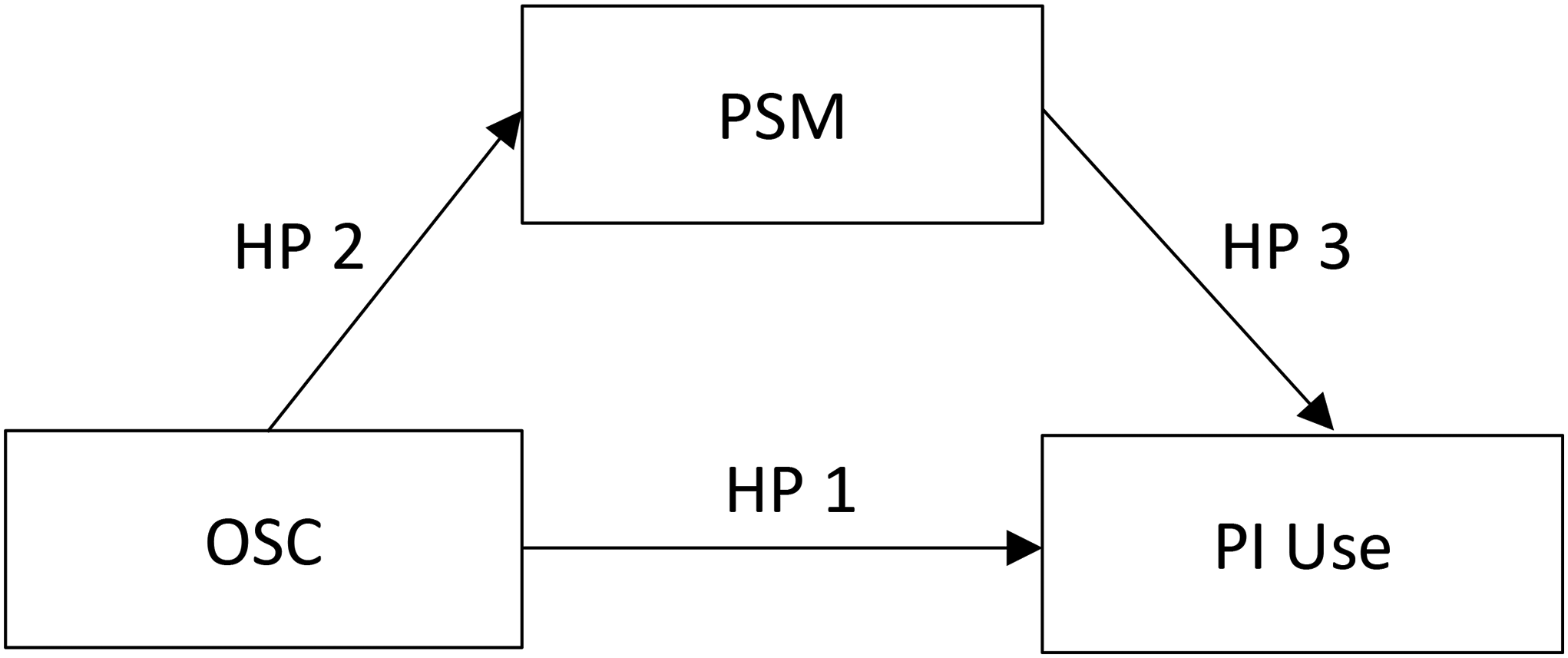
Theoretical Model.
Hp 3: Managers’ PSM will be positively related to performance information use.
Data and Methods
Unit of Analysis
Managers, middle managers and any other figures with a supervisory role in the State of Florida County Governments have been used to test the proposed hypotheses. There are 67 counties in the State of Florida. Although the State of Florida is considered a relevant study setting for the topic of this article, it is also has been chosen for these other reasons (as in Tantardini 2016). First, the State of Florida is the third 1 most populous state in the Union. It has also doubled its population in the past 30 years, thus forcing local public administrations to deliver increasing levels of public services (Kolo and Watson 1992). Second, the State of Florida has also been chosen for political reasons (Griset 2002) due to the variation in voting preferences between metropolitan and rural areas and between the northern and the southern parts of the State. This allows to control for ideological and political stances, and it is a fair representation of the political equilibrium in other States. Third, by restricting the analysis to Florida counties, other potential influences on performance information use—such as the legal framework and state level obligations—are held constant (as in Andrews et al. 2009). Fourth, the State of Florida has a relatively small number, compared to other states, of overlapping special districts that provide services also supplied by counties and/or municipalities (Wu and Hendricks 2009).
County governments have also been chosen for several reasons (as in Tantardini 2016). First, counties have powers and duties 2 related to various public issues and are also responsible for the delivery of public services to their citizens, thus making them worthy of examination. Second, performance management systems among Florida counties are very diverse due to the fact that the Florida Statutes do not provide performance management State-wide requirements that every county has to follow. The average population of Florida counties in 2021 is 325,091 inhabitants. Miami-Dade County is the most populous county with 2,662,777 inhabitants, while Liberty County is the least populous with 7,900 inhabitants. In terms of size, the average land area is 805 square miles. Palm Beach County is the largest county in the State with a land area of 2,034 square miles, while Union County is the smallest with a land area of 240 square miles.
Data Collection
A multiple-informant survey (Enticott, Boyne and Walker 2009) has been used to collect the data, as described in Tantardini (2016). This approach was used to capture information on individuals within the same organization and especially individuals who belong to different hierarchical levels. Payne and Mansfield (1973) note that only using one score per organization to measure an organizational level variable “may be misleading” (p. 519) because people higher in the organizational hierarchy tend to perceive organizational climate differently from persons in lower positions. Three echelons have been surveyed in this study: department heads, middle managers, and any other figure with a supervisory role. These three echelons have been chosen because all of them, to different extents, can make decisions in their departments and may or may not inform their decision-making process with performance information.
The survey for the present study was completed online. Four follow-ups were necessary to achieve a departmental response rate between 30 and 35 percent. Eight departments from each of the 67 counties were surveyed for a total of 513. Following Lowi (1964), the eight departments were chosen according to his classic typology of public policy: regulation, distribution, redistribution, and constituent, which could also be used to control for variation across departments.
The online survey was sent via email to each of 513 department heads asking them to complete two tasks: first, to complete the survey and, second, to forward the survey link to middle managers and any other figure with a supervisor role in their department so that they could complete the survey as well. Among respondents, department heads accounted for 28.29 percent of respondents; middle managers for 17.59 percent of respondents; and supervisors for 10.24 percent of respondents, which are 27 out of 449 respondents; 43.88 percent of respondents did not indicate their status.
In terms of county response rate, 57 out of the 67 Florida counties responded to the survey. The sample is representative of the population of counties. According to the 2010 Census, 45 percent of Florida Counties are rural and the remaining urban. In the sample, 42 percent percent of counties are rural and the remaining urban. Most of them are small counties in terms of population and located either in the Florida Panhandle or in Northern Florida. In terms of individual level response rate, this information is impossible to calculate. As in Andrews (2011), because of the way the survey was distributed to middle managers and supervisors, it is only known how many department heads received the survey (n = 513). However, it is not possible to ascertain how many middle managers and other individuals with a supervisory role received the survey being forwarded by their department head. Due to missing values in the responses received, the final observation count used for the analysis is 228.
Dependent Variables: Routine Performance Information Use
To measure routine performance information use, the literature suggests several methods (e.g., Moynihan and Lavertu 2012; Moynihan and Ingraham 2004; and Moynihan and Pandey 2010). In this study, as reported in Table 1, and following the contribution of Moynihan, Pandey and Wright (2012) and as in Tantardini (2016), respondents were asked the extent to which routine performance information is used for a broad and common set of activities that county public managers are charged with executing. As shown in Table 1, the eight items used in the survey to measure the use of routine performance information loads on two factors that are labeled in the analysis, following Moynihan (2009), as Purposeful Performance Information (PI) Use (Factor 1) and Political Performance Information (PI) Use (Factor 2). Both eigenvalues are greater than 1. The eigenvalue of Factor 1 is 4.343, the eigenvalue of Factor 2 is 1.013. Furthermore, the Cronbach’s alpha is 81.4 percent for Factor 1 and 80.6 percent for Factor 2.
Performance Information Use Factor Analysis.
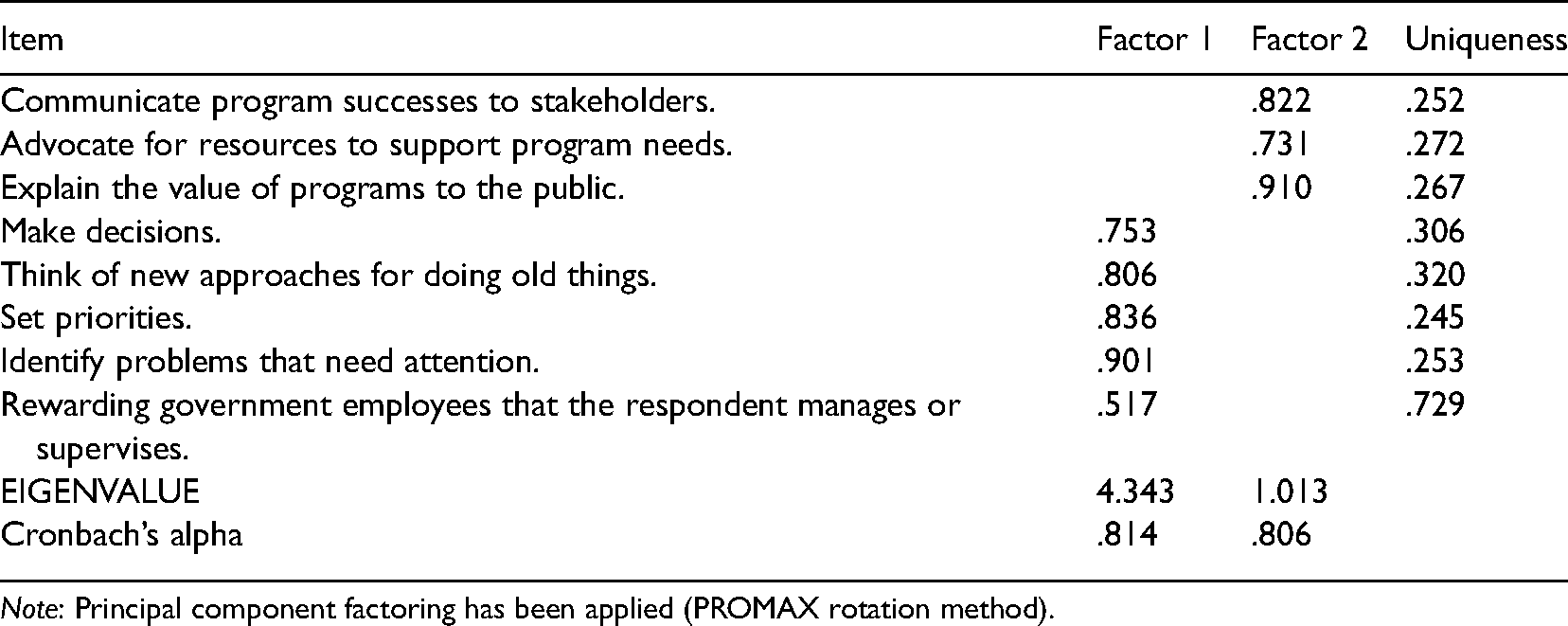
Note: Principal component factoring has been applied (PROMAX rotation method).
Independent Variable: Organizational Social Capital
A comprehensive index to measure organizational social capital, so far, does not exist. However, organizational social capital and its three components have been measured using proxies in studies by Andrews (2010, 2011) and Leana and Pil (2006). In this study, organizational social capital is measured as in Andrews (2011) and Tantardini (2016).
As shown in Table 2, the six items used in the survey to measure organizational social capital load on two different factors: Factor 1, which is labeled in the analysis as the Trust and Value component or Relational-Cognitive Social Capital (RCSC); and Factor 2, which is labeled in the analysis as the Network component or Structural Social Capital (SSC). The Eigenvalue of Factor 1 is 2.665. The Eigenvalue of Factor 2 is 1.224. Furthermore, the Cronbach’s alpha of the first factor is 75.6 percent. The Cronbach’s alpha of the second factor is 69 percent, which is slightly lower than the threshold for a good reliable scale of 70 percent but can still be considered acceptable. Moreover, both Cronbach’s alphas are higher than the Cronbach’s alpha of the Organizational Social Capital Index in Andrews (2010), which was 61 percent and Andrews (2011), which was 64.3 percent.
Organizational Social Capital Factor Analysis.
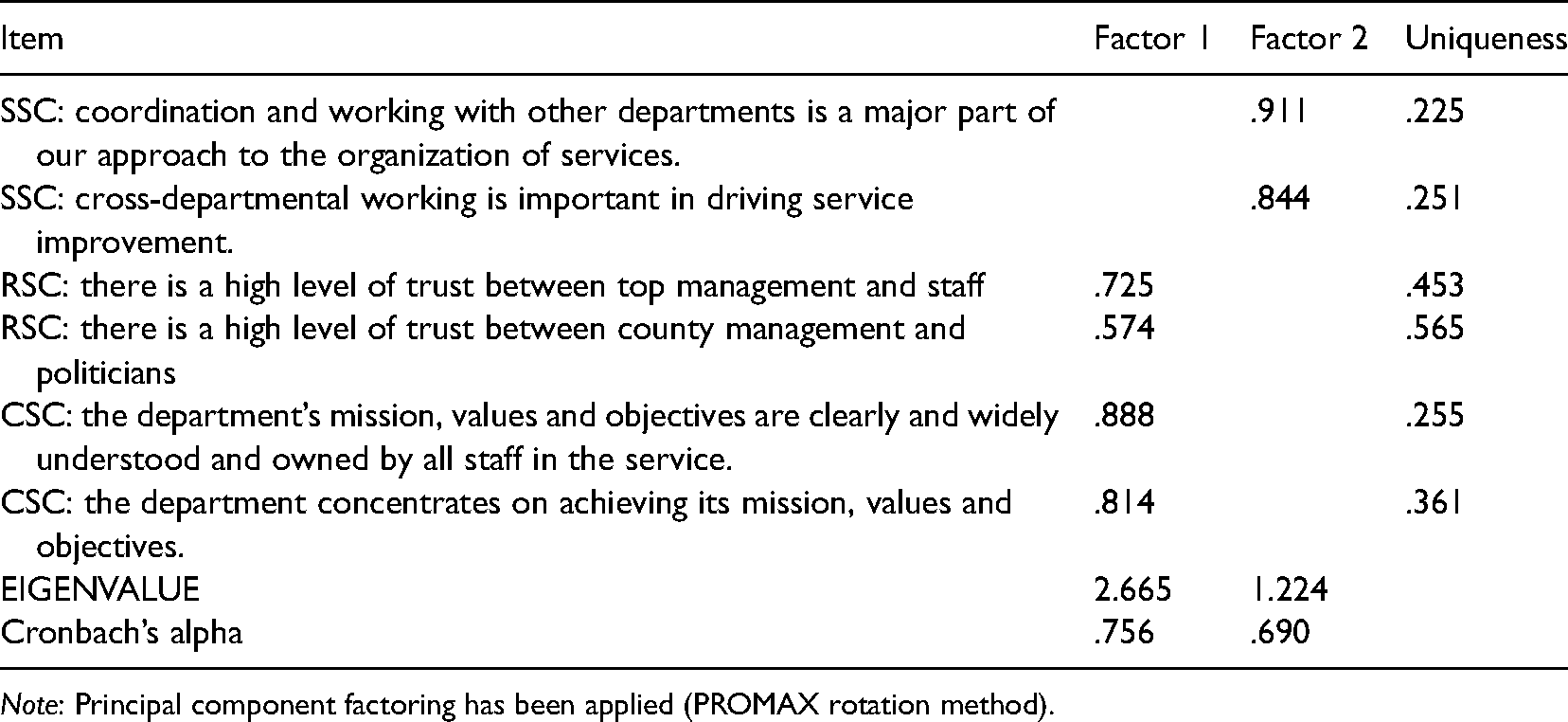
Note: Principal component factoring has been applied (PROMAX rotation method).
Mediating Variable: Public Service Motivation
To measure PSM, the 5-item scale, which was first included in the 1996 Merit Systems Protection Board (MSPB) survey of federal employees and empirically justified by Wright et al. (2013), was used. This scale has been used for the following reasons. First, while this scale allows to measure PSM, it does so by keeping the survey instrument at a reasonable length. This decreases the risk of participants dropouts (Hoerger 2010). Second, this scale has been widely used in the literature. Examples of studies that employed this scale to measure PSM are the following: (Alonso and Lewis 2001; Brewer and Selden 2000; Kim 2005; Moynihan and Pandey 2010; Pandey et al. 2008). Third, Wright et al. (2013) provide strong evidence that this scale is equivalent to other scale used to measure PSM or pro-social behavior (see for example the one proposed by Grant 2008a). The Cronbach’s alpha of this variable is 77.88 percent.
Control Variables
Finally, to increase the internal validity of the model, it was necessary to control for other potential factors that could affect a priori routine performance information use (as in Tantardini 2016). In particular, the following control variables were included in the analysis: citizens’ demand of performance information (Moynihan and Ingraham 2004) and leadership commitment (Dull 2009). Another control variable used in the analysis is resources. This variable was measured using the following question: “In my department, there are sufficient resources (e.g., people, materials, budget) to get the job done.” Another control variable used in the analysis is rewards (Wright 2007). This variable has been constructed from these two questions: “Working hard was recognized” and “Hard work was adequately rewarded”. The Cronbach’s alpha of this variable is 73.25 percent. Other individual level control variables have been used in the analysis, including supervisory status (department head, middle manager, supervisor, other); length of stay in the department; and age of the responder.
Results
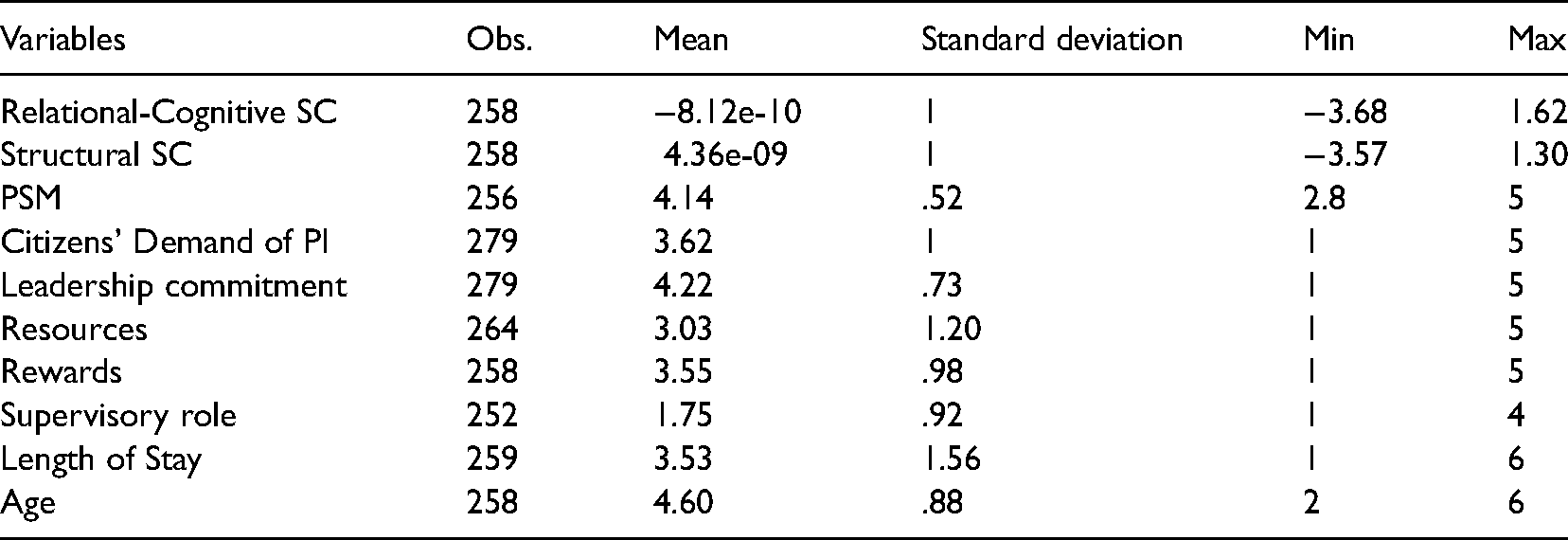
Descriptive statistics of the main variables of interest in the analysis are reported in Table 3.
Descriptive statistics.
Data have been analyzed using Stata 17 and the mediating effect of PSM has been estimated with the medeff command, which is a function for estimating mediation effects with robust standard errors clustered at the county level. The rationale for using this approach lies in the work of Hicks and Tingley (2011), who describe the benefits of using the Stata medeff mediation package versus “[e]arlier approaches to mediation analysis [that] largely relied on a form of structural equation modeling” (p. 605). According to Hicks and Tingley (2011, 605) “these earlier methods were not derived from a formal framework for causal inference and did not permit sensitivity analyzes with respect to key identification assumptions”. All of these limitations are addressed in the Stata medeff mediation package (Hicks and Tingley 2011). Thence, its use for the scope of this analysis.
The result of Harman’s single factor test (1960) show that common source bias may not be considered a problem in the data. This test uses exploratory factor analysis where all variables used in the analysis are loaded onto a single factor. If this factor explains more than 50 percent of the variance, then common source bias may be present. In this analysis, the first factor explains only 27.38 percent of the total variance in the data and it is way below the aforementioned threshold of 50 percent.
Given the distinction between the purposeful and the political use of performance information, Table 4 presents the estimation results of the four regression models tested. In general, the models fit the data adequately well, with R2 values between .1 and .12. The goodness of fit of the models is comparable to the studies of Moynihan and Pandey (2010) (Pseudo R2 = .116), and Moynihan and Lavertu (2012) (Pseudo R2 = .1). However, it is lower than in the study by Moynihan and Ingraham (2004) where R2 were between .4 and .5. Four different models were tested.
Estimation results.
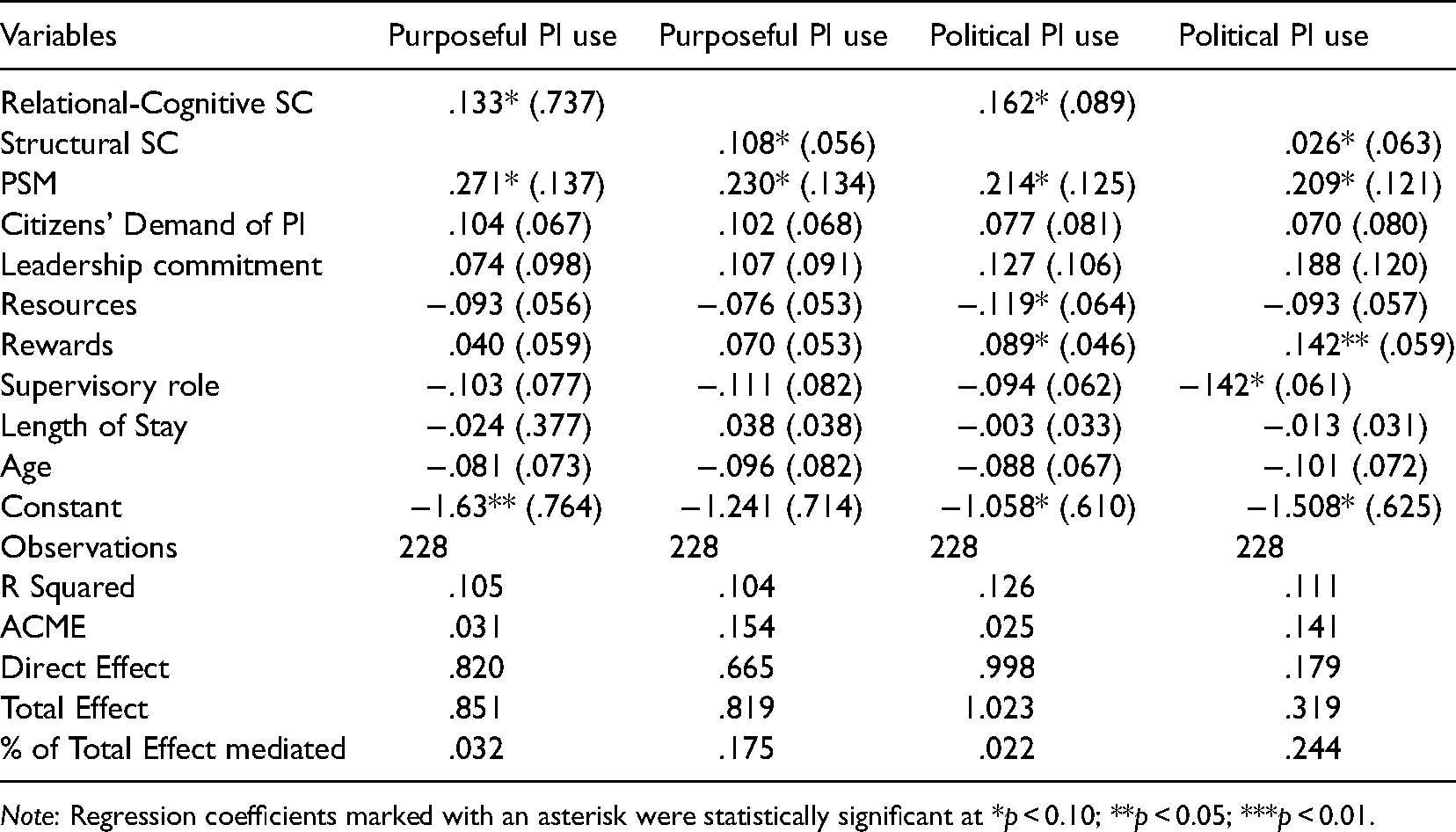
Note: Regression coefficients marked with an asterisk were statistically significant at *p < 0.10; **p < 0.05; ***p < 0.01.
In Model 1 and Model 2, the results support the hypothesis (Hp 1) that organizational social capital is positively related with PI use—Purposeful PI Use. The coefficient of the relational-cognitive dimension of social capital (.133) and the coefficient of the structural dimension of social capital (.108) exhibit expected signs and are statistically significant (p < 0.1). This means that, managers in departments where organizational social capital is higher, purposefully use performance information at a higher level, ceteris paribus. The estimates of the direct effect of RCSC and SSC on Purposeful PI Use are equal respectively to 0.820 and 0.665.
The coefficients of PSM (.271 in Model 1 and .230 in Model 2) are also statistically significant (p < 0.1), which means that PSM does indeed mediate the effect of organizational social capital on performance information use (Purposeful PI use). The average effect (ACME) of the treatment variable on the outcome that operates through the mediator is 0.031 in Model 1 and 0.154 in Model 2. The proportion of the total effect mediated by PSM is .32 in Model 1 and .175 in Model 2. Therefore the results of the analysis show support also for hypotheses 2 and 3. No control variable is statistically significant in Model 1 and Model 2.
In Model 3 and Model 4, the regression results support the hypothesis (Hp 1) that organizational social capital is positively related with PI use—Political PI Use. The coefficient of the relational-cognitive dimension of social capital (.162) and the coefficient of the structural dimension of social capital (.026) exhibit expected signs and are statistically significant (p < 0.1). This means that, managers in departments where organizational social capital is higher, politically use performance information at a higher level, ceteris paribus. The estimates of the direct effect of RCSC and SSC on Political PI Use are equal respectively to 0.998 and 0.179.
The coefficients of PSM (.214 in Model 3 and .209 in Model 4) are also statistically significant (p < 0.1), which means that PSM does indeed mediate the effect of organizational social capital on performance information use (Political PI use). ACME of the treatment variable on the outcome that operates through the mediator is 0.025 in Model 4 and 0.141 in Model 4. The total effect is 1.023 in Model 3 and .319 in Model 4, the proportion of the total effect mediated by PSM is .022 in Model 3 and .244 in Model 4. Therefore the results of the analysis show support also for Hypothesis 2 and 3. In Model 3 two control variables are also statistically significant (p < 0.1): Resources and Rewards. The coefficient of Resources exhibits a negative sign. Managers in departments that tend to have sufficient resources (e.g., people, materials, budget) to complete projects, also tend to have lower usage of routine performance information (Political PI Use) in their decision-making process, ceteris paribus. The coefficient of Rewards exhibits a positive sign. Managers in departments that tend to reward people, also tend to have a higher usage of routine performance information (Political PI Use) in their decision-making process, ceteris paribus. This variable is also statistically significant in Model 4. Supervisory role is also statistically significant in Model 4, and it exhibits a negative sign. Managers in lower hierarchical positions tend to use more performance information for political use.
Discussion
The Direct Effect
Although modest, both SSC and RCS exhibit positive and statistically significant signs and are in line with the results presented and discussed in Tantardini (2016). Organizational social capital is positively related to PI use (Hypothesis 1). Collaboration, coordination, and interaction between members of an organization not only make information available (see, for example, Granovetter 1973; Jacobs 1965; Nahapiet and Goshal 1998), but once information is available, managerial use of the available information will occur. Similarly, when sufficient levels of trust exhist, trust first enables a series of positive organizational outcomes, including greater working effectiveness, goal orientation (Putnam 1993), and goal achievement (Coleman 1988). Secondly, trust also facilitates information sharing, as for the structural dimension of social capital, and especially of sensitive information and even negative or uncomfortable information to share (de Bunt, Wittek, and de Klepper 2005). Finally, trust increases the reliability—in the eyes of final users—of performance information that is collected, processed, and submitted by employees to their managers (Dirks and Ferrin 2001; Nicolaou et al. 2013); thus, the information is more likely to be used in the decision-making process. Therefore, trust enables organizational and individual mechanisms that allow managers to use of performance information. Managers that share organizational goals and strive to achieve these goals in a collective way (Shteynberg and Galinsky 2011), use routine performance information in decision-making processes because they want to know if the organization can achieve the defined and shared goals (Barzelay and Campbell 2003; Olsen and Eadie 1982); routine performance information can also be used to quantify employees’ individual contributions to the achievement of overall organizational goals (Fishbach et al. 2011).
As in Tantardini (2016), an interesting result is that managers in departments that tend to have sufficient resources (e.g., people, materials, budget) to complete projects also tend to have lower usage of routine performance information (Political PI use) in their decision-making process. This result is interesting because the opposite would be expected; that is, managers in departments that tend to have sufficient resources to complete projects also tend to have higher political usage of routine performance information “to define their efforts and success” (Moynihan 2009, 593) and in order to advocate even more resources for their departments.
In addition to that, managers and any other figures with a supervisory role tend to use routine performance information for a political use in presence of a reward system. As previously explained, a possible explanation for this result lies in the definition of political PI use (Moynihan 2009, 593). Managers and any other figures with a supervisory role use performance information “to define their efforts and success”, and they are more likely to do so if rewards (monetary and non-monetary) will be available to them.
Finally, managers in lower hierarchical positions tend to use more performance information for political use. As for the other two control variables a possible explanation lies in the fact that they would need performance information “to define their efforts and success” (Moynihan 2009, 593) in the eyes of their supervisors.
The Indirect Effects
Although modest, the results show evidence that PSM mediates the effect of organizational social capital on both types of performance information uses (Hypothesis 2 and 3). This means that not only organizational social capital is an important driver of performance information use but also that this resource is beneficial for managers and employees and that is able to sparks attitudes and behaviors that positively contribute to the organization itself (PSM). Therefore, this study is important because it shows that an organizational level resource like organizational social capital is able to influence mangers’ PSM, which, in turn is associated with a positive outcome like the use of performance information in the decision-making process. Specifically this study show that all three dimensions of organizational social capital may foster the PSM level of public sectors managers. In regard to the structural dimension of organizational social capital, this study is in line with a study by Choi (2016) that showed that PSM is influenced by “the extent of the social relationships among group members and their positions within a network” (p. 900). This study is also in line with several studies that have shown how trust (relational dimension of organization social capital) is positively associated with PSM (see for example, Chen et al. 2014). Following Chen et al. (2014) public managers and civil servants “can learn good will from co-workers.” (p. 957). Public managers and civil servants’ “trust in colleagues’ benevolence, sincerity, and professional ethics should constitute a pivotal part of their value system, foster their willingness to repay, and nourish their belief in altruism […], eventually leading to a higher level of PSM” (p. 957). For the cognitive dimension of organizational social capital, this study is also in line with a previous study by Grant (2008b) that has shown that “the motivation of public service employees can be enhanced by connecting them to their prosocial impact” (p. 48). Having shared goals, achieving these goals collectively, and knowing the impact that has been made (cognitive dimension of organizational social capital) may well enhance the motivation of public sector managers and employees.
The results presented in this article are also in line with a previous study by Mostafa et al. (2015) that shows that investments on high-performance human resource practices (HPHRPs) influences employees’ level of PSM and in turn this has desirable organizational and employee level outcomes. This study also adds also to the literature of “institutional shapers of individual beliefs and behavior” (Moynihan and Pandey 2007, 41). In addition to HPHRPs (Mostafa et al. 2015), organizational social capital can be considered another organizational resource able to shape individual beliefs and behaviors, and, as shown in this study, managers’ PSM.
Conclusion
Much of the previous literature on performance information use has mainly focused on managerial drivers of performance information use and not enough research focused on sociological factors. To address this gap in the literature, this article responds to a call for empirical evidence that organizational social capital could be considered a potential driver of performance information use and that this relationship is mediated by PSM. This study tested empirically that organizational social capital can foster two uses of performance information use—purposeful and political—through the mediating role of PSM. A multiple informant survey was submitted to department heads, middle managers, and other individuals with a supervisory role from eight departments in all the 67 Florida counties.
Although the results of the analysis showed evidence supporting the hypothesized effects, this study is not without limitations. First, the inability to determine the individual level response rate posits some problems in terms of nonresponse bias. Future studies utilizing multiple-informant surveys should consider specifying the number of lower-level informants (e.g., middle managers and supervisors) the survey should be sent by the initial informant (department head) so that it will be possible to calculate the individual response rate. Second, although Meier and O’Toole (2013) show that the common source bias potential of performance information use items is lower than that of other items (e.g., actual performance) and although the first factor in the Harman’s single-factor test (Podsakoff and Organ 1986) account for about 27.38 percent of the total variance in the data, future studies should employ the unmeasured latent factor and the non-ideal marker (Podsakoff et al. 2012) to test for potential common source bias. Third, the results of RSC and SSC on routine performance information use are modest. Although this is not unusual with social variables (Berman et al. 2013), future analysis could be complemented by a small sample of interviews or focus groups. This could help making the conclusions stronger and add confidence to the overall research design and to the interpretation of the results. Finally, similar studies could benefit from including additional organizational- and individual-level variables in the analysis, such as political support, which has a positive influence on performance information use (Yang and Hsieh 2007).
In terms of implication for practitioner and policy recommendation, this study adds other potential drivers of performance information use—organizational social capital and PSM—to the ample existing literature. Therefore, it is important for managers in local public organizations to capitalize on this important organizational resource and especially to foster organizational social capital in their organizations. As presented in Tantardini (2016), the question on how to foster organizational social capital is not easy to answer. Authors like Cohen and Prusak (2001) and by Ellinger et al. (2011) have tried to provide theoretical and practical wisdom on how to foster organizational social capital. In particular, Cohen and Prusak (2001) discussed the importance for organizations of having activities that create a sense of group identity among their members (structural dimension of organizational social capital), thus helping to create new connections and to expand the linkages among the members of the organization. Cohen and Prusak (2001) also suggest fostering cooperation in organizations by promoting collaboration instead of competition among their members (structural and cognitive dimension of social capital). Finally, in order to foster trust (relational component of organization social capital), organizations should foster “behavioral norms and values that give employees reasons to have confidence in the organization, instead of giving them reasons to respond to the organization and its representatives defensively” (Ellinger et al. 2010, 573).
In addition to that, Tantardini (2016) provides specific examples on how to foster this important resource in local public organizations. As shown in this study, investments in organizational social capital not only create direct beneficial outcomes for local government managers and employees, but also indirect beneficial outcomes—namely on PSM—which in turn may create additional beneficial outcomes both at the individual level—managers and employee may be more motivated in their daily jobs—but also organizational ones—the use of performance information may increase the overall productivity and the capacity of local governments to achieve organizational goals and fulfill their mission of service to their citizens.
Footnotes
Acknowledgements
I thank Drs. Alexander Kroll, Emel Ganapati, and Allan Rosenbaum for their insight, guidance, and support throughout the realization of this research project.
Declaration of Conflicting Interests
The author(s) declared no potential conflicts of interest with respect to the research, authorship, and/or publication of this article.
Funding
The author(s) disclosed receipt of the following financial support for the research, authorship, and/or publication of this article: This work was supported by the University Graduate School, Florida International University (grant number DYF).
