




Abstract
Knowledge has replaced labor as the key factor for productivity growth in innovation discourse. The Knowledge Spillover Theory of Entrepreneurship (KSTE) provides the theoretical foundation to bridge the gap between knowledge and productivity growth. The way regional knowledge actually contributes to productivity growth requires a theoretical explanation because knowledge capability is an indirect and intangible input for regional productivity growth. Previous research has shown that entrepreneurship alone is insufficient to drive productivity improvements. We examine how knowledge capabilities lead to meaningful growth outcomes of new firms in a region. This study examines the determinants of productivity growth by analyzing the factors of entrepreneurship and knowledge capabilities at the regional level, especially considering the moderating effect of entrepreneurship between knowledge and regional growth; by comparing different dimensions of local knowledge capabilities; and by aggregating the contribution of knowledge capabilities and entrepreneurship to productivity growth at the regional level. The empirical analysis is performed on Italian NUTS-3 regions by utilizing an integrated data set combining patent data from the EPO PATSTAT database, and regional data from Eurostat regional statistics. This study makes two main contributions to the KSTE literature by linking knowledge, entrepreneurship, and regional growth and by providing empirical results on different aspects of regional knowledge capability. Our findings identify which types of local knowledge capabilities are more important and how related innovative activity interacts with entrepreneurial activity, elucidating the mechanisms by which knowledge affects labor productivity through entrepreneurship.
Keywords
Introduction
Exploring factors of productivity is one of the most relevant topics in economic research. In earlier studies, the role of factor inputs, that is, capital and labor, was the primary focus. Kaldor (1961) first recognized the positive relationship between growth and labor productivity. As an input for productivity, labor induces productivity growth through increased quantity as well as quality. Increasing labor productivity is a way to increase wages and to regain job loss due to offshoring (Atkinson 2019) and as an outcome can lead to an increased labor share (Grossman et al. 2018). Learning or absorbing knowledge improves labor productivity. Early studies assume that knowledge is an external variable, reflective of hiring, human resource development, and capital investment decisions (Koch and Mcgrath 1996). Although many studies frame productivity as a shift between labor and capital, recent studies have shown that whether labor and capital are zero-sum factors depends on knowledge frameworks (Ballestar et al. 2020). In the new era of the knowledge economy, the position of labor has been replaced by knowledge as the key factor of productivity growth. Knowledge is now an essential asset to achieve a competitive advantage for economic agents including individuals, firms, regions, and countries. Yet, beyond human resource factors, recent studies suggest that knowledge-intensive innovation activities are also critical to increasing economic performance through improved labor productivity 1 (Malerba and McKelvey 2020; Szerb et al. 2019).
Concerning regional economic development, the knowledge capabilities of a region are highlighted because they affect the spatial distribution of knowledge development possibilities, qualities, utilization, and dissemination activities. Greater regional knowledge capabilities indicate that a region has a greater opportunity of producing new firms and valuable products and processes with its advantage in accessing and absorbing the required base knowledge (Lau and Lo 2015). In this regard, theory and policies promote various knowledge-intensive activities, not only to encourage R&D spillovers and venture creation, but also to increase specialization in certain industrial activities in the region (Potter and Watts 2014). Government policy, therefore, should focus on regional technology-based economic policies rather than solely focusing on investment activities and business cycles (Tassey 2020).
Past studies show that strong regional knowledge capabilities improve local conditions for achieving innovation and new employment, but then this relationship bluntly assumes that this happens through improved productivity. The way regional knowledge contributes to productivity growth requires a theoretical and empirical explanation because knowledge capability is an indirect and intangible input for regional productivity growth. In this regard, the Knowledge Spillover Theory of Entrepreneurship (KSTE) provides the platform to bridge the gap between knowledge and productivity growth (Braunerhjelm et al. 2010). The concept of KSTE starts with the recognition of the importance of new and small firms—or entrepreneurs—to realize the value of knowledge. The greater the amount of knowledge available in a region, the more extensive the opportunities are expected for entrepreneurs to start new businesses; the active engagement of entrepreneurs contributes to the overall economy by actualizing the given opportunities from local knowledge (Audretsch and Keilbach 2008).
Entrepreneurship alone is insufficient to drive labor productivity improvements. Some past studies find that entrepreneurship can have varying results including negative economic outcomes on a region pending on the knowledge transmission mechanism present (Szerb et al. 2019). In this regard, Schumpeterian innovation is an important factor for positive effects from entrepreneurship (Szerb et al., 2019; Wong et al., 2005). Malerba and McKelvey (2020) provide an evolutionary economic theoretical framework to understand how entrepreneurship and knowledge converge to improve selection odds and to improve economic performance. Yet, they also suggest that empirical research is still necessary to disentangle the co-evolutionary processes involved in knowledge-intensive innovative entrepreneurship that enables firms to survive the selection process of market dynamics (c.f. Kogler 2016). In an empirical study, Szerb et al. (2019) consider Schumpeterian entrepreneurship or innovative entrepreneurship as indicated by the newness of products, technologies, or industries that entrepreneurs engage with.
These previous studies also consider external factors to entrepreneurship. Yet, entrepreneurial activities seem to have the greatest impact when they take advantage of knowledge in technology, that is, product/process innovation, or the market, that is, unmet demand (Szerb et al. 2019). This study (Szerb et al., 2019) considers internal knowledge-intensive activities that in turn determine entrepreneurial performance. In the present investigation, we suggest that entrepreneurship is driven by knowledge-intensive innovation processes that increase the competitiveness by leveraging new technologies or non-technological advantages within the economy.
Based on the theoretical background of KSTE, the relationship between knowledge, entrepreneurship, and productivity has been explored empirically in previous studies (Block, Thurik, and Zhou 2013; Audretsch and Keilbach 2008; Braunerhjelm et al. 2010; Erken, Donselaar, and Thurik 2018; Mueller 2007; Iammarino and Jona-Lasinio 2015). Between knowledge and productivity, entrepreneurship serves as a conduit enabling the potential value of knowledge that entrepreneurs hold. Local knowledge induces more entrepreneurial activities (Colombelli 2016) and greater entrepreneurship in a region promotes regional productivity (Erken, Donselaar, and Thurik 2018; Mueller 2007). Quality entrepreneurship—or Schumpeterian entrepreneurship—is necessary for better regional performance (Szerb et al. 2019). Thus, the present study aims to understand the link between knowledge, entrepreneurship, and productivity, and more importantly, the moderating role of entrepreneurship on the impact of regional knowledge capabilities on labor productivity growth.
Following on from that, the study examines the determinants of productivity growth in the context of three distinctive approaches. First, we review the factors of productivity growth focusing on the entrepreneurship and knowledge capabilities at the regional level. The available relevant literature on factors of productivity growth mostly examines these factors separately rather than considering them jointly while also ignoring their interaction. Moreover, studies on entrepreneurship find that entrepreneurship is not necessarily inherently good for economic growth and that there is a need for a greater understanding of the innovative aspects of entrepreneurship (Szerb et al. 2019). Additionally, empirical studies that disentangle knowledge-intensive innovative entrepreneurship are still required (Malerba and McKelvey 2020). Thus, Knowledge capabilities are expected to increase labor productivity, but the mechanisms are not specified. To fill this missing gap, we explore not only the individual effects of knowledge capabilities and entrepreneurship but also the moderating effect of entrepreneurship between knowledge and regional growth. Second, different dimensions of local knowledge capabilities (knowledge creation, knowledge adoption, scientific knowledge assimilation, knowledge quality, and knowledge diversity) are explored. Using knowledge measures obtained from patent documents, various aspects of knowledge capabilities are discussed in terms of the driving factors for productivity growth. Third, the contribution of knowledge capabilities and entrepreneurship to productivity growth is aggregated at the regional level. Considering the heterogeneity in knowledge-intensive activities, regional aggregation allows us to differentiate the effects of local knowledge capabilities and entrepreneurship.
To address these research goals, we focus on the Italian NUTS-3 regions between 2008 and 2017. Italy provides a perfect case due to its strong regional characteristics. First, each region in Italy has accumulated unique knowledge capabilities over a long period of time. Thus, the differences in knowledge capabilities emerge at the regional level (Colombelli 2016). Second, since the industries in Italy tend to be mature compared to some other advanced and/or developing countries, entrepreneurship plays a more important role in bringing vitality to the economy (Colombelli and Quatraro 2018). Finally, the regional differences in terms of economic activities and performance between the northern and central regions—that are wealthier and have greater knowledge capabilities—and the southern regions allow us to capture how our argument holds. The European Patent Office (EPO) PATSTAT database is used to measure the diverse aspects of knowledge capabilities at the regional level. Regional-level economic indicators and entrepreneurial variables are obtained from the Eurostat database. In sum, we build a unique balanced panel of 107 Italian NUTS-3 regions.
This study makes two main contributions. First, we provide both a theoretical and empirical contribution to the KSTE by linking knowledge, entrepreneurship, and regional growth of labor productivity. To the best of our knowledge, the relationship between these three factors, and more importantly, the interaction effects of knowledge and entrepreneurship on regional labor productivity growth, has yet to be investigated. As we hypothesize of the importance and proximity of both factors, this not only could potentially explain how entrepreneurial activity moderates the effect between knowledge and productivity growth, but also could provide useful implications on how policy should intervene at the intersection of knowledge and entrepreneurship. Second, our results contribute to the literature by providing findings with different aspects of regional knowledge capabilities. Especially in regional studies, only limited facets of local knowledge, such as knowledge size, or diversity, have been considered so far. In this sense, our findings address which aspects of local knowledge are more important and how each knowledge aspect interacts with entrepreneurial activity.
The following section covers the theoretical background of the main argument. The third section outlines the data and methodology utilized for the empirical analysis in detail. The fourth and fifth sections highlight the empirical findings and provide concluding remarks.
Regional Knowledge Capabilities and Associated Productivity Growth
Factors of Regional Productivity Growth
The agglomeration of resources provides regional advantage by creating externalities that accrue through skilled labor, local supplier networks, and knowledge spillovers (Potter and Watts 2014; Marshall 1890). The relevant literature finds that benefits of regional accumulation depend on various characteristics including the level of agglomeration, types of capabilities, learning capabilities, and connections within the regional innovation systems (Cooke, Uranga, and Etxebarria 1997; Asheim and Gertler 2006). These knowledge capabilities depend on tacit knowledge rather than knowledge embedded in capital or other codified sources. Spatial proximity is important for the development of a knowledge base within a regional innovation system, especially with respect to industrial knowledge capabilities (Asheim and Gertler 2006). Thus, the region is usually seen as an important arena for knowledge exchange (Malmberg, 1996). The regional context is an important facet of knowledge exchange that leads to innovation-driven productivity growth (Lau and Lo 2015). Moreover, the capabilities of firms within a region, and their ability to benefit from agglomeration economies, depend on the collective capabilities to generate, diffuse, and accumulate economically valuable knowledge (Duranton and Puga 2004). The knowledge capabilities that reside within a region determine whether or not innovations occur, that is, whether knowledge is transformed into novel products and processes that generate economic rents and growth. Firms that manage to leverage local tacit knowledge are expected to generate a positive impact on labor productivity rather than having to rely on changes in physical capital at least in the short term.
Endogenous growth theory suggests that changes in knowledge-driven productivity account for economic growth more than traditional factor accumulation (Aghion and Howitt 1992; Easterly and Levine 2001; Lucas 1988; Romer 1986). Learning and absorptive capabilities are the main mechanism through which firms, countries, and regions manage to accumulate knowledge for innovation (Cohen and Levinthal 1990; Zahra and George 2002; Cohen and Levinthal 1989). These capabilities are referred to as knowledge capabilities here because they are the capabilities of firms in a region to acquire, assimilate, transform, and exploit knowledge (Cohen and Levinthal 1990; Zahra and George 2002; Cohen and Levinthal 1989). Moreover, the accumulation of knowledge is necessary to develop technological and production capabilities that change the level of output (Bell and Pavitt 1993). Measuring knowledge capabilities, however, is difficult because of the intangible nature of knowledge including the economic spillovers caused by it. Recent studies have turned toward measuring the effects of intangible assets on productivity (Autant-Bernard, Guironnet, and Massard 2011; Dettori, Marrocu, and Paci 2012; Iammarino and Jona-Lasinio 2015; Marrocu, Paci, and Pontis 2012). Similar to knowledge, entrepreneurship is also an intangible asset that poses difficulties in terms of measuring it.
Teece (1998) emphasizes the importance of the complementarity of intangible assets—knowledge bases and competencies that firms and countries to gain competitive advantage. Firms that are strategically capable of recognizing new products and associated market fit are better able to take advantage of entrepreneurial conditions (Ireland, Hitt, and Sirmon 2003). The ability to identify new opportunities can be measured through new business ventures, that is, entrepreneurship. Duranton and Puga (2004) refer to this idea as “matching” capabilities that enable more efficient uses of inputs, improved labor productivity, and/or an increase in economies of scale derived from urban infrastructure. Entrepreneurial capabilities are one of the important competencies not only for firms but also for regions, to exploit the knowledge absorptive capabilities, especially insofar as these capabilities and competencies are complementarity to each other (Teece 1998).
Considering both knowledge and entrepreneurship, KSTE provides the theoretical foundation on explaining how entrepreneurship fills the missing gap between knowledge and productivity growth (Braunerhjelm et al. 2010). The idea of KSTE starts from the recognition of the importance of new and small firms, and here we call them entrepreneurs, on realizing the value of knowledge. The successful development of new knowledge does not necessarily mean that new knowledge leads to successful commercialization, requiring a “knowledge filter” (Audretsch and Keilbach 2007; Acs, Audretsch, and Feldman 1994; Caiazza, Richardson, and Audretsch 2015). Likewise, entrepreneurship is an insufficient determination of success (Szerb et al. 2019). Successful entrepreneurship requires leveraging knowledge to compete in an evolutionary selection process (Malerba and McKelvey 2020), even within a region that provides different capabilities to access local knowledge (Caiazza, Belitski, and Audretsch 2019). While entrepreneurs improve productivity by identifying favorable opportunities, KSTE focuses on the role of entrepreneurship as a mechanism that turns knowledge spillovers into productivity growth.
A region provides opportunities for entrepreneurs to start new businesses by potentially providing greater amounts of knowledge and by encouraging active engagement between actors. These regional attributes enable entrepreneurs to contribute to the overall economy by actualizing the market opportunities from local knowledge (Audretsch and Keilbach 2008). Block et al. (2013) showed that a high rate of entrepreneurship facilitates the effect of knowledge on innovation outcomes. Iammarino and Jona-Lasinio (2015) found that the positive relationship between ICT production and productivity growth in Italian regions is moderated by regional capabilities to ensure widespread knowledge diffusion. With the participation of entrepreneurs, new regional knowledge can be implemented through business activity, leading to greater overall regional productivity (Iammarino and Jona-Lasinio 2015). This indicates that entrepreneurship serves as a conduit enabling the potential value of knowledge to increase productivity. Entrepreneurship is positioned between local knowledge and productivity: new local knowledge induces more entrepreneurial activities (Plummer and Acs 2014) and entrepreneurship promotes greater productivity (Erken, Donselaar, and Thurik 2018; Mueller 2007).
In line with the KSTE, we consider how the complementarity of knowledge absorption and entrepreneurial capabilities affect regional productivity. Thus, we hypothesize that entrepreneurship moderates the effect of regional knowledge on productivity growth.
We present the following hypotheses of whether the regional agglomeration of knowledge and entrepreneurship capabilities drives regional labor productivity growth.
H1. Increased knowledge capabilities lead to increased labor productivity growth.
H2. The relationship between labor productivity growth and knowledge capabilities is moderated by the entrepreneurial activities of firms.
Patents and Patent Citations as Indicators of Regional Knowledge Capabilities
From a traditional economic point of view, technology and the price of inputs are taken as given; greater inputs lead to greater outputs. Early economists considered technological change as an exogenous factor of economic growth (Solow 1957). Later, economists found that endogenous factors such as skilled human capital and R&D were means to foster technological change (Romer 1986; Lucas 1988). More contemporarily, endogenous factors are recognized to play an important role in sustaining economic growth compared to traditional production inputs (Easterly and Levine 2001). Unlike other productivity inputs, however, the greater size of investment, or of human resources, does not necessarily or uniformly lead to better innovation and productivity. For instance, the spillover of knowledge can enable the outperformance of even newly founded, small-sized firms compared to larger firms, especially with respect to innovation. The nature of knowledge as an intangible asset, yet valuable input, has challenged researchers since residual growth measures were first identified, especially considering the local spillovers that knowledge creates.
The intangibility of knowledge suggests different modes of measuring it and its outcomes are needed. Knowledge bases are developed within a region through tacit knowledge capabilities that are not always measurable because they reside in individuals. While absorptive capabilities are necessary for any individual, company, region, or country to generate new knowledge or to innovate (Cohen & Levinthal, 1989; Zahra and George, 2002), the types of knowledge that are transmitted can differ along with the capabilities required. These differences in types of knowledge require different forms of knowledge capabilities to manage, and thus, they represent different forms of knowledge capabilities. Moreover, the capabilities in a region generate the spillovers accrued there. Because of the positive influence of knowledge spillovers, the physical location where innovation and production activity taking place matters and provides the reasoning for supporting industrial activities at a regional level (Duranton and Puga 2004). A region’s knowledge capacity represents not only that of producing or generating new knowledge but also absorbing and spreading new knowledge, which brings the effects of greater knowledge spillover to the regions (Feldman and Kogler 2010).
Despite the difficulties, measuring knowledge is an important aspect of understanding the economic effects of innovation (Jaffe and de Rassenfosse 2017). In this regard, knowledge is accepted as an endogenous factor that is obtained through R&D or human capital investment (Griliches 1979). Mohnen (2019) surveys different indicators that might be used for economic analysis of productivity that includes statistics on patents, literature, or bibliometrics/scientometrics; surveys of R&D, innovation, or inventors; or other demand-based indicators. Kogler (2015) describes how patents and citations indicate and enable the measurement of the creation and diffusion of knowledge. Patents are one of the earliest and most commonly used indicators of knowledge output (Griliches 1990). A patent represents the creation of tacit knowledge made explicit by providing incentives to the inventors to disclose their inventions in detail. Yet, knowledge does not behave as we might expect when represented explicitly in the form of patents, to be widely and easily transmitted or spillover. The variation of the impacts of the knowledge they represent is difficult to explain; only a few of the top patents generate most of the value derived from codified knowledge (Pakes and Schankerman 1984). While patents may be necessary for innovative firms to capture the rents from R&D investments, the counts of patents themselves may be an incomplete indicator for economic performance generated from the wider pool of tacit knowledge.
The limitations of patents as a measure of innovation are well known (Pavitt 1985; Griliches 1990). The challenges that arise stem from the difficulty of measuring knowledge and absorptive capabilities adequately. There have been alternative attempts to measure different aspects of knowledge behavior, including spillovers. For example, citations to prior knowledge as indicated in patent documents might be an indicator how certain firms are capable of understanding existing knowledge and in turn use it to apply it in a novel way in subsequent inventions. Thus, alternative measures such as citation counts tend to be adopted as proxies of knowledge spillovers across various levels (Trajtenberg 1990; Jaffe, Trajtenberg, and Henderson 1993; Scherer 1982; Verspagen 1997), including regions (Peri 2005).
Previous studies empirically link knowledge to economic growth and productivity through patents and patent citations (Griliches, 1979; Trajtenberg, 1990). Yet, how firms or regions use explicit knowledge such as patents indicates the specific knowledge capabilities that are applied by, and thus possessed by, the user. Since knowledge itself and even the knowledge capabilities associated with it are intangible, alternative indicators must be used to represent different types of knowledge capabilities. Building on the concept of absorptive capacity by Cohen and Levinthal (1990; 1989), Zahra and George (2002) identify the need to realize absorptive capabilities through different activities including assimilation, transformation, and exploiting new knowledge. Both patents and citation counts represent a proxy for the absorptive capabilities to create and use knowledge (Kogler 2015). The type of a citation can relate to the effect that particular knowledge flow has on economic activities (Mohnen 2019). Patent citations can demonstrate capabilities to assimilate knowledge when those citations are backward. Forward citations, however, suggest a greater value to future innovations by demonstrating abilities that exploit knowledge to a greater degree, for example, resulting in higher productivity than that of the average patent. Other studies have attempted to account for the quality of patents by focusing on patents that access knowledge that is rarer and more valuable, that is, citations to the scientific literature. Citations to prior patents differ from those to scholarly works in that the value of knowledge is prescribed and protected by law in the former. Yet, non-patent citations, that is, citations of SCI journal articles, provide evidence of assimilation of scientific knowledge. Additionally, patents that are cited soon after application are also seen to have more immediate effects on innovation. Therefore, we examine the different ways in which knowledge in a patent is used as an indicator of different types of knowledge capabilities.
Specifically, this study examines the effects of different types of knowledge capabilities in regions. Past studies examine proximity as a factor of regional knowledge spillovers (Boschma 2005; Shaw and Gilly 2000). When considering the measurement of the spatial aspects of knowledge flows, intellectual property, for example, patents or journal articles, must somehow be codified (Rigby 2015; Boschma, Balland, and Kogler 2015). Patent citations offer alternative measures for the spatial flow of knowledge between regions (Hu 2009). Despite the non-rivalrous nature and transmissibility of knowledge, it still tends to remain localized (Peri 2005). Both patents and patent citations have strong localized characteristics at all levels of aggregation but especially at regional level (Breschi and Lissoni 2009; Peri 2005). This is less of a surprise when the characteristics and qualities of tacit knowledge are considered (Feldman and Kogler, 2010).
To the best of our knowledge, prior research on the interaction between entrepreneurship and knowledge capability types has not been done. The intangible nature of knowledge may lead to the overlap of the knowledge capabilities, especially knowledge creation and assimilation; those regions that are able to successfully patent are also likely to be able to cite other patents. The different types of knowledge capabilities, however, may still lead to differences in labor productivity. The ability to assimilate scientific knowledge or create higher quality knowledge is expected to lead to greater productivity. Knowledge capabilities to exploit knowledge through diverse forms, that is, forward and backward citation, might have more diffuse or weaker effects. Thus, the differences of interaction between entrepreneurship and different types of knowledge capabilities are examined in this study in separate models. We test hypotheses H1 and H2 using different forms of knowledge capabilities to acquire, assimilate, transform, and exploit different kinds of knowledge, for example, general and scientific.
Methodology
Data
We consider the Italian regions according to NUTS-3 classification by merging two databases. First, the European Patent Office (EPO) in the Worldwide Patent Statistical Database (PATSTAT) is used to generate the knowledge capability measures at the regional level. The PATSTAT database provides the list of patents and related information including year of application, inventors, inventors’ addresses, technology classifications, and citations. Second, regional statistics are obtained from Eurostat regional statistics. The Eurostat regional statistics provide comprehensive information of regions such as economic accounts and business demography in Europe at the NUTS-2 and -3 levels. We collect regional-level information such as value added, employment, and population from regional economic accounts, new firm formation from regional business demography, and population density from regional demographic statistics. The PATSTAT and Eurostat databases are merged by NUTS-3 classification, which gives us a region-year level panel dataset.
Finally, we construct a balanced panel of 107 regions over the period 2008–2017, which covers all Italian NUTS-3 regions except those missing values for the variables of interest: “Valle d’Aosta/Valle d’Aosta,” “Bolzano-Bozen,” “Extra-Region NUTS-3,” and “Trento.”
Model and Variables
To address our research questions, we examine the separated and combined roles of knowledge capabilities and entrepreneurial activity in shaping labor productivity growth at the regional level. The equation for the regression model is


The explanatory variables for knowledge capabilities include five local indicators: knowledge creation, knowledge assimilation, scientific knowledge assimilation, knowledge quality, and knowledge diversity. For all these measures, inventor-share is multiplied by each value to geo-locate the knowledge capabilities according to the inventors’ locations. Using inventor-share as the proportion of inventors participating in the patent development, local knowledge can be approximated with inventor’s address and his inventor-share (Kogler, Essletzbichler, and Rigby 2017). For instance, if a patent was developed by two inventors living in different regions, half of the inventor-share is assigned to each region. Using this approach, either over- or under-estimation of local patenting activity can be avoided.
Knowledge creation capability is measured by the total sum of inventor-share made by the local inventors living in a region. For local knowledge assimilation, citation counts are used. Knowledge assimilation capability, referring to the region’s capability of adapting existing knowledge, is measured by the sum of the backward citation counts. Scientific knowledge assimilation capability is measured by the non-patent backward citations to SCI journal, which shows how much local knowledge relies on the scientific knowledge. Knowledge quality capability quantifies the forward citation counts within the first 3 years after patent application. Since older patents have a greater possibility of receiving more citations, this allows us to control time-driven bias. Last, knowledge diversity capability shows the region’s ability to use cross-sector knowledge and is measured by using the sub-class cooperative patent classification (4-digit CPC) that has been assigned to local patents. By definition, the technology class developed by the local inventors indicates the existing knowledge component in a region. Using the list of sub-class CPCs, each region’s knowledge diversity is measured with the entropy index. 2
Regarding local entrepreneurial activity, we use growth rates of new firm formation at the regional level. Growth rates of new firm formation in region i is measured as the log difference of a number of new firms between t-1 and t.
Descriptive Statistics.
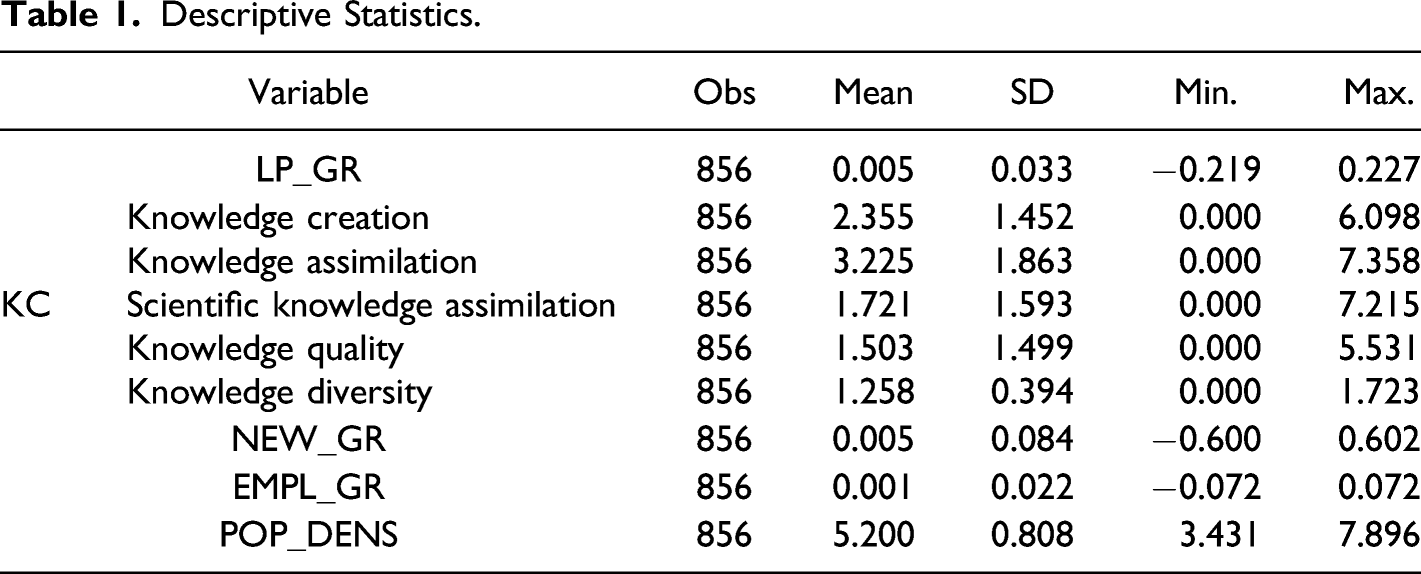
Equation (1) is a dynamic panel model where the correlation between the lagged dependent variable and unobservable individual heterogeneity may exist. Estimated results using traditional panel techniques can be biased due to endogeneity. In order to mitigate this problem, this study uses a two-step System GMM estimator that uses lagged differences and lagged values as instruments of endogenous variables (Arellano and Bover 1995; Blundell and Bond 1998). In general, System GMM is more efficient than a difference GMM estimator, which only uses lagged variables as instruments.
To verify that the results of the System GMM are valid, the following two tests are required. First, the Hansen test is conducted to confirm the validity of instruments. For the estimated results to be robust, the null hypothesis, which instruments are valid, must not be rejected. Second, the autocorrelation of the disturbance term has to be confirmed. If the disturbance term shows autocorrelation, the lagged values of the dependent variable used as the instrumental variables are close to the endogenous variables. If there is no autocorrelation in the disturbance term of the equation
Results
Univariate Analysis
Prior to performing multivariate analysis, this section examines the evolution and dynamics of productivity in the Italian regions. We also conduct univariate analysis to examine what differences exist in knowledge capabilities and entrepreneurial activity between regions with different dynamics of productivity growth. The evidence could suggest that our main variables play a role in shaping local productivity growth.
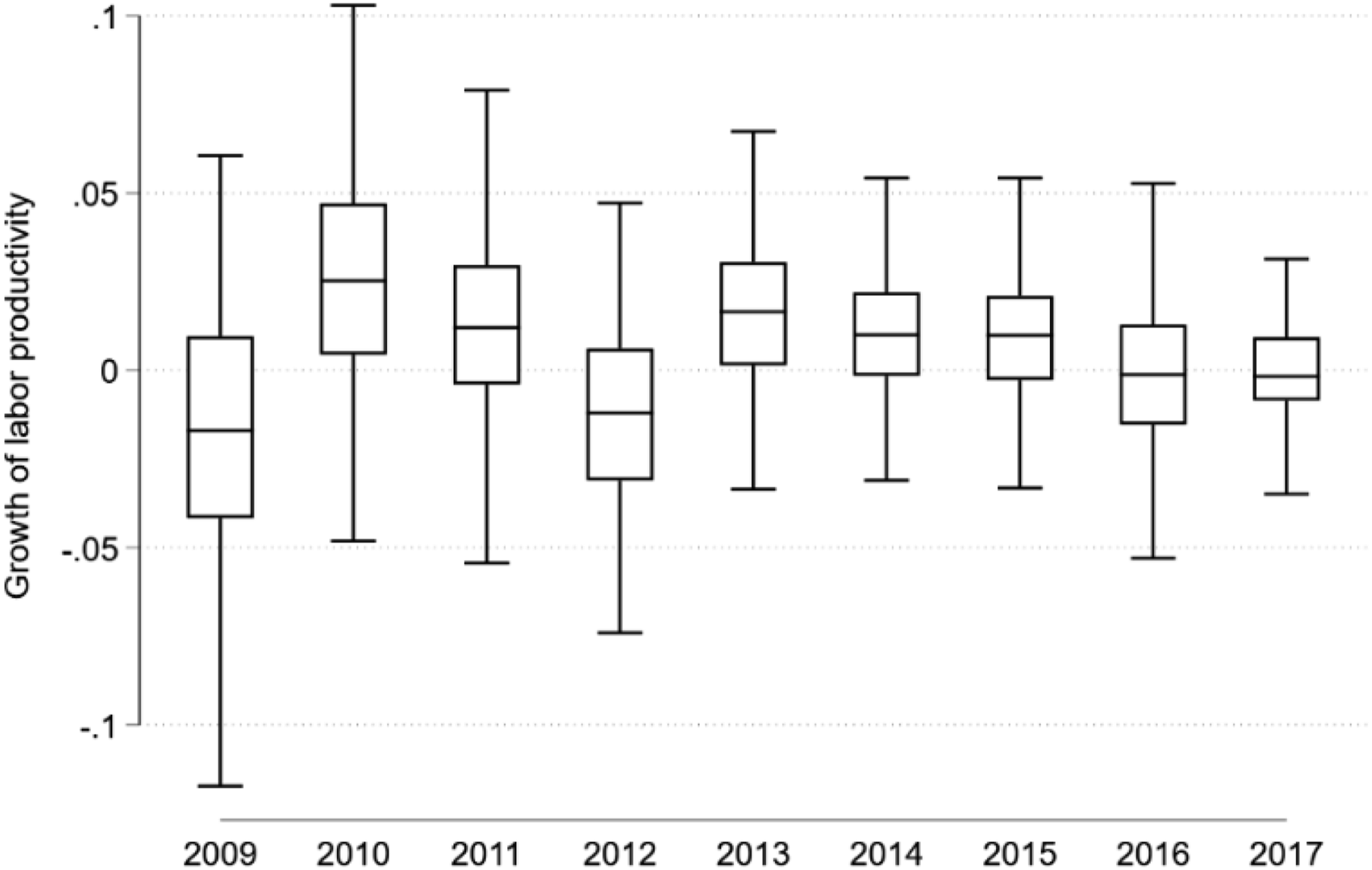
We first consider the changes in local productivity over time in terms of levels and growth. Figure 1 shows the labor productivity levels over the period 2008–2017. The distributions are quite similar regardless of the year. Figure 2 illustrates labor productivity growth over the period 2009–2017. During the analysis period, the median growth rates are negative in 2008 and 2012, and the growth rates have recently slowed. Especially, the heterogeneity in the growth rates across regions becomes smaller over time, which is caused by a decrease in regions with the extremely high growth rates. Labor productivity by year. Growth rates of labor productivity by year.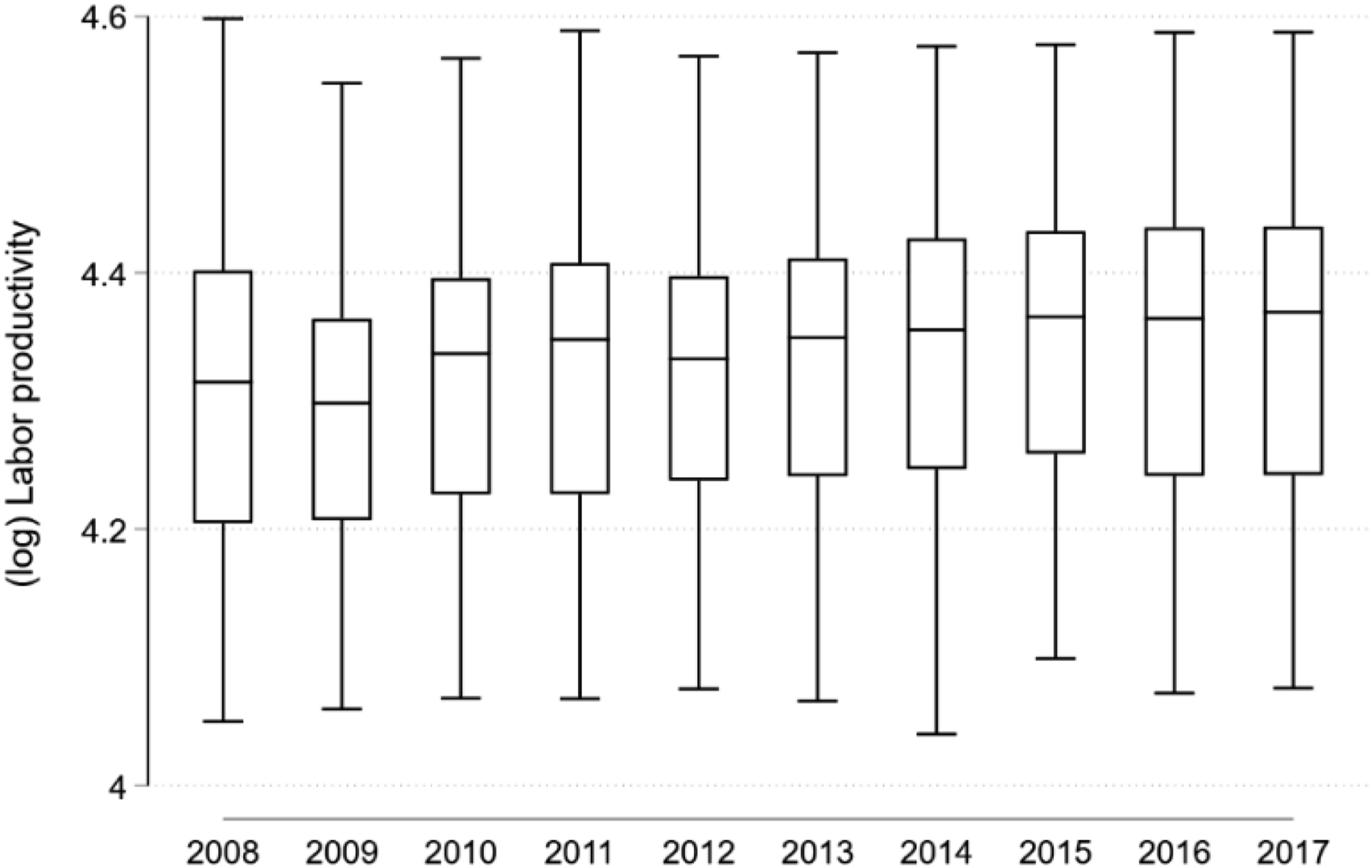
Transition Probability Matrix.
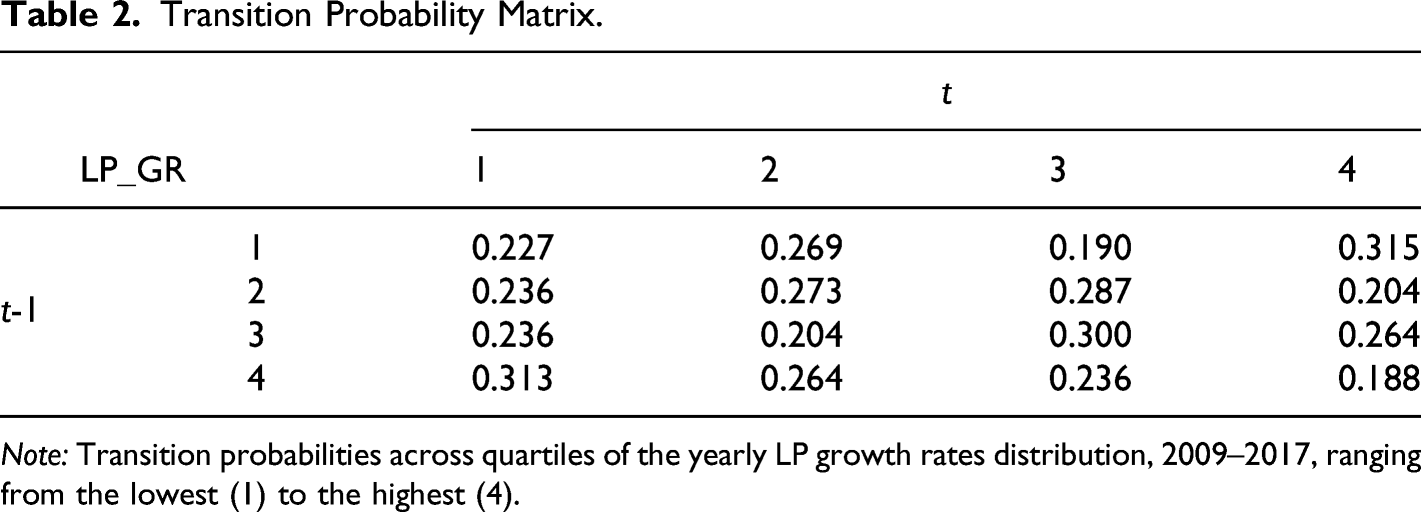
Note: Transition probabilities across quartiles of the yearly LP growth rates distribution, 2009–2017, ranging from the lowest (1) to the highest (4).
To summarize intra-distributional overall mobility characterizing the TPM, we exploit two well-known mobility indices. First, we consider the Shorrocks index focusing on probabilities to remain in the initial quartiles (i.e., diagonal elements; Shorrocks, 1978). 3 In our case, the Shorrocks index is 1.005, which is higher than 1.000 that would indicate a case of random growth (i.e., 0.250 in all cells in TPM). Second, we consider the modified version of the Bartholomew index (Bartholomew 1973; Fiaschi and Lavezzi 2003). 4 This index takes into account the off-diagonal elements of the TPM by weighting the distance between quartiles of time t-1 and t. In our case, the Bartholomew index value is 0.430, which is higher than 0.367 in the case of random growth. The results of both indices lead us to conclude that labor productivity growth shows a negative degree of persistence, meaning that regions growing at time t-1 tend to reverse growth at time t.
Group Mean Test.
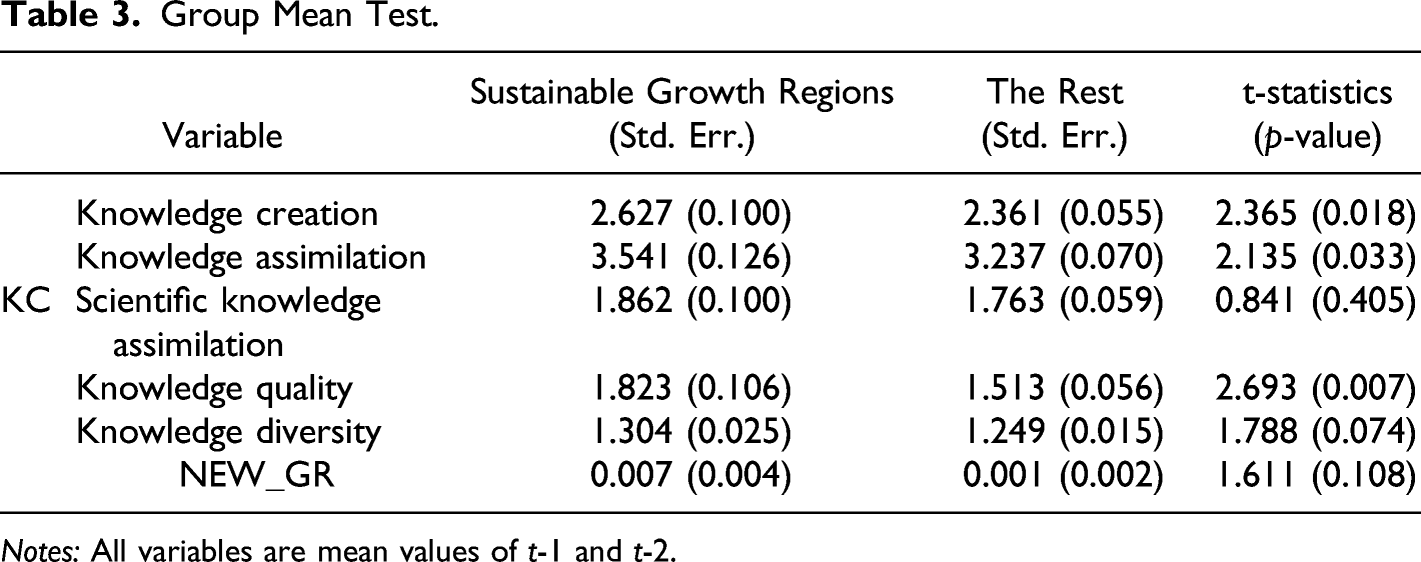
Notes: All variables are mean values of t-1 and t-2.
Multivariate Analysis: Determinants of Productivity Growth
Results: Total Sample.
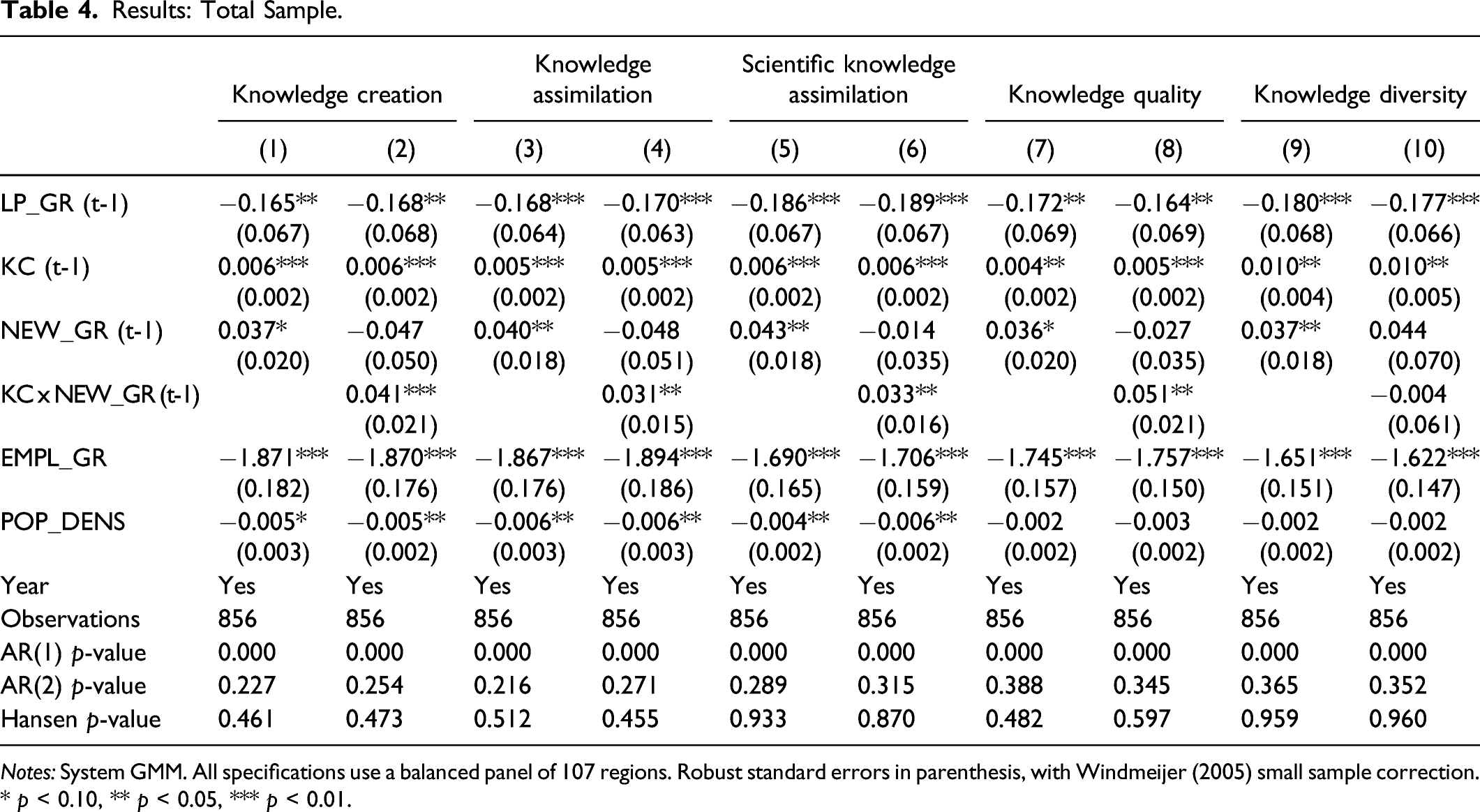
Notes: System GMM. All specifications use a balanced panel of 107 regions. Robust standard errors in parenthesis, with Windmeijer (2005) small sample correction. * p < 0.10, ** p < 0.05, *** p < 0.01.
Let us focus on addressing our research questions. First, all knowledge capabilities (KC) are positively associated with regional productivity growth. Specifically, regions with high knowledge creation, knowledge assimilation, scientific knowledge assimilation, knowledge quality, and knowledge diversity show higher productivity gains than others. Higher knowledge capabilities not only lead to new opportunities for the region but also increase the possibility of absorbing external knowledge or creating new further knowledge, which leads to regional development through labor productivity improvements.
Second, according to the models without an interaction term, the growth of new firm formation (NEW_GR) leads to regional productivity growth, which supports the findings of previous studies (Erken, Donselaar, and Thurik 2018; Mueller 2007). Existing studies suggest this is because entrants may be more efficient than incumbent ones or because innovative entrants force incumbents to increase their efficiency (Bosma et al., 2018). In the case of Germany, Audretsch and Keilbach (2004) find that regions with higher start-up rates show stronger growth of labor productivity. Third, there are the synergies between knowledge capabilities and entrepreneur activity (KC x NEW_GR) in shaping productivity growth. In other words, the positive relationship between knowledge capabilities and productivity growth is moderated by growth of new firm formation, except for entropy. OECD (1998) argues that entrepreneurs are the agents of growth in the market by accelerating the creation, dissemination, and application of impactful knowledge. The active engagement of entrepreneurs contributes to local productivity growth by actualizing the given opportunities from local knowledge (Audretsch and Keilbach 2008). Entrepreneurial activity also facilitates the spillover of impactful knowledge created in the region. According to our findings, regions with large, high-quality, or science-based knowledge capabilities can lead to further productivity gains by enabling entrepreneurs to utilize their innovative knowledge. This implies that not only high local knowledge capability itself is important for regional growth but also that entrepreneur activity plays a crucial role as a medium for knowledge diffusion that increases productivity.
Moreover, entrepreneurial activity (NEW_GR) loses its effect on labor productivity when the interaction term (KC x NEW_GR) is introduced. The effect of entrepreneurship is dependent on the knowledge capabilities of a region. This supports the theoretical findings of Malerba & McKelvey (2020), who find the positive effects of entrepreneurship are dependent on knowledge-intensive innovative entrepreneurship. Past studies have shown that non-innovative entrepreneurship—or Kirznerian entrepreneurship—can even have a negative effect on labor productivity (Szerb et al. 2019). In the entropy model, the effect of the knowledge capability increases compared to the other models, but the interaction term does not significantly affect productivity through entrepreneurship.
Regarding the control variables, lagged productivity growth is negatively associated with current productivity growth, consistent with the results of the mobility index. The increase in employment in the previous year has a negative impact on productivity growth in the current year. Employees who are not yet familiar with work need experience to contribute to productivity improvement. Biagi and Ladu (2018) also find a negative relationship between TFP growth and employment growth in Italy.
Italy shows regional imbalances. Especially, economic gaps between the Northern and Southern regions in terms of GDP, employment, and investment are large and persistent over the long run (Eckaus 1961; OECD 2018). OECD (2018) shows that youth unemployment rates in the Southern regions are the highest in the OECD area, 45.7 percentage points higher than that of Bolzano-Bozen, one of the Northern regions. To understand whether the impacts of knowledge capabilities and entrepreneur activity on productivity growth vary across regions, we further conduct our analysis by region.
Figure 3 displays the knowledge capabilities and entrepreneur activity in 2016 and productivity growth in 2017 of the NUTS-3 regions in Italy.
5
We observe that there are wide heterogeneities in all knowledge capabilities and entrepreneur activity across regions. Moreover, this heterogeneity shows a similar pattern to the economic disparity. Specifically, the Northern and Central regions show higher values in all knowledge capabilities than the Southern regions.
6
Regarding entrepreneurial activity, the Southern regions show higher growth rates of new firm formation than other regions. Productivity growth is relatively less heterogeneous between the Northern, Central, and Southern regions. Given the geographic information and economic disparity across the regions in Italy, we expect that the contributions of knowledge capabilities and entrepreneurial activity to productivity growth will differ depending on the stage of regional development. To understand this heterogeneous contribution by regions, we aggregate them into Northern-Central regions—which tend to be wealthier and to have higher knowledge outputs—and Southern regions and analyze them separately.
7
Regional map.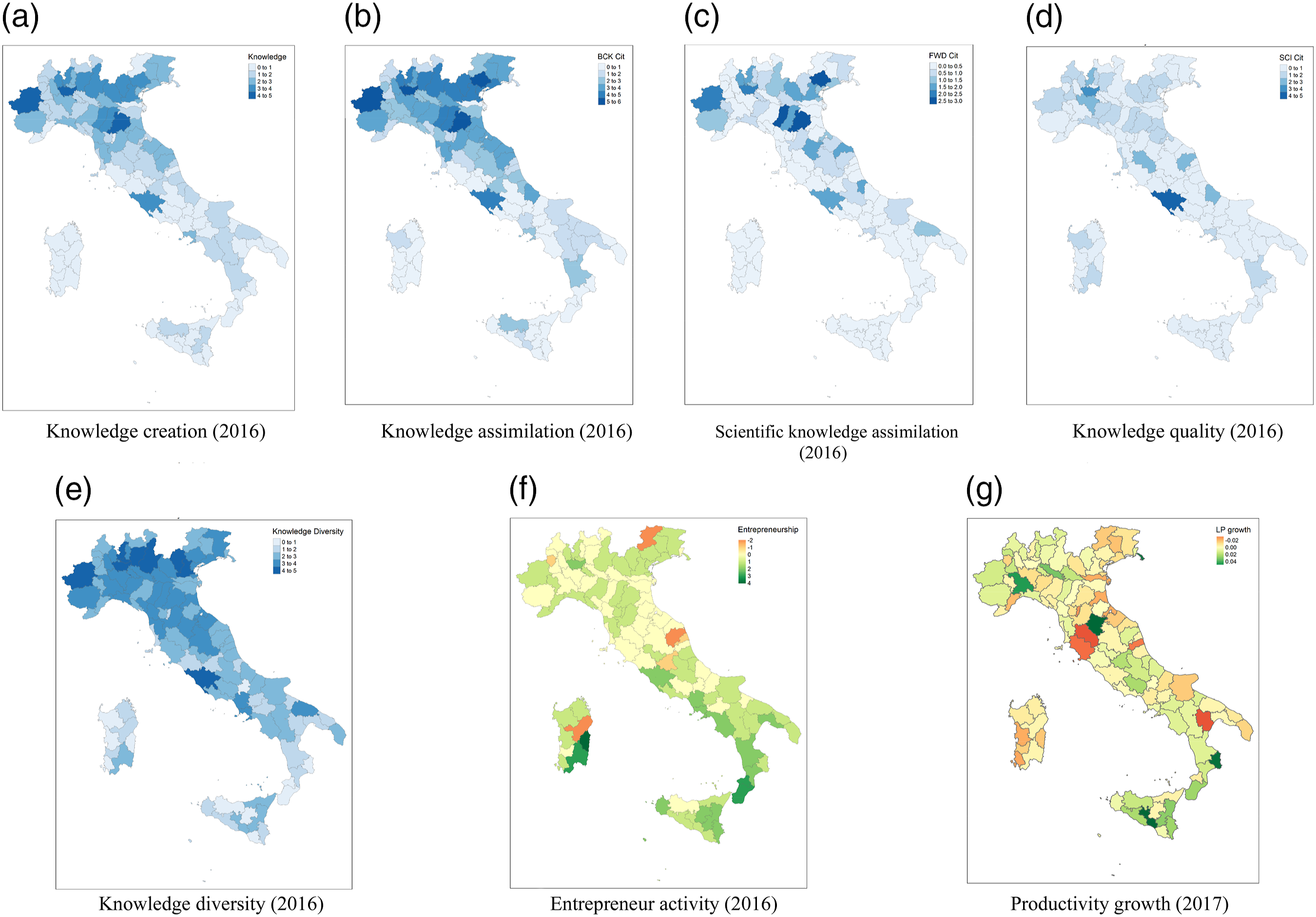
Results: Regional Aggregation.
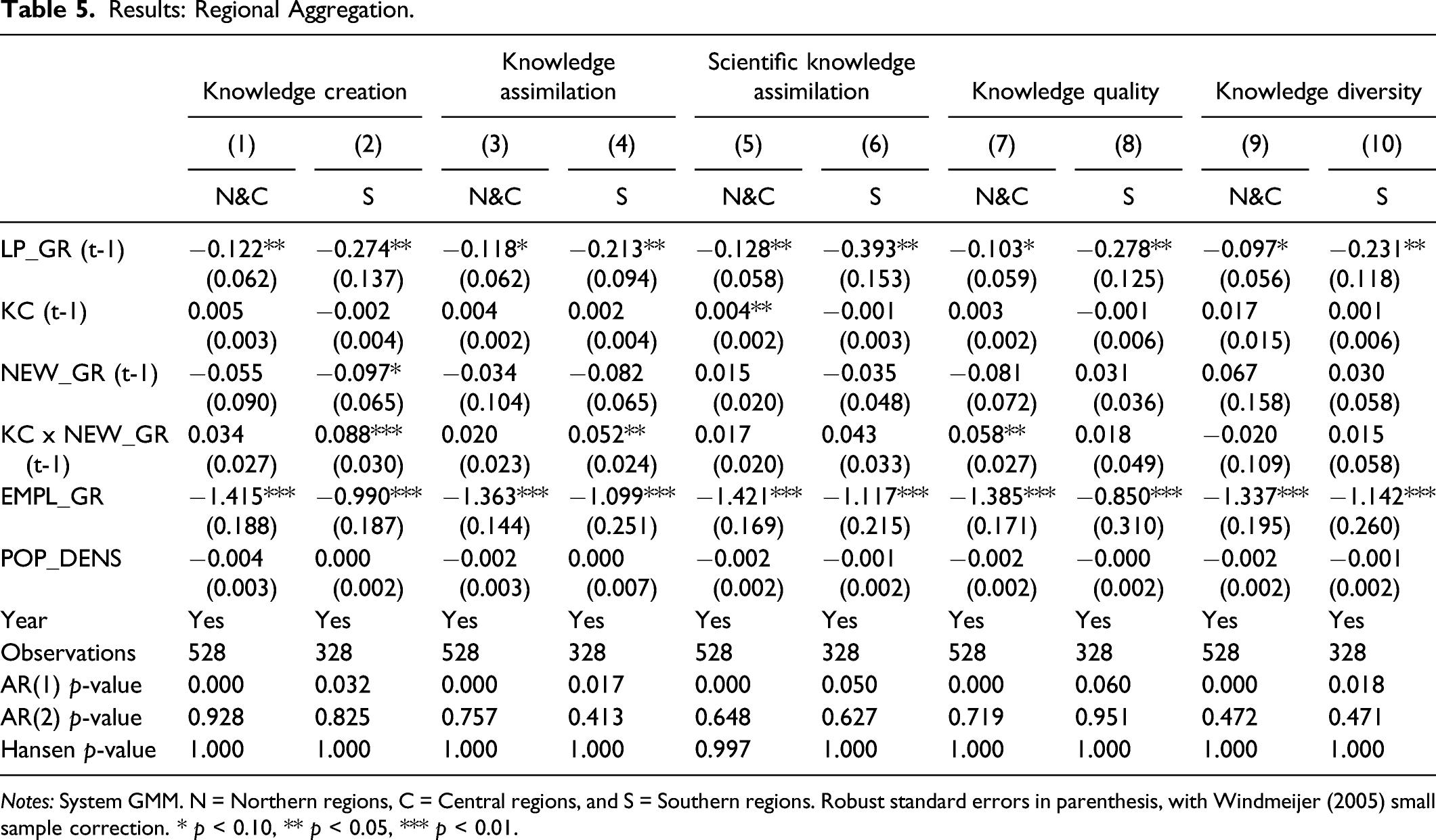
Notes: System GMM. N = Northern regions, C = Central regions, and S = Southern regions. Robust standard errors in parenthesis, with Windmeijer (2005) small sample correction. * p < 0.10, ** p < 0.05, *** p < 0.01.
The interaction between entrepreneurial activity and knowledge capabilities behaves differently depending on the regions in Italy. In the Southern regions, the interaction depends on firms’ capabilities to create and to assimilate knowledge, in models (2) and (4). Regarding the Northern-Central regions, only the interaction between knowledge quality capability and entrepreneurship in model (7) provides a positive contribution to productivity growth. This implies that in regions with relatively greater knowledge resources, it is better to create high-quality knowledge than higher amounts of knowledge. For regions like the Northern-Central Italian regions where there is greater advantage in knowledge production, local entrepreneurs leverage knowledge quality capability. Capello and Lenzi (2015) show that the positive relationship of scientific knowledge to productivity works in regions where the local knowledge capabilities are already quite developed. For instance, active university-firm collaboration may be needed in these regions to transfer and absorb scientific knowledge as an input factor.
Conclusion
This study contributes to research on the KSTE by linking knowledge, entrepreneurship, and regional productivity, both theoretically and empirically, and by elucidating different aspects of regional knowledge capability. Evidence regarding knowledge-intensive innovative entrepreneurship or Schumpeterian entrepreneurship so far has been limited. Recent studies explain the impact of knowledge on performance through entrepreneurship, providing initial theoretical (Malerba and McKelvey 2020) and empirical evidence (Szerb et al. 2019). Knowledge-focused activity is also necessary for labor productivity to not lose out to capital productivity, that is, robotics (Ballestar et al. 2020). We find entrepreneurial activities are a means to focus knowledge capabilities and increase labor productivity. This study extends the body of literature by examining how internal, knowledge-intensive innovative entrepreneurial activities affect regional performance through labor productivity. We have investigated the impact of local knowledge on regional growth and how entrepreneurship moderates this relationship. For this purpose, an integrated dataset was constructed at the Italian NUTS-3 level combining patent, entrepreneurship, and socio-economic data. To consider different aspects of knowledge, knowledge creation and several other local knowledge capabilities were taken into consideration. In the first part of our analysis, we tested our model overall, and in the second part, we aggregated the Italian regions into Northern & Central and Southern to compare how these effects differ among persistent economic conditions.
Our results not only emphasize the importance of local knowledge capabilities from different perspectives but also shed light on the significant role of entrepreneurship for enhancing the effect of knowledge on productivity growth. This aligns with the previous argument that higher entrepreneurship increases the possibility of knowledge contributing to innovation (Block, Thurik, and Zhou 2013). As Iammarino and Jona-Lasinio (2015) insisted, regional productivity gains can be achieved through a combination of the capabilities of producing new goods and of creating and transmitting new knowledge. In this regard, our findings explicitly highlight the importance of local entrepreneurs as a channel for knowledge diffusion, which enhances productivity growth. Additionally, the conceptual shift from patents as explicit knowledge to how patents are used through tacit knowledge capabilities helps explain why the effects of knowledge remain localized (Breschi & Lissoni 2009; Peri 2005).
While all of the types of knowledge capabilities studied improve regional labor productivity, entrepreneurship only matters when knowledge capabilities are also present. Moreover, the interaction between knowledge capabilities and entrepreneurship has a stronger impact than knowledge capabilities considered separately. The types of knowledge capabilities have varying amounts of impacts on labor productivity. The knowledge capability with the highest impact is knowledge quality, followed by knowledge creation. Knowledge assimilation also has a greater impact when scientific knowledge is considered. Last, knowledge diversity does not have a significant impact on labor productivity through entrepreneurship. Thus, developing the knowledge capabilities of firms’ knowledge quality and creation should be prioritized among the differing types. However, all knowledge capabilities but diversity are beneficial for new firm growth.
The clarification of the role of entrepreneurship on local productivity growth provides meaningful directions for policy makers. To enhance productivity growth and to cope with new innovation trends, a region needs to have entrepreneurial-friendly environments that provide institutional support including knowledge capability development. In Italy, the number of new firms has been declining in most regions since the global financial crisis (Ciffolilli, Cutrini, and Pompili 2019). Our argument is not only limited to the so-called “innovation cluster” regions where strategic support from government is provided to attract new firms. Regardless of the economic conditions in a region, entrepreneurs contribute to the diffusion of new knowledge and boost its economic values. Regional industrial policies often focus on entrepreneurial activity and R&D support separately. Yet, our results suggest that entrepreneurial activity is only worthwhile when it is combined with specific knowledge capabilities.
Rather than spreading support across all knowledge capabilities for entrepreneurial firms, particular aspects of knowledge are recommended depending on the region. Nearly all types of knowledge capabilities had similar effects on productivity. The similarity may suggest that the different capabilities are expressions of different innovation activities. Higher quality knowledge capabilities that lead to patents, especially those that are cited, should be targeted for higher labor productivity in new firm growth. Knowledge diversity has a greater impact on productivity, but its interaction with new firm growth does not lead to significant results. While further research is needed, new firms are likely to be smaller and thus less capable of managing diverse forms of knowledge. Wealthier and higher knowledge producing regions should focus on entrepreneurship policies that also strengthen high-quality knowledge capabilities, meaning the ability to create knowledge with immediate impacts. On the other hand, the regions with less developed knowledge quality capabilities cannot solely rely on entrepreneurship promotion without also building local knowledge creation and assimilation capabilities. Considering regional gaps, regional policy should adopt different entrepreneurship strategies, especially knowledge-related ones tailored to the conditions in a region.
The findings of this study can be furthered in several directions. First, the empirical analysis can be made at the firm-level, which will allow us to differentiate those effects by industrial sectors. Due to the limitation of data, local entrepreneurial activities could be measured only at a regional level, but incorporating with firm-level entrepreneurial data can consider industry effects. Moreover, our empirical model can be extended to broader regions. Additionally, studies on policies that support specific aspects of knowledge capabilities and entrepreneurial activities such as university–industry linkages and spin-offs may help identify the sources of entrepreneurial capabilities that involve knowledge capabilities in a region.
Footnotes
Declaration of conflicting interests
The author(s) declared no potential conflicts of interest with respect to the research, authorship, and/or publication of this article.
Funding
The author(s) disclosed receipt of the following financial support for the research, authorship, and/or publication of this article: The project was supported by Science Foundation Ireland (grant no: SciTechSpace/17/SPR/5324) and H2020 European Research Council (grant no: ERC TechEvo/715631).
