




Abstract
The strength of the 2008 financial and economic crisis and the resulting degree of resilience were heterogeneous among and within the European Union countries. Challenges and opportunities driven by regional-specific differences determined the ability to overshoot the precrisis levels of growth. Focusing upon Nomenclature of Territorial Units for Statistics 2 (NUTS 2) European regions, we explore a novel conceptual framework related to regional economic resilience, namely the renewal capacity. Precisely, we concentrate on the capacity of regional economies to “renew” their growth paths in the labor market in the aftermath of the recent global crisis. We find some well-identified spatial patterns of regional employment renewal and we identify a set of territorial assets that allow regions to bounce back faster and more comprehensively than others to the economic downturn. Furthermore, there are significant differences between the drivers of the regional renewal of Old and New Member States. Our findings suggest potential policy directions at all levels for enhancing regional resilience.
Introduction
The Great Recession has severely impacted countries’ labor markets all over the world. A mixture of different aspects determined its degree and intensity across countries and regions they belong to, suggesting that there is no univocal policy response that would be efficient for all. This article investigates whether and how differences in performances and economic virtuosity prior to the 2008 global downturn affected the employment trajectories of European regions after the crisis. The relevance of employment in shaping regional economic resilience has been recently confirmed by Pontarollo and Serpieri (2020a). Furthermore, this indicator is widely used to test resilience as it reflects the social impact of the recessionary shocks better than output (Fratesi and Rodríguez-Pose 2016). To the extent of our research, we refer to two literature strands. The first is related to the mechanisms behind regional employment dynamics which have been studied extensively since the pioneering paper of Blanchard and Katz (1992) who investigated employment trends across US States. The second strand focuses on regional economic resilience, where a growing theoretical and empirical literature concentrates on testing the differentiated reactions of regions to negative shocks, mainly identifying with the recent Great Recession.
Regarding the studies pertaining to the first strand, the structural and institutional determinants of regional employment across the European Union (EU) countries have received special attention among scientists. 1 Among the structural determinants of regional employment performances, human capital is conceived as an important driver (Crescenzi, Rodríguez-Pose, and Storper 2007). The contribution of sectoral specialization and industry diversity is still debated (among others, Longhi, Nijkamp, and Traistaru 2005; Marelli, Patuelli, and Signorelli 2012; De Groot, Poot, and Smit 2009, 2016). Business dynamism and innovativeness, as identified by statistics on gross fixed capital formation and patents, positively address opportunities in the labor market (European Patent Office and Office for Harmonization in the Internal Market 2016). A key institutional element of labor market outcomes is represented by the employment protection and unemployment benefits. As illustrated by Blanchard, Jaumotte, and Loungani (2013), excessive provision of social policies can reduce the flexibility of labor markets, that is, the ability of markets to reallocate workers to productive jobs. Conversely, higher public expenditure in social dimensions and strong labor market programs can be good work incentives and position countries for better labor performances. This duality of outcomes and trade-offs in the labor market have been exacerbated by the Great Recession. In this regard, various authors analyzed the dynamics of the labor market and the factors that determined its reaction to the Crisis, that is, the resilience capacity.
The seminal paper of Martin (2012) contributes to the second strand of literature above mentioned identifying four main dimensions of regional resilience: (i) resistance concerns the sensitivity of regional economic systems to shocks; (ii) recoverability refers to the ability to recover, in terms of speed and degree, of a region; (iii) reorientation investigates the dynamism of a region, that is, the extent to which its structure transforms after a shock; and (iv) renewal examines the extent to which regional economies “renew” their growth paths. The identification and measurement of the regional economic resilience have been focused and carried out mainly with respect to the resistance and recoverability dimensions. 2 To this extent, alternative approaches have been used, ranging from composite indicators to empirical and model-based analysis. Therefore, given the vast literature on regional resilience, our aim is not to give an extensive overview but to outline relevant contributions in particular on the analysis of resilience referred to employment. Regarding the measurement attempts, we first recall Martin et al. (2016) who, based on Martin (2012), operationalize employment recoverability and resistance. While the latter indicator is often employed in literature (see, e.g., Giannakis and Bruggeman 2019; Ezcurra and Rios 2019); however, another widely used indicator of employment resilience is simply the postcrisis employment growth rate (see, among others, Fingleton, Garretsen, and Martin 2012; Tsiapa, Kallioras, and Tzeremes 2018). Bristow and Healy (2018), on the other hand, adopt an evolutionary approach to annual employment data for the period 2001–2011 to verify the relationship between the technological innovation and the reorientation and renewal dimensions of resilience among the EU regions by treating each region as a separate time series to date the individual regional business cycles.
Accounting also for the employment dimension, Rizzi, Graziano, and Dallara (2018) propose a synthetic regional resilience indicator accounting for the social, economic, and environmental domains. Pontarollo and Serpieri (2020a, 2020b), instead, develop an original composite indicator based on the Shapley decomposition of gross domestic product (GDP) per capita, where they observe that employment plays a decisive role in explaining regional resilience.
The empirical analysis of the drivers of employment resilience performed by Doran and Fingleton (2018) shows that more specialized US metropolitan was more adversely affected by the crisis and less able to resist it. Being specialized positively affects recovery as well as experiencing a structural change during the recovery period. Martin et al. (2016), instead, in the analysis of United Kingdom Nomenclature of Territorial Units for Statistics (NUTS) 1 regions over various recessionary shocks, reveal that economic structure is found to have exerted a limited and not consistent influence on employment resistance and recoverability, while “region-specific” effects have played a significant role. Palaskasy et al. (2015) show that unemployment reaction to the crisis of Greek municipalities is statistically heterogeneous. Economic crisis, structural characteristics, urbanization, and public investments increase unemployment. On the contrary, agriculture and tourism contribute to reduce unemployment. Angulo, Mur, and Trívez (2018), examining Spanish provinces, find that the ones with both sectoral structure and location advantages, or at least with locational advantages, have a significantly lower “drop” in employment growth in the postcrisis period. An increasing specialization in the service sector before the crisis contributes to lowering the “drop” of employment growth and being specialized in the construction sector, on the other hand, increase the “drop.” Faggian et al. (2018) identify that, for Italian local labor systems, tourism and belonging to food and textile industrial district were positive factors in sustaining employment after the recession. Furthermore, employment in medium-size local labor systems makes local labor systems much more likely to be simultaneously more resistant and to recover faster than employment in larger ones. Finally, Tsiapa and Batsiolas (2018) find that labor productivity contributes to increase employment in Eastern European regions.
Addressing the EU as a whole, Giannakis and Bruggeman (2019) identify differences in employment resilience in urban, intermediate, and rural regions. Regional resilience is strongly affected by national context, particularly in rural areas. Migration is a positive driver of regional resilience in urban areas, while agriculture contributes positively in intermediate regions. Tsiapa, Kallioras, and Tzeremes (2018) demonstrate that sectoral productivity improvements are key drivers of employment growth, while Ezcurra and Rios (2019) demonstrate that regional institutional quality is a fundamental factor for resilience. Fratesi and Rodríguez-Pose (2016), investigating regional employment trends since the outbreak of the crisis, find that, with some exception, regions that had developed more sheltered economies during the boom years have not weathered the employment shock associated with the crisis well and vice versa.
In the context of resilience analysis, regional core–periphery patterns within the EU, as far as we know, have not been explicitly considered. In the EU, indeed, preexisting regional disparities strengthened as a consequence of the crisis led to exacerbate spatial core–periphery pattern with peripheral regions affected by higher unemployment rate (European Commission 2009). The dichotomy in the EU is often reconducted to the divide between the Old Member States (OMS) and New Member States (NMS). 3 To the best of our knowledge, only Marelli, Patuelli, and Signorelli (2012), analyze the short-run postcrisis employment growth in European NUTS 2 regions distinguishing between the ones belonging to countries that joined the EU before and after 2004. The authors find significant differences in the parameters between the two groups of countries. Western European regions are sensitive to sector specialization in construction which is a negative factor in terms of both employment and unemployment. Regions with high share of long-term unemployed are less sensitive to the effects of the crisis, and Eastern regions benefit from the flexibility of workers on temporary contracts. However, the main limitation of the contribution of Marelli, Patuelli, and Signorelli (2012) is the fact that the “long crisis” was still ongoing as their sample period incorporates the debt crisis.
The novelty of our approach is that we contribute to the literature by studying a still underexplored dimension of resilience, the regional renewal, referred to the labor markets within the EU by identifying its drivers and their different effects among regions belonging to NMS and to OMS.
This article is structured as follows. In The Spatial Dimension of Regional Renewal section, we illustrate the spatial pattern of the employment renewal among EU regions. Methodology and Data section describes the methodology and data employed. Results section provides the results of the empirical analysis on the determinants of employment renewal across EU regions as a whole and distinguishing regions belonging to NMS and in OMS. The last section concludes.
The Spatial Dimension of Regional Renewal
This paragraph introduces the spatial dimension of the EU regional employment renewal stage, that is, the fourth and last phase, after the introduction, growth, and maturity, of the resilience life cycle process as identified by Pontarollo and Serpieri (2020b). 4 During the first three phases, which belong to the so-called slow burning process (Manca, Benczur, and Giovannini 2017), a regional economic system can build the capacity to cope with a shock, and policy strategies can be targeted to strengthening the resilience capacity building. Borrowing from Pontarollo and Serpieri (2020c), the regional employment renewal capacity has been measured as the difference between the slopes of the trends before and after the crisis. 5 As long as the difference between the two is positive (negative), a welfare gain (loss) arises which represents the extent to which regional economies “renew” (or not) their growth paths.
Therefore, we calculate the pre- and postcrisis trends regressing, for each region, the annual employment rate on the corresponding years. To this extent, we use annual data over the 2000–2015 time period from Cambridge Econometrics. We take as a reference the relative maximum falls in employment rate between 2008 and 2009. This time lag is due to the differentiated propagation of the effects of the Great Recession among regions. Thus, we label “renewal” as the difference between the post- and precrisis regression coefficients. The positive or negative sign depends on whether the capacity to recover built in the precrisis is strong enough to allow regions to renew their growth path after a shock. Precisely, in case a negative shock occurs, the resilience capacity may shrink leading to a decline or empower determining a renewal process.
Renewal capacity in the labor market of the EU NUTS 2 regions is shown in Figure 1. Darker colors identify regions with a postcrisis growth trend closer or eventually higher than the precrisis trend, while lighter ones perform worst compared to the precrisis growth path.
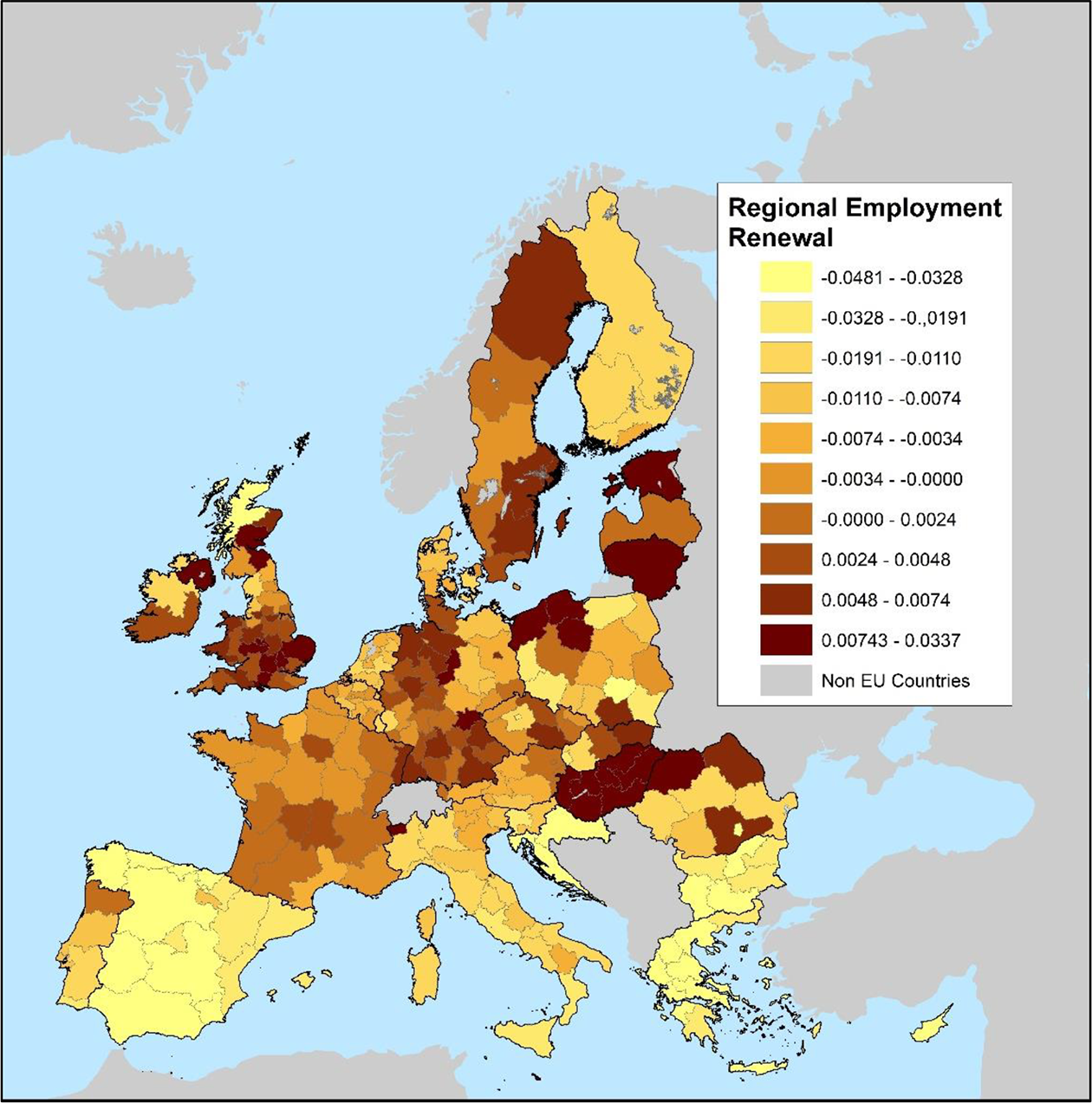
Decile map of employment renewal capacity of European Union regions.
As observed by Pontarollo and Serpieri (2017), regional employment renewal has a clear spatial pattern. Higher levels of renewal in the labor market appear in Western Germany, Great Britain, Northern countries, and the Baltics. Regions belonging to these countries demonstrate higher efficiency, overcoming precrisis employment levels. Mediterranean countries, in particular, have been severely affected by the negative shock and failed to renew their employment growth path. Visually, renewal capacity to the crisis looks like not being uniform among regions belonging to same NMS, while a higher homogeneity is observed in the OMS.
The presence of a statistically significant spatial pattern is tested through the Moran’s (1950) I (MI), which has been widely used in the resilience literature to describe economic phenomena whose distribution in the space is not random (Pontarollo and Serpieri 2020b; Giannakis and Bruggeman 2019). 6
The MI is defined as:

where i and j are the ith and the jth regions, whose total number is N, x is the variable of interest;
The MI for the regional employment renewal is equal to .63 and significant at 1 percent level, confirming the presence of positive autocorrelation. The Moran scatterplot (Figure 2) shows that regions are prevalently located in the first (HH) and third (LL) quadrants. Among them, regions belonging to the HH quadrant are close to the line that interpolates the points, meaning that their values are quite homogeneous; the opposite is true for regions belonging to the LL quadrant, which appears visually sparser. Better performing regions tend to co-move generating clusters in space with homogeneous employment renewal degrees. On the other hand, in the cluster of less performing regions, these have very different values.
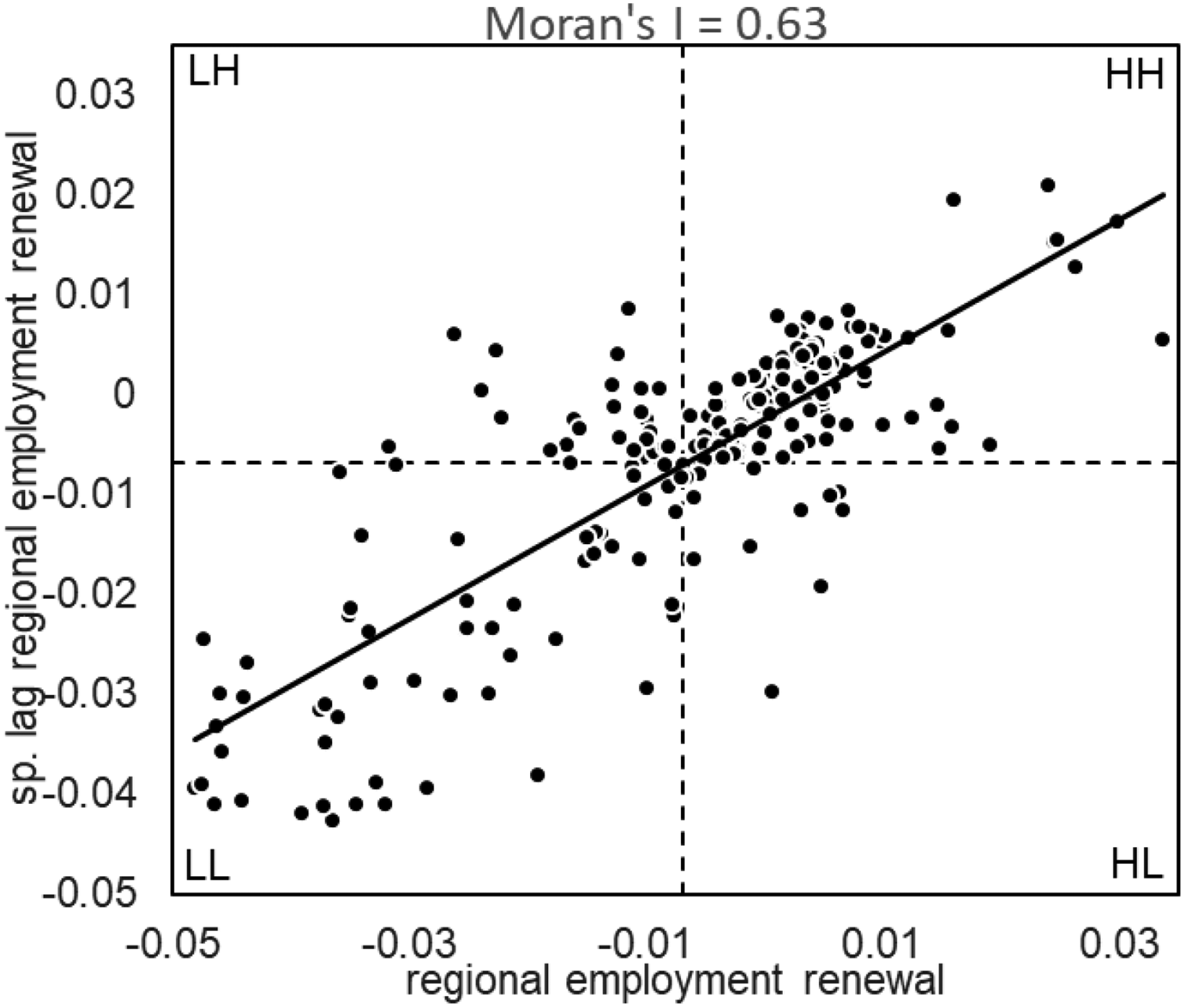
Moran’s I of employment renewal capacity of European Union regions.
Additional information on the spatial structure of the data is obtained from the Mantel’s test. If statistically significant, it confirms that groups of regions that are close together are also compositionally similar in their employment renewal and groups that are spatially distant from each other are also compositionally dissimilar. The test has p value < .01 (the Z statistic is equal to 756,095,675), leading to reject the null hypothesis of no relationship between spatial location and renewal.
Methodology and Data
Methodology
In consideration of the spatial dependence in regional renewal capacity, the choice of the empirical specification is based on a spatial autoregressive (SAR or lag) model. As it will be shown in the empirical section, this preference is confirmed from the results of the Lagrange multiplier (LM) test for spatial dependence performed on the residuals of the ordinary least square (OLS) regression. In the SAR model, substantive spatial dependence is incorporated into the unconditional specification via the inclusion of a spatially lagged dependent variable:

where
The parameter ρ is a SAR (or lag) coefficient that, in our case, as the already mentioned
The SAR model is generally estimated through a maximum likelihood estimator (Anselin 1988). However, to check for the robustness of our results, this article considers two additional estimation techniques, namely the generalized spatial two-stage least squares (STSLS; Kelejian and Prucha 1998) and the spatial autoregressive combined model (SAC) estimation by generalized method of moments (GMM) (generalized spatial two-stage least squares [GS2SLS]; Kelejian and Prucha 1999). In both cases, the spatial autoregressive term is instrumented via internal instruments that consist in the first and second spatial lags of the independent variables, namely
As we indicated, we try to minimize the simultaneity problems, taking the explanatory variables for the period before the crisis and correlating them with the variable on employment renewal which, however, is constructed using the employment trend before and after the crisis. As we include in our specification, among the regressors, employment trend before the crisis, which is included implicitly also in the dependent variable, we instrument it to minimize endogeneity issues. This is done following the approach of Le Gallo and Páez (2013), that is, creating a synthetic instrument by first obtaining the eigenvectors of the
Following Pontarollo and Serpieri (2020b) who identify well-defined and differentiated spatial patterns of resilience across regions belonging to OMS and NMS, we allow for parameter instability between the regions belonging to these two so-called spatial regimes. This yields to a spatial lag switching regression (Lim 2016):

where subscripts OMS and NMS denote Old and New Member States, respectively, and DOMS and DNMS are the corresponding dummy variables. A different vector of coefficients corresponds to each spatial regime. Significantly different coefficients across the two regimes confirm the spatial heterogeneity in the form of structural instability. Compared to the model proposed by Allers and Elhrost (2005) or Marelli, Patuelli, and Signorelli (2012), 8 or to the estimation of two separate regressions for each regime, a spatial lag switching regression maintains the spatial linkages of the independent variable unaltered, which means that spatial spillovers occurring in OMS spread also in NMS. As spatial spillovers are conceivable, given that all countries belong to the EU, it is also highly possible that regions that belong to countries characterized by different stages of development have different drivers of renewal.
The existence of the spatial spillovers is due to the spatial multiplier (
In our empirical estimation, we proceed by steps. We first estimate a standard OLS regression model for the whole sample, we check for the most appropriate spatial model (spatial lag or spatial error) with a LM test on the residuals, and we estimate it. In a second step, we consider the switching regression model based on the OLS, and then, we estimate the spatial model based on the results of the LM tests. At this stage, the Chow–White test is used to check for the joint null hypothesis of spatial structural stability against the alternative of spatial structural instability.
Data
The ratio on the selection of the independent variables is the following (see Online Appendix A for the data sources and correlation matrix):
Gender difference in unemployment rate between females and males, fifteen to sixty-four years old, is selected to consider the gender gap in the labor market. The higher the difference, the less a job market is receptive with respect to female employment, that is, the higher is the female unemployment compared to males. The variable measures the strength of the lack of opportunities for women in the job market.
Patents per million of active population are considered to capture general propensity to innovate of EU regions (Crescenzi, Rodríguez-Pose, and Storper 2007). The effect is expected to be positive because innovation implies higher demand for skills, lower probability of lay off, and so on (Nickell and Bell 1996).
Absolute
9
specialization and diversification indexes have been considered to measure market concentration and economic diversity.
10
The absolute specialization index is calculated taking the maximum of the share of the sectoral employment. It is expressed by
Share of the working-age population who has attained secondary education and tertiary education. These variables are used to measure the average level of human capital in each region which, according to growth theories, is an important driver of growth (Crescenzi, Rodríguez-Pose, and Storper 2007).
Gross fixed capital formation. According to Bond, Leblebicioglu, and Schiantarelli (2010), there is a positive relationship between investment as a share of GDP and long-run growth rate of GDP per worker. Following the same reasoning, a high share of gross fixed capital formation is conceived to be able to foster employment renewal.
Employment gives us information about the precrisis average level of employment. A high share means that an economy was more prosperous and then it could react better to the crisis. At the contrary, anyway, a high employment rate, if not linked to productivity improvements, could be negatively correlated to renewal.
Employment trend, in the same vein of the employment share, allows us to check whether a rapidly growing regional economy is able to renew its postcrisis trend better than another region that has grown more slowly.
Youth unemployment is related to the dynamism of the labor market. A negative sign of youth unemployment, on the other hand, could be interpreted as the existence of labor markets barriers that prevent young people to enter in the job market.
Long-term unemployment (twelve months and more) is seen as a negative factor because it is linked to the incapacity of absorption of workers and to a lack of job opportunities (De Groot and Van der Klaauw 2014). According to Arulampalam, Gregg, and Gregory (2001), people lose their professional skills the longer they stay unemployed; furthermore, it is often considered an indication of relatively low productivity.
Population weighted density is a proxy for agglomeration economies, which are linked to geographical concentration of economic activity, which foster innovation, circulation of ideas and, finally, rising productivity (Duranton and Puga 2004; Charlot and Duranton 2004). Agglomeration economies are controlled for in order to single out the impact of other “knowledge” assets like patents. It is expressed by
Local accessibility. Hochard and Barbier (2017) show that a strong relationship exists between economic growth and both the average level of market access and the distribution of that access worldwide. In particular, local accessibility is chosen because, as shown by Martin and Rogers (1995) and Martin (1998), if public infrastructure facilitates transactions within a region (intraregional trade), this leads to economic growth. For European NUTS 2 regions, we rely on the approach of Stępniak and Jacobs-Crisioni (2017) to measure internal regional accessibility. The authors introduce an innovative method to reduce scale dependencies in the estimation of travel time, substantially improving intrazonal travel time accuracy. Local accessibility is calculated as the population-weighted arithmetically averaged travel time, that is,
Disposable household income gives us more reliable information on the household’s economic well-being than GDP per capita because it refers to current household consumption and future spending that could be financed by current saving. Disposable household income, according to Ribarsky, Kang, and Bolton (2016), registered an increasing gap since 2000 in many Organization for Economic Cooperation and Development (OECD) countries, typically due to differences in prices faced by producers and by consumers and a rising profit share of corporations. Furthermore, household income remains in the country, while GDP may be retained by corporations and government and not accrue to households. Our aim is examining the role of the consumption possibilities of individuals in sustaining employment renewal. A higher disposable household income means a lower risk to fall in poverty, higher education, and job opportunities.
Results
The results of the baseline model in equation (2) are represented in Table 1. OLS regression presents problems of autocorrelation in the residuals, given that both the randomized Moran test and LM tests are statistically significant. The LM tests confirm that the spatial lag model is the preferred option to deal with spatial dependence. 15 The latter, indeed, is absent in the residuals of these models. This evidence led us to focus on the spatial lag estimations. The first aspect to highlight is that the autoregressive coefficients ρ are highly statistically significant across the different models and comprised between .45 and .48. This implies the existence of the so-called spatial spillovers due to the spatial multiplier calculated as (1 − ρ)−1 that are comprised between 1.81 and 1.89, that is, between 81 percent and 89 percent of employment renewal is already reflected in neighborhood employment renewal, through indirect reaction effects from the neighbors. This means that the impact of a dependent variable on employment renewal derives for about one-third from interaction among other neighboring regions. 16 In commenting the results, which are robust to the different techniques used, we refer to Table 2, where the direct, indirect, and total effects are reported.
Baseline Estimation.
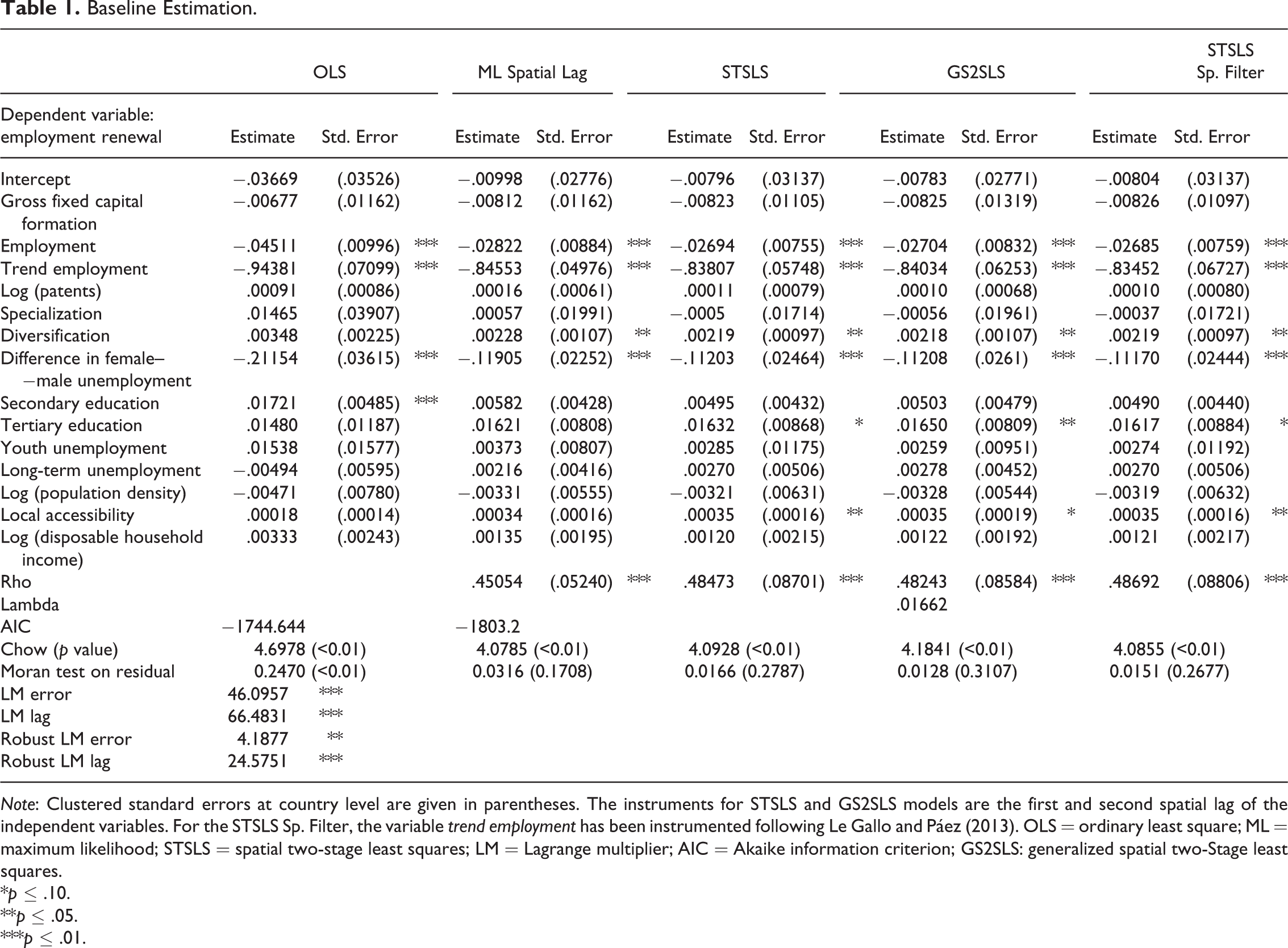
Note: Clustered standard errors at country level are given in parentheses. The instruments for STSLS and GS2SLS models are the first and second spatial lag of the independent variables. For the STSLS Sp. Filter, the variable trend employment has been instrumented following Le Gallo and Páez (2013). OLS = ordinary least square; ML = maximum likelihood; STSLS = spatial two-stage least squares; LM = Lagrange multiplier; AIC = Akaike information criterion; GS2SLS: generalized spatial two-Stage least squares.
*p ≤ .10.
**p ≤ .05.
***p ≤ .01.
Direct, Indirect, and Total Effects, Baseline Estimation Based on Maximum Likelihood Spatial Lag Model.
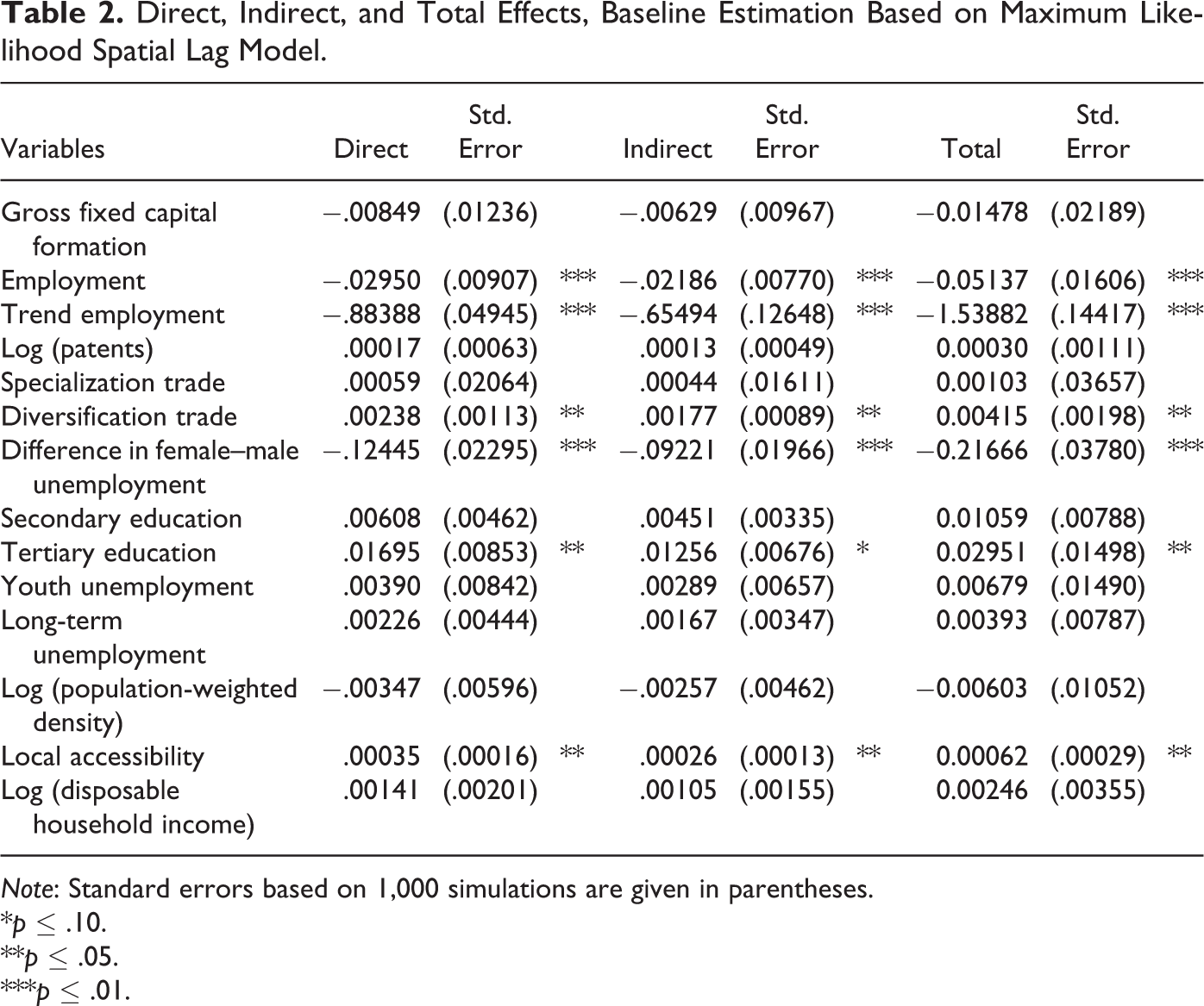
Note: Standard errors based on 1,000 simulations are given in parentheses.
*p ≤ .10.
**p ≤ .05.
***p ≤ .01.
The average employment level and its related trend over the precrisis period have negative direct, indirect, and total effects on renewal. This happens probably because areas that were better-off in their employment were not able to exploit it productively, experiencing overemployment. The significant indirect effect tells us that if, for example, real estate market booms in a particular region, not only that region is affected but also the surrounding ones, generating a vicious circle. It is worth noting, however, that average employment level and trend can hide composition effects since the crisis has not impacted equally all groups of workers and sectors (European Central Bank 2012). The analysis of the composition effects, in spite out of the scope of this work, is an aspect that deserves attention and will be considered in the future. While specialization is not significantly correlated to employment renewal, diversification is positive and significant. In Online Appendix B, when specialization and diversification are calculated on the exports, both are not significant. The result on employment diversification is in line with Giannakis and Bruggeman (2019) who use employment resistance as dependent variable, and with Pontarollo and Serpieri (2020c) who analyze the factors affecting productivity renewal. Sectoral employment diversification, accommodating sector-specific shocks, contributes positively to economic growth (Hausmann et al. 2013). This positive effect, at least partially, looks like to be translated to employment. Interestingly, diversification produces significant spillover effects.
Specialization, on the other hand, can improve productivity growth (Van Oort, de Geus, and Dogaru 2015) but, on the other hand, can also leave regions exposed to international fluctuations. As in our regressions we estimate an average effect, we cannot exclude that both effects are happening, balancing each other. The effect of specialization in the context of literature is not clear and strongly depends on what dimension of resilience is analyzed (see, e.g., Doran and Fingleton 2018).
The unemployment gender gap has negative and significant direct, indirect, and total effects on employment renewal. Given that women work mainly part-time, earning in proportion less, they are more exposed to the risk of poverty (OECD 2016). These rigidities in the labor market contribute to clarify why progresses in the inclusion of women can lead to an economic empowerment that may guarantee higher renewal (Kabeer 2012). Youth and long-term unemployment, in contrast, do not have significant effects on employment renewal. High values of these indicators may indicate a problem in the job market even in the precrisis period that, in this extent, might not negatively affect postcrisis employment renewal.
Accessibility is significant in the spatial models, while population-weighted density is not. This result is quite interesting because it shows that agglomeration economies are not a key factor for resilience as in Fratesi and Perrucca (2018), but that local accessibility matters, as predicted by Martin and Rogers (1995) and Martin (1998) in a different but similar context, opening potentially a debate on future territorial planning strategies.
Patents and gross fixed capital formation are not significant too. This highlights that these factors do not contribute to renew the employment trend probably because, in the first case, patents are generally correlated to productivity, but only a marginal part of workers may benefit from them. The gross fixed capital formation, on the other hand, might sustain automatization and productivity rather than employment (Jerbashian 2019). The secondary education is not significant, while tertiary education is positively different from zero, highlighting how much important a skilled labor force is to overcome a crisis.
In Table 1, we report also the Chow–White test for structural breaks between NMS and OMS. The significant results show that the joint null hypothesis of spatial structural stability is rejected, suggesting spatial heterogeneity in the regional renewal process in the form of structural instability between parameters in the two spatial regimes. The roots of these structural differences, as observed by Paprotny (2016), are in the history of these two groups of countries, with the former communist countries that since the 1960s to early 1970s, when they were close to the West, made little progress. This is confirmed by Borsi and Metiu (2015) who do not find economic convergence between the NMS and OMS in the long run, with persistent cross-country real income per capita differences. Marelli, Patuelli, and Signorelli (2012), on the other hand, as shown in the Introduction, analyzing the determinants of employment and unemployment growth after the 2008 crisis find that spatial heterogeneity holds between OMS and NMS and that different factors explain (un)employment in the two regimes. Our findings, reinforced also by previous evidence, support the need to estimate a model, the switching regression, which accounts for structural parameter instability.
The results of the switching regression (equation [3]) are in Table 3 and the direct, indirect, and total effects in Table 4. As for the global regression, also in this case, we find spatial dependence in the residuals of the OLS model and the LM tests confirm the choice of the spatial lag model. The SAR terms across the different models remain highly significant and the values slightly decrease, being comprised between .43 and .56, confirming that spatial spillovers within and between regimes are important in explaining employment renewal. The spatial multiplier is comprised between 0.75 and 1.29.
Switching Regression Estimation.
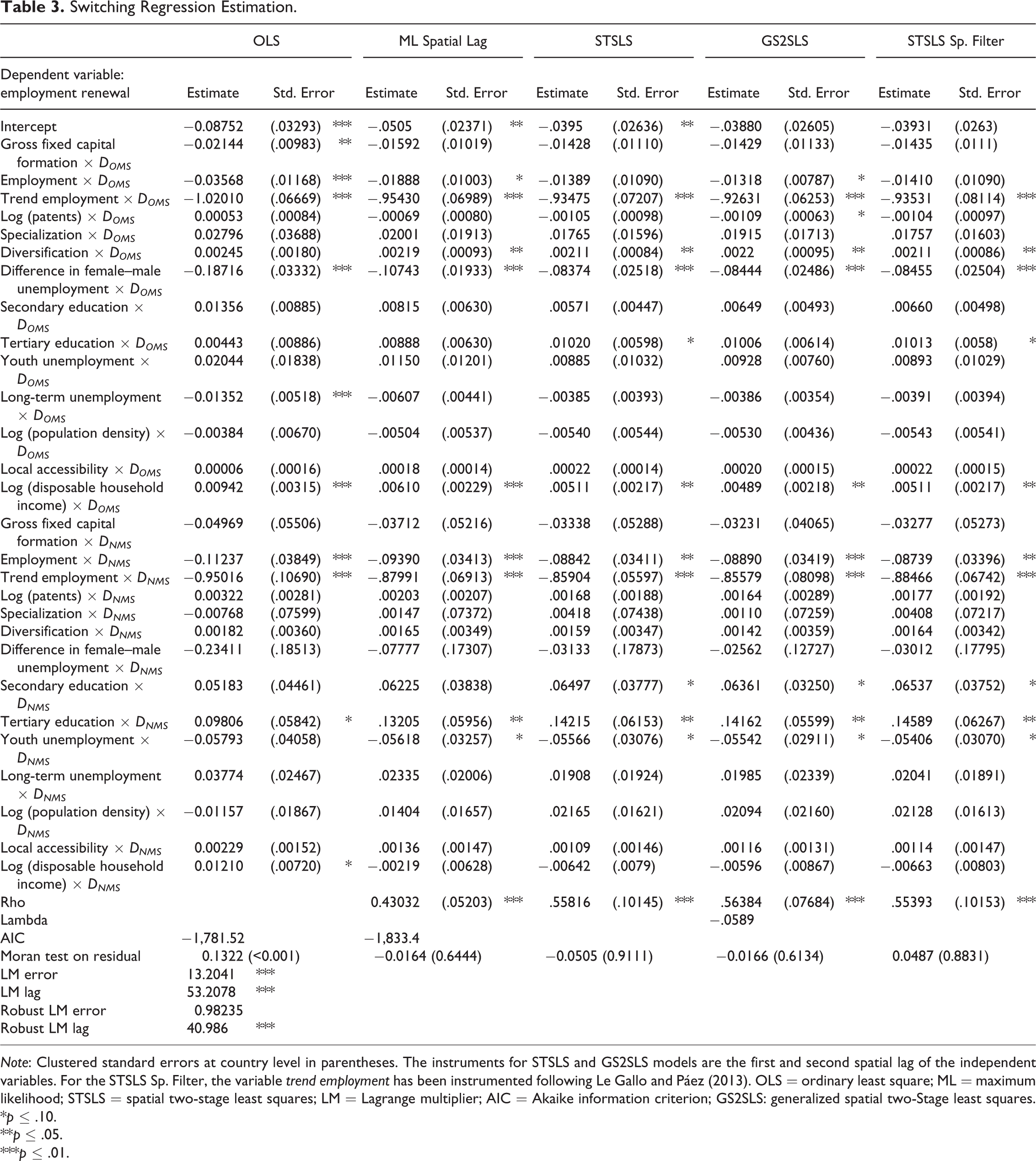
Note: Clustered standard errors at country level in parentheses. The instruments for STSLS and GS2SLS models are the first and second spatial lag of the independent variables. For the STSLS Sp. Filter, the variable trend employment has been instrumented following Le Gallo and Páez (2013). OLS = ordinary least square; ML = maximum likelihood; STSLS = spatial two-stage least squares; LM = Lagrange multiplier; AIC = Akaike information criterion; GS2SLS: generalized spatial two-Stage least squares.
*p ≤ .10.
**p ≤ .05.
***p ≤ .01.
Direct, Indirect, and Total Effects, Switching Regression Estimation based on Maximum Likelihood Spatial Lag Model.
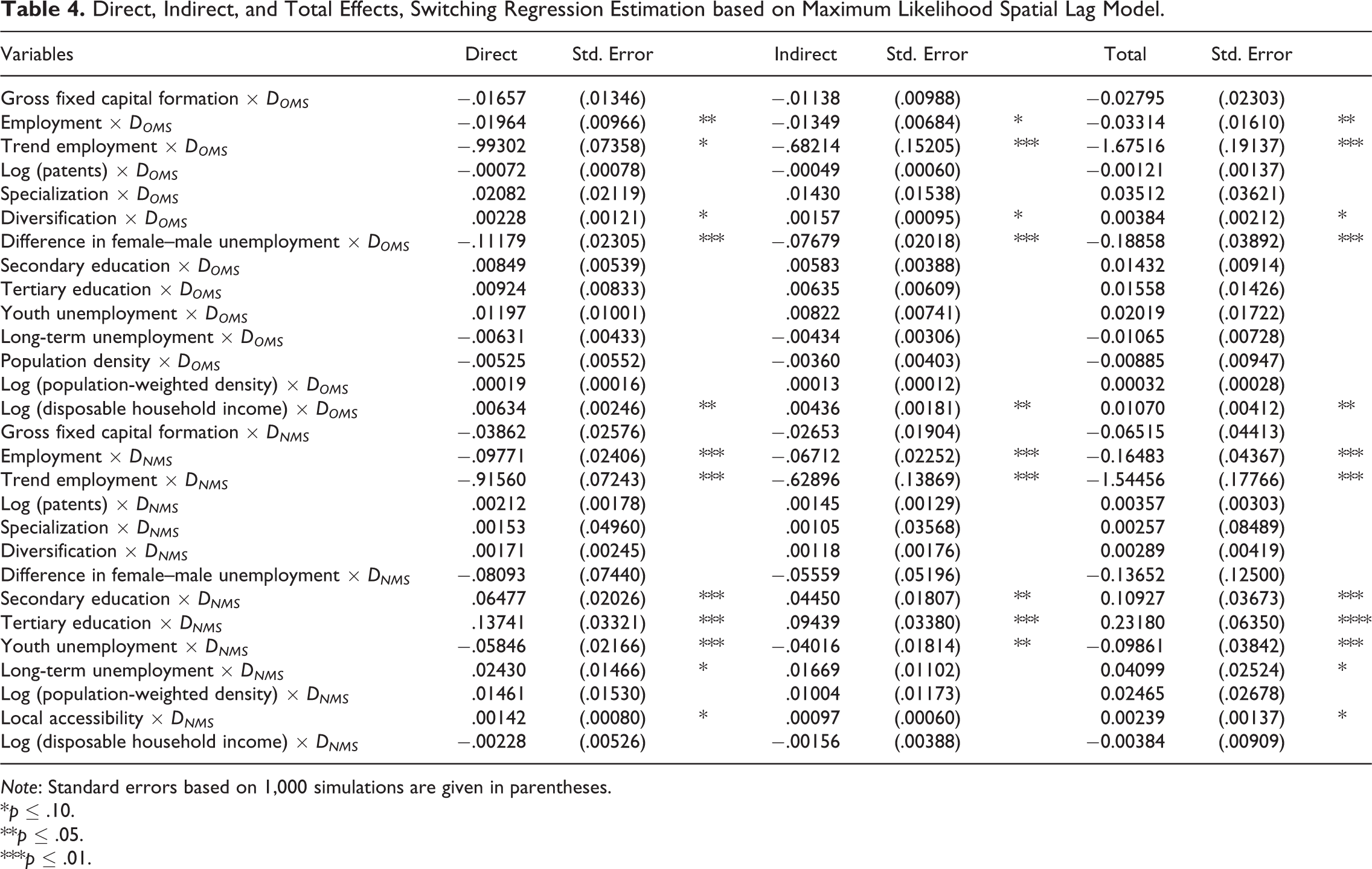
Note: Standard errors based on 1,000 simulations are given in parentheses.
*p ≤ .10.
**p ≤ .05.
***p ≤ .01.
Various coefficients of the included variables and their significance change between the two groups of countries. Among them, we have the difference between female and male unemployment, which is negative for both the groups of regions but significant only for regions belonging to OMS where the economic structure is more advanced and service-intensive, opening to further work options. Long-term unemployment, on the other hand, does not affect the renewal capacity in any of the two spatial regimes, while youth unemployment only in the NMS pointing that employment structure matters only partially for renewal. Specialization is confirmed not being significant neither for OMS nor for NMS. Diversification is marginally positively and significantly correlated to employment renewal in OMS, highlighting that it could be a strategy for regional economies to smooth the negative effects of exogenous shocks, in particular in transition countries. Regarding specialization and diversification based on trade, only the first is negative and statistically significant for regions belonging to NMS highlighting, probably, that they might be exposed to international fluctuations.
The null effect of gross fixed capital formation and education, except for the secondary and tertiary education in NMS, is probably due to their “nonsticky” characteristics (Fratesi and Perrucca 2018): these production factors, indeed, are relatively free to move in space. Regarding education, its different impact on renewal for OMS and NMS might deal with the problem of mismatch between workers’ skills endowment and the labor market requirements. Precisely, compared to NMS, the highly educated and skilled workers in the OMS might contribute marginally less to employment and productivity, challenges in finding adequate jobs in more saturated job markets becoming willing to accept positions for which they are overqualified, which reflects an impediment to economic growth (International Labour Office 2014). The contrary might be true for NMS where, since there are fewer educated people, a higher share of people with secondary and tertiary education has a positive and significant impact because being competitive in the job market increases employability, contributing to the regional renewal of transition economies. This generates a general progress in the regional economies through the spatial spillovers.
Another “spatial nonsticky factor,” patents, is found positive and statistically different from zero in NMS in Tables B3 and B4, in Online Appendix B, but not in Tables 3 and 4. As a consequence, we run a set of additional robustness checks, not reported here for lack of space, that confirmed the statistical significance. The result may point that in those areas where innovation is generally lower, an increase matters more than in areas where it is more widespread, producing significant direct and indirect effect on employment.
Among the “spatial sticky factors,” those that typically do not move in space, local accessibility is significant for direct effects in NMS, while population-weighted density has been found to be significantly different from zero in NMS as shown in Tables B3 and B4 in Online Appendix B and in other robustness checks which are available upon request. The latter result highlights the role of agglomeration economies, identified mainly with the capital regions, as engine of employment renewal in transition countries. The other interesting aspect is that agglomeration economies are able to generate positive spatial spillovers. The effect of disposable household income, finally, is strongly positively significant for direct, indirect, and total effects in regions belonging to OMS, meaning that higher household income, which is in a big part used for consumption, contributes to the faster pace of recovery in the OMS, generating a multiplier effect in space. Regarding NMS, small and open economies strongly depend on foreign markets where consumption of the national working population has become a less important engine for economic growth, making aggregate demand more unstable and weakening the consumer-supported employment (Hegerty 2019). This is the case, for example, of Baltic States.
We check the simultaneity problems by correlating the residuals of our regression models with the independent variables. The detected low or null correlation (in Online Appendix C) contributes to exclude simultaneity issues. Finally, the STSLS model augmented including the synthetic instrument for the trend in employment before the crisis confirms the robustness of our results.
Conclusions
This article takes a novel view of regional economic resilience, analyzing employment renewal among European NUTS 2 regions in the aftermath of the Great Recession. Regional employment renewal, as borrowed from Pontarollo and Serpieri (2017), reveals a clear and significant spatial pattern in the EU. Regions from Western Germany, Great Britain, Northern countries, and the Baltics demonstrate higher capacity in overcoming precrisis employment levels. On the contrary, regions belonging to Mediterranean countries failed to renew their employment trend.
In the second part of this article, we concentrate on whether and how different economic structures and performances prior to the Great Recession affect the ability to renew the employment trajectories of European regions. We employ a spatial switching regression model identifying two spatial regimes corresponding to OMS and NMS. The null hypothesis of equal coefficients for the OMS and NMS subsamples is rejected, confirming what previously observed by Marelli, Patuelli, and Signorelli (2012), that is, the presence of a structural break in the sample under analysis. From a policy perspective, this finding has a double implication. The first is that different macro-area policies might be adopted. The second is that, since spatial dependence in the form of spatial autocorrelated dependent variable holds in all the models, regional and national policies should be implemented carefully because they do not affect only the places where they are implemented, but they spread to other neighboring regions, regardless of the spatial regime to which they belong to. Our findings identify opportunities and challenges for European, national, and regional policy makers when dealing with economic downturn.
Among the territorial assets that potentially influence employment renewal, the gender gap negatively affects the renewal for the OMS, highlighting the need for gender equality policy that favors the greater participation and opportunity of women in the labor markets. As a matter of fact, closing the gender gap is conceived as an ever-present global challenge to boost economic growth (World Economic Forum 2017). The presence of positive link between diversification and specialization based on employment and renewal is not verified while specialization in terms of trade has been an obstacle for the employment renewal of NMS. Regional labor market features like employment level, and trend are always negative and significant for employment renewal of both groups of regions, highlighting the need for creating productive employment to overcome a shock. The negative impact of youth unemployment on NMS renewal, on the other hand, calls for actions to increase the dynamism of regional economies of this macro area of Europe. Consumer spending, which has driven employment renewal in the OMS, might be supported in particular in those countries. Policy actions to increase the share of people with secondary and tertiary education attainment should be taken in NMS. These countries, which perform comparatively worse than OMS in this field, however, may gain marginally more from an increase in the share of people with high educational attainment, due to their development stage. Furthermore, if it is true that a higher share of people with high education sustains the renewal of the NMS, the fact that those countries have relatively low share of people with high educational attainment might be an obstacle to maintain their growth path.
Finally, policy actions could be taken to create the proper condition for other non-sticky production factors like capital and patents to produce effects on local markets. These conditions typically consist of a mix of soft and hard assets and should be implemented under the “place-sensitive distributed development policies” (Iammarino, Rodríguez-Pose, and Storper 2018) that integrate place-sensitive policies to maximize each territory’s development potential.
Supplemental Material
Supplemental Material, Table_A1 - Challenges and Opportunities to Regional Renewal in the European Union
Supplemental Material, Table_A1 for Challenges and Opportunities to Regional Renewal in the European Union by Nicola Pontarollo and Carolina Serpieri in International Regional Science Review
Supplemental Material
Supplemental Material, Table_A2 - Challenges and Opportunities to Regional Renewal in the European Union
Supplemental Material, Table_A2 for Challenges and Opportunities to Regional Renewal in the European Union by Nicola Pontarollo and Carolina Serpieri in International Regional Science Review
Supplemental Material
Supplemental Material, Table_B1 - Challenges and Opportunities to Regional Renewal in the European Union
Supplemental Material, Table_B1 for Challenges and Opportunities to Regional Renewal in the European Union by Nicola Pontarollo and Carolina Serpieri in International Regional Science Review
Supplemental Material
Supplemental Material, Table_B2 - Challenges and Opportunities to Regional Renewal in the European Union
Supplemental Material, Table_B2 for Challenges and Opportunities to Regional Renewal in the European Union by Nicola Pontarollo and Carolina Serpieri in International Regional Science Review
Supplemental Material
Supplemental Material, Table_B3 - Challenges and Opportunities to Regional Renewal in the European Union
Supplemental Material, Table_B3 for Challenges and Opportunities to Regional Renewal in the European Union by Nicola Pontarollo and Carolina Serpieri in International Regional Science Review
Supplemental Material
Supplemental Material, Table_B4 - Challenges and Opportunities to Regional Renewal in the European Union
Supplemental Material, Table_B4 for Challenges and Opportunities to Regional Renewal in the European Union by Nicola Pontarollo and Carolina Serpieri in International Regional Science Review
Supplemental Material
Supplemental Material, Table_C1 - Challenges and Opportunities to Regional Renewal in the European Union
Supplemental Material, Table_C1 for Challenges and Opportunities to Regional Renewal in the European Union by Nicola Pontarollo and Carolina Serpieri in International Regional Science Review
Footnotes
Authors’ Note
The scientific output expressed does not imply a policy position of the European Commission. Neither the European Commission nor any person acting on behalf of the Commission is responsible for the use which might be made of this paper.
Declaration of Conflicting Interests
The author(s) declared no potential conflicts of interest with respect to the research, authorship, and/or publication of this article.
Funding
The author(s) disclosed receipt of the following financial support for the research, authorship, and/or publication of this article: Funding has been provided by Joint Research Centre (JRC), European Commission.

Supplemental Material
Supplemental material for this article is available online.
Notes
References
Supplementary Material
Please find the following supplemental material available below.
For Open Access articles published under a Creative Commons License, all supplemental material carries the same license as the article it is associated with.
For non-Open Access articles published, all supplemental material carries a non-exclusive license, and permission requests for re-use of supplemental material or any part of supplemental material shall be sent directly to the copyright owner as specified in the copyright notice associated with the article.
