




Abstract
Scholars of the geography of innovation have produced an impressive body of literature over the last decades. However, until recently this research focused on successful core regions, implicitly assuming that there is no innovation in peripheral areas. This view is being increasingly questioned, which is reflected by a rising number of papers, special issues, and edited volumes on innovation outside of agglomerations. Hence, this rapidly emerging field calls for a critical survey. In order to identify a future research agenda, this article conducts a systematic literature review of the work on innovation in the periphery (1960–2016). As such, it explores the recurring themes and key issues of the field and discusses the various periphery concepts applied, ranging from a geographic to a functional perspective on various scales. In doing so, it outlines options for policy makers and suggests avenues for future research: first, the periphery concept needs more refinement. Second, future studies should include systematic comparisons of regions. Third, an evolutionary perspective might provide new insights. Fourth, future work could explore the benefits peripheries offer for certain kinds of innovation. Fifth, urban–rural linkages might be of higher relevance than assumed. Sixth, research should go beyond the well-known examples. Finally, the analysis could be extended by applying a broader understanding of innovation.
Introduction
The relation between geographical proximity and economic development is a key aspect in economic geography (Simmie 2005; Howells and Bessant 2012). Numerous scholars are citing the seminal work of Marshall (1919, 284) and his notion of the industrial atmosphere in Sheffield and Solingen, implying that there are benefits stemming from localization economies. However, since Jacobs (1969), there is also little doubt that urbanization economies are beneficial and that they might be even more important. This is underlined by the recent debate on the related variety (Frenken, Van Oort, and Verburg 2007), which argues that Jacobs’ externalities (i.e., related variety within sectors) are crucial for economic development and innovation.
Following the ideas of Marshall (1919) and Jacobs (1969), territorial innovation models (TIMs; Moulaert and Sekia 2003, 291) have become influential within economic geography and consequently in policy-making but have hardly ever yielded the expected results (Martin and Sunley 2003). Hence, a critique of these models is now well-documented and accepted within the discipline (Moulaert and Sekia 2003; Crevoisier 2014). Some of the issues raised are the lack of conceptual clarity and the limited explanatory value for noncore regions. As TIMs assume that spatial proximity and urbanization economies are beneficial or even mandatory for innovation, this would mean that firms in peripheral settings could not innovate. The dominance of TIMs might also have been a reason why there has not been much interest in innovation processes and potentials of peripheral regions.
Recently more and more scholars are expressing their discontent with this bias toward agglomerations and the theoretical framework based on concentration (Petrov 2011; Shearmur 2011; Davies, Michie, and Vironen 2012; Shearmur 2015; Isaksen and Karlsen 2016). This bias might also be rooted in the focus on radical, patented innovations, which occur less frequently outside of cities (Davies, Michie, and Vironen 2012; Shearmur 2012). Another reason could lie in the fact that the marketing of an innovation requires services and financing available only in agglomerations, meaning that peripheral origins of an innovation could be overlooked (Shearmur 2015).
These theoretical considerations are underpinned by increasing empirical evidence showing that innovation can be found in remote areas as well. For instance, Virkkala (2007) studies innovation networks in remote Finnish manufacturing, Fitjar and Rodríguez-Pose (2011a) explain innovation processes in peripheral Norway, and Petrov (2011) observes an innovative Northern Canadian periphery. The growing interest in less favored regions is also reflected by special issues of journals (Lagendijk and Lorentzen 2007; Mayer and Baumgartner 2014) and edited volumes by Bathelt, Feldman, and Kogler (2011), Cooke and Piccaluga (2012), Danson and de Souza (2012), and Shearmur, Carrincazeaux, and Doloreux (2016). Addressing this rapidly emerging subdiscipline of economic geography, this article applies an in-depth literature review in order to identify avenues for future research.
The structure of the article is as follows: the second section briefly outlines recent theoretical advances explaining innovation in the periphery, while the third section introduces the overall approach and the methodology of the literature review. Then, the fourth section introduces the findings of the first part of the review, which comprises the preconditions for innovation in the periphery, the innovation processes, and their outcomes. Thereafter, the fifth section turns to the second part and sheds light on the different peripheries investigated. Finally, following a discussion in the sixth section, directions for further research are outlined in the seventh section.
The Theoretical Context beyond TIMs
Before reviewing the literature, it seems necessary to embed the discussion in the wider theoretical debate on the role of space in terms of the geography of innovation. While the TIM literature has assumed that geographical proximity is beneficial and in fact necessary for innovative activity (Moulaert and Sekia 2003), current theoretical developments challenge this view and provide insights into how and when innovation can also be possible in peripheral regions. There might be cases where temporary spatial proximity is sufficient or where too much proximity is indeed disadvantageous. Furthermore, different types of innovation or business strategies might rely on different regional endowments. Consequently, scholars have come up with theoretical frameworks to explain how peripheral regions can be innovative despite low accessibility and the lack of a critical mass of actors.
In this regard, the proximity approach (Rallet and Torre 1999; Torre and Rallet 2005; Knoben and Oerlemans 2006) has been quite influential. It highlights that distance should not only be understood purely in a geographical sense and that too much proximity can lead to negative lock-in effects (Boschma 2005). For example, peripheral areas can be linked via organizational, cognitive, and technological proximity to other (core) areas and use these forms of proximity in their innovation process. Therefore, geographical distance is no longer the whole story. It can facilitate spontaneous exchange and cooperation but temporary spatial proximity (e.g., at conferences or trade fairs) can be sufficient (Torre and Rallet 2005; Rychen and Zimmermann 2008). The presence at such events can therefore help to overcome the disadvantages resulting from a peripheral location.
Related to this approach is the idea of global pipelines complementing—or under certain circumstances even replacing—a local buzz (Bathelt, Malmberg, and Maskell 2004). The basic assumption is that knowledge sourcing increasingly occurs on a global scale. This is necessary due to the high specialization in niches often required for innovation processes. Hence, firms might have to look beyond cities or regions for suitable partners and expert knowledge. There is evidence that such global pipelines have already become more important than the regional environment (Fitjar and Rodríguez-Pose 2011b). Accordingly, this has profound implications for peripheral regions: if the local endowments become less important, then individual firms in a peripheral region lacking the option of local buzz can be innovative if they are well integrated in global pipelines.
Another important strand argues for a more diverse understanding of the preconditions for different types of innovations. In this regard, Jensen et al. (2007) introduced the concept of innovation modes. While the science, technology, and innovation mode highlights the importance of codified scientific and technological knowledge usually brought forward in cities, the doing, using, and interacting mode focuses on informal processes of learning and experience-based expertise. As such, the latter mode can be found not only in firms located in core but also in peripheral areas. In other words, not only high-tech industries usually located in cities can be innovative but many industries possess potential for innovation. In addition, a synthesis of these modes—the so-called combined and complex innovation mode—is also not exclusive to urban areas (Isaksen and Karlsen 2012).
Similarly, the knowledge base approach (Asheim, Boschma, and Cooke 2011) distinguishes between an analytical (science-based), synthetic (engineering-based), and a symbolic (arts-based) knowledge base. While the synthetic base also has potential to be available in more remote areas focusing on the combination of already existing knowledge and problem-solving, the other two are more likely to be found in larger cities with universities and their numerous amenities. Finally, Shearmur (2015) argues that such a vibrant environment might be suitable for innovations relying on the latest knowledge and on frequent interaction (fast innovators). However, firms might prefer a more isolated location with little interaction, building their innovation process more on in-house development and secrecy (slow innovators).
Recently, such ideas have also been incorporated into the debate on regional innovation systems (RISs). Although they initially belonged to the TIM family (Moulaert and Sekia 2003), a distinctive feature of RISs has always been that from early on, scholars provided typologies of different shapes of RISs (see, e.g., Cooke 1998, 2004; Asheim and Gertler 2005; Asheim and Coenen 2006). Hence, the concept has been refined over the years, and efforts have been undertaken to describe institutionally and/or organizationally thin RISs (Trippl, Asheim, and Miörner 2016). As such, RISs are also the theoretical framework for many studies investigating innovative activity in peripheral regions.
Furthermore, numerous studies refer to the relational turn (Bathelt and Glückler 2003) in this debate, as a large body of the work is emphasizing the importance of personal innovation networks and not focusing a priori on a spatial dimension. To conclude, there is now a broad theoretical foundation for conducting research on innovation in remote settings. Hence, the following section explores how these ideas have been tested empirically.
Research Approach, Method, and Sample Structure
The overarching goal of this article is to establish a knowledge base of the literature on innovation in the periphery. As such, the review follows a systematic approach outlined by Wee and Banister (2016). In doing so, the journal articles for this review were retrieved from two scientific databases: Google Scholar and Elsevier’s Scopus. The search included two search strings targeting a publications title, abstract or its key words, namely (1) “Innovation AND Periphery OR Peripherality OR Peripheral” and (2) “Innovation AND Lagging OR Less-Favo(u)red OR Remote OR Rural.” This was done to include not only articles using the term periphery explicitly but similar notions that are often used synonymously. In addition, (3) forward snowballing ensured that frequently cited journal articles and especially book sections not fulfilling these criteria or not included in these databases are considered in the review.
It is important to note that innovation is understood here as firm-level economic innovation, predominantly observed in the manufacturing sector. This was done in order to limit the scope of the review and to arrive at valid results for this kind of innovation. This seems legitimate as economic geography clearly has focused on this type so far (Shearmur 2012), and including other forms of innovation (i.e., social innovation, policy innovation, or public innovation) would lead too far.
The search was further restricted to original scientific publications in English, to the period January 1960 (i.e., the beginning of the period covered by Scopus) to December 2016, and to the fields of economic geography and regional science (the distinction is based on the background and affiliations of the authors as well as the methods of the papers), resulting in 124 publications. The search was not limited to specific journals or books but included all publications fulfilling the aforementioned criteria. However, nineteen publications were excluded from the analysis because they were lacking a clear geographical perspective or provided no specific results for peripheral areas. Additionally, in order to limit the scope of the review, studies on entrepreneurship (four) and path creation (three) in peripheral areas were excluded as well, as these important issues would justify their own respective reviews. Consequently, ninety-eight publications were found eligible for this review.
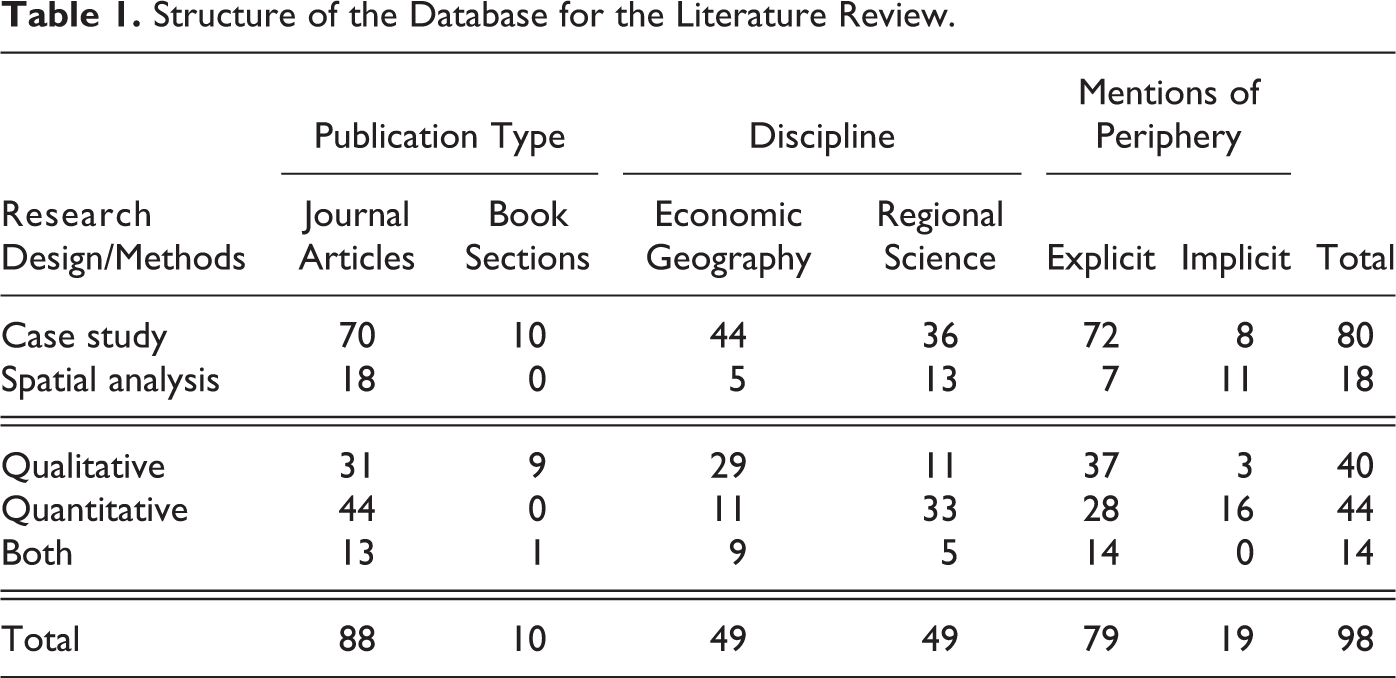
The vast majority (eighty) of publications follow a case study design, describing one or more particular cases. Only eighteen publications can be classified as spatial analyses (Shearmur 2011), meaning that an issue is explored for a larger study area and afterward conclusions for peripheral and central regions are drawn. Furthermore, forty publications are of a qualitative and forty-four are of a quantitative nature. The remaining fourteen combine both qualitative and quantitative methods. Finally, most studies (seventy-nine) explicitly mention peripheral regions, while the remainder is concerned with noncore areas in a more subtle way without labeling them as peripheral. An overview of the database for the literature review is provided in Table 1.
Structure of the Database for the Literature Review.
The coding of the ninety-eight publications regarding the main topics and the theories applied was rather exploratory and is in fact based on the reviewed literature itself. Hence, the following three recurring themes were identified: (1) preconditions for innovation, (2) innovation processes, and (3) innovation outcomes. Reflecting the brief overview on recent theoretical developments, the publications were also classified according to their theoretical framework: (1) proximity approach, (2) local buzz/global pipelines, (3) innovation modes, (4) knowledge bases, (5) RISs, and (6) innovation networks. Additionally, category (7) TIMs summarize publications referring to TIMs and the more traditional understanding of space of the 1980s and 1990s. Not classifiable publications according to this scheme were grouped into a separate class (8).
The study of innovation in peripheral areas has received increasing attention within the field of economic geography especially over the last decade, when the number of publications has risen significantly (see Figure 1). However, the origins date back to the work by Stöhr (1986) on innovation complexes in the periphery but remain scattered until the 2000s publications. From 2006 onward—with the exception of a few single years—the amount of literature has been growing, and recently publications per year have remained at a high level.
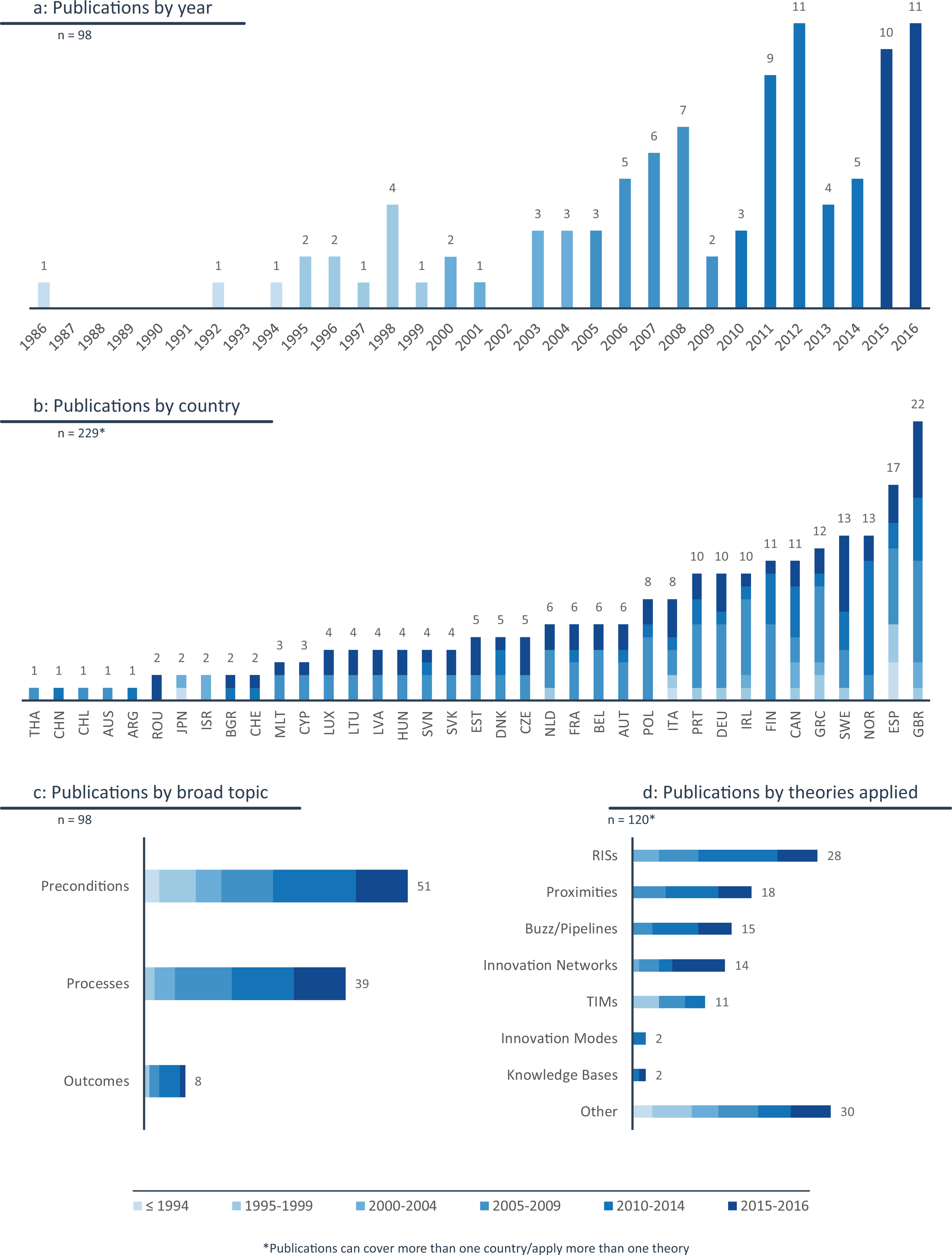
Publications by year, country, broad topic, and theories applied.
In terms of geographical coverage, it becomes clear that empirical work is predominantly of European origin. However, many countries appear only in multinational comparative analyses; in-depth case studies are generally available for countries with at least five publications. With a few exceptions coming from the developing countries, there is undoubtedly a spatial focus on the Northern and Southern peripheries of Europe, while the former has received more attention recently. The exception is Canada where the province of Quebec is the subject of various studies. Nevertheless, with twenty-two empirical studies, it is Great Britain—mainly the Northern parts of the country—that is leading this list. Findings from all these countries are contributing to the literature on innovation in the periphery (for an overview of the sample, see Figure 1). Consequently, the next section reviews the recurring themes and key issues found in the literature.
Characterizing an Innovative Periphery: Preconditions, Processes, and Outcomes
As mentioned above, three recurring themes could be identified in the publications targeting innovation in peripheral areas. First, the majority of the papers (fifty-one) deal with the preconditions for innovations and describe regional or company-related factors essential to triggering or maintaining innovative activities. Second, thirty-nine publications analyze the innovation processes in remote areas. Third, another and just recently emerging strand (eight) investigates the different types of innovation outputs and strategies in peripheral regions. In the following, each of these issues is discussed in detail.
Preconditions: When Is the Periphery Innovative?
Numerous studies focus on the preconditions that allow innovative activities also in peripheral settings, despite the lower accessibility, the lack of research and development (R&D), or a critical mass of actors. Work discussing the regional factors in particular is predominantly quantitative—though not always conclusive. For instance, Crescenzi (2005) argues that innovation efforts might have different outcomes in different regions. Consequently, if factors such as R&D expenditure or education are targeted, this might only yield a limited success. However, there is evidence that specialization externalities are more important for low-density regions, while diversity matters more for denser urban areas (Caragliu, de Dominicis, and de Groot 2016). Some authors argue that peripheral regions might be able to provide an innovative environment for small- and medium-sized enterprises (SMEs), while large enterprises rely on the richer environment usually found in core regions (Karlsson and Olsson 1998).
However, this is disputable and recent research challenges this view by arguing that especially in peripheral regions, company-related factors are crucial if a firm aims to be innovative. Some of these factors are absorptive capacity, company growth, firm size, and strategical planning (e.g., North and Smallbone 2000; McAdam, McConvery, and Armstrong 2004; Copus, Skuras, and Tsegenidi 2008; Varis and Littunen 2012; McAdam, Reid, and Shevlin 2014). Consequently, it seems that there is little doubt nowadays that regional factors influencing innovation in peripheral regions are diverse and that they might actually be of limited importance. Innovative firms are compensating for their location disadvantages through a more efficient internal organization (McAdam, McConvery, and Armstrong 2004; Glückler 2014).
Hence, considering these recent findings, it might be more accurate to speak of innovative firms located in the periphery rather than of innovative peripheral regions. In other words, a relational perspective seems more suitable than a mere territorial perspective in describing peripheral innovative activity. With the absence of a vibrant environment and fewer possibilities to discover new ideas, scientific research, and possibilities for cooperation by chance, firms rely more on their own initiatives. Accordingly, it is unlikely that a peripheral region could provide all inputs necessary for a firm’s innovation process.
Nevertheless, the importance of public subsidies, support institutions, and innovation policies should not be underestimated. Various papers focus on innovation policy targeting the periphery on different spatial scales: on the supranational (Kyrgiafini and Sefertzi 2003; Liagouras 2010), the national (Collins and Pontikakis 2006), but predominantly on a regional level (e.g., Frenkel 2000; North and Smallbone 2006; Soursa 2007; Karlsen, Isaksen, and Spilling 2011; Melançon and Doloreux 2013; Carlsson et al. 2014). This indicates that policy makers indeed see the regional level as most appropriate for innovation policy today, as was already suggested by Cooke (1998).
Most scholars acknowledge that a well-targeted innovation policy is crucial to triggering innovation in peripheral regions if it is based on a thorough analysis. The bad reputation of inefficient innovation policy stems from the fact that too often one-size-fits-all solutions have been implemented, neglecting the specific regional settings (Tödtling and Trippl 2005). For example, conflicting policies have been observed in Northern Finland where a mismatch between competitiveness policies supporting high-technology development and local policies promoting employment is evident (Jauhiainen and Moilanen 2012). However, even if efforts build upon regional expertise and include local universities and R&D, locations might possess limitations that can hardly be overcome with innovation policy, as the case of the marine biotechnology cluster in Tromsø shows (Karlsen, Isaksen, and Spilling 2011). Hence, regions with an innovation policy in place seem to be better off in the long run (Carlsson et al. (2014), but there is no guarantee that it will succeed.
A crucial factor for such a success might be the existence of a university or at least university branches. Peripheral regions that host a university clearly have an advantage over regions lacking higher education institutions. Nevertheless, the successful integration of a university in a peripheral RIS is ensured only if the resources provided by the university are the ones demanded by firms in the region.
This mismatch is often neglected and the reason why universities do not yield the expected returns (Charles 2016). However, if the relationship between region and university is developed along the strengths of the university and the needs of the region, there can be positive outcomes (e.g., Benneworth and Charles 2005; Schiller 2006; Kosonen 2012; Kempton 2015; Pinto, Fernandez-Esquinas, and Uyarra 2015). Such examples underline the importance of higher education infrastructure for peripheral regions, especially in terms of endogenous development.
In sum, regional endowments might influence the innovation potential of remote areas, but it is unclear to what extent. A more crucial precondition is the prevalence of firms focusing on innovation and actively overcoming the limitations of their location. Such firms are ideally supported by a tailor-made innovation policy, including important regional actors like a university (if available). In this case, innovators possess the preconditions necessary to organize their innovation process in an efficient way. Consequently, if there is a critical mass of actors and a certain organizational and/or institutional thickness (Zukauskaite, Trippl, and Plechero 2017), peripheral RISs can develop, as described in the next section.
Processes: How Can the Periphery Be Innovative?
The open innovation paradigm (Chesbrough 2003) has been very influential within the discipline and has replaced both the linear and the interactive innovation models. This thinking emphasizes the importance of interaction, spillovers, absorptive capacity, and external knowledge. Although these are equally important for firms in central and remote locations, there are different challenges to establish and maintain the innovation process. And by definition, this is harder to achieve in peripheral regions.
However, similar to central regions and inspired by the relational turn in economic geography (Bathelt and Glückler 2003), a number of studies investigate innovation networks in the periphery. They focus on teleworkers located in remote locations (Bergum 2012), core-periphery patterns in aspatial networks (Kudic, Ehrenfeld, and Pusch 2015), or innovation networks in general (e.g., Copus and Skuras 2006; Huggins and Johnston 2009; Li, Li, and Liu 2011; Esparcia 2014; McKitterick et al. 2016; Merli 2016). Most scholars conclude that innovation networks are crucial for innovative SMEs in the periphery, especially connections to extraregional actors. In such networks, public institutions are often essential to set the foundations and to trigger exchange. However, the development of extraregional networks might also depend on the accessibility of the region and therefore at least to some extent on geographical proximity (Copus and Skuras 2006).
Nevertheless, faced with the absence of universities, an underdeveloped support infrastructure and the lack of a critical mass (and therefore local buzz) firms might have no choice but to rely on such external linkages. Hence, another key issue in the empirical work is how firms in a peripheral location actually access the external knowledge necessary for their innovation activities. Although there might be potential for regional cooperation and knowledge transfer, there is a tendency in the literature to assume that external information is more crucial for peripheral than for core areas.
For example, external linkages are seen as essential in order to get access to the latest research or to specialized service providers and to gain knowledge about markets (e.g., Lorentzen 2007; Onsager et al. 2007; Fitjar and Rodríguez-Pose 2011a, 2011b; Fontes 2012; Rodríguez-Pose and Fitjar 2013; Dubois 2015, 2016). Hence, scholars argue that policy makers should emphasize securing the access to such external knowledge instead of trying to upgrade the local knowledge base.
However, the empirical evidence is not as clear-cut as this might suggest. In a study on Norway, Rodríguez-Pose and Fitjar (2013) highlight that firms are actually more likely to have international partners in the capital region of Oslo compared to firms located in more remote and smaller towns of the country. This indicates that it might be a very individual decision of a firm how external knowledge is accessed and absorbed.
Besides the need for external and often international networks, formalized cooperation is also seen to have potential to replace the local buzz usually found in more vibrant environments. The basic idea is that without possibilities for spontaneous exchange and local cooperation, firms might aim to formalize their contacts to be able to maintain innovation networks over a larger distance. Empirical work tends to confirm this relation, and firms located in peripheral regions seem indeed to focus more on formal cooperation than firms in central locations (Grillitsch and Nilsson 2015; Jakobsen and Lorentzen 2015). To establish such international ties, foreign workers can be crucial also in peripheral regions (Solheim 2016).
Besides this emphasis on extraregional networks and formal cooperation, a large body of work actually investigates the emergence and internal processes of peripheral RISs. While scholars agree that thin regions have various disadvantages in creating an RIS, there is evidence that they can be found in such regions as well. However, they might not always be based on high technology, and again, contacts to extraregional actors are highly relevant. As in core regions, RISs in more remote areas can evolve more or less accidentally (bottom-up; Doloreux and Dionne 2008) or can be strategically planned (top-down; Coenen and Asheim 2012).
Peripheral RISs are analyzed in a rather descriptive way in Canada (Doloreux 2003, 2004; Doloreux, Dionne, and Jean 2007; Doloreux and Dionne 2008), the Czech Republic (Zitek and Klimova 2016), Greece (Komninaki 2015), Japan (Abe 2004), and Spain (Todt et al. 2007). Following a framework outlined in Trippl, Asheim, and Miörner (2016, 27), the examples of Bauce (Doloreux 2003, 2004), La Pocatière (Doloreux, Dionne, and Jean 2007; Doloreux and Dionne 2008), and Western Greece (Komninaki 2015) seem to fulfil the criteria of institutionally thick but organizationally thin RISs. On the other hand, Tohoku (Abe 2004) and Valencia (Todt et al. 2007) exhibit signs of an organizationally thick but institutionally thin RIS. None of the regions under investigation can be described as institutionally and organizationally thin RISs, indicating that such regions do not possess many characteristics that could actually be researched.
In conclusion, the empirical work highlights that firms in peripheral areas have options to participate in global knowledge networks and extraregional innovation activities. This relates to the previous section, indicating that the strategies of individual firms actively maintaining such linkages are most important. However, with a certain degree of concentration, successful thin RISs in which the local and regional scale play a more important role can be identified as well.
Outcomes: Which Innovations Can Be Observed in the Periphery?
Scholars have increasingly been pointing out that peripheral regions might have been overlooked in innovation studies due to a focus on high-tech innovations and indicators such as patents (Petrov 2011; Davies, Michie, and Vironen 2012; Shearmur 2015; Isaksen and Karlsen 2016). However, as the knowledge base approach indicates, other industries can also be innovative, and peripheral regions where the economy might still rely more on manufacturing than on the service or scientific sector could actually have advantages concerning the synthetic knowledge base. Hence, it appears to be necessary to distinguish between different forms of innovations—with some more likely in certain regions than others.
So far, however, only few studies have pursued this direction. For instance, there is evidence that core regions are more innovative when process innovation is considered, but original innovations, on the other hand, can be found to a same degree in more remote locations (Lee and Rodríguez-Pose 2013). Still, innovations might occur in more traditional sectors that are less frequently studied (Alderman 1998) or might be of a more incremental nature. Peripheral firms are therefore predominantly innovation followers and not leaders (Shearmur 2011; Davies, Michie, and Vironen 2012). Furthermore, as Davies, Michie, and Vironen (2012) point out there might be hidden innovations not considered in traditional innovation surveys based mainly on R & D activities. The implicit assumption often found in the literature that innovation can only be found in central areas and that peripheral areas exhibit no innovative activity at all is therefore not confirmed empirically.
This has led to the concept of slow and fast innovators (Shearmur 2015). Accordingly, the former interact with less frequency, do not depend on the latest information, and can therefore be found in the periphery as well. On the other hand, the latter depend on frequent interaction, R&D, and access to various knowledge sources. Hence, in contrast to slow innovators, fast innovators are more likely to be located in diverse and dense areas. A first empirical analysis on the province of Quebec (Shearmur and Doloreux 2016) seems to confirm these theoretical assumptions. However, it is unclear whether this is true also for peripheries in smaller countries with comparatively overall high accessibility. As Tödtling, Lehner, and Kaufmann (2009) demonstrate, advanced innovations indeed rely on knowledge exchange with universities and business organizations, patents, and R & D. However, for the case of Austria, there is no difference between central and remote firms concerning these factors.
As this section indicates, considering incremental innovations, experimental development, and traditional industries in addition to science-based, high-tech innovation and patents might draw a more realistic picture of the innovation landscape. However, the empirical literature also shows that the notion of periphery is applied to a motley mix of regions. This raises the question of what actually qualifies as a peripheral region? This issue is explored in detail in the following sections.
The Multifaceted Understandings of the Periphery
Evidence on the recurring themes identified above stems from various peripheries. As Shearmur (2012, 11) points out, there are different types of innovations, which means that the term is not always understood in the same sense. This is not any less true for the notion of periphery itself (see Figure 2). Hence, the comparison of results is often complicated by the different spatial contexts they stem from.
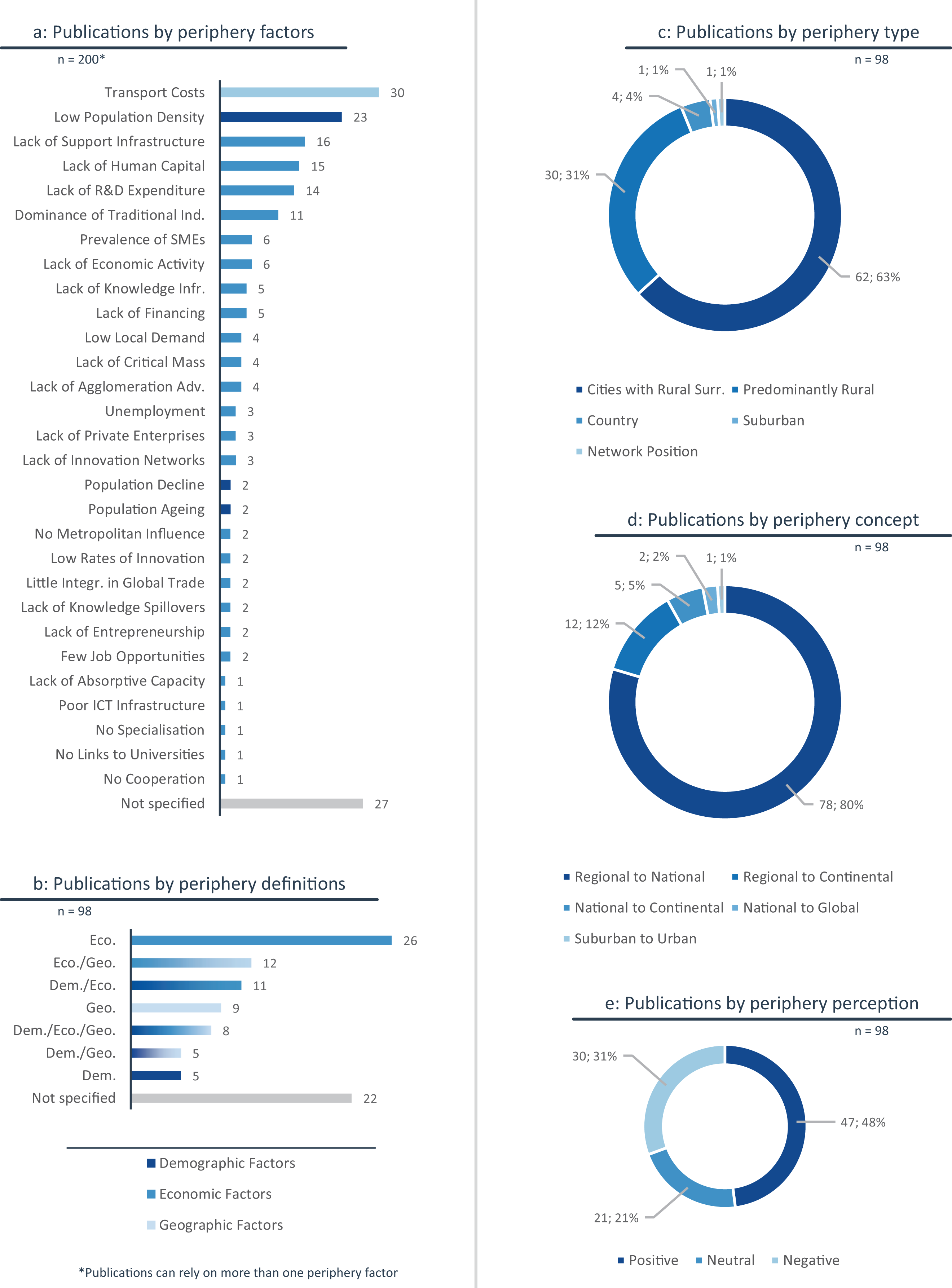
Publications by periphery factors, definitions, type, concept, and perception.
This becomes evident when analyzing the factors used to define the peripheral study regions. About thirty studies mention geographical factors—usually transport costs due to lower accessibility—in describing peripheral regions. Low population density as well as population aging and decline (i.e., demographic factors) are considered as well, although less frequently. The third and most diverse group is comprised by economic factors. Many authors see a lack of support infrastructure, human capital, R&D expenditure, and the dominance of traditional industries as decisive factors. On the other hand, twenty-seven publications are not specifying at all what challenges the region under investigation faces (e.g., Alderman 1998; Lorentzen 2007; Coenen and Asheim 2012; Brown 2016).
However, only few publications consider periphery in a purely geographical sense. These are mainly quantitative analyses for a large number of regions (e.g., North and Smallbone 2000; Rodríguez-Pose and Crescenzi 2008; Shearmur 2011). More often, only economic factors are used to define peripheral regions (e.g., Crescenzi 2005; Pinto, Fernandez-Esquinas, and Uyarra 2015; Trippl, Asheim, and Miörner 2016). Yet most studies actually apply a combination of economic, geographic, and more rarely demographic factors (e.g., Soursa 2007; Melançon and Doloreux 2013; Dubois 2015; Mayer, Habersetzer, and Meili 2016). Still twenty-two publications provide no information on why the research area is considered peripheral (e.g., Stöhr 1986; Doloreux, Dionne, and Jean 2007; Cooke 2011).
Another important distinction addresses regional infrastructure and the preconditions for innovation. About 60 percent of the studies focus on regions that host one or more large cities and therefore often include a university and a certain support infrastructure. Such regions are usually surrounded by a predominantly rural hinterland (e.g., Abe 2004; Glückler 2014; Kempton 2015; Shearmur and Doloreux 2015). In contrast, another third deals with rural peripheral areas which are—despite the lack of a critical mass—innovative at least to a certain degree (Dinis 2006; Copus, Skuras, and Tsegenidi 2008; Fløysand and Jakobsen 2011; Lee and Rodríguez-Pose 2013; Solheim 2016), although the innovation barriers are even more pronounced in such environments.
This leads to the question on which scale a region is defined as peripheral? In the vast majority of studies, a region is seen as peripheral compared to other regions of the nation it is located in. In fewer cases, it is the region (e.g., North and Smallbone 2006; Rodríguez-Pose and Crescenzi 2008; Arias-Aranda and Romerosa-Martínez 2010; Caragliu, de Dominicis, and de Groot 2016) or the country (e.g., Collins and Pontikakis 2006; Liagouras 2010; Fontes 2012; Merli 2016) that is seen as peripheral in relation to the whole continent. In addition, sometimes combinations of these concepts are applied.
Not surprisingly, about half of the studies have a positive attitude toward the periphery, concluding in most cases that innovation is possible in spite of the limitations posed by the remote location. This indicates that many studies are (purposely) selecting successful peripheral regions. Another group has a neutral attitude toward peripheral regions, mainly highlighting the challenges such regions face. However, there is also empirical work drawing a rather sceptical picture of the issue of innovation in the periphery, concerned predominantly with ill-suited innovation policy. They question whether peripheries can actually overcome their challenges in the long run, arguing that disparities might become more pronounced (e.g., Liagouras 2010; Fitjar and Rodríguez-Pose 2011b; Karlsen, Isaksen, and Spilling 2011; Brown 2016).
As the analysis in this section has shown, rather than analyzing innovation in similar peripheral regions, the field is characterized by the study of innovation in various quite different peripheries. As the next section will point out, besides the varying application of the notion of periphery, another important question is largely absent in this debate.
Discussion: Innovation Imperative and Periphery Concepts—Peripheral Topics in Innovation Studies?
The literature review provided a detailed picture of the status quo of the research on innovation in peripheral regions. Although the selection process was designed to lead to a comprehensive database, it cannot be ruled out that single publications might have been overlooked. This should be taken into account in the following interpretation and discussion of the results.
Why Should the Periphery Be Innovative?
The most fundamental question also seems to be a trivial one: why should peripheral regions actually be innovative? Of the surveyed literature, only twenty-one publications briefly address this issue, claiming that innovation is crucial for economic growth and fostering territorial cohesion, especially for peripheral regions. The vast majority of the literature adopts uncritically the prevalent narrative of innovation studies, namely, that the changing economic landscape requires firms to be innovative, and being innovative is essential for being competitive and successful in the global economy (Shearmur 2012; Crevoisier 2014), highlighting that this might be true even more for peripheral regions with a lack of local demand (McAdam, McConvery, and Armstrong 2004).
While this at first appears compelling, at second sight, it becomes clear that applying a too positive attitude toward innovation to the periphery is challenging for such regions. As Oughton, Landabaso, and Morgan (2002, 98) put it: The regional innovation paradox refers to the apparent contradiction between the comparatively greater need to spend on innovation in lagging regions and their relatively lower capacity to absorb public funds earmarked for the promotion of innovation and to invest in innovation related activities, compared to more advanced regions.
However, although these insights have provided a more comprehensive understanding of the geography of innovation, they also indicate that case studies of successful agglomerations have been accompanied by successful peripheries. In other words, while previous research was picking winners like cities or clusters, the study of innovation in peripheral areas is also looking mainly at the most notable examples. And some of these might not be that peripheral after all, like the suburbs of the Quebec agglomeration (Doloreux 2003, 2004) or university towns in Norway (Rodríguez-Pose and Fitjar 2013) or the United Kingdom and the Netherlands (Benneworth and Charles 2005).
Hence, there is also a tendency for neoregionalism in the study of innovation in the periphery. Spatial analysis—as outlined by Shearmur (2011)—remains the exception. The argument here is not that innovation cannot occur in peripheral regions or that case studies cannot provide useful insights. Rather it is important to highlight that innovation also in remote areas is often based on at least a certain degree of concentration, path dependency, external inputs, and/or accessibility. Most authors acknowledge this and point out that findings from case studies should not be transferred uncritically to other regions. However, it is important to underline this in order to avoid false hopes of policy makers from previously uncompetitive and non-innovative peripheral regions. As the research has also shown, the crucial factor is not the region itself or its innovation strategy but a firm’s competences, absorptive capacity, and willingness to be innovative.
In sum, while there are critical voices directed at the pro-innovation bias (Godin and Vinck 2017) and innovation policy in peripheral areas needs to be especially careful, innovation practices certainly have the potential of overcoming the downsides of a peripheral location. Especially, if the preconditions for maintaining global pipelines or a synthetic knowledge base are available. However, the possible positive outcomes should not be overestimated. The success of some regions might rely on specific factors or on a path that is not transferable to other regions. Hence, a focus on innovation can be rewarded, but some regions clearly should not try to seek their fortune in technological, firm-based innovation but rather take another path.
What Actually Is an Innovative Periphery?
Related to this argument is the crucial question of which regions or countries should be seen as peripheral? As Jauhiainen and Moilanen (2012) point out, there is a geographical (remoteness, which leads to few relevant development actors and low innovation capabilities as well as entrepreneurship) and functional (weak human capital, thin institutional structures, poor quality of information and communication technology infrastructure, and scarce links to markets) perspective.
As the theoretical debate outlined above has shown, a definition based only on a geographical perspective is insufficient to delimit an innovative periphery. Consequently, most scholars are acknowledging this by applying definitions that also include a functional perspective, that is, economic factors. However, the analysis revealed that a fifth applied no definition of the periphery at all. Another example highlights different perceptions of the periphery: while Stöhr (1986) describes the Third Italy as an innovative periphery, many scholars mention it alongside Silicon Valley and Baden-Württemberg as one of the most successful clusters or RISs worldwide (Doloreux and Parto 2005; Uyarra 2010). As such, it can hardly be described as peripheral.
Indeed, the scope of innovative peripheries found in the literature is broad. It ranges from fishing villages in Northern Norway (Fløysand and Jakobsen 2011) and regions with bigger cities at the edges of the European Union (e.g., Arias-Aranda and Romerosa-Martínez 2010; Fontes 2012; Harris, McAdam, and Reid 2016; Merli 2016) to countries in the Global South (Schiller 2006; Glückler 2014). This illustrates that the research on innovation in the periphery is more diverse than one might assume, which is also the result of an arbitrary application of the term periphery itself.
Despite this, a theorization of the notions of central and peripheral regions is largely absent within the geography of innovation. As pointed out above, most studies do not go beyond acknowledging that not only geographical but also functional factors are important in delimiting peripheral regions. However, this does not represent a sound theoretical framework that would allow for a profound cross-regional or cross-country analysis. Hence, from the perspective of an individual reader not familiar with the peculiarities of a country or a region, a case study might not seem to fulfil the criteria of being peripheral.
It is not the aim of this article to argue that some regions or countries are not peripheral enough and should be neglected in further analyses. However, the scope should also not become too arbitrary—an issue for which the research conducted under the umbrella of the TIM family has been widely criticized (Moulaert and Sekia 2003). As a comprehensive framework is currently not available, this complicates the scientific debate and the comparison of case study results across regions. Therefore, future work would benefit from a more careful, theory-led application of the concept of periphery.
Questions toward a Research Agenda
The amount of work on innovation in the periphery is still low in comparison to what has been written on cities and clusters (Shearmur 2012). Nevertheless, recent theoretical developments and empirical work have started to open the black box of innovative activities in peripheral areas. While some topics have received quite an amount of attention, more efforts are needed to understand less frequently explored issues.
Some scholars have already shown interest in such more marginalized topics. Among these topics are lack of financing (Lee and Brown 2017) and poor governance (Rodríguez-Pose and Di Cataldo 2015), which can hamper innovative activities in peripheral regions. Furthermore, Birch and Cumbers (2010) highlight the challenges of such regions in becoming integrated in knowledge-based commodity chains. Another body of work indicates that in some regard, peripheral regions might be quite similar to central ones. There is evidence for a positive impact of immigration (Kalantaridis and Bika 2011) or niche marketing strategies (Dinis 2006), and there is no difference in the uptake of knowledge intensive business services based on a firm’s location (Shearmur and Doloreux 2015).
Additionally, future research could develop along the following issues: first, there is a need to be more explicit about the type of periphery under investigation. Future studies should put more emphasis on outlining the peripheral setting (both from a geographical and functional perspective) of the study area in order to make research results comparable across regions and countries. Another step would be to try and arrive at a more theory-driven definition of innovative regions, both peripheral and central. Such a framework could include new theoretical developments such as the innovation modes or the knowledge base concepts, highlighting the different strengths and weaknesses of regions concerning different types of innovations.
Second, as the literature is seemingly dominated by case studies of successful regions, the identification of crucial factors for innovation might be biased. Hence, a systematic comparison between peripheral regions with and without innovative firms might provide important insights. This would go beyond the focus on best practice examples but would also include unsuccessful strategies and failed firms. Such analyses might help to answer questions such as why different regions produce different innovations? Why similar points of departure lead to different outcomes? and why some regions fail to be innovative at all?
Third, related to the above is the need for a dynamic perspective. Only few studies (Doloreux, Dionne, and Jean 2007) employ an evolutionary perspective, although this is crucial to understanding whether and how regions or firms located in the periphery can become innovative over time. Hence, future studies should go beyond describing the status quo. This is also important as a region might become central or peripheral over time, and periphery should be seen as a dynamic concept.
Fourth, the current work is overwhelmingly trying to explain how firms located in peripheral locations can be innovative despite the challenges imposed on them by their environment. However, there are indications that (relative) isolation might in fact be a business strategy (Shearmur 2015) and that SMEs might rely on secrecy (Shearmur 2012). Furthermore, a peripheral location can serve as a testing ground (Glückler 2014). This strand is in opposition to the view that concentration is always beneficial and provides plausible arguments. It also argues for more analysis on the individual firm level instead of the regional level. However, evidence of firms deciding deliberately to locate to remote locations in order to harvest this potential has so far been limited (Mayer and Baumgartner 2014).
Fifth, and directly linked to the above, is the importance of urban–rural linkages. Although this is indirectly addressed in studies focusing on knowledge sourcing and innovation networks, there is only little work acknowledging that ties to urban cores can be a crucial factor for peripheral innovation (Mayer, Habersetzer, and Meili 2016). Future research could therefore overcome the dichotomy of studying urban or peripheral areas, focusing on the one hand on mutual interaction and on the ways they can benefit from each other. On the other hand, studies could explore how such ties can actually suppress the innovation base in peripheral regions, for example, by the recoupling of a global production network (MacKinnon 2012).
Sixth, scholars of the geography of innovation have expressed a discontent with the bias toward successful core regions (Petrov 2011; Shearmur 2011, 2015; Isaksen and Karlsen 2016). However, the literature on innovation in the periphery also seems to focus on the most successful examples in some of the most well-developed economies worldwide. It might make sense to look at peripheral regions with no innovative activity for comparative reasons. Furthermore, the field could benefit from more research applying a spatial analysis approach (Shearmur 2011) and by looking at thus far understudied regions and countries rather than analyzing well-known examples anew.
Finally, the pro-innovation bias has led to the assumption that all peripheral regions should be innovative and that fostering innovation activities is a crucial task for policy makers. However, as the innovation paradox (Oughton, Landabaso, and Morgan 2002) and critical voices (Godin and Vinck 2017) show, this might not be an option for all regions, especially not for peripheral ones. Research on the economic well-being of remote regions could therefore look at successful firms, despite being seemingly not innovative. At least in terms of classical indicators such as R&D spending or patents. A broader understanding of innovation (e.g., ecological, frugal, and disruptive innovation) might provide insights into regions where firm-level technological innovation is not an option.
There is still little doubt that cities play an important role in global innovation processes (Shearmur 2012). However, as this review has shown, the actual situation is not as binary (innovative core vs. non-innovative peripheral areas) as it was often understood. Recent research has shed light on various issues and peculiarities of remote areas. Alongside theoretical advancements, there is now a sound basis for analyzing such issues. However, there are still paths less traveled and enough directions available along which future work could develop with the aim of providing a more comprehensive and comparable picture of innovation in the periphery.
Footnotes
Author’s Note
The usual disclaimer applies.
Acknowledgments
The author would like to thank Robert Musil, Michaela Trippl, and two anonymous referees for critical and helpful comments on earlier versions of this article.
Declaration of Conflicting Interests
The author(s) declared no potential conflicts of interest with respect to the research, authorship, and/or publication of this article.
Funding
The author(s) received no financial support for the research, authorship, and/or publication of this article.
