




Abstract
The term gaslighting is widely used today to describe deliberate attempts to undermine a person’s sense of reality. Although predominantly studied in romantic relationships, research suggests that gaslighting can occur in any context where a power imbalance exists. In this research, we provide a theoretical framework for understanding gaslighting in the workplace, highlighting its unique position within the workplace mistreatment literature. Next, focusing on the leader-employee dyad, we differentiate between the gaslighting tactics leaders employ (leader gaslighting) and target employees’ psychological experience of being gaslit (employee-experienced gaslighting). We also examine whether the consequences of leader gaslighting are conditional on the (in)formal power imbalance between the employee and leader. To test our conceptual model, we first develop separate measures of leader gaslighting tactics and employee-experienced gaslighting and accumulate construct validity evidence across multiple studies (Studies 1a-c, 3). Notably, we find consistent evidence of a bi-factor structure with a “global” destructive leadership factor, and “specific” leader gaslighting, abusive supervision, and social undermining factors. In Study 2, we show that leader gaslighting is positively associated with employee-experienced gaslighting, which in turn adversely impacts self-focused (organizational-based self-esteem and turnover intentions), performance-focused (task performance and workplace deviance), and leader-focused (impression management and affective commitment) outcomes. In Study 4, we show that the direct and indirect negative effects of leader gaslighting are weaker for employees who have relatively greater (versus less) informal (referent and expert) power than their leaders. We conclude with theoretical and practical implications of gaslighting in organizations.
Keywords
In recent years, gaslighting has dominated public discourse on toxic interpersonal relationships. Robin Stern, a leading gaslighting scholar, explains that “in the vernacular, the phrase ‘to gaslight’ refers to the act of undermining another person’s reality by denying facts, the environment around them, or their feelings” (Stern, 2019). In academia, gaslighting has been extensively studied in the intimate partner violence (IPV) context (Darke, Paterson, & van Golde, 2025). This work shows that gaslighting severely impacts the health and wellbeing of targets (Darke et al., 2025; Graves & Samp, 2021). As a result, the UK government formally recognizes gaslighting as a form of psychological abuse and classifies it as a criminal offence with a 5-year jail term (Mikhailova, 2018). Scholars further note that gaslighting can occur in any relationship where there is power imbalance (Jones, 2023; Sweet, 2019), an observation that has promoted research in disciplines such as sociology (Sweet, 2019), philosophy (Abramson, 2014), and nursing (Christensen & Evans-Murray, 2021).
In the field of management, research on gaslighting is still in its infancy. To date, studies on workplace gaslighting have largely adopted qualitative approaches to understanding the phenomenon, often in niche contexts such as non-government organizations (Jones, 2023) and entrepreneurship (Omran & Yousafzai, 2024). Despite these promising works and emerging quantitative studies (e.g., Kukreja & Pandey, 2023), we currently lack deep understanding of workplace gaslighting and how it fits within the broader mistreatment literature. Given ongoing concerns about the proliferation of constructs in this literature (Dhanani & Bogart, 2026; Hershcovis, 2011), scholarly interest in workplace gaslighting is understandably tempered by concerns about whether it differs from extant constructs. Indeed, lay descriptions of gaslighting often reference interpersonal hostility, intimidation, and disingenuousness (Sweet, 2022)—content covered by constructs such as abusive supervision, social undermining, and bullying (Dhanani & Bogart, 2026). Yet, a closer examination suggests that gaslighting encompasses unique content that has yet to be studied in the organizational sciences. A key defining feature of gaslighting is that perpetrators often seek to control their targets by making them question their perceptions of reality, their sense of self, and their recollection of lived experiences (Omran & Yousafzai, 2024; Sweet, 2019). If gaslighting is successful, targets experience a pernicious state where they no longer trust their own memory and constantly question their sanity, while often unaware that they are being manipulated (Sweet, 2019). Thus, gaslighting may be a particularly consequential but poorly understood form of workplace mistreatment that warrants pressing scholarly attention. Such attention would mirror heightened public interest in gaslighting as illustrated by extensive media coverage (e.g., Jamison, 2024; Rogers, 2023), especially following its recognition as the 2022 word of the year (Merriam-Webster, 2022). Absent theoretical and empirical work on workplace gaslighting, management scholars risk overlooking a potentially important phenomenon with strong public interest and promoting a situation where public discourse and managerial practice significantly outpace the science.
In service of the above, it is critical to address the limited knowledge we currently have on the nomological network of gaslighting in the workplace, including potentially unique theoretical correlates, antecedents, consequences, and boundary conditions. Given the core assumption that power imbalance is central to gaslighting (Sweet, 2019)—and power imbalance permeates all aspects of traditional organizations (Keltner, Gruenfeld, & Anderson, 2003)—gaslighting should be most readily observable in leader-employee dyads where power imbalance is formalized and institutionalized through organizational hierarchy (Sweet, 2022). Indeed, initial evidence indicates that some leaders do employ gaslighting tactics with their subordinates (Kukreja & Pandey, 2023; Sweet, 2022). Lastly, it is necessary to develop understanding of the target’s psychological experience of being gaslit in the workplace. Prominent scholars assert that, despite the perpetrator’s actions, gaslighting does not formally occur unless the target experiences self-doubt, “crazy” feelings, and a sense of surreality (Stern, 2007; Sweet, 2019). Thus, to guide the growing literature on gaslighting in organizational contexts, there is need for a comprehensive conceptual framework that accounts for (1) the unique behavioral tactics that workplace gaslighters employ, (2) targets’ psychological experiences of being gaslit at work, (3) the workplace consequences of these experiences, and (4) boundary conditions that attenuate or exacerbate these relationships. To these ends, it is essential to have rigorously validated measures to capture both sides of the gaslighting phenomenon.
Thus, our goals in this paper are as follows. First, we advance unique conceptualizations of leader gaslighting (relative to other destructive leadership constructs) and employee-experienced gaslighting. Second, we accumulate, adapt, and validate measures for each construct. Third, drawing on the approach/inhibition (A/I) theory of power (Keltner et al., 2003), we test a nomological network of gaslighting in the leader-employee relationship. Specifically, we position leader gaslighting as an antecedent of employee-experienced gaslighting, which in turn adversely impacts a host of self-, performance-, and leader-focused outcomes. Fourth, we examine employee-leader informal (versus formal) power imbalance as a key boundary condition. An overview of our proposed conceptual model is depicted in Figure 1.
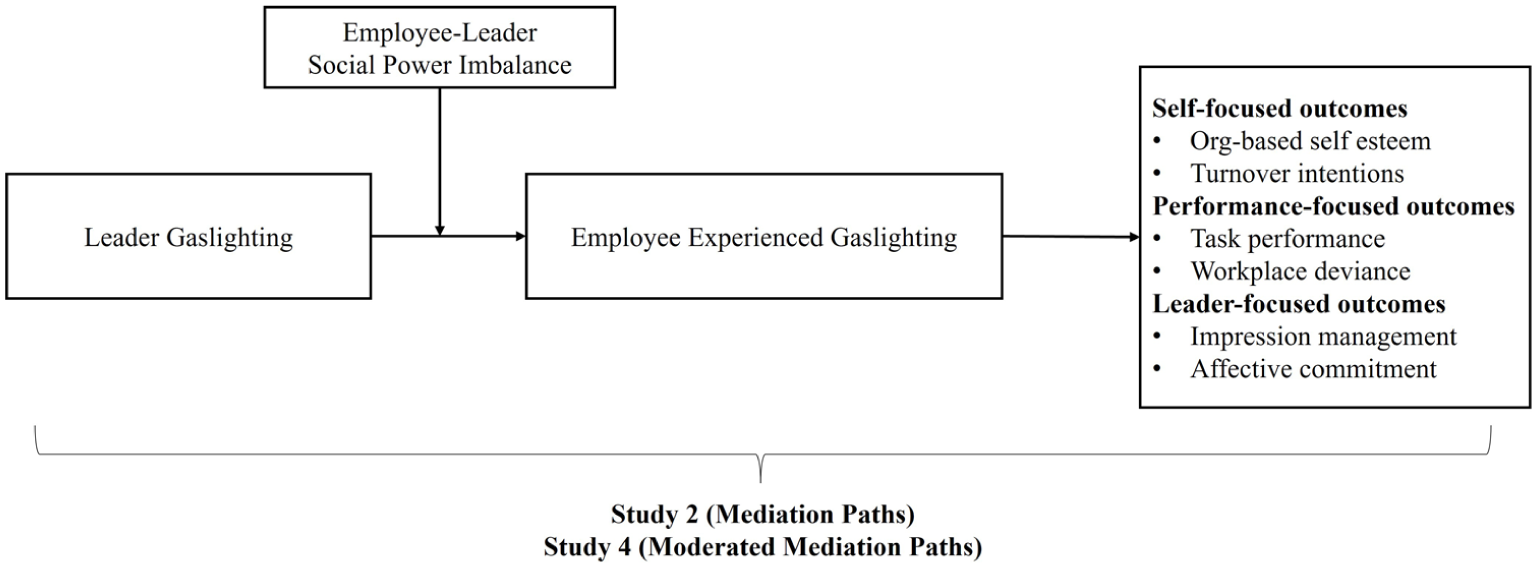
Conceptual Model
Our research seeks to contribute to the destructive leadership literature in several ways. First, we draw on the A/I theory of power (Keltner et al., 2003) to articulate how the imbalance of formal power between leaders and employees facilitates gaslighting. By taking a power lens, we advance an understanding of gaslighting in line with how it is conceptualized in other disciplines (Abramson, 2014; Graves & Samp, 2021; Sweet, 2019). We further aim to clarify how gaslighting differs from conceptually similar constructs. This is important given ongoing attempts to reconcile a variety of negative leader behaviors (Einarsen, Aasland, & Skogstad, 2007; Krasikova, Green, & LeBreton, 2013; Schyns & Schilling, 2013). We advance the thesis that while leader gaslighting falls under the “destructive leadership” umbrella (Krasikova et al., 2013; Mackey, Ellen, McAllister, & Alexander, 2021), it deserves scholarly attention because it covers unique content that offers novel insights into toxic leadership conduct at work. Indeed, Tepper and Henle (2011) argue that new constructs may advance, rather than fragment, the literature if they offer novel ways of thinking about destructive leadership. Thus, we curate and validate a measure of leader gaslighting and empirically demonstrate its distinctiveness from conceptually related constructs such as leader social undermining, abusive supervision, and leader bullying.
Second, we seek to advance new knowledge on the psychological experiences of employees who are subjected to gaslighting. By distinguishing employee-experienced gaslighting from the gaslighting tactics leaders employ, we seek to draw attention to the critical but poorly understood “target” side of the gaslighting phenomenon (Omran & Yousafzai, 2024). As noted earlier, scholars agree that any attempt to gaslight another must be deemed unsuccessful (i.e., gaslighting did not occur) if the target does not experience the core psychological “indicators” of one who has or is being gaslit (Stern, 2007; Sweet, 2019). Our work advances knowledge of what this psychological phenomenon looks like in the workplace. Moreover, since the workplace experience of being gaslit has yet to be formally researched using quantitative methods, we contribute to the literature by curating and validating a new measure and showing its distinctiveness from constructs such as personality, psychoticism, general self-efficacy, psychological distress, and adult attachment.
Third, we seek to shed light on the downstream consequences of employee-experienced gaslighting, focusing on cognitive, social, and behavioral work outcomes predicted by the A/I theory of power (Keltner et al., 2003). Specifically, we explore how the experience of being gaslit engenders inhibition-related employee reactions, including emo-cognitive (organizational-based self-esteem, affective commitment, and turnover intentions) and behavioral (impression management, task performance, and workplace deviance) responses. Thus, we advance nuanced knowledge on how leader gaslighting uniquely affects target employees through experienced gaslighting. We also consider its effects relative to other destructive leadership constructs.
Fourth, research suggests that not all attempts at gaslighting tend to be successful, indicating that some targets are able to defend against it. Omran and Yousafzai (2024) report narratives of targets who were able to silence would-be gaslighters and end the “gaslighting tango” before surreality sets in (p. 1733). This suggests that some employees may possess qualities that allow them to disrupt the imbalance of power to mitigate or neutralize the effectiveness of the leader’s gaslighting attempts. Although there is consensus that gaslighters tend to use formal or structural power to subjugate their targets (Stern, 2007; Sweet, 2019), we consider how those with little formal power may nonetheless push back using other sources of leverage at their disposal. Specifically, we advance the literature by exploring the moderating role of informal power (e.g., expert and referent power; Raven, Schwarzwald, & Koslowsky, 1998) imbalance between employees and leaders to understand how targets may reduce gaslighting effectiveness.
Theoretical Background
Conceptual work highlights that gaslighting occurs in power-imbalanced relationships where the dyad is situated within naturally existing power structures such as those found in romantic and work relationships (Abramson, 2014; Sweet, 2019, 2022). Drawing on over 100 narratives, Sweet (2022) concludes that gaslighters “depend on the mobilization (or creation) of a power imbalance against the victim” and “controlling resources and narratives is key to how power imbalances are established and reproduced.” Below, we build on these elements to conceptualize the two sides of gaslighting in leader-employee dyads: leader gaslighting tactics and the employee’s psychological experience of being gaslit.
Leader Gaslighting
Although several definitions of gaslighting exist (Stern, 2007; Sweet, 2019), Omran and Yousafzai (2024) provide a useful starting point based on their work on the experiences of women entrepreneurs navigating male-dominated enterprises. Adapting their definition to reflect a more general work context, we conceptualize workplace gaslighting as sustained attempts by a party to control another party in a power-imbalanced work relationship with the express aim of inducing a sense of surreality and doubt by altering their perceptions of self, their work environment, and their lived history at work (see Omran and Yousafzai, 2024: 1726, for the original definition). Embedded in this definition are key elements of power imbalance and intentional and repeated attempts to control the other, to distort their sense of reality, and to instill self-doubt. Lastly, we note that gaslighting is explicitly behavioral in nature and reflects a set of tactics that the perpetrator employs to gaslight another. An extensive review and content analysis of the interdisciplinary literatures on gaslighting (see Appendix A of the online supplement) highlights three broad categories of gaslighting behaviors: (1) Reality Distortion tactics such as denial, flipping stories, and presenting false information (Abramson, 2014; Ahern, 2018; Stern, 2007; Sweet, 2019), (2) Gaining Control (over the target’s experience) tactics such as coercion, micro-regulating the target’s behaviors, deferring actions that would help the target, and isolating the target (Ahern, 2018; Christensen & Evans-Murray, 2021; Miano, Bellomare, & Genova, 2021; Stern, 2007; Sweet, 2019), and (3) Harassment tactics such as name-calling, blaming, and threatening the target (Abramson, 2014; Miano et al., 2021; Stern, 2007; Sweet, 2019).
In the management literature, the first category of behaviors (Reality Distortion) has received no attention to date. The notion that perpetrators may attempt to intentionally distort the reality of their targets is not captured in the descriptions of any mainstream workplace mistreatment or destructive leadership construct (see Dhanani & Bogart, 2026; Hershcovis, 2011; Krasikova et al., 2013, for prior reviews). With respect to the second category (Gaining Control), the idea that leaders use destructive behaviors to control their targets has received some limited attention (Krasikova et al., 2013). For example, Ferris, Zinko, Brouer, Buckley, and Harvey (2007) describe how leaders may use “strategic bullying” to control others to achieve personal and/or organizational goals. Although not explicit in its conceptualization, social undermining may also be viewed as an attempt to control the interpersonal experiences, successes, and reputation of the target (Duffy, Ganster, & Pagon, 2002). Overall, it is relatively uncommon for extant destructive leadership constructs to explicitly reference control in their conceptualization or operationalization. In contrast, interdisciplinary reviews of gaslighting (see Darke et al., 2025, and our Appendix A) highlight that control is a core component of gaslighting. Perpetrators often explicitly aim to control their targets through “mind games” and other forms of psychological manipulation (Sweet, 2019; Stern, 2007). These control efforts keep the target off-balance, increase self-doubt, and make them more reliant on the gaslighter. In contrast, scholars have extensively explored the third category of behaviors (Harassment). For instance, “name-calling,” “blaming,” “ridiculing,” “criticizing,” “condescending,” and “belittling” are key descriptors of many constructs, including incivility (Andersson & Pearson, 1999), abusive supervision (Tepper, 2000), bullying (Einarsen, 2000), and social undermining (Duffy et al., 2002). As such, harassment behaviors do not effectively differentiate gaslighting from extant constructs. In conceptualizing gaslighting at work, we thus focus on the first two categories. We do so in service of our collective effort as a field to mitigate construct proliferation in this literature (Hershcovis, 2011; Schyns & Schilling, 2013). We encourage researchers interested in studying general harassment behaviors at work to consider established workplace mistreatment constructs (see Dhanani & Bogart, 2026).
Locating Leader Gaslighting Within the Destructive Leadership Space
Building on past destructive leadership reviews (e.g., Krasikova et al., 2013), we propose that leader gaslighting shares conceptual similarities—but also critical differences—with three constructs: abusive supervision (Tepper, 2000), leader bullying (Einarsen et al., 2007), and social undermining (Duffy et al., 2002). Below, we contrast them along dimensions commonly used in the literature, including intent, frequency, relationship type, severity of harm, and whether the construct mandates specific outcomes (Hershcovis, 2011; Schyns & Schilling, 2013).
In terms of conceptual similarities, all four constructs characterize the perpetrator’s behaviors as consistent and frequent patterns of mistreatment over a prolonged period (Einarsen et al., 2007; Hershcovis, 2011). Second, all constructs appear to exert moderate to severe harm on targets, relative to other “milder” forms of mistreatment such as incivility (Hershcovis, 2011; Schyns & Schilling, 2013). Third, social undermining, bullying, and gaslighting may occur in different types of work relationships (e.g., leader-employee, coworker-coworker), while abusive supervision is limited to leader-employee relationships. Fourth, much like in the gaslighting literature, social undermining, bullying, and abusive supervision scholars specify that power imbalance between the perpetrator and target is a key attribute (Hershcovis, 2011). When these behaviors are initiated by leaders, the power imbalance is necessarily embedded in the formal power structure that characterizes the leader-employee relationship. In contrast, less well understood is the nature of power imbalance when these behaviors (i.e., gaslighting, social undermining, and bullying) manifest in relationships that are not formally hierarchical or top-down (e.g., when an employee targets a leader). Fifth, social undermining and gaslighting both explicitly define the perpetrator’s intent and the outcomes for the target. Indeed, gaslighting is most similar to social undermining because both specify that the perpetrator not only intends to harm the target but also seeks to interfere with the target’s relationships with others, work successes, and reputation (Duffy et al., 2002; Sweet, 2019).
In terms of conceptual differences, the perpetrator’s explicit attempts to disorient the target’s sense of reality, sow confusion, and in the process, instill self-doubt (and reliance on the gaslighter) are unique elements that are not captured by other destructive leadership constructs. Foundational theoretical work on social undermining, abusive supervision, bullying, and related constructs do not specify that perpetrators intentionally (or unintentionally) make their targets question their perceptions of events using tactics such as flipping stories or presenting alternate version of events in a deliberate attempt to sow confusion and to make the target feel like they are going “crazy” (see Hershcovis, 2011; Krasikova et al., 2013; Mackey et al., 2021, for reviews on common destructive leadership constructs). Moreover, we are unaware of empirical research that explicitly link these constructs to targets’ experiences of surreality, self-doubt, and feeling “crazy” at work. We argue that while perpetrator behaviors such as social undermining and abusive supervision may lead targets to feel “confused”—especially when enacted inconsistently across time or among group members (Ogunfowora, Weinhardt, & Hwang, 2021; Yoon et al., 2023)—the confusion is likely about why the leader is equivocating and what it means; rather than confusion about the reality of events and experiences at work (which is unique to gaslighting). In contrast, gaslighting perpetrators often seek to gain and exercise psychological control over their targets (Darke et al., 2025; Sweet, 2019). This often involves micro-regulating the target’s behaviors (e.g., requiring that the target seeks their permission to pursue tasks or interests that they are not a part of or do not control) and using “mind games” to control their emotions, cognitions, and perceptions (Darke et al., 2025; Stern, 2007; Sweet, 2019). While some destructive leadership constructs include overt forms of controlling behavior, scholars note that the use of intricate and covert forms of psychological control is unique to gaslighting (March, Kay, Dinić, Wagstaff, Grabovac, & Jonason, 2025; Stern, 2007).
Gaslighting is further unique in the requirement that the perpetrator must successfully distort the target’s sense of reality (Stern, 2007). While bullying, abusive supervision, and social undermining behaviors are recognizable and labeled as such regardless of whether the target experiences specific outcomes, scholars (Stern, 2007; Sweet, 2019) argue that it is necessary for gaslighting targets to have experienced the psychological state of being gaslit for gaslighting to have “successfully” occurred. This is depicted as an exit or “off-ramp” path in Omran and Yousafzai’s (2024) distillation of the qualitative accounts of gaslighting reported by their interviewees, where some targets were able to “silence their gaslighter and end the gaslighting tango” (Figure 2, p. 1733) before the stage where surreality and self-doubt set in. Thus, the differentiation between the perpetrator’s behavioral attempts at gaslighting and the effectiveness of such attempts is another key distinction from extant constructs. The implication is that gaslighting scholars must concurrently study both the perpetrator’s behaviors and the target’s psychological experiences, a condition not required by other destructive leadership constructs. Lastly, gaslighters often attempt (successfully or not) to conceal their actions or seek to change or reframe others’ interpretations of their actions. They often pass their behaviors as “jokes,” attempt to convince targets that their actions are harmless and call out the target for being “overly sensitive” (Sweet, 2019). While abusive supervision and bullying are overt and social undermining may be covert and overt (Duffy et al., 2002), the use of such covert “intention concealing” and “confusion inducing” tactics are unique to gaslighting. Table 1 provides a summary of these similarities and differences among the constructs. In sum, although leader gaslighting shares similarities with extant constructs—and thus, should be conceptualized under the same broader destructive leadership umbrella—we propose that there are qualitatively unique elements to this construct that warrant scholarly attention.
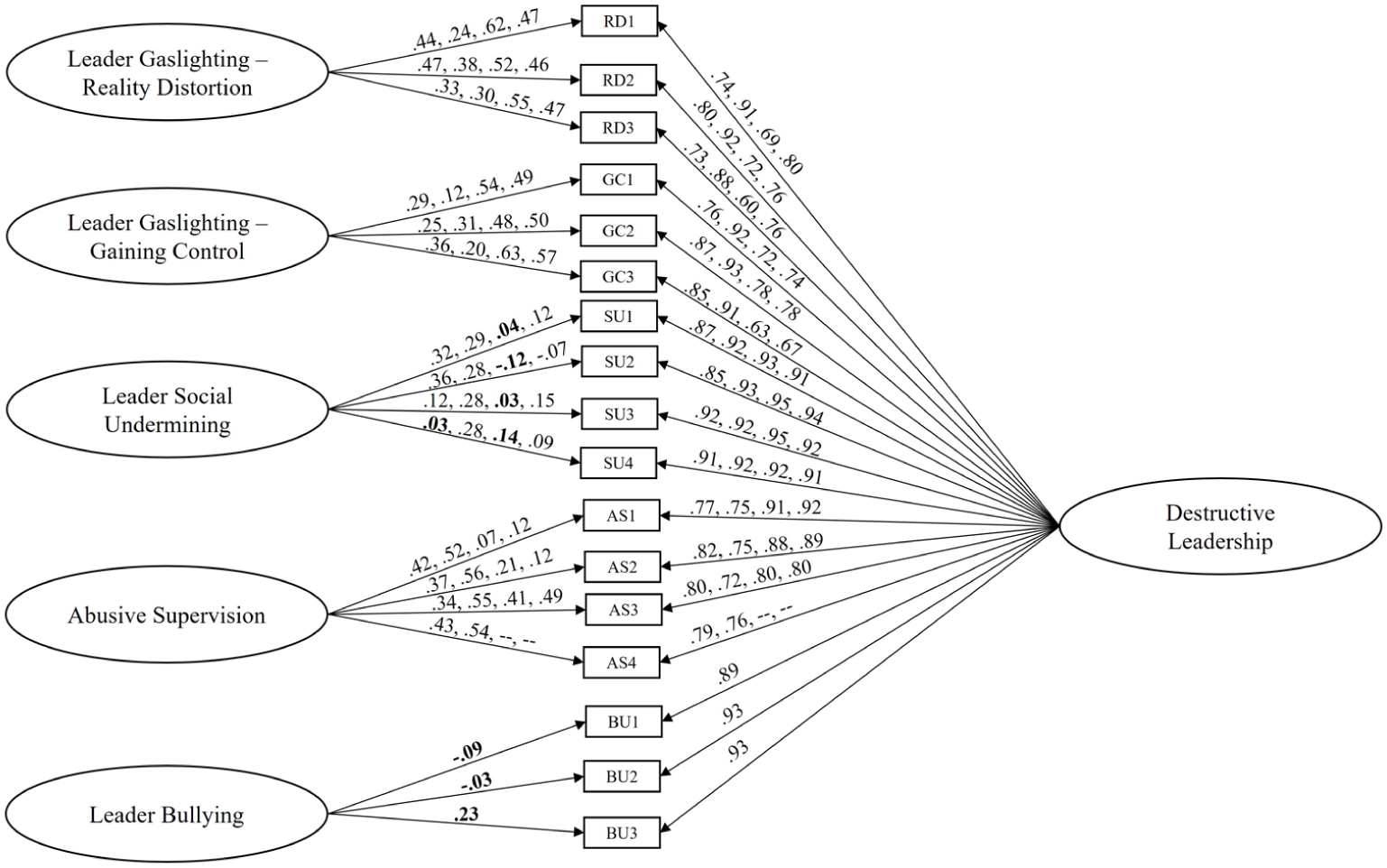
Graphical Depiction of Destructive Leadership Bifactor Structure Results Across Studies
Definitions and Key Distinctions Among Destructive Leadership Constructs
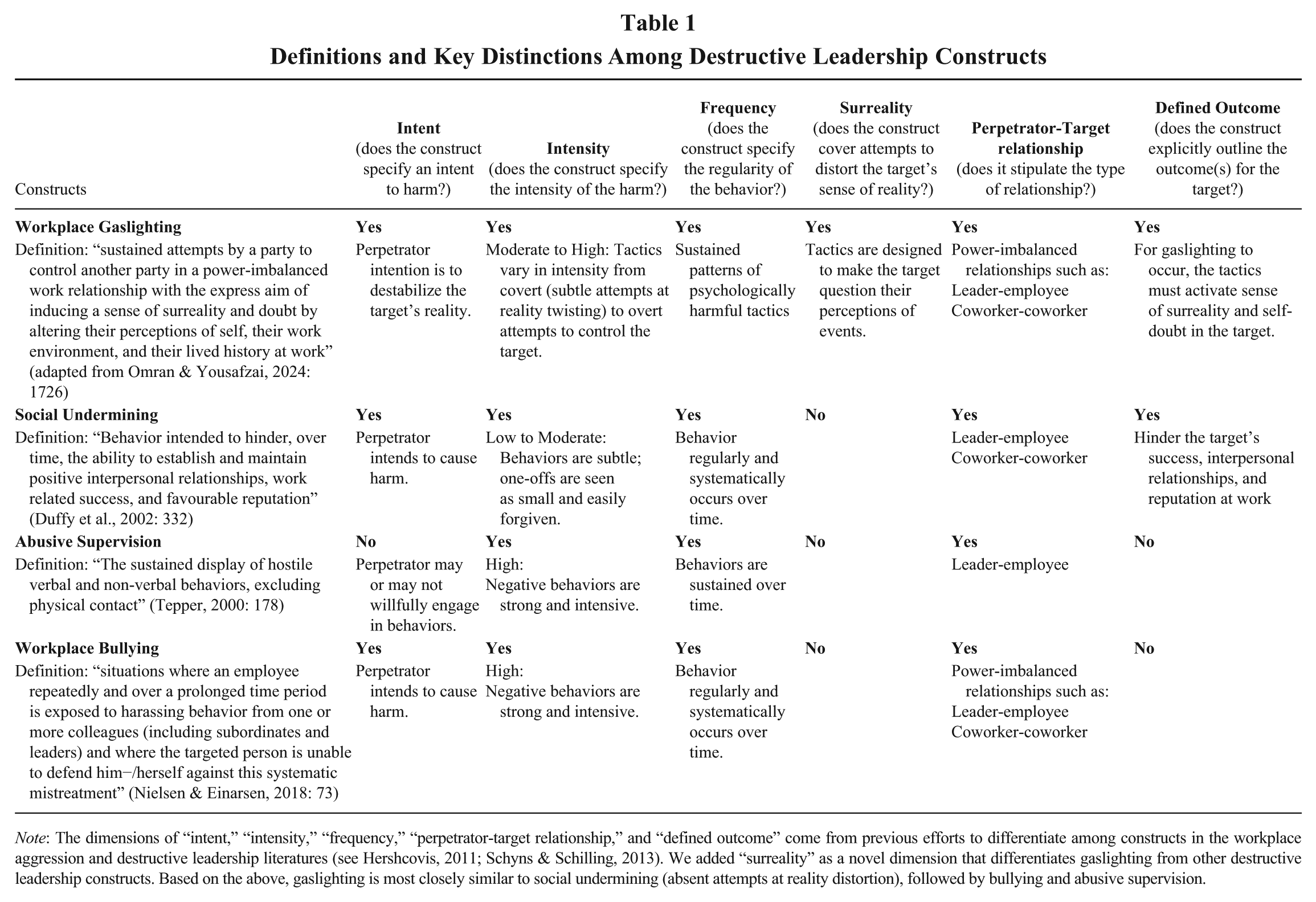
Note: The dimensions of “intent,” “intensity,” “frequency,” “perpetrator-target relationship,” and “defined outcome” come from previous efforts to differentiate among constructs in the workplace aggression and destructive leadership literatures (see Hershcovis, 2011; Schyns & Schilling, 2013). We added “surreality” as a novel dimension that differentiates gaslighting from other destructive leadership constructs. Based on the above, gaslighting is most closely similar to social undermining (absent attempts at reality distortion), followed by bullying and abusive supervision.
Employee Experienced Gaslighting
To date, scholars have described the psychological experience of being gaslit—sometimes referred to as the “gaslight effect” (Stern, 2007) or “gaslighting experience” (Ciabatti, Nerini, & Matera, 2025; Miano et al., 2021)—as characterized by the destabilization of one’s perceptions of reality and debilitating self-doubt, including doubting one’s sanity, perceptions, behaviors, feelings, thoughts, competence, and identity (Ahern, 2018; Christensen & Evans-Murray, 2021; Sweet, 2019). Stern (2007) notes that the target regularly “feels confused and even crazy,” “frequently asks ‘am I too sensitive’” and “often lies to avoid put-downs and reality twists.” In a study of whistleblower intimidation in the work domain, Ahern similarly notes that “the whistleblower doubts [their] perceptions, competence, and mental state” (2018: 59). Narratives from other studies also highlight how gaslighters made targets doubt their perspectives, realities, and sanity (Jones, 2023; Omran & Yousafzai, 2024). These descriptions suggest that the experience of gaslighting reflects a persistent psychological state characterized by unique patterns of thoughts, feelings, and actions exhibited by the target. Baumert et al. (2017) also note that a psychological state captures a “quantitative dimension describing the degree/extent/level of coherent behaviours, thoughts, and feelings. . .” (p. 528, italics added). This perspective aligns with the ABC model (Eagly & Chaiken, 1998), which specifies that psychological constructs often encompass “affective (A),” “behavioral (B),” and “cognitive (C)” components.
Building on the rich body of work on the experiences of individuals who have been subjected to gaslighting in work and non-work contexts (Jones, 2023; Omran & Yousafzai, 2024; Stern, 2007; Sweet, 2019), we define experienced gaslighting as a phenomenon wherein a target experiences a persistent psychological state characterized by a sense of surreality, self-doubt, uncertainty, unease, dread, and confusion about their perceptions and interactions at work as a result of a perpetrator’s deliberate attempts to control and manipulate their perceptions of reality at work. This definition includes elements of the gaslighting experience described in prior research, including surreality, confusion, self-doubt, and uncertainty about one’s relationships and interactions in the work context where the gaslighting occurs. We note that, in this context, doubt reflects not only uncertainty about the self (e.g., in terms of work competence), but also uncertainty about one’s perceptions of events, social interactions, and overall sense of reality in the workplace.
A Power Perspective on Gaslighting in Leader-Employee Dyads
Scholars from diverse disciplines agree that, at its core, gaslighting is about the perpetrator’s attempt to leverage power over the target (Sweet, 2019). As such, gaslighting has predominantly been studied from a power dynamics lens (Graves & Samp, 2021; Jones, 2023; Omran &Yousafzai, 2024; Sweet, 2019). In line with this approach, we explore leader-employee gaslighting dynamics through the lens of the A/I theory of power (Keltner et al., 2003). A/I theory defines power as the “capacity to alter others’ states by providing or withholding resources and administering punishments” (Keltner et al., 2003: 267). The theory posits that an individual’s relative power plays a fundamental role in how and what they attend to in the world around them, as well as their emotional reactions, cognitions, and behaviors (Keltner et al., 2003). Powerful individuals possess valuable resources, including the ability to withhold tangible outcomes, to punish, and to withhold their affection and attention. In contrast, less powerful individuals often have little control and resources, which makes them especially attentive to the behaviors, emotions, and approval of more powerful individuals. Thus, less powerful individuals are strongly influenced by powerful others because their approval and support matters.
Moreover, A/I theory posits that an individual’s power impacts their approach versus inhibition-related processes and actions (Cho & Keltner, 2020; Keltner et al., 2003). While those with more power interact with the world in a more “approach-oriented” way (e.g., positive emotions, attending to rewards), less powerful individuals tend to be “inhibition-oriented” (Cho & Keltner, 2020). Less powerful individuals are more attentive to threats and punishment and prone to negative emotions and cognitions (Cho & Keltner, 2020; Keltner et al., 2003). For instance, because these individuals tend to have reduced access to resources, they are sensitive to the evaluations of others, tend to be more vigilant, and are more likely to experience negative emotions such as anxiety, fear, and embarrassment (Keltner et al., 2003).
In the leader-employee context, leaders tend to have more formal power than employees by virtue of their job positions. Leaders typically have the power to reward and punish (Hinkin & Schriesheim, 1989), along with control over social resources (e.g., networking). Thus, having a positive relationship with one’s leader by gaining their approval can be instrumental to success at work. However, a negative relationship—such as one in which the leader gaslights the employee—should evoke negative employee emotions and cognitions, consistent with the inhibitory responses described in the A/I framework. For instance, the unease and anxiety characteristic of the gaslighting experience are consistent with inhibitory negative affect responses that those with less power often experience. Similarly, the doubt, confusion, disbelief, and sense-making attempts (Stern, 2007) are consistent with the controlled cognitions and negative attitudes that A/I theory predicts for individuals with low power (Cho & Keltner, 2020; Keltner et al., 2003).
Leader Gaslighting and Employee Experienced Gaslighting
A/I theory suggests that, when motivated, people who possess power often engage in a variety of negative behaviors that adversely impact those with less power (Keltner et al., 2003). Powerful individuals are more likely to see others as a means to their own ends or that others exist to serve their own needs (Keltner et al., 2003). They are also likely to blame negative outcomes on the deficiencies of the less powerful. As such, when a leader seeks to harm an employee by manipulating their sense of reality, they have at their disposal a host of formal tools and opportunities. Conversely, less powerful individuals often engage in thorough and controlled information processing to try and understand the actions of the powerful (Keltner et al., 2003). Thus, absent reasonable explanations for the leader’s gaslighting, A/I theory predicts that employees should experience inhibitory responses such as self-doubt, confusion, and unease (Keltner et al., 2003)—outcomes consistent with the psychological experience of being gaslit.
In support of this, research on gaslighting in the IPV domain offers insights into how the psychological experience of being gaslit unfolds. For instance, gaslighters often question the knowledge and perceptions of their targets (Stern, 2007). Gaslighting tactics such as denying events, flipping stories, and contradicting the target’s experience serve to create confusion (Christensen & Evans-Murray, 2021). Moreover, gaslighters often make it difficult for targets to recognize harmful acts by pairing them with sporadic acts of kindness (Stern, 2007). They often enact harmful behaviors when they are alone with the target but treat the target kindly in public. These tactics serve to further confuse the target (Abramson, 2014; Stern, 2007). Gaslighters also seek to establish control over their targets’ environment by socially isolating them and preventing them from seeking support from others or corroborating their experiences (Sweet, 2022). In sum, leader gaslighters may use various tactics to diminish their target’s sense of self-worth, increase self-doubt, distort their sense of reality, and ultimately weaken trust in their own perceptions and lived experiences (Sweet, 2019). Recent qualitative work on the experiences of gaslightees in work settings similarly highlight elements of self-doubt, judgment questioning, disbelief, and confusion (Jones, 2023; Omran & Yousafzai, 2024). Thus, we predict that leader gaslighting tactics are positively associated with experienced gaslighting in targeted employees.
Hypothesis 1: Leader gaslighting positively relates to employee-experienced gaslighting.
Consequences of Employee Experienced Gaslighting
The A/I theory of power suggests that less powerful targets of gaslighting are likely to experience a number of affective, cognitive, and behavioral outcomes. Affectively, less powerful individuals tend to experience inhibition-related emotions, such as anxiety and fear (Cho & Keltner, 2020; Keltner et al., 2003). Cognitively, they tend to exhibit more vigilance, sensitivity to threat and punishment, and concern with how they are being perceived by others (Keltner et al., 2003). Behaviorally, they engage in conduct associated with the activation of inhibition systems, such as withdrawal (Cho & Keltner, 2020; Keltner et al., 2003). We build on these propositions to outline the downstream consequences of employee-experienced gaslighting.
Self-Focused Outcomes
Scholars from different domains have consistently highlighted that low self-esteem and feelings of worthlessness are characteristic outcomes of being gaslit (Christensen & Evans-Murray, 2021; Jones, 2023; Sweet, 2019). In the work context, we predict that experienced gaslighting is negatively associated with employees’ organization-based self-esteem (OBSE). Encompassing both cognitive and affective elements, OBSE captures the degree to which an individual “perceives themselves as important, meaningful, effectual, and worthwhile within their employing organization” (Pierce, Gardner, Cummings, & Dunham, 1989: 625). When the leader constantly makes the employee question their own competence, memories of past interactions, and realities of how simple work events unfolded, the employee is likely to believe, over time, that they are unworthy and do not have the requisite capabilities to contribute meaningfully to the organization (Omran & Yousafzai, 2024). Such low OBSE reflects inhibitive cognitive and affective self-evaluations of the less powerful (Keltner et al., 2003). Thus, we posit that employee-experienced gaslighting is negatively associated with OBSE.
We further posit that employees subjected to gaslighting regularly think about exiting the organization, another common cognitive inhibitive reaction of less powerful individuals (Keltner et al., 2003). Qualitative evidence from the IPV literature suggests that once the target becomes aware of the gaslighter’s tactics, they are often unwilling to remain in the relationship (Klein, Wood, & Li, 2022). In the work context, Omran and Yousafzai document instances where targets resort to withdrawal, including expressing intentions to leave the situation (e.g., “I didn’t fit. I’m the problem. Not the system”; 2024: 1731). Yet, successful gaslighters often get targets to believe that they are well intentioned (Ahern, 2018) and intersperse periods of mistreatment with care and praise (Stern, 2007). These conflicting behaviors promote confusion, making the target question whether they are overreacting when they contemplate quitting. As such, we expect that the effect of experienced gaslighting on turnover intentions is positive but moderate in strength.
Hypothesis 2a: Employee-experienced gaslighting mediates the negative relationship between leader gaslighting and employee OBSE.
Hypothesis 2b: Employee-experienced gaslighting mediates the positive relationship between leader gaslighting and employee turnover intentions.
Performance-Focused Outcomes
The A/I theory of power further argues that less powerful individuals often experience adverse cognitive performance, particularly in threatening situations (Keltner et al., 2003). Research shows that when people experience negative and threatening situations, they often take longer to process information as they are less capable of “moving large volumes of information through consciousness” (Taylor, 1991: 78). This is because people become more conservative and cautious of new information and use fewer cognitive heuristics—processes that make information processing slow and inefficient (Taylor, 1991). These arguments strongly indicate that employees who experience gaslighting are less likely to perform their job tasks effectively. Gaslit employees often exist in a persistent negative psychological state, where they question their experiences and self-worth, and dread social interactions with the leader (Sweet, 2022). These experiences consume attentional resources that would otherwise be used to perform work.
We further expect an association between experienced gaslighting and workplace deviance. On one hand, A/I theory argues that less powerful individuals are more inhibited and avoid socially inappropriate behavior due to increased sensitivity around being perceived poorly. On the other hand, research shows that when people are in persistent negative emotional states and are unable to effectively regulate their negative emotions, they engage in various forms of deviant behaviors (Matta, Erol-Korkmaz, Johnson, & Biçaksiz, 2014). When people are in a state characterized by helplessness, anxiety, and low self-esteem, they are likely to experience hostility and retributory feelings that are precursors to workplace deviance (Matta et al., 2014). Lian, Brown, Ferris, Liang, Keeping, and Morrison (2014) show that employees engage in deviance when mistreated by leaders because they develop feelings of hostility toward them. Thus, we predict that leader gaslighting positively relates to employee deviance through experienced gaslighting.
Hypothesis 3a: Employee-experienced gaslighting mediates the negative relationship between leader gaslighting and employee task performance.
Hypothesis 3b: Employee-experienced gaslighting mediates the positive relationship between leader gaslighting and employee workplace deviance.
Leader-Focused Outcomes
We further posit that the psychological experience of being gaslit is associated with negative leader-directed attitudes and behaviors. As noted above, A/I theory posits that less powerful individuals depend on powerful others for approval, as well as for social and material resources (Keltner et al., 2003). Moreover, they spend a great deal of cognitive effort attending to how powerful individuals perceive them. As such, we predict that gaslit employees pay attention to and seek approval from their gaslighter leaders. Specifically, gaslit employees should be more likely to engage in impression management (IM) behaviors to secure favorable perceptions of their leaders. Target employees doubt their competence and judgment and often accept the narrative that the leader perpetuates (Sweet, 2019), which, among other things, makes it clear that the leader does not hold them in high regard. Despite these negative experiences, however, gaslit employees may attempt to improve their standing with the leader to enhance the leader’s perceptions of their competence, to ensure that the leader is positively disposed towards them, and/or to put an end to the mistreatment. To these ends, gaslit employees may engage in IM behaviors such as self-promotion (i.e., behaviors to highlight one’s competence), ingratiation (i.e., behaviors such as flattery and opinion conformity to be seen as likable), exemplification (behaviors that appear to show that one is hardworking and dedicated), and even supplication (attention-seeking behaviors that suggest that one is in need of assistance) (Bolino & Turnley, 1999). While IM may not always be deviant per se, it is perhaps not surprising that IM positively correlates with workplace deviance (Wiltshire, Bourdage, & Lee, 2014)—given that it often means misrepresenting oneself (e.g., “Try to appear busy, even at times when things are slower” is an exemplification item). Moreover, individuals appear to engage in more IM when working with an abusive leader, and less IM when working with an ethical leader (Lukacik & Bourdage, 2019). Together, these findings suggest a positive link between experienced gaslighting and leader-directed IM.
Lastly, we posit that employee-experienced gaslighting is associated with lower affective commitment to the leader. A diminished desire to remain emotionally involved with gaslighting perpetrators is characteristic of gaslighting targets (Omran & Yousafzai, 2024; Stern, 2007). Following sustained exposure to a leader that makes one feel confused, disoriented, and constantly anxious, it is not surprising that targets often seek to sever their socio-emotional bond with the perpetrator as a form of recovery (Klein et al., 2022). In doing so, target employees seek to minimize the adverse impact of the leader’s gaslighting tactics. Yet, gaslighters often try to conceal their malevolence by concurrently expressing concern for their targets (Ahern, 2018; Stern, 2007), accentuating confusion about the quality of the relationship. However, A/I theory suggests that gaslit employees should hold negative emotions and attitudes toward these powerful leaders (Keltner et al., 2003). Although they pay attention to and seek the good graces of powerful others (Keltner et al., 2003), these reactions are driven primarily by the relative powerlessness they experience in terms of control and resources, rather than because of genuine positive emotional ties to them. Thus, we expect that employee-experienced gaslighting is associated with lower affective commitment to the leader.
Hypothesis 4a: Employee-experienced gaslighting mediates the positive relationship between leader gaslighting and leader-directed impression management.
Hypothesis 4b: Employee-experienced gaslighting mediates the negative relationship between leader gaslighting and affective commitment to the leader.
Overview of Studies
Given the infancy of quantitative research on gaslighting in organizational settings, it is necessary to first develop psychometrically sound measures of leader gaslighting and employee-experienced gaslighting. It is also critical to determine the extent to which the measures are different from measures of conceptually similar constructs. In Studies 1a-c and 3, we detail our scale construction and validation efforts for both measures. Study 1a reports our initial item generation for both scales and exploratory factor analyses. Next, we confirm the factor structures, as well as evaluate discriminant and convergent validity evidence for leader gaslighting (Study 1b) and employee-experienced gaslighting (Study 1c). In Study 2, we use these new scales to test our conceptual model. In Study 3, we make minor revisions to the two measures and collect new data to further establish convergent and discriminant validity evidence. In Study 4, we replicate and extend our conceptual model. Our data, materials, statistical analysis syntax, and outputs are available at: https://osf.io/cxse5/overview?view_only=0861379f568f4fb08b3cf351d1ae9819. Appendix B and C of the online supplement provide the full list of items used for both constructs (including where the item was adapted or adopted from, where relevant) and summarize our item selection and refinement decisions across Studies 1–4.
Study 1A
The goals of Study 1a were to generate initial pools of items for the two measures, explore their underlying factor structures, and refine the measures accordingly.
Item Pool Generation
Employee-Experienced Gaslighting
Stern (2007) developed a 20-item measure to capture the psychological experiences of people who have been subjected to gaslighting by their romantic partners. This measure is the most widely used tool for evaluating gaslighting in clinical and academic settings (Darke et al., 2025). As such, we adapted this measure to the work context. We then reviewed the items carefully for content domain relevance. We eliminated those that did not translate well to the workplace (e.g., “You buy clothes for yourself or other personal purchases with your supervisor in mind, thinking about what they would approve instead of what would make you feel great”), those that can be driven by multiple reasons or involved third parties (e.g., “your coworkers try to protect you from your supervisor,” “you find yourself furious with people at work that you have always gotten along with before”), and those that were redundant with established constructs (e.g., “you feel hopeless and joyless at work” [psychological distress] and “you can’t understand why, with so many apparently good things in your work and life, you aren’t happier” [depression]). This process resulted in 13 items.
Leader Gaslighting
We accumulated items from measures commonly used to study gaslighting in the IPV literature. Specifically, we adapted 12 items from Tolman’s (1989) Psychological Maltreatment of Woman Inventory (PMWI) and 35 items from the Subtle and Overt Psychological Abuse scale (SOPAS; Marshall, 1999) to the work context. While content related to Gaining Control are well represented in this pool, we noted a deficiency in content related to Reality Distortion (as per Appendix A). As such, we generated two new items. In total, we had an initial pool of 49 items. We refined the pool by conducting content validation to identify items that captured content unique to gaslighting. As noted earlier, the tactics described in the Harassment category correspond strongly with extant constructs. Thus, to differentiate the leader gaslighting construct and avoid redundancy with existing constructs, we focused only on tactics that fall under the Reality Distortion and Gaining Control categories. This process yielded 25 items. We further eliminated redundant and/or conceptually unclear items, which resulted in 20 items.
Participants and Procedures
We recruited 314 working adults from Prolific. After screening for inattentiveness, the final sample consisted of 294 adults who were each compensated $4. Participants were full-time employees from Canada, US, and the United Kingdom. Their mean age was 37.5 (SD = 11.63) and 49.3% were female (49.7% male, .3% non-binary). Participants had worked 6.82 years (SD = 6.94) at their organizations and 3.06 years (SD = 3.18) with their current leaders. We instructed participants as follows: “In the last six months, how frequently have you experienced the following at work?” (1 = Never to 5 = Frequently, if not always).
Results
Factor Structure
We ran exploratory factor analysis (EFA) in Mplus 8.11 (Muthén & Muthén, 1998-2017) using geomin (oblique) rotation to assess the underlying factor structures of our two measures.
Employee Experienced Gaslighting
EFA results yielded three factors, but only the first two had eigenvalues greater than 1. The eigenvalues were 6.64 for factor 1 (51.1% of total variance) and 1.18 for factor 2 (9%). The two-factor solution fit the data well, χ2 (53) = 81.01, p < .001, CFI = .99, TLI = .98, RMSEA = .042, SRMR = .024, and was better than the one-factor solution, ∆χ2 (12) = 132.47, p < .001. We removed one item (“You think twice before bringing up certain seemingly innocent topics of conversation at work”) with weak loadings on both factors. This resulted in 12 items. Six items loaded on the first factor. These items capture the target’s sense of disorientation and doubt about their perceptions, judgments, and feelings at work. Thus, the items mainly reflect the cognitive element of experienced gaslighting. The remaining six items loaded on the second factor. These items reflect emotions and actions that are symptomatic of the target’s anxiety, dread, and desire to avoid or minimize the experience. Thus, the items capture both affective and behavioral aspects of the construct. We label these two factors “Self-Doubt” and “Dread-Avoidance,” respectively. In sum, in line with the ABC model (Baumert et al., 2017) and recommended practice (Wilt & Revelle, 2015), the measure of experienced gaslighting covers all three affective, behavioral, and cognitive elements.
Leader Gaslighting
EFA results yielded five factors, the first two of which had eigenvalues greater than 1. The eigenvalues were 11.894 for factor 1 (59.5% of total variance) and 1.31 for factor 2 (7%). The two-factor solution fit the data well, χ2 (151) = 515.37, p < .001, CFI = .93, TLI = .91, RMSEA = .091, SRMR = .035, and was better than the one-factor solution, ∆χ2 (19) = 414.21, p < .001. We deleted items with low factor loadings and significant (>.40) cross-loadings, while ensuring content coverage. This process resulted in 13 items. The first factor has eight items that reflect Gaining Control tactics (e.g., “Acts like they know what you did when they were not around” and “Encourages you to do something then somehow makes it difficult to do it”). The second factor has five items that reflect Reality Distortion tactics (e.g., “Makes you question reality by ‘spinning tales of things you did’ that never happened” and “Tells you that your feelings are irrational or crazy”). Given that we ask employees to report on their leaders’ use of gaslighting tactics, it is reasonable to describe our measure as capturing “perceptions” of gaslighting rather than objective gaslighting behaviors. To claim the latter requires obtaining leader self-reported gaslighting tactics and/or ratings provided by third-party observers. Thus, in all studies reported in this paper, the measure is best viewed as capturing employee perceptions of leader gaslighting.
In sum, Study 1a provides initial support for the content and factorial validity of the leader gaslighting and employee-experienced gaslighting measures. We conducted two additional studies (1b, c) to further evaluate their factor structures. Lastly, we examine convergent and discriminant validity evidence for the leader gaslighting (Study 1b) and experienced gaslighting (Study 1c) measures.
Study 1B
Participants and Procedures
We recruited 415 working adults from Prolific. Respondents were compensated $4. After screening out incomplete data and participants who failed more than one of three attention check items, the final sample was 383. The average age was 40.62 years (SD = 10.13), with 50.7% males and 49.3% females. Participants were full-time employees with 8.41 years (SD = 7.63) company tenure and 4.15 years (SD = 4.09) working with their leaders. We administered the employee-experienced gaslighting and leader gaslighting measures using the same instructions as Study 1a. These items were administered as part of a large survey that included demographic measures.
In this sample, we also evaluated convergent and discriminant validity evidence for the leader gaslighting measure. First, we assessed interactional frequency, gender, age, and perceived similarity to the leader for discriminant validity. Past research suggests that employee mistreatment is partly influenced by the quality of relationship (e.g., interaction frequency as proxy) and perceived similarity between the target and perpetrator (Xu, Loi, & Lam, 2015). Second, gaslighting is often conceptualized as a gendered phenomenon, with women often targeted by men (Sweet, 2019). Third, some have expressed concern that the term gaslighting is used loosely in popular culture among younger individuals (Sweet, 2022). Nonetheless, we expect that leader gaslighting will relate modestly with these variables as it is a perpetrator-specific behavior that goes beyond basic demographics.
We also administered a 9-item measure of authoritarian leadership (Cheng, Chou, Wu, Huang, & Farh, 2004), Bush et al.’s (2021) measures of prevention-focused (6 items) and promotion-focused (6 items) ethical leadership, and the 20-item measure of leader power bases (Hinkin & Schriesheim, 1989). We expected moderate correlations with authoritarian leadership because gaslighters are not simply those whose leadership style involves using their authority to control the work-related actions of their employees and demanding blind compliance with their decisions (Cheng et al., 2004). We expected moderate correlations with ethical leadership because gaslighting is more nuanced than an amoral leadership style devoid of an unwillingness to encourage normatively appropriate behaviors (promotion-focused) or to discourage normatively inappropriate behaviors (prevention-focused) (Bush et al., 2021). We also expected moderate correlations with the five leader power bases in line with the aforementioned theoretical relevance of perpetrator power to gaslighting. Lastly, we administered the 13-item measure of social undermining (Duffy et al., 2002) and 15-item measure of abusive supervision (Tepper, 2000) to assess its convergence (but non-redundance) with constructs that fall under the destructive leadership umbrella.
Analytic Strategy
We ran Bayesian confirmatory factor analyses in Mplus 8.11 (Muthén & Muthén, 1998-2017). Bayesian procedures use Markov chain Monte Carlo (MCMC) methods to estimate the distribution of each parameter in the model, providing a median estimate as well as 95% credibility intervals around the estimate. We compared four alternate models for both measures: one-factor, two-factor, higher-order factor, and bi-factor models. Bi-factor models are less constrained alternatives of higher-order models (i.e., higher-order models are nested in bi-factor models). Specifically, higher-order models impose a “proportionality constraint” on the ratio of the factor loadings of items (within the same set) on the lower-order and higher-order factors (Gignac, 2016), an unrealistic restraint in many cases. Bi-factor models do not impose this constraint, and as such, tend to better reflect the reality of most hierarchically structured constructs. In a bi-factor model, each item loads simultaneously on its hypothesized “specific” factor and on a “global” factor (Marsh, Morin, Parker, & Kaur, 2014). This allows specific factors to retain their uniqueness while still acknowledging that they belong to a broader latent construct.
We used traditional Bayesian indicators of fit to assess all models. We rely primarily on CFI, TLI, and RMSEA given that these indices 1 perform better for complex models (Garnier-Villarreal & Jorgensen, 2020). However, to evaluate the appropriateness of bi-factor models, researchers must further consider statistics that shed light on the functioning of the general and specific factors. A bi-factor model with good fit indices might still be inappropriate if items load strongly on the global factor but poorly on the specific factors (or vice versa). In other words, all latent factors should be well defined—a determination made by examining patterns of factor loadings and factor analysis-derived reliability estimates. Thus, we report Omega Hierarchical (omegaH—the proportion of variance in total scores that can be attributed to the general factor, controlling for variances attributable to the specific factors; Rodriguez, Reise, & Haviland, 2016) and Omega Hierarchical Subscale (omegaHS—the proportion of variance in total scores that is attributable to a specific subscale, controlling for the variance due to the general factor; Rodriguez et al., 2016). OmegaH (omegaHS) is an index that reflects the reliability of a composite (subscale) score after controlling for the variance due to the specific (general) factors (Reise, Scheines, Widaman, & Haviland, 2013).
We assessed convergent and discriminant validity evidence following Rönkkö and Cho’s (2022) recommendations. Rönkkö and Cho (2022) suggest that researchers evaluate the magnitude—and associated 95% confidence interval—of the latent correlation (ρ) between constructs to judge discriminant validity. They suggest a “no problem” classification if the (absolute) 95% upper limit of the latent correlation is less than .80, “marginal problem” if it falls between .80 and .90, “moderate problem” between .90 and 1.0, and “severe problem” if it includes 1.0 (Rönkkö & Cho, 2022, Table 12). As such, we specified a series of CFA models to estimate the latent correlations between leader gaslighting and theoretically relevant constructs.
Results
Factor Structure
Employee Experienced Gaslighting
Table 2 shows that the bi-factor model fits the data quite well, CFI = .98, TLI = .97, RMSEA = .05. The bi-factor model is significantly better than all alternate models based on both ΔDIC and ΔBIC indices. However, we noted that a self-doubt item (“You feel as though you can’t do anything right at work”) loaded strongly on the general factor but weakly on its domain factor. We revisit this item in Study 1c. The reliability of the overall scale (omega, ω) is .91. The reliability of the general factor (omegaH, ωH) is .77, while the reliabilities of the specific factors (omegaHS, ωHS) are .07 (Self-Doubt) and .08 (Dread-Avoidance). The low omegaHS values indicate that after partitioning out the variance explained by the general factor, there remains very small common variance to be explained by the specific factors (and thus, their reliabilities diminish substantially) (Rodriguez et al., 2016). This suggests that the raw total score can be interpreted as an “essentially unidimensional reflection of [the construct], despite the presence of clear multidimensionality of the data” (Rodriguez et al., 2016: 141). The general factor can be interpreted as “the single source of common variance running through all the items on a measure . . . representing the psychological construct the instrument was created to measure” (Reise, 2012: 691). Here, there is little to gain from creating both total and subscale scores and entering them in competition in a regression model (Reise, 2012).
Results of Bayesian Confirmatory Factor Analyses (Study 1b, 1c, 2, 3, and 4)
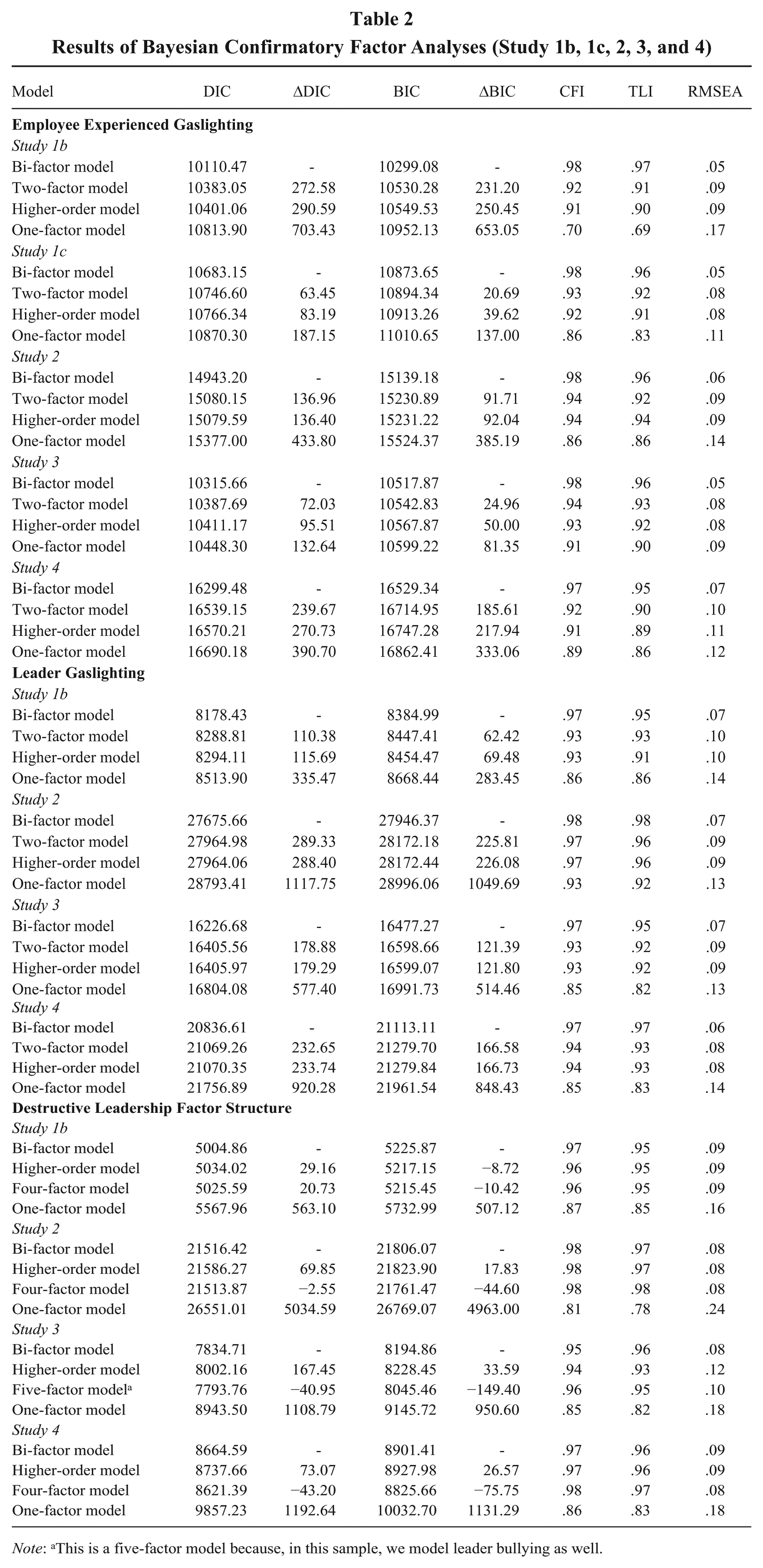
Note: aThis is a five-factor model because, in this sample, we model leader bullying as well.
Leader Gaslighting
Table 2 shows that the bi-factor model fit the data very well, CFI = .97, TLI = .95, RMSEA = .07, and was significantly better than other models. The reliability of the overall scale (omega, ω) is .95. The reliability of the general factor (omegaH, ωH) is .86, while the reliabilities of the specific factors (omegaHS, ωHS) are .04 (Reality Distortion) and .06 (Gaining Control). While all items loaded significantly on the global factor, two items loaded weakly on the domain factors. Moreover, while loadings on the general factor were moderate to strong (λ range: .57 to .81), most loadings on the domain factors (except for one item, .69) were much weaker (λ range: −.01 to .44). This suggests that the bi-factor model may not be suitable because the domain factors are not well defined (Jennrich & Bentler, 2011). In contrast, the higher-order and two-factor models had lower but still acceptable fit and were not much different from each other. Thus, due to the strong correlation between the two factors (i.e., in the two-factor solution: ρ = .81) and following the rule of parsimony, we suggest that the higher-order factor may best represent the leader gaslighting construct.
Convergent and Discriminant Validity Evidence for the Leader Gaslighting Measure
The zero-order correlations are shown in Table 3. CFA results shows that leader gaslighting was weakly-to-modestly related to employee age (ρ = −.001, 95% CI [−.07, .07]), gender (ρ = −.06, 95% CI [−.16, .05]), supervisor gender (ρ = .06, 95% CI [−.05, .18]), frequency of interaction with the leader (ρ = −.19, 95% CI [−.29, −.07]), and employee perceived similarity to the leader in terms of age (ρ = −.12, 95% CI [−.22, −.01]), gender (ρ = .02, 95% CI [−.08, .14]), and ethnicity (ρ = .02, 95% CI [−.09, .13]). None of the correlations exceeded the “no problem” upper CI limit (ρ = .80) suggested by Rönkkö and Cho (2022), indicating that leader gaslighting is sufficiently distinct from these constructs/variables.
Means, Standard Deviations, Reliabilities, and Inter-correlations among Study Variables (Study 1b)
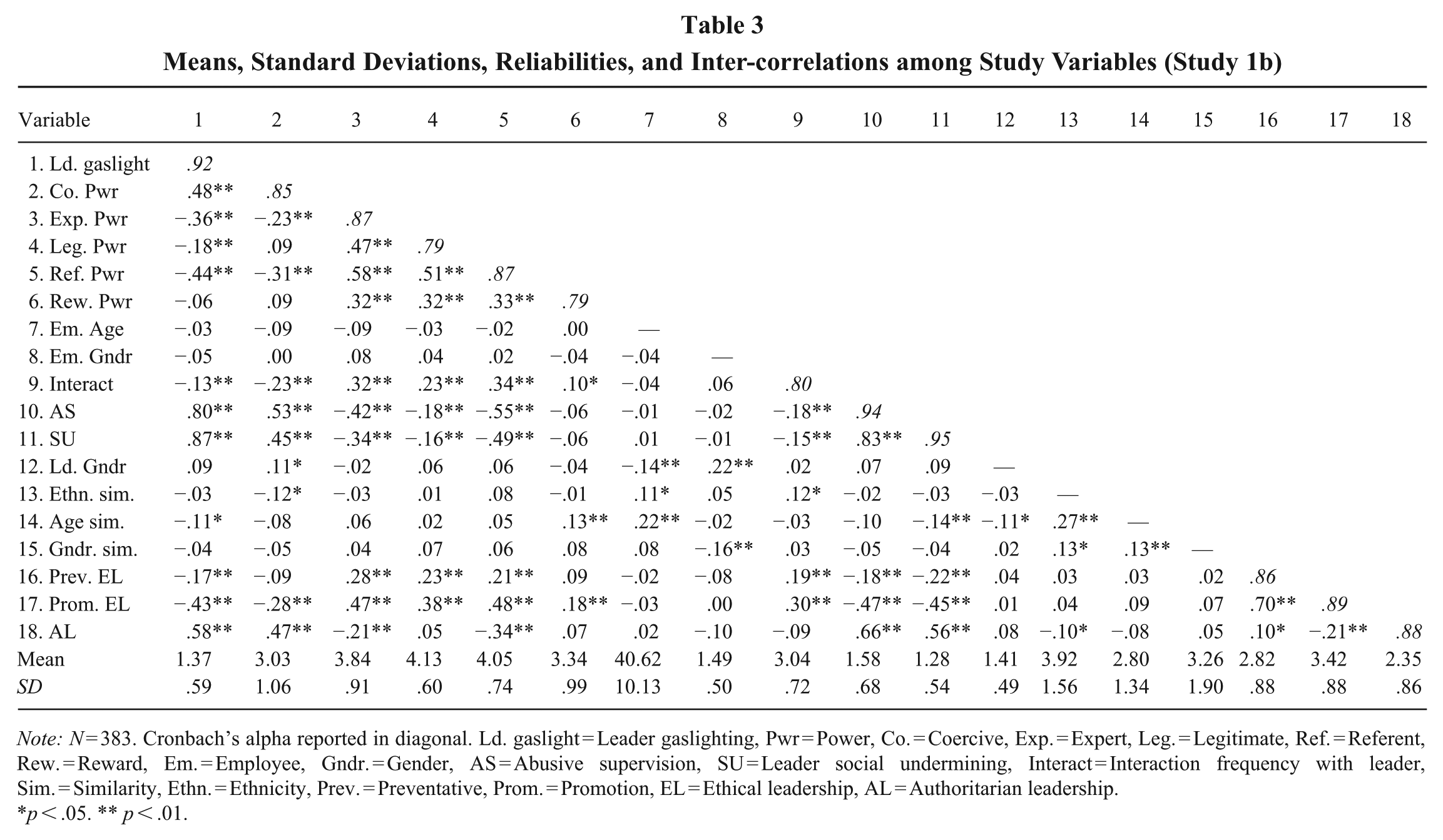
Note: N = 383. Cronbach’s alpha reported in diagonal. Ld. gaslight = Leader gaslighting, Pwr = Power, Co. = Coercive, Exp. = Expert, Leg. = Legitimate, Ref. = Referent, Rew. = Reward, Em. = Employee, Gndr. = Gender, AS = Abusive supervision, SU = Leader social undermining, Interact = Interaction frequency with leader, Sim. = Similarity, Ethn. = Ethnicity, Prev. = Preventative, Prom. = Promotion, EL = Ethical leadership, AL = Authoritarian leadership.
p < .05. ** p < .01.
Next, the results show that leader gaslighting is weakly-to-moderately correlated with coercive (ρ = .54, 95% CI [.44, .62]), expert (ρ = −.39, 95% CI [−.48, −.28]), referent (ρ = −.49, 95% CI [−.58, −.40]), legitimate (ρ = −.18, 95% CI [−.58, −.40]), and reward power (ρ = −.07, 95% CI [−.17, .05]). These results indicate that leaders who employ gaslighting tactics are not simply those in formal positions that confer legitimate (and reward) power, but rather those that tend to use their power coercively. Leader gaslighting was also moderately positively correlated with authoritarian leadership (ρ = .64, 95% CI [.57, .71]), and modestly-to-moderately negatively correlated with promotion- (ρ = −.48, 95% CI [−.57, −.39]) and prevention-focused (ρ = −.23, 95% CI [−.33, −.11]) ethical leadership. Following Rönkkö and Cho (2022), we conclude that leader gaslighting is distinct from leader power, and authoritarian and ethical leadership behaviors.
Relationship with Other Destructive Leadership Constructs
Table 3 shows the correlations between leader gaslighting, social undermining, and abusive supervision. CFA results of latent correlations show that leader gaslighting was strongly positively related with social undermining (ρ = .97, 95% CI [.95, .99]) and abusive supervision (ρ = .88, 95% CI [.84, .91]). The upper 95% CI limits suggest that there is “moderate problem” with discriminant validity among these measures. However, as earlier noted, many harmful leader behaviors fall under the umbrella of destructive leadership (Krasikova et al., 2013; Schyns & Schilling, 2013). Yet, scholars argue that most retain unique elements that warrant independent study (Tepper & Henle, 2011). In factor analysis terms, this suggests a bi-factor model with destructive leadership as the global factor and abusive supervision, social undermining, and the two leader gaslighting factors as distinct specific factors (see Figure 2).
To test this possibility, we ran supplemental confirmatory factor analyses. We compared a bi-factor destructive leadership model to other alternatives, including a higher-order, one-factor, and four-factor model. We randomly created three-to-four parcels for each measure. This is pivotal given the large number of items relative to sample size. Scholars note the importance of managing sample-size-to-indicators ratios, which can influence the stability of factor solutions in larger models with lower ratios (Landis, Beal, & Tesluk, 2000).
We found the weakest support for a one-factor structure (CFI = .87, TLI = .85, RMSEA = .16), suggesting that these constructs are not tapping into a unidimensional construct. In contrast, we found strong support for a bi-factor model with a global “destructive leadership” factor and four specific factors (CFI = .97, TLI = .95, RMSEA = .09). Figure 2 provides a visualization of this model. The bifactor model exhibited better fit than the higher-order and four-factor models across multiple indices (except for BIC). We therefore conclude that the bifactor structure best captures these constructs. We observe very similar patterns of findings across three other samples: Study 2, Study 3 (where we also measure leader bullying), and Study 4 (see Table 2 and Figure 2). Generally, the bifactor and four-factor models tend to perform best, but consistently strong correlations among the constructs suggest that the four-factor model is not ideal (in Study 3, the upper 95% limit of some correlations include 1.00).
In sum, we conclude that leader gaslighting tactics fall under a broader destructive leadership construct. However, support for the bifactor model indicates that the two dimensions of gaslighting deserve attention because they cover unique content not shared by other constructs under the broader destructive leadership umbrella (i.e., abusive supervision, bullying, and social undermining). Indeed, all indicators of our gaslighting tactics measure load significantly and substantively on both the global factor and the specific factors—a well-defined pattern that replicates across all samples (see Figure 2). This highlights that leader gaslighting captures unique content beyond the global destructive leadership construct. This is not consistently true for other leadership constructs. For instance, the specific factors for social undermining and bullying are not well defined across samples (see Figure 2).
Study 1C
In this study, we aim to establish convergent and discriminant validity evidence for the experienced gaslighting measure.
Participants and Procedures
We recruited 410 working adults from Prolific to complete a 15-minute survey. In exchange, they were compensated $2.20. Participants completed the experienced gaslighting scale and other measures described below. After screening out participants who provided incomplete data and who failed more than one attention check, the final sample size was 382. The average age was 37.03 years (SD = 9.95), with 49% identifying as male, 45.5% female, and 0.3% as non-binary/third gender. Participants were full-time employees with an average organizational tenure of 6.99 years (SD = 7.40) and 2.92 years (SD = 3.72) working with their current leaders.
To assess discriminant validity evidence, we considered the following: employee age, gender, tenure with leader, leader gender, perceived similarity with leader, and interaction frequency with leader. We expected that experienced gaslighting would be modestly associated with these demographic variables because it is less about the demography of the target and more about specific dynamics of the gaslighting relationship. We anticipated modest correlations because it is possible that gaslighters are less likely to target employees who are demographically similar to them or those with whom they work with frequently. Moreover, we did not expect strong dispositional correlates of experienced gaslighting, given that it is a psychological experience that is context and exposure specific. Yet, there may be personality differences in susceptibility to gaslighting attempts. For example, we expected moderate associations with Conscientiousness (Emotionality) as past research suggests that employees who are low (high) on this trait tend to be targets of leader mistreatment (Mackey et al., 2021). It is also possible that individuals with certain dispositions tend to perceive themselves as victims of mistreatment in general. Extraversion (Emotionality) may negatively (positively) correlate with reports of experienced gaslighting as these two traits capture the general tendency to experience positive and negative emotions. We further expected that experienced gaslighting correlates moderately with trait Psychoticism, which captures the tendency to experience culturally non-normative, unusual, odd, or eccentric beliefs, thoughts, and behaviors (Widiger & Crego, 2019). Specifically, a sub-scale of Psychoticism—perceptual dysregulation—covers content such as “feeling disconnected from the world” and “feeling unreal,” elements akin to the “surreality” component of experienced gaslighting. Thus, we posited that the psychological experience of being gaslit is moderately positively related to, but not redundant with, trait Psychoticism. Experienced gaslighting should also be distinct from insecure attachment styles at work, including attachment anxiety (the tendency to view the self negatively, preoccupation with fears of rejection, and overdependence on others; Richards & Schat, 2011) and attachment avoidance (strong distrust of and unwillingness to depend on others for protection and support; Richards & Schat, 2011).
With respect to convergent validity, we posited that experienced gaslighting relates strongly and positively with state negative affect and state paranoia at work, and negatively with state positive affect. This is because gaslighting targets are more likely to be anxious, worrisome, unhappy, unenthusiastic, and hyper-suspicious (Graves & Samp, 2021; Omran & Yousafzai, 2024). Thus, these emotional states at work—especially negative affect and paranoia—should be highly symptomatic of employee-experienced gaslighting.
Measures
We administered the 12-item experienced gaslighting scale, 9-item perceived similarity scale (Eby, Buits, Lockwood, & Simon, 2004), 5-item interaction frequency scale (McAllister, 1995), 10-item Extraversion, Conscientiousness, and Emotionality scales from the HEXACO-60 inventory (Ashton & Lee, 2009), Psychoticism (20 highest loading items from Krueger, Derringer, Markon, Watson, & Skodol, 2012), attachment anxiety and avoidance (6 highest loading items each from Richards & Schat, 2011), work-specific measures of state negative and positive affect (10 items each from Watson, Clark, & Tellegen, 1988) and work-specific state paranoia (8 items adapted from Schaerer, Foulk, Du Plessis, Tu, & Krishnan, 2021).
Results
Factor Structure of Experienced Gaslighting
CFA results (Table 2) show that the bi-factor model exhibited the best fit to the data, CFI = .98, TLI = .96, RMSEA = .05, and was significantly better than other models. However, the same item from Study 1b (“You feel as though you can’t do anything right at work”) loaded weakly on the self-doubt factor. Given that this item may be driven by other factors (e.g., true ability) or may be an indicator of psychological distress, we eliminated it from the scale. The reliability of the 11-item overall scale (omega, ω) is .89. The reliability of the general factor (omegaH, ωH) is .75, while the reliabilities of the specific factors (omegaHS, ωHS) are .07 (Self-Doubt) and .08 (Dread-Avoidance). Once again, we find evidence that despite the underlying multidimensionality, an overall scale score appropriately captures the experienced gaslighting construct, with little unique variance attributable to the subscales.
Convergence and Discriminant Validity Evidence
The means, standard deviations, and inter-correlations are shown in Table 4. CFA results show that the global experienced gaslighting factor correlates weakly with age (ρ = .06, 95% CI [−.02, .13]), employee gender (ρ = −.03, 95% CI [−.11, .08]), leader gender (ρ = .06, 95% CI [−.02, .15]), tenure with (ρ = −.004, 95% CI [−.10, .09]), interaction frequency with (ρ = −.07, 95% CI [−.22, .03]), perceived similarity with the leader in terms of ethnicity (ρ = .003, 95% CI [−.07, .06]), age (ρ = −.05, 95% CI [−.11, .05]), and gender (ρ = −.006, 95% CI [−.08, .07]). Experienced gaslighting further correlates modestly-to-moderately with trait Emotionality (ρ = .22, 95% CI [.11, .36]), Extraversion (ρ = −.54, 95% CI [−.64, −.35]), and Conscientiousness (ρ = −.45, 95% CI [−.52, −.37]). Experienced gaslighting also correlates moderately positively with Psychoticism (ρ = .68, 95% CI [.59, .73]), attachment anxiety (ρ = .49, 95% CI [.41, .59]), and avoidance (ρ = .30, 95% CI [.22, .42]). These results provide strong discriminant validity evidence in line with Rönkkö and Cho’s (2022) guidelines. Lastly, experienced gaslighting correlates moderately-to-strongly with work-specific negative affect (ρ = .84, 95% CI [.70, .90]) and state paranoia (ρ = .66, 95% CI [.54, .74]). These findings support our expectation that experienced gaslighting is strongly associated with these adverse states, aligning with prior qualitative reports of experienced gaslighting in romantic (Stern, 2007) and work relationships (Omran & Yousafzai, 2024). In contrast, experienced gaslighting is modestly related with state positive affect at work (ρ = −.27, 95% CI [−.41, −.13]). Overall, we find strong support for discriminant and convergent validity evidence for the experienced gaslighting measure.
Means, Standard Deviations, Reliabilities, and Inter-correlations among Study Variables (Study 1c)
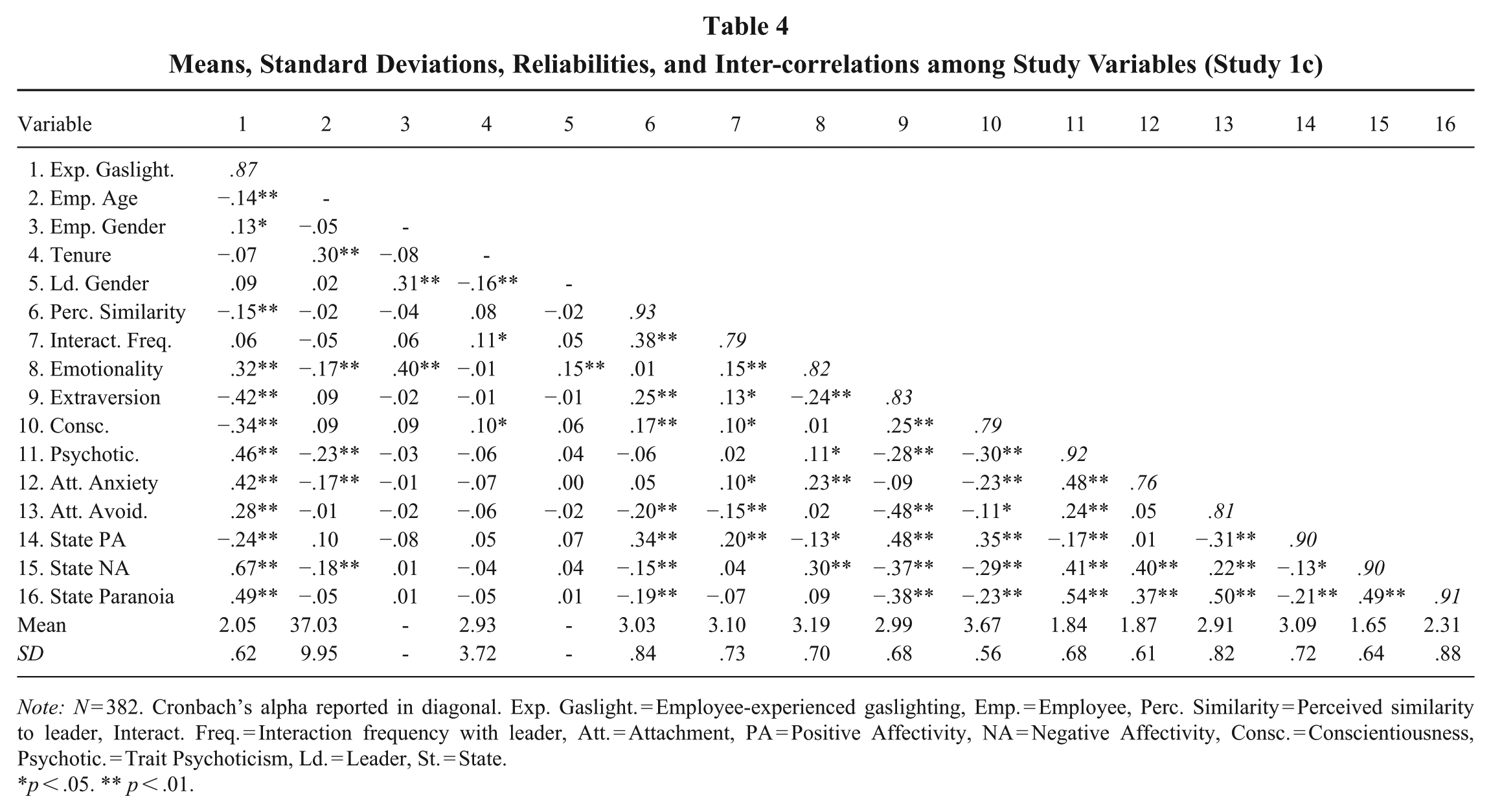
Note: N = 382. Cronbach’s alpha reported in diagonal. Exp. Gaslight. = Employee-experienced gaslighting, Emp. = Employee, Perc. Similarity = Perceived similarity to leader, Interact. Freq. = Interaction frequency with leader, Att. = Attachment, PA = Positive Affectivity, NA = Negative Affectivity, Consc. = Conscientiousness, Psychotic. = Trait Psychoticism, Ld. = Leader, St. = State.
p < .05. ** p < .01.
Study 2
In this study, we carried out a large multi-source, time-lagged survey to test our conceptual model. We also further evaluated the psychometric properties of the measures.
Participants and Procedures
Data for this study comes from a larger project on leadership, individual differences, and morality at work. We contracted an online survey company (ClearVoice) to survey employee-leader dyads. Data collection occurred over three phases. Employee surveys for the current study were administered during phase 1 and phase 3. For ease of understanding, we label these Time 1 and Time 2 surveys, respectively. There was roughly six weeks between the two surveys. There were 1,314 employees at Time 1 and 632 at Time 2. We informed participants that we were interested in surveying their direct supervisors/managers to get more insights into behaviors at work. ClearVoice invited participants to provide contact information for their current supervisors in exchange for bonus compensation if the supervisors completed the survey. ClearVoice contacted the supervisors via email, informing them that a direct report had participated in our study and that we were seeking their participation in a brief survey. In total, 194 supervisors provided ratings of focal employees at Time 2. The surveys took 15 to 25 minutes to complete. ClearVoice paid participants $1.00 for each completed survey, plus a $1.00 bonus if their supervisors participated. Supervisors received $2.00. 66.9% of participants identified as women and 32.7% identified as men. 74.3% identified as White American, 11.3% Black/African American, 7.2% Hispanic American, and 4.9% Asian/Pacific Islander. Their average age was 44.07 years (SD = 9.73), organizational tenure was 8.35 years (SD = 7.80), and tenure with supervisor was 4.45 years (SD = 4.94).
Measures
Leader Gaslighting
At Time 1, employees completed the 13-item leader gaslighting measure (α = .98) using a 5-point frequency scale. The instruction was: “In the last 6 months, how often did your supervisor engage in each of these behaviors towards you?”
Employee-Experienced Gaslighting
At Time 2, employees completed the 11-item measure of experienced gaslighting (α = .91) using a 5-point frequency scale. The instruction was: “In the last 6 months, how frequently have you experienced the following at work?”
Self-Rated Employee Outcomes
At Time 2, employees completed Pierce et al.’s (1989) 10-item OBSE scale (α = .96), two items 2 from Seashore, Lawler, Mirvis, and Cammann (1982) turnover intentions scale (α = .76), Stinglhamber, Bentein, and Vandenberghe’s (2002) 5-item affective commitment scale (α = .85), and 15 items from Bolino and Turnley’s (1999) measure of impression management tactics (self-promotion, ingratiation, supplication, and exemplification) directed at the leader (α = .92).
Leader-Rated Employee Outcomes
At Time 2, leaders rated participants’ task performance using the three items with the highest loadings from Williams and Anderson’s (1991) measure (α = .97). They also rated their workplace deviance using eight items from Bennett and Robinson’s (2000) scale (α = .91). We used short versions of these scales to manage the survey length in order to increase our response rate among the supervisors.
Controls
We controlled for employees’ length of time working with their leaders, as well as how frequently they interacted with them. We suggest that employee reactions to gaslighting may be partly shaped by how long and how closely they work with the leader. We assessed leader interaction frequency using five items (α = .84) from McAllister (1995). Lastly, given its conceptual and empirical overlap with leader gaslighting, we measured and controlled for the effects of leader social undermining using Duffy et al.’s (2002) 13-item scale (α = .98).
Analytic Strategy
First, we ran a series of Bayesian confirmatory factor analyses to further assess the factor structure of the gaslighting scales. Next, we concurrently tested our hypotheses (i.e., we modeled all outcomes together) via a path analytic model in Mplus using Bayesian estimation procedures (Biterations = (10,000)). We controlled for leader social undermining (the leadership style most highly related to gaslighting), as well as employees’ tenure with and interaction frequency with leaders. We used overall scale scores for leader gaslighting and experienced gaslighting in line with the results of our factor analyses from the prior studies.
Factor Structure
Leader Gaslighting
Similar to Study 1b, the bi-factor model exhibited the best fit to the data, CFI = .98, TLI = .98, RMSEA = .07, and was significantly better than the alternate models (see Table 2). The reliability of the overall scale (omega, ω) is .98. The reliability of the general factor (omegaH, ωH) is .95, while the reliabilities of the specific factors (omegaHS, ωHS) are .02 (Reality Distortion) and .009 (Gaining Control). While all items loaded strongly and significantly on the general factor, loadings on the domain factors were much weaker. Thus, a bi-factor model does not capture these data well. Alternatively, the higher-order model fit the data well, CFI = .97, TLI = .96, RMSEA = .09 and was not significantly different from the two-factor model (ΔDIC = .93, ΔBIC = .27). Again, given the strong latent correlation between the two factors in the two-factor model (ρ = .93, p < .01), and following the rule of parsimony, we conclude that the higher-order model best theoretically represents the leader gaslighting construct.
Employee-Experienced Gaslighting
Table 2 shows support for the bi-factor structure, CFI = .98, TLI = .96, RMSEA = .06. This model was significantly better than all alternate models. Factor loadings on the global factor and domain factors are generally well defined (except for two weaker loadings on the dread-avoidance factor). In contrast, the two-factor model exhibited worse fit (and the two factors correlated strongly (ρ = .78, p < .01)). We conclude again that the bi-factor model best fits the data. The reliability of the overall scale (omega, ω) is .93. The reliability of the general factor (omegaH, ωH) is .83, while the reliabilities of the specific factors (omegaHS, ωHS) are .08 (Self-Doubt) and .03 (Dread-Avoidance). Thus, we find again that the global experienced gaslighting factor captures the majority of variance across the items and thus, it is appropriate to compute and utilize the total raw scale score.
Measurement Model
We tested our full measurement model, which includes a higher-order leader gaslighting factor, bi-factor employee-experienced gaslighting, and six outcome factors. We created 3-to-4 random parcels for long scales (except for the turnover and performance scales). CFA results show excellent support for the hypothesized model, CFI = .99, TLI = .98, RMSEA = .03. This model fit better than (1) a model that allows leader gaslighting and experienced gaslighting items to load on one factor, ΔDIC = 2828.78, ΔBIC = 2745.26, (2) a model that collapses the six outcomes into two self-rated and leader-rated latent factors, ΔDIC = 3751.08, ΔBIC = 3673.06, and (3) a one-factor model, ΔDIC = 9239.54, ΔBIC = 9104.87.
Lastly, given that we measured the mediators and self-reported outcomes at the same time and using the same source, we tested a measurement model with only the Time 2 constructs to assess whether common source/method bias (CMB) is a significant issue. The hypothesized factor structure (a bi-factor structure for experienced gaslighting and four other factors) fit the data well, CFI = .96, TLI = .94, RMSEA = .07, supporting the distinctiveness of the constructs. The latent correlations among the factors (ρ range = −.51 to .61; range of upper 95% CI limit = −.57 to .70) are much lower than the cutoff recommended by Rönkkö and Cho (2022). Next, we estimated the degree of CMB using the marker variable approach (Williams & McGonagle, 2016). We used a measure of moral knowledge of the inappropriateness of unethical work behaviors according to societal norms and expectations (Reynolds et al., 2014). Following Williams and McGonagle’s (2016) prescribed CFA steps, we found evidence of some degree of CMB. However, only 2.6% of the variance in the indicators of the mediator and outcome constructs are attributable to CMB. In addition, we found that the proportion of total reliability in the mediator and outcome variables attributable to the method factor (i.e., the marker variable) is 5.8% on average (range 1.1% to 18%). We thus conclude that the impact of CMB is limited.
Main Effect and Mediation Results
Table 5 presents the means, standard deviations, internal consistency reliabilities, and correlations among Study 2 variables. The results of the path analysis are shown in Table 6. First, controlling for leader social undermining, 3 employee tenure, and interaction frequency with the leader, we find that leader gaslighting is positively related to employee-experienced gaslighting (B = .40, p < .001), providing support for Hypothesis 1. Next, employee-experienced gaslighting significantly mediated the relationships between leader gaslighting and employee OBSE, B = −.11, 95% CI [−.17, −.05], turnover intentions, B = .19, 95% CI [.10, .30], task performance, B = −.09, 95% CI [−.17, −.01], workplace deviance, B = .09, 95% CI [.04, .15], impression management, B = .23, 95% CI [.13, .33], and affective commitment, B = −.05, 95% CI [−.11, −.01]. As such, we find support for Hypotheses 2a, 2b, 3a, 3b, 4a, and 4b, respectively.
Means, Standard Deviations, Reliabilities, and Inter-correlations among Study Variables (Study 2)
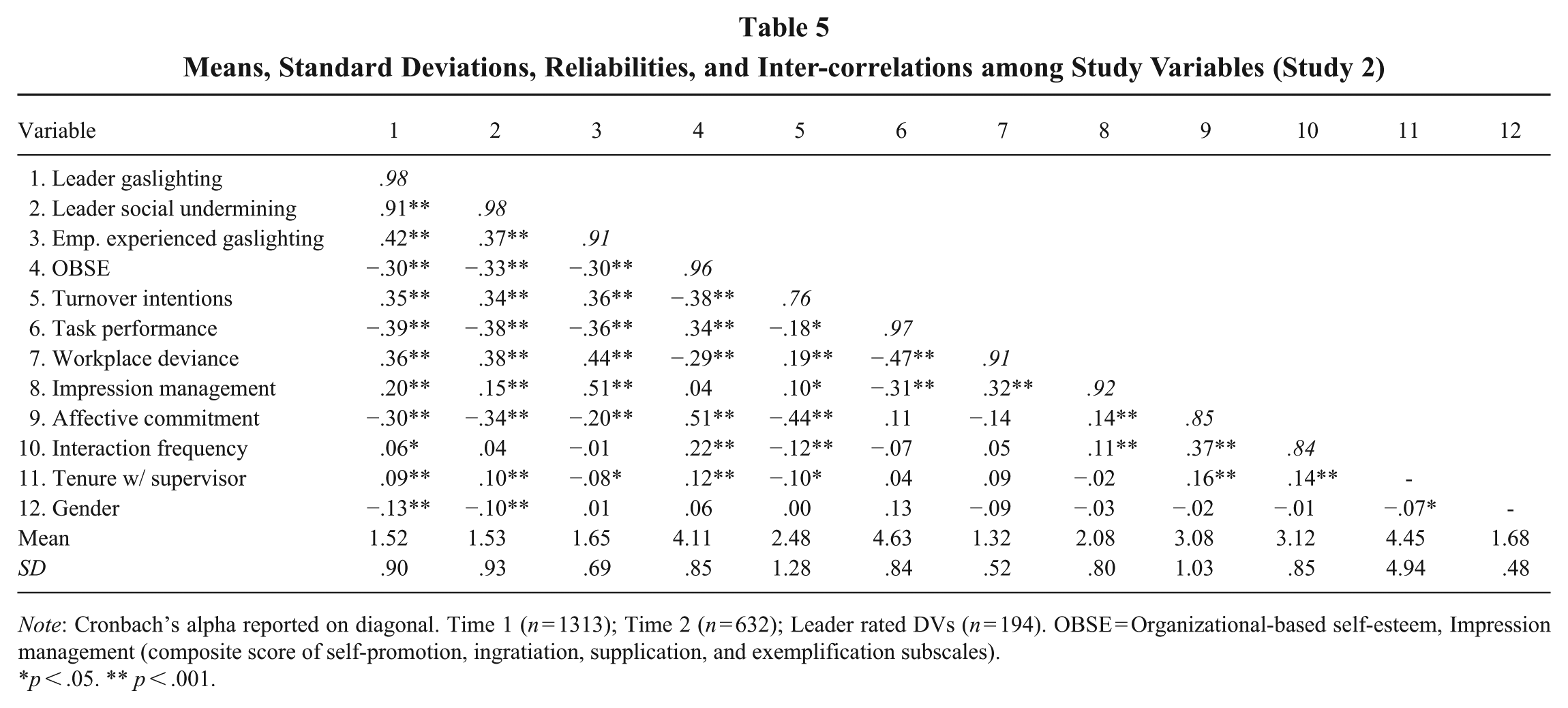
Note: Cronbach’s alpha reported on diagonal. Time 1 (n = 1313); Time 2 (n = 632); Leader rated DVs (n = 194). OBSE = Organizational-based self-esteem, Impression management (composite score of self-promotion, ingratiation, supplication, and exemplification subscales).
p < .05. ** p < .001.
Leader Gaslighting, Employee Experienced Gaslighting, and Employee Outcomes (Study 2)
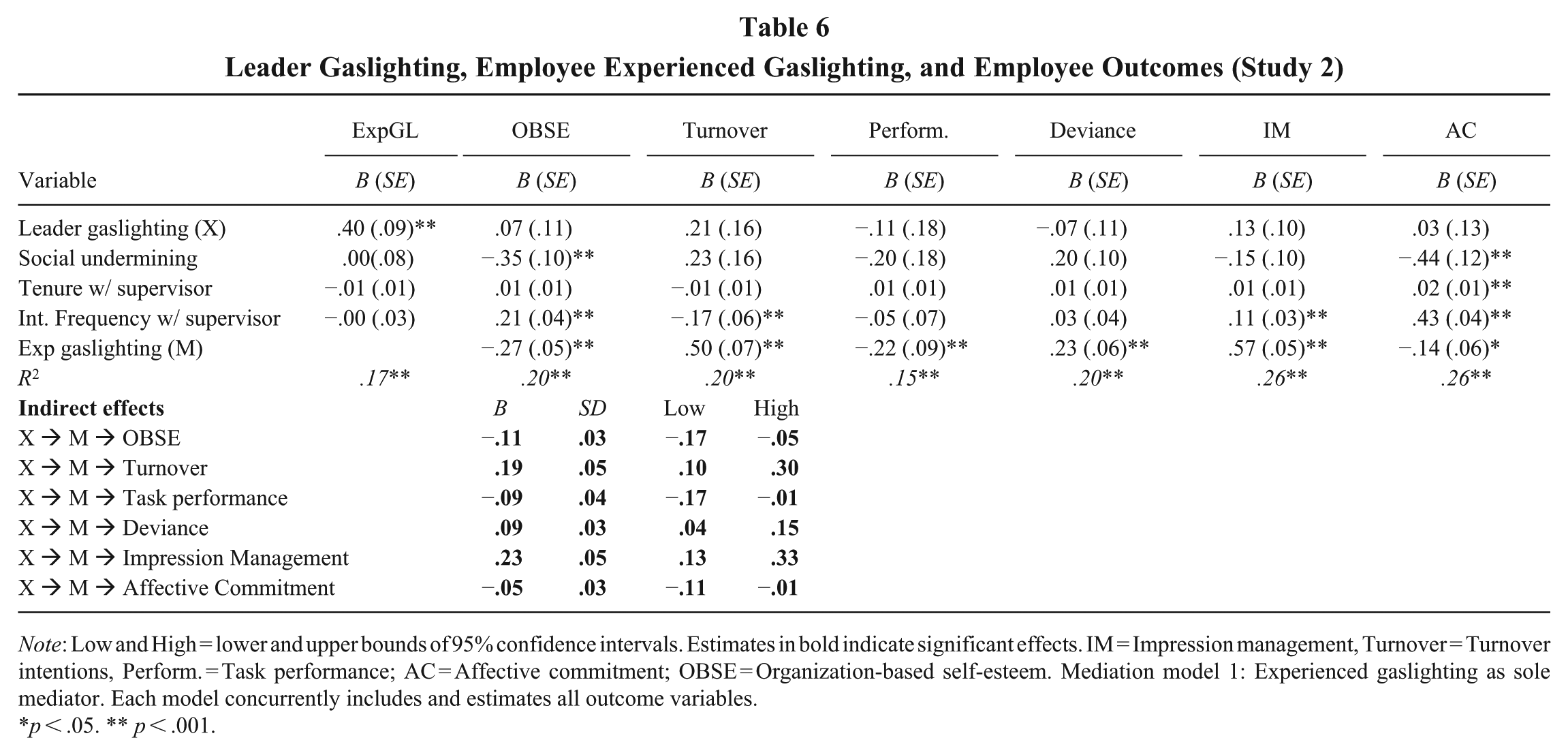
Note: Low and High = lower and upper bounds of 95% confidence intervals. Estimates in bold indicate significant effects. IM = Impression management, Turnover = Turnover intentions, Perform. = Task performance; AC = Affective commitment; OBSE = Organization-based self-esteem. Mediation model 1: Experienced gaslighting as sole mediator. Each model concurrently includes and estimates all outcome variables.
p < .05. ** p < .001.
Brief Discussion
We find support for our conceptual model linking leader gaslighting to employee-experienced gaslighting and subsequent outcomes. These results highlight the critical role that experienced gaslighting plays in understanding how leader gaslighting adversely impacts targeted employees. The findings are particularly encouraging given that we controlled for the effects of leader social undermining. Considering the strong CFA support for the bi-factor structure of destructive leadership (wherein leader gaslighting captures unique content), we find cumulative evidence that leader gaslighting is a distinct form of destructive leadership.
Despite these findings, Study 2 is limited in a few ways. First, a core assumption is that power imbalance between perpetrators and targets plays a critical role in understanding how gaslighting unfolds. In line with past research and theory, we have primarily defined this imbalance in terms of formal or structural power (Sweet, 2019). We indirectly capture this by studying leader-employee dyads where there is an inherent imbalance of formal power. However, theory and empirical evidence indicates that people may hold other forms of power. Extensive research distinguishes between formal power and informal power (French & Raven, 1959; Raven et al., 1998). This distinction—and specifically, the magnitude of the relative informal (versus formal) power differential between leaders and employees—may be an important boundary condition that we have not considered thus far.
Moreover, there are some methodological limitations that warrant attention. First, we did not separate our measures of mediator and outcomes by time. Although we show that CMB likely has minimal impact, it is critical to replicate our findings in a new study that separates these measures. Second, our measures of leader gaslighting and employee-experienced gaslighting were adapted from extant research and, in an attempt to stay as true to the original source materials, we elected to retain similar wordings and sentence structures in our adaption. However, a few items warrant further refinement, including vaguely worded items that may be caused by multiple factors (“you have trouble making simple decisions at work”) and double-barreled items (e.g., “you feel confused and even crazy at work”). Third, the review team suggested pursuing additional convergent and discriminant validity evidence for both measures and illustrating how well our leader gaslighting scale performs relative to an existing measure of workplace gaslighting published after we began our research (Kukreja & Pandey, 2023).
In response, we carried out two new studies. In Study 3, we revise specific items in both gaslighting measures and carry out further validation to support the revisions. In Study 4, we extend our conceptual model by testing the moderating effects of leader-employee informal (versus formal) power imbalance. We also designed this study to address the methodological limitations of Study 2 (i.e., appropriately separating measures by time).
Study 3
Minor Item Revisions
We made minor revisions to the gaslighting measures to make certain items clearer and more gaslighting-focused, and to revise double-barreled items. A comparison of items in the measures for each study (and the original source they were adapted from, where relevant) is provided in Appendix B. In the leader gaslighting measure, we revised two double-barreled items. For example, we split “Makes you feel guilty about something you did (or should have done)” into “Makes you feel guilty about something you should have done” and “Makes you feel guilty about small mistakes at work.” In the experienced gaslighting measure, we made minor revisions to address concerns about vagueness and to better capture self-doubt. For example, we revised “You have trouble making simple decisions at work” to “You doubt yourself when making even simple decisions at work.” We also refined two double-barreled items. For example, we split the item “You feel confused and even crazy at work” into “You feel confused about whether your perception of reality at work is accurate” and “You feel crazy at work for reasons you can’t quite explain.” While we expected these to be very highly related to the originals, validating changes in an independent sample is good practice (Hinkin, 1998).
Convergent and Discriminant Validity
For leader gaslighting, we measured abusive supervision, social undermining, and leader power bases, as we did for the original version (Study 1b). We also assessed leader bullying, given our prior conceptual arguments that this construct is closely related to leader gaslighting. To further support discriminant validity, we identified additional measures that we predict would have small to negligible relationships with leader gaslighting, such as leader gender, leader span of control, team size, and weekly work hours (a proxy of interaction frequency). We also measured the same constructs that we used to establish discriminant validity in Study 1b. Lastly, we administered Kukreja and Pandey’s (2023) workplace gaslighting scale. 4 We aimed to demonstrate that our leader gaslighting measure converges with this measure. Moreover, we sought to test whether our measure exhibits similar patterns of relationships with constructs in the nomological network and whether it demonstrates similar or stronger predictive validity evidence.
For experienced gaslighting, we collected many of the same variables as Study 1c. This allowed us to compare the relationships using different versions of our scale. We also included new measures to further establish convergent and validity evidence. For instance, given that a core component is the sense of surreality (Stern, 2007; Sweet, 2019, 2022), we expected that experienced gaslighting would be moderately and positively related to the experience of workplace depersonalization/derealization. This construct captures the extent to which people experience a sense of strangeness, surrealness, and bodily detachment. 5 Second, to rule out the possibility that experienced gaslighting simply captures low self-efficacy and psychological distress, we administered measures of these constructs. Given that self-doubt is a key part of experienced gaslighting, showing some degree of convergence between self-efficacy and experienced gaslighting is important. A similar argument can be made for experienced gaslighting and psychological distress, a key feature of the gaslighting experience (Sweet, 2019). Third, since gaslighting includes efforts to control and isolate the target (Omran & Yousafzai, 2024), we expect that experienced gaslighting correlates positively with loneliness at work. Lastly, we assessed new variables that should exhibit weak correlations with experienced gaslighting, such as employee work hours and Openness to Experience (Ashton & Lee, 2009).
Method
Participants and Procedures
We carried out a time-lagged validation study of employees recruited from Prolific. After screening for incomplete data and inattentiveness, there were 495 participants at Time 1 and 386 at Time 2. The final matched sample size was 357. Participants were compensated $2 for Time 1 and $2.36 for Time 2. The average age was 40.11 years (SD = 11.36), with 48.3% identifying as male, 48.3% female, and 1.8% as non-binary/third gender. Participants were full-time employees with an average organizational tenure of 7.52 years (SD = 6.76) and 4.19 years (SD = 4.22) working with their current leaders.
At Time 1, we administered both the original and revised versions of the leader gaslighting measure, as well as measures of abusive supervision (Tepper, 2000), social undermining (Duffy et al., 2002), leader bullying (Rosander, Blomberg, & Einarsen, 2024), and power bases (Hinkin & Schriesheim, 1989). We also administered Kukreja and Pandey’s (2023) workplace gaslighting scale, as well as demographic measures. At Time 2, we included the original and revised versions of the experienced gaslighting scale. We also administered many of the same measures from Study 1c, including personality (Ashton & Lee, 2009), adult attachment style (Richards & Schat, 2011), workplace paranoia (Schaerer et al., 2021), and state positive and negative affect at work (Watson et al., 1988). New to this study, we administered measures of general self-efficacy (Chen et al., 2001), workplace loneliness (the four-item emotional deprivation subscale from Wright et al., 2006), psychological distress (Goldberg, 1992), and depersonalization/derealization (Sierra & Berrios, 2000). All measures referenced the workplace context, including in the instructions. The measures can be found on the OSF page (https://osf.io/cxse5/overview?view_only=0861379f568f4fb08b3cf351d1ae9819).
Results and Discussion
The correlations between the original and revised versions of the leader gaslighting scale, as well as with other study variables are shown in Table 7. The correlations for experienced gaslighting are shown in Table 8. First, the minor revisions we made did not substantively change our measures. The original and revised versions of the leader gaslighting scale correlate quite strongly (r = .99). The different versions of the experienced gaslighting measure also correlate extremely highly (rs = .98—.99). In addition, the measures exhibit highly similar patterns of correlations with other study variables. In short, we show that the changes we made do not impact the psychometric properties of both measures and their relations with other variables. Moving forward, we strongly recommend the revised 15-item leader gaslighting and the 13-item experienced gaslighting scales, which are provided in Table 9.
Validation of Final 15-item Measure of Leader Gaslighting: Additional Convergence and Discriminant Validity Evidence (Study 3)
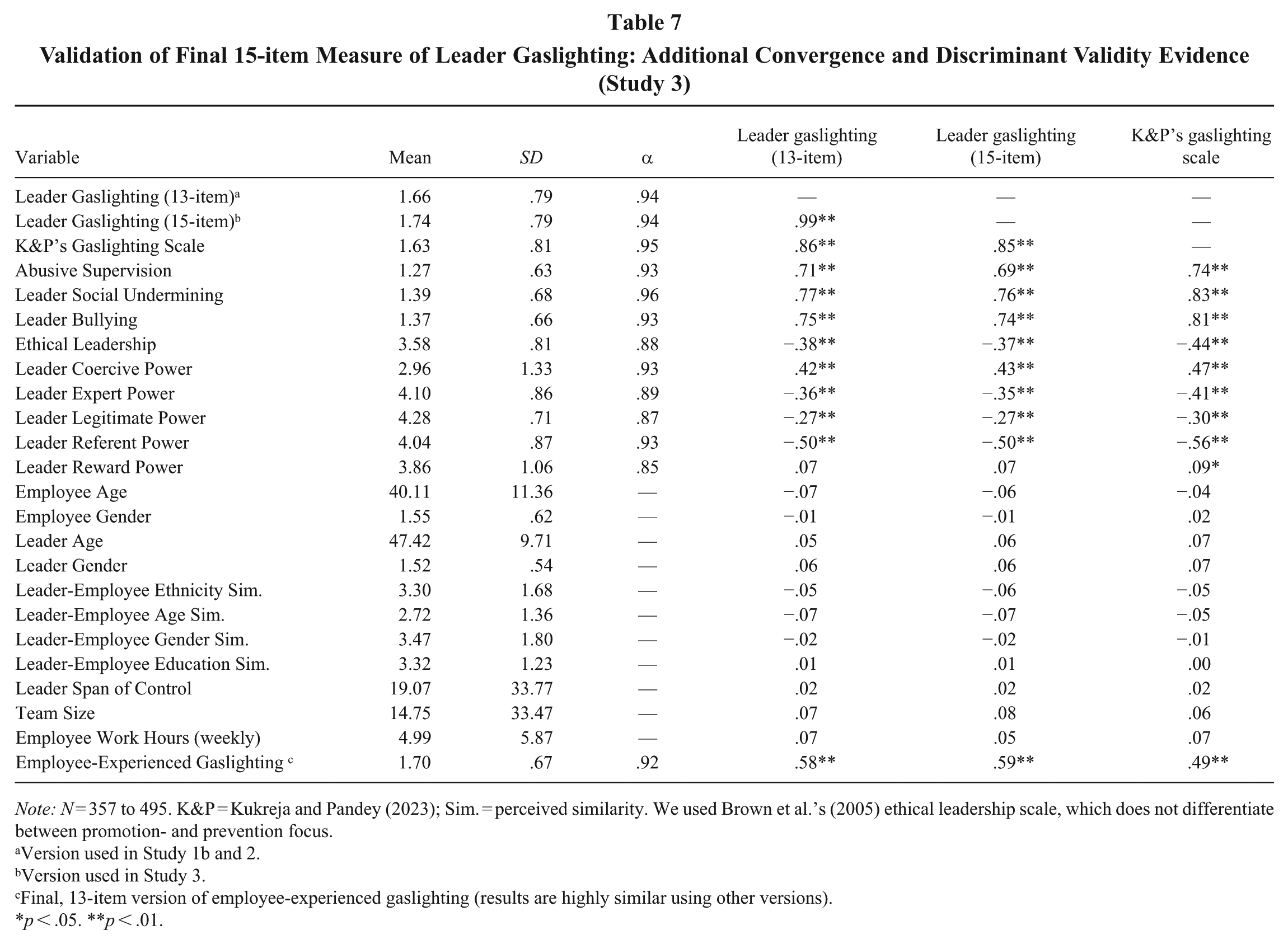
Note: N = 357 to 495. K&P = Kukreja and Pandey (2023); Sim. = perceived similarity. We used Brown et al.’s (2005) ethical leadership scale, which does not differentiate between promotion- and prevention focus.
Version used in Study 1b and 2.
Version used in Study 3.
Final, 13-item version of employee-experienced gaslighting (results are highly similar using other versions).
p < .05. **p < .01.
Validation of Final 13-item Measure of Employee Experienced Gaslighting: Additional Convergence and Discriminant Validity Evidence (Study 3)
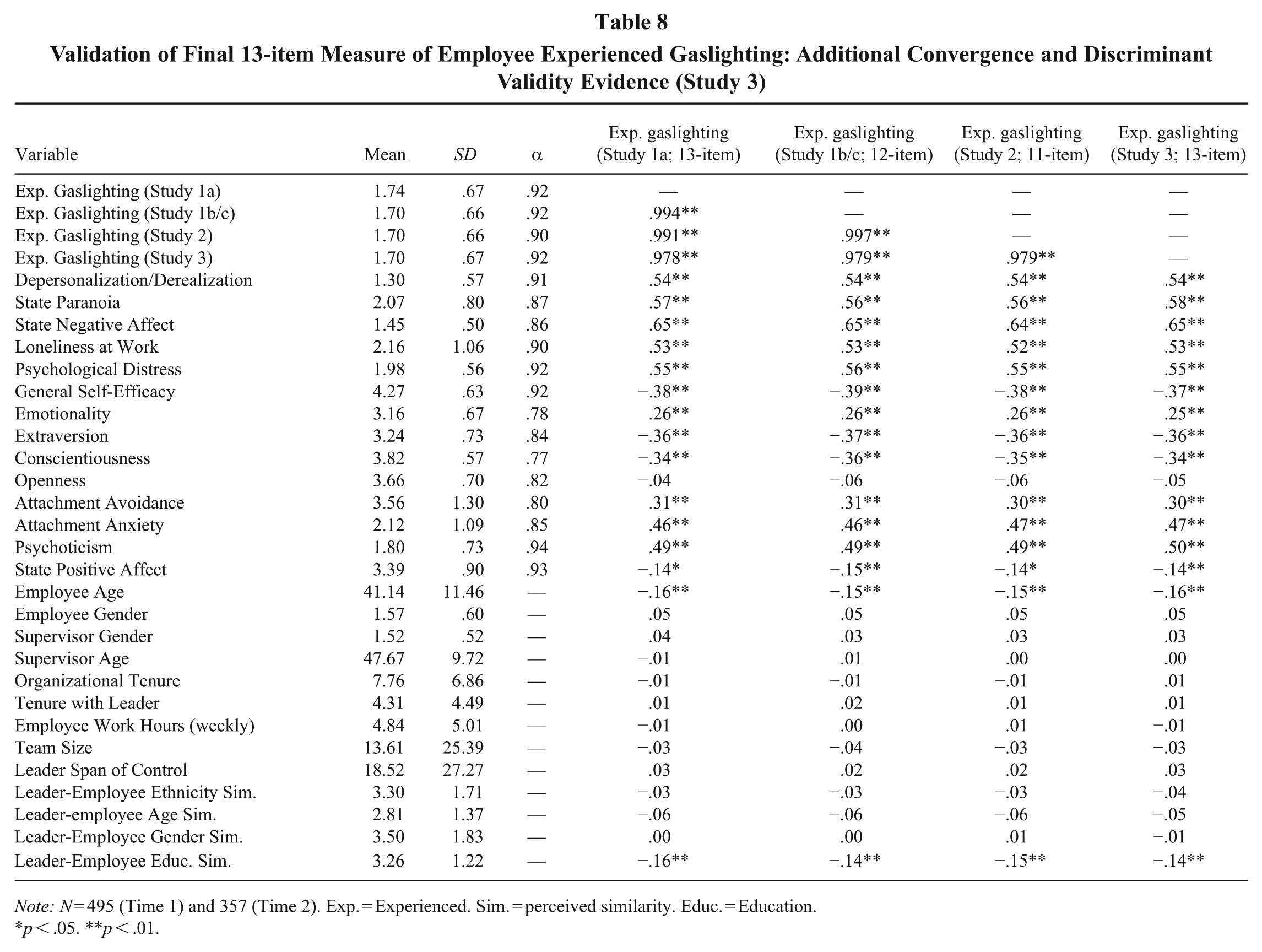
Note: N = 495 (Time 1) and 357 (Time 2). Exp. = Experienced. Sim. = perceived similarity. Educ. = Education.
p < .05. **p < .01.
Employee Experienced Gaslighting and Leader Gaslighting Measures (Study 3 and 4)
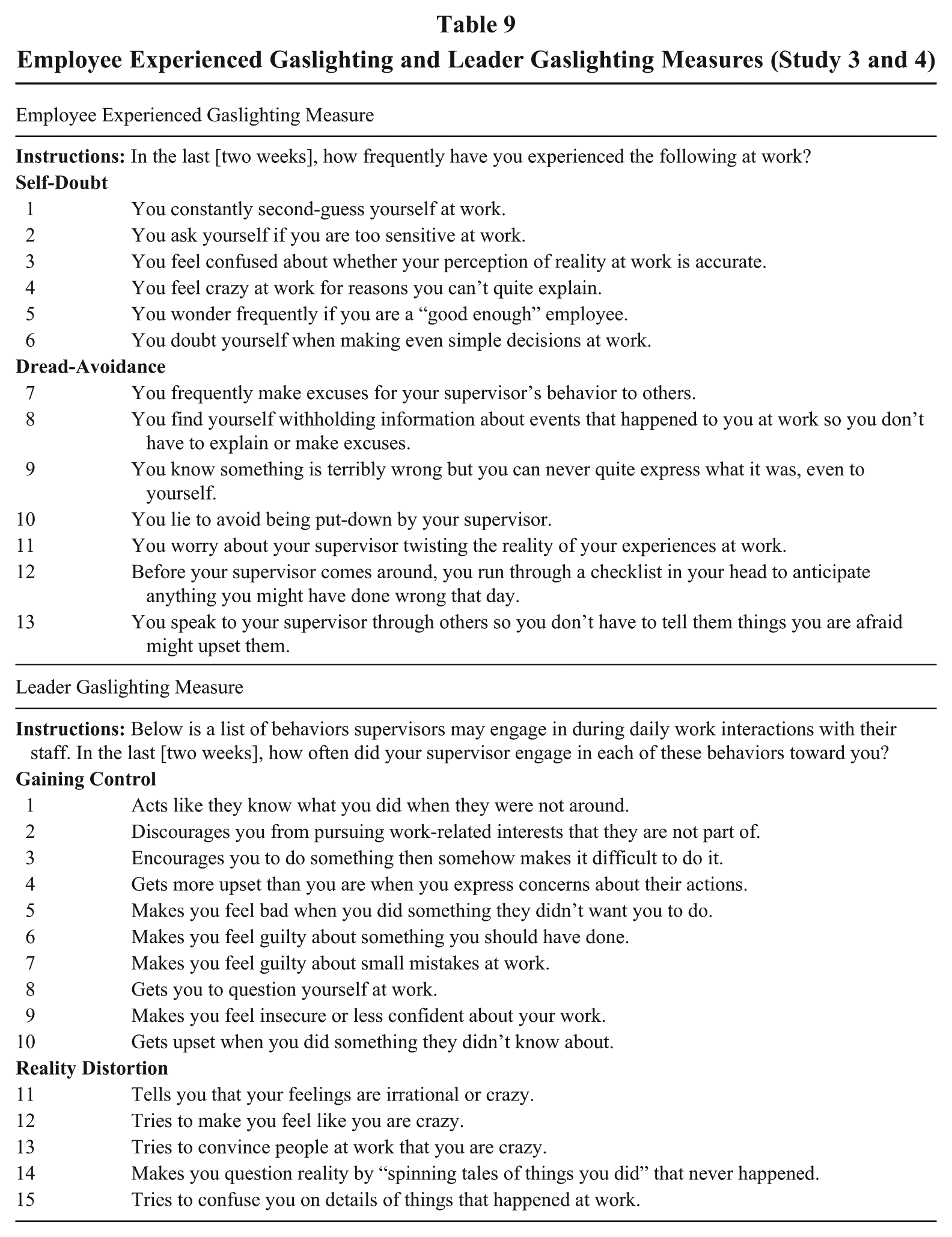
In terms of convergent and discriminant validity evidence for leader gaslighting, the results largely echo those observed in Study 1b. Thus, we do not revisit them in detail here (for CFA results, see Table 2; for full convergent/discriminant validity results, see Appendix D of the online supplement). Of note, the new constructs we assessed further support construct validity. The new variables included to test for discriminant validity (i.e., team size, leader span of control, and work hours) exhibited negligible correlations with leader gaslighting (ρ < .10). In terms of convergence, we find that leader gaslighting correlates strongly with leader bullying. However, as per Study 1b (and shown in Table 2 and Figure 2), we find that—along with abusive supervision and social undermining—leader gaslighting and bullying are best captured by a global “destructive leadership” construct, with each construct also retaining its own specific factor.
For experienced gaslighting, we observe weak (ρs < .06) correlations with measures included to test for discriminant validity similar to Study 1c. Regarding the variables unique to this study, we find that experienced gaslighting is modestly related to general self-efficacy at work (ρ = −.17), indicating that while those experiencing gaslighting do have lower self-efficacy, these two constructs are not redundant. Similarly, we find that experienced gaslighting positively correlates with (but not so high as to be redundant) psychological distress (ρ = .53), loneliness at work (ρ = .40) and depersonalization/derealization (ρ = .58). In sum, the findings further support the construct validity of the revised measure of employee-experienced gaslighting.
Lastly, we compared the leader gaslighting measure to Kukreja and Pandey’s (2023) scale. While the two scales correlate fairly highly (r = .85), they exhibit somewhat differential relations with the other study variables. For example, our leader gaslighting scale exhibited relatively weaker correlations with abusive supervision, social undermining, and leader bullying (potentially because our item generation process explicitly sought to avoid content overlap with these constructs). More importantly, our measure is more strongly correlated with experienced gaslighting (r = .58 versus .49). Indeed, hierarchical regression analysis shows that our measure (B = .52, p < .001) incrementally predicts employee-experienced gaslighting at step 2 over and above Kukreja and Pandey’s (2023) measure (B = .47, p < .001) at step 1; accounting for an additional 11% of variance (∆R2 = .11, p < .001). Conversely, after controlling for our measure at step 1 (B = .54, p < .001), their measure does not significantly predict experienced gaslighting at step 2 (B = .021, p = .767; ∆R2 = .000, p = .767). These findings indicate that while the measures are highly correlated, there is unique content captured by our measure which is incrementally important for understanding targets’ experienced gaslighting.
Study 4
The Moderating Role of Employee-Leader Social Power Imbalance
Formal power is most commonly associated with leadership positions, including power that is officially bestowed by the role (legitimate power), comes from having control over the allocation of desirable resources and rewards (reward power), or from being able to coerce others through punishment (coercive power) (Raven et al., 1998). In traditional organizations, formal power imbalance is most likely to skew substantially, if not exclusively, in favor of the leader. It is unlikely that a leader would have less legitimate power than their direct report, or that a direct report has more reward power than the leader. As such, leader-employee formal power imbalance may not be a critical boundary condition on the consequences of leader gaslighting simply because there is likely to be range restriction in variance in how discrepant these power bases are (i.e., leaders should almost always be perceived as having greater formal power).
In contrast, there is greater possibility that informal personal power—which derive from one’s unique personal appeal, abilities, and skills, and experiences (French & Raven, 1959; Raven et al., 1998)—is more variably distributed between leaders and employees. Informal power may be particularly important in the context of gaslighting because gaslighters rely on isolating targets from their social network and convincing others that they are “crazy” and unreliable (Stern, 2007; Sweet, 2019, 2022). These tactics severely limit the employee’s capacity to effectively engage in sense-making and, importantly, “reality checking” with others at work.
Keltner, van Kleef, Chen, and Kraus (2008) provide a theoretical account of how less powerful individuals may leverage informal power to (re)balance the distribution of power in social relationships. They argue that less powerful individuals often form and leverage social alliances and networks to push back against powerful individuals. By signaling to others in their network that they care about and are committed to advancing the interests of others, they are in turn afforded social power by group members (Keltner et al., 2008). This embodies French and Raven’s (1959) referent power, which captures an employee’s interpersonal appeal and social influence, including being well liked, trusted, and respected (Raven et al., 1998). Keltner et al. further allude to the importance of expert power—which derives from having superior and coveted knowledge and expertise (Raven et al., 1998). They note that “the centrality and complexity of social relationships in human groups led to a degree of interdependence in human relationships” (p. 156), affording greater power to those “in situations defined by interdependent action” (p. 156). Modern workplaces are defined by interdependencies and often organized to leverage the expertise of various employees. As such, those with specialized knowledge and expertise tend to occupy central roles and associated power. Keltner et al. (2008) suggest that less powerful individuals can leverage these sources of informal social power to “potentially negate any advantages that higher status individuals might enjoy” (p. 155).
In the gaslighting context, targeted employees with relatively greater referent power may leverage their social influence and reputation to push back against the leader’s attempt to socially isolate them and to counter the leader’s attempt to spread the narrative that the employee is “crazy” (Sweet, 2019)—a unique tactic that gaslighting perpetrators use to isolate their targets. Specifically, with deeper social support, respect, and centrality, targeted employees should have more opportunities for sense-making and reality-testing of their perceptions and lived experiences. We argue that the ability and opportunity for robust sense-making with others is antithetical to gaslighting. This aligns with Omran and Yousafzai’s (2024) argument that the capacity to assemble and rely on a close-knit community that stands with the target in solidarity helps to resist and overcome gaslighting. In contrast, Sweet (2022) concludes that “the effects of gaslighting are worse for people who lack social networks.” Thus, an employee who has relatively greater social influence (i.e., referent power)—that is, one who is more socially embedded, widely known, respected, and well liked in general and relative to the leader—may have a better chance at thwarting the leader’s gaslighting efforts compared to one who has relatively less informal power. Additionally, we propose that employees may further leverage their expert power to push back against the gaslighting narrative that they are incompetent and untrustworthy (Omran & Yousafzai, 2024; Sweet, 2019). The more coworkers respect and depend on the knowledge and expertise of the target, the less likely it is that the employee (and coworkers) will accept the leader’s narratives—which they can readily weigh against their own experiences working with the target. These arguments suggests that the extent to which the employee has greater informal (referent and expert) power relative to the leader should moderate the impact of leader gaslighting on experienced gaslighting and downstream consequences.
Hypothesis 5: Employee-leader informal power imbalance moderates the positive relationship between leader gaslighting and employee-experienced gaslighting. Specifically, the relationship will be strongest when informal power imbalance strongly favors the supervisor and weakest when the imbalance strongly favors the employee.
Hypothesis 6: Employee-leader informal power imbalance moderates the indirect effects of leader gaslighting, through employee-experienced gaslighting, on employee (a) OBSE, (b) turnover intentions, (c) task performance, (d) workplace deviance, (e) impression management, and (f) affective commitment. Specifically, the magnitude of these indirect effects will be strongest when informal power imbalance strongly favors the supervisor and weakest when power imbalance strongly favors the employee.
Lastly, given our argument that formal power differences are inherently skewed towards leaders, its potential moderating role on the impact of leader gaslighting is unclear. It is difficult to imagine many work arrangements where, compared to the leader, a direct report’s job position possesses more legitimate power, has greater ability to recommend or dispense rewards such as promotions and bonuses, or greater ability to punish, demote, fire, or otherwise threaten others. Yet, there may be contexts where an employee has the capacity to indirectly reward or threaten others. This might occur in cases where the employee can speak poorly (favorably) about others to a superior such as a higher-ranked leader (e.g., department head) with whom the employee has a favorable relationship. In such circumstances, the employee may believe that they possess greater formal power than the immediate leader (and may be similarly perceived as such by others). Given these competing ideas, we explore the possibility that employee-leader formal power imbalance moderates the relationship between leader gaslighting and employee-experienced gaslighting.
Research Question 1: Does employee-leader formal power imbalance moderate (a) the positive link between leader gaslighting and employee-experienced gaslighting and (b) the indirect effects of leader gaslighting on employee outcomes?
Methods
Participants and Procedures
We recruited working adults from CloudResearch Connect, an online survey platform that focuses on academic research. CloudResearch has an extensive set of tools to identify high quality human respondents. Data collection occurred over three time points, with two-week intervals. We compensated participants $2.50, $1.00, and $1.25 respectively for the three surveys. Participants were 38.39 years old (SD = 10.62) on average and reported organizational tenure of 7.43 years (SD = 6.48) and 4.45 years (SD = 4.44) with their leaders. 46.3% identified as women, 53.2% men, 0.2% identified as non-binary/transgender, and 0.3% did not respond.
At Time 1, participants completed measures of demographics, leader gaslighting, social undermining, and a rating exercise of their own and their leader’s five power bases. At Time 2, they completed measures of employee-experienced gaslighting. At Time 3, they completed measures of the outcomes. We note that these surveys included other measures not reported in this study. At Time 1, we screened out participants who failed more than one attention check and those that provided incomplete data. At Time 2, we invited only those who provided complete and usable Time 1 data. At Time 3, we invited only those who provided complete and usable Time 2 data. Through this process, we had complete and usable data from 683 participants at Time 1, 603 at Time 2, and 543 at Time 3. Following Podsakoff, Podsakoff, Williams, Huang, and Yang’s (2024) recommendation, we incorporated a series of study design features to minimize CMB. We separated measures of our predictors, mediator, and outcomes by time, randomized the presentation of items within surveys, used different anchors/rating scales, attempted to balance positive and negatively worded items where feasible, and used unique measures/rating exercises to break up monotony and to focus attention. The full measurement model results supporting the distinction among all Study 4 variables are reported in Appendix E of the online supplement.
Measures
Leader Gaslighting
We administered the 15-item version validated in Study 3. We asked: “In the last 6 months, how often did your supervisor engage in each of these behaviors towards you?” (α = .94). We replicate CFA support for the higher-order model (see Table 2). Thus, across multiple samples, we find that the higher-order structure best captures leader gaslighting and using an overall scale score is appropriate (see Appendix E of the online supplement for full results).
Employee Experienced Gaslighting
We administered the 13-item version validated in Study 3. We asked participants: “In the last two weeks (since the last survey), how frequently have you experienced the following at work” (α = .93). We replicate CFA support for the bi-factor model (see Table 2 and Appendix E of the online supplement for full results). Thus, across multiple samples, we find that an overall scale score is appropriate for assessing experienced gaslighting.
Employee Outcomes
We used the same measures as Study 2, except for turnover intentions—which we measured using Vigoda’s (2000) three-item scale.
Employee-Leader Power Imbalance
We administered Hinkin and Schriesheim’s (1989) 20-item power measure. Participants provided a rating for each item twice using a slider scale (with 1 to 5 agreement anchors), first about themselves and second about their leader. We instructed them to “please indicate the extent to which the statement applies to you, relative to your supervisor. In other words, your responses should clearly reflect which of you ranks “lower versus higher (or equal)” on each statement.” We modified the items slightly to reference how much power they have over other people at work (e.g., I/My supervisor “can provide people at work with needed technical knowledge,” and “can make things unpleasant for people at work”). The items did not ask how much power the employee (supervisor) has over the supervisor (employee), but how much power each generally has over “people at work.” We calculated two composite scores for each target: formal power (coercive, legitimate, and reward) and informal power (referent and expert). This aligns with conceptual and empirical evidence that the five power bases load onto two higher-order factors (Chiu, Balkundi, & Weinberg, 2017). Next, we calculated the differences between employee and leader power (informal and formal). A positive (negative) score indicates that the employee possesses more (less) power relative to the leader. We used these new difference score variables as moderators. 6
Results
Main Effect and Mediation Results
Table 10 presents the means, standard deviations, internal consistency reliabilities, and correlations among Study 4 variables. We tested our conceptual model concurrently using path analysis in Mplus. The main effects and mediation effects are shown in Table 11. The main effect results show that, controlling for leader social undermining, employee tenure, and interaction frequency with the leader, leader gaslighting is positively related to employee-experienced gaslighting (B = .58, p < .001), providing support for Hypothesis 1. Next, we find that employee-experienced gaslighting mediates the links between leader gaslighting and employee OBSE, B = −.13, 95% CI [−.19, −.08], turnover intentions, B = .12, 95% CI [.01, .23], task performance, B = −.10, 95% CI [−.14, −.06], workplace deviance, B = .12, 95% CI [.08, .17], and impression management, B = .14, 95% CI [.08, .21], but not affective commitment, B = −.04, 95% CI [−.13, .05]. As such, we find support for Hypotheses 2a, 2b, 3a, 3b, and 4a, but not 4b.
Means, Standard Deviations, Reliabilities, and Inter-correlations among Study Variables (Study 4)
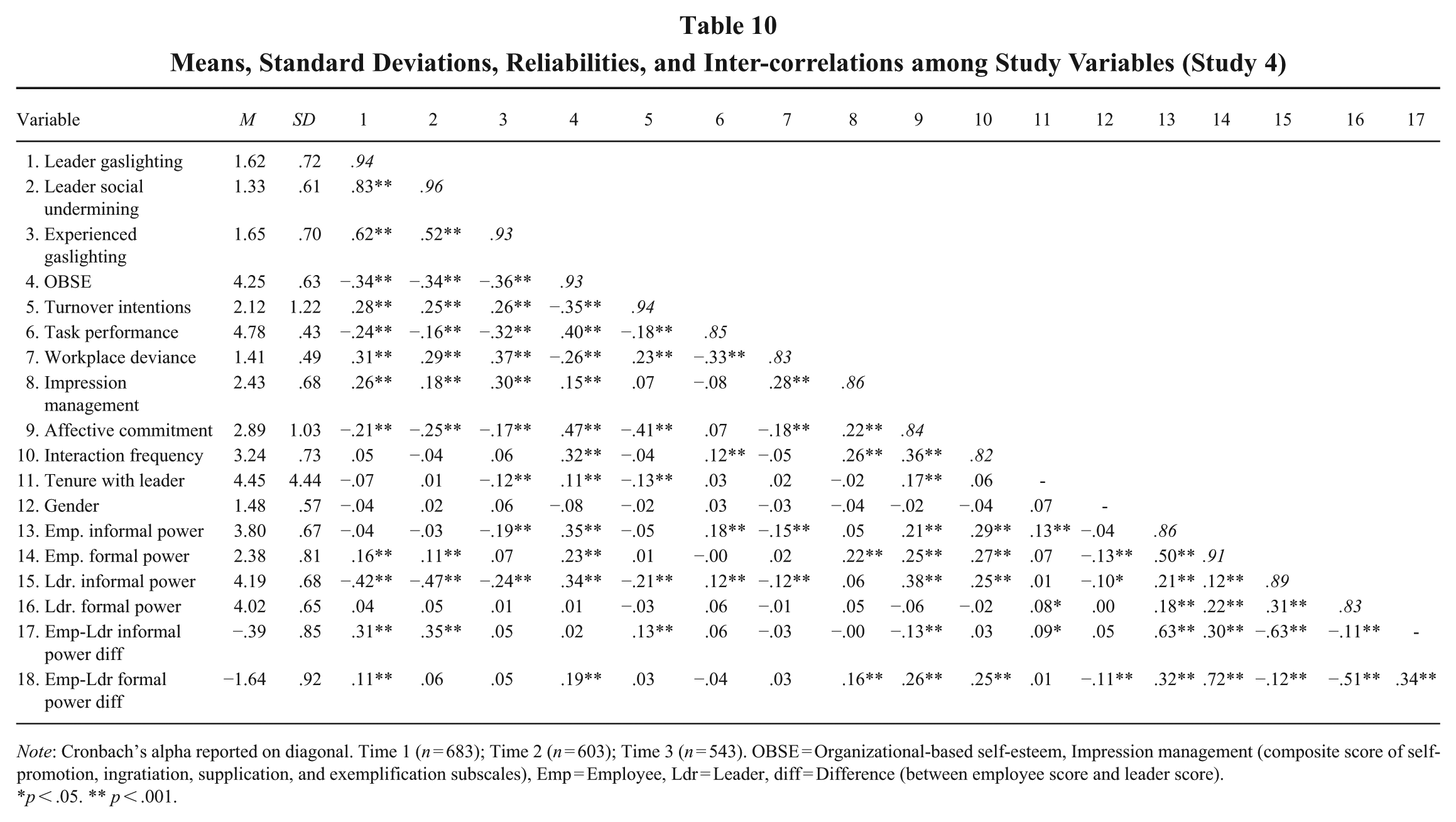
Note: Cronbach’s alpha reported on diagonal. Time 1 (n = 683); Time 2 (n = 603); Time 3 (n = 543). OBSE = Organizational-based self-esteem, Impression management (composite score of self-promotion, ingratiation, supplication, and exemplification subscales), Emp = Employee, Ldr = Leader, diff = Difference (between employee score and leader score).
p < .05. ** p < .001.
Leader Gaslighting, Employee Experienced Gaslighting, Informal Power Imbalance, and Employee Outcomes (Study 4)
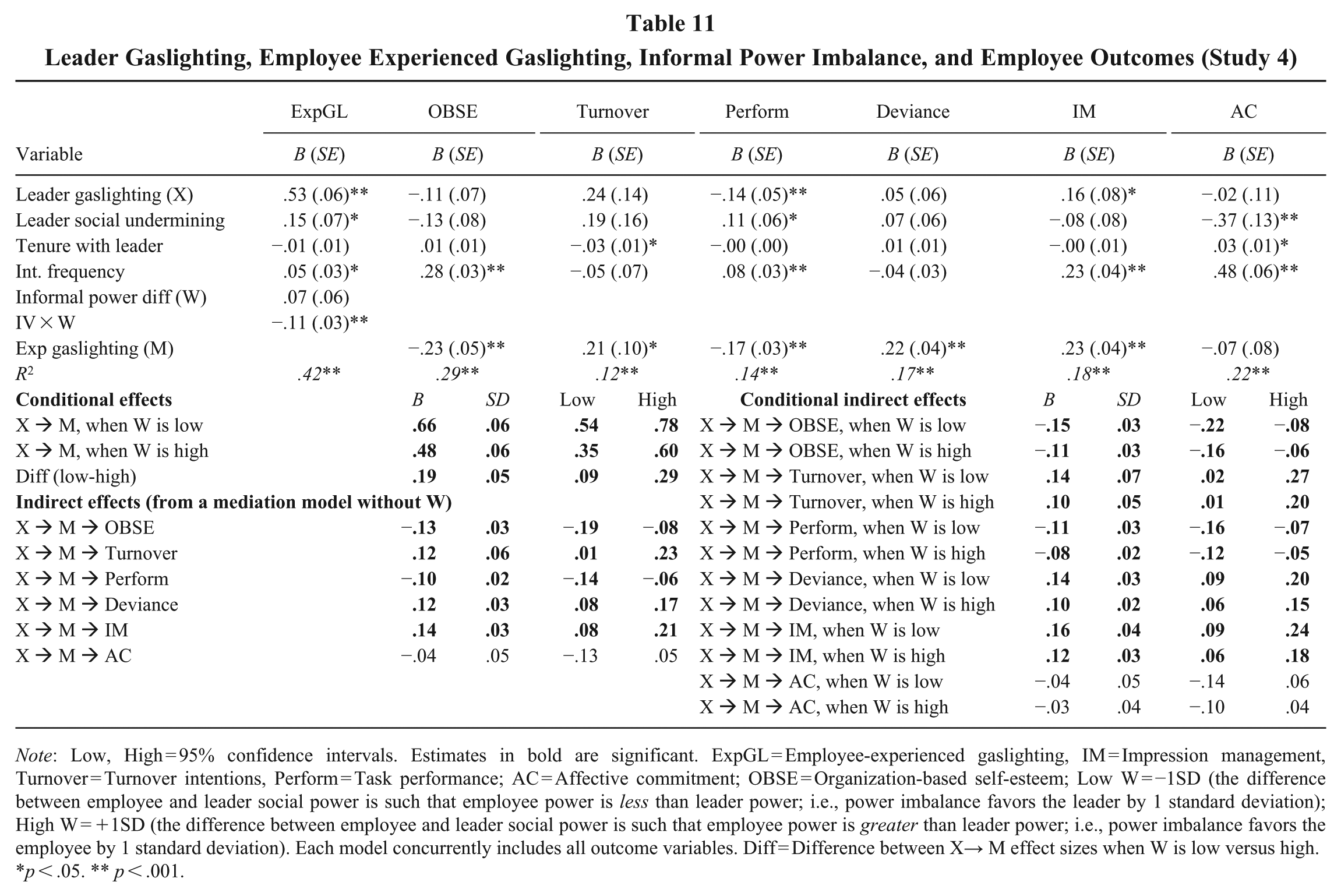
Note: Low, High = 95% confidence intervals. Estimates in bold are significant. ExpGL = Employee-experienced gaslighting, IM = Impression management, Turnover = Turnover intentions, Perform = Task performance; AC = Affective commitment; OBSE = Organization-based self-esteem; Low W = −1SD (the difference between employee and leader social power is such that employee power is less than leader power; i.e., power imbalance favors the leader by 1 standard deviation); High W = +1SD (the difference between employee and leader social power is such that employee power is greater than leader power; i.e., power imbalance favors the employee by 1 standard deviation). Each model concurrently includes all outcome variables. Diff = Difference between X→ M effect sizes when W is low versus high.
p < .05. ** p < .001.
Moderation Results
Table 11 shows that leader gaslighting significantly interacted with leader-employee informal power imbalance to predict employee-experienced gaslighting (B = −.11, p < .001, 95% CI [−.17, −.05]). Simple slopes tests show that the positive effect of leader gaslighting on employee-experienced gaslighting is stronger for employees with lower informal power relative to their leaders (B = .67, 95% CI [.55, .79]) but weaker (although still significant) for those with greater informal power (B = .48, 95% CI [.35, .60]). The difference in effect sizes between the two groups was significant (ΔB = .19, 95% CI [.09, .29]), indicating that having greater informal power diminishes the impact of leader gaslighting on employee-experienced gaslighting. Figure 3a depicts the Johnson-Neyman (J-N) plot of the interaction trend across varying levels of employee-supervisor informal power difference. Figure 3b depicts the patterns of the interaction at ±1 SD around the mean. Mirroring these trends, we also found significant interactions separately using referent power (B = −.09, p = .004, 95% CI [−.15, −.03]) and expert power (B = −.09, p < .001, 95% CI [−.14, −.04]) imbalance, respectively. In sum, we find strong support for Hypothesis 5.
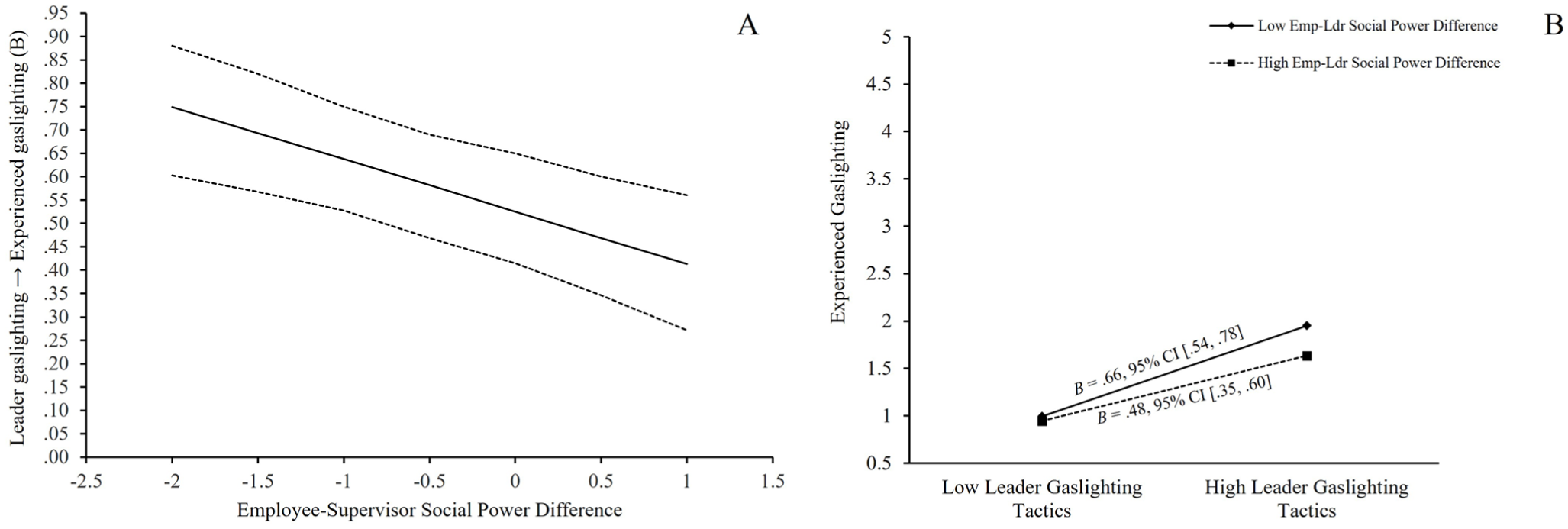
The Moderating Effect of Employee-Leader Informal Power Imbalance on the Link Between Leader Gaslighting Tactics and Employee-Experienced Gaslighting (Study 4)
Regarding Research Question 1a, we found no significant moderating effects of formal power imbalance (B = .03, p = .30). At a more granular level, we similarly found no significant moderating effects for legitimate (B = −.01, p = .58) and reward (B = .01, p = .57) power imbalance. However, coercive power imbalance significantly moderated the relationship (B = .05, p = .03, 95% CI [.004, .09]), such that the adverse impact of leader gaslighting on employee-experienced gaslighting was stronger for those who reported presumably having greater (versus less) coercive power relative to their leaders (see Figure 4a, b).
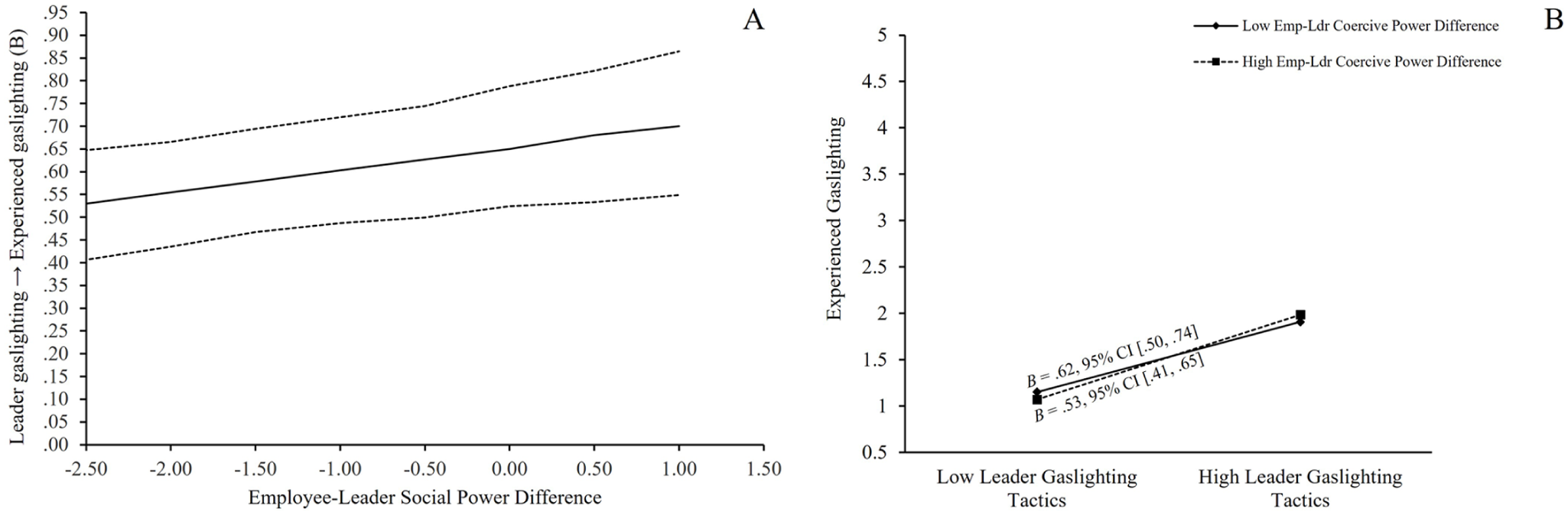
The Moderating Effect of Employee-Leader Coercive Power Imbalance on the Link Between Leader Gaslighting Tactics and Employee-Experienced Gaslighting (Study 4)
Moderated Mediation Results
The indices of moderated mediation show that the indirect effects of leader gaslighting on employee OBSE (B = .024, 95% CI [.01, .04]), turnover intentions (B = −.022, 95% CI [−.05, −.001]), task performance (B = .019, 95% CI [.01, .03]), deviance (B = −.023, 95% CI [−.04, −.01]), and impression management (B = −.026, 95% CI [−.05, −.01]) are significantly conditional on employee-leader informal power imbalance. Table 11 further shows the results of tests of the simple indirect slopes. Generally, the indirect effects of leader gaslighting on all five outcomes are significantly stronger for employees with relatively lower informal power but weaker (though still significant) for those with relatively greater informal power than the leader. These results provide full support for Hypotheses 6a-e. However, Hypothesis 6f was not supported as the index of moderated mediation for the conditional indirect effect of leader gaslighting on employee affective commitment was not significant (B = .01, 95% CI [−.01, .03]). Follow-up analyses show very similar pattern of results when referent power imbalance is the moderator. In contrast, expert power imbalance did not significantly moderate the indirect effects of leader gaslighting on turnover intentions and commitment. This suggests that employee referent power (imbalance) may be particularly important in this context.
Lastly, we probed the indirect effects conditional on coercive power imbalance (Research Question 1b). The indices of moderated mediation show that the indirect effects of leader gaslighting on employee OBSE (B = −.011, 95% CI [−.02, −.00]), task performance (B = −.008, 95% CI [−.02, −.001]), deviance (B = .01, 95% CI [.00, .02]), and impression management (B = .011, 95% CI [.001, .03]) are conditional on coercive power imbalance. Simple indirect effect slopes show that the indirect effects of leader gaslighting on these outcomes are significantly stronger (i.e., worse) for employees who report more coercive power than their leaders but weaker (though still significant) for those with less coercive power. Coercive power imbalance did not significantly moderate the indirect effects on turnover intentions (B = .009, 95% CI [−.001, .03]) and affective commitment (B = −.003, 95% CI [−.01, .01]).
Overall, we find that informal power that tips in favor of the targeted employee is a key resource that they may leverage to mitigate, but not entirely eliminate, the adverse effects of leader gaslighting. In contrast, we find that formal power imbalance is largely inconsequential. This mirrors the reality of most organizations where employees have less formal power than leaders. In cases where formal coercive power imbalance favors the employee, the net effect is that the employee suffers worse adverse consequences. It is possible that gaslighters do not respond well to these employees (potentially seeing them as threatening) and may choose to subject them to more harm to “keep them in check.” Overall, Study 4 highlights a series of novel power dynamics that offer nuanced insights into how gaslighting unfolds in leader-employee relationships.
General Discussion
The present research offers a conceptual foundation for understanding gaslighting in the workplace, uniquely positioning it within the workplace mistreatment/destructive leadership space. Highlighting the leader-employee relationship, we differentiated between leader gaslighting and employee-experienced gaslighting (i.e., the psychological experience of being gaslit). Next, we (1) adapted and validated distinct measures of leader gaslighting and employee-experienced gaslighting (Studies 1–4), (2) tested our conceptual model (Study 2), and (3) replicated and extended the model by testing the moderating role of informal (vs. formal) power imbalance (Study 4). We find that leader gaslighting positively predicts employee-experienced gaslighting, which, in turn, leads to several negative outcomes. Lastly, we find that targeted employees who possess greater (versus less) informal power relative to their leaders experienced significantly less adverse outcomes. Below, we discuss the implications of our findings for theory.
Theoretical Implications
Our first and most notable theoretical contribution is that we provide a theoretical basis for conceptualizing gaslighting in the workplace. We propose that leader gaslighting fits within the broader destructive leadership umbrella but also includes unique content that differentiates it from constructs such as abusive supervision and social undermining. We uncover unique gaslighting tactics leaders use for gaining control and distorting their targets’ sense of reality. In light of multiple calls to manage construct proliferation in the workplace mistreatment and destructive leadership spaces (Hershcovis, 2011; Krasikova et al., 2013; Schyns & Schilling, 2013), we advance knowledge by empirically showing across multiple studies that a bi-factor structure model best captures these destructive leadership constructs: with a global destructive leadership factor and multiple specific and orthogonal factors (leader gaslighting, social undermining, leader bullying, and abusive supervision). In addition, we offer conceptual clarity on how leader gaslighting differs from other leadership constructs (Table 1) and empirically demonstrate that it predicts experienced gaslighting and other outcomes beyond these constructs. These findings are critical to future theory development and research. Specifically, our research changes the conversation from whether leader gaslighting is a unique construct that warrants scholarly attention to more pressing matters, such as understanding the nuances of leader gaslighting tactics, the psychological experiences of targeted employees, the downstream repercussions, and boundary conditions. To aid with this work, we provide a rigorously validated measure to operationalize this phenomenon.
Second, we offer novel theoretical insights into the psychological experience of being gaslit at work. Scholars agree that a key requirement of “effective” gaslighting is that the target feels “crazy,” experiences self-doubt, and questions their reality (Stern, 2007; Sweet, 2019). Thus, we conceptually and empirically distinguish leader gaslighting tactics from employees’ psychological experiences of gaslighting. Doing so allows for the possibility that a leader’s attempts to gaslight an employee may not necessarily be effective if the employee does not exhibit the “symptoms” of being gaslit (Stern, 2007; Sweet, 2019). We further show that experienced gaslighting encompasses both self-doubt and dread-avoidance elements. These elements correspond with past conceptual description of gaslightee experiences in romantic relationships (Graves & Samp, 2021; Sweet, 2019), as well as recent in-depth narratives in organizational settings (Jones, 2023; Omran & Yousafzai, 2024). To facilitate theory development and testing, we validated a measure of experienced gaslighting at work. Using this scale, we provide initial construct validity evidence that experienced gaslighting is distinct from stable individual differences (e.g., psychoticism, insecure attachment, and personality traits), relationship features (e.g., interaction frequency and perceived similarity with leader), and other demographic factors (e.g., perpetrator and target age and gender). In addition, experienced gaslighting aligns (but is not redundant) with psychological states that gaslit individuals frequently experience, including paranoia, loneliness, negative affect (Omran & Yousafzai, 2024), and depersonalization/derealization (Sierra & Berrios, 2000) at work. Overall, we find strong evidence that experienced gaslighting in the workplace is a novel and critically important phenomenon in need of scholarly attention in the management literature.
Third, by positioning leaders as powerful gaslighters and targeted employees as less powerful gaslightees, our work aligns with consensus across different disciplines that power imbalance rests at the core of gaslighting dynamics (Stern, 2007; Sweet, 2019, 2022). Building on this perspective, we advance knowledge by quantitatively demonstrating the work-specific repercussions of being subjected to gaslighting by the leader. We show that targets of successful leader gaslighting experience a host of negative cognitions, attitudes, and behaviors that are disruptive to the employee, leader, workgroup, and the broader organization. These consequences are consistent with many propositions derived from the A/I theory of power (Keltner et al., 2003) regarding the reactions of less powerful individuals in adverse situations, including inhibitive emo-cognitive reactions (e.g., low OBSE, affective commitment), cognitive interference (e.g., lower task performance), and withdrawal (e.g., turnover intentions). The A/I power lens also helps to understand why gaslightees engaged in more supervisor-directed impression management (IM). Consistent with the literature on employee IM (Lukacik & Bourdage, 2019), the A/I framework suggests that less powerful individuals attend to and desire the approval of high-power individuals as there are significant consequences (both social and material) for being perceived positively by the powerful. As such, engaging in IM in response to experienced gaslighting is theoretically and empirically consistent with theory and past research.
However, one area where the A/I theory of power conflicts with extant research is in the prediction of workplace deviance. On one hand, Keltner et al. (2003) predict that less powerful individuals are likely to act in inhibited and socially appropriate ways to avoid being perceived negatively. On the other hand, extensive research shows that less powerful employees tend to react to mistreatment from leaders by enacting counterintuitive acts of retribution against them and organization (Lian et al., 2014; Mackey et al., 2021). In our study, we find that employees perceiving gaslighting engaged in more workplace deviance, contrary to A/I theory. As such, it appears that this specific proposition of the A/I theory of power needs further investigation.
Fourth, our research offers nuanced understanding of how power dynamics play out in leader-employee dyads. We argue and show that while leaders tend to possess more formal power that enables them to target and gaslight their employees (Sweet, 2019), employees are not always powerless against these advances. Indeed, researchers have shown that not all aspiring gaslighters are successful, a failure that is often attributed to the target’s ability to push back (Omran & Yousafzai, 2024). We provide a power-based explanation for this observation. Specifically, we theorize and show support for the notion that some target employees may draw from other sources of informal power, including their referent and expert power, to shift the power imbalance in their favor and ultimately diminish the proximal and distal effects of leader gaslighting. This is a critical theoretical extension that challenges what we know from decades of research on gaslighting in other fields. That is, we suggest that power imbalance in leader-employee gaslighting relationships is not static and unidirectional. Instead, the gaslighting “tango,” as Omran and Yousafzai (2024) describe it, may be viewed as a dynamic power play, the major currency being any and all resources—including formal and informal sources of power—that each party can leverage to be successful.
Practical Implications
Our research has a number of important practical implications for both employees and organizations. First, the wide-ranging negative outcomes of experienced gaslighting highlight the necessity of managerial action in dealing with leaders who engage in gaslighting and providing support for targeted employees. Although much more work is needed on empirically supported strategies for mitigating both leader gaslighting behavior and its negative consequences for employees, we can draw on work from the broader destructive leadership and the non-work gaslighting literatures to suggest preliminary recommendations.
At the organizational level, prior studies have proposed different strategies for mitigating the fallout of destructive leadership behaviors, such as training, establishing zero tolerance policies, and explicitly tying policies to leaders’ performance and compensation systems (Nandkeolyar, Shaffer, Li, Ekkirala, & Bagger, 2014). We believe these strategies are relevant to the leader gaslighting context. However, given the unique elements of this phenomenon, we argue that tailored training is critical. Such training should educate leaders on the “what” and “how” of leader gaslighting, along with information on the psychological experiences of targeted employees. Senior leaders need to learn to recognize gaslighting behaviors in leaders under their purview. In addition to policies and recognition, the elements of isolation and power imbalance also highlight the potential importance of structurally encouraging broader networks within the organization that do not rely on a single individual in power to act as the hub. Examples could include mentorship programs where the individual is paired with somebody outside of their primary network or reporting chain. Ivey and Dupré (2022) note that mentorship “provides proteges with access to information and influential social networks” (p. 716) and “arms proteges with a champion who promotes their career interests while providing career and emotional support” (p. 717). In short, outside mentorship may help to tackle many of the elements that exacerbate gaslighting, such as power imbalance, isolation, lack of access to other networks, and poor social support.
At the individual level, it is important that employees recognize when they or their coworkers are being gaslit. Many descriptors in our experienced gaslighting measure have been used as checklists to better understand the “symptoms” exhibited by gaslightees (Stern, 2007). Knowledge of these descriptors may help demystify the gaslighting experience and help employees better identify when they are experiencing it. Although effective strategies for coping with gaslighting is a subject of future exploration, they may be broadly categorized as internally focused (i.e., on oneself) or externally focused (i.e. involving others). From an internal focus, mindfulness-based approaches have been demonstrated to be broadly beneficial for stress and wellbeing in the workplace (Bostock et al., 2019). Given the strong negative emotional discord associated with experienced gaslighting, mindfulness-based approaches may be particularly helpful for employees. Research in a non-work setting shows that self-compassion is associated with reduced experienced gaslighting (Ciabatti et al., 2025). Self-compassion is linked to many positive outcomes, and research demonstrates that mindful self-compassion interventions can be quite effective (for a review, see Neff, 2023). In addition, given the sense of surreality and derealization associated with experienced gaslighting, it is possible that sensory grounding exercises (Hammond & Brown, 2025)—a specialized form of mindfulness—could be helpful. Common sensory grounding exercises allow individuals to disrupt surreal feelings by identifying, in the moment, things they can see, touch, hear, smell, and taste (Shukla, 2020).
From an external-focused perspective, effective approaches from prior destructive leadership research include the ability to vent to supportive others, engaging in voice, and involving influential third parties (Tepper et al., 2017). In a non-work context, perceived social support (e.g., family and significant others) is linked to decreased experienced gaslighting (Ciabatti et al., 2025). As such, leveraging these supports where possible may be very important. Moreover, employees should be encouraged to develop, nurture, and ultimately leverage their informal power to fight against gaslighting at work. Being able to rely on a robust network of employees who trust and look up to them, and who believe in their competence and expertise, is a potential way to stay grounded in reality through collective sense-making and interpretation of events. A strong network of supportive coworkers can also help the employee understand when they are being gaslit, and functions as a sense-making buffer when the leader attempts to diminish the employee’s reputation (“crazy” narrative) among colleagues. Lastly, targeted employees should also learn to avoid ineffective and costly strategies such as surface acting, avoidance, and self-isolation. Indeed, the observation that avoidance is a key element of experienced gaslighting is troubling since studies show that this strategy often results in negative outcomes (Nandkeolyar et al., 2014). Instead, building one’s support networks both within and outside the organization is likely key to reducing experienced gaslighting and its effects.
Limitations and Future Research
The present research has a few limitations that warrant discussion. First, our studies are cross-sectional in nature, making it difficult to make causal inferences. This is critical, for instance, with respect to the link between leader gaslighting tactics and employee-experienced gaslighting. We do not know the extent to which this relationship evolves over time and whether it deepens or dissipates in time. Second, we relied heavily on self-reported data across our studies. While self-reports are necessary for capturing employee perceptions, affect, and attitudes, our research could have benefitted from additional rating sources/perspectives. For example, leader self-rated use of gaslighting and/or third-party observers of these behaviors would have strengthened our findings. Moreover, coworkers may offer key insights into the proposition that gaslighters proactively attempt to discredit and isolate their targets by painting them as “crazy” to other people in their social networks. Third, in Study 2, we did not separate our self-rated measures of mediators and outcomes by time to manage possible common method-source biases. Fortunately, we rectified this issue in Study 4 and observed similar results.
Our research provides several promising directions for future research. First, it is important to continue to draw attention to construct proliferation issues in this literature (Hershcovis, 2011). It is clear from our studies that leader gaslighting overlaps with other destructive leadership constructs. However, we show through extensive factor structure modeling that leader gaslighting covers unique content. We further show that it predicts many outcomes incrementally beyond social undermining (and abusive supervision, see footnote 3). We believe the key in demonstrating construct uniqueness is selecting antecedents and outcomes that are most theoretically relevant and unique to gaslighting. In the current research, leader gaslighting strongly and uniquely predicts employee-experienced gaslighting. We encourage future research to explore other theoretically relevant and unique outcomes of gaslighting to further differentiate it. Empirically showing that leader gaslighting predicts employee job satisfaction or citizenship behaviors is unlikely to advance research on workplace gaslighting if scholars do not control for other leadership constructs that have previously been linked to these outcomes.
Second, future research should examine the occurrence of gaslighting in other work relationships, such as coworker-to-coworker, coworker-to-client, or employee-to-leader gaslighting. We began with leader-employee dyadic relationships based on extensive work that positions gaslighting as a power imbalance driven phenomenon. Focusing on the leader-employee relationship made conceptual sense as a starting point given that leaders have formal power and control over valuable resources at work. Future research should evaluate other forms of work relationships where formal power is not implicated, considering the findings in Study 4 that informal sources of power are also important. These informal forms of power may help explain how gaslighting occurs in non-hierarchical relationships, such as between coworkers. The possibility of upward gaslighting is particularly intriguing as it requires nuanced understanding of how employees may systematically and covertly “flip the script” on power dynamics with their leaders. Beyond dyadic relationships, future studies may examine the possibility that gaslighting exists at higher levels of abstraction, such as when a leader attempts to gaslight an entire workgroup, or when a group of coworkers attempt to gaslight a specific target. To aid these investigations, the measure of leader gaslighting can be easily adapted by changing the “your leader” referent in the instructions (e.g., to “your coworker,” “your team members”), although whether the behaviors described fully capture gaslighting by other parties may require further investigation.
On a related note, it would be interesting to change the referent to “I” and survey leaders or other potential perpetrators of gaslighting. As we note earlier, our assessment of leader gaslighting in this research relies on employee perceptions. As such, we cannot presently speak to the “degree of objectivity” of gaslighting behaviors in the workplace (see Martinko et al., 2011, for similar discussions on abusive supervision perceptions versus behaviors). Future research using perpetrator self-reported gaslighting tactics would add to the growing body of knowledge, particularly in demonstrating convergence (or lack thereof) between perpetrator, target, and third-party reports of gaslighting behaviors. Establishing that gaslighting objectively occurs will also be useful as organizations and societies contemplate policies and legislation (Darke et al., 2025). However, we acknowledge the challenge in collecting self-reported gaslighting given the strong potential for social desirability in responding. Podsakoff et al. (2024) offer useful suggestions for how to minimize different forms of biases, such as carefully choosing the target audience, explaining the importance of the research questions to them, and other design strategies that encourage honest responses.
Third, future research should continue to investigate the nomological network of gaslighting. For instance, future research could investigate if members of groups that tend to be lower in power—such as individuals of certain ethnic/cultural backgrounds, sexual orientations, gender expressions, or lower SES—are also more vulnerable to workplace gaslighting and its negative outcomes. This line of work may seek to understand who is most at risk of experiencing gaslighting. In terms of antecedents, research shows that those that crave power for self-serving ends (such as low-Honesty-Humility) are more likely to engage in destructive leadership (Breevaart & de Vries, 2017). Dark triad traits (e.g., Machiavellianism) may be especially critical in this context (see March et al., 2025). Social Dominance Orientation (SDO)—“an individual’s preference for group-based hierarchy and inequality” (Ho et al., 2012: 584) may further expand our understanding of gaslighting. On the one hand, gaslighter SDO might predict the likelihood to engage in gaslighting tactics, whereas target SDO might explain tolerance of being gaslit.
Finally, future research could investigate the role of culture on workplace gaslighting. For instance, it is possible that top leaders, through their influence on organizational culture, create an environment where gaslighting tactics are routinely used to placate or purposefully deceive others. This is consistent with research showing that destructive leader behaviors often “trickle down” through the organization (Tepper et al., 2017), such that top leaders and the culture they help create often explain why lower-level leaders engage in these behaviors. Moreover, it is possible that culture plays a role in the likelihood of (and reaction to) gaslighting. One possibility is that in higher power distance cultures (which tend to be more tolerant of and respectful towards power imbalance), subordinates may be less likely to recognize that they are being gaslit. These targets of gaslighting may therefore experience worse outcomes if they ultimately blame themselves. Indeed, research suggests that those with a higher power distance orientation may be less likely to view their supervisor as treating them unfairly (Lian et al., 2012). Thus, culture could play an important role in workplace gaslighting use, experiences, and reactions.
Conclusion
Our research offers new insights into the nature of gaslighting in the workplace. Through a series of studies, we validate distinct measures of leader gaslighting and employee-experienced gaslighting, allowing for deeper understanding of the phenomenon at work. In addition, we demonstrate that the experience of gaslighting is damaging for the individual and organization. Finally, we demonstrate that these consequences may be somewhat mitigated if targets have greater informal sources of power relative to their leaders. We hope that our work stimulates future scholarship on this promising and important line of research.
Supplemental Material
sj-docx-1-jom-10.1177_01492063261426014 – Supplemental material for Is My Boss Gaslighting Me? Uncovering the Nomological Network of Gaslighting In Leader-Employee Relationships
Supplemental material, sj-docx-1-jom-10.1177_01492063261426014 for Is My Boss Gaslighting Me? Uncovering the Nomological Network of Gaslighting In Leader-Employee Relationships by Babatunde (Tunde) Ogunfowora and Joshua S. Bourdage in Journal of Management
Footnotes
Acknowledgements
The authors acknowledge the contributions of Kaitlyn Guenther during the early stages of this project, including extensive literature review and initial conceptual work. This research was supported by two grants from the Canadian Social Sciences and Humanities Research Council to the first (435-2020-0529) and second (435-2018-0500) authors.
Supplemental material for this article is available with the manuscript on the JOM website.

Notes
References
Supplementary Material
Please find the following supplemental material available below.
For Open Access articles published under a Creative Commons License, all supplemental material carries the same license as the article it is associated with.
For non-Open Access articles published, all supplemental material carries a non-exclusive license, and permission requests for re-use of supplemental material or any part of supplemental material shall be sent directly to the copyright owner as specified in the copyright notice associated with the article.
