




Abstract
Parties in an alliance aim to capture both common and private benefits. As they transfer and jointly create knowledge to generate common gains, differences in private benefits can arise due to asymmetric knowledge spillovers. Our model of alliance structural choices incorporates the alliance itself—the channel through which partner knowledge flows—to reflect the fact that partners and the alliance may operate in different industry contexts. We propose that partners select structural governance mechanisms (equity governance and alliance scope) to enable valuable knowledge flows while protecting themselves from unwanted spillovers. Analyzing a large sample of U.S. alliances from 1985 to 2024, we find that asymmetric distance predicts these governance choices and that it is linked to the simultaneous use of multiple structural safeguards, including equity governance and a narrow alliance scope.
Keywords
Introduction
Partners form alliances to capture a mix of common benefits (e.g., novel knowledge generated together or mutually transferred to achieve alliance objectives) and private benefits (e.g., knowledge gained from the alliance and applied to outside purposes) (Khanna, Gulati, & Nohria, 1998). These benefits are not mutually exclusive. When the parties open up and share knowledge to achieve common benefits, undesired spillovers are more likely to occur. This increases the risk of knowledge expropriation (Colombo & Piva, 2019; Gulati & Singh, 1998; Oxley, 1997). Alliance structural choices—such as governance mode and the scope of alliance activity—are upfront decisions that can shape knowledge flows (Lioukas & Reuer, 2020; Oxley & Sampson, 2004) and head off concerns about private benefits. These choices are often framed as safeguards to regulate flows into and through the alliance, although their effects—particularly for equity governance—are nuanced (Oxley & Sampson, 2004).
Private benefits are particularly problematic when they are perceived to be imbalanced: when one partner gains more private benefits than the other. Such private benefit imbalances often arise from partner asymmetries, where access to knowledge or resources confers greater benefit to one partner in particular. Prior research has considered asymmetry between alliance partners along many dimensions, including: a) the magnitude of private and common benefits (Arslan, 2018), b) competitive perceptions and market overlap (Bouncken, Fredrich, Kraus, & Ritala, 2020), and c) familiarity with different governance structures (Lee, Hoetker, & Qualls, 2015). Although prior work considers the implications of such imbalances for learning dynamics and competitive tension (Bouncken et al., 2020; Khanna et al., 1998; Lane & Lubatkin, 1998), it primarily emphasizes partner dyad characteristics. Less attention has been given to the broader context of the alliance. In particular, the alliance itself—the vehicle through which knowledge flows between the partners—may operate in its own industry context.
In this paper, we consider how each partner’s closeness or distance from the alliance industry context could introduce governance challenges that are only partly addressed by two existing theories of alliances. The competence-based view (e.g., Chen, 2004; Choi, 2020; Martínez-Noya & Narula, 2018; Mowery, Oxley, & Silverman, 1996; Norman, 2004; Phene & Tallman, 2014; Sampson, 2007) focuses on the beneficial knowledge flows that derive from the different starting points of each partner. By contrast, transaction cost economics (TCE) emphasizes how differences such as these may increase the potential hazard of knowledge spillovers (e.g., Lioukas & Reuer, 2020; Oxley & Sampson, 2004). We bridge these theoretical traditions to ask: given a particular constellation of industry distances, what governance structures are chosen at the time of alliance formation to maximize common benefits and mitigate tensions stemming from potentially asymmetric knowledge flows between partners? While prior literature examines firm-level knowledge appropriation between existing competitors, the potential for industry-level knowledge spillovers transmitted via an alliance has yet to be investigated in detail. To do so, we introduce the concept of partner distance asymmetry by integrating the literature on industry relatedness between partners and the alliance (Khanna et al., 1998) with studies of structural governance choice (Lioukas & Reuer, 2020; Oxley & Sampson, 2004; Villalonga & McGahan, 2005), knowledge flows on alliance structure and outcomes (Chen, 2004; Inkpen & Tsang, 2005; Kok, Faems, & de Faria, 2020; Mowery et al., 1996; Norman, 2004; Sampson, 2007), and differential benefits between alliance partners (Arslan, 2018; Hoffmann, Lavie, Reuer, & Shipilov, 2018; Khanna et al., 1998; Kumar, 2010).
Our work examines the tension between the common benefits achieved through joint knowledge creation against the potential for asymmetric private benefits caused by uneven knowledge spillovers. We articulate how partners assess concerns about potential knowledge flows and employ two structural choices (alliance scope or governance mode) to increase the likelihood of generating common benefits while mitigating the hazards of knowledge spillovers. We identify asymmetric partnerships as cases in which differential knowledge spillovers are salient and motivate additional safeguarding. Here, one partner is notably closer to the alliance context than the other, such that the closer partner is especially exposed to the threat of industry-specific knowledge spillovers. As explained later, both partners are motivated to employ the canonical safeguards of equity-based governance and narrow scope, albeit for different reasons. We also consider the potential for employing both structural choices in tandem and find evidence to suggest that such “double safeguarding” is most likely to be employed in situations where asymmetries between the partners exist and neither partner is too far from the alliance context.
Our paper contributes to the study of TCE in the context of alliances in two ways. First, we highlight a salient but understudied external transactional hazard present at the time of alliance formation: the threat of asymmetric industry-level knowledge spillovers (e.g., Lioukas & Reuer, 2020; Runge, Schwens, & Schulz, 2022). Whereas extant TCE work rightfully tends to focus on mitigating hazards germane to the transaction dyad (e.g., asset specificity, current competition), we extend and generalize this logic to the intersection of the alliance and partners’ industry environments. We gain theoretical and empirical traction by incorporating this higher level of analysis (industry context); doing so foregrounds the hazard of industry knowledge spillovers. Such hazards are not readily anticipated when considering the partners in isolation of their broader context (Tian, Su, & Yang, 2022; Mowery et al., 1996). Second, we highlight the complementarity between TCE and competence-based views of alliances (e.g., Norman, 2004) and show how asymmetric distance induces alliance partners to safeguard against industry-specific knowledge spillovers in a nuanced way. We find that the canonical structural safeguards of governance mode and scope can be used as complements rather than merely substitutes, since equity governance can both promote and inhibit knowledge sharing (Oxley & Sampson, 2004: 723). The conditional value of such “double safeguarding” in the presence of asymmetric distance has not previously been recognized. Indeed, we submit that the construct of industry distance can provide one vehicle to unify TCE and competence-based perspectives by capturing the desire to exploit opportunities access novel, complementary knowledge and capabilities while also foregrounding hazards such as asymmetric knowledge spillovers and learning imbalances. More generally, our work highlights the importance of jointly analyzing both partners’ desires regarding knowledge flows, in contrast to foregrounding the perspective of a single focal partner.
Theoretical Background
Alliances are voluntary agreements between firms seeking to create value jointly through some combination of exchange, sharing, and co-development of knowledge and/or resources to achieve their objectives (Gulati, 1998; Zajac & Olsen, 1993). Beyond the creation of mutual value, alliances can also be a means for private, unilateral value capture by appropriating resources and capabilities and benefiting from knowledge spillovers (Baum, Cowan, & Jonard, 2010; Kogut, 1988; Lane, Salk, & Lyles, 2001). 1 There are many sources of common and private benefits, which motivate alliance entry: organizational learning, capability development and transfer, competitive positioning and market access, legitimation, managing risk and uncertainty, and minimizing the costs of organizing (Gulati, 1998; Kogut, 1988; Nielsen, 2010).
Given these assorted motivations, many perspectives inform their study. TCE offers one foundation (e.g., Bouncken & Fredrich, 2016; Colombo, 2003; Lioukas & Reuer, 2020; Oxley & Sampson, 2004), viewing alliances as a vehicle to economize on the costs of organizing and to alleviate the hazards of exchange between the partners by employing structural safeguarding mechanisms (Lioukas & Reuer, 2020). Some of the partner dyadic characteristics emphasized in TCE, such as resource complementarity (e.g., Lavie, 2006) and asset specificity (e.g., Williamson, 1985), represent unique interdependencies between the parties that may also contribute to hazards such as competitive tensions and learning imbalances between alliance partners. Partners employ governance mechanisms that aim to achieve joint objectives while protecting against appropriability hazards (Colombo, 2003; Oxley, 1997).
At the same time, the competence perspective on alliances (see Colombo, 2003) highlights the resources and knowledge each partner brings to an alliance as a source of joint value creation (e.g., Chen, 2004; Choi, 2020; Martínez-Noya & Narula, 2018; Mowery et al., 1996; Norman, 2004; Phene & Tallman, 2014; Sampson, 2007). In this telling, the purpose of an alliance is to learn and add to the firm’s existing knowledge base, often in the service of creating or maintaining competitive abilities (Norman, 2004). This literature also explicitly or implicitly undergirds many of the studies on alliance relatedness (e.g., Harrison, Hitt, Hoskisson, & Ireland, 2001; Lin, Yang, & Arya, 2009; Villalonga & McGahan, 2005). 2
We ask how governance structures are chosen to mitigate tensions from asymmetric knowledge flows, drawing upon three literature streams: the determinants of structural governance choices (Lioukas & Reuer, 2020; Oxley & Sampson, 2004; Villalonga & McGahan, 2005); the role of knowledge flows on alliance structure and outcomes (Chen, 2004; Inkpen & Tsang, 2005; Kok et al., 2020; Mowery et al., 1996; Norman, 2004; Sampson, 2007); and differential partner benefits (Arslan, 2018; Hoffmann et al., 2018; Khanna et al., 1998; Kumar, 2010).
Alliance Structural Governance as a Salient Outcome
Before proceeding, we wish to delimit our paper’s scope. Alliances are a quintessential strategic choice—formed when both parties anticipate favorable outcomes after accounting for potential risks. Achieving desired outcomes requires appropriate partners, contractual governance, and successful management (Nielsen, 2010; see also Bicen, Hunt, & Madhavaram, 2021; Chen, 2004; Das & Teng, 2000). Structural choices at the time of alliance formation set the stage for favorable outcomes such as knowledge transfer (Chen, 2004; Mowery et al., 1996; Sampson, 2007) while mitigating unfavorable outcomes such as appropriation risks or premature termination (Asgari, Tandon, Singh, & Mitchell, 2018; Pangarkar, 2003; Reuer & Zollo, 2005). The material cost of modifying these structural choices in the future (Keller, Lumineau, Mellewigt, & Ariño, 2021; Majchrzak, Jarvenpaa, & Bagherzadeh, 2015) suggests the initial choice is made carefully.
Figure 1 sketches our hypothesized model, drawing inspiration from Nielsen’s (2010) diagram of the alliance process and descriptions by Gulati (1998), Oxley and Sampson (2004), and Meier (2011). The figure illustrates how anticipated knowledge flows shape whether partners employ equity governance and how broadly they define the alliance’s scope. We posit anticipated knowledge flows influence these choices, which stem from a) knowledge mutually transferred or created and b) spillovers from one partner to the other through the alliance (Arslan, 2018; Bouncken et al., 2020; Diestre & Rajagopalan, 2012; Khanna et al., 1998; Kumar, 2010). Our hypotheses examine the absolute and relative distances between each partner and the alliance context, which influences the expected content and magnitude of these knowledge flows.
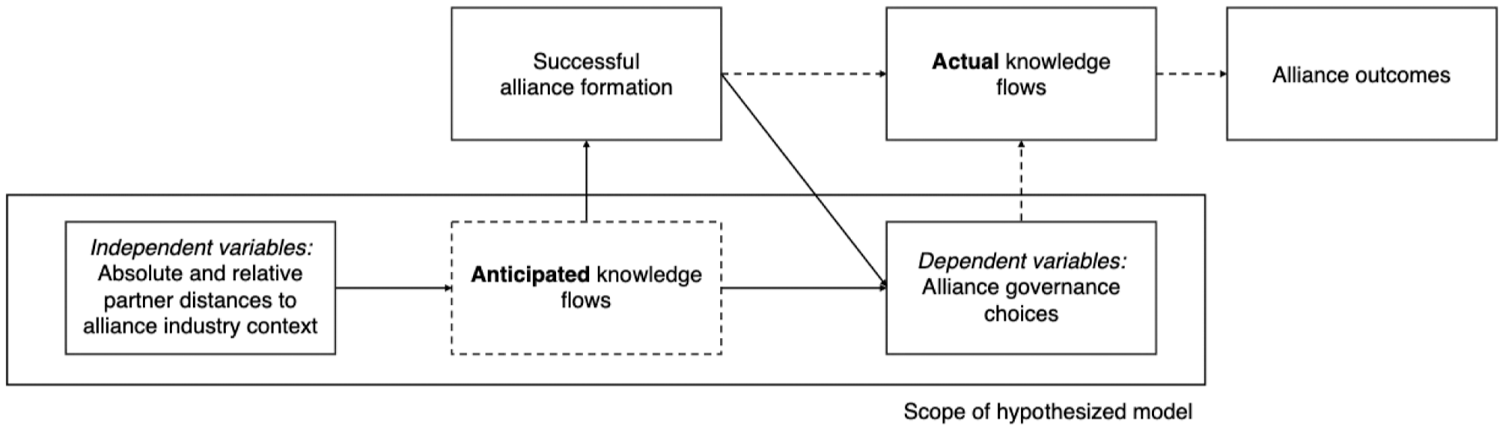
Scope of Hypothesized Model
As Figure 1 illustrates, governance structures can influence subsequent knowledge dynamics because they can shape the actual flows of knowledge (Chen, 2004; Mowery et al., 1996; Sampson, 2007). Rather than focusing on realized knowledge flows, the model highlights how firms’ industry positions inform expectations about potential knowledge flows. 3 We use industry distance as a central theoretical construct to introduce an external dimension capturing how firms’ positioning relative to an alliance’s industry influences governance choices. Industry distance provides a powerful lens for understanding choices during the alliance formation process because it captures the degree of dissimilarity between firms’ core industries. Greater distance signals opportunities to access novel, complementary knowledge and capabilities that are difficult to develop internally, but it also introduces relational hazards such as asymmetric knowledge spillovers and learning imbalances (Oxley & Sampson, 2004; Tian et al., 2022).
The Benefits and Hazards of Knowledge Flows
Prior studies highlight two forms of knowledge flows between partners—desired flows that advance joint objectives, and undesired flows leading to involuntary spillovers (Inkpen, 2000; Meier, 2011; Spender, 1996).
Desired knowledge flows
Meier (2011) summarizes how alliances are a conduit for knowledge flows by accessing or transferring knowledge; they can also help create new knowledge (see also Grant & Baden-Fuller, 2004; Inkpen, 2000; Jiang & Li, 2009; Khanna et al., 1998; Larsson, Bengtsson, Henriksson, & Sparks, 1998; Mowery et al., 1996; Runge et al., 2022). Inkpen and Tsang (2005) likewise note that firms learn when the partners jointly enter a new business and develop new capabilities, or when they gain access to partner skills and competencies. When partners apply their collective knowledge in novel domains, their non-overlapping knowledge bases can facilitate innovation.
Firms that mutually exchange such “sanctioned” knowledge set the groundwork for synergistic value creation (Arslan, 2018; Vasudeva, Spencer, & Teegen, 2013). Sampson (2007) notes that R&D collaboration provides access to complementary capabilities and economies of scale that ultimately shorten development time while spreading the risk and cost of such new developments (see also Martínez-Noya & Narula, 2018). While some alliances focus on resource access, knowledge is still gained during alliance execution (Harrison et al., 2001).
Undesired knowledge spillovers
Learning can result in common or private benefits. While common benefits accrue to all partners, private benefits allow one partner to generate rents in activities outside of an alliance (Norman, 2004) by picking up skills from partners and applying them to its own operations (Khanna et al., 1998). Thus, knowledge contributions to an alliance are at risk of spilling over to the private benefit of other partners (Arslan, 2018). The extent of these undesired knowledge spillovers depends on (1) the amount of knowledge flowing into the alliance and (2) the potential that the recipient can use that knowledge for purposes outside the alliance (Phene & Tallman, 2014). Such leakage of knowledge is frequently studied in the TCE literature on alliances (e.g., Lee et al., 2015; Lioukas & Reuer, 2020; Oxley & Sampson, 2004; Su et al., 2023) and leads partners to enact structural safeguards. In the context of R&D alliances, there is a well-known tension between knowledge sharing and expropriation (Martínez-Noya & Narula, 2018). Concordantly, the literature on horizontal alliances makes clear that competitors are particularly wary of opportunistic behavior and firm-specific knowledge spillovers (Bouncken & Fredrich, 2016; Oxley & Sampson, 2004; Wallenburg & Schäffler, 2014).
Knowledge spillovers between noncompetitors can also be undesirable and hazardous. When two partners operate in different industries, their knowledge and resource bases tend to have less overlap (cf. Oxley & Sampson, 2004; Wang & Zajac, 2007). Both firms gain access to each other’s skills and capabilities, and the resulting knowledge may be redeployable beyond the alliance context—creating concerns over unintended competitive knowledge transfer (Inkpen & Tsang, 2005). Such spillovers are particularly problematic if they provide differential private benefits. Beyond the prima facie concerns regarding unequal distribution of benefits, the presence of private benefits can cause partners to redirect effort—undermining the premise of the alliance (Arslan, 2018; Khanna et al., 1998). To that end, the nature of each partner’s pool of knowledge relative to the alliance context can help uncover the relative magnitude of beneficial knowledge flows (to them) and/or undesired knowledge spillovers (from them).
Managing Knowledge Flows Through Structural Governance Choices
Alliance partners are not resigned to allowing knowledge flows to occur in an uncontrolled manner. They can structure the alliance to their particular needs through governance choices. Prior literature highlights two particularly critical choices: governance mode (purely contractual versus equity-based arrangements) and scope (e.g., tasking the alliance to perform one specific business function, such as R&D, versus several at a time).
Equity-based modes
Equity-based governance represents a hierarchical approach where two or more firms pool a portion of their capital resources within a common legal entity (Kogut, 1988), such as a joint venture. When forming this entity, partners often establish charters, routines, and mechanisms for coordinating exchange (Asgari et al., 2018; Gulati & Singh, 1998). Managing knowledge flows through equity governance is a double-edged sword, acting through three different channels of influence. First, the competence-based literature shows that equity-based governance facilitates tacit knowledge sharing (Chen, 2004; Kogut, 1988; Mowery et al., 1996) and builds absorptive capacity (Mowery et al., 1996)—that is, the ability to recognize and apply new knowledge (Cohen & Levinthal, 1990). The procedures that accompany equity governance allow for more efficient knowledge transfer (Sampson, 2007) and facilitate information reporting (Asgari et al., 2018; Lioukas & Reuer, 2020; Oxley & Wada, 2009; Williamson, 1985). Both partners tend to assign employees to the entity who absorb knowledge before returning to the parent (Sampson, 2007). While this facilitates knowledge sharing and innovation, it may also form a conduit through which valuable knowledge can leak from one partner to another (Oxley, 1997).
Second, equity alliances can facilitate monitoring between the two parties (Oxley, 1997) through tools such as process controls, inspections, and using senior team members to oversee partner behavior (Lioukas & Reuer, 2020; Poppo & Zhou, 2014). While monitoring does not inherently facilitate or inhibit knowledge flows, it can serve as a safeguard against unwanted knowledge spillovers by regulating the flow of information into the alliance.
Third, consistent with TCE reasoning, equity-based modes modify the incentives of the parties. Equity positions serve as “mutual hostages” (irreversible upfront investments) that motivate working toward common goals and guard against unwanted knowledge transfer by aligning interests (Asgari et al., 2018; Williamson, 1983). Moreover, explicit investment delineation in an equity venture provides a means to distribute the gains from cooperation with less ex-post haggling (Gulati, Wohlgezogen, & Zhelyazkov, 2012; Hennart, 1988; Kogut, 1988). Aligned incentives reduce the likelihood that private benefits will be pursued to the detriment of joint knowledge creation and mutually agreed-upon knowledge transfer (Arslan, 2018). This effect can help to drive beneficial knowledge flows while throttling unwanted spillovers.
Alliance scope
The second governance choice pertains to the scope of cooperation and resources exchanged (Arslan, 2018; Lavie, 2006). Scope can be considered along several dimensions, including geographic, product, consumer, functional, and technological (Khanna et al., 1998), but a common dimension considered in extant literature is business function (Oxley & Sampson, 2004). For example, scope is often considered narrow when an alliance pertains to R&D only, whereas broader scope alliances pertain to multiple functional areas that can range from R&D to manufacturing and marketing (Cui & Kumar, 2012; Hanisch, 2024; Li, Eden, Hitt, & Ireland, 2008; Lioukas & Reuer, 2020; Oxley & Sampson, 2004).
As Lioukas and Reuer (2020: 360) explain, firms can carefully select “the activities or assets involved in the transaction [. . . resulting in one] that is less complex and easier to monitor,” making scope an “important alliance design choice that can help reduce misappropriation hazards in an alliance.” Alliance scope effectively enables partners to regulate knowledge sharing (Oxley & Sampson, 2004) by varying the aperture through which knowledge flows: increased flows come with an increased risk of knowledge spillovers. The opposite holds, too: a narrower scope reduces the risk of appropriation but reduces the opportunity for beneficial flows (Norman, 2004).
Other governance choices
Prior work indicates that the effect of governance mode and scope can be conditioned by partner familiarity (Li et al., 2008), trust (Inkpen & Tsang, 2005), or common third-party partners (Gulati, 1998). Furthermore, alliance design is increasingly sophisticated (Albers, Wohlgezogen, & Zajac, 2016): termination provisions and steering committees can replicate some features of equity governance without the need for irreversible investment (Hanisch, 2024; Hanisch, Reuer, Haeussler, & Devarakonda, 2024; Reuer & Devarakonda, 2016). We account for these factors in both our theoretical framing and empirical analyses.
Hypotheses
Absolute and Relative Partner Distances to Alliance Industry Context
Prior literature has examined learning imbalances within alliances (Bouncken et al., 2020; Khanna et al., 1998; Lane & Lubatkin, 1998), with a focus on partner dyad characteristics. Less attention has been paid to how the alliance itself serves as a conduit for knowledge flows. We submit that the symmetric nature of relatedness (i.e., the relatedness of Firm A to B is equal to the relatedness of Firm B to A) may have obscured earlier recognition of this source of asymmetry. 4 By contrast, our analysis here considers the absolute and relative distance of both partners to the alliance (cf. Arslan, 2018; Khanna et al., 1998; Lee et al., 2015). 5 In doing so, we can identify common incentives to facilitate beneficial knowledge flows (absolute distance) and asymmetries that expose partners to undesired knowledge spillovers (relative distance). We set aside cases where the partners are existing competitors (horizontal alliances or co-opetitive agreements), since these alliances have unique motivations and hazards that prior work have already detailed (Chen, 1996; Hamel, 1989; Mowery et al., 1996; Oxley & Sampson, 2004; Park & Ungson, 2001; Park & Zhou, 2005; Simonin, 1999). We control for existing competition between alliance partners in our primary empirical analyses and exclude existing competitors altogether in our robustness checks.
To fix ideas, consider the position of a “Focal Alliance” as the origin. From this starting point, we distinguish a “Close Partner” to the alliance (in terms of industry distance) and a “Far Partner” and assess their absolute and relative distances to consider the knowledge flow patterns each configuration entails. 6 Using this lens, Figure 2 illustrates five qualitatively different cases.
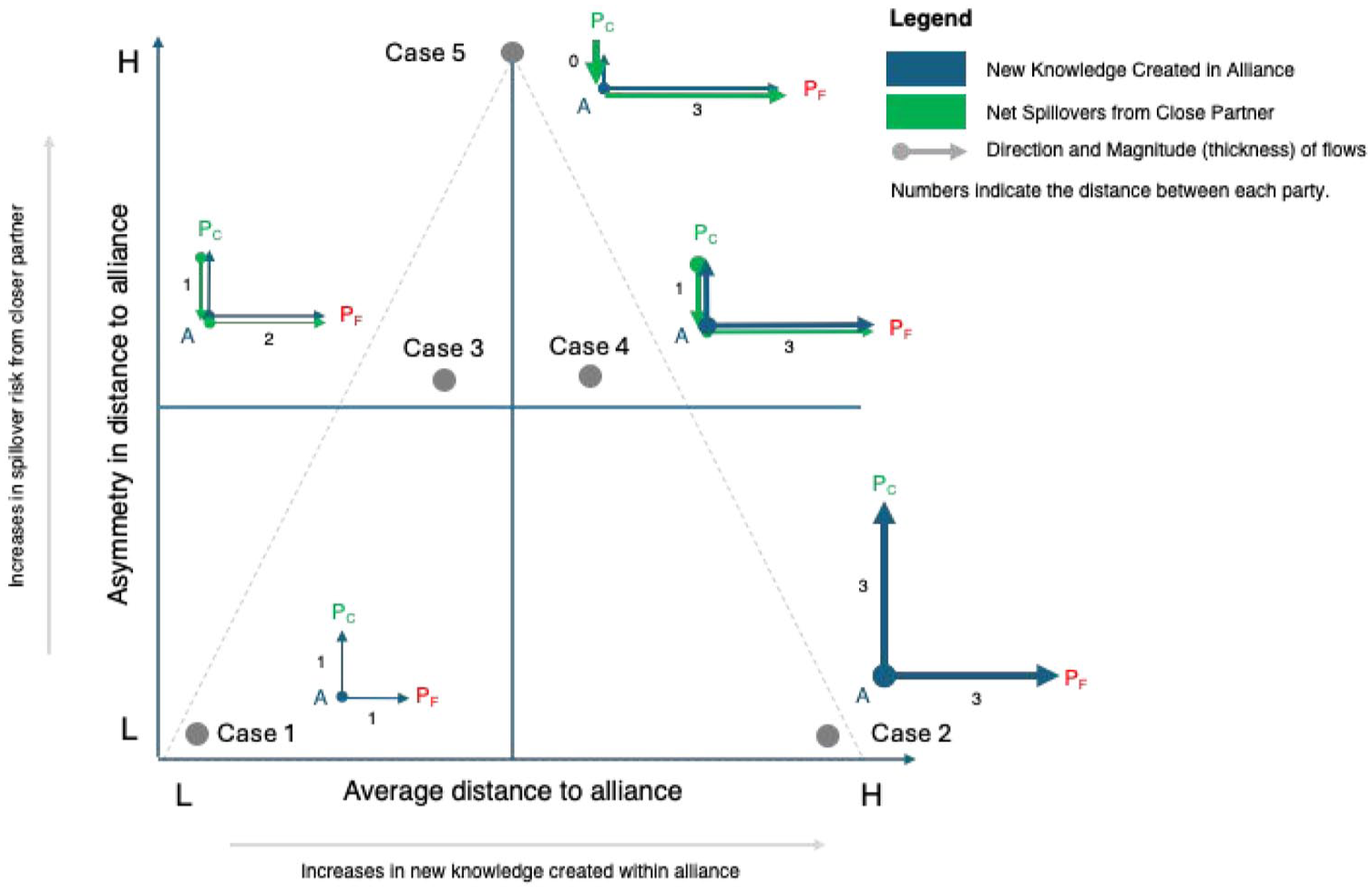
Industry Distance Configurations and Anticipated Knowledge Flows
In Case 1, partners are symmetrically positioned close to the alliance (i.e., both parties are relatively close to the focal alliance, with each partner equally distant). In this case, knowledge flows into the alliance from both parties in similar proportions, which serves to create new knowledge. An example is the alliance between Workday (computer programming services) and Salesforce (prepackaged software) to develop an AI employee service tool (Salesforce Inc., 2024). This alliance operates in an industry—computer-integrated systems design—that is familiar to both partners but outside the current scope of either firm’s primary operations.
Mutually Distant Partners and Mutually Beneficial Knowledge Flows
In Case 2, both partners are symmetrically distant from the alliance (Case 1 and Case 2 differ in terms of the average distance). As both partners jointly grow more distant, they understand less about the context of their collaboration. On the one hand, this makes it more difficult to acquire and integrate knowledge that is far removed from the partner’s current knowledge base. On the other hand, greater industry distance often signals opportunities for accessing complementary knowledge and resources that are difficult to develop internally (Hagedoorn, Roijakkers, & Van Kranenburg, 2006). Since the alliance is further from the extant industries of the partners, new knowledge created is more likely to be both novel and unfamiliar to the partners (Heil & Bornemann, 2018; Tian et al., 2022).
On balance, we expect in the case of symmetric partners that both parties have much to gain from knowledge sharing and co-creation—allowing them to exploit complementary knowledge for joint innovation (see studies related to post-acquisition knowledge use, for example, Cefis, Marsili, & Rigamonti, 2020; Choi, 2020; Makri, Hitt, & Lane, 2010). Since alliances are formed to reap the benefits of collaboration, the parties have an incentive to increase knowledge flows of any type to maximize common benefits. Critically, because both parties are symmetrically distant, knowledge spillovers about their home industries are likely to be similar in magnitude. This allows the partners to avoid the distraction of trying to manage appropriation hazards. Parity in expected private benefits motivates cooperation rather than driving competition (Arslan, 2018). For example, Walmart and Netflix partnered to create a digital storefront with branded merchandise from Netflix shows and related online experiences (Walmart Inc., 2021). Here, Netflix could gain retailing knowledge from Walmart, and Walmart could gain content creation knowledge from Netflix, but the alliance industry context was relatively novel to both parties at the time of the alliance. 7
Equity governance enables beneficial knowledge flows in two ways: by facilitating knowledge transfer and by aligning incentives. As prior research has shown, equity governance facilitates knowledge transfer by protecting the partners’ resource commitments and inducing a similar commitment by the other partner (Li et al., 2008; Oxley & Sampson, 2004). This allows the partners to learn and safely share relevant information within the confines of the alliance (Das & Rahman, 2010; Inkpen, 2000; Norman, 2004). Further, equity governance offers needed flexibility to modify the terms of the agreement as evolving conditions dictate (Luo, 2002; Martínez-Noya & Narula, 2018; Oxley, 1997). And while equity governance is comparatively more costly than purely contractual alternatives, we anticipate that the perceived benefits of increased knowledge flow will outweigh these startup costs. Thus, we predict:
Hypothesis 1a: As the average industry distance from the alliance for both partners increases, the likelihood of employing an equity-based governance mode increases.
Another governance tool to increase knowledge flows for symmetrically distant partners is to establish a broad alliance scope. Broader alliance scope increases the extent of knowledge sharing and information flows across organizational boundaries (Li et al., 2008; Oxley & Sampson, 2004). The increased diversity and complementarity of these knowledge flows can facilitate innovation and enhance partner value (Soda & Furlotti, 2017; Xu, Fenik, & Shaner, 2014), even though the complexity of such arrangements may need sophisticated administration (Cui & Kumar, 2012; Hanisch et al., 2024; Reuer, Zollo, & Singh, 2002). Because both partners are equivalently unfamiliar with the alliance industry, we expect that the partners, on balance, will use the available tools to increase knowledge flows since they are uncertain about what they might learn and want to maximize the number of “shots on goal.” There is little concern regarding asymmetric private benefit accrual, and thus, in this instance, the common benefits should outweigh the risk of knowledge spillovers for all parties (Arslan, 2018). Thus, we predict:
Hypothesis 1b: As the average industry distance from the alliance for both partners increases, the scope of the alliance becomes broader.
Asymmetrically Distant Partners and Undesired Knowledge Spillovers
By contrast, Cases 3, 4, and 5 all occur when the partners have asymmetric positions relative to the alliance (i.e., one partner is closer to the alliance context than the other). These asymmetries create differences in the magnitude of industry-specific knowledge spillovers germane to each partner (Arslan, 2018; Ranganathan, Ghosh, & Rosenkopf, 2018). When a firm’s home industry is closer to the alliance context, it leaks a relatively higher amount of knowledge into the alliance (as illustrated by the thicker green arrows in Figure 2). Although the farther partner has the benefit of being exposed to more of their partner’s knowledge, they have less inherent ability to absorb and understand it. This countervailing mix motivates the partners to carefully select a mutually agreeable governance structure that balances these factors. The literatures on strategic positioning, coopetition, and real options explain why asymmetric knowledge spillovers pose a risk: alliances can be a pathway for increased future competition when used as a vehicle for learning and subsequent entry or acquisition (McCarthy & Aalbers, 2022; Montgomery & Hariharan, 1991; Silverman, 1999; Speckbacher, Neumann, & Hoffmann, 2015; Tripsas, 1997).
As an example of Case 3 (close to the alliance, but asymmetric partners), consider how LifePoint Health, an operator of community hospitals, formed a joint venture with an academic health system, Duke University Health, to create a cobranded network of community hospitals (LifePoint Health, 2011). The joint venture is in LifePoint’s primary industry, giving Duke a comparatively greater opportunity to learn from knowledge spillovers about operating community hospitals, whereas less spillover knowledge about managing an academic health system will be available for LifePoint. Case 4 (far and asymmetric partners) is illustrated by the partnership between Acadia Healthcare and the Henry Ford Health System (which operates medical facilities in Michigan) to develop a new behavioral health facility (Acadia Healthcare, 2020). While neither partner had significant prior experience operating a behavioral health facility, Acadia is relatively closer to the alliance context as a behavioral health service provider. Henry Ford Health can learn comparatively more about the delivery of behavioral health services than vice versa.
Concerns regarding asymmetry are most salient in Case 5 (maximum asymmetry between the partners). By definition, asymmetry is maximized when one partner’s industry is collocated with the alliance, while the other partner is in a different industry. An example is the 2017 alliance between Beach Co-op and Anchor Ingredients to process pulse ingredients for pet food, where the alliance sits in the same industry as Beach Co-op (growers) and Anchor brings its industry knowledge of pet food merchandising (Anchor Ingredients Co., 2017). Knowledge spillovers in this context are most akin to the hazards discussed in extant research examining horizontal alliances (Belderbos, Gilsing, & Lokshin, 2012; Bouncken & Fredrich, 2016; Wallenburg & Schäffler, 2014).
With these cases in mind, we now turn to their implications for choosing a governance mode. Consider first the perspective of the closer partner, who faces a greater risk that knowledge related to successfully competing in their home industry will spill into the alliance. As Arslan (2018: 3225) summarizes, “A partner can extract private benefits by proactively internalizing the counterpart’s knowledge, skills and capabilities, and by applying them outside the scope of the alliance to its own advantage.” For example, the farther partner can use the alliance as a learning vehicle for subsequent entry (Mitchell & Singh, 1992; Speckbacher et al., 2015; Tripsas, 1997). Even if this is not the intention at the outset, firms often diversify into industries that they become familiar with (Montgomery & Hariharan, 1991; Silverman, 1999). Yet the closer partner does not benefit from a similar learning opportunity because incidental knowledge spillovers from the farther partner are less likely to be relevant and utilized by the closer partner (Kavusan, Noorderhaven, & Duysters, 2016; Kok et al., 2020; Kumar, 2010). To address this lack of parity in potential private benefits, the closer partner will prefer equity to nonequity modes to minimize or monitor knowledge spillovers about their home industry (Arslan, 2018; Norman, 2004).
Now consider the perspective of the farther partner. The far partner is a net recipient of knowledge spillovers and—to them—this is a desirable “side effect” of the alliance. Since the relative scope of the alliance is lower for the farther partner, it has a higher ratio of private to common benefits (Khanna et al., 1998: 196). As a result, the farther partner has incentives to create conditions that encourage knowledge sharing and tacit knowledge transfer to capitalize on these benefits. And because the farther partner has less familiarity with the tacit knowledge from this distant context (Kavusan et al., 2016; Lane & Lubatkin, 1998; Norman, 2004), it is motivated to employ tools like equity governance to increase its “transferability factor” and likelihood of understanding the knowledge (Chen, 2004; Khanna et al., 1998; Kogut, 1988; Mowery et al., 1996), even if this allows the closer partner to marginally improve its monitoring capacity.
Taken together, equity governance offers advantages to both parties, but for different reasons. For the closer partner, it provides monitoring protocols to limit unwanted knowledge transfer and aligns incentives to reduce the potential for extraction of private gains (Arslan, 2018; Oxley & Sampson, 2004; Oxley & Wada, 2009). At the same time, the farther partner can use equity governance to increase its ability to learn via the alliance.
Hypothesis 2a: As the asymmetry in industry distance from the alliance for both partners increases, the likelihood of employing an equity-based governance mode increases.
Similar to equity governance, both parties can also use scope decisions to shape knowledge flows through the alliance context. Increased scope requires both parties to invest more in knowledge assets (Li, Eden, Hitt, Ireland, & Garrett, 2012) and knowledge flows (Li et al., 2008; Oxley & Sampson, 2004). Narrowing scope reduces the amount of knowledge that can spill over to their partner (Kumar, 2010). Consequently, narrowing scope is particularly appealing to the closer partner, who is more familiar with the alliance context and has more to lose from such spillovers (Lioukas & Reuer, 2020; Oxley & Sampson, 2004). Unlike the symmetric condition discussed in Hypothesis 1a, asymmetry increases the risk that the farther partner (who is comparatively less familiar with the alliance industry context) will employ industry-specific knowledge gained from their alliance to their private benefit. Anticipating this risk, the closer partner is likely to prefer a narrower alliance scope to mitigate this risk.
If a broader scope was unambiguously positive for the farther partner, we could expect the parties to be at loggerheads. But the tradeoff discussed in Hypothesis 1a remains: while broader scope allows access to more information, this information is difficult for the farther partner to integrate because it is cognitively distant from their industry context (Lane & Lubatkin, 1998; Nooteboom, 2009). The farther partner may foresee the benefits of a narrow scope for acquisition and integration efforts and acquiesce to a narrower scope for the alliance in hopes of aligning and maximizing common benefits. Taken together, while the closer partner benefits from tighter control of knowledge outflow, the farther partner can focus their attention. In this way, a narrow scope can serve as a mutually beneficial governance choice.
Hypothesis 2b: As the asymmetry in industry distance from the alliance for both partners increases, the scope of the alliance becomes narrower.
The Potential for Double Safeguarding
Until now, we have followed prior literature and considered each governance choice by itself, as a substitute means of controlling knowledge flow and safeguarding against appropriation. Lioukas and Reuer (2020) found only one case in a sample of 119 R&D alliances that deployed two safeguards (narrow scope and equity usage) simultaneously. The logic of substitution applies to symmetric alliances. Narrow scope and equity governance both have costs of implementation, and if each mode operates in a similar fashion to the other, it is costly to deploy both unnecessarily. In line with our earlier arguments for Hypotheses 1a and 1b, as industry distance from the alliance increases symmetrically for both partners, it is unlikely that the partners would encourage knowledge sharing through equity-based governance while also throttling it by restricting alliance scope. These two structural choices run counter to and inhibit the partner’s efforts to maximize knowledge creation and mutual transfer.
Hypothesis 3a:As the average industry distance from the alliance for both partners increases, the likelihood of simultaneously employing an equity-based governance mode and a narrow alliance scope decreases.
However, when partners are asymmetrically distant, a bundle of narrow scope and equity governance—or double safeguarding—can offer a preferred outcome to both parties. It does so by limiting the amount of uncontrolled information flow, while emphasizing depth of learning over breadth. Equity-based modes of governance not only provide safeguards against knowledge appropriation but can also be effective vehicles for transferring tacit knowledge (Kogut, 1988; Mowery et al., 1996). This increases the risk for partners who want to limit the amount of knowledge transferred (Oxley & Sampson, 2004), particularly when learning is a primary motivation for the alliance (Khanna et al., 1998; Lane & Lubatkin, 1998). Thus, equity-based governance in isolation brings “risks of partner appropriation of the shared knowledge and administrative costs to minimize those risks, requiring a complex net value calculation” (Phene & Tallman, 2014: 1059). By employing the secondary safeguard of a narrow scope, lingering concerns can be addressed and both parties can protect their interests, even though their perception of alliance hazards differs (Lee et al., 2015: 1536). Narrowing alliance scope mitigates unwanted knowledge misappropriation (the close partner’s concern) by limiting the scope of knowledge shared while also binding the partners to facilitate knowledge flows (the far partner’s concern).
Hypothesis 3b: As the asymmetry in industry distance from the alliance for both partners increases, the likelihood of simultaneously employing an equity-based governance mode and a narrow alliance scope increases.
Methods
To test our model, we construct a multi-industry sample from SDC Platinum of 21,650 alliances that includes all successfully completed alliances from 1985 to 2024 between two firms based in the United States. Given that our research question focuses on the absolute and relative industry distances between the partners and their alliance, we sought a source with broad variability in industry distance. While not free of limitations, SDC has the advantage of covering a wide range of industries, whereas other sources are often limited to a few industries or focus on a particular alliance type (Schilling, 2009). Table 1 contains descriptive statistics for all modelled variables. The majority of firms are private, with about half (41%) of the firms in the sample publicly traded and only 19% of all transactions occurring between two public firms.
Descriptives
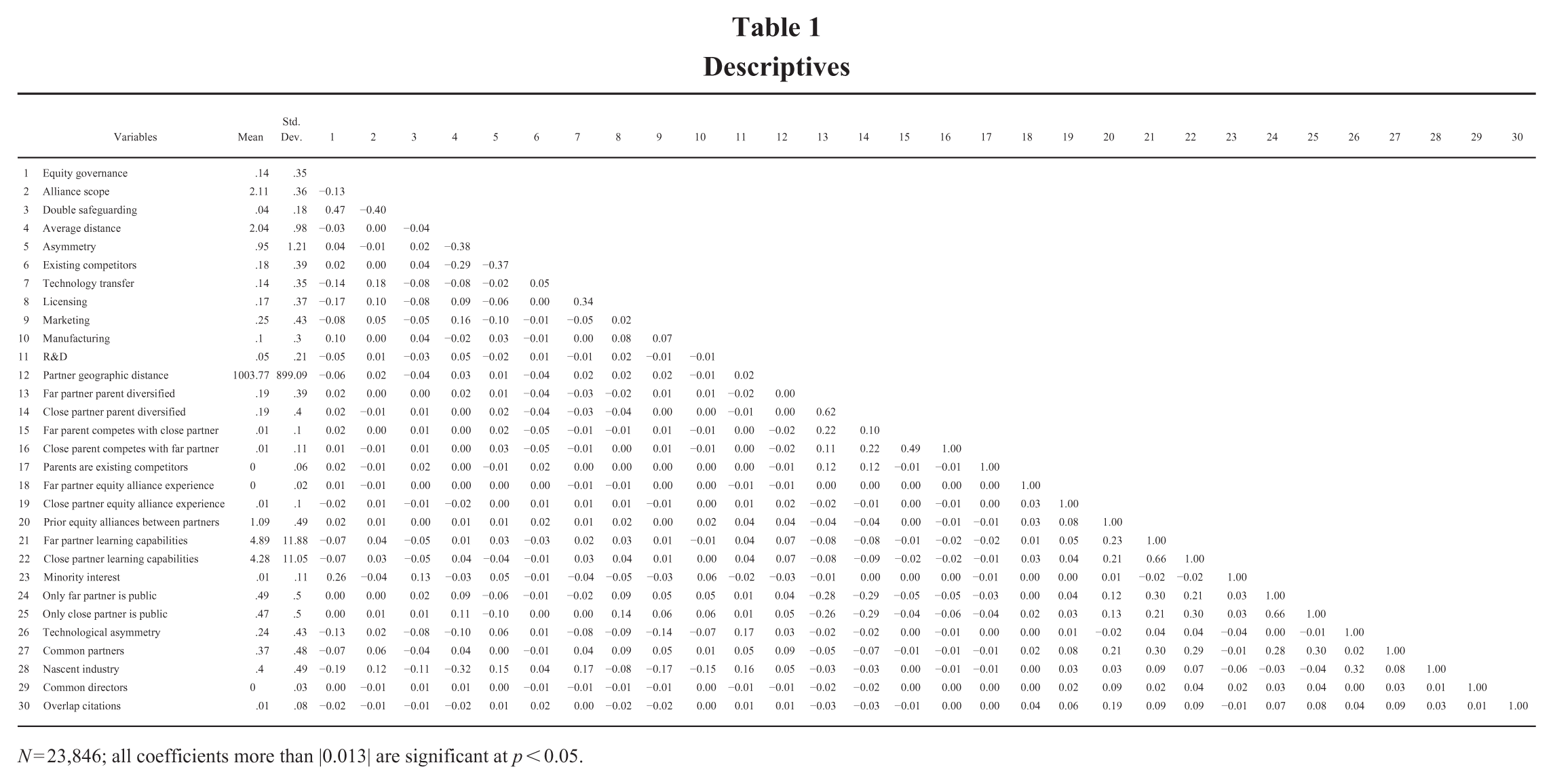
N = 23,846; all coefficients more than |0.013| are significant at p < 0.05.
Measures
Dependent variables
We use three dependent variables to capture alliance governance structure. Our first dependent variable, equity governance, equals one if the partners employ equity-based governance (of any proportional split), and zero otherwise. Our second measure assesses vertical alliance scope by distinguishing between narrow alliances (which incorporate fewer areas of collaboration) and more complex alliances (which collaborate across broad and diverse functional areas). Alliance scope is often measured as dichotomous (one vs. more than one function) or an integer count, with broader scope implying greater complexity (Lioukas & Reuer, 2020; Hanisch, 2024; Reuer et al., 2002). We generalize this concept: complexity is proportional to the information necessary to describe a system (Bar-Yam, 2019; Shannon, 1948). Thus, we measure alliance scope as the entropy of the textual description of the alliance. Higher values indicate more complex alliances. 8 Our third dependent variable, double safeguarding, captures when an alliance is both equity-based and limited to a narrow scope. The variable is coded as one when the parties employ equity governance and the alliance scope (as computed previously) is equal to or below the 10th percentile (i.e., the narrowest alliances), and zero otherwise.
Independent variables
We measure industry distance between each partner and the alliance using four-digit Standard Industrial Classification (SIC) codes, consistent with prior work (e.g., Finkelstein & Haleblian, 2002; Martynov, 2017; Tian et al., 2022). We assign numerical values to the difference in SIC codes, ranging from zero to three, with higher values reflecting greater distance. If the SIC codes for a focal partner and alliance context exactly match, distance equals zero. If the codes match but for the last digit (e.g., 7371 and 7372—computer programming and prepackaged software), the partner and alliance are in the same industry group and the distance measure equals one. The first two digits represent a major group—that is, cluster of similar industries (Occupational Safety and Health Administration, 2024). If the partner and an alliance share the same major group (e.g., 7371 and 7311, which both fall under business services), the distance equals two. Finally, if the partner and alliance are in different major groups (e.g., 7371 and 6311, computer programming and life insurance), the distance equals three. A distance measure is computed for each partner with respect to the alliance.
The first independent variable, average distance between the partner and alliance industry, ranges from zero to a maximum of three, when both partners are maximally distant from the alliance. 9 Our second independent variable, asymmetry between partners, is the absolute value of the difference between the two partner-alliance distance measures. It also ranges from zero, when firms are equidistant from the alliance, to three, when one partner is collocated in the alliance industry while the other partner is maximally distant from that context.
Control variables
We organize our controls into categories. First, we control for 11 variables relating to the knowledge bases, motivations, and bargaining power of the partner firms. 1) Prior equity alliances between partners control for both partners’ ex-ante proclivity for equity alliances with each other over the prior five years. 2 and 3) We control for each firm’s individual prior experience in equity alliances separately through the continuous variables close partner equity alliance experience and far partner equity alliance experience, which sum each partner’s joint ventures over the prior five years. 4 and 5) We control for each partner’s past experience with alliances in the focal alliance industry context by computing close partner prior point of contact and far partner prior point of contact. To avoid double-counting, when a joint venture occurred between the same two partners in the focal alliance industry, this alliance is counted in the prior equity alliances between partners variable and excluded from both prior point of contact variables. 6) We control for common partners, based on a count of shared third alliance partners, because informal relational mechanisms may be a substitute to manage knowledge spillovers (Albers et al., 2016). 7) We control for partners who are existing competitors (Folta, 1998; Mowery et al., 1996; Simonin, 1999). This variable is naturally correlated with average distance and asymmetry (the model is still well conditioned) but serves as a good control variable as described by Cinelli, Forney, and Pearl (2024). 8 and 9) Because private firms enjoy a knowledge advantage compared to public firms (Capron & Shen, 2007), we include close partner is public and far partner is public dummy variables. 10) We control for partner geographic distance using a continuous measure of the distance between the state capitals in which each partner’s headquarters is located. This variable helps proxy for the monitoring, learning, and bargaining costs associated with physical distance (e.g., Ryu, McCann, & Reuer, 2018). 11) Finally, we account for the differences in technological knowledge bases (Sampson, 2007) that may limit knowledge appropriation (Lai & Weng, 2013). Technological asymmetry is a dichotomous variable equal to one when one partner belongs to a high-technology industry while the other does not, and zero otherwise.
Our second category controls for six alliance characteristics. 1) We control for technology transfer alliances because this activity suggests a high level of partner cooperation and trust that mitigates opportunism (Powell, Koput, & Smith-Doerr, 1996) and requires less governance safeguards. 2, 3, 4, and 5) We account for the fact that certain alliance types trigger more or less protective governance modes (Oxley & Sampson, 2004) by including dichotomous variables for alliances focused in specific functional areas (Lioukas & Reuer, 2020; Oxley & Sampson, 2004)—namely licensing, marketing, R&D, and manufacturing. 6) We control for alliances that may occur within firms that exist in nascent industries, as detailed in Online Appendix A.
Our third category includes five controls that recognize how partners are not necessarily single line-of-business firms (Inkpen, 1998). 1 and 2) We create dichotomous variables—close partner parent diversified and far partner parent diversified—to designate firms active in other industries in addition to their primary sector (while retaining the distinction between partners based on industry distance). 3 and 4) We create dichotomous variables to capture where the parent company of one partner is already in direct competition with the other partner: close parent competes with far partner and far parent competes with close partner. 5) Because the extent to which each parent firm is involved in the alliance industry is also pertinent, we control for existing competition between the parent companies—parents are existing competitors.
Analytical Technique
Our empirical analysis faces two key methodological challenges that require careful econometric treatment. First, because we only observe the governance structure of successfully completed alliances, our analysis could suffer from selection bias (Heckman, 1979) arising because factors that influence whether firms successfully form an alliance may also affect choices about the mode of governance for that alliance (e.g., Diestre & Rajagopalan, 2012; Li et al., 2008; Su et al., 2023). To address this possibility, we employ models that explicitly account for the attrition of announced but unsuccessfully completed agreements. A Heckprobit specification is employed for the binary dependent variables (equity-based governance and double safeguarding). A standard Heckman model is used for alliance scope (Greene, 2018; Heckman, 1979). Both methods estimate two models, a first stage for the selection process (whether an announced alliance agreement was successfully completed or not) and a second stage that analyzes governance choices conditional on this selection process.
We use all announced alliances as observations in our sample selection stage, whereas only completed alliances are analyzed in the governance selection stage. For identification, we use two exclusion restrictions in the first-stage equation that are excluded from the second-stage equations. The first, whether the partners have any overlapping directors, is based on prior research showing that overlapping directors can facilitate initial partner identification (Cai & Sevilir, 2012; Haunschild, 1994; Shropshire, 2019), without directly impacting governance choice. The data related to director ties is sourced from BoardEx, with entries matched by firm and director and where data are extracted for the year of alliance formation for each partner. This variable is coded as one if the alliance partners had any overlapping directors on their boards, and zero otherwise. The second exclusion restriction is the patent citation overlap between the alliance partners, which likewise can facilitate partner identification (e.g., Mowery, Oxley, & Silverman, 1998) while not impinging on alliance governance. The data related to patent citations for each partner is sourced from USPTO PatentsView and entries matched on firm names. Firms often apply for patents using their subsidiaries and holding companies, which can make it difficult to link a firm’s patent assignee name to its registered name in SDC Platinum or Compustat databases. To account for this variation in their assignee names, we followed prior research, which uses fuzzy matching techniques to match a firm’s name from SDC Platinum to its name in USPTO’s database (Bhussar, Fox, & Grove, 2025; Marx & Fuegi, 2020). We generated a list of each firm’s total approved patents and their cited patents until the year of alliance formation. The measure was coded as one if both alliance partners cited common patents (citation overlap), and zero otherwise.
For our alliance scope model (continuous outcome), the coefficient for the inverse Mills ratio is negative (b = −0.35). The negative sign and significance of the inverse Mills ratio 10 indicates the presence of negative selection bias (Certo, Busenbark, Woo, & Semadeni, 2016) and shows completed alliances having a lower unobserved outcome value than those that failed to complete. Said differently, alliances that are more likely to be completed (based on unobserved factors) tend to have a narrower scope, conditional on observed characteristics. This is not surprising to us—overly ambitious partnerships may not make it to fruition, whereas more narrowly defined agreements are more likely to complete. The likelihood ratio test for independent equations was rejected, suggesting that the Heckman corrected model is preferred (χ2(1) = 202.77, p < 0.001). For the equity model, there is a positive correlation (r = .80) between the unobserved factors affecting both the selection process into completed alliances and the likelihood of employing an equity governance mode. Practically, this means that completed alliances are more likely to employ equity governance modes than incomplete alliances. The likelihood ratio test for independent equations was again rejected, confirming the presence of selection bias (χ2(1) = 4.65, p = 0.031), indicating that accounting for selection effects is warranted in this case. As we show in Table 2, overlapping directors is a significant, negative predictor of alliance completion (b = −.56, se = .21, p = 0.009). This is intuitive since director ties may serve as a driver of the initial formation and announcement of the alliance, but they do not necessarily lead to completion because the diligence process may make clear that a successful agreement cannot be struck. 11 Citation overlap is likewise negatively related to completion, but the effect is not significant (b = −.08, se = .15, p = 0.570). Importantly, asymmetric alliances are more likely to complete once announced (b = .04, se = .01, p = .004)—indicating that our independent variables have an influence on the selection process.
Heckman Model First Stage Selection Equation for Alliance Completion
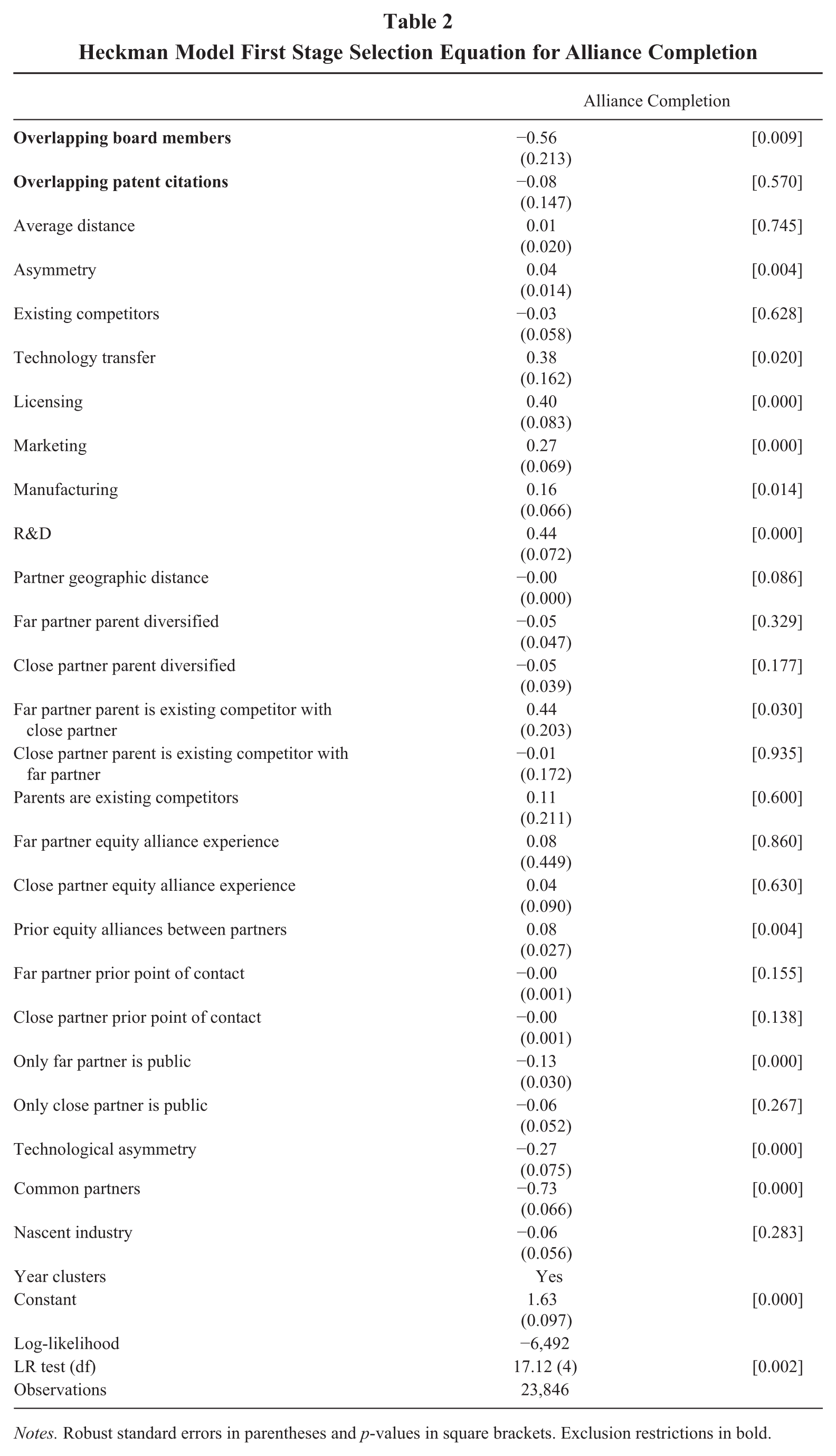
Notes. Robust standard errors in parentheses and p-values in square brackets. Exclusion restrictions in bold.
The second methodological challenge stems from the possibility of omitted causes—uncorrelated with the independent variables—that may influence both governance decisions. For example, termination provisions or steering committees (which are unobserved in our data) may simultaneously affect the need to employ equity governance or narrow scope (Hanisch, 2024; Hanisch et al., 2024; Reuer & Devarakonda, 2016). Given the near-simultaneous determination of governance mode and scope, we employ seemingly unrelated estimation techniques using the suest command in STATA to account for potential correlation in the error terms (Woolridge, 2010). This approach allows us to obtain more efficient estimates by accounting for the correlation structure across the governance choices (Cameron & Trivedi, 2005) and can accommodate nonlinear models. Results are unchanged if the equations are jointly or separately estimated or if we employ alternative techniques such as conditional mixed process modeling (e.g., the cmp command in STATA). Our variance structure employs robust standard errors clustered by year.
Results
Tables 3 and 4 present the results of our regression analyses. Models 1 and 2 estimate equity-based governance, while Models 3 and 4 estimate alliance scope. As the table indicates, many of the control variables are significantly related to our variables of interest. Of particular interest is that existing competition (with the focal partner or between the parent organizations) is positively related to equity governance, while alliance scope is not significantly influenced. Geographic distance reduces the likelihood of entering an equity partnership and increases alliance scope. As expected, prior equity alliances with the partner increase the likelihood of further partnerships of this type. Technological asymmetry is less common in equity partnerships and is associated with broader alliance scopes; a similar pattern emerges for nascent industries.
Heckman Model Results for Governance Mode and Alliance Scope
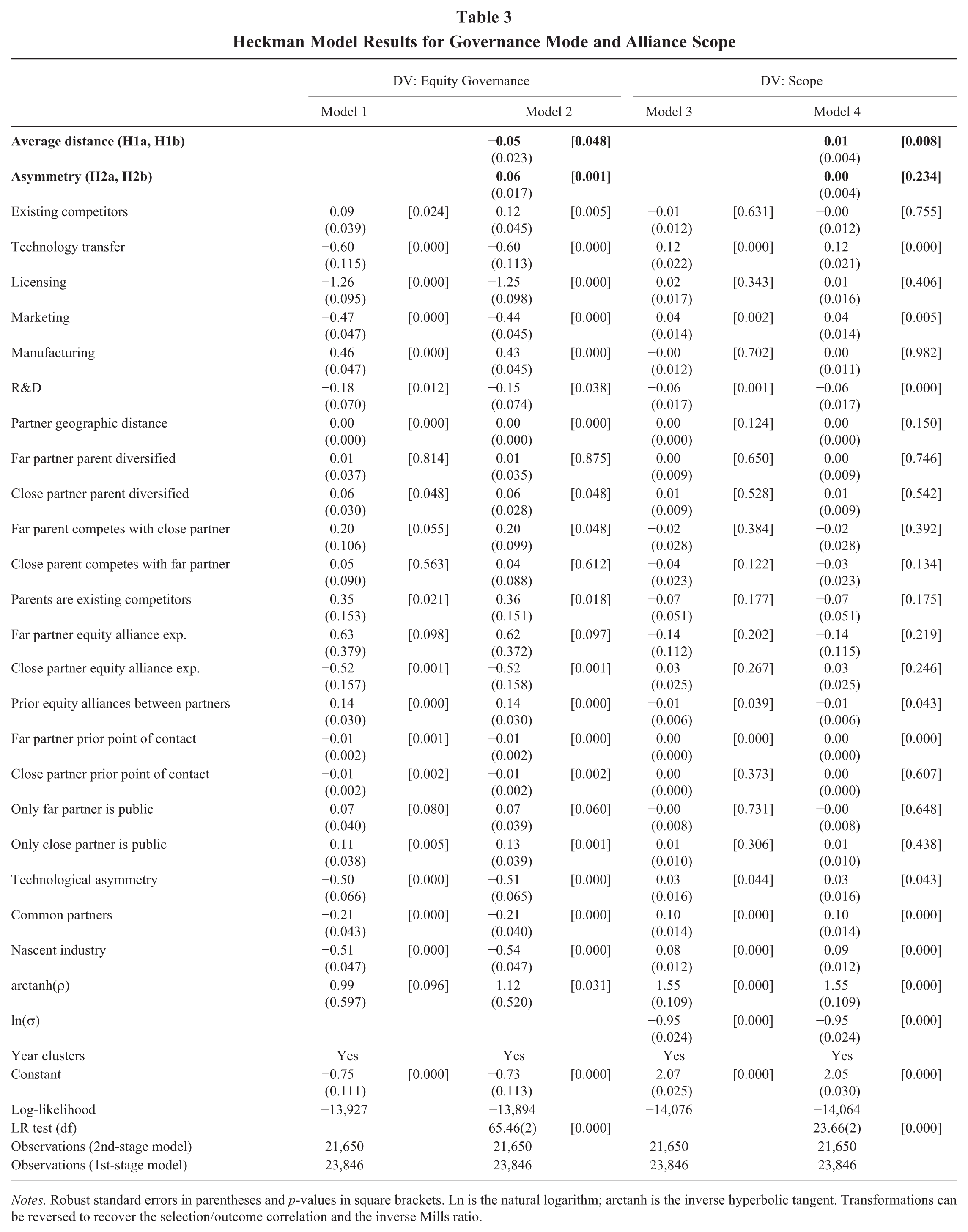
Notes. Robust standard errors in parentheses and p-values in square brackets. Ln is the natural logarithm; arctanh is the inverse hyperbolic tangent. Transformations can be reversed to recover the selection/outcome correlation and the inverse Mills ratio.
Heckman Model Results for the Likelihood of Double Safeguarding
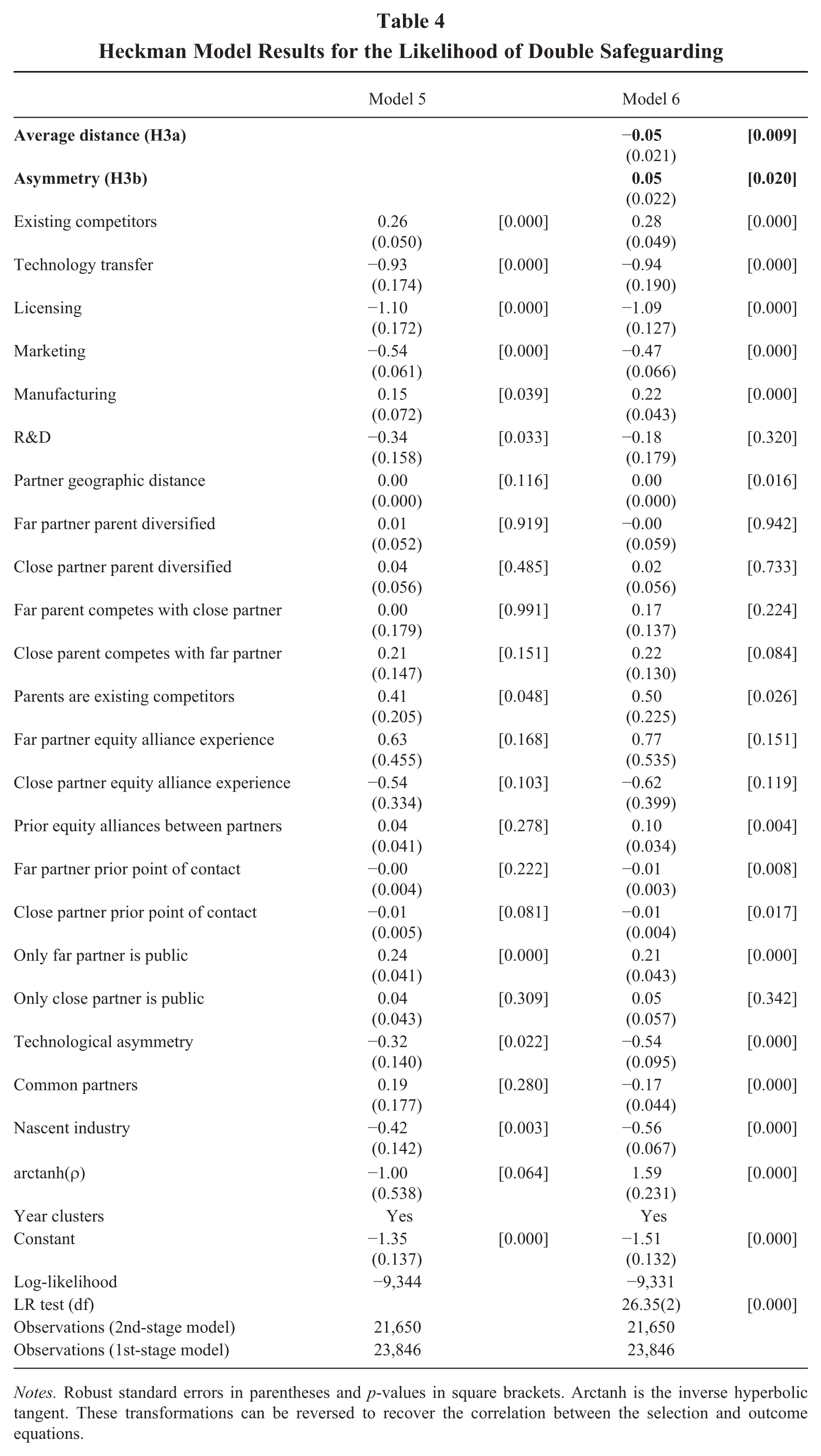
Notes. Robust standard errors in parentheses and p-values in square brackets. Arctanh is the inverse hyperbolic tangent. These transformations can be reversed to recover the correlation between the selection and outcome equations.
We do not find support for Hypothesis 1a, which predicts that average industry distance increases the likelihood of employing an equity-based governance mode; the results shown in Table 3 indicate an opposite effect (b = −0.045, SE = 0.023, p = 0.048). We do find support for Hypothesis 1b: as the average industry distance from the alliance for both partners increases, the scope of the alliance becomes broader (b = 0.011, SE = 0.004, p = 0.008). Practically speaking, the overall effect of moving from a condition of low average distance to high average distance translates to the addition of one incremental scope element to the alliance description. This effect is similar in magnitude to the influence of technological asymmetry (b = −0.510, SE = 0.065, p = 0.000).
Because our theory allows governance mode and scope to either substitute for or complement each other, we note up front that H2b effects do not materialize in the empirical results. Hypothesis 2a predicts that asymmetry in industry distance increases the likelihood of employing an equity-based governance mode, and Table 3 shows strong support for this argument (b = 0.056, SE = 0.017, p = 0.001). In practical terms, a unit increase in asymmetry raises the odds of employing equity-based governance by 5.9%; compared to a symmetric set of partners, a set of partners with maximum asymmetry are 17.6% more likely to employ equity governance. This overall effect of asymmetry (going from no asymmetry to maximal asymmetry) has a similar effect magnitude to the effect of partners being existing competitors. We did not find support for Hypothesis 2b. Asymmetry does not narrow the scope of the alliance (b = −0.004, SE = 0.004, p = 0.234). We discuss this non-finding later.
Turning to our analysis of double safeguarding in Table 4, Hypothesis 3a predicts that average industry distance decreases the likelihood of simultaneously employing an equity-based governance mode and a narrow alliance scope. Model 5 in Table 4 shows support for this hypothesis (b = −0.05, SE = 0.021, p = 0.009). For Hypothesis 3b, we find that as asymmetry increases, so does the likelihood of simultaneously employing an equity-based governance mode and narrow alliance scope (b = 0.05, SE = 0.022, p = 0.020). Practically speaking, a one-unit increase in asymmetry increases the odds of double safeguarding by 5.2%.
Robustness Tests
We took several additional steps to test the robustness of our results. First, we created factor variables to align with the five cases depicted in Figure 2. To align more closely with this typology, we excluded existing competitors to avoid comingling competitors and noncompetitors in the symmetric cases (by definition, asymmetric partners are noncompeting when forming the alliance). As we show in Online Appendix B, the use of equity governance is more likely than the base case (Case 1) for asymmetrically close (Case 3) and maximally asymmetric partners (Case 5), consistent with Hypothesis 2a. Interestingly, the only case where the scope is significantly narrower is asymmetrically close partners (Case 3), consistent with Hypothesis 2b. Case 4—when partners are asymmetric but also distant from the alliance—seems to be less affected by safeguarding or knowledge flow considerations, a point we return to in the discussion. Finally, consistent with Hypothesis 3b, we find that asymmetrically close partners (Case 3) as well as maximally asymmetric partners (Case 5) are more likely to employ double safeguards.
Second, while the selection model described previously accounts for the attrition of announced but incomplete alliances, it does not allow us to consider the difference between announced and unannounced alliances—in other words, the likely nonrandom nature of the initial formation process. In supplemental tests, we adapt the approach of Vasudeva et al. (2013) to construct a risk set of over 16 million potential but unformed alliances to probe the possibility of whether nonrandom selection of alliance partners materially influences the results. As we report in Online Appendix C, we find the same pattern of results as we report here. 12
Discussion
Alliances aim to create value through cooperation and knowledge sharing, but in doing so create opportunities for knowledge spillovers that generate private benefits. Just as couples may form a prenuptial agreement to limit appropriation if their union dissolves, asymmetric alliance partners protect themselves from potential post-alliance hazards. We focus on alliances as vehicles by which knowledge can be shared, and find that the partners seem to anticipate potential private benefit imbalances when the distances between each partner and the alliance are asymmetric (e.g., Lioukas & Reuer, 2020; Runge et al., 2022). To address this risk, the partners employ equity safeguards—either alone or in combination with narrow scope—to manage knowledge flows and protect against asymmetric industry-specific knowledge spillovers. By contrast, in symmetrically distant alliances where this risk is absent, the partners increase the scope of the alliance.
Our findings are consistent with and extend work on coopetition (Bengtsson & Kock, 2000; Brandenburger & Nalebuff, 1996; Hoffmann et al., 2018), horizontal alliances, and R&D alliances. We show that alliance partners appear to weigh the benefits of knowledge sharing through intentional transfer (Baum et al., 2010; Kogut, 1988; Lane et al., 2001), while accounting for potential spillovers through safeguarding behaviors (Devarakonda, McCann, & Reuer, 2018; Kale, Singh, & Perlmutter, 2000), even when their partner is not yet a competitor.
Elaborating upon the extant literature, we recognize a dual purpose of equity: as a safeguard and a vehicle for knowledge flow. Yet our results indicate that this predicted knowledge-sharing effect was not present for symmetric, distant alliances. In fact, the evidence suggests equity was less likely to be used, contrary to Hypothesis 1a. One possible explanation is that the perceived costs of equity governance outweigh the anticipated knowledge-sharing benefits. Our theorizing recognized this tension but assumed that anticipated benefits would outweigh the costs. Alternatively, managers may be relatively uninformed about the knowledge benefits of equity. While we have observed these benefits in the literature, perhaps practicing managers were insufficiently cognizant of these benefits when making alliance governance decisions.
Our findings also help to highlight the incremental value of examining alliances using the lens of absolute and relative distance rather than employing interfirm relatedness alone. Industry distance—in a certain sense, the inverse of relatedness—offers a more precise way to understand spillover risks and safeguards by emphasizing separation or divergence rather than shared similarities (Nooteboom, 2009). By differentiating between different patterns of knowledge flow, distance is better able to capture the risks and strategic implications of asymmetry. This provides us with conceptual leverage to make nuanced predictions regarding the use of different safeguards.
Implications
Our work adds to the extant work applying TCE to alliances by identifying and demonstrating the importance of a salient but understudied transactional hazard present at the time of alliance formation: the threat of asymmetric industry-specific knowledge spillovers. Building on prior work that highlights concerns about firm-specific knowledge leakage, we expand the domain of discourse of TCE by incorporating a hazard discussed in other research areas, such as coopetition, but not previously examined through a TCE lens. Consistent with TCE, current work in this tradition focuses on mitigating hazards within the transaction dyad (e.g., asset specificity, existing competition). We build on this TCE foundation to consider the relative overlap of the alliance and partners’ industry environments, which give rise to hazards such as competitive tensions and learning imbalances. By incorporating a higher level of analysis (from focal firms to their industry contexts), we examine the underlying asymmetries in the industry contexts in which each partner and the alliance operate; such asymmetries create a hazard of industry knowledge spillovers not readily anticipated when considering the partners in isolation from their broader contexts. The incorporation of industry distance extends TCE by providing evidence to suggest that firms’ positioning relative to the industry in which the alliance is situated is a pertinent concern for governance choices. Comparing effect sizes, we find that the effect of asymmetry (a 17% increase in the odds) is similar in magnitude to the effect of existing competition (a 13% increase in odds).
We also contribute to TCE and the alliance design literature by more deeply integrating TCE logic with the competence perspective (e.g., Colombo, 2003; Lioukas & Reuer, 2020; Norman, 2004; Oxley & Sampson, 2004). The competence perspective focuses on the motivation for alliance formation—for partners to learn and jointly create new knowledge to generate common benefits, the potential for which can be observed in partner industry distances. However, when the partnership is forming, contracting hazards also become salient, and industry distance asymmetries create salient hazards. Consistent with TCE, partner governance choices are made with an eye toward safeguarding against these contracting hazards—bearing in mind the implications that such safeguarding might have for achieving the goals of the alliance. Thus, the construct of industry distance provides a powerful lens for unifying TCE and competence-based perspectives by signaling opportunities to access complementary knowledge and capabilities difficult to develop internally but also foregrounding relational hazards such as asymmetric knowledge spillovers and learning imbalances (Oxley & Sampson, 2004; Tian et al., 2022).
Through this lens, we show that in asymmetric alliances, governance mode and scope may operate as complements—what we term “double safeguarding.” Whereas a straightforward application of TCE reasoning posits that they are substitutes: alternatives subject to a comparative assessment and selected based on the knowledge they can effectively safeguard and the unique “tax” they place on each partner (Li et al., 2008; Lioukas & Reuer, 2020), integrating TCE with the competence-based view provide the conceptual leverage to analyze more nuanced bundles of governance choices. Future research could consider other bundles of governance design choices at alliance formation, or structural designs that emerge during the life of the alliance. Moreover, our model aims to be nuanced and holistic in its dual focus on the benefits of the alliance and the steps taken to mitigate risks that accrue in tandem with those benefits. In particular, we argue and find that under conditions of asymmetry, managers want to neutralize hazards while still trying to protect the original purpose of the alliance—one grounded in partner knowledge combination and sharing. Negotiating this balance of hazard mitigation and joint benefit generation opens up new theoretical possibilities for alliance research to likewise embrace combinations of theoretical traditions, particularly as this balance may shift throughout the course of an alliance.
One of the more intriguing aspects of our results is the equifinality of governance choices despite differing partner motivations. While both parties are incentivized to choose similar governance structures in asymmetric alliances, their underlying motives differ: knowledge transfer in the case of the far partner, and knowledge protection in the case of the close partner. We find evidence of this equifinality in the case of employing equity governance when alliances are asymmetric—despite different motivations, equity governance is more likely to result. By contrast, we find that partner asymmetry has no discernible relationship with scope in our primary test for Hypothesis 2b. This may reflect the tension between novelty and lack of familiarity. Indeed, our robustness tests suggest a nuance: close but asymmetric partners are most likely to choose a narrow scope for the alliance. In this case, the close partner seeks protection from partners who are better able to understand the industry-specific knowledge spillovers from this comparatively closer context. This dynamic may be particularly relevant for pharmaceutical alliances where the patent clock places pressure on both partners to structure the alliance in a way that ensures focus on accelerating drug development—alliances of this type were conspicuously common in our dataset. In comparison, this dynamic is muted when the partners are far and asymmetric since the knowledge overlap of both partners is lower and the incentive to mutually learn is higher.
Moreover, our double safeguarding results provide further data to probe choices made despite different partner objectives. When the motives converge, double safeguarding is less likely; there is no need to bear the safeguarding “tax” twice. By contrast, when the motives diverge, double safeguarding is more likely to achieve a certain configuration of knowledge sharing and knowledge spillover mitigation. Managers considering entering an asymmetric alliance can creatively consider a combination of structural choices to achieve the common benefits of the alliance while mitigating common alliance hazards.
Limitations and Future Research Paths
We recognize limitations of our study and paths for future work. First, we do not observe the entire set of alliance negotiations that commenced but were never announced and captured in SDC Platinum. We attempt to make some progress on this front in our supplemental analysis reported in Online Appendix C, but this is a partial rather than a full risk set of alliances, potentially comprising hundreds of millions of possible combinations. Further, even when just focusing on completed alliances, the dataset may be best thought of as a sample, not a census, of all alliances (Schilling, 2009). Second, we cannot rule out reverse causality, but we believe it is unlikely in this context. A firm’s home industry or alliance context is unlikely to be strategically chosen in anticipation of employing a particular governance mode or scope in a potential future alliance. We believe our causal chain—that companies select a partner and a context of collaboration and then make choices about governance structure sensitive to the benefits and costs of the context and partner they select—is more plausible. Third, our model is a point-in-time governance decision conditional on alliance completion. While we discuss the implications of these governance choices for subsequent knowledge flows, future research could examine whether ex-ante asymmetries affect the likelihood of positive future outcomes (e.g., knowledge sharing and creation) or negative outcomes (alliance dissolution, ex-post partner market entry).
Fourth, future research could consider the sensitivity of the parties to knowledge flows associated with industry distance, such as their prior experience forming alliances in distant industry contexts. Furthermore, we focus on asymmetries with respect to industry distance, but future research could examine technological distance asymmetries as a relevant driver for alliances with a technological basis. In a similar vein, future research could consider moderating or interaction effects with other types of asymmetries (not only with respect to distance but also size, power, etc.) on firm-alliance market asymmetries (see, e.g., Runge et al., 2022). For example, it is plausible that concerns related to knowledge spillovers are neutralized when the closer partner has a large incumbent advantage in their core industry—a barrier for potential new entrants.
Fifth, concerns regarding knowledge spillovers largely stem from information asymmetry regarding awareness of partner knowledge, motivation to exploit that knowledge, and (potentially hidden) complementary capabilities (Chen, 1996). Information asymmetry has traditionally dealt with one party having an information advantage relative to another advantage at the beginning of the alliance; the farther partner has more to gain in the future precisely because of their starting information disadvantage.
Finally, we examine two types of safeguards—governance and scope—but there is a burgeoning literature on other administrative safeguards (Devarakonda & Reuer, 2018; Devarakonda et al., 2018; Reuer & Devarakonda, 2016). Future research can investigate whether other types of safeguards at formation or that emerge during the life of the alliance can protect alliance partners—potentially as substitutes or as complements, as we find here.
Conclusion
Balancing the benefits and the risks of knowledge flows is crucial for alliance structuring. By examining absolute and relative industry distance between the partners and the alliance, we highlight the salient but understudied external hazard of industry knowledge spillovers. In so doing, we expand the domain of discourse of TCE in two ways. First, we incorporate a hazard discussed in other research areas such as coopetition but not previously examined through a TCE lens. Second, we more deeply integrate TCE with the competence-based view of alliances. Taken together, this provides the conceptual leverage to analyze more nuanced bundles of governance choices, such as double safeguarding, which we find is used to balance the benefits and risks when working with asymmetrically distant partners.
Supplemental Material
sj-docx-1-jom-10.1177_01492063251410193 – Supplemental material for Structural Choices at Alliance Formation: Accounting for Partner Asymmetry in Industry Distance
Supplemental material, sj-docx-1-jom-10.1177_01492063251410193 for Structural Choices at Alliance Formation: Accounting for Partner Asymmetry in Industry Distance by Sergio Grove, Brian C. Fox, Rebecca Ranucci, Manjot S. Bhussar and David Souder in Journal of Management
Footnotes
Acknowledgements
We thank the editor, reviewers, and the empirical expert at the Journal of Management. We also appreciate the reviewers and participants at the Southern Management Association annual conference and the Academy of Management annual meetings for their thoughtful comments and suggestions, which substantially strengthened this manuscript.
Supplemental material for this article is available with the manuscript on the JOM website.

Notes
References
Supplementary Material
Please find the following supplemental material available below.
For Open Access articles published under a Creative Commons License, all supplemental material carries the same license as the article it is associated with.
For non-Open Access articles published, all supplemental material carries a non-exclusive license, and permission requests for re-use of supplemental material or any part of supplemental material shall be sent directly to the copyright owner as specified in the copyright notice associated with the article.
