



Abstract
Termination provisions establish vital governance mechanisms in alliances, offering essential safeguards and incentives by providing the flexibility to exit (underperforming) partnerships. However, they can also foster distrust and instability by potentially undermining commitment and continuity. We argue that the motivation behind termination provisions lies in the need to address safeguarding and flexibility concerns arising from increases in alliance scope, upfront payments, and technological uncertainty. Conversely, alliances with strong relational commitment and social embeddedness stemming from prior and indirect ties tend to omit termination provisions. Drawing on an analysis of 1,576 biopharmaceutical alliance contracts, we scrutinize various conditional and unconditional termination rights, along with their partner-specific allocations. Among other findings, we observe a positive association between broad alliance scope and termination rights for patent challenge, for lack of reasonable effort, and for specific countries assigned to the research and development (R&D) firm contributing technological expertise and, furthermore, termination rights for convenience for the client firm sponsoring the alliance. Larger unilateral upfront payments increase the likelihood that the client firm receives termination rights for lack of reasonable effort and for convenience. Higher technological uncertainty is associated with termination rights for convenience for the client or R&D firm. In contrast, prior ties negatively correlate with termination rights for convenience for the client firm, while indirect ties show a negative association with termination rights for convenience and specific countries for the R&D firm. Conceptually, our study highlights the relevance of termination provisions as elastic governance mechanisms that enable partners to accommodate postcontractual disturbances.
Keywords
Introduction
There is persistent scholarly interest in understanding the complex mechanisms underlying alliance governance (Hanisch, Reuer, Haeussler, & Devarakonda, 2024; Hoetker & Mellewigt, 2009). One of the most consequential governance decisions in this regard involves termination provisions that enable parties to prematurely exit a contractual relationship. From a governance perspective, termination provisions play a prominent role in contracting because they condition any other form of contractual safeguard or administrative control on the nonuse of termination provisions. In practical terms, this means that termination provisions can supersede other contractual governance mechanisms, including bilateral dispute resolution mechanisms (Lumineau & Oxley, 2012), control rights (Elfenbein & Lerner, 2003), and administrative controls (Reuer & Devarakonda, 2016). From a strategic vantage point, termination provisions also enable parties to exit an underperforming alliance and pursue alternative outside options (Greve, Baum, Mitsuhashi, & Rowley, 2010; Zhelyazkov & Gulati, 2016). Due to their unique leverage in contractual relationships, termination provisions are among the most consequential contractual rights from both theoretical and practical perspectives (Özdemir & van den Ende, 2021; Robinson & Stuart, 2007).
The literature acknowledges that termination provisions play a crucial role in alliance governance by offering essential safeguards and enhancing flexibility, particularly in situations characterized by high uncertainty and a lack of specifiability in contractual performance (Lerner & Malmendier, 2010; Weber, Mayer, & Macher, 2011). However, this recognition is limited in its consideration of three key aspects: (1) the associated strategic trade-offs, (2) the conditions governing their use, and (3) the allocation of termination rights among partners (Ariño, Reuer, Mayer, & Jané, 2014; Lerner & Merges, 1998). Regarding the first aspect, one important yet underexplored issue revolves around the drawbacks of termination provisions. Despite their benefits, these provisions inherently raise concerns, as they implicitly call the continuity of a relationship into question, which introduces an element of distrust and potentially undermines the stability of an alliance. In extreme cases, the mere threat of termination can be opportunistically exploited to extract postcontractual concessions. Regarding the second and third aspects, termination rights may be subject to conditions previously agreed upon and unevenly distributed among the partners, which places substantial constraints on their use. This variance is a critical issue because termination rights are necessary to leave an alliance without being liable to legal claims for damage, which introduces a crucial boundary condition to the extant discussions of alliance exits (Asgari, Tandon, Singh, & Mitchell, 2018; Bakker, 2016; Smith, 2005).
This paper enhances the understanding of the strategic motives and variance linked to termination provisions in interorganizational relationships by presenting an analysis of how parties evaluate the strategic trade-off between safeguarding and flexibility on the one hand and distrust and instability on the other. We also categorize termination provisions into two types: conditional termination rights (i.e., patent challenge and lack of reasonable effort) that are aimed at preventing opportunistic behavior, and unconditional termination rights (i.e., convenience and country-specific) that offer flexibility benefits such as the ability to reinvest in available outside alternatives. Based on these considerations, we examine the transactional and relational mechanisms that explain the presence and allocation of termination provisions in contracts. We argue that partners are more likely to incorporate conditional and unconditional termination rights when confronted with opportunistic threats posed by broad alliance scope, high upfront payments, and the absence of relational ties, and tend to choose unconditional terminations when flexibility concerns arise from technological uncertainty.
Empirically, we analyze 1,576 research and development (R&D) alliances in the biopharmaceutical industry, where the R&D firm (e.g., a biotechnology firm) typically assumes primary responsibility for research activities due to its deep technological expertise, while the client firm (e.g., a large pharmaceutical firm) supports the process through upfront and milestone payments and downstream activities such as clinical trials and commercialization (Robinson & Stuart, 2007). We observe that broad alliance scope is positively associated with various termination rights, such as those for patent challenge allocated either to the R&D firm or to both firms, termination rights for lack of reasonable effort allocated to the R&D firm, convenience termination rights allocated to the client firm, and country-specific termination rights allocated to either the R&D firm or to both firms. Similarly, higher unilateral upfront payments are positively correlated with termination rights for patent challenge allocated to the R&D or both firms, termination rights for lack of reasonable effort allocated to the client firm, and termination for convenience rights allocated to the client firm. Additionally, higher technological uncertainty is linked to termination rights for convenience that are either allocated to the client firm or the R&D firm. Conversely, prior ties are negatively related to unilateral termination rights for convenience allocated to the client or R&D firm, while indirect ties show a negative correlation with termination rights for convenience and country-specific termination rights allocated to the R&D firm. Insights into ancillary findings are presented in the analyses and results section.
This study contributes to the literature on strategic alliances and interorganizational governance by offering several novel insights. First, we conceptualize the termination provision as “an elastic contracting mechanism” (Williamson, 1991: 271) that enables legally autonomous parties to appropriately respond to disturbances in their relationship. This mechanism not only conditions any other form of contractual governance but also prompts postcontractual comparisons with outside alternatives to the focal relationship, among which it must prevail. Second, our study of different types of conditional and unconditional termination rights and their partner-specific allocation offers a more granular view of interorganizational governance that can inform studies on alliance stability and early termination (Asgari et al., 2018; Bakker, 2016). Third, we clarify the interplay between transactional and relational attributes in shaping governance decisions (Gulati, 1998; Polidoro, Ahuja, & Mitchell, 2011). We highlight that social embeddedness can compel partners to lessen their contractual safeguards as a gesture of continued relational commitment. Overall, this paper extends the prior work on termination provisions (Ariño et al., 2014; Lerner & Malmendier, 2010; Weber et al., 2011) and offers a refined perspective on the intricate governance mechanisms employed within alliances.
Theoretical Background: Termination Provisions as a Governance Mechanism
Although strategic alliances offer many benefits, including access to complementary resources and capabilities (Dyer & Singh, 1998; Harrison, Hitt, Hoskisson, & Ireland, 2001), they also expose their partners to various governance challenges, such as the risk of opportunistic behavior and maladaptation problems because alliances are based on inherently incomplete yet relatively rigid contracts (Al-Najjar, 1995; Crocker & Reynolds, 1993). One strategy for responding to these challenges is an agreement on termination provisions, which can safeguard partners’ interests and offer a high level of flexibility (Weber et al., 2011). Termination provisions are necessary when a partner wishes to end a collaboration without having to rely on the other partner’s consent, and to avoid being effectively locked into the alliance relationship (Bates & Lemmon, 2003). Without termination provisions, a partner may not be able to terminate the alliance unilaterally without being able to prove in a court that the other party has committed a serious material breach or fraud (Ellis, 2018). In fact, “if a partner leaves the partnership under circumstances not sanctioned by the partnership agreement, the departing partner may be subject to damages for breach of contract” (Smith, 2005: 311). Against this legal backdrop, the decision of whether to include termination provisions becomes a strategic imperative when forming interorganizational relationships.
Termination provisions can support alliance governance in three ways. First, they offer—if not tied to the occurrence of specific contingencies—the flexibility to pursue available opportunities outside the focal alliance (Greve, Mitsuhashi, & Baum, 2013; Vanneste & Frank, 2014). This not only creates room for alliance portfolio restructuring but also encourages alliance partners to maintain their competitiveness. Second, termination provisions provide a financial incentive for meeting performance expectations because, in the event of termination, relationship-specific investments are lost (Poppo & Zenger, 2002; Williamson, 1983). In other words, the mere threat of costly termination can discourage opportunistic behavior (Heide & Miner, 1992; Panico, 2011). Third, termination provisions can mitigate hold-up problems by offering an effective exit option (Bienz & Walz, 2010; Dnes, 2003; Young-Ybarra & Wiersema, 1999). If a partner engages in an opportunistic hold-up, termination provisions can be leveraged to free the partner from the exploitative relationship.
Although termination provisions provide postcontractual flexibility and performance incentives, they inevitably create room for instability and new forms of opportunism, which can affect both collaboration and commitment. In fact, an experimental study highlights the double-edged nature of termination provisions, demonstrating that they are associated with both the likelihood of effective collaboration and the risk of relationship breakdown (Solinas, Meloso, Banal-Estañol, Seldeslachts, & Kretschmer, 2022). Even the mere possibility of termination can discourage high effort due to the fear of losing alliance-specific investments. The danger that the threat of sudden termination can be exploited to extort postcontractual concessions from the partner is a serious concern. In long-term collaboration projects, which rely on continuous commitment, a sudden exit can inhibit project continuity and damage a partner’s reputation (Comino, Nicolò, & Tedeschi, 2010; Reuer & Zollo, 2005; Zhelyazkov & Gulati, 2016). Overall, partners need to weigh the benefits of incorporating a termination right against the costs of early termination and the associated risks of instability and opportunism.
Types of Termination Rights
Before discussing the hypotheses, it is crucial to recognize that termination rights vary in strategic leverage. Broadly, termination rights can be categorized into two types: conditional and unconditional. This distinction has a strategic component since conditional termination rights can only be used on the occurrence of a specified condition, such as a disturbance in the relationship (e.g., opportunistic behavior), whereas unconditional termination rights can be exercised at will for any reason. In other words, conditional termination rights impose contractual limits on their (ab)use, while unconditional termination rights are unrestricted and can be used for any or no reason. Moreover, unlike contingent and option rights, which are linked to predefined future states (e.g., high demand or technological breakthroughs), conditional termination rights are associated with specific behaviors within the alliance context.
The governance implications of conditional and unconditional termination rights differ in noteworthy ways, and we wish to expound on some of the underlying strategic considerations that have emerged through extensive discussions with alliance managers, and generally echo the arguments found in the broader alliance literature (e.g., Devarakonda & Reuer, 2018; Faems, Janssens, Madhok, & van Looy, 2008). Conditional termination rights serve as targeted safeguards and deterrents in partnerships, and they are used to address disturbances such as knowledge misappropriation and hold-up problems. In contrast, unconditional termination rights provide greater flexibility, enabling partners to exit (underperforming) alliances and pursue alternative options. These provisions can be particularly useful when unforeseen events occur or when proving the occurrence of opportunistic behavior is challenging. However, they may also be used opportunistically to extort concessions and generally infuse greater instability into the relationship. Consequently, we can anticipate more diverse motives for the inclusion of unconditional termination rights than for conditional termination rights, which we elaborate on in the following hypotheses.
Hypothesis Development
Our hypotheses regarding the presence of termination provisions in alliance contracts are organized on the basis of two lines of reasoning. In Hypotheses 1 to 3, we argue that agreeing with the partner’s termination provisions creates additional benefits under an increased risk of postcontractual disturbances and that termination provisions act as a signal of compliance and provide effective safeguards that serve to increase the likelihood of alliance formation and incentivize postcontractual performance. These hypotheses align with the key tenets of transaction cost economics, which underscore the importance of the frequency of interaction, relationship-specific investments, and uncertainty as antecedents of governance decisions that enhance the parties’ capacity to safeguard agreed-upon transactions (Williamson, 1991). In our context, we thus focus on the exchange frequency associated with varying alliance scopes, contractually committed upfront payments, and the technological uncertainty of collaborative projects. In contrast, Hypotheses 4 and 5 add a sociological perspective and posit that the trade-off tilts against the inclusion of termination provisions when there are prior ties and indirect ties between the partners, which stabilize the relationship and could be harmed by signaling distrust (Lawler & Yoon, 1996). By including these hypotheses, we also account for an alternative explanatory pathway that has been emphasized in the relational governance literature (Cao & Lumineau, 2015; Poppo & Zenger, 2002).
Alliance Scope
A central attribute of alliances, with important ramifications for their governance, is the scope of cooperation (Khanna, 1998; Li, Eden, Hitt, & Ireland, 2008). Strategic alliances differ in their scope, that is, the extent to which they cover upstream and downstream activities along the value chain, such as R&D and commercialization (Oxley & Sampson, 2004). A broader alliance scope can increase the risk of opportunistic behavior, as the partners rely on each other’s cooperation in a larger number of tasks to advance a joint project and are therefore more susceptible to hold-up problems (Oxley, 1997). For instance, a partner’s refusal to cooperate on certain upstream activities would likely create problems down the line, given the typical inseparability across functional activities (Oxley & Sampson, 2004). Another problem of broader alliance scope relates to the increased number of possibilities for partners to engage in opportunistic actions due to the presence of more points of contact and interfaces at which problems can occur (Lioukas & Reuer, 2020). Such situations can lead to involuntary knowledge leakages that can be opportunistically exploited (Kalaignanam, Shankar, & Varadarajan, 2007). Given the increased complexity of broad-scope alliances, the implementation of comprehensive monitoring and control mechanisms becomes more difficult and costly.
To counteract the risks of a broad alliance scope, alliance partners can respond by consenting to conditional and unconditional termination rights, which then serve as a credible signal of compliant behavior (Bergh, Connelly, Ketchen, & Shannon, 2014). Allowing the partner to terminate the alliance in the event of verifiable or even unverifiable opportunistic behavior represents a credible and costly signal of goodwill because premature alliance termination is generally associated with high renewed partner search and alliance setup costs (Inkpen & Ross, 2001; Schuessler, 1989). While conditional termination rights represent tailored responses to specific contingencies, unconditional termination rights also cover unforeseen disruptions and misconduct that could be difficult to prove in court. The anticipated costs of termination diminish the perceived benefits of opportunistic behavior to the point that the partner granting a termination right has a greater incentive to ensure continuous satisfactory performance, hence rendering the effective threat of termination unnecessary and ultimately increasing the returns from the alliance for both partners (Parkhe, 1993; Susarla, 2012). In other words, the potential risk of opportunistic behavior resulting from broader alliance scope can be balanced by the fear of costly retaliation through early termination by the partner. Hence, we propose the following:
Hypothesis 1: A broader alliance scope is positively associated with the presence of conditional and unconditional termination rights.
Unilateral Upfront Payments
A discriminant characteristic within strategic alliances and other forms of economic exchange is the extent to which partners make unilateral and irredeemable investments in the relationship (Joskow, 1988; Kang, Mahoney, & Tan, 2009). In the context of R&D alliances, particularly in the biopharmaceutical industry, a significant portion of alliance investments flow unidirectionally in the form of irrevocable upfront payments from the client firm, sponsoring alliance-related activities to the R&D firm, which primarily drives the R&D process and provides key technological expertise. 1 The client firm’s financial commitments are specified ex ante in the alliance contract. In return for these often multimillion-dollar payments, the client company receives a financial stake in the potential drug being developed and tested (Lerner & Merges, 1998; Robinson & Stuart, 2007).
As the size of unilateral upfront payments grows, so too do the mounting concerns that the money might not be used as intended. Given that R&D activities are largely controlled by the R&D firm, the client firm faces imminent concerns about the potential misappropriation of funds, cross-subsidization of other projects, and inefficient use of resources (Lerner & Malmendier, 2010). To avoid this situation, the client firm has a strong interest in obtaining a unilateral termination right to exit based on observable but unverifiable information without breaching the contract, which in turn helps to limit any potential damage and further costs (Robinson & Stuart, 2007). Termination by the client firm due to a misappropriation of funds results in significant reputational damage to the R&D firm, and it thus reduces the risk of such behavior. This logic applies to both conditional and unconditional termination rights, although the latter provide an even stronger bargaining chip because they do not require substantive proof, which could entail lengthy and costly litigation if contested. Given the opportunistic hazards associated with unilateral upfront payments and the adaptive mechanisms provided by termination provisions, we expect the following:
Hypothesis 2: Higher unilateral upfront payments are positively associated with the presence of unilateral conditional and unconditional termination rights for the client firm.
Technological Uncertainty
Governance choices in strategic alliances are driven not only by concerns about maladaptation problems resulting from anticipated opportunistic behavior but also by the uncertainty surrounding the transaction, which creates contingencies that require postcontractual flexibility (Carson, Madhok, & Wu, 2006). High levels of technological uncertainty stimulate a mutual interest in being able to redirect investments and priorities later rather than committing too early. R&D alliances often serve to explore the potential of a technology, while collaboration success remains subject to considerable uncertainty (Folta, 1998). Therefore, partners may have an interest in disengaging when developments take an unfavorable turn (Greve et al., 2010; Simonin, 1999). Unconditional termination rights offer the flexibility to engage in collaborations at early development stages, as they can be exercised without the need for a material breach or defection. Thus, they balance the opportunity to explore early-stage technologies with the option to withdraw if necessary (Banerjee & Siebert, 2017).
From the R&D firm’s perspective, granting the client firm an unconditional termination right provides the client with an incentive to cooperate, particularly when the prospects of the technology are difficult to assess (Folta, 1998; Santoro & McGill, 2005). By offering the client firm an unconditional termination right in such situations, the R&D firm can reduce concerns on the part of the client firm that the R&D firm might withhold important information about the quality of the technology to close the deal (Akerlof, 1970). An unconditional termination right signals the R&D firm’s confidence in its ability to compete with outside options that the client firm could seize with a high degree of flexibility. Conversely, the R&D firm is less inclined to seek termination rights when technological uncertainty is high, as this might reflect poorly on its ability to control technological risks or be interpreted as noncommittal. Therefore, it is primarily the client firm that has an interest in safeguarding the relational risk embedded in technological uncertainty due to the information asymmetry that exists between the partners. Consequently, unconditional termination rights for the client firm are more likely to be implemented in alliances formed under a high degree of technological uncertainty to incentivize alliance formation when information on the technology is either absent or is unilaterally available to the R&D firm.
Hypothesis 3: Technological uncertainty is positively associated with the presence of unilateral unconditional termination rights for the client firm.
Prior Ties
In addition to technology-induced uncertainty, prior ties with a partner have been found to exert a significant impact on governance decisions, as such ties can reduce behavioral uncertainties and enhance interorganizational trust (Abdi & Aulakh, 2017; Poppo & Zenger, 2002). Prior relationships enable partners to form clearer expectations of each other’s behavior (Gulati, 1995), thus reducing the need for contingency planning and postcontractual adaptation. This can foster mutual trust and promote common interests, providing assurance about the viability of cooperation (Das & Teng, 1998; Hoang & Rothaermel, 2005). From a sociological perspective, repeated interactions between partners mirror a growing commitment to their relationship, which reflects an increasing appreciation for the relationship itself, despite the availability of attractive alternatives (Lawler & Yoon, 1996).
The inclusion of termination provisions would dilute the valuable relational commitment manifested in the intent of a renewed interaction, while the absence of such provisions can be understood as an expression of commitment by binding the partners more closely to the contract. In situations where a relationship is reaffirmed through renewed interactions, agreeing to unconditional termination rights would contradict the partners’ expressed and continued relational commitment. Conversely, partners in a first-time relationship face greater uncertainty regarding their counterpart’s reliability and are therefore less willing to commit unconditionally. As a result, they may agree to exit clauses that allow for ending the collaboration without a specific reason and may also insist on conditional termination rights to protect against opportunistic threats. Denying conditional termination rights in such cases can easily be construed as a willingness to act opportunistically. Thus, we propose that the presence of conditional and unconditional termination rights is negatively associated with prior ties between alliance partners.
Hypothesis 4: Prior ties between alliance partners are negatively associated with the presence of conditional and unconditional termination rights.
Indirect Ties
Another relational factor that impacts governance choices in interorganizational relationships is the social embeddedness of the partners, which refers to their indirect ties with each other that have been established through their broader social network (Gulati & Gargiulo, 1999; Uzzi, 1996). The partners’ connection through a shared social network serves as a source of stability in strategic alliances because it creates the trust necessary for informal contract enforcement through the social network (Greve et al., 2010). On the one hand, firms with overlapping social networks have better access to information about each other, leading to more informed and stable partner choices (Ahuja, Polidoro, & Mitchell, 2009; Polidoro et al., 2011). On the other hand, social network overlap between the partners provides “social collateral” because opportunistic behavior in the focal alliance creates ripple effects that could negatively affect other collaborations, thus incentivizing compliance and effort (Karlan, Mobius, Rosenblat, & Szeidl, 2009). As a result, indirect ties create monitoring opportunities through which behavior in the focal alliance can be observed within the shared social network, which creates additional reputational damage when implicit or explicit norms are violated (Polidoro et al., 2011).
The indirect ties provided by overlapping social networks are likely to influence the inclusion of termination provisions in a contract. Since R&D alliances operate in highly specialized fields, firms are aware of the connections between their alliance partner and other firms, especially since this information is typically published through press releases and directly communicated through informal channels. This information reduces the risk of engagement and fosters greater confidence in partner selection (Heidl, Steensma, & Phelps, 2014), thereby diminishing the need for flexible opt-out mechanisms such as termination provisions. Due to the possibility of being well informed in advance and the reputational damage arising from a failed alliance, partners have a vested interest in avoiding premature exit from a socially embedded alliance without a good reason. As such, termination provisions become less pertinent, and requesting them could signal distrust and carry negative implications for both goodwill and collaboration. Therefore, we anticipate a negative association between indirect ties and the presence of termination provisions in a contract.
Hypothesis 5: Indirect ties between alliance partners are negatively associated with the presence of conditional and unconditional termination rights.
Methods
Data and Sample
As in many previous studies, we tested our theory on a sample of R&D alliance contracts in the biopharmaceutical industry (Lerner & Malmendier, 2010; Lerner & Merges, 1998; Reuer & Devarakonda, 2016). This industry is particularly suitable for this study because alliances are a key component of R&D strategies for many firms and facilitate the sharing of the costs and risks associated with drug development. We were granted access to a random sample of 1,700 R&D alliance agreements signed between 2005 and 2015 that were selected and provided by BioScience Advisors, which is a consulting firm that specializes in the biopharmaceutical industry. BioScience Advisors categorizes contracts into various types, such as joint ventures, mergers and acquisitions (M&As), supply agreements, and R&D alliances. As per our agreement, the randomization process was conducted by BioScience Advisors based on the predefined category of R&D alliances. The time frame was selected because BioScience Advisors’ records of alliances have the best coverage after 2005, and our research project was initiated in 2016.
We complemented the contractual information with firm-level data on measures such as the number of employees and patents from the firms’ annual reports and historical websites (available at archive.org) and the U.S. Patent and Trademark Office (USPTO), as described in greater detail below. Because relevant firm information is often unavailable, especially for smaller and private biotechnology firms, we use 1,576 observations in our analyses. We apply no sample restrictions other than those arising from missing data, resulting in a broad and varied sample.
Dependent Variables
Termination rights
Alliance contracts typically contain a detailed termination rights section specifying the conditions under which the partners can terminate the agreement. Based on our intense reading of alliance contracts and the related literature (e.g., Ariño et al., 2014; Lerner & Malmendier, 2010), we identified those termination rights in our sample of contracts that best matched our theoretical concepts of conditional and unconditional termination rights. Moreover, we excluded termination rights that were highly standardized and contained barely any variation between contracts. This exclusion applied to termination rights relating to material breaches, which represent a default right in most legislation, as noted by several lawyers who we interviewed. These rights allow partners to terminate the alliance in the case of a persistent, unremedied, and flagrant violation of the contractual terms. Furthermore, termination rights for material breaches are decoupled from our theoretical constructs because they do not involve a strategic trade-off consideration.
We analyzed each contract with respect to the inclusion of termination rights and the allocation of these rights to specific partner(s) (i.e., the client, R&D firm, or both). For our main analysis, we consider different types of conditional and unconditional termination rights and their allocation to one or both partners. Regarding conditional termination rights, we distinguish between “termination rights for patent challenge” and “termination rights for lack of reasonable effort.” Both of these termination rights serve as safeguards against challenges to intellectual property and other kinds of opportunistic behaviors, such as a party’s failure to exert necessary or agreed-upon efforts. In terms of unconditional termination rights, we differentiate between “termination rights for convenience” and “country-specific termination rights.” These termination rights enable partners to terminate the alliance without cause or justification. Accordingly, we created four categorical variables, each of which corresponded to a specific termination right. For each categorical variable, a value of 1 signifies allocation to the client firm, that of 2 designates allocation to the R&D firm, and that of 3 indicates that both firms possess termination rights. Zero serves as the baseline category indicating that no termination rights are specified.
To illustrate the contractual design of termination provisions in our empirical setting, we discuss examples of each of the four termination rights considered in our study, beginning with termination rights for patent challenge. The protection of intellectual property rights is a frequently faced concern by firms entering R&D alliances. The deep insights that an alliance partner gains into its partners’ technology and knowledge base through collaboration can empower the partner to contest the validity and scope of intellectual property rights. In fact, an opportunistic firm may even form an alliance solely to learn about a rival’s technology, challenge the validity of the related patents, and thus avoid licensing fees, future royalty payments, and competition when using the technology outside the alliance context. Termination rights for patent challenge assigned to the partner contributing intellectual property can help to deter such behavior by immediately revoking any rights that are granted to intellectual property through the collaboration agreement. The following excerpt from a December 2014 R&D alliance contract signed by two biopharmaceutical firms serves as a typical example:
A similarly severe form of opportunistic behavior is the intention to form an alliance for exploiting partner knowledge without the intention of collaboration. The ultimate expression of this behavior materializes when a firm seeks to deliberately slow and delay the development of the alliance project in favor of a rival internal product. By forming the alliance, the partner firm is prevented from entering into another alliance with a rival, and the focal firm also tames a potential competitor. From a legal perspective, as we learned from several interviews with legal experts, such a firm enters into an alliance in bad faith and neglects its due diligence obligation in an attempt to slow the partner’s efforts to gain a head start on an internal competing product. To avoid being trapped in an alliance that is primarily intended to eliminate competition, the contract can include termination rights for a lack of reasonable effort, as illustrated in this example from an R&D alliance negotiated in October 2013 between two biopharmaceutical firms: This AGREEMENT will terminate in its entirety upon ninety (90) calendar days’ prior written notice from [the R&D firm], if [the client firm] breaches or defaults on any other obligation under this AGREEMENT, including [the client firm]’s diligence obligations of using commercially reasonable efforts to research, develop and obtain regulatory approvals to market and sell at least one LICENSED PRODUCT.
Apart from conditional termination rights, many contracts feature unconditional termination rights, which are more versatile as they are not tied to specific events. A termination for convenience right, in its widest sense, allows the termination of an alliance for any reason or even without a reason. Typically, this type of termination right lies with the client firm (i.e., the sponsor of the R&D collaboration), as illustrated by the following example between two biopharmaceutical firms from early 2014: [The client firm] may terminate this Agreement in its entirety effective upon three (3) months prior written notice to [the R&D firm].
Moreover, unconditional termination rights can be restricted to specific countries or markets. Such specifications can be of interest in alliances that span different markets or involve partners from different countries. The following example is drawn from an R&D alliance signed in July 2014 between two biopharmaceutical firms: [The client firm] may terminate this Agreement [. . .] on a country-by-country basis, upon providing ninety (90) days’ written notice to [the R&D firm] at any time and for any reason or for no reason at all.
Independent Variables
Alliance scope
As a measure of alliance scope, we followed Oxley and Sampson (2004), who distinguish between alliances focused purely on R&D and those that additionally cover commercialization activities. For a more granular view, we refined this original binary measure by distinguishing among five central activities that are performed along the value chain: R&D, clinical trials, regulatory approval, manufacturing, and commercialization. Hence, the refined measure is a summation of these activities and can take values of 0 to 5 rather than only 0 or 1. A value of 0 indicates a licensing agreement under which the research unit licenses a technology to the client with limited postcontractual collaboration, which occurs in only 9% of cases. 2 Although the emphasis in this situation is placed on strategic knowledge-sharing collaboration, each partner continues to carry out pertinent drug development-related activities on their own and has the option to work with other partners in the future, if necessary. In contrast, 57.7% of the alliances included in our sample have an alliance scope value of 5.
Unilateral upfront payments
To gauge unilateral upfront payments, we used the natural logarithm of the agreed-upon amounts. As explained in our theorizing, upfront payments are irrevocable investments that are tied to the partnership. Compared to other relationship-specific investments that are incrementally made following alliance formation, such as specialized routines or investments in human capital (Kang et al., 2009), upfront payments represent legally binding ex ante commitments that cannot be revoked or adjusted. The value of upfront payments can exceed several hundred million U.S. dollars, and they thus represent a major strategic commitment for the client firm and an essential source of revenue for the R&D firm (Lerner & Malmendier, 2010; Robinson & Stuart, 2007).
Technological uncertainty
To measure technological uncertainty, we followed Reuer and Devarakonda (2016) and used the average probability of a drug being approved for a given disease area and during a particular development phase. Specifically, this metric matches the inverse success probabilities calculated by DiMasi, Feldman, Seckler, and Wilson (2010) for each alliance based on the relevant disease area and the clinical phase at the point of alliance formation. This measure thus captures the varying technological uncertainties that partners face when entering an alliance.
Prior ties
As in several previous studies (Gulati, 1995; Robinson & Stuart, 2007), we measured prior ties as the number of previous collaborations between the same partners prior to the focal alliance using BioScience Advisors’ records of 46,689 alliances. Partners who have worked together in the past can build on a strong foundation that forms a basis for relational commitment.
Indirect ties
The indirect ties variable reflects the degree of similarity between the social networks of the alliance partners. Specifically, we calculated the Jaccard and Dice similarity coefficient between the alliance partners, which is the number of ties that exist in both partners A and B divided by the total number of ties that exist in either partner A or B (Tröster, Parker, van Knippenberg, & Sahlmüller, 2019; Verma & Aggarwal, 2020). In other words, the similarity coefficient accounts for partners’ indirect ties based on their common partners relative to the size of their respective networks (cf. Polidoro et al., 2011). Formally speaking, this calculation is equivalent to the following:

where
Control Variables
Knowledge stock
We accounted for potentially confounding factors related to exchange hazards and uncertainties. The first set of variables relates to the partners’ knowledge and relatedness. Partner firms that have valuable intellectual property are likely to be more concerned with knowledge misappropriation than those without such property, and they therefore may wish to implement additional contractual safeguards. To account for this factor, we included each partner’s knowledge value, which is the logarithmic value of the number of forward citation-weighted patents that the partners had owned prior to forming the focal alliance (Argyres & Silverman, 2004; Henderson, Jaffe, & Trajtenberg, 1998). As in previous studies, we used USPTO data and a 10-year time window to determine the citation weights (Reuer & Devarakonda, 2016).
Technology overlap
We controlled not only for knowledge value but also for the degree of similarity in the partners’ knowledge stock. Specifically, we used technology overlap, which is a patent portfolio similarity measure developed by Jaffe (1986) and is a commonly adopted metric in the alliance literature (e.g., Li et al., 2008; Oxley & Sampson, 2004). High technology overlap indicates that alliance partners can more easily misappropriate each other’s knowledge (either voluntarily or involuntarily) because their respective ideas and R&D processes are likely to be focused on similar issues. Consequently, partners may be more interested in governance mechanisms that serve to deter misappropriation, such as conditional termination rights.
Alliance experience
In line with previous research, we controlled for each partner’s alliance experience (Hoang & Rothaermel, 2005), operationalized as the number of alliances each firm had entered prior to forming the focal alliance based on the records provided by BioScience Advisors.
Size disparity
The fear of exploitation in an alliance can increase among highly asymmetric partners (Lui & Ngo, 2004). For instance, a large firm might override a smaller firm and enforce decisions against its will. Termination provisions offer the opportunity to prevent exploitation and thus may be used more frequently in asymmetric alliances. To account for the power differentials between partners, we used the difference in the partners’ numbers of employees divided by the number of employees of the larger firm, yielding a continuous variable with values between 0 and 1.
Incentive payments
In addition to upfront payments, R&D alliances often include milestone payments for the achievement of predefined targets. The variable is the logarithmic sum of all postcontractual milestone payments agreed upon in the contract. This variable is important in our context because it creates performance incentives that would be lost when the contract is terminated early.
Equity stakes
We included a binary variable for minority equity relationships between alliance partners. Equity provides an alternative control channel for partners and reduces incentive misalignments and hence the need for termination rights.
International alliance
The binary variable “international alliance” is included to reflect the concerns that partners in cross-border alliances may hold regarding the enforceability of their contractual interests in a foreign country, as well as the increased difficulty in monitoring alliance activities, which potentially leads to opportunistic behavior (Hagedoorn, Cloodt, & van Kranenburg, 2005). This variable takes a value of 1 for cross-border transactions and a value of 0 otherwise, with the country being determined by the parent firm’s headquarters.
Fixed-term contract
To account for the possibility of negotiating short-term contracts that can be extended or renegotiated (Weber et al., 2011), we included a binary variable that takes a value of 1 for fixed-term contracts and 0 otherwise. A dummy variable seemed appropriate because of the difficulty of assigning values to open-ended contracts.
Termination fees
Certain contracts include termination fees to dissuade selfish early terminations and lessen financial repercussions. Among our sample, 18 contracts feature termination fees, averaging $3,684,306, with values ranging from $2,500 to $12,500,000. We employed natural log-transformed fees as a control variable in our models.
Contract length
We also considered additional governance mechanisms that can complement or substitute termination provisions, such as elaborate contractual safeguards and contingency planning. For this purpose, we followed prior work and controlled for contract length (Reuer & Devarakonda, 2016), which is measured by the number of words in the contract.
Phase, therapeutic area, technology, and year
Specific to our context, we included control variables for the clinical development phase of a drug, as well as its therapeutic area and technology fixed effects. These fixed effects are represented by binary variables that indicate the specific phase, therapeutic area, technology, and year in which the contract was signed. This information is based on data provided by BioScience Advisors and complemented through the manual coding of contracts in the case of missing information (see Hanisch et al., 2024). The phase, therapeutic area, and technology fixed effects account for the systematic differences in the drug development process that can simultaneously influence alliance scope, investments, and the subsequent need for termination rights. Finally, we used year fixed effects to account for trends in contract design over time (e.g., we observed that contracts have become longer over the last 10 years) and general market dynamics. For the sake of readability, we refrain from individually reporting the coefficient and standard errors of each binary control variable used in the regressions. Rather, we present the outcomes of the test of joint significance and report the χ2 value for all dummies within a given category (e.g., all year dummies), testing whether all the coefficients for the dummy variables within that category (e.g., year) are equal to 0. A significant χ2 value indicates that at least one dummy variable is significantly different from 0.
Analyses and Results
Table 1 presents the descriptive statistics and a correlation matrix. Overall, conditional termination rights are present in 36.2% of the alliance contracts in our sample, and unconditional termination rights are present in 65.8%. Notably, termination rights for convenience are the most prominent type and occur in 61.2% of the contracts, while country-specific termination rights occur in only 16.3% of the contracts. Termination rights due to patent challenge are present in 25% of cases, and termination rights due to a lack of reasonable effort are found in 19.4%. As shown in Figure 1, conditional termination rights are most frequently allocated to the R&D firm, whereas unconditional termination rights are typically assigned to the client firm.
Means, Standard Deviations, Minimums, Maximums, and Correlations
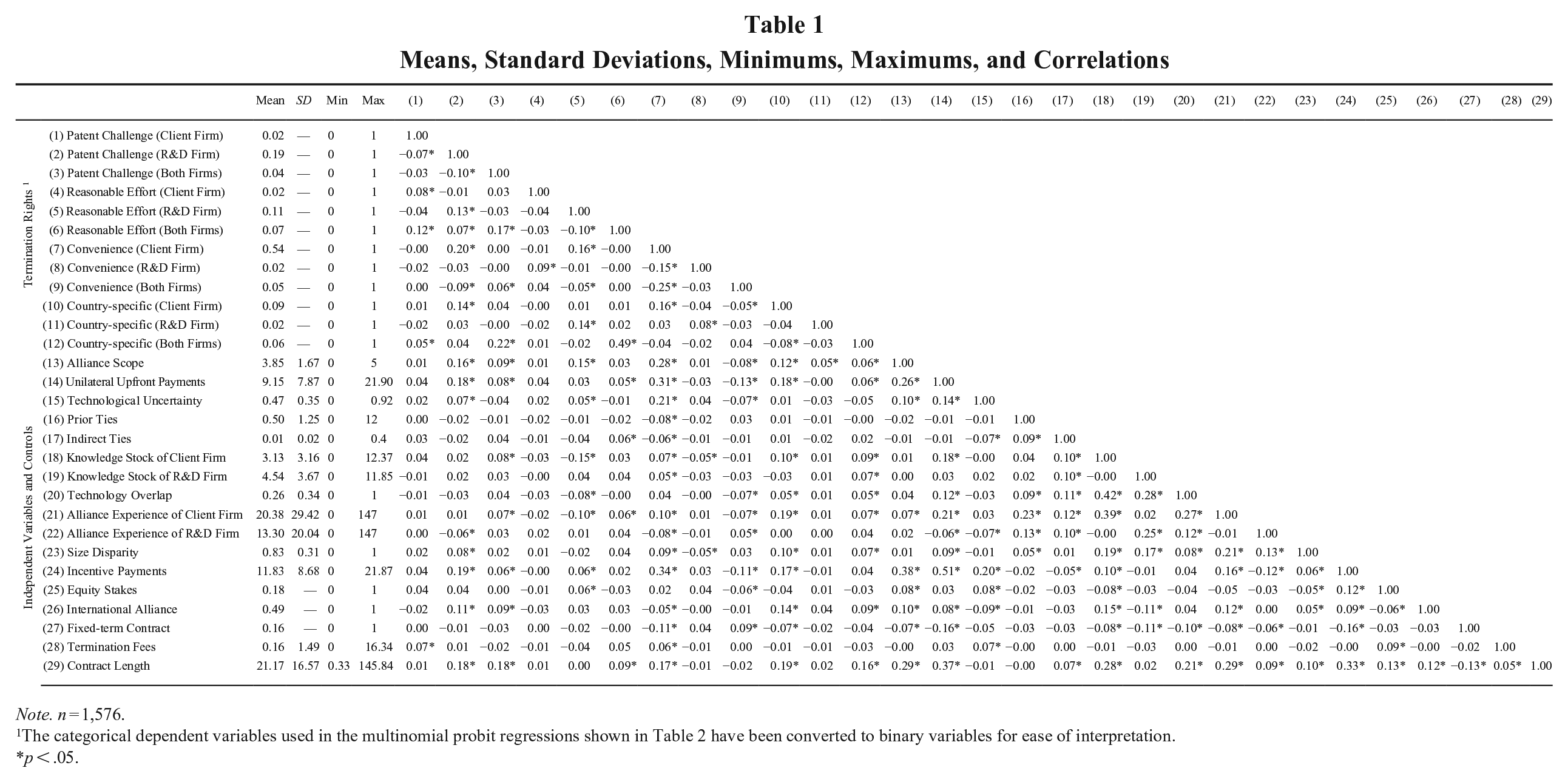
Note. n = 1,576. 1The categorical dependent variables used in the multinomial probit regressions shown in Table 2 have been converted to binary variables for ease of interpretation.
p < .05.
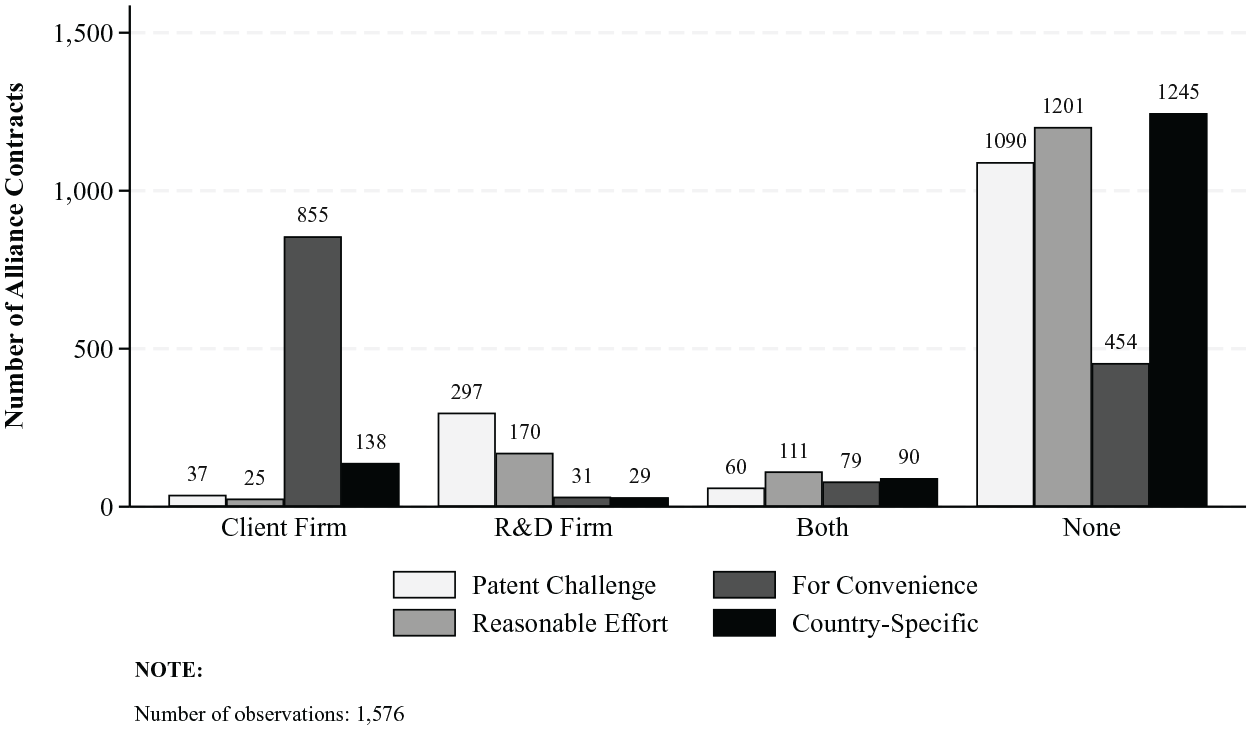
Termination Rights in Alliance Agreements
Table 2 displays the regression results of a multinomial probit model used to estimate the likelihood of assigning each of the four termination rights to either one or both parties. Accordingly, each coefficient should be interpreted as the probability of allocating a termination right to the client firm, R&D firm, or both firms compared to the same baseline in which the termination right is absent. We report robust standard errors clustered at the partner and dyadic levels because firms and dyads can appear multiple times in our dataset (Cameron, Gelbach, & Miller, 2011). Except for binary variables, we standardized all the independent variables to better compare the marginal effects. For brevity, we report the average marginal effects for key variables in tabular form in Table 3.
Main Analysis: Multinomial Probit Regressions Results for Termination Rights
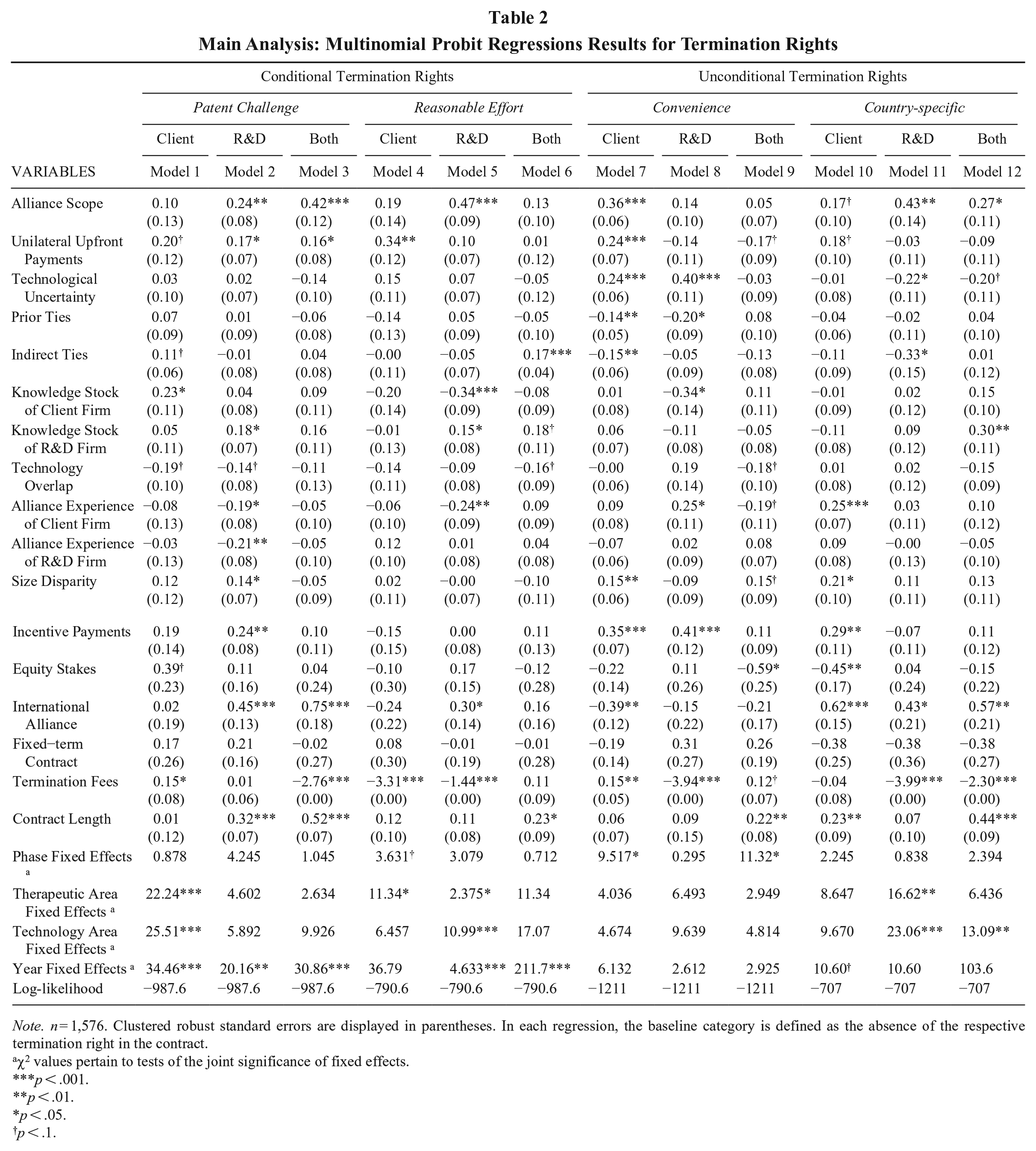
Note. n = 1,576. Clustered robust standard errors are displayed in parentheses. In each regression, the baseline category is defined as the absence of the respective termination right in the contract.
χ2 values pertain to tests of the joint significance of fixed effects.
p < .001.**p < .01. *p < .05. †p < .1.
Average Marginal Effects of Multinomial Probit Regressions for Termination Rights
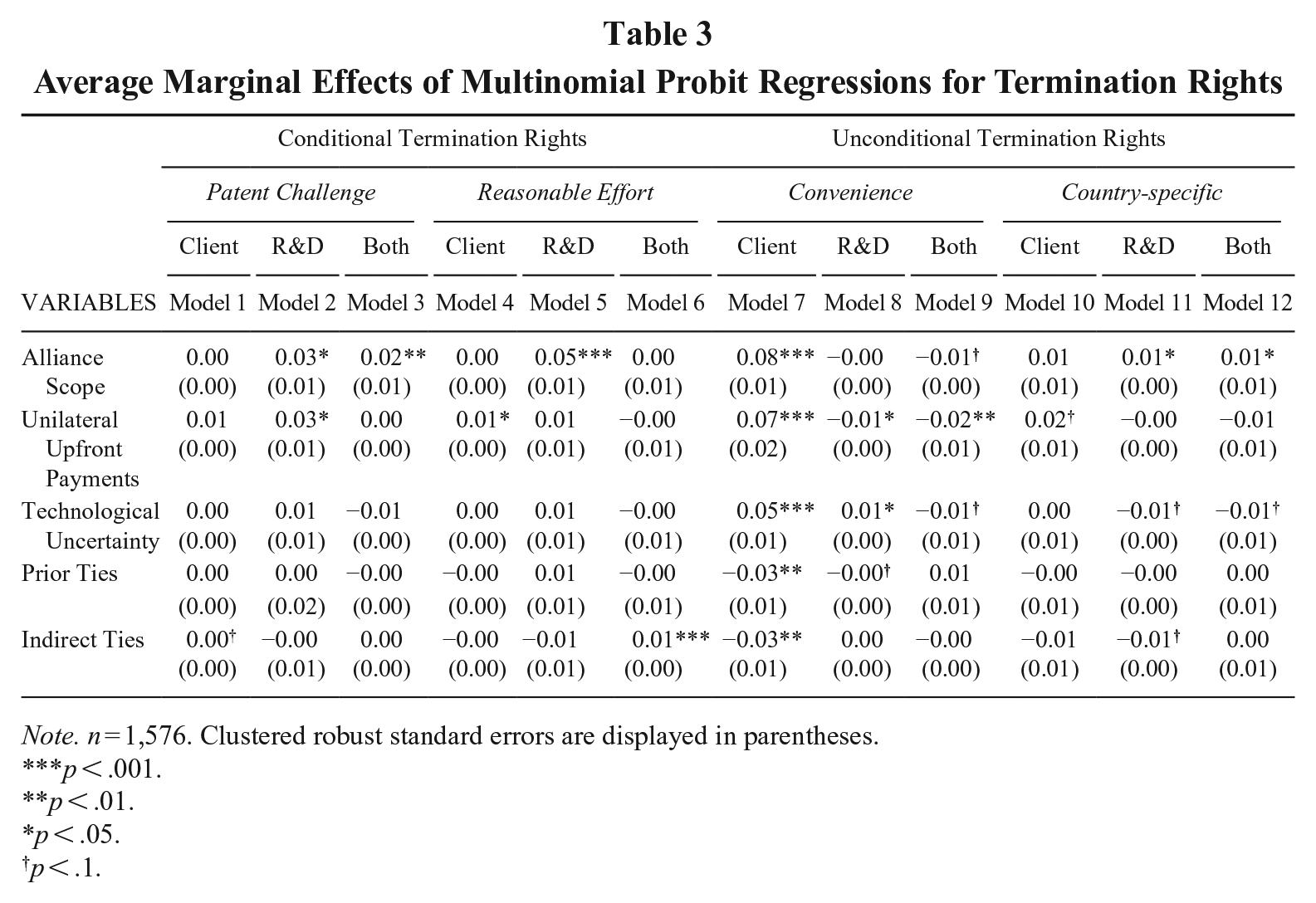
Note. n = 1,576. Clustered robust standard errors are displayed in parentheses.
p < .001. **p < .01.*p < .05.†p < .1.
Our first hypothesis suggests that alliance scope increases the number of touchpoints in the alliance, thus simultaneously provoking concerns regarding moral hazards and hold-ups and, in turn, encouraging partners to signal compliance by granting termination rights to each other. Regarding conditional termination rights, we indeed find that increases in alliance scope are positively and significantly related to the presence of termination rights for patent challenge allocated to the R&D firm (b = 0.24; p = .002) or to both firms (b = 0.42; p = .000) and those for lack of reasonable effort that are allocated to the R&D firm (b = 0.47; p = .000). This pattern reflects the asymmetric opportunistic risks inherent in R&D alliances, wherein threats to intellectual property are a concern for both parties but are of particular concern for the R&D firm. Similarly, the R&D firm is often more exposed to the risk of lack of reasonable effort, and termination rights can help if the client firm opportunistically obstructs the progress of the alliance in favor of an internal rival project, for example, by withholding critical information or delaying clinical trials.
Regarding unconditional termination rights, in broad scope alliances, the right to terminate for convenience is often vested in the client firm (b = 0.36; p = .000), but we see no statistically significant relationship with either the unilateral assignment of this right to the R&D firm or to both firms. In the case of country-specific termination rights, we see statistically significant relationships for unilateral allocation to the R&D firm (b = 0.43; p = .002) or to both partners (b = 0.27; p = .011) but only statistically weak support for unilateral allocation to the client firm (b = 0.17; p = .082). Overall, our findings underscore the necessity of adopting a nuanced perspective on the types and partner-specific allocation of these rights, given the distinct patterns observed in our regression results.
Our second hypothesis posits that the hazards associated with unilateral upfront payments can be countered through the allocation of conditional and unconditional termination rights to the client firm. The positive and significant signs for the coefficients of unilateral upfront payments shown in Models 1, 4, 7, and 10 confirm this expectation of termination rights being allocated to the client firm for patent challenge (b = 0.20; p = .087), reasonable effort (b = 0.34; p = .005), convenience (b = 0.24; p = .000), and country-specific reasons (b = 0.18; p = .068). While two of these associations show weak statistical significance, the general pattern is consistent with H2. In addition, upfront payments are also positively related to termination rights for patent challenge that are allocated to the R&D firm (b = 0.17; p = .013) or both firms (b = 0.16; p = .050).
Our third hypothesis postulates that technological uncertainty is positively associated with unconditional termination rights for the client firm to balance the risk associated with early-stage technologies. Consistent with this expectation, technological uncertainty is positively related to the allocation of termination for convenience rights to the client firm (b = 0.24; p = .000) but non-significantly related to country-specific termination rights allocated to the client firm, as shown in Model 10. When interpreting these results, it should be noted that the right to terminate for convenience is a particularly strong right and that a client firm that can terminate for any reason or no reason may not need any other termination rights. In particular, termination rights for convenience would cover narrower country-specific termination rights. Although not directly related to H3, technological uncertainty is also positively associated with the probability of the R&D firm being allotted termination rights for convenience. One plausible explanation for this may be that some R&D firms in the early stages of development prefer to keep the door open to outside investors to cover the possibility that the technology may prove more promising in the future than initially expected.
According to our fourth hypothesis, prior ties between partners are negatively related to conditional and unconditional termination rights because partners who repeatedly interact with one another can develop confidence in each other’s trustworthy behavior and develop a commitment to the relationship that manifests in a contractual pledge to refrain from an early exit. The results displayed in Models 7 and 8 show that the prior ties variable is negatively associated with unilateral termination rights for convenience of the client firm (b = −0.14; p = .002) and the R&D firm (b = −0.20; p = .021). Although these two results support H4, we cannot reject the statistical null hypothesis that the coefficients are equal to 0 for all the other termination right allocations displayed in Table 2.
Finally, our fifth hypothesis suggests a negative relationship between partners’ indirect ties and the presence of conditional and unconditional termination rights. While we find a supportive negative and significant relationship between partners’ indirect ties and the client firm’s termination for convenience right (b = −0.15; p = .007), as well as between the R&D firms’ country-specific termination right (b = −0.33; p = .027), we also find a positive relationship with the bilateral allocation of termination rights for the lack of reasonable effort (b = 0.17; p = .000) and termination rights for patent challenge that are allocated to the client firm (b = 0.11; p = .066). These mixed findings suggest that the monitoring benefits provided by indirect ties are less relevant than previously assumed, and that partners may want to retain the ability to terminate the alliance when one partner neglects its due diligence, even (or especially) in the presence of indirect ties. An alternative view could be that partners might grant each other a termination right for a lack of reasonable effort to signal their compliance.
Although tangential to our argument, we would like to highlight some of the results regarding the control variables. Consistent with our expectations, we observe a positive relationship between the knowledge stock of the R&D firm and its acquisition of termination rights for patent challenge (b = 0.18; p = .011). This finding reaffirms the notion that R&D firms with valuable knowledge are more concerned about misappropriation and may therefore wish to implement protective termination options. Moreover, the client firm’s alliance experience is negatively related to the R&D firm’s inclusion of termination rights for patent challenge (b = −0.19; p = .016) and that for lack of reasonable effort (b = −0.24; p = .010). This finding might be explained by the fact that firms with close-knit alliance networks have more reputational capital due to their links with other firms, which could protect R&D firms from opportunistic behavior. Finally, international alliances are positively related to the allocation of termination rights for patent challenge to the R&D firm (b = 0.45; p = .000) or to both partners (b = 0.75; p = .000), thus hinting at the problems associated with enforcing intellectual property rights across legal systems. Relatedly, we find a positive relationship between international alliances and country-specific termination rights (b = 0.62; p = .000, b = 0.43; p = .043, b = 0.57; p = .005 in the order shown in Models 10 to 12) that allow partners to selectively exit the alliance in certain geographic regions.
Supplementary Analyses
To complement our main analysis, we considered whether and to what extent termination rights exist alongside other governance mechanisms, particularly administrative control structures. Extant empirical studies have highlighted the role of joint steering committees in facilitating coordinated adaptation in alliances (Hanisch et al., 2024; Reuer & Devarakonda, 2016). Building on the argument that joint steering committees offer communicative interfaces for reducing information asymmetries and thus mitigating the risk of opportunism (Devarakonda & Reuer, 2018), our interest is in the complementary nature of termination rights and joint steering committees. Therefore, we constructed an additional regression model to predict the presence of conditional and unconditional termination rights in conjunction with joint steering committees. For ease of comparison, and based on the common variance structure, we transformed our categorical dependent variables into two binary variables. The variable conditional termination rights takes a value of 1 if the contract includes a “termination right for patent challenge” and/or a “termination right for lack of reasonable effort” and 0 otherwise. Conversely, the variable unconditional termination rights takes a value of 1 if the contract includes a “termination for convenience right” and/or a “country-specific termination right” and 0 otherwise.
Similar to the evidence from previous studies (Reuer & Devarakonda, 2016), 46.2% of the contracts in our sample had established a joint steering committee. Surprisingly, we observe a relatively weak correlation between termination rights and joint steering committees of 0.13 for conditional termination rights and 0.17 for unconditional termination rights, suggesting that they neither serve as substitutes nor complements but rather as governance mechanisms sui generis. Table 4 presents the trivariate probit regression estimates, accounting for the possible correlation between the three binary dependent variables. The results indicate that joint steering committees seem to be incorporated for reasons that differ in several notable aspects from termination rights. Although joint steering committees are more common in alliances with broader scopes (b = 0.28; p = .000), similar to conditional (b = 0.22; p = .000) and unconditional termination rights (b = 0.24; p = .000), factors such as higher unilateral upfront payments, technological uncertainty, and prior or indirect ties do not significantly influence their establishment. A plausible interpretation of our results is that joint steering committees address the coordination challenges inherent in broad-scope alliances, such as the management of increased touchpoints, but they may not necessarily address the concerns related to safeguarding and flexibility that are associated with unilateral upfront payments, technological uncertainty, and social ties. Therefore, while steering committees seem to be associated with coordination concerns, as emphasized both in previous research (Reuer & Devarakonda, 2016) and in our findings on alliance scope, termination rights can address concerns surrounding safeguarding and flexibility in alliances.
Post Hoc Analysis: Trivariate Probit Regression Results for Termination Rights (TR) and Joint Steering Committees (JSC)
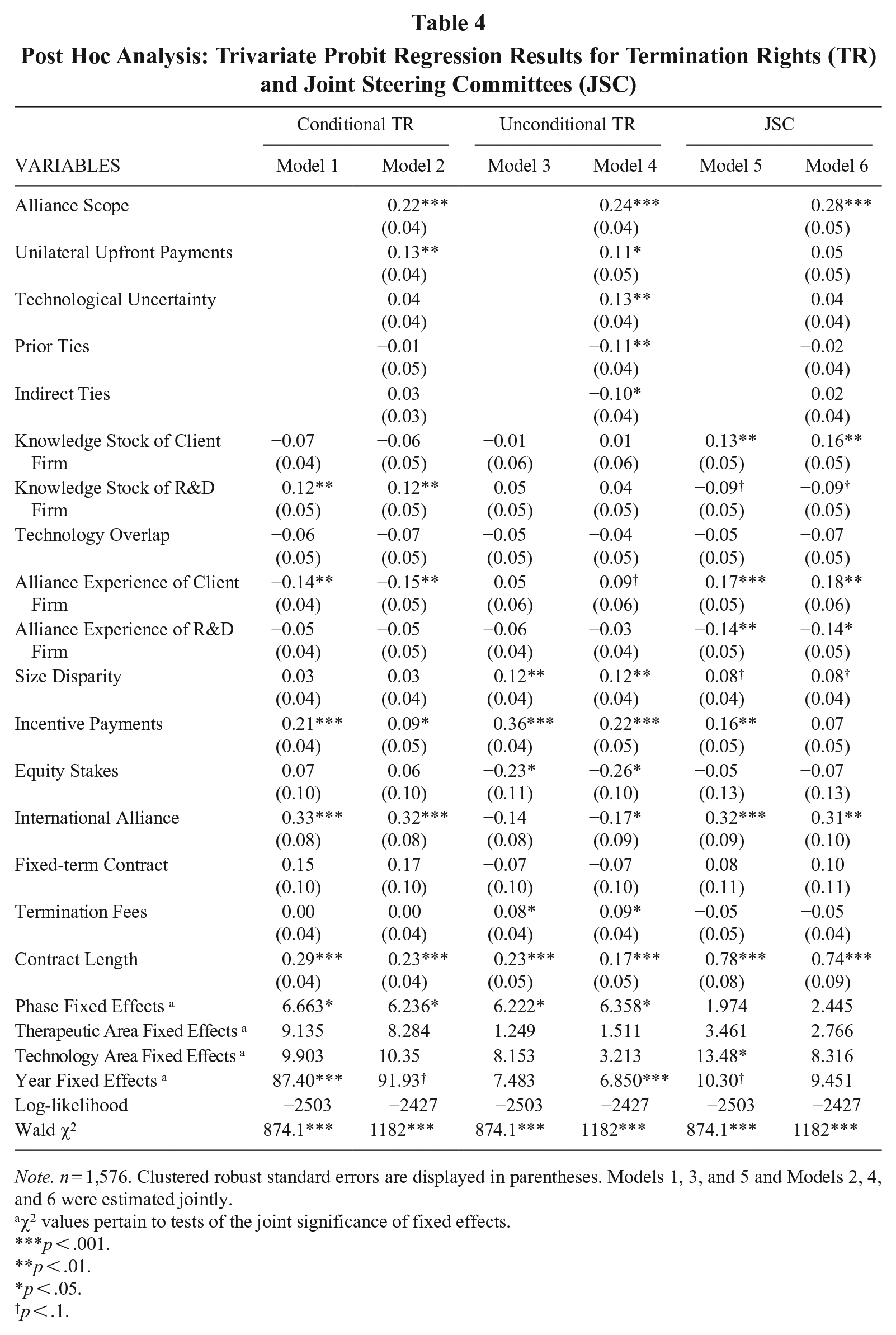
Note. n = 1,576. Clustered robust standard errors are displayed in parentheses. Models 1, 3, and 5 and Models 2, 4, and 6 were estimated jointly.
χ2 values pertain to tests of the joint significance of fixed effects.
p < .001.**p < .01.*p < .05.†p < .1.
From a theoretical perspective, termination provisions differ from administrative controls in at least two important ways. Unlike administrative controls, which rely on hierarchical fiat to exert control and facilitate adaptation (Williamson, 1991), termination provisions—particularly unconditional ones—tap into the disciplinary regime of the competitive market mechanism, as they facilitate the pursuit of outside options (to the extent that they are available) against which the focal alliance must successfully compete. Such an arrangement means that unconditional termination rights introduce a competitive element into the partnership and equally dilute the bilateral commitment among partners. In addition, termination provisions tie all other contractually agreed-upon governance mechanisms, including administrative controls, to the non-exercise of termination. Given this nexus, further research can further the conceptual understanding of the governance implications of both the joint and independent use of administrative controls and termination rights and the mechanisms underlying each.
Because alliance scope and unilateral upfront payments are choice variables and are therefore particularly prone to endogeneity concerns, we performed an instrumental variable regression. Following Bascle (2008), we used the sample average of alliance scope from alliances formed in the same phase of development, technological area, and medical condition, excluding the focal alliance. These average values are unlikely to directly influence governance choices or payment decisions, satisfying the exclusion restriction. The three instruments demonstrated robust correlations with alliance (r = 0.22, r = 0.20, and r = 0.22), meeting the relevance criterion supported by Cragg–Donald minimum eigenvalue statistics (minimum eigenvalue statistic of 4.26 exceeding the critical value of 3.92). We also instrumented unilateral upfront payments using the same averages. Again, positive correlations (r = 0.26, r = 0.20, and r = 0.27) and satisfactory Cragg–Donald minimum eigenvalue statistics (test statistic of 4.00 exceeding the critical value of 3.92) confirmed the validity of our instruments.
Since we could not perform the instrumental variable regression on the main analysis (Table 2) because some models did not achieve convergence, we decided to perform a robustness check on the aggregate analysis using the binary dependent variables introduced in the above post hoc analysis. The results are qualitatively consistent with the post hoc analysis. The alliance scope variable is still positively related to both conditional termination rights (b = 0.77; p = .000) and unconditional termination rights (b = 0.59; p = .033). Similarly, unilateral upfront payments are positively related to both conditional (b = 0.11; p = .019) and unconditional termination rights (b = 0.14; p = .007). The detailed regression table is available upon request. Although not a perfect replication of the main results, the consistency between the post hoc analysis and the instrumental variable regression provides some indication that our findings are not spurious. Nevertheless, we wish to caution readers that our intention is not to assert causal relationships but rather to demonstrate robust correlations.
Discussion
In this paper, we propose that alliance partners can strengthen contractual governance through the use of conditional and unconditional termination rights, which entail a strategic balance between safeguarding against opportunistic hazards, creating performance incentives, and allowing for adaptability without compromising commitment and continuity. We propose that alliance partners use conditional and unconditional termination rights in the face of opportunistic hazards, with unconditional termination rights representing reactions to both opportunistic threats and adaptability concerns. Concerning opportunistic threats, our empirical findings suggest a positive association between broader alliance scope and termination for convenience rights for the client firm, as well as termination rights for patent challenge, lack of reasonable effort and country-specific exits allocated to the R&D firm. Meanwhile, prior and indirect ties exhibit a negative association with termination for convenience rights for the client firm. With respect to adaptability concerns, our results indicate a positive link between higher technological uncertainty and the presence of unilateral termination rights for convenience of either the client or the R&D firm. These results not only illustrate the complex motives that drive alliance governance choices but also reveal substantial variance in the explanatory power of established theories regarding individual termination rights and the ways in which they are allocated. This invites the further development and integration of existing theories, as elaborated below.
Our study adds to the literature on alliance governance, which has focused on hierarchical governance forms such as boards and equity participation as a means of aligning incentives and ensuring continuity (Gulati & Singh, 1998; Oxley, 1997; Reuer & Devarakonda, 2016). In contrast, we highlight the fact that termination provisions offer similar incentives for refraining from opportunism while allowing for more flexibility than hierarchical governance. Compared to administrative controls that need to be staffed, termination provisions also tend to be more cost-effective and can therefore serve as viable instruments for firms facing resource constraints. Our findings reveal that termination provisions are frequently used to protect against opportunistic threats (e.g., when the alliance scope is broad and the upfront payments are high) and to retain strategic flexibility (e.g., when technological uncertainty is high). However, unlike administrative controls that are aimed at coordinated adaptation, termination provisions lack bilateral coordination channels and promote independent flexibility. Consequently, while such provisions can meet safeguarding and postcontractual adaptation needs, they appear to be less suited to addressing the coordination requirements in alliances (Schepker, Oh, Martynov, & Poppo, 2014). The fact that termination rights and steering committees address distinct governance concerns (and do not act as substitutes or complements for each other) is corroborated by our post hoc analysis, which shows a low correlation between the presence of conditional and unconditional termination rights and that of steering committees.
Another contribution of this study lies in its illumination of the interplay between formal contractual (i.e., termination provisions) and informal relational (i.e., prior and indirect ties) governance mechanisms (Cao & Lumineau, 2015). We highlight that the social motive of reaffirming preexisting ties and refraining from termination rights is subject to an analogous logic, where both express a commitment to the relationship. Thus, we view these two governance mechanisms as two sides of the same coin rather than as complements or substitutes for one another (Poppo & Zenger, 2002). Our finding that client firms are less likely to include termination rights for convenience when such prior and indirect ties exist is consistent with the general notion that strong relational bonds lead to stronger contractual ties. To extend this argument, it would be interesting to investigate whether the commitment to the relationship, as evidenced by the absence of termination rights for convenience, can translate into greater dedication to the goals of the alliance and higher effort levels, thereby increasing the chances of alliance success (Lavie, Haunschild, & Khanna, 2012; Robson, Katsikeas, & Bello, 2008). Moreover, the positive relationship between indirect ties and termination rights for lack of reasonable effort assigned to both parties also points to differential motives for including distinct types of termination provisions, which warrants further theoretical investigation.
From a broader theoretical perspective, termination provisions offer a complementary logic for categorizing alliances. While transaction cost theory classifies interorganizational exchange on a continuum of hierarchical control (Williamson, 1991), termination provisions present an alternative spectrum. In contrast to hierarchical control, unconditional termination rights introduce a competitive, market-like element to the exchange because they allow partners to seize available outside options (Hirschman, 1970). Such possibilities imply that the extent to which termination provisions are present in a contract corresponds to the degree to which alliances are oriented toward the “market” (in which competitive forces govern exchanges) regardless of the presence of administrative control structures. Given that administrative controls, such as boards, committees, and equity, are contractually endowed, they can also be revoked through contract termination, meaning that termination provisions can ultimately overshadow other contractually defined governance mechanisms. Conversely, the absence of termination provisions creates a strong contractual bond between partners that is difficult to break and can thus be interpreted as an expression of ex ante commitment to the alliance. In this sense, termination provisions represent a powerful discriminant for classifying alliances on a continuum of relational commitment.
Conclusion
In this study, we draw attention to termination provisions as theoretically and empirically versatile and interesting governance mechanisms. While termination provisions can discourage opportunism, incentivize performance, and allow for flexible adaptation, their inclusion can also foster distrust and instability in the partnership. Our detailed analysis of conditional and unconditional termination rights enhances our understanding of their variance and the motives for their contractual incorporation, while encouraging further exploration of their interplay with other governance mechanisms, such as administrative controls. From a theoretical perspective, termination provisions not only represent elastic contracting mechanisms but also offer a salient discriminant for categorizing interorganizational relationships based on the spectrum of relational commitment indicated by the presence and strength (i.e., conditional or unconditional) of these exit options. This nuanced perspective extends previous conceptualizations of alliances as hybrid forms of governance situated between markets and hierarchies (Williamson, 1991). Ultimately, this paper enriches the scholarly discourse on interorganizational governance, setting the stage for continued research in this area.
Footnotes
Acknowledgements
I am grateful to the editor, Sali Li, and the review team for their helpful comments throughout the process. I would also like to thank Pedro de Faria, Carolin Haeussler, and Andreas König for their feedback on earlier versions of the manuscript. My special thanks go to the many practitioners who generously shared their invaluable experience and expertise in contract law and the biopharmaceutical industry.
