




Abstract
Careers in creative crafts are perceived to be precarious: workers face constant rejection and receive low and erratic pay. Yet, some creative craft workers handle these challenges better than others. Precarity sometimes subsides as careers progress, and the core-periphery structure that typifies creative craft production systems is navigable. This raises the question of how creative craft workers can cope productively with the precarity of craft work. We research a prominent creative craft worker collective: country music songwriters. Our study captures the voices of 90 creative craft workers, drawing on secondary interviews with 66 songwriters working at the core of Nashville’s highly corporatized country music production system, and 24 operating at its social and spatial periphery. We find that the key to coping with precarity lies in achieving supportive patterns of social embeddedness by investing in primary craft skills, advancing higher-order vocational skills, and navigating the core-periphery structure of the creative craft production system. As apprentice songwriters practice their craft and learn how to organize their songwriting routines, they become increasingly vested in the system. Once they become master songwriters, they broaden their networks by liaising more with other industry stakeholders and engage with the system more reflexively to ensure their continued relevance. Peripheral workers engage in allyship and develop ties with workers positioned at the system’s core. We incorporate these social strategies in a grounded theoretical model capturing how songwriters cope with precarity. We conjecture that elements of the model generalize theoretically towards other corporatized creative craft production systems.
Introduction
Growing numbers of aspiring craft workers are entering creative occupations, mainly drawn by the promise of beauty, utility, and virtuosity in this type of work (Becker, 1982). As people flock to the creative crafts in search of meaning, however, most will not find steady employment or critical appreciation (Menger, 1999; Skaggs, 2019a) but rather experience precarity (cf. Campbell & Price, 2016; Kalleberg, 2009). Many creative craft workers will face job insecurity, career unpredictability, and life in a perpetual “survival trap” (Lee & Gargiulo, 2022). From craft cider and beer production in the United States (Elzinga, Tremblay, & Tremblay, 2015; Weiler, 2022), to luxury industries in Italy (Djelic & Ainamo, 1999) and traditional crafts in Japan (Sasaki, Kotlar, Ravasi, & Vaara, 2020), creative craft workers find their labor harshly devalued, their employment conditions worsening, and their livelihoods constantly threatened by industrialization. Modernity’s “inexorable rationalization and disenchantment” (Suddaby, Ganzin, & Minkus, 2017: 285) thus pushes craft workers into precarious working conditions (Endrissat & Noppeney, 2018).
Yet, experiences of precarity are never universal and patterns of hardship differ amongst creative craft workers. While most engage in “self-exploitative creative employment” (Wallace, 2019: 955) due to the perennial oversupply of creative talent (Menger, 1999; Skaggs, 2019a, 2019b), a select few of them are living exalted lives (Weiler, 2022). Some creative craft workers enjoy a proper career, with their aesthetic work (Ocejo, 2017) becoming more rewarding over time as they come to profit from higher status, developmental opportunities, and greater financial security. Others, however, remain stuck in the same everyday routines and experience neither advancement nor assurance (Jakob, 2013). These experiences of precarity in modern creative crafts follow a core-periphery structure, where individuals’ structural positioning in stratified craft production systems determines their experiences of social and economic inclusion or exclusion (Frederick & Van Nederveen-Meerkerk, 2023). Understanding how some creative craft workers are better able than others to work through experiences of precarity thus becomes crucial, especially since precarious employment practices spread to other creative craft settings across the economy. We set out to develop an interpretative grounded theoretical model that addresses our central research question: How can creative craft workers cope productively with experiences of precarity?
Our model captures the experiences of country music songwriters. These songwriters display all the features of creative craft workers: they relentlessly practice their craft, rely on arousing tools (Sennett, 2008), engage in playful experimentation, show deep intrinsic commitment to their craft, and masterfully capture life events and personal stories in their songs (Peterson, 1997). Yet, songwriting can also be perceived as highly precarious by those who practice it. Our study encompasses a qualitative analysis of 90 secondary interviews with songwriters. To maximize variability in songwriters’ experiences of precarity, we have drawn these interviews from both the archives of Nashville’s Country Music Hall of Fame and Museum (CMHFM) and podcasts covering four different geographical and social milieus (Australia, Canada, the United Kingdom, and songwriters with alternative racial or gender identities). These songwriters collectively form part of the fabric holding together the world’s largest and most profitable music production system.
Our model offers a social embeddedness perspective on how creative craft workers cope with perceived precarity (Allan, Autin, & Wilkins-Yel, 2021; Campbell & Price, 2016; Kalleberg, 2009). This contrasts with extant literature, which suggests that craft workers tend to work individually or in rudimentary collectives (Kroezen, Ravasi, Sasaki, Żebrowska, & Suddaby, 2021; Miller, 2017). Under such isolated conditions, only individual-level factors like intermittent reinforcement (Aldrich, 2020; Deslauriers & Everett, 1977) or portfolio careers (Comunian & England, 2020; Umney & Kretsos, 2015) can explain how craft workers confront precarity. In contrast, the workers in our study develop deep patterns of social embeddedness, providing a basis for mutual and intergenerational support. We find three social strategies allowing creative craft workers to confront experiences of precarity. First, apprentice songwriters are investing in primary craft skills by seeking communion with more advanced peers, for example through the co-writing of songs. Second, more experienced songwriters are advancing higher-order vocational skills by broadening their patterns of embeddedness to include parties like performing artists, publishers, and producers. Third, songwriters operating at the social or geographical margins of the country music production system are navigating the system’s core-periphery structure by building a “community within a community” and spanning spatial boundaries. Combined, these social strategies prevent workers from “giving into feelings of failure and desperation” (Aldrich, 2020: 542). We conjecture that these patterns of embeddedness might also be found in other corporatized creative craft production systems like video game development (Zackariasson, Styhre, & Wilson, 2006), haute couture (Wenting & Frenken, 2011), and Hindi cinema (Ganti, 2012).
Theoretical Background
Precarious Work in Corporatized Creative Crafts
Creative craft workers 1 are socially embedded in “networks of cooperation and assistance through which work gets done” (Becker, 1982: xii). These networks include formal organizations and informal relationships (Reilly, 2017; Skaggs, 2019a). While these networks resemble the differentiated art worlds occupied by artists (Becker, 1982), the creative crafts are not art, regardless of their definitional qualities of beauty and virtuosity. The difference lies in the intrinsic (arts) versus extrinsic (crafts) utility of what is being produced. In the arts, “the measurement of utility [refers] to standards developed by knowledgeable participants in [the world in which art is produced]” (Becker, 1982: 274). Utility in the creative crafts, in contrast, is always determined by an external user, like a producer or performing artist assessing whether a particular song has the potential to become a radio hit or streaming success. In music more broadly, a surprisingly robust hierarchy exists that segregates classical music, which was able to develop intrinsic standards of evaluation and utility owing to the protected patronage and mecenate of the aristocracy, from popular music like hip-hop or country, which always has had to secure an existence by delivering on its potential extrinsic utility to market audiences (Roy & Dowd, 2010). Beyond music, other examples of cultural production that are craft rather than art because their utility is extrinsic include gastronomy (Slavich & Castellucci, 2016), winemaking (Massa, Helms, Voronov, & Wang, 2017), and stand-up comedy (Friedman, 2014).
Creative craft products increasingly originate from production systems that “operate like a machine” 2 and are highly corporatized (Ganti, 2012). Corporatized creative craft production systems have three properties that tend to make craft work precarious: they are intertwined with distribution systems, characterized by role differentiation, and create social stratification through certification contests (Anand & Watson, 2004; Han & Pollock, 2021). First, corporatized creative craft production systems are integrated with creative craft distribution systems, thus locking in creative craft producers. Amateur craft workers are empowered by more democratic distribution systems because these make small-scale business models viable (Church & Oakley, 2018). Yet, amateur craft workers also become highly dependent upon such distribution systems, which constrain their economic rights and “expressive freedom” (Arvidsson, Malossi, & Naro, 2010; Becker, 1978: 866; Miller, 2019). Such seemingly democratic distribution platforms include online creative craft marketplaces like Etsy and Amazon Handmade (Church & Oakley, 2018; Luckman, 2013), recording artist distributors like DistroKid and CD Baby, and independent publishing services like Kindle Direct Publishing or Reedsy. Beyond the amateur stage, however, farther-reaching integration of craft production and distribution is observed in corporatized production systems like the Hollywood motion picture and country music industries, where movie distributors like Walt Disney and Warner Bros. and music labels like Big Machine and Dualtone own the catalogue rights of many craft workers. In corporatized systems, precarity stems from the asymmetric dependence of craft workers on craft distributors. In country music, for example, precarity due to one-sided dependence on publishers is so common that “writers who do not normalize rejection or who do not interact appropriately with gatekeepers will remain hobbyists or aspirants rather than successfully joining the occupational community” (Skaggs, 2019a: 169).
Second, corporatized creative craft production systems are typified by high degrees of role differentiation (Becker, 1982), as craft products result from a creative partnership involving many individuals. Examples include the music industry (e.g., songwriters, recording artists, studio musicians, recording engineers, mixing engineers), filmmaking (e.g., directors, actors, scriptwriters, camerapersons), book publishing (e.g., authors, editors, designers, publicists), and gastronomy (e.g., Chef de Cuisines, Chef de Parties, sommeliers, maître d’hôtel). Such role differentiation grows with production system corporatization. Reflecting on the Nashville country music industry, Peterson (1997: 8) wrote: “the earliest artists not only had to perform for an audience, but they often had to book their own engagements, arrange transportation, plan publicity, find new songs, and collect the money owed to them.” Specialized songwriters therefore arrived on the scene early, because performing artists in country music were less likely to write their own songs owing to the excessive demands of touring (Sicoli, 1994). The country music production system now spans the roles of “manager, talent agent, recording producer, publicist, publisher, song plugger, disk jockey, side-man, session musician, and customer” (Peterson, 1997: 8). Role differentiation fuels perceptions of precarity, because it shifts power from creative craft workers to network brokers like agents and managers. In corporatized systems, craft workers “seem to have lost most of their control over the definition of the quality of their work” (Peterson & White, 1981: 10). Because brokers certify the quality of craft workers, they heavily curtail craft worker agency (Skaggs, 2019a). Once craft production roles are highly differentiated, brokers force craft workers into “nonstandard work arrangements, such as contracting and temporary work” (Kalleberg, 2009: 7-8). This has also been referred to as “occupational dismantling” (Standing, 2011: 66), which not only disassembles material sources of job security but also amplifies the perceived precarity workers experience (Kalleberg, 2009; Standing, 2011).
Third, creative craft workers’ status matters in corporatized creative craft production systems, because workers are directly associated with the products they create, thus taking an interest in the aesthetic appreciation of their work (Fine, 1992; Khaire, 2014). Many creative industries are connected to winner-take-all markets underpinned by superstar economics (Caves, 2000; Rosen, 1981). Status hierarchies in corporatized creative craft production systems do not emerge spontaneously but are deliberately orchestrated through selection systems (Wijnberg & Gemser, 2000) and tournament rituals (Anand & Watson, 2004). These do not just reflect commercial success (Han & Pollock, 2021) but also count as the “hallmark of peer recognition” (Watson & Anand, 2006: 41). Examples include the Grammy Awards (Anand & Watson, 2004) and Country Music Awards (Sicoli, 1994) in popular music, the Academy Awards in the Hollywood movie industry (Cattani, Ferriani, & Allison, 2014; Mannucci & Yong, 2018), and the Michelin awards in haute cuisine (Rao, Monin, & Durand, 2005; Slavich & Castellucci, 2016). Poignantly, a palpable side-effect of this deliberately imposed status stratification is career precarity: employment for apprentice-stage or lower-status creative craft workers “is typically irregular and inconsistent” (Reilly, 2017: 147).
Coping With Perceived Precarity in Creative Craft Production
Precarity clearly has material, socioeconomic roots, and tends to emerge when people face “pervasive uncertainty about [their] ability to secure a steady stream of work” (Petriglieri, Ashford, & Wrzesniewski, 2019: 135). It also has a large perceptual component and work becomes precarious especially when it is seen as “uncertain, unpredictable, and risky from the point of view of the worker” (Kalleberg, 2009: 2). While all creative craft workers experience precarity at some point in their life, especially at the start of their careers (Sinha, 1979), some find ways of coping with it productively. Productive coping is a largely psychodynamic process ensuring craft worker viability and vitality in the face of perceived emotional and economic challenges stemming from high rejection rates and low pay security (Butler & Stoyanova Russell, 2018; Petriglieri et al., 2019). The literature currently recognizes three coping mechanisms, notably: intermittent reinforcement (Aldrich, 2020), income diversification (Morgan, Wood, & Nelligan, 2013), and solidarity strategies (Duarte, 2020).
A first mechanism describes intermittent reinforcement as a psychodynamic process that bolsters craft workers’ resistance to perceived precarity by amplifying their intrinsic commitment to craft work (Aldrich, 2020; Deslauriers & Everett, 1977). Creative craft workers are sometimes framed as being able to work through precarity by surrendering income and job security in exchange for intermittent rewards cultivating their intrinsic motivation. This reinforcement process is argued to lead to dealienation, as “craftspeople feel deeply engaged in their work and are morally attached to it” (Vincent & Brandellero, 2023: 7). Others have stressed that this process involves resignification, such that creative craft work “acquires value in itself” (Gandini & Gerosa, 2023: 2). However, critical commentators have pointed out that, as scholars, we should avoid perpetuating the “dubious yet enduring notion that self-expressive work offers ‘nonmonetary rewards’ . . . which counteract the sting of low earnings” (De Peuter, 2014: 271). From a psychodynamics point of view, intermittent reinforcement may provide creative craft workers with viable identities, but this might well come at the cost of their vital selves (Petriglieri et al., 2019: 155-157).
A second mechanism craft workers use to compensate for a lack of stable and secure opportunities in craft work is income diversification, as they seek to sustain themselves by combining multiple income streams. They sometimes do this by leveraging their creative craft skills, for example by combining part-time employment with freelance work (Comunian & England, 2020). Yet, this tends to result in portfolio careers characterized by “multiple short-term projects with heterogeneous employers or clients” (Umney & Kretsos, 2015: 317). Craft workers are then “becoming ‘generalists’ who can work in a variety of projects and settings” (Frenette & Dowd, 2020: 12). Many creative craft workers must also take up remunerated non-craft work, which is “sufficiently flexible to shrink and expand according to the waxing and waning of [their] career[s in creative craft]” (Morgan et al., 2013: 411). When such artistic hustling is normalized as a livelihood strategy, it is ultimately “flexible or freelance workers who bear the costs and risks of uncertainty” (Pratt, 2019: 136), a condition sometimes referred to as “flexploitation” (Morgan et al., 2013).
A third mechanism involves solidarity strategies between individual craft workers. Collectives of creative craft workers sometimes attempt to cope with precarity by developing strategies through which they “share resources, collaborate, [and] build alternative community cultural economies” (Duarte, 2020: 35). Such collectives represent individual workers’ attempts at creating a substitute “holding environment” (Petriglieri et al., 2019: 124) to cope with work-related emotions while lacking any strong attachment to a work organization. Yet, such holding environments tend to be “neither stable nor lasting” (Petriglieri et al., 2019: 142). Moreover, they cannot compensate for the formal representation of creative craft workers seeking to uphold their rights. In the words of Gill and Pratt (2008: 19-20), The lack of trade unionization and labour organization in many areas of [creative craft] work is striking, and is both cause and outcome of industries that are individualized, deregulated and reliant upon cheap or even free labour, with working hours and conditions . . . that are largely beyond scrutiny.
Solidarity strategies alone thus do not offer a viable path out of precarity, unless they involve exchange relationships with more privileged individuals located at the core of the corporatized creative craft production system. Without ties to more centrally positioned peers, peripheral workers will continue to experience precarious labor conditions.
What these three well-documented coping mechanisms have in common is that they shift the uncertainty and emotional toll of creative craft production to workers themselves, who must cope with these predicaments “without the cover of an organizational roof” (Petriglieri et al., 2019: 160). These mechanisms transform honest work into hope labor: “un- or under-compensated work carried out in the present, often for experience or exposure, in the hope that future employment opportunities may follow” (Kuehn & Corrigan, 2013: 1; see, too, Neff, Wissinger, & Zukin, 2005). Still, even in corporatized creative craft production systems, we not only see creative craft workers surviving, but some of them even thriving. We conjecture that this is the case because some creative craft workers move beyond these more individuated coping mechanisms and develop social strategies allowing them to initiate and maintain deeply embedded work patterns over the course of a life in creative craft.
Methodological Considerations
Research Context: The Country Music Industry
Country music is one of the three most popular music genres in the United States (Shaw, 2020). The music industry supports more than 60,000 jobs in the Nashville area, featuring over 5,000 musicians, 10,000 songwriters, 190 recording studios, 130 music publishers, and 80 record labels (Harper, Cotton, & Benefield, 2012). It annually contributes US$15.9 billion to the local economy, and music industry employment (per 1,000 population) in Nashville is four times higher than in any other city in the United States (Nashville Area Chamber of Commerce, 2021). Known as Music City (Kosser, 2006), this has prompted others to call Nashville the “Silicon Valley of the music business” (Florida, 2009).
The Nashville country music industry has developed highly formalized ways of remunerating songwriters, rooted in U.S. copyright law. Each recording encompasses two copyrights: one on the sound recording (or “master”) and the other on the composition (or “song”). Songwriters get vested with the latter right, but then usually transfer these rights to publishers representing them through a publishing deal. 3 Since most country songs are co-written, songwriters typically are entitled to only a part of the credits to each song. In country music (but not in other genres), song credits are divided in line with the “one word, one third” principle, which means that if three people co-write a song, each is entitled to an equal songwriting credit, even if they contribute only a single word. While most songs never get recorded (“cut”), the ones that do can accrue three royalty streams: mechanical royalties are obtained from legal album sales and digital downloads; performance royalties come in through terrestrial broadcast radio, live performance venues, and online streaming services; and synch fees are owed when a song is used to score a video for television, cinema, or social media. From the sum of these gross royalties, recording costs, the producer’s fee, and marketing and distribution expenses are deducted to arrive at net royalties. These are then divided between the record label representing the artist and the publisher representing the songwriter, with the latter typically receiving between 15% and 20%. Most publishing deals offer songwriters a flat fee per mastered song plus an agreed upon fraction of the net royalties. The median annual pay of the category in which the U.S. Bureau of Labor Statistics incorporates songwriters was $63,670 in 2024, but this overlooks the fact that many apprentice-stage songwriters are not formally registered (U.S. Bureau of Labor Statistics, 2024).
Data Collection
Our sample consists of secondary interviews with 90 country music songwriters, collected from two sources. First, we obtained 66 videoed interview recordings from the Country Music Hall of Fame and Museum (CMHFM), a Nashville institution with a mission “to preserve, celebrate, and share the important cultural asset that is country music” (CMHFM, 2021). Second, we added 24 podcasted interview recordings documenting the experiences of songwriters operating on the social and geographical margins of the country music production system. We included songwriters from non-United States settings (i.e., Australia, Canada, and the United Kingdom and Ireland) and with underrepresented identities (i.e., Black, Latinx, Indigenous, and females). Our study is thus part of a wider trend towards extracting qualitative data from videoed and podcasted interviews (cf. Fisher, Stevenson, Neubert, Burnell, & Kuratko, 2020; Foroughi, Eisenman, & Parsley, 2024; Murray, Kotha, & Fisher, 2020; Sadeh & Mair, 2024).
To access the experiences of the first 66 individuals included in our sample, we used video recordings of the CMHFM’s Songwriter Sessions, which offer songwriters the opportunity to perform songs and talk about the craft of songwriting in front of a live audience. 4 We included all online accessible sessions between 2016 and 2021, with the exception of specials devoted to a dedicated theme. 5 If two or more sessions featuring a particular songwriter were available, we only included the most recent recording to maintain balance across perspectives. The format includes an introduction of the songwriter by a CMHFM staff member. The songwriters then fill the session with songs and stories, while also taking questions from the audience. Songwriters tell the stories behind their songs, detail the precarity they experienced throughout their careers, explain how their upbringing shaped their songwriting, provide their personal take on the songwriting process, and tell backstories about Nashville’s music scene. The format is only partially structured and thus well-suited for our research purposes because it offers an uninterrupted flow of autobiographical reflections. While the CMHFM’s Songwriter Sessions cover the experiences of individuals operating at the social and geographical core of the country music production system, they include a wide variety of talent ranging from long-established songwriters with multiple Number One hits and industry awards to up-and-coming songwriters who are still at the beginning of their careers.
To retrieve the experiences of the 24 individuals completing our sample, we included podcasted interviews mimicking the naturalistic conversations of the CMHFM Songwriter Sessions. We focused on podcast episodes released between 2020 and 2022, and we aimed to include both newcomers and established songwriters. We ended up including 20 episodes featuring a total of 24 individual songwriters from four different podcasts 6 : Sunburnt Country Music from Australia, On the Porch from Canada, No Chords but the Truth from the United Kingdom, and Color Me Country from the United States, with the latter focusing on Black, Latinx, and Indigenous country music. While the narratives of these individuals in many ways overlapped with those recorded in the CMHFM Songwriter Sessions, they also related different experiences of precarity and an alternative social strategy, owing to these individuals’ positioning at the social and geographical periphery of the country music production system. Especially songwriters encountering experiences of intersectionality due to being both female and Black/Latinx offered insights with high revelatory potential.
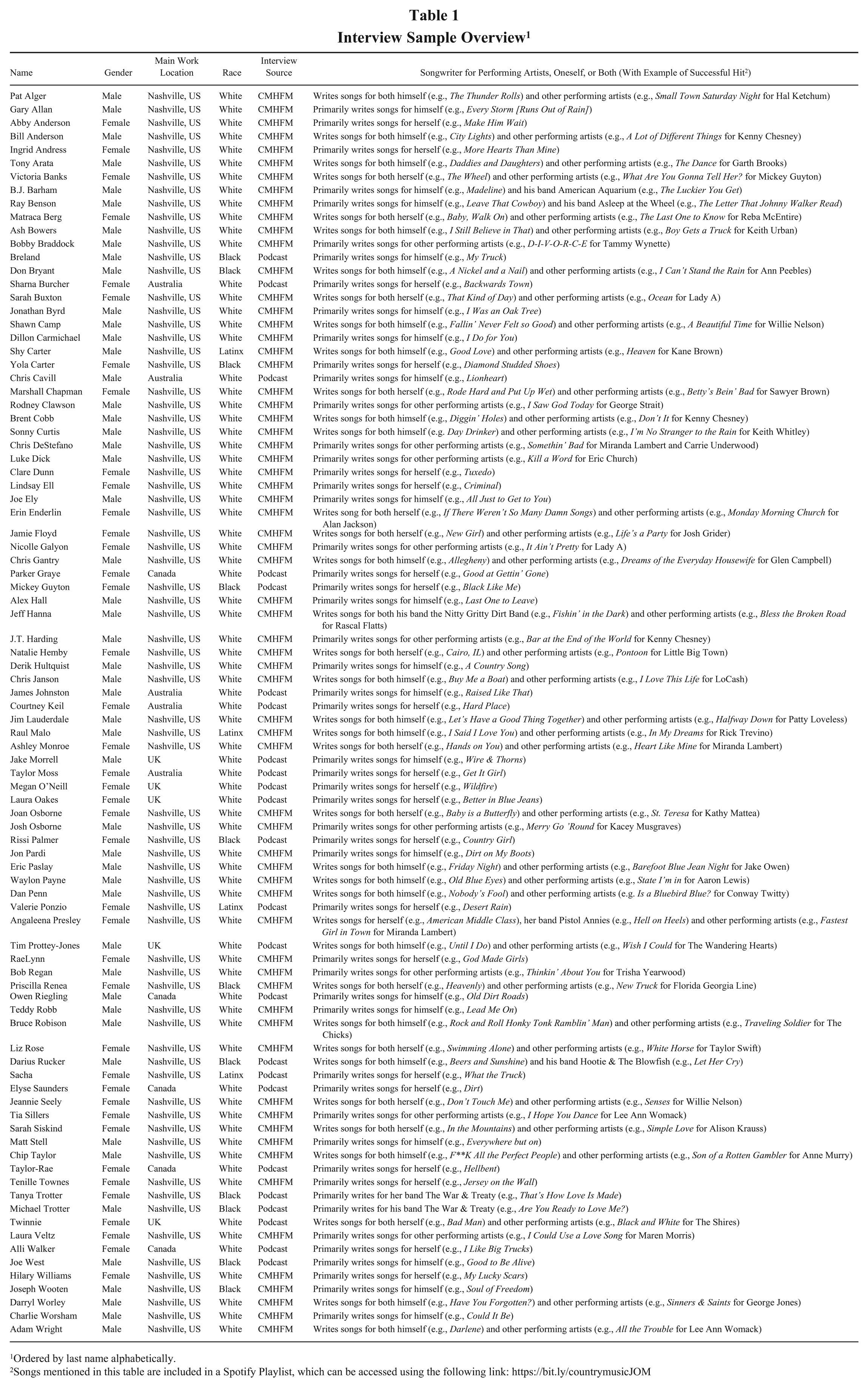
Our sample of 90 songwriters includes 40 songwriters who self-identify as female and 50 songwriters self-identifying as male, which is salient because of the gendered nature of country music and creative work in general (Koppman, Bechky, & Cohen, 2022). All interviewees have experienced precarity at least at some point in their careers or continue to do so despite having achieved a modicum of artistic success. Our sample includes songwriters who mostly write for others as well as songwriters performing their own songs as artists. The songwriters straddle different subgenres, ranging from (neo-)traditional (e.g., Jon Pardi) and modern country (e.g., Nicolle Galyon) to country-rock (e.g., BJ Barham) and country-pop crossover (e.g., Liz Rose). Our video and podcast data jointly span more than 63 hours of playtime and 731 pages of transcripts (Ariel, 11 font size, single-spaced). The Table 1 offers a condensed summary of the songwriters included in our sample.
Interview Sample Overview 1
Ordered by last name alphabetically.
Songs mentioned in this table are included in a Spotify Playlist, which can be accessed using the following link: https://bit.ly/countrymusicJOM
Data Analysis
We employed several analytical moves in line with the social constructivist position (cf. Charmaz, 2014). These allowed us to build theory inductively from qualitative data, aimed to arrive at a deeper understanding of how songwriters experience precarity and cope with it productively (Kalleberg, 2009). We used NVivo to support our data analysis and interpretation efforts. Data collection and analysis took place concurrently but can be grouped into three phases. To ensure analytical rigor, we applied the recommendations made by Grodal, Anteby, and Holm (2021). Based on categorization theory, these authors propose several steps to increase transparency in qualitative data analysis.
We started our data analysis with the objective of understanding the nature of songwriting as craft, the precarity experienced by creative craft workers, and their embeddedness in a broader system of music production. Thus, creative craft work in the country music industry served as a theoretical and empirical prime prompting interpretative questions (“Why?” “How?” “With what intention?”) aimed at reconstituting the lived experiences of songwriters. This task is one of considerable hermeneutic complexity, as we are construing a story about storytellers telling their stories. Songwriters are constantly looking for opportunities to gain exposure and create favorable impressions of themselves (Kuehn & Corrigan, 2013), and we acknowledge that there is an irreducibly performative component in our work. Taking up this hermeneutic challenge nonetheless, we created initial, open, and inclusive categories that were later revised, expanded, and regrouped. During this first phase, we construed a basic model capturing the lived experiences of country music songwriters.
As we began to see the bigger picture of what the data was telling us, related categories were merged (e.g., categories relating to iconic venues such as “Bluebird” or “Grand Ole Opry” were merged into the superordinate category “inhabiting institutions of shared value”) while others were split (e.g., “industry roles” was split into “interacting with artists,” “interacting with producers,” and “interacting with publishers”). As categories were refined, findings related to the socially embedded nature of songwriting emerged through ongoing discussions between the authors while simultaneously consulting the related literatures. The process remained active and iterative as we managed to “constantly cycle through multiple and distinct moves while purposefully probing and revisiting initial categories” (Grodal et al., 2021: 605). In this second phase, we concentrated on disambiguation by zooming in on the precarities experienced and coping mechanisms employed by craftworkers, acknowledging similarities and differences across core and peripheral songwriters.
In a third phase, we engaged in focused coding (Corbin & Strauss, 2008) to more deeply scrutinize the experiences of peripherally positioned songwriters. It is more difficult for individuals operating in geographically distant locations or having identities that differ from the Southern White male norm in country music to access the main stage of the CMHFM Songwriter Sessions. The podcast data thus brought out more clearly what it means to be a craftsperson at the periphery of the creative crafts production system, and which additional sources of deprivation these songwriters were facing. See Figure 1 for the final data structure.
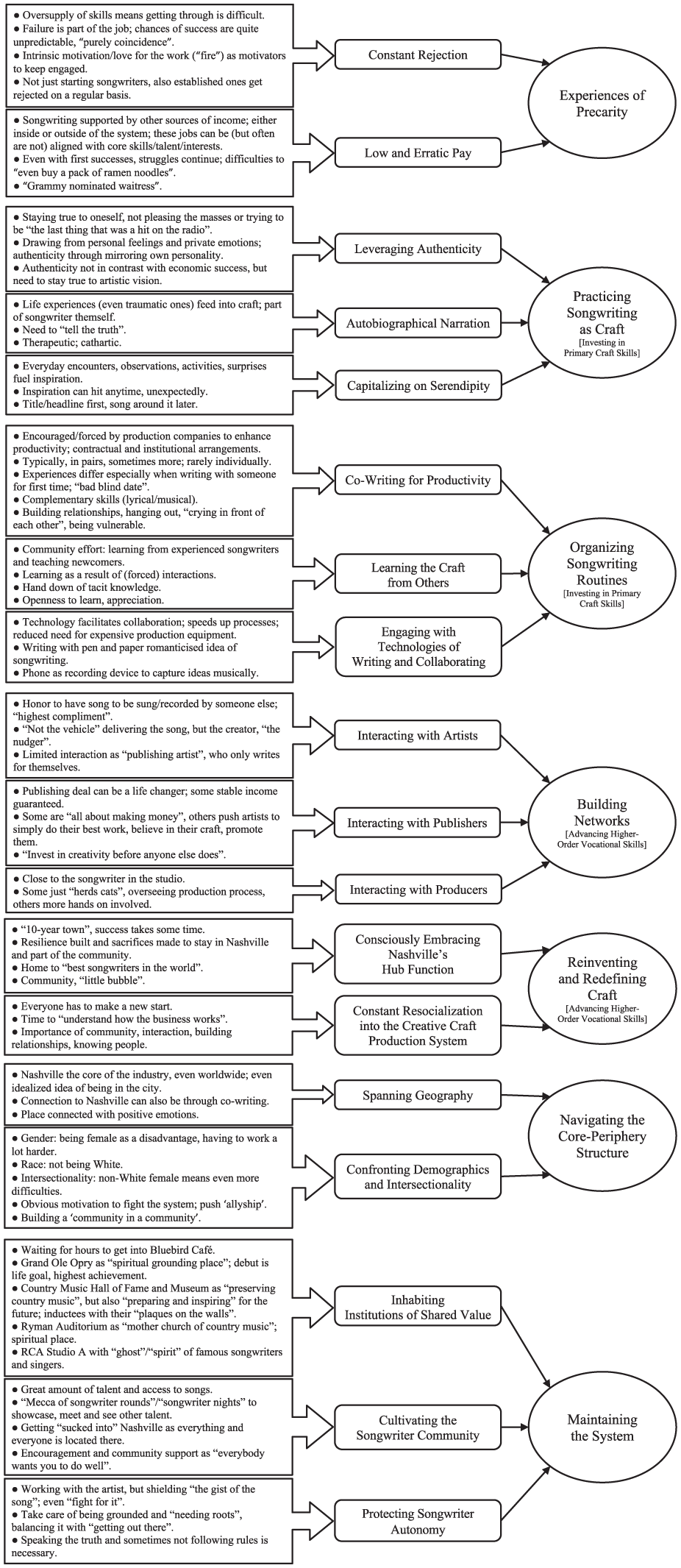
Data Structure
Findings
We arrived at an interpretative grounded theoretical model that puts songwriters’ lived experiences front and center. We report songwriters’ experiences of precarity, which encompass constant rejection as well as low and erratic pay. We then report how songwriters develop social strategies, establishing patterns of embeddedness that help them cope with perceived precarity. Entering the creative craft production system as apprentices, they are investing in primary craft skills by spending countless unpaid hours honing their craft and by communing with their peers across cohorts (Skaggs, 2019b). Moving to the master phase of their careers, they are advancing higher-order vocational skills by cultivating relationships with many other parties inhabiting the creative craft production system, and by developing a set of more reflective skills which we label reinterpreting and reinventing craft. Songwriters operating on the margins of the creative craft production system owing to their alternative identity or geographical positionality are navigating the core-periphery structure of the system to mitigate the additional sources of precarity they experience. Finally, we report several stewardly behaviors through which craftspeople contribute to maintaining the creative craft production system (Cornfield, 2015). 7 Each section reveals how social embeddedness rather than individual resilience enables productive coping with precarity. Figure 2 shows how these findings are captured in our theoretical framework.
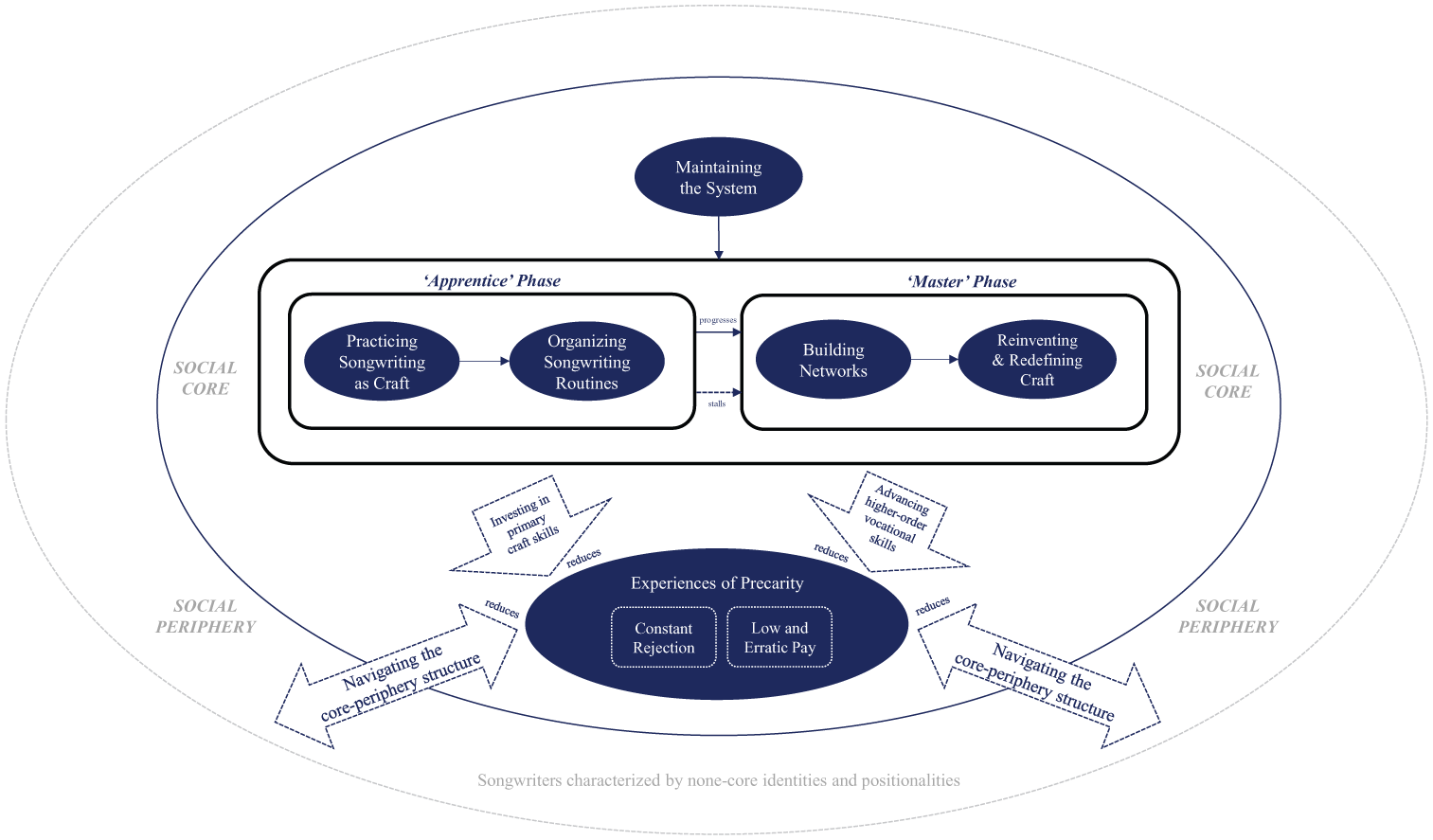
The Embedded Nature of Creative Craft Workers in Nashville’s Country Music Industry
Experiences of Precarity: Constant Rejection
Constant rejection is definitional for creative craft careers (Skaggs, 2019a). It is impossible to escape due to the oversupply of talent in what Priscilla Renea
8
calls a “tough business.” Twinnie (UK) states that “people get dropped or there’s a lot of luck involved in the music industry and a lot of politics,” while Megan O’Neill (UK) calls it “an absolute dogfight.” Even experienced songwriters face constant rejection. Rodney Clawson observes that: There’s so many new guys out on radio right now. Really good guys, there’s so much talent. It’s really hard for some of these artists that have been around for a while, mid-level guys like Justin [Moore], to get a song up there.
Getting a publishing deal is necessary in order to have a stable income; yet, in their attempts to secure this, nearly all craft workers “fail miserably” repeatedly (Ash Bowers). Natalie Hemby remembers that she was “really devastated” when signing with a big record label did not work out at last minute, even if it would have meant that “they owned my soul, my blood type, everything.” Charlie Worsham agrees that “the industry will never love you back.”
At the beginning of her career, Priscilla Renea encountered pushbacks as she “had all these people telling me: ‘It’s not gonna happen, just give up, go back home.’” Only because “the love of what you do outweighs any of the downside or the negative part of it, that’s just . . . part of signing up for this crazy journey that we get to be on as songwriters” (Claire Dunn). The constant rejection makes many songwriters question periodically whether they will continue with their craft. Even “after chasing a dream for so long” with all its “highs and lows,” Teddy Robb reached a point “where I remember calling my family and be like: ‘I think I have something to offer the world. I just don’t know how to break into Music Row and get my songs heard by people that can help me.’” Tim Prottey-Jones (UK) remembers that “throughout so much of my 20s,” he had to deal with “rejection, rejection, rejection, rejection.” Similarly, Bill Anderson shares that being rejected is a constant in craft, even for experienced songwriters: I had been doing this 30 years. . . . And I really thought I had a good song and I took it to this major producer. . . . He was really throwing a pretty pointed insult at me. And I said: ‘No, I don’t want you to pitch it to anybody.’ And I just took it and put it back in my briefcase and I left.
As part of the job, craft workers constantly receive unpleasant feedback, even when they have been part of the industry for a long time. Jim Lauderdale shares his experience: There’s a lot of rejection, and I still get it, it’s like every week almost. I seem to say to myself: ‘I’m getting my heart broken every week.’ And this music business . . . I put myself out there for that, get turned down, or I feel rejected. You just develop, you get used to it.
Experiences of Precarity: Low and Erratic Pay
Creative craft workers often receive low and erratic payment for their craft work, which makes it challenging to secure a living as a professional craftsperson. Without a publishing contract, “no one’s paying you to write a song” (Tim Prottey-Jones, UK). Since “there’s very few that can get signed” (Elyse Saunders, Canada), supporting oneself can be challenging. Jim Lauderdale, like many others when starting out in Nashville, recalls that “I had to have a series of jobs that I wasn’t crazy about, or I’ve had to accept gigs that I wasn’t crazy about. But in order just to make a living, I had to.” Jamie Floyd also had to support herself: “I was waiting tables at night, I was kind of paying myself to write during the day and keep my dream alive,” whereas Chris Janson was “a tip jar guy” when “playing four shows a day, four hours a piece, seven days a week.” Twinnie (UK) recounted that “I was grafting and I was hustling” to make a living as songwriter. Working in the country music industry can be financially challenging without a publishing deal. “Bartending,” “waiting tables,” “landscaping” (Gary Allan) or being “on a tractor 12 hours a day” (Rodney Clawson) are common side jobs that songwriters must accept. Even as the years go by, Joe West states that he “worked a real job for 27 years of my life” because the industry “can be so unstable.” Priscilla Renea encountered a point in her life where she was having her first successes, yet was still struggling financially: And then maybe six, eight weeks later, it [Timber] was number one, and . . . it was all over. It was at the NBA playoffs, final song. And I was going through a really tough time and a crazy lawsuit. And it was playing everywhere. And I had seven cents in my bank account. And I was like: ‘How is this possible?’ This is what you see on VH1’s Behind the Music [a documentary series about popular artists and musicians] and you never think it’s gonna happen to you. But it was. I was like: ‘This is pretty ironic. I have a number one song in the country. And it’s everywhere. And I can’t even buy a pack of ramen noodles.’
Jamie Floyd noted that her hit song The Blade “turned me from a waitress into a Grammy nominated waitress” and Angaleena Presley looked back calling those times her “starving artist phase.” Josh Osborne describes: “I was having my car repossessed, I was having a foreclosure notice and things put on my door.” Even when her first successes started coming in, Laura Veltz cautioned that “it starts evolving, but it’s keeping in mind bartending began eight years before, so it’s a long process.” With the money she earned, Sacha “definitely invested every penny” in her career, which means that “there is no house in the future,” calling the precarious work conditions she is experiencing “a major struggle.” Recognition of artistic success is also not guaranteed to translate automatically into financial success. As Chris Janson put it: “When you signed three bad record deals before you get the right one you don’t have any money left. So that’s just it. Welcome to Nashville; we’re gonna make you a star.”
Investing in Primary Craft Skills (I): Practicing Songwriting as Craft
In the apprentice phase, novice songwriters are investing in primary craft skills as a way of coping with precarity. Sometimes they even weaponize precarity by capturing it in their songs. We specifically find three early career craft practices typifying novice songwriters’ work: leveraging authenticity, autobiographical narration, and capitalizing on serendipity.
Leveraging authenticity
Songwriters in Nashville constantly help craft a sense of tradition, in that they “tell an audience of their own heroes and . . . indicate their own place in the tradition” (Peterson, 1997: 225). One of the first skills songwriters need to acquire is conveying authentic experiences: “It’s all about the honesty and the authenticity,” as Ingrid Andress summarizes, in that “country music should be talking about what people are experiencing in this country.” By practicing songwriting such that he “really treated it like a job,” James Johnston (Australia) is now at a point where he can “truly write the most honest version of what I wanted to write.” Leveraging authenticity requires the songwriter to “answer the question: ‘Why’?” (Adam Wright) when writing a song to “make good pure music from the soul” (Shy Carter). Adam Wright also states that: “I’ve tried to write songs that I thought would be easy to get on the radio, and they never ended up on the radio. And they weren’t satisfying for me to write.” Similarly, Parker Graye (Canada) makes it clear that “I can’t produce things that I don’t feel something deeply about. I just can’t.” Taylor Moss believes this to be the key to success: “if it’s the truth, it’s gonna work. It’s country music.” Authentic accounts include emotional, personal experiences shared by the songwriter. Victoria Banks is convinced that “the best song ideas come when you just get your heart completely smashed by somebody” because “when you’re brokenhearted, everywhere you look, there are song ideas just falling out of the trees onto your head.” Ingrid Andress states that “it’s really hard for me to write something unless I have actual feelings about it” and Lindsey Ell confirms that “it definitely comes from an emotion.” Luke Dick states that “especially in country music, that there’s this feeling of needing roots” that feed back into authentic accounts songwriters can leverage. For many songwriters, authenticity starts with introspection. In the words of Dillon Carmichael: I was doing a whole lot of listening to everybody else and a little bit of listening to myself, but what I really need to be doing was listening to myself completely. And when I did that is, what they say ‘find in yourself.’ I guess that’s kind of what that was for me . . . and one day I was like: ‘You know what? I’m done trying to fit in because I don’t know how to do this stuff. I’m gonna stick to what I know.’
Autobiographical narration
Aspiring songwriters must learn how to use autobiographical narration in their songs. Elyse Saunders (Canada) appreciates being a country music songwriter as “you can tell stories and be yourself.” Charlie Worsham has his “‘tell the truth’ notebooks”: I had a lot on my chest I needed to get out. . . . So the words ‘tell the truth’ sort of seem to make sense. And I wrote it on the cover. And I promised myself I’d fill a page up every morning. And the only rule was it had to be the truth.
Autobiographical narration does not only stem from positive experience as “people write songs, ’cuz they’ve been through something” (Shy Carter). It provides a “great pressure valve when life gets to be too much” (Marshall Chapman) and sometimes acts as a “type of therapy” (Darryl Worley) that offers “cathartic” (Hilary Williams) and “therapeutic” (Angaleena Presley; Ingrid Andress) value. Waylon Payne recalls: “Getting off drugs is healthy for you, but . . . nobody tells you the rest of it. . . . You’re about six months in and you realize what happened to you when you were four, so there’s your country song.” In “devastating situations” where Jim Lauderdale “don’t even feel like getting up,” coping occurs as he “got to write myself out of it.” When Chris Cavill (Australia) wrote an album to “celebrate [his deceased] dad’s life,” he put his own experiences into the writing, as through his craft “I want to tell his story, I want to tell my story.” Yet, James Johnston (Australia) points out that it is a “push and pull that you got to constantly juggle” between “staying true to who you are as an artist and creating music that’s authentic to me” as much as it is about “listening to what’s happening in the market.”
Capitalizing on serendipity
A related skill nascent songwriters must acquire is capitalizing on serendipitous events. Sometimes they stumble upon unrelated “newspaper articles” (Tenille Townes), “a thing on TV” (Bobby Braddock) or just a conversation while “in a restaurant having lunch” (Jeannie Seely) that find their way into their works. At other times, inspiration may come when going “down to the beach” or “on a trip to the Rocky Mountains” (Tia Sillers). A songwriter may have “passed a billboard and seen something and thought: ‘Why isn’t this a country song? I need to write this right now!’” (Erin Enderlin). Priscilla Renea describes a moment that inspired one of her greatest successes (California King Bed): They had this guitar riff. And I was just kind of sitting there, like: ‘What am I gonna do with this?’ And I was on the computer, online shopping. And I was looking for a bed. And I had just bought, got my first place and was moving to LA and big-time writing songs. And the producer walks in the room, he goes: ‘What you got?’ And I was like: ‘A title.’ And he’s like: ‘Well, what is it?’ And I just read what was on my screen: ‘California King Bed.’ And he was like: ‘All right.’ And he left. And I was like: ‘Well, now I gotta write that.’ So that’s how this song came about. And actually, it was one of the songs that made people kind of start taking me serious as a songwriter.
For a songwriter, a song idea might linger everywhere. When writing Somebody’s Daughter, Tenille Townes recalls that she “took this exit off the interstate, saw this young girl standing there holding onto a cardboard sign and just had this moment at the red light wondering what happened to her, what her story was, what her name was.” When they have their mind set on songwriting, “everything sounds like a song title” (Laura Veltz). Chris DeStefano remembers that he was writing Smoke Break “literally in the middle of writing another song.”
Investing in Primary Craft Skills (II): Organizing Songwriting Routines
The early craft career practices of leveraging authenticity, autobiographical narration, and capitalizing on serendipity are seemingly individuated responses to precarity. From the moment they set foot in Nashville, however, many apprentice-stage songwriters begin to organize their songwriting routines by connecting them to deeply embedded social relationships. Patterns of social embeddedness thus come to envelop and enhance these songwriting routines. Specifically, apprentice-stage songwriters are observed to add a social dimension to their craft skill development by partaking in the co-writing system, learning the craft from others, and engaging with technologies of writing and collaborating.
Co-writing for productivity
The cornerstone of Nashville’s songwriting community is the co-writing system, which encourages or even contractually obliges songwriters to write in groups of two to five people (Skaggs, 2019b), but as Laura Veltz states: “Typically, we write in pairs or threes.” Darryl Worley explains how this was new to him as he “didn’t co-write any” before coming to Nashville. Co-writing makes the craft production system highly productive, as it entices people to write new songs cooperatively. Megan O’Neill (UK) recalls that she was in “two [writing] rooms a day, every day, every day of the week” to write with many different songwriters. In the same way, Taylor-Rae (Canada) would “just book co-writes now so that I like force myself to do it.” Lindsay Ell asks: “Why would I finish a song myself when I could bring it into a room with two or three other really smart brains and finish it together?” The system also benefits songwriters because it facilitates learning, which improves the quality of their craft, as Darryl Worley relates: It was a really, really difficult transition for me to come to Nashville. And I understand it now better than I did then. But they really, really push for you to get in the room with all these other people. And obviously, the publishers and the production company want that because it’s going to turn you into a better songwriter faster, you’re going to become more productive, you’ll be writing two songs a day instead of one and a half a week. If you’re a good sponge, like myself, it’s all about osmosis, you just soak that stuff up and steal from everybody and learn how to do all the tricks real fast.
These sessions are usually set up between colleagues that know each other, perhaps bringing along a new songwriter. This led Derik Hultquist to conclude that “sometimes co-writing can feel like a blind date. And the bad kind sometimes.” However, the co-writing experience is fruitful for many songwriters, Laura Veltz explains: Sometimes you’re in the room with an artist that has an idea that’s musical, and you’re contributing the lyrics. Or maybe you have a whole blueprint of an idea that’s not even a lyric. It’s sort of a concept and then you dig around. It’s a lot of chatting. I feel like songwriting is a lot of chatting, and getting to know everybody and like crying in front of each other. It’s very vulnerable. But I think there’s no one way to do it.
Learning the craft from others
Learning the tacit aspects of songwriting from others is common in Nashville’s country music industry, where songwriters aim to “get in each other’s brains” (Adam Wright) during co-writing sessions. Breland describes it as “that Nashville education,” referring to the collaboration between songwriters happening there. Songwriters must become “a really incredible, subtle thief, and learn how to steal these little bits and pieces from everybody until you figure out what your style is” says Darryl Worley. To learn from others, Twinnie (UK) “wanted to be the shittiest person in the room.” Starting songwriters appreciate the opportunity to work with more senior colleagues, as Tenille Townes describes: It’s pretty amazing in this community that we get to really be sponges to learn from people who love that craft so much and who are so great at it. And then to have the opportunity to sit next to them in a songwriting room. And it’s like, what a dream, it’s been the coolest thing to get to learn from those people in sessions.
Dillon Carmichael also recalls and appreciates that he got “to see how these guys work” early on in his career, as his publisher bluntly told him: I’m gonna throw you immediately in with massive smash hit songwriters, whether you like it or not, whether you feel like you can hang with them, whether you feel like you can write with them, doesn’t matter. You’re still gonna write with them.
Established songwriters also appreciate co-writing experiences with younger colleagues. Liz Rose confidently states that “every time I write a song, I learn something new.” She explains that “whether it’s about how to behave in the songwriting room, whether to fight through a song that’s not working, I try and learn from my situation, the write, the co-writer every time.”
Engaging with technologies of writing and collaborating
Songwriters increasingly rely on technology to simplify and disintermediate the collaborative process. Mobile phones often replace more specialized equipment. Ray Benson describes that he and a colleague “collaborated by text [message] and voice [message] where I’d send her an idea and she’d send one back.” It also enables them “to send files around” so that they “don’t really have to have a studio all the time” (Alex Hall). Songwriters are also able to record their songs on their devices, thus replacing demo tapes. Jon Pardi is enthusiastic about technology use in the writing process as he can simply “sing a melody in my phone” and play it later for his co-writing partner. Also, when his publisher requests his songs, he knows that “there is one on my phone or my laptop” and he can “Dropbox it” to them. Similarly, Ashley Monroe illustrates: I was just home and that melody just kind of came in my head. I thought: ‘That’s cool.’ And I remember singing into my phone. And then when I got back, I had a writing room with Jon Randall. So, I was like: ‘Got an idea!’
Co-writing continued during the COVID-19 pandemic thanks to technology that enabled online get-togethers: “when we all get on Zoom together” technology helps to create “such a beautiful environment, because it’s just relaxed, everyone can be themselves” (Courtney Keil, Australia).
In short, whereas investing in primary craft skills seems to be an individual challenge, apprentice-stage songwriters meet it in decidedly social ways. They accelerate their progress as a songwriter by engaging deeply in the co-writing system, learning the craft from accomplished others, and constantly staying in touch with their peers through new technologies of online writing and collaborating. The greatest learning opportunities for apprentice-stage songwriters thus come from communing with more advanced peers.
Advancing Higher-Order Vocational Skills (I): Building Networks
As songwriters transition towards the master phase, their social strategies evolve along with their increasing embeddedness in the system, thus increasing their capacity to deal with precarity. Conversely, if a songwriter is unable to form deep social connections with other parties in the system, the threat of precarious experiences looms large (Menger, 1999; Reilly, 2017). For songwriters who have successfully entered the master phase of their careers, we observe how they become increasingly interlocked with a variety of co-producing partners in the creative craft production system, including artists, publishers, and producers.
Interacting with artists
Performing artists support songwriters by bringing their craft to life. Songwriters find great satisfaction in seeing their outputs become successes, as Liz Rose describes: “And so to have written this song [Cry Pretty] with her [Carrie Underwood] and then to hear her sing it and then have it be a single, this is how just songwriters that aren’t artists get to celebrate.” Shawn Camp is “proud of every cut” even though in every song that he had recorded “there’s something in it that I wouldn’t have done that way, because that’s their [the artist’s] interpretation of it.” Tia Sillers describes the relationship between songwriter and artist as one where she quietly crafts the songs but remains in the background: I’m not the vehicle. I’m the nudger, the person who helps create it, but I want to be invisible by the time it’s done. Like by the time I’m done with all Kenny Wayne [Shepherd] songs, you would never think I wrote them. They’re his songs.
Songwriters thus find satisfaction in engaging in their craft, even when the broader public does not care about the writer behind the song too much. Artists sometimes approach songwriters proactively to record one of their songs, as happened to Jeannie Seely: “I remember that he came to me and said: ‘I want to record that song. You wrote that especially for me, whether you know it or not.’ And who’s gonna argue with [Little] Jimmy Dickens?” Sometimes, songs are also written with a particular artist in mind, as Jeannie Seely relates: This song [Sometimes I Do] just came out of nowhere, and I could just hear Ernest Tubb singing it the whole time I was writing it. I was a nervous wreck when I came home and went to sing it to Ernest. But he listened to me. And he said: ‘Jeannie, honey, I believe you’re right. I believe the old man can get that for you.’ So this was my first record from Ernest Tubb.
Songwriting is not a one-way street through which the songwriter hands down their work for the artist to record. Artists also contribute to the craft, and in “collaborating . . . they have an idea of what they want their next record [to] sound like,” as Natalie Hemby clarifies. She also stresses that the artist’s emotional condition often reflects what kind of songs they want to have written: “If they’re in love, then all of a sudden, you’re writing all these love songs, like Maren Morris right now, she and I are writing a lot of love songs, she’s so in love.”
Interacting with publishers
Publishers are responsible for songwriters’ musical output and manage its distribution (i.e., “get songs cut by major artists or artists from their roster” [Waylon Payne] as they connect songwriters to “artists that we don’t have access to” [Chris Janson]). They also assist with legal and copyright issues. Publishers can even become involved in the creative craft of their songwriters, and many songwriters consider themselves fortunate to work in a very supportive environment, as Adam Wright points out: I guess I’m lucky to be with a publisher that is sort of constantly pushing himself and us, or me anyway . . . to be better, not necessarily more successful, and that by being better, the other things that . . . I have no control over anyway, will sort themselves out accordingly.
Charlie Worsham similarly portrays publishers as “the unsung heroes of the music business because they invest in creativity before anyone else does.” Songwriters realize that to get into business with a publisher, they have to accumulate about “10 or 12 copyrights” (Charlie Worsham). However, embeddedness in the creative production system can be helpful as Chris DeStefano illustrates that he got his first publishing deal because of a friend: Listening back, the songs just weren’t great. But they were good enough to get the attention of a friend of mine, who actually changed my life by signing me to EMI Music Publishing back in 2009. Yeah, my good friend Dan McCarroll signed me to a publishing deal and it was largely based on a lot of those songs that I was writing way back, and he was just a fan for many years and he got into a position that he was able to pull the trigger on signing me to a publishing deal and that changed my life. I mean . . . they say it takes 10 years to become an overnight success. Well, it took me 15.
Interacting with producers
Producers often act as brokers on creative projects, who integrate the work of songwriters with that of musicians, artists, and engineers (Lingo & O’Mahony, 2010). Clare Dunn explains the process: Sometimes a producer is just somebody who herds cats, and tries to keep the artists and the musicians and everything going forward, and keep the integrity of the sound. And sometimes producers are the ones in there tinkering with the board and making a guitar sound a certain way or distorting it a certain way, or whatever it is.
While she concludes that “the spectrum is broad as to what a producer does,” they are greatly responsible for shaping craft outputs. Helpful producers have “this amazing ability to be able to hear what it is that you’re describing in your head” (Chris Cavill, Australia) or step in to motivate and “pump my tires” (Taylor-Rae, UK). Country music songwriters need to get the attention of successful producers to take part in the production process. When Dillon Carmichael “got a chance to meet Dave Cobb, who is my dream producer,” he was left with “30 minutes try[ing] to convince him to produce my record.” In turn, choosing the songwriters that they want to work with, producers might ask to hear “one song that is you as a whole” (Dillon Carmichael). Eventually, fruitful collaborations are praised because a producer “wears a lot of hats” (Courtney Keil, Australia), such that they not only step in to aid the production process but also offer help as an instrumentalist, co-writer, coach, or mentor. Sacha describes her producer as “the game changer” behind her career advancement.
Advancing Higher-Order Vocational Skills (II): Reinventing and Redefining Craft
To cope with precarity more effectively, master songwriters engage more reflectively with the creative craft production system. Their social embeddedness is not an outcome but an ongoing process, and master creative craftspeople must constantly reinvent and redefine their craft to ward off career regression and remain relevant. Two ways in which efforts to reinvent and redefine craft manifests themselves is through consciously embracing Nashville’s hub function and through constant resocialization into the creative craft production system.
Consciously embracing Nashville’s hub function
Master songwriters cultivate the idea that Nashville is country music’s hotspot and that the “best songwriters in the world come to Nashville” (Abby Anderson). As Ingrid Andress explains, “I think the biggest thing that attracted me to Nashville and country music was the songwriting community that’s here.” She realizes how her career success as a country music songwriter started with her embracing Nashville as the hub in country music: “Nashville just, it was one of those moments where you just kind of, it hits you in your gut, and you’re just like: ‘I belong here.’” Chris DeStefano agrees as for him “Nashville always wins” and is “just such a special place.” Josh Osborne embraced Nashville’s gravity early on as “the day I could I moved to Nashville, like three days after I graduated high school, I moved here full time. And I’ve been here ever since.” But the benefits of relocating do not manifest overnight. Nashville is often called a “ten-year town,” in that becoming successful as a songwriter may take a decade to achieve. Chris Janson knows that “this town . . . can kick you in the dirt and it makes a lot of people cry and go home.” Thus, songwriters must learn how to deal with experiences of precarity, as Jamie Floyd shares: I had lost the last publishing deal that I had. That’s what happens in Nashville, you get a deal and you lose it. . . . And we all pay our dues. That’s part of living here. But I had lost another deal. And I’ve been losing deals for a long time. I got my first record deal when I was 11. So it’s been a long road here in Nashville for me.
But while getting there might be “a grind” (Ingrid Andress), being a songwriter in Nashville offers a very rewarding experience for creative craft workers who persistently embrace its hub function. Laura Veltz felt that when her talent as a songwriter was finally recognized, which indeed “happens at about ten years,” she was “just so grateful to be in Nashville writing songs at all and just get paid to write at all is a big deal here. And having any success and seemingly kind of early on was a big, big, big deal to me.” Chris DeStefano indeed very consciously embraces Nashville’s hub function: I’ve lived [in] a lot of different places before I came to Nashville. I lived in New Jersey, and Boston, and Los Angeles, Vegas, Miami. . . . And I knew it immediately, literally. And it sounds crazy. But from day one when I got to Nashville and just met the people and then my co-writers that I was able to write with [are] still dear friends to this day. I knew there was something special.
Parker Graye (Canada) summarizes the experience of Nashville and embedding into its system as a non-U.S. songwriter: I go there and everything about my soul is energized. Obviously, I’m in full alignment in terms of being around people who are doing the exact same things that I’m doing or in similar kind of realms. . . . I find that the people that I’ve met there, I’ve met so many incredible people that are Canadians that I’ve worked with diligently over the last year, but when I work with those people in Nashville, there’s just something very special about that place.
Constant resocialization into the creative craft production system
One consequence of the persistent influx of new talent is that Nashville’s creative craft production system is constantly evolving. This makes that master songwriters must continuously resocialize themselves into the system. Nashville thus demands of songwriters “to figure out how to interact with it one way or another” (Bruce Robison). Elyse Saunders (Canada) reckons that “the industry is small, it’s a family” but “if you can’t connect with people, I don’t know if you’re in the right industry, especially in country music.” This is a perennial learning experience, as explained by veteran songwriter Luke Dick: “A lot of people come to town and they know how to navigate infrastructure and I’ve never had that kind of natural acumen.” Songwriters point out that upon arriving in Nashville, the process of getting acquainted starts and never stops: “When you get to Nashville, you probably have to just start right in the beginning” (Laura Veltz). It does not matter “whether you’re just a young pup starting out or if you have a catalog of songs and you’re well into your life and you know how to write songs” as Laura Veltz puts it. She knows that “what I learned about songwriting [before] didn’t really translate. I had to start from the beginning and learn how to write songs for Nashville. So, it’s sort of a different science.” This process of constantly reestablishing oneself as a country music songwriter is vital: There’s a magic moment there, . . . a happy medium where you can spend an amount of time in town. I think, you [need to] really understand how the business works and learn the importance of the community and songwriting system and being involved and building real relationships in town. And you can’t do that in nine months. (Matt Stell)
Jeannie Seely reflects on the to-and-fro between songwriter and the broader creative craft production system, highlighting how songwriters try to relate to both the past and future of songwriting to ensure both continuity and renewal in country music as a genre: There’s a lot of change. But you know what? Everything changes. I told somebody the other day, you’re not driving the same car probably you were about 20, 30 years ago, either. So, everything changes, styles do and as much as some of us might hate to admit it, it’s just not our era anymore. And I think everybody brings their own sound, their own style when they’re coming in [the] industry. And certainly, with all due respect to Kitty Wells, when I came, I loved Kitty. But I wanted my records to sound different. And I didn’t want Little Roy Wiggins on steel, I wanted Buddy Emmons on steel. So, it’s just a natural progression that things change. There’s things out there today I don’t care for, but there were things in my era I didn’t like too, so it is as it’s supposed to be.
In short, master songwriters often find themselves in a precarious position. On the one hand, they can rely on a carefully cultivated reputation, genuine craft skills, and a deep catalogue of prior works. On the other hand, they must constantly reinvent themselves to stay relevant and avoid precarity (cf. Bielby & Bielby, 1999). Only by advancing higher-order vocational skills can they maintain their social embeddedness in the country music songwriting system. Experienced songwriters are constantly looking to develop new relationships with artists, publishers, and producers, as this is the only way for them to avoid the experience of increased rejection rates and lower pay in the more advanced stages of their career.
Navigating the Core–Periphery Structure (I): Spanning Geography
Our analysis also yielded new insights into the experiences of songwriters operating on the periphery of the country music system, either because they did not reside in Nashville or because their identity differed from the Southern White male norm dominating the industry, both compromising their ability to achieve deep social embeddedness. Even when located thousands of miles away, songwriters recognize Nashville as the beating heart of country music: “Nashville makes you” (Megan O’Neill, UK). Jake Morrell (UK) states that Nashville represents the gold standard for country music as “we have seen how it is in Nashville, so this is how it has to be.” Songwriters who are geographically removed from Nashville extensively refer to the city, work with Nashville co-writers or producers, and share experiences of going to Nashville themselves, as embedding oneself in this city’s ecosystem is a necessary condition for achieving success in this line of creative craft work.
Upon realizing that a songwriter wants to establish themself in country music, leaving their hometown or native country to go to Nashville is a natural next step. Songwriters cannot “pass up an opportunity to go to Nashville” (Sharna Burcher, Australia). James Johnston (Australia) stated that he was “ready to move, I had sewed up my entire life, guitar and a hand backpack ready to go” to advance his career and reposition himself from the periphery into the system’s core. For some, since “I was a teenager, I just desperately want[ed] to live in Nashville and be Carrie Underwood” (Laura Oakes, UK), while others followed up to make the move as soon as they could. Megan O’Neill (UK) recalls: I came home, and I was 21. I finished uni. And I was like: ‘Right, I’m moving to Nashville.’ My parents were like: ‘What is going on?’ And that’s where it all started for me. So, I left, I left the day after my graduation . . . and I moved out to Nashville.
Parker Graye (Canada) stresses that “the magic of the place itself and the people” makes her “so smiley when I’m talking about Nashville” as “my soul is here in Vancouver right now, but my heart is in Nashville.”
Navigating the Core–Periphery Structure (II): Demographics and Intersectionality
The struggles of being female, Black, or both in country music can push songwriters further into the periphery. As Twinnie (UK) recognized, females have probably built-up extra resilience as “women generally in the music industry have to fight harder and women in country music, that’s a whole different ballgame.” She points to the problem being exacerbated in country music, where “they can see all this talent of women, but they’re not putting them on [country music radio].” Victoria Banks relates that at most industry functions there are “all the incredible female artists . . . in the room,” but also “all of the men in suits, who [are] the business people . . . surrounding them.” She laments that “women often don’t own themselves, don’t control their own career” due to the male-dominated industry structures. Parker Graye (Canada) therefore made it her goal to “really . . . start working with more females. I think that women in this industry are just underutilized. And there’s so much talent, bananas!” When co-writing with and for females, Tia Sillers knows that “our songs have to be better than all the guy songs, they just have to, that’s the only way we can get on.” Mutual support is offered and used as a coping strategy. Twinnie (UK) shared that “I’d talked to my other friends in the music industry, especially women, because there has been so much crap that I don’t even want to say.” Black songwriters can relate to these experiences. Darius Rucker shares that “there wasn’t anybody that looked like me on the radio” when he entered the system. He got told that he should not be part of the system “not just by White people, by Black people too. It was both sides.” He “didn’t know music was color” but believed that “music was notes and words and chords.”
While songwriters want to believe that “great songwriting is great songwriting” (Breland), especially female non-White country music songwriters tend to share two additional experiences of precarity. Valerie Ponzio knows that “the industry is the way the industry is: women alone have a hard time, so [for] a Black woman or a Latin woman, it’s going to be extra, even that much more extra.” Rissi Palmer, in interviewing Mickey Guyton on the occasion of her Grammy Award nomination, points out that “there’s a 45-year gap between the Pointer Sisters’ nomination and Mickey’s nomination. So, it’s been 45 years since a Black woman has been nominated in a country category at the Grammys. Just let that one sit for a second.” Mickey Guyton recognized that being nominated for the Grammys and “being a Black woman in the category that I’m in, is bigger than just an award for me. This award is really for all Black women.” She is very clear about this being a “collective” or a “family” where “if I got a Grammy, you got a Grammy.” “Allyship” or “sisterhood” (Mickey Guyton) was stressed so that “if one of us makes it, the other one is going to hold the door open, so the other ones can get in and that’s what this is about.” Having worked with her for more than 10 years, Victoria Banks got to experience first-hand that “the deck was very much stacked against her . . . as a black woman in country music.” Still, Mickey Guyton knows that: Not only is it important for me to win, but it’s important for Black women to win. And the only way I truly believe that Black woman can win is by bringing each other up. . . . It’s not enough for just one of us to get through. It has to be a collective effort. And that is the path for the next Black girl is for her to in fact, open her door for the next Black girl.
She takes a further stand in stating that “there’s so many beautiful and talented women of color out there that I want to be associated with that.” Having more Black females in country music and “you giving love to another artist that is a Black woman is not going to take away from your success.” Rissi Palmer acknowledges that allyship is important especially from successful and established songwriters such as the example Maren Morris—herself a White female—set during her acceptance speech at the 2020 Country Music Awards (CMA): She took a moment to shout out Linda Martel, myself, Mickey Guyton, Brittany Spencer, and Rhiannon Giddens. And, oh Lord, I absolutely did not expect that. And she absolutely did not have to do it. And so, I’ve said it many times since last week and I’ll say it again: It was an extremely kind and classy and selfless move that she did, because she could have gotten up there and just talked about herself, and she’d be well within her rights. But she decided to share that moment with us.
In brief, songwriters operating at the periphery of the country music production system are at a heightened risk of experiencing precarity. It is not that what they go through is wholly incomparable to what White male songwriters operating out of Nashville encounter, but they do have to activate additional social strategies such as spanning geography by maintaining ties with individuals at the core of the creative craft production system and being prepared to engage in allyship and building a community in a community to constantly confront geographic and intersectional pressures. We capture these efforts under the banner of navigating the core-periphery structure of the system.
Maintaining the System
A final set of findings shows how songwriters, mostly those in the master phase, help maintain the creative craft production system. As their careers progress, songwriters start dividing their time between investing in their own careers and engaging in stewardly behaviors. As is common in other craft settings, master-phase songwriters display intergenerational solidarity by mentoring and developing their apprentice-phase peers. However, they also engage in a set of less frequently reported stewardly behaviors oriented towards system maintenance. We identify three such behaviors: inhabiting institutions of shared value, cultivating the songwriter community, and protecting songwriter autonomy.
Inhabiting institutions of shared value
Songwriters contribute to the maintenance of what we term institutions of shared value by ensuring their continued inhabitation. Institutions of shared value serve as free spaces where creatives and commercials meet, where talent is picked up, and where craft gets celebrated. Examples include the Bluebird Cafe, the Country Music Hall of Fame and Museum, the Grand Ole Opry, and the Ryman Auditorium. The Ryman Auditorium, a live performance venue in downtown Nashville, is often referred to as the “mother church of country music” (Jamie Floyd). It reminds Nashville’s songwriters of the legacy it carries. Dillon Carmichael was honored to be recording at the old RCA Studio A “with the ghost of Waylon Jennings, . . . where Dolly Parton recorded Jolene, and Waylon [Jennings] cut all his records, and [Merle] Haggard’s been there as well, Willie [Nelson]’s been there, George Jones, Elvis Presley.” Similarly honoring “the spirit of all these amazing people” (Dillon Carmichael) is the Bluebird Café, a small music club with live performances. After moving to Nashville, Tony Arata recalls his first encounter: I’ll never forget the first time ever I walked down to the Bluebird, walked into the Bluebird Café to see what the competition was like. I pulled on the door and it was one of our latest inductees into the Country Music Hall of Fame [and Museum], Mr. Don Schlitz, is singing. So I just closed the door and I told [my wife] Jaymi, I said: ‘You know, half our stuff’s still on the truck. And we’re gonna be back in Savannah tomorrow.’ But anyway, we stuck it out.
Other institutions of shared value, like the Grand Ole Opry, offer performing songwriters the opportunity to build an audience. Abby Anderson views her “Grand Ole Opry debut” as the “best weekend of my life.” She also describes the Grand Ole Opry as a “church” and a “spiritual grounding place.” Erin Enderlin likewise remembers that “getting to make my debut . . . was everything I’ve ever dreamed of and more. That was my number one goal in life, was to play the Grand Ole Opry.” As Jeannie Seely relates: “Becoming a member of the Grand Ole Opry family was and will always be probably the greatest event that’s happened in my whole life.” By celebrating these venues, songwriters help maintain the creative craft production system.
Cultivating the songwriter community
Songwriters cultivate a sense of community across cohorts, which helps both apprentice- and master-stage songwriters cope with precarity, albeit in different ways. Stronger intergenerational ties enhance individual craft workers’ capacity to cope with precarity: “In this fabulous town that we live in, there’s so much talent, and these people have access to so many songs every day” (Jeannie Seely). Ingrid Andress adds: “you’re just put into the city with so many talented people who all want to do the same thing.” To cultivate the social bonds underlying their community, songwriters organize themselves as a collective, for example by meeting at “songwriter nights” (Eric Paslay) or “writers’ rounds” (Dillon Carmichael) as “Nashville is the Mecca of songwriter rounds” (Natalie Hemby). Adam Wright shares that “you start doing songwriter nights and you just meet all these people that are just these little geniuses, that just sit around and live in notebooks with guitars.” Songwriters are also organized in a “wonderful organization called the Nashville Songwriters Association International (NSAI)” with “dedicated people and professional songwriters who are there to help other people, they conduct workshops around the country, they do critiques of songs” (Bill Anderson). The NSAI facilitates community development, for instance through “their seminars, learning about how to be a songwriter, how to improve your craft” (Josh Osborne). This sense of community enables songwriters to act in prosocial ways even when competition is tough, as Natalie Hemby explains: You find your group, because there’s a group of people who are coming up with you. . . . But when you come up with your peers, you all learn from each other. And then you’ve got this group and it’s fun to see your friends succeed. And then you succeed.
Ingrid Andress expresses how she has benefited from being a member of the community: You’re just put into the city with so many talented people who all want to do the same thing, but the community in Nashville was just so, everybody wants you to do well. And everybody wants you to write the best song you’ve ever written.
Outside of Nashville, while Jake Morrell (UK) recognizes that “people are heavily influenced by the American scene,” songwriters do profit from local institutions like the Academy of Country Music or Australian Songwriters Conference in Australia. To cultivate local songwriter communities, Elyse Saunders (Canada) knows that “it’s important to be able to give back and help some other artists out too, because they are the next generation.” She believes that to do so, her own success is vital, because “the more success I can have, the more I could help other artists” as “there’s enough to go around” (Twinnie, UK). Darius Rucker takes a similar approach and states that “if I can ever help you . . . let me know. You’re a songwriter? Send me your songs! I might be starting a publishing company, you never know.
Protecting songwriter autonomy
Songwriters also use advocacy to protect their autonomy. The commercial interests involved in country music are intense, and the pressure to adopt a hot format is considerable. The task of pushing back often falls to established songwriters. As Tony Arata puts it, this involves putting your foot down “when people tell you they’re not going to record the song until they take these words out of it.” Chris Janson has similarly learned how to stand his ground: “I quit trying to impress people. I quit trying to write for what anybody else wanted. And I just started writing what I wanted to say.” Many songwriters are sufficiently protective of their autonomy to save their work until an artist comes along who understands the “gist of the song” (Tony Arata). Darryl Worley stresses that he has been “called down for forcing a song” because he believes “if that’s what I want to say, if that’s what I want the listener to hear and what I want the listener to know . . . if I feel strongly enough, I’ll fight for it.” Shawn Camp illustrates the point by referring to notoriously independent Loretta Lynn, who “spells things a little differently, but what she’s talking about, she’s so real. She’s not going to change that because that’s who she is.”
Discussion
We have investigated how songwriters cope with experiences of precarity. While constant rejection and low and erratic pay are often seen as emblematic of careers in the creative crafts, experiences of precarity are also on the rise in other sectors of the economy, making songwriters a bellwether for what awaits workers in other vocations. We therefore now zoom out to offer a discussion of the theoretical implications and generalizability of our work, limitations and future research opportunities, and a brief conclusion.
Theoretical Contributions
Our work makes three theoretical contributions. First, we have developed a social embeddedness perspective on how creative craft workers cope with experiences of precarity (Campbell & Price, 2016; Kalleberg, 2009; Standing, 2011). We thereby offer a more socialized alternative to existing individualistic accounts. While creative craftwork is often portrayed as an individuated endeavor, governed by self-organization through which craftspeople informally achieve task coordination (Kroezen et al., 2021), we reveal systematic patterns of social embeddedness. Our study shows that creative craft workers seek social embeddedness in craft production systems, providing them with acknowledgement and resources in return for contributing to system maintenance. Importantly, while we find many instances of more straightforward relational advantages of social embeddedness like gaining access to influential actors like publishers and producers, informational arbitrage, and creative work team assembly (Lingo & O’Mahony, 2010), we also find that social embeddedness is the engine behind several other precarity-mitigating processes. These include attracting peer support for primary craft skill development, career innovation and rejuvenation, and spanning the gendered and racialized boundaries present in the creative craft production system. We thus offer a rich and nuanced theorization of creative craft production as a deeply embedded form of work, which might be replicable in other creative craft hotbeds like San Francisco’s video game development (Zackariasson et al., 2006), haute couture (Wenting & Frenken, 2011), and Hindi cinema in Mumbai (Ganti, 2012).
Second, by embracing a craft career evolution perspective (Koppman, 2016; Lee & Gargiulo, 2022), we offer a view on how craft workers’ embedded ties evolve, following the stages of their career. As Lee and Gargiulo (2022) have documented for K-pop songwriters, patterns of embeddedness in the creative crafts change as individuals move from the apprentice to the master stage, evolving from tight-knit closed networks towards more open patterns of collaboration. In country music songwriting, however, this form of network evolution goes together with a shift towards less frequently documented stewardly behaviors. Whereas a more limited form of stewardship has been documented in many craft production settings—through which master craft workers mentor and develop apprentice-stage workers—the master-stage songwriters in our study demonstrate a more encompassing perspective on stewardship. As country music songwriters mature, they become increasingly concerned with stewardly responsibilities like protecting the legacy and authenticity of Nashville, and contributing to the maintenance of its institutions of shared value. Seeing these stewardly behaviors through the lens of custodianship (Dacin, Dacin, & Kent, 2019), participating in the rituals enmeshed with these institutions is an act of institutional maintenance (Dacin, Munir, & Tracey, 2010). These stewardly behaviors help master craft workers cope with the psychological strains of precarity, because engaging in them is an exhilarating experience. Ritualistic performances like playing at the Country Music Awards show (CMAs) or the Grand Ole Opry thus not only buttress the creative craft production system, but also ward off experiences of precarity by providing intrinsic motivation to master songwriters.
Third, we incorporated songwriters operating on the margins of the country music production system owing to their geographical positionality or identity characteristics. We discovered a core–periphery structure that is also present in other creative craft production systems (Cattani, Dunbar, & Shapira, 2013; Lee & Gargiulo, 2022). The experiences of creative craft workers in such corporatized systems seem to differ from those reported for more decentralized, temporal, and loosely organized creative production initiatives, such as stand-up comedy (Reilly, 2017, 2018) and film projects (Jones, 1996). On the one hand, we find that peripheral craft workers face additional depravations because corporatized craft production settings “reflect the larger system of inequality that places barriers for certain groups—namely, women, people of color, and the less affluent” (Frenette & Dowd, 2020: 10). On the other hand, by carefully establishing and leveraging ties with parties operating at the core of the creative craft production system (allyship), peripheral craft workers can establish productive patterns of social embeddedness allowing them to overcome at least certain perceptions of precarity.
Generalizability of the Model
While our grounded theoretical model depicts the lived realities of songwriters operating in the corporatized country music production system, our findings might generalize towards other corporatized crafts. What typifies creative craft production systems is that they exert a gravitational pull on craft talent, are prone to role differentiation, are highly stratified in terms of their social and economic organization, and carry the weight of vast financial interests. These qualities are not found in creative clusters dominated by smallish creative craft enterprises, such as exclusive perfumery (Endrissat & Noppeney, 2018), electric guitar building (Hartmann & Ostberg, 2013), and silk-tie production (Toraldo, Mangia, & Consiglio, 2018). Yet, they are commonly found in other corporatized creative craft production systems, such as the K-pop industry in Korea (Lee & Gargiulo, 2022), the Bollywood film scene (Ganti, 2012), the U.S. video game industry (Bulut, 2020), and high-end fashion in India (Khaire, 2014). In these settings, creative craft workers experience significant precarity too. Based on our work, we conjecture that in these locales the key to coping with precarity lies in investing significantly in primary craft skills, advancing higher-order vocational routines, and navigating the social and spatial core-periphery structure of the system.
The literature on the creative industries also pinpoints questions which can likewise be asked of the corporatized country music production system, starting with questions about career progression. Koppman (2016) describes how in the creative industries talented people in the apprentice phase are matched to jobs, and her findings suggest that shared cultural capital and a shared cultural vocabulary signals creative potential to those on the hiring side. In the country music industry, such cultural pedigree is often expressed through cultural signifiers like growing up in a small town, experiencing hardship in early life, living the Southern way of life, and exposure to rural wisdom. Bielby and Bielby (1999) highlight the continued importance of social embeddedness in the master phase of creative craft workers’ careers. Their study documents that television writers are less likely to be hired as they age. The intervening mechanism seems to be that aging writers are less likely to be represented by core agencies and are instead relegated towards lower-tiered agencies or are no longer represented by an agency at all. It is this lack of representation that makes it harder for them to acquire new contracts. Unless creative craft workers constantly maintain their social embeddedness, their experiences of precarity are thus likely to increase again as they advance throughout their careers.
Other studies reflect on the tension between creativity and commercial success. Elsbach’s (2009) work on toy designers provides a case in point. Her finding that serial toy designers manage to maintain recognizable signature styles, even while operating in a highly financialized industry, offers valuable insights into a perennial dilemma facing all country music songwriters, which is how to navigate the oppositional forces of adhering to popular formulaic templates and telling relatable personal and authentic stories. Interestingly, executives in the corporatized crafts also realize that these oppositional forces are at play. Fitzgerald (1995), for example, convincingly debunks the myth that the success of the Motown label in the 1960s and 1970s is solely attributable to rehashing much-loved formulaic elements. Instead, Motown executives carefully sought to balance formulaic elements, which its producers knew their audience to love, with offering artistic freedom to performers and songwriters who had cultivated a strong personal connection with their fans. Based on these parallels with other creative industries, we stipulate that while the experiences of Nashville-based songwriters are highly revelatory, they are not unique.
Limitations and Future Research
Our study is limited in several ways, which offer opportunities for future research. First, we rely on cross-sectional data. We therefore cannot capture within-person changes over time, nor can we directly observe the transitional mechanisms allowing craftspeople to move from one career stage to the next. Future research should consider a longitudinal research design focused on the career development of creative craft workers. Second, as we rely on prerecorded interviews, we were not able to directly engage with the songwriters in our sample and we could not follow up emerging hunches with probing questions. We also cannot rule out that the life stories conveyed in these interviews were purposefully narrated and used instrumentally for self-presentational or careerist ends. Indeed, telling tales of hardship firmly belong to the cultural toolkit of songwriters (Swidler, 1986). Having that said, the hardship songwriters tend to narrate in their songs—whether coping with breakups, fighting with addiction, mourning departed loved ones, questioning faith, or grieving over parents struggling with dementia—predominantly comes from their personal lives and features partly verifiable autobiographical details. Videoed and podcasted interviews should thus be assessed critically, but they do fit in with pleas for methodological pluralism (Lamont & Swidler, 2014). Third, we made the conscious decision to focus on one type of craft work to develop a grounded theoretical model of how creative craft workers cope with experiences of precarity across the various stages of their careers. These dynamics might work out differently for pure craft, technical craft (Kroezen et al., 2021), or heritage craft (Sasaki et al., 2020), which are also typified by precarious labor conditions, but within which the organizational patterns surrounding craft production are different. Scholars interested in these forms of craft work are therefore encouraged to examine how craft workers cope with experiences of precarity in these settings. Fourth, although we also included voices from the social and spatial periphery of the country music songwriting system, we could only make a start in exploring their experiences of precarity. We are thus keen to see future studies focusing explicitly on female, Black, Latinx, and Indigenous creative craftspeople to properly account for their unique struggles, challenges, and stories of success to better illustrate what careers on the periphery of craft production systems look like.
Conclusion
Country music songwriters experience precarious labor conditions involving constant rejection as well as low and erratic pay. Our findings nonetheless suggest a model, grounded in the lived experiences of songwriters, that details the social strategies they use to cope productively with experiences of precarity. As craft workers progress from the apprentice to the master phase of their careers and become increasingly embedded in the creative craft production system, they ward off precarity by continuously practicing their craft, coordinating collaboration across creative craft practitioners, maintaining a system of interlocking roles, and sustaining a high level of openness towards new talent to constantly kindle creativity and renewal. Songwriters operating on the social and spatial periphery of the system additionally cultivate ties with parties positioned at the core of the system. Our study thus shows how songwriters use social strategies to navigate the “broken road” of creative craftwork and “hold on” to their craft.
Footnotes
Acknowledgements
We are grateful to Journal of Management Associate Editor Nicky Dries for her thoughtful and constructive editorial guidance throughout the review process. We are likewise indebted to four anonymous reviewers, who not only helped to develop the paper methodologically and theoretically, but who also proved to be exceptionally knowledgeable about the context of craft work and the music industry. We also benefitted from spirited conversations during seminar presentations at the Copenhagen Business School, Nova School of Business and Economics, City University of Hong Kong, and the Rotterdam School of Management, Erasmus University. We furthermore presented this paper at the 2022 Academy of Management Annual Meeting and the 2023 EGOS Colloquium, as well as at an inspiring Craft Studio meeting in January 2022, where Tina Dacin was our raconteur. The authors are solely responsible for any remaining flaws.
Authors’ Note
The “title song” of this paper, “I Hold On,” was co-written by Brett James and Dierks Bentley and recorded by the latter. It is included in a Spotify playlist compiled to accompany this paper ( ). Next to the title track, it contains 131 songs, each crafted and/or performed by the songwriters in our sample (see Table 1). It also includes seven songs that songwriters refer to directly in their quotes (see the Findings section).