




Abstract
While the corporate lingua franca mandate aims to facilitate communications among linguistically diverse employees, evidence shows that it creates more problems than it solves, often negatively affecting social integration and knowledge sharing in the workplace. Our study is driven by the phenomenon of high language diversity and low lingua franca proficiency, emerging characteristics of workplaces around the globe given increasing migration. We adopt a mixed-methods, longitudinal design involving participant observations, interviews, social network surveys, and company data. Our analysis revealed the existence and prevalence of an informal language advice network (LAN) in which individuals with varying levels of English proficiency actively engage in voluntary language-related knowledge-seeking and sharing. We found more positive interpersonal interactions and consequences of LAN than typically reported in extant studies. We leverage the social networks and generalized exchange literature to explain the processes and consequences of LAN for individuals and the organization. Management recognition was found to be important for sustaining LAN in a context of high language diversity. Our integrative analytical framework offers a valuable lens for scholarship on future workplaces that are being shaped by rapidly shifting ethnic, cultural, and linguistic demography.
Keywords
The greater interdependence of the world’s economies and concomitant rise in the global mobility of people dictate the need for many individuals to work with colleagues who speak different native languages. Multinational corporations (MNCs) are thus multilingual entities (Luo & Shenkar, 2006). Language diversity is a challenge for MNCs because it can hamper the free flow of knowledge (Barner-Rasmussen & Aarnio, 2011; Barner-Rasmussen & Björkman, 2007) and social integration in organizational units (e.g., Piekkari, Vaara, Tienari, & Säntti, 2005). To manage language diversity and create a common platform for communication in operations across foreign markets, MNCs have increasingly adopted a common corporate language, a lingua franca (Luo & Shenkar, 2006), that is typically English given its widespread use in global communication and as a business language (Neeley, 2013; Nickerson, 2015; Reiche & Neeley, 2019).
While the benefits of a corporate lingua franca are proposed to facilitate information exchange and reduce misunderstanding among linguistically diverse colleagues, the idea of effectively channeling communication flows through a lingua franca is viewed as simplistic (Steyaert, Ostendorp, & Gaibrois, 2011). This is because it does not fully take into account individual differences in lingua franca fluency that have a bearing on communication (Steyaert et al., 2011; Tenzer & Pudelko, 2017) as well as individual and organizational performance (Barner-Rasmussen & Aarnio, 2011; Barner-Rasmussen & Björkman, 2007; Harzing & Feely, 2008). Although many MNCs provide employees with language training and translation support, such organization-led policies and practices may be insufficient (e.g., Steyaert et al., 2011). Established translation channels, for example, may effectively manage the editing of formal documents, but such channels could delay the workflow for multiple other daily assignments that require speedy solutions. While machine translation solutions can be speedy, the outcome may be a suboptimal translation that is potentially costly to the organization (Araghi, Palangkaraya, & Webster, 2024).
From an organizational perspective, therefore, it could be desirable for employees to voluntarily find solutions among themselves (Piekkari, Welch, Welch, Peltonen, & Vesa, 2013) to manage the daily flow of English-language-related work. This would naturally entail less-fluent speakers initiating language advice from fluent speakers, and fluent speakers sharing their language-related knowledge to advice seekers (e.g., Piekkari et al., 2013; Sanden & Lønsmann, 2018). However, there can be impediments to the sharing of language-related knowledge. Language fluency is viewed as a form of career capital in the MNC (Itani, Järlström, & Piekkari, 2015) and individuals fluent in the lingua franca may not be willing to share language-related knowledge (Wasko & Faraj, 2005). Such knowledge represents individuals’ expert power (Tenzer & Pudelko, 2017) and sharing it would reduce their competitive advantage, as well as consume their time and energy, which could interfere with their workflow (e.g., Piekkari et al., 2013; Sanden & Lønsmann, 2018). Likewise, there can be impediments to language-knowledge seeking on the side of less-proficient lingua franca speakers. While lingua-franca fluency should be the criterion for seeking advice, the prospective advisor’s social characteristics such as race and nationality may compromise their optimal choice (Johansson & Sliwa, 2016). Research shows that individuals seek advice from similar others, thus forming and maintaining homophilous social networks (Haas & Cummings, 2015). Such networks limit not only the usefulness of knowledge within the homophilous group due to knowledge redundancy (Dalkir & Liebowitz, 2011; Haas & Cummings, 2015), but also the extent of knowledge sharing and social integration within the organization (Ertug, Brennecke, Kovács, & Zou, 2022; Nahapiet & Ghoshal, 1998). By contrast, heterophilous networks are deemed more conducive to widening interpersonal networks and gaining non-redundant knowledge (e.g., Hansen, 1999; Nebus, 2006).
The Arabian Gulf provides an interesting and underexplored context for examining language-knowledge sharing. It is a context characterized by “linguistic superdiversity” (Sanden, 2020: 35) with a high percentage of expatriates relative to Gulf nationals (Al-Seghayer, 2023). Expatriates come not only from the West but increasingly from South Asia, Southeast Asia, the Middle East and North Africa (e.g., Azad & Fahmida, 2024). English is typically used as the corporate lingua franca to provide a means to communicate in a linguistically diverse workforce. The English language is considered attractive due to its use as a global business language, and perceptions among local populations that English is “the language of economic survival and development” as well as instrumental to individual professional success (Al-Seghayer, 2023: 91; Azad & Fahmida, 2024). Many countries in the Gulf region, however, score low or very low on global indices of English language proficiency (World Population Review, 2024). Those in the workforce have varying levels of English fluency depending on their country of origin, resulting in a high asymmetry in English fluency (e.g., Al-Seghayer, 2023).
We posit that the context in the Arabian Gulf, mirrored in our research organization, constitutes a phenomenon that has theoretical and practical implications for the future workplace. A phenomenon can be construed as a particular set of occurrences distinct from what is currently known (e.g., Von Krogh, Rossi-Lamastra, & Haefliger, 2012). A context in which organizations operate and where little is known about the effect of such context on organizations also constitutes a phenomenon (e.g., Bruton, Pryor, & Cerecedo Lopez, 2024). Our research organization, the headquarters (HQ) of a large Gulf-based multinational energy company that mandates English as the corporate lingua franca, reflects the contextual phenomenon in the Gulf: The workforce is highly linguistically diverse, lingua franca proficiency is low among many employees, and there is great asymmetry in lingua franca fluency. In the HQ, there is no dominant language group; even the home country language, Arabic, is spoken by only 20% of the employees, who represent over 65 different nationalities. This context is distinctive compared to many earlier studies on the use of lingua franca within organizational units of a MNC, which tend to include either a few languages in addition to the home or host country language (e.g., Steyaert et al., 2011) and/or the home or host country language is spoken by a high percentage of the workforce in that particular unit (e.g., Kankaanranta & Planken, 2010). Studies where language diversity is high relative to the number of employees are those focused on global teams (e.g., Tenzer, Pudelko, & Zellmer-Bruhn, 2021), though they represent a subset of the workforce that may be formed temporarily around projects and may be geographically dispersed.
We are interested in how and why individuals might seek and offer informal language help, and what new constructs or theories may be needed to fully explain the sharing of language knowledge given this contextual phenomenon. In our phenomenon-driven study (Von Krogh et al., 2012), we investigate language-knowledge sharing in a mixed-method longitudinal study in three phases (Creswell & Creswell, 2018). In the first phase, our research question is “How does language diversity affect social relations and individual careers when there is a lingua franca mandate?” In this phase, we discover the emergence of an informal network that we refer to as Language Advice Network (LAN) where individuals voluntarily seek and offer language-related advice. In the second phase, our research question is “How and why do individuals seek and offer language help in LAN?” Through analyzing rich qualitative data collected from participant observation and interviews, together with survey and HR data, we uncover the mechanisms underlying how and why individuals engage in this network. In the third phase, four years later, our research question is “Is LAN sustained over time and, if so, can its impact on individual careers and social integration be verified?” We find evidence to support the continuance of LAN and its positive influence on individual careers and social integration.
Our study is important for at least two reasons. First, we have identified a phenomenon that has theoretical implications for how language diversity is conceptualized. The contextual phenomenon of high native-language diversity, combined with high asymmetry in lingua franca fluency and low levels of lingua franca proficiency, is rapidly shaping workplaces around the world due to migration and globalization processes (Gest, 2021; Natarajan, Moslimani, & Hugo Lopez, 2022). There is further ample opportunity for researchers to investigate how the contextual phenomenon that we have identified may change the way we think about language diversity, and also how it may inform global organizations for better managing and motivating linguistically diverse employees.
Second, our study offers an in-depth analysis of language-knowledge sharing in LAN, a lingua franca-based social network, that we suggest contributes to social integration in organizations. Drawing upon social networks and generalized exchange theories, we develop an analytical framework to explain how LAN is formed and sustained. We posit that language, specifically lingua franca, is a knowledge resource that can be transferred through social networks. Our framework specifies how LAN contributes to social integration, especially through linguistically heterophilous networks, and explains why LAN might be sustained in the long term through the generalized exchange principles. Our findings stimulate a fresh way of incorporating language diversity in organizational and management research. The increasingly complex composition of ethnically and linguistically diverse workplaces (Sanden, 2020), such as our research context, is on course to fundamentally alter how employees perceive and utilize lingua franca, making it imperative for scholars to place these changing demographics at the forefront of lingua franca investigation.
We now turn to a literature review of language diversity and lingua franca from the perspective of social networks and generalized exchange theories. While these theories are brought in during later phases in the research process to understand the data and mechanisms underlying the voluntary seeking and sharing of language advice, we present the literature review in advance.
Language Diversity and Lingua Franca
Research on language has gained significant traction in recent years in tandem with the growth of linguistically diverse workforces (Johansson & Sliwa, 2016). This is a welcome development given that less attention has been paid in the past to language diversity compared to cultural diversity in the management literature, with language often subsumed in studies of culture (Henderson, 2005). A growing number of native languages prevalent in the workplace has been referred to as “linguistic superdiversity” (Sanden, 2020). This reflects what has been captured in the diversity literature as “maximum variety” (Harrison & Klein, 2007), suggesting that a relatively small number of individuals are likely to speak the same native language and there may be no dominant language present. Our research setting exemplifies these characteristics.
The term ‘English as a lingua franca’ has emerged to refer to “communication in English between speakers with different first languages” (Seidlhofer, 2005: 339). In a business context, it is often referred to as business English as a lingua franca (BELF: Kankaanranta & Planken, 2010). While a lingua franca creates a common platform for communication, some scholars have noted that it can create a multitude of challenges (e.g., Sanden, 2020). It can be a disruptive element among employees because it can amplify misunderstandings, limit the expression of complex ideas, and marginalize non-native speakers who may feel less confident or excluded from critical discussions (Tenzer, Pudelko, & Harzing, 2014). Lingua franca can thus be a source of friction (Bhagat, Kedia, Haveston, & Triandis, 2002) between fluent and less-fluent lingua franca speakers. Indeed, it has been observed that a common corporate language, while aiming to unite people and organizations, may be divisive (Charles, 2007; Hinds, Neeley, & Cramton, 2014), running counter to social integration.
Differences in lingua franca ability also have implications for career advancement and status gain (Neeley & Dumas, 2016). Evidence shows that employees who command high lingua-franca fluency are often viewed as valuable employees with great career prospects (Sanden, 2020), and more competent and powerful than others (Lauring & Klitmøller, 2015) because they act as language nodes, taking on intermediary roles such as information gatekeepers and translators for less-fluent colleagues (Marschan-Piekkari, Welch, & Welch, 1999). These individuals thus gain status. By contrast, employees with low lingua-franca fluency may not enjoy the same reputational and positive career experience as their fluent peers. For less-proficient speakers, lingua franca is typically portrayed as an impediment (Marschan-Piekkari et al., 1999), obstacle (Henderson, 2005), or barrier (Harzing & Feely, 2008) to performance and career progression. Scholars indicate that less-proficient speakers may experience discomfort and reluctance to speak the lingua franca (Aichhorn & Puck, 2017; Bordia & Bordia, 2015), and even experience diminished confidence and status in the workplace (Neeley, 2013). In sum, differences in lingua-franca fluency inform different career trajectories in the organization, career trajectories that may have suddenly changed for individuals with the advent of a corporate lingua franca policy, realigning status hierarchies (e.g., Neeley & Dumas, 2016).
Given the contextual phenomenon of our research setting— a combination of high native-language diversity, high asymmetry in the fluency of the English language, the mandated lingua franca, and low average English language fluency— it is reasonable to expect a great need for the informal and voluntary sharing of language knowledge since English proficiency is required for an individual’s task completion. Language, specifically lingua franca, is an increasingly important knowledge resource that can be shared among colleagues. Below, we highlight two literature streams that underpin the constraints and possibilities for language knowledge sharing and the implications for social integration.
Social Networks and Knowledge Seeking
Social network theory provides a useful framework for understanding how individuals seek knowledge within organizations. It posits that individuals seek knowledge through their networks of relationships and that those networks influence the outcome of knowledge seeking (Borgatti & Cross, 2003; Hansen, 1999). Network homophily is a concept in social network theory that describes the tendency of individuals to form ties with others who are similar in designated attributes (McPherson & Smith-Lovin, 1987). It highlights how organizational subgroupings along ethnic, cultural, or language lines can affect the way individuals build interpersonal relationships and share knowledge. This, in turn, can affect individual careers and social integration within the organization (Ertug et al., 2022).
Interpersonal similarities such as language, race, ethnicity, and gender form the basis of homophily and socialization in organizations (e.g., Ibarra, 1993; Lee & Reade, 2015; McPherson & Smith-Lovin, 1987). In a highly multilingual context, speaking a common language is one of the primary criteria for friendship and socialization (e.g., Ahmad & Widén, 2015; Manev & Stevenson, 2001). This is because people are generally more comfortable expressing themselves in their native language (Aichhorn & Puck, 2017), including those with a shared linguistic style (Kovács & Kleinbaum, 2020). Research shows that language clustering, or “a grouping of people owing to their tendency to interact more with those with whom they share a common native language in multilingual workplaces” (Ahmad & Widén, 2015: 431), is a prominent challenge faced by MNCs. For instance, a study by Mäkelä, Kalla, and Piekkari (2007) found that while a shared native language can contribute to knowledge sharing within the same language cluster, language-based homophily posed barriers to the flow of knowledge across the organization.
Speaking a common native language facilitates interaction and sharing of ideas and knowledge between members of the group (Henderson, 2005; Reiche, Harzing, & Pudelko, 2015). Research shows homophily affects patterns of knowledge seeking (Haas & Cummings, 2015) and sharing (Dalkir & Liebowitz, 2011) between individuals. Because most daily work is carried out through the collaborations that emerge from informal relationships, any constraints in social networks resulting from homophily will have a bearing on knowledge seeking (Haas & Cummings, 2015; Noorderhaven & Harzing, 2009). If individuals only interact with their limited contacts through homophilous networks, it reduces the free flow of knowledge that can hamper individual and organizational performance (Ertug, Gargiulo, Galunic, & Zou, 2018; Nahapiet & Ghoshal, 1998).
Engaging in a broad range of networks is generally beneficial for effective knowledge acquisition (Nebus, 2006; Reagans & McEvily, 2003, 2008). This is because information search and knowledge acquisition are facilitated by a network that contains nonredundant or weak ties (Burt, 1992; Granovetter, 1973; Hansen, 1999). Despite the benefit of non-redundant ties, however, individuals tend to activate a limited set of proximal network ties and resources (Smith, Menon, & Thompson, 2012). In the case of language advice, for example, those who first come to mind will be individuals with the relevant expertise (Borgatti & Cross, 2003), typically within one’s close social network, such as someone who speaks the same native language. Additionally, an intuitive judgment of the value and trustworthiness of a person’s knowledge may be biased toward those whom one knows well due to communication ease through a shared native language (Krackhardt, 1994). While such a knowledge acquisition strategy may be efficient, it can yield suboptimal results, especially if knowledge resides in more linguistically distant parts of social networks.
Above we reviewed the benefits and pitfalls of activating a homophilous social network for language-knowledge seekers. Seekers and sharers of language knowledge in our research setting are in a situation of clear resource asymmetry, such that the sharer commands language knowledge resources, and the likelihood of receiving direct reciprocation from the seeker is very low (e.g., Nebus, 2006). We draw on generalized exchange to theorize the possible mechanism for why fluent lingua-franca speakers might help language advice seekers. Generalized exchange is particularly relevant for understanding a complex web of relationships in a community in which the exchange of resources is not fully explained by direct and dyadic reciprocity.
Generalized Exchange and Knowledge Sharing
Wasko and Faraj (2005), through analyzing knowledge-sharing behaviors in the electronic space, identified several reasons why some people share more than others. These include an enhanced professional reputation, the joy of helping others, and past positive experiences of sharing. Generalized exchange (GE) theory is well suited to explain the motivational aspects of the knowledge sharers. GE is a particular type of social exchange that takes place among three or more individuals (Blau, 1964; Takahashi, 2000) and outlines a complex form of indirect and collective reciprocity that occurs between actors (Molm & Cook, 1995). In direct exchange, two actors give benefits to one another. In GE, one actor gives benefits to another and receives benefits from someone else in the community, resulting in a chain of reciprocity involving three or more actors. First documented by anthropologists Lévi-Strauss (1969) and Malinowski (1922), collective reciprocity is widely recognized as an important form of social capital, contributing to cooperation and solidarity among the members of the community (Molm, Collett, & Schaefer, 2007). Despite the desirability of GE in organizational life, such as facilitating social integration, few studies have empirically investigated GE in organizational contexts.
Two broad processes regulate GE systems (Simpson, Harrell, Melamed, Heiserman, & Negraia, 2018). One is paying it forward (Baker & Bulkley, 2014; Hyde, 2000), whereby actor A provides resources to actor B because she previously received help from someone else in the community. The other is reputational giving, a process that describes indirect reciprocity, starting with an actor who helps another individual, thus building a reputation for helping, which later is reciprocated by a third person (Molm & Cook, 1995). These two processes inform why an actor might help another, even if there is no expectation of direct reciprocity from this individual. In organizations, GE systems constitute the foundation of group-oriented organizational citizenship behaviors, which are not formally required but contribute to the organization by improving others’ productivity (Baker & Dutton, 2007).
The relevance of GE to organizations has garnered attention in recent years because contemporary organizations increasingly rely on flexible and spontaneous collaboration among employees beyond one-on-one dyadic relationships (Yoshikawa, Wu, & Lee, 2018). We submit that fostering indirect reciprocity among multiple individuals is critical for knowledge exchange in organizations. For example, many organizations encourage their employees to exchange knowledge via online platforms where employees can post questions and answers. Such platforms enable interactions among a large number of individuals who may not have previously formed dyadic relationships with each other, thus positively contributing to social integration (Wasko & Faraj, 2005; Yoshikawa, Wu, & Lee, 2023). Research indicates that individuals are more likely to engage in GE when they perceive benefits to be high relative to costs and risks (Yoshikawa, Wu, & Lee, 2020).
Methods
Research Context
We conducted our study in the HQ of a state-owned MNC in the Arabian Gulf, Gulfco (a pseudonym). Gulfco was established in the 1980s and is one of the world’s largest players in the energy sector with over 6,000 employees worldwide across its subsidiaries and operations. It is one of the most prestigious organizations in the country and its HQ houses around 2,500 employees comprising over 65 nationalities. Home-country nationals represent a numerical minority at 18%; expatriates make up the remainder (39% from the West and 43% from other areas of the world). This largely mirrors the demographic composition of the nationwide workforce. Many native languages are spoken including Arabic, English, French, German, Hindi, Tagalog, and Urdu. Around 30% of middle management positions and 50% of supervisory and administrative positions in the HQ are held by women.
Gulfco, like other organizations in the energy sector, prioritizes English language competence as a key business skill and mandates it across the organization. This is evident from the hiring process to training and development, to allocating a large amount of the company budget for in-house translation services. The HQ is structured into two main groups, the Human Capital Group, which conducts most of the administrative work, and the Commercial Group, which deals with the technical side of the energy business. Job applicants take a standardized English language test as part of the recruitment process and candidates must score a minimum of 3 on a five-point scale, a baseline working knowledge of English, where 5 indicates fluency and 1 indicates no knowledge of English. Many of those hired only meet the baseline level of fluency (41% score 3; 32 % score 4; and 27 % score 5, of which 15% are native speakers). It should be noted that these language proficiency classifications reflect differentiation within the organization that is set in a region where many score low or very low on global indices of English language proficiency (World Population Review, 2024). In other words, the mid-point score of 3 on the company scale, for example, may not correspond to a mid-point proficiency on a global standard. The HQ has an English language translation division within the Legal department which accommodates a wide range of requests from departments and individuals throughout the HQ. While employees can choose to bring their work to the translation division, it is typically used only for long documents.
The first author, a home country national, negotiated research access. Collaborating with a researcher was new to this organization. Gulfco was persuaded to grant access by presenting it as an opportunity to contribute to national and organizational capacity building through the learning derived from research outcomes. The company agreed to offer a contract for a 10-month unpaid internship that provided restricted access to specific departments of the organization and their employees; in return, the first author agreed to take an administrative role including English translation work.
Research Design
Given the novelty of a context that has not been systematically studied, we were open to new insights that we might gain in the field and decided on a multiphase, mixed-methods design, addressing multiple research questions that evolved over the duration of the research process (Creswell & Creswell, 2018).
In the first phase, we entered the field with the question, “How does high language diversity affect social relations and individual careers when there is a lingua franca mandate?” This exploratory phase lasted about three months. Our data consists of participant observation and the first few semi-structured interviews. We familiarized ourselves with the context, spoke to employees, attended meetings, and read company policies. During this period we were intrigued by the strong emphasis on English proficiency and discovered the existence of LAN in the organization. This was an unexpected finding leading to an abductive inference, making a preliminary explanation about the LAN based on existing theories and data. Therefore, this first phase was abductive in nature because the focus was on generating explanations for surprising findings and involved iterative adjustments and explanatory reasoning (Timmermans & Tavory, 2012).
After the abductive analysis phase, we transitioned to the second phase of the study, which lasted about seven months. The second phase is inductive in nature as we looked for the corroboration of patterns and salient themes in the data. New data collected in phase 2 through a mixed methods approach, i.e., participant observation, in-depth interviews and social network surveys, refined our emerging arguments and reshaped the theoretical scope. In this phase, we sought to understand how and why individuals engage in LAN.
Four years later, we revisited the organization to conduct the third phase of research. The purpose of this phase was to investigate whether LAN had been sustained over time and if so, to verify its impact on individual careers and social integration. We conducted follow-up interviews with the available original interview participants and gained access to their annual performance ratings over the previous four years, their salary levels, and positions.
Sample and Data
Across the three phases of our research design, we collected and used multiple and overlapping data sources including participant observation (phases 1, 2, & 3), interviews (phases 1 & 2), follow-up interviews (phase 3), social network surveys (phase 2), annual performance and salary data (phases 2 & 3). Detailed information on the data collected, how each data source was used, and the stage of analysis is presented in Table 1.
Description of the Data
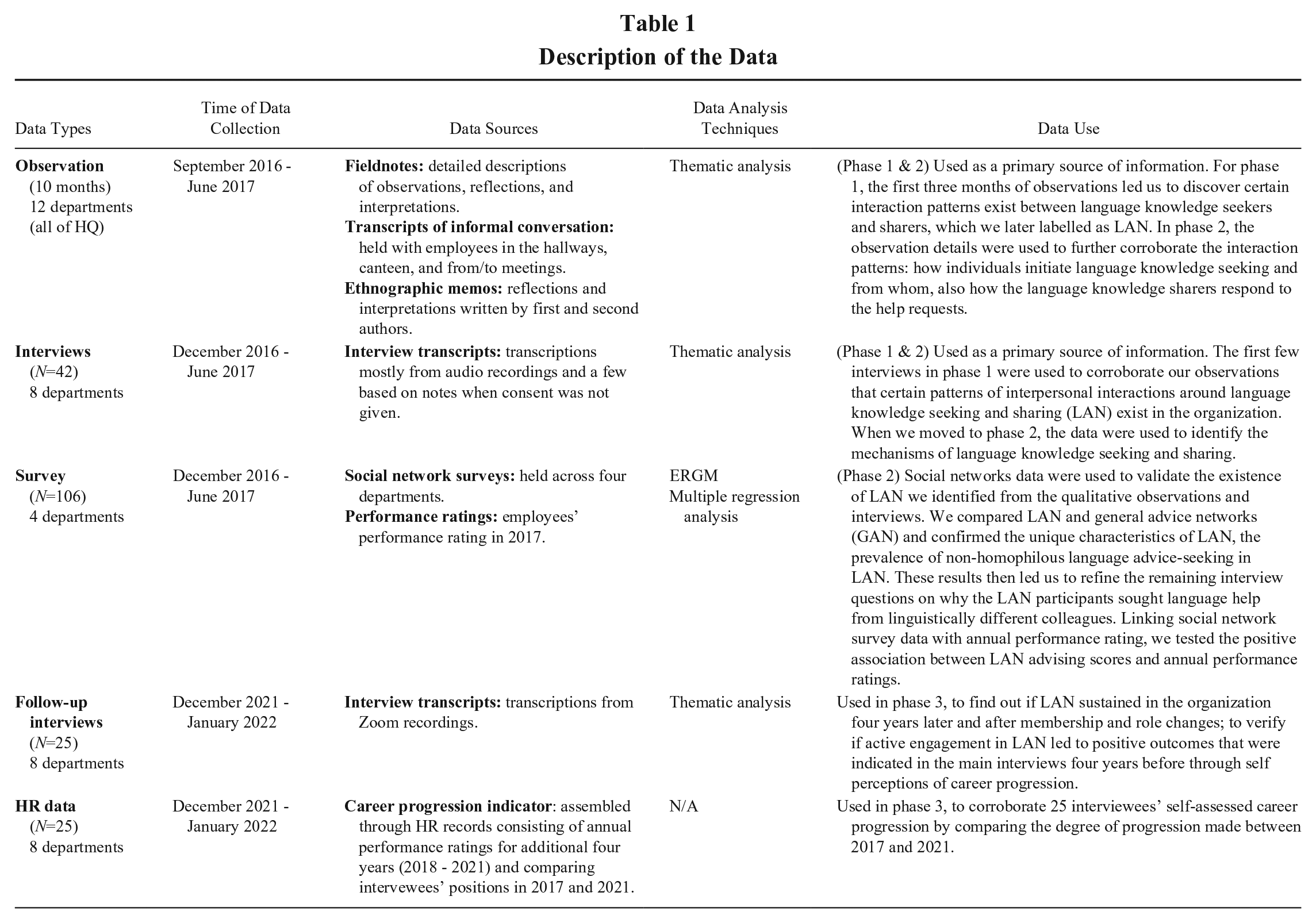
Participant observation
The first author spent six to eight hours per working day over ten consecutive months at Gulfco’s HQ. This entailed attending meetings and performing weekly administrative tasks. Such intense exposure at the HQ provided valuable opportunities to informally observe and engage with employees during work and breaks. The intern status was advantageous as employees viewed her only as a supporting staff, someone who takes care of the time-consuming administrative work. They perceived her as a short-term addition, primarily valued for her work in English translation, and not a competitor. This temporary role enabled employees to feel at ease in exposing their language limitations, as they understood she would not remain with the organization permanently.
Furthermore, the first author’s intersecting identities—a national and relatively young individual visiting from abroad—enhanced her approachability and contributed to employee perceptions of her as a non-threatening figure. Due to her multilingual fluency and local appearance, the first author gradually assumed the role of an active participant in the workplace and gained employees’ trust, which allowed the participant observations to be largely unobtrusive (Miles & Huberman, 1994) through “going native” (Flick, 2009). To mitigate any possible biases related to “going native,” the first and second authors held weekly meetings to discuss the interpretation of events.
The degree of observation and participation varied by activity. During business meetings, she mostly observed, whereas in the canteen and at social gatherings she actively participated as an employee. She made notes of numerous incidents and conversations with employees in a small notebook that was always kept handy in a pocket. This formed the basis of the fieldnotes. During the first three months, we noticed that employees routinely interacted with others to seek and offer language help; such interactions appeared to be part of a casual and relaxed daily routine. In this phase, many questions started to form that were worthy of investigation. We decided to conduct in-depth one-to-one interviews.
Interviews
Three months into the fieldwork, we began conducting semi-structured interviews, designed with an initial interview template of 20 questions. After the first few interviews, we confirmed the existence of LAN and gained clarity on our research direction. We decided to refine the interview directions to investigate how advice seekers initiate LAN and why advisors offer help. Thus, new, more refined interview questions were added as we gained additional information in tandem with an increasing number of interviews. The interview protocol is available as supplemental material in S1. When interviews provided no new information, we stopped recruiting interviewees. We conducted a total of 42 interviews. After briefly introducing the purpose of the interview and providing an opening question, interviewees were allowed to lead the conversation. The interview questions were intentionally non-directive to avoid biases of predefined prior knowledge, providing a stronger grounding for theoretical insights (Eisenhardt, 1989). The questions were open-ended to allow new themes to emerge and new facets of LAN to be explored through an inductive process.
Interviewee selection was done through a snowballing technique that started with five employees from different functional areas. Interviewees were asked at the end of each interview to identify names of people from whom they sought help or to whom they gave help. Among the names provided, the priority for selecting interview participants was to ensure the diverse representation of functional, gender, job level, nationality, and language backgrounds. We also ensured that the participants were either language advisors or seekers (or had a dual role) as our study aimed to focus on the experiences, perceptions, motivations, and consequences of both the advisors and advice seekers in LAN. Participant names used in the paper are pseudonyms. As the only Gulf country nationalities in our sample were from the home country of the case organization, we refer to their nationality as “Gulf national.”
The duration of interviews ranged between 40 and 60 minutes. Most interviews were recorded with the consent of the interviewees; in a few cases, interviewees were uncomfortable being recorded and only notes were taken. A detailed summary of the interview with quotes was made immediately following the interviews. Interviews were conducted in English, with the occasional use of Arabic with Arabic-speaking interviewees.
It is important to note that the term “LAN” was not referred to in our interviews until phase 3, when we conducted follow-up interviews four years later. Rather, we used terms such as language, language competence, language help, language help seeking, language advising. We used the label “LAN” during the data analysis and writing process.
Follow-up interviews
Four years later, the first author revisited the organization to see if LAN was sustained and evaluate the consequences of LAN. Twenty-five of the original 42 interview participants still worked in the organization and agreed to the follow-up interviews. All interviews were conducted via Zoom, and the session began by briefly revisiting some of the conversations noted in the original interview and then moved to the key questions. At this time the participants were told about the concept of LAN and were asked whether they had recognized its existence four years earlier and whether it was still present. We asked participants if they had been advisors or advice-seekers four years ago and, if relevant, what their current role was in LAN. We also asked them for a self-assessment of their career progression over the past four years such as whether their career progression was average, slower, or faster in comparison with other colleagues of a similar level four years ago; and in what ways they felt that LAN engagement had been beneficial to them, if any. The interviews lasted between 25 and 40 minutes.
Surveys
We gained access to administer social network surveys in four departments of the Human Capital Group: Human Resources, Learning & Development, General Services, and Public Relations. Completed surveys numbered 106, representing a 92% response rate. Such a high rate was attributable to support from management, who endorsed the surveys with a follow-up email encouraging employees to complete them. The surveys were divided into two main sections. The first section asked respondents for background information such as job level, age, gender, native language, tenure in Gulfco, and educational attainment. The second section listed the names of all employees in their department and asked respondents to rate the frequency of their interaction with each employee (in a month, on average) for both language advice and general advice. We asked about language advice and general advice separately because we wanted to examine the structural and relational differences between language- and general advice networks. Additionally, we obtained English language fluency ratings for the 106 individuals who participated in the survey. The descriptive statistics are available as supplemental material in S2.
Annual performance data
Key Performance Indicator (KPI) scores range from 1 (under-achieved) to 4 (exceeds expectation in performance). We had access to the KPI scores for the 106 survey respondents at the time of the survey. We also obtained four-year performance data for the follow-up interviewees when we returned to the field.
HR data
We had access to HR records that consist of position titles, English language fluency scores, and salary increments for the 25 follow-up interviewees.
Data Analysis
Qualitative data analysis
During the entire data collection period, we followed the same data analysis protocol for both observations and interviews. The first and second authors worked closely by discussing and reflecting on the first author’s experience in the field, continuously refining the research scope as themes emerged. In phase one, we first started analyzing participant observation. The first and second authors reviewed the field notes weekly and gradually developed the coding structure. Therefore the discussions over observations formed the basis of our analysis in phase one, which allowed us to stay faithful to the informants’ insights (Pratt, Sonenshein, & Feldman, 2022). We were intrigued by the rather positive attitude of both fluent- and less-fluent English speakers toward each other and that they frequently made connections via language advice seeking and sharing. We collected more specific information through one-on-one interviews which confirmed previous observational insights.
We started our literature base with language diversity in MNCs. Once we became intrigued by the participants’ positive attitude towards LAN, which appeared to contradict the findings in some extant literature (e.g., Piekkari et al., 2013; Sanden & Lønsmann, 2018), we explored additional literature on superdiversity (e.g., Vertovec, 2007) and majority-minority demographic conditions (Gest, 2021). These literature streams enhanced our understanding of the distinctive contextual conditions in which our research organization is situated. After gaining clarity on our research context, we sought to understand the mechanisms of LAN, that is, how advice seekers initiate LAN and why language advisors provide help. As our data informed us of a few possible explanations, we expanded our literature reviews to include social networks, homophily, and generalized social exchange. Throughout the data analysis process, we followed grounded theory standards by interrelating data collection, analysis, and literature reviews; therefore, data collection and data analysis were an iterative process.
Our qualitative data consists of the accumulated fieldnotes taken from the participant observation by the first author, the interview transcripts, and the memos from the discussions between the first and second authors. We used NVivo software (version 14) to organize all the text data, and adopted thematic analysis by beginning with “open coding” (Attride-Stirling, 2001; Corbin & Strauss, 1990). In this process, the texts were broken down into words or short excerpts expressing it as a single concept or “code.” At an early stage of data analysis (phase 1), our goal was to use interpretations of the text as a foundation for collecting further data, and at a later stage (phase 2), it was primarily to conceptualize our findings with relevant concepts and theories in the literature. We categorized dozens of codes into emerging themes from the text, referred to as first-order categories such as “not like me,” “good karma,” and “bringing us together” (Attride-Stirling, 2001). With these first-order categories, we went back and forth between our data and the relevant literature. These themes were then organized into more abstract, constructed codes, which represent the content of their theoretical dimensions (Attride-Stirling, 2001), such as “social network” and “generalized exchange.” The illustrative quotes of each theoretical dimension are presented in S3-S6. Finally, we progressed to axial coding, to identify and classify the links and relations between theoretical dimensions (Attride-Stirling, 2001; Corbin & Strauss, 1990).
Our follow-up interview data gained in the third phase underwent the same data analysis protocol used in phases 1 and 2. We started with a detailed line-by-line data analysis of the transcripts to generate first-order categories and then proceeded with second-level themes, theoretical dimensions and axial coding. We did not find any new categories beyond what we had identified in phase two; we did, however, gain richer information on the two mechanisms of generalized exchange, especially the paying-it-forward mechanism. This is primarily because some of the interviewees who were advice seekers in phase 2 had become language advisors four years later, and they were able to articulate clearly why they offer language help to others in need, i.e., paying-it-forward. The data structure is presented in Figure 1.
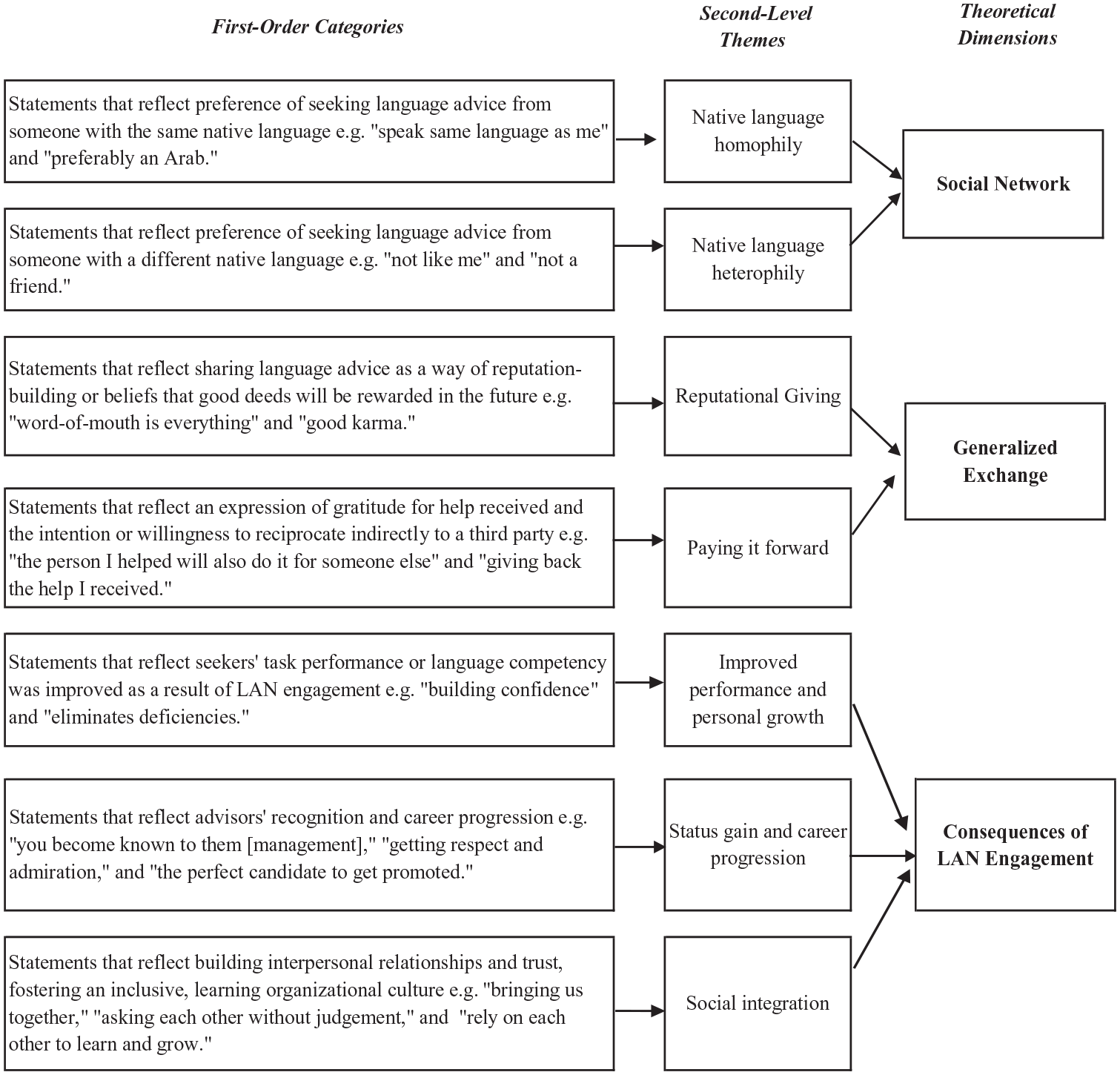
Data Structure
Social network analysis
In phase 2, we conducted a social network survey to corroborate the existence of LAN and to determine if it is independent of the general advice network. We conducted Exponential Random Graph Modelling (ERGM) (Snijders, Pattison, Robins, & Handcock, 2006) using the software R, and examined the structural and relational features of the two networks. This method of analysis was deemed highly suitable to compare the two networks because it permits inferences about the relative frequency of interactions in the observed networks by producing estimated parameters that show how much more (or less) frequently an occurrence of an interaction is expected by chance, given all the other parameters in the model.
Multiple regression analysis
Multiple regression analysis was used to test the link between LAN advising scores (from the social network analysis) and annual performance ratings. We used the LAN advising score (in-degree centrality) as an independent variable and the annual performance rating score as the dependent variable. We included English fluency as a control variable because English language skills are factored into the behavioral rating categories such as communication skills, interpersonal skills, and initiative-taking in their annual performance ratings at Gulfco’s HQ. We also included demographic control variables such as sex, age, company tenure, job level, and education level.
Findings
The key finding of our analyses is that less- and more-fluent lingua franca speakers seek and share informal language advice, forming a web of language advice networks (LAN) in the organization that promotes social integration. We found that less-fluent speakers initiate LAN in one of two ways: utilizing homophily networks by relying on familiar ties within the same native language group or crossing native language boundaries by purposefully approaching fluent speakers outside their native language group. Language advising is a prosocial and voluntary act, yet fluent lingua franca speakers willingly share their knowledge for two reasons: reputational giving and paying it forward. Reputational giving is where advisors offer help because they believe any good deed will ultimately benefit themselves, and paying it forward is where they had previously received language help and wish to reciprocate it to others in need. We also found that management recognition of self-initiated LAN engagement by sharers plays a key role in sustaining LAN.
Our findings are structured in the order of our three research phases, beginning with the discovery of LAN and its contextual conditions (phase 1), followed by the two pathways and mechanisms that elucidate how advice-seekers initiate their engagement in LAN and why advisors share language knowledge with others (phase 2), and the consequences of LAN engagement for individuals and the organization, as well as showing that LAN was sustained after four years (phases 2 & 3). Figure 2 presents our analytical framework.
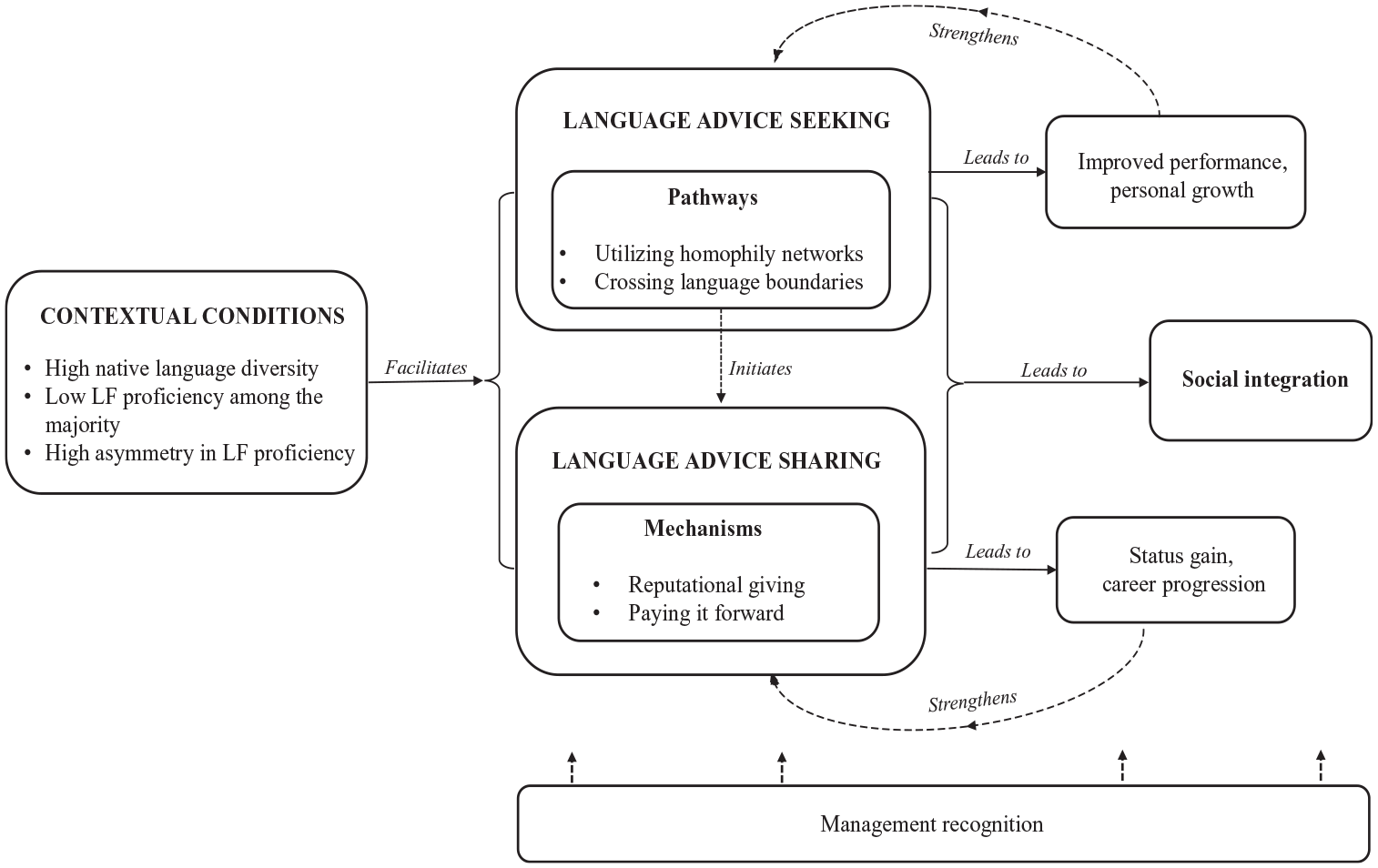
Language Advice Network: Contextual Conditions, Process, and Consequences
Language Advice Network (LAN)
During participant observation across all HQ departments in phase 1, we noticed that there were regular patterns of relations between individuals that we had not anticipated: Some employees frequently engaged in brief encounters with others in the office to ask for help on English words and expressions related to a work assignment. We found it interesting that such English advice-seeking was initiated in a highly casual manner and that the person approached willingly took the time to answer the questions on the spot. We also observed that there were prominent individuals who were more frequently approached than others. We term this pattern of engagement “Language Advice Network” (LAN) because the relations among individuals revolve around language advice and involve actors who seek language advice and others who are the “go-to” people occupying a central role in the web of relations. Such casual exchanges were an attempt to efficiently conduct daily tasks by utilizing the language knowledge embedded in the firm’s human capital.
Because everyone is under pressure to complete tasks efficiently, it is impractical for employees to pursue mainstream solutions for language help, such as making an official request to the translation division within the Legal Affairs Department, which could be considered time-consuming, a waste of resources, or costly (Janssens & Steyaert, 2014). Instead, one turns to a friendly colleague or superior who is fluent in English. As Khaled, an administrative assistant, put it during an interview: We skip this long process by just seeking help from within the department, and so long as we have the resources [fluent speakers], it’s more efficient this way. I mean, we save a lot of time! Imagine I make an official request through the portal, which then requires approval from my department manager, who is always busy in meetings or out of the office at the plant site. Once that is received, it will still take time at their [Legal Affairs Department’s] end. We’re talking about a week or so [sighs]. (Egyptian, male, age 35)
The slow process of the formal language support system is echoed by Harry, an expatriate manager, during an informal conversation: “The official translation route is for everyone to use, but the system in place looks at priority . . . Some requests are classified as low priority, and that can take more than a week, maybe two to finish.” (Dutch, male, age 49)
The most common type of language-advice query observed in phase 1 entailed English vocabulary or grammar that required an immediate answer. In one observation, Mohammed, a Gulf national (male, age 35) and head of the Nationalization Strategy, made a call to his subordinate, Yasir, an Arab-American (male, age 59) who is fluent in English: “Salam [Arabic/Muslim salutation]. Are you busy?” [silence for 10 seconds as Yasir responded on the other end of the line] “I’m working on the March report for COO. Give me another word or phrase for ‘just enough.’ The budget was just enough.”
The replacement word Mohammed received from Yasir was “sufficient.” The phone conversation with Yasir continued in the same pattern of Mohammed requesting synonyms for a few other words he had written in his report. Requesting such help through the official translation support channel would have been impractical.
Other examples of language advice exchange involved company-specific or industry-specific words. This illustrates the need for employees to acquire vocabulary beyond simply English competence, conceptualized in the language literature as hybrid language (Fiset, Bhave, & Jha, 2024) or BELF competence (Kankaanranta & Planken, 2010). For example, Amna, a Gulf national (female, age 24) and the newest member of the Competence Development and Performance Management team, was observed to frequently get up and walk over to Charles, a British, Senior Specialist (male, age 65) whose desk was three cubicles away from hers. In one observed occasion: [Amna] “What do they mean by ‘on probation’? I found it on the latest Excel sheet of the performance summary.” [Charles] “Oh yeah, yeah. I forgot to explain this in our meeting yesterday . . . those are the individuals who got a rating of 1 in last year’s appraisal.”
Amna later elaborated on this incident during an informal conversation with the first author, saying that she chose to ask Charles because other means, such as Google Translate, would have given her other irrelevant scenarios in which the word “probation” is applicable.
As illustrated in these two examples, there are two actors involved in the exchange of language-related advice: a language-advice seeker (such as Mohammed, Amna) who has a language-related need hindering the completion of a task at hand and a language advisor (such as Yasir, Charles) who is often a sought-after employee with higher language fluency. There is evidence of such an informal advice network between less-fluent and more-fluent colleagues in the extant literature. Piekkari et al. (2013), for example, studied Finnish host nationals in a Nordic multinational enterprise headquartered in Sweden and found the occurrence of informal advice networks for language translation. These networks, however, were portrayed in a somewhat negative light, given that the language nodes (i.e., language advisors) were burdened by the extra work. Similarly, Sanden and Lønsmann (2018) found that stress was placed on the language node individuals in self-initiated, informal language networks.
By contrast, our field observation revealed predominantly positive social interactions in LAN such that employees appeared to routinely seek and offer language-related help among one another in a relatively relaxed and congenial manner. These interactions were constant, casual, and swift, typically lasting for a few minutes each. We compared the context of our study with that of others to gain insights into the conditions that explain what appear to be contrasting outcomes of informal language advice networks.
Contextual Conditions That Facilitate LAN
Ethnographic memos revealed the three contextual conditions that facilitate LAN. High native-language diversity is the first condition that differentiates our context. In previous studies, the research samples typically consisted of just a few dominant language groups (e.g., Sanden & Lønsmann, 2018; Steyaert et al., 2011), or the home or host language was spoken by a high percentage of the workforce (e.g., Kankaanranta & Planken, 2010). In such contexts, the English language mandate may not be critical to getting one’s work done as there are sufficient numbers of employees in the dominant language groups (e.g., Sanden & Lønsmann, 2018). By contrast, our research context is characterized by linguistic superdiversity (Sanden, 2020) where no dominant language is present. Speaking English is therefore not only a practical solution for employees of various native tongues to communicate but critical for the completion of their daily work. Such superdiversity was succinctly summarized by a senior British expatriate: “There are over 60 nationalities in Gulfco. This is as international as it gets in multinational organizations.” Because the majority of the workforce speaks English as a second language, asking for help appeared to be a part of the normal daily routine for many, as illustrated in the following interview: We encourage teamwork. So there is nothing wrong with asking for [language] help here and there. Most of the company staff are second [English] language speakers.. . . I do it myself too. I ask a colleague to have a thorough look if the document is sensitive and needs to be carefully worded. (Gulf national, male, age 35)
Furthermore, language diversity in organizational units is predicted to grow as articulated by a Pakistani recruitment specialist during an informal conversation: “We expect more and more international employees, from countries we have not yet had employees from, because of [Gulf nation’s] new immigration rules . . . and economic growth.” In practice, Gulfco’s workforce will be composed of even fewer native English speakers. The future use of English for most Gulfco employees will likely be in the form of BELF (Kankaanranta & Planken, 2010), a skill that is not reliant on native English speakers and which has implications for a lessened hegemony (Nickerson, 2015) and greater democratization (Steyaert et al., 2011) of the English language.
The second condition that facilitates LAN engagement is the generally low levels of lingua-franca proficiency among the majority of employees in the workplace. At Gulfco, many employees have only a basic or moderate command of English and require language help with their work. Because the majority are not fluent in English, employees do not feel “linguistically ostracized or sidelined” (Tenzer et al., 2021: 8); instead, they are motivated to actively seek language help to complete their work and improve their language skills. Chris, a Filipino employee fluent in English, commented during an interview that it is natural for his less-fluent colleagues to seek help: Because we are obliged to talk and write in English inside [Gulfco], we need help from time to time because not everyone here has excellent language skills in the company language, English . . . help is necessary for many. (Filipino, male, age 41)
The third condition is high asymmetry in lingua franca proficiency among employees. According to Gulfco’s English proficiency classification, 27% of the HQ workforce has a high command of English, among which 15% are native English speakers. The remaining 73% of the workforce has varying levels of lower English proficiency. The wide variation in English proficiency creates an opportunity and incentive for less fluent speakers to utilize the language-related knowledge of more fluent speakers. Lia, a senior analyst, indicates during an informal conversation how such variation in fluency facilitates seeking and providing language advice among employees: Everyone here doesn’t speak fluent English . . . but it’s ok because it doesn’t mean they’re incompetent. It just means we need to collaborate to succeed . . . It just happens naturally [helping each other], I guess, when you’re surrounded by fluent colleagues that you work with. (Greek, female, age 33)
It is interesting to note that employees in Gulfco perceived asymmetry in fluency as being multi-faceted in that some individuals were seen as more proficient in a particular domain of the lingua franca while others were more proficient in another, leading some individuals to assume a dual role as advisor and advisee as shared during an informal conversation: There are situations where he advises me on what [linguistically] sounds better in an email . . . and, other times where I advise him how to deliver a message in a way that is better perceived in our culture. So, we help each other all the time because he’s a native speaker and his communication skills are professional and I know what’s better in the context of his job. (Gulf national, male, age 34)
Overall, our field observation and interviews revealed three contextual conditions that facilitate the formation of LAN resulting in positive social interactions: high native-language diversity, low levels of lingua franca proficiency among the majority, and high asymmetry in lingua franca proficiency. These conditions not only distinguish our research context from existing studies, but are indicative of emerging characteristics of the global workplace. Next, we present how advisees seek language advice and why advisors offer it.
How Advisees Seek Language Advice: Two Pathways
Our findings revealed two pathways through which advice seekers find language advisors: utilizing homophily networks and crossing language boundaries.
Utilizing homophily networks
The social network literature suggests preexisting ties between two individuals are often the basis of access to information and knowledge (Adler & Kwon, 2002; Nahapiet & Ghoshal, 1998) as they signal high levels of trust and likely cooperation (Itani et al., 2015) and willingness to share knowledge (Tortoriello, Reagans, & McEvily, 2012). When asked who they usually went to for language help, some interviewees indicated they chose colleagues with the same language and cultural backgrounds: It is easier and less formal to ask someone close for help. . . . It is most likely to be Linda or May [both Filipino colleagues in the department]. (Filipino, female, age 34)
A similar interview response was obtained from a Gulf national who specifically noted her preference for approaching a fellow national due to their shared language: Preferably a [Gulf national], too, so, it’ll be easy to instruct or guide me in Arabic. (Gulf national, female, age 28)
Engaging with individuals who speak the same native language can further consolidate interpersonal relationships. However, this may restrict employees from forming broader social relationships that span different language groups. For the organization, language-based homophilous networks compromise social integration as the flow of information and knowledge sharing is restricted between individuals of different native language groups.
Crossing language boundaries
Many of our participants, however, appeared to willingly move out of their comfort zone of native language circles and establish new ties with linguistically different colleagues. As LAN is instrumental in gaining specific knowledge (i.e., words and expressions in the English language), it may be advantageous for individuals to approach an advisor who is “different” from them in terms of native language. As the following interviewee described, individuals purposefully sought language help from colleagues they do not know personally or have previously worked with: If I want to make friends, I look for someone like me. Like someone who shares my background and beliefs, I guess. But if I need English help, I will look for someone who is nothing like me. Someone who studied abroad or lived in an English-speaking country . . . because someone in my friendship circle with a similar background will probably make the same mistakes as me. (Gulf national, female, age 23)
Given that our findings appeared to contradict those from previous studies, we sought to corroborate the interview findings through social network analysis from a wider sample of 106 employees in four departments of the Human Capital Group. To verify if language heterophily was more frequently observed than homophily, we compared the number of edges that cross language groups (i.e., crossing edges) and the number that stay within the same language group (i.e., within edges). As shown in Table 2, across all four departments surveyed, the percentages of heterophilous edges in LAN far exceeded the percentages of homophilous edges by more than three times. These results corroborate our qualitative findings that individuals more frequently seek advice from advisors in different language groups from their own. It is worth noting that LAN properties differ from those of the general advice network. While the general advice network follows the common homophily principle, a heterophilous tendency was observed in LAN. This comparison underscores the unique properties of LAN.
Comparison of Language Homophily for the Language Advice Network and General Advice Network
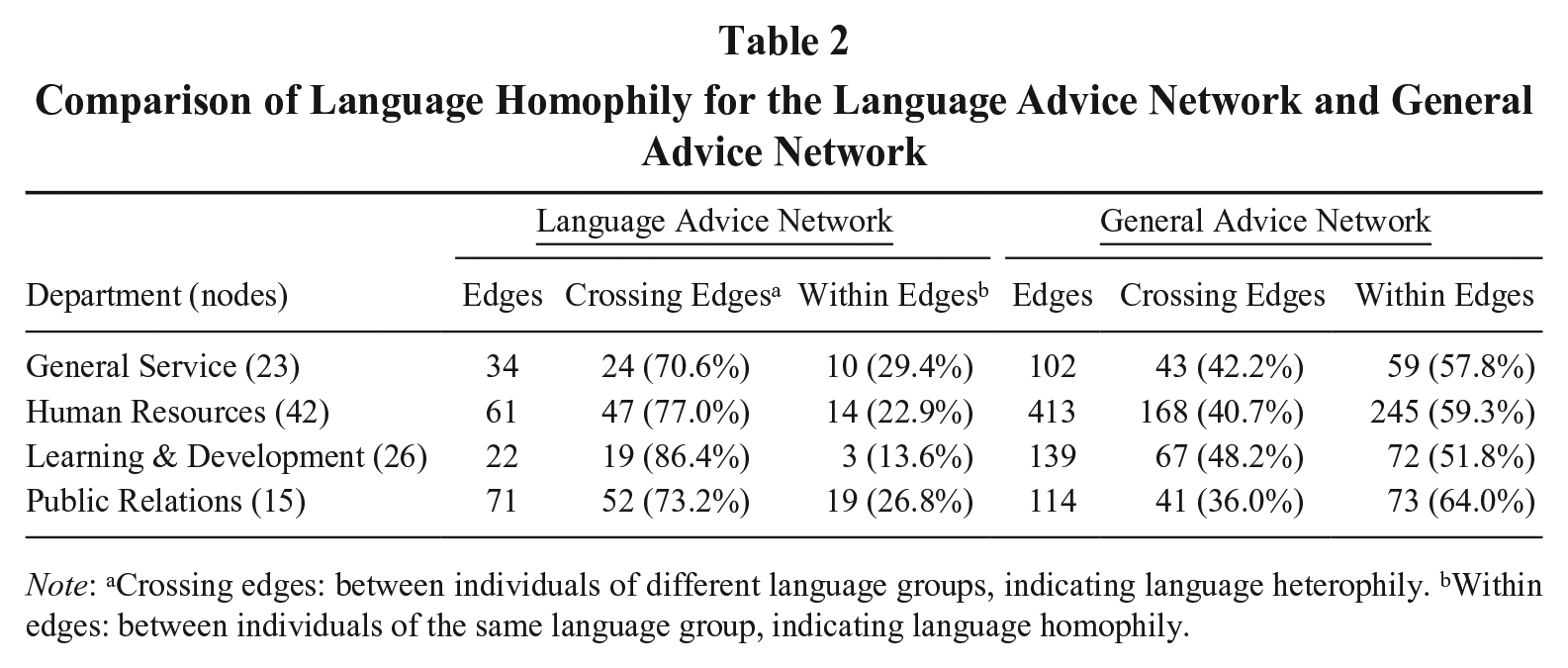
Note: aCrossing edges: between individuals of different language groups, indicating language heterophily. bWithin edges: between individuals of the same language group, indicating language homophily.
In sum, while some advice seekers preferred advisors from the same language group, they generally expressed a preference for approaching fluent speakers who are linguistically different from them. This was borne out in the social network analysis, and is interesting because previous studies reported that employees generally reach out to others who speak the same language (e.g., Piekkari et al., 2013; Sanden & Lønsmann, 2018).
Why Advisors Offer Language Advice: The Mechanisms
Our analysis revealed the following two mechanisms through which language advisors offer language help to less-fluent speakers.
Reputational giving
We noticed employees spoke very highly of acts of language helping around the workplace. Instead of feeling burdened, language advisors appeared happy to be asked and motivated to offer help. As an Indian procurement officer (male, age 55) noted during an informal conversation, “The more you share, the more you are regarded as a valuable team member, and this is how you gain people’s utmost respect.” There appeared to be a broad consensus among the language advisors that advice-giving equates to spreading one’s good reputation, as shared by an interviewee: Once my name appears in every project and my face appears in every meeting, they [management] will see how much I’m contributing . . . this will make me a valuable asset and they will see it too. (Gulf national, female, age 27)
When advice-givers were asked to elaborate why they engaged in providing language help to others, an Indian IT specialist explained during an informal conversation: Even though I don’t have to do it [give language advice], I still do it. It is so rewarding to help others . . . It’s good karma. Someday, someone will help me when I’m in need and this is what makes this act so admirable. (Indian, male, age 32)
Our participants expressed their beliefs that one day someone will reciprocate their good deeds. We therefore labelled this mechanism as reputational giving, consistent with the two roots of generalized exchange systems—reputation and gratitude (Simpson et al., 2018). The gratitude-based mechanism is presented next.
Paying it forward
Other employees spoke strongly about their gratitude for the language help they had received, how useful it was to them in performing their tasks and improving their language skills, and how they would (or did) reciprocate these good deeds to others in need. We labelled this mechanism “paying it forward,” in line with the generalized exchange literature (e.g., Baker & Bulkley, 2014; Hyde, 2000). The positive emotion of gratitude, contrasted with obligation, explains reciprocation to a third party (McCullough, Kimeldorf, & Cohen, 2008), and is consistent with the gratitude root of reciprocity in generalized exchange systems (Simpson et al., 2018). A manager from the Learning & Development Department elaborated on the paying-it-forward chain of indirect reciprocity during an informal conversation: Natalie was my former boss. She took me under her wing and trained me for the job. I shadowed her at all the upper management meetings . . . She taught me as little as the basics of writing an email. To be a good leader, like Natalie was, I am now doing the same for the young nationals. (Gulf national, male, age 41)
During informal conversations with employees, they frequently expressed their intention or willingness to reciprocate indirectly to a third party. The following interview quote from a young Gulf national employee epitomizes the intention of paying it forward: I need her [a senior colleague] to hear me go over my QPR [Quarterly Performance Review] presentation so she can spot if there are any mistakes, wrong spelling, or maybe a more professional way to say some segments of the presentation. This is my first time doing a QPR, but she’s been through many, and she knows what Omar [manager] wants. I’d do the same if one day someone asks me to help them. (Gulf national, female, age 24)
One female advisee who became an advisor four years later, spoke about her experience during a follow-up interview: “Over the years, I learnt so much by asking for [language] help. Now, I give it to those who are less fluent than I” (Palestinian, female, age 31).
Consequences of LAN Engagement
Our analysis in this section combines findings from phases 2 and 3 to assess the individual and organizational consequences of LAN. Based on continued observation, interviews, survey data and HR records, we found that both seekers and advisors enjoyed benefits through LAN engagement. While some of the benefits to individuals were apparent in phase 2, the benefits of LAN to the organization in terms of social integration were clearly pronounced in phase 3, corroborated especially from interviews with senior-level individuals who could provide the organizational perspective on the benefits of LAN.
We found that employees spoke very positively about their experience in language help-seeking and sharing because they gained tangible and intangible benefits. This includes noticeable performance improvement and personal growth for the advice seekers and respect and admiration from colleagues for the advisors. The HR records extracted for a 5-year period correspond with the interviewees’ self-evaluations in terms of improved language competency and performance and/or career progression.
Management and the leadership recognized that LAN advisors significantly contribute not only to the performance of their colleagues but also to the overall productivity of the firm. Informants in leadership positions fully acknowledged the front-line language practice of informal advice-seeking and advice-giving. While they could not formally prescribe or enforce or these practices, they fostered them through recognition. Accordingly, we assessed that management recognition plays an important role in sustaining the operation of LAN.
Improved performance and personal growth for advice seekers
The advice seekers received immediate and concrete benefits from their engagement in LAN because the LAN advisors helped them perform their tasks effectively and also helped them improve their language competency over time. As we learned through an interview and informal conversation, respectively: For me, it wasn’t just the help that I received from my colleagues but also the validation. After a while, I noticed that when I went asking for something to be double checked or proofread, I was almost always sent back without feedback because I wrote the report or the email well. This is when I knew I needed to build my confidence and be proud of how much I learned in the process. (Gulf national, female, 27) The writing and communication in general in organizations is very different from school and the way we communicate in social life. So I ask for my work to be checked and questions to elevate my writing skills and speaking to be like the professionals who have been around the organization longer. (Algerian, male, 26)
The improvement of the language skills of advice seekers through LAN was also acknowledged by a prominent advisor during an informal conversation: While the training course gives you an overview of the language competence required in the organization, it [LAN] takes less time to address the weaknesses that employees have in their language. So, it saves them time and improves their deficiencies very quickly. (British, female, age 54)
During the follow-up interviews four years later, several interviewees verified how engaging in LAN had significantly improved their language skills and made them grow over the period since the original interview.
When I joined Gulfco there were some terms and acronyms only people who have worked in this job know and that was much of why I engaged [in LAN, as a seeker]. Shortly after, I became an advisor and that made me feel really good about myself. (Gulf national, female, age 29)
In sum, language advice seekers reported that engaging in LAN gave them a sense of personal growth and improved their task performance. Such immediate benefits made them more confident in proactively seeking language advice, creating a virtuous circle between advice-seeking and its personal outcomes.
Status gain and career progress for LAN advisors
Our analysis showed that LAN advisors received positive returns even though language advising was not formally part of their job. These returns could be subtle or intangible such as respect and admiration from colleagues or recognition and approval from the management. Our participants referred to language advisors as “important contributors,” “knowledgeable colleagues,” or “go-to employees” to get the job done. In an environment where individuals compete for promotion, employees want to manage the impression that they have skills and knowledge worthy of recognition. Language advisors felt that they were thought of as “smart” and “helpful” by others and would be known to the leadership because of the extra help they gave to others, as indicated by an interviewee: When asked who helped, they will mention you. Your name will come up here and there. This is how you gain their respect and approval . . . The next time you’re in an elevator with one of the big guys, they’ll salute you by your name. (Indian, male, age 32)
Apart from intangible rewards, we found that tangible rewards were occasionally accorded to prominent LAN advisors, such as monetary awards and high annual performance ratings. For example, Star rewards are financial rewards given to employees who excel in a high-profile project or otherwise exceed management expectations. Star rewards range between 150 to 500 US dollars. A senior supervisor of an engineering team explained during an interview why he allocates Star rewards to prominent language advisors: As we [an engineering team] are located off-shore, our work is very delicate and precision is a must. One mistake can really hold us back and cost us millions . . . Some of the [English] language we use in the plant is highly technical and so new staff are not really aware of it. I expect some of my star employees to advise [on technical words in English] . . . Once in a while, I grant them [language advisors] a Star reward. (Indian, male, age 54)
To confirm the eligibility of Star rewards, the HR policy team verified through interviews that LAN advisors were deserving of them. A Policy and Procedure specialist elaborated: We try not to make a habit of granting them [Star rewards, including for language advisors] whenever requested. But some individuals exceed our expectations, and to encourage teamwork and collaboration, we reward them . . . they get motivated, others want the same and imitate, and so their collective performance improves. (Australian, female, age 42)
In addition to Star rewards, prominent language advisors received high performance ratings. Raj in Corporate Planning, for instance, confirmed through an interview that he had received exceptional ratings (the highest being 4 and the lowest 1) throughout his tenure in Gulfco: I’m not sure if I’m allowed to share this [laughs]. I have had the pleasure of receiving "4” two years in a row. Before that, I had “3.” I’m just active in sharing my [English] knowledge in the department, and I mentor the little ones that join . . .. I guess they [management] see it as valuable, I mean, they appreciate it. (Indian, male, age 38)
These findings were corroborated by an OLS multiple regression analysis, using our social network survey data and the company’s performance ratings obtained from HR records. Table 3 shows that the LAN advising score is positively and significantly associated with the KPI performance score (beta = .23, p = .019) after controlling for the English language fluency score, sex, age, tenure, job level, and education. Importantly, the LAN advising score explains KPI above and beyond English fluency. This indicates that language advising is recognized as an important performance component beyond English competency.
OLS Multiple Regression on Annual Performance Rating (KPI)
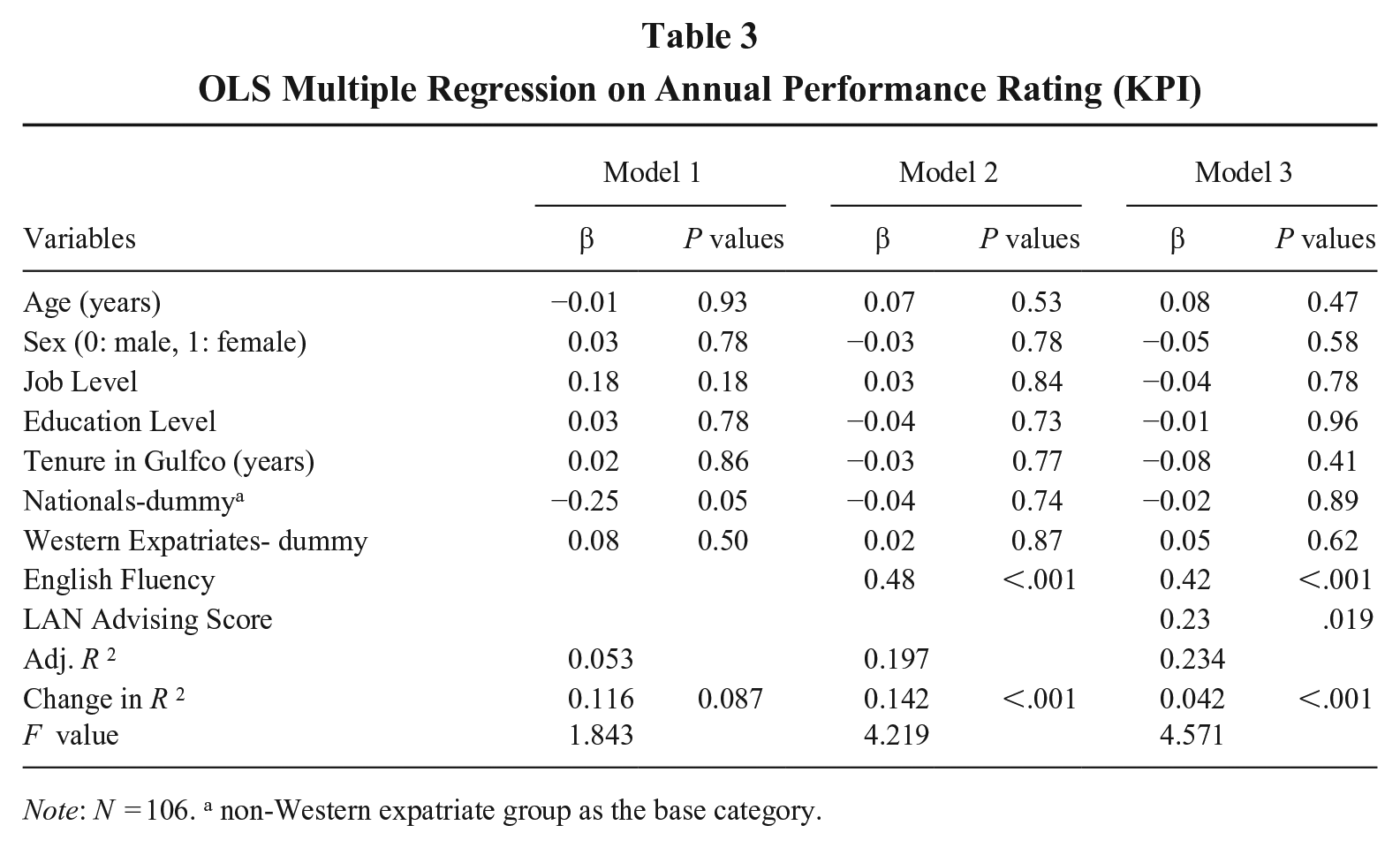
Note: N = 106. a non-Western expatriate group as the base category.
Our follow-up interviewees four years later confirmed that language advisors generally make better career progress compared to non-advisors. Progress in the form of promotions and financial rewards was particularly pronounced. We asked individuals who made speedy career progression to reflect on the past four years leading to their new roles. Sara, for example, was a fresh graduate when we first interviewed her. Four years later, she had been promoted to a supervisory role in the same department. She explained: When you are willing to help others and give them direction, that makes you the perfect candidate to get promoted. It is not just being fluent in the language of business but also ensuring everyone else learns and improves. . . (Gulf national, female, age 33)
Our participants’ reflections on sharing language knowledge show that their good deeds are widely appreciated not only by advice seekers but by colleagues and management. Such appreciation, whether expected or not, may contribute to reducing costs associated with knowledge sharing, and encourage the advice sharers to continue engaging in LAN.
Social integration in the organization
We found that engagement through LAN helped break social barriers and fostered trust among employees of different native languages as described by these follow-up interviewees: It breaks unnecessary boundaries between team members, making them feel they can ask each other for anything without judgment. That makes a very productive and successful team. (Jordanian, male, age 55) You start forming a connection due to the re-occurring interactions [language advising]. You start to relate to them and ask them to help you back in learning some words in Arabic or their native language. You get to know them at a personal level and not just a professional level. (British, male, age 59)
Another follow-up interviewee explicitly points to the benefit of the corporate English language policy in bringing people of different backgrounds together: We are all different in obvious ways: where we come from and the cultures we belong to. But the one thing that brings us together is the workplace . . . and suddenly we don’t see our differences when we work together for a common vision. Plus, working in one language, even if we are not so good at it, makes it possible . . . The level of language [fluency] is not an issue because we have the good ones to compensate for the poor ones. (Sri Lankan, male, age 41)
We reasoned from our analysis that the lingua-franca mandate has the unexpected benefit of fostering a learning and helping culture that brings people of different native languages together. While this may be the general expectation of a lingua franca mandate, previous studies indicate that this is difficult to achieve. Individuals in our study increased interpersonal interactions and strengthened their existing relationships or formed new relationships due to the need for language help. These interactions were often extended to supporting colleagues in other ways, further enhancing social integration in the organization.
Most notably, in our follow-up interviews, we found that participants spoke highly of LAN as a means to promote an inclusive work environment and engender a positive learning culture. For instance, the HR manager expressed her view that LAN engagement is a knowledge system where employees rely on each other to learn and grow. She went on to state the importance of LAN for the organization: We must be doing something right . . . although we have lessened the training budget, especially for behavioral competencies, and still see no deterioration in the performance reviews of the employees, it means that they [employees] have created a system that replaces the language training courses. It may very well be because of LAN in the organization. (Gulf national, female, age 42)
Laura, a senior supervisor in the Succession Planning and Talent Pool Management Division, shared a similar view: It [LAN] definitely brings employees closer and shows that everyone has something to offer here [HQ] in the organization. If this is a practice across the whole organization [MNC], we definitely have an irreplicable learning culture. (British, female, age 54)
Overall, the findings of follow-up interviews confirmed the continued existence of LAN four years later, with advice seekers and advisors continuing their activities despite the turnover of several network participants who had been originally interviewed, thereby making connections with new network participants across language groups. Importantly, LAN was viewed as instrumental to the company’s social integration manifested by an inclusive, learning culture. It is worth noting that management was fully aware of the frontline language-advice-sharing practice in LAN, and indirectly helped promote it through continued recognition of the members’ active LAN engagement.
Discussion
Our study was driven by the contextual phenomenon of high language diversity combined with low proficiency and high asymmetry of lingua franca fluency in our research organization and wider regional context. We took a mixed-methods, grounded approach to identify the existence and prevalence of an informal lingua franca–based social network that we labelled LAN, where many employees voluntarily seek and share English language knowledge across linguistic boundaries, thereby contributing to social integration. Based on these findings, we developed an analytical framework that explains the conditions, inner workings, and consequences of LAN (see Figure 2).
Participant observation and interviews revealed that individuals seeking language advice often approached advisors outside their own language group, fostering social ties across linguistic boundaries. Those providing language advice reciprocated the help they had received from others or because they believed an act of goodwill would ultimately benefit them. Prominent language advisors gained respect and admiration among colleagues and were often rewarded through financial gains and speedy career progress, which helped sustain and even encourage using LAN in the organization. These findings differ from extant research that has mostly focused on the loss of status and power differentials that inhibit the careers of non-native lingua franca speakers (e.g., Neeley, 2013; Neeley & Dumas, 2016). Further, the predominantly positive tone of LAN engagement was unexpected, given contrary findings in the lingua franca literature (e.g., Piekkari et al., 2013). Our findings challenge the predominantly problem-focused view of a corporate lingua franca mandate in the literature.
The remainder of our discussion addresses the theoretical contributions, limitations and future research directions, and practical implications of our study.
Theoretical Contributions
Our research makes two major contributions. First, we contribute to the diversity literature, language diversity in particular, by providing a nuanced understanding of the role of context and how it informs the nature of diversity and the resulting social dynamic in the workplace. The language diversity in our research context is characterized by maximum variety (Harrison & Klein, 2007); the number of native languages spoken in the workforce was very high, and the language groups were proportionately distributed rather than skewed towards one group. More broadly, this context reflects a “majority-minority” society (Gest, 2021) where no single ethnic, racial, or language group forms the majority of the population. Such distinct social demographics bring linguistic superdiversity (Sanden, 2020) in organizations where a key challenge is encouraging employees of different native languages to connect, communicate and collaborate effectively.
We specify several contextual conditions that facilitate, rather than hamper, different native language speakers to connect and collaborate and thus positively contribute to workplace social integration. We argue that contextual conditions inform how employees interpret the meaning of lingua franca and language help-seeking behaviors. Our participants perceived the English language as a practical tool for daily task completion. There was thus little inhibition, embarrassment, or feeling of inferiority for the less-fluent speakers to seek language help from more fluent speakers. We theorize that the structural composition of people relating to lingua franca in our research organization, namely, the number and proportion of native language groups, the average level of lingua franca fluency, and the distribution of different proficiency levels in the workplace, informed the way individuals seek language advice and who they choose to approach for language advice.
Our findings are important because linguistic superdiversity rapidly shapes workplaces worldwide due to migration and globalization processes (Arnaut, Blommaert, Rampton, & Spotti, 2016), particularly in global cities that are crucial investment locations for MNCs (Chakravarty, Goerzen, Musteen, & Ahsan, 2021). Our research setting represents a global migration hub and showcases how this important yet underexplored workplace characteristic might fundamentally alter how scholars (and management practitioners) approach and analyze the effect of lingua franca mandates on individuals and organizations. Our research thus contributes to formulating an exciting new research agenda in the field.
Second, we enrich the language and lingua franca studies by bridging it with the social networks and generalized exchange literature, two important and highly relevant research streams. Extant research shows that employees’ language competency is positively related to their status (e.g., Neeley, 2013; Neeley & Dumas, 2016) and career (e.g., Itani et al., 2015; Peltokorpi, 2023). Our research suggests that not only language competency per se but also the sharing of language knowledge is career capital. In the context of a firm where the workforce’s lingua franca proficiency is generally low, language knowledge sharing helps improve individual advice seekers’ performance and contributes to the overall functioning of the firm. As a result, prominent language advisors are widely valued, admired by colleagues, and often formally recognized by the management.
Furthermore, we showcase in our analysis that lingua franca is the knowledge being sought and therefore serves as the basis to form a social network, the LAN. Advice seekers in LAN tend to approach colleagues who are different from them. This is interesting because social network theory suggests similarities to be the key antecedent to form ties between individuals (e.g., Ibarra, 1993). In this regard, the LAN is a distinctive form of network that does not align with the homophily principle in the formation of social networks. It therefore supports the notion that while friendship ties are often homophilous, instrumental ties are often forged with dissimilar others (e.g., Hansen, 1999). In this way, we add to the existing literature on the generation of advice networks (Nebus, 2006), particularly advice networks revolving around corporate lingua franca (Piekkari et al., 2013). Our study is the first social networks-based study on language and lingua franca in a corporate setting that utilizes social networks theories to provide explanatory power for why work colleagues engage with one another in language knowledge seeking and sharing. This differs from a study by Piekkari et al. (2013) that found social networks to be a coping mechanism for knowledge seeking and sharing outside of the immediate collegial information network, for instance, family and friends outside the organization. Our study thus advances our understanding of language networks in organizations.
We also bridge the language and generalized exchange literature. Utilizing rich qualitative data, we propose that two generalized exchange mechanisms, reputational giving and paying it forward, complementarily explain why fluent lingua franca speakers willingly share language knowledge even though doing so is not part of their job requirements and might overburden them and/or disrupt their work. The importance of generalized exchange has been well documented in classical social exchange literature (e.g., Blau, 1964; Emerson, 1976). However, organizational and management research primarily focuses on a dyadic and direct exchange between two actors such as the exchange between supervisor and subordinate or between employee and organization (Yoshikawa et al., 2018).
Generalized exchange is crucial for contemporary organizations to best utilize organizational social capital as it facilitates multidirectional flows of resources among organization members (Levine & Prietula, 2012). This is especially so when the use of resources can be maximized when they are exchanged between multiple actors, such as language knowledge sharing in our study. In addition, collective reciprocity through generalized exchange promotes a psychological bond between organizational members that translates into high trust and social integration at the organizational level (Molm et al., 2007). Our study thus underscores the importance of moving beyond assumptions of reciprocity in dyadic relationships found in much organizational scholarship.
Limitations and Future Research Direction
There are several limitations of the study that offer avenues for future research. One is that our study was conducted in one MNC in a distinctive context. The immediate generalizability of our findings may be limited to the Arabian Gulf region where most countries share similar contexts in terms of the low ratio of nationals to non-nationals and where the use of English is becoming more widespread (Nickerson, 2015). Nevertheless, we are witnessing a growing trend of migration globally, such that workplaces in MNCs located in other areas of the world are likely to gain numerous employees for whom the corporate lingua franca is not their mother tongue. We encourage more research in similar research settings to further corroborate the inner workings of LAN revealed in our study. Global cities attract a large influx of migration and a shift in the workforce composition is underway such that previously dominant ethnic groups may well become a numerical minority (Gest, 2021). We see evidence of this in Germany and other European countries that have experienced a rapid influx of migrants from Turkey, Syria, and Eastern European countries.
Furthermore, cases of under-researched contexts are encouraged in language research because the scope of regions and countries covered in the field remains severely limited (Tenzer, Terjesen, & Harzing, 2017). The Middle East is one of the least represented geographic areas in the international management literature (Barkema, Chen, George, Luo, & Tsui, 2015), and our study addresses this by investigating how lingua franca policies provide both challenges and benefits for the organization in this under-studied context. We therefore recommend expanding the scope of regions and countries in future research on language and lingua franca in MNCs. As this study demonstrates, a lingua franca mandate can unexpectedly foster social integration and intra-firm knowledge sharing in a highly multilingual context. By exploring novel and under-studied contexts, or what may appear to be “extreme cases” (Eisenhardt, 1989) at present, will offer valuable insights because it is a harbinger of workplaces in other parts of the world.
Although not revealed during the observations and interviews, there could have been discontent among those who opted out of LAN engagement. Not everyone actively engaged in LAN, as shown in the advice-seeking and advising scores from the social network analysis. While low-fluency individuals could benefit from advice-seeking, some rarely sought advice; similarly, some fluent speakers rarely offered advice, according to the advising scores. We did not focus on the possible dark side of this non-engagement. Some individuals may have avoided engagement, or engaged only with those in their native language groups. In Sanden and Lønsmann’s (2018) study, for example, employees were found to use their discretionary power of whether to avoid foreign language interaction. In our research context, however, all employees could not escape from the need to use English, which for most was a foreign language.
Future research would benefit from focusing on both those who actively engage and those who do not, and further theorize on the implications of the non-engaging individuals for generalized exchange systems, and what would motivate them to engage. Relatedly, future research could explore personality and individual differences such as generalized exchange orientation (Yoshikawa et al., 2020) to understand why some fluent speakers are more likely to share their knowledge than others. Also, the intersectionality of individual demographics such as nationality, gender, race, and age amongst others (e.g., Fitzsimmons, Baggs, & Brannen, 2020; Johansson & Sliwa, 2016) may shed further light on individual motivation for engagement or disengagement in language knowledge sharing. Finally, although it did not appear in our dataset, we would be remiss not to suggest that individual perceptions of English hegemony, regardless of one’s English proficiency, may have influenced non-engagement.
Managerial Implications
Our study highlights the pivotal role of management in the recognition of employees’ self-initiated LAN engagement in sustaining the LAN system and its positive consequences, providing a fresh insight into language management in MNCs. Our findings suggest that any organizational attempts to encourage knowledge-sharing between employees should first create a climate that helps reduce the costs of individuals’ knowledge exchange activities. For instance, managers need to ensure that language knowledge seekers have a sense of psychological safety as speaking up about language deficiencies can be stressful (Aichhorn & Puck, 2017). In our research organization, interviewees mentioned the impact of subtle management recognition of LAN activities that sets a positive tone for building a learning culture. At a more concrete level, line managers and HR department should carefully consider a reward structure that reflects individuals’ voluntary contributions to knowledge-sharing activities. In our case, active LAN advising was readily acknowledged and compensated through various forms of intangible and tangible rewards, which further strengthened employees’ motivation to share language-knowledge.
Lingua franca is a form of knowledge and affects the overall effectiveness of the MNCs. Therefore, the language knowledge residing among members should be utilized through broad tie formations between individuals of different language proficiency. We show that some individuals took a dual role in LAN, knowledge seeking and sharing, whereas others who had been at the receiving end of English knowledge became knowledge sharers after four years. However, management should not rely on individuals alone to improve lingua franca capacity, but should have a clear language strategy in place. A heavy reliance on individuals’ voluntary initiatives without providing a proper formal language support system could lead to employees feeling exploited, and ultimately not be sustainable. Also, managers should be aware that there are many nuanced layers that can affect not only individual proficiency in lingua franca but also the inclination to engage. These may have to do with the intersection of historical and demographic issues including colonialist history, employee nationality, age, gender, and race (e.g., Fiset et al., 2024; Fitzsimmons et al., 2020; Johansson & Sliwa, 2016). While lingua franca proficiency should be factored into hiring, evaluation, and promotion decisions, management should not overvalue language skills at the expense of domain knowledge—technical and social skills, for example. In addition, the lingua franca policy must be sensitive to employees’ need to speak their native languages (Neeley & Kaplan, 2014), especially in the context where workforce lingua franca proficiency is low, like our research sample.
We view our research as a fresh step to embrace the future workplace where we must seek new ways of understanding and theorizing by incorporating contextual elements. By presenting an extreme case, our study demonstrates how researchers can engage with the changing linguistic demography of the workplace. Furthermore, our model incorporating the structural conditions of LAN, underpinning mechanisms of language knowledge sharing, and various (positive) consequences of LAN, will stimulate further innovations in the way we analyze workplace language diversity and the corporate lingua franca.
Supplemental Material
sj-docx-1-jom-10.1177_01492063251337067 – Supplemental material for The Unexpected Upside of High Language Diversity: Social Integration Through Language Advice Networks
Supplemental material, sj-docx-1-jom-10.1177_01492063251337067 for The Unexpected Upside of High Language Diversity: Social Integration Through Language Advice Networks by Mai Al-Naemi, Hyun-Jung Lee and Carol Reade in Journal of Management
Footnotes
Acknowledgements
We would like to thank the three anonymous reviewers and Associate Editor Nicky Dries for their highly constructive comments that helped to bring our paper to its fullest potential. We are also appreciative of the feedback from reviewers at the Academy of Management, where an earlier version of this paper won the 2024 Carolyn B. Dexter Award.

Supplemental material for this article is available with the manuscript on the JOM website.
References
Supplementary Material
Please find the following supplemental material available below.
For Open Access articles published under a Creative Commons License, all supplemental material carries the same license as the article it is associated with.
For non-Open Access articles published, all supplemental material carries a non-exclusive license, and permission requests for re-use of supplemental material or any part of supplemental material shall be sent directly to the copyright owner as specified in the copyright notice associated with the article.
