




Abstract
Managerial mental representations (MMRs) are mental constructs that structure cognitive content to guide perception and interpretation. MMRs have been examined across a broad spectrum of management research contexts, leading to the use of numerous related terms such as “mental representation,” “schema,” “mental model,” “cognitive frame,” “cognitive map,” and “mindset.” This proliferation of terms has caused considerable definitional overlap and ambiguity. To foster definitional clarity, this review systematically analyzes 206 articles employing any of 33 MMR terms used during the past 30 years. We identify the conceptual and functional definition facets of MMRs and use them to analyze commonalities and differences among the most prominent MMR terms. We further examine both established and emerging discussions surrounding the characteristics of MMRs. Established discussions focus on MMR content and levels of analysis, while emerging discussions explore MMR permanence and implicitness. We propose suggestions to advance each conversation. Based on this comprehensive analysis, we create a guiding framework aiding future research to conceptualize MMRs and navigate terminology choices. Finally, we propose two future research directions: integrating the content and process perspectives on MMRs and applying an MMR lens to examine the emergence of artificial intelligence in organizations.
Keywords
To effectively navigate the complexity of organizations, decision-makers create managerial mental representations (MMRs), referring to simplified, structured cognitive content shaped by prior experiences. MMRs guide managers’ perceptions, allowing them to interpret their surroundings, predict the outcomes of decision alternatives, and take action (Barr, Stimpert, & Huff, 1992; Hodgkinson & Healey, 2008; Narayanan, Zane, & Kemmerer, 2011; Simon, 1955). Managerial mental representations are a foundational component of managerial cognition and can take many different forms, such as cognitive maps outlining competitive landscapes, categories for strategic opportunities, or social network representations of organizational roles. While the broad application of MMR constructs in management research attests to their importance, it has also led to considerable conceptual ambiguity.
MMRs have been studied in a wide array of theoretical contexts such as dynamic capabilities (Kor & Mesko, 2013), competitive strategy (Hodgkinson, 1997a), organization design (Puranam & Swamy, 2016), organizational learning (Westbrock, Muehlfeld, & Weitzel, 2019), and innovation (Tripsas & Gavetti, 2000), employing a plethora of related terms like “schema,” “mental model,” “cognitive frame,” “cognitive map,” and “mindset” (Kaplan, 2011; Martignoni, Menon, & Siggelkow, 2016; Nadkarni & Narayanan, 2007a; Narayanan et al., 2011).
Additionally, MMRs are studied from two contrasting conceptual perspectives, each deeply rooted in historical thought. The representational perspective emphasizes how MMRs mirror an objective reality, while the cognitive constructivist perspective examines how MMRs emerge and evolve as subjective and intersubjective interpretations.
The diverse research contexts, the proliferation of related terms, and the contrasting conceptual perspectives have resulted in the aforementioned ontological ambiguities (Dewulf et al., 2009; Hodgkinson et al., 2023; Tsoukas, Patriotta, Sutcliffe, & Maitlis, 2020; Walsh, 1995). This ambiguity not only hinders the accumulation and integration of knowledge but may also discourage researchers from engaging with MMR research, thereby stifling new contributions.
Despite persistent calls for greater conceptual clarity (Dewulf et al., 2009; Hodgkinson et al., 2023; Tsoukas et al., 2020; Walsh, 1995), these concerns remain unresolved. Instead, prior work has examined specific MMR terms, such as “team mental models” (Mohammed, Ferzandi, & Hamilton, 2010), “cognitive frames” (Dewulf et al., 2009), “cognitive maps” (Eden, 1992), “dominant logics” (Engelmann, Kump, & Schweiger, 2020), as well as “heuristics and biases” (Hodgkinson et al., 2023). Others have reflected on seminal work (Bromiley, Koumakhov, Rousseau, & Starbuck, 2019; Kaplan, 2011), explored organizational implications (Narayanan et al., 2011), or aimed to establish a behavioral strategy research lens (Hambrick & Crossland, 2018; Powell, Lovallo, & Fox, 2011).
This review’s purpose is to address the conceptual ambiguity surrounding MMRs. To this end, we first examine 33 MMR “para-synonyms,” that is, terms related to organizational cognitive content, employed in 206 publications over 30 years. We identify the key terms in MMR research and their underlying ontological assumptions by decomposing each MMR conceptualization into individual definition facets. Identifying both shared and unique definition facets of MMR terms provides the empirical foundation to assess and resolve the ambiguities created by MMR term proliferation.
To facilitate conceptual integration, we examine the scholarly discussions associated with MMR characteristics. We identify established discussions related to MMR content and level—from individual to group, organizational, industry, and market—as well as emerging discussions on MMR permanence and explicitness. Finally, based on our extensive literature review, we develop a guiding framework to navigate terminological choices and direct future research along two promising paths.
Our endeavor is particularly timely, given that the emergence of artificial intelligence (AI) technologies raises new questions about what distinguishes human cognition from AI, prompting a reassessment of long-held assumptions surrounding the role and value of human cognition within organizations (Krakowski, Luger, & Raisch, 2023). We contend that enhancing conceptual clarity around MMR establishes a robust theoretical foundation for this discussion.
This review offers three key contributions that collectively address the conceptual ambiguity surrounding MMRs. First, we identified six fundamental MMR definition facets. These facets allow us to discuss the similarities and differences among key MMR terms (“schema,” “mental model,” “cognitive frame,” “cognitive map,” and “mindset”). Second, we promote integration by examining both established and emerging discussions surrounding MMR characteristics, proposing new avenues for advancement beyond the representational and cognitive constructivist divide. Third, we encourage future research not only by providing a guiding framework to navigate terminology choices but also by offering two promising research paths. These reflect the opportunity to advance managerial cognition research by integrating cognitive content and cognitive process perspectives, as well as the potential to leverage MMRs as a theoretical lens to understand the evolving role of human decision-making within organizations in the context of AI.
Historical Foundations and Ontological Assumptions
MMRs have been studied from contrasting ontological perspectives, which should come as no surprise, considering the ancient roots of the concept. Anaxagoras (500–428 BCE) introduced the notion of mind (nous) as a distinct force that imposes order on the elements of a chaotic reality (apeiron; Warren, 2007). This idea is echoed in Critique of Pure Reason, where Kant (1781) discusses the concept of a schema as a subjective framework through which the mind interprets external objective elements (the thing-in-itself). In contrast, Berkeley’s (1710) A Treatise Concerning the Principles of Human Knowledge advanced a more radical notion. He argued that familiar objects, such as tables and chairs, are merely ideas perceived by the mind and, as such, cannot exist independently of being perceived. Various disciplines, including psychology (Bartlett, 1932), economics (Simon, 1955), artificial intelligence (Minsky, 1974), and organizational studies (March & Simon, 1958), have continued to examine mental representations with slightly diverging assumptions. This diverse engagement has naturally led to conceptual ambiguities, overlaps, and evolutions over time (Fiol & Huff, 1992; Hodgkinson & Healey, 2008; Hodgkinson & Sparrow, 2002; Hodgkinson et al., 2023; Huff, 1990; Porac, Thomas, & Baden-Fuller, 1989; Tsoukas et al., 2020; Walsh, 1995).
Despite the expansion of the MMR concept, the most fundamental differences in ontological assumptions about mental representations were already evident in the work of philosophers, and remain relevant in contemporary management research. While Anaxagoras and Kant explored how the mind represents an objective environment, Berkeley proposed that objects cannot exist without being construed by the mind. This difference in assumptions is echoed in today’s discussions about why MMRs matter for managers and their organizations: The representational perspective suggests that MMRs generate value by accurately or effectively representing the environment (e.g., Csaszar & Levinthal, 2016; Gary & Wood, 2011), while the cognitive constructivist perspective posits that the value of MMRs lies in their role as personalized and intersubjective abstractions that facilitate interpretations and decisions (e.g., Atanasiu, Ruotsalainen, & N. Khapova, 2023; Daniels, Johnson, & de Chernatony, 2002; Hodgkinson, 1997b; Reger & Huff, 1993). To explicate this distinction further, representationalists are primarily concerned with how MMRs interact with the objective reality of the task environment, investigating how these representations reflect or distort reality and how they can be optimized to improve decision-making and problem-solving. Cognitive constructivists, meanwhile, focus on MMRs themselves, exploring how these mental representations are construed and evolve over time.
A related ontological divide that has long been recognized by cognition scholars (Lant & Shapira, 2000) contrasts the computational perspective, which views cognition as a system of mental representations corresponding to the external world that the mind manipulates to produce behavior (Hodgkinson & Healey, 2008), with the interpretivist perspective, which argues that individuals actively construct and thereby interpret their environments (Smircich & Stubbart, 1985). Notwithstanding this debate, the underlying ontological assumptions in applied MMR research often remain implicit.
Additionally, epistemological ambiguities arise from the fact that MMRs cannot be observed directly. This poses a significant challenge for operationalization, leading to diverse empirical methodologies, each with unique assumptions about the nature of MMRs. These range from qualitative work identifying MMRs through inductive coding (Kaplan, 2008) to quantitative content analyses (Nadkarni & Narayanan, 2007a) and experience-based approaches (Lee & Csaszar, 2020). Others employ simulations (Denrell, Fang, & Levinthal, 2004) or formal models (Slegers, Brake, & Doherty, 2000). MMRs have even inspired idiosyncratic methodological approaches, such as techniques to uncover system dynamics and causality through causal mapping (Axelrod, 1976; Kelly, 1955), as well as approaches to elicit dimensional and hierarchical representations with the help of repertory grids (Hodgkinson, 1997b; Reger & Huff, 1993; Wright, 2004). Other works have discussed these techniques in detail and provide excellent introductions (Fiol & Huff, 1992; Hodgkinson & Healey, 2008; Huff, 1990; Kaplan, 2011; Walsh, 1995).
To conclude, the ambiguities associated with MMRs arise not only from their broad dissemination but also from their deep historical foundations, differences in ontological assumptions between the representational and cognitive constructivist perspectives, and vastly diverging methodological approaches. In this review, we do not aim to attribute more or less value to any perspective; instead, we recognize that diverse views contribute to a richer understanding of MMRs. Our goal is to enhance conceptual clarity and offer suggestions for integration to foster future scholarly discussion. To achieve this goal, our examination of the relevant literature will be deliberately broad, while our focus will be sharply concentrated on the conceptualization of MMRs.
Methodology
Article Selection
We initiated our analysis by identifying search terms related to MMRs, drawing on foundational research (Walsh, 1995) and discussions with leading scholars in the field. We expanded our list based on articles mentioning MMR synonyms (e.g., Martignoni et al., 2016; Nadkarni & Narayanan, 2007a) and earlier literature reviews focusing on managerial cognition (Bromiley et al., 2019; Eden, 1992; Hodgkinson & Thomas, 1997; Hodgkinson et al., 2023; Kaplan, 2011; Meindl, Stubbart, & Porac, 1994; Narayanan et al., 2011; Porac & Thomas, 1989; Sandberg & Tsoukas, 2015). As our analytical focus is on MMRs—considered as structured cognitive content—we deliberately omitted terms related to actions or cognitive processes, such as “attention,” “signaling,” or “information processing.”
We identified 33 terms, which we used to search for relevant publications in top journals focused on organizational cognition and decision-making. We recognize the pivotal role played by Walsh’s (1995) review in shaping this field by adeptly synthesizing existing research. Therefore, our primary focus was on post-Walsh works, although we included articles after 1993 to account for those in press during his publication process. Despite this, we do reference seminal earlier works that continue to exert a significant influence on the field. Our review aimed to explore how MMR terms are employed in a wide range of scholarly practice, from investigations of managerial cognition to those that utilize MMRs as a secondary concept for analyzing organizational phenomena.
To account for the broad spectrum of MMR research, we used a multi-stage selection process to identify relevant articles. First, we retrieved 5,099 articles from the EBSCO database based on specified keywords and publication outlets. Second, we narrowed the selection down to the 1,234 articles that used our search terms in their title or keywords. Third, we examined the selected articles in more depth, applying specific criteria to identify those that best contributed to our understanding of MMRs. We selected articles that considered MMRs as a cognitive construct. We excluded some articles that referred to the search terms because they primarily focused on theorizing in the context of neo-institutionalism (DiMaggio, 1997; DiMaggio & Powell, 1983) or social processes of interactional meaning creation (Sandberg & Tsoukas, 2015; Weick, 1995), and thus deemphasized the role of cognition. We defined “managerial” mental representations as those linked to organizational behavior and decision-making.
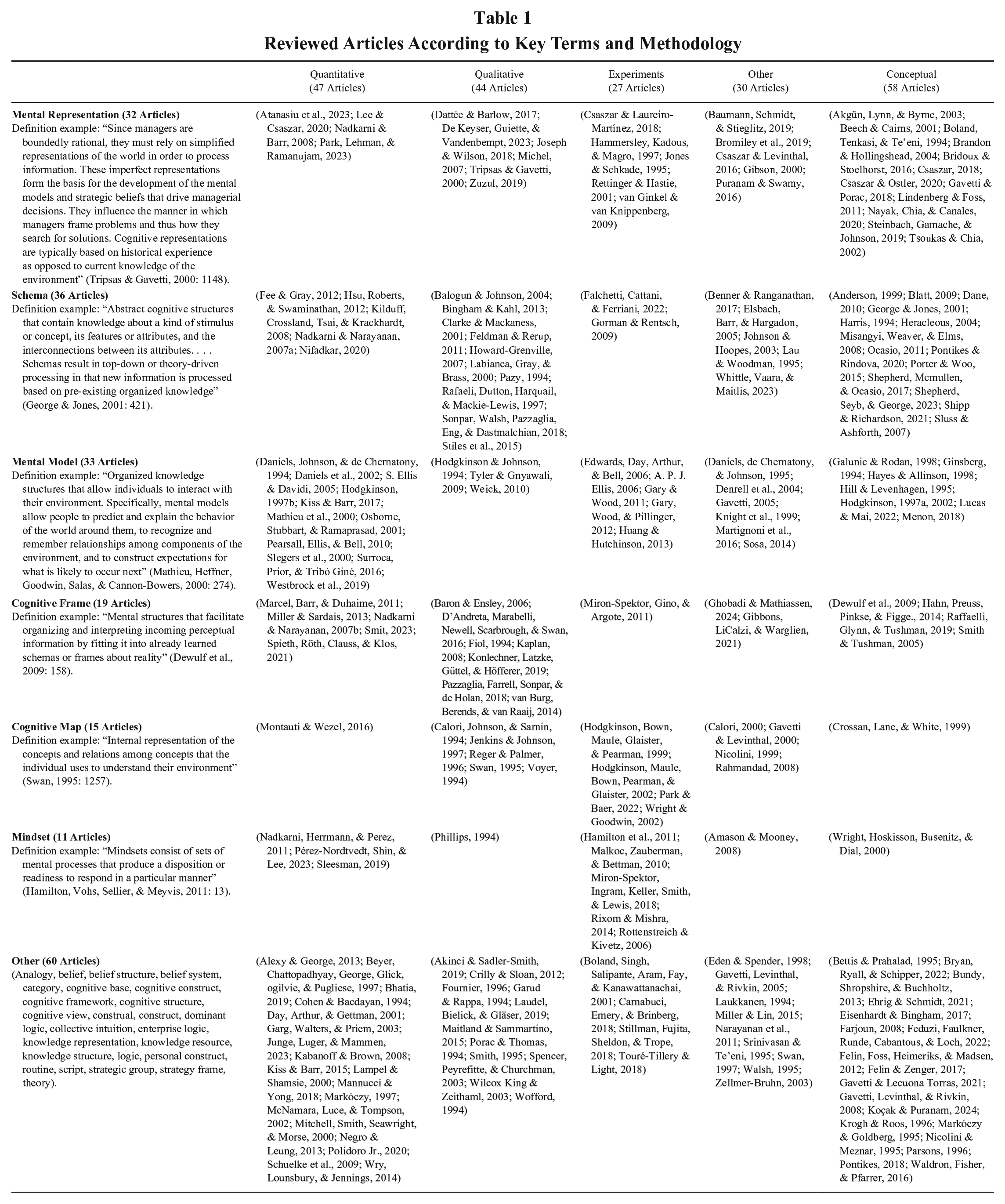
To include publications that do not mention MMR terms in the abstract or use permutations of search terms (“cognitive template” vs. “mental template”) in the title or keywords, we employed a machine learning algorithm. We utilized the ASReview framework (van de Schoot et al., 2021) to enhance our literature review with active learning. The initial model was trained on 1,234 articles already labeled as relevant or irrelevant. In the active learning loop, unlabeled articles from the initial dataset were presented for evaluation, prioritizing the ones most likely to be relevant. This process continued until 150 irrelevant publications were identified after the last relevant one, resulting in a total of 2,894 reviewed publications. This method yielded 51 additional articles from our initial dataset of 5,099 articles. Ultimately, we compiled 206 articles. Figure 1 visualizes our selection process. Given the large number of reviewed publications, we are unable to cite all relevant pieces in our manuscript. Instead, we have attempted to provide a selective and balanced overview of recent empirical research, and foundational theoretical work. Table 1 presents the reviewed literature.
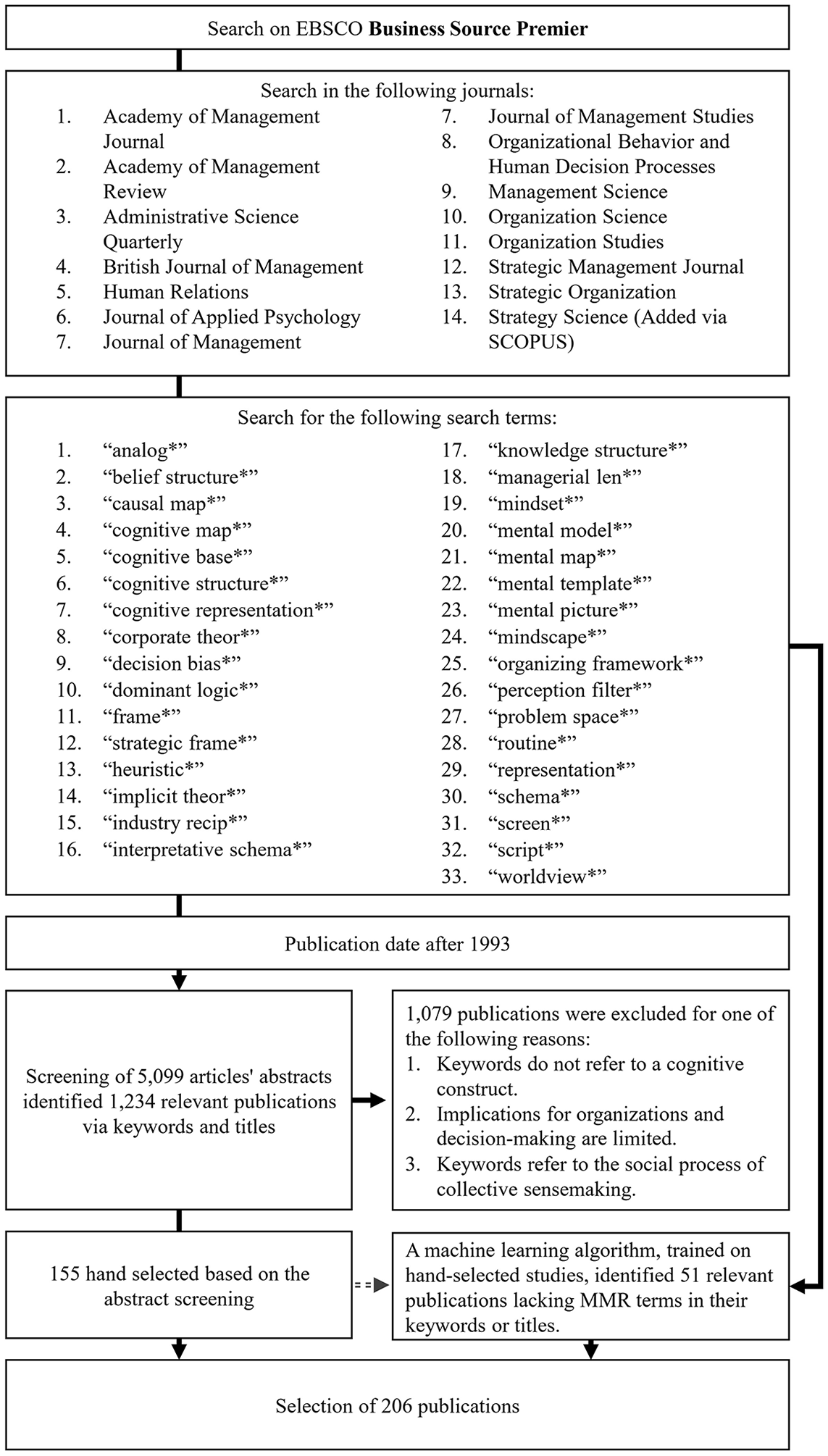
Article Inclusion and Exclusion Steps and Criteria
Reviewed Articles According to Key Terms and Methodology
Coding Process
We employed an inductive yet structured approach to review the selected articles (Cronin & George, 2023; Simsek, Fox, & Heavey, 2023). The first author reviewed all pre-selected articles and extracted basic details (e.g., authors, title, year, journal) and extended information into a comprehensive database. This database included (1) key terms related to managerial mental representations (MMRs); (2) text defining MMRs and their purpose or characteristics; (3) theoretical background; (4) type of article and methods; (5) empirical or conceptual findings; and (6) a short self-compiled summary. The other two authors assessed the database’s comprehensiveness and reviewed a sample to develop a preliminary coding scheme, capturing definition facets and characteristics of MMR-related terms. Subsequently, we used an emergent coding process (Onwuegbuzie, Frels, & Hwang, 2016; Saldaña, 2013). The first author iteratively refined the coding scheme while coding all articles, documenting new or adjusted codes as needed to reflect the essence of MMR definition facets and characteristics. After completing the coding, the first author developed a coding handbook with detailed instructions, descriptions, and illustrative examples for each code. To establish reliability, the third author independently coded all articles using the handbook. Discrepancies arose primarily with definitions that differed in wording but conveyed equivalent meanings or finer-grained nuances (e.g., synonyms or variations for “structured knowledge,” such as interrelations or hierarchies of concepts). These discrepancies were resolved collaboratively by expanding examples in the handbook to accommodate conceptual variations. This iterative refinement allowed for necessary scrutiny to identify meaningful coding dimensions while ensuring transparency, replicability, and reliability (Cronin & George, 2023; Simsek et al., 2023). The finalized coding handbook, including examples, is provided in the online Appendix.
Review Results
This process led to the identification of six defining facets that capture both MMR functions and conceptualizations, as well as four MMR characteristics that are examined within two established (content and level) and two emerging discussions (permanence and implicitness). Figure 2 provides an overview of these results that simultaneously mirror the structuring of our manuscript.
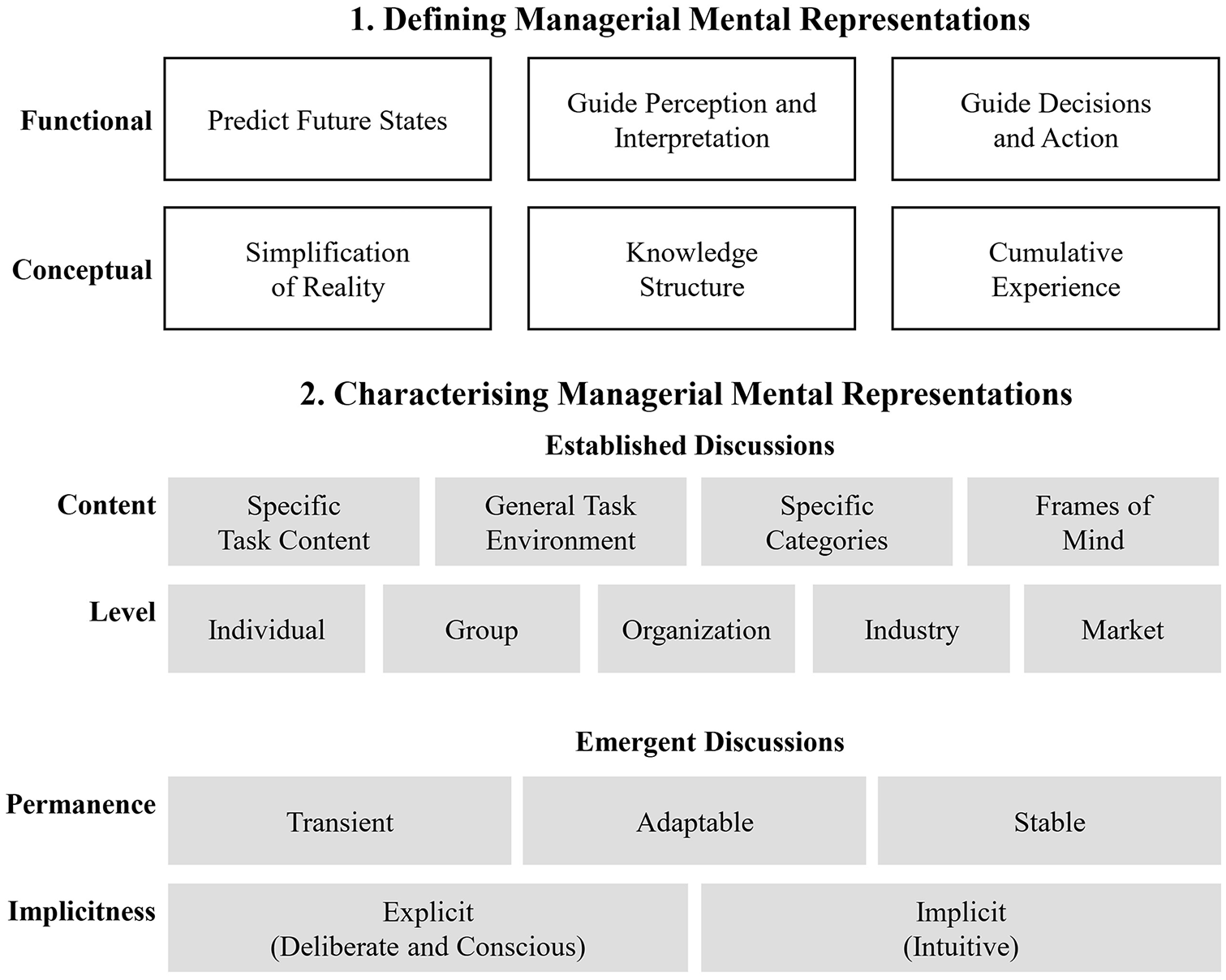
MMR Review Results Overview
Common MMR Terms and Definitions
In our analysis, the following six terms accounted for three-quarters of all reviewed publications (157/206 articles): “mental representation,” “schema,” “mental model,” “cognitive frame,” “cognitive map,” and “mindset.” In stark contrast, each of the remaining terms appeared in less than 5% of the articles. Hence, we have structured our findings around these core MMR research terms. We begin the presentation of our findings by outlining exemplary definitions. These definitions should not be understood as a “ground truth”; they provide illustrative examples that allow us to discuss definitional overlaps and differences between MMR terms.
Tripsas and Gavetti (2000: 1148) define mental representations as “simplified representations of the world. . . . These imperfect representations form the basis for the development of the mental models and strategic beliefs that drive managerial decisions.” George and Jones (2001: 421) describe schemas as structures that guide perception through “top-down or theory-driven processing” based on pre-existing knowledge. Swan (1995: 1257) defines cognitive maps as “an individual’s internal representation of the concepts and relations among concepts” used to understand the environment. Dewulf et al. (2009: 158) conceptualize cognitive frames as “mental structures” that organize new information by fitting it into existing schemas. Mathieu et al. (2000: 274) define mental models as “organized knowledge structures” that help to predict what is likely to occur next. Finally, Pérez-Nordtvedt et al. (2023: 1555) define mindsets as “lenses” for interpreting stimuli, which can be stable or develop over time.
While these exemplary definitions are obviously selective, they highlight three attributes at the core of the conceptual ambiguity surrounding MMR conceptualizations. First, they share conceptual facets such as structuring knowledge or guiding perception. Second, they refer to conceptual facets that are not shared, such as the prediction of future states. Third, they refer to related MMR terms without specifying conceptual differences.
Conceptual and Functional Definition Facets of MMRs
To address the ambiguity arising from MMR conceptualizations, we decomposed them into individual definition facets. We distinguish between three conceptual facets (simplification of reality, knowledge structure, and cumulative experience) and three functional facets (guide perception and interpretation, predict action outcomes, and guide decisions and action). The conceptual facets are ways of describing what MMRs are, for example, “simplified representations of the world” or “an individual’s internal representation of the concepts and relations among concepts.” The functional definition facets, in contrast, define MMRs in terms of what they do, for example, guiding perception through “top-down or theory-driven processing” (George & Jones 2001: 421). This distinction allows us to juxtapose the primary descriptions and their potential applications, aiming to identify conceptual differences and interconnections that are relevant to management research. It is important to note that the definition facets are not mutually exclusive, but cooccur in the reviewed articles in different ways. Below, we describe each facet and provide examples. Most articles reviewed emphasized multiple facets (average: 2.5).
Simplification of reality
We found 58 articles that characterize MMRs as simplifications of a complex environment that enable managers to process information efficiently (Calori et al., 1994). This definition facet links to Simon’s (1955) concept of bounded rationality, which focuses on the cognitive limitations that prevent humans from capturing all the information available in an environment. It is not surprising that this facet is foundational for the representational perspective, which focuses on the interaction between the objective task environment and a manager’s internal representation of that environment. Simulation studies that explore how agents navigate NK-fitness landscapes (Baumann et al., 2019; Gavetti & Levinthal, 2000) and experiments (Gary & Wood, 2011; Gary et al., 2012; Puranam & Swamy, 2016) grant scholars control over, and insights into, this underlying objective environment. Nevertheless, it is important to note that scholars associated with the constructivist perspective also emphasize that the individually or collectively construed nature of their models is inherently reductionistic (Stiles et al., 2015; Tsoukas & Chia, 2002).
Knowledge structure
We found 120 publications that define MMRs as cognitive structures that contain ordered information stored in memory (Bartlett, 1932; Fiske & Taylor, 1991; Porac & Thomas, 1990). MMR research discusses a wide range of structuring patterns, including hierarchical order (Carnabuci et al., 2018), clustering of related concepts (Knight et al., 1999; Porac & Thomas, 1990), or causality (Laukkanen, 1994; Markóczy & Goldberg, 1995). Structuring complex knowledge is vital for scholars focused on strategic groups (Osborne et al., 2001) and competitive dynamics (Pontikes & Rindova, 2020), as they can capture decision-makers’ understandings of market actors and boundaries. This facet is relevant to both the representational and constructivist perspectives.
Cumulative experience
Fifty-seven articles suggest that MMRs represent cumulative experience—an idea highlighted by both the representational and cognitive constructivist perspectives. The representational approach emphasizes that MMRs are manifestations of expertise, derived from past decision-making experiences that are transferable to novel environments (Gavetti et al., 2005). Articles in this context examine differences between experts and novices in opportunity recognition (Baron & Ensley, 2006) or explore how managers create inertia by retaining established MMRs amid changing environments (Hodgkinson, 1997b; Porac & Thomas, 1990; Reger & Palmer, 1996; Tripsas & Gavetti, 2000) and learn by transferring knowledge across different decision-making contexts (Gary et al., 2012). Meanwhile, the cognitive constructivist perspective emphasizes the retrospective interpretation of experiences by individuals, which shapes and assigns meaning to past events (Weick, 1969). This approach is particularly relevant in discussions about how managers develop simple rules for decision-making (Atanasiu et al., 2023), interpret past failures (Park et al., 2023), and handle change processes (Konlechner et al., 2019).
Guiding perception and interpretation
120 articles define MMRs in terms of their function of influencing how managers perceive their environment and interpret events. MMRs operate as mental templates leading to top-down or theory-driven processing (George & Jones, 2001), where new information is interpreted through pre-existing organized knowledge (Walsh, 1995). Publications highlighting this facet are particularly interested in MMRs acting as lenses through which actors interpret firms (Benner & Ranganathan, 2017), innovations (Raffaelli et al., 2019), paradoxes (Miron-Spektor et al., 2011), or market categories (Pontikes, 2018). Both the representational and cognitive constructivist perspectives on MMRs regard this definition facet as the foundation of MMRs’ behavioral implications.
However, it is important to note that the two perspectives differ in their views on the conceptual relationship between MMRs and interpretation. From a representational perspective, MMRs are fundamental in understanding the task environment by “providing coarse insights into potentially superior solutions and by offering an understanding of the structural characteristics of the problem” (Baumann et al., 2019: 304), suggesting that interpretation creates MMRs. In contrast, the cognitive constructivist perspective views MMRs as enabling interpretation through a conversational process “that gradually develops from past experience and subsequently guides the organization of new information” (Rousseau, 2001: 513), underscoring that MMRs are the origin, outcome, and prerequisite of interpretation.
Predicting action outcomes
We found 30 articles that define MMRs in terms of their function of manipulating mental representations via cognitive processes to predict actions’ potential outcomes (Thagard, 2005). Therefore, MMRs allow managers to predict the implications of potential actions by gaining strategic foresight (Csaszar & Laureiro-Martínez, 2018) and searching for strategic options (Baumann et al., 2019; Gavetti & Levinthal, 2000). The concept of prediction is closely linked to the representational perspective as it necessitates distinguishing between the MMR and the processes of interpretation and manipulation that enable the envisioning of future states of these representations.
Guiding decision and action
Finally, we identified 91 articles that define MMRs as instrumental in guiding decision-making processes and subsequent actions. MMRs provide a cognitive blueprint for evaluating options and assessing risks, thereby determining the course of action (Walsh, 1995). Unsurprisingly, this definition facet is particularly prevalent in strategic management research interested in organizational decision-making (Csaszar, 2018; Nadkarni & Narayanan, 2007a; Priem & Harrison, 1994). Both the representational and constructivist perspectives highlight this facet, as it provides the basis for behavior.
The Interplay Between Conceptual and Functional Definition Facets and MMR Terms
Our review advanced to a quantitative assessment of the combinations between conceptual and functional definition facets, aiming to derive meaningful interpretations of the shared and unique “conceptual spaces” of MMR terms. We calculated the co-occurrence of these facets for each MMR term (i.e., the percentage of articles defining a term using this combination), examining nine possible combinations (three conceptual × three functional facets). The results of the cooccurrence analysis are presented in heatmap diagrams (Figure 3), which visually illustrate the core and peripheral combinations for each MMR term. Focusing on the co-occurrences allows us to consider how the conceptual nature of MMRs and their functional implications interact in defining MMR terminology. Additionally, comparing these heatmaps reveals the nature and extent of overlapping definitional combinations, enabling us to uncover commonalities and distinctions between MMR terms.
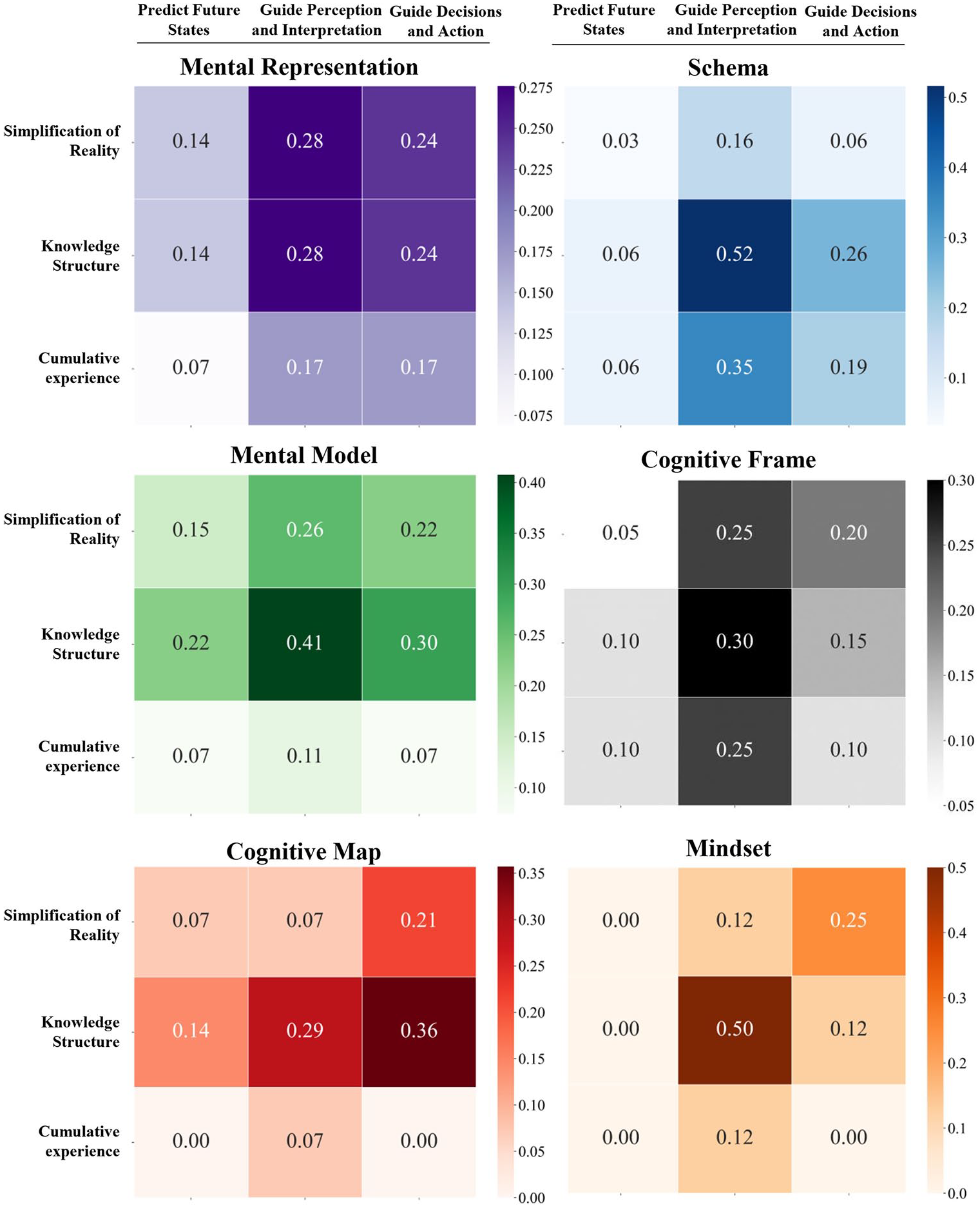
Results: Conceptual and Functional MMR Definition Facets of MMR Terms in Scholarly Practice
As Figure 3 illustrates, MMR terms share considerable overlap in the interplay between MMRs as knowledge structures guiding perception and interpretation. This offers empirical support to the assumption of definitional overlap between concepts. Beyond the shared definitional space, we derive two important insights. First, the term “mental representation” effectively covers all conceptual aspects and functional facets frequently discussed in the literature, showcasing its suitability as an umbrella term. Second, our analysis highlights that certain peripheral combinations receive more emphasis in publications using specific MMR terms than others. For example, research using the definitions “schema” and “cognitive frames” accentuates that cumulative experience shapes perception and interpretation. In contrast, “mental models” research highlights how knowledge structures and simplification of reality help to predict future states. Research on “mindsets” emphasizes the critical role of simplification in guiding actions and decisions, rather than focusing on perception and interpretation. Articles concerned with “cognitive maps” consider how knowledge structures guide decisions and actions.
On the one hand, the accentuation of some MMR terms’ conceptual and functional facet combinations provide a useful foundation for conceptual delineation. On the other hand, our initial analysis of MMR definitions demonstrated considerable definitional overlap. To facilitate further delineation, we will strengthen our empirical foundation by examining important MMR characteristics and their related scholarly discussions.
Established Discussions on MMR Characteristics
We begin our examination of MMR characteristics based on the established discussions on MMR content and the levels of analysis already highlighted in Walsh’s (1995) seminal work.
MMR Content
We identified four major types of MMR content. Publications concerned with specific task content (37 articles) frequently center on studying representations of predefined tasks or decision-making scenarios—a focus that is particularly prominent in the representational perspective. These articles most often address how these MMRs influence task performance in the context of organizational learning (Puranam & Swamy, 2016; Rahmandad, 2008) and strategic decision-making (Csaszar, 2018).
Most articles focus on MMRs related to the general task environment (92 articles). These articles address MMRs encompassing the broader contextual environment, which is relevant for numerous organizational tasks rather than individual tasks. For example, scholars were interested in MMRs of market environments (Eisenhardt & Bingham, 2017), competitive landscapes (Gavetti & Porac, 2018), organizational stakeholders (Felin & Zenger, 2017), and organizational culture explicated via shared codes (Koçak & Puranam, 2024). Construing the general task environment as the personal space of action is integral to the cognitive constructivist perspective. However, this content type is not exclusive to cognitive construct research. Representational research has also applied a contingency perspective to examine the appropriateness of complexity in MMRs (Csaszar & Ostler, 2020) or decompose the environment into individual strategic issues evaluated as opportunities or threats (Miller & Lin, 2015).
While MMRs of the general task environment focus on depicting the wide-ranging contextual surroundings, research in the context of specific categories (55 articles) examines particular concepts or elements in the general task environment. For example, scholars have examined MMRs of novel technical innovations (Garud & Rappa, 1994), workplace attire (Rafaeli et al., 1997), the leading supervisor (Nifadkar, 2020), sustainability efforts (Hahn et al., 2014), failures (Park et al., 2023), and smart cities (Zuzul, 2019).
Finally, the MMRs considered in research on frames of mind (22 articles) contain more abstract content related to one’s expertise or deeply held beliefs about the world beyond a specific task, general task environment, or specific category. Literature dealing with this type of content investigates issues such as paradox mindsets (Miron-Spektor et al., 2011), representations of experts versus novices (Baron & Ensley, 2006), and temporal mindsets (Pérez-Nordtvedt et al., 2023). As frames of mind do not represent the environment directly, but rather reflect individual beliefs about abstract and often implicit concepts, most “frames of mind” research is associated with a cognitive constructivist perspective.
Our analysis yielded no clear pattern reflecting how all MMR terms relate to content, with the exception of mindsets, which are predominantly related to frames of mind and cognitive maps that are dominantly created to represent the general task environment. Mental representations capture all four content types quite evenly. Schemas like cognitive frames often capture the general task environment and specific categories, while mental models capture both the task-specific and general task environment.
Advancing the MMR content discussion
To advance research on MMR content, two key challenges must be addressed. First, the collection and evaluation of MMR content data through interviews, surveys, or observations is highly labor-intensive, often limiting researchers to cross-sectional data from a single data source. This can mask the context-specificity and malleability of MMR content. Second, traditional data collection methods impose the researcher’s own mental representation, as they direct their attention and questions toward specific aspects of the content. Three decades ago, Walsh (1995: 303) called for a “moratorium” on “content portraits” and urged scholars to focus on the behavioral and organizational implications of MMR content. Thirty years on, we advocate for a dynamic portrayal of MMR content through longitudinal data and triangulation.
The increasing accessibility of natural language processing technology, coupled with the growing abundance of textual data at both individual and organizational levels—including social media activity, interview transcripts, online forums, and company blogs (Choudhury, Wang, Carlson, & Khanna, 2019; Heavey, Simsek, Kyprianou, & Risius, 2020)—has the potential to enable efficient and inductive examination of cognitive content in textual big data.
Topic modeling enables scholars to identify specific categorical MMRs inductively, without the need to define these concepts in advance (Hannigan et al., 2019). Building on established techniques such as cognitive mapping, the identified topic categories can be analyzed for their interrelations through cooccurrence patterns. This approach allows researchers to map both relevant concepts and their interconnections in an automated fashion to examine how general task environment MMRs are construed based on textual data such as conference calls with shareholders, online communities, or corporate social responsibility reports. Many of these large datasets are available longitudinally, providing an opportunity to explore how MMR content evolves over time and in response to organizational, industry, or societal contextual factors.
Word embeddings transform textual data into vectors, providing the opportunity to examine the conceptual distance between entire documents based on vector distances. This allows scholars to quantify the degree of MMR content change between two observation points (Kusner, Sun, Kolkin, & Weinberger, 2015). Word embeddings can also support scholars by expanding predefined seed lists of terms for specific content categories by adding contextually relevant words. This helps identify relevant MMR content within large datasets (Li, Mai, Shen, & Yan, 2021). Once a relevant sentence is found, a sentiment classifier can capture its associated valence (Tul et al., 2017). Tracking the evaluation of concepts over extended periods and across varying contexts offers valuable insights into how stable frames of mind influence the evaluation of specific categorical MMRs.
Level of MMR analysis
Scholars from the representational, as well as the cognitive constructivist perspectives, take a keen interest in examining MMRs on multiple levels, ranging from the individual to entire markets. While the bulk of scholarly work focuses solely on individual-level MMRs (90 articles), others also examine shared MMRs. On the group level (23 articles), extended periods of cooperation in small teams create a shared representation of the task environment, communication channels, and the characteristics of fellow team members (Mathieu et al., 2000). This level of analysis reveals how small groups create routines and provides a lens to reveal the contextual factors that shape collaboration processes, such as interruptions during knowledge acquisition (Zellmer-Bruhn, 2003). Articles that examine MMRs at the organizational level (36 articles) discuss how managerial thinking and decision-making contribute to the creation of routines (Stiles et al., 2015), organizational schemas (Rerup & Feldman, 2011), and dominant logics (Prahalad & Bettis, 1986). At the industry level (six articles), MMR alignment occurs through similarities in the task and institutional environments, which contribute to the development of shared mental representations among individuals across organizations creating cognitive strategic groups (Spencer et al., 2003). This explains similarities in Chief Executive Officer (CEO) attentional focus (Surroca et al., 2016), decision-making (Pazzaglia et al., 2018), and firm performance (Osborne et al., 2001). Market-level MMRs (four articles) are primarily concerned with how market actors categorize relevant elements in a market space, such as how critics evaluate wines (Hsu et al., 2012), analysts appraise firms during significant technological shifts (Benner & Ranganathan, 2017), or investors consider a firm’s open-source activities (Alexy & George, 2013). Thirty-eight articles employ a multi-level focus, looking into aggregation mechanisms or how individual MMRs compare to group- or organizational-level MMRs (e.g., Hodgkinson & Johnson, 1994; Tyler & Gnyawali, 2009). In nine articles, the level of analysis remains unclear. All six key MMR terms are used across every level of analysis, offering limited opportunities for conceptual delineation based on this characteristic.
Advancing the MMR level of analysis discussion
It is important to recognize that while individual-level and shared MMRs have certain characteristics in common, conceptualizing and measuring MMRs at levels beyond the individual presents challenges necessitating the exploration of distinct concepts and methodologies (Tarakci, Ates, Porck, van Knippenberg, Groenen, & de Haas, 2014). Shared MMRs give rise to emergent properties (Anderson, 1999) that depend on the nature of sharedness. To engage with this, we propose focusing on the following question: Where do shared MMRs reside? We identified three potential answers to this question, each offering a distinct perspective and providing a unique lens on the phenomenon.
First, one might argue that shared MMRs can only reside within individuals who predict and interpret the behavior of others by making assumptions about their thoughts and feelings. This “theory of mind” involves forming a representation of another actor’s MMR, which, in turn, can facilitate effective interaction (Leslie, Friedman, & German, 2004). For example, Waldron et al. (2016) studied how social entrepreneurs’ assumptions about others’ perceptions shaped their rhetorical strategies.
Second, shared MMRs can reside in the “overlap” of cognitive content across multiple individuals (Mohammed et al., 2010). This perspective has been historically prominent and presents opportunities to explore phenomena such as consensus (Csaszar & Laureiro-Martínez, 2018; Tarakci et al., 2014) and centralization (Kiss & Barr, 2015, 2017), as well as similarity and accuracy (Edwards et al., 2006).
Third, shared MMRs reside in interactions over time, with no fixed or localized substrate; rather, they only exist through ongoing communication and collaboration. Hodgkinson and Sparrow (2002) identified three key forms of interaction that can constitute shared MMRs: Creating consensus involves aligning individual mental models within the group to achieve shared interpretations of key aspects of reality. Information sharing supports this alignment by ensuring that all members have access to relevant data and perspectives. Transactive memory refers to the continuous collective storing, accessing, and updating of knowledge by drawing on each team member’s expertise. We argue that advancing each of these three perspectives on MMR “sharedness” can deepen understanding of the emergent properties of shared MMRs.
Emerging Discussions on MMR Characteristics
Beyond the established discussions related to the content and level characteristics of MMRs, we have identified two additional MMR characteristics—permanence and implicitness—that not only provide a foundation for defining MMR terms but also present rich opportunities for future exploration.
MMR permanence
Permanence describes the duration over which an MMR remains cognitively pertinent and consistent, indicating its stability over time. In the existing literature, scholars tend to assume MMRs are either transient, adaptable, or stable. We identified 27 articles that treat MMRs as transient cognitive constructs that occur at a specific moment in time. These articles emphasize the contextuality of MMRs requiring conscious engagement. For example, some articles consider MMRs to be immediately constructed in response to a specific timebound task or situation (e.g., Boland et al., 1994; Smith, 2023), while others treat them as transient as a result of methodological choices, such as experimental manipulations of MMRs (e.g., Csaszar & Laureiro-Martínez, 2018; Park & Baer, 2022).
We identified 73 articles that describe the MMRs in their study as stable. Importantly, while these articles do not claim that MMRs are immutable, they do assume that MMRs exhibit stability over longer time horizons. This implies that MMRs remain inactive during periods lacking active cognitive engagement but can be reactivated when environmental conditions render them relevant. These articles include research on deeply held beliefs such as entrepreneurial strategic logics (e.g., Eisenhardt & Bingham, 2017) or schemas encapsulating cultural and institutional knowledge (e.g., Pontikes & Rindova, 2020).
We found 100 articles that focused on adaptable MMRs. Adaptability extends beyond viewing MMRs as stable knowledge constructs (Hambrick & Crossland, 2018), emphasizing their changing over time. For example, Rahmandad (2008) studied the evolution of cognitive maps within an organization and their impact on strategic decision-making. Konlechner et al. (2019) focused on the interpretations following the initiation of change projects and illustrated the interplay of prospective and retrospective aspects in MMRs. Importantly, while the authors studying MMRs as adaptable cognitive structures outline their flexible nature, it has also been found that even when MMRs eventually change, those that are widely shared exhibit a certain degree of inertia (Benner & Ranganathan, 2017). This suggests that the formation of shared MMRs within teams, organizations, and industries allows individual-level representations to crystallize into organizational artifacts such as cultural norms, processes, structures, and decision-making guidelines (Weick, 1969). Sharing MMRs enables cognitive content to transcend the short time horizons of active cognitive engagement. Finally, six articles remained ambiguous concerning MMRs’ permanence. We will discuss the permanence associated with specific MMR terms in the section “MMR Terminology” below.
Advancing the MMR permanence discussion
While our examination of permanence has primarily framed the concept in terms of ontological differences, it could also be argued that it stems from epistemological challenges in MMR research. Since MMRs cannot be observed directly, researchers must make assumptions that align with their chosen methodological approaches. Many articles employ language to capture MMRs, whether by posing questions or analyzing text. Utilizing language offers the clear benefit of using a familiar and accessible means of probing and articulating our internal states. However, relying solely on language introduces ambiguities concerning MMR permanence, as the spoken word is inherently transient. Designating MMRs as adaptable or stable thus constitutes an assumption that scholars must engage with proactively.
Drawing from psychology and neuroscience offers methodological approaches that go beyond language. Using functional magnetic resonance imaging (fMRI), cognitive scientists have observed neural activation in response to concepts (Frankland & Greene, 2020). Others have performed experiments to uncover the cognitive mechanisms that translate visual information into mental categories (Belke, Leder, Harsanyi, & Carbon, 2010). While fMRI studies remain a rarity in management science due to the need for specialized equipment and expertise (exceptions include Laureiro-Martínez & Brusoni, 2018; Parkinson, Kleinbaum, & Wheatley, 2017), eye-tracking (Rahal & Fiedler, 2019) has emerged as a more accessible tool for investigating how individuals gather information to create a task-specific MMR.
Advancing understanding of the antecedents and underlying dynamics of MMR permanence provides a foundation for developing tools that help organizational decision-makers explicate stable MMRs and adapt their thinking toward more effective representations. Prior research has thoroughly explored the potential of scenario planning (Healey & Hodgkinson, 2024; Schoemaker, 1993) and cause mapping (Hodgkinson et al., 1999) as methods to reconsider MMRs. Expanding this toolkit and validating it further through both experiments and field studies holds substantial potential for managerial cognition research to provide immediate value to practitioners and society at large.
MMR implicitness
Publications in our review predominantly addressed mental representations’ explicit and verbal cognitive content—retrieved via deliberation—that can be accessed consciously and articulated. Few articles considered the implicit content of MMRs. It might thus be important to highlight that structured cognitive content is not only concrete or verbal; it can also be abstract, aggregated, or even subconscious. MMR implicitness refers to knowledge that is stored without the individual deliberately engaging with it. This implicit content, although not consciously accessible, still influences perception, decision-making, and behavior (Dane & Pratt, 2007; Hodgkinson & Sadler-Smith, 2018; Sadler-Smith, Akstinaite, & Akinci, 2022). Methodologically, it is much easier to access explicit than implicit cognitive content. Nevertheless, our understanding of MMRs would be incomplete if we were to focus on their explicit content alone. Thankfully, there is some research that explores the perceptual and behavioral implications of implicit MMRs that emerge through intuitions, which have been defined by Seger (1994) as “feelings of knowing” (p. 170) and by Dane and Pratt (2007) as “affectively charged judgments” (p. 33). In some cases, implicit content has been empirically demonstrated to explain a greater variance in behaviors than explicit knowledge (Bargh, 1996; Latham & Locke, 2012). This research draws on insights from cognitive science and neuroscience highlighting the importance of intuition in managerial and organizational decision-making (Healey & Hodgkinson, 2014; Pratt & Crosina, 2016), emphasizing the need to examine the role of implicit cognitive content in shaping organizational outcomes.
Advancing the MMR implicitness discussion
Studying implicit content is most valuable when we need to understand the underlying thought processes and biases that influence managerial decisions and actions (Healey, Vuori, & Hodgkinson, 2015). However, examining the nature of such implicit content remains a crucial challenge—not only in management research, but in the cognitive sciences too. Novel combinations of methodologies promise to further illuminate these hidden cognitive structures.
The Implicit Association Test (IAT; Greenwald, McGhee, & Schwartz, 1998) is one established method that has provided valuable insights. The IAT observes the speed at which individuals categorize two contrasting concepts (such as flowers vs. insects) along with an attribute (such as pleasant vs. unpleasant), thus revealing underlying associations. Exploring combinations of IATs with mental mapping techniques might bring to light both implicit and explicit content, their mutual interactions, and the outcomes of such processes.
Another idea relies on exploring the potential of emerging technologies. For example, facial recognition systems could be employed to gauge implicit social categorizations based on subtle facial cues (Adjabi, Ouahabi, Benzaoui, & Taleb-Ahmed, 2020), potentially revealing unconscious biases in a person’s perceptions. Similarly, skin conductance responses—often associated with emotional arousal—could be monitored during exposure to stimuli, potentially uncovering implicit emotional associations with specific concepts or categories (Crone, Somsen, Van Beek, & Van Der Molen, 2004). By integrating these novel tools with established methodologies such as the IAT, we can gain a more comprehensive and nuanced understanding of the complex nature of implicit content use, and complement this with advances in methods targeting the explicit content of MMRs.
Beyond the behavioral implications, an in-depth analysis of the interaction between implicit and explicit content is critical for gaining a more profound understanding of how MMRs are formed and, more importantly, how they can be altered. Recent modeling work by Gibbons et al. (2021) supports the idea that managers distill the complexity of the world around them into a finite number of categories without necessarily being aware of it. This work implies that MMRs are constantly changing without us knowing. To further understand how MMRs are formed and adapted, we need to explore methodologies that can capture automatic, unconscious cognitive content (e.g., implicit associations, intuitions) alongside the explicit cognitive content that is consciously accessible. Two recent studies relying on fMRI techniques show two different ways to study mental representations that might advance this discussion. Frankland and Greene (2020) found two ways in which thoughts are represented in the brain. They investigated how the brain builds complex representations of thoughts by using fMRI to analyze the neural mechanisms underlying semantic composition. Most notably, they found that the brain employs different strategies for integrating complex word meanings, depending on whether the integration involves agent roles or event types.
Another brain imaging study, by Sievers, Welker, Hasson, Kleinbaum, and Wheatley (2024), relied on an fMRI study of MBA students to show how consensus-building conversations strengthen the alignment of the mental representations of group members. Further, the strength of the alignment varies according to participants’ position in the network, with more central members showing closer alignment. While the authors did not differentiate between explicit and implicit cognitive content, it is likely that the alignment that people experienced derived not only from aspects that were explicitly addressed in their conversations but also from people implicitly directing their attention to certain aspects of the new stimuli following their discussions. In combination, these two examples provide ideas about how we could approach the understanding of how MMRs encompass different objects in different roles, how representations are sensitive to the roles of those around us, and how interactions with others (or the environment) can generate alignment that changes representations.
MMR Terminology
We began this review by echoing the criticism that many MMR terms share substantial definitional overlap. Our analysis of their definition facets, their underlying assumptions, and the associated discussions provides empirical evidence for that assertion. In particular, our findings demonstrate that MMRs, defined as “knowledge structures” that “guide perception and interpretation,” are common across all the terms we examined in depth. These aspects serve as the underlying commonalities unifying MMRs as mental constructs.
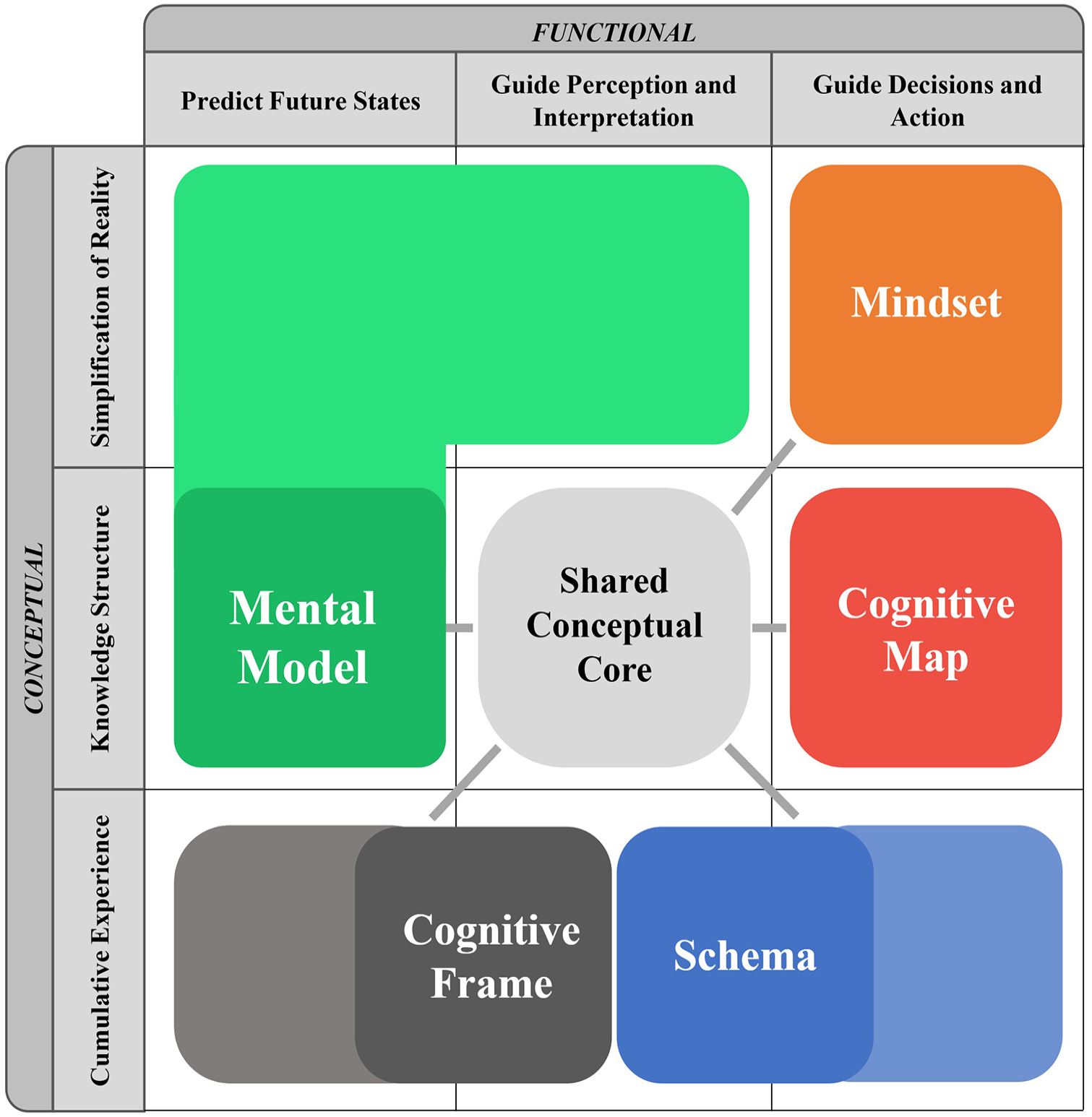
To further enhance conceptual clarity, we positioned the key terms based on their unique combinations of conceptual and functional facets, which extend beyond the shared conceptual core of MMRs, in Figure 4. These defining combinations were selected according to their relevance to the specific term itself (within term) and their distinctiveness compared to other MMR terms (between terms). In cases where a definitional combination of an MMR term is less emphasized in the literature, we highlight this in a lighter color (i.e., cognitive frames, schemas, and mental models). The details of the analytical approach are documented in our coding handbook. Below, we discuss the six key terms based on this guiding framework as well as the established and emerging discussions in the literature. 1
Managerial Mental Representations Guiding Framework
First, our analysis suggests that mental representations have been employed extensively across all definitional facets, MMR content forms, levels of analysis, and degrees of permanence. 2 This widespread use presents an opportunity to consider mental representations as an umbrella term for different types of MMR. The term was used by both representationalists (e.g., Csaszar & Levinthal, 2016) and constructivists (e.g., Bridoux & Stoelhorst, 2016; De Keyser et al., 2023), offering further opportunities to provide ground for conceptual exchange. For this reason, we do not suggest a further specialization of this term.
Second, a schema can be seen as a relatively stable cognitive structure that often delineates specific categories (e.g., schema of change, self-schema) of similar contents related to the general task environment (e.g., competitive landscape). Importantly, schemas emphasize the facet of cumulative experience resulting in top-down and theory-driven processing (Fiske & Linville, 1980; Fiske & Taylor, 1991; Taylor & Crocker, 1981). Moreover, most research on schemas assumes a constructed reality, describing schemas in terms of the centrality of imparting subjective meaning to experience (Labianca et al., 2000). Since schemas might encompass both explicit and implicit elements that become more defined with frequent recollection, they are crucial for understanding how organizational members construe and react to stimuli (George & Jones, 2001). Thereby, schemas guide not only perception and interpretation but ultimately the decisions and actions of individuals, teams, and organizations (Rerup & Feldman, 2011). We therefore suggest that schemas form an appropriate context for research focusing on how personal or organizational experience influences top-down perception and the integration of new information into existing, cognitive structures.
Third, mental models are typically formed in response to direct interaction with a specific task or general task environment. Thereby, they serve as predictive tools that offer a simplified and explicitly articulated representation of the surroundings. They can be mentally manipulated to allow individuals to make plausible predictions about future possibilities based on current knowledge and understanding (Rouse & Morris, 1986). Mental models play a critical role in strategic planning and forecasting, providing a structured way to anticipate changes and adapt strategies accordingly (Csaszar & Levinthal, 2016). Once the task is completed or the environment changes, only selected elements of these models are retained as knowledge. Therefore, it is important to recognize that mental models require conscious engagement, which is why we suggest considering their permanence as transient or highly adaptable. They are typically studied on the individual level, but multi-level research could explore the similarities of predictive models among organizational decision-makers. Researchers interested in exploring the relationship between the present task environment and a manager’s representations might study mental models, emphasizing the ability to mentally manipulate such models to perceive and interpret the environment and, crucially, to predict the outcomes of potential actions based on a simplified representation of reality. For this reason, we position mental models as simplified knowledge structures to guide perception and interpretation and to predict the future.
Fourth, cognitive frames depict another concept related to subjective and constructed realities. They refer to cognitive structures that help managers organize and interpret incoming perceptual information (Minsky, 1975). Cognitive frames rely on memories of past experiences and provide managers with filters to perceive, interpret, evaluate, and order present stimuli (Dewulf et al., 2009; Weick, 1995). Cognitive frames are concerned with top-down perception and interpretation; however, they guide managers towards imposing meaning onto a present situation (Nadkarni & Barr, 2008)—for example, framing a situation as an opportunity or a threat, often unconsciously, by relying on memories of similar situations that were experienced in such a way. While cognitive frames can be understood as stable (e.g., Hahn et al., 2014; Smith & Tushman, 2005), some studies have utilized treatments in experiments to provoke the transient activation of specific cognitive frames (e.g., Miron-Spektor et al., 2011). This line of research shows that cognitive frames, although typically stable, can be manipulated depending on how information is presented. Researchers interested in studying how individual experience leads to mental shortcuts and how these, in turn, impose meaning onto new situations, might find it useful to consider cognitive frames as a specialized theoretical underpinning. Lastly, an emerging field of study suggests that cognitive frames can also include visions of the future (Zuzul, 2019) and can be studied to understand how managers use cognitive frames for prospective interpretation (Konlechner et al., 2019). However, this field is still emerging, which is why we position the term “cognitive frame” in relation to cumulative experience and the prediction of future states with caution (depicted in a light color).
Fifth, a cognitive map is a personalized construction of a decision-maker’s general task environment. It is a simplified representation of complex interdependencies between various organizational issues and their environmental contexts (Markóczy & Goldberg, 1995). These interdependencies often take the form of rather stable cause-effect beliefs between key variables but can also be realized through other structuring processes such as differentiation, nuancing, or comparison (Calori et al., 1994; Graf-Vlachy, Bundy, & Hambrick, 2020). Importantly, cognitive maps are often studied by means of cognitive mapping (Eden, 1992; Fiol & Huff, 1992) as a technique to elicit causal representations of otherwise implicit beliefs. Cognitive maps are instrumental in guiding decisions and actions, allowing organizational members to navigate complex task environments and make informed decisions by understanding the relational dynamics at play (Hodgkinson et al., 1999).
Sixth, a mindset is considered to be a subjectively perceived cognitive construct (Buhrau & Sujan, 2015). Mindsets are typically implicit and operate subtly, influencing how individuals interpret their surroundings and their interactions within them (Dweck, 2006; Gupta & Govindarajan, 2002). In contrast to other terms, research on mindsets typically does not study cognitive structures related to specific task contents but focuses on how mindsets guide action and decisions based on deeply held “frames of mind” concerning various abstract concepts (Pérez-Nordtvedt et al., 2023). For example, a “paradox mindset” explains job performance when individuals are faced with organizational tensions (Miron-Spektor et al., 2018). While mindsets have been traditionally considered stable, some studies have shown that they can be adapted (e.g., Nadkarni et al., 2011) and temporarily manipulated under experimental settings (e.g., Rottenstreich & Kivetz, 2006). We, therefore, suggest that scholars interested in how deeply held assumptions shape decision-making across multiple situations might gravitate toward mindset research.
Our guiding framework offers several advantages. First, by establishing “mental representations” as an umbrella term, it creates a broad platform for scholars interested in MMRs to explicitly exchange and debate ontological assumptions, thus fostering knowledge accumulation and scholarly exchange. Second, it provides scholars interested in the cognitive underpinnings of organizational phenomena with a definitional foundation for selecting an appropriate MMR term and familiarizes them with the associated discussions. Third, the framework clarifies differences in MMR terminologies, laying the groundwork for further conceptual delineation and empirical testing of assumptions.
Advancing Definitional Clarity in MMR Terminology
Our framework takes a step toward delineating a vast and diverse stream of research. Such endeavors always face challenges, and we wish to highlight the following three caveats. First, our proposed framework, although based on an in-depth analysis of existing literature, is not all-encompassing, and it is important to recognize that prior research may have utilized an MMR term that stands in contrast to it.
Second, specific terms such as “dominant logics” (Prahalad & Bettis, 1986) or “strategic groups” (Osborne et al., 2001) have created their own literature streams. We do not advocate substituting these terms with more general ones. Instead, we hope that our work will foster theorizing that clearly distinguishes more specialized terms from broader concepts.
Third, we acknowledge that MMRs are intrinsically multi-layered constructs. Every task-specific representation is construed in the context of an overarching frame of mind. Every representation is transient, as it is cognitively engaged while being informed by more stable schemas. Every shared representation is ultimately processed via individual-level cognition. Recognizing that, we argue that advancing MMR research requires scholars to explicate—rather than obfuscate—the conceptual assumptions associated with MMRs.
This includes answering the following three questions: One, does the MMR conceptualization provided align with the conceptual foundations of the chosen MMR term? Two, why has this term been chosen over other related MMR terms? Three, does the MMR operationalization create additional assumptions concerning the nature of the MMR? For instance, the MMR is evaluated using textual data, whereas the associated outcome variable is measured at a later point in time, implicitly assuming that the MMR remains stable. To conclude, we suggest that authors acknowledge and clarify these assumptions, thereby paving the way for future research by demystifying MMRs.
The Future of MMR Research
In our review, we have clarified the terms related to MMRs by outlining the assumptions linked to two different perspectives. We argue that the apparent incommensurability between the representational and cognitive constructivist perspectives may be more superficial than substantive, reflecting a difference in emphasis rather than conflicting ontological assumptions. Both perspectives ultimately contribute to a comprehensive understanding of MMRs, albeit from distinct vantage points. The representational perspective focuses on the accuracy and fidelity with which MMRs reflect an objective task environment, and how they aid decision-making and problem-solving in such a context. In contrast, the cognitive constructivist perspective concentrates on how these mental models are individually constructed and evolve, supporting personalized interpretation and processing. Rather than deepening any schism, acknowledging these differences can foster a productive dialogue. Below, we discuss how to advance MMR research beyond the representational and cognitive constructivist divide.
Integrating the “What” and “How” of Managerial Cognition
MMRs are an essential component of managerial cognition alongside cognitive processes (Meindl et al., 1994). Although the two are interrelated, mental representations refer to structured knowledge stored in the mind, whereas cognitive processes refer to the activities that manipulate these representations (Tenenbaum, Kemp, Griffiths, & Goodman, 2011). Contemporary managerial cognition research tends to focus either on cognitive content (the what) or cognitive processes (the how).
However, applying a neurological perspective on MMRs reveals some thought-provoking ideas about the deep “intertwinedness” of content and processing: different types of cognitive content activate specific processing pathways. We propose that adopting an integrative lens opens up intriguing avenues for future research examining the interplay between the what and the how.
In a review of computational modeling in behavioral brain science, Tenenbaum et al. (2011) discuss how the structure of mental representations (the what) influences how the mind generalizes from them (the how). They summarize that mental representations containing causal relations between abstract higher-order concepts allow inductive inferences to be drawn more quickly and accurately than the analysis of numerous (lower-order) concepts. Conversely, mental representations can be gradually updated with concrete details without losing the “big picture.” Another example of this idea in the context of neuroscience comes from the work by Edelson and Hare (2023), who investigated how the representation of memories (the what) influences the abilities that are deployed during decision-making (the how).
To advance the integration of what and how, future research could explore the ways in which implicit MMR content influences interpretation processes, or the means through which MMR permanence shapes managerial attention focus. Simultaneously, future work is needed to investigate which cognitive processes determine the permanence of MMR content. Specifically, which thought processes transform transient MMRs into permanent ones, and which cognitive processes facilitate the adaptation of stable MMRs? In sum, we conclude that adopting an integrative lens that bridges the gap between “what is the content of managerial thought” and “how is managerial thought processed” holds great potential to enhance, or even reinvigorate, our comprehension of managerial and organizational cognition. To address such intricate inquiries, advanced methodological approaches will be needed. While we have already outlined the potential of machine learning to examine MMRs, AI technology also prompts reflection on its implications for organizations and managerial cognition.
MMRs in the Context of AI
We argue that an MMR perspective can shed light on three pressing questions concerning the nature of human–AI interaction, the cognitive capabilities of the future, and competitive advantage in the context of AI. Prior research has established distinct differences between human and artificial “cognition” (Bender, Gebru, McMillan-Major, & Shmitchell, 2021; Bishop, 2021). Elucidating these differences further can help address the question of the nature of human–AI interaction in organizations. For instance, human MMRs can be adapted based on sentient learning (Balasubramanian, Ye, & Xu, 2022; Healey & Hodgkinson, 2024) and novel information (Laureiro-Martínez & Brusoni, 2018). Depending on the assumptions concerning AI’s similarity to human malleability and capacity for agentic information collection, two different perspectives on human–AI collaboration emerge. The “human–centaur” perspective posits that an AI system functions merely as an extension of the user’s own MMR, acting like a stable yet latent external MMR that becomes active and transient through interaction, just as chess engines support expert players (Krakowski et al., 2023). Conversely, the “human–AI collaboration” perspective emphasizes the cocreation of shared representations between humans and AI, developed through bidirectional interaction, as exemplified by a person exploring business ventures through a conversation with a large language model chat application (Eicke, Foege, & Nüesch, 2024; Raisch & Fomina, 2024). To facilitate cumulative research into how AI changes the allocation of cognitive tasks in organizations, we advocate for a conceptual framework of AI applications and technologies that explicates the distinctions and commonalities between human cognition and AI capabilities. This will establish a valuable theoretical foundation for conducting and integrating future research into the cognitive underpinnings of human–AI interaction.
Addressing the differences between human cognition and AI can also shed light on the human capabilities and skills that might be essential in the age of AI. AI technology tends to outperform human cognition in highly specialized tasks (Agrawal, Gans, & Goldfarb, 2018) and whenever content has been codified and made explicit (Boussioux, Lane, Zhang, Jacimovic, & Lakhani, 2024). Humans, however, excel at leveraging implicit and explicit MMR content to apply it to unfamiliar decision contexts via analogical reasoning (Gavetti et al., 2005) and intuition (Hodgkinson & Sadler-Smith, 2018), allowing humans to learn from rare occasions (March, Sproull, & Tamuz, 1991) and tackle novel problems. This suggests that human cognition will likely remain an integral part of decision-making in high-uncertainty and unexplored solution spaces such as strategic decision-making and entrepreneurship. Here, decision-makers may interact with specialized AI tools in a hybrid fashion (Raisch & Krakowski, 2021).
Aside from the important differences between human cognition and AI, an additional aspect worthy of future researchers’ attention regards the changes to human MMRs in the context of AI. Consistent engagement with AI might create the possibility of a cognitive crowding-out effect, where the development of effective MMRs is impeded as reliance on AI increases. Hence, future research on the capabilities required for success in organizations must account for human actors who have already cultivated their MMR through sustained interactions with AI (Anthony, 2021; Gaessler & Piezunka, 2023).
While cognitive crowding-out may affect individuals, at the organizational level, shared AI technologies provoke a homogenization of cognitive content within and across firms (Balasubramanian et al., 2022). This raises a critical question: What are the sources of firm competitive advantage in the context of AI? In the past, many authors provided evidence for the importance of appropriate individual and shared MMRs (Edwards et al., 2006; Gary & Wood, 2011; Tripsas & Gavetti, 2000). However, AI seems poised to challenge this paradigm (Krakowski et al., 2023). To accommodate this paradigmatic shift in managerial cognition, we propose conceptualizing AI as a distinct, novel MMR level residing in an algorithmic form, complementing and coexisting with individual and shared human cognitive content. This perspective creates an opportunity to examine the source of competitive advantage at the intersections of these levels.
Conclusion
By meticulously analyzing the extensive body of literature surrounding MMRs and distilling it into a guiding framework, this paper has addressed the conceptual fragmentation plaguing this area of study and set out a robust foundation for advancing research. By building on our delineation of six definitional facets and examining established and emerging discussions regarding the content, level, permanence, and implicitness of MMRs, we have developed a resulting framework that provides much-needed conceptual clarity and guidance for navigating terminological choices. Finally, the paper has offered suggestions for advancing these discussions and outlined promising directions for future research.
Supplemental Material
sj-docx-1-jom-10.1177_01492063251318260 – Supplemental material for Thirty Years of Managerial Mental Representations: A Review Guiding Conceptualization and Future Research
Supplemental material, sj-docx-1-jom-10.1177_01492063251318260 for Thirty Years of Managerial Mental Representations: A Review Guiding Conceptualization and Future Research by Philipp Benedikt Becker, Daniella Laureiro-Martinez and Zorica Zagorac- Uremović in Journal of Management
Footnotes
Acknowledgements
This work benefited from insightful comments at the 2024 Academy of Management Annual Meeting and Strategic Management Conference. We thank Thomas Fischer, Luis Hillebrand, Sabine Pittnauer, and Ann-Katrin Eicke for their valuable feedback, as well as Editor Amy Y. Ou and the anonymous reviewers for their guidance.

Supplemental material for this article is available with the manuscript on the JOM website.
Notes
References
Supplementary Material
Please find the following supplemental material available below.
For Open Access articles published under a Creative Commons License, all supplemental material carries the same license as the article it is associated with.
For non-Open Access articles published, all supplemental material carries a non-exclusive license, and permission requests for re-use of supplemental material or any part of supplemental material shall be sent directly to the copyright owner as specified in the copyright notice associated with the article.
