



Abstract
Producers’ resource allocation, performance, and survival depend on how market audiences identify, evaluate, and value them. While research has focused on producers’ heterogeneity, it has not consistently addressed audiences’ heterogeneity despite its critical consequences on producers’ decisions and market dynamics. This review integrates three research perspectives—ecological, socio-cognitive, and optimal distinctiveness—to offer a clearer comprehension of audience heterogeneity. It distinguishes between-audience heterogeneity from within-audience heterogeneity and regroups existing but scattered findings under two audience heterogeneity dimensions: audience plasticity and audience multiplexity. Avenues for research build on these distinctions and underscore the relationships between audience heterogeneity and market temporality, individual reactions (e.g., rooted in ideology and emotions), and technology (in particular AI-enhanced categorization).
Keywords
Introduction
A fundamental question at the core of management and organization studies is the understanding of organizational success in the context of evolving markets. Of critical importance to their success is how organizations distinguish themselves from competition and innovate. This differentiation depends on how audiences identify organizations, evaluate their moves, and value their offerings. Consequently, audiences play a crucial function in markets by providing a selective advantage to some organizations. Traditionally, market audiences are distinct groups of evaluators—such as consumers, critics, and investors—who use established market categories to identify, assess, and assign value to organizations and products (Durand & Paolella 2013; Fisher, Kuratko, Bloodgood, & Hornsby, 2017; Hannan, Pólos, & Carroll, 2007). Audiences’ assessments, decisions, and actions influence producers’ resource allocation (Hannan et al., 2019), performance, (Paolella & Durand, 2016), growth (Navis & Glynn, 2010), and survival (Piazza & Perretti, 2015).
For a long time, as a working assumption, each audience group has been treated as a homogenous entity whose behavior, preferences, and decisions could be predicted (e.g., Cattani, Ferriani, Negro, & Perretti, 2008; Hannan et al., 2007; Hsu, 2006). 1 Since audience evaluations have so dramatic consequences for organizations, we were driven in this review by the relaxing of this assumption and the question of understanding better the nature, antecedents and consequences of audience heterogeneity for organization and market evolutions. We refer to audience heterogeneity to represent the degree of variability not only between audience groups but also within each audience along defining features, such as identity, goals, and values. Some recent studies have started to acknowledge various dimensions of audience heterogeneity (e.g., Cattani, Ferriani, & Allison, 2014; Goldberg, Hannan, & Kovács, 2016; Hannan et al., 2019; Kim & Jensen, 2011, 2014; Majzoubi & Zhao, 2022; Sharkey, Kovács, & Hsu, 2022), including audiences’ different theories of value (Lamont, 2012; Paolella & Durand, 2016; Zuckerman, 2017), expertise (Falchetti, Cattani, & Ferriani, 2021), preferences (Pontikes, 2012), demographic structure (Chae, 2022), and path-dependent evaluation routines (Kovács & Sharkey, 2014; Theeke, Polidoro, & Fredrickson, 2018). However, these studies focus only on selected aspects of audience heterogeneity, often constrained by their empirical contexts.
While these efforts represent important steps in the right direction, the lack of a comprehensive systemic overview and a clear roadmap for future research limits our understanding of how audience heterogeneity impacts firms and market dynamics. Indeed, without a clearer comprehension of audience heterogeneity, organization and management fields would face significant limitations in grasping the fine-grained sources of organizational success. This is problematic, as Cattani and colleagues argue that the absence of a systematic understanding of audience heterogeneity “complicates the way one should think about performance and competitive advantage” (Cattani, Porac, & Thomas, 2017: 73). This absence leaves us with simplified theories of product and producer selection in markets—and of market evolution.
To respond to their and others’ call (e.g., Durand and Thornton, 2018; Soublière & Gehman, 2020; Wang, 2022), we conducted a topic search for “audiences” and “markets” in leading management and sociology journals. We identified 155 papers in three main research traditions: ecological approaches of categorization, socio-cognitive perspective on categorization, and optimal distinctiveness. While the different facets of audience heterogeneity are individually identifiable in these various research streams, they have previously not been systematically examined and integrated. We identified three shared themes linked to audience heterogeneity in these literatures: heterogeneity in evaluation, audience diversity, and shifting audience preferences. Furthermore, we noticed the presence of between- and within-audience heterogeneity as two distinct types of audience heterogeneity. We analyzed each type from our corpus of references as a stepping stone toward an integrated audience heterogeneity view of market dynamics. Finally, we regroup our review’s other findings by presenting two dimensions of audience heterogeneity: audience plasticity and audience multiplexity. While present under different forms in the scholarly discourse today, these dimensions are unnamed. By naming and reviewing the corresponding works from the three streams and integrating them under these labels, we aim to provide a unifying conceptual lens that can help organize future studies on audience heterogeneity and motivate further longitudinal inquiries into how audiences develop over time and how their actions shape market dynamics.
Our paper consists of four main sections. First, we outline the methodology of our review. Second, we take stock of the sources of audience heterogeneity in contemporary research and discuss how they manifest in tensions between the ecological, socio-cognitive, and optimal distinctiveness views. This is also the section where we describe within-and between-audience heterogeneity in detail. Third, we integrate the reviewed streams by elaborating audience plasticity and multiplexity as constitutive elements of audience heterogeneity and as a demand-side antecedent of market dynamics. Finally, drawing on emergent topics in our corpus of 155 publications, our last section delineates potential avenues for further research.
Methodology
To select publications for our review, we searched within the Web of Science™ using distinct Boolean expressions related to audiences (for search terms and iterations, see Figure 1) starting from 1989 on. As relevant publications, we considered the leading management journals: Academy of Management Annals, Academy of Management Review, Academy of Management Journal, Administrative Science Quarterly, Journal of Management, Journal of Management Studies, Management Science, Organization Science, Organization Studies, Strategic Management Journal, and Strategic Organization. In addition, given the significance of audiences in organizational sociology, we included sociology journals that are frequently referenced in management research. These include the American Journal of Sociology, American Sociological Review, Sociological Theory, and Annual Review of Sociology.
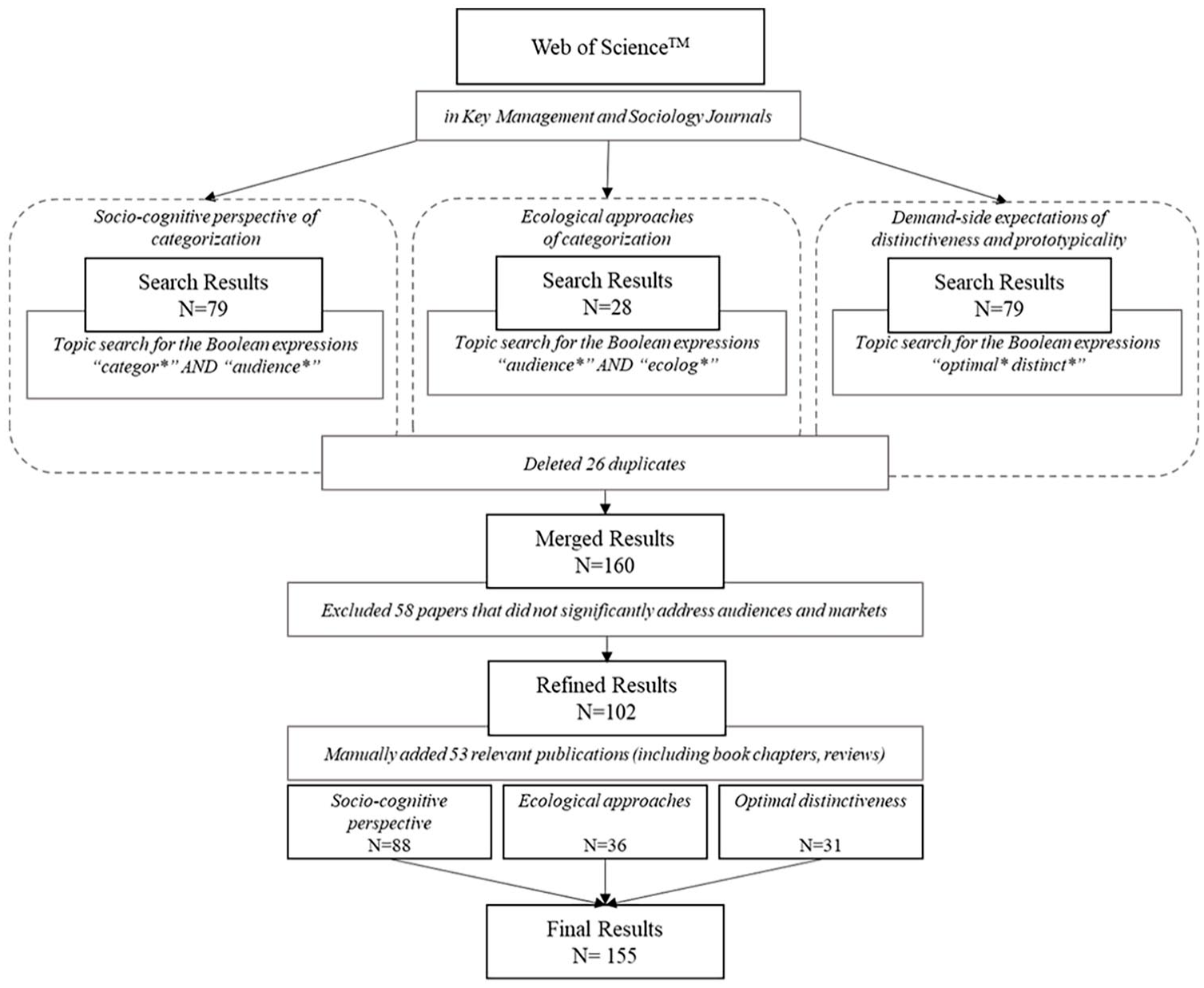
Literature Selection Process
Based on this first search, we found that three streams constituted the corpus of the 160 articles around three main seminal references (see Figure 1): Hannan and Freeman’s (1989) monograph entitled Organizational Ecology for the literature on the ecological perspective, Zuckerman (1999) for the research on the socio-cognitive perspective of categorization (see also Vergne & Wry, 2014), and strategic balance theory (Deephouse, 1999) for research on optimal distinctiveness. Given that our interest lies in the connection between audience heterogeneity and market outcomes, we excluded all publications that did not refer to the market-level implications of audience attributes or actions. Based on that we excluded 58 publications. A closer investigation of the corpora led us to the discovery of 53 additional sources (e.g., book chapters, book reviews, articles from other journals, and working papers) Therefore, the final number of the reviewed publications is 155, which we consider the main corpus of this review. For each paper, we collected information on (1) the types of audiences, (2) their characteristics, (3) their role, and (4) their relationship with market dynamics.
Markets and Audiences: Three Distinct Research Traditions
Our review on audience heterogeneity addresses existing gaps in each research tradition. For example, in their review on market categorization, David and Lee (2022: 716) find that audiences’ categorization processes are contingent on audience characteristics, which need further investigation. Durand and Boulongne (2017: 659) call for further research on how inter- and intra-audience variation affects markets differently, and Zhao (2022: 72) emphasizes that what counts as “optimally” distinctive depends on the evaluating audiences and their lenses and benchmarks in use.
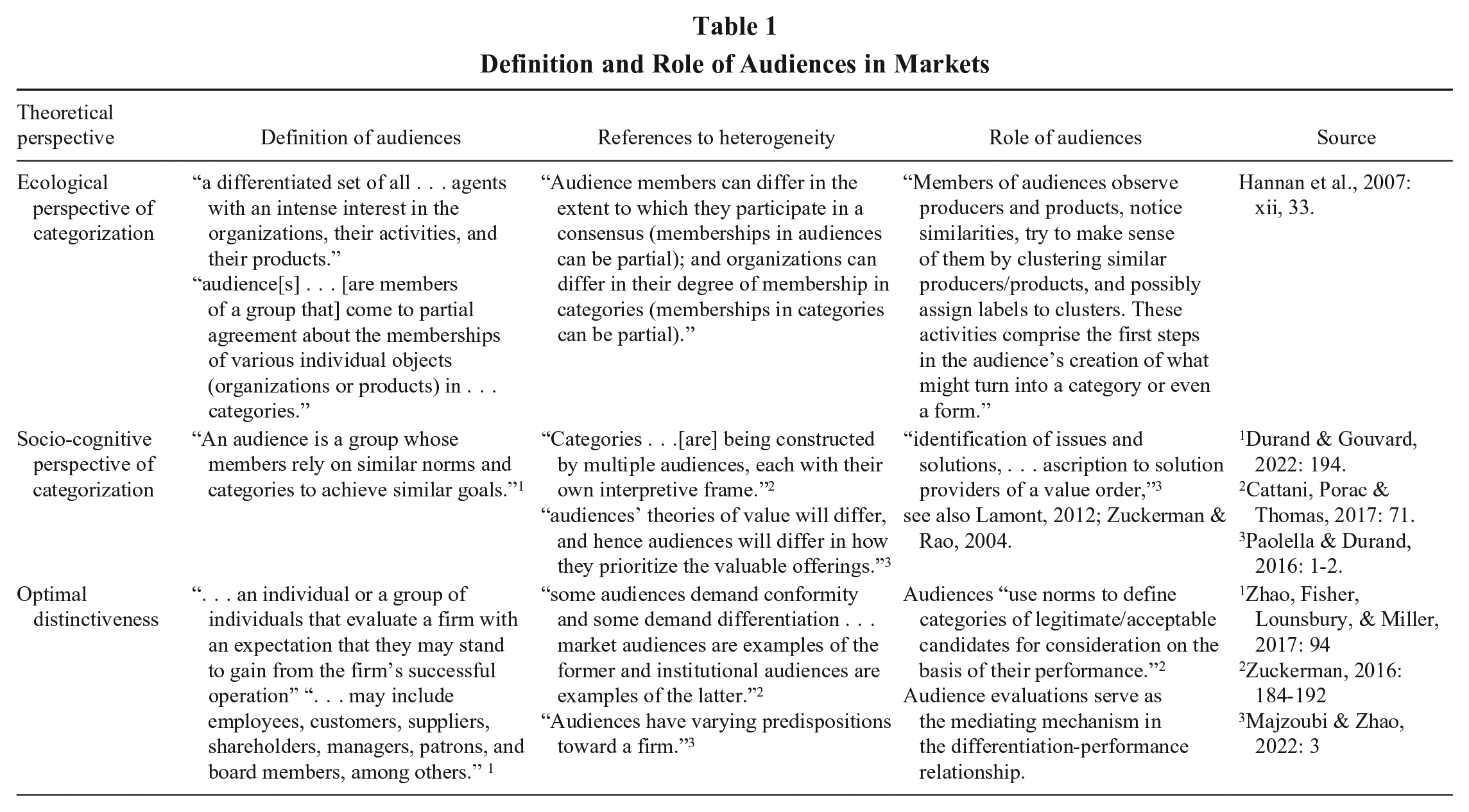
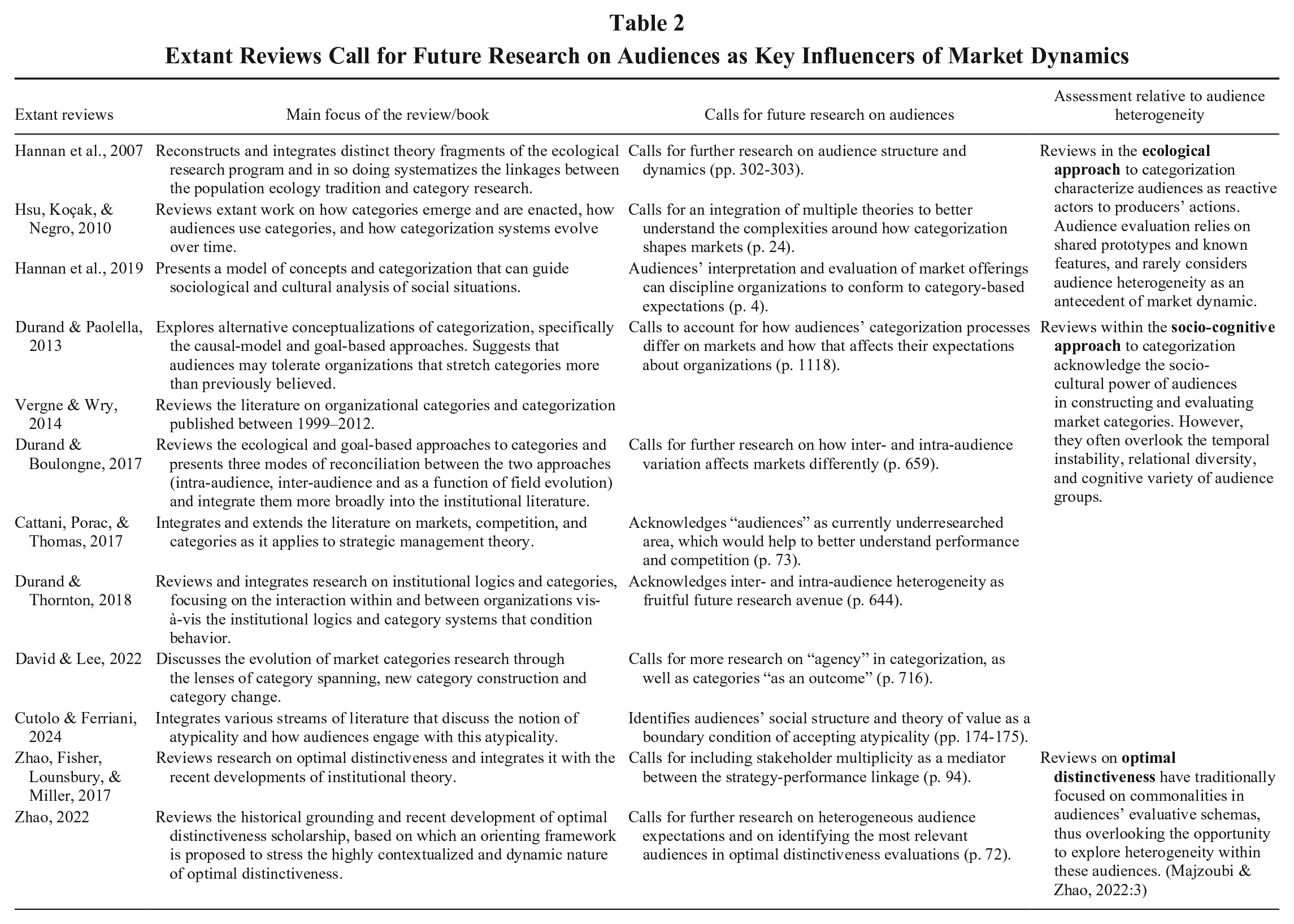
Figure 2 displays the growth of research in the three streams of literature we identified. We noticed that discernible tensions exist among the ecological, socio-cognitive, and optimal distinctiveness streams in terms of how they address audiences, which can only be reconciled through a comprehensive horizontal review. Table 1 summarizes our analysis of how the three streams view markets and the role of audiences in market evolution. While prior reviews of these research streams exist, as shown in Table 2, none of them have focused on the complexities surrounding the dynamic, heterogeneous nature of audiences and how these in turn affect categorization processes and market dynamics. For example, Hannan and colleagues acknowledge that audience members “can differ in the extent to which they participate in a consensus” (Hannan et al., 2007: xii). However, they assume that audience preferences remain stable and their work is primarily concerned with the heterogeneity (or fuzziness) of categories, how audiences might perceive this fuzziness, and how various organizational niches are created in response (Hannan et al., 2007), rather than with the heterogeneity of the audiences themselves. The socio-cognitive perspective acknowledges multiple audiences and cognitive processes. However, it generally assumes that markets are stable. Research on optimal distinctiveness recognizes the evolution of audience tastes but otherwise adopts a completely producer-centric approach. In our review, we examine these differences and tensions to understand where the three streams of research diverge and where they share common ground.
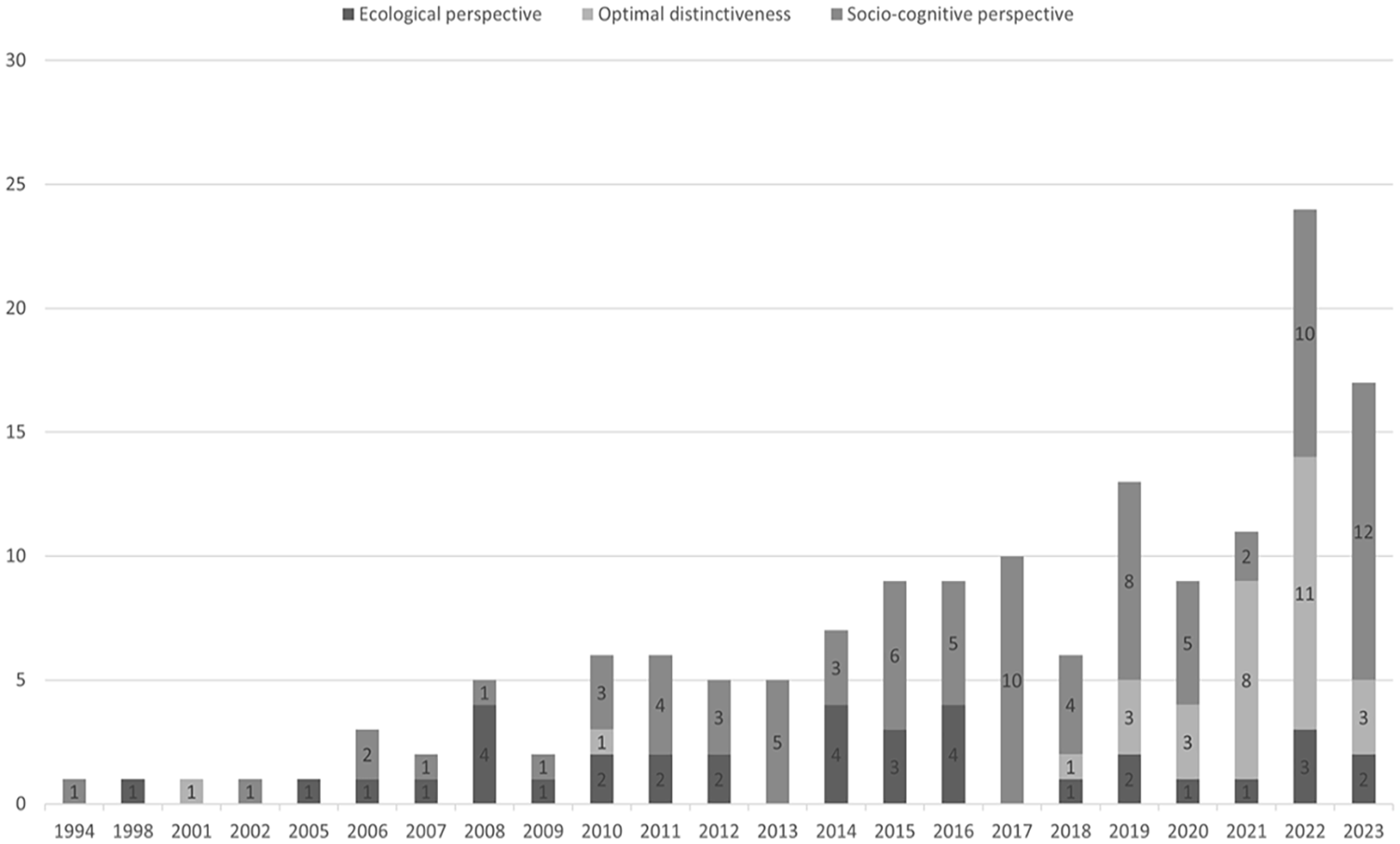
Development of Reviewed Literature Over Time
Definition and Role of Audiences in Markets
Extant Reviews Call for Future Research on Audiences as Key Influencers of Market Dynamics
Audience Heterogeneity in Contemporary Research
Based on our review, we found that the three approaches have different ideas about audience heterogeneity that revolve around the heterogeneity in audience evaluations, the origins of diversity in audiences, and the reasons of shifts in their preferences. In the following sections, we take stock of these approaches before refining audience heterogeneity and its dimensions that emerge from this review.
Heterogeneity in Evaluation: The Case of Category Spanning
The first theme that chronologically appeared across the three research streams is how audiences react to category spanning in markets. Category spanning organizations have multiple market identities and span their offerings across multiple market categories (Hsu, Hannan, & Koçak, 2009), which creates ambiguity and difficulties for audience members in their variety to identify, assess, and value them (Cutolo & Ferriani, 2024: 16-17; David & Lee, 2022: 712-713; Durand & Thornton, 2018: 638-640). As such, there are different interpretations across the three literature streams on whether audiences reward or penalize organizations that engage in category spanning. Our review indicates that accounting for audience heterogeneity—an element present in many of the reviewed studies—can help explain the varying market outcomes of category spanning.
Category spanning in the ecological tradition
Researchers in the ecological view originally assumed that producers that span multiple categories suffer identity and competence disadvantages: audiences penalize them as less identifiable and hence less competent as audiences prefer producers belonging to established and robust categories (Hsu et al., 2009). More recent work in this stream explored diverse boundary conditions of the relationship between category spanning and penalty (David & Lee, 2022: 713). To illustrate, Pontikes (2012) found in her study of U.S. software companies that audience responses to category spanning are shaped by the audience’s market role. In the context of her study, consumers and corporate venture capitalists (“market-takers”) use existing, robust market categories to aid their investment decisions, so they generally tend to avoid ambiguous labels that make ventures fuzzy and unappealing. To the contrary, independent venture capitalists (taking on the role of “market-makers”) aim to redefine and reinvent market structures, so they interpret categorical ambiguity as a source of strategic flexibility and pivoting opportunity.
Category spanning in the socio-cognitive tradition
Categorization scholars in the socio-cognitive tradition posit that the consequences of category spanning are not always negative, as they depend on “how audiences identify issues and solutions, ascribe value, and rank solution providers, i.e., on audiences’ ‘theory of value’” (Paolella & Durand, 2016: 4; Zuckerman, 2017). Specifically, this stream of research states that audiences have diverse theories of value depending on their situation. For example, Paolella and Durand (2016) argue and find that when issues are complex, audiences’ theories of value are goal-based rather than prototypical (see also Durand & Paolella, 2013; Boulongne & Durand, 2021). In such issue domains, category spanning organizations receive higher evaluations from audiences. For example, in the case of complex audience requirements (e.g., legal advice during the acquisition of a rival firm), audiences primarily consider their desired end goal rather than the prototypicality of available services, and will select a provider that helps them meet this goal—even if, or especially because, the provider’s expertise spans across multiple categories (Paolella & Durand, 2016).
Category spanning in optimal distinctiveness research
Scholarly work situated in optimal distinctiveness research examines whether and to what extent audiences can accept category spanning, depending on the strategic agency of producers, the influence of intermediaries, and the maturity of the product category (Zhao, Ishihara, Jennings, & Lounsbury, 2018). In their study on the U.S. console video game industry, Zhao et al. (2018) observe that, when audiences (gamers) face emerging categories that span multiple boundaries, they often rely on critics, a different audience group, who play an important role in signaling quality and making sense of the new offerings. To illustrate the effect of firms’ strategic agency on audiences’ attitude toward category spanning, another study on the U.S. automobile industry examined how audiences responded to multiproduct firms that engage in category spanning (Bu, Zhao, Li, & Li, 2022). The authors found an interesting dichotomy in audience reactions: when firms distinguished themselves from industry counterparts through category spanning—achieving between-organization distinctiveness—audiences tended to reward them. In contrast, the same audiences were less appreciative when firms applied category spanning within their own range of products to create within-organization distinctiveness (Bu, Zhao, Li, & Li, 2022).
Audience Diversity
While most papers studying category spanning assume audience homogeneity, other researchers have moved away from this initial assumption (e.g., Hsu, 2006). The existence of diverse audiences is acknowledged across all three literature streams as an important factor influencing market variability. Scholars started to pay more attention to the fact that audiences are made up of subgroups with varying characteristics as they realized that audience diversity may affect market outcomes. The context in which each audience is embedded, not only shapes the audience’s preferences but also influences producer responses. The three research streams zoomed in on different aspects of audience diversity and its origins.
Origins of audience diversity in organizational ecology
In research informed by the ecological view, the emergence of diverse audiences is attributed to the segmentation of markets. This segmentation (or partitioning) occurs as a result of competition between specialist and generalist producer populations (Boone, Bröcheler, & Carroll, 2000; Dobrev, 2000; Swaminathan, 1995). Competition not only segments markets but also leads to the partitioning of audience populations, as generalist and specialist providers each attract distinct audience segments (Mezias & Mezias, 2000; Swaminathan, 2001). In other words, the ecological perspective contends that audience diversity stems from niche spaces (Hannan et al., 2007: 171-190; Hannan et al., 2019). Work on market partitioning also acknowledges the role of cultural beliefs of audiences (e.g., Carroll & Swaminathan, 2000). For example, in their study, Hsu, Koçak, and Kovács (2018: 185-186) took cultural variation across geographical markets into account when studying audiences’ diverging attitudes towards recreational cannabis dispensaries and found significant differences in audience attitudes regarding the legalization of recreational cannabis dispensaries in the states of Colorado and Washington.
Origins of audience diversity in the socio-cognitive perspective on categorization
Research informed by the socio-cognitive view complements the ecological view’s take on audience diversity in arguing that audience diversity stems from differences in the distribution of cognitive mechanisms activated by entities’ attributes (Gouvard & Durand, 2023). These mechanisms are influenced by the sociocultural contexts in which audiences are situated. Cues and symbols are value-laden attributes that trigger different cognitive mechanisms, such as prototype-based, goal-based, or exemplar-based categorizations. This can lead to the emergence of audiences that differ in their viewpoints and compositions (Durand et al., 2017). The primary sources of audience diversity according to this research tradition are the differences in audiences’ needs and theories of value (Zuckerman, 1999, 2017; Durand & Boulongne, 2017; Lamont, 2012; Paolella & Durand, 2016).
Origins of audience diversity in optimal distinctiveness research
In optimal distinctiveness research, organizations are assumed to compete in environments enacted by diverse audiences that shape the boundaries of industries and markets. Each group’s unique expectations play a role in how they view and define the market, making the audience a key player in the competitive environment (Zhao, 2022: 49). Recent work in this stream highlights the critical role of audiences, noting the need for firms to not only capture audience attention but also to strategically identify which audience segments are pivotal for their optimal positioning. For example, in their investigation of investment recommendations by security analysts for U.S. publicly listed firms, Majzoubi and Zhao (2022) found that there was significant heterogeneity even within this seemingly homogeneous group, showing that individuals possessed unique predispositions in their evaluations of companies due to differences in industry focus, evaluation models, and how they interpreted information.
Shifting Audience Preferences
The third and most recently emerging theme in contemporary literature addresses the temporal aspect of audience heterogeneity—namely, the idea that audience preferences change over time. Though variety in audiences’ preferences was acknowledged early on in all the three streams of research (Carroll & Hannan, 2000: 9; Deephouse, 1999: 152; Suddaby & Greenwood, 2005), the fact that these preferences can shift over time has been recognized only in more recent research (Fisher, Kotha & Lahiri, 2016). Each research tradition included in this review has different explanations as to why these shifts in audience preferences occur.
Shifting audience preferences in organizational ecology
For long, the ecological perspective treated the differences in preferences among audience members as fixed ex ante, creating niches for producers to position their differentiated offerings. For example, resource partitioning theory 2 traditionally assumed that audience support is stable within each niche (Carroll & Hannan, 2000: 261-274). Only more recent research has acknowledged the “fickleness” of audiences (Kim & DellaPosta, 2022). As such, the evolution of audience preferences is linked to the expansion of their current and past schemas associated with a category (Le Mens, Hannan, & Pólos, 2015: 556). For organizations to adapt to the changing nature of audience tastes, Jia and colleagues propose collaborations between generalists and specialists (Jia, Lewis, & Negro, 2022: 1). However, this line of research tends to overlook the intricate socio-cognitive processes that shape audience judgments within their social environments.
Shifting audience preferences in the socio-cognitive perspective on categorization
The socio-cognitive view addresses this issue by focusing on audiences’ categorization processes and acknowledging their contextual and temporal intricacies (Durand et al., 2017). Audiences adapt to institutional shifts and respond to the emergence of new institutional logics, demonstrating that their preferences are not static. For example, Jones and colleagues elaborate on the construction and evolution of “modern architecture” as a category, during which internal and external audiences (professional peers and architectural historians, respectively) participated in the creation of a new artifact code (Jones, Maoret, Massa, & Svejenova, 2012: 1525). The authors document that in the early period of the category development, a subgroup of critics and professional peers (revivalist architects) reacted negatively to modern buildings, calling them “half-modern,” “ugly,” and “a monster of awkwardness” (Jones et al., 2012: 1533, 1536). Later, as the category of modern architecture evolved and producers competed with divergent logics and artifact codes, critics were convinced, while professional peers were left confused (Jones et al., 2012: 1536). Finally, in the subsequent period, after 1946, audiences gradually accepted the category and celebrated it for uniting science with art and healing the wounds of war (Jones et al., 2012: 1538-1539). Hence, as this case illustrates, audience preferences can shift, but for a category to remain in use, some audiences need to support it. For instance, experts and vanguards may first sponsor and then abandon it while the general public keeps the category alive. As such, “[t]he success of any product is tied to the viability of its category—that is, whether the category remains in the collective awareness and active use” of audiences (Lo, Fiss, Rhee, & Kennedy, 2020: 87; Soublière, Lo, & Rhee, 2024: 61).
Shifting audience preferences in optimal distinctiveness research
Being optimally distinct involves a series of factors, some under and others beyond the producers’ control. Research on optimal distinctiveness posits that shifts in audience preferences stem from the balancing act of firms competing for being recognized as different from their peers while still conforming to market expectations at the same time (Zhao, Fisher, Lounsbury, & Miller, 2017). Audiences react to this competition by evaluating the distinctiveness of organizations viewing some firm positions more legitimate or favorable than others (Navis & Glynn, 2011; Zuckerman, 2016; Kim & DellaPosta, 2022). For example, as the study of Haans (2019) on the Dutch creative industry demonstrates, audience preferences shift in response to within-product category heterogeneity. His findings show that audiences shift away from organizations in markets where being different becomes the norm, and instead value organizations that stand out in environments where the majority of firms come to rely on conformity (Haans, 2019: 25).
A Source of Confusion Revealed: Between- vs. Within-Audience Heterogeneity
Overall, our literature review indicates that audience heterogeneity is a consistent theme across the three main research streams. It takes different forms, from heterogeneity in audience evaluations and the origins of diversity in audiences to the reasons of shifts in their preferences. However, as our analysis of the reviewed articles shows (for details, see Supplementary Table 1, Online Appendix), extant work in all three streams of literature conflates two distinct types of audience heterogeneity. Until today, papers tended to not distinguish between the two (for rare exceptions, see Durand & Boulongne, 2017: 658; who discuss polarization, Durand & Thornton, 2018: 644). These two different types of audience heterogeneity are between-audience and within-audience heterogeneity. Some studies use both concepts separately (e.g., within-audience interaction vs. interactions between vanguard and lay audiences, in Koçak, Hannan, & Hsu, 2014), while some only refer to within-audience heterogeneity (e.g., the audience’s differing perceptions of exemplar similarity in Majzoubi, Zhao, Zuzul, & Fisher, 2025), while others operate with between-audience heterogeneity only (e.g., insider vs. outsider audiences, in Ubisch & Wang, 2023). However, it is currently not common practice in the field to distinguish or explain the type of heterogeneity that characterizes the focal audience.
Based on our review and building on the ensuing observation that leaving audience heterogeneity un(der)defined seems to cause confusion among researchers, we suggest formalizing the concepts of between- and within-audience heterogeneity (previously referred to on some occasions also as inter- and intra-audience heterogeneity, e.g., in Durand & Thornton, 2018: 644).
Understanding the dynamics of categorization processes in the presence of heterogeneity both between and within audiences represents a growing area in current research and provides important practical implications for the different market actors. For example, for producers, recognizing which audience segments are most critical to their success is essential for sustaining their competitive advantage (cf. Stroube & Waguespack, 2024: 25). It is not only about recognizing the existence of diversity within an audience; but also strategically prioritizing engagement with different audiences’ segments that are most impactful for producers (for early examples, see Kodeih, Bouchikhi, & Gauthier, 2019, and Majzoubi & Zhao, 2022). These segments may share more similarities across audiences (e.g., biodiversity protection may unite some consumers and investors alike) than within a given audience (a minority of investors may share ecological concerns).
Individuals can also belong to multiple audience subgroups simultaneously, a characteristic that research has only recently started to discover. This phenomenon of multi-audience membership is becoming more prevalent, forming a key structural feature of contemporary markets. The surge of subgroups within broader audiences is quite typical in the online context. Online platforms facilitate the congregation and dialogue of audience members, influencing opinions on specific products or services (Greenberg, Sands, Cattani, & Porac, 2024; Kovács & Horwitz, 2020; Pozner et al., 2022; Verhaal & Dobrev, 2022). Subgroups frequently form distinct niches that, at times, can also actively compete against one another—a trend observable in the multitude of specialized online communities (for an example, see the work of Kim & DellaPosta, 2022 on competition among amateur beer connoisseurs). Due to the ongoing evolution of audiences, certain subgroups may gather momentum and eventually emerge as independent audiences. We found evidence for this in the work of Zavyalova, Callahan, Hubbard, and Zyung (2023), who discuss polarization, an extreme form of divergence of subgroups. 3 The proliferation of trans- and sub-audiences gives rise to an ever-expanding phenomenon of categorical recombination at the market level, impacting both differentiation and segmentation decisions of producers (Cudennec & Durand, 2023; Majzoubi & Zhao, 2022).
Taking Stock of Research: Identifying Audience Plasticity and Multiplexity
As described above, the majority of prior publications on audience heterogeneity discusses the aspects of audience diversity, shifting preferences, and differences in attitudes towards category spanning. While the first analysis of our corpus of texts provides a good basis for distinguishing the locus of audience heterogeneity (between vs. within), this distinction does not yet fully capture other aspects of heterogeneity that are present in the set of reviewed papers, such as the dynamic and fluid nature of audiences’ memberships, and the various types of connections between distinct audience groups and producers (see Figure 3). Taking stock of a rich set of recent papers, we identified 58 that discuss aspects of audience plasticity and 39 that address various forms of audience multiplicity. This development in recent research helps to clarify formerly underspecified dimensions of audience heterogeneity. We formalize these two dimensions as key factors that explain how audience heterogeneity varies over time.
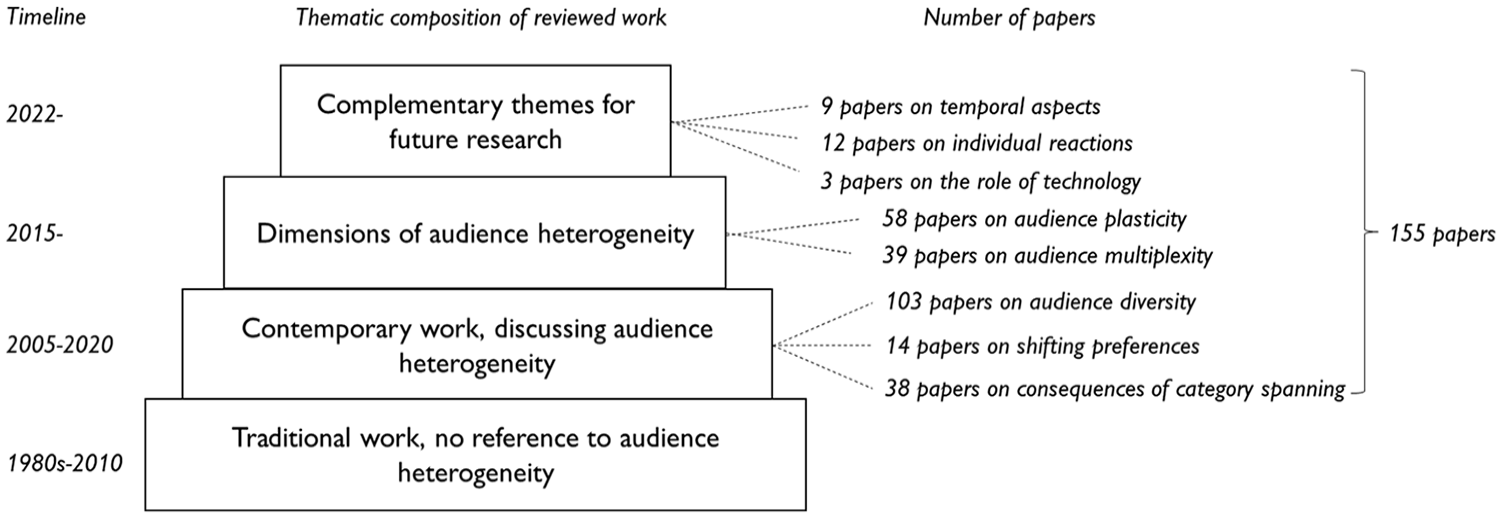
Development of Themes in Reviewed Literatures
Audience Plasticity
When looking at the development of audiences longitudinally, there is some evidence in the existing research that audience heterogeneity varies over time (e.g., audience fluidity or “fickleness” in Demetry, 2019; Hahl, Kim, & Zuckerman Sivan, 2018; Jia et al., 2022; Kim & DellaPosta, 2022). For example, an increase in field knowledge may turn novices into experts who perceive the system of categories attached to a market differently and, as a result, assign different values to new offerings (Cudennec & Durand, 2023). Drawing on the neuroscientific phenomenon called “neuroplasticity,” 4 we introduce the concept of audience plasticity, which we define as a characteristic of an audience to change its activity (identification, evaluation, and valuation) in response to stimuli from their internal and external environments by reorganizing its memberships, preferences, and theory of value. Our review helps characterize three non-mutually exclusive key aspects of audience plasticity: episodic change patterns, learning dynamics, and imitation across sub-audiences due to mutual exposure.
Episodic change patterns
Our review suggests that audiences undergo shifts in their heterogeneity during critical periods, corresponding to a pattern of punctuated change (Levinthal, 2021). Specifically, pivotal events reveal heightened audience malleability, affecting both within- and between-audience heterogeneity. Such audience plasticity episodes can be triggered by producers, audiences, and exogenous events (like an accident or crisis).
Producers can influence audience plasticity, and consequently, between-group heterogeneity by their decisions to expand their audience. Ocasio and Joseph (2017) study Apple’s decision to open up the iPhone’s operating system to software and application developers. This decision decreased the psychic distance between mobile phone users and software providers. The introduction of the iPhone itself also affected the within-group heterogeneity of mobile phone users. Especially the rapid exposure to superior design quality significantly changed mobile user expectations.
Audiences’ own actions can also impact audience plasticity and the evolution of their own heterogeneity. Granqvist and Ritvala (2016: 229) observed a significant shift in consumer preferences away from “functional foods” toward organic, sustainably produced food products over time. This shift arose from a growing consumer awareness and concern about health, environmental sustainability, and ethical practices. Influenced by reports and research on the impacts of pesticides, preservatives, and genetically modified organisms (GMOs), consumers began demanding more natural and organic options. Major food companies and supermarkets, which had traditionally focused on conventional food products, found themselves needing to adjust to these changing consumer demands (Falguera, Aliguer, & Falguera, 2012). This led to the expansion of product lines, acquisitions, as well as marketing and branding adjustments (e.g., Mathias, Huyghe, & Williams, 2020). This shift toward organic products has implications for both within- and between-audience heterogeneity. As consumers increasingly demand organic and sustainable options, within-audience heterogeneity within the consumer group itself becomes more pronounced between radical vegans and flexitarians for instance. Likewise, among other audiences such as raters or investors, members specialize in new categories, preferences reassort groupings, and theories of values are revisited to address the new market realities (e.g., Boghossian & David, 2021), increasing between audience heterogeneity.
Simultaneously, between-audience heterogeneity is affected as movements (such as the organic food movement) influences not just consumers but also other market actors such as investors and regulators (Lee, Hiatt, & Lounsbury, 2017; Ozcan & Gurses, 2018; Georgallis, Dowell, & Durand, 2019). For instance, investors might start prioritizing companies with sustainable practices due to perceived long-term profitability and reduced regulatory risks, thus differing in their objectives and preferences from consumers who are motivated by health and environmental factors. This leads to varying strategies and expectations between these distinct audience groups, shaping how companies formulate and market their products.
Audience plasticity can continually modify the heterogeneity configurations of audiences, leading to dynamic shifts in how companies engage with multiple heterogeneous audiences. This plasticity intensifies the complexity of managing audience expectations and behaviors, as companies must adapt to both within- and between-audience heterogeneity. Gouvard and Durand (2023) argue that as different segments of the market exhibit shifting preferences and values, companies need nuanced strategies to cater to these evolving needs.
The above examples illustrate episodic change patterns, an aspect of audience plasticity, as a source of increasing heterogeneity in audiences. However, episodic change patterns may affect audience heterogeneity in the opposite direction, too. Cases exist whereby audience plasticity is impaired, leading to shrinking and rigidifying heterogeneity. Chai, Doshi, and Silvestri (2022) study the crash of a test flight for space tourism by Virgin Galactic in 2014. The crash divided a previously homogenous space tourism audience into detractors and supporters. Detracting audiences re-drew boundaries to selectively include players that they consider legitimate, thereby signaling their rigidifying risk tolerance and changing expectations regarding who should be allowed to operate in the space industry. Supporting audiences defended Virgin Galactic’s position by referring to the expectable difficulties that come with radical innovations in the space industry, thereby signaling the expansion of their risk tolerance.
Learning dynamics
Like neural pathways that strengthen with repeated stimulus, audience preferences and behaviors solidify with repeated exposure to a given stimuli. Harmon, Rhee, and Cho (2023) find an example for such learning dynamics in their study. When the Internet was still in its infancy in the 1990’s, investors did not initially believe in the profitability of firms in the nascent Internet market; however, as firms repeatedly exposed investors to their new measurement of expected profitability (i.e., engagement metrics, such as traffic, or number of users), these metrics started to gain legitimacy among investors (pp. 2612-2613), to the point where they started using them routinely. Hence, Harmon and colleagues’ study illustrates how an audience’s mental schema evolves and that due to this evolution, the audience may be more willing to accept categorical features previously alien to them. Those most sensitive to the new features then often reorder themselves into sub-audiences in which membership unites actors that would not have been connected to each other otherwise. This learning also impacts the heterogeneity of audience groups: as a result of Internet firms’ repeated efforts to convince investors about their profitability, the heterogeneity of investor groups expanded, as their tolerance of atypicality and risk increased.
Authenticity work serves as another example of how stimulus-response learning nurtures audience plasticity and influences the development of audience heterogeneity. Authenticity work—the efforts by producers to appear authentic to their audiences (Delmestri & Greenwood, 2016; Grayson & Martinec, 2004; Peterson, 2005; Voronov, Foster, Patriotta, & Weber, 2023)—can be considered as a stimulus targeted towards an audience to alter their activity (identification, evaluation, and valuation). However, recent research suggests that to solidify audiences’ learning processes after the initial heterogeneity-expanding efforts of the first stimuli, a deeper engagement with audiences seems necessary. Indeed, authenticity work requires more than producers sending one-way signals towards audiences. Rather, as Demetry (2019: 937) argues, authenticity work is an “active co-construction of illusions by organizers and their audiences.” Since audiences do not have an aligned understanding of an optimal level of authenticity (Beverland & Farrelly, 2010; Hahl et al., 2018; O’Connor, Carroll, & Kovács, 2017), they need confirmation from other market actors as well. For example, in the case of underground pop-up restaurants, audiences contribute to the authenticity of the experience by adopting certain rituals, such as downplaying the economic nature of the transaction, and engaging with other guests as if they would be long-time friends (Demetry, 2019: 938).
Stimuli from either audiences or producers can also lead to a stimulus-response interaction and affect the heterogeneity of both senders and receivers. For example, Mathias and Fisher (2022) examined a situation in which different audience groups, opponents and proponents of collegiate-licensed beer, were at odds but still capable of exchanging and influencing one another through their respective signals. Their analysis revealed that when faced with backlash craft breweries shifted focus from highlighting student involvement to spotlighting alumni and broader community engagement, which proved to be a more effective approach to garner broader acceptance (Mathias & Fisher, 2022: 708-713). In doing so, proponents of college-branded beers created a broader framing around the participants of their supported category, thereby successfully decreasing the negatively perceived categorical proximity between university curriculum and alcohol.
Mutual exposure of audience groups
As the previous example suggests, audience groups do not exist in isolation, but are exposed to one another, thereby having the opportunity of influencing each other’s heterogeneity (Wang, 2022: 2). This mutual exposure can inform a focal audience’s plasticity and lead to variation in its heterogeneity. Examples from the reviewed literature include papers on digital platforms—the modern-day variation of traditional social classification systems that organize the expectations and preferences of audiences (Hsu, 2006; Zuckerman, 1999)—are crucial enablers of mutual exposure of audiences. These platforms have the power to separate or connect distinct and adjacent audiences. Depending on the features provided, some audience groups may coalesce, while others grow further apart. It is not just platform features, however, that determine whether a focal audience group’s plasticity increases or decreases. These dynamics are also influenced by the initial level of heterogeneity of the audiences themselves. Audience groups that share recurrent factors of heterogeneity (e.g., values, experiences) may gradually become more homogenous by adopting similar characteristics. In other words, the more overlapping characteristics these audience groups initially share, the more likely they will borrow from other audiences, affecting audience plasticity and reducing between-audience heterogeneity.
A good example of a reduction in audience heterogeneity is the evolution of fitness communities. Online fitness channels on Strava or YouTube originally started out with diverse audiences. However, as they shared the same values and goals, their practices started to converge in terms of online tool use (Couture, 2021) and self-representation (Stollfuß, 2020), leading to over time homogenizing category goals and values. Similarly, Suarez, Grodal and Gotsopoulos (2015) look at the time when smartphones first entered the market. At that time, smartphones appealed to distinct audience groups: early adopters, tech enthusiasts, professionals seeking enhanced productivity, and younger audiences seeking social connectivity. Over time, however, these groups started to note their similarities and their previously distinct characteristics started to overlap, resulting in reduced audience heterogeneity. Manufacturers responded to this convergence by producing devices that catered to these overlapping characteristics. This resulted in a more homogeneous market, where all users now expect a similar set of features from their smartphones and show less tolerance for atypicality (Cutolo & Ferriani, 2024).
Exposure to within-audience heterogeneity may foster audience plasticity and lead to an even greater within-group heterogeneity. Before the advent of music streaming platforms, music enthusiasts had limited, pre-curated access to the vast variety of music genres. With the introduction of music streaming platforms such as Spotify, and online communities such as Rate Your Music (Rate Your Music – RYM/Sonemic, 2000), audiences were exposed to greater variance and were able to fine-tune their tastes based on their individual preferences, which led to diversifying these audience groups (Datta, Knox, & Bronnenberg, 2018). As DellaPosta, Shi, and Macy (2015) note, parallel membership in multiple audiences became accepted and even expected within communities.
By contrast, if the exposure across subgroups diminishes over time and space, imitation across them will cease and their plasticity will rigidify, which can lead to an increased between-audience heterogeneity and to the formation of new, distinct audience groups. Dale and Green (2017) take stock of the evolution of communities around computer gaming. In the early days of video gaming, audiences were fairly homogenous and there was not much diversity in the offering (e.g., Pong). As the industry evolved and genres multiplied, the development led to multiple, increasingly specialized, heterogeneous audience.
Audience Multiplexity
In early categorization research, the prevailing assumption was that producers, audiences, and intermediaries are distinct and non-interchangeable entities. Accordingly, “firms with products are producers, financers and customers are audiences, and analysts and raters are intermediaries” (Durand, Granqvist, & Tyllström, 2017: 10). More recent studies have examined various relationships audiences can have with other market actors blurring the traditional clear-cut separation between producers and the respective audiences. For instance, audiences engage on crowdfunding platforms not only as investors, but also as consumers, supporters, partners, or developers. To characterize this rich dimension, we borrow the term multiplexity from network analysis, where it refers to “the extent to which two actors are connected by more than one type of tie” (Kilduff & Tsai, 2003: 135; see also Ertug, Brennecke, & Tasselli, 2023).
Hence, we define audience multiplexity as the extent that an audience member is connected with another actor (e.g., a producer, an intermediary, a member of the focal or another audience) by more than one type of tie. For instance, members of a social movement can be seen as a conflicting audience when they react to or critique the practices of some producers. Yet, they may also be clients or employees of the firms they criticize. In such cases, audience heterogeneity is characterized by a layering of various ties and identities among audience members. This is supported by the recent review of Zhao (2022: 30), in which he argues that the line between producers (e.g., entrepreneurs) and audiences has become blurred. As the multiplexity of an audience increases, i.e., the more its members are linked by a multiplicity of ties to another actor, the audience’s characteristics (e.g., level of expertise, risk tolerance, values) will be impacted. For instance, if the more multiplex members tend to look similar to the actors with which they share ties, it is possible that the within-audience heterogeneity will increase while the between-audience heterogeneity will reduce. There are three channels through which these multiplex interactions can take place: between audiences and producers, between audiences, and within audiences.
Audience-producer multiplexity
Audience-producer multiplexity is characterized by multifaceted relationships that transcend traditional buyer-seller dynamics. These interactions include consumption (e.g., Kovács, Carroll, & Lehman, 2014), criticism (e.g., Frake, 2017), advocacy (e.g., Odziemkowska, 2022), and co-creation (e.g., Althuizen & Chen, 2022). For example, a group that utilizes a producer’s services may also provide evaluations of those services, thus playing a dual role as both consumers and critics. Similarly, in the context of initial public offerings (IPOs), audiences go beyond the role of mere evaluators to become also investors (Souitaris, Peng, Zerbinati, & Shepherd, 2022). When audiences and producers acknowledge the complexity of these multiplex relationships, they contribute to the evolution of a “meaningful conceptual system” (Navis & Glynn, 2010: 440) and maintain the “actor-audience interface” (Soublière & Lockwood, 2022). Here, endeavors gain meaning as producers interact with their audiences (Bitektine & Haack, 2015; Navis & Glynn, 2011), directly influencing how audiences engage with categories and altering their within-audience heterogeneity.
Producers also rely on multiplex audiences for validation of their past and current endeavors and to gauge future trends. Through feedback, activism, and engagement, audiences inform and influence producers’ offerings. Boghossian and David (2021) study Quebec’s cheese industry, where a symbiotic relationship emerged when producers found support beyond traditional market feedback. The non-profit activist group Solidarité Rurale du Québec (SRQ) and the Quebec Ministry of Agriculture transcended their roles as evaluators by advocating for and helping to define the “Quebec terroir” category. This engagement of external bodies in the category’s conceptualization illustrates a dynamic interplay between producers and audiences. Recognition of this multiplexity can reinforce audiences’ self-perception and identity, potentially further increasing audience heterogeneity. Conversely, producers who overlook the complex nature of the relationships with their audiences risk diminishing their competitive advantage.
Between-audience multiplexity
Audiences also establish connections with other distinct audiences sharing similar interests (Durand & Boulongne, 2017). For instance, an audience focused on organic food might overlap with an audience advocating for ethical fashion, leading to a convergence of values and shared advocacy efforts. Wang (2022) investigated the interdependence between two audience groups, video game critics and consumers, and found that critics were helpful in mediating signal inconsistencies in markets, thereby helping (multiplex or not) audiences to get a better understanding of the focal product. This happened because critics were more motivated and vigilant in their scanning the environment, while consumers rather focus on the product itself. Critics’ evaluations shape customers’ theories of value and the depth and direction of their attention (Rao, Monin, & Durand, 2003). Due to this interplay, customers may adopt some of the critics’ vigilance while customers’ focus on the product may influence critics to update their investigative lenses. Therefore, audience heterogeneity is impacted as the proportion of multiplex members in an audience who start looking more similar to their counterparts in the other audience increases (and therefore they become less similar to the members of their original group). As such customers become critics and their evaluations transform market dynamics (for a further example, see sale evolution for touristic and high-end restaurants in New York, Greenberg et al., 2024).
Within-audience multiplexity
The various interrelations of within-audience subgroups are perhaps the least researched aspect of audience heterogeneity. We found evidence for this kind of multiplexity in market audience segmentations that arise both from close interaction within an audience group, leading to assimilation and subculture creation and from insufficient interaction—or even rivalry—with other audience members, resulting in a subculture drift (e.g., in jazz, Innis, 2022; or art auctions, Coslor, Crawford, & Leyshon, 2020). Both assimilation and rivalry can impact the characteristics of the audience group members. For example, in the gaming community, excessive debate over the direction of the game’s development might create factions within the audience. Some members may align with the developers and their subculture sharing multiplex ties and advocating for innovative features, while others (without multiplex ties) might resist changes and fear the loss of the game’s original appeal (Pearce, 2011).
Future Research
Our literature review helps to detect two types of audience heterogeneity—between- and within-audience heterogeneity—and highlights two critical dimensions shaping its evolution. The first, plasticity, refers to audiences’ capacity to change over time in response to episodic change patterns, internal or external stimuli, and mutual exposure to other audiences, allowing them to learn and adapt. The second, multiplexity, captures how the boundaries and roles separating market actors blur and are continuously recomposed. While the reviewed literature contains numerous examples of audience plasticity and multiplexity (see Figure 3), the components and mechanisms underlying these concepts remain theoretically underdeveloped and empirically underexplored. We propose that a closer examination of the antecedents of audience heterogeneity—beginning with individual-level factors that, when aggregated, shape audiences—combined with a focus on plasticity and multiplexity, offers promising paths to understanding how heterogeneous audiences drive market dynamics.
In this section, we take stock of complementary themes that surfaced in our review and provide fertile ground for future research. We identified themes at the temporal-, individual-, and technological levels that inform audience heterogeneity research in general and its two dimensions (plasticity and multiplexity) in particular. The emerging conclusion of our review is that to more fully account for organizational success and market dynamics, we need to understand better audience heterogeneity, and for that end, we must comprehend its properties (such as plasticity and multiplexity) and the factors that influence them (see Figure 4).
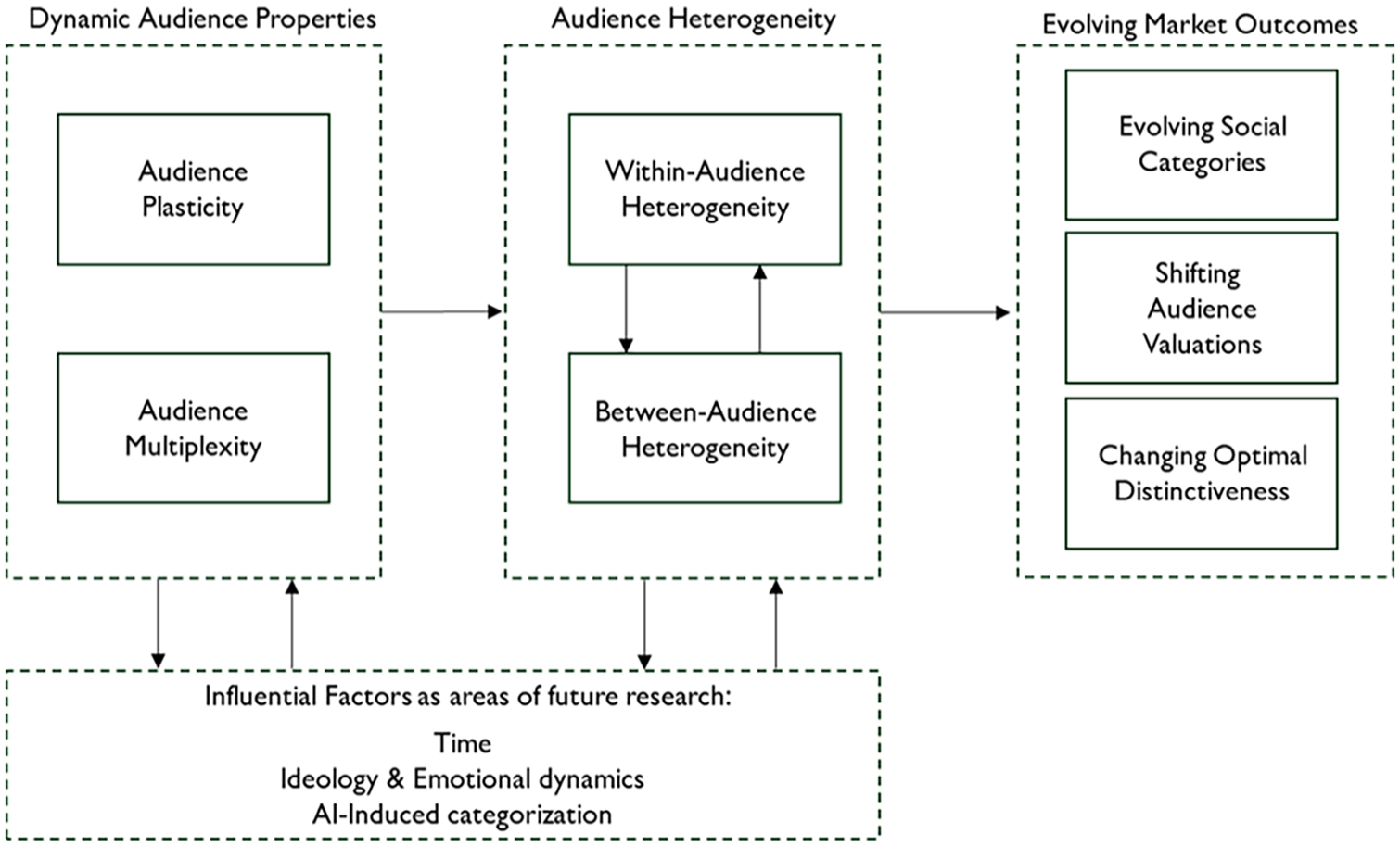
Toward an Audience Heterogeneity View of Markets: An Integrative Framework
Time and Audience Heterogeneity
We infer that new areas of research exist about time in the corpus of texts. Rather than being solely a property of the market, time can be shaped by audiences themselves. Moreover, depending on the market’s stage of evolution, audience heterogeneity can have varying implications for producers. Incorporating time more intentionally into the study of market audiences provides an opportunity to explore key aspects of audience plasticity and multiplexity. For instance, recent research highlights how heterogeneous audiences can accelerate or decelerate market evolution. Hence, examining these dynamics from the perspective of audience plasticity and multiplexity offers a valuable opportunity to uncover the underlying mechanisms and deepen our understanding of audience heterogeneity. Similarly, the existing research suggests that audiences adopt different evaluative logics at various stages of market development. The concepts of audience plasticity and multiplexity enable researchers to map changes in audiences’ logics and behaviors.
Time and audiences
Most of our reviewed papers assume that time is external to audiences (for instance, see above how episodic changes or critical events influence audience plasticity). However, an avenue for research concerns how audience heterogeneity can trigger acceleration or deceleration in markets. The reduction in audiences between-heterogeneity via for instance the disappearance of audience groups slows down the changes in market expectations and therefore affect how quickly firms respond to this sluggish demand. By contrast, an increase in audience within-heterogeneity forces firms to constantly adjust their products. As such, audience heterogeneity could be linked to market temporality mostly through the acceleration pace that it imposes on firms. Research on vanguards (i.e., consumers who engage with a market more actively than average consumers, Hannan, 2010: 173; Khessina, Reis, & Verhaal, 2020; Koçak et al., 2014; Rosa & Spanjol, 2005) and evangelists (i.e., audience members who “build a critical mass of support for new ways of doing things,” Massa, Helms, Voronov, & Wang, 2017; Stinchcombe, 2002; Suchman, 1995) paved the way for such an exploration. Vanguards and evangelists dynamize audience within-heterogeneity while separating forerunners from laggards and so increasing audience between-heterogeneity, which in turn speeds up time in corresponding markets. More research should study their influence as well as that of audience members that resist change, slowing down how market actors experience competition time.
Audience heterogeneity and market evolution
Granqvist and Ritvala (2016) note that due to the lack of longitudinal studies, there is little clarity on why and how audiences categorize offerings in various stages of market development. They note that categories encounter different audience types (i.e., between-audience heterogeneity) during their evolution, and that individual audience groups change their perspectives of the focal category as it develops over time (i.e., within-audience plasticity). While Granqvist and Ritvala (2016) further scholarly understanding in characterizing market categorization as an evolving activity, future research could clarify how audiences themselves change alongside market evolution.
Future research could investigate whether different mechanisms of audience plasticity and multiplexity are more prevalent at different market development stages. The reviewed papers provide anecdotal evidence of changing audience heterogeneity levels and dimensions. For example, in nascent market settings, audience plasticity is high, given the unclear motivations and the lack of a shared knowledge base around emerging market categories (Granqvist & Ritvala, 2016: 214). Shared meanings are yet to be created. As Koçak et al. (2014) theorize, in emerging market orders, audiences achieve these shared meanings through three distinct processes: through interaction among the audience, through influence of vanguard audience members on lay audiences; and through vanguard influence on authorities. This resonates with audience plasticity (mutual exposure of audience groups) and audience multiplexity (within-, between-audience, as well as between audience and other market actors) and demonstrates how in nascent market settings, these mechanisms can result in decreased audience heterogeneity (i.e., convergence in meanings). It would be interesting to research the counterfactual (divergence of meanings in nascent markets) and find out whether it leads to the increase of audience heterogeneity.
In mature markets, we found evidence for increasing within-audience heterogeneity. Kim and DellaPosta (2022) study how audience evaluate beer online and find that audiences engage in social competition in the form of fine-tuning and diversification activities to set themselves apart within their community: as such, amateur connoisseurs compete for in-group status and prestige. Future research could explore further whether market maturity reduces audience plasticity by reinforcing entrenched preferences or provides opportunities for experimentation and boosts it.
To what extent can audiences directly influence the transition of markets from “mature” to “declining,” and does this influence their heterogeneity? As Granqvist and Ritvala (2016) demonstrate, declining markets can be the result of changes in the levels of audience plasticity, in that audiences undergo a preference shift (e.g., turning away from the functional food trend to organic foods in the mid-2000s, Granqvist & Ritvala, 2016: 229). Is increased plasticity always detrimental in mature and declining markets, or can it offer strategic opportunities? Does greater within-audience heterogeneity signal potential for market renewal, or does it mark the onset of decline? These questions, among others, remain open for future research.
In sum, our review shows that there is considerably more research focused on mature markets, which explains why we have a better understanding of audience heterogeneity at this stage of market evolution. However, while some publications discuss the market categorization processes in nascent and declining markets, 5 future research could prioritize empirical focus on these stages or market evolution to illuminate the antecedents and consequences of audience heterogeneity in these understudied settings.
Individual Reactions and Audience Heterogeneity
In this section, we address two underdeveloped factors contributing to audience heterogeneity: ideologization and emotions. While existing research has provided some insights, much remains to be understood about how they both influence how individuals regroup or part ways and affect audience heterogeneity and its implications for market dynamics. The ideologization of audiences impacts both audience plasticity and multiplexity, most likely reducing the former and increasing the latter. The role of emotions may be even more complex: When organically emerging from individual audience members and “spreading” across audience groups, emotions can increase both plasticity and multiplexity. However, when leveraged by producers to manipulate audiences, emotions may reduce audience heterogeneity, diminishing plasticity and multiplexity.
Ideologization of categories and audiences
The first theme that permeates the systematic review of the three research streams is the presence of value-laden features in category definitions (e.g., Arjaliès & Durand, 2019; Syakhroza, Paolella, & Munir, 2019) that influence audiences’ categorization processes (identification, evaluation, and valuation of organizations). Traditional views often consider audience categorization as primarily cognition-based, with homophily leading to shared beliefs and thought patterns (Hannan et al., 2019). However, emerging evidence suggests that audience communities are not merely passive groups defined by like-mindedness; rather they are active, agenda-driven plastic collectives and use goal-based categorization (Mohliver, Crilly, & Kaul, 2023; Paolella & Durand, 2016). Such collectives may engage in ideologization with dominant moral codes influencing their identity, categorization, and behavior (Arjaliès & Durand, 2019; Boone & Özcan, 2020). They form around moral agendas and moral prototypes that guide their actions and define their collective ethos (DellaPosta, Shi, & Macy, 2015; Lashley & Pollock, 2020). Hence, there is an opportunity for future research to explore how market actors, both producers and audiences (and others as well such as market intermediaries), actively construct and utilize ideological narratives (e.g., political, moral, and religious) and study the consequences for categorization processes.
Ideologization of categories through value-laden features redistributes memberships in and across audiences. Value-laden features attract and coalesce multiple members that absent this feature would not have imagined their proximity. Within an audience, ideologization modifies the distribution of preferences and precipitates members to assess either favorably or negatively producers and products (e.g., through polarization, Chung, Odziemkowska, & Piazza, 2023; Mohliver et al., 2023), which therefore reduces audience plasticity (and chances to learn from other members and to be exposed to different subgroups). Mathias et al. (2020) present a case where freedom, authenticity, and independence characterize craft brewers and ideologically oppose their category to the dominant oligopoly. For producers, addressing audiences’ ideologization pushes them to develop alliances with identifiable engaged organizations. For instance, firms that want to address grand challenges, may partner with social movement organizations (SMOs), building on their expertise increasing audience multiplexity and hence reducing audience heterogeneity and expected negative valuation (Odziemkowska, 2022).
Therefore, future research needs to assess more how ideological features shape audience heterogeneity and its dimensions. From the emerging body of research, it appears that contradictory audience evaluations of ideological features can lead to intensified polarization within and between audience groups, reducing audience plasticity and increasing audience multiplexity. What needs further investigation are the consequences of these changes for producers’ evaluation and valuation by audiences, and whether these enhance the organizations’ selective advantages over their rivals. The consequences for market structure and dynamics are worthy of interest, since a potential outcome of category ideologization is market fragmentation in confrontational blocks. Another vein of research concerns the direction of causality in these dynamics: Are audiences through goal-based categorization the ferment of polarization? Or are producers the initiators of category ideologization? And what roles does (within and between) audience heterogeneity play in these processes? Overall, our literature review sets the stage for a deeper exploration of the ideological underpinnings of audience heterogeneity and its implications for both organizational success and market dynamics.
Emotions as underlying drivers of audience heterogeneity
The second theme that surfaced in our review of audience heterogeneity is emotions. Emotions shape how audiences make sense of events in markets (Harmon, 2019; Pfarrer, Pollock, & Rindova, 2010; Rafaeli & Vilnai-Yavetz, 2004). For businesses that violate certain moral codes, the key is to reduce undesirable emotional responses by downplaying the prevalence of the morally controversial element, and reinforcing the desirable emotional responses (Ruebottom, Buchanan, Voronov, & Toubiana, 2022). Achieving emotional resonance 6 with audiences may have the potential to reduce the plasticity of audiences and to unify audience members around reorganized preferences and theories of value. As such, producers and market intermediaries mobilize emotions to unify audience memberships and benefit from a stronger (expected positive) reaction to their offerings. As a consequence, for a producer, being able to elicit emotional resonance around its offerings reverberates within and across audiences and affects audiences’ heterogeneity in ways that have been ignored so far.
First, emotions shape learning dynamics and accelerate mutual exposures within and across audience boundaries, all of which influence audience plasticity. Positive emotions induced by rituals (Massa et al., 2017; Patriotta, 2003), beauty, aesthetics (Jones & Massa, 2013), superior human values (such as solidarity, adelphity, e.g., Gould, 2009) or common heritage (Mathias & Fisher, 2022) are likely to increase audience plasticity and facilitate mutual exposure between subgroups within audience members and across audiences, which would result in better evaluations and higher valuations of organizations eliciting these emotions. By contrast, negative emotions could freeze audiences, reduce learning dynamics and mutual exposures, and lead to poorer assessments. These general rules are indeed dependent on what positive and negative emotions mean for a given audience (Harmon, 2019), and to what features these emotions are related to.
Second, exploring the psychological foundations behind traditional audience multiplexity channels at both individual and group levels represents a vital area for further study, especially considering their significant influence on market dynamics. For instance, the emotional impact of experiencing exhilarating or traumatic historical events could serve as a catalyst affecting all three traditional channels of audience multiplexity. Such extremely positive or negative connections, shared among individuals, can forge strong bonds, leading to unified categorization processes. Delving into the effects of collective memory and shared trauma on audience perceptions and behaviors offers a promising avenue to understand how audience identity forms and its subsequent effect on market interactions.
Therefore, beyond the traditional cues that producers send to audiences (e.g., quality signals, technical characteristics), emotion-triggering features also resonate with audiences, affect their heterogeneity, and influence their behavior. Future research that decrypts how audience heterogeneity interacts with emotion-triggering cues will advance our understanding of market dynamics. We sketched three main avenues: the positive and negative valence of triggered emotions and their reception by and influence on audience plasticity; the analysis of highly emotional events and symbols that creates bridges across market actors and audiences, which results in increased multiplexity; and the presence of selective advantages for “emotional” organizations as categorized more favorably by more homogenous audiences.
Technology and Audience Heterogeneity: The Role of AI
While research in this area is still in its infancy, the integration of AI into categorization processes presents a compelling avenue for future study. Understanding how emerging technological tools influence audience composition, plasticity, and multiplexity will be crucial for developing a more comprehensive view of market behavior and outcomes in the digital age.
Zhao (2022: 36) signals that more and more market actors (for instance e-retailers, streaming networks, advertisers) use machine-learning algorithms to account for audience heterogeneity and optimize their market positioning. Despite being present in rare occasions in our set of reviewed papers, we cannot but think that AI-induced categorization needs further investigation. Indeed, contemporary organization and management research has traditionally operated under the premise that categorization processes comprise exclusively of human faculties (of identification, evaluation, and valuation). However, the advent of advanced data analytics has challenged this premise (see Csaszar & Steinberger, 2022). Increasingly, data harvested from mobile applications are synthesized for algorithmic judgment and the usage of AI “copilots” becomes ubiquitous. The emergence of AI-induced categorization constitutes a paradigm shift, representing a departure from traditional frameworks. It underscores the necessity to recognize and theorize the role of algorithms not merely as tools, but as autonomous entities capable of “acting upon” data and of linking together audience members who otherwise would have remained disconnected. Thus, future research must explore these methods and tools and their consequences for market dynamics in order to offer a more integrated view of demand-side composition effects (i.e., audience heterogeneity) on market outcomes.
While the importance of audience heterogeneity emerges in research, it has been already tackled by market organizations as new AI-based tools spread. Using considerable amounts of proprietary data, some producers create new categories based on similarity across audiences derived from AI-generated combinations. They push products under a now widespread logic: “Had you liked this and that items, other people like you enjoy item 3.” This data-induced combinatorial recomposition of audiences continuously nurtures audience plasticity and exacerbates audience heterogeneity. Audience members keep changing affiliations and memberships. AI categorization and matching processes could also decrease audience plasticity through learning and imitation across communities and propagation of biases. Furthermore, AI-generated categories dramatically increase audience multiplexity as producers, critics, influencers, and audience members are more connected to social media and specialized threads or groups. Notably, the emergence of AI-induced categorization means that new types of multiplexities are in the making. New ties between producers, AI-classifiers, and audiences modify market “cognitive infrastructures” (Schneiberg & Berk, 2010), properties of audience heterogeneity, and organizational and market outcomes.
As the influence of AI categorization on audience homogenization or heterogenization is of critical importance in today’s market dynamics, further research on audience plasticity and multiplexity processes must account for AI-induced categorization and whether algorithms generate ties that reinforce or weaken audience heterogeneity and with which consequences. This future research would benefit not only audiences and producers, but also regulators in their mission to protect the markets and anticipate market shifts on time.
Conclusion
In this review, we synthesize insights from three research streams—ecological, socio-cognitive, and optimal distinctiveness—to provide an integrative foundation for a demand-side view of market dynamics, forming the basis of the audience heterogeneity perspective on markets. We analyze how audience heterogeneity has been addressed in prior research and distinguish between-audience heterogeneity from within-audience heterogeneity. In order to understand how different degrees of audience heterogeneity influence firms’ selective advantage and market dynamics, we elaborate on the concepts of audience plasticity and audience multiplexity, and how they can enhance our understanding of the continuously evolving, dynamic nature of audiences. We discuss potential directions for future research in order to better understand why audience members regroup or disband, affecting in turn the nature and structure of markets.
Supplemental Material
sj-docx-1-jom-10.1177_01492063241312658 – Supplemental material for An Audience Heterogeneity View of Markets: Contributions, Tensions, and Agenda for Future Research
Supplemental material, sj-docx-1-jom-10.1177_01492063241312658 for An Audience Heterogeneity View of Markets: Contributions, Tensions, and Agenda for Future Research by Kata Isenring, Rodolphe Durand and Tomi Laamanen in Journal of Management
Footnotes
Acknowledgements
The authors would like to thank editor Michael Withers and two anonymous reviewers for their constructive comments. They are also grateful to Peer Fiss, Balázs Kovács, Peter Murmann, and Kate Odziemkovska for their valuable feedback, as well as to the participants of the Heterogeneity and Interplay of Actors and Audiences Symposium at the Academy of Management Annual Meeting (2024), the Theoretical Development of Categorization paper session at the Academy of Management Annual Meeting (2021), and the Organization Theory Winter Workshop (2020) for their insightful discussions. The first author gratefully acknowledges financial support from the Chair of Technology and Management Innovation at ETH Zurich.

Supplemental material for this article is available with the manuscript on the JOM website
Notes
References
Supplementary Material
Please find the following supplemental material available below.
For Open Access articles published under a Creative Commons License, all supplemental material carries the same license as the article it is associated with.
For non-Open Access articles published, all supplemental material carries a non-exclusive license, and permission requests for re-use of supplemental material or any part of supplemental material shall be sent directly to the copyright owner as specified in the copyright notice associated with the article.
