




Abstract
Our research addresses how organizations manage a shift from a single to a hybrid identity, a question that the identity literature still is grappling with. We address this question by reflecting on how organizations develop hybrid identities in response to institutional decline. Identity hybridization, we predict, takes place in stages via strategies that gradually hybridize the identity. We study how British political parties hybridized their identities in response to the decline of social-class politics over the period 1950–2015. Quantitative and qualitative analyses of the identity projections of three political parties in their election manifestos provide support for our hypotheses.
Keywords
As for the previous three elections [i.e. the reason why Labour lost in 1992] it is not complex, it is simple: society had changed and we did not change sufficiently with it.
The societal change that Tony Blair refers to is known among political scientists as the long-term decline of social-class politics (Clark & Lipset, 1991; Clark, Lipset, & Rempel, 1993). The term social-class politics denotes the institutionalized arrangement of voters casting their votes largely in accordance with their social class, and political parties shaping their identities in accordance with a political ideology that targets a specific social class (Franklin, 1985). In the British context, this meant that the working class by and large voted for the Labour party, the identity of which was influenced by a socialist political ideology; whereas the upper-middle class voted for the Conservative party, whose identity was rooted in conservative political ideology. As of the early 1970s, however, the institution of social-class politics had begun to decline (Garnett & Lynch, 2014). The causes have been described elsewhere (e.g. Clark & Lipset, 1991; Clark et al., 1993), and our interest lies in the pressures for identity adaptation—manifested in a loss of voter behavior predictability—that this institutional decline held for the political parties of Britain.
Skipping ahead 2 decades from when Tony Blair made his analysis of the situation, the parties have changed in ways that, under the institution of social-class politics, would have been considered inconceivable by most observers. The Labour party, while maintaining its focus on worker welfare, also champions economic growth and orthodoxy. Meanwhile, the Conservative party, while upholding its commitment to economic orthodoxy, advocates for a broader welfare expansion. Parties have crossed ideological lines and have blended central elements of each other’s ideology into their new identities. How did the parties manage such profound identity change?
In the terms of Albert and Whetten (1985), the identity change of the parties has followed a trajectory from a single to a hybrid organizational identity, that is, an identity that encompasses positions that “would not normally be expected to go together” (Albert & Whetten, 1985: 95). Although identity change is discussed widely as one way by which organizations manage different types of hybridity (Greenwood, Raynard, Kodeih, Micelotta, & Lounsbury, 2011; Haveman & Rao, 2006; Kodeih & Greenwood, 2014; Raffaelli & Glynn, 2014), limited attention has been paid to the question of how an organizational identity becomes hybridized (Battilana & Lee, 2014; Pratt, 2016). Studies that address hybrid organizational identity (Battilana, Besharov, & Mitzinneck, 2017; Smith & Besharov, 2019), have primarily focused on hybridity that is forged at birth, leaving the development from a single to a hybrid identity of an organization underexplained (Pratt, 2016: 109). This is an important omission as it represents a fundamental type of identity change that is not limited to political parties, but is likely critical to any organization that faces contradictory pressures regarding what to be (Pratt, 2016).
We develop a model to explain the shift from a single to a hybrid organizational identity by drawing on theories of identity multiplicity and hybridity (Kraatz & Block, 2008; Pratt & Foreman, 2000), identity change (Gioia, Patvardhan, Hamilton, & Corley, 2013), and work at the intersection of identity and institutional theory (Glynn, 2008; King, Clemens, & Fry, 2011; Kraatz, Phillips, & Tracey, 2016; Ruef, 2014). We recognize that the development of a hybrid identity helps in coping with a complex institutional setting (Kraatz & Block, 2008) and also may enable competitive differentiation (Pratt & Foreman, 2000). At the same time, however, we assert that institutional forces constrain identity hybridization. Drawing on the work of North (2018), we outline three main challenges to hybridization that organizations face and which are underpinned by the institutional context of the organization: internal resistance to identity change (Gioia & Chittipeddi, 1991; Golden-Biddle & Rao, 1997), the threat of retaliation by competitors resenting intrusion on their identity claims (Karthikeyan, Jonsson, & Wezel, 2016; Livengood & Reger, 2010), and the risk that audiences see hybridization as illegitimate (Glynn & Abzug, 2002; Kraatz et al., 2016). In a stable institutional context, these challenges can be insurmountable, and hybridization therefore likely requires the weakening of this institution.
Institutional decline is a gradual and stage-wise process (Ruef, 2014), and we expect the hybridization strategy of organizations to change over these stages. In particular, we hypothesize that in an initial stage of institutional decline, organizations will adopt a strategy of identity “compartmentalization” (Pratt & Foreman, 2000: 27)—which enables organizations to maintain a legacy identity, but partially hybridizing it by subordinated investments into oppositional claims—that is, into those that would not be expected to go together (Albert & Whetten, 1985). With further institutional decline, audience concerns about the legitimacy of hybridity are likely to diminish (Glynn, Hood, & Innis, 2020), along with internal resistance to identity change. This renders previously incompatible identity positions more attractive. Organizations can thus engage in more advanced identity hybridization, implementing what Pratt and Foreman (2000: 27) term an “aggregation strategy,” wherein they invest systematically (i.e., repeatedly) in oppositional identity claims and thereby elevate these to equal centrality as their legacy identity claims to produce a fully hybridized identity.
We test our model of identity hybridization in the context of British political parties, studying their hybridization in the face of the decline of the institution of social-class politics over the period 1950–2015. To empirically capture the efforts of the parties at identity hybridization, we focus on their external identity claims (Anthony & Tripsas, 2016; Tripsas, 2009). We utilize data from the Manifesto Project Database—a text corpus that comprises all electoral manifestos and that allows us to track identity hybridization at an unusually granular level (see also Janda, Harmel, Edens, & Goff, 1995; Karthikeyan et al., 2016).
At the start of the observation period each party projected a mostly single identity, anchored in the institution of social-class politics and instantiating a particular political ideology. Each new claim (or issue investment) of a party in the text of a manifesto can be read as an internally negotiated attempt to maintain or change its externally projected identity in relation to an established ideology (Harmel, 2018; Karthikeyan et al., 2016). By analyzing the way in which claims are made into opposing ideological positions, we can trace the hybridization strategies used by the parties and thereby test our model. We complement our quantitative analyses with a descriptive semantic network illustration of the process of party identity hybridization. This provides additional support for our core finding that the parties changed their identities from a single to a hybrid identity by employing two different strategies: first compartmentalization and then aggregation of oppositional identity elements.
Our study contributes to the understanding of identity hybridization, advancing work at the intersection of organizational identity and institutional theories, and illustrates the importance of adopting an organizational view in the study of political parties. With respect to identity hybridization, we develop and find empirical support for a model to understand the transition from a single to a hybrid organizational identity. This model offers insights beyond current conceptualizations that have often viewed hybridization as an initial condition or as a problematic transitory phase. We moreover expand the conceptualization of how identities can be hybridized by introducing the concept of partial hybridity—hybridization organized to minimize frictions with the institutional context. Responding to the call by Pratt (2016: 110), we also expand the dimensions of identity hybridity studied beyond the standard normative and utilitarian goals suggested by Albert and Whetten (1985) to also include ideological dimensions. Additionally, we offer several contributions to the literature at the intersection of identity and institutions. Where institutions have been understood as the context from which organizations draw symbolic materials to construct identities (Glynn, 2008; King et al., 2011), we show how institutional change enables identity hybridity and drives shifts in long-term identity change strategies, and underscores long-term identity change (c.f. Cloutier & Ravasi, 2020). With respect to the political science literature, our findings highlight the relevance of an organizational perspective in understanding political parties’ ability to maintain distinct identities.
Political Parties and the Decline of Social-Class Politics
The decline of British social-class politics has been of central interest to political scientists in the United Kingdom (Clark & Lipset, 1991; Clark et al., 1993; Franklin, 1985). Drawing on this literature, we present a broad outline of this decline, but with a different aim than that of most political scientists. Their primary aim has been to piece together an ex-post causal story of a particular case of institutional decline to explain voter behavior in specific elections, whereas our main interest lies with the organizations—the political parties—that faced this decline and needed to adapt their identities. It is necessary to bear in mind that what, in hindsight, reads as a straightforward story of institutional decline was, to the political parties at the time, a highly opaque process (c.f. Ruef, 2014). Our presentation of stages of decline should therefore be seen as a narrative technique for expositional clarity; although we identify distinct stages of institutional stability and decline, the party experience of this was likely ambiguous.
Our narrative starts by recognizing that in British politics, the ideological space has traditionally been defined along a right-to-left scale according to economic policy. Within this ideological framework, political parties drew on specific ideologies to position themselves in relation to the economic interests across different social classes (Franklin, 1985). Accordingly, when a socialist ideology provided a vision of a society focused on the interests of the working classes, a conservative ideology presented a vision focused on the upper classes. A liberal ideology further catered to the interests of the white-collar class. These ideologies were institutionalized as legitimate bases of parties under the epithet of “social-class politics” (Clark & Lipset, 1991; Clark et al., 1993).
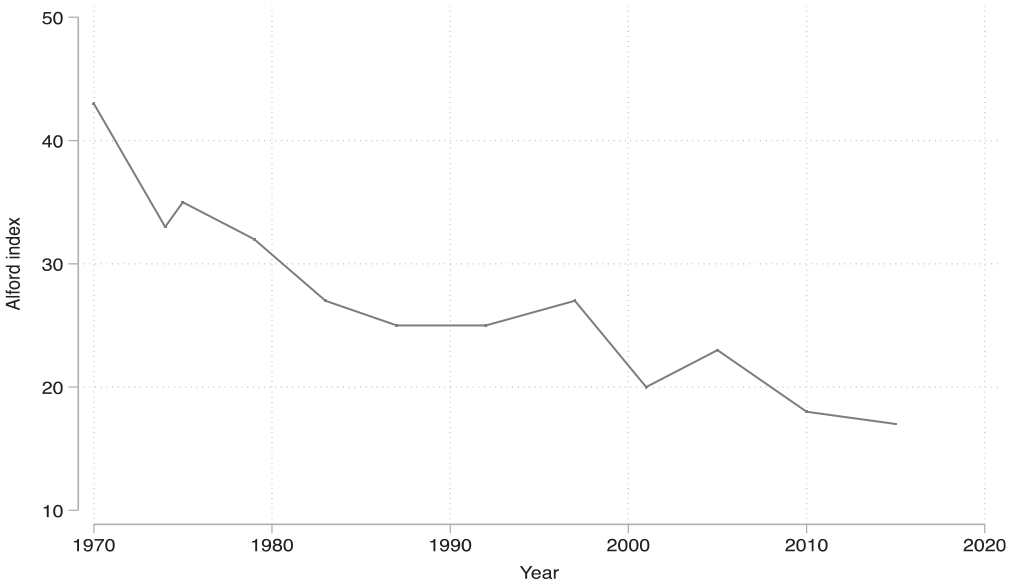
The decline in the institution of social-class politics can be illustrated by the Alford index—an index of the share of voters that “vote their class” 1 —and which approximates the strength of the institution of social-class politics. Figure 1 presents this index from 1970 to 2015. We set the start at 1970, as the importance of social class in voter choice dropped sharply in that election year (Franklin, 1985). Two distinctive periods in the decline can be discerned. First, there is a steep decline during 1970 to 1992, when the index moved from 45 to 25, followed by a gentler descent of 25 to 17 during the years 1993 to 2015. These two periods, preceded by a period of institutional stability—not shown here but noted in political science literature (for instance Clark et al., 1993)—suggest qualitative shifts in the expectations of voters on the degree to which a party should construct its identity in relation to ideological boundaries. We now describe the events that characterize these stages of institutional decline.
Alford Index
During the period 1950–1969, social-class politics was institutionalized to such a degree that class cleavages in British society were the pre-eminent division in voters’ choice of a party (Norris, 1997). Guided by ideological affiliations and class constituencies, the political parties offered differentiated identities to the voters on the left–right, or socialist–conservative, continuum (Wright, 2003). The voters, in turn, distinguished and evaluated political parties according to the prescriptions of class politics, and an expressive rather than a calculative logic governed their voting decisions (Nieuwbeerta & De Graaf, 1999).
The institution of social-class politics slipped into decline by the late 1960s. Greater intra- and inter-generational class mobility, increased affluence, and individualization processes blurred traditional class boundaries, especially those between the working class and the middle class—weakening the influence of class on the social identities of British voters (Garnett & Lynch, 2014). In addition, state expansion and the shrinking working class rendered several political conflicts less salient in domains such as welfare, education, and family—areas that had previously divided the classes (Franklin, 1985). Given the confluence of these various social and political changes, the “core elements of the system changed, and changed decisively in the early seventies” (Norris, 1997: 17), leading to a decline in the voter engagement with the institution of social-class politics. Parties with identities anchored to ideologies now faced voters who were critical of ideology and had become consumer-like in their voting (Clarke & Stewart, 1984; Crewe, Sarlvik, & Alt, 1977). This voter pragmatism generated electoral volatility at unprecedented levels. Because of the uncertainty about whether this change was temporary or permanent, it became increasingly problematic for parties to decide which political issues to invest in (Budge, 1994).
From the early 1990s onward, the decline of class politics became clearer; voters began to transcend class and ideology-inspired divisions (Enelow & Hinich, 1982). The parties found their established ideology-based identities to be of little value, and voters began to equate the parties’ adherence to ideologically grounded identities as being out of touch with reality. By the late 1990s, there was a lively discussion on the potential emergence of new structuring institutions in British politics (Burnham, 2001; Clarke, 2009; Green, 2007; Sobolewska & Ford, 2020).
The withering of social-class-based politics meant a decline in the institution that anchored the identity of the political parties to separate ideologies. It was this social change to which Tony Blair alluded in the quote at the beginning of this paper, and it is this change to which the major parties in British politics responded to by developing hybrid identities.
Theoretical Development
The Development of Hybrid Identities
The literature on hybrid organizing is growing, and, as noted by Battilana and Lee (2014) and Pratt (2016), the term “hybridity” is used in several ways. Two common meanings of hybridity are the hybridity of organizational forms, where unexpected forms of organizing are mixed in an organization (Greenwood et al., 2011; Haveman & Rao, 2006), and of institutional logics, where contradictory logics are combined in an organization (Glynn, 2000; Jones, Maoret, Massa, & Svejenova, 2012; Lounsbury, 2007; Raffaelli & Glynn, 2014). For instance, Haveman and Rao (2006) show how the hybridization of organizational forms, in the shape of different models of thrift, changed the institution of saving in the United States. In contrast, Jones et al. (2012) illustrate logics hybridity by showcasing the blending of different institutionalized logics within already established schools of architecture, a phenomenon linked to the emergence of modern architecture.
These two instances of organizational hybridity should not be conflated with organizational identity hybridity. As Pratt puts it, “Hybrid organizational identities should not be confused with hybrid organizations or hybrid organizing, which are broader concepts referring to organizations that combine identities, forms, and/or institutional logics to create a new type of organization” (2016: 110). Core to an understanding of identity hybridization is the work of Albert and Whetten (1985), who define a hybrid identity as comprising at least two different aspects that would “normally not be expected to go together” (1985: 95). Contradictory identity elements can be harbored within a hybrid organizational identity in an ideographic or in a holographic manner—where the contradictory elements shape the identities of separate sub-organizational units or suffuse the entire organization, respectively (Albert & Whetten, 1985).
The majority of the studies of hybrid organizational identities see hybridity as a problematic passing phase in the transition from one single identity to another (Glynn, 2000; Smith & Besharov, 2019; Zilber, 2002). Alternatively, more permanent identity hybridity is seen to be dealt with in an idiographic manner, where the conflicting identity expressions are contained in separate organizational sub-units (Battilana et al., 2017; Mair, Mayer, & Lutz, 2015). More relevant to our enquiry into the development of hybrid identities, many earlier studies have focused on cases where hybridity is inherent from the inception of an organization (Battilana et al., 2017; Smith & Besharov, 2019). Thus, as Pratt (2016: 109) concludes, there is little known about how an organization shifts from a single to a hybrid identity.
A Model of Identity Hybridization
To understand the shift from a single to a hybrid organizational identity, it is useful to begin with the potential incentives for hybridization. This is a question that is often glossed over. In the studies of organizational hybridity from birth, the motivation for hybridity is sui generis: an organization is studied because it has chosen to be a hybrid identity organization (Mair et al., 2015; Smith & Besharov, 2019). A less noted, but quite important incentive for hybridization are strategic considerations. The development of a hybrid identity can be a way to survive in a complex institutional setting (Kraatz & Block, 2008) and also provide a valuable lever of competitive differentiation (Pratt & Foreman, 2000).
Countering any incentives to hybridize, there are several challenges associated with identity hybridization that need to be overcome. To develop our reasoning, we recognize that the identity of an organization is institutionally embedded (King & Whetten, 2008; Kraatz et al., 2016; Whetten & Mackey, 2002). The various elements which instantiate the identity of an organization—such as practices, artifacts, organizational form, or discourse—are instilled with meaning in an institutionalized field (Battilana & Lee, 2014; Berger & Luckmann, 1966; Glynn & Abzug, 2002). To construct and maintain an identity that is imbued with meaning that legitimizes and positions the organization within its field, organizational leaders draw on elements with institutionalized meanings (Glynn, 2008; King et al., 2011; King & Whetten, 2008). As institutions define what constitutes legitimate (non-hybrid) combinations of identity elements, they also define what is incompatible (Glynn et al., 2020; Phillips, Turco, & Zuckerman, 2013)—that is, what is a hybrid organizational identity.
The observation that identities are institutionally embedded explains why hybridization is difficult and why it may not always be considered an option, despite strategic incentives. As hybridity means mixing of elements that contravenes the institutions of the field, attempts to hybridize will be disciplined—by disapproval and other forms of resistance (c.f. Bitektine & Haack, 2015; Clemente & Roulet, 2015; Edman & Arora-Jonsson, 2022). Drawing inspiration from the work of North (2018) on institutional deviance, we argue that a change from a single to a hybrid identity requires overcoming three challenges: internal resistance to such change (Gioia & Chittipeddi, 1991; Golden-Biddle & Rao, 1997), the threat of competitive retaliation from other organizations that resent an intrusion on their identities that hybridization may entail (Karthikeyan et al., 2016; Livengood & Reger, 2010), and the risk that audiences see hybridization as illegitimate (Glynn & Abzug, 2002; Kraatz et al., 2016). Internal resistance, competitive retaliation, and illegitimacy concerns of audiences are all rooted in the deviation from institutionalized norms inherent in hybridization. Under a stable institution, internal, competitive, and audience pressures are thus likely to limit the possibilities of a successful shift from a single to a hybrid identity. For hybridization to be perceived as an opportunity, the different forms of resistance to hybridization need to weaken, and one important way in which this can happen is by the decline of the institution that underpins this resistance.
Following the work of Ruef (2014: 9) we observe that the weakening of an institution typically progresses over two stages. First there is an initial stage that is characterized by uncertainty about the stability of the institution; it is not certain that the institution is still in place, but it is not certain that it is not. This can be followed by a second stage, during which it becomes more certain that the institution no longer is in full force, but it is ambiguous as to what will replace it. These two stages constitute different types of institutional complexity (Kraatz & Block, 2008). In the first stage the complexity relates to the difficulty in judging the strength of the institutional context and thereby the limits to hybridization, and in the second stage the complexity relates to not knowing what institutional arrangements the organization will have to adapt to in the future. This change in the institutional complexity, we argue, will drive different strategies used by organizations to manage identities and progress towards identity hybridization.
To describe the first of those strategies, we draw on what Pratt and Foreman (2000: 27) term identity “compartmentalization”—where oppositional identity claims are subordinated to an unchanged identity core. This strategy allows organizations to preserve their legacy identity, while expanding it by subordinate investments into oppositional claims. We reason that in the first stage of decline where an institution is evident but its stability is uncertain, organizations are likely to expand their identity to include hybridizing elements, but also attempt to preserve their legacy identity (Kraatz et al., 2016). This strategy generates what we call a partial identity hybridization: it brings together identity elements that are not expected to go together, but it does so in a hierarchically structured way where the new elements are subordinated, such as not to expose the organization fully to internal resistance or external criticism of an illegitimate move. Notice that we are suggesting a new form of hybridity here. Earlier work on identity hybridity has worked from the formulation of Albert and Whetten (1985) that defines hybridity as the mixing of elements that normally do not go together, but there has been scant problematization or nuancing of the ways by which such mixing could take place.
As the institutional decline advances, doubts about the decline diminish, presenting the organizations with a different scenario in which to manage their identities. The constraints of the prior institutional setting become less stringent, indicating a further reduction in the costs of hybridization. There is, however, likely more uncertainty, and thereby the institutional complexity as to what the new institutional setting will be (Ruef, 2014). By this stage, the two sources of resistance to hybridity—internal disapproval and audience disapproval—have likely diminished as the institution that defines hybridity weakens (Clemente, Durand, & Roulet, 2017; Glynn et al., 2020). This setting, we argue, provides greater possibilities for organizations to realize identity synergies, leading them to alter the hierarchical ordering of the hybridizing identity elements and adopt what Pratt and Foreman (2000: 27) describe as a strategy of identity “aggregation,” where oppositional identity claims become as equally central as their legacy identity claims.
Hypothesis Development
To develop our hypotheses, we will contextualize our model of identity hybridization within the British political system. In this system, the institution that defines identity hybridity for the political parties is social-class politics. For example, political issues of economic orthodoxy and welfare expansion are considered contradictory under the institution of social-class politics, positioning these issues on the opposite ends of a socialist-conservative ideological scale (Downs, 1957). Maintaining a single identity under social-class politics means staying within the ideological confines of a party, whereas developing a hybrid identity involves mixing ideological traditions. For political parties, the latter option of ideological boundary-crossing is tantamount to deviating from the institutionalized norms of social-class politics.
As we described in the empirical background section, the institution of social-class politics underwent a period of decline from about 1970 onwards (Clark & Lipset, 1991; Clark et al., 1993; Franklin, 1985). This decline was gradual, extending over several decades. Drawing on the work of political scientists, we parse our observation period into three periods that correspond to the stages of institutional decline proposed by Ruef (2014): institutional stability from 1950 to 1969, initial decline spanning from 1970 to 1992, and advanced decline from 1993 to 2015. We develop our hypotheses by applying our model of identity hybridization to these periods, operating under the premise that each period would present the parties with a distinct institutional context influencing their identity management decisions.
Identity deepening during institutional stability
We do not derive hypotheses for the period of institutional stability but outline the expected behavior of the parties during this time as a benchmark for the subsequent stages of institutional decline.
During this period of institutional stability (1950–1970), we expect that the parties would deepen their identities (Glynn & Abzug, 2002; King et al., 2011) by enhancing their investments in issues that are mostly consistent with a single, ideologically bounded identity. Any attempt to hybridize a party's identity by integrating claims from an oppositional ideology would directly challenge the institution of social-class politics. Consequently, such efforts would likely face negative sanctioning through the three mechanisms of institutional enforcement (North, 2018). Conversely, deepening their ideologically anchored identities would strengthen the sociocultural ties between the parties and the voters, while simultaneously allowing the parties to differentiate themselves from competitors (Hsu & Hannan, 2005; Santos & Eisenhardt, 2009).
Identity hybridization under stages of initial and advanced institutional decline
As the importance of social-class politics on voter behavior began to decline in the early 1970s, the parties experienced an increasingly complex institutional context due to the uncertainty about the stability of the institution of social-class politics.
Our model posits that there are always latent incentives for organizations in a competitive setting to hybridize their identities. The parties operate in a competitive market for votes (Janda et al., 1995; Katz & Mair, 1995), which incentivizes parties to project an appealing and distinct identity. As argued earlier, how the parties adapt their identity to a changing institutional context will depend on their handling of several trade-offs. For a given party, hybridization efforts—a stand taken on a political question that expands the identity beyond the party ideology into the turf of the opposing parties—can be thought of in terms of expected threats and opportunities.
During the period of initial decline (1970–1992), doubts concerning the stability of social-class politics had begun to emerge. Political scientists have noted that this period was marked by an increasing number of “floating” voters who did not play by the rules of social-class politics and were more like “consumers than active participants” (Katz & Mair, 1995: 7-8). Voter loyalty to the parties decreased and electoral volatility increased, introducing uncertainty over the attractiveness of party identities and the validity of social-class politics.
Karthikeyan et al. (2016) study British parties’ identity change in this particular time-period and show that the parties adapted their identities in two ways. First, the parties worked with a strategy of identity affirmation whereby they responded with counter-investments when other parties staked claims in their ideological identity space (as theorized by Livengood & Reger, 2010). The parties thus reaffirmed their ideologically-based identity in response to the identity work of other parties. Second, the parties also engaged in identity reformation efforts to expand their identities. This expansion was, however, done in a way that was non-confrontational, prioritizing claims to issues that were not those of their opposing party. The findings of Karthikeyan et al. (2016) resonate with Ruef (2014) who shows that in stages of institutional uncertainty, field members prioritize elements of the existing, but uncertain, institution.
Their work is, however, not directly informative for our question of how the parties developed hybrid identities. The development of hybrid identities would require not only identity affirmation and reformation, but also investments into oppositional identity positions—positions that normally do not go together. Given our assumption of a latent incentive for hybridization in a competitive setting, an institutional decline may pave the way for such hybridization efforts. A suspicion that voter behavior was less ideology-bound diminished the expected returns from social-class politics, and it also further reduced the threat of voters characterizing a position outside the ideological framework as illegitimate. This development, we expect, led parties to invest beyond their established ideological positions to appeal to a larger electorate.
Other potential costs of hybridization likely continued to be of concern though. Parties were still at risk of being imitated or having a competing party respond by counter-investments in response to an attempted identity change. It remained unclear how a party could retain its distinctiveness, and what identity changes would invite competitive retaliation. Moreover, there was still a fundamental uncertainty regarding the state of the institution: Had voters abandoned social-class politics? Some voters still voted along class lines. An expansion outside the ideological base, however, would likely also cause resistance within parties (Janda et al., 1995), as members had self-selected into the party based on their earlier ideological position. The threat of “back-bench rebellions” (i.e., protests by party MPs) increased during this period (Norris, 1997).
Given these uncertainties, we expect that in this initial period of institutional decline, the established identity of the parties would act as an inertial force in the identity change process (see also Kraatz et al., 2016). Whereas parties would still prioritize their traditional claims, they would also begin to take initial steps towards a partial hybridization by investing in the core issues of an opposition party. To minimize the risks of retaliation, we expect the identity expansion of the parties to involve unsystematic investments (i.e., investments that are not systematically repeated over time) in ideologically oppositional claims. The sporadic nature of these investments permits them to be hierarchically subordinated to investments in the established identity positions. Using the language of Karthikeyan et al. (2016), we expect that identity affirmation would trump identity reformation in this period, and that the parties would develop partially hybrid identities by subordinating identity-expanding claims to their traditional identity claims, utilizing the identity-management strategy of compartmentalization (Kraatz & Block, 2008; Pratt & Foreman, 2000). Summarizing this argument, we hypothesize:
Hypothesis 1: During the period of initial institutional decline (1970–1992), the parties would build partially hybrid identities via a compartmentalization strategy. This involves (a) managing the increased plurality of identity elements by continuing to prioritize traditional claims over oppositional claims and expanding their identities by (b) unsystematic investments in claims oppositional to the ideologically anchored identity.
During the period that we term advanced institutional decline (1993–2015), the reciprocal understanding between parties and voters about the role of social-class politics further deteriorated. The parties’ efforts to adapt during the initial stage of institutional decline rendered them less distinct in the eyes of the voters. Moreover, a growing convergence in the viewpoints of voters suggested to the parties that their ideology-based positioning held little significance in the changed circumstances (Budge, 1994). As a result, the institution of social-class politics further weakened (Green, 2015; Sobolewska & Ford, 2020).
We expect that the further decline of social-class politics held significant implications for the way the parties managed their identities. The parties likely understood more clearly the opportunity of strategic maneuvering outside the institutionally-defined ideological boundaries. The symbolic costs connected with violating its identity legacy likely decreased as parties became aware that the earlier safe-haven of an ideological position was no longer available. Moreover, the parties had already spent two decades gradually expanding their identities beyond the former ideological confines, building both internal and external acceptance for such changes (Sobolewska & Ford, 2020). Arguably, the risk of retaliation from competitors also reduced, as the institutional foundation of the ideological turf of each party had faded (c.f. Livengood & Reger, 2010).
In the period of advanced decline, the relative costs and benefits of an identity that combined different ideological positions had changed to the extent that a fully hybrid identity would have seemed useful, if not attractive, to the parties. Hence, we expect the parties to develop a hybrid identity by making selected, yet systematic, investments into oppositional issues. As these are systematic investments, they would be hierarchically at the same level as those inspired by the ideologically anchored identity, representing what Pratt and Foreman (2000: 27) called an “aggregation strategy.” Building on this line of argument, we hypothesize that:
Hypothesis 2: In the period of advanced decline (1993-2015), the parties would build fully hybrid identities using aggregation strategies. This involves (a) managing the increased plurality of identity elements by elevating the oppositional claims to the level of traditional ones and expanding their identities by (b) systematic investments in claims oppositional to the ideologically anchored identity.
Data, Measures, and Methods
Data
To trace the development of hybrid identities in the face of the decline of social-class politics, we leverage data on the public claims of the three main British political parties in their electoral manifestos over the period 1950–2015.
To what extent do claims made in political manifestos shape and reflect party identities? Identities are an ongoing construction (Gioia et al., 2013) and, in the case of parties, the construction is by visions, promises, and decisions (Husted, Moufahim, & Fredriksson, 2022). The manifestos are the primary means by which the parties communicate their identity positionings to their voters (Harmel, 2018; Janda et al., 1995), and the claims within electoral manifestos have long been viewed as central to the identity positioning and differentiation of political parties (Budge, 1994; Janda et al., 1995). Especially in the British context, political scientists have highlighted the role of manifestos, noting that they consist of “statements connoting intentions, emphases, promises, pledges, policies or goals to be activated should that party achieve office’’ (Bara, 2005: 585), that is, clarifying what the voters can expect from a party. These manifestos are understood as contracts between parties and voters in British politics (for a discussion of the enduring and multifaceted role of manifestos see Harmel, 2018; Ray, 2007). Importantly for our reasoning, manifestos cause—and at the same time are used to settle—internal disputes about what the party stands for. Each statement in this official document can be considered a widely agreed-upon idea/vision/promise of what the party is about (Harmel, 2018), and any inclusion of an issue drawn from an oppositional ideology is the result of internal discussions and signifies an official promise of the party to the electorate.
Our data are drawn from the Manifesto Project (https://manifesto-project.wzb.eu/), within which researchers have content-analyzed and coded the electoral manifestos of the three main British parties for the entire duration of our study (for a discussion see Budge, Klingemann, Volkens, Bara, & Tanenbaum, 2001; Klingemann, Volkens, Bara, Budge, & McDonald, 2006). The Manifesto Project has mapped all electoral manifestos along 56 fundamental political issues, which are further grouped into seven broad policy domains. These issues and the policy domains are mutually exclusive and are collectively exhaustive of the policy space. This classification of political issues is inspired by the ideological stands of parties according to social-class politics, and is widely considered to be empirically meaningful and comprehensive (e.g. Budge et al., 2001; Klingemann et al., 2006). Relying on this coding, we can categorize any identity claim in an electoral manifesto according to its policy-issue domain and determine whether it aligns with a party’s ideological (op)position. This data provides us with fine-grained information about the identity claims of several party organizations over a long time span.
Dependent Variables
To test our hypotheses regarding the use of compartmentalization and aggregation strategies of identity hybridization, we created a variable labeled Issue investment, which measures the extent to which a political party leverages a given political issue to construct its identity. Setting the unit of analysis to the level of issues allows us to study identity changes from the differential investments received by a given issue, relative to the investments in other issues. The Issue investment variable captures the relative weight that a party assigns to a particular political issue in each of the election manifestos. Following Budge et al. (2001), we operationalized this variable as the percentage of quasi-sentences a political party allocated to an issue in its manifesto. Issues not included by a political party in its manifesto are coded as receiving zero investments.
Independent Variables
To capture how the identity claims of the parties shifted from prioritizing their ideologically grounded claims to treating them almost at par with other claims (i.e., to test H1a, H2a), we created the variable Established identity issue. This variable distinguishes between claims about political issues that are related (1) and unrelated (0) to the ideologically anchored identity of a party. The coding of this variable follows the Manifesto Project’s description of political ideologies (Budge et al., 2001; Klingemann et al., 2006). By controlling for investments in unrelated but ideologically-adjacent as well as in neutral issues (see below, the section on control variables), the coefficient estimate of the established identity variable will be informative about the degree of investment into ideologically gorunded claims against oppositional ones.
To map the different strategies used by the parties in managing identity elements when expanding their identity claims, the variable Systematic identity issue was created. We coded this variable as 1 for those ideologically unrelated issues, oppositonal ones as well, that received investments above the party’s mean issue level investments in the last three elections, and 0 otherwise (unsystematic or more sporadic investments).
Building on the historical development of British politics, we constructed two variables that delineated the institutional decline. The first variable, Initial decline, corresponds to 1970–1992—the initial stage of declining social-class politics, during which we expected that social-class politics still anchored party identities, but that there was uncertainty about its stability. A second variable, Advanced decline (1993–2015), marks the stage in which the institution of social-class politics further deteriorated, and the legacy of the past became less salient in the identity work of the parties. As a baseline, we also constructed a variable called Stable institution, to capture the years 1950–1969, during which social-class politics was firmly institutionalized.
We tested Hypotheses H1a and H2a by interacting Established identity issue with the institutional decline variables: Stable institution, Initial decline, and Advanced decline. These interactions enable us to understand how institutional decline influenced the intensity of investments in ideologically unrelated claims in relation to the investment levels of traditional claims. The interactions between Systematic identity issue and the institutional decline variables serve to examine our hypotheses regarding whether the investments in identity-expanding claims are systematic or sporadic, as posited in Hypotheses 1b and 2b.
Control Variables
As Karthikeyan et al. (2016) have used a subset of the same data, we build on their work in deciding the set of control variables to be added to our models. The first set of controls seeks to rule out the effect of claims unrelated to identity hybridity. To do this, we controlled for whether an issue is a Neutral issue—a dummy variable coded as 1 if the issue is unrelated to any of the party ideologies, and 0 if otherwise. In the same way, we used the variable Adjacent identity issue to see if political parties invest in elements that belong to the less oppositional (adjacent) ideology. For the Conservatives, the oppositional identity is defined by the Labour ideology and vice versa. For the Liberal party, the oppositional identity is defined by the Conservative ideology because of its social-liberal roots (Russell, Russell, & Fieldhouse, 2005). The variable Adjacent identity issue is coded as 1 if the issue belongs to the ideology of the non-oppositional party identity, and 0 if it belongs to the oppositional party identity. Investment in any Oppositional identity issue is therefore the omitted category in our models.
We also controlled for the behavior of competitors by calculating Competitor investments as the sum of the issue investments of the competing parties into a focal issue. We square-rooted the Competitor investments variable to reduce its skewness and also interacted it with the Established identity issue variable. This interaction can also be seen as a way of capturing the influence of competitive interdependencies in guiding the investments of political parties. As the previous investments of a political party influence its future investments, we created the variable Previous investments (squared rooted), which measures the cumulative investments of a political party on a specific political issue. Like Karthikeyan et al. (2016), we interacted the variable Previous investments with the variable Established identity issue.
The binary variables, Conservative Party and Labour Party, are included in our models to control for unobserved party-specific heterogeneity, keeping the Liberal party as the omitted category. Finally, policy domain dummies were included in the models to capture variations in the general appeal of the six policy domains; keeping the policy domain of social groups is the omitted reference category. The variable labeled Election loss counts the number of consecutive elections lost by the focal party, to control for any investment related to poor performance.
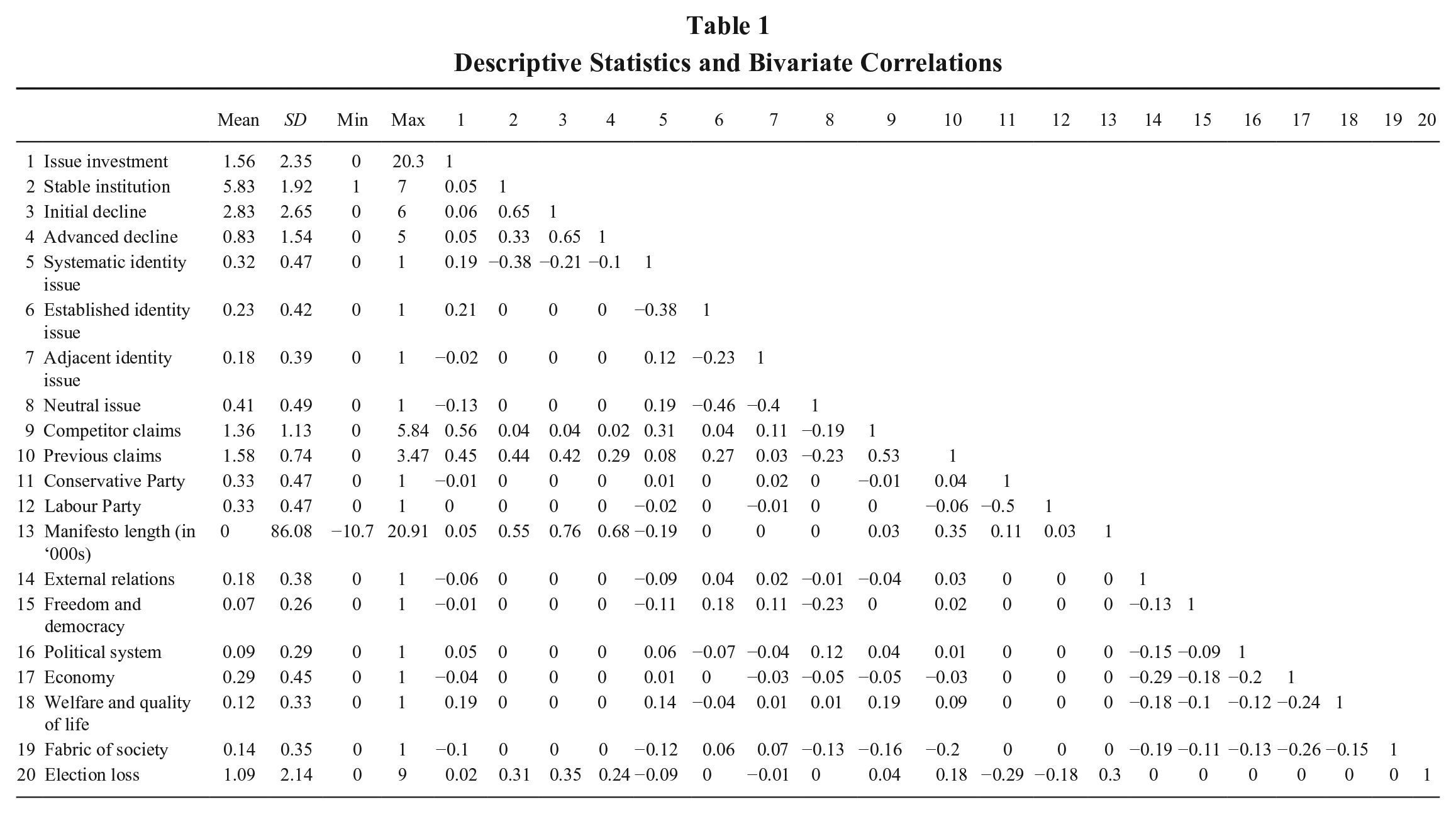
Table 1 outlines the descriptive statistics and correlations among the variables used in our models.
Descriptive Statistics and Bivariate Correlations
Analytical Approach
Our data are structured as a issue-by-party panel. To model issue investments over multiple elections, we used a population-averaged linear regression model based on generalized estimating equations (Zeger, Liang, & Albert, 1988). The GEE estimation method allowed us to leverage across- and within-issue variance in investments for each party. To model the dependent variable, Issue investment, we inspected the distribution of our dependent variable and chose a Gaussian distribution, an identity link, and an unstructured correlation as the working correlation matrix. As no issue receives 100% of the investments, the upper-bounded nature of our dependent variable does not raise any concern. As for its lower-bound, stemming from the party’s decision not to engage with the focal issue in a given election, we computed the inverse Mills’ ratio from the selection equation and then added it as a control variable (Heckman, 1979). We used the (square rooted) percentage of uncoded sentences—that is, the text unrelated to any specific political issue—as the exclusion restriction in the first stage. We report robust standard errors to account for potential misspecification of the error structure (Huber, 1967; White, 1980).
To capture the differences across stages of decline while also acknowledging within-period variation, we employed a linear spline specification, essentially a variation of piecewise specifications. 2 To quote Edwards and Parry (2018: 70), “although piecewise regression can estimate functions that are discontinuous at the point where the slope is specified to change . . . the functions estimated by spline regression are continuous.” By using this specification for our period effects, we can interpret the spline coefficients as regular regression coefficients and do significance testing for the knots. The two knots of the spline were set at the start of each new period of institutional evolution: 1970 and 1992, which leads to a segmentation of time along the periods introduced earlier. We implemented this procedure via the Stata command, mkspline.
Results
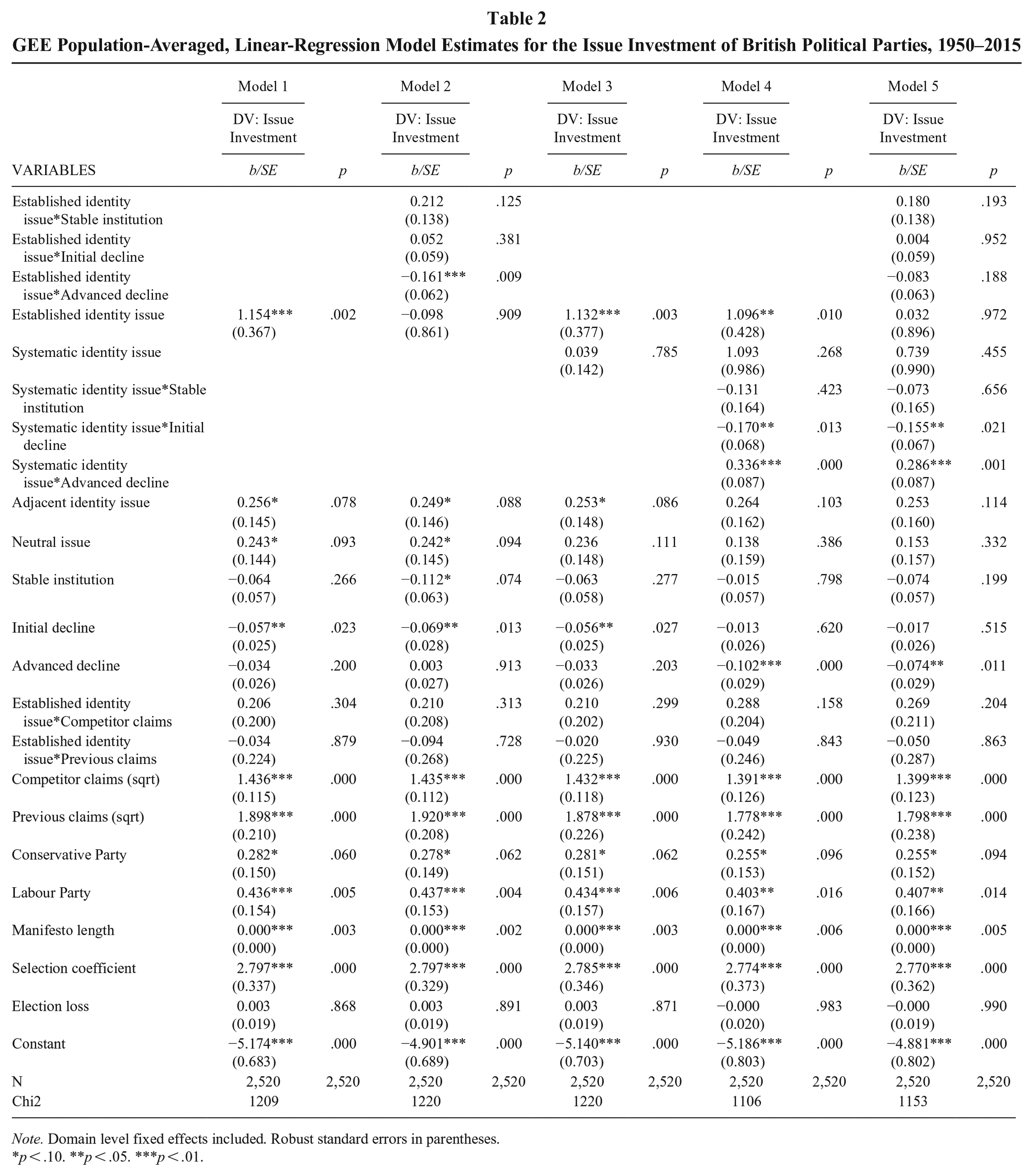
We have organized the discussion of the results into three sections in the order of the different stages of the evolution of the institution of social-class politics. Table 2 presents the GEE estimates of the models used to test Hypotheses H1a, H1b, H2a, and H2b, and we begin with a discussion of the effect of the important control variables.
GEE Population-Averaged, Linear-Regression Model Estimates for the Issue Investment of British Political Parties, 1950–2015
Note. Domain level fixed effects included. Robust standard errors in parentheses.
p < .10. **p < .05. ***p < .01.
In Table 2, the coefficient of the variable Established identity issue is positive and statistically significant. This is consistent with our understanding that the parties, on average, kept investing in their ideologically anchored identities throughout the decline of social-class politics. The expected self-reinforcing dynamic of issue investment, where earlier investments drive current ones, does not hold (see the coefficient for Previous investment variable) but the moves of competitors do guide investments (see the coefficient for Competitor claims). 3
Identities Under a Stable Institution
Although showing the expected positive sign, the coefficient estimate concerning identity deepening of the parties fails to reach statistical significance in the stable period, 1959 4 –1969, as evidenced by the interaction between Established identity and Stable institution (see Model 2). Net of the threat from competitors that is accounted for by the interaction between the Competitor investments and the Established identity issue variables, the difference between investments in established and oppositional issues did not seem to increase in favor of the former (but see Table 5 concerning the additional analyses on party-level differences).
Identity Hybridization Responses Under Initial Institutional Decline (H1a and H1b)
Our main argument is that, in response to the uncertainty of change brought about by the decline of social-class politics, the parties would develop partially hybrid identities. This, we expected, would first involve strategies of compartmentalization that hierarchically order traditional over oppositional identity claims. In Model 2, the interaction effect of the variables Established identity issue and Initial decline is not statistically significant. A comparison of this coefficient estimate with the one relating to the period of a stable institution, however, seems to suggest a decreasing attention to political issues associated with the established identity.
We also expected the parties to make marginal, unsystematic investments into issues that are oppositional to their established identities. The coefficient estimate of the interaction between Systematic identity issue and Initial decline is negative and statistically significant (Model 4). This suggests that during this period investments into oppositional identity were not primarily systematic, as unsystematic patterns of investments exceed the systematic ones. This is in line with our expectation of partial hybridization, involving subordinating investments in opposition to investments in identity-deepening claims. We read these results as aligned with H1a and H1b.
Identity Hybridization Under Advanced Institutional Decline (H2a and H2b)
We expected the parties to deal with the continuing decline in social-class politics by switching to strategies that expand their identities and hybridize them fully by elevating investments in oppositional issues to the same stature as traditional identity issues. Regarding elevating oppositional investments to that of traditional issue investments (H2a), we see that the coefficient estimate of the interaction between Established identity issue and Advanced decline, as reported in Model 2, is negative and statistically significant. The political parties thus invested relatively less in issues related to their established identity, compared to the oppositional ones in this period. The trend of the coefficient estimates of the interaction effects suggests that the parties successively made less investments in issues related to their established identities, relative to investments in issues belonging to the oppositional ideology. To illustrate what this meant in concrete terms, we can compare the usage of particular identity issues in the manifestos. A simple comparison between the manifestos of 1979 (initial decline) and 2001 (advanced decline) reveals that the Labour party decreased its focus on its established identity issues such as “democracy” (from 6% to 0.5% of the text), and “equality” (from 7% to 1.5% of the text). Similarly, the Conservative party reduced its use of identity issues like “free market economy” (from 8% to 1%), and “economic orthodoxy” (from 4% to 0.8%).
The effort at elevating the investments in oppositional issues by systematic investments is evident in the positive and statistically significant coefficient of the interaction between Systematic identity issues and Advanced decline (Model 4). Political parties changed their strategy and engaged in systematic investments in issues that were oppositional to their ideology. This result is consistent with our prediction that political parties, in response to the further decline of the institution of social class politics, hybridized fully through systematic efforts that aggregated oppositional and traditional identity elements (H2a and H2b).
Additional Analyses and Robustness Checks
Triggers of hybridization and its results
Notwithstanding the results discussed so far, our empirical analyses remain silent about any organization-specific trigger of hybridization, and we have assumed a homogenously diffused institutional-change incentive to hybridize for the parties. To better appreciate the underlying mechanisms at work, we investigated the potential moderation effects of parties’ recent performance—specifically, that poor election performance can be a driver of identity hybridization efforts of parties (Janda et al., 1995).
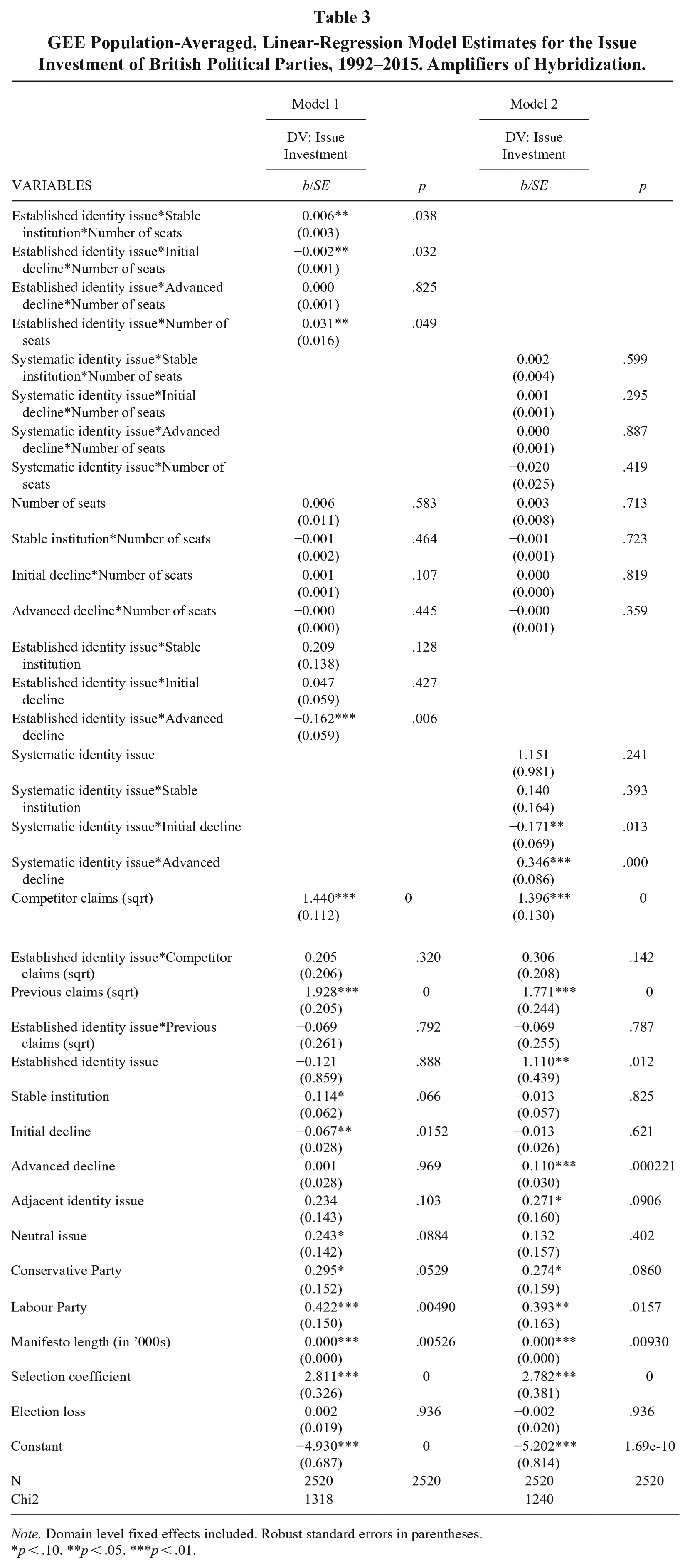
The main idea behind this analysis is to check whether negative performance feedback provided a different incentive to hybridize across the stages of institutional decline. The main models control for elections lost, but this is a coarse measure of party performance. A party can lose many seats and still manage to win an election, or it can lose an election but have gained a number of seats. We therefore proxy performance by a count of seats won or lost at the last election (Number of seats). We interacted this performance variable with the relevant identity variables (Established identity issue and Systematic identity issues) and with those related to the different stages (Institutional stability, Initial decline, and Advanced decline).
Table 3 presents the estimates from these models. Several conclusions can be drawn from these results. During the period of Institutional stability, there was a positive relationship between seats won and investments in the Established identity issues of parties, in line with an idea that it is not good performance that drives change. However, during the period of Initial decline larger seat wins led to further hybridization, in the form of reduced investments in established issues relative to oppositional ones. We interpret this result as suggesting that positive, rather than negative, performance feedback provided an incentive to embrace partial hybridization (i.e., compartmentalization) in this period. Nonetheless, in the period of Advanced decline past performance did not seem to matter to full hybridization—neither in terms of investments in Established identity issues nor for Systematic investments; larger seat gains did not further incentivize full hybridization.
GEE Population-Averaged, Linear-Regression Model Estimates for the Issue Investment of British Political Parties, 1992–2015. Amplifiers of Hybridization.
Note. Domain level fixed effects included. Robust standard errors in parentheses.
p < .10. **p < .05. ***p < .01.
Party differentiation
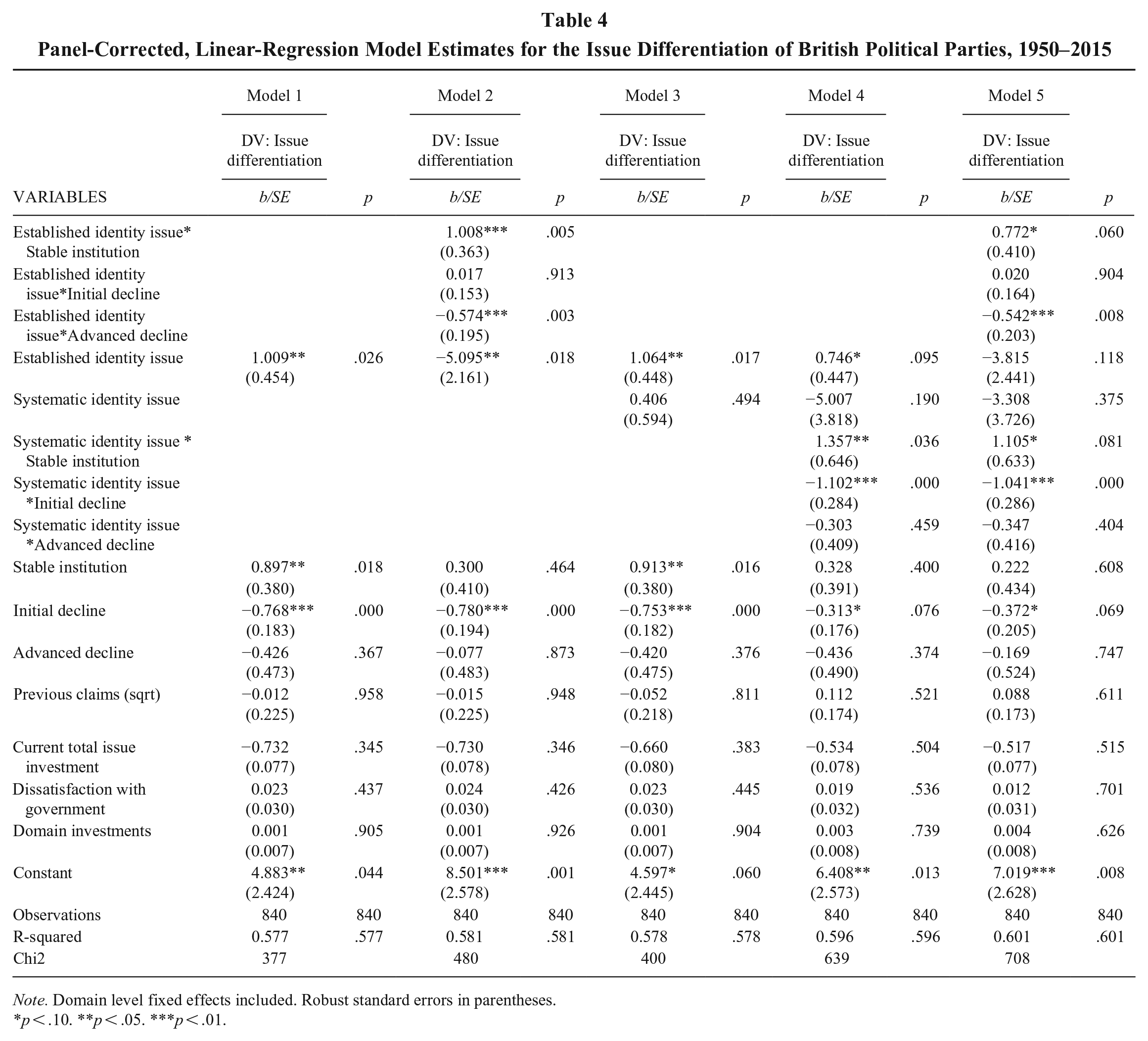
Our model posits that hybridization may be driven by a need to differentiate the position of an organization; but, does identity hybridization help to differentiate parties? We ask two questions in this analysis: Do parties differentiate themselves on their established identity issues, and if they do not, do they instead differentiate themselves on their newly constructed hybridized identities? To investigate this, we restructured the data at the issue level—in contrast to the party-by-issue level used earlier—and created a dependent variable, Issue differentiation, which is an issue-specific representation of the overlapping investments of the parties on each political issue. 5 We included some of the previous controls, party dummies, policy domain dummies, and Previous investments, and added some new controls necessary for this analysis. The variable Total current issue investments is measured as the sum of the investments of all three parties on a given issue in the focal elections, to hold constant the relative popularity of the focal issue. Public dissatisfaction with the government at the time of the election is measured by the variable, Dissatisfaction with government, with data obtained from Ipsos Mori surveys. The variables Change in GDP and Domain investments accounted for changes in the economic climate and domain-level popularity of an issue, respectively. The outcome variable Issue differentiation, which we use to test the degree of differentiation among political parties, has a different dependence structure across measurement units as compared to the previous dependent variable. Given the likely correlation in investments at the field level and also over time, we recognize the existence of contemporaneous correlations across issues via panel-corrected standard errors (Beck & Katz, 1995) and first-order auto-correlation (AR1).
Table 4 presents the results of the models that analyze differentiation among parties concerning their investment in each given issue. These analyses inform us about the differentiation resulting from the compartmentalization and aggregation strategies of the political parties. The positive and statistically significant interaction between Established identity issue and Stable institution in Model 2 confirms that in times of institutional stability, the identities rooted in social-class politics enabled the differentiation in issue investments; significantly more so than investments into ideologically unrelated issues. As multiple parties are involved, no difference with adjacent issues can be factored in. 6 In the subsequent periods of institutional decline, the issues related to established identities were less useful in differentiating the parties—particularly during the period of advanced decline, as can be seen in the negative and statistically significant interaction between Established identity issue and Advanced decline (Model 2).
Panel-Corrected, Linear-Regression Model Estimates for the Issue Differentiation of British Political Parties, 1950–2015
Note. Domain level fixed effects included. Robust standard errors in parentheses.
p < .10. **p < .05. ***p < .01.
Whereas it is not surprising that the differentiation in terms of their established identity issues diminished as the parties began to adopt each other’s issues, the question remains as to whether they managed to build new and differentiated hybridized positions. When ideologically unrelated issues are considered, we see that the coefficient of the interaction between Systematic identity issue and Stable institution (Model 4) is positive and statistically significant, indicating that the systematic investments in oppositional issues did create differentiation among the parties in the stable institutional period. The opposite trend, however, holds in the period of Initial decline during which there was considerable overlap—that is, less differentiation—among the parties on systematic investments, particularly involving neutral issues (see also Karthikeyan et al., 2016). Finally, the interaction between Systematic identity issues and Advanced decline fails to reach statistical significance, suggesting that the parties’ attempts at differentiating their identities via systematic investments in this period were not successful. This finding suggests that, as organizations were in the process of fully hybridizing their identities, it was not obvious that they were able to differentiate themselves from each other.
Party-level differences
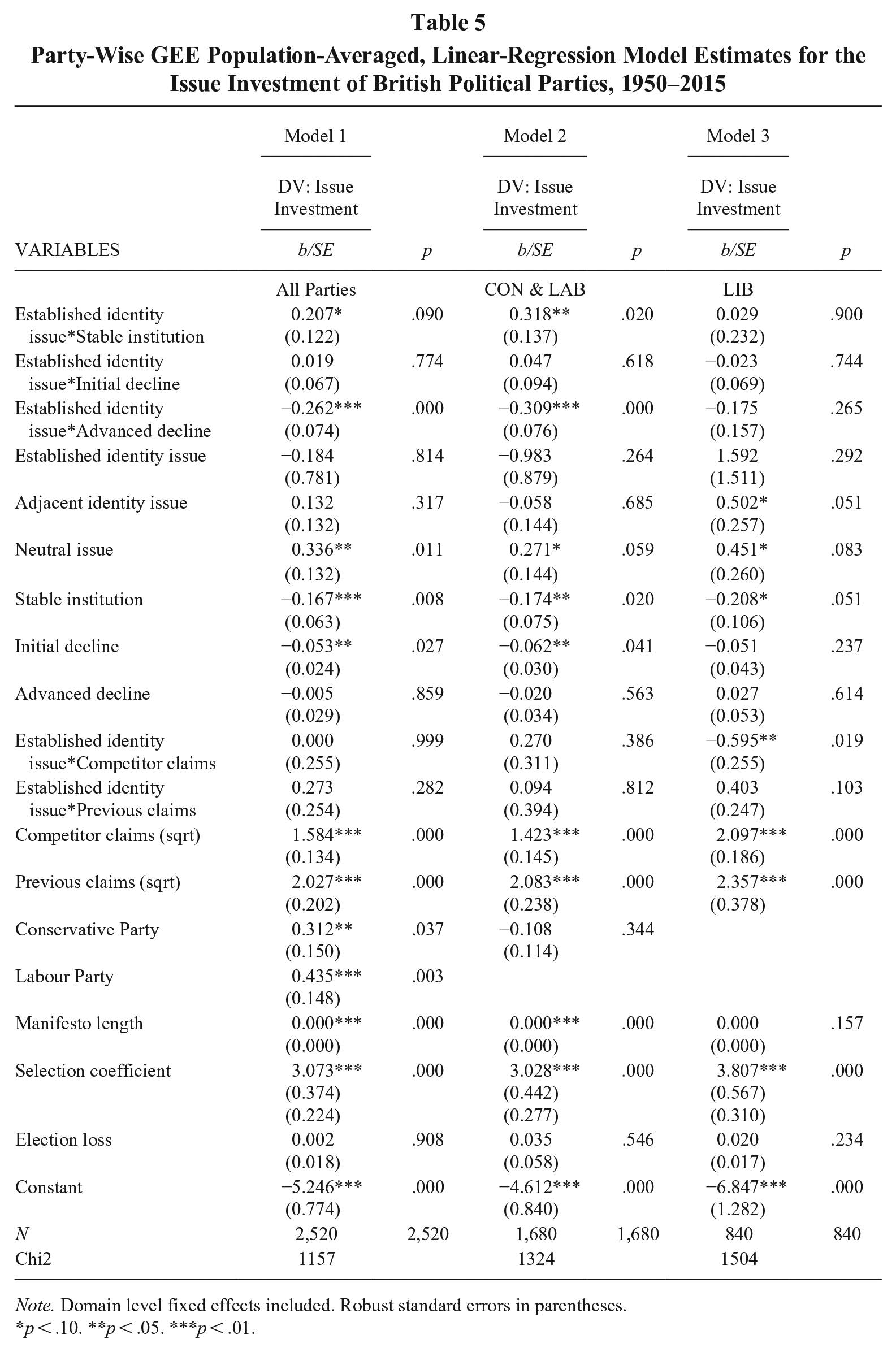
To further assess our main results, we conducted an additional robustness check. Because the variable Established identity issue is based on a categorization of issues into left and right ideological issues, we removed the Liberal party from the sample as it did not fit within either of these political traditions the way, arguably, the other parties did. Table 5 reports the results of analyses that replicate Model 2 of Table 2, excluding the Liberal party (Model 2) from the sample and focusing solely on it (Model 3), respectively. The estimates obtained are comparable to those of the previous models, 7 but also reveal that the expected identity-deepening strategy during the period of Stable institution (not statistically significant in the main models) was indeed followed by the Conservative and the Labour parties. The results also point to the potentially different route to hybridization followed by the Liberals, a party marked by a weaker ideology compared to the Labour and Conservative parties (for a more detailed exploration of the repositioning of this party, see Karthikeyan & Wezel, 2010).
Party-Wise GEE Population-Averaged, Linear-Regression Model Estimates for the Issue Investment of British Political Parties, 1950–2015
Note. Domain level fixed effects included. Robust standard errors in parentheses.
p < .10. **p < .05. ***p < .01.
Qualitative Evidence
To bolster the confidence in our interpretation of the results drawn from our quantitative testing of the hypotheses, we inquired further into the identity changes of British parties through a visual semantic network analysis of their manifestos. As the Conservative and the Labour parties carry the largest weight in the main results presented so far, we—for the sake of clarity of exposition—confined these additional analyses to these parties and excluded the Liberals.
We reconstructed the party identities as networks of political issues and the manifestos in which those issues appeared. Such networks, presented in Figure 2, are the relational visualization of the manifesto-per-issue data that we use in the quantitative analyses. To appear in the visualization, an issue must represent at least 4% of the quasi-sentences of that manifesto. The grey squares represent party manifestos while the issues that the parties have claimed are represented through nodes differently shaped according to the ideological stance of the underlying claim: circles are for socialist, triangles for neutral, and pentagons for conservative. The position of the nodes, obtained through a spring-embedding algorithm, is such that the closer they are, the larger their semantic relatedness—for example, two manifestos are closer the more similar the issues that they address.
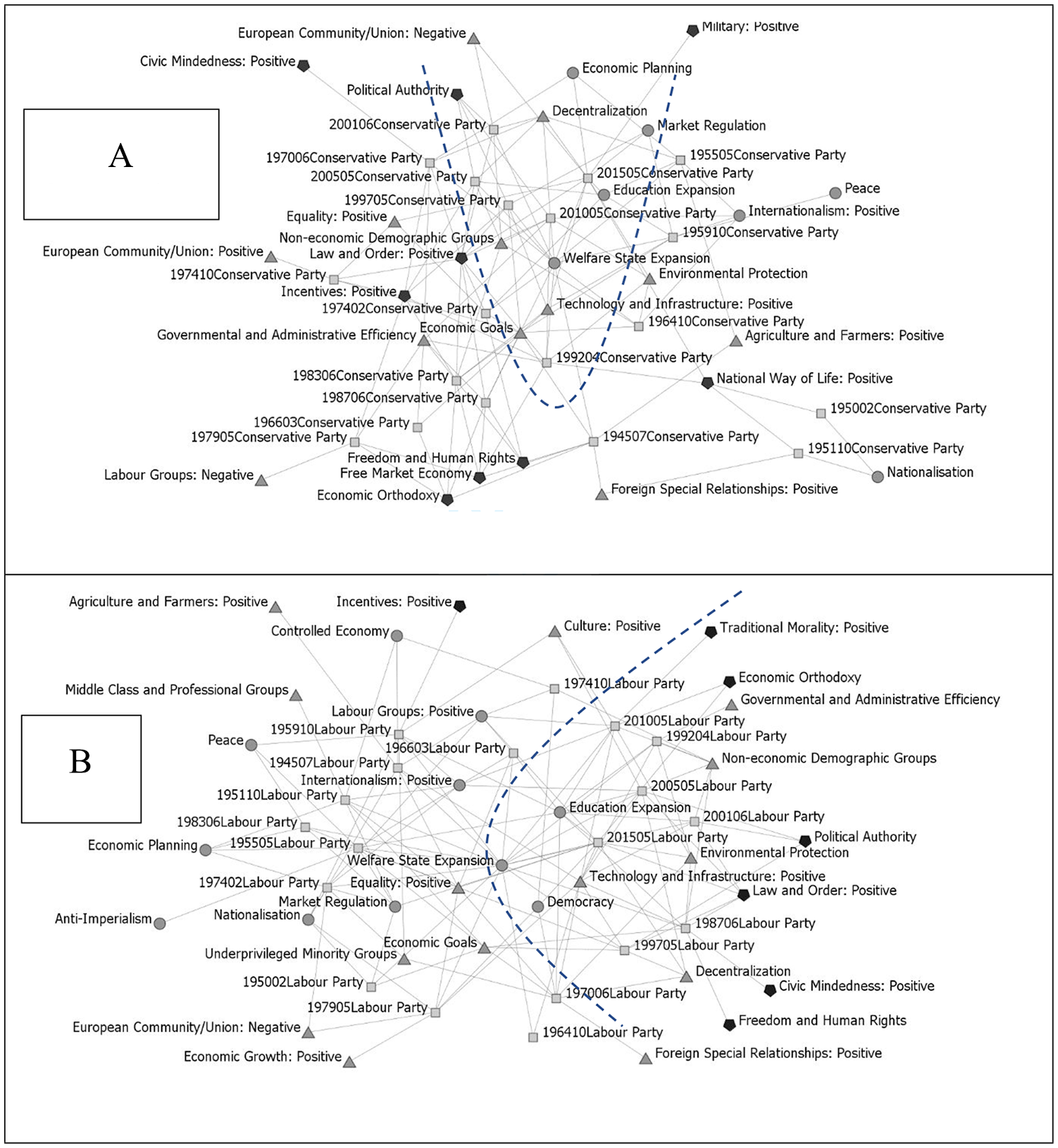
(A) Conservative Manifesto and (B) Labour Manifesto (Grey Nodes) and Issues Most Claimed Over Time
These networks yield two main conclusions about: (a) the temporal evolution in the parties’ claims and (b) the change in the centrality of the claims. As for (a), both parties over time increasingly moved away from their initial ideological stance (i.e., network position) and towards the ideological tradition of their opponent. The convex spaces 8 delineated by dashed lines in Figure 2 are created to ease the interpretation of this trend. These spaces signal semantic continuity between manifestos created mostly after the early 1990s.
As we examine issues per each party within the convex areas, we see that the ideological stance of the more recent manifestos is prominently either neutral or belonging to the ideological position of the opponent party. When we look instead at the less recent manifestos outside the convex areas, we observe that the connected issues are more in line with the ideological tradition of each party. These results indicate that the parties shifted towards partially hybrid identities from the late 1980s—that is, at the end of the stage of initial decline. Besides the semantic proximity, the temporal continuity between manifestos in the convex areas, de facto pointing to the advanced decline stage, suggests a shift from unsystematic experimentation at broadening the identity (i.e., compartmentalization and partial hybridity) to a more systematic engagement with oppositional issues (e.g., aggregation) as the main strategy to develop a hybridity identity.
As for the change in the centrality of the claims (b), “Welfare expansion,” for instance, traditionally a Labour issue central to socialist ideology, appears more recently core to both parties, pointing in particular to the hybridization of the Conservative party identity. This issue became prevalent in Conservative party claims as of the 2010 election. 9 Observing the full range of connections representative of the 2010 Conservative Manifesto we see that it features conservative issues such as “political authority” and “law and order positive.”
Examples of a compartmentalization strategy
To further enrich our understanding of the strategies used by the parties to develop partially hybrid identities, we carefully read the texts of the manifestos, looking for tangible examples of the different identity change strategies. As suggested by the semantic network analysis, the Conservative Manifesto of 1987 offers a good example of a compartmentalization strategy (a similar example from the Labour party involves their claims on crime prevention). For instance, although “welfare expansion” and “education expansion” represented individual sections in that manifesto, they appear only on pages 5 and 13 (jointly with healthcare expansion). The manifesto is centered on claims that are rooted in conservative ideology—“national way of life,” “international prominence,” and “military strength.” A representative claim involves the conservative view of the coal strike.
Remember . . . The year-long coal strike, with its violence and intimidation on a massive scale. It failed and mining productivity soared. (Conservative Manifesto of 1987: 289 section 6, paragraph 1)
After those claims, and a section on a “capital-ownership-based democracy,” (ibid: 291 section 11) the focus of the Conservative Manifesto of 1987 shifted to “raising standards in education,” (ibid: 292 section 12) which is a welfare issue. Although this section on education includes expansionistic policy objectives, it is subordinated to previous ideological claims and is infused with conservative ideals: Parents want schools to provide their children with the knowledge, training and character that will fit them for today’s world. They want them to be taught basic educational skills. They want schools that will encourage moral values: honesty, hard work and responsibility. And they should have the right to choose those schools which do these things for their children. (ibid: 292 section 12, paragraph 1)
In line with a compartmentalization strategy, the section on welfare-expanding policies is integrated into a discussion on “Lower taxes” (ibid: 295 section 17) and into a section on “Spending We Can Afford” (ibid: 295 section 18): Over the past years we have managed the nation’s finances with care. Even allowing for inflation, this has enabled us to spend substantially more on the Health Service (up by 31 percent), defence (up by 23 percent), roads (up by 17 percent), education per pupil (up by 18 percent). (ibid: 295 section 18, paragraph 1)
Examples of an aggregation strategy
An aggregation strategy instead suggests that hybrid identities are developed via an approach that prioritizes traditional claims and those rooted in the oppositional ideology equally. The Conservative Manifesto of 2015 is illustrative of this strategy, as it dedicates striking attention to questions of welfare expansion: We will continue to increase spending on the NHS, provide 7-day a week access to your GP and deliver a truly 7-day NHS—so you know you will always have access to a free and high-quality health service when you need it most. (The Conservative Party Manifesto 2015: 3 section 1)
The primacy of this issue on the Conservative political agenda is witnessed by its position at the beginning of the manifesto. The party’s effort at aggregating traditional and oppositional issues is palpable in the discussion that appears a little later in the same manifesto: Our long-term economic plan reflects our values: we as a nation should not be piling up and passing on unaffordable levels of debt to the next generation. We will eliminate the deficit in a sensible and balanced way that will enable us to continue to increase spending on the NHS and cut Income Tax for 30 million working people. (ibid: 8 section 1)
This passage is notable for the joint discussion of claims about economic orthodoxy and welfare expansion. We read the effort of the Conservatives at developing political coherence between those issues as an indication of affording ideologically oppositional claims a similar level of importance. The fact that ideologically oppositional claims precede ideologically related ones also suggests that the former are no longer subordinated to the latter.
Also, the Labour party Manifesto of 2015 reveals a similar trend. It opens with a claim on economic orthodoxy, an issue traditionally owned by Conservatives: Our manifesto begins with the Budget Responsibility Lock we offer the British people. It is the basis for all our plans in this manifesto because it is by securing our national finances that we are able to secure the family finances of the working people of Britain. (Labour Party Manifesto 2015: 1 section 1)
The aggregation effort of the Labour party in this manifesto can be appreciated from the simultaneous emphasis on families (a traditional Conservative claim) and working people (a traditional Labour claim). Again, the elevation of the competitor’s ideology to equal footing to the traditional ideology is emphasized by the sequencing of argumentation. Not only do the words “Our manifesto begins with” emphasize the centrality of the “budget responsibility” argument, but their relevance is reinforced also by its positioning as the initial statement, just before the foreword of the party leader. The argument is picked up again in most sections of the manifesto. A comparable aggregation effort can be observed in the discussion that references national way of life as positive and immigration as negative (again, traditionally Conservative claims): Immigration has made an important contribution to our economic and social life, but it needs to be properly controlled. With a Labour Government, migrants from the EU will not be able to claim benefits until they have lived here for at least two years. (ibid: 11 section 1)
Discussion
The societal change referred to by Tony Blair—the decline of social-class politics—did eventually lead to identity change among British political parties in previously unimaginable ways. Whereas the identities of all parties drew on different ideologies in the 1950s, by 2015 the identities reflected a mixing of contradictory ideologies. As we show in our semantic network analysis, by 2015 the Labour party embraced economic orthodoxy like lowering taxes alongside their emphasis on a welfare state, and the Conservative party highlighted efforts at developing the welfare state in addition to their concern for economic growth. This identity hybridization happened without the parties being split into conservative and socialist sub-organizational units—which is, according to extant studies, the main way in which organizations maintain hybrid identities (Battilana et al., 2017; Smith & Besharov, 2019).
Our research addresses how parties managed this shift from a single to a hybrid identity, a question that the identity literature still is grappling with (Pratt, 2016). Our answer is a model of organizational identity hybridization, where parties use different hybridization strategies across the stages of institutional decline. Albert and Whetten (1985: 101) theorize different paths to hybridity, but to the best of our knowledge, ours is a rare instance of an empirically tested model of the change from a single to a hybrid identity.
Scope Conditions
The model has a few scope conditions that set out the boundaries within which it is applicable. These conditions are: (a) the analysis concerns a market where oppositional identities exist and are sociologically real (i.e., institutionalized and that matter for decisions), (b) these identities are manifested through public commitments, and (c) there are incentives for identity hybridization.
Given these boundary conditions, our model is not likely useful in the emergent phase of an industry where there are no clear market identities (c.f. Navis & Glynn, 2010), in markets without sociologically real oppositions—for instance, in commodity markets or markets for many consumer goods such as toothbrushes, or where identities do not publicly manifest. Identity hybridization, quite naturally, is not a question in settings devoid of positions that “would normally not go together.” That said, our model would be expected to hold in a number of markets where organizational identities are important in the competitive process, such as in mature product markets. Moreover, we note that an important form of market transformation is the construction of identity polarization by entrepreneurs who strive to create an oppositional product category and also invoke identity based differentiation (Carroll & Swaminathan, 2000; Dupin & Wezel, 2023)—a form of market situation where our model could be useful.
Moreover, we study a particular organizational form—political parties—that is different from most organizations studied by management scholars. Core to this difference is the centrality of organizational purpose and the large reliance on voluntary staff that is ideologically motivated (Husted et al., 2022; Olsen, 2019). The question arises: How well do our findings translate to other forms of organizations? Despite the differences, we believe that it should translate quite well. Political parties and for-profit organizations both experience latent incentives to hybridize as they operate in competitive markets where differentiation is key. There are differences, of course, but these are difficult to judge a priori. Identity hybridization might be easier to achieve among for-profit organizations due to relatively weaker member identification with the organizational identity as compared with a political party (c.f. Fiol, 2002). On the other hand, these organizations may face constraints from technology and product legacies that impede hybridization (Tripsas, 2009) to a greater extent than for political parties. It remains uncertain whether organizational identity hybridization is more or less probable among political parties than among for-profit organizations. We look forward to future research that seeks to validate our model in the context of production-oriented organizations.
Within those boundaries, our model and results hold important implications for the literature on identity hybridity, the literature in the intersection of identity and institutions, and the political science literature.
Hybrid Identities
Apart from providing an initial answer to the question about the way in which identities are hybridized, our results also inform the hybridity literature in several ways. First, it broadens the discussion around why organizations may develop hybrid identities. Where earlier work has typically cast hybridity as something forced on an unwilling organization by external changes (Glynn, 2000; Mair et al., 2015), we draw on Pratt and Foreman (2000) to argue that there are strategic incentives to hybridize, and our findings demonstrate that institutional change can facilitate this process. At the level of individual parties, our additional analysis of the triggers of hybridization (reported in Table 3) suggests that identity hybridization is driven by good performance, but not unequivocally so. The complex relationship between institutional change and organizational performance as drivers of identity hybridization requires further investigation.
Second, our model deepens our understanding of the dynamics of identity hybridity. Pratt and Foreman (2000) together with Kraatz and Block (2008) have provided foundational insights by offering a static classification of strategies to manage hybrid identities. We further their work by reconceptualizing their classificatory schedule as the basis for a sequential succession of strategies of identity hybridization that are contingent on the institutional context.
Third, we also make the point that identity hybridity can be of different types. The original formulation of Albert and Whetten (1985)—that hybridity is the combination of positions that are normally not considered to go together—makes no distinction in the ways in which these positions are put together. Compartmentalization, where the novel identity elements are subordinated to the earlier core identity, is one way through which partially hybrid identity is generated; aggregation, on the other hand, is the combination of contrasting elements on an equal footing that also includes the dilution of the distinction between a legacy identity and the new, fully hybrid one. We connect the shift between these strategies to different institutional settings: partial hybridization under uncertainty about the stability of the institution, and full hybridization when the uncertainty is about what the future institution will be like. Partial and full hybridization may require different internal managerial work and may induce different effects on audience appreciation, two questions not addressed in this paper and which require further exploration.
Fourth, our study of ideological hybridization extends the scope of research on hybridity, as called for by Pratt (2016), beyond the normative/utilitarian dimensions, that is, the economic and social logics that is the staple of hybridity studies (Battilana & Lee, 2014). Political ideologies and their roles in organizations is a field that is important and requires more research (Barnett & Woywode, 2004; Briscoe, Chin, & Hambrick, 2014; Gupta & Wowak, 2017)—perhaps most importantly when it comes to the identity of an organization. We look forward to research that will extend our model and test its generalizability in different empirical settings.
While remaining confident about the applicability of our model, we recognize that much more remains to be done. Our finding of a sequential nature of identity hybridization is suggestive, but important questions remain. Do transitions to hybrid identities always have to be sequential? Does full hybridization always follow partial hybridization, or can it stop or reverse from that point? Would a backward change from a hybrid to a non-hybrid identity also be sequenced? These are important questions awaiting answers.
Institutions, Organizational Identity, and Identity Change
Our work also holds implications for the literature in the intersection of institutions and identities, as well as for the broader literature on identity change. Over the last few years, there has been significant work at the intersection of institutional theory and organizational identity (Glynn, 2017; Kraatz et al., 2016). A central insight of this work is that institutions provide the legitimated elements from which organizations construct identities (Glynn, 2008; King et al., 2011). Our model builds on the idea that identities are institutionally embedded and theorizes the connection between institutional change and identity construction, arguing that the dynamics of institutions are influential in enabling identity change. The insight that institutional complexity matters to organizational identity work is not new (Greenwood et al., 2011; Kraatz & Block, 2008), but there has been little work to explicitly link change in one to change in the other. We hope that our model can provide an initial step in this direction.
Our model also holds implications for our understanding of institutions and identity. In contrast to the well-cited work of Glynn and Abzug (2002), which finds that institutions can lead to mimesis among important organizational identity aspects (such as name choice), our findings suggest that the opposite also can be true: institutions may be necessary to enable differentiation among organizations. The institution of social-class politics was instrumental to the ability of the parties to differentiate their identities—to the extent that when this institution declined, so did inter-party identity differentiation. Although the parties, through hybridization, actively aimed at developing a novel position, the extent of their competitive differentiation remains much more limited nowadays compared to the times of a stable institution. We think that the link between institutions and the ability of organizations to maintain identity differentiation represents an important area of future research in the intersection of institutional, identity, and strategic management theories (see also Ravasi, Tripsas, & Langley, 2020).
Our model and findings also provide insights for the broader literature on identity change. The central finding of Cloutier and Ravasi (2020), who have studied long-term identity change, was that the trajectories of identity change differed across organizations, and the reason for this, they suggested, was organization-specific factors. To this, we provide another insight: the trajectories (or strategies as we call them) of identity change can shift across institutional contexts. By studying three organizations that share the same institutional context, our findings show that although there is organization-specific variation in identity change over time, the institutional context seems to explain an important part of the shift in identity change strategies.
Contribution to Political Science
The repositioning of the British political parties in response to the decline of social-class politics has been a core topic of political science for the past 30 years (see, for instance, Clark et al., 1993; Green, 2007; Sobolewska & Ford, 2020). Our model informs this literature with organization theories of identity management and institutional change, thereby providing an organizational explanation that is not centered exclusively on changes in voter behavior and demographics (Janda et al., 1995). While these factors are undoubtedly important, our analysis suggests that the decision of when and how to hybridize a political party’s identity is fundamentally an organizational one, where concerns about identity management play a role.
Another insight that our findings can provide is a possible link between the electoral system and the hybridization of parties. Drawing on organizational identity theory, we outline the difficulties—internal and external—that identity hybridization entails, which suggests that hybridization is likely not attempted lightly. The question of identity hybridization will, we would speculate, be judged in relation to the possible alternatives—and here the electoral system may be of importance. The U.K. voting system is different from many of the European systems in that it uses the First Past the Post (FPTP) electoral system where it is not the total number of votes in the election that matters, but how these votes are distributed geographically. This system, which also is used in the United States, favors large, incumbent, parties and often result in democracies dominated by a few parties (Horowitz, 2003). The difficulty faced by small parties in establishing themselves in such a setting has likely incentivized the British parties to hybridize more strongly than their peers in the rest of Europe, where the tensions between staying ideologically pure and attracting voters led to spin outs from the main parties (i.e., new political parties being founded). This is what we see in many of the electoral systems that do not have the FPTP electoral system.
Limitations
A few limitations of our study are worthy of mention. We look at each of them as a possible avenue for future research. Our findings should not be read to suggest that the party leaders that initiated hybridization necessarily had a vision for full hybridization; they could just have been muddling through. We did not investigate the question of managerial foresight and strategic intent in identity hybridization, but that is an important question. Moreover, whereas we acknowledge that the decline of social-class politics is both a cause of, and caused by, party identity hybridization, we do not investigate this complex recursive relationship between institution and organizational identity work (Clemente et al., 2017). We believe that the relationships among institutions, identity change, and audience evaluations require further research attention. Moreover, although the road toward hybridization was likely to be preceded by internal struggles within the parties (Golden-Biddle & Rao, 1997), we downplayed the internal dynamics of the parties that led to the observed identity changes. How does the party leadership motivate its members to embrace oppositional identity claims? Language is likely to play a key role (Fiol, 2002). Would the language differ across processes of partial and full hybridization? These are important questions for future research.
Conclusion
How do organizations hybridize a well-established identity? This question has received little attention thus far. Our findings highlight the importance of considering institutions not only as a repository of elements for identity construction but, perhaps more importantly, as enablers of identity hybridization. Overcoming internal resistance, competitive retaliation, and the threat of illegitimacy in the eyes of stakeholders is necessary for identity hybridization. Identity hybridization thus is more likely when the institution that underpins the opposition to hybridize weakens. Our core finding is that, given such challenges, organizations follow a path where different hybridization strategies are utilized.
Footnotes
Acknowledgements
Arora-Jonsson and Wezel share first authorship. We gratefully acknowledge financial support from the Swiss National Foundation project number 197640. Earlier versions of this paper have received valuable feedback at the 2017 EGOS conference in Copenhagen and the 2022 Neo-institutional theory workshop in Madrid.
