




Abstract
Green innovation is an organizational strategy aimed to address climate crises and create low-carbon growth, yet, its implementation remains a significant challenge. We focus on green innovation implementation (GII) and argue that GII is a distinctive strategic process. Traditional innovation implementation, centered on short-term economic growth, can be problematic as it often decouples nature from innovation in the pursuit of profit maximization. Thus, the traditional approach fails to adequately explain GII, specifically, who implements it and how they do it. We adopt a strategy-as-practice perspective and conduct a systematic review of 224 journal articles across various management fields to synthesize existing knowledge of GII. This review makes three main contributions. First, we posit that GII is theoretically distinct with unique implementation challenges: recoupling nature with innovation implementation introduces complex antecedents and environment-inclusive benefits, requiring a long-term implementation process and a broader scope. Second, we develop a framework that synthesizes practitioners, antecedents, processes, and impact of GII from three theoretical foci: (1) resource-based perspective, (2) sustainable value-driven perspective, and (3) institutional perspective. This framework complements the traditional understanding of innovation implementation by offering diverse theoretical insights on GII. Third, we propose theoretical and methodological directions for future research to advance knowledge on green innovation and provide meaningful insights on GII.
Keywords
Introduction
Green innovation is a timely and necessary organizational strategy for addressing the severity of the current climate crisis. Green innovation brings novelty and adds value to organizations and societies by reducing or avoiding negative environmental harm 1 (Carrillo-Hermosilla, Del Río, & Könnölä, 2010). Organizations implement green innovation to achieve economic growth (C. C. Cheng & Shiu, 2012), secure competitive advantages in changing markets (Adams, Jeanrenaud, Bessant, Denyer, & Overy, 2016), and meet social demands for sustainability (Takalo, Tooranloo, & Parizi, 2021). Implementation is “putting an innovation strategy to work” (Real & Poole, 2005: 64) and green innovation implementation (GII) is the strategic process that converts green strategies into action. While green innovation has the potential to generate economic and environmental benefits, its implementation remains challenging. Many green innovations remain “good” ideas but are rarely implemented (Adams et al., 2016; Takalo et al., 2021).
This paper focuses on GII and argues that GII is unique because the natural environment makes innovation processes different from traditional innovation implementation (TII). To explain innovation implementation, the early literature relies on economic paradigms, assuming that the primary objective of TII is productivity maximization and business growth (e.g., Anderson, Potočnik, & Zhou, 2014; Garud, Tuertscher, & van de Ven, 2013). The traditional approach can be problematic as it often decouples innovation from the natural environment, which can stimulate short-term economic growth, but at the expense of environmental problems such as resource overuse and depletion (Bansal, Durand, Kreutzer, Kunisch, & McGahan, 2024). As nature resources become over-extracted and scarce, TII fails to sustain long-term economic development and leads to climate hazards and social problems, including loss of livelihoods, climate-induced migration, and refugee crises.
Surprisingly, the green innovation literature seems to take economic paradigms for granted, mostly focusing on whether and how green innovation contributes to organizational performance (e.g., Klewitz & Hansen, 2014; Takalo et al., 2021). Nonetheless, green innovation is often considered a subset of traditional innovation strategies that is confined within the boundaries of isolated organizations. The innovation literature does not explicitly discuss the uniqueness of implementing “green” innovations, leaving largely unexplored how integrating the natural environment changes the way innovation is implemented. Two notable exceptions acknowledge an increased interest in implementation but only briefly mention some antecedents (e.g., organizational, cultural, and regulatory aspects) and emerging topics (e.g., implementation benefits and motivations) in the area of green innovation (Adams et al., 2016; Takalo et al., 2021). Online Supplements I and II compare our review with previous review articles on green innovation and innovation implementation respectively. We show that the literature presents fragmented knowledge about GII, particularly regarding who implements green innovation, why they do it, how they implement it, and what is its impact.
To move forward, we call for an integration of the natural environment into innovation management to unpack the uniqueness of the “green” in the innovation implementation process. Unlike the traditional approach of decoupling innovation implementation from nature, we suggest that GII recouples economic and environmental objectives. This integration introduces more complex antecedents, such as balancing conflicting values and adapting to heightened environmental regulations (Klewitz & Hansen, 2014). GII internalizes environmental costs in implementation and generates environment-inclusive benefits (Chistov, Aramburu, & Carrillo-Hermosilla, 2021). This distinction sets GII apart from TII, which typically externalizes environmental costs in favor of profitability (Bansal et al., 2024; Rennings, 2000).
This systematic literature review is guided by the following questions: Who implements green innovation? What factors enable or hinder GII? What and how do they implement it? What is the impact of GII? We take a strategy-as-practice (SAP) perspective to address these research questions. SAP concerns the doing of strategy, who does it, what they do, and how they do it (Jarzabkowski & Spee, 2009). We use “practitioners” to refer to actors actively engaged in performing green innovation (Klein & Sorra, 1996), 2 at various levels (Vaara & Whittington, 2012): (1) the micro level includes entrepreneurs, managers, and lower-level employees; (2) the meso level includes innovation project teams; and (3) the macro level involves regulators, suppliers, and consumers. In this way, we offer a systematic understanding about micro–meso–macro-level practitioners and how they implement green innovation, ranging from antecedents and processes, to the impact of GII. Antecedents are the critical factors enabling or constraining GII; processes describe the situated actions that practitioners undertake for GII; and impact refers to the consequences of GII. We followed a systematic literature review approach (Denyer & Tranfield, 2009) in data collection and used thematic analysis (Braun & Clarke, 2022) to analyze 224 high-quality journal articles dispersed across management fields including strategic management, innovation management, sustainability management, and organizational behavior.
We make three contributions: First, we clarify GII as a strategic process distinct from TII, highlighting four key implementation challenges of GII: more complex antecedents; a long-term implementation process; environment-inclusive benefits; and a broader scope. These fundamental challenges are largely overlooked in the innovation and strategic management literature, which, with its traditional focus on business success and economic growth, cannot fully explain how and why GII hits roadblocks and ends in failure (Bansal et al., 2024; Garud et al., 2013). We emphasize the need to theorize GII as a distinct phenomenon, enabling future research to move beyond traditional understandings. Embracing the uniqueness of the “green,” we aim to create new knowledge to navigate the GII challenges.
Second, we develop an organizing framework to clarify and synthesize research into the practitioners, antecedents, processes, and impact of GII. This framework integrates the literature into three theoretical foci: (1) resource-based; (2) sustainable value-driven; and (3) institutional perspectives. While these theoretical insights are often studied separately, they coexist in practice. By synthesizing and clarifying their theoretical differences, we provide scholars with a deeper understanding of the inherent uniqueness and complexity of GII. In line with these theoretical foci, we also identify practical implications, such as developing sustainability-related skills and a supportive workplace environment, to drive successful GII.
Third, we highlight promising theoretical avenues for future research in four interrelated domains: antecedents, processes, impact, and practitioners of GII. Additionally, we outline key methodological advancements for future GII research. Recognizing that one solution does not fit all, we hope this review paves the way to accelerate the development of this field and inspires future research to explore how we can mitigate disruptions, inefficiencies, and potential failures in GII. We have brought to the fore that GII involves a long-term implementation process for its environment-inclusive impact to become voiced and visible (Slawinski & Bansal, 2012).
Methods
We employed Denyer and Tranfield’s (2009) four-step systematic literature review approach to ensure a transparent, inclusive, explanatory synthesis of knowledge on GII. Detailed information can be found in supplementary materials via the Open Science Framework (https://osf.io/wgyct/?view_only=b801576bb8a44b0dae4b88c138e6914b).
Step 1: Searching for existing reviews on green innovation and innovation implementation
Searching existing reviews helps to develop a clear understanding of the research scope (Denyer & Tranfield, 2009). A search was conducted using the Business Source Complete, Scopus, and Web of Science databases. Based on these search results, we decided to focus on GII and list keyword synonyms for literature searching.
Step 2: Locating previous GII studies
We located GII studies by searching keywords and synonyms in the three databases. In doing so, we identified 1,370 records in the business, management, and accounting subjective areas. After removing duplicates, we collected 1,164 initial results for relevance checks.
Step 3. Identifying relevant articles
By focusing on peer-reviewed top-tier journal articles, we narrowed our results down to 525 records published across the management domain. The first and second authors conducted two rounds of independent screening on 160 randomly selected articles (30.48% of the total records), reaching a high level of inter-coder reliability at 82% (Cohen, 1960). We applied Denyer and Tranfield’s (2009) context–intervention–mechanisms–outcome framework to develop selection criteria (see Online Supplement IV Table C, including research contexts in private sector organizations but excluding those in public sectors). Two rounds of independent screening and ongoing discussions clarified our selection criteria and prevented unintentional deviations in the coding process. This step resulted in 224 articles for further analysis.
Step 4. Analyzing and synthesizing existing GII knowledge
To analyze the 224 relevant articles, we adopted Braun and Clarke’s (2022) thematic analysis and utilized three ways to extract data: (a) downloading from databases for basic information about a specific article; (b) using categorical coding for antecedents, processes, impact, and micro–meso–macro levels of practitioners; and (c) coding textual themes for open-ended questions (e.g., research questions, antecedents, and impact). The coding findings are presented in Online Supplement IV Table E.
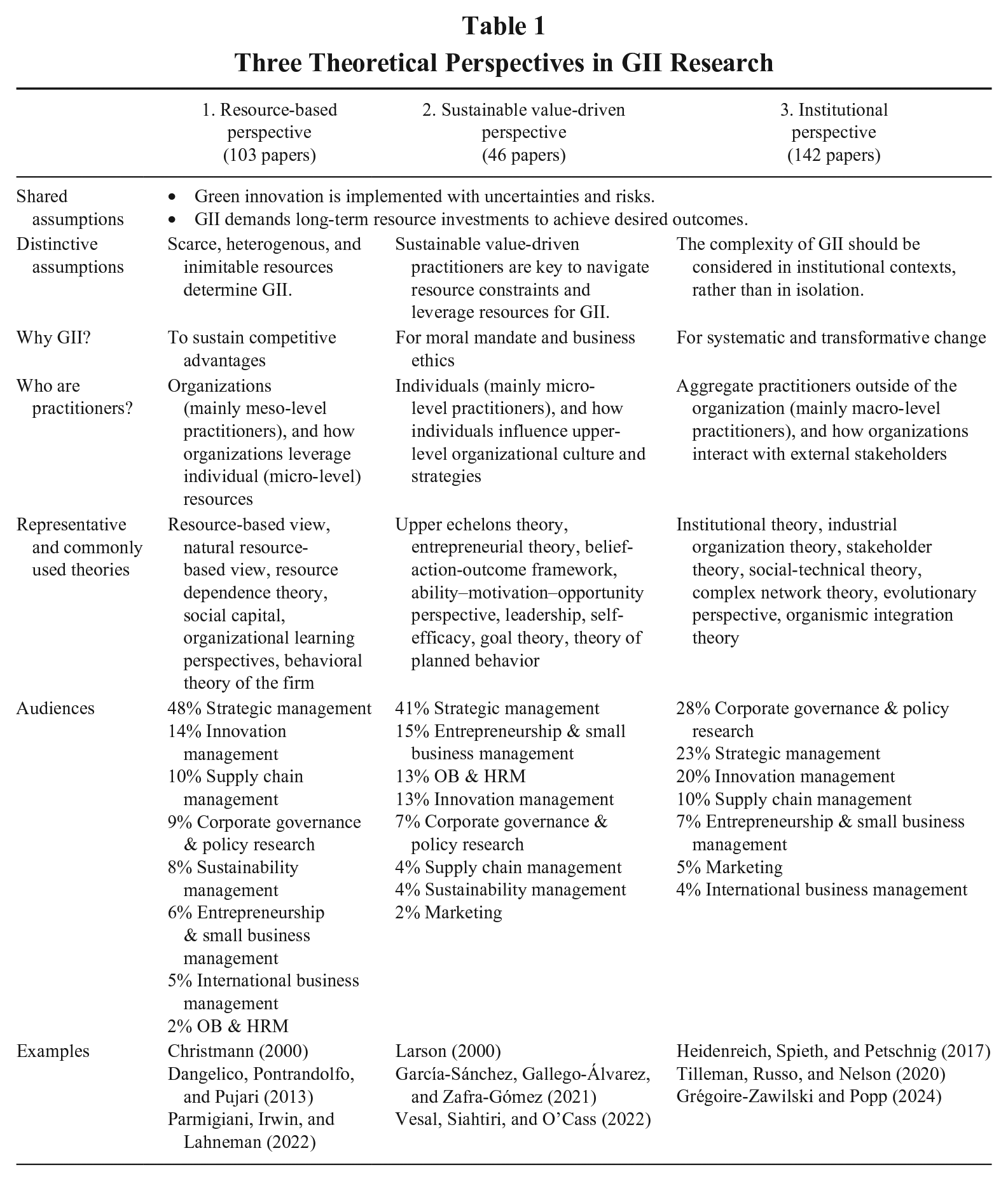
Building on these descriptive findings, we examined practitioners at each level: micro (individuals), meso (organizations), and macro (external stakeholders). We focused on theories commonly used and how they explained the practitioners, antecedents, processes, and impact of GII. During this process, we identified three main theoretical foci (see Table 1): (1) the resource-based perspective; (2) the sustainable value-driven perspective; and (3) the institutional perspective. Studies can be categorized according to two theoretical perspectives, as seen in C. Wang, Wei, and Wu (2023), who employed both the resource-based view and institutional theory. We adopted a narrative approach (Konlechner & Ambrosini, 2019) to interpret the findings.
Three Theoretical Perspectives in GII Research
Findings
Stream 1: Resource-based Perspective on GII
The first literature stream connects studies focusing on meso-level practitioners and the importance of organizational internal resources for GII. Literature in this stream uses a range of theoretical theories; for example, the resource-based view (Christmann, 2000; Dangelico et al., 2013; C. Wang et al., 2023), resource-dependence theory (Shevchenko, Lévesque, & Pagell, 2016), and the capability-based view (Delgado-Verde, Amores-Salvadó, Martín-de Castro, & Navas-López, 2014). Most of these studies are theoretically grounded in the resource-based view, emphasizing that resources that are simultaneously valuable, scarce, immobile, and inimitable serve as a source of competitive advantage (Barney, 1991). This stream concentrates on how organizations develop and use valuable resources for GII to obtain and maintain a competitive advantage. Organizational heterogeneous resources serve as important antecedents of GII and subsequently influence processes and impact.
Antecedents
Most studies in this stream concentrate on meso-level practitioners (aggregated organizations and sub-organizational units) and their resources. Organizational resources and capabilities are the most studied antecedents of GII. Early studies focus on tangible resources (Brunnermeier & Cohen, 2003; Christmann, 2000) such as financial assets, equipment, and natural resources (e.g., materials and land; Barney, 1991; Hart, 1995). Financial shortages can immediately cut off implementation (Ghisetti, Montresor, & Vezzani, 2021), but GII usually demands continuous or long-term financial investment (Ruiz-Castillo, Aragón-Correa, & Hurtado-Torres, 2024; Yang & Jiang, 2023). Larger organizations with greater financial resources are often positioned as leaders in GII; in contrast, financially constrained small and medium-sized enterprises (SMEs) struggle to implement at the same pace (Bu & Wagner, 2016; Qin & Luo, 2022).
Intensive debate continues about the relative importance of tangible and intangible resources as antecedents of GII. Financial resources are arguably not the most influential antecedents for two main reasons. First, financial investment alone does not guarantee the success of GII (Ghisetti et al., 2021). Second, intangible resources such as organizational capabilities, knowledge, and relationships can help overcome financial resource constraints. For example, SMEs navigate financial constraints by leveraging social capital and internal readiness to enact radical change (Shevchenko et al., 2016; Siebenhüner & Arnold, 2007).
Studies on intangible resources investigate various organizational capabilities and their influence on GII. We categorize these capabilities with regard to their relevance to innovation and sustainability. Innovation-related capabilities emphasize an organization’s ability to handle the complexity of the innovation implementation process; they include generic innovative capabilities, dynamic capabilities, and technological capabilities (Bhatia, 2021; Dangelico et al., 2013). Another group of studies argues that GII requires organizations to adapt their generic capabilities to fit environmental specificities. We call these sustainability-related capabilities, which include green-oriented design capability (Ghisetti et al., 2021), green knowledge managing capability (C. C. J. Cheng, 2020; Delgado-Verde et al., 2014), and environmental capability (Bu & Wagner, 2016). Most studies support the positive influence of innovation- and sustainability-related capabilities on GII, albeit with variation in these effects. For example, sustainability-related (e.g., green design) capabilities display a larger effect on GII than do generic innovative capabilities (Ghisetti et al., 2021).
While most studies center on organizational resources and capabilities as important antecedents of GII, some also examine how organizations leverage human resources, such as employee skills, experience, and knowledge, to facilitate GII (García-Quevedo, Jové-Llopis, & Martínez-Ros, 2020; C. H. Wang & Juo, 2021). These studies highlight the importance of recruiting, training, and rewarding employees for GII. For example, Spanish organizations face a shortage of employee expertise, which hinders GII (García-Quevedo et al., 2020). Others also highlight problems caused by the shortage of skills and employee training in GII. For example, skilled and experienced environmental designers can provide alternative solutions such as circular models or cradle-to-cradle approaches, which minimize waste through the entire life cycle of products and services (Ison, Collins, & Iaquinto, 2021; Ghazilla, Sakundarini, Taha, Abdul-Rashid, & Yusoff, 2015). One study shows that most Slovenian designers lack skills and knowledge and have misconceptions about how to integrate eco-design and circular economy principles into the engineering process (Denac, Obrecht, & Radonjič, 2018). Such misconceptions were also reported when surveying and interviewing Malaysian designers (Ghazilla et al., 2015).
Another antecedent of GII is employees’ interpersonal relations. Strong interpersonal relations enhance employees’ innovation capacity either constantly during implementation or through reflection afterward (Brix, 2020). Close, fluid, and cooperative peer-to-peer relations facilitate GII by accelerating knowledge sharing (Delgado-Verde et al., 2014). However, maintaining good interpersonal relations is time-consuming and employees spending too much time on non-work-related issues may disturb work efficiency (Chiffoleau, 2005). Human–technology relations also emerge as an interesting research topic in this stream. British builders were found to attach positive emotions (e.g., hope and confidence) to a zero-carbon housebuilding project, and these positive emotions motivated them to advocate for GII (Sage, Vitry, & Dainty, 2020). This emerging human–technology relationship resonates with Chiffoleau’s (2005) recommendation to further explore the socio-technical construction of GII.
Moderators
Extant studies discuss a range of organizational characteristics—including firm size (Bu & Wagner, 2016; Qin & Luo, 2022), firm age/experience (García-Quevedo et al., 2020; Rogge & Schleich, 2018), and firm type (García-Sánchez et al., 2021; C. Wang et al., 2023)—that can moderate the effect of organizational resources and capabilities on GII. This relationship is found to be more salient for larger organizations than for SMEs because of their greater visibility and higher scrutiny (Bu & Wagner, 2016; Qin & Luo, 2022; Qi, Shen, Zeng, & Jorge, 2010). The extent to which resources and capabilities influence GII also depends on the firm type—for example, multinational versus domestically owned enterprise (Bu & Wagner, 2016; C. Wang et al., 2023) or incumbent versus new enterprise (Edmondson, Kern, & Rogge, 2019; Grégoire-Zawilski & Popp, 2024). For instance, C. Wang et al. (2023) show that the influence of resources and capabilities on GII is more salient for multinational enterprises because they have stronger legitimacy intentions than domestic ones.
Processes
Empirical studies underline the critical processes by which organizations integrate internal resources and capabilities for GII. While organizations traditionally focus on utilizing tangible resources (Larson, 2000), recent studies investigate the accessibility, control, and interconnectedness of resources and how to leverage them across organizational units (Bellamy, Dhanorkar, & Subramanian, 2020; Lai, Feng, & Zhu, 2023). Although resource constraints may hinder GII, Parmigiani et al. (2022) demonstrate that organizations lacking supplier relationship capabilities can implement component innovation through superior manufacturing capabilities. Similarly, internal management processes such as environmental performance evaluation and internal coordination are found to offset deficiencies in organizational capabilities (Albertini, 2019; Lai et al., 2023).
Training employees is also an important process for organizations to leverage human resources for GII. As employees with limited skills and knowledge might impede GII (García-Quevedo et al., 2020; C. H. Wang & Juo, 2021), organizations are advised to upskill employees for GII (Denac et al., 2018). Effective training processes include sharing best practices (Albertini, 2019), collaborating across departments (Przychodzen, Przychodzen, & Lerner, 2016), and enabling internal communication for organizational learning (García-Quevedo et al., 2020). Studies illustrate new training methods, such as eco-design with life cycle analysis (Marconi & Favi, 2020), and integration of circular economy principles into training (Shahzad, Qu, Zafar, & Appolloni, 2021). Training improves employee’s knowledge and skills and demonstrates the organization’s strategic orientation toward GII, fostering employees’ environmental awareness and commitment (Marconi & Favi, 2020; Sihvonen & Partanen, 2016).
Various learning processes have proven effective for GII; they include professional and social dialogues (Chiffoleau, 2005), self-learning and learning from peers (Brix, 2020), and implementation of a learning system designed for systematic inquiry (Ison et al., 2021). Relevant studies embrace the idea that learning enhances individual capability to convert new knowledge to GII. However, the influence of learning on GII may vary according to organizational context. For example, learning prompts medium-size organizations to pursue radical GII, while large organizations typically learn for incremental GII (Siebenhüner & Arnold, 2007).
Impact
Most studies contend that GII benefits organizations financially. Positive financial performance could be manifested as cost savings (Bhatia, 2021; Christmann, 2000), a sale and market boost (C. C. Cheng & Shiu, 2012; Kim, 2015), and operational efficiency enhancement (Albertini, 2014; Ghisetti et al., 2021). However, GII does not guarantee positive financial performance (Christmann, 2000). For example, green innovation may not always result in patents, which reduces the incentive for organizations to invest (García-Sánchez et al., 2021; Li, Lian, & Xu, 2023). Also, GII incurs environmental externalities and costs for organizations because of high initial investment and long payback periods, which may undermine their competitive advantage (Wu, Wang, & Lin, 2023).
Many studies in this stream also indicate that GII has a positive effect on non-financial performance—for instance, providing organizations with a green image (Yang & Jiang, 2023), reputation improvement (Albertini, 2019; Ghisetti et al., 2021), and competitive advantages (Vasileiou, Georgantzis, Attanasi, & Llerena, 2022). However, some studies argue that non-financial performance is likely indirect and long-term (Broadstock, Matousek, Meyer, & Tzeremes, 2020; Kim, 2015). For example, Kim (2015) estimated the performance of 1,032 organizations, finding a positive long-run effect of voluntary GII during a financial crisis (2008–2009). Vasileiou et al. (2022) also identify GII as a long-term process, encouraging organizations to implement multiple types of innovation to achieve better performance. However, a certain number of organizations, especially those with instrumental orientation, are interested in short-term benefits (Christmann, 2000). A delayed, intangible, and indirect impact, despite being positive, can hinder organizations from subsequent GII (Broadstock et al., 2020).
Key insights of the resource-based perspective stream
This stream predominantly emphasizes that heterogeneous resources and capabilities determine GII. However, there is ongoing debate over the relative effect of tangible and intangible resources on GII, with inconclusive findings on moderating effect of firm size. In terms of what and how to implement, this stream emphasizes that integrating internal resources and capabilities and leveraging external resources from supply chains is critical for GII. Most studies suggest GII contributes to financial and non-financial performance; however, the expectation of possible long-term, intangible, and indirect returns might instead discourage organizations from implementation.
Stream 2: Sustainable Value-driven Perspective on GII
The second stream of GII studies focuses on micro-level practitioners and is underpinned by value-driven perspectives. Studies in this stream emphasize sustainable value as a key motivator for GII, especially in navigating implementation challenges and resource constraints. Values can be defined as “what is important to us individually or collectively (as an organization, community or nation) at a given moment in time” (Barrett, 2014: 3). Studies in this stream adopt a broad range of theories, including upper echelons theory (García-Sánchez et al., 2021; Vesal et al., 2022), belief–action–the outcome framework (Bellamy et al., 2020), the ability–motivation–opportunity perspective (Tian, Siddik, Pertheban, & Rahman, 2023), and subjectivist entrepreneurial theory (García-Quevedo et al., 2020; Larson, 2000), to explain how practitioners prioritize sustainable values over economic values to guide their behavior. These studies view GII as a moral mandate, and practitioners holding sustainable values aim to balance economic and environmental values for a sustainable world (Hart & Milstein, 2003). While the resource-based perspective focuses on meso-level practitioners, this stream focuses on micro-level practitioners such as entrepreneurs, managers, and lower-level employees who prioritize sustainable values and bring their available resources to GII. Micro-level practitioners have insider knowledge that enables them to identify unique business opportunities in GII (Bhatia & Jakhar, 2021; Larson, 2000). Moreover, they can sustain the implementation of a nascent green innovation, even without ready-made structures or sufficient resources (Lehoux, Silva, Denis, Miller, Sabio, & Mendell, 2021; Siebenhüner & Arnold, 2007).
Antecedents
The majority of studies in this stream examine the leading role of entrepreneurs (García-Quevedo et al., 2020; Meijer, Koppenjan, Pruyt, Negro, & Hekkert, 2010), top managers (Bhatia & Jakhar, 2021; Li, Lian, & Xu, 2023), chief executive officers (CEOs) (Vesal et al., 2022; C. H. Wang & Juo, 2021), and directors (García-Sánchez et al., 2021; Ruiz-Castillo et al., 2024). These studies suggest that GII is influenced by various leadership styles, such as participatory (Siebenhüner & Arnold, 2007), supportive (Brix, 2020), and entrepreneurial leadership (Larson, 2000). These studies advise leaders to engage employees in the decision-making process and empower them with timely feedback and support to enable more resources to be mobilized for GII. Conversely, directive leadership styles hinder GII by reducing the transfer of information and new knowledge (Siebenhüner & Arnold, 2007). In addition, some studies document a positive effect of green transformation leadership (Przychodzen et al., 2016) and pro-environmental leadership (Vesal et al., 2022), which reflects an organization’s vision of creating sustainable values from GII.
Managers’ environmental concerns and commitments are also antecedents of GII. Managers perceive the salience of environmental crises differently, leading to variation in decision-making regarding GII. Some managers view GII as a threat and prioritize economic value, while others perceive GII as an opportunity and aspire to create environmental value (Hoogendoorn, van der Zwan, & Thurik, 2020; Li et al., 2023). GII is facilitated when managers exhibit higher levels of environmental concern and dissatisfaction with previous implementation (Qi et al., 2010). Similarly, managers’ environmental commitment enhances GII (Bhatia & Jakhar, 2021); for instance, it helped Slovenian SMEs overcome the obstacle of limited financial and human capital (Denac et al., 2018).
Some studies investigate environmental concern and commitment among lower-level employees. For example, scholars reveal that GII is positively impacted by employees’ environmental concerns (Chou, 2014), health and safety concerns (Qi et al., 2010), and environmental commitment (Razumova, Rey-Maquieira, & Lozano, 2016). In contrast, employees without environmental awareness or commitment can be a barrier to GII. In a study of designers, Ghazilla et al. (2015) find that these employees exhibit reluctance toward GII, even though they acknowledge ongoing environmental crises.
While this stream focuses on micro-level practitioners and their value-driven behavior, some studies discuss how individuals, especially entrepreneurs, CEOs, and managers, can shape organizational culture and strategies. One outstanding manifestation of an organization’s sustainable values is organizational culture, which refers to shared beliefs and values in an organization. 3 Most studies examine organizational cultures that prioritize environmental values, such as environmental corporate culture (García-Granero, Piedra-Muñoz, & Galdeano-Gómez, 2020), sustainability orientation (C. C. J. Cheng, 2020), and organizational green climate (Chou, 2014). These studies indicate that the more positive an organization is regarding environmental issues, the more likely green innovation will be implemented. Nevertheless, some types of organizational culture might adversely impact GII. Reyes-Santiago, Sánchez-Medina, and Díaz-Pichardo (2017) find that only an adhocracy culture is closely related to GII, whereas a hierarchy culture hinders GII because it resists change and experiments.
An organization’s sustainable value is manifested in its strategic orientation, which is often regarded as a continuum, ranging from compliant to proactive strategies. The former emphasizes the eco-efficiency of GII and only implements it at a minimum level, while the latter is a more open, positive orientation for radical and societal change (Adams et al., 2016). Interestingly, some studies argue that commercial or profit orientation should not be decoupled from GII, as it stimulates GII to differentiate organizations from rivals and enhance customer value (García-Granero et al., 2020; Przychodzen et al., 2016). Albertini (2014) notes this strategic continuum is dynamic, and organizations can improve both compliant and proactive strategies for GII based on external antecedents (e.g., changing environmental regulations).
Moderators
Some studies investigate the moderating effects of individual demographics, such as gender, age, and educational level, on the relationship between sustainable values and GII. For example, this relationship is found to be more effective for female leaders as they tend to be more compassionate and affective (García-Sánchez et al., 2021). As age increases, the influence of sustainable values on GII becomes stronger among senior managers (Vesal et al., 2022). Similarly, the influence of sustainable values on GII tends to be stronger among individuals with a higher level of education (Babu, Dey, Rahman, Roy, Alwi, & Kamal, 2020; Sihvonen & Partanen, 2016).
Processes
One key process of GII is aligning sustainable values since values often vary across levels: for example, lower-level employees may perceive the severity of environmental problems and recognize the opportunities for GII, while upper-level managers prioritize profit and efficiency (Razumova et al., 2016). Conversely, upper-level managers may have stronger environmental concerns and commitment, while lower-level employees lack awareness (Ghazilla et al., 2015; Qi et al., 2010). Aligning sustainable values within organizations is an essential part of GII. For instance, internal coordination and managers’ timely feedback help reduce subordinate perceptions of risks and uncertainties and thereby motivate them to persist in GII (Meijer et al., 2010). Value alignment is also achieved through knowledge transfer via daily dialogue and service exchange in a study of French cooperative viticulture (Chiffoleau, 2005).
One major challenge of GII is aligning sustainable values across levels—for example, incorporating individual sustainable values into business models and adjusting business procedures and management patterns for structural alignment (Baldassarre et al., 2020). Lehoux et al. (2021) find that one key GII barrier for Canadian and Brazilian organizations is how entrepreneurs uphold their sustainable values in a system that remains either inadequately established or not supportive. To address this barrier, micro-level practitioners are encouraged to integrate sustainable values to the value propositions of their business models (Nijhof, Bakker, & Kievit, 2019). While conventional value propositions primarily target economic value through low-price or differentiation strategies, organizations can transit to sustainable business models; for example, entrepreneurs can leverage resources at hand to implement small-scale pilots of green innovation (Baldassarre et al., 2020). The perceived uncertainty of GII can also be mitigated through entrepreneurial activities such as studying, experimenting, knowledge acquisition, cooperating, and lobbying (Meijer et al., 2010).
This stream highlights breaking path dependency as an important GII process. Path dependency implies practitioners are locked into historical operational processes and norms (Ison et al., 2021). Green innovation challenges established workflows, causing employee resistance because of discomfort with change (Larson, 2000). Emerging efforts to break path dependency include encouraging collaboration across departments and leveraging external threats to stimulate adaptation (Przychodzen et al., 2016; Ison et al., 2021).
Impact
This stream highlights the leading role of micro-level practitioners and how their sustainable values drive GII. However, the literature provides only limited and indirect evidence on the impact of GII, and hints that GII can influence micro-level practitioners’ career development and well-being. Completing green innovation projects helps employees gain recognition for their success and receive rewards and promotions (Sage et al., 2020). However, frequent innovation implementation can increase employee job strain, anxiety, and burnout (Chung, Choi, & Du, 2017; Delmas & Pekovic, 2018).
Key insights of the sustainable value perspective stream
This stream of literature highlights the critical role of sustainable value-driven individuals—whether entrepreneurs, managers, or lower-level employees—in utilizing available resources for GII. This stream identifies leadership, supervisory support, environmental awareness, concern, and commitment as key antecedents of GII. Regarding processes, studies highlight the importance of aligning sustainable values within and across levels and breaking path dependency for GII. Most studies center on how sustainable values drive GII; however, this stream largely overlooks whether and how GII impacts micro-level practitioners and how their values evolve over time.
Stream 3: Institutional Perspective on GII
The third stream of GII focuses on macro-level practitioners from an institutional perspective, arguing that organizations and their actions are embedded in broader societal contexts (Vaara & Whittington, 2012) and that GII needs to be examined beyond organizational boundaries (Gomes, Facin, Salerno, & Ikenami, 2018). This stream emphasizes the influence of external stakeholders (e.g., regulators, suppliers, and consumers) and how organizations interact, collaborate, and co-create for GII (Lehoux et al., 2021; Sihvonen & Partanen, 2016). This stream suggests that isolated organizations cannot address climate change and large-scale crises (Jové-Llopis & Segarra-Blasco, 2020; Zhang, Xue, & Zhou, 2019). A wide range of theories are used to unpack the influence of institutional environments—for example, industrial organization theory (Porter hypothesis) (Costantini, Crespi, & Palma, 2017; Heidenreich et al., 2017), institutional theory (Tilleman et al., 2020; Wu et al., 2023), complex network theory (Zhang et al., 2019), and the evolutionary perspective (Jové-Llopis & Segarra-Blasco, 2020).
Antecedents
Studies in this stream investigate how regulators can fundamentally shape the pace of GII through various policy types and design features (Cecere & Martinelli, 2017; Edmondson et al., 2019; Grégoire-Zawilski & Popp, 2024). These studies often discuss and compare two types of policy: (1) command and control instruments, which refer to direct regulation and legislations by governments, often clarifying what is permitted or illegal and thereby regulating behaviors; and (2) market-based instruments, which use price, markets, taxation, subsidies, negotiable licenses, and carbon trading schemes. Hu, Pan, and Huang (2020) suggest that market-based policies facilitate GII, finding that China’s carbon emission trading system has significantly stimulated the quantity and quality of green innovation, particularly when implemented by state-owned, large, and eastern-located organizations.
Policy effects on GII vary with design features such as stringency, the level of strictness applied to innovation policy, and flexibility, the degree of freedom to implement innovation (Cecere & Martinelli, 2017; Rogge & Reichardt, 2016). Scholars advocate for more flexible and less stringent environmental policies to leave organizations room for continuous improvements rather than technology lock-ins (Brouillat & Saint Jean, 2020; Razumova et al., 2016).
Suppliers are often considered as external resources and knowledge providers that enable organizations to overcome resource constraints in GII (C. C. J. Cheng, 2020; Corazza, Cisi, & Falavigna, 2022; Ward, Barr, Butler, & Memon, 2012; Yang & Jiang, 2023). For instance, Corazza et al. (2022) demonstrate that SMEs pool resources from supply networks to address limitations in resource, knowledge, and technology accessibility. Similarly, GII is facilitated by local suppliers with flexible machinery, available technology-specific human resources (Yang & Jiang, 2023), and foreign suppliers with distant knowledge (Ha, 2021). In contrast, suppliers with limited skilled installers are found to impede the implementation and spread of rainwater harvesting, a United Kingdom green innovation (Ward et al., 2012).
The literature has also examined how consumers influence GII through their perceptions, attitudes, and innovativeness (Chang, 2023; Qin & Luo, 2022). Chang (2023) finds perceived usefulness and ease of use positively influence consumers’ intention to purchase an electronic vehicle. Similarly, consumer preferences (Tsai & Liao, 2017) and willingness to pay (Bleda & Valente, 2009) strongly influence organizations’ GII efforts. However, consumers may be unwilling to sacrifice immediate or short-term benefits for environmental values (e.g., Qi et al., 2010). Another key antecedent is consumer innovativeness, and their curiosity toward innovation (Wunderlich, Veit, & Sarker, 2019). Empirical evidence holds that consumer innovativeness speeds up GII for implementation of alternative fuel vehicles (Heidenreich et al., 2017) and smart metering technology in German households (Wunderlich et al., 2019). Consumer innovativeness is driven more by a desire for uniqueness than variety or hedonism (Heidenreich et al., 2017); and highly innovative consumers have a positive brand image and greater satisfaction with organizations engaging in GII (Marín-García, Gil-Saura, & Ruiz-Molina, 2021).
Moderators
The literature primarily examines industry heterogeneity and market characteristics as contextual moderators of GII (Bu & Wagner, 2016; C. Wang et al., 2023). Industry heterogeneity is evident in differences between manufacturing and service. For example, market pull factors more significantly influence GII in Spanish service organizations, whereas Spanish manufacturing firms are more motivated by public regulations for GII (Jové-Llopis & Segarra-Blasco, 2020). Market characteristics, such as the level of media communication and market competition, also moderate the relationships between external antecedents and GII (Heidenreich et al., 2017; Rogge & Schleich, 2018). Heidenreich et al. (2017) show that a higher level of media communication strengthens the effect of consumer innovativeness on GII. Similarly, the relationship between regulatory pressures and GII is more pronounced in international markets because of increased competition levels (Brunnermeier & Cohen, 2003; Kawai, Strange, & Zucchella, 2018).
Processes
This stream of literature reveals the dynamic interconnections of macro-level practitioners. One key process is how regulators implement policies to ensure and support organizations for GII. If a policy instrument takes a long time to implement, GII incentives for organizations will largely decline because of environmental and knowledge externalities (Brouillat & Saint Jean, 2020). Instead of relying on a single policy instrument, studies suggest regulators design and implement policy mixes that combine various policy instruments and design features (Edmondson et al., 2019; Magro & Wilson, 2019; Rogge & Reichardt, 2016). For example, regulators can mix “hard” instruments (e.g., by establishing an interdepartmental committee to coordinate GII) and “soft” instruments (e.g., by engaging more macro-level practitioners in GII) (Magro & Wilson, 2019).
Several studies further emphasize the complexity of policy mixes, noting that their superiority in supporting GII is not guaranteed and depends on the interplay of various policy instruments (Edmondson et al., 2019; Magro & Wilson, 2019). Some instruments may not align with or even counteract one another (Costantini et al., 2017; Fagerberg, 2018). Changing a single policy instrument may trigger unintended effects that reshape entire policy mixes and their impact on GII (Edmondson et al., 2019). In addition, overly complex regulations increase organizations’ costs (García-Quevedo et al., 2020). Therefore, regulators should carefully manage the ultimate objective and evaluate the interactions of each policy instrument (Edmondson et al., 2019; Rogge & Schleich, 2018).
Studies that view suppliers as external resources often suggest that organizations learn from suppliers for GII (Bellamy et al., 2020; C. C. J. Cheng, 2020). For example, Bellamy et al. (2020) find that organizations with better accessibility to information flow in their supply networks are more likely to implement administrative green innovations and environmental disclosure. Downstream consumers are also considered a potential knowledge source. For instance, Martínez-Martínez, Cegarra-Navarro, Garcia-Perez, and De Valon (2023) show that organizations can address financial and technological gaps by actively listening to consumers and acquiring new environmental knowledge. Global supply chains facilitate the transfer of distant knowledge and green technology from multinational enterprises to local organizations (Wu et al., 2023).
In addition, several studies suggest treating suppliers from resource providers to co-creators. C. C. J. Cheng (2020) finds that GII’s performance improves when suppliers are involved as co-creators, rather than knowledge sources. Co-creation helps organizations leverage complementary advantages from suppliers and connected networks. Organizations and their suppliers can co-create green value by jointly developing implementation strategies (Ma, He, Gu, & Li, 2021), forming strategic alliances (Babu et al., 2020), and building strategic networks (Corazza et al., 2022). Babu et al.’s (2020) study illustrates how commercial organizations collaborate with governments and nonprofit organizations to address implementation challenges and reach remote markets in Bangladesh regions. Ma et al. (2021) also indicate that the best scenario involves collaboration among governments, manufacturers, and retailers to optimize the environmental performance of GII.
Impact
Existing literature have critical discussions and debatable findings about the influence of GII on the policy, supply, and ecological environment. For example, divergent views are presented regarding the influence of GII on regulators and their policies. One set of studies views GII as a learning process, where policy formulation and implementation are not instantaneous but instead take effect through repeated assessments and experiments (Magro & Wilson, 2019; Rogge & Reichardt, 2016). By applying some policy instruments to stimulate GII, regulators receive feedback from organizations and other stakeholders (e.g., media and academics) and thereby gain the opportunity to learn and adjust policy types and design features (Rogge & Reichardt, 2016). Such adjustment is termed “soft governance,” which forms a learning loop to benefit subsequent GII (Magro & Wilson, 2019).
However, another set of studies calls for caution in interpreting the interactions between GII and regulators. There may be a risk of regulatory capture, which means the regulatory agency may be manipulated by the regulated (Finch, Geiger, & Reid, 2017). Some incumbents, deeply rooted in institutional contexts, have the power to negotiate, shape, and influence regulators and their policies (Fagerberg, 2018). Regulatory capture may reduce policy credibility and lower incentives to implement subsequent green innovation (Brouillat & Saint Jean, 2020; Finch et al., 2017). The impact of GII on regulators is dynamic and recursive and can be either positive or negative (Rogge & Reichardt, 2016).
Additionally, studies present conflicting views on the performance of supply chains. Most studies find that GII enhances supply chain financial and relational performance (Batle, Orfila-Sintes, & Moon, 2018; X. Wang, Zhao, & Hou, 2020). Batle et al. (2018) suggest that green innovations (e.g., alternative agricultural methods and energy-saving systems) contribute to trust building in a Mallorca supply chain. However, Liao and Liu (2022) suggest that consumer boycotts sometimes occur because GII is seen as self-serving, leading to feelings of deception and negativity toward organizations.
This stream also measures the impact of GII on the ecological environment. Most studies show that GII positively affects the environment in ways such as reduction of waste and carbon emissions, and less consumption of energy and materials (Bhatia & Jakhar, 2021; C. Wang et al., 2023). Further, combining green products, processes, and managerial innovation can improve environmental performance (Chiou, Chan, Lettice, & Chung, 2011). However, some GII makes only a minor contribution to environmental performance (Denac et al., 2018; Hoogendoorn et al., 2020). For instance, organizations may implement end-of-pipe technology as a response to stricter policy requirements (Shevchenko et al., 2016), but this does not mitigate pollution in other stages of the production process (Denac et al., 2018).
Key insights of the institutional perspective stream
Studies in this stream emphasize the institutional embeddedness of GII and how interactions between organizations and external stakeholders can shape GII. These studies discuss the crucial roles that regulators, suppliers, and consumers play in influencing GII. While this stream explores interactions between macro practitioners, it often overlooks the need to study cross-level and multi-level interplays and interdependencies. This suggests a need for integrating broader, more complex perspectives to fully comprehend the dynamics at play in GII.
Practical Implications
Our synthesis of GII research reveals three main theoretical foci, offering nuanced insights and practical actions for practitioners at various levels. From a resource-based perspective, managers should ensure that employees have the necessary skills, knowledge, and capabilities in relation to both innovation and sustainability. Organizations are advised to provide sufficient resources and continuous support throughout the implementation process. The resource-based perspective also signals the importance of fostering a supportive workplace environment that encourages information exchange, knowledge sharing, and learning across organizational hierarchies and departments.
The sustainable value-driven perspective emphasizes the importance of cultivating and integrating environmental values into organizational culture and individual daily work. Organizations can provide continuous education and awareness programs, which encourage and empower employees at all levels to develop a sustainable mindset, making GII a natural and integral part of their professional routine. Organizations should conduct regular internal audits to identify gaps and prioritize actions to bridge these gaps for GII.
In line with the institutional perspective, organizations should leverage, involve, and engage macro-level practitioners in GII. For example, organizations are advised to develop processual thinking and provide interactive feedback with regulators to ensure effective GII. Organizations should also leverage the resources and creativity of suppliers and customers to strategize GII and embed these strategies into daily operations. Recognizing that one solution does not fit all, organizations should select the most suitable ways of conducting GII contingent on specific contexts. However, any missing link at the individual, organizational, or macro level can lead to disruptions, inefficiencies, or even failure in GII.
An Organizing Framework
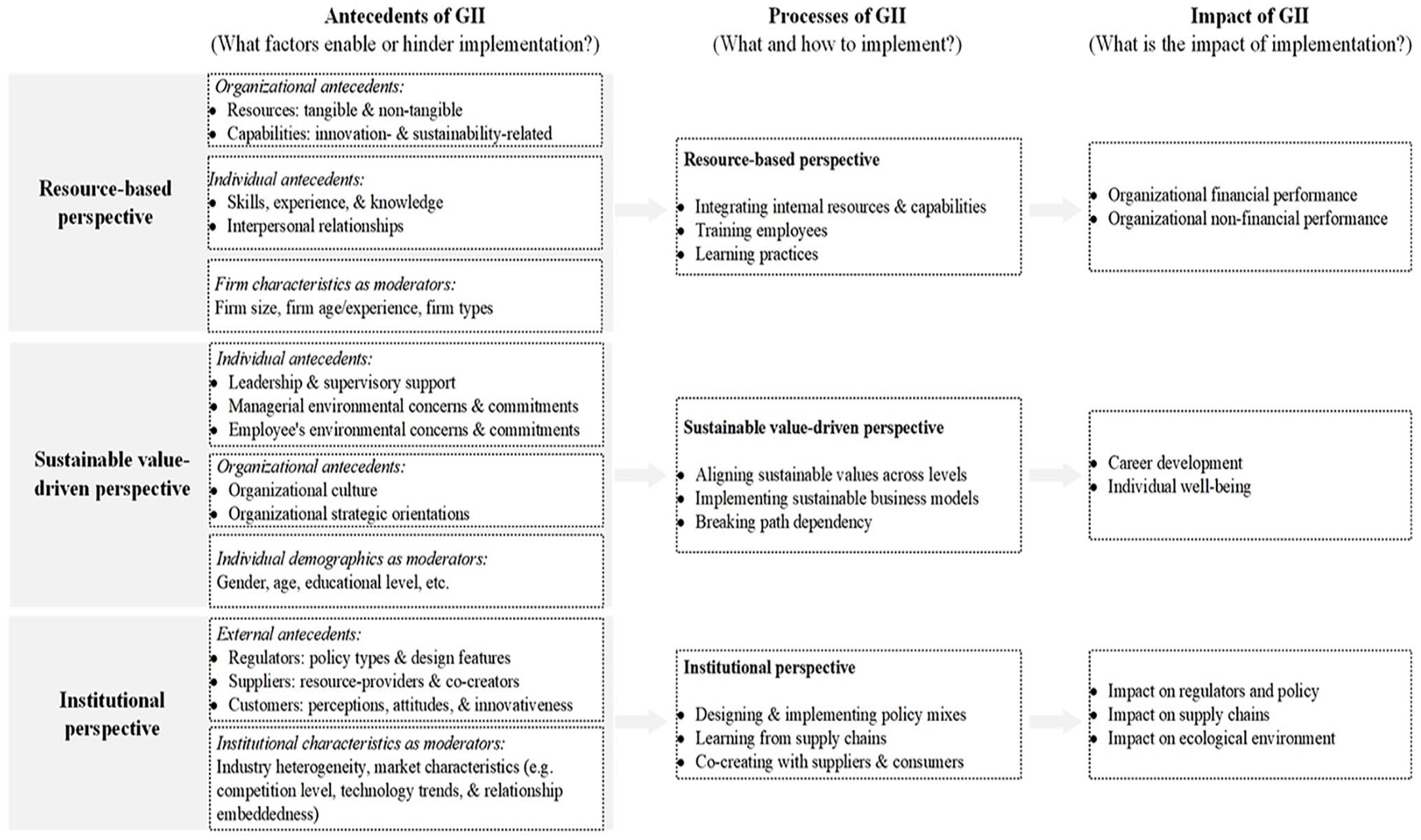
In the introduction, we argued that GII is theoretically distinct from TII, necessitating an unpacking of the GII phenomenon. This review was guided by four questions: Who implements green innovation? What factors enable or hinder GII? What and how do they implement it? What is the impact of GII? To answer these questions, we synthesized existing GII knowledge according to three theoretical foci: resource-based, sustainable value-driven, and institutional perspectives. We developed a framework to integrate these theoretical foci and existing knowledge about the practitioners, antecedents, processes, and impact of GII (see Figure 1).
Thematic Findings from the GII Literature
Building on this framework, we now offer a synthesis of insights and argue that compared with TII, GII is a distinctive strategic process with more complex implementation challenges, in at least four respects: more complex antecedents, a long-term implementation process, environment-inclusive benefits, and a broader scope.
First, while traditional innovation is mainly implemented for productivity maximization, GII has more complex antecedents, such as balancing economic and environmental objects and changing environmental regulations. Our findings on the resource-based perspective confirm that a significant group of studies follow the economics tradition, indicating that GII is economically driven to sustain competitive advantage (Christmann, 2000; Ruiz-Castillo et al., 2024). While we identify an ongoing debate over the relative effect of tangible and intangible resources on GII, sustainability-related capabilities emerge as key antecedents of GII (Bu & Wagner, 2016; Ghisetti et al., 2021; Shevchenko et al., 2016). In addition to economic motives, we theorize the environmental motives of GII from two perspectives: (1) the sustainable value-driven view, which suggests proactive implementation led by individual practitioners for moral mandate and business ethics (Bhatia & Jakhar, 2021; Larson, 2000); and (2) the institutional perspective, which reveals passive implementation triggered by macro-level practitioners for systematic and transformative sustainable changes (Edmondson et al., 2019; Qin & Luo, 2022; Wu et al., 2023).
Second, our review indicates that GII is a long-term implementation process that involves several time-consuming actions, such as breaking path dependency (Ison et al., 2021), training employees (García-Quevedo et al., 2020), and designing and implementing policy mixes (Edmondson et al., 2019). GII strongly relies on learning and training, which explains why it often requires more time and resource investment to generate impact (Slawinski & Bansal, 2012). While each theoretical perspective discussed processes in isolation, we find that GII research addresses some multi- and cross-level interactions, such as how individual practitioners endeavor to align sustainable values across levels (Qi et al., 2010; Razumova et al., 2016), and how organizations co-create GII value with suppliers and customers (Lehoux et al., 2021; Sihvonen & Partanen, 2016). In the next section, we return to this point and propose multi-level theorizing as a promising direction for future research.
Third, while we acknowledge that GII includes environmental benefits not typically found in TII, we also find that GII can generate positive economic and social impact. While studies taking the resource-based perspective present inconclusive findings regarding whether GII contributes to financial performance (e.g., Li et al., 2023; Wu et al., 2023), our review highlights that GII can contribute to non-financial performance (e.g., green image and reputation), which may become visible and voiced in the long term (Broadstock et al., 2020; Vasileiou et al., 2022). This long-term and indirect impact of GII is also manifested in career development and individual well-being as posited by those writing from the sustainable value-driven perspective (Chung et al., 2017; Sage et al., 2020). Studies adopting the institutional perspective confirm that GII has a positive impact on ecological systems, with a potential social impact on regulatory (Rogge & Reichardt, 2016), supply (Batle et al., 2018), and consumption (Liao & Liu, 2022) systems.
Fourth, while TII can be completed within the boundaries of a single organization, our findings reveal that GII emphasizes the interconnection and interdependency among micro–meso–macro-level practitioners. For example, resource-based perspective studies examine organizational resources but also highlight the potential to leverage individual capabilities (e.g., skills and experience) and interpersonal capitals (e.g., relationships) (García-Quevedo et al., 2020; Ison et al., 2021; Sage et al., 2020). Similarly, the sustainable value-driven perspective indicates that individual environmental commitments can facilitate GII and underscores the importance of organizational culture and strategic orientations in influencing GII (C. C. J. Cheng, 2020; Reyes-Santiago et al., 2017). The institutional perspective supports the broader scope of GII by outlining joint efforts by regulators, suppliers, and consumers (Tilleman et al., 2020; C. Wang et al., 2023).
In short, GII is a distinctive strategic process with unique implementation challenges that merit deeper theorization and future research. This will help reform innovation scholarship and address the urgent need to challenge traditional economic paradigms to facilitate low-carbon economic growth (Bansal et al., 2024).
Future Research Directions
Antecedents of GII
Resource-based antecedents: resource constraints as a threat vs. an opportunity
A body of GII literature rooted in the resource-based perspective views resource constraints as a threat to GII. However, resources can be socially constructed, enabling practitioners to “create something from nothing” (Fisher, 2012: 1027). This suggests that resource constraints can turn into an opportunity for GII. For example, future research can integrate GII and the circular economy, which challenges the traditional view of waste in the linear economy, arguing that waste can be transformed into valuable resources that reenter the economic cycle (Cecere & Martinelli, 2017; Denac et al., 2018). As debate continues in the literature about the relative importance of tangible and intangible resources of GII, future research could critically examine the traditional assumption regarding the conditions under which resources are abundant or can be depleted for GII. Frugal innovation, for instance, is a resource-scarce solution that future research could investigate as a way to improve ecological sustainability using fewer resources and low costs (Dabić, Obradović, Vlačić, Sahasranamam, & Paul, 2022). Future research can contribute by conceptualizing how scarce and so-called wasteful resources can be mobilized and turned into opportunities for GII.
Value-based antecedents: static vs. dynamic
While a stream of GII literature highlights the role of sustainable values in driving GII, we find that sustainable values (e.g., managerial environmental commitment) are often treated as relatively static. However, some studies suggest that values can evolve internally within organizations through leadership (Meijer et al., 2010) or externally through societal and market influences (Babu et al., 2020). This leaves an underexplored research area regarding how sustainable values evolve over time and how dynamic values influence GII. This evolution may be recorded and influenced by digitalization in terms of what individuals, organizations, and society prioritize. For example, digital monitoring helps GII track pro-environmental changes with recycling, energy use, or water consumption (Lai et al., 2023). Future research could explore how using digital nudges promotes GII and enhances business accountability (Stryja & Satzger, 2019). By adopting a dynamic view of sustainable values, future research can examine how changing values, both within and outside organizations, influence GII over time.
Institution-based antecedents: interactions within a level of analysis vs. multi-level analysis
Our review also identified a stream of studies following an institutional perspective to examine the interactions between organizations and macro-level practitioners (regulators, suppliers, and consumers). However, a significant gap remains in understanding multi-level dynamics in GII. This is a problem because GII integrates nature into business, reforming a complex social-ecological system where individuals, organizations, and external stakeholders are interconnected and interdependent (Gomes et al., 2018; Vaara & Whittington, 2012). Antecedents at one level can have upward or downward influences on other levels, collectively shaping GII. To understand the interacting antecedents at multiple levels, future research can draw upon a systems perspective, which argues that the complexity of economic, social, and ecological systems can only be understood by analyzing their relationships (Bansal & Song, 2017). For example, one multi-level study shows how micro-level entrepreneurs confront GII challenges in upholding a responsible identity, but struggle to achieve financial sustainability when macro-level innovation systems provide only limited support (Lehoux et al., 2021). Future research can explore how and when a green industrial system emerges through the co-evolution of organizations and individuals (Williams, Kennedy, Philipp, & Whiteman, 2017). Multi-level theorizing holds significant potential for unravelling the complexities of GII within social-ecological systems (Bansal et al., 2024).
Processes of GII
Knowledge management: learning vs. unlearning
Our review revealed that the resource-based perspective has led to an intensive focus on the learning and training processes of GII, such as employee training and organizational learning. While existing discussions appear to take the anthropocentric view that humans are active in learning and are independent from nature, future research could transit into an ecocentric approach and explore how nature-based learning could bring green elements back for GII (Borland, Ambrosini, Lindgreen, & Vanhamme, 2016). However, learning only provides a partial understanding of knowledge management. Opportunities exist for future research to explore “unlearning” (Tsang & Zahra, 2008) and dynamic learning processes for sustainability (van Oers, Feola, Runhaar, & Moors, 2023). Future research could explore how to integrate artificial intelligence and virtual reality to enhance environmental literacy in organizations. Studies can investigate collective unlearning; that is, how organizations collectively dismantle established routines and structures for GII (van Oers et al., 2023). Additionally, examining the dynamics and interactions between learning and unlearning will provide valuable insights into the cognitive capabilities required for GII.
Temporal perspective: past, present, and future
We identified several time-consuming processes of GII, including breaking path dependency, training employees, and designing and implementing policy mixes. However, GII is not a one-off endeavor but a recursive process for sustainable change, where the current process both is shaped by and shapes previous GII (Jarzabkowski, 2004). Future research could adopt a temporal perspective (e.g., Slawinski & Bansal, 2012) to unpack the temporality and recursive nature of GII. Recent work by Blagoev, Hernes, Kunisch, and Schultz (2024) might inspire extending the traditional focus on time as a resource to include structure, process, and how different temporal lenses influence GII. Future research could also explore how temporal dynamics—spanning past, present, and future—shape interpretation of the “green” within GII and investigate the conditions under which GII emerges in response to critical events (Bansal et al., 2024). For example, studies could examine how practitioners selectively memorize and reconstruct the past to support radical changes in GII. The multidirectional nature of time encourages future research to explore how GII can be planned ahead of time and enacted in the present. Ample opportunities exist to understand how to implement green innovation for a desirable future, without losing sight of ongoing challenges and strategies rooted in past identities, experiences, and network.
Impact of GII
Economic impact: short-term, tangible, and direct benefits vs. long-term, intangible, and indirect development
While economic impact is a primary focus in the GII literature, we found inconclusive evidence on whether GII directly contributes to organizational financial performance in the short term. Future research could deepen our understanding by examining how GII can generate positive and tangible benefits, and contextual differences in shaping these impacts. Beyond short-term benefits, GII may produce long-term, intangible, and indirect effects. One promising avenue is to explore how GII shapes micro-level practitioners, influencing their working practices and well-being. The SAP literature can inspire future research to explore how GII influences micro-level practitioners’ ways of working (e.g., routine formulation and dynamics) (Seidl, Ma, & Splitter, 2024). New research could also integrate OB and HRM theories to examine how GII shapes career development (e.g., empowerment and skill development) and well-being (e.g., psychological strain) (Meyer & Maltin, 2010; Thomas, Ambrosini, & Hughes, 2019).
Environmental impact: anticipated vs. actual impact
We found that studies commonly embrace an assumption that GII has a positive spillover to reduce negative environmental impact. This assumption has a certain optimism bias toward GII. However, it is important to note the lack of concrete verification for the anticipated positive environmental impact generated by GII. Therefore, we advocate for future research to make both theoretical and methodological advancements in assessing the actual environmental impact of green innovation and, at the same time, to integrate the role of cognitive biases and overconfidence when it comes to innovation (Arici & Uysal, 2022). Researchers can adopt innovative approaches and collaborate with interdisciplinary or cross-disciplinary fields, such as economics, computer science, and engineering, to improve the measurement of GII’s environmental impact with behavioral effects (Mura, Longo, Micheli, & Bolzani, 2018).
Social impact: from environmental sustainability to holistic sustainability
Our review indicated that studies primarily concentrate on the influence of GII on environmental sustainability. However, the intersection between environmental and social sustainability remains largely unexplored in the literature (Adams et al., 2016). The impacts of climate crises and risks are unevenly distributed due to various social antecedents (e.g., social class and race), with marginalized communities experiencing environmental injustice, vulnerability, poverty, and conflict (García-Sánchez et al., 2021; Nijhof et al., 2019). We see many opportunities for future research exploring how GII addresses environmental injustice, creates decent jobs, and empowers vulnerable communities to establish sustainable livelihoods.
Practitioners of GII
Predominantly, the GII literature views practitioners as meso- and macro-level organizations. Much less is known about the roles and influences of micro-level practitioners, such as entrepreneurs, middle-level managers, and frontline employees. This insufficient exploration highlights research opportunities. Insights from OB and HRM could provide insights into how rewards and social incentives (e.g., recognition and reputation) affect individual motivation, commitment, and engagement in navigating implementation challenges (Thomas et al., 2019). Management and innovation researchers could integrate, adapt, and validate these incentive designs for GII. Moreover, insights from the entrepreneurship literature could help to understand entrepreneurial intentions, motivations, and endeavors relating to GII. For example, research could seek to understand how entrepreneurs evaluate and commercialize green innovation projects to sustain implementation and business survival (Fisher, 2012).
While our framework differentiates micro–meso–macro levels of practitioners, we stress that it is impossible to address GII at a single level; instead, future research is needed to unpack the interconnection and interdependencies of practitioners at different levels. A systems thinking approach will be useful in understanding the non-linear, relational, and dynamic feedback loops of green innovation systems. For example, it would be interesting to investigate how lower-level practitioners adapt for GII in response to top-down resource allocations, and how bottom-up resource mobilization triggers self-organizing dynamics and new equilibrium toward sustainability (Williams et al., 2017). Similarly, integrating GII and open innovation represents a promising way to understand the dynamic interactions between practitioners across levels and how they intertwine and influence each other’s values and implementation processes (Chistov et al., 2021). Future research can investigate how GII recouples economic and environmental values, and how impact can be co-created through partnerships ranging across all levels.
Methodological Advancements
From economic-centric ontologies to relational and systems-based ontologies
Our review showed that existing GII studies are underpinned mainly by economic-centric ontologies, which traditionally prioritize the primary agency of economic agents such as organizations, suppliers, and consumers. Most GII researchers have continued along this path without adapting their underpinning philosophical worldviews to incorporate the natural environment fully. To advance research, we concur with Callaghan and Mitchell’s (2024: 520) suggestion that innovation researchers need to rethink their ontological underpinning: “some long-standing management theories might need to be challenged.” Thus, we propose that future research paradigms and designs should shift from economic-centric ontologies to relational and systems-based ontologies for GII. Research designs should evolve to incorporate nature and natural elements into knowledge generation, broadening traditional economic-centric approaches for a more holistic understanding of GII processes. For example, future research can adopt indigenous ontologies, where nature is granted agency and relational knowledge between humans, non-humans, and the natural environment becomes profound (Banerjee & Arjaliès, 2021).
From cross-sectional measurement toward longitudinal and process-oriented measurement
We found that GII research heavily relies on cross-sectional data from two dominant measures: self-reported behavioral change (e.g., C. C. Cheng & Shiu’s [2012] implementation scale) and public-recorded green patent data (e.g., from the World Intellectual Property Organization’s Green Inventory; Montobbio & Solito, 2018). Both are outcome-oriented measures that do not adequately capture implementation processes (Mura et al., 2018). Consequently, how GII behaviors evolve over time remains unknown. We suggest that exploratory immersive ethnographies (Dumont, 2023), which involve the researcher’s engagement over an extended period, can provide a deeper immersion into the implementation processes of GII. Process approaches (e.g., Langley, Smallman, Tsoukas, & Van de Ven, 2013) can generate new knowledge on how practitioners experience GII over time and advance the understanding of inherent dynamics and complexities of various implementation episodes.
Conclusion
This review enhances a systematic understanding of GII by synthesizing dispersed knowledge across management fields. Our review extends the innovation management and business sustainability literature in three ways. First, we compare GII with TII, highlighting GII as a distinctive strategic process worthy of exploration and theorizing in its own right. Second, we unpack the implementation dynamics of GII by adopting the SAP perspective. We synthesize key practitioners, antecedents, processes, and impact of GII from three theoretical foci—the resource-based, sustainable value-driven, and institutional perspectives. This enables researchers to better grasp the inherent uniqueness and complexities of GII. We also offer practical implications and an organizing framework that consolidates existing knowledge. Third, we outline new theoretical and methodological directions to inspire future investigation into the antecedents that enable or hinder GII, the implementation processes, the impact of GII, and the involvement of micro-, meso-, and macro-level practitioners. We hope this review provides a renewed starting point for future research to advance our understanding of GII regarding its distinct strategic processes and implementation dynamics.
Footnotes
Acknowledgements
The authors gratefully acknowledge Associate Editor Fabrice Lumineau for his guidance and support, as well as two anonymous reviewers for their constructive feedback throughout the review process.
