




Abstract
Organizational research has long suggested that when working with problems that are complex and ill-defined it is imperative for organizational members to understand and represent these problems in order to effectively address them. However, research on the topic has remained fragmented across different organizational literatures resulting in the development and persistence of ambiguities in our understanding of the activities that compose the process of developing problem representations, the temporal patterns through which they unfold, and the associated mechanisms and outcomes. In this paper, we review and synthesize research across seven different literatures—all of which examine different organizational contexts that involve complex and ill-defined problems—and offer a framework that integrates research across these different literatures. Our framework delineates the different activities constituting the process of developing problem representations, provides insights about different approaches to developing problem representations, elaborates our understanding of the mechanisms associated with the process, and broadens our understanding of the different outcomes of the process. In so doing, our review and framework not only offer clarity and coherence on the topic but also highlight new opportunities for theoretical and methodological advancements.
Keywords
Albert Einstein is quoted as having said, “If I had an hour to solve a problem, I’d spend 55 minutes thinking about the problem and five minutes thinking about solutions.” In other words, when tackling a problem, it is critical to focus not only on coming up with solutions but also on understanding the nature of the problem. This is particularly relevant for organizations—both established and nascent—that often face problems that are complex and ill-defined. Unlike simple, well-defined problems (Arlin, 1990; Getzels, 1982), complex, ill-defined problems usually present themselves only via certain indicators—like the symptoms of an illness—that provide little to no insight as to the underlying cause. To make matters worse, some of the yet-to-be identified causes may produce other symptoms that may have not been noticed or that managers have not yet associated with the problem. In such circumstances, addressing the initial symptom may do little to address the “true” problem. In addition, solutions to complex, ill-defined problems often do not exist and even the criteria by which to evaluate solutions may not be known (Dillon, 1982; Simon, 1973). As a result, different stakeholders are likely to disagree about the best way of moving forward. Addressing a symptom can therefore produce conflict and create new issues down the line.
An attack on an organization’s cybersecurity is an example of a complex, ill-defined problem. A cyberattack typically manifests itself via one obvious symptom—inaccessibility or loss of data in the case of malware attacks or fraudulent transactions in the case of phishing attacks. However, there are often a host of factors that make a cyberattack possible, not all of which are immediately obvious or even observable. In addition, the problem involves a range of stakeholders, some of whom may be driven by different motives and understandings of the problem. Finally, given the speed of technological change, effective solutions ensuring cybersecurity may not always be available or even known. Trying to come up with solutions to a cybersecurity attack without developing an understanding of the problem first may, therefore, be challenging and potentially even counterproductive.
Due to the challenges associated with complex, ill-defined problems, it is imperative for individuals to develop a thorough understanding of these problems first in order to effectively address them. This understanding often manifests itself in a problem representation—a simplified model of the problem, including the symptoms that characterize the problem as well as the causes that explain it (Csaszar & Levinthal, 2016; Reiter-Palmon, Mumford, Boes, & Runco, 1997; Simon, 1973). The goal of this paper is to review the research that has examined how organizational members represent the more complex, ill-defined problems they face and to offer a conceptual framework that integrates research insights across all the different literatures that have wrestled with this topic.
Research on the topic began as a small stream of work within decision sciences that challenged the dominant “solution-centric” paradigm in the field and pointed out that a manager’s job is not only to address well-defined problems but also to tackle problems that are not as easily understandable or solvable (Elbing, 1970; Pounds, 1969). Scholars like Simon (Newell & Simon, 1972; Simon, 1973) and Nutt (1984, 1993) further spotlighted the importance of understanding and representing complex and ill-defined problems in order to solve them. Despite the initial, promising work on the topic, this stream of research began to “dry out,” as it was largely descriptive and arguably lacked a solid theoretical foundation (Nickerson, Yen, & Mahoney, 2012). However, the topic has since attracted attention from scholars across a range of literatures, including creativity, innovation, strategic management, knowledge work, entrepreneurship, and design (see Appendix A). This increasing interest is a testament to the broad relevance of this topic to scholars and practicing managers alike.
Our review takes stock of the research on problem representation and reveals important differences across literatures. As we detail below, there is considerable ambiguity around what the process of developing problem representations entails, how it unfolds over time, and what its key outcomes are. First, there is ambiguity regarding the activities that compose the process of developing problem representations. Indeed, studies sometimes focus on entirely different activities, with some emphasizing the identification of initial symptoms indicating a problem (Kiesler & Sproull, 1982; Pounds, 1969), while others focus on activities such as coming up with different ways of framing it (Reiter-Palmon et al., 1997; Vaccaro, Brusconi, & Veloso, 2011), and still others examine how people find meaningful patterns explaining the problem (Leonardi, 2011; Wan & Lin, 2022). As such, we lack a solid and holistic conceptualization of the key activities that this process comprises. Without agreeing on what its key ingredients are, it is difficult to accumulate knowledge about what employees, managers, and entrepreneurs can and should do—the different activities they need to effectively engage in—to better understand the problems they face.
Second, conceptualizations of how the process of developing problem representations unfolds over time also vary, with some studies emphasizing the need for the process to occur and conclude prior to the development of any solutions (Baer, Dirks, & Nickerson, 2013; Park & Baer, 2022), while others invite the possibility that an understanding of the problem may be developed after some solutions have been derived, or even concurrently (Dorst & Cross, 2001; Harvey & Kou, 2013). Naturally, ambiguity regarding the temporal sequencing of the activities involved in the development of problem representations makes it difficult to offer insights into when and how this process needs to be initiated and advanced.
Finally, while some research has evaluated the process of representing problems purely in terms of the quantity or quality of the solutions that arise (Park & Baer, 2022; Reiter-Palmon et al., 1997), other research has argued for the importance of evaluating outcomes that extend beyond the development of solutions (Björkdahl & Linder, 2015; Niederman & DeSanctis, 1995), such as following through on resolving the problem. This ambiguity makes it difficult to appreciate the full range of potential benefits associated with thoroughly representing problems, including the mechanisms that govern these relationships.
Overall, then, we believe that continued fragmentation without integration will lead to the persistence of ambiguities and inhibit further progress on this topic. Our review intends to help address these issues by developing an integrative framework that clarifies and synthesizes research on the development of problem representations across literatures. In so doing, we set the stage for more systematic examinations of this topic.
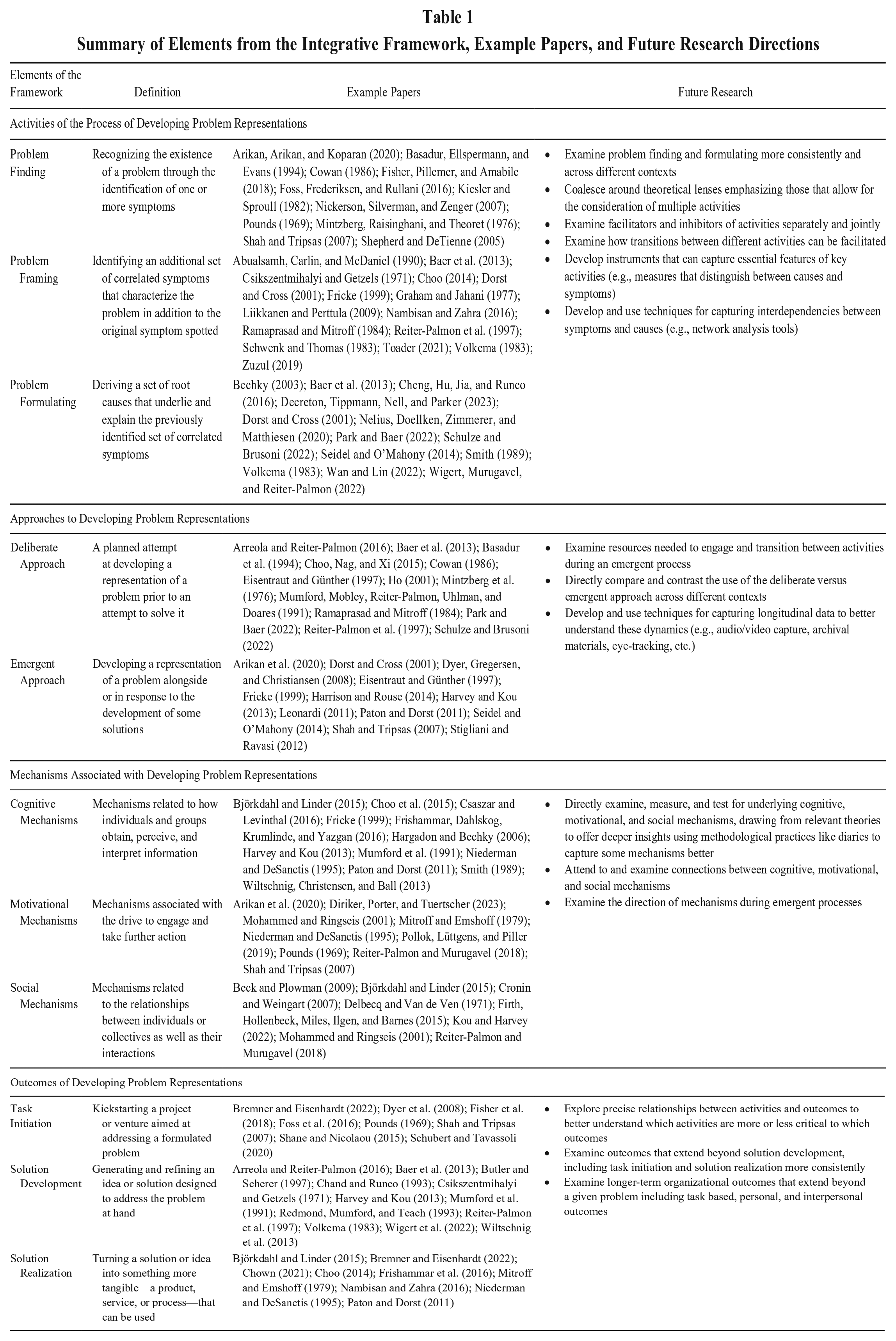
Our framework spotlights three distinct activities involved in developing problem representations: problem finding, problem framing, and problem formulating. These activities can unfold through two different approaches, a deliberate approach and an emergent approach. Our framework further highlights three different outcomes of this process, including task initiation, solution development, and solution realization, and sheds light on the cognitive, motivational, and social mechanisms underpinning these effects. We use this framework to structure our review and to highlight directions for future theoretical and methodological development. Figure 1 offers a graphical representation of our framework and Table 1 provides a summary, along with example papers and future research directions.
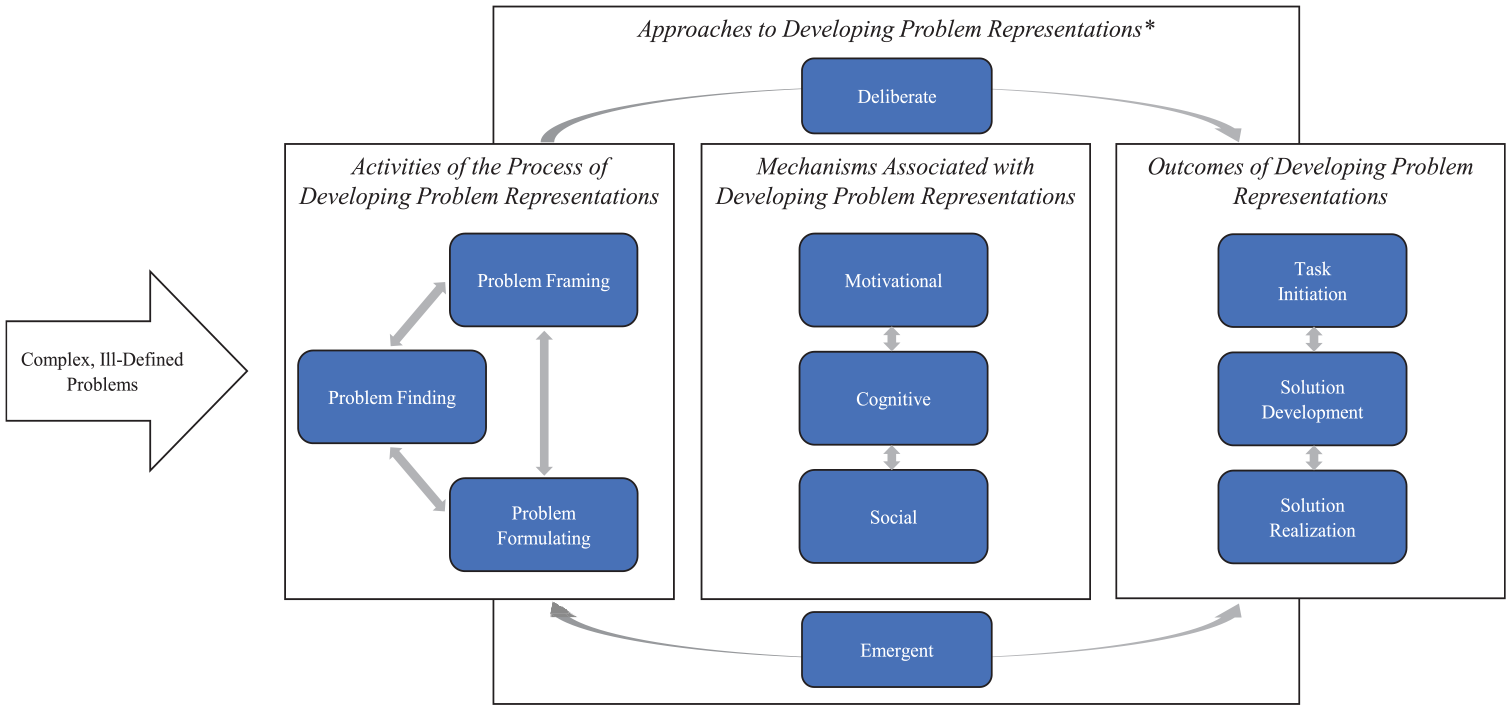
An Integrative Framework of the Process of Developing Problem Representations
Summary of Elements from the Integrative Framework, Example Papers, and Future Research Directions
Review Procedure
The review procedure involved a multiphase process during which we systematically searched for, coded, synthesized, and interpreted individual studies as well as collections of studies (Cronin & George, 2023; Tranfield, Denyer, & Smart, 2003). The need to understand and represent problems can arise at the individual, group, and organizational levels of analysis. Consequently, we reviewed research on the topic across all these levels. As a result, the scope of our review extends beyond prior reviews and meta-analyses that have primarily focused on studies within specific literatures and that are limited in their scope to particular levels of analyses, methodologies, or timeframes (e.g., reviews by Abdulla, Paek, Cramond, & Runco, 2020; Reiter-Palmon & Robinson, 2009, which examined individual level, quantitative studies conducted within the creativity literature and focused primarily on measures of divergent thinking as outcomes). This is in line with our goal of synthesizing findings and offering an integration across literatures.
We began with a search on Web of Science, using a wide set of search terms relating to the process of developing problem representations (i.e., problem formulation, problem construction, problem finding, problem framing, problem definition, problem structuring, opportunity formation, opportunity creation, opportunity finding, task definition, task identification, and task re-definition). Based on our initial search, it became obvious that researchers use many different terms when describing how problems are represented (also see Abdulla et al., 2020; Smith, 1989). To accommodate this complexity, we used an iterative process to identify articles for our review, using an ever-widening net of search terms. 1
Our initial search on Web of Science yielded more than 7,300 articles across a range of fields, including the natural sciences, many of which were not relevant to organizations. To narrow down the number of articles, we applied category filters and selected categories with explicit relevance to organizations (e.g., business, management, applied psychology, etc.). This resulted in an initial list of 364 articles. Of these, we included papers that explicitly examined (any aspect) of the process of deriving problem representations (instead of taking it for granted) as the focal construct. This led us to include both conceptual and empirical articles that either focused on the process itself or on its relationship to relevant outcomes. We excluded any remaining articles without explicit relevance to organizations that slipped through our filter the first time (e.g., articles in creativity journals that focused on education and did not examine adult populations). Additionally, we excluded articles that examined specific types of problems (e.g., articles in operations research examining the best way of representing the travelling salesman problem). We also carefully considered the relevance of each of the literatures to our endeavor. For instance, we discussed whether papers from entrepreneurship should be included. Entrepreneurship scholars frequently conceptualize entrepreneurial opportunities as consisting of both problems as well as solutions (e.g., Hsieh, Nickerson, & Zenger, 2007). We therefore decided to include selected papers from the entrepreneurship literature, a decision that is also in line with the recommendation that reviews seeking to synthesize and integrate across literatures include “grey literatures” that may at the surface appear different but share deeper connections (Cronin & George, 2023).
We then conducted an iterative and expanded search using Google Scholar. We started by searching with the same terms we had entered on Web of Science to ensure that we had not missed any relevant articles. We then took two critical steps to ensure that we captured articles that may have used terminologies that were different from the ones we had searched for initially on Web of Science. First, we conducted a forward and backward citation search. Second, we maintained a running list of relevant terms that were used in the articles we surveyed and ran a search on Google Scholar for each new term we encountered. We then read through the work and applied the same inclusion and exclusion criteria we had used previously. We continued to conduct searches on Google Scholar at regular intervals between 2021 and early 2023 when we completed the first drafts of our review.
This iterative process resulted in a total of 172 articles published between 1969 and early 2023. 126 of these were empirical studies (73%). Among these, 47% employed quantitative methods, 49% employed qualitative methods, and 4% employed both. The articles represent seven literatures, including decision sciences (20%), strategic management (17%), creativity (20%), innovation (13%), knowledge work (7%), entrepreneurship (9%), and design (13%). Online Appendix B offers a breakdown of the articles by literature, method, and level of analysis, and includes relevant terminologies, definitions and theories.
We began with a preliminary coding of a set of ten papers, representing the different disciplines that each member of the authorship team reviewed separately. We used orienting questions to guide our initial survey of these papers (e.g., “What are the activities constituting the process of developing problem representations?”), given that such questions can help to “synthesize findings, observations, concepts and relationships” across different disciplines, paradigms and methodological approaches (Simsek, Fox, & Heavey, 2023: 296; see also Cronin & George, 2023; Rousseau, Manning, & Denyer, 2008). We then discussed our initial insights and agreed on a set of codes that we used to create a coding scheme. The first author then coded the entire list of articles, adding additional codes to the scheme, if required. Discrepancies in the coding were discussed and resolved by the authors.
During the synthesis and interpreting stages, we compared within and across articles to reveal similarities and distinctions, as well as connections between the codes in order to create broader, more meaningful categories into which these codes could be placed. For instance, we combined conceptualizations or operationalizations of actions that were focused on developing different variations of a problem, including “number of ways of seeing a problem,” “uniqueness of ways of seeing a problem,” and “seeing a problem differently from someone else” under the broader category of “problem framing,” which we again distinguished from the broad categories “problem finding” and “problem formulating” and their underlying codes. Online Appendix C provides a comprehensive list of all the codes we generated and the broader categories they were aggregated into, as well as the orienting questions that guided our coding and analysis. In a final step, we worked to understand the connections between these higher order categories and used these emerging insights to develop our review and framework, and also to highlight directions for future research.
Problem Contexts across Literatures
We begin by spotlighting the various problem contexts that have been examined across the literatures we reviewed. A common thread across these literatures is that they all are concerned with developing solutions to address existing or newly identified problems. To the extent that these problems are complex and ill-defined, creating valuable solutions is not possible without understanding what one needs to solve for. Problem representations provide the answer to that question.
Scholars have used different terminologies to refer to the overarching process of developing problem representations (Abdulla et al., 2020; Smith, 1989). Some terms are discipline specific or are closely related to labels used to describe sub-activities of this process. For instance, while both Lyles and Mitroff (1980) and Volkema (1986) refer to the overarching process as problem formulation, scholars like Kay (1991) and Baer et al. (2013) have used problem formulation to refer to a sub-activity of that process. We use the term “developing problem representations” to describe the overarching process because it is not tethered to a single literature and it captures the key function of the process, which is to develop a simplified model of the problem at hand.
Research in decision sciences on this topic typically examines two different problem contexts, novel operational issues—issues that involve an unusual disturbance or deviation relating to the day-to-day activities of the organization—and strategic issues. Examples of novel operational issues may involve a major production breakdown, an increase in absenteeism, or a rise in customer complaints, as well as quality improvement projects undertaken at the middle or lower levels of an organization (e.g., Brightman, 1978; Choo, 2014; Pounds, 1969). Strategic issues faced by leaders and managers—which are also central to the strategic management literature—can range from whether an organization should enter a new market or release a new product to whether it should acquire another firm. For instance, Mintzberg et al. (1976) examined strategic issues in an airline company choosing a new type of jet aircraft, in a radio station firing a star announcer, and in a consulting firm negotiating a merger.
The creativity literature, which largely focuses on identifying the drivers of idea generation, has examined whether developing (primarily divergent) problem representations facilitates the brainstorming of solutions to problems, such as managing a student’s academic and extracurricular workload (Reiter-Palmon & Murugavel, 2018). More recent research in this area has focused on new product development, which involves not only generating ideas but also the implementation of ideas as tangible outputs, such as designing new outdoor ski-boots and helmets or choreographing a new, modern dance routine (Harrison & Rouse, 2015). Such problems also have been central in the design literature (e.g., Goel & Pirolli, 1992)—the focus of which is to understand how designers develop solutions to ill-defined problems presented to them by certain stakeholders—and in the innovation literature (e.g., Schweisfurth & Raasch, 2018). The innovation literature as well as research on knowledge work have additionally examined research and development projects undertaken by experts within specialized units, such as early-stage drug discovery units (e.g., Ben-Menahem, Von Krogh, Erden, & Schneider, 2016), in an effort to understand how multidisciplinary groups may develop a shared understanding of highly complex and ill-defined problems.
Studies in strategic management and innovation have examined complex, ill-defined problems in the context of crowdsourcing projects where solutions—such as a new port scanner for a particular operating system in a free open-source software community (Foss et al., 2016)—are not only developed but, in some cases, are also implemented by dispersed participants. Finally, venture creation, such as the development of a commercial venture for a socially valuable product that may address problems related to early childhood development (Busch & Barkema, 2022), has been a featured context in the entrepreneurship literature, which has explored how the development of problem (or opportunity) representations may relate to entrepreneurial action. Unlike other contexts, the development of problem representations in this context is pre-organizational, in that it often occurs prior to the establishment of a firm in a formal sense.
Activities of the Process of Developing Problem Representations
At the heart of our review and framework are the activities that organizational members engage in during the process of developing representations of complex, ill-defined problems. We identify three distinct activities—problem finding, problem framing, and problem formulating—that together constitute this process.
Problem Finding
During problem finding, one or more symptoms are identified and interpreted in a manner that culminates in the judgment that a problem exists (Arikan et al., 2020; Basadur et al., 1994; Cowan, 1986; Foss et al., 2016). Not all studies have explicitly examined or distinguished problem finding from other activities that are part of the process of developing problem representations. Where scholars have focused on examining this activity, they have used, in addition to problem finding, a plethora of other terms to describe it. In the decision sciences, for instance, the terms problem generation (Basadur et al., 1994), problem sensing (Kiesler & Sproull, 1982), and problem recognition (Cowan, 1986) have been used. In research on creativity (Amabile & Pratt, 2016) and in strategic management (Chown, 2021), the terms task identification and problem identification, respectively, have been favored. In contrast, entrepreneurship scholars prefer the terms opportunity discovery and opportunity creation (Alvarez & Barney, 2007). We use the term problem finding throughout this review. It captures the key features of this activity—the active identification and interpretation of a set of symptoms suggestive of a problem. It also clearly distinguishes this activity from the other activities and from the overall problem representation process and is agnostic to disciplinary preferences and differences.
We identified two ways in which problem finding has been conceptualized. The first involves detecting symptoms by uncovering differences between the current state and a desired state and interpreting this discrepancy as evidence of a problem’s existence (Basadur et al., 1994; Pounds, 1969; Smith, 1989). The second way of conceptualizing problem finding involves recognizing the opportunity to move to a new standard or a new way of doing things. This conceptualization was introduced fairly early in decision sciences, with studies by Pounds (1969) and Nutt (1984) showing that when employees and managers came across a superior idea or practice, it led them to search for an opportunity or need which could be addressed using the idea. This conceptualization has recently received greater attention from entrepreneurship scholars employing the perspective that new opportunities can be “created” (e.g., Alvarez & Barney, 2007; Dyer et al., 2008).
Drawing from a social cognition perspective, scholars have suggested that knowledge and experience are critical factors that support problem finding, as individuals’ information and knowledge sets can shape the focus of attention and whether something is interpreted as a discrepancy (Cowan, 1986; Kiesler & Sproull, 1982). Fisher et al. (2018), for instance, found that experts with prior knowledge in the domain were able to detect discrepancies during product development that others did not notice. Shepherd and DeTienne (2005) reported that entrepreneurs with prior knowledge of customer problems identified more opportunities, both in terms of quantity and innovativeness. Foss et al. (2016) observed that having open and unbounded conversations that created new knowledge helped individuals find new problems instead of merely joining problems that others had identified. Kaish and Gilad (1991) showed that knowledge from non-traditional sources can support problem finding. Studies have also found that people’s social networks (Smith, Moghaddam, & Lanivich, 2019) as well as factors like curiosity (Arikan et al., 2020) can be important for problem finding. Finally, organizational routines have been linked to better problem finding. Specifically, decision-making studies examining novel operational issues observed that monthly statements, reports, and inventories that cross a manager’s desk regularly could aid problem finding, resulting in a larger number of issues being spotted (MacDuffie, 1997; Mintzberg et al., 1976; Pounds, 1969).
Problem Framing
At the heart of problem framing is the identification of all symptoms that jointly characterize the problem at hand, in addition to the original symptom spotted during problem finding (Csikszentmihalyi & Getzels, 1971; Dorst & Cross, 2001; Ramaprasad & Mitroff, 1984). Each newly identified symptom may suggest and imply a different view (i.e., frame) of the problem, ensuring that the problem is seen through as many lenses as required to mirror the problem’s complexity. As with problem finding, scholars have not always distinguished this activity from other relevant activities. Where this activity has been examined with greater nuance and specificity, scholars have used a variety of other, often literature-specific terms. These include terms like problem/brief interpretation (Dorst & Cross, 2001) or problem decomposition (Liikkanen & Perttula, 2009) which have been used in the design sciences. Terms such as reconfiguration (Arikan et al., 2020) and demand side narratives (Nambisan & Zahra, 2016) resonate in the entrepreneurship literature. In addition, more general terms like problem-purpose expansion (Volkema, 1983), problem construction (Reiter-Palmon et al., 1997), alternatives generation (Schwenk & Thomas, 1983), and forming divergent representations (Zuzul, 2019) have also been used to refer to aspects of this activity. We use the discipline agnostic term problem framing, as it captures the essence of this activity—describing a problem by inviting the use of multiple lenses or frames—while highlighting its distinctiveness from other activities and the overall problem representation process.
Problem framing involves departing from a single, dominant perspective to consider and entertain alternative views of the problem. Correspondingly, a dominant way of conceptualizing and measuring problem framing is via the number of different, yet relevant symptoms (and associated perspectives) that are identified (e.g., Csikszentmihalyi & Getzels, 1971; Volkema, 1983). For instance, Volkema (1988) built from the law of requisite variety to describe it as the number of different problem statements generated. This bears resemblance to Reiter-Palmon and Murugavel’s (2018) study which provided participants with a real-life problem and asked them to generate as many restatements of that problem as they could. Likewise, Toader (2021: 573) administered a scale which captured the quantity of frames developed, using items such as “This team conducted multiple examinations of suggested problems.” Graham and Jahani (1977) drew from a systems lens and conceptualized it as the number of different stakeholders relevant to an organizational problem that are identified and whose (distinct) perspectives are taken into consideration.
A number of studies which examined problem framing not only focused on the quantity of frames but also captured the quality of the framing activity (Abualsamh et al., 1990; Wigert et al., 2022). This may entail ratings of the originality of different framings (Csikszentmihalyi & Getzels, 1971; Massey & Clapper, 1995; Paletz & Peng, 2009; Vaccaro et al., 2011) or the amount of time spent on developing alternate framings (Choo, 2014; Kay, 1991; Redmond et al., 1993; Rostan, 1994). In addition, some studies conceptualized and measured problem framing based on how differently an individual saw a problem relative to the other members of the group. For instance, Basadur, Pringle, Speranzini, and Bacot (2000) examined the different ways in which members of a cross-functional team at a consumer goods firm saw the problem of rising costs in their department, with members from manufacturing seeing the problem differently from members from sales who focused more on the customer experience.
The literature has discussed a number of factors that support problem framing. Studies in the creativity literature have shown that personality variables, such as tolerance for ambiguity, flexibility, openness to experience, and low cognitive inhibition are associated with better performance on a variety of different measures of problem framing (e.g., Mumford, Costanza, Threlfall, Baughman, & Reiter-Palmon, 1993). Moreover, studies of creativity and decision making have revealed that contextual factors, such as explicit instructions (e.g., Butler & Scherer, 1997; Redmond et al., 1993), as well as diverse and even conflicting sources of information can support problem framing (e.g., Fricke, 1999; Reiter-Palmon et al., 1997). Previous research also has highlighted that group level factors, such as functional diversity, can promote better problem framing, as different members are likely to bring to bear different perspectives on the problem at hand (e.g., Baer et al., 2013; Ben-Menahem et al., 2016; Leonardi, 2011). Likewise, studies have considered the value of access to different information and perspectives for problem framing at the organizational level. According to Beck and Plowman (2009), for instance, organizations are more likely to generate a greater number of diverse interpretations of a problem when managers surface conflicting rumors and elicit multiple pieces of information relevant to the problem at hand.
Problem Formulating
Problem formulating refers to the activity of deriving a set of (root) causes that underlie and explain the web of symptoms that were identified previously (Baer et al., 2013; Deichmann, Moser, & Van den Ende, 2021; Dorst & Cross, 2001; Schulze & Brusoni, 2022). When studies have emphasized or distinguished this activity from either problem finding or problem framing, they have used terms such as problem diagnosis (Smith, 1989), problem reduction (Volkema, 1983), assumption integration (Mitroff & Emshoff, 1979), concept coherence (Seidel & O’Mahony, 2014), transforming understandings (Bechky, 2003), or constructing the problem framework (Harvey & Kou, 2013). We propose the term problem formulating, as it captures the quintessence of this activity—deriving an explanation of what is at the root of a problem. It is also a discipline-agnostic term that differentiates problem formulating from other activities and the overall problem representation process.
Problem formulating is typically thought of as a convergent activity that has been conceptualized and measured in a number of ways. Some early studies in decision making and creativity considered the simple winnowing down of generated frames into a smaller subset as a way to capture problem formulating. For instance, in their study of problem-solving groups, Niederman and DeSanctis (1995) focused on coding statements made by group members that indicated preferences among alternative framings of a problem. Likewise, Mumford, Baughman, Threlfall, Supinski, and Costanza (1996) instructed participants to read through a list of alternative interpretations of a problem situation and to select the ones they thought would be most useful in solving the situation at hand. This conceptualization of problem formulating relies on the tenuous assumption that by viewing the problem through a particular lens, its causes will become obvious eventually. In addition, the mandate to select one particular perspective on the problem (rather than to entertain multiple different frames) is likely to result in the loss of relevant nuance. Despite its shortcomings, this indirect and reductionist approach to specifying the causal forces driving a problem continues to enjoy popularity in the literature (e.g., Lee, Daly, Huang-Saad, Rodriguez, & Seifert, 2020; Wigert et al., 2022).
Alternatively, studies have considered the integration of different frames as a way to conceptualize problem formulating. For instance, Basadur et al. (2000: 68) examined how members of a manufacturing unit created a representation that combined two different interpretations of a manufacturing problem—“How might we reduce packaging department costs?” and “How might we continue to make our required quota of sales calls per day?”—resulting in a broader, integrative representation that combined both ways of framing the problem. Likewise, Redmond et al. (1993) instructed participants to produce (after framing) a new problem statement that covered as many of the considerations that surfaced during framing as possible. This conceptualization of problem formulating suffers from the same potential shortcoming as the one described earlier (frame reduction)—without an explicit focus on deriving underlying causes, the risk remains that the problem is understood only at a surface level (i.e., symptom level) and that valuable nuance is lost.
In contrast to these approaches, some studies highlight the importance of problem formulating involving not only the description of a problem via its observable symptoms (and associated frames) but also the distillation of more abstract causes that explain why the symptoms arose in the first place. We favor this conceptualization of formulating (e.g., Baer et al., 2013; Cowan, 1986; Park & Baer, 2022), as it most directly captures the translation from symptoms to causes that is critical to the definition of problem formulating and that sets it apart from other activities. An example here is a study by Wan and Lin (2022) who build from a dialectic perspective to describe how designers formulated the problem of designing a cup for bubble tea by abstracting from commonalities between two initial parameters of the problem—the need for an “environmentally sustainable cup” and the need for a cup that would have the “economic benefit of usability”—to transform the design challenge to one focused on resolving “the root problem of cleaning” the cup. Studies also show that applying techniques such as the “Five Whys” which involve taking a symptom that has been selected as being relevant and then repeatedly asking why that symptom exists is helpful in successfully moving toward formulating more abstract root causes that explain previously identified symptoms (e.g., Abualsamh et al., 1990; Schulze & Brusoni, 2022).
Scholars have examined a variety of factors that can help or hinder problem formulating. Park and Baer (2022) draw on construal level theory to suggest that high construal levels help people develop a comprehensive formulation of a problem. Other work finds that decision biases can cause individuals to ignore or mischaracterize neutral or disconfirming information, which can compromise their ability to successfully formulate the causes of a problem (e.g., Fricke, 1999; Nelius et al., 2020; Volkema, 1986). However, research by Zhang and Yang (2022) suggests that such issues may be offset to the extent that individuals previously have developed breakthrough ideas, as developing such ideas may facilitate their appreciation of novel knowledge couplings and improve their ability to entertain and integrate diverse perspectives.
Interestingly, some factors that support problem framing, such as low cognitive inhibition, may hinder problem formulating, as the process of formulating root causes of a problem can actually benefit from cognitive inhibition (Cheng et al., 2016). Research at the group level points in a similar direction, with several studies suggesting that diversity among group members, a factor that supports problem framing, makes formulating challenging (e.g., Baer et al., 2013; Cronin & Weingart, 2007). Groups may have to employ practices such as developing and using objects that can bridge knowledge boundaries, verbal protocols, or a combination of both to transcend these differences and arrive at a common understanding of the problem (Bechky, 2003; Leonardi, 2011; Seidel & O’Mahony, 2014). Studies at the organizational level, similarly, suggest that having people or processes that can facilitate integration can be critical to formulating problems. For instance, Decreton et al. (2023) suggest that the involvement of mid-level managers (e.g., subsidiary managers) can serve as a bridge helping to bring together the diverse perspectives of senior managers and subsidiary employees when formulating problems.
Summary
Our review revealed that developing problem representations involves three activities that we refer to as problem finding, problem framing, and problem formulating (see Figure 1). In addition, we found that whereas problem finding and, in particular, problem framing involve divergence, problem formulating is thought of as a convergent activity. Finally, we found some preliminary evidence to suggest that the three activities may require different forms of support and that facilitators of one activity, such as problem framing, may hinder another activity, like problem formulating. This raises questions about how the different activities may be facilitated and how people may successfully transition between them—issues that remain unresolved to date.
To be clear, we are not the first to suggest that there are different activities involved in the process of representing problems. However, it is not uncommon for research to omit certain activities (e.g., Baer et al., 2013; Wigert et al., 2022 ignore problem finding), combine activities that are meaningfully different (e.g., Cowan, 1986), or include activities that relate to the development of solutions (e.g., Smith, 1989). By bringing together insights from different literatures, focusing on similarities and differences between activities, and drawing clear boundaries between processes for representing problems versus those related to developing solutions, we hope to offer a more comprehensive and clearer conceptualization. The aim of this clarification is to facilitate the consistent use of terminology that takes into account the unique function of each activity in the broader problem representation process.
Approaches to Developing Problem Representations
Our review spotlights differences in how problem finding, framing, and formulating—that is, the overall process of developing problem representations—unfold over time and as part of a broader problem-solving process. Specifically, we uncovered two fundamental approaches to developing problem representations—what we term a deliberate approach and an emergent approach—each following a different temporal pattern.
Deliberate Approach
The deliberate approach typically involves any planned attempt to develop a representation of a problem prior to solving it (e.g., Cowan, 1986; Mumford et al., 1991; Ramaprasad & Mitroff, 1984). The deliberate approach to developing problem representations is, thus, characterized by both intentionality as well as the timing of the problem finding, framing, and formulating activities, relative to the development and realization of solutions. When individuals deliberately work to develop problem representations, all the key activities occur prior to developing and realizing solutions (e.g., Eisentraut & Günther, 1997). This approach is the dominant approach in the literatures we reviewed, including decision sciences, strategic management, and creativity, as well as entrepreneurship studies adopting a discovery perspective (e.g., Baer et al., 2013; Kaish & Gilad, 1991; Volkema, 1988). Indeed, Mintzberg et al. (1976) found that 14 out of the 25 decision processes they examined involved deliberate attempts at understanding a problem prior to the development of solutions. Likewise, Simon and Hayes (1976) observed that problem solvers generally begin seeking solutions only after they believe that they have a complete and valid understanding of the problem at hand.
A deliberate process can be observed when individuals are explicitly instructed to frame or formulate a problem prior to developing solutions, even to the point of being prevented from generating solutions until they have either focused on understanding the problem for a particular amount of time or generated a specified number of frames or formulations. For instance, studies in the creativity literature (e.g., Csikszentmihalyi & Getzels, 1971; Reiter-Palmon et al., 1997) often instruct participants to generate different ways of framing the problem before asking or allowing participants to generate solutions. Likewise, in the strategic management literature, Park and Baer (2022: 290) instructed all participants in their experimental study to first identify “the most important problem their organization is facing” and then asked participants to list “the causes of the problem they had previously identified,” before they could move on to the task of generating solutions.
Scholars have suggested that the deliberate approach may offer certain key advantages. According to Hsieh et al. (2007) whose work draws from the behavioral theory of the firm, as problem complexity increases, cognitive search via upfront theorizing becomes more valuable than experiential search via trial-and-error. In other words, in contexts in which problems tend to be highly complex (e.g., strategic issues), it may be necessary to engage in the formal, upfront development of problem representations. Furthermore, such contexts may also carry with them higher costs of making “bad” decisions, such that it becomes inefficient or ineffective to rely on trial-and-error processes. Thus, representing such problems at the beginning protects, as much as possible, against the misspecification or underspecification of a problem prior to the development and realization of solution strategies. Indeed, Volkema and Gorman (1998) argued that problem-solving success for certain problems is positively related not only to the formulation activity but also to the extent to which such activity preceded action. While there still may be a later need to modify the initially developed representation (Cowan, 1986; Ho, 2001; Simon, 1973), such modifications ideally entail relatively minor adjustments.
Emergent Approach
The process of developing problem representations does not always unfold in a deliberate manner and may not necessarily have to occur or conclude prior to the development of solutions. Indeed, problem representations may co-evolve alongside or in response to solution development (Harvey & Kou, 2013; Stigliani & Ravasi, 2012). This is because within an emergent approach, experimenting with solutions can serve as a mechanism for eliciting information and generating new knowledge. As the solution space evolves, the problem space co-evolves, as well, through the interchange of information between the two spaces (Dorst & Cross, 2001).
Sometimes an emergent approach begins with a solution. Indeed, some studies have observed that during the venture creation process it is not uncommon for individuals to come up with or stumble upon an unexpected solution that drives them to find a problem (e.g., Arikan et al., 2020; Pounds, 1969; Shah & Tripsas, 2007). For instance, the invention of Febreze at P&G involved the serendipitous discovery of a chemical compound that absorbed unpleasant smells, which then was followed by the search for a problem that could be solved using the compound. At times, the emergent approach allows for the observation of users interacting with the solution to then trigger the finding, framing, and formulating of a problem using information gained through these interactions (Arikan et al., 2020). Shah and Tripsas (2007) provided evidence for these “pure” emergent processes in the case of user entrepreneurship in the childcare space. Users who came up with new product ideas for personal needs would then share the idea with the broader community, which then led them to find, frame, and formulate a problem that was relevant to a broader audience.
At other times, an emergent approach may involve the concurrent development of a rudimentary problem representation during solution generation, followed by additional efforts geared towards problem framing and formulating. Evidence of this approach can be found in some early research of decision sciences (e.g., Mitroff & Emshoff, 1979) as well as recent work in creativity, innovation, knowledge creation, and design. For example, in their study of product designers, Stigliani and Ravasi (2012) adopted a sensemaking perspective and described how design teams developed an initial, provisional problem representation while generating solutions. Based on the information and knowledge gained during the process of generating solutions, members then return to framing and formulating the problem to derive a new problem representation and, possibly, also new solutions (see also Fricke, 1999; Harrison & Rouse, 2014; Harvey & Kou, 2013). Two of the healthcare teams in the study by Harvey and Kou (2013) adopted such an approach of developing an initial problem representation alongside a small number of healthcare ideas to then return to framing and formulating the problem as they evaluated those ideas.
An emergent approach may confer some advantages over a deliberate approach, particularly in situations where the relevant information and knowledge sets required to frame and formulate the problem may not yet exist. Examples of such contexts may include venture creation, research and development, or new product development. A simple example can be found in Fricke (1999) who observed that when tackling a design problem to develop a “wall-mounted swivel mechanism” for a laboratory, successful designers initially developed an imprecise problem representation, generated initial solutions, and then worked on clarifying the problem further with the aid of initial solutions. This approach was found to not only aid them in the development of superior solutions, but also to enable designers to complete the task in a shorter time span. This finding also suggests that an emergent approach may be useful in situations where time pressure is high (see also Eisenhardt & Tabrizi, 1995; Eisentraut & Günther, 1997).
Summary
The process of developing problem representations may be approached in a manner that is deliberate, occurring prior to the development of any solutions, or emergent and in concert with—or in response to—the development of solutions (see Figure 1). Our review offers two additional insights. First, although a deliberate approach has dominated research, there is evidence to suggest that an emergent approach may be particularly useful when one is dealing with problems for which relevant information and knowledge sets may not yet exist (e.g., venture creation). Second, both approaches have advantages and disadvantages. Whereas the deliberate approach reduces the likelihood of underspecifying or misspecifying a complex, ill-defined problem, this approach is more time-intensive and requires that relevant expertise can be identified and accessed. In contrast, the emergent approach, while less time-intensive and less reliant on the identification and availability of relevant expertise, does require a certain amount of trial-and-error, which carries with it its own risks and costs. These findings suggest a need to specify the precise conditions under which each approach may be more or less beneficial and to further unpack the temporal dynamics of each approach.
Mechanisms Associated with Developing Problem Representations
Our review uncovered novel insights about the mechanisms theorized to underpin the influence of problem representations on certain outcomes. Specifically, we identified three types of theoretical mechanisms: cognitive, motivational, and social. Where it was possible to classify these mechanisms, we observed that a majority of studies focused on cognitive mechanisms with motivational and social mechanisms receiving relatively less attention.
Cognitive Mechanisms
We identified several cognitive mechanisms—mechanisms related to how individuals and groups obtain, perceive, and interpret information—associated with finding, framing, and formulating problems. Some studies suggest that finding a greater number of potential problems provides organizations access to unique information, which offers them a greater number of options for future action (e.g., Alvarez & Barney, 2007; Schubert & Tavassoli, 2020). Other studies suggest that unique information comes not only from finding but also, critically, from framing and formulating problems (e.g., Shah & Tripsas, 2007). Indeed, framing and formulating a problem can guide the retrieval of pertinent information from long-term memory (along with the activation of relevant knowledge) and spur the search for new information (Mumford et al., 1991; Smith, 1989). In fact, in their study of a metal casting manufacturing plant, Choo et al. (2015) leveraged information processing theory and found that the development of problem representations was associated with significant increases in knowledge stocks. This can lead to greater awareness of critical issues (e.g., Frishammar et al., 2016; Niederman & DeSanctis, 1995), while also ensuring that search processes are focused on the problem at hand (Frishammar et al., 2016; Kruger & Cross, 2006).
Framing and formulating a problem can reduce fixation on familiar courses of action (e.g., Mumford et al., 1996; Paton & Dorst, 2011) and promote mental stimulation and increased cognitive processing (e.g., Björkdahl & Linder, 2015). In their analysis of transcripts from a design exercise, Wiltschnig et al. (2013) found that mental stimulation could be identified in 45.5% of transcript segments when participants considered the problem while developing solutions. In contrast, they found that mental stimulation dropped down to 11.4% when participants did not consider the problem.
When framing problems collectively, interactions among group members can shift members’ awareness in ways that can make new frames accessible, leading to the collective consideration and pursuit of possibilities that might not have emerged otherwise (Hargadon & Bechky, 2006; Harrison & Rouse, 2014). Furthermore, in moving from framing to formulating, groups may achieve cognitive consensus and a shared understanding of the problem (Bechky, 2003; Mohammed & Ringseis, 2001). Interestingly, some research also points to the bi-directional nature of cognitive mechanisms. For instance, studies show that initial problem representation activities shape solution generation via a cognitive pathway by providing information and activating knowledge. The development of initial solutions, in turn, makes available additional information that eventually helps members in reshaping the problem representation (Fricke, 1999; Harvey & Kou, 2013; Mitroff & Emshoff, 1979).
Motivational Mechanisms
Motivational mechanisms refer to mechanisms associated with the drive to take action to address the problem. Some research suggests that representing a problem can motivate individuals to take action by highlighting the depth and the pervasiveness of the problem at hand (e.g., Arikan et al., 2020; Pounds, 1969). For example, in their study of user entrepreneurs, Shah and Tripsas (2007) found that people were more motivated to start a venture when they saw that the problem was important and that others struggled with it as well. Research also suggests that developing problem representations can be crucial for motivating potential solvers (e.g., Diriker et al., 2023). For example, Pollok et al. (2019) built on uncertainty reduction theory to show that developing problem representations helped the organizers of a crowdsourcing challenge to attract the attention of potential problem solvers and motivate them to participate.
Framing and formulating a problem can also enhance satisfaction and commitment to the solution (e.g., Mitroff & Emshoff, 1979). For example, Niederman and DeSanctis (1995) and Mohammed and Ringseis (2001) observed that developing problem representations during problem solving exercises led to greater satisfaction and higher commitment to the solutions developed. These scholars have suggested that this may be because individuals are more likely to believe in the merits of a solution if they make efforts to truly understand the problem. A positive link between the development of problem representations and outcome satisfaction was also observed in the study of brainstorming groups by Reiter-Palmon and Murugavel (2018). Interestingly, some research suggests that motivational mechanisms may work bi-directionally during emergent problem representation (e.g., Pounds, 1969). This idea has received renewed attention in the entrepreneurship literature where scholars have theorized that “accidentally” stumbling upon or developing a solution may create curiosity and motivate individuals to find a problem to which that solution can be applied, which in turn can support further development of the solution (e.g., Arikan et al., 2020).
Social Mechanisms
Social mechanisms involve processes related to the relationships between individuals or collectives as well as their interactions. First, developing problem representations, particularly moving from problem framing to formulating, can facilitate coordination in groups, allowing group members to work together as well as apart more effectively (e.g., Firth et al., 2015; Kou & Harvey, 2022). Research also suggests that as group members develop a common understanding of the problem and reach consensus, they begin to trust each other more and experience fewer problems working together on next steps (Björkdahl & Linder, 2015; Mohammed & Ringseis, 2001; Paton & Dorst, 2011). This is also borne out by findings that people are less likely to take steps to contradict one another (Beck & Plowman, 2009) or stand in the way of solutions being realized when they are involved in representing the problem (Delbecq & Van de Ven, 1971).
Indeed, building from theory on team information processing, research has shown that groups that do not achieve consensus around a problem representation are more likely to experience conflict when developing solutions (Cronin & Weingart, 2007; Firth et al., 2015). Correspondingly, Reiter-Palmon and Murugavel (2018) found that groups that engaged in the collective development of problem representations enjoyed better social outcomes, such as reduced conflict. The fact that these social dynamics are dependent on cognitive consensus among group members as well as coverage of critical issues (e.g., Cronin & Weingart, 2007; Delbecq & Van de Ven, 1971) also suggests that there may be links between cognitive and social mechanisms associated with developing problem representations.
Summary
Scholars have discussed and examined three types of mechanisms associated with developing problem representations. Although research has focused primarily on cognitive mechanisms, we also found evidence that developing problem representations is associated with important motivational and social mechanisms (see Figure 1). However, our understanding of these mechanisms is limited, both theoretically and empirically, and thus could be an exciting avenue for future research. In addition, we found evidence that some mechanisms may function bi-directionally, as problem representations are developed in an emergent manner. Finally, we unearthed some evidence that certain mechanisms may be interdependent, enhancing each other (e.g., cognitive and social mechanisms).
Outcomes of Developing Problem Representations
Although a majority of research has focused either implicitly or explicitly on the development of solutions as the primary outcome, our review spotlights a broader array of outcomes worthy of consideration. In the sections below, we summarize the three main outcomes that we uncovered—task initiation, solution development, and solution realization.
Task Initiation
Task initiation refers to the act of kickstarting a task (e.g., a project or venture) (Busch & Barkema, 2022; Foss et al., 2016; Shane & Nicolaou, 2015). The activities involved in developing problem representations can play a powerful role in launching a project or venture to resolve the problem at hand. Some studies establishing a relationship between the development of problem representations and task initiation have been conducted in the field of entrepreneurship where task initiation often is thought of in terms of forming a new venture (e.g., Dyer et al., 2008; Shah & Tripsas, 2007; Shane & Nicolaou, 2015). In more established organizations, task initiation may involve steps such as bringing together relevant players, establishing a project and the team formally, and then dedicating resources to resolving the problem (e.g., Bremner & Eisenhardt, 2022; Foss et al., 2016; Pounds, 1969; Schubert & Tavassoli, 2020).
Our review revealed clear connections between task initiation and problem finding across different studies, driven to some extent by social and motivational forces. In their study of a free open-source software community, for instance, Foss et al. (2016) noted that finding new problems through open-ended communication with other members helped to prompt members to launch new projects within the community. They observed that instead of merely joining or working on existing projects, individuals who found problems posted descriptions of new projects on the community forum, designed new project architectures, and recruited people to join their projects. Similarly, Schubert and Tavassoli (2020) observed that top management teams who excelled at problem finding were more likely to innovate and invest resources in innovation activities. Finally, some entrepreneurship studies have shown that individuals whose personality characteristics correspond to the recognition of opportunities (i.e., problem finding) are more likely to start new businesses (e.g., Shane & Nicolaou, 2015).
Problem finding alone, however, may not be sufficient for task initiation. For instance, in their study of user entrepreneurship in the juvenile goods industry, Shah and Tripsas (2007) found that user entrepreneurs were more likely to start firms when they went beyond problem finding and engaged in framing and formulating which further deepened their understanding of the problem and its pervasiveness. Likewise, Fisher et al. (2018) found that it was not only finding but also framing and formulating problems that propelled senior design leaders to become engaged in solving them.
Solution Development
Solution development refers to the generation and refinement of an idea or solution designed to address the problem at hand (Garud, Tuertscher, & Van de Ven, 2013; Mumford et al., 1991). Our review suggests that solution development is the most frequently studied outcome in research across the different literatures in our review (relying on cognitive mechanisms primarily). Scholars in the areas of decision making, strategic management, and knowledge work, for instance, have argued that finding, framing, and formulating a problem can give rise to higher quality solutions because having a comprehensive understanding of the precise causes that explain a problem allows for the design of solutions that can target these causes more effectively and in their totality (e.g., Baer et al., 2013; Csaszar & Levinthal, 2016; Nickerson et al., 2012; Volkema, 1983).
Research generally suggests a positive relationship between developing problem representations and the quality of subsequently developed solutions. For example, a study by Redmond et al. (1993) found that developing problem representations improved solution quality as assessed against a benchmark. Other studies (e.g., Butler & Scherer, 1997; Volkema, 1983) provide evidence for a relationship between the development of problem representations and certain quality measures, such as accuracy, technical feasibility, and effectiveness. Studies in the design literature further show how framing and formulating problems can help designers develop solutions that are not only more effective at addressing client problems (e.g., Cross, 1997; Ho, 2001; Wiltschnig et al., 2013) but also take into consideration additional issues, such as the need for safety (Eisentraut & Günther, 1997).
An additional benefit of a well-represented problem is that it can enhance the creativity (usefulness and novelty) of solutions (e.g., Csikszentmihalyi & Getzels, 1971; Reiter-Palmon et al., 1997). Naturally, to the extent that framing and formulating a problem may unearth relevant causes, the development of useful (i.e., effective) solutions should be aided. However, creativity researchers have also highlighted that problem framing can improve novelty by facilitating the generation of a larger number of non-redundant solutions (Chand & Runco, 1993; Reiter-Palmon et al., 1997) as well as the development of more original solutions (Redmond et al., 1993; Ward, Patterson, & Sifonis, 2004). An important recent finding by Wigert et al. (2022) is that combining both divergent framing and convergent formulating of a problem results in more creative solutions than relying only on the generation of diverse frames, suggesting that both framing and formulating are important for the development of creative solutions. Correspondingly, research at the group level of analysis (e.g., Harrison & Rouse, 2014; Harvey & Kou, 2013) has shown that engaging in problem framing and formulating supports the development of creative solutions in teams by helping members elaborate and integrate ideas.
Solution Realization
During solution realization, an idea or set of solutions is turned into something more tangible—a product, service, process, or strategy (Garud et al., 2013; Perry-Smith & Mannucci, 2017). We found evidence from a small set of studies, particularly in decision sciences, strategic management, and innovation that developing problem representations may facilitate solution realization via all three types of mechanisms (e.g., Mitroff & Emshoff, 1979; Schulze & Brusoni, 2022). First, studies show that developing problem representations makes it more likely that decisions are implemented. Frishammar et al. (2016) found that product developers relied on their understanding of a problem to determine which solution to implement. Similarly, Harvey and Kou (2013) found that groups that developed problem representations also made more decisions on which solutions should be implemented. Research also showed that groups that engaged in developing a problem representation reported stronger intentions to implement solutions (Niederman & DeSanctis, 1995).
Research has also found that spending time finding, framing, and formulating problems can result in more successful implementation. Some studies indicate that this is directly related to the quality of solutions developed. For example, in a study investigating the development and implementation of scheduling mechanisms at a hospital, Chown (2021) reported that departments that spent time on developing a problem representation were more likely to develop and subsequently implement customized scheduling systems that helped physicians and other members of the department coordinate their efforts and improve patient care than departments that did not.
Finally, research has found that better understanding problems can result in faster solution realization. Research by Björkdahl and Linder (2015) showed that developing a clear vision of the problem helped a green product development firm accelerate the development and commercialization of green innovations. Similar findings about the importance of spending time understanding the problem for faster solution implementation were also reported by Bremner and Eisenhardt (2022). Interestingly, however, some results point to a curvilinear relationship between time and effort spent on developing problem representations and solution realization. According to Choo (2014), there may be a U-shaped relationship between the duration of problem framing and formulating and the duration of the project, such that spending too little time lengthens overall project implementation time but spending too much time can also cause delays. Nambisan and Zahra (2016), whose work relied on a demand-side approach emphasizing the needs, desires, and perspectives of consumers, argued that coming up with multiple ways of framing a problem will have an inverted U-shaped relationship on the enactment solutions, such that beyond a threshold level, acquiring more frames will have a negative effect on enactment.
Summary
Across different disciplines, scholars have examined a variety of outcomes associated with the development of problem representations (see Figure 1). Reviewing these outcomes revealed two key insights. First, all three activities—problem finding, framing, and formulating—are critical drivers of organizationally relevant outcomes and, indeed, focusing on one or two activities alone is not enough to tackle complex, ill-defined problems. Second, although a majority of studies focus on the development of solutions as the primary outcome of interest, we find evidence that developing problem representations can have benefits for activities that both precede (task initiation) and follow (solution realization) solution development. This indicates that the process studied here has broader implications than previously emphasized and sets the stage for examining a wider set of outcomes of developing problem representations and assuming a longer time horizon when doing so.
Implications and Directions for Future Research
The goal of this review was to assess and advance the research about the development of problem representations in organizations. By synthesizing findings across literatures, we developed an integrative framework and offered insights about what has been examined and what remains to be explored further. In this section, we leverage these insights to discuss a set of directions for future research and theoretical development (also see Table 1 for a summary of avenues for future research) as well as practical implications.
Activities of the Process of Developing Problem Representations
We identified and delineated three activities—problem finding, framing, and formulating—that are key aspects of the process of representing complex, ill-defined problems. Representing a complex and ill-defined problem well requires that problem finding, framing, and formulating are all carried out effectively. However, whereas problem framing has been examined widely and has been the subject of a review and meta-analysis in the creativity literature, problem finding and formulating have received far less attention. It could be that problem finding often is taken for granted or assumed to be the responsibility of only a select few, such as budding entrepreneurs, leaders, or managers (Kiesler & Sproull, 1982; Nickerson et al., 2007). However, this does not mean that problem finding does not have broader relevance, particularly as organizational hierarchies get flatter and traditional structures are dismantled (e.g., Ananth & Harvey, 2023; Vaara, Harju, Leppälä, & Buffart, 2021). Indeed, in such circumstances, individuals who work on the frontlines may be more likely to spot problems than leaders and managers who may lack similar exposure to or knowledge of the various symptoms of a problem. Likewise, problem formulating as a convergent activity may have been understudied because of the emphasis on divergent activities in certain disciplines, such as creativity (see Acar, Tuncdogan, Knippenberg, & Lakhani, 2023). We thus invite researchers to examine problem finding and formulating more consistently and across different contexts, drawing on the foundation provided by our synthesis and framework.
Our review also highlights the need for scholarship to coalesce around a set of theoretical perspectives to offer a more solid foundation from which to orchestrate future examinations of the process in its entirety. Currently, scholars across disciplines draw from a wide range of theories and perspectives, including systems theory, theories of social cognition, theory of alertness, entrepreneurial theories of discovery and creation, as well as dialectic and sensemaking perspectives. This theoretical fragmentation is reflective of the fact that certain disciplines emphasize certain activities over others. And while some theoretical perspectives may be better suited for understanding certain activities in isolation, others such as a systems lens or dual processing models of cognition may allow for the consideration of multiple activities of the problem representation process simultaneously.
Another avenue for future research involves a more precise and nuanced examination of the factors that help and hinder the different problem representation activities. To date, scholars have not systematically examined the different enablers and inhibitors or differentiated between factors that influence the entirety of the process and factors that influence one or more constituent activities more notably. This is important because our synthesis indicates that some factors, such as group diversity that have been found to benefit problem framing, have been suggested to pose challenges for other activities, such as formulating the causes of a problem. Our framework spotlights these nuances and offers a roadmap for scholars to contrast and compare the different problem representation activities to identify the factors that offer unique benefits and those that are conducive to the process of understanding problems more generally. For instance, scholars could explicitly examine whether certain personal or contextual factors that are known to offer unique benefits to either problem finding (e.g., attention), problem framing (e.g., diverse, conflicting information), or problem formulating (e.g., using boundary objects) also help or hinder other aspects of the process or the overall process more generally.
We also see merit in better understanding how the different problem representation activities work in concert. Currently, we only have a rudimentary understanding of when different activities take place relative to each other and how they may impact each other. Furthermore, we also do not know how individuals may transition to, from, and between different activities. Some studies suggest that these transitions can be challenging—individuals do not always transition between activities and sometimes skip them altogether. For instance, Schulze and Brusoni (2022) found that without appropriate support and instructions, people may fail to move from problem finding and framing to problem formulating. This highlights the need for future research to examine the circumstances under which transitions take place successfully, including when transitions need to take place, who needs to be involved in these transitions, and how they can be supported by specific instructions or interventions.
Our research also highlights opportunities for methodological advancements. An important next step would be to develop more precise measures that capture core aspects of different activities. For instance, given the emerging consensus that to formulate root causes one may need to take steps to develop theories of the problem (Baer et al., 2013; Wan & Lin, 2022), research needs to develop measures that move beyond the selection and/or integration of identified symptoms and truly capture the formulation of root causes. This would involve, in particular, reaching a consensus on how to distinguish between causes and symptoms to determine the extent to which the problem has not only been found and framed but also formulated. Another key challenge involves capturing the inherit interdependent nature of the activities. One cause may drive a number of different symptoms, different causes may affect one and the same symptom, and causes may condition each other. Here, the use of network analysis tools (e.g., Wasserman & Faust, 1994) might be helpful in analyzing relationships between the symptoms identified during problem framing and the root causes formulated.
Approaches to Developing Problem Representations
Our review offers a deeper understanding of the temporal nature of the process (Cloutier & Langley, 2020) by highlighting different approaches to developing problem representations. Although the deliberate approach has dominated the literature, particularly in decision sciences, strategic management, and creativity, a smaller but important set of papers have emphasized an emergent approach where problem representations are developed in concert with solutions. One reason for this might be that scholars in different disciplines draw on different theoretical traditions. Indeed, it is possible that the dominant theoretical lenses in a given field may have implicitly influenced the approaches emphasized. For instance, papers in decision sciences and strategic management draw from theories like the behavioral theory of the firm and systems theory whereas research in fields like knowledge creation and design build from dialectic traditions.
The emergent development of problem representations implies that the relationship between problems and solutions is not unidirectional. Instead, problems and solutions can co-evolve. To leverage the potential benefits of an emergent approach, future research needs to examine this approach more closely, particularly the skills, tools, and techniques needed to engage and transition between activities during an emergent process. Indeed, an emergent approach is unlikely to be initiated through interventions that normally would guide deliberate approaches, such as giving individuals instructions upfront and not allowing them to progress to the next phase of problem solving until they have represented the problem. In addition, it would be worthwhile to examine the extent to which problem finding, framing, and formulating unfold differently over time, depending on the approach that is chosen. Naturally, an emergent approach assumes greater flexibility and recursiveness than a deliberate approach. To fully understand both approaches, we would need to understand when and how the constituting activities are undertaken.
Another avenue for future research is to examine when a deliberate approach may be preferable over an emergent approach or vice versa. Existing research largely has focused on examining these approaches in isolation (see Eisentraut & Günther, 1997 for an exception) which makes it challenging to understand and agree on which approach should be used when and why. By synthesizing research across different literatures, we were able to detect patterns that offer useful insights about this. In particular, we found evidence to suggest that a deliberate approach may be more beneficial in contexts in which relevant information and knowledge sets are available and the costs associated with misspecifying or underspecifying the problem are high (i.e., most strategic problems). In contrast, an emergent approach may be more beneficial and perhaps the only viable option when the information sets required to frame and formulate the problem may not yet exist, such as when one is operating at the intellectual frontier of a field. Similarly, an emergent approach may be valuable in contexts in which relevant information is not easily accessible, for instance, when representing a problem requires an understanding of people’s preferences. Such preferences are difficult to gauge and individuals themselves may not be able to articulate them until they engage with a solution prototype (i.e., new product design). Going forward, we encourage researchers to compare and contrast both approaches and identify the precise conditions that necessitate either approach and the conditions that would benefit from a marriage of both.
Finally, we believe that the study of the different approaches needs to be supported by methodological advancements that allow for more precise longitudinal examinations that can better capture temporal dynamics. Many studies continue to examine the development of problem representations at a single point in time. To study the development of problem representations longitudinally, researchers will need to devise methods and measures that can capture aspects of the process as it unfolds over time. Some tools do exist. For example, design studies code archival documents generated by participants to evaluate problem representations over time (e.g., Dorst & Cross, 2001; Eisentraut & Günther, 1997; Paton & Dorst, 2011). These tools might find application in other literatures. Additional tools like the use of audio or video recordings (e.g., Harrison & Rouse, 2014; Niederman & DeSanctis, 1995) or eye-tracking software (e.g., Nelius et al., 2020) that have been used in a few assorted studies also have to be developed and adopted more widely to capture longitudinal details about the process that may be difficult to detect through less nuanced methods.
Mechanisms Associated with Developing Problem Representations
The cognitive, motivational, and social mechanisms we identified offer important opportunities for future research. We recommend that future research seek to obtain greater precision in the theorization of these mechanisms and also take efforts to validate their existence. This will particularly benefit our understanding of motivational and social mechanisms that have received far less attention than cognitive mechanisms and the theory, information processing, that this mechanism often is predicated upon. For instance, while there is evidence to suggest that the development of problem representations is associated with greater satisfaction and commitment to solutions (e.g., Mohammed & Ringseis, 2001; Niederman & DeSanctis, 1995), this evidence is limited and lacks theoretical underpinnings. As such it is not clear whether the effects observed are because the solutions developed are of superior quality or because individuals experience a deeper sense of psychological ownership as a consequence of spending time engaging with the problem. Future research into these mechanisms that specifies and builds on theoretical foundations will be important for clarifying these questions.
Another promising avenue for future research involves examining the relationships between and dynamics of these mechanisms, building on initial insights from our review. First, we found evidence that the mechanisms may influence each other (e.g., developing cognitive consensus can influence social processes, such as trust). Future studies could explore cognitive, motivational, and social mechanisms in concert to examine how they relate to one another. Furthermore, we believe there would be value in delving deeper into how these mechanisms unfold in the course of emergent approaches of developing problem representations, building on preliminary evidence from our review that these mechanisms may function bi-directionally. For instance, future research could examine whether cognitive, motivational, or social mechanisms are impacted more by the development of the problem or by the development of solutions during emergent processes.
Outcomes of Developing Problem Representations
We believe that there is a need to develop a better understanding of the precise relationship between different problem representation activities and outcomes. To date, many connections have been examined insufficiently. For instance, connections between problem finding/problem formulating and solution development have received limited attention, particularly when compared to studies focusing on the relationship between problem framing and solution development. However, these activities may offer unique benefits to solution development. Indeed, some evidence suggests that identifying the root causes of a problem may be critical for developing solutions of greater value, both in terms of utility in resolving causes but also in terms of novelty due to new combinations of solution elements being identified. In addition, future research could examine outcomes that extend beyond solution development. Initial insights suggest that whereas problem finding alone may be sufficient for task initiation, particularly when a smaller number of people are involved, problem framing and formulating may be particularly critical when multiple stakeholders with differing motivations need to be brought onboard. Our review similarly suggests that there is a greater need to understand how formulating relevant causes may aid solution realization, including the extent to which the relationship is driven by the quality of solutions versus mechanisms like building greater collective ownership of the problem and the solutions.
An important new thrust for future research would be to examine the long-term consequences of developing problem representations. We highlight this opportunity for two reasons. First, there hardly is any research on this topic, making this area ripe for discovery. Second, and perhaps more importantly, the few studies that provide some hints about longer-term consequences raise intriguing questions and possibilities. For instance, some studies paint a dark picture and suggest that people may dislike the process of developing problem representations, even if it leads to superior solutions because of the time it takes to see any tangible outcomes (e.g., Abualsamh et al., 1990). This points to a key tension for scholars to resolve in future research. Other studies offer an interesting insight into potentially positive interpersonal consequences in the long-term, including a deeper understanding of the broader goals and perspectives of the people involved in the process (e.g., Bechky, 2003; Mohammed & Ringseis, 2001). We thus encourage researchers to ask questions such as: Does representing a problem successfully encourage people to do so consistently in the future? How can individuals manage stakeholder expectations for swift solutions? What does developing a shared understanding of a complex, ill-defined problem do for diverse groups that may otherwise be characterized by their differences? We believe these to be critical questions for advancing future research on the topic.
Implications for Practice
Our work highlights to managers the different contexts in which they are likely to encounter complex and ill-defined problems and provides a framework to address such problems. Our framework also clearly spotlights the intricate nature of the process, involving a set of interrelated, yet distinct activities, thereby enhancing managers’ awareness of the fact that they will need to engage in and transition between these activities in order to represent problems effectively. This could include training manuals that explicitly focus on all the problem representation activities or specifying roles, such as having a person involved throughout the process, who can ensure that all activities are properly executed.
Our synthesis and framework further show that there may be different ways of approaching the process, including a deliberate approach or an emergent approach, both of which have unique advantages and disadvantages. This emphasizes the need for managers to remain open to different approaches while being mindful of the availability of relevant information and knowledge as well as the ability to absorb the potential costs of trial and error—deciding factors in terms of which approach is likely to be more fruitful. Furthermore, our work also has implications as to whom managers may decide to involve in the problem representation process. We reveal that developing a better understanding of problems can have benefits that extend beyond solution generation. This includes a greater likelihood of task initiation and solution realization because of the cognitive, motivational, and social benefits of such engagement with the problem. This suggests to managers that if they want to increase the chances of succeeding in bringing about organizational change, particularly in circumstances in which there is great uncertainty, involving a broad set of members might be useful as the process outlined here not only builds a better understanding of the problem but also greater commitment to addressing it.
Conclusion
Many problems that managers and other members of contemporary organizations encounter are complex and not easily solvable. How they develop an understanding of these problems—a representation of them—matters. It matters because the process of finding, framing, and formulating a problem determines not only the extent to which successful solutions can be developed but also the extent to which these solutions are implemented. In this paper, we synthesized what we know about this process and integrated our findings and insights into an overall framework. We hope that our work inspires scholars from across literatures to travel on the avenues for future research that we have spotlighted and that we believe will set the stage for new theoretical and methodological advancements in this area.
Supplemental Material
sj-docx-1-jom-10.1177_01492063241291532 – Supplemental material for Developing Problem Representations in Organizations: A Synthesis across Literatures and an Integrative Framework
Supplemental material, sj-docx-1-jom-10.1177_01492063241291532 for Developing Problem Representations in Organizations: A Synthesis across Literatures and an Integrative Framework by Poornika Ananth, Markus Baer and Dirk Deichmann in Journal of Management
Footnotes
Acknowledgements
We are very grateful for the guidance of our editor, Zeki Simsek, and our two anonymous reviewers who helped us develop and improve our manuscript. We thank Jackson Nickerson for having suggested the language of finding, framing, and formulating that is key to our integrative framework. We are also thankful to Stuart Bunderson and Stefano Tasselli who provided valuable feedback on early drafts of our review.

Supplemental material for this article is available with the manuscript on the JOM website.
Notes
References
Supplementary Material
Please find the following supplemental material available below.
For Open Access articles published under a Creative Commons License, all supplemental material carries the same license as the article it is associated with.
For non-Open Access articles published, all supplemental material carries a non-exclusive license, and permission requests for re-use of supplemental material or any part of supplemental material shall be sent directly to the copyright owner as specified in the copyright notice associated with the article.
