



Abstract
Research suggests that extreme levels of constraint can push people to use different types of creative problem solving, but this conflicts with recent theory arguing that individuals are most creative under a moderate level of constraint. To resolve this issue, this paper proposes a combinatorial theory of constraints that argues it is necessary to understand how multiple dimensions of constraint (e.g., on problems and resources) work together to influence creativity, rather than study them in isolation. Accordingly, two conditions can enhance creativity—either through divergent problem solving or emergent problem solving—because they produce an overall balanced combination of constraint that improves important psychological mechanisms of creativity such as intrinsic motivation and creative search. Alternatively, two other conditions can hinder creativity—either due to ambiguous opportunity or futile effort—because they produce a combined low or high level of constraint on a task.
Creativity in organizations fundamentally comes from people drawing on resources to produce novel and useful solutions to a problem (Amabile, 1983; Amabile & Pratt, 2016; Shalley & Zhou, 2008; Sonenshein, 2014). However, it is not always clear what conditions lead to success or what psychological mechanisms are needed to promote greater creativity (Acar et al., 2019; Unsworth, 2001), which is defined as the extent ideas generated during problem solving are both novel and useful (Amabile, 1996). Take for example two major breakthroughs, one in the field of autonomous vehicles and the other in archaeology, that both used Light Detection and Ranging (LIDAR) to achieve feats that had never before been accomplished. LIDAR is a technology that uses pulses of light to illuminate a target and measures how long it takes for reflections to return to a sensor, using differences in return times to render high-resolution digital maps of real physical environments.
The first breakthrough came in 2004, when the Defense Advanced Research Projects Agency (DARPA) announced a Grand Challenge for autonomous vehicles to travel across 142 miles of the Mojave Desert in the fastest time (Davies, 2017). Individuals participating in this competition had a clear outcome to achieve, but it was still unknown how to solve the problem. As a result, each person needed to consider how they could combine various technologies and vehicles together to create the most effective design. Dozens of participants entered the competition, each proposing a unique design, but at first none succeeded, with the farthest vehicle traveling only 7.4 miles. Although this may have seemed like a failure, it also revealed that LIDAR had the greatest potential to solve the problem at hand. Therefore, when DARPA re-ran the competition 1 year later, many participants developed more robust LIDAR systems and successfully completed the race for the first time, marking the unofficial start to the autonomous-vehicle industry.
The second breakthrough came in 2009, when a pair of archaeologists learned about LIDAR and decided to use it in their study of ancient Mayan ruins in the jungles of Central America (Hopkins, 2014). At first, these individuals believed LIDAR could potentially improve their research, but did not have any specific problems in mind to address. However, after implementing the technology, clearer benefits began to emerge. According to Hopkins (2014), “In less than a week, the [archaeologists] collected more data than they had in a quarter of century of hacking their way through the jungle.” Then, after interpreting vast amounts of digital data in ways that had never be done before, they discovered a sprawling network of 60,000 structures across the region that eventually revolutionized theories about the Mayan civilization (Holland, 2018). Therefore, by exploring how a single technology could be used in new and unexpected ways, these archaeologists developed a new standard for data collection in the field and discovered entirely new research questions to address.
These examples illustrate how extreme levels of constraint can promote different types of creative problem solving (Cromwell et al., 2018; Cromwell, Haase, et al., 2023; Unsworth, 2001). For example, individuals in the DARPA example were working on a highly constrained problem that provided clear goals to achieve (Byron & Khazanchi, 2012; Hunter et al., 2007; Shalley, 1991), whereas individuals in the archaeology example were working an open-ended problem that allowed them to develop much more diverse interpretations of their goal (Dillon, 1982; Getzels & Csikszentmihalyi, 1976; Unsworth, 2001). A similar contrast can be found in the level of resources needed to accomplish each breakthrough. Individuals in the DARPA example drew upon extensive knowledge, materials, tools, and finances to develop a creative solution (Amabile et al., 1996; Hunter et al., 2007; Weiss et al., 2017), while the archaeologists worked with a single material resource to achieve a similar result (Damadzic et al., 2022; Moreau & Dahl, 2005; Stokes, 2001).
When investigating how each dimension of constraint affects creativity, research presents conflicting findings. Fairly strong evidence now exists showing that individuals can be more creative when the problem is either constrained or unconstrained (e.g., Byron & Khazanchi, 2012; Getzels & Csikszentmihalyi, 1976), and similarly when the resources used for developing a solution are either constrained or unconstrained (e.g., Damadzic et al., 2022; Hunter et al., 2007). Therefore, when analyzing empirical results across many studies, theorists often conclude that people should operate under a moderate level of constraint on each dimension to be more creative (e.g., Acar et al., 2019; Byron et al., 2010). However, this overlooks another theoretical possibility, which is that multiple dimensions of constraint can work together to influence outcomes. As Acar et al. (2019) noted: “research has not addressed whether different constraints interact in their effect on creativity… we strongly encourage future research to consider multiple constraints to advance theory” (pp. 111–112). Therefore, a fundamental research question arises: How do different combinations of constraint affect creative problem solving and performance?
To answer this question, this paper begins with the assumption that all creativity comes from a cognitive problem-solving process (Cronin & Loewenstein, 2018; Lubart, 2001; Mumford et al., 1991; Newell & Simon, 1972), which can be affected by external dimensions of a task such as constraint (Acar et al., 2019; Amabile & Pratt, 2016; Cromwell et al., 2018; Unsworth, 2001). The theoretical framework to emerge from this analysis suggests that the underlying problem space for creativity is systematically shaped by two dimensions: (1) constraint on the problem, which ranges from open to closed and (2) constraint on resources, which ranges from limited to abundant. When exploring how multiple dimensions of constraint affect creativity, it is possible for individuals to become more creative when they experience a high level of constraint on one dimension coupled with a low level of constraint on the other, producing an overall balanced combination that enhances creativity. However, the particular combination of high versus low constraints on each dimension can dramatically change the experience of problem solving, leading to fundamentally different types of creativity that affect both processes and performance (e.g., Cromwell et al., 2018; Cromwell, Haase et al., 2023; Unsworth, 2001). They can also struggle to be creative under a combined high or low level of constraint on a task.
This theory offers several new contributions to literature. First, it develops a coherent framework to explain how different combinations of constraint influence creative performance. Unlike previous research that theorizes how constraints individually affect creativity, this paper highlights a deeply interdependent relationship between constraints, suggesting it may be necessary to account for multiple dimensions whenever trying to predict the effect of one on performance. For example, in addition to arguing for a moderate level of constraint on each dimension (e.g., Acar et al., 2019), this paper also argues that extreme levels of constraint—both high and low, on any dimension—can improve creativity. However, it fundamentally depends on the state of other constraints during problem solving. Second, this paper proposes a new typology of creative problem solving that includes divergent problem solving and emergent problem solving, which can operate under completely different conditions and yet produce similar effects on creativity. This typology helps account for the two examples described above, and it may capture a much larger scope of creative activity in organizations (e.g., Cromwell et al., 2018; Cromwell, Haase et al., 2023). Finally, this paper extends research on typologies of creativity by drawing on theory of constraints to more clearly predict when and why creativity is likely to flourish or not in organizations (cf. Unsworth, 2001).
Constraints and creativity
Constraints are defined as any limit on the inputs, processes, or outputs of a task (Acar et al., 2019; Rosso, 2014), which can come from many sources such as managers, teams, organizations, or markets (Amabile et al., 1996; Damadzic et al., 2022; Goncalo et al., 2015). However, creativity is fundamentally a cognitive problem-solving process (Amabile, 1983; Cronin & Loewenstein, 2018; Duncker, 1945; Finke et al., 1992; Guilford, 1967; Mumford et al., 1991; Newell & Simon, 1972; Wallas, 1926), suggesting that two dimensions are most salient. First, constraints on outputs such as goals, outcomes, requirements, and specifications can limit the problem; and second, constraints on inputs such as knowledge, materials, time, and finances can limit the solving. To understand how these two dimensions combine to influence performance, it is necessary to review how they each affect important psychological mechanisms of creativity such as motivation and cognition (Acar et al., 2019; Amabile et al., 1996; Damadzic et al., 2022; Hunter et al., 2007). Once a solid foundation has been built at this level, future research can incorporate additional constraints, mechanisms, and levels of analysis to advance theory, which is elaborated in the discussion.
How constraints affect motivation for creativity
The foundational theory for understanding how constraints affect motivation is the componential model of creativity (Amabile, 1983, 1996; Amabile & Pratt, 2016), which has become deeply embedded in many of the most prominent organizational theories of creativity and innovation (Anderson et al., 2014; Oldham & Cummings, 1996; Shalley & Zhou, 2008; West, 2002; Woodman et al., 1993). This theory identifies three essential components that are all necessary and sufficient for creativity to flourish: domain-relevant skills, creativity skills, and task motivation. The first two account for individual characteristics that affect creative outcomes. Domain-relevant skills refer to the knowledge, skills, and abilities relevant to a particular domain, and creativity skills refer to the cognitive processes people use to generate ideas. However, the third component—task motivation—is where external forces such as constraints are theorized to exert their greatest influence on creativity.
The most important source of task motivation is the level of intrinsic motivation people have for working on a task, a proposition informed by self-determination theory and its precursors (Bem, 1972; deCharms, 1968; Deci & Ryan, 1985; Lepper et al., 1973; Ryan & Deci, 2000). One of the central tenets of this theory is that intrinsic motivation comes primarily from people working under conditions of autonomy, or more specifically, the freedom to choose one's own behaviors while working on a task. Accordingly, people can be intrinsically motivated by internal factors such as deep personal interest in the activity, or they can be extrinsically motivated by external factors such as demands, rewards, or the desire to impress others (Deci & Ryan, 1987). This proposition, and subsequent empirical research, has led to the intrinsic motivation principle of creativity (Amabile, 1996), which holds that people working in a more intrinsically motivated state are more likely to explore divergent cognitive pathways, take risks, and search for more novel and useful outcomes (Amabile, 1979; Csikszentmihalyi, 1996; Liu et al., 2016). In a more extrinsically motivated state, people tend to view an activity as a job to be finished rather than a satisfying endeavor in itself. As a result, they are more likely to search for solutions that can solve a problem quickly and efficiently and are less likely to take risks on more novel ideas (Amabile & Gitomer, 1984; Amabile et al., 1994; McGraw, 1978).
Therefore, it is often essential that people do not feel overly constrained while working on a task because it can undermine intrinsic motivation and reduce creativity (Amabile et al., 1996; Hunter et al., 2007; Liu et al., 2016; Woodman et al., 1993). However, it is important to note there may be limits to these effects, because some external constraints can improve creativity, such as when creative performance is clearly defined as a desired outcome (Byron & Khazanchi, 2012; Shalley, 1991), or when feedback and evaluation are perceived as supportive rather than controlling (Byron & Khazanchi, 2012; Deci et al., 1999; Shalley & Perry-Smith, 2001). As a result, extrinsic motivation can sometimes work harmoniously with intrinsic motivation to improve overall performance (Amabile, 1993; Cerasoli et al., 2014). There may also be limits to autonomy, such that extreme levels can produce a “tyranny of freedom” that negatively affects attitudes and behaviors (Schwartz, 2000). In these extreme choice conditions, people can experience several negative emotions such as stress, anxiety, and frustration (Iyengar & Lepper, 2000; Scheibehenne et al., 2010; Schwartz, 2004), which can undermine both intrinsic motivation and creativity (Chua & Iyengar, 2006, 2008).
Therefore, when viewing different dimensions of constraint through a motivational lens, it is unclear how they can be combined most effectively to improve performance. For example, low constraint on resources can enhance intrinsic motivation because individuals have more autonomy to explore divergent pathways and experiment with ideas (e.g., Amabile et al., 1996; Hunter et al., 2007; Weiss et al., 2017). However, high constraint can also sometimes improve intrinsic motivation because it promotes more optimal choice conditions when generating ideas (e.g., Chua & Iyengar, 2006, 2008). Similarly, low constraint on the problem can allow individuals to choose the particular goals they want to accomplish (e.g., Getzels & Csikszentmihalyi, 1976; Unsworth, 2001; Zhou & Shalley, 2003), but high constraint can help individuals focus on accomplishing specific goals when generating ideas (Carson & Carson, 1993; Roskes, 2015; Shalley, 1991, 1995), helping them feel more competent as they make progress toward developing a viable solution (Deci et al., 1999; Ryan & Deci, 2000).
Further complicating the matter is that constraints can have different effects on intrinsic motivation depending on how much they affect perceptions of autonomy during problem solving (Acar et al., 2019; Unsworth, 2001). Some individuals can withstand high levels of constraint (Bledow et al., 2022; Cromwell, Haase et al., 2023), but most need some level of control over their behaviors to preserve their intrinsic motivation (Byron & Khazanchi, 2012; Byron et al., 2010; de Jesus et al., 2013; Liu et al., 2016; Ryan & Deci, 2000). Therefore, when considering how each dimension of constraint affects intrinsic motivation in isolation, the tradeoff between higher versus lower constraint can be most effectively resolved by maintaining a moderate level of constraint (e.g., Acar et al., 2019). However, when considering multiple constraints together, it becomes possible to create a balanced combination, such that a high level of constraint on one dimension is coupled with a low level of constraint on another. These possibilities have yet not been explored in prior research, motivating the need for new theory.
How constraints affect cognition for creativity
Constraints can affect many cognitive processes for creativity such as opportunity identification (An et al., 2018), cognitive fixation (Mehta & Zhu, 2016), and search strategies (Scopelliti et al., 2014). However, the most foundational theory for understanding how constraints affect cognition comes from the Geneplore model of creativity (Finke et al., 1992; Ward, 1994; Ward et al., 1999). This model contrasts with traditional models of problem solving that include multiple stages linked together in dynamic and iterative loops over time (cf. Amabile, 1983; Lubart, 2001; Mumford et al., 1991; Newell & Simon, 1972). Instead, it consists of just two basic cognitive activities: (1) generating ideas, which involves drawing upon relevant knowledge and experience to produce an idea and (2) exploring ideas, which involves interpreting ideas in the context of a problem domain to discover a more specific problem to solve. People can iterate between these activities multiple times, but the process typically begins with generating an idea and it ends with the discovery of a problem (Cromwell et al., 2018).
According to this model, constraints refer to any features of a task that directly shape how people generate and explore ideas such as “product type, category, features, functions, components, and resources” (Finke et al., 1992, p. 20). Early research suggested that all types of constraint seem to improve creativity through the same mechanism, which was first demonstrated in an experiment that asked subjects to use a subset of three out of 15 materials (e.g., hook, sphere, spring, etc.) to generate ideas for inventions in one of eight problem domains (e.g., furniture, toys, appliances, etc.; Finke, 1990). The experimenter manipulated constraint by putting subjects into one of three conditions: In the first, subjects randomly received the materials, but they could choose their own domain; in the second, they randomly received a domain, but could choose their own materials; and in the third, they randomly received both the materials and problem domain. Subjects then had 2 min to generate an idea for an invention, which was then rated for novelty and usefulness by an independent panel of judges. Results showed that subjects in the third condition, in which both the materials and problem were highly constrained, produced more creative ideas than subjects in either of the other two conditions.
These results can primarily be explained with theories of cognition, which argue that cues inherent in a task will trigger particular ideas in the minds of individuals working on the task, which are constructed from prior experience (e.g., Mumford et al., 1991; Newell & Simon, 1972). Thus, when subjects could make their own decision, they were more likely to choose materials or problem domains that were familiar to them, resulting in ideas that resembled existing cognitive templates based on prior experience. Consequently, their ideas were less creative. Scholars have described this process as “following the path of least resistance” and argue is more likely to occur when people have more autonomy on a task rather than less (Ward, 1994). Therefore, constraints are generally valuable for creativity because they push people off the path of least resistance. As constraints are added to a task, people must search for more distant or unique ideas in their semantic network or create more unusual combinations of ideas to satisfy all the constraints.
An increasing amount of research supports this model across various settings and types of constraint (Acar et al., 2019). For example, extensive research shows that various constraints on the problem can enhance creativity such as design requirements, product configurations, narrow problem scope, or external goals (e.g., Caniëls & Rietzschel, 2015; Goldenberg et al., 1999; Moreau & Dahl, 2005; Rietzschel et al., 2014; Sagiv et al., 2010). Similarly, various constraints on resources can also improve creativity such as inadequate materials, restricted knowledge, insufficient time, or limited finances (e.g., Burroughs & Mick, 2004; Mehta & Zhu, 2016; Moreau & Dahl, 2005; Rietzschel et al., 2007; Scopelliti et al., 2014; Stokes, 2001). Therefore, when viewing different dimensions of constraint through a cognitive lens, it seems that individuals can engage in more creative search when both the problem and resources are highly constrained. These conditions seem to contrast sharply with those supporting intrinsic motivation, making it unclear how the two mechanisms interact under various combinations of constraint to influence performance.
How combinations of constraint affect creativity
This paper builds new theory by starting with a cognitive model of problem solving that sits at the foundation of creativity research (Cronin & Loewenstein, 2018; Newell & Simon, 1972). Then, it argues that different dimensions of constraint can systematically structure the problem space in different ways, which in turn influences intrinsic motivation and creative search to produce different levels of creativity. Altogether, this theory lays the groundwork for future research to investigate how any constraint—in isolation or combination—affects creative problem solving and performance.
How combinations of constraint structure the underlying problem space for creativity
According to foundational theories of problem solving (Newell & Simon, 1972), all creativity takes place within a problem space, which comprises an initial state, a desired goal state, and all intermediate states. A creative problem exists when people have a goal state that differs from the initial state, but do not know what steps can be taken to achieve the goal. For example, individuals in the DARPA Grand Challenge wanted to create an autonomous vehicle that could travel 142 miles across the Mojave Desert in the fastest time, but did not know how to solve this problem. According to Newell and Simon (1972), individuals can solve problems by engaging in an iterative process that involves reading a problem statement, generating an internal representation of the problem, choosing a set of parts and actions that are relevant to solving the problem, and combining these parts and actions to generate new ideas that can solve the problem (Cronin & Loewenstein, 2018). An idea becomes a viable “solution” once it satisfies all the objectives specified in the goal state; ideas that precede the solution and the order in which they are generated define the intermediate states of the problem space.
Each dimension of constraint changes the underlying structure of the problem space, but in different ways. Constraints on the problem influence the range of possible interpretations people can make on the goal state (Finke et al., 1992). When a problem is open-ended or unconstrained (Dillon, 1982; Unsworth, 2001), people have a vague sense of the general direction they want to pursue, but do not have any clear goals, objectives, or criteria they are trying to satisfy. For example, when the archaeologists first learned about LIDAR, they believed it could generally improve their research, but did not have any specific problems in mind to address. As a result, they had flexibility to interpret the problem in many ways, resulting in a large number of more specific problems that they could have formulated (Mumford et al., 1994; Simon, 1973). However, as the problem becomes more closed or constrained, the goals, objectives, and criteria also become clearer and more specific (Byron & Khazanchi, 2012; Carson & Carson, 1993; Reiter-Palmon, 2017; Shalley, 1991), resulting in fewer possible interpretations of the goal state. For example, individuals in the DARPA Grand Challenge had a highly objective outcome to achieve, which offered very little room for interpretation.
By contrast, constraints on resources influence the range of possible ideas people can generate when solving a problem. Resources include many factors such as materials, knowledge, time, and finances (Acar et al., 2019; Amabile et al., 1996; Weiss et al., 2017). Materials and knowledge represent the fundamental building blocks of idea generation (Newell & Simon, 1972), because they directly influence the parts and actions people can use to generate ideas (Cronin & Loewenstein, 2018; Newell & Simon, 1972), while time and finances enable people to acquire more materials and knowledge (Acar et al., 2019; Scopelliti et al., 2014). Therefore, low resource constraint means people have the capacity to generate a broad scope of ideas during problem solving (e.g., Amabile, 1996; Chua & Iyengar, 2008; Hunter et al., 2007). For example, individuals in the DARPA Grand Challenge could combine any technology with any vehicle they wanted, resulting in hundreds of possible designs. By contrast, high resource constraint means people can only generate a narrow scope of ideas (e.g., Mehta & Zhu, 2016; Moreau & Dahl, 2005; Rietzschel et al., 2007), such as when the archaeologists used only a single piece of new technology to collect data.
Together, these dimensions systematically structure the underlying problem space for creativity, which is stylistically depicted in Figure 1. People with a low level of constraint on both dimensions (lower-left quadrant) have the capacity to formulate a large pool of potential problems and generate a large pool of potential ideas. The gray overlap between these areas represents the total pool of potential solutions that can be developed for various problems, which in this case is relatively large. For example, Google has now become famous for providing 20% time to employees to pursue personal projects within the company (Tate, 2013). This means that employees have access to abundant resources that can be used to address a wide range of customer problems across various product lines. However, not all ideas that employees generate can viably solve a problem, which is represented in Figure 2 by nonoverlapping areas that are white, and some problems they define cannot be solved even when applying abundant resources, which is represented by nonoverlapping areas that are black.
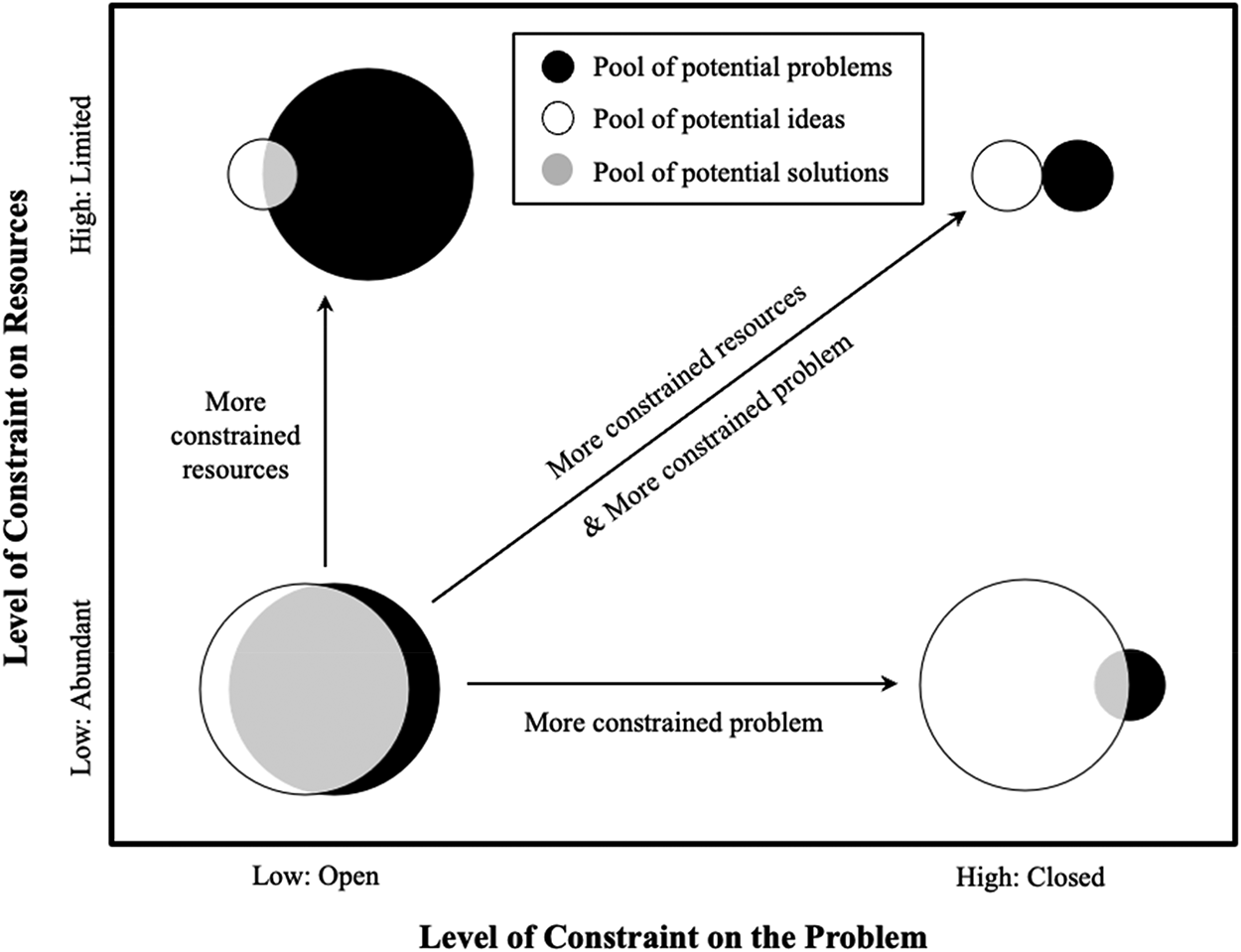
How combinations of constraint structure the underlying problem space for creativity.
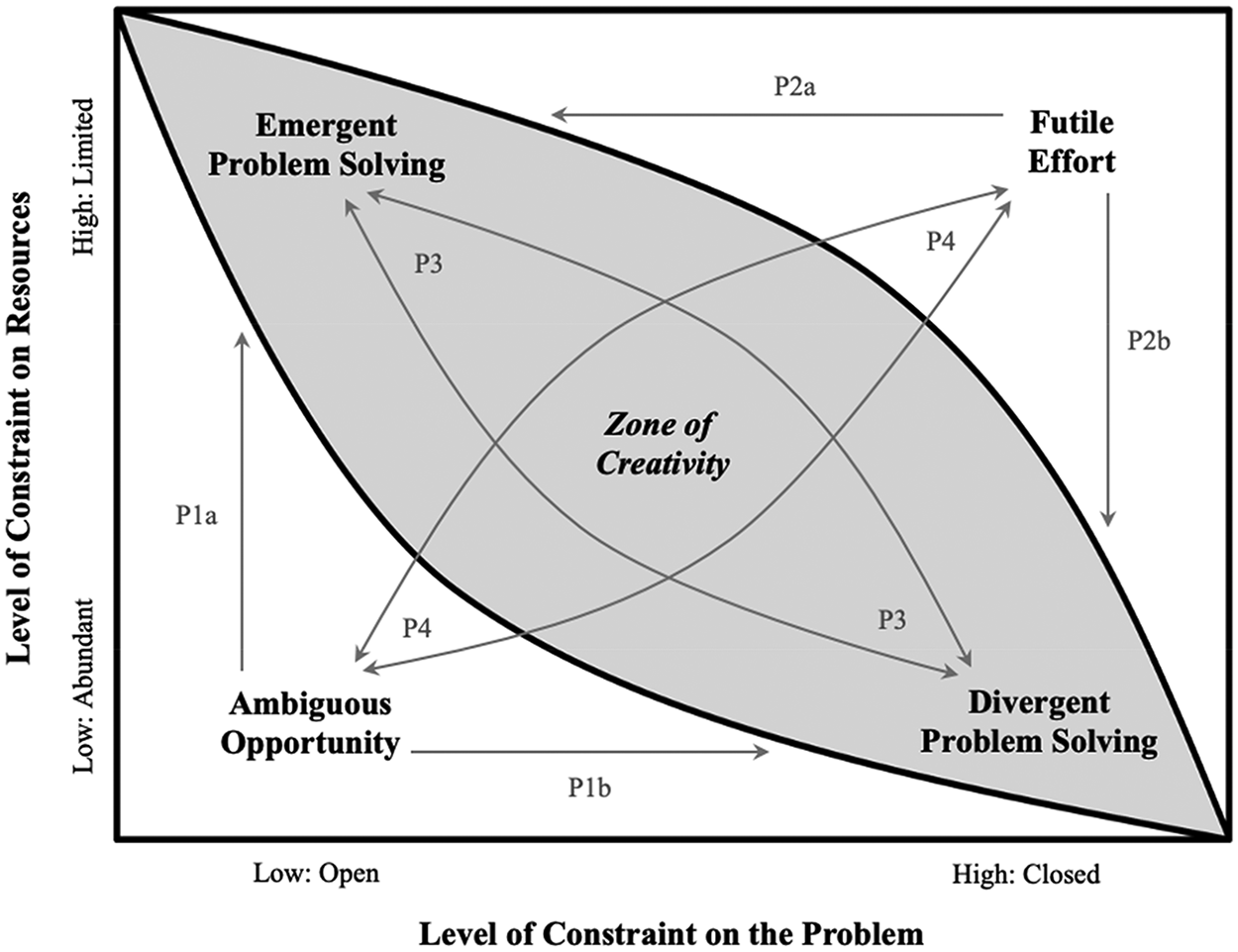
How combinations of constraint affect creative problem solving and performance.
As resources become more constrained (moving to the upper-left quadrant), the number of potential ideas gets smaller, but because the problem is still unconstrained, many ideas can still become a potential solution to a problem. For example, when a small startup company is developing a new product with limited resources (Ries, 2011), individuals may only be able to generate a small number of ideas. However, because they do not have an established brand or strategy yet, they can also pivot toward completely new and unexpected problems during development—such as when YouTube started as an online dating site in 2005, but then pivoted to become one of the world's largest platforms for user-generated content (Koebler, 2015). As the problem becomes more constrained (moving to the lower-right quadrant), the number of potential problems that can be formulated gets smaller, making it easier to eliminate ideas during problem solving (Byron & Khazanchi, 2012). Therefore, people can still generate a large pool of ideas, but a much smaller portion can actually solve a problem—such as what occurred in the DARPA Grand Challenge. Finally, if there is a high level of constraint on both dimensions (upper-right quadrant), people can only formulate a small pool of problems and generate a small pool of ideas, in which case few—if any—ideas can successfully solve a problem.
How combinations of constraint affect overall levels of creativity
Conditions shown in Figure 1 influence the total quantity of problems and ideas people can develop during problem solving, but do not determine the overall quality of solutions that arise at the intersection of these problems and ideas (cf. Simonton, 1997, 2004). Instead, solution quality is driven by the psychological mechanisms activated under various conditions of constraint (Acar et al., 2019; Amabile, 1983; Finke et al., 1992; Unsworth, 2001). With this view in mind, it becomes possible to theorize how different combinations of constraint produce different zones of creative problem solving that promote either higher or lower levels of creativity. A summary of these effects is shown in Figure 2.
Some zones promote higher levels of creativity, which is represented by the shaded area called the zone of creativity. One zone refers to emergent problem solving (upper-left quadrant), in which people generate and explore ideas until a successful match between problem and solution emerges together (e.g., Finke et al., 1992). In this zone, people can be creative because they are working with limited resources that can be interpreted in the context of an open-ended problem, such as what occurred in the archaeology example. The opposite zone refers to divergent problem solving (lower-right quadrant), in which people generate a large number of different ideas to solve a closed problem (e.g., Amabile, 1983). In this zone, people can be creative because they are using a wide variety of resources to solve a constrained problem, such as what occurred in the DARPA example.
Other conditions in Figure 2 reflect relative dead zones that produce lower levels of creativity. One dead zone is called ambiguous opportunity (lower-left quadrant), in which people may feel overwhelmed by choice and suffer from a lack of direction on which opportunities to pursue (e.g., Chua & Iyengar, 2006, 2008; Schwartz, 2000, 2004). For example, if the archaeologists were trying to decide between LIDAR and various other technologies, they could have felt uncertainty about which could produce better results and thus defaulted to using more familiar tools or methods. By contrast, the opposite zone is called futile effort (upper-right quadrant), in which people may feel they cannot develop a viable solution because resources seem insufficient or irrelevant to solving the problem at hand (e.g., Deci & Ryan, 1985; Ryan & Deci, 2000). For example, if participants in the DARPA Grand Challenge continued experiencing failure, they may have believed the problem was impossible to solve given existing resources. The following sections describe each zone in more detail and outline how different combinations of constraint can affect psychological mechanisms of intrinsic motivation and creative search to produce either positive, negative, sustained, or curvilinear effects on creativity.
The zone of ambiguous opportunity: When high constraint enhances creativity
When an employee at Google first starts using 20% time to work on a personal project, they may initially feel unconstrained, free to draw upon any resources they like to address any customer problem that looks interesting to them. Although such conditions can promote maximum autonomy (Deci & Ryan, 1985; Ryan & Deci, 2000), which some people might enjoy (Bledow et al., 2022; Furnham & Marks, 2013), most are likely to experience feelings of ambiguous opportunity that can undermine their intrinsic motivation and creative search abilities. For example, when people do not have strong preferences to work on a specific problem or with particular resources (Chua & Iyengar, 2006, 2008), they can experience excessive choice conditions that trigger negative emotions such as stress, frustration, and anxiety (Iyengar & Lepper, 2000; Schwartz, 2000, 2004). Furthermore, people are likely to follow the path of least resistance (Finke, 1990; Ward, 1994), meaning that although they have potential to develop many possible solutions to many different problems, the actual creativity of these ideas is likely to be low (cf. Simonton, 1997, 2004). This could be why Google has considered eliminating 20% time for its employees in the past (Tate, 2013).
However, there are two ways to adjust constraints that can improve creativity. The first is by making resources highly constrained to move people into the active zone of emergent problem solving. When people are forced to work with limited resources, they may not be able to generate as many ideas, but they can still interpret these ideas in various ways to identify a broad range of more specific problems to address (Cromwell, Haase et al., 2023; Finke et al., 1992). For example, this is what occurred when the archaeologists applied LIDAR to their research and discovered entirely new research questions to address. Similarly, when developers at YouTube launched their website as an online dating service, they discovered that users instead wanted to upload more general videos about their hobbies and interests. As a result, in the zone of emergent problem solving, people can evaluate different problems to solve given limited ideas, which can prevent feelings of excessive choice and promote higher levels of intrinsic motivation (Chua & Iyengar, 2006; Iyengar & Lepper, 2000; Schwartz, 2000).
These conditions may also be optimal for creative search, which was demonstrated in a follow-up experiment to the one described above (Finke, 1990). In this version, one condition was the same as before, in which subjects were randomly given both the materials and problem domain at the beginning of the task, followed by 2 min to generate ideas for an invention. However, subjects in the second condition received only the materials at the beginning of the task, followed by 1 min to generate a “potentially useful” idea. Then, they received the problem domain followed by an additional minute to explore their idea in the context of that domain. Results showed that subjects in the second condition produced more creative ideas than those in the first, suggesting that creative search may be highest when people generate ideas for a completely open-ended problem, which are then explored in a domain until a clearer and more specific problem emerges.
Alternatively, the problem can be highly constrained to move people from the dead zone of ambiguous opportunity to the active zone of divergent problem solving. In this zone, the number of ideas that can successfully solve a problem becomes smaller (Byron & Khazanchi, 2012; Rosso, 2014), helping people transition from a state of excessive choice to optimal choice when evaluating potential solutions (Chua & Iyengar, 2006, 2008). Furthermore, people can be pushed off the path of least resistance (e.g., Caniëls & Rietzschel, 2015; Finke, 1990; Rietzschel et al., 2014), forcing them to search for more distant or unique ideas that satisfy all the objectives in the goal state. Consequently, people are more likely to be creative when they have the capacity to generate a large pool of potential ideas to solve a highly constrained problem (e.g., Amabile et al., 1996; Hunter et al., 2007). Altogether, when people are experiencing feelings of ambiguous opportunity, a high level of constraint on one dimension can create a more balanced combination of constraints that improves overall creativity, which is illustrated in Figure 2 with lines labeled P1a and P1b: Proposition 1: When people experience ambiguous opportunity on a task, a high level of constraint on (a) the resources or (b) the problem can create a more balanced combination of constraints that improves creativity.
The zone of futile effort: When low constraint enhances creativity
When people are working in a startup, they can spend years developing a new product with the hopes of solving a valuable customer problem, but they often fail, leaving them with a decision to either pivot or persevere multiple times during development (Ries, 2011). Many choose to persevere because they would prefer to solve a problem they already know rather than explore new opportunities and risk losing any progress they have made. But if they continue failing, they may eventually experience feelings of futile effort that undermines both intrinsic motivation and creative search. According to self-determination theory, people can experience three different causality orientations that affect cognition, behaviors, and emotions (Deci & Ryan, 1985). One is called an “autonomy orientation,” in which people experience a high degree of choice over factors that determine their behaviors; another is a “control orientation,” in which people feel their behaviors are controlled primarily by external factors; and the final is an “impersonal orientation,” in which people feel they cannot regulate their behavior in a way that reliably produces desired outcomes.
Prior research on creativity has primarily drawn on differences between the autonomy and control orientations to explain why people suffer from lower intrinsic motivation when confronted with greater constraint (Amabile, 1996; Deci & Ryan, 1987; Shalley et al., 2004). However, people experiencing futile effort struggle to generate ideas that can successfully solve a problem, which activates an impersonal orientation. Therefore, people are likely to “see themselves as incompetent and unable to master situations. They experience tasks as being too difficult and/or outcomes as being independent of behavior” (Deci & Ryan, 1985, p. 112). Consequently, they experience depressive feelings and strong anxiety about their situation, resulting in negative effects on intrinsic motivation that go beyond those occurring under a control orientation (Ryan & Deci, 2000).
The zone of futile effort also undermines creative search. Although people are working on a highly constrained problem, which can push them far off the path of least resistance (e.g., Finke, 1990; Moreau & Dahl, 2005; Rietzschel et al., 2014), resources are also highly constrained, bounding them to work with a particular set of materials, knowledge, time, and finances that limits the total number of ideas they can generate. Although some people may be able to thrive under such conditions (Bledow et al., 2022; Cromwell, Haase et al., 2023), most will feel like they cannot draw upon relevant resources to navigate through the problem space effectively, resulting in a limited capacity to produce creative solutions to a problem. As people continue generating ideas, they may confront the boundaries of their semantic network or run out of ideas altogether. This can exacerbate the impersonal orientation, contributing to increasingly lower levels of intrinsic motivation, and in turn lower levels of creativity, over time.
However, there are two ways in which people can adjust constraints to avoid these effects. First, they can choose to pivot on the problem and move into the active zone of emergent problem solving. This has a positive effect on creative search—not by increasing the number of ideas they can generate—but by increasing the scope of possible problems they can address. People can take ideas they have generated with limited resources and explore them across various domains to discover new problems to solve (e.g., An et al., 2018; Baker & Nelson, 2005), such as when YouTube pivoted from an online dating service in 2005 to become a general content-creation platform. An unconstrained problem can also increase intrinsic motivation by helping people regain the feeling of control over the factors that determine their behavior to achieve desired outcomes (Deci & Ryan, 1985).
Alternatively, they can choose to persevere on the problem, but acquire additional resources to move into the active zone of divergent problem solving. As resources become more abundant, people can search for more distant or unique combinations of ideas (Amabile et al., 1996; Hunter et al., 2007), traveling further off the path of least resistance while also increasing the chances of solving the problem at hand. This can eliminate the impersonal orientation and stimulate the autonomy orientation (Deci & Ryan, 1985; Ryan & Deci, 2000), which increases intrinsic motivation to activate additional cognitive processes for creativity such as exploring divergent pathways and taking risks on more novel ideas (Amabile, 1996). Altogether, when individuals experience feelings of futile effort, a low level of constraint on either the problem or resources can create a more balanced combination that improves creativity, which is illustrated in Figure 2 with the lines labeled P2a and P2b. Proposition 2: When people experience futile effort on a task, a low level of constraint on (a) the problem or (b) the resources can create a more balanced combination of constraints that improves creativity.
The zone of creativity: When a balanced combination of constraints sustains creativity
Scholars have argued that a moderate level of constraint can improve creativity (e.g., Acar et al., 2019), which would mean that individuals only thrive in the center of Figure 2. However, when applying a combinatorial view, a much broader range of possibilities exists to create balanced combinations of constraint that improve creativity. Under such conditions, people can experience a high level of both intrinsic motivation and creative search, but the primary source of each mechanism differs depending on where they are operating within the problem space. Near the zone of emergent problem solving, intrinsic motivation comes primarily from having autonomy over the problem, and creative search comes from being forced to work with a limited set of resources. By contrast, near the zone of divergent problem solving, people experience the opposite conditions and thus derive intrinsic motivation and creative search from opposite sources. Abundant resources provide individuals with more autonomy over ideas and solutions, thus becoming the primary source of intrinsic motivation, and a constrained problem pushes them further off the path of least resistance to become the primary source of creative search.
Therefore, high levels of creativity can be sustained by maintaining an overall balanced combination of constraints across the problem space. In the zone of emergent problem solving, this means a high level of constraint on resources is coupled with a low level of constraint on the problem. If the problem also becomes highly constrained, then people might drift into the dead zone of futile effort, where they become bound to work with particular resources that seem irrelevant to solving the problem at hand. For example, this might occur when individuals in a startup are exploring many potential problems to address for a customer, and user feedback funnels them toward a specific problem that may be difficult to solve with existing knowledge and materials. To counteract these effects, they might need to gather additional resources to transition into the zone of divergent problem solving, in which they can generate a broader range of ideas to increase their chances of success at solving the problem.
Alternatively, resources can become unconstrained to move people into the dead zone of ambiguous opportunity, where they experience excessive choice conditions that make it harder to develop creative solutions to a problem. For example, this could occur when employees at Google discover a new potential customer problem to address and are given additional resources to further explore that opportunity. However, they might instead transition to a more well-known and validated problem to ensure higher chances of success and secure greater opportunities for career advancement (Mueller, 2017; Mueller et al., 2012). Therefore, the problem also needs to become more constrained so people move into the zone of divergent problem solving, which prevents them from following the path of least resistance and maintains enough autonomy to facilitate highly creative solutions to the problem.
In the zone of divergent problem solving, a balanced combination of constraint comes from having a high level of constraint on the problem coupled with a low level of constraint on resources. This represents an opposing set of conditions compared to emergent problem solving, and thus creativity can be sustained by adjusting constraints in opposite directions. For example, an increase of constraint on resources should be met with a decrease of constraint on the problem, such as what occurred when YouTube originally launched their website as an online dating service, but realized it cost too much to attract users for this service and then pivoted to solve a different problem. Alternatively, a decrease of constraint on the problem should be met with an increase of constraint on resources. For example, when an employee at Google first starts using 20% time to develop their own personal project, they might feel overwhelmed with options given the abundant resources available at the company. In this case, they can focus on using specific tools or knowledge that they have strong access to, which can preserve their intrinsic motivation and creative search abilities. Altogether, generalizing from these various paths, high levels of creativity can be sustained by maintaining an overall balanced combination of constraints, which is summarized in Figure 2 with the lines labeled P3. Proposition 3: Within the zone of creativity, a decrease of constraint on one dimension can be met with an increase of constraint on the other dimension (and vice versa) to maintain an overall balanced combination of constraints that sustains creativity.
Failing to maintain a balanced combination of constraints can cause people to drift outside the zone of creativity and suffer from lower intrinsic motivation and creative search, but the sequence of change over time influences the qualitative experience of problem solving. For example, when starting in the dead zone of ambiguous opportunity, intrinsic motivation is low because of choice anxiety, and creative search is low because people are following the path of least resistance. When moving into the dead zone of futile effort, intrinsic motivation becomes low because of a lack of choice, and creative search becomes low because people are bounded to use particular resources that seem irrelevant to solving a particular problem. When moving in the opposite direction, people experience low intrinsic motivation first because of insufficient choice and then because of excessive choice, and they experience less creative search first because they are bounded to particular problems and resources and then because they are unbounded. These constraints are constantly changing on creative tasks in organizations (Cromwell et al., 2018), resulting in a rich multitude of possible effects on creativity over time. However, theorizing about these possibilities can be more effectively done in future research, so this paper ends with a general proposition explaining how different combinations of constraint can produce a curvilinear effect on creativity, which is reflected in Figure 2 with the lines labeled P4. Proposition 4: A curvilinear effect on creativity occurs when people move from a combined low level of constraint in the dead zone of ambiguous opportunity to an overall balanced combination of constraints in the active zone of creativity and then again to a combined high level of constraint in the dead zone of futile effort, and vice versa.
Discussion and conclusion
This paper aims to develop new theory that changes the way scholars think about creativity, constraints, and problem solving. Prior research has identified numerous dimensions of constraint that all have strong effects on creativity (Acar et al., 2019; Amabile et al., 1996; Cromwell et al., 2018; Damadzic et al., 2022; Unsworth, 2001), but these have mainly been studied in isolation, leading to an incomplete understanding on how they can be combined to improve performance. Therefore, this paper begins a new line of inquiry by proposing a combinatorial theory of constraints. It argues that two dimensions of constraint interact to produce different types of creative problem solving, which can operate under completely different conditions and produce similar effects on creativity. This theory makes several contributions to literature and lays a foundation for future research to build upon.
Theoretical contributions
The primary contribution of this paper is that it develops new theory on how different combinations of constraint affect creativity. A common recommendation in literature is that individuals should experience a moderate level of constraint to be more creative (Acar et al., 2019; Baer & Oldham, 2006; Byron et al., 2010). However, this paper suggests that a much broader range of possibilities exists when accounting for the combinatorial effects of constraints across the problem space. For example, when looking at Figure 2, it is indeed possible for a moderate level of constraint on all dimensions to improve creativity, which occurs in the middle of the zone of creativity. However, it is also possible for extreme levels of constraint—both high and low, on either dimension—to promote greater creativity, but it fundamentally depends on the state of other constraints during problem solving. For example, when constraint on the problem is high, resource constraints must be low, and when constraint on the problem is low, resource constraints must also be high. Therefore, this paper highlights a deeply interdependent relationship between problems and resources, suggesting that scholars may need to always consider how these dimensions are in balance (or not) when studying their effects on creativity during a task.
By examining how different combinations of constraint affect creativity, this paper also proposes a new typology of creative problem solving that differs from prior literature. For example, one existing typology argues that different types of creativity can arise from “problem type” and “driver for engagement” on a task (Unsworth, 2001), which affect how much intrinsic motivation people have while working on the task. However, this typology fails to account for the role that resources play during problem solving, and it overlooks important cognitive mechanisms for creativity (Acar et al., 2019). Therefore, this paper builds upon prior work by exploring how two dimensions of constraint can be combined to influence both motivational and cognitive mechanisms of creativity to produce different levels of performance.
Another typology argues that people can be creative either through a “flexibility” or “persistence” pathway (De Dreu et al., 2008; Nijstad et al., 2010). In the first, people flexibly search across broad categories or perspectives to create distant combinations of ideas (e.g., Amabile, 1983), and in the second, they engage in deep exploration of ideas within narrow categories or perspectives (e.g., Ward, 1994). However, this theory fails to recognize that flexibility and persistence can each vary along two dimensions (i.e., on problems and resources), making it possible to follow both pathways simultaneously during problem solving. For example, people can persistently work with limited resources when generating ideas while also flexibly searching across many domains to discover a problem to address. Alternatively, they can persistently work on a closed problem while also flexibly searching across abundant resources to generate ideas. Therefore, understanding how flexibility and persistence operate in harmony with each other, rather than in competition, may unlock a new stream of research that alters our views on how people can achieve high levels of creativity in organizations.
Finally, this paper expands theory to capture a broader range of creative activity in organizations. For example, divergent problem solving has been a focal point of creativity research for more than 50 years (Acar & Runco, 2012; Amabile & Pratt, 2016; Anderson et al., 2014; Guilford, 1967; Shalley & Zhou, 2008). However, this paper suggests that emergent problem solving can also be highly effective at producing creativity, but has received far less attention in literature (cf. Cromwell et al., 2018; Cromwell, Haase et al., 2023). This model was first developed in the field of cognitive psychology (Finke, 1990; Finke et al., 1992; Ward, 1994), but its focus on constrained resources and open-ended problems also aligns it with other models of problem solving such as bricolage (Baker & Nelson, 2005), need-solution pairs (von Hippel & von Krogh, 2016), and exaptation (Andriani et al., 2017). Therefore, this paper can build new theoretical bridges between organizational creativity and other streams of literature to expand our understanding of creative problem solving in organizations more generally.
Current limitations and opportunities for future research
Several limitations must also be noted that should be addressed in future research. First, this paper assumes that variation in creativity can be explained primarily by differences within individuals. For example, the model shown in Figure 2 predicts how one person might produce relatively different levels of creativity across different zones of the problem space. However, this overlooks important differences between individuals that might also play an important role in predicting outcomes. For example, recent research shows that people can have distinct preferences for engaging in divergent versus emergent problem solving (Cromwell, Haase et al., 2023), which likely influences their ability to generate creative ideas in each zone of the problem space. Similarly, people can have different needs for cognitive closure (Webster & Kruglanski, 1994), tolerances for ambiguity (Budner, 1962; Furnham & Marks, 2013), or action-state orientations (Bledow et al., 2022), all of which can influence how they deal with different levels and types of constraint. As a result, certain areas of the problem space that might be classified as ambiguous opportunity or futile effort for some might be within the active zone of creativity for others. Therefore, the overall size, shape, and topography of outcomes can expand or contract according to individual differences between people (see Shalley & Zhou, 2008; Shalley et al., 2004 for reviews).
A related issue is that this paper does not account for how individual differences can be aggregated, synthesized, or balanced in teams (Harvey, 2014; Kurtzberg & Amabile, 2001; Perry-Smith & Mannucci, 2017; Shalley et al., 2018). This paper argues that the underlying structure of the problem space (Figure 1) can create different zones of problem solving that lead to higher or lower levels of creativity (Figure 2). However, one of the main benefits of working in teams is that they can integrate different perspectives or abilities to expand the range of potential problems, ideas, and solutions to develop. For example, teams can typically generate more divergent ideas than individuals (Singh & Fleming, 2010; Taylor & Greve, 2006), which may help them expand the zone of creativity into regions that would normally be classified as futile effort for any single member of the team. Alternatively, they can use multiple perspectives to be more critical when evaluating ideas (Harvey, 2013; Sutton & Hargadon, 1996), helping them eliminate ideas and avoid feelings of ambiguous opportunity.
Therefore, the overall size, shape, and topography of outcomes can also change based on different structures and social process within teams (Acar et al., 2019). For example, research shows that teams can evaluate ideas in two fundamentally different ways (Harvey & Kou, 2013). They can either focus on evaluating a large number of ideas to help them find the most effective solution to a problem, or they can evaluate a small number of ideas to gain a stronger shared understanding of the problem. These two approaches seem to neatly align with the typology identified in this paper. For divergent problem solving, teams can adopt the first approach to sift through many ideas and find a viable solution, while for emergent problem solving, the second approach can help them discover a suitable problem to address given limited resources. It is also likely that adopting each social process in the wrong situation can negatively affect performance. Therefore, additional contributions can be made by investigating how specific social processes can be aligned or misaligned with different combinations of constraint to influence overall levels of creativity across the problem space.
Finally, this paper develops theory on only two psychological mechanisms of creativity—intrinsic motivation and creative search—overlooking many other mechanisms that can affect performance such as activation levels, positive or negative emotions, and meaningfulness (e.g., Amabile & Pratt, 2016; Baer & Oldham, 2006; De Dreu et al., 2008; George, 2007; George & Zhou, 2002). Adding these mechanisms can lead to interesting new research questions because they might interact with intrinsic motivation and creative search differently depending on where people are operating within the problem space. For example, in the zone of divergent problem solving, positive emotions will likely trigger more flexible thinking that combines with intrinsic motivation and creative search in synergistic ways to promote greater creativity. But in the zone of emergent problem solving, the effects are less clear. Positive emotions may help people flexibly search across different problems, but negative emotions might also help them be more persistent in generating ideas with limited resources. Therefore, further exploring how other psychological mechanisms interact with intrinsic motivation and creative search under different combinations of constraint can improve our overall understanding of creativity.
Practical implications for managers and problem solvers in organizations
Creativity in organizations is becoming increasingly important, especially with recent advances in artificial intelligence and the need to address global challenges such as climate change, sustainability, and equality (United Nations, 2018). Many individuals who engage in creativity, regardless of whether they work in product development, scientific research, or nonprofit organizations, feel inspired to make a positive impact on the world, but this is an open-ended problem that can make it difficult for them to generate creative ideas. Therefore, this paper offers practical guidance to both managers and problem-solvers to help them navigate through various constraints that are constantly shifting over time (Cromwell et al., 2018).
For managers, their role is to assess the external environment and determine which factors are in their control or not. Then, they can structure the internal environment in ways that promote a better overall balance of constraint for employees. For example, there could be new demands from customers to increase sustainability of business operations, which can help identify many specific problems to address. In this case, managers should provide enough resources to employees so they can engage in divergent problem solving and be more likely to develop highly creative solutions to these problems (e.g., Amabile et al., 1996; Hunter et al., 2007). Alternatively, a new emerging technology could become available, such as an artificial intelligence chatbot, that dramatically expands the potential problems a company can address (Cromwell, Harvey et al., 2023). In this case, managers can facilitate emergent problem solving by encouraging employees to use the new technology and openly explore how it can address new and unforeseen problems for customers (e.g., Andriani et al., 2017; von Hippel & von Krogh, 2016).
For problem solvers, their role is to engage in the challenging work of curating resources, generating new and useful ideas, and developing viable solutions to a problem. Therefore, this paper identifies various ways people can work around constraints to achieve high levels of creativity. For example, when working on a project that is driven primarily by managers, problem solvers can probe into the project and determine which dimensions are more constrained and which are more flexible. Depending on what they find, they may be able to engage in divergent problem solving, emergent problem solving, or a dynamic iteration between both over time (e.g., Cromwell et al., 2018). For more self-directed projects, problem solvers may instead try to embrace the value of constraints, which can push them off the path of least resistance and help them generate more creative ideas than they would otherwise be able to accomplish.
Conclusion
Organizations increasingly rely on people to produce new products, processes, services, or ideas, but creativity is a challenging endeavor because people must work under various constraints that are constantly in flux. Prior research has identified many dimensions of constraint that can all have strong effects on creative problem solving, but has yet to develop an integrated theory explaining how different combinations of constraint influence creativity. Therefore, this paper builds upon prior work by explaining how two dimensions of constraint interact to produce a new typology of creative problem solving, which better explains when and why creativity is likely to flourish or not on a task. This theory lays the groundwork for a new stream of research that can deepen our understanding of creativity and capture a broader range of problem-solving activities in organizations.
Footnotes
Funding
The author received no financial support for the research, authorship, and/or publication of this article.
