



Abstract
Organizations launch diversity initiatives to promote diversity within their ranks, improve the work experiences of underrepresented groups, and satisfy growing demands for diversity in workplace settings. While typically welcomed by the target group, diversity initiatives can be compromised when employees who are not the initiative’s targets—for example, men in the case of gender diversity initiatives—withhold their support. Particularly organizations that are mostly composed of nontargets may thus struggle with a lack of support for their diversity initiatives. To understand how organizations can successfully implement diversity initiatives while preserving nontarget support, we take an uncertainty management perspective and examine the interactive effects of diversity practice type (identity-conscious vs. identity-blind) and leader continuity rhetoric (high vs. low vision of continuity) on nontarget support. In Study 1, using data from a 2 × 2 between-person field experiment in a firefighter organization, we find that framing the initiative under a vision of high (vs. low) continuity preserves nontargets’ anticipatory distributive justice in the face of identity-conscious (vs. identity-blind) practices and thereby promotes initiative support. Study 2, a vignette experiment, replicates our findings and shows that other justice dimensions above and beyond distributive justice appear secondary in this context. Our work has important implications for managing the initiation phase of diversity initiatives in organizations primarily composed of nontargets in a way that fosters nontargets’ perceived justice and support.
Keywords
Today, pursuing greater diversity and inclusion is a prevalent ambition among organizations worldwide (PWC, 2022). Hence, many organizations are implementing diversity practices to enhance the workplace experiences and outcomes of groups that face societal disadvantages (Kalev, Dobbin, & Kelly, 2006; Leslie, 2019). A prime goal of such diversity initiatives is to increase the representation of target groups (Kulik & Roberson, 2008). In Europe, the context of our study, common target groups of diversity initiatives, are females or employees from various cultural backgrounds. However, despite organizations worldwide spending billions of dollars on diversity initiatives each year (Global Industry Analysts Inc., 2024), many fall short of expectations and fail to increase target group representation significantly (Dobbin & Kalev, 2016).
One important factor influencing the effectiveness of diversity initiatives is how employees respond to them (Kanitz, Reinwald, Gonzalez, Burmeister, Song, & Hoegl, 2024). Studies have shown that whether and in what ways diversity initiatives improve targets’ representation and work experiences can depend on nontarget employees’ support (Dover, Major, & Kaiser, 2016; Leslie, 2019; Nishii, Khattab, Shemla, & Paluch, 2018). Employee support refers to behaviors of actively participating in, facilitating, and contributing to the initiative’s implementation (Avery, 2011; Kim, Hornung, & Rousseau, 2011). Nontargets tend to be more resistant relative to target employees (Avery, 2003; Plaut, Garnett, Buffardi, & Sanchez-Burks, 2011) because they often perceive the outcomes of the practices implemented as part of diversity initiatives as uncertain and unfair to them (Harrison, Kravitz, Mayer, Leslie, & Lev-Arey, 2006; Konrad, Richard, & Yang, 2021). This is problematic because nontargets typically hold disproportionate power within organizations and can influence how effectively diversity initiatives are realized.
Although prior work has pointed to the challenge of gaining nontarget support for diversity initiatives, our understanding of how to address this challenge remains limited (Konrad et al., 2021; Leslie, 2019). This is noteworthy as the presumably most effective practices for increasing target representation, such as identity-conscious hiring and promotion practices with redistribution of valued outcomes (e.g., leadership roles) in favor of targets (Konrad & Linnehan, 1995), may face the highest levels of resistance among nontargets (Harrison et al., 2006; Konrad et al., 2021; Leslie, 2019). As emphasized in Leslie’s (2019) seminal work on responses to diversity initiatives, there is a pressing need for a deeper understanding of resistant and supportive nontarget responses.
One critical factor that is likely to influence nontarget responses to diversity initiatives is senior leadership (Martins, 2020, Leslie 2019). 1 Senior leaders occupy the highest authority within an organization (e.g., top management team members) to make change decisions, are closely observed by members of the organization, and carry significant influence (Hambrick & Mason, 1984). Indeed, a senior leader’s behavior is critical to successfully initiate any organizational change (Oreg & Berson, 2009). Prior research has highlighted senior leader rhetoric that shapes “the meaning of diversity within an organization” (Martins, 2020, p. 1195) and that transmits an effective vision for diversity as a critical lever to encourage support for change (Oreg & Berson, 2019; Stam, Lord, Van Knippenberg, & Wisse, 2014).
Whereas the role of leaders in managing diversity has been acknowledged (e.g., Buengeler, Leroy, & De Stobbeleir, 2018; Martins, 2020), we know relatively little about how leaders’ rhetoric can motivate nontarget support for diversity initiatives. Diversity rhetoric research has predominantly focused on so-called value-in-diversity rhetoric (e.g., Georgeac & Rattan, 2023; Thomas & Ely, 1996; van Dijk, van Engen, & Paauwe, 2012): emphasizing that diversity is beneficial for organizations based on business and/or moral reasons. However, this rhetoric has yielded inconsistent results, including nonsignificant effects (e.g., Dover, Major, & Kaiser, 2021) or unintended negative effects (e.g., Dover et al., 2016; Plaut et al., 2011). Hence, scholars have only recently begun to explore other types of diversity rhetoric that help to secure support for initiatives, such as contingent-diversity rhetoric, which emphasizes the benefits of diversity conditional upon overcoming its challenges (Leslie, Flynn, Foster-Gimbel, & Manchester, 2024). While we applaud these recent efforts, the existing set of diversity rhetoric is unlikely to directly address the inherent uncertainty of nontargets, a fundamental challenge of any change initiative (Bordia, Hobman, Jones, Gallois, & Callan, 2004). Accordingly, our understanding remains limited regarding how to motivate initiative support through rhetorical means without alienating those who are not the intended targets. Hence, we ask: How can leader rhetoric facilitate impactful diversity initiatives and garner nontarget employee support?
We argue that, to answer this critical question, we need to consider the uncertainty of nontargets as a central factor shaping their support and explore types of leader rhetoric specifically tailored to address uncertainty-induced responses among nontarget employees. To accomplish this, we suggest that diversity management research would benefit from broadening its scope and integrating ideas from organizational change leadership research (Oreg & Berson, 2019; Stouten, Rousseau, & De Cremer, 2018). Change leadership scholars have been studying the rhetoric of leaders (Bayraktar & Kabasakal, 2022; Petrou, Demerouti, & Häfner, 2015), particularly related to communicating effective visions for change (Venus, Stam, & van Knippenberg, 2013, 2019). Likewise, change research highlights employees’ uncertainty as a central psychological factor that underpins resistance to change (Bordia et al., 2004; DiFonzo & Bordia, 1998). In the realm of diversity management, an uncertainty perspective on leader rhetoric is relatively underrepresented. Crucially, this body of research also emphasizes the methods to alleviate uncertainty, specifically leader rhetoric, during the initial stages of a change (Bordia et al., 2004; Giessner, 2011).
Hence, we take an uncertainty management lens (Lind & Van Den Bos, 2002) to integrate research on diversity practices (Harrison et al., 2006; Konrad et al., 2021; Nishii et al., 2018) and leader rhetoric from change leadership literature (Oreg & Berson, 2019; Venus et al., 2019). We theorize that the introduction of identity-conscious practices with preferential treatment for targets creates uncertainty and reduces particularly anticipatory distributive justice among nontargets, ultimately resulting in reduced initiative support. In addressing uncertainty and maintaining anticipatory distributive justice, we theorize that leader continuity rhetoric (i.e., rhetoric emphasizing that the core aspects that characterize the organization will remain unchanged despite the diversity initiative) can preserve support.
Our research advances the literature on diversity and organizational change leadership in several ways. First, we extend the literature on diversity management by integrating insights from research on diversity practices and leader rhetoric from change leadership research to test an uncertainty-management-theory-based model on how to motivate contested initiatives in the critical but underexplored change initiation phase. We demonstrate how continuity rhetoric (Venus et al., 2019) can be a powerful means for leaders to preserve support for identity-conscious practices. Thereby, we contribute a novel perspective grounded in change leadership research to the evolving literature on senior diversity leadership (Martins, 2020) and diversity rhetoric (Georgeac & Rattan, 2023; Leslie et al., 2024). Specifically, we highlight that beyond the existing types of examined diversity rhetoric (i.e., value-in-diversity and contingent-diversity rhetoric), which have not paid explicit attention to uncertainty-induced justice concerns, a continuity rhetoric is well tailored to address uncertainty in nontargets.
Second, we advance research on unintended consequences of diversity practices (Leslie, 2019) and employees’ responses to diversity practices (Nishii et al., 2018) by focusing our theorizing on nontarget employees as a source of potential resistance that may hinder initiative implementation. By examining the interactive effects of diversity practice content and leader rhetoric, we reveal anticipatory distributive justice concerns—rather than other dimensions of justice or identity threat—as a critical mechanism underlying nontarget support for initiatives in the early initiation phase. Thus, we broaden our understanding of the mechanisms underpinning nontarget responses to diversity initiatives.
Third, our work contributes to the growing body of research on leader change visions (Paine, Byron, & Higgins, 2024) in general and continuity in particular (Venus et al., 2019) by highlighting the relevance of continuity rhetoric to specific employee groups (i.e., nontargets) and change content types (i.e., identity-blind vs. identity-conscious diversity practices). Our research provides field-experimental evidence that continuity rhetoric can bolster support for change by effectively addressing concerns of relative loss (i.e., anticipatory distributive justice) among groups with a high likelihood of withholding support. This notably expands upon the original continuity research (Venus et al., 2019) by emphasizing that continuity rhetoric can have differential effects on various groups depending on their status (i.e., target or nontarget status in our case) and the content of change (i.e., identity-conscious or -blind practices). This highlights a more complicated interplay of continuity rhetoric, recipient characteristics, and change content than previously acknowledged.
Theoretical Model
Uncertainty Management and Anticipations of Justice
Organizational change research has emphasized uncertainty as a critical mechanism to explain responses to organizational change (Bordia et al., 2004; DiFonzo & Bordia, 1998). According to uncertainty management theory (Lind & Van Den Bos, 2002), individuals confronted with uncertainty, such as in the context of organizational change, pay more attention to justice because their justice judgment provides them with a means to cope with uncertainty. Accordingly, Lind and Van den Bos (2002, p. 181), in their seminal writing on uncertainty management theory, assert that the concepts of uncertainty and justice “are so closely linked that it is in fact impossible to understand the role of one of these concepts in organizational psychology without reference to the other” and suspect the impact of justice judgment “to be greater in the context of change than at ‘normal’ times.” (p. 210), as those phases are particularly uncertain.
Given that any organizational change takes time to unfold and that uncertainty is particularly high in the early phases of change (Lind & Van Den Bos, 2002), employees are likely to form anticipations of justice when change is announced (even though it is not rolled out yet), with important implications for change support or resistance (Dhensa-Kahlon & Coyle-Shapiro, 2013). Accordingly, when faced with uncertainty, employees are likely to pay particular attention to justice and use their anticipations of justice to guide their responses to a new change initiative (Lind & Van Den Bos, 2002; Shapiro & Kirkman, 2001).
In the following, we integrate this line of thought from uncertainty management theory with the work on diversity initiatives. We argue that diversity initiatives, like other organizational change initiatives, can trigger uncertainty, particularly about future resource distribution between members of nontarget and target groups (Leslie, 2019). We then theorize important downstream consequences of anticipatory justice on nontargets’ support of the diversity initiative.
Diversity Practice Types and Anticipatory Distributive Justice
Diversity initiatives include various diversity practices that relate, for example, to hiring and promoting people from underrepresented target groups (Hideg & Ferris, 2017). While diversity initiatives generally create uncertainty, the specific diversity practices they introduce differ in the degree to which they actively redistribute resources between targets and nontargets in an organization, and therefore, we expect them to vary in their potential to trigger uncertainty and anticipations of justice.
Diversity practices can be categorized into two groups: identity-conscious (IC) and identity-blind (IB) practices (Konrad & Linnehan, 1995; Konrad et al., 2021). 2 IB practices encourage applications from targets, yet do not provide preferential treatment (Harrison et al., 2006; Konrad & Linnehan, 1995; Kulik & Roberson, 2008). As such, IB practices have also been labeled non-discrimination practices (Leslie, 2019) and seek to attract targets but give no weight to demographic attributes in hiring or promotion decisions. IC practices, in contrast, go beyond encouraging applications from targets and use demographic attributes to determine which candidate receives a job offer or a promotion (Harrison et al., 2006; Hideg & Ferris, 2017). Accordingly, IC practices have occasionally been labeled resource practices (see Leslie, 2019) because they provide specific, valuable support that makes a tangible difference for targets. Hence, IC practices are assumed to be more effective than IB practices in enhancing target representation because they are actively countering biases (Glasser, 1988; Kulik & Roberson, 2008; Portocarrero & Carter, 2022). However, at the same time, these IC (relative to IB) practices are more likely to trigger uncertainty in nontargets and thereby draw attention to issues of justice.
To examine nontargets’ responses to IC relative to IB practices, we draw on the concept of anticipatory distributive justice, which captures nontargets’ expectations about the fairness of future outcomes caused by new diversity practices (Shapiro & Kirkman, 1999, 2001). Indeed, research suggests that “majority group members evaluate diversity policies in relative terms, focusing on the intended benefits for minority versus majority group members” (Brown & Jacoby-Senghor, 2022: 1075). This stream of work has shown that nontargets focus particularly on the relative distribution of outcomes between targets and themselves (Brown & Jacoby-Senghor, 2022; Brown, Jacoby-Senghor, & Raymundo, 2022; Wilkins, Wellman, Babbitt, Toosi, & Schad, 2015). Accordingly, we position anticipatory distributive justice as the mechanism linking diversity practices and initiative support in our model.
Similarly, uncertainty management theory (Lind & Van Den Bos, 2002) suggests that certain justice dimensions can be focal in specific situations. This implies that when nontargets have information inducing judgment or anticipation about one dimension of justice, such as distributive justice in our case, but lack information about another dimension, such as procedural justice (for instance because the implementation process has not started yet and the procedures are still unknown), they will use the known justice information to form beliefs about the other justice dimension. In other words, in the early phase of diversity initiatives, anticipatory distributive justice will likely be the central modality that influences further justice judgments in response to diversity practices.
Still, while the previous arguments suggest the primacy of distributive justice in our context, an IC practice may indirectly influence other justice dimensions. This is in line with work in the organizational change domain focusing on newly initiated change. This work highlights that “distributive justice is of overwhelming importance” (Kirkman, Shapiro, Novelli, & Brett, 1996: 50; see also: Oreg, Vakola, & Armenakis, 2011), particularly in the early phase of change initiation characterized by high levels of uncertainty (Melkonian, Monin, & Noorderhaven, 2011). At the same time, this work acknowledges the role of other justice dimensions (see also Shapiro & Kirkman, 1999). We examine the role of other justice dimensions in Study 2 and, reaching somewhat beyond the main goals of this research, explore possible second-order effects of anticipatory distributive justice on other justice dimensions, as uncertainty management theory suggests.
In the following, we theorize how IC (versus IB) practices result in lower anticipatory distributive justice in nontargets and, in turn, weaken their support. We argue that leader continuity rhetoric can preserve distributive justice, emphasizing that the organization’s core aspects will be protected and remain unchanged. We summarize the conceptual model in Figure 1.
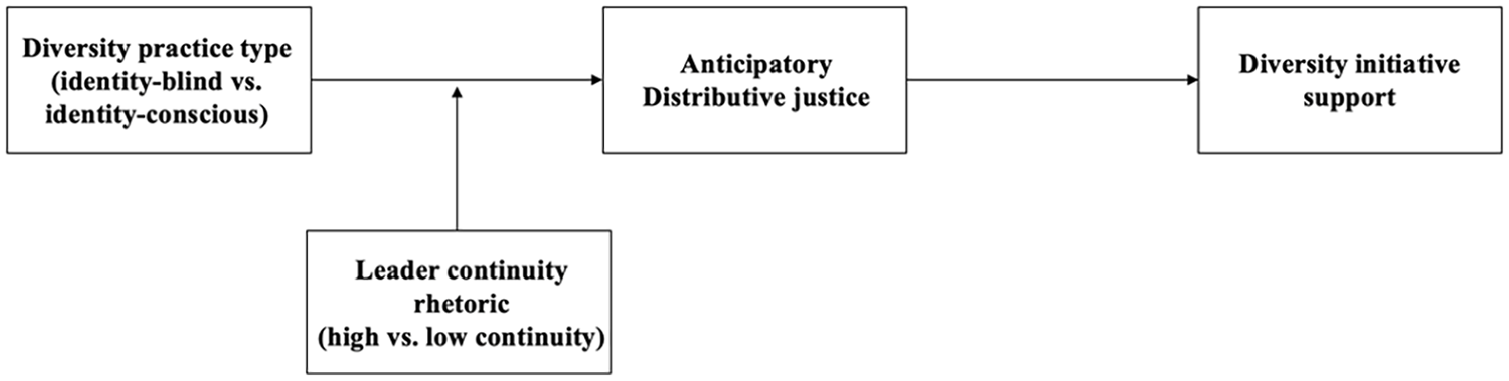
Conceptual Model
How Diversity Practices Shape Initiative Support via Anticipatory Distributive Justice
Uncertainty management theory (Lind & Van Den Bos, 2002) suggests that announcing a diversity initiative will trigger uncertainty and activate anticipations of distributive justice among nontargets. As a result, we argue that nontargets will closely monitor cues indicating how the diversity initiative will affect the distribution of outcomes.
We propose that nontargets paying attention to justice will anticipate lower distributive justice when confronted with an IC (rather than IB) practice. Nontargets are likely to evaluate diversity practices through a zero-sum lens (Brown & Jacoby-Senghor, 2022; Leslie, 2019). A zero-sum lens describes the tendency in individuals to focus on relative outcome distribution where resource allocation is assumed to inevitably create winners and losers. In the context of diversity practices, this implies that nontargets perceive a relative improvement in targets’ resources (even when they are still disadvantaged in absolute terms) as equaling losses for them as nontargets (“their gain, our loss”); (Brown & Jacoby-Senghor, 2022; Brown et al., 2022; Leslie, 2019). Accordingly, as IC practices provide targets with valued resources, such zero-sum thinking between nontargets and targets may be particularly salient, inducing nontargets to assume that their own access to resources within the organization is decreasing (see Leslie, 2019). As a result, this salient zero-sum lens fuels nontargets’ anticipation that resources gained by targets through IC practices correspond to a loss in resources for themselves (Tyler, Boeckmann, Smith, & Huo, 1997)—an outcome that is perceived as unfair. Likewise, past work suggests that nontargets often focus on merit (e.g., ability, effort, or qualification) as a distributive justice rule (Son Hing, Bobocel, & Zanna, 2002; Son Hing et al., 2011). Because targets of diversity practices are primarily defined based on group attributes and not solely on ability or qualification (Bobocel, Son Hing, Davey, Stanley, & Zanna, 1998; Gu, McFerran, Aquino, & Kim, 2014), nontargets are likely to perceive IC practices as violating the meritocracy principle (Bobocel et al., 1998; Konrad et al., 2021; Leslie, 2019). Hence, nontargets, who often underestimate systematic biases in societies against targets (Begeny, Ryan, Moss-Racusin, & Ravetz, 2020; Norton & Sommers, 2011), may perceive targets to receive more valued resources than they deserve or were otherwise entitled to (Cropanzano, Slaughter, & Bachiochi, 2005). As a result, nontargets are likely to anticipate low distributive justice in response to IC practices.
In contrast, IB practices do not provide preferential treatment to targets and thus are less likely to trigger concerns about relative resource losses among nontargets, even when viewed through a zero-sum lens. Specifically, IB practices base decisions on ability, effort, and qualification (Cropanzano et al., 2005) and thus do not deviate from the meritocracy-based resource distribution traditionally present in many modern organizations (Konrad et al., 2021; Leslie, 2019). Hence, the anticipated outcomes of IC practices are perceived as less distributively just than IB practices by nontargets.
Finally, lower anticipatory distributive justice will translate into lower initiative support. Uncertainty management theory (Lind & Van Den Bos, 2002) has argued early on that justice judgments are, in turn, an important driver of employees’ acceptance of change. This is supported by empirical research that has shown perceptions of justice to be important predictors of employee supportive and resistant responses to change (Oreg et al., 2011). When people perceive organizational practices as unjust, they tend to form negative attitudes about them and refrain from exerting effort to support them (Colquitt et al., 2013). In the context of organizational change more generally (e.g., Shapiro & Kirkman, 2001; Spreitzer & Mishra, 2002) and diversity initiatives specifically (e.g., Bobocel et al., 1998; Konrad et al., 2021; Nosworthy, Lea, & Lindsay, 1995), justice has been theoretically suggested and empirically shown to relate to employee support of change initiatives (e.g., Rodell & Colquitt, 2009; Shapiro & Kirkman, 1999). Distributive justice seems particularly relevant because it is closely related to appraisals of personal valence and perceived benefits, which have been suggested to be a main driver of behavioral change support (Armenakis, Harris, & Feild, 1999; Oreg, Bartunek, Lee, & Do, 2018). Hence, we suggest that IC (relative to IB) practices harm perceptions of anticipatory distributive justice among nontargets, thereby decreasing initiative support. We hypothesize:
Hypothesis 1: Anticipatory distributive justice will mediate the negative effect of an identity-conscious (vs. identity-blind) diversity practice on nontarget initiative support.
The Moderating Role of Leader Continuity Rhetoric
Because perceived uncertainty can be malleable, we suggest that uncertainty is not only the trigger for nontargets’ anticipation of low distributive justice but also part of the cure. Diversity research has generally highlighted the role of leaders and particularly their rhetoric in managing diversity (Leslie et al., 2024; Martins, 2020), and work in other domains drawing on uncertainty management theory has explicitly pointed to the role of leadership in reducing uncertainty (Thau, Bennett, Mitchell, & Marrs, 2009). Moreover, work on change leadership has highlighted the role of leaders in managing uncertainty during change (e.g., Bordia et al., 2004; Conger & Kanungo, 1987; Yukl, 2010) and has particularly emphasized the uncertainty-reducing function of leader rhetoric in visions (Venus et al., 2019). A vision refers to leaders’ descriptions of a future state of the collective when change is realized (Stam et al., 2014; Van Knippenberg & Stam, 2014). Visions of change are a key rhetorical vehicle for guiding employees’ interpretation of the change and motivating them to contribute to its realization (Shamir, House, & Arthur, 1993; Yukl, 2010). We suggest that uncertainty and anticipatory distributive justice can be shaped by a leader’s rhetoric in vision communication.
One important attribute of change visions that is likely to influence uncertainty is the conveyed degree of continuity (Venus et al., 2019), which may range from high (e.g., “We must bridge the past by preserving what we have and translate it for the future”) to low (e.g., “We must break from the past to reinvent ourselves”). A high-continuity rhetoric frames the change as a new expression of what the organization stands for or as not altering the defining core characteristics of the organization. In essence, high continuity assures nontargets that, whatever is going to change, those aspects that constitute the organization’s core will be preserved (Venus et al., 2019). Indeed, research has shown that a sense of continuity can help employees to reduce uncertainty within the context of change (Giessner, Ullrich, & van Dick, 2011) and that this sense of continuity can be shaped by leader rhetoric (Sani, 2010; Sonenshein, 2010; Venus et al., 2019). A low-continuity rhetoric, in contrast, transmits the impression of a clear break from the past and discontinuity of the organization’s traditions and practices (Venus et al., 2019). Here, the ways in which the organization’s current state is deficient might be emphasized, coupled with a discrepant and idealized alternative for the future.
We suggest two reasons why continuity rhetoric mitigates the negative impact of IC practices on nontargets’ anticipatory distributive justice. First, the level of continuity transmitted by the leader will influence the degree of uncertainty and, thereby, the salience of distributive justice judgments. When IC practices are rhetorically framed with high continuity, they are presented as a continuation of what defines the organization. This can help alleviate nontargets’ uncertainty within the organization, as the change is framed as preserving what matters and thus honoring past contributions (“Although they will get more resources, my contributions still count”). In contrast, when IC practices are accompanied by low-continuity rhetoric, nontargets perceive the change as a break with the past. This can leave more room for uncertainty about their future opportunities, as resources are perceived as newly redistributed without consideration of the nontargets’ past contributions (“Will my contributions still count?”). Accordingly, as uncertainty is reduced under high continuity, anticipatory distributive justice judgments will be less salient.
A second reason for a reduced negative impact of IC on anticipatory distributive justice is that high continuity reduces the extent to which nontargets evaluate practices through a zero-sum lens. Leader rhetoric can significantly influence the prominence of particular identities within the organization (Ashforth & Johnson, 2001; Hogg, 2012). Hence, we suggest that leader high-continuity rhetoric increases the salience of a higher organizational identity and thereby amplifies the salience of a predictable and valued organizational identity that all employees (targets and nontargets alike) share (Ashforth & Johnson, 2001; Venus et al., 2019). This reduces the salience of being a member of the nontarget group, and individuals rely more strongly on their identification with the organization to manage their uncertainty and assess the initiative (Ashforth & Johnson, 2001). Thus, leader high-continuity rhetoric reframes intergroup relations from a “target group vs. nontarget group piece of the pie” logic to an “our organizational pie” logic. This blurs the borders between targets and nontargets and reduces the extent to which nontargets evaluate IC practices through a zero-sum lens (“us vs. them”). Anticipatory distributive justice concerns are, therefore, less pronounced.
In contrast, when IC practices are accompanied by low-continuity rhetoric, the change is framed as a discontinuation of the defining attributes of the organization. As a result, uncertainty remains high and group boundaries remain salient, as no shared organizational identity blurs these borders. Nontargets are thus more likely to evaluate the practices through a zero-sum lens, lowering anticipatory distributive justice. Therefore, we propose the following:
Hypothesis 2: High (vs. low) leader continuity rhetoric weakens the negative indirect effect of identity-conscious (vs. identity-blind) practices on nontarget initiative support via anticipatory distributive justice.
Overview of Studies
In Study 1, we first tested our hypotheses in a 2 × 2 between-person field experiment in a firefighter organization, which allowed us to assess the validity of our model in an organizational context primarily composed of nontarget employees and to capture effects on consequential support outcomes. In Study 2, we conducted a pre-registered vignette experiment with nontarget participants recruited via a panel provider to replicate our findings and disentangle the role of distributive justice from other justice judgments. Together, the studies allow for a rigorous test of our theoretical model with high external validity of the field setting and high internal validity of the carefully controlled complementary experimental designs.
Study 1
Research Setting
We conducted a field experiment in a firefighter organization (FF in the following) with 910 members in a large German city. FF members are voluntary firefighters, meaning that they are not employed by the city but are part of FF in addition to their primary occupations. FF’s main objectives include extinguishing fire alongside the city’s professional fire department, conducting disaster relief operations (e.g., during floods, storms, or COVID-19), and carrying out other community service operations (e.g., fire prevention work or traffic protection).
FF members enjoy a range of benefits from their dedicated service (which become more substantial as one ascends the hierarchical ladder) and thus care very much about the distribution of these resources. First, there are monetary benefits: FF members get discounts in a variety of venues (e.g., tickets for museums or public swimming pools) and stores (e.g., sports equipment, furniture, pharmaceutical products), and those with leadership roles or other special responsibilities within FF also receive monetary compensation for their service. Second, there is a wide range of non-monetary benefits: FF members are granted prioritized access to subsidized apartments and childcare in the city, and members of high ranks receive regular local media coverage of their operations and sometimes awards from different institutions. Third, being an FF member is considered prestigious since being a volunteer firefighter is regarded as admirable and honorable. FF members, particularly those in leadership positions, proudly display their affiliation through visible markers, including a firefighter badge, a volunteer card (utilized for accessing the mentioned benefits), and a pager, signifying their commitment to their role.
To become an FF member, individuals must apply for one of the strictly limited open positions and undergo thorough technical training. Open positions are typically highly contested at FF. Thus, FF chooses the most promising candidate for each open position out of the many applications. FF operates top-down, encompasses eleven hierarchical levels, and is divided into five city districts. The top management team leading the entire FF force, elected every six years, consists of the fire chief, FF’s highest-ranking leader, and two other senior leaders. Further leadership roles, such as group or district leaders, are high-status positions that grant extra privileges and authority. To be promoted into leadership roles, members must apply to complete in-depth technical training programs—which are only occasionally offered for a few selected high-potential candidates. Applicants compete to be accepted for these additional training programs.
In terms of diversity, approximately 10% of FF’s members identify as female, and around 1% have an immigration background—with no representation of these attributes in higher leadership positions. According to interviews the first author conducted with multiple members, FF’s culture centers around the idea of a traditional firefighter who is characterized by physical strength, German nationality, male gender, and heroism. However, this culture is perceived as not sufficiently inclusive by many minority members. Therefore, the elected top management decided to actively work toward creating a more diverse and inclusive work environment. To promote diversity, top management launched a strategic initiative (here labeled “Project Diversity”). The aim was to implement new practices for hiring and promotions to increase female and immigrant representation in membership and leadership positions. 3
Sample
Of the 902 registered members who received our study invitation, 323 fully completed the experimental survey (response rate = 36%). 4 We removed cases for final data analysis when they violated one of the following criteria. First, we removed five participants who indicated technical difficulties in playing the fire chief’s video message. Second, as we were interested in nontargets, we excluded 44 female participants and 7 participants of non-German nationality. Third, we excluded one individual who withdrew their consent to participate. Our analyses were based on a final sample of 266 nontarget FF members. Participants’ age ranged between 17 and 62 years (M = 36; SD = 11.6) and tenure between 1 and 43 years (M = 15; SD = 11.2).
Study Design and Procedure
We conducted a 2 (high- vs. low-continuity rhetoric) × 2 (IC vs. IB diversity practice) between-subject field experiment. Our experiment resembled an online survey that was sent out by the research team. FF members were randomly assigned to our conditions at the individual level. No monetary incentives for participating were offered, as this would have been highly unusual in the FF context and might have even been met with suspicion or distrust, according to our FF project partners. Participants were made aware that their responses would be treated strictly confidentially and only processed and analyzed by the research team.
We presented one of two recorded video speeches by the fire chief (FF’s highest-ranking leader) that informed FF members about “project diversity.” Giving a video speech was the fire chief’s standard way of communicating with organizational members. Both video speeches were held by the same fire chief who was responsible for the entire workforce. We collaborated with a professional cameraman to record the videos and provided coaching to the fire chief during the recording process. In the video speeches, we manipulated the rhetorically transmitted continuity (high vs. low). After watching the video speech, participants read a short message from the fire chief stating that they would now read about a diversity practice FF is considering implementing. The practice would change decision criteria for (a) hiring new members and (b) promoting members to leadership roles or special functions as part of the initiative’s implementation. Participants then read one of two texts describing the practice, in which we manipulated the practice type (identity-conscious vs. identity-blind). Immediately afterward, participants responded to measures that assessed our mediator and dependent variables.
We took several precautions to minimize the risk of members discussing our study materials with other members who had not yet participated in our survey. First, during the time of our data collection in the first half of 2022, life at FF had not fully returned to normal due to COVID-19. To minimize opportunities for in-person discussions regarding our study materials, we carefully chose a period of no scheduled in-person gatherings in any of the FF locations for our data collection. Second, we asked the fire chief to announce to FF members when he would share the link to his video speech and the survey to increase our data collection speed. Most responses (around 55%) were collected within one week, leaving limited time to engage in detailed discussions about the speech. Third, we maintained regular communication with our FF project collaborators to confirm that no unusual or systematic discussions were occurring during the data collection period. Taken together, these measures and insights lead us to believe that it is improbable that discussions among members would have systematically influenced our results. 5
Manipulations
Leader continuity rhetoric manipulation
We varied the content of the fire chief’s videotaped speech to manipulate leader rhetoric (see Supplementary Material A and B for transcripts), which reflected either low or high continuity (following Venus et al., 2019). We ensured fair comparisons between experimental conditions and closely collaborated with the fire chief in co-creating the speeches for authenticity, context relevance, comprehensibility, realism, and alignment with our intended objectives. We kept everything else constant (e.g., overall length, structure, and content) and only varied the transmitted degree of assurance of continuity. Both conditions thus described the vision pursued with the new initiative. However, in the high-continuity condition, the initiative was framed as a continuation of FF’s organizational identity, whereas the low-continuity condition framed it as a discontinuation of FF’s past.
We conducted a pretest to check our manipulations. We recruited 61 participants via Prolific. We prescreened participants to reflect FF’s age structure between 18 and 65 years and required them to live in Germany. After removing one participant who failed our attention check, 60 participants remained (62% female, average age = 29.8). We randomly assigned them to the leader continuity rhetoric conditions (Nhigh = 31, Nlow = 29) and then measured perceived continuity (Venus et al., 2019) (α = .81, 1–7 agreement scale) (see Supplementary Material E for a full list of all our items from this prestudy as well as Study 1 and 2). An independent t-test yielded that participants exposed to the high-continuity condition perceived the vision to be significantly more reflective of the preservation of organizational identity (M = 5.22; SD = .94) compared to participants exposed to the low-continuity condition (M = 3.63; SD = 1.40; t(58) = −5.18; p < .001; Cohen’s d = 1.34). To eliminate the possibility of unintended systematic differences between the conditions, we measured perceived fire chief charisma (three items; based on Rosenberg & Hirschberg, 2009; α = .85), optimism (single-item from the multifactor leadership questionnaire [MLQ]; Bass & Avolio, 1995), genuineness (two-item version of the genuineness index; Amengual & Apfelbaum, 2021; α = .93), and leader diversity initiative support (three-item version of the senior leadership support factor of the readiness for change scale; Holt, Armenakis, Feild, & Harris, 2007; α = .83) because these variables have been shown to influence responses to leader communication. None of the independent t-tests across both conditions yielded significant differences at the .10 level.
Diversity practice type manipulation
To manipulate diversity practice type (IB vs. IC), we gave participants a short description of one of the two diversity practices. Participants read a short text by the fire chief explaining that FF was considering implementing the practice soon (see Supplementary Material C and D for the full texts). We based our manipulations on the work by Hideg and Ferris (2017), specifically on their weak preference affirmative action and identity-blind diversity policy manipulations. Keeping everything else constant, we only varied the extent to which group membership would be used to grant preferential treatment. In both conditions, participants read that the practice will encourage applications from targets (i.e., women and people of non-German national heritage) in hiring and promotions. In the IB condition, it was stated that candidates’ demographics would not influence decisions on hiring and promotions, whereas, in the IC condition, it was stated that among well-qualified candidates, preferential treatment in hiring and promotions would be granted based on gender and national background.
Again, we conducted a pretest to check our manipulations. We recruited 140 participants via Prolific. We used the same prescreening criteria as in our other manipulation check. After removing one participant who failed our attention check, 139 participants remained (38% female, average age = 32.1). We randomly assigned them to our diversity practice conditions (NIB = 68, NIC = 71) and used an adapted six-item version of the IB vs. IC manipulation check used by Hideg and Ferris (2017) (α = .960; 1–7 agreement scale). An independent t-test showed that participants perceived the practice to be significantly more reflective of hiring some candidates over others based on gender and national background in the IC condition (M = 6.05; SD = .97) compared to participants in the IB condition (M = 2.76; SD = 1.55; t(137) = −15.07; p < .001; Cohen’s d = 2.56).
Measures
We report all item-based measures in Supplementary Material E.
Initiative support
We operationalized behavioral support for the initiative in two ways: (1) self-reported initiative championing and (2) consequential sign-up for a catalyst network.
Initiative championing
Championing is characterized by exerting discretionary effort and promoting the value of the change to others (Herscovitch & Meyer, 2002). We used the established three-item championing scale (Kanitz, Gonzalez, Berger, Reinwald, Huettermann, & Franczak, 2023; Sonenshein & Dholakia, 2012) (1–7 Likert agreement scale; α = .95).
Catalyst support
Following general recommendations for developing behavioral measures in experiments (Morales, Amir, & Lee, 2017) and relying on previous research on employee change support (Choi, 2011; Herscovitch & Meyer, 2002; Kim et al., 2011), we used a consequential measure of initiative support. We developed this measure in collaboration with FF to capture a behavior that would have a major impact in the initiative’s early phase. Participants read a short text informing them of the option to support the initiative by joining a catalyst network (i.e., signing up and providing an email address). It was highlighted to participants that being part of the network would entail supporting the diversity project team in implementing the initiative, as well as championing the initiative within FF. Hence, signing up for the catalyst network demonstrates an exceptional willingness to invest personal time and effort to drive the diversity initiative. Participants who signed up were contacted six weeks after our field experiment and became involved in the implementation of the diversity initiative. Catalyst network support was measured with a dummy reflecting whether the individual signed up or not.
Anticipatory distributive justice
We measured the anticipatory distributive justice of the initiative through the widely used organizational distributive justice scale (Colquitt, 2001), which was slightly adapted to fit our context and reflect the anticipation of justice (Bell, Wiechmann, & Ryan, 2006; Soenen, Melkonian, & Ambrose, 2017) (7-point Likert scale from 1 = not at all to 7 = very much; α = .94).
Identity threat
To examine if identity threat functions as an alternative mechanism in a supplementary analysis (see section Supplementary Analysis on Alternative Mechanism), we used an established six-item identity threat measure that combines six identity threat concerns (Kroeper, Williams, & Murphy, 2022) and slightly adapted the items to fit our context (7-point Likert scale from 1 = not at all to 7 = an extreme amount; α = .91).
Results
We report the means, standard deviations, and correlations in Table 1.
Descriptive Statistics and Correlation Matrix for the Variables in Study 1
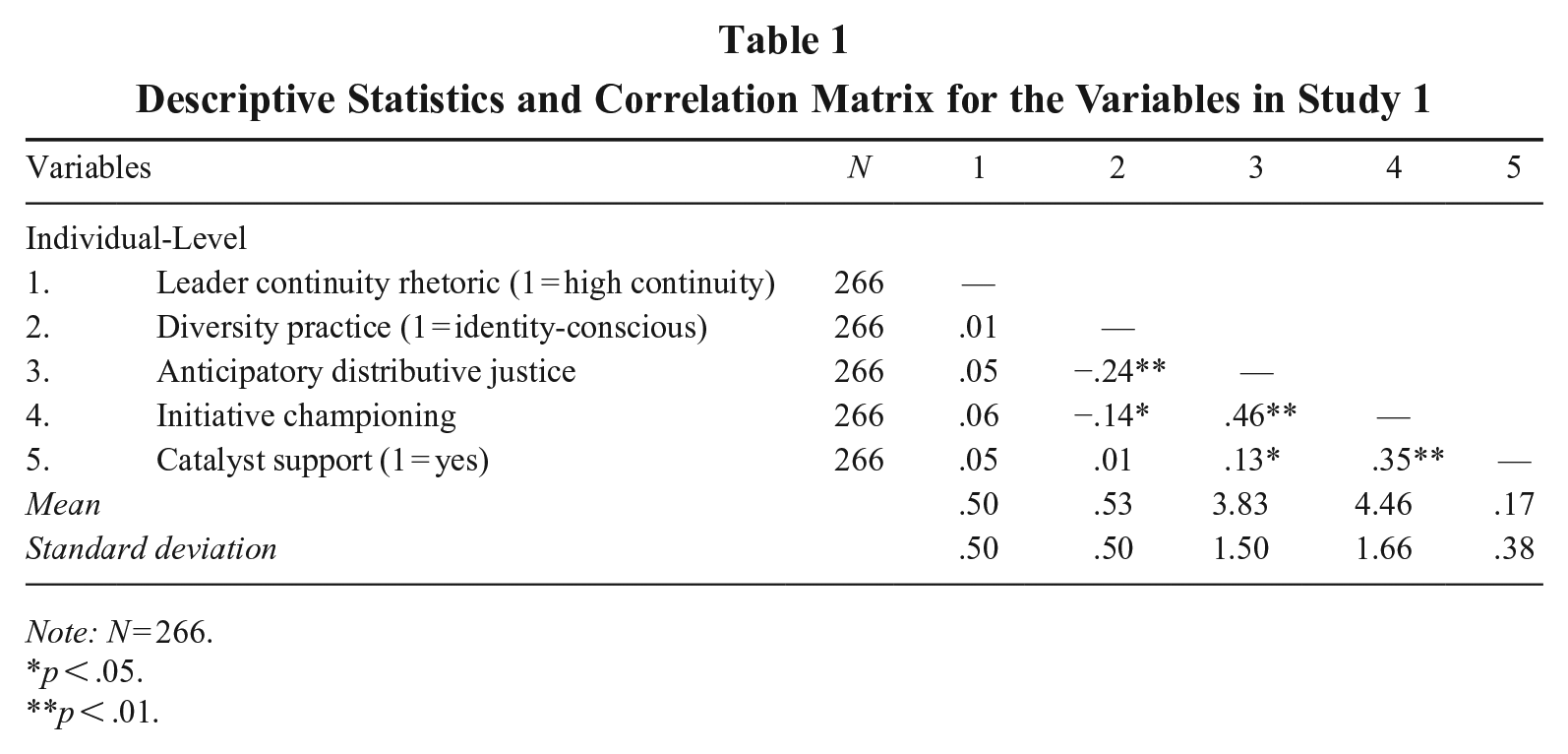
Note: N = 266.
p < .05.
p < .01.
Test of hypotheses
We used Stata 17 to test our hypotheses. We ran standard linear regression models for continuous outcomes and logit regressions to test the effect on the catalyst support dummy (Long & Freese, 2014). We used clustered standard errors (McNeish, Stapleton, & Silverman, 2017) to account for the nesting of FF members in five districts.
To test Hypothesis 1, we examined the effect of IC practices on anticipatory distributive justice. Table 2 (Model 1a) shows that the relationship was significantly negative (B = −0.71, p = .019). Second, we examined the relationship between anticipatory distributive justice and both initiative championing and catalyst support. Anticipatory distributive justice was positively related to both initiative championing and catalyst support (B = 0.50, p = .001, and B = 0.26, p = .003, respectively) (Models 2 and 3 in Table 2). We conducted bootstrapping with 95% bias-corrected bootstrap confidence intervals with 5,000 repetitions for all indirect effects (following the recommendation of Shrout & Bolger, 2002). We found that the indirect paths carried by anticipatory distributive justice were different from zero for the relationships between IC practice and initiative championing (−0.36; 95% CI = [−0.583, −0.178]) as well as catalyst support (−0.19; 95% CI = [−0.412, −0.044]). Therefore, we find support for Hypothesis 1 across both dependent variables.
Regressions for Hypothesis 1 in Study 1
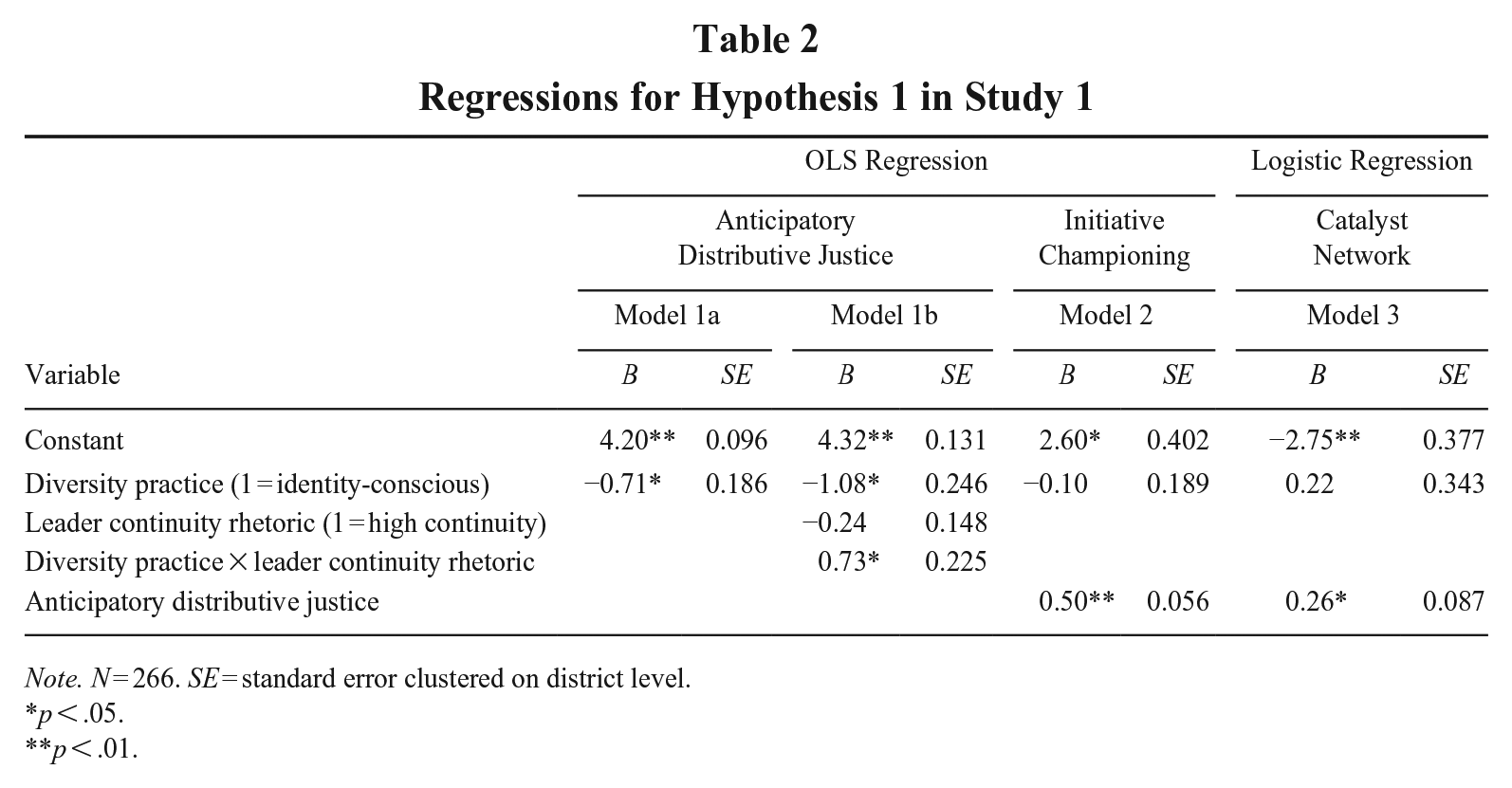
Note. N = 266. SE = standard error clustered on district level.
p < .05.
p < .01.
Hypothesis 2 constitutes a moderated mediation, which suggests that the indirect effect varies across different values of the moderator (Preacher, Rucker, & Hayes, 2007). We first tested the interaction between diversity practices and leader rhetoric on anticipatory distributive justice and found a significant interaction (B = .73, p = .032). The interaction plot is displayed in Figure 2. Simple slope analyses revealed that the negative effect of IC practices on anticipatory distributive justice is significant (p < .05) in the condition with a low-continuity rhetoric (B = −1.08, p = .012) but notably weaker in the high-continuity condition (B = −.35, p = .098).
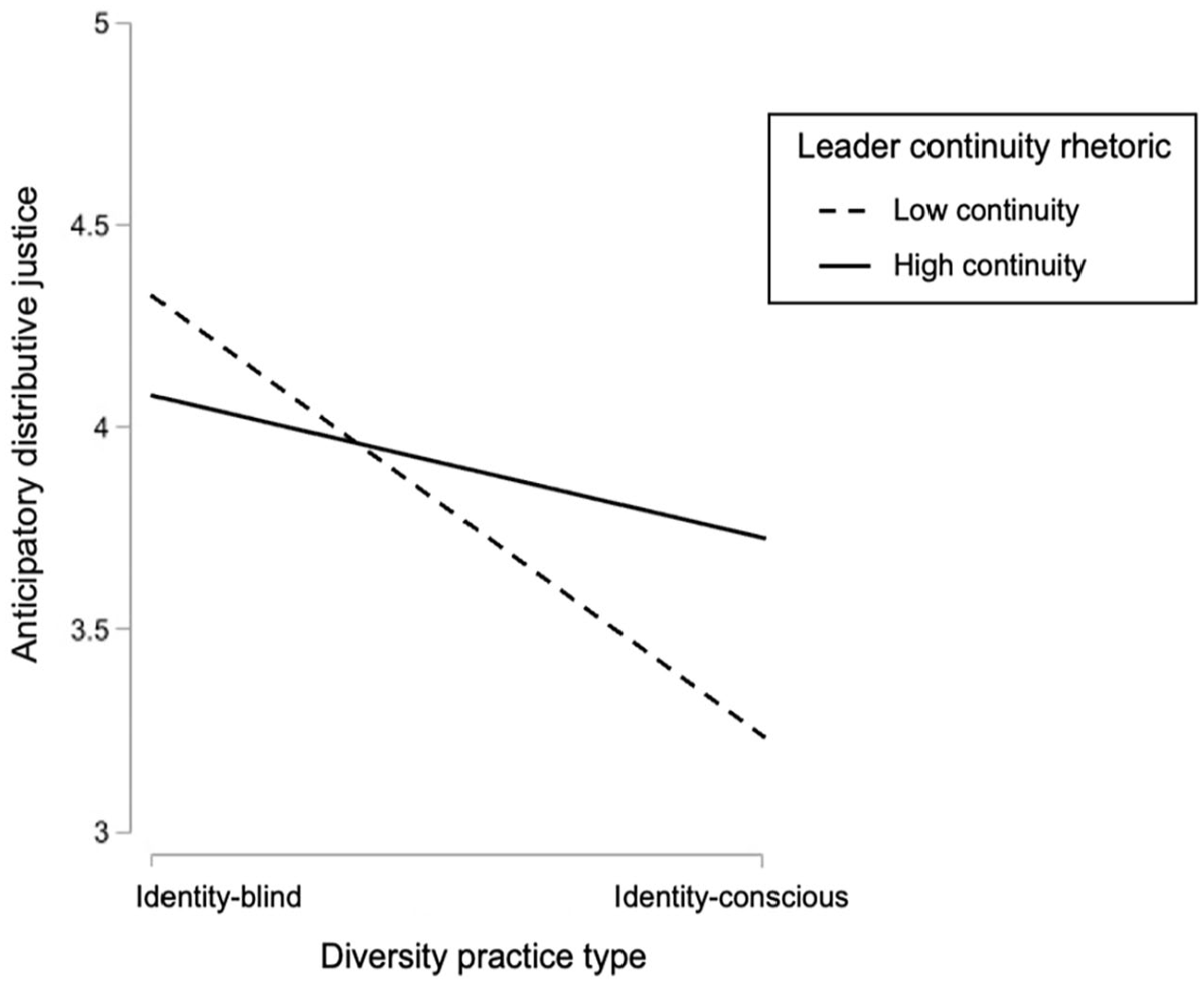
Study 1: Interaction Plot Between Diversity Practice Type and Leader Continuity Rhetoric on Anticipatory Distributive Justice
We then estimated the conditional indirect effect of IC practices on initiative support for the two leader continuity rhetoric conditions. The results show that the conditional indirect effects of IC practices were stronger and significant (p < .05) in the low-continuity condition (−0.54; 95% CI = [−0.834, −0.290] for initiative championing and −0.27; 95% CI = [−0.597, −0.046] for catalyst support) but weaker and nonsignificant in the high-continuity condition (−0.18; 95% CI = [−0.459, 0.063] for initiative championing and −0.09; 95% CI = [−.312, .023] for catalyst support). The bias-corrected confidence intervals for the index of moderated mediation for both outcomes did not include zero (initiative championing: 0.36, with a 95% CI = [0.031, 0.747]; catalyst support: 0.19, with a 95% CI = [0.010 and 0.559]). Hence, our results provide evidence that the negative indirect effect of an IC practice on nontarget support through anticipatory distributive justice is stronger when accompanied by low-continuity rhetoric, as proposed in Hypothesis 2.
Supplementary analysis on alternative mechanism
The core rationale of our model is that nontargets withdraw support for IC practices because the announcement of such practices creates uncertainty and, thereby, concerns about the future distribution of resources in intergroup relations. Whereas the tendency of majority members to focus on the distribution of relative outcomes in intergroup relations is well established (Brown & Jacoby-Senghor, 2022; Brown et al., 2022), one could argue that anticipatory distributive justice concerns are not the core mechanism that explains nontargets’ responses. Instead, a general feeling of identity threat caused by IC practices may drive the withdrawal of nontarget support. Reaching far beyond nontargets’ anticipatory justice concerns, identity threat captures a broader “set of psychological concerns pertaining to the value of one’s identity in a setting, including worries about belonging and authenticity as well as concerns about being devalued, disrespected, stereotyped, and marginalized in a setting” (Kroeper et al., 2022: 400). To explore the role of identity threat, we included the identity threat measure by Kroeper et al. (2022) and tested it as an alternative mechanism. The effect of IC practice on identity threat (B = 0.15, p = .271) and the interactive effect of IC practice and leader continuity rhetoric on identity threat were nonsignificant (B = −0.16, p = .761). The results suggest that identity threat, although widely used in diversity research (e.g., Brown & Jacoby-Senghor, 2022; Dover et al., 2016), is unlikely to function as a mechanism for the relationships in our study context. We speculate that the clear majority status of nontargets and its expected continuation in the firefighter context shields them against general identity threats, such as general fears of being devalued, excluded, stereotyped, and marginalized, but importantly, not from anticipatory concerns about the distribution of valued outcomes.
Study 2
Study 2 was a preregistered 2 × 2 between-person vignette experiment with participants from the Prolific platform who closely matched the demographic characteristics of our field experiment nontarget sample. 6 To replicate our results and disentangle the role of different justice dimensions beyond distributive justice, we used the exact same manipulations as in Study 1. Following recommendations for experimental vignette studies (e.g., Aguinis & Bradley, 2014), we asked participants to imagine being a firefighter who is informed about an upcoming diversity initiative.
Sample
To examine the responses of nontargets, we recruited 593 German-speaking white males through the Prolific platform. 7 We removed participants for final data analysis when they violated one of the following criteria. First, given our focus on nontargets, we excluded 44 participants who indicated that they were neither German nor Austrian nationals, as this categorization would place them within the target and not the nontarget group. Second, we removed six participants who indicated that they were not able to play the fire chief’s video message due to technical problems and thus failed to receive our treatment (e.g., Zadro, Williams, & Richardson, 2004). Third, we excluded 29 participants who failed either of the two memory recall attention checks regarding the content of our manipulations (Abbey & Meloy, 2017; Kung, Kwok, & Brown, 2018; Meade & Craig, 2012). These checks were administered immediately after each respective manipulation. Fourth, we excluded 21 participants who indicated that they could not put themselves in the presented scenario sufficiently well to warrant using their responses (Abbey & Meloy, 2017; Meade & Craig, 2012). Our analyses were based on a final sample of 493 nontarget participants (all identifying as male, 6% Austrian nationality, 94% German nationality). Participants’ age ranged between 18 and 59 years (M = 30; SD = 8.5).
Study Design and Procedure
We conducted a 2 (high vs. low leader continuity rhetoric) × 2 (IC vs. IB diversity practice) between-subject experimental vignette study. Participants were randomly assigned to our conditions and remunerated with 2.80 GBP for their participation. To facilitate participants’ ability to envision themselves in the role of a firefighter, we initially presented them with a short cover story of the firefighter’s situation that was based on a realistic representation of an average firefighter from the organization in Study 1 (see Supplementary Material F). Subsequently, we introduced our manipulations, which were identical to those used in Study 1, and then asked participants to complete the measures related to our research objectives.
Measures
We measured all items, except initiative championing, on a 7-point Likert scale ranging from 1 = not at all to 7 = very much. Items were slightly adapted to fit our context (see Supplementary Material E for a full item list).
Anticipatory distributive justice
We used the same four items as in Study 1 (α = .94).
Initiative championing
Similarly, the same three items as in Study 1 were used to capture employees’ self-reported championing (Sonenshein & Dholakia, 2012) (1–7 Likert agreement scale; α = .94). 8
Controls
We controlled for the three other justice dimensions—procedural justice (7 items; α = .80), interpersonal justice (4 items; α = .75), and informational justice (5 items; α = .80)—using the scale by Colquitt (2001). Research suggests that the justice dimensions are jointly experienced and often conditional upon each other (Brockner & Wiesenfeld, 1996; Folger & Konovsky, 1989). We thus follow other justice researchers (e.g., Barclay, Skarlicki, & Pugh, 2005; Bell et al., 2006; Folger & Konovsky, 1989) and control for the respective other justice dimensions in our models.
Results
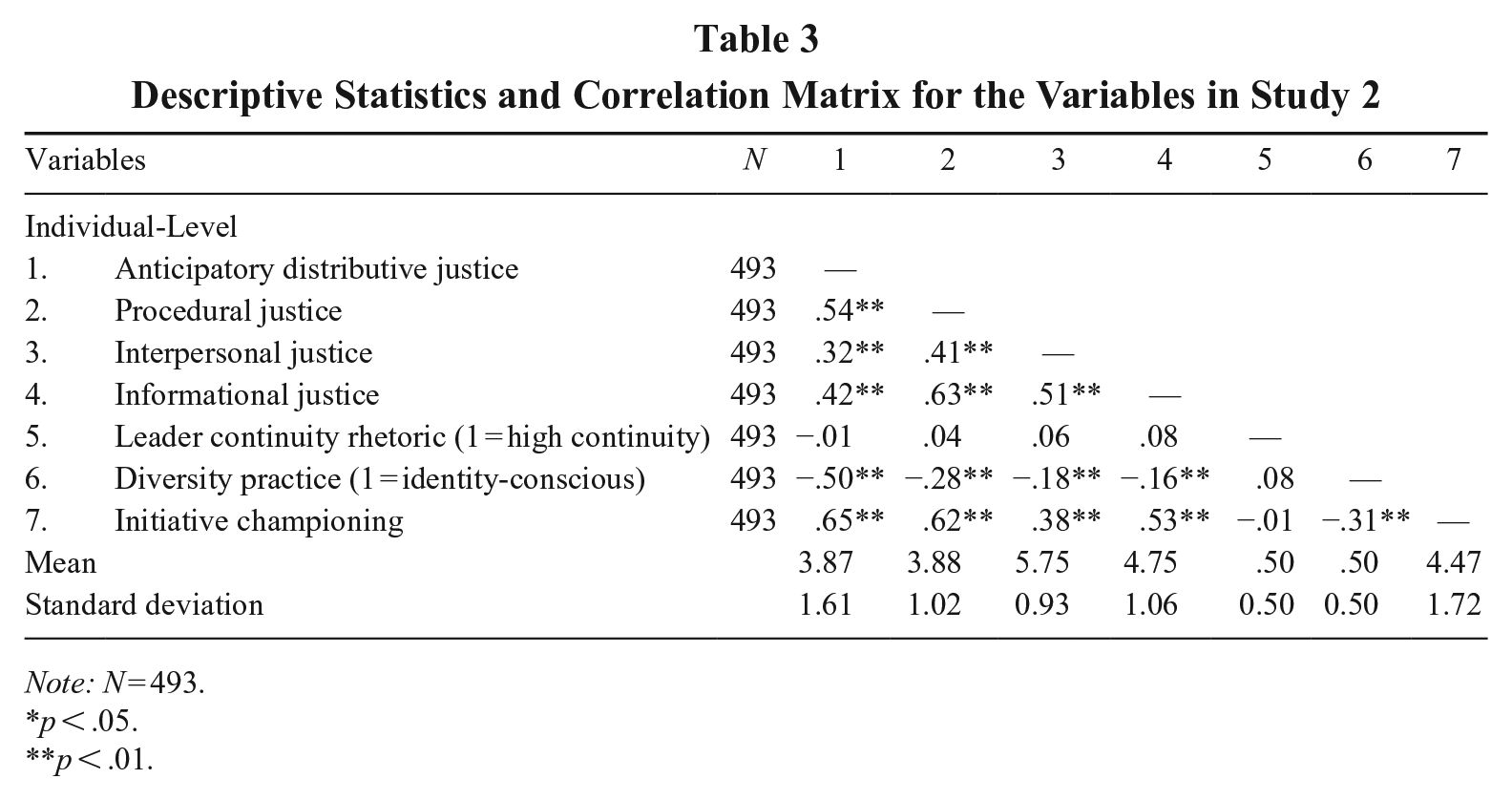
We report the means, standard deviations, and correlations in Table 3.
Descriptive Statistics and Correlation Matrix for the Variables in Study 2
Note: N = 493.
p < .05.
p < .01.
Test of hypotheses
We used Stata 17 to test our hypotheses and examine the effects of our manipulations on justice judgments. We ran standard linear regression models and used clustered standard errors (McNeish et al., 2017) to account for the nesting of our participants in the two countries, Germany and Austria. 9
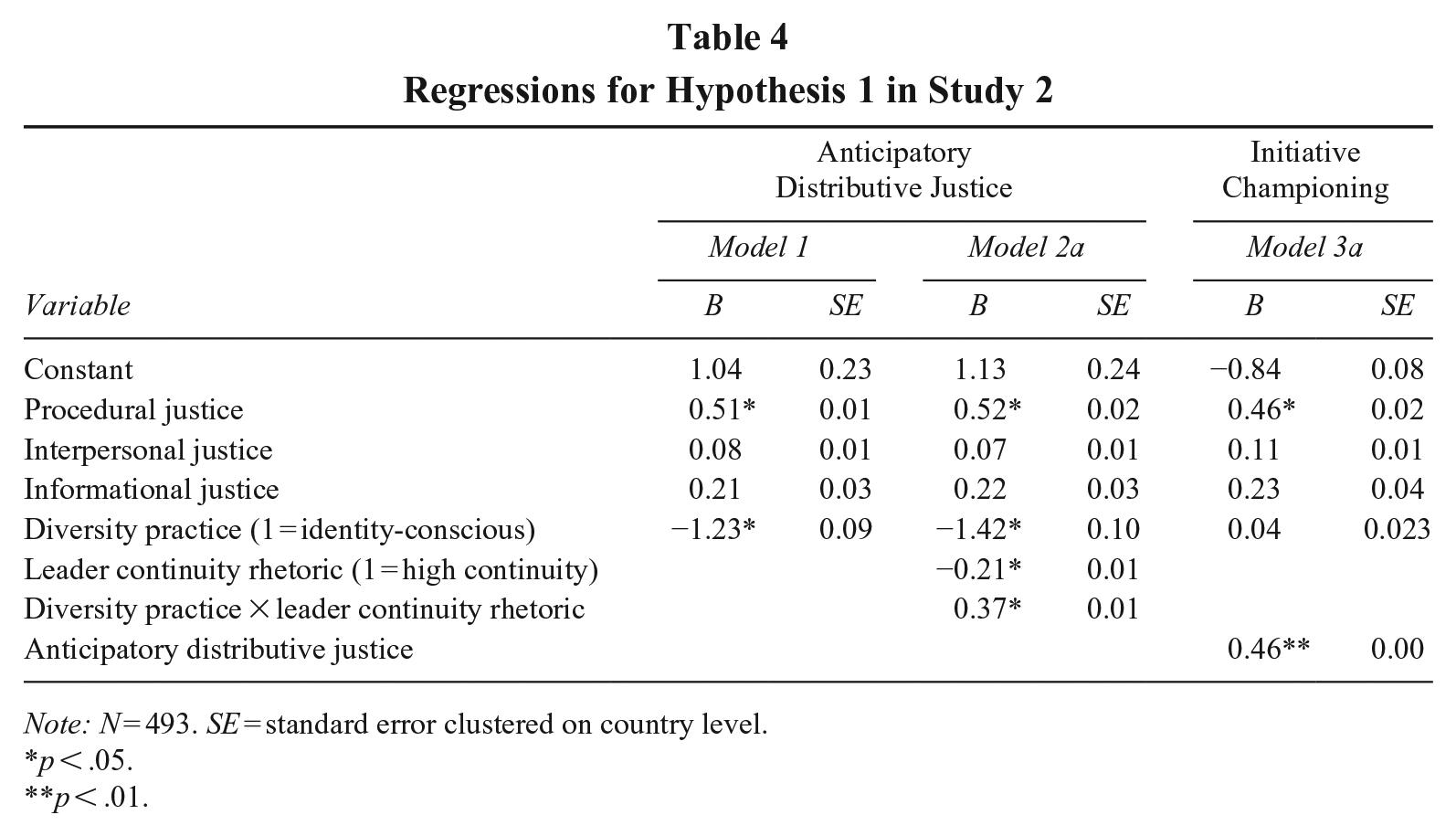
To test if the effect of IC diversity practices on nontarget support is mediated by anticipatory distributive justice (i.e., Hypothesis 1), we examined the effect of IC diversity practices on anticipatory distributive justice in Table 4 (Model 1), which was significantly negative (B = −1.23, p = .045). Anticipatory distributive justice was, in turn, positively related to initiative championing (B = 0.46, p = .005) (Model 3a). Similar effects were found when rerunning the analysis without the other justice dimensions as controls (see Supplementary Material G). We calculated bias-corrected bootstrap confidence intervals for indirect effects. We found that the indirect path carried by anticipatory distributive justice was different from zero for the relationship between IC practices and initiative championing (−0.57; 95% CI = [−0.748, −0.424]).
Regressions for Hypothesis 1 in Study 2
Note: N = 493. SE = standard error clustered on country level.
p < .05.
p < .01.
To test if the mediation effect is conditional on the leader continuity rhetoric (i.e., Hypothesis 2), we tested the interaction between IC diversity practices and continuity rhetoric on anticipatory distributive justice (Table 4, Model 2a) and found a significant interaction (B = 0.37, p = .013). To probe the interaction, simple slope analyses revealed that the negative effect of IC practices on anticipatory distributive justice is notably stronger in the condition with a low-continuity rhetoric (B = −1.42, p = .045) compared to the high-continuity condition (B = −1.05 p = .057) (see Supplementary Material H for the interaction plot).
We then estimated the conditional indirect effect of IC practices on initiative support for the two-leader continuity rhetoric conditions. The results showed significant negative indirect relations between IC practices and initiative championing both in the low-continuity condition (−0.66; 95% CI = [−0.888, −0.471]) and the high-continuity condition (−0.48; 95% CI = [−0.674, −0.326]). The indirect effect was slightly less negative in the high-continuity condition compared to the low-continuity condition, as shown by a significant index of moderated mediation with a 90% bias-corrected bootstrapped confidence interval (0.17; 90% CI [0.007 and 0.344]) but not with a 95% confidence interval (0.17; 95% CI [−0.028 and 0.380]), indicating marginal statistical significance when applying the conventional significance thresholds. 10 Taken together, we replicate our main results of Study 1 and show that the level of continuity transmitted by leader rhetoric influences nontarget responses to IC (relative to IB) practices via anticipatory distributive justice.
Supplementary analysis on other justice dimensions
We explored whether the interaction between diversity practices and leader continuity rhetoric might extend to other justice dimensions when controlling for the respective other dimensions. Our rationale for emphasizing anticipatory distributive justice over other dimensions in Study 1 emerged from our theoretical arguments laid out in the theory section. We contend that particularly during the early phase of the diversity initiative characterized by uncertainty and nontarget sensitivity to outcome distribution, individuals are more likely to be concerned with the anticipatory justice of outcomes rather than the procedural, interpersonal, or informational dimensions. In line with this notion, we found that the effects of the interaction term on procedural justice (B = −0.15, p = .284), interpersonal justice (B = 0.11, p = .070), and informational justice (B = −0.13, p = .437) did show substantially weaker and mostly nonsignificant effects. Hence, these findings offer additional support for the idea that continuity rhetoric in the initiation phase is weakening the negative effect of IC practices on initiative support by shaping anticipatory distributive justice.
Still, while anticipatory distributive justice appears to be focal in this context, there may be second-order effects of anticipatory distributive justice on other justice dimensions, as uncertainty management theory suggests (Lind & Van Den Bos, 2002). This expectation is in line with the correlation between IC practices and the other justice dimensions (see Table 3), which are significant, albeit notably weaker than the IC and distributive justice correlation. Further supporting the idea of second-order effects for at least one justice dimension, we found that IC practices unfold a significant indirect effect on informational justice via distributive justice, which is moderated by leader continuity rhetoric (index of moderated mediation with 90% bias-corrected confidence interval; 0.03; 90% CI [0.003 and 0.076]). In contrast, the indices of moderated mediation were nonsignificant for procedural and interpersonal justice, suggesting that these justice judgments may be formed based on further cues that become available at later stages in the change process.
General Discussion
How organizations can use effective practices to promote diversity without alienating nontarget employees is a critical question for diversity managers but remains underexplored in empirical research. This paper aimed to develop and test theory on how to address this challenge by jointly examining diversity practices and leader continuity rhetoric and their interactive effects on nontarget initiative support. Our uncertainty management lens, combined with evidence derived from both a field experiment (Study 1) and a vignette experiment (Study 2), substantiates the idea that using leader rhetoric emphasizing high (vs. low) continuity mitigates the adverse impact of introducing IC (vs. IB) diversity practices on nontarget support. This mitigation occurs primarily through a reduction in anticipatory distributive justice, not a general identity threat. Similarly, other justice dimensions appear secondary in this specific context. This implies that leaders can maintain nontarget support for diversity initiatives in the initiation phase by choosing appropriate rhetoric for their diversity efforts, thereby contributing to the success of initiatives.
Research Implications
Extending research on diversity rhetoric
Our work has important implications for research on diversity rhetoric. Although the growing body of research on strategic diversity leadership by senior managers (see Martins, 2020, for a recent review) emphasizes the importance of diversity rhetoric, the topic has received relatively little empirical attention in the literature. Prior work on diversity rhetoric has concentrated on the effectiveness of value-in-diversity rhetoric (i.e., business and/or moral reasons) for diversity initiatives with mixed results (e.g., Georgeac & Rattan, 2023; Thomas & Ely, 1996; van Dijk et al., 2012). Only recently have scholars begun to explore other types of rhetoric, highlighting the importance of contingent-diversity rhetoric, which acknowledges the challenges of diversity initiatives (Leslie et al., 2024). While undoubtedly those types of diversity rhetoric are relevant, they are less tailored to addressing anticipatory distributive justice concerns among nontargets during the initiation phase of a diversity initiative. Accordingly, our work advances existing research by integrating insights from change leadership into the diversity rhetoric space and demonstrates how leader continuity rhetoric (Venus et al., 2019) can be a powerful means to mitigate anticipatory justice concerns among nontargets. We show that—beyond communicating why diversity practices are beneficial for organizations (e.g., Georgeac & Rattan, 2023; value-in-diversity rhetoric) or acknowledging diversity-related challenges (Leslie et al., 2024, contingent-diversity rhetoric)—it is important that leaders explicitly articulate what will not change and that the core attributes of the organization will be preserved. This continuity rhetoric can maintain support from individuals who are not the primary targets of diversity initiatives and who may perceive them as bringing more harm than gain (Harrison et al., 2006; Kalev et al., 2006). Hence, we contribute a novel perspective to the evolving literature on strategic diversity leadership (Buengeler et al., 2018; Martins, 2020; Ng & Sears, 2020) and diversity rhetoric specifically (Georgeac & Rattan, 2023; Leslie et al., 2024).
Advancing diversity research on unintended consequences and nontarget responses
Our work advances research on the unintended consequences of diversity initiatives by making nontarget employees the focus of our theorizing. Recent conceptual work has begun to explore these unintended consequences, highlighting a potential trade-off between advancing the interests of marginalized target employees and fostering unity between target and nontarget employees (Konrad et al., 2021). Some scholars have conceptualized this tension as a “diversity-meritocracy paradox” (Konrad et al., 2021) or a “zero-sum game” (Leslie, 2019), suggesting that diversity practices may benefit targets but provoke resistance from nontargets. We contribute to this research by providing clarity on the mechanisms that are likely, and those that are less likely, to underlie nontarget employees’ responses to diversity practices in the initiation phase.
Previous research has suggested that nontarget employees may respond negatively to diversity practices but has lacked clarity regarding the specific mechanisms. Some researchers have argued that the advantages afforded to targets threaten the identities of nontargets (e.g., Ballinger & Crocker, 2021; Brown & Jacoby-Senghor, 2022; Dover et al., 2016), leading to feelings of resentment. Others have proposed justice concerns as the primary drivers (e.g., Bobocel et al., 1998; Konrad et al., 2021; Leslie, 2019). As we empirically demonstrated (see supplementary analysis of Study 1), identity threat is unlikely to be the primary obstacle to nontarget support for diversity practices in the initiation phase in homogeneous organizations. We speculate that strong job prototypes favoring nontargets (e.g., male-favoring job prototypes, as observed in our firefighting context) (Perry, 1994), along with the expected continued dominance of nontargets in such settings, make it unlikely for nontargets to perceive the introduction of diversity practices as a significant threat to their identity. In contrast, our results lend support to claims that justice concerns are a central element in the formation of responses to diversity practices (e.g., Bobocel et al., 1998; Kravitz, 1995; Nacoste, 1987). More precisely, our work implies that anticipatory distributive justice is a central driver of nontargets’ lack of support in the initiation phase and, consequently, of unintended consequences of diversity initiatives (Leslie, 2019).
Importantly, we not only enrich our understanding of the mechanisms that drive nontarget responses but also point to a potential cure. Our findings imply that uncertainty-induced anticipatory distributive justice concerns are not fixed; rather, they are malleable and can be influenced through rhetorical strategies by leaders. In other words, employing continuity rhetoric when introducing diversity initiatives has the potential to reduce uncertainty among nontargets and counteract the misconception that such initiatives harm the outcomes of nontarget groups (Brown et al., 2022). As we have elucidated, continuity rhetoric can redirect attention to the core elements that remain valued and protected during these changes. We encourage future researchers to delve deeper into these processes for a more comprehensive understanding.
Advancing research on change leadership and leader continuity rhetoric
Our work enriches the existing body of research on leader change visions (Oreg & Berson, 2019; Paine et al., 2024) and specifically continuity rhetoric to enhance change visions (Venus et al., 2019). Recent work has demonstrated the potential of continuity rhetoric to increase employee support (Venus et al., 2019). However, there is scarce empirical field evidence for the benefits of continuity rhetoric, as current evidence is limited to correlational field studies (e.g., business expansions or product changes) and lab experimental evidence with student samples (Venus et al., 2019). We go beyond the initial work on continuity rhetoric by empirically demonstrating—in a field experiment, a rarity in this particular research domain—how visions of continuity can help preserve employee support in the context of diversity initiatives.
Furthermore, we expand upon the original research on continuity rhetoric by enhancing our understanding of the mechanisms that connect continuity rhetoric and employee support for change. In their initial study, Venus et al. (2019) introduced the concept of collective continuity, defined as “the perception that the defining features of the organization remain visible over time” (Venus et al., 2019, p. 672), as a mechanism to explain the impact of continuity rhetoric on change support. Notably, collective continuity is conceptually close to the continuity rhetoric concept itself in the causal chain linking rhetoric and employee responses. Our research goes beyond this by demonstrating that continuity rhetoric can strengthen support for change by effectively addressing concerns related to the relative distribution of outcomes—namely anticipatory distributive justice. This is particularly relevant for employees who anticipate adverse consequences due to a proposed change. Therefore, our research introduces an unexplored mechanism that is conceptually closer to the actual employee support for change within the causal chain.
In addition, our findings highlight a crucial yet previously overlooked facet in the realm of vision research (Paine et al., 2024) and continuity rhetoric (Venus et al., 2019): How do the effects of visions of continuity depend on the content of change and differ among recipient groups? We centered our study around nontargets, as they can be a key source of resistance to diversity initiatives. However, the effect of leader rhetoric could vary among distinct recipient groups, influencing not only nontargets in intended ways but also targets in potentially unintended ways, contingent upon the type of diversity practice. Consequently, we explored whether targets and nontargets reacted differently to IC practices framed with high- or low-continuity leader rhetoric. When we include target employees in our analysis of Study 1, results show a significant three-way interaction between being a target, the type of diversity practice employed, and the leader rhetoric used (B = −1.92, p = .033). This provides evidence that there are systematic variations in how targets and nontargets respond to these factors. However, we can confidently rule out that high-continuity rhetoric hurts targets’ responses when paired with IC practices, as targets confronted with an IC practice did not differ in anticipatory distributive justice (p = .323) or initiative championing (p = .264) when exposed to leader rhetoric of high rather than low continuity. Still, it is worth noting that targets generally regarded an IB practice as more just compared to an IC practice when presented under a high leader-continuity rhetoric (p = .010). This is in line with prior work indicating that women are critical toward preferential treatment because they fear backlash from nontargets (Heilman, Battle, Keller, & Lee, 1998; Heilman & Herlihy, 1984). Further research is required to investigate the differential effects of continuity rhetoric on targets and nontargets dependent on diversity practice type.
Limitations and Future Research
The major strength of our research lies in combining a field experiment in a real organization and a vignette experiment and, therefore, balancing external and internal validity. However, our research is not without limitations, which we will highlight.
First, we have built on an established tradition within the diversity literature, which has categorized diversity practices into two overarching groups: identity-conscious and identity-blind practices (e.g., Leslie, Bono, Kim, & Beaver, 2020; Harrison et al., 2006; Hideg & Ferris, 2017; Konrad et al., 2021). Although we acknowledge that this dichotomy of diversity practices is a simplification of the varying degrees of how diversity practices can be differentiated, the notion of the dichotomy (i.e., whether practices grant preferential treatment based on individual characteristics or not) is strongly tied to the distributive justice angle proposed in our model. Still, we recognize that specific diversity ideologies—“beliefs regarding the importance of demographic differences and how to navigate them” (Leslie et al., 2020, p. 454)—expressed by leaders that are underlying those practices can also have important implications for employee initiative support (Dang, Volpone, & Umphress, 2023). Examining those ideologies or other forms of diversity cognitions (see Leslie & Flynn, 2022, for a review) was beyond the scope of our theoretical focus and was held constant in our research design. Still, we speculate that the ideologies leaders endorse when introducing a diversity initiative can influence the selection of practices and rhetoric and thus spill over and shape how employees perceive and respond to initiatives. Therefore, we encourage future research to delve into the role of leader diversity cognitions as an antecedent and how leader ideology shapes (un)intended responses in greater detail.
Second, our research has provided empirical evidence on the importance of anticipatory distributive justice concerns in shaping nontarget responses in the early initiation phase. We used the Colquitt (2001) conceptualization as the most used measure of justice perceptions (according to Rupp, Shapiro, Folger, Skarlicki, & Shao, 2017). However, recent reviews of the justice literature (Rupp et al., 2017) have raised concerns about conceptualizations of distributive justice that primarily center on equity (i.e., whether received outcomes align with receivers’ respective inputs), which also applies to the measure we utilized (Rupp et al., 2017). That leaves equality (i.e., whether received outcomes are equal across all receivers) and need (i.e., whether received outcomes reflect receivers’ relative needs), two other central allocation principles that have been put forth (Deutsch, 1975), underexamined. We took initial steps based on reviewer feedback and explored need and equality as alternative allocation principles underlying distributive justice perceptions in Study 2. We adapted the Colquitt (2001) distributive justice items to capture need (three items, e.g., “Are the consequences you expect appropriate regarding your needs as an FF member?”; α = .96) and equality (three items, e.g., “Are the consequences you expect appropriate regarding how you are affected by them compared to others at FF?”; α = .95). We found the interaction of diversity practices and leader continuity rhetoric (controlling for the respective other allocation principles) to be nonsignificant on distributive justice with need as an allocation principle (B = −0.04, p = .747) as well as with equity as an allocation principle (B = −0.08, p = .548). This indicates that the unconsidered allocation principles are unlikely to explain the findings in our study, but we call for future research to offer a more nuanced perspective on those allocation principles.
Practical Implications
Our findings have important implications for managers who seek to promote diversity in their organizations. One established lever for shaping responses to diversity initiatives is their content—the practices they introduce. Leaders may be tempted to resort to less controversial IB practices in homogeneous organizations to mitigate potential resistance. Yet, we propose that leaders should recognize the importance of rhetoric (e.g., via personal video messages or speeches) as an additional lever to influence how employees respond. One particularly important aspect of this rhetoric is the conveyed degree of continuity. According to well-known recommendations, leaders should frame the change as a break from the past by pointing to a deficiency in the status quo and providing a promising alternative (e.g., Kotter, 1995). However, our work shows that when leaders implement diversity practices in homogeneous organizations, just the opposite rhetoric may be more helpful: building a rhetorical bridge between what was and what comes next. By giving employees a sense of continuity (i.e., assuring employees that, despite diversity-related change, what defines the organization will be maintained), leaders can preserve nontargets’ sense of justice about the initiative’s outcomes and thereby foster support, even for identity-conscious practices that carry the most potential to increase minority representation yet tend to be most reviled. Thus, through utilizing continuity rhetoric (i.e., by bridging the past rather than breaking from it), leaders can address one key obstacle to greater diversity and inclusion—they can secure nontarget support right from the start.
Supplemental Material
sj-docx-1-jom-10.1177_01492063241281466 – Supplemental material for Bridging the Past, or Breaking From It? Leader Continuity Rhetoric and Nontarget Employee Diversity Initiative Support
Supplemental material, sj-docx-1-jom-10.1177_01492063241281466 for Bridging the Past, or Breaking From It? Leader Continuity Rhetoric and Nontarget Employee Diversity Initiative Support by Anastasia Kukula, Max Reinwald, Rouven Kanitz and Martin Hoegl in Journal of Management
Footnotes
Acknowledgements
We thank editor Pauline Schilpzand and two anonymous reviewers for their helpful feedback and constructive guidance during the revision process. An earlier version of this paper was presented at the Academy of Management annual meeting in Boston in 2023. Finally, we sincerely thank the firefighter organization and its leadership for igniting this research with their blazing support.

Supplemental material for this article is available with the manuscript on the JOM website.
Notes
References
Supplementary Material
Please find the following supplemental material available below.
For Open Access articles published under a Creative Commons License, all supplemental material carries the same license as the article it is associated with.
For non-Open Access articles published, all supplemental material carries a non-exclusive license, and permission requests for re-use of supplemental material or any part of supplemental material shall be sent directly to the copyright owner as specified in the copyright notice associated with the article.
