



Abstract
Structures involve a patterned regularity of interactions and frameworks that guide what individuals work on, with whom, and who influences those decisions. A deeper understanding of structures that exist within organizations has begun to emerge and illuminate new forms of structures (over 100 of them) that drive behavior in organizations. In this scoping review, we organize the fragmented insights on structure within organizations into a unifying framework that provides a coherent foundation for the domain by identifying nine topic domains and offering a summary of each (i.e., authority structures, cognitive structures, communication structures, coordination structures, leadership structures, motivational structures, social structures, task structures, and temporal structures). Next, as multiple structures co-occur within organizations, we explore the connections across topic domains, including their combinations. Understanding the separate topic domains and their combinations enables researchers and practitioners to understand why employee behaviors are inconsistent with the behaviors endorsed by a particular structure and better navigate the inherent complexity of structures within organizations. Finally, we outline implications for future work featuring structure combinations as well as emergent areas from the topic domains, such as the potential for change. Given the ubiquity of structures in organizations and their links with a variety of theoretical domains, this article’s implications have the potential to benefit a wide range of scholars and managers.
Structure is a classic concept of interest in the management domain. Historically, organizational-structure research focused on themes related to task allocation (the division of labor into distinct tasks), coordination (integration of labor to enable accomplishing joint goals), and formal decision-making authority (power within specific levels and spans of control; see Lawrence & Lorsch, 1967; Mintzberg, 1980). However, as research has progressed in this area, there has been increasing interest in expanding beyond the formal relationships captured in the organizational chart to understand other patterns across varying levels within organizations (e.g., Bunderson & Boumgarden, 2010; Hollenbeck, Beersma, & Schouten, 2012). Adopting a broad and inclusive approach, consistent with Ranson, Hinings, and Greenwood (1980: 1), we conceptualize structure as “a configuration of activities that is characteristically enduring and persistent,” with the dominant feature being “patterned regularity,” which applies to both the framework (e.g., configurations of roles and procedures) and interaction (e.g., patterned regularity of interactions) conceptions.
In recent years, there has been a proliferation of studies examining different structures within organizations (e.g., social structures, temporal structures). Notably, this research has proceeded largely independently, lacking a unifying framework for organizing findings within the structure domain. Additionally, there has been relatively little acknowledgment of the co-occurrence of multiple structures. This is problematic given that the effects associated with each form of structure may change when more than one form is considered simultaneously (e.g., leadership structures suppressing authority structures). As a result, there is a pressing need to develop knowledge across these forms of structure that would promote effective knowledge accrual and enable scholars and managers to navigate the inherent complexity.
To address this need, we conduct a scoping review of management-related research on structures within organizations published from 2000 to 2023. We categorize the more than 100 forms of structures identified from this review into nine topic domains (i.e., authority structures, cognitive structures, communication structures, coordination structures, leadership structures, motivational structures, social structures, task structures, and temporal structures) and provide a summary of research in each domain. We then discuss the connections across these topic domains and their implications for future research, management scholarship, and practice.
In doing so, this article offers several contributions. First, we advance a unifying framework for organizing the disparate forms of structure into a coherent foundation for the theoretical domain, which supports knowledge accrual and facilitates a tenable conversation about combinations. Second, we provide a summary of research in each topic domain, noting the variety of conceptualizations and operationalizations and highlighting how the focal structure impacts functioning within organizations. Third, we feature insights at the intersection of the topic domains, including how multiple structures combine. This enables researchers and practitioners to understand why employee behaviors are inconsistent with the behaviors endorsed by a particular structure. Cumulatively, identifying the topic domains and the connections across them enables researchers and managers to better navigate the multitude of structures that are often examined separately but co-occur in practice. Finally, we identify areas for future research and note several implications for management scholarship and practice. This supports the development of new insights that will accelerate the development of the domain and further embrace the complexity of today’s organizations.
The Review Process
Purpose and Type
Structure is a root construct in organizational phenomena. Similar to other root constructs (e.g., identity; Albert, Ashforth, & Dutton, 2000), it has been studied broadly and eclectically with diffuse and wide-ranging perspectives. Recognizing the broad scope of conceptualizations and methodologies, we conducted a scoping review to create a unifying framework and to offer insights into how structures impact functioning within organizations. Although more common in other academic disciplines (e.g., medicine; Colquhoun et al., 2014; Maggio, Larsen, Thomas, Costello, & Artino, 2020; Tricco et al., 2016), scoping reviews have recently been utilized in management as well (e.g., Bolino, Henry, & Whitney, 2024; Simsek, Fox, Heavey, & Liu, in press). A scoping review is a useful method for conducting a review for our context, as it is particularly suited for capturing the breadth of evidence for topics with a broad scope (Arksey & O’Malley, 2005), that do not have an existing encompassing framework (Simsek et al., in press), and that have not been reviewed comprehensively before (Arksey & O’Malley, 2005; Bolino et al., 2024). Although there have been systematic reviews featuring a few specific content areas (e.g., formal structure and informal social structures; McEvily, Soda, & Tortoriello, 2014; team hierarchy structures; Greer, de Jong, Schouten, & Dannals, 2018) or a few specific relationships (e.g., the impact of organizational structure on information processing and decision-making; Joseph & Gaba, 2020), to our knowledge, there has not yet been a review capturing the broad scope of structures within organizations.
Design, Execution, and Alignment
Review process
To cover the breadth of the proposed conceptual domain, we used the Scopus database to search titles, abstracts, and keywords for the term “structure*” in management, organizational psychology, organizational science, and strategy journals with a 2021 Academic Journal Guide ranking of 4* (i.e., Academy of Management Annals, Academy of Management Journal, Academy of Management Review, Administrative Science Quarterly, Journal of Applied Psychology, Journal of Management, Organization Science, Personnel Psychology, Strategic Management Journal). As our purpose is to organize studies of structures within organizations into a unifying framework and offer insights into the general research question of how structures within organizations impact functioning, a broad search term (vs. preselecting a subset of activities, such as task allocation or team structure) is well aligned with our purpose.
From these search results, we downloaded the title, year, authors, author keywords, index keywords, and abstract for each article. We utilized the 2000-to-2023 temporal window as it allows us to concentrate on the more novel structures that are most relevant to today’s complex and dynamic workplaces. We also note this time period captures the emergence of theoretical insights regarding structure combinations (e.g., Bresman & Zellmer-Bruhn, 2013; Hollenbeck et al., 2012). Our initial search generated 1,180 articles. We then followed a two-stage screening process, from which a final sample of 337 articles was generated (Bolino et al., 2024). Table 1 provides details about this process.
Review Procedures
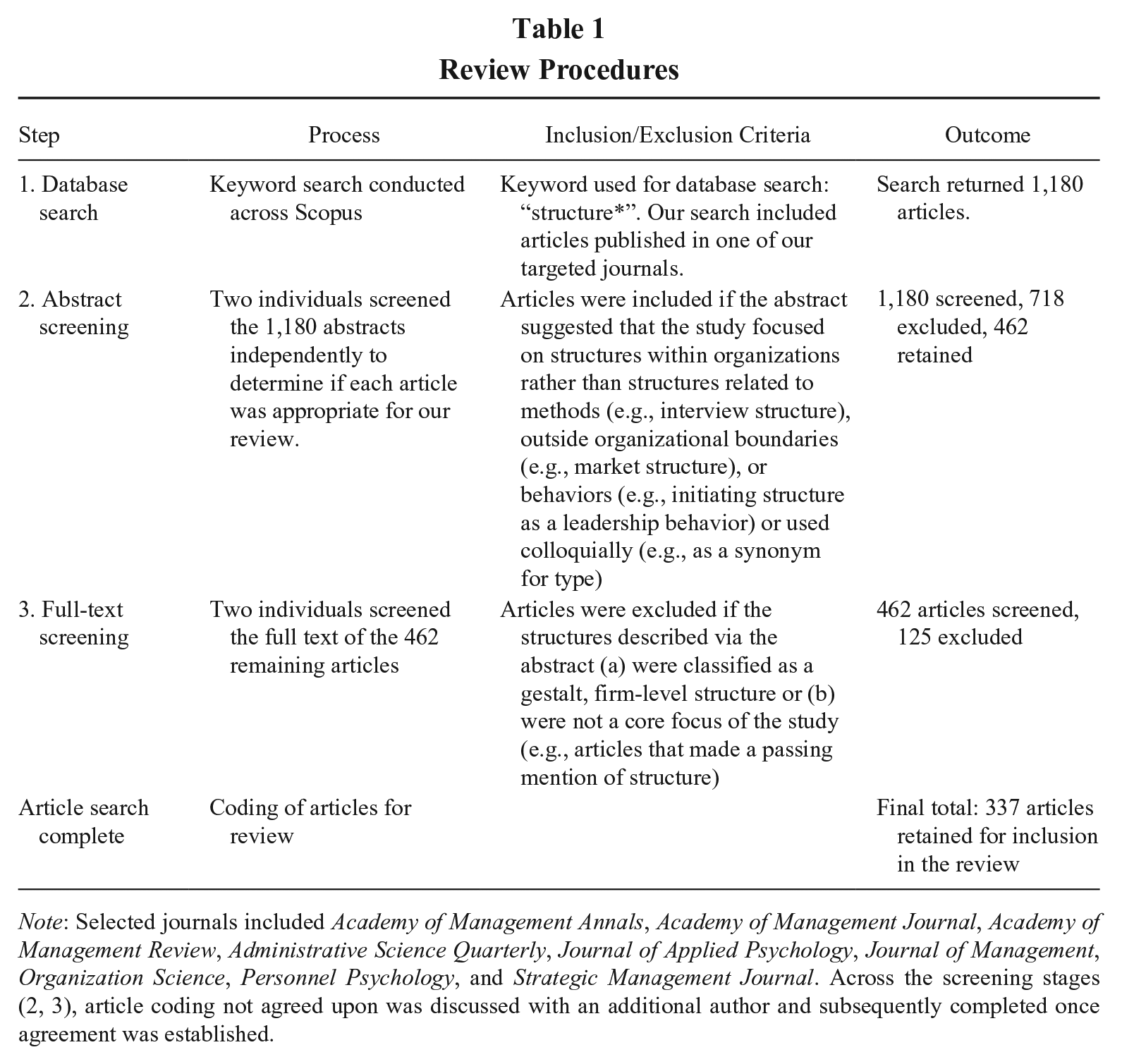
Note: Selected journals included Academy of Management Annals, Academy of Management Journal, Academy of Management Review, Administrative Science Quarterly, Journal of Applied Psychology, Journal of Management, Organization Science, Personnel Psychology, and Strategic Management Journal. Across the screening stages (2, 3), article coding not agreed upon was discussed with an additional author and subsequently completed once agreement was established.
Article coding and categorizing
In analyzing the articles, we reviewed each article in terms of the author(s)’s structure term and its descriptions or definitions; the research context and methods used to capture it (e.g., survey, archival), including the operationalization of the structure construct (if applicable); and the findings related to how structure impacts functioning. If an article noted multiple structure forms (e.g., task and social structure; Mannucci, Orazi, & De Valck, 2021), we also noted the separate and combined effects of the structures (if reported).
We then conducted content analysis on the extracted data, referencing the full article text as necessary for clarification. Content analysis is a useful tool for systematically coding and categorizing textual information—especially when scholars wish to identify patterns across the data set (Gbrich, 2007; Mayring, 2000). Our content analysis occurred in three phases: preparing, organizing, and reporting (Elo & Kyngäs, 2008). The preparing phase consisted of two authors reading the entire table to immerse themselves in the data and get a sense of the conceptual space. The organizing phase involved coding and creating categories. To create categories, we iteratively sorted and grouped the structure descriptions based on similarities and differences, as belonging to a particular grouping implies not only bringing together similar data but also comparing with data that do not belong to the same group (Schmidt, Priem, & Zanella, in press). To elaborate, structure forms within the same category should be more conceptually similar to each other than forms in other categories and more conceptually different from structure forms in different categories than within their own category. We engaged in an iterative process of coding subsections of the sample followed by team meetings to discuss the coding until sufficient confidence in their categorizations was established in terms of both the appropriate number of categories and the membership of articles in those categories (Schmidt et al., in press).
This process resulted in nine categories (hereafter topic domains), which were labeled based on their observed commonalities (i.e., authority structures, cognitive structures, communication structures, coordination structures, leadership structures, motivational structures, social structures, task structures, and temporal structures). Each of these topic domains has a clear core concept of interest, which unifies the articles in that topic domain (see description of research focus in Table 2). However, not every study exclusively speaks to only one topic domain. The topic domain codes are included in a supplemental table, with the multifaceted structures that captured more than one topic domain (e.g., multiteam structure) being coded into its multiple relevant topic domains (e.g., coordination structure, task structure; de Vries, van der Vegt, Bunderson, Walter, & Essens, 2022). 1
Structures Within Organizations
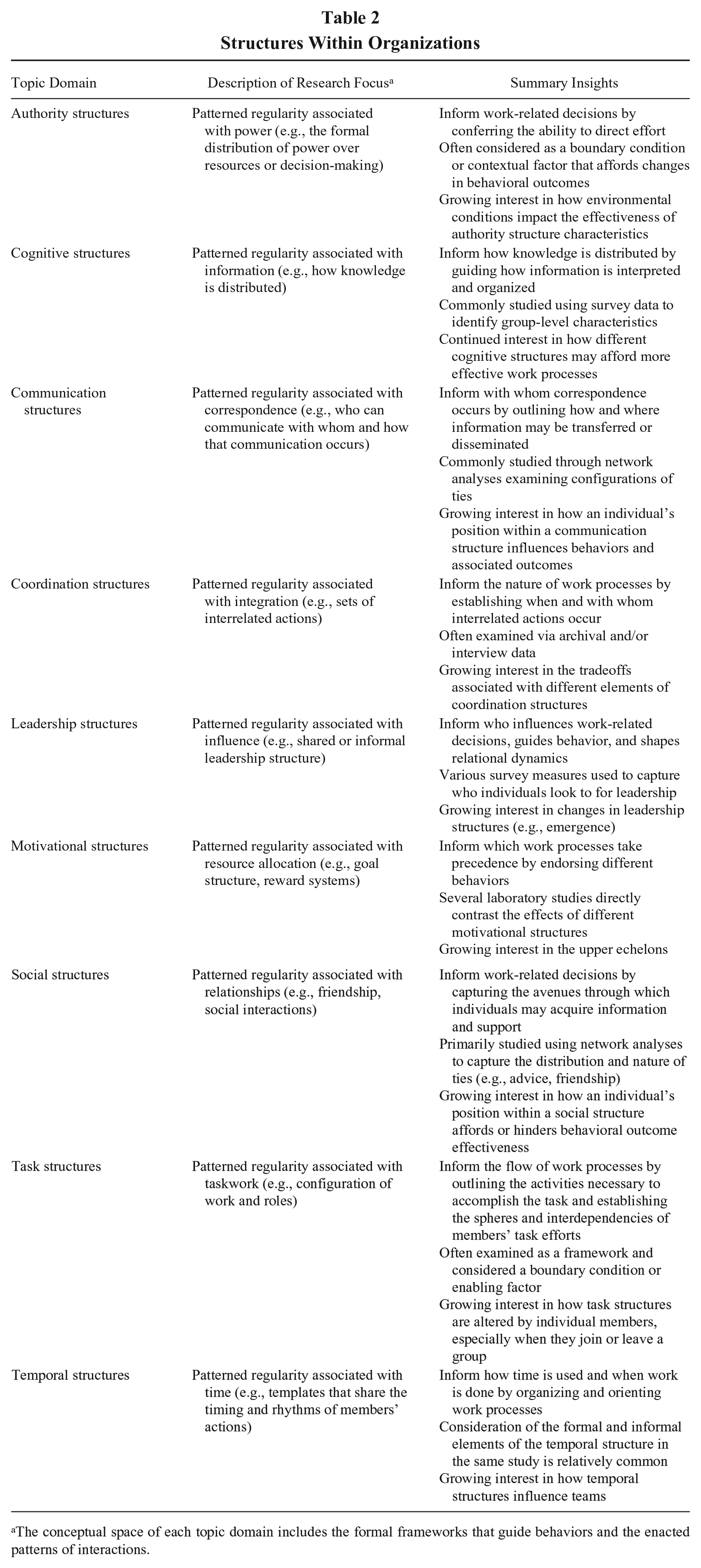
The conceptual space of each topic domain includes the formal frameworks that guide behaviors and the enacted patterns of interactions.
In addition to identifying the nine topic domains, the coding conversations in the organizing phase also generated insights about how the structures within a specific domain impact functioning (see the Impact on Functioning subsection of each topic domain) and cross-domain insights (see the section Connections Across Topic Domains). This resulted in adding a column to the supplemental table for the overarching theme (i.e., who influences decisions, who works with whom, and what is worked on). To elaborate, the research team found that the structure domains had a stronger connection with an aspect of functioning within organizations that informs who influences decisions, who works with whom, or what is worked on. This additional coding is methodologically consistent with the recommendations to engage in comparisons of similarities and differences across topic domains and consistent with the purpose of a scoping review, which seeks to establish a foundation for the broader domain by mapping the domain, identifying key concepts or topic domains, exploring connections within the domain, and offering insights into areas where further research is necessary (Levac, Colquhoun, & O’Brien, 2010; Simsek et al., in press). The reporting phase of our content analysis is presented in the following section.
A Unifying Framework of Structures Within Organizations
In Table 2 we present a unifying framework of structures within organizations derived from our review. Given “the dominant feature of organizational structure is its patterned regularity” (Ranson et al., 1980: 1), we provide overarching descriptions for each topic domain emphasizing the content of the patterns central to the domain. As noted earlier, these patterns can refer to the prescribed frameworks and/or enacted interactions.
As most articles in our review feature one form of structure from one topic domain, we concentrate on those articles in this section before turning to the connections across domains in the following section. For each topic domain, we first delineate the domain by providing examples of how the construct has been conceptualized and operationalized. We then synthesize the insights on how structure impacts functioning. This helps crystallize the fragmented insights while honoring the diversity within each topic domain as they explore similar patterns at different levels of specificity and analysis, using various methodological approaches. In so doing, our summary of research in the topic domains lays the groundwork to explore the complex connections among structures within organizations.
Authority Structures
Conceptualizations
The authority-structure domain encompasses studies of patterned regularity associated with power. Collectively, authority structures specify both the allocation and characteristics of formal control regarding resources and decision-making within an organization, encompassing forms such as ownership (e.g., David, O’Brien, Yoshikawa, & Delios, 2010; Desender, Aguilera, Crespi, & Garcia-Cestona, 2013; Fong, Misangyi, & Tosi, 2010; Ramírez & Tarziján, 2018), governance (e.g., Dalton & Dalton, 2011; Gore, Matsunaga, & Yeung, 2011; Pathak, Hoskisson, & Johnson, 2014), power structure (e.g., Aime, Humphrey, DeRue, & Paul, 2014; Huffman, Cohen, & Pearlman, 2010; van Bunderen, Greer, & Van Knippenberg, 2018; Young-Hyman, 2017), top management team (TMT) structure (e.g., Menz & Scheef, 2014; Vieregger, Larson, & Anderson, 2017), and decision-making structures (e.g., J. S. Chen, Elfenbein, Posen, & Wang, 2022; Piezunka, Aggarwal, & Posen, 2022; Tzabbar & Margolis, 2017). Importantly, the authority-structure domain encompasses both power vested in people, such as “the allocation of decision rights” (Marengo & Pasquali, 2012: 1299), as well as power vested in rules and procedures, such as voting structures (Piezunka et al., 2022).
Operationalizations
Authority structures are often examined using archival data (e.g. Coles, McWilliams, & Sen, 2001; Gore, et al., 2011; Huffman et al., 2010; Menz & Scheef, 2014; Pathak et al., 2014; Tzabbar & Margolis, 2017; Westphal & Bednar, 2008; Young-Hyman, 2017), experimental manipulations (e.g., Aime et al., 2014; Li et al., 2022; Meier, Stephenson, & Perkowski, 2019; Wellman, Applegate, Harlow, & Johnston, 2020), computational modeling (e.g., J. S. Chen et al., 2022; Marengo & Pasquali, 2012; Piezunka et al., 2022), survey data (e.g., van Bunderen et al., 2018), or interview data (e.g., Kochan & Rubinstein, 2000). Across these studies, authority structures are frequently studied as aspects of shareholder ownership or distribution of decision rights. For example, using archival data, Tuschke and Gerard Sanders (2003: 640) studied ownership structure as “the percentage of shares held in blocks of 5 percent, or more,” whereas Keum and See (2017) adopted two different approaches in their article: In the first study, they used an experimental manipulation in which the hierarchy of authority was assigned using two different organizational charts, and in the second study, they conducted a field study examining the hierarchy of authority in design teams based on participant ratings of brands’ levels of authority. Likewise, van Bunderen et al. (2018: 1114) used experimental manipulations in one study by informing participants in a lab study of the formal power structure within their team, and in the following field study, intrateam power structures were measured using a seven-item survey scale (e.g., “In my team, there is a clear distance between the top and the bottom of the hierarchy” and “There are virtually no differences in authority between the members of my team”).
Impact on functioning
Authority structures determine who can make work-related decisions by specifying who has the power to assign tasks and direct efforts. The field of authority structures has broadly aimed to comprehend its effects on individual behavior and group dynamics while also exploring the contextual factors that shape these outcomes. For example, Piezunka et al. (2022: 1109) found that “decision-making structures that more effectively aggregate individuals’ knowledge can be less effective at facilitating individuals’ learning,” whereas Marengo and Pasquali (2012) demonstrated that higher control and higher levels of learning can be achieved through partitioning decision rights. In a related vein, studies examined the outcomes associated with hierarchy of authority, with Keum and See (2017: 661) finding that “hierarchy of authority is detrimental to idea generation but beneficial to selection performance” and Yap, Madan, and Puranam (2022) arguing that formal hierarchies can lead to upward status disagreement, status conflict, and diminished individual performance.
Additionally, authority structure–related studies at the team level examined structures’ impact on performance (e.g., Greer et al., 2018; Levinthal & Workiewicz, 2018; Yin & Zajac, 2004) and creativity (Keum & See, 2017). There is also a growing interest in differences in responses to contextual conditions. For instance, Wellman et al. (2020: 997) found that when task variety is high, an inverse-pyramid-shaped formal hierarchy authority increases team performance in relation to a pyramid-shaped hierarchy. Related, Young-Hyman (2017) found that when tasks are complex and uncertain, cross-functional interactions increase team productivity only in contexts of concentrated ownership and governance rights but not when these rights are widely distributed. Additionally, exploring differences between hierarchical and heterarchical teams, heterarchical team structures enhance team creativity in response to dynamic situational demands when teams acknowledge the associated power shifts as legitimate (Aime et al., 2014). Moreover, in situations of resource-threatening interteam conflict, the negative effects on team performance due to internal power struggles associated with hierarchical team structures may be mitigated through the use of egalitarian team structures (van Bunderen et al., 2018).
Last, scholars have also explored the connection between authority structures at higher organizational levels and broader organizational outcomes. Studies suggest that authority structures are determined by firm performance (e.g., ownership structure; Chang, 2003) and subsequently influence firm performance (e.g., co-CEO structure; Krause, Priem, & Love, 2015; ownership structure; Bruton, Filatotchev, Chahine, & Wright, 2010; Gedajlovic & Shapiro, 2002; Thomsen & Pederson, 2000). An emphasis has also been placed on strategic firm decisions arising from authority-related structures, such as the findings of David et al. (2010: 636) demonstrating that “although transactional owners . . . prioritize profitability when diversifying, relational owners primarily seek growth rather than profits from diversification,” those of Werner, Tosi, and Gomez-Mejia (2005: 377) indicating that “ownership structure not only affects upper management’s pay, but also the pay of all employees through substantial differences in the firm’s compensation practices,” or the findings of George, Wiklund, and Zahra (2005: 210) establishing that “internal owners . . . tend to be risk averse and have a lower proclivity to increase scale and scope of internationalization than external owners.”
Cognitive Structures
Conceptualizations
The cognitive-structure domain encompasses studies of the patterned regularity associated with information, such as how knowledge is distributed and who knows what. Specifically, cognitive structures refer to the mental frameworks, schemas, or patterns of thought that individuals and groups use to perceive, interpret, and make sense of information and experiences within the organizational context. Common examples of structure forms in this topic domain include shared mental models, transactive memory systems (TMSs), collective intelligence, knowledge structures, attention structures, and attitude structures. For example, Bundy, Shropshire, and Buchholtz (2013: 357) defined cognitive structures as “the relatively stable characteristics and/or repeated patterns of behavior used to interpret strategic information,” whereas Marks, Zaccaro, and Mathieu (2000: 972-973) defined individual mental models as “organized knowledge structures that allow individuals to understand and form expectations about how a system operates.”
Operationalizations
Cognitive structures are often operationalized using experimental manipulations (e.g., Mell, Van Knippenberg, & Van Ginkel, 2014), survey data (e.g., Carter et al., 2020; Davis & Yi, 2004; Day, Arthur, & Gettman, 2001; Heavey & Simsek, 2017), archival data (e.g., Kabanoff & Brown, 2008; Yayavaram & Ahuja, 2008), or interview data (e.g., Vuori & Huy, 2016). Structural assessments are commonly used to measure cognitive structures (e.g., Davis & Yi, 2004) in which the accuracy of trainees’ knowledge structures is examined by assessing “the degree of similarity between the trainees’ structures and an expert referent structure” (Day et al., 2001: 1025). Alternatively, Mell et al. (2014: 1162) used experimental manipulations to capture the TMS structure, such that “in the centralized TMS structure, one person received all five units of metaknowledge while the other two members did not receive any metaknowledge. In the decentralized TMS structure, every team member received one or two units of metaknowledge.” Additionally, we note the common use of a 15-item TMS scale developed by Lewis (2003).
Impact on functioning
Cognitive structures dictate how information is interpreted and organized, subsequently shaping the distribution of knowledge. Research within this domain has commonly examined the impact of knowledge structures (e.g., Day et al., 2001; Kabanoff & Brown, 2008; Schuelke et al., 2009), managerial-focused cognitive structures (e.g., Barnett, 2008; Hahn, Preuss, Pinkse, & Figge, 2014), and attention structures (e.g., Joseph & Wilson, 2018; Ren & Guo, 2011; Vuori & Huy, 2016) on employee outcomes, such as decision-making behavior (Bundy et al., 2013; Narayanan, Zane, & Kemmerer, 2011). Much of this research suggests the positive effects of shared cognitive structures on different aspects of functioning, such as team performance. For example, Marks et al. (2000: 971) found that “both leader briefings and team-interaction training affected the development of mental models, which in turn positively influenced team communication processes and team performance.” These shared mental models, along with high levels of team cognition (Mohammed, Rico, & Alipour, 2021), polychronicity (Souitaris & Maestro, 2010), centralized TMSs (Mell et al., 2014), and strong team justice climate (Antino, Rico, & Thatcher, 2019), all positively related to team performance.
Other studies have considered aspects of functioning other than performance. For example, Heavey and Simsek (2017) found that team diversity improves the potency and efficacy of TMSs to enable TMTs to pursue an ambidextrous orientation. Additionally, Day et al. (2001: 1022) concluded that “the similarity of trainees’ knowledge structures to an expert structure was correlated with skill acquisition and was predictive of skill retention and skill transfer.” Alternatively, Ren and Guo’s (2011) study was one of the few that demonstrated the potential downside of shared cognitive structures, as middle managers likely prescreen entrepreneurial opportunities from lower levels of the organization due to constraints from attention structures.
Communication Structures
Conceptualizations
The communication-structure domain encompasses studies of the patterned regularity associated with correspondence, such as who communicates with whom and how that communication occurs. Commonly used to specify where and how communication occurs, communication structures also include listening and communication network structures. For example, Yip and Fisher (2022: 667) provided a review of listening structures, defined as the “procedures, norms, and practices—that shape how listening is experienced and perceived.” Alternatively, Soda, Mannucci, and Burt (2021: 1164) used a network approach to describe communication structure, or “whom they talk to.” A few studies in this topic domain emphasize the interplay between formal and informal communication. For example, Foss, Frederiksen, and Rullani (2016: 2590) explored communication structure as “communication with less a priori structure (i.e., open-ended and informal communication with few constraints) . . . [and] more structured and formal communication (i.e., communication that directly relates to well-defined objects, and therefore, has inherent constraints).”
Operationalizations
Communication structures are often operationalized using survey data (e.g., Detert, Burris, Harrison, & Martin, 2013), archival data (e.g., Foss et al., 2016; Soda et al., 2021), or a combination of interview and survey data (e.g., Sosa et al., 2015). Across these studies, communication structures are commonly measured using network analysis to examine communication ties or focus on the mode of communication itself. For instance, using survey data, Detert et al. (2013) studied informal communication structure as the number and type of communication ties an individual has (e.g., “Respondents first indicated to whom they directed their voice by clicking ‘yes’ next to all applicable names and then indicated how frequently they spoke up to each target [from ‘seldom’ to ‘always’]”; Detert et al., 2013: 645), whereas Foss et al. (2016: 2597) utilized archival data in their examination of how modes of communication shape project behaviors, measuring open-ended communication and artifact-based communication as the “number of messages i’s colleagues have sent to the forums of projects in which individual i is not involved, and the number of artifacts (i.e., bug reports, patches, feature or support requests) colleagues have submitted to the tracker system of projects in which individual i is not involved, respectively.”
Impact on functioning
Communication structures inform how and where information may be transferred and disseminated throughout an organization by outlining the channels of correspondence. Scholars in this domain are often interested in the contingencies or trade-offs associated with different structures (e.g., channels or modes of communication). For example, Nasrallah, Levitt, and Glynn (2003) found that strong management control of the communication structure was not beneficial when communication patterns were already dictated via implicit structures. Additionally, Soda et al. (2021) found that open communication networks coupled with low network stability facilitate higher levels of creativity for individuals, and Foss et al. (2016: 2590) found that less structured communication is better for communicating new problems, whereas more structured communications is better for subproblems. Furthermore, Yip and Fisher (2022: 657) suggested that “while organizations use listening structures to enable and signal listening, these efforts can impose greater costs on listeners, reinforce existing power structures, and create opportunities for unwanted surveillance.”
There is also growing interest in the contingencies associated with different positions (e.g., vertical vs. horizontal communication, leader vs. coworker). For example, Maurer and London (2018) proposed that integrative structures for horizontal communication may positively affect individual contributor and leadership innovation motivation and competence. Additionally, Garicano and Wu (2012) argued that hierarchical communication is best when there is low synergy and low information cost, vertical communication is best when there is low synergy and high information cost, and horizontal communication is best when there is high synergy and low information cost. Finally, Detert et al. (2013) found that voice flow targeted to a unit’s leader positively impacts unit effectiveness, but voice flow targeted toward coworkers with little power to influence change negatively influences unit effectiveness.
Coordination Structures
Conceptualizations
The coordination-structure domain encompasses studies of the patterned regularity associated with integration. Historically, the classic conceptualizations of coordination emphasized formal structures, wherein “formal structures enable coordination by grouping and prioritizing interactions among organizational members with epistemic interdependence” (Ben-Menahem, Von Krogh, Erden, & Schneider, 2016: 1310). Yet, due to concerns about the “portrayal of processes and structures as formal elements planned by organizations rather than as ongoing work activities that emerge in response to coordination challenges” (Okhuysen & Bechky, 2009: 468), a second stream of coordination research emerged, emphasizing a practice orientation in which scholars highlight the informal emergent aspects of coordination structures, particularly in uncertain environments (Ben-Manahem et al., 2016; Okhuysen & Bechky, 2009). Coordination practices are characterized as structure to the extent that the practices demonstrate a patterned regularity of interaction. For example, Kellogg, Orlikowski, and Yates (2006: 22), in a qualitative study of an interactive marketing organization, noted that as members regularly engage in three coordination practices (display, representation, assembly), they “enact a coordination structure [trading zone] that affords cross-boundary coordination while facilitating adaptability, speed, and learning.”
Operationalizations
Coordination structures are often operationalized using data from archives (e.g., Gray, Bunderson, Boumgarden, & Bechara, 2019; Stan & Puranam, 2017), surveys (Bunderson & Boumgarden, 2010; Burt, Opper, & Holm, 2022), or a combination of various sources (e.g., interviews, observations, archives; de Vries et al., 2022; Kellogg et al., 2006; archival data and interviews; Mattarelli, Bertolotti, Prencipe, & Gupta, 2022). For example, Stan and Puranam (2017: 1052) used archival data to study the impact of integrator structures, using the following measures: “If only the option of a dedicated physician was reported, authority-focused integrator was coded as 1, and 0 otherwise; similarly, if only the option of a named nurse was reported, communication-focused integrator was coded as 1, and 0 otherwise. Finally, if both options of a dedicated physician and a named nurse were reported, the measure integrator mix was coded as 1, and 0 otherwise.” Alternatively, Zhang, Bhuiyan, and Kong (2018) modeled coordination structure as the interaction intensity matrix, whereas Mattarelli et al. (2022: 1431, 1432) used archival and interview data to examine the formal coordination structure based on “standardization of interfaces, skills, and practices” as well as the emergent team coordination practices used to function within “the extremely fast timeframe and the need for continuous replanning.”
Impact on functioning
Coordination structures inform the nature of work processes by establishing when and with whom interrelated actions occur. Scholars in this domain have sought to uncover the effectiveness of coordination structures, often emphasizing the interplay among formal and informal coordination structures or their performance-related trade-offs across contexts. For example, Ben-Menahem et al. (2016: 1333) described how the formal coordination structures enable informal coordination practices that “facilitate the integration of knowledge creation efforts and propel specialists to reveal new interdependencies that establish the ground for structural adaptation.” Additionally, Stan and Puranam (2017: 1057) found that the use of integrators—“managerial roles that are mandated to coordinate the contributions of specialized but interdependent agents—enable superior performance in the face of interdependence shifts” and that the integrator mix setup was associated with higher postchange learning rates compared with authority-focused and communication-focused integrator setups.
Alternatively, Khanna and Guler (2022) explored trade-offs in collaborative structures, finding that collaborations within assortative structures led to a greater quantity of inventive outputs, yet these inventive outputs were less novel. Further exploring the interplay among individual practices in a team context, Mattarelli et al. (2022: 1424) showed that coordination issues related to conflicting individual practices impaired team functioning due to the team having developed “illusionary concordance,” whereas Crawford and LePine (2013) theorized that the benefits of increased coordination are eventually outpaced by communication costs.
Leadership Structures
Conceptualizations
The leadership-structure domain encompasses studies of patterned regularity associated with influence. Historically, the leadership domain often equated leadership structures with formal authority structures. As Morgeson, DeRue, and Karam (2010: 6) assert, “Extant research has also tended to focus primarily on formal team leadership structures (i.e., hierarchical, formally appointed leaders) . . . despite the long-recognized fact that leadership is often distributed within a team.” Yet, among scholars, concerns arose regarding this authoritarian conceptualization of leadership, resulting in the loosening of the presumption that “leadership behaviors are reserved only for individuals with designated authority” (DeRue, Nahrgang, & Ashford, 2015: 1192). Consequently, DeRue and Ashforth (2010: 630) introduced theorizing that explains “not only how an individual comes to see him or herself in a particular way, but it also focuses on how a leadership relationship is socially constructed and, ultimately, how patterns of influence form and evolve among individuals.” Subsequent studies have furthered this conceptualization, such as defining management team leadership networks as consisting “of relationships wherein one member rely on another for leadership roles (DeRue & Ashford, 2010), which thus reflect the influence patterns among team members” (Song, Fang, Wang, & Shi, 2020: 618). Collectively, across the leadership-structure domain, scholars have settled on acknowledging two aspects of leadership: formally appointed leadership (an aspect of the authority-structure domain) and informal leadership (associated with the pattern regularity of influence).
Operationalizations
Leadership structures are commonly operationalized using experimental manipulations (e.g., Carnabuci, Emery, & Brinberg, 2018), observations (e.g., Luciano, Fenters, Park, Bartels, & Tannenbaum, 2021), and survey data (e.g., Boone, Van Olffen, & Van Witteloostuijn, 2005; DeRue et al., 2015; Li, Koopmann, Lanaj, & Hollenbeck, 2022; Peng, Schaubroeck, Kim, & Zeng, 2023; Song et al., 2020). Owing to the subjective understanding of leadership, particularly in relation to influence, survey measures have emerged as the predominant approach to examining leadership structures. For example, in Carnabuci et al.’s (2018) longitudinal multisample field study, three separate survey-based measures were used to determine informal leadership, two of which provided the students with a description of task and relationship leadership beforehand (i.e., “Leadership is the act of influencing the activities of an organized group in its efforts toward goal setting and goal achievement. . . . Task leaders . . . provide leadership when it comes to organization and planning and . . . relationship leaders . . . provide leadership when it comes to making sure the group worked together as a team”; Carnabuci et al., 2018: 125). Meanwhile, Boone et al. (2005: 897) measured the presence of team leadership through a single measure, asking “all team members whether one member, perhaps unintentionally or informally, led team decisions about how to play the game”; whereas Li et al. (2022: 1633) measured shared leadership using a network density score of the following item: “In general, how often do you rely on this team member for leadership?”
Impact on functioning
Leadership structures inform the nature of work processes by guiding task behavior and shaping relational dynamics. Studies in this domain highlight the numerous favorable effects of leadership structures on individual and team outcomes. Some examples of this include Li et al. (2022: 1634), who found that “gender diversity benefits team task role enactment via shared leadership in teams that are higher (vs. lower) in learning goal orientation,” and Peng et al. (2023), who found a reinforcing relationship where informal leadership has positive time-lagged effects on advice network centrality and subsequently on upward voice. Yet other studies focused on the negative potential of leadership structures, as described by Song et al. (2020: 630), who found that “management team singular leadership density was negatively associated with management team cohesion, which further decreased business unit performance,” or Boone et al. (2005: 902), who found that “a team with a high average external locus-of-control score performs better when it has a leader, whereas the opposite is the case for an internal team [high average internal locus-of-control].”
Additionally, the leadership structure domain has a growing interest in changes in leadership structures. For instance, DeRue et al. (2015) found that a dense network of warmth perceptions at the group level predicts increased leadership structure density, whereas a centralized pattern of competence perceptions at the group level was associated with a rise in centralized leadership structures. Other authors examining the change of leadership structures include Carnabuci et al. (2018: 119), who found broad support across three studies for their “socio-cognitive model [explaining] how individuals’ schematic cognitions of leadership dynamically influence who individuals come (or stop) to regard as a leader, which in its turn shapes the overall evolution of the group’s leadership structure,” and Spisak, O’Brien, Nicholson, and Van Vugt (2015), who theorized on how leadership structures emerge within and between organizations over time to address coordination issues through a process of niche construction. Finally, Luciano et al. (2021: 1256) found mixed results, such that “On one hand, [leadership task transitions] help manage the multiteam system (MTS)-environment interface by rapidly reallocating effort to alleviate the current dominant pressure, which positively impacts MTS effectiveness. On the other hand, leadership task transitions inevitably disrupt one or more task-based cycles, thereby harming MTS internal functioning and negatively impacting MTS effectiveness.”
Motivational Structures
Conceptualizations
The motivational-structure domain encompasses studies of the patterned regularity associated with resource allocation. Commonly used to encourage specified behaviors (Homan, Hollenbeck, Humphrey, Van Knippenberg, Ilgen, & Van Kleef, 2008), motivational structures encompass incentive, reward, pay, compensation, and goal structures, all of which have the shared characteristic of guiding resource allocation to a certain outcome. For example, Obloj and Sengul (2012: 306) described incentive structures as being “concerned both with incentivizing intended actions (value creation) and specifying the conditions of value appropriation by employees,” whereas Ferrin and Dirks (2003: 18) described reward structures as “a crucial and often flexible means through which employees are motivated and resources are allocated.” As motivational structures can exist at multiple levels of the organization (e.g., CEO; Deckop, Merriman, & Gupta, 2006; team; Johnson, Hollenbeck, Humphrey, Ilgen, Jundt, & Meyer, 2006), research has also examined the compatibility of motivational structures. For example, Kistruck, Lount, Smith, Bergman, and Moss (2016: 1175) suggested that goal structures can be “primarily cooperative or competitive in nature.”
Operationalizations
Motivational structures are often operationalized using experimental manipulations (e.g., Ferrin & Dirks, 2003; Johnson et al., 2006; Pearsall, Christian, & Ellis, 2010; Rico, Sánchez-Manzanares, Antino, & Lau, 2012), field experiments (e.g., Kistruck et al., 2016), survey data (e.g., Currall, Towler, Judge, & Kohn, 2005), archival data (e.g., Alessandri, Tong, & Reuer, 2012; Brown, Sturman, & Simmering, 2003; Trevor & Wazeter, 2006), or, occasionally, archival data complemented by interview data (e.g., Obloj & Sengul, 2012). For example, Pearsall et al. (2010: 186) experimentally manipulated reward structures through three reward conditions: “Teams in the ‘cooperative’ condition operated under a shared reward structure. . . . Members of the ‘individual’ teams, however, were instructed that they were competing with all other participants in their specific role in other teams. . . . ‘Hybrid’ teams operated under a reward structure with both cooperative and individual aspects.” Alternatively, Connelly, Tihanyi, Ketchen, Carnes, and Ferrier (2017: 1162) used archival data to examine the impact of CEO-TMT pay gap as “the difference between the CEO’s total compensation and the average total compensation of the TMT’s four highest-paid members other than the CEO” on a firm’s competitive complexity, whereas Steinbach, Holcomb, Holmes, Devers, and Cannella (2017: 1708) operationalized within-TMT incentive heterogeneity “with the gini coefficient of the proportion of TMT incentive-based pay in their portfolios . . . for each TMT member (the top five managers).”
Impact on functioning
Motivational structures inform which work processes take precedence by endorsing, to varying extents, different behaviors. Broadly, several studies on motivational structure have attempted to uncover behavioral outcomes associated with different motivational structure types with specific emphasis on the surrounding context. For example, focusing on the team context, Rico et al. (2012: 407) found that “teams with crosscut roles perform better when they are assigned a superordinate goal than a subgroup goal,” implying that different motivational (goal) structures endorse different behaviors that are more or less conducive to effective team performance within teams characterized by crosscut roles. Further, in a laboratory experiment examining the effects of hybrid, shared, and individual rewards, Pearsall et al. (2010) observed that hybrid rewards led to higher levels of team performance. This occurred because the motivational structure inherent in hybrid rewards sanctioned the elements associated with improved information allocation and reduced social loafing behaviors.
Additionally, a growing area of interest in the motivational-structure domain is the upper echelons of management. These studies have found that motivational structures wield influence over pivotal executive decisions, such as shaping choices regarding executive affiliations with firms (Aime, Hill, & Ridge, 2020), turnover determinations (Ridge, Hill, & Aime, 2017), and acquisition investments (Steinbach et al., 2017). For example, Connelly et al. (2017) identified that an increased pay gap between CEOs and TMTs stimulated an organization’s adoption of complex competitive repertoires, whereas, in a review of CEO wrongdoing, Schnatterly, Gangloff, and Tuschke (2018: 2412) pointed out that “compensation structure can drive the CEO to misbehavior because of the pressure it applies.”
Social Structures
Conceptualizations
The social-structure domain explores patterned regularity associated with relationships, such as friendships. Social structures shape interpersonal interactions, collective behaviors, and access to resources within organizations by capturing the nature and distribution of ties among individuals. Thus, social structures refer to “the concrete patterns of social interactions in which actors are embedded” (Gulati, Sytch, & Tatarynowicz, 2012: 449). Broadly, this domain commonly uses a network approach to ‘“study social structures directly and concretely’ by analyzing the arrangement of relations among members of a social system using a set of tools derived from graph theory” (H. Chen, Mehra, Tasselli, & Borgatti, 2022: 1606). In this way, social structures studied via networks emphasize the position and connections between individuals, or “the pattern of ties linking a defined set of persons or social actors. Each person can be described in terms of his or her links with other people in the network” (Seibert, Kramer, & Liden, 2001: 220).
Operationalizations
Social structures are often examined using survey data (e.g., Dumas & Stanko, 2017; McClean, Martin, Emich, & Woodruff, 2018), archival data (e.g., Acharya & Pollock, 2021; Bianchi, Kang, & Stewart, 2012; Chakravarti, Menon, & Winship, 2014; Christie & Barling, 2010; Zaheer & Soda, 2009), or a mix of interviews and observational data (e.g., DiBenigno & Kellogg, 2014). Broadly, across the social-structure domain, instrumental (e.g., advice) and relational (e.g., friendship) ties are common operationalizations of the construct (e.g., Rank, Robins, & Pattison, 2010; Roberson & Williamson, 2012; Sasovova, Mehra, Borgatti, & Schippers, 2010; Soda & Zaheer, 2012). For example, Schulte, Cohen, and Klein (2012) operationalized social structure by asking individuals to identify who they view as advice givers, friends, and difficult individuals, whereas Tortoriello (2015: 591) identified structural holes via a survey in which they asked participants, “Please indicate how often you generally go to this person for information or knowledge on work-related topics.” However, other studies used different operationalizations of social structure, such as McClean et al. (2018: 1875), who studied status structures with a round-robin survey approach using two items: “This person has a high level of respect in others’ eyes” and “This person is held in high regard by others.”
Impact on functioning
Social structures inform the nature of decision-making within organizations by capturing the avenues through which individuals may acquire information and support. Broadly, articles in this domain commonly examined the outcomes of individual behaviors within various social structures. For example, multiple articles study social structure and its relationship to individual status (Christie & Barling, 2010; Howell, Harrison, Burris, & Detert, 2015; McClean et al., 2018), finding that individuals who have a high social status are more likely to have their voice recognized by their superiors (Howell et al., 2015). Other studies focused on social structure via network characteristics, such as brokerage (Halevy, Halali, & Zlatev, 2019) and structural holes (Tortoriello, 2015), highlighting the potential impacts of individuals occupying certain positions within social networks. Specifically, in their review of brokerage and brokering, Halevy et al. (2019) highlighted how individuals in brokerage roles can choose to use their position positively or negatively, and their actions may affect whether they maintain that social position in the future. Furthermore, Tortoriello (2015) found that individuals who span structural holes in an internal knowledge-sharing network can amplify the positive effects of external knowledge on innovation generation. In a similar fashion, Zaheer and Soda (2009: 1) demonstrated that “spanning structural holes is associated with superior team performance.”
These studies are emblematic of the overarching trends within the social-structure domain, showcasing how social structures offer a promising avenue for organizations to improve the effectiveness of individual and group dynamics. Several other theoretical and empirical studies in this field echo this assertion, such as Robertson, O’Reilly, and Hannah (2020), who proposed that the opportunities to engage in purposeful actions that produce meaningfulness of work is likely influenced by individuals’ professional networks. Alternatively, DiBenigno and Kellogg (2014: 399) discussed the difficulties associated with cross-occupational collaboration that occur “even when the organization provides collaboration tools,” subsequently finding that the use of shared social identities provides the resources necessary to overcome these associated difficulties.
Task Structures
Conceptualizations
The task-structure domain encompasses studies of the patterned regularity associated with taskwork. Generally used to specify work processes and deliverables across jobs and individuals, or provide a guiding framework for the necessary work processes (e.g., role systems, routines), task structures include the configuration of task-related responsibilities (Mannucci et al., 2021). For example, Wilmers (2020: 1019) adopted a deliverable-focused conceptualization of task structures described as “the configuration of work tasks across jobs,” whereas LePine (2003: 33) used a responsibility-focused conceptualization of role structures: “a recognizable recurring pattern of task-related activity (role structure).” Similarly, Raveendran, Puranam, and Warglien (2022: 815) stated, “A structure of tasks (we use this synonymously with jobs or roles, for our purposes) exists and is typically the result of formal design efforts around task structure and role specification.”
Operationalizations
Task structures are often operationalized using archival data (e.g., Dobrajska, Billinger, & Karim, 2015; Espinosa, Slaughter, Kraut, & Herbsleb, 2007; Stuart & Moore, 2017; Wilmers, 2020), interview data (e.g., Tan, 2015), experimental manipulations (e.g., Fahrenkopf, Guo, & Argote, 2020), survey data (e.g., Gajendran, Mistry, & Tangirala, 2022), and computational modeling (e.g., Raveendran et al., 2022). For example, Wilmers (2020: 1031, 1032) used archival data to operationalize task structure as task variety and job turf, with task variety being measured as “the degree of task diversity in a job” and job turf in part as “each nodal worker’s share of a task out of his or her union’s total work in that task category.” Alternatively, Espinosa et al. (2007: 620) operationalized task structure using task size, measured by “the number of thousands of lines of software instructions . . . written for the MR [modification request],” and structural complexity of the task, measured by “the number of modules impacted by the MR.” Elsewhere, Gajendran et al. (2022: 21) studied task structure as job routinization, measured by two items: “There is something different to do here every day” and “For almost every job I do, there is something new happening almost every day.”
Impact on functioning
Task structures inform the flow of work processes by outlining the activities necessary to accomplish the task and establishing the spheres and interdependencies of members’ task efforts. Broadly, studies on task structure often focus on how specific aspects of task structure (e.g., task interdependence) and the changes thereof impact group functioning. For example, LePine (2003) found that role-structure adaptation mediates the relationship between team characteristics (higher member cognitive ability, achievement, openness, and lower dependability) and team performance. Likewise, in a review of external team contexts, Ployhart, Schepker, and McFarland (2022: 1052) described how the task structure may mediate the impact of the external team context on team dynamics: “The external team context (e.g., resources, economic conditions) determines the nature of team tasks, and thus by extension, the manner in which teams are composed, structured, and interact.” In a separate review, Ma, Kor, and Seidl (2022) developed a framework on how TMT role structure impacts TMT behavior, strategic outcomes, and organizational legitimacy, whereas Graf-Drasch, Gimpel, Barlow, and Dennis’s (2022) meta-analysis found that task structure is a necessary condition for groups to exhibit collective intelligence.
Some studies have taken a more granular look into how task structures impact and are altered by individual members. For example, multiple articles investigated the influence of task structures on individual performance (Gajendran et al., 2022), earnings (Wilmers, 2020), and task alignment (Raveendran et al., 2022), whereas others focused on how individual members may shape task structure change. For instance, Tan (2015) examined how newcomers to elite culinary groups used negotiated joining, wherein the newcomer and target group iteratively modify provisional roles to achieve mutually desirable roles, which may support absorptive capacity in groups. However, task structures are not always amenable to adaptation, as observed by Stuart and Moore (2017: 1963), who found that the exit of members occupying specialized roles (i.e., enforcers) disrupts teams’ ability to effectively perform due to difficulties in replacing such roles “because to enact these roles effectively requires experience in the local social context.”
Temporal Structures
Conceptualizations
The temporal-structure domain encompasses studies of the patterned regularity associated with the timing and rhythms of members’ actions. Research on temporal structures traces its origins to the study of time itself. Time, as was classically examined, encompassed various elements, from conceptions of time (e.g., linear time, cyclical time, subjective time) to the mapping of activities to time (e.g., scheduling, allocation of time, entrainment) to the relation of time to actors (e.g., experience of time, experience of duration, temporal orientation; Ancona, Okhuysen, & Perlow, 2001). Across these elements, earlier studies of time, explicitly or implicitly, made an assumption of time being either a subjective or an objective phenomenon. Yet, with Orlikowksi and Yates (2002: 684), a third view was introduced that formed the basis of the temporal-structure domain, where “time is experienced in organizational life through a process of temporal structuring that characterizes people’s everyday engagement in the world . . . [through which] people produce and reproduce what can be seen to be temporal structures to guide, orient, and coordinate their ongoing activities.” Consequently, a depiction of time that integrates both subjective and objective interpretations, capable of guiding and being guided by human action, materialized in the form of temporal structures in following research. Recently, Shipp and Richardson (2021) expanded on this premise, theorizing how individuals may entrain, resist, or create temporal structures within an organization using temporal schemata.
Operationalizations
Temporal structures are often operationalized using data from interviews (e.g., Lifshitz-Assaf, Lebovitz, & Zalmanson, 2021; Reinecke & Ansari, 2015) and archives (e.g., Mell, Jang, & Chai, 2021; Okhuysen & Waller, 2002). Across these articles, temporal structures often blend informal (subjective) and formal (objective) structural characteristics. For example, Mell et al. (2021) used archival data to study temporal structures based on both formal time zones and temporal brokerage (i.e., informal position that bridges teams with little to no temporal overlap). This was accomplished by calculating the “temporal overlap between each pair of members based on the assumption of a continuous 10-hour workday or window of availability” and computing “each member’s normalized flow betweenness centrality in the temporal network” (Mell et al., 2021: 740). Using two laboratory experiments, Okhuysen and Waller (2002) studied the development of temporal structures as a type of semistructure associated with time pacing and midpoint transitions. In this study, midpoint transitions were “identified when a cluster of activity (1) was triggered by a statement regarding the time remaining or time use and (2) modified the pattern of activity of the group (what was happening, who was leading the discussion, and so on)” (Okhuysen & Waller, 2002: 1059-1060). Alternatively, Reinecke and Ansari (2015) used interview data to explore how to develop “ambitemporality” between differing temporal structures (e.g., market vs. developmental temporalities), acknowledging the coexistence of clock time (objective) and process time (subjective) framings.
Impact on functioning
Temporal structures provide a specification for how time is used and when work is done by organizing and orienting work processes. Due to the nature of temporal structures as incorporating both objective and subjective understandings of time with the ability for human action to both influence and be influenced by its characteristics (Orlikowski & Yates, 2002; Shipp & Richardson, 2021), temporal structures may emerge across all levels of the organization and determine, in part, when and how work processes occur. Specifically, temporal structures influence how work is done by informing when communication activities can occur and by setting task deadlines that inform the available sequencing of activities in a task event. For example, Mell et al. (2021) demonstrated that although occupying a temporal-brokerage position increased workload and reduced project completion, it also led to increased coordination efforts and higher average quality for completed projects. In this case, the temporal structure necessitated the use of a temporal broker to bridge the temporal divide across different time zones, which dictated the coordination processes for the team. Additionally, Lifshitz-Assaf et al. (2021) studied hackathon teams operating under temporal ambiguity, finding that the only teams able to produce functioning new projects were those that allowed new temporal structures to emerge, facilitating adaptive coordination processes. Along similar lines, Okhuysen and Waller (2002: 1056) studied how teams established temporal semistructures (i.e., midpoint transitions and time pacing) that enabled the team “to ‘stop and think,’ evaluate the work, and develop alternative work strategies.”
Connections Across Topic Domains
Although different forms of structure are often studied separately, they are not necessarily mutually exclusive. Nor are they always completely distinct. Some connections across structure domains point to looser conceptualizations or similar manifestations in certain contexts. Other connections acknowledge the potential for multiple structures to impact similar functions—or even each other. In the following section, we feature the connections across topic domains present in our review (i.e., multiple structures being connected by the same phenomenon or same function or examined jointly) to offer a more complete and cohesive understanding of the complex domain of structures within organizations. The ability to explore connections across domains is a core strength of our review scope and is practically important given that these structures co-occur in practice and have the potential to impact each other. Acknowledging the muddiness offers a sharper depiction of a complex domain and helps inform future systematic reviews that adopt a narrower scope, as it reveals where relevant insights may be lurking under different terms.
Same Phenomenon, Multiple Structures
Conceptual connections
The most common conceptual connections were across studies in the authority- and leadership-structure domains. Although power and influence are conceptually distinct, studies have used the terms interchangeably. For example, authority structures are referred to as a “formal hierarchical leadership structure” (e.g., Luciano et al., 2021: 1236), and formal decision-making structures, which align with authority structures, have been described as a “collective decision-making structure where informal leadership and influence is shared among several team members” (Li et al., 2022: 1630). This is likely symptomatic of the conceptual muddiness between managers and leaders and between power and influence as—although important distinctions exist—they are not always easily separated in practice and the terms are often used loosely.
Similarly, studies of task and coordination-related structures tended to more broadly conceptualize their focal structural forms and thus had more connections with other domains. For example, some conceptualizations of the patterned regularity of activities associated with task interdependence include the focal activities in the task- and coordination-structure domains (e.g., “the degree to which the interaction and coordination of team members is required to complete tasks”; Langfred, 2007: 886). Also, some conceptualizations of task structure mention goals and sequencing, which are associated with the motivational- and temporal-structure domains, respectively (e.g., outlining the sequence of activities necessary to achieve a specified goal; Graf-Drasch et al., 2022).
Contextual connections
Additionally, connections across topic domains appeared more frequently in certain research contexts. For example, articles featuring coordination structures and temporal structures acknowledge their connections, especially in distributed teams. For instance, Mell et al. (2021: 742) suggest that “being in a position of temporal brokerage in a given team results in increased coordination activity and, consequently, an increased workload as well as increased integrative complexity.” As another example, Kellogg et al. (2006: 37), in their study of cross-boundary coordination practices among members of different communities within a marketing organization, noted that “members often had to adjust their temporal rhythms, particularly when clients were located in different time zones. As a Client Services member noted, this meant longer hours for everyone.”
Methodological connections
Furthermore, our review unearthed overlap among the studies in the social and communication structure domains, especially when the methods involved social-network analysis. The increased use of social-network analysis to examine the patterned regularity of interactions has brought exciting advancements to the structure domain with increased precision and the ability to examine multiple structures separately and in combination (e.g., leadership and friendship structures; Song et al., 2020). However, some prompts used to determine the structure, or its structure holes, can include multiple topic domains. For example, “Please indicate how often you generally go to this person for information or knowledge on work-related topics” can include social, communication, and cognitive structures (Tortoriello, 2015: 591).
Same Function, Multiple Structures
In addition to the cross-domain connections in how certain studies conceptualized and operationalized structure, there are also cross-domain connections in the functions they impact. Herein, we describe the potential for multiple structures to impact each of three core functions (i.e., structures to guide what individuals work on, with whom they work with, and who influences those decisions). Appreciating these connections across the structure domain supports researchers and practitioners in determining which structures are driving workplace behaviors.
What is worked on?
The structure topic domains of task, motivational, and temporal all speak to what is worked on by discussing who works on what (task structure), for what reason (motivational structure), and when (temporal structure). The combination of task, motivational, and temporal structures creates a deeper understanding of the structures impacting what is worked on—acknowledging the complexity that exists beyond the assigned task structure alone (e.g., these tasks are associated with my job role vs. working only on tasks that are rewarded or working on harder tasks in the morning). For example, Brickson (2000: 92-93) studied both motivational (reward) and task structures to study how they individually and simultaneously influence employees’ identity orientations, finding that jointly, “task and reward structures also influence whether interpersonal cooperation arises. Since the prototypical relational identity emerges among dyads, structuring tasks so that dyadic partners have different and interlocking roles (e.g., Miller & Davidson-Podgorny, 1987) is likely to elicit a relational orientation.”
Who works with whom?
The structure topic domains of coordination, communication, and cognitive all speak to who works with whom, whether that work is interdependent actions (coordination structure) and/or conversations (communication structure), and how knowledge is distributed in those interaction patterns (cognitive structure). The combination of coordination, communication, and cognitive structures creates a more nuanced understanding of the structures impacting who works with whom than coordination structures alone (e.g., working with people on the assigned team vs. seeking information from people outside the team who may or may not be the experts on the topic). For example, Joseph and Wilson (2018) studied both cognitive (attention) and coordination (administrative) structures, explaining how the relationship between attention structures and divisional interdependencies influenced architectural elaboration.
Who influences decisions?
The structure topic domains of authority, leadership, and social all speak to who influences decisions, be it the formal boss (authority structure), informal leader (leadership structure), or your friend in the next cubicle (social structure). The combination of authority, leadership, and social structures creates a more complete understanding of who influences decisions than of authority structures alone (e.g., ask the boss vs. turning to an informal leader or friend). For example, Ahearne, Lam, and Kraus (2014: 83) studied both authority (span of control) and social (social capital in network) structures, finding that “social actors can be simultaneously constrained and facilitated by structural variables that can be either formal (e.g., the organization of a business unit; documented in organizational records) or informal (e.g., social networks at multiple levels within the formal structure; not documented).”
Combined Impact, Multiple Structures
Building on the understanding of how multiple structures can impact the same function, we consider how multiple structures can impact each other—potentially altering the impact of the structure from what one or both topic domains would predict. Although relatively few articles explicitly consider the combination of multiple structures, either integrated into a single concept or modeled both separately and in combination, those that did suggest the potential for structures to impact each other in various ways, including reinforcing, suppressing, and expanding. Reinforcing structure combinations bolster one another by endorsing more of the same behavior, as each structure guides actions toward similar behaviors consistent with the topic domains. Suppressing structure combinations endorse less of a behavior, as one structure wields a disproportionate or dominating influence. To elaborate, this combination guides action toward the behaviors predicted by a certain structure while weakening the impact of the other (i.e., the behaviors predicted by the second structure are limited or nonexistent). Finally, expanding structure combinations endorse more of a different behavior: As the separate structure domains target different areas, they create options for new behaviors, thereby expanding the possibilities.
Multiple structure domains as a single concept
Some articles in our review noted the patterned regularities associated with multiple structure domains in their descriptions. For instance, authority and leadership structures were combined as board leadership structures (Garg, Li, & Shaw, 2018, 2019; Krause, Withers, & Semadeni, 2017), integrating the formal power of authority structures (i.e., the formal position of CEOs and board members) with the informal influence of leadership structures (i.e., the influence of CEOs and board members). Another example may be seen in Vera, Nemanich, Vélez-Castrillón, and Werner’s (2016: 1874) work on minimal structures—or a structural form encompassing motivational, task, and authority domains (i.e., “goal clarity combined with autonomy”)—finding that minimal structures reinforce the positive relationship between research and development teams’ ability to create a shared understanding of new knowledge (shared mental model) and improvisation ability.
Similarly, coordination and communication structures were occasionally combined into a single concept, blending the formal coordination structures and informal communication structures into unique network structures, including information-processing structures (Clement, 2022), core/periphery knowledge-sharing structures (Maoret, Tortoriello, & Iubatti, 2020), and network structures (Rank et al., 2010). To elaborate, Clement (2022: 30-31) suggested that in information-processing structures, “lateral communication among members seemed to promote systemic search when recognizing its value required making sense of complex interdependencies, while relying on formal coordinators accelerated systemic search only when the need for it was already apparent,” which led to performance improvements. This suggests the potential for coordination and communication structures to target different areas, thereby expanding the effects.
Multiple separate structure domains
Turning to the articles that index structure forms from multiple topic domains and examined their effects separately and together, Maoret et al. (2020) examined the interplay among task and cognitive structures. To elaborate, they examined the impact of position in the formal task structure (i.e., affiliation with a core organizational unit) and informal cognitive structures (i.e., core position in the informal knowledge-sharing network) on innovative productivity, finding a positive, reinforcing effect on productivity for inventors who are core in the informal knowledge-sharing network and affiliated with a core organizational unit. Alternatively, Antino et al. (2019) found a suppressing effect combination between team-structure clarity (merged task and coordination structures) and activated fault lines (cognitive structure), where the negative effect of activated fault lines was suppressed when the team structure was clear.
In rare studies that examined more than two structure domains, two effects were observed together. For instance, Bird, Short, and Toffel (2019) found suppressing and reinforcing structure combinations in their study of supplier labor practices. More specifically, they examined multiple combinations of different structures: legitimacy structure (labor codes: task structures), efficiency incentive structure (piece-rate payment: motivational structure), and managerial structure (unionized: authority structure; certification to management systems: task structure). In short, the relationship between the labor code legitimacy structure and organizational practices is suppressed by a piece-rate payment motivational structure and reinforced by the managerial structures (here the workforce is unionized, and it possesses a management system standard certification). Further stacking the combinations revealed that the managerial structures reinforced each other and weakened the suppressing effects of the incentive structure on the legitimacy structure–outcome relationship.
Along similar lines, Greer et al.’s (2018) meta-analysis on the relationship between team hierarchy and team effectiveness examined the moderating effects of multiple forms of structure (task interdependence: task structure; skill differentiation: task structure; membership instability: temporal structure; hierarchy mutability: authority structure; hierarchy form: authority structure), which exhibited a mix of suppressing and reinforcing effects on the team hierarchy–effectiveness relationship. This points to the potential for meta-analyses to contribute rich insights to the study of structure combinations as well as the complexity of the conceptual space within a topic domain, as there are multiple manifestations of the structure (e.g., expertise hierarchy, influence hierarchy, positional hierarchy) that can vary in different ways (e.g., differentiation vs. instability).
Navigating the Multitude of Structures
Given the complexity and variety of work arrangements, it is unsurprising that over 100 forms of structure were identified in this review. Indeed, 100 more may be identified over the next 20 years if the structure domain keeps up with the changing nature of work and continues to dive deeper into the formal and informal aspects. If left without guidance, scholars and managers alike will be faced with structure (and construct) proliferation that could make it all but impossible to accumulate scientific knowledge or make knowledgeable changes at work.
By identifying the dominant topic domains and the connections between them, we have created a framework for navigating the multitude of co-occurring structures that exist within organizations. This gives both managers and scholars nine topics to ponder as they consider how structure impacts functioning. Further, this raises important questions to ponder when considering change, such as “Is this (new) structure similar to existing structures?” “Does this structure impact outcomes already shaped by structures under our control?” and “How does this structure combine with other structures to create more of the same behavior (reinforcing), more of a different behavior (expanding), or less of a behavior (suppressing)?”
Discussion
Implications for Future Research
Reflecting on more than two decades of research on structures within organizations, we identify important avenues for future research. Broadly, we call for future research that enriches the depth of understanding of the structure forms and their combinations. Most notably, we recommend (a) investigating nascent areas, (b) exploring configurations, (c) diving into the dynamics associated with changes in structure, and (d) more comprehensively cataloging structure content. We suggest this portfolio of research will build novel mesotheory on structures within organizations, providing managers and members with actionable insights on how to design and navigate the multitude of co-occurring structures.
Investigating nascent areas
First, we note the relatively few studies on structure combinations and call for additional research in this area. These studies could feature combinations of structure forms from different topic domains (e.g., authority and cognitive structures) or combinations within the same domain across levels of analysis (e.g., unit- vs. team-level structure) or formality (e.g., formal vs. informal, subjective vs. objective, external framework vs. enacted practices). Studies in the temporal topic domain often incorporate formal and informal elements of temporal structures and could be used as a template for other topic domains (e.g., Mell et al., 2021). We also recommend future research consider a greater variety of outcomes. To elaborate, existing studies frequently include behavioral and performance-related metrics. The inclusion of cognitive and affective outcomes may provide unique and counterintuitive insights (e.g., how do individuals experience structure combinations that guide action toward different behaviors?). They may generate cognitive and emotional dissonance, or they may promote adaptability and enable individuals to make the trade-offs necessary to offset the potential detriments of each structure (Gulati & Puranam, 2009).
Exploring configurations
A second avenue for future research expands existing research on the combinations of multiple structures to explore configurations of a greater number of structure forms. For example, examining three or more structures simultaneously generates interesting future research questions regarding combinative suppression (i.e., two or more structures aligning to suppress the behaviors predicted by a third), rotating suppression (i.e., a round-robin suppression process where no behaviors emerge), or mutual reinforcement (i.e., three or more structures align to produce synergistic behavioral outcomes). Additionally, employing qualitative comparative analysis (QCA; Misangyi, Greckhamer, Furnari, Fiss, Crilly, & Aguilera, 2017) may provide a statistical tool for identifying configurations of structures that lead to specific outcomes. QCA is optimal for considering equifinality (Gabriel, Campbell, Djurdjevic, Johnson, & Rosen, 2018), where multiple multidimensional configurations result in similar levels of outcomes (such as performance) and therefore may provide an opportunity for abductive theory creation in this space (Ketchen, Kaufmann, & Carter, 2022). As with all research that explores profiles using pattern analysis and other conceptualizations of fit, it will be important to ensure alignment between its theoretical conceptualization and empirical operationalization (Venkatraman, 1989).
Change in structures
A third avenue for future research features the dynamics associated with change in structure. For example, it may be beneficial to expand research on structural adaptation theory to explore more forms of structural changes. To elaborate, structural adaptation theory suggests that it may be easier to change structures in a certain way (e.g., changing a motivational structure from cooperative to competitive rewards has better performance outcomes than changing from competitive to cooperative rewards; Johnson et al., 2006). Thus, it is plausible that other structures are similarly situated, such that one type of change is easier than another. We further speculate that structural combinations may facilitate or impede successful structural change. For example, the co-occurrence of a specific coordination structure may make changes in a motivational structure more or less disruptive. Relatedly, future research should also explore how a change in one structure impacts change in other structures. This research could incorporate insights from the few studies that consider either change among structures (Argyres, Rio, & Silverman, 2020) or how individuals can shape structure (e.g., Mannucci et al., 2021; Sandhu & Kulik, 2019). For example, building on the understanding of the core forms of structures and how they combine, the structure domain can more effectively and systematically explore how changes in one part of the system of structures may or may not impact other areas. As the task- and leadership-structure domains have a growing interest in change, albeit usually associated with individuals in teams, they may offer a useful foundation for this work (e.g., Li et al., 2022; Peng et al., 2023, Stuart & Moore, 2017).
Cataloging structure content
Finally, this review creates a common language for the forms of structures within organizations, which can facilitate the accumulation of knowledge in a systematic fashion. As it is not feasible for a single study to examine all variations of the nine topic domains, we recommend future studies endeavor to provide more robust descriptions of how structure manifests in their study setting. This would enable meta-analyses to generate insights into their contrasting forms and combinations (cf. Greer et al., 2018). These descriptions could also include the strength, separation, and stability of each structure form. Strength captures the degree of formality and clarity, separation captures the degree of specialization and differentiation, and stability captures the degree of consistency and continuity over time. These structure elements are drawn from prominent structural frameworks (e.g., Hollenbeck et al., 2012; Luciano, DeChurch, & Mathieu, 2018; McEvily et al., 2014) and key articles advancing multilevel theory on structure (e.g., Bresman & Zellmer-Bruhn, 2013; Bunderson & Boumgarden, 2010). We suggest that more thoroughly incorporating these elements into empirical explanations will enable the development of more robust theory on why structure combinations exhibit different forms (e.g., perhaps structures that are high on strength and stability tend to be the dominant structure when there are suppressing effects).
Implications for Management Scholarship
In this review, we take stock of studies on structures within organizations. Our relatively broad review scope is novel for the structure domain, as it encompasses multiple forms of structures across levels within organizations. This is unique from other recent reviews that focused on organizational-level structures impacting a specific process (e.g., the impact of organizational structure on information processing and decision-making; Joseph & Gaba, 2020), concentrated on differences within a specific form of structure (e.g., formal and informal social structures; McEvily et al., 2014), or dedicated a small section of a construct-focused review to a specific form of structure (e.g., a section on coordination structure in a review on coordination; Okhuysen & Bechky, 2009; a section on leadership structures in a review on leadership; Denis, Langley, & Sergi, 2012). Our approach enables organizing the fragmented insights to establish a coherent foundation for the theoretical domain. This supports knowledge accrual and facilitates a tenable conversation about combinations across nine core topic domains instead of more than 100 different forms of structure. Stated differently, we brought together a variety of independent conversations about structure into a unifying framework that offers a more comprehensive and cohesive map of the domain. We hope this framework will help scholars better connect their research to the structure domain (e.g., how a study of motivation structures may contribute to both the motivation literature and the structure literature).
A key contribution of our review is the identification of nine topic domains within the overarching structure domain. These nine domains provide a unifying framework through which researchers can position their studies and compare their findings to the existing literature, thereby enabling more systematic contributions. Additionally, we provide a summary of research in the domains, discussing the diversity of conceptualizations and operationalizations within each structure domain to avoid artificially restricting the topic domains to a particular form or methodology. Indeed, as these structures take different shapes in different organizations, we see this variety as a strength of the domain as it wrestles with the complexity of the phenomenon and its real-world variance. To this end, we also acknowledge the conceptual muddiness in some of these distinctions and explain its potential connection with how structure forms manifest in different contexts (e.g., coordination and communication structures in knowledge work). This guides keyword searches for authors of future reviews who wish to focus on specific structure topic domains as they are now aware of where relevant insights may be lurking under different terms.
Implications for Practice
Turning to implications for practitioners, our review offers practical implications to help navigate the complexity of structures in today’s organizations. Historically, the organizational chart was the go-to tool for managers to diagnose structural forms and effectively navigate them. However, organizational structures have become much more complex, proffering a multitude of co-occurring structural forms. Our unifying framework may help navigate the complexity, as it provides a list of suspects to consider when individuals are behaving in ways that are inconsistent with the behaviors endorsed by a particular structure. For example, regarding the perpetually perplexing problem of why individuals are not adhering to the task structure (e.g., doing their assigned tasks in the specified order), perhaps the task structure is being suppressed by the motivational structure (e.g., individuals are disproportionately rewarded for a subset of tasks, so that is where they allocate their efforts) or the social structure (e.g., their friend in another group needs a different set of reports run to enable doing their job, so that is where they allocate their efforts). Either way, the framework is a helpful diagnostic tool to consider the multitude of structures that may not be immediately apparent to the manager. Along similar lines, our review helps managers to think through the implications of structure combinations, as there are likely instances when they wish to reinforce behaviors and instances when they wish to suppress them. Finally, our review also serves as a cautionary warning to carefully consider the interconnected web of structures when proposing change (e.g., how will the new reward system align with the communication structure?).
Conclusion
Organizations contain a multitude of structures, which manifest in various forms. We organize these forms into nine core topic domains to offer a unifying framework for the structure domain and facilitate tenable conversations about structure combinations. Understanding the separate domains and their combinations enables researchers and practitioners to understand how these co-occurring structures impact each other and to better navigate the inherent complexity of structures within organizations.
