



Abstract
Social comparisons are one of the most ubiquitous behaviors that individuals, groups, and firms undertake. In particular, social comparison theory is based upon the premise that actors are motivated to engage in comparisons and that decisions throughout this process impact employees’ core self-evaluations, team relations, executives’ behaviors, firm prestige, and more. However, despite the prevalence of the phenomenon—and thereby the frequent application of the theory in organizational studies—a synopsis of the theory’s underpinnings and extant findings remains absent. Here, we present a state-of-the-art review that summarizes the theory’s history and mechanics and critically examines how social comparison theory has been applied in organizational studies across multiple levels of analysis. In particular, we identify several problems within the literature, including patterns of theoretical imprecision when applying the theory, lopsided attention paid to the micro-level of analysis, and an underappreciation of subjective comparisons. In addition to discussing the extant literature and common methodological approaches, we present a simplified model of social comparisons. Based on this new theory-building, we discuss ways the field can move forward to reconcile some of the identified problems.
One day, a poor villager happens upon a magic, talking fish that is ready to grant him a single wish. Overjoyed, the villager weighs his options: “Maybe a castle? Or even better—a thousand bars of gold? Why not a ship to sail the world?” As the villager is about to make his decision, the fish interrupts him to say that there is one important caveat: whatever the villager gets, his neighbor will receive two of the same. Without skipping a beat, the villager says, “In that case, please poke one of my eyes out.”
Social comparisons are a “fundamental, ubiquitous, and robust human proclivity” (Corcoran, Crusius, & Mussweiler, 2011: 119) with all the associated costs and benefits. Indeed, as our epigraph warns, the comparison process is emotionally saturated and is often the harbinger of toxic behaviors. Case in point, the Google search “stop comparing yourself to others” returns dozens of blog posts, YouTube videos, and news articles encouraging people to curb this innate tendency. Incidentally, even monkeys seem prone to negative outlashes in the face of undesirable comparisons (Brosnan & De Waal, 2003; cf. Roma, Silberberg, Ruggiero, & Suomi, 2006). On the other side, comparisons can also be the fountain of positive social emotions (e.g., inspiration, optimism, and sympathy; Smith, 2000), thereby laying the groundwork for assimilative behaviors, such as prosocial action or self-improvement efforts. To explain the nuances associated with comparisons, Festinger (1954) proposed a “theory of social comparison processes” (p. 117), commonly referred to as social comparison theory (SCT), to help explain why and how humans compare.
Although comparisons occur in all domains of life (e.g., social media, in the home), comparisons are often supercharged in organizational contexts where employees, teams, and firms naturally compare themselves to one another. This tendency to compare is a function of multiple factors, including, but not limited to, the competitive nature of work, scarce resources, easily accessible data within and between organizations on performance, the length of time employees interact with coworkers, the similarity between coworkers, and much more. In many ways, it might be said that organizational life is a comparative life. As a testimony to this observation, since Festinger’s (1954) original treatise, SCT has been widely adopted in fields such as organizational behavior (e.g., Brown, Ferris, Heller, & Keeping, 2007), top management teams (e.g., Fredrickson, Davis-Blake, & Sanders, 2010), human resource management (e.g., Luffarelli, Gonçalves, & Stamatogiannakis, 2016), entrepreneurship (e.g., Xie, Li, & Zhou, 2023), leadership (e.g., Chiniara & Bentein, 2018), and strategic management (e.g., Aime, Hill, & Ridge, 2020) for nearly 70 years, and despite this tenured exploration of social comparisons, SCT continues to be used as a lens in top-tier outlets (e.g., Li, Law, Zhang, & Yan, 2024; Luger, 2023; Watkins, 2021). Perhaps in light of all these advancements, Buunk and Gibbons (2007) correctly declared “the end of a theory and the emergence of a field” (p. 3).
Nevertheless, the application of SCT with management studies is not without limitations, and our review of the literature reveals several areas in which the theory can be more effectual. First and foremost, research on SCT within management research has yet to adequately appreciate—or fully expand—the exceptionally nuanced nature of comparisons. Although management research has drawn from SCT quite liberally over the years, scholars have all too often overlooked the theoretical nuance afforded by previous SCT frameworks and have occasionally fallen into the mistake of what others have called “theory soup,” in which SCT is tangentially applied alongside other theories or loosely operationalized, thereby forgoing the opportunity to build better programmatic theory (Cronin, Stouten, & Van Knippenberg, 2021). Naturally, this proclivity limits our understanding of SCT. There is a vast body of research on comparison-related phenomena, and as such, scholars need greater theoretical precision.
Second, theory building on SCT has primarily resided within the micro-level of analysis, which is likely a function of the seminal work on SCT residing at this level (Festinger, 1954), and that sister fields of research have mainly applied the theory at this level as well (e.g., Goethals, 1986; Mumford, 1983; Wheeler, 2000; Wood, 1996). However, social comparisons also occur between teams and between firms. Although some research exists on social comparisons at the meso- and macro-levels (as our review shows), it must be remembered that most of the theory building for SCT has been conducted at the micro-level of analysis and that key features unique to meso- or macro-levels of analysis are often unheeded when drawing upon SCT. Comparisons between firms, for example, feature several defining characteristics that differ from comparisons between coworkers; however, the broader field of SCT has done relatively less to develop applications of SCT to these higher levels of analysis (see Greve [1998] as an example of applying SCT to the firm level). Thus, what is needed is a more integrative perspective of social comparison that enables scholarship to build upon the strong foundation of research at the interpersonal level of analysis and to deepen our understanding of the comparison process across and between other levels.
Another reality of the existing literature is that scholarship is well established on objective comparisons (e.g., differences between pay, differences in performance). At the same time, more work is needed regarding subjective comparisons (e.g., differences between relationship qualities), especially given the fact that although compensation and capabilities are relatively straightforward and consistent across contexts (e.g., salary, job performance), there are myriad forms of subjective comparisons that have a bearing in the workforce (e.g., prestige, prosocial actions, leader-follower relationships, group relationships, health, personal hobbies). This point is essential, given that Festinger’s (1954) original work on SCT clearly differentiates between objective and subjective comparisons and how these dimensions overlap and diverge. Going forward, we call for the field to emphasize testing and building SCT regarding subjective components of organizational life and how organizational actors rely on these dimensions.
This manuscript is intended to explain and address these issues, and, in this spirit, the main body of our manuscript is divided into two parts: looking back and looking forward. First, we take stock of the extant literature and provide an overview and methodological insights. This process of looking back to what has already been accomplished is intended to provide insights regarding the status quo of the current research on social comparison theory. Building on this foundation, we then look forward. In particular, we address the roadblocks identified in our review, provide a simplified model of social comparison processes (Figure 1), and offer future research direction for expanding our knowledge on levels of analysis (see online supplementary file) and comparison dimensions. We conclude with practical implications on how organizational decision-makers can leverage our insights to maximize favorable comparisons and check negative ones. We conclude with final thoughts.
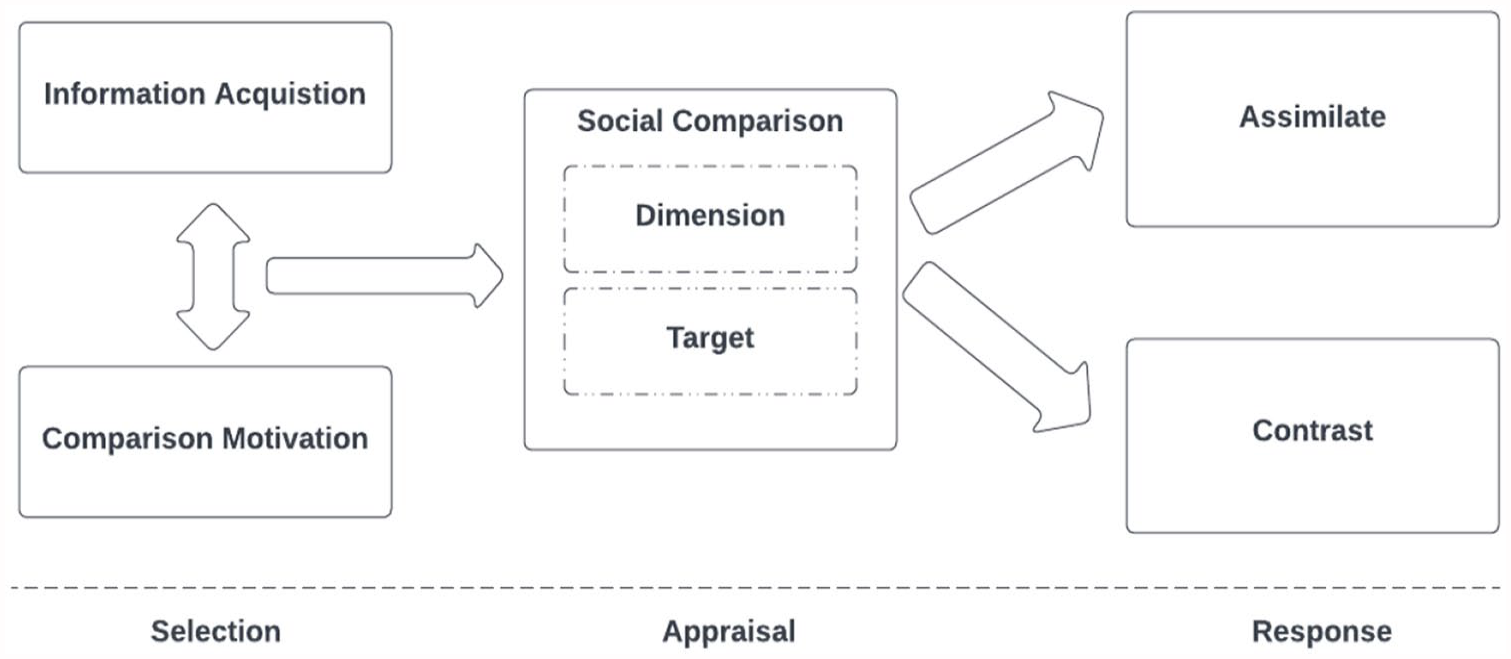
A Simplified Model of Social Comparisons
Looking Back: Social Comparison in Organizational Studies
As Sun, Li, Li, Liden, Li, and Zhang (2021: 252) observe, “the nature of organizational life provides abundant opportunities for employees to compare themselves frequently and closely.” Although there are various reasons why this is the case, we emphasize that organizations are specifically constructed to foster comparisons as a function of the abundance of information and motivation that triggers comparisons. 1 First, regarding information, at every level of the organization, there are countless domains of comparisons—and thus attainable information—available to actors. These include compensation (e.g., Bamberger & Belogolovsky, 2017), awards and recognitions (e.g., Li & Lu, 2022), performance metrics (e.g., Greve, 2008), promotions and career success (e.g., Lee & Gargiulo, 2022), treatment from leaders and coworkers (e.g., Hu & Liden, 2013), and so forth. Somewhat analogously, a central premise of SCT is that actors are concerned with comparing themselves to relevant others (i.e., actors that are “like” them) (Festinger, 1954). Although there are certainly boundary conditions to this proposition, the fact that workers compare with those who have similar job functions (Wang, Zhao, & Thornhill, 2015) indicates that the organizational setting is rife with relevant targets, thus providing one of the most valuable pools for individuals to draw upon to compare socially. At least at the micro- and meso-levels of analysis, this information is also encountered on a near-daily basis, as a vast number of adults’ waking hours are spent at work. As such, the organizational setting is saturated with information regarding both targets (i.e., actors to compare with) and dimensions (i.e., aspects of life to compare) that can inform comparisons; indeed, “it is difficult for individuals to avoid social comparison, especially when regularly interacting with co-workers” (Ang, Van Dyne, & Begley, 2003: 565).
Beyond the ubiquity of information, a distinctive feature of social comparisons in organizational settings are factors that increase the motivation to compare (see Sun et al., 2021). Again, depending on the context, this motivation can be driven by the reality of scarce resources coupled with direct competition between actors (Reh, Tröster, & Van Quaquebeke, 2018). While individuals compare in all domains of their lives, in the organizational setting, a target’s success (or failure) often directly impacts one’s failure (or success). For example, when considering promotions (Schaubroeck & Lam, 2004) or awards (Shi, Zhang, & Hoskisson, 2017), actors are in direct competition with one another, and positive outcomes are finite. Additionally, firms are equally motivated to and influenced by comparisons. Firms frequently benchmark and compare their standing to the external market, which has implications for their continued success and performance. As a historical illustration, many higher education organizations were shocked by the arrival of U.S. News & World Report rankings on universities and had to quickly adjust based on their relative standing (O’Neil, 2017). Overall, organizational settings naturally create incentives for comparisons.
Review Process
Given the preceding, it is no wonder that social comparison research has thrived within the management domain (Goodman, 2007). To increase our understanding of the current state of the field, we take stock of the extant literature that draws on SCT. Although past reviews on SCT exist, these are usually in sister fields of research (e.g., education [Dijkstra, Kuyper, Van der Werf, Buunk, & van der Zee, 2008], social psychology [Gerber, Wheeler, & Suls, 2018], abnormal psychology [Myers & Crowther, 2009], and health [Tennen, Mckee, & Affleck, 2000]), and a limitation of these perspectives is that they are generally focused on non–work phenomenon or do not consider meso- or macro-levels of analyses. Although each of these resources serves a particular purpose, a deep understanding of SCT and how it has—and should be—applied in organizational studies requires a review dedicated to this singular purpose; therefore, we present a narrative integrative review of social comparison theory in organizational settings.
To capture relevant articles, the second author led a multipronged initiative in collaboration with the first author. First, we conducted a Web of Science search for manuscripts on social comparisons. We searched abstracts, keywords, and titles with terms related to social comparison (e.g., social compar*). We constrained our search to the last 30 years (1992–2022) for parsimony. 2 In determining which journals to search, we targeted the same outlets as a recently published review in the Journal of Management that was also focused on a social theory (i.e., social role theories; Anglin, Kincaid, Short, & Allen, 2022). This journal selection process is also consistent with best practices (Short, 2009), given that it represents a reasonable boundary condition for an integrative review (Elsbach & van Knippenberg, 2020).
The initial search resulted in 185 articles. After assessing each manuscript, we excluded 35 articles that were not empirical (e.g., conceptual) or articles that were not relevant to our integrative review (e.g., special issue introduction). (Nevertheless, although we do not explicitly review these articles, they still influenced our understanding and framing of the theory.) We also evaluated the sample being investigated and determined whether or not the sample aligned with a reasonable organizational context. In total, we eliminated 16 articles when the sample was not employees and did not align with an organizational context; however, we did include 7 articles that did not study employees but aligned with an organizational context. Some examples of papers with student samples that were kept include studies on expectations of labor market entrants (e.g., Jackson, Gardner, & Sullivan, 1992; Lopez-Kidwell, Grosser, Dineen, & Borgatti, 2013) or that had participants engage in a business simulation (e.g., John, Loewenstein, & Rick, 2014). Furthermore, we eliminated articles that mentioned social comparison as a process but did not explicitly draw upon the theory. In the end, the review was abductive: as each article was evaluated, the second author considered how it could inform organizational scholars’ knowledge of SCT and how it fits into the known literature. This filtering process resulted in a total of 102 articles being included during this stage.
Second, using the same journal list as before, we conducted a backward search in Google Scholar from the seminal article on SCT—that is, Festinger (1954). The purpose of this search was to supplement our previous approach that relied on Web of Science and, thus, did not search the entire body of the article but instead searched the title, abstract, and keywords. Conversely, Google Scholar enabled us to search the entire manuscript. During this process, we captured any articles that referenced Festinger (1954) and contained the term “social comparison theory” anywhere in the text. This added step resulted in an initial list of 250 articles. After filtering out duplicates and unrelated articles, this added 29 articles to our review. Taken together, the total number of articles included in our review was 131, a number that is consistent with past reviews published in the Journal of Management (e.g., van Knippenberg & Dwertmann, 2022). Our coding sheet and additional information are available in the online supplementary material that accompany this article.
Concerning descriptive statistics, our coding of these studies revealed that 50% were survey-based, 34% were archival, 24% were experimental, and 3% were inductive. 3 Regarding geography, 57% of the manuscripts were conducted in North America, 29% in Asia, 15% in Europe, and >1% in Oceania. Most studies were at the individual (68%) or firm and top management team (TMT; 33%) levels of analysis; however, some studies did investigate teams (10%), although nearly all of these studies incorporated team dynamics while comparisons generally remained at the individual level (e.g., comparisons between individuals in a team setting and its impact on team outcomes).
In regard to theories used alongside SCT, equity theory was common, given the shared interest in understanding relative standing (Baltes, Zhdanova, & Parker, 2009; Boivie, Bednar, & Barker, 2015; Coen, 2006; Harris, Anseel, & Lievens, 2008; Hill, Aime, & Ridge, 2017; Sherf & Venkataramani, 2015). Especially at the micro-level of analysis, scholars often used other “social theories” alongside SCT, including social identity theory (Chae, Song, & Lange, 2021; Tai, Keem, Lee, & Kim, 2024; Tse, Ashkanasy, & Dasborough, 2012; Tyler & Blader, 2002), social cognitive theory (Audenaert, Carette, Shore, Lange, Van Waeyenberg, & Decramer, 2018; Downes, Crawford, Seibert, Stoverink, & Campbell, 2020; Johnson & Leo, 2020), and social information processing theory (e.g., Van Vianen, Rosenauer, Homan, Horstmeier, & Voelpel, 2018). The application of common social theories is to be expected (and is appropriate) given the social nature of organizational life; however, there is a concern when scholars draw on an excessive amount (i.e., 3+) of “social theories” simultaneously—a concept we refer to as “theory soup,” as it can become unclear where the predictions and rationale of one “social” theory ends and another begins.
At the macro-level of analysis, scholars have paired SCT with the behavioral theory of the firm (Hu, He, Blettner, & Bettis, 2017; Kacperczyk, Beckman, & Moliterno, 2015; Mezias, Chen, & Murphy, 2002; Moliterno, Beck, Beckman, & Meyer, 2014; Schillebeeckx, Chaturvedi, George, & King, 2016; Shi et al., 2017; Tarakci, Ateş, Floyd, Ahn, & Wooldridge, 2018; Washburn & Bromiley, 2012), agency theory (Bentley, Fulmer, & Kehoe, 2019; Ezzamel & Watson, 2002; Fong, 2010; Jaskiewicz et al., 2017), tournament theory (Fredrickson et al., 2010; Ridge, Aime, & White, 2015; Ridge, Hill, & Aime, 2017), and aspirations research (Greve, 2008; Hu et al., 2017; Kacperczyk & Balachandran, 2018; Kim, Finkelstein, & Haleblian, 2015; Luger, 2023; Tarakci et al., 2018; Xie et al., 2023), with multiple of these papers drawing on social comparison and two or more of these other perspectives (e.g., Pepper, Gosling, & Gore, 2015).
For simplicity, when reviewing the extant literature, we highlight instances in which authors tested components of Festinger’s (1954) original conceptualization. However, understanding what has or has not been tested is not always straightforward, considering that a “frequently used phrase in the social comparison literature” is “what Festinger meant” (Wood, 1989: 236). Additionally, we note there is a vast array of SCT perspectives used in the literature (see Table 1), including, but not limited to, classical social comparison theory (Festinger, 1954), neo-social comparison theory (also known as downward social comparisons; Hakmiller, 1966; Wheeler, 1991; Wills, 1981), upward comparisons (Collins, 1966; Thornton & Arrowood, 1966), moral comparisons (Fleischmann, Lammers, Diel, Hofmann, & Galinsky, 2021), the frog-pond effect (Davis, 1966), temporal comparisons (Albert, 1977), counterfactual comparisons (Olson, Buhrmann, & Roese, 2000), relative deprivation (Masters & Smith, 1987), self-evaluation maintenance model (Tesser, 1988), selective accessibility model (Mussweiler, 1997, 2003), the sensitivity about being a target of a threatening upward comparison (known as the STTUC model; Exline & Lobel, 1999), a general analytic structure of social comparisons (Smith, 2000), leader-member exchange social comparisons (LMXSC; Vidyarthi, Liden, Anand, Erdogan, & Ghosh, 2010), and more. In Table 1 and throughout our review, we detail components of SCT that are less well-studied than others, as well as areas that require further exploration. Finally, given that, like Daniels and Robinson (2019), the aim of our review is “to identify common patterns and connections across studies so as to integrate them into a single parsimonious framework” (p. 2450), we occasionally draw upon articles that fell outside our formal review but were still informative, especially in the “Moving Forward” section of our manuscript.
An Abridgement of Comparison Perspectives
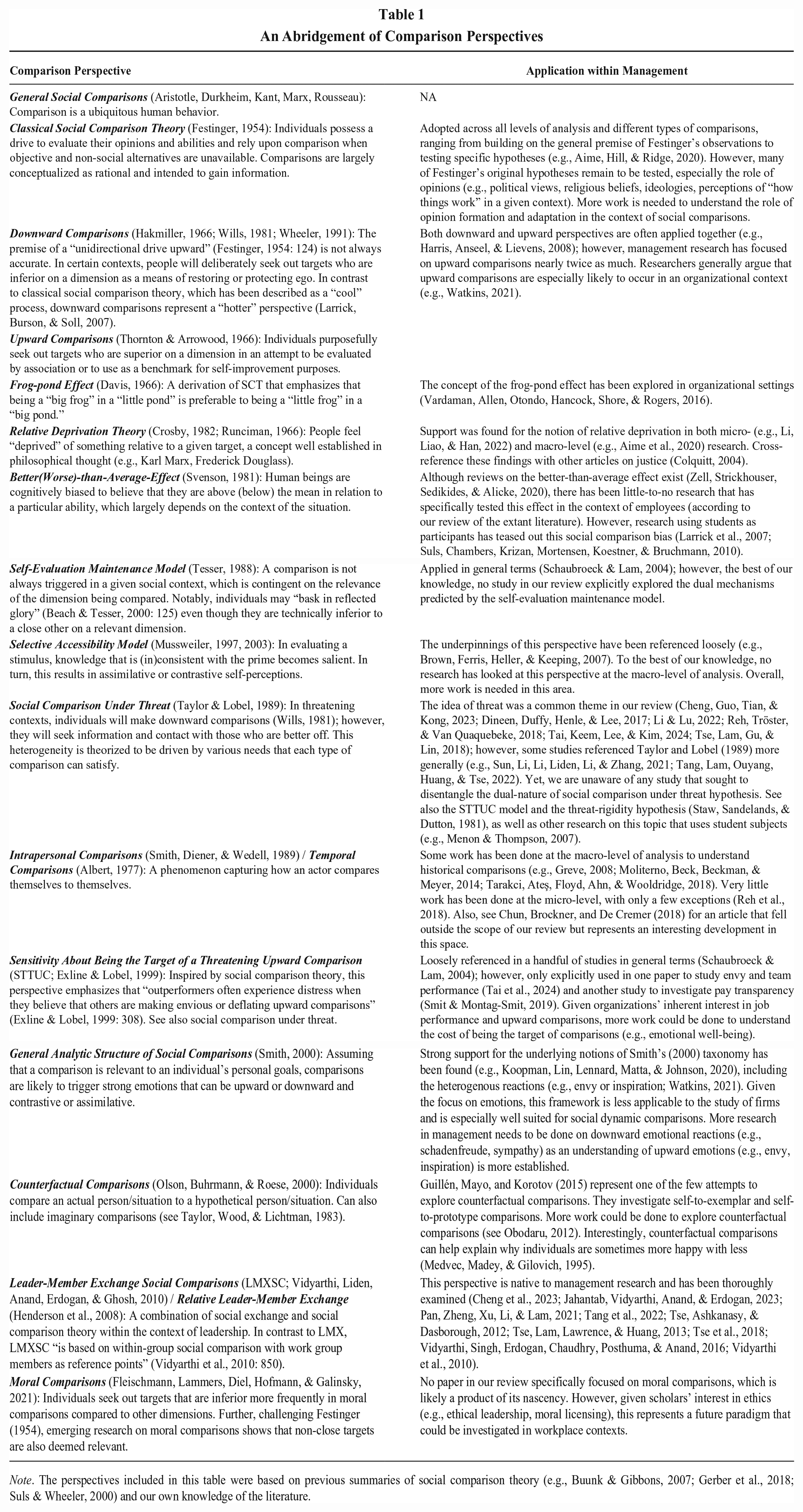
Note. The perspectives included in this table were based on previous summaries of social comparison theory (e.g., Buunk & Gibbons, 2007; Gerber et al., 2018; Suls & Wheeler, 2000) and our own knowledge of the literature.
Identification of themes
Further, our goal in reviewing the organizational literature was to identify what (i.e., the comparison dimension) actors compare in organizations. Although previous work has investigated the type of comparisons made (see Table 2 in Bartel [2001]), this empirical work was conducted at the interpersonal level of analysis and could not speak to the type of comparisons made by teams or firms. To identify key themes, we first extensively coded each article and then used our coding process and the articles to inform our selection of themes, a process similar to prior work (e.g., Anglin et al., 2022). For each article in our review, the following coded aspects helped inform our creation of themes, comparison investigated/dimension, level of analysis, research method, target of comparison, and the article’s abstract and title. The two authors reviewed and discussed the coding of the articles to finalize the relevant themes. Ultimately, the coding of each theme by the authors was an abductive process (Sætre & Van de Ven, 2021) and included aspects of “generating hunches” and then “evaluating hunches” (p. 686) as it related to the best way to frame our review. In total, we identified three major themes of how prior research has applied SCT in organizational research: compensation (e.g., salary), capabilities (e.g., performance, effort), and social dynamics (e.g., leader treatment). Notably, these themes map well onto the objective-subjective continuum, with compensation being the most objective and social dynamics being the most subjective of the three. Below, we take stock of the extant literature by stepping through each theme (i.e., compensation, capabilities, social dynamics).
Comparing Compensation
The first theme of SCT in organizational studies is compensation, which included 27% of our articles. Indeed, the entire concept of pay—including its transparency or secrecy—is a deeply entrenched component of work (see Brown, Nyberg, Weller, & Strizver [2022] for a review) and has been studied in the context of social comparisons for years in sister fields (Crosby, 1976; Messé & Watts, 1983). Perhaps this attention to compensation is best summarized by the statement that “wealth . . . is any income that is at least one hundred dollars more a year than the income of one’s wife’s sister’s husband” (H. L. Mencken, as quoted in Aime et al. [2020]). This theme is characterized by the fact that the distribution of rewards is a vital metric actors use to compare themselves with others. Of course, money is centrally linked with most compensation studies, such as salary (Bamberger & Belogolovsky, 2017) and pay dispersion (Jaskiewicz, Block, Miller, & Combs, 2017). By definition, money is fungible (i.e., it is mutually substitutable and is interchangeable so that it is equivalent across contexts), thus making it a universal tool to compare across various targets. Although asserting that one’s vice president position is superior to a colleague’s might be difficult, it is much easier to compare one’s salary. Perhaps this is why Trevor and Wazeter (2006) observe that “social comparisons . . . are central to how people react to pay” (p. 1260). Others have similarly noted that social comparison is foundational to “an economic theory of fairness” (Pepper et al., 2015: 1284). Given that income is tied to the workplace, people will be motivated to compare their rewards with others, as predicted by equity theory (e.g., Harris et al., 2008). Thus, any discussion of comparisons within organizational contexts would be incomplete without discussing the role of pay. Within the theme of compensation, research has spanned from the micro-level (Bamberger & Belogolovsky, 2017; Choi & Chen, 2007; John et al., 2014) to the macro-level (e.g., Ezzamel & Watson, 2002; Hill et al., 2017; Wade, O’Reilly, & Pollock, 2006) and is one of the more balanced applications of SCT across levels of analysis among the three themes.
Macro-level
At the macro-level of analysis, prior research has primarily examined how pay differences and the associated social comparisons derived from these disparities guide TMT and firm compensation structures (e.g., Aime et al., 2020), performance (e.g., Ridge et al., 2015), and firm or executive behavior (e.g., Bentley et al., 2019; Lim, 2019). Concerning compensation structures, De Vaan et al. (2019) found that CEOs benefit from selecting better peers for benchmarking purposes as these upward comparisons subsequently increase their own pay. This comparison process has similarly been found to occur for board members. As board members have increased pay in adjacent board positions, this increases their compensation at the focal firm (Boivie et al., 2015). In general, organizations are often motivated to select social comparisons that are superior on compensation metrics as this facilitates improved compensation outcomes for firms’ leaders (e.g., Chizema, Liu, Lu, & Gao, 2015; Ezzamel & Watson, 2002). This tendency to select superior targets is in line with Festinger’s (1954) hypothesis regarding a “unidirectional drive upward” (p. 124).
For TMTs, pay differences carry both positive and negative performance outcomes. For example, Hill et al. (2017) found that pay dispersion can benefit performance if it is congruent with team members’ contributions. In contrast, Jaskiewicz et al. (2017) found that pay dispersion harmed firm performance. Potentially reconciling these findings, Ridge et al. (2015) showed that executive pay disparity had an inverted U-shaped effect on performance. They theorized that SCT is only relevant for the negative relationship between pay disparity and performance from low to medium levels of pay disparity. In contrast, they argue that the positive relationship between pay disparity and performance between medium and high disparity is attributable to tournament theory. Likewise, Wang et al. (2015) found a similar inverted U-shape effect between pay differences and organizational innovativeness. The underlying logic for these inverted U-shape effects of pay disparity and organizational performance is linked with actors’ perceptions of either fairness (low disparity) or rent-seeking opportunities (high disparity). Low levels of disparity create a sense of fairness and equality, which can help drive performance-related outcomes. By contrast, high levels of pay disparity can drive firm performance and innovations as actors recognize that they may attain higher payment outcomes via increased performance. Taken together from a social comparison perspective, pay differences harm performance when they are not aligned or justified by contributions. They are also damaging when actors do not see a potential future gain related to pay differences.
Furthermore, firm and executive behaviors in response to pay differences also render both beneficial and adverse outcomes. In particular, actors in firms that perceive that they can benefit from pay differences are more likely to stay; however, actors that are harmed by pay differences are more likely to turnover. This research is an excellent example of testing and building upon Festinger’s (1954) hypothesis that actors seek out groups that garner favorable comparisons (Aime et al., 2020). For example, Kacperczyk and Balachandran (2018) find that horizontal pay dispersion (i.e., the difference of pay within the same organizational level) increases firm turnover, whereas vertical pay disparity (i.e., the difference of pay between organizational levels) decreases turnover. Likewise, Ridge et al. (2017) find similar effects of pay differences in TMT, with general pay dispersion positively relating to turnover and vertical pay differences between the TMT and CEO reducing turnover. As executives leave due to being relatively underpaid, they typically select new employment in firms with less pay variation and where they have higher relative pay, thus boosting their perceptions of social comparison by changing their comparison targets (Aime et al., 2020). Thus, while their pay may be unchanged, their social comparisons of pay have improved.
Micro-level
At the micro-level of analysis, several studies have considered how individuals form their comparisons of compensation (e.g., Belliveau, 2005; Jackson et al., 1992) and how employees respond to differences in compensation (e.g., Bamberger & Belogolovsky, 2017; Harris et al., 2008). In terms of wage expectations, research has focused on how gender influences wage expectations. In several instances, scholars showcased impressive theoretical precision in teasing apart the different impacts of pay structure and different types of pay comparison (external versus internal) (Trevor & Wazeter, 2006). Interestingly, Jackson et al. (1992) examined female wage expectations and found that women had lower expectations because they compared themselves to other women, who earned less than men on average. Along these lines, women who have men in their advice network and thus are more likely to socially compare to men receive higher salary offers and relatively more job offers than women with no men in their advice network (Belliveau, 2005). This general finding is congruent with Festinger’s (1954) observation that if actors are limited in terms of the availability of comparison targets, this decreases the precision of the comparison process.
Further, although Festinger (1954) discussed boundary conditions at a high level (e.g., “factors which increase the strength of the drive to evaluate . . .” [p. 130]), research in this space has drawn on more recent advancements of the theory and demonstrated more specific differences between employees, such as social comparison orientation, desire for social comparisons, uncertainty in the workplace, being in the middle of a pay grade, and fear of negative evaluations all prompt employees to seek and share pay information (Smit & Montag-Smit, 2019).
Not surprisingly, socially comparing oneself to someone who is similar but better-compensated results in negative responses such as envy (Bamberger & Belogolovsky, 2017), compensation dissatisfaction (Harris et al., 2008), cheating (John et al., 2014), reduced sense of pay fairness (Kim, Wang, Chen, Zhu, & Sun, 2019), and a diminished desire to help the comparison other (Bamberger & Belogolovsky, 2017). In contrast, comparing oneself to a referent who is more poorly compensated can increase satisfaction, reduce turnover, and improve work effort (Levine, 1993). That said, when individuals are extremely overcompensated compared to a similar other, this can reduce their sense of pay fairness (Kim et al., 2019). These negative and positive reactions are not necessarily in line with Festinger’s (1954) original premise, which generally stopped short of unpacking intrapersonal and interpersonal reactions; however, these findings align with later developments of SCT (e.g., Smith, 2000). In sum, drawing from the firm-level research, the aggregate adverse effects of comparisons at the individual likely outweigh the aggregate potential benefits as the firm-level research finds that horizontal pay differences are typically harmful to organizational outcomes (e.g., Kacperczyk & Balachandran, 2018).
Comparing Capabilities
Our second theme was capabilities, which included 41% of our articles. Capabilities—as its name implies—concern actors’ ability to ascertain knowledge or their relative ability to execute their formalized role. In Festinger’s (1954) original work on SCT, he argued that social comparisons were driven by an individual’s desire to gain accurate information about the self, and “abilities” is a crucial comparison dimension (Festinger, 1954). Actors often use social referents to gauge their own capabilities, which can be a helpful way to benchmark where an actor stands. Some of the most common ways comparisons that fall under the category of capabilities include performance (e.g., Luffarelli et al., 2016; Obloj & Zenger, 2017), performance awards (Liao, Feng, Zhu, & Guan, 2023), and overqualification (e.g., Jahantab, Vidyarthi, Anand, & Erdogan, 2023; Li, Liao, & Han, 2022).
Macro-level
Both large and small firms are highly sensitive and influenced by the capabilities of referent others. Similar to compensation, firms are not passive in selecting comparison targets. When firms experience heightened uncertainty, they alter their referents to more similar firms to provide better benchmarks of relative performance (Luger, 2023). When making comparisons on capabilities, these comparisons can drive growth (Greve, 2008), cause organizational change (Moliterno et al., 2014), influence strategic behavior (Tarakci et al., 2018), and impact acquisition behaviors (Shi et al., 2017). Firms evaluate their performance in comparison to their past performance, historical comparisons (e.g., Greve, 2008), and the performance of referent others—social comparisons (e.g., Shi et al., 2017). Crucially, these different comparisons often render heterogeneous firm responses (e.g., Kacperczyk et al., 2015; Kim et al., 2015). For example, Kim et al. (2015) found that acquisition behavior declines when firm performance exceeds historical aspirations. Nevertheless, when firm performance is higher than a social referent, this increases acquisition behavior.
Micro-level
For individual employees, engaging in social comparisons capabilities can lead to attitudinal (e.g., Baltes et al., 2009) and behavioral responses (e.g., Edelman & Larkin, 2015). For upward comparisons, one of the most common responses is the emotional reaction of envy (e.g., Breidenthal, Liu, Bai, & Mao, 2020; Kim & Glomb, 2014), which is perhaps why envy has been referred to as “social comparison jealousy” (Salovey & Rodin, 1984). Notably, Festinger did not focus on emotional reactions but rather generally assumed that actors would “[face] up to his or her honest self-assessment” as a way of “[bettering] the self” (Wood, 1989: 232). Thus, studies in this space often drew on later developments of SCT, such as Smith’s (2000) taxonomy (e.g., Li et al., 2022).
In addition, capabilities-based social comparisons have been linked with victimization (Kim & Glomb, 2014), deviance (Dineen et al., 2017), deception (Edelman & Larkin, 2015), unethical behavior (Tzini & Jain, 2018), reduced performance (Downes et al., 2020), and self-serving behaviors (Rus, van Knippenberg, & Wisse, 2010). The undergirding negative behavioral response of these upward social comparisons can be linked with a desire to enhance one’s sense of capabilities, often via potentially unethical means, or to undermine or attack an outperforming comparison other. Notably, reactions toward the target are not always predicted by Festinger (1954) and, in some ways, contradict it (espeically as it relates to objective, rather than subjective, comparisons). Concerning abilities—which is akin to capabilities—Festinger (1954) specifically suggested that engaging in comparisons toward a target who outperforms an individual led to a recognition of their superiority, not an increase of hostility or derogation. However, this reaction to a target aligns with other developments in SCT (Smith, 2000; Tesser, 1988).
One of the silver linings of social comparisons is that upward social comparisons can also increase motivation (e.g., Song, Tucker, Murrell, & Vinson, 2018) or network expansion (Lee & Gargiulo, 2022). For example, Song et al. (2018) show that providing public relative performance feedback led to a 10.9% upturn in productivity among physicians in emergency departments, as this public information revealed top performers and their superior strategies, which aligns with the fact that Festinger (1954) specifically highlighted that when there is a discrepancy, this “will lead to action” (p. 124) to reduce the said discrepancy (see also Bradler, Dur, Neckermann, & Non, 2016). The effects of enhanced performance due to capabilities-based comparisons can be lagged, and the positional ranking of the employee compared to the referent other influences the magnitude of the boost in employee performance, with the lowest-ranked employees seeing the most considerable boost in performance (Song et al., 2018). Further, these potentially beneficial effects of social comparisons are context and employee-dependent (Downes et al., 2020; Moore & Klein, 2008; Van Waeyenberg, Brebels, De Winne, & Marescaux, 2023). In regards to capabilities in organizations, research has not thoroughly explored Festinger’s (1954) observation that “there are non-social restraints which make it difficult or even impossible to change one’s ability” (p. 125), and generally speaking, the evidence suggests that individuals possess a great degree of agency in changing their workplace abilities.
Comparing Social Dynamics
Our last central theme dealt with numerous social factors, which we ultimately categorized as “social dynamics” and included 41% of our articles. The theme of social dynamics relates to social or interpersonal factors that are often subjective and embedded in the actor’s context. The fact that individuals compare their own social dynamics with the social dynamics of others makes intuitive sense, given that the goal of these comparisons has multiple possible motives (e.g., self-enhancement). Examples of these types of comparisons include comparing ideology (Takeuchi, Yun, & Wong, 2011), reputation (Kim & Tsai, 2012), prestige (Salaiz, Evans, Jones, & Pathak, 2022), leader-member exchange (LMX; Hu & Liden, 2013), positive personal experiences (Watkins, 2021), home-work balance (Carlson, Quade, Wan, Kacmar, & Yin, 2023), and even the arrival of a new coworker (Slavova, Fosfuri, & De Castro, 2016). Notably, Festinger (1954) focused more on abilities and opinions; however, researchers in this space have generally transferred the underlying logic of Festinger (1954) to apply to social dynamics. However, much of the research in this space is more appropriate for variants of SCT that emphasize the importance of self-esteem (e.g., Tesser, 1988). (Naturally, increasing our knowledge of how comparisons on social dynamics differ from compensation and capabilities is a critical future direction that we discuss later in the manuscript.)
Macro-level
The primary firm-level comparison in this theme is firm reputation or status (e.g., Kim & Tsai, 2012; Yildiz & Fey, 2016; see also Belliveau, O’Reilly, & Wade, 1996). One of the organization’s most prized components of its social identity is its relative status. Understandably, firms and CEOs are sensitive to their relative reputation. Sentiments of lagging can prompt action to amend their reputational identity. Specifically, Shi et al. (2017) explored how competitors react to peer CEOs who win awards. They found that competitor CEOs engage in more acquisitions in response to this information.
General firm reputation is likewise related to SCT. For example, firms that are seen as less favorable on online forms are quicker to engage in corporate social responsibility (Luo et al., 2016) as a response to improve their relative standing. However, reputational comparisons between firms are influenced by CEOs (Tang, Mack, & Chen, 2018), and CEOs’ individual differences can influence how they view the relative importance of different reputational comparisons. Social dynamic comparisons thus possess a higher level of idiosyncrasy relative to compensation and capabilities, as firms and TMTs have differing values and priorities.
Micro-level
For individuals, research has explored how employees compare themselves across a variety of social factors such as career position (Gibson & Lawrence, 2010), job search behaviors (Johnson & Leo, 2020), overqualification (Jahantab et al., 2023), work-family balance (Carlson et al., 2023), and workplace standing (Reh et al., 2018). For individual employees, one of the most popular and well-studied comparisons in this theme is the relationship followers have with their leaders, often captured by differences in LMX or relative LMX (abbreviated as LMXSC or RLMX; e.g., Hu & Liden, 2013; Tse, Lam, Gu, & Lin, 2018; Tse, Lam, Lawrence, & Huang, 2013; Tse et al., 2012; Vidyarthi, Singh, Erdogan, Chaudhry, Posthuma, & Anand, 2016; Vidyarthi et al., 2010). Our relationships and the quality of our relationships often form the basis of the self-concept (Linville, 1987), which is a core part of one’s social identity; indeed, social identity theory is based on social comparisons (e.g., Hornsey, 2008). Followers who make downward comparisons of leader relationships toward others have improved in-role and extra-role performance (e.g., Vidyarthi et al., 2010) and an improved sense of self-efficacy or competence (e.g., Hu & Liden, 2013). In contrast, those who perceive a worse relationship with their leader or perceive worse treatment from their leader experience hostility (Tse et al., 2018), contempt (Tse et al., 2013), and envy (Pan et al., 2021) toward those with better relationships. These perceptions of poor leader-follower relationships and treatment can result in harmful behaviors directed at those with a superior quality relationship. These comparisons can increase emotional strain (Huo, Lam, & Chen, 2012) and resource depletion (Koopman, Lin, Lennard, Matta, & Johnson, 2020). The relative treatment employees perceive to receive from their leaders forms a predicament for leaders who can benefit from treating certain employees better than others but at the expense of disengaging other followers.
Cross-Theme Similarities and Differences
Notable similarities and differences emerged between our themes that warrant attention. First, the themes of compensation and capabilities—as compared to social dynamics—were theoretically operationalized more consistently. Compensation was almost always captured by some measure of pay, and capabilities were almost invariably captured by some metric of task or firm performance. In contrast, research on social dynamics captured a broad array of social features (e.g., work-family, i-deals, CSR, reputation, career choices, organizational/leader treatment, demographics). Thus, although 41% of the articles in our review were categorized as part of the social dynamics theme, this does not necessarily imply that our knowledge is fully mature, given the great variety within this theme.
Second, comparisons of social dynamics and, to a lesser extent, capabilities are often more complex and nuanced than compensation due to their more subjective nature. Novel issues arise when there is subjectivity about one’s relative position compared to another and when the dimension being compared is differentially valued. For example, work by Tang, Lam, Ouyang, Huang, and Tse (2022) highlighted how two actors can simultaneously view each other as having a better leader-member relationship. Likewise, Tang et al. (2018) highlighted how organizations value CSR comparisons differently based on the traits of the CEO. Later in the manuscript, we note how future research can explore these exciting prospects related to more subjective comparisons.
Third, across all themes, there has been a much stronger emphasis placed on upward comparisons, in contrast to downward comparisons. In organizational contexts, it is expected that upward comparisons will occur. Indeed, this emphasis on upward comparisons makes intuitive sense, as scholars have often argued that organizations naturally create motivation to aspire upward (e.g., organizational charts). However, across all themes, we know relatively less about how actors respond and deal with downward comparisons. As noted in Table 1, more work could be done to understand the role of downward comparisons and whether they are confined to the micro-level of analysis or also encompass teams and firms. As such, we call for more work to explore the contexts in which a downward comparison may be triggered.
Fourth, the reason that we omitted subsections on “meso-level” findings is that no study explicitly explored comparisons at the meso-level; however, we note that several studies explored how team variables (e.g., interpersonal helping, groupwork, cooperative team goals) intersected with dyadic social comparisons. In particular, several studies showed how performance comparisons within teams create both discord and synergy. These countervailing effects are partly driven by the duality of collaboration and positively standing out (Coen, 2006; Lount & Wilk, 2014). For example, Coen (2006) found that teams cooperate more when they see competitors as more favorable but cooperate less when they see teammates as more favorable. Witnessing a competent competitor creates a rise in team connectedness, but that same competence within the team creates distance within the team and a potential sense of threat. However, team members do not want to be perceived as weak. Lount and Wilk (2014) find that publicly posting individual performance can benefit team performance compared to working alone. We applaud research that has looked at SCT in the context of teams; however, most meso-level studies are related to the theme of capabilities, and more work needs to be done across all three themes on this topic.
Fifth, there was a surprising amount of consistency across themes with regard to comparison responses—that is, comparisons appear to feature a certain degree of equifinality. For example, comparisons on compensation, capabilities, and social dynamics were all found to lead to envy (e.g., Bamberger & Belogolovsky, 2017; Kim & Glomb, 2014; Koopman et al., 2020), harmful and counterproductive work behaviors (e.g., John et al., 2014; Tai et al., 2024; Tse et al., 2018), and turnover or turnover intentions (e.g., Hambrick & Cannella, 1993; Ridge et al., 2017; cf. Tyler & Blader, 2002). While unique differences remain between these different themes, the underlying processes of socially comparing frequently present similar responses independent of the dimension being compared.
Methodological Insights
The previous sections outlined the type of comparisons that are made within organizations; however, a consistent point across all types of SCT studies is the need to justifiably operationalize social comparisons. In other words, there remains the question of how researchers are studying comparisons. We highlight three main approaches in the extant literature (i.e., proxy variables, atomistic comparisons, molecular comparisons), including observations on when each approach may or may not be appropriate. Markedly, no paper in our study used formal group-level analysis measures (hence its absence from our discussion), and going forward, scholars should adopt appropriate measurement techniques for such investigations (see Bliese, 1998; LeBreton, James, & Lindell, 2005; Newman & Sin, 2009).
First, proxy variables do not explicitly measure social comparisons but capture related concepts purported to serve in their place. For example, Ang et al. (2003) measure task interdependence to capture social comparison based on the assumption that interacting with coworkers will increase the likelihood of comparisons between coworkers. Lount and Wilke (2014) use a dichotomous variable of posting (or not posting) performance with the observation that posting may “facilitate a culture of comparison” (p. 1100) in given contexts. Somewhat analogously, Brady, Brown, and Liang (2017) argue that workplace gossip “generally includes an explicit or implied social comparison due to the presence of evaluative talk about another individual” (p. 4), suggesting that SCT may be operationalized in the form of workplace gossip.
Despite the flexibility afforded by proxy variables, we recommend that if scholars are seeking to understand social comparison processes, proxy variables be avoided where possible at the micro- and meso-levels, where comparison measures are relatively easy to capture unless a clear theoretical or methodological rationale can be provided for why an alternative measure is more suitable. For the macro-level of analysis, constraints may necessitate the use of proxy variables. As noted by Gartenberg and Wulf (2020), in regard to capturing social comparisons at the firm level, “identifying social comparison as a mechanism is notoriously difficult, as it is by nature intangible,” and they continue by advocating for capturing social comparisons, “by testing the predictions of outcomes or behaviors that are easily explained by social comparison and less easily explained by other means” (p. 5934). Likewise, Obloj and Zenger (2017) noted that capturing comparison emotions was “either impossible or prohibitively costly” (p. 7). Instead, they sought to capture variables that theoretically mapped back to SCT. Given the inherent difficulty in directly capturing variables at the macro-level of analysis, most articles applied proxy variables or, in specific contexts, atomistic comparisons, which we discuss next.
Atomistic comparisons 4 are defined by taking two quantifiable discrepancies between actors on a given dimension and assuming that a comparison occurred in the presence of such a discrepancy. In particular, Jasso (2006) presents a formulaic way to test atomistic comparisons, and this type of approach was quite common at the macro-level of analysis. Multiple articles in our review adopted this methodological approach. For example, Aime et al. (2020) use the ratio of executive pay to mean TMT pay to infer that a comparison has occurred. Although this was most common at the macro-level of analysis, at the micro-level, it is also possible to capture comparisons in this way. For example, several studies captured social comparisons by taking an individual’s dimension score and finding its difference from the focal employee’s group mean of the dimension (e.g., Edelman & Larkin, 2015), such as when Jahantab et al. (2023) calculated relative overqualification by “subtracting the group mean of overqualification from a focal employee’s perceived overqualification score” (p. 886). As another example, leaders could rate all employee’s performance for a group, and then each employee’s “socially compared” performance is the difference between their performance score and the average of the group. Another approach was calculating differences using polynomial regression to capture social compared differences (e.g., Audenaert et al., 2018). A clear advantage of atomistic comparisons is that there is a reduced likelihood that individuals will inflate or deflate their own value on a dimension based on their comparison target. Indeed, the idea that individuals are biased in their evaluations is well-established in the SCT literature (Wood, 1989). However, a limitation is that scholars cannot determine whether a comparison actually occurred between two actors.
Third, molecular comparisons are when an actor explicitly compares themselves to another. For example, Carlson et al. (2023) asked participants, “When considering (coworker’s name), how much more or less likely are you to experience each of the following than him/her?” Existing research at the micro-level of analysis would suggest that molecular comparison measurements are the gold standard when investigating comparisons, and we recommend using the scale anchoring items provided by Koopman et al. (2020) in their study of leader justice. In their study, they used the anchors of 1 = “far less,” 2 = “less,” 3 = “equal,” 4 = “more,” and 5 = “far more” and placed a blank space in their scale item to indicate a comparison. (It is even more preferable when the authorship team can pipe in the initials of the target to whom the actor is comparing, which can be obtained at the beginning of the survey, to ground the participant in the current study). The preferability for molecular comparisons is also attributable to the fact that, to a certain extent, in studying organizational behavior, and especially social interactions, perceptions are king; that is, an “individual’s perceptions of a social phenomenon are critical to driving their subsequent response to that phenomenon” (Meister, Jehn, & Thatcher, 2014: 490, emphasis original).
Within the broader discussion on molecular comparisons, we caution against truncating comparisons so that downward or upward comparisons are not possible. We use the term “truncate” to refer to the practice of limiting the full range of comparison on a dimension (e.g., making the scale only range from “about the same” to “much more”). Even if scholars capture the full range (e.g., 1 = “far less”; 5 = “far more”), they can still justifiably theorize on one type of comparison by drawing on their chosen theoretical paradigm, which is often tied to motivation. Indeed, “lateral comparisons serve self-evaluation, downward comparisons serve self-enhancement, and upward comparisons serve self-improvement” (Corcoran et al., 2011: 125), indicating that theorizing on a direction is entirely appropriate in a given circumstance. However, we do not recommend unnecessarily reducing variance in the act of operationalization via a truncated scale unless there is a theoretically justifiable reason for doing so.
Looking Forward: A Simplified Model of Social Comparisons
Despite the excellent theory-building and testing that has proliferated the management literature (e.g., Waltré, Dietz, and van Knippenberg, 2023), our review reveals several challenges that face the field, which we recapitulate here. Although many studies remained faithful to a particular paradigm (as shown in Table 1), other studies have overlooked; not kept abreast; or, at a minimum, overlooked the nuances and paradoxes of social comparisons that have yet to be untangled. As Wood (1989: 231) observes: “For some time, researchers have operated under an understanding of social comparison that goes beyond Festinger’s (1954) original theory and that in some ways contradicts it.” Considering that this statement was penned over thirty years ago, exclusively drawing upon Festinger while ignoring advancements in SCT research (which many papers in our review do) can lead to improper theorizing. As an illustrative example, Festinger’s (1954) observations regarding a “unidirectional upward drive” and a preference for similar targets have notable boundary conditions (Wood, 1989), a fact often forgotten when organizational scholars are simply “cherry-picking” from the broader social comparison literature and do not adopt theoretical precision. The challenge for social comparison researchers is to be simultaneously cognizant of SCT research that can help answer these questions while still being able to draw from foundational components of SCT (Festinger, 1954) that remain relevant to understanding how comparisons operate in the workforce.
In addition to this first concern (i.e., theoretical imprecision), our review also highlighted another conundrum: social comparison research (and theory-building) is lopsided when it comes to levels of analysis. As previously mentioned, much of the work on social comparisons skews to the micro-level of analysis, which presents several challenges. For example, historically, scholars have relied upon theories meant for micro-level analysis and adapted them to other levels. Greve (1998), for example, recognized that “there is less research on social comparison among organizations” (p. 60) and thus discussed how factors known at the micro-level may transfer to studies of firms. Despite the suitability of this adaptation (which is the best-case scenario given the research at the time), more theory-building needs to be done in the areas of groups and firms to assess the assumptions that have been developed at the interpersonal level of analysis (see Luger [2023] for a rare, but excellent, example of this practice). Recall that social comparison theory is inherently interpersonal; thus, more conceptual work must be done to build this theory at other levels.
Third and finally, our review revealed that our knowledge regarding dimensions of social comparisons is stable as it relates to compensation and capabilities. In other words, the existing research on how these comparisons unfold in the workplace is relatively uniform. Thus, based on our review of the literature, there is a need for the research drawing on SCT to move away from studying compensation and capabilities and more toward social dynamics. This need for more research on subjective dimensions is not intended to suggest that objective comparisons do not represent legitimate areas of research inquiry. However, our understanding of comparisons in terms of social dynamics is currently underdeveloped, and new initiatives should focus on areas where social comparisons are less understood; indeed, novel contexts provide an opportunity to test the boundary conditions of SCT. In situations where scholars continue to study compensation and capabilities, a greater focus on teasing apart the nuances of comparisons should be a priority.
To address these three issues that exist in the literature, we draw inspiration from previous conceptual work on SCT (Buunk & Gibbons, 2007; Goodman & Haisley, 2007; Greenberg, Ashton-James, & Ashkanasy, 2007; Kulik & Ambrose, 1992; Wood, 1996) and present a simplified model of social comparisons (Figure 1) that is adaptable to multiple “theoretical strands” (Wood, 1989: 231), levels of analysis, and types of comparisons. Naturally, this model is intended to help increase theoretical precision; however, we encourage scholars to familiarize themselves with the broader SCT literature since this model is not intended to abrogate existing frameworks (shown in Table 1) or empirical findings. Instead, we envision our model helping bring together multiple ideas previously existing in the literature and serve as a fulcrum for research moving forward. To demonstrate our model in action, we center our discussion section around each phase of the model (i.e., selection [Table A1], appraisal [Table A2; Figure 2], response [Table A3]) with future directions regarding general research questions, levels of analysis, and comparison dimension. Tables A1 to A3, as well as discussion of cross-level comparisons, can be found on our online supplementary material. As a final note, to present and contextualize our simplified model, we link the findings of our review with other research on social comparisons in sister fields (e.g., social psychology) and other domains (e.g., citizenship behavior).
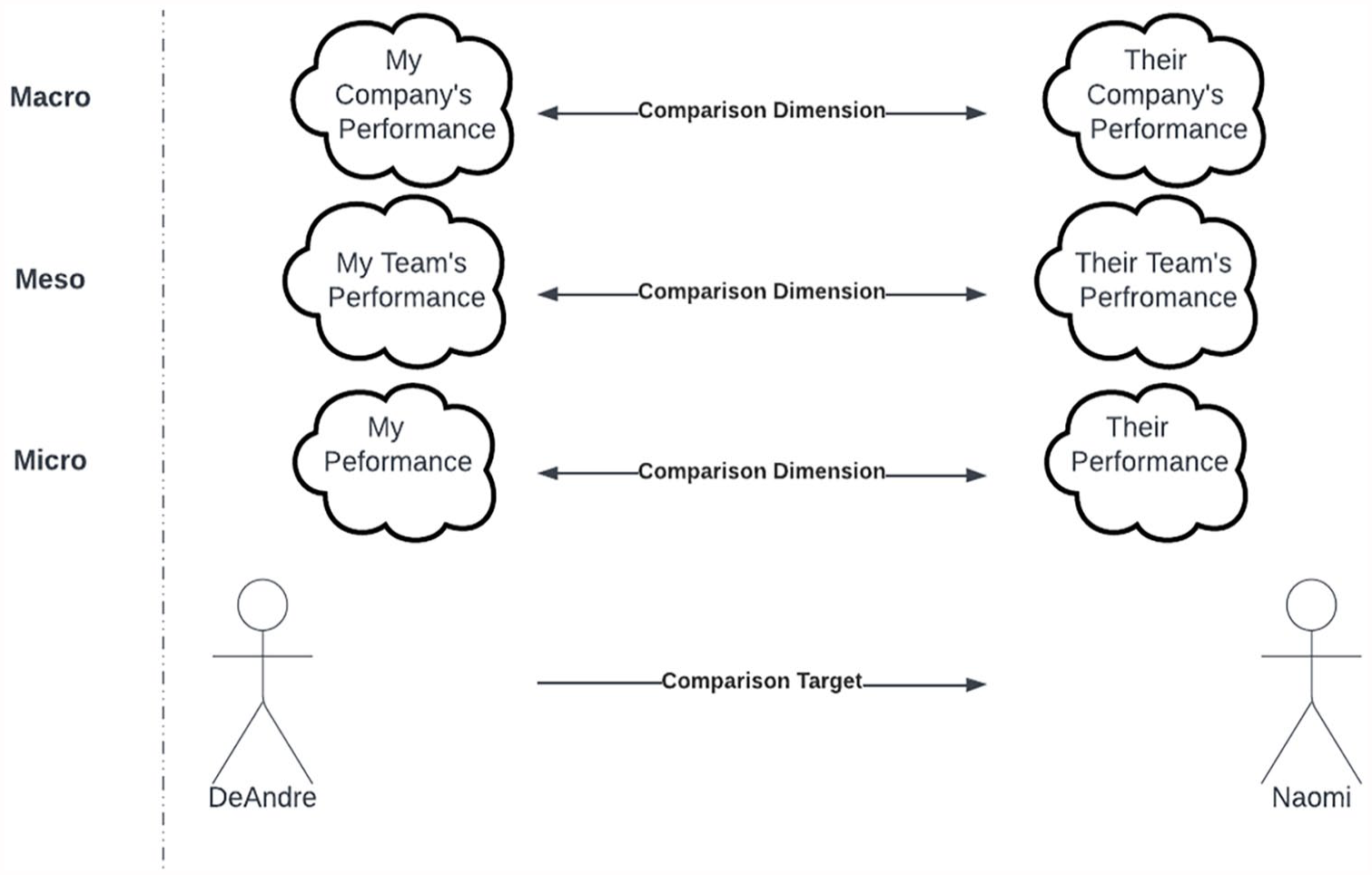
An Illustration of Comparisons and Levels of Analysis
Phase 1: Selection
As shown in Figure 1, the selection process concerns the mechanisms by which the combination of (a) information acquisition and (b) comparison motivation produce a social comparison. 5 First, information acquisition can be actively or passively initiated. Seeking information deals with proactively looking for relevant social cues and information to make comparisons (Wood, 1996). In contrast, encountering information emphasizes that many social comparisons occur subconsciously or automatically when new information is presented. For example, an employee may ask a coworker how much they earn (seeking information), or a team meeting may feature a boss unexpectedly presenting employee productivity statistics (encountering information). Notably, information acquisition varies based on the level of analysis and comparison dimension. For example, TMTs can likely acquire their peer’s salaries due to the openly available information of many public firms, whereas employees working for the same company may not be able to find this data.
Within the realm of selection—that is, the first phase of our model—motivation also plays a notable role, with various forms of motivation proposed (Helgeson & Mickelson, 1995). Festinger’s (1954) original work generally held motivation constant, or in his words, “There exists, in the human organism, a drive to evaluate [his/her] opinions and [his/her] abilities” (p. 117). In particular, identifying various motivations was a key jumpstart to later developments (e.g., neoclassical social comparison theory; Suls & Wheeler, 2000). In our model, motivation also umbrellas factors such as “social comparison orientation” (Gibbons & Buunk, 1999), which captures the fact that “social comparison is not equally important to everyone” (Van der Zee, Oldersma, Buunk, & Bos, 1998: 802) and is a critical individual difference (see Watkins, 2021). Although space precludes an exploration of all the ingredients of social comparison motivation (e.g., relevance; see Kulik & Ambrose, 1992; Tesser, 1988), we note that motivation is a critical antecedent of the comparison process, independent of its origins (e.g., whether contextually or dispositionally sourced).
Stepping back and assessing information acquisition and motivation in tandem, we challenge the field to seriously consider the underlying assumptions regarding these two components based on their phenomenon of interest. As previously mentioned, for example, these two elements may interact. Case in point, there is often too much information for any actor to process, so actors must select information. An actor’s motivation undoubtedly influences this filtering process. Remember, “social comparisons are not purely social, but can also be cognitively manufactured to meet particular motives or goals” (Taylor & Lobel, 1989: 569), as manifested in threatening situations (Christy & Fox, 2014; Marx, Stapel, & Muller, 2005; Reh et al., 2018). In this way, one’s “information” and its impact on the eventual comparison is not wholly independent of motivation but can only be understood in parallel. Considering that information processing and motivation are both endogenous to a particular actor, it should be unsurprising that they interact. Although research is still nascent in unpacking this interaction in the context of SCT, we encourage future scholars to consider this moving forward.
As these preceding arguments show, more thought needs to be given to information and motivation. For example, if scholars theorize that individuals engage in upward comparisons as they relate to morally charged workplace constructs (e.g., ethical behavior comparisons), this position would contradict recent research on moral comparisons, which suggest individuals are strongly motivated to engage in downward comparisons (Fleischmann et al., 2021). In this case, researchers would be ill-advised to rely on the premises of Festinger (1954), who would predict an upward comparison and instead give more credence to modern developments relating to this type of comparison, which hypothesizes the opposite effect. Conversely, if researchers are studying a context in which a social comparison may—or may not—trigger (i.e., an actor does not advance to the appraisal process of Figure 1), then drawing on the self-evaluation maintenance model (Tesser, 1988) is justified given its conceptual design of featuring a comparison and non-comparison route.
Finally, as it relates to the selection process, more work could be done on when comparisons are attenuated in organizational contexts. The cardinal hypothesis of social comparison states that “there exists, in the human organism, a drive to evaluate [his or her] opinions and [his or her] abilities” (Festinger, 1954: 117), and later seminal works, such as Smith’s (2000) general analytic framework of social comparisons, similarly recognized “the evolutionary underpinnings of our capacities to compare ourselves with others” (Smith, 2000: 194). Yet, according to classical philosophers, relativist concerns are not solely biological but, rather, socially driven (Rousseau, 1754/1984; see also Smith [2000]), revealing the critical observation that the process of organizing (Scott & Davis, 2015) is often the source of comparisons. If this is true, then we suspect that comparisons are less likely to occur (or at least be attenuated) based on the form of organization. For example, depending on the type of organizing (e.g., loose versus structured), the purpose of organizing (e.g., for-profit versus non-profit), and the frequency of organizing (e.g., stable versus alternating project teams), comparisons may be more or less likely to occur.
Levels of analysis
As foreshadowed, we now discuss future directions as they relate to the intersection of the selection process of social comparisons and levels of analysis. As shown in the online supplementary file, we encourage future research to explore social norms regarding social comparisons and how they vary by level of analysis. For example, at the macro-level, we suspect that it is entirely acceptable and expected that organizations compare themselves with one another. Indeed, these comparisons align with Festinger’s (1954) conceptualization that comparisons are a logical way to self-evaluate and corroborate macro-oriented perspectives such as benchmarking. However, comparisons at the micro-level of analysis may be viewed as “petty” due to their intertwinement with self-esteem and emotions. For example, an employee who discloses that they compare themselves with their coworker will likely be viewed more negatively than if a firm publicly compares themselves with a competitor.
Along these same lines, at the meso-level of analysis, more work could be done to see what structural factors normalize or discourage comparisons from occurring. For example, the process of gamifying tasks (e.g., leader boards) is becoming increasingly common (Smith, Butts, Courtright, Duerden, & Widmer, 2022). Gamifying job duties can increase the enjoyability of the task; nevertheless, keeping “score” may increase comparisons, which is a way that “organizational leadership tries to improve managerial processes” (Landers, 2019: 137). Thus, managers and scholars need to further investigate the tradeoffs associated with gamification and identify inflection points where games “go too far” and become the source of toxic competition.
Another fruitful area of research is to understand leadership as a group process. In the context of leader identity (Steffens et al., 2014), leaders are motivated to advance an identity and shape how followers think of themselves, which often satisfies the “motivat[ion] to see that (in)group (‘us’) as positively distinct from other comparison (out)groups (‘them’)” (Haslam, Gaffney, Hogg, Rast, & Steffens, 2022). In this context, leaders often have control over information and can strategically give information to followers, but they also possess the wherewithal to influence motivation by strategically incentivizing followers to engage in particular comparisons. For example, using a field experiment, Waltré et al. (2023)—in their state-of-the-art application of SCT—focus on how leaders can promote “assimilation-focused sense giving,” which influences assimilative comparisons done by the followers, ultimately impacting job performance. In their study, they identify how leaders can contextualize job performance in a way that motivates high performers to continue to execute well and lower performers to be inspired by higher performers and emulate their efforts. Research can address the dearth of research at the meso-level of analysis by considering leadership identity to answer questions such as how leaders motivate employees to make certain comparisons and how social comparisons are impacted when they are exogenous (e.g., created by the leader).
Comparison dimension
Regarding the selection phase of social comparisons as it relates to the comparison dimension, we encourage future research to investigate how comparison motivation is dependent on the dimension of the comparison. As shown in Figure 1, comparison motivation is a crucial component of comparisons, and scholars have almost universally assumed comparison to be constant regardless of the type of comparison (i.e., objective versus subjective); however, we suspect this assumption is likely incorrect. For example, an individual may have self-esteem motivations for comparing social dynamics but self-improvement motivations for comparing workplace capabilities. Somewhat analogously, research on the “better-than-average” social comparison bias (Zell, Strickhouser, Sedikides, & Alicke, 2020)—along with its counterpart “worse-than-average”—may help unpack how motivations for comparisons vary across dimensions and how these motivations shape the accuracy and validity of comparisons, especially considering the fact that “better-than-average” comparisons thrive when information cannot be easily verified (as in the case of “social dynamic” comparisons). Indeed, there is research to support that this effect is influenced by the degree of information that individuals possess (Kruger, Windschitl, Burrus, Fessel, & Chambers, 2008) and that comparisons may become more rational as information accumulates. Relatedly, SCT could be integrated with self-verification theory (Swann, 2012) to identify instances in which individuals are motivated to engage in inferior comparisons for the sake of preserving their identity, even at the cost of being seen as less. This research would be especially fruitful at the micro-level of analysis, where more motivations for comparisons have been identified (Helgeson & Mickelson, 1995; Suls & Wheeler, 2000).
Another research area to consider is the role that hybrid work will have on the types of comparisons being made. Greenberg et al. (2007) note that “virtual environments deny employees some comparative information that otherwise might be available to those in traditional work environments” (p. 30). However, this suppression of information likely does not have an equal bearing on all types of comparisons. For example, regardless of how employees interact (e.g., in-person or virtually), knowing a series of digits that represent a coworker’s salary is plenty of information to still make a comparison. Conversely, comparing social dynamics (e.g., LMXSC) is likely more difficult in virtual environments because these subjective comparisons require more data points.
Phase 2: Appraisal
Transitioning to the second phase of our model, we highlight two key factors regarding the appraisal process: target and dimension. This approach builds upon prior models (e.g., Bogard, Delmas, Goldstein, & Vezich, 2020; Wood, 1989, 1996) and seeks to highlight the difference between who (target) and what (dimension) is being compared. Target comprises the characteristics of whom an actor compares with and captures aspects about the comparison target such as ingroup vs. outgroup, rivalry, gender, relational closeness, positional relevancy, positional distance, leader vs. coworker vs. subordinate, and so forth. The characteristics of the target with whom actors compare relate to how individuals appraise the social comparison (e.g., Xu et al., 2020). An illustrative example of the importance of considering the target is work by Tai et al. (2024), which showed that employee envy varies by the gender of the comparison target. Secondly, dimension captures what is being compared. Numerous dimensions can be compared between two actors: performance, compensation, prestige, and more. Notably, in our model, dimension also captures the valence of the dimension—that is, whether the value of the other actor’s dimension is superior, inferior, or the same. For example, in the context of performance, valence focuses on whether an actor “overperformed or underperformed relative to a [referent]” (Bogard et al., 2020: 62). In sum, during the appraisal process of social comparisons, it matters who an actor compares with (i.e., target) and what they compare on (i.e., dimension), which then informs their response.
Regarding this second phase of social comparisons, greater theoretical precision could be obtained by specifying the target and dimension, the two building blocks of the social comparison appraisal process. A noteworthy confound in the existing SCT literature is that scholars have used the terms “upward” and “downward” to both refer to targets and dimensions. As an example of this theoretical confusion, in organizations, hierarchy is often seen as a form of “upward” and “downward” status, yet a leader may underperform in relation to a follower. Constructs such as “upward sympathy” or “downward envy” appear to be oxymorons (Yu, Duffy, & Tepper, 2018) until, upon further examination, one term refers to the target, and another refers to the dimension. On this point, scholars must consider how they conceptualize valence, given that a social comparison might be classified as upward/downward (as a result of the target) or upward/downward (as a result of the dimension).
One of the reasons that organizational researchers may uniquely face this challenge is that in day-to-day interactions, most individuals compare with peers (e.g., friends and family members). However, in business contexts, there is a clear sense of hierarchy, which can “serve as the breeding ground for social comparison” (Sun et al., 2021: 252), such as when a younger individual serves as one’s leader, thereby evaluating them to be seen as “superior” (see Li, Wang, Williams, Chen, & Brockner, 2023). Whenever there is reason to believe that something about the target’s characteristic sets an expectation that they will outperform on a given dimension (e.g., leaders are expected to be better performers), this likely presents a unique problem, threat, or challenge, and as such, we would suspect that there would be multiple motivations for engaging in a comparison. For example, work by Taylor and Lobel (1989) shows how individuals might be motivated to engage in downward comparisons but gain information and associate with those who are upward. Overall, we applaud research questions that explore paradoxical research questions related to the tension between a target that is inherently seen as superior (inferior) but has inferior (superior) performance on a dimension; however, as with all paradoxes, theoretical precision is required.
Levels of analysis
Our review revealed that a central feature of SCT at the macro-level of analysis seeks to discover who CEOs and firms select as referent others and how these selections influence these actors (e.g., Gartenberg & Wulf, 2017). In contrast, research at the micro-level could improve in detailing referent selection. In many instances, individuals at work do not have as many options in terms of relevant comparisons (e.g., employees are naturally encouraged to compare with their immediate coworkers). Thus, while individuals and teams may sometimes have limited control over whom they choose as their target, scholars generally overlook the component of target selection in workplace settings at the micro-level of analysis.
On this subject, we note that no study in our review explored how groups seek out and identify other groups with which to compare. Unfortunately, there is a dearth of social comparison research that truly resides at the meso-level of analysis. At the micro-level of analysis, it is relatively easy to identify another target (e.g., another coworker); however, at the meso-level of analysis, teams are often porous, and it may be difficult to conceptualize what actually constitutes the other team, thereby reducing information attainability. Indeed, true meso-level and company-level comparisons require a “shared understanding” (Goodman & Haisley, 2007: 116) among members, which is likely more challenging to obtain.
With this in mind, we present Figure 2 to highlight how much of the research on groups does not actually reside at the meso-level of analysis, which resonates with an earlier critique that “most of the so-called ‘group’ studies focus instead on individuals making comparisons within the context of groups” (Goodman & Haisley, 2007: 117). Viewing this figure (alongside Figure 1), it remains clear that the target of these comparisons often remains constant and at the micro-level of analysis; however, the dimension often fluctuates in its context. Going forward, we encourage scholars to develop research both on meso-level comparisons (i.e., an entire group comparing themselves to an entire group) and multi-level comparisons (i.e., DeAndre comparing his team’s performance to Naomi’s team performance; see Figure 2).
Comparison dimension
Regarding the appraisal process and the type of comparison dimension, more work could be done within the domain of subjective comparisons to assess how actors determine the valence (i.e., superiority, equality, or inferiority) of a comparison dimension, especially concerning ambiguous situations. Consider the following example. Conceptual work has proposed that citizenship behaviors (Bateman & Organ, 1983) generate feelings of ambivalence (Kelemen, Turnley, Bergeron, Rochford, & Hinz, 2022); thus, if an employee is consistently helping more than others, it is plausible that a coworker who performs less citizenship behavior may perceive their less frequent citizenship behavior as positive (e.g., “I do not have to work as much”) or negative (e.g., “I am not as hard of a worker”). This hypothetical example demonstrates that how individuals appraise a situation is not always predictable, especially when the comparison is influenced by emotion or social context. Thus, while we suspect that the appraisal process for compensation is relatively straightforward (e.g., more pay is generally seen as objectively superior), the more subjective nature of comparisons on capabilities and—even more so—social dynamics suggests that our understanding of the actor’s construal process is underdeveloped. As such, we encourage future research to build on our simplified model to unpack secondary or tertiary processes or mechanisms that co-occur during the comparison process to appraise the valence of a comparison (see also the selective accessibility model; Mussweiler, 1997).
Phase 3: Response
The third phase of the SCT process is the response. Social comparisons drive various actor responses, which can be constructive and destructive (e.g., Mussweiler & Strack, 2000). Based on Smith’s (2000) taxonomy of social comparisons—which represents a significant stride in our understanding of how comparisons map onto emotions—reactions can be decomposed into two categories: assimilative (meaning to move towards) and contrastive (meaning to draw away from), which are similar to engaging and disengaging social emotions (see Kitayama, Mesquita, & Karasawa, 2006). Assimilative behavioral responses can include trying to become like the other person or learning from them (e.g., Song et al., 2018), whereas contrastive behavioral responses can include leaving the situation (e.g., turnover) or socially undermining others (Watkins, 2021). Emotional reactions, such as envy and schadenfreude, are considered contrastive, whereas positive emotional reactions, such as inspiration and sympathy, are thought to be assimilative (Smith, 2000).
As it relates to responses, a theoretical (as well as methodological) challenge that researchers face is the “double-barreled” nature of common constructs in this space. A double-barreled construct, as its name implies, is when a construct implies the existence of one construct with the presence of the other and is seen with some frequency in organizational research (e.g., Bolino, Hsiung, Harvey, & LePine, 2015). In particular, Smith’s (2000) taxonomy of SCT includes many emotions that are double-barreled by nature. For example, schadenfreude (taking pleasure from someone else’s misfortune, sometimes referred to as an “evil pleasure”; Xu et al., 2020) is theoretically proposed as a contrastive reaction to social comparisons (Smith, 2000). However, this construct represents a conundrum because common ways of conceptualizing schadenfreude are to capture one’s state of being “happy” or “satisfied” (Feather & Nairn, 2005; Smith, Turner, Garonzik, Leach, Urch-Druskat, & Weston, 1996); yet, clearly, a core assumption of this construct is that a focal actor will readily recognize that the target’s situation is undesirable. When building theory on social comparison reactions, researchers must determine how linked the reaction is to the appraisal process or whether it stands relatively independent. For example, research on envy or gossip is difficult to imagine as behaviors in the workplace without a comparison antecedent. More work could be done to disentangle the reaction (e.g., envy and gossip) from the comparison itself.
Levels of analysis
Moreover, we discuss how research could flesh out SCT at additional levels of analysis by considering the response phase of social comparisons. One observation is that different actors have heterogeneous options regarding how they will respond after a social comparison. For example, at the firm level, organizations can literally “become” the target via a merger and acquisition (M&A). Stated simply, if a firm compares itself and feels threatened, it can trigger an acquisition. Clearly, individuals cannot attain this degree of an assimilative response (i.e., an employee cannot “merge” with their coworker to obtain better results). Similarly, firms and groups can “subtract” to improve on dimension. For example, if a team realizes that they are underperforming, they can identify weak performers and terminate them, thereby improving their relative standing, at least when considered in the aggregate. Again, however, individuals are less able to shed off their own flaws (i.e., an employee cannot “fire” their weakest skill set), and in this way, individuals do not have the luxury of “subtracting” so easily in a way to compete on a dimension. Of course, this example is only intended to illustrate differences between levels when it concerns comparison responses; we encourage more research on assimilative and contrastive responses and how they differ based on the level of analysis.
Comparison dimension
Finally, concerning the response phase of the social comparison process, we encourage future research to consider how actors may simultaneously engage in assimilative and contrastive responses and how this might vary based on the comparison dimension. Drawing from the previous distinction between target and distance, the assimilative or contrastive response may be focused on the target or on the dimension. For example, an employee who compares themselves to a coworker who is outperforming them will likely experience the emotional response of envy—a classic contrastive emotion (Smith, 2000). This emotion may prompt them to undermine their colleague simultaneously via gossip, resulting in a contrastive response toward the target. However, despite a contrastive reaction to the target, the colleague may wish to become more like their coworker in relation to their own performance, and in this regard, they may move toward—or become more like—their colleague as it relates to the dimension. In addition to teasing out such effects, we encourage research to specifically focus on the comparison dimension. For example, in regard to compensation, individuals will almost always seek assimilation on the dimension; however, this may not be the case for social dynamics.
Practical Implications and Final Thoughts
Our review of the literature, coupled with our presentation of Figure 1 and the future research suggestions (see online supplementary file), has several practical implications. Work is becoming ever more ambiguous, and as such, understanding how and why actors make comparisons is becoming increasingly relevant. From a practical perspective, managers face the paradox of maximizing the benefits of social comparisons while mitigating the adverse effects. For example, social comparisons can increase the accuracy of self-ratings (Farh & Dobbins, 1989); however, when it comes to rewarding employees, managers need to be cognizant that “if left unchecked, [social comparisons] can unleash a bevy of destructive behaviours” (Sonpar, Walsh, Pazzaglia, Eng, & Dastmalchian, 2018: 678). Our model demonstrates how managers can handle comparisons and, more particularly, how actors respond.
First, in regard to the selection phase of social comparisons, controlling motivation and information accessibility are critical. If comparisons are harming an organization, managers can extinguish comparison motivation (e.g., removing a gamified activity) or reduce information accessibility (e.g., phasing out a leaderboard). Conversely, our model implies that if managers struggle to motivate employees to self-improve, it may be helpful to increase information or organizational practices to augment comparison motivation. This insight also applies to decision-makers for firms, for example, by encouraging stakeholders to either engage in or refrain from comparisons with other companies. Regarding the actual comparison, like the distinction between task and relationship conflict (De Dreu & Weingart, 2003), our review highlights the importance of recognizing the two major comparison components—that is, the target and the dimension. Insomuch as managers, group leaders, and firm decision-makers can deemphasize a focus on a target and instead focus on dimensions, this has the potential to increase the positive elements of comparison and avoid the formation of rivalries as actors enter a loop of iteratively comparing with the same target. Finally, regarding response, at the micro-level of analysis, leaders must take care to protect those who may be the target of envy, as the STTUC (Exline & Lobel, 1999) model would suggest. At the macro-level of analysis, our model suggests that firms can potentially exploit the fact that they can contrast with a target but assimilate on a dimension, a nuance that may be especially important for firms that are trying to be seen as distinctive from their rivals while simultaneously gaining legitimacy via assimilative behaviors (see DiMaggio & Powell, 1983).
Conclusion
Interestingly, Festinger (1954) observed that his conceptualization of social comparison was not “plausible” because it was inherently counterintuitive. Fast forwarding several decades, social comparisons are not only plausible but also central to scholars’ understanding of organizational phenomena. Today, the fact that we compare—and the nuances of comparisons—continue to capture the imagination of management scholars. Every day, individuals, teams, leaders, and firms compare themselves with one another; indeed, to compare is human. Since Festinger’s (1954) original work, SCT has continued to inspire organizational scholars to reexamine how social processes unfold at work, and we encourage future research to build on our insights to deepen our knowledge of organizational life.
Supplemental Material
sj-docx-1-jom-10.1177_01492063241266157 – Supplemental material for To Compare Is Human: A Review of Social Comparison Theory in Organizational Settings
Supplemental material, sj-docx-1-jom-10.1177_01492063241266157 for To Compare Is Human: A Review of Social Comparison Theory in Organizational Settings by Michael J. Matthews and Thomas K. Kelemen in Journal of Management
Supplemental Material
sj-xlsx-2-jom-10.1177_01492063241266157 – Supplemental material for To Compare Is Human: A Review of Social Comparison Theory in Organizational Settings
Supplemental material, sj-xlsx-2-jom-10.1177_01492063241266157 for To Compare Is Human: A Review of Social Comparison Theory in Organizational Settings by Michael J. Matthews and Thomas K. Kelemen in Journal of Management
Footnotes
Acknowledgements
We gratefully acknowledge the assistance of two blind reviewers and our editor, Dr. Bhave: the paper would not have been the same without their excellent feedback. We are mindful of the many scholars who preceded us and their thought-provoking insights on social comparisons. We are also grateful to Dr. Mark Bolino for his insights on constructing a review manuscript and his support throughout the entire process.

Supplemental material for this article is available with the manuscript on the JOM website.
Notes
References
Supplementary Material
Please find the following supplemental material available below.
For Open Access articles published under a Creative Commons License, all supplemental material carries the same license as the article it is associated with.
For non-Open Access articles published, all supplemental material carries a non-exclusive license, and permission requests for re-use of supplemental material or any part of supplemental material shall be sent directly to the copyright owner as specified in the copyright notice associated with the article.
