




Abstract
We examine the application of “lean start-up” in impoverished non-Western contexts. Specifically, we focus on settings of impoverishment in which individuals earn less than $3.65 per day. We focus on how two attributes of these contexts—institutional differences relative to mature economies and resource constraints—affect entrepreneurs’ implementation of lean start-up principles. By focusing our conversation on five components of lean start-up (search for opportunities, business modeling, validated learning, minimum viable products, and the decision to persevere/pivot), we describe how the conditions faced by impoverished entrepreneurs outside the West in impoverished settings present hurdles to some practices of lean start-up while encouraging other practices. We also offer ways entrepreneurs can adapt lean start-up to fit the conditions they face. In addition to advancing our understanding of lean start-up, this article also joins recent work that has critiqued the Western orientation of many management theories and practices and especially their application to people outside the West, where assumptions may not carry over due to institutional differences and resource constraints.
Lean start-up is a concept that draws from a book written in 2011 by Eric Ries, who describes it as an “application of the scientific method to entrepreneurship” (Blank & Eckhardt, 2023: 1). The potential of lean start-up in boosting entrepreneurs’ performance and advancing the theoretical understanding of entrepreneurship (Camuffo, Cordova, Gambardella, & Spina, 2020; Contigiani & Young-Hyman, 2022; Harms & Schwery, 2020) has led to its broad adoption by business educators and public and private organizations in pursuit of innovation (Shepherd & Gruber, 2021). Entrepreneurs who deploy lean start-up emphasize the concepts of experimentation, the acquisition of customer feedback, adaptation, and rapid prototyping (Blank, 2013; Bocken & Snihur, 2020) as an alternative to lengthier planning and development processes (Mansoori & Lackeus, 2020). Lean start-up continues to grow in popularity, and it has also begun to receive more critical attention from scholars related to assumptions and boundary conditions within which the method applies (i.e., Felin, Gambardella, Stern, & Zenger, 2020; Leatherbee & Katila, 2020). However, lean start-up research remains largely contextualized within a set of Western assumptions appropriate for mature economies, as does most management scholarship, which means entrepreneurs might not be able to apply the proscriptions of lean start-up outside Western institutional contexts with abundant resources (Filatotchev, Ireland, & Stahl, 2022). Given recognition that theories might benefit from recontextualization outside Western mature economies (i.e., Bruton, Zahra, Van de Ven, & Hitt, 2022; Newbert, Kher, & Yang, 2022), we focus on the implications inherent in impoverished non-Western contexts for lean start-up and how entrepreneurs in these contexts might adapt lean start-up to successfully develop businesses.
In 2022, 23% of the world's population lived in poverty, earning less than $3.65 per day (Schoch, Baah, Lakner, & Friedman, 2022), and virtually none of this population lived in North America or Europe. We focus on two characteristics of highly impoverished non-Western contexts noted in research—institutional differences and resource constraints (Bruton, Ketchen, & Ireland, 2013; Bruton, Sutter, & Lenz, 2021; Gao, Zuzul, Jones, & Khanna, 2017; Sutter, Bruton, & Chen, 2019)—and describe how these characteristics may affect entrepreneurs’ use of lean start-up. 1 Institutional differences between Western and non-Western settings often mean that non-Western economies do not have established institutions that support market transactions, such as functioning capital markets, legal systems, and property rights (Webb, Khoury, & Hitt, 2020). Resource constraints, particularly, entrepreneurs’ lack of financial capital, exacerbate the risks entrepreneurs bear in settings of impoverishment (Hota, Mitra, & Qureshi, 2019), which can hamper entrepreneurs’ ability to engage in the kinds of deliberate experimentation and adaptation described by lean start-up.
This article provides two contributions. First, we explore how impoverished entrepreneurs in non-Western contexts can widely practice (or not) lean start-up principles, and we suggest adaptations to lean start-up principles to better accommodate the institutional and resource conditions that these entrepreneurs face. In so doing, we argue that impoverished entrepreneurs often rely on lean start-up practices, to a degree, and that possibilities exist to further adapt lean start-up to address the challenges entrepreneurs face in these contexts. Second, we contribute to research that has encouraged a greater contextualization of management theories and practices in non-Western contexts (Newbert et al., 2022; Verwaal, Klein, & La Falce, 2022).
Lean Start-Up Method
The lean start-up method outlines a set of practices related to the start-up creation process that emphasize experimentation, entrepreneurs’ early and frequent reliance on customer feedback to acquire validated learning, adaptation, and the rapid development of prototypes (Ries, 2011). Lean start-up also helps entrepreneurs identify market opportunities to pursue on the basis of market conditions and entrepreneurs’ strengths (Gruber, MacMillan, & Thompson, 2008, 2012). In describing lean start-up practices and explaining how impoverishment may influence how non-Western entrepreneurs enact lean start-up, we rely on the work of Shepherd and Gruber (2021), who highlighted as practices of lean start-up (a) the search for opportunities, (b) business modeling, (c) validated learning, (d) the use of minimum viable products (MVP), and (e) the decision to persevere or pivot. Next, we briefly discuss how entrepreneurs in mature Western economies understand and employ each element.
The Search for Opportunities
The Market Opportunity Navigator is a tool in lean start-up that enables entrepreneurs to evaluate a range of potential opportunities based on the desirability and difficulty of exploitation (Gruber & Tal, 2017). Opportunities emerge from specific markets, industries, technologies, and resource providers, and entrepreneurs who target infeasible opportunities experience reduced performance or costly adaptations if they target new opportunities (Blank, 2019; Gruber, MacMillan, & Thompson, 2013). Alternatively, entrepreneurs who can uncover and evaluate a range of opportunities before dedicating resources to building a start-up might be able to mitigate uncertainty, learn about customer needs more fully and more quickly, and adjust their resource deployments more effectively (Shepherd & Gruber, 2021). Entrepreneurs can also use the Market Opportunity Navigator to evaluate the potential of opportunities they uncover during the start-up process and whether they need to make adjustments or pivots (Gruber & Tal, 2017).
Business Modeling
Business modeling is a tool that entrepreneurs use to transform implicit assumptions about their businesses into explicit assumptions (Leatherbee & Kitila, 2020). The Business Model Canvas, a popular template used in lean start-up (Osterwalder & Pigneur, 2010), describes the various dimensions by which businesses create and capture value, including firms’ value propositions, customer relationships, channels, and key activities. Business modeling helps entrepreneurs develop a cohesive theory of their business ideas and formulate hypotheses that they can use to test their ideas with customers. Because business models provide a simple and tangible representation of a business, entrepreneurs can devise business models that allow them to emphasize the key component of the business (Sarooghi, Sunny, Hornsby, & Fernhaber, 2019; You, 2022). Scholars have also noted, however, potential drawbacks in that business modeling produces a simplified understanding of the businesses and does not take into account external competitive dynamics facing a start-up (Becker & Brocker, 2021). Additionally, business modeling may lead to excessive testing and iteration, which can ultimately harm start-up performance (Ladd, 2016).
Validated Learning
Equipped with hypotheses derived from a business model, the next common lean start-up practice is validated learning. Entrepreneurs employ the practice to interact with potential or early customers to understand their problems, obtain feedback on their businesses, and validate their assumptions (Blank, 2013). Through interactions with customers, the entrepreneur tests hypotheses and learns enough to turn their assumptions into verified facts (Blank & Dorf, 2012). Frequent, intensive interactions with customers and constant efforts to understand customer needs and behaviors are strong themes in lean start-up. In a lecture video, Blank (2020) encourages entrepreneurs to aggressively pursue customer feedback, saying that “in almost every country in the world now, entrepreneurs almost have a special pass of being crazy. . . . If you’re breaking some cultural norm, just remind them you’re an entrepreneur.” In another video, Blank stresses being aggressive in gathering data from customers: “One of the other things you ought to think about, before you leave the building, is whether you can make bail. . . . In customer discovery, founders need to be aggressive, at least in the U.S.” (Blank, 2012).
MVP
Lean start-up encourages entrepreneurs to frequently iterate their products and services based on their changing understanding of their customers’ needs through validated learning (Blank, 2013). Opposed to longer, labor- and capital-intensive development cycles, lean start-up urges entrepreneurs to launch their products quickly as a tool to learn about customers (Ghezzi & Cavallo, 2020). A key practice that flows from this principle is the use of MVPs to test hypotheses. Instead of using fully developed beta tests with products that have received significant development attention, lean start-up encourages entrepreneurs to devote a “minimum amount of effort” to produce the sketch of an idea or the simplest possible solution to customers’ problems (Ries, 2011). The MVP is the version of a new product that allows a team to collect the maximum amount of validated learning about customers with the least effort, enabling entrepreneurs to test hypotheses quickly.
Persevering/Pivoting
Through validated learning and the use of MVPs, entrepreneurs come to discover how to reach customers and understand what they want (Ries, 2009). When customer feedback validates entrepreneurs’ assumptions, they might gain the confidence to persevere in their pursuits. Other times, when customer feedback suggests that an assumption of the business model might be invalid, entrepreneurs may consider pivoting, which is an “especially radical type of organizational change” (Hampel, Tracey, & Weber, 2020; Ries, 2011). A pivot represents an action greater than the incremental development obtained through validated learning (Shepherd & Gruber, 2021) and occurs when entrepreneurs make fundamental changes to their business model (Ries, 2011). Given the scale of change implied in a pivot, entrepreneurs can resist making them due to sunk costs or other personal biases (Burnell, Stevenson, & Fisher, 2023).
Overview of Lean Start-Up
Lean start-up offers an alternative to the traditional planning-heavy entrepreneurial approach often taught in business schools and utilized by many companies. As Blank (2013: 5) notes, “Business plans rarely survive first contact with customers.” Therefore, entrepreneurs who invest significant resources into business product or service development without first speaking with customers and learning about their needs can ultimately lose these investments. Another key difference between the classic planning-heavy approach and lean start-up lies in the understanding of a start-up's purpose. In the classic view, according to Blank, start-ups are small versions of large companies, and they aim to successfully execute plans. In lean start-up, the purpose of a start-up is to search for customer needs, a product or service that meets those needs, and a scalable business (Blank, 2013). Overall, studies have shown that the tools from lean start-up are very useful to entrepreneurs in mature economies since they help them avoid costly failures and excessive sunk costs (Camuffo et al., 2020).
Settings of Poverty
As noted earlier, we focus on the 23% of the world’s population whose income is $3.65 per day who live outside developed Western contexts (Schoch et al., 2022), where entrepreneurs and their customers experience extreme poverty and limited financial resources. The $3.65 level includes both those living close to starvation and those still severely resource constrained in their entrepreneurship efforts but not necessarily confronted with a daily struggle for survival. The populations at this level of poverty are not evenly distributed across the globe but instead concentrated in sub-Saharan Africa and East Asia (Pakistan, India, Bangladesh, Nepal). A high proportion of people living in sub-Saharan Africa falls under the $3.65 threshold. Even in an economically developed nation like South Africa, approximately 40% of the population lives on less than $3.65 per day, while the same is true of about 83% of the population of Mozambique (Oxford University, 2023). This level of impoverishment is almost nonexistent in North America and Europe. For instance, approximately 1% of the population in the United States and about 0.25% of the population in Germany experience this level of poverty (Oxford University, 2023). Therefore, scholars from North America and Europe who study these contexts are almost always encountering a phenomenon that they have not personally experienced or witnessed in depth. As a result, scholars often lack the contextual understanding of such settings and, when applying concepts like lean start-up, may not adapt their arguments to fit settings outside developed Western contexts.
We focus on how characteristics common to impoverished non-Western contexts—institutional differences and resource constraints—might affect and require the adaptation of lean start-up. Institutional differences found in contexts of impoverishment result in inefficient market transactions, and they consist of both formal differences and informal differences (Khanna & Palepu, 1997; Webb, Khoury, & Hitt, 2020). In practical terms, formal institutional differences that characterize settings of impoverishment commonly consist of weak property rights, arbitrary court or police actions, and the lack of developed and dependable infrastructure, such as roads, electricity, and water (Khoury & Prasad, 2016; Mair & Marti, 2009; Pryor, Zahra, & Bruton, 2023). Informal institutional differences in such settings can have severe impacts on specific groups, such as women, when a setting prohibits women from owning property, transacting with men, or conducting business outside the home (Cleaver, 2005). Also, informal institutional differences, relative to Western contexts, can include the influence of tribes or clans that promote doing business only within that tribe or clan (Webb et al., 2020). Similarly, businesses in such settings also place a strong emphasis on community because entrepreneurs need to rely more extensively on other actors in their community to overcome the challenges that arise from weaker formal institutions (Peredo & Chrisman, 2006). Their communities can include families, religious and tribal figures, and even suppliers and competitors (Bruton, Khavul, Siegel, & Wright, 2015; Mitchell, Wu, Bruton, & Gautam, 2022). Community members can provide information, supplies, financial support, and family support, and this support tends to be a mutual exchange (Bhuiyan & Ivlevs, 2019). As a result, a spirit of cooperation, rather than a Western emphasis on competition, often predominates within impoverished communities.
The second key characteristic of impoverished non-Western contexts is resource constraints. People who live on $3.65 per day or less have up to about $1,333 a year to survive. The scarcity of financial resources in these contexts drives entrepreneurs to rely on low-risk behaviors and pursue low-risk businesses (Julian & Ofori-Dankwa, 2013; Linna, 2013). In addition to supporting their businesses, entrepreneurs must also purchase goods, support households, and educate their children; thus, business failure can have broad, harmful consequences for entrepreneurs and those who depend upon them (Amankwah-Amoah, Boso, & Antwi-Agyei, 2018). Resource constraints also affect entrepreneurs’ customers, who are often driven by subsistence-related needs (Martin & Hill, 2012). Scholars have noted the difficulty of introducing innovative products to such customers, given the unfamiliarity they might have with an innovation, inability to understand how an innovation may benefit them, and deficiencies in human capital or information sources to understand an innovation (Nakata & Weidner, 2012). For entrepreneurs, introducing innovative products may not be fruitful, given customers’ unwillingness to pay (e.g., Wanyama, Godecke, Jager, & Qaim, 2019). As a consequence, in non-Western contexts, impoverished entrepreneurs serving impoverished consumers often avoid innovative products and rely on imitation as a way to reduce customers’ uncertainty (e.g., Peprah, Giachetti, Larsen, & Rajwani, 2022).
Lean Start-Up in Settings of Poverty
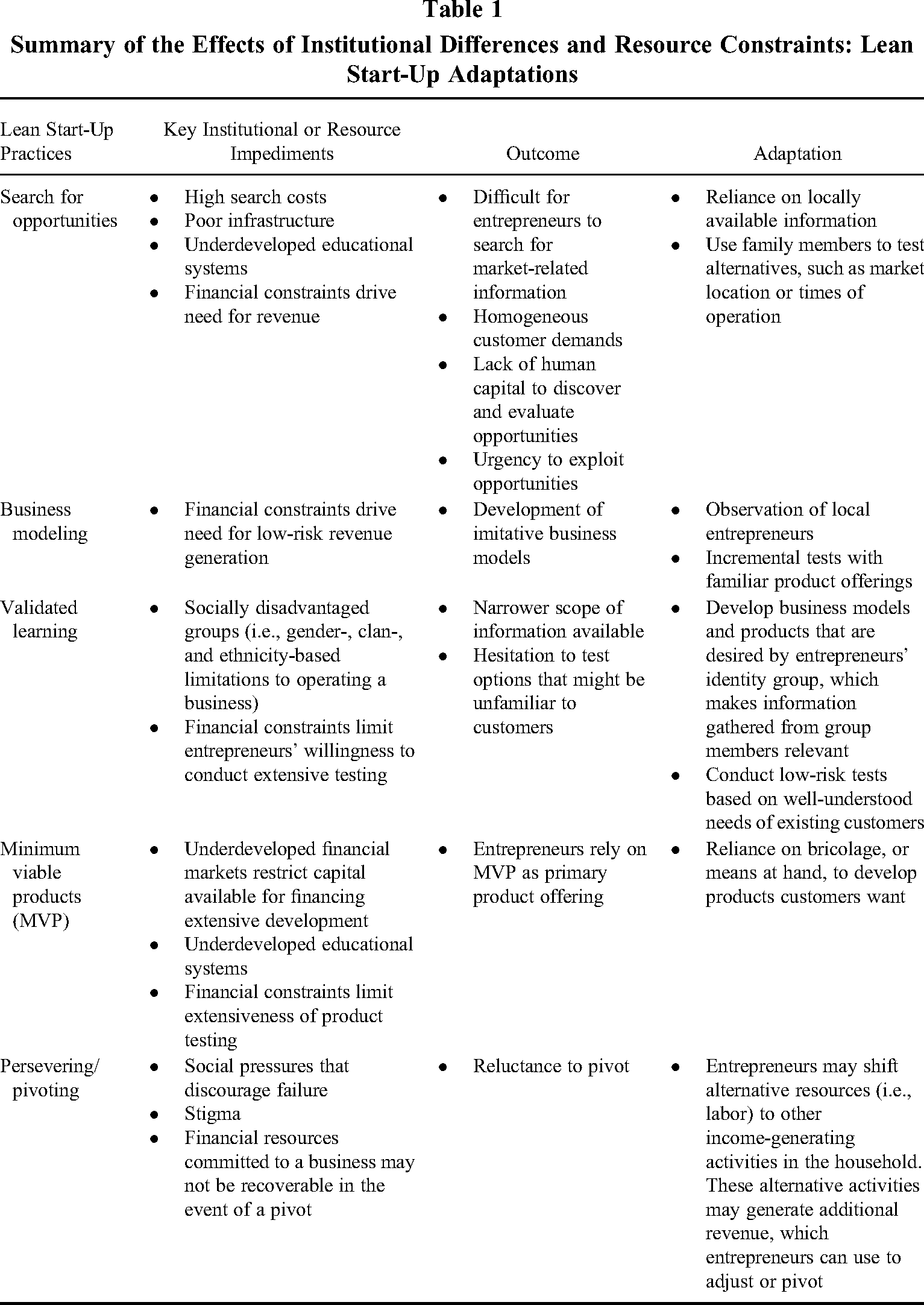
In this section, we explore how institutional differences and resource constraints in settings of impoverishment in non-Western contexts affect the usefulness of lean start-up practices and how entrepreneurs might adapt these practices. We will in turn initially discuss the five aspects of lean start-up and how the setting of impoverishment impacts that aspect of lean start-up. Immediately following the discussion of each lean start-up practice, we will show how that aspect of lean start-up might be adapted for settings of impoverishment. Table 1 provides a summary of this discussion.
Summary of the Effects of Institutional Differences and Resource Constraints: Lean Start-Up Adaptations
The Search for Opportunities
Institutional differences in impoverished non-Western settings raise a number of challenges for entrepreneurs searching for and evaluating opportunities. Generally, entrepreneurs’ possession of unique information about customer demands and means for addressing those demands enables them to recognize opportunities (Lanivich et al., 2022; Vaghely & Julien, 2010). However, search costs, including the time and resources people spend to understand market conditions, represent a hurdle in impoverished non-Western contexts as entrepreneurs seek to obtain information about customer demands (Aker & Mbiti, 2010). For example, unlike in mature Western economies, impoverished entrepreneurs in non-Western settings often cannot access rich sets of web-based information on existing businesses, market analyses of consumer demands, competitors’ pricing, or other kinds of information that may enable them to discover gaps in the market. The resulting higher search costs, along with undependable infrastructure that makes travel difficult, can lead to high homogeneity of entrepreneurs’ offerings and consumer demands, as entrepreneurs and consumers rely on existing, known solutions rather than innovative solutions. The lack of educational infrastructure, common in these contexts, can further hamper entrepreneurs’ ability to discover and evaluate opportunities (Brixiova, Ncube, & Bicaba, 2015). Resource constraints may, in turn, force entrepreneurs to rapidly exploit the opportunities they identify due to the urgent need for revenue. Therefore, resource-constrained entrepreneurs often limit their exploration of alternative opportunities and select the most immediate option.
Adaptation for impoverished non-Western contexts
Despite these challenges, entrepreneurs in impoverished non-Western contexts may be able to successfully rely on lean start-up tools, such as the Market Opportunity Navigator, and adapt them to their needs. Thus, despite high search costs and homogeneous market conditions where entrepreneurs largely sell the same products as their competitors, entrepreneurs can rely on locally available information to find opportunities related to varying their locations in markets or the times they sell in the markets. Although conducting simultaneous product or market tests may be difficult, especially if entrepreneurs are simultaneously operating a small business, such as a stall or stand in a market, entrepreneurs may be able to ascertain the viability of time or location variations by using their family members or children to test-operate temporary outposts throughout a market or markets at different times of day. Entrepreneurs in these contexts frequently deploy such practices (e.g., Koomson & Asongu, 2016), which enable them to conduct, to a limited extent, market opportunity exploration.
Business Modeling
Resource constraints constitute a key obstacle for entrepreneurs in impoverished non-Western contexts to the practice of business modeling as conceptualized in lean start-up. In lean start-up, business modeling implies the development of innovative forms of value creation and capture (Ghezzi & Cavallo, 2020; Shepherd & Gruber, 2021) and frequent experimentation (Blank & Dorf, 2012; Osterwalder & Euchner, 2019). However, in impoverished non-Western contexts, entrepreneurs more frequently rely on imitative business models to achieve greater performance (e.g., Adomako, Amankwah-Amoah, & Ahsan, 2023; Peprah et al., 2022). This imitation is the result of resource constraints that push the entrepreneur to generate revenue quickly, thus lowering their risk. Customers’ resource constraints, too, limit the extent to which entrepreneurs in these contexts may attempt business model innovation, as customers are reluctant to pay for innovative products and tend to focus on the basic needs of their daily life.
Adaptation for impoverished non-Western contexts
Given that imitative business models are often more appropriate in conditions of severe resource constraints, entrepreneurs may engage in practices to rapidly align their business models with similar businesses. In these contexts, entrepreneurs frequently are in large markets, where there may be hundreds of other vendors selling similar products. For example, in the Kantamano market in Accra, Ghana, more than 1,000 vendors sell used clothing. Entrepreneurs looking to enter this market may easily observe the practices of their neighbors and determine how much to charge for clothing, given that these transactions take place in open-air markets. Entrepreneurs can also observe how customers interact with other vendors, which can help them adjust their product offerings for that day or for individual customers who frequent the markets. However, in conditions like these, entrepreneurs may be able to practice very incremental business model innovations by observing the deliberate and inadvertent trials and successes of other vendors in the market. Given the volume of customers that pass through these markets, entrepreneurs may (or may not) rapidly validate trials, and observant entrepreneurs might find success in adopting successful variations.
Validated Learning
Institutional differences in impoverished non-Western contexts, such as those that favor one group of people over another or that disadvantage certain people, like women (Webb et al., 2020), make the kind of aggressive validated learning advocated by lean start-up more challenging. In some circumstances, women or members of a particular tribe or clan are unable to interact openly with others who can help them validate a product idea or a business model (e.g., Amine & Staub, 2009). In these cases, the scope of information entrepreneurs can obtain is significantly narrower than for entrepreneurs in conditions relatively unmarked by such social norms. Resource constraints might lead entrepreneurs to forego extensive validated learning before attempting to generate revenue. Additionally, the sort of scientific hypothesis testing advocated in lean start-up (Shepherd & Gruber, 2021), which leads entrepreneurs to validate the truthfulness of assumptions, might be limited in impoverished non-Western settings, where entrepreneurs are more comfortable selling what works than testing an alternative that might not work and might also alienate innovation-resistant customers.
Adaptation for impoverished non-Western context
Prior research has found that, in impoverished non-Western contexts, women and other disadvantaged groups rely on each other as business partners or on family members to support their business operations (Khavul, Bruton, & Wood, 2009; Pryor, Bruton, & Zahra, 2019). Therefore, entrepreneurs disadvantaged in these contexts can rely on their kinship networks to validate their ideas concerning products or business models. Although this approach might constrain the amount of information they obtain (Khavul et al., 2009), such feedback can be useful given that women-led businesses in these contexts tend to rely more deeply on their networks of family and friends (Ngoasong & Kimbu, 2019; Xeneti, Thapa-Kharki, & Madden, 2018). Additionally, in lieu of expensive experimentation, these entrepreneurs may practice frequent and low-cost adjustments based on their day-to-day interactions with customers. For instance, a clothing entrepreneur in the Kantamano market who sells sports jerseys might use revenue generated by the business to purchase related inventory, such as athletic shoes, because of an assumption that their customers might buy the related product. Entrepreneurs who have become familiar with their regular customers can even text customers to let them know shoes are available. By taking such iterative, low-risk approaches and focusing on the information validated by the interactions with customers, entrepreneurs can experiment and successfully develop business models.
MVP
Institutional differences, such as those that have fostered underdeveloped financial markets and educational infrastructure in impoverished economies, make it challenging to develop innovative products in impoverished non-Western contexts because entrepreneurs encounter difficulties in financing product development, and lower human capital levels make it harder for entrepreneurs to innovate and for customers to understand the benefits of innovation (Castellacci, 2015; Danquah & Amankwah-Amoah, 2017). The resource constraints entrepreneurs face in these contexts can also reduce the scope of innovation possible (Woschke, Haase, & Kratzer, 2017). Entrepreneurs rely on MVP to evaluate market demand in lieu of engaging in longer and more resource-intensive product development cycles, which may result in offering products that customers do not buy (Ries, 2011). Therefore, the use of MVPs suits impoverished non-Western entrepreneurs, given the institutional and resource hurdles they face.
Adaptation for impoverished non-Western context
Extensive research on innovation in developing economies and among impoverished entrepreneurs has found evidence that entrepreneurs rely on bricolage, which involves “making do by applying combinations of the resources” (Baker & Nelson, 2005: 333). Using means at hand helps entrepreneurs overcome the lack of financial availability to support extensive product development (Yu, Li, Su, Tao, Nguyen, & Xia, 2020), and while human capital and personal resource constraints can limit the extensiveness of entrepreneurs’ innovation, relying on means at hand can also increase the familiarity of products for customers, which can help entrepreneurs overcome information asymmetries (e.g., Da Silveira, 2001; Magruder, 2018). When contrasting the use of MVP in developed settings, where practitioners might assume large differences exist between products’ minimal and final developed states, these differences are, themselves, likely to be minimal in impoverished contexts as a consequence of using bricolage. The adaptation by the clothing entrepreneur in Ghana who began to sell athletic shoes to complement their existing products might constitute an MVP, by which the entrepreneur gleans information about their customer while also generating needed revenue. However, the degree to which the entrepreneur might iterate beyond this minimum level is uncertain.
Persevering/Pivoting
Institutional differences, particularly, weak formal institutions, which increase the importance of community relationships, constitute serious challenges for pivoting. Pivots, insofar as they represent major changes to entrepreneurs’ business models and product offerings (Ries, 2011), occur when entrepreneurs fail to validate their assumptions regarding customers. In impoverished non-Western contexts, communities will likely perceive pivots as failures and even wasteful of community resources and support (Khavul et al., 2009). Therefore, the abandonment of a business is traumatic for entrepreneurs and their families, which often leads such entrepreneurs to continue to adhere to their existing businesses (e.g., Ukaegbu, 2003) lest they experience debilitating stigma (Amankwah-Amoah, 2018). Resource constraints, too, limit entrepreneurs’ ability to pivot. For instance, a clothing seller in the Kantamano market who had been successfully selling used women's apparel finds that, with the recent introduction of cheaply made new women's apparel, customers are less desirous of their goods. This entrepreneur has made significant investments in an inventory they can no longer reliably sell to customers. Pivoting to new women's clothing is difficult, given their current inventory investments and inability to purchase new goods. Therefore, these entrepreneurs often become trapped.
Adaptation for impoverished non-Western context
One practice common in impoverished non-Western contexts that can enable entrepreneurs to practice pivoting is income diversification of families’ business efforts. Households in contexts with weak or unstable institutional environments, frequent political or environmental shocks, and underdeveloped labor markets will often attempt to diversify their income sources by involving family members in multiple income-generating activities (Reardon, Delgado, & Matlon, 1992; Wouterse & Taylor, 2008). Men or older children may provide goods and services in local markets, women may produce homemade goods for sale in markets or tend household plots of land, and younger children may provide smaller services, such as scavenging or providing labor to others in a community (Canagarajah & Nielsen, 2001; Perez, Bilsborrow, & Torres, 2015). This practice constitutes a form of indigenous real-options strategy, by which households mitigate risks related to any one income stream while also being able to reallocate resources to income streams that are more valuable, given changing local conditions. This practice may also enable a form of household-level pivoting: While an entrepreneur may be reluctant to make large changes to one business, given prior resource investments, they might be more willing to reallocate resources, especially their labor, to support more successful income-generating activities. Entrepreneurs may use the increased income derived from these alternative activities to, eventually, enhance their primary business in ways they could not otherwise afford.
Discussion
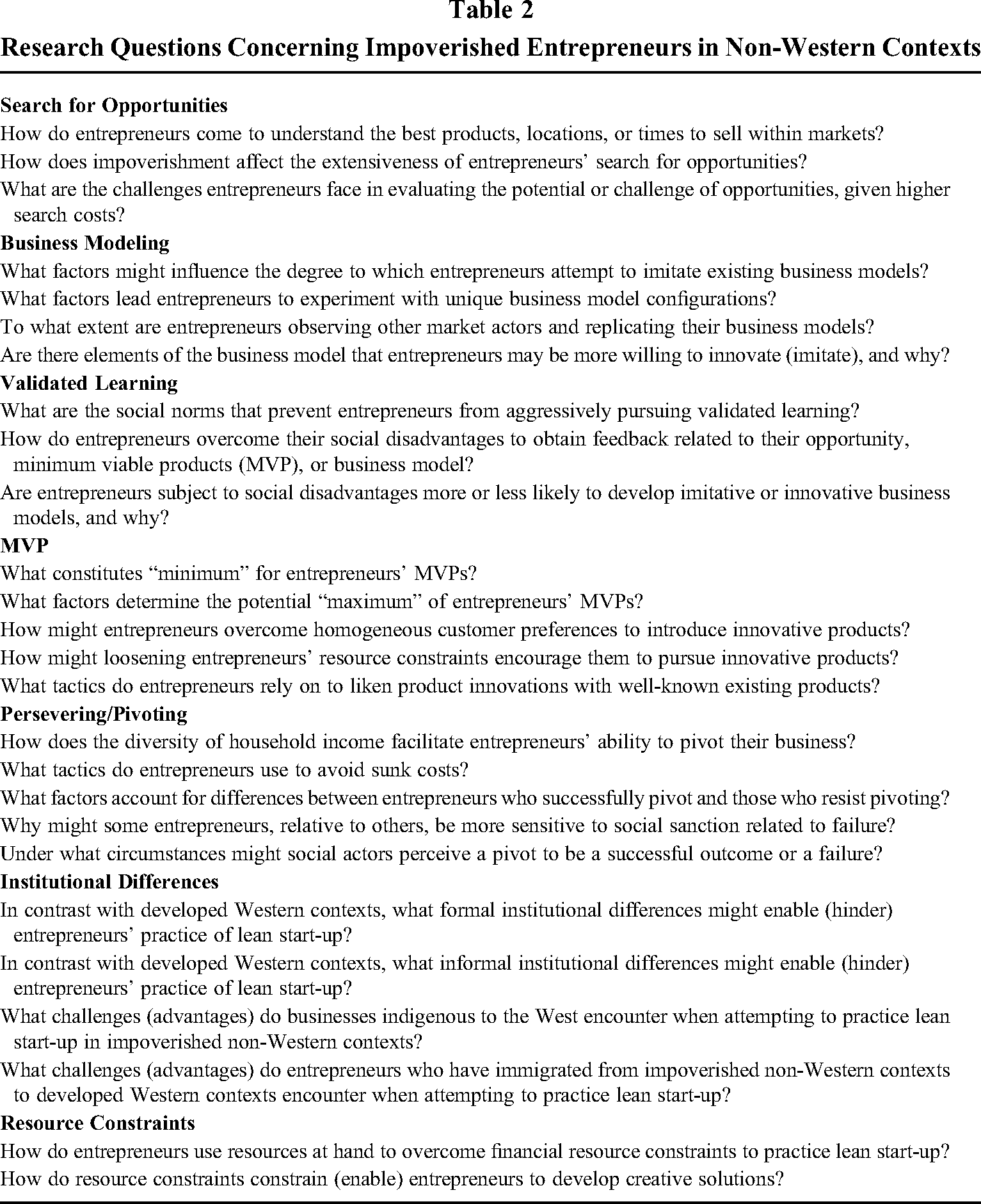
Lean start-up is both an important set of practical tools for entrepreneurs and an increasingly vibrant research stream (Shepherd & Gruber, 2021). Our article describes how conditions in impoverished non-Western contexts—in particular, institutional differences and resource constraints—can affect entrepreneurs’ use of lean start-up practices. We also describe how, despite these conditions, entrepreneurs might adapt these practices to derive the most benefit in their circumstances. In this section, we will discuss the contributions and related future research directions concerning lean start-up and management theory and practice more broadly. We include additional research questions in Table 2, and we close with a discussion of the practical implications of this article.
Research Questions Concerning Impoverished Entrepreneurs in Non-Western Contexts
Contributions and Future Research Directions
Our article suggests that a number of differences exist between how entrepreneurs conceptualize and practice lean start-up in developed Western settings and how entrepreneurs conceive and practice it in impoverished non-Western settings. While research has presented lean start-up as a more effective and efficient means to produce innovative products and business models, certain institutional differences exist outside the West that often render this objective infeasible for impoverished entrepreneurs. Increased search costs, for entrepreneurs and for their customers, along with infrastructure weaknesses, make the obtainment and diffusion of unique information more difficult, which can stymie entrepreneurs’ search for opportunities and lead them to create imitative businesses and lead their customers to demand imitative products (Acs & Virgill, 2010). Nevertheless, these entrepreneurs likely have some choice available to them regarding “where to play,” such as their locations in particular markets or the product categories they intend to enter. Research focusing on how impoverished non-Western entrepreneurs make these choices and the extent to which they might use factors captured by the Market Opportunity Navigator, such as the potential scale represented by an opportunity or the challenges related to pursuing an opportunity (Gruber & Tal, 2017), could lead to further insights. Additionally, institutional differences that create social disadvantages for certain populations present difficulties for entrepreneurs who use aggressive validated learning. While Blank (2012) acknowledges that entrepreneurs in the West might be so aggressive they could need bail money, the kinds of informal enforcement mechanisms that exist in certain non-Western impoverished contexts, such as social ostracism or worse (e.g., Hayami, 2009), limit the sources of information some entrepreneurs can gather. Conversely, research suggests that in some non-Western contexts, entrepreneurs already occupy outcast status, especially when forms of employment are available (e.g., Markowska & Abebe, 2021), which might free them to practice validated learning. Future research is necessary to further understand how the potential for ostracism or outcast status might shape the information sources or depth obtained by entrepreneurs in these contexts.
Lean start-up practice in the developed West and impoverished non-Western contexts may also share several similarities that warrant further scholarly exploration. Perhaps the most notable similarity is the reliance on MVPs in both contexts. We describe how both institutional differences and resource constraints can compel impoverished entrepreneurs to deploy MVPs; however, unlike entrepreneurs in the developed West, questions remain concerning the difference between the actual minimal and potential maximum product. While scholars in the West have called for further research into what constitutes “minimum” (e.g., Shepherd & Gruber, 2021), scholars from a non-Western orientation may also seek greater understanding related to what caps the maximum potential of impoverished entrepreneurs’ end products. Second, impoverished entrepreneurs might possibly practice a form of validated learning unique to that in the West, given that many impoverished non-Western entrepreneurs conduct their business in close proximity to other entrepreneurs, who, very often, are selling imitative goods to the same customers in the same location. This possibility raises questions related to how entrepreneurs’ market location (i.e., where to play) can facilitate vicarious learning (e.g., Foo, Vissa, & Wu, 2020).
We also intend for this work to join prior research that has called for a greater sensitivity in applying theories and practices derived in the West to non-Western contexts (e.g., Bothello et al., 2019; Bruton et al., 2018, 2022). We hope to encourage practitioners and scholars to examine other models developed in Western settings and seek to understand how those models work in settings where Western institutional assumptions do not necessarily apply. For instance, scholars in the West assume lean start-up is an effective and efficient methodology to innovative outcomes; however, to the extent that impoverished entrepreneurs outside the West practice lean start-up, it seems to be less about innovation and more about surviving in fragile and resource-scarce environments. Other theoretical perspectives, too, may find that their foundations are radically different when applied to non-Western contexts, and we encourage researchers not just to embrace these differences but also to consider deriving theories based on the indigenous practices of vast swaths of the world that are only now attracting increasing scholarly attention.
Finally, we recognize that entrepreneurs in different settings may not experience poverty in the same way or that poverty will have the same effects on their business practices, given that institutions and the nature or resource constraints differ across societies. Among many other factors, colonial legacies, traditional social norms, migration patterns, the availability of environmental resources, civil strife, and the degree to which some populations experience disadvantages or oppression, can affect the institutional differences faced by entrepreneurs and the possibility for entrepreneurs to accumulate personal resources (e.g., Afolayan, 2001; Joireman, 2001; Namatovu, Dawa, Adewale, & Mulira, 2018; Ploeg, 2011). Additionally, impoverished non-Western entrepreneurs constitute almost the entirety of a population, while impoverished entrepreneurs in the West constitute a much smaller proportion of a population. Further research could help researchers understand how these differences might affect entrepreneurs’ practices and how lean start-up might best be adapted to fit each unique context.
Practical Implications
Many of the efforts to encourage entrepreneurship among the impoverished to help address their poverty have failed (Kim & Kim, 2022). Even a widely promoted innovation in developing economies, microfinancing, has not significantly improved entrepreneurship outcomes (although it has improved people's nutrition; Chen, Chang, & Bruton, 2017). Thus, we encourage scholars not to view our work as a critique of impoverished non-Western contexts but rather as a set of descriptions grounded in reality. With that in mind, researchers can use this article to enhance entrepreneurial training in impoverished non-Western contexts. For instance, entrepreneurs could be trained to see their local markets as playing fields, in which they can deliberately test, very incrementally, new locations, products, and times of operation in order to better understand the most favorable market conditions. Additionally, for entrepreneurs who face social disadvantages due to their gender or ethnicity, rather than seeing these conditions as constraints, perhaps they could learn to see their gender or ethnic groups as potentially tight-knit user groups, which, from a certain perspective, constitute potential markets (cf. Shah & Tripsas, 2007).
Can the practices of the entrepreneurs we examine inform the lean start-up practices of entrepreneurs in the West? One possibility noted by scholars is that entrepreneurs in the West can pivot too much (Chen, Elfenbein, Posen, & Wang, 2022; Ladd, 2016) or that entrepreneurs may have picked up the jargon of lean start-up without understanding or practicing it (e.g., Seibel, 2020). In contrast, impoverished entrepreneurs, who are not aware they are practicing lean start-up principles but do so out of necessity, place a great emphasis on generating revenue quickly (similar to experienced entrepreneurs in the West; e.g., Baron & Ensley, 2006). Therefore, entrepreneurship educators in the West may consider incentivizing students to strive more strongly to make sales much earlier in the start-up process.
Conclusion
Researchers have recognized that businesses cannot ignore the problems of poverty (Tang, 2018). The practices that make up lean start-up have the potential to help impoverished entrepreneurs overcome the constraints of their contexts. Establishing a clear understanding of how entrepreneurs can best adapt lean start-up to the circumstances of impoverishment is important, yet unfinished, work. In the areas of the world in which people survive on less than $3.65 a day, entrepreneurship is often a necessity—operating a business is often the only means a person must support themselves and their families. Scholars can help both new and established businesses to be more successful and to help address the pressing issues of poverty that these individuals face. This goal requires consciously and purposefully contextualizing the theories we study in order to provide new knowledge that fits adequately to the challenges entrepreneurs face.
