



Abstract
Companies increasingly collaborate with competitors to innovate, minimize risks, and address sustainability crises. However, these alliances often falter or fail due to challenges arising from coopetition paradoxes—contradictory yet interdependent tensions between competition and cooperation. Extant research predominantly focuses on addressing these paradoxes through seeking a stable balance between competition and cooperation; however, we lack in-depth processual understandings of how to navigate these paradoxes as they shift over time. To address this gap in the literature, we analyze longitudinal data over the 3 years it took to establish Canada’s Oil Sands Innovation Alliance (COSIA), the unlikely alliance across 13 competitive Canadian oil sands companies to improve their industry’s environmental performance. We noted the role of competition, which we label as the dominant pole—the more powerful of two paradoxical poles—and identify leveraging the dominant pole as a core mechanism for navigating intensifying coopetition paradoxes. Rather than diminishing the dominant competition pole, alliance champions leveraged competition to enable cooperation aided by a paradox mindset. These findings reorient coopetition scholarship away from seeking stability between the two forces, toward a processual understanding of how to navigate the shifting coopetition paradoxes in alliances over time.
Shifting competitive landscapes and mounting global challenges increasingly require organizations to work together in strategic alliances—cooperative arrangements between firms that seek synergies and mutual strategic objectives (Das & Teng, 2000; Hu, Jain, & Delios, 2021). Competitive organizations collaborate with one another to improve market opportunities by advancing innovation (Ansari, Garud, & Kumaraswamy, 2016; Gnyawali & Park, 2009) and reducing financial risks (Gnyawali, Madhavan, He, & Bengtsson, 2016; Raza-Ullah, Bengtsson, & Kock, 2014). Other firms collaborate to address seemingly intractable societal issues like climate change (Ferraro, Etzion, & Gehman, 2015), toxic waste reduction (Lin & Darnall, 2015), and disaster responses (Williams & Shephard, 2016).
Despite the value of strategic alliances, such partnerships are fragile and often falter or fail (Parameswar, Dhir, Khoa, Galati, & Ahmed, 2022; Park & Ungson, 2001). Theories of alliance instability point to the challenge of managing coopetition—the tensions surfacing from simultaneously cooperating and competing (Lado, Boyd, & Hanlon, 1997; Raza-Ullah, 2021). Strategic alliances require cooperation across competitive firms (Brandenburger & Nalebuff, 1996; Gnyawali & Charleton, 2018), yet cooperative and competitive forces directly conflict with one another in their goals, processes, and outcomes. Scholars depict coopetition as paradoxical, that is, “contradictory yet interrelated elements that exist simultaneously and persist over time” (Smith & Lewis, 2011: 382). Paradoxes include opposing poles such as exploring and exploiting, social and financial, global and local, and so forth (Johnson, 2020; Farjoun, 2010). Scholarly work portrays competition and cooperation as intertwined paradoxical poles and highlights the ongoing challenges of addressing these paradoxes (e.g., Chen, 2008; Gnyawali et al., 2016; Hoffman, Lavie, Reuer, & Shipilov, 2018), given that they evolve over time (De Rond & Bouchikhi, 2004; Hannah & Eisenhardt, 2018) and that market forces often result in competition overpowering cooperation (Park & Russo, 1996).
Even as existing alliance research depicts coopetition paradoxes as evolving and shifting (e.g. De Rond & Bouchikhi, 2004; Hannah & Eisenhardt, 2018), scholarship on managing these paradoxes predominantly focuses on approaches seeking “an appropriate balance on an ongoing basis” between competition and cooperation (Das & Teng, 2000: 95). These approaches include structures, capabilities, and mindsets to balance coopetition paradoxes (Hoffman et al., 2018; Stadtler & Van Wassenhove, 2016), often through offsetting the demands of competition, or diminishing the dominance of competition (Park, Srivastava, & Gnyawali, 2014; Sytch & Tatarynowicz, 2014). Yet, these strategies fail to account for the shifting nature of coopetition paradoxes over time. We therefore lack processual understandings of how to engage with these shifting and evolving paradoxes to enable successful alliances. As such, we address the following research question: How is the coopetition paradox navigated over time in strategic alliances?
To investigate this question, we analyzed 3 years of in-depth process data exploring how 13 highly competitive oil and gas firms successfully formed Canada’s Oil Sands Innovation Alliance (COSIA), a strategic alliance to advance environmental performance in the Canadian oil sands industry. Our analysis surfaced a surprising finding. Rather than balance coopetition by advancing cooperation and minimizing competition, the alliance champions in our study did the opposite. They leveraged the dominant pole. We define the dominant pole as the more powerful of two paradoxical poles. Leveraging the dominant pole involves drawing on the dominant, or more powerful, pole to advance the weaker paradox pole. In our case, leveraging involved embracing competition to enable cooperation. The champions did so through three practices of aligning company goals with those of the alliance, applying peer pressure and giving ownership to company leaders. Our findings further identify paradox mindsets as enabling the alliance champions to engage in leveraging. Over time, as the alliance progressed through three phases of alliance formation, competitive resistance grew, and the coopetition paradox intensified as a growing number of alliance champions continued to leverage competition to advance the alliance.
Our key contribution is to build a process theory of navigating the coopetition paradoxes through leveraging the dominant pole. Three implications surface from our process model. First, we extend existing research on the role of cognition in addressing coopetition paradoxes by detailing how leveraging the opposite pole depends on a paradox mindset. Second, our model reorients existing scholarship away from aiming for a stable balance between cooperation and competition towards dynamically navigating the coopetition paradox over time. Finally, our study surfaces a pattern of oscillation and intensification which suggests that navigating coopetition paradoxes is not only challenging, but that the level of difficulty increases over time, extending current understandings of alliance instability. We also contribute to paradox theory by unpacking processes for navigating power in paradoxical poles.
Navigating Coopetition Paradoxes in Alliances
The Role of Coopetition Paradoxes in Strategic Alliances
Strategic alliances allow firms to realize advantages through cooperating with other firms that are often their competitors, to achieve mutually beneficial goals (Gnyawali & Park, 2011). Whether they take the form of joint ventures (Ariño & De La Torre, 1998; Kogut, 1988), multipartner alliances (Lavie, Lechner, & Singh, 2007; Yin, Wu, & Tsai, 2012), research and development (R&D) consortia (Doz, 1996; Doz, Olk, & Ring, 2000), or other forms, these alliances include firms that seek to protect their own interests while simultaneously aiming for shared goals. Yet, while increasingly prevalent and potentially beneficial, these relationships are often fragile and unstable (Gnyawali & Charleton, 2018; Hoffmann et al., 2018). In their bibliometric analysis of the alliance termination literature, Parameswar et al. (2022) report that 30% to 70% of these relationships dissolve prematurely before achieving their strategic goals. Furthermore, surviving alliances have been deemed less efficient and effective than a firm working independently (Park & Ungson, 2001).
To explain why strategic alliances are unstable and dissolve prematurely, researchers increasingly point to challenges arising from coopetition paradoxes—contradictory yet interdependent tensions between competition and cooperation (Brandenburger & Nalebuff, 1996; Chen, 2008; Gnyawali & Charleton, 2018; Hoffmann et al., 2018). Coopetition tensions are contradictory in that the goals and processes to achieve cooperation conflict with those to achieve competition (Park & Ungson, 2001). Competition refers to “pursuing one’s own interest at the expense of others” and prompts competitors to protect their knowledge and assets, while cooperation seeks “mutual interests and common benefits” (Das & Teng, 2000: 85) and relies on trust and knowledge sharing to achieve collective goals (Khanna, Gulati, & Nohria, 1998). These pressures are interdependent and cannot easily be separated (Chen, 2008; Raza-Ullah et al., 2014). As Chen notes, they “define or are defined by each other, so that it becomes impossible to conceptualize an idea without considering and incorporating its inverse” (2008: 297). Cooperation can enhance the competitive position of firms by allowing alliance partners to enhance their knowledge and capabilities (Gnyawali & Charleton, 2018), and by sharing costs across the partners (Ozmel, Yavuz, Reuer, & Zenger, 2017; Rai, Gnyawali, & Bhatt, 2023). Conversely, competition can motivate cooperative behaviors and can spur alliance formation (Kale, Singh, & Perlmutter, 2000). When firms engage in strategic efforts to collaborate with their competitors, these paradoxical forces create conflicts and instabilities within all stages of alliances, although they are particularly salient at the formation phase as firms negotiate the terms of the agreement with their partners (Eisenhardt & Schoonhoven, 1996; Katila, Rosenberger, & Eisenhardt, 2008).
Prior research offers several insights into why coopetition paradoxes in alliances are difficult to manage. First, paradoxes are complex and therefore raise cognitive dissonance and defensiveness (Lewis, 2000; Lewis & Smith, 2022; Vince & Broussine, 1996). Coopetition paradoxes are cognitively taxing and trigger emotional ambivalence in alliance managers (e.g., Raza-Ullah, 2021). Second, prior research on alliances demonstrates how competition typically dominates over cooperation (Hoffmann et al., 2018; Park & Russo, 1996) as member firms are primarily concerned with defending their interests (Chen, 2008; Gnyawali & Charleton, 2018; Khanna et al., 1998). While some scholars theorize that strategic alliances can involve too much collaboration (Dyer, Singh, & Hesterly, 2018; Khanna et al., 1998), empirical examples emphasize the dominance of competition and its impact on collaborative contexts (Ariño & De La Torre, 1998; De Rond & Bouchikhi, 2004). Research on paradox theory more broadly suggests that paradoxes become more challenging in contexts with unequal distributions of power across opposing poles because the stronger pole always overtakes and limits the weaker pole (Berti & Simpson, 2021). Third, coopetition paradoxes continually shift and evolve requiring flexible and dynamic responses (Jarzabkowski & Bednarek, 2018; Sonenshein, Nault, & Obodaru, 2017). For example, in their process study of an alliance between a large pharmaceutical company and a smaller biotech start-up, De Rond and Bouchikhi (2004) found that competitive and cooperative forces oscillated due to a dialectic tension. Research on other paradoxes, such as between a firm’s social mission and financial performance, depicts navigating paradoxes as challenging when these dynamic relationships require ongoing engagement and responses (Jay, 2013).
Navigating Coopetition Paradoxes
While scholarship on strategic alliances depicts coopetition paradoxes as complex, unstable, and evolving, only limited research explores dynamic approaches to navigating the shifting nature of these paradoxes. For example, in their multiple-case study of five firms in the U.S. residential solar industry, Hannah and Eisenhardt (2018) found three distinct ecosystem strategies to balance dynamic tensions between competition and cooperation over time. They identified a bottleneck strategy, which allowed companies to balance opposing forces of competition and cooperation by engaging them sequentially. In their study of navigating coopetition in the reinsurance business, Jarzabkowski and Bednarek (2018) found that competitors’ motivations shifted between being rivalrous and relational, depending on the context. These studies suggest not only that the forces of competition and cooperation can shift over time, but that navigating these forces may be more complex and dynamic than previously thought, requiring adept approaches by alliance firms and managers (Doz et al., 2000; Spekman, Forbes, Isabella, & MacAvoy, 1998). Moreover, scholarship more broadly has suggested that successful outcomes in complex and contested industry-wide contexts depend on the approaches of the individuals involved and the nature of their cognitive frames (Helms, Oliver, & Webb, 2012). While these studies offer emerging insights into the importance of dynamic responses, processual understandings of how to navigate evolving coopetition paradoxes in alliances remain limited.
Instead of these dynamic approaches, much of the extant research on managing coopetition paradoxes in strategic alliances implicitly adopts a more static approach, focusing predominantly on seeking a stable balance across levels of cooperation intensity and competition intensity, so that neither force dominates over the other (Das & Teng, 2000; Park & Russo, 1996). In their review of coopetition research, Gnyawali and Charleton (2018) argue that positive alliance results depend on moderately strong levels of both cooperation and competition. Several studies demonstrate that successful alliances offset the dominant competition pole with more cooperation, or diminish competition (Gnyawali & Park, 2011; Park et al., 2014; Sytch & Tatarynowicz, 2014). Researchers also highlight structural approaches such as dividing the management of cooperation and competition into separate departments (e.g., Bengtsson & Kock, 2000), or integrative capabilities that achieve a balance between competition and cooperation by juxtaposing the two poles simultaneously (Bengtsson, Raza-Ullah, & Vanyushyn, 2016; Raza-Ullah, 2020). For example, Bengtsson et al. (2016) introduce the concept of coopetition capability, drawing on the idea of ambidexterity, to refer to the ability of a firm to pursue and balance the paradoxical demands of competition and cooperation while managing conflict. Still others argue that coopetitive mindsets (Das & Teng, 2000; Fernandez, Le Roy, & Gnyawali, 2014), i.e. the ability to hold both poles in one’s mind simultaneously, can enable decision-making that incorporates both competition and cooperation equally to advance alliances (Stadtler & Van Wassenhove, 2016).
Taken together, previous research on the paradoxes of cooperation and competition expands our understanding of the challenges of managing these paradoxes in alliance relationships. Yet, aside from a few studies, we still know little about how to manage the evolving, complex, and paradoxical relationship between cooperation and competition over time, as most research to date has examined approaches that seek a stable and enduring balance between the two poles of competition and cooperation (Gnyawali & Charleton, 2018; Gnyawali & Park, 2011; Raza-Ullah, 2020). We therefore need to further theorize the processes for navigating coopetition paradoxes over time in strategic alliances.
Method
To unpack the coopetition paradox over time, we adopt a longitudinal qualitative analysis of COSIA’s formation (Edmondson & McManus, 2007; Langley, 1999). COSIA offers an extreme case study (Siggelkow, 2007), given the industry’s cut-throat competition (Slawinski & Bansal, 2015), the complexity of forming a multipartner alliance with 13 companies (Yin et al., 2012), and the focus on the alliance formation stage, which involves heightened coopetition tensions (Katila et al., 2008).
Research Context: The Alberta Oil Sands and the Formation of COSIA
The Alberta oil sands is a competitive industry fraught with environmental challenges. The 142,000 km2 of oil sands comprise the world’s third largest reserves after Saudi Arabia and Venezuela. In 2010, at the start of our data collection to study COSIA’s formation, over 40 companies in Alberta collectively extracted 1.6 million barrels per day of bitumen, the unrefined mixture of tar, sand, and oil upgraded into synthetic crude oil, with 13 companies comprising 90% of industry activity (Government of Alberta, 2011).
The Alberta oil sands’ history points to a fiercely competitive industry. Local Alberta companies began searching for oil starting as early as the 1850s; however, it took over 140 years for a combination of technological innovation and favorable commodity pricing to enable profitable extraction in the late 1990s (Shenker, 2008). Multinational companies raced into the region, competing for their share of the resource and triggering what some described as a “black oil gold rush.” Senior executives got rich quickly, leading to mounting self-interest. With thin margins, this commodity product spurred competition around cost-saving innovations.
Starting in the early 2000s, however, the frenzy met with serious resistance from environmental groups who argued that, compared with conventional oil, Alberta’s “dirty oil” produced higher greenhouse gas emissions, used more water, introduced more noxious pollutants into the air, and resulted in significant deforestation. In 2008, over 1,600 ducks landed on a northern Alberta tailings pond and died. Pictures of these dying ducks went viral on the internet. Around the same time, various groups protested building the Keystone XL pipeline that would distribute oil to U.S. refineries due to its impact on the environment and communities. These events brought significant negative media attention to the industry. Alberta oil sands executives worried that the industry was losing its social license to operate and that public pressure could risk further government regulation and delay or cancel project approvals.
In 2008, five companies, including Suncor, created the Oil Sands Leadership Initiative (OSLI) to address these issues. OSLI met with resistance from leaders of companies that were not included, while also facing limitations to its effectiveness. In the fall of 2010, Gord Lambert, Vice President of Sustainability at Suncor and co-founder of OSLI, proposed creating a broader and more effective alliance that would be named Canada’s Oil Sands Innovation Alliance (COSIA), an industry-wide alliance with the 13 biggest companies in the region. Our study explores how the alliance champions navigated cooperation and competition tensions for 3 years while forming COSIA. Figure 1 provides a timeline of events surrounding COSIA’s formation.
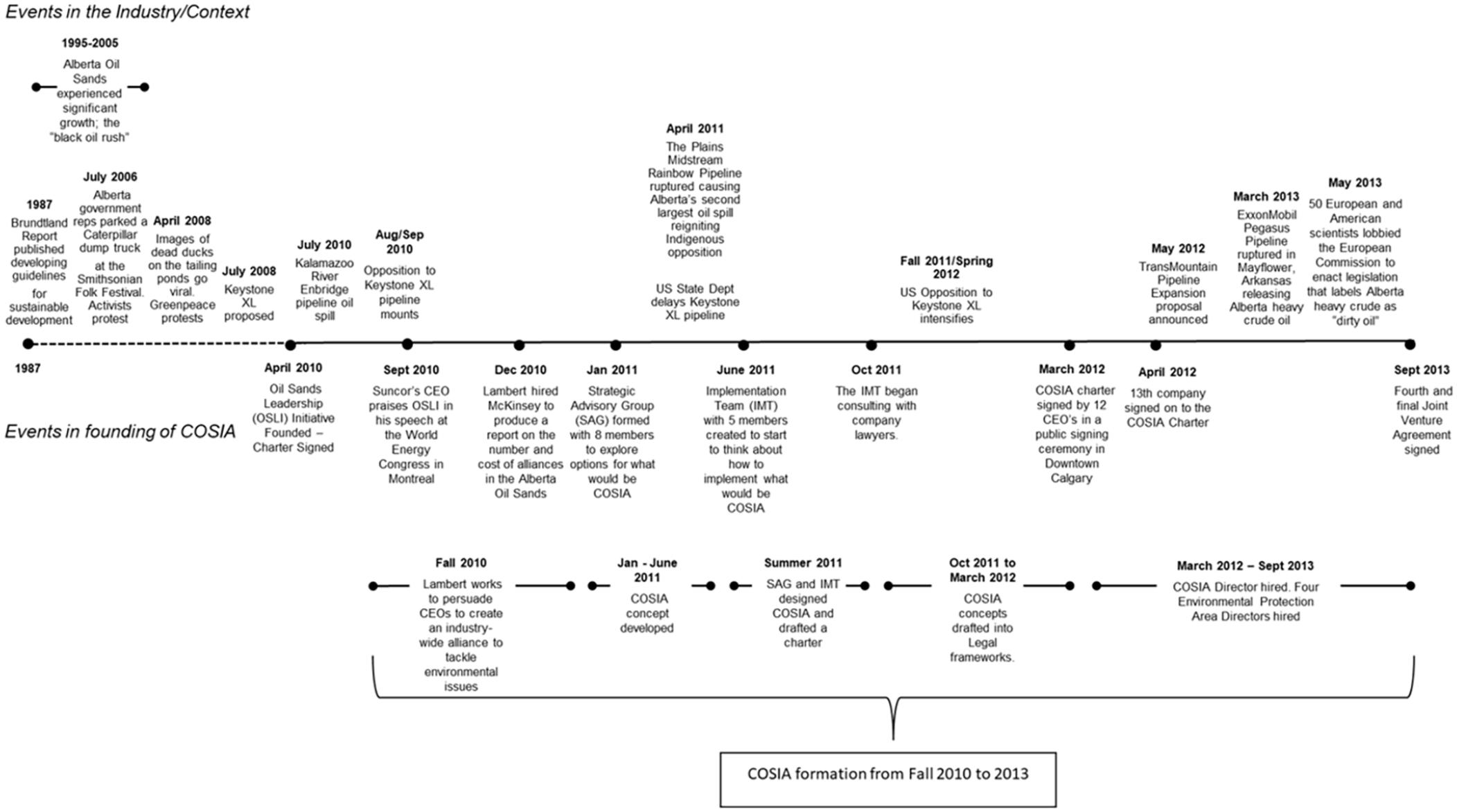
Timeline of Events in the Industry and in the Formation of COSIA (1987–2013)
Data Collection
Between 2008 and 2010, one of the authors collected data from companies belonging to OSLI—a precursor organization to COSIA—providing important contextual insights on the competitive nature of the industry and the development of the OSLI collaboration. In May 2011, the same author learned about highly confidential discussions for a larger industry-wide initiative that would become COSIA and gained access to study the creation of this seemingly impossible alliance. Two of the authors systematically collected interview and observational data from September 2011 until the formal founding of the alliance in September 2013. The authors used archival documents and retrospective interviews to unpack the first year of alliance formation, while drawing on real-time observations, interview data, and documents for the next 3 years. Table 1 summarizes our data sources. In our findings section below, we denote each data source by a letter reflecting their role or context, and a unique number.
Summary of Data Analyzed
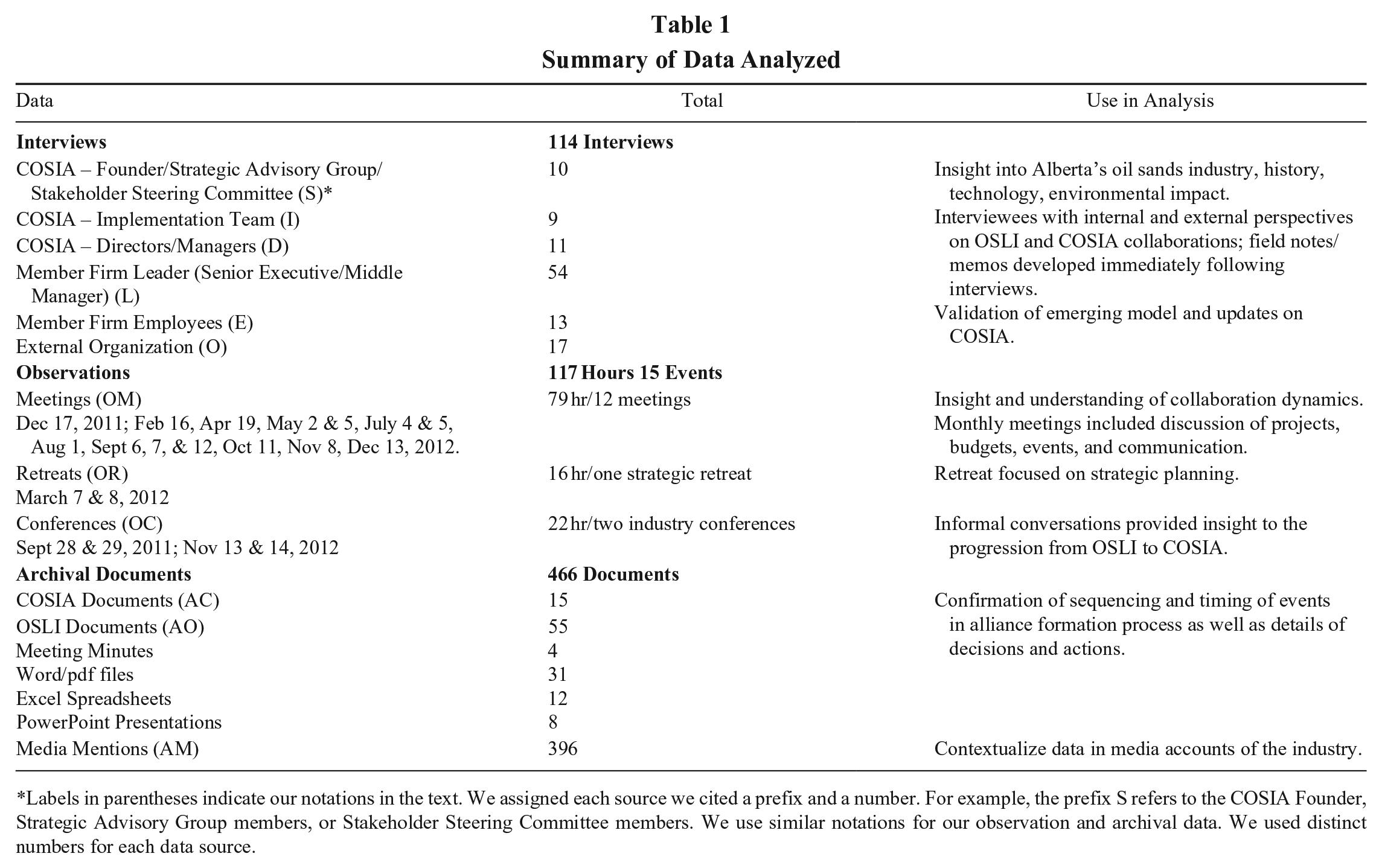
Labels in parentheses indicate our notations in the text. We assigned each source we cited a prefix and a number. For example, the prefix S refers to the COSIA Founder, Strategic Advisory Group members, or Stakeholder Steering Committee members. We use similar notations for our observation and archival data. We used distinct numbers for each data source.
Interviews
We conducted 114 semi-structured interviews with oil sands managers and industry experts, including 30 interviews with COSIA founders, directors, and other champions, 67 interviews with senior executives and managers of COSIA member-companies, and 17 individuals belonging to stakeholder organizations familiar with COSIA and/or the industry, such as think tanks, media, and government. We included informants who strongly supported COSIA, as well as those who remained skeptical. Interviews ranged from 45 minutes to 2 hours, averaging just over 1 hour in length. We conducted interviews in person, with the exception of one telephone interview. Two authors conducted 24 interviews together, allowing us to compare impressions and analyses, with the other 90 interviews conducted by a single author. We used a semi-structured protocol, first asking participants about their role in their individual firm and their association with OSLI and COSIA, then exploring questions centered on the enablers and barriers to the formation of COSIA. As we started to identify themes in our data, our questions became more specific, and we started to ask more targeted questions about the nature and shifts of competition and cooperation, the approaches to address these challenges, and the impact of these approaches on the alliance’s formation. We recorded and transcribed 106 of the 114 interviews. For the eight non-recorded interviews, we took and quickly typed up detailed notes to ensure that we captured the key ideas.
Observations
We observed 117 hours of OSLI meetings while they were transitioning to COSIA, including 12 half-day meetings, one full-day retreat, and two industry conferences. We took detailed notes of activities, interactions, decision-making processes, and informal discussions. These real-time observations triangulate insights from interviews and mitigate against retrospective bias (Eisenhardt & Graebner, 2007).
Archival data
We examined 396 publicly available media articles on the Alberta oil sands and COSIA during our study’s timeframe, which provided context and background. We also obtained 70 documents from OSLI and COSIA, including strategic plans and slide decks, to triangulate our observations and interview analysis and fill gaps in our understanding.
Data Analysis
We adopted prescribed methods for analyzing in-depth longitudinal data to move from raw data to specific codes and constructs (Gioia, Corley, & Hamilton, 2013), particularly in the context of unfolding a process over time (Langley & Abdallah, 2015). We engaged in an insider/outsider approach (Gioia, Price, Hamilton, & Thomas, 2010; Rerup & Feldman, 2011), inviting a third coauthor unfamiliar with the data to ask questions that deepened the analysis.
First, we identified emergent themes as we collected the data. At the end of each day two of the authors wrote field notes and, when collecting data together, compared notes. These notes and discussions helped clarify our insights and guided future data collection. In Fall 2011, these same authors coded the data by reading all the interviews and identifying key themes, and then compared and contrasted insights. Early analyses surfaced a core group of people who believed deeply in the alliance, worked hard to advance it, yet faced and navigated intensifying challenges. We labeled these people as alliance champions.
Second, we integrated our data into a single spaced, 58-page thick description of events over the 3 years of COSIA’s formation. Doing so offered us a holistic understanding and temporal timeline of the alliance formation process (Langley, 1999), and triangulated key insights by drawing on disparate data sources and informants (Eisenhardt, 1989). The themes from our initial coding helped inform this thick description. For example, we explored how the alliance champions understood and addressed cooperation amid strong competitive responses. The thick description further allowed us to identify specific events that created temporal brackets (Langley & Abdallah, 2015) with three distinct phases. The first phase began when Suncor’s Chief Executive Officer (CEO) asked Lambert to respond to concerns about OSLI. Lambert began conceptualizing and advocating for an industry-wide alliance and persuaded eight companies to form what they named a Strategic Advisory Group. We named this the conceptualization phase. The second phase started with the creation of what they called the Implementation Team, dedicated to developing the charter’s terms. We labelled this phase as formalization. The third phase launched with 13 companies signing the COSIA charter, committing them to develop and eventually sign onto four joint venture agreements to share intellectual property, which we called the finalization phase. As we analyzed the thick description, we noticed themes and patterns repeating across phases, and also the intensification of some themes.
Informed by emerging themes, we systematically coded raw data to understand the patterns over time. We integrated literature to help label our constructs. We used prescribed processes to move from more empirically informed themes (e.g., open coding) toward more conceptual categories (e.g., axial coding; Gioia et al., 2013; Strauss & Corbin, 1998; Tavory & Timmermans, 2019; see Figure 2). All three authors coded interviews separately, comparing and contrasting codes through discussions for greater specificity. We further compared codes across phases. We sought distinctions and changes over time; however, what was most striking was the repetitive yet intensifying patterns of the nature and response to coopetition tensions across phases. With a broad set of initial codes, we categorized our empirical themes into more conceptual clusters (Miles & Huberman, 1994), folding in the literature to help inform how we understood and labeled these themes (Eisenhardt, 1989; Gioia et al., 2013). Throughout this process, we sought surprising or novel insights. For example, we expected that increased efforts toward cooperation and alliance formation would dampen competitive pressures. Instead, as the alliance formed, increased cooperation triggered more competition. We noticed the approaches of the people working to advance the alliance—or the alliance champions. Ironically, their efforts to advance cooperation also exacerbated competition. The alliance champions used language to describe these challenges as “creative tensions” and “paradox.” These comments led us to the literature on paradox and coopetition. Finally, we explored what these champions did to address this paradox, surfacing insights about how they leveraged competition to enable cooperation.
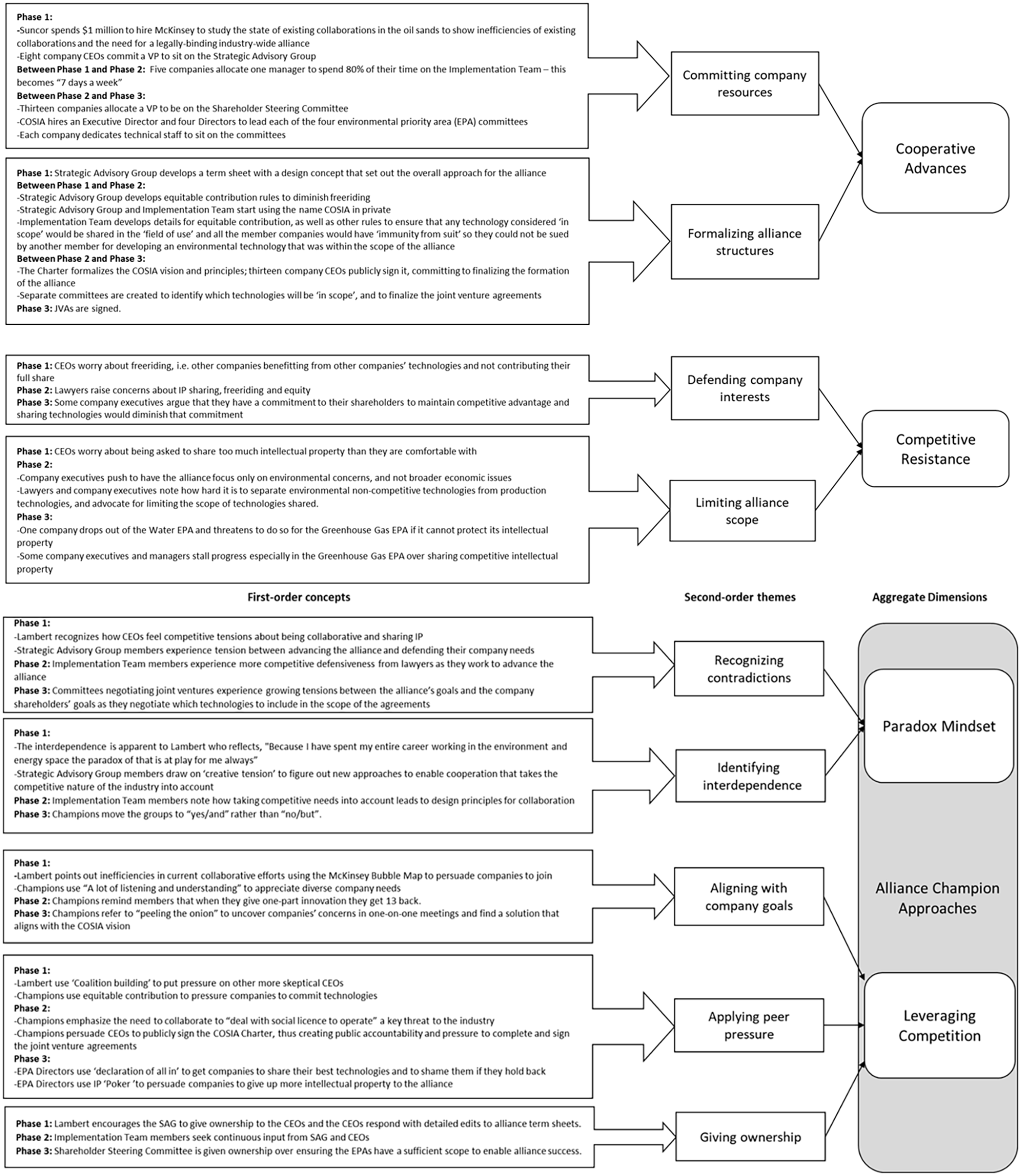
Data Structure
In the final stage of our analysis, we continued to iterate between data and theory, aggregating our constructs into key dimensions and developing an integrative model (Eisenhardt, 1989). We generated three sets of aggregate dimensions; the first two represent the actions by corporate leaders. Cooperative advances involve actions increasingly formalizing the alliance, while competitive responses involve actions that challenge or create obstacles to the alliance. Alliance champion approaches include the champions’ mindsets and behaviors to overcome the obstacles to enable the advances. This step further revealed an iterative and intensifying experience; cooperative advances and competition responses iterated and intensified and required the actions of the champions over time. We shared our model in a meeting with approximately 50 COSIA members and separately with three key COSIA champions. Their reactions validated and added detail to our model. We further shared our model with academic colleagues. Their reactions helped us to clarify the labels of our constructs and integrate our model with theory.
We drew on prescribed practices to ensure validity throughout the data collection and analysis process. First, we gained greater insights into the subtle nuances of our context by spending 3 years collecting data on the industry before collecting data on COSIA for another 3 years (Lincoln & Guba, 1985). Second, to triangulate our data, we drew from a variety of data sources, interviewing informants from different companies, at multiple levels of their organizations and with varied relationships to COSIA (Eisenhardt & Graebner, 2007). Third, we combined real-time observations with our retrospective data to increase the robustness of our insights and minimize biases from any one data source or informant (Leonard-Barton, 1990). Fourth, we used analytical techniques to explore the process of how competition and cooperation were navigated over time by pulling together relevant material into a coherent thick description (Langley & Abdallah, 2015). Finally, we received feedback from colleagues and informants to increase the reliability and validity of our interpretations (Lincoln & Guba, 1985).
We present our findings in the next section, by describing how Gord Lambert and an expanding community of champions drew on competitive approaches to address ongoing and intensifying resistance and to convince company leaders to commit to the alliance. We structured our findings by the three phases of alliance formation, offering a chronological delineation of the key events and mechanisms that we surfaced through our analysis, and then we detail our theoretical model. Readers can refer to our theoretical model (Figure 3) to orient to our findings.
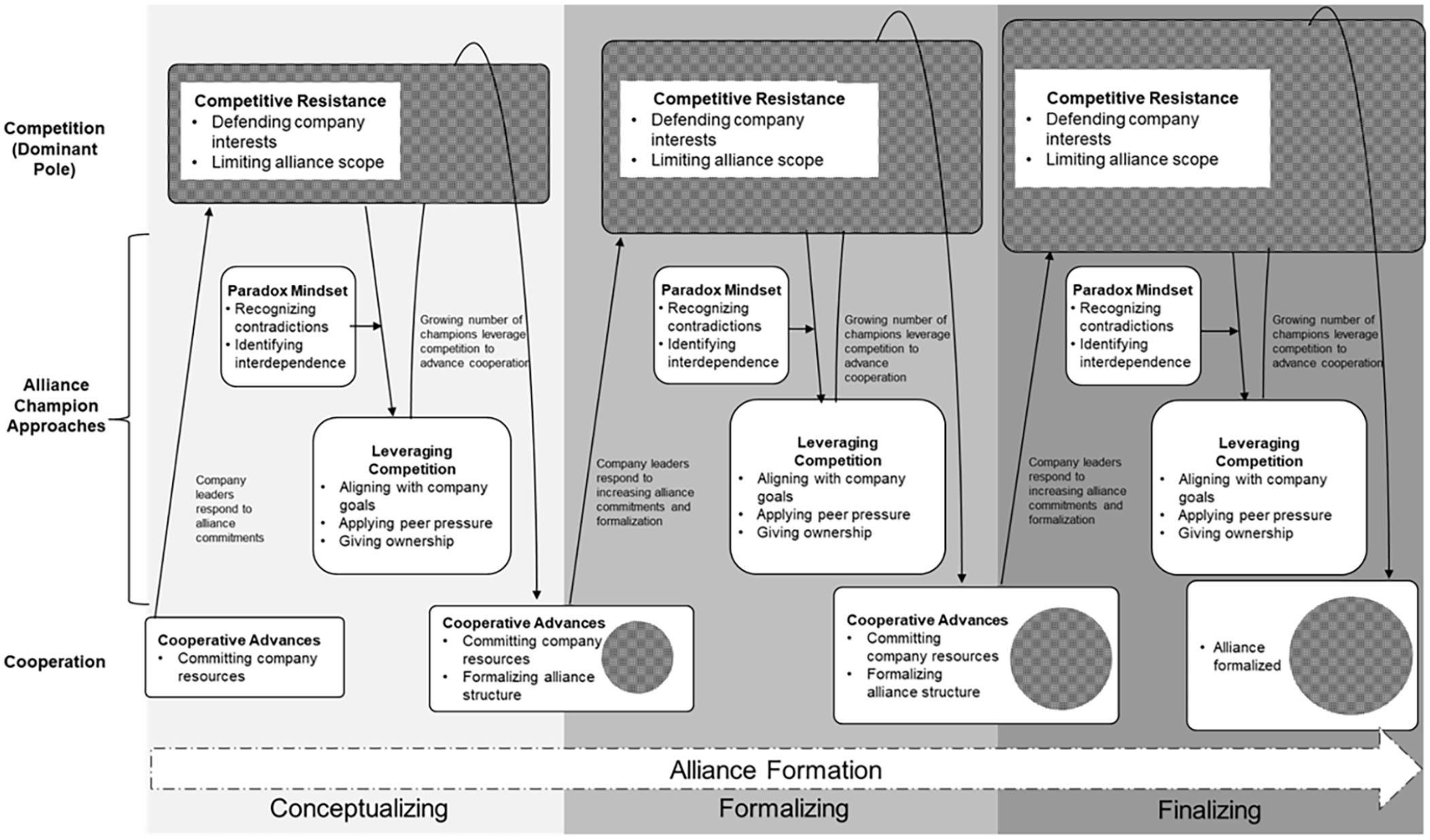
A Model of Leveraging the Dominant Pole to Navigate Coopetition Paradoxes in Strategic Alliances
Phase 1 (September 2010–June 2011): Conceptualizing
In September 2010, Suncor’s longtime CEO, Rick George, praised the Oil Sands Leadership Initiative (OSLI), an informal alliance of five companies including Suncor, at a keynote speech for the World Energy Congress, which included representatives from over 100 countries. George recognized the promise of OSLI to improve the oil sands sustainability performance amid an industry culture of “cut-throat competition, where all players believe they can beat everyone else, and sometimes do whatever it takes to prove it” (George & Reynolds, 2012: 24). The speech created backlash among CEOs of non-OSLI companies who felt left out of the alliance. George asked Gord Lambert, Suncor’s Vice President of Sustainability and co-founder of OSLI, for help. Lambert, who was well respected in the industry, had already begun to wonder about OSLI’s impact, given both the limited number of companies and their restricted mandate. Lambert saw this opportunity as a chance to develop a more impactful industry-wide alliance to both alleviate the concerns of non-OSLI CEOs and to effectively address the industry’s environmental performance. Realizing the need to address environmental issues, eight CEOs agreed to appoint vice presidents (VPs) to what he called a Strategic Advisory Group tasked with developing a vision and mission for the alliance.
In this phase, opting out of the alliance would have been relatively easy as the companies had only committed their VPs’ time to the alliance. Yet, leaving was also not in their best interest. First, they might miss out on some key technologies offered up by their competitors within the alliance. Second, they might appear uncooperative, which could make them look bad not only in the eyes of their peers, but also of government and environmentalists, who were pressuring the industry to clean up its act. By the end of this phase, several of the Strategic Advisory Group VPs had become committed to the alliance and joined Lambert as champions. Importantly, they persuaded their CEOs to commit to creating an implementation team of five full-time employees, who were tasked with creating a charter for the alliance that, in Phase 2, they would name COSIA.
Responding to Initial Commitments With Competitive Resistance
Gord Lambert, Suncor’s VP of Sustainability, saw opportunity in the CEOs’ frustration at being left out of OSLI. Even as George praised OSLI, the alliance still lacked impact. It only included five of the 13 major oil sands companies, had minimal funding, and was represented by lower-level company leaders with limited time or influence. Instead, Lambert envisioned an industry-wide alliance with high-level leaders and wide-reaching impact on sustainability and environmental performance. He believed this was the right thing to do and the only way to address the region’s problems. With George’s backing, Lambert presented this idea at an industry CEOs meeting. Although the CEOs remained skeptical, Lambert at least saw their willingness to consider the possibility and thought his presentation “landed really well” (S7). Seven CEOs in addition to George, agreed to put aside their cut-throat competition and commit company resources by appointing a company VP to a Strategic Advisory Group. By January 2011, the Strategic Advisory Group started meeting weekly to develop an initial vision.
Launching the Strategic Advisory Group was a huge success for Lambert. The VPs participated with “the blessings of our CEOs and our companies” (S9), spending time away from their company responsibilities. Many of the VPs had frequent meetings to update their CEOs, signaling the importance of the initiative. However, even with this support, these Strategic Alliance Group members faced significant resistance as they began to share emergent ideas with their CEOs. CEOs defended their company’s interests as they worried about their competitors freeriding, as previous collaborations such as OSLI had offered limited mechanisms to enforce contributions from members. One manager explained, “often the failure [of other collaborations] is that two or three people tend to be the drivers of the process, take ownership and then you have two-thirds that are just there to be there” (D9). Previous alliances he noted, tended to “drive to the lowest common denominator” (D9) and had limited impact. The CEOs also worried that they would have to share too much of their valuable intellectual property (IP) and began advocating to limit the scope of the alliance. Lambert and other champions knew that for COSIA to improve environmental performance and ensure the industry’s survival, companies needed to be “sharing IP at a level that has never been done before, certainly within this industry” (D9). Limiting the IP they shared would significantly diminish the alliance’s value.
Recognizing the Contradictions and the Interdependence
In their weekly meetings, the VPs in the Strategic Advisory Group experienced ongoing struggles with their dual roles to advance the alliance through sharing IP while also protecting their firm’s competitive interests. Lambert described this challenge as a “paradox” and “creative tension” (S7) that could lead to new opportunities. He had been thinking about how to engage the “synergy of economics and environment” since he was a university student. His “intuition about these synergies was validated” (S5) in 1987 when the United Nations published the Brundtland Commission Report (World Commission on Environment and Development, 1987), exploring interdependencies between economic development, social equity, and environmental protection. Lambert described the challenge as paradoxical: “Because I have spent my entire career working in the environment and energy space,” he argued, “the paradox of that is at play for me always” (S5).
Lambert frequently shared this perspective with other members of the Strategic Advisory Group. These members recognized the contradictions as they were “spending way too much time fighting over IP” (S7). Several members also identified interdependence noting that addressing the competitive concerns of individual firms led them to think about new ideas for a more effective alliance. As Lambert explained, Strategic Advisory Group members “were always calibrating back to where tension, creative tension, comes in. It’s all about the resource. Every company has its own interest, but we were always calibrating against what’s required for development of the [oil sands] resource” (S7).
Strategic Advisory Group members and other COSIA members adopted different approaches to these tensions. Several members became enamored with Lambert’s vision and joined him to champion the alliance, while recognizing the ongoing tensions between their commitment to the alliance and to their companies. We apply the label of alliance champion to describe this first group of leaders. “Champion” reflects the person’s actions and practices, not their formal roles. Other leaders, despite their formal role in COSIA, continued to vehemently defend their company’s needs over the needs of the alliance.
Champions Leverage Companies’ Competitiveness to Advance Cooperation
Lambert and the expanding group of champions knew it would be hard to gain buy-in from the CEOs to support an industry-wide alliance. Rather than try to sell them on why they should support an alliance, he focused on addressing their competitive needs. Lambert knew that the CEOs cared deeply about cost cutting and the bottom line. To build a “bullet proof argument” (S5), Lambert convinced George to have Suncor pay $1 million for McKinsey consultants to analyze existing industry collaborations. The consultants created a “bubble map” showing 30 collaborations accounting for over $90 million in company spending. For Lambert, the map was “a bit of gold” (S7) for its ability to convince skeptical CEOs that these collaborations had not yielded results that warranted their cost. He held one-on-one meetings with CEOs and showed them the bubble map. The CEOs were shocked at the expense and the inefficiencies. As Lambert noted, [One CEO] was like, ‘Holy crap! This is total chaos,’ [while another said] ‘This is like five-year-old’s playing soccer. And who the hell are these groups and, by the way, it’s like 90 million dollars a year to care and feed them all.’ (S5)
Lambert explained how a formal industry-wide alliance focused on results would minimize this inefficiency. He convinced them that by bringing together all the companies, drawing on influential high-level leaders, and legally ensuring that companies benefitted from the innovation and IP, the alliance would yield results that would benefit all members. By doing so, Lambert persuaded the company leaders that the alliance would be aligned with their company goals.
Lambert and other Strategic Advisory Group members continued to hold one-on-one meetings with CEOs and executives with the goal of “coalition building” (S5). Once they had the support of a CEO, they would use that support to apply peer pressure on skeptical CEOs by suggesting that if they did not join, they would miss out on important knowledge from companies that were committed to joining. As one Strategic Advisory Group member noted, In between [formal meetings with the CEOs] there were conversations within companies and some of us would speak to other companies and their CEOs and just building momentum around [the alliance]. There is a degree of peer pressure around the table. (S10)
The alliance champions further realized they could best respond to CEO and company competitiveness by encouraging CEOs to own the vision. When a VP from the Strategic Advisory Group would suggest limiting the alliance scope, Lambert encouraged them to keep the scope broader and leave it to the CEOs to decide: It shouldn’t be us who takes [issues] off the table. It should be the CEOs. We’ve got to empower them to be part of this process as well. So err on the side of thinking more boldly than being more timid. (S7)
By giving ownership to the CEOs rather than imposing control, Lambert and the other members of the Strategic Advisory Group encouraged more commitment to the alliance. Lambert felt particularly inspired when the CEO initially most “pissed-off” about OSLI made detailed edits to the alliance term sheet: We were getting markups from [the ‘pissed-off’ CEO]. Like I mean, really detailed wordsmith stuff. . . . And the fact that we were getting this really incredible amount of detailed editing from [the most competitive CEOs] was ‘yahoo!’ This is being socialized well and they are behaving like owners. (S7)
Transition From Phase 1 to Phase 2
The conversations that Lambert and other alliance champions had with company VPs and CEOs started to pay off. By June 2011, a number of industry CEOs tentatively agreed to move forward with the proposal from the Strategic Advisory Group to form an industry-wide alliance by developing four legally-binding joint venture agreements. Each one would represent an environmental priority for the alliance including tailing ponds, water usage, land usage, and greenhouse gas emissions. This proposal narrowed the scope of the alliance to focus only on environmental technologies and exclude production technologies tied to competitive advantage, although, as they later realized, disentangling these types of technologies became challenging and a source of ongoing conflict. Finally, the Strategic Advisory Group proposed a process they labeled as equitable contribution, in which the legal agreements would develop a formula to calculate how each company would share IP commensurate to the size of the organization as measured by production volume. These terms further formalized the alliance structure. In addition, they created what they called an Implementation Team, made up of five senior managers who would spend 80% of their time to act as the “arms and legs” (I9) of the initiative, figuring out how to implement these design concepts and develop a charter to be signed by the CEOs. This investment of employee time represented an increasing commitment of company resources to the alliance by five companies. As one informant explained, “It was obvious by the influence and the steerage that [the team members] were given, that these [CEOs] were very keen on seeing this [alliance] succeed” (D9). These increasing commitments of resources and the growing formalization of the alliance triggered Phase 2 of the alliance.
Phase 2 (June 2011–March 2012): Formalizing
During Phase 2, the scale of commitment grew even more with the increase of companies and employees involved, and more financial resources and time committed by the companies. In addition, the industry alliance went from being a vague idea to a more formalized set of rules and structures, which raised the stakes for the individual companies whose representatives became increasingly concerned about giving up more than they could get from membership in the alliance. Company lawyers advised their companies not to share core IP with the other members. They were concerned about other companies freeriding off their own hard-earned technological advances. The lawyers introduced concerns about industry-wide collusion. The champions, which now included the five members of the implementation team, worked hard to address these concerns. Instead of pushing back against this competitiveness, the champions recognized the paradoxical nature of competition and cooperation as not only in tension, but also interdependent. Instead of trying to diminish the growing competitiveness of the firms, they used it to their advantage by leveraging it to further the collective interests of the alliance. By the end of Phase 2, the champions had accomplished what many thought impossible. They had crafted a charter that the CEOs of 90% of the industry’s companies agreed to sign publicly.
Company Leaders Respond by Defending Their Interests and Limiting Scope
The five Implementation Team members became important alliance champions, along with Lambert and others on the Strategic Advisory Group. By summer 2011, those working on the alliance privately started calling it by the formal name Canada’s Oil Sands Innovation Alliance (COSIA), signaling the increasing commitment to the alliance.
These five members met regularly, starting in June 2011, with continued guidance from the Strategic Advisory Group, with the goal of drafting the alliance charter within 3 months. Working to meet the diverse needs of a large group of competitive companies raised significant obstacles and the charter was not signed until 9 months later. The work was demanding. As one Implementation Team member explained, “We were supposed to be [working] seventy or eighty percent of our time [but instead] I was almost full-time on COSIA. And, I let my other [company] work fall on the team that I had there” (I9).
As the Implementation Team specified the legal framework for the alliance, many of the CEOs became increasingly anxious about signing the charter. None of the previous alliances in the oil sands industry involved such detailed formal legal agreements; nor did they require sharing valuable technologies outside of those co-created within the alliance. Getting nervous, many of the CEOs consulted with their companies’ lawyers, who then started working directly with the Implementation Team. As one Implementation Team member noted, “Those [lawyers] tend to be people [who are] very protective [and who] try and create value for the company” (I9). The lawyers defended their companies’ interests regarding sharing IP, freeriding, and equity. One VP who was on the Strategic Advisory Group, but who remained skeptical of the alliance’s goals, explained the concerns being discussed within his company: This year [my company] was recognized as the top spender on technology in the oil sands industry. . . . A sensitive point is that others haven’t spent as much and therefore don’t have as much to offer. And we’re not getting as much as we’re giving. (S4)
Many lawyers advised their company’s CEO to limit the alliance scope. The Strategic Advisory Group members, led by Lambert, decided that COSIA would focus only on environmental technologies as these were seen to be less likely to yield competitive advantages compared to production technologies. Yet, it remained difficult in practice to separate the two. As one informant explained, “People like to think about it as environmental technology [or] production technology. Actually, it isn’t like that. There is no pure environmental. There is no pure production” (L50). For example, one of the industry’s most competitive companies invested significant resources developing technologies to use steam to extract bitumen located deep below the ground. By reducing water and energy usage, this process had environmental benefits, but also lowered company costs and improved its competitive advantage.
In contrast with the alliance champions that prioritized the formation of the alliance, the CEOs and company lawyers prioritized their company interests. We use the term company representatives to refer broadly to those people focused on their company needs. Over time, as the number of people involved in the alliance grew, the company representatives significantly outnumbered the alliance champions.
More Champions Exhibit a Paradox Mindset and Leverage Companies’ Competitiveness
As the lawyers defended their companies, negotiations became tense. The Implementation Team members felt frustrated by how the lawyers’ competitiveness increasingly stood in the way of cooperation, recognizing contradictions. A consultant working with the Implementation Team echoed their frustration noting: The lawyers better get the hell out of the way pretty damn quick because the number one way to stifle ideas and innovation is to burden it with legal frameworks and structures. It’s like getting married and checking your marriage, ‘ok here’s the prenup, and we’re going to get this so tightly defined that every time we have an issue in our marriage we’re going to go back and check.’ Well, what’s the fricken’ point? (O10)
The Implementation Team members and other COSIA champions also increasingly identified interdependence between competition and cooperation. While cooperation was challenging in their competitive industry, alliance champions also recognized the risks of not collaborating. As one champion noted, there were “risks to not being able to grow the sector” with corporate investors seeing “risks of changing regulations or changing public support for oil sands as a risk on the investment” (I9). The alliance champions recognized that companies would be unable to survive if they did not collaborate to improve their environmental performance; cooperation was a means to ensure the industry’s long-term viability. They saw the competitive nature of the industry as being potentially beneficial to the effectiveness of the alliance, by motivating members to perform better. As one champion explained, “[A] key aspect of COSIA is we do want to keep a competitive atmosphere . . . we want to be an executing group . . . [so we need both competition and cooperation]” (D9). Another champion echoed the importance of maintaining both: There are some individuals that are very content to share that knowledge with others. . . . Others would look at that and say we spent a bunch of money doing that and so what has been the end result? They are both of value. So what we wanted to do was create an organization where we [draw on both types—competitive and collaborative].
With the company lawyers now involved in drafting the charter, the Implementation Team members had to work harder to address concerns and gain buy-in. These members knew that each of the companies had different competitive concerns. They were constantly meeting with CEOs and other company representatives: It takes time. It takes a lot of listening and understanding. There are so many different companies from all over the world. So many different parameters and if somebody says ‘no, I can’t do that,’ how do you make sure you understand why they can’t do it so you can make those barriers go away? (S9)
By listening to company concerns, alliance champions were able to align the alliance goals with the companies’ goals to gain buy-in.
Alliance champions also reminded the CEOs of the overall threat to the industry, and the need for them to work together. As one Strategic Advisory Group member noted, “I think the fact that we saw a real pressure in the industry gave us this compelling case, which of course has been key throughout” (S10). Another Implementation Team member noted that they constantly reminded company representatives that, “We’re not competing with each other. We’re trying to deal with license to operate [i.e., the acceptance of the oil sands from key stakeholders such as regulators] and we all have a vested interest in that” (D9). By pointing to the need to work together and showing how other companies already bought in and what they would lose out on if they did not join, they were applying peer pressure to the more reticent companies.
To continue to gain buy-in for the charter, alliance champions on the Implementation Team constantly invited reactions from company representatives. The Implementation Team socialized their ideas with members of the Strategic Advisory Group, who would bring the ideas to the CEOs. As one Implementation Team member noted, “we literally had Strategic Advisory Group meetings every week. . . . They’d kind of recast and redirect us a little bit and we’d go back and do more work” (I9). The Strategic Advisory Group VPs would bring these ideas back to their own CEOs to get feedback and buy-in. By inviting input, the alliance champions were giving ownership of the alliance to the company representatives.
Throughout the alliance formation, Lambert demonstrated leadership to the other champions by not taking ownership over the alliance. He described his approach as follows: Part of what I have to do in the role that I play is . . . be inclusive and engaging of other leaders to help in owning that really quickly and then in the driving of it. . . . No fingerprints because I have been so inclusive of other people in the journey that we’ve taken and the design phases of it that they all feel ownership. That’s a true collaborative model.
This approach was key throughout the formation of COSIA as it assuaged the fear of company leaders that they were losing control of what their companies would have to give up to the alliance and enabled the alliance formation to move forward.
The Transition From Phase 2 to Phase 3
On March 1, 2012, at the Calgary Hyatt Hotel, 12 oil sands CEOs incorporated COSIA by publicly signing the charter, thereby defining the vision, and formalizing the alliance structures. Within a month, a 13th company signed on. The charter publicly committed the companies to “delivering accelerated improvement in environmental performance through collaborative action and innovation” (AC8). When signing the charter, they also announced a new COSIA executive director, who acknowledged the grandeur of the moment, stating, “As far as we know, this is the only place on the planet where this [level of collaboration] is done, certainly in this size” (D3). As one CEO said, “To get [13] companies to agree to something and launch it and move it along is the best indication [of progress]” (AM231). Finally, they converted the initial Strategic Advisory Group to what they now called the Shareholder Steering Committee, made up of one VP from each member company, with direct “line of sight” access to their CEO to ensure the alliance was a priority. These increasing commitments of resources and the growing formalization of the alliance triggered Phase 3 of the alliance.
Phase 3 (March 2012–September 2013): Finalization
In Phase 3, the number of champions again grew as support for the alliance increased and additional roles were created to advance the work of alliance building. This further growth in the scale of resources and the formalization of structures continued to raise the stakes and prompted even more intense defensiveness and resistance by company representatives. As the company representatives’ competitiveness continued to grow, the champions stepped up their efforts to advance the alliance’s interests. Together these dynamics and forces served to intensify the tension between competition, as observed in the company approaches to protect their firm’s interests and limit the scope of the alliance, and cooperation, as we show in the champions’ approaches to advance the alliance’s goals.
In this phase, COSIA leaders worked to create legally binding Joint Venture Agreements, delineating which technologies the alliance would share in order to advance environmental improvements, and which technologies remained proprietary to enable individual companies to maintain competitive advantage. They created a committee for each of four Environmental Priority Areas (EPAs)—Tailings, Land, Water, and Greenhouse Gas—which included a director to lead the negotiations and company representatives (usually technology specialists or business development managers) from each member organization. None of the EPAs faced more intense negotiations than the Greenhouse Gas EPA, which was the last agreement to be signed, as the committee experienced considerable competitive struggles and delays. By the end of Phase 3, all four EPAs were finally signed, signaling the finalization of the alliance formation.
Growing Competitive Resistance as Commitments and Finalization Increase
After signing the charter, the next challenge was “to define technically and to legally codify the strategic scope of each of the four Environmental Priority Areas” (D3). This included: (1) tailings—management of the manmade ponds used to capture the waste from the production process; (2) land—reforestation and management of land; (3) water—minimizing water use and pollution; and (4) greenhouse gas—reducing greenhouse gas emissions. They created a separate committee for each of these four areas. Companies identified people to sit on each committee, further committing company resources. Each committee included, “technical people, lawyers and competition lawyers, internal/external council. . . . So you might expect 50 people negotiating technically and legally about where the boundaries stop and start” (D3). As the number of company representatives increased, so, too, did the complexity. Each committee was responsible for creating its own joint venture agreement to be signed by the CEOs. COSIA hired a full-time director to lead the negotiations for each committee. The directors became champions for the alliance, working through increased conflict and tension toward signing a joint venture agreement that all companies could agree to.
The excitement that accompanied the public signing of the charter was soon replaced by anxiety among company leaders. The stakes were high. The alliance champions were tasked by the CEOs with creating an alliance whose scope needed to be broad enough to have real environmental impact. This broad scope required getting companies to share more IP with the alliance members. Yet, company representatives were also tasked with defending their company’s interests. In weekly meetings to negotiate the scope of shared technologies, company representatives fought to keep key technologies out of the collective pot. For example, as the Greenhouse Gas Committee director explained, Greenhouse gases brought decades worth of research and technology breakthroughs that were owned, patented, licensed and sold around the world as a revenue stream. The COSIA model said . . . you are now agreeing to share. Companies got really, really, uncomfortable with that change. (D11)
Some company representatives raised legal arguments to defend their company interests. They worried about how sharing technologies violated their responsibility to their shareholders. One representative asked incredulously, “Should we be putting every one of our competitors in the same position to produce as cheaply as we can? Is that what our shareholders expect of us” (S4)? These discussions were challenging because, according to the COSIA charter, any technology “in scope” could legally be developed by the signatories, whether or not a company possessing this technology offered to share it. One director explained, “We had to draw a circle for companies to be prepared to lend access to anything they’ve got in that scope” (D9). The companies agreed to “immunity from suit”; they could not sue others for using any technology in the “field of use”—the Alberta region.
Some company representatives started to see the benefit of having a broad scope of technologies that would be required to be shared, while other company representatives whose companies invested heavily in R&D thought they had more to lose than to gain in sharing technologies and continued to limit the scope of the alliance: “You could say, ‘Well this technology is for environmental purposes so it should be in.’ Some might say, ‘Well, no. I think it’s got more competitive benefits so it should be out.’ So that was a challenge” (D9).
Importantly, not every company that signed the COSIA charter had to sign on to all four of the separate joint venture agreements, making the negotiations particularly complex as companies threatened to leave. As one champion said, The big challenge is just so many moving parts. We have [13] companies, each of them with a different business plan, different culture, different background, different agenda. . . . [The challenges] multiply by a couple orders of magnitude because we have our legal folks involved, we have our technical people involved, we have our more strategic people involved. (D3)
The Greenhouse Gas Committee director noted how difficult it was to negotiate when company representatives were so defensive: You start off with this high level, and [the company representatives] think, ‘Oh yeah. That makes sense. I can understand that.’ But then you get into the grind of an agreement or the grind of a scope and it’s really hard to kind of break loose of those provincial views. ‘What is he giving versus what am I giving?’ and ‘is my stuff more valuable than his stuff?’ (D9)
One company’s representatives were so concerned about protecting their firm’s competitive technologies that their company decided not to sign the water joint venture agreement, undermining the alliance as it would lose out on that company’s promising water-saving technologies. Representatives from that same company threatened to withhold their signature from the greenhouse gas agreement if their competitive concerns were not met. “I think they know we’re serious about protecting these [greenhouse gas reduction] technologies,” a company representative said. “It’s in everybody’s interest including ours that we participate. . . . So we’re looking for ways to exclude the technologies that are important to us” (S4).
Leveraging Competition to Address Intensifying Coopetition Paradox
As the negotiations progressed, tensions increased. A growing number of participants involved in the negotiations recognized contradictions between collaboration and competition. As a Shareholder Steering Committee VP noted: [COSIA written materials] talk about [how] the behavior of people collaborating within COSIA should reflect the advancement of the interest of the group before the advancement of the individual. . . . [But] we have responsibilities to our shareholders . . . the interests of our company have to be given the primacy over the industry interests. (S4)
The champions also continued to identify interdependence of competition and collaboration. As another champion noted, “I’m very complimentary of [COSIA’s CEO] and the Shareholders Steering Committee, to recognize the tension. There are companies that sat in the room and wanted everything in, and other companies wanted it small for competition reasons.” They said however that, “I still hear some no/buts,” and then explained how the alliance champions were moving the group “towards a yes/and mentality” (D11). The Greenhouse Gas Committee director recognized that the tensions felt by company representatives who were grappling with profoundly new ways of collaborating were productive tensions: “These guys are all places where they’ve never been before, and they don’t necessarily want to be, or like to be, but they see the need to be. So, tension is good. . . . So, it is somewhat of a paradox” (D9).
The alliance champions continued to work toward signing all four joint venture agreements. The tailings and land agreements were relatively straightforward because they involved limited competitive technologies. Water was more complicated, with greenhouse gas being the most challenging given that the technologies that reduced greenhouse gas emissions also reduced cost and therefore yielded competitive advantages. One Strategic Advisory Group member noted, “[Greenhouse gas] has one foot in the ‘compete’ world, and one foot in the ‘I really want to be collaborative’ world. It’s a hard one” (S9).
As they negotiated the greenhouse gas agreement, several key company representatives pushed to limit the scope of the agreement and minimize the technologies to share. The Greenhouse Gas Committee director repeatedly reminded skeptical members that if they gave one-part innovation to the alliance, they would get 13 parts back. Alliance champions encouraged company representatives to “open their kimono” (I9), as they called it, meaning getting company representatives to divulge their company’s relevant technologies and IP. Only once the alliance champions knew what the companies were hiding could they then explore how they could share IP with one another. Alliance champions held extensive one-on-one conversations to learn what was at stake for each organization and align company self-interest with the overall alliance goals. One champion described the ongoing meetings to unpack different company needs as “peeling the onion” (S10), to slowly allow company representatives to identify different layers of concerns. They explained that “if someone has a different view—and we definitely want to understand it—we will take good time . . . finding a way through in a win-win way” (S10). The Greenhouse Gas Committee director also held small group meetings with various company representatives. They described how these meetings allowed them to develop a better understanding of company concerns, and, in doing so, eventually broaden the scope of which technologies would be shared: The process was put in place to breakdown or understand all the reasons why certain companies wanted a narrow scope. . . . Once we understood what the reasons were then we were able to build solutions to address those concerns and broaden the scope to a point where every company at the table was comfortable with it. (D11)
By developing these small groups, the Greenhouse Gas Committee director could then apply peer pressure from one company to encourage more participation from another. To do so, they employed an approach they called “IP Poker” to get companies to compete to add the most IP to the collective pot. The more IP that they shared, the more that other companies would eventually have to share. Continuing with the poker metaphor, the chair eventually called for a “declaration of all in,” asking whether companies had identified all the technologies that they had to share that fit within scope. One representative suggested this “all in” tactic applied peer pressure by encouraging a “moral statement” based on avoiding shame: What you were asked to do when you joined the [Environmental Priority Area] . . . is declare whether you’re all in. . . . The declaration of ‘all in’ said you’re going to look the guy in the eye and say I put everything in. Or you’re going to say ‘no, I know you expect me to put everything in and everybody else does too. But I haven’t put everything in.’ Kind of a nasty moral position to be in. (S4)
Once each committee had an agreement, they needed approval from the Shareholder Steering Committee. Drawing on their support from their CEOs, this committee advocated for a broader scope. Over a period of one and a half years, the Shareholder Steering Committee, which had been given ownership over the alliance, rejected the greenhouse gas joint venture agreement several times on the grounds that it was too narrow or hindered COSIA’s goals. The Greenhouse Gas Committee director chair joked that the process was as difficult as choosing a new Pope, “Here are the options; time for the conclave! Stand back and see if you see white smoke or black smoke” (D9).
Alliance Formalized
In September 2013, COSIA member CEOs signed the greenhouse gas agreement, the final of the four joint venture agreements. The alliance was now legally formed, setting the stage for the majority of the industry to collaborate on the environmental governance of the oil sands. An Environmental Priority Area director described this transformation: “It’s amazing to watch the CEO Council and to see the degree of competition that there was in the past and the degree of cooperation and broad collaboration [that is there] now” (S10).
Coda
Since 2013, COSIA’s four Environmental Priority Areas continue to work towards the mission of accelerating environmental performance in the oil sands, most recently by joining a broader initiative called Pathways Alliance. As of 2022, the total amount of money spent by COSIA members to improve land, air, water, and tailings was over $1.8 billion to develop over 1100 technologies (COSIA, 2022). Yet, the challenges remained. One of the authors continued to attend industry events. COSIA leaders noted that the tension between competition and cooperation remains salient. Despite our focus on the formation stage of the alliance, at which the tension is most salient (Katila et al., 2008), the coopetition tension persists as a permanent feature being negotiated in the alliance.
A Model of Leveraging the Dominant Pole to Navigate the Coopetition Paradox
Our process model shows how alliance champions navigate the coopetition paradox by leveraging the dominant pole, which we define as drawing on the approaches and goals of the stronger pole (i.e., competition) to promote the weaker pole (i.e., cooperation; see Figure 3 for the conceptual model). By doing so, the champions both respond to, and contribute to, the growing force of competition to move the alliance forward. This model highlights two key features of navigating the coopetition paradox. First, we note that the paradoxes between competition and cooperation not only persist, but also intensify over time, throughout the alliance formation process, demanding continued engagement from alliance champions. Second, alliance champions engage in key practices that leverage instead of diminish competition to dynamically navigate the intensifying paradox.
Our model of leveraging the dominant pole moves through three phases. The model begins with the first alliance formation phase, which we label “conceptualizing,” in which the initial alliance champion persuades competitor firms within the industry to commit preliminary resources, prompting cooperative advances, which occur when firms agree to collaborate on shared goals. The first phase involves lower stakes for companies compared with later in the formation process, as the alliance does not yet require firms to contribute a significant amount of resources and has not yet formalized and scoped which resources firms must share. Even so, the start of such discussions already triggers competitive resistance among company leaders who defend their firms’ interests and seek to limit the scope of the alliance to protect their intellectual property. Anxiety and defensiveness to protect firms’ competitive advantage grows when the alliance moves toward the more nuanced details in the formalization and finalization phases.
By the second phase, which we term “formalizing,” competitive resistance intensifies as companies commit more resources and agree to increasing formalization of alliance structures. Yet, at the same time, these cooperative advances lead to more competitive resistance. As support grows for the alliance among the firms and structures are put in place, the number of champions, that is, the people working to advance the alliance, grows. By the third phase of the alliance, which we label “finalizing,” the level of company commitment and alliance formalization increases again, and leads to even more competitive resistance, before the final agreements are finally signed by all firms.
We bracket phases at the moment that there is a major cooperative advance to increasingly formalize the alliance. These cooperative advances trigger competitive responses by member firms, creating paradoxical tensions between cooperative and competitive forces. These tensions prompt a response from the alliance champions who, instead of seeking to diminish competition, leverage it. Leveraging competition is a key mechanism to both navigate the paradoxes and to advance the alliance. The champions engage the stronger and growing competition pole to promote the weaker pole of cooperation through three practices. First, alliance champions seek to align the companies’ goals with the alliance’s goals by learning what each company is trying to gain while taking their interests into account while building the alliance terms. Second, champions apply peer pressure, engaging with the firms’ fear of missing out on the benefits of the alliance to prompt collaboration and sharing. Third, alliance champions give ownership to the company representatives so that they have more control and are more invested in the success of the alliance. In our figure, we depict leveraging through the looped arrow that begins with the champions’ leveraging practices, and wraps around competitive resistance, pulling it back towards the cooperative advances box, which contains a dark circle indicating that, through this process, the champions recognize that competition is embedded in, rather than distinct from, cooperation. Scholars point to the yin/yang image as symbolizing coopetition paradoxes, depicting competition and cooperation as opposites that each contain the seed of the other, and that together form a unified whole (e.g., Chen, 2008). Further, what enables this leveraging mechanism is the champions’ “paradox mindset” (Miron-Spektor, Erez, & Naveh, 2011; Miron-Spektor, Ingram, Keller, Smith, & Lewis, 2018; Smith & Tushman, 2005), in which the champions view the tension as paradoxical, recognizing the contradictions and interrelatedness of the two poles. Instead of viewing competition as a problem to be eliminated, the champions see its value for the alliance in that competition can spur stronger performance and can motivate reticent firms to participate in and contribute to the alliance.
Despite the champions’ efforts to navigate the coopetition paradox and enable further cooperative advances, competition continues to emerge even more strongly, requiring sustained and heightened efforts to leverage the dominant pole. Not only does the paradox resurface, it intensifies, meaning that as competitive resistance grows, so too does cooperation. Figure 3 depicts the boxes growing in size across the phases, with competition as the bigger box to denote that it dominates. Two mechanisms trigger the intensification of competition. First, greater commitments to the alliance over time increase the stakes for the companies, which further triggers more defensive competitive responses. Second, growing alliance formalization moves decision-making from more general terms to more specific discussions about exactly which proprietary knowledge will be shared in the legal agreements, resulting in companies fighting even harder for their own interests (Katila et al., 2008). The alliance moves through an oscillating and intensifying pattern of coopetition paradoxes that the champions both respond to and fuel by advancing cooperation, which in turn triggers competitive resistance from firms.
Discussion
While scholarship depicts cooperation and competition as paradoxical and evolving, our study offers important insight in theorizing the dynamics of managing these paradoxes in strategic alliances over time. To do so, we introduce a process model of navigating coopetition paradoxes that reorients scholarship away from structural approaches that seek a stable balance between cooperation and competition (Das & Teng, 2000; Fernandez et al., 2014; Lado et al., 1997), to instead explore agentic practices enabling a dynamic evolution. We identify a novel mechanism to navigate paradox, which we label as leveraging the dominant pole. This approach advances the less powerful pole (i.e., cooperation), by drawing on and valuing, rather than diminishing, the more powerful pole (i.e., competition). This novel approach enables champions to flexibly respond to ongoing shifts across the two poles. Our model offers three key theoretical implications to advance research on coopetition paradoxes in strategic alliances.
First, our model identifies paradox mindsets as critical for navigating the dynamics of coopetition paradoxes over time. Extant scholarship has identified coopetitive mindsets as a capability to hold the opposing elements of competition and cooperation in one’s mind at once (Oshri & Weber, 2006). These mindsets help navigate the uncertainty and complexity of cooperation and competition (Bengtsson et al., 2016; Raza-Ullah, 2021; Stadtler & Van Wassenhoven, 2016), enable a win/win approach that seeks integration across competing firms (Gnyawali & Park, 2011), and facilitate balancing capabilities (Chen, 2008; Hoffman et al., 2018). Coopetitive mindsets provide a more specified version of what scholars have called paradox mindsets, 1 or the cognitive mental models to recognize tensions and embrace opposing demands as interdependent and persistent, rather than seeking to resolve them (Miron-Spektor et al., 2018, see also Smith & Tushman, 2005). Paradox mindsets can introduce more generative and creative approaches to evolving strategic challenges (Hahn, Preuss, Pinkse, & Figge, 2014; Miron-Spektor et al. 2011; Smith & Besharov, 2019). For example, Hahn, et al. (2014) theorize how leaders adopt different approaches to corporate sustainability when they frame the relationship between their financial goals and social mission as paradoxical rather than seeking to justify a business case. Smith and Besharov (2019) empirically induce how a paradox mindset led to novel and valuable practices to sustain hybridity in a social enterprise (see also Miron-Spektor et al. 2011; Smith, 2014; Pradies, Tunarosa, Lewis, & Courtois, 2021).
In our study, COSIA’s success depended in part on the paradox mindset adopted by Gord Lambert and others who sought to advance the alliance. They recognized that the cut-throat competitive culture of the Alberta oil sands would destroy the whole industry if these companies could not collaborate to address environmental challenges. Importantly, they also understood that any collaborative efforts across these companies would only succeed if they valued the competitive culture. Understanding this intertwined relationship enabled Lambert and his colleagues to not only be creative, but also resilient and inspiring amid ongoing company resistance and challenges. Our findings invite future coopetition scholarship to explore in more depth how paradox mindsets impact strategic alliances. Scholars could explore in greater detail the origins and antecedents of paradox mindsets. Gord Lambert suggested to us that understanding paradoxes emerged when he was a university student and crystalized when he first read the Brundtland Report in 1987, which highlighted interdependencies among sustainability pillars. His approach seems to have informed that of the other champions. This insight invites several key questions about where this mindset comes from and how it transmits across people, as well as how persistent or fragile these mindsets may be over time. It also invites questions about scale and tipping points; what percent of teams and collectives need to adopt paradox mindsets to advance novel insights.
Extant studies suggest that paradox mindsets trigger epistemic motivation (Miron-Spektor, Emich, Argote, & Smith, 2022), inviting individuals to seek deeper understanding of a problem. Alternatively, our study suggests that paradox mindsets may have served as an emotional resource for alliance champions by providing motivation to advance the alliance amid ongoing and intensifying frustrations. In our study, each time company leaders agreed to advance the alliance, they then also increased their defensiveness and competitive concerns. The champions depicted these situations as stressful and frustrating, but also saw the resistance as an avenue for continued development. Future research could continue to explore the motivational and emotional mechanisms by which paradox mindsets advance alliance formation.
Second, we advance theory on coopetition in strategic alliances by identifying a novel mechanism for navigating these paradoxes, which we call leveraging the dominant pole. Existing scholarship predominantly examines structures, mechanisms, and capabilities, such as resource complementarity (Gnyawali & Park, 2011), conflict management (Hoffmann et al., 2018), and balancing capabilities (Fernandez et al., 2014) to equalize the forces of competition and cooperation, usually by diminishing the dominant pole or by enhancing the weaker pole to offset the stronger one. Instead, in our study, alliance success depended on drawing on and valuing competition as a resource, not rejecting it as an obstacle. In our study, COSIA embedded competitive goals and processes, which enabled CEO support. We use the metaphor of jiu-jitsu, a Japanese martial art, to describe the novelty and sophistication of leveraging the dominant pole. The jiu-jitsu word means “gentle art” because the martial artist does not seek to block or defend against an opponent’s advances, but rather yields to and uses the opponent’s energy to achieve their own goals. If an opponent strikes, the martial artist follows and then redirects the energy of the strike. Our study surfaced jiu-jitsu-like practices to navigate coopetitive paradoxes. The alliance champions engaged with the highly competitive CEOs, listening, understanding and valuing the competitive culture. They then drew on these competitive goals, processes, and outcomes to advance the alliance. These jiu-jitsu moves acknowledge underlying defensive psychodynamics of fear and control that emerge from company leaders (Petriglieri & Petriglieri, 2022; Vince & Broussine, 1996), and seek to address these issues directly, rather than avoiding or diminishing them. Where company leaders felt the need for control, champions gave ownership to keep them engaged in advancing the alliance. Where company leaders felt a fear of missing out, the champions drew on this fear and applied peer pressure to persuade the member firms to stay committed to the alliance to avoid missing out on its benefits. Future research could tease apart which aspects of the dominant pole are most effective to leverage.
By identifying leveraging the dominant pole, our study encourages focusing on the practices to navigate strategic alliances. Our model shifts the dominant discussion in coopetition and strategic alliance scholarship from exploring structures and capabilities to encourage adopting a practice ontology and exploring everyday actions to negotiate coopetition (e.g., Jarzabkowski & Bednarek, 2018). Our model further highlights the agency and the roles of individuals involved in enacting these practices (Jarzabkowski, 2005). This insight invites future scholarship to explore other practices and everyday occurrences that could inform large scale coopetitive strategies. Further, our focus on practices highlights the importance of the people who work to advance the alliance, which we label as the alliance champion. Our research returns to an early insight suggesting the importance of agency to advance alliances (Ring & Van de Ven, 1994), and invites future research to continue to understand the role, power, demographics, and other characteristics that enable the success of these alliance champions.
Finally, our model of leveraging the dominant pole offers novel insights into how coopetition paradoxes re-emerge and intensify over time even as alliance champions engage in approaches to address the tensions between cooperation and competition. Extant literature predominantly argues strategic alliance success is dependent on effectively balancing coopetition paradoxes by achieving equal amounts of competition and cooperation (e.g., Das & Teng, 2000; Gnyawali & Charleton, 2018). Aside from several notable exceptions (e.g., De Rond & Bouchikhi, 2004; Hannah & Eisenhardt, 2018), extent literature implies that tensions between cooperation and competition decrease over time as people build trust (Hoffman et al., 2018), learn how to navigate competing demands (Stadtler & Van Wassenhove, 2016), and more effectively address external challenges (Hannah & Eisenhardt, 2018). Our study surfaces a different pattern between cooperation and competition, that is, one of oscillation and intensification—advancing cooperation triggers increased competitive responses, which leads to intensifying approaches from the alliance champions to advance cooperation. This oscillating and intensifying pattern reframes the challenge of navigating strategic alliances from one of balancing to achieve stability, to one of intensifying cyclicality that requires a different approach and different set of assumptions.
Surfacing an oscillating and intensifying pattern of cooperation and competition tensions further advances theory by complexifying the role of coopetition paradoxes in alliances. While previous studies focus on coopetition paradoxes as sources of alliance instability and failure (Chen, 2008; Das & Teng, 2000), we suggest that depending on how they are navigated, these paradoxes may also contribute to the progression of the alliance. First, increasing resource commitments and alliance formalization trigger increased competition as company leaders fear losing competitive advantage the more IP they are required to give to the alliance. Second, the champions respond to this growing competitive resistance that threatens the alliance by leveraging the dominant pole, which advances the alliance, while intensifying the paradoxical tensions. This oscillation and intensification pattern encourages future scholarship to pay attention to nuanced challenges of navigating coopetition paradoxes. In addition, ongoing intensification can lead to alliance champion burnout, which may offer additional explanations for why alliances are precarious and difficult to manage (Das & Teng, 2000). We invite more longitudinal research to further unpack the complex role of coopetition paradoxes in both advancing and jeopardizing alliances, and to further investigate how navigating these paradoxes may lead to intangible costs on the people who work to advance the alliance.
Implications for Paradox Theory
Even as our study focuses on coopetition paradoxes, our findings contribute to paradox theory more broadly (e.g., Lewis & Smith, 2022; Putnam, Fairhurst, & Banghart, 2016; Schad, Lewis, Raisch, & Smith, 2017). First, our findings invite paradox scholars to identify and explore in more depth the differential power of paradoxical poles. Studies more broadly have pointed to such power differences. Studies on innovation take into account how exploitative forces overpower exploratory ones (e.g., March, 1991). Research on social responsibility stresses the overwhelming power of financial forces over social missions (e.g., Margolis and Walsh, 2003), or the pressures for short-term shareholder outcomes over other stakeholder needs (e.g., Freeman, 2010). Early paradox scholarship depicted these relationships as paradoxical, yet remained equivocal or evasive of power differentials. More recently, scholars have called for increased attention to power in paradox studies, with studies pointing to strategies to advance the weaker pole by sublimating the stronger one (Huq, Reay, & Chreim, 2017) while others have pointed to power dynamics in specific contexts that could influence paradox navigation (e.g., Berti & Simpson, 2021; Gaim, Clegg, & Cunha, 2021). Recognizing how this power differential shifts over time, our findings encourage paradox scholars to take seriously the power differentials across poles. Future studies could explore antecedents to pole differentials. Research suggests that actors normally pay more attention to, and prioritize, demands that are more short-term (Laverty, 1996; Slawinski, Pinkse, Busch, & Banerjee, 2017), quantifiable (Espeland & Stevens, 2008; Michaud, 2014), and certain (Trope, Liberman, & Wakslak, 2007). As in the case of COSIA, competition often focuses on the more short-term, quantifiable, and certain goals of increased profits, compared with the more ambiguous, long-term cooperative goals around environmental performance. Other paradoxical tensions also encompass contextual factors and characteristics of the poles that lead one pole to dominate over the other (Huq et al., 2017; Putnam et al., 2016). For example, exploitation often involves more short-term, quantifiable, and certain outcomes compared with exploration, and is reinforced by contexts that emphasize success in the present, such as large publicly-traded firms that aim to meet quarterly targets (Levinthal & March, 1993; March 1991). Future studies could further investigate the factors that inform dynamic shifts across poles (i.e., Berti, Simpson, Cunha, & Clegg, 2021), and the impact of such power differentials on navigation strategies over time.
Second, leveraging the dominant pole advances theory by offering a novel and unique approach to navigating paradoxes more broadly. As with coopetition research, paradox scholarship more broadly has explored strategies for balancing competing demands over time (Lewis and Smith, 2022), through practices such as differentiating and integrating (Miron-Spektor et al., 2018; Pradies et al., 2021), and connecting to a long-term goal (Slawinski & Bansal, 2015; Smith, 2014). Our study invites paradox scholars to more broadly explore the jiu-jitsu approaches behind leveraging the dominant pole to enable the weaker pole. For example, how could world leaders draw on polarizing politics to advance cooperative strategies? How could social entrepreneurs embrace business purposes to more effectively achieve social missions?
Generalizability and Limitations
We conducted this research on coopetition paradoxes in an extreme context (Siggelkow, 2007), inviting future scholarship to explore the generalizability of our findings. First, COSIA was an industry-wide alliance that included 13 different companies covering 90% of the industry. Multi-party alliances are challenging due to the number of partners and exponential growth of relationship ties (Yin et al., 2012), therefore increasing the difficulties facing alliance champions. Second, the nature of the challenges and the context might inform the competitiveness in our study. COSIA companies were collaborating on what might have been perceived as non-market (i.e., environmental) issues; however, these environmental issues were tied to financial performance and thereby to market outcomes. In other settings where a non-market strategy may be at play, the competitive dynamics may be different. In addition, Alberta’s political climate tends to be pro-business and free market, which may have impacted the competitiveness of the industry players. Third, we conducted our research during the alliance formation stage. During this phase, competitors engage in extensive negotiations to clarify the alliance terms, which may increase their competitive defensiveness (Katila et al., 2008). These extreme contexts offered us a chance to unpack the nuances of navigating coopetition that might not be visible in other situations where tensions are less salient (Siggelkow, 2007). Future research can explore how our findings generalize to other coopetitive contexts. Other types of interorganizational relationships, such as cross-sector partnerships (Hahn & Pinkse, 2014; Rondinelli & London, 2003), are increasingly being formed to address grand challenges (Ferraro et al., 2015). Even such cooperative arrangements are prone to competitive pressures, as partners possess disparate goals and values despite working towards shared goals, such as alleviating human suffering and preventing environmental collapse (Stadtler & Van Wassenhove, 2016). Future research could explore how these insights extend the generalizability of leveraging the dominant pole to alternative alliance phases and different types of alliances and interorganizational relationships.
Additionally, while our study focused on coopetition paradoxes, we invite future scholarship to explore how our model of leveraging the dominant pole may generalize to other strategic paradoxes (Smith, 2014). For example, navigating the tensions between exploring and exploiting also requires careful attention to these forces and could involve oscillation and intensification as exploitation often dominates over exploration (Raisch, Birkinshaw, Probst, & Tushman, 2009; Smith, 2014). Organizations that seek both to exploit existing products and explore new opportunities face tensions as the two rely on contradictory knowledge management processes while also complementing each other (Andriopoulos & Lewis, 2009; March, 1991). To avoid the negative outcomes resulting from this exploration and exploitation paradox, managers balance the two forces by creating supportive structures, strategies, and contexts (e.g., Gibson & Birkinshaw, 2004; Smith & Tushman, 2005). Yet, as our findings suggest, managers might do more than create the conditions to enable balancing, but might also engage in the practice of leveraging the dominant pole, rather than simply offsetting the dominant pole. These managers might further rely on their cognition, including paradox mindsets, to navigate difficult tensions. Future research could test our insights.
Conclusion
Since we started this research, the situation on the planet has become progressively more dire. Issues once known as climate change are now described as a planetary emergency. Other grand challenges such as poverty, racial and economic injustice, and health concerns also continue to mount globally. Democracy feels at risk, with authoritarianism on the rise and war breaking out in several regions fostering geo-political instability. To effectively address these complex problems that plague humanity, organizations will increasingly need to work together and pursue collaborations, despite intense competitive self-interest. With our insights, we hope to inspire future work that will continue to inform how competing organizations can more effectively collaborate to address the world’s greatest challenges.
Footnotes
Acknowledgements
We are grateful to Associate Editor Pursey Heugens for his guidance and two anonymous reviewers for their thoughtful feedback. We also thank Marya Besharov, Jennifer Brenton, Josh Keller, Paul Tracey, Tatbeeq Raza-Ullah, Ella Miron-Spektor, Reut Livne-Tarandach, Shuba Patvardhan, Ario Seto, and Andy Van de Ven for their feedback on previous versions of the paper, the paradox community, including the EGOS Paradox subtrack and the Paradox Research Education and Practice (PREP) Conference, for their continued support, and Bruna Brito, Bui Petersen, Pedram Pourasgari, and Ethan Ward for research assistance. Finally, thank you to the research participants, and especially Gord Lambert, for providing significant time and insights.
Funding
The author(s) disclosed receipt of the following financial support for the research, authorship, and/or publication of this article: This research was funded by the Carbon Management Canada Network of Centres of Excellence (NCE) program (project number D228).
