



Abstract
Hedge fund activism frequently has severe consequences for target firms and their management and boards. Yet, we know little about target management and boards’ response to activist attacks. To advance our understanding in this respect, we examine how the style of target management and boards’ written communication with activists influences campaign outcomes. Building on the behavioral mimicry perspective, we propose that language style matching (LSM) and emotional tone mimicry (ETM), which constitute two distinct types of verbal mimicry, are important communication style characteristics of target management and boards’ response letters that can induce activist demand withdrawal. Though LSM and ETM are reflective of different modes of conflict behavior, we further reason based on conflict management research that ETM in conjunction with LSM is particularly effective in inducing activist demand withdrawal. The positive effects of ETM in conjunction with LSM, however, are expected to fade with increasing length of target management and boards’ written response. Results of an empirical analysis of the public communication between activists and target management and boards in 150 U.S. activist hedge fund campaigns between 2002 and 2019 support these predictions. Our study extends research on financial activism by offering a novel theoretical explanation as to why and how target management and boards can avert activist demands. Further, we contribute to behavioral mimicry research by examining the individual and joint effectiveness of distinct types of verbal mimicry in the hostile context of activist hedge fund campaigns.
Activist hedge fund (AHF) campaigns often have severe consequences for a target firm’s management and board as the effectiveness of their strategy and governance are called into question (Ahn & Wiersema, 2019; Bebchuk, Brav, Jiang, & Keusch, 2020; Brav, Jiang, Partnoy, & Thomas, 2008; Denes, Karpoff, & McWilliams, 2017; DesJardine, Shi, & Sun, 2021). Activists most frequently request changes to the constitution of management and the board or demand fundamental revisions of target firms’ business and corporate strategies (Activist Insight, 2021). For 2022, the investment bank Lazard (2023) recorded a 36% increase in the number of AHF campaigns compared with the prior year and the largest number of campaigns since 2018. In continuation of this trend, AHFs launched major campaigns against some of the world’s largest software and media firms (i.e., Salesforce, Walt Disney Company) in the first half of 2023, demanding CEO/director replacements and partial divestitures while opposing selective mergers and acquisitions transactions.
From research on AHF campaigns, we know that activists succeed in getting about 60% to 70% of their demands met (Klein & Zur, 2009; Wiersema, Ahn, & Zhang, 2020). To explain activists’ success rate, research on the determinants of campaign outcomes has identified a set of activist, campaign, and target firm characteristics. Specifically, scholars have provided evidence that activist size, campaign experience, reputation, and stake in the target firm are positively associated with activists’ success to get their demands met (Brav et al., 2008; Brav, Jiang, & Kim, 2015; Krishnan, Partnoy, & Thomas, 2016; Wiersema et al., 2020). Additionally, target firm and campaign characteristics such as the type and number of demands brought forward by an activist, target firms’ size and prior performance, and the timing of the campaign were found to influence activists’ campaign success (Brav et al., 2008; Wiersema et al., 2020).
Yet, despite these valuable insights on how selective activist, campaign, and target firm characteristics influence campaign outcomes, no attention has been given to the response by the target management and board to activist attacks. Prior reviews of shareholder activism literature have thus called for “process-driven studies . . . [which] could enrich our understanding of how CEOs and directors perceive, react, anticipate, and deal with different types of shareholder activism” (Goranova & Ryan, 2014: 1257). Similarly, in one of the more recent contributions on hedge fund activism, Wiersema et al. (2020: 2494) lament that “how target firms respond to activist investors largely remains a ‘black box,’” and Shi, Connelly, Hoskisson, and Ketchen (2020: 1886) conclude that it would be useful if future research were to “investigate the [campaign] process in more depth and with greater nuance.”
From the perspective of the target management and board, a campaign represents an unsolicited and unwelcome attempt by an activist investor to influence the firm’s governance, financial, or strategic direction (Wiersema et al., 2020). Activist investors, however, usually hold only relatively small ownership stakes in the range of 6% to 10% in target firms (e.g., Barry, Brav, & Jiang, 2020; Boyson & Mooradian, 2011; Wiersema et al., 2020) and thus cannot impose changes with their sole voting power at shareholder meetings. Instead, they must persuade the management and board of the target firm of the validity of their concerns and the potential of their demands toward increasing shareholder value. Fittingly, Brav, Jiang, and Li (2021) thus refer to hedge fund activism as “governance by persuasion.”
As part of this persuasion process, activists often put pressure on a target firm’s management and board by issuing a public letter to reinforce their demands and to make themselves appear competent while making the target management and board appear less capable (Brauer, Wiersema, & Binder, 2023; PricewaterhouseCoopers, 2020). Consequently, the target management and board need to decide how to best respond to the critique and demands expressed in activist letters. Through their response to the activist’s public letter, the target management and board ideally convince the activist to withdraw all or at least some of the demands voluntarily to avoid costly confrontation and a loss of status by giving in to the activist’s demands (David, Bloom, & Hillman, 2007; Neubaum & Zahra, 2006).
In this study, we propose that behavioral mimicry can effectively influence an activist’s willingness to voluntarily withdraw demands. Behavioral mimicry is characterized by the assimilation of one’s behavior with the behavior of the interlocutor (Chartrand & Lakin, 2013; Van Swol, 2003). A major “consequence of behavioral mimicry is an increase in persuasion” (Chartrand & Lakin, 2013: 291). To assess the effectiveness of behavioral mimicry in AHF campaigns, we focus on verbal mimicry and distinguish two types of verbal mimicry: language style matching (LSM), as reflected in a similar use of function words (e.g., pronouns, conjunctions, prepositions) rather than content words (e.g., nouns, verbs), and emotional tone mimicry (ETM), as reflected in an emotional tone by the target management and board in the response letter that is congruent with the emotional tone expressed in the activist letter.
Both types of verbal mimicry have in common that they can be the result of conscious or nonconscious behavior (Chartrand & Dalton, 2009; Chartrand & Lakin, 2013; Shi, Zhang, & Hoskisson, 2019). Yet, while LSM signals cooperative behavioral intent (e.g., Ireland & Pennebaker, 2010; Ireland, Slatcher, Eastweick, Scissors, Finkel, & Pennebaker, 2011), the mimicry of negative emotional tone signals confrontational behavioral intent of the target management and board (e.g., Hareli, Elkabetz, & Hess, 2019; Hess & Fischer, 2014; Mauersberger & Hess, 2019). Though LSM and negative ETM essentially reflect two distinct modes of conflict behavior, we theorize that both can positively influence activist demand withdrawal: LSM because it fosters feelings of togetherness and trust among interlocutors (e.g., Chartrand & Lakin, 2013; Shirako, Kilduff, & Kray, 2015) and increases communication efficiency by stimulating convergent thinking and fostering mutual understanding (Giles & Ogay, 2007; Soliz & Giles, 2014), and negative ETM because it demonstrates the target management and board’s resoluteness to defend their position and demarcates “red lines” to the activist (Hareli et al., 2019; Hess & Fischer, 2014; Mauersberger & Hess, 2019).
As conflict management research suggests that interlocutors frequently show both cooperative and confrontational behavior in conflict situations rather than a single and pure mode of conflict behavior (Tjosvold, Wong, & Chen, 2014; Van de Vliert, 1997; Van de Vliert, Euwema, & Huismans, 1995), we further examine the conjoint influence of LSM and ETM on activist demand withdrawal. The study of conglomerated conflict behavior is not only a more accurate reflection of practical reality but also of considerable theoretical interest: 1 Prior behavioral mimicry research has exclusively evaluated the individual influence of distinct types of behavioral mimicry on negotiation or decision outcomes. Hence, we are oblivious to whether these distinct types are substitutes or complements. On the basis of interpersonal conflict literature (e.g., Van de Vliert et al., 1995; Van de Vliert, Nauta, Giebels, & Janssen, 1999), we argue that LSM and ETM are complements. Yet, we also theorize that the length of the target management and board’s response constitutes an important boundary condition. Specifically, we argue that with increasing length of a response letter, the positive effects of ETM in conjunction with LSM, which stem from the simultaneous display of resoluteness (or firmness) paired with the display of interest in seeking mutually beneficial solutions, are lost on the reader (“dilution effect”). The empirical analysis of 150 U.S. activist campaigns during which both activist and target firms communicate via public letters provides support for these four theoretical predictions.
Our study makes several contributions to financial activism research. While past studies have generated important insights into which activist, campaign, and target firm characteristics influence campaign outcomes (Brav et al., 2008; Klein & Zur, 2009; Wiersema et al., 2020), it has remained largely unexamined how the actual behavior of campaign constituents influences campaign outcomes. While select studies focused on how activists’ tactics influence campaign outcomes (Brauer et al., 2023; Brav et al., 2008), we are first to shed light on how target management and boards’ responses influence campaign outcomes. By focusing on the style of target management and boards’ public communication with activists during campaign processes, we extend the emerging literature on the determinants of campaign outcomes and offer a novel explanation as to why and how target firms can fend off activist demands.
Furthermore, our study contributes to the behavioral mimicry perspective in various respects. While past managerial studies have provided first evidence that LSM is associated with positive outcomes in hierarchical subordinate-supervisor relationships in the workplace context (e.g., Shi et al., 2019), our study extends these insights by suggesting that LSM can also have positive effects in hostile contexts, such as AHF campaigns. Building on the notion of emotional mimicry in behavioral mimicry literature (Duffy & Chartrand, 2015; Hess & Fischer, 2014, 2022), our study further contributes by introducing the concept of ETM, which emphasizes the importance of congruence in emotional tone. While extant work on tone management has provided evidence how positive emotional tone in corporate communication is associated with short-term stock returns and favorable stakeholder evaluations (e.g., Jegadeesh & Wu, 2013; Pfarrer, Pollock, & Rindova, 2010), past studies considered only the tone of a single interlocutor. A novel insight generated by our study is that matching of the emotional tone of the exchange partner is associated with favorable negotiation outcomes in confrontational contexts. Especially the finding on negative ETM is intriguing because past research on facial emotional mimicry suggested that people do not mimic others they do not like (e.g., Herrera, Bourgois, & Hess, 1998) or emotions that signal antagonism (Hess & Fischer, 2014). Finally, our study advances behavioral mimicry and conflict management research by evaluating whether LSM and ETM are substitutes or complements. Results indicate that the conglomeration of high extents of LSM and ETM is particularly effective in motivating activist demand withdrawal. Thereby, our study results provide evidence for the proposition in the conflict management literature that the conglomeration of cooperative and confrontational behavior can be highly effective in the resolution of interpersonal conflict (van de Vliert et al., 1995, 1999). Yet, we also unravel that conglomerated conflict behavior is considerably less effective in longer (written) communications. So far, the situational conditions under which conglomerated conflict behavior is less effective than an “all good” or “all bad” behavior have remained largely unexplored.
Background
AHF Campaigns
An AHF campaign draws public attention when the activist files a Schedule 13D with the Securities and Exchange Commission (SEC), announcing beneficial ownership of more than 5% of a target firm’s shares, paired with the desire to influence control over it. Since activists usually acquire only a small stake in the target firm due to the high absolute market capitalization of target firms, they cannot get their demands met by merely exercising their voting power at shareholder meetings (Boyson & Mooradian, 2011; Brav et al., 2015; Wong, 2020). Instead, they must rely on a process involving “compromise, dialogue, and negotiation” (Goranova & Ryan, 2014: 1247) to persuade the target management and the board of the validity of their concerns and the potential of their demands toward increasing shareholder value.
At the outset of a campaign, activists usually stick to private negotiations in the form of phone calls or (dinner) meetings (Becht, Franks, Mayer, & Rossi, 2009). When the target management and an activist cannot reach an agreement in these private negotiations, an activist campaign shifts “from private to more public forms of engagement” (Gantchev, 2013: 614). Activists often attempt to put further pressure on target management and boards by issuing a public letter to them. In these public letters, activists critique target management and boards and seek to convince them and target firms’ other shareholders as to the validity of their points of critique and the benefits of their demands. With the use of a public letter, an activist thus becomes more confrontational (Brav et al., 2008). Consequently, the target management and board need to find an adequate response to the activist’s public attack, which, most preferably, leads the activist to voluntarily withdraw some or even all demands. Voluntary withdrawal of the activist’s demands is the most preferable outcome because it avoids the distraction and the often multimillion consulting and legal fees that are incurred by litigations or proxy fights (Brav et al., 2008; Gantchev, 2013). The withdrawal of demands, however, is solely the activist’s decision. Therefore, the target management and board must convince the activist to do so in the engagement process. This begs the question how persuasion can be achieved best by the target management and board when communicating with the activist.
Target Firms’ Communication With Activists
Target management and boards can influence activist demand withdrawal through the content (i.e., their substantive reaction) and/or the style of their communication. In this study, we focus on target management and boards’ style of communication rather than target management and boards’ substantive verbal reaction (i.e., outright rejection of activist demand, partial concession to activist demand, or foreshadowing of future actions) because the behavioral mimicry perspective and verbal impression management theory propose that how something is said matters just as much as what is being said (e.g., Crilly, Hansen, & Zollo, 2016; Guo, Sengul, & Yu, 2020, 2021). This is also because how something is said often strongly influences the interpretation of what is being said.
From a “content perspective,” the target management and board essentially have three response options: The first response option is to outright reject the activist’s demands. Through rejection, the target management and board signal confidence in their own way of managing and governing the firm and their intrepidity to oppose the activist. Together, this might increase the likelihood of voluntary activist demand withdrawal. At the same time, outright rejection substantially increases the risk of further escalation of the dispute. A second response option is to make partial concessions to the activist. This more conciliatory approach could increase an activist’s willingness to give up demands. But as concessions to activists’ demands are commonly viewed as the admittance of managerial mistakes or insufficiencies (David et al., 2007; Neubaum & Zahra, 2006), this approach might also backfire and increase an activist’s determination to hold up their initial demands. Third, research on symbolic management suggests that activist demand withdrawal could be provoked by foreshadowing future substantive actions in line with the activist’s demands in the response letter (Busenbark, Lange, & Certo, 2017; Westphal & Park, 2020). Yet again, not all activists are likely to be appeased by the mere foreshadowing of future actions, especially given activists’ relatively short-term investment horizons (DesJardine, Shi, & Sun, 2021). In sum, the effects of the three substantive response options are ambiguous as all of them entail the substantive risk of increasing activists’ insistence. We thus suggest that the style of the target management and board’s communication may play an important role in the persuasion process because linguistic style permeates content and conveys meaning (Tausczik & Pennebaker, 2010; Topaloglu & Dass, 2021).
Building on the behavioral mimicry perspective, we focus in this study on a specific feature of target management and boards’ communication style with activists: the extent of verbal mimicry by target management and boards in their written communication with activists. The AHF campaign context lends itself to the study of verbal mimicry for multiple reasons. First, the public discourse between activist and target management and board is central to activist and target firm engagement and of great relevance for campaign outcomes (e.g., Brauer et al., 2023; Brav et al., 2008; Chuah, DesJardine, Goranova, & Henisz, 2024). Second, the campaign setting allows us to not only observe two-way communication but also, different from many other contexts in which verbal coordination has been examined, to clearly distinguish who is priming whom given that activists initiate the “conversation.” Third, the AHF campaign context enables us to extend prior verbal mimicry research, which has almost exclusively studied verbal mimicry in harmonious settings (Hess & Fischer, 2014), by testing whether past results on the effectiveness of verbal mimicry generalize to more hostile settings.
Theory and Hypotheses
Influence of Verbal Mimicry on Activist Demand Withdrawal
Scholars have studied the adoption of pronunciations and accents, speech rates, speech volumes, body postures and expressions, and the same word usage as different types of verbal mimicry (Brennan & Clark, 1996; Chartrand & Bargh, 1999; Giles, 1973). Extant research has provided ample evidence that these different types of verbal mimicry increase persuasiveness (Chartrand & Lakin, 2013; Topalogu & Dass, 2021; Van Swol, 2003). In our subsequent theorizing on how verbal mimicry relates to activist demand withdrawal, we discuss two types of verbal mimicry: (a) LSM and (b) ETM. Additionally, we suggest that LSM and ETM are complements, meaning that ETM in conjunction with LSM is particularly effective in inducing activist demand withdrawal. Yet, we theorize that the positive, conjoint effect fades in longer communications.
LSM in AHF Campaign Processes
Past research on verbal mimicry makes a clear distinction between language style and language content (Ireland & Pennebaker, 2010). LSM captures language style by focusing on the similarity of interlocutors’ use of function words (e.g., articles, auxiliary verbs, conjunctions, and pronouns) in speaking or writing (Ireland et al., 2011). LSM has been argued and found to positively influence negotiation outcomes for two main reasons: first, by increasing trust and sympathy among interlocutors (e.g., Chartrand & van Baaren, 2009; Shockley, Richardson, & Dale, 2009) and, second, by increasing mutual understanding and general communication efficiency (e.g., Giles & Ogay, 2007; Soliz & Giles, 2014). Experimental studies suggest that LSM enhances feelings of togetherness and trust by shortening the social distance between interlocutors and leading to greater approval and a more positive evaluation of the interlocutor (Maddux, Mullen, & Galinsky, 2008; Pickering & Garrod, 2004; Soliz & Giles, 2014). Further, greater feelings of togetherness and trust have been argued to result from the fact that LSM reflects “not only each partner’s attempts to engage the other, but also the degree to which these attempts are reciprocated” (Ireland et al., 2011: 40). These positive effects of LSM are grounded in similarity attraction theory, postulating that the higher the perceived similarity between two interlocutors, the higher the aptitude for sympathy and mutual respect (Byrne, 1971). Among others, greater perceived similarity has been found to have a positive effect on performance ratings and to be associated with more favorable assessments of and less conflict between interlocutors in negotiations (Strauss, Barrick, & Connerley, 2001; Wilson, DeRue, Matta, Howe, & Conlon, 2016). Chartrand and Bargh (1999), for instance, demonstrated that people who were mimicked reported liking the confederate more than those who were not and that they perceived the interaction to be smoother and more harmonious.
Next to increased mutual trust and sympathy, LSM has been found to increase mutual understanding and the efficiency of communication (Giles & Ogay, 2007; Soliz & Giles, 2014). Studies show that LSM facilitates agreement by lowering uncertainty and interpersonal anxiety while creating a shared conception of what is being discussed (Brennan & Clark, 1996; Garrod & Anderson, 1987). Specifically, it has been argued that greater extents of LSM indicate that interlocutors have a matched focus on the following: “the subject(s) of attention (through the use of personal and impersonal pronouns); the specificity and qualifications relating to their conversation topic (through the use of articles and adverbs); the temporal and spatial factors of their statements (through the use of auxiliary verbs and prepositions); refining stances on viewpoints (through the use of negations to clearly state one’s position on an issue); or connecting thoughts and ideas and creating a coherent narrative (through the use of conjunctions)” (Bayram & Ta, 2019: 26-27; Tausczik & Pennebaker, 2010). Collectively, past scholarly findings thus provide compelling evidence for the benefits of LSM.
These insights suggest that LSM in the response letter authored by the target management and board can be particularly effective in the confrontational AHF campaign context. Trust and mutual understanding often lack in social interactions between adversaries (Hess & Fischer, 2014). LSM helps the target management and board establish trust, which is conducive to attenuate the activist’s tenacity to push for all their original demands. Furthermore, through LSM, the target management and board can profit from the appearance of similarity and establish feelings of togetherness, leading to a more favorable assessment by the activist and lower potential for conflict (Shirako et al., 2015). Together, trust and mutual understanding positively influence an activist’s willingness to withdraw demands as their confidence in the responsiveness of the target management and board increases. From this we hypothesize as follows:
Hypothesis 1: LSM in a target management and board’s response letter to an activist investor is positively associated with activist demand withdrawals.
ETM in AHF Campaign Processes
Emotional mimicry is one manifestation of behavioral mimicry that focuses on the mimicry of emotional signals (Hess & Fischer, 2022). Research on behavioral mimicry found that “humans often spontaneously read and take on the emotional and affective states of others, a phenomenon known as emotional contagion” or mood matching (Chartrand & Lakin, 2013: 298; Hatfield, Cacioppo, & Rapson, 1994). Emotions can be signaled via different channels, such as the face, the tone of voice, body postures, or gestures (e.g., Baenziger, Grandjean, & Scherer, 2009). Here, we focus on (written) tone as an emotional signal whereby ETM refers to the adjustment to the emotional tone of the interlocutor (Shi et al., 2019). The emotional tone of a speaker is a meaningful emotional signal because it provides the audience with information about the speaker’s appraisal of an event and their behavioral intentions regarding the event. In short, “emotional signals [are mostly social and] tell the other to withdraw, approach, stay, comfort, play, or back off” (Hess & Fischer, 2014: 45).
Prior findings from negotiation and conflict management literature support this proposition of behavioral mimicry research. Studies suggest that “voice [i.e., the written or verbal expression of views pertaining to conflict], has an integral role in the process of managing conflict” (Shapiro & Burris, 2014: 174). More specifically, studies suggest that assertive, confrontational conflict behavior is of particular value in severe conflict situations in which the parties have clearly competing goals (Tjosvold et al., 2014; Van de Vliert et al., 1995, 1999). This has been mainly explained with contingency arguments. As noted by Tjosvold et al. (2014: 44), “conflict management is surely an area where people do and should act contingently,” and “at times, this means fighting to win.” Similarly, Van de Vliert et al. (1999) argue that “forcing,” defined as contending the opponent in a direct way, can be effective in severe conflict situations.
In the hostile AHF campaign context, negative ETM is indicative of such a confrontational, “hard-nosed” approach to conflict. A transfer of the insights from behavioral mimicry and conflict management literature to the context of AHF campaigns thereby suggests that, by mimicking the negative tone of the activist in their response letters, the target management and board signal the activist to back off and to not overstep “red lines.” Further, negative tone congruence indicates the target management and board’s resoluteness to defend against the activist’s critique and demands. This display of determination is likely to impress the activist and make the activist consider partial withdrawal.
Due to the hostile nature of AHF campaigns, activist letters to target management and boards are usually negative in tone (e.g., Ahn & Wiersema, 2021; Brav et al., 2008; Wiersema et al., 2020). Consequently, positive tone congruence plays a minor role in AHF campaigns compared with negative tone congruence. Theoretically, however, positive tone congruence can also be expected to be positively associated with activist demand withdrawal but for a very different reason: While negative tone congruence signals the activist to back off, positive tone congruence placates the activist. Specifically, positive tone congruence indicates the target management and board’s affiliative intent and their willingness to cooperate, thus increasing the activist’s confidence in the target management and board’s responsiveness to their concerns.
Yet, theoretical reasons not only exist for negative and positive tone congruence being positively associated with activist demand withdrawal, but theoretical reasons also exist for why tone incongruence is negatively associated with activist demand withdrawal. The tone of a target management and board’s letter can be incongruent in two ways: First, the response letter by the target management and board can be toned overly negative, meaning that the tone of the response letter is considerably more negative than the tone of the activist’s letter. Second, the response letter by target management and board can be toned overly positive, meaning that the tone of the response letter is considerably more positive than the tone of the activist letter. Both cases of emotional tone incongruence make activist investors’ demand withdrawal less likely. An overly negative tone of the response letter leads the activist to conclude that the demands clearly have merit and substantive change at the target firm is needed. Likewise, an overly negative tone of the response letter in form of a harsh rebuttal of the activist is likely to incite the activist and motivate them to sustain or even intensify the attack. An overly positive tone in the response letter compared with the activist’s letter makes activist demand withdrawal less likely, too. The activist is likely to perceive an overly positive tone of the response letter as indication of the target management and board’s misplaced optimism and/or their unwillingness to adequately acknowledge the severity of the company’s performance or governance shortfalls. This theoretical reasoning is backed by research on optimism and overconfidence. Optimists who are identified by positive language use have been found to discount unwanted facts and information and to be less responsive to negative news (Geers, Handley, & McLarney, 2003; Geers & Lassiter, 1999). As a result, the activist is likely to become particularly insistent if the target management and board’s response letter is overly positive in tone compared with the activist’s letter. Hence, we predict the following:
Hypothesis 2: ETM in a target management and board’s response letter to an activist investor is positively associated with activist demand withdrawals.
Interplay of LSM and ETM
Research on communication accommodation shows that interlocutors may converge on some linguistic features (e.g., lexical diversity) but diverge on others (e.g., accent), a phenomenon labeled interactional complexity (Giles, Mulac, Bradac, & Johnson, 1987). Yet, the effects of different types of verbal mimicry have almost exclusively been studied in isolation. As a result, we lack knowledge on the aggregate effect of different types of verbal mimicry and whether they are substitutes or complements. Similarly, the “one-best-way perspective” in conflict management literature has been critiqued, as field observations evidenced that reactions to a conflict frequently consist of multiple behavioral responses rather than a single and pure mode of conflict behavior (Van de Vliert et al., 1999). In the following, we predict based on negotiation and conflict management literature that the conglomerated effect of LSM and ETM is positively related to activist demand withdrawal.
In conflict management research literature, the negotiator’s dilemma describes the trade-offs associated with the single reliance on a (“soft”) cooperative approach and the single reliance on a (“hard”) confrontational approach in negotiations (Lex & Sebenius, 1986; Urlacher, 2014). A negotiator who uses a cooperative approach may succeed in reaching a settlement, but it may be a settlement that produces less value for that negotiator than the one that might have resulted had they engaged in more hard-nosed tactics. Likewise, a negotiator who is confrontational may succeed in producing a favorable settlement but risks causing a breakdown of negotiations with no settlement reached (Urlacher, 2014). To mitigate these risks associated with the two types of behavior, conflict management research suggests that the conglomeration of cooperative and confrontational behavior may be most effective for conflict resolution (e.g., Van de Vliert, 1997; Van de Vliert et al., 1995). The key feature of conglomerated conflict behavior is that negotiators display confrontational and threatful behavior in conjunction with displays of compassion and sympathy. This interplay has been argued and found to be positively associated with an exchange partner’s willingness to make concessions and to generate superior results for the negotiator compared with an “all positive” or “all negative” response advocated by the one-best-way perspective in conflict management (Brodt & Tuchinsky, 2000; Kuhn & Poole, 2000; Tjosvold et al., 2014; Van de Vliert et al., 1995). Research on buyer-seller negotiations, for instance, found that greater concessions were made by the other party when negotiators shifted between cooperative and confrontational behavior (Hilty & Carnevale, 1993) or when negotiators showed firmness or applied forcing behavior in conjunction with a cooperative, problem-solving approach (Van de Vliert et al., 1995, 1999).
The AHF campaign context lends itself to the study of conglomerated conflict behavior. First, AHF campaigns are usually highly confrontational. AHFs “are by far the most frequent type of investor willing to actively oppose management” (Lilienfeld-Toal & Schnitzler, 2021: 279) and have been portrayed as keen on “rattling the leaders of the corporate world,” creating “a renewed struggle between shareholders and managers” (Ahn & Wiersema, 2021: 96). Second, qualitative evidence suggests that AHF campaigns are typically characterized by cooperative and confrontational conflict behaviors. Namely, AHFs have been observed to engage in a variety of tactics ranging from “more cooperative, private activism to more confrontational, public methods” (Goranova & Ryan, 2014: 1247).
A transfer of insights from negotiation and conflict management literature to the AHF campaign context suggests that LSM is likely to amplify the positive influence of both negative and positive ETM on activist demand withdrawal. While negative ETM conveys the target management and board’s resoluteness (or firmness) and cautions the activist not to overstep “red lines,” LSM signals affiliative intent and thereby makes activists more likely to partially accept these red lines. Moreover, conflict resolution between the activist and target management and board becomes more likely when a letter features high extents of both LSM and negative ETM because LSM is deescalative and thus substantially lowers the risk that negotiations break down, which might occur if activists perceive the target management and board’s ETM as too confrontational. Similarly, LSM is likely to strengthen the positive influence of positive ETM on activist demand withdrawal because LSM underscores the target management and board’s affiliative intent and cooperative attitude. Hence, we predict the following:
Hypothesis 3: LSM strengthens the positive association of ETM with activist demand withdrawals.
Communication Length as a Boundary Condition
While the proposition that conglomerated conflict behavior frequently proves more effective than “all good” or “all bad” behavior has gained popularity in conflict management literature, studies have been silent regarding the situational conditions that lower the efficacy of conglomerated conflict behavior. Consistent with our study’s focus on the importance of communication style, we suggest that the length of the target management and board’s response letter is a relevant contingency factor. Specifically, we expect that the length of the target management and board’s response letter depresses the effectiveness of conglomerated conflict behavior in AHF campaigns. This is for the following reasons: The longer the response letter, the greater the risk that the positive effects of ETM in conjunction with LSM, which stem from the simultaneous display of resoluteness (or firmness) paired with the display of interest in seeking mutually beneficial solutions, are lost on the reader. The simple fact that the reader must cognitively process a larger number of words and sentences and is thus burdened with a greater cognitive load causes this dilution effect (Fiske & Taylor, 2017; Murphy, Groeger, & Greene, 2016). Furthermore, communication and attention research has shown that in longer conversations, the content of the conversation becomes more important (Ocasio, Laamanen, & Vaara, 2018). Comparatively greater focus on communication content than style exacerbates the dilution effect in longer letters. In longer response letters, LSM is less likely to sufficiently deflect from or compensate for strong differences in opinion and less likely to effectively reduce the risk associated with negative ETM that negotiations break down because of elevated hostility (Schwarz, 1996).
In shorter letters, in contrast, the risk of dilution caused by more and often also longer words and sentences is arguably much lower. Simpler words and simpler syntax are usually used in shorter texts by which they impose less cognitive load on the reader (Murphy et al., 2016). As a result, it is much easier for readers of shorter letters to discern whether an author simultaneously signals resoluteness and cooperativeness or whether they display a single mode of conflict behavior. Similarly, dilution of the positive effects of ETM in conjunction with LSM caused by communication content eclipsing communication style is less of an issue in shorter letters. In shorter letters, communication style not only is more readily discerned but also permeates content more strongly. Hence, we expect that the conglomeration of high extents of ETM and high extents of LSM is more effective in shorter letters compared with longer letters. We thus predict the following:
Hypothesis 4: Greater length of a target management and board’s response letter weakens the positive association of ETM in conjunction with LSM on activist demand withdrawals.
Method
Data and Sample
To test our hypotheses, we collected data on all AHF campaigns targeting U.S. firms in the time period from 2002 to 2019. We focus on a single country to avoid biased analyses resulting from differences in corporate governance and other regulatory laws and practices. We obtained data on AHF campaigns from Thomson Reuters ASSET4 ESG, providing information on activist campaigns, the demands brought forward within these campaigns, and each demand’s outcome. This led to an initial sample of 1,790 campaigns. The target firms in our sample, on average, have total assets of US$4.953 billion in the financial year prior to the campaign. Moreover, the target firms in our sample have a negative return on assets of −5.90%, supporting earlier findings that activists typically target underperforming firms.
In a second step, we identified all campaigns in which an activist sent a letter to a target firm. To do so, we screened each target firm’s SEC filings, namely, its Schedule 13D and DFAN 14A filings. The SEC requires investors to submit a Schedule 13D filing if they acquire more than 5% of a firm’s outstanding shares and plan to actively influence either the control or the management of a target firm (SEC, 2012b). In the Schedule 13D filing, investors are obligated to state the number of shares held and to provide background information on the purpose of their transaction. Moreover, investors are obligated to file amendments to their Schedule 13D filings to report any material change in the information provided and any acquisition or disposition of 1% or more shares. In their public letters to target management and boards, activists state their intentions toward the firm. Therefore, activists attach these letters as exhibits under Item 7 of the Schedule 13D. Since some activist demands are also brought forward in more formal activist proposals, public letters can also be attached via DFAN 14A filings, referred to as “definitive additional proxy soliciting materials filed by non-management” (SEC, 2019: 55). For our initial 1,790 campaigns, we identified 567 campaigns (32% of all cases) in which activists sent letters to the management and board of the target firm.
In a third step, we identified public letters sent by the target management and board to the activist by screening target firms’ Form 8-K and DEF filings. Public letters to activists constitute relevant information “shareholders should know about” (SEC, 2012a), as the information disclosed allows shareholders to make inferences about the firm’s upcoming strategic decisions and, therefore, require a Form 8-K filing. DEF filings, comprising several types of definitive (additional) proxy statements and information filed by management, constitute the counterpart to DFAN 14A filings and contain letters to activist investors when activist demands are brought forward in activist proposals. For the 567 campaigns in which activists sent a letter, we identified 178 campaigns (31% of all cases) in which the target management and board sent response letters. Due to missing data on control variables, our final sample, including only campaigns in which activists sent letters and the target management and board sent response letters to activists, consists of 150 campaigns against 146 different target firms initiated by 110 different activists.
Dependent Variable
Extent of activist demand withdrawal
As outlined in our theorizing, the primary objective of target management and board in a campaign is to get the activist to withdraw her/his demands voluntarily. We measure the extent of an activist’s demand withdrawal as the proportion of the number of demands withdrawn by the activist divided by the total number of demands initially brought forward by the activist. So, if activists withdraw one out of two demands brought forward, the withdrawal rate is 50 percent. The mean of activist withdrawals in our sample is 36 percent. We utilize Thomson Reuters’ ASSET4 ESG database to identify all the demands brought forward by an activist during a campaign and each demand’s outcome.
Key Predictor Variables
LSM
To assess the extent of LSM, we conduct a linguistic analysis of all activist letters and the corresponding response letters by target management and boards. In the first step, we formatted each letter by excluding nonrelevant information, like headers, footers, page numbers, and addresses. Additionally, we followed the recommendations by Loughran and McDonald (2016) and removed all tables and exhibits quoting third-party sources as they could also bias our linguistic analyses. In a second step, we analyzed each letter using Linguistic Inquiry and Word Count (LIWC), a widely used word count program with over 70 predefined grammatical dictionaries, including function word categories and psychological dictionaries (Pennebaker, Booth, & Francis, 2007). Because of their strong validity and reliability, LIWC measures have been widely used in strategy and finance research over the past 10 years (e.g., Crilly et al., 2016; Nadkarni, & Chen, 2014; Pfarrer et al., 2010). Specifically, we used the measure developed by Ireland et al. (2011) to assess the extent of LSM across each pair of letters. We rely on this measure rather than alternative measures (e.g., Jaccard similarity measure) because the discriminant and predictive validity of LSM incorporated in LIWC has been well demonstrated in past research (e.g., Cohn, Mehl, & Pennebaker, 2004; Ireland & Pennebaker, 2010; Mehl & Pennebaker, 2003). We first calculated separate LSM scores for each of the nine basic-level function word categories (i.e., personal pronouns, impersonal pronouns [iprons], articles, conjunctions, prepositions, auxiliary verbs, high-frequency adverbs, negations, quantifiers), adopting the formula from Ireland and Pennebaker (2010) and Ireland et al. (2011):

In this formula, in which impersonal pronouns (e.g., “it,” “that,” “anything”) are used as an example, ipronsActivist is the percentage of impersonal pronouns used in the activist’s letter and ipronsTarget is the percentage of impersonal pronouns used by the target management and board in the response letter. In the denominator, 0.001 is added to prevent empty sets. Then, we added the nine category-level LSM scores to create a composite LSM score. Higher scores represent a greater level of LSM between letters. For our sample, we find an average LSM score of 7.26, which is very similar to the CFO-CEO LSM score (LSMCEO-CFO = 7.89) reported by Shi et al. (2019).
ETM
To assess the extent to which the emotional tone of the response letter by the target management and board is congruent with the emotional tone of the activist in their letter, we again conducted a linguistic analysis of all activist letters and the corresponding response letters. Consistent with our measurement of LSM, we use the LIWC content analysis software developed by Pennebaker, Booth, Boyd, and Francis (2015) to analyze the emotional tone of activist and target firm letters. LIWC’s emotional tone measure is a combination of positive-emotion words and negative-emotion words. LIWC’s positive-emotion category combines, among others, the two subcategories “positive feelings” and “optimism and energy,” while its negative-emotion category combines, among others, the three subcategories “anxiety or fear,” “anger,” and “sadness or depression.” In line with expectations, we find that activist letters carry, on average, a significantly more negative emotional tone relative to target firms’ response letters (t = 6.843, p = .000). Since ETM reflects congruence between the tone of the activist and the tone of the target firm, we operationalize ETM as follows:

A score of zero thus indicates full congruence in tone, and more negative values indicate greater incongruence in emotional tone.
Response letter length
We use response letter length (i.e., the number of words) as a control variable and as a moderator variable to test Hypothesis 4. We winsorize this variable at the 5th and 95th percentiles to prevent outliers from affecting our results. Yet, post hoc analyses show that our results remain unchanged when using the unadjusted response-letter-length variable.
Validation of ETM Measure
The tone measure incorporated in LIWC has been widely used in management and finance research (e.g., Harmon, 2019; Oliver, Campbell, Graffin, & Bundy, 2023; Pfarrer et al., 2010; Tetlock, Saar-Tsechansky, & Macskassy, 2008), and its predictive validity has been well demonstrated in past research (e.g., Cohn et al., 2004; Ireland & Pennebaker, 2010; Mehl & Pennebaker, 2003). Still, we saw merit in the validation of our ETM measure to assess whether readers pick up the tone (in)congruence in the letter exchanges similar to the computerized text analysis. In a first step, we thus identified from our sample pairs of letters that, based on our computerized linguistic analysis, reflected high or low ETM (about −2 and +2 standard deviations). We identified five pairs of letters for each condition, which we randomized in order of presentation. Before rating the pairs of letters in terms of ETM, we gave the readers the definition of ETM as the extent to which the emotional tone of the response letter is congruent with the emotional tone of the activist’s letter. The two readers then rated ETM on a 7-point Likert scale, with 1 representing very low ETM and 7 representing very high ETM. We find that readers’ assessments of ETM are sufficiently consistent with each other (Krippendorff’s alpha = .76) and that they rate letter pairs with low ETM (average rating = 2.20) significantly lower than letter pairs with high ETM (average rating = 4.60; Δ = 2.40, p = 001). We conclude that the perceptions of the average reader regarding congruence in tone across letters adequately align with the results generated by the computerized text analysis.
Control Variables
To account for additional factors that might motivate an activist to withdraw their initial demands, we control for several target firm, activist, and campaign characteristics. Regarding target firm characteristics, we control for the target firm’s size, measured by its total assets, its financial performance using industry-adjusted return on equity, and its responsiveness to the activist’s attack. The response time of the target firm to the activist attack is assessed by the time interval between the activist letter and the response letter (in days). We find that 72% of target firms respond within 4 weeks and 90% within a quarter. Further, we control for the substantiveness of a target firm’s response. On the basis of qualitative text analysis of the response letters, we create three dummy variables identifying whether target management and boards give a rejection, make a concession, or foreshadow future actions in line with activist demands in their response letters. A response letter can contain all three substantive responses if an activist put forward multiple demands. The qualitative text analysis to identify target firms’ substantive responses was conducted in equal parts by the first author and a trained secondary coder, who received detailed instructions together with a coding guideline. We also evaluated interrater reliability for 15 randomly selected response letters. To assess interrater reliability, we used Cohen’s (1968) kappa, which was equal to 0.92 and thus above the threshold of 0.80, which is considered a high level of interrater agreement (Fleiss, 1981). Using a dummy variable labeled target multiple attack, we also account for the fact that a firm might have been attacked by an activist before. In addition, we control for several CEO and board characteristics of the target firm as the CEO and board are the primary targets of an activist attack and because the CEO and board jointly determine the response strategy to an activist attack. On CEO level, we control for gender, CEO tenure, and CEO share ownership. Additionally, we control for board size and independence, assessed by the share of independent directors on the board. Regarding the activist, we control for their stake in the target firm at the beginning of a campaign, measured as the percentage of the target firm’s shares outstanding held by the activist. Further, we control for activist size using assets under management. Additionally, we assess an activist’s prior demand withdrawal in all campaigns launched by the activist within the preceding 3 years to account for an activist’s prior campaign behavior and reputation gained through this behavior (Krishnan et al., 2016). Consistent with our dependent variable, we assess an activist’s prior demand withdrawal as the total number of withdrawn demands divided by the total number of demands brought forward by the activist in prior campaigns. If an activist engaged in several campaigns in the preceding 3 years, we average the withdrawal rate of these campaigns. As activists may put forward multiple demands of different kind in a campaign (Bebchuk et al., 2020), we further control for the type of demand. To distinguish between different demand types included in a single campaign, we follow prior research (Bebchuk et al., 2020; Brauer et al., 2023) and use the 56 demand types provided in the campaign data obtained from Thomson Reuters ASSET4 ESG. On the basis of the topical similarity of these demands, we group demands into six categories: board demands (e.g., demands of board representation, director/CEO removal), business strategy demands (e.g., request of a new strategic business plan), corporate strategy demands (e.g., completion of an acquisition, opposition to a planned merger), sale-of-company demands (e.g., sale of the entire company), other corporate governance demands (e.g., removal of anti-takeover provisions), and miscellaneous demands not fitting one of the prior categories. Following prior research (e.g., Brav et al., 2008, 2021; DesJardine et al., 2024; Wiersema et al., 2020), each of the six categories was coded as a binary indicator that equals 1 if an activist put forward the respective demand type as part of the campaign and 0 otherwise. Finally, we include dummy variables to control for the campaign announcement year and a target firm’s industry background based on two-digit Standardized Industrial Classification codes.
Analytic Method
For our hypotheses testing, we exclusively focus on campaigns in which an activist issued a public letter and the target management and board sent a response letter. Since the issuance of a public letter by both the activist and the target management and board as part of a campaign is not a random event, our sample might not fully reflect the population from which it is drawn. Therefore, we employ a two-stage Heckman (1979) model to address potential sample-induced endogeneity. In the first stage of the analysis (i.e., selection equation; cf. Table 1), we employ a probit model to estimate the probability that the activist and target management and board issue public letters, which is the criterion for inclusion in our sample. We use both an activist-level as well as a target-level exclusion restriction. As an activist-level exclusion restriction, we use the dummy variable prior activist letter, which equals 1 if the focal activist used a letter in the target industry before. The conceptual rationale is that the use of a letter in prior campaigns increases the likelihood of an activist to use a letter in future campaigns. At the same time, prior use of letters by the activist is making it more likely that a target firm responds in form of a letter in the focal campaign because this appears a suitable mode of communication. In support of this rationale, we find that prior activist letter is a significant predictor of the joint likelihood of a public letter by both the activist and the target firm (ß = 0.251, p = .033). The correlation of this dummy variable with our dependent variable, activist demand withdrawal, is not significant (r = −.06, p = .434). As a target-level exclusion restriction, we use the number of response letters by a target firm’s industry peers in the 3 years before the focal campaign. The conceptual rationale is that both activist and target firm are more likely to use letters in a focal campaign if peer target firms have used letters in recent campaigns. This variable is also a positive and significant predictor of the joint likelihood of a public letter by both the activist and the target firm (ß = 0.023, p = .088) while not being significantly correlated with activist demand withdrawal (r = −.06, p = .478). Both variables thus meet the necessary conditions for valid exclusion restrictions (Wolfolds & Siegel, 2019). Consequently, we incorporate the fitted values from the selection equation, which are in a function called the inverse Mills ratio (IMR), in the outcome equation—the second stage of the Heckman method.
Probit Model Estimating the Likelihood That an Activist Sends a Public Letter to the Target Firm and the Target Firm Sends a Public Letter to the Activist
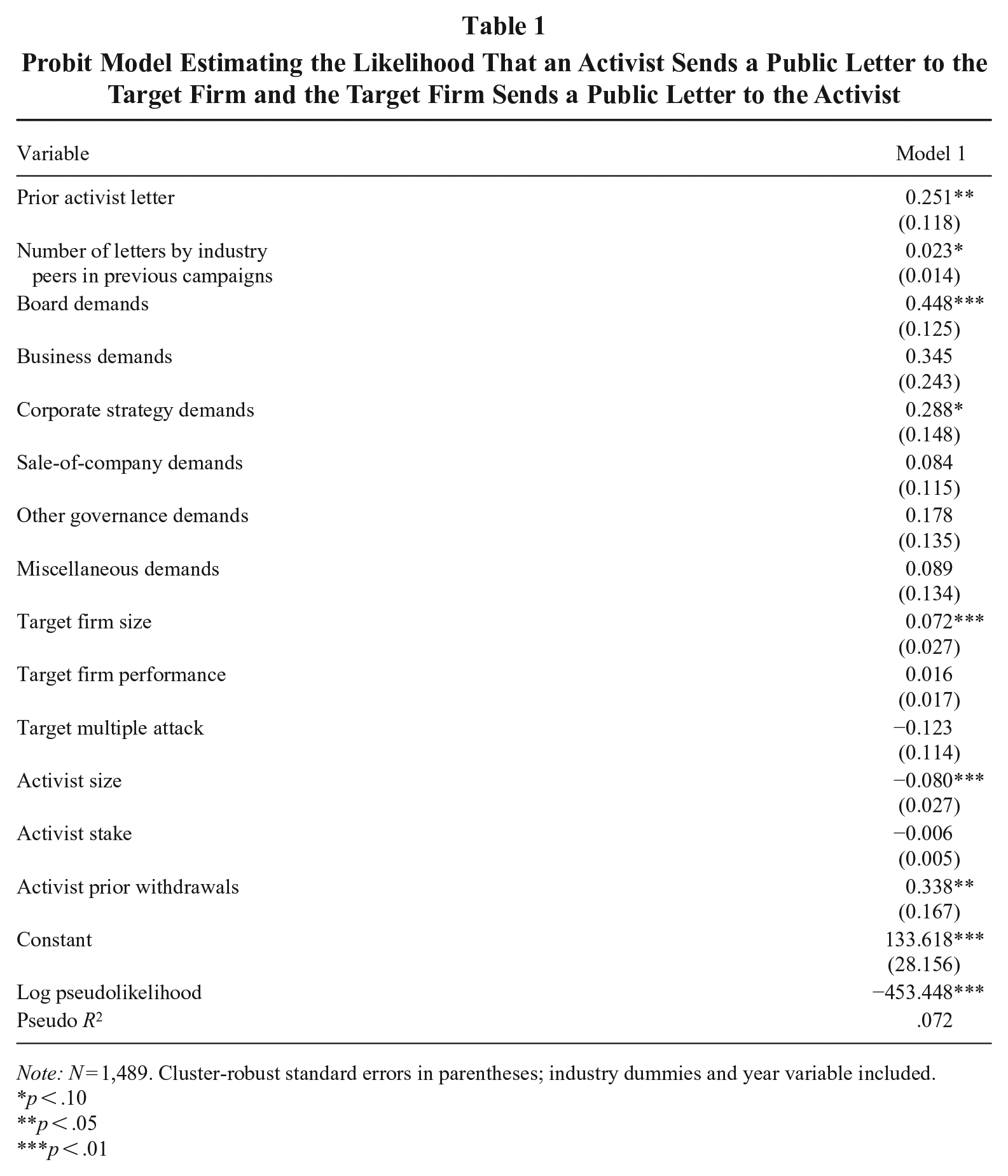
Note: N = 1,489. Cluster-robust standard errors in parentheses; industry dummies and year variable included.
p < .10
p < .05
p < .01
In the second stage of the Heckman model, we take the specific nature of our dependent variable into account. Extent of activist demand withdrawal is a fraction that measures the share of demands withdrawn by the activist and takes on values between 0 and 1 (0% to 100%). Our dependent variable hence differs from a ratio (e.g., return on assets), which can take on values below 0 and above 1. Therefore, we use a fractional logit model, imposing a functional form for the conditional mean, specifically designed to deal with dependent variables bounded from both above and below (Papke & Wooldridge, 1996). The model does not require data transformation and ensures that the predictions lie inside the naturally bounded interval (Villadsen & Wulff, 2019). To address the problem of potential nonindependence of observations for the cases in which a target firm is targeted more than once during our sample period, we run our statistical analyses using cluster-robust standard errors. Finally, an assessment of variance inflation factors (VIF) using ordinary least squares (OLS) regression analysis shows that the highest VIF in our models is 2.29 and the mean VIF is 1.35. Consequently, multicollinearity does not seem to affect our empirical results.
Results
Table 2 provides descriptive statistics and pairwise correlations of the variables included in the main analyses, while Table 3 shows results for the second-stage Heckman analysis. The IMR is nonsignificant in all models. To evaluate the strength of our exclusion restrictions further, we followed the recommendation to examine the correlations between the IMR and our key predictor variables LSM and ETM (Bushway, Johnson, & Slocum, 2007; Certo, Busenbark, Woo, & Semadeni, 2016). As noted by Certo et al. (2016: 2649), “when the exclusion restrictions are poor in a model (or do not exist at all), IMR will correlate too highly with x [the key predictor variable], thus introducing multicollinearity problems in the second stage of the model.” We find that the bivariate correlations between the IMR and LSM (rLSM = .055, p = .508) and the IMR and ETM are very low (rETM = −.056, p = .494), indicating that the insignificance of the IMR is not due to poor exclusion restrictions. Moreover, when analyzing the correlation between error terms in the first- and second-stage equations (i.e., rho), as recommended by Certo et al. (2016), we do not find a significant correlation (rho = −0.133, p = .7198). Together, the outcomes of these various analyses suggest that it is unlikely that our results are strongly affected by sample-induced endogeneity.
Descriptive Statistics and Pairwise Correlations
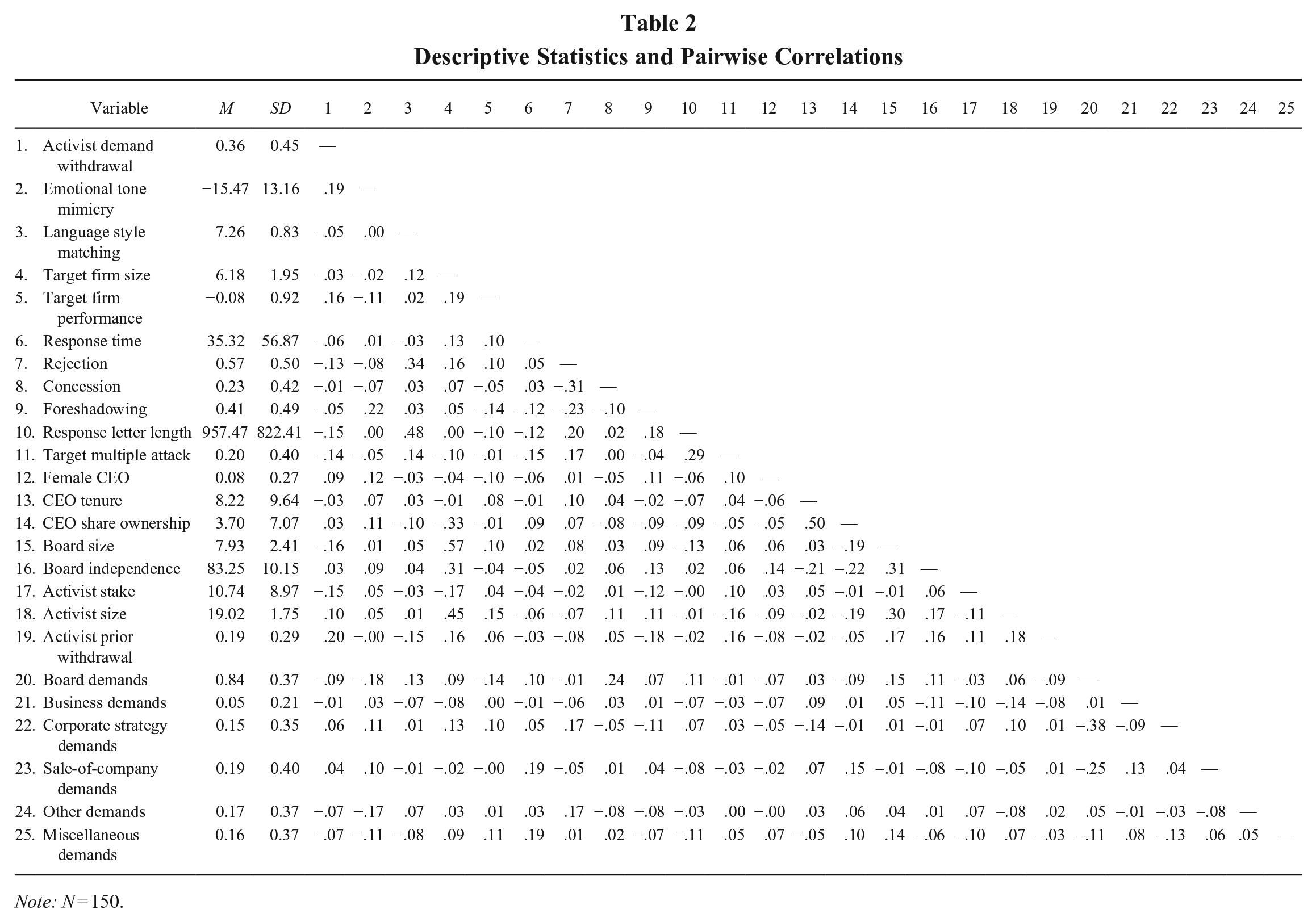
Note: N = 150.
Results of Second-Stage Heckman Analysis Using Fractional Logit Regression Analysis to Predict the Extent of Activist Demand Withdrawal
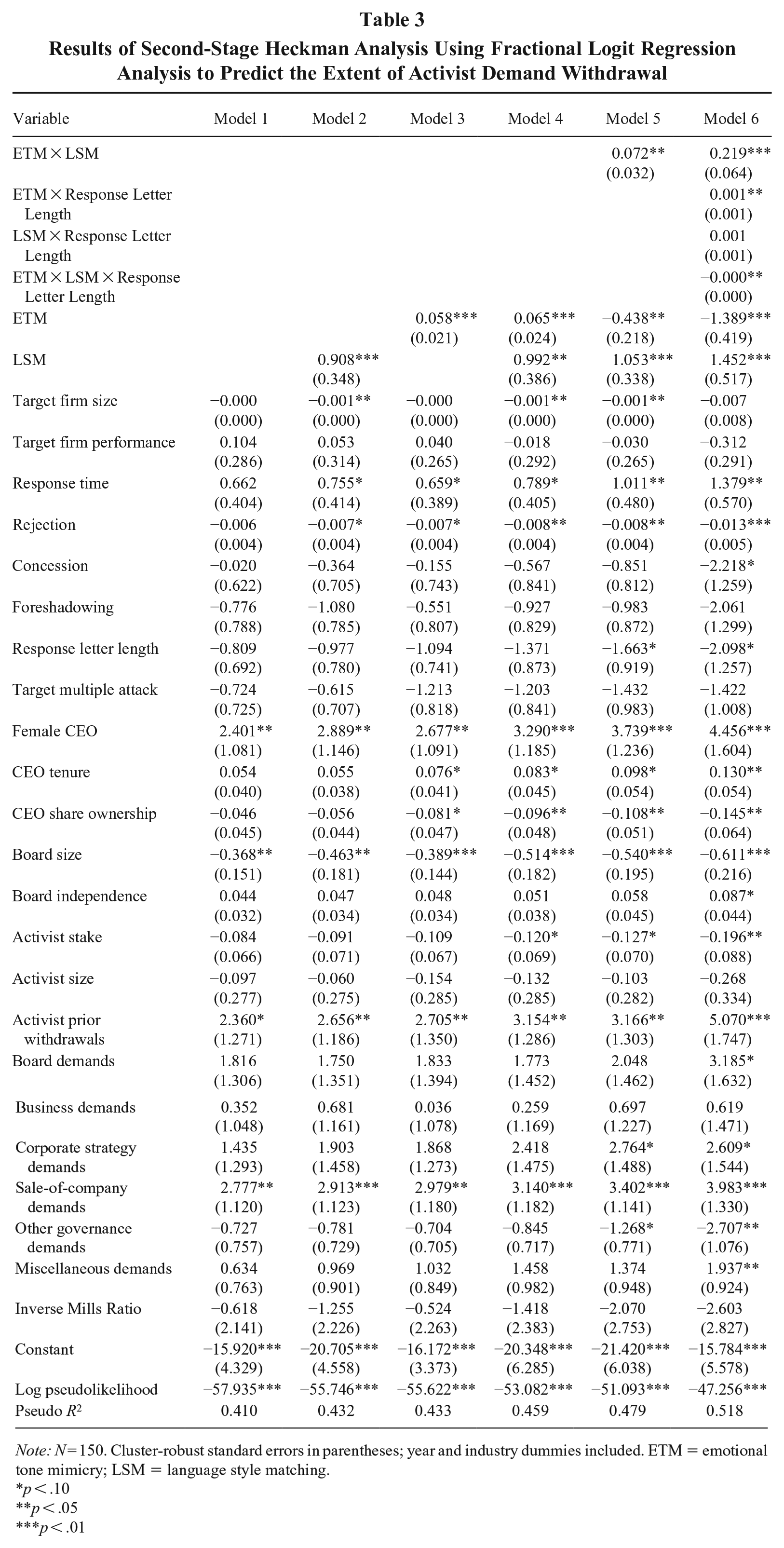
Note: N = 150. Cluster-robust standard errors in parentheses; year and industry dummies included. ETM = emotional tone mimicry; LSM = language style matching.
p < .10
p < .05
p < .01
In support of Hypothesis 1, Model 2 of Table 3 shows that LSM is a positive and significant predictor of activist demand withdrawal (β = 0.91, p = .009). Due to the nonlinear nature of our model, we follow Hoetker’s (2007) recommendations and compute the marginal effect of LSM on the extent of activist demand withdrawal at the mean and at low (i.e., one standard deviation below the mean) and high (i.e., one standard deviation above the mean) values while keeping all other independent variables at their mean values. As shown in Table 4, the average marginal effect of LSM is positive and significant at low values (β = 0.09, p = .02), at the mean (β = 0.11, p = .07), and at high values (β = 0.13, p = .08) of LSM.
Average Marginal Effect (AME) of Language Style Matching and Emotional Tone Mimicry on the Extent of Activist Demand Withdrawal
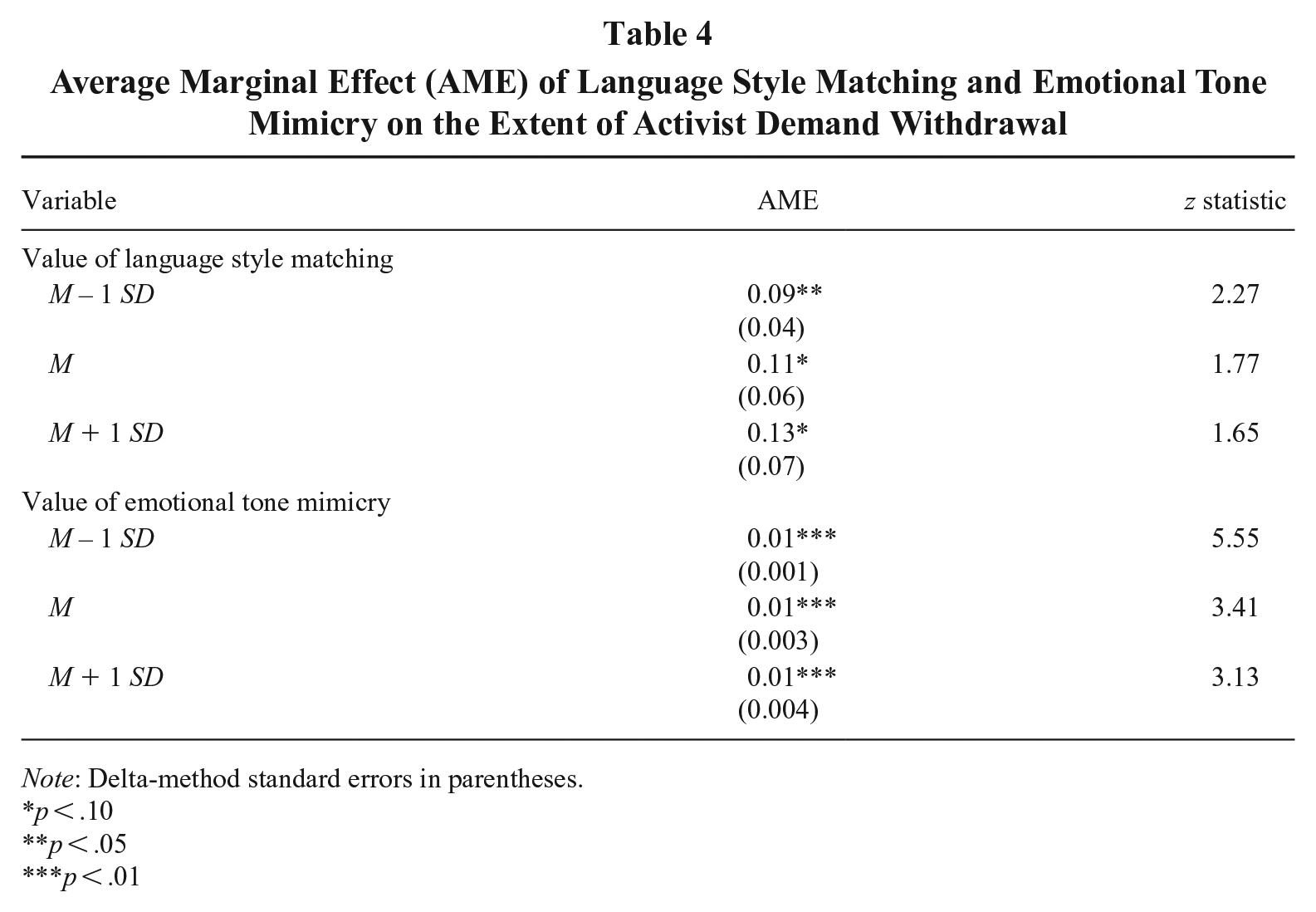
Note: Delta-method standard errors in parentheses.
p < .10
p < .05
p < .01
To assess the economic significance of the impact of LSM on activist demand withdrawal, we also plotted the marginal effect and find that a low extent of LSM is associated with a predicted demand withdrawal rate of about 29%. In comparison, a high extent of LSM is associated with a significantly higher predicted rate of around 46%. These findings provide full support for Hypothesis 1, proposing that LSM is positively associated with activist demand withdrawal.
Hypothesis 2 suggested that ETM is positively associated with activist demand withdrawal. In line with this prediction, Model 3 of Table 3 shows that ETM is positively and significantly associated with activist demand withdrawal (β = 0.06, p = .006). As shown in Table 4, the average marginal effect of ETM is positive and significant at low values (β = 0.01, p = .000), at the mean (β = 0.01, p = .001), and at high values (β = 0.01, p = .002). When plotting the marginal effect, we find that a low extent of ETM is associated with a predicted demand withdrawal rate of 27%. In comparison, a high extent of ETM is associated with a predicted withdrawal rate of about 45%. Also, when including both LSM and ETM in a single model (Model 4), we find that their effects remain highly robust both in terms of effect sizes as well as significance levels (ßLSM = 0.99, p = .010; ßETM = 0.06, p = .007). Empirical results thus strongly support Hypothesis 2.
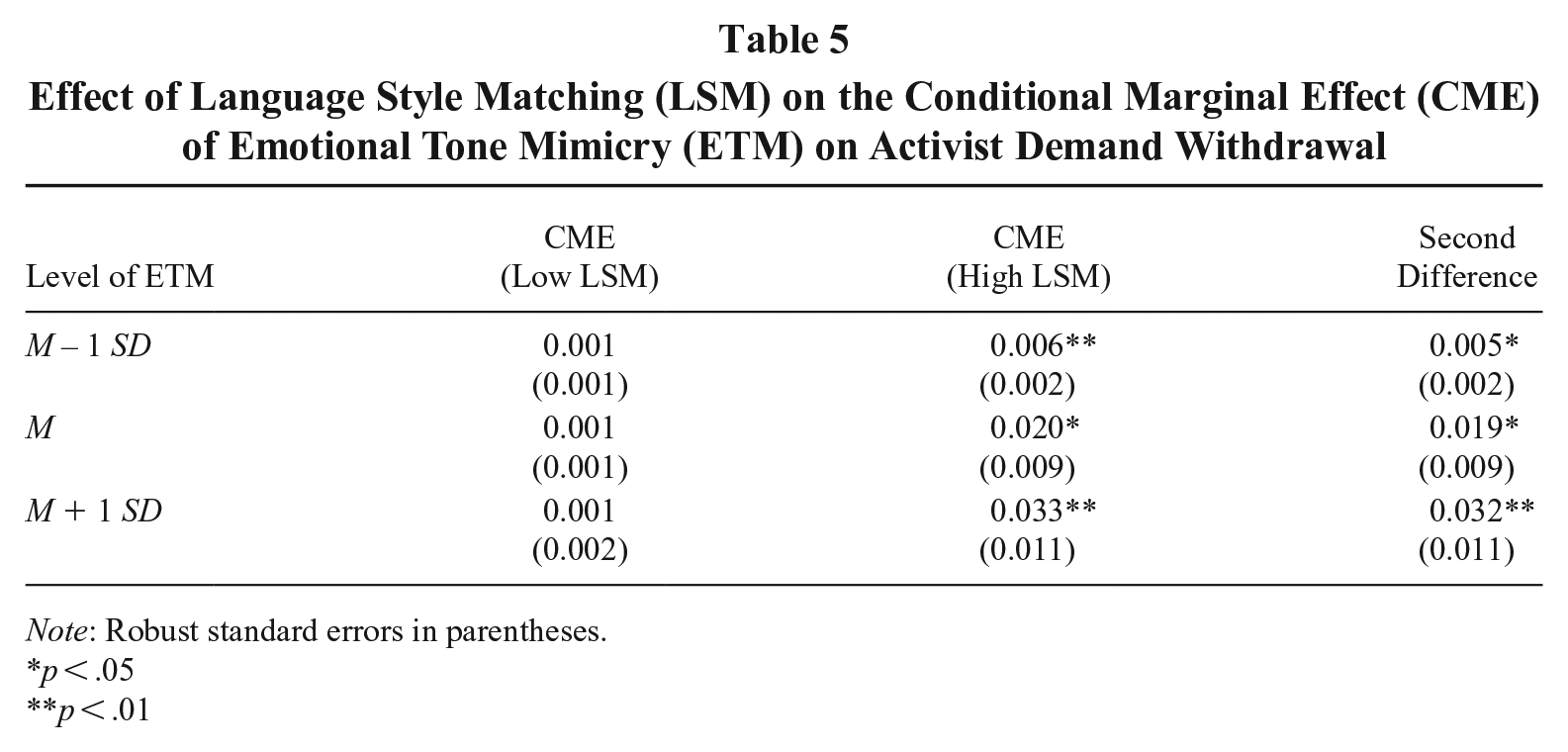
Hypothesis 3 posited that LSM strengthens the positive association of ETM with activist demand withdrawals. Model 5 of Table 3 supports this prediction. The interaction of LSM and ETM is positively and significantly associated with activist demand withdrawal (β = 0.07, p = .025). As shown in Table 5, we find that while ETM has a positive and significant marginal effect at low (β = 0.006, p = .009), average (β = 0.020, p = .026), and high values (β = 0.033, p = .002) of ETM at high levels of LSM (i.e., mean plus one standard deviation), it has no significant marginal effect at low (β = 0.001, p = .275), average (β = 0.001, p = .394), or high values (β = 0.001, p = .483) of ETM at low levels of LSM (i.e., mean minus one standard deviation). We also find that differences in the marginal effect of ETM between letters with low and high LSM is statistically significant at low (β = 0.005, p = .020), average (β = 0.019, p = .035), and high (β = 0.032, p = .004) values of ETM. Figure 1 provides a graphical visualization of the effect.
Effect of Language Style Matching (LSM) on the Conditional Marginal Effect (CME) of Emotional Tone Mimicry (ETM) on Activist Demand Withdrawal
Note: Robust standard errors in parentheses.
p < .05
p < .01
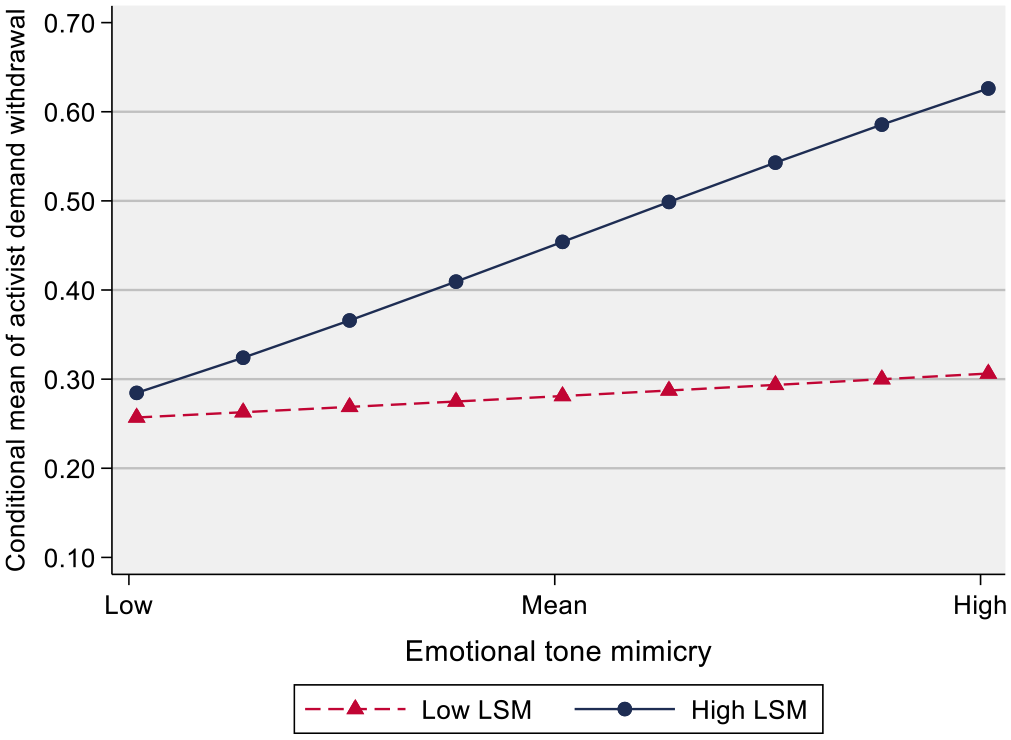
Conjoint Influence of Emotional Tone Mimicry and Language Style Matching on Activist Demand Withdrawal
Finally, Model 6 of Table 3 provides support for Hypothesis 4, which suggested that greater length of a target management and board’s response letter weakens the positive association of ETM in conjunction with LSM on activist demand withdrawals. The three-way interaction term is negative and highly significant (β = −0.0002, p = .021). Figure 2 graphically illustrates the effect and shows that the positive influence of high extents of ETM in conjunction with high extents of LSM on activist demand withdrawal is most pronounced in short letters, defined as letters with a length lower than the mean letter length minus one standard deviation. We also probed the three-way interaction applying simple slope analysis. Consistent with our theorizing, we observe the strongest positive slope for the effect of ETM on activist demand withdrawal when the level of LSM is high and the length of the response letter is low. Specifically, we find that whereas ETM is positively related to activist demand withdrawal at a high level of LSM and a low level of response letter length (β = 0.354, t = 3.26, p = .002), it is not significantly related to activist demand withdrawal when both LSM and response letter length are high (β = 0.010, t = 0.17, p = .867). Collectively, these results offer further support for Hypothesis 4.
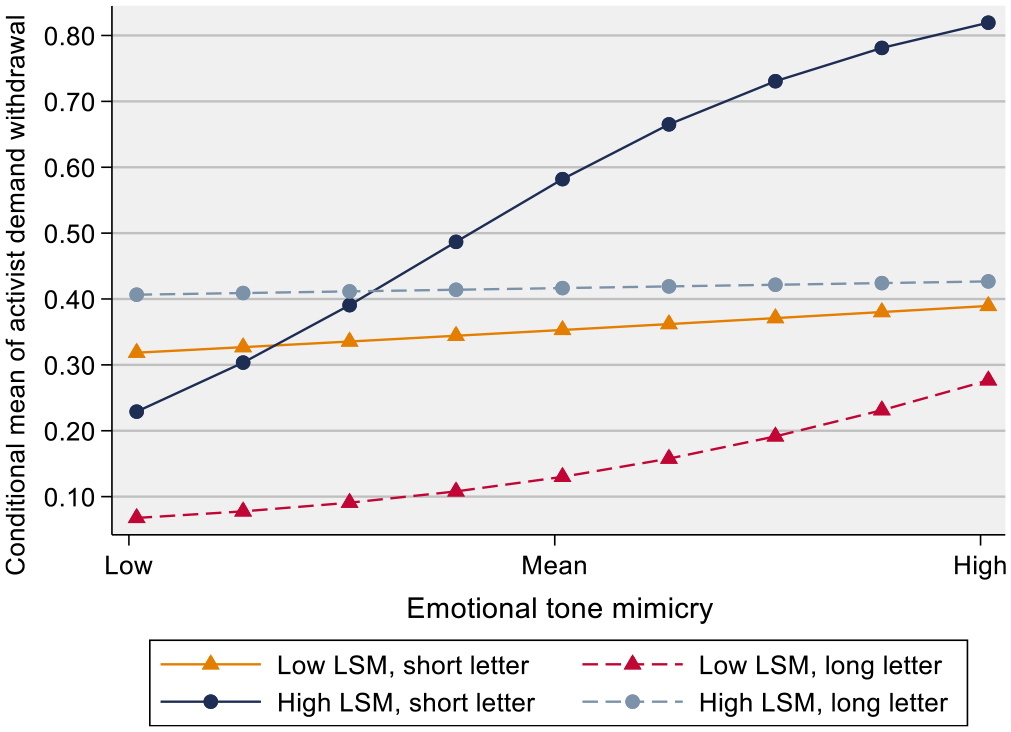
Moderating Influence of Letter Length on Conjoint Effect of Emotional Tone Mimicry and Language Style Matching on Activist Demand Withdrawal
Supplementary Analyses
We conducted several robustness checks to assess the validity and reliability of our findings as well as the accuracy of our theoretical reasoning. First, we analyzed several single-stage models instead of the preferred two-stage Heckman models. Specifically, we utilized single-stage OLS, general linear, and fractional logit models and find fully consistent results. Moreover, we tested alternative operationalizations of our dependent variable, extent of activist demand withdrawal. Specifically, we used an indicator variable measuring whether activists withdrew their entire campaign (i.e., all demands) as an alternative outcome variable. We find that both types of verbal mimicry are positively and significantly associated with full campaign withdrawal. In addition, we tested for a squared effect of our key predictor variables on activist demand withdrawal. The squared terms of LSM (β = 0.43, p = .135) and ETM (β = −0.00, p = .167) were not significant, providing support for the hypothesized linear relationships.
Second, as an alternative to the measure of LSM by Ireland et al. (2011), we assessed same-language use in an activist’s and target firm’s letter via the Jaccard similarity coefficient (Jaccard, 1901). The coefficient represents the size of the intersection of two sets (of words) divided by the size of their union and can thus take values between 0 (if no word appears in both texts) and 1 (if all words appear in both texts). For this measure of same-language use, we also find a positive and significant effect on activist demand withdrawal (β = 22.11, p = .014).
Third, we completed additional empirical analyses to validate our theoretical reasoning for Hypothesis 2. In support of our argument for Hypothesis 2 that negative ETM is effective in the confrontational AHF campaign context because it is an assertive, “hard-nosed” approach that signals the activist to back off, we find that the isolated effect of negative response letter tone on activist demand withdrawal is positive and highly significant (β = 2.21, p = .000). Moreover, additional analyses also support our second line of reasoning for Hypothesis 2 that focused on the harmful effect of responding in an either overly positive or overly negative tone to the activist (i.e., tone incongruence). To capture the effect of overly positive and overly negative tone, we defined two dummy variables that are equal to 1 if the difference in the emotional tone of the response letter and the activist letter is more than two standard deviations above or below the mean tone difference. We find that both an overly positive response and an overly negative response by the target management and board compared with the activist are significantly negatively related to activist demand withdrawal (ßposincongr = −20.27, pposincongr = .000; ßnegincongr = −15.46, pnegincongr = .000). These results support our reasoning that tone incongruence is negatively perceived by activists. Additionally, the results highlight an important boundary condition: A too-harsh repudiation of activist demands, as reflected in an overly negative tone by the target management and board (compared with the activist), decreases activist demand withdrawal.
Fourth, we assessed whether both positive ETM and negative ETM have a uniform influence on activist demand withdrawal. To complete this test, we first determined the tone used by activists in their letters. In line with prior research (e.g., Pfarrer et al., 2010), we define the tone in an activist letter as positive if the letter’s emotional tone is at least 66% positive and as negative if its emotional tone is at least 66% negative. We find that both negative ETM (ß = 0.572, p = .000) and positive ETM (ß = 0.076, p = .035) are significantly positively associated with activist demand withdrawal. We also observe that the effect of negative ETM is significantly stronger than that of positive ETM (χ2 = 53.13, p = .000). Together, these findings suggest that there is uniformity in positive and negative ETM’s impact on activist demand withdrawal but that negative ETM is even more effective in the confrontational context of AHF campaigns.
To add further depth and specificity to our finding that negative ETM is particularly effective, we decomposed LIWC’s negative-emotions measure into its three main subcategories: anger, sadness, and anxiety. Empirical results show that matching activists’ share of anger expressions is significantly positively associated with activist demand withdrawal (ß = 4.274, p = .067). Similarly, we find that matching activists’ share of sadness expressions has a positive but insignificant effect (ß = 1.888, p = .117). In contrast, the effect of using similar shares of anxiety expressions is negative yet statistically insignificant (ß = −0.394, p = .709). Collectively, these results provide further support for our theoretical reasoning that the effectiveness of negative ETM is primarily driven by signaling activists to back off and not overstep “red lines.”
Fifth, we completed empirical analyses to validate our main theoretical argument for Hypothesis 4. We reasoned that the positive effects of conglomerated conflict behavior fade in longer (written) communications because of greater cognitive load and attention dilution caused by more words and sentences as well as a greater share of complex words and longer sentences. In support of this reasoning, we find that long letters (i.e., letters with a length greater than the mean letter length plus one standard deviation) contain a higher share of complex words (t = 1.398, p = .082), measured as words with two or more syllables (Loughran & McDonald, 2014). We also find that the number of average words per sentence is substantially greater in long letters (t = 2.642, p = .005). Our theoretical reasoning is further supported by correlation analyses showing that response letter length is strongly positively correlated with the number of average words per sentence (r = 0.293, p = .000) and moderately positively correlated with the share of complex words (r = 0.140, p = .089).
Sixth, we explored relevant boundary conditions for our two main effects. As recent conceptual work on shareholder activism has posited that the cumulative history of past campaigns influences focal campaign outcomes (Chuah et al., 2024), we analyzed whether the effectiveness of LSM and ETM is contingent on whether a target firm, and thereby its management and board, has been subject to an activist attack previously. An interesting insight that emerges from this analysis is that cooperative conflict behavior in form of LSM is particularly effective for repeat target firms, while confrontational conflict behavior in form of ETM by repeat target firms is found to be negatively related to activist demand withdrawal.
Finally, to further address endogeneity concerns, we assessed the potential of our results being confounded by an omitted variable. Specifically, we calculated the robustness of inference to replacement value using Stata’s konfound command (Busenbark, Yoon, Gamache, & Withers, 2022; Frank, 2000). Results of this analysis suggest that an omitted variable would have to invalidate the positive relationships between the two types of verbal mimicry and activist demand withdrawal in more than 75 out of the 150 cases to refute our inferences. Given our extensive set of control variables and the results of this supplementary robustness test, we assess the likelihood of omitted variables confounding our results as low.
Discussion and Contribution
Given a dearth of research on the campaign process and its outcomes, we hold limited knowledge on how target management and boards can effectively respond to activist attacks (Goranova & Ryan, 2014; Shi et al., 2020; Wiersema et al., 2020). To advance our understanding on this issue, we examined how the style of the target management and board’s written communication with activists influences activist demand withdrawal. Drawing on the behavioral mimicry perspective, we focused on verbal mimicry and distinguished two types of verbal mimicry: LSM and ETM. Our empirical findings support our theorizing that both types of verbal mimicry are positively associated with activist demand withdrawal yet for distinct reasons, as LSM is reflective of cooperative conflict behavior while negative ETM is reflective of confrontational conflict behavior. Further, we find in line with research on interpersonal conflict that ETM in conjunction with LSM is particularly effective in inducing activist demand withdrawals. The length of the target management and board’s response, however, seems to constitute an important boundary condition: In line with our theorizing, empirical results suggest that the effectiveness of conglomerated conflict behavior decreases in longer (written) communications.
Contributions to Research on Financial Activism
Our study complements recent studies on hedge fund activism that document a linkage between AHFs’ (minority) stakes in target firms and changes to target firms’ investment policies, human resources policies, and innovative and financial performance (Chen, Meyer-Doyle, & Shi, 2021; DesJardine & Durand, 2020; DesJardine, Marti, & Durand, 2021). These earlier studies, however, shed light on neither how activists attempt to get their demands met nor how target management and boards manage to avert activist demands. The few studies that explored how specific activist, campaign, and target firm characteristics relate to campaign outcomes (Brav et al., 2008; Klein & Zur, 2009; Wiersema et al., 2020) also did not consider the individual campaign constituents’ behavior to influence campaign outcomes to their favor. The very few studies that examined constituents’ behavior exclusively focused on activists’ influence tactics (Brauer et al., 2023; Brav et al., 2008), leaving the target management and board’s response unaccounted for. By examining the public response of the target management and board to activist attacks, our study thus provides novel insights into the campaign process and the determinants of campaign outcomes. Specifically, our study advances financial activism research by highlighting the relevance of target management and boards’ communication style in AHF campaigns and thereby offers a novel theoretical explanation for why and how target management and boards succeed in persuading activists to partially withdraw their demands. Furthermore, our theorizing and empirical findings draw attention to the fact that not a single mode of response behavior is called for in the hostile context of AHF campaigns but that conflict resolution with activists can be best achieved by conglomerative conflict behavior.
Contributions to Behavioral Mimicry Research
Our study also makes several contributions to behavioral mimicry literature. First, we extend research on LSM by examining its effectiveness in a confrontational context (i.e., AHF campaigns). Past research has almost exclusively studied LSM in harmonious settings so that it is unclear whether past results on its effectiveness generalize to more hostile settings (Hess & Fischer, 2014). Ironically, the first study on LSM by Ireland et al. (2011) predicted the outcomes of romantic relationships and found that LSM was associated with greater likelihood of mutual interests as well as greater relationship stability. Subsequent research focused mostly on subordinate-supervisor LSM in the workplace context and its influence on the likelihood of being promoted or receiving greater compensation (e.g., Shi et al., 2019). Consequently, we lack knowledge on whether LSM is associated with equally positive outcomes in relationships marked by hostility. While it is more expected that LSM has desired effects in hierarchical subordinate-supervisor relationships in the workplace context, our study suggests that LSM can reduce confrontation and thus is also associated with positive outcomes in antagonistic relationships lacking clear hierarchical structures.
Second, our findings on ETM highlight a so far largely neglected facet of verbal mimicry—the importance of tone congruence. Emotional tone is one of the most frequently studied linguistic features and has further been found to be one of the most impactful linguistic features (e.g., Harmon, 2019; Oliver et al., 2023; Pfarrer et al., 2010; Tetlock et al., 2008). A substantive body of research in strategy, corporate finance, and accounting have provided ample evidence that (positive or negative) emotional tone and changes in emotional tone are significant predictors of abnormal stock returns and trading volumes, negative future earnings and cash flows, and capital structure adjustments (e.g., Feldman, Govindaraj, Livnat, & Segal, 2010; Price, Doran, Peterson, & Bliss, 2012). But while prior work on tone management has generated valuable insights into how a speaker’s positive or negative emotional tone influences decision or even firm outcomes, with very rare exceptions have past studies considered the tone of both interlocutors (Shi et al., 2019; Um, Guo, Lumineau, Shi, & Song, 2022). By being one of the first studies to examine and show the relevance of tone congruence on negotiation outcomes, we can offer a valuable theoretical and empirical extension to this rich body of research on emotional tone. Moreover, our findings on tone congruence inform behavioral mimicry research by highlighting that not only the mimicking of positive emotions but also the mimicking of negative emotions can be associated with positive outcomes—at least in contexts in which the expression of negative emotions is expected by the exchange partner. This finding also contributes to research on interpersonal conflict. As noted by Tjosvold et al. (2014), the widespread practice of confrontational conflict behavior suggests that people find it useful. Yet, “studies have not much documented when and how a competitive approach to conflict is consistently constructive” (Tjosvold et al., 2014: 44). Our main findings on ETM hint at the value of confrontational conflict behavior in hostile contexts. At the same time, results of our supplementary analyses caution that target management and board should not “overshoot”: An overly negative tone by the target management and board in the response letter (compared with the tone of the activist) seems to negatively affect activists’ willingness to withdraw demands.
Third, our study innovates by analyzing the conjoint influence of LSM and ETM on activist demand withdrawal. Though the verbal mimicry perspective allows for interactional complexity, the conjoint influence of linguistic features has rarely been examined in past studies. Our theorizing and empirical analysis on the influence of ETM in conjunction with LSM on activist demand withdrawal hint at the value of conglomerated conflict behavior in hostile contexts. More generally, this finding suggests that greater attention should be paid to conjoint effects of linguistic features, especially so, as these often co-occur in negotiations and are not processed in isolation by exchange partners. The relevance of considering the interplay of central communication style characteristics is further underscored by our study’s final insight that in longer communications, the effectiveness of ETM in conjunction with LSM decreases. The finding illustrates how various communication style characteristics can complement but also constrain each other.
Limitations and Future Research Directions
Like any study, ours has limitations, which offer avenues for future research. First, from a corporate governance perspective, our study calls for more research on the antecedents and consequences associated with target management and boards’ response to activist attacks. While studies in management research largely emphasize the negative effects associated with hedge fund activism (e.g., Chen et al., 2021; DesJardine & Durand, 2020), studies in finance predominantly suggest that hedge fund activism is actually associated with improved operational and financial performance for the target firm (e.g., Boyson & Mooradian, 2011; Brav et al., 2008, 2021; Klein & Zur, 2009). The latter raises the question of whether efforts to avert activist demands are really in the interest of the firm or only in the self-interest of the target management and board.
Second, like prior works on behavioral mimicry, our study is unable to accurately determine the extent to which target management and boards intentionally engage in LSM or ETM. For target management and boards that have made a conscious choice to respond in form of a letter and that are aware of the close public scrutiny of these letters, it does not seem overly hypothetical to assume that they consciously craft the content and tone of their letters to positively influence activists. Yet, we still see the need for primary research that, based on interviews or surveys, can more accurately delineate intentional and unintentional target management and board behavior. Such research efforts could also be complemented by studies on the antecedents of LSM and ETM. It would be valuable to better understand to which extents LSM and ETM are determined by stable personality traits of the speaker, the traits of the interlocutor, or situational conditions.
Third, we see merit in future studies that examine the effectiveness of verbal mimicry in other confrontational contexts to assess the generalizability of our findings. Similarly, it seems worthwhile to examine further whether the effectiveness of LSM and ETM wears off if applied repeatedly. Our supplementary analyses suggest that signaling cooperative intent in the form of LSM seems more conducive to conflict resolution than confrontational behavior in the form of ETM when being repeatedly attacked by activists—a finding that underscores the need for longitudinal research designs in which verbal mimicry and its effectiveness can be assessed over multiple rounds of negotiation.
Last, a limitation of our study that should be addressed by future research is its exclusive focus on hedge fund activism targeting U.S. firms. We do so due to the prevalence of activism in the United States and to avoid biased analyses resulting from differences in corporate governance and other regulatory laws and practices. But given that activists intensify their efforts around the globe, particularly in Europe and Asia (Activist Insight, 2021), we see merit in future studies on AHF campaigns against non-U.S. firms. Given disparate governance regimes and/or cultural differences, activists may use different influence tactics when attacking European or Asian firms. Consequently, the response by target management and boards might differ as well. Future studies on action-response patterns in AHF campaigns against European or Asian firms could help assess the generalizability of our findings and bring to light other relevant determinants of campaign outcomes.
