



Abstract
Drawing on complexity theory, we investigate the structuring processes and underlying mechanisms underpinning the emergence of a new technology. Empirically, we track the emergence of blockchain technology by examining international patents issued between 2009 and 2020. Our results indicate that technology emergence follows an evolutionary trajectory that progresses from disordered to structured interactions among the technological elements, culminating in the formation of a technological core that acts as a pole of attraction for further interactions and delineates boundaries within the technological domain. Technology structuring is fueled by what we term “technology fitness” and “self-reinforcing” mechanisms that progressively transform primitive structures into more complex, self-organized configurations. Our study offers a novel framework of technology emergence, highlighting how dispersed bits of technological knowledge gradually aggregate into complex structures that define the specific trajectory of a particular domain.
I hold it impossible to know the parts without knowing the whole, or to know the whole without knowing the parts in detail.
Emerging technologies are a critical driver of firm success and economic and social progress (Kapoor & Klueter, 2020; Soete & Freeman, 2012; Yoruk, Radosevic, & Fischer, 2023). New technologies emerge as a result of inventive processes during which technological elements—building blocks of an invention characterized by unique features (Fleming & Sorenson, 2004; Wang, Rodan, Fruin, & Xu, 2014)—are combined to solve a specific problem, laying the ground for technological advances (Dosi, 1982; Fleming, 2001; Park, Leahey, & Funk, 2023; Xiao, Makhija, & Karim, 2022; Yayavaram & Ahuja, 2008). This process of turning inventions into available knowledge is at the core of technological innovation (Savage, Li, Turner, Hatfield, & Cardinal, 2020; Somaya, Teece, & Wakeman, 2011; Teece, 2018).
Extant literature has primarily examined how inventors and organizations shape the modalities and trajectories through which new technologies emerge. Scholars who study modalities have focused on how existing technologies yield new ones. From this perspective, new technologies emerge from a synthesis of existing knowledge, which may produce variations under certain conditions, leading to new morphologies and even to new species of technology (Adner & Levinthal, 2002; Cattani, 2006; Fleming & Sorenson, 2001, 2004; Kodama, 1992; Levinthal, 1998; Schillebeeckx, Lin, George, & Alnuaimi, 2021). The research that has focused on trajectories, on the other hand, has mapped the evolutionary processes by which new technologies come into existence and change over time. Technology emergence is typically portrayed in terms of either path-dependent processes in which the initial technological choices become progressively more difficult to reverse (Arthur, 1989; Marin, Stubrin, & Van Zwanenberg, 2023; Sydow, Schreyögg, & Koch, 2009, 2020) or punctuated equilibrium, according to which relatively long periods of technological stability are punctuated by short bursts of fundamental change and discontinuity (Abernathy & Utterback, 1978; Anderson & Tushman, 1990; Grodal, Krabbe, & Chang-Zunino, 2023; Suarez, 2004).
Both perspectives presuppose that inventors and organizations play an important role in driving technology emergence. The modalities approach highlights the agentic micro processes by which inventors and organizations manipulate pieces of existing knowledge to create new technologies. Conversely, the trajectories approach recognizes the role of inventors but argues that their agency is constrained by path-dependent trajectories that emerge over time because of technological lock-in. Although the two streams of literature have been very useful for promoting an understanding of technology emergence, less attention has been paid to the structuring process by which the micro permutations that underpin technological modalities crystallize into stable structures and macro trajectories. This limits our understanding of technology emergence as a dynamic process that unfolds across different levels of interaction. A more comprehensive picture of technology emergence should simultaneously consider the interaction between technological elements at a micro level, the underlying modalities, and the lock-in effects generated by technological trajectories at a macro level.
The purpose of this article is to investigate how the structuring process that arises from interactions among technological elements affects the emergence of a new technology over time. We draw on complexity theory (Dick, Faems, & Harley, 2017; Nicolis & Prigogine, 1977; Prigogine, 1980; Prigogine & Stengers, 1984) to study technology emergence as a self-organizing process in which novel and coherent structures arise out of the interactions among smaller parts of the system (Goldstein, 1999). Two aspects of the theory are relevant to our objective. First, the complex systems theory recognizes that both emergent and intentional processes coexist and coevolve (Borzillo & Kaminska-Labbé, 2011). This is because the elements of complex systems have a semiautonomous agency that allows them to adapt to their environment without centralized coordination. In this way, interactions among technological elements lead to the formation of organized patterns from the bottom up. Second, complex systems evolve by converting loose technological elements into consolidated technological cores. Because there is no centralized control, technological structuring is achieved through a process of self-organization in which interactions among elements spontaneously give rise to increasingly stable patterns (Morel & Ramanujam, 1999).
From an empirical standpoint, we consider the recently emerged blockchain domain—a set of technological elements characterized by a shared identity—as our focus of analysis and track the emergence of international blockchain patents issued between 2009 and 2020. We use network-based mapping to depict the growing complexity of blockchain technology over time and apply the knowledge decomposability measure to assess its structuration. Our results indicate that technology emergence is guided by technology fitness and self-reinforcing mechanisms. The technology fitness mechanism connotes the intrinsic quality of a specific technological element to connect with different technological elements within a specific technological domain (e.g., Fleming, 2001; Fleming & Sorenson, 2001, 2004). The self-reinforcing mechanism is based on a historical pattern of past connections according to which technological elements with numerous existing connections are more likely to acquire new ones, regardless of their intrinsic qualities (Gould, 2002; Sydow & Schreyögg, 2013). The interplay of these mechanisms generates increasingly structured interactions among technological elements, culminating in the formation of a technological core that acts as a pole of attraction for further interactions and delineates boundaries within blockchain technology. We then extend our analysis beyond the blockchain domain and conduct simulations to understand the potential outcomes of structuring processes when both technology fitness and self-reinforcing mechanisms are present or when only one of them is involved.
This study has significant implications for the technology innovation literature. First, by combining insights from studies on modalities and trajectories, we consider both the micro and macro dimensions of technology emergence to theorize the structuring processes through which technology emergence is accomplished. Second, we show how the dynamics underlying technology emergence combine in ways that go beyond the agentic intentionality of any one actor in the system, revealing how the semiautonomous interactions of technological elements, through technology fitness and self-reinforcing mechanisms, facilitate technological structuring. Third, our study offers a novel understanding of the spatial and temporal dynamics that underpin processes of technology emergence.
This article is organized as follows. First, we review the literature on technology emergence and highlight the modalities and trajectory perspectives. Next, we draw on complexity theory to propose a framework that shows how the interactions among technological elements allow a technological domain to structure and become more organized over time. We then describe the setting, data, and methodology applied in our study. After presenting our results, we discuss the theoretical and managerial implications of this work and note its limitations and some avenues for future research.
Theoretical Background
The Dynamics of Technology Emergence
Dosi (1982: 151-152) has defined technology as a set of pieces of knowledge, both directly “practical” (related to concrete problems and devices) and “theoretical” (practically applicable but not necessarily actually applied). The suggestion from this perspective is that the procedures underpinning the emergence of new technologies are broadly similar to those that characterize the construction of scientific knowledge. In line with this conceptualization, scholars working on modalities have examined processes of technological speciation and (re)combination (Cattani, 2006; Cattani & Mastrogiorgio, 2021; Khanna, 2022; Kok, Faems, & de Faria, 2019; Schillebeeckx et al., 2021). Speciation has its roots in biology and refers to “the separation of one evolving population from its antecedent population, which in turn allows populations to follow different evolutionary paths” (Adner & Levinthal, 2002: 51). By analogy, new technologies come into being as a result of existing technological knowledge being transplanted to a new application domain, where it evolves in new directions (Adner & Levinthal, 2002). For example, Cattani (2006) has documented how Corning’s knowledge and experience in the production of glass fibers for medical and military applications enabled it to identify opportunities in the seemingly unrelated domain of electronics. Likewise, Moehrle and Caferoglu (2019) observed several instances of technological speciation in the domain of camera technology, including the action camera, the depth camera, and the dashboard camera.
The modality of combination conceptualizes inventors who are embedded in organizations as agents of inventive processes over technological landscapes (Fleming & Sorenson, 2001, 2004; Grigoriou & Rothaermel, 2014; Schillebeeckx et al., 2021; Wang, 2024; Xiao et al., 2022). This inventive activity operates through a combination of existing and new technological components from previously joint or disjoint technology areas (Basalla, 1988; Hargadon, 2003; Hargadon & Sutton, 1997; Henderson & Clark, 1990; Kodama, 1992; Schillebeeckx et al., 2021). For example, Teece (1986) has illustrated how computed axial tomography (CAT) scanning technology resulted from cross-fertilization between computer technology and X-ray technology. According to Fleming and Sorenson (2001), a core element of technological evolution and other complex systems is the existence of an agent of recombination. For example, inventors combine new and old pieces of technological knowledge to produce new technologies based on fitness criteria, conveying a view of the technology as a spectrum of opportunities (Basalla, 1988; Fleming, 2001; Fleming & Sorenson, 2001).
Scholars who study technological trajectories have noted how inventors and organizations collectively shape patterns of continuity and discontinuity in technological emergence (Dosi, 1982). Specifically, continuity has primarily been framed in terms of path dependence (Arthur, 1989, 1994; David, 1985, 1986), a situation in which the cumulative effects of prior technological choices increasingly constrain the agency of inventors and allow subsequent technological recombination to develop only within the trajectory defined by earlier ones (Grodal, Gotsopoulos, & Suarez, 2015; Grodal et al., 2023; Sahal, 1985; Sydow et al., 2009). Path dependence is triggered by a critical event—such as an inventor’s decision, choice, or solution—that unintentionally sets the path-building process in motion. The technological path takes shape through self-reinforcing feedback mechanisms that support the initial event, generating a specific pattern that gradually becomes dominant and reduces the initial set of alternatives (Grodal et al., 2015). The consolidation of a dominant pattern may lead to a lock-in (Marin et al., 2023; Sydow et al., 2020; Sydow & Schreyögg, 2013) or even take on a deterministic character that results in alternative courses of action ceasing to exist (Clark, 1985; David, 1985).
While path dependence defines typical trajectories of technological progress, some scholars studying technology emergence through discontinuous trajectories have portrayed this progress in terms of punctuated equilibrium (Abernathy & Utterback, 1978; Anderson & Tushman, 1990; Tushman & Anderson, 1986; Tushman & Romanelli, 1985), a process in which periods of small, incremental change are punctuated by quantum leaps. Specifically, the emergence of a technological breakthrough may initiate a period of sharp divergence triggered by the existence of a plethora of technical variations (Anderson & Tushman, 1990; Utterback & Abernathy, 1975). Once a dominant design has emerged, the dynamics of technology competition prompt firms to select the technologies that are most likely to succeed and abandon the rest (Anderson & Tushman, 1990; Grodal et al., 2015; Utterback & Abernathy, 1975). Periods of technological progress can also be punctuated by moments of setbacks (Adner & Kapoor, 2016; Bakker, 2010; Kapoor & Klueter, 2020) that pose a technological challenge on the road toward technological advancement and may reverse the initial momentum.
When taken together, these studies portray technology emergence as a process that entails combining, separating, and recombining pieces of technological knowledge to form more consolidated entities. This is achieved by applying a different emphasis, however. Modalities highlight the micro processes by which inventors manipulate and synthesize pieces of technological knowledge, while trajectories highlight the emergence of macro structures that progressively diminish the agency of inventors until a situation of lock-in is reached. What is more, emergence is not accidental: It follows specific mechanisms that shape the configuration of a domain. In this regard, the research on modalities emphasizes the significance of integrating existing technological elements based on their mutual fitness to create a novel invention. Conversely, the studies on trajectories highlight how self-reinforcing interactions among technological elements contribute to the crystallization of a particular pattern over time.
Importantly, while inventors and organizations may drive the combination of technological elements at a micro level, they cannot fully control the outcomes of these combinations: that is, the macro structures that emerge at a macro level. There are two reasons for this. First, the success of technological combinations depends not only on the inventor’s abilities but also on the underlying characteristics of the combined elements and their interdependence. These interdependencies empower technology with an intrinsic autonomy that goes beyond the purposive behavior of inventors and organizations. Second, the relative influence of an individual inventor’s agency decreases over time as the technology gradually takes on a structure. In other words, as a technology crystallizes, part of the initial agency of its inventors is transferred to the technology itself, which acquires a life of its own (Latour, 1987).
If the dynamics of technology emergence involve structuring processes that comprise both micro and macro levels of interaction, then there is a need to better understand how these levels are connected throughout the emergence process. To bridge this gap, we draw on complexity theory (Dick et al., 2017; Goldenfeld & Kadanoff, 1999; Goldstein, 1999; Prigogine & Stengers, 1984; Tsoukas, 2017). Complexity theory complements current understandings by offering a view of technology emergence as the self-organized outcome of dynamic patterns that arise from the interactions among technological elements and progressively strengthen in scope and orders of complexity (Morel & Ramanujam, 1999; Thietart, 2016). Self-organization means that patterns and regularity emerge spontaneously in a system as a result of interactions among interdependent parts. It also implies that the interactions among the system’s constituents are not centrally controlled; rather, the interacting units combine locally to produce complex coordinated patterns of collective behaviors that change and adapt.
From this perspective, technologies come into being as a result of both the intentional agency of inventors and organizations and the emergent processes stemming from technological interdependencies. For example, the inventive act of writing an academic article is shaped by the author’s intentions. Once the article has been published, however, it is appropriated by other members of the community, who might have different intentions and cite the article for their own purposes. As Greenwood and Meyer (2008) point out, an idea that emerges from a paper is detached from its authors, who give up the exclusive right to interpret it. Ideas not only become semiautonomous and take on a life of their own; they may also be path dependent as the initial reception affects and narrows the core topic, which will later be explored further (Gould, 2002; Greenwood & Meyer, 2008). In a similar vein, a new technology relies on the input of its inventors, who manipulate technological elements to generate inventions, but once the invention has been granted a patent, it is appropriated by other inventors and organizations that use it for their own purposes. In other words, the agency of the inventor is to some extent “delegated” to the patent (Latour, 1987), thus blurring the boundary between the agency of the inventor and that of the patent. 1 As the patent takes on a life of its own and becomes semiautonomous, the influence of the individual inventor’s agency decreases. Patented inventions therefore become particularly helpful for a study of the process of technology emergence.
The example also conveys a process of technology structuring, thus reinforcing the parallel between the emergence of new technologies and the construction of scientific knowledge (Dosi, 1982; Park et al., 2023). Just like inventors, academics are engaged in the production of novelty. Scientific innovation proceeds by means of an aggregation and accumulation of pieces of knowledge that take the form of an academic article. Scientific articles are ensembles of ideas, and when authors cite an article, they embrace one or more study’s ideas, thus attaching new pieces of knowledge to the existing ones. In turn, subsequent authors further build upon these ideas that they have drawn to expand on what is known. And so the process continues. References to previous work are made based on suitability: Authors choose to work on those ideas that fit for the purposes of developing their own contribution. Repeated references to the same idea or set of ideas included in articles reinforce certain claims, thus generating a conceptual core and crystallizing ideas into a coherent body of literature. The structuring of emergent technologies follows the logic of reinforced ideas over time. It proceeds through the accumulation of patents that are created by inventors, taken up by other inventors based on fitness, and progressively aggregated around technological cores that attract new patents within an emerging knowledge structure. To investigate these mechanisms at work, we will now present a model of technology emergence as a structuring process based on complexity theory.
Technology Emergence as a Structuring Process
Complexity theorists conceptualize emergence as the manifestation of novel, coherent structures capable of generating explicit patterns in complex systems (Dick et al., 2017; Goldenfeld & Kadanoff, 1999; Goldstein, 1999; Tsoukas, 2017). Complex systems consist of numerous interconnected elements that work together without any centralized control, functioning collectively as a whole (Prigogine & Stengers, 1984). When technological elements have extensive opportunities to interact, the system seems disorganized, and patterns are difficult to detect. However, spontaneous changes arising out of interacting elements can generate new configurations through self-organization (Nicolis, 1979; Prigogine & Stengers, 1984). Self-organization occurs spontaneously through the mutual adaptation of system elements (MacIntosh & MacLean, 1999; Miller, 1982; Thietart, 2016) as a result of which the micro interactions among the parts generate patterns of an increasingly higher order (Devezas & Corredine, 2002; Goldstein, 1999; Prigogine & Stengers, 1984). This implies that systems are characterized by ongoing interactions among multiple elements that continuously affect and shape the configuration of the system over time (Wang et al., 2014; Yayavaram & Ahuja, 2008).
Overall, complexity theory provides an understanding of technology emergence that brings together insights from both the modality and trajectory perspectives. On the one hand, it considers how efforts to combine interdependent technological elements generate connections and define technological modalities (Fleming & Sorenson, 2001), while on the other, it illustrates the self-organization dynamics by which micro interactions among technological elements crystallize into ordered patterns that define technological trajectories over time.
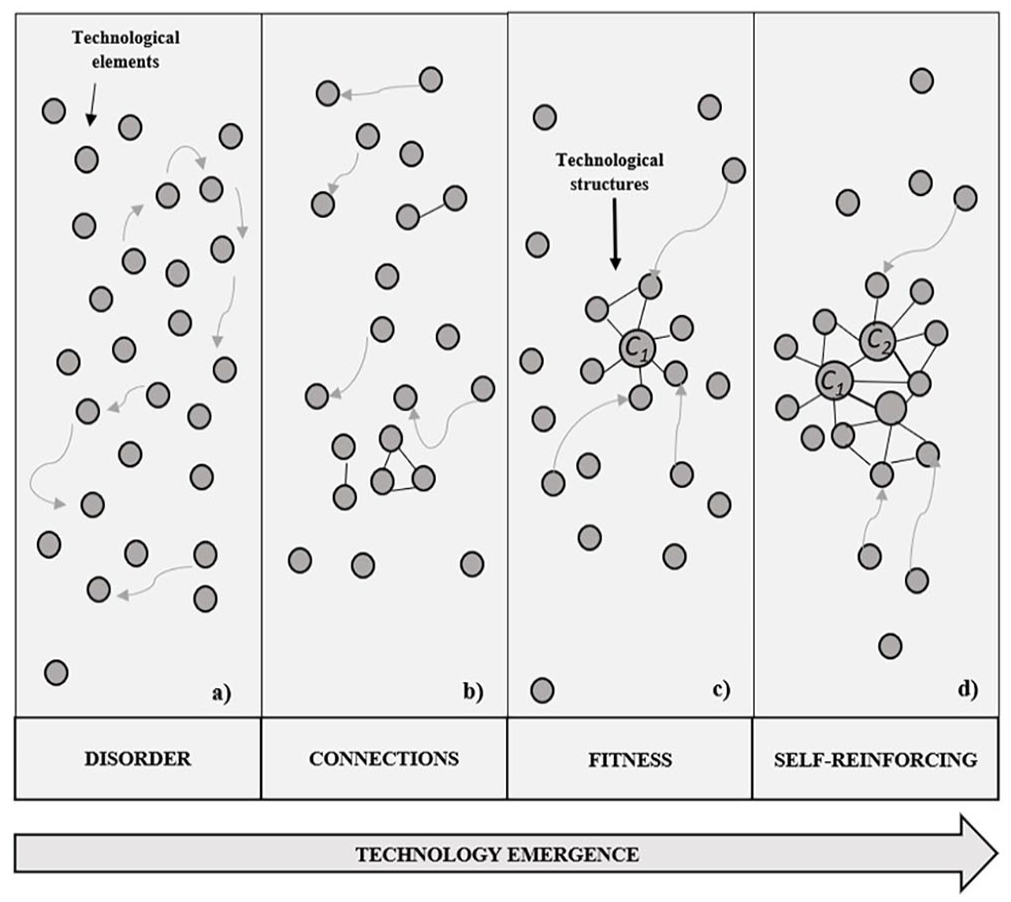
Our work develops these concepts within the framework shown in Figure 1. In this illustration, a complex system evolves through the aggregation of technological elements into patterns that progressively become more interconnected and complex, eventually culminating in the emergence of a new technology.
The Process of Technology Emergence
Figure 1a illustrates a situation in which technological elements are present but not yet connected. Although they are not linked in a formal sense, however, they may engage in initial efforts to form connections according to their potential interdependencies (Haken, 1981). These preliminary attempts can be viewed as ongoing experimentation through trial and error (Wang et al., 2014). The more of these attempts there are, the more likely it is that a connection among previously uncombined technological elements will be made. For instance, Branly’s invention of the coherer in 1890 was key to the development of radio transmission; in 1894, Lodge tried to use it as a receiver, but the signals were not comprehensible. In the same year, Marconi experimented with wireless telegraphy, making several attempts not only with Branly’s coherer but also with other technological components. Experimentation enhances the understanding of technological interdependencies and eventually leads to successful connections.
Figure 1b illustrates the earliest connections among technological elements, meaning that the first invention has given birth to the domain. Inventions are meant to solve specific problems (Dosi, 1982). These technical solutions may include two or more technological elements sharing certain technical features that facilitate their connection (Carnabuci & Bruggeman, 2009; Carnabuci & Operti, 2013). For instance, Marconi combined several technological components, such as Hertz’s spark, Branly’s coherer, Popov’s antenna, Lodge’s tuning circuit, and Morse code, to build the first long-distance wireless telegraph. All these components already existed (Figure 1a), but it was only after years of experimentation that Marconi was able to discover the interdependencies among them and connect them successfully. During this inception phase, all the technological elements exhibit the same level of fitness in the nascent technological domain and play a part in its emergence. Inventors shape the domain by selecting and connecting certain technological elements based on the specific goal of the inventing process (Capaldo, Lavie, & Messeni Petruzzelli, 2017; Grigoriou & Rothaermel, 2014; Schillebeeckx et al., 2021; Wang & Chen, 2018).
Figure 1c depicts how connections aggregate and generate elementary structures with the potential to subsequently evolve. Early inventions foster subsequent inventive activity that exploits previous combinations while attracting new technological elements. Although the technological interdependencies are the same as in Figure 1b, some of the technological elements in Figure 1c exhibit a higher level of technology fitness, which is an intrinsic quality of a specific technological element to be connected, thanks to the inventors, who act as agents—with different technological elements within a specific technological domain. This mechanism explains why some technological elements are more attractive than others (for example, technological element C1) even though they possess the same number of previous connections. By using their knowledge and creativity, inventors can activate the technology fitness mechanism when they embody technical knowledge that is malleable and can easily connect with other technological elements, thus increasing a system’s complexity. The modalities approach is helpful here as a means of explaining the mechanism of technology fitness because the original attributes and intrinsic characteristics of the technological elements serve as drivers for recombination (Fleming, 2001; Kok et al., 2019; Wang et al., 2014). For example, in the early 1800s, the British chemist Humphry Davy discovered a chemical reaction that generated hydrogen. His discovery attracted further connections and was applied to the automotive industry in 1807 when the Swiss inventor Francois Isaac de Rivaz created a four-wheel vehicle powered by hydrogen and oxygen. In our framework (see Figure 1c), hydrogen can be represented by the technological element C1. Thanks to its fitness, it allows connections with many other elements, thus increasing the system’s complexity. These examples show how inventors are relatively free to create something from scratch by combining different technological elements (Figure 1b). Their agency diminishes compared with Figure 1b, however, since they are more likely to combine technological elements that exhibit a high degree of technology fitness (i.e., C1) while also being free to discover new connections.
Figure 1d captures the self-reinforcing mechanism by which specific technological elements become predominant over time. For instance, de Rivaz’s hydrogen-powered vehicle received positive feedback that was confirmed in the late 1930s when William R. Grove created a hydrogen fuel cell. Both de Rivaz’s and Grove’s intuitions were further reinforced by a Belgian inventor who developed and tested a large vehicle with a combustion engine in the 1860s. In the move from one invention to another, some technological elements (including electrodes and electrolytes) were ignored and disappeared, while others, such as the cylinder, ignition systems, piston, crankshaft, and fuel storage, became prerequisites for further developments. This means that subsequent efforts by inventors became constrained by these core elements. For the sake of clarity, in Figure 1d, the self-reinforcing mechanism can be observed in the technological elements C1 and C2 (see Figure 1d), which gradually gain prominence and form a more stable structure compared with Figure 1c. Subsequent inventions relating to the combustion engine reinforced the link among these technological elements. These examples show how an initial path becomes increasingly crystallized with the potential to set a dependent trajectory. The predominance of specific paths constrains the agency of inventors since they have less influence when it comes to changing or modifying those paths once they have been established.
Moreover, the emergence of a more complex structure around two technological elements (C1 and C2 in Figure 1d) generates a pole of attraction. Subsequent inventions are built around core technological elements that are further reinforced by increasing the number of existing connections, but inventors also introduce new technological elements, thus expanding the scope of the technology. The fundamental difference between technology fitness and self-reinforcing mechanisms lies in the criteria by which technological elements acquire new connections. The technology fitness mechanism is based on the intrinsic quality of a particular technological element to connect with other technological elements within a specific technological domain. Technology fitness makes some technological elements more attractive for new connections, regardless of their previous number of connections. In contrast, the self-reinforcing mechanism is predicated on a historical pattern of past connections where technological elements with many existing connections are more likely to gain new ones irrespective of their intrinsic qualities. This implies that the technology fitness and self-reinforcing mechanisms can work jointly. For example, the anode is a core component of hydrogen fuel cell technology. It is essential for hydrogen oxidation and was initially characterized by a high level of technology fitness thanks to its compatibility with a variety of catalysts. This intrinsic quality attracted extensive research and development that led to a series of inventions. As these components became more established in the technological domain, self-reinforcing mechanisms started to influence their further development. The widespread use and proven performance of the anode encouraged further research and optimization, thus reinforcing its technological dominance. The activation of the two mechanisms depicted in Figure 1 allows a technology to emerge.
Overall, our model explains technology emergence through two core mechanisms—technology fitness and self-reinforcing—that shape the configuration of a new technology. First, the technology fitness mechanism is activated by inventors as a result of the intrinsic quality of a specific technological element to connect with other technological elements within a specific technological domain. In line with the modalities approach, these connections are guided by both the intrinsic attractiveness of the technological elements and the inventors’ ability to embody them in an invention (Dosi, 1982). Technological elements with high levels of technology fitness act as a sort of magnet, attracting heterogeneous but compatible technological elements and fostering the integration of these elements by steering them in a specific direction. Second, the self-reinforcing mechanism crystallizes this direction by bonding connections in technology structures. The concurrent activation and persistence of these two forces transform elementary and easily malleable structures into more complex and rigid ones. The increased structuring restricts subsequent technology development. As a result, technological elements become less dependent on the inventor’s agency and contribute to further structuring through their semiautonomous agency. Indeed, in this case, a single inventor cannot intentionally force the positioning of a technological element within the technological domain, for instance, by moving one element from a peripheral to a more central position.
Method
Following the theoretical framework outlined already, this research examines technology emergence as a structuring process in which sets of technological elements connect on an ongoing basis and generate spontaneous structure through the activation of technology fitness and self-reinforcing mechanisms. To investigate the dynamics underpinning technology emergence and how they shape the configuration of a technology, we examine the recently emerged blockchain technology and track how it acquired structure over time.
We proceed as follows. First, we use network analysis to map and visualize connections among technological elements and detect the two mechanisms at work as blockchain technology emerges (Wang et al., 2014; Yayavaram & Ahuja, 2008). Second, we apply the decomposability measure (Yayavaram & Ahuja, 2008) to assess the structuring of the technological domain and show the interaction of the technology fitness and self-reinforcing mechanisms. Last, we use simulation techniques (Oberg, Korff, & Powell, 2017; Pham, Sheridan, & Shimodaira, 2016, 2020) to show how the two mechanisms shape the structuring and emergence or non-emergence of any technology. We develop a simulation to create controlled environments within which we can vary parameters representing our proposed mechanisms and observe the resulting dynamics. This allows us to consider the roles of these mechanisms in shaping technological domains beyond what we observe in the context of our study of the emergence of a specific technology.
Setting
Blockchain is an emerging software-based technology that has become essential for firms’ success and survival in the digital era (Bailey, Faraj, Hinds, Leonardi, & von Krogh, 2022; Chen, Pereira, & Patel, 2021; Hsieh & Vergne, 2023; Iansiti & Lakhani, 2017; Tapscott & Tapscott, 2017). Developed by Satoshi Nakamoto in 2008, it is one of the megatrends that are shaping today’s businesses and society (World Economic Forum Report, 2020). Nakamoto’s (2008) white paper proposed the virtual currency known as Bitcoin to facilitate transactions. The author conceived blockchain as a distributed data ledger that would be capable of safely storing digital transactions without the intervention of a central authority, thus revolutionizing the traditional concept of currency. The emphasis on a peer-to-peer network generates currency exchanges between users by recording all transactions in a shared ledger that is dispersed across the world (Kher, Terjesen, & Liu, 2021). The first Bitcoins were created in a collaborative, open-source environment by Nakamoto, who was active until mid-2010. The project was subsequently transferred to the community.
Although it was initially aimed at the financial sector, blockchain’s scope has extended to the realm of cryptocurrency, enabling a wide range of applications of blockchain technology in the domains of gaming and entertainment, mobility, supply chains, and health care, among others (Biais, Capponi, Cong, Gaur, & Giesecke, 2023; Chen et al., 2021; Clarke, Jürgens, & Herrero-Solana, 2020; Schmeiss, Hoelzle, & Tech, 2019). In this regard, a prominent role has been played by Vitalik Buterin, who in 2014 introduced Ethereum, 2 a next-generation blockchain platform designed for executing smart contracts (a self-executing contract with the terms of the agreement between the parties directly written into lines of code). Because of its vast potential, numerous firms working on blockchain technology have emerged, pushing them to protect it from further development. This need for protection has translated into a rush to patent blockchain inventions (Clarke et al., 2020; Kaye & Wagstaff, 2017). An analysis of these patented inventions can therefore provide a comprehensive picture of the structuring process of the blockchain domain over time.
Data Collection
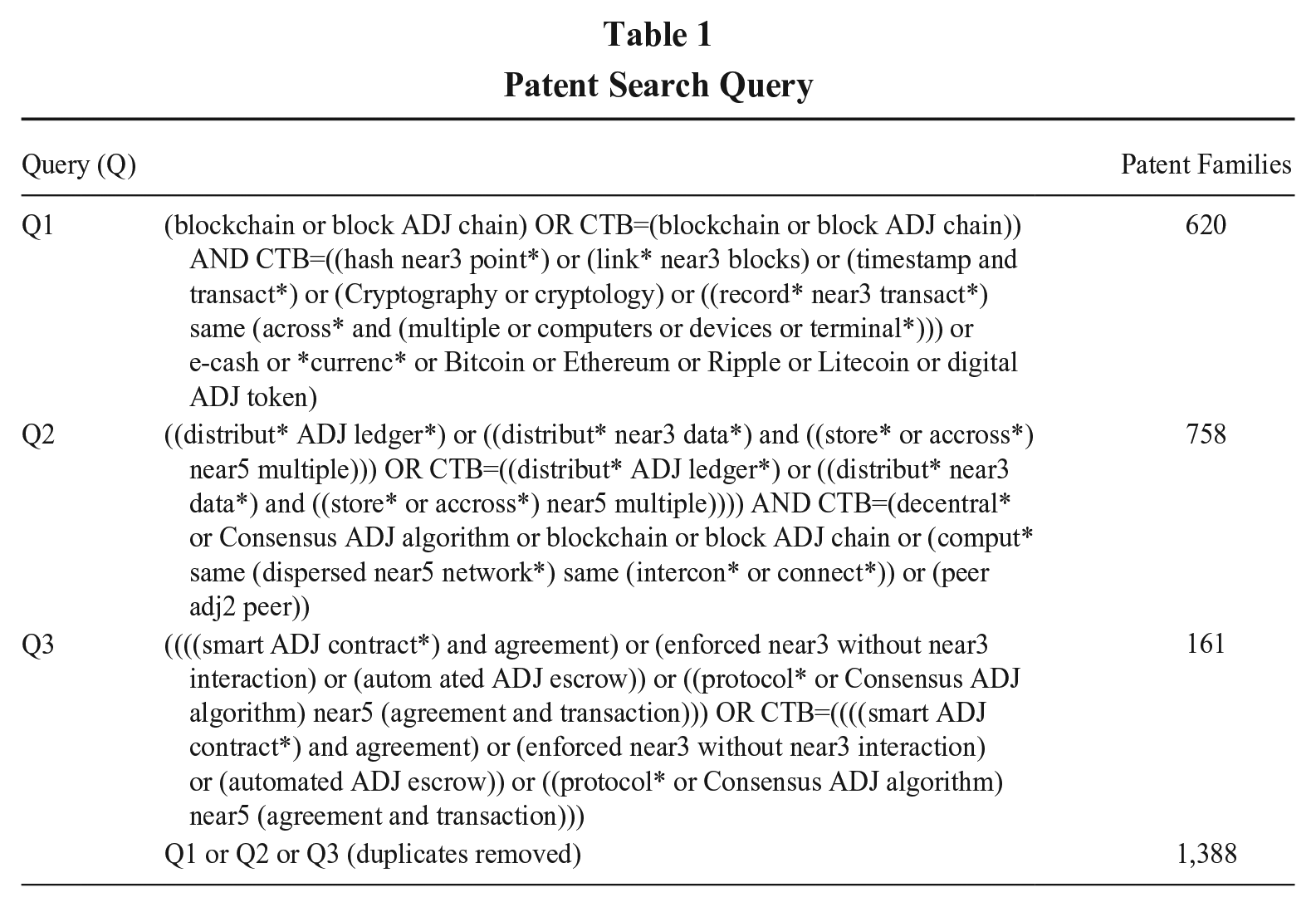
We collected international blockchain patents that are globally protected through the World Intellectual Property Organization to reduce any bias in national or regional patent activity (Criscuolo & Verspagen, 2008). We retrieved the patent documents using the Derwent Innovation Database, 3 which enables the grouping of patents into families to reduce redundancy in a sample (Harrigan, Di Guardo, Marku, & Velez, 2017). To this end, we used Clarivate Analytics, whose experts developed the search queries in Table 1. Searches were run on the patent title, claims, or abstract. The combination of the three queries after any duplications had been removed led to a final sample of 1,388 patent families distributed in a time frame from 2009 to the second trimester of 2020.
Patent Search Query
We used the Derwent World Patent Index (DWPI) as our patent classification system. We reviewed the DWPI patent classification codes in depth to determine whether any of the codes had been reclassified, as this might have introduced bias into our data. We found that there had been no patent reclassification during the period under examination. Next, we transformed our sample into an appropriate data structure by pooling patents according to the year they were applied for.
Mapping and Visualizing Connections and Mechanisms
This study adopts a network-based approach, employing patent co-classification as a particularly suitable method for revealing the structure and the earliest dynamics of a technological domain, thereby facilitating the design of maps without the time lag associated with citation-based methods (Engelsman & van Raan, 1994; Tijssen, 1992). To conduct our network analysis, we first calculated co-occurrence matrices to capture yearly changes in the frequency of the appearance of two technological elements in patents. P denotes the set of all patents. Each patent p ∈ P is characterized by an application year y(p) and an associated set of technological elements T(p) identified by the patent classification codes. For each separate year y observed in our dataset, we defined an N × N matrix Ay where N represents the total number of unique technological elements identified across all patents. The entry

where
Using the matrices
Using a multivariate analysis, we transformed the high-dimensional data in C Y into a reduced-dimensional space. For network analysis, we interpreted each cumulative matrix C Y as a weighted undirected graph G Y . The technological elements in G Y correspond to the unique technological elements (that is, the patent classification codes), with connection weights determined by the aggregated co-occurrence frequencies from the matrix (Yayavaram & Ahuja, 2008). The size of the technological elements reflects the frequency with which a particular technological element appears in a pool of patents: The greater the frequency, the larger the size. The more two classification codes co-occur in patent documents, the more intense their interaction will be. According to our theoretical framework, the initial phase of technology emergence is characterized by the presence of a small number of technological elements with limited interconnections, reflecting the initial outcome of the inventive processes. As these processes advance, technology fitness allows for the integration of new technological elements. This leads to a scenario of increased complexity translated into a large number of technological elements. Some of these technological elements become more prominent, activating a self-reinforcing mechanism that further increases their dominance in the technological domain.
Measuring Technology Structuring
We used the decomposability measure to capture the structuring process resulting from the interplay of technology fitness and self-reinforcing mechanisms. This measure quantifies both the cohesiveness of a structure and the strengthening of connections over time (Simon, 1962; Yayavaram & Ahuja, 2008). Specifically, the technology fitness mechanism increases the number of new connections, thus adding complexity, while the self-reinforcing mechanism enhances the number of strong connections associated with specific elements and aids in forming a core within the technological structure. To assess how technology is structured, we first identified each technological element’s microstructure, which includes all the direct connections of the focal technological element with its neighbors as well as the connections between these neighbors (Yayavaram & Ahuja, 2008). We then categorized connection patterns as strong or weak according to the frequency of connections between two technological elements relative to all possible connections inside the focal technological element’s microstructure. Following prior literature, we proceed in determining a threshold connection value cv i operationalized as

where wj represents the number of connections occurring between technological elements ni and nj. We indicate with r the number of technological elements in the microstructure. Ci is the number of all possible connections of the focal technological element ni in the microstructure.
4
Thus, cv
i
is a positive discrete number for each technological element ni. If the observed number of co-occurrences is above the threshold connection value, the connection pattern is strong. Conversely, values below the threshold indicate weak connection patterns. Then, we proceed with assessing the integration level Ini defined for each focal technological element ni as Ini =
Finally, decomposability measure D is determined as

where zi ranges between 0 and 1 and represents the relative size of each technological element (that is, the ratio of the number of occurrences of a technological patent class and the total number of occurrences), Ii assumes values between 0 and 1 and measures its integration value, and N is the number of total technological elements. This formulation aggregates the technological element data, combining aspects of size and integration to measure how cohesive the overall structure is.
The decomposability measure, which ranges from 0 to 1, helps us understand the structuration process. Values between 0 and 0.5 reasonably indicate a nondecomposable structure. In this scenario, technological elements are interconnected, but the connections are distributed so broadly that no distinct structure or pattern emerges. For values greater than 0.5 but less than 1, the structure is considered to be nearly decomposable. Here, the structure is more discernible, with a core technology emerging amid weaker connections. Finally, values equal to 1 signify a fully decomposable structure. This represents a scenario in which the technology is characterized by a lack of weak connections, meaning that the technology is highly self-contained, with each part operating independently rather than interdependently. As a result, the technology becomes locked in, with each component functioning in isolation, leading to a system that is resistant to external influences or integration with other technologies. This condition reflects a rigid structure that limits the potential for evolution. Following our theoretical framework, we expect a nearly decomposable structure (values higher than 0.5 and lower than 1) in the blockchain context, with increasing values of the decomposability measure over time. This is the result of the technology fitness mechanism, which produces an increase in weak connections, and the self-reinforcing mechanism, which fosters the emergence of a technology core. We have included an additional example in Appendix A (see online supplement) with more detailed operationalization.
Estimating Technology Fitness and Self-Reinforcing Mechanisms
According to our theoretical model, technology emerges thanks to technology fitness and self-reinforcing mechanisms. To jointly estimate these mechanisms, we use the PAFit method. This method is particularly suitable for modeling networks where both the number of connections between technological elements and their individual characteristics evolve dynamically (Pham et al., 2016). Following Pham et al. (2020), we indicate Pi(t) as the probability that a technological element ni receives a new connection at time t:

where η i is the technology fitness of technological element ni, A k denotes the self-reinforcing mechanism, and ki(t) is the number of connections technological element ni has at time t.
When considering the technology fitness mechanism in isolation, the probability Pi(t) that a technological element ni connects at time t is given by a positive number η i , independent of the number of connections the technological element possesses (k is not considered here). To measure η i , in the formalization (4) the effect of the self-reinforcing mechanism is neutralized by setting Aki(t) = 1 (Caldarelli, Capocci, De Los Rios, & Munoz, 2002; Pham et al., 2020). The values of η i are typically higher than 0, since the absence of technology fitness η i = 0 would imply the technological element cannot form a new connection. Differences between technological elements in terms of values η i explain why technological elements that joined the technological domain later can surpass those that were already there.
When the self-reinforcing mechanism is considered in isolation, the probability Pi(t) that a technological element ni connects at time t depends on the existing number of connections ki(t) that specific technological element ni already possesses; k ranges from 0 to the maximum number of connections composing the technology structure. The self-reinforcing mechanism Ak assumes a log-linear form A k = k α , where α represents the self-reinforcing exponent (Krapivsky, Rodgers, & Redner, 2001; Pham et al., 2020). Understanding the value of the α exponent is fundamental because it explains to what extent established technological elements continue to dominate and thus influence technology structuring. When α = 1, it indicates a situation in which a few technological elements become very highly connected. Values of α < 1 suggest that most technological elements have a moderate number of connections; however, there are very few highly connected. In contrast, when α > 1, it represents a lock-in scenario where highly connected core technological elements dominate the overall technological domain, with less chance for less prominent technological elements to emerge.
Finally, we chose a 95% confidence interval to make our results more robust. The estimation process in PAFit utilizes a majorization-minimization (MM) algorithm, which in the context of our model ensures efficient and effective estimation of both technology fitness and self-reinforcing mechanisms (Pham et al., 2016).
Results
Structuring of the Blockchain Domain
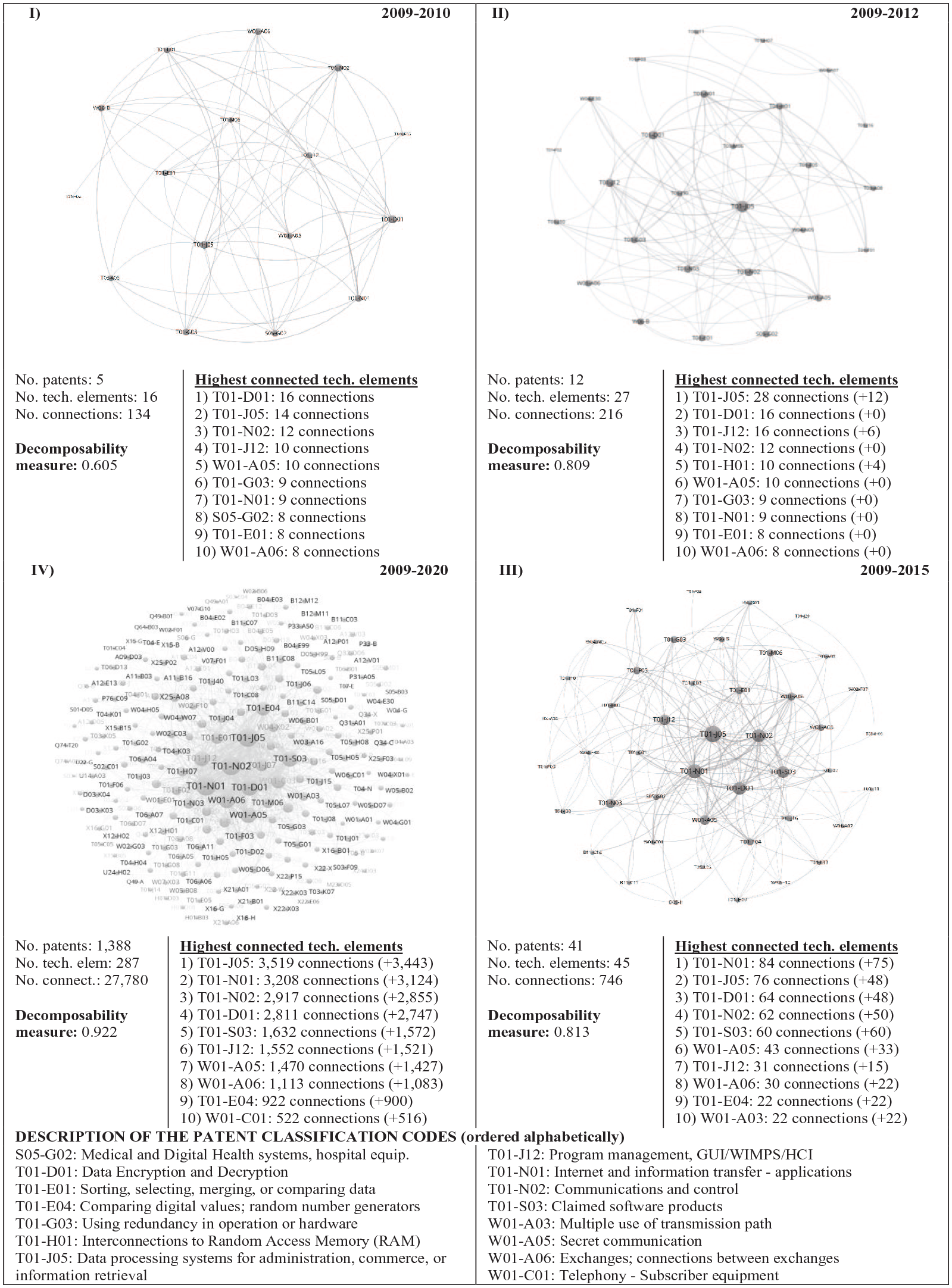
Figure 2 provides a comprehensive overview of the structuring process observed within blockchain technology, illustrating the results of the two mechanisms at play. By delineating the technological elements and mapping their connections over time, the figure highlights technology emergence and evolution in terms of complexity and structuring. We explain this process using four distinct time windows to convey how the technological elements self-organize, attract each other, and self-reinforce their position. Each window in Figure 2 reports the number of patents, the number of technological elements, the number of connections, and the top 10 most connected technological elements ranked according to their total number of connections. The decomposability measure is also included to capture the degree of structuring and assess temporal changes.
The Structuring of the Blockchain Domain
Moving from the upper-left-hand side, Figure 2 (I) illustrates blockchain’s earliest connections in the 2009-to-2010 time frame. The combination of 16 technological elements included in five patented inventions is an expression of the initial efforts of inventors at a micro level. These results are consistent with our theorization (as depicted in Figure 1b and further in Figure 1c). In particular, the mechanism of technology fitness is evident in this phase, and it may determine different paths for the technological elements. For instance, the technical features of T01-D01 (data encryption and decryption) allowed it to establish 16 successful connections (exhibiting higher technology fitness) while T01-F02 (interrupt, multiprogramming, multitasking) was able to connect only once. Structuring can therefore be considered as the outcome of successful connections among technological elements that self-organize. The decomposability measure for this time interval is consistent with these observations, as it displays a value that falls into the nearly decomposable level (0.605).
Figure 2 (II) shows a more complex structure that transforms the blockchain domain into a new configuration consisting of 27 technological elements and 216 connections in the 2009-to-2012 time frame. The key aspect that needs to be highlighted in this snapshot is the appearance of the self-reinforcing mechanism. This dynamic is illustrated by the initial predominance of one technological element—T01-J05 (data-processing systems for administration, commerce, or information retrieval)—over the rest. Consistent with our model (see Figure 1d), the reinforced connections foster structuring, as evidenced by an increase in the decomposability value (0.809) for the time window. At the same time, it is also possible to observe the technology fitness mechanism at work. This mechanism explains why technological elements with the same number of connections evolve in different ways, as is the case with W01-A05 (secret communication), which was able to attract more connections than T01-J12 (program management), even though they had had the same number of connections in the previous time frame (10 each). The emergence of an initial, albeit fragile, path that was primarily related to Bitcoin reduced the scope of the experimentation—an early, but weak, signal of the diminishing agency of the inventors.
Figure 2 (III) depicts the cumulative growth of blockchain in the time frame 2009 to 2015. Compared with the previous time frames, the domain has acquired greater complexity (45 technological elements linked 746 times), and a higher degree of structuring has led to the generation of an initial technological core. In this time frame, we see that the domain includes almost 4 times as many patents compared with the previous period (41 vs. 12) while the number of technological elements has less than doubled. This means that the inventors are increasingly keen to combine existing technological elements that fit together better. Figure 2 (III) shows how some technological elements increased their size and consolidated their connections (signaled by thicker connections). Indeed, all the technological elements included in the list of the highest connected technological elements (Figure 2) acquired new connections to varying degrees. These differences in amount depend on the magnitude of and interplay between technology fitness and self-reinforcing mechanisms. For instance, T01-N01 (internet and information transfer–applications) shifted from the eighth position (nine connections) in the second time frame to the first position (84 connections) in the third. Thanks to the self-reinforcing mechanism, existing connections among technological elements were confirmed, while the technology fitness yielded new ones. This is not surprising, because the field began to proliferate during this time window due to Ethereum, whose white paper was released in 2014. Ethereum highlights the fundamental role played by its inventor, Vitalik Buterin, whose agentic action paved the way for the rapid development of technology beyond the financial sector. Domain structuring over the 7-year window is evidenced by the increase in the decomposability value (0.813), indicating a more cohesive structure over time.
In the final window (2009-2020) depicted in Figure 2 (IV), we observe the exponential growth of the blockchain domain in terms of the number of patents (1,388), number of technological elements (287), and number of connections (27,780). This intensive inventive activity has profoundly changed the domain configuration, which now reveals a clearer technological core. The four technological elements listed in Figure 2 (IV) have 45% of all the connections while representing 1% of the overall domain. This is an expression of the self-reinforcing mechanism, which has consolidated certain specific technological elements. Technology fitness has also fostered complexity by attracting new technological elements and shaping the blockchain domain. For example, technological solutions such as cryptography, proof of work, and proof of stake are considered to have greater fitness because they enhance the security of the blockchain. The accumulation of micro interactions among the technological elements has formed a specific trajectory that is now revealed at a macro level. The increase in structuring (2009-2020) is confirmed by an increase in the decomposability value (0.922), which depicts a nearly decomposable structure with defined microstructures and numerous connections that bridge them. Also, thanks to the interplay between the two mechanisms, the primitive core described in Figure 2 (III) is transformed into a technological core that serves as an “attractor,” encompassing a domain’s identity. A technology core can be difficult to change unless self-reinforcing and technology fitness mechanisms definitively cease.
It should be noted that almost all the technological elements listed in the top 10 most connected elements in the first time frame (2009-2010) also appear in the top 10 lists in subsequent time frames, although more than a decade has passed. The massive contribution of numerous inventors worldwide is heavily grounded on and profoundly influenced by the initial intuition of a few. We observed that path dependence increases with time, while the inventors’ agency decreases as technology trajectories become more evident. Indeed, inventors face technology constraints that “force” them to comply with a technology core and a defined, although malleable, technological structure. New technological elements that join the blockchain domain cannot occupy a random position; rather, they must self-organize according to their connection with the existing technological elements. To capture the post-Ethereum structuring process, we mapped the blockchain domain in the 2014-to-2020 time window. The results are very similar to those from 2009 to 2020, suggesting the importance of the role played by Ethereum in shaping the blockchain domain.
Technology Emergence: Joint Estimation of the Mechanisms at Work
To show the joint influence of the two mechanisms on technology structuring, Table 2 includes the estimation of the α exponent when considering the self-reinforcing mechanism in isolation (Model 1) and the joint estimation of α when both self-reinforcing mechanism and technology fitness are considered (Model 2). Blockchain technology presents a sublinear case in which α < 1 in both models, with values of 0.923 and 0.907 for Model 1 and Model 2, respectively. This result confirms that while technological elements with more connections are more likely to acquire even more, the rate at which they receive new connections is not directly proportional to their current number of connections (k).
Estimation of Self-Reinforcing and Technology Fitness Mechanisms
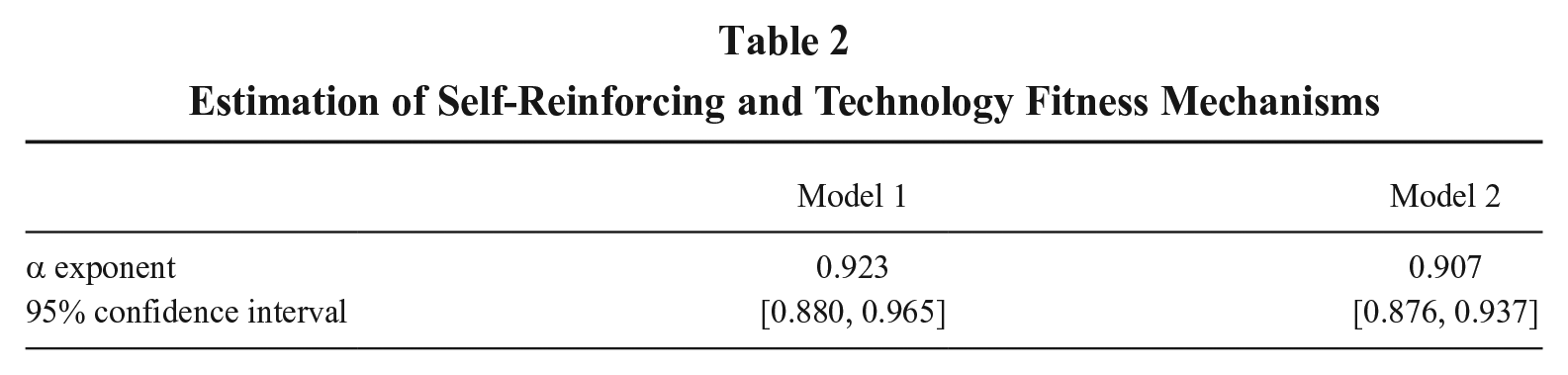
Moreover, when the technology fitness mechanism is included in Model 2, the α exponent decreases. This result is consistent with our theorization that both technology fitness and self-reinforcing mechanisms jointly affect technology structuring. Indeed, the self-reinforcing mechanism is not the sole driver of technology, but also technology fitness is present. The latter allows technological elements with fewer connections to become more influential, independently of the number of existing connections, thus leading to a more heterogeneous technology structure. Note that the 95% confidence intervals do not include the value 1, making the results of a sublinear case more robust. Although the details are beyond the scope of the present study, in Appendix B online, we include additional analyses aimed at measuring the individual contribution of the two mechanisms in shaping blockchain technology.
Simulating Different Paths of Technology Emergence
We carried out simulations to generalize from our observations in the blockchain domain and show how technology structuring unfolds when the two identified mechanisms operate independently or jointly. By simulating the two mechanisms at work, we were able to assess alternative configurations of technology (non-)emergence against the path observed for blockchain technology, thus providing a further test of the robustness of our results. The methods we used to develop these simulations are included in Appendix C online. In this subsection, we present the results in terms of the different configurations that can potentially arise in any technological domain.
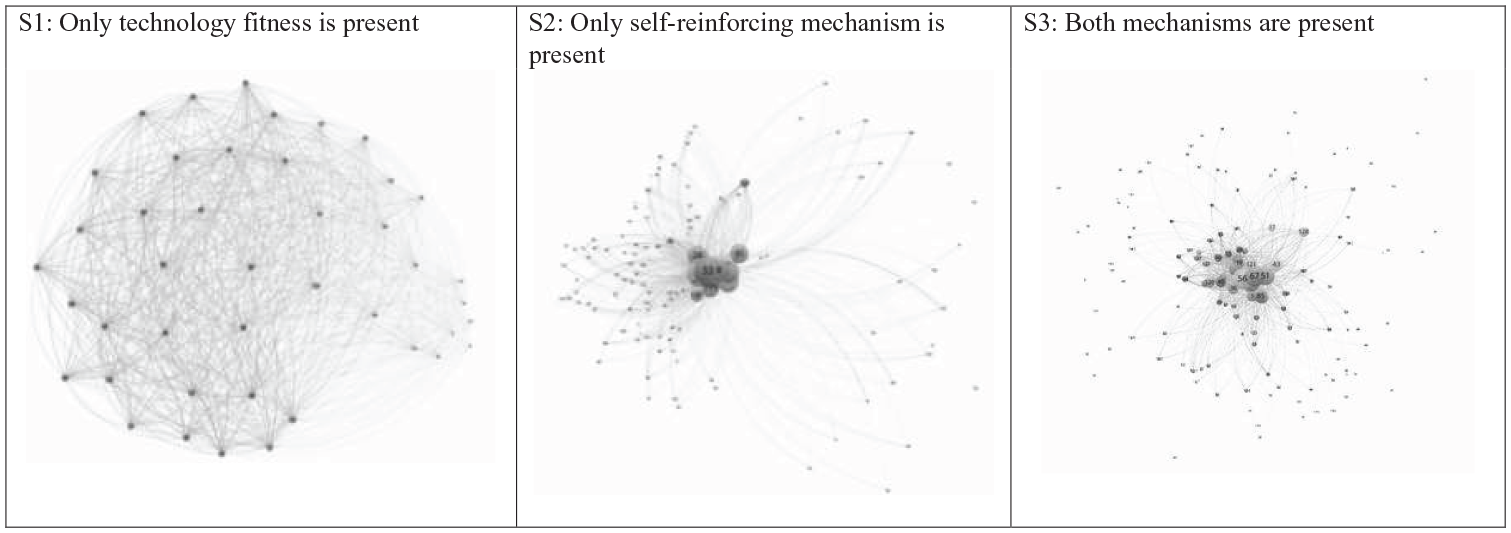
Figure 3 visualizes the simulation outcomes. Three scenarios are considered: (a) Only the technology fitness mechanism is present, (b) only the self-reinforcing mechanism is present, and (c) the technology fitness and self-reinforcing mechanisms work jointly.
Simulations
Simulation 1 presents a scenario in which the presence of technology fitness has fostered connections with new technological elements but the formation of the technological core is not evident. The absence of a self-reinforcing mechanism leads to a more distributed and interconnected structure, resulting in a non-emergence of the technology. The technology is in its earliest stages of development, during which a variety of paths can still be explored through experimentation. Without a clear core, however, this scenario involves a high degree of uncertainty regarding the evolution of technological patterns. This situation depicts a fully decomposable structure in which connections are broadly distributed and no specific trajectory is established. Considering that no constraint is imposed by a dominant trajectory, inventors are free to generate unexpected combinations of technological elements that might give rise to profound changes in the technology.
In Simulation 2, the technological structure is shaped exclusively by the self-reinforcing mechanism. As discussed in our theoretical framework, the technology fitness mechanism is essential because it enables connections. To simulate the absence of the technology fitness mechanism, all the technological elements are considered as having an equal ability to attract, and connections occur on a random basis. In this simulation, we observe the powerful force of this mechanism, which has fostered a dense, interconnected technological core at the expense of complexity and variety, and as clearly emerges, the number of elements composing the technology decreases significantly and a rigid trajectory is laid out. Under these circumstances, the technology becomes locked in around its core elements, thus limiting experimentation with new technological combinations and restricting growth opportunities. This scenario suggests a nondecomposable structure, where core technological elements are profoundly interconnected, and changing even one can have significant implications for the entire structure. A scenario like this highlights the overreliance of the technological domain on a few technological elements, offering inventors very limited options for technological advancement.
Finally, Simulation 3 depicts a general model of technology emergence in which the technology fitness and self-reinforcing mechanisms work together. Here, the structure appears to be nearly decomposable, with sets of strongly connected technological elements forming a core, even though numerous weak connections are also present. Within this framework, inventors reinforce the recombination of core technological components while exploring multiple new technological options. This scenario reflects the case of blockchain technology, where certain technological elements have activated the self-reinforcing mechanism, becoming dominant and crystallizing their position at the core. Technology fitness has attracted many technological elements, further fostering exploration. When both mechanisms are at work, even peripheral technological elements can potentially enter the core. This entry can be facilitated by an exponential growth of connections with one or more existing core technological elements. Thus, the model illustrates how the emergence of technology is the outcome of complex interactions between technology fitness and self-reinforcing mechanisms. These interactions not only allow emergence but also shape any technological domain.
Discussion
The aim of our study was to investigate the structuring processes that underpin the emergence of a technology. We have drawn on complexity theory to build a theoretical model that depicts how sets of technological elements that have been synthesized in patented inventions self-organize and gradually aggregate into more complex structures that serve as a basis for further technology development. The progressive aggregation and structuring of the technological elements occur through the interaction of two distinct mechanisms: technology fitness and self-reinforcing. The technology fitness mechanism embodies the attractiveness force working at a technological element level, while the self-reinforcing mechanism synthesizes the force of a connection between technological elements, and the emergence of a predominant connection over time crystallizes patterns and trajectories, leading to technology emergence.
The application of the model to the blockchain domain showed that an increasing number of inventions and the modalities of putting together new and existing technological elements—facilitated by the technology fitness mechanism—considerably increased the complexity of the domain. The successful combination of technological elements reinforced specific connections, thanks to the self-reinforcing mechanism. Furthermore, the joint activation and persistence of both technology fitness and self-reinforcing mechanisms enabled certain technological elements to attract numerous others, strengthening their connections and thereby consolidating into a technology core. Our simulations extended the dynamics of technology emergence observed in the blockchain domain to other technological domains based on variations in the presence or absence of the technology fitness and self-reinforcing mechanisms. Our results suggest three theoretical contributions, which we discuss next.
Understanding Technology Emergence as a Structuring Process
Our study brings together two important dimensions of technology emergence. First, it bridges the micro and macro processes of technology structuring; and second, it combines the agency of inventors with that of technological elements. Existing studies on the modalities of emergence have focused on the micro dimension of technology speciation and recombination. From this perspective, emergence is conceptualized as an aggregation process that involves elementary pieces of knowledge combined in an invention (Basalla, 1988; Cattani, 2006; Cattani & Mastrogiorgio, 2021; Fleming & Sorenson, 2004; Hargadon, 2003; Kodama, 1992; Levinthal, 1997; Xiao et al., 2022). In contrast, the literature on trajectories has predominantly examined the macro dimension of technology emergence and development, disentangling patterns and directionalities (Anderson & Tushman, 1990; Tushman & Anderson, 1986; Utterback & Abernathy, 1975). Although these two perspectives represent the core foundations of innovation literature, they have been hitherto considered separately.
By integrating research on modalities and trajectories, our study suggests that technology emergence results from the interaction of micro- and macro level dynamics that gradually take a system from simplicity to complexity and from loose interactions to structured patterns. Specifically, activating the technology fitness mechanism facilitates a broader combination of technological elements, thus increasing complexity, while activating the self-reinforcing mechanism generates patterns that crystallize into cores and progressively structure the system. These observations are theoretically important because they explain how a technological domain is shaped and under what conditions of emergence, non-emergence, and locked-in scenarios.
Our model of semiautonomous agency also expands current understandings by recognizing both the efforts of inventors and the agentic properties of technological elements during processes of technology emergence. Admittedly, technological innovation is a human endeavor that relies on the initiative of multiple inventing subjects and the sharing of knowledge between academic scientists and industrial research managers (see, e.g., Evans, 2010; Fleming & Sorenson, 2001): On the one hand, inventions imply the existence of an agent of recombination (Fleming & Sorenson, 2001; Kok et al., 2019), while on the other, the institutionalization of inventions into patents with legal status turns human inventive acts into tangible technological elements that acquire semiautonomous agency. In this regard, the emergence of a technology is similar to the construction of scientific knowledge (Dosi, 1982), in which initial ideas gradually detach from their originator, becoming semiautonomous and taking on a life of their own (Gould, 2002; Greenwood & Meyer, 2008). While combinations of technologies are created by inventors or organizations, the success of those combinations also depends on the underlying characteristics of the technological elements themselves, and hence, we argue that a model of technology emergence should simultaneously consider the agentic actions of inventors and organizations and the self-organizing processes arising from the interacting technological elements.
Our study shows how the mechanisms of technology fitness and self-reinforcing affect inventors’ efforts by shaping technology opportunities and constraining future developments. In the case of the blockchain domain, we observed that the inventor’s initial intuition to combine key technological elements, such as data encryption and decryption, secret communication, and data-processing systems, crystallized into a technology core. The path-dependent trajectory compelled subsequent inventors to follow the emergent pattern, and so the inventor’s agency to independently shape technology gradually decreased. This happens because technological elements can self-organize through a semiautonomous agency, following rules of technology fitness and self-reinforcement. Although the self-reinforcing mechanism increases over time, the blockchain field does not exhibit a locked-in situation, which suggests that changes to and the persistence of these mechanisms may counteract the decrease in the inventors’ agency. These findings are theoretically important because they contribute to debates on the agency of things (Latour, 1987) relating to processes of technological emergence. They suggest that inventors delegate agency to patents, which interact in a semiautonomous manner and are eventually combined in nonpredictable technological configurations. These agency mechanisms shape technological modalities and trajectories.
The Role of Space and Technological Distance
This study has implications for our understanding of the spatial dimension of technology in general, and specifically the role of technological distance in management studies (Capaldo et al., 2017; Rosenkopf & Almeida, 2003; Rosenkopf & Nerkar, 2001; Wang & Chen, 2018). Technological distance, which is commonly viewed as the difference in the technological profile of two patent portfolios (Nooteboom, Van Haverbeke, Duysters, Gilsing, & Van den Oord, 2007; Savage et al., 2020), has mostly been investigated in contexts like mergers, acquisitions, and inter-company collaborations to examine partner selection and innovation performance (see Ahuja & Katila, 2001; Mowery, Oxley, & Silverman, 1998). Studies in this stream of research have mainly assessed technological distance by taking patents and simply counting the number of classification codes shared by two enterprises’ portfolios (Diestre & Rajagopalan, 2012). A more recent study by Capaldo et al. (2017) has investigated technological distance at a patent level by accounting for the distance of technological elements included in a single patent. While these patent-based indicators are effective for analyzing large datasets, their lack of inherent temporal and sectoral dynamics is a limitation.
Our results challenge previous understandings (see, e.g., Ahuja & Katila, 2001; Capaldo et al., 2017; Rosenkopf & Nerkar, 2001) and highlight the fact that technological distance can be treated not as an absolute measure but rather in the context of a specific technological domain. Technological elements have varying roles in the domain, which may change over time. We showed that in the case of blockchain technology, the structuring process brought together distant, previously unconnected technological elements, such as cryptography, secret communication, and financial applications. Once the newly born domain has been formed and its technological core has been structured, a new trajectory is defined. For inventions to align with this emerging trajectory, they must incorporate components of blockchain technology. Thus, individual technological elements of subsequently patented inventions may seem distant when viewed separately but are closely linked when considered within the context of blockchain technology.
When viewed from this perspective, measures of technological distance should consider both the interactions that exist between technological elements in a given technological domain and the evolution of these interactions. Several key recommendations suggest themselves here. First, patent-based measures of technological distance should preserve the granularity of technology knowledge embedded in inventions by looking at the multiple and distinct patent classification codes. Second, to account for the interaction between technological elements, the co-occurrence of patent classification codes should reflect temporal changes in their likelihood of appearing jointly within a specific domain, indicating whether or not they are positioned at the core of the technology. The introduction of a dynamic technological distance indicator may prove to be an important advance in this regard. Last, as these interactions change over time, the calculated likelihood should refer to a specific time frame. A patent indicator should thus weigh the relevance and interactions of patent classification codes within the evolving technology. By improving measures of technological distance, we can more effectively recognize and leverage potential complementarities and synergies in innovation strategies. Appendix D in the online supplement includes a dynamic measure of technological distance.
A Temporal Model of Technology Emergence
Our results suggest a new perspective on the temporal dynamics underpinning technology emergence. On the one hand, studies on modalities conceptualize emergence as a focal event where the interaction between technological components has the potential to yield a new technological domain (Basalla, 1988; Cattani, 2006; Cattani & Mastrogiorgio, 2021; Fleming & Sorenson, 2004; Hargadon, 2003; Kodama, 1992; Levinthal, 1997). On the other, research on trajectories has explained links in time showing how technology emergence might follow specific paths that unfold linearly (path dependence) or are punctuated by radical shifts (punctuated equilibrium) (Anderson & Tushman, 1990; Tushman & Anderson, 1986; Utterback & Abernathy, 1975). Thus, while the studies on modalities have looked at the synchronic aspects of technology emergence, the research on trajectories has disentangled the diachronic issues.
Our model tracks the emergence of new technologies by showing both synchronic and diachronic evolutionary dynamics. Specifically, our review of the blockchain domain provides synchronic snapshots of the state of a given technology at different points in time from inception to later evolution. In each snapshot, our analyses have captured processes of self-organization driven by technology fitness and self-reinforcing mechanisms that portray micro-level interactions among technological elements. In the specific domain of blockchain, both technology fitness and self-reinforcing mechanisms played a crucial role. By connecting the different snapshots and expanding the time frame, we have been able to observe changes in the mechanisms at work. Specifically, technology fitness allows more recent technological elements to increase their influence in the domain while self-reinforcing leads prominent technological elements to increase their influence over time. By providing a more holistic picture of the temporal structuring of technology, our study can help researchers understand what initial constraints based on the initial decisions taken by inventors might determine specific technological paths and enable a core structure to be identified in the technological domain (Arthur, 1994).
The temporal structuring of emerging technologies also has important consequences for predicting future developments of a technological trajectory. Our study has focused on the micro and macro dynamics of technology emergence in a technological domain that is still evolving. On the basis of our simulations, we identify three distinct evolutionary scenarios—non-emergence, lock-in, and emergence—in which the presence or absence of technology fitness and self-reinforcing mechanisms shape the structuring of a new technology. Specifically, technology fitness facilitates connections among diverse technological elements, increasing the complexity and the scope of technology, while the self-reinforcing mechanisms contribute to the formation of a technology core and the consolidation of technological trajectories.
These scenarios have important management implications because they can guide managers toward the adoption of a successful technology strategy. At this time, many innovators are struggling to contribute to the emergence of new domains. An example of this might be cultured meat technology, which is attracting substantial investment and encouraging the entrance of new players, including start-ups. Although the promise of a new market is there, however, the technological domain has not yet emerged. To make this happen, innovators should first attract new technological elements by borrowing them from other fields (such as plant-based meat), reinforcing successful procedures and technological patterns. In other words, to innovate effectively, firms need to assess emerging configurations of technology fitness and self-reinforcing and make informed decisions about how novel or conforming their technological innovations should be (Brewer, 1991; Zhao, Fisher, Lounsbury, & Miller, 2017).
On the basis of the outcomes of our simulations, we expect that technology is more likely to emerge when firms and innovators exercise agency in relation to the lacking mechanism. In a scenario of non-emergence, where technology fitness is the only mechanism being activated, innovators should concentrate their efforts on exploiting existing connections and helping crystallize the core domain, thus providing it with a stronger identity. Conversely, when self-reinforcing mechanism is being used in isolation, firms and innovators need to concentrate on fostering technology fitness, thus avoiding lock-in effects. Managers should thus aim for an “optimal point” where their technological innovations are distinct enough to avoid lock-in effects but also sufficiently aligned with the core domain to ensure relevance and applicability (Hsu, Hannan, & Koçak, 2018; Zhao et al., 2017; Zuckerman, 2016). In this case, innovators should experiment with other complementary domains, thereby increasing technological opportunities and expanding the scope of the technology. These considerations can also be read in terms of implementing a strategic balance between consolidating core technologies and fostering technological diversity (Hsu et al., 2018) concerning technology emergence since the value of an innovation is maximized either when extending its technological scope and opportunities in a technological domain or when investing in strategic activities close to the core of the domain. Finally, firms and innovators should also consider the agency of the technological elements themselves. This means understanding the inherent characteristics, strengths, and integration of the relevant technology and how they might influence and shape the domain.
Conclusion
As with any study, this work has some limitations that can set the stage for future research. First, we used patents to examine inventive activity in a particular domain. It has long been argued that not all inventions are patented, either because firms rely on secrecy (Leten, Belderbos, & Van Looy, 2016) or simply because some inventions are open-source. This latter aspect is particularly relevant for the blockchain domain because the first Bitcoins were created in a collaborative, open-source environment. Nevertheless, although it was not possible to track non-patent-related information, we might deduce that the patents included in our sample encompass key technology features at that specific time. To this extent, they can be considered to be representative of the overall knowledge of blockchain. Future studies should extend our understanding of the role of non-patent-related information in setting new technology patterns. Second, this study employs patent co-classification to investigate emergence as a structuring process, focusing on the blockchain domain. Although this fine-grained lens is particularly suitable to capture technology dynamics and early-stage developments, future studies could utilize patent co-citation analysis (e.g., Jaffe, Trajtenberg, & Henderson, 1993; Jaffe & de Rassenfosse, 2017) to measure and track the knowledge flows and examine further evolutionary stages of the blockchain technology. Third, our results portray the formation of a technological core that acquires increasing complexity and broadens the scope of application. This points to the establishment of blockchain as a general-purpose technology (see, e.g., Bresnahan & Trajtenberg, 1995; Goldfarb, Taska, & Teodoridis, 2023). Future studies might investigate these dynamics by empirically examining how and to what extent technology fitness and self-reinforcing mechanisms contribute to structuring a domain as a general rather than a narrowly structured objective. Fourth, this study does not account for market dynamics. Market feedback is fundamental for directing a firm’s R&D efforts to satisfy customer needs. We have assumed that firms are willing to develop technologies that appear to be more promising, thereby allowing them to gain a competitive advantage. Future research might consider both technology and market forces to build a more comprehensive overview of the emergence and structuring of a technology domain. Finally, in line with prior recombination literature, our analysis is based on pairs of technological elements (Carnabuci & Operti, 2013; Fleming, 2001; Fleming & Sorenson, 2001, 2004). We have assessed how their connections change over time and eventually create a specific trajectory. Although we have used the decomposability measure to assess technology structuring by accounting for a broader set of connections rather than direct connections, future research might examine trios or even larger elementary configurations to assess structural stability. Such an expansion might build upon our current findings, offering a more complex and nuanced understanding of technological domains.
This study contributes to our understanding of technology emergence by looking at the structuring processes by which technological elements progressively aggregate and crystallize into stable outcomes. In line with the tenets of complexity theory, our study assumes that technology is always in the process of becoming or turning into something different (Tsoukas, 2017). From this perspective, technology emergence is an interactive accomplishment that begins as an open-ended process and becomes progressively constrained by the boundaries of emerging technological patterns and self-reinforcing mechanisms. It is hoped that our findings will encourage future research on technology emergence aimed at testing and extending our theoretical insights across different technological domains.
Supplemental Material
sj-docx-1-jom-10.1177_01492063241247496 – Supplemental material for Technology Emergence as a Structuring Process: A Complexity Theory Perspective on Blockchain
Supplemental material, sj-docx-1-jom-10.1177_01492063241247496 for Technology Emergence as a Structuring Process: A Complexity Theory Perspective on Blockchain by Elona Marku, Maria Chiara Di Guardo, Gerardo Patriotta and David G. Allen in Journal of Management
Footnotes
Acknowledgements
The authors wish to express gratitude to editor Gokhan Ertug and two anonymous reviewers for their insightful feedback throughout the review process. We are also thankful to Silvio Piredda and Paolo Mattana for their valuable support to research assistance and model development. Special thanks to Elisa Operti, Riccardo Fini, and Ryan Krause for their insightful feedback during the manuscript’s final review stage. This study was funded by the Italian Ministry of Education, University, and Research (MIUR) as part of the Research Projects of National Interest (PRIN) program (CUP F53D23002990006).

Supplemental Material
Supplemental material for this article is available with the manuscript on the JOM website.
Notes
References
Supplementary Material
Please find the following supplemental material available below.
For Open Access articles published under a Creative Commons License, all supplemental material carries the same license as the article it is associated with.
For non-Open Access articles published, all supplemental material carries a non-exclusive license, and permission requests for re-use of supplemental material or any part of supplemental material shall be sent directly to the copyright owner as specified in the copyright notice associated with the article.
