




Abstract
Decades of research have examined how employees experience organizational-level change events (e.g., “the merger”). However, employees can also experience “everyday change events” that occur at the individual-level as the change becomes routinized for their jobs. That is, individuals can react to organizational change events that are occurring at different hierarchical levels. Drawing on event system theory, we argue that employees’ commitment to the organizational-level change event can shape how employees anticipate and experience subsequent everyday change events. These negative and positive everyday change events can impact (a) how employees engage with their work, impacting their performance and (b) whether employees perceive that they are fairly treated, impacting their subsequent evaluations of organizational-level change. Our hypotheses were generally supported in a field sample in which employees were surveyed immediately after a merger was announced, participated in a daily diary study as the merger was implemented, and completed a second survey 2 weeks after the diary study. By applying event system theory to organizational change, we provide important theoretical and practical insights, including how an organizational-level event can exert top-down direct effects by impacting how employees anticipate and experience change on an everyday basis as well as how everyday negative and positive change events can subsequently impact employees’ commitment to the organizational-level change, creating bottom-up direct effects. We also illuminate the importance of considering the frequency and strength of both negative and positive events to understand what it is about everyday negative and positive events that has implications for employees and organizations.
By its nature, [organizational] change creates discontinuity because it touches the entire organization.— Carucci (2021).
Organizational change initiatives typically represent a significant event that is critical for the organization’s long-term success and even its survival (e.g., Dougherty & Hardy, 1996; Goodstein & Burke, 1991). For example, organizations may enact a merger to enhance viability, adopt a new technology to improve efficiency, or rebrand to increase marketability. Given the importance of effectively managing organizational change, extensive scholarly attention has been devoted towards examining how employees react to organizational change and how organizations can build employee support for change (for a review, see Oreg, Vakola, & Armenakis, 2011). While the organizational change literature has provided abundant insights into employees’ reactions to organizational change as an organizational-level phenomenon, organizational change is intended to alter existing patterns (i.e., disrupt existing strategies, processes, and/or structures). This may require employees to routinize organizational-level change in their own jobs, suggesting that it is also important to examine employees’ reactions to organizational change as it is implemented on an individual-level (e.g., Kiefer & Müller, 2007). Said differently, employees can evaluate whether they generally support an organizational change (e.g., “the merger”), but they can also evaluate and respond to how this organizational change impacts their day-to-day experiences (e.g., Bess, 2015; Oreg, Bartunek, Lee, & Do, 2018). As such, distinguishing between employees’ reactions to organizational-level and individual-level change events (and examining their interplay) may advance our understanding and ability to effectively manage organizational change.
Drawing on event system theory (e.g., Liu, Morgeson, Zhu, & Fan, 2023; Morgeson, Mitchell, & Liu, 2015), we argue that examining how employees experience and react to organizational change as it is implemented for their jobs (i.e., individual-level change) can illuminate novel processes and insights, while also complimenting and deepening the existing understanding of employees’ experiences and reactions to organizational-level change. 1 We begin by examining how employees’ reactions to an organizational-level change event (i.e., the merger) can influence their everyday experiences (i.e., events that occur as the merger is implemented for their jobs). We propose that employees’ initial reactions to the organizational-level change event can shape their anticipatory perceptions related to the likely impact of the organizational change on their jobs. These anticipatory perceptions can create a lens through which employees experience everyday change events. That is, employees’ anticipatory perceptions can serve as a lynchpin that connects employees’ reactions to the organizational-level change event with their everyday experiences as this change is implemented on an individual-level. Importantly, we argue that everyday negative and positive change events can impact employees’ perceptions and behaviors. Everyday negative and positive change events may signal information about the organization, which can inform employees’ fairness perceptions and therefore impact their support for the organizational change. Further, everyday negative and positive change events may also influence employees’ engagement with their job, which can impact their downstream performance. Taken together, applying event system theory to organizational change reveals the importance of everyday change events, including how these events can influence employees’ performance and commitment to organizational change. While both performance and commitment are critical for the success of the organizational change, performance is also important for employee and organizational effectiveness. Figure 1 displays our theoretical model.
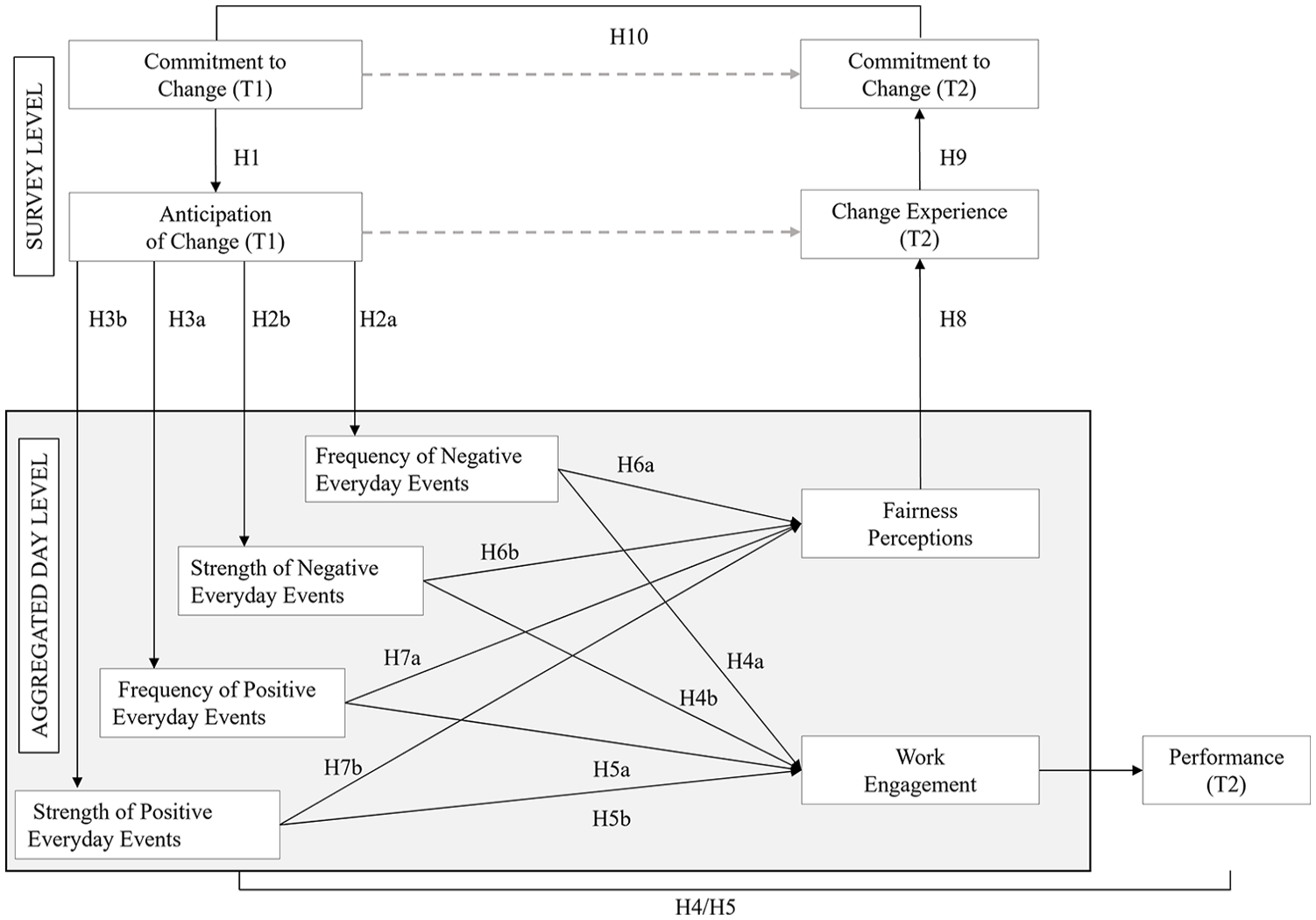
Theoretical Model and Hypotheses
We advance the literature in three ways. First, while an extensive literature exists that sheds light on employees’ responses to organizational-level change (e.g., Oreg et al., 2011), applying an event system theory perspective to organizational change suggests that it is also critical to examine how organizational change can shape employees’ everyday experiences on the job (i.e., their experiences of organizational change at the individual-level). Drawing on event system theory (e.g., Morgeson et al., 2015), we distinguish between employees’ reactions to organizational change at the organizational-level (e.g., a change event originating at the organizational level; in our study, “the merger”) versus employees’ experiences of organizational change at the individual-level (e.g., everyday change events originating at the individual-level as the merger impacts their own job). Thus, we answer general calls within the management literature to study events at the individual-level (e.g., Liu et al., 2023) as well as calls in the organizational change literature to recognize and study “everyday experiences of working in the context of change” (e.g., Kiefer & Müller, 2007: 233). In doing so, we reveal novel processes that can emerge as employees experience and respond to everyday change events (as the organizational change becomes routinized in their jobs). By illuminating how employees react to change events at the individual-level, we also offer a complementary perspective to the extant literature examining organizational-level change, thereby providing a more comprehensive understanding of employees’ experiences and reactions to organizational change.
Second, an event system theory perspective highlights the importance of studying top-down and bottom-up direct effects between event levels (e.g., Liu et al., 2023; Morgeson et al., 2015). 2 Building on this theoretical foundation, we explore the interplay between employees’ experiences of and responses to organizational-level and individual-level change events. For top-down direct effects, we consider how employees’ evaluations of the organizational-level change can shape their anticipation and experience of everyday change events (i.e., at the individual-level). In doing so, we provide insight into how the organizational-level change can impact employees’ individual-level experience of organizational change and their performance. For bottom-up direct effects, we consider how employees’ everyday experiences of change (i.e., employees’ reactions to individual-level change) can contribute to their reactions to organizational-level change. In doing so, we provide insight into why and how employees’ reactions to organizational-level change can shift over time. Understanding bottom-up effects and the dynamic nature of reactions to organizational-level change is critical for building employees’ commitment to organizational change over time (e.g., Bouckenooghe, De Clercq, & Deprez, 2014; Herold, Fedor, & Caldwell, 2007). By considering the interplay between employees’ reactions to individual-level and organizational-level change events, we provide insights into how to promote positive outcomes for employees and organizations (i.e., enhance performance) as well as promote positive outcomes for the change initiative (i.e., build employee commitment to organizational change). These insights are critical to enhance the effectiveness of organizational change initiatives as well as the general effectiveness of employees and organizations.
Third, we answer the recent call from event system scholars to explore the effects of positive events (see Liu et al., 2023). While negative events are often emphasized because it is assumed that “bad is stronger than good” (see Baumeister, Bratslavsky, Finkenauer, & Vohs, 2001), ample theoretical (e.g., Fredrickson, 2001) and empirical research (e.g., Kiefer, Barclay, Conway, & Briner, 2022) indicates that positive events are also important in their own right. Within the context of organizational change, understanding negative and positive everyday change events may be especially important because this can shed light on how to positively shift employees’ evaluations of the organizational-level change. The organizational change literature has highlighted the importance of positive experiences of organizational-level change (e.g., Fugate, 2013) and demonstrated that many employees experience ambivalence (e.g., negative and positive reactions) to organizational-level change (e.g., Oreg & Sverdlik, 2011; Piderit, 2000). As Oreg and Berson (2019) noted, it is important to foster a deeper understanding of why ambivalence might arise as well as how change leaders and organizations can promote positive reactions to organizational-level change. By examining both negative and positive everyday change events (i.e., the favorability of individual-level events; see Laulié & Morgeson, 2021) alongside the frequency (i.e., how often events are experienced) and strength of events (i.e., the extent to which an event is experienced as novel, disruptive, and critical; see Morgeson et al., 2015), we provide insight into how everyday change events may contribute to employees’ reactions to organizational-level change as well as what it is about everyday negative and positive events that has implications for employees and organizations.
Applying Event System Theory to Organizational Change
Decades of research has examined employees’ reactions to organizational-level change. Overall, this literature has offered extensive insights outlining the features of employees (e.g., traits, demographics), jobs (e.g., job characteristics), and organizations (e.g., culture) that can impact employees’ reactions to organizational-level change (e.g., Oreg et al., 2011). The process of organizational change has been recognized as unfolding over time (e.g., Huy, Corley & Kraatz, 2014) and employees may experience ambivalent reactions to change that may also shift over time (e.g., Oreg & Berson, 2019). While employees’ reactions to organizational-level change have been extensively examined, event system theory highlights the importance of considering how event-related phenomenon may occur at different hierarchical levels (see Morgeson et al., 2015). Given that organizational change is intended to disrupt existing strategies, processes, and/or structures within the organization (i.e., organizational change reflects a significant nonroutine event because it is intended to create shifts or alterations within the organization; see Morgeson & Hofmann, 1999), organizational change can occur as an organizational-level event. However, organizational change can also necessitate further changes at other hierarchical levels (e.g., departments, teams, individuals). That is, organizational-level “events can also beget new events that have further downstream consequences” (Liu et al., 2023: 2149).
Existing qualitative research supports the distinction between organizational-level and individual-level change events as well as the notion that individual-level change events can emerge as the organizational-level change is implemented on an everyday basis for employees’ work. For example, Kiefer and colleagues found that employees can react to change events at the organizational level (e.g., anger at yet another merger), but also change events at the individual level (e.g., frustration with changes to their work caused by the organizational-level change; Kiefer, 2002a, 2002b; Kiefer & Müller, 2007). Similarly, using interviews, Giaever and Smollan (2015) found that employees distinguished between organizational change “at an abstract level” (organizational-level change) from everyday experiences of change. However, these everyday experiences were embedded in the broader change context, implying that organizational-level change may shape everyday experiences of change. In a case study, Bess (2015: 740) challenged the notion that organizational-level change initiatives are the dominant focus of employees’ change experiences and instead found that most employees were focused on the “concrete and immediate changes–both positive and negative–they experienced in their daily work.” Taken together, extant qualitative research highlights that employees can distinguish between organizational change as events that can occur at the organizational-level and the individual-level.
Building on this foundation, we focus on everyday change events and examine the interplay between reactions to organizational-level versus individual-level change events. To better understand the distinction between organizational-level and individual-level events, we begin by conceptually defining events. Broadly, an event refers to observable actions or circumstances that command attention by breaking established routines (e.g., Morgeson, 2005; Morgeson et al., 2015; Mowday & Sutton, 1993). Events are discrete (bounded by space and time with a beginning and end) and reflect discontinuous “happenings” that “diverge from the stable or routine features of the organizational environment” (Morgeson et al., 2015: 519). An organization-level change event is typically defined by the organization, communicated to members of the organization as a change event, and is understood (and even referred to) by employees as a change event (e.g., “the merger”). An organizational-level event may occur over time (e.g., over the course of weeks, months, or even years in the case of organizational change).
By contrast, everyday change events are experienced by employees as the organizational change shapes their day-to-day work (Liu et al., 2023). These events emerge at the individual-level, reflect employees’ “lived change experience” working in the context of organizational change (Bess, 2015; Kiefer & Müller, 2007), and typically have a shorter duration (e.g., occur within a day or over a few days). We focus on everyday change events to isolate events that are related to organizational change but that occur at the individual-level, such as when an employee has a discussion with their manager about how “the merger” is impacting their day-to-day work duties or receives more information about how the organizational change should be implemented in their job. 3 We now turn to examining how an organizational-level event may exert top-down direct effects (i.e., impact the individual-level as the organizational change is translated into and shapes employees’ everyday experiences).
How Organizational-Level Events Shape Employees’ Everyday Change Experiences: The Importance of Top-Down Direct Effects and Anticipatory Perceptions
Decades of research has established that employees not only evaluate organizational-level change, but that employees’ commitment to organizational-level change is imperative for the success of organizational change initiatives (e.g., Fugate, 2012; Herscovitch & Meyer, 2002; Khaw, Alnoor, AL-Abrrow, Tiberius, Ganesan, & Atshan, 2023). Using event system theory, we argue that employees’ commitment to organizational-level change is also critical because it can exert top-down direct effects by shaping experiences at the individual-level (e.g., Morgeson et al., 2015). While findings from qualitative studies are consistent with the notion that employees’ beliefs about the organizational-level event can shape these everyday lived change experiences (e.g., Bess, 2015; Giaever & Smollan, 2015; Kiefer, 2002a, 2002b), it is currently unclear how this occurs. Given that organizational change is typically initiated at the organizational-level and then disperses to the individual-level as it becomes implemented in employees’ work (for a discussion on event space and event spatial direction, see Morgeson et al., 2015), we argue that employees are likely to first evaluate the organizational-level change and then evaluate how the implementation of the organizational-level change is likely to impact their everyday experiences. For example, the announcement of a merger may prompt employees to evaluate the merger and anticipate how the implementation of this organizational-level event (i.e., the merger) is likely to worsen/improve their circumstances.
Building on the notion that employees’ commitment to the organizational-level change is a critical factor that promotes employees’ support for change (e.g., Herscovitch & Meyer, 2002), we argue that employees’ commitment to the organizational-level change can influence how they anticipate that the organizational-level change is likely to impact their everyday experiences. We propose that employees who are affectively committed to the organizational-level change (e.g., believe in the value and importance of the change) are more likely to anticipate that the organizational-level change can have beneficial effects for them (i.e., the organizational-level change is likely to improve rather than worsen processes and/or circumstances related to their job). As such, we propose that employees’ affective commitment to the organizational-level change is positively associated with anticipatory perceptions that the organizational-level change is likely to improve their own circumstances at the individual level. Moving forward, we use the terms commitment and anticipatory perceptions for simplicity.
Hypothesis 1: Employees’ commitment to the organizational-level change is positively related to their anticipatory perceptions that the organizational-level change is likely to improve their own circumstances.
While the implementation of an organizational-level change can initiate everyday change events for employees, we argue that employees’ anticipatory perceptions may impact how employees experience these everyday events. More precisely, anticipatory perceptions are typically anchored on people’s evaluations and form a lens through which people evaluate incoming information (e.g., Fiske & Taylor, 1984; Lind, 2001). By creating a filter through which employees perceive new information (e.g., Rodell & Colquitt, 2009; Shapiro & Kirkman, 2001), anticipatory perceptions may influence how they experience and react to subsequent everyday events. Indeed, previous research on psychological contracts has demonstrated that having trust in one’s employer can reduce the likelihood that subsequent negative events are experienced as contract breaches (e.g., Robinson, 1996).
Applied to the context of organizational change, we propose that employees who anticipate that the organizational-level change is likely to improve their individual-level circumstances may engage in selective perception by attending to and interpreting information in ways that are consistent with their beliefs. That is, employees’ anticipatory perceptions may shape how employees experience everyday change events that emanate from the organizational-level change. To explore how anticipatory perceptions may influence everyday change-related events, we examine both negative and positive everyday change events. This aligns with recent advances in event-oriented theorizing (e.g., Cropanzano, Anthony, Daniels, & Hall, 2017) and empirical evidence (e.g., Lindquist, Satpute, Wager, Weber, & Barrett, 2016), indicating that people typically experience everyday events as either negative or positive. Given that event system theory indicates that not all events are experienced as impactful or salient (Morgeson et al., 2015), we also examine the frequency (i.e., how often events are experienced) and event strength (i.e., the degree to which the change-related event is salient due to its perceived novelty, disruption, and criticality) of negative and positive everyday change events.
Building on the above foundation, we propose that anticipatory perceptions that the organizational-level change is likely to improve employees’ own circumstances can prompt employees to attend to information that is consistent with these perceptions. Similar to the confirmation biases identified in other literatures (e.g., Robinson, 1996), we propose that anticipatory perceptions that reflect expected improvements can direct employees’ attention to perceiving and positively interpreting information. This suggests that positive anticipatory perceptions can guide employees’ attention towards perceiving fewer negative and more positive everyday events. Similarly, positive anticipatory perceptions may decrease the perceived event strength of the negative everyday change events but increase the perceived event strength for positive everyday change events because individuals are motivated to perceive both types of events in a more positive light due to their pre-existing beliefs. Thus, we argue that employees’ anticipatory perceptions that the organizational-level change is likely to improve their circumstances can guide people’s attention away from negative information and towards positive information, thereby decreasing the frequency and event strength for negative everyday change events but increasing the frequency and event strength for positive everyday change events.
Hypothesis 2: Employees’ anticipatory perceptions that an organizational-level change can improve their circumstances are negatively associated with the frequency (H2a) and event strength (H2b) of negative everyday change events.
Hypothesis 3: Employees’ anticipatory perceptions that an organizational-level change event can improve their circumstances are positively associated with the frequency (H3a) and event strength (H3b) of positive everyday change events.
Understanding the Impact of Everyday Negative and Positive Change Events
Building on the above argument that organizational-level change can initiate everyday negative and positive change events, we argue that these everyday events can impact employees’ perceptions and behaviors (i.e., exert single-level effects in which events experienced at the individual-level can have implications for employees at the individual-level; see Morgeson et al., 2015). Moreover, how employees experience the implementation of organizational change can have implications that extend beyond the implementation period. Examining employees’ aggregated everyday experiences at the individual-level can conceptually reflect employees’ experiences during the implementation of the change as well as shed light on the downstream implications of these everyday experiences (i.e., can reveal bottom-up direct effects).
We focus on how aggregated everyday change events impact employees’ engagement and fairness perceptions (in the aggregate during the implementation of change) given the importance of these outcomes for both employees (i.e., single-level effects) and for organizational-level change (i.e., bottom-up direct effects). This also creates the opportunity to provide further insight into extant findings related to engagement in the organizational change literature, which indicate the importance of engagement during change implementation (e.g., Kaltiainen, Lipponen, Fugate, & Vakola, 2020; Vakola, Petrou, & Katsaros, 2021) and that negative beliefs about organizational-level change can detract from employees’ engagement during the implementation of change (e.g., Belschak, Jacobs, Giessner, Horton, & Bayerl, 2020). We posit that employees’ experiences of everyday events can provide insight into why engagement is impacted during the implementation of change.
Work engagement is a positive motivational state that reflects employees’ affective energy directed towards their work tasks (Crawford, LePine, & Rich, 2010) and is characterized by energy, enthusiasm, inspiration, and task focus (e.g., Schaufeli & Bakker, 2004). We argue that everyday change events can shift employees’ attention and energy (i.e., impact their engagement as the change is being implemented), which can in turn impact their downstream performance. Experiencing frequent or salient (i.e., high event strength) negative everyday change events may consume employees’ resources and divert their attention away from work, thereby diminishing their engagement during the implementation of change. By contrast, experiencing frequent or salient (i.e., high event strength) positive everyday change events may build resources and focus employees’ attention on work, thereby enhancing engagement during change implementation. Given that engagement can shift employees’ affective energy and focus to their work tasks, build resources, and encourage employees to dedicate their resources and attention to their work, we argue that this can enhance their downstream performance (e.g., Bakker & Bal, 2010; Beal, Weiss, Barros, & MacDermid, 2005). Taken together, we propose that employees’ aggregated everyday experiences (i.e., the frequency and aggregated strength of everyday events during the implementation of organizational change) can impact aggregated work engagement during change implementation, which can impact employees’ downstream performance.
Hypothesis 4: There is an indirect effect from frequency (H4a) and strength (H4b) of negative everyday change events to subsequent performance via work engagement during change implementation.
Hypothesis 5: There is an indirect effect from frequency (H5a) and strength (H5b) of positive everyday change events to subsequent performance via work engagement during change implementation.
Event system theory highlights that employees are likely to engage in event-related sensemaking to understand “what is going on and what should be done” (Morgeson et al., 2015: 522). This may be especially important in the context of organizational change since employees’ experiences during the change implementation may impact their perceptions of the organizational-level change (e.g., Bouckenooghe et al., 2014). Similar to engagement, we argue that examining everyday experiences during change implementation may shed light on these effects. More precisely, we propose that experiencing everyday change events during the implementation of change can impact how employees evaluate the organization. Given that everyday change events emanate from organizational-level change, we argue that employees are likely to evaluate the organization by considering how these everyday change events impact their perceptions of the organization (e.g., Rupp, Shao, Jones, & Liao, 2014). More precisely, employees may focus on organizational fairness perceptions because these everyday events provide meaning for how employees are being treated during the change and are likely to be treated after the change has been implemented (e.g., Cobb, Folger, & Wooten, 1995).
Building on this foundation, we argue that experiencing frequent or salient (i.e., high event strength) negative events during the implementation of organizational change can detract from employees’ general perceptions that the organization is fair by signaling issues related to outcomes, procedures, communication, and/or interpersonal treatment (see Colquitt, Conlon, Wesson, Porter, & Ng, 2001). By contrast, employees’ experiences of frequent or salient positive events during the implementation of change is likely to communicate that employees’ everyday experiences are being improved, which can enhance employees’ general perceptions that the organization is fair. Taken together, we argue that employees’ everyday experiences during change implementation can impact their aggregated fairness perceptions during this period.
Hypothesis 6: During change implementation, the frequency (H6a) and event strength (H6b) of negative everyday change events are negatively associated with organizational fairness perceptions.
Hypothesis 7: During change implementation, the frequency (H7a) and event strength (H7b) of positive everyday change events are positively associated with organizational fairness perceptions.
Examining Bottom-Up Direct Effects: How Everyday Change Events Can Build Employee Commitment to Organizational-Level Change
Previous research has established that employees’ fairness perceptions are instrumental in their attitudes towards organizational-level change (e.g., Fuchs & Edwards, 2012) and that employees can reflect on how the organizational-level change has generally impacted them (Isabella, 1990). Building on this foundation, we argue that employees’ fairness perceptions during change implementation can reflect how employees feel about the treatment from their organization and signal how employees may be treated in the future (see Cropanzano, Byrne, Bobocel, & Rupp, 2001). As such, employees’ aggregated fairness perceptions during change implementation may predict how they subsequently evaluate their general experiences of the organizational-level change (i.e., exert bottom-up direct effects; see Morgeson et al., 2015).
Hypothesis 8: Employees’ fairness perceptions during change implementation are associated with positive evaluations of their experience of organizational-level change.
Previous research has demonstrated that employees’ positive evaluations of organizational-level change can increase their support for organizational-level change (e.g., Choi, 2011; Oreg et al., 2018) and that experiencing general benefits from organizational-level change can enhance employees’ commitment towards the organizational-level change (e.g., Meyer & Hamilton, 2013). Building on this foundation, we propose that employees’ positive evaluations of their everyday experiences (i.e., their individual-level experiences) can enhance their commitment to the organizational-level change because they have personally experienced the value of the organizational-level change in their everyday working lives.
Hypothesis 9: Employees’ positive evaluations of their change experiences are associated with enhanced commitment to the organizational-level change.
Taken together, we argue that employees’ commitment to organizational-level change events can change over time as a function of their everyday experiences (i.e., employees’ experiences of positive and negative everyday change events). While employees’ perceptions of the organizational-level change event can shape how they anticipate and experience organizational change on an everyday basis, these everyday negative and positive everyday change events are critical because they can shape employees’ fairness perceptions and how employees generally evaluate their own change experience, which can impact employees’ subsequent commitment to the organizational-level change. Thus, we propose that employees’ commitment to change over time can shift through everyday change events and their impact on employees’ fairness perceptions.
Hypothesis 10: Change in employees’ commitment is mediated by employees’ everyday change-related experiences.
Method
Given that our research question focuses on employees’ reactions to an organizational-level change event and everyday change events, we used a combination of data collection techniques to capture these reactions while also mitigating retrospective biases (see Bolger, Davis, & Rafaeli, 2003; Ohly, Sonnentag, Niessen, & Zapf, 2010). We first conducted a survey when the merger was announced but before it was implemented (T1 survey). Next, we conducted an event-sampling diary study over the course of 10 working days as the merger was being implemented. The diary study asked participants to report whether an event related to change had been experienced each day and also included assessments of engagement and fairness perceptions (measured on a daily basis). After the diary study was complete, participants responded to a second survey (T2 survey) that was completed 2 weeks after the diary study. Thus, we captured pre and post measures of commitment to the merger using a survey along with everyday events via a diary study.
Organizational Change Context
We collected our data in the context of an organizational-level change event in which two public-sector organizations were forming a special strategic partnership that merged processes to gain efficiencies and reduce costs. While the merger was prompted by an environmental-level event (a decision by the government to invoke austerity measures), we focus on the merging of two organizations as the organizational change event (occurring at the organizational-level). Given that the merging organizations offered the same public service but in separate geographical locations, the initial goal of the merger was to share support functions and services (e.g., human resources, information technology) but expanded to include operational functions. A special name (used in the surveys) was allocated to the organizational-level change event. We use the pseudonym “merger” and obscure the below timeline to maintain confidentiality.
Using terminology from event system theory (see Morgeson et al., 2015), we note that the merger occurred at the organizational-level (event origin), was intended to proceed in a top-down manner (event spatial direction) with the initial changes occurring over months and full completion within 2 years (event time), and a broad scope with direct implications emanating from the organizational-level change for the day-day functioning of those within the organization and how their work was to be conducted at the individual-level (event spatial dispersion). Moreover, the merger was a non-routine event that was intended to fundamentally shift processes and routines within the organization as part of critical cost-cutting measures. As such, the event strength of the merger was highly novel (the merger was the first of its kind in this sector), highly disruptive (the merger altered key processes and procedures, impacting all aspects of the organization), and highly critical (cost-cutting was imperative to meet austerity guidelines).
With respect to event timing, the merger was officially announced at Month 0, followed by a period of discussion and consultation between the two organizations. We conducted our T1 survey in Month 2—after the announcement had been made but before active communication about the merger and plans for implementation occurred. The planned merger implementation started in Month 5. We conducted the diary study in Month 6 to capture employees’ experiences as the merger was being implemented. At this stage, established operational teams had been pulled apart and reassembled, some with new supervisors. Many employees had to work in a different geographical location, dealing with unfamiliar cases and contexts. Many employees were also experiencing a lack of clarity, especially since many processes and structures had been disrupted, but new procedures were not yet in place or sufficiently clarified. We conducted our T2 survey in Month 7 to assess employees’ performance and commitment to the merger, after employees had experienced key aspects of the merger implementation.
Participants and Procedure
Employees from the two public sector organizations involved in the merger were invited to participate in the T1 survey via email. A total of 939 employees responded to the T1 survey. At the end of the T1 survey, participants were asked to indicate their willingness to be contacted for a diary study. A total of 291 employees (31% response rate) agreed to participate in the diary study and were emailed a link to complete a diary entry at the end of each working day for 10 consecutive working days. A total of 276 employees produced usable diary data, (2,437 daily entries; M = 8.37, SD = 4.04). Those who completed the diary study were invited to participate in the T2 survey. A total of 195 completed the T2 survey (71% response rate). Participants did not receive monetary compensation for completing the studies but were told that they would receive a report of the findings and that this report would also be provided to the management team to provide insight into how the merger was being experienced and to inform decision-making. Participants were assured confidentiality and that only aggregated data that did not identify individual participants would be released. All surveys were conducted online. Our final sample was 53% male and 92% Caucasian, with an average age of 41 and average tenure of 11 years, and 23% with a managerial function.
Measures
Commitment to the Merger (T1 and T2) was measured with Herscovitch and Meyer’s (2002) 6-item affective commitment to change scale. We adapted the items to our context by using “merger” instead of “change.” The items were “I believe in the value of this [merger]”; “The [merger] is a good strategy for this organization”; “I think that management made a mistake by introducing the [merger]” (reverse-scored); “The [merger] serves an important purpose”; “Things would be better without the [merger]” (reverse-scored); “The [merger] is not necessary” (reverse-scored). The questions stem was: “Thinking about the [merger], to what extent do you agree with the following?” Responses ranged from 1 (strongly disagree) to 7 (strongly agree).
Anticipation of the Change (T1) was assessed with an inventory consisting of 10 items. Within the change literature, an inventory approach is often used to capture how organizational change relates to different aspects of the job and whether the change is appraised as positive or negative (e.g., Paterson & Cary, 2002; Reilly, Brett, & Stroh, 1993). However, to enhance ecological validity, the content of the inventory is typically contextualized by leveraging subject matter experts to reflect the nature of the change being studied. For example, inventories to measure change have been contextualized to examine corporate turbulence (e.g., Reilly et al., 1993), downsizing (e.g., Paterson & Cary, 2002), structural change (e.g., Kiefer, 2005), and change due to COVID-19 disruptions (e.g., Barclay, Kiefer, & El Mansouri, 2022), to name a few. We consulted with subject matter experts in the organization (e.g., managers) to contextualize the inventory to the merger and modified the instructions to capture how employees anticipated the merger. The question stem was: “The following set of questions refer to the [merger]. We are interested in how you feel about the [merger] and what you expect will happen. Do you think the implementation of the [merger] will worsen or improve the following aspects of your own job?” The items were: “The quality of your performance”; “The amount of work you will have”; “How well you will be able to serve the public”; “How secure your job will be”; “Whether you will be able to advance and develop in your job/organization”; “The support you will receive from senior management”; “How fairly you will be treated”; “How much you will co-operate with different functions”; “Your personal safety at work”; “How motivated you will feel at work.” Responses ranged from 1 (will very much worsen) to 5 (will very much improve), with 3 indicating no change. This measure represents an index (i.e., formative rather than a reflective measure; see Bollen & Lennox, 1991), with high scores reflecting that the merger is anticipated to bring improvements.
Everyday change events were assessed by asking participants to indicate whether they had experienced a negative or positive event related to the merger in each diary entry. To ensure that participants had a common frame of reference for the organizational-level change, the diary study was introduced as focusing on participants’ everyday experiences of the merger. For each diary entry, we asked “Think about your day at work. Have you experienced or observed a negative [positive] event related to ongoing changes today at work, no matter how big or small?” Participants who indicated “yes” were asked to complete event-specific questions, including briefly outlining the event in one or two sentences. Our measure of frequency reflects the aggregated number of negative or positive everyday events related to the change reported by the participants across the diary period that related to the merger.
Our measure of perceived event strength was created by averaging three event-specific measures to reflect Morgeson and colleagues’ (2015) conceptual argument that event strength is reflected by novelty, disruption, and criticality. Novelty reflects “the extent to which an event is different or varies from current and past behaviors, features, and events” and activates the need for in-depth processing (Morgeson et al., 2015: 520). We operationalized novelty with one item, “surprise,” from an emotion scale. This is consistent with the notions that surprise can reflect novelty (see Morgeson et al., 2015), is experienced when an individual evaluates an event as “novel” or different in comparison to the expected (see Scherer, 1984), and is associated with shifting/focusing attention as well as driving change in behavior or learning (e.g., Munnich, Foster, & Keane, 2019). Surprise is also applicable to both negative and positive events because it is hedonically neutral (Louis, 1980). The question stem was “How did experiencing this [negative/positive] change event make you feel?” The response scale ranged from 1 (not at all) to 4 (a great extent).
Disruption is defined as “the amount or degree of change in usual activities . . . and reflects perceived threats experienced with major disruptions” (Morgeson et al., 2015: 521). While previous research examining disruption in teams focused on whether an event affected the team’s routinized behavior (e.g., Morgeson & DeRue, 2006), we operationalized disruption at the individual-level with a one-item measure that assessed whether the everyday change event disrupted the employee’s relationship with the organization (“Has this [negative/positive] change event fundamentally changed how you think about your organization?”). The response scale ranged from 1 (not at all) to 4 (a great extent). We focused on disruption to the relationship with the organization because this type of disruption is consistent with the notion that disruption reflects the need for processing (see Morgeson et al., 2015) while also ensuring that our measure was sufficiently broad to capture the range of events that were likely to be experienced on an everyday basis, especially since some employees in our sample had highly prescribed tasks (i.e., rigid protocols to ensure safety that remained the same, but who they did their job with, how they accomplished their job, and even where they did their job, was likely to be different).
Finally, consistent with Morgeson and colleagues’ (2015: 521) argument that criticality “reflects the degree to which an event is important, essential or a priority”, we assessed criticality with one-item (“How important is this event to you?”). The response scale ranged from 1 (not at all) to 4 (very important). To create an overall event strength score, we computed the mean of novelty, disruption, and criticality scores across the diary period in three steps. We first aggregated the three items across the diary period, then coded those that did not report any positive or negative everyday change events during the diary period as 0, and then computed the mean across the aggregated items.
Work Engagement was measured using four items from Schaufeli, Bakker, and Salanova’s (2006) work engagement scale, and assessed on a daily basis. The times were: Today, “I felt full of energy while working”; “I was enthusiastic about my work”; “I was inspired by my job”; “I was completely immersed in my work.” These items were assessed on a daily basis, regardless of whether participants reported an everyday change event, and an aggregated measure over the diary period was created. Responses ranged from 1 (not at all) to 4 (to a great extent).
Performance (T1 and T2) was measured using Robinson’s (1996) measure: “How would you rate your own performance over the last month” and “How would your organization rate your performance over the last month?” Anchors ranged from 1 (poor) to 5 (excellent).
Fairness Perceptions were measured with four items from Ambrose and Schminke’s (2009) scale. The items were: “Overall, I am treated fairly by my organization”; “In general the treatment I receive around here is not fair”; “For the most part, this organization seems to treat its employees fairly”; “Most of the people who work here would say they are treated unfairly.” These items were assessed on a daily basis, regardless of whether participants reported an everyday change event, and an aggregated measure over the diary period was created. Responses ranged from 1 (not at all) to 4 (to a great extent). 4
Change Experience (T2) was measured with the same items and response anchors as the scale for anticipation of the merger impact. However, the question stem was changed to: “The following set of questions refer to the [the merger]. So far, do you think the implementation of the [merger] has worsened, improved or not changed the following aspects of your own job?”
Potential Covariates were also assessed related to the individual (e.g., gender, age, tenure, managerial status, negative affectivity), the diary methodology (e.g., number of diaries completed), and the merger (e.g., from which originating organization they were employed, their pre-existing knowledge about the merger). Consistent with Spector’s (2021) recommendations, we conducted our main analyses without these covariates and then conducted supplemental analyses with these covariates. Results were substantially similar with and without these covariates included in the analyses, which provides confidence in the robustness of the findings. We report our analyses without these control variables for clarity and simplicity.
Results
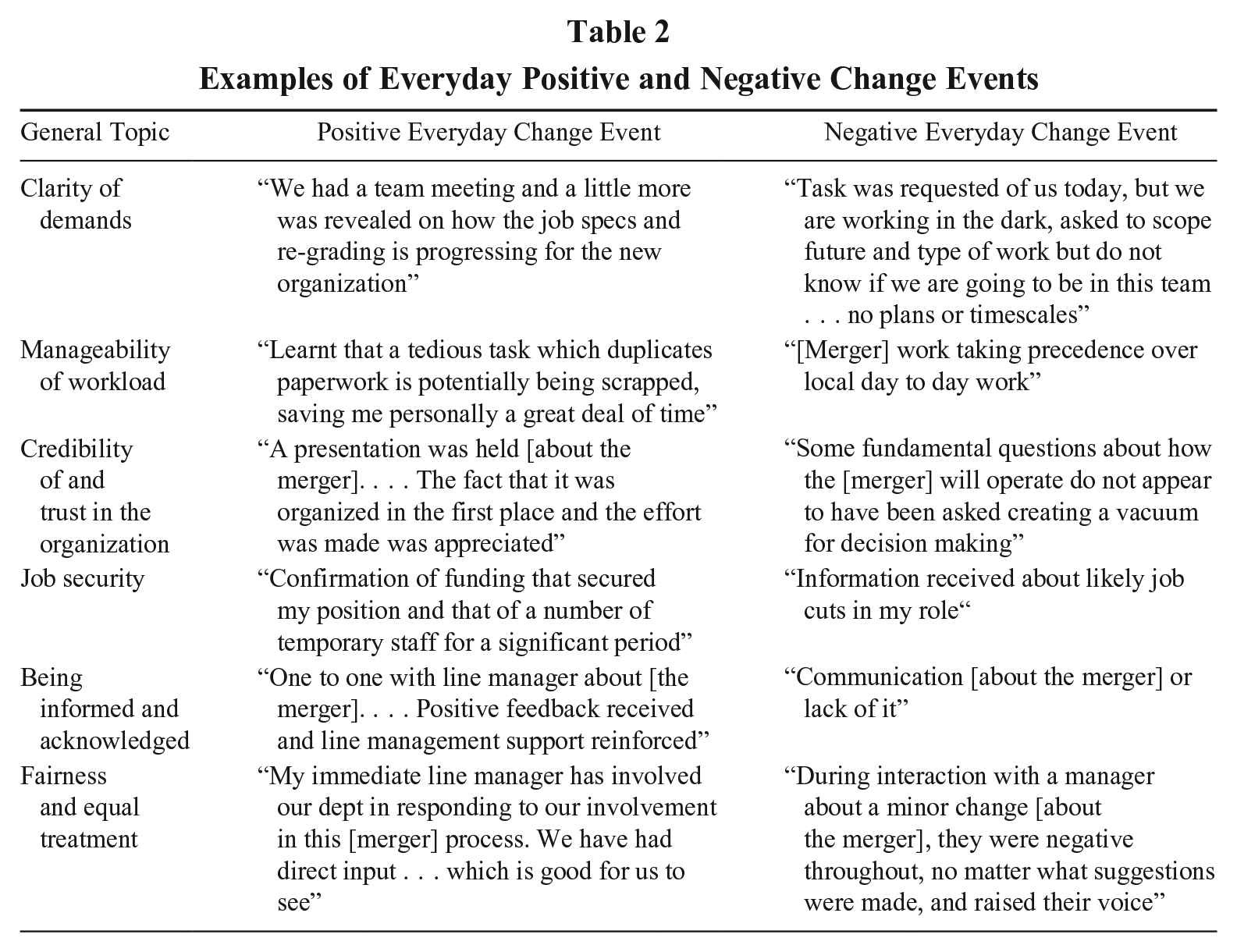
Table 1 presents the means, standard deviations, reliabilities, and correlations. On average, participants (N = 276) reported 1.7 negative everyday change events (ranging from 0 to 11 events) and 1.01 positive everyday change events (ranging from 0 to 9 events) across the 10 days. Most participants reported one or more events during the diary period, with 19% reporting no everyday change events, 24% reporting one event only, and 37% reporting two or more events. With respect to reported positive and negative change events, 32% of participants reported only negative change events (one or more), but no positive change events; 13% of participants reported only positive change events (one or more), but no negative change events. Participants who reported an everyday change event were asked to provide one to two sentences describing the event (see Table 2).
Means, Standard Deviations, and Correlations
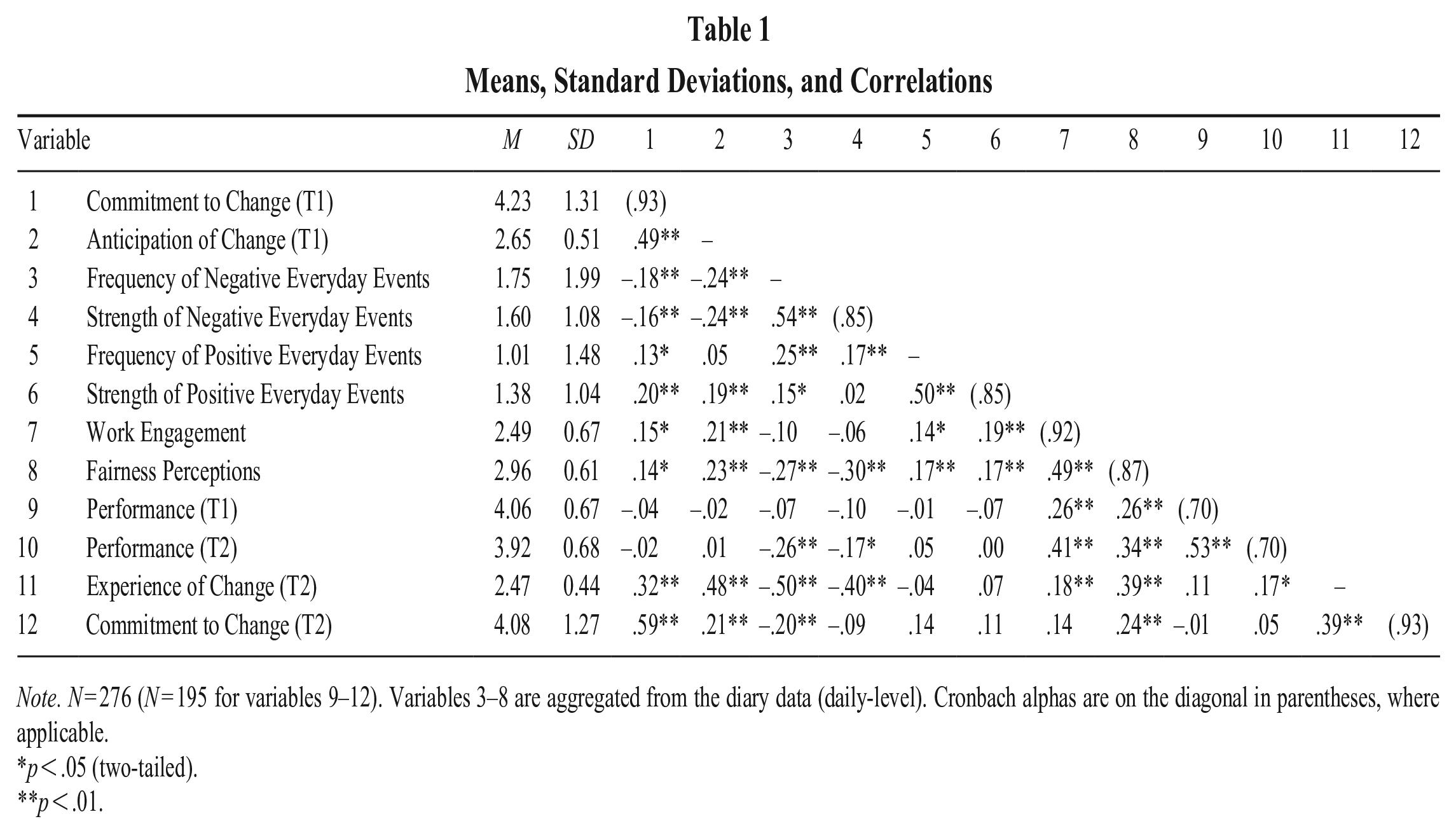
Note. N = 276 (N = 195 for variables 9–12). Variables 3–8 are aggregated from the diary data (daily-level). Cronbach alphas are on the diagonal in parentheses, where applicable.
*p < .05 (two-tailed).
p < .01.
Examples of Everyday Positive and Negative Change Events
We conducted a confirmatory factor analysis (CFA) to examine the distinctiveness of our reflective constructs using Mplus (Version 8.2; Muthén & Muthén, 2017). An eight-factor model involving commitment to change (T1 and T2), performance (T1 and T2), strength of everyday positive change events, strength of everyday negative change events, work engagement, and fairness perceptions had an acceptable fit to the data (χ2 = 668.22, df = 377, p = .000; CFI = .94; RMSEA = .05). 5 The eight-factor had superior fit to alternative models, including all seven-, six-, five-, and four-factor models (range of ∆χ2 from 449.55 to 1292.07, p = .000). These CFAs support the construct validity of the measurement model.
Following suggestions by Podsakoff, MacKenzie, Lee, and Podsakoff (2003), we first examined common method variance by adding an unmeasured latent method factor (MF) to the eight-factor model (see Podsakoff et al., 2003; Podsakoff, MacKenzie, & Podsakoff, 2012). We allowed the items to load onto their respective theoretical factor and the MF, constraining loadings to the MF to be equal, as well as setting the variance of the MF to 1 and all correlations from the MF to the theoretical factors to zero (Podsakoff et al., 2003, 2012). This significantly decreased model fit (χ2 = 1012.92, df = 376, p = .000; CFI = .87 RMSEA = .08; Δχ2 (1) = 344.70, p = .000). The pattern and significance of the relationships did not change when including the MF (on average, the factor loadings change by 0.10 or approximately 14%). Second, we performed the Harman single-factor test, constraining all items of the eight theoretical variables to load onto one factor in an unrotated exploratory factor analyses. The one factor explains 24.65% variance (the average for this type of research is 25%; cf. Williams, Cote, & Buckley, 1989). Taken together, we conclude that there is no significant issue with CMV in this study. We also checked for multicollinearity by calculating the Variance Inflation Factors (VIFs) using all the variables in our tested model (see Figure 1). All VIFs were below the threshold of 3 (ranging from 1.114 to 1.516), which indicates that there were no issues with multicollinearity (cf. O’Brien, 2007).
Analytic Strategy
We tested all hypotheses using a path model in Mplus (Version 8.2; Muthén & Muthén, 2017), using TYPE = GENERAL with maximum likelihood (ML) estimation. This method estimates models using all available data (N = 276 for T1; aggregated daily level data; N = 195 for T2). Measured (vs. latent) variables were used in the path model to remain within the suggested ratio of parameters to observations (e.g., Guadagnoli & Velicer, 1988). The path model also included links to account for the shared variance between T1 and T2 commitment to change and allowed the error terms to correlate between anticipation and experience of change. We included T1 performance and allowed T1 performance to correlate with the other T1 variables as well as fairness perceptions and engagement to account for variance between those variables. By including T1 levels, we tested the effects of the everyday experiences beyond pre-existing judgments and baseline performance to reflect changes in the outcome variables. Further, we fitted direct links from the four event variables to experience of change to account for the potential for events to directly impact the change experience. We also allowed the event variable error terms to correlate to ensure that the shared variance between those variables was controlled.
Consistent with Beal and Weiss’s (2003) recommendations to use theory to determine the appropriate level of aggregation, we used aggregated diary data to align our theorizing with our hypothesis testing. For example, we predicted that anticipatory perceptions (assessed in the pre-diary survey) impact the frequency and strength of positive and negative everyday change events across the entire diary period. These accumulated everyday change events during the diary period in turn predict employees’ overall evaluations of organizational change (assessed in the post-diary survey). As such, our aggregation of the diary data conceptually reflects employees’ overall experiences during the diary study (e.g., as the change was being implemented). Further, aggregating engagement and fairness perceptions across the entire diary period (including days with no events) not only has the advantage of capturing employees’ experiences during the diary period but also of capturing variation between those who reported no, few, or many events.
Hypotheses Testing
The overall model demonstrated a good fit: χ2(32) = 55.794, p = .006; CFI = .97, TLI = .93, RMSEA = .05, SRMR = .06. Figure 2 shows the standardized results.
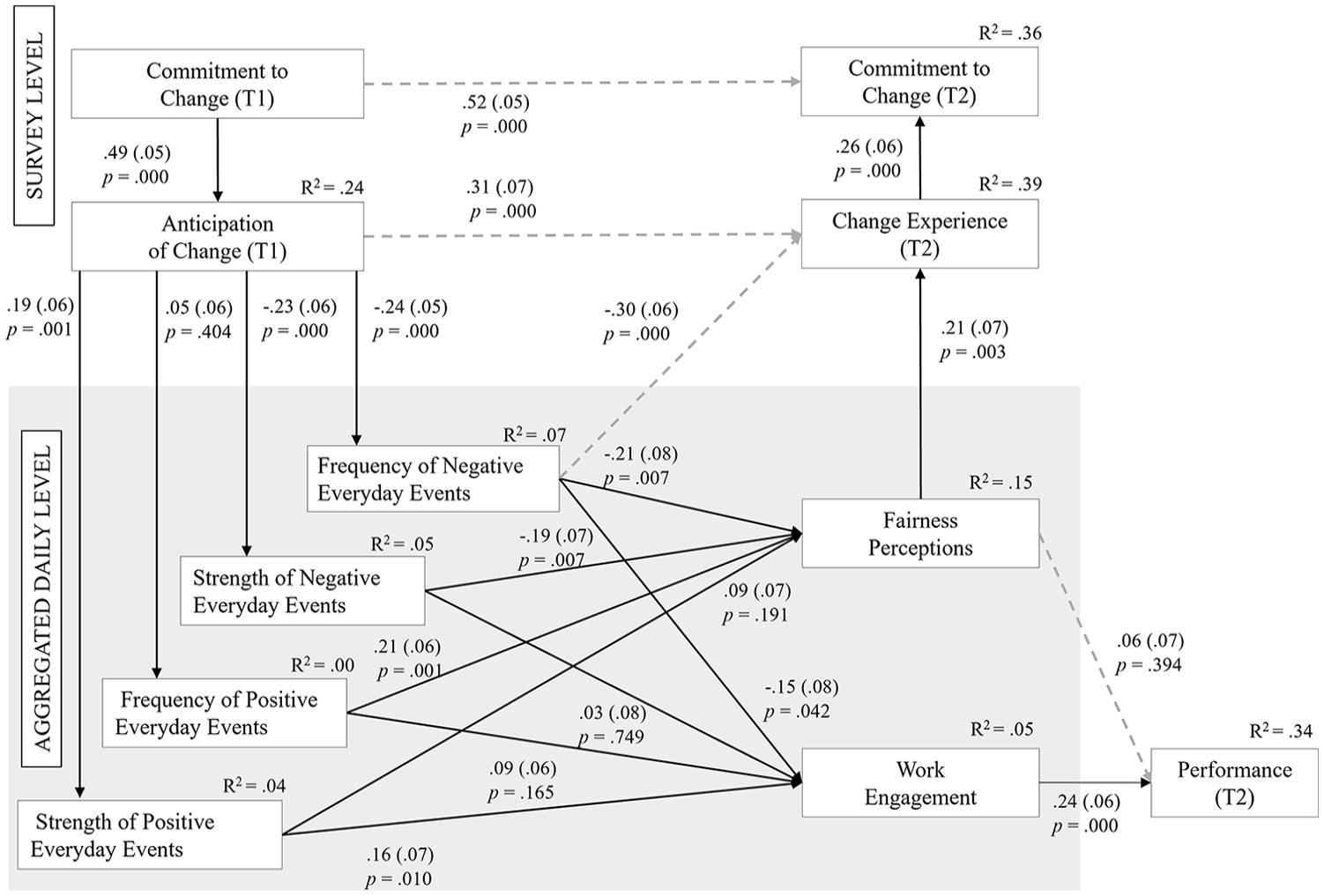
Results
For our hypothesized top-down direct effects, results indicated a positive relationship between commitment to change (T1) and anticipatory perceptions (β = .49, SE = .05, p = .000). H1 was supported. Anticipatory perceptions were negatively related to both frequency (β = −.24, SE = .05, p = .000) and strength of everyday negative change events (β = −.23, SE = .06, p = .000). H2a and H2b were supported. Anticipatory perceptions were not significantly related to frequency of everyday positive change events (β = .05, SE = .07, p = .404), but were positively related to strength of everyday positive change events (β = .19, SE = .06, p = .000). H3a was rejected, while H3b was supported.
For our hypothesized single-level effects using aggregated everyday experiences, the frequency of negative change events (β = −.15, SE = .08, p = .042) was negatively related to engagement, while the strength of everyday negative change events was non-significant (β = −.03, SE = .08, p = .749). The frequency of everyday positive change events was not significantly associated with engagement (β = .09, SE = .06, p = .165), while the strength of everyday positive change events was positively associated with engagement (β = .16, SE = .06, p = .010). To test our hypothesized mediation, we included T1 performance as a control variable. There was a significant negative indirect effect from frequency of everyday negative change events (indirect effect = −.05 SE = .03; p = .074; 90% CI [−.094, −.004]) and a significant positive indirect effect from strength of positive change events (indirect effect = .04 SE = .02; p = .015; 95% CI [.008, .080]) on performance (T2, controlling for performance at T1), via engagement. H4a and H5b were supported, but H4b and H5a were rejected. We also tested the total indirect effect from commitment to change (T1) to performance (T2). Results suggest a positive indirect effect via anticipation, everyday events, and engagement (indirect effect = .008 SE = .00; p = .047; 95% CI [.0001, .016]), supporting our theorizing.
With respect to fairness perceptions, the frequency (β = −.21, SE = .08, p = .007) and strength of everyday negative change events (β = −.21, SE = .07, p = .007) were both negatively associated with fairness perceptions. H6a and H6b were supported. The frequency of everyday positive change events was positively associated with fairness perceptions (β = .21, SE = .06, p = .001), while strength of everyday positive change events was not significant (β = .09, SE = .07, p = .191). H7a was supported, but H7b was rejected.
For our hypothesized bottom-up direct effects, fairness perceptions were positively related to change experiences at T2 (β = .21, SE = .07, p = .003). H8 was supported. Moreover, employees’ change experience was positively associated with their commitment to change (T2) controlling for T1 commitment to change (β = .26, SE = .06, p = .000). H9 was supported. To test the total indirect effects, we followed Preacher, Zyphur, and Zhang’s (2010) recommendation to use a 90% confidence interval (CI) to reflect the directional nature of this test. Results indicated a significant total indirect effect from commitment to change (T1) to commitment to change (T2) via anticipation, everyday events, daily fairness perceptions, and experience of change (indirect effect = .003 SE = .00; p = .089; 90% CI [.0001, .005]). H10 was supported.
Discussion
By applying event system theory to organizational change, we showcased the importance of distinguishing between employees’ reactions to organizational-level change versus individual-level change, including illuminating top-down, single-level, and bottom-up direct effects within the context of organizational change. By examining the negative and positive everyday change events alongside their frequency and strength, we demonstrated that everyday experiences can have important implications for supporting organizational change (e.g., building commitment to change) as well as promoting broader employee effectiveness (e.g., enhancing performance). We discuss the theoretical and practical significance of our key findings below.
Conceptualizing Organizational Change
Conceptually, our findings highlight the importance of distinguishing between employees’ reactions to an organizational-level change event and employees’ experiences as they routinize the change in their day-to-day work (i.e., everyday change events that can emerge from this organizational-level change event). Moreover, while employees may experience the organizational-level change at the same time (e.g., when an announcement goes out to the organization), their experiences of everyday change events (e.g., the frequency and strength of everyday change events) are likely to depend on how the organizational-level change alters processes or structures related to their job. This raises the possibility that employees’ everyday experiences of change implementation can be quite varied. Indeed, the qualitative event descriptions revealed that employees may differentially experience everyday changes (see Table 2). For example, the removal of a bureaucratic process may improve work for some by reducing the amount of time spent on tedious paperwork whereas others may find that removing this process worsens their work by making it more difficult to access information to complete job-related requirements. This implies that disparate issues can arise for employees as the organizational-level change is implemented. Additionally, employees may not experience everyday change events in the same way, at the same frequency, with the same strength, or during the same timeframe. As such, managing organizational change as an organizational phenomenon versus an everyday experience is likely to be quite different.
Employees’ Reactions to Everyday Negative and Positive Change Events: The Importance of Frequency and Strength
We predicted that the frequency and strength of everyday negative and positive change events relate to employees’ fairness perceptions and engagement during the implementation of change. However, our findings revealed a more nuanced perspective. Both the frequency and event strength of negative everyday change events detracted from fairness perceptions. By contrast, the frequency of positive everyday change events enhanced fairness perceptions, but the event strength of positive events was not significantly related to fairness perceptions during change implementation. This suggests that employees are attuned to how often the organizational change is impacting their everyday experiences (i.e., frequency), with frequent negative and positive everyday events influencing fairness perceptions. However, the event strength of positive everyday events was less impactful than the event strength of negative events. This is consistent with the notion that employees expect to be treated fairly (e.g., Lind, 2001), and therefore their fairness perceptions may be less impacted by events that confirm this expectation (i.e., positive events) than those that violate it (i.e., negative events). This suggests that “bad is stronger than good” when it comes to the impact of event strength of everyday events on fairness perceptions (see Baumeister et al., 2001), but both frequent negative and frequent positive everyday events are critical for fairness (whereas the former violates expectations, the latter reinforces positive expectations).
For engagement, frequent negative everyday events and the event strength of positive everyday events significantly predicted engagement during change implementation. Employees may be especially susceptible to everyday events that repeatedly deplete their resources (i.e., frequent negative events) since this may habitually distract employees from their work and require them to repeatedly expend resources managing day-to-day hassles and demands. By contrast, experiencing impactful positive everyday events (e.g., positive events with high event strength) may support engagement by building resources. While extensive literatures exist outlining how employees can cope with organizational-level change (e.g., Fugate, Kinicki, & Prussia, 2008) and how employees can cope with discrete everyday events (e.g., Lazarus & Folkman, 1984), our findings highlight that further integrating these literatures may provide insights for how employees can appraise and cope with everyday events related to organizational change. This is especially important since there are likely to be key differences between how people appraise and cope with an organizational-level versus individual-level event, as well as how people appraise and cope with individual-level events that are shaped by the organizational-level event.
Top-Down Direct Effects: How Organizational-Level Change Shapes Everyday Experiences
Consistent with the literature on organizational change readiness (e.g., Armenakis, Harris, & Mossholder, 1993), our findings indicate that helping employees to recognize the value and importance of the organizational-level change event can be beneficial. Whereas previous research has focused on the importance of employee commitment because it can support the broader change effort (e.g., Herscovitch & Meyer, 2002), applying event system theory extends these insights by revealing that employees’ initial commitment to organizational-level change is important because it also shapes how employees anticipate, experience, and react to everyday change events. Being committed to the organizational-level change event can direct employees’ attention to how the organizational-level change may improve their own job and/or work-related circumstances. These anticipatory perceptions are important because they can provide a lens through which employees can experience subsequent events (e.g., Lind, 2001; Rodell & Colquitt, 2009).
A number of studies on organizational-level change have established that employees engage in continuous sensemaking during the anticipation phase of change, which can impact subsequent responses to the change (e.g., Fugate, Kinicki, & Scheck, 2002; Giaever & Smollan, 2015; Isabella, 1990; Krogh, 2018). Our findings extend this by indicating that anticipatory perceptions direct employees’ attention, which may invoke a confirmatory bias in which they process everyday events in ways that are consistent with this bias. This suggests that anticipatory perceptions can serve as the lynchpin connecting employees’ reactions to the organizational-level change event with their everyday change-related experiences. Managing how employees anticipate what the organizational-level change event means for their own experiences is important because these anticipatory perceptions can serve as a filter that can guide how employees experience change on an everyday basis. Anticipatory perceptions may also serve as a point of intervention; even if employees negatively react to the organizational-level change, it is still possible to create a positive change experience by shaping how employees anticipate the impact of the organizational-level change for their own job (e.g., by directing employees’ attention to the positive impact of the organizational-level change for their own circumstances, which may also build commitment to the organizational-level change over time).
Interestingly, anticipatory perceptions were positively but not significantly related to the frequency of positive events. There are at least three explanations for this finding. First, since anticipatory perceptions may invoke a confirmation bias, perceiving positive events may simply confirm employees’ prior expectations. Second, anticipatory perceptions may be less predictive of positive (vs. negative) events simply because positive events are less salient (i.e., “bad is stronger than good”; Baumeister et al., 2001). Third, while employees reported experiencing everyday positive change-related events, these events were less frequent than their negative counterparts which may imply a restriction of range. Although anticipatory perceptions did not significantly predict the frequency of positive events, frequent positive everyday change events are indeed important because of their downstream benefits (i.e., enhancing performance, promoting fairness perceptions, improving employees’ experience of change, and building commitment to organizational-level change).
Bottom-Up Direct Effects: Revealing the Opportunity to Build Commitment to Change
Given the importance of employee commitment for the success of organizational change initiatives, it is perhaps not surprising that a great deal of scholarly attention has focused on how to build commitment (e.g., Fugate, 2012; Herscovitch & Meyer, 2002; Khaw et al., 2023). For example, research has focused on identifying what circumstances need to be in place to support the introduction of a change initiative and reduce potential resistance (e.g., identifying who is likely to respond negatively or positively to a change initiative, what needs to be done to create the conditions for change, or when the environment is likely to support a change initiative).
Importantly, an event-oriented approach illuminates the possibility that organizations can lose or build employee commitment to organizational change through everyday experiences and provides insight into why employees’ reactions to organizational-level change may dynamically shift over time. Said differently, bottom-up direct effects may occur, such that everyday events can shape employees’ reactions to organizational-level change. For example, employees’ initial positive reaction to the organizational-level change may be undermined by negative everyday change events. By contrast, employees’ initial negative reaction to the organizational-level change may shift through everyday positive change events. Taken together, an event-oriented approach provides insight into why employees’ reactions to organizational-level change may shift over time (e.g., due to everyday experiences) and points to bottom-up direct effects as an important avenue for building commitment to change over time (e.g., by minimizing negative and fostering positive everyday change events).
Our findings also shed light on why employees may experience ambivalence (both negative and positive reactions) to organizational-level change (see Oreg & Berson, 2019; Vakola et al., 2021). For instance, employees’ everyday experiences may reveal that some aspects of the organizational change can improve their work, but other aspects may worsen it. Further, these negative and positive everyday experiences can inform employees’ evaluations of their overall experience (e.g., Kiefer et al., 2022). This suggests that negative events may be influential for overall evaluations, but it also showcases the importance of ensuring that employees also experience positive events to prevent an overall negative evaluation.
Moving Beyond Organizational Change: Fairness Perceptions and Performance
Above, we discussed how employees’ fairness perceptions and performance are important for supporting organizational change (e.g., by building commitment and enhancing effectiveness, respectively). However, fairness perceptions and performance are also important in their own right. For example, organizational fairness perceptions are associated with increased citizenship behaviors, enhanced job satisfaction, positive evaluations of organizational representatives, and reduced withdrawal and turnover (for meta-analytic reviews, see Colquitt et al., 2001, 2013; Rupp et al., 2014). Similarly, enhancing performance is not only important for organizational effectiveness, but can have further positive effects for employees. For example, performance and well-being can have recursive relationships, such that performance can enhance employee well-being, which can then further enhance performance (e.g., Wright & Cropanzano, 2000). Our findings indicate that everyday experiences of change present an opportunity to positively contribute to fairness perceptions and performance; leveraging this opportunity may enhance employee outcomes, build stronger relationships (e.g., between employees, managers, and organizations), and promote organizational functioning in the longer term—beyond the context of organizational change.
Extending Event System Theory Using Context Theorizing
A benefit of context theorizing (i.e., studying theories in context) is that this can serve as a “sensitizing device that makes us more aware of the potential situational and temporal boundary conditions to our theories” while also revealing why and how higher-level phenomenon can impact lower-level phenomenon (Bamberger, 2008: 840). Indeed, our findings highlight the benefits of applying event system theory to the context of organizational change because it can reveal novel processes and nuanced insights. Moreover, our findings also indicate that examining event system theory in context can offer insights that can further advance event system theory. For example, we uncovered mechanisms that can connect organizational-level and individual-level experiences of change (both top-down and bottom-up effects) while also revealing that the conceptual definition of event strength may be more aligned with negative rather than positive everyday events. Context theorizing may also provide insights into how to target interventions at specific levels and/or guidance to managers on how to best manage complex phenomena that occur at multiple levels (e.g., Bliese & Jex, 2002). Thus, our findings reinforce the benefits of engaging in context theorizing and how doing so can continue to advance event system theory.
Strengths, Limitations, and Future Directions
To capture employees’ reactions to organizational change, we used a survey that assessed reactions to the announcement of a merger, followed by a diary study as the merger was being implemented, and a second survey that measured commitment to the merger after employees had experienced the everyday impact of this organizational-level change event. This combination of methodologies was important to ensure that we examined change as it was implemented, avoided retrospective biases, and captured dynamic reactions to the organizational-level change event alongside everyday events that may influence these downstream reactions.
We tested our hypotheses using a single organization. Although this provided the opportunity to examine how the same organizational-level change event impacted employees within the same organization, future research should explore the generalizability of our findings with other organizational events and with heterogenous samples of employees from a range of industries to identify moderators related to the organization and types of events.
Given the nature of our research question, we aggregated our diary data to examine how employees’ reactions to organizational-level change can shape their experiences and reactions during change implementation. This is consistent with recommendations to recognize that some research questions may require aggregated diary data (e.g., Weiss, Nicholas, & Daus, 1999), but that it is important to use theory to identify the level of aggregation that is needed (e.g., Beal & Weiss, 2003). While this level of aggregation was consistent with our theorizing (i.e., aligned with our focus on employees’ experiences during the implementation of change), we recognize this may result in the loss of information (see Beal & Weiss, 2003) or obscure within-in person processes (e.g., Weiss et al., 1999). As such, we encourage future research to examine research questions that delve into within-person processes underlying employees’ everyday experiences of change. For example, exploring the interplay between single instances of negative and positive events may reveal that positive events can buffer or “undo” the effects of negative events (see Fredrickson & Levenson, 1998; Fredrickson, Mancuso, Branigan, & Tugade, 2000). If this effect generalizes to organizational change events, then experiencing positive everyday change events may reduce the negative impact of everyday change-related negative events (e.g., by building resources that can enable employees to better cope with and recover from negative experiences).
We used self-report measures to assess employees’ perceptions and experiences. To curtail common method bias, we designed our studies using best practice recommendations (e.g., assuring confidentiality, randomizing items within question blocks; varying response anchors, measuring anticipatory perceptions separately from everyday experiences; see Conway & Lance, 2010). Our analyses indicated that common method bias had minimal, if any, impact on our results.
While we focused on how an organizational-level change event may impact employees on an individual-level, it is possible that organizational-level change can also infuse other levels of the organization (e.g., departments and teams). Future research may benefit from adopting a multi-level approach that considers how change events infuse multiple levels within the organization (see Morgeson et al., 2015) as well as how people’s perceptions may be impacted by how others in the same environment are also experiencing and reacting to change events.
We operationalized event strength at the individual-level and contextualized it to our organizational context by assessing event novelty (via surprise), disruption (related to the employee’s relationship with the organization rather than disruption to routines), and criticality (using the importance of the event to the individual). While these operationalizations were intended to reflect the individual-level, they differed from previous studies examining event strength at the team-level (e.g., Morgeson & DeRue, 2006). Future research should further explore whether event strength should be operationalized differently at disparate levels of analysis or operationalized differently for positive versus negative events, consider more direct assessments of novelty, and assess whether these measures should be contextualized.
Consistent with event system theory (e.g., Morgeson et al., 2015), we used the terms “top-down” and “bottom-up” to reflect event spatial direction. However, these terms may have disparate meanings within the organizational change literature. For example, these terms may reflect “who” is driving organizational-level change and/or how involved employees have been with decision-making around an organizational-level change (e.g., Heyden, Fourné, Koene, Werkman, & Ansari, 2017). Given these conceptual differences, it is imperative for future research to clearly define how these terms are being used. Future organizational change research would also benefit from further integrating event system theory to enhance clarity around the event level and nature of the events.
Practical Implications
Our findings provide guidance for effectively managing organizational change. First, organizational change is not simply experienced as an organizational-level change event. Instead, organizational change can prompt subsequent events for employees as the change alters processes, routines, and structures related to their own jobs. This suggests that effectively managing change is not restricted to ensuring that employees react positively to change at the organizational-level, but also includes effectively managing everyday change events.
Second, building initial commitment to the organizational-level change event can offer an important point of intervention for effectively managing employees’ everyday experiences. While the announcement of an organizational-level change often outlines the benefits for organizations (e.g., how a merger can enhance efficiency or viability), our findings suggest that it is also important to relate this to employees’ experiences by highlighting how the organizational-level change event can positively impact them and/or their jobs.
Third, employees who “buy into” the organizational-level change are more likely to anticipate that the change will positively impact them and are therefore better able to navigate the everyday change-related experiences that can emerge. Indeed, our findings indicate that anticipatory perceptions can direct employees’ attention and serve as a lynchpin connecting organizational-level change with everyday experiences related to change. As such, effectively managing anticipatory perceptions can create the opportunity for supervisors and leaders to influence valuable outcomes. Importantly, the anticipatory phase of organizational change is not a “passive waiting time for organizational members” but rather a time in which “organizational members engage in recurring patterns of sensemaking, positioning, and scripting of positive futures in preparation for the organizational changes” (Krogh, 2018: 1271). This suggests that managers may benefit from engaging in “sensegiving” in which they interpret and frame the organizational-level change for employees to help them understand and prepare for the personal impact of the organizational change (see Maitlis & Lawrence, 2007). Moreover, repeatedly engaging in sensegiving is likely to be important as employees process the change and as more details become available, which can direct employees’ attention to the positive outcomes that can be expected. This may be especially important for employees who did not initially “buy into” the organizational-level change. That is, anticipatory perceptions can serve as a point of intervention for managers to overcome initial negative reactions to the organizational-level change.
Fourth, facilitating everyday positive change-related events can have numerous benefits, including increasing engagement (which can enhance performance) as well as positively contributing to fairness perceptions (which can build commitment to the organizational-level change event). This suggests that it is not only important to curtail negative change-related events for employees but also to foster positive everyday change events.
Finally, everyday change-related experiences are critical for enhancing employees’ performance and fairness perceptions. While these outcomes can positively contribute to organizational effectiveness and support organizational change, these outcomes may also have additional long-term positive implications. For example, fairness perceptions can positively contribute to important outcomes, including job satisfaction, leader–member exchange, and trust (for meta-analytic reviews, see Colquitt et al., 2001, 2013; Rupp et al., 2014). This suggests that effectively managing organizational change can promote short-term functioning and ensure the success of the change initiative as well as promote the beneficial long-term implications of enhanced performance and fairness perceptions.
Conclusion
By applying event system theory to the context of organizational change, we empirically tested key theoretical tenets, revealed novel processes, and created exciting new opportunities for research and practice. Theoretically, recognizing that organizational-level change can initiate subsequent negative or positive everyday change events provides nuanced insights into employees’ experience of change, including how to enhance performance and build support for organizational change. Practically, recognizing that organizational-level change can become routinized through everyday events can enable managers to more effectively steer the implementation of change and enhance the likelihood that organizational-level change becomes effectively implemented throughout the organization. Moreover, managing the anticipation of change and everyday change events is especially important for enhancing employees’ commitment to organizational-level change. By enhancing performance and fairness perceptions, effectively managing everyday experiences of change can also have long-term beneficial effects that extend beyond the organizational change. Given these benefits, we encourage scholars and practitioners to adopt an event-oriented approach and leverage event system theory to further illuminate theoretical and practical insights for effectively managing organizational change.
