




Abstract
Drawing from media routines and narrative theory research, we theorize that benefits spill over to competitors who are cognitively linked to a celebrity via media narratives. Specifically, we argue that actors with direct competitive relationships with a celebrity will receive increased media attention and emotive media content, as well as increased performance. Due to the nature of these narratives, we further argue that this effect continues into periods after the direct relationship has ended. We test our hypotheses using a novel, eight-year data set from the Ultimate Fighting Championship. Our findings support our theoretical arguments, providing evidence on how celebrities benefit others in ways that other social evaluation assets—namely, high reputation and high status—do not.
Introduction
Sociocognitive research in management has long explored how actors can accrue assets in the form of audiences’ positive evaluations and how these evaluations can be translated into tangible benefits (Fombrun & Shanley, 1990; Paruchuri, Pollock, & Kumar, 2019; Pfarrer et al., 2019; Podolny, 2005). This research has also examined how actors who possess high levels of these assets can affect those around them (e.g., Zavyalova, Pfarrer, Reger, & Shapiro, 2012). For instance, scholars have theorized and found that for focal actors to possess high reputation and high status, they need a relative group to be compared against, which in turn leads to a perceived stratification of their competitors. This stratification has been found to have negative performance implications for those with lower levels of these assets (e.g., Bundy & Pfarrer, 2015; Podolny, 2005; Rindova, Williamson, Petkova, & Sever, 2005; Zavyalova et al., 2012).
More recently, scholars have begun to investigate another social evaluation asset, celebrity, which we define as audiences’ high levels of attention and positive emotive responses toward a focal actor (Hubbard, Pollock, Pfarrer, & Rindova, 2018; Pfarrer, Pollock, & Rindova, 2010). This research explicates the positive performance benefits for focal celebrity actors that are similar to high reputation or high status (Hubbard et al., 2018; Pfarrer et al., 2010). However, it has largely ignored how having a celebrity in an industry affects competitors in ways that are distinct from high reputation or high status. This is surprising, given the distinct sociocognitive underpinnings of celebrity, notably the exciting narratives created in the media and the emotive attention celebrities generate in audiences (Pfarrer et al., 2010; Rindova, Pollock, & Hayward, 2006). Celebrities are also distinctly important in the production of culture (Gamson, 1994). Therefore, it is likely that celebrity has different performance effects on competitors than the stratified and ordered relationships associated with reputation and status.
Drawing from media routines research (Graf-Vlachy, Oliver, Banfield, König, & Bundy, 2020; Oliver, Campbell, Graffin, & Bundy, 2023) and narrative theory (Czarniawska, 1997; Herman, 2007), we propose that direct competitors receive a positive spillover effect from appearing as secondary characters in media narratives about a celebrity. We theorize that the media will not only increase their attention and emotive content on the protagonist (focal celebrity) but also on the secondary characters (competitors) in their narratives. We then argue that competing against a celebrity translates into performance benefits for these competitors. Finally, we theorize that there is a longer-term temporal effect on media attention, emotive media content, and earnings for those who compete with celebrities.
We test our hypotheses on a sample of scheduled bouts in the Ultimate Fighting Championship (UFC). The UFC is a suitable context to study the spillover effects of celebrity because of its clear exchanges and the level of information available on other social evaluations (e.g., fighters’ reputation and status). Consistent with our hypotheses, we find that a bout with a celebrity affects media attention, emotive content, and earnings of their competitor. Further, we find that our theorized effects continue in subsequent bouts for earnings and media attention but not for emotive content.
We contribute to social evaluation research in three primary ways. First, we extend celebrity research by theorizing and empirically finding that benefits spill over to competitors who are cognitively linked to a celebrity, moving our understanding of celebrity’s effects beyond the celebrities themselves. We also provide a theoretical explanation for how emotive attention can flow from celebrity actors to noncelebrities as part of the media’s narratives. Second, our explication of the benefits of celebrity for competitors stands in contrast to research that has examined the negative effects of an association with a high-reputation or high-status actor (Benjamin & Podolny, 1999; Malter, 2014; Podolny, 2005; Rao, 1994; Rindova et al., 2005). Finally, our examination of the durability of celebrity provides a broader and longer perspective of its effects (Lovelace, Bundy, Pollock, & Hambrick, 2021; Zavyalova, Pfarrer, & Reger, 2017). Specifically, research has suggested that due to the emotive attention it is associated with, celebrity’s effects on other actors may be fleeting (Zavyalova et al., 2017). Our findings, however, suggest its effects on competitors endure over time.
Social Evaluations and Spillovers
Reputation, status, and celebrity are three key social evaluations that can represent audiences’ positive judgments (Pollock, Lashley, Rindova, & Han, 2019). Reputation is a judgment of an actor’s quality or capabilities and is assessed relative to others in an evaluative group (Haleblian, Pfarrer, & Kiley, 2017; Lange, Lee, & Dai, 2011), whereas status is a perceived rank in a social order (Podolny, 2005). Distinctly, celebrity reflects audiences’ high levels of attention and positive emotive responses toward a focal actor (Pfarrer et al., 2010; Rindova et al., 2006).
Research finds that competitors are a key aspect of a focal actor’s reputation because it is based on the actor’s quality relative to similar others in an evaluative set (Basdeo, Smith, Grimm, Rindova, & Derfus, 2006). Therefore, for a focal actor to have a high reputation, competitors must be sorted into lower reputational positions (Rindova et al., 2005). Those sorted into a lower-reputation position experience poorer performance (Rao, 1994) because higher-reputation actors can build better stakeholder relationships, access more resources, and build more market share (Lange et al., 2011). For example, Rao (1994) and Goldfarb, Zavyalova, and Pillai (2018) showed that in the early years of the car industry, lower reputation firms had greater failure rates than ones with higher reputations. Likewise, Rindova et al. (2005) demonstrated that higher reputation universities were associated with recruiters’ more negative perceptions of other universities in their evaluative group as well as lower salaries for their graduates.
Similarly, high status is based on an actor’s relative comparison to similar others in an evaluative set from low to high (Podolny, 2005). Thus, for high status to be meaningful for the focal actor, other competitors must be sorted into lower-status positions. Research finds that higher status actors are perceived as more prestigious than those with lower status and that the former enjoys benefits that the latter do not (Benjamin & Podolny, 1999; Bothner, Kim, & Smith, 2012; Malter, 2014; Podolny, 1993, 2005). For example, Podolny (1993) described how perceived status can be the basis for grouping securities underwriters, with lower status underwriters facing restrictions on the fees they could charge. Also, Malter (2014) found that status orderings created pricing benefits for high-status wineries compared to other wineries in the same region.
In sum, the presence of high-reputation and high-status actors leads to a perceived stratification of competitors, generating more positive outcomes for those possessing higher levels of these social evaluation assets and more negative outcomes for those that do not. 1
Celebrity and Its Effects
Research has theorized and shown that celebrity has distinct effects from those of reputation (e.g., Pfarrer et al., 2010) and status (e.g., Hubbard et al., 2018). For instance, at the organizational level, celebrity is associated with stronger market reactions to positive earnings surprises (Pfarrer et al., 2010), higher employee engagement (Kjærgaard, Morsing, & Ravasi, 2011), and alliance formations (Hubbard et al., 2018). For individuals, celebrity can offer greater earnings (Koh, 2011) and lower premiums when engaging in acquisitions (Cho, Arthurs, Townsend, Miller, & Barden, 2016). Celebrity has also recently been shown to influence the type of language an executive will use when communicating with stakeholders (Pollock, Ragozzino, & P. Blevins, 2023) and impacts stakeholders’ evaluations of misconduct (Han, Pollock, & Paruchuri, 2023). Individual celebrity has also been linked to increased firm performance (Koh, 2011)
The media play an integral role in celebrity creation by acting as conduits between celebrity actors and audiences who often have little direct contact with the celebrity (Pfarrer et al., 2010; Rindova et al., 2006; Zavyalova et al., 2017). Further, the media help produce celebrities by creating exciting narratives that shape audience perceptions about the attributes and actions of the focal actor (Hayward, Rindova, & Pollock, 2004; Rindova et al., 2006; Westphal & Deephouse, 2011). Accumulation of these narratives creates fully developed characters and the development of their distinct personality, talent, style, and social resonance (McCracken, 1989; Rindova et al., 2006; Zavyalova et al., 2017). A key aspect of celebrity is that these primary characters, the celebrities themselves, garner a high level of media attention and generate emotive responses from audience members (Pollock et al., 2019), leading to the abovementioned benefits.
Less is known, however, about how celebrity affects other actors around them. Drawing from media routines research and narrative theory (Herman, 2007; Oliver et al., 2023; Shoemaker & Reese, 1996), we investigate the spillover effects of a celebrity’s positive attention on those with whom the celebrity interacts. That is, we theorize how direct, noncelebrity competitors may benefit from their association with a celebrity. We explicate our theory in the context of the Ultimate Fighting Championship (UFC), the largest league in the sport of mixed martial arts (MMA). MMA’s popularity has rapidly increased since the turn of the century, and by the 2010s it had surpassed boxing in terms of popularity and average revenue per athlete (McDermott, 2017). The UFC is a suitable context to study the spillover effects of celebrity because of the clear exchanges and the level of information available on potentially confounding factors (e.g., fighters’ reputation and status). That is, our context allows for a clear examination of celebrity with other social evaluation assets held constant, which helps extend theory and findings that differentiate these similar yet distinct assets.
Theory and Hypotheses
While the media primarily drive the creation of celebrity, they face pressure and uncertainty to generate newsworthy content that will attract and hold audiences’ attention (McQuail, 1985). Consequently, they often resort to “media routines,” which are practices that shape how they create coverage (Graf-Vlachy et al., 2020) and that streamline and expedite the publishing process (Graf-Vlachy et al., 2020; Lovelace et al., 2021; Oliver et al., 2023). One media routine is the development of exciting narratives about celebrities (Lovelace et al., 2021; Rindova et al., 2006). Celebrity research, however, has focused on the primary characters, the celebrities themselves, in media narratives while largely ignoring secondary characters, the actors with whom the celebrities interact (Rindova et al., 2006; Zavyalova et al., 2017).
Primary characters drive the action in a narrative (Duncan, 2020), while secondary characters are typically understood through their relationship with the primary character(s) (Herman, 2007). Secondary characters take on two main types—those who mirror or complement the primary character and those who are framed as foils in opposition to the primary character (Herman, 2007). The relationship between primary and secondary characters drives a narrative such that without both, a cohesive story typically does not exist (Abbott, 2007). Building on these ideas, we theorize that the media use celebrities as primary characters to drive their stories (Lovelace, Bundy, Hambrick, & Pollock, 2018; Rindova et al., 2006; Zavyalova et al., 2017) and that secondary characters (their competitors) benefit from being part of this narrative.
Increased Media Attention Toward Secondary Characters
Two primary factors influence the potential newsworthiness of a story—actors’ deviance and social significance (Oliver et al., 2023; Zavyalova et al., 2017). Deviance pertains to the distinct characteristics of actors that make them stand out relative to their peers (Shoemaker & Reese, 1996), and it consequently allows a narrative to stand out and captivate audiences’ interest. Deviance can manifest in various forms, ranging from violations of social norms, such as polluting the environment, to extremely positive performance, such as an individual becoming the richest person in the world or a company becoming highly valued (Heckert & Heckert, 2002).
The second factor, social significance, refers to an actor’s relative importance to audiences because of their cultural, economic, or institutional influence (Shoemaker & Cohen, 2012). For instance, large and highly visible firms are more likely to be perceived as socially significant compared to smaller, less visible firms with limited perceived political, economic, or cultural impact (Oliver et al., 2023). Similarly, CEOs of larger companies tend to have greater social significance and thus receive higher levels of coverage relative to their peers at smaller firms (Lovelace et al., 2018).
When it comes to celebrity organizations and CEOs, their nonconformity to industry norms encapsulates the deviance and social significance that lead to high levels of media coverage (Hayward et al., 2004; Rindova et al., 2006). What researchers have not discussed, however, is how the media reflect celebrities’ nonconformity in their narratives. Research has established that a common way for the media to build interest in their narratives is to describe the interaction between the celebrity (protagonist) and other characters (Lovelace et al., 2021; Oliver et al., 2023; Shoemaker & Cohen, 2012). Thus, we argue that the media will utilize secondary characters—direct competitors—to help exemplify the primary characters’ nonconformity.
Further, we know that the media employ storytelling techniques to maintain audiences’ attention over time (Oliver et al., 2023; Rindova et al., 2006; Shoemaker & Reese, 1996). Following our previous logic, this suggests that competitors of celebrities will be increasingly mentioned as secondary characters to help build a newsworthy story of the celebrity’s nonconformity. As a byproduct, not only will the main character receive high levels of media attention, but the secondary characters in these stories will also. Thus, as focal celebrities’ nonconforming actions drive media coverage about them, it will also drive media coverage about their competitors. For example, Apple was described positively as the primary character in narratives about the personal computer, with Dell being more of a secondary character (Nicholson, 2014). Between 1985 and 1995, Apple Computer was mentioned 3,017 times in the New York Times, Dell was mentioned 524 times, and they were mentioned together 181 times. We propose that media coverage of the celebrity Apple as a main character also helped drive media coverage to the noncelebrity Dell as a secondary character. We thus hypothesize:
Hypothesis 1: Directly competing against a celebrity is positively associated with media attention for the noncelebrity.
Increased Emotive Content Toward Secondary Characters
Given the pressure and uncertainty involved in identifying newsworthy stories, it can be challenging for the media to assess audiences’ interest in a given actor (Graf-Vlachy et al., 2020; Oliver et al., 2023). Thus, the media will often cater to their audiences’ tastes by “forgo[ing]complex, technical explanations, and instead build[ing] on their audiences’ experiences and schemas” (König, Mammen, Luger, Fehn, & Enders, 2018: 1201).
One way in which the media capture audiences’ attention and cater to their tastes is by increasing the emotive content of their stories (Shoemaker & Cohen, 2012; Shoemaker & Reese, 1996). This media routine is likely to be particularly salient when writing about celebrity actors and their competitors, given celebrities’ reflection of audiences’ emotions. Moreover, this increase in emotive content helps build interest in the relationship between the narrative’s primary and secondary characters (Shoemaker & Cohen, 2012). For instance, if secondary characters are framed as foils, then the media will increase their negative emotive content to create opposition to the main character (Duncan, 2020). Alternatively, if a secondary character is framed as a mirror, the media will increase its positive emotive content to draw the audience toward the congruent relationship between the primary and secondary character (Duncan, 2020; Herman, 2007). For example, Lyft has had a secondary-character relationship with Uber with both negative and positive coverage as the relationship developed (Sainato, 2021).
In our UFC context, the media used emotive language to describe Chris Weidman, a secondary character, and his relationship with the primary character, Anderson Silva: Yeah, Weidman has had his struggles with becoming a top draw, but he is still one of the best fighters in the sport. He’s the man who defeated Anderson Silva when he was still considered to be invincible. When Silva, the long-reining dominant champion, was still a mythically moving, untouchable beast, Chris was the one who went up to him and said “TOUCH!” (Zivin, 2016)
Thus, while media narratives describe celebrities positively, they will create positive and negative engagement with secondary characters, depending on their roles as mirrors or foils. As a result, we suggest that the emotive content for secondary characters in media narratives will increase, regardless of how the competitor is framed.
Hypothesis 2: Directly competing against a celebrity is positively associated with emotive media content for the noncelebrity.
Increased Performance for Noncelebrity Competitors
In addition to increased media attention and emotive media content, we theorize that direct competition with a celebrity is associated with noncelebrities’ performance benefits for two primary reasons: the inference of quality through noncelebrities’ prominence in exciting celebrity narratives and increased audience awareness.
First, research suggests that in ambiguous contexts, celebrity can inform uncertain assessments of quality (Hubbard et al., 2018). For secondary characters, they are likely to be less known to audience members prior to their celebrity interaction, and their awareness will increase from appearing in exciting celebrity narratives (Rindova et al., 2006). Therefore, an association with a celebrity is likely to give these competitors the appearance of higher quality compared to other similar competitors who did not appear in celebrity narratives. This framing effect has been shown to increase benefits for focal celebrity actors, such as forming more alliances (Hubbard et al., 2018) and generating more positive stock market reactions (Pfarrer et al., 2010). We theorize that this will also happen for their competitors as broader audiences become aware of who they are and make quality judgments about them given limited information. Indeed, research suggests that being associated with a celebrity leads to inferences of higher quality for a product (e.g., Bennett, Anaza, & Andonova, 2022).
Second, there is an established link between audiences’ awareness of brands (and their products) and subsequent performance, including purchase decisions (Chartrand, 2005; Roberts & Lattin, 1991; Srinivasan & Ratchford, 1991). This connection between audience brand awareness performance underscores the significance of understanding how celebrity competitors, as a distinct source of attention, can influence not only the narratives for their competitors but also the levels of awareness of them in audiences paying attention to the celebrity. Thus, we expect that the greater an audience is aware of the noncelebrity, the greater the likelihood this attention will be associated with increased performance. For example, Avis adopted a strategy to leverage Hertz’s greater recognition by positioning itself as “the number two car rental company” (The Associated Press, 1988).
In sum, we theorize that the noncelebrity fighters in our context experience an increase in earnings when they directly compete with a celebrity fighter.
Hypothesis 3: Directly competing against a celebrity is positively associated with earnings for the noncelebrity.
Narrative Arcs, Character Arcs, and the Durability of Positive Spillovers
Finally, we theorize that positive spillovers will continue for a direct competitor after competing against a celebrity. Narratives follow a temporal structure, involving phases such as exposition, rising action, climax, falling action, and denouement (Duncan, 2020). This temporal framework is fundamental to the art of storytelling and influences how narratives captivate audiences impacting their perceptions and responses (Shih, Wijaya, & Brossard, 2008).
Therefore, we argue that if the media are employing storytelling techniques to build interest between a celebrity and a competitor, the level of coverage will not immediately end once a competitive interaction ends. Instead, it is more likely to arc over time, suggesting that media attention will likely remain high for competitors even after their direct association with a celebrity has ended (Chatman, 1980; Herman, 2007). Media routines research also espouses this logic by suggesting that once the media introduce a character to their audience, the character will be reused in media narratives for an extended period (McQuail, 1985; Shoemaker & Cohen, 2012).
Further, we theorize that the celebrity’s character arc—the focal actor’s transformation over time—will influence the emotive attention secondary characters receive even after a direct relationship has ended (Lovelace et al., 2018). Given the investment made in developing the relationships between previous competitors, the media are likely to continue incorporating emotive content into their writing about the relationship between the two characters (McQuail, 1985; Shoemaker & Reese, 1996). Thus, the noncelebrity competitor will continue to be entwined in the celebrity’s narratives, which extends the level of emotive content in media coverage of the noncelebrity competitor.
Finally, research in cognitive psychology suggests that associations that elicit strong emotional responses—both positive and negative—are more memorable (Berger, 2016; Talarico, Berntsen, & Rubin, 2009). These emotionally charged memories are recalled more frequently and used as reference points more often than memories that did not elicit such a response (Dolcos, LaBar, & Cabeza, 2004; Talarico et al., 2009). Due to this frequent recollection of emotionally charged memories, the audience is likely to continue to infer increased quality in the noncelebrity after the association with the celebrity has ended, thus continuing to offer the competitor an ability to gain a continued benefit from their association with a celebrity. For example, Yahoo! was considered Google’s main rival in the 1990s, and media co-mentions of Google and Yahoo! peaked in 2016. However, the media continued to link Google and Yahoo! in their narratives, despite the waning of the companies’ direct rivalry and the major differences in overall press attention toward the two firms (Tynan, 2018). Bringing the three previous points together, we hypothesize:
Hypothesis 4a: The effects of competing against a celebrity on media attention will continue for the noncelebrity after the direct competition has ended.
Hypothesis 4b: The effects of competing against a celebrity on emotive media content will continue for the noncelebrity after the direct competition has ended.
Hypothesis 4c: The effects of competing against a celebrity on earnings will continue for the noncelebrity after direct competition has ended.
Methods
Sample and Data Collection
We collected eight years (2009–2016) of fight-level data from the Ultimate Fighting Championship (UFC), the world’s most prominent mixed martial arts (MMA) league. The UFC is an appropriate context to study our research question and phenomenon of interest, celebrity. It also allows us to differentiate celebrity from two other social evaluation assets, high reputation and high status (Lovelace et al., 2018; Pfarrer et al., 2010; Rindova et al., 2006).
The UFC moved from being a stigmatized, fringe sport into the mainstream during the first decade of the 21st century (Helms & Patterson, 2014). This move also saw the emergence of fighters who gained attention based predominantly on their nonconforming actions and the emotive attention they received (Jennings, 2021), two aspects that define celebrity actors (Pfarrer et al., 2010; Rindova et al., 2006). Prior to this point, being a UFC champion or event headliner, positions that represent high reputation and high status, were the most recognized positions in the industry (Gentry, 2011; Jennings, 2021). Subsequently, audiences began to identify more with celebrity fighters than before (Jennings, 2021), thus allowing us to construct a sample to investigate the impact of celebrity actors on their competitors.
In addition, our context has several advantages for testing our hypotheses. First, sports contexts such as the UFC are well suited to studying social evaluations because they allow for clearer operationalizations of often difficult-to-measure constructs (Fonti, Ross, & Aversa, 2023). Second, UFC officials facilitate the emergence of celebrity fighters with numerous press conferences and promotional materials (Helms & Patterson, 2014). Third, our context allows us to clearly identify direct competition (i.e., scheduled bouts) between fighters. Finally, while the fights take place at the individual level, multiple organizational factors also influence fighters’ performance and earnings. For example, managers, trainers, assistants, and other team members are involved in preparing fighters, marketing the fights, and negotiating terms with the UFC. Therefore, it makes the implications broader than individual-level competition.
We collected fighters’ performance and biographical data from the UFC’s website (http://www.ufc.com/fighters) as well as from other public sources—state athletic press releases, media reports, and specialist websites that track UFC statistics (www.sherdog.com, www.fightmatrix.com, and www.thesportsdaily.com). We restricted our sample to fighters who were in the weight divisions with the celebrity fighters, which we describe later. Our final, eight-year sample consisted of 1,489 individual fights involving 231 competitors across 5 weight divisions.
Dependent Variables
Media attention
To measure media attention, we searched LexisNexis for “[Name]” and “UFC” for 1 month before and after each fight for each fighter in the sample. We collected the total number of articles in that period from all English-language news outlets in the Unites States (minus duplicates). In total, we collected 21,344 articles from 42 news outlets.
Emotive media content
We hypothesized previously that secondary characters will generate both positive and negative emotive media content. To operationalize these constructs, we followed the process used in previous celebrity studies (Lovelace et al., 2021; Pfarrer et al., 2010). We first downloaded all news articles from LexisNexis in the same 1-month period before and after each fight, using the same criteria for our media attention measure. We then used Linguistic Inquiry and Word Count 22 (LIWC), a computer-aided text analysis software (Pennebaker, Booth, & Francis, 2007), to assess the frequency with which positive or negative words were used in each article (Pennebaker & Francis, 1996). Finally, we measured emotive media content as the overall percentage of emotive words in an article (both positive and negative; Oliver et al., 2023; Pfarrer et al., 2010).
Earnings
We measured earnings as a fighter’s guaranteed financial compensation for each fight. The UFC is based in the United States and holds about 80 domestic and international events a year. In most U.S. states, the State Athletic Commission releases the competitors’ earnings after each event. However, seven states and all international commissions do not release fight earnings data. When these data were not available, we collected earnings data from an MMA website. 2
Once a fight is commissioned, the two competitors, who operate as independent legal entities, must agree to financial and logistical terms with the UFC. Typically, pay is based on a fighter’s experience, record, and how much interest there is from the public to pay to see them fight (Gentry, 2011). Further, any bonuses related to an event are also not captured in this measure. Due to its skewed distribution, we used the natural log of earnings as our dependent variable.
Independent Variables
Directly competing against a celebrity
We operationalized directly competing against a celebrity as a fight versus a celebrity. To do this, we first had to create a sample of celebrity fighters. Celebrity reflects audiences’ high levels of attention and positive emotive responses toward a focal actor, and the media play a role in this process (Pfarrer et al., 2010; Rindova et al., 2006). To identify media attention, we identified fighters appearing on the cover of prominent MMA magazines. We chose this as our primary measure of attention to be consistent with our context and theorizing (Hubbard et al., 2018). We chose the number of cover appearances instead of total news coverage in these outlets to isolate whether the fighters were celebrities and not merely mentioned in other fighters’ news coverage as secondary characters. 3
We chose the two most prominent MMA magazines based on circulation—the bimonthly UFC Magazine and the monthly Fighters Only. Publishers typically select someone for the cover who is widely recognizable, as it is a key component of their marketing campaigns (McQuail, 1985). We identified eight fighters who appeared on each cover at least once, thereby reducing the likelihood that the fighter appeared for purely performance reasons.
To measure the second dimension of celebrity—positive emotive responses toward a focal actor—we investigated whether the eight fighters we identified as “high attention” also won the fan-voted award for Most Popular Fighter at the Annual MMA Awards. This award is one of the most visible in the industry (Jenness, 2018) and reflects fans’ choice of their favorite fighter, irrespective of performance.
Applying these two binary criteria—high levels of media attention and positive emotion—we identified five celebrity fighters in our sample: Georges St Pierre, Anderson Silva, Jon Jones, Conor McGregor, and Ronda Rousey. 4 These five fighters competed in 50 fights across 6 weight divisions. Given that celebrities can require time to generate high levels of positive attention (Rindova et al., 2006), we coded the fighters as celebrities in the year after they appeared on the covers and won the fan vote. To support our logic, we examined the average media coverage of the focal celebrities in years prior to winning an award and appearing on the covers. Our search resulted in 631 articles per year, whereas the average per year after they received an award and appeared on a magazine cover was 3,479.
Finally, to test Hypothesis 4a through 4c, we created two additional indicator variables identifying the two fights after the fight against the celebrity, which we labeled fight versus a celebrity t+1 and fight versus a celebrity t+2.
Control Variables
We used several variables to control for a fighter’s history and event characteristics that could affect the relationships of interest in our study, including the year the fighter joined the UFC, total MMA fights (including those outside of the UFC), and total UFC fights. Past work has suggested a relationship between past performance and future earnings (Gordon, 1959; Sloan, 1996). We therefore controlled for fighters’ past performance by their number of wins. We controlled for the number of times the fighter had wins by stoppage via knockout or submission given they are considered more exciting.
To control for event characteristics, we created an indicator variable that captured if the fight was a headliner or co-headliner and thus a high-status fight and another if the fight was a championship fight. Finally, we controlled for the prominence of the event by creating a dummy variable for Pay-per-View (PPV) events. PPV events typically attract larger audiences, produce greater gate receipts, and generate higher income for the promoters and fighters (Gentry, 2011).
We controlled for the high reputation and high status of fighters and their opponents. To measure high-reputation fighter, we collected data from www.fightmatrix.com, which generates continuous rankings of fighters. These rankings use a computer algorithm based on points allocated for wins and losses, method of win, and other activities, and they are updated in real-time. We coded 1 if the focal fighter was in the top 10 percent of the ranking at the time of the fight and 0 otherwise. We controlled for a high-status fighter by creating an average of the fighter’s positions on UFC fight cards. If they were on average a co-headliner or headliner (first or second position), we coded them as high status. 5 This is consistent with research that defines status as a perceived rank in a social order (Podolny, 2005). We controlled for a high-reputation opponent by identifying if the opponent was in the high-reputation measure and for a high-status opponent by identifying if the opponent was in our high-status measure. We also controlled for the focal fighter being a celebrity fighter.
Method of Analysis
We set our data as a time series panel at the fight level with year fixed effects. 6 To predict our continuous dependent variables, we used a random-effects estimator with robust standard errors to account for potential heteroscedasticity in our error terms (Kennedy, 2008). Media volume is typically considered a count variable but given the wide range of the variable, we tested the log of media attention in the same manner as our other dependent variables. 7 The random-effects model is more appropriate than a fixed-effects model because our research question and theory reflect the variance between fighters (Certo, Withers, & Semadeni, 2017). Given the statistically significant results of Hausman tests for two of our three dependent variables, we ran a two-stage model as a robustness test to address possible endogeneity concerns. 8
Results
Table 1 presents descriptive statistics and correlations for our variables. We calculated the means and standard deviations using untransformed measures for ease of interpretation. We tested for multicollinearity in our regressions using variance inflation factors (VIF) and the condition number. The results across the three dependent variables showed a mean VIF of 2.40 with no individual VIF greater than the recommended threshold of 10 (Cohen, Cohen, West, & Aiken, 2014). The condition numbers were all below the recommended threshold of 30 (Cohen et al., 2014). Thus, multicollinearity is unlikely to be an issue in our analyses.
Descriptive Statistics and Pairwise Correlations
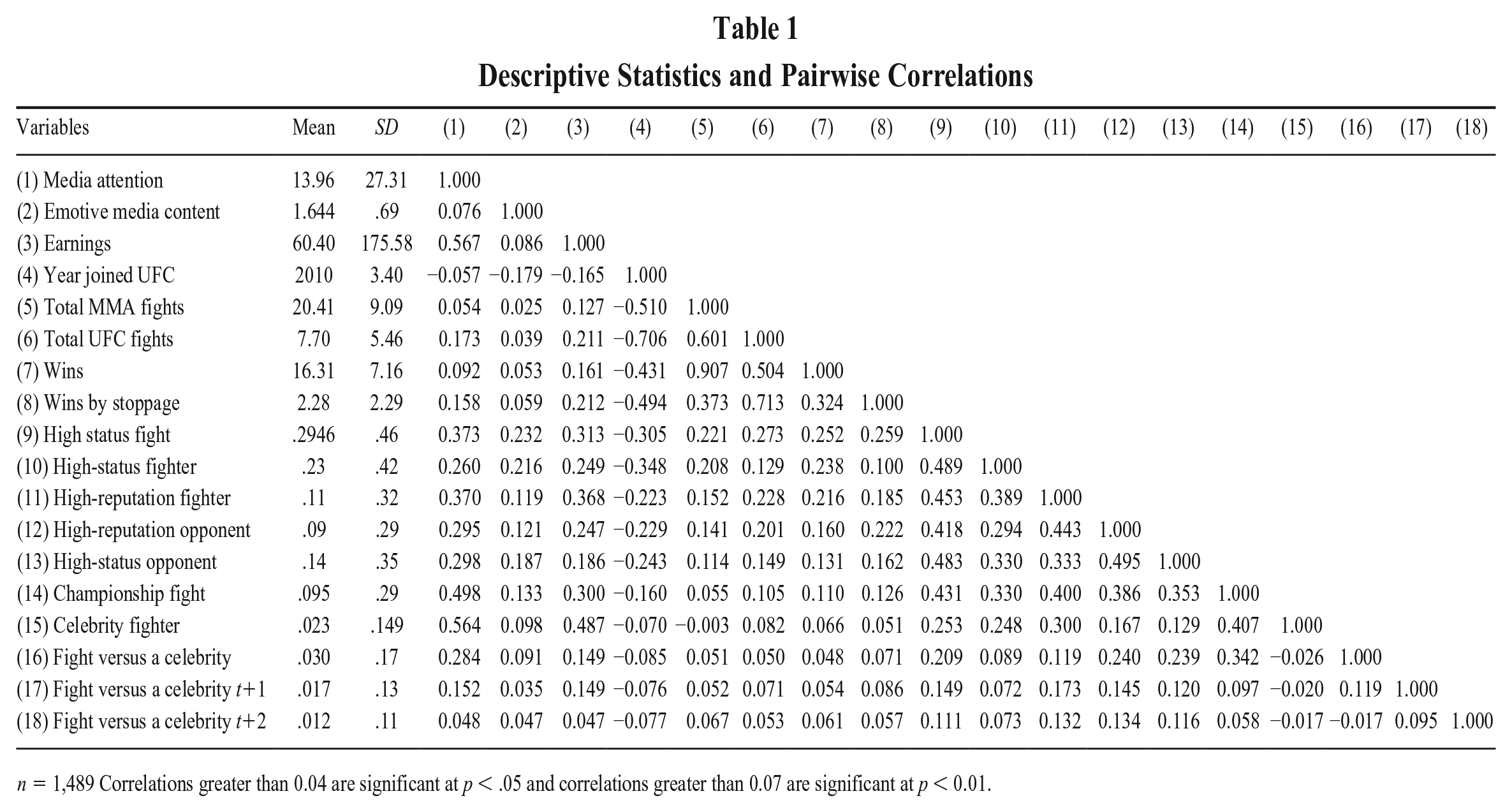
n = 1,489 Correlations greater than 0.04 are significant at p < .05 and correlations greater than 0.07 are significant at p < 0.01.
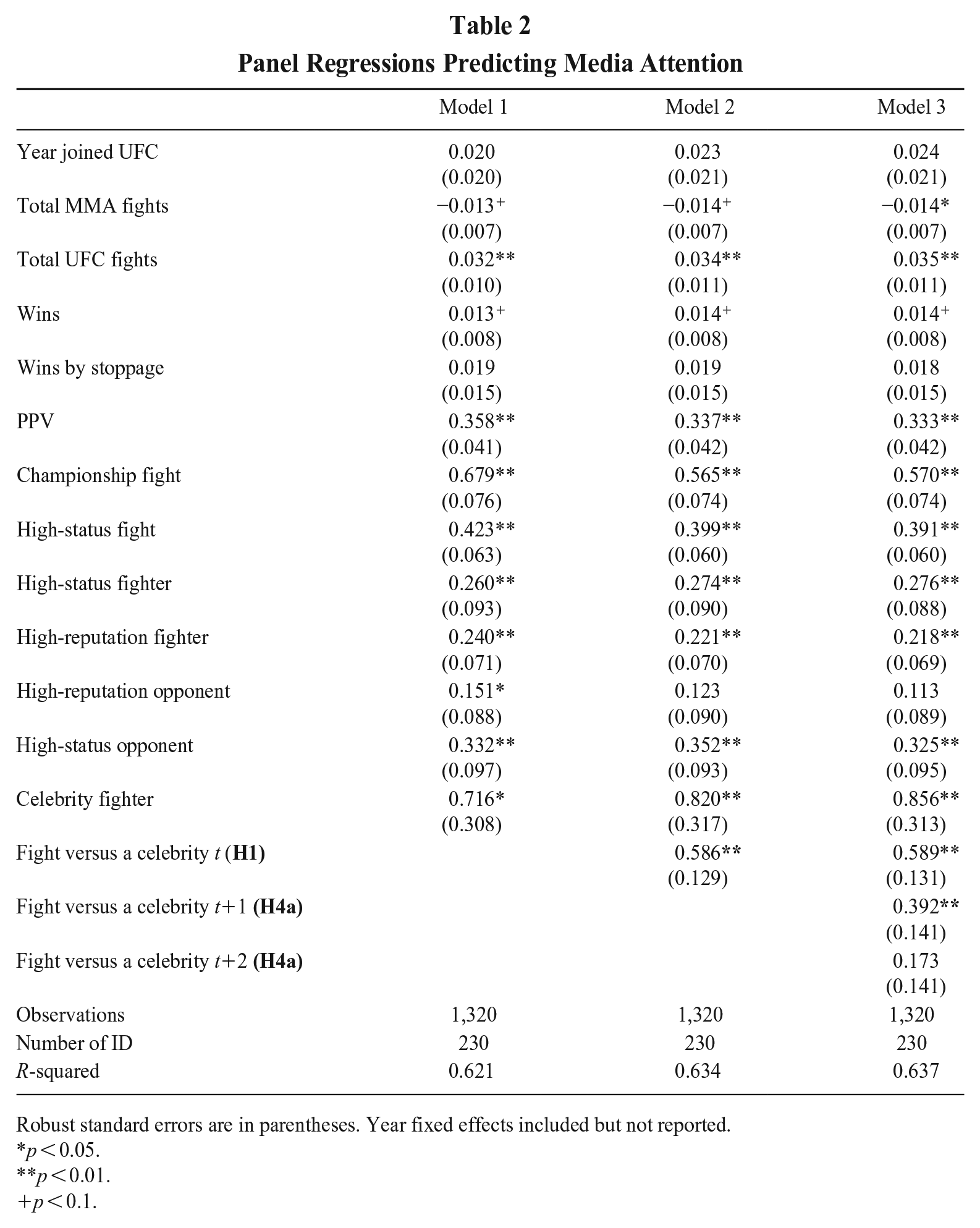
Hypothesis 1 predicted that directly competing against a celebrity is positively associated with media attention for the noncelebrity. Model 1 in Table 2 presents the control model, while Model 2 presents the full model. The coefficient for a fight versus a celebrity shows a positive relationship (β = 0.586, p = 0.000), which suggests statistical support for Hypothesis 1. When noncelebrity competitors fight a celebrity, they receive an 80% increase in media attention.
Panel Regressions Predicting Media Attention
Robust standard errors are in parentheses. Year fixed effects included but not reported.
p < 0.05.
p < 0.01.
p < 0.1.
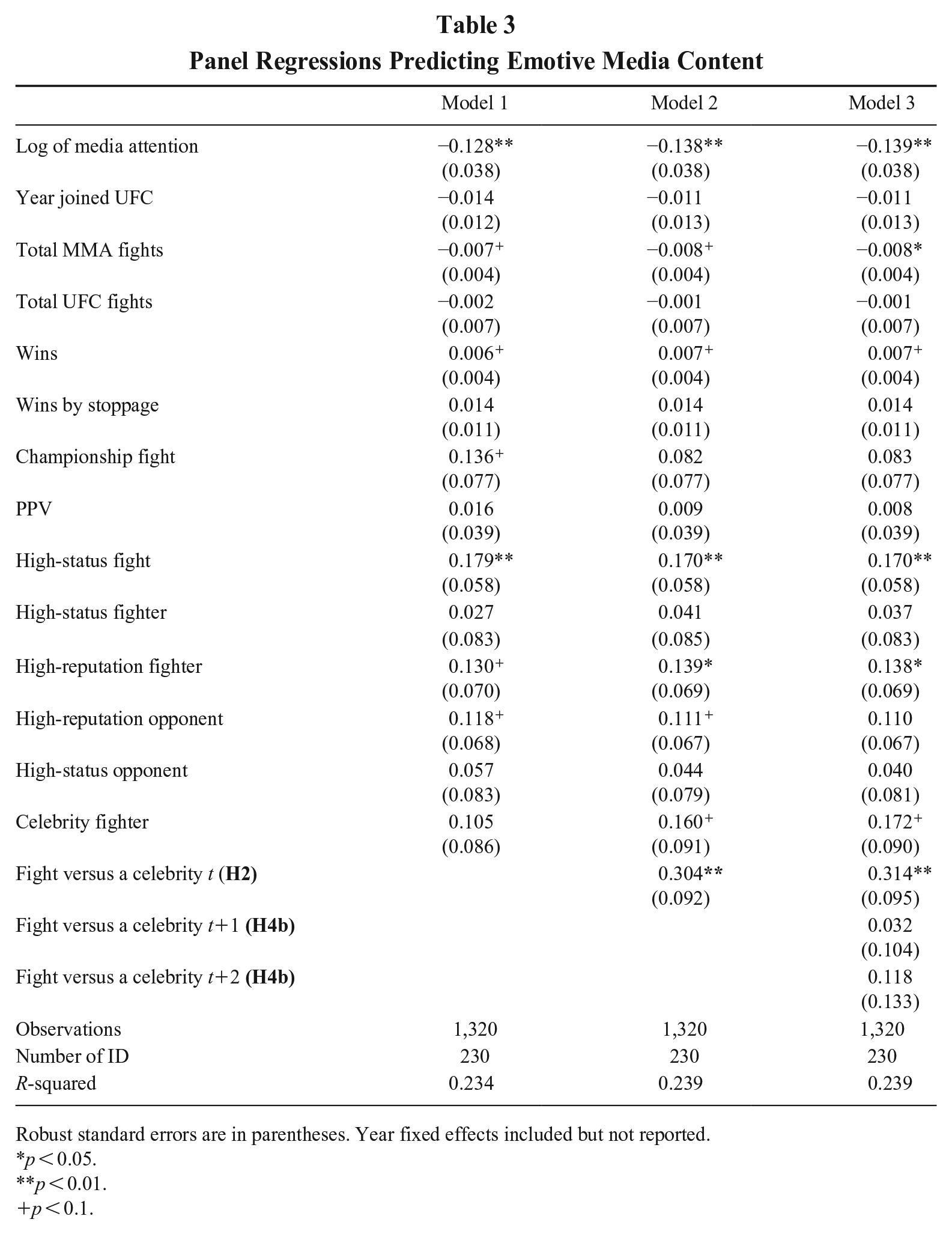
Hypothesis 2 predicted that directly competing against a celebrity is positively associated with emotive media content for the noncelebrity. Model 1 in Table 3 presents the control model, while Model 2 presents the full model. The coefficient for a fight versus a celebrity shows a positive relationship (β = 0.304, p = 0.001), which suggests statistical support for Hypothesis 2. When noncelebrity competitors fight a celebrity, they receive an 18% increase in emotive media content.
Panel Regressions Predicting Emotive Media Content
Robust standard errors are in parentheses. Year fixed effects included but not reported.
p < 0.05.
p < 0.01.
p < 0.1.
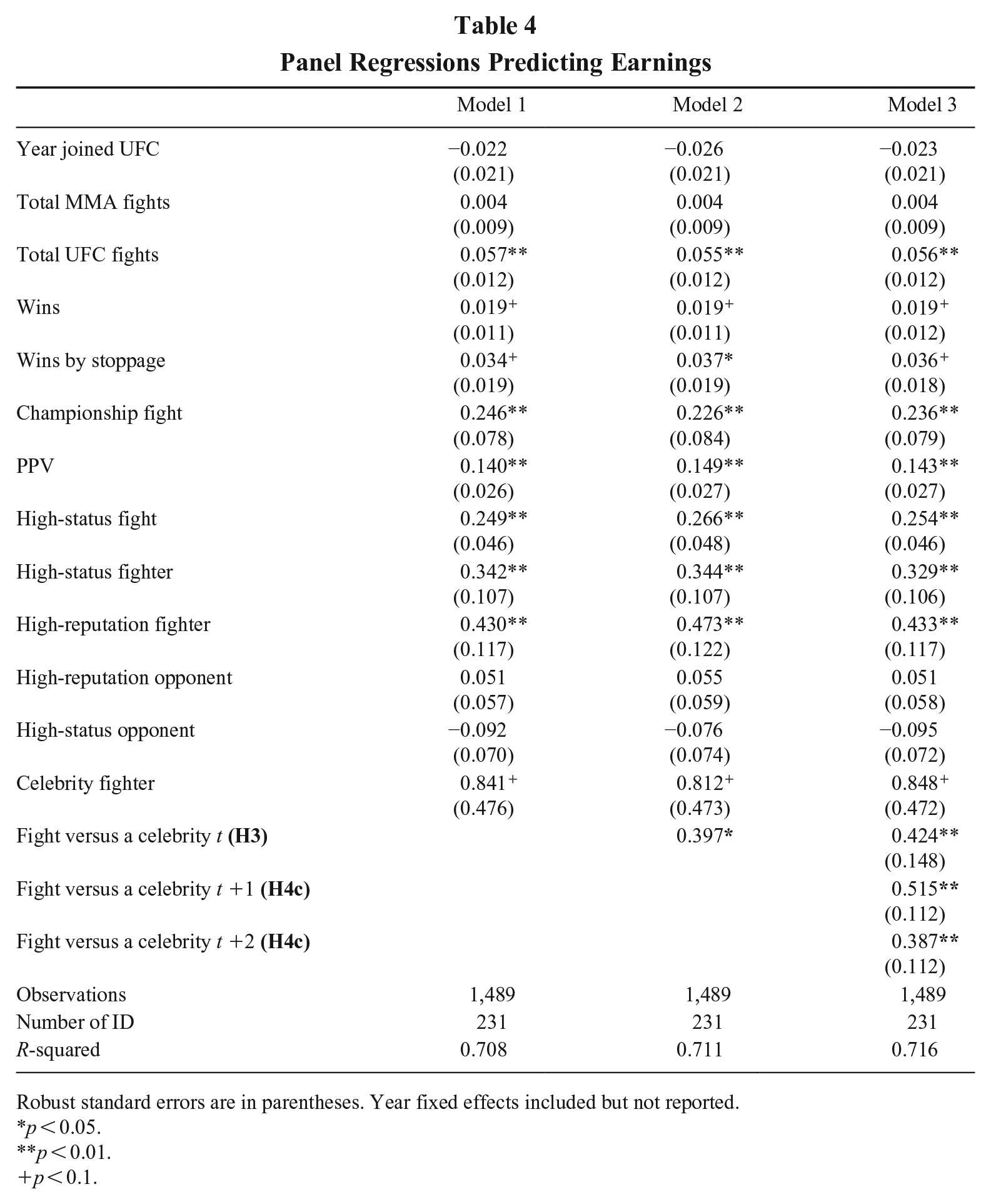
Hypothesis 3 predicted that directly competing against a celebrity is positively associated with earnings for the noncelebrity. Model 1 in Table 4 presents the control model, while Model 2 presents the full model. The coefficient for a fight versus a celebrity shows a positive relationship (β = 0.397, p = 0.012), which suggests statistical support for Hypothesis 3. When noncelebrity competitors fight a celebrity, they receive a 49% increase in earnings.
Panel Regressions Predicting Earnings
Robust standard errors are in parentheses. Year fixed effects included but not reported.
p < 0.05.
p < 0.01.
p < 0.1.
We predicted in Hypothesis 4c that a positive spillover effect will continue for media attention, emotive media content, and earnings for the noncelebrity competitor in periods after the direct competition has ended. As shown in Model 3, Table 2, in fight versus a celebrity t+1 (β = 0.392, p = 0.005), media attention increases by 48% but loses significance in fight versus a celebrity t+2 (β = 0.173, p = 0.219). As shown in Model 3, Table 3, the coefficients for emotive media content in both subsequent fights do not suggest a statistically significant relationship (β = 0.032, p = 0.811; β = 0.118, p = 0.352). Finally, as shown in Model 3, Table 4, the coefficients for earnings in the fight versus a celebrity t+1 (β = 0.515, p = 0.001) and fight versus a celebrity t+2 (β = 0.387, p = 0.001) suggest a 67% and 47% increase respectively. Taken together, these results suggest mixed support for Hypothesis 4.
Robustness Tests
Test of audience attention
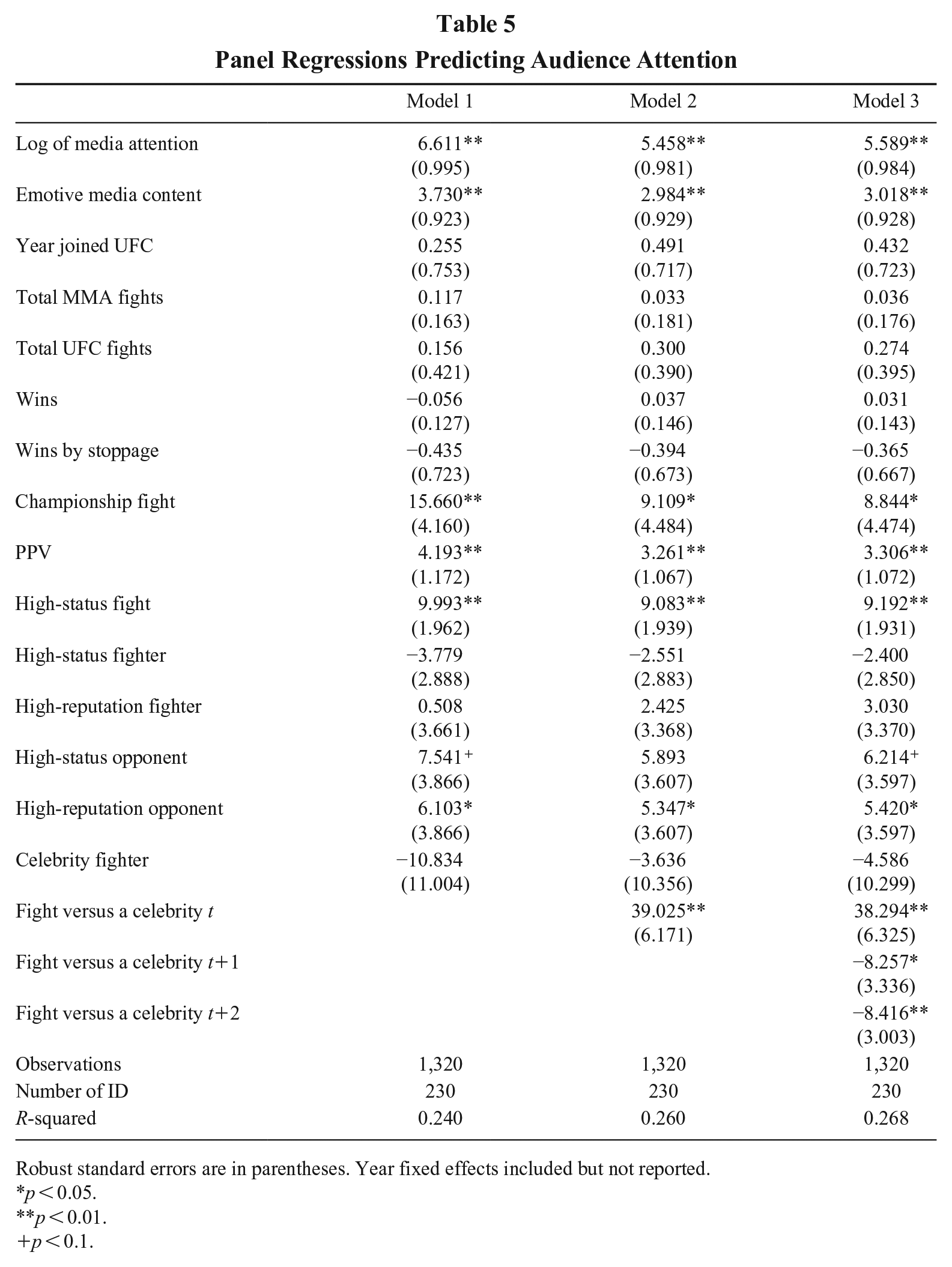
We theorized previously that one of the underlying mechanisms driving an increase in performance is increased attention to noncelebrity fighters. To test this idea, we collected an additional dependent variable, audience attention. To measure it, we used Google Trends data on searches for each fighter. Google generates publicly available trends data on how often terms are searched per month. The data are aggregated and transformed into a scale from 0 to 100, where 100 is the month the term was most searched and then declining to 0, which was the term’s least searched month(s). We downloaded all available trends data covering the career of each fighter with the location restricted to the United States, and we extracted the score for the month of each fight in our sample. 9 Table 5, Model 3, presents the full model. The coefficient for fight versus a celebrity shows a positive relationship (β = 38.294, p = 0.000). When noncelebrity competitors fight a celebrity, they receive a 38% increase in the amount of Google searches. Interestingly, audience attention decreases in fight versus a celebrity t+1 (β = −8.257, p = 0.013) and fight versus a celebrity t+2 (β = −8.416, p = 0.00).
Panel Regressions Predicting Audience Attention
Robust standard errors are in parentheses. Year fixed effects included but not reported.
p < 0.05.
p < 0.01.
p < 0.1.
Tests of boundary conditions
To gain confidence in our primary theoretical arguments and findings, we tested three boundary conditions to our theorizing. First, we explored the effects of positive versus negative emotive content as an outcome of fighting a celebrity. To do this, we split our emotive media content measure into positive and negative emotions while controlling for the other conditions. The coefficient for fight versus a celebrity suggests a positive statistically significant relationship for negative media content (β = .309, p = 0.001) and statistically insignificant results for positive media content. This suggests that media narratives are more likely to create foils rather than mirrors (Herman, 2007).
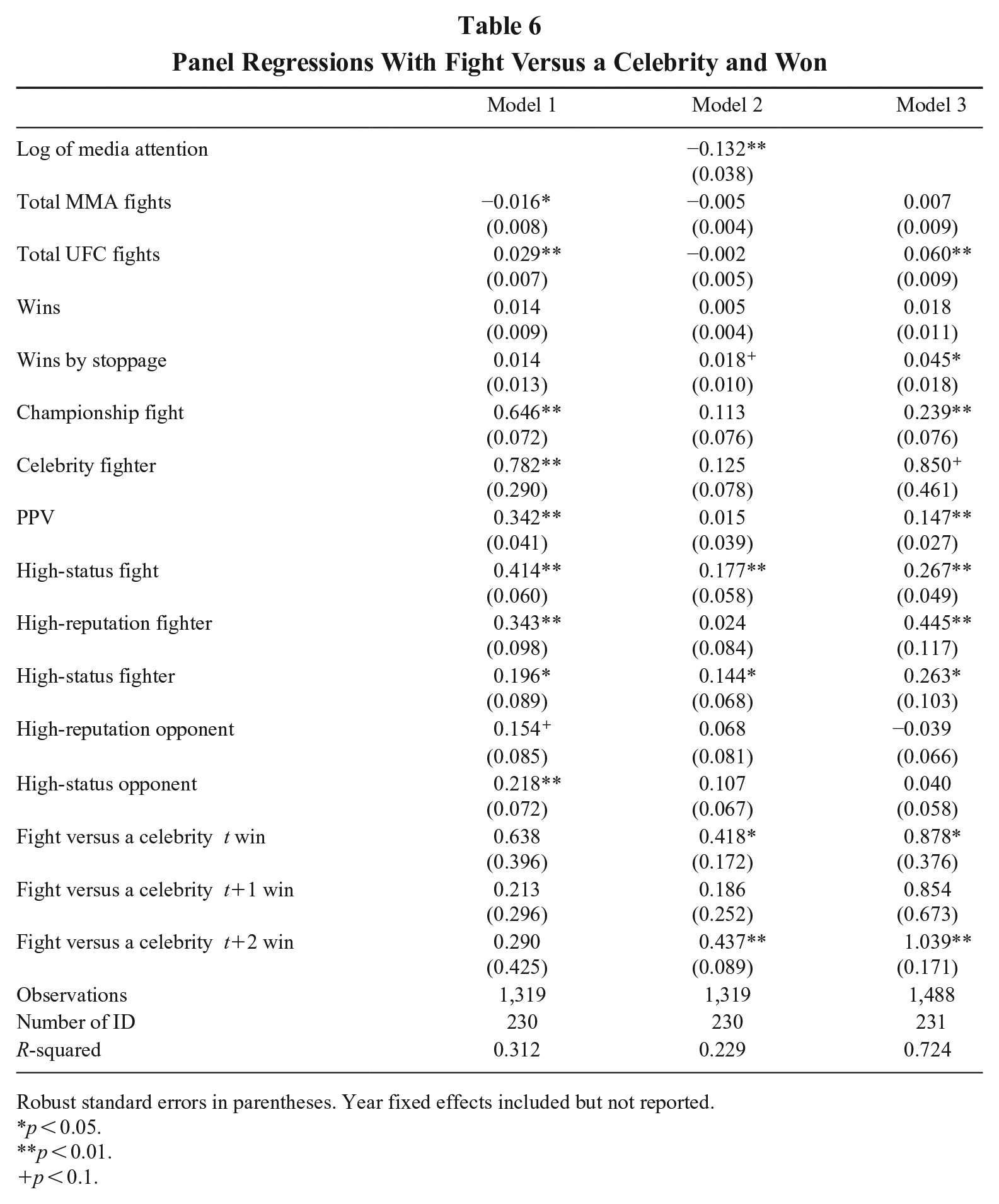
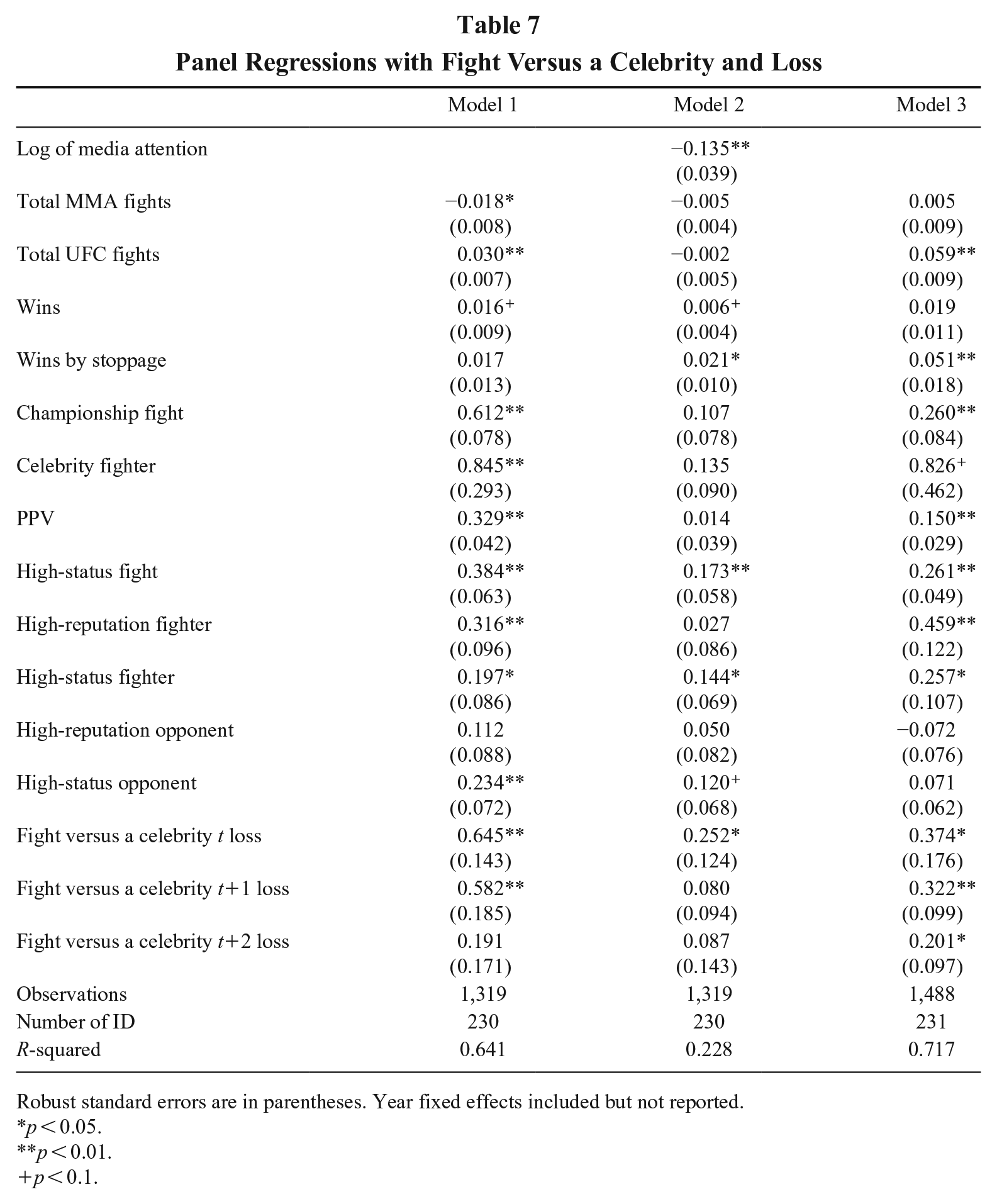
Second, we explored the outcome of the initial fight against the celebrity and whether this impacted the durability of the spillover in t+1 and t+2. We created two new binary variables that reflect whether the fighter won or lost against the celebrity fighter (see Tables 6 and 7). The results for fighting a celebrity and winning suggest an increasing positive effect on earnings (Model 3, Table 6) and emotive content over time (Model 2, Table 6). The results for fighting a celebrity and losing suggest a decreasing positive effect on media attention (Model 1, Table 7) and earnings over time (Model 3, Table 7). Taken together, our results suggest that the media pay more attention to the fighters who lost but that this attention does not translate into better earnings. Conversely, the media seem to cover fighters who won against a celebrity less, but they use more emotion in their writing when covering these fighters in subsequent periods.
Panel Regressions With Fight Versus a Celebrity and Won
Robust standard errors in parentheses. Year fixed effects included but not reported.
p < 0.05.
p < 0.01.
p < 0.1.
Panel Regressions with Fight Versus a Celebrity and Loss
Robust standard errors are in parentheses. Year fixed effects included but not reported.
p < 0.05.
p < 0.01.
p < 0.1.
Third, we looked at whether the reputation and status of the celebrity fighter and their noncelebrity competitors interacted with our proposed relationships. Using the measures from our control variables, we ran an interaction with high-reputation fighter, high-status fighter, high-reputation opponent, high-status opponent, and total wins. The interaction term between high reputation and a fight against a celebrity suggests a positive moderating effect (β = 0.450, p = 0.053). The effect on earnings was 26% higher for a high-reputation competitor when they fight a celebrity compared to a competitor without a high reputation. Additionally, the interaction term for a high-status fighter suggested a negative moderating effect at a threshold just beyond the 10% level (β = −0.492, p = 0.115), but the interaction terms for high-status fighter, high-reputation opponent, high-status opponent, and total wins provided no evidence of moderating relationships.
Test of narrative relationships
One way to test our theoretical mechanism of character relationships in a narrative is to see if direct competitors are co-mentioned more often with the focal celebrity when they compete against them. Using the same method of analysis as our main models, we found a strong positive relationship for fight versus a celebrity t (β = 2.510, p = 0.000) on the number of co-mentions between the celebrity and a noncelebrity competitor in the one month before and after their fight. Thus, fighters who competed against a celebrity experienced over 10 times the number of co-mentions with the celebrity. The results for fight versus a celebrity t+1 also suggest a positive relationship in the competitor’s next fight (β = .959, p = 0.008). This translates into over twice the number of co-mentions, even though they were no longer competing against a celebrity. Our findings suggest that consistent with our theorizing, co-mentions increased during and after competing against a celebrity and an effect remained even when the celebrity and noncelebrity were competing against other fighters.
Finally, we also coded for a link between the celebrity and their noncelebrity competitor in the text. We coded 1 if the competitor’s name was in the same paragraph as the celebrity and the text described a relationship between them. We coded 0 if the names were not in the same paragraph or if they appeared in the same paragraph for unrelated reasons.
Given the large number of articles, we coded 20% of the articles in the sample that contained the competitor’s name (Duriau, Reger, & Pfarrer, 2007). For example, Bethe Correia was mentioned in 92 articles in the period when she fought against Ronda Rousey, and we coded 19 of those articles. Following this protocol, we found that in the period in which noncelebrities fought a celebrity, both fighters were in the same paragraph and linked 100% of the time. The association was still quite high in the periods following the fight. While the total number of co-mentions declined in t+1 and t+2, the noncelebrity fighter was still linked to the celebrity fighter in the same paragraph 90% of the time. One member of the author team and a research assistant independently coded the dataset following the previous protocol and discussed differences together to reach 100% agreement on the coding.
Alternative measurement of earnings
We ran two supplemental tests to explore the consistency between the earnings data we collected from state athletic commissions and the third-party website. Specifically, we (1) created a binary variable for the third-party data and included it with the athletic commission data, and (2) we dropped the third-party data from the sample. Neither analysis affected the statistical significance of our results, suggesting that the data were consistent across the two sources.
Alternative coding for celebrity actors
To explore the boundaries of our celebrity measure, we recoded our fight versus a celebrity variable in three different ways. First, we included those fighters who won an award but did not appear on the cover. Second, we included those fighters who appeared on both covers but did not win an award. Finally, we recoded the high-attention dimension of our celebrity variable by selecting those fighters who appeared in the top quadrant of news coverage (Hubbard et al., 2018; Pfarrer et al., 2010). The first re-operationalization yielded five additional celebrity fighters, the second effort yielded three, and the third yielded no new additional fighters. We ran our models with the additional fighters, and Hypothesis 1 (β = 18.45, p = 0.000), Hypothesis 2 (β = 0.300, p = 0.001), and Hypothesis 3 (β = 13.60, p = 0.000) were supported, but Hypotheses 4a through 4c were not supported.
Tests for mediation
Although we do not imply any mediated effects in our theorizing, media attention and emotive media content may each play an indirect role linking the relationship between directly competing against a celebrity and earnings. We, therefore, tested for mediation using Sobel tests and bootstrapping analyses (Preacher & Hayes, 2008; Sobel, 1982). We found that the indirect effect of media attention was supported with both Sobel’s test (β = 0.129; p = 0.000) and bootstrapping ([0.069, 0.188], estimated with 1,000 replications). The indirect effect of emotive media content, however, was not supported with neither Sobel’s test (β = 0.008; p = 0.266) nor bootstrapping ([−0.007, 0.023], estimated with 1,000 replications).
Endogeneity
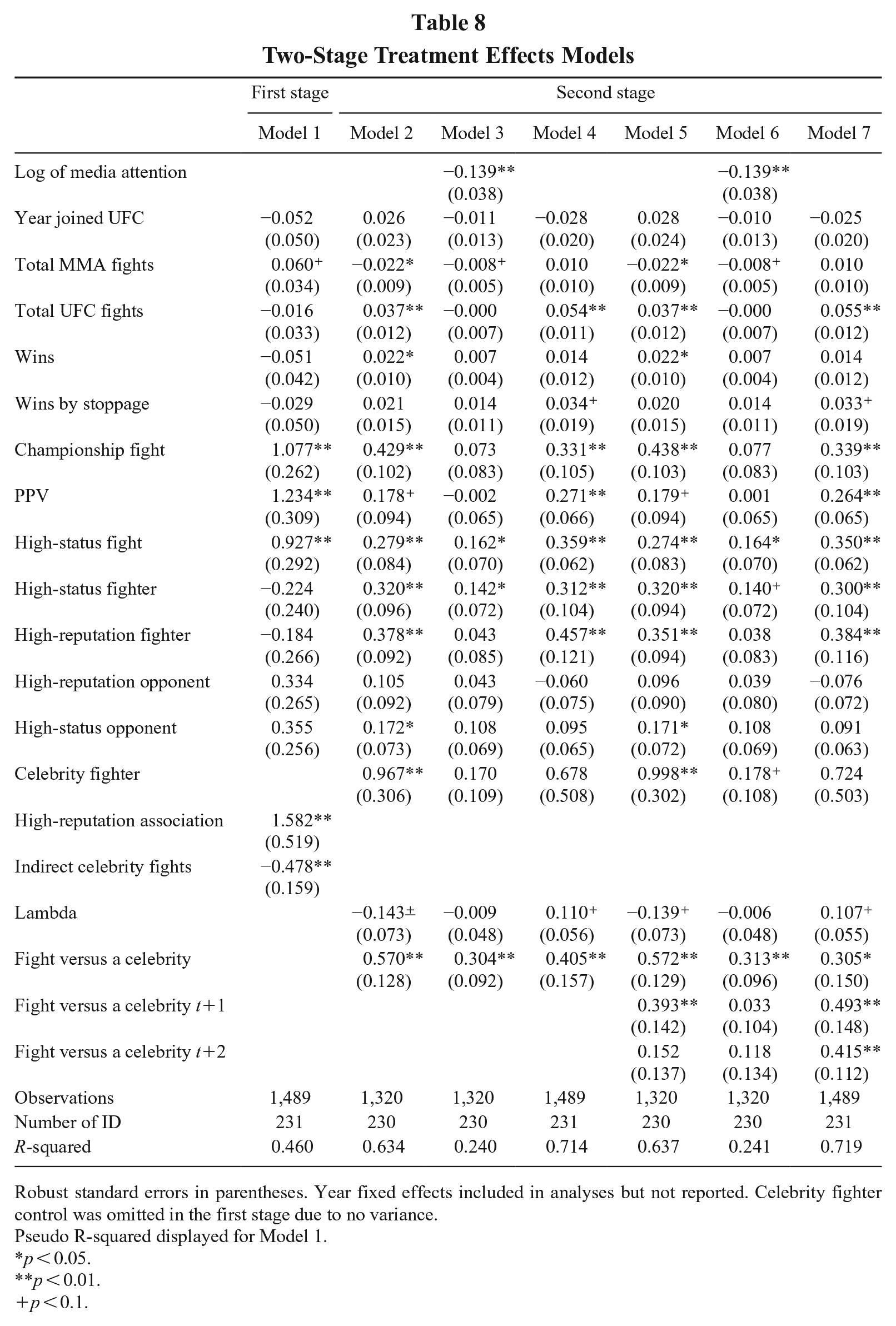
The decision to fight a celebrity is not a random occurrence. Thus, we tested our hypotheses using a two-stage treatment effects model, which is an instrumental variable technique that helps alleviate the effects of endogeneity and is appropriate when the independent variable of interest is binary (Baum, 2006). The first stage of the treatment effects model predicts the endogenous variable (fight versus a celebrity) using all of the covariates in the structural model and including two exclusion restrictions that are theoretically and empirically correlated with the independent variable but not the structural error term (Semadeni, Withers, & Certo, 2014). 10 The second stage consists of the structural model predicting the dependent variable, which includes the endogenous predictor, all other covariates, and a hazard factor (lambda) that is calculated from the first stage (Shaver, 1998).
Our first exclusion restriction is high-reputation association, which we measured as the total number of a fighter’s opponents who belonged to high-reputation gyms (measured as an affiliation with a gym that had a previous champion train there). This is an appropriate instrument because being connected to high-reputation circles should help a noncelebrity fighter’s chances of fighting a celebrity in the future through positive network effects (Westphal & Zajac, 2013) but should not directly influence the media attention or earnings of the actual fight with a celebrity.
Our second exclusion restriction, indirect celebrity fights, captures how many of a noncelebrity fighter’s prior opponents fought a celebrity fighter. 11 The more a noncelebrity fighter has fought these “indirect celebrities,” the more they will think they already have a good profile and the less likely they will pursue a fight with a celebrity. At the same time, if a noncelebrity fighter does fight a celebrity, this history should only influence our dependent variables through an actual fight with the celebrity. Empirical tests support our theory as both high-reputation association (β = 1.582, p = 0.002) and indirect celebrity fights (β = −0.478, p = 0.003) are strong predictors of fighting a celebrity (F-stat = 19.93), but they are not correlated with the structural error term (Sargan χ2 = 0.686, p = 0.408). Both are thus strong exclusion restrictions according to recommendations for instrumental variables to be relevant and exogenous (Semadeni et al., 2014).
Table 8 displays results from our two-stage treatment effects models. Model 1 contains the first-stage results, and Models 2 through 7 contains results corresponding to our hypotheses. Our results in Models 2 through 7 are all consistent with those from our main analyses but have slightly different estimates, likely due to the lower efficiency of two-stage model techniques (Kennedy, 2008).
Two-Stage Treatment Effects Models
Robust standard errors in parentheses. Year fixed effects included in analyses but not reported. Celebrity fighter control was omitted in the first stage due to no variance.
Pseudo R-squared displayed for Model 1.
p < 0.05.
p < 0.01.
p < 0.1.
Discussion
Our overarching goal in this study was exploring if and how celebrities provide spillover benefits to their competitors. We found that the media not only increase their attention and use of emotive content on the protagonist (celebrity) but also on the secondary characters (noncelebrity competitors) in their narratives. Further, we found that noncelebrities enjoy increased earnings from their association with celebrities and the roles they play as mirrors or foils in the media’s narratives. Finally, we found that a positive spillover effect remains in periods after the association has ended, but these results were mixed. Specifically, we found there was no durable effect of fighting a celebrity on emotive media content, but that there was an effect on media attention and earnings.
One possible explanation considering our robustness check splitting positive and negative media content is that once the media develop the noncelebrity fighter as a foil and the celebrity moves on to fight someone else, the media spend less time using emotive language when covering the noncelebrity fighter. This could mean that the media find it less pertinent to use emotive language once the antagonistic relationship is established and the direct competition ends. This nonfinding may also suggest that fighting a celebrity sets off a cycle where the noncelebrity becomes more well-known but shifts from being a villain to a more neutral character.
Contributions to Research
We contribute to social evaluations research in three primary ways. First, we extend celebrity research by theorizing and empirically showing how the benefits of celebrity spill over to other actors, moving our understanding of celebrity’s effects beyond the celebrities themselves. This extends what we know about the development of celebrity by highlighting how it can share high levels of emotive attention with competitors (Lovelace et al., 2021; Rindova et al., 2006; Zavyalova et al., 2017).
This finding also contributes to our understanding of the effects of media narratives on market actors (Lovelace et al., 2021; Zavyalova et al., 2016). We theorized and empirically found that the media’s narrative construction process has important consequences for those actors who are not only primary characters but also those who are secondary characters in the same narratives. Understanding the power of media narratives helps highlight and clarify the theoretical mechanisms shaping the construct of celebrity in social evaluations research. Specifically, we contribute to research discussing levels of celebrity (Lovelace et al., 2021) and archetypes of celebrities (Lovelace et al., 2018) by providing theoretical explanations about how the media creates narrative through its routines. This suggests broader impacts of celebrity than the more agent-centric approaches thus far. In the increasingly mediatized world, our paper suggests that media narratives are powerful tools to generate value within an industry.
Second, we contribute to the understanding of how celebrity impacts how benefits flow in an industry. We theorized and empirically found that celebrity actors can have positive performance effects on their competitors given the increase in emotive media attention and audience attention. This contributes to social evaluations research by showing how celebrity impacts competitors positively, in contrast to other social evaluation assets—namely reputation (Rao, 1994; Rindova et al., 2005) and status (Benjamin & Podolny, 1999; Malter, 2014; Podolny, 2005). Moreover, our paper presents convincing evidence that there is a transition in some industries from traditional, tangible-result-based constructs like reputation or position-based constructs like status, which previously governed the flow of benefits. It highlights the growing significance of narratives associated with celebrity actors in influencing these benefits.
Third, our examination of the durability of celebrity also brings a longitudinal and broader perspective to celebrity research. Although conceptual research has suggested that celebrity can be fleeting (Zavyalova et al., 2017), we theorized and found that the presence of a celebrity impacts noncelebrities positively and durably beyond the association with the celebrity. We thus provide further discriminant validity for this relatively nascent construct and contribute to an understanding that its effects go beyond celebrities themselves (Hubbard et al., 2018; Lovelace et al., 2021; Pfarrer et al., 2010) and can endure beyond initial and direct associations. Our findings suggest that the attention and the ability of the noncelebrity to generate more income endures but the emotive content does not. This suggests that over time, if these characters do not generate celebrity for themselves, they will become less memorable and the effect eventually fades.
Contributions to Practice
Our theory and findings also offer practical implications for managers. Rivals in industries in which celebrities develop should consider the possible ancillary benefits of directly and indirectly competing against them. For instance, even if a firm loses a bid or has a smaller market share than a celebrity firm, our findings suggest that simply competing can bring benefits due to the additional positive attention the noncelebrity actor will receive.
Moreover, there are several industries where celebrity actors develop—for example, Johnny Cochran in law, Foster and Associates in architecture, or Sequoia Capital in venture capital—that engage in head-to-head competitive exchanges, much like UFC fighters and our research context. Similarly, star financial analysts tend to attract more attention and have a greater influence on changes in the valuation of the firms they cover (Boivie, Graffin, & Gentry, 2016). In these types of industries, our theory and findings suggest that taking up a case against Cochran or bidding against Foster and Associates—regardless of the outcome—could be a good strategic move for the noncelebrity rival.
Future Research Directions
Our context was suitable to answer our research question in that it provided a competitive context in which we could identify celebrities, their interactions, competitors’ earnings, and other social evaluation assets. Despite these benefits, we recognize that it is a relatively specialized context. As such, some of its dynamics may not generalize to contexts that do not generate high levels of media attention and emotion in observers.
However, we believe there are numerous examples of industries that display these dynamics. For example, valuations in the electric car market have soared in recent years, and observers have deemed the popularity of Tesla and Elon Musk as potential explanations (Owens & Kilgore, 2021). We thus posit that this provides two avenues of research: the importance of celebrity actors to the growth of “visible” industries versus the role celebrity plays in contexts that are not the subject of intense media scrutiny and audience attention. While our theory and findings highlighted the benefits of having a celebrity rival, future research could consider the negative externalities associated with it (Zavyalova et al., 2017).
Furthermore, our study suggests that the personalities of different fighters impact each other in media narratives. This suggests that there may be some more individual-level spillover effects that could be studied in future research. This could be investigated in different contexts such as professional groups (Boivie et al., 2016), top management teams (Graffin, Wade, Porac, & McNamee, 2008), and project teams (Szatmari, 2022; Szatmari, Deichmann, Van Den Ende, & King, 2021).
In conclusion, we theorized and found that noncelebrities benefit from competing against their positively hyped rivals. As such, competitors who take a literal or figurative punch from a celebrity may benefit from it over time.
Footnotes
Acknowledgements
We extend our gratitude to associate editor Ryan Krause and two anonymous reviewers for their invaluable guidance throughout the review process. Our thanks also go to Owen Parker, Jonathan Bundy, Abbie Oliver, Davide Ravasi, Santi Furnari, and Paul Tracey for their insightful feedback on earlier drafts of this paper, as well as to the participants of the 2019 EGOS conference’s social evaluations track. We are grateful to Robin Breed for his research assistance. Additionally, Kevin Curran wishes to express his appreciation to Rupert Younger and the Oxford Centre for Corporate Reputation for their support during his tenure there as a postdoctoral fellow.
