



Abstract
Recognizing the potential contributions businesses can make to address the grand challenge of global poverty, management scholars have increasingly turned research attention to poverty. We conducted an integrative review of poverty studies in the organizational literature spanning from 1985 to 2022. Based on the review, we clarify poverty as a significant lack of market-oriented resources, opportunities, and capabilities. Further, we develop a framework that captures the ways in which organizational practices offer the poor, or deprive them of, resources, opportunities, and capabilities, and thereby contribute to poverty alleviation or aggravation respectively. Moreover, our framework identifies the necessary support conditions for an organization to effectively combat poverty. We conclude by proposing a research agenda aimed at advancing management scholarship on poverty.
Keywords
A recent report on global multi-dimensional poverty, 1 which includes factors like health, education, and living standards, across 110 countries revealed that out of 6.1 billion people, 1.1 billion are experiencing poverty, mainly in low and middle-income countries. The report indicates a general decrease in poverty levels, but it also warns that the COVID-19 pandemic, population growth, and persistent conflicts might have impeded the pace of poverty alleviation efforts. Organizations from various sectors, including for-profit, non-profit, and public sectors, play a role in poverty alleviation (Wadhwani, 2018). Among these, for-profit business organizations, which are the focus of our review, are increasingly recognized as significant actors in multilateral discourses on poverty alleviation (Agarwal & Holmes, 2019; Bruton, 2010; Colquitt & George, 2011; Suddaby, Bruton, & Walsh, 2018). At the same time, scholars have also scrutinized the negative role of for-profit business organizations in contributing to poverty (Leana & Meuris, 2015; Leana, Mittal, & Stiehl, 2012; Meuris & Gladstone, 2023). In a broader sense, organizational scholars have been called upon to actively engage with poverty to promote socially inclusive growth that allows the poorest and disenfranchised populations to participate in social and economic progress (George, Howard-Grenville, Joshi, & Tihanyi, 2016).
The study of how organizations interact with poverty is crucial for management scholars, for both instrumental and moral reasons. From an instrumental standpoint, poverty is closely linked with organizational value creation, distribution, and capture, significantly affecting business operations and strategies (Bapuji, Ertug, & Shaw, 2020; Dembek, Sivasubramaniam, & Chmielewski, 2020; Sutter, Bruton, & Chen, 2019). Value creation in businesses is influenced by the broader socio-economic context, including poverty, which affects market dynamics, consumer power, and labor markets. A more balanced value creation and distribution through fair employment, trade practices, and community investments can not only help firms achieve sustainable development goals (e.g., SDG 1–No Poverty and many other related SDGs), but also enhance brand reputation, customer loyalty, and business environment, thereby enabling better value capture (Bapuji, Husted, Lu, & Mir, 2018; Bapuji et al., 2020).
From a moral standpoint, it is imperative for organizations not only to minimize their contribution to poverty but also to actively engage in practices that alleviate poverty. This ethical responsibility (Pongeluppe, 2022; Sud & VanSandt, 2011) goes beyond mere compliance or philanthropy; it is about integrating poverty reduction into core business strategy. For instance, the principles of stakeholder theory (Dmytriyev, Freeman, & Hörisch, 2021) emphasize an organization’s duty to all parties affected by its operations. This duty, increasingly acknowledged and enshrined in legal frameworks, transcends the traditional focus on shareholders, customers, and employees. Recognizing the poor as key stakeholders is not just a strategic necessity but a moral imperative (Bailey & Lumpkin, 2023; Mair, Marti, & Ventresca, 2012).
This evolving instrumental and moral perspective represents a paradigm shift in the purpose of for-profit corporations, widely seen as shareholder wealth maximization (Aguilera, 2023). It underscores the growing recognition in contemporary management scholarship of the need for businesses to play a proactive role in societal welfare (Jones et al., 2016). By integrating poverty alleviation into their corporate purpose, organizations can contribute to a more equitable and sustainable future, aligning their success with the broader health and prosperity of the communities they serve.
The above-mentioned shifts have resulted in a rich and rapidly growing organizational literature on poverty. Indeed, more than 80% of the 177 articles meeting our selection criteria were published after 2010. This burgeoning area has been noted for a lack of conceptual clarity about poverty (George, McGahan, & Prabhu, 2012)—for instance, in terms of conflation with inequality (Bapuji et al., 2020)—and is dispersed in different management fields (Sutter et al., 2019). Accordingly, we review this literature to assess and integrate the diverse insights in the literature, identify common themes, and explicate future research opportunities. 2 To this end, we focus on the domain of organizational engagement with poverty and approach our review with three questions: 1) How is poverty conceptualized in organizational research? 2) How do organizations engage with poverty? and 3) What are the factors that influence organizations in their poverty alleviation efforts?
In answering these questions, our review makes four contributions. First, we enhance conceptual clarity by defining poverty from an organizational perspective to strengthen organizational research and practice related to poverty. Second, we highlight the often-overlooked role of organizations in poverty aggravation, while consolidating the research on poverty alleviation, which has been the dominant focus of management scholars. Third, we identify the factors influencing organizations to effectively engage in poverty alleviation through market participation. Finally, we lay out an agenda for future research on organizational engagement with poverty, focused on adopting a multi-level approach and using context-appropriate methods.
Our paper is structured as follows. We first explain the method adopted to systematically identify research on organizational engagement with poverty and analyze the articles. We then clarify what poverty means in an organizational context. This is followed by a discussion on organizational practices that alleviate or aggravate poverty and the factors influencing effective organizational engagement with poverty alleviation. Finally, we present future research avenues that can help expand the boundaries of organizational research on poverty.
Review Process and Overview of the Literature
We followed a three-step process of identification, screening, and completion of articles (Tranfield, Denyer, & Smart, 2003). See Table 1 for details. First, we identified relevant articles by conducting a topic search in the Scopus database for combinations of keywords that we developed through iterative discussion (i.e., “poor,” “poverty,” “base/bottom of pyramid,” “social entrepren*/enterpr*,” “institutional entrepren*/enterpr*,” “disadvantage,” “informal,” “deprivation,” “marginal*,” “victim,” “beneficiar*,” “aid,” “consumer”). To keep the scope of our review pertinent to management scholars, we limited our search to a selected set of 57 journals, including (a) the FT-50 list of journals, (b) journals ranked 4/4* in the CABS Academic Journal Guide 2021, 3 and (c) specialist journals that publish organizational research and practice on poverty, such as Business & Society (see Table 1 and Appendix B for details).
Summary of Article Selection Process
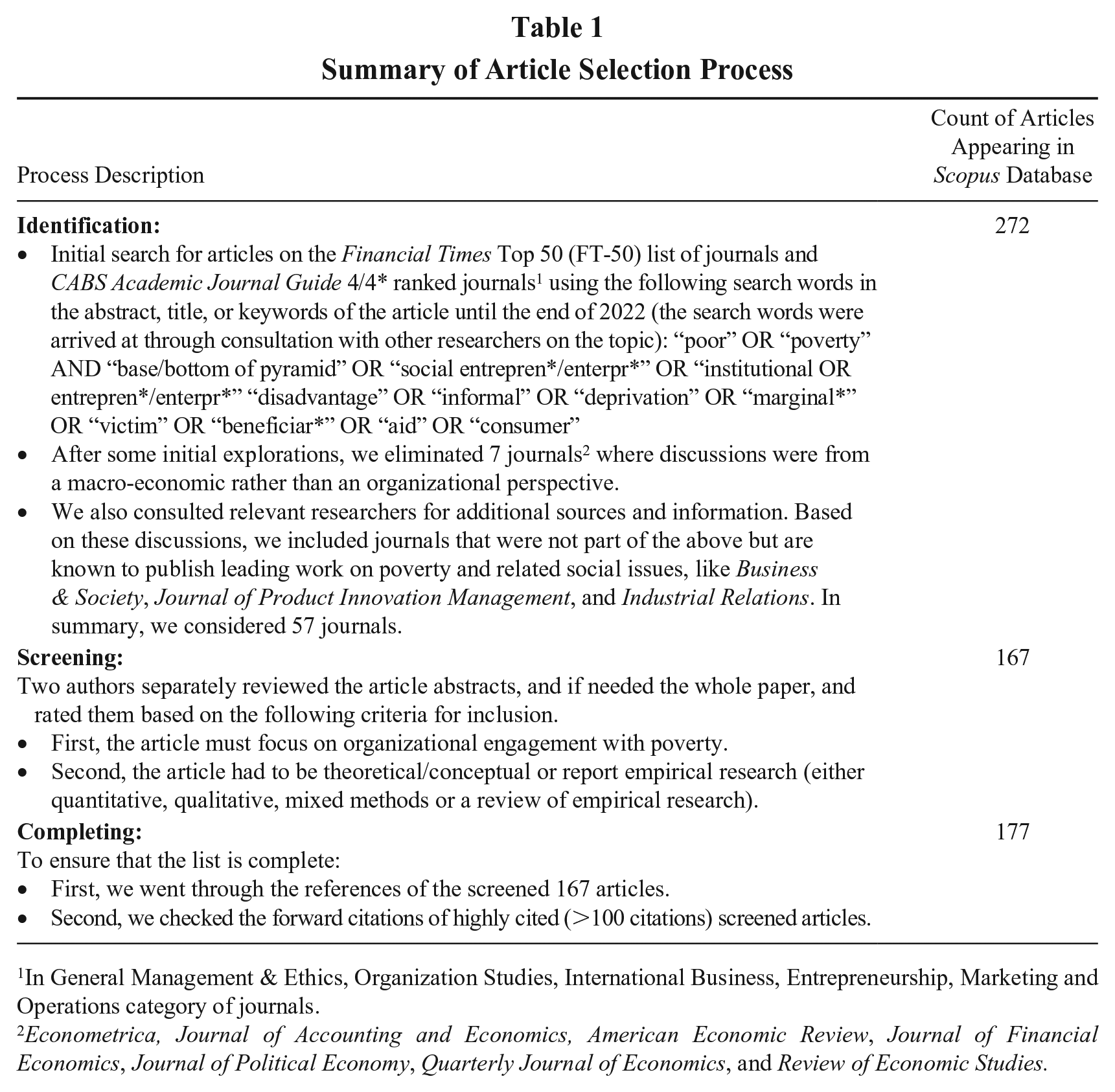
In General Management & Ethics, Organization Studies, International Business, Entrepreneurship, Marketing and Operations category of journals.
Econometrica, Journal of Accounting and Economics, American Economic Review, Journal of Financial Economics, Journal of Political Economy, Quarterly Journal of Economics, and Review of Economic Studies.
Second, following Stephan, Patterson, Kelly, and Mair (2016), two members of the research team screened the articles for inclusion using a set of inclusion criteria. First, the article must focus on organizational engagement with poverty. Second, the article had to be theoretical/conceptual or report empirical research (either quantitative, qualitative, or mixed methods).
Finally, we conducted a backward and forward citation search (Hiebl, 2023). First, we reviewed the reference list of screened articles to check for new articles. Subsequently, for the highly cited screened articles (>100 citations on Scopus), we looked at their forward citations. Through this process, we identified additional articles for inclusion in the review.
Overall, the three-step process resulted in 177 articles (120 empirical and 57 conceptual) being retained for the final review over the period of 1985–2022. We present a summary of the search procedure in Table 1, including the search terms and inclusion criteria. In addition, we provide the list of included articles in Appendix B.
Aside from an occasional article in the late 1980s, management research on this topic began in earnest around the turn of the century and has steadily escalated since that time. In the pre-2005 period, discussions were more from an ethical viewpoint (e.g., Egan, 1988; Hill, 2002). With the backdrop of the Global Financial Crisis and rising emphasis on sustainable development, the number of relevant publications began to increase since 2010, with over 80% of the 177 articles in our review published between 2010 and 2022. This research has been published in journals such as the Academy of Management Journal, Strategic Management Journal, and Journal of Management and more frequently in journals such as the Journal of Business Ethics, Journal of Business Venturing, and Business & Society. This mix of journals from different sub-fields of management reflects the interdisciplinarity of the field and its broad relevance to management theory and practice.
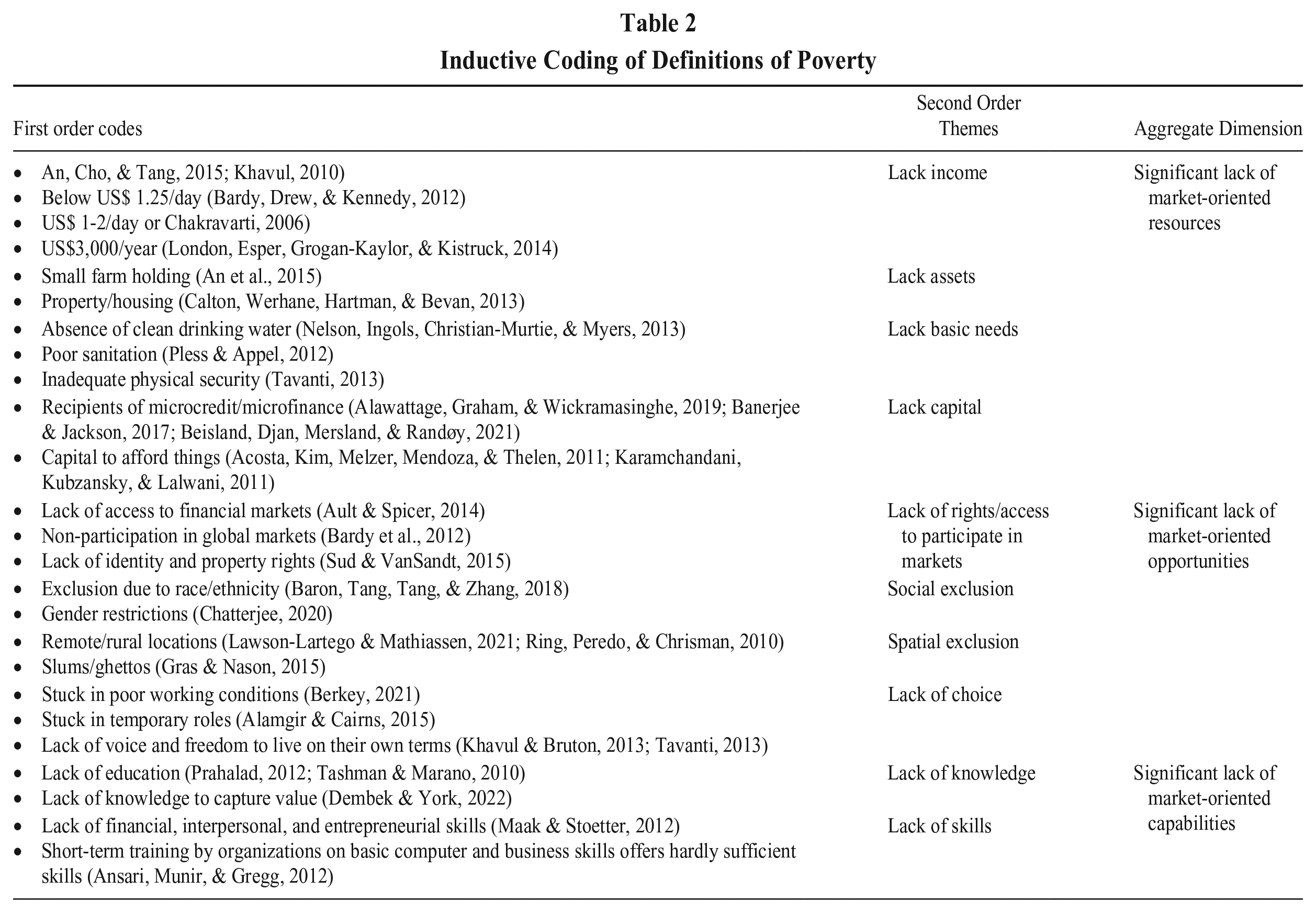
We conducted a content analysis of the 177 articles identified. Three members of the author team coded the articles iteratively in consultation with the other team members. We coded all the articles for the scope and context of the study, theoretical lens used, methodology, level of analysis, and key findings/conclusions. Then, we coded all articles for insights into the conceptualization of poverty and integrated them into meaningful themes that captured the multidimensional content of the construct and generated a consolidated definition (See Table 2 for sample coding). Building on the definition, we then coded for different practices of organizational engagement with poverty and consolidated them to develop two different modes of organizational engagement with poverty, namely alleviation and aggravation, and a range of relevant practices that reflected these modes of engagement. Finally, we coded for factors influencing organizational engagement with poverty alleviation and consolidated them into three levels, namely institutional, organizational, and individual.
Inductive Coding of Definitions of Poverty
The articles in our set draw on a wide range of theories including Rawls’ fairness-as-justice theory (Hahn, 2009; Hill, 2002), network theory (Ring, Peredo, & Chrisman, 2010; Shivarajan & Srinivasan, 2013), the resource-based view (Hart & Dowell, 2011; Tashman & Marano, 2010), institutional theory (Kent & Dacin, 2013; Sud & VanSandt, 2011), and stakeholder theory (Sun & Im, 2015). Of the 177 articles in our review, 120 (68%) were empirical studies, while the remaining were theory or perspective pieces. The theory and perspective pieces offer a foundational understanding of organizational engagement with poverty, highlighting aspects such as ethical and social dilemmas (Griffiths, 2012; Miles, Munilla, & Covin, 2002), justice (Santos & Laczniak, 2009; Sud & VanSandt, 2011) and human rights (Hudon, 2009; Mena, de Leede, Baumann, Black, Lindeman, & McShane, 2010). Overall, the articles are positioned within diverse management fields, including entrepreneurship, marketing, finance, and ethics. To integrate insights from this diverse research and also advance future research, it is crucial to examine how poverty is understood in the existing literature.
Understanding Poverty
Organizational research lacks a well-defined construct to capture poverty (George et al., 2012), with some studies failing to offer or adopt a clear definition of the term (e.g., Venkataraman, Vermeulen, Raaijmakers, & Mair, 2016). Researchers often define poverty with operationalizations, rather than offering a constitutive or conceptual definition. For example, income level is often used as an indicator of poverty, such as daily income less than US$ 1 (Chakravarti, 2006), daily income below US$1.25 (Bardy, Drew, & Kennedy, 2012), daily income less than US$2 (An, Cho, & Tang, 2015), or annual income less than US$3,000 (London, Esper, Grogan-Kaylor, & Kistruck, 2014).
In addition, various non-income-based indicators are also used to define poverty, including limited or lack of access to assets, education, and housing (Mair & Marti, 2009), or poorly met basic needs such as access to potable water and sanitation (Martin & Hill, 2012). In addition, labels such as “Bottom of the Pyramid (BOP)” or “subsistence markets” are used to describe people living in impoverished conditions. These varying indicators and labels underscore the multidimensional nature of poverty and the need for a clear theoretical definition that is pertinent to organizational research.
A Definition of Poverty from an Organizational Perspective
We build on the research reviewed (i.e., the conceptualization and measurement of poverty) and develop our definition of poverty inductively from an organizational perspective (refer to Table 2 for inductive coding and analysis). Our analysis reveals that, in management and organization studies, poverty is understood in terms of market-oriented resources, opportunities, and capabilities. The market refers to both formal and informal markets (London et al., 2014), although in certain contexts, the boundaries between formal and informal markets may be blurred (Webb, Tihanyi, Ireland, & Sirmon, 2009).
Based on our analysis, we define poverty as a significant limitation in terms of market-oriented resources, opportunities, and capabilities. Impoverished individuals significantly lack certain market-oriented material resources, such as money (Bardy et al., 2012; Chakravarti, 2006), assets in the form of land or property (Calton, Werhane, Hartman, & Bevan, 2013), and/or resources to meet the basic needs of food, water, and shelter (Nelson, Ingols, Christian-Murtie, & Myers, 2013). Studies also demonstrate that poverty often emanates from a significant lack of market-oriented opportunities in the form of lack of rights (Ault & Spicer, 2014; Sud & VanSandt, 2015), social exclusion (Baron, Tang, Tang, & Zhang, 2018; Chatterjee, 2020), spatial exclusion (Gras & Nason, 2015; Lawson-Lartego & Mathiassen, 2021; Ring et al., 2010) and lack of choice (Alamgir & Cairns, 2015; Khavul & Bruton, 2013). Finally, impoverished individuals also significantly lack market-oriented capabilities in the form of education (Prahalad, 2012; Tashman & Marano, 2010), skills (Mair & Marti, 2009), and experience (Maak & Stoetter, 2012).
This definition of poverty provides a basis for organizational research and practice, as it recognizes poverty as a multifaceted, contextual, and dynamic concept that is rooted in market orientation. Poverty is multifaceted because it encompasses not only limited resources but also constrained opportunities and capabilities. Poverty is contextual since the levels and types of market-oriented resources, opportunities, and capabilities differ across markets (i.e., contexts). Therefore, what is considered “significantly limited” varies depending on the specific context. Poverty is also dynamic because the value of resources, opportunities, and capabilities changes over time such that a given level of these may not be valued the same across time.
By comprehending poverty from an organizational standpoint, we can help managers create more effective and suitable strategies to alleviate poverty and foster sustainable development. Toward this end, we turn our attention to the research on organizational engagement with poverty.
Organizational Engagement with Poverty
We integrate the reviewed studies in a framework (Figure 1) that explicates two distinct modes of organizational engagement with poverty: poverty alleviation and poverty aggravation. The framework also outlines organizational offering and depriving practices related to these modes and the factors influencing organizations in poverty alleviation efforts through market participation. We delve into these below.
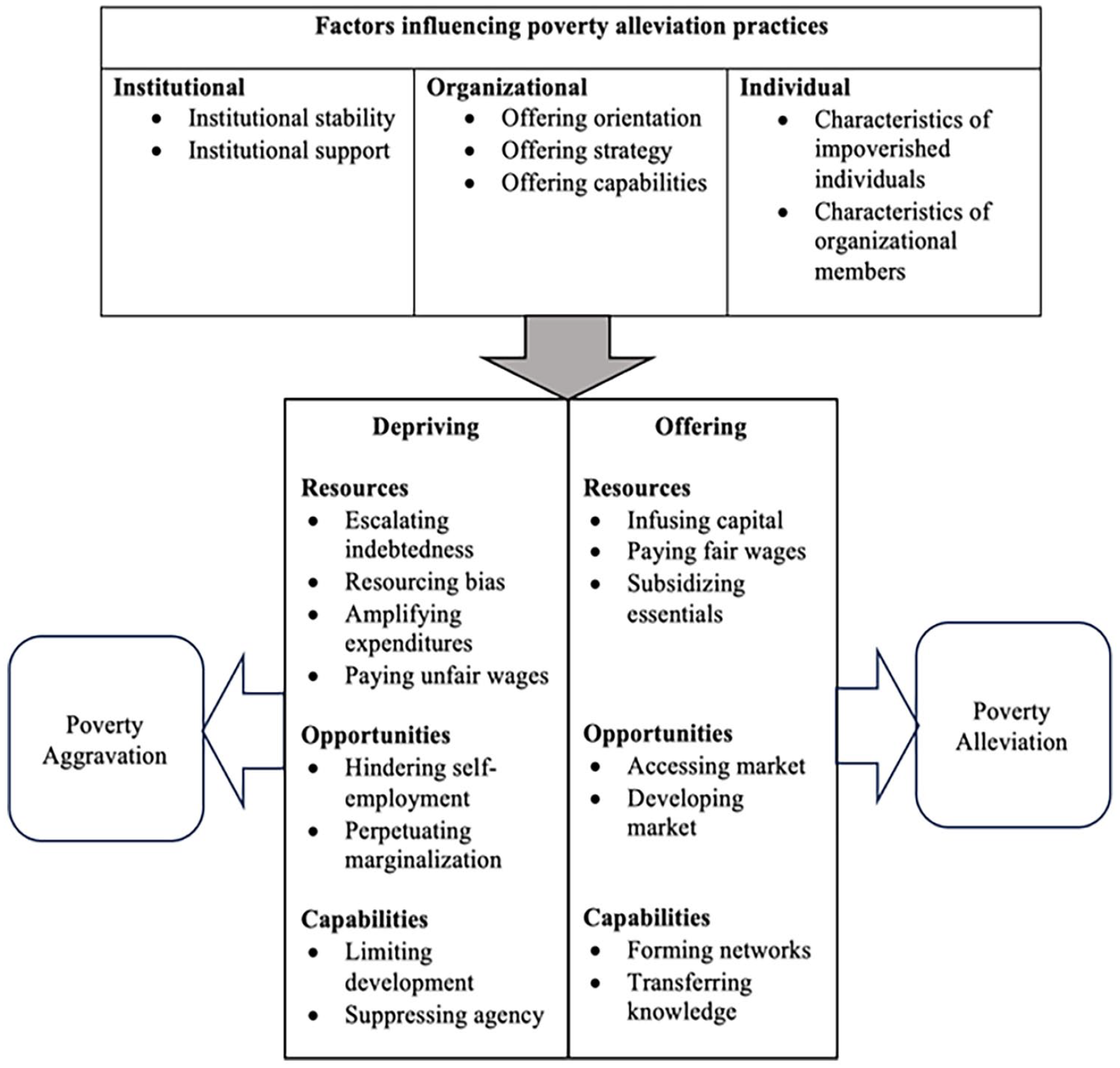
Organizational Engagement with Poverty
Organizational Practices That Alleviate Poverty
To combat poverty, organizations offer a blend of market-oriented resources, capabilities, and opportunities to enhance market participation for the impoverished.
Resource offering
Organizations play a crucial role in supporting the market participation of the poor by offering market-oriented resources in three forms: infusing capital, paying fair wages, and subsidizing essentials.
Microfinance—small, low-interest loans primarily aimed at the unbanked in developing nations—stands out as the primary form of capital infusion studied in the literature (Beisland, Djan, Mersland, & Randøy, 2021; Bruton, Khavul, & Chavez, 2011; Galak, Small, & Stephen, 2011; Sun & Im, 2015). The purpose of micro-finance is twofold: to kickstart small businesses (Bruhn & Love, 2014; Cobb, Wry, & Zhao, 2016), and to facilitate the acquisition of assets like land and livestock (Mair & Marti, 2009). While some organizations directly lend money, other organizations support the market participation of the poor by bridging the gap between lenders and borrowers, acting as financial intermediaries (Butler, Cornaggia, & Gurun, 2017). Capital infusion also takes the form of philanthropy during institutional disruptions (i.e., “the sudden and unexpected, temporary, and systemic breakdowns in market-oriented institutions”) to restore factors that are essential for the market to function (Ballesteros & Magelssen, 2022, p. 1501).
In addition to infusing capital, a few studies also demonstrate that organizations also bolster market participation by offering fair wages to employees, especially those at the bottom of the supply chain (Burchielli, Delaney, Tate, & Coventry, 2009) and small and medium enterprises (Maksimov, Wang, & Luo, 2017). Elevating worker income is a strategic move to combat poverty, with emphasis on providing more than just the minimum wage (e.g., living wage) as demonstrated by a study on the Australian Fair Wear Campaign (Burchielli et al., 2009).
However, organizational efforts to support the market participation of the poor are not limited to offering monetary provisions in the form of capital and wages. A few studies in the literature show that organizations also offer essentials for the impoverished for free or at an affordable price. This includes reducing expenditures of the poor on essentials like clean water, sanitation, stoves, and electricity (Khavul & Bruton, 2013; Pless & Appel, 2012), and modern amenities like telecommunications (Acosta, Kim, Melzer, Mendoza, & Thelen, 2011; Lashitew, Bals, & van Tulder, 2020). For example, Safaricom telecom firm expanded financial access through mobile banking innovations like M-Pesa in multiple African countries (Lashitew et al., 2020). Furthermore, organizations enhance affordability through discounts, vouchers, and bulk purchase options, reducing household costs (Noble, Lee, Zaretzki, & Autry, 2017; Orhun & Palazzolo, 2019).
Opportunity offering
Organizations play a pivotal role in enhancing the market participation of the poor by offering market-oriented opportunities in two forms: accessing market and developing market.
Market access focuses on bridging the gap between the impoverished and the formal sectors, offering both self-employment and employment avenues to boost income. This approach encompasses buying goods and services from underprivileged entrepreneurs for resale in urban/developed markets (Ramachandran, Pant, & Pani, 2012), leveraging these entrepreneurs for product distribution (Kistruck, Sutter, Lount, & Smith, 2013), integrating them into value chains (Parmigiani & Rivera-Santos, 2015; Reficco & Márquez, 2012), and amplifying labor force involvement (Cooray, Dutta, & Mallick, 2017). For instance, social ventures like Arzu in Afghanistan and Habi in the Philippines have been highlighted for procuring products such as rugs and shoes from low-income women and introducing them to developed markets (Dembek & York, 2022; Mena et al., 2010). Another exemplary initiative is by Fabindia, which integrated over 15,000 rural artisans into its supply chain, granting them ownership of production hubs and thus boosting clothing production (Sud & VanSandt, 2011).
In addition to providing market access to the poor, organizations also attempt market development, especially in contexts riddled with institutional complexities and inefficiencies. This practice revolves around reshaping market structures and legitimizing new market players, aiming to facilitate market access and participation by renegotiating prevailing social norms (Mair et al., 2012). This also extend to what McMullen (2011) termed “development entrepreneurship,” a process that seeks to dismantle the political, legal, social, and cultural barriers obstructing the impoverished from active market engagement.
Capability offering
Market-oriented capabilities that organizations offer to the economically disadvantaged take two forms: forming networks and transferring knowledge.
Networks are invaluable capabilities for impoverished entrepreneurs, offering both sustenance and growth opportunities. Studies underscore the importance of organizations in facilitating these networks, emphasizing their role in bridging gaps within impoverished communities and between impoverished communities and resource-rich networks (Alawattage, Graham, & Wickramasinghe, 2019; Ansari, Munir, & Gregg, 2012). Ansari et al. (2012) posit that these networks ensure the diffusion of new capabilities while enhancing existing capabilities required for growth. Alawattage et al.’s (2019) study on women in Sri Lankan villages illuminates this, showing that internal community networks functioned as micro-accountability systems by monitoring each other, enabling them to adhere to lending norms and thus become “bankable.”
Knowledge sharing stands as another practice in enhancing the market participation abilities of the impoverished. This is achieved predominantly through incubation and training. A singular study on business incubators in South Africa revealed that entrepreneurs, when mentored by highly skilled individuals, witnessed significant growth in both revenue and employment compared to their non-incubated counterparts (Assenova, 2020).
Training, on the other hand, has been the subject of multiple studies (Chatterjee, Shepherd, & Wincent, 2022; Tashman & Marano, 2010). The majority of these studies focused on venture creation training, encompassing both industry-specific technical training (Nelson et al., 2013) and broader entrepreneurial skills like risk management and innovative business modeling (Chakrabarty & Bass, 2015). A case in point is Pure Home Water, which not only retailed water filters but also provided training and employment prospects to the poor in Ghana, equipping them to establish their businesses in the future (Nelson et al., 2013). Additionally, organizations also tailor training programs to bridge labor market gaps, which in turn, enhance job opportunities for the impoverished. For instance, recycling firms in Kinshasa were noted for training initiatives that target young individuals and women with subsequent employment (Etambakonga & Roloff, 2020).
In summary, our review highlights that organizations adopt diverse practices to offer market-oriented resources, opportunities, and capabilities, thereby enhancing market participation for individuals living in poverty. This positive contribution has been a predominant theme in existing literature, underscoring the proactive role organizations can play in poverty alleviation. However, our review also uncovers a less frequently discussed but equally important aspect: the potential of organizational practices to aggravate poverty.
Organizational Practices That Aggravate Poverty
Organizations aggravate poverty by depriving the impoverished of market-oriented resources, capabilities, and opportunities needed for market participation.
Resource depriving
Organizations sometimes advertently or inadvertently deprive marginalized communities of essential market-oriented resources, hindering their market participation. This deprivation manifests in four primary forms: escalating indebtedness, resourcing bias, amplifying expenditures, and paying unfair wages.
Scholars highlighted that microfinance, often lauded as a tool for poverty alleviation, has its dark side. Some studies spotlight the role of microfinance institutions in exacerbating the indebtedness of the already impoverished. By levying steep interest rates on loans, these organizations, even if inadvertently, push vulnerable communities further into debt (Banerjee & Jackson, 2017; Hudon & Sandberg, 2013). An example comes from rural Bangladesh, where microfinance was found to intensify the economic, social, and environmental vulnerabilities of impoverished communities (Banerjee & Jackson, 2017).
Organizational resourcing biases lead to the exclusion of certain segments of the impoverished population. Ballesteros and Magelssen (2022) highlight that, on a macro scale, organizations tend to allocate resources (e.g., aid or donation) preferentially to countries that hold greater economic significance to their interests. This means that the impoverished in some countries are left out even during major economic shocks due to epidemics, terrorist attacks, and natural disasters. At a micro-level, Galak et al.’s (2011) study on microfinance reveals a tendency for managers to favor individuals who share similarities with them in aspects such as gender, occupation, and even the initial of their first names, thereby sidelining those who do not fit these criteria.
In the realm of employment, organizations sometimes resort to offering unfair wages as a cost-cutting measure (Alamgir & Cairns, 2015; Etambakonga & Roloff, 2020; Joseph, Katsos, & Daher, 2021). Tactics include employing individuals on short-term contracts (Etambakonga & Roloff, 2020) or temporary home-based work (Alamgir & Cairns, 2015), which, while providing immediate cash flow, often deny long-term security and benefits for workers. The plight of vulnerable individuals stands out in this context. For example, Joseph et al. (2021) illustrated that businesses exploit the vulnerability of refugees by offering subpar wages and undesirable working conditions. Similarly, Khan, Munir, and Willmott (2007) highlighted how the world’s largest soccer ball manufacturing cluster in Pakistan had a long-standing practice of child labor to keep wages low.
Lastly, organizations increase the financial burden on the impoverished through pricing strategies. Overpricing in impoverished areas (Huang, 2005; Jacob, Vieites, Goldszmidt, & Andrade, 2022; Talukdar, 2008), and neglecting these markets altogether (Hill, 2002; Leisinger, 2005) are common practices that increase the financial burden on the poor. Talukdar’s (2008) research reveals that retail prices in impoverished regions were consistently higher than in more affluent areas, even after accounting for factors like store size and competition. Leisinger (2005) further critiques large corporations, like those in the pharmaceutical sector, for overlooking impoverished markets, arguing that they lack the mandate or the means to act with social responsibility.
Opportunity depriving
Research shows that organizations deprive the impoverished of market-oriented opportunities in two ways: hindering self-employment and perpetuating marginalization.
Self-employment opportunities for the underprivileged are obstructed by organizations in various ways. These include perpetuating economic disparities by favoring resource-rich entrepreneurs and side-lining those with fewer resources (Chatterjee, 2016; Granados, Rosli, & Gotsi, 2022). For instance, Chatterjee (2016) argues that Base of the Pyramid (BoP) projects often overlook the inherent inequalities of capitalism, inadvertently maintaining the status quo and further sidelining the impoverished. Indirectly, organizations obstruct self-employment by pursuing natural resource-seeking investments, such as land acquisition, that potentially harm natural ecosystems, thereby impeding subsistence farming (Brandl, Moore, Meyer, & Doh, 2022) or by influencing state investments to divert resources away from infrastructure crucial for market participation (Yamin & Sinkovics, 2009).
Beyond self-employment barriers, organizations also marginalize the impoverished by silencing their voices. This manifests in various ways, such as denying them platforms to address workplace concerns (Arnold, 2013; Berkey, 2021) or excluding them from interventions designed for their benefit (Boersma, 2009). Boersma’s (2009) analysis of Fair Trade exemplifies this dynamic and highlights that the decision-making power in poverty alleviation initiatives is predominantly held by organizations in the Global North. In contrast, impoverished farmers of the Global South—the presumed beneficiaries of these initiatives—often have minimal influence or voice in the process.
Capability depriving
Organizations deprive the impoverished of market-oriented capabilities in two forms: limiting development and suppressing agency.
Research demonstrates that organizations limit the capability development of the poor by restricting their access to fundamental needs like nutritious food (Elmes, 2018), withholding training and vital entitlements like social security (Alamgir & Cairns, 2015), and undermining social capital (Banerjee & Jackson, 2017). Elmes (2018) offers an illustration, highlighting how certain segments of the U.S. population grapple with food insecurity and obesity because of the fast-food industry’s market practices. Consuming unhealthy food out of sheer necessity, these individuals experience a diminished “equality of capabilities,” (Elmes, 2018, p. 1045) hindering their active and meaningful participation in the market.
In addition, organizations deprive the capabilities of the impoverished by suppressing the agency required to transform the skills and knowledge into improvements in life (Chatterjee, 2020; Vestergaard, Murphy, Morsing, & Langevang, 2020) or for mobilization against exploitation (Zulfiqar & Khan, 2020). Chatterjee (2020: 394), based on her research in India, argues that the BoP business model takes away impoverished women’s agency by valorizing their “emotions, feelings, affinities, and sensibilities over contractual relations [which] recasts poor third world writies within collectivist contextsomen as irrational beings driven not by reason but passion—a move that is reminiscent of Orientalizing discourses that fixed ‘the native’ as the other of the enlightened rational (western) self. . . . As a consequence, the BOP proposition paradoxically (and, perhaps unknowingly) ends up excluding poor third-world women in the very act of their inclusion.”
In summary, our review demonstrates that organizations exacerbate poverty by depriving impoverished communities of essential market-oriented resources, opportunities, and capabilities. This aspect, often overlooked in mainstream discussions, is critical for a comprehensive understanding of the role organizations play in socio-economic landscapes, as well as helping to improve the effectiveness of organizational poverty alleviation efforts, which we discuss next.
Factors Influencing Poverty Alleviation Through Market Participation
Our review revealed many factors at the institutional, organizational, and individual levels that influence the effectiveness of organizational efforts to alleviate poverty through market participation.
Institutional Level
To effectively combat poverty through market participation, organizations require a conducive environment shaped by institutional stability and support. The literature delved into these conditions, spotlighting both broad institutional factors (e.g., institutional stability) and specific societal and state-related nuances (e.g., regulations and inequalities).
Institutional stability
Organizational poverty alleviation efforts generally thrive in complex institutional settings (Chliova, Brinckmann, & Rosenbusch, 2015); however, the stability of institutions in such settings is important for their effectiveness (Cobb et al., 2016). Cobb et al. (2016) show that, in unstable institutional contexts, only large microfinance organizations garner support from funders. This is because funders aim to mitigate risks and earmark funds for future endeavors, banking on capital recovery which may be jeopardized in volatile environments. Related research on microfinance lenders across 123 countries further elucidates this, revealing that in nations with unstable state institutions, lenders often pivot towards wealthier clients, as serving the impoverished becomes financially taxing (Ault, 2016). This trend is notably more pronounced among for-profit microfinance entities compared to their non-profit counterparts (Ault & Spicer, 2014).
Institutional support
Institutional support encompasses backing both organizations spearheading poverty alleviation and the impoverished themselves. At its core, formal institutional recognition, such as providing proof of identity, significantly bolsters organizational efforts to enable market participation (Sud & VanSandt, 2015). Additionally, infrastructure, food, and healthcare support from formal institutions further empower the impoverished to engage actively in the market (Aiyar & Venugopal, 2020; Alsmadi & Alnawas, 2019). Regulatory backing is also essential, especially to shield the impoverished from illegitimate and influential entities that might impede their market participation (Granados et al., 2022; Sutter, Webb, Kistruck, & Bailey, 2013). Granados et al.’s (2022) study highlights the challenges posed by powerful actors such as local authorities, private firms, and media when waste pickers in Colombia sought market inclusion. These actors “mobilized overt power mechanisms such as de-legitimizing (through mythologizing and demonizing) and deterring (by barring access to waste) and covert power mechanisms, such as manipulating (through empty promising, dividing and conquering, reinterpreting the law, enabling, and silencing) and abstaining (neglecting and omitting the duty to protect, turning a blind eye, not complying, and remaining silent)” to thwart the market participation of the waste pickers (Granados et al., 2022, p. 2). In such scenarios, robust regulatory support, whether sourced from local frameworks or international agreements, is invaluable (e.g., see Riisgaard’s (2005) examination of the banana supply chain).
In addition to formal institutions, informal institutional support matters for organizational poverty alleviation efforts to be effective. Societal inequalities and inter-group differences rooted in, for example, race, gender, and caste, stymie organizational poverty alleviation efforts (Bhatt, Qureshi, & Sutter, 2022; Packard & Bylund, 2018). For instance, Bhatt et al.’s (2022) research indicate that pronounced gender and caste-based disparities hinder organizational poverty alleviation endeavors. So, a collectivist institutional context, offering community safety nets and rich social capital, is thus essential for the impoverished to navigate the challenges (Ring et al., 2010; Sodhi & Tang, 2014). Such an environment bolsters self-perception and fosters the emergence of “known strangers”—a network that provides resources and emotional support, enabling low-power actors to transcend institutional barriers and champion social change (Martin de Holan, Willi, & Fernández, 2019). Nevertheless, there can also be group-based disparities within collectivist contexts requiring conscious navigation (Bhatt et al., 2022).
Organizational Level
The quest to mitigate poverty through market participation necessitates a multifaceted array of organizational conditions, encapsulated within the realms of offering orientation, offering strategy, and offering capability.
Organizational offering orientation
The literature delineates that the orientation organizations adopt critically shapes their poverty alleviation efforts. Predominantly, three orientations surface in the literature: community, stakeholder, and ethics. The community-oriented approach underscores the significance of tailoring efforts to community strengths, leading to sustainable product and business models, judicious investor selection, long-term growth strategies, and mechanisms for community value capture (Chmielewski, Dembek, & Beckett, 2020; Mende, Salisbury, Nenkov, & Scott, 2020; Venkataraman et al., 2016). It involves an amalgamation of business and community-centric strategies, finely tuned to each community (Beckett, Chmielewski, & Dembek, 2022) that lead to the development of new social structures such as self-help groups instrumental for poverty alleviation (Venkataraman et al., 2016).
Parallel to this, the stakeholder-oriented approach emphasizes the importance of stakeholder engagement in enhancing poverty alleviation outcomes (Bailey & Lumpkin, 2023; Kouamé, Hafsi, Oliver, & Langley, 2022; Pongeluppe, 2022). Kouamé et al. (2022) reveal that organizations employing this approach partake in emotional resonance work, fostering stakeholder involvement through shared concerns and collaborative purpose-building. Pongeluppe’s (2022) examination of e-commerce firms illustrates that those with a stakeholder focus invest more in initiatives that improve access for impoverished communities.
Ethics-oriented approaches draw from diverse philosophical doctrines—Catholic teachings (Santos & Laczniak, 2009), the Vincentian perspective (Miles, Verreynne, & Luke, 2014; Tavanti, 2013), and virtue ethics (Chakrabarty & Bass, 2015). Tavanti (2013), for instance, illustrates that a Vincentian approach to microfinance makes microfinance organizations foster economic self-reliance, social capital, and empowerment across individual, collective, and systemic levels.
Organizational offering strategy
Organizations employ diverse strategies to craft and execute their poverty alleviation initiatives, with the chosen strategy significantly shaping the outcomes of these efforts. Research has identified several strategic approaches that bolster organizational efforts in poverty alleviation through market participation: localization, structural transformation, multi-stakeholder collaboration, and social evaluation.
Localization entails integrating initiatives within the local cultural fabric (Peredo & McLean, 2013) and leveraging indigenous knowledge systems instead of transplanting Western paradigms (Bardy et al., 2012; Hahn, 2009). Evidence suggests that localization fosters trust and reciprocity, mitigates information gaps, and alleviates uncertainties, particularly in contexts with institutional voids (Khavul & Bruton, 2013; Lashitew et al., 2020). Khavul and Bruton (2013) underscore the dividends of a profound understanding of local consumers, acknowledging the interconnected nature of local adoption processes, and investing in local ecosystems for both innovators and their impoverished clientele. Studies show that achieving localization demands the use of identity-based mechanisms, engaging local participants (Kistruck et al., 2013), or employing boundary spanners who facilitate the organization’s navigation of challenges and foster a conducive environment for action and learning within the community (Qureshi, Sutter, & Bhatt, 2018).
Another strategic imperative is structural transformation, which is crucial in institutionally complex settings for poverty alleviation (Bardy et al., 2012; Parmigiani & Rivera-Santos, 2015). This transformation may entail the dismantling of harmful structures, such as criminal networks and illegitimate institutions (Sutter et al., 2013), as well as establishing new, beneficial structures like voluntary engagement rules (Bardy et al., 2012). Venugopal and Viswanathan (2019) delineate a pathway for structural transformation that includes legitimizing within local communities, disrupting local institutional barriers, reimagining institutional norms, and resourcing the change process.
Localization and structural transformation cannot be accomplished by the organizations alone. Collaboration with a spectrum of stakeholders is vital, particularly when organizations lack the inherent capabilities for poverty alleviation. Government and civil society organizations, for instance, extend the reach of initiatives, enhance local capacities, tailor products to needs, and reduce transaction costs by engaging closely with impoverished communities (Lawson-Lartego & Mathiassen, 2021; Schuster & Holtbrügge, 2014; Sun & Im, 2015). Especially, government partnerships provide additional benefits, such as cost recovery, subsidies, and market exclusivity, as seen with organizations that received support from India’s Universal Service Obligation Fund (VanSandt & Sud, 2012).
Finally, the evaluation frameworks that organizations employ to assess their offering strategy are pivotal. While an overemphasis on financial metrics causes a mission drift from poverty alleviation (Kent & Dacin, 2013), incorporating social indicators enhances financial performance, expands outreach, clarifies social objectives, boosts staff commitment, and elevates service quality and customer satisfaction (Beisland et al., 2021).
Organizational offering capability
Organizations aiming to mitigate poverty through market participation must possess certain specialized capabilities, as underscored by a limited but insightful body of research. These capabilities include dynamic capability (Tashman & Marano, 2010), organizational reflexivity (van Wijk, van Wijk, Drost, & Stam, 2020), framing and communication capabilities (Bradley, Mcmullen, Artz, & Simiyu, 2012), and monitoring systems (Rein & Stott, 2009), each playing a distinct role in the effectiveness of poverty alleviation initiatives. Dynamic capabilities refer to an organization’s ability to systematically evolve and reconfigure its resources and operations in response to rapidly changing environments (Teece, Pisano, & Shuen, 1997). This ability is crucial for organizations to remain effective and responsive to the shifting landscapes of poverty (Tashman & Marano, 2010).
Organizational reflexivity, explored by van Wijk et al. (2020), involves an organization’s capability for self-examination and learning, understanding the nuanced interactions between their interventions and the local context. They argue that reflexivity is not merely beneficial but essential for crafting interventions, thereby maximizing their impact on poverty alleviation.
Studies on framing reveal the impact of how poverty is perceived—whether as innovation or resource deprivation (Bradley et al., 2012)—and how communication strategies are employed on the effectiveness of alleviation efforts (Durand & Huysentruyt, 2022). Bradley et al. (2012) suggest that framing poverty as innovation deprivation garners more effective responses than viewing it as mere resource scarcity. Durand and Huysentruyt (2022) indicate that simplicity and empathy in communication framing, as opposed to a charity-centric framing, significantly boost beneficiary enrolment in poverty alleviation programs.
Monitoring capability, as highlighted by Rein and Stott (2009), is another critical organizational capability. It enables continuous oversight and assessment of poverty alleviation efforts, ensuring that initiatives remain on track and are adjusted as necessary to meet their objectives effectively.
Individual Level
A subset of studies has delved into individual-level factors that influence market participation. We organize these factors in two categories: those concerning impoverished individuals and those related to organizational members.
Characteristics of impoverished individuals
Regarding impoverished individuals, extant research underscores several determinants influencing their market participation: psychological factors, capabilities, past experiences, and social structures. Psychologically, the emphasis is on individuals’ perceptions and beliefs about institutional support (Baron et al., 2018) and about entrepreneurship (Tobias, Mair, & Barbosa-Leiker, 2013). Shepherd, Parida, and Wincent’s (2021) study on impoverished Indian entrepreneurs reveals that their entrepreneurial pursuits are often driven by a desire to uplift their children’s education and, by extension, their family’s socio-economic status, rather than a broader ambition to reform institutions. Kimmitt, Muñoz, and Newbery (2020) resonate similar thoughts, wherein in the context of Kenya, they find that future prosperity expectations around family and children drive the actions of farm-based entrepreneurs.
Capability-wise, Bao, Ni, and Singh (2018) suggest that impoverished individuals’ loan repayment capacities improve with alternative financial options. Experience-wise, the focus narrows down to childhood encounters with poverty (Whelan & Hingston, 2018; Zhang, Wang, & Jia, 2022). Such early-life experiences impact market participation detrimentally, as evidenced by Whelan and Hingston’s (2018) study on product engagement and Zhang et al. (2022) study on risk-taking behavior. Whelan and Hingston (2018) show that everyday brands threaten the self-esteem of those with experiences of childhood poverty more than luxury brands do because everyday brands represent the material norm that is difficult for them to achieve.
Furthermore, an individual’s social structure, encompassing family support (Chatterjee et al., 2022; Kimmitt et al., 2020), family and community social networks (Venkatesh, Shaw, Sykes, Wamba, & Macharia, 2017), community backing (George, Kotha, Parikh, Alnuaimi, & Bahaj, 2016), and household diversity (Gras & Nason, 2015), plays a pivotal role. While family and community generally bolster market participation, Gras and Nason (2015) offer a nuanced perspective, suggesting that a moderate diversity within impoverished entrepreneurial families—spanning business expertise, education, age, and gender—enhances performance. However, overlapping industry experiences might curtail growth opportunities by restricting the knowledge acquisition required for expansion.
Characteristics of organizational members
Shifting the lens to organizational members engaged with poverty alleviation, the focus is predominantly on leaders (Thorgren & Omorede, 2018; Wanasika, Howell, Littrell, & Dorfman, 2011) and loan officers (Doering & Wry, 2022). Leadership traits such as culturally embeddedness (Wanasika et al., 2011), social responsibility (Maak & Stoetter, 2012), and being driven by passion (Thorgren & Omorede, 2018) bolster poverty alleviation endeavors. For instance, Wanasika et al.’s (2011) study on Sub-Saharan Africa accentuates the importance of Ubuntu-based leadership characteristics (e.g., collectivism) in navigating local challenges, while Thorgren and Omorede (2018) underscore the role of a leader’s passion in engendering trust in the leader and the mission of the enterprise. Regarding loan officers, prior research explores their interest in engagement with the impoverished. Doering and Wry (2022) reveal a higher attrition rate among loan officers dealing extensively with impoverished clients, especially in for-profit entities. Moreover, Beisland, D’Espallier, and Mersland (2019) observe that seasoned loan officers often overlook vulnerable clients more than their less-experienced counterparts.
In summary, our review reveals that a variety of factors at the institutional, organizational, and individual levels impact organizational practices that alleviate poverty. Understanding these influencing factors is crucial for policymakers, managers, and other key stakeholders so that they can foster an environment that is supportive of and conducive to organizational efforts that reduce poverty. Further, this knowledge is essential for creating strategies and policies that effectively encourage and facilitate poverty alleviation initiatives within organizations.
Advancing Research on Organizational Engagement with Poverty
Our review has revealed a diverse range of opportunities for advancing research in the domain of organizational engagement with poverty, both in terms of alleviation and aggravation. This advancement involves an examination of the relationship between market-oriented resources, opportunities, and capabilities as well as the practices by which organizations offer or deprive market-oriented resources, opportunities, and capabilities and their multi-level influencing factors. However, to comprehensively elevate research in this area, it is vital to explore topics across different organizational layers: internally within organizations (intra-organizational), among different organizations (inter-organizational), and extending beyond organizational limits (extra-organizational). Adopting such a multifaceted approach will unveil a spectrum of research possibilities that remain largely unexplored, offering potential for advancing the field. This is because addressing poverty, which is a systemic problem, requires the involvement and contributions of the various actors involved across levels.
Intra-Organizational Level
A fertile ground for future scholarly inquiry exists in the realm of intra-organizational research. The review has demonstrated that a specific focus on organizational dynamics, groups, and individuals within organizations is needed to deepen our understanding of organizational engagement with poverty from an intra-organizational level.
Organizational dynamics
A critical area for future research lies in dissecting the factors that shape organizational activities in the context of poverty. Researchers can delve deeper into the specific orientations, strategies, and capabilities that enable organizations to effectively engage in offering or depriving resources, opportunities, and capabilities. While our review offers some insights into the organizational orientation, strategies, and capabilities (e.g., Pongeluppe, 2022; Poruthiyil, 2013), no research, to our knowledge, examines their development and sustenance. Future research can explore specific aspects of organizational structure and culture that influence the development of particular organizational orientations, strategies, and capabilities supporting offering or depriving practices. This exploration could extend to various organizational forms, including the unique dynamics in family-owned and small businesses (e.g., by building on works such as Kimmitt et al., 2020), particularly in terms of family involvement in the development and implementation of these orientations, strategies, and capabilities.
Another potentially important line is the evaluation and monitoring of organizational practices (e.g., Kistruck et al., 2013; Rein & Stott, 2009), especially considering the potential for organizations to (un)intentionally harm impoverished communities by depriving them of market-oriented resources, opportunities, and capabilities. Such studies could focus on the evaluation and monitoring processes and accountability structures within organizations (e.g., inclusive service climate, Meshram & Venkatraman, 2022) and could provide insights into how organizations can be steered toward more ethical and effective engagement with poverty alleviation.
Groups within organizations
Research on the dynamics of groups or teams involved in the process and practices of poverty engagement is surprisingly scant (e.g., Castellanza (2022) being one of the exceptions). Understanding how decisions are made within these groups, and the interplay of different team dynamics is needed to develop a robust understanding of organizational engagement with poverty. For instance, in a large organization, the relationship between sustainability or social responsibility teams and others can be complex, with potential conflicts and a lack of synergies that significantly impact strategy development and implementation (Risi & Wickert, 2017; Soderstrom & Weber, 2020). Investigating these dynamics can provide valuable insights into how organizational strategies are shaped and executed with respect to offering or depriving resources, opportunities, and capabilities.
Individuals within organizations
There is a vast unexplored territory in the study of individuals within organizations when it comes to engagement with poverty. While some focus has been placed on leadership traits and the characteristics of specific roles like loan officers (Doering & Wry, 2022; Maak & Stoetter, 2012), there is a broader spectrum of individuals and attributes that merit attention. This includes the ideologies, psychological traits, and demographics of those leading organizations or representing organizations on the ground. Additionally, research into the characteristics of individuals who directly engage with impoverished communities is crucial. Understanding which individual qualities contribute to more effective engagement with the impoverished could help organizations identify such members to lead their engagement with poverty alleviation, and thus, significantly enhance organizational impact in this area.
Inter-Organizational Level
At the inter-organizational level, the literature on engagement with poverty is sparse. There are emerging opportunities for studies on for-profit, non-profit, and public-sector organizations.
For-profit organizations
While there exists some exploration of how for-profit organizations collaborate through partnerships and the impact of these collaborations on engagement with poverty (Calton et al., 2013; Jha, Pinsonneault, & Dubé, 2016; Vestergaard, Murphy, Morsing, & Langevang, 2020), it is still a largely unexplored area. Research should delve into the initiation, maintenance, and dissolution of these alliances, particularly in the context of poverty alleviation. Specifically, research can explore what motivates organizations to form partnerships aimed at addressing poverty, how these partnerships are structured and managed to maximize their impact on poverty, and what factors lead to the success or failure of these partnerships in terms of their poverty alleviation goals. Additionally, understanding how these partnerships influence the distribution or deprivation of resources, capabilities, and opportunities is crucial.
In the realm of supply chains, research should focus on how these relationships impact the availability and quality of resources, capabilities, and opportunities, especially in impoverished communities. This includes examining the ethical and social responsibilities of supply chain management, the impact of supply chain practices on local economies and communities (e.g., Soundararajan, Wilhelm, & Crane (2021), and the role of supply chains in either perpetuating or alleviating poverty. Understanding the power dynamics within supply chains, such as the influence of larger corporations over smaller suppliers (e.g., Wilhelm, Blome, Bhakoo, & Paulraj, 2016), and how these dynamics affect the distribution of resources and opportunities is particularly important.
Non-profit organizations
The exploration of collaborations between organizations and non-profit organizations (NPOs) has predominantly focused on how these partnerships can facilitate the offering of resources, opportunities, and capabilities (e.g., Rein & Stott, 2009). However, there is a significant research gap regarding how such collaborations might also contribute to organizational practices that deprive communities of these same benefits. Future research should investigate the nature of collaborations that inadvertently or intentionally support organizational practices leading to the deprivation of resources, opportunities, and capabilities. This includes examining scenarios where a lack of effective communication and knowledge sharing between organizations and NPOs results in ineffective or counterproductive outcomes. It is important to understand the conditions under which these collaborations fail to achieve their intended social benefits or, worse, contribute to negative outcomes. Research should also explore the motivations and mechanisms through which these NPOs become involved in such practices. This includes understanding the dynamics of power and influence, ethical considerations, and the regulatory frameworks governing these collaborations. Finally, research should not only identify and analyze the problems but also propose strategies and frameworks for organizations and NPOs to mitigate the risks of deprivation practices.
Public-sector organizations
While existing literature occasionally touches upon the interactions between for-profit and public-sector organizations in the context of poverty (e.g., Acosta et al., 2011), there is a notable gap in comprehensive studies focused specifically on the dynamics of these relationships and their broader societal impacts. This gap presents a significant opportunity for future research, especially in understanding the complex interplay of synergies and tensions between the private and public sectors, and the resultant effects on societal outcomes, particularly in poverty alleviation efforts. A key area for research is the exploration of the motivations, expectations, and objectives that drive for-profit and public-sector organizations to collaborate. It is essential to delve into the reasons behind these partnerships, examining what each sector aims to achieve and how these goals align or conflict. Other research could explore the mechanisms through which public-sector organizations either facilitate or impede the efforts of for-profit entities in managing resources. This includes a thorough analysis of policy frameworks, financial incentives, regulatory environments, and collaborative initiatives. Understanding these mechanisms can shed light on how public-sector involvement influences the actions of for-profit organizations, either positively or negatively or vice versa. Given the public accountability inherent in the public sector, it is important for research to also focus on how these collaborations influence the distribution and accessibility of resources, opportunities, and capabilities, with a particular emphasis on marginalized or impoverished communities.
Extra-Organizational Level
There is extensive potential for future research around extra-organizational factors affecting organizational engagement with poverty. Organizations are deeply influenced by external elements in their efforts to combat poverty, and a thorough understanding of these influences is key to formulating effective poverty alleviation strategies.
Political settings and policies
The impact of political environments and government policies on organizational engagement with poverty is a critical area of study (Ault, 2016). Future research should focus on how changes in policy, political stability or instability, and government initiatives influence the ways organizations provide resources, opportunities, and capabilities. This research should also delve into how organizations adapt to and navigate varying regulatory environments or collaborate with governments 4 to leverage political support or overcome political barriers in their poverty alleviation practices. Additionally, understanding the relationship between political environments and organizational practices of depriving resources is equally important.
Cultural norms and values
Cultural factors have a profound impact on organizational behaviors and strategies (Peredo & McLean, 2013; Van de Vliert, 2003), especially in the context of poverty. While there has been research on culture-oriented gender dynamics in organizational engagement with poverty (e.g., London et al., 2014), there is a need to explore other cultural norms and values across different regions. Building on cross-country social entrepreneurship research (e.g., Sahasranamam, Nandakumar, Pereira, & Temouri, 2021), future studies could investigate the impact of societal attitudes towards poverty, the influence of local customs, and the role of cultural expectations in shaping how organizations engage with poverty. This includes an understanding of how cultural nuances influence both the provision and deprivation of resources, capabilities, and opportunities by organizations.
Technological advancements
The role of technology, including platforms like crowdfunding and digital ecosystems (e.g., Figueroa-Armijos, & Berns, 2022), in organizational engagement with poverty has been of rising interest, particularly within Information Systems research. However, with the rapid evolution of technology, particularly in areas like AI and robotics, there is a need for more focused research at the intersection of technological progress and poverty (e.g., Tang, 2022). Future studies can examine how technological innovations enable organizations to better identify, reach, and support impoverished communities. This includes understanding the challenges and opportunities presented by the digital divide, especially how it affects organizational efforts in offering or depriving resources, opportunities, and capabilities.
Impact of crises
Crises such as natural disasters, pandemics, climate change, and conflicts pose unique challenges to organizations involved in poverty alleviation (George, Howard-Grenville, et al., 2016). Future research could explore how these crises impact organizational capacity and strategies, examining how organizations adapt to rapidly changing needs. This includes understanding how organizations can leverage crises as opportunities for innovation (e.g., Sahasranamam & Soundararajan, 2022) in their poverty alleviation approaches. The research should also consider the long-term effects of these crises on organizational strategies and the sustainability of their poverty alleviation efforts. Finally, research should also focus on how organizations per se contribute to the crises that adversely affect the poor.
In summary, there is a significant need and opportunity for multi-level research to understand organizational engagement with poverty. This approach opens the door for conducting context-specific research, allowing for a deeper understanding of how different environments and circumstances affect the efficacy of poverty alleviation strategies. Such research is not only crucial for academic advancement but also has the potential to inform and transform real-world practices and policies. In the following section, we delve into the importance and implications of this context-specific research on poverty.
Context and Methods
Our review uncovers numerous opportunities for advancing research, particularly in terms of contextual focus and methodological approaches. These opportunities include exploring poverty across diverse economic settings and through a post-colonial lens, ensuring research aligns with local priorities, addressing issues of disenfranchisement in the context, employing bottom-up methodologies, and incorporating longitudinal analysis.
Poverty in different economies
The majority of the literature we reviewed, where the context was explicitly mentioned, used some data from a developing country or low- and middle-income context in the world. Research on such contexts is valuable because extreme poverty threatens the well-being of hundreds of millions of people in these regions. In comparison, only around 20% of the literature exclusively focused on high-income economies, even though, poverty exists in them. For instance, successive United Nations special rapporteurs on extreme poverty and human rights have found the “systematic immiseration” 5 of UK people, which is “in violation of international law over poverty levels.” 6 Similarly, in 2022, the US saw one of its largest one-year increases in the poverty rate from 7.4% in 2021 to 12.4% in 2022, with child poverty doubling in the same period. 7 So, there is a need for research on organizational engagement with poverty in high-income countries. There is also a need for cross-country comparative research on organizational engagement with poverty in different types of economies and to measure the outcomes to establish what measures work better in what contexts and why.
Further, much of the research on poverty is situated in post-colonial contexts and, as such, post-colonial theory (Fanon, 1961; Said, 1978), is of potential value to develop insights into how structural inequalities continue to shape patterns of poverty and social exclusion, and how organizations can play a role in perpetuating or challenging these inequalities. Further, it is necessary to develop and use indigenous theories to understand such challenges. By understanding the structural and historical roots of poverty (e.g., the caste system in South Asia, Alamgir, Bapuji, & Mir, 2022) we can better understand the ongoing effects of these legacies and how they continue to shape patterns of poverty today. Further, post-colonial theory as well as indigenous theories can help us to question dominant narratives about poverty, which often reinforce stereotypes and stigmatize marginalized communities (Wadhwani, 2018). By challenging these narratives, we can create space for alternative perspectives and voices, and work towards more inclusive and equitable approaches to poverty alleviation.
Alignment with state priorities
Various local institutions are engaged in poverty alleviation efforts by offering resources, opportunities, or capabilities. While such institutional efforts are highlighted in the studies we reviewed (e.g., Aiyar & Venugopal, 2020; Alsmadi & Alnawas, 2019), organizational research often focuses predominantly on organizational efforts and ignores the wider context of what efforts are made simultaneously by other parties, most notably the relevant government, and how they are related to organizational efforts. Deeper engagement with poverty and the broader contexts in which it is found might yield a better understanding of how complementary or conflicting approaches can enhance or impede one another. Future studies should address the impacts of organizational efforts on poverty in the context of national and/or regional government priorities and policies and the extent to which such policies augment alleviation efforts or further aggravate them.
Disenfranchisement
While poverty is itself a form of disenfranchisement, the contexts in which much of the organizational research has been conducted approach further marginalizing factors that intersect with poverty only fleetingly. Gender is one such area that has received attention, but research on the intersection between poverty and localized disenfranchisement based on caste, race, and ethnicity, for example, has received much less explicit attention from management scholars. In the context of South Asia, for example, caste often acts invisibly to limit resources, opportunities, and capabilities for those placed at the lower rungs of the caste hierarchy (Bapuji, Gupta, Chrispal, & Roulet, 2023). However, how caste influences poverty has rarely been considered in the research on poverty (e.g., please see Bhatt et al., 2022 and Qureshi et al., 2018 for exceptions). More broadly, it will also be useful to consider the intersection of poverty with inequalities based on invisible attributes besides caste, such as social class, neuroatypicality, and sexual orientation (Bapuji, Ertug, Soundararajan, & Shaw, 2023). Further, it will be useful to examine the mechanisms (e.g., social capital, Soundararajan, Sharma, & Bapuji, 2023) that drive such inequalities and trap people in poverty.
Bottom-up methodological approaches
To date, research has predominantly employed top-down methodologies, spearheaded by scholars. This approach, however, overlooks the potential of bottom-up strategies that engage individuals living in poverty as researchers themselves. Such individuals are often the focus of existing studies, yet their perspectives and insights remain underutilized. Future research should prioritize collaboration with impoverished communities to gain a deeper, qualitative understanding of their experiences and the effectiveness of various poverty alleviation efforts (Bansal & Sharma, 2022). Examples of such methods include participatory action research, photovoice, auto-videography, drawings, diary method, and participatory mapping (e.g., McIntyre, 2007; Wach, Stephan, Weinberger, & Wegge, 2021; Wang & Burris, 1997). These approaches promise not only to yield rich data that sheds light on the evolving experiences of the impoverished and their response to it but also to pave the way for innovative theoretical frameworks. The theorizing process could involve following the framework of market orchestration (Kistruck & Shulist, 2021) supported by abductive experimentation (Kistruck & Slade Shantz, 2022). This could help identify bottom-up approaches that offer a greater voice to the experiences of the impoverished (e.g., Soundararajan, Sahasranamam, Khan, & Jain, 2021). By transcending traditional research methodologies and involving researchers who have first-hand experience with poverty, scholars can uncover nuanced, micro-level insights. These insights have the potential to significantly enhance both our theoretical understanding and practical approaches to addressing poverty.
Longitudinal analysis
Our review highlights a significant gap in the availability of longitudinal studies focusing on organizational engagement with poverty. Such studies are crucial for comprehending the enduring effects of organizations’ practices. Longitudinal research would offer valuable insights into the long-term consequences of these practices and how they shape the lives of those in poverty. Additionally, it would shed light on the evolving organizational and institutional dynamics that can affect these efforts and their outcomes. This approach is not only instrumental in understanding the sustained impact of organizational actions but also vital for developing process-based theories (Cloutier & Langley, 2020; Langley, 1999), offering a more nuanced and temporal perspective on how organizations interact with and influence poverty. Particularly, there is scope for the use of methodologies like difference-in-difference and randomized control trials to investigate causal inferences of organizational interventions on poverty.
Policy and Practice Implications
Our review yields several implications for policy and practice. First, it alerts policymakers and practitioners to the ways in which organizations aggravate poverty by limiting market participation. Recognizing this could spark important policy discussions and changes, encouraging a shift from practices that aggravate poverty to those that alleviate it. This shift is crucial not only for the welfare of citizens but also for progressing towards the United Nations Sustainable Development Goals. Second, our review sheds light on organizational practices in poverty alleviation through market participation, as well as the factors that support these practices. This information provides policymakers with a reference on effective strategies, assisting them in promoting and incentivizing organizational practices that contribute to poverty reduction. Similarly, managers can draw from these practices to refine their strategies toward poverty alleviation. Third, by redefining poverty through the lens of market-orientation, our review encourages policymakers to move beyond a solely income-based measurement of poverty. This broader, more integrative approach includes considering resources, opportunities, and capabilities, offering a more holistic view of poverty. In line with this, organizations could also adopt a market-oriented perspective in their impact reporting. Finally, academic groups focused on impact, such as the Responsible Research in Business and Management initiative, UNPRME, and the Behavioural Science and Policy Association, can play a pivotal role. They can encourage and assist scholars and business schools in establishing infrastructure similar to the Abdul Latif Jameel Poverty Action Lab and Social Impact Research Lab within business schools. Such infrastructure would enable collaboration among scholars from various disciplines and regions, fostering the development of effective market-participation-based practices for organizational poverty alleviation.
Conclusion
Organizational research on poverty is a growing and thriving area of study, with contributions from scholars across disciplines, including sociology, management, and economics. The increasing attention towards poverty alleviation and aggravation practices by organizations has led to the development of a body of research that is constantly expanding and evolving. Our review aims to advance poverty research for both theory and practice. By bringing together diverse insights from existing literature, we provide a comprehensive and holistic understanding of organizational engagement with poverty. This allows us to identify gaps in the existing research and highlight areas where further investigation is needed. Furthermore, our review helps to connect the different strands of research that have emerged across disciplines and fields, thereby promoting interdisciplinary dialogue and collaboration. This is essential for advancing research on poverty and enhancing our understanding of how organizations engage with poverty and its outcomes. Overall, our review contributes to the growth of organizational research on poverty and facilitates the development of theory and practice in this important and timely area.
Footnotes
Appendix A
Related Reviews
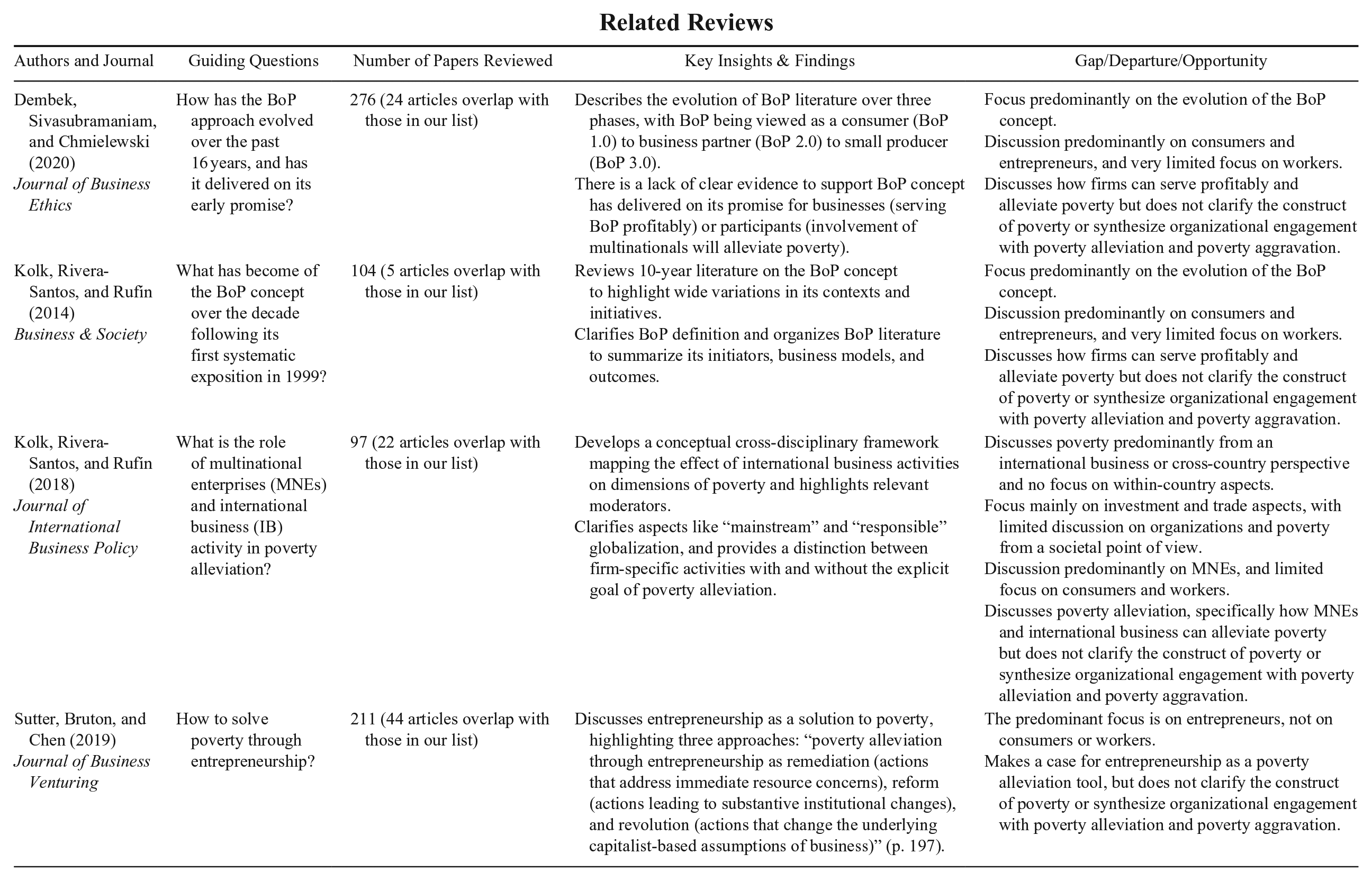
| Authors and Journal | Guiding Questions | Number of Papers Reviewed | Key Insights & Findings | Gap/Departure/Opportunity |
|---|---|---|---|---|
|
Dembek, Sivasubramaniam, and Chmielewski (2020)
Journal of Business Ethics |
How has the BoP approach evolved over the past 16 years, and has it delivered on its early promise? | 276 (24 articles overlap with those in our list) | Describes the evolution of BoP literature over three phases, with BoP being viewed as a consumer (BoP 1.0) to business partner (BoP 2.0) to small producer (BoP 3.0). There is a lack of clear evidence to support BoP concept has delivered on its promise for businesses (serving BoP profitably) or participants (involvement of multinationals will alleviate poverty). |
Focus predominantly on the evolution of the BoP concept. Discussion predominantly on consumers and entrepreneurs, and very limited focus on workers. Discusses how firms can serve profitably and alleviate poverty but does not clarify the construct of poverty or synthesize organizational engagement with poverty alleviation and poverty aggravation. |
|
Kolk, Rivera-Santos, and Rufín (2014)
Business & Society |
What has become of the BoP concept over the decade following its first systematic exposition in 1999? | 104 (5 articles overlap with those in our list) | Reviews 10-year literature on the BoP concept to highlight wide variations in its contexts and initiatives. Clarifies BoP definition and organizes BoP literature to summarize its initiators, business models, and outcomes. |
Focus predominantly on the evolution of the BoP concept. Discussion predominantly on consumers and entrepreneurs, and very limited focus on workers. Discusses how firms can serve profitably and alleviate poverty but does not clarify the construct of poverty or synthesize organizational engagement with poverty alleviation and poverty aggravation. |
|
Kolk, Rivera-Santos, and Rufín (2018)
Journal of International Business Policy |
What is the role of multinational enterprises (MNEs) and international business (IB) activity in poverty alleviation? | 97 (22 articles overlap with those in our list) | Develops a conceptual cross-disciplinary framework mapping the effect of international business activities on dimensions of poverty and highlights relevant moderators. Clarifies aspects like “mainstream” and “responsible” globalization, and provides a distinction between firm-specific activities with and without the explicit goal of poverty alleviation. |
Discusses poverty predominantly from an international business or cross-country perspective and no focus on within-country aspects. Focus mainly on investment and trade aspects, with limited discussion on organizations and poverty from a societal point of view. Discussion predominantly on MNEs, and limited focus on consumers and workers. Discusses poverty alleviation, specifically how MNEs and international business can alleviate poverty but does not clarify the construct of poverty or synthesize organizational engagement with poverty alleviation and poverty aggravation. |
|
Sutter, Bruton, and Chen (2019)
Journal of Business Venturing |
How to solve poverty through entrepreneurship? | 211 (44 articles overlap with those in our list) | Discusses entrepreneurship as a solution to poverty, highlighting three approaches: “poverty alleviation through entrepreneurship as remediation (actions that address immediate resource concerns), reform (actions leading to substantive institutional changes), and revolution (actions that change the underlying capitalist-based assumptions of business)” (p. 197). | The predominant focus is on entrepreneurs, not on consumers or workers. Makes a case for entrepreneurship as a poverty alleviation tool, but does not clarify the construct of poverty or synthesize organizational engagement with poverty alleviation and poverty aggravation. |
