



Abstract
Widespread social unrest occurred in the United States in the Summer of 2020. Citizens took to the streets to challenge the prevailing social justice framework. According to event systemstheory, these Black Lives Matter (BLM) protests were high-strength, as they represented novel, critical, and disruptive events. They were also mega-threats as they focused on threats to the social identities of the marginalized communities. Because different approaches were taken in navigating the BLM protests by authorities, it was unclear what constitutes effective leadership during these events. We integrate insights from event-oriented literature with intersectionality of gender and race research to introduce an intersectional leadership advantage (ILA). This framework suggests that Black women, owing in part to the rich tapestry of their social experiences, tend to develop a distinct leadership style characterized by sensitivity to racial injustice, leaning into risk, and commitment to the community. These qualities enable Black women leaders to be effective during events like BLM protests. Utilizing data from six public sources covering 11,540 protests across 3,338 U.S. cities from May to August 2020, we hypothesized an interaction of city police chiefs’ gender and race in relation to protest-related violence (measured in three ways). Results revealed that protests in cities with Black women police chiefs were associated with the lowest levels of violence compared to other groups. This study provides insights into qualities associated with leadership effectiveness in high-strength mega-threat events, and it connects diversity in leadership roles to favorable outcomes.
In the Summer of 2020, the United States (U.S.) witnessed significant social unrest. The Black Lives Matter (BLM) movement surged after George Floyd’s death at the hands of police on May 25, 2020. Advocating for social justice, the movement galvanized 11,540 protests in 3,338 cities, spanning 1,481 counties and all 50 states (U.S. Crisis Monitor, 2020; see Figure 1). Whereas some demonstrations were peaceful, others were not, and city leaders sought to mitigate violence on the streets (Stockman, 2020). In some communities, police engaged in dialogues with protestors; in others, they responded with force (U.S. Department of Justice, 2022a). The former approach can help foster peaceful solutions, but the latter risks inducing escalating violence (Drury & Reicher, 2009; Koerth & Lartey, 2020). The varied reactions ignited a quest for answers about the nature of effective leadership during these protests.
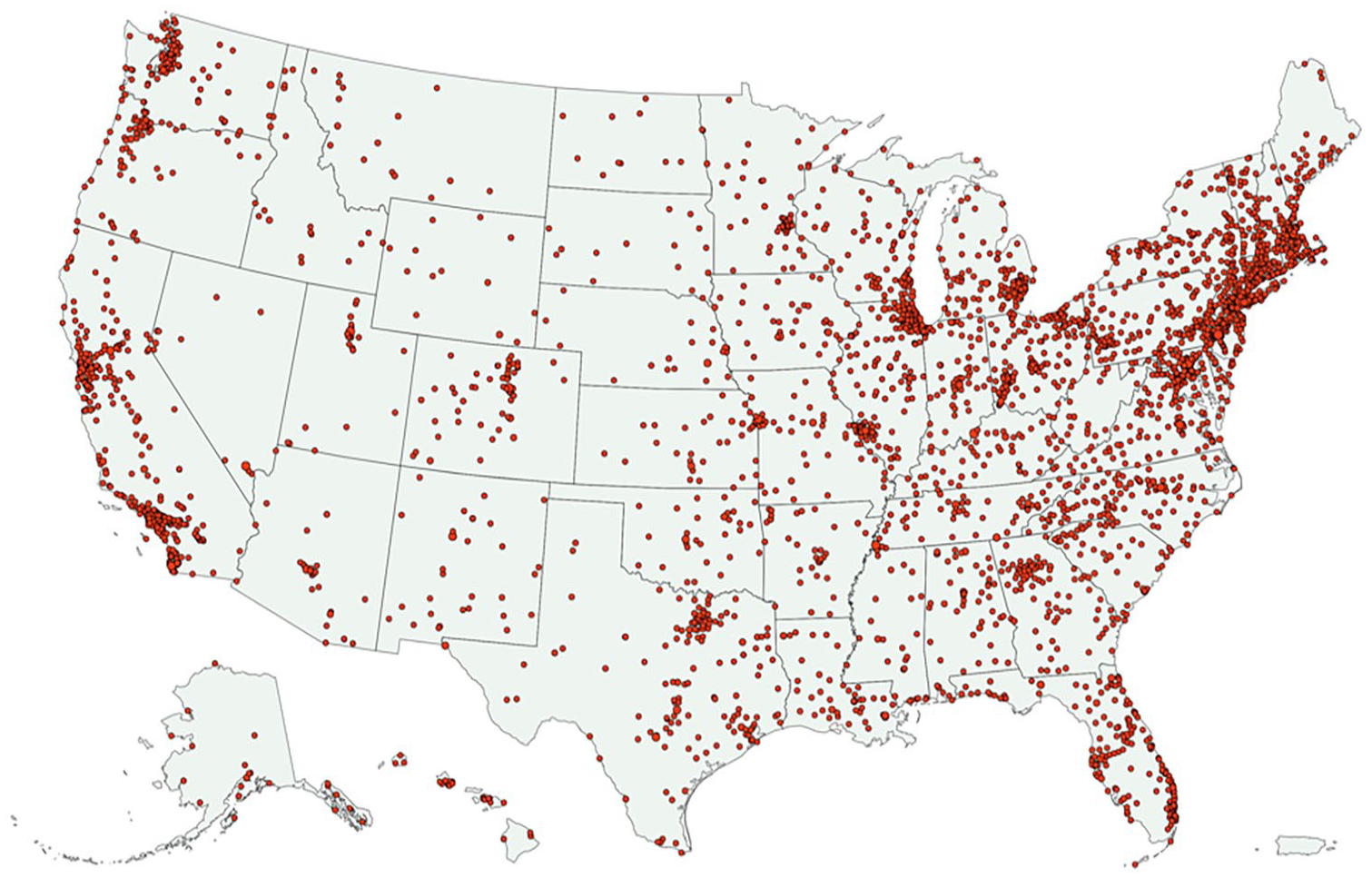
Summer 2020 Demonstrations Across the United States
Leadership, a process of motivating group action (Haslam, Reicher, & Platow, 2020), is critical in amorphous contexts in which conventional practices from more predictable times are unlikely to apply (Hannah, Uhl-Bien, Avolio, & Cavarretta, 2009). Despite a growing focus on a contextual approach to leadership (Liden & Antonakis, 2009; Oc, 2018), studying leadership effectiveness in an event context is still relatively rare because “research in organizational behavior is seldom timely enough to capture the impact of such events” (Johns, 2006: 390). We draw from event-oriented literature (Leigh & Melwani, 2019; Liu, Morgeson, Zhu, & Fan, 2023) to define the nature of BLM protest events. Then, we integrate those insights with intersectional leadership literature on gender and race (Rosette, de Leon, Koval, & Harrison, 2018) to guide our examination of leadership effectiveness during Summer 2020 BLM protests.
We focus on the BLM movement as a composite of individual protests because they were linked in time (Summer 2020) and space (U.S.), and they had the shared goal of seeking social justice. According to event system theory (EST; Morgeson, Mitchell, & Liu, 2015), the BLM protests can be classified as high-strength events because they were novel (not routine), disruptive (presented major change), and critical (demanded high attention). The novelty was high because there have not been similar events where a quest for social justice was met with a risk of death amid a pandemic (McCay & Ailworth, 2020). The events were disruptive as they were associated with violence (Stockman, 2020), and they were critical because the impact of social injustice had disproportionate consequences for minority communities (Rosenblatt, 2020).
These events necessitated leadership in real-time to tackle high-stakes problems when no prepackaged responses existed. What facilitates effective leadership during high-strength events, though, is less known (Hannah & Parry, 2014). Drawing from research on the intersection of gender and race (Livingston, Rosette, & Washington, 2012; Rosette, Koval, Ma, & Livingston, 2016), we propose an intersectional leadership advantage (ILA), such that Black women leaders will be most effective in this event context. We argue that because their journeys to the top positions are fraught with obstacles (Davis, 2016), Black women tend to form a distinct leadership style (Allen, 1997; Green & King, 2001; Parker & Ogilvie, 1996; Smith, Watkins, Ladge, & Carlton, 2019). Among other qualities, the approach of Black women leaders is characterized by sensitivity to racial injustice (Collins, 2000), leaning into risk (Morgan, 2018), and prioritization of community needs (Rogers, 2005; Rosser-Mims, 2010). We suggest that these qualities enable Black women leaders to reduce tension and mitigate conflict during the protests.
We test our hypothesis that protests in cities with Black women police chiefs will be associated with less violence using protest event analysis (PEA; Lorenzini, Kriesi, Makarov, & Wüest, 2022). PEA is a method of mapping, analyzing, and interpreting variables derived from multiple protests using content analysis of police records and news reports (Hutter, 2014; Koopmans & Rucht, 2002). PEA quantifies event activities and outcomes across locations and over time. We compiled data from six public sources into a unique set of 11,540 protests that occurred from May 25, 2020, to August 29, 2020, across 3,338 cities, 1,481 counties, and 50 states. The race and gender of city police chiefs were related to levels of violence at the events, where protests in cities with Black women police chiefs were associated with the least violence. These findings offer new insights into leadership effectiveness during high-strength events.
Literature Review and Theory Development
Events, Protests, and Social Justice
An event is a discrete, observable circumstance triggered by one or more external factors (Morgeson et al., 2015). A protest is an event in which individuals come together to challenge the polity publicly (Bearman & Everett, 1993; Oliver, Cadena-Roa, & Strawn, 2003). We define BLM protests as a cluster of related events (Morgeson et al., 2015) because these demonstrations shared time (Summer 2020), space (U.S. cities), and purpose (seeking social justice). By focusing on an event cluster, our study has the benefit of a longitudinal design from event data that unfolded over three months. Social justice, widely agreed to be a shared goal of Summer 2020 BLM protests (Bent-Goodley, St Vil, Cuevas, & Abbey, 2022), is defined as a “goal to decrease human suffering and to promote values of equality and justice” (Vasquez, 2012: 337).
Social outcomes
Although the study of protests and movements spans social science disciplines (Oliver et al., 2003), it often adopts a sociological theory lens (della Porta & Diani, 2020; Klandermans, 1984; Tarrow, 2022). This approach has delved into social dynamics between movements and counter-movements (McAdam, McCarthy, & Zald, 1996), explored how social structures mobilize people (Beissinger, 1998; McCarthy & Zald, 2001), investigated collective framing processes in public narratives (Benford & Snow, 2000), and scrutinized media biases (Earl, Martin, McCarthy, & Soule, 2004; Koopmans, 2004). These studies on social protest events provided valuable insights, but they did not connect with organizational studies, as their sociological focus was the nature of the protests themselves.
Organizational reactions
Management scholars partially bridged the gap between sociology and organizational research by shifting the focus to how organizations react to protests against them. This research investigated the impact of social movements on corporate control (Davis, McAdam, Scott, & Zald, 2005; Davis & Thompson, 1994), such as organizational structures and strategies (Rao, Morrill, & Zald, 2000; Schneiberg & Lounsbury, 2008). This research also examined the effects of protests on firm outcomes, such as concessions (Ingram, Yue, & Rao, 2010), openness to changes due to activism (Gupta & Briscoe, 2020; King, 2008), reputational threats and image management (McDonnell & King, 2013), stock fluctuations (King & Soule, 2007), and stigmatization (McDonnell & Werner, 2016). Related work examined mega-events (Tilcsik & Marquis, 2013), such as the impact of hosting the Olympics on an economic regional uplift and other macro-level outcomes (McNamara, Pazzaglia, & Sonpar, 2018).
Mega-threats
The above literature, though insightful, does not consider individual-level variables and outcomes (Morgeson et al., 2015). More recent research on mega-threats (Leigh & Melwani, 2019) has probed into links between mega-events and individuals involved in them. Mega-threats represent “negative, large-scale, diversity-related episodes that receive significant media attention” (Leigh & Melwani, 2019: 565). Negative refers both to actions associated with an event, such as mistreatment of individuals based on social identity (e.g., the 2016 Orlando Pulse gay nightclub shooting; the 2019 attack on a synagogue in Pittsburgh), and to psychosomatic impacts on members of targeted groups (Bor, Venkataramani, Williams, & Tsai, 2018).
Following Leigh and Melwani (2019: 569), we focus on “one major type of mega-threat: instances of police shootings and brutality enacted against Black men and women . . .” To date, mega-threat literature has mostly addressed spillover effects, both for organizations, such as shifts in revenue after supporting the BLM movement (Corrington, Fa-Kaji, Hebl, King, Stewart, & Alao, 2022), and for individuals, such as personal emotions and ruminations (Leigh & Melwani, 2019). We extend this research by examining qualities associated with effective leadership during BLM protests.
EST and the Nature of BLM Protests as High-Strength Events
Events vary in strength, which is a consequential distinction because leadership qualities needed during events of varying strengths differ (Liu et al., 2023). EST provides a framework for categorizing event strength in terms of novelty, disruption, and criticality (Morgeson et al., 2015). We suggest BLM protests were high-strength events (Liu et al., 2023) for these reasons.
Novelty
The protests were novel, which increases event strength due to embedded uncertainty. There have not been similar events in recent U.S. history where a public quest for social justice was met with health mandates to prevent the risk of deadly virus transmission (McCay & Ailworth, 2020). That is, social protests did not accompany the Spanish flu pandemic of 1918-1919, nor did the civil rights movement of the 1960s unfold amidst a global pandemic. The pandemic was an exogenous event that required activists to adhere to health mandates while protesting, which presented a unique constraint. It also fueled the protests because the Black community was not only disproportionally affected by police brutality (Stolberg, 2020; Taylor, 2020) but also by COVID-related lay-offs (Gezici & Ozay, 2020) and deaths (Yancy, 2020).
Disruption
The disruptive nature of an event is related to the magnitude of its consequences. In the case of the BLM protests, arson, vandalism, personal injuries, and looting caused the highest recorded damage in U.S. history from social unrest events (Deese, 2020). Disruptive events spark temporary separation from conventional thinking, feeling, and behaviors and can instigate a wide set of consequences (Leigh & Melwani, 2019; Morgeson et al., 2015).
Criticality
An event is critical if it demands significant cognitive attention. For example, during the 2020 BLM protests, calls for action to defund the police echoed across cities, and several municipalities began announcing plans to disband the police (Bates, 2021). For better or worse, this marked the first instance in the U.S. that such calls have been made by officials. This request provoked nationwide cogitations and put police chiefs in positions of leading through events where activists called for dismantling their organizations, posing threats to the future careers of both the chiefs and their officers. Under these intricate conditions, police chiefs were tasked with balancing the rights of the protestors, ensuring public safety, and addressing the needs of officers under their leadership, a process that demanded notable attentional processing.
Taken together, BLM protests during the Summer of 2020 significantly affected society. On the one hand, progress has been made since the Civil Rights Act of 1964. On the other hand, 2020 was labeled “an apocalypse” by some (Rosenblatt, 2020: 1), as the simultaneous and unplanned occurrences of protests and a deadly pandemic joined forces to deepen extant social rifts (Corrington et al., 2022; McKeever, 2021). This sparked a social justice movement. Yet, how to lead adaptively and effectively through such high-strength mega-threat events is unclear.
To understand the complex dynamics involved, we employ a multifaced conceptual perspective by approaching leadership effectiveness through an intersectional lens. Theorizing how a leader’s racial and gender identities intertwine to shape their experiences and leadership style offers insights into effective leadership during high-strength events such as BLM protests.
Intersectional Research On Leader Race and Gender
Examining the effects of intersecting marginalized identities, such as race and gender, is referred to as intersectional research (Cole, 2009; Rosette et al., 2018; Sanchez-Hucles & Davis, 2010). This research finds that race matters for women leaders (Rosette et al., 2016), as race and sex have historically interacted to spur various forms of subjugation for Black women (Collins, 2000; Davis, 1983; Giddings, 1985). Early Black feminism literature (Collins, 2000), which addressed the marginalization of Black women, referred to this demographic intersection as “multiple jeopardy” (King, 1988: 42): “Who are they? Are their experiences, expectations, and behaviors more akin to those of White women? Do their experience resemble those of Black men? Where do they fit?” (a bank CEO asked in a meeting about diversity, cited in Bell & Nkomo, 2001: 7).
These questions tend to surface when race intersects with gender. Black women are the least understood of these four categories because “the category of ‘Black female’ is not merely the additive combination of race and gender. Rather, their dual subordinate identities of being women and Black, assign Black women to a unique space” (Livingston et al., 2012: 355). Black women tend to be perceived as less visible in organizations and report finding themselves in the corporate shadows, suggesting that how they fit in is not readily apparent (Bell & Nkomo, 2001; Sanchez-Hucles & Davis, 2010). Research has also discovered “paradoxical effects of intersectionality invisibility” (Smith et al., 2019: 27), revealing both disadvantages and advantages for leaders belonging to these two stigmatized groups.
On the one hand, Black women are subordinated and marginalized across work domains (Berdahl & Moore, 2006; Holder, Jackson, & Ponterotto, 2015; Livingston & Rosette, 2020), and they face steep barriers to career progression (Cook & Glass, 2014). Black women are often denied credit for success (Bertrand & Mullainathan, 2004; Heilman, Block, & Lucas, 1992), and they are disproportionally sanctioned for mistakes. For example, when described as leading firms with shrinking profits, Black women leaders received the lowest ratings compared to White women, Black men, and White men (Rosette & Livingston, 2012). Aggravating the unfairness is research showing that Black women are effective leaders across domains (Allen, 1997; King & Ferguson, 2001; Morgan, 2018; Rosser-Mims, 2010), including in organizations (Parker, 2004; Parker & Ogilvie, 1996), academia (Green & King, 2001), and politics (Rogers, 2005).
On the other hand, research has revealed a canceling effect for Black women, such that they face fewer penalties in some instances than other groups (Smith et al., 2019). This is thought to be because Black women are not prototypical members of their racial group (as are Black men) nor their gender group (as are White women; Bell & Nkomo, 2001). Thus, their invisibility (de Leon & Rosette, 2022) places them in an auspicious space that buffers them from penalties (Biernat & Sesko, 2013). For instance, compared with Black men, Black women report experiencing fewer work hostilities (Motro, Evans, Ellis, & Benson, 2022; Purdie-Vaughns & Eibach, 2008). Similarly, Black women tend to be perceived as more agentic compared to White women (Hall, Everett, & Hamilton-Mason, 2012; Livingston et al., 2012; Rosette et al., 2016, 2018), and because of it, agentic Black women tend to receive less backlash in the workplace compared with agentic White women (Rosette et al., 2016, 2018). 1
Intersectional Leadership Advantage (ILA)
We propose an intersectional leadership advantage (ILA) such that Black women’s social experiences, behaviors, and attitudes toward their community cultivate a leadership style that is effective during high-strength events, especially when the events share a social justice mission. To assess the leadership effectiveness of Black women compared to other leaders, we examine the association of city police chief gender and race with violence at protests in their jurisdictions. The primary responsibility of a city police chief during protests is ensuring public safety, which includes preventing violence (Maguire & Oakley, 2020; U.S. Department of Justice, 2022a).
Based on the premise that “different intersectional positions may lead to significantly different experiences” (Smith et al., 2019: 5-6), we suggest that overcoming a lifetime of both racism and sexism (Berdahl & Moore, 2006; Holder et al., 2015; Livingston & Rosette, 2020; Livingston et al., 2012; Roberson, 2019; Rosette et al., 2018) imparts to many Black women a heightened sensitivity to human suffering and magnifies their attention to issues of inequality and social injustice (see also Leigh & Melwani, 2019). In the context of ongoing social unrest, Black women police chiefs are likely to grasp the etiology of issues quickly, and because they are members of two subordinate groups, they are apt to be attuned to subtle differences among the groups. Because Black women must navigate multiple layers of social identity, they are accustomed to considering multiple, diverse perspectives (Parker & Ogilvie, 1996). Familiarity with racial concerns and sensitivity to predilections enables Black women leaders to recognize and react to moments of difference (King & Ferguson, 2001; Parker, 2004). When trust is lost, as it was between protestors and police, it is critical for leaders to quickly recognize divergences, communicate, deploy resources with care, and, ultimately, prevent discord from mounting.
Further, given the perils involved with street demonstrations, effective leadership requires an ability to move forward together despite event turbulence. One recurring concept in Black feminism literature (Collins, 2000; Rosser-Mims, 2010) is shielding, suggesting that Black women leaders find ways to overcome repeated pushbacks and move forward (Morgan, 2018). Their journey to the top requires that they display resolve, quick decision-making, and flexible strategies to transform roadblocks into opportunities (Harris, 2007). Moreover, and perhaps because of it, Black women leaders are eager to demonstrate their leadership prowess by “boldly leaning into high-visibility risky assignments” and “crafting a reputation for excellence that defies others’ low expectations” (Smith et al., 2019: 21). Embracing critical opportunities to showcase leadership effectiveness is consequential during fluid social unrests that could escalate.
Equally important, given the looming label of “double jeopardy” (Berdahl & Moore, 2006: 91), “failure is not an option for Black women” (Rosette & Livingston, 2012: 1162). Because of this, these women have a strong commitment to their goals and stand up for what they believe is right (Rosette et al., 2016). When it comes to advocating for marginalized voices and striving for solutions despite challenges, they act with conviction (Livingston & Rosette, 2020) by crafting relationships and proactively forming ties across racial and gender groups (Smith et al., 2019). Black women leaders have been found to connect stakeholders and build rapport among parties with the aim of finding sustainable alternatives and solutions (Bhattacharyya & Berdahl, 2023).
These leadership qualities are critical during protests because police chiefs are the primary communicators responsible for fostering dialogue and setting expectations. Consider, for example, Chief Thompson, a Black female police chief in North Carolina who chose dialogue over force during BLM protests. Addressing protestors, she voiced outrage over George Floyd’s murder and conveyed solidarity with the cause, but also affirmed that peaceful protests can spur change without destroying the city. Rather than using force and armored vehicles, she instructed her officers to facilitate peaceful marches by accompanying activists on bicycles (Dickey, 2020).
In addition, effective “leadership occurs at the juncture of leaders, followers, and context” (Mayo & Pastor, 2007: 95). Thus, effectiveness is also partly determined by the image others construct of the leader, which is often influenced by salient factors, such as race (Meindl, 1995). When a leader “embodies, exemplifies, and symbolizes” the cause, demonstrators can better grasp their role in relation to the mission (Meindl, 1995: 333). Because Black women embody a quest for social justice in ways that other demographic groups cannot, protestors may be more prone to positively respond to their leadership, at least in part because their mission is more likely to be perceived as shared, creating “identity fusion” (Leigh & Melwani, 2019: 568).
In summary, through a rich tapestry of social experiences, resolute efforts to remove obstacles for themselves and attain challenging goals, and commitment to the community with whom they share a social identity and related struggles, we suggest that Black women leaders develop a multidimensional cognitive space capable of multivariate functionality. This unique capacity facilitates a nuanced understanding of matters relating to racial (in)equality, encourages leaning into risks to discover alternatives to complex issues, and propels Black women leaders toward solutions for the betterment of the community. This is not to suggest that all Black women leaders should adopt the same approach, but only to highlight tendencies observed over time, rooted in shared experiences and sociocultural contexts. All things considered, through their challenging journeys to the top, Black women tend to develop adaptive leadership operability, making them likely to be effective during high-strength events, such as BLM protests during Summer 2020.
Hypothesis 1: Police chief race and gender will interact such that protests in cities with Black women police chiefs will be associated with the least violence.
Method
Data
We combined data from six public sources into a unique, large-scale dataset. First, we obtained the “US Crisis Monitor 2020” data collected by the “Armed Conflict Location and Event Data Project” (ACLED; Raleigh, Linke, Hegre, & Karlsen, 2010) to gather information about Summer 2020 BLM protests. ACLED data started on May 25, coinciding with the death of George Floyd, and we captured protests through August 29, 2020. This included 11,540 protests in 3,338 cities, 1,481 counties, and all 50 states. For each protest, ACLED recorded the date, location, and description and classified each event into 1 of 25 categories of violence. ACLED defined violence as “A single altercation where force is often used by one or more groups to a political end, although some instances—including protests and nonviolent activity—are included in the dataset to capture the potential pre-cursors or critical junctures in a period of disorder” (p. 1).
Second, we obtained the “Summer-Fall 2020 George Floyd Protests” data collected by “the Prosecution Project” (tPP) to collect arrest records related to Summer 2020 BLM protests. 2 The tPP data covers arrests from May 20, 2020, to January 27, 2021. Using press releases from the U.S. Department of Justice, court records, and news sources, tPP recorded federal and non-federal arrests made by law enforcement concerning Summer 2020 protests. The tPP arrest data included city, state, arrest date, and a description that we used to match 1,191 of the 1,632 arrests to a corresponding protest in the ACLED data (320 protests, 123 cities, 117 counties, 39 states).
Third, we collected demographic data from the U.S. 2019 Census, such as population and community racial and gender composition. Fourth, we integrated data from the “MIT Associated Press County-by-County 2020 Presidential Election results” to control for political leaning of the event location. 3 Fifth, we used biographies on city web pages to collect demographic information about the city police chief for cities in which a protest was recorded. Sixth, we obtained “Crime in the United States Annual Report” for 2019 to control for pre-existing violence levels using data reported by the Federal Bureau of Investigation (FBI) Uniform Crime Reporting Program. 4
Dependent Variable Measures
We assessed violence at BLM protests with three measures. They are as follows.
ACLED event classification
ACLED coded the violence of each event by classifying it into 1 of 25 event types. Because event type represents a category rather than a numeric degree of violence, we dummy-coded each category to examine if the gender and race of police chiefs related to differences in classifications. We cannot draw directional inferences from this analysis, as positive/negative coefficients do not translate to more/less violence, but main effects of gender and race can offer initial indications of differences in violence associated with the two predictors.
Event descriptions and text analysis
ACLED dataset provided a description of each protest, totaling 476,579 words across events. These descriptions, written by ACLED, used information from news outlets (3,108 unique sources) and drew from multiple sources to attenuate bias in descriptions. The event descriptions were relatively brief, averaging 41 words (SD = 17.04) and 1.5 sentences (SD = 1.05). To assess the likelihood of bias in descriptions, we assessed network source affiliations and noted that 2.5% of sources were related to ABC, 3.4% to FOX, 2% to NBC, and 1.7% to CBS. The remaining 90% appeared to be local without a major network affiliation. On average, descriptions were derived from 1.5 (SD = .76) news sources, and events in the same city on different days often drew from different sources. 5 Taken together, this information suggests that event descriptions were reasonably sourced and fairly objective.
The information age has generated massive amounts of text, and social science methods have been developed to analyze it (Porter, Outlaw, Gale, & Cho, 2019; Roberts, Stewart, & Airoldi, 2016). Models of using text data to search for theory-driven themes look for associations of words and themes. Thus, we analyzed the event descriptions to assess the degree of violence. Rather than interpreting text descriptions and coding manually (e.g., Beer, Micheli, & Besharov, 2022), we opted for a more independent approach using the Linguistic Inquiry and Word Count 2022 (LIWC-22). This software has built-in dictionaries (Boyd, Ashokkumar, Seraj, & Pennebaker, 2022a, 2022b), developed and validated by LIWC-22 (Pennebaker, Boyd, Jordan, & Blackburn, 2015). This software has increasingly been used in management research (Post, Lokshin, & Boone, 2022; Schantz & Latham, 2009; Sergent & Stajkovic, 2020). A score from a LIWC-22 represents the percent of words in the text analyzed related to a given dictionary, such that a score of 2.25 is interpreted as 2.25% of words in the text related to a given dictionary (Tausczik & Pennebaker, 2010). We used the LIWC-22 negative behavior dictionary to assess the frequency of words related to behaviors such as “aggressive,” “aggravate,” “assault,” “attack,” “battle,” “brutal,” “cruel,” “destroy,” “harm,” and “violence.” Additionally, Levitt, Bamberg, Creswell, Frost, Josselson, and Suárez-Orozco (2018: 36-37) outlined standards for reporting qualitative results calling for “quotes or excerpts to augment data” and to “demonstrate that findings are grounded in evidence (e.g., using quotes . . .).” Thus, for example, the following description would score zero, or no violence, in the LIWC-22 analysis: On . . . members of Impact Church peacefully marched . . . speaking out against racial injustice and police misconduct in support of the Black Lives Matter movement. They marched towards the police substation at Regency Mall with signs.
In contrast, this event description would score high on violence, as evaluated by the LIWC-22: Demonstration turned violent as rioters vandalized cars and buildings, destroyed statues, and assaulted a State Senator. Police used pepper spray to disperse the crowd.
We created a violence heat map of the protests using this LIWC-22 score (see Figure 2).
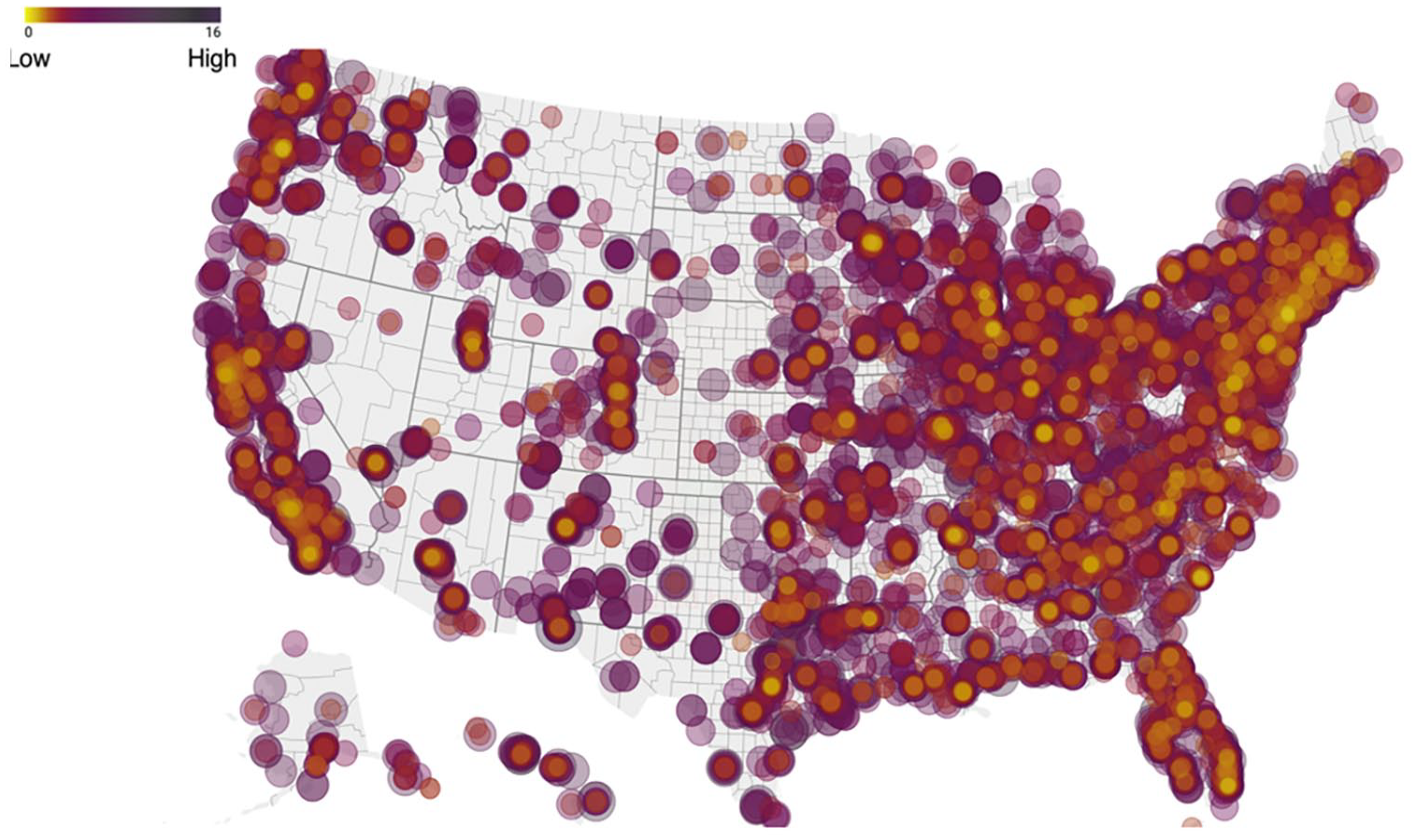
Heat Map of Violence Related to Summer 2020 Demonstrations in the United States
Charges filed and scored according to the FBI handbook
Using the tPP data “Summer-Fall 2020 George Floyd Protests,” we matched 1,191 arrest records to protests in the ACLED dataset. For each arrest, the tPP file listed each charge against arrested individuals (e.g., riot act, curfew violation, assault on a police officer, burglary). We matched the location and date of charges with corresponding demonstrations in the ACLED dataset. Then, we compiled a list of unique charges related to each protest event. 6 Of the 11,540 protests, 320 had at least one associated charge (spanning 123 cities, 117 counties, and 39 states). Of the 320 events associated with at least one arrest, 11.9% were in a city with a female police chief, 41.1% were in a city with a Black police chief, and 7% were in a city with a Black female police chief. We followed the classification system specified in the Federal Bureau of Investigation (FBI) Uniform Crime Reporting Handbook to quantify violence from arrest records. 7 This FBI handbook describes 29 criminal offenses in descending order of violence (see Table 1). For each charge related to an ACLED demonstration, we assigned the corresponding number from the FBI handbook; a higher value represents a more violent crime on a scale from 1 to 29. To calculate the overall violence of an event, we summarized the values of all unique charges filed in relation to a particular protest.
Offense Classifications from FBI Uniform Crime Reporting Handbook
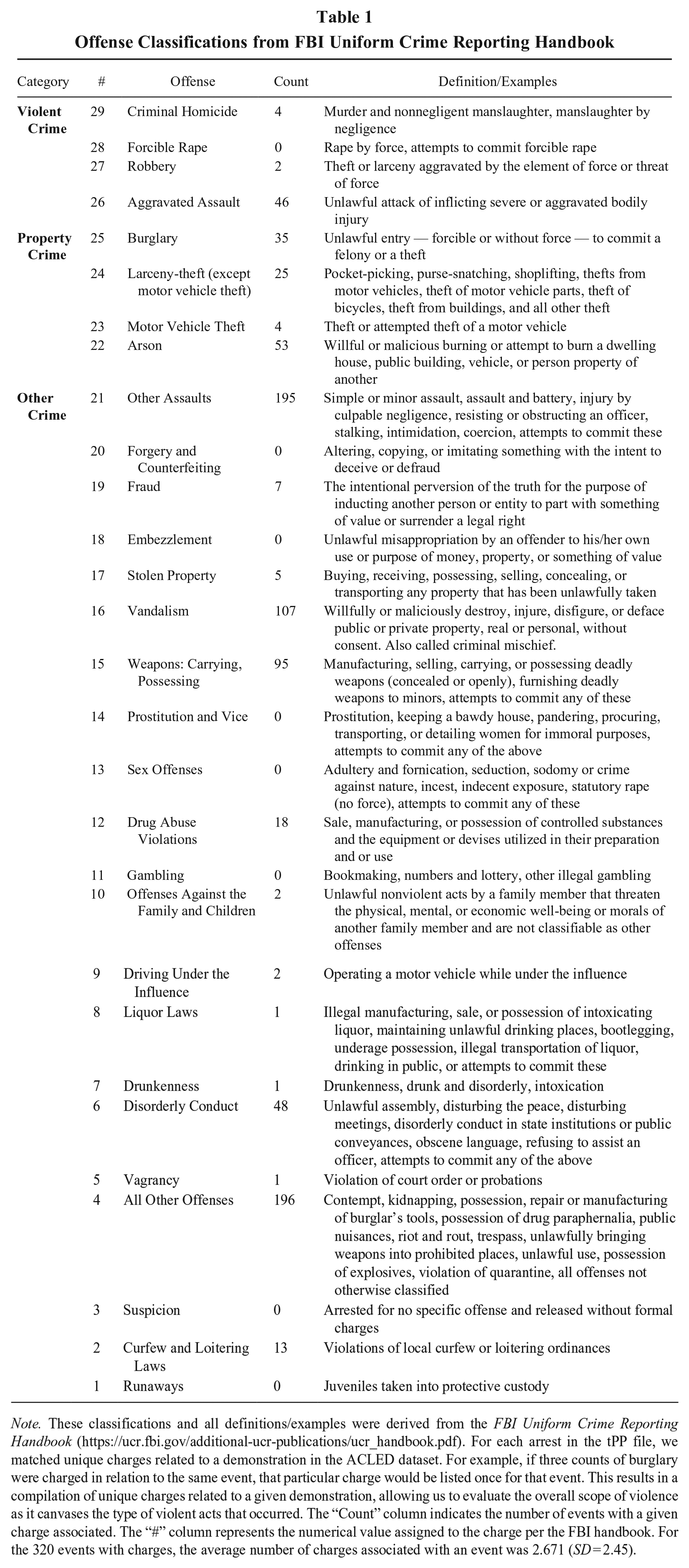
Note. These classifications and all definitions/examples were derived from the FBI Uniform Crime Reporting Handbook (https://ucr.fbi.gov/additional-ucr-publications/ucr_handbook.pdf). For each arrest in the tPP file, we matched unique charges related to a demonstration in the ACLED dataset. For example, if three counts of burglary were charged in relation to the same event, that particular charge would be listed once for that event. This results in a compilation of unique charges related to a given demonstration, allowing us to evaluate the overall scope of violence as it canvases the type of violent acts that occurred. The “Count” column indicates the number of events with a given charge associated. The “#” column represents the numerical value assigned to the charge per the FBI handbook. For the 320 events with charges, the average number of charges associated with an event was 2.671 (SD = 2.45).
Independent Variables
Police chief gender and race
For each city in which ACLED recorded a demonstration, a research assistant, blind to the purposes of this research, coded the police chief’s gender as female (.5) or male (−.5), and race as Black (.5), White (−.5), or Other (0), from biographies on city’s webpages. Of 11,540 protests in the ACLED dataset, 1,033 (8.95%) were in a city with a female police chief, 2,411 (20.89%) were in a city with a Black police chief, and of these 480 protests occurred in a city with a Black female police chief (4.16%).
Control Variables
Population
Demonstrations in larger cities are likely to include more participants, which may increase the likelihood of violence. Using ddply in R, we mean-centered population obtained from the U.S. 2019 Census by state, divided by 100,000 (M = 7.73, SD = 17.68).
Political leaning
To mitigate the possibility that violence measures are impacted by political leaning, we coded county political affiliations using the “MIT Associated Press County-by-County 2020 Presidential Election” results. We coded cities as Democrat (−.5) if protests occurred within counties that voted for President Biden and Republican (.5) if they were in counties that voted for President Trump. Of the 11,540 events, 3,836 (33.2%) were in a conservative city. Of these, 165 were in a Republican city with a female police chief, 474 in a Republican city with a Black police chief, and 48 in a Republican city with a Black female chief.
Percent black
The minority population within cities is related both to the proportion of minority officers and to measures of police force behavior (Fyfe, 1979, 1980). Additionally, given the focus on racial injustice in this event context, higher minority populations concentrated in cities could result in higher antagonism between disadvantaged groups and the police (Smith, 2003). Thus, to isolate the effects of leadership more precisely, we controlled for the percentage of county residents who self-identified as Black, according to the 2019 U.S. Census report.
Percent female
Men and women exhibit different propensities toward violence and tend to express it differently (Archer, 2004; Eagly & Steffen, 1986). Generally, women employ subtle and indirect forms of hostility rather than physical violence (Underwood, 2003). Even when women are arrested, they are less likely than men to have histories that raise concerns about their potential for violence (Henning & Feder, 2004). Thus, we controlled for the percentage of residents who identified as female in the 2019 U.S. Census, as higher populations of men could increase the baseline propensity for violence, irrespective of the police chief’s approach.
Violent crime
If a location experiences more violence in general, then protest-related violence might be more likely, regardless of the effectiveness of the police chief at the event. Thus, we obtained the number of violent crimes per 100,000 inhabitants reported by the FBI Uniform Crime Reporting Program for 2019 to control for baseline propensity for violence.
Distinct charge categories
In our analysis of violence using charges filed, we controlled for the number of distinct charges related to each protest to prevent an overestimation of violence in cases where an event had a broader range of charges, e.g., curfew violation, disorderly conduct, and drug possession. Given that each unique charge filed in relation to an event adds to the violence score derived from the FBI coding scheme, a wider variety of charges will increase the violence score. However, a wider variety of charges does not inherently indicate a more violent protest, as multiple low-level offenses do not necessarily translate to greater violence.
Analytic Procedures
We used restricted maximum likelihood iterations in which estimates are progressively modified to maximize the log-likelihood function. Kenward and Roger’s (1997) approximation was used to compute degrees of freedom and Analysis of Covariance (ANCOVA) with a linear-mixed-effect-model (LMEM). LMEM is a form of hierarchical linear modeling that accounts for nonindependence by parsing out random effects to obtain the least biased fixed effects (Brauer & Curtin, 2018). There are several benefits of using LMEM. It is robust to complex data structures where observations are not independent, such as analyzing data when different cities provide various observations (events) for each predictor. LMEM improves the precision of the fixed effect estimate because it parses out within-group variance, and it is robust to violations of sphericity and unequal cell sizes across groups (Kuznetsova, Brockhoff, & Christensen, 2017).
Because some cities had multiple demonstrations, LMEM is more reliable than repeated measures ANOVA, which is limited to computing total scores by averaging across multiple data points from the same city. LMEM considers the reliability of each of the total scores, which is determined by the number and variability of individual data points. Nonindependence in the data is caused by repeated protests in the same city and police chiefs within the same county influencing one another. LMEM accounts for observations’ nonindependence by including random intercepts in random effects. We included random intercepts for each level because the dataset included cities nested within counties and counties nested within states. A model without random intercepts, i.e., non-nested, would assume the same criterion changes across all protests.
Results
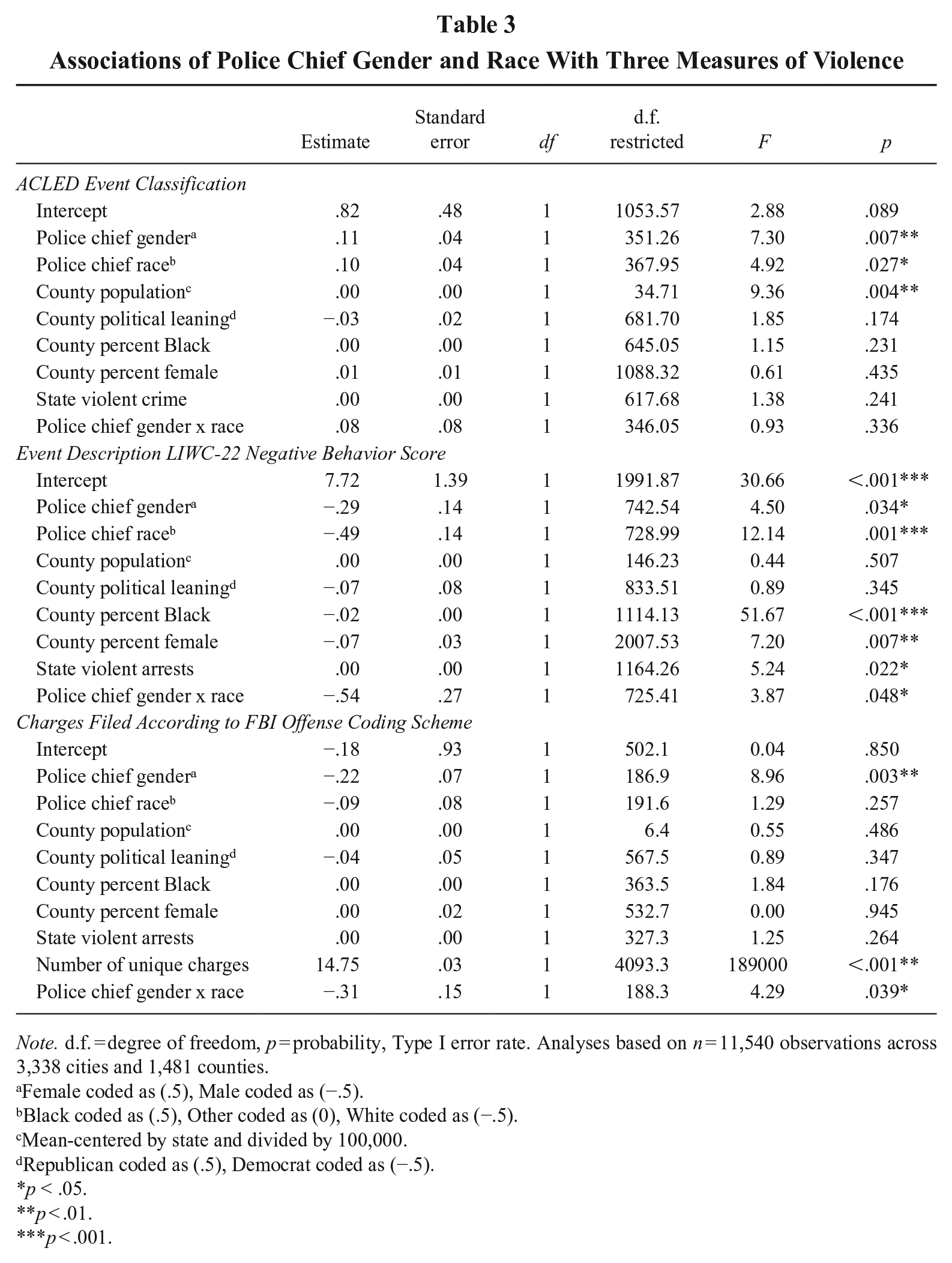
Descriptive statistics and bivariate correlations for all measures are reported in Table 2. Results of the three LMEM analyses for each measure of violence are reported in Table 3.
Descriptive Statistics and Correlations
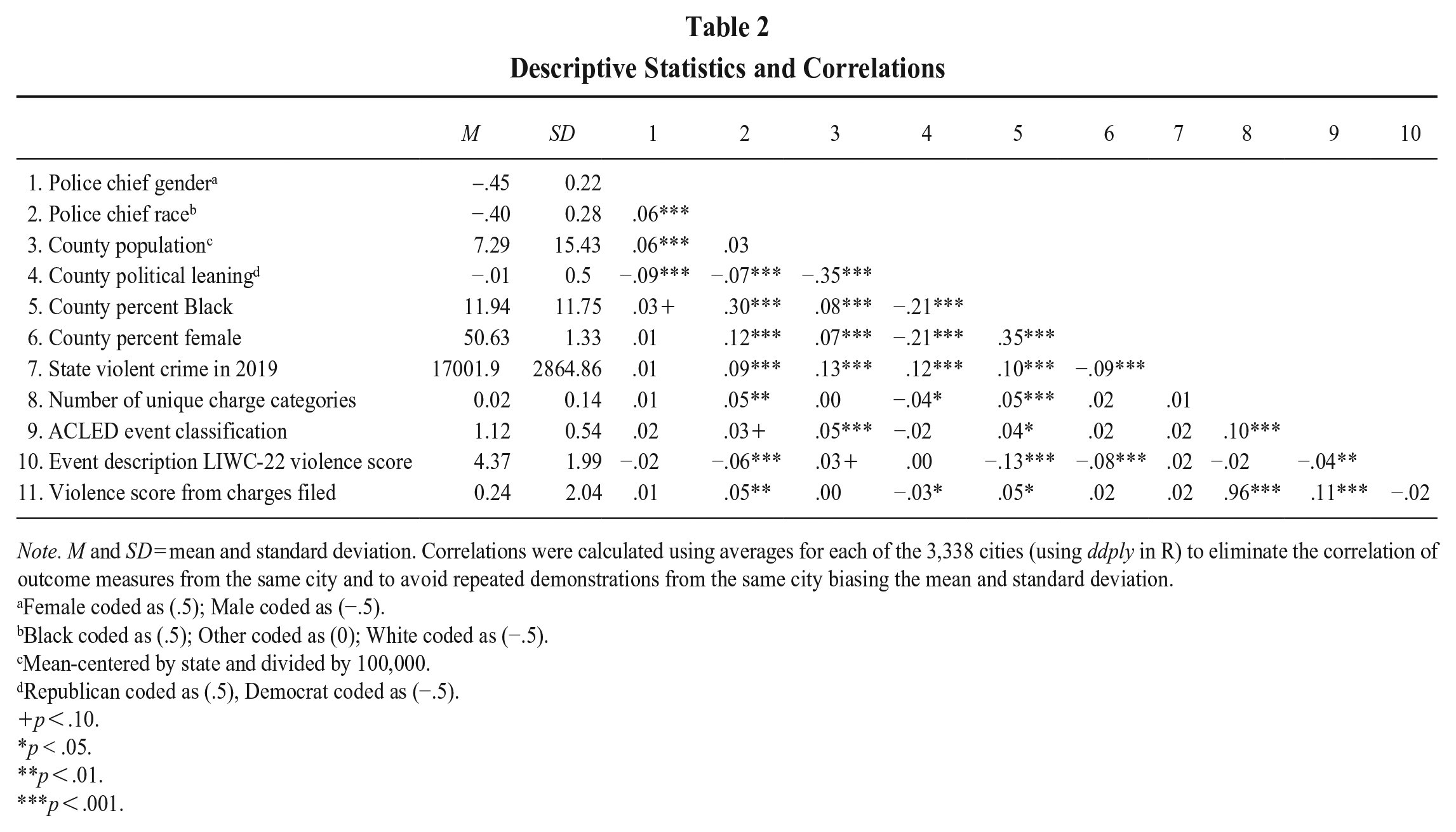
Note. M and SD = mean and standard deviation. Correlations were calculated using averages for each of the 3,338 cities (using ddply in R) to eliminate the correlation of outcome measures from the same city and to avoid repeated demonstrations from the same city biasing the mean and standard deviation.
Female coded as (.5); Male coded as (−.5).
Black coded as (.5); Other coded as (0); White coded as (−.5).
Mean-centered by state and divided by 100,000.
Republican coded as (.5), Democrat coded as (−.5).
p < .10. *p < .05.**p < .01. ***p < .001.
Associations of Police Chief Gender and Race With Three Measures of Violence
Note. d.f. = degree of freedom, p = probability, Type I error rate. Analyses based on n = 11,540 observations across 3,338 cities and 1,481 counties.
Female coded as (.5), Male coded as (−.5).
Black coded as (.5), Other coded as (0), White coded as (−.5).
Mean-centered by state and divided by 100,000.
Republican coded as (.5), Democrat coded as (−.5).
p < .05. **p < .01.***p < .001.
The first analysis revealed that police chief gender and race were each associated with differences in the ACLED event classification (p = .007, p = .027, respectively). The interaction of the police chief gender and race was insignificant. This is unsurprising, though, as this dependent variable is a dummy coding of the ACLED event classification; a dummy coding scheme precludes a directional interpretation of model coefficients and limits the likelihood of capturing an interaction. The two significant main effects lend credence to our predictions and indicate that event classification differs beyond chance on the basis of leader gender and race.
Results from the second analysis, in which we used the LIWC-22 to quantify violence from the event descriptions using the negative behavior dictionary, supported H1. Specifically, we found a significant negative interaction, along with two main effects, of police chief gender and race. The model coefficients were in the hypothesized direction, such that events in cities with female police chiefs were associated with less violence than protests in cities with male police chiefs (p = .034). Events under the jurisdiction of Black police chiefs were associated with less violence than protests under the jurisdiction of White police chiefs (p = .001). Finally, supporting an ILA, there was an interaction beyond these two additive effects such that protests in cities with Black female police chiefs were associated with even less violence (p = .048).
Our third analysis used a measure of violence derived from applying the FBI Uniform Crime Reporting Handbook to charges filed, and 2.8% of the 11,540 protests had a violence score above zero in this analysis. Results supported H1, and the coefficients continued to be in the hypothesized directions. Events in cities with female police chiefs were associated with less violence than protests in cities with male police chiefs (p = .003). Although the main effect of police chief race was insignificant in this analysis, results again supported the ILA hypothesis, as leader gender and race interacted such that protests in cities with Black female police chiefs were associated with less violence (p = .039). Figures 3 and 4 illustrate the interactions of police chief gender and race in relation to violence measured with the event descriptions and charges filed.
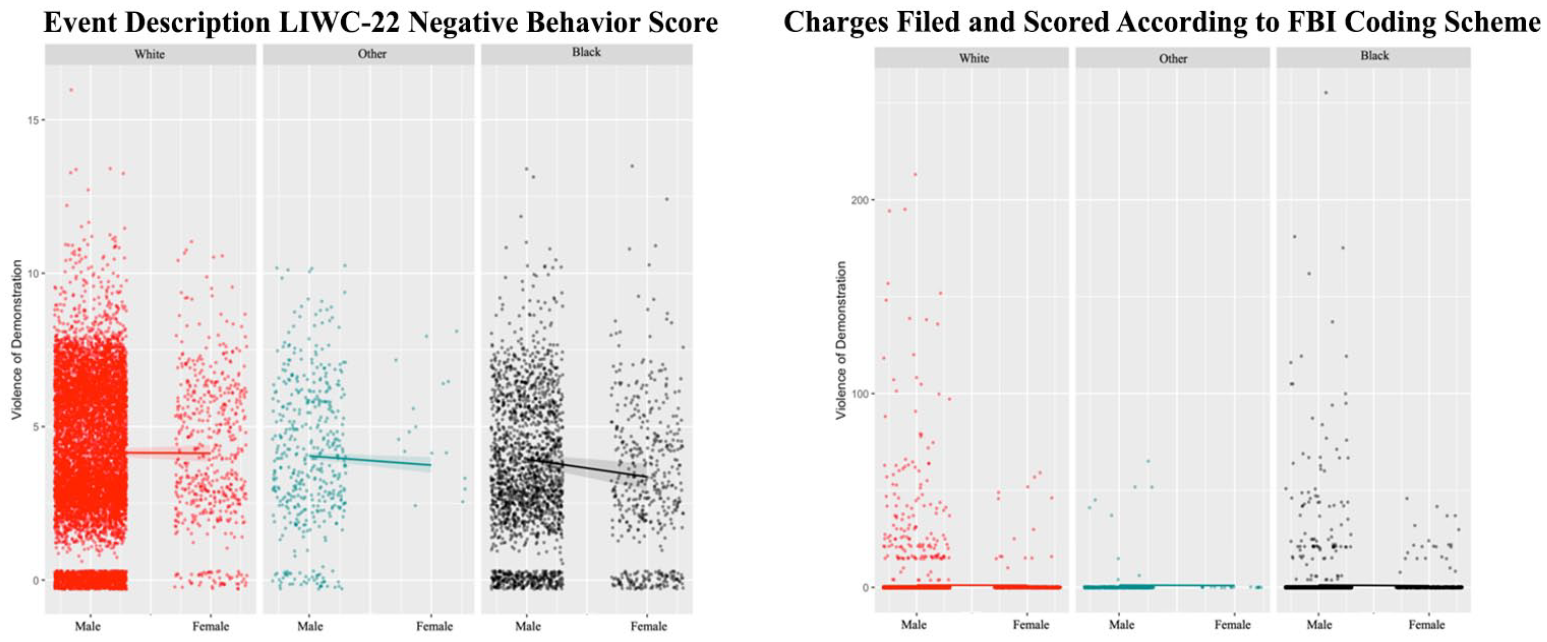
Associations of Police Chiefs Gender and Race With Violence
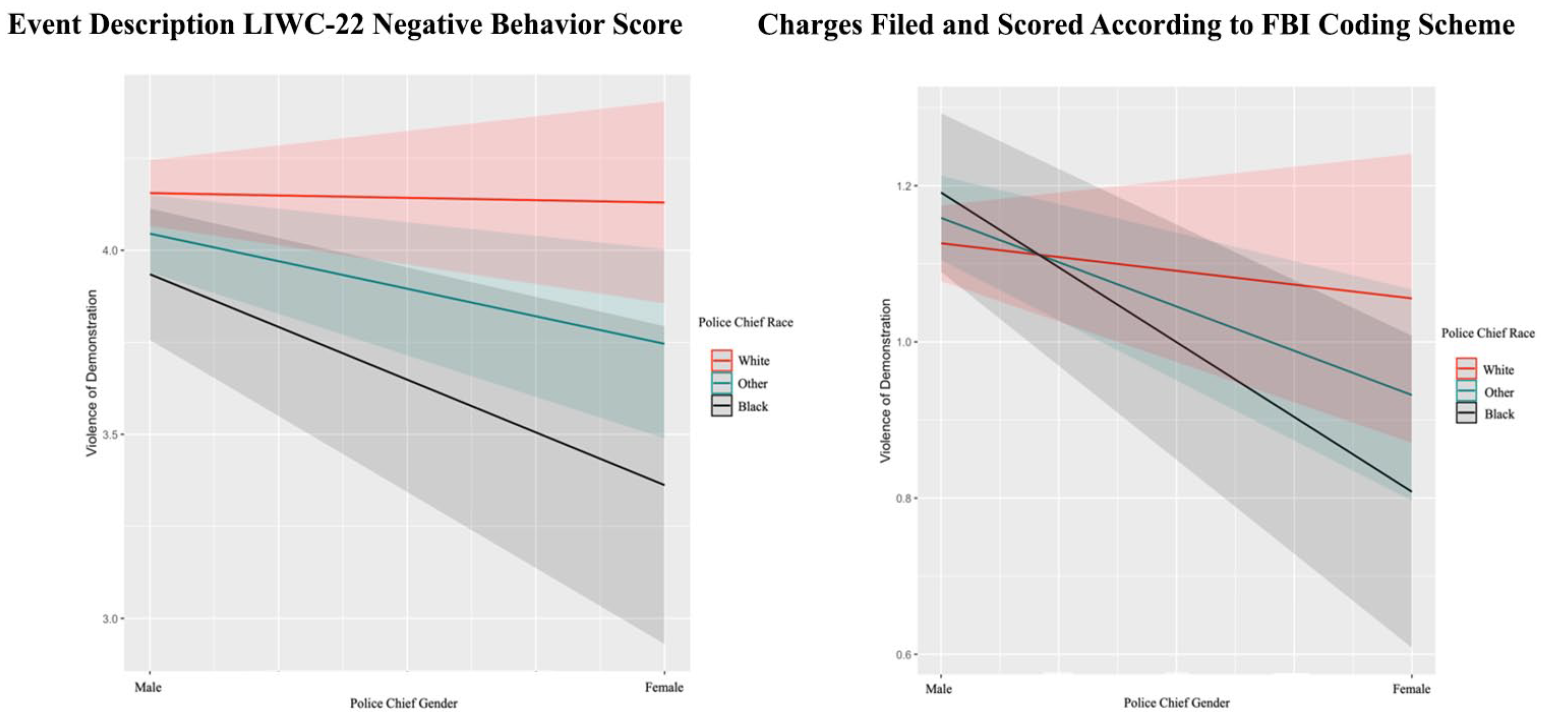
Interaction of Police Chief Gender and Race on Violence
Discussion
One obstacle to studying the intersection of gender and race is an underrepresentation of Black women in top roles (Leslie, Manchester, & Dahm, 2017; Rosette et al., 2016). Guynn and Schrotenboer (2021) report that only 1.8% of Standard & Poor’s 100 executives were Black, and two CEOs in the Fortune 500 in 2023 were Black women. We leveraged the Summer 2020 BLM protests as a unique opportunity to test event-based leadership effectiveness (Liu et al., 2023; Morgeson et al., 2015), guided by an intersectional theory lens (Cole, 2009; Rosette et al., 2018).
Mega-threat events, with their focus on social identities, provide an instrumental context for examining the intersection of gender and race (Leigh & Melwani, 2019) in relation to leadership effectiveness. Among the numerous mega-threats (see Bor et al., 2018), we focused on events related to instances of police violence directed toward African Americans (see also Leigh & Melwani, 2019), manifested by thousands of protests in the quest for social justice. Racial tension was part-and-parcel of these street demonstrations, pointing to segmentation between minority communities and authorities (Buchanan, Bui, & Patel, 2020). These events brought societal (media) attention to the treatment and experiences of marginalized groups and police brutality directed toward the Black community (Buchanan et al., 2020; Corrington et al., 2022; Stolberg, 2020; Taylor, 2020).
We categorized the protests as high-strength events according to the EST framework (Liu et al., 2023; Morgeson et al., 2015). Characteristics relevant to effective leadership in this context were informed by literature on Black feminism (Collins, 2000; Rogers, 2005; Rosser-Mims, 2010) and intersectionality in leadership (Rosette et al., 2016, 2018; Smith et al., 2019). Integrating insights from this research, we proposed an intersectional leadership advantage (ILA), such that Black women police chiefs will be the most effective leaders in this context.
We tested the hypothesis by assessing an association between the police chief’s gender and race with the degree of violence at protests in their jurisdiction. We merged six public sources to create a unique dataset that included 11,540 demonstrations across 3,338 cities, 1,481 counties, and 50 states during Summer 2020. Studying a cluster of temporally related events that shared an aim of social justice made it possible to identify predictors (race and gender) and a criterion (violence) across multiple events, reducing sampling bias and increasing the external validity of the findings. Multiple measures and covariates added to the robustness of the results, as quantitative and qualitative analyses provided layers of support for the hypothesis.
Consistent with research on gender and leadership effectiveness in a crisis (Post, Latu, & Belkin, 2019; Sergent & Stajkovic, 2020), there was a main effect of gender in all analyses. We observed a main effect of race in two of three analyses. Together, these main effects suggest that there was less violence at events in cities with female police chiefs and less violence at events in cities with Black police chiefs. Central to the proposed ILA, police chief gender and race interacted to predict violence, indicating that events in cities with Black women police chiefs were associated with less violence beyond the sum of the main effects. This finding underlines that ILA is not merely an additive sum of being Black and a woman. Rather, the combination of these two identities creates a unique leadership dynamic resulting in synergy.
Implications for Theory
Research on gender and leadership has considered what changes when women lead (Post & Byron, 2015; Post et al., 2022), probed advantages and disadvantages of female leadership (Hoobler, Masterson, Nkomo, & Michel, 2018; Sergent & Stajkovic, 2020), and tested boundary conditions (Post et al., 2019). An intersectional lens that considers race in addition to gender enables a richer understanding of how the two marginalized identities shape experiences and outcomes (Liu, Park, Hymer, & Thatcher, 2019). The study of Black women is underscored by their dual minority status, which compounds challenges (Bell & Nkomo, 2001; Koval & Rosette, 2021; Rosette, Leonardelli, & Phillips, 2008). For example, both Black and White women navigate complexities of gendered identity, but Black women negotiate additional penalties (e.g., “double jeopardy,” Berdahl, & Moore, 2006: 426) associated with their racial identity (Bhattacharyya & Berdahl, 2023; Byrd, 2009). Given this, intersectional management research has historically focused on demonstrating the marginalization and invisibility of Black women, highlighting the hurdles they face at work (Bhattacharyya & Berdahl, 2023; Davis, 2016; de Leon & Rosette, 2022; Motro et al., 2022). We contribute to an emergent perspective (Smith et al., 2019) that focuses on intersectionality that confers advantages, such as leadership effectiveness.
Relatedly, our research links the effectiveness of Black women leaders to objective outcome measures. This contributes to prior research, which has mostly focused on how Black women leaders are perceived by others (Livingston et al., 2012) and how they see themselves (Smith et al., 2019). Though perceptions are informative, they could be distorted by the biases of the perceiver, potentially misrepresenting a leader’s actual effectiveness (Eagly & Karau, 2002; Paustian-Underdahl, Walker, & Woehr, 2014). Moving beyond perceptions, we examined outcomes in a real-world setting, measured in three ways, with data from several sources.
Finally, our study extends the value proposition of intersectional leadership by illustrating its societal benefits, thereby responding to calls for management research to address grand social challenges (Hoobler et al., 2018; Howard-Grenville, 2020). Grand challenges have far-reaching consequences, but organizational scholarship has largely overlooked them (Howard-Grenville, 2021). On the one hand, the organizational impact of social issues is often indirect, obscuring fit for studying such challenges within management. On the other hand, ignoring them has limitations (Reinecke & Ansari, 2016) because social issues associated with these challenges eventually circle back to the workplace (Brammer, Branicki, Linnenluecke, & Smith, 2019). Embracing the study of grand challenges, such as the quest for social justice, moves us beyond familiar topics and modes of inquiry to contribute to addressing social problems.
Limitations and Future Research
First, selection artifacts at a macro level present a boundary condition. For example, cities that appoint Black women police chiefs might differ from those that select other leaders, such that differences in effectiveness could arguably be related to political preferences. To mitigate this threat, we controlled for county-level political affiliation. Other attributes of the public, such as education level, could be tested as moderators of leadership appointments in future research.
Second, because leaders are embedded within institutional/organizational cultures, even if Black women are appointed to top roles, their leadership style might face resistance, averting their effectiveness from manifesting. To illustrate, Tonya Chapman, a Black female police chief in Virginia, stepped down in 2019 after being pushed out for ushering in accountability measures: “As with any organization, there were officers in the department that did not like my style of leadership and did not want me to hold them accountable for their actions. . . . Some quite frankly did not like taking direction from an African American female” (Stack, 2019: 2). Thus, future intersectional leadership research could test for moderation of organizational culture.
Third, potential bias in event descriptions could influence an assessment of violence (Earl et al., 2004; McLeod & Hertog, 1992). This was mitigated in several ways. The descriptions were written by an independent agency, ACLED, and our review of their sources did not indicate bias. Moreover, using event descriptions from news reports is consistent with prior protest research: “among the possible sources for quantitative data on protest development, newspapers are generally the best choice” (Koopmans, 1998: 92). In addition, we used police records as an alternative measure of violence (Hocke, 1998; Rucht & Neidhardt, 1998) by coding the charges filed into a violence score using the FBI Crime Reporting Handbook. This approach is consistent with protest studies that have used police records to cross-validate information from news sources (Maney & Oliver, 2001). The accuracy of police records to measure violence could be compromised if similar crimes were charged in one city but not another. To mitigate the impact of this possibility, we assigned a violence score to a filed charge only once to avoid inflating violence if many people at an event were charged with the same crime. We also controlled for the total number of charges filed in relation to each event to account for an increased violence score rooted in a wider variety of less violent charges.
Fourth, the coding of race into a single category does not capture its complex nature (Gibson, 2022). Additionally, other identity orientations, such as religion or sexual orientation, could have implications for leadership styles (Sitzmann & Campbell, 2021). Though we examined a leader’s gender and race within their most parsimonious categories, future research can add to this foundation by examining leadership effectiveness associated with other intersecting identities. For example, though we focused on Black women leaders during a high-strength event related to social justice, future research could investigate if there is an ILA for women of other identities (e.g., Asian, Latina) in diverse contexts of varying event strengths.
Fifth, because our data were archival, causality cannot be claimed, only patterns of associations. Verification of causality regarding leadership effectiveness concerning socially situated outcomes to avoid, such as violence, requires converging evidence from divergent methods. Because researchers do not manipulate inhumanities, experiments are limited to minor transgressions and hypothetical scenarios. Thus, we call for more research on an ILA concerning outcomes under naturally occurring conditions using different methods across activity domains. If leader effectiveness during high-strength mega-threat events associated with race and gender is a product of socialization, then leaders of any identity can learn more about such approaches. 8
Finally, another interesting avenue for future event-oriented research is to examine if the qualities associated with leadership effectiveness shift across event phases. Our analysis was limited to the “during” phase, and subsequent studies could examine if different leadership attributes are needed in the pre-or-post-event phases. Longitudinal data capturing predictors and criteria throughout phases of the same event could reveal whether leaders ought to adapt their style to an event phase for the greatest effect and how such transitions occur frictionlessly.
Practical Implications
Our findings underscore the value of diverse leadership voices and the importance of fostering a culture that both recognizes and elevates individual identities. The prior decade was marked by racial turmoil in the U.S., and it witnessed a rise in the appointment of Black police chiefs (U.S. Department of Justice, 2022b). Yet, despite progress, Black women continue to be underrepresented in leadership positions, presenting a contrast with our findings related to their effective leadership. Several strategies could be taken to help bridge this disparity.
First, it is critical to recognize the need for an intersectional perspective versus focusing on one identity in the workplace. As our theory and results suggest, Black women are not merely an additive combination of Black and woman. They tend to demonstrate a unique style, which, per our findings, is associated with effective leadership outcomes during turbulent times. The importance of their distinctive leadership approach during high-strength events has garnered acknowledgment from law enforcement leaders. As the president of the National Organization of Black Law Enforcement Executives and Chief of Police in Durham, North Carolina, remarked: I think city managers are starting to pick up on the fact that women in this field provide expertise and balance, and that our approaches aren’t always about the ego or the brawn. We’re constantly thinking about how to do this work with as little harm as possible—not just harm to the community, but harm to our officers as well. (quoted in Dickey, 2020)
An intersectional approach stands in contrast with research that has focused on either race or gender but not their interaction (Antonovics & Knight, 2009; Brown & Frank, 2006; Holmes & Smith, 2008; McElvain & Kposowa, 2008; Paoline, Gau, & Terrill, 2018). Similarly, prior studies have examined differences in outcomes related to the racial composition of the police force (Ochs, 2011; Smith, 2003; Wilkins & Williams, 2008) but not leaders and effectiveness.
Second, the efficacy of diversity training can vary across audiences. Programs focusing on biases and work inequity (Fath, Ma, & Rosette, 2022), subconscious prejudice (Sergent & Stajkovic, 2019), and integrating technology into development programs (Lambrecht & Tucker, 2019) have been shown to be effective. Yet, they are seldom evaluated for effectiveness across demographic groups (Bell & Nkomo, 2001). Cultural anthropology offers a perspective that questions a “one size fits all” approach to training. The etymology of Black women’s social and leadership development is influenced by autoethnography (Allen, 1997; Chang, Longman, & Franco, 2014), narratives (Byrd, 2009; Hall et al., 2012), and mentoring (King & Ferguson, 2001), especially “sisters mentoring sisters” (Green, & King, 2001: 156). This literature suggests that Black women, on average, pay more attention to what other Black women say (Berdahl & Moore, 2006), presenting an idea for a tailored program (Alfred, 2001a, 2001b; Davis, 2016).
Third, although our study centered on social protests, our findings could potentially be extended to leadership amid a constellation of recent mega-threat societal events. Consider the widely publicized departures of Chief Diversity Officers from Netflix, Disney, and Warner Brothers, together with an unprecedented number of diversity-related position layoffs across the U.S. in 2023 (Chen & Weber, 2023). Additionally, the 2023 U.S. Supreme Court ruling, which seems to negate the use of affirmative action in college admissions, will cascade downstream consequences for universities and organizations relying on diverse students and applicant pools.
The question thus arises: What will effective leadership look like in response to these mega-threats? Our theory and results offer insight into leadership that could be effective for mega-threat events that share similar contextual qualities relating to event strength and social identity.
Conclusion
Nationwide calls for social justice took to the streets of U.S. cities in the summer of 2020. According to an EST framework, these protests represent a distinct set of high-strength events involving social identity threats, characterizing them as mega-threat events. We leveraged the protests and bridged multiple research perspectives to introduce, define, and test an intersectional leadership advantage. We found that Black women leaders were associated with the most effective outcomes in this context. We focused on the leadership of police chiefs as they face notable challenges during protests in relation to curbing violence. Our results reinforce a need for more event-oriented leadership research to study the intersection of identities in varied contexts.
