



Abstract
Management scholars have long examined gender disparities in leaders’ communication and followers’ reactions. There is, however, a paucity of research that takes an intersectional perspective. This article takes that step, using an intersectional lens to examine women leaders’ use of dominant language and how others receive it. Leveraging advances in natural-language processing, I analyzed the stereotype content of more than 250,000 Congressional remarks (Study 1) and almost one million tweets (Study 2) by leaders. Women leaders referenced dominance more than men did (using more words like “powerful”), violating stereotypes that depict women as submissive. However, as theory on racialized gender stereotypes suggests, this effect was unique to White leaders. Two additional studies revealed backlash to women leaders’ use of dominant language. Analyzing almost 18,000 editorials revealed the more that women leaders referenced dominance, the more they were portrayed as dominant but also cold. Effects were strongest for Black and Latina women (Study 3). Finally, an experiment using simulated social media profiles found the more that Black women (but not men) leaders referenced dominance, the more voters rated them as less likeable, a result that was unique to Black leaders (Study 4). The article demonstrates the critical importance of intersectionality for understanding gender inequality in leaders’ communication and its reception by the media and the public.
For over 60 years, management scholars have been interested in how leaders influence followers through communication (Bales and Slater, 1955; Schultz, 1980; Luthans and Larson, 1986; Fairhurst and Sarr, 1996; Emrich et al., 2001; Chatterjee and Hambrick, 2007; Flynn and Lide, 2022). For nearly as long, the field has explored gender differences in how leaders communicate and how followers respond to such differentiated communication (Kanter, 1977; Forsyth et al., 1985; James and Drakich, 1993; Bowles, Babcock, and Lai, 2007; Amanatullah and Morris, 2010; Okimoto and Brescoll, 2010; Brescoll, 2011). For instance, women leaders are subject to unique pressures when communicating to their peers and to the public, due to stereotypes. Effective leadership has long been tied to dominance (Stogdill, 1948; Tannenbaum and Schmidt, 1973; House and Aditya, 1997). This can be problematic for women, who are stereotyped as lacking in dominance and as inclined toward warmth (e.g., Heilman, 2001; Eagly and Karau, 2002; Rudman and Phelan, 2008). Women leaders may therefore be inclined to express dominance when communicating with peers or followers, but women are penalized for violating stereotypes via dominant behavior (Rudman, 1998; Bowles, Babcock, and Lai, 2007; Okimoto and Brescoll, 2010; Brescoll, 2011; Williams and Tiedens, 2016). This leaves women leaders in a bind. As women’s striking educational advancements make them increasingly qualified for leadership positions (U.S. Department of Education, National Center of Education Statistics, 2019), it is imperative to understand how women’s stereotype-relevant communication (i.e., communication related to stereotypes)—and followers’ reactions to it—may mitigate or maintain gender inequality in leadership.
Despite the wealth of management scholarship on gender differences in leaders’ communication and followers’ reactions to such communication, little research has taken an intersectional perspective. This article meets that goal. Intersectionality is broadly defined as the notion that people who share one demographic category (e.g., gender) but differ on another category (e.g., race) experience different outcomes (Crenshaw, 1991; Cole, 2009; Hall et al., 2019). Drawing on intersectionality’s vast theoretical tradition, I contend that intersectional analyses are crucial to understand gender differences in leaders’ stereotype-relevant communication—and to reveal who is penalized for it.
I take an intersectional approach to examine gender differences in leaders’ communication via language. A growing body of research finds that, in outgroup settings, people often use counter-stereotypical language. For instance, White liberals use fewer words related to dominance (e.g., “powerful”) when addressing mostly Black (versus mostly White) audiences (Dupree and Fiske, 2019), violating stereotypes that depict White Americans as dominant, in a likely well-meaning (but patronizing) phenomenon. Women leaders navigating workplaces composed of mostly men may also use counter-stereotypical language in such workplaces—language that violates stereotypes depicting women as submissive (Heilman, 2001; Ridgeway, 2001; Eagly, 2007). I propose that women in high-profile leadership positions use dominant language more often than men do, referencing more words related to dominance (e.g., “powerful,”“competitive,” and “assertive”) when addressing peers or the public. Moreover, I suggest that women leaders’ use of dominant language has direct implications for media portrayals and public support, such that the more often that women leaders use dominant language, the more they will be penalized for it. Although much research has explored public reactions to women’s communication, there is little direct evidence of whether and how women leaders use counter-stereotypical language at work and how such use impacts how the media portray and whether the public supports women. This article addresses these issues.
Intersectional analyses are crucial for this (and, indeed, any) examination of gender inequality. Gender stereotypes are racialized. As such, theorized gender differences in leaders’ stereotype-relevant communication likely depend on leaders’ race. For instance, Black women are seen as less feminine and more dominant than White women (Hall, Galinsky, and Phillips, 2015; Rosette et al., 2016). Moreover, Black women contend with the “angry Black woman” stereotype (Harris-Perry, 2011), the notion that Black women are angrier than other women (Durik et al., 2006). Because people attend more closely to and exaggerate stereotype-consistent behavior (Trope and Thompson, 1997; Biernat, 2012), Black women’s expressions of dominance may be amplified and perceived as unjustified anger, leaving them discredited. Black women leaders therefore contend with an additional possibility of backlash, which potentially influences their use of dominant language and the public’s reactions to such language. Intersectional analyses are therefore necessary to fully understand women leaders’ stereotype-relevant communication and its implications.
Specifically, this research uses intersectional analyses to enhance our understanding of expert leaders’ communication, the influence and persuasive capacity of leaders from low-power groups, and the perception of and discrimination against leaders from low-power group members based on their communication. Using archival data from the U.S. Congress—a real-world organization featuring a plurality of women leaders—and the social media website Twitter (now titled X), I determine whether and which women communicate dominance more than men do. I next examine the implications of these findings. My analysis of archival written editorials determines whether and for which women the use of dominant language predicts how the media portray them. Finally, in a controlled experiment, I use simulated social media profiles to test whether and which women leaders who use dominant language are rejected by potential voters. Across studies, I first test overall gender-based predictions across race before disaggregating findings for White leaders and leaders of color, thereby revealing the importance of intersectional analyses. Together, these four studies reveal whether, how, and which women leaders use counter-stereotypically dominant language and who is penalized for it, potentially influencing how they are portrayed by media narratives and whether they are supported by constituents.
Literature Review and Predictions
Intersectionality
Although intersectionality has become highly politicized in recent years (Coaston, 2019), the term was coined decades ago by legal scholar Kimberlé Crenshaw (1989, 1991), who highlighted legal cases in which Black women were forced to choose between bringing a claim of racism or sexism to court. Since then, intersectionality has become what some scholars call the most important contribution to feminist thinking of the twenty-first century (McCall, 2005). As modern feminist theorists have begun to challenge the persistent homogenization of gender and question the assumptions underlying conventional approaches to the study of gender, there is increased understanding that “the individual’s social location as reflected in intersecting identities must be at the forefront of any investigation of gender” (Shields, 2008: 301).
Some conceptualizations of intersectionality focus generally on the presence of multiple identities (Markus and Kitayama, 1991; Zack, 2005); others focus specifically on the presence of at least one stigmatized identity (Crenshaw, 1989; Kwan, 1996; McCall, 2005; Shields, 2008). Most scholarship—including this article—falls into the latter camp, viewing intersectionality as instantiating social stratification. Social identities such as gender or race may be experienced individually, but they reflect power relations in our society. Certain groups are disadvantaged or devalued in our society, while others are advantaged or valued and thus experience greater access to resources, rewards, and opportunities. Intersectionality captures and adds nuance to our understanding of these power dynamics.
In examining leaders’ communication, it is crucial for scholars to consider not just whether women leaders use dominant language and experience backlash for it, but also for whom these effects are most robust. This article does so by focusing on racialized gender effects. Gender scholarship has typically focused on the experiences of White women and men. Social scientists have therefore begun to emphasize the theoretical, practical, and moral failings of research that “allows White experiences to function as the control or the default” (Zuberi and Bonilla-Silva, 2008; Garza, 2020: 199; Roberts et al., 2020; Dupree and Kraus, 2022). Intersectionality challenges knowledge production that marginalizes certain individuals (Cho, Crenshaw, and McCall, 2013). To develop a deeper, nuanced understanding of gender inequality and to inform solutions that apply to many rather than a few, gender scholars must examine the racialized nature and implications of such inequality. I address this issue by using intersectionality theory to add nuance to my contributions to gender inequality scholarship.
While scholars have increasingly noted the importance of intersectional perspectives, the application of such perspectives to social and behavioral scholarship has been slower to materialize. Indeed, some scholars have called intersectionality “a perspective in search of a method” (Shields, 2008: 306), possibly due to the theoretical and empirical complexities of conducting such analyses, particularly in quantitative work. Scholars may be tempted to view intersectionality in purely statistical terms, a 2 × 2 analysis of two identity-based variables. Through statistical analyses, one can empirically test how the effect of one variable (e.g., gender) is impacted by the effects of another variable (e.g., sexual orientation). Yet, such analysis is incomplete without accompanying theoretical and contextual work. Intersectional analyses of any identity-based phenomenon must first involve a theoretical conceptualization of the underlying stereotypes—stereotypes rooted in social, cultural, and historical contexts—that drive a rationale for proposed interaction effects. This article takes both these steps.
First, I draw on the extensive gender literature to devise predictions for overall gender effects. I then conduct a theoretical analysis of racialized gender stereotypes that are thought to drive disparate outcomes for White leaders versus leaders of color (specifically, Black and Latina/o leaders). Grounding my work in the literatures on stereotyping, prototypicality, and tokenism, I devise specific predictions at the intersection of leaders’ gender and race. Finally, for each study, I conduct two sets of analyses. Initial analyses probe gender differences in leaders’ communication and backlash for dominant verbal behavior. Subsequent analyses then test predicted racialized gender effects by separately examining results for White leaders and for leaders of color. This study thus models an intersectional theoretical and empirical approach in the context of socially meaningful research questions about the lived experiences of Black, Latina, and White women leaders.
Leaders’ Use of Dominant Language: A Racialized Gender Effect
This study focuses on language, a key tool used to manage others’ impressions of us and to derive our impressions of others. Language wins jobs (Kraus et al., 2019), arguments (Warner, Colaner, and Park, 2020), funding (Kanze et al., 2018), and elections (Frimer et al., 2015; Frimer and Skitka, 2018). People are fundamentally motivated to be accepted by others (Baumeister and Leary, 1995), and they use language to meet this social goal.
Stereotypes, largely unspoken but widely known labels applied to social groups, can hinder the goal of being accepted by others. Stereotypes and biases are often transmitted via language (Caliskan, Bryson, and Narayanan, 2017; Garg et al., 2018). People are well aware of the negative stereotypes applied to their own groups, such as those labeling White Americans as bigoted (Vorauer et al., 2000), Black Americans as low-status (Dupree et al., 2021), and women as submissive (Heilman, 2001; Eagly, 2007). While men are characterized as “aggressive, forceful, independent,” women are characterized as “kind, helpful, sympathetic” (Heilman, 2001: 658). These gender stereotypes are descriptive and prescriptive. They specify what women and men are like and dictate how they are supposed to behave (Burgess and Borgida, 1999; Heilman, 2001; Eagly and Karau, 2002). The stereotypes associated with women are seen as (at best) irrelevant or (at worst) incompatible with those that people desire for leaders (Eagly, 2007). Indeed, employers openly use masculine terms to describe the ideal executive (Acker, 1990; Meriläinen, Tienari, and Valtonen, 2015). Moreover, women who have already achieved leadership are not exempt from these stereotypes. Women managers are characterized as less agentic than men are (Heilman, Block, and Martell, 1995), and women politicians are depicted via stereotypical imagery (Jamieson, 1995; Kahn, 1996). Because stereotypes about women are incompatible with leadership, these stereotypes may be all the more acute in leadership positions, hindering women’s access to and retention within leadership positions.
Although gender scholars typically examine agency (also termed competence; Fiske et al., 2002) as a unidimensional construct, the concept comprises several subdimensions, including dominance, status, and ability. Women are stereotyped as lacking in all three, but dominance, defined as influence over others via control of resources or punishment (Emerson, 1962; Magee and Galinsky, 2008; Anderson, Hildreth, and Howland, 2015), is especially relevant to women leaders. Being seen as lacking dominance is a particular burden for leaders. Dominance inferred from a leader’s face or voice is a robust predictor of election outcomes, particularly in Western countries (Todorov et al., 2005; Antonakis and Dalgas, 2009; Klofstad, Anderson, and Peters, 2012). Westerners, especially, prefer their leaders dominant.
Women leaders are likely aware of and concerned about stereotypes that depict them as lacking in dominance, which can prove threatening. Stereotype threat, the fear of confirming a negative stereotype about one’s group in evaluative settings, impacts performance and participation (Steele, 1997; Dar-Nimrod and Heine, 2006) through relatively unconscious processes (Schmader, Johns, and Forbes, 2008; Schmader and Beilock, 2012). Situational cues trigger stereotype threat, prompting uncertainty about one’s performance and attention to cues that confirm or disconfirm one’s fear. A woman presenting to an audience of mostly men may, for example, fear that they will view her in a stereotype-consistent way. Although people experiencing stereotype threat try to dampen their negative thoughts (Johns, Inzlicht, and Schmader, 2008), these concerns—and the anxiety they arouse (Ben-Zeev, Fein, and Inzlicht, 2005)—ultimately reduce cognitive capacity, which limits performance (see Schmader, Johns, and Forbes, 2008, for a review). Because these processes are relatively unconscious, “individuals experiencing stereotype threat may not necessarily be able to articulate concerns about being judged negatively on the basis of a group identity as a cause of their reactions” (Brands and Mehra, 2019: 199). Rather, increased anxiety belies their threat.
Although stereotype threat is relatively unconscious, leaders act to counter these stereotypes in predictable ways. Prior research suggests that people use language (which is dynamic, flexible, and impactful) that violates negative ingroup stereotypes when interacting with outgroup members. White liberals use fewer words related to dominance when addressing mostly Black (versus mostly White) audiences (Dupree and Fiske, 2019), thus violating stereotypes that depict White Americans as more dominant, and Black and Latina/o conservatives use more words related to dominance than liberals do in mostly White settings (Dupree, 2021), thus violating stereotypes that depict racial minorities as powerless. Women leaders may also use counter-stereotypical language in outgroup settings, but little research has tested this possibility.1,2 Grounding these ideas in the literatures on gender stereotypes, social identity threat, and self-presentation, I predict that women navigating leadership positions (a majority-men domain) engage in counter-stereotypical behavior by using dominant language that opposes submissiveness stereotypes.
This phenomenon likely depends on women’s race. Black and Latina women share the same foundational demographic category of gender as that of White women, but they differ in the intersecting category of race. This intersection has implications for gender stereotypes. For instance, because “Black” is implicitly associated with men (Goff, Thomas, and Jackson, 2008; Hall et al., 2019), when Black women are evaluated the masculine stereotype is activated. Evaluators implicitly integrate stereotypes of women and men and apply them to Black women. Thus, Black women are seen as having multiple contradicting attributes: those related to men and those related to women. This results in the dilution of feminine stereotypes applied to Black women (Hall et al., 2019): Black women are seen as less feminine than White women.
Latinas may also be subject to diluted femininity stereotypes. They have long been depicted as hot-blooded, with a fiery temper and spicy personality (Keller, 1994; Ramírez Berg, 1997; Rodríguez, 1997; Carstarphen and Rios, 2003; Ghavemi and Peplau, 2013). The hot/spicy Latina stereotype has been perpetuated for decades across media sources (Rodriguez-Erastrada, 1992). Accumulation theory (DeFleur and Dennis, 1998) suggests that the media “has powerful effects when information is conveyed persistently, consistently, and corroborated among forms” (Merskin, 2007: 134). Thus, Latinas are subject to a deep-seated stereotype that depicts them as angry. Anger signals dominance (Tiedens, 2001; Brescoll, 2011), and “women (including women leaders) are proscribed from displaying high-status, masculine emotions that convey dominance, such as anger” (Brescoll, 2011: 422). For Latinas, being stereotyped as angry contrasts with gender stereotypes of femininity.
Black and Latina women may therefore be less subject than White women to submissiveness stereotypes that are thought to drive a gender difference in leaders’ use of dominant language. Moreover, theories on attention to stereotype-relevant information (Trope and Thompson, 1997) and shifting standards (Biernat, 2012) suggest that people may especially attend to and exaggerate Black and Latina women’s use of dominant language, as such language is consistent with stereotypes that depict them as angry (Rodríguez, 1997; Harris-Perry, 2011). This exaggeration could prove delegitimizing, and Black and Latina women may be aware of this effect. I conducted a pilot study to directly test this assumption. Two-hundred seventy-six Black, Latina, and White women rated their perceptions of backlash for dominant behavior in a hypothetical leadership role. The results revealed that Black and Latina women (M = 3.10, SD = 1.01) anticipated significantly more backlash than did White women (M = 2.89, SD = 0.79) for dominant behavior, t(274) = −1.99, p = .048, d = −.24 (see Supplement 1 in the Online Appendix for more details). Black and Latina women are thus aware that they are at increased risk of backlash for dominance. Applying these stereotyping, communication, and cognition theories, I offer the following intersectional prediction.
Backlash Against Leaders Who Use Dominant Language: A Racialized Gender Effect
Women in high-profile leadership positions are still subject to gender stereotypes, largely transmitted by the media (Jamieson, 1995; Kahn, 1996), but little research has tested whether women’s stereotype-relevant behavior corresponds to the stereotypicality of media portrayals. Prior theory suggests that observers do attend to women’s dominant language. People pay close attention to how others present themselves, converging their impressions based on brief, “thin slices” of behavior (Ambady, Bernieri, and Richeson, 2000: 201). Stereotypes label women as warm and kind, not agentic and dominant (Prentice and Carranza, 2002). Thus, women leaders’ use of dominant language will likely prove more noticeable than will that of men.
This attention may prompt backlash. Women are penalized for dominant behavior (e.g., LaFrance, 1992; Rudman, 1998; Bowles, Babcock, and Lai, 2007; Heilman and Okimoto, 2007; Rudman and Phelan, 2008; Okimoto and Brescoll, 2010; Williams and Tiedens, 2016). They are deemed less likeable and hirable than men who display the same behavior (Williams and Tiedens, 2016). Women who express anger (an emotion typically tied to dominance) are conferred lower status and offered lower salaries (Brescoll and Uhlmann, 2008). Women (but not men) in politics are penalized for expressing power-seeking intentions (Okimoto and Brescoll, 2010). Thus, women leaders’ use of counter-stereotypically dominant language may harm them. However, theoretical predictions are somewhat elusive, as little research has considered whether women in high-profile leadership positions are subject to backlash (some research suggests they are not; see Rosette and Tost, 2010). It is also unclear whether using dominant language prompts backlash in the same way that displaying other dominant behavior does. Some research suggests that implicit expressions of dominance are less subject to backlash effects than explicit expressions are (Williams and Teidens, 2016), but it is unclear (both theoretically and empirically) whether the use of dominant language is implicit or explicit. Addressing these gaps (and despite the above-noted theoretical uncertainties), I draw on the vast backlash literature to predict that women who violate stereotypes by using dominant language will be penalized for it.
I test backlash from two sources: the media and constituents. I predict that journalists portray women leaders who use dominant language as dominant but also cold. People tend to judge others along two dimensions: agency and communality (Asch, 1946; Rosenberg, Nelson, and Vivekananthan, 1968; Fiske et al., 2002). However, these stereotypes tend to oppose each other: people and groups are rarely seen as both agentic and communal (Fiske, Cuddy, and Glick, 2007). A person seen as warm is typically seen as lacking in agency, while one seen as agentic is typically seen as cold. Thus, while women may effectively use dominant language that violates stereotypes depicting them as submissive, they may also activate—and violate—stereotypes that prescribe warmth. My theorizing captures this potential ambivalence.
However, backlash effects for women leaders’ use of dominant language are likely racialized. Black and Latina women may be more or less subject to backlash depending on their level of visibility and observers’ perceptions of their femininity, status, and stereotypicality. The notion of intersectional invisibility (Truth, 1851; hooks, 1981; Bell, 1992; Purdie-Vaughns and Eibach, 2008) suggests that non-prototypical group members are less readily remembered than are prototypical members (Silvera, Krull, and Sassler, 2002; Sesko and Biernat, 2010). Indeed, observers are less likely to remember statements by Black women than those by Black men, presumably due to the women’s non-prototypicality (Schug, Alt, and Klauer, 2015; Sesko and Biernat, 2018). Aside from Black and Latina women leaders’ visibility, these women may be less subject to dominance penalties because they are less feminized (Landrine, 1985; Goff, Thomas, and Jackson, 2008; Livingston, Rosette, and Washington, 2012; Ghavami and Peplau, 2013). One potential advantage to minoritized women being less feminized is the reduced likelihood of their receiving backlash for dominant behavior (see Livingston, Rosette, and Washington, 2012). Observers may therefore be less likely to attend to Black and Latina women leaders’ use of dominant language and less likely to reject them for it. This possibility leads to the following hypothesis, which qualifies Hypothesis 2a above:
Much scholarship, however, suggests the opposite: that observers may pay special attention to Black and Latina women leaders’ use of dominant language and penalize them for it. Black and Latina women leaders are numerically rare (Catalyst, 2017), making them “tokens” who are perpetually salient (Kanter, 1977; Taylor et al., 1978; Taylor, 1981; Lord and Saenz, 1985: 918). Moreover, because Black and Latina/o Americans are stereotyped as lower in status than White Americans (Zou and Cheryan, 2017; Dupree et al., 2021) and low-status groups are seen as more homogenous than high-status groups (Guinote, Judd, and Brauer, 2002; Pratto and Pitpitan, 2008), Black women and Latina leaders are counter-stereotypical, which means they draw more cognitive and attentional resources from observers than their White counterparts do (Mendes et al., 2007). Finally, Black and Latina women’s dominant behavior is consistent with negative stereotypes that already depict these women as angry (Rodríguez, 1997; Harris-Perry, 2011). As noted, people tend to exaggerate stereotype-consistent behavior (Trope and Thompson, 1997; Biernat, 2012), potentially leaving Black and Latina women leaders who use dominant language especially vulnerable to backlash. According to these theories of organizational behavior and social cognition, people will likely notice, exaggerate, and penalize Black and Latina women for the use of dominant language, making gendered backlash effects stronger among leaders of color. These ideas suggest the following hypothesis, which opposes Hypothesis 2b:
Finally, I determine whether women leaders who use dominant language experience backlash from another important source: their constituents. Consistent with the extensive backlash literature, women leaders who violate prescriptive stereotypes by using dominant language are more likely to experience penalties, specifically in the form of reduced likeability (Rudman and Glick, 2001; Rudman et al, 2012; Williams and Tiedens, 2016). For women leaders in high-profile political positions, using dominant language could mean being liked less, with potential downstream consequences in the voting booth.
My intersectional analyses provide nuance to the above prediction by determining whether and how this gendered backlash effect may be racialized. Grounding these ideas in the above theoretical logic, I again pose two opposing predictions:
An Intersectional Analysis of Women Leaders’ Dominant Language: Four Studies
I conducted four studies to test the hypotheses described above. For the initial two studies, archival analyses of over 250,000 Congressional remarks (Study 1) and of nearly one million tweets (Study 2) determine whether, as predicted, women leaders use dominant language more often than men do and whether the predicted gender effects are unique to White leaders. Two additional studies consider the consequences of women leaders’ use of dominant language. Through archival analysis of 18,000 editorials, I determine whether women leaders’ use of dominant language in the workplace predicts journalists’ use of dominant but cold language in editorials about the women (Study 3). Intersectional analyses test whether the media are especially likely to show backlash against women of color’s dominant language. Finally, in an experimental study, I use simulated social media profiles to determine whether women (but not men) leaders’ use of dominant language on social media predicts a likeability penalty from potential voters and whether this, too, depends on women's race (Study 4). The schematic in Figure 1 illustrates how gender stereotypes may compromise women leaders in the workplace, creating a vicious cycle whereby women leaders use counter-stereotypical dominant language, thus prompting backlash from journalists (who describe them as dominant but cold) and constituents (who reject them). But, importantly, these effects are likely racialized. I report all results before and after I control for potentially relevant variables, including socioeconomic status, Congressional experience, political party, and political ideology.
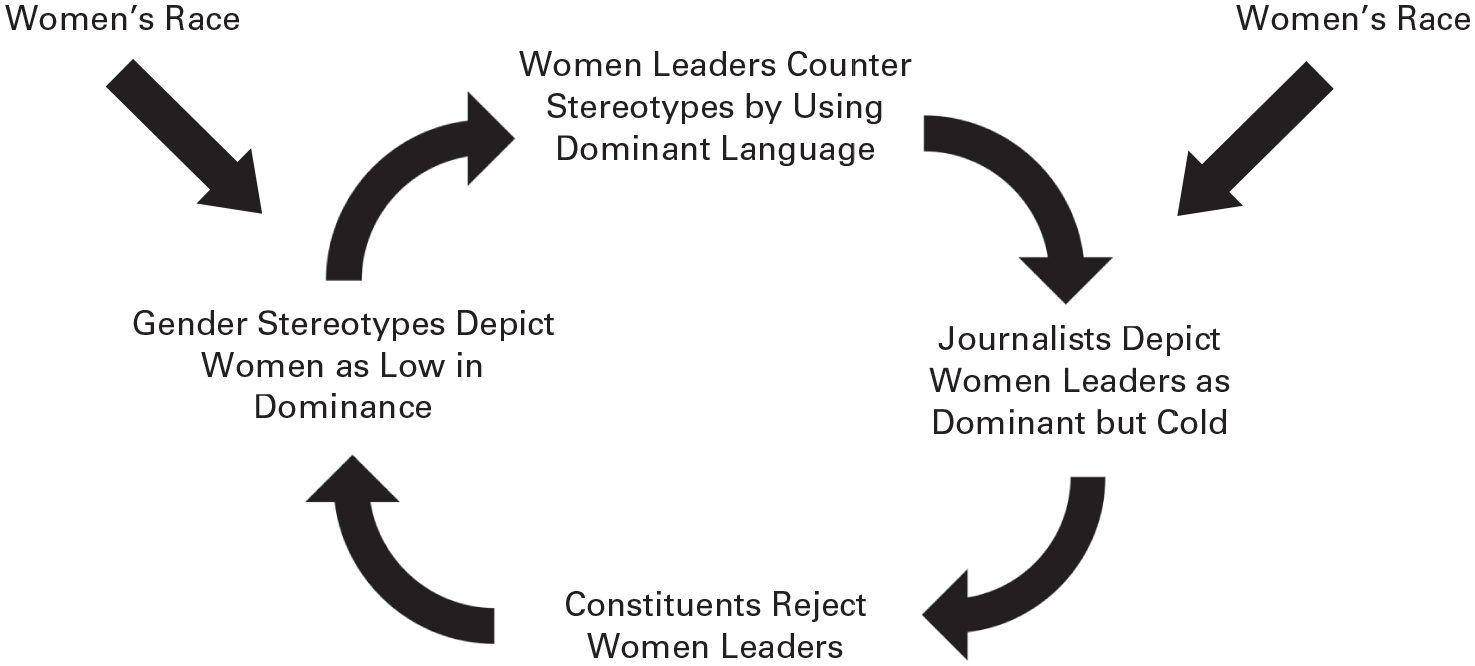
Relationships Between Gender Stereotypes, Women Leaders’ Use of Dominant Language, Media Depictions, and Constituent Rejection, Moderated by Women Leaders’ Race
The Setting: United States Politics
To test my theories in the field, a site needed to meet several conditions: observability and measurability of language from women and men leaders, comparability of language between women and men leaders, observability and measurability of media outlets’ written descriptions of leaders as predicted by the leaders’ language, and comparability of constituents’ support of women and men leaders as predicted by leaders’ language. Accordingly, I chose a prominent leadership context: U.S. politics.
Study 1: Field Data from the Congressional Floor
Study 1 provides an initial test of Hypotheses 1a and 1b by capturing and analyzing the naturalistic verbal behavior of women and men leaders in the U.S. Congress. Leveraging advances in natural-language analysis, I analyzed 25 years of Congressional remarks to test whether women used more dominant language than men did on the Congressional floor, before and after I controlled for relevant variables. The analyses first tested for predicted gender effects overall (Hypothesis 1a) before separately testing whether, as theorized (Hypothesis 1b), the predicted effects are unique to White (but not Black and Latina/o) leaders.
Setting
As in organizations worldwide, the face of leadership in U.S. politics is changing. Although men still compose the majority of the U.S. Congress, at the time of this writing a record number of women serve in that body (Blasina and DeSilver, 2021). During their term in Congress, every lawmaker has the opportunity to speak on the Congressional floor, providing an ideal context in which to test my theories. Topics addressed on the Congressional floor vary widely, as legislators choose to speak about many different topics, through introducing bills, debating colleagues, or engaging attention on particular issues or events (Davis, 2015).
Readers may wonder whether political leaders prepare their own Congressional remarks. Political speech is often a collaboration between legislators and their staff. Interviewing staff members from 24 Congressional offices, Jost and Sterling (2020) found that much Congressional speech is co-created with staff to varying degrees. My field data are nonetheless useful for examining stereotype-relevant language in leaders’ speech (and its implications), for several reasons. First, legislators pay close attention to the remarks they deliver. To verify this, I interviewed a Congressional staff member (who wished to remain anonymous), who noted that legislators often closely attend to communication, modifying the content of prepared remarks or social media posts. 3 This is true outside the political realm as well. Chatterjee and Hambrick (2007: 363) interviewed corporate experts to verify leaders’ involvement in CEO reports, finding that “CEOs are very attentive to the content and design of annual reports, and they particularly have strong opinions and control over how they themselves are portrayed.”
Second, when drafting Congressional speech, staffers conform to the legislators’ linguistic preferences. As Jost and Sterling (2020: 84) wrote, “staffers communicating on behalf of a member of Congress seek to write messages that would be approved by their boss, and this, too, is likely to increase the similarity between what the staffer writes and what the Congress members would find appealing in terms of language use.” As staff receive feedback from legislators, they modify communication to conform to the legislators’ wishes. “Everything you do is in their name. What they say goes” (anonymous informant, personal communication, July 18, 2023).
Finally, there is empirical precedent in the field for examining leaders’ speech (often not exclusively authored by the leaders) as representing them. For instance, in the above-noted study, Chatterjee and Hambrick (2007) linked language use in CEOs’ annual reports to leaders’ putative narcissism, although reports were co-authored by staff. Moreover, Emrich and colleagues (2001) analyzed U.S. presidential speeches, testing whether the content impacted perceptions of leaders’ charisma. These speeches, too, were co-authored with staff. Regardless of authorship, the communication that leaders approve and deliver is taken to represent them and has implications for how they are perceived and whether they are accepted.
Data
To ensure an equal number of White and racial minority politicians in my data set, I first catalogued the total number of Black American and Latina/o politicians elected to the U.S. Congress through public records of their Congressional remarks (i.e., those who served after 1995, when transcripts of Congressional remarks became readily accessible). I determined race through a multi-step process. First, I drew on archives of all Black and Latina/o legislators elected to the U.S. Congress (History, Art, and Archives, U.S. House of Representatives, 2023a, 2023b). I next cross-referenced these legislators of color against recorded membership in formal groups organized around racial identity (e.g., National Hispanic Caucus of State Legislators, Congressional Hispanic Caucus). I also perused legislators’ official biographies and statements, reviewing them for references to racial identity. For instance, Ted Cruz would be coded as Latino because he is included in official government archives as a Latino senator (History, Art, and Archives, U.S. House of Representatives, 2023b), and he has recorded instances of asserting his Hispanic heritage (Carpenter, 2015). This search process resulted in a total of 156 Black (n = 95) and Latina/o (n = 61) legislators who were first elected to Congress between 1971 and 2017 and who served between 1995 and 2018.
Each Black American or Latina/o politician was then matched with a White American politician of the same gender and political party, from approximately the same region of election, and who served the same approximate term in office. This was achieved by reviewing the Biographical Directory of the United States Congress. This matching process resulted in a total of 312 Black, Latina/o, and White American lawmakers, including 92 women. This final sample size provided greater than 80 percent power to detect a between-groups (women versus men) difference of d = .4, the average effect size in social psychology (Richard, Bond, and Stokes-Zoota, 2003).
The Congressional Record is a mostly verbatim account of all remarks made by lawmakers on the floor of the Senate and the House of Representatives. Congressional remarks refer to all commentary (including speeches, queries, and responses) made by lawmakers on the Congressional floor. I used the programming language Python to search the Congressional Record archives and collect all Congressional remarks by the identified politicians. This search process resulted in a total of 259,458 remarks by all selected Black, Latina/o, and White congressmen and congresswomen between 1995 (when the Congressional Record became publicly available) and 2018. I aggregated all legislators’ Congressional remarks throughout their tenure, providing the largest quantity of analyzable text for each leader. Supplement 2 in the Online Appendix provides topic model analyses of the entire corpus of text and text subgrouped by leaders’ gender and race, providing suggestive evidence that conversation topics were similar across groups.
Measures
Outcome variable
The outcome variable was Dominance references in Congressional speech. Researchers across the social sciences have long suggested that content analysis of open-ended text is the most objective approach to analyzing linguistic data (Silverman, 1993). I leveraged recent advances in natural-language processing to determine the stereotype content of men and women leaders’ public statements. The R dictionary Semi-Automated Dictionary Creation for Analyzing Text (SADCAT) uses validated dictionaries to assess the stereotype content of open-ended text (Nicolas, Bai, and Fiske, 2021). SADCAT has several advantages over other text-analysis tools. First, rather than assessing agency as a unidimensional construct, SADCAT features several dictionaries that more precisely capture subdimensions of agency, including dominance. Second, SADCAT assesses valence, with separate dictionaries that capture high or low references to the construct of interest (e.g., high dominance). Nicolas and colleagues’ (2021) dictionary-creation process was both rigorous and theory-driven. Each dictionary began with theoretically relevant seed words before expanding to include semantically related terms using WordNet (Fellbaum, 1998). The authors then subjected each dictionary to robust convergent and discriminant validity analyses. For example, they used pairwise comparisons to determine that the words within each dictionary were more closely related to each other than to words in other dictionaries (Nicolas, Bai, and Fiske, 2021, Study 3). For more details on the dictionary-creation and -validation process, see Nicolas, Bai, and Fiske (2021).
I focused on the dictionary most relevant to my theorizing: the high power dictionary, which includes words such as “determined,”“assertive,” and “confident.” SADCAT counts the number of words from open-ended text that come from a given dictionary. SADCAT controls for volubility, which corresponds to both dominance and gender (Brescoll, 2011), by computing percentages rather than counts; percentages account for the total number of words in a given text. Each leader was thus given a score representing the percentage of words from their Congressional remarks that correspond to the high power dictionary: their use of dominant language in Congress. 4
Predictor variable
The predictor variable was Leader gender (–1 = woman, 1 = man). Although the gender binary (woman/man) does not reflect the spectrum of gender identities in Congress or worldwide, the binary was the focus of my theorizing and this study.
Moderator variable
The moderator variable was Leader race (–1 = White American, 1 = Black American or Latina/o). Black and Latina/o leaders were grouped together for analyses because predictions for these leaders were similar, based on my theorizing, and doing so increased the sample size for comparisons between White leaders and leaders of color. While this grouping limits fine-grained analyses of effects among these racial/ethnic groups, this analytical choice increased statistical power for White/racial minority comparisons—an important consideration given that sample sizes were limited in field settings. In additional analyses, I disaggregated this grouping to examine results for Black and Latina/o leaders separately; results for Black and Latina/o leaders were similar (see Supplement 3 in the Online Appendix).
Control variables
Leaders’ use of dominant language may correspond to numerous related variables. Compared with Democrats, Republicans are stereotyped as more masculine and are known to express more dominance (Kahn, 1996; Petrocik, Benoit, and Hansen, 2003; Winter, 2010). Moreover, analyses of political discourse suggest that conservatives tend to use more dominant language than liberals do (Fetterman, Boyd, and Robinson, 2015) and that women’s stereotype-relevant language use may vary according to their political party (Bauer and Santia, 2022). I thus controlled for Leader political party (–1 = Republican, 1 = Democrat), determined via the Biographical Directory of the United States Congress, and Leader ideology, estimated using DW-NOMINATE (Poole and Rosenthal, 1985, 2001)—a measure that estimates legislators’ liberal–conservative ideology based on their roll-call votes in Congress. These widely validated scores, determined by applying multidimensional scaling techniques, are often used by scholars and media outlets to estimate political actors’ ideology. Scores are available for current and prior lawmakers on the website Voteview.com, which updates roll-call votes daily and scores frequently. 5 Higher scores indicate more-conservative ideology.
Legislators with more Congressional experience may use more dominant language than do newer arrivals to Congress, due to the former’s increased feelings of empowerment. Alternatively, due to increased feelings of stability, seasoned legislators may be less likely than inexperienced legislators to use dominant language. To account for both possibilities, the final control variable was Congressional terms served, estimated as the number of Congressional terms each legislator had served prior to 2018. This information is publicly available via the Biographical Directory of the United States Congress. Table 1 provides means, standard deviations, and intercorrelations for all variables used in my analyses.
Means, Standard Deviations, and Correlations for Study 1*
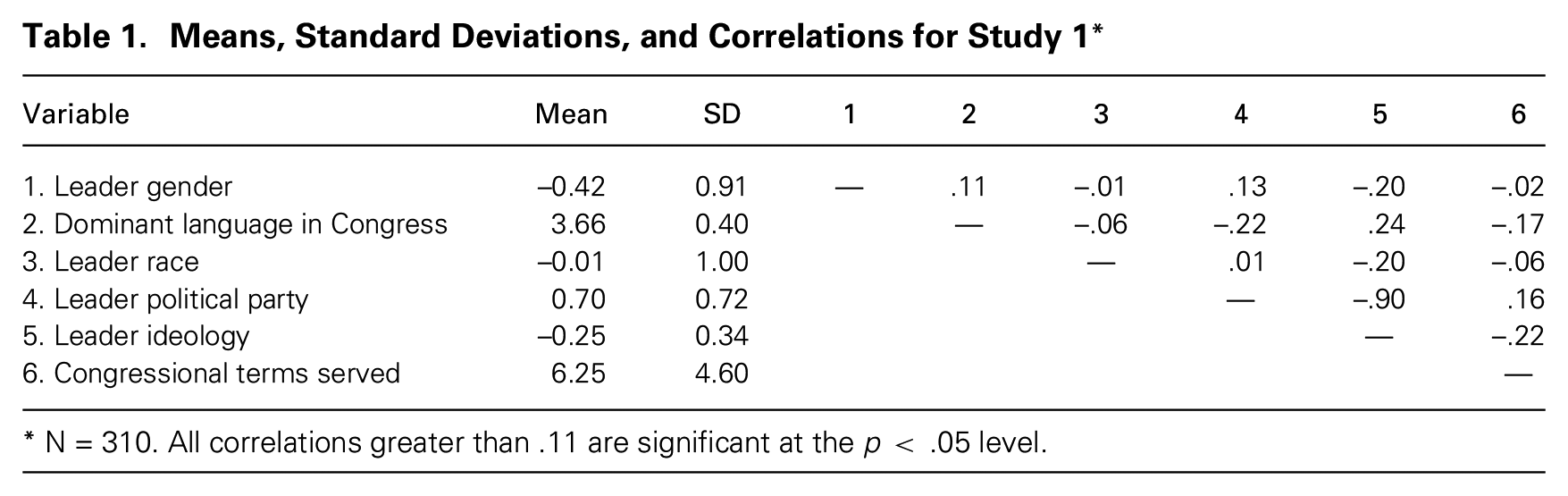
* N = 310. All correlations greater than .11 are significant at the p < .05 level.
Results
I first entered Leader gender into a linear regression model predicting leaders’ use of dominant language in their aggregated Congressional remarks. I next entered control variables into a second model. A third model included Leader gender, Leader race, and the interaction term (no control variables). Finally, I entered all variables—Leader gender, Leader race, the interaction term, and control variables—into a fourth model. Table 2 provides all results.
Effect of Leaders’ Gender Predicting Leaders’ Use of Dominant Language in Congress (Study 1)*
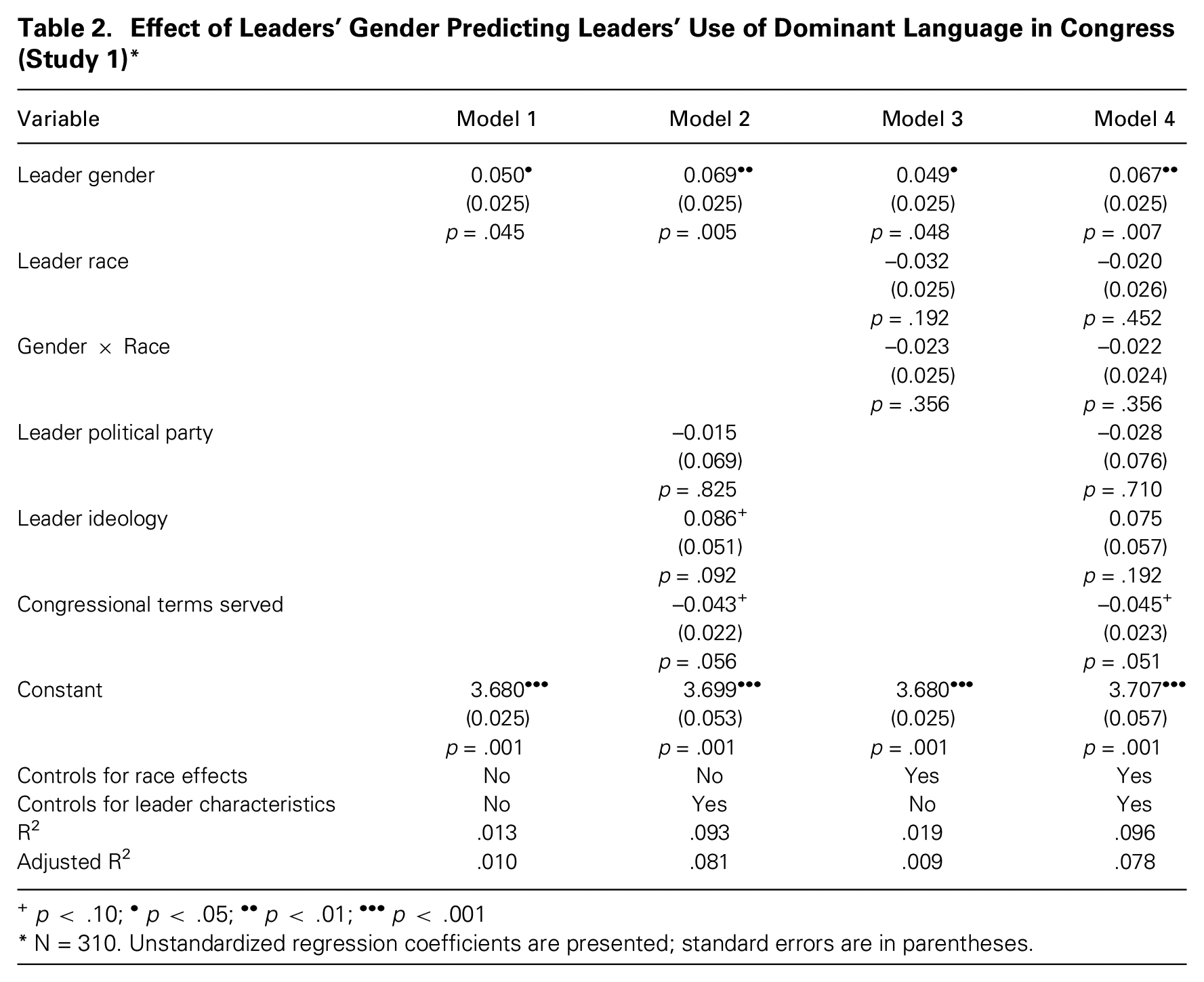
+p < .10; •p < .05; ••p < .01; •••p < .001
* N = 310. Unstandardized regression coefficients are presented; standard errors are in parentheses.
Effect of leaders’ gender
Initial analyses tested Hypothesis 1a, the prediction that women leaders use more dominant language than men do. As estimated in Model 1 of Table 2, a significant effect of Leader gender supported this prediction. Women leaders referenced dominance significantly more than men did in Congress. Figure 2 plots this main effect in terms of percentage of dominance references in aggregated Congressional remarks.
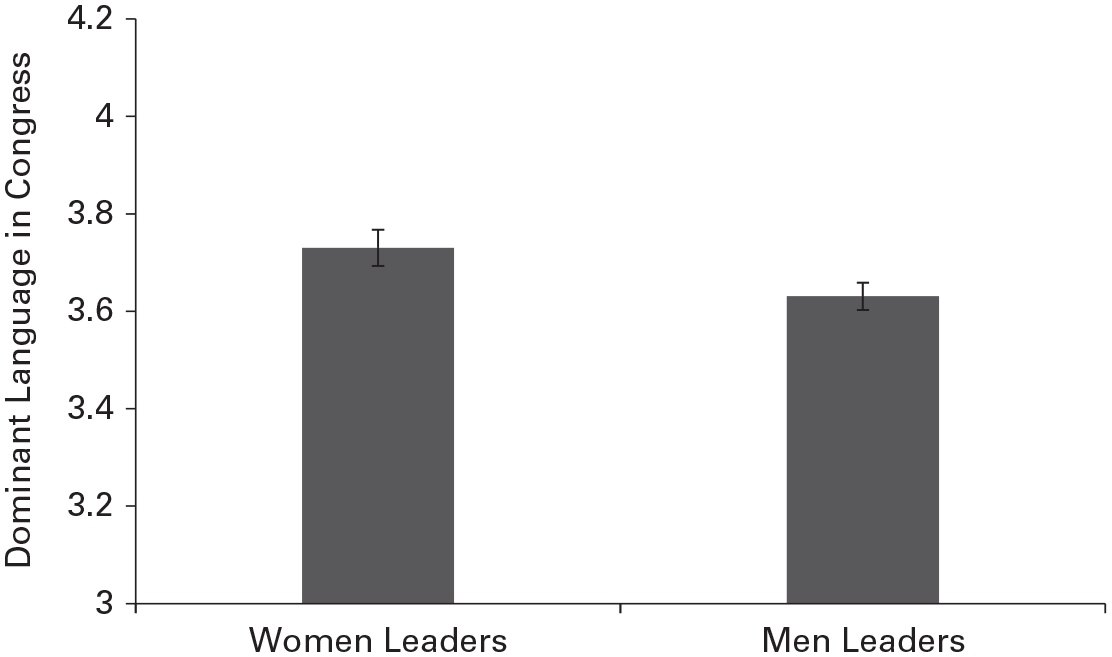
Effect of Leaders’ Gender on Use of Dominant Language in Congress (DV: Percentage Dominance References in Congressional Remarks)*
I conducted several sensitivity analyses and robustness checks on the main result reported in Model 1. I first determined whether the Leader gender effect held after I accounted for leader characteristics. As shown in Model 2 of Table 1, the main effect of Leader gender held beyond control variables. I next ensured that the Leader gender effect was not driven by gender differences in the distribution of dominance references. Levene’s test of equality of variance revealed that variances for dominance references in aggregated Congressional remarks were not significantly different for women than for men leaders (p = .374). Second, I checked variable distribution. Although linear regression analyses are robust to non-normal predictor or outcome variables, non-normal residuals violate assumptions. Kolmogorov-Smirnov tests of normality indicated that the outcome variable and residuals were normally distributed (ps = .200); visual assessments of residual normality, variable linearity, and heteroscedasticity yielded no deviations. Third, I checked for outliers. Although I made the decision a priori not to exclude outliers (thus maximizing statistical power and better representing the sample’s diversity), in a separate analysis I found that the pattern of results held when I trimmed the dataset to include only leaders whose use of dominant language was in the middle 99 percent of the distribution (thus excluding leaders who referenced dominance less than 2.68 or more than 4.77 percent of the time). Re-analysis of the Leader gender effect without these outliers (n = 4) revealed the same pattern of results: women leaders referenced dominance more than men did (without controls: β = .111, p = .052; with controls: β = .140, p = .014). Finally, I checked for multicollinearity by computing variance inflation factors (VIF). In all models, VIF scores were less than six, below the recommended cutoff of ten (Kutner et al., 2005).
Effect of leaders’ gender separated by leaders’ race
I next tested Hypothesis 1b, which posed that the predicted Leader gender effect on leader’s use of dominant language would be strongest among White leaders. This translates to White women leaders referencing dominance more than same-race men do but Black and Latina women leaders not referencing dominance more than same-race men do. Although the Leader gender×Leader race interaction did not reach significance (Models 3 and 4, Table 2), the omnibus interaction test is insensitive to predictions (such as this one) containing one null slope rather than a full crossover pattern (Rosnow and Rosenthal, 1989). Thus, my analyses directly tested a priori predictions by examining simple slopes (see also Tybout and Sternthal, 2001; Kaiser and Spalding, 2015; Dupree and Fiske, 2019; and Iyer and Achia, 2021). The results supported my predictions: the Leader gender effect was unique to White leaders. White congresswomen referenced dominance significantly more than White congressmen did (without controls: unstandardized beta (B) = .072, standard error (S.E.) = .035, p = .039; with controls: B = .089, S.E. = .034, p = .009). However, Black women and Latina leaders did not reference dominance significantly more than same-race men did (without controls: B = .026, S.E. = .035, p = .457; with controls: B = .045, S.E. = .034, p = .193). Follow-up equivalence tests revealed that the gender difference for leaders of color was significantly closer to zero than it was to the smallest effect that this field sample had the power to detect at 80 percent power (90 percent CI = –.16–.08, P = .020, n = 154). 6 Recall that this sample included equal numbers of White and minority politicians. Figure 3 plots these simple slopes (without controls); see Table 3 for means between groups and pairwise comparisons. 7
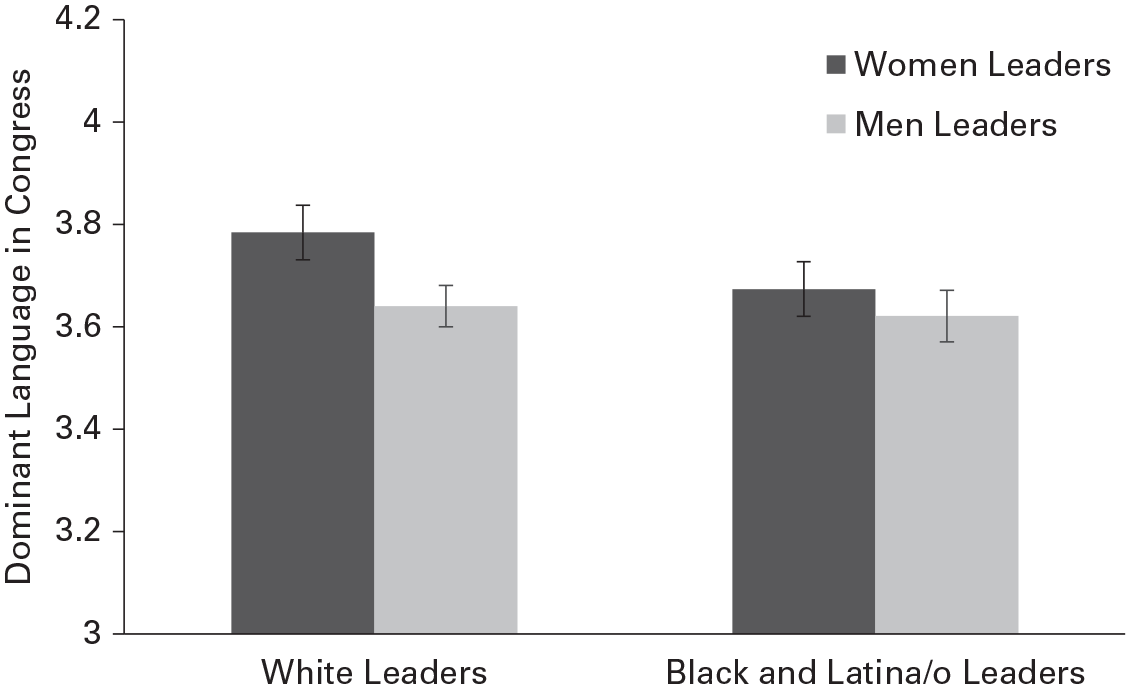
Effect of Leaders’ Gender on Use of Dominant Language in Congress, Separated by Race (DV: Percentage Dominance References in Congressional Remarks)*
Mean Differences Between Groups for Use of Dominant Language (Studies 1–2)*
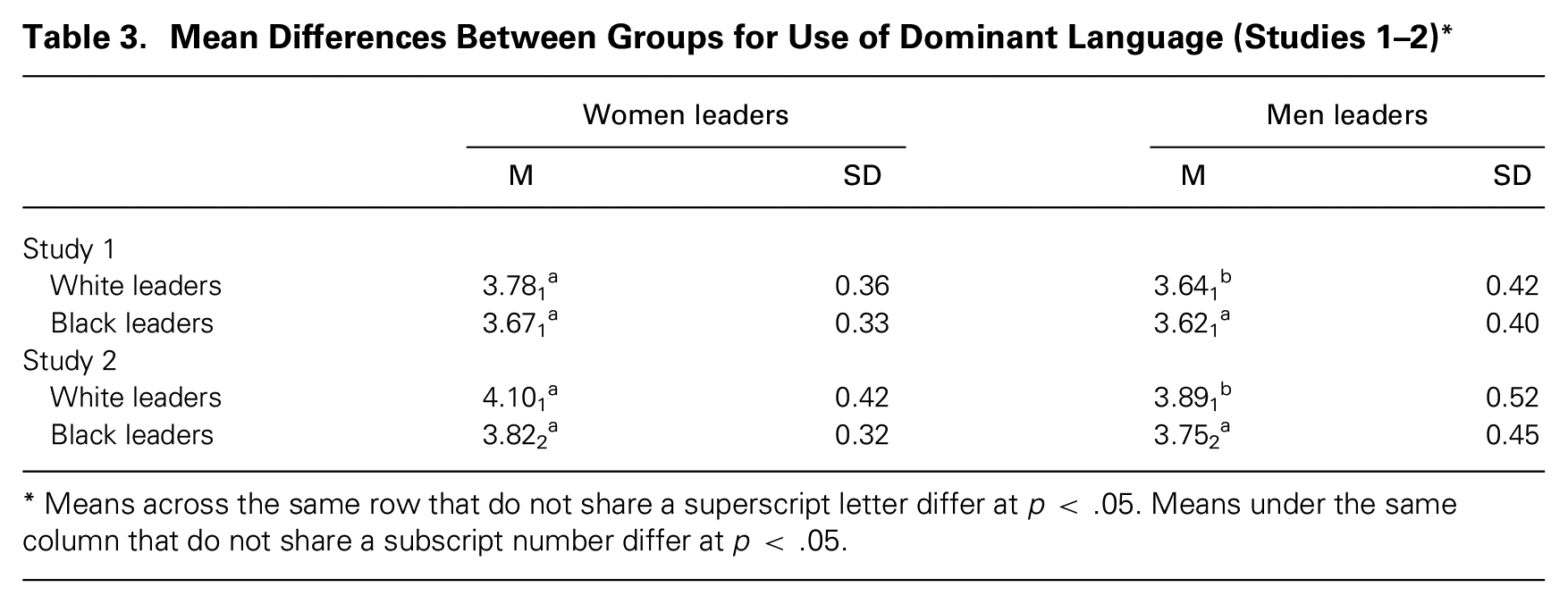
* Means across the same row that do not share a superscript letter differ at p < .05. Means under the same column that do not share a subscript number differ at p < .05.
Discussion
In line with the proposed theoretical model, Study 1 offers evidence that women leaders use language that runs counter to submissiveness stereotypes in workplace speech. When speaking on the Congressional floor, women leaders referenced dominance significantly more than men leaders did. Through intersectional analyses, I tested whether results differ for White leaders versus leaders of color, specifically, Black and Latina/o leaders, who are more wary of backlash effects for dominant behavior. The results supported this notion: Black women and Latina leaders did not reference dominance significantly more than same-race men leaders did. Having found initial support for my theories, I sought to replicate the results in another ecologically valid leadership environment: social media.
Study 2: Field Data from Social Media
The aim of Study 2 was to replicate and extend Study 1’s findings, again testing whether and which women leaders use counter-stereotypical language by referencing dominance more than men leaders do. To meet this goal, I sought a field site featuring a racially and gender-diverse sample of women and men leaders whose public statements are readily available and analyzable. The social media platform Twitter (now titled X) met this goal.
Study 2 also extends prior findings in one important way: by analyzing political speech that voters are more likely to notice. On the Congressional floor, legislators directly address other politicians (and, to a lesser degree, journalists). Indeed, in interviewing Congressional staffers, Jost and Sterling (2020: 84) found that language on the Congressional floor is often deemed as being aimed toward “other elites rather than ordinary citizens.” However, social media is largely composed of voters, making them the intended audience of social media posts. According to one interview in Jost and Sterling (2020), legislative office members perceive the Twitter audience to be the general public (versus the Facebook audience, which is perceived to be largely supporters). Thus, while Study 1 examines high-profile leaders’ speech directed at other elite leaders and the media, Study 2 examines high-profile leaders’ speech directed at the general public.
Setting and Data
In 2019 (the year of data collection), Twitter was one of the most popular social media sites in the world, with 20 percent of all U.S. internet users logging on daily. Users create an online profile, from which they can post brief messages (“tweets”) consisting of 280 or fewer characters. Leaders worldwide have realized the possibilities of massive online communities. Many politicians use social media to launch soft campaigns and connect with voters (Utz, 2009). (Former U.S. president Donald Trump used this platform almost daily throughout his presidency, posting often-polarizing tweets at all hours.) Twitter provided an ideal environment in which to test the theorizing supported in Study 1, to determine whether and which women leaders used counter-stereotypical language by referencing dominance more than men leaders did when posting on Twitter.
I first determined the sample size by cataloguing the total number of White, Black, and Latina/o legislators who served in the 116th U.S. Congress (the active Congress at the time of data collection) and who had active Twitter profiles (95 percent of all legislators). For those legislators with multiple profiles, I selected the “official” profile. The data collection process resulted in 419 White and 92 Black (n = 55) and Latina/o (n = 37) legislators, including 116 women.
I accomplished tweet collection using the standard Twitter API (application programming interface), which downloads a maximum of the 3,200 most recent tweets posted by any given user, with no time limit. I therefore used an automatic script to download the 3,200 most recent tweets posted by selected lawmakers as of July 2019 (when data collection occurred). Duplicate tweets, retweets, and links were deleted, leaving a total of 936,722 original tweets posted by White, Black, and Latina/o politicians seated in the 116th Congress. As was done for Congressional remarks, I aggregated the politicians’ tweets, providing the largest quantity of analyzable text for each leader.
Measures
Outcome variable
The outcome variable was Dominant language on Twitter. I used the R package SADCAT to measure leaders’ use of dominant language on Twitter, again drawing on the high power dictionary. Each leader was given a score representing the percentage of words from their Congressional tweets that came from the high power dictionary: their use of dominant language on Twitter. Higher scores indicate that a higher percentage of leaders’ language came from SADCAT’s high power dictionary.
Predictor variable
The predictor variable was Leader gender (–1 = woman, 1 = man). Although the gender binary (woman/man) does not reflect the spectrum of gender identities worldwide or in Congress, the binary was the focus of my theorizing and this study.
Moderator variable
The moderator variable was Leader race (–1 = White American, 1 = Black American or Latina/o). I again grouped Black and Latina/o leaders together for analyses because theoretically grounded predictions for Black and Latina/o leaders were consistent, doing so increased statistical power to disaggregate findings by White leaders versus leaders of color, and Study 1 revealed that results were similar for Black and Latina/o leaders. In separate analyses (see Supplement 3 in the Online Appendix), I disaggregated this grouping to examine results for Black and Latina/o leaders separately, and results for both racial/ethnic groups were again similar.
Control variables
Study 2 included the same control variables as those used in Study 1. I again determined the speakers’ party membership (–1 = Republican, 1 = Democrat) via the Biographical Directory of the United States Congress and estimated political ideology by using DW-NOMINATE scores collected from Voteview.com. (DW-NOMINATE scores were unavailable for four members of the 116th Congress; these politicians were excluded from analyses.) Finally, I estimated Congressional experience via the number of terms each politician had served prior to the 116th Congressional term; this information was again collected via the Biographical Directory of the United States Congress. Table 4 provides means, standard deviations, and intercorrelations for all variables used in the analyses.
Descriptive Statistics and Intercorrelations for Variables in Study 2*
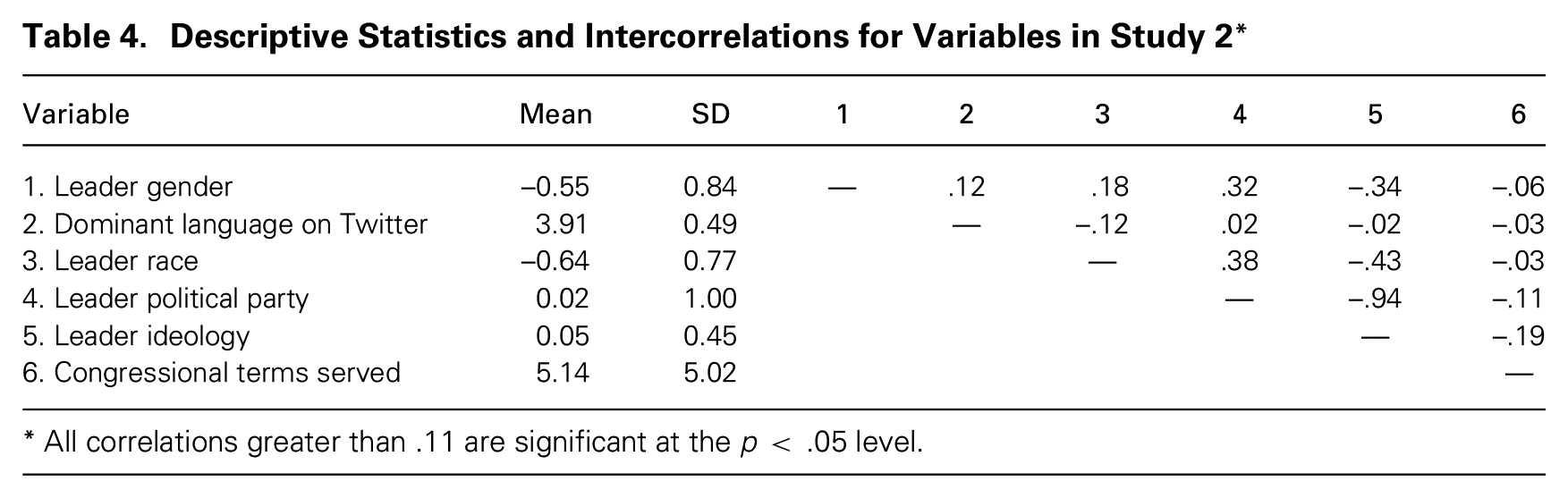
* All correlations greater than .11 are significant at the p < .05 level.
Results
I first entered Leader gender into a linear regression model predicting leaders’ use of dominant language in their aggregated Congressional tweets; control variables were added into a second model. I entered Leader gender, Leader race, and the interaction term into a third model. A fourth model mimicked the third, with the inclusion of control variables. Table 4 provides all results.
Effect of leaders’ gender
Initial analyses tested Hypothesis 1a, which predicted that women leaders would reference dominance more than men leaders did. A significant main effect of Leader gender supported this prediction. As shown in Model 1 of Table 5, women leaders referenced dominance significantly more than men leaders did on Twitter. Figure 4 plots this effect in terms of percentage of dominance references in aggregated Congressional tweets.
Effect of Leaders’ Gender and Race Predicting Leaders’ Use of Dominant Language on Twitter (Study 2)*
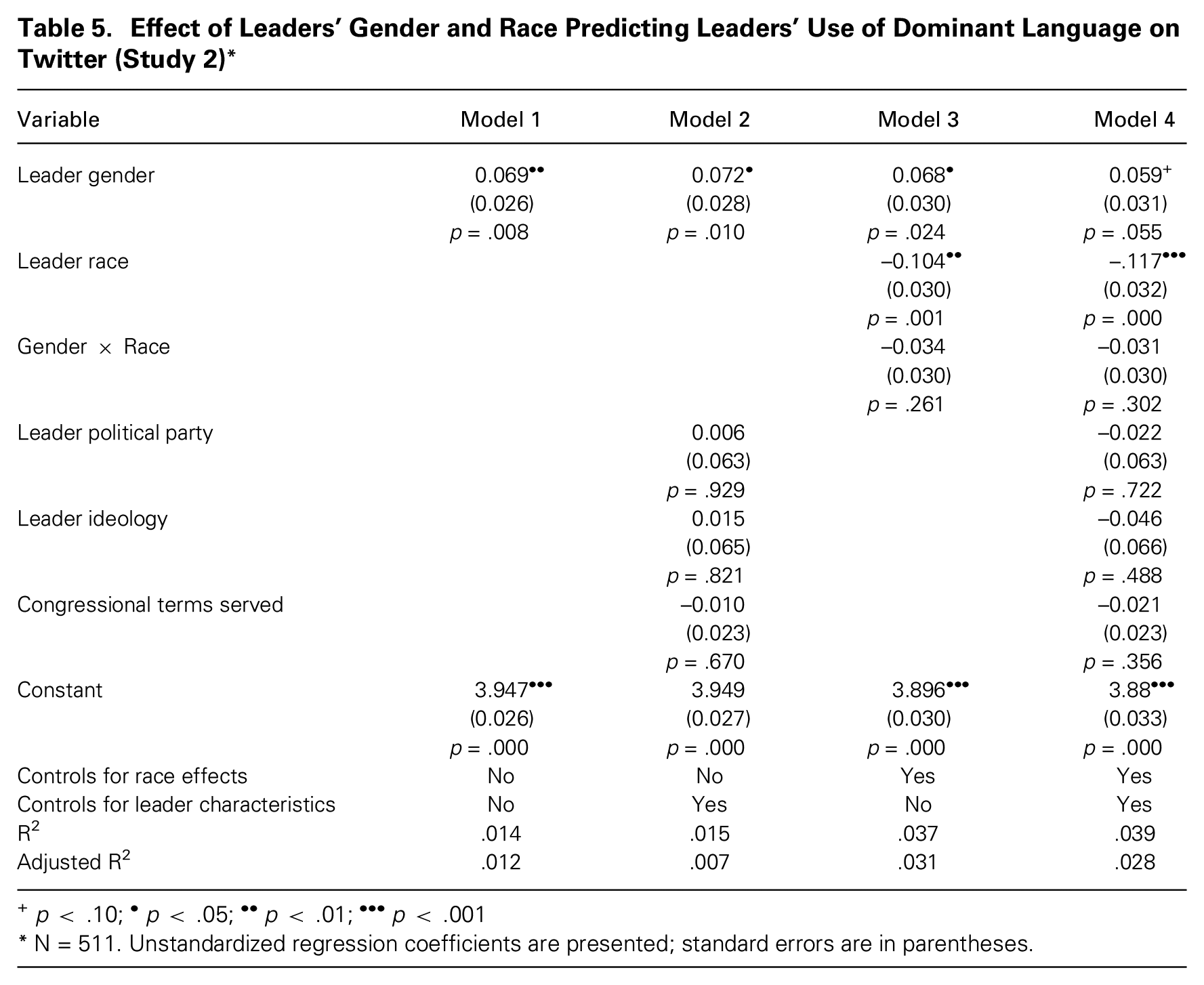
+p < .10; •p < .05; ••p < .01; •••p < .001
* N = 511. Unstandardized regression coefficients are presented; standard errors are in parentheses.
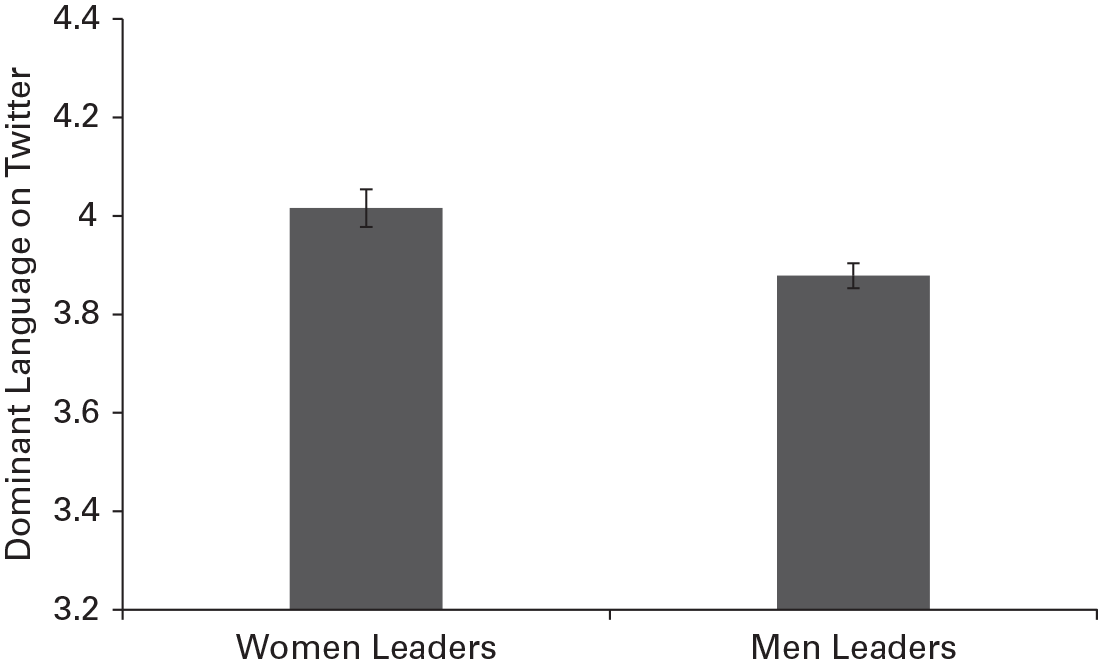
Effect of Leaders’ Gender on Use of Dominant Language on Twitter (DV: Percentage Dominance References in Congressional Tweets)*
As I did for Study 1, I conducted several sensitivity analyses and robustness checks on the Leader gender effect. First, I showed that the main effect of leaders’ gender held beyond the control variables (Model 2, Table 5). I next tested for gender differences in the distribution of dominance references. Levene’s test for equality of variance revealed that women leaders’ use of dominant language was significantly more variable than men’s (p = .013). Thus, I conducted an independent t test with equality of variance not assumed. The results mirrored those reported in Model 1: women leaders used more dominant language than men did on Twitter (t(228.52) = −2.987, p = .003). I next checked the variable distribution and outliers. Kolmogorov-Smirnov tests of normality found that the outcome variable and residuals were not normally distributed (outcome variable: p = .023; residuals: p = .033). Visual assessment of variable and residual distribution suggested that outliers were likely responsible. I therefore trimmed the dataset to include only leaders in the middle 99 percent of the distribution, excluding leaders with dominance references (i.e., those for whom less than 2.67 percent or more than 5.13 percent of the words in their aggregated tweets referenced dominance). After I removed these outliers (n = 10), Kolmogorov-Smirnov tests of normality found that the outcome variable and residuals were normally distributed (outcome variable: p = .200; residuals: p = .153). Re-analysis using this trimmed dataset replicated the main results reported above: women leaders used more dominant language than men did on Twitter (without controls: β = .122, p = .012; with controls: β = .135, p = .010). Finally, I checked for multicollinearity. In all models, VIF scores were less than nine, below the recommended cutoff of ten (Kutner et al., 2005).
Effect of leaders’ gender separated by leaders’ race
I next tested whether, as theorized in Hypothesis 1b, the Leader gender main effect would be unique to White (versus Black and Latina/o) leaders such that White women but not Black and Latina women would reference dominance more than their same-race men peers did. As in Study 1, simple slope analyses directly tested this a priori prediction. Supporting my theorizing and replicating Study 1, the Leader gender effect was unique to White leaders. White women referenced dominance significantly more than their same-race men peers did on Twitter (without controls: B = .102, S.E. = .030, p = .001; with controls: B = .091, S.E. = .032, p = .005). However, Black and Latina women did not reference dominance significantly more than their same-race men peers did (without controls: B = .034, S.E. = .052, p = .510; with controls: β = .028, S.E. = .052, p = .540). Moreover, follow-up equivalence testing determined that the gender difference for leaders of color was significantly closer to zero than to the smallest effect that this field sample had the power to detect at 80 percent power (90 percent CI = –.20–.06, P = .021, n = 92). Figure 5 plots these simple slopes (without controls).
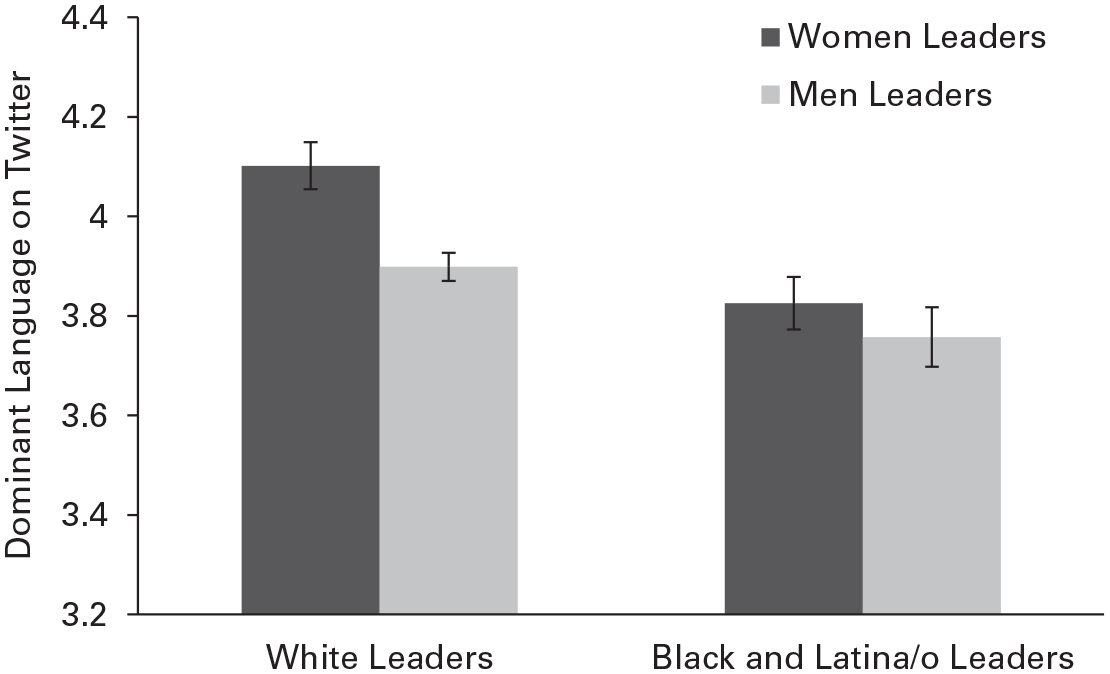
Effects of Leaders’ Gender on Use of Dominant Language on Twitter, Separated by Race (DV: Percentage Dominance References in Congressional Tweets)*
Discussion
Study 2 replicated the results of Study 1 by testing my theories in a new, ecologically valid setting: social media. When posting on Twitter, women leaders referenced dominance significantly more than men leaders did, supporting Hypothesis 1a. Together, Studies 1 and 2 support my theories. Across two archival datasets of real-world leaders’ speech, women leaders referenced dominance more than men did, using language that runs counter to stereotypes depicting women as more submissive than men. This effect, however, was unique to White women. Supporting my intersectional theories, Black and Latina women leaders did not reference dominance more than their same-race peers did. This finding, replicated across two studies, reinforces the need for gender scholars to analyze gendered phenomena as racialized.
Study 3: Media Coverage of Leaders Who Use Dominant Language
Studies 1 and 2 revealed that women leaders—White women, in particular—referenced dominance more than men did in Congress and on Twitter. These archival studies were well powered and high in ecological validity; leaders were not aware that their statements were under study by scholars. The effects, however, were subtle. Although robust across studies, the effect sizes were small to medium. This raises the question: do observers attend to women leaders’ use of dominant language? If so, to what effect? Studies 3 and 4 examine the intersectional implications of women leaders’ dominant language, specifically backlash.
A robust literature on backlash effects finds that women are often penalized for dominant behavior (Heilman, 2001). However, two questions remain. First, are women penalized for referencing dominance in their speech? Studies show that women are less penalized for implicit than for explicit dominance (Williams and Tiedens, 2016). Thus, if women’s use of dominant language in the workplace is relatively implicit, they may not be penalized for it. Second, are women leaders who have reached the upper echelons of their field penalized for dominant behavior? Much of the backlash research has focused on women in lower or middle management; empirical tests of dominance penalties toward women in high-profile leadership positions remain rare and ambivalent. Some scholarship suggests that women at the very highest organizational ranks (e.g., CEOs) are less subject than their lower-ranked counterparts to penalties for dominant behavior, presumably because such leaders have already proven their likeability by ascending to high ranks (Rosette and Tost, 2010).
Studies 3 and 4 test these questions. Study 3 begins by examining whether women leaders’ dominant language predicts backlash from the media. Specifically, Study 3 tests the possibility that the more women leaders reference dominance in Congress, the more frequently journalists will use dominant but cold language to describe them (Hypothesis 2a). My intersectional analyses then determine whether these effects are strongest among White leaders (Hypothesis 2b) or Black and Latina/o leaders (Hypothesis 2c), as my theory suggests either possibility.
Setting and Data
Journalists are important observers of political behavior. Editorials can paint legislators as powerful or weak, cold or caring. Per accumulation theory, consistent, persistent, and highly corroborated descriptors have an immense impact on observers (DeFleur and Dennis, 1998). Political scientists have shown that media depictions of women leaders especially tend to be stereotypical and can have robust consequences for women seeking to attain and maintain access to political leadership (Kahn, 1992, 1996).
Study 3 returns to the politicians whose Congressional speeches I analyzed in Study 1: a total of 310 8 lawmakers based in the continental United States: 156 White, 154 Black (n = 94) or Latina/o (n = 60), including 90 congresswomen. Study 1’s sample was preferable to Study 2’s, as the former included an equal number of White leaders and leaders of color and captured leaders’ Congressional remarks over the course of decades. Using Dow Jones & Company’s Factiva, an international news database (https://global.factiva.com/), research assistants collected all news editorials that referenced each legislator in the headlines during their Congressional tenure. For each legislator, the search criteria were specified as follows: major news and business publications, United States; editorials, not letters, not letters to the editor, not commentaries/opinions; United States; “[legislator name]”; and custom date range: [year legislator began service–year legislator ended service (or present year if still serving)]. Certain leaders shared a name with another famous individual (e.g., Al Green); in such cases, research assistants included the politician’s party and state (e.g., D-TX) or sorted results manually.
For 279 legislators (138 White, 91 Black, 50 Latina/o; 90 percent of all legislators whose Congressional speech was analyzed in Study 1), at least one targeted editorial referenced them (M = 65.63 editorials), resulting in a total of 17,984 editorials. 9 For politicians with over 100 editorials (e.g., Barack Obama), the number was limited to the 100 most recent editorials in their Congressional term (10 percent of sample). The final sample size of 279 leaders with editorials provided over 80 percent power to detect an interactive (Leader gender×Dominance) effect size of f = .21, the average effect size in social psychology (Richard, Bond, and Stokes-Zoota, 2003). As was done in prior studies, I aggregated editorials about each leader, providing the largest quantity of analyzable text for each leader.
Measures
Outcome variables
The primary outcome variables were Journalists’ use of dominant language in editorials and Journalists’ use of cold language in editorials. As in prior studies, I used SADCAT’s high power dictionary to determine the extent to which journalists used dominant language to describe leaders. I used SADCAT’s low sociability dictionary to determine the extent to which journalists used cold language to describe leaders. The low sociability dictionary includes words like “cold,”“disliked,” and “unfriendly.” Higher scores indicate that a higher percentage of words within editorials about each leader, as aggregated throughout their Congressional tenure, came from the high power or low sociability dictionaries.
Predictor variables
The first predictor variable was Leaders’ dominant language in Congress. I again collected leaders’ Congressional remarks, using the Congressional Record. I then computed leaders’ use of dominant language by using the R package SADCAT. Higher scores indicate that a higher percentage of words within leaders’ Congressional remarks, as aggregated throughout their Congressional tenure, came from the high power dictionary. The second predictor variable was Leader gender (–1 = men, 1 = women). The final predictor variable was the Dominance×Gender interaction, which tests whether the effects differed for women (versus men) who used dominant language in the workplace.
Moderator variable
The moderator variable was Leader race (–1 = White American, 1 = Black American or Latina/o). Black and Latina/o leaders were again grouped together for analyses. In separate analyses, I disaggregated this grouping to examine results for Black and Latina/o leaders separately. In this case, the results for White and Latina/o leaders were similar, making this a conservative test of hypotheses (see Supplement 3 in the Online Appendix for more details).
Control variables
Study 3 included the same control variables as those used in prior studies: Leader political party (–1 = Republican, 1 = Democrat), determined using the Biographical Directory of the United States Congress; Leader ideology, estimated using DW-NOMINATE scores from Voteview.com; and Congressional terms served, estimated as the number of terms each politician had served prior to the 116th Congressional term, determined using the Biographical Directory of the United States Congress. Table 6 provides means, standard deviations, and intercorrelations for all variables used in the analyses.
Means, Standard Deviations, and Correlations for Study 3*
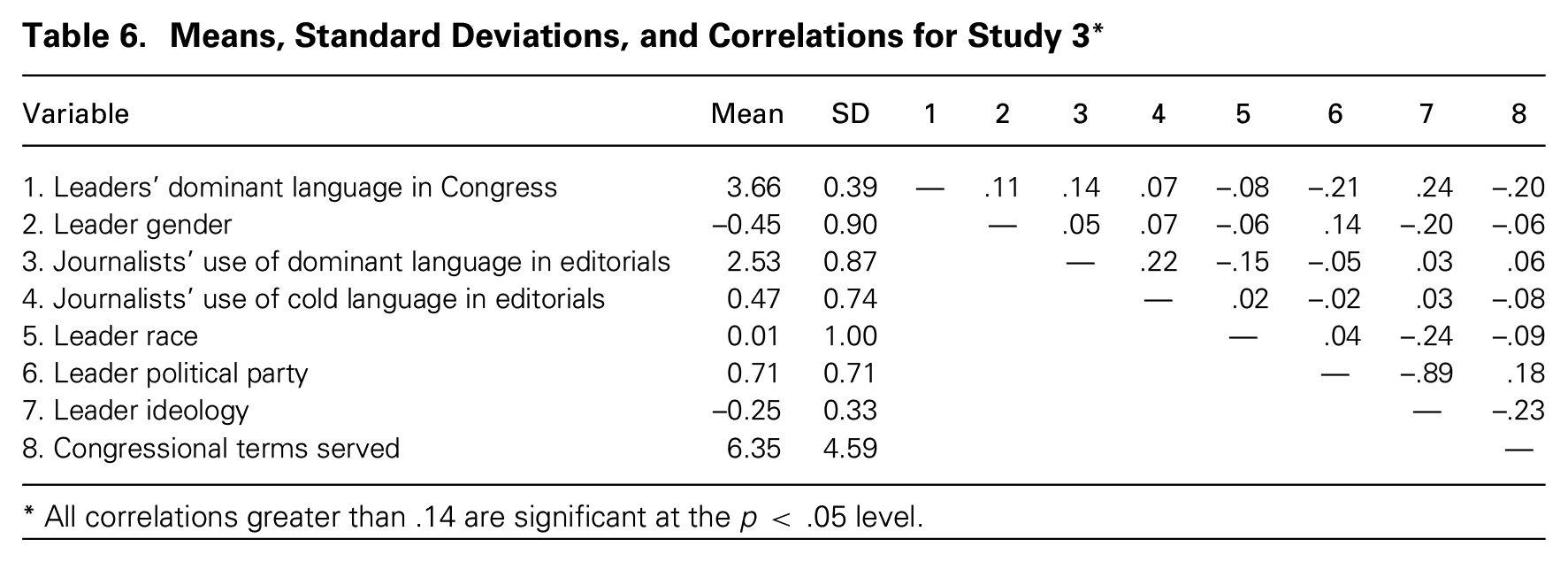
* All correlations greater than .14 are significant at the p < .05 level.
Results
I first entered Leader gender into a linear regression model predicting journalists’ use of dominant language in aggregated editorials about leaders; control variables were added into a second model. Leader gender, Leader race, and the interaction term were entered into a third model. A fourth model included all relevant variables. Tables 7 and 8 provide all results.
Effect of Leaders’ Gender, Race, and Use of Dominant Language in Congress Predicting Journalists’ Use of Dominant Language in Editorials (Study 3)*
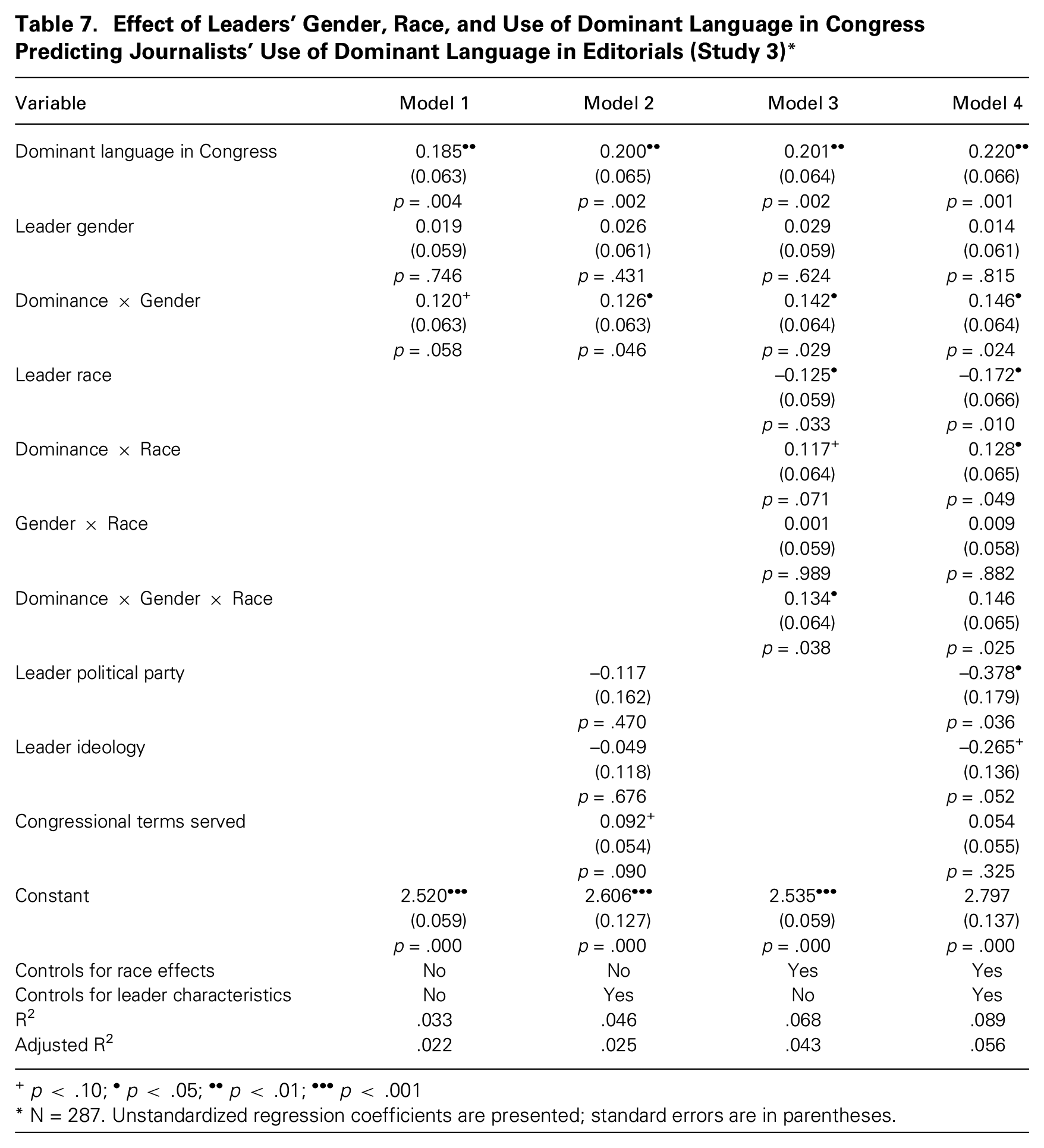
+p < .10; •p < .05; ••p < .01; •••p < .001
* N = 287. Unstandardized regression coefficients are presented; standard errors are in parentheses.
Effect of Leaders’ Gender, Race, and Use of Dominant Language in Congress Predicting Journalists’ Use of Cold Language in Editorials (Study 3)*
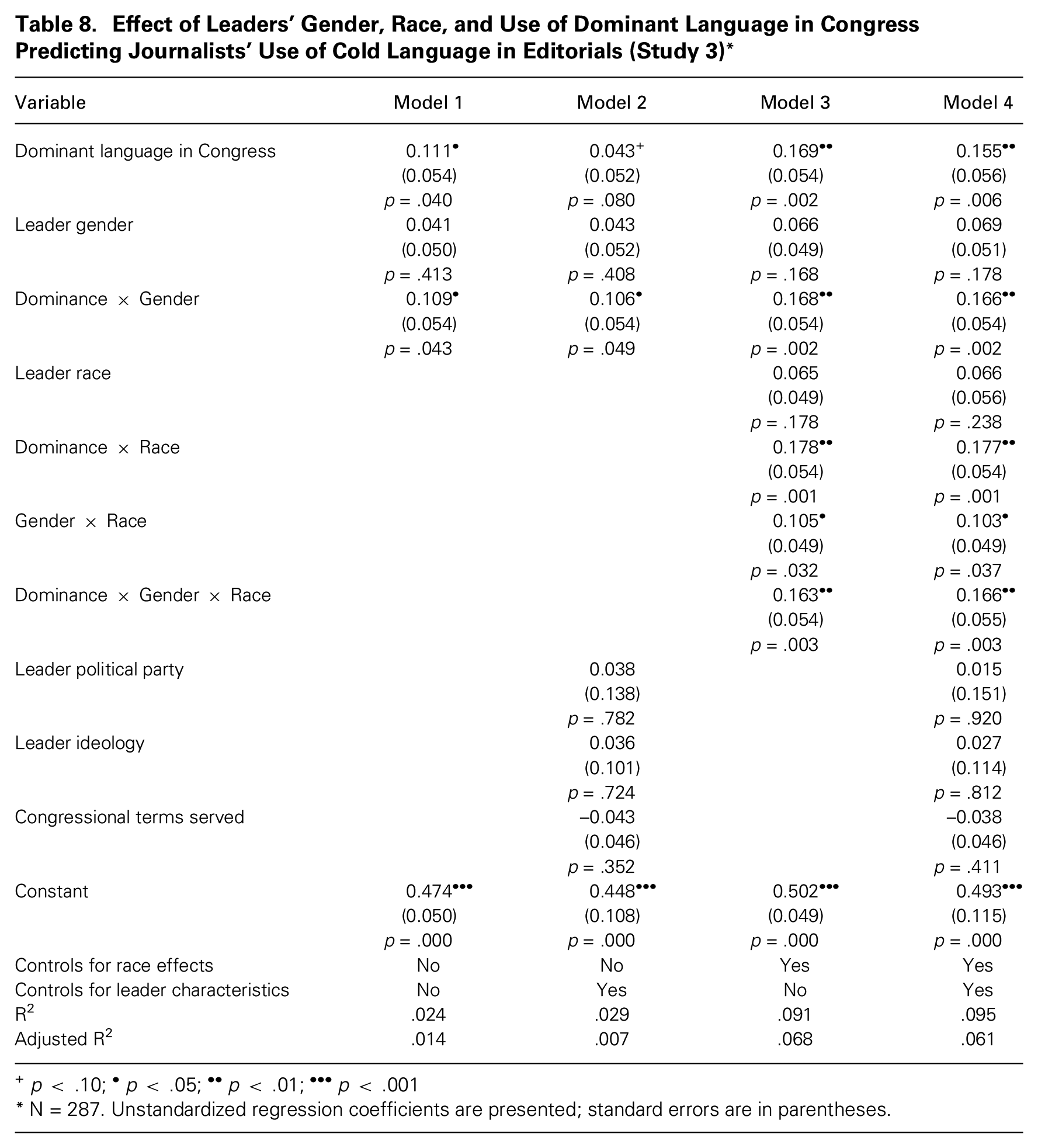
+p < .10; •p < .05; ••p < .01; •••p < .001
* N = 287. Unstandardized regression coefficients are presented; standard errors are in parentheses.
Effects of leaders’ use of dominant language and gender
Hypothesis 2a claims that women leaders’ use of more dominant language will predict journalists’ use of more dominant but cold language to describe the women in written editorials. Turning first to journalists’ use of dominant language, I find that the coefficient for the Dominance×Gender interaction was positive but only marginally significant without controls, as shown in Model 1 of Table 7. Deconstructing this interaction revealed the more that women leaders referenced dominance in Congress, the more that journalists referenced dominance in editorials about them, supporting Hypothesis 2a (without controls: B = .31, S.E. = .112, p = .007; with controls: B = .326, S.E. = .113, p = .004). No such relationship emerged for men leaders (without controls: B = .065, S.E. = .059, p = .272; with controls: B = .074, S.E. = .061, p = .227). These simple slopes are depicted in Panel A of Figure 6 (without controls).
With regard to journalists’ use of cold language in editorials, the Dominance×Gender interaction reached significance, as shown in Model 1 of Table 8. The more that women leaders referenced dominance on the Congressional floor, the more that journalists referenced coldness in editorials about them, supporting Hypothesis 2a (without controls: B = .220, S.E. = .095, p = .021; with controls: B = .204, S.E. = .096, p = .035). However, no such effect emerged for men (without controls: B = .002, S.E. = .050, p = .972; with controls: B = –.001, S.E. = .052, p = .870). Panel B of Figure 6 plots these simple slopes (without controls).
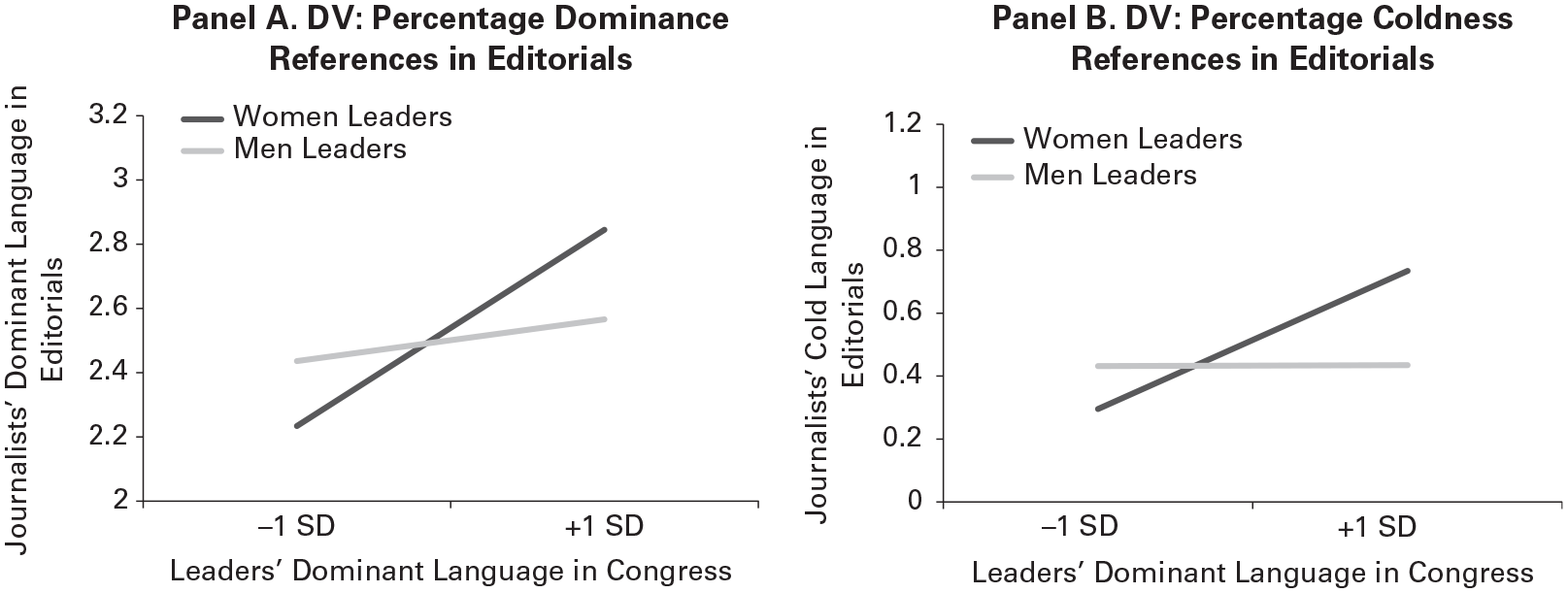
Effects of Leaders’ Gender and Dominant Language on Journalists’ Use of Dominant and Cold Language
Effects of leaders’ use of dominant language and gender, separated by race
I next tested Hypotheses 2b and 2c by examining effects separated by leaders’ race. As shown in Model 3 of Table 7, the Dominance×Gender×Leader race interaction reached significance. Deconstructing this three-way interaction revealed that the Dominance×Gender interaction reached significance among Black and Latina/o leaders (without controls: B = .276, S.E. = .099, p = .006; with controls: B = .293, S.E. = .099, p = .003) but not among White leaders (without controls: B = .007, S.E. = .083, p = .928; with controls: B = –.0003, S.E. = .083, p = .997). Through simple slopes analyses, I tested whether journalists were especially likely to attend to and reflect the dominant language of Black and Latina women leaders. The results suggest that they were: the more that Black and Latina women leaders used dominant language in Congress, the more that journalists used dominant language in editorials about them (without controls: B = .594, S.E. = .180, p = .001; with controls: B = .640, S.E. = .180, p = .0004). No such effect emerged among Black and Latino men (without controls: B = .042, S.E. = .083, p = .618; with controls: B = .055, S.E. = .087, p = .527), White men (without controls: B = .078, S.E. = .082, p = .349; with controls: B = .093, S.E. = .082, p = .258), or White women (without controls: B = .092, S.E. = .143, p = .523; with controls: B = .092, S.E. = .145, p = .524). Panels A and B of Figure 7 display these simple slopes (without controls).
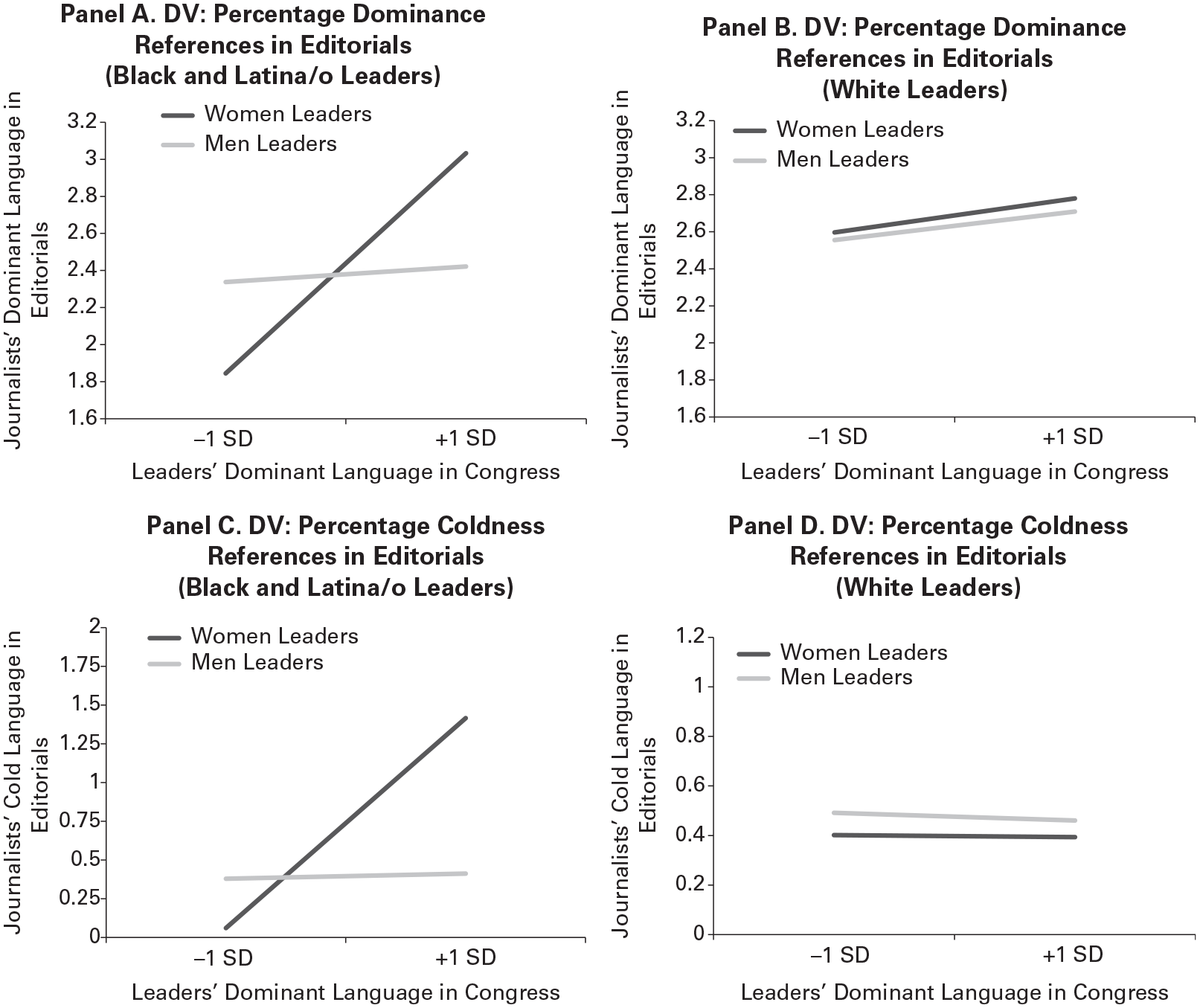
Effects of Leaders’ Gender and Dominant Language on Journalists’ Use of Dominant and Cold Language, Separated by Race
With regard to journalists’ use of cold language in editorials, Model 3 of Table 8 reveals a significant Dominance×Gender×Leader race interaction. The Dominance×Gender interaction reached significance among Black and Latina/o leaders (without controls: B = .331, S.E. = .083, p = .0001; with controls: B = .332, S.E. = .083, p = .0001) but not among White leaders (without controls: B = .006, S.E. = .069, p = .933; with controls: B = .0003, S.E. = .070, p = .997). Simple slopes analyses determined whether Black and Latina women leaders’ use of dominant language in the workplace predicted journalists’ use of cold language in editorials. The results supported this notion: the more that Black and Latina women leaders used dominant language in Congress, the more that journalists used cold language in editorials about them (without controls: B = .679, S.E. = .150, p = .000; with controls: B = .664, S.E. = .151, p = .000). No such effect emerged among Black or Latino men leaders (without controls: B = .016, S.E. = .067, p = .817; with controls: B = .0002, S.E. = .073, p = .998), White men leaders (without controls: B = –.016, S.E. = .068, p = .819; with controls: B = –.022, S.E. = .069, p = .754), or White women leaders (without controls: B = –.004, S.E. = .120, p = .973; with controls: B = –.021, S.E. = .122, p = .863). Panels C and D of Figure 7 display these simple slopes (without controls).
Discussion
Study 3 examined the implications of women leaders’ use of dominant language in the workplace for how they are portrayed by the media, and determined whether the effects depended on the leaders’ race. I collected and analyzed almost 18,000 written editorials about Black, Latina/o, and White leaders, testing whether their use of dominant language in Congress predicted the use of dominant and cold language in editorials about them. The results revealed that the media attended to and reflected the dominant language of women leaders but distorted it in a form of backlash: the more that women leaders (but not men) used dominant language in Congress, the more that media outlets used dominant but cold language to describe them, supporting Hypothesis 2a. This effect was strongest when I analyzed editorials about Black and Latina women leaders, thus supporting Hypothesis 2c. No such effect emerged for Black or Latino men. Moreover, White women’s use of dominant language did not predict journalists’ use of dominant or cold language to describe them, an ironic effect given that Studies 1 and 2 found that White women leaders were uniquely prone to using counter-stereotypical language, referencing dominance more than same-race men did. Observers may therefore be especially likely to attend to and reject Black and Latina women leaders’ behavior, for these leaders are numerically rare and non-prototypical, and their use of dominant language is consistent with racialized gender stereotypes associated with dominance.
These results speak to the crucial importance of intersectional analyses. Had this study focused on gender effects among White leaders and generalized those findings (as is the norm in the social sciences; Zuberi and Bonilla-Silva, 2008; Garza, 2020; Roberts et al., 2020), it would have concluded that the media does not penalize women leaders for using dominant language. The study would have missed a form of backlash that is unique to Black and Latina women leaders who use dominant language.
Study 4: Potential Voters’ Reactions to Leaders’ Use of Dominant Language
Study 4 continued to explore the implications of women (versus men) leaders’ use of dominant language and, through intersectional analysis, to determine whether and how the predicted backlash effects depend on leaders’ race. To meet these goals, Study 4 used a controlled experimental design, manipulating ostensibly real leaders’ use of dominant language, their gender, and their race in a simulated social media profile.
Participants and Design
For this experimental study, I recruited working adults in the United States by using the online labor market Prolific Academic (Peer et al., 2017). Research (e.g., Campbell and Hahl, 2022) suggests that working adults recruited through crowdsourcing (i.e., online panels) are largely representative of the general working population in the country in question. The target sample size was predetermined to be 787 participants, as power analysis using G*Power (Faul et al., 2007) revealed that this sample size would detect a medium (eight groups, f = 0.1; Cohen, 1988) effect size at 80 percent power. Participants (n = 794) were invited to complete an online study in which they would evaluate political profiles. The participants were 430 men, 352 women, ten nonbinary individuals, and two who identified as “other.” The sample included 597 White Americans, 79 Black Americans, 35 Asian Americans, 28 Latina/os, four Native Americans, nine who identified as “other,” and 42 who identified as mixed-race. On average, participants were 43 years old (SD = 14.04). Nearly all participants (93.8 percent) were registered voters. I used a between-subjects design, manipulating leaders’ dominance references (high, low), leaders’ gender (woman, man), and leaders’ race (Black, White).
Procedure
After providing informed consent, participants were told that I was interested in evaluating their first impression of politicians and their memory of political remarks. They were then asked to carefully review the Twitter profiles of a (presumed-real) politician for at least 60 seconds. See Figure 8 for sample Twitter profiles.
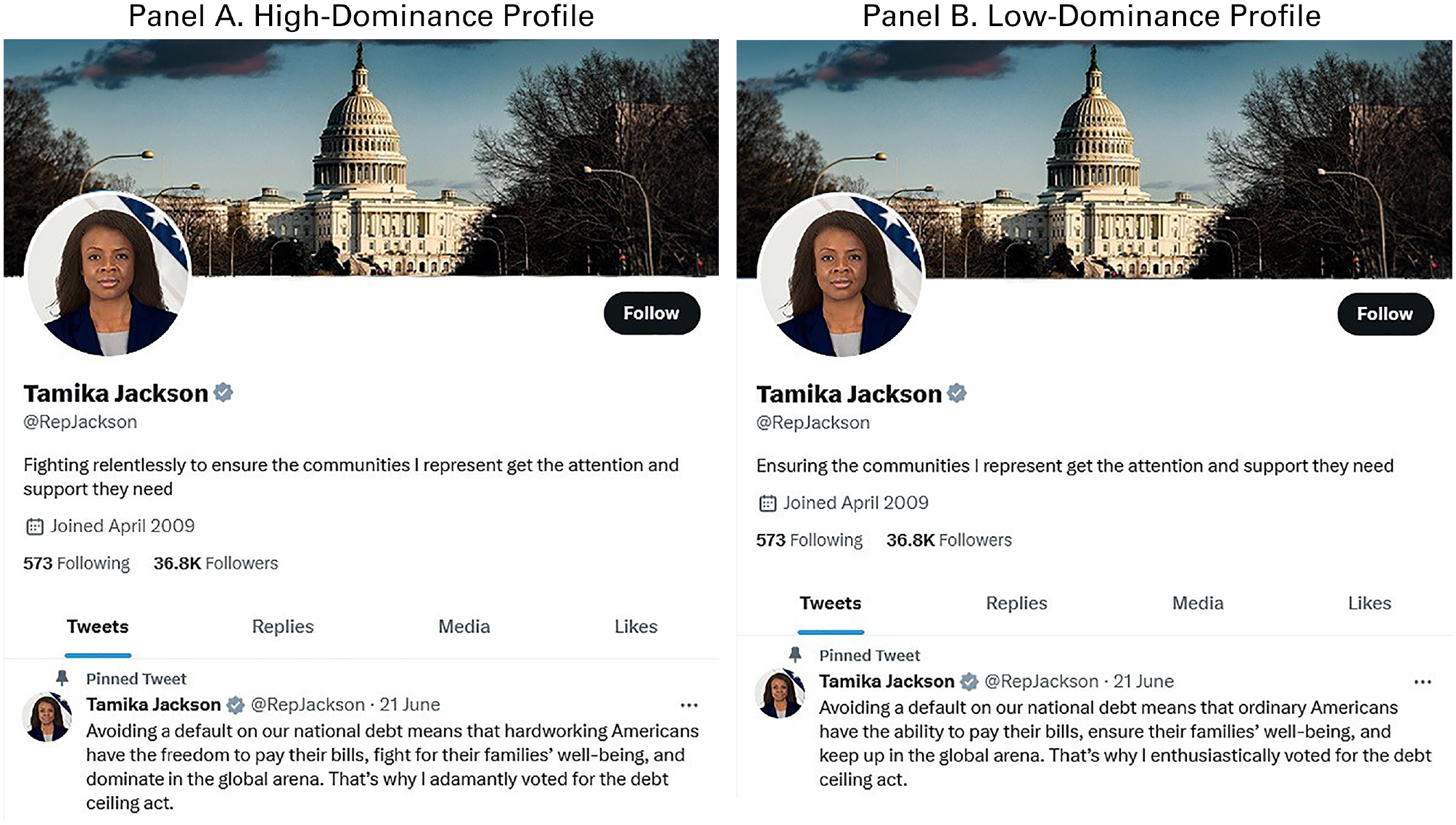
Sample Twitter Profiles Reviewed by Participants in Study 4
Gender and race manipulation
I manipulated the leaders’ gender and race through names and photos. Much research suggests that names can be a particularly robust signal of minority status and a basis for discrimination (Bertrand and Mullainathan, 2004; Kang et al., 2016). For White leaders, the woman was named Mary Wagner, and the man was named Thomas Wagner. For Black leaders, the woman was named Tamika Jackson, and the man was named Jermaine Jackson. These names were selected from Crabtree and colleagues’ (2023) archive of 600 names that are highly prevalent among the largest racial groups in the United States; over 4,000 respondents rated each of these names. I selected names only if a majority of raters correctly identified the racial identity with which the names were associated.
For the photo manipulation, I selected photos from the Chicago Face Database (Ma, Correll, and Wittenbrink, 2015), an archive of standardized facial photos featuring adults across gender and race, with accompanying information provided by the photographed adults and independent raters. The selection process was as follows. First, individuals in the photo must have been identified by the majority of independent raters as women or men and as Black or White. This ensured that participants would reliably assume that politicians were members of the gender and racial groups of interest. Next, selection focused on photos featuring adults estimated to be over 35 years old by independent raters. As this study featured political leaders, I turned to the U.S. Constitution for guidance, which stipulates that Senators are required to be at least 30 years old and Representatives at least 25 years old (U.S. Const., art. I, § 2, cl. 2; U.S. Const., art. I, § 3, cl. 3). To avoid suspicion based on target age and recognizability, leaders were described as U.S. Representatives. I selected final photos that met the above criteria and were rated similarly in attractiveness and trustworthiness. Through pretesting, I found that, within race, men and women targets were rated similarly in perceived dominance, trustworthiness, and attractiveness (see Supplement 4 in the Online Appendix).
I next used Adobe Photoshop to give leaders a natural, closed-lip smile and to modify their clothing, dressing men leaders in a suit and tie and women leaders in a dress. (Original selections featured a neutral facial expression, with targets clothed in a gray t-shirt.) All photos were in standard head-and-shoulders format, with no visible accessories. Using Photoshop, I added a white background image with American flag imagery in the upper right-hand corner of the leader headshots. All headshots were then cropped into a circular shape to resemble profile pictures. Finally, I pinned each final headshot in front of a politically relevant but otherwise neutral profile background photo of the U.S. Capitol building.
Dominance manipulation
I embedded the dominance manipulation within the text appearing in the Twitter bio. This manipulation relied on the presence (high-dominance condition) or absence (low-dominance condition) of words previously found to be related to high dominance (Nicolas, Bai, and Fiske, 2021)—the very words that, per previous studies, women leaders (especially White women leaders) are more likely to use, compared to their same-race men colleagues. Beneath standard indicators of the leader’s follower count and number of accounts followed (both based on the median numbers for legislators; Amira, 2013; Van Kessel et al., 2020), I displayed a single pinned tweet in which the leader discussed the debt ceiling act. I selected this particular bill because it was passed close to the time of data collection (June 2023), and it received bipartisan support (Seigel et al., 2023). The high-dominance version of the tweet read, “Avoiding a default on our national debt means that hardworking Americans have the freedom to pay their bills, fight for their families’ well-being, and dominate in the global arena. That’s why I adamantly voted for the debt ceiling act.” In contrast, the low-dominance version read, “Avoiding a default on our national debt means that ordinary Americans have the ability to pay their bills, ensure their families’ well-being, and keep up in the global arena. That’s why I enthusiastically voted for the debt ceiling act.” Thus, the tweets mirrored each other in topic and word length; the only difference was the presence or absence of dominant language. I also controlled for the use of communal language, making this a particularly robust test of the hypotheses. Finally, I also manipulated the politician’s Twitter biography. I wrote biographies based on a review of several legislators’ Twitter profiles. The high-dominance version read, “Fighting relentlessly to ensure the communities I represent get the attention and support they need,” while the low-dominance version read, “Ensuring the communities I represent get the attention and support they need.”
Measures
Using seven-point scales, participants completed a three-item index of leadership suitability, adapted from Brescoll (2011) and Okimoto and Brescoll (2010): “How much would you want this person to be your politician?”, “How likely is it you would vote for this person to represent you?”, and “How likely is it this person has the necessary skills to be an effective politician?” (α = .93). Participants also completed a likeability index adapted from Rudman and colleagues (2012): “How much do you like this person?”, “Is this someone you would like to know more about?”, “How popular do you think this person is with voters?”, and “How popular do you think this person is with their colleagues?” (α = .85). Finally, participants completed a five-item index of perceived dominance (“To what extent is this person . . . powerful/assertive/strong/tough/influential”; α = .90), a two-item index of perceived competence (“To what extent is this person . . . capable/efficient; α = .89), and a five-item index of perceived warmth (“To what extent is this person . . . supportive/caring/likeable/trustworthy/warm”; α = .93).
Results
Pretest studies
I conducted two independent pretest studies to verify that the manipulations effectively varied perceptions of leaders’ gender, leaders’ race, and leaders’ dominance. For the first pretest, 400 participants were randomly assigned to review one of the four headshots. Participants were significantly more likely to rate the woman leader as a woman and the man leader as a man than they were to misidentify their genders (χ2(1) = 380.26, p < .001); they were also significantly more likely to rate the Black leader as Black and the White leader as White than to mislabel their race (χ2(6) = 380.26, p < .001). There was no significant effect of leaders’ gender or race on perceived attractiveness, ps > .092. For the second pretest, a separate group of 200 participants were randomly assigned to review the high- or low-dominance tweet. Participants rated the poster of the high-dominance tweet (about whom they were given no information) as more dominant than that of the low-dominance tweet (t(198) = −2.92, p = .004, d = −.41). There was, however, no effect of tweet dominance on perceptions of speaker competence (t(198) = −0.67, p = .505, d = −.10) or warmth (t(198) = −0.22, p = .822, d = −.03). See Supplement 4 in the Online Appendix for more details on these pretest studies.
Leaders’ ratings
The results revealed the main effects of dominance references, leaders’ gender, and leaders’ race predicting ratings of leaders’ suitability, leaders’ likeability, perceived dominance, perceived competence, and perceived warmth. Specifically, participants rated leaders who used dominant language in their Twitter profiles as significantly less suitable for leadership (F (1,786) = 6.70, p = .010, η2 = .008), less likeable (F (1,786) = 8.51, p = .004, η2 = .011), less warm (F (1,786) = 8.78, p = .003, η2 = .011), and more dominant (F (1,786) = 9.45, p = .002, η2 = .012) than those who did not use dominant language. Women leaders were rated as more suitable for leadership (F (1,786) = 8.74, p = .003, η2 = .011), more dominant (F (1,786) = 9.84, p = .002, η2 = .012), more competent (F (1,786) = 10.62, p = .001, η2 = .013), and more warm (F (1,786) = 5.06, p = .025, η2 = .006) than men leaders. Finally, Black leaders were rated more suitable for leadership (F (1,786) = 17.21, p < .001, η2 = .021), more likeable (F (1,786) = 16.40, p < .001, η2 = .028), more warm (F (1,786) = 20.69, p < .001, η2 = .026), more competent (F (1,786) = 15.09, p < .001, η2 = .019), and more dominant (F (1,786) = 22.33, p < .001, η2 = .028) than White leaders.
The main effects predicting leader likeability ratings were qualified by a significant three-way interaction, F (1,786) = 5.56, p = .044, η2 = .005. Deconstructing this interaction revealed that the Dominance×Gender interaction reached significance for Black leaders (F (1,399) = 3.87, p = .049, η2 = .010; see Figure 9, Panel A) but not for White leaders (F (1,387) = 0.84, p = .360, η2 = .002; see Figure 9, Panel B). Specifically, participants rated a Black woman leader who used dominant language as significantly less likeable than one who did not use dominant language (t(196) = 2.71, p = .007, d = .39). There was, however, no effect of dominant language on likeability ratings for a Black man leader (t(203) =−0.26, p = .792, d = −.04). No other main effects or interactions reached significance (ps > .053).
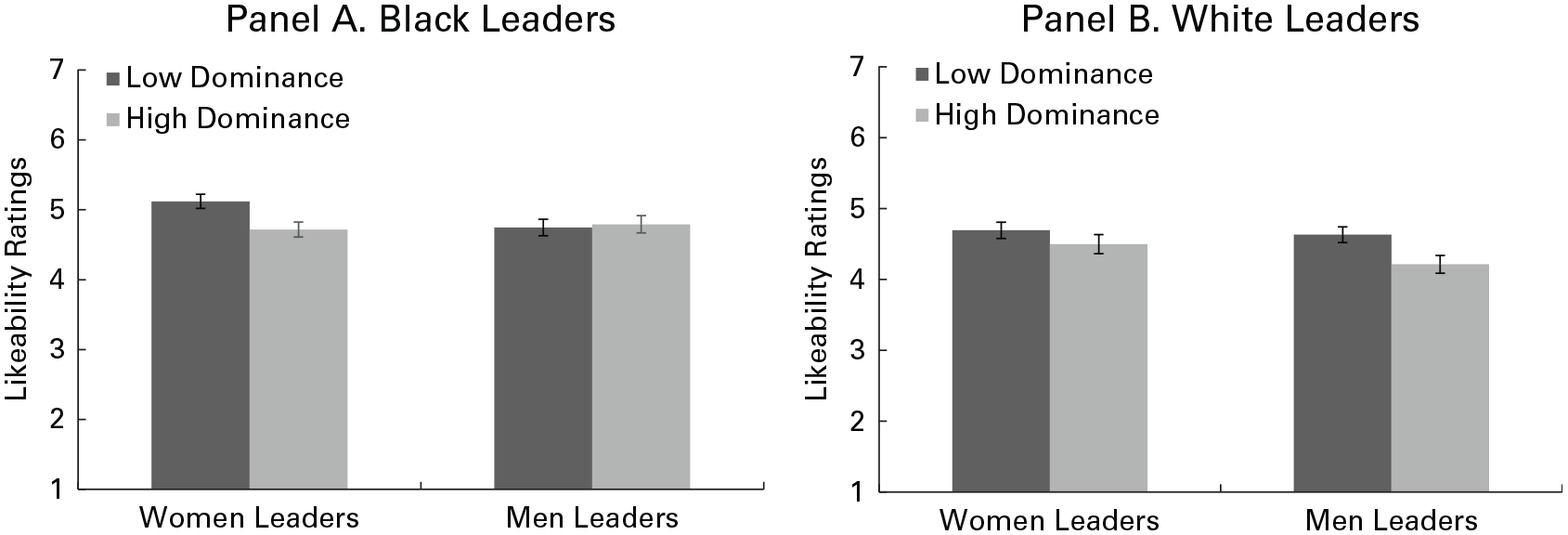
Effect of Dominance References and Leaders’ Gender on Likeability Ratings, Separated by Leader Race (Study 4)*
Discussion
Study 4 continued to examine the intersectional implications of women leaders’ use of dominant language. This controlled experiment used simulated social media profiles to manipulate leaders’ use of dominant language, their gender, and their race. In so doing, it determined whether and how potential voters would reject women (but not men) leaders who used high- (versus low-) dominant language on social media and, importantly, whether this effect would differ depending on leaders’ race. As theorized (Hypothesis 3a), the results suggest a likeability backlash effect based on women’s (but not men’s) use of dominant language. However, this interactive effect was again unique to leaders of color. Specifically, potential voters rated a presumed-real Black woman leader who used dominant language on social media as less likeable than one who did not use such language. No such effect emerged for Black men, supporting Hypothesis 3c. While the results revealed no effects of dominance on ratings of Black women’s leadership suitability, perhaps due to social desirability effects (e.g., Arnold and Feldman, 1981), prior research suggests that perceptions of likeability can have downstream consequences for leaders’ presumed hireability (see Rudman and Glick, 1999, 2001). These findings suggest that the use of dominant language does indeed provoke reduced perceptions of women’s (but not men’s) likeability—but this gendered backlash effect is unique to Black leaders.
General Discussion
Effectively wielding one’s words constitutes the ultimate leadership advantage. However, not all leaders easily win this advantage, as gender scholars have revealed. Although management scholars have long examined gender disparities in how leaders influence followers through communication, little research has taken an intersectional perspective. This study addressed that gap through an intersectional examination of leaders’ use of dominant language in the workplace and the backlash it can provoke, which potentially influences women’s access to, efficacy in, and retention of leadership positions. Focusing on the realm of political leadership, I analyzed over 250,000 Congressional remarks delivered (Study 1) and nearly one million tweets posted (Study 2) by leaders. Analysis of two high-powered archival datasets revealed that women referenced dominance significantly more than men did when speaking on the Congressional floor or posting on social media. This gender difference, however, was unique to White leaders. Consistent with my predictions, White women leaders referenced dominance more than same-race men did in Congress or on Twitter, using language that violates stereotypes depicting them as too submissive to lead. As suggested by theory on racialized gender stereotypes, Black women and Latinas, who hold a greater fear of backlash for dominant behavior, showed no such effect. White women leaders uniquely used counter-stereotypical language, referencing dominance more than White men leaders in the workplace did.
Two studies determined the implications for crucial observers of leaders’ behavior: journalists and constituents. Archival analysis of almost 18,000 targeted editorials found that for women leaders only, their dominant language in the workplace corresponded to how the media portrayed them. Specifically, the more that women leaders referenced dominance in Congress, the more that journalists used dominant but cold language to portray them (Study 3). Intersectional analyses revealed that, as in Studies 1 and 2, this effect depended on women leaders’ race. In this case, the effects were unique to Black women and Latina leaders such that the media were especially likely to represent these leaders who used dominant language in the workplace as dominant but cold in editorials, a specific form of backlash from the media. Finally, a controlled experiment using simulated social media profiles revealed a racialized gender effect in how constituents responded to leaders’ use of dominant language. The more that women leaders referenced dominance in a simulated social media profile, the less that potential voters rated them as likeable (Study 4). No such effect emerged for men. This effect, however, was unique to Black leaders; no gendered backlash effect emerged among White leaders. Thus, these findings reveal two unique sources of backlash for a previously unexplored form of counter-stereotypical behavior among women: the use of words related to dominance in the workplace and on social media. However, these backlash effects depend on women’s race.
This research reinforces the importance of intersectional analyses in the study of gender inequality, for consistent with my theorizing on racialized gender stereotypes and their implications, the effects of leaders’ gender on communication and backlash depended on race. White women leaders used more dominant language than did same-race men; Black and Latina women leaders did not. Ironically, White women leaders’ use of dominant language did not predict the content of media portrayals, but it did for Black and Latina women leaders, who were penalized for it. Finally, the gendered effect of dominant language on constituents’ reduced ratings of leader likeability was more robust among Black leaders. For scholarship to have a clear theoretical and practical understanding of how gender inequality manifests among women leaders, it must include intersectional analyses.
Theoretical Implications and Future Directions
This study contributes to literature on organizational diversity, intersectionality, leadership behavior, and leadership evaluations. This intersectional examination of women in politics is the first to suggest that women leaders (specifically, White women) use language that violates low-agency stereotypes in workplace speech by referencing dominance more than men do, opening up new avenues of research on gender differences in language. Moreover, while classic scholarship has found that media outlets are less likely to cover women than men leaders (Kahn, 1992, 1996; Heldman, Carroll, and Olson, 2005), this study reveals that for Black and Latina women only, leaders’ use of dominant language directly corresponds to journalists’ use of dominant and cold language in media coverage. Indeed, when news outlets do cover Black and Latina women leaders, they attend to and reflect their dominant language but also distort it by portraying them as dominant but cold. This could ultimately reduce the women’s chances of retaining their leadership positions. Prior scholarship in political science suggests that gender differences in news coverage can impact perceptions of women politicians’ electability (Kahn, 1996). Indeed, Study 4 revealed the more that Black women (but not Black men) leaders use dominant language on social media, the less likeable they appear to constituents. These findings bring the research on stereotyping, self-presentation, intersectionality, and backlash effects into real-world, high-profile leadership settings—with real consequences for women leaders.
Despite these advancements, this study is not without limitations that pave the way for future research. First, this work relied largely on archival datasets, which have numerous advantages: the studies were high-powered (including 250,000 Congressional remarks, one million tweets, and 18,000 editorials) and ecologically valid, providing robust tests of women leaders’ use of dominant language and the implications of such language across several real-world contexts (e.g., Congress, Twitter, and news outlets). Nonetheless, a crucial next step will be to clarify the psychological mechanisms behind these phenomena through additional experimental work. For example, while White women leaders’ use of more dominant language than men use may be rooted in a desire to reverse stereotypes that label women as low in agency, an alternative explanation is the desire to reverse positive stereotypes that label women as high in communality. Indeed, pilot data revealed that White women anticipated more backlash for warm behavior than did Black and Latina women (see Supplement 1 in the Online Appendix). If so, White women may be exhibiting a compensation effect whereby people who have a goal to appear low in communality are more likely to present high agency (Holoien and Fiske, 2013). Related, Black and Latina women may not use more dominant language than same-race men use because they fear backlash for it, as pilot data suggested. Priming racialized gender stereotypes before seeking to replicate findings among Black, Latina, and White women leaders could provide valuable insight. Future research could also analyze women leaders’ coldness references, determining whether and which women leaders simultaneously reference dominance and coldness more than men do. Finally, research should further consider Black and Latino men’s use of dominant language to determine whether and when they use language that violates threat-related stereotypes (Devine, 1989; Amodio, 2014). 10 This could speak further to one mechanism that may drive the use of counter-stereotypical language in outgroup settings: the desire to reverse negative ingroup-related stereotypes.
Testing the intentionality of this phenomenon provides another ripe area for future research. Pilot data suggested that Black and Latina women are aware that they are at increased risk of backlash for dominant behavior. Indeed, they predicted they would receive more backlash for dominance than did White women. Are White women leaders aware that they reference dominance more than their same-race men peers do? Experiments could prove illuminating by testing women’s dominant language in a work task when they are under time pressure versus time delay. If the women are less likely to use dominant language when forced to deliberate (versus under time pressure), that suggests a relatively spontaneous process; if not, that suggests a more deliberate, controlled process (Sloman, 1996; Kahneman, 2003). Women leaders may be subject to additional cognitive demands, particularly if they attempt to distance themselves from submissiveness stereotypes (White women) or anger stereotypes (Black and Latina women) through the use of more or less dominant language in the workplace.
Future research should further disentangle the link between women leaders’ dominant language and the implications for media portrayals and constituents’ impressions. Study 3 was correlational in nature, thereby precluding conclusions about causality. Thus, the relationship between Black and Latina women leaders’ dominance references in Congress and journalists’ dominant language in editorials could be bidirectional whereby the media’s dominant language about Black and Latina women leaders reinforces the leaders’ own dominant language in the workplace, and vice versa. Study 4 avoided correlational limitations through a controlled experiment; the dominance manipulation impacted potential voters’ likeability impressions for Black women (but not men). Future studies could link Studies 3 and 4 by directly testing whether and how dominant and cold language in media portrayals impacts voters’ impressions. Such work should also consider whether and how news outlets’ political leanings may impact Study 3’s findings.
Compelling future research in this area could also test longitudinal effects. For example, scholarship suggests that people are especially likely to attend to, exaggerate, and mimic others’ stereotype-consistent (versus stereotype-inconsistent) communication (Trope and Thompson, 1997; Castelli et al., 2009; Biernat, 2012). Thus, for Black women and Latina leaders (but not White women), their use of dominant language may be more likely to elicit dominant language from audience members, with potential implications for cooperation.
Several contextual and psychological factors may impact my findings, suggesting an intriguing area of future study. Backlash effects are now more frequently understood as contextually variable (O’Neill and O’Reilly, 2011), and women’s use of counter-stereotypically dominant language likely also depends on context. Do White women leaders reference dominance more than White men do outside of political settings? Do these findings replicate in middle or lower management contexts? White women are likely to experience backlash for promoting themselves (Williams and Tiedens, 2016), and they are aware of such backlash effects (Rudman and Fairchild, 2004). In other organizational settings, White women may avoid referencing dominance, instead referencing other dimensions of agency (such as ability or status) or referencing dominance more rarely/strategically. Moreover, although topic model analyses in my study did not suggest drastic differences in topics discussed based on leaders’ gender and race (see Supplement 2 in the Online Appendix), a ripe area for future work would be to test when topic matters. Are White women leaders especially likely to use more dominant language than men do when discussing themselves or when discussing others? Prior research suggests that when negotiating on behalf of others, women are less likely to experience backlash than when they negotiate for themselves (Amanatullah and Morris, 2010). If so, can Black and Latina women leaders avoid backlash for such dominant language when discussing other-oriented topics? Experiments could also further examine individual differences (e.g., gender identification, stereotype awareness, system justification) and identities (e.g., social class) that predict the use and reception of counter-stereotypically dominant language.
Finally, recent years have seen a push to make scholarship less WEIRD (Western, educated, industrial, rich, and democratic; Henrich, Heine, and Norenzayan, 2010). A crucial next step is to test this phenomenon in a broader global context. Women are disadvantaged relative to men in virtually every society (UN Development Programme, 2013), but variability in gender stereotypes exists. Future research can determine whether and which women leaders around the world use language that violates low-agency stereotypes in workplace speech—and crucially, whether, how, and for whom such language provokes backlash. One particularly intriguing next step is to test whether these phenomena are moderated by macro-level factors, such as cultural endorsement of collectivist versus individualistic values (Markus and Kitayama, 1991) or regional levels of gender inequality. For instance, one could test whether findings replicate in countries that have a longer track record of women serving in powerful, high-profile leadership positions (e.g., Germany, New Zealand).
Practical Implications
Women leaders walk a narrow tightrope. Expressing dominance can convey authority, expertise, and confidence—all valued characteristics in a leader. For women, however, expressing dominance can backfire, making them appear cold, calculating, and aloof. This work suggests that White women in highly visible leadership positions walk this tightrope by referencing dominance more than men do, thus countering stereotypes that depict the women as more submissive. Although Black women and Latinas do not reference dominance more than same-race men do, the media are especially attentive to their language, reflecting but distorting their expressions of dominance in editorials that describe them as dominant but cold. Moreover, laypeople also attend to such language, rating Black women (but not Black men) who use dominant language as less likeable. I hope that this work brings attention to the unique complexities that Black, Latina, and White women in high-profile leadership positions must navigate. This complexity makes it impossible for me to offer any one solution to leaders and practitioners. I therefore offer three sets of recommendations: for organizations, for scholars, and for women leaders.
First, organizations must provide ample support for women leaders, particularly those most marginalized, through data-driven initiatives and well-resourced programs. Organizations should regularly survey women employees and employees of color, including those in leadership, to determine whether they are thriving or struggling and why. Importantly, these data must be disaggregated by gender and race to better understand the experiences of all women. For instance, my findings revealed that Black women and Latinas fear backlash for dominant behavior, while White women fear backlash for warm behavior, suggesting the importance of disaggregating survey data examining women’s experiences by women’s race. Organizations must also commit to funding initiatives that can help, such as mentorship programs and employee resource groups. To be most effective, organizational programs that support women leaders (when organizations have such programs) should be disaggregated by race. These initiatives must acknowledge intersectionality by making a direct effort to hear and support women who are most marginalized. Finally, media and news organizations should collect metrics on their portrayals of women, disaggregating these data by race and sharing the metrics in a transparent manner. Such analyses can illuminate whether and how the media contribute to gender inequality by, as suggested by acculturation theory (DeFleur and Dennis, 1998), transmitting persistent, consistent, and corroborated gender stereotypes.
Second, academics must empirically determine whether gender-based phenomena tested among White women also apply to women of color. This study, along with seminal work by scholars such as KimberléCrenshaw (1991), Patricia Hill Collins (2008), and Ashleigh Rosette (Rosette et al., 2016), shows that we must consider the unique experiences of women at intersecting social identities. Social scientists studying gender should theorize how phenomena of interest may be racialized, disaggregate findings by race, note and justify the racial composition of their samples, and avoid making broad statements about gender-based phenomena that are predicated on White samples, before testing whether such phenomena apply to non-White populations.
Finally, reversing stereotypes and mitigating discrimination should not be women’s burden. The underrepresentation of women leaders is a complex problem rooted in historical, cultural, and institutional contexts (Valian, 1998; Beckman and Phillips, 2005; Brands and Fernandez-Mateo, 2017; Cheryan et al., 2017) that will likely require collective and policy-based solutions (Joshi et al., 2015; Cheryan et al., 2017). However, women leaders can closely consider their own style of communication and how others respond to it, along with that of other women leaders whom they admire. What kind of language do they use, and how do others respond to them? Assessing and experimenting with communication styles may help women leaders find a style that feels authentic while meeting their professional goals.
Conclusion
This study examined gender disparities in leaders’ use of dominant language at work and their implications by using an intersectional approach—a rarity in management science. Focusing on an ideal leadership context—the political arena—the results revealed that women leaders use more dominant language than men leaders do in Congress and on social media, with backlash effects for how they are portrayed by the media and whether they are accepted by voters. Together, these four studies reveal whether, how, and which women leaders use counter-stereotypical language in the workplace, thus impacting how they are perceived and whether they are supported. In doing so, this article models an intersectional approach to studying gender inequality in organizations. My hope is that this work illuminates and validates women leaders’ complex and intersectional experiences, encouraging investment in understanding and supporting all women leaders.
Supplemental Material
sj-pdf-1-asq-10.1177_00018392231223142 – Supplemental material for Words of a Leader: The Importance of Intersectionality for Understanding Women Leaders’ Use of Dominant Language and How Others Receive It
Supplemental material, sj-pdf-1-asq-10.1177_00018392231223142 for Words of a Leader: The Importance of Intersectionality for Understanding Women Leaders’ Use of Dominant Language and How Others Receive It by Cydney Hurston Dupree in Administrative Science Quarterly
Footnotes
Acknowledgements
I gratefully acknowledge Amy Wrzesniewski and Michael Kraus for their guidance and support throughout this project. I also thank Julia DiBenigno, Sa-Kiera Hudson, and members of the University College London School of Management Reading Group for their feedback on various drafts. Fariba Ghayebi and Andrei Viziteu provided invaluable assistance with research support. Finally, I would like to acknowledge Associate Editor Damon Phillips, Editor Christine Beckman, four anonymous reviewers, two methodological reviewers, and copy editors Joan Friedman and Ashleigh Imus for greatly improving this article throughout the review and publication process.

1
Existing research has typically taken an alternative approach, examining whether women use stereotype-consistent language by using less assertive and more affiliative language than men do (see Leaper and Ayres, 2007, for a review).
2
Prior research does not empirically link these linguistic phenomena to an expressed drive to reverse negative ingroup stereotypes (which, for reasons noted above, is rarely revealed through explicit measures). Establishing such linkages is not the goal of this article. However, a robust literature on social identity threat, meta-stereotypical concerns, and intergroup interaction goals suggests that such counter-stereotypical outgroup behavior is likely related to the well-established desire to avoid confirming negative stereotypes.
3
There is, of course, variance. An interviewed staffer described some legislators as “micromanagers” who “must approve each tweet, every press release” (anonymous informant, personal communication, July 18, 2023). Some legislators change specific words or phrases. Others disregard drafted communications altogether, opting to write their own remarks or ad lib. Moreover, many Congressional remarks, such as those in question-and-answer sessions or debates, are unscripted. While there is variation in the degree to which legislators rely on staffers for Congressional speech, these communications are often co-created, and not all communication is prearranged.
4
Through supplementary analyses, I explored the relative frequency of leaders’ references to dominance, ability, and status in Congressional speech and Congressional tweets and journalists’ references in editorials about each leader throughout their Congressional tenure. I used the R package SADCAT (Nicolas, Bai, and Fiske, 2021) to analyze the stereotype content of each corpus of text, focusing on the high power dictionary (e.g., “assertive,”“powerful”), the high status dictionary (e.g., “influential,”“successful), and the high ability dictionary (e.g., “intelligent,”“capable”). In Congressional speech, leaders most frequently referenced high power (M = 3.66, SD = 0.40), followed by high ability (M = 3.58, SD = 0.37), followed by high status (M = 2.07, SD = 0.35). In Congressional tweets, leaders again most frequently referenced high power (M = 3.91, SD = 0.49), then high ability (M = 3.27, SD = 0.37), then high status (M = 2.37, SD = 0.39). Finally, in editorials about these leaders, journalists most frequently referenced high ability (M = 2.78, SD = 0.91), followed by high power (M = 2.52, SD = 0.87) and high status (M = 2.21, SD = 0.91).
5
DW-NOMINATE scores were unavailable for statutory representatives, including Congresswoman Jennifer Gonzales-Colon (resident commissioner of Puerto Rico) and Congresswoman Eleanor Holmes (a non-voting delegate to the House of Representatives). These lawmakers were excluded from further analyses.
6
As one cannot show the total absence of an effect in a population, scholars should avoid interpreting null effects. Equivalence testing can, however, provide statistical evidence for the absence of a meaningful effect (Lakens, 2017). Therefore, I conducted equivalence tests on hypothesized null effects, namely, the gender effect among leaders of color, to determine whether the effect was statistically closer to zero than the smallest effect size these field studies were powered to detect at 80 percent power. I conducted all equivalence tests using the R package TOSTER (Lakens, Scheel, and Isager, 2018), given equivalence bounds of –.50 to .50 (Study 1) and –.60 to .60 (Study 2) and α = .05.
7
Some scholars have suggested testing whether simple slopes are significantly different from each other (Robinson, Tomek, and Schumacker, 2013). Thus, I tested whether the effect of leaders’ gender on leaders’ dominance references in Congress or on Twitter was significantly different for White leaders versus Black and Latina/o leaders. Simple slopes did not significantly differ in Study 1 (without controls: t(308) = 0.93, p = .355; with controls: t(308) = 0.91, p = .363) or Study 2 (without controls: t(167.31) = 1.02, p = .308; with controls: t(159.19) = 1.13, p = .262; equal variances not assumed).
8
Of the 312 legislators initially examined in Study 1, two were excluded from analyses, as D-Nominate scores were unavailable for them (see Footnote 5 for more details).
9
Correlation analyses revealed no significant relationship between leaders’ use of dominant language on the Congressional floor and the number of editorials written about them (r = .039, p = .514).
10
Investigation of within-gender racial effects revealed that minority men did not use significantly less dominant language than their White men counterparts did in Study 1 (without controls: B = –.010, S.E. = .027, p = .723; with controls: B = .002, S.E. = .028, p = .937), but they did in Study 2 (without controls: B = –.071, S.E. = .035, p = .044; with controls: B = –.086, S.E. = .038, p = .025).I cannot speak with confidence to this effect without having replicated it, but theory (Devine, 1989; Amodio, 2014) supports the possibility that Black and Latino men’s reduced use of dominant language may relate to a desire to counter threat-related stereotypes.
Author’s Biography
References
Supplementary Material
Please find the following supplemental material available below.
For Open Access articles published under a Creative Commons License, all supplemental material carries the same license as the article it is associated with.
For non-Open Access articles published, all supplemental material carries a non-exclusive license, and permission requests for re-use of supplemental material or any part of supplemental material shall be sent directly to the copyright owner as specified in the copyright notice associated with the article.
