



Abstract
Corporate scandals disrupt the landscape for organizational leaders and employees, providing a burning platform that creates new momentum for change. Here, we explore the implications for the human resources (HR) function as organization-level responses to scandals cannot occur without individual-level changes in employee behaviors—the domain of HR. We apply event systems theorizing to uncover the nature of the scandals through notions of strength, space, and time to better understand the range of possible outcomes for HR function roles. Empirical data are presented from in-depth qualitative case studies carried out in five large multinational corporations in the pharmaceutical, chemical, and financial services industries. Subsequently, we uncover how organization-level scandals punctuate the equilibrium of organizational operations, facilitating a recalibration of the balance between the potentially competing institutional logics of moral legitimacy and business priorities. We furthermore challenge universal HR role typology theorizing regarding the direct influence of external stakeholders on the role that HR can adopt inside organizations. Overall, we demonstrate that organizational responses to corporate scandals require individual-level and collective employee behavior change, placing the HR function at the intersection of managing risk, compliance, and legal requirements.
Keywords
Organizational misconduct, when exposed publicly, can create a scandal and consequent corporate crisis that can threaten the fundamental existence of a firm. Such events are not unfamiliar, ranging from the public learning of Enron’s concealment of large losses (the 2000s), Wells Fargo’s accounts fraud (2016), Facebook–Cambridge Analytica’s data gathering (2018), and Boeing’s 737 MAX fraudulent deception of airline regulators (2019) to FTX’s cryptocurrency exchange fund mismanagement (2022), to name but a few. In the corporate world, when firms face public scandals, structures, systems, and personnel are changed to match the new operating conditions (Chen, Liu, Tang, & Hogan, 2021).
At the heart of any corporate misconduct are the values, attitudes, and behaviors of the firm’s actors, ranging from senior leadership to shop floor employees (Davis, 2005). Consequently, the human resources (HR) function has a fundamental role to play in addressing such crises. In this study, we uncover how corporate scandal event systems affect HR roles in managing compliance and risk across the organization. Event system theory (EST) provides a suitable theoretical frame as it regards a scandal as an event system and therefore a context for disruptive change (Morgeson, Mitchell, & Liu, 2015).
HR role typologies suggest how progress might be achieved for HR to become increasingly influential in corporate settings. Ulrich and Dulebohn (2015) propose a four-wave framework that culminates in HR reacting to the demands of external stakeholders to direct HR activities inside the organization. However, the HR roles literature also emphasizes the constant tensions in HR between advocating for employee well-being and/or enacting professional legitimacy while serving management's agenda (Cayrat & Boxall, 2023). These tensions have typically resulted in routinized roles that can persist “more or less automatically until and unless something specific happens to break a group out of its routine” (Gersick & Hackman, 1990: 80). We posit that a scandal provides the burning platform that creates momentum for change. In other words, the slow-to-change equilibrium is punctuated or disturbed by a substantial event that defines future HR roles (Romanelli & Tushman, 1994).
We highlight here the changes that take place in the HR function in line with changes in a firm’s operating context (Collings, Nyberg, Wright, & McMackin, 2021). Our primary research question adopts an EST lens to ask how HR roles change as a result of substantial corporate scandals that punctuate the established equilibrium. We explore this through detailed qualitative case studies in five corporations. In brief, we argue that the HR function is embedded in an organizational context and therefore subject to internal and external events. How the HR function adapts is, therefore, both important and interesting to study, particularly given the relevance of highly disruptive scandalous events related to employee misconduct.
As such, this study makes several contributions to theory. First, by investigating the influence of corporate scandals on HR roles, we extend EST thinking to highlight the importance of exploring the nature of events through strength, space, and time to better understand the range of possible outcomes. Combining this with the idea of punctuated equilibrium (Romanelli & Tushman, 1994), corporate scandal events are our focal research phenomena that break the organization out of its routines based on the dynamic context that ensues.
Second, we highlight EST’s lack of acknowledgment of the relevance of embedded agency (individuals inside organizations, and organizations as parts of society), questioning the usefulness of considering events at a single level of analysis or whether the levels of analysis are inextricably intertwined. Our study builds on similar theorizing in the field of disaster events (Gregg, Restubog, Dasborough, Xu, Deen, & He, 2022), demonstrating not only how organization-level responses to scandals cannot occur without individual-level changes in employee behavior but also how they naturally impact the broader society in which they operate and hence cannot be seen as detached.
Third, the findings lead us to question the extent to which external stakeholder demands have a direct impact on HR’s response inside organizations, refining Ulrich and Dulebohn’s (2015) Wave 4 theorizing of HR roles. Drawing on the principles of EST, we demonstrate the relevance of critical organizational events to strategic choices made inside the organization to which HR is responding. We argue that HR is not responding directly to external stakeholders but rather is aligning itself with the changed organizational priorities as a result of the scandal. In line with the notion of competing institutional logics (Battilana & Dorado, 2010), we propose scandal events permit a rebalancing process of potentially competing compliance and profit-driven demands.
Fourth, by focusing on event systems that punctuate HR’s equilibrium in organizations, we challenge the context-free nature of HR roles that has dominated extant literature, exploring the dynamic nature of context (Johns, 2018). We demonstrate that organizational responses to corporate scandals require individual-level and collective employee behavior change. We might therefore expect the HR function to be intrinsically involved, although research has said little about what this involvement looks like. This study provides empirical evidence to uncover how HR’s role supports managerial strategizing for the process of organizational recovery.
Overall, the study uncovers the relevance of events driven from the external stakeholder context to strategic choices necessitated inside the organization in response to a dynamic situation. This novel approach to exploring the nature and impact of event systems on HR roles not only advances theory but also is valuable for practice, underlining the need for more context-centric HR.
HR Roles in Context
The transformation of the HR role is documented by Ulrich and Dulebohn (2015) as including four waves. Wave 1 is the traditional administrative function of HR, delivering services and acting in compliance with labor laws. During Wave 2, the emphasis shifts to the development of innovative HR practices to meet workforce planning goals, such as hiring, training, and reward. The strategy wave (Wave 3) describes the overall alignment of HR activities to corporate strategy, representing what Ulrich and Dulebohn call the “inside/outside” perspective on HR roles. Finally, Wave 4, the “outside/inside” perspective of HR, places greater importance on the broader business and societal context. HR is expected to create value by connecting and aligning the outside (external stakeholders) demands with the inside (employees). Wave 4 requires HR to go beyond creating strategic value by aligning with the organization’s goals, additionally looking at the firm from the perspective of different external stakeholders, such as customers and investors who shape the role of HR inside organizations. Although this literature assumes that (outside) context is a force that can drive (inside) HR role change, empirical evidence of how the HR equilibrium can be punctuated into change remains lacking. We explore in this study whether Wave 4 becomes a reality when organizations face intense pressure from external stakeholders to change corporate behaviors, that is, those that have faced a corporate scandal.
HR role typologies have received varied attention in the literature for some 50 years (Cayrat & Boxall, 2023). During this time, typologies have explored the extent to which HR is either a conformist or a deviant innovator (Legge, 1978), the level of HR involvement in corporate strategy—such as Tyson and Fell’s (1986) strategic (architect), operational (contracts manager), and administrative (clerk of works) roles—and how innovation and strategic involvement are combined—for example, Storey’s (1992) change makers (proactive, strategic), advisers (reactive, strategic), regulators (proactive, operational), and handmaidens (reactive, operational). Guest (1990) added the unitarist/pluralist and conservative/traditional dimensions in his model of HR roles, while Ulrich (1997) focused on the people/process and future/operational dimensions. While these typologies have been presented predominantly as normative descriptors, some commentators started to question their practical application. For example, Caldwell (2003) suggested a review of the models proposed by Storey and Ulrich, raising the issues of potentially conflicting demands across roles. Nevertheless, research has provided little evidence of how HR functions transition from operational to strategic roles, despite the interest in these normative frameworks (Cayrat & Boxall, 2023).
Of all the typologies, that developed by Ulrich (1997; later Ulrich & Brockbank, 2005) has been the most influential in both research and practice. One role advocated by this model is the strategic partner, which is future focused and based on the strategic management of people and aligning HR and business strategy (in line with Ulrich and Dulebohn’s [2015] Wave 3). Subsequent work focusing on HR competencies continues to emphasize the strategic partner domain of the HR role, which is associated with delivering the most added value in firms and has been widely adopted across organizations (Reilly, Tamkin, & Broughton, 2007). The HR business partner role is also attractive to HR practitioners who seek to be accepted as organizational players (Keegan & Francis, 2010; McCracken, O’Kane, Brown, & McCrory, 2017). Moreover, this role emphasizes the need for HR business partners to work closely with line managers to implement and internalize HR policies and practices (Caldwell, 2008; Purcell & Hutchinson, 2007).
What is, however, lacking, is an understanding of how the organization’s external context affects HR roles in practice. Evolving beyond the strategy-alignment focus, the influence of the Wave 4 (Ulrich & Dulebohn, 2015) broader context on HR role definition can be found in pockets of the HR literature. For example, the literature on hybrid organizations (i.e., organizations that combine different institutional logics; Battilana & Dorado, 2010) demands HR approaches that can combine the demands of different stakeholders. Hybridity can cause tensions from diverging institutional logics, such as in nongovernmental organizations, where there is simultaneously a need for a development logic to help those in need versus a banking logic to be a profitable organization. Battilana and Dorado (2010) suggest that it is HR’s role to even out and mediate between the different institutional logics to create a consistent organizational identity. Similarly, sustainable HR connects the organization and its employees to the grand challenges of our times, and the question of purpose becomes a central theme influencing the role of HR in addressing sustainable development goals (Aust, Matthews, & Muller-Camen, 2020; Ren, Tang, & Jackson, 2018).
Despite the postulated influence of the external stakeholder context, few studies have explicitly incorporated this in empirical inquiry, prescribing role typologies to be applied universally. Dulebohn, Ferris, and Stodd (1995) review a sequence of market and corporate events throughout history that shaped the activities of the HR function but without empirical evidence of how change occurred. Monks (1992) considered corporate forces and their impact on the HR function, suggesting that in stable environments, a simple model of HR practice will suffice and that it is only in complex organizations, particularly those undergoing substantial change, where a more sophisticated approach is required. Other commentators support this linkage between the nature of HR and the needs of the organizational context (Carroll, 1991; Guest, 1991), recognizing that in some instances this may result in a mismatch between the higher-status goals of the HR function and the actual organizational goals that require a much simpler approach to HR. Such studies have, however, rarely considered how the external context directly affects HR roles inside the organization. We explore these effects here in the context of substantial corporate scandals.
Corporate Scandals as Event Systems
Corporate scandals are defined as “the alleged or actual . . . behavior of a firm (or multiple firms) that is publicly condemned as morally or legally wrong and causes shock and upset among the general public” (Hail, Tahoun, & Wang, 2018: 625). A corporate scandal is thus an event system that substantially affects corporate functioning. In developing EST, Morgeson et al. (2015) draw on the open-system approach of Katz and Kahn (1978) that describes the organization as being in an open exchange with the environment. In an open system, the organization acts as a mediator by borrowing resources from the outside, processing them internally, and returning an output to the outside. Events occurring in an open system maintain or create organizational structures that can lead to steady structures over time or, in the case of scandals, to dynamics that trigger change. Understanding context as an event system complements the conventional view of context as a feature that is steady, enduring, and rather stable, where individuals can adjust to the context over time (Johns, 2018).
EST (Morgeson et al., 2015) posits that an event system involves the interaction of strength, space, and time to affect organizations and depends on how novel, disruptive, and critical the event is (strength); where the event originates from and how it disperses across the organization (space); and when the event occurs, how long it lasts, and how urgent it is (time). EST does not solely assume that a higher-level event (e.g., a national disaster) must affect a lower-level entity (e.g., an organization); it also assumes a bottom-up approach, where a lower-level entity event (e.g., employee misbehavior) can affect a higher-level entity (e.g., the reputation of the entire organization; Johns, 2018).
Corporate misconduct, although originating at the employee level, becomes a scandal only when external stakeholders (e.g., the public and/or authorities) learn of the misconduct, which creates a situation in which there is an urgent need to take remedial action. If corporate or employee misconduct remains unknown to external stakeholders, there is little pressure for the organization to act, and hence a scandal may be avoided. Insights from EST can serve as a frame to analyze corporate scandals and their effect on the HR function and employee behavior at large. These events represent organizational shocks, that is, shocks to the organizational system, that make employees evaluate their current job roles and can trigger a decision to voluntarily leave the organization (Holtom, Goldberg, Allen, & Clark, 2017). The COVID-19 pandemic is a clear example: Employees’ perceptions of the strength of the pandemic impacted their work engagement and sense of work meaningfulness, but these perceptions can be softened by organizational interventions (Liu, Chen, & Li, 2021). Since organizational shocks can lead to corporate crises, the underlying effects need to be understood to design suitable interventions to soften potential negative effects and speed up organizational recovery.
According to EST, events create actions in response. At the organization level, typically, senior leadership develops a strategy to recover from such scandals, and in response, corporate governance—“the structuring of rights and responsibilities of a firm’s different stakeholders” (Lubatkin, Lane, Collin, & Very, 2007: 43)—becomes a central part of corporate life. Simultaneously, developing an appropriate corporate culture and supporting employee behaviors (the domain of the HR function) are critical to achieving desired outcomes (Boselie, Paauwe, & Farndale, 2013).
Evidence shows that organizational misconduct, such as financial fraud, damages employee perceptions of the organizational culture and senior leadership (Zhou & Makridis, 2019). Moreover, it has negative financial outcomes across an organization’s employees largely through no fault of their own, in terms of decreased wages or bonuses because of the consequent downturn in the firm’s profitability (Gadgil & Sockin, 2020). The range of activities that firms adopt to address scandalous misconduct such as this indicates the central role of the HR function and the need for HR roles to develop to meet the needs of the changed situation. The following empirical study explores how the HR role changed in firms that experienced a substantial scandalous event.
Method
A qualitative research design was adopted not to develop theory through inductive methods but rather to document empirically how a scandal event or cluster of events impacted HR roles. In so doing, the qualitative data allow us to uncover how the external stakeholder context of corporate scandal event systems punctuates the established equilibrium of HR roles.
Case studies were carried out in five large multinational corporations in the financial services, chemicals, and pharmaceutical sectors (see Table 1). The participant companies were selected for their diversity across industries, including those in high-risk environments that had faced a substantial public scandal based on employee misconduct in recent (the last 5 to 10) years. Pragmatically, the cases all showed an eagerness to understand the role HR might play in rectifying employee misconduct. One company, MoneyCo in the financial services sector, was included as a comparator because although operating in an industry that had suffered many corporate governance challenges, the company itself had not experienced a recent public scandal.
Case Study Participants
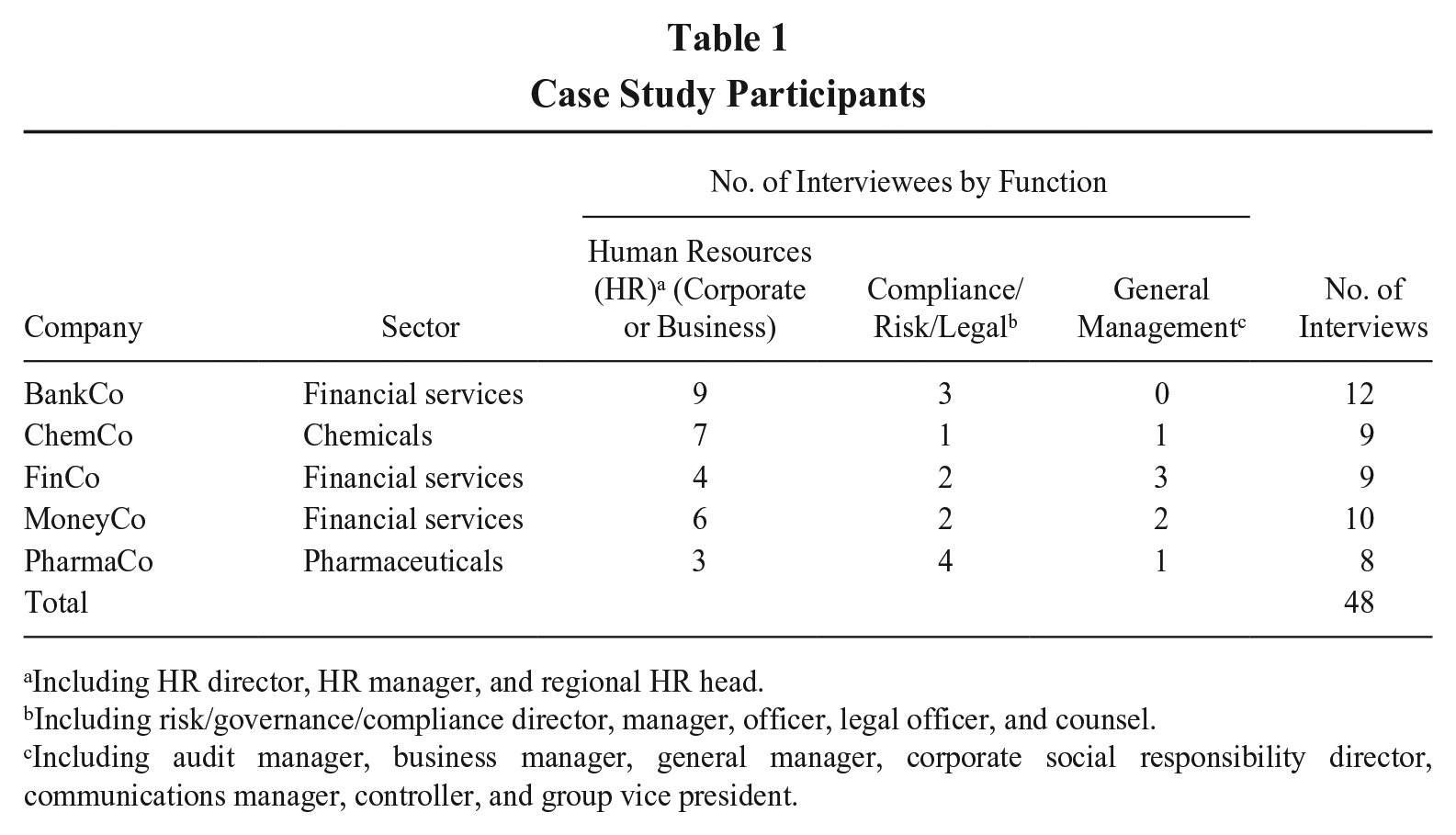
Including HR director, HR manager, and regional HR head.
Including risk/governance/compliance director, manager, officer, legal officer, and counsel.
Including audit manager, business manager, general manager, corporate social responsibility director, communications manager, controller, and group vice president.
The firms were either contacted either through personal networks or letters sent to the HR director at corporate headquarters inviting the company to participate. Once a single contact person was established, this person provided an appropriate list of interviewees for the study. Interviews were then arranged at convenient times at the interviewee’s office location; they lasted 1 to 2 hr and were carried out with two people present. This allowed the interviewer to concentrate on interaction with the interviewee, while the other person focused on making accurate notes and raising any issues that required clarification (Eisenhardt, 1989).
A multiple-respondent approach to the research (comparable to Guest & King, 2004) was adopted, including interviews with HR managers, senior business managers, and compliance/risk officers. These individuals were the key informants for the study as they were all directly involved in HR activities related to corporate governance. Interviews were carried out at corporate headquarters and country and divisional head offices in Belgium, Germany, the Netherlands, the United Kingdom, and the United States. This variety of respondents and locations enabled a deep understanding of the role of HR in corporate governance across the corporation rather than focusing only on corporate headquarters’ intentions, for example. In total, 48 interviews took place, spread across the five companies. A sector-related pseudonym is used further to represent the companies for reasons of confidentiality.
The interviews were carried out face-to-face, with only five conducted by telephone or videoconference due to geographic limitations. All interviews were recorded and transcribed. The content of the interviews was summarized by the lead interviewer into a company case study, which was fed back to the firm to check for accuracy. Company documents were also used to supplement the interviews for data triangulation. The interviews were semistructured, based on a schedule designed by the research team, including questions about the company context, corporate governance frameworks, HR structure, HR delivery channels, and HR metrics (see the appendix for example questions). Interviews were carried out until there were sufficient data on all themes and no new information was added by interviewees.
To uncover how scandals affected HR roles, it was necessary to have a multiyear interlude between the scandal taking place and the interviews, as time was needed to implement changes inside the organization to observe how this played out for HR. Moreover, it would not be possible to find senior-level respondents willing to talk about a scandal during or directly afterward due to the highly sensitive nature of changes taking place. The passage of time allowed interviewees to talk openly about the events as they were no longer embargoed. Interviewees could also be expected to have good recall of the scandals that took place as they were interviewed within 5 to 10 years of their occurrence and all were wide-hitting and highly impactful events, including extensive media exposure, fundamental organizational change, and ongoing reinforcement through training and socialization processes. Interviewees were very clear about what had occurred and provided consistent information across their accounts. Moreover, the authors corroborated the information shared about the various scandals with details published in reliable news outlets.
Thematic content analysis (Boyatzis, 1998; Hyde, Harris, Boaden, & Cortvriend, 2009) was used to analyze the interview data, as the phenomenon being explored has received little attention to date. First, the literature was reviewed for relevant themes to develop the initial heuristic framework (Miles, Huberman, & Saldana, 2019). The transcripts were analyzed for these broad themes, including the scandal faced, the approach to corporate governance adopted, and HR’s roles, practices, and tools used to support the new context. These themes were further broken down as the analysis progressed into multiple subtheme codes. This followed an iterative process whereby when a new subtheme started to emerge, the initial coding of interviews was revised to ensure all subthemes were coded in each of the case studies. The software package NVivo was used for the coding process, which was carried out by the first author and checked for accuracy by the remaining authors. Any discrepancies were discussed, and an appropriate code was agreed upon between the authors.
Findings
Having coded the interview transcripts, Figure 1 summarizes the underlying themes related to HR role change. We detail here the findings for each main theme, highlighting the emergent subthemes identified. (More detailed interview findings can be found in the online supplemental materials.)
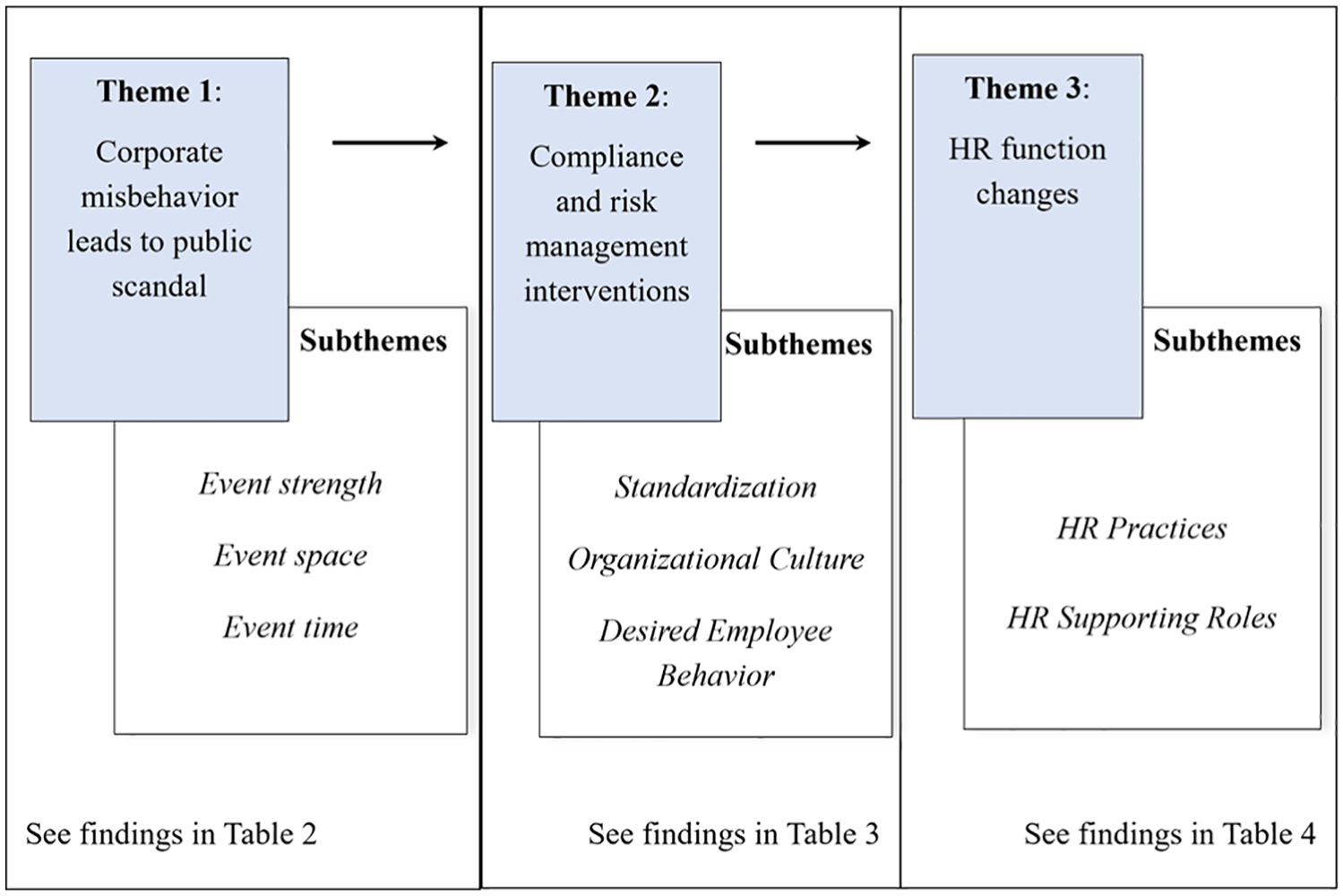
Framework for Event-Based Contextual Analysis of Human Resources Function Changes
Theme 1: Corporate Misbehavior Leads to Public Scandal
EST highlights how the strength, space, and time of an event are critical to understanding the mechanisms of how the event plays out. We focus here on instances of employee or leadership misbehavior that result in organization-level corporate scandals. Although they might start at a lower organizational level, for example, an individual employee, events do not become scandalous until the corporate reputation is affected, whereby the events have a top-down direct change-focused effect on lower-level units. In other words, the organizational scandal (not employee or leadership misconduct) is our phenomenon of interest. We can, therefore, expect overall event strength to be high (novel, disruptive, and critical), the space to be extensive (originating inside the organization and dispersing to affect every aspect of organizational operations and beyond), and the time to be extended (having ripple effects a long time after the initial urgency when then scandal hits). We summarize in Table 2 and describe in more detail next the nuances of how the events in each of the case companies meet these criteria.
Summary of Findings: Public Scandal Event
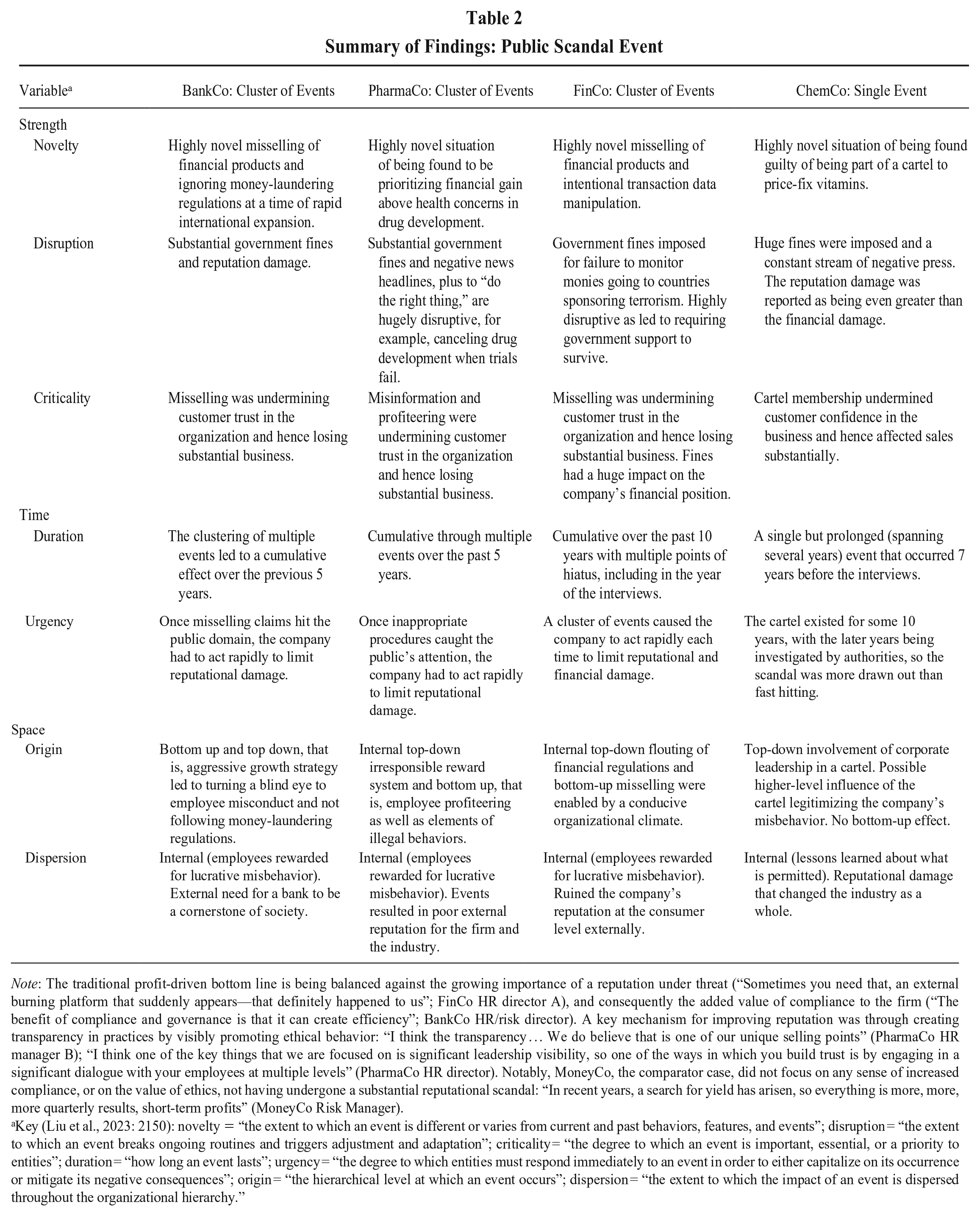
Note: The traditional profit-driven bottom line is being balanced against the growing importance of a reputation under threat (“Sometimes you need that, an external burning platform that suddenly appears—that definitely happened to us”; FinCo HR director A), and consequently the added value of compliance to the firm (“The benefit of compliance and governance is that it can create efficiency”; BankCo HR/risk director). A key mechanism for improving reputation was through creating transparency in practices by visibly promoting ethical behavior: “I think the transparency . . . We do believe that is one of our unique selling points” (PharmaCo HR manager B); “I think one of the key things that we are focused on is significant leadership visibility, so one of the ways in which you build trust is by engaging in a significant dialogue with your employees at multiple levels” (PharmaCo HR director). Notably, MoneyCo, the comparator case, did not focus on any sense of increased compliance, or on the value of ethics, not having undergone a substantial reputational scandal: “In recent years, a search for yield has arisen, so everything is more, more, more quarterly results, short-term profits” (MoneyCo Risk Manager).
Key (Liu et al., 2023: 2150): novelty = “the extent to which an event is different or varies from current and past behaviors, features, and events”; disruption = “the extent to which an event breaks ongoing routines and triggers adjustment and adaptation”; criticality = “the degree to which an event is important, essential, or a priority to entities”; duration = “how long an event lasts”; urgency = “the degree to which entities must respond immediately to an event in order to either capitalize on its occurrence or mitigate its negative consequences”; origin = “the hierarchical level at which an event occurs”; dispersion = “the extent to which the impact of an event is dispersed throughout the organizational hierarchy.”
BankCo
At the time of interviewing, BankCo was undergoing the initial stages of integration with its latest acquisition, becoming highly internationalized overnight. The BankCo executive actions throughout recent years had resulted in massive growth but also overexposure to novel risk situations, including lower-level employees misselling financial products for personal gain: “Something went wrong in terms of how banks were evaluating the risks that they have; they weren’t pricing properly; they weren’t as rigorous as we collectively should be in evaluating that” (BankCo HR director F). This was combined with a more immediate single event 1 year before the interviews, when the bank failed to follow regulations to screen for money laundering or the financing of terrorist activities (aka “dirty money”) for which substantial regulatory fines were imposed. The cluster of events means that the event time duration is cumulative over approximately 5 years, with peaks as urgent and fast-paced responses were demanded as each scandal broke.
The spatial origin of the cluster of events includes three event effects in parallel: two top-down and one bottom-up direct effect. A top-down direct effect can be observed when the organization's leadership pursued an aggressive growth strategy. This led to competition at the team level for bonuses and aggressive (mis-)selling at the individual level. Similarly, a top-down effect can be identified involving the failure to follow money-laundering regulations. Finally, there was a bottom-up effect among sales employees purposefully turning a blind eye to misconduct, thereby facilitating the irresponsible policies pursued at the organizational level.
Event space dispersion is internal and widespread. The interview data refer primarily to managers turning a blind eye to internal misselling complaints, that is, employees were being rewarded for inappropriate but lucrative product sales. However, banks need to have “processes and mechanisms that are securing that the organization is protected” (BankCo HR director A). HR had to address this, together with risk and compliance: “They [the employees] might not have had the skills to actually think of something better to do, and sometimes they might not have actually followed the process in the first place” (BankCo HR risk director). This applies regardless of how high performing the individual was: Where we believe, in HR, we do have a role is to be consistent and say, “No, just because they are a good guy, and you don’t want to address that issue.” We are the custodians of integrity and consistency around here and we are going to escalate this to your line manager. (BankCo regional head of HR)
Moreover, event space dispersion extended beyond the internal setting, which enabled the public scandal: “It’s also absolutely essential that banks don’t fail because if banks fail, the public loses confidence, the government can’t look itself in the face in the morning, and it’s necessary for those two things to coexist” (BankCo compliance director).
Overall, event strength was high: The events were in the public eye due to the record-breaking multimillion-dollar fines being imposed by governmental regulatory bodies. Although financial misselling did not make BankCo unique in the banking industry, the scandal was a novel situation for the bank alongside its rapid growth, opening it up to substantial risk. The disruption caused by the lack of attention to “dirty money” as well as misselling was substantial in terms of both financial and reputational losses. Ultimately, the clustered events would have a fundamentally critical effect on its bottom line as customer trust in the organization was lost and so business was declining rapidly.
PharmaCo
During the 5 years leading up to the interviews, PharmaCo faced a cluster of public scandals ranging from drug safety concerns, that is, multiple cases of inadequate or delayed reporting or labeling of warnings or side effects of drugs, to profiteering, that is, illegal financial inducements to doctors to persuade them to prescribe certain drugs. The cluster of scandals means that event time duration is again cumulative across multiple time points in the organization’s recent memory. Each time, once inappropriate procedures caught the public’s attention, the company had to act rapidly to limit reputational damage.
Although such scandals were not novel in the pharmaceutical industry, we classify the event strength novelty as extremely high because each scandal was new to PharmaCo. Moreover, the events had a cumulative effect to disrupt the modus operandi as misinformation could affect people’s lives: “If the phone doesn’t quite work the way it was supposed to, well, get a new phone. If the drug doesn’t work quite the way it was supposed to then . . . you can’t get a new life” (PharmaCo governance manager). PharmaCo faced huge fines and negative-headline news stories for years. Interestingly, the government fines were being internalized postscandal as having a positive outcome: “We already had a compliance program when we signed that [corporate integrity] agreement [with the government], but the corporate integrity agreement provided further impetus to our compliance efforts” (PharmaCo compliance officer): There is a lot of regulation around drug safety, and that makes things very difficult, but if you have a drug that is coming through an extremely rigorous drug safety process, then the public can be assured that it is a safe drug to take. Well, that is actually great for us because we want people to have confidence in our drug. (PharmaCo legal counsel)
The general sentiment became that if a drug had clinical problems, it should be killed immediately, rather than trying to push forward just because of the reward system in place for reaching milestones in drug development. This change in mindset was seen as hugely disruptive to the way of operating within HR: “It is the ultimate irony of reward because what you will therefore be trying to do is find ways to reward failure” (PharmaCo governance manager).
From the perspective of event space, PharmaCo’s case illustrates top-down effects that originate at the organizational level to trigger behaviors at the individual level that were equally inappropriate. An irresponsible reward system prioritized sales at all costs, overlooking product mislabeling, safety concerns, and payments to doctors for prescribing PharmaCo’s products: “I think if you look at the big cases that have been filed against the pharma industry, they do not involve a single individual doing something wrong. They generally involve a number of people a few levels up doing inappropriate things or turning a blind eye to what was really going on” (PharmaCo compliance officer). There is, however, also a bottom-up element that goes beyond simply following inappropriate corporate norms: “Some of these cases involve criminal statutes with individual liability. There are sales reps in the U.S. within the pharma industry who have been indicted” (PharmaCo compliance officer).
The PharmaCo case is an example of where the event space dispersion is internal, driven largely by organizational leadership. However, the public scandal extends beyond the company to be classified as a societal issue: “At that point in time, the reputation of the pharmaceutical industry was even below that of tobacco, whereas in the past its reputation had been very high based on its research and products. People were asking externally whether they could still trust the industry” (PharmaCo HR manager A). Overall, the event strength criticality of the scandal was very high as it was undermining consumer trust in the organization, seriously affecting bottom-line performance.
FinCo
For FinCo, the scandals were multiple, spanning the prior decade before the interviews. Event time duration is cumulative, with a cluster of corporate misconduct scandal events, including misselling financial products: “People who are on the insurance side and who try to make deals with customers on their own account . . . They sell insurance that is not insurance at all, and they cash in the money themselves” (FinCo HR director B). Moreover, during the year of the interviews, FinCo again hit the headlines as it was found to have failed to comply with U.S. sanctions against countries sponsoring terrorism, allowing them access to the U.S. financial system for illicit activities. These events caused the company to act rapidly to limit reputational and financial damage: We really had those compliance issues within [the company] 2 years ago, with a director of the bank who was fired, which at a certain point was managed here to ensure no financial damage, but seriously damaged the image of [the company]. Last year we had the newspapers full of whether the chairman of the Board of [country] had acted with insider information or not. (FinCo general manager of communications)
Overall, event strength novelty was high, with a mix of “typical” misselling behaviors apparent in the banking industry at the time although novel to the firm, along with flouting of U.S. financial regulations. The scandal’s criticality was very high as the disruptive effect of regulatory body fines was evident within the company, ultimately leading to FinCo being one of the first banks in its home country to require government support for survival when the global financial crisis struck later that year, after the interviews were complete, as it was heavily caught up in the subprime mortgage crisis in the United States.
In regard to event space origin, FinCo’s case illustrates bottom-up direct effects that emanate at the individual behavioral level through the misselling of financial products, which leads to an organization-level scandal. While this misconduct boosted corporate sales, a lack of compliance enforcement at the organizational level was evident, for which the company subsequently paid heavily. There is also a top-down direct effect with organizational leadership choosing not to follow U.S. regulations as well as how it became a major player in the subsequent global financial crisis.
Event space dispersion again extends beyond the company, negatively impacting the firm’s external relationships with stakeholders: “Companies do not want to do business with companies that are not compliant. So, you have to. At that moment that is not a choice; you have to” (FinCo HR director B): You see how important your customers’ perception of the quality of your products is and if those customers feel that your products are not transparent, rightly or wrongly, but they have that feeling themselves, then no commercial on TV can compete with that. (FinCo general manager)
ChemCo
The ChemCo case differs slightly from the previous three cases. ChemCo’s public scandal stemmed from a single event (rather than a cluster of events) that came to a head 7 years before the interviews were held. ChemCo found itself in a highly novel situation when it became part of a multicompany cartel that conspired to inflate and fix the prices and allocate the sales volumes of vitamins most commonly used as nutritional supplements or to enrich human food and animal feed sold around the world. Among other things, the event resulted in the appointment of the company’s first chief compliance officer. Event time duration is prolonged, as the cartel had existed for almost a decade, with the later years being investigated by authorities, but discrete; the scandal was more drawn out than fast hitting.
Nevertheless, the event strength disruption was substantial, largely due to it being so public and having huge financial consequences for ChemCo: The vitamin case was in everybody’s mind. Because you read it every 2 days in the newspapers, et cetera, and you also saw that people were standing up at our annual general meeting to answer the questions of why we acted the way we did. (ChemCo compliance officer)
Event strength novelty was high for ChemCo, having this as its only major scandal, whereby the misconduct resulted in hugely disruptive fines and reputational damage: When we encountered this case, we had to pay a lot for the lessons learned at that time. And at that time, the feeling in the company changed. . . . We want to comply, and we expect everybody to comply, and we don’t accept excuses. You have to comply and if you don’t comply, you have to bear the consequences. (ChemCo compliance officer)
Event criticality was high as it turned the firm on its head in thinking about governance issues in trying to win back the trust of its customer base.
Spatially, the events originated in ChemCo through top-down direct effects but with no evidence of bottom-up direct effects as evidenced in the prior cases. At the organization level, management’s involvement in the cartel had disastrous results for the company and its employees. However, there is also a higher-level direct effect in this case that originates in the company’s environment: It could be argued that the industry collective, that is, the cartel, legitimized ChemCo’s wrongdoing. Event space dispersion is internal as corporate leadership affected the financial and reputational outcomes for the firm, but there is also a broader reach in terms of the impact of the event, extending beyond this particular company: Everybody in our industry has learned what is permitted to do and what not. . . . If we are honest, the economic consequences could be handled. One billion is a lot of money and it really hurt this year but on the other hand, money is something you can calculate and at some point, it is over. The damage to the reputation was much more severe. (ChemCo group VP)
MoneyCo
In contrast to the four cases presented so far, MoneyCo (our comparator case in the financial services sector) had not faced any significant public scandals at the time of interviewing and was therefore still focused on increasing pressure to produce high financial returns rather than considering issues of governance or compliance: “With the pressure for growth, for profit, unless it is explicitly prohibited, you can go ahead and do it” (MoneyCo risk manager). There is, therefore, no event system to analyze.
Theme 2: Compliance and Risk Management Interventions
The second theme for analysis was the corporate strategic reaction to the scandal, focusing on the governance mechanisms (i.e., structures for compliance and risk management) that were established. The findings are summarized in Table 3.
Summary of Findings: Compliance and Risk Management Interventions
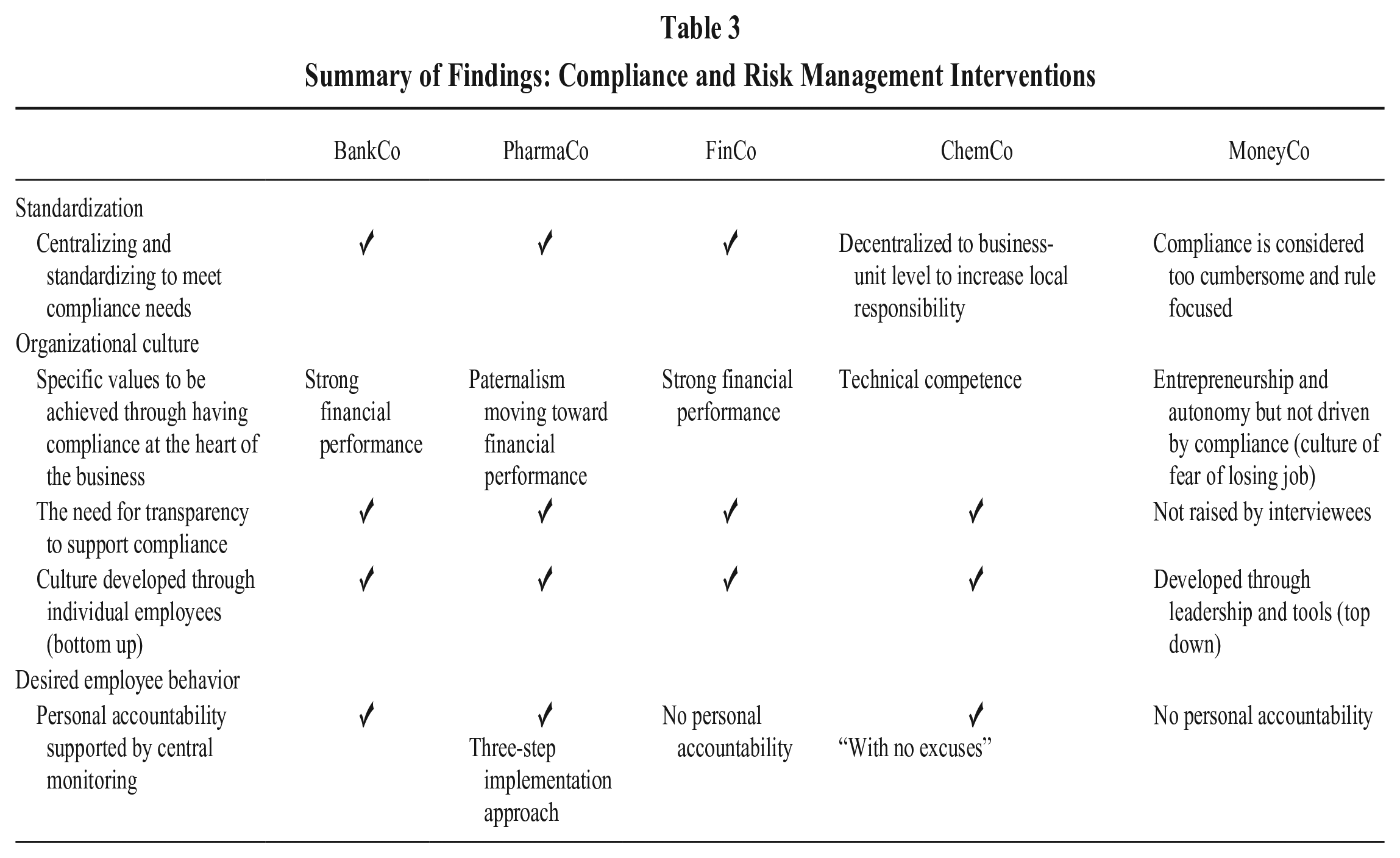
In all cases, compliance has both an internal process and an external regulation dimension. Examples of how this was achieved include developing principles rather than bureaucracy (“Compliance should not be about bureaucracy and details. You know, reams of paper telling me what to do”; PharmaCo compliance officer) and focusing on compliance at the individual level (“Compliance is not a code of behavior, but it is a way of life”; FinCo audit manager). This theme revealed three subthemes across the cases: standardization or centralization of the approach to compliance, shifts in the organizational culture, and new ways of creating desired employee behavior.
Standardization
PharmaCo, BankCo, and FinCo all focused on centralizing and standardizing their approach to compliance. This led to the introduction of a new compliance function: “Our organization is huge; I don’t know how many compliance people there are here, but there are loads of them” (FinCo HR director B). However, in ChemCo, compliance had been decentralized to the business-unit level to increase local responsibility: “We have divided, separated the responsibility for compliance in the different business parts because I think it’s very important that the business parts themselves are responsible for this theme” (ChemCo HR manager A). In BankCo, the compliance function specifically was described as the conscience of the business.
Organizational culture
An important subtheme that emerged from the corporate governance interventions was the relevance of organizational culture. It is noteworthy that the five cases had quite contrasting core values: ChemCo interviewees emphasized the importance of technical competence, PharmaCo interviewees referred frequently to its legacy of paternalism, BankCo and FinCo had very strong financial performance cultures, while MoneyCo (the comparator case) stressed entrepreneurship. However, in PharmaCo, there was change afoot: “In the past, there were multiple scorecards for all the different areas and levels of the business, which resulted in too much confusion. Now, the scorecard only articulates the strategic initiatives that will improve business performance” (PharmaCo HR manager A).
All cases that had experienced a scandal felt compliance was at the heart of their culture. Examples include the following: “I guess what I’ve seen emerge, probably in the last couple of years, driven by some kind of external climate, is getting people to personally attest that ‘as a result, I have done this, I have read this, I have seen this’” (BankCo HR director B); “We have this compliance coordinator, writing in the company newspaper about it. . . . Employees realize it’s not just a one-time story” (ChemCo HR director A); “The most important thing was to make compliance a core part of the business strategy rather than something that seemed like an add-on” (PharmaCo HR manager A). In terms of ethics, ChemCo interviewees did not volunteer this as being of fundamental value to building the corporate reputation; BankCo did not have an explicit code of ethics, nor did interviewees highlight transparency as a corporate reputation issue.
The means of achieving a more compliant and ethical organization varied between the cases, but all focused on the importance of transparency for this process: If something does go wrong, it’s “Right, why did we do it, how did we do it, who did it,” and it’s . . . so in that respect I would say it’s . . . there’s no element of keeping things hidden or . . . it’s honest in that way. . . . If something has gone wrong, then we go through it and we find out why. (BankCo HR manager) That business behavior up to the mid-’90s might sometimes have been a different one, yeah. And especially our business where we are very close to dealers, to retailers, to farmers. But this has totally changed dramatically; the values and principles came into force then. (ChemCo HR director A)
Communication was key to developing the culture across the cases, in which BankCo highlighted how critical individual employees are to this process (“Developing a culture is a very powerful and very important thing, but it needs to come from individuals”: BankCo HR director C).
In our comparator case, MoneyCo, interviewees described the compliance function as the conscience of the business and displayed little emphasis on corporate values around integrity or ethics. Instead, the culture was very strongly embedded in the notion of entrepreneurship, maximizing the autonomy of the business units: “Currently, there is little about integrity—it is not in the [corporate values]” (MoneyCo HR director B). MoneyCo relied heavily on key tools and leaders (“Role models are hugely important when trying to create a certain climate”; MoneyCo HR director B) but lacked a supportive organizational culture: “Transparency is too infrequent due to a fear of losing one’s job” (MoneyCo HR director A).
Desired employee behavior
A related subtheme stemming from the corporate governance interventions was a renewed focus on employee behavior. In ChemCo, PharmaCo, and BankCo, expectations are laid out (in documents and meetings), transgressions are punished, and compliance is seen as successful behavior (“We want to comply, and we expect everybody to comply, and we don’t accept excuses”; ChemCo compliance officer). Across these firms, individuals were expected to exercise self-control as part of the compliance culture (“Compliance culture is around every person taking personal accountability for their own behavior”; PharmaCo HR director). Line management also plays an active role in encouraging appropriate behaviors, supported by HR (“As a line manager, I have responsibilities under a majority of bank policies and it’s my job to live up to those”; BankCo HR director B).
Monitoring employee behavior was also seen as a fundamental part of the compliance and risk management structure (“In a market-driven firm, temptations exist in a materialist society . . . then you have a compliance department which monitors people doing silly things”; FinCo risk manager). Over time, the following example from PharmaCo illustrates how things had been changing: Two or 3 years ago, everyone was given a compliance objective which read like a book, but it did not help people to know what they should be doing. It was overwhelming. The most important thing was to make compliance a core part of the business strategy rather than something that seemed like an add-on. The next step was to ensure people understood the mandatory nature of compliance and to simplify compliance documents. The third stage was education and communication. When an employee takes the online training there is an exam at the end. If they do not score 100% they have to retake the whole program. This was a culture shock when it was first put in about 3, 4 years ago. (PharmaCo HR manager A)
In contrast, in FinCo, compliance expectations were not clearly stated, yet the consequences of compliance transgressions were very visible: “You start off by having a disciplined approach, rewarding people for being good, compliant citizens, and you punish people and hold them accountable if they are not because they can seriously poison the culture” (FinCo audit manager). In this respect, there are more similarities with the comparator case, MoneyCo, where rather than a reliance on self-control, this was noted as lacking and regarded as a weak point: “All regulations come down to behavior and ultimately to employee integrity and morality; there is currently too little self-control” (MoneyCo HR manager A). MoneyCo and FinCo delegated responsibility for compliance to line managers under the purview of the compliance function.
Theme 3: HR Function Changes
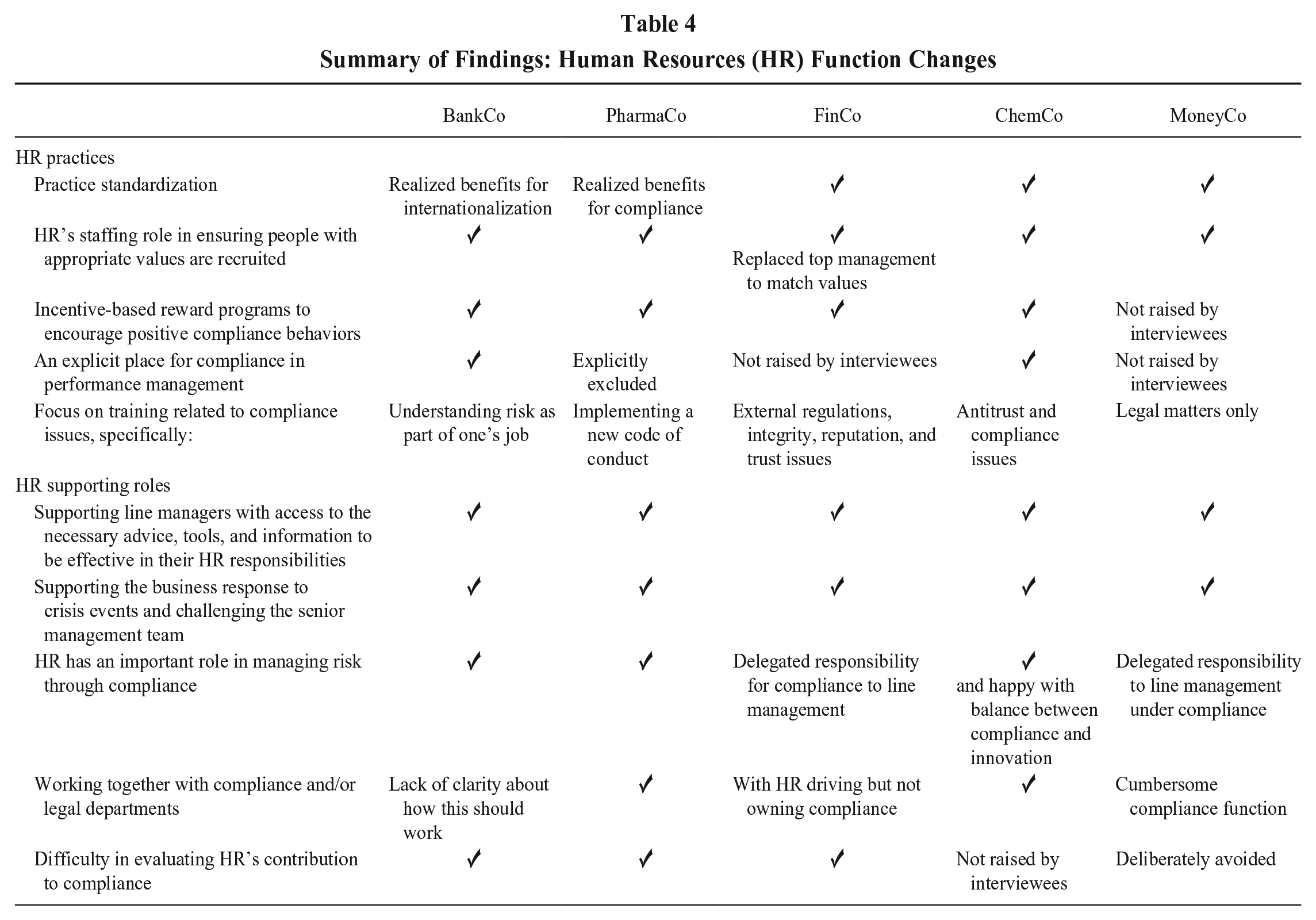
The third primary theme focuses on evidence of how HR roles in the firms change to align with the strategic choices made inside the organization in response to the scandal event. Two subthemes emerged: the HR practices used to encourage appropriate employee behavior and the actual roles carried out by HR in the firm. The findings are summarized in Table 4.
Summary of Findings: Human Resources (HR) Function Changes
HR practices
Several noted changes in HR’s delivery strategy appear to be more general changes happening within the HR functions across organizations, being less tightly connected with the scandal events per se. For example, in BankCo, FinCo, and PharmaCo, the responsibility for HR activities was being transferred from the HR function to line management with a concurrent need to simplify and clarify the range of HR practices for the benefit of line managers and employees in addition to achieving compliance goals. The cases differed substantially, however, regarding the extent of standardization of HR practices, which was more closely related to strategies for dealing with the fallout from the scandals. Whereas in PharmaCo, interviewees realized the benefits of standardization for compliance (“The benefits of having a single global approach outweigh those of customization”; PharmaCo HR manager A), in BankCo, standardization was also seen as key; however, this was not a result of any scandal but of internationalization (“They’re trying to matrix all of the policies on a two-by-two basis, which ones can be globally driven and globally implemented or which have to be more local”; BankCo HR manager): I think the reorganization of HR into the regions is a very, I think, critical step in this [keeping on top of compliance issues] because the rest of the company hasn’t restructured in the same way that we have. And we’ve genuinely created a local footprint in creating four regional HRLTs—HR leadership teams. (BankCo regional HR director)
FinCo and ChemCo were also taking steps toward more centralized corporate control but not explicitly related to a scandal: We had a very heterogeneous situation in Europe, and we are now implementing more central structures in Europe. . . . This has not been the case in the past, where I would say certain sites had a lot of autonomy. . . . We’re working more on harmonization and performance management approaches in Europe. (ChemCo HR director B)
Focusing on the actual HR practices being implemented, it becomes much clearer how HR activities were designed as a consequence of the various scandals: HR also plays a role, HR of course plays a role. What they know the most about, there are quite often things going on with people, and if things are at stake with people, HR is involved from the first moment. (FinCo general manager of communications)
For staffing, in all cases that had faced a scandal, interviewees highlighted HR’s role in ensuring people with appropriate values are recruited: “Building compliance and behavioral and value elements into how leaders are selected, evaluated, and rewarded—HR can play a crucial role in this. This is how you build a compliance culture” (FinCo HR manager A).
What has certainly been a big change at [FinCo], especially in recent years, is that we have acquired a much stronger performance culture. I also think that one of the silent revolutions that has taken place here is the replacement of almost three-quarters of the top management in [the company]. . . . There is more upside if you do well, but there is also more downside if you don’t do well. We also really fire people. (FinCo general manager of communications)
All cases also saw the value of incentive-based reward schemes to encourage positive compliance behaviors: “We have a well-mapped process around variable reward, encouraging the organization . . . to behave in a way that adheres to that process because it meets the best interest of the company” (PharmaCo governance manager); “You also have to be able to see the HR practices internally in the leaders you select. How to reward them” (FinCo HR director B).
For performance management, there was a division between ChemCo and BankCo, which saw an explicit place for compliance in the process (“Our leadership team has compliance as one of the underlying requirements in their job description and their target agreements”; ChemCo group VP), and PharmaCo, which explicitly excluded this (“Performance would directly measure your contribution to the project, whatever your objectives were. . . . Compliance isn’t factored in performance unless there was a problem”; PharmaCo business manager).
Training is a key area of activity where HR supports the compliance function: “This has been fundamentally changed after the vitamin case in the late ’90s, how we deal with that, fundamentally with training. We have regularly antitrust and compliance trainings with everyone who has outside contacts” (ChemCo group VP). However, priorities for programs differed per case, ranging from antitrust and compliance issues (ChemCo), implementing a new code of conduct (PharmaCo), and understanding risk as part of one’s job (BankCo), to external regulations, integrity, reputation, and trust issues (FinCo).
The observed change in training and development practices following the scandal events was also evident across the cases. Examples follow.
For leadership development and team effectiveness, there is one approach. That has been a huge step forward for us because we used to do things that we thought were appropriate in our function, but then, particularly if you are developing teams and leaders, if every function does it in a different way, you don’t get the benefit of actually developing a cadre of leaders. (PharmaCo HR manager A)
Compliance and HR developed [the new compliance training]. HR was responsible for the delivery channel and the technology, which was the e-learning platform, but the content largely came from the compliance function because we are not subject matter experts. . . .
Within 3 months people have to do [the new compliance training] as part of their socialization?
Yes, so that was not the case 3 years ago or 4 years ago. This is just the beginning of a whole change. That’s why it’s so impactful because everyone feels that more strongly than in the past by immediately being confronted with it.
Finally, disciplinary procedures are a significant compliance activity, with HR being called upon when transgressions involve people: “We [HR] are the custodians of integrity and consistency around here and we are going to escalate to your line manager” (BankCo HR director D).
In the comparator case, MoneyCo, no mention was made by interviewees of the link between disciplinary activities and compliance, which is in line with the finding earlier that employee behavior was not seen as being at the heart of compliance activities. This is confirmed further by compliance not being a component of incentive-based rewards or performance management at MoneyCo and that its compliance training does not extend beyond legal matters.
HR supporting roles
Focusing on the emerging HR roles, given the corporate transformations faced by the firms, we see how HR supports individual managers, employees, and the business as a whole as well as HR’s role alongside the compliance and legal departments. Taking the example of FinCo, the corporate scandal had critical implications for the HR function related to transparency and responsibility: “Transparency, adhering to the rules, I think that is critical for HR people who address others that they adhere to the rules” (FinCo HR director B); “We now have a separate Operational Risk Management (ORM), risk, and a kind of compliance function within HR, which was not appropriate in the past. Which in principle reports, can report, directly to the new HR director of the [country]” (FinCo HR director B); “The compliance officer of HR must ensure that HR employees are adequately informed, are aware of the compliance rules, for example, regarding insider trading” (FinCo general manager).
In other cases, there was a similar shift in how compliance issues were now handled post–scandal events through HR: “Their [the HR risk department group] priority has been around putting in systems and processes around getting people to understand that risk is part of their job, getting them to understand how to look at risk” (BankCo HR director A): You need to address this [compliance] in a different way. So there has been a growth and, really, there's a HR leadership team leader who encourages “HR with attitude” and “HR with confidence” to go back and challenge the business and say this is not the way we should do this. (BankCo regional head of HR) The skill centers are responsible for researching best practices and are accountable for developing this: our trust in them is that they figure out the best way of doing it. Business partners then take the approach they are given and implement it, which is a change from how this previously used to happen but is seen as saving a lot of work. (PharmaCo HR manager A)
Across all cases faced with a scandal, supporting line and senior managers emerged as being about ensuring they have access to the necessary advice, tools, and information to be effective in their HR responsibilities: “There has been a quite significant change a few years ago; I was at [ChemCo] at that time. There was a redefinition of what is the role of a divisional HR person. And the role of the divisional HR person is no longer to be the contact of the employee, but to be the coach of the supervisors” (ChemCo HR director A); “The acceptance of HR and its added value is in the processing: making HR things transparent and simple for the line and employees” (FinCo HR manager B). Some had adopted a self-service model through shared service centers: “I think the issue is not to get the solutions to the people, but actually to get them the tools to help themselves” (BankCo HR director C).
From a business perspective, HR supports the strategic choices made and challenges the senior management team: “This is a big role for HR directors as business partners in challenging the business teams that they’re part of” (BankCo HR director B). This had also clearly changed postscandal in BankCo: This morning, I put a call out to Asia where one of my responsibilities is the integration of the HR function as well as helping the businesses. My job is to pull together a single HR function in Asia and we were very clear about doing that and it was a very comfortable conversation. And 5 years ago, would I have had that same conversation over the integration of [a company]? I don’t think so. I think they would have said, “We’ll give you 30 days, do it, and then report back after 30 that you’ve done it with a 30-day plan.” Today’s conversation was very different. There was much more around “we do it right.” (BankCo regional head of HR)
Regarding support for employees, only in PharmaCo with its more paternalistic culture was there still a role for HR here: “Giving people space to talk about values, how they feel about something—that has been just as important as having the policies in place” (PharmaCo HR manager A).
From a risk management perspective, all cases, including the comparator, saw risk as a fundamental part of their business. How this risk was managed and how HR was involved differed, however. For example, whereas BankCo saw HR had an important practical role (“The business challenge to HR would be OK, it’s really important that we are legislatively compliant, et cetera, but what is the most practical way to do that”; BankCo HR director B), MoneyCo noted the cumbersome, rule-focused role of the compliance function (“Currently, the balance is not good and the focus lies too much on rules”; MoneyCo HR director A). PharmaCo also focused on the many control processes at risk of stifling innovation, introducing a new role for HR (“That is the battleground for HR. It is not compliance—it is how to foster innovation”; PharmaCo business manager), whereas ChemCo appeared to be happier with the balance between compliance and innovation, perhaps because of the time that had lapsed since having dealt with the major scandal (“Perhaps it is because it [compliance] is so deeply embedded in the DNA of the company that it still can be innovative”; ChemCo HR manager B).
The data also show that in all cases that faced a scandal, there is an understanding that compliance and HR must work together: “Because of the industry we’re in, it’s what causes this special relationship between HR and the compliance function” (BankCo risk director). From the compliance function perspective, it is believed that HR can support an increased focus on compliance activities: “I think HR really does have a big role to play in governance. They have the ability to impact the employee population in all sorts of different ways” (PharmaCo compliance officer); “You get much more legalization of the HR processes than you used to have. So, you see an army of compliance officers arise within HR and controllers arise” (FinCo HR manager A). This view is equally reflected in the HR perspective: “HR knows the employees well; compliance wants something from these employees, so compliance has to listen to what HR has to say” (FinCo risk manager). There is also evidence of HR working alongside the legal department, primarily with legal taking the lead, and HR ensuring implementation: “We [HR] have helped the legal department in the more practical training” (ChemCo HR manager A).
Alongside this compelling evidence of an emergent role for HR supporting compliance initiatives, some interviewees highlighted that there remained a certain lack of clarity: “I think HR has got better things to do; I think they have got real challenges to help us deliver towards, and compliance is not one of them” (PharmaCo business manager); “Compliance very often is, from an organizational point of view, linked to central legal departments. As far as I can remember, I never saw it linked to HR. So I think this is a message, an indicator” (ChemCo HR director D); “HR, and the policies that affect my world, very much see themselves, portray themselves, are perceived as the bearers of the message and not the owners of the message” (BankCo compliance director); “You aren’t given your role—you have to earn it—and you earn it with the simple things” (FinCo HR manager B).
One comment in BankCo identified a potential cause of this lack of clarity as depending on the importance of compliance to the firm: “I don’t think it’s just about what role HR chooses to play. It’s actually how embedded the organization wants compliance to be” (BankCo HR director B). This was translated in FinCo to the nuanced role for HR to drive compliance rather than own it: The HR function should be the key driver of the way we live compliance. The HR function is not the owner, it is the guardian of the key resource of the company—the people. So, the HR department has a responsibility to protect and to nurture and to build the HR brand in the company. (FinCo audit manager)
One of the activities required from a compliance perspective is proactively observing trends to avoid future problems. Although it was perceived that HR was in a good position to do this, HR admitted not being very active in this respect: “I think it is often a responsibility that the HR function doesn’t fulfill effectively because we have so many day-to-day demands from the business that we can easily have our head in the sand” (PharmaCo HR director).
Equally, all cases that faced a scandal except ChemCo mentioned they were finding it difficult to evaluate HR’s contribution through compliance or other activities: “At the HR level, the strategic level . . . I don’t really see key metrics that are being used or even discussed” (FinCo audit manager).
In MoneyCo, the comparator case, there was no current role ascribed to HR alongside compliance or legal: “They [HR] want to be advisors, but I just want them to do their work well” (MoneyCo corporate social responsibility director). MoneyCo even went as far as to avoid evaluating HR in compliance activities: “We made a conscious choice not to set up a control department because I believe that as a team, you are fully responsible for the service you provide” (MoneyCo HR manager C).
Discussion of Findings
As implied by EST, depending on strength, space, and time (Morgeson et al., 2015), corporate public scandals can be a turning point in a firm’s existence and, as such, have a fundamental effect on organizational members. The HR function is impacted by such events as it lies at the heart of facilitating a change in employee behaviors to support corporate recovery. By exploring in-depth multirespondent interview data, we have uncovered how HR roles change in the context of corporate scandals. We summarize here the findings that emerged across the case companies.
Regarding the novelty of the scandals, in all instances, the case organizations were facing unchartered territory (refer also to Table 2). BankCo and FinCo were both exposed as misselling financial products and flouting financial regulations, PharmaCo was guilty of chasing profit rather than adhering to its health-driven mission, and ChemCo was charged with being part of a multifirm cartel that was price fixing. The scandals were highly disruptive for all the firms involved due to both huge fines being imposed as well as substantial reputational damage and the need to rethink their corporate governance. However, some differences in focus emerged here. PharmaCo emphasized how disruptive it was to have to stop a drug development process beyond any fines being imposed due to the substantial shift in mindset and reward systems required. ChemCo was more focused on reputational damage than the financial consequences of fines, which they believed they could recover from more quickly. Similarly, concerning criticality, PharmaCo stood out given that employee wrongdoing could directly affect people’s lives, carrying much more serious consequences than the financial implications of employee wrongdoing in BankCo and FinCo. We, therefore, summarize that event strength (novelty, disruption, and criticality) was high across the cases but perhaps highest in PharmaCo due to the life-impacting consequences of events.
Regarding event time duration, BankCo, PharmaCo, and FinCo had all experienced a cluster of scandal events over the past 5 to 10 years, whereas at ChemCo, there was one major event that had occurred 7 years before the interviews. The urgency of the events differed, however; that is, for BankCo, PharmaCo, and FinCo, the scandals broke quickly and required a rapid response, whereas for ChemCo, the investigation into the cartel operation was over a period of years, so the event was more drawn out.
All four cases demonstrated both internal and external implications of their scandal events, demonstrating high event space dispersion. Internally, employee wrongdoing was often overlooked by management in favor of financial gain, alongside senior leadership being complicit in believing turning a blind eye was appropriate to maintain shareholder value. Externally, they all suffered severe reputational damage yet had critical roles to play as organizations in the broader society. The spatial origin of the events involved both top-down leadership and bottom-up employee misbehavior in BankCo, PharmaCo, and FinCo, while for ChemCo, the scandal was driven by top-down corporate leadership through its decision to take part in the cartel.
Against these scandal event backgrounds, comparing each case as presented in Tables 3 and 4, we can see that the comparator case that had not faced any scandal, MoneyCo, stands out as being the most divergent. Compliance was considered very cumbersome, and responsibilities were delegated to line managers with little personal accountability; the corporate culture was driven top down, not embedded in compliance but in entrepreneurship and autonomy; the HR function was explicitly excluded from compliance efforts; and there was no mention of compliance being part of HR practices other than training on legal matters. Given the lack of a public scandal, essentially, there was no burning platform that initiated change for HR. The only changes being observed were those more typically happening, such as greater customization of HR practices to meet local needs.
ChemCo was somewhat unique compared with the other three cases that had faced a public scandal. The scandal had taken place 7 years before the interviews and had been somewhat drawn out but nevertheless had been so forceful that it was still part of the organizational memory. Consequently, in the time that had since passed, the firm had been able to progress well beyond initial reactions. Compliance and risk management were now largely decentralized to the business-unit level to ensure a bottom-up sense of responsibility. The company felt it had managed to achieve a good balance between the importance of both compliance and innovation (which involves risk-taking). This was particularly important due to the corporate-culture focus on building technical competence. There was also a strong belief in all employees being responsible for their behavior, “with no excuses.” The HR function had implemented a broad range of HR practices that incorporated compliance values and behaviors, including training on antitrust and compliance issues. ChemCo HR had, therefore, evolved into an active partner working alongside the compliance department, supporting managers, employees, and the business as a whole.
FinCo and BankCo had faced similar corporate scandal events in a comparable time frame, and therefore, it is not surprising that their HR changes showed considerable similarity. They differed only in how compliance monitoring and responsibility were delegated. In BankCo, HR had a more active role to play, as well as individual employees being more accountable for their behavior. This meant a focus on training on understanding risk as part of one’s job. In contrast, in FinCo, there was more delegation to line management yet a lack of personal accountability. Line managers also resisted HR activities being delegated to them. Compliance training was more focused on external regulations, integrity, reputation, and trust issues. Both companies had implemented a broad range of HR practices that supported a focus on compliance, and BankCo was trying to work out how HR and compliance should work together. In FinCo, HR was seen more clearly as driving but not owning compliance.
Finally, PharmaCo had the centralization approach of BankCo and FinCo as well as a need for transparency and a bottom-up-driven culture, perhaps due to the very high strength of the corporate scandal event. The company was most like BankCo in many other respects other than explicitly not including compliance criteria in performance management practices (as this was included only if a problem was identified).
Drawing across these findings, although each case that experienced a scandal has seen a considerable change to the HR function, the end point is not always going to be the same for all firms. We posit that organizations are complex systems in which there is no one best way in which the role of the HR function might be designed to support organizational compliance, but instead, organizations learn by doing; that is, each organization creates its own structure to deal with the compliance issues raised by a public scandal. We discuss the implications of these findings for theory and practice.
Implications for Theory
This study has highlighted how corporate scandals act as fundamental instigators of change in HR function roles. Overlaying an EST lens to explore the organizational response to scandal events identifies novel research themes important for the further development of HR roles research.
First, consistent with EST, the data demonstrate that events can trigger changes in organizations; however, we contribute further to the EST perspective by highlighting the importance of not only studying event effects but also exploring systematically the nature of these events in terms of their strength, space, and time and their multiple possible outcomes. Although we agree with Romanelli and Tushman (1994) that the punctuated equilibrium model is useful in explaining major organizational transformations, the EST perspective extends this thinking by focusing on the nature of the event overall rather than merely the speed at which the event occurs. Public scandals are punctuating events, whereby the HR function serves as a key driver in reestablishing equilibrium postscandal. Having uncovered the nature of public scandals as events and how they trigger this shift, we can better understand how HR becomes a driver (though not an owner) of a compliance culture as employee behavior needs to change. Practically, HR performs this function by developing appropriate HR practices, such as value-based staffing, compliance-driven performance management and reward systems, and compliance training.
Second, our study has led us to question the extent to which EST considers agency in open systems. As we have demonstrated, employee misconduct can result in a corporate scandal, especially when that misconduct is reinforced by organizational norms. Consequently, recovery from scandals requires individual-level employee or leadership behavior change, which the HR function can facilitate. In some instances, however, EST’s implied starting point of an event disrupting the status quo may not be a linear causal process, but rather, individual and organizational behavior are entwined (e.g., when employee misbehavior is endorsed by organizational actions). In other words, organization-level responses to scandals cannot occur without individual-level changes in employee behavior, which the HR function is well positioned to facilitate. Moreover, organization-level responses to scandals naturally impact the broader society in which the organization is operating and hence cannot be seen as detached. Overall, we encourage future research to explore how event systems impact across multiple levels of analysis simultaneously (as with a disaster event; e.g., Gregg et al., 2022).
Third, whether the shift to supporting a compliance culture is driven internally or externally is important to explore in terms of HR roles. We conclude that corporate scandals provide the impetus for HR to assume a role that aligns HR services with the strategic needs of the organization that have emerged as a result of the expectations of external stakeholders, that is, the public or regulatory bodies. One might consider this as evidence of bringing the “outside inside” with regard to the HR function role as reflected in Ulrich and Dulebohn’s (2015) Wave 4 of HR evolution. However, Ulrich and Dulebohn’s (2015) framework depicts an almost natural sequencing from Wave 3 to Wave 4 as the ultimate goal for HR. On the basis of our findings, we question whether a transition to Wave 4, which relies on the direct influence of the external stakeholder context on HR roles, is perhaps an unlikely organizational reality. A direct illustration of this point came from BankCo HR director B: “I don’t think it’s just about what role HR chooses to play. It’s actually how embedded the organization wants compliance to be” (emphasis added).
The HR literature has documented the perceived struggle for power of the HR professional inside organizations for decades (Heizmann & Fox, 2019). Wave 4 represents this power struggle, suggesting extension beyond the internal, management-led focus and HR being an instigator of change based on external stakeholder demands. However, as we saw in our case analyses, although the corporate scandals are driven by a negative external stakeholder reaction, it is corporate leadership that needs to respond to this crisis and, in so doing, turns to HR to help redirect employee and leadership behavior. As such, we posit that Wave 4 is not an organizational reality as a result of a scandal but rather represents further evidence of the Wave 3 alignment of HR with changed corporate priorities, that is, developing a compliance culture. Consequently, we suggest a refinement of “Wave 4” theorizing whereby Wave 4 is still a question of strategic alignment but one that helps the organization respond to external stakeholder demands in balance with internal management demands.
The scandal situations described in this study allow for a closer alignment between what is morally (or legally) desirable to achieve and the organization’s leadership goals. We link this reasoning to the concept of competing institutional logics (Battilana & Dorado, 2010): HR’s role in the need to balance a traditional profit-driven bottom line with compliance needs in the face of reputational threats and fines. We posit that a scandal event system permits a balancing of legitimacy to take place. Future research might explore further whether Wave 4 would ever be an organizational reality, whereby HR acts directly on external stakeholder demands, rather than being mediated through corporate leadership in this balancing of competing tensions (Cayrat & Boxall, 2023).
Fourth, we posit that it would be valuable to avoid considering the role of HR functions in organizations through universal modeling, instead adopting a context-dependent perspective as it is unlikely that HR functions progress neatly from one phase of an HR role typology to the next in a linear fashion throughout. Configurational thinking (Delery & Doty, 1996) is helpful here. For example, we posit that the existing makeup of an organization will influence the outcome of a scandal event (in line with our observation of differences between FinCo and BankCo). In other words, two firms might experience a very similar scandal, but the outcome can be different because of (a) different organizational starting points and (b) different strategic responses by leadership.
Business environments are in a permanent state of change, if not crisis, according to VUCA (volatility, uncertainty, complexity, and ambiguity) thinking (Baran & Woznyj, 2021). Consequently, HR functions require agility in their roles to survive in this environment, coping with uncertainties whenever a scandal hits. Having uncovered how events ultimately impact the HR function, we suggest that EST can be utilized in future research to explore other VUCA scenarios beyond the focus here on public scandals. As demonstrated by recent research on employees’ mental states concerning the COVID-19 pandemic in China (Liu et al., 2021), EST can also be used to explore how national- or international-level events (e.g., the COVID-19 pandemic) affect a lower-level entity, such as an organization. Current evidence is emerging that this type of external event can trigger an internal response for survival. For HR, this has meant increased agility to respond to uncertainties, primarily shifting priorities to remote work and related implications in terms of managing employee productivity and well-being (Collings et al., 2021).
Implications for Practice
The cases analyzed in this study illustrate the new role HR assumed, playing an important role at the intersection of risk, compliance, and the legal departments—being a partner for each area although not the function ultimately responsible. Though this may cause ambiguity and at times unclear responsibilities, it represents the requirements of being able to act proactively and anticipatively in a dynamic environment. Nevertheless, the focus on risk mitigation and compliance can sometimes overshadow the agility and responsiveness expected from HR (Noe, Hollenbeck, Gerhart, & Wright, 2017), especially when HR is also expected to foster an innovation culture. These findings hold significant implications for HR practitioners, especially chief human resources officers (CHROs), who play a central role in shaping HR functions within organizations.
A primary insight from this study is that the HR role is likely to evolve toward compliance and risk management, especially in the aftermath of a scandal event. However, a proactive approach to this transformation is crucial, enabling organizations to prevent damaging events from occurring rather than fixing them in the aftermath. Therefore, our findings emphasize the importance of a proactive stance, explicitly defined to avoid confusion in terms of responsibilities. At PharmaCo, for instance, there was a perception that HR should assume more ownership of compliance-related tasks but was hindered by resource constraints. Interactions between HR and other functions existed, but the role HR could and should play in compliance remained unclear, leading to tensions. In BankCo, according to the compliance director, HR is seen as the messenger but not the owner, rendering HR a “toothless tiger.”
CHROs would be advised to advocate for a forward-thinking approach, positioning HR as a strategic partner in mitigating risks and ensuring compliance. Drawing on change management models that motivate moving from one state to another (e.g., Fredberg & Pregmark, 2022; Kotter, 2008), CHROs could focus on creating urgency within the organization, communicating the potential risks and benefits of a proactive shift toward compliance and risk management. This would involve avoiding working in organizational silos and proactively engaging with all relevant others to create alignment across organizational domains and goals, which facilitates organizational buy-in and support for strategic evolution.
While not studied extensively in the HR management field, nudging can be regarded as an effective change management technique (Beshears & Kosowsky, 2020). Applying experimental methodology, Grunewald et al. (2017) report on an organization that successfully created a nudge in the form of an incentive system, motivating managers to change their behavior. The creation of a nudge depends on the organization and the required change; however, nudging is a proactive, indirect, and therefore less provocative approach to motivating behavioral changes. Finally, demonstrating how a proactive approach aligns with strategic objectives fosters greater executive and board-level support, positioning HR as a strategic partner rather than a reactive entity.
In sum, CHROs may establish mechanisms for regular risk assessments and adapt HR practices accordingly. This adaptive approach ensures that the HR function remains resilient and responsive to the dynamic nature of compliance challenges. The CHRO plays a critical role in steering HR toward a proactive stance on compliance and risk management, which is not merely a response to scandals but a strategic imperative for the contemporary HR function.
Limitations and Future Research
Although highly illuminating, this in-depth case study research design has limitations. The number of case companies may restrict the generalizability of the findings, although it is, of course, the responsibility of researchers to build on the work of others, providing additional cases, however limited, to help expand our knowledge of a subject (Collinson & Rugman, 2010). The range of interviewees, including both HR and non-HR managerial perspectives, helps to mitigate this limitation, as does the data collection process involving carrying out additional interviews until no new information was being gathered. This reduces the chance of bias emerging in the data collection, hence improving its generalizability.
A further limitation is that the insights gained from applying EST may be highly dependent on the specific context and may not be generalizable to different scenarios, sectors, or cultures. All our cases, for instance, include large Western enterprises. Smaller firms or start-ups may not have a pronounced HR function, and behavioral ideals of innovation, experimentation, and speed (flexibility and agility) may be more crucial for competition and survival than a focus on compliance and legal aspects. A focus on the latter may develop and become a priority at a later point in time as the organization grows. Future studies may explore how different organizational contexts might create different opportunities and constraints for the HR function to respond to scandal events.
Moreover, future research might explore how organizations in a particular industry affect each other through their actions. FinCo and BankCo had similar scandals take place within the same industry, perhaps legitimizing their behavior in the same way that ChemCo may have felt legitimized by collaborating with other firms in the cartel. When a company sees a scandal unfold in a comparable organization, through a process of mimetic isomorphism (DiMaggio & Powell, 1983), it might activate the HR function in a different way than the HR function that is directly confronted with its own unique corporate scandal. Further research is required to explore this theorizing.
Another point of focus of our study has been on the impact of external stakeholders on corporate operations; in other words, it was the public’s response to organizational misconduct as external stakeholders that ultimately created the scandal events. However, we have also stressed how the external stakeholders were one step removed from having a direct influence on the HR function, demonstrating how HR roles are affected by the external context mediated through the corporate strategic response. Future research might explore in greater detail how firms engage with external stakeholders when scandals break, considering such issues as stakeholder power and salience on how the organizational response then plays out (Bundy, Vogel, & Zachary, 2018).
Finally, we focused only on the role of the HR function here, although the study also revealed evidence of how the compliance function was evolving as a result of the scandals. Future research could explore how other corporate functions similarly react to high-impact corporate scandal events. Other directions in which future research might develop this topic include division of labor/management issues. For example, who is controlling what roles HR can adopt, and what is the power balance between the different corporate functions of HR, compliance, and legal alongside top management boards?
Conclusion
This study has extended the traditional HR roles literature, adopting open-systems thinking through the application of EST, which suggests that corporate scandals lead to a substantial adjustment to a new context. Similarly, extant HR roles literature suggests that the HR function will be actively involved when a corporation is seeking to recover from a major public scandal, due to the ability of HR to influence employee behavior. Public scandals have, therefore, been identified as representing an event or a cluster of events that necessitates corporate action in the domains of compliance, strategic responses, organizational culture, and employee behavior. Such an event punctuates the equilibrium for the HR function through how HR is practiced, resulting in new HR roles. Understanding the nature of the event allows us to build a deeper appreciation of organizational impact.
Supplemental Material
sj-docx-1-jom-10.1177_01492063231226137 – Supplemental material for Corporate Scandals as Punctuating Events That Change Human Resource Roles
Supplemental material, sj-docx-1-jom-10.1177_01492063231226137 for Corporate Scandals as Punctuating Events That Change Human Resource Roles by Elaine Farndale, Jaap Paauwe, Paul Boselie and Sven Horak in Journal of Management
Footnotes

References
Supplementary Material
Please find the following supplemental material available below.
For Open Access articles published under a Creative Commons License, all supplemental material carries the same license as the article it is associated with.
For non-Open Access articles published, all supplemental material carries a non-exclusive license, and permission requests for re-use of supplemental material or any part of supplemental material shall be sent directly to the copyright owner as specified in the copyright notice associated with the article.
