



Abstract
Over the past half century, virtual interactions have become a mainstay of contemporary organizations, whether leveraged for formal job interviews or day-to-day communication. Despite this central role, there is a lack of a holistic understanding of how employees make and manage impressions in these virtual contexts. In this article, we review, organize, and evaluate the state of the growing body of cross-disciplinary research on virtual impression management. We develop a guiding theoretical framework that identifies three categories of virtual impression management behavior (verbal, nonverbal, and meta behavior) that meaningfully alter impressions, and the conditions under which these outcomes vary. Through considering this body of research as a whole, we highlight that virtual interactions are quite rich when it comes to creating impressions. By illustrating where virtual impression management research has concentrated thus far, our review enables us to conclude by offering an agenda for future research on virtual impression management.
Keywords
Introduction
From a software engineer engaging in a video call with a teammate from another office to a carpenter responding to customer text messages on the go, virtual interactions have become an essential component of work (Heaphy, Byron, Ballinger, Gittell, Leana, & Sluss, 2018; Raghuram, Hill, Gibbs, & Maruping, 2019). As a result, employees’ impressions of their colleagues—an important determinant of performance evaluations, pay, and career advancement (Barrick, Shaffer, & DeGrassi, 2009; Bolino, Kacmar, Turnley, & Gilstrap, 2008; Ferris, Judge, Rowland, & Fitzgibbons, 1994; Ferris, Munyon, Basik, & Buckley, 2008)—are increasingly formed in response to virtual communications (Gajendran & Harrison, 2007; Spreitzer, Cameron, & Garrett, 2017). More than 300 billion emails are exchanged and over 300 million videoconferences occur each day (Dean, 2023; The Radicati Group, 2022). As many organizations have operated virtually for some time or have transitioned to remote work in the wake of the COVID-19 pandemic, many new employees have only been able to form impressions of their colleagues through virtual interactions.
Bringing a greater focus to research on virtual impression management is valuable not only because of the growing reliance on virtual interaction, but also because the very nature of virtual communication can make both impression management behaviors—and outcomes—more consequential. First, compared with nonvirtual interactions, virtual interactions are relatively rehearsable, or editable (Dennis & Valacich, 1999), giving people more time and opportunity to manage their impressions. Such editability is readily apparent in email communications, which are often carefully crafted (Rosen, Simon, Gajendran, Johnson, Lee, & Lin, 2019; Wang, Liu, & Parker, 2020; Walther, 2007), and in asynchronous video communications, which provide actors with the opportunity to re-record their messages (Roulin, Wong, Langer, & Bourdage, 2022). Second, virtual interactions are relatively more permanent (Dennis & Valacich, 1999; Myers, 2007; Wang et al., 2020). Due to their inherent ability to leave digital records, many of which are easily searchable, virtual interactions are generally more easily retained, revisited, and shared (Dennis & Valacich, 1999; Treem & Leonardi, 2013). Third, virtual interactions shape the variety of cues available to communicate, for example, limiting actors to expressing themselves via text or, in video, altering views of their nonverbal behavior (Dennis & Valacich, 1999), and thus increasing the likelihood of miscommunication (Byron, 2008). Such features raise the stakes of virtual impression management behaviors, amplifying both their costs and consequences.
Despite the potential prevalence and impact of virtual impression management, scholarly work has not yet sought to provide a comprehensive understanding of how people seek to—and succeed in—managing impressions via these virtual means. Integrating research on virtual impression management is especially complex due to the wide range of fields in which research in this domain is conducted, spanning management, psychology, communication, and information sciences. Perhaps as a consequence, there is a dearth of comprehensive reviews or frameworks that have been developed to help organize this literature and begin to build theory surrounding it, with the closest related reviews (Liu & Ginther, 1999; Walther, 1992) published over 2 decades ago. Since those reviews, there have been substantial innovations in the way employees interact at work; by comparison, the most recent review in 1999 was published almost a decade before the first iPhone was released (Farber, 2014). Indeed, in reviewing the substantial research on the adjacent area of (non-context specific) impression management strategies, Bolino, Long, and Turnley (2016: 400) noted that “research on impression management using technology and in the context of virtual teams has only recently emerged… the implications of these forces with regard to impression management are not well known.”
In this paper, we review the cross-disciplinary research on virtual impression management to examine the current state of the literature and develop a framework organizing existing research on virtual impression management strategies, and how they influence both competence- and affective-related outcomes. The review is separated into five sections. We begin by reviewing background research illuminating the broad potential for people to leverage virtual interactions to manage and form impressions. Then, we turn to considering individual virtual-communication behaviors and their more specific downstream consequences for impression formation. This section of our review introduces moderators of these effects in the direct context of the behaviors in which they were originally studied. In the third section, we amalgamate these factors to provide insights into overarching categories of virtual impression moderators, and, in the fourth, we discuss outcomes. In the fifth and final section, we build on our analysis of virtual impression management research to theoretically distinguish the intrapersonal process of engaging in virtual (versus nonvirtual) impression management, and provide additional recommendations for future research on virtual impression management.
Scope of The Review
Impression management behaviors are defined as behaviors—either intentional or unconscious/habitual—which are intended to shape how people are seen by others, with the goal of creating or maintaining a desired image (Bolino et al., 2016; Bozeman & Kacmar, 1997). Impression management research focuses on an actor and their target(s)—often termed “communicators” or “senders” and “recipients,” respectively, in virtual communication literature—and generally entails individual-level behaviors (e.g., self-promotion and ingratiation) (Bolino et al., 2008). Although there are important complexities beyond this focus—including how impressions can aggregate to form impressions of teams and organizations, how different impression management behaviors interact with one another when utilized simultaneously, and how repeated usage of the same impression management behavior over time may alter outcomes—given that virtual impression management is still a budding research domain, this first review on the topic begins to organize this literature by focusing on the impact of singular impression management behaviors at the individual level. 1 However, it is our hope that, as research expands in this area, a broader picture will also begin to form of the second-tier complexities of such behaviors (e.g., across levels of analysis, behavior combinations, and time).
Whereas a variety of terms have been used to describe virtual interactions—such as computer-mediated communication (Walther, 1996), information communication technology (Wang et al., 2020), and electronic communication (Orlikowski, Yates, Okamura, & Fujimoto, 1995)—this review uses the term virtual interactions, which we define as interactions that occur via an electronic medium (i.e., not in person). Accordingly, virtual interactions can be synchronous or asynchronous. Following this definition, we use the terms “virtual communication,” “virtual media,” and “virtual impressions” to describe the exchanges made via such interactions, the specific technology across which such interactions take place, and people’s resulting perceptions, respectively.
To avoid redundancy with robust prior reviews of impression management (Bolino et al., 2008, 2016), this review focuses on impression management behaviors that are unique to virtual interactions or that have been shown to be particularly meaningful within virtual (relative to nonvirtual) interactions. For example, many impression management behaviors that have been shown to occur in person, such as ingratiation, self-promotion, and exemplification, can similarly occur in email (Kersten & Phillips, 1992). Yet, these impression management strategies have not been shown to be unique to, or differently impactful in, virtual interactions. Accordingly, we focus on behaviors specific to virtual communication.
Method
Because research on virtual impression management is not limited to the management field, we did not restrict the literature search to publications in management, nor to a specified set of journals, with the goal of being exhaustive. We began with key phrase searches on both Web of Science and Google Scholar for directly-applicable search terms in relevance-ranked searches (e.g., terms like “impression management,” “impressions,” “social perception,” and “self-presentation,” intermixed with variations of terms to represent the virtual interactional context such as “virtual,” “computer-mediated,” and “communications technology”). Then, similar to Raghuram and colleagues’ (2019) review on virtual work, using a snowball technique through extracting relevant terms through the papers that were revealed, we developed additional key phrases based on those papers (e.g., “attributions” and “greetings” intermixed with terms that refer to virtual interaction contexts). Next, given that some relevant research might not have impression management-based keywords, we used search terms for other types of virtual interaction behaviors/outcomes (e.g., “virtual teams” and “virtual interpersonal conflict”). Lastly, we separately examined other review papers on virtual interactions in work contexts, on topics including the intrapersonal outcomes of information communication technologies (Wang et al., 2020), virtual work (Gajendran & Harrison, 2007; Raghuram et al., 2019), and virtual teams (Hinds, Liu, & Lyon, 2011; Martins, Gilson, & Maynard, 2004) for other relevant research. Given the broadness of our multi-discipline search criteria, we continued each search strategy until our results yielded a clear point of diminishing returns and completeness (i.e., an additional 10 full pages of search results—approximately 100 citations—were scanned without identification of relevant articles) (Booth, 2010; Simsek, Fox, & Heavey, 2021). To limit the likelihood of overlooked publications, three research assistants separately conducted independent searches for any research that might have been missed. After eliminating papers that did not (a) have empirical results (e.g., theoretical or review papers), (b) include a virtual impression management behavior, (c) include an impression management outcome, or (d) fell outside of the boundaries described in this review, 124 articles remained, on which this review centers. This process is summarized in Table 1.
Summary of Review Procedures
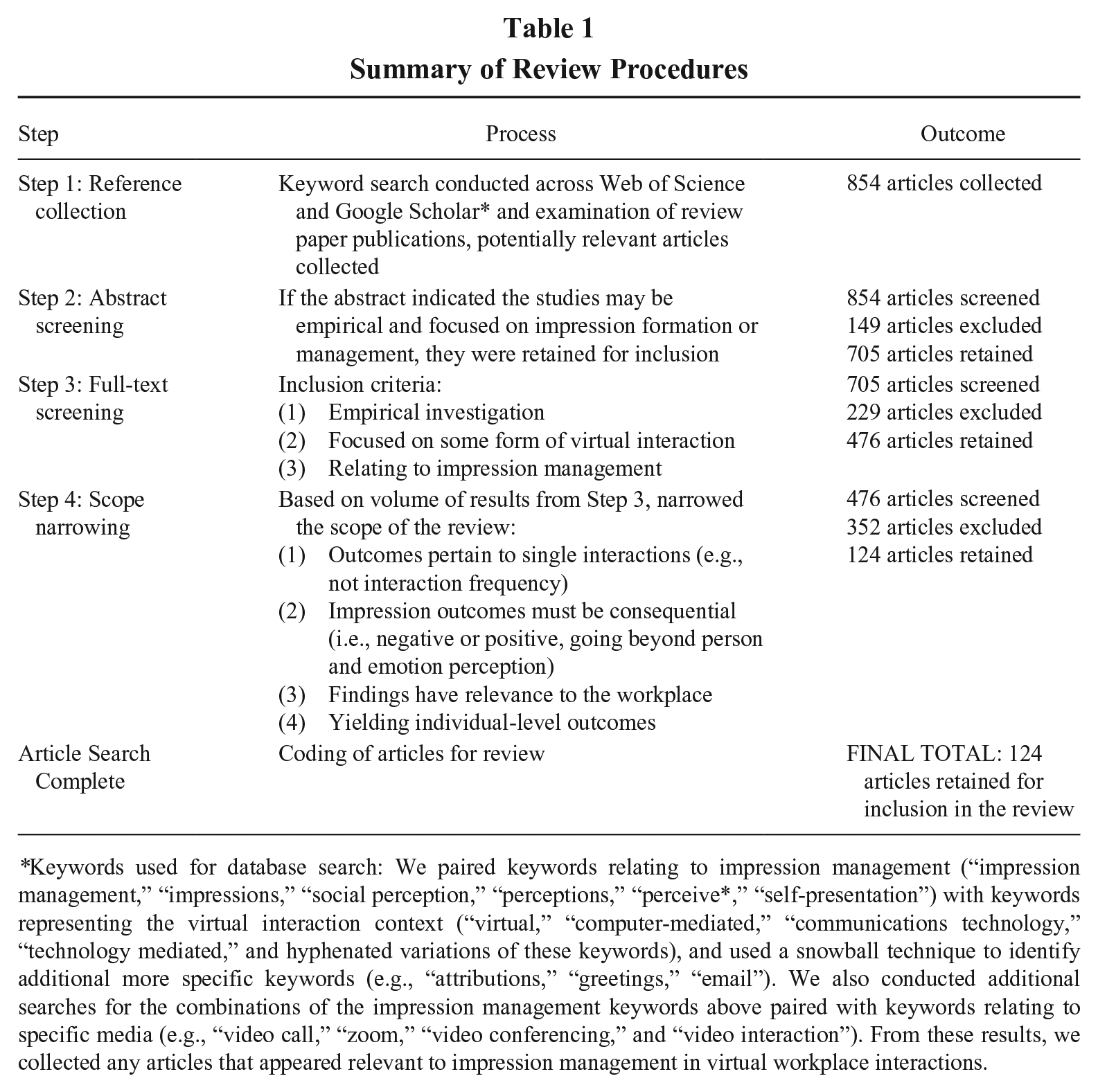
*Keywords used for database search: We paired keywords relating to impression management (“impression management,” “impressions,” “social perception,” “perceptions,” “perceive*,” “self-presentation”) with keywords representing the virtual interaction context (“virtual,” “computer-mediated,” “communications technology,” “technology mediated,” and hyphenated variations of these keywords), and used a snowball technique to identify additional more specific keywords (e.g., “attributions,” “greetings,” “email”). We also conducted additional searches for the combinations of the impression management keywords above paired with keywords relating to specific media (e.g., “video call,” “zoom,” “video conferencing,” and “video interaction”). From these results, we collected any articles that appeared relevant to impression management in virtual workplace interactions.
Background
Virtual Communication Theories
To provide a basis for understanding the role of virtual communication in impression management, it is valuable to first examine existing, broader theories on how virtual communication can alter interaction outcomes. Generally, these theories fall into two buckets, which we illustrate in Table 2.
Virtual Communication Theories
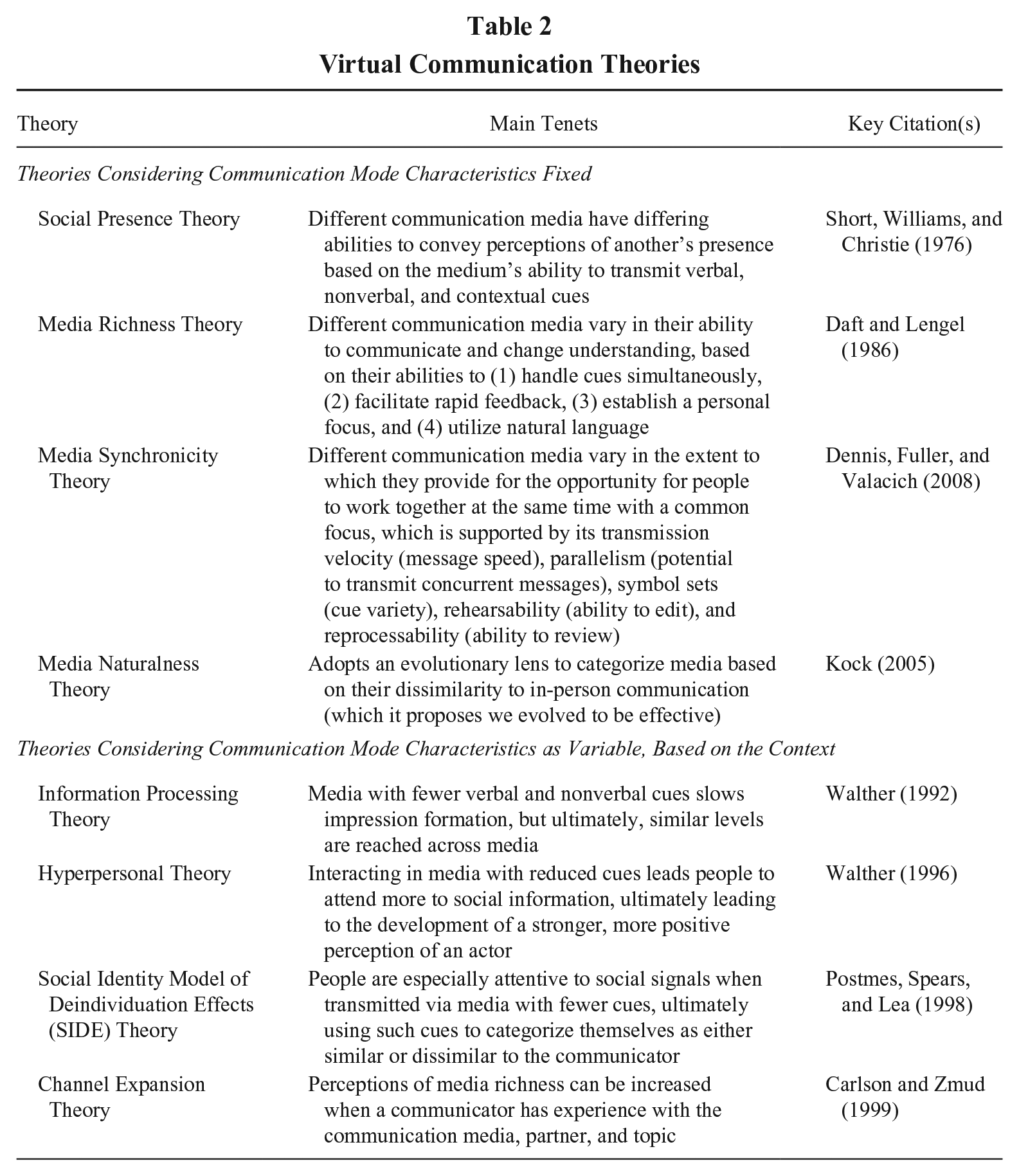
The first bucket of theories, including Social Presence Theory, Media Richness Theory, Media Synchronicity Theory, and Media Naturalness Theory (see Table 2, rows 3–6), takes the perspective that the characteristics of communication modes are mostly fixed and that virtual modes of interaction (especially those that are text-based) lack the full information-relaying ability of in-person interactions. Common to all of these classic theories is a continuum of communication media ranging from in-person communication, which is typically considered the richest/most synchronous/most natural, to asynchronous text communication (e.g., email), which is considered the opposite end of the spectrum (leading to the greatest outcome divergence vs. in-person interaction).
The second bucket of theories (Information Processing Theory, Hyperpersonal Theory, Social Identity Model of Deindividuation Effects/SIDE Theory, and Channel Expansion Theory, see Table 2 rows 8–11) views the potential for communication media to alter interaction outcomes as less fixed, with more attention given to how virtual interaction outcomes may differ depending on the context and how individuals alter their behavior when interacting via virtual means. For instance, Channel Expansion Theory argues that media richness is not static based on the affordances of a given medium, but, rather, that media richness can be increased when an actor has experience with the communication medium, partner, and topic (Carlson & Zmud, 1999).
Although the theoretical reasoning and specific predictions may differ across these theories, they all imply the potential for strong impression formation—and accordingly a role for impression management—in virtual media.
Virtual Impression Formation
Subsequent work drawing from these theories has indeed found evidence of meaningful impression formation via virtual interaction (Liu, Ginther, & Zelhart, 2002; Walther, 1993). In this vein, one domain that contributes to impression formation is emotion perception (Adams, Nelson, Soto, Hess, & Kleck, 2012; Ames & Johar, 2009; Montepare & Dobish, 2003), and a significant body of work has found evidence that people readily perceive emotion in their virtual interactions (Byron & Baldridge, 2007; Derks, Fischer, & Bos, 2008), even to a similar extent as in-person interactions (Cheshin, Rafaeli, & Bos, 2011; Walther, Loh, & Granka, 2005).
Notably, however, studies comparing virtual versus nonvirtual interactions suggest that creating a positive impression is more difficult via virtual than nonvirtual means. In this realm, many studies have focused specifically on perceptions of trust, perhaps due to its centrality in driving virtual team performance and satisfaction (Gilson, Maynard, Jones Young, Vartiainen, & Hakonen, 2015; Jarvenpaa, Knoll, & Leidner, 1998). Across the spectrum of virtual communication media (text-based, audio, and video), a broad body of research has documented reduced perceptions of trustworthiness in virtual (versus nonvirtual) interactions (Hill, Bartol, Tesluk, & Langa, 2009; Naquin & Paulson, 2003; Olson & Olson, 2012; Rockmann & Northcraft, 2008; Thompson & Nadler, 2002; Wilson, Straus, & McEvily, 2006). Additional work finds that virtual interactions reduce liking (Okdie, Guadagno, Bernieri, Geers, & Mclarney-Vesotski, 2011; Sprecher & Hampton, 2017), desire for future interaction (Purdy, Nye, & Balakrishnan, 2000), and positivity of job candidate ratings (Basch, Melchers, Kurz, Krieger, & Miller, 2021; Chapman & Rowe, 2002; Melchers, Petrig, & Sauer, 2016; Sears, Zhang, Wiesner, Hackett, & Yuan, 2013; Van Iddekinge, Raymark, Roth, & Payne, 2006). Although this research suggests that virtual (versus nonvirtual) interaction worsens many types of impressions, there is still substantial variance in impressions within virtual interactions. Our review focuses on highlighting such variance and the behaviors that contribute to the generation of a more positive versus negative virtual impression.
Motivation to Manage Virtual Impressions
Research on impression management has established that people are interested in managing the impressions they generate (Bolino et al., 2016; Walther, 2007). Leary and Kowalski (1990) decompose impression management into two components, an impression motivation component (the desire to control how others see them), and an impression construction component (the choice of what kind of impressions they want to construct and how they will go about creating them). Given the clear ability for impressions to be formed in virtual interactions, these two components would also underlie virtual interactions.
Consistent with this line of thinking, there is a significant body of research indicating that people actively seek to manage others’ virtual impressions of them (e.g., Barry & Fulmer, 2004; Basch, Melchers, Kegelmann, & Lieb, 2020; Berkelaar, 2017; Kersten & Phillips, 1992; Ollier-Malaterre, Rothbard, & Berg, 2013; Tidwell & Walther, 2002; Walther, 1992). Indeed, empirical work suggests that people may be especially intent on managing their virtual (as opposed to nonvirtual) impressions. In their study of remote workers, Barsness, Diekmann, and Seidel (2005) found that those who spent a higher proportion of time working virtually also had a higher frequency of their job- and supervisor-focused impression management attempts.
Leary and Kowalski’s (1990) framework provides a potential explanation for this increased motivation. The impression motivation component of their model has three factors: (1) the goal-relevance of impressions, (2) the value of the desired goals, and (3) the discrepancy between their desired and current image. Although virtual interactions would be unlikely to have a unique influence on the first two factors (i.e., they would likely manifest the same regardless of whether the interaction occurred virtually or not), they may, in fact, increase the third. Based on their own experiences forming impressions of others, people may anticipate that virtual communication can reduce the positivity of impressions, leading to a greater discrepancy between their desired and current image. Moreover, managing others’ virtual impressions of oneself may be especially impactful, as virtual communications are often rife with misperception and misunderstanding (Byron, 2008; Kruger, Epley, Parker, & Ng, 2005; Olaniran, 2002; Riordan & Trichtinger, 2017), an observation which actors may intuit.
A Virtual Impression Management Framework
Having introduced general evidence of people’s desire and ability to generate impressions via virtual media, we now turn to reviewing research on the individual behaviors that drive (or that actors believe drive) virtual impressions, relating to the impression construction component of Leary and Kowalski’s (1990) model. Our literature search yielded articles from multiple fields and relating to a variety of modes of interactions; we summarize the distribution of these findings in Table 3A, which illustrates the variety of fields across which virtual impression management research is conducted, and Table 3B, which categorizes the literature by the interaction media studied.
Virtual Management Impression Literature by Publication Outlet Primary Field
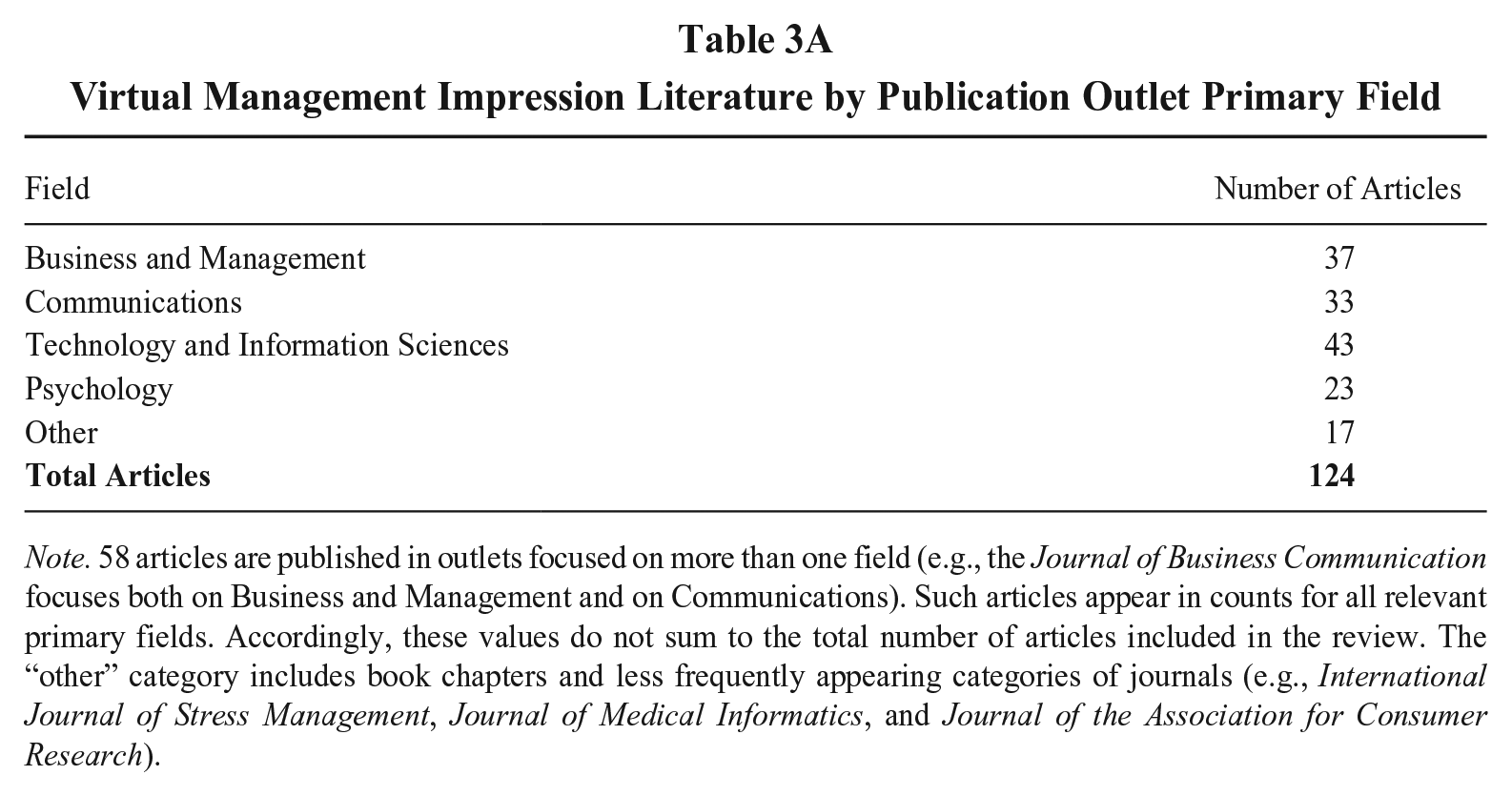
Note. 58 articles are published in outlets focused on more than one field (e.g., the Journal of Business Communication focuses both on Business and Management and on Communications). Such articles appear in counts for all relevant primary fields. Accordingly, these values do not sum to the total number of articles included in the review. The “other” category includes book chapters and less frequently appearing categories of journals (e.g., International Journal of Stress Management, Journal of Medical Informatics, and Journal of the Association for Consumer Research).
Virtual Management Impression Literature by Interaction Medium
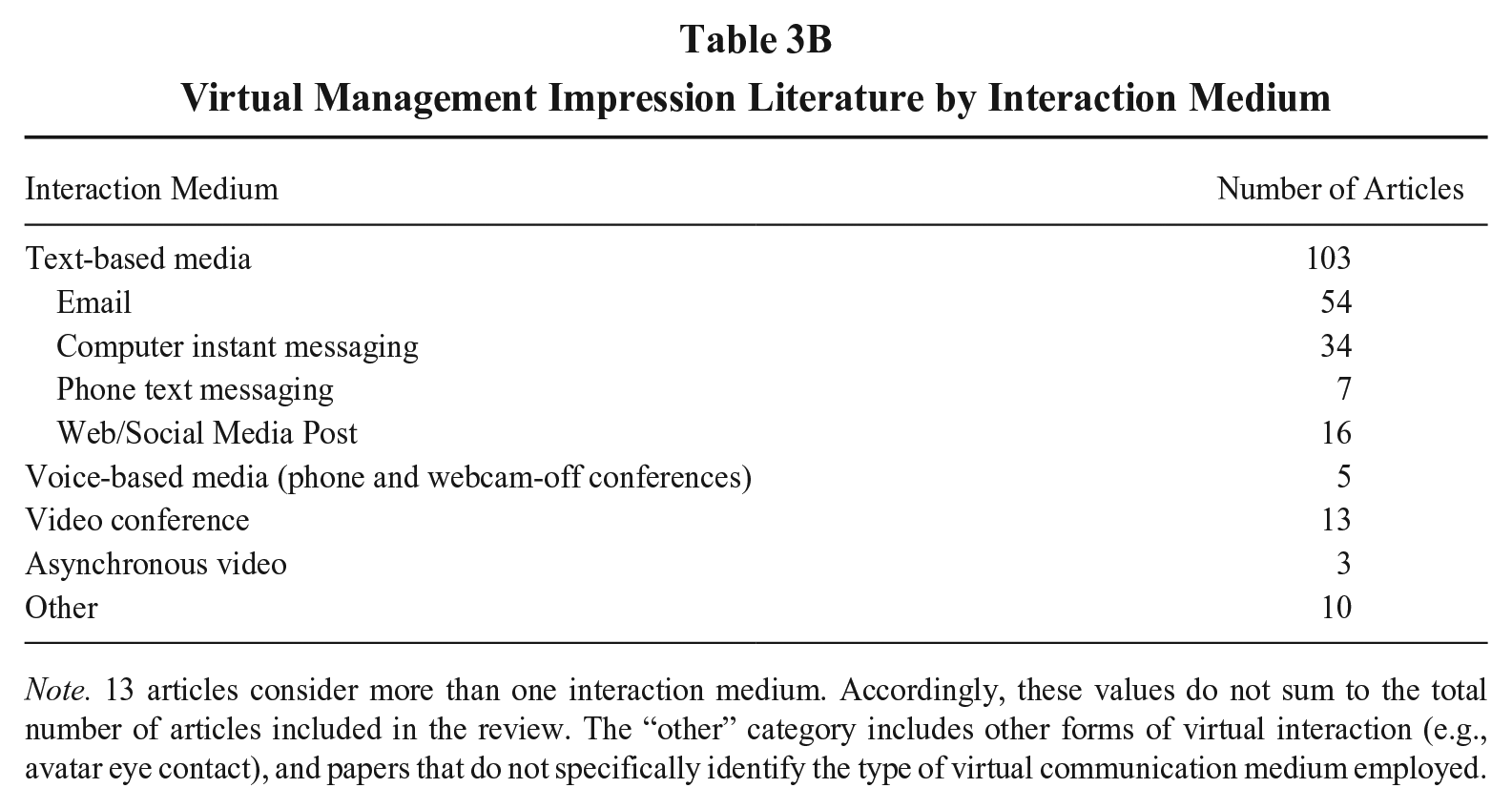
Note. 13 articles consider more than one interaction medium. Accordingly, these values do not sum to the total number of articles included in the review. The “other” category includes other forms of virtual interaction (e.g., avatar eye contact), and papers that do not specifically identify the type of virtual communication medium employed.
We further categorized the articles identified by the year in which they were published, which we illustrate in Figure 1. As expected, the number of articles considering virtual impression management has generally increased as virtual work has grown more popular.
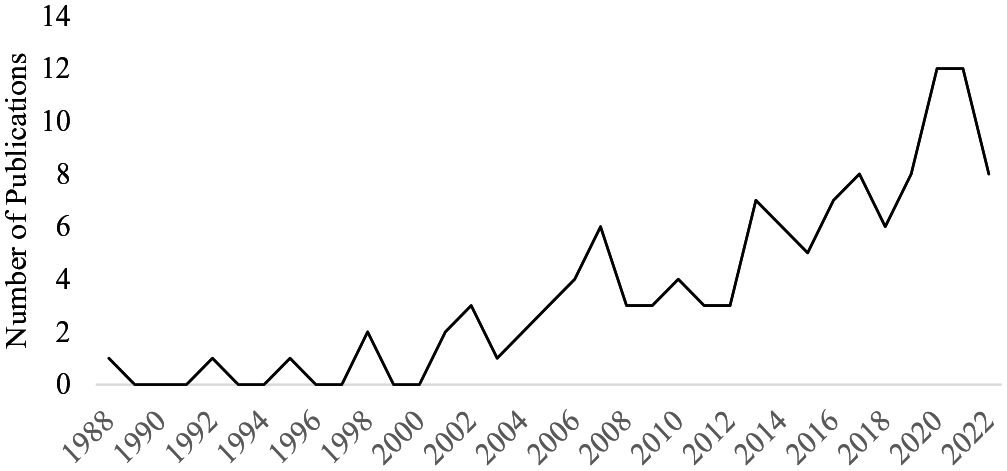
Virtual Impression Management Behavior Publications Over Time
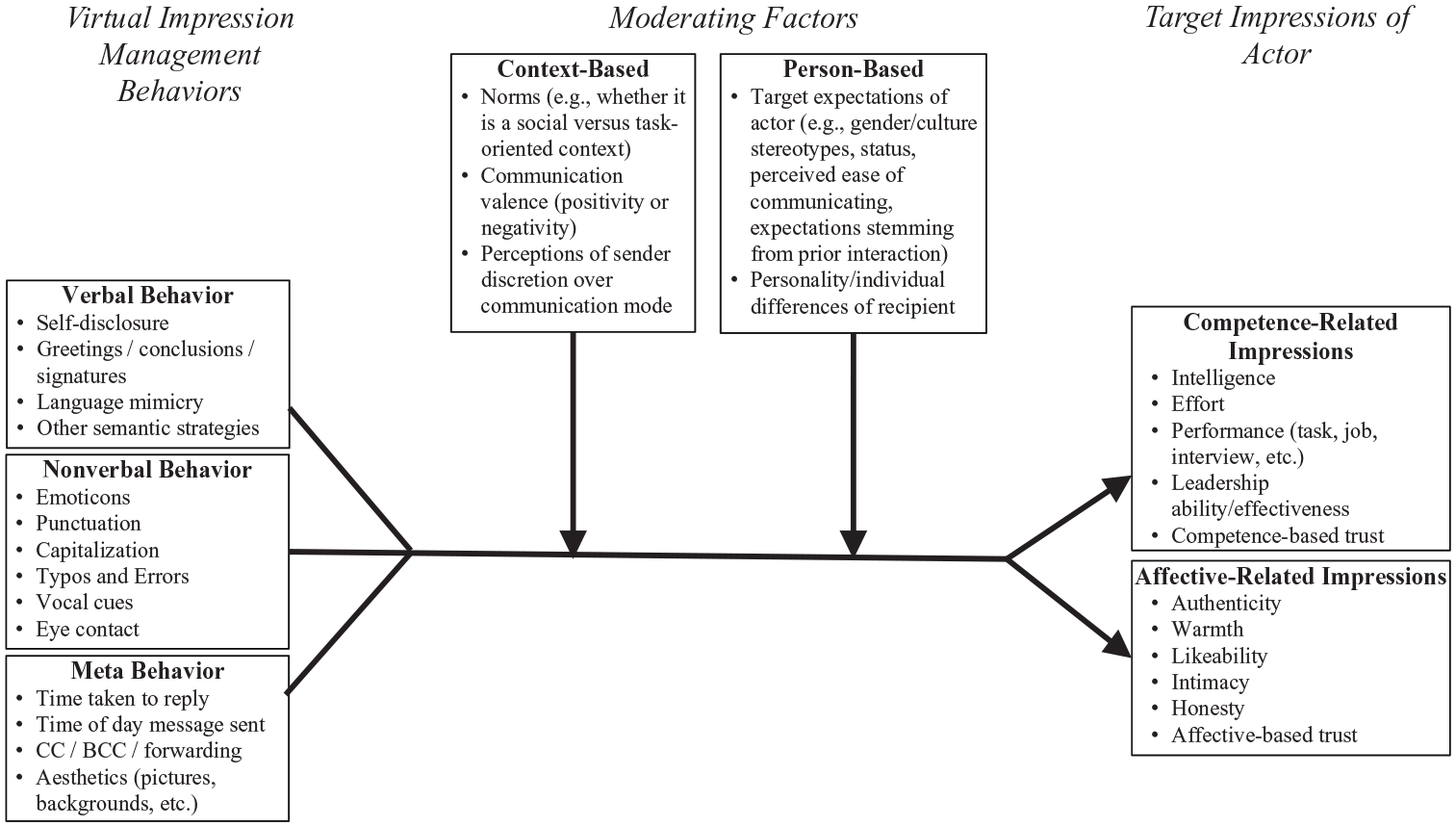
Drawing from this research, we have developed an organizing framework (Figure 2) centered on three overarching categories of virtual impression management behaviors, which are shown on the left-hand side. The first and second categories focus on two common types of behavior often discussed in the context of self-presentation and social perception: “verbal behavior” and “nonverbal behavior” (DePaulo, 1992; Ekman & Friesen, 1981; Wayne & Liden, 1995). Although these categories are similar in name to those used to describe in-person interactions, the behaviors we consider within these categories are specific to virtual interactions. We define virtual verbal behavior as any behavior that centers on the words an individual uses, and we define virtual nonverbal behavior as any behavior or communication that is transmitted as part of the interaction content itself that is not specific to the words an individual uses in the interaction, such as emoticons. As these two traditional categories do not fully capture the breadth of virtual impression management behaviors, we also consider “meta behavior,” which we define as behaviors achieved through the unique affordances of virtual interaction, such as message CC’ing/BCC’ing/forwarding or information gleaned from message timestamps.
Virtual Impression Management Behavior and Its Outcomes
Our review also revealed that the impact of virtual impression management behavior is conditional on a number of related factors, which we grouped into two overarching categories: “context-based moderators,” which consider the influence of features of the interaction context (e.g., norms and the broader valence of the interaction), and “person-based moderators,” which relate to the influence of characteristics of the actor and/or target.
We trace how these behaviors and moderating factors influence two categories of actor impressions: “competence-related” and “affective” impressions, reflecting the two universal dimensions of social perception (Fiske, Cuddy, & Glick, 2007). Competence-related outcomes relate to perceptions of a target’s capability, and affective-related impressions relate to perceptions of their warmth and communality—although, notably, some outcomes, such as trust, relate to both dimensions. As we will show, the varied and meaningful outcomes studied in virtual impression management research indicate that both employees and leaders have a substantial ability to make positive or negative impressions on these dimensions when interacting virtually.
The broader theoretical categories and structure of the framework are intended to be comprehensive, as a means both to organize extant research and theory as well as to provide a map for future research within the area. For each section, we begin by reviewing research relating to actors’ attempts to manage impressions via that behavior, after which we review work on its impression-related consequences.
Verbal Behavior
Similar to in-person impression management, employees’ verbal behaviors when interacting virtually significantly impact the impressions they make. In this regard, a number of verbal impression management behaviors—the first behavioral category in our framework—have been shown to be specifically valuable in virtual interactions because either (a) the limitations of certain virtual communication modes (e.g., lack of facial expressions or spontaneity of interactions) necessitate deliberate engagement in the behavior or (b) the behavior is unique to virtual interactions (e.g., the use of email signatures).
Self-disclosure
Following theory that virtual communication lacks the information-relaying ability of in-person interactions, some scholars have indicated that virtual communication may lead people to be perceived more anonymously, which actors could offset via communication humanizing or personalization strategies (Baltes, Dickson, Sherman, Bauer & LaGanke, 2002; Postmes, Spears, & Lea, 1998). In this vein, a significant body of work has considered a specific individuating strategy: virtual self-disclosure. Two independent studies found increased levels of self-disclosure among student teams interacting via instant message (vs. in person; Joinson, 2001; Tidwell & Walther, 2002), a finding echoed byGilmore and Warren’s (2007) qualitative account of transitioning to a virtual teaching environment. However, a subsequent meta-analysis suggests that such effects may be constrained to experimental settings, as survey-based work has found greater self-disclosure in in-person settings (Ruppel et al., 2017).
Despite the lack of straightforward evidence on the effects of virtual interaction on the absolute amount of self-disclosure, self-disclosure’s impression-related consequences in virtual interactions are clearer. Studies of both online communications (Ridings, Gefen, & Arinze, 2002) and virtual/non-collocated teams (Breuer, Hüffmeier, Hibben, & Hertel, 2020; Cheng, Bao, Yu, & Shen, 2021; Zakaria & Yusof, 2020) have repeatedly shown that self-disclosure increases perceptions of actor trust. Analyses of team email communication patterns have further found that those in teams that volunteered personal information in their first messages tended to have higher trust ratings (Jarvenpaa et al., 1998), and teams with relationally-oriented content communicated in the first messages developed higher levels of psychological safety (Glikson & Erez, 2020), an outcome strongly linked with perceptions of trust (Edmondson & Lei, 2014). Research on virtual negotiations also mirrors these findings, although email (vs. in-person) negotiation was found to inhibit the process of exchanging personal information (and trust formation); specifically, when negotiators had a brief introductory telephone conversation that facilitated a personal information exchange, their trust increased (and their negotiation outcomes improved) (Morris, Nadler, Kurtzberg, & Thompson, 2002). An exception to these findings is the work of Altschuller and Benbunan-Fich (2010), whose survey of virtual student teams did not yield a correlation between self-disclosure and trust, and their follow up work (Altschuller and Benbunan-Fich, 2013), indicating that there may be a curvilinear relationship between virtual self-disclosure and trust (i.e., moderate levels of virtual self-disclosure are beneficial, but overly high levels of self-disclosure may decrease trust).
Research focused on impression management in social media has also explored the role of self-disclosure. The desire to manage impressions via self-disclosure is a widely-documented strategy in social media (Bazarova & Choi, 2014; Lauriano & Coacci, 2021; Marder, Joinson, Shankar, & Thirlaway, 2016; Ollier-Malaterre et al., 2013; Rothbard, Ramarajan, Ollier-Malaterre, & Lee, 2022). Comparatively less work has focused on the impression-related consequences of such strategies in this domain. One study of self-presentation found that those on LinkedIn whose claims were externally supported (e.g., by a referral) were deemed more trustworthy than those whose claims were not externally supported (Cummings & Dennis, 2018). Two additional studies identified valence effects: Those who posted negative self-disclosures on social media were rated as less positive than those who posted positive ones (Forest & Wood, 2012; Liu & Kang, 2017).
Greetings, conclusions, and signatures
People employ other verbal strategies to manage and form virtual impressions in the way they open and close their messages (Kersten & Phillips, 1992). Rains and Young’s (2006) content analysis of 193 email signatures revealed demographic and occupational differences in signature content, which they suggested indicates the use of email signatures as an impression management strategy. Subsequent analyses of email corpuses have found that the attempts to impression manage via greetings and closings may depend on contextual factors such as organizational and national culture (Huang, 2016; Waldvogel, 2007), and social distance (McKeown & Zhang, 2015).
Similar context-based impression management strategies appear with respect to the use of email signatures. In their study of academics’ email signatures, Harmon-Jones, Schmeichel, and Harmon-Jones (2009) found that professors with fewer citations included more professional titles in their email signatures, which the authors asserted enabled such professors to create clear impressions of their professional attainment. Similarly, Sherblom’s (1988) content analysis of 157 employee emails revealed that signatures were included more often by lower status employees, who would likely benefit more from perceptions of their professionalism. These behaviors are reminiscent of the idea of the self-promoter’s paradox, whereby those with lower status (or lower possession of some positive attribute) feel a greater need to self-promote, whereas those who have the greatest amount of the relevant positive trait are often the least likely to promote it, as their possession of the trait is often self-evident (Holoien & Fiske, 2013; Jones & Pittman, 1982).
Beyond one set of interviews indicating that targets build impressions of actors via the actor’s greetings and closings (Robertson, Olteanu, Diaz, Shokouhi, & Bailey, 2021), several experimental studies have shed light on the nature of such impressions. One experiment revealed that actors were perceived as more professional when their email signatures included social media information, and less professional when they included religious quotes (Hailpern, Huber, & Calvo, 2020). Marlow, Lacerenza, and Iwig’s (2018) experimental study that manipulated email closing statements and gender also revealed some valuable insights. Although women were largely viewed as more professional than men on average, women were viewed as less professional when closing their email with “Thanks!” rather than “Best,” “Thank you,” or with no closing statement. In another experiment investigating impressions of a student who sent an email that included (a) a greeting, a closing, proper grammar, and correct punctuation or (b) none of the aforementioned elements, the element-including student seemed more competent and trustworthy (instructors were also more likely to comply with the student’s request; Stephens, Cowan, & Houser, 2011). In a different experiment, emails with a greeting, salutation, and concise message resulted in higher likability (Bartl, 2017). Nevertheless, Robertson et al. (2021) did not find significant effects of such opening and closing structures, perhaps due to the short length and informality of the messages included in their study.
Linguistic mimicry
Virtual communication research also highlights the role of linguistic mimicry in influencing virtual impressions. Experimental and correlational studies have found evidence of mimicry of linguistic markers in email and chat communications (Bunz & Campbell, 2004; Sandy, 2013). Additional work has linked such text-based virtual mimicry with higher levels of target-perceived trust and likability of the actor (Muir, Joinson, Collins, Cotterill, & Dewdney, 2020; Nixon & Guajardo, 2022; Scissors, Gill, & Gergle, 2008), much like opinion conformity (another marker of similarity) generates positive impressions in traditional impression management research (Bolino, Kacmar, Turnley, Gilstrap, 2008). However, not all virtual mimicry is likely to engender a positive impression: When chat partners mirrored each other’s negative emotion words (likely increasing overall negativity), they were less trusting of one another (Scissors, Gill, Geraghty, & Gergle, 2009), and higher-status actors who mimicked lower-status targets, thereby violating role expectations, were perceived more negatively (Muir, Joinson, Cotterill, & Dewdney, 2017).
Other semantic strategies
Additional research highlights other semantic verbal strategies that employees use to manage virtual impressions. In this section, we consider these virtual impression management strategies for which there is only limited evidence of their potential impact on impressions.
In a study examining the introductory messages people wrote to prospective discussion partners, whose gender and status (professor vs. student) were experimentally manipulated, people used more personal pronouns when writing messages to students, and more complex language when writing to professors, the latter of which positively predicted perceptions of immediacy (a construct that includes warmth and liking; Walther, 2007). Separately, an investigation of impression management in virtual knowledge sharing communities found that contributors sought to improve their reputations by providing higher quality content that was more specific to the collective (Abdallah, 2018). Other work in the realm of online reviews has found that reviewers who include two-sidedness and affective expression are deemed more credible (Jensen, Averbeck, Zhang, & Wright, 2013).
In the workplace, two studies uncovered a variety of verbal strategies (although not the outcomes of these strategies) that leaders employ to manage their impressions. Erhardt and Gibbs (2014) highlighted how verbal silence can take a unique form in asynchronous virtual communication, whereby employees may dodge responding to emails to limit their accountability for decisions with potentially unfavorable outcomes. Via instant message, these strategies included utterance chunking (breaking one message across several successively-sent components) to “hold the floor,” communicating informally (e.g., sending “k” instead of “OK,”), and adding “comic-strip sounds” (e.g., “erm” to indicate a pause; Darics, 2020).
Summary
Together, these findings suggest that in seeking to manage and generate virtual impressions, people attend to all of the verbal elements of a message, including not only their main content, but also the ways in which the messages begin and end. These behaviors are outlined in the first box on the left of Figure 2. However, whereas more research examining message content (e.g., self-disclosure, mimicry) has focused on its impression-related consequences, research focused on other verbal strategies (e.g., openings and closings) has largely focused on actors’ impression management behaviors or motives, with work on their ultimate effectiveness relatively nascent.
Nonverbal Behavior
During in-person interactions, people develop impressions based on others’ gestures, facial expressions, posture, and tone of voice (DePaulo & Friedman, 1998; Ekman & Friesen, 1981; Mehrabian, 2017). Moreover, individuals intentionally manage such nonverbal behaviors in order to generate positive impressions (McFarland, Yun, Harold, Viera, & Moore, 2005; Stevens & Kristof, 1995). Although many of these cues may not be available in virtual media (e.g., facial expressions may be available in video but hand gestures may not, and neither is available in email), a growing body of research highlights various other nonverbal behaviors that drive impressions in virtual interactions, the second behavioral category in our framework. As it is the most distinct from in-person interactions, a significant focus of research in this domain has centered on nonverbal cues in text-based media.
Emoticons
One of the clearest examples of unique nonverbal behavior in textual virtual interaction is the emoticon, a symbolic representation of emotion (e.g., a smiley face). Beyond signaling emotion (Aldunate & González-Ibáñez, 2017; Tang & Hew, 2018), research on emoticon usage suggests that employees may incorporate emoticons to clarify the intent of their message, such as indicating sarcasm (Derks, Bos, & Von Grumbkow, 2008; Thompson & Filik, 2016), or modulate the strength of a message (e.g., soften a directive or strengthen an expression of gratitude) (Skovholt, Grønning, & Kankaanranta, 2014).
Several findings highlight the potential impression-based benefits and pitfalls of emoticon use. Across a variety of contexts, including introductions (Glikson, Cheshin, & van Kleef, 2018; Taesler & Janneck, 2010), feedback (Grieve, Moffitt, & Padgett, 2019; Wang, Zhao, Qiu, & Zhu, 2014), interpersonal help requests (Aretz & Mierke, 2019; Byron & Baldridge, 2007; Marder, Houghton, Erz, Harris, & Javornik, 2020), and customer service (Li, Chan, & Kim, 2019; Park & Sundar, 2015), emoticon usage has been shown to increase perceptions of actor warmth and likability, although interviewee statements that included five (vs. zero) emoticons were viewed as less honest (McHaney & George, 2021). Additional studies of student interactions found positive effects of actor emoticon use on closeness and intimacy (Huang, Yen, & Zhang, 2008; Janssen, Ijsselsteijn, & Westerink, 2014), which are antecedents of likability (Miller, 1990).
With respect to perceptions of actor competence and intelligence, however, evidence of emoticon use, including from some of these same studies, finds both negative and neutral effects. Glikson et al. (2018) found that emoticon-using new teammates were perceived as less competent, a finding they linked with work place norms of formality. Li et al. (2019) found similar reductions in competence perceptions of emoticon-using customer service representatives, as did Marder et al. (2020) with university staff. Similarly, Aretz and Mierke (2019) found that emoticon-using supervisors were perceived as having reduced assertiveness—a trait often viewed as valuable for leadership (Crant & Bateman, 2000; Lord, De Vader, & Alliger, 1986). On the other hand, two experiments did not find significant differences in competence perceptions of emoticon users (Ernst & Huschens, 2019; Grieve et al., 2019), although these studies were conducted in largely student-based contexts that may have had more informal norms.
Findings from two studies suggest that message valence may influence impressions of emoticon users. In the context of online reviews, Qiu, Wang, Pang, and Jiang (2016) found that whereas authors of a positively-valenced review engendered more empathy and trust when incorporating emoticons, the opposite was true for authors of a negatively-valenced review. In a separate experiment, Wang et al. (2014) found that the inclusion of positive emoticons increased perceptions of feedback givers’ good intentions, whereas negative emoticons had the opposite effect.
Additional research has considered a broader category of pictorial nonverbal behavior—the use of emojis (small digital icons; e.g., a clock to indicate time, a pair of eyes to indicate looking)—which are often intended to have a clarifying and/or playful effect (Riordan, 2017). Riordan and Glikson (2020) found that whereas men deemed emoji-using leaders as more likable and effective, women deemed them less so (although, for women, leader differences in likability were not statistically significant).
Together, the bulk of this research suggests that whereas emoticon use likely has positive effects on impressions of likability, its effects on competence impressions may be context-based.
Punctuation
One’s use of punctuation is also meaningful for impression management. A content analysis of information sciences professional discussion groups found that professionals often use exclamation points to indicate friendliness (Waseleski, 2006). Such a signal seems to be interpreted in line with actors’ intentions: A repeated measures experiment that varied exclamation point and question mark usage in workplace email found that the use of exclamation points increased perceptions that the actor was a friend (McAndrew & De Jonge, 2011). In addition, those who used more question marks were perceived as more confused, and those who used fewer exclamation points and question marks were perceived as more senior, yet also more apathetic (McAndrew & De Jonge, 2011). Within the realm of text messaging, participants rated the author of a text message that did (vs. did not) end with a period as less sincere (Gunraj, Drumm-Hewitt, Dashow, Upadhyay, & Klin, 2016; Reynolds, Casarotto, Noviski, & Roche, 2017), suggesting that in more informal modes of virtual communication, more formal types of nonverbal impression-management strategies may be counterproductive.
Capitalization
Although the use of capitalization can also influence perceptions of an actor, less research has focused on this particular nonverbal behavior. In one study, students rated a prospective student as less likable when the prospective student requested information about their university in all capital letters (versus using standard capitalization) (Byron & Baldridge, 2007). Absent a positive communication context, typing in all capitalization can also lead messengers to be perceived as hostile and unfriendly (Turnage, 2007).
Typos and grammatical errors
Whereas emoticon use, punctuation, and capitalization are likely deliberately included in messages (Riordan & Kreuz, 2010), evidence suggests that people also form impressions based on a less deliberate text-based cue: typos, “errors (as of spelling) in typed or typeset material” (Typo, 2005). Actors whose messages include typos have been evaluated as less warm and competent (Boland & Queen, 2016; Queen & Boland, 2015) and less trustworthy (Raedts & Roozen, 2021) than those whose messages (email and tweets, in the aforementioned studies) are error free.
Three investigations replicate these findings while also providing insight into factors that may mitigate the negative impressions typos engender. Vignovic and Thompson (2010) showed that negative perceptions of error-laden email senders were attenuated when participants learned that the author was a non-native English speaker from outside the United States. In a parallel illustration, Blunden and Brodsky (2021) showed that the intelligence penalty of typos was reduced in emotional contexts, which provided an alternative explanation for the error (emotional interference). In a third study, highlighting moderators of the effect of typos on impressions, Carr and Stefaniak (2012) revealed that the negative impact of grammatical errors on perceptions of an email sender’s professionalism was mitigated by the inclusion of a signature element indicating that the message was more challenging to physically compose (e.g., “sent from my iPhone”). The latter tactic may be envisioned as a form of self-handicapping, whereby people seek to maintain positive impressions by providing an explanation for poor performance (Crant & Bateman, 1993; Greenberg, 1996; Rudman, 1998). Across this set of studies, a common theme has emerged that when there are alternative explanations for communication errors—whether they be due to culture, emotion, or mode of interaction—their negative impact on impressions are attenuated.
Vocal cues
Thus far, we have reviewed research related to impressions stemming from nonverbal cues in text-based virtual communication. Separate research highlights an adjacent suite of nonverbal cues that drive impressions within virtual audio and video communications.
Although there is significant evidence of the effects of vocal cues—such as vocal pitch, vocal tone, and speed—on impressions (for example, see Bosker, Pinget, Quené, Sanders, & De Jong, 2013; McAleer, Todorov, & Belin, 2014; Tsantani, Belin, Paterson, & McAleer, 2016), this research generally does not differentiate between the effects of voice within in-person versus virtual interactions, and thus is outside the scope of this review. However, several studies elevate vocal cues in the formation of a positive virtual impression. In Schroeder and Epley’s (2015) hiring-related study comparing recruiters’ impressions of a candidate’s proposal communicated via video recording, audio recording, or text, candidates were evaluated as more competent and more likely to be hired in the two conditions in which a candidate’s voice could be heard (video and audio), with no additive role of video. The authors attribute these findings to the ability of vocal cues to uniquely signal a person’s mental capacities (an effect explored more deeply in Schroeder, Kardas, & Epley, 2017). In another hiring-related study that varied whether candidates were evaluated via email, chat, or chat with audio, those in the chat with audio condition received the highest ratings of warmth (George, Marett, & Tilley, 2004). Similarly, undergraduates were more likely to positively update their negative stereotypical impressions of another (e.g., rate someone expected to be unintelligent as relatively more intelligent) after interacting with them via phone rather than email (Epley & Kruger, 2005).
Yet, not all vocal cues may be beneficial. Research on the effect of vocal cues in virtual interactions has revealed that muffled audio in video interviews was linked with reduced candidate ratings (Huang et al., 2022). Another area of emerging research that is likely relevant to virtual impression management is the impact of internet lags or latency on video conference interactions, which can interrupt the flow of conversations (Boland, Fonseca, Mermelstein, & Williamson, 2022), potentially amplifying or dampening the effects of vocal cues in video or phone communications. Such effects have been theorized in Blacksmith, Willford, and Behrend’s (2016) meta-analysis of virtual interviews.
Eye contact
Although eye contact is impactful in in-person impression formation, its presence or absence has been shown to be distinctively relevant to video interactions, which make it more challenging to sustain. To make eye contact in video interactions, one must look in the direction of the webcam rather than at the target on the screen, which can easily be inhibited by poor webcam placement, on-screen distractions, and a lower intensity stimulus to draw and maintain eye contact (a webcam/screen rather than a live person). Studies of video interviews (Basch et al., 2021; Huang et al., 2022; McColl & Michelotti, 2019), video conferencing (Fauville, Queiroz, Luo, Hancock, & Bailenson, 2022), instructors (Guerrero & Miller, 1998), physicians (Helou et al., 2022), therapists (Pfender & Caplan, 2022), and customer service avatars (Cafaro, Vilhjálmsson, & Bickmore, 2016; Fukayama, Ohno, Mukawa, Sawaki, & Hagita, 2002) revealed positive effects of virtual eye contact on impressions of both warmth and competence. Breil and Böckler (2021) replicated these findings yet also found that the negative impact of averted eye gaze on impressions was mitigated when actors were listening to a negative autobiographical story (an effect they theorize stems from perceptions that the actor was regulating their own emotions, providing an alternative attribution for the negative behavior).
Summary
The growing body of research considering unique nonverbal behaviors in virtual interactions, outlined in the second box on the left side of Figure 2, offers relatively robust insight into both actor-side impression management attempts and perceiver-side consequences. Although the bulk of this work has focused on non-verbal impression management strategies in text, there has been significant growth in research focused on other forms of virtual communication, as evidenced by the variety of studies examining virtual eye contact.
Meta Behavior
Moving from cues within the message content, we now review work relating to the impression management consequences of meta behaviors, impression management behaviors enabled by the affordances of virtual communication media (such as timestamps), the third behavioral category in our framework.
Time taken to reply
One of the main ways virtual communication technologies differ from in-person interactions is in their ability to be asynchronous: Whereas in-person responses to questions are nearly instant, individuals may often not respond to a question received via email for hours or even weeks. Due to this possibility of communication delays, responsiveness is a common concern among those interacting virtually. From an impression management standpoint, employees report great pressure to respond quickly to their emails to establish and maintain positive reputations in both qualitative (Mazmanian, Orlikowski, & Yates, 2013) and survey-based (Becker, Belkin, Conroy, & Tuskey 2021; Brown, Duck, & Jimmieson, 2014) organizational studies. Given the importance placed on managing impressions via responsiveness, research lab workers in an interview-based study revealed another strategy to manage virtual impressions without immediately responding fully: sending a short, incomplete response indicating the reason for their delay and/or when their full response could be expected (Birnholtz, Dixon, & Hancock, 2012).
Research from the target perspective reinforces the importance of message responsiveness in establishing a positive virtual impression. Across experimental studies in the contexts of workplace interaction (Walther & Tidwell, 1995), job applications (Kalman & Rafaeli, 2011), and teacher responses (Tatum, Martin, & Kemper, 2018), response delays—even of just one day—have been shown to reduce impressions of actor trust, credibility, likability, competence, and caring. Another mixed-method field study indicated that establishing a rule for responsiveness is one of the two most important factors in facilitating trust among virtual teammates (Haron, Hua, Hassim, Eftekhari, Muhammad, & Harun, 2019). Similarly, a survey-based investigation of leader communication effectiveness highlighted a significant positive relationship between leader responsiveness and trust (Newman, Ford, & Marshall, 2020). In contrast, actor attempts to manage response delays through the use of email return receipts were viewed negatively (Birnholtz, Dixon, & Hancock, 2012).
Beyond email, several studies also found that shorter response times in instant message conversations increased perceptions of actors’ warmth and competence (Park & Sundar, 2015), trustworthiness (Kalman, Scissors, Gill, & Gergle, 2013), and likability (Hwang, Khojasteh, & Fussell, 2019), although Lew, Walther, Pang, and Shin (2018) did not detect chat latency effects, perhaps due to the relatively short difference in response delays (eight vs. 40 seconds). Interestingly, in Hwang and colleagues’ (2019) study, an indicator that the partner was typing did not mitigate the negative effects of instant message delays.
Despite this converging evidence that response delays engender negative impressions, additional research has illuminated three characteristics that can mitigate this negative effect. Delays were less penalized when actors were high status (Sheldon, Thomas-Hunt, & Proell, 2006), low-quality job candidates (whose response delays may not have violated expectations; Kalman & Rafaeli, 2011), or social (rather than task) oriented (Walther & Tidwell, 1995). Even though response delays can negatively impact impressions, Giurge and Bohns (2021) found that actors overestimated the extent to which targets expected an email response “right away,” or “tonight,” suggesting short delays, in the context of email, may be more accepted.
Time of day
Additional research has shown that people generate impressions based on the time of day a message was sent, inferred from communications that carry a time stamp. In experimentally manipulating time stamps (day vs. night time) of emails, Walther and Tidwell (1995) found that people perceived greater intimacy and affection for those who sent emails during the night, and perceived those who sent messages during the day as more dominant. Döring and Pöschl (2017) replicated these findings in a similar experiment in the context of text messages. Although these studies offer insight into how the time of day a message is sent can influence affective-related impressions, its effects on impressions of competence are less clear. Whereas we could expect that a late-night message could signal commitment, and thereby greater competence, it could also indicate a poor ability to plan or manage one’s time.
Carbon copying (CC, BCC) and forwarding
Asynchronous text-based messages, such as email and chat, also have the potential to include multiple recipients or be forwarded. Two studies indicate that employees strategically use this feature for impression management purposes. In an analysis of email chains and interviews with members of a multinational organization, Machili, Angouri, and Harwood (2019) documented how employees used the carbon copy (CC) function to project their professional accomplishments and deny responsibility for company decisions. Similarly, Kersten and Phillips’s (1992) analysis of emails from members of a research institute documents strategic employee use of the CC function to display confidence and publicly transfer responsibility to more senior others.
Despite employees’ inclinations to establish and maintain positive virtual impressions via carbon copying others, doing so may rather have a negative effect on impressions of them. In a series of experiments and field surveys, Haesevoets et al. (2021) found that CC’ing supervisors on emails reduced trust, ultimately lowering perceptions of psychological safety. Another investigation considered the use of forwarding and blind carbon copying (BCC), in which additional recipients are included yet hidden from others. Across three online experiments in which targets read a neutral introductory email and learned their supervisor was forwarded or BCC’d on the message (rather than CC’d on it, which would be more readily apparent to the recipient), targets rated the actor as less moral and were less likely to nominate the actor as a team leader (Haesevoets, De Cremer, & McGuire, 2020).
Aesthetics
Virtual interactions may also involve unique aesthetic elements, such as pictures and backgrounds. Several studies indicate that providing a picture in text-based interactions can increase the positivity of others’ impressions (Hailpern, Huber, & Calvo, 2020), especially when the actor is unknown (Walther, Slovacek, & Tidwell, 2001) or part of an outgroup (Tanis & Postmes, 2003).
Video communications uniquely enable people to form impressions based on their camera positioning and chosen backgrounds (e.g., the office or home setting behind the actor). Whereas virtual interview candidates were rated more negatively when they had awkward camera angles (McColl & Michelotti, 2019) or backlighting (i.e., light shining behind the candidate that makes it more difficult to see them; Huang et al., 2022), candidates were perceived as more likable when they used high camera angles, although there were no effects of actor distance from the camera (Fauville, Queiroz, Luo, Hancock, & Bailenson, 2022).
Several studies have also considered the role of videoconference backgrounds. Such research has found that actors using backgrounds that reveal personal information (e.g., hobbies, likes/dislikes, parental status, personality) were perceived as warmer (Karabulut, Moore, & Messinger, 2023; Roulin, Wong, Langer, & Bourdage, 2023), and backgrounds with plants and books created more positive impressions of an actor’s warmth and competence (Cook, Thompson, & Ross, 2023). Alternatively, backgrounds conveying sexual orientation (e.g., a small rainbow flag) did not have a meaningful effect on impressions (Roulin et al., 2023), and “novelty” backgrounds (a picture of a walrus on an iceberg) resulted in worse impressions (Cook et al., 2023). Backgrounds can also influence perceptions via serving as markers of similarity with a target. When an actor’s background revealed that they shared a political orientation (e.g., a visible mug with a Republican elephant or Democrat Donkey), they were perceived as warmer and received higher overall interview performance ratings (Roulin et al., 2023). Related to the latter finding, van der Land, Schouten, Feldberg, Huysman, and van den Hooff (2015) found that teams whose members were represented by similar avatars exhibited greater social attraction, providing additional suggestive evidence that aesthetic choices that indicate an actor is part of the target’s ingroup versus outgroup can influence impressions of them.
Summary
This work suggests that meta behaviors, delineated in the third box on the left hand of Figure 2, have significant potential in driving impressions. Yet, the focus of research findings in this area are somewhat narrow. Whereas there has been relatively robust study of the consequences of response delays, and growing interest in the effect of video backgrounds, less work has deeply examined impressions stemming from other signals relevant to virtual communication. Beyond the behaviors that have received limited attention (e.g., carbon copying and aesthetics), there are a number of other behaviors that have not yet been explored (e.g., number of recipients included on an email, speed of responding to voicemails, and background noises from pets/children during video calls), indicating significant potential for further study.
Moderators of the Effects of Virtual Impression Management Behaviors
Our review thus far has highlighted numerous individual and contextual elements that can moderate the effects of the aforementioned virtual impression management behaviors. In this section, we introduce additional evidence of moderation effects, and synthesize these findings by categorizing them and drawing parallels across effects. These effects are represented in the middle of the top of Figure 2.
Context-based moderators
The context within which a virtual interaction takes place is the first moderating component of our framework. One of the most widely-studied moderators of virtual impressions is contextual or organizational norms. Research in this domain has revealed that people carry situationally-driven expectations for how they and their counterparts should act when communicating virtually. For example, targets have context-driven expectations in terms of the extent to which actors should display emotion to their virtual teammates (Glikson & Erez, 2013), whether it is appropriate to include a greeting and/or closing (Waldvogel, 2007), which communication behaviors constitute politeness (Graham, 2007), and how responsive actors should be (Mazmanian, 2013; Mazmanian et al., 2013). A quasi-experiment of virtual groups illustrated how such norms can shape impressions: The groups who were encouraged to engage in an explicit set of virtual collaboration norms ended up forming more positive impressions of their teammates in the form of greater liking and trust (Walther & Bunz, 2005).
Another domain with substantial evidence of norms-based moderation is emoticon use. In this vein, the competence penalty of emoticon use found in some studies was attenuated when communication norms shifted to render emoticon use more appropriate based on various signals of context informality: social (rather than work-related) email content (Glikson et al., 2018), an informal workplace culture (Riordan & Glikson, 2020), and a communal (rather than exchange-oriented) interaction (Li et al., 2019).
Several research studies also suggest that the valence of a communication—whether it is positive or negative—also significantly impacts the relationship between virtual impression management behaviors and impressions. Specifically, communication valence has been shown to moderate the effects of self-disclosure (Forest & Wood, 2012; Liu & Kang, 2017), language mimicry (Scissors et al., 2009), emoticon usage (Qiu et al., 2016; Wang et al., 2014), capitalization (Turnage, 2007), and eye contact (Breil & Böckler, 2021) on impressions, often via altering whether these impression management behaviors are perceived as (in)appropriate or (un)expected for the context.
People also form impressions of one another based on whether they believe the actor had agency—and their related choice—over which communication medium to use. Norman, Avey, Larson, and Hughes’ (2020) analysis of open-ended survey data found that employees’ perceptions of a leader’s adeptness at using appropriate media influenced their trust of the leader. Given the potential consequences stemming from one’s decision about the communication medium within which to interact, perceptions of sender discretion over the communication mode can also moderate virtual impressions. For example, Brodsky (2021) found that using less rich communication media (e.g., email instead of telephone) to relay other-oriented emotions was punished more severely (i.e., by being perceived as being lower effort and thereby more inauthentic) when targets believed the actor was the one to choose the mode of communication. Perceptions of medium choice constraints may also account for Carr and Stefaniak’s (2012) finding that negative impressions stemming from grammatically incorrect messages were mitigated when the message indicated that it was sent from (and thus likely written on) the actor’s phone. As this attenuation is likely related to perceptions that it is more difficult to type accurately on a phone, their results may have differed if targets believed that the actor could have elected a different form of communication.
Person-based moderators
Targets’ expectations about the actor, often based on stereotypes of the sender’s demographics, are the second moderating component of our framework, represented in the second box in the top middle of Figure 2. Our review thus far has highlighted several such effects, illuminating how expectations stemming from an actor’s relative status (Harmon-Jones et al., 2009; Kalman & Rafaeli, 2011; Muir et al., 2017; Sherblom, 1988; Walther, 2007) and gender (Marlow et al., 2018) moderate virtual impressions. Two additional studies speak to the association between actor gender and virtual interaction expectations. First, McAndrew and De Jonge (2011) found that messages with a high frequency of expressive punctuation were perceived as more likely to be written by a woman, directly highlighting an example of gender-based expectations. Second, Barsness, Diekmann, and Seidel (2005) showed that supervisor-focused virtual impression management was more effective (i.e., more positively correlated with performance ratings) for those who were the opposite gender from their supervisor, which they concluded was driven by mixed-gender dyads in which the subordinate was female. The authors interpreted these findings as illustrating that women receive a boost for conforming to gender-related expectations (i.e., that women ingratiate).
Expectations relating to an actor’s perceived ability to communicate can similarly moderate virtual impressions of them. For example, Vignovic and Thompson (2010) found that the error impression penalty was reduced when perceivers believed the actor was from a foreign culture. Blunden and Brodsky (2021) found a similar error-penalty mitigating effect of perceptions of sender emotionality, as the error was partly attributed to the overwhelming experience of emotion rather than wholly to sender incompetence. Relatedly, those whose messages included typos received a reduced professionalism penalty when it was clear that they had more difficulty physically typing the message (i.e., composing it on an iPhone rather than computer; Carr & Stefaniak, 2012).
Prior interaction with a target can also influence virtual impression management outcomes by shaping a target’s expectations of an actor. Although, as we noted in the introduction, virtual (vs. in-person) interaction generally reduces perceptions of trust, several studies have found that in subsequent virtual interactions with the same party, which are informed by expectations set from the initial interaction(s), trust impressions improve (Hill et al., 2009; Wilson et al., 2006). Sprecher and Hampton (2017) found similar effects in an experiment measuring liking rather than trust.
Individual characteristics of the target also color their virtual impressions. In addition to Riordan and Glikson’s (2020) aforementioned findings illuminating how men and women perceive emoji-using leaders differently, additional work suggests target gender may influence their virtual impressions of others. In a recent survey, Jones, Wurm, Norville, and Mullins (2020) found that women have more familiarity with emojis than men, likely driving how such emojis are interpreted. In the domain of video interviews, Fauville et al. (2022) found that women perceived actors as more likable than did men.
Similarly, target perceptions of an actor can be influenced by the target’s own culture or language proficiency. In their aforementioned study of eye contact in video interviews, Helou et al. (2022) noted that the positive effects of eye contact varied by culture. In a different study of virtual multicultural teams, Zakaria and Yusof (2020) observed that lack of confidence in one’s own English language skills reduced trust in team members who were fluent in English.
Target personality can also influence impressions of virtual actors. Byron and Baldridge (2007) found that emotional stability and extraversion positively related to perceptions of sender likability when assessing the author of an email with correct capitalization (but not when the content was all capitalized). Similarly, emotional stability positively related to sender likability when the email included (vs. did not include) an emoticon. A separate organizational survey revealed that for employees who worked virtually 80% + of the time (and who thus may have been especially anxious about managing impressions; Barsness et al., 2005), there was a negative relationship between employee neuroticism and confidence in their leader (Flavian, Guinaliu, & Jordan, 2022). Although these findings focus on different personality traits, they underscore the notion that there may be a limit to virtual actors’ agency in managing the virtual impressions that they make; stable, target-side characteristics also shape them.
Summary
Among the moderators identified in prior virtual impression management research, the preponderance of research has focused on norms in the contextual domain and gender in the individual one. An element that seems to unite this work is the role of expectations, suggesting that additional factors that influence communication expectations are especially likely to moderate the effects of virtual impression management behaviors. Yet, despite the growing body of research on virtual impression management, much is still unknown regarding how contextual and individual differences may moderate these effects. Of particular note is the absence of research considering how these effects may be influenced by race, which has recently been shown to have a significant impact on nonvirtual impression management (Wayne, Sun, Kluemper, Cheung, & Ubaka, 2023). Future work investigating the influence of such expectation-driven factors would yield useful insights into the contexts in which the effects of impression management may differ from those illuminated by our review.
Outcomes of Virtual Impression Management Behaviors
Our review focused on studies of impression management behaviors with clear positive or negative outcomes for actors in terms of the two universal dimensions of social perception—competence and affective-related impressions (Fiske et al., 2007)—which we conceptualize similarly to research on non-virtual impression management. The specific outcomes represented across the research we reviewed are delineated in the right-hand side of our framework (see Figure 2). Notably, these outcomes do not always move in tandem. Rather, for example, emoticons have been shown to boost warmth perceptions but, in many cases, undercut perceptions of competence (Glikson et al., 2018; Riordan & Glikson, 2020). Relatedly, as research on virtual impression management continues to grow, there would be value in both delving into the nuances and potentially differentiating effects within each of the two overarching outcome categories we have provided (i.e., affective- and competence-related impressions) and moving beyond such categorizations (e.g., by considering short- vs. long-term effects).
General Discussion
Our review has highlighted how employees undertake a wide variety of virtual communication-specific actions to manage others’ impressions of them. As evidenced by this review, there is a wealth of empirical evidence supporting the notion that individuals build strong impressions of others—from work ability to trustworthiness—in virtual interactions. The substantial research we reviewed to develop an organizing framework (Figure 2) illustrates how virtual impressions influence a variety of warmth- and competence-related outcomes, the two universal dimensions of social perception (Fiske et al., 2007).
An Agenda for Future Research on Virtual Impression Management
Although this review highlights the breadth of behaviors that can alter impressions in virtual interactions, existing studies on this topic have only begun to scratch the surface of the ways in which distinct interaction modes provide for building impressions. We center our discussion of future areas for research around four themes: (1) building theory on the less understood anteceding process of the intrapersonal experience of virtual impression management, (2) expanding existing theory on interpersonal virtual impression management with a greater focus on less-studied interaction modes, (3) developing forward-looking theory regarding the role of artificial intelligence in virtual impression management, and (4) strengthening existing findings on impression management.
Developing theory on the unique intrapersonal experience of engaging in virtual impression management
Due to the focus of prior research, this review largely centers on unique virtual impression management behaviors from an interpersonal perspective relative to in-person interactions. Yet, drawing from research in the domain of virtual communication, we suggest that the intrapersonal experience of virtual impression management is also theoretically unique. Notably, in the introduction, we highlighted key differences between virtual versus in-person communication which, when jointly considered alongside existing theories on impression management, suggest a meaningfully different experience for actors engaging in virtual versus nonvirtual impression management (Dennis & Valacich, 1999). With the goal of spurring more research in this area, we provide a novel framework in Figure 3, intended as a means to both introduce the distinct, potential intrapersonal experiences of virtual impression management and as an organizational tool for future research within this domain.
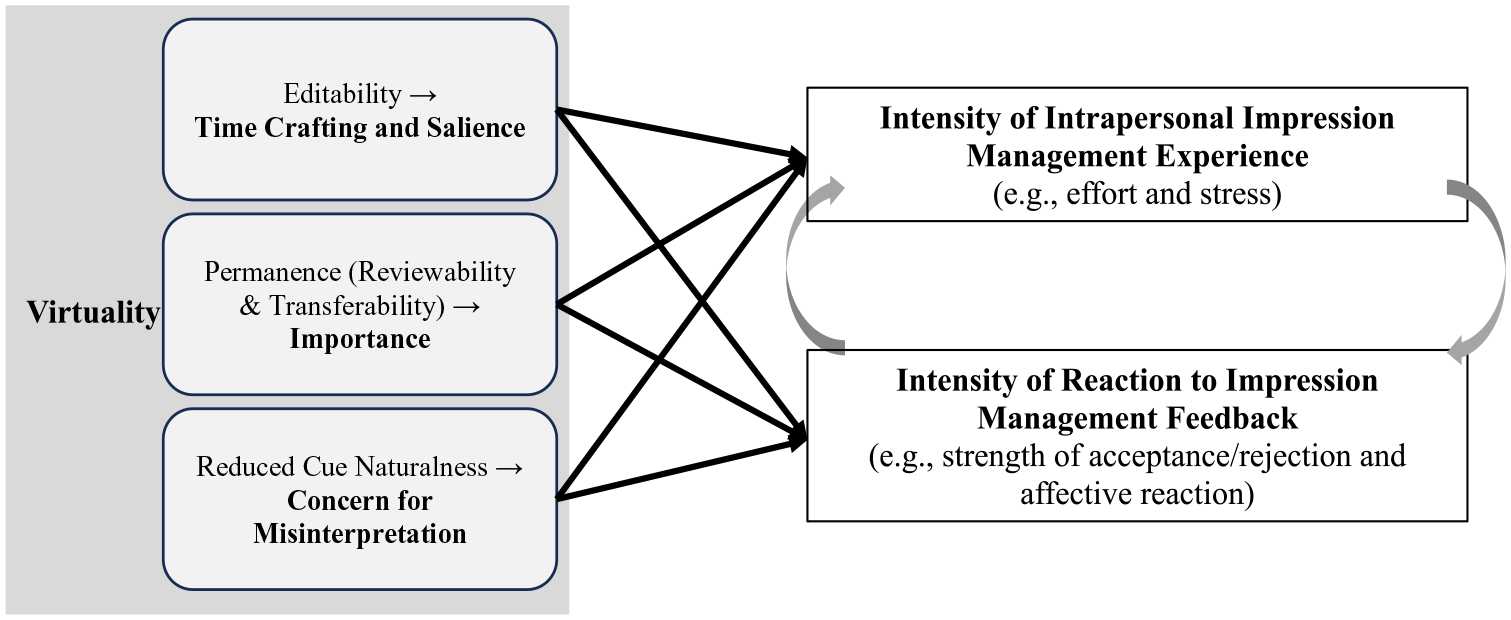
The Intrapersonal Experience of Virtual Impression Management
At the center of our model are two core components that shape one’s intrapersonal experience of impression management, which occur irrespective of whether impression management occurs virtually: (1) the intensity of actors’ intrapersonal impression management experience (e.g., the level of effort and stress it engenders) and (2) the intensity of actors’ reactions to impression management feedback (e.g., their affective reactions to the feedback and the extent to which they accept or reject it). The circular arrows in the model highlight the likely reinforcing nature of these two components. On one hand, a more affectively or cognitively intense experience of engaging in impression management (e.g., one that is more effortful or stressful) is likely to increase actors’ concentration on the outcomes of their impression management behavior (Chajut & Algom, 2003), strengthening their reaction—whether that reaction be productive or unproductive—of subsequent feedback. Similarly, greater intensity of actors’ reactions to the feedback received—whether the feedback is positive or negative—is likely to contribute further to the salience of impression management outcomes, further intensifying future intrapersonal experiences of impression management.
The left-hand side of our model draws from the research highlighted in this review to trace how virtual interaction may alter these two experiential components. As we described in the introduction, compared with nonvirtual interactions, virtual (vs. in-person) interactions are relatively editable, permanent (and thus reviewable and transferable), and distinctive in the communication cues they provide for (Dennis & Valacich, 1999; Dennis et al., 2008), each of which potentially impacts both the intensity of the intrapersonal impression management experience and the intensity of actors’ reactions to their impression management feedback.
First, we consider the editability of a communication, the possibilities of which are highlighted by a number of the nonverbal behaviors highlighted in this review (e.g., typos and capitalization). The greater ability offered by virtual communication to edit messages (Dennis & Valacich, 1999) is likely to increase the intensity of engaging in impression management both due to the greater time spent crafting messages (Rosen et al., 2019; Walther, 2007) and greater salience of the editing/impression crafting process itself. Such editability is clearly apparent in email and even video interactions, through the provision of a self-view, which enables actors to observe and alter their nonverbal and meta behaviors throughout an interaction (e.g., facial expressions, background, and lighting; Abramova, Gladkaya, & Krasnova, 2021; Brucks & Levav, 2022). As longer and more salient experiences tend to be more impactful (Miron-Shatz, 2009; Mrkva & Van Boven, 2020; Sadler & Tesser, 1973), the increased attention to—and time spent engaging in—virtual impression management would likely increase the intensity of the impression management experience. Such salience would likely also facilitate the identification and internalization of when one’s impression management behaviors are inauthentic (Chawla et al., 2021), which has been linked with stress and burnout (Brotheridge & Grandey, 2002; Grandey, 2003).
Second, the relative permanence of virtual interactions can escalate the importance of impression management behaviors as targets can more easily review and share them (exemplified by research on CC/BCC/forwarding behaviors in our review; Haesevoets et al., 2020, 2021; Myers, 2007). For instance, whereas a slip of the tongue may be easily missed in person, a typo that recipients can reread is likely to be more glaring. Because permanence enables one’s virtual interactions to be more easily dissected and re-reviewed by targets, and potentially broadcast to the world, the stakes of one’s virtual impression management are higher. Such stakes would likely spur actors to spend greater effort and experience elevated stress when engaging in virtual impression management.
Third, the cues available in virtual interactions are less natural (i.e., removed from the ways humans have historically interacted; Kock, 2005). Whereas humans have evolved to interpret and display a variety of nonverbal behavior in person (Andrew, 1963; Boone & Buck, 2003), behaviors like staring at a web camera or deciding whom to CC on a message are unlikely to come as naturally. Such differentiated cue variety is likely to elevate actor concerns of virtual interaction misinterpretation (Byron, 2008; Fallows, 2002), further increasing the stress and effort virtual actors are likely to expend.
Beyond increasing the intensity of impression management in the moment, these characteristics are also likely to strengthen actors’ reactions to the feedback they receive from their impression management behaviors largely by increasing actors’ ability and motivation to recall their initial behaviors (Gollwitzer & Bargh, 1996; Papies, Pronk, Keesman, & Barsalou, 2015). Returning to editability, if an actor spends more time crafting a message as part of a more salient impression management process, their impression management behaviors are likely to be more memorable (Phillips, Russell-Bennett, & Kowalkiewicz, 2022; Rogers & Milkman, 2016). For its part, interaction permanence enables actors to look back at their impression management behaviors, rendering them more recallable. Whereas actors cannot easily remember everything they said after speaking in person, such behaviors are more easily reviewable after one sends an email. The permanence-driven higher stakes of virtual impression management is also likely to increase actors’ motivation to attend to the feedback they receive. Third, reduced cue naturalness, and its corresponding increase in concern for misinterpretation (Byron, 2008), is also likely to spur greater memory of one’s impression management behaviors due to increased attention to those behaviors stemming from greater concern that miscommunication will thwart communication goals (Rosen & Tesser, 1972; Stubbe, 2017). Beyond memorability, the concern for misinterpretation may also result in actors’ greater motivation to deeply analyze feedback to ensure that their initial message and the target’s response were both interpreted as intended. In sum, these characteristics both introduce and strengthen an additional communication feedback loop beyond that experienced within in-person impression management (whereby actors and targets process information and adjust their roles accordingly; see Bozeman & Kacmar, 1997; Leary & Bolino, 2018). Namely, actors may be more motivated and able to review the initial interaction at the same time as they view the response to it.
The consequences of this drive and ability are threefold. First, it may lead to rumination rather than dismissal of negative feedback if the actor observes a behavior associated with negative impressions (e.g., if in reviewing the message they see a typo; Ciarocco, Vohs, & Baumeister, 2010; Jones, Papadakis, Hogan, & Strauman, 2009; McGuirk, Kuppens, Kingston, & Bastian, 2018). Second, having an actual record of communication can reduce memory bias (Zhang, Pan, Li, & Guo, 2018), leading to greater acceptance of the target’s feedback. For example, if a manager told a subordinate that they presented poorly in person, the subordinate may attribute and/or dismiss the manager’s feedback as biased (Hewett, Shantz, Mudy, & Alfes, 2018; Liden & Mitchell, 1985; Martinko, Douglas, & Harvey, 2006). Alternatively, if the actor has a video call recording of a virtual presentation, they could more objectively review it and better dissect it for potential mistakes. Third, the ability to simultaneously review an interaction alongside a target’s response to it can enable an actor to identify successful impression management behaviors more easily, providing for greater calibration of such behaviors going forward.
Our model suggests that there are a variety of paths via which the intrapersonal experience of virtual impression management is likely to be distinct from that experienced in person. Although this model is intended as a starting point for developing theory in this domain, it is our hope that future research will test and build on it. For instance, beyond examining the main effects of virtual interaction on the intrapersonal experience of impression management, value also lies in considering moderators of these relationships. For example, given that virtual interaction modes differ on many of these dimensions (e.g., chat is more reviewable than video message), it is possible that certain interaction modes may improve the intrapersonal experience of virtual impression management, for example, by minimizing impression-management driven stress and providing for the objective incorporation of feedback. In addition to providing insight into virtual impression management, this approach can inform theory on impression management as a whole, as virtuality can enable researchers to disentangle—through variation in interaction characteristics—the underlying intra- and interpersonal processes that occur within impression management more broadly (e.g., pinpointing effects driven by accurate interpretation versus an actor’s skillful impression management behaviors).
Video, audio, and mixed-mode virtual impression management
Beyond the novel area of individual experience in engaging in impression management, there is still much to be learned about the interpersonal outcomes of impression management. Specifically, the bulk of research on virtual impression management has centered on text-based communication, likely because it is the most distinct from in-person communication. Yet, the substantial shift to remote work due to COVID-19 has brought to the forefront other virtual modes of communication, such as video conferences (e.g., Zoom, Microsoft Teams, & Webex; Bennett, Campion, Keeler, & Keener, 2021; Shockley et al., 2021), which can also simultaneously incorporate chat or instant messaging, and provides actors with the option to turn their cameras off (Reimann, Utz, & Anderl, 2022). With the exception of an emerging cluster of research focused on video interviewing, this review highlighted a relative lack of research considering video, audio, and simultaneous multi-mode forms of virtual impression management (see Table 3B). This lack of research is despite evidence showing that there are key differences in impression management between video communication and in-person communication, such as eye contact (Basch et al., 2021). Notably, recent work has theorized that zoom fatigue, feeling drained following a day of virtual meetings, occurs, in part, because of self-presentation concerns (Shockley et al., 2021). Additional work could consider how impression-related cues shown to be meaningful in the context of in-person interactions (e.g., dress; Hester & Hehman, 2023) may operate similarly or differently in video calls, which may have differing appearance norms (Bailey, Horton, & Galinsky, 2023). Similarly, impression management research on the unique effects of audio in audio-only interactions—such as telephone or audio-only conferences—relative to the effects of audio in in-person interactions, is also limited despite several findings suggesting that audio-only interactions are often overlooked and can be optimal (Brodsky, 2021; Connell, Mendelsohn, Robins, & Canny, 2001; Kumar & Epley, 2021).
The development of mixed-mode interactions (e.g., video with chat) also offers the opportunity for examining new virtual impression management behaviors. For instance, what impression might be intended or formed by actors who directly chat with one participant within a group video call? Examining actors’ communication mode choice when multiple are clearly available within a singular interaction, can help to better understand the distinctive impression-making possibilities of each virtual mode.
Artificial intelligence and impression management
Beyond these extensions, recent advances in artificial intelligence (AI) offer fertile ground for developing new theory of innovations that may alter impression management. First, new theory could consider how impression management processes unfold when targets know that the actor is actually an autonomous AI-driven program. In this regard, substantial research has shown that individuals humanize and build impressions of chatbots (e.g., impressions of trust; Go & Sundar, 2019; Mostafa & Kasamani, 2022), calling into question similarities and differences for how targets might form impressions when interacting with an AI program versus a human. Likewise, research has only begun to consider how more mixed approaches to interactions, with humans using AI as extensions of themselves or tools to help with their communication, result in impression formation (Benke, Knierim, & Maedche, 2020; Endacott & Leonardi, 2022).
Perhaps a larger theoretical question stemming from these emerging steams of research is what is uniquely human about impression management? Our review would suggest that AI, at least in its current level of evolution, cannot have the full potential of humans in engaging in diverse impression management strategies. This is because current AI tools are unable to independently engage in more personal impression management tactics for an actor (e.g., strategic self-disclosure), given that they do not have independent access to personal information from individuals and/or knowledge of an individuals’ impression-management goals related to specific interactions. Additionally, preliminary research would suggest that when targets are unsure whether they are interacting with an AI-assisted communication technology, making impression-management related mistakes (e.g., making typos), can ironically improve some impressions (e.g., humanization; Bluvstein, Zhao, Barasch, & Schroeder, 2021). These effects are likely driven by the fact that humans strongly value human authenticity (Gardner, Cogliser, Davis, & Dickens, 2011; Krumhuber, Manstead, Cosker, Marshall, & Rosin, 2009; Moore, Lee, Kim, & Cable, 2017), and when targets feel that an actor is using AI to create the communication for them, the actor’s communication may appear low effort or inauthentic. Consequently, as AI improves, it may create an AI-impression management paradox, whereas common knowledge that AI is engaging in certain impression management behaviors may actually diminish or reverse the benefits of those behaviors. For instance, recent tools have been released that can show an individual as engaging in centered eye contact on video calls, even when they may be not directly looking at their camera (Delgado, 2023; Warren, 2022). If these kinds of tools were to gain widespread adoption and become well known, it is plausible that having less eye contact may end up being more beneficial in certain circumstances, as it would signal that an individual is authentically displaying more of their true self rather than using AI-assisted technology.
Improving the rigor of findings
Lastly, although studies on virtual impression management have done an excellent job of unearthing potential new behaviors of interest, greater rigor is needed both in new investigations as well as in reexamining existing findings to assess their generalizability to present-day work contexts. For instance, many of the effects we reviewed are findings from single studies with small samples, with additional replication important to build greater confidence in their validity. Separately, some of the papers cited in this review are from the 1990s and early 2000s, yet workplace interaction technologies and related norms have changed considerably since then, which could result in the nature of these behaviors deviating from findings in prior work. Similarly, although multiple studies have highlighted the influential role of cultural expectations/stereotypes on virtual interaction outcomes (Staples & Zhao, 2006; Vignovic & Thompson, 2010), many studies on virtual impression management strategies have used relatively homogenous samples either from single universities, single organizations, or single countries (Henrich, Heine, & Norenzayan, 2010). A significant proportion of the research we reviewed is also derived from student samples in experimental settings, which may or may not operate similarly within organizational contexts. As a result, research in this domain would benefit from constructive replications of old and new research findings with a variety of populations.
Practical Implications
Our review also highlights some practical implications for those seeking to generate and maintain positive interactions virtually. First and foremost, our review demonstrates that there is a significant breadth of behaviors that an actor can leverage virtually to alter others’ impressions of them. Although many employees may go about their days paying little attention to the small communication-related decisions they make (such as sending a message without first proofreading it), our review suggests such seemingly minor, thoughtless behaviors are likely to influence targets’ perceptions of an actor. Moreover, our review categorized a variety of behavior-specific implications for each of these interactions, which we summarize in Table 4.
Virtual Impression Management Behavior Practical Recommendations
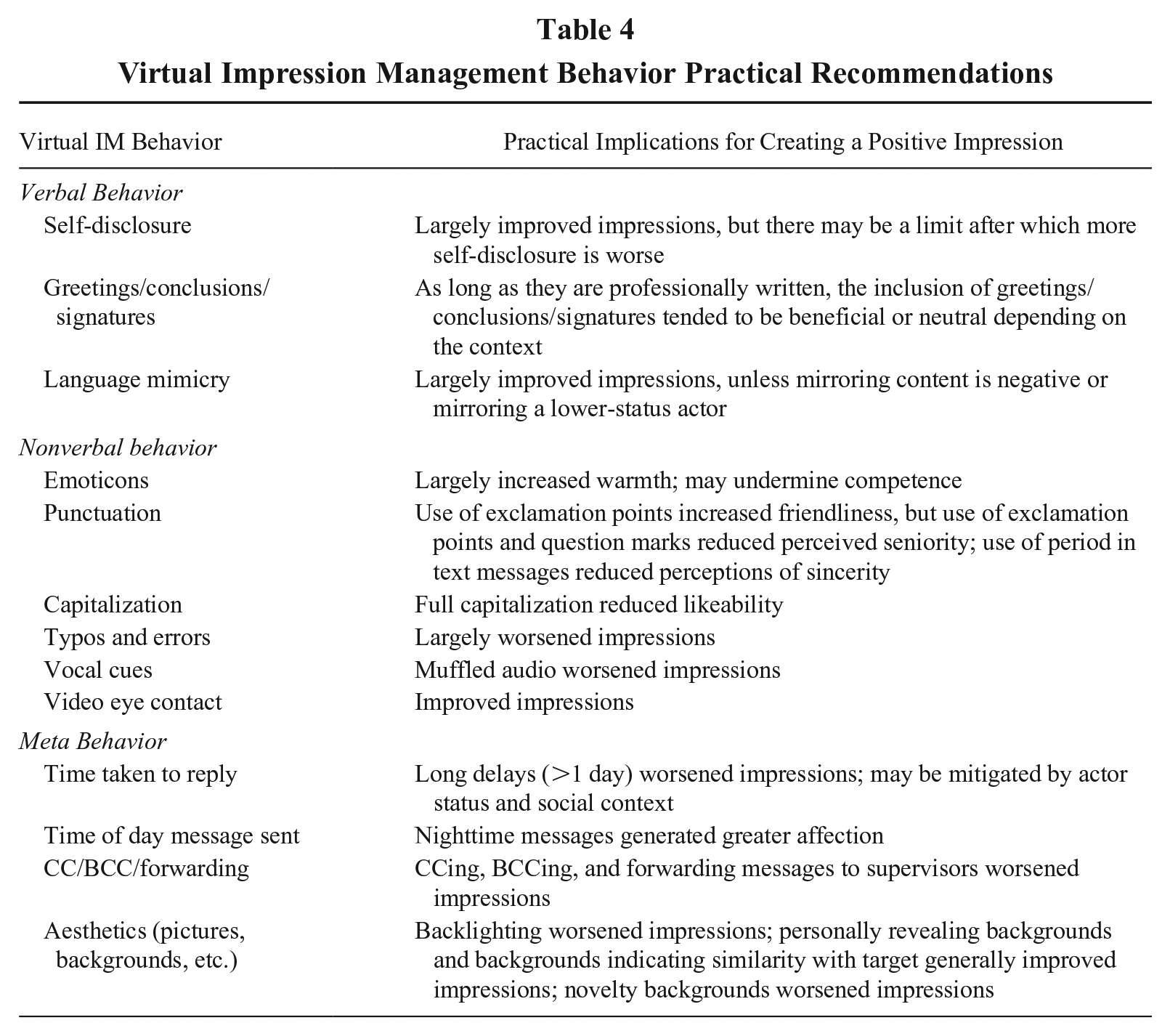
Conclusion
As interest in virtual work grows and the rate of technological innovation accelerates, employees are perhaps likelier than ever to develop impressions of one another virtually. We hope that this integrative review and framework can advance the understanding of—and inspire future research on—impression management in the increasingly virtual-centric workplace for years to come.
