



Abstract
Although research consistently shows that employee creativity contributes to positive outcomes for teams and organizations, we have limited insight into how employee creativity shapes the outcomes of those employees who demonstrate such creativity, particularly in the context of environmental uncertainties. Drawing from event system theory and threat rigidity theory, we argue that under a threat to organizational survival, incremental creativity has a positive, and radical creativity has a negative, indirect effect on downsizing survival selection via manager evaluations of employee job performance. Study 1 uses a unique three-wave, three-source field study (n1 = 186) to provide support for our hypotheses. Studies 2 and 3 use experimental data (n2 = 410, n3 = 565) involving different scenarios of threats to organizational survival (i.e., organization’s innovation failure, competitor’s successful innovation) that provide further support for the hypothesized effects of radical creativity on manager evaluations of employee job performance. Post-hoc analyses reveal novel insights into how managers’ creativity preferences can influence their evaluation of the job performance of employees who demonstrate incremental creativity during threatening events.
Keywords
Introduction
Academics and managers alike are focused on understanding the effects of employee creativity (Lua, Liu, & Shalley, 2023)—that is, the generation of novel and useful ideas (Amabile, 1996). While employee creativity is commonly associated with positive outcomes for teams (e.g., Goncalo & Staw, 2006) and organizations (e.g., Shalley, Zhou, & Oldham, 2004), we have less insight into whether employee creativity is associated with positive or negative outcomes for those who demonstrate such creativity (Anderson, Potočnik, & Zhou, 2014; Lua, Liu, & Shalley, 2023; Mueller, Melwani, Loewenstein, & Deal, 2018). Some studies show that managers reward employee creativity (e.g., Carnevale, Huang, Crede, Harms, & Uhl-Bien, 2017; Li, Deng, Leung, & Zhao, 2017), whereas other studies suggest that managers give preference to employees who demonstrate less creativity (Benner & Tushman, 2002; Blair & Mumford, 2007; Kohn, Paulus, & Choi, 2011). Further evidence indicates that the evaluation of creativity by others (e.g., managers) may depend on the environmental context (Berg, 2022; Mueller, Melwani, & Goncalo, 2012) or the occurrence of certain types of organizational events (Chen, Liu, Tang, & Hogan, 2021; Jeong, Gong, & Zhong, 2022). To better understand how organizational events may influence how managers assess employees who demonstrate creativity, we adopt an event-oriented perspective (Morgeson, Mitchell, & Liu, 2015) to examine the effect of employee creativity on manager evaluations of employee job performance when an organization faces an important event that elicits uncertainty—that is, a threat to its very survival. In turn, we examine how these job performance evaluations affect employee downsizing survival decisions.
Event-oriented organizational behavior research treats events as focal research phenomena (Liu, Morgeson, Zhu, & Fan, 2023) and examines how events affect behaviors, outcomes, and subsequent events (Morgeson et al., 2015). While there is a greater need to understand event chains, referring to causally related events that unfold subsequently (Liu et al., 2023), most research on creativity and downsizing considers downsizing to be a static event that reduces employee creativity (e.g., Amabile & Conti, 1999) and creative outcomes (e.g., Ramdani, Guermat, & Mellahi, 2021; Ritter-Hayashi, Knoben, & Vermeulen, 2020). In contrast with much of this literature, we adopt an event-oriented lens to examine how threatening events that pose a risk to the long-term viability of an organization influence how creativity is evaluated, which may then shape other events, such as employee downsizing decisions (Datta, Guthrie, Basuil, & Pandey, 2010). Given that job performance evaluations are an important factor in downsizing selection decisions (Zatzick, Deery, & Iverson, 2015), the uncertainty that is commonly associated with threatening events (Starcke & Brand, 2016) may influence how managers evaluate creative employees, which inevitably affects their likelihood of downsizing survival.
Accordingly, we draw on event system theory (EST; Morgeson et al., 2015), complemented with insights from threat rigidity theory (TRT; Staw, Sandelands, & Dutton, 1981), to examine the relationship between employee creativity and downsizing survivor selection. From an overarching perspective, EST describes how disruptive events can generate effects across levels (e.g., an organizational event influences outcomes or relationships at lower levels) and over time. Drawing from Morgeson and colleagues (2015), who identify the impact of top-down moderating effects, we posit that higher-level events (i.e., a threat to organizational survival) provide a context that influences relationships between employee behaviors (e.g., employee creativity) and associated outcomes (e.g., manager evaluations of employee job performance). A novel and critical event, such as a threat arising from failed innovation attempts (e.g., Välikangas, Hoegl, & Gibbert, 2009) or heightened competition (e.g., Gandolfi & Hansson, 2011), can direct managerial attention away from the immediate work environment to higher-level organizational issues, resulting in a shift from automatic to controlled information processing (Morgeson et al., 2015). Using EST as the overarching theoretical framework, we contend that threats to organizational survival influence how managers evaluate the job performance of their creative workers, subsequently affecting survivor selection decisions.
To better understand how managers are influenced by a threat to organizational survival, we draw on TRT, which posits that individuals are prone to respond to threats with rigidity (Staw et al., 1981). Although it might appear commonsensical that managers concerned about organizational survival are likely to value new and innovative ideas from their employees, we argue that managers under threat differentially value creative ideas based on how these ideas affect information processing, control and coordination, and resource efficiency. Specifically, under the threat of organizational survival, managers are likely to positively evaluate the job performance of employees who demonstrate incremental creativity (i.e., ideas that are adaptive in nature) and negatively evaluate the job performance of those who demonstrate radical creativity (i.e., ideas that are a major departure from current processes and frameworks). These job performance evaluations subsequently inform downsizing survivor selection decisions made by senior executives.
Our theorization is tested over three studies. In Study 1, we collected time-separated field data (n1= 186) in an organization that had experienced a major new product launch failure which resulted in a significant downsizing of its workforce. We found evidence that managers evaluated the job performance of incrementally and radically creative employees differently, and that these differences were related to downsizing survival selection. Studies 2 and 3 used experimental data (n2 = 410; n3 = 565) involving different threat scenarios (i.e., failed innovation attempt, successful innovation of competitor) to test the underlying assumption of Study 1—namely, that threats to organizational survival influence the effects of employee creativity on job performance evaluations and, subsequently, affect downsizing survival selection.
Employee Creativity
Employee creativity has been traditionally viewed as leading to positive outcomes for employees (e.g., Ford, 2000), groups (e.g., Goncalo & Staw, 2006), and organizations (e.g., Shalley et al., 2004). However, a growing number of studies claim that creativity research suffers from the innovation maximization fallacy—the mistaken belief that “all creativity and innovation is good; and the more, the better” (Anderson et al., 2014: 1320; Priem, Li, & Carr, 2012). Anderson and colleagues (2014) contend that researchers must consider how creative processes exist within broader contexts to obtain a more complete understanding of the implications of creativity. Not surprisingly, there has been an increase in studies that examine creativity within different contexts, ranging from work–life contexts (e.g., Harrison & Wagner, 2016) to job contexts (e.g., Gong, Zhou, & Chang, 2013), that point to some negative effects. Extending these efforts, we examine employee creativity within the context of a threat to the organization.
In addition, we provide a more nuanced perspective of creativity by investigating the effects of different forms of creativity, something rarely done in the extant creativity literature (Zhang, Li, Song, & Gong, 2021). Although creativity was originally conceptualized as a unitary construct (Shalley et al., 2004), this approach failed to account for the differences between minor adaptations and significant breakthroughs (Mumford & Gustafson, 1988; Unsworth, 2001). Using insights from the innovation literature (Dewar & Dutton, 1986), two different forms of creativity (i.e., incremental, radical) were introduced (Gilson & Madjar, 2011; Madjar, Greenberg, & Chen, 2011). Incremental creativity refers to adaptive ideas that result in minor modifications to existing frameworks, practices, and products (Madjar et al., 2011)—for example, a retail salesperson selecting a different brand to display on mannequins. Radical creativity refers to disruptive ideas that manifest in breakthrough changes that meaningfully differ from existing practices (Madjar et al., 2011)—for example, a senior leader changing the mode of clothing sales from a brick-and-mortar business model to an online business model.
Radical creativity is frequently contrasted to incremental creativity because it represents drastically different ideas (Madjar et al., 2011). This departure from the status quo, however, is not without substantial risk (Venkataramani, Richter, & Clarke, 2014). It is noteworthy that, in comparison with incremental creativity, radical creativity often requires greater flexibility and freedom of resources, rules, procedures, or requirements (Acar, Taraki, & van Knippenberg, 2019; Christensen, 2013). Thus, because experimentation with high-risk projects may yield more innovation (e.g., Bourgeois III, 1981), radical creativity could be viewed as more valuable than incremental creativity. However, incremental creativity could also be viewed as more valuable than radical creativity when considering the implications of maintaining slack resources within an organization (e.g., Latham & Braun, 2009; Voss, Sirdeshmukh, & Voss, 2008). In sum, neither form of creativity is superior to the other, given that both forms of creativity can be valuable and simply serve different purposes (Madjar et al., 2011).
Similar to much of the literature that has largely focused on antecedents of creativity (Anderson et al., 2014; Shalley et al., 2004), research on incremental and radical creativity has primarily focused on their antecedents (e.g., Gilson, Lim, D’Innocenzo, & Moye, 2012; Gong, Wu, Song, & Zhang, 2017; Li, Lin, & Liu, 2019; Malik, Choi, & Butt, 2019; Sung, Rhee, Lee, & Choi, 2020; Venkataramani et al., 2014), with little attention to their outcomes (for exceptions, see Bulut, Kaya, Mehta, & Danish, 2022; Petrou, van der Linden, & Bakker, 2023; Zhang et al., 2021). However, insights from the entrepreneurship literature point at quite different effects. For example, Chan and Parhankangas (2017) show that incrementally innovative crowdfunding campaigns have a positive effect on average funding received, while radically innovative campaigns have a negative effect.
Based on Chan and Parhankangas (2017), we infer that a crowdfunding campaign could be thought of as an event that influences how individuals evaluate innovation. However, very few studies have applied an event-oriented approach to examine how employee creativity is evaluated. To the best of our knowledge, there are two exceptions. First, Chen and colleagues (2021) use EST to explain the interaction of workplace event novelty and workplace event criticality on employee creativity via employee improvisation. Second, Jeong and colleagues (2022) use TRT to explain that employee-experienced crisis (i.e., the impact an employee experiences from crisis events in a team) relates to employee creativity via job anxiety and creative process engagement. Similar to much of the creativity literature, these event-oriented accounts of employee creativity examine antecedents of employee creativity. In contrast, we adopt an event-oriented perspective to examine how a threat-related event may influence the evaluation of employee creativity and its subsequent outcomes.
Employee Creativity: An Event System Perspective
According to EST (Morgeson et al., 2015), organizational life inherently entails events that command attention, triggering controlled (as opposed to automatic) information processing. An event refers to an externally-rooted occurrence that is separate from the perceiver, arising from an interaction between entities (e.g., employees, organizations, environments), that is bounded in time and space (Morgeson et al., 2015). In accordance with systems theories (e.g., Von Bertalanffy, 1950), an event system comprises three components: strength (i.e., the novelty, disruption, and criticality of the event), space (i.e., where an event occurs and how it spreads throughout the organization), and time (i.e., the time at which the event unfolds, the length through which the event impacts others, and the evolution of the strength of the event). Although an event system can manifest in different ways to affect individual and collective entities (Morgeson et al., 2015), we examine the top-down moderating effect of an event on the relationship between lower-level behaviors and outcomes. According to EST, the attentional focus of the event can affect individual and collective behaviors, features, and subsequent events across hierarchical levels and time. Despite recognition that “cognitive and social processes push entities towards action” (Morgeson et al., 2015: 531), an elaboration of these psychological processes is beyond the scope of EST, yet “further theoretical elaboration is needed to specifically describe this overall process” (Morgeson et al., 2015: 531).
To illuminate the psychological processes underlying how threat-related events affect how managers process work-related information, we draw complementary theoretical insights from TRT (Staw et al., 1981) whose core premise is that adverse environmental conditions (e.g., resource scarcity, fierce competition, weak consumer demand) trigger a threat. According to Staw and colleagues (1981: 502), a threat refers to “an environmental event that has impending negative or harmful consequences for the entity.” Stated differently, a threat represents a situation where undesirable effects are expected but have yet to take place (Lazarus & Folkman, 1984). Thus, a threat to the vital interests of the organization (i.e., threat to organizational survival) is a specific organizational event that affects how managers process information, influencing their cognitive processes and behaviors (e.g., Muurlink, Wilkinson, Peetz, & Townsend, 2012; Shi, Connelly, & Cirik, 2018).
According to TRT, there are differences in the processes through which individuals, groups, and organizations make sense of threats (Staw et al., 1981). From an organizational standpoint, we examine how managers respond to a threat, based on three information and control processes: (1) restricted information processing (i.e., threats are associated with information overload, reducing the search for information and enhancing reliance on existing knowledge); (2) constriction of control (i.e., managers undertake a mechanistic shift towards formalization of processes and centralization of authority to gain more control); and (3) conservation of resources (i.e., managers focus on efficiency via resource-preservation measures, such as cost-cutting). These information and control processes elicit rigid responses from managers in response to threats, meaning that managers rely on dominant, well-learned actions (Staw et al., 1981).
Drawing from TRT, we propose that the wider context in which managers operate influences how they evaluate employee creativity as “creativity can be evaluated only locally” (Sternberg, 2019: 394). Under normal circumstances, manager evaluations of employee creativity may vary widely based on a variety of factors (e.g., Carnevale et al., 2017; Kohn et al., 2011). However, given that a threat to the organization affects how managers process information and control the situation (Staw et al., 1981), managers who work in organizations under threat are prone to favor employee behaviors that align with their preference for dominant, well-learned responses. As such, managers’ social construction of their evaluations of employee job performance are inherently influenced by contextual factors such as threatening events. Thus, managers are likely to positively respond to incremental creativity with favorable job performance evaluations because incremental ideas resemble well-learned responses. Accordingly, managers are likely to negatively respond to radical creativity with unfavorable job performance evaluations because disruptive ideas deviate significantly from well-learned responses. In turn, downsizing research widely suggests that senior executives use manager evaluations of employee job performance to downsize employees (Datta et al., 2010; Kalev, 2014).
Employee Creativity and Job Performance Evaluations Under a Threatening Event
Although incremental and radical creativity are both positively associated with job performance (e.g., Zhang et al., 2021), research suggests that context can affect these relationships because the “evaluation of creativity does not occur in a vacuum” (Zhou, Wang, Bavato, Tasselli, & Wu, 2019: 2582). Drawing insights from EST (Morgeson et al., 2015) and TRT (Staw et al., 1981), we propose that incremental and radical creativity are interpreted differently by managers who operate under a threat to the organization, as they become inclined to constrict information and control processes (e.g., reduce information overload, restrict control and coordination processes, limit resource consumption).
Employees who enact incremental creativity are likely to receive favorable job performance evaluations from their manager under conditions of a threat to the organization. In accordance with EST (Morgeson et al., 2015), a threatening event triggers controlled information processing by managers—that is, deliberate, logical, and effortful processing to make sense of the threat, affecting subsequent thoughts and behaviors. To theoretically examine how managers respond to threatening events, we draw from TRT (Staw et al., 1981), which states that managers exposed to a threat are prone to respond with rigidity. Given that incremental creativity is aligned with well-learned and dominant responses, managers are particularly likely to value incremental creativity under a threatening event, as incrementally creative ideas require few modifications (Madjar et al., 2011) and entail a strong likelihood of successful implementation (Grote & Cortina, 2018).
According to TRT (Staw et al., 1981), the restricted information processing mechanism suggests that managers who are exposed to a threatening event seek to restrict the volume and complexity of information, yet also seek information that aligns with previous approaches (Staw et al., 1981). As incremental creativity requires limited information processing (Gilson & Madjar, 2011) and support from internal scans of the work environment (Jaussi & Randel, 2014), managers are likely to favorably evaluate the job performance of employees who offer incremental ideas for improvements to existing processes. The constriction of control mechanism suggests that managers redistribute employee control into the hands of authority figures in attempt to standardize processes to limit employee discretion (Staw et al., 1981). As such, managers are apt to favorably evaluate the job performance of employees who provide incremental suggestions to improve current processes, given that these ideas help the organization survive volatile environments (George, 2007) without disrupting existing control mechanisms or processes. The conservation of resources mechanism further suggests that managers who are faced with a threatening event seek to conserve resources through more efficient procedures and processes (Staw et al., 1981). Given that creativity can consume significant resources (Sung et al., 2020), managers who function when the organization faces a threat are likely to respond favorably to incremental ideas because these ideas comprise little novelty (Litchfield, Gilson, & Gilson, 2015), require few resources (Gilson & Madjar, 2011), and may even free up cognitive resources for other tasks (Harrison & Wagner, 2016).
Hypothesis 1a: When the organization faces a threat, employee incremental creativity positively relates to manager evaluations of employee job performance.
However, radical creativity may be perceived quite differently when the organization faces a threatening event. EST suggests that managers direct their attention towards threats when they are present, which affects how they process information (Morgeson et al., 2015). According to TRT (Staw et al., 1981), managers who are faced with a threatening event are often inundated with information about this threat, making them unlikely to welcome radical suggestions, given that these ideas contribute to (as opposed to alleviate) information overload (e.g., Criscuolo, Dahlander, Grohsjean, & Salter, 2017). Indeed, radical creativity can easily exacerbate information overload for managers because it requires a scan of the internal and external environment (Jaussi & Randel, 2014) and exploratory learning (Li et al., 2019). Moreover, managers working in organizations facing a threatening event also seek to constrict control (Staw et al., 1981), suggesting that these managers are unlikely to respond well to employees who disrupt established processes of control and coordination. Given that uncertainty often contributes to a negative bias against creativity (Mueller, Melwani, & Goncalo, 2012), managers facing a threatening event are likely to unfavorably evaluate the performance of employees who regularly offer radical ideas because these disruptive ideas destabilize existing situations (Madjar et al., 2011). Finally, managers may further respond to threatening events with improved resource efficiencies (Staw et al., 1981). Because a threat contributes to “a reduced ability and willingness to consider new ideas” (Shi et al., 2018: 1893), managers working under these conditions are likely to unfavorably evaluate the performance of radically creative employees. Radical creativity consumes significant resources because these disruptive ideas involve “experimentation and paradigm shifts” that significantly deviate from the norm (Gilson et al., 2012: 171) and have a low likelihood of success (Grote & Cortina, 2018).
Hypothesis 1b: When the organization faces a threat, employee radical creativity negatively relates to manager evaluations of employee job performance.
The Downstream Implications for Survival Selection
EST suggests that experiencing a critical event is likely to affect how individuals process information across hierarchical levels (Morgeson et al., 2015). For example, senior executives working in organizations that face a threatening event are required to make difficult decisions to improve organizational functioning (Barker III & Mone, 1998; Ocasio, 1995). Downsizing research widely suggests that workforce reductions are an oft-used strategy to improve organizational performance (Datta et al., 2010). Although senior executives can resort to across-the-board reductions (e.g., a certain percentage of all departments are terminated) without regard to specific contextual considerations (e.g., firm strategy, job tenure; Gandolfi & Littler, 2012), more often, the workforce is reduced based on specific criteria that is applied to all individuals (Bragger, Kutcher, Menier, Sessa, & Sumner, 2014), such as job performance, job role, and organizational tenure (Kalev, 2014). This approach often intends to retain employees who are well-positioned to support organizational functioning (Morrall, 1998). Unsurprisingly, job performance is therefore often considered a key antecedent of survival selection (Chhinzer, 2021). Thus, senior executives are likely to retain employees with the highest performance evaluations for continued employment.
Hypothesis 2: Manager evaluations of employee job performance positively relate to downsizing survival selection.
Altogether, we propose that senior executives are likely to retain employees who engage in incremental creativity, given their favorable job performance evaluations by managers. Specifically, employees who offer incremental suggestions for improvement may receive favorable performance evaluations when the organization faces a threatening event, such that these employees help to reduce information overload, foster greater control and coordination, and improve resource efficiencies (Staw et al., 1981). Given that senior executives are most concerned with improved organizational functioning, these employees are likely to be retained during downsizing. In contrast, employees who offer radical ideas that disrupt organizational processes (who may otherwise be considered favorably) are likely to receive unfavorable evaluations because they contribute to information overload, disrupt control and coordination processes, and consume significant resources (Staw et al., 1981). As such, senior executives are likely to downsize these radically creative employees given the event-related shift in attentional focus.
Hypothesis 3a: When the organization faces a threat, employee incremental creativity positively relates to downsizing survival selection via manager evaluations of employee job performance.
Hypothesis 3b: When the organization faces a threat, employee radical creativity negatively relates to downsizing survival selection via manager evaluations of employee job performance.
Study 1
Downsizing Context
Study 1 involves a unique multi-wave, multi-source field study involving a high-tech organization in North America. This organization expended considerable resources developing a new product that was intended to be the new flagship product. The product launch received considerable media attention. However, approximately six months later, substantially lower-than-expected product sales led to a drastic reduction in the price of the product and a shift in the sales strategy from storefront to online. Approximately 4 months later, the CEO went on record with several media outlets to communicate that the flagship product had very low sales, and about 12 months after the product launch, the CEO announced a significant downsizing of the workforce. Subsequent press coverage revealed that managers had provided internal warnings that the intended flagship product had several issues.
Sample
Data were collected from three separate sources (employee, manager, organization) to reduce same-source bias (Spector & Brannick, 2010). We started collecting data after the product launch but before the announcement of low sales. 1 All employees (n = 389) were invited to voluntarily participate in an online survey that evaluated their creativity. The survey was completed by 186 employees (48% response rate, no missing data). We used the recommendations of Goldammer, Annen, Stockli and Jonas (2020) to proactively address careless responding to the survey by using incentives (i.e., all participants were entered into a draw to win one of three gift cards valued at $100 CAD [∼$75 USD]), personal instructions, and items that were only necessary for study purposes. We adopted a 2-month lag time between the first and second waves of data collection to ensure that creative behaviors would have time to influence overall performance evaluations (Gong, Huang, & Farh, 2009), but were also careful to select a timeframe that would help ensure this relationship would not dissipate over time. A 2-month lag between data collections is consistent with previous creativity studies (e.g., Han, Hampson, & Wang, 2022; Han, Masood, Cudjoe, & Wang, 2021).
Approximately 2 months later, the second wave of data was collected, subsequent to the CEO’s announcement of the poor performance of the newly launched product. The human resources (HR) department met with each manager to evaluate the job performance of each employee. Approximately 2 months later, the organization downsized approximately one-third of its workforce. We collected data on who was retained and who was terminated from the organization 1 week after the downsizing announcement; these data represent the third wave of data. Employee identification numbers and an organizational chart were used to link employee survey responses with the outcome variables (i.e., manager evaluations of employee job performance, downsizing survival). The organization’s human resource information system (HRIS) was used to collect data for the second and third wave.
Most of the sample comprised males (72%) and individuals holding an undergraduate degree or higher (75%). The average organizational tenure was 1.46 years (SD = 1.16). Two-thirds of the sample were between 18 and 35 years old, and a quarter held a managerial position. Consistent with the proportion of employees who were laid off, approximately two-thirds (64%) of the sample survived the layoff.
Measures
Data Analysis
We conducted structural equation modeling (SEM) to test our hypotheses using Mplus 8.4 (Muthén & Muthén, 2010). We used Bayesian estimation with default settings, which includes non-informative (i.e., diffuse) priors (Asparouhov & Muthén, 2010). We elected to use a Bayesian SEM because of its computational advantages compared with other estimation techniques when modelling categorical outcomes (such as job performance evaluations and survivor selection variables) with latent continuous variables (such as our incremental and radical creativity variables; Asparouhov & Muthén, 2010; Muthén, Muthén, & Asparouhov, 2015). Bayesian estimation uses Markov chain Monte Carlo (MCMC) algorithms to create approximations to the posterior distributions by iteratively making random draws in the MCMC chain (Asparouhov & Muthén, 2010). Bayesian estimation uses probit regression with weighted least-squares means and variance-adjusted estimation to facilitate path analyses involving binary outcomes (Harrison, 2002; Muthén & Muthén, 2010). Bayesian estimation uses a process similar to traditional bootstrapping to calculate indirect effects through iterative estimation (iteration = 20,000; Zyphur & Oswald, 2015). Grand mean centering was used on both predictor and mediator variables.
Results
Confirmatory factor analysis (CFA) was used to capture the extent to which the measures loaded on their respective constructs. The measurement model demonstrated adequate fit (χ2 = 44.42; df = 24; χ2/df = 1.85; CFI = .97; TLI = .94; RMSEA = .06; SRMR = .06). The hypothesized measurement model was compared with an alternate model that loaded incremental and radical creativity onto one factor. This alternate model demonstrated significantly worse fit compared with the hypothesized measurement model (χ2 = 104.85; df = 23; χ2/df = 4.56; Δχ2 = 60.47 (p < .001); CFI = .87; TLI = .78; RMSEA = .14; SRMR = .23). Thus, the hypothesized model was retained.
Table 1 summarizes the means, standard deviations, and correlations between variables. The structural model was found to have adequate fit (χ2 = 103.19; df = 79; χ2/df = 1.31; CFI = .96; TLI = .94; RMSEA = .04; SRMR = .07). Because the present research hypothesizes mediation effects, this structural model was compared with a series of alternative models to determine whether this parsimonious model provided the best fit. In a series of analyses, we used the hypothesized structural model as a base and included direct paths from incremental creativity (χ2/df = 1.34; Δχ2 = .01; CFI = .95; TLI = .93; RMSEA = .04; SRMR = .07) and radical creativity (χ2/df = 1.34; Δχ2 = .01; CFI = .95; TLI = .93; RMSEA = .04; SRMR = .07) to survival selection. In each case, the alternative models did not indicate a significantly improved model than the hypothesized structural model. Thus, the hypothesized model was retained for parsimony.
Means, Standard Deviations, and Correlations of Study 1
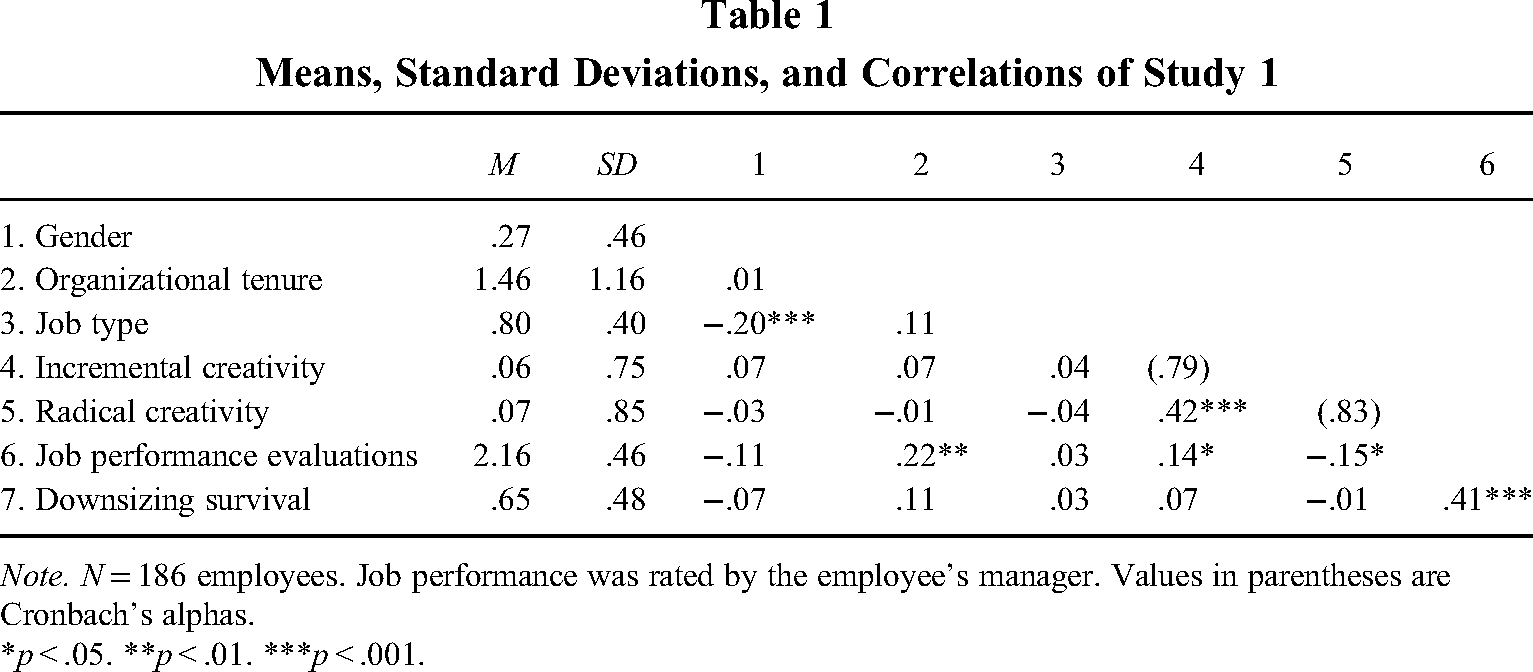
Note. N = 186 employees. Job performance was rated by the employee’s manager. Values in parentheses are Cronbach’s alphas.
*p < .05. **p < .01. ***p < .001.
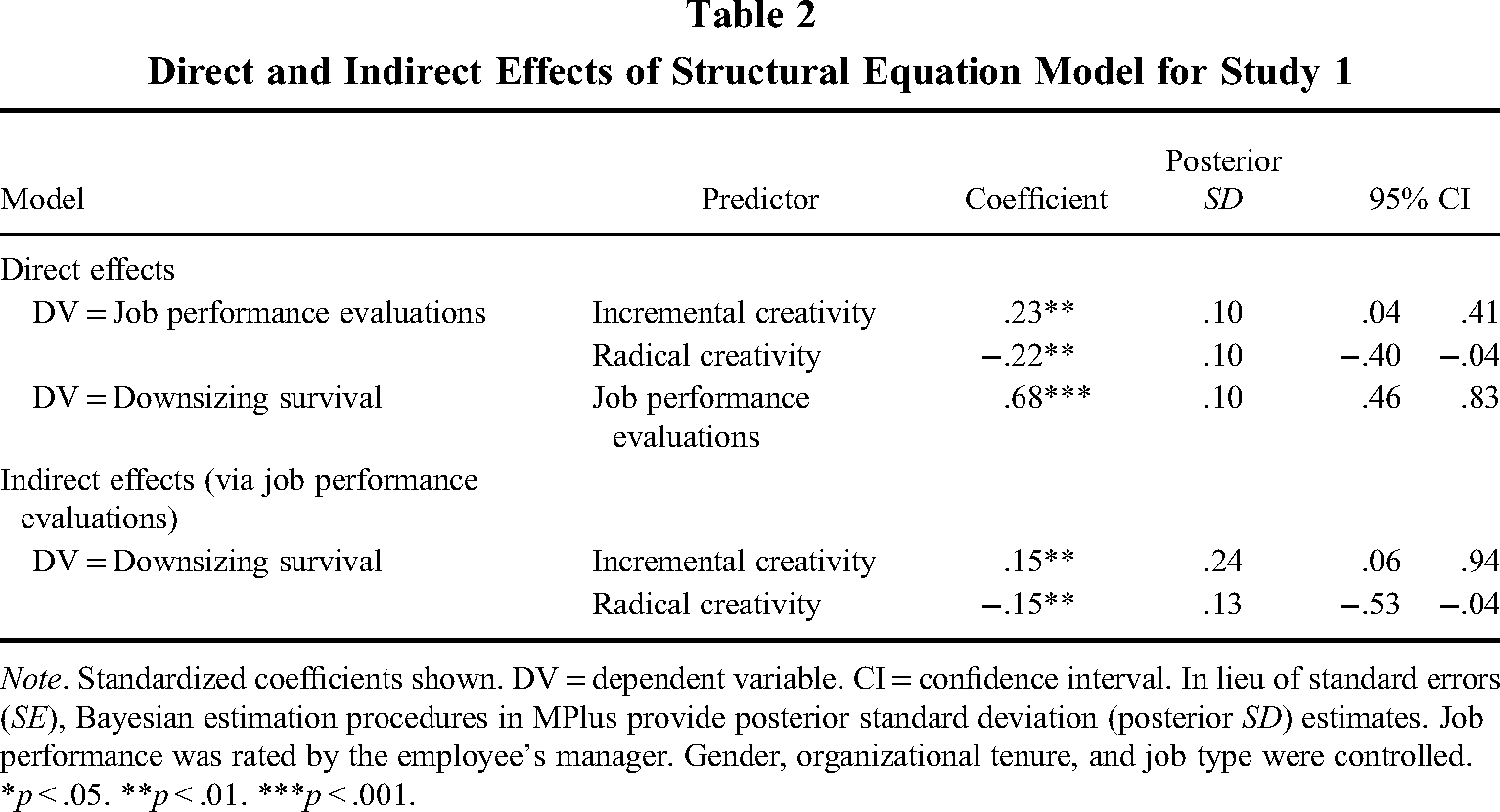
Table 2 provides a summary of the SEM results. The first hypothesis posits that under a threat to organizational survival, (a) incremental creativity and (b) radical creativity relate to manager evaluations of employee job performance. This hypothesis was supported by the data shown in Table 2, as there was a significant positive direct effect between incremental creativity and manager evaluations of employee job performance (β = .23, p = .007, 95% CI [.04, .41]) and a negative direct effect between radical creativity and manager evaluations of job performance (β = -.22, p = .007, 95% CI [-.40, -.04]).
Direct and Indirect Effects of Structural Equation Model for Study 1
Note. Standardized coefficients shown. DV = dependent variable. CI = confidence interval. In lieu of standard errors (SE), Bayesian estimation procedures in MPlus provide posterior standard deviation (posterior SD) estimates. Job performance was rated by the employee’s manager. Gender, organizational tenure, and job type were controlled.
*p < .05. **p < .01. ***p < .001.
The second hypothesis posits a positive relationship between manager evaluations of job performance and downsizing survival. Data analysis revealed a significant positive relationship between manager evaluations of employee job performance and downsizing survival (β = .68, p < .001, 95% CI [.46, .83]). Again, this model estimated a probit regression coefficient to represent the effect of manager evaluations of employee job performance on the binary outcome of downsizing survival selection. For clarity, a probit coefficient describes that for every one unit increase in the predictor variable (i.e., manager evaluations of employee job performance), there is a corresponding increase (or decrease) in the cumulative normal probability associated with the binary outcome variable (i.e., downsizing survival selection; Harrison, 2002). The probit coefficient representing the effect of manager evaluations of employee job performance on downsizing survival was .68 (p < .001), suggesting that a single-unit increase in manager evaluations of employee job performance was associated with a .68 increase in the cumulative probability of downsizing survival. Simply put, this suggests that higher manager evaluations of employee job performance are associated with an increased probability of surviving downsizing. Thus, Hypothesis 2 is supported.
The third hypothesis posits that under a threat to organizational survival, (a) incremental creativity and (b) radical creativity indirectly relate to downsizing survival via manager evaluations of employee job performance. Supporting Hypothesis 3, the results reveal a positive indirect effect of incremental creativity on downsizing survival selection via manager evaluations of employee job performance (β = .15, p = .009, 95% CI [.06, .94]), and a negative indirect effect of radical creativity on downsizing survival selection via manager evaluations of employee job performance (β = -.15, p = .009, 95% CI [-.53, -.04]).
Study 2
Study 2 involves a scenario experiment that expands on the results from Study 1. For Study 2, we delved deeper into the relationship between employee creativity and manager evaluations of employee job performance for the following reasons. First, we found the opposing effects in the relationship between the two different forms of employee creativity and manager evaluations of employee job performance rather interesting, necessitating the need for further exploration. Second, Study 1 assumed that managers who were conducting performance evaluations were aware of the threat to the organization because of the contextual circumstances (i.e., the CEO publicly acknowledged the lower-than-expected sales for the flagship product, the sudden shift in sales strategy, managers informed the media that they had previously warned the CEO of their concerns). Study 2 provided the opportunity to explicitly test this assumption by manipulating the threatening event. Third, the model tested in Study 2 is also consistent with EST (Morgeson et al., 2015), which suggests that events have a top-down moderating effect on the relationship between behavior (i.e., employee creativity) and features (i.e., job performance).
Sample and Procedure
Participants (n = 410) were recruited from Prolific Academic (https://www.prolific.co/) to complete a short scenario experiment for £1, which is consistent with extant research (e.g., Kim, Holtz, & Hu, 2020). Participant selection criteria included the following: fluency in English; residency of Canada, the United States, or the United Kingdom; being currently employed; supervision of employees; at least a 95% approval rating; and participation in at least 10 Prolific surveys. Following the recommendations of Goldammer and colleagues (2020), we proactively addressed careless responding by using incentives (i.e., participants were compensated £1 for completing the survey), personal instructions (e.g., we referenced the platform they used to complete the survey and asked respondents not to complete the survey in front of the TV or while listening to music) and items that were only necessary for study purposes. Because Study 2 was designed to further develop findings from Study 1, we only included specific measures that would allow us to test our research hypothesis. Surveys were designed to be short in nature with an average completion time of 7 min (Goldammer et al., 2020). All participants passed three attention checks (Kung, Kwok, & Brown, 2018). Approximately half of the respondents identified as male (53%) with an average age of 41 years (SD = 11.36), and having worked for an average of 21.38 years (SD = 11.24), with approximately 8 years as a manager (SD = 7.81). On average, managers had six direct reports. One-third of participants (34%) had been downsized previously.
Participants were randomly assigned to either an incremental-creativity or radical-creativity scenario. To avoid information overload with manipulations for two different (yet similar) forms of creativity, we conducted two separate scenario experiments for incremental and radical creativity. The only difference was the manipulation for high-incremental versus high-radical creativity (Appendix B). For brevity, we only describe the radical-creativity experiment below.
We used a 2 (low vs. high threat to organizational survival) × 2 (low vs. high radical creativity) between-persons experimental design, where participants were randomly allocated to one of four scenarios. In the scenario introduction, which was identical for all conditions, each participant was asked to imagine that they work as a manager at a fast-growing technology company. They were informed that as part of their managerial role, they were responsible for evaluating employee job performance. Following this introduction, the participants were subject to a threatening event manipulation, which described the release of a new flagship product and its importance to the organization. In the high-threat condition, the product release was deemed a failure that forced the organization into an unstable and unpredictable state. In the low-threat condition, the product release was deemed a success that positioned the organization for stable and continued growth. Afterwards, the participants were provided with information about one of their employees for the radical creativity manipulation. In the high radical creativity condition, the employee was described as consistently recommending highly disruptive and radical ideas. In the low radical creativity condition, the employee was described as following predetermined company procedures. Afterwards, participants provided responses to a series of items (i.e., threat to organizational survival, radical creativity, job performance evaluations) relating to the scenario.
Measures
Incremental and radical creativity were measured using the same scales as described in Study 1 (incremental: α = .84; radical: α = .94). These measures were included as manipulation checks. Threat to organizational survival was measured using a single item adapted from the Fugate, Kinicki and Prussia (2008) threat appraisal scale. Using a 5-point Likert scale (1 = not at all; 5 = very large extent), participants responded to the following item: “In your view, to what extent is your company experiencing a major threat to its survival?” This measure was also included as a manipulation check. Manager evaluations of employee job performance was operationalized using a four-item measure from Schat and Frone (2011), which was adapted from Wayne and Ferris (1990). Using a 5-point Likert scale (1 = poor; 5 = excellent), participants were asked to rate the scenario employee based on their “quality of work,” “dependability,” “cooperation,” and “overall job performance.” Downsizing survival was measured using the following single line item: “If your organization had to substantially downsize its workforce, how likely is it that this employee would be downsized (i.e., they would lose their job)?” A 5-point Likert scale was used (1 = very unlikely, 5 = very likely).
The following four control variables were included in the analysis: gender, manager experience, risk-taking propensity, and creativity preferences. We controlled for gender and manager experience to align with the control variables used in Study 1. Risk-taking propensity (α = .73) was measured using three items from Mueller, Titus, Covin and Slevin (2012), which was adapted from Covin and Slevin (1989). Respondents used a 5-point agree/disagree scale in response to items such as “I have a strong proclivity for low-risk projects with standard and predictable rates of return.” Creativity preference (α = .92) was measured using an eight-item scale from Aleksic, Cerne, Dysvik and Skerlavaj (2016). A 5-point agree/disagree Likert scale was used to obtain responses to items such as “I want to suggest new ways to achieve goals or objectives.”
Manipulation Checks
Before testing our hypotheses, we conducted manipulation checks with analysis of variance (ANOVA) to examine the different levels of the threat to organizational survival, radical creativity, and incremental creativity between the experimental conditions. The threat to organizational survival (high: M = 3.69; low: M = 1.75; t (402) = 21.35, p = .023), radical creativity (high: M = 6.02; low: M = 4.07; t (396) = 12.76, p < .001), and incremental creativity (high: M = 5.58; low: M = 4.63; t (400) = 6.99, p = .002) manipulations were all supported. Table 3 reports the means, standard deviations, and correlations.
Means, Standard Deviations, and Correlations of Study 2
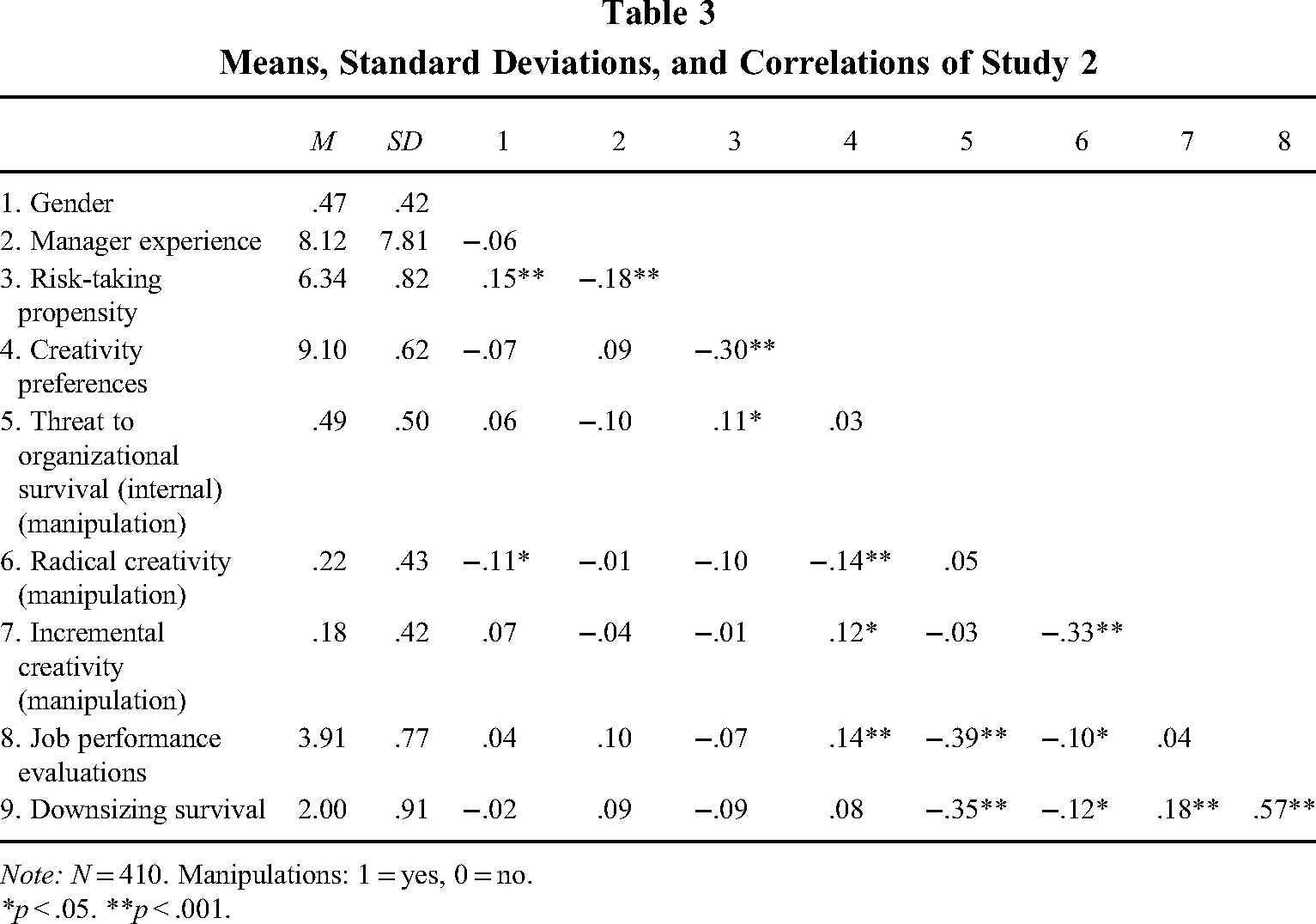
Note: N = 410. Manipulations: 1 = yes, 0 = no.
*p < .05. **p < .001.
Experimental Results
Analysis of covariance (ANCOVA) was used to examine the effect of interaction between radical creativity and threat to organizational survival on manager evaluations of employee job performance, while including the control variables. When the threat to organizational survival was low, there was little difference in the performance evaluations between high (M = 4.19) and low (M = 4.17) radical creativity. Conversely, when the threat to organizational survival was high, there was a significant difference in performance evaluation between high (M = 3.31) and low (M = 3.64) radical creativity. This interaction was significant with respect to manager evaluations of employee job performance: F (1, 379) = 4.622, p = .032, η 2 = .018. Figure 1 illustrates a negative relationship between radical creativity and manager evaluations of employee job performance only when there is a high threat to organizational survival. Thus, both the independent samples t-test comparison as well as ANCOVA support the hypothesis that manager evaluations of employee job performance are influenced by the interaction between radical creativity and threat to organizational survival.
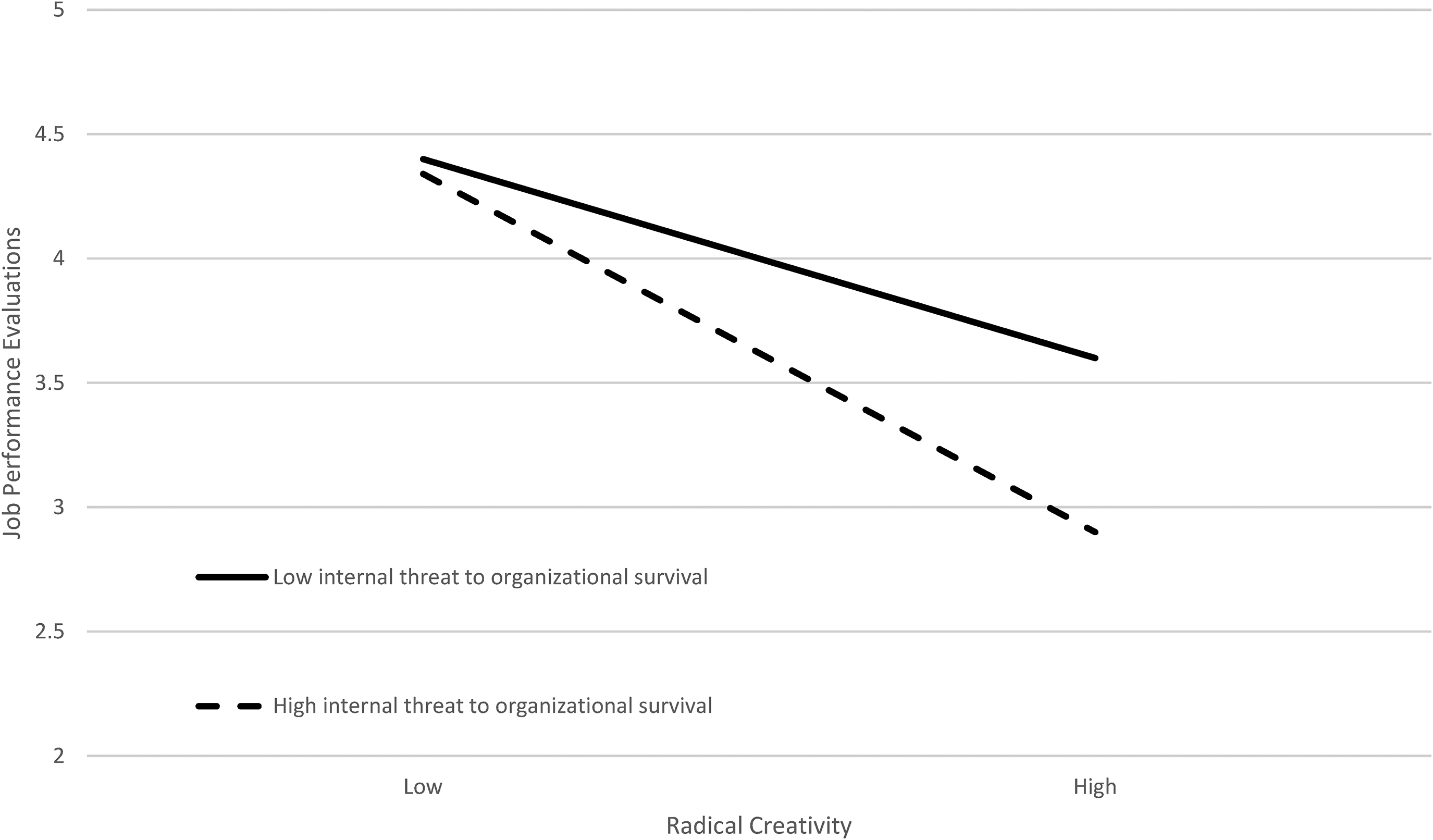
Study 2: Internal Threat to Organizational Survival Moderates the Effect of Radical Creativity on Job Performance Evaluations
We performed a second ANCOVA to examine the interaction between the level of incremental creativity and the level of threat on manager evaluations of employee job performance, with control variables included. When the threat to organizational survival was low, the mean job performance scores were nearly the same for low (M = 4.19) and high (M = 4.14) incremental creativity. When the threat to organizational survival was high, there was still a minor difference in performance evaluation for low (M = 3.51) and high (M = 3.60) incremental creativity. This interaction was not significant with respect to manager evaluations of job performance: F (1, 379) = .330, n.s., η 2 = .001).
Finally, the results presented in the correlation matrix show a significant correlation between manager evaluations of employee job performance and downsizing survival: r(402) = .565, p < .001. This relationship is consistent with our broader theorization.
Study 3
Study 3 used experimental data involving a scenario that differs from the scenarios included in Studies 1 and 2. While both Studies 1 and 2 assess the effect of a threat to organizational survival due to organizational innovation failure on manager evaluations of employee job performance, organizations may experience a threat to organizational survival for other reasons (e.g., Trahms, Ndofor, & Sirmon, 2013). For example, an organization may experience a downsizing threat from their external environment due to a competitor’s innovation success, 2 which can lead the competitor to acquire a greater market share (Ivanova, Holionko, Tverdushka, Olejarz, & Yakymchuk, 2019). Although our theorization does not differentiate between a threat to organizational survival that originates internally versus externally, Study 3 seeks to replicate our theorization and results to a threat to organizational survival that arises from the external environment, namely, a competitor’s innovation success. In this study, we examine the influence of this environmental threat on manager evaluations of employee job performance.
Sample and Procedure
In Study 3, we followed the same procedure for recruiting participants (i.e., Prolific Academic) and mitigating careless responses (Goldammer et al., 2020) as for Study 2. In this case, 600 participants were recruited, of which 565 completed the survey and passed all three attention checks. The survey was short, with an average completion time of 6 min (Goldammer et al., 2020). Half of this sample were male (51%). On average, respondents were 41.4 years old (SD = 10.9) and worked for an average of 21.7 years (SD = 10.8), with approximately 8.8 years as a manager (SD = 8.2). On average, managers had seven direct reports. Approximately half of the sample (49%) had been downsized previously.
Similar to Study 2, participants were randomly assigned to either an incremental-creativity or radical-creativity scenario. The only difference between Studies 2 and 3 was the manipulation for threat to organizational survival. In Study 3, this manipulation described a competitor’s release of a new innovative product. In the high condition, the competitor’s product release was deemed a success that led to market growth, which put the participant’s organization in an unstable and unpredictable state. In the low condition, the competitor’s product release was deemed a failure, which placed the participant’s organization in a position for stable and continued growth (see Appendix C for the full experiment script).
Measures
Incremental and radical creativity were measured using the same scales as described in Studies 1 and 2 (incremental: α = .84; radical: α = .97), and were included as manipulation checks. Threat to organizational survival was also measured using the same single item as was described in Study 2 (i.e., “In your view, to what extent is your company experiencing a major threat to its survival?”), and was included as a manipulation check. Manager evaluations of employee job performance was operationalized using the same four-item measure as described in Study 2 (α = .88). Downsizing survival was operationalized using the same item as described in Study 2. The same four control variables as described in Study 2 were used in Study 3 (i.e., α for risk-taking propensity was .70, α for creativity preference was .92).
Manipulation Checks
Before testing our hypotheses, we conducted manipulation checks with ANOVA to examine the different levels of the threat to organizational survival and incremental creativity between the experimental conditions. The threat to organizational survival manipulation was supported (high: M = 3.36; low: M = 2.02; t [562] = 345.582, p < .001), as was the radical-creativity manipulation (high: M = 6.06; low: M = 4.06; t [562] = 228.3, p < .001), and the incremental-creativity manipulation (high: M = 5.68; low: M = 4.76; t [562] = 82.99, p < .001). Table 4 reports the means, standard deviations, and correlations.
Means, Standard Deviations, and Correlations of Study 3
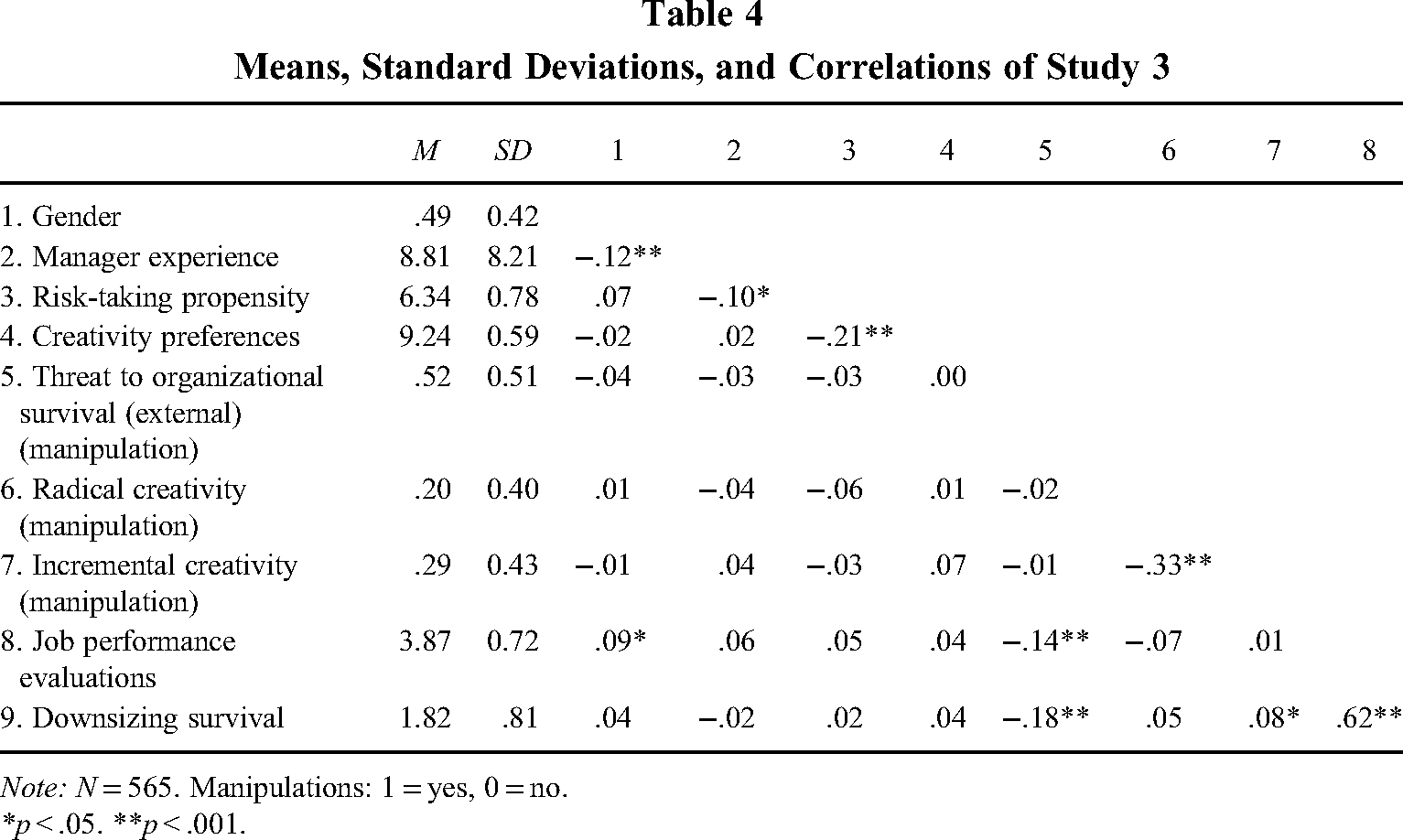
Note: N = 565. Manipulations: 1 = yes, 0 = no.
*p < .05. **p < .001.
Experimental Results
ANCOVA was used to examine the interaction between radical creativity and threat to organizational survival on manager evaluations of employee job performance, with all four control variables included. When the threat to organizational survival was low, there was little difference in the performance evaluations of employees with high- (M = 3.95) and low (M = 4.05) radical creativity. Conversely, when the threat to organizational survival was high, there was a significant difference in the performance evaluations of employees with high- (M = 3.67) and low- (M = 3.88) radical creativity. This interaction was significant with respect to manager evaluations of employee job performance: F (1, 528) = 4.069, p = .044, η 2 = .02. The simple slopes analysis of this interaction is illustrated in Figure 2.
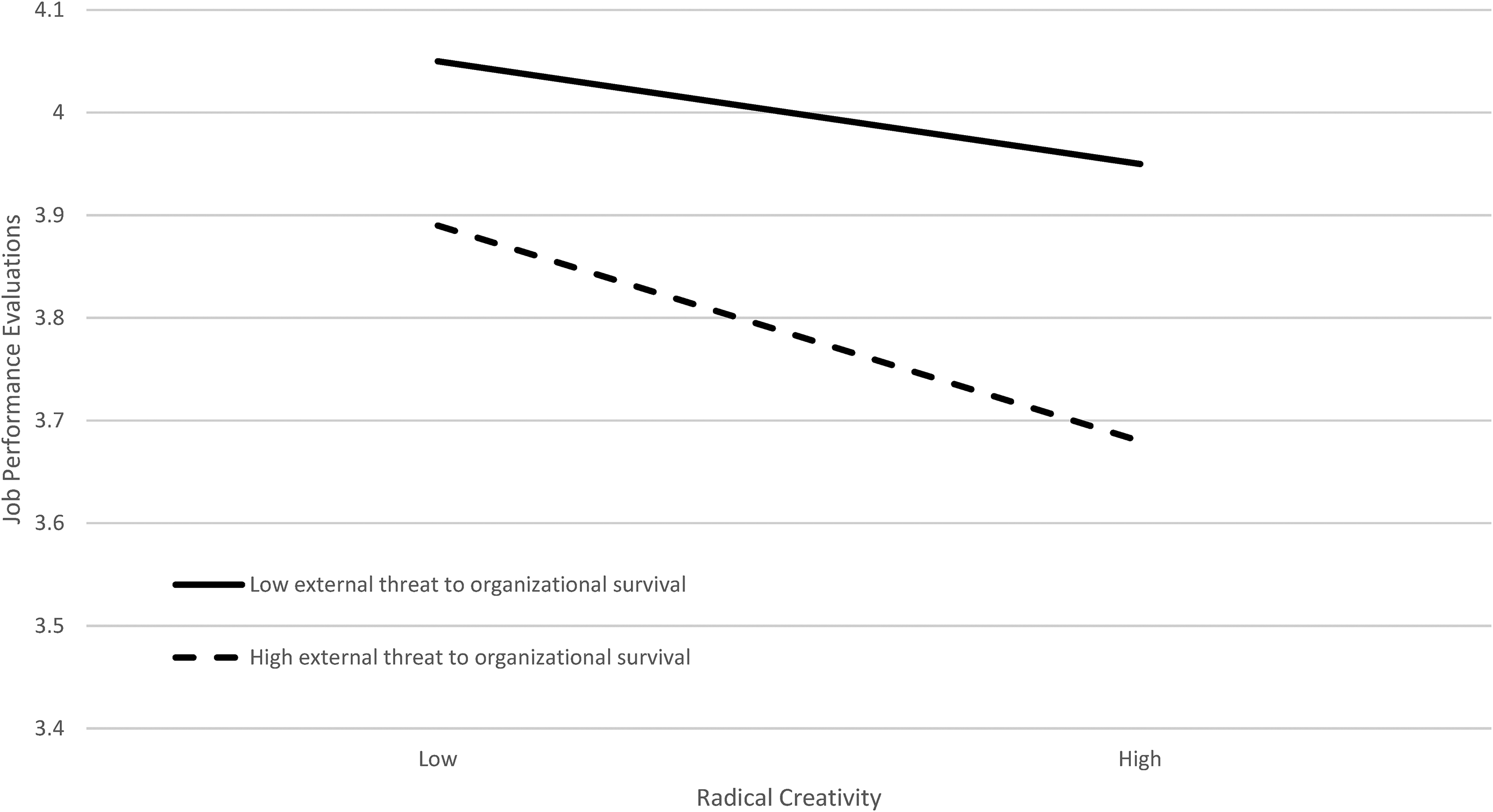
Study 3: External Threat to Organizational Survival Moderates the Effect of Radical Creativity on Job Performance Evaluations
When the threat to organizational survival manipulation was low, there was negligible difference in the performance evaluations of employees with high (M = 4.00) and low (M = 4.03) incremental creativity. Similarly, when the threat to organizational survival manipulation was high, there was also an insignificant difference in the performance evaluations of employees with high (M = 3.89) and low (M = 3.80) radical creativity. Using ANCOVA to examine the effect of the interaction between incremental creativity and threat to organizational survival on manager evaluations of employee job performance, we did not find a significant interaction: F (1, 528) = .779, n.s., η 2 = .001.
Finally, it should also be noted that, based on the results presented in the correlation matrix, there is a significant relationship between manager evaluations of employee job performance and downsizing: r(562) = .616, p < .001. Similar to Study 2, this relationship is consistent with our broader theorization.
General Post-Hoc Analyses
Although the organizational field study data (i.e., Study 1) provided support for our theorization that a threatening event is likely to result in favorable performance evaluations for employees who demonstrate incremental creativity, our scenario-based experimental data (i.e., Studies 2 and 3) did not. As such, we conducted post-hoc analyses on the data from Studies 2 and 3 to better understand these results. Specifically, we examined the role of creativity preference of managers, which was included as a control variable in Studies 2 and 3 (we did not have creativity preference as a variable in Study 1). While we initially controlled for creativity preference considering its association with creativity-related outcomes (e.g., Berg, 2022), research also suggests that a manager’s creativity preferences affect how they frame stimuli and interpret context (Dew, 2009). Accordingly, there is the possibility that managers’ creativity preferences may influence how they interpret and respond to threatening events (stimuli) when evaluating incrementally creative employees (context; see Appendix D for the full results). Study 2 data show that when the threat to organizational survival is high and creativity preference is low, there is a significant difference in manager evaluations of employee job performance for low (M = 3.28) and high (M = 3.67) incremental creativity: F (1, 376) = 3.73, p = .07, η 2 = .012. Similarly, Study 3 data show that when the threat to organizational survival is high and creativity preference is low, there is a significant difference in manager evaluations of employee job performance for low (M = 3.68) and high (M = 3.96) incremental creativity: F (1, 525) = 3.68, p = .05, η 2 = .017.
General Discussion
In contrast to creativity research that largely adopts a feature-oriented perspective (e.g., Acar et al., 2019), we draw on EST (Morgeson et al., 2015) and TRT (Staw et al., 1981) to show that, in the context of threatening events, employee creativity may have both positive and negative implications for manager evaluations of employee job performance and downsizing survival. Study 1 demonstrates that, under a threat to organizational survival, incrementally creative employees were evaluated positively in terms of their job performance, whereas radically creative employees were evaluated negatively. These performance evaluations were subsequently positively related to downsizing survival. Building on this research, Studies 2 and 3 provide further support for these novel insights with respect to radical creativity. Specifically, Studies 2 and 3 triangulate this evidence by using a different method (e.g., scenario-based experiments) that provides similar results with respect to employee job performance evaluations. Thus, we punctuate that awareness of a threatening event to organizational survival interacts with radical creativity to influence manager evaluations of employee job performance.
Theoretical Implications
This research extends EST in two important ways. First, we extend EST (Morgeson et al., 2015), which posits that organizational events can have a top-down moderating effect at the team level. Our theorization and evidence shows that both internal (organizational; i.e., Studies 1 and 2) and external (environmental; i.e., Study 3) events have a top-down moderating effect at the individual level, namely, with respect to the relationship between employee creativity and manager evaluations of employee job performance. In doing so, this research is the first to contribute an event-oriented theoretical lens to the dialogue on the outcomes of employee creativity. Contrasting the two existing event-oriented studies on creativity that examine how events influence employee creativity (Chen et al., 2021; Jeong et al., 2022), we advance the argument that threat-related events may influence how employee creativity is related to manager evaluations of employee job performance and downsizing survival. Importantly, we extend research on creativity and uncertainty that shows that individuals who experience uncertainty are prone to direct a negative bias against creativity (e.g., Mueller, Melwani, & Goncalo, 2012) by highlighting how managers who experience uncertainty (arising from threatening events) are likely to have a negative bias against only certain forms of creativity rather than against creativity in general. The core finding of our research is that when under organizational threat, managers are likely to respond negatively to radical creativity given that it requires substantial information processing, relinquishment of control, and significant resources. This research provides further insight into why radical breakthrough innovations may face considerable resistance under uncertain conditions (Chan & Parhankangas, 2017; Khessina, Goncalo, & Krause, 2018).
Beyond the primary contributions to the radical creativity literature, we also make an important contribution to incremental creativity research by advancing the understanding of how managers respond to incremental creativity within the context of threatening events. Using theoretical insights from TRT, we argue that under the shadow of an event that threatens organizational survival, managers act rigidly when evaluating their incrementally creative employees (Staw et al., 1981). Our findings from Study 1 extend research on uncertainty and creativity (e.g., Mueller, Melwani, & Goncalo, 2012) by showing that managers respond to uncertainty arising from threatening events by exhibiting a preference for dominant, well-learned responses through more favorable evaluations of employees who demonstrate incremental creativity. This finding aligns with research showing that incremental innovations can be viewed as superior to radical innovations (Chan & Parhankangas, 2017). Our post-hoc analysis of data from Studies 2 and 3, however, revealed a somewhat unforeseen finding with respect to how managers respond to threatening events. Specifically, while research suggests that preferences for creativity are associated with favoring creativity-related activities (e.g., Aleksić, Černe, Dysvik, & Škerlavaj, 2016), our post-hoc analyses show that, under threatening conditions, only managers with a low preference for creativity are likely to give preference (in the form of job performance evaluations) to employees who demonstrate incremental creativity. We speculate that managers’ creativity preferences affect how they interpret threatening contexts (Dew, 2009), which influences the extent that they are likely to respond rigidly (Staw et al., 1981) when evaluating employees who demonstrate incremental creativity. Further research is required to better understand this post-hoc finding.
Second, this research also extends EST (Morgeson et al., 2015) by explaining how organizational or environmental events may indirectly relate to employee outcomes and subsequent organizational events. While event-oriented research theorizes that events may directly influence other events (Morgeson et al., 2015), our research shows how an interaction between an event and employee behaviors (i.e., creativity) influences features (i.e., evaluations of job performance) that may influence subsequent organizational events (i.e., downsizing announcements related to survivor selection). Importantly, this research is the first to empirically examine how an organizational and environmental threatening event can shape how employee creativity is related to downsizing survivor selection. Building on survival selection research that has largely identified employee demographics (e.g., Elvira & Zatzick, 2002), job role characteristics (e.g., Cornfield, 1983), and employee attitudes (e.g., Zatzick et al., 2015) as antecedents of survivor selection, we show that employee creativity also influences survivor selection via manager evaluations of employee job performance. While previous research shows a positive relationship between job performance and survivor selection (e.g., Schraeder, Self, & Lindsay, 2006), our research uniquely highlights the critical role of organizational context in managers’ evaluations of employee job performance when considering the contributions of employee creativity. In line with event-oriented research (Morgeson et al., 2015), we importantly report that different forms of employee creativity can increase or decrease the likelihood of receiving positive job evaluations, which relate to downsizing survival.
Practical Implications
Our research provides direct and speculative event-oriented insights for employees, managers, and senior executives. While employees who generate radically creative ideas may fulfill their intrinsic desires (Gilson & Madjar, 2011), we caution employees who wish to generate radically disruptive ideas to be mindful of the organizational context. Corroborating research on the inherent uncertainty of radical creativity (Madjar et al., 2011), our research shows that there can be significant personal costs (i.e., lower job performance evaluations, eventual layoffs) for employees who share radically creative ideas when their organization faces a threat to its survival. This potential negative implication is important for employee consideration bearing in mind that employee downsizing is pervasive (Datta et al., 2010) across a growing number of industries (Jung, 2015).
Although our research does not explicitly examine creativity expectations, we conjecture that managers working in organizations under threat of survival should consider clear communication of their creativity expectations. Given that incremental creativity may be valued in threatening and non-threating contexts (particularly when managers have strong creativity preferences), managers may wish to explicitly encourage incremental creativity from employees to benefit the organization. However, managers must be mindful that one form of creativity is not necessarily better than another across varying contexts (Gilson & Madjar, 2011). In some cases, radical creativity can be particularly fruitful to achieve organizational success (Domínguez-Escrig, Mallén-Broch, Lapiedra-Alcamí, & Chiva-Gómez, 2019), especially given that rigid responses to threats are often maladaptive (Staw et al., 1981). Thus, managers should consider supporting radical creativity by actively encouraging the generation of radically creative ideas, and assuring their employees that they are willing to consider those creative ideas.
Perhaps most importantly, we draw from our findings to offer some practical insights for senior executives on how to manage the downsizing process. Although incremental and radical innovations can both be important for organizational survival (Shalley et al., 2004), radical innovations may be a particularly critical avenue in which to achieve a competitive advantage and future growth. In fact, TRT (Staw et al., 1981) suggests that although dominant, well-learned insights can be functional in specific circumstances (e.g., limited significant change), these well-learned responses are often inappropriate under new conditions because they often result in dysfunctional outcomes. This implies that radical innovations may be necessary to ensure survival when facing an existential threat. Strikingly, we find that organizations may do the opposite—that is, our research shows that radically creative employees are more likely to receive lower job performance evaluations, which is associated with a greater likelihood of downsizing selection when the organization faces a threat to its survival.
When organizations desire radically creative ideas, especially during turbulent times, we rely on theoretical insights from TRT (Staw et al., 1981) to speculate that senior executives could consider adopting a more vigilant approach in retaining radically creative employees. Similar to the protection of “skunkworks” (Oltra, Donada, & Alegre, 2022), our research suggests that senior executives may consider retaining radically creative employees with the hope of eliciting significant value-add across multiple teams rather than traditionally creative groups (e.g., research and development [R&D]). This raises the possibility that radically creative innovations may be achieved across departments to bring forth important contributions (e.g., reduced costs, improved efficiencies) to improve organizational functioning. Given the importance of knowledge sharing in downsizing contexts (Sitlington, 2012), managers may consider supporting knowledge sharing between employees to mitigate the loss of radically creative ideas, especially during downsizing. Finally, downsizing may prompt voluntary turnover (Trevor & Nyberg, 2008), implying that senior executives may consider taking actions to retain knowledge from radically creative employees who may decide to voluntarily quit.
Limitations and Avenues for Future Research
Despite the strengths of our three-study approach (e.g., a multi-wave, multi-source field study combined with two scenario experiments to establish causal effects), limitations remain. First, all studies were situated in the high-tech sector in Western cultural contexts, which may limit the generalizability of the results (Budros, 1999). Thus, future research should seek to replicate these results in different sectors and national cultures, whilst further exploring contextual nuances. For example, while Studies 1 and 2 relate to an internal threat, and Study 3 relates to an external threat, all three studies involve threats to organizational survival within the creativity context. Future studies could examine how threats to organizational survival that are unrelated to creativity—such as industry decline or organizational restructuring (Trahms, Ndofor, & Sirmon, 2013)—may shape the relationship between employee creativity and job performance evaluations.
Second, the nature of the Study 1 dataset restricted our theoretical examination of the relationships within our model. Although the effect of threat to organizational survival was confirmed in Studies 2 and 3, future research should test the underlying mechanisms (i.e., information overload, control and coordination, resource conservation) (Staw et al., 1981). To illustrate, researchers may collect data (e.g., information overload) from managers prior to the downsizing announcement. This type of investigation may deepen our understanding of how these mechanisms affect how managers may rigidly respond to threatening events. In addition, we further encourage future research, particularly qualitative studies, to examine how the attentional focus of managers shifts when faced with a threat to organizational survival. Specifically, additional research is needed to understand more deeply how managers shift their attention away from the overall context towards event-specific details, as they seek to process the event in order to determine how to best respond to it. Qualitative investigations could also enable a deeper understanding of why managers appear not to value radical creativity in threatening environments.
Future research is recommended also to explore the employee experience of creativity when the organization faces a threat to its survival. For instance, Study 1 did not allow for a direct examination of whether employees perceived a threat to organizational survival and how this may have influenced their expression of creative ideas. However, this is an important area for future investigation to gain insight into how specific organizational events may influence a subsequent chain of events (e.g., threatening events may influence employee creativity which, in turn, influences manager evaluations of employee job performance and subsequent downsizing survivor selection). In addition, employee creativity has been conceptualized and operationalized in a variety of ways, sometimes without clear distinctions between the different forms of creativity. For example, the radical creativity line items used in this study have been previously conceptualized and operationalized as both radical creativity (Madjar et al., 2011) and general creativity (Rhee & Choi, 2017). Given that our results point at differing effects for radical and incremental creativity, future research may benefit from exploring the influence of threatening events on specific forms of employee creativity (i.e., incremental creativity, radical creativity), rather than general forms of creativity. In addition, future research could benefit from adopting an affective theoretical lens to examine how downsizing may facilitate negative emotions within managers. Given that openness to creativity is related to positive emotions (e.g., Gunzelman & Olson, 2018), managers who experience an organizational threat may experience negative emotions that may affect their openness to creativity. Alternatively, future research is recommended to investigate cognitive mechanisms that may theoretically illuminate how downsizing (or other threatening events) may shape attitudes towards employee creativity.
Furthermore, the 2-month time lag between the first and second waves of data collection in Study 1 also serves as a potential limitation, given that we could not verify that both incremental creativity and radical creativity explicitly influenced job performance evaluations over time. While our Study 1 SEM does account for both forms of creativity, and Studies 2 and 3 test for the relationship between specific forms of creativity and manager evaluations of employee job performance, future field studies are recommended to isolate specific pathways between specific forms of creativity and job performance evaluations. In a similar vein, we recognize that Study 1 measures job performance using a rather simplified process (which was beyond our control because this process was the standard organizational process), whereas Studies 2 and 3 measure hypothetical job performance. Although the use of different performance measures reflects some disconnect across the studies, these differing approaches help provide further credibility to the core study findings.
Future research should further explore the role of events within the context of creativity and employee job performance evaluations. While we examined the largely negative event of a threat to organizational survival (Staw et al., 1981), future research should explore the role of positive organizational events (e.g., significant and unexpected growth). For example, managers who work in organizations that quickly experience unprecedented growth may positively evaluate the performance of radically creative employees. Following insights from Morgeson and colleagues (2015), more specific nuanced insights can be gained from the investigation of how specific event characteristics (e.g., strength, space, time) affect how managers respond to the event and their subsequent actions.
Future research should also zero in on the role of individual differences to better understand how managers make sense of and respond to organizational events. Building on our findings, managers with a strong preference for radically creative ideas may favorably evaluate the performance of radically creative employees, regardless of the organizational circumstances. Finally, while we used EST as an overarching theory and supplemented our arguments with TRT, this theoretical focus overlooks other possible mechanisms such as affective processes. Future research may benefit from examining the influence of events on affective processes to deepen our understanding of how employee creativity may relate to manager evaluations of employee job performance.
Conclusion
Motivated by the lack of event-specific creativity research into the outcomes for those who demonstrate creativity, this study sheds light on how threat-related events influence the effects of incremental and radical creativity on manager evaluations of employee job performance and downsizing survival. Grounded in EST and TRT, we extend theory on employee creativity by identifying nuances (i.e., the influence of incremental and radical creativity on job performance evaluations, the influence of a threat to organizational survival on the relationship between employee creativity and job performance evaluations) not yet explored in the literature on the implications of creativity. Perhaps most importantly, our research suggests that the differential effects of incremental and radical creativity can have lasting employment implications for employees with respect to employee downsizing. As such, this research reiterates the relationship between creative processes and broader organizational processes (Amabile & Pratt, 2016) in that it highlights that only certain forms of creativity are rewarded when organizations face a threat to their survival.
Footnotes

Acknowledgements
This research was partially funded by the Social Sciences and Humanities Research Council in the form of an Insight Development Grant, which was awarded to the first author.
Notes
APPENDIX A
Discriminant and convergent validity were examined. First, we conducted confirmatory factor analysis (CFA) on these two constructs. The two-factor model exhibited adequate fit to the data: χ2 = 31.37, df = 8, χ2/df = 3.92, confirmatory fit index (CFI) = .96, incremental fit index (IFI) = .96, Tucker Lewis index (TLI) = .96, and standardized root mean square residual (SRMR) = .06 (Hu & Bentler, 1999). A Harman’s single-factor test revealed 39% of the variance was accounted for by the items associated with radical creativity and 35% of the variance was accounted for by the items associated with incremental creativity, suggesting common method bias is unlikely (Podsakoff, MacKenzie, Lee, & Podsakoff, 2003). Second, we examined the factor loadings and average variance extracted (AVE). All loadings for incremental and radical creativity were above .6, and each factor was significant at p < .001. The AVE of both incremental (i.e., .69) and radical (i.e., .74) creativity exceeds the recommended threshold of .5 (Fornell & Larcker, 1981). These results indicate that the latent constructs account for at least 50% of the variance in the items.
The details of how we adapted Madjar and colleagues (2011) line items of creativity are provided below. Madjar and colleagues’ (2011) incremental creativity items were: “Uses previously existing ideas or work in an appropriate new way,” “is very good at adapting already existing ideas or ads,” and “easily modifies previously existing work processes to suit current needs,” while our line items were “uses previously existing ideas or work in an appropriate new way,” “is very good at adapting already existing ideas,” and “easily modifies previously existing work processes to suit current needs.” Madjar and colleagues’ (2011) radical creativity items were “is a good source of highly creative ideas,” “demonstrates originality in his/her work,” and “suggests radically new ways for doing advertising,” while our line items were “is a good source of highly creative ideas,” “demonstrates originality in his/her work,” and “suggests radically new ways of doing things.”