



Abstract
Management scholars have examined various kinds of workplace mistreatment. These investigations and empirical summaries of the literature show that personal experience of mistreatment at work creates a variety of deleterious problems such as more negative job attitudes, lower performance, and poorer health. The bulk of the literature assumes that the key cause-effect relationship resides at the individual level. However, individuals do not experience mistreatment in a vacuum, but rather in a complex social environment that shapes interpretations of, and reactions to, individual mistreatment. In this integrative review, we depart from prior reviews that focus primarily on personal experiences of mistreatment and instead evaluate the literature on mistreatment in the context of others’ negative experiences. Analyzing 64 empirical articles on own and others’ mistreatment at work, we identify six key theoretical perspectives concerning how others’ experiences shape individual reactions to mistreatment. We then develop a sensemaking and social information processing framework for understanding mistreatment in context. We conclude the article by discussing theoretical and methodological recommendations for future research.
Keywords
Regrettably, employees are often exposed to mistreatment at work. Mistreatment is broadly defined as “negative interpersonal behaviors directed at another person in the workplace” (Dhanani & LaPalme, 2019: 2323). Such behaviors can range from occasional, but unintended, discourteous or rude behavior to intentional, but often subtle, forms of undermining and ostracism (e.g., Duffy, Ganster, & Pagon, 2002; Robinson, O’Reilly, & Wang, 2013). Other times, individuals may be subjected to more direct and egregious interactions, such as interpersonal injustice, abusive supervision, and aggression (e.g., Ferris, Yan, Lim, Chen, & Fatimah, 2016; Peng, Schaubroeck, & Li, 2014). Although they vary in intensity, directness, and intentionality, the empirical literature shows clearly that targets of workplace mistreatment suffer. Adverse consequences of various types of mistreatment include lower task performance, poorer well-being, and higher turnover intentions (Bedi, 2021; Han, Harold, Oh, Kim, & Agolli, 2022; Mackey, Frieder, Brees, & Martinko, 2017). In terms of interpersonal interactions, the adage that bad is stronger than good is largely borne out in the literature.
In the past two decades, however, a vibrant new vein of research emerged in the literature. This stream assumes that employees do not separately respond to their own mistreatment and the mistreatment targeted at others in the social environment but rather that direct and indirect experiences of mistreatment jointly affect employees (e.g., Colquitt, 2004; Duffy, Ganster, Shaw, Johnson, & Pagon, 2006). For example, supervisors undermine some subordinates but not others. One perspective suggests that the victims would experience negative outcomes, but those who are not undermined would still perceive the supervisors favorably. However, a social-context perspective suggests that the dynamics of such a situation are more nuanced and complex. For example, knowing that others are treated poorly, third parties may experience moral anger toward the supervisor or harbor negative thoughts and beliefs about the leader's intentions and behaviors (e.g., Folger, 2001; O’Reilly, Aquino, & Skarlicki, 2016; Reich & Hershcovis, 2015). Alternatively, for a sole target of mistreatment in a social context, the effect of mistreatment may perhaps be more detrimental than the case where the mistreatment is prevalent in the workplace (e.g., Duffy et al., 2006; Huo, Lam, & Chen, 2012).
One general conclusion of this line of research is that inconsistency between one's own high level of mistreatment and others’ experiences results in deleterious outcomes. Most of the empirical research on this phenomenon consistently shows that the negative impacts of personal mistreatment on individual work outcomes are stronger when the others’ mistreatment was low versus high. By logical extension, when others are concurrently or consistently mistreated as well, empirical work suggests that the relationship between one's own mistreatment and outcomes is attenuated (e.g., Peng, Schaubroeck, Chong, & Li, 2019).
In our view, the empirical conclusion about the consequence of the interplay between one's own and others’ mistreatment is relatively clear and robust, but theoretical explanations behind the findings remain disputed by researchers. Specifically, our review revealed that there exist at least six plausible explanations for these joint relationships. Although the tenets of each perspective stand to reason, the potpourri of explanations could obfuscate the precise explanations and presumed mechanisms that lead to distal outcomes such as negative job attitudes, poorer well-being, and lower performance (Edwards & Berry, 2010; Hambrick, 2007). Hence, it is imperative to undertake rigorous evaluation and comparison of different theories to refine the current theoretical landscape of the literature (Leavitt, Mitchell, & Peterson, 2010).
To our knowledge, no extant systematic efforts have been made to synthesize the accumulated theoretical explanations and empirical evidence about mistreatment in social context. In this integrative review, we take stock of the extant empirical studies that examine the interplay between one's own and others’ mistreatment. Our review is important for at least two reasons. First, our review is a noteworthy departure from previous approaches that focus on the independent or main effects of personal and vicarious mistreatment. Although we already have a large body of empirical studies as well as several insightful reviews that separately assess the distinct impacts of personal and vicarious mistreatment, such reviews usually consider only one type of mistreatment with scant attention to the other form, and none, to our knowledge, compare and contrast different theoretical accounts about social-context effects (e.g., Dhanani & LaPalme, 2019; Schilpzand, De Pater, & Erez, 2016; Tepper, Simon, & Park, 2017). Dhanani and LaPalme (2019) dedicated a section of their review to the interaction between personal and vicarious mistreatment but did not provide a comprehensive account of the phenomenon by examining the variety of theoretical explanations. Our work differs from these literature reviews and instead integrates the cumulative empirical findings that specifically concern the interaction effect stemming from mistreatment in a social context.
Second, we distill the similarities and differences from different theoretical explanations adopted in the extant studies concerning the social context of mistreatment. Specifically, we organize the existing plausible explanations and elaborate on two overarching assumptions in which these explanations are grounded. In so doing, we unpacked how and why one's own and others’ mistreatment simultaneously influence employees’ attitudes and behaviors. Further, by delineating the differences across the explanations, we proposed several boundary conditions under which certain explanations might be more versus less likely to hold.
In conducting this research, we made the following decisions. First, as our adopted constitutive definition suggests, we conceptualized mistreatment broadly and included not only a variety of workplace antisocial and uncivil behaviors (e.g., abusive supervision, incivility) but also other constructs for which the “low end” of the conceptual continuum constitutes a negative interpersonal interaction or exchange relationships (e.g., injustice, poor exchange quality). In other words, the scope of our review included the studies that examine such constructs as leader-member exchange (LMX) and procedural justice, insofar as the studies involved observations of these constructs in the social context. Second, we included the studies that assess the interplay of one's own and others’ mistreatment in the form of an interaction and differentiation in treatment among employees. Our decision to include differentiation is based on the premise that differential treatment among group members is one way to conceptualize the interplay between the treatment directed at oneself and others in the group.
We conducted a systematic evaluation of relevant empirical articles using the Web of Science search engine, with the keywords of abusive supervision, undermining, (in)justice, antisocial work behaviors, counterproductive work behaviors, deviance, incivility, relationship quality, and ostracism. We included articles published between 1970 to 2021 from the following six disciplines: management, psychology, multidisciplinary psychology, applied psychology, social psychology, and experimental psychology. We then reviewed the title and abstract of the articles and categorized them as either relevant to the review topic or irrelevant and thus excluded from the review. Specifically, we excluded studies solely focused on the main effect of mistreatment on either a focal person or observers. This approach yielded 64 relevant articles with 85 independent empirical studies (the full list of the references are provided in the online supplemental material).
Our review consists of three major parts. We take stock of the extant research around the following themes: (1) the form of the interplay between one's own and others’ mistreatment, (2) review of the theoretical frameworks and mechanisms and empirical findings in the current literature, (3) commonalities across the theoretical explanations being adopted to examine the mistreatment in a social context, and (4) a set of future research questions derived from the distinctions among the theoretical perspectives. To conclude, we outline a roadmap for future research on the social context of mistreatment.
Mistreatment in Context: Taking Stock of the Literature
Form of Interplay of One's Own and Others’ Mistreatment
We summarized the empirical studies concerning mistreatment in social contexts in the literature and how researchers conceptualized and operationalized one's own and others’ mistreatment in the online supplemental material. Although many researchers look at the interplay or interaction between one's own and others’ mistreatment, the focus of the research questions and the emphasis on one's own, others’, or their joint effects differ across studies. One line of research primarily focuses on the individual-level mistreatment of varying types and consider group, team, or peer mistreatment as a contextual factor (e.g., De Cremer & Van Hiel, 2010; Mao, Chang, Johnson, & Sun, 2019). Other research investigates meso-level dynamics such as mistreatment climates and considers individual-level mistreatment as a secondary factor through which the higher-level construct is transmitted or interpreted (e.g., Farh & Chen, 2014; Jiang & Gu, 2016). It is also common to study the joint dynamics by examining a theory-driven interaction between one's own and others’ mistreatment (e.g., Colquitt, 2004; Duffy et al., 2006) or by more directly measuring one's treatment relative to others (e.g., Emery, Booth, Michaelides, & Swaab, 2019; Koopman, Lin, Lennard, Matta, & Johnson, 2020).
In terms of the form or nature of the interplay, it is probably most straightforward to describe it in interaction terms. Indeed, the literature is replete with studies that report significant interactions between one's own and others’ mistreatment (Duffy et al., 2006; Hannah et al., 2013; Huo et al., 2012; Peng et al., 2014). With only a few exceptions, the form of these interactions appears mostly stable and consistent across studies. Figure 1 depicts the common pattern of the interaction. When others’ mistreatment is high, individuals tend to show consistently negative reactions across levels of one's own mistreatment from low to high. That is, the slope of the individual-level relationship with work-related outcomes (e.g., performance, engagement) tends to be weak and/or not significant when others’ mistreatment is high. But when others’ mistreatment is low, the slope of individual-level mistreatment on outcomes tends to be stronger and negative. Usually, the most deleterious outcomes are argued to occur when personal mistreatment is high but others’ mistreatment is low (e.g., Duffy et al., 2006; Farh & Chen, 2014). When the “singled-out” effect is measured directly (e.g., “compared to coworkers . . .”) or with ratios, the pattern of findings is typically consistent with the form of this interaction (e.g., Koopman et al., 2020). That is, the nature of the relationship is such that most negative employee-related consequences are observed when an individual reports experiencing more mistreatment relative to others.
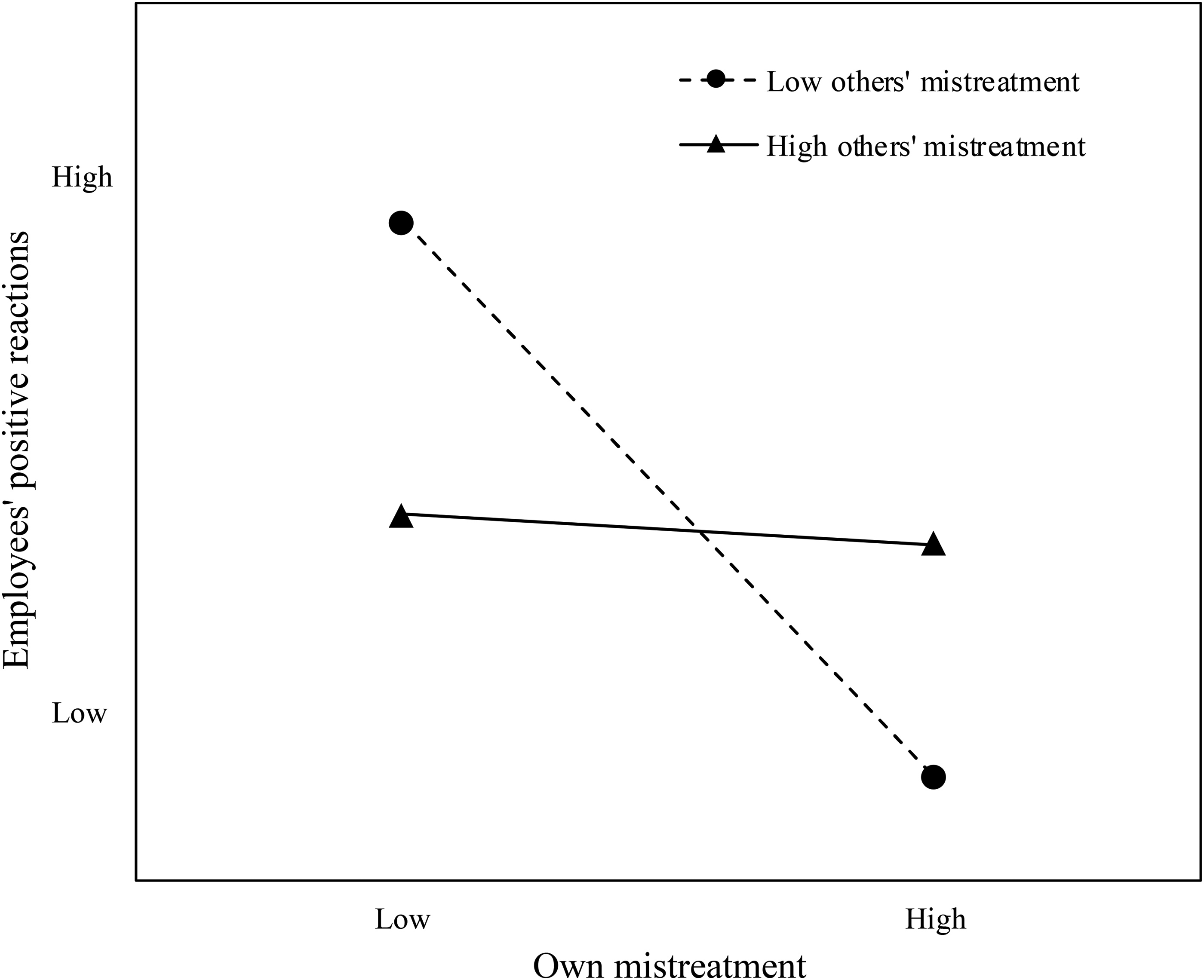
General Form of the Interactive Effect Between One's Own and Others’ Mistreatment on Employees’ Positive Reactions
Review of Theoretical Explanations on Mistreatment in Social Contexts
The experience of being singled out for mistreatment in a social context appears to be a disquieting experience for individuals. Across the 64 articles in our review, when the focal employee perceives his/her mistreatment to be more intense compared to others, s/he generally experiences a wide range of negative affective, cognitive, and behavioral outcomes (e.g., Harris, Li, & Kirkman, 2014; Jiang, Gu, & Tang, 2019; Tse, Lam, Gu, & Lin, 2018; Wang, Jiang, Liu, & Ma, 2017). However, in this body of literature, we also observed an amalgam of alternative theoretical explanations and the presence of several plausible mechanisms to explain the consequences of mistreatment in the social context. Put differently, the literature stands at a point where we are clear on the “what” but not on the “why.” Progress needs to be made in terms of refining the underlying conceptual knowledge and pruning theoretical perspectives and explanations that lack conceptual veracity and/or corresponding empirical support (Edwards & Berry, 2010). As such, in this review, we aim to summarize the empirical research on social-context mistreatment based on commonalities and differences across current theoretical viewpoints so that we can identify specific areas where future research should take place.
Toward this end, we conducted an in-depth analysis of the existing theoretical landscape. In our analysis of the current literature, a majority of the studies are predicated on at least one of the following six theoretical frameworks—social comparison, justice/fairness, social identity, attribution, social exchange, and social cognitive perspectives. Two other miscellaneous theories appear in the literature but in a more isolated way. 1 In our judgment, across these six frameworks, we observed that there are two overarching theoretical assumptions. First, when an individual is targeted for mistreatment, s/he tries to understand why it occurred and uses information in the social context to judge how severe, unusual, or unfair the mistreatment is and/or to determine who is responsible for the mistreatment. When viewed from this higher vantage point, we conclude that sensemaking (Maitlis & Christianson, 2014; Weick, 1995; Weick, Sutcliffe, & Obstfeld, 2005) and social information processing (SIP) perspectives (Salancik & Pfeffer, 1978) can be considered broad umbrella theories to integrate the literature. Specifically, regardless of the types of specific theoretical mechanisms that researchers choose, the sensemaking and SIP perspectives can help to organize the current theoretical explanations and, more importantly, move in the direction of “why” individuals react to mistreatment targeting both oneself and others, in addition to “what” caused the social-context mistreatment.
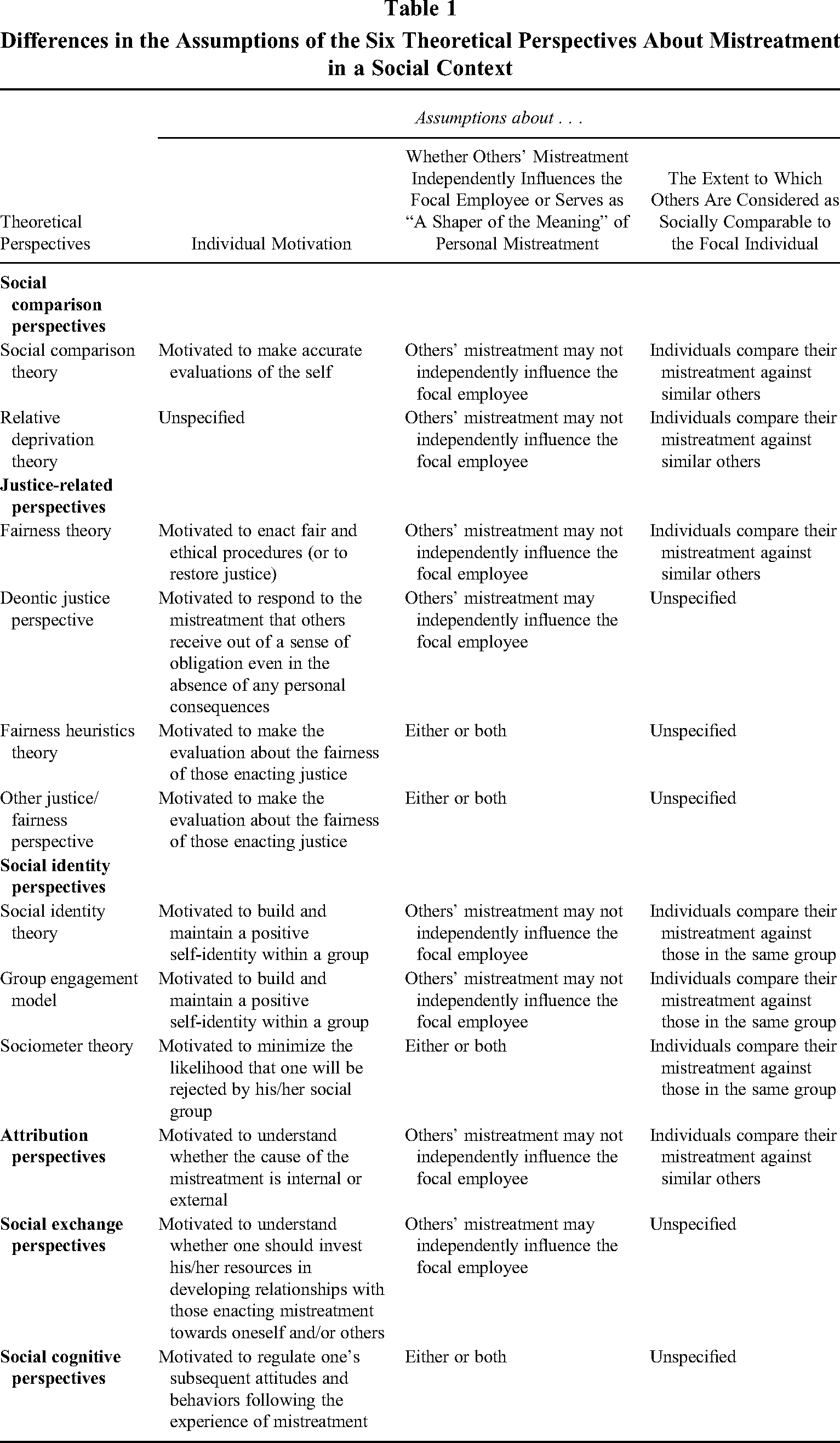
In the following sections, we first provide a review on how the six theories have guided previous empirical research on the phenomena of mistreatment in the social context, using representative studies for each theory. At the end of each view, we describe how the theory posits the process by which individuals react to their own and others’ mistreatment. Specifically, guided by the sensemaking and SIP perspectives, we focus on why individuals are motivated to make sense of their own mistreatment and what role contextual information of others’ mistreatment would play. We summarize this in Table 1. We then elaborate on how the theories identified in our review can be subsumed and tied together under the more encompassing sensemaking and SIP perspectives. Finally, based on the distinctions across the six theories, we present a set of research questions that could guide future research in this topic.
Differences in the Assumptions of the Six Theoretical Perspectives About Mistreatment in a Social Context
Social Comparison Perspectives
Social comparison theory (Festinger, 1954), its variants, and its predecessors (e.g., relative deprivation theory) are perhaps the dominant theoretical frameworks in our review and appear in at least 20 articles (see the online supplemental material). Adopting the social comparison perspectives, researchers show that unfavorable social comparison (i.e., being treated worse than others) exacerbates the negative impacts of personal mistreatment (e.g., abusive supervision, lack of justice) on various affective, cognitive, and behavioral outcomes including envy, resentment, organization-based self-esteem, turnover intention, and voice (Farh & Chen, 2014; Grienberg, Rutte, & van Knippenberg, 1997; Koopman et al., 2020; Ogunfowora, Weinhardt, & Hwang, 2019). However, the social-comparison literature does not yield a completely uniform pattern of findings. Ambrose and Kulik (1989, 1991) did not find a significant interaction effect between process control for the self and for the referent other (e.g., the levels of input individuals are allowed to provide in terms of how and what tasks to be completed) on fairness and satisfaction. Similarly, personal incivility and group incivility differentiation have a significant interaction effect on organizational citizenship behavior toward individuals but not on task performance and counterproductive work behavior (Mao et al., 2019). As we discuss later, the types of mistreatment could affect how individuals engage in social comparisons when being singled out for mistreatment.
Despite its popularity as a primary theoretical framework in the literature of mistreatment in context, we contend that social comparison theory has not been applied appropriately. The key rationale for adopting social comparison perspectives in the context of mistreatment is, according to our interpretation, that individuals use mistreatment of similar others in the same social context (e.g., group members who have the same supervisor) as a standard for accurately evaluating and interpreting the implications of their own mistreatment. That is, when levels of mistreatment in a group are low, reactions to high levels of individual mistreatment should be quite negative. The theory further suggests that when group mistreatment is high, reactions to low levels of individual mistreatment should be positive because the individual fares well in the social comparison.
The key to our contention occurs when individual mistreatment matches what is experienced by others in the social environment. According to the theory, we believe that negative reactions should be muted or neutral when one's experiences are in line with the experiences of others in the social context. That is, social comparison theory predicts positive reactions when one's experiences compare favorably to others’ experiences, negative reactions when one's experiences compare unfavorably to other's experiences, and more neutral reactions when treatment is consistent between the individual and the group. Thus, it is arguable that a social comparison theory derivation does not imply a multiplicative interaction between individual- and group-level mistreatment but rather two additive or main effects of opposite signs. Using job satisfaction as an example outcome, social comparison theory would predict that individual-level mistreatment would be negatively related to job satisfaction whereas group-level mistreatment would be positively related. This pattern, however, is rarely observed—if at all—in the current literature. Based on our view, we would encourage future researchers to explore the application of social comparison theory conceptually and empirically in future studies.
Justice/Fairness-Based Perspectives
Several justice/fairness-based perspectives—fairness heuristic, fairness, and deontic justice theories—are also a popular choice for researchers in this area. Other articles’ theorizing was grounded in more general justice/fairness-related perspectives such as principles of equity and equality, organizational justice theory, and the appropriateness framework, etc. We elaborate throughout.
Fairness heuristic theory. Fairness heuristic theory describes the process whereby people form fairness judgments about their authority figures based on their organizational experiences. These experiences serve as heuristics and guide their subsequent attitudes and behaviors in their organizations (Colquitt & Zipay, 2015; Lind, 2001). In line with the logic of fairness heuristic theory, previous studies evince that one's procedural (in)justice hinges upon others’ procedural (in)justice to affect helping behaviors, negative emotions (anger and frustration), antisocial intentions, and retaliation (De Cremer & Van Hiel, 2010; Jones & Skarlicki, 2005; Shin, Du, & Choi, 2015). The theory suggests that employees incorporate others’ procedural (in)justice experiences as part of social information to determine reactions to their own experiences of procedural (in)justice.
Fairness theory. Fairness theory (Folger & Cropanzano, 2001) explains that when individuals are mistreated at work, they do not simply react to their current circumstance but rather engage in counterfactual thinking about how the situation should, could, and would have unfolded differently. Counterfactual thinking is an automatic response to a certain event and partly shaped by one's personal experiences (e.g., past interaction and relationship quality with supervisors and/or colleagues) as well as situational factors (e.g., personality and behaviors of supervisors and/or colleagues, kinds of treatment experienced by his or her colleagues or someone serving as his or her standards of comparisons) (Roese, 1997). Drawing on fairness theory, Duffy et al. (2006) found that employees who are singled out for social undermining (i.e., intentional behavior that harms employees’ interpersonal relationships and performance at work; Duffy et al., 2002) are more adversely affected and experience lower justice perceptions, resulting in lower job satisfaction, higher intention to quit, more self-initiated undermining behaviors and counterproductive work behaviors, greater depression, and reduced individual performance. Also, task performance and psychological reactions were highest and most favorable, respectively, when one's own and team members’ procedural justice were both high, whereas their reactions were most negative when individuals were sole targets of procedural injustice (Colquitt, 2004). In other words, negative reactions would be stronger when one's experience of procedural injustice was higher than others.
Deontic justice theory. Deontic justice perspective also suggests that individuals are unlikely to interpret personal mistreatment in a vacuum, but rather they are expected to reflect on others’ experience to determine their subsequent reactions. Specifically, employees care about immoral behaviors targeting others, as people's concern about justice is based not only on mere self-interest but also a sense of duty and obligation to correct injustice (Folger & Skarlicki, 2008; Skarlicki & Kulik, 2005). The theory thus suggests that differential mistreatment (the situation where the levels of one's own and others’ mistreatment do not match) give rise to negative work outcomes, as employees are adversely affected when observing others’ mistreatment. Consistent with this prediction, leader's differential treatment invokes unethical attitudes and deviant behaviors of employees (Ogunfowora, 2013). Also, interactional justice had a weaker positive impact on LMX when interactional justice differentiation was high (He, Fehr, Yam, Long, & Hao, 2017). That is, favorable treatment backfires when it is unevenly distributed among employees.
Other justice/fairness perspectives. Other researchers adopted more generalized theories about justice/fairness—viz, principles of equality and equity (e.g., Hooper & Martin, 2008; Zhao, 2015), organizational justice theory (Emery et al., 2019), relational theories of procedural justice (Chen, He, & Weng, 2015), justice climate theory (Erdogan & Bauer, 2010), and the appropriateness framework (Haynie, Cullen, Lester, Winter, & Svyantek, 2014). Some simply examined justice/fairness perception as a mediator through which differential mistreatment impacts employees (e.g., Chen et al., 2015; Liden, Erdogan, Wayne, & Sparrowe, 2006; Lind, Kray, & Thompson, 1998). Overall, these theories posit that employees judge whether their own treatment is fair and appropriate based on how others are treated. Empirical evidence shows that LMX differentiation was negatively related to employees’ justice and fairness perceptions (Emery et al., 2019), job satisfaction, well-being (Hooper & Martin, 2008), interactional justice climate (Xie, Li, Jiang, & Kirkman, 2019), and team creativity via increased relationship conflict (Zhao, 2015). LMX differentiation also suppressed the benefits of LMX such that it reduced the positive impacts of LMX on employee performance (Liden et al., 2006) and job dedication (Chen et al., 2015). Differentiated treatment from a leader makes employees’ concern about justice more salient, and employees perceive that the norm of equality is violated, leading them to question their leader's neutrality and fairness.
These four justice-based perspectives are grounded in the premise that individuals seek for fair and appropriate treatment for oneself (fairness heuristics theory, fairness theory, and other justice perspectives) as well as for others (deontic justice theory). However, as illustrated in Table 1, these theories can differ in terms of how one responds to others’ mistreatment. In particular, whereas fairness theory proposes that individuals use others’ mistreatment as a reference to consider how their own situation could have unfolded differently and how the authority figure who enacted the injustice should have acted differently, deontic justice perspective suggests that others’ mistreatment invokes one's retributive motive but may not influence his/her interpretation of personal mistreatment. Despite the consistent findings in terms of the singled-out effect of mistreatment on justice/fairness perception in the literature, there seem to be different assumptions about how others’ mistreatment affects individuals.
Social Identity Perspectives
A core tenet of social identity theory (Tajfel & Turner, 1986) is that people strive to attain a positive self-image by identifying with the group that confers high status upon them. According to the theory, membership in valued social groups constitutes a source of pride and self-esteem and helps individuals form a positive self-identity. When personal abusive supervision is high relative to group-level abusive supervision, focal employees would believe that others show lower respect, resulting in low organizational identification, affective commitment, task performance, and high turnover intention (Schaubroeck, Peng, & Hannah, 2016). Social identity would also play a role in shaping a leader's evaluation of his/her employees, and leader's evaluation was lowest when LMX was low, whereas LMX differentiation was high (Ma & Qu, 2010). This is because employees with low levels of LMX may be less likely to be identified as an in-group member by the leader, particularly when LMX is highly differentiated among group members.
We also identified two other theories germane to the social-identity mechanism. First, group-engagement model (Tyler & Blader, 2003) explains that one's group identification determines the internal motivation to engage in cooperation in groups; individuals demonstrate discretionary cooperative behaviors and hold positive values and attitudes toward their groups when they seek to cultivate a favorable identity. Employees may be unlikely to identify with the organization when their standing in the group, which is typically signaled by leader's treatment, is lower compared to others (Zhao, Liu, Li, & Yu, 2019). Further, the interactive effect of one's own and others’ mistreatment from the leader is particularly detrimental when the leader represents the group's values and goals, as his/her attitudes and behaviors would carry more meaningful information to interpret one's own group standing (De Cremer, Van Dijke, & Mayer, 2010). Second, sociometer theory argues that individuals monitor their social environments to gauge their social standing and worth in the group. The theory emphasizes corrective responses individuals would take to protect their relational value and reduce the chance of being rejected by the group (Leary, 2005). When the focal employee was the sole victim, experienced incivility leads to self-blame, which then causes greater rumination, stress, and withdrawal behavior to prevent the reoccurrence of the negative experience (Schilpzand, Leavitt, & Lim, 2016).
These social identity perspectives present another rationale concerning the joint effect of one's own and others’ mistreatment. Personal mistreatment may signal one's social status insofar as others in the same group are not mistreated. In other words, when a leader is unfair to all, the focal employee who is mistreated cannot effectively gauge how s/he is seen in the group relative to others. Similar to social comparison theory and fairness theory, social identity perspectives assume that individuals use the mistreatment of comparable others as a reference point to evaluate their own mistreatment, whereas others’ mistreatment may not have a direct implication in social identity concerns.
Attribution Perspectives
Attribution theory (Kelley, 1967; Kelley & Michela, 1980) suggests that individuals attribute personal mistreatment to either internal or external causes. When supervisors mistreat everyone, employees would likely interpret the behavior to be caused by some external cicumstances that are beyond their own control (e.g., supervisors’ flaws), whereas mistreatment that exclusively targets one employee would induce internal attribution of its cause (e.g., their own mistakes or some internal traits/characteristics). Such internal attribution leads to greater strain and shame, which may result in subsequent negative outcomes (turnover intention, internet addiction, problem drinking, and problem smoking; Huo et al., 2012; Peng et al., 2019). However, internal attribution of personal mistreatment may not always result in the most intense reactions. For some discrete emotions like fear, employees exhibit a stronger affective reaction when others in the social context are also subjected to the mistreatment than when being the sole targets (Peng et al., 2019). Also, helping and creative behaviors of employees who experienced low procedural justice were higher when others’ procedural justice was high, whereas procedural injustice led to the most negative outcomes when others are also treated unfairly (Du, Choi, & Hashem, 2012).
Despite some inconsistency surrounding when internal attribution of personal mistreatment would exert more deleterious effects, the notion that one's attribution of personal mistreatment is susceptible to situational influence is a relatively robust finding in the literature. Therefore, whether one attributes mistreatment to internal or external causes depends on the extent to which others in the same context are also mistreated. As in social comparison theory, fairness theory, and social identity theory, attribution perspectives delineate similar assumptions concerning how others’ mistreatment would influence one's interpretation of personal mistreatment.
Social Exchange Perspectives
Governed by the norm of reciprocity (Gouldner, 1960), social exchanges refer to the relationships between exchange partners that are enduring and based on feelings of trust, shared investment, and unspecified obligations to one another (Blau, 1964; Cropanzano & Mitchell, 2005). In the context of mistreatment, Peng et al. (2014) found that employees are unlikely to build high-quality relationships with both the leader and coworkers when s/he is singled out for abusive supervision. When peer abusive supervision is low (vs. high), one's direct experiences with the leader would serve as a primary cue to decide whether a high-quality exchange relationship is possible and if s/he should commit to building such a relationship. Also, members are unlikely to respect and build positive relationships with individuals who are exclusively abused by the leader, hampering the development of affective trust among coworkers. In general, the absence of mistreatment among others makes personally experienced mistreatment more distinct and salient, impairing the quality of interpersonal relationships. However, Harris, Harvey, Harris, and Cast (2013) demonstrated that the absence of abusive supervision toward others might qualify, rather than intensify, the negative impact of personal mistreatment. In their interaction plot, the effect of one's own abusive supervision on perceived organizational support was weakened as vicarious abusive supervision increased—a form that was opposite to the general pattern of the interplay of one's own and others’ mistreatments shown in Figure 1. The weakening effect of vicarious abusive supervision in Harris et al. (2013) suggests that the absence of others’ mistreatment potentially signals that the organization may not condone supervisory abuse and take corrective steps against the mistreatment.
As such, scholars have explored how mistreatment in a social context can shape people's relational bonds with leaders and other members in the same group based on social exchange perspectives. Employees’ perceptions about the potential to build positive relationships with their exchange partners are shaped by both direct mistreatment and indirect or vicarious one that is targeted at third-party individuals in the same work group or organization. Evidently, the way others’ mistreatment is supposed to affect individuals in the social exchange framework may be more akin to deontic justice perspective—that is, others’ mistreatment is not a mere reference point to assess the severity of his/her own mistreatment. Rather, individuals would see it as a separate source of information to decide the level of relational investment they would make with the exchange partner.
Social Cognitive Perspectives
Scholars also apply social cognitive theory (Bandura, 1988; Wood & Bandura, 1989) to social context of mistreatment, with a particular emphasis on how social environments shape one's self-regulatory processes following the incident of mistreatment (Bandura, 1991). Hannah et al. (2013) revealed that individual-level and group-level abusive supervision jointly prompt one to reflect upon his/her moral agency (i.e., capability to think morally and take actions in accordance with what is right and wrong; Bandura, 1986). Specifically, although abusive supervision does not have a potent influence when others are also abused, it constrains one's moral agency and thereby increases one's unethical attitudes and behaviors at work when s/he is singled out for the abuse. Tong, Chong, and Johnson (2019) investigated self-blame as one's self-evaluative reaction to experienced and observed incivility. When incivility is highly distinctive, an employee is likely to believe that he/she triggered incivility from others and to resort to blaming him/herself for the situation. These authors reported that experience of workplace incivility had a positive effect on self-blame when individuals did not observe incivility elsewhere in the social context but not when observed incivility was high.
Both studies underscore the simultaneous influence of personal and others’ mistreatment on one's self-evaluative reactions to mistreatment, such that experienced mistreatment has stronger effects on moral agency and self-blame when others are not mistreated. However, given that incivility is usually ambiguous in terms of perpetrator's intent to harm, individuals need to compare personal incivility against others to blame either themselves or others, which is analogous to attribution perspectives (Tong et al., 2019). In contrast, both personal and others’ abusive supervision would affect moral agency independently, which does not involve social comparison (Hannah et al., 2013). Specifically, a failure to take morally right actions against abusive supervisors thwarts one's moral agency, regardless of whether the target of the abuse is oneself or others. Thus, others’ mistreatment may influence one's cognition either directly or indirectly (i.e., via the social comparison process) depending on the type of self-evaluations one makes following personal mistreatment.
Summary of the Current Literature on the Social Context of Mistreatment
As readers can observe from our summary of the theories and empirical findings, the interplay of one's own and others’ mistreatment is in something of a unique state in the literature. Although some exceptions did exist (e.g., Ambrose & Kulik, 1989; Ambrose, Harland, & Kulik, 1991; Du et al., 2012; Harris et al., 2013), our analysis of the empirical databank reveals an encouraging level of consistency in people's experience of mistreatment in a social context—generally, people are more adversely affected when they are the sole targets of mistreatment. Furthermore, researchers have proposed and tested intriguing affective and cognitive mechanisms through which mistreatment in a social context affects individuals. As mentioned in the beginning, the accumulation of empirical evidence has indeed deepened our understanding about what happens when mistreatment is directed toward selected individuals or only a single person in a given context. But, presence of various explanations might result in ambiguity about why victims of mistreatment look for certain contextual cues in the first place and why the experience of others’ mistreatment shapes one's interpretation of personal mistreatment.
In the following section, we aim to synthesize the theoretical explanations revealed in our review to shed light on the questions of why. We conduct an in-depth analysis of these six theoretical explanations. In Figure 2, we summarize the similarities and differences across the extant theoretical frameworks and propose an integrated conceptual process model that describes how individuals would react to mistreatment while taking a social context into consideration.
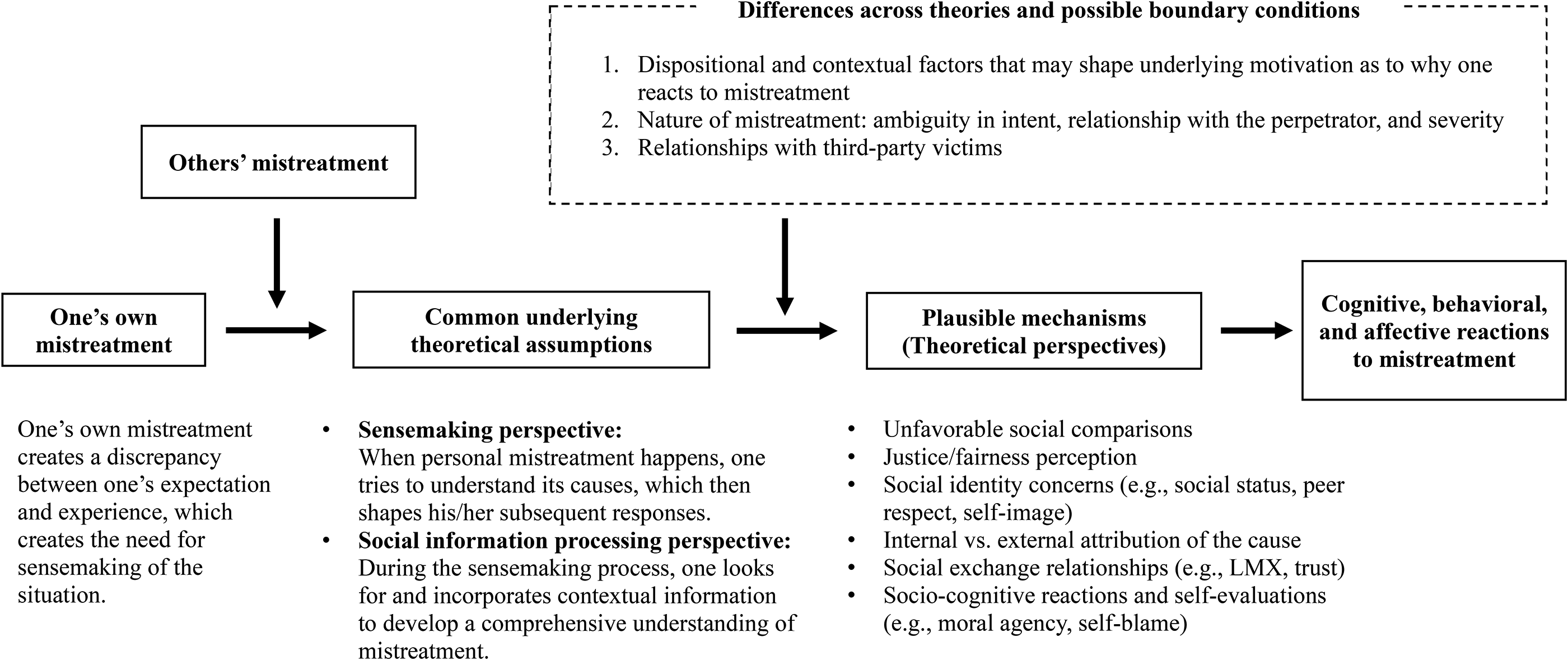
Conceptual Process Model for Mistreatment in the Social Context
Synthesis of Theoretical Explanations
Sensemaking and Social Information Processing as Umbrella Perspectives
Although the theoretical perspectives reviewed previously differ in terms of their presumed mechanisms, they can be tied together with two umbrella assumptions: (1) people are motivated to make sense of the situation when faced with novel, unexpected, and/or negative events to develop a better understanding about the events and to enact necessary changes, and (2) people interpret the meanings and reasons of the personal experience of mistreatment based on the information that they process from their social environments. When an unexpected event causes discrepancy between one's expectations and experience, people become uncertain about how to act in the given situation and motivated to reduce ambiguity through sensemaking activities (Maitlis & Christianson, 2014; Weick et al., 2005). Specifically, people try to understand why the event occurred and how to regulate their behaviors in response to the event. Simultaneously, such discrepancy should also motivate people to look for contextual information to deal with uncertainty as a sensemaking social process (Brockner & Wiesenfeld, 1996; Salancik & Pfeffer, 1978; Weick et al., 2005).
Mistreatment such as verbal abuse, workplace bullying, undermining behaviors, and incivility at work—whether the sources are from leaders or coworkers—are generally considered to be disruptive events that interrupt employees’ daily work procedures and activities. Workplace mistreatment is also commonly viewed as an issue that requires an explanation and needs to be resolved, as it violates employees’ expectations of appropriate treatment. Moreover, individuals are more likely to initiate sensemaking when a given event presents threats to their individual identities (Maitlis & Christianson, 2014). For instance, a supervisor's derogatory comments about a follower's work performance would signal a lack of competence, and the follower might question his or her identity as a capable organizational member. To mitigate intense emotional discomfort associated with such a threat and restore their own identity, employees are prompted to identify the cause of the mistreatment and take corrective actions accordingly. Hence, mistreatment at work should trigger sensemaking as a common reaction to interpret its meaning. The sensemaking perspective also suggests that employees’ unique mental models would influence and guide how the experience of mistreatment is perceived and interpreted (Weick et al., 2005). To make sense of given mistreatment, employees would reflect on their own past behaviors (e.g., if they engage in any behaviors that caused the mistreatment) and/or previous history with its perpetrators (e.g., if the perpetrators previously treated them unfairly too).
Furthermore, this effort involves a social process where people rely on relevant cues from environments (Maitlis & Christianson, 2014; Weick, 1995). In line with the SIP view (Salancik & Pfeffer, 1978), the information available from one's immediate social environments also shapes his/her social attitudes and behaviors along with personal experiences. In this context, employees are likely to interact with their immediate environments to gain a comprehensive understanding of their experience of mistreatment. For example, employees might construct different meanings about the same abusive behavior from their supervisors, depending on the frequency and pervasiveness of the mistreatment (e.g., does my supervisor always act in a disrespectful manner or is this a one-time event? Does my supervisor abuse my coworkers as well or is it only me who is abused?). One's social context has considerable influence on how individuals interpret and derive meanings from the event (Johns, 2006).
The major theoretical frameworks identified in our review are predicated on sensemaking and SIP perspectives. As delineated in the preceding section and Figure 2, we propose that sensemaking and SIP perspectives explain the process by which one's attitudinal, cognitive, and behavioral responses unfold following the incident of personal mistreatment. First, the experience of mistreatment causes sensemaking, because the mistreatment is usually discrepant from employees’ expectations about fair treatment in organizations and presents itself as a potential threat. In other words, sensemaking may be an initial reaction to personal mistreatment, which then leads to some forms of victim's cognitive responses—that is, being singled-out for mistreatment would prompt targets to understand their current situation by comparing oneself with others, engaging in counterfactual thoughts, making a judgment about fairness and appropriateness of the given treatment, reflecting on one's self-concept and social identity and status within a group, attributing the cause of mistreatment to either internal or external factors, assessing one's investment in social exchange relationships, or making sociocognitive self-evaluation. Although individuals might not be concerned about how others are treated at this initial stage of sensemaking, they would subsequently reflect on and make evaluations of others’ mistreatment, as this information would enable them to regulate their future attitudes and behaviors more effectively. As such, sensemaking processes are likely to be followed by social information about one's peers and group. As shown in previous studies in our review, the impact of personal mistreatment, to a considerable extent, is thus context dependent across a wide range of samples, types of mistreatment, and outcome variables.
To summarize, through the synthesis of the literature, we shed light on these two underlying assumptions about an employee's reactions to mistreatment in a social context. The literature, in toto, suggests that this sensemaking process is likely to be particularly acute and active when one is singled out for mistreatment in a social context. Taken together, the sensemaking and SIP perspectives serve important theoretical umbrellas for why a given social context can shape the effect of personal mistreatment on employees.
Differences in Theoretical Explanations and Potential Boundary Conditions for Mistreatment in a Social Context
Dispositional and Contextual Factors as Moderators
As noted previously, our effort in illuminating the common assumptions that lie in the six theoretical perspectives for the interaction effect also helped us identify at least three differences among them, which pointed to some promising areas of future research regarding potential boundary conditions for the interaction effect (Table 1). Firstly, the previous theoretical explanations are predicated on different assumptions about individual's motivation in interpreting one's own and others’ experiences of given mistreatment. Although social comparison theory posits that people refer to one's own and others’ mistreatment to make accurate evaluations of themselves, justice-related perspectives generally concern one's motivation to seek fair and ethical treatment for oneself and others. Likewise, in attribution theory, a more prominent motivation is to understand potential causes of mistreatment, whereas less emphasis is on understanding one's social identity (social identity perspective), assessing whether they should form social exchange relationships with those enacting mistreatment (social exchange perspective), or regulating one's future attitudes and behaviors (social cognitive perspective).
These distinctions in theoretical premises shed light on several individual and contextual variables that could influence the interactive effects and explain when mistreatment takes individuals down different cognitive paths. For example, Colquitt (2004) found the moderating effects of several individual and contextual variables on the interaction effect between one's own and others’ procedural justice (e.g., task interdependence and equity sensitivity). Schaubroeck et al. (2016) reported that the adverse impact of relative abusive supervision on perceived peer respect was intensified when individuals perceived their groups to be more potent (i.e., the collective belief among group members about group capabilities; Gully, Incalcaterra, Joshi, & Beaubien, 2002), because individuals tend to be more sensitive to negative interactions and their membership in a high-status group than in a low-status one.
The different theoretical views appear to lend themselves to different categories of boundary conditions. For example, drawing on social cognitive theory in terms of morality, we expect that one's moral character—personal differences in thinking, feeling, and acting in an ethical manner (Cohen & Morse, 2014)—may serve as a dispositional factor that may strengthen the interactive effect between personal and others’ mistreatment. Also, the interactive effect may be contingent on contextual factors, such that the deleterious effects of highly differentiated LMX in a group are mitigated under high justice climate (e.g., Erdogan & Bauer, 2010; Haynie et al., 2014). Likewise, future studies can test whether justice climate attenuates the adverse effect of high personal mistreatment combined with low others’ mistreatment. Depending on dispositional, contextual, and even societal and cultural factors, people incline toward different values and goals (e.g., Hollenbeck & Brief, 1987; Markus & Kitayama, 1991; Schwartz, 1992). As evidenced by a wide range of theoretical perspectives and explanatory mechanisms being proposed and tested in extant research, individual and contextual differences might make employees more or less prone and sensitive to certain types of mistreatment as well as their consequences over others. Research Question 1: What are the dispositional and contextual factors that influence the interactive effect of own and others’ mistreatment in a social context?
Intention Ambiguity, Prior Relationships, and Mistreatment Severity as Moderators
The theoretical explanations we examined in our review make different assumptions about how contextual information about others’ mistreatment influences individuals. From a social cognitive view, one's moral agency is shaped in part by one's success or failure in acting in response to someone's mistreatment toward others (Hannah et al., 2013). Deontic justice theory revolves around the assumption that people react to others’ mistreatment out of their moral concern and obligation. Social exchange theory also suggests that individuals likely perceive the perpetrators of mistreatment to be untrustworthy and unworthy as long-term social exchange partners, even if they did not personally experience mistreatment (Peng et al., 2014). According to these theories, observing others’ mistreatment may have a relatively direct bearing on forming one's belief about moral efficacy and justice as well as developing interpersonal relationships.
In contrast, as we summarize in Table 1, the social context of mistreatment can also serve as “a shaper of meaning” (Johns, 2006). Specifically, others’ mistreatment is presumed to influence one's introspective reactions toward personal mistreatment in social comparison theory, fairness theory, social identity theory, group-engagement model, and attribution theory. Put differently, these theories suggest that others’ mistreatment itself might not shape one's attitudes and behaviors toward the perpetrators and/or targets of the mistreatment, but rather individuals consider it as a complementary piece of information to assess personal mistreatment. According to social comparison perspectives, individuals use others’ mistreatment as a referent against which they assess how unfair their own personal treatment is. Fairness theory does not specify how others’ mistreatment independently affects one's cognition but suggests that the individual uses the information of others to evaluate the feasibility and mutability of counterfactual thoughts that are originally derived from his or her personal experience of mistreatment. Social identity theory and group-engagement model also consider others’ mistreatment as contextual information for people to understand their value and social status, a process that begins when individuals are targeted for mistreatment. Similarly, the attribution framework suggests that people use others’ mistreatment to determine what specific causes they should attribute their personal mistreatment to. As such, these theories appear to emphasize that victims of mistreatment explicitly engage in social comparison of personal versus others’ mistreatment.
Such differences among the theoretical explanations suggest that when mistreatment is ambiguous in terms of perpetrators’ intent to harm (e.g., workplace incivility and abusive supervision; Blau & Andersson, 2005; Tepper, 2000; Tong et al., 2019), theories such as social comparison theory, fairness theory, social identity theory, group-engagement model, and attribution theory seem more useful, because they assume that one's interpretation of personal mistreatment hinges on others’ mistreatment. High ambiguity in the perpetrators’ intent of mistreatment would likely present a difficulty in accurately interpreting one's own mistreatment, which raises the need for comparing oneself to referent others (e.g., Festinger, 1954). Contextual information about others’ mistreatment, through the social comparison process, can help victims put the mistreatment into perspective and understand whether it has any consequential implications in such outcomes as justice perceptions, self-image, and status within a group.
In contrast, the explanations that do not involve the social comparison process (i.e., social exchange perspective, deontic justice perspective, and social cognitive perspective of morality) may be more applicable for understanding the types of mistreatments that are unambiguous regarding intent. When mistreatment intent is unambiguous, the meaning of personal mistreatment is evident, and the need for social comparisons is reduced. Social exchange theory does not assume that individuals engage in comparison or use others as baseline to evaluate their own mistreatment. As Peng et al. put, “own and peer abusive supervision each has essentially the same adverse influence on social exchange relationships” (2014: 1389). Similarly, from the viewpoint of deontic justice theory, when people are already adversely affected by personal mistreatment, one's retributive motive being derived from witnessing others being mistreated may not further exacerbate the negative effects of personal mistreatment (i.e., one's reaction may be negative throughout the levels of personal mistreatment when others’ mistreatment is high). Also, as mentioned previously, social cognitive perspective of morality predicts that both personal and others’ mistreatment would precipitate the same self-reactive process and influence one's moral agency (Hannah et al., 2013). Hence, the extent of ambiguity in the perpetrators’ intent of mistreatment can be an important factor to distinguish which explanatory mechanisms may provide a reasonable account for the interactive effect. Research Question 2a: Does the ambiguity of mistreatment in the perpetrator's intent to harm influence the interactive effect of own and others’ mistreatment in a social context?
Similarly, given that the social comparison process plays an important role in understanding mistreatment in a social context, the victim's relationship with the perpetrator of mistreatment could also influence the extent to which one relies on contextual information of others’ mistreatment. In particular, familiarity with the perpetrator should help the focal employee correctly infer the intent of the perpetrator from his/her actions, regardless of whether the relationships between the perpetrator and victim may be positive or negative. Knowledge and familiarity with the perpetrator might thus reduce one's need to look for additional information from a context as well as to rely on their referent others to understand why the mistreatment happened. As such, the theoretical perspectives being predicated on the social comparison process might be less germane when the victim has already sufficiently known the perpetrator's characteristics. We therefore surmise that one's prior interactions and relationships with the perpetrator could also affect how one would react to personal and others’ mistreatment and should inform the choice of more plausible theoretical explanations. Research Question 2b: Does the relationship with the perpetrator of mistreatment influence the interactive effect of own and others’ mistreatment in a social context?
In a related vein, the severity of mistreatment may also play a role. For example, abusive supervision could exert a stronger negative impact compared to a low level of interpersonal justice from his/her supervisor, as the presence of abuse is likely to be more potent and salient than the absence of fair treatment from the standpoint of the victim. When employees experience the higher-severity mistreatment, the negative impact of one's own mistreatment may override the importance of considering others’ experiences of mistreatment. In contrast, when mistreatment is low to mild in its intensity, the focal employee may find it more difficult to understand the meaning and implications of the mistreatment like incivility, and therefore, search for relevant social information (Tong et al., 2019). As such, the severity of mistreatment may influence the extent to which the impact of personal mistreatment is moderated by others’ mistreatment in the same social context. Research Question 2c: Does the severity of mistreatment influence the interactive effect of own and others’ mistreatment in a social context?
Relationships with Third-Party Victims as Moderators
A third dimension that distinguishes the theoretical explanations concerns the characteristics of others who experience mistreatment in each social context—more specifically, the six theories hold different premises about the extent to which others are considered as socially comparable to the focal individual (Table 1). Social comparison theory explicitly postulates that individuals compare themselves with similar others, because people cannot accurately assess their own abilities or opinions when referent others are too divergent (Festinger, 1954). Individuals are thus less likely to make interpretations about their own mistreatment with reference to others outside their own social context. Similarly, as suggested by fairness theory, counterfactual thoughts about personal mistreatment should be less feasible and less likely to be conjured up when the target compares him/herself with those who are widely divergent (Duffy et al., 2006). For instance, an employee should find it more difficult to imagine that a supervisor who mistreated him/her could have acted differently when coworkers working for a different supervisor are treated fairly (less socially comparable), compared to when the coworkers working for the same supervisor received fair treatment (more socially comparable). Further, as social identity perspectives specifically concern how individuals develop self-image and attain social identity in specific groups such as work units and organizations, employees should choose others in the same group (i.e., more socially comparable) to compare each other's mistreatment to make sense of their social status and worth within their groups. Finally, in the attribution framework, one is expected to compare him/herself with others of similar qualities, as comparisons with dissimilar others would not constitute useful information to determine whether one should internally or externally attribute the cause(s) of mistreatment.
However, social exchange theory and justice-related perspectives (except for fairness theory) suggest that employees likely judge supervisors and/or coworkers, who are uncivil and unfair toward someone, to be not trustworthy enough to develop social exchange relationships, even if the victim works in a different unit or team (e.g., Folger, 2001; Skarlicki & Rupp, 2010). Likewise, although social cognitive theory proposes that perceived similarity reduces one's moral disengagement by preventing dehumanization of a victim (Bandura, 2002), it does not make a specific prediction about whether personal relationships with recipients of mistreatment modulate reactions to interpersonal mistreatment in context. Generally, failing to act in compliance with personal ethical standards for someone else—be it a close other or not—would challenge one's confidence in the capability to act morally (Hannah et al., 2013).
As such, the analysis of the theoretical explanations raises the possibility that the contextual information of others’ mistreatment might vary the strength of reactions to mistreatment in context, depending on how close or comparable others are to focal employees. As illustrated previously, theories such as social comparison theory and fairness theory explicitly predict that focal employees will refer to their mistreatment with that of someone who is comparable. Hence, these explanations might be less plausible when focal employees view third-party victims to be dissimilar. However, this contingency is rarely considered in the extant literature. It is thus critical to make efforts in accounting for perceived similarity with third-party victims and investigating it as a potential moderating variable in the interactive effect of own and others’ mistreatment.
In a similar vein, future studies can also explore what types of interpersonal relationships might affect the interactive effect. For example, when the third-party employees are their rivals and compete for scarce resources like opportunities for promotion or pay raise (e.g., De Cremer & Van Hiel, 2010; Xu et al., 2020), being singled out for mistreatment might have an even more adverse impact on employees by further intensifying social comparisons and/or the pain of counterfactual thoughts. The utility of the explanations might also vary depending on individual and contextual factors, and some theories might offer a more plausible rationale than others under certain conditions. The interactive effect on relationship quality, for example, may emerge even when focal employees are not personally familiar with third-party victims, but the interactive effect on justice perceptions may be weakened if the focal employees do not personally know about the third-party victims or if they belong to different work teams, given a reduced motive for social comparison. As such, future researchers can consider potential boundary conditions when making comparisons across different theoretical explanations. Research Question 3a: How does the focal employee's relationship with third-party victims influence the interactive effect of own and others’ mistreatment in a social context?
In addition, whether a focal employee directly witnesses the mistreatment of someone or indirectly comes to learn about it may also influence the own/others’ mistreatment interaction. Of the extant research conducted in field settings, others’ mistreatment is usually measured by directly asking the extent to which focal persons observe certain types of mistreatment toward others (e.g., Tong et al., 2019; Zhan, Li, & Luo, 2019) by calculating the mean of group members’ reports about personal mistreatment (e.g., Hannah et al., 2013; Wu, Wang, & Lu, 2018) or by subtracting a focal individual's rating on mistreatment from the group-level mean (e.g., Peng et al., 2014; Peng et al., 2019). In many studies, however, it is unclear if participants observed mistreatment directly or mistreatment was known via other means (conversations with coworkers, rumor, etc.). Indeed, Harris et al. (2013) measured vicarious abusive supervision by using items such as, “I have heard about or witnessed supervisors at work making negative comments about one or more of those below them to others.” Failing to account for the source of contextual information (direct or indirect) about the mistreatment experienced by others may potentially affect the nature of the interactive relationships. Further, if the sources of contextual information (directly witnessing the mistreatment vs. indirectly hearing about it from someone else) do matter, the characteristics of information sources can also be explored. The interactive relationship may be stronger when the source of the information about others’ mistreatment comes from someone who is credible and trustworthy. Using experimental manipulations, for example, researchers can develop an even more fine-grained understanding about when and how mistreatment in the social context affects employees. Research Question 3b: How does the way in which the focal employee obtains the information about others’ mistreatment (i.e., directly witnessing about it or indirectly hearing about it) influence the interpretation of his/her own experience of mistreatment?
Additional Future Directions
Strong Inference Studies
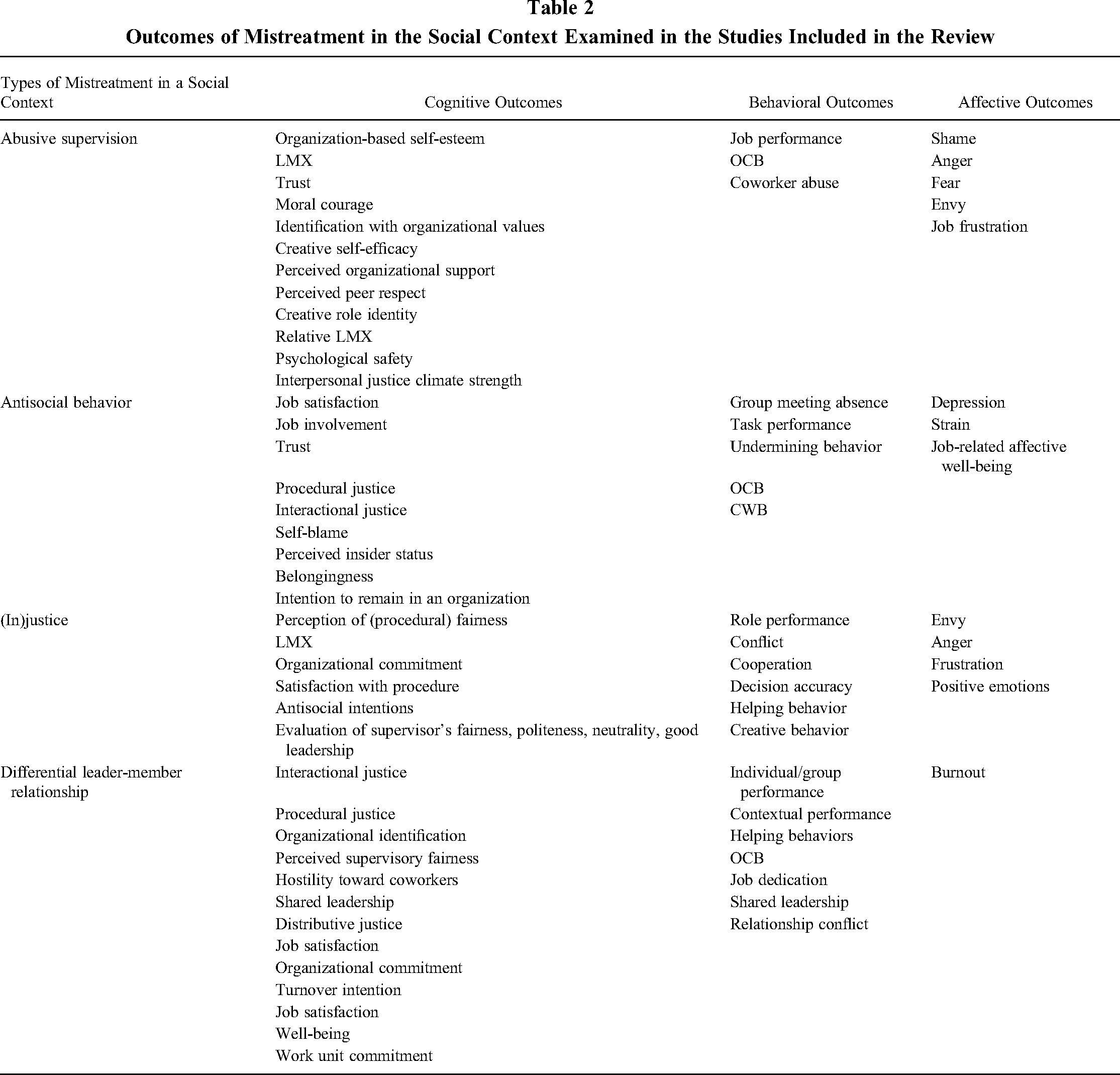
Our review points to the need for future researchers to engage in strong inference testing by concurrently comparing each theoretical mechanism (Leavitt et al., 2010). In Table 2, we classified immediate outcomes of the interactive effect of one's own and others’ mistreatment into three broad categories (affective and stress-related, cognitive, or behavioral). There exist various theoretical mechanisms, including interpersonal relationships, justice, identity, and morality, as well as stress and affective reactions, to explain the influence of different types of mistreatment. For example, one's own and peer experiences of abusive supervision interactively impact employee behaviors and attitudes through such variables as LMX, trust in coworkers (Peng et al., 2014), organization-based self-esteem (Farh & Chen, 2014), affective states (Peng et al., 2019), and psychological safety (Jiang & Gu, 2016). Although employing different theories could enrich our understanding of how and why a phenomenon happens (Whetten, 1989), equally critical is pitting alternative models against each other to determine if theory pruning is necessary (Leavitt et al., 2010; Shaw, Gupta, & Delery, 2005). In some of the recent studies on the interactive effect of own and others’ abusive supervision (Koopman et al., 2020; Peng et al., 2019), scholars made laudable efforts to control for alternative mechanisms derived from different theories. When studying other types of mistreatment in a social context, future researchers may be encouraged to control for alternative explanations and also make specific predictions about which mechanism may be more important, so that the literature moves in the direction of more theoretical parsimony (Edwards & Berry, 2010). Research Question 4: For different types of mistreatment (e.g., abusive supervision, social undermining, incivility, ostracism, [in]justice, and differential leader-member relationship), which theoretical mechanisms are more important than others?
Outcomes of Mistreatment in the Social Context Examined in the Studies Included in the Review
Affective Responses to Mistreatment in a Social Context
As seen in Table 2, relatively fewer affective outcomes have been examined across different types of mistreatment compared to cognitive and behavioral outcomes. Although evidence is sparse, some studies do demonstrate differential effects on emotional outcomes. As mentioned previously, Peng et al. (2019) found that although the positive relationship between abusive supervision and shame was stronger when coworkers were not abused, the relationship with fear was stronger when coworkers were also abused. They also reported that personal abusive supervision was positively related to anger regardless of the level of coworker abusive supervision. Furthermore, although extant research has primarily focused on how own and others’ mistreatment interactively influences employees’ negative emotions, there might exist potential implications in their positive emotions (e.g., De Cremer, Stinglhamber, & Eisenberger, 2005), such that an employee might feel a sense of relief or schadenfreude (i.e., positive emotion derived from others’ misfortune; Li, McAllister, Ilies, & Gloor, 2019) when being singled-out for favorable treatment—instead of mistreatment—in a work group. Future research can be thus built upon the perspectives that are more focused on employees’ affective reactions toward the mistreatment that occurs in a social context. Research Question 5: What are the affective outcomes associated with combinations of own and others’ mistreatment in a social context?
Justification for Operationalizing the Interplay of Own and Others’ Mistreatment
Scholars have chosen various ways for conceptualizing and operationalizing mistreatment in context. Specifically, we observed at least three distinct ways in which researchers approach employees’ reactions to mistreatment in social contexts—individual-level interaction (e.g., De Cremer et al., 2010), cross-level interaction (e.g., Duffy et al., 2006), and differentiation and/or variance (e.g., Schaubroeck et al., 2016). When it comes to differentiation, researchers commonly adopt the dispersion model (Chan, 1998) or calculate coefficient of variance (e.g., Emery et al., 2019). However, there seems to be some inconsistency around single-level and cross-level interactions across studies.
When considering an individual-level interaction, some researchers either manipulate both one's own and others’ mistreatment in experimental settings or approach others’ mistreatment as “observed” or “witnessed” mistreatment by asking participants to rate how often they perceive others to experience certain forms of mistreatment (e.g., Tong et al., 2019; Zhan et al., 2019). Other researchers using team-level data employ a different approach (Peng et al., 2014; Peng et al., 2019), such that they average personal mistreatment reported by group members excluding the focal person to produce individualized index of peer mistreatment for each member. Contrasted with the second approach that explicitly measures the mistreatment being experienced and reported by other employees in the same social context, the first approach primarily relies on subjectivity of a focal employee.
Likewise, the operationalization of group-level mistreatment varies considerably across studies. Some researchers use a direct consensus model by simply aggregating the self-reports of respondents within the group and providing such agreement indices as intraclass correlation and rwg(j) (e.g., Duffy et al., 2006; Farh & Chen, 2014). Other researchers conceptualize mistreatment as a team climate (e.g., procedural justice climate, abusive supervision climate, incivility climate) and use a referent-shift consensus model (e.g., Paulin & Griffin, 2016; Shen, Yang, & Hu, 2020; Shin et al., 2015). The decision about which composition model researchers choose should be guided by theory, because each model is grounded in distinct assumptions (Chan, 1998). Such variability in operationalization across studies could potentially introduce a systematic bias in the estimate of the joint effects of one's own and others’ mistreatment.
We thus encourage future researchers to either (1) provide explicit justifications for their decision concerning operationalization or (2) use multiple sets of operationalization of others’ mistreatment to reinforce the validity of their findings. For example, Hannah et al. (2013) explained why they chose the additive model over the direct consensus model to measure work-unit mean abusive supervision by arguing that employees’ experiences of abusive supervision would not be necessarily shared within a work unit. Such explicit justification clarifies the meaning of others’ mistreatment and is thus an important requisite when future researchers undertake investigations that involve both personal and others’ mistreatment in the workplace. Researchers can also include the measure for different types of operationalization of others’ mistreatment. Peng et al. (2014) included two types of peer abusive supervision: one of them was based on the ratings from one's peers, and the other was an individual self-report (or perceived peer abusive supervision). These authors noted that the results did not differ across the measures. Inclusion of an alternative index can clarify whether it is the subjective perception of the focal employee (including witnessing or observing others’ mistreatment) or the actual experience of others that interacts with the effects of one's own mistreatment. Research Question 6: Do methodological differences in conceptualizing the mistreatment that others experience change the interactive effect of own and others’ mistreatment in a social context?
Conclusion
With the recent wave of the research on the joint influence of one's own and others’ mistreatment, researchers have offered and tested a wide range of explanations to study the sociocontextual effect of mistreatment. At this time, unlike the empirical consensus that personal mistreatment causes more devastating effects when others do not suffer from the same experience, theoretical consensus about the interplay of one's own and others’ mistreatment is yet to be achieved. By delineating two umbrella assumptions of the sensemaking and SIP perspectives and distinctions across the theoretical explanations being adopted in the extant literature, we illuminated why and how employees react to both one's own and others’ mistreatment and proposed a set of specific research questions that may contribute to a further advance in the literature. Future researchers should clarify how these explanations might be more versus less applicable to account for the interactive effect under various conditions.
