



Abstract
Based on social identity theory, exclusive talent programs can be understood to divide employees into two groups—‘talents’ versus ‘non-talents’—creating a setting where ostracism may occur. Using 360°-video vignettes (Study 1; N = 184) and text vignettes (Study 2 and 3; N = 243 and 573) we recreate a fictional HR board meeting and trouble three assumptions commonly held in the talent management literature: First, does exclusive talent management indeed lead to a feeling of exclusion and turnover amongst non-talents? Second, do emotional reactions to talent management spill over between employees? Third, does transparent communication reduce negative employee reactions, as is often assumed? We found that employees identified as talents in fact anticipate more ostracism by non-talents than vice versa, increasing talents’ intention to quit. However, this effect only occurred when non-talents displayed contrastive emotional responses to talent programs (e.g., resentment), not when they displayed assimilative responses (e.g., admiration). In addition, talents’ anticipation of being ostracized by non-talents was also found to be reduced when organizations implemented talent management secrecy. This study addresses researchers’ and practitioners’ concerns about talent retention and provides theoretical and practical implications for the field of workforce differentiation, social identity theory, and organizational intergroup conflicts.
Keywords
Many organizations around the world allocate a disproportionate amount of resources to their employees who they identify as ‘talents’, expecting a higher return on investment for this group (Collings & Mellahi, 2009). On the one hand, this enhances the organization’s sustainable advantage over competitors (Morris et al., 2021). On the other hand, this inadvertently creates a disproportionate cost when talents quit (Glebbeek & Bax, 2004). Empirical results on the effectiveness of retaining employees through talent identification are greatly mixed however (De Boeck et al., 2018), with studies reporting both negative (e.g., Trevor et al., 1997) and positive effects (e.g., Björkman et al., 2013). Notwithstanding the hot-button nature of talent retention, empirical evidence on the specific drivers of turnover among talents is still critically lacking (Bethke-Langenegger et al., 2011; Festing & Schäfer, 2014). Moreover, even less research exists on how employees not identified as talents (which we will hereafter refer to as ‘non-talents’) respond to their lack of talent identification, and how their responses influence the reactions of their co-workers who were identified as a ‘talent’ (Al Ariss et al., 2014). It has been suggested, for instance, that the negative reactions of non-talents may undermine talent management by diminishing the positive outcomes (e.g., talent retention) typically granted to talents (De Boeck et al., 2018).
The lack of empirical evidence is particularly worrisome, as organizations that engage in so-called ‘exclusive’ talent identification practices have a workforce that is predominantly comprised of non-talents (i.e., typically less than 10% of employees is identified as a ‘talent’ by managers, Church et al., 2015; Swailes, 2013), causing them to have relatively the most influence on the organizational climate (James, et al., 2008), and thereby the organization’s actual productivity and profitability (Neal et al., 2005). Moreover, several assumptions are prevalent in the talent management literature that dictate managers’ talent philosophies and talent program implementation decisions. We trouble three key assumptions through our research: (1) The feeling of exclusion non-talents experience, (2) the impact the emotional reactions non-talents have in response to talent programs, and (3) the role of secrecy in inhibiting negative employee reactions.
First, the primary premise of the present study is that transparent talent identification creates status differences between employees—the talents versus the non-talents, the ‘haves’ versus the ‘have-nots’—and thus two opposing groups within the organization (Nijs et al., 2022). To be clear, organizations do not (openly) refer to their employees as ‘non-talents’ and researchers ought not to use this term with study participants, yet this is a common term in the scientific literature to refer to the group of employees excluded from a talent program (De Boeck et al., 2018). Research on social identity has shown that opposing groups are prone to socially exclude each other (i.e., ostracism; Williams, 2007), with non-talents being assumed to be the ones feeling excluded (Swailes, 2013). Building on social identity theory (Tajfel & Turner, 1986), we will demonstrate, however, that talents will anticipate being ostracized more by non-talents than vice versa. Furthermore, as evidence suggests that ostracism is a key determinant of voluntary turnover (Rubenstein et al., 2015), we will argue that worries about being ostracized by non-talents will encourage talents to want to leave their organization (O’Reilly et al., 2015; Williams, 2007).
Second, one major limitation of existing research is that the organizational practice of talent identification is infrequently considered from a social-psychological perspective—i.e., focusing on the interactions, behaviors, and feelings of employees—and thus not commonly acknowledged as a relational phenomenon (Al Ariss et al., 2014; Nijs et al., 2022). Instead, talent identification is mostly studied as a strategic HR topic, equating employees identified as talents to ‘resources’ and ‘human capital’ (e.g., Collings & Mellahi, 2009; Morris et al., 2021), despite increasing concerns about employee responses to exclusive talent identification practices—especially those of non-talents (Swailes, 2013). In addition, it is assumed that talent identification will create positive effects on talents, and that non-talents typically respond negatively towards talents (De Boeck et al., 2018). In contrast, through a relational perspective, we can account for ‘spillover’ effects, where the thoughts and feelings of non-talents influence the thoughts and feelings of talents (Fowler & Christakis, 2008), potentially to the benefit of the talents (Lockwood & Kunda, 1997; Smith, 2000). In the present paper, we will argue that the nature of the emotional response non-talents exhibit to the introduction of a talent program within their organization—i.e., an assimilative (e.g., inspiration) or contrastive emotional response (e.g., envy)—will affect the degree of anticipated ostracism among talents, which in turn will influence their turnover intentions (see Figure 1). Hypothesized theoretical model.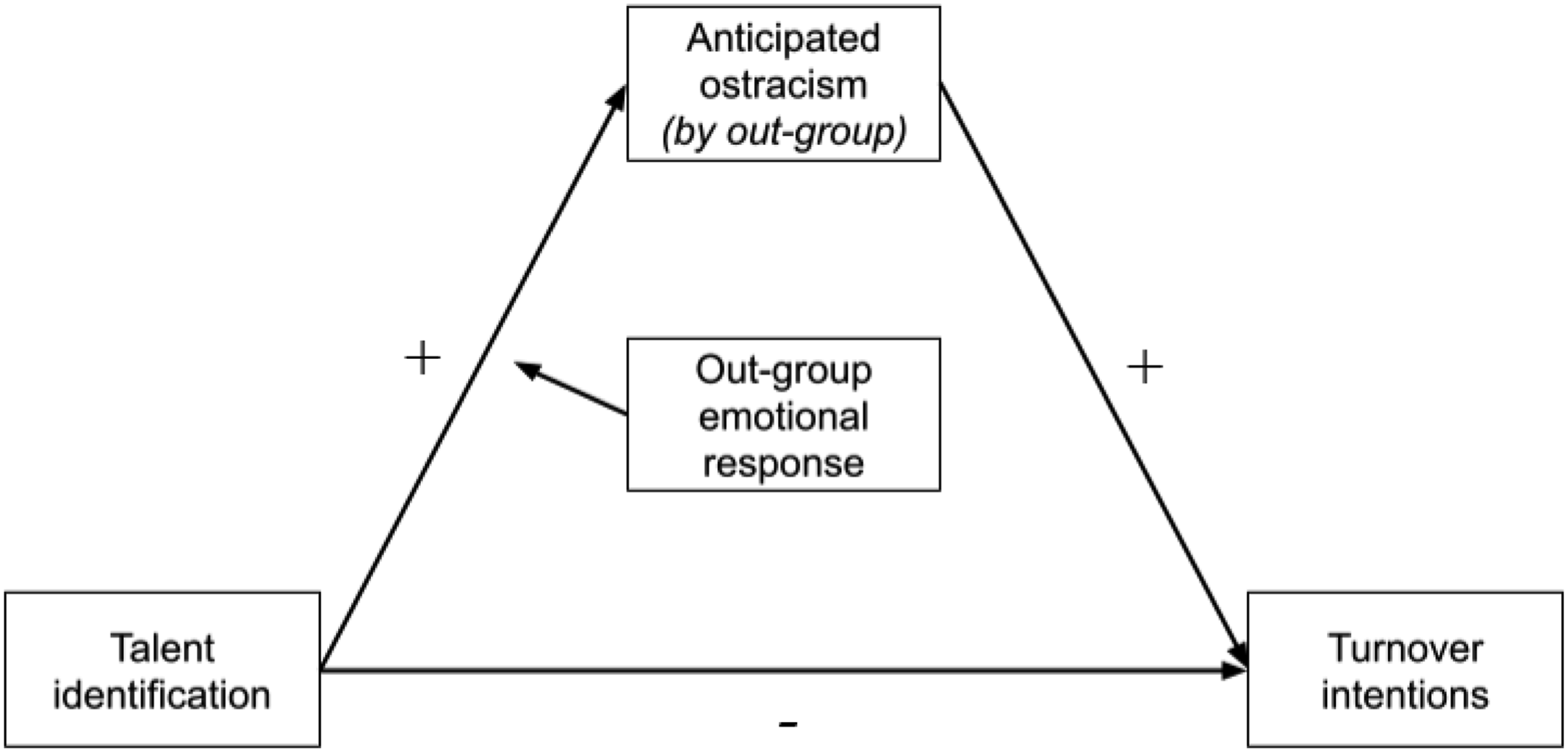
Third, while some organizations keep talent identification a secret from their employees in an attempt to preemptively limit negative employee outcomes (Church et al., 2015)—arguably with little success as employees will often find out anyway (Dries & De Gieter, 2014; Huang & Tansley, 2012)—more and more managers have begun to communicate transparently towards their subordinates (Swailes, 2013). In their latest benchmark study, Church and colleagues (2015) determined that 34% of talent managers communicate transparently about talent identification, yet this number has likely gradually increased since then due to revised business ethics and legislative pressures (Trotter et al., 2017), and several studies highlighting employees’—both talents and non-talents—concerns with the lack of transparency surrounding talent management (De Boeck et al., 2018). Consequently, researchers assume that transparency signals respect, and subsequently makes employees more understanding towards their co-workers who were identified as a ‘talent’ (O’Connor & Crowley-Henry, 2019). Nevertheless, we will argue that transparency will be to the detriment of talents, as transparent practices inevitably set intergroup dynamics and employee reactions in motion (Ashforth & Mael, 1989; De Boeck et al., 2018) that will influence the effectiveness of talent identification (Bethke-Langenegger et al., 2011).
To test our model, we adopt an experimental vignette design (Auspurg & Hinz, 2015) as this approach allows for systematically controlled variation in independent variables—fostering high levels of internal validity—which is a crucial gap in research on employee reactions to talent identification (De Boeck et al., 2018). To date, most of the research done on talents has been case-based, which means that very little research has been able to establish generalizable, causal patterns between the conditions under which employees are identified as talents and their responses (Gallardo-Gallardo et al., 2015). To address the typical concerns around external validity, however, we included 360°-video vignettes which serve to enhance participants’ experience through immersion and realism, fostering high levels of ecological validity (i.e., the findings can be extrapolated to the ‘real world’). Aguinis and Bradley (2014) have argued that more immersive experimental vignette methodologies thus lead to optimal levels of both internal and external validity in organizational research, whereas field studies frequently fall short on both (De Boeck et al., 2018).
Theoretical Background
Talent Identification as a Source of Social Identity
Recent developments in the talent identification literature have shown an increase in interest in employee reactions—particularly those of employees not identified as talents—as these are assumed to greatly influence the success of talent programs (De Boeck et al., 2018). To date the dominant theory used to understand employee reactions to talent identification has been social exchange theory (Wikhamn et al., 2021). The basic assumption is that when employees are identified as talents by their organization, they receive additional resources such as opportunities for training and promotions, which they reciprocate through increased work effort and organizational loyalty. In their review of the literature, De Boeck and colleagues (2018) conclude, however, that social exchange theory alone is insufficient to provide a complete understanding of the social-psychological processes underpinning employee reactions to talent identification. They propose that the identification of talents will not only lead to (tangible) unequal resource allocation among employees, but also conveys (symbolic) identity-relevant information such as the extent to which one is valued and appreciated by the organization (Kamoche & Leigh, 2022; Tansley & Tietze, 2013). Several authors have since suggested that symbolic effects of talent identification—i.e., the mere act of being labeled as ‘talent’—may persist even in the absence of tangible differences created between talents and non-talents (as it has been found that not all organizations couple talent identification to immediate benefits but rather take a ‘wait and see’ approach; Dries & Pepermans, 2008). Such symbolic effects cannot be explained by social exchange theory, while social identity theory offers important insights in this regard (De Boeck et al., 2018). These ideas were then taken up and empirically tested by Wikhamn et al. (2021), who confirmed in a field study that being identified as a talent leads to shifts in social identity, such as an increased identification with management and the organization (as compared to non-talents). While that study looked at the relationships of talents and non-talents to their organizations, there have not yet been any studies on how talent identification alters identity-based relationships between both groups of employees.
In the present paper, we respond to this call for further research on the symbolic and relational dynamics that are triggered when employees are (not) identified as talents by their organizations (Al Ariss et al., 2014; Nijs et al., 2022). As a starting point, we adopt the basic premise of social identity—i.e., that individuals base their sense of who they are (and their social status) on their group memberships (Tajfel, 1979). Identity-relevant information provided by organizations prompts employees to self-evaluate their own relative value to the organization and adjust their behavior accordingly (Ashforth & Mael, 1989; Korte, 2007). In addition, perceived intergroup differences are assumed to predict group members’ behaviors and feelings, as they adjust to the norms of their in-group (Tajfel & Turner, 1986).
To get at the idea that talent identification has symbolic identitary value to employees, in the present study we adopt a minimal group paradigm, meaning that respondents are randomly allocated to groups without any real-life consequences. Prior to Tajfel’s (1970) seminal work it was believed that in-group/out-group effects would only manifest in groups that were deliberately formed based on shared goals. Tajfel showed, however, that experimental allocation to arbitrary groups—e.g., based on the outcome of a coin toss—is sufficient to induce a sense of belongingness to a specific group, and to foster a sense of ‘us’ (i.e., the in-group) versus ‘them’ (i.e., the out-group). Further research showed similar effects in the field, where individuals are found to continuously divide themselves and others into (imaginary) groups based on similar abstract socio-environmental elements—such as the clothes people wear—in order to make sense of the world (Krueger & DiDonato, 2008). Applied to organizational settings, this means that it is not necessarily required for employees to interact personally in order to form a group. Instead, employees’ sense of belonging to a specific social group (such as the ‘talents’ of the organization) can perfectly well be internalized based on abstract notions of that group as compared to other groups in the organization (Ashforth & Mael, 1989).
Overall, we expect talent identification to have positive effects on employees’ attitudes toward their organization. Korte (2007), for instance, found that belonging to an organizational in-group motivated employees to engage in behaviors beneficial to the organization as a whole. In a talent identification study, Björkman and his colleagues (2013) found that turnover intentions are lower among employees who believe they are identified as a talent, which they explained using social exchange theory. We discuss this and other studies on talent identification and retention in more detail below.
Talent Identification and Turnover Intentions
One of the primary goals through talent identification is to enhance the loyalty and commitment of talented employees (Festing & Schäfer, 2014), with talent retention being one of the biggest challenges reported by organizations (Bethke-Langenegger et al., 2011; Gallardo-Gallardo et al., 2015). It is typically assumed that talent identification should lead to lower turnover intentions among talents (Björkman et al., 2013; Dries et al., 2012; Rubenstein et al., 2015), yet empirical evidence on the retention effects of talent identification is scarce and inconsistent (i.e., lower, Björkman et al., 2013; higher, Trevor et al., 1997; insignificant, Dries and De Gieter, 2014). De Boeck et al., (2018) concluded that negative effects of talent identification are likely underreported in general, since effects on talents are assumed to be positive (and negative variables are thus not included in survey studies). Moreover, they found that several qualitative interview studies had uncovered unexpected negative side-effects of talent identification, such that talents feel an increased pressure to live up to their new social identity (Dries & Pepermans, 2008; Tansley & Tietze, 2013), and carry the burden of being seen as an ‘elite’ group (Kamoche & Leigh, 2022). These types of negative effects could, in the long term, trigger turnover intentions among talents (Rubenstein et al., 2015). On the other hand, these potential drivers of turnover intentions will be offset—at least partially—by the beneficial psychological effects of their social identity through the symbolic value attached to talent identification (Nijs et al., 2014), as social identity theory dictates talents will positively self-evaluate their new value relative to their co-workers (Ashforth & Mael, 1989; Korte, 2007), enhancing their loyalty to their organization (Björkman et al., 2013; Dries et al., 2012).
To date, however, there have been hardly any empirical studies on the turnover intentions of talents—in comparison to non-talents—since organizations typically will not allow researchers to survey non-talents on how they feel about their lack of talent identification, fearing that this would trigger (further) dissatisfaction among them (De Boeck et al., 2018). The few quantitative studies that have in fact been able to compare workplace attitudinal data from employees formally identified as talents versus non-talents (Boonbumroongsuk & Rungruang, 2022; Dries et al., 2012) were fully blind, meaning that they relied on correlational analyses on archival data, and that respondents were not informed nor debriefed that the study was about talent identification due to the sensitivity of the subject matter (De Boeck et al., 2018).
Therefore, while the demotivational effects of lack of talent identification on non-talents will likely drive their turnover intentions (Malik & Singh, 2014; Swailes et al., 2014), talents—theoretically (Ashforth & Mael, 1989; Korte, 2007)—ought to experience lower turnover intentions. We expect our findings to support that relationship—and finally causally establish the effects of talent identification on turnover intentions (De Boeck et al., 2018; Gallardo-Gallardo et al., 2015)—but we will nuance this outcome by incorporating the mediating role of anticipated ostracism by non-talents and the moderating role of the non-talents’ emotional response, to explain when and why talent retention may not be realized.
Talents’ Anticipation of Being Ostracized by Non-Talents
The phenomenon of a group of individuals feeling ignored or excluded by individuals belonging to another group is called ostracism (Robinson et al., 2013; Williams, 2007). Feeling ostracized is considered aversive and painful, to the extent that the feeling of ostracism has been shown to elicit physical pain (i.e., the same neurons in the brain are activated when people are ostracized and when physically hurt; Eisenberger et al., 2003). As physical pain sensations normally signal to the brain that something is wrong, it acts as a prompt that action needs to be taken to remedy the situation (Ferris et al., 2008). Within an organizational context, the most readily available response for employees—in a bid to avoid further unfavorable situations on the work floor—is to leave the organization entirely (Mitchell et al., 2001). Research from O'Reilly and colleagues (2015) showed that workplace ostracism, compared to other intergroup conflicts such as harassment, was the best predictor of employee turnover. While organizations can take steps to combat ostracism in the workplace, such as improving communication channels and introducing more cooperative tasks (Wu et al., 2016), employees themselves rarely feel powerful enough to change, or adapt to, their isolation from the group (Williams, 2007). Furthermore, an innately natural response to ostracism is to attempt to seek new social connections, making employees more prone to explore other employment opportunities—and with that new co-workers—elsewhere (Mitchell et al., 2001; O’Reilly et al., 2015).
As stated earlier, talent identification inevitably creates two opposing groups (i.e., ‘us’ vs. ‘them’; Nijs et al., 2022). In line with social identity theory, we can expect employees to exhibit in-group favoritism—preferring collaborations and interactions with other co-workers belonging to the same group—while developing a negative bias of those in other groups (Ashforth & Mael, 1989; Tajfel, 1979; Williams, 2007). In addition, talent identification sends an implicit message about some employees being seen as ‘better’ or more ‘valuable’ to the organization than others (Wikhamn et al., 2021)—something employees are typically highly sensitive to (Wu et al., 2016)—which increases the visibility of talents within the organization (Call et al., 2015), and subsequently their likelihood of being ostracized by non-talents (Robinson et al., 2013).
This symbolic value attached to their talent identification elicits intergroup anxiety, causing talents to actively worry about the intergroup interactions—and possible conflicts (Williams, 2007)—that stem from perceived threats to their identity (O’Donnell et al., 2019). Research has also shown that this psychological mechanism holds in a minimal group paradigm (Navarrete et al., 2012), meaning that talent identification may cause talents to worry about how others will behave towards them. We therefore expect talents to worry more about being ostracized at the workplace as a result of their new identity (cf. similar to how individuals fear to be ostracized by their peers for their negatively appraised social identity; Robb, 1996), as they may believe that their co-workers may not want to associate with talents anymore (Malik & Singh, 2014; O’Donnell et al., 2019; Yu et al., 2018). Most importantly, they anticipate being ostracized more due to being put in the limelight as an elite and superior group (Call et al., 2015; Robinson et al., 2013; Wikhamn et al., 2021). This coincides with actual behavior in organizations, as studies have found that employees who have received preferential treatment are more likely to be acutely aware of the social risks that accompany their special status (Vecchio, 2005), leading them to anticipate undesirable interactions with out-group co-workers and proactively hide their successes at work (Roberts et al., 2021).
In summary, there is theoretical and empirical support for anticipated ostracism and talent identification to go hand in hand (Navarrete et al., 2012; O’Donnell et al., 2019; Roberts et al., 2021; Wikhamn et al., 2021), meaning that talents may anticipate being ostracized by their out-group co-workers more than non-talents, potentially triggering a flight response and an intention to leave the organization (O’Reilly et al., 2015; Robinson et al., 2013; Williams, 2007). We thus predict that anticipated ostracism mediates the relationship between talent identification and employee turnover intentions. However, we also expect that the outcome of this mediation effect for talents will be contingent on the moderating role of non-talents’ emotional response, as explained below.
The Moderating Role of Non-Talents’ Emotional Response
In addition to the lack of clarity around the retention effects on talents, non-talents—who comprise a large majority of the workforce in most organizations (Church et al., 2015)—are assumed to react very negatively to talent programs (Swailes, 2013). However, state-of-the-art literature on talent identification has shown that talents who also socially identify with the group of non-talents (i.e., those that do not consider themselves superior to—or feel threatened by—their non-talented co-workers; Yu et al., 2018), do not actively worry about social repercussions from their environment (Call et al., 2015). Positive association with other group members within an organization can be enhanced through a collaborative climate and cooperative tasks (Buunk et al., 2005; Wu et al., 2016), yet this approach fails to take both self-identity evaluations into account (e.g., employees will still be inferior to superior co-workers despite wanting to self-improve; Sterling et al., 2016; Wikhamn et al., 2021), as well as the underlying emotions employees may inevitably feel towards their group membership, members from other groups, and/or the organization (Fowler & Christakis, 2008), which could override or undermine positive outcomes for employees.
To address these shortcomings, we return to social identity theory which dictates that it is a natural and automatic occurrence for groups of individuals to evaluate their position as equal, better, or worse compared to other groups (Tajfel, 1979). Using all the information available to them from the social environment (Krueger & DiDonato, 2008), such evaluations will ultimately determine their feelings and behaviors (Ashforth & Mael, 1989). They are driven at least in part by intergroup dynamics, such as the emotions expressed by out-group members (Spoor & Williams, 2007), which can either be classified as contrastive (i.e., emotional cues that highlight the differences between the groups) or assimilative (i.e., emotional cues that decrease the distance between the groups) (Smith, 2000).
While both talents and non-talents may exhibit contrastive or assimilative emotional responses to their (lack of) talent identification, we specifically expect contrastive emotional responses from non-talents to exacerbate talents’ anticipation of being ostracized by the non-talents (Korte, 2007), effectively creating a spillover effect where the thoughts and attitudes of the non-talents influences those of the talents (Fowler & Christakis, 2008). Especially when talents feel that there is a lack of potential positive interactions with the non-talents, non-talents’ emotions—signaled by verbal remarks and facial expressions (Van Kleef et al., 2010)—would act as crucial drivers of anticipated ostracism (Spoor & Williams, 2007). In addition, with a sense of belonging being a fundamental human need (Baumeister & Leary, 1995), it is guaranteed that talents will actively—yet subconsciously—pick up on the social cues that may hint towards being ostracized as they are predisposed to detect these specific signs (Spoor & Williams, 2007).
For non-talents’ emotional responses, an example of a contrastive emotional response would be envy—i.e., feelings of discontent and ill will towards the talents as a result of their superior position—and an example of an assimilative response would be inspiration—i.e., enhanced expectations for one’s own future created by another person’s superior example. As for the talents, a typical contrastive emotional response would be pride—i.e., celebrating one’s own success of being identified as a talent—whereas a typical assimilative emotional response would be sympathy—i.e., worry about the misfortune of employees not identified as talents (Smith, 2000). While we focus on the former for our hypotheses—given our predication that talents are the ones to experience anticipated ostracism—the latter is briefly discussed as well as a robustness check in our supplementary materials.
In line with social identity theory, intergroup conflicts—such as ostracism—may be buffered entirely when employees perceive that the differentiation between groups of employees does not threaten their social identity, and instead benefits the organization as a whole (Korte, 2007). Thus, a more assimilative response from non-talents—e.g., inspiration (Smith, 2000)—may diminish the interpersonal distance between the talents and non-talents. For instance, non-talents’ expressions of inspiration and admiration signal support for talents’ social identities and indicates a desire to learn from them to potentially acquire the same status in the future (Lockwood & Kunda, 1997). Most importantly, they signal to talents that their advantage is well-deserved, ensuring that the social identity of talents is endorsed rather than brought into question (Smith, 2000), as is most commonly the case with minority groups (Eck et al., 2017). Conversely, envy and resentment—as contrastive emotional responses displayed by non-talents—reveal discontent with the talents’ advantage, in that the relatively superiority of their position induces feelings of inferiority in the social identities of non-talents (Smith, 2000).
Talent Management Secrecy
Critics of the exclusive talent management approach do not only take issue with the exclusivity itself, but also with the secrecy that tends to go hand in hand with it (Huang & Tansley, 2012). In a bid to avoid negative reactions of non-talents (Sumelius et al., 2020)—but also to avoid perceptions of career guarantees among talents (Dries & De Gieter, 2014)—over half of the organizations surveyed in 2015 did not inform their employees of their (lack of) talent identification (Church et al., 2015). More recent developments in terms of ethical and legislative pressures, however, have put organizational secrecy under increased scrutiny these last few years. For instance, under the revised Transparency Act in the US, many organizational decisions previously kept under wraps—such as pay differentials—are now illegal to not disclose to employees (Trotter et al., 2017). Moreover, theoretical developments have highlighted several benefits with organizational transparency (e.g., signaling respect towards employees; O’Connor & Crowley-Henry, 2019). We can thus realistically expect more and more organizations to opt for transparent communication in regard to their talent management practices.
Although one can certainly question the use of secrecy on ethical and legal grounds, the question remains as to how effective transparancy is at reducing negative employee reactions to talent management. This assumption is taken for granted in the literature, but has in fact never been tested empirically, mostly due to the ethical and practical challenges of collecting field data from employees who are unaware of their own (lack of) talent identification (De Boeck et al., 2018). In the event that secrecy works—and employees somehow do not find out about their (lack of) talent identification (Huang & Tansley, 2012)—it may be used as a necessary ‘evil’ to prevent ostracism and talent turnover within the organization. In other words, the success of exclusive talent management may be contingent on the ability of managers to avoid having employees making upward social comparisons with talents.
Hypothesis Development
Based on all the above, we hypothesize that talent identification bolsters talent retention, yet that talents’ intention to leave the organization will depend largely on the emotional response displayed by their non-talented co-workers, mediated through their anticipated ostracism by non-talents. We expect contrastive emotional responses by non-talents to increase anticipated ostracism, while assimilative responses will decrease this anticipation. We test this hypothesized model using moderated mediation (see Figure 1).
We conducted three studies to test our hypotheses. First, we used a 360°-video vignette to test our hypothesized model. Second, we replicated the first study using a traditional text-based vignette to ensure our results could not be attributed to artifacts associated with our immersive methodology. Third, we adjusted our text-based vignette to assess the influence of secrecy in inhibiting negative outcomes for talents.
Study 1
Methods
Procedure
Respondents were randomly assigned to one of 8 conditions (i.e., 2x2x2 between-subjects design: 1 talent identification, talents’ emotional response, and non-talents’ emotional response; see manipulations further down), and after giving their informed consent, prompted to watch an eight-minute 360°-video of a board meeting in which a talent program was introduced at a fictional organization (visuals and methodological details can be consulted in the online supplement). Respondents witnessed events and the manipulations unfold during the meeting from the first-person perspective of an employee named ‘Robin’ (a gender-neutral name). All 8 other employees in the video (i.e., Robin’s co-workers—6 or 5 non-talents and 1 or 2 talents respectively, depending on the talent identification of Robin—and 1 HR director) were experienced actors acting out a script written by the researchers. Respondents were instructed to imagine being in the shoes of Robin for the entirety of the study. Once respondents finished watching the video, they were taken to a survey containing the measures detailed below. They also completed a manipulation check (detailed further down).
Sample
Potential respondents were recruited by reaching out directly to employees in Belgium through our combined professional network, social media, and job-specific media outlets. Respondents had to be employed full- or part-time (i.e., no students, retirees, and temporary workers) in order to be eligible to participate. Of our preliminary sample of 229 employees, 184 completed the survey and were included in our analyses. 16 respondents had to prematurely exit the survey due to technical issues with the video (e.g., unsynchronized sound, trouble loading), 28 were removed for failing manipulation checks (see further down), and one additional respondent was removed for completing the survey faster than the total duration of the video. Of these 184 employees, 44% were male and 56% female. Respondents were on average 37.32 (SD = 12.43) years old and had 14.88 (SD = 12.37) years of work experience. Respondents worked in many different industries, the most common being human resources (9%), healthcare (9%), and finance (8%). The majority of our sample had obtained a higher education degree (48% held a Master’s degree; 37% a Bachelor’s degree; 3% a PhD or MBA; and 12% did not complete any higher education), and 28% of respondents held a position in management.
Manipulations
Talent Identification
Two employees present in the fictional meeting were identified as talents (announced by the actor playing the HR director), and 6 employees were not. Half of the respondents were assigned to the condition in which ‘Robin’ was one of the 2 employees told they were a ‘talent’, and the other half to the condition in which ‘Robin’ observed two co-workers being told they were a ‘talent’. Across all conditions, talents represented a clear minority to ensure that ‘talent’ identification was perceived as something special.
Talents’ Emotional Response to Their Talent Identification
The employee(s) identified as a talent in the vignette responded to their talent identification either with visible pride (a downward contrastive emotion), or sympathy (a downward assimilative emotion; Smith, 2000). 2 In the former condition, they raised their arms in victory, yelling out “woo-hoo!”. They then said: “I am so proud, I will do everything to prove you picked the right person”. In the latter condition, they briefly placed their hand over their mouth and then said, with a concerned and earnest expression on their face: “I feel so bad for all the others that are not a part of it”.
Non-Talents’ Emotional Response to the Talent Program
Each of the non-talents in the vignette was instructed to act out at least one of the emotions, based on Smith’s (2000) work on upward contrastive (i.e., envious, depressed, stressed, irritated, hostile, resentful, embarrassed) and upward assimilative emotions (i.e., interested, enthusiastic, inspired, admiring, hopeful, optimistic, proud). They acted out the emotions both verbally and non-verbally. For instance, envy was acted out as huffing, looking around angrily, and saying in the direction of the talents: “What kind of nonsense is this… It’s almost like it’s designed to make us envious. I will keep an eye on you, see if you truly deliver better work or not!“. Admiration, in contrast, was acted out by heavy nodding, smiling, and saying to the talents: “I truly admire you both for being chosen as talents. I will keep an eye on you, see what I can learn from you!”. Each condition contained either only contrastive, or only assimilative emotional responses by non-talents.
Manipulation Checks
Several manipulation checks were included at the end of the survey to help eliminate respondents who did not pick up on one or more of our manipulations. Specifically, we asked respondents if they were (i.e., if Robin was) identified as a talent or not, and to check off all the emotions they observed in the video as expressed by the actors (from a fixed list containing all assimilative and contrastive emotions included in the script verbatim). Respondents did not have to check off every single emotion that was presented in the video, as long as they indicated one or more emotions from the appropriate category (i.e., assimilative vs. contrastive) of their co-workers correctly. 28 participants (13%) were removed for failing one or both of the manipulation checks.
Measures
The study was conducted in the form of an online survey, published on the Qualtrics platform. The survey consisted of four sections: first, a socio-demographic background section; second, the video vignette section (containing an embedded YouTube video), third, a section containing the scales for our dependent and mediator variable (see further down), and fourth, a set of manipulation checks.
Anticipated Ostracism
We asked respondents to indicate to what extent they believed they would feel ostracized by co-workers of the out-group (i.e., by non-talents if the respondent was identified as a talent and vice versa) in the scenario allocated to them, using the Workplace Ostracism Scale from Ferris and colleagues (2008), adapted minimally to fit our study topic and design (i.e., ‘others’ in the original scale was changed to ‘(non-)talents’ and items were phrased in the future tense). An example item was “The (non-)talents would start ignoring me at work”. Items were rated on a seven-point scale from 1. never to 7. always.
Turnover Intentions
To measure turnover intentions we used the five-item job search behavior index (Kopelman et al., 1992), combined with the three-item turnover intention scale (Hom et al., 1984), as recommended by turnover researchers (Mitchell et al., 2001). An example item was “To what extent would you, within 12 months after the announcement of the talent program, revise your resume?”. Items were rated on a seven-point scale from 1. to a very small extent to 7. to a very large extent.
Control Variables
Gender and work experience were identified as potential control variables for this study. Studies have found that women are more affected by differentiation practices at work (Guimond & Chatard, 2014), and that employees at the start of their career tend to value talent identification more than more senior employees (Festing & Schäfer, 2014). We furthermore identified employees’ desire for talent identification as another control variable, as the manipulated talent identification may not align with how employees would want to view themselves in real-life (Björkman et al., 2013; Sonnenberg et al., 2014), which we elaborately discuss in the online supplement to this article.
Statistical Analyses
Analyses were performed using IBM SPSS 28. The moderated mediation model was tested using the PROCESS macro (Hayes, 2017). We used effect coding to recode our dummy variables (i.e., talent identification and out-group emotional response) to −.5 and .5. Bias-corrected bootstrapping (n = 5000) and 95% confidence intervals (CI) were used to test the indirect effects.
Results
Study 1 Descriptives and Correlations (N = 184).
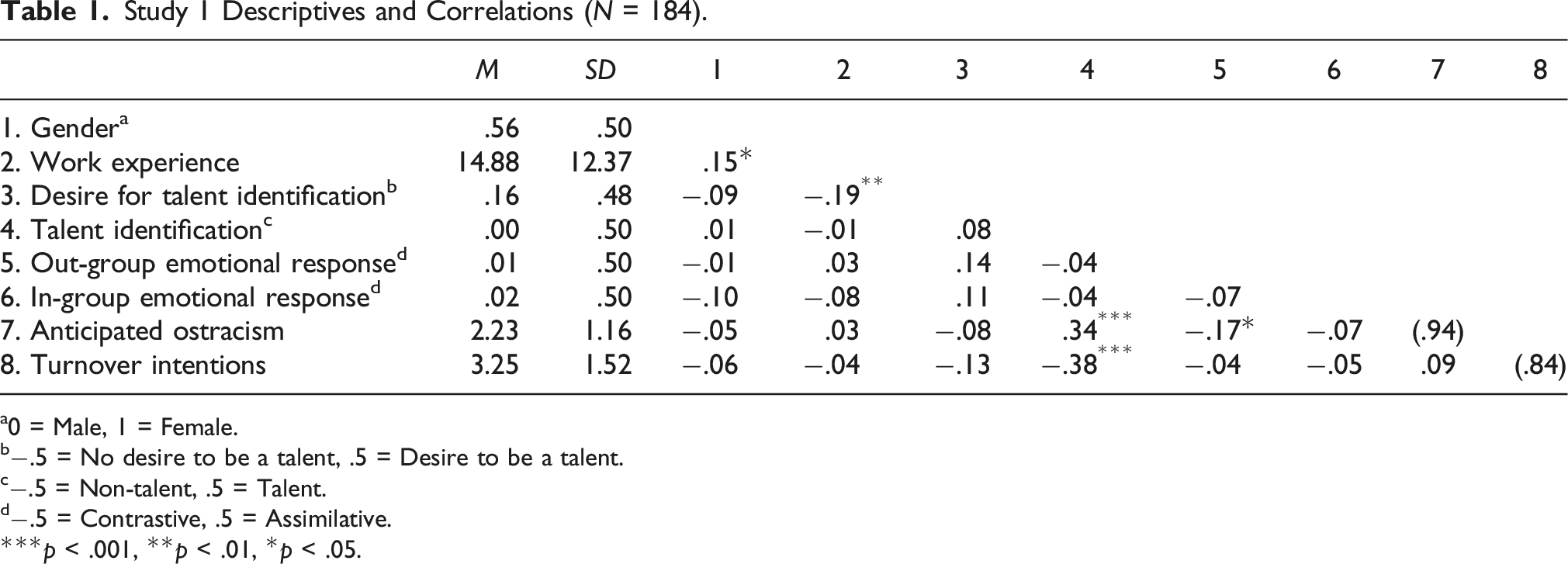
a0 = Male, 1 = Female.
b−.5 = No desire to be a talent, .5 = Desire to be a talent.
c−.5 = Non-talent, .5 = Talent.
d−.5 = Contrastive, .5 = Assimilative.
***p < .001, **p < .01, *p < .05.
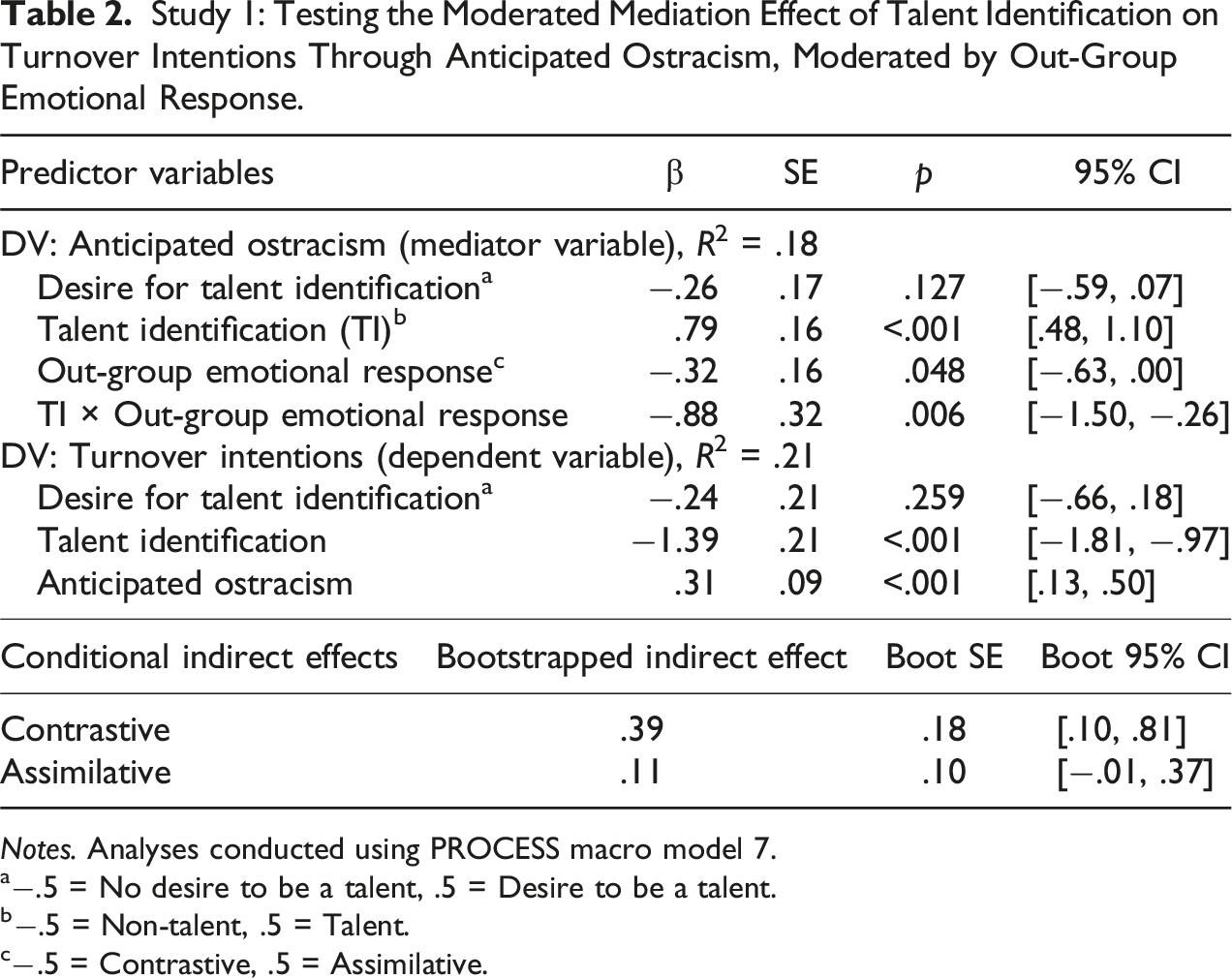
Study 1: Testing the Moderated Mediation Effect of Talent Identification on Turnover Intentions Through Anticipated Ostracism, Moderated by Out-Group Emotional Response.
Notes. Analyses conducted using PROCESS macro model 7.
a−.5 = No desire to be a talent, .5 = Desire to be a talent.
b−.5 = Non-talent, .5 = Talent.
c−.5 = Contrastive, .5 = Assimilative.
In line with our hypothesis, we found that out-group emotional response moderated the relationship between talent identification and anticipated ostracism (β = −.32, SE = .16, p = .048). Furthermore, we found that the indirect effect of talent identification on turnover intentions through anticipated ostracism was moderated by out-group emotional response (indirect effect = −.28, Boot SE = .13, Boot 95% CI = [−.57, −.06]). More specifically, there was no effect of talent identification on anticipated ostracism when the out-group response was assimilative (indirect effect = .11, Boot SE = .10, Boot 95% CI = [−.01, .37]), while there was an effect when the out-group response was contrastive (indirect effect = .39, Boot SE = .18, Boot 95% CI = [.10, .81]). As expected, this effect was only found for talents (F(3, 180) = 12.02, p < .001), who anticipated more ostracism (M = 2.99, SD = 1.26) in the contrastive condition than the non-talents (M = 1.81, SD = .88). The means did not significantly differ within the assimilative condition. The means across all eight conditions are illustrated in Figure 2. Study 1: Conditional effect of talent identification on anticipated ostracism depending on the out-group emotional response.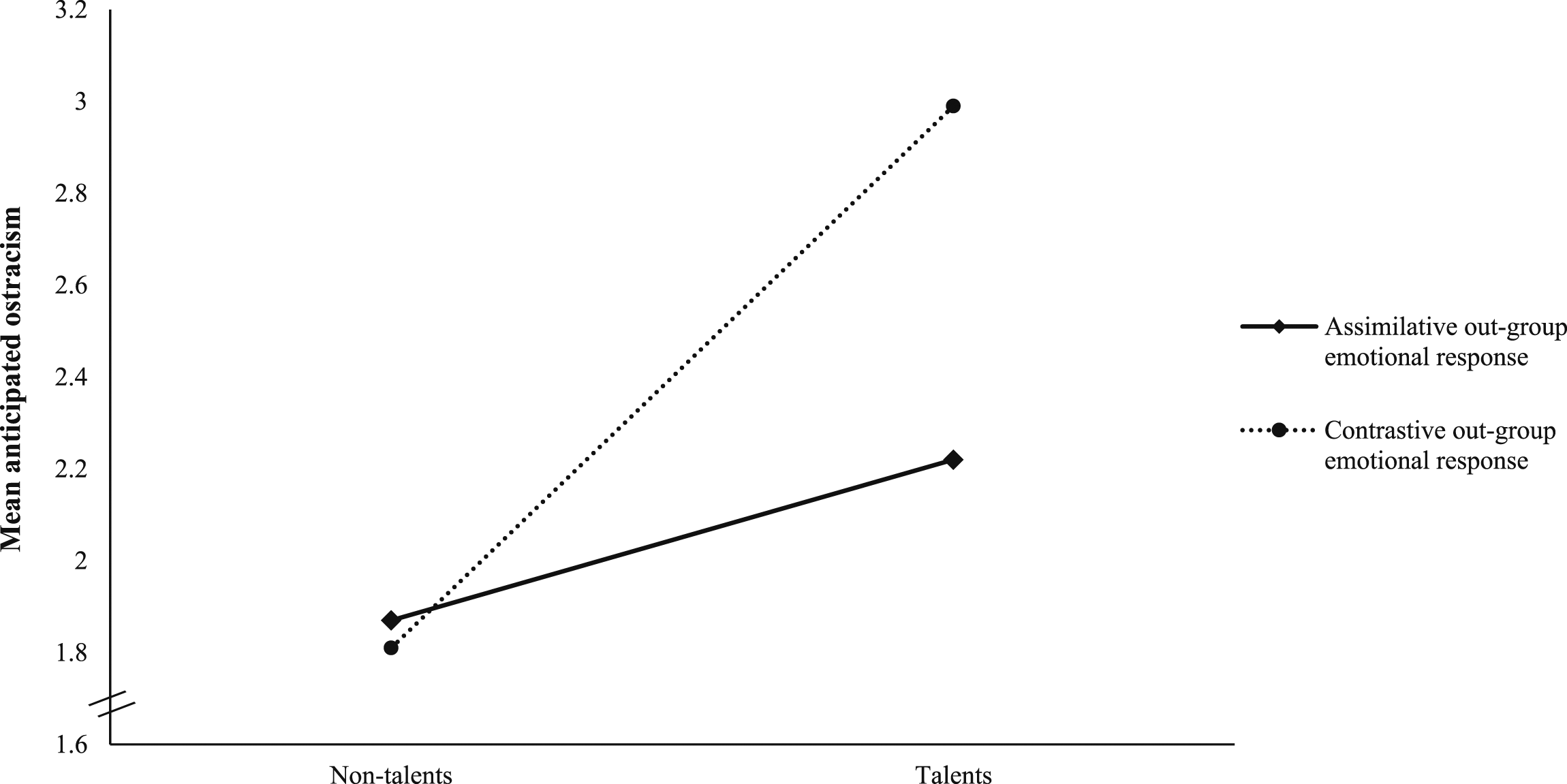
In addition to the above analyses, we performed robustness checks (on talent program inclusivity, the in-group emotional response of co-workers, and employees’ desire for talent identification) and a test of ecological validity, which are reported in the online supplement to this article.
Study 2
360°-video vignettes may convey implicit signals confounding the emotions expressed by the actors (Lee et al., 2008), such that the expression of an assimilative emotion may be misinterpreted as a contrastive emotion by some observers (e.g., two Study 1 participants noted that the admiration expressed by their co-workers felt as a form of sarcasm). To rule out confounding effects of such implicit signals, in Study 2 we replicated Study 1 using a traditional text vignette allowing for all the information explicitly conveyed to participants (e.g., your co-workers responded well—or poorly—to the introduction of the talent program) to be interpreted by study participants in the exact same manner. Our assumption was that respondents might be more likely to question the intentions and hidden meanings behind facial expressions in a 360°-video, than when information is communicated to them through written text (Lee et al., 2008; Van Kleef et al., 2010). Although text vignettes are generally assumed to be less realistic and immersive, thus reducing ecological validity (Aguinis & Bradley, 2014), replicating our findings this way allowed us to address the potentially confound in Study 1’s manipulations, and allow for a more stringent replication of the interaction effect of co-workers’ emotional responses on anticipated ostracism.
Method
The method used was largely similar to that of Study 1, including the exact same sampling strategy, manipulations, measurements, manipulation checks, and analyses. Study 2 ran simultaneously with Study 1, ensuring that no respondent could participate in both. Similarly, respondents took on the role of an employee of DruCo and learned about a new talent management practice (including the same details presented in Study 1), with the main difference being that respondents were presented with a text-based vignette about the specifics of the organization and the talent program. Furthermore, respondents read a list of emotions (in bold font) that their co-workers expressed in response to the talent program (e.g., “Your co-workers responded with admiration towards the talents”, “Your co-workers mentioned that they found the talent program irritating”). This time, however, respondents could not see the facial expressions and body language of their co-workers.
Of our preliminary sample of 271, 28 were removed for failing one or more manipulation checks. Our sample was largely similar to that of Study 1. Of the 243 employees in our final sample, 42% were male and 58% female, with an average age of 37.21 (SD = 12.66) and 15.07 (SD = 12.78) years of work experience. The majority of respondents worked in human resources (13%), finance (10%), and healthcare (8%), and obtained a higher education degree (49% Master’s; 31% Bachelor; 4% PhD or MBA). 22% held a position in management.
Results
Study 2 Descriptives and Correlations (N = 243).
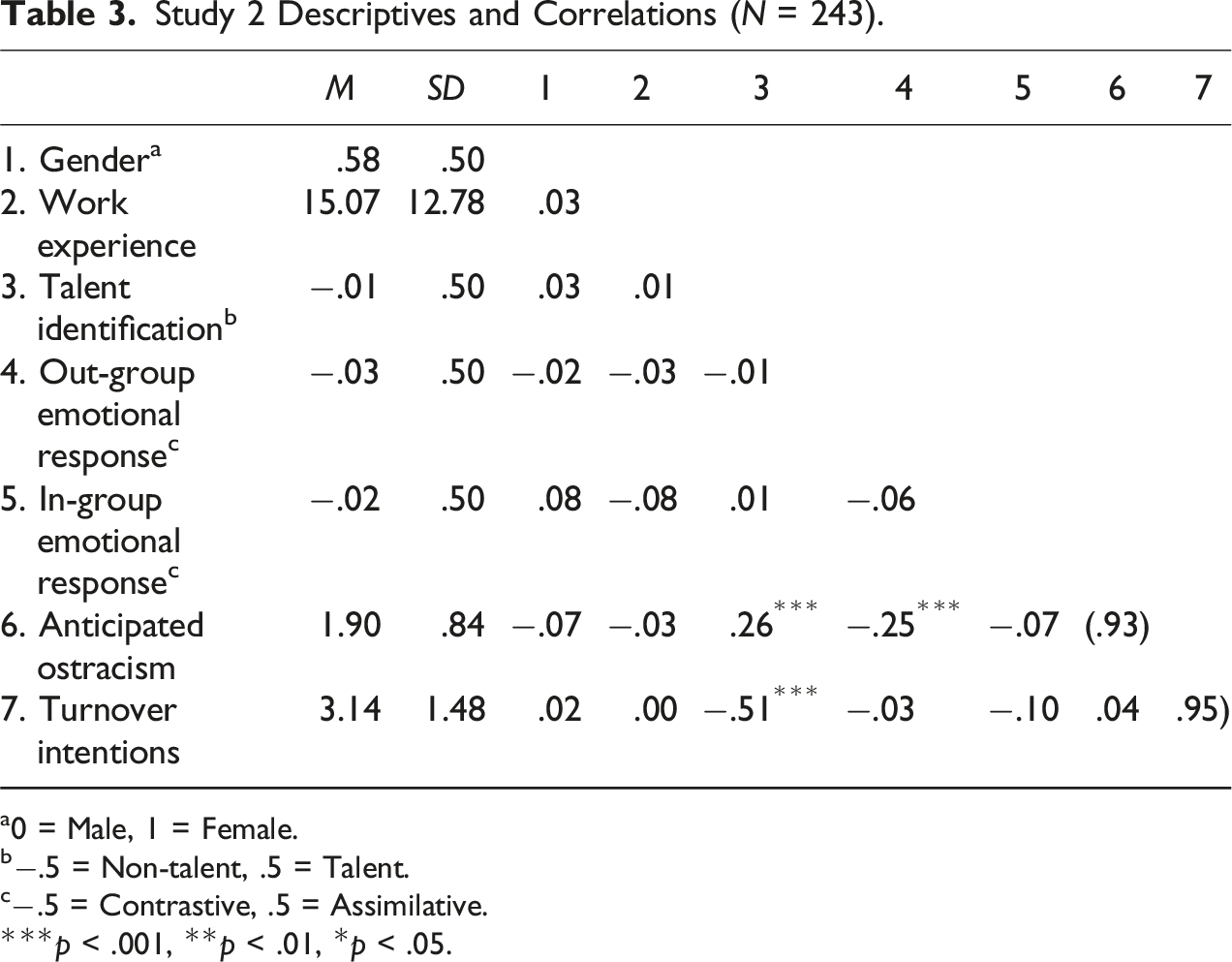
a0 = Male, 1 = Female.
b−.5 = Non-talent, .5 = Talent.
c−.5 = Contrastive, .5 = Assimilative.
***p < .001, **p < .01, *p < .05.
Study 2: Testing the Moderated Mediation Effect of Talent Identification on Turnover Intentions Through Anticipated Ostracism, Moderated by Out-Group Emotional Response.
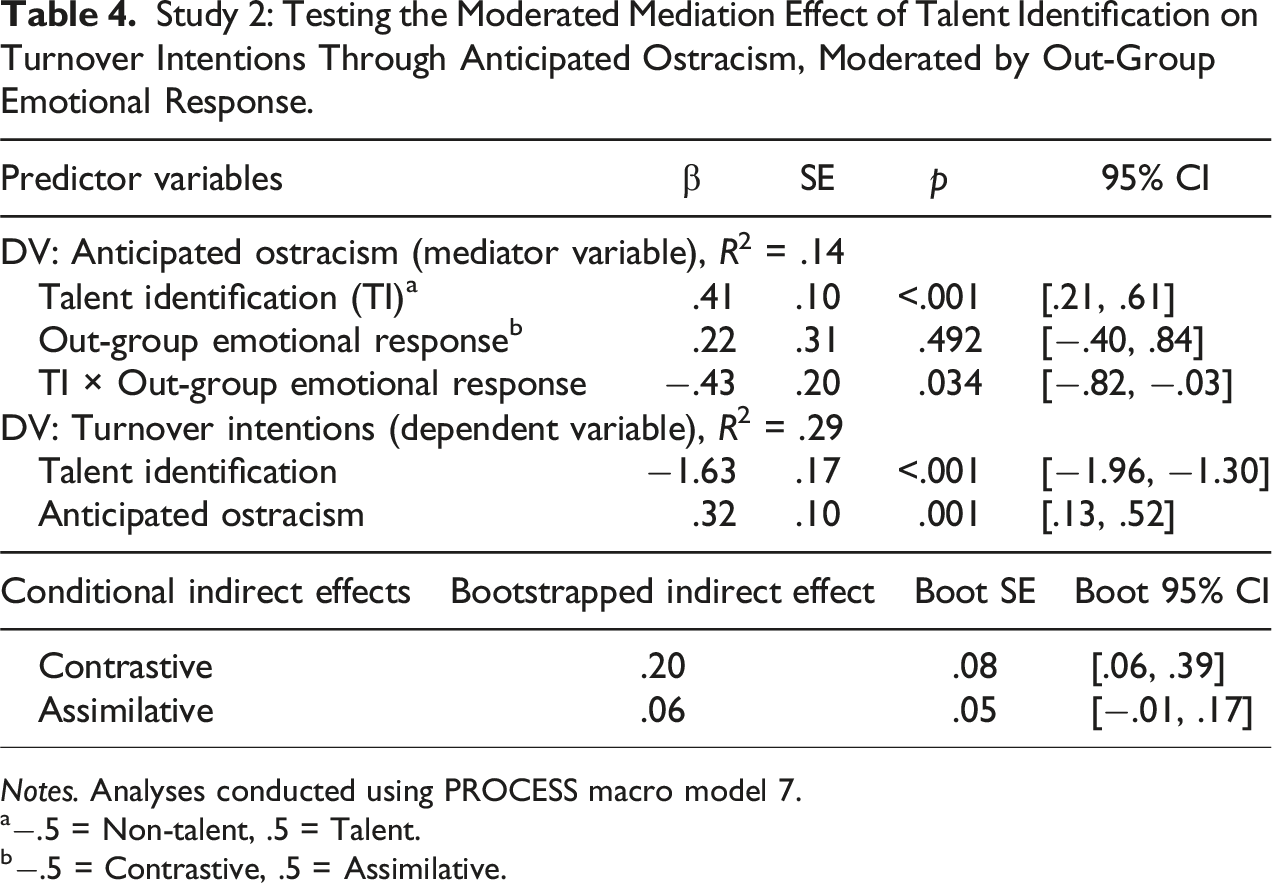
Notes. Analyses conducted using PROCESS macro model 7.
a−.5 = Non-talent, .5 = Talent.
b−.5 = Contrastive, .5 = Assimilative.
Study 3
A common reason for organizations to keep talent identification a secret from employees is to avoid negative employee reactions and inter-group conflict (Church et al., 2015). Moving towards more transparent communication in regard to talent identification—a prevalent trend in practice (Bethke-Langenegger et al., 2011; O’Connor & Crowley-Henry, 2019; Swailes, 2013)—may thus jeopardize the effectiveness of talent management if employees end up leaving the organization in droves. To emphasize the importance of anticipated ostracism in predicting employee turnover, we examine in our third and final study whether employees anticipate to be ostracized significantly more when talent identification is communicated publicly, such that all employees know who is, and is not, identified as a ‘talent’. Building on the findings from Study 1 and 2, we hypothesize that talents anticipate significantly more ostracism when their co-workers without talent identification learn about their newfound status, in comparison to when it is kept under wraps.
Method
For Study 3 we employed the same measurements, yet used different manipulations, opted for another sampling strategy, and utilized alternative analyses. In this study, we did not manipulate emotional responses. Instead, respondents were told they were (not) a ‘talent’ through one of three communication channels as detailed below. Respondents were randomly assigned to one of 5 conditions (i.e., 2 × 3 between-subjects design: talent identification and communication—excluding the combination of ‘non-talent’ and ‘secrecy’ for feasibility). True organizational secrecy while knowing one is not a ‘talent’ is impossible to recreate in a scenario, thus leaving a total of five unique experimental conditions. Because of that, one-way ANOVAs were run to assess the mean differences in anticipated ostracism and turnover intentions across all conditions.
Manipulations
Secrecy (Only Included in the ‘Talent’ Condition)
Today your manager pulls you aside to let you know that you, and one of your co-workers, have been identified as a “talent”. You are informed that the organization’s policy is to keep it a secret from the employees in your department (roughly 200 people) who are not identified as a “talent”. Your manager therefore requests that you not share this information openly with the co-workers who are not included in the talent program.
Private
Today your manager tells you, during a private conversation, that you, and one of your co-workers, have been identified as a “talent”/that two of your co-workers have been identified as a “talent”, but that you yourself have not. [both] You are informed that the organization’s policy is to have private conversations with everyone in the organization, including the employees in your department (roughly 200 people) who are not identified as a “talent”. Your manager therefore informs you that your co-workers have privately been told who in the department is included in the talent program.
Public
Today your manager convenes your entire department (roughly 200 people) in the meeting hall and announces publicly that that you, and one of your co-workers, have been identified as a “talent”/two of your co-workers have been identified as a “talent”. You yourself are not mentioned. [both] You are informed that the organization’s policy is to communicate about the talent program publicly to everyone in the organization; both the employees who are and are not identified as a “talent”. Therefore, it is public knowledge to all of your co-workers who in the department is included in the talent program.
Sample
We recruited respondents through Prolific, and incorporated additional attention checks to ensure that respondents were actively reading the questions, and not clicking random responses to expedite their monetary reward. Only full-time employed white-collar residents of the United Kingdom could participate. Of our preliminary sample of 604, 12 were removed for failing one or more attention checks, and 19 for failing one or more manipulation checks. Of the 573 employees in our final sample, 50% were male, with an average age of 39.59 (SD = 11.21) and 19.55 (SD = 11.27) years of work experience. The majority of employees worked in education (19%), government (11%), and healthcare (10%), and obtained a higher education degree (18% Master’s; 48% Bachelor; 4% PhD or MBA).
Results
Study 3 Descriptives and Correlations (N = 573).
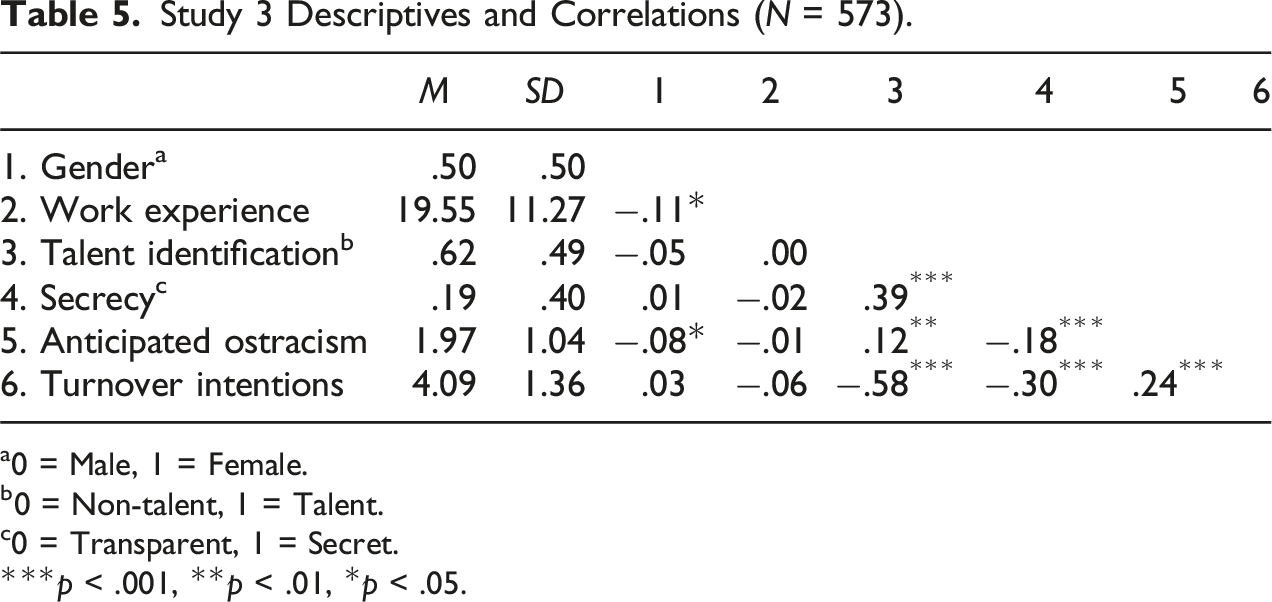
a0 = Male, 1 = Female.
b0 = Non-talent, 1 = Talent.
c0 = Transparent, 1 = Secret.
***p < .001, **p < .01, *p < .05.
Study 3: One-Way ANOVA Means Comparisons of Anticipated Ostracism and Turnover Intentions of Talents and Non-talents to Talent Identification That is Communicated Publicly, Privately, or Kept a Secret.
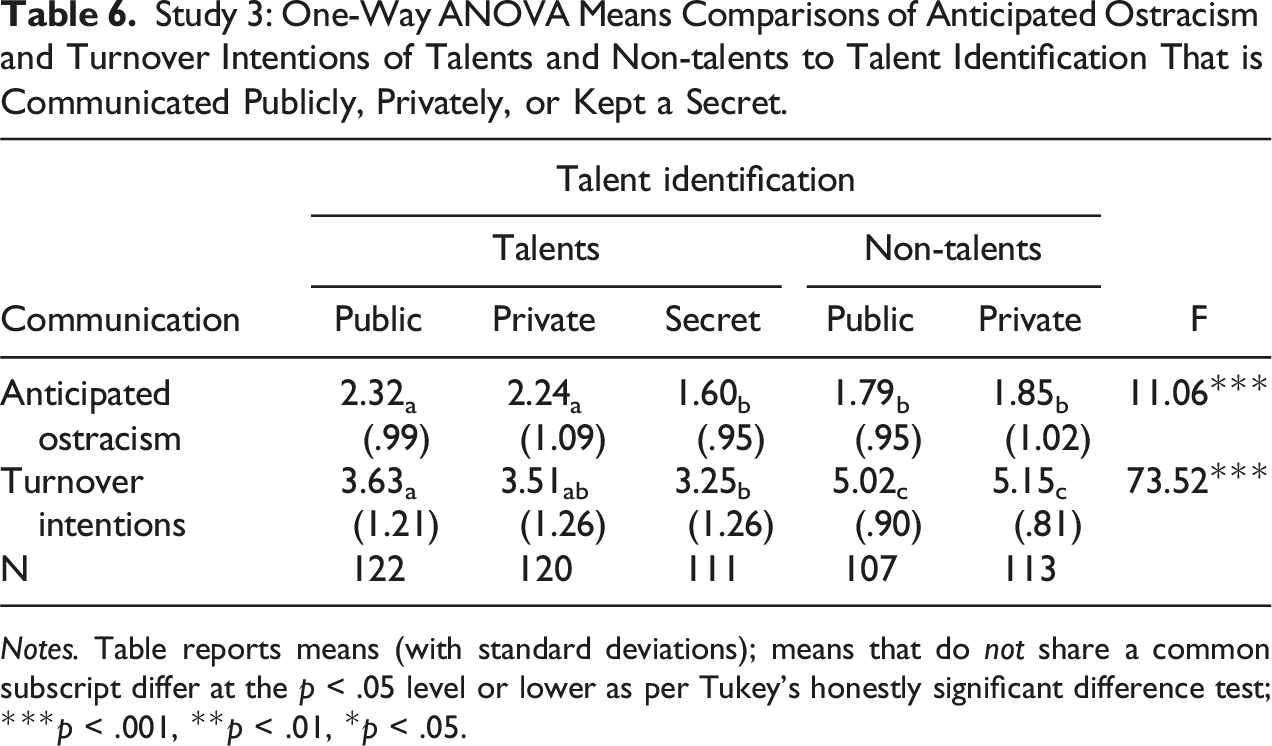
Notes. Table reports means (with standard deviations); means that do not share a common subscript differ at the p < .05 level or lower as per Tukey’s honestly significant difference test; ***p < .001, **p < .01, *p < .05.
Discussion
In this paper we set out to examine the causal relationship between talent identification and turnover intentions, the mediating influence of anticipated ostracism, and the moderating role of out-group emotional response (particularly non-talents’ emotional responses directed at talents) to talent identification (Figure 1). Surprisingly little research has looked at the factors affecting the turnover intentions of talents, despite the clear importance of talent retention to organizations (Festing & Schäfer, 2014; Gallardo-Gallardo et al., 2015), and heated debates in the literature especially about the assumed reactions of talents (in comparison to non-talents), the spillover effects of non-talents’ reactions, and the role of secrecy in talent management (Al Ariss et al., 2014; De Boeck et al., 2018; Swailes, 2013).
A first finding was that talent identification directly affects the turnover intentions of employees. However, talent retention through talent identification alone is not a given. We found that the relationship between talent identification and turnover intentions was partially mediated by anticipated ostracism, with talents having stronger expectations of being ostracized by non-talents and thereby eliciting stronger intentions to leave the organization. We also found a negative direct effect of talent identification on turnover intentions but a positive indirect effect through anticipated ostracism. These opposite directions indicate that anticipated ostracism acts as a suppressor variable in our model, partialling out extraneous variation, and strengthening the relationship between talent identification and turnover (MacKinnon et al., 2000). Where most mediators explain the process through which an outcome comes to be, a suppressor variable provides support why it may not. It is thus very well possible that previous talent identification studies did not find consistent effects of talent identification on turnover intention (as described earlier in this paper) as a result of unidentified suppressor variables, of which anticipated ostracism appears to be one.
The suppressing effect of anticipated ostracism is theoretically justified as talent identification imposes a clash of cognitive processes upon employees. On the one hand, in line with social identity theory, talent identification enhances the social ‘symbolic’ value of the employee (e.g., I am part of the ‘elite’; Kamoche & Leigh, 2022; Nijs et al., 2014), while they adapt their behavior to reflect their new social identity (Ashforth & Mael, 1989; Korte, 2007), thereby becoming more loyal to the organization (Björkman et al., 2013; Festing & Schäfer, 2014)—i.e., the positive direct effect of talent identification on turnover intentions. On the other hand, still in line with social identity theory, this same ‘elite’ identity is associated with a social burden (Kamoche & Leigh, 2022), and increased visibility to co-workers (Call et al., 2015), putting their new social identity under greater threat by out-group members and eliciting intergroup anxiety (O’Donnell et al., 2019), thereby fostering a worry for intergroup conflicts such as ostracism (Williams, 2007; Wu et al., 2016)—i.e., the suppressing effect of anticipated ostracism between talent identification and turnover intentions. We explain how researchers can better take this into account in future studies below.
We found a conditional indirect effect of non-talents’ emotional response on talents’ anticipated ostracism. Specifically, assimilative emotional responses shown by non-talents—where they embrace the talent program and support the talents’ new social identity—reduce talents’ anticipation of being ostracized by non-talents. As Figure 2 shows, the level of ostracism talents anticipate under that boundary condition is similar to that of non-talents. In other words, employees identified as talents expect to be ostracized on the work floor more, unless the identification of talents is perceived by non-talents as a positive practice, such that the talents are considered praiseworthy and a source of inspiration to all employees.
Finally, we replicated our findings across two studies, showing that employees react similarly when they learn about the study manipulations through video and text, while also demonstrating the added value (i.e., higher ecological validity and more accurate measurements) of 360°-video vignettes over text vignettes (see supplementary materials for a greater discussion). Moreover, we show that talents’ anticipated ostracism—and subsequently turnover intentions—can also be curbed by keeping talent identification a secret from those excluded. While this is an important finding that contradicts the trend towards, and ethical and legislative pressures for organizational transparency (Bethke-Langenegger et al., 2011; O’Connor & Crowley-Henry, 2019; Swailes, 2013; Trotter et al., 2017), some scholars will argue that it is not a question of ‘if’ employees find out about their co-workers’ talent identification, but a question of ‘when’ (Dries & De Gieter, 2014; Huang & Tansley, 2012). Our study thus highlights the tension between what might work best for the organization and its talents, and what would be the ‘right’—or legally mandatory (Trotter et al., 2017)—thing to do.
Theoretical Contributions
The present study addresses commonly held assumptions held in the literature and adds to the literature on talent identification (Gallardo-Gallardo et al., 2015), social identity theory (Ashforth & Mael, 1989), and ostracism in the workplace (Williams, 2007). First, to date only a handful of studies on talent identification—most of which qualitative interview studies—have used social identity theory as their theoretical framework (e.g., Dubouloy, 2004; Kamoche & Leigh, 2022; Tansley & Tietze, 2013; Wikhamn et al., 2021). As it stands currently, the literature benefits from a deeper understanding of the effects of talent identification on the social identity of employees (De Boeck et al., 2018). Whether organizations like it or not, the label ‘talent’ given to a select few shapes employees’ social identities and subsequent behavior (Tajfel, 1979), leading to intergroup anxieties (O’Donnell et al., 2019; Tajfel & Turner, 1986), causing employees to start worrying about being ostracized at work (Ferris et al., 2008). Moreover, our study demonstrates that employees will react to (not) being identified as a talent in this way even when a minimal group paradigm is adopted, mirroring talent identification practices that are mostly symbolic in nature and decoupled from tangible rewards (Nijs et al., 2014). Field studies, to date, have been unable to separate the symbolic effects of talent identification from the effects of the tangible additional resources employees (e.g., promotions, pay raises) may receive as a result (De Boeck et al., 2018). In addition, our study is the first to study the potential effects of talent identification on intergroup anxieties between talents and non-talents (supplementing state-of-the-art literature highlighting social comparisons between the two groups; Call et al., 2015; Reh et al., 2018), which is also a significant gap in the literature (Al Ariss et al., 2014; Nijs et al., 2022). In general, there has been too little acknowledgment of the potential negative effects of talent identification on talents specifically (De Boeck et al., 2018), with the exception of a few studies that looked at talents’ levels of stress and alienation (Dries & Pepermans, 2008; Kamoche & Leigh, 2022; Tansley & Tietze, 2013). While it is much more common to assume some negative effects on non-talents—such as diminished employee morale and productivity (Kehoe & Tzabbar, 2015; Malik & Singh, 2014; Sapegina & Weibel, 2017; Swailes, 2013)—empirical studies incorporating their reactions to talent management have also been exceedingly rare as organizations are typically unwilling to allow data collection on such a sensitive topic (De Boeck et al., 2018). Therefore, another indirect contribution of our study is to demonstrate an alternative and feasible method for doing experimental research on sensitive organizational phenomena, that allows for causal inferences to be made. Using immersive vignettes, researchers enable the systematic manipulation of independent variables in realistic settings while still having the benefits of a controlled ‘laboratory’ environment (Aguinis & Bradley, 2014; Auspurg & Hinz, 2015).
Second, within the literature on ostracism, researchers are still actively exploring which variables may influence individuals’ experience of ostracism both within and outside of the workplace (e.g., O’Reilly et al., 2015; Robinson et al., 2013; Wu et al., 2016). To the best of our knowledge, while recent studies have looked at dispositional variables such as personality to predict whether people will feel ostracized in specific situations (Yaakobi, 2021), to date there have not been any studies investigating workplace factors to gauge their potential impact on anticipated ostracism. Our findings illustrate that employees do in fact anticipate ostracism, before it could or will actually happen, in organizational settings in which ostracism is theoretically predicted (Kamoche & Leigh, 2022; O’Donnell et al., 2019), as well as practically conceivable (Gelens et al., 2013; Malik & Singh, 2014; Wu et al., 2016; Yu et al., 2018). Furthermore, the anticipation and anxiety linked to the potential experience of ostracism is evidently sufficient for employees to behave in a manner that is in line with the literature on ‘actual’ ostracism (O’Reilly et al., 2015; Robinson et al., 2013). We therefore contribute to the ostracism literature by highlighting the relevance of incorporating the construct of anticipated ostracism in research designs using fictional scenarios.
Finally, what may perhaps be the most surprising finding for practitioners and researchers was that talents anticipated more ostracism than non-talents—in the event that non-talents respond negatively to the talent program, which they frequently do (De Boeck et al., 2018). As we mentioned, negative outcomes for talents are not commonly acknowledged (Dries & Pepermans, 2008; Dubouloy, 2004; Kamoche & Leigh, 2022), and it is naively assumed that only non-talents feel excluded (Swailes, 2013). Through our contradictory results, our findings contribute to social identity theory by showing that minority- and majority-group outcomes can thus be reversed in certain situations. A possible explanation is offered by Eck and colleagues (2017), who found that belonging to a majority group—such as the non-talents in our study—tends to buffer non-talents’ anticipation of being ostracized as there is less threat to the need to belong when one belongs to a relatively larger in-group. Thus, where employees would normally be expected to benefit from their inclusion in a privileged group, such effects may be reversed when talents worry about being ostracized by a very large majority group (i.e., the non-talents, normally comprising 90–99% of the workforce; Church et al., 2015), which is furthermore enhanced through the increased visibility of their ‘elite’ social identity (Call et al., 2015; Kamoche & Leigh, 2022). A theoretical question that arises, then, is whether our findings would still hold if the talents were to form the majority group, despite the fact that this is hardly ever the case in real-life organizations (Swailes et al., 2014). While our data cannot answer that question, the present findings do illustrate that singling out an elite, high-status minority group in an organizational setting will create undesired side effects, such as the group expecting to be ostracized by out-group members belonging to the majority—which previous studies have indicated is more typically the case for lower-status minority groups (Williams & Carter-Sowell, 2009). The literature on envy (e.g., Roberts et al., 2021; Vecchio, 2005), competitive human resource practices (Sapegina & Weibel, 2017), coworker social undermining (Reh et al., 2018), and knowledge hiding (e.g., Connelly et al., 2019) may be relevant to look at for future studies examining reversed group size social identity effects in more depth.
Practical Implications
Our findings lend support to the notion that talent identification, as an organizational practice, can indeed positively affect talent retention—a key objective for managers hoping to retain their ‘best’ employees (Collings & Mellahi, 2009)—such that the mere identification of employees as ‘talent’ makes them less likely to want to leave the organization. However, practitioners should be aware that employees identified as ‘talents’ anticipate more ostracism by non-talents, than the other way around. It is possible that this reflects a natural effect where social order is restored by undermining coworkers who are higher in status (Reh et al., 2018). This finding certainly warrants reflection if non-talents’ concerns are not timely addressed, and non-talents start to ostracize talents, as some authors have gone so far as to say that ostracism can have more harmful effects on organizations than bullying (Ferris et al., 2008; Williams, 2007) or harassment (O’Reilly et al., 2015), even though employees themselves tend to rate these latter types of interpersonal conflict as subjectively worse than being ostracized. Reported effects of ostracism on employees include anxiety (Buss, 1990), risky and unhealthy behaviors (Twenge et al., 2002), aggression (Twenge et al., 2001), physical pain (Eisenberger et al., 2003), and ultimately greatly reduced organizational performance (Kerr et al., 2008). The root of the issue lies in the ambiguity surrounding ostracism, leading individuals to ruminate over whether it even occurred to begin with (Robinson et al., 2013). This ambiguity also makes it nearly impossible for managers to identify and address workplace ostracism, exacerbating the issue further, as they cannot confront group members about what they have not done (Robinson et al., 2013), and any act of ostracism can be infallibly denied by the perpetrators (Williams, 2007).
So what can managers do to prevent talents from even beginning to worry about ostracism? Our results indicate that an assimilative emotional response from non-talents to talent identification—i.e., interest, enthusiasm, inspiration, admiration, hope, optimism (Smith, 2000)—buffers the anticipated feelings of ostracism held by talents. Consequently, it may help to set up more cooperative tasks and improved communication lines (e.g., weekly employee meetings, networking events) between both groups (Wu et al., 2016). It is likely also important to communicate that not being identified as a talent this year does not mean one will not have the opportunity to be identified in the future, and check for selection biases annually (Gelens et al., 2013). Other strategies are positioning the talents as role models (Lockwood & Kunda, 1997) and emphasizing the similarities and shared goals among non-talents and talents within one’s team or business unit, thereby altering the ‘us versus them’ dynamic (Krueger & DiDonato, 2008).
As we have seen from Study 3, the opposite strategy may also work, which is keeping talent identification a secret from non-talents (Church et al., 2015). There have been several studies that have found that, indeed, secrecy or at least ‘strategic ambiguity’ seems to be the norm in the field (Dries & De Gieter, 2014; Sumelius et al., 2020). While this prevents the overt creation of two opposing groups, Huang and Tansley (2012) argue that employees will often find out about their talent identification regardless, for instance when one employee gets to do a company-sponsored MBA while others do not, leading to gossip and detective-work (Dries & De Gieter, 2014). The risk is, then, that the secrecy will exacerbate the already negative responses to talent identification (Swailes, 2013), unwittingly intensifying the worries of being ostracized even further.
Limitations and Directions for Future Research
Experimental vignette studies are sometimes criticized for their perceived lack of ecological validity, as they capture participant responses to fictitious scenarios and are not based on field data. It is argued, therefore, that their findings cannot be readily extrapolated to ‘real’ employees in ‘real’ organizations (De Boeck et al., 2018). This critique is also in part based on the observation that many experimental studies draw from student or MBA samples, which was not the case in the present study (see sample descriptives). When done properly, vignettes allow researchers to capture intricate and complex real-life situations and mechanisms into scenarios designed to test for causal effects of systematically varied independent variables, a distinct advantage over field studies (Auspurg & Hinz, 2015). As compared to the more commonly used text-based vignettes, more immersive methods like 360°-videos have also been found to be rated by respondents as more realistic and invoking a greater sense of presence (see online supplement, section on ecological validity). Moreover, vignettes allow for the study of sensitive or counterfactual phenomena that are difficult or impossible to study in the field (Aguinis & Bradley, 2014).
While the 360°-videos used in the present study enhance the realism, they do not necessarily further enhance the plausibility of our outcome variables in comparison to traditional vignettes. Regardless of the study setting—experimental, survey, observational, or otherwise—intention variables do not always translate to actual behavior, despite being very strong predictors thereof (Dalton et al., 1999). As such, even after the 360°-videos, employees could indicate their intentions to leave the organization without carefully processing the risks associated with leaving—they have nothing to lose. Nevertheless, realistic hypothetical scenarios allow researchers to more readily and accurately gauge employee intentions, as these thoughts and feelings are more often kept a secret in field studies, or more prone to socially desirable responses (Aguinis & Bradley, 2014; Auspurg & Hinz, 2015).
In fact, we believe that more experimental research is urgently needed in the talent identification topic area, considering the causality issues plaguing the field, and the difficulty of getting access to field data due to the sensitivity of the topic (De Boeck et al., 2018). We would also argue that vignette studies are also the most feasible method to study employee responses to talent identification, as the alternative—multilevel field studies—require samples of hundreds of talents and non-talents in a few dozen organizations to account for the impact of organizational context and specific talent features. Such studies would furthermore have to oversample talents as they typically comprise only 1–10% of an organization’s population (Church et al., 2015), which means that random sampling would lead to extremely skewed sample sizes for talents and non-talents respectively. Field studies also typically suffer from causal inference issues, especially when they use cross-sectional surveys, which has been the case for almost all existing quantitative studies on talent identification (De Boeck et al., 2018). For instance, are talents less likely to leave the organization because of their talent identification, or were they hand-picked by management because of their visibly higher loyalty to the organization (Wikhamn et al., 2021)?
In addition, researchers would have to account for confounds (i.e., irrelevant differences between organizations that influence employee responses), and avoid relying on self-report data since as a result of the talent identification secrecy/ambiguity phenomenon (Dries & De Gieter, 2014; Huang & Tansley, 2012; Sumelius et al., 2020), employees cannot reliably report on their own talent identification (Sonnenberg et al., 2014). Further research might perform more fine-grained tests of the effects of (incongruences between) formal talent identification, employees’ desire for talent identification, and perhaps yet other constructs such as perceived deservingness and merit (Gelens et al., 2013; Sonnenberg et al., 2014).
These constructs may ultimately function in a similar manner as anticipated ostracism, suppressing or enhancing the relationship between the independent and dependent variable(s) (MacKinnon et al., 2000). Suppression mediators are rarely given due attention in the organizational sciences, yet prior studies have shown that these ‘inconsistent models’ help clarify misunderstood or contested relationships in the literature (e.g., the suppressing mediating role of engagement between HR practices and organizational performance; Pombo & Gomes, 2018). We therefore recommend future researchers to take more variables into account—primarily affective, behavioral or cognitive variables which are uncommon in research on talent identification (De Boeck et al., 2018)—especially when the direct effects on a given outcome are inconsistent. Specifically in the literature on talent identification, more mixed results have been reported on top of turnover intentions, such as on employee morale (De Boeck et al., 2018), justice perceptions (Gelens et al., 2013), psychological contract (Sonnenberg et al., 2014), and employee well-being (stress; Dries & Pepermans, 2008), which may potentially be better understood through indirect suppression effects.
If we also want to come to a better theoretical and empirical understanding of talent (vs. non-talent) responses to talent identification, we need more studies that capture the effects of systematic variations in this organizational practice and its contextual factors (De Boeck et al., 2018). Alternative research designs could, for instance, shed more light on the relative impact of emotional responses of co-workers, as the current design did not feasibly allow us to present assimilative and contrastive emotions simultaneously to participants. While it is commonly agreed upon that individuals will generally use information from their environment that confirm their personal convictions—as a form of attention bias (Wadlinger & Isaacowitz, 2008)—it is unclear how talents will deal with conflicting emotions in this specific organizational context. Further experimental research could also study the (interactive) effects of different configurations of other contextual conditions (e.g., how talent identification is justified to employees; Gelens et al., 2013) in more detail. Typically, within-subjects designs—such as implicit policy capturing and conjoint analysis (Aguinis & Bradley, 2014)—allow researchers to study the effects of a larger number of independent variables and moderators to create (more) complex study configurations on simple dependent variables (typically choice preference or approval rating). Researchers can then disentangle the relative effects of many different independent variables and moderators on interpersonal dynamics, such as anticipated ostracism, in more detail (Auspurg & Hinz, 2015).
Supplemental Material
Supplemental Material - Talents Under Threat: The Anticipation of Being Ostracized by Non-Talents Drives Talent Turnover
Supplemental Material for Talents Under Threat: The Anticipation of Being Ostracized by Non-Talents Drives Talent Turnover by Anand van Zelderen, Nicky Dries, and Elise Marescaux in Group & Organization Management.
Footnotes
Declaration of Conflicting Interests
The author(s) declared no potential conflicts of interest with respect to the research, authorship, and/or publication of this article.
Funding
The author(s) received no financial support for the research, authorship, and/or publication of this article: This research was funded by an Aspirant fellowship grant (1113919N) and a project grant (G074418N) from the FWO-Research Foundation Flanders, and by an Internal Funds C1 grant from the KU Leuven (C14/17/014).

Supplemental Material
Supplemental material for this article is available online.
Notes
Author Biographies
References
Supplementary Material
Please find the following supplemental material available below.
For Open Access articles published under a Creative Commons License, all supplemental material carries the same license as the article it is associated with.
For non-Open Access articles published, all supplemental material carries a non-exclusive license, and permission requests for re-use of supplemental material or any part of supplemental material shall be sent directly to the copyright owner as specified in the copyright notice associated with the article.
