



Abstract
Despite the rapid growth of research on organizational sensemaking and an acknowledgment of the critical role of language in the sensemaking process, the literature on sensemaking and language is fragmented. In particular, there is no systematic review that explains the roles and functions of different linguistic elements in meaning construction. The purpose of this review paper is to develop an integrative theoretical framework that organizes existing research in a way that allows us to better understand how different linguistic processes shape the construction of meaning in sensemaking. First, we explain how a cognitive linguistic perspective elucidates how language provides the cognitive associations, schema, and frames used in sensemaking. Second, we discuss how a focus on the social practices of language use, as in rhetorical, narrative, or interactionist approaches, illuminates the patterns of meaning-making among organizational members in social interaction. Third, we explain how a focus on discourse helps us to understand how discursive structures enable or constrain sensemaking and thereby reproduce or transform systems of thought. This leads us to turn to the differences in these perspectives and suggest how they can be brought together in an integrative theoretical framework. Finally, we discuss the contributions of our framework and propose an agenda for future research focusing on the multifaceted role of language in sensemaking, intertextual and multimodal links in the language of sensemaking, the agentic and structural role of language in sensemaking, episodic and latent aspects of language use in sensemaking, and the role of power in discursive sensemaking.
Since the publication of Karl Weick's seminal work (Weick, 1969, 1979, 1995), sensemaking has grown into an important part of organization theory. Sensemaking is the process through which managers and other organizational actors come to understand events or issues, constructing meanings by extracting, interpreting, and acting upon cues from their environment (Maitlis & Christianson, 2014). It is widely acknowledged that language is a central part of sensemaking (Weick, 1995). According to Weick, Sutcliffe, and Obstfeld (2005: 409): “[S]ensemaking is, importantly, an issue of language, talk, and communication. Situations, organizations, and environments are talked into existence.” The key role of language has also been affirmed in reviews of sensemaking (Brown, Colville, & Pye, 2015; Maitlis & Christianson, 2014; Maitlis & Sonenshein, 2010; Sandberg & Tsoukas, 2015), although these papers have not focused on language or communication per se.
While language is thus important in sensemaking, the literature about language in sensemaking is diverse and fragmented. In particular, the different roles and functions of language in sensemaking have not been theorized, which has hampered the development of this field of research. This is an important issue because language significantly affects both the processes and outcomes of sensemaking: how sense is made, the kind of meaning that results, and their implications for organizing. Yet, to date, we lack a systematic analysis of how language is used in sensemaking and its impact on the sense people make. More specifically, extant research has not explained the different functions served by various linguistic forms and how these are linked together in organizational meaning construction processes. This means that while we have an appreciation of the role of language in certain aspects of sensemaking, we understand less how different forms of language work together to shape the organizational sensemaking process as a whole. There is thus a need to take stock of existing research and develop an integrative theoretical framework that can help to move this important field of research forward.
The purpose of this review paper is to develop such an integrative theoretical framework elucidating how different linguistic processes shape the construction of meaning in sensemaking and their effects on organizational outcomes. In this effort, we recognize the epistemological differences across the various theoretical and methodological traditions. However, we also work to build an inclusive framework that shows the “bigger picture” and identifies linkages between the different approaches and the pathways that they enable. This allows us to recognize the richness of work in this area and to move the field forward.
After an overview of how we conducted the review, we offer a theoretical framework that elaborates three main ways of conceptualizing language, and identifies, for each, the corresponding function that language plays in sensemaking. First, we explain how a cognitive linguistic perspective, with a conceptualization of language as offering insights into the human mind, elucidates how language provides the cognitive associations, schema, and frames used to make sense of the world. Second, we discuss how a focus on the social practices of language use, which underlies rhetorical, narrative and interactionist perspectives, illuminates the patterns of meaning-making among organizational members in social processes of sensemaking. Third, we explain how a focus on discourse, characterized by critical discursive perspectives, helps to explain how discursive structures enable or constrain sensemaking and thereby reproduce or transform systems of thought. This leads us to turn to the differences in these approaches and suggest how they can be brought together in an integrative theoretical framework. Finally, we discuss the implications of our review and framework and propose an agenda for future research focusing on the multifaceted role of language in sensemaking, intertextual and multimodal links in the language of sensemaking, the agentic and structural role of language in sensemaking, episodic and latent aspects of language use in sensemaking, and the role of power in discursive sensemaking.
Review Methodology
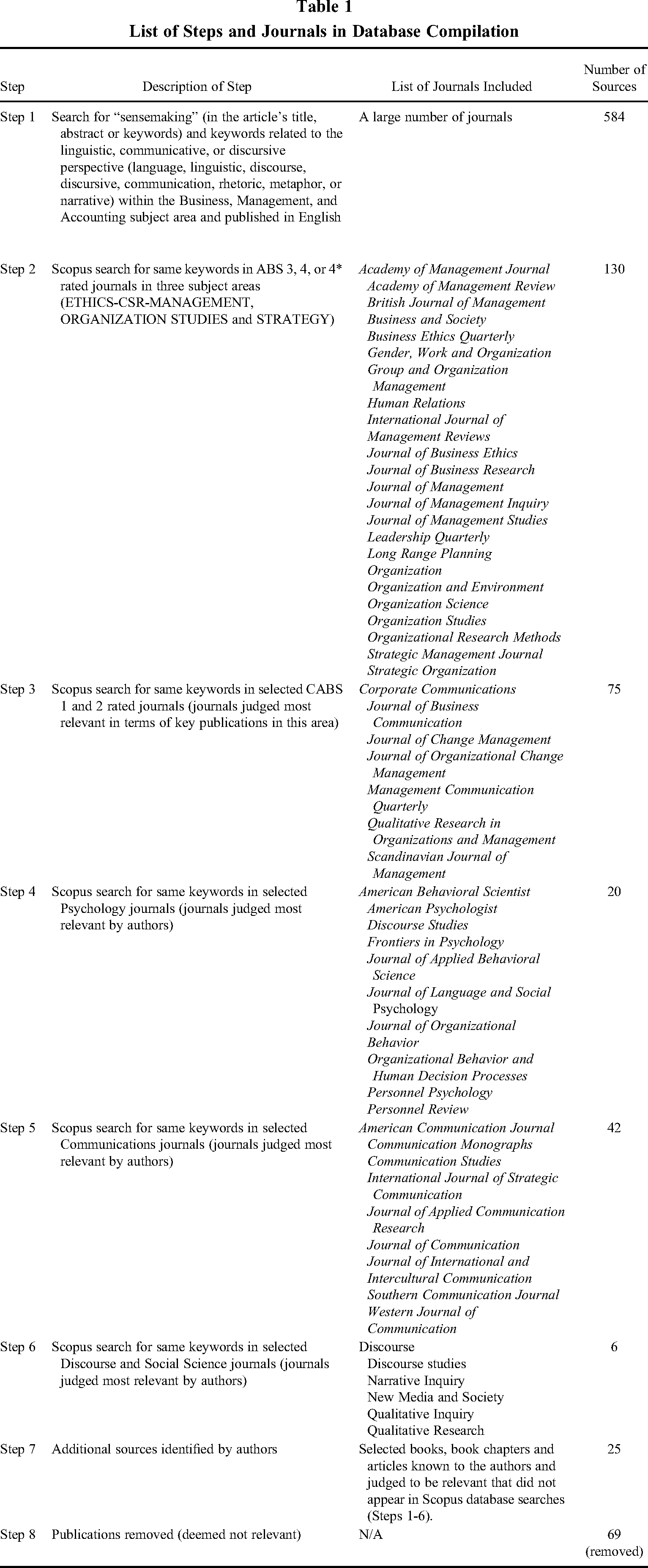
Our review is based on a database of books and articles published up to and including June 2022. The database was compiled using the following steps. The first step involved searching the Scopus database for the term “sensemaking” (in the article's title, abstract, or keywords) and keywords related to the linguistic, communicative, or discursive perspective (language, linguistic, discourse, discursive, communication, rhetoric, metaphor, or narrative) within the Business, Management, and Accounting subject area and published in English. This resulted in 584 publications, showing a proliferation of research in this area. Wanting to take a closer look at the most relevant high-quality publications, in the second step we concentrated our Scopus search on the most highly rated journals (3, 4, or 4*) in selected lists (ETHICS-CSR-MANAGEMENT, ORGANIZATION STUDIES and STRATEGY) from the 2021 Academic Journal Guide of the Chartered Association of Business Schools (ABS). This resulted in 130 articles.
However, we also recognized the limits of the ABS guide and wanted to make sure we included most of the key journals publishing research on language and sensemaking. Thus, the third step involved a wider Scopus search (using the same keywords) of all journals within the Business, Management, and Accounting subject area. After some iterations, the authors selected seven journals publishing relevant contributions beyond the 3, 4, or 4* categories already captured, providing a total of 75 additional articles.
To ensure we captured key contributions in adjacent areas of research—and especially at the intersection of management and organization studies and applied psychology and communication studies—in the fourth step we searched Scopus (using the same keywords) for selected psychology journals (20 articles). The fifth step repeated this for selected communication studies journals (42 articles) and the sixth step for selected Social Science journals (six articles).
Finally, we wanted to make sure we did not miss influential pieces of work published elsewhere. Thus, the seventh step involved the compilation of 25 additional sources identified by the authors that had not appeared in the previous searches, including books, book chapters, and additional journal articles. These seven steps resulted in a dataset of 298 publications. The final step involved a check for relevance to our focus on language and sensemaking. A total of 74 publications were deemed not relevant and excluded on that basis, making a final database of 224 publications. A summary of the steps involved in database compilation and a full list of included journals is provided in Table 1. It should be noted that these are not absolute numbers of written works on language in sensemaking but reflect our selection of the key pieces.
List of Steps and Journals in Database Compilation
Having compiled the database, we used an Excel sheet to code each article or book using a largely inductive approach that was also partly guided by our knowledge of the literature. Through subsequent discussions among the author team and further rounds of coding and code aggregation, we identified five core theoretical approaches to language in sensemaking: cognitive linguistic, rhetorical, narrative, interactionist, and critical discursive. We recognize that there are other ways of doing this coding. For example, framing could be seen as a category of its own due to its central role in sensemaking. However, because framing was linked with multiple approaches, we saw it as more fruitful to focus attention on its role in the cognitive linguistic, rhetorical, and interactionist approaches. Based on the content of each publication, multiple codes were applied where relevant. A total of 42 publications were coded with two or more codes. An overview of the cumulative progression of publications using each of the five theoretical approaches from 1990 onwards is provided in Figure 1. Publications prior to 1990 are excluded because of the very small number appearing across the years 1969 to 1989. Figure 1 provides an overview of the cumulative trajectory of work based on our coding of the selected articles and, as such, provides evidence of the proliferation of research in all five categories, and especially in the interactionist and narrative approaches.
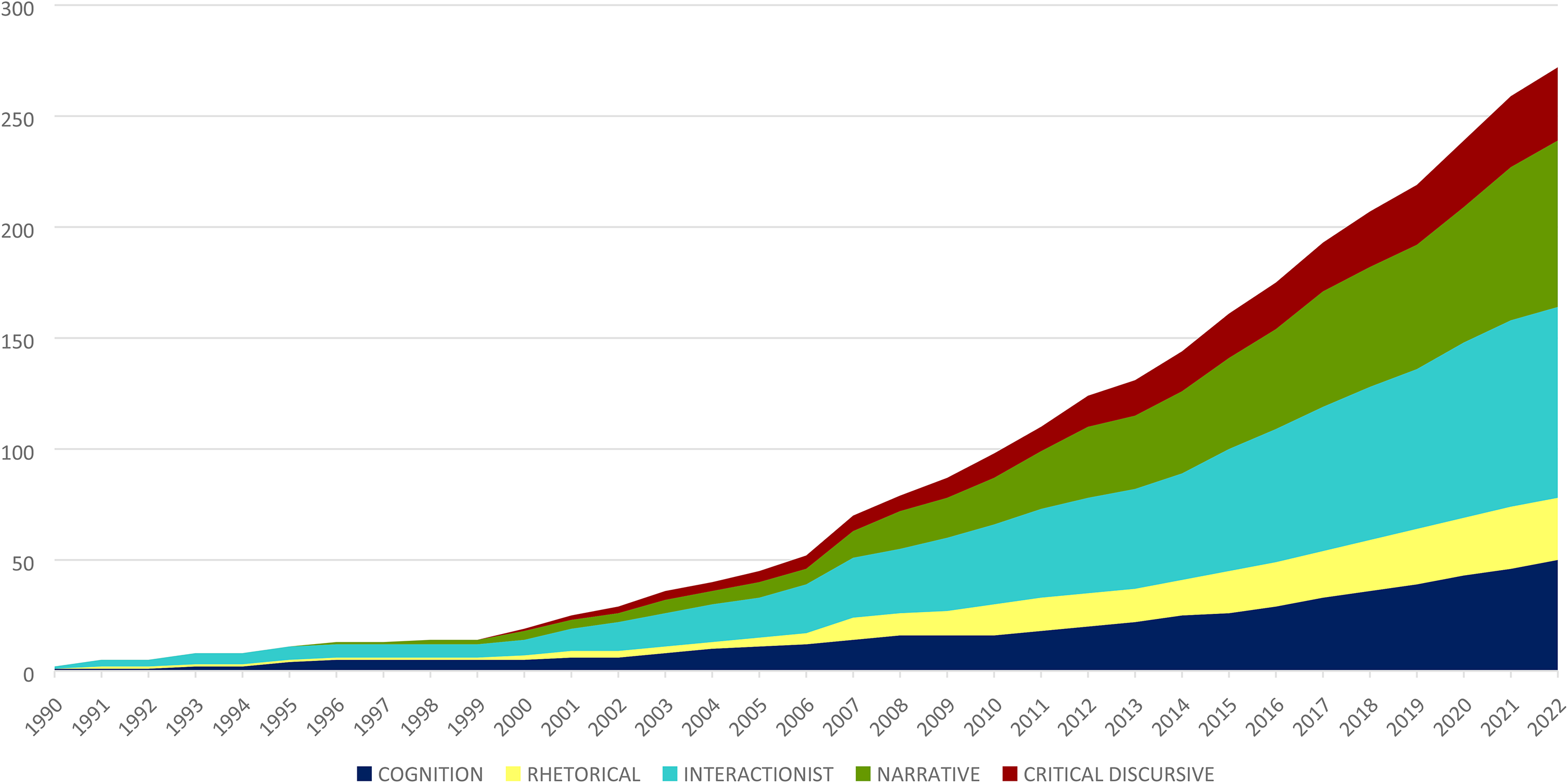
Cumulative Chart of Coding of Publications by Theoretical Approach (1990 Onward)
Although we first organized the literature by these theoretical traditions, we then grouped the research into three overarching categories: language and cognition (linguistic frames, concepts, and schema shaping sensemaking, as captured in the cognitive linguistic approach), language and social practice (patterns of language use in social interaction in sensemaking, as found in rhetorical, narrative, and interactionist approaches), and language and discourse (discursive structures enabling or constraining sensemaking, as exemplified in a critical discursive approach). While the research did not always fall neatly into one of these groups, this categorization allowed us to identify ways of distinguishing how language is used to create meaning and its effects on meaning-making processes; that is, to explore the functions of language in sensemaking. It is important to note that some perspectives can be linked with more than one approach. For instance, narratives can be analyzed as cognitive linguistic elements of temporal meaning formation, but, because narrative studies have tended to focus on collective processes such as organizational change or occupational identity, we decided to group narrative studies with other practice-related approaches.
Language-Based Perspectives on Sensemaking
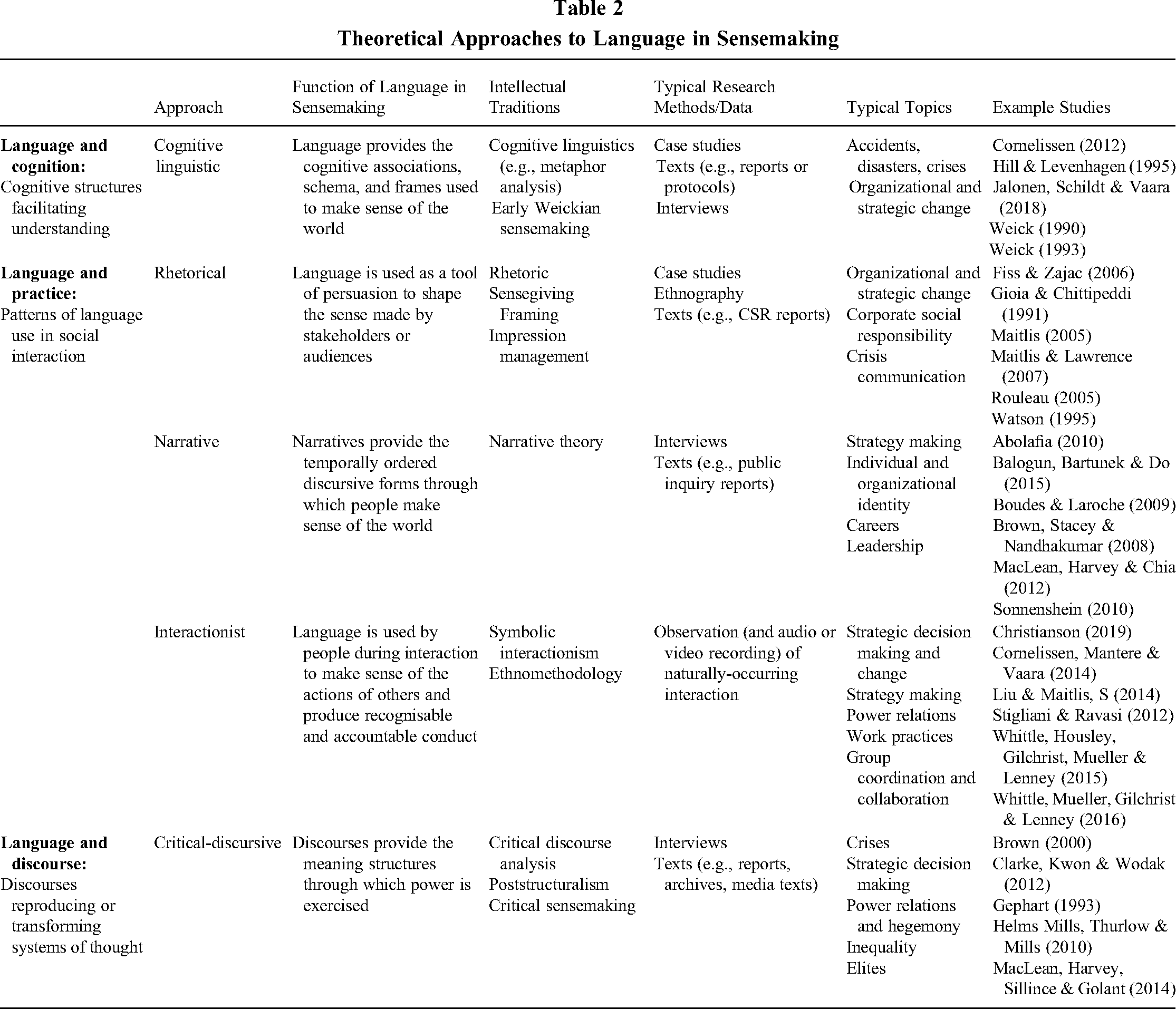
Using the emergent organizing framework, we now offer an overview of research focusing first on cognitive linguistic elements, second, on patterns of language use in social interaction, and third, on discursive structures enabling or constraining sensemaking. Table 2 offers an overview of these approaches, a summary of their characteristics, functions, and examples of key papers.
Theoretical Approaches to Language in Sensemaking
Language and Cognition: Cognitive Linguistic Elements Facilitating Understanding
This first category of scholarship concentrates on language as a basis of cognition. Research from this perspective explores linguistic terms and utterances in sensemaking, often revolving around specific frames, categories, metaphors, or concepts.
In some of Weick's early work (1990, 1993), language was highlighted as a key element of the cognitive failures that shaped sensemaking and created or precipitated the unfolding of disasters. For instance, Weick (1990) identified a failure to recognize an impending disaster in the Tenerife air crash when ambiguous utterances (e.g., “We are now at takeoff,” “Is he not clear then, that Pan Am?”) combined with the communicative distortion of deference to authority to precipitate the errors that ultimately led to the crash (Weick, 1990: 572-573). There were also breakdowns in understanding contributing to the loss of life in the Mann Gulch wildfire when communication became strained as the smokejumpers became separated and they failed to make sense of the orders given by their team leader when he instructed them to lie down in an “escape fire” (Weick, 1993: 629).
In the sensemaking scholarship that followed, Hill and Levenhagen (1995) were among the first to highlight the role of cognitive linguistic devices in sensemaking. In this research, the focus was on metaphors in the development of mental models by entrepreneurs. Sensemaking is vital in entrepreneurial contexts because these businesses are typically replete with ambiguity because they disrupt established ways of doing things, prompting questions such as “What does this business do?” or “How does this product or service work?” Hill and Levenhagen (1995) show that metaphors play a key role not only in how entrepreneurs develop their mental models of how the business environment works (sensemaking) but also how they communicate their “sense” to others to gain support, for example from investors or customers (sensegiving). Metaphors are important, they propose, because they help to render the abstract more concrete by drawing analogies to domains with which both the entrepreneur and audience are already familiar.
The significance of metaphors in sensemaking processes has subsequently been developed both in entrepreneurship studies and beyond. Cornelissen (2012), for example, reveals how corporate communication professionals use metaphors to negotiate their professional role commitments amidst pressures of social accountability. He shows how they do this through sensemaking and sensegiving when responding to critical incidents such as a campaign by animal rights activists, a nuclear accident, and a terrorist attack. König, Mammen, Luger, Fehn, and Enders (2018) demonstrate how journalists and securities analysts make different kinds of sense of CEOs’ metaphorical language because of the two groups’ different “thought worlds,” leading the two groups to evaluate the firms’ prospects in more positive or less positive ways. Bruskin and Mikkelsen (2020), in turn, identified the metaphors used by employees and managers in an organization undergoing change. They found that metaphors of the past trivialized change whereas metaphors of future anticipated change in ways that reflected and reinforced their fear of uncertainty and gloomy outlook for the future.
Metaphors are not the only focus for scholars interested in the role of language in shaping mental processes of sensemaking. Jalonen, Schildt, and Vaara (2018) examined how “strategy concepts”—the specific set of words or phrases developed during strategy processes that have some shared meaning—shape strategic sensemaking. For example, they showed that the concept of “self-responsibility” was used in a city organization to help managers find common ground for action in the face of ambiguity and uncertainty, while also hindering the implementation of some decisions. In a recent study, van Zoonen, Rice, and Ter Hoeven (2022) focused on how being linguistically categorized into “essential” and “non-essential” workers during the COVID-19 pandemic shaped how employees made sense of the meaningfulness of their work, and also of themselves, triggering identity threats for those categorized as “non-essential” alongside feelings of anxiety, distress, and depression.
Studies centered on framing have also explored the power of linguistic frames in sensemaking. In writing taking a cognitive perspective, a frame has been defined as a “mental template that individuals impose on an information environment to give it form and meaning” (Walsh, 1995: 281) or as a “knowledge structure that directs and guides information processing” (Cornelissen & Werner, 2014: 184). Framing research has shown that organizational actors make sense using different frames, which are often organized around distinct clusters of terms, phrases, or figures of speech. For example, Mize Smith (2012) used interviews and focus groups with employees to identify four distinct frames used by employees to make sense of their employers’ philanthropic donations and charitable activities.
Importantly, studies have shown not only that distinct frames can be created but also that conflict can occur when these different frames meet. Meyer, Cross, and Byrne (2016) studied the “framing contests” that occurred between actors in a school district organization that undertook a “green building” initiative to build an environmentally responsible and resource-efficient building. These contests were resolved by decoupling the frames, for example by separating environmental concerns from other concerns, and extending the central frame to one of “high performance building,” which did not privilege one set of stakeholder concerns over others. Notably, by resolving these framing contests to construct an agreed understanding of the new building, it was possible to generate support and motivate action for the new green initiative amongst different stakeholders.
Other studies have made further advances in our understanding of framing during periods of organizational change. Gover and Duxbury (2018) build new understandings of how organizational change is cognitively processed and “made sense of” over time. Their study of change in a hospital showed that employees’ real-time sensemaking about the change experience can differ from their retrospective accounts, with the latter being influenced by cognitive biases. In addition, Konlechner, Latzke, Güttel, and Höfferer (2019) highlight the value of both coupling and decoupling frames in enabling a change initiative in two hospital units. They found that differences in the unit's “perceived problem” frame (“learning from errors is not part of our culture” vs. “few errors happen on our ward”) shaped their sensemaking about the “fit” and “expected value” of the change initiative for their unit. Although this study found that frames were continuously changing, they also showed that the expectations embedded within these frames were “sticky” and in each case led to a failed change process.
Other scholars have examined the interplay of language with emotion in sensemaking processes. This dynamic has been found to be a key component of the sensemaking processes involved in interpersonal conflict (Heaphy, 2017; Volkema, Farquhar, & Bergmann, 1996), interorganizational disputes (Myers, 2007), and the pursuit of a “calling” to value-laden work (Schabram & Maitlis, 2017). Heaphy (2017), for example, studied sensemaking in hospital employees who acted as mediators in conflicts between patients, families, and staff. She found that the language that patients and their families used and the way they spoke to mediators evoked a range of emotions in those mediators. The mediators drew on their feelings, as well as those expressed by the other party, to make sense of the conflict and its causes in what Heaphy calls “empathetic accounts.” Chen and colleagues (2021) also found that the emotional and behavioral responses of perpetrators of “abuse” towards their subordinates in organizations occur not only directly from the abusive act itself, but also from how the perpetrator subsequently talks about their actions with others and the responses by those others. Taken together, this body of work suggests a recursive relationship between language, emotion, and sensemaking, showing how language shapes our emotional response to an event and, in turn, the meanings we make of it. At the same time, the way we generate meanings shapes the emotions we feel and the language with which we communicate.
In sum, the cognitive linguistic perspective, although not always going by this label, has been a key part of sensemaking research since its inception. Recent analyses concerning metaphors and frames have opened up new, theoretically grounded insights into the core question of how meaning is made through cognition-based language in sensemaking. This research highlights how linguistic devices such as metaphors significantly shape how people process novel or equivocal information, cognitively and emotionally. This, in turn, affects the kinds of meanings they make. Importantly, this body of work provides insights into the more cognitive aspects of sensemaking, specifically the way individuals interpret and organize what they see, hear, and experience. However, there are also issues and areas that warrant more attention. For instance, while a great deal is known about metaphors, the role of other tropes, such as metonymy or irony, remains only partly understood. There is also a need to dig deeper into the dynamics of how frames are cognitively created and reproduced, particularly how new frames are created or how existing frames are combined in creative new ways. In addition, linking a more cognitive and psychological interest in emotions with more recent research on emotions as embodied phenomena represents an important direction for future research.
Language and Social Practice: Patterns of Language Use in Social Interaction
This second category of sensemaking research concentrates on various practices through which sense is made during interactions with others. One body of work has drawn on the rhetorical tradition and focused on how language is used as a tool of persuasion to shape the sense made by stakeholders or audiences. This tradition includes research drawing from impression management and framing, in addition to studies of sensegiving that have often emphasized the persuasive aspects of language use (Gioia & Chittipeddi, 1991; Maitlis & Lawrence, 2007). In the body of work using a narrative approach, language in the form of narratives provides the temporally ordered discursive forms (i.e., a plot connecting events between a cast of characters in a meaningful sequence) through which people make sense of their experiences. This stream of research includes work drawing from advances in organizational narrative analysis (Brown, 2000; Brown & Humphreys, 2003; Vaara, Sonenshein, & Boje, 2016). Yet another set of studies follows an interactionist perspective where language is understood as a method of making and displaying to others the moment-by-moment interpretations and actions that constitute social organization. This work has been inspired by Garfinkel's (1967) work in ethnomethodology, as well as new calls for phenomenological or practice-based approaches (Sandberg & Tsoukas, 2015: 2020).
Since its inception by Gioia and Chittipeddi (1991), the concept of “sensegiving” has been recognized as an important communicative activity. Gioia and Chittipeddi (1991: 442) defined sensegiving as “the process of attempting to influence the sensemaking and meaning construction of others towards a preferred definition of reality.” Weick and colleagues (2005: 416) later defined sensegiving as “a sensemaking variant undertaken to create meanings for a target audience.” Gioia and Chittipeddi (1991) developed the concept from their study of how senior managers sought to influence the interpretations of others during a period of strategic change. Importantly, their study found that sensegiving involved using symbols and symbolic actions to “communicate that the existing interpretive scheme is no longer appropriate” (Gioia & Chittipeddi, 1991: 434). Language, as used in communicative activity, comprised a key symbolic action used to influence the sensemaking of others as the top manager held meetings, make presentations, and engaged in conversations with various stakeholder groups.
Maitlis (2005) also emphasizes the role of language-use in both the forms of communication between leaders and diverse organizational stakeholders and the emergent accounts—defined as “discursive constructions of reality that interpret or explain” (2005: 21)—in the social processes of sensemaking and sensegiving in three symphony orchestras. The study identified the communicative activities—such as “contesting a proposal, calling a meeting, explaining a situation, issuing a warning, expressing an opinion, writing a report, justifying a view, promoting a position, gossiping, and taking minutes” (Maitlis, 2005: 29)—used during “attempts to influence others’ understanding of an issue” (Maitlis, 2005: 21). Maitlis and Lawrence (2007), in turn, further developed the understanding of sensegiving by establishing when it is triggered and what enables it to be done. They place language at the heart of their definition of sensegiving, which they see as an interpretive process “in which actors influence each other through persuasive or evocative language” (2007: 57). This study identifies the importance of both “discursive ability” and “process facilitators,” referring to the routines and structures that give actors the time and opportunity to engage in sensegiving. More recently, Bilgili, Tochman Campbell, Ellstrand, and Johnson (2017) have developed the sensegiving perspective by examining the effect of lexical choices in written announcements to shareholders. They found that both the content and tone of the language used in the announcements affected how shareholders made sense of major organizational changes, in their case a change in leadership triggered by a CEO retirement. In all of this research, the way that language is used in sensegiving is key to the impact of that activity on recipients and, in turn, organizational outcomes.
Turning now to literature that focuses explicitly on rhetoric and sensemaking, Mills, Weatherbee, and Colwell (2006) studied how Canadian universities use performance and ranking measures to influence impressions of their academic standing and reputation amongst various audiences. The authors combine sensemaking theory and “ethnostatistics,” which involves the ethnomethodological study of the production and use of statistics, to show that the statistics produced by ranking and accreditation systems can have multiple meanings and provide powerful rhetorical devices to influence external audiences. Numbers can thus also be seen as a form of “symbolic” exchange within a language system.
Disruptive events such as the global financial crisis have also been examined from a rhetorical perspective. Green and Peloza (2015), for example, studied the role of rhetoric in sensemaking by exploring how managers answered the question of “What's going on here?” and “What do I do next?” (2015: 109) in the recession that followed the global financial crisis. Counter to their expectations, the authors found that the number of Corporate Social Responsibility (CSR) messages used by managers during the recession increased rather than decreased. In line with their predictions, however, the content of managers’ messages changed in ways consistent with the environmental conditions, such that CSR messages were integrated into mainstream advertising and the use of “self-oriented” appeals increased. The authors argue that the managers adapted their messaging by making sense of the likely reactions of consumers and using this “sense” to design their CSR communications.
In another study of the global financial crisis, Höllerer, Jancsary, and Grafström (2018) showed the distinctive rhetorical potential of visual media. Their study revealed how visual images used together with written texts in media coverage of the global financial crisis enhanced sensegiving about its causes and consequences by broadening its scope and providing additional layers of information to the audience. Here we see the strength of combining analysis of visual and verbal communications in sensemaking. Nowling and Seeger (2020) also studied crisis communication but in a context of a public health turmoil in Flint, Michigan. Tens of thousands of Flint residents were exposed to dangerous levels of lead in their water supply which, together with the subsequent outbreaks of Legionnaire disease, made many people ill and killed at least 12 people. The authors analyzed the emails and documents used to communicate during the crisis by government officials, which ultimately served to exacerbate the failure of sensemaking, particularly when “image repair” and efforts to maintain consensus dominated the responses.
The study of CSR has been another key context for the development of studies of sensemaking and rhetoric. In addition to the Green and Peloza (2015) study described above, Joutsenvirta (2011) researched how firms and NGOs come to define what is socially responsible behavior. By identifying the rhetorical struggles between a forestry company and Greenpeace over a period of 16 years, the study showed that these struggles redefined the boundaries of what was considered socially acceptable corporate behavior, with implications for the environmental issues on which the company chose to act. Iivonen and Moisander (2014) in turn examined how organizations defend their reputation in situations where the legitimacy of their industry has been called into question, focusing on the U.S. industry association representing the soft drinks industry when it came under scrutiny for its role in causing obesity. Elaborating a “stakeholder-oriented sensemaking perspective,” the paper identifies the rhetorical strategies the organization used to make sense of—and give sense to—corporate responsibility as a way of managing their stakeholder relationships. Iivonen and Moisander (2014) identify three “narcissistic” rhetorical strategies through which the industry body worked to undermine the credibility of the agenda-setters while promoting the reliability and authority of the industry: “dismissal of agenda-setters and their accounts of the issue” (2014: 656), “reframing the issue and the responsibility of the industry” (657) and “bolstering and normalizing the industry and its accounts of the issue” (658).
In sum, rhetorical approaches to sensemaking, often conceptualized as sensegiving, have illuminated the key role that language plays when influencing the sensemaking of others, and the variety of ways in which it does so. This has sparked new research in several areas such as the financial crisis and CSR and holds promise for the analysis of other contemporary topics, such as sensemaking and sensegiving in the climate change crisis or the coronavirus pandemic. While rhetoric can thus be seen as a core part of theory development in sensemaking and sensegiving, it should be noted that only some studies in this area have been explicitly linked with advances in rhetoric analysis elsewhere, and thus there are opportunities to deepen our understanding of the rhetorical means used in sensemaking.
Narrative analyses have made significant contributions to the advancement of knowledge across a range of topic areas in sensemaking research. Here, we will consider a select number of contributions across the areas of strategic management, individual and organizational identity, careers, and leadership. Starting with the study of strategic management, Dunford and Jones (2000) built on Barry and Elmes’s (1997) notion of strategies as narratives about the organization's future to examine how narratives serve as devices for sensegiving during periods of strategic change. For Dunford and Jones (2000: 1208), language affects both “what we constitute as objects of concern” and “the actions we conceive” in response to those concerns. Critically, they emphasize the importance of language in its narrative form in “constituting a new reality in the minds of organizational members” (Dunford & Jones, 2000: 1208), which they explore in relation to three organizations facing strategic challenges as a result of industry deregulation. The narrative approach to studying strategic processes has been further developed by Fenton and Langley (2011) in relation to strategy as practice research, Logemann, Piekkari, and Cornelissen (2019) in the context of sensegiving and strategic change, and Rindova and Martins (2021) in relation to how strategic narratives of the future are crafted as a form of prospective sensemaking.
Individual and organizational identity research has also been influenced by the study of narrative sensemaking processes (Vough, Caza, & Maitlis, 2020). In relation to individual identity, Watson and Bargiela-Chiappini (1998) have shown how the narratives in personnel management magazines provide “story boards” for readers to make sense of the tensions and dilemmas they experience in their managerial roles in ways that differ according to the national context. Hay, Parker, and Luksyte (2021) analyzed narratives of failed organizational change—in their case a failed restructuring exercise in an Australian university—to show how employees’ identities in relation to their organization, professional group, and work group were reinforced or challenged by the way they made sense of the failed change. Sensemaking about failure has also been examined by Bourne (2017), who focused on three distinct narratives through which members of an online community made sense of the collapse of a Jamaican investment firm and, in so doing, made sense of their own identities as “enterprising investors.” Lilius and colleagues (2008) brought together narrative and cognitive linguistic approaches by identifying how giving, receiving, or witnessing compassion offered to “suffering” employees serves as a “sensemaking occasion” from which employees narrate new understandings of themselves, their coworkers and their organization. Importantly, this study also illustrates how sensemaking about identity can operate at individual, group, and organizational level, as people create stories that answer the questions “Who am I?” and “Who are we?” With a focus on identity at the organizational level, Humphreys and Brown (2008) adopted a narrative approach to study how a bank made sense of its CSR in relation to members’ understanding of the organization's identity. They identified three ways in which organizational members tried to make sense of new CSR initiatives alongside the imposed narrative of the organization's identity, with its focus on the economic payoffs for such initiatives.
A common finding in narrative studies of organizational sensemaking is narrative plurality and “discrepant sensemaking” (Brown, Stacey, & Nandhakumar, 2008). This is where groups differ in the story they create about “who we are” or “what is happening” across organizational groupings (e.g., different teams, departments, business units, or hierarchical levels) and across geographic locations. For example, Brown and Humphreys (2003) found that senior managers told “epic” tales whereas employees told “tragic” tales of their experience of a merger. More recently, Stensaker, Balogun, and Langley (2021) showed how employees located at different sites constructed different meanings of a change in an offshore oil platform. Their study found that onshore workers constructed “progressive” narratives whereas offshore workers constructed “regressive” narratives.
The narrative sensemaking approach has also been used by scholars interested in careers. Lee, Kossek, Hall, and Litrico (2011) employed a narrative approach to identify five different narratives through which professional workers made sense of reducing their working hours, revealing the different ways they made sense of their commitments to their personal, family, work, and community lives. Vough, Bataille, Noh, and Lee (2015) examined how managers produced narratives that made sense of their retirement decisions, identifying six different narratives through which the decision to stop working was constructed. With a focus more on outward impressions of legitimacy, MacLean, Harvey, and Chia (2012) explored how members of the business elite crafted narratives of their career that served to legitimize their privileged position and present their life history in socially acceptable and desirable ways, thereby connecting the narrative approach with the critical discursive focus on power inequalities.
In leadership research, narrative sensemaking approaches have been employed to explore three distinct contexts for leadership stories: stories leaders create while inspiring or influencing followers; stories told about leaders; and stories that leaders tell about their own development as leaders. With regard to the first context, where leaders tell stories while interacting with followers, Kelley and Bisel (2014) examined how leaders crafted stories of the trustworthiness of organizational members, revealing how the leaders emplotted them in storylines of being “predictably bad,” “predictably good” or “unpredictable,” with consequences for how they interacted with them. Humphreys, Ucbasaran, and Lockett (2012) explored the second type of context, where people tell stories about leaders, to examine how jazz musicians told (and retold) oral stories about leaders in the world of jazz. In their study, informal storytelling about “past legends” of the jazz world were used for both sensemaking and sensegiving. The stories of past legends both “orchestrated” by helping musicians to make sense of how to behave as a musician within a band, and “educated” by giving sense to others about what it means to be a jazz musician. The third type of context—where leaders tell stories about their own development as leaders—has been advanced by Mathias and Smith (2016) in their study of autobiographies of craft entrepreneurs, by Zheng, Meister, and Caza (2021) in a study of the stories leaders tell about becoming a leader and how they enact leadership, and by Bisel, Kramer, and Banas’s (2017) study of how a leader of a top gymnastics training organization led others to challenge and change unethical practices in the organization.
In all, this body of work has highlighted the key role of narratives in individual and collective sensemaking about issues that often have self-understanding at their center. In essence, this research has shown how narratives provide temporal discursive structures that are crucial for making sense of experiences at the interface of the self and organization. Although already used to study a variety of topics, the narrative perspective can also be applied in other areas where there is a need to place specific events or issues in a longer-term context, such as historical analyses of organizational change (Boje, Haley, & Saylors, 2016; Gasparin, Green, & Schinckus, 2019), or studies of adversity and growth (Maitlis, 2022; Sawyer & Clair, 2021). Such research not only illuminates the role of preexisting and established narratives in collective meaning-making, but also how narratives are formed, reproduced and transformed in social interaction.
Through our review of the literature, we identified five main bodies of work that both share an interest in sensemaking and elucidate its language-based interactional aspects. The first body of work focuses on interactions that constitute strategic decision-making and strategic change. For example, an early contribution by Vaara (2003) identified the interactions that shaped sensemaking during a major strategic change involving an acquisition of three smaller Swedish companies by a larger Finnish company. By examining how the acquiring and acquired organizational members made sense of the integration process in internal discussions over a period of 4 years, Vaara (2003) showed how their interactions contributed to the slow progress of the integration efforts. Also exploring strategic change, Rouleau and Balogun (2011) looked at how middle managers developed their strategic roles during periods of strategic change. Their study showed that the “discursive competence” of middle managers lay not only in “performing the conversation”—such as how they use language within meetings and presentations—but also in their skills in “setting the scene,” by setting up the right kinds of interactions with the right people at the right time. Jian (2011) also examined sensemaking during periods of change, using discourse analysis to analyze real-time interaction in an insurance company, revealing the interrelated “layers” of discursive action through which change is created that do not fit linear, step-based models of change. These layers involve the search for meaning in relation to questions of organizational circumstances (i.e., “What is this situation we are facing?”), questions of individual and organizational identity (i.e., “Who am I and who are we?”) and questions of organizational practice (i.e., “What does this action mean?”).
The second body of work examines interactions that are shaped by relations of power and authority. For example, Tourish and Robson (2006) address the question of why managers ignore the messages of warning and concern they receive from subordinates (referred to as “critical upward communication”) and also why subordinates suppress the communication of these messages. Bringing a sensemaking perspective to this question, the authors identify the processes through which managers over-commit to courses of action despite critical feedback from below them in the hierarchy, and how they rationalize their actions by demonizing and stigmatizing those who view the situation differently. Parmar (2017) also examines relationships marked by power relations by reexamining one of the most famous social experiments of all time: the interactions between the participants and the “stooge” acting as a university scientist in Milgram's obedience to authority experiments. Parmar (2017) uncovered key areas of difference in the language and interaction used by obedient and disobedient participants. Specifically, disobedient participants “engaged in cycles of sensemaking, until they were able to construct an interpretation of the situation that problematized the experiment and indicated a will to exit” and used “language to extract different cues from an equivocal situation…to trigger an alternate interpretation of the situation, and the will to disobey” (Parmar, 2017: 1375). In other words, the degree to which the authority figure exercised power over the experiment participants was fundamentally grounded in the “sense” they constructed of the situation and expressed in cycles of interaction. Together, these studies of sensemaking and power relations show that how power is enacted and the responses engendered are grounded in the construction of sense through language-based processes of interaction.
The third body of interactionist work has in common neither topic nor site of study, but, rather, a shared approach to analysis grounded in ethnomethodology. Alongside phenomenology and systems theory, ethnomethodology was one of the key intellectual influences in Weick's development of sensemaking theory, especially Garfinkel's development of Karl Mannheim's ideas about the “documentary method” of interpretation (Weick, 2001: 20-23). Ethnomethodological scholars use different terminology, such as “inferential practices” (Samra-Fredericks, 2010: 231) or interpretive “procedures” or “methods” for making sense (Heritage, 1984), but they share with sensemaking theory a concern to identify how people turn “cues” into meaning using “frames” (or how an “appearance” is connected to a “pattern,” to use ethnomethodological terminology; see Heritage, 1984: 86).
The body of work informed by ethnomethodology typically uses data comprised of audio- and video-recording of naturally occurring interactions because the interactions can later be “slowed down” and subjected to detailed analysis in order to identify these “inferential practices.” A number of key insights have been derived from studies using this approach. Using an ethnomethodological discourse analysis approach to study real-time interaction during employee selection decisions, Bolander and Sandberg (2013) showed how assessors reached hiring decisions grounded in the construction of “facts” about the candidates, which were based on the inferential practices they used to interpret candidates’ interview performances. The authors also revealed how assessors used selection tools as “sensemaking devices” to make their decisions visible, reasonable, and accountable. Yamauchi (2015) used video-recordings of photocopier repair technicians to understand how the technicians made their requests for, and offers of, assistance “make sense.” In the context of strategic change, Whittle, Housley, Gilchrist, Mueller, and Lenney (2015) used an approach grounded in ethnomethodology used to study categorization practices known as Membership Categorization Analysis to analyze audio recordings of meetings. The analysis revealed how a consultant led a team of middle managers to make sense of the threats and opportunities associated with an organizational change using their shared stock of knowledge and reasoning procedures associated with different categories of organizational actor. Whittle, Mueller, Gilchrist, and Lenney (2016) also used an ethnomethodological approach to examine how a middle management team in a British subsidiary of an American multinational corporation made sense of their relationship with corporate headquarters. Analyzing the use of metaphors and stories in their meeting interactions, the authors showed how the team hid, diluted, and restricted their “local sense” from the headquarters, thereby transforming potential strategic action into inaction, in a process they called “sense-censoring.”
The fourth body of work explores processes of interaction in work groups that enable or disrupt processes of coordination and collaboration. An early study by Kavanagh and Kelly (2002) studied the conditions underpinning coordination and collaboration, in their case between organizations in a project network assembled to design a new process control system for a pharmaceutical company. The authors identify the creation of “communicative spaces” as a key component enabling project members from different “situated communities” to generate the collective “sense” needed for collaboration. More recently, Mikkola and Stormi (2021) studied interaction in management meetings in a hospital during a period of change and identified three different forms of “change talk,” which they labelled “collaboration,” “control,” and “confrontation.” Crucially, these distinct discourses of change also shaped how the managers made sense of what change was possible or desirable, with implications for what the organization decided to change.
Scholars have also made important theoretical developments in the study of group interaction and sensemaking by linking these phenomena to other key concepts, such as “face” and “voice.” Patriotta and Spedale (2009) examined social interaction in a consultancy task force to identify the role that “face games” played in how individuals and groups constructed and maintained a coherent image of themselves. When interacting, the task force generated language-based divisions and controversies that required resolution through the construction of shared meaning. While some interactions generated an “interaction order” that helped to build a working consensus, on other occasions unresolved controversies over meaning and identity weakened the team structure and created a loss of meaning they label “senselosing.” The concept of “face” was also important for Jahn's (2019) study of how firefighters make sense of exchanges involving “voice,” for instance when employees try to draw attention to risky or hazardous workplace behavior. Jahn's (2019) study found that voice involved equivocality and that firefighters had to actively make sense of and respond to in order to develop their shared learning, with profound implications for high-reliability organizations where voice is especially important for identifying errors. In addition, Einola and Alvesson (2019) examined the interactions of three virtual teams and identify the processes through which teams can build—or fail to build—the shared meanings necessary for coordinating their activities and acting like a “team.” Importantly, their analysis reveals how divergence as well as convergence in meanings can emerge from team interaction, where “diverging individual sensemaking fuels distance, conflict and the corrosion of the team” (Einola & Alvesson, 2019: 1905).
The fifth and final body of work expands the remit of interactional studies of sensemaking by identifying the role played by both linguistic and non-linguistic elements in sensemaking processes. By non-linguistic, we refer to approaches exploring the material, multimodal, and embodied aspects of sensemaking. This body of work seeks to advance sensemaking theory beyond the focus on linguistic elements of interaction (i.e., talk and text) to incorporate all embodied forms of interaction (e.g., facial expression, gesture, bodily movement, etc.). It also seeks move beyond an “anthropocentric view” (Hultin & Mähring, 2017: 568) by identifying the role played by the technological tools and material artefacts in sensemaking processes. For example, Stigliani and Ravasi (2012) drew on evidence from an ethnographic study of a design consultancy firm to propose that conversational and material practices come together to support the transition from individual-level sense to the kind of collective group-level sense necessary for shared understandings to form. Cornelissen and colleagues (2014), in turn, showed how verbal communication breakdowns, together with the material properties of artefacts and intense emotions felt by the officers, contributed to the fatal shooting of an innocent man mistakenly suspected to be a terrorist. For example, their analysis revealed how the material properties of the artefacts used during the interaction between counter-terrorist officers and surveillance officers on the ground and at the command center—such as the use of a black and white (rather than color) photocopy of the intended suspect—contributed to their collective failure to recognize and correct their mistake.
Hultin and Mähring's (2017) study of the changes in sensemaking triggered by a “lean” initiative in an emergency ward also highlight how discursive practices interacted with material practices. Importantly, they proposed that material artefacts such as a “flow board” monitor display were not only devices designed to aid the sensemaking of the human actors but were “constitutive of the material-discursive practice conditioning the acts and enactments of sensible actions and beings” (2017: 587). Building on this, Meziani and Cabantous (2020) used evidence from a study of four film crews to question mind-body dualism by showing how bodily actions play a key role in transforming an initial sense of a situation, experienced as “intuition,” into something that can be publicly displayed and communicated. They propose that four elements interact in collective sensemaking: cognition, language, body, and materiality. Weiser's (2021) study of strategic change in a software company showed that sensemaking is a multi-modal process, combining discursive practices such as sensegiving with “substantive actions,” such as making modifications to the organizational structure. Jansson, Lunkka, Suhonen, Meriläinen, and Wiik (2019) also emphasize the interplay of material and discursive practices in the formation of collective sense, using video recordings to identify how staff in a recently merged surgical unit developed their working practices, including the replaying of video recordings to facilitate sensemaking. Finally, Nissi and Pälli (2020) advanced our understanding of how shared sensemaking is facilitated by multimodal artefacts. In their study, the authors propose that the artefacts used during a writing exercise in training workshops exerted their own “agency” because they either enabled or restricted the actions of those using them.
In all, the proliferation of research adopting an interactionist approach reveals the crucial role of social interaction and reciprocity in sensemaking. Whether explicitly conceptualized as a process involving double interacts or not, this stream of work has highlighted different interactions through which people in organizations create, reinforce, change, conceal, or challenge sense. The plurality of approaches also shows how different theoretical and methodological perspectives can be used in this area. Future research can thus follow a variety of paths, including studies grounded in the ethnomethodological roots of sensemaking, or using new tools and methods in multimodal analysis (Höllerer et al., 2018; Vaara & Whittle, 2022).
Language and Discourse: Discourses Reproducing or Transforming Systems of Thought
The third category of sensemaking research concentrates on discursive structures that enable or constrain sensemaking.
Much of this work takes an explicitly critical perspective and explores issues of power, politics, and ideology in societal level sensemaking processes. The term “discourse” is commonly used in this body of work to refer to the collection of linguistic and social practices that comprise a system of thought which shapes how people make sense of themselves and the world around them. Discourses as systems of thought shape sensemaking processes by “mak[ing] sense of the world for its inhabitants, giving it meanings that generate particular experiences and practices” (Phillips, Lawrence, & Hardy, 2004: 636). Work in this vein is often inspired or informed by the poststructuralist work of Michel Foucault or the critical linguistics of Norman Fairclough and colleagues. While these approaches differ in terms of their philosophical commitments—most notably the latter's development of poststructuralist thought in dialogue with neo-Marxist theories of ideology and hegemony—they share a focus on the role of discourses in shaping power relations in organizations, institutions, and society at large.
One of the first papers to put forward a critical discursive approach to the study of language and sensemaking was by Gephart (1984). Gephart (1984) studied two inquiries—one into the Santa Barbara oil spill and one into a sour gas well leak in the Blueberry River Reserve—to explore how they made sense of the causes of the disasters and how they assigned responsibility for them. Gephart (1984) presents a critical perspective on the talk and text used during the inquiries to make sense of the disasters, emphasizing the way in which descriptions of events are “inherently political” (1984: 210) and identifying the power struggles between different parties to define “reality.”
This critical approach to studying language and sensemaking was later developed in Brown's (2000) analysis of the Allitt inquiry into a scandal at a hospital involving a nurse accused of killing multiple children. Brown identified how the inquiry team made sense of the individual and organizational failings that allowed the killer to continue unimpeded for three months, murdering four children and attempting to poison a further nine. Brown's analysis was grounded in rhetorical and narrative approaches, which we have considered earlier, but he also developed a novel synthesis of these with critical approaches to discourse analysis. These critical approaches examine the role of ideology (understood as a system of ideas that serve to benefit one social group over others) and hegemony (understood as the transformation of an ideology into something that is taken-for-granted as “natural” or “right”). From Brown's (2000) perspective, language features in sensemaking not only as a system for cognitive processing or group interaction, but also as a power-laden feature of how a text such as an inquiry report serves to “support the legitimacy of social institutions and extend the hegemony of prevailing system-supportive ideologies” (Brown, 2000: 48). Brown (2005) later advanced this line of theorizing further in his analysis of the official report into the collapse of Barings Bank, emphasizing the report's hegemonic functions as it sought to legitimate established institutions.
Others have developed the critical discursive approach to sensemaking by examining how the discourse used in sensemaking draws on, reproduces, or challenges preexisting ideologies. The critical discourse analysis approach developed by Van Dijk (2006) and Chouliaraki and Fairclough (2010) has been applied by Breit (2010) in the context of media coverage of corruption cases. By “ruling in” certain ways of making sense of corruption and “ruling out” others, the discourse used in the media texts in this study had ideological implications for how societal actors made sense of the causes of corruption and what could (or should) be done about it. This research also highlights the important ideological function played by the mass media in shaping how citizens, organizations, and governments make sense of issues. Drawing on the critical discourse approach of Van Dijk (2006), Mees-Buss and Welch (2019) examined the growth and decline of a counter-ideology among the corporate elite in one large multinational firm. The authors propose that ideologies can be conceived as “deep” sensemaking structures which shape managerial decision-making in ways that are typically unnoticed by those involved. Importantly, the ideologies identified by Mees-Buss and Welch (2019) were grounded in the language used by the managers, such as in their shared lexical choices and the shared logic of cause and effect found in their narratives.
Clarke, Kwon, and Wodak (2012) examine how senior managers make sense of strategic issues to inform their decision-making, using a Discourse-Historical Approach (DHA) in their analysis. DHA is a form of critical discourse analysis that involves analyzing not only what is said “here and now” but also unpacking the “levels” of historical context beyond this. In DHA, the analyst identifies the deeper social and historical contexts in which talk and text are produced, from the genres and discourses on which a text draws, to the extralinguistic social and institutional contexts in which they arise, and the broader sociopolitical contexts in which they are embedded. In so doing, the analyst can be sensitive to how sense made through talk or text—such as discussions in a strategy meeting in Clarke and colleagues’ (2012) case—reproduces or challenges historically sedimented power structures.
The ideological dimension of discourse used in sensemaking has also been elaborated in historical studies by MacLean and colleagues (MacLean, Harvey, Sillince, & Golant, 2014; MacLean, Harvey, Suddaby, & O’Gorman, 2018), who explore how deeply entrenched ideologies persist over time and shape strategic decision-making (MacLean et al., 2014) and how multinationals contribute to the promulgation of particular ideologies (MacLean et al., 2018). Their study of the role of Hilton International in promulgating anti-communist discourse (MacLean et al., 2018), for example, highlights how ideology can be understood as something organizations actively use to gain strategic advantage, by “giving sense” to others using the ideology.
Helms Mills and colleagues (2010) have, in turn, developed a “critical sensemaking” approach that puts discourse at the heart of the systems of inequality, exploitation, and privilege shaped by sensemaking processes. The authors draw on the work of Foucault (1979) to propose that discursive practices, drawn from powerful and dominant discourses, shape the possibilities of sensemaking. In other words, to understand how organizational actors make sense, we should pay attention not only to how they actively construct collective meaning but also how their meaning-making is structured by the “systems of thought” that prevail in that society at that time. The critical sensemaking approach was also used by Tomkins and Eatough (2014), who explored how competing societal discourses of “how to be a woman” and “how to be an employee” shaped how working women with unpaid caring responsibilities make sense of their identities. Tomlinson and Egan (2002) develop the idea that discourses shape how people make sense of their experiences, but not in unproblematic ways. Their study found that women espouse the discourse of “valuing diversity” but also struggle to enact it, finding that “the valuing diversity discourse was not particularly helpful to participants’ sensemaking” (2002: 79). Schlierer and colleagues (2012), in turn, explore how SMEs make sense of their social responsibilities to stakeholders in ways that differ according to their sociolinguistic context, such as when Anglo-American business concepts and terminology are translated into local languages. For example, when the term “stake” is translated to mean “interest” in Italian, “these translations may also influence the sensemaking process” (2012: 48).
In summary, the critical discursive approaches highlight the broader discursive structures and processes that easily pass unnoticed in conventional sensemaking analysis. They are nevertheless crucial to better understand the basis of sensemaking and the power structures that sensemaking reproduces or challenges. These approaches also enable more critical analysis in sensemaking, for example by highlighting its ideological basis and functions. It is easy to see that such analysis can be extended beyond the topics and contexts that have been examined so far, to not only specific empirical questions but also to advance our theoretical understanding of the ways discourses enable or constrain sensemaking.
An Integrative Theoretical Framework
Based on this review, we can thus see both significant differences in the different streams of work and opportunities to develop a more comprehensive understanding of the variety of linguistic processes and functions at play in sensemaking. Although we have presented prior research in terms of five approaches organized into three broader categories, we recognize that there are important distinctions between and within the approaches. In particular, the underlying onto-epistemological assumptions differ significantly, and it is thus not easy or even always possible to integrate insights from the different analyses. For instance, the worldview in cognitive linguistics is very different from that in rhetorical, narrative, or ethnomethodological analysis, not to speak of the critical discursive perspectives. In cognitive linguistics, the focus is on specific elements of language use (such as a term or a metaphor) that are understood to influence, or represent, cognitive constructions. In contrast, within the rhetorical and narrative traditions in our review, the focus is on the social practices and processes of language use. The interactionist approaches such as ethnomethodology are even more process oriented with an emphasis on social construction through ongoing interactions. Finally, in the critical discursive studies, discourses are seen as higher-level structures, of which people are usually unaware, reproducing and at times transforming social reality and relations of power. Thus, the definitions, empirical contexts, and preferred research methods may be fundamentally different across the different approaches. This means, at the very least, that care should be taken when attempting to synthesize the theoretical points made or empirical insights emerging from studies grounded in the different approaches. These fundamental differences might also be a major cause for the ambiguity and complexity that seems, at times, to characterize research on sensemaking.
Nevertheless, we believe that it is also important to use this review as a basis for developing an overall theoretical understanding that helps to move this field forward. In our view, identifying and elaborating on the three broad categories of research also suggests that it is possible to link them together in a form of an emergent theoretical framework at a higher level (Elsbach & van Knippenberg, 2020). Figure 2 offers a visual presentation of this framework. Our intention here is not to dismiss fundamental differences between various approaches but to offer an overview that helps to identify the differences and suggests linkages that can pave the way for future research efforts. This is important in order to move towards a more comprehensive understanding of the role of language in sensemaking.
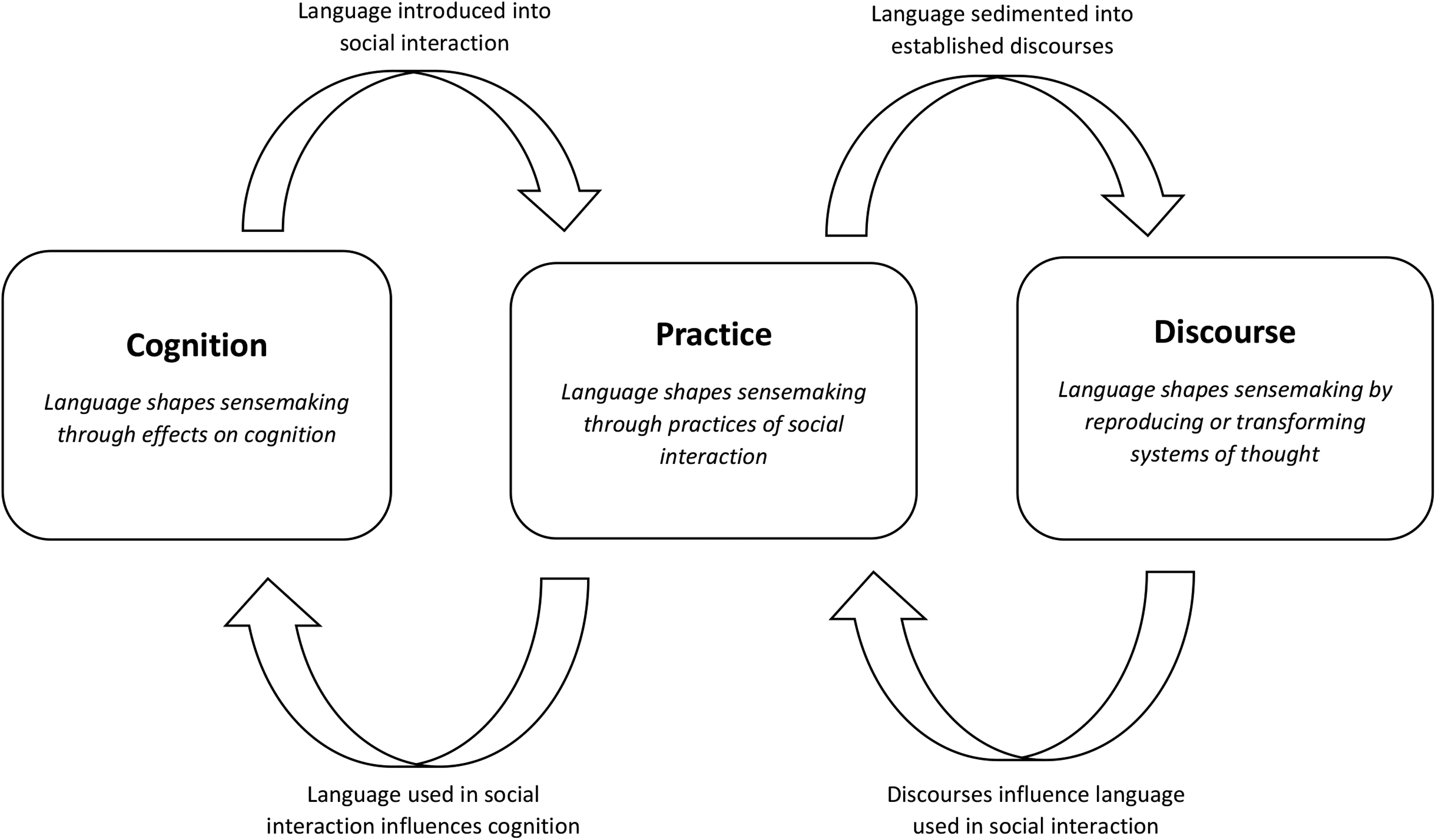
Integrative Theoretical Framework for Understanding Language in Organizational Sensemaking
Bringing different perspectives together illuminates the pathways through which language shapes sensemaking in terms of cognition, social practice, and broader discursive structures and processes. By so doing, we can also see how these pathways and their functions are interlinked and mutually constitutive. Moving from left to right, the cognitive linguistic elements form the basis of social interaction, and these interactions and the social practices they entail then constitute the broader discourses as systems of thought. Moving from right to left shows how the broader discourses enable or constrain social interaction, which, in turn, influence the kind of cognition that may be prompted and the “sense” that emerges.
This has important implications for our understanding of sensemaking, and, in the following section, we discuss how this emerging framework can be used to further progress research on sensemaking.
Contributions and an Agenda for Future Research
As shown in our review, there are many issues and questions that warrant more attention within specific approaches. Thus, future research could involve more targeted analyses using specific—and explicitly identified—cognitive linguistic, rhetorical, narrative, interactionist, or critical discursive lenses. However, based on our emerging theoretical framework, it is also possible to identify and elaborate key topics and questions that cut across specific approaches and can help us move forward with a more comprehensive understanding of the role of language in sensemaking. Thus, we propose that special attention should be focused on the following issues: the multifaceted role of language in sensemaking, intertextual and multimodal links in the language of sensemaking, the agentic and structural role of language in sensemaking, episodic and latent aspects of language use, and the role of power in discursive sensemaking.
Multifaceted Role of Language in Sensemaking
By integrating different perspectives on language and sensemaking, we chart their multifaceted relationships. Specifically, we highlight three pathways through which language influences the sensemaking process: (a) shaping processes of cognition through the formation of schemas or frames used in individual meaning-making; (b) in processes of social interaction to build frames and shared understandings upon which collective action is taken; and (c) enabling and constraining sensemaking through the discourses circulating in institutions and society. Each of these pathways provides a foundation for understanding the variety of forms language takes and the functions it plays in management and organizations. Together, they document the influence of language on sensemaking and thus on the meanings that managers and other actors make in organizational life.
Moreover, combining these pathways provides a basis for exploring how language and sensemaking interact in the complex, multi-level social processes that run through organizations and organizing. If we consider, for instance, issues of disability and inclusion in organizations, the importance of language and sensemaking are obvious (Mik-Meyer, 2016; Santuzzi & Waltz, 2016), but the processes through which language and sensemaking interact around this issue are complex. Our framework provides a basis for exploring how language and sensemaking might shape the evolution of such an issue through cognition (as individuals build schemas that define the meaning of and boundaries around disability), social interaction (as groups of people negotiate their shared understandings of the meaning of disability in their organizations), and discursive structures (as societal discourses motivate and constrain organizational responses to disability). Thus, identifying when and how language shapes sensemaking has profound implications for a wide range of organizational processes, including decision making, resource allocation, crisis management, and the development of collective identity.
The key challenge for future research is to conceptualize and empirically explore the relationships between the various roles that language plays, as depicted in Figure 2. This figure allows us to see the recursive processes linking together forms of language that underpin cognition, such as utterances and metaphors, and linguistic practices through which sense is made in social interactions which, over time, sediments to produce the discursive structures that enable or constrain our ways of making meaning. Elaborating on these pathways thus offers exciting avenues for future research.
Intertextual and Multimodal Links in the Language of Sensemaking
Our review also highlights the power in moving beyond the analysis of standalone conversations or texts—valuable though this kind of analysis is—towards an understanding of how they gain their meaning, import, and power through their linkages with other texts and other semiotic forms. Future research could usefully be directed at understanding the sensemaking effects of chains of texts (acts of speech or writing), extending the analysis of individual acts of language use to consider how texts are connected and reinterpreted as they move through space and time and across different groups and communities (e.g., MacLean et al., 2018). We therefore encourage future research to use intertextual analysis and multimodal analysis. Intertextual analysis shifts the methodological scope of analysis beyond single points of time in single locations in at least three ways: (a) toward processual studies of meaning-making through texts over time (such as within or between organizations as they make sense of an issue); (b) toward historical analysis of shifts in dominant discourses across epochs; and (c) toward comparative analysis of how discourses vary across institutions, countries, or regions. Techniques such as topic modelling and corpus linguistics could prove particularly valuable in advancing such work.
Multimodal analysis offers a fruitful direction for future research because it shifts the focus away from studying texts as purely linguistic phenomena towards studying them as one of many semiotic modes that interconnect in the meaning-making process (Höllerer et al., 2018). This directs scholars towards studying how the sense made of texts shapes (and is shaped by) their relationship with other semiotic forms, including images, signs, colors, objects, and bodily movement. As we have discussed earlier in this review, methodologies that capture how language relates to other semiotic forms are likely to be valuable here, such as video-ethnography and visual data analysis methods. Multimodal analysis is particularly important, we argue, for understanding how sense is formed in an increasingly mediatized society, where sense is shaped by mass media and social media. Here, research designs are needed that capture how the language used in mass and social media shape sensemaking within organizations and sensemaking about organizations within society (e.g., Hu & Rerup, 2019; Stieglitz, Bunker, Mirbabaie, & Ehnis, 2018; Toubiana & Zietsma, 2017).
This also raises the issue of embodiment, which is gaining increasing attention in sensemaking research. We propose two ways of linking this interest in embodiment with language and communication. The conventional one is to distinguish between language use and sociomateriality, implying that embodied aspects of sensemaking form a separate line of sensemaking research. The other is to adopt a broader view of communication and meaning-making that encompasses bodily movements, gestures, and visceral experiences as important sensemaking cues (De Rond, Holeman, & Howard-Grenville, 2019; Whiteman & Cooper, 2011). Viewing communication in such a way helps to develop a more comprehensive view on communication as mediated by embodiment, and it also links with calls for a broader understanding of semiotic processes in meaning-making in and around organizations (Höllerer et al., 2018). Following this line of work spearheaded by recent examples (De Rond et al., 2019; Whiteman & Cooper, 2011) opens up exciting avenues for future research on the multimodal semiotic and embodied processes in sensemaking.
Agentic and Structural Role of Language in Sensemaking
Our review reveals that existing research has developed two distinct ways of viewing language in sensemaking. One approach views language use as a deliberate, conscious, and strategic activity of influencing the sensemaking of others, and this is most visible in rhetorical work such as sensegiving. Another approach focuses on the constitutive role of language in “structuring” the sense that can be made, typically in unconscious and taken-for-granted ways, which characterizes especially the critical discursive perspectives. These two perspectives are grounded in very different constructions of power in organizations, and lead to alternative ways of explaining organizational change and related processes. Each approach also has quite different implications for leaders and managers. We believe that our framework can help to develop a more complete picture of the sensemaking process, one which captures both the agentic modes in which language is used by people to “do things” and the more structural mode in which language “does things” to people. In fact, our framework—albeit in a somewhat abstract manner—helps to unpick the different functions of language use and see the various ways in which language-based structures and processes impact this use.
Future research could thus address both the question of “how do people actively use language to make and give sense?” as well as deeper sets of questions, including “where does the language used in sensemaking come from?” in the form of available discourses. The latter aspect enables us to ask: “what structuring effects, including power effects, does language have over those making sense?” While the agentic form of analysis has been well developed through studies of sensegiving, impression management, and rhetorical strategies, there is scope to examine more underdeveloped areas, including humor and irony in the process of rhetorical persuasion (e.g., Kwon, Clarke, Vaara, Mackay, & Wodak, 2020), and questions of how sensemaking is shaped by misinformation and fake news, conspiracy counter-narratives, and bullshit (Christensen, Kärreman, & Rasche, 2019; Foroughi, Gabriel, & Fotaki, 2019; Spicer, 2017).
Episodic and Latent Aspects of Language Use
Our review also highlights how existing research can be differentiated according to whether sensemaking is viewed as something that occurs during particular “episodes” of interaction where events are surprising, confusing, or equivocal (that is, where making sense is experienced as effortful for members; Weick, 1995) and the “latent” view where sensemaking is viewed as something that takes place on an ongoing basis in ways that are often routinized (that is, where sense is made and taken for granted by members; Holt & Cornelissen, 2014; Introna, 2019; Sandberg & Tsoukas, 2015). In the former perspective, equivocality (where an event has more than one meaning) is a more visible phenomenon. In the latter, equivocality is not as obvious because the language-in-use has furnished actors with routinized and taken-for-granted ways of making sense and therefore meaning-making feels effortless, simply a matter of using shared “common sense” (Vaara & Whittle, 2022).
Our review develops novel insights into the connections between these two views by focusing on the role of language in meaning construction. We propose that organizational sensemaking can be understood as a process of movement between situations where sense is more taken-for-granted (because language has furnished actors with a shared “common sense” that enables coordinated action) and more equivocal situations (where actors struggle to develop a common language that provides a shared meaning system which can enable coordinated action). This would help us not only link these two different perspectives but also develop a more comprehensive view of sensemaking dynamics that focus attention on how one may shift from more automatic “common sense” views to questioning taken-for-granted understandings, or how situations where people are lacking existing frames for making sense (e.g., “cosmology episodes”; Weick, 1993) can eventually turn into “routine” sensemaking.
Thus, there is a need for future research to explicate how and why these processes of “latent” structuring through language matter for organizations, such as when linguistic categories pre-structure sense in ways that precipitate mistakes and disasters, for example in the case of the “10 o’clock fire” (Weick, 1993) and the “code red” alert in the Stockwell shooting (Cornelissen et al., 2014). For instance, in both these cases, it was arguably the “latent” structuring of the actors’ sense of the situation through the use of a linguistic category (“10 o’clock fire,” “code red”) from an established discourse that exacerbated the actor's failure to sense what was happening. Our integrative framework helps show how attention to the interconnection between the ways of thinking based on meaning (as discussed in our section “language and cognition”), the “here and now” of shared meaning generation through social interaction (what we call “language and social practice”), and the wider systems of thought that actors draw on (what we call “language and discourse”) provides for a more complete understanding of organizational sensemaking and its outcomes.
Power in Sensemaking
Finally, there is a need to focus special attention on power in discursive sensemaking. While there are papers that have dealt with power, they have remained relatively rare and have often only implicitly tackled issues such as politics and power relations. Recent articles have however shed new light on power as an inherent part of sensemaking. Schildt, Mantere, and Cornelissen (2020) demonstrated how power works in sensemaking processes in more visible or hidden ways, Vaara and Whittle (2022) have offered a critical discursive perspective to illuminate the underpinnings of power in organizational sensemaking, and Alvesson and Jonsson (2022) focused on meaninglessness and non-sensemaking in sensemaking. Together these conceptual papers show the theoretical potential that lies in adopting discursive perspectives to better comprehend both how power relations inform sensemaking and how sensemaking reproduces or changes broader power relations. Some of the papers included in the critical discursive approaches in our review share this orientation, but there is a need for more empirical research that illustrates exactly how power operates in sensemaking and, more specifically, how this happens in and through language use.
Conclusion
Although acknowledged as a key part of sensemaking, the exact role of language has remained unclear in this area of research. Thus, we have focused on taking stock of what is known and not yet known about language in this review. If anything, our analysis reveals the need to take language seriously in sensemaking research because of the many different ways it operates in sensemaking. Our review also shows that it is time to move from abstract and vague ways of dealing with language to a more theoretically grounded analysis of the processes, practices, and functions of language use. We believe that by elucidating the multiple roles of language in organizational sensemaking and illuminating ways in which the specific approaches can be linked, our analysis helps to move sensemaking research forward. This can mean increasingly sophisticated and targeted cognitive linguistic, rhetorical, narrative, interactionist, or critical discursive analysis. However, there are also opportunities to connect insights from these existing streams of work and to focus on themes that cut across specific perspectives.
We hope that our agenda for future research can both help sensemaking scholars to advance understanding of the fundamental role of language in meaning construction, and connect these insights to those in adjacent streams of work in organization studies such as framing (Cornelissen & Werner, 2014), discourse (Phillips & Oswick, 2012), narrative analysis (Vaara et al., 2016), or language use (Lockwood, Simona, & Glynn, 2019). This can make an important contribution to theory development and also advance methodological understanding of the various language-based meaning-making processes in the social construction of reality.
