



Abstract
Sports contexts are increasingly used in management research to test and develop theory and explore managerially relevant phenomena. This growth in publications is likely driven by a series of advantages that sports data offers to management researchers. However, such positive features are not a panacea, as several drawbacks are also associated with leveraging sports data, which can limit their usefulness for management scholars. In this paper, we aim to provide management researchers guidance to leverage the advantages and avoid the drawbacks of leveraging sports contexts. To do so, we identify and review 249 papers published over the last 50 years that used sports data to advance management theories and shed light on managerial phenomena. After outlining how these works contributed to the growth of several key conversations in management research, we discuss the advantages of using sports data by outlining how they can advance management research both conceptually (e.g., theory building and radical theorizing) and empirically (e.g., triangulation and replication). We then discuss the potential drawbacks of research using sports data and suggest ways to compensate for them. We close by outlining several new directions in which scholars can leverage sports data to further advance management research.
Keywords
Management research leveraging sports data has increased steadily in recent years. Of the 249 studies using sports data we identified in our sample (i.e., management journals included in the Financial Times 50 list—hereafter “FT50”—in the 50 years from January 1, 1972, to December 31, 2021) 52% have been published since 2010 and 34% since 2015. The explosion of such research is driven by a series of advantages that sports data confers to management researchers, who have been quick to recognize the opportunities offered by the “datafication” and professionalization of sports (Millington & Millington, 2015). Such data is precise, comprehensive, and relatively accessible. Further, the relative newness of sports as empirical contexts and the pertinent yet distal nature of sports vis-à-vis management topics all contribute to make sports data advantageous to management research.
While sports data's positive features facilitate empirical investigations and offer a rich context to advance our understanding of management phenomena, they are not a panacea. These data have several drawbacks that may limit their usefulness to management scholars, thus turning sports contexts into an underutilized resource and/or limiting the applicability of sports data insights to management theory or practice. Examples of such drawbacks are an oversimplification of the match between the sports context and given management phenomena, which might result in overgeneralization of the findings (e.g., Katz, 2001; Taylor, 2017; Vermeulen, 2016), as well as the unsuitability of sports data to explain certain management phenomena.
Hence, the goal of this paper is to provide guidance to researchers who might benefit from leveraging sports contexts so that they are able to maximize the positives and avoid the negatives of sports data. 1 To do so, we review management research that has utilized sports data to highlight the positive and negative aspects of the use of sports contexts for management research and discuss opportunities for future research using such data.
The appeal of sports as an empirical setting for management research has yielded two reviews (Day, Gordon, & Fink, 2012; Wolfe et al., 2005). Their contributions, though, are quite different from ours. The first review (Day et al., 2012) focuses exclusively on a subset of micro-organizational research and examines how organizational behavior and sports science literatures contribute to central themes in management research, such as competition and cooperation within organizations, advocating for further integration between these two fields. The second review (Wolfe et al., 2005) focuses on research published before the recent surge in interest for sports contexts in management research. It also included only a selection of works (i.e., 18 papers) because its goal—rather than comprehensiveness—was to start a conversation about how organizational scholars might leverage sports contexts to study specific organizational research topics. Such differences are also reflected in a minimal overlap between these two works and our review, as only 11% of the 249 papers in our sample are included in these two previous works (for details on our review procedure, please see Appendix A1). We see our work as building on these two prior reviews to provide a more comprehensive review of the potential benefits and drawbacks of using sports data in management research and thus provide broad guidance on how to best leverage such data.
Our study is structured as follows. In the next section, we discuss the ways in which the use of sports data has advanced management research, providing examples of how different domains of research benefitted from research using sports contexts. Following this, we discuss opportunities for using sports data to continue to advance management research both conceptually (e.g., theory building and radical theorizing) and empirically (e.g., triangulation and replication). We then discuss common constraints and possible drawbacks linked to the use of sports data and suggest ways to address them. We close by providing several suggestions on how future works could leverage sports data to further advance management research.
Examples of Management Research Using Sports Data
In this section, we outline examples of how research using sports data has contributed to advancing several streams of management literature, namely the resource-based view, status and reputation, network-related theory, rivalry, risk-taking, decision-making, motivation, leadership, and unethical behavior. In the Future Directions section, we then highlight how scholars might further leverage sports data to advance such literature streams.
Resource-Based View
The use of sports data in management research has contributed significantly to the body of literature on the resource-based view (RBV). The presence of competing teams in tournaments (cf. Connelly, Tihanyi, Crook, & Gangloff, 2014) allows sports contexts to shed light on central aspects of the RBV. For instance, the sharing of a common factor market among sports teams allows for the exploration of how resources are bundled and deployed (Holcomb, Holmes, & Connelly, 2009; Sirmon, Gove, & Hitt, 2008), how the tacitness of experience and knowledge of sports teams and their managers enhance the understanding of the difficulty of imitating scarce resources (Berman, Down, & Hill, 2002), and how the ease of comparison between sports teams enables the investigation of performance differences due to similarities and differences in team size, structure, and goals (Holcomb et al., 2009).
A key feature of studies that leverage sports contexts is the recognition of human resources and tacit knowledge as key sources of competitive advantage and performance (Berman et al., 2002; Campbell, Saxton, & Banerjee, 2014; Holcomb et al., 2009; Moliterno & Wiersema, 2007; Shamsie & Mannor, 2013). A central insight from these studies is that the potential for superior performance does not come from simply possessing valuable resources, but instead from managing those resources actively and linking them with other organizational factors. For example, measuring sports organizations’ bundling and deploying resources over time enabled researchers to provide insights about the role of resource management to attain resource-based competitive advantage (Sirmon et al., 2008). Similarly, in other studies managerial ability was shown to be an important source of resource value creation (Holcomb et al., 2009). Studies using sports contexts have also found that tacit knowledge and routines provide a source of competitive advantage (Aime, Johnson, Ridge, & Hill, 2010; Shamsie & Mannor, 2013). At the same time, such resources can also be a source of rigidity and decline (Berman et al., 2002). Research leveraging sports data has also highlighted the importance of scope conditions with regards to the applicability of some of the core tenets of RBV, for example by showing that higher performance returns associated with more idiosyncratic resources might depend on contextual conditions (Fonti & Maoret, 2016). Along this line, research leveraging sports data has also shown that resources and capabilities are important contingencies to effectively implement an organization's strategy (Ross & Sharapov, 2015; Wright, Smart, & McMahan, 1995).
Beyond exploring the sources of performance differences, scholars have also used sports contexts to examine decisions to modify an organization's resource base. For instance, Moliterno and Wiersema (2007) studied how shifts in factor market conditions influence an organization's resource divestment capability as an organizational change routine. Their study was one of the first to empirically test arguments that were derived from both the RBV and the behavioral theory of the firm (BTOF) to study organizations’ decisions about whether to divest resources and, if so, which ones to divest. Theoretical integration of this kind provides an example of how management research using sports contexts can better connect RBV with organization theory, which is in line with recent calls for such integration (Davis & DeWitt, 2021; Greve, 2021).
Status and Reputation
Scholars have leveraged sports data from a variety of settings (e.g., basketball, baseball, football, soccer, hockey, golf, martial arts, Olympics, NASCAR, and Formula 1) to advance theory on status and reputation. 2 One of the central issues in the literature on status and reputation is that these constructs are often intertwined with other indicators of quality or performance, thus making it difficult to isolate their effects. Sports data provides multiple sources of information about alternative factors that might affect performance, as well as continuous and detailed tracking of various outcomes, which allows scholars to better disentangle the effects of reputation and status.
Accordingly, research using sports data has illustrated how actors’ status and reputation influence external evaluators in ways that are not explained by the actors’ actual quality or performance, which shows that the effect on outcomes comes from status or reputation rather than from other related factors (Graffin & Ward, 2010; Kim & King, 2014).
Sports settings offer fine-grained statistics that have been leveraged to contribute to conversations on status and reputation. In their contributions to these conversations, scholars have used different kinds of data, such as players’ competitive actions (Bothner, Kang, & Stuart, 2007), salaries (Christie & Barling, 2010; Marr & Thau, 2014), indications of deference (Anderson, Willer, Kilduff, & Brown, 2012; Huang & Washington, 2015), rankings (Bothner, Kim, & Smith, 2012; Kim & King, 2014), and performance-related outcomes (Bothner et al., 2012; Christie & Barling, 2010; Flynn & Amanatullah, 2012; Maoret, Marchesini, & Ertug, in press; Waguespack & Salomon, 2016). Scholars have also examined status- and reputation-related effects and mechanisms that apply to sports executives (Radaelli, Dell’Era, Frattini, & Messeni Petruzzelli, 2018), coaches (Kilduff, Galinsky, Gallo, & Reade, 2016; Treadway et al., 2014), and institutions (Sahib, 2015). Actors’ status and reputation have also been analyzed in relation to outcomes that go beyond traditional on-field performance, such as their implications for ticket sales (Ertug & Castellucci, 2013; Huang & Washington, 2015), for achieving broader acceptance among social audiences (Helms & Patterson, 2014), for interorganizational partnerships (Castellucci & Ertug, 2010), and for hiring and turnover (Ertug & Castellucci, 2013).
Network-Related Theory
Research leveraging sports data has advanced network-related theory by shedding light on network mechanisms that explain individual (Campbell et al., 2014; Mariotti & Delbridge, 2012) and organizational outcomes and processes. The wealth and granularity of sports data, together with the social and interdependent nature of team sports (Katz, 2001), make sports an ideal setting to contribute to this conversation. It is thus not surprising that some of the earliest works in our sample contributed to network-related theory (Stern, 1979; 1981). More recently, research leveraging sports data has advanced current conversations on the roles networks play for individuals and organizations, such as the altercentric perspective (Kleinbaum, Jordan, & Audia, 2015; Tasselli & Kilduff, 2021)—by providing clarity on how the decisions and behaviors of other network members affect a focal actor's network and its outcomes (Clough & Piezunka, 2020; Schwab, 2007; Sgourev & Operti, 2019)—and the role of network core versus periphery (Cattani & Ferriani, 2008; Maoret, Tortoriello, & Iubatti, 2020)—by showing how core and peripheral members of an organization differently affect the organization's behavior and performance (Fonti & Maoret, 2016; Stuart, 2017; Wang & Cotton, 2018). For example, work leveraging Formula 1 data has highlighted that organizations’ decisions about whether to initiate new ties are affected by the outcomes of similar experiences of their immediate neighbors organizations (i.e., vicarious performance feedback; see Clough & Piezunka, 2020), and thus that the evolution of an organization's network is conditioned by the decisions and outcomes of other organizations in the network. In addition, research using National Hockey League (NHL) data has shown how losing a central actor reduces organizations’ propensity to experiment, thus diminishing their performance (Stuart, 2017).
Rivalry
One of the management literatures that has strongly benefitted from research using sports data is rivalry. For example, research using data from National Collegiate Athletic Association (NCAA) basketball teams showed that the subjective intensity of rivalry is determined by shared experiences and history of competitive interactions (Kilduff, Elfenbein, & Staw, 2010). Rather than being driven by the team's individual attributes, rivalry perceptions varied at the dyad level and were the highest when teams were similar, had a history of repeated interactions, and competed in evenly matched competitions. These findings were novel as they revealed that the underlying psychological components of rivalry were subjective and relational, which contrasted with prior work that had generally used the word rivalry and competition as synonyms or defined a subset of competitors as rivals based either on more objective features (such as threats) or on current—rather than past—features or events (such as the exchange of competitive moves; Chen, 1996).
These insights about the subjective intensity of rivalry motivated subsequent management research—also using sports data—that aimed to understand the relationship between relational rivalry and competitive conduct at the team level, such as risk-taking (To, Kilduff, Ordoñez, & Schweitzer, 2018a) and unethical behavior (Kilduff et al., 2016). The relational component of rivalry has also influenced how rivalry has been examined in proximate disciplines, such as psychology, with studies on the performance outcomes of runners competing against rivals (Kilduff, 2014), on the factors that increase Machiavellianism (Kilduff & Galinsky, 2017), and on the effects of a rival's performance against third parties on a focal actor's motivation to win (Pike, Kilduff, & Galinsky, 2018).
Recent work conceptually addresses the common assumption that “relational rivalry operates similarly at the interindividual and interfirm level” (Kilduff, 2019, p. 781) by providing a theoretical framework that aggregates individuals’ psychological processes to explain firm-level outcomes. This work emphasizes the role of institutionalization of interorganizational rivalry, while providing anecdotal evidence—such as university fight songs sung at sports events—to show how rituals, language, and myths can help socialize newcomers and institutionalize rivalry between competitors.
Risk-Taking
Yet another management literature that has been advanced using sports data is risk-taking. Work leveraging sports data has typically focused on the link between attention focus and risk-taking (Bothner et al., 2007; Greve, Rudi, & Walvekar, 2021; Lehman, Hahn, Ramanujam, & Alge, 2011). For instance, to examine the role of time in the performance-risk relationship (March & Shapira, 1992), recent work (Lehman et al., 2011; Lehman & Hahn, 2013) has captured varying amounts of risk taken by teams by leveraging discrete choices (i.e., play-by-play decisions) in the National Football League (NFL).
Due to the unique feature of temporally bound performance periods in sports, this work also addresses calls for research that accounts for time in organizational processes (Ancona, Okhuysen, & Perlow, 2001) and tackles two additional issues that pertain to organizational risk-taking. First, prior work has primarily looked at how the performance-risk relationship varies across performance periods, yet organizations also monitor performance within periods. Lehman et al. (2011) found that the time that remains before the end of a period is a unique resource triggering shifts between foci of attention that are related to alternative reference points (i.e., aspirations, survival, and slack), thus shaping the performance-risk relationship. Second, even though performance is generally dynamic, many prior studies on the performance-risk relationship have adopted a rather static view of performance. Sports data allows researchers to overcome this limitation. Leveraging the NFL context, where teams experience winning or losing scores within games as well as wins and losses over a season, Lehman and Hahn (2013) showed that momentum in performance trajectory over time impacts organizational risk-taking. Similarly, Bothner et al. (2007) used National Association for Stock Car Auto Racing (NASCAR) data to show that, at the individual level, the interplay between within-period relative performance (i.e., number of competitors capable of surpassing a focal driver within a race) and period-to-period performance (i.e., the focal driver's race-to-race change in ranks) can influence attention shifts and shape an individual's risky conduct (i.e., propensity to crash).
Decision-Making
Sports data has also been used to advance insights on decision-making. One central area of research looks at biases in decision-making. For instance, scholars have used basketball data to explore the sunk-cost effect on player personnel decisions (Staw & Hoang, 1995) and to examine the so-called “generalist bias” (Wang & Murnighan, 2013), which is the “tendency to reward people with general skills when complementary, specialized skills are needed” (p. 47). Black and Vance (2021) have also used baseball data to explore whether and how long initial assessments of worker ability shape promotion decisions. Their results suggest “that the process of updating initially held beliefs occurs slowly over time and, thus, may be consistent with primacy or confirmation bias” (p. 16). Scholars also found that fans’ familiarity with basketball teams can bias and increase prediction confidence, but having more information decreases prediction accuracy of uncertain outcomes (Hall, Ariss, & Todorov, 2007). To further the understanding of the linkage between forecasting and decision-making under uncertainty, Keren (1987) has used the game of bridge as study context to capture two sources of uncertainty (i.e., the imperfect knowledge of the card distribution and the uncertainty about how opponents will play). This is relevant because studies on judgment and decision-making tend to assume and build on the construct of uncertainty as unitary construct (Tannenbaum, Fox, & Ülkümen, 2017).
This stream of studies has also looked at the role of intuition in decision-making. For example, Dane, Rockmann, and Pratt (2012) examined circumstances that determine the relative effectiveness of intuitive decision-making over analytical decision-making and find that domain expertise amplifies the effectiveness of intuition relative to analysis. Radzevick and Moore (2008) revealed that when decision-making in competitive setting relies more on intuition than on systematic analysis, competitors attend myopically to themselves (i.e., their own side rather than on opponents). Finally, scholars have used data on handball players to examine the effect of different strategies on the option-generation process and the quality of final choice (Johnson & Raab, 2003) and found that “strategies producing fewer generated options result in better and more consistent decisions” (p. 215).
Motivation
Sports have shown to be ideal settings to advance theories on individual motivation, particularly equity theory and expectancy theory. Sports settings are particularly suited for testing equity theory (Day et al., 2012) because data on individual inputs (e.g., individual performance) and outcomes (e.g., salaries) for a variety of possible referent others—both internal and external to one's organization (cf. Werner & Mero, 1999)—are available in most professional sports. This allows individuals a more precise assessment of whether equity is respected in relation to the inputs/outcomes ratio of their referent others (Bretz & Thomas, 1992) and, consequently, whether this comparison should act as a motivating factor. At the same time, it also allows researchers to test more directly the effect of extant inequities on an individual's motivation. As data on individual input and outcomes are rarely publicly available in corporate settings, equity theory has been mostly tested in the laboratory, with all the intrinsic limitations of such designs, where it is unclear whether manipulations were sufficient to challenge perceived equity in the subjects (Bretz & Thomas, 1992). The granularity of such data makes professional sports a unique setting to test and advance this theory, both in terms of confirming its basic mechanisms and determining important contingencies on how they operate. Research leveraging the behavior of free agents in baseball provided confirmatory evidence for the basic tenets of equity theory, i.e., the fact that players use a variety of methods—typically, the most economical (cf. Cook & Hegtvedt, 1983)—to restore equity perceptions when they experience inequity in their treatment compared to referent others (Bretz & Thomas, 1992; Duchon & Jago, 1981; Lord & Hohenfeld, 1979). Using these data, research in this area has also looked at the interaction of equity theory and expectancy theory. By exploring under which contingencies equity mechanisms are at play, it showed how expectancy theory—namely, the performance-outcome expectancy—plays a role in moderating the extent to which equity theory drives individuals’ behavior (Harder, 1991), thus providing a unique insight on how equity and expectancy jointly affect individual motivation. Additional research leveraging baseball and basketball data on free agents’ behavior refined such findings by providing evidence for additional contingencies on the functioning of equity theory. Namely, it showed how free agents’ behavior differs depending on the type of inequity they perceive—that is, feeling under- versus over-rewarded—and that such difference depends on the level of interdependence among teammates (cf. Thompson, 1967). For example, in the case of basketball, which features higher levels of team interdependence, players behave selfishly if under-rewarded and cooperatively when over-rewarded (Harder, 1992). Finally, research leveraging data from professional golf (Flynn & Amanatullah, 2012) showed that, due to social comparisons, a focal actor's individual performance increases when performing alongside high-performing individuals yet decreases when competing directly with them.
Leadership
Research leveraging sports data has also contributed to advancing the leadership literature. Sports contexts naturally lend themselves to examining leadership behavior—due to a clear identification of who is the leader on a given team—and its effect on performance, which is typically available, both individually and as a team. In early examples of such research, leadership data were collected either via survey or by coders who observed leaders in action. For example, scholars leveraged survey data on captains of intramural basketball teams (Konar-Goldband, Rice, & Monkarsh, 1979), as well as observational and survey data on the behavior of coaches of Little League baseball teams (Curtis, Smith, & Smoll, 1979) to link specific leadership behaviors to individuals’ perceptions and performance. Further work took a more prescriptive approach to highlight what leaders should be doing to maximize team performance. For example, leveraging observational data on skippers’ behaviors in a sailboat regatta (Komaki, Desselles, & Bowman, 1989), scholars found that the two types of supervisor behaviors—that is, collecting performance information during a race (monitors) and providing feedback on such performance (consequences)—were both correlated to better team performance (i.e., regatta wins).
Research using sports data also extended leadership theory by integrating it with other theories. To examine the relationship between leadership, trust, and performance, Dirks (2000) leveraged survey data on coaches of NCAA men's college basketball teams to show that trust in leadership—but not in teammates—played a positive, mediating role between past and future team performance. Sports data also helped to shed light on the negative side of leadership. A study using data on the biographical sketches of the CEOs of Major League Baseball organizations showed that CEO's dark-side personality features (namely, narcissism) were negatively related to the use of transactional leadership, a leadership style that played an important role in retaining field managers (Resick, Whitman, Weingarden, & Hiller, 2009). Further, research leveraging self-reported data on golf games played by USGA members showed that CEOs shirking behavior—operationalized as playing more golf—resulted in lower firm performance (Biggerstaff, Cicero, & Puckett, 2017). However, negative leadership behavior might also have a positive effect on performance: using coaches’ halftime locker room speeches, researchers found an inverse-U relationship between leaders’ unpleasantness and team performance, thus highlighting how the right amount of unpleasant affect can act as a motivator for players (Staw, DeCelles, & de Goey, 2019). Finally, recent research focusing on race stereotypes in leadership leveraged news portrayal of US college football quarterbacks (Carton & Rosette, 2011) and coaches’ race in the National Football League and the National Basketball Association (Avery, McKay, Volpone, & Malka, 2015) to highlight under which conditions racial stereotyping is at play and, more importantly, how it can be reduced.
Unethical Behavior
Research on sports contexts has generated insights about unethical behavior, which is defined as workplace behaviors that violate generally accepted norms (Treviño, Weaver, & Reynolds, 2006). Empirical studies have explored such unethical behavior by looking at soccer players receiving yellow and red cards (Bartling, Brandes, & Schunk, 2015; Greve et al., 2021; Kilduff et al., 2016; Miklós-Thal & Ullrich, 2016), dojo members of martial arts violating “physicality norms” (Cole, 2015), NCAA members violating rules about recruiting and practice (Davis, Cox, & Baucus, 2021; Stern, 1981), ice hockey players receiving penalties for norm violations (Bushman & Wells, 1998; Kakkar, Sivanathan, & Gobel, 2020; Kelly & McCarthy, 1979), and horse-racing jockeys and members of competing neighborhoods being involved in violence, provoking injuries, and receiving penalties (Operti, Lampronti, & Sgourev, 2020). Some of these studies have also explored how practicing sports can help alleviate unethical and deviant behavior in everyday life (Trulson, 1986). By leveraging sports contexts, these works shed light on the individual and organizational antecedents of unethical behavior (cf. Kish-Gephart, Harrison, & Treviño, 2010). More specifically, they have revealed that unethical behavior can derive from rivalry (Kilduff et al., 2016), performance feedback (Bartling et al., 2015; Davis et al., 2021; Greve et al., 2021), and leader succession (Davis et al., 2021), as well as social networks and career mobility (Operti et al., 2020).
How Sports Data Can Advance Management Research
Having provided an overview of how works leveraging sports data have advanced several management research streams, we now turn to a discussion on how sports settings might help management research in multiple ways—namely, by facilitating theory development and testing (i.e., in the sections Theory Building and Theory Testing, and Radical Theorizing), by tackling emerging phenomena (i.e., Exploration of Emerging Phenomena), by addressing critiques that have been raised at empirical management research in general (i.e., Generalizability, Replication, Triangulation, and Practice Impact), and by providing new opportunities for management research (i.e., Data Availability).
Theory Building and Theory Testing
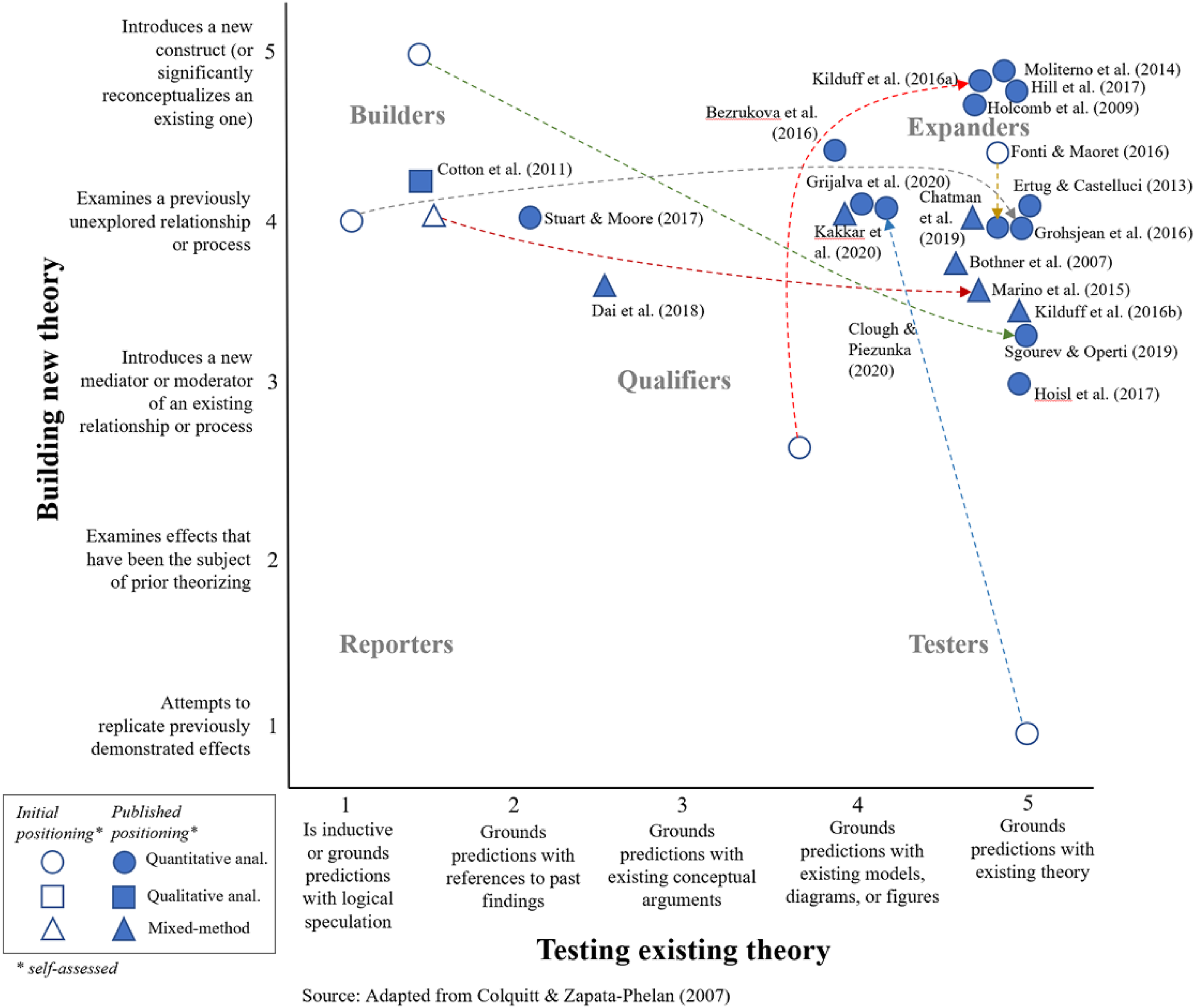
Management scholars have used sports data to test theory, develop theory, or both. To get a better understanding of the different theoretical contributions of empirical articles using sports data, we examined a subset of papers in our sample using Colquitt and Zapata-Phelan’s (2007) taxonomy. According to this taxonomy, empirical articles can be classified in five categories, depending on where they stand on two dimensions—the extent to which an article builds new theory and the extent to which it tests existing theory. Three of these categories (builders, expanders, and testers) represent articles with higher contribution to theory building and testing, whereas the other two (reporters and qualifiers) indicate articles with more limited contributions to the two dimensions.
We asked 20 author teams that published research using sports data to position their research in the matrix emerging from this taxonomy (as shown in Figure 1). Two of the authors gathered this information while organizing workshops on advancing management theory with sports data at six AoM Annual Meetings (from 2016 to 2021). Overall, these 20 articles, all included in our sample, were strong in theory building (i.e., builders), or strong in both theory building and theory testing (i.e., expanders), with most of the contributions being mapped onto the latter quadrant. Although this concentration might be partly due to a selection effect (e.g., journals’ preferences to publish these kinds of papers), articles in the expanders category balanced novelty (in terms of phenomena or setting investigated) and continuity (in terms of theories used), which has the benefit of attracting attention to a novel contribution while bridging it to readers’ understanding of existing theories.
Theoretical Contributions for Empirical Articles Using Sports Data
To explore whether this observed pattern was due to chance, we also obtained information about the positioning of the initial submission for six of these articles. Comparing the initial vs. final theoretical contributions (cf. Figure 1) gave us an additional sense of whether a good approach to publishing management research using sports data is to create a balance between familiar themes and novelty, regardless of whether that approach is driven by the authors or by the reviews (i.e., the journal). A comparison of theoretical contributions of the initial positioning of the paper with those in the accepted version suggested that they tended to transition to or stay within the upper-right quadrant (the expanders category), continuing to point to the importance of grounding management contributions leveraging sports data in existing management theories.
For instance, Hill, Aime, and Ridge (2017) build on the RBV to introduce the concept of congruence between resource value dispersion and pay dispersion. Using Major League Baseball (MLB) data, they find that congruence directly impacts organizational performance and moderates the effects of organizational pay levels and organizational resources on performance. Moliterno, Beck, Beckman, and Meyer (2014) extend BTOF's insights about socially derived performance targets by introducing an upwardly anchored “top performance threshold” and a downwardly focused “reference group threshold” (2014, p. 1684). Using data from the German Bundesliga, they leveraged the thresholds for team relegation to a lesser division (i.e., ending a season ranked 15th or below) and Union of European Football Associations (UEFA) cup participation (i.e., ending a season ranked 6th or above) to operationalize these new constructs. Similarly, Bothner et al. (2007) test existing arguments from prospect theory, yet also introduce the concept of competitive “crowding from below” (2007, p. 208)—which refers to the presence of competitive rivals in a market and is operationalized as the number of competitors able to outdo a given player in a contest—to explain risk-taking in NASCAR racing.
Finally, articles in our sample that are positioned in the upper-left area of Figure 1 (builders) are located there because of their research design (cf. Cotton, Shen, and Livne-Tarandach, 2011, who leverage inductive qualitative research) or their limited grounding in existing theory (cf. Stuart and Moore, 2017, who theorize and examine the previously unexplored relationship between illicit roles and resilient team performance in the context of professional ice hockey teams).
Radical Theorizing
Among the possible theory-building opportunities afforded by sports settings, a prominent role is played by radical theorizing. Management scholars have extensively discussed the importance of pursuing research that can provide major advances to scientific understanding (Colquitt & Zapata-Phelan, 2007; Corley & Gioia, 2011), which can be seen in recent calls for radical theorizing—that is, “the generation of completely new theoretical insights that may lead to a substantial departure from existing paradigms” (Nadkarni, Gruber, DeCelles, Connelly, & Baer, 2018, p. 371). Consistent with this view are recent calls to adopt “new ways of seeing” to advance management inquiry (Bansal, Smith, & Vaara, 2018; Shaw, Bansal, & Gruber, 2017) as a way to facilitate radical theorizing. Exclusive reliance on the same (or proximal) set of theories or assumptions can reinforce the “streetlight effect,” as they tend to further illuminate already investigated research questions while leaving new ideas or paradigms in the dark (Shaw et al., 2017).
In a parallel fashion, we suggest that repeatedly using the same empirical contexts can limit opportunities to develop radical contributions to management theory. The pertinent, yet distal, nature of sports settings can nudge scholars to reduce their use of routine, unreflective, and uncritical approaches to theory development. Thus, we suggest that sports settings provide new opportunities to facilitate radical theorizing in management theory. First, the use of sports data might help counteract the streetlight effect and help scholars observe topics and issues differently by moving away from traditional settings, thus reducing the weight of entrenched, taken-for-granted ways of theorizing that might unreflexively condition how management topics are investigated. Second, by offering a clearer view of the mechanisms at play, using sports settings might lead to more cross-disciplinary research. Taking a different viewpoint could enable scholars to step back from contexts they are familiar with and thus, by looking at mechanisms in a more stylized fashion in sports settings, provide explanations of management phenomena that might span different areas of specialization and break down disciplinary silos (Shaw, Tangirala, Vissa, & Rodell, 2018).
Research leveraging sports contexts provides several examples of how to contribute to radical theorizing. Nadkarni et al. (2018) identify four ways to advance radical theorizing, which we draw on to understand the role of sports data in radical theorizing. Inductive theory generation is a way to explain new, little understood phenomena when existing theory to explain it is insufficient. An example is Howard-Grenville, Metzger, and Meyer (2013), where the authors leverage an inductive exploration of a community of runners in Eugene, Oregon, to theorize a novel process of collective identity resurrection through the key role of experience and emotions. Another example is Cotton et al. (2011), who leveraged qualitative data from induction speeches in the MLB's National Baseball Hall of Fame to build a detailed, abstract model that includes causal relationships. Evocative theoretical boundary spanning leads to radical theorizing by borrowing a theory from a different discipline to explore an emerging phenomenon. For example, Kilduff et al. (2010) leveraged NCAA basketball teams to explore the relational bases of rivalry, which prior work had understood mainly through economics-grounded theories where rivalry was driven by actors’ reaction to objective threats or incompatible goals. Theoretical consensus shifting is about reconceptualizing a phenomenon by adopting a novel theoretical lens. This approach can generate radical theorizing by shifting the general opinion on assumptions and logics that are taken for granted within the scholarly community. Using sailing data from the America’s Cup World Series, Ross and Sharapov (2015) leverage the Austrian School perspective of competitive dynamics (Kirzner, 1973) to understand the effectiveness of imitation strategies for a leader. Whereas most prior studies explored the imitation of leaders by followers, their study introduces a reversal of the taken-for-granted assumption of a “follow the leader” strategy and find that imitation pays off for leaders too. Diverse theoretical integration entails reconciling different established perspectives that nonetheless present tensions and contradictions, which then favors radical theorizing. Leveraging hockey data from the NHL, Kakkar et al. (2020) resolve the theoretical tension around how social status relates to the severity with which third parties judge actors who are accused of ambiguous transgressions of social norms by “highlighting the role of two different status types through which status yields its benefits and associated costs” (531).
Exploration of Emerging Phenomena
In addition to contributing to the advancement of extant management theories, sports contexts can also provide ways to examine phenomena that management research has not fully leveraged (Moliterno et al., 2021). A prominent example is inequality. While management research has been making progress in acknowledging the importance of examining this construct, inequality remains a major challenge both in societies and organizations. Notwithstanding the substantial efforts and progress to promote diversity and inclusion, inequality persists in organizations and society (Bapuji, Ertug, & Shaw, 2020). Although inequality is a problem in most contexts, it can be more difficult to observe in traditional organizations. Sports settings present a fitting context to study inequality and related matters due to the visibility they afford regarding the presence—or absence—of diversity and inclusion (Pope, Price, & Wolfers, 2018; Swaab & Galinsky, 2015). Because of the high visibility of their actors, sports contexts provide examples of inclusion (or inequality) that are easy to spot, making them suitable contexts to study how such issues emerged and (whether) they are effectively dealt with. Players’ prominence and media exposure offer them a powerful platform to voice whether and how their organizations dealt with equality or inclusion, or to voice their concerns regarding such issues. A challenge for management scholars is to examine when and why barriers to inclusion persist in order to arrive at a better understanding of what can be done to overcome such barriers. As part of this endeavor, management researchers could study contexts where organizations have succeeded in being more inclusive, and the lessons learned can be disseminated to other settings and organizations. Thus, sports are a promising context for research on inclusion and exclusion, the mechanisms driving these phenomena, and can generate lessons to apply more broadly to other types of organizations.
Recent events highlight how issues related to diversity and inclusion are found in sports contexts, such as the gender pay gap (e.g., the U.S. women's soccer team's appeal for equal pay) and racial discrimination (e.g., kneeling during the U.S. national anthem in the National Football League or athletes’ decision to stop U.S. professional sports games to show support for the Black Lives Matter movement). Sports also present positive examples of inclusivity, for example, by providing equal opportunities to people with disabilities (as in sailing, where in the International 2.4mR boat class, both able-bodied and disabled athletes participate on equal terms, and where a disabled athlete became a world champion), by representing a way to help migrants integrate (e.g., teams of migrants playing in local soccer leagues), and by affording children in less-developed countries access to education (e.g., the UNICEF-supported program in Nigeria helping children and adolescents—especially girls—to get an education via specific academies that combine academics and soccer, thus increasing their chances of professional success). Recent work leveraging sports data has started to deal with and identify biases, differences in treatment, and more in general exclusion—as well as inclusion—based on a variety of dimensions, such as race (Ertug & Maoret, 2020; Pope et al., 2018; Timmerman, 2007; Zhang, 2017, 2019), gender (Adriaanse, 2016; Micelotta, Washington, & Docekalova, 2018; Ortlieb & Sieben, 2019), nationality (Chatman, Greer, Sherman, & Doerr, 2019), and core-periphery position (Christie & Barling, 2010; Fonti & Maoret, 2016; Humphrey, Morgeson, & Mannor, 2009; Stuart, 2017). Some work has also highlighted how sports can provide a more inclusive environment (e.g., better career prospects across genders; cf. Stevenson, 2010). These studies provide initial insights into and lessons from inclusion and exclusion in sports contexts, highlighting the potential of studying sports settings for further understanding such phenomena.
Other timely phenomena that can be studied using sports data are grand challenges, or “formulations of global problems that can be plausibly addressed through coordinated and collaborative effort” (George, Howard-Grenville, Joshi, & Tihanyi, 2016, p. 1880). These include climate change–induced natural disasters, water scarcity, poverty, famine, and pandemics. Some sports have directly embraced the aim to tackle some of these challenges, thus creating fertile ground to explore and theorize the management implications of such solutions (McNamara, Pazzaglia, & Sonpar, 2018). For example, the Olympic Games have recently started to consider providing positive externalities to the hosting community. For instance, the air quality standards imposed for the 2008 Olympic Games in Beijing contributed to reduced CO2 production in the region (Min, Bin, Sihua, Bin, & Ming, 2011; Wu, Zhang, Xu, & Zhu, 2011). The organizing committee of the Paris 2024 Olympic Games has presented ten main challenges to address, which include ecology, creation of jobs, improvement of social cohesion, regeneration of unprivileged areas, and promoting the practice of sports for collective well-being (Poirier, 2017). Prototype motorsport has embraced the challenge to reduce carbon emissions by using the racetrack to develop and test more fuel-efficient technologies that will eventually be used in standard road vehicles (Aversa, Furnari, & Haefliger, 2015). This explains why major car manufacturers, such as Honda, Toyota, Fiat-Chrysler, and Renault, have long been deeply involved with motorsport. Management research has started investigating these cases by exploring the development of innovative hybrid engines in Formula 1 (Marino, Aversa, Mesquita, & Anand, 2015) and Le Mans Prototypes (Aversa & Guillotin, 2018). More recently, Formula E has been facilitating the development of technologies—mainly batteries and engines—that might lead to a wider and more sustainable adoption of electric vehicles (Næss, 2019). The increasing pervasiveness of sustainable approaches within sports organizations makes them a fertile and still relatively untapped field to study these important phenomena in management research.
Addressing Common Concerns with Management Research
Sports settings also have the potential to alleviate some of the criticisms commonly leveled at management research, such as generalizability, validity, replicability, and practice impact, as we discuss below in the corresponding subsections.
Generalizability
A common criticism raised when sports data is used in management research is generalizability—that is, justifying how findings can be extended to other contexts, because a clear correspondence between what happens in sports settings and in contexts that are traditionally studied in management research is not always immediately evident.
During a conference on advancing management theory with sports data held in spring 2020, two of the authors and event co-organizers polled researchers about the challenges they faced in doing this type of research. A “lack of external validity” was rated as the biggest challenge (69% of respondents), followed by “mapping data, research questions, and theory” and “resistance by reviewers” (both 50%). Using sport as a context for management research ties to the broader debate in scientific research between context and generalizability. To see how studies in our sample address generalizability, we screened the papers in our sample for generalizability and then categorized the approaches they used, which yielded the five categories that we discuss below (Table A1 in the Appendix provides an extended overview).
First, the most common approach to addressing generalizability is the specification of boundary conditions, as describing the “contexts for which the accuracy of theoretical predictions is high” (Busse, Kach, & Wagner, 2017: 578). For example, Aime et al. point out that their findings using data from the NFL are more likely to apply to highly competitive environments, such as “industries in which head-to-head competition takes the form of competitive bidding, much like that found in many other industries such as accounting, consulting, advertising, TV broadcasting, and airline . . . where exposure to pricing and other competitive routines is more direct” (2010, p. 85). Similarly, Chen and Garg emphasize that the extent to which their theory about losing a star player—as studied in the NBA—applies to other contexts “depends on the extent to which team members can suspend tasks that depend on the star and redirect efforts towards tasks that do not involve her” (2018, p. 1263). Since interdependency was key to their theoretical framework, Fonti and Maoret specify that their findings about the role of social and human capital in the NBA are “more generalizable to highly interdependent settings that lack strict bureaucratic role structures, such as start-ups, small/medium sized firms, or larger firms that center their activities on high performance teams, such as professional service firms” (2016, p. 1771). Ethiraj and Garg point out that their theory is relevant for “human-capital-intensive contexts—including accounting services, legal services, consulting services, and investment banking—provided three important boundary conditions are met. First, labor must account for the bulk of inputs. Second, the activity must be team-based to create the potential for complementarity. Finally, individual performance must be measurable to create the potential for appropriation” (2012, p. 739, italics in the original). Hüffmeier et al. (2017) highlight how the effort gains they find in swimming relay teams are limited to teams featuring high levels of sequential task interdependence, and thus generalizable to contexts such as “virtual teams with international . . . ‘around-the-clock’ workflows [or] teams working along a supply chain” (2017, p. 1683). Lastly, given the presence of an exogenous regulatory framework in motorsports that periodically reshapes product architecture and innovation (Aversa & Guillotin, 2018), the findings from studies using these data are more generalizable to traditional industries that present similar dynamics, such as aviation, automotive, or defense (Marino et al., 2015).
Some authors identify boundary conditions indirectly, by stating when their findings will likely not hold. For example, Holcomb et al. (2009) note that the implications of their work on head coaches in the NFL might not extend to managers in traditional business organizations, because “whereas senior executives often wait long periods before the results of specific resource management actions are known, coaches often receive immediate feedback on the outcome of decisions they make and can adjust bundling and deployment actions more quickly” (2009, p. 480). Taking a different approach, some authors state that their decision to leverage sports data was due to the presence of the mechanism they wanted to theorize about, thus implicitly suggesting that their findings might apply to other contexts where such mechanisms are present. For example, in their work using data from the Champions League, Greve et al. highlighted that “[an] important feature of football matches is that they are games against an opponent, which is different from most organizational decision-making. However, this feature had no theoretical function other than to help operationalize loss framing. Thus, if we can find a clean operationalization of loss framing in other contexts, the same findings should hold” (2021, p. 1048). In their study on the importance of status inequality, Christie and Barling (2010) point out that NBA's public visibility might enhance the salience of the status markers they use, thus making their findings less generalizable to organizational settings where status cues are more difficult to pick up. Finally, Ertug and Castellucci’s (2013) work on the role of NBA players’ reputation and status for team-level outcomes notes how findings might not generalize to settings where it is difficult to separate status from reputation (or from performance).
Second, some studies provide guidelines on how to study and test their theory in other contexts. In their work using professional golf and NASCAR data, Bothner et al. mention that life scientists can provide an empirical setting to replicate their work “because of the relative ease of measuring status and performance” (2012, p. 430). Likewise, Sharapov and Ross discuss how competitive dynamics scholars might explore their theoretical framework, developed by studying sailing competitions, in other contexts, by leveraging “[their] insights in combination with the multi-plane vector approach developed in prior work to examine the different paths that multiple rivals take through a competitive landscape over time” (in press, pp. 26-27).
Third, some scholars provide anecdotal evidence coming from other contexts (i.e., other sports and/or business) to generalize their findings. Sgourev and Operti discuss how their findings’ generalizability “is bolstered by anecdotal evidence for relational gaps in mobility networks in other contexts” (2019, p. 1353). They point out the similarities between the intense rivalry of Glasgow's two football clubs (the catholic Celtics and the protestant Rangers) and to the almost complete lack of overlap between the career paths of employees from rivals Boeing and Airbus (with only 240 having worked for both companies, over 140,000 listed on LinkedIn). Similarly, Ross and Sharapov (2015) use anecdotal evidence from the head-to-head competition between Apple and Samsung to both motivate their study and provide a nuanced explanation of their imitation decisions and performance outcomes.
Fourth, some scholars use triangulation across methods or contexts to address generalizability. For example, Kakkar et al. (2020) ran a lab experiment that uses scenarios adapted from real cases in Fortune 500 companies to replicate their findings from an analysis of ice-hockey matches. Sharapov and Ross (in press) use data from multiple-competitor sailing boat races to empirically test the propositions they developed with simulations, while at the same time controlling for heterogeneity between “real” competitors, which a simulation cannot capture (McGrath, 1981). Addressing generalizability in a different way, Bothner et al. (2012) use data from the Professional Golfers’ Association (PGA) Tour and NASCAR races to replicate their findings in two settings. They emphasize that their “findings are informative for future examinations of the effects of status on performance in other contexts . . . given that [they] have uncovered similar patterns in two different data sets” (2012, p. 428).
Fifth, some scholars bridge different methodological approaches across different articles to address generalization. For example, Greve et al. (2021) leverage Champions League data to study loss aversion and suggest that “[s]tudying a population of top performers making rapid and consequential decisions [in European soccer] can give insights into the generalizability of theories supported mostly by experimental evidence” (2021, p. 1033). Likewise, Massey and Thaler extend a long tradition of using experimental research to explore biases in judgment and decision-making by leveraging regressions to explore NFL draft data to see “whether . . . [such biases] remain present in contexts in which experienced participants face strong economic incentives” (2013, p. 1479).
A form of generalization we did not observe in the articles we reviewed is temporal generalization, which generalizes from a sample in one population at a point in time to the same (or possibly a different population) at another point in time, assuming that the context remains the same (Tsang & Williams, 2012). For instance, knowledge generated by researchers using sports data may influence players, coaches, or referees, and thus shape their behavior at a future point in time (Pope et al., 2018). Major events linked to sports, such as the influence of the Black Lives Matter movement, revelations of doping scandals, or athletes’ abuse can influence whether insights from studies conducted before such events can generalize and extend to the circumstances that characterize the setting after those events.
Replication
Leveraging sports data can help deal with issues concerning replication and reproducibility of results. Replication “involves the study of a phenomenon being conducted more than once, either by the same set of authors (dependent replication) or by different sets of authors (independent replication)” (Köhler & Cortina, 2021, p. 491). Replication studies can provide information about whether empirical evidence can be confirmed, extended, or confuted.
As some scholars note that management research is undergoing a “replication crisis” (Bonett, 2021), we believe that research leveraging sports data can ameliorate issues of replication and reproducibility by addressing at least two of its underlying causes. The first cause is the lack of appreciation of the various forms of replications. Advancement here would come from providing guidance on how to tackle replications (Bonett, 2021), such as recent work (Bettis, Helfat, & Shaver, 2016) suggesting that scholars can undertake either narrow replication (i.e., by using the same sample, or the same data set in a different time span) or quasi-replication (i.e., by using the same methods over different settings, or by keeping the data constant and changing the analytical methods). The richness of sports data is well-suited to undertake both kinds of replication. For example, Ertug and Maoret (2020) offer a narrow replication and extension of former empirical evidence (Schroffel & Magee, 2012; Zhang, 2017, 2019) with respect to the presence of coaches’ racial bias in the NBA. They show that once coaches’ decision to “rest the starters” are incorporated into the models, the relationships that have been taken to indicate racial bias in previous studies are no longer significantly different from zero. Klein Teeselink, van den Assem, and van Dolder (in press) conducted a narrow replication of the study by Berger and Pope (2011) with the same NBA data set, as well as an NBA data set across a longer time span. They also conducted a quasi-replication by conducting the same analysis across three additional sports settings (Australian football, American football, and rugby). Their results show that the probability of winning when slightly behind, “if existent at all, is likely relatively small” (Klein Teeselink et al., in press, p. 1).
The second cause is the lack of data to effectively conduct replications. Sports context can help with this, as most of these data is public and open access (Beus & Whitman, 2017). By allowing researchers to keep raw data and measures consistent across studies, open access data—whether in sports or in other settings (such as patent data)—makes it easier for scholars to build on each other's ideas and contributions, as it makes (in)consistencies across studies more likely to be attributed to new ideas or more careful inference, rather than to differences in raw data or measures. Concerns about the file drawer problem and publication bias (Simmons, Nelson, & Simonsohn, 2011) further underline the value of openly accessible data that allow researchers to engage more directly with each other's work in a dialogue that pushes management research forward.
Triangulation
Using sports contexts in management research can also aid in efforts for methodological triangulation (Turner, Cardinal, & Burton, 2017). Triangulation refers to documenting consistency in findings by adopting various sources or methods related to observing or analyzing a specific phenomenon (Gibson, 2017), suggesting that the weaknesses of one method can be offset by the strengths of another (McGrath, 1981). Sports settings present multiple means for triangulation by providing different types of data about the same event that can be analyzed using various methodologies. Sports events such as the Super Bowl, the Fédération Internationale de Football Association (FIFA) World Cup, or the Olympic Games draw the attention of multiple audiences (e.g., athletes, media, fans, organizers, and managers), which can provide various kinds of data about the same event. In many sports, different audiences’ real-time impressions of the event are broadcasted, recorded, and made publicly available, as in the case of radio transmission between Formula 1 drivers and team engineers during Grand Prixes and sailing team communications in America's Cup sailing races.
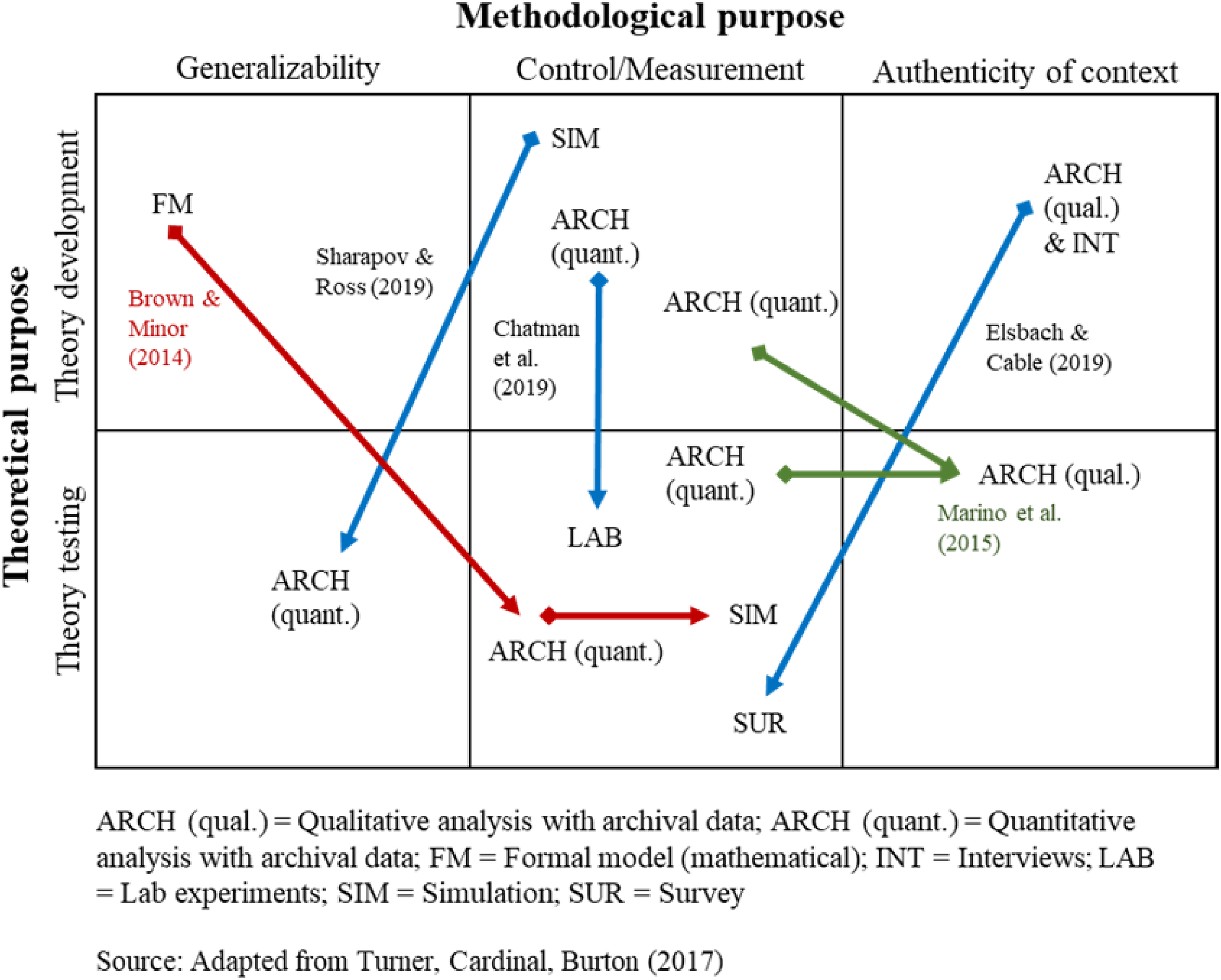
Although most articles we reviewed build on one method, some of the papers in our review sample make use of multiple data and methods. Leveraging a subset of these papers, we illustrate in Figure 2 how research using sports data uses multiple methods for theoretical and methodological purposes. For example, Elsbach and Cable (2019) first analyzed qualitative archival data and interviews to develop a theoretical framework on what predicts fan identification with NASCAR. They then collected survey data from NASCAR fans to test the developed hypothesis. While the first study provided an authentic context for observed behavior, the second study helped the authors validate the theory by offering greater precision in control and measurement of variables. Prioritizing the generalizability of their theory, Brown and Minor (2014) initially developed a formal theory model to explain tournament outcomes. They then used the structure of single-elimination tennis tournaments to test their theory in a setting that offered precision in control and measurement. To strengthen that precision, the authors then used a simulation to ensure that their empirical results were not driven by mechanical relationships that result from the seeding protocols of the Association of Tennis Professionals (ATP).
Linking Processes for Triangulation-Based Mixed Methods Research Using Sports
Triangulation in multimethod studies can also be useful to “see” particular aspects of a phenomenon or “judge” attributes of a theory (Turner et al., 2017). For example, Sharapov and Ross (in press) paired the results of a set of simulations with the analysis of data from sailing races. This triangulation allowed them to offset the limitations of different methodologies and enabled them to discover new facets of rivalry that would not have been possible using each method separately. Similarly, Chatman et al. (2019) used different methods to further develop the insights derived from a theoretical model. Whereas their first study leveraged archival data from Himalayan mountain-climbing expeditions to develop and test two hypotheses, in a second study they tested their third hypothesis in a laboratory setting. Marino et al. (2015) used fine-grained archival data from Formula 1 racing to quantitatively test the relationship between exploration and performance, finding that the magnitude of environmental change (as different from the frequency of changes) was a crucial yet overlooked attribute. The authors then qualitatively identified and assessed the underlying mechanisms underpinning this effect.
Sports can also be studied as a “living laboratory,” thus complementing traditional “laboratories” in developing and deploying research that uses mixed designs (McGrath, 1981). Certain unique features of sports contexts (such as the random draw of opponents in some tournaments, exogeneity of variables such as weather or quasi-exogeneity such as injuries, the possibility to isolate certain constructs such as status, and the precision of control due to fine-grained and comprehensive data) and the characteristics of data (e.g., longitudinal performance measures) can aid the development and use of such effort to advance management research.
Practice impact
Recent initiatives promote the idea of bringing sports closer to managers, because sports have led the analytics revolution from which other industries can learn (Davenport, 2014; Michelman, 2020). Further, research using sports data can benefit from a unique opportunity to bring insights from academic research to management practice. Practitioners and academics tend to approach topics in different ways: while academics seek to generate generalizable insights, practitioners look for advances or implications that can be applied to their specific work and challenges (Garman, 2011; Simsek, Bansal, Shaw, Heugens, & Smith, 2018). Below we discuss how management research using sports data can help bridge the rigor of academic research with relevance for practitioners, facilitating practice impact (Bartunek & Rynes, 2014; Rynes, Bartunek, & Daft, 2001).
First, a key issue that scholars face in creating practically useful research knowledge is linking their rigorous work to current managerial practices. For example, some of the current challenges practitioners face are around managing risk and uncertainty (Bettis & Blettner, 2020; Reeves & Whitaker, 2022). The body of work that we reviewed addresses some of those important issues head on, examining risk mitigation strategies in the face of specific types of uncertainty, such as ecological uncertainty (Tashman & Rivera, 2016), technological uncertainty (Aversa & Guillotin, 2018), environmental uncertainty (Ross & Sharapov, 2015), and capacity uncertainty (Chan & Fearing, 2019). Research using sports data has also provided insights into heuristics and decision rules when organizations face frequently changing environments (Sharapov & Ross, in press; Suarez & Montes, 2019).
Second, research can also be more proximal to practice by deploying a question-driven and phenomenon-based approach (Graebner, Knott, Lieberman, & Mitchell, in press). Compared to the dominant null-hypotheses-testing approach, such approaches can be more accessible for practitioners. Sports have been shown to be suitable settings for deploying such question-driven and phenomenon-based approaches. For example, Sharapov and Ross (in press) leverage sports data and a question-driven approach to explore strategies to stay ahead in competitions, which is a key issue to practitioners when competitive advantage is less sustainable and market leadership is temporary (Reeves, Whitaker, & Deegan, 2020).
Third, sports images can be particularly powerful and evocative. Management journals increasingly provide authors the opportunity to publish a video abstract with the academic article. When research uses sports data, such video abstracts can be quite effective in disseminating their findings to a wider audience, as evocative video material from the sports context can be combined with business examples and research insights (e.g., Grohsjean, Kober, & Zucchini, 2016; Sgourev & Operti, 2019; Stuart & Moore, 2017). Short videos on research articles using sports data also allow lecturers to translate academic research for experienced MBA students, as sports examples resonate strongly with this audience.
Fourth, an additional way of communicating to practitioners and students is by publishing core ideas using sports data in outlets that are more accessible to them, such as articles in practitioner journals (e.g., Aversa, Haefliger, & Reza, 2017; Groysberg, Hecht, & Naik, 2019; Piezunka, Lee, Haynes, & Bothner, 2018; To, Kilduff, Ordoñez, & Schweitzer, 2018b), interviews in practitioner journals (e.g., Aversa & Berinato, 2017; Linkenauger, 2012), or blogs that are offered by some management journals (Clough & Piezunka, 2020).
Fifth, using sports data and metaphors, because of their broad appeal to managers (e.g., Katz, 2001; Keidel, 2014), could help develop a shared language between academics and practitioners, which facilitates the dissemination of ideas to practice. Some scholars use sports examples in their studies to illustrate the managerial phenomena they tackle (Berman et al., 2002, pp. 15-16; Boumgarden, Nickerson, & Zenger, 2012, pp. 606-607). Engaging with sports examples also helps managers step back from their view of “how things work” in their specific organization or industry and envision the mechanisms at play in archetypal forms of coordination and competition. To the extent that managers are attuned to sports examples, analogies, and metaphors, and these strongly resonate with them, work incorporating sports data will be more cognitively available for practitioners (Rynes, Colbert, & O’Boyle, 2018).
Metaphors building on sports have been used in outlets that are widely read by managers, such as the case of boxing to address agility and absorption during downturns (Sull, 2009) and judo to illustrate the dynamics of internet-based competition (Yoffie & Cusumano, 1998). Having said this, the use of sports metaphors must be done carefully to avoid sending unintended messages to managers, such as “winning . . . is the only thing” (Katz, 2001, p. 66). Such concerns can be addressed by providing examples of boundary conditions for managers and for scholars who wish to bridge between sports metaphors and situations in practice. 3
Data Availability
Sports settings allow for new ways to explore managerial questions through the use of extensive and granular data (Day et al., 2012; Wolfe et al., 2005). The application of mathematical models to sports data has been developed since the 1950s (Lindsey, 1959). Yet, it is primarily in the last twenty years that the practice of leveraging statistical models in sports organizations diffused more widely across teams and sports (Alamar & Mehrotra, 2011). The growing use of statistical analyses in sports training, coaching, and practicing—which started in baseball and is often referred to as “sports analytics” (cf. Chan & Fearing, 2019)—has fueled an extensive and systematic collection of data in sports organizations to the point that, in some cases (e.g., Formula 1 racing), it has been characterized as big data (George, Haas, & Pentland, 2014). Scholars have used such data to advance conversations in sociology (Foy & Ray, 2019), sports medicine (Hopkins, 2000), sports studies (Gratton & Jones, 2014), engineering (Asai, Carré, Akatsuka, & Haake, 2002) and, as shown in our review, management. The availability of sports data has enabled researchers to capture relevant constructs in management theories. Table A2 in the Appendix provides examples of the different measures that studies in our sample used to capture core theoretical constructs in different management literature streams.
The quantity and quality of both quantitative and qualitative data emerging from sports contexts continue to increase. Due to recent technological developments, traditional sources of data, such as media articles, interviews, audio and video recordings, reports, sports bulletins, and regulations, have been complemented by newer data, such as global positioning system (GPS) localization (especially for sports such as sailing, racing, orienteering, and climbing), spatial tracking of athlete and/or team positions and moves, athletes’ biophysics data (e.g., heartbeat, oxygenation, stress, nutrition, and sleep), and fans’ live reactions and interactions on social media (to assess engagement and related sales), as well as the functioning of equipment, technologies, tools, and aids (thanks to the connectivity of most sports technologies).
The development of digital technologies has also allowed for the creation of virtual environments that mimic the conditions of sports practice. These technologies have led to the diffusion of professional virtual simulators, which are used for training in sports such as sailing, car racing, rowing, golf, cycling, and winter sports, and provide additional sources of data. Similar technologies have also been adopted for the development of official tournaments, thus supporting the rise of e-sports (Hallmann & Giel, 2018; Heere, 2018), a new sports context that has recently started to be explored in management journals (e.g., Ching, Forti, & Rawley, 2021).
However, increased data availability does not automatically mean more genuine opportunities for scholars to leverage such data in their research. There are at least three challenges to the utilization of the wealth of data generated in contemporary sports contexts. The first challenge is accessibility. While most basic sports statistics and media repositories are often publicly available, accessing more advanced data can be difficult. Sports organizations and firms that generate or compile analytics are increasingly aware of the commercial and strategic value of these data, which makes them protective of such assets. Thus, they often ringfence such data behind paywalls that might be prohibitively expensive for academics. Even when such data are made available, they are seldom released as complete, disaggregated data sets, but rather as summary statistics or via dashboards that “piecemeal” the data. As these formats are often not convenient for academic research, scholars might have to invest significant resources to acquire and convert the data they need. Although data scraping and machine learning are popular solutions to such issues, their implementation requires a careful understanding of the technical and legal implications of their use.
The second challenge is the need for a deep understanding of the context being analyzed. Although sports represent popular settings many can relate to, when leveraged for research purposes they require that scholars familiarize themselves with the idiosyncrasies and nuances of the settings and phenomena that might relate to their research questions. For example, as we have mentioned, Ertug and Maoret (2020) show how not accounting for the practice of “resting the starters” might lead to an erroneous conclusion about the presence of coaches’ racial biases in the NBA (Zhang, 2017, 2019).
The third challenge lies in the need for multidisciplinary knowledge to fully capture the value of sports data. For example, athletes’ biophysics and health-related data might contain information that requires knowledge of the medical, legal, and ethical practices in ways that go beyond what most management researchers have experience with. To make responsible and appropriate use of such data, management scholars might need to undertake dedicated trainings or call upon the expertise of colleagues and professionals across fields (e.g., health and science, sports science, and biology) for guidance as to how to use such data. While more complex to put into practice, this might also lead to more novel research due to the intrinsic multidisciplinary nature of these collaborations.
Potential Drawbacks in the Use of Sports Data
The increasing use of sports data in management research also carries a series of potential problems that should be highlighted. As it is the case for other research, awareness of such drawbacks grows out of the increasing use of sports data: as more of this research is done, the drawbacks of utilizing sports contexts become more evident for people within and outside the community leveraging these data. Table 1 presents a summary of the drawbacks we discuss below, as well as a set of possible mitigation approaches.
Sports Data Drawbacks and Possible Mitigation Approaches
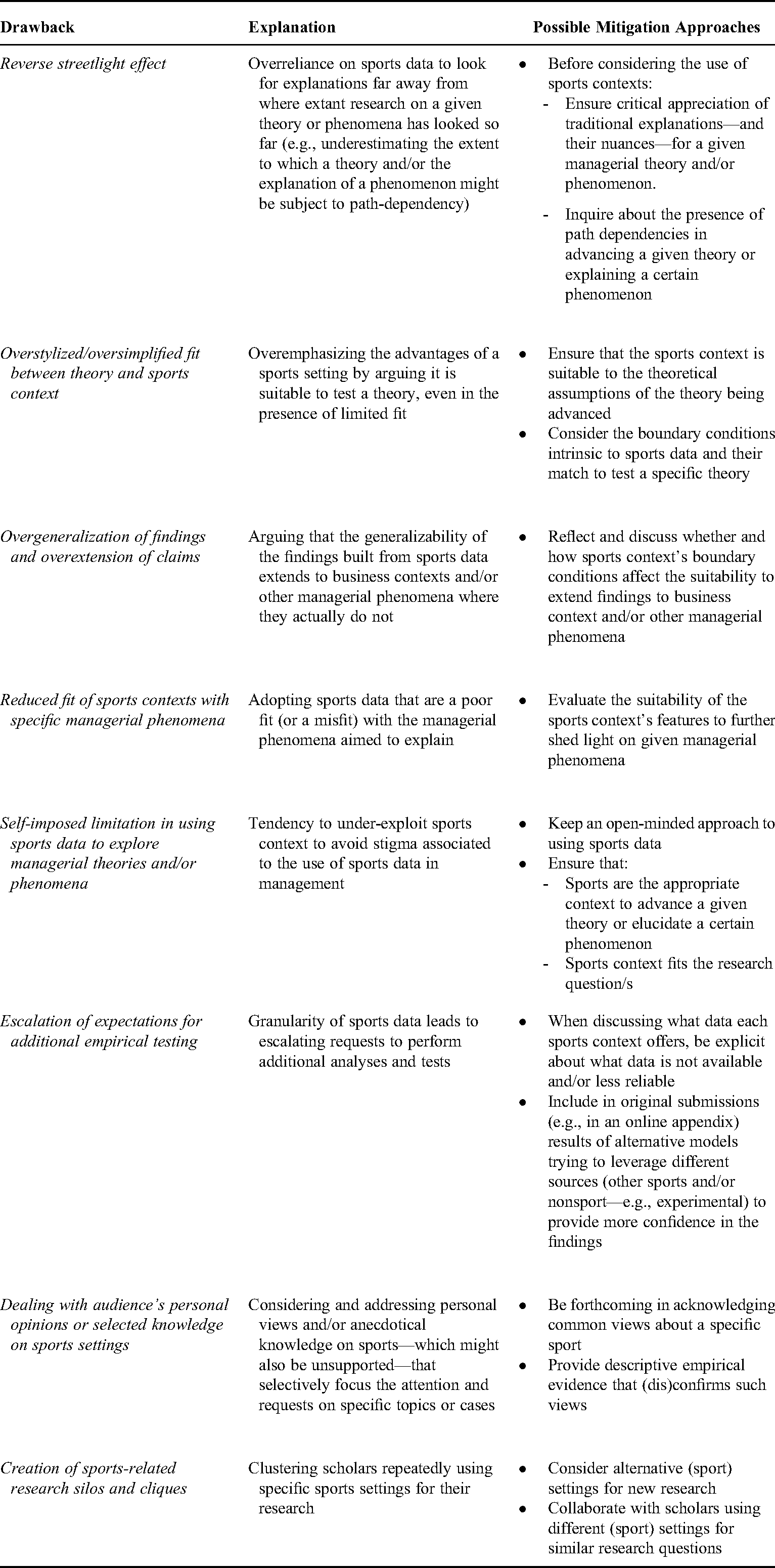
Some of the drawbacks associated with this type of research closely mirror the advantages that stem from it. For example, relying too much on sports data might lead to a “reverse streetlight effect,” whereby the newness of these settings leads researchers to look for explanations detached from where extant research on a given theory or phenomena has searched so far, thus leaning toward a less critical appreciation of the nuances of a given managerial phenomenon and underestimating the extent to which such phenomena might be subject to path dependency. Drawbacks might also emerge because of the researchers’ attempt to create an overstylized/oversimplified fit between a given theory or phenomenon and the sports context they utilize in the study. This is a common overreaction to the traditional concern about limited generalizability that is often associated with management studies using sports data. In such cases, scholars leveraging sports data might overemphasize the advantages of such contexts by arguing that they are representative of a theory they are trying to advance (or of a phenomenon they are attempting to shed light on), even though there is a poor fit between theory (or phenomenon) and context. In other cases, scholars might argue that the generalizability of their findings extends to business contexts and/or other managerial phenomena even though, given the type of data they have used, there is little evidence of this, thus leading them to overextend their claims. Finally, although the fact that most sports are very well regulated represents an advantage in terms of clarity of the mechanisms that can be tested with these data, it also makes it more difficult to compare findings from these contexts with managerial research exploring much less-regulated settings.
Another potential challenge to the use of sports data—which does not find equivalents in the advantages of using sports contexts—is that they might not be suitable to advance all managerial research equally well. Although sports data represent an optimal empirical context to explore certain literature streams and phenomena, such as rivalry (especially head-to-head competitions), they are less suitable to explore others, such as internationalization and market entry (with some exceptions, such as the penetration of the Chinese market by the NBA or the international transfer of managerial knowledge; e.g., Peeters, Mills, Pennings, & Sung, 2021), and unsuitable to investigate phenomena such as merger and acquisitions, alliances, and the functioning of large organizations. Thus, the suitability of sports data to advance management research depends on the management research streams or phenomena being explored; regarding this, sports data might be seen on a continuum, ranging from optimal empirical settings to suboptimal empirical contexts (or that at least require several caveats in their utilization), all the way to unsuitable settings. The role that celebrity plays in sports might also interfere with generalizability to everyday organizations, as it might pollute the link between data and how we theorize about certain phenomena. However, this issue might also present a unique opportunity in regard to emerging research on the influence on organizations of star CEOs (Lovelace, Bundy, Hambrick, & Pollock, 2018), of the “halo” effect (Kozlowski, Kirsch, & Chao, 1986), and of celebrity more generally (Pollock, Lashley, Rindova, & Han, 2019; Zavyalova, Pfarrer, & Reger, 2017).
The popularity of sports may also generate hard-to-manage expectations with editors and reviewers. The renowned richness of sports data can expose scholars to multiple requests for running additional analyses and testing alternate mechanisms, yet scholars can only go so far in testing alternative hypotheses, as they are limited by what is already available and additional data collections are often not possible. Because many people know about sports, it also opens these papers to additional criticisms, for example, based on the performance of outliers, thus requiring scholars using such data to provide explanations for specific and/or exceptional circumstances to an extent much larger than scholars using more traditional settings. Lastly, scholars using sports data may self-limit the stories they can tell using these contexts. In their continuous effort to use sports data as a tool and to draw connections with more traditional organizations and industries, they might have constructed barriers that, while on the one hand are instrumental in avoiding any stigma associated with using sports data in management research, on the other hand may limit their voices and what can be said with these data. As an example of this, there might be phenomena in sports contexts that are worth examining in and of themselves (e.g., the kneeling that started in American football) and, as management scholars, we should embrace these opportunities.
As it is the case for other research, awareness of such drawbacks grows out of the increasing use of data in sports contexts: the more research using sports data is done, the more the negatives of utilizing such contexts become evident for people within and outside the community leveraging such type of data. With growth also comes the creation of silos and cliques between scholars working on different sports, which could further limit the ability of researchers working on diverse types of sports to build on one another's mistakes and to solve common issues related to sports contexts. As for other kinds of research, we need to be aware of and counteract such tendencies if we want research that leverages sports context to continue to grow and thrive in its contribution to managerial research.
Future Directions
While the practice of using sports data to advance management research is fast growing, many opportunities still exist to further leverage sports contexts. The idiosyncrasy of sports data offers specific research opportunities for scholars to advance management research streams that—as we highlighted earlier—have already widely benefitted from using such empirics.
For instance, leveraging sports contexts could help further develop the RBV by exploring its linkages with emerging literature on resource reconfiguration and redeployment (Karim & Capron, 2016). Like other businesses, sports organizations need to align their resources to expand, contract, and innovate. For example, relegation and promotion between lower and higher status leagues (Moliterno et al., 2014), player injuries (Chen & Garg, 2018), shifts in factor market conditions (Moliterno & Wiersema, 2007), and regulatory changes (Marino et al., 2015; Kim & Makadok, in press) can provide “inducements” (Penrose, 1959) for an organization to reconfigure its portfolio of resources, and thus opportunities to advance the RBV.
Sports contexts can also help further research on status and reputation. For example, by allowing researchers to more precisely track and disentangle the antecedents, attributes, and consequences of status and performance, sports data offer not only season-level data—which have been commonly used—but also data in smaller time units, such as game level (e.g., pass, assist, defense, sprint, and score), set level (for team sports), or lap or sector level (for motorsports). Such granularity is available not only for players, drivers, and athletes, but also for referees, coaches, and sports executives. Although these data have been used in some studies, future research could leverage them to investigate the implications of status and reputation in more direct and proximal ways. In addition to data collected during practices or competitions, athletes and teams also feature prominently in a variety of media outlets, which provide data to assess their popularity (Christie & Barling, 2010). Additionally, sports settings would also allow to study career mobility more directly than some other settings (e.g., as compared to the mobility of inventors as assessed via patent data), as the dates on which players join or leave a team or play their first or last game—and even possibly their first or last day in training—are often publicly available for most major sports, which is often not the case in management contexts. Finally, management research has explored the constructs of celebrity and stigma often lumped with reputation and status, under the umbrella of social evaluations or intangible assets/liabilities (Knittel & Stango, 2014). 4 Research using sports data to investigate stigma is scant (for an exception, see Helms & Patterson, 2014), and no study in our sample has directly tackled celebrity. Sports contexts might be leveraged to investigate these two constructs through media stories and profiles, social media posts by or about athletes, interviews, and information about athletes’ social media followers, as well as through data about their commercial endorsements, sponsorships, merchandise, and business or social initiatives.
The properties that have helped sports data contribute to advancing network-related theory to date (i.e., their granularity and the interdependent nature of sports competition within and across teams) continue to show promise for future network research. For example, sports data could be used to investigate network dynamics by providing a way to study how actors’ decisions to initiate, maintain, or dissolve a tie might be jointly influenced by both their and their network neighbors’ experiences. Given the variety of stakeholders involved (cf. Elsbach & Cable, 2019; Wolfe & Putler, 2002), sports data might also provide novel insights into network multiplexity, for example, by showing the constraining or enabling effect on athletes’ outcomes of having multiple ties—possibly of varying intensity—with a variety of stakeholders, such as the coaching staff, other players, agents, sponsors, and fans. Lastly, detailed information about players and teams within a sport or league affords a rich view of the activities of all network members, thus allowing researchers to shed light on how other actors’ choices and behaviors might affect a focal actor's network and outcomes, thereby furthering the exploration of the altercentric view of networks (Kleinbaum et al., 2015). For example, sports data might allow insight into how focal actors shape their network in response to other network members’ unethical behavior, and how this might influence both the evolution of the unethical actors’ own networks, and whether the relationship between networks and performance outcomes changes as a result of these dynamics.
Research using sports data can also continue to inform future work on rivalry by illustrating the role of sports teams’ fans in athletes’ competitive conduct. Insights from such studies can be applied to organizations more generally, based on their implications for organizations’ employees and customers. The coronavirus (COVID-19) pandemic may provide a natural experiment for such research designs (Wunderlich, Weigelt, Rein, & Memmert, 2021), as many leagues played in empty stadiums or courts, potentially influencing the psychology of competition (Garcia, Tor, & Schiff, 2013). Future rivalry research could also capitalize on the interplay between internal and external competition, since most racing series (e.g., MotoGP and Formula 1) have teams competing with two or more drivers, which can lead to fierce rivalry and even foul play between colleagues. In the ways we have mentioned above, rivalry represents an example of how the use of sports data can be instrumental in generating novel insights in existing research streams, creating linkages between existing conversations, and facilitating novel research directions.
Sports contexts can also be leveraged to better understand risk-taking. For example, the definite, known-ahead-of-time nature of the periods over which performance unfolds in sports provides an opportunity to advance our understanding of the “variable focus of attention model” of risk-taking in tournament settings (Boyle & Shapira, 2012; March & Shapira, 1992). Due to the availability of precise within- and across-period performance data, sports settings allow researchers to identify and distinguish between leader and followers in a contest, thus unveiling asymmetries and further insights on risk-taking. However, some sports also provide excellent exogenous instruments to assess risk-taking. For example, the sudden arrival of rain on a racetrack (Piezunka et al., 2018), which makes high-speed racing and overtaking more dangerous, can help scholars dissect different risk-taking strategies between competitors.
Finally, sports data presents further opportunities to better understand unethical behavior. First, future research could explore the role of socialization and employee mobility for (un)ethical behavior. As some players spend much of their career—or even all of it—playing for one club, whereas others change clubs (Grohsjean et al., 2016), are temporarily transferred on loan to other clubs, or play in national teams (Miklós-Thal & Ullrich, 2016), sports settings present an opportunity to explore the role of players’ trajectories as altering forces of unethical conduct in different domains. Second, scholars might also explore the role played by third parties—such as media, fans, umpires, and sponsors—in players’ rule violation. As we mentioned before, fan restrictions in stadiums during the pandemic could be leveraged to explore the impact of the absence of fans (who are assumed to be a big driver of the home-field advantage) on players’ unethical behavior. Third, research could also examine whether social movements or the pandemic created (possibly temporary) shifts in motivations for unethical behavior because athletes face a novel decision-making situation, invoking different identities and deviations from rules (March, 1995; Tenbrunsel & Messick, 1999). Fourth, while existing management research using sports contexts has largely looked at players’ unethical behaviors as implicitly or explicitly driven by players’ own decisions, future research could explore the role that managers play in such (mis)conduct. For instance, scholars have recently begun leveraging qualitative data to explore different rationales that drive basketball coaches’ engagement in deliberate behaviors, such as risking technical fouls (Andrevski, Miller, Le Breton-Miller, & Ferrier, in press). It might also be possible that the decisions of coaches influence specific players to violate the rules in certain conditions (Stuart & Moore, 2017). Like players, coaches have a career history, and their relationships with prior clubs and national teams may influence such effects. Because of different organizational models across sports contexts (Keidel, 2014), the coach's effect on players’ unethical behavior may also vary depending on the type of sports.
In addition to the ways in which future research leveraging sports contexts might advance management research that has already benefitted from this type of work, plenty of other avenues can be explored using sports data to further individual management theories. For example, sports contexts seem well suited to test and develop the BTOF (Cyert & March, 1963), as they lend themselves well to identifying theoretical dualisms—such as financial and nonfinancial aspirations, individual and organizational goals, and direct and vicarious performance feedback—and then linking them to firms’ strategic decisions (Ertug & Castellucci, 2013; Moliterno et al., 2014; Moliterno & Wiersema, 2007). Certain features of sports data could also address yet unresolved issues highlighted in recent reviews of BTOF research (cf. Gavetti, Greve, Levinthal, & Ocasio, 2012; Posen, Keil, Kim, & Meissner, 2018). Examples of these issues are conflicts between predictions derived from the BTOF and from alternative theoretical explanations (e.g., escalation of commitment by adding more star players to a losing team), distinctions between offline and online search (e.g., simulations and search for performance improvements ahead of a tournament vs. physical racing), interplay between parallel problemistic searches (e.g., teams with multiple teammates competing in the same competition), distinguishing backward- versus forward-looking decision-making (e.g., past or current performance vs. expected performance given weather forecasts), unintended byproducts of resolving performance shortfalls when facing multiple performance dimensions (e.g., decisions to increase a team's winning record, such as playing more defensively, that might be negatively received from the team's fans), and limited visibility of competitor actions in Red Queen search processes (e.g., using “stealth mode” as a competitive action—which temporally hides the GPS signal to competitors and also interrupts performance feedback from other boats during The Ocean Race in sailing).
Sports contexts can also help to further explore other managerial literature streams where sports data has been less commonly used. For example, scholars have widely used sports data to explore organizational change and response, since the granularity and multilevel nature of such data are well suited to investigating these phenomena, via both qualitative and quantitative methods (Adriaanse, 2016; Suarez & Montes, 2019; Slack & Hinings, 1994; Washington & Ventresca, 2004). Future research using sports settings could explore the impact of external shifts on organizational change and response across different levels of analysis by coupling data on external changes—such as shifts in market conditions (Moliterno & Wiersema, 2007), evolutions in practices in other domains (Aversa, Bianchi, Gaio, & Nucciarelli, in press), regulatory changes (Marino et al., 2015), environmental changes (Sharapov & Ross, in press), and technological shifts (Aversa, Furnari, & Jenkins, 2021)—with granular tracking of players’ or teams’ national and international activities.
We do not argue that all sports contexts should be leveraged to explore all streams of management research (as discussed when we suggested that sports data's viability to advance managerial research lies on a continuum, from optimal to unsuitable). Yet, scholars active in research conversations that have benefitted the least from the use of sports data could reflect on the viability to use sports data—and, if so, which specific sport—to further their research. In addition, investigating the extent to which different sports have been used in prior work might provide an opportunity to see what topics can still be developed. For example, research has focused on certain types of sports data over others (major US professional leagues, Olympics, basketball, or baseball), whereas others have been seldom used (e.g., swimming, golf, and rugby) or not used at all (e.g., volleyball). This outlines opportunities for the use of different kinds of sports contexts in future research and invites reflection about constraints on how and where sports data might help provide new perspectives. In addition, even for those sports that are more frequently used, certain types of data have not yet been leveraged extensively, such as play-by-play information in basketball or baseball, or drivers’ physiological data during Formula 1 races.
Furthermore, looking at the act or process of doing sports (Suarez & Montes, 2019) or at the business and technological innovation sides of sports (Aversa et al., 2015; Aversa et al., in press; Schweisfurth & Raasch, 2015; von Hippel & Kaulartz, 2021), rather than just the actual competition, may provide a more distal view of a theory or phenomenon, thus yielding a different way to advance their understanding.
Finally, sports data can benefit management research at the field level. For example, the transparency and availability of such data may make it more accessible to scholars that might not have the resources to embark on costly and lengthy primary data collections. As such, these data allow for the inclusion of scholars of different means who come from countries or institutions with fewer resources. Furthermore, sports contexts can be used to examine grand challenges, such as inclusivity and equality: their exploration represents a prime example of research whose positive impact goes past businesses and instead affects society. Finally, the immediate availability of sports data can help scholars significantly reduce the time necessary to develop and publish new findings, thus bringing the management discipline closer to others—such as science, technology, engineering, and mathematics (STEM)—that have been able to provide quicker responses to arising societal challenges (for example, one could compare the significant difference in speed and volume for new contributions in management versus STEM to address the COVID-19 challenges).
Conclusion
Scholars have been increasingly leveraging sports settings to advance management research, which suggests a growing legitimization of these contexts, more awareness of their benefits, and a diffusion of expertise in conducting this type of research. Our review provides an overview of the advantages of using such data in management research, as well as of the drawbacks it entails. We hope the reflections and ideas we offer for future research will help management scholars who are already using sports data—as well as those who are considering doing so—to further benefit from the advantages linked to the use of sports contexts, while at the same time help them navigate some of the challenges entailed by their use. Our message is far from claiming that sports data might fit most, let alone all, research challenges. While many research questions may not be suited for sports data, this is no different from the considerations that all contexts entail, as no empirical setting can be a go-to solution for all research questions. Our review outlines the opportunities, expectations, and constraints that we believe researchers should keep in mind when developing relevant and rigorous research using sports data to advance management research. 5
Supplemental Material
sj-docx-1-jom-10.1177_01492063221117525 - Supplemental material for Using Sports Data to Advance Management Research: A Review and a Guide for Future Studies
Supplemental material, sj-docx-1-jom-10.1177_01492063221117525 for Using Sports Data to Advance Management Research: A Review and a Guide for Future Studies by Fabio Fonti, Jan-Michael Ross and Paolo Aversa in Journal of Management
Footnotes
Acknowledgments
The authors gratefully acknowledge Associate Editor Aaron Hill and two anonymous reviewers for the constructive guidance and continuous support during the revision of this paper. We are grateful to Tian Wei, Elizabeth Johnson, Dmitry Sharapov, and the participants of the Academy of Management Professional Development Workshop “Using Sports Data to Advance Management Theory” (2016-2021) for their contributions. We thank Gokhan Ertug for contributions to earlier versions of this manuscript. Finally, we also acknowledge the Center for Sport and Business at the Stockholm School of Economics, its director Martin Carlson-Wall, and its members for their continuous support and encouragement. Errors remain our own.

Notes
References
Supplementary Material
Please find the following supplemental material available below.
For Open Access articles published under a Creative Commons License, all supplemental material carries the same license as the article it is associated with.
For non-Open Access articles published, all supplemental material carries a non-exclusive license, and permission requests for re-use of supplemental material or any part of supplemental material shall be sent directly to the copyright owner as specified in the copyright notice associated with the article.
