




Abstract
Work effort has been a key concept in management theories and research for more than a century. Maintaining and increasing employee effort also is a persistent concern to managers. The goal of the present conceptual and meta-analytic review was to increase clarity and consensus regarding what effort is and how to measure it. First, we reviewed conceptualizations of effort and provided an integrated definition that views effort as a direct outcome of motivation that captures (a) what employees work on, (b) how hard they work, and (c) how long they persist in that work. Second, we identified four main ways researchers have operationalized effort and meta-analytically studied the effects of each operationalization on effort–job performance relationships. For example, measures that assessed multiple dimensions of effort (ρ = .37) tended to relate more strongly to performance than measures that focused on only one dimension (e.g., effort intensity) or on effort more generally (ρ = .18 to .29). Third, we developed and meta-analytically tested a nomological network to gain a better understanding of effort's antecedents (e.g., intrinsic motivation, ρ = .46; performance orientation, ρ = .12) and outcomes (e.g., job performance, ρ = .34; exhaustion, ρ = .04) as well as constructs that appear to overlap with effort (e.g., work engagement, ρ = .48; grit, ρ = .51). Finally, on the basis of our conceptual and meta-analytic reviews, we delineated an agenda for future research on this central, yet often misunderstood, construct.
Great increase of work and results can be secured by outside stimulus and by conscious effort. (Scott, 1911: 9)
Early texts on management and related fields often were organized around ways to improve output by increasing various forms of work effort (e.g., Münsterberg, 1913; Scott, 1911; Taylor, 1911). A century later, work effort remains a central construct across management-related theories and domains. For example, effort is a key variable in theories of work motivation (e.g., Bandura, 1977; Locke & Latham, 1990; Vroom, 1964), job performance (e.g., Campbell, 1990), and organizational citizenship behavior (OCB; e.g., Borman & Motowidlo, 1993). Furthermore, strategic management theories refer to the effort CEOs and top management teams exert for their firms (e.g., Waldman & Yammarino, 1999), and entrepreneurship scholars are interested in the effort entrepreneurs devote to their ventures (e.g., Uy, Foo, & Ilies, 2015).
Despite its significance, effort is a somewhat “elusive and ill-defined construct” (Macey & Schneider, 2008: 14). For instance, early researchers found work effort so central that they did not even formally define the concept (e.g., Münsterberg, 1913). Today, theories and empirical research refer to effort in various ways, which has resulted in a “jumble of meanings, definitions, and operationalizations” (De Cooman, De Gieter, Pepermans, Jegers, & Van Acker, 2009: 266). For example, some studies focus on mental effort (e.g., attentional focus; Kanfer, Ackerman, Murtha, Dugdale, & Nelson, 1994), others on physical effort (e.g., heart rate; Brehm & Self, 1989), and yet others on effort more generally (e.g., Brown & Leigh, 1996). Furthermore, some researchers have construed effort as an internal attribute that can be measured using self-reports (e.g., Brown & Leigh, 1996), whereas others have conceptualized effort in terms of resource allocation (e.g., Vancouver, More, & Yoder, 2008) and have used objective measures, such as hours spent working (e.g., Katerberg & Blau, 1983). A lack of consistency and clarity also exists regarding the underlying dimensions of effort and how to measure them. For example, effort has been defined in terms of direction, intensity, and persistence (e.g., Campbell, 1990; Kanfer, 1990; Locke, Shaw, Saari, & Latham, 1981), but most studies do not include separate measures of these dimensions.
In addition to the many ways researchers have defined and operationalized work effort, this concept also appears as part of other constructs that have surfaced in recent years. For instance, measures of work engagement (e.g., Rich, LePine, & Crawford, 2010), grit (Duckworth, Peterson, Matthews, & Kelly, 2007), and work drive (Lounsbury, Gibson, & Hamrick, 2004) contain items that refer to effort. The popularity of these constructs raises questions regarding whether and how they differ from effort.
Apart from this conceptual importance, a clear understanding of what effort entails and its relationship to future performance also is important because managers often make inferences regarding effort when making judgments. For example, effort is seen as more controllable than traits such as mental ability (Weiner, Heckhausen, & Meyer, 1972). As such, managers give more weight to effort when making staffing decisions (e.g., selection, promotions) and even reward those whose performance is not as high as others if they make efforts to improve (e.g., Soliman & Buehler, 2018).
Thus, although effort is a central concept, little clarity and consensus exist regarding how to conceptualize and operationalize the construct. Consequently, we also do not know a lot about the nature of relations between effort and other constructs. The primary goal of our review is to synthesize research on work effort, and in doing so, we clarify its meaning, measurement, and relations with other constructs. First, we review conceptualizations of effort and offer an integrated definition of work effort that builds upon and subsumes existing ones. We also identify four main ways researchers have operationalized effort. Second, on the basis of our review, we propose a nomological network of potential antecedents and outcomes of effort. Fourth, we conduct a meta-analysis that examines relations between the different operationalizations of effort and job performance as well as provides a preliminary test of effort's nomological network. Finally, we discuss implications for theory, practice, and future research.
Literature Review
Review Parameters
As researchers have referred to effort in many ways, domains, and contexts, it was important to establish some criteria for our review (Aguinis, Ramani, & Alabduljader, 2018). First, we focus on effort toward work task completion and not effort in educational (e.g., Elliot, McGregor, & Gable, 1999), athletic (e.g., Hatzigeorgiadis & Biddle, 2007), or other nonwork settings (e.g., sociology; Bielby & Bielby, 1988). Accordingly, we do not cover pre-employment forms of effort, such as effort people devote to searching for jobs (e.g., Wanberg, Zhu, & Van Hooft, 2010) or effort applicants exert during the selection process (e.g., Arvey, Strickland, Drauden, & Martin, 1990). Second, we focus on effort workers exert and not on demands jobs place on workers (e.g., Demerouti, Bakker, Nachreiner, & Schaufeli, 2001). For example, measures of work overload often include items such as “My job requires me to work very hard” (e.g., Caplan, Cobb, French, Harrison, & Pinneau, 1975). Third, we do not focus on constructs that focus on lack of effort (e.g., Kidwell, Bennett, & Valentine, 2010), which are sometimes considered aspects of counterproductive work behavior (CWB; e.g., Bennett & Robinson, 2000).
Conceptualizations of Work Effort
Definitions of effort
Educational psychologist Dewey (1913: 46) may have been the first to define effort in its psychological interpretation as “persistency, consecutiveness of activity: endurance against obstacles and through hindrances.” Ryan (1947: 22) appears to be one of the first organizational researchers to define effort, suggesting that it reflects “the relationship between actual rate of performance and the capacity of an individual at a given time.” Additional definitions of work effort began to emerge in the 1960s and 1970s. Some of these definitions focused on energy, such as “the amount of energy an individual expends in a given situation” (Porter & Lawler, 1968: 21) or the “amount of energy ‘spent’ on the act per unit of time” (Naylor, Pritchard, & Ilgen, 1980: 6). Other definitions focused on working or trying hard, such as “how hard one works” (Williams & Seiler, 1973: 50) and “the expenditure of energy or how hard the person tries” (Terborg, 1977: 188). Further, although most definitions focused on effort in general, a few distinguished between physical and mental effort. For example, effort as “job-related physical and mental exertion [that] can vary from minimum required to maintain work-role to working extremely hard” (Mitchell & Albright, 1972: 5) and “the amount of physical and mental energy devoted to work” (Bielby & Bielby, 1988: 1032).
Campbell and Pritchard (1976: 65) were among the first to delineate different dimensions of effort when defining work motivation as “a label of the determinants of (a) the choice to initiate effort on a certain task, (b) the choice to expend a certain amount of effort, and (c) the choice to persist in expenditure of effort over a period of time.” Other researchers defined effort as a resource workers allocate to different activities. For example, according to Naylor et al. (1980), individuals have an energy reservoir that can be allocated among various activities, some of which will be productive and others will not. Accordingly, they suggested that how workers allocate effort between relevant and irrelevant activities is critical to performance.
Effort's relation to motivation and performance
Extensive research has studied effort in relation to motivation and performance, and there appears to be three perspectives regarding how these variables are related. First, some researchers have referred to effort as motivation (i.e., effort = motivation). For example, Bandura and Cervone (1986: 96) suggested that “the major defining property of motivation is the level of effort mobilized and sustained in a pursuit,” and Williams and Seiler (1973: 49) suggested that “effort can be viewed as a measure of work motivation.” Similarly, Walker, Churchill, and Ford (1977: 162) defined motivation “as the amount of effort the salesman desires to expend on each of the activities or tasks associated with his job.”
Second, some researchers have considered effort as a component of performance (i.e., effort = performance). For instance, Campbell, McCloy, Oppler, and Sager’s (1993: 47) theory of job performance includes “demonstrating effort” as a dimension of performance, which they defined as the “consistency of an individual's effort day by day, the frequency with which people will expend extra effort when required, and the willingness to keep working under adverse conditions.” Indeed, Viswesvaran’s (1993) review of job performance measures identified effort as one of 11 dimensions most frequently assessed in supervisor ratings of performance. Further, demonstrating extra effort often is considered a dimension of contextual performance and OCB. For example, Borman and Motowidlo’s (1993) model includes a dimension called “persisting with enthusiasm and extra effort” (see also Coleman & Borman, 2000).
Third, other researchers have conceptualized effort as possibly distinct from motivation and performance and posited three types of relations among them. First, there is a perspective of effort as an outcome of motivation (i.e., motivation → effort). Dowling and Sayles (1978: 16), for example, discussed motivation as “an inner desire to make an effort.” Second, some theories view effort as an antecedent of performance (i.e., effort → performance). For instance, in Porter and Lawler’s (1968) model of managerial attitudes and performance, perceptions about the value of rewards and probability of the effort–reward linkage are antecedents of effort. Effort, in turn, is an antecedent of performance. Similarly, a key element in the theory of planned behavior (Ajzen, 1991) is intention to perform a given behavior. Intentions reflect “how hard people are willing to try, of how much of an effort they are planning to exert, in order to perform the behavior” (Ajzen, 1991: 181). As individuals’ intention increases, so does the likelihood they will engage in the intended behavior. Third, many theories position effort as a mediating construct that links motivation to performance (i.e., motivation → effort → performance). For example, in expectancy theory (Vroom, 1964), effort is an outcome of workers’ expectations and a direct antecedent of performance. In social-cognitive theory, self-efficacy is “a major determinant of people's choices of activities, how hard they strive, and how long they persist in their attempts” (Bandura, Adams, & Beyer, 1977: 138). Similar ideas have been formulated in the Rubicon model of action phases (Gollwitzer, 1990, 2012). In this model, effort or volition resides in the postdecisional phase and captures the intensity individuals invest into action to achieve the goal. In goal-setting theory (Locke & Latham, 1990), setting goals is thought to induce effort, which then is an antecedent of performance. Self-regulation theories, such as the risk-taking model (Atkinson, 1957) and motivational intensity theory (Brehm & Self, 1989) suggest that individuals demonstrate maximum effort when they believe doing so increases their chance to be successful on a task.
Integrated definition of work effort
Thus, effort has been referred to as motivation, as an in- and extrarole performance dimension, and as an outcome of motivation and an antecedent of performance. We suggest that effort is related to, but different from, both motivation and performance. First, work motivation is often defined as an “unobservable force” that initiates work behavior to determine its direction, intensity, and duration (e.g., Campbell & Pritchard, 1976; Diefendorff & Chandler, 2011; Kanfer, 1990; Pinder, 2008). This definition suggests that effort is not motivation but rather is behavior that results from motivation. As the theory of planned behavior proposes, although workers may desire to act (i.e., be motivated), external factors may make action impossible or undermine the instrumentality of actions, such that motivation never results in “trying” (Ajzen, 1991). In this sense, motivation is a necessary but insufficient condition for effort. For example, sales goals—and incentives for reaching the goals—may motivate salespeople. The amount of effort they expend to achieve those goals could then be measured by the number of sales calls made (e.g., Rapp, Bachrach, & Rapp, 2013).
Second, performance “includes only those actions or behaviors that are relevant to the organization's goals and that can be scaled (measured) in terms of each individual's proficiency (that is, level of contribution)” (Campbell et al., 1993: 40). In contrast, effort does not reflect the efficiency or effectiveness of behavior. In other words, “how hard a person works (effort) is different from how well he[sic] works (proficiency)” (Williams & Seiler, 1973: 49). Returning to our illustration, a salesperson could make a lot of calls but do so inefficiently (e.g., to the wrong potential customer base) or say the wrong things while talking to potential customers. Similarly, performance reflects behaviors that contribute to an organizations’ goals, whereas a worker's efforts may focus on activities that do not contribute to these goals.
Finally, researchers have defined performance as behavior, results, or a combination of both (Viswesvaran & Ones, 2000). For example, Campbell et al. (1993) and Beck, Beatty, and Sackett (2014) focused on performance behavior, whereas Bernardin and Beatty (1984) and Minbashian and Luppino (2014) focused on performance results. Effort is related to performance defined as behavior and defined as results. For instance, salespeople who make more sales calls (i.e., effort) and whose actions on the calls contribute to the organization (i.e., performance as behavior) tend to sell more products (i.e., performance as results). To conclude, we define work effort as follows: How hard workers try to perform their jobs, which includes where they devote their effort (direction), the amount of their effort (intensity), and how long they persevere in their effort (persistence).
Thus, effort is a direct outcome of motivation such that motivation reflects the psychological arousal that influences choices employees make about what they work on, how hard they work, and how long they persist in that work. Further, effort is a direct antecedent of performance. The key distinction between effort and performance is that, unlike performance, effort does not reflect the efficiency or effectiveness of behavior. In one sense, effort is a necessary but insufficient condition of performance. That is, workers need to exert effort to perform their roles, but their effort must be efficient and focus on the appropriate behaviors. Finally, effort influences performance behavior and results.
Operationalizations of Work Effort
Given that researchers have conceptualized work effort in various ways, effort has consequently been operationalized (i.e., measured) in many ways. On the basis of our review, we identified four categories that capture how researchers have operationalized effort.
Effort dimension
As discussed, effort comprises three dimensions: direction, intensity, and persistence. Most research has focused on intensity and persistence. Effort intensity focuses on how hard workers try to carry out a chosen behavior (Blau, 1986). Most studies have operationalized intensity by asking workers (or their supervisors or peers) to assess the amount of effort devoted to the job. For example, Brown and Leigh’s (1996) Work Intensity Scale includes items such as “When I work, I really exert myself to the fullest” and “When there's a job to be done, I devote all my energy to getting it done.” Other studies have operationalized intensity in terms of the amount of effort workers devote to specific activities. For instance, some have measured intensity using number of calls employees make to potential customers (e.g., Rapp, Agnihotri, & Forbes, 2008). In contrast, others have used customer calls to operationalize performance (e.g., Grant, 2008). In this case, the number of calls would reflect effort, whereas the effectiveness of the calls would reflect performance.
Effort persistence focuses on how long workers keep trying until the behavior is accomplished. For example, Terborg (1977) coded video recordings to determine the percentage of time employees were working versus not working. Researchers also have measured persistence based on how many hours employees work. Paterson and O’Driscoll (1990), for instance, used number of unpaid overtime hours employees worked. Although hours worked may be a useful proxy for persistence, there also are potential limitations of such measures. For one, employees could work a lot of hours but not work hard during that time. In addition, hours worked may confound effort with efficiency, such that some employees must work longer hours because they are inefficient. External factors also could affect work hours, such as when employees must work overtime to meet a customer order. In addition, type of position can play a role, such as higher-level managers working more hours than lower-level managers (e.g., Blau, 1986). Measures of voluntary overtime hours worked (e.g., Grant, 2008) may minimize some of these issues because working overtime is discretionary rather than required.
Measures of effort direction focus on where workers devote their effort or what they choose to do (Kanfer, 1990). Much less research has focused on effort direction, perhaps due to uncertainty about how to operationalize this dimension. In Porter and Lawler's model (1968), role perceptions reflect where workers believe they should direct their effort (Terborg, 1977). Further, role perceptions are hypothesized to moderate relations between effort and performance, such that relations should be stronger when role perceptions are accurate and weaker when they are inaccurate. Other researchers have operationalized effort direction by assessing the frequency with which workers engage in job-relevant activities or behaviors. Katerberg and Blau (1983), for instance, assessed how frequently realtors engaged in each of 57 activities. However, such measures may blur the line between effort and performance. For example, it is unclear whether or how these measures differ from behavior observation scales (Latham & Wexley, 1977), which require raters to indicate how frequently they have observed workers perform different aspects of the job. Finally, some researchers have referred to effort intensity and persistence as “working hard” and effort direction as “working smart” (Sujan, 1986). The idea is that direction is about choosing a strategy, whereas intensity and persistence are about working hard to implement that strategy. Measures of effort direction (i.e., working smart) focus on steps workers take to plan and set goals (e.g., “Each week I make a plan for what I need to do” and “I set personal goals for each sales call”) as well as adapt to the situation (e.g., “I vary my sales style from situation to situation”; Sujan, Weitz, & Kumar, 1994).
In addition, rather than assessing one or more of the effort dimensions just described, many measures assess effort more generally. For example, Bono (2001) used a three-item measure that included items such as “I put my best effort into this task,” Jamal and Baba (1991) asked nurses to rate how hard they work compared to other nurses in their unit, and Williams and Seiler’s (1973) effort measure included a single item that asked employees how hard they work.
Effort time span
This category focuses on the time span over which effort is assessed and distinguishes between effort on short-term tasks versus effort employees exert over longer periods. For example, lab studies often measure how much effort participants devote to a set of simulated job tasks during a few hours or less. Robinson (2009), for instance, measured effort with items such as “I put a good deal of effort into learning the material” and “I invested a lot of energy in order to learn the material.” In contrast, field studies typically measure effort over longer periods. Rapp et al. (2013), for example, measured the number of sales calls employees made during a 3-month period.
Effort level of analysis
This category refers to whether effort is measured between different workers at a given point in time (i.e., between-person level) or within the same worker over time (i.e., within-person level). Most research has used between-person designs by measuring effort across workers in the same or in different organizations. A few studies have focused on within-person changes in effort on a task over time. For example, Yeo and Neal (2004) measured participants’ effort across multiple trials of an air traffic control simulation. Findings suggested that the relationship between effort and performance on short-term tasks often is curvilinear, such that the relation is positive at the start and then weakens, or even becomes negative, once participants learn how to perform the task. In other words, as workers gain experience performing a task or a role, they can maintain high levels of performance with less effort (see also Kanfer & Ackerman, 1989).
Effort subjectivity
This category distinguishes between subjective perceptions of effort and more objective measures. Some researchers have construed effort as an internal attribute that workers themselves are in the best position to assess. For instance, Brown and Peterson (1994) asked salespeople to rate their agreement with items such as “Work hard to make as many sales calls as I can each day” and “Work harder to reach my sales goals.” Examples of potentially more objective measures include the percentage of time employees are working based on video recordings (e.g., Blau, 1993) and the amount of time participants spend studying training materials (e.g., Fisher & Ford, 1998).
Nomological Network of Work Effort
Figure 1 presents a nomological network of potential antecedents, overlapping constructs, and outcomes of effort based on our review. The network includes constructs (a) for which there was a theoretical or conceptual basis for a relationship with effort and (b) that were included in primary studies identified for the meta-analysis we describe in the next section.
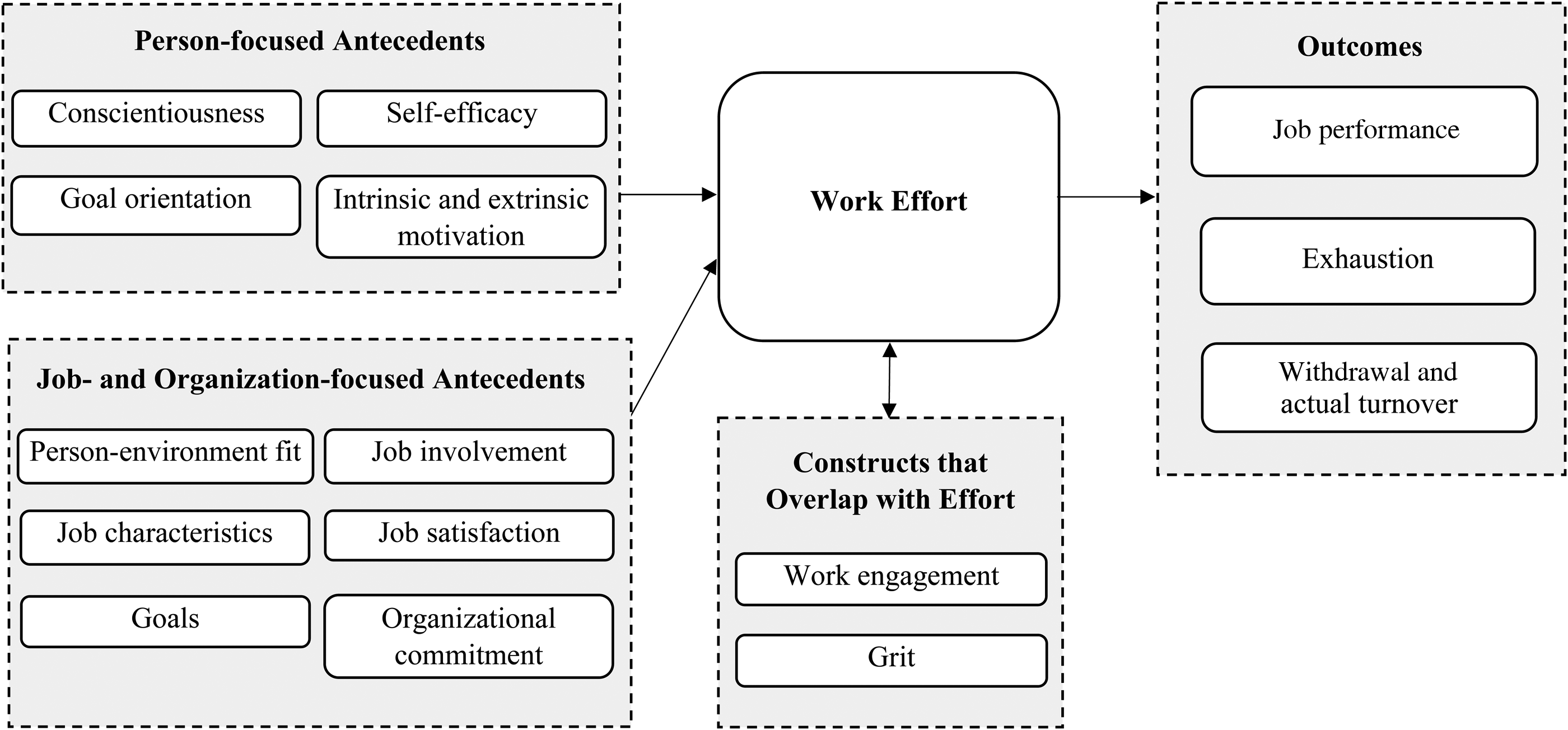
Nomological Network of Work Effort
Antecedents of Effort
We organize the proposed antecedents into two general categories. Person-focused constructs assess individual differences that may influence or covary with the effort workers exert, and job- and organization-focused constructs assess aspects of workers’ job or organization that may influence the extent to which individuals exert effort.
Person-focused antecedents
Conscientiousness is thought to be the personality factor most relevant to work effort (Schmidt & Hunter, 1992). People who are highly conscientious tend to be achievement oriented, be hardworking, and have high expectations of themselves (Barrick, Mount, & Strauss, 1993). Further, conscientious individuals tend to set goals and exert effort to achieve those goals (Barrick et al., 1993). Thus, definitions of conscientiousness refer to effort-related concepts, such as hard work. However, conscientiousness is broader than effort because it includes additional dimensions, such as order, dependability, and self-control (Costa & McCrae, 1992; Roberts, Chernyshenko, Stark, & Goldberg, 2005).
Achievement striving (which also is referred to as achievement motivation and need for achievement) is the dimension of conscientiousness that seems the most relevant to effort. People who are high on this characteristic “strive to do their best at being competent at any job they do and often do more than they planned” (Mount & Barrick, 2002: 54). They are “hardworking and persistent with high aspiration levels.” In fact, achievement-striving measures sometimes include items that refer to effort. For example, the Personal Characteristics Inventory (Mount & Barrick, 2002) Achievement Striving scale includes items such as “Others have described me as an extremely hard-worker” and “I like to do the best I can, even if it requires a lot of extra effort.” Similarly, the NEO Personality Inventory Achievement Striving scale (Costa & McCrae, 1992) includes items such as “work hard” and “put little time and effort into my work” (reverse scored). At the same time, such measures also include items that may be somewhat outside the effort domain, such as “I strive for excellence in everything I do” and “I approach most jobs with great enthusiasm.”
Self-efficacy refers to individuals’ confidence in their ability to perform in a specific domain (Bandura, 1997). General self-efficacy reflects individuals’ perception of their ability to perform across various situations, whereas specific self-efficacy reflects individuals’ beliefs about their ability to perform a particular task (Chen, Gully, & Eden, 2004). As discussed, social-cognitive theory (Bandura, 1977) proposes that workers who possess higher task-specific self-efficacy will devote greater effort to performing their jobs.
Goal orientation focuses on what motivates workers. Individuals with a mastery or learning goal orientation (LGO) are motivated to increase their competence by acquiring new knowledge or skills, whereas individuals with a performance goal orientation (PGO) are motivated to demonstrate competence compared with others (Dweck, 1986). Workers who are high on either or both dimensions should be more likely to demonstrate effort to achieve those goals than workers who are lower on these dimensions. However, LGO tends to covary with other motivational constructs, whereas PGO does not (e.g., Payne, Youngcourt, & Beaubien, 2007). Thus, we anticipate that only LGO will correlate positively with effort.
Intrinsic motivation refers to the desire to expend effort based on interest in and enjoyment of the work itself, whereas extrinsic motivation reflects the desire to obtain external outcomes, such as rewards or recognition (Deci & Ryan, 2000). Thus, workers who possess higher motivation, whether it be intrinsic or extrinsic, should exert more effort. However, similar to LGO and PGO, intrinsic motivation tends to relate more strongly to other motivation-related constructs than does extrinsic motivation (e.g., Dysvik & Kuvaas, 2013). As such, we expect that intrinsic motivation may also be more strongly related to effort than extrinsic motivation.
Job- and organization-focused antecedents
Person–environment fit is thought to relate to performance through its effects on job attitudes, such as job satisfaction and organizational commitment (Arthur, Bell, Villado, & Doverspike, 2006). Person–job fit focuses on the match between workers’ knowledge, skills, and abilities and the characteristics required for successful job performance (i.e., abilities–demands fit) as well as the match between what workers want or need in a job (e.g., flexibility) and what the job supplies regarding those needs (i.e., needs–supplies fit; Cable & DeRue, 2002). Person–organization fit focuses on the match between workers and the organization overall, such as the fit between what workers value and the values of the organization. Overall, the better the fit between workers and their job and organization, the more satisfied and committed they will be, and the better they will perform. We suggest that fit may affect effort in a similar way, such that workers with better fit will exert more effort to perform their jobs and contribute to the organization.
According to the job characteristics model (Hackman & Oldham, 1976), certain job characteristics have a positive effect on workers by making jobs more challenging, meaningful, and autonomous. Specifically, this model proposes that jobs are more meaningful when workers have the chance to use different skills in performing a job (skill variety), when they can see the finished product of their work (task identity), when their job is important to the organization or society (task significance), when they have freedom to decide how to accomplish their work (autonomy), and when they receive input about how they are doing (feedback). These characteristics, in turn, are thought to increase performance by motivating employees to invest time and energy to complete assigned tasks (Grant, 2008). For instance, when jobs can positively impact other people, workers are more likely to exert effort to successfully perform the job.
Workers or their supervisors often set goals, which are thought to help direct workers’ effort toward goal attainment (Diefendorff & Chandler, 2011; Katerberg & Blau, 1983). According to goal-setting theory (Locke & Latham, 1990), workers who set specific goals should devote greater effort to their work than workers who set more general goals or no goals at all. For example, goals may help workers persist despite difficulty and setbacks. Relatedly, goal commitment concerns how committed workers are to achieve their goals. Workers who possess higher levels of goal commitment should exert greater effort than those who are less committed.
Job involvement represents “the perceived importance of work in one's life or the degree of psychological identification with work” (Kanungo, 1981: 7). Workers who possess high levels of job involvement identify with their job and think about it even when outside of work (Kanungo, 1982). For example, Lodahl and Kejner’s (1965) widely used measure includes items such as “The most important things that happen to me involve my work” and “I live, eat, and breathe my job.” The more people identify with their work, the greater the amount of time, energy, and effort they are likely to commit to work activities (Brown & Leigh, 1996).
Job satisfaction also has been linked to work effort. Some research suggests that job satisfaction is an antecedent of effort (e.g., Riketta, 2008) and mediates the relation between satisfaction and performance (e.g., Mulki, Jaramillo, & Locander, 2009). That is, workers who are more satisfied with their jobs devote more effort, which, in turn, leads to higher performance. Other research suggests that effort is an antecedent of satisfaction (Brown & Peterson, 1994). For example, effort may lead to intrinsic and extrinsic rewards that increase workers’ satisfaction. Regardless of the causal direction, we expect satisfaction and effort will be positively related.
Finally, organizational commitment reflects workers’ commitment to their current employer and includes three dimensions (Meyer & Allen, 1991). Affective commitment refers to workers’ emotional attachment to, identification with, and involvement in the organization. Workers with a strong affective commitment may exert greater effort because they are attached to the organization and want it to be successful. Continuance commitment focuses on the potential costs of leaving an organization. Employees with a strong continuance commitment remain with the organization because they must (e.g., due to lack of alternatives) and, thus, may exert more effort to avoid losing their job. Finally, normative commitment reflects a feeling of obligation to stay with an organization. Workers with a high level of normative commitment feel that they ought to remain with the organization, such as to reciprocate goodwill to the organization for providing them a job. Thus, workers who possess strong normative commitment may exert effort because they believe they owe the organization their best effort.
Constructs That Overlap With Effort
There has been much debate regarding the meaning and measurement of work engagement (e.g., Byrne, Peters, & Weston, 2016; Macey & Schneider, 2008; Newman & Harrison, 2008). Kahn (1990: 700) defined engagement as “the simultaneous employment and expression of a person's ‘preferred self’ in task behaviors that promote connections to work and to others, personal presence (physical, cognitive, and emotional), and active, full performances.” Rich et al. (2010: 619) suggested that engagement reflects “a multi-dimensional motivational concept reflecting the simultaneous investment of an individual's physical, cognitive, and emotional energy in active, full work performance.” On the basis of these definitions, engagement seems to be a broad and somewhat ambiguous concept that includes elements of effort (e.g., the “investment of energy” to one's performance) but also other constructs (e.g., emotional engagement seems similar to job involvement).
Measures of work engagement also appear to overlap with effort. The Job Engagement Scale (JES; Rich et al., 2010) and the Utrecht Work Engagement Scale (UWES; Schaufeli, Salanova, González-Romá, & Bakker, 2002) are two of the most widely used engagement measures. The JES includes three subscales. The Physical Engagement subscale focuses directly on effort and comprises items such as “I exert my full effort to my job” and “I try my hardest to perform well on my job.” The Cognitive Engagement subscale captures mental effort using items such as “At work, I pay a lot of attention to my job” and “At work, I concentrate on my job.” In contrast, the Emotional Engagement subscale focuses on more attitudinal elements, such as interest, pride, and excitement about one's job. Example items include “I am interested in my job,” “I am proud of my job,” and “I am enthusiastic in my job.”
The UWES also includes three subscales. The Vigor subscale appears to overlap with effort the most by assessing energy (e.g., “At my work, I am bursting with energy”) and persistence (e.g., “I can continue working for very long periods at a time”). In contrast, the Dedication subscale focuses on feelings about one's job, such as “I am proud of the work that I do,” and the Absorption subscale assesses the extent to which workers get absorbed in their work, such as “I get carried away when I’m working” (see Byrne et al. [2016] for a detailed empirical comparison between these two engagement measures). Thus, two of the most widely used engagement measures capture aspects of effort.
Grit is the “perseverance and passion for long-term goals” (Duckworth et al., 2007: 1087) and comprises two dimensions. The consistency-of-interests dimension focuses on whether people maintain or change their interests and goals over time. Although this dimension does not seem to overlap with effort, the perseverance-of-effort dimension does in both name and content. Indeed, the scale for this dimension includes items such as “I am a hard worker” and “I finish whatever I begin” as well as related but somewhat different concepts, including overcoming setbacks and diligence.
Outcomes of Effort
As discussed, workers who try hard to perform their jobs will tend to demonstrate better job performance in terms of both behaviors and results. We anticipate that effort will relate positively to task performance, as well as to contextual performance (e.g., OCB), particularly to measures that focus on or include items about the discretionary effort workers devote to helping their coworkers or the organization. In contrast, we expect effort will be negatively related to CWB. Specifically, individuals who work harder may be less likely to demonstrate counterproductive behaviors, particularly those conceptually similar to reduced effort, such as lateness and loafing on the job. In addition, if effort is indeed more proximal to job performance than its proposed antecedents (as the model in Figure 1 proposes), then effort should be more strongly related to performance than its antecedents. To explore this possibility, we also compare relations between effort and performance to relations between the antecedents and performance.
We also explore the possibility that effort could be related to outcomes in addition to performance. First, exerting high levels of effort could lead to emotional exhaustion, which is a key dimension of work-related well-being (Wright & Cropanzano, 1998). Second, effort may also be relevant to withdrawal from the organization. For example, progressive withdrawal theory suggests that workers decrease effort as they begin to withdraw from an organization (Koslowsky, Sagie, Krausz, & Singer, 1997). In addition, workers who decide to leave may reduce their effort due to the lack of long-term consequences. Thus, we also explore whether effort is associated with turnover intentions or actual turnover.
Meta-Analytic Review
Method
Literature search
We began by searching the following electronic databases for potentially relevant published and unpublished studies: Google Scholar, PsycINFO, and Web of Science. We also searched the metaBUS database (Bosco, Field, Larsen, Chang, & Uggerslev, 2020). We searched for studies that included the terms “work effort” or “hard work.” We also searched more broadly for studies that included effort and the other constructs we referred to in the previous sections, including burnout, commitment, citizenship behavior, counterproductive behavior, efficacy, effectiveness, efficiency, goals, motivation, success, performance, productivity, satisfaction, sales, supervisor ratings, and turnover. Next, we searched for studies that included specific measures we identified as assessing effort, including measures from Brockner, Grover, Reed, and Dewitt (1992); Brown and Leigh (1996); Brown and Peterson (1994); De Cooman et al. (2009); Kanfer et al. (1994); Kuvaas and Dysvik (2009); Rich et al. (2010); and Sujan et al. (1994). Finally, we reviewed the References sections of the studies we obtained to identify additional sources. In total, we reviewed over 3,500 studies for potential inclusion in the meta-analysis.
Inclusion criteria
We used seven criteria to determine whether to include primary studies in the meta-analysis. First, we included studies that measured effort employees devote to their job, participants devote to simulated job tasks in laboratory settings, 1 or entrepreneurs devote to new ventures. Second, we included studies that measured effort direction, intensity, persistence, or effort more generally. 2 For number of hours worked (as a measure of effort persistence), we included only primary studies for which the entire sample (a) held the same or a highly similar job (i.e., to help ensure similar work schedules/demands) and (b) was full- or part-time and not some combination of the two (i.e., to avoid potential extraneous variance due to differing work schedules). Third, we included studies that measured effort and at least one of the constructs in the nomological network. Fourth, for studies that measured effort and a performance-related outcome, we included outcome measures that reflected task performance, contextual performance, CWB, or overall performance using supervisor, peer, or customer ratings or results-based measures (e.g., sales). Although we excluded self-ratings of job performance, consistent with previous meta-analyses (e.g., Gonzalez-Mulé, Mount, & Oh, 2014), we included self-ratings of CWB, which most primary studies measure using self-reports (e.g., because CWBs such as theft often go unobserved). We also included self-ratings of exhaustion and turnover intentions because most primary studies measured these more intrapersonal constructs using self-reports. Fifth, we included studies that measured effort and performance using different sources. 3 Sixth, we included studies that measured effort and the other constructs at the individual level (see Torka, Mazei, & Hüffmeier [2020] for a review of effort in team contexts). Seventh, we included studies based on independent samples. A total of 141 studies, including 171 independent samples, met all the criteria. Studies comprised 119 journal articles, 20 dissertations and theses, one book, and one conference paper (see online supplement for references for all the primary studies).
Coding of primary studies
The first two authors independently coded 20 primary studies and compared their results. Both coders have expertise in the substantive domain and have conducted several meta-analyses. We coded sample size, reliability estimates, and correlations between effort and other variables. We also coded several aspects of the effort measure(s) in each study, including its standing on the categories in Table 1. In addition, we coded the type (e.g., task performance vs. performance results) and source (e.g., supervisor ratings vs. records) of the outcome measures. The percentage of intercoder agreement ranged from 90% (for effort dimensions assessed) to 100% (e.g., for effort–outcome correlations), with an overall agreement of 96.3% across nearly 300 individual codes. After resolving any disagreements via discussion, the first author then coded the remaining studies. 4
Descriptive Statistics for Reliability Estimates for Study Variables
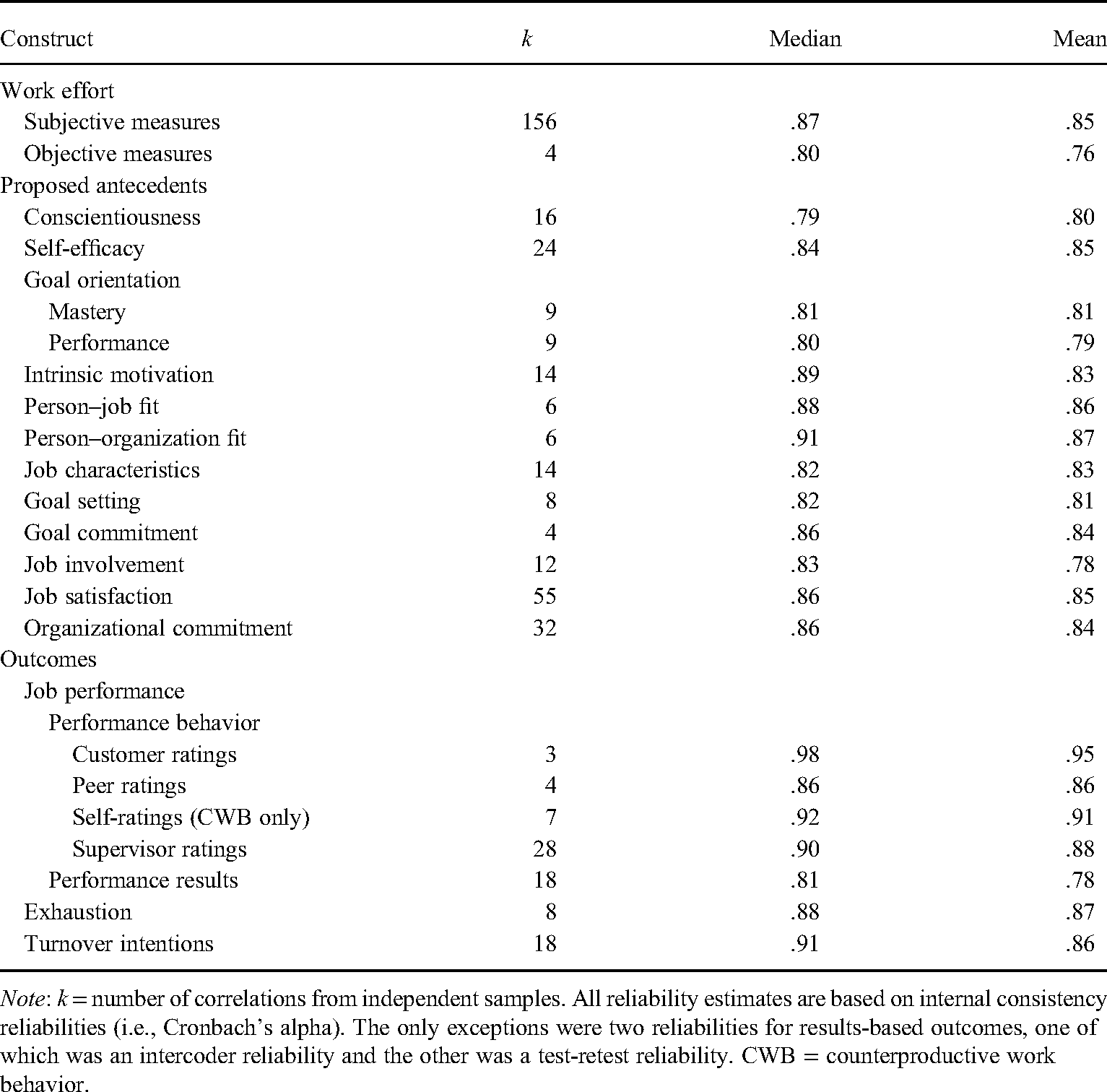
Note: k = number of correlations from independent samples. All reliability estimates are based on internal consistency reliabilities (i.e., Cronbach's alpha). The only exceptions were two reliabilities for results-based outcomes, one of which was an intercoder reliability and the other was a test-retest reliability. CWB = counterproductive work behavior.
Meta-analytic approach
We used Schmidt and Hunter’s (2015) psychometric meta-analysis using a Microsoft Excel program developed by Huy Le. First, we computed the mean sample size–weighted observed correlations (r) between effort and the proposed antecedents and outcomes in Figure 1. A few studies reported means and standard deviations, which we converted to rs. For studies that included multiple effort and/or outcome measures, we computed composite rs for inclusion in the overall meta-analyses (Schmidt & Le, 2004). Second, we computed rs corrected for measurement error in all the measures to estimate construct-level relations. For studies that reported reliability estimates, we used those values in the meta-analyses. Almost all of these were internal consistency reliability estimates (alpha). For studies that did not report reliability estimates, we used the median estimate based on other studies in the data set as seen in Table 1. Internal consistency reliability tends to overestimate the reliability of ratings-based criteria (and, in turn, underestimate corrected correlations) because intrarater errors typically are smaller than interrater errors (LeBreton & Senter, 2008). Unfortunately, none of the primary studies reported estimates of interrater reliability for supervisor, coworker, or customer ratings of performance. We therefore report two corrections for rs involving performance ratings: one using internal consistency estimates from the primary studies and one using an interrater reliability of .60 from prior meta-analyses (e.g., Rothstein, 1990; Van Iddekinge, Arnold, Frieder, & Roth, 2019). The latter estimate reflects the reliability of a single rater, which was appropriate given that all the primary studies used only one rater to evaluate each worker.
Results
We report results for analyses based on three or more primary studies. This included all the proposed relationships in the nomological network summarized in Figure 1 except for relations between effort and actual turnover. In addition, to identify potential influential studies, we used a modified version of the sample adjusted meta-analytic deviancy statistic (Beal, Corey, & Dunlap, 2002) available in Meta-Analysis Mark XIII (Piers Steel, personal communication, March 21, 2022). If exclusion of a study changed the original mean corrected r by 20% or more, we report the results with and without the influential study (and we discuss results without the influential study) based on best practices in outlier management (e.g., DeSimone, Brannick, O’Boyle, & Ryu, 2021; Steel, Beugelsdijk, & Aguinis, 2021).
Relations between effort and its proposed antecedents and correlates
Table 2 displays correlations between effort and its proposed antecedents as well as the constructs that appear to overlap with effort. Among the person-focused antecedents, intrinsic motivation and self-efficacy were most strongly related to effort (
Meta-Analytic Correlations Between Work Effort and Its Proposed Antecedents and Overlapping Constructs
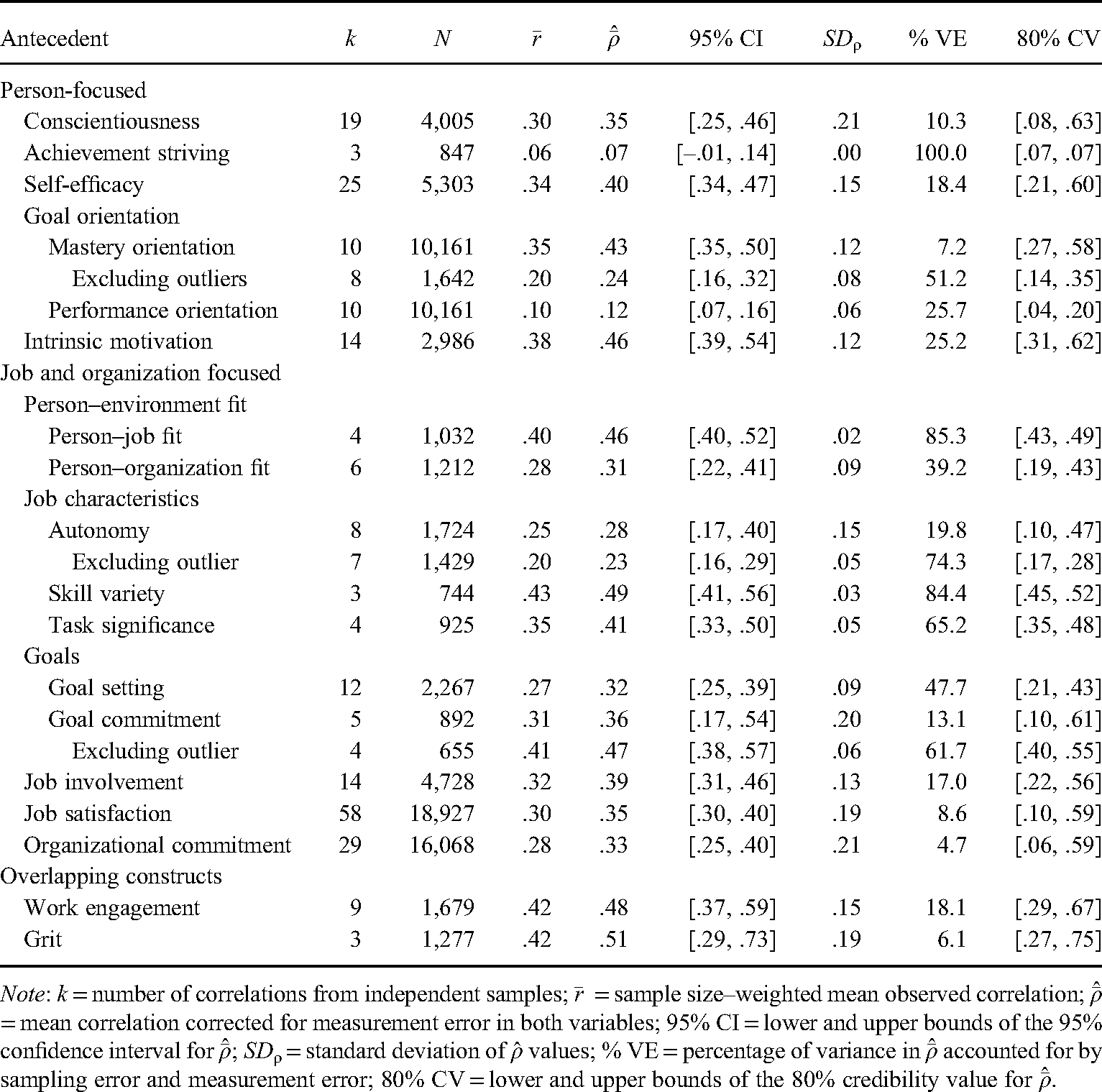
Note: k = number of correlations from independent samples;
Regarding the constructs that overlap with effort, the mean corrected r between effort and engagement was .48, and the mean corrected r between effort and grit was .51. Also, in addition to the overall grit scale, one of the primary authors (Jordan, Hochwarter, Ferris, & Ejaz, 2018) provided us separate correlations for each of the two grit subscales. As expected, effort was more strongly related to perseverance of effort than to consistency of interests (
Relations between effort and outcomes
Table 3 displays correlations between effort and the proposed outcomes. For job performance, the table provides rs corrected for measurement error in performance ratings using internal consistency reliabilities from the primary studies (
Meta-Analytic Correlations Between Work Effort and Outcomes
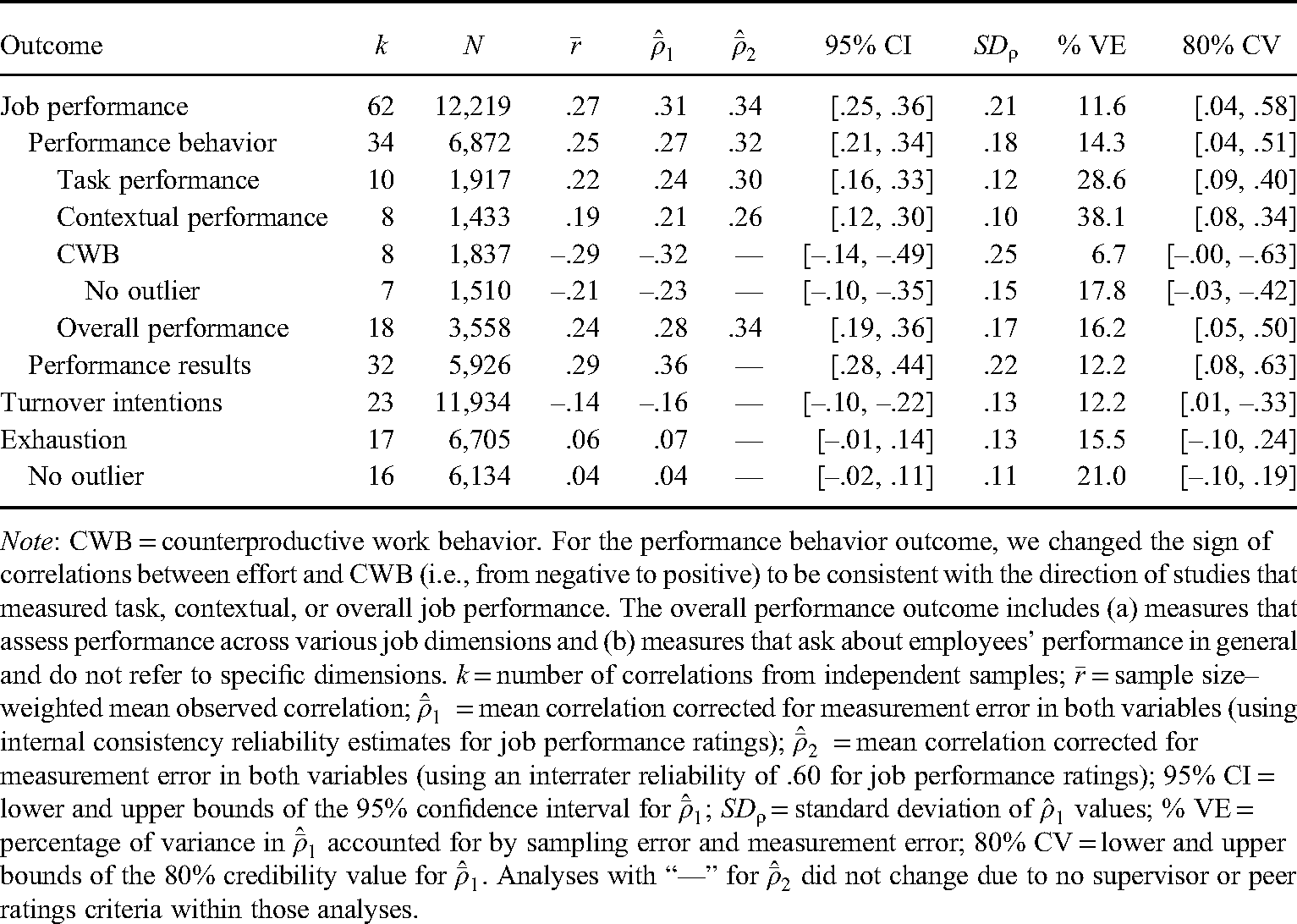
Note: CWB = counterproductive work behavior. For the performance behavior outcome, we changed the sign of correlations between effort and CWB (i.e., from negative to positive) to be consistent with the direction of studies that measured task, contextual, or overall job performance. The overall performance outcome includes (a) measures that assess performance across various job dimensions and (b) measures that ask about employees’ performance in general and do not refer to specific dimensions. k = number of correlations from independent samples;
The overall corrected r between effort and job performance was .31, and there was considerable variability around this mean estimate (SDρ = .21). Effort was a better predictor of performance results (
Relations between effort categories and performance
Table 4 reports meta-analytic rs between effort and job performance (including both behavior- and results-based measures) separated by the effort categories we identified. We focused on performance as the outcome for these analyses and did not incorporate relations between effort and the other outcomes (i.e., turnover intentions and exhaustion) given conceptual and empirical differences across the outcomes (e.g., effort was more strongly related to performance than to the other outcomes).
Meta-Analytic Correlations Between Work Effort and Job Performance by Effort Category
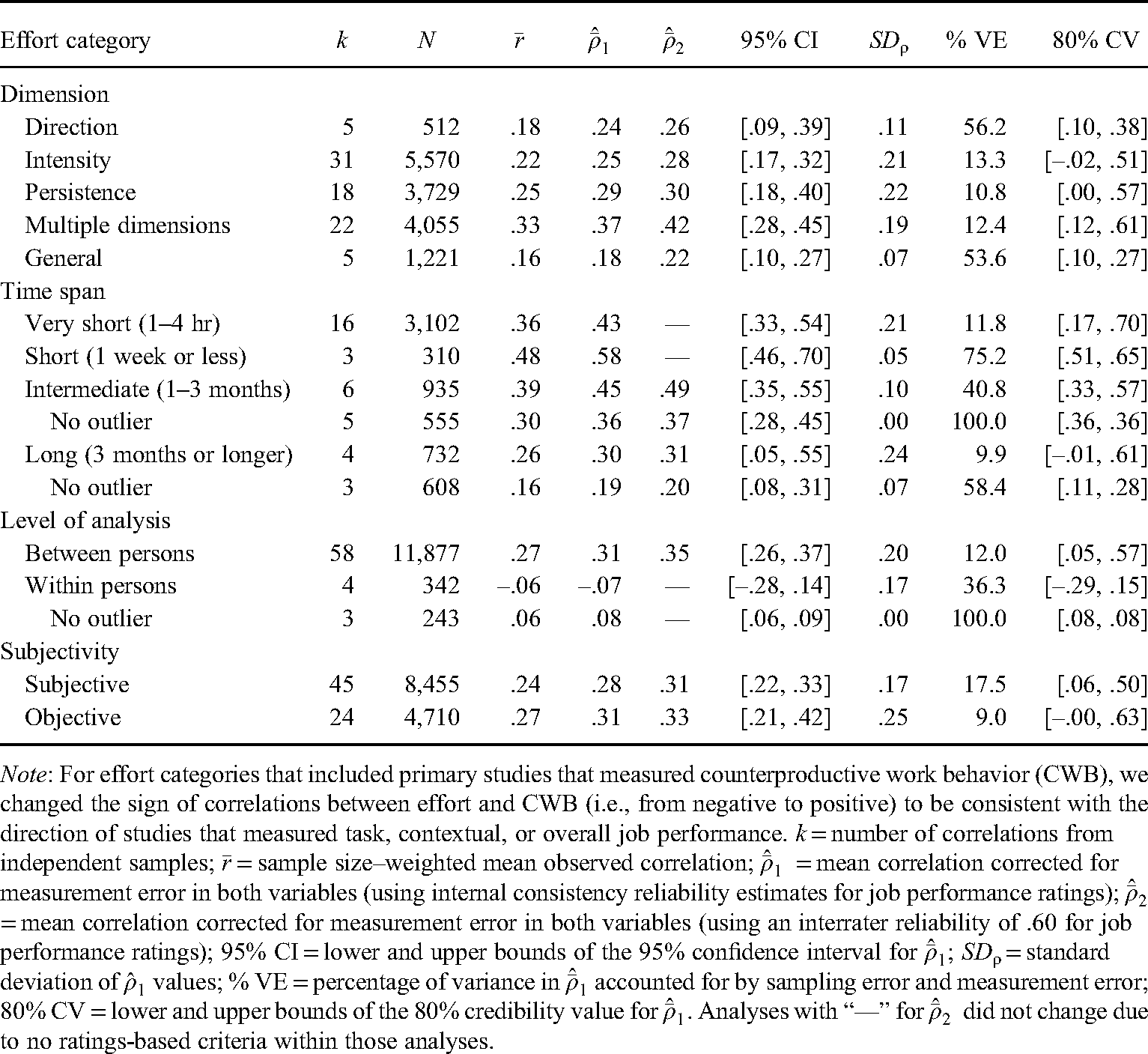
Note: For effort categories that included primary studies that measured counterproductive work behavior (CWB), we changed the sign of correlations between effort and CWB (i.e., from negative to positive) to be consistent with the direction of studies that measured task, contextual, or overall job performance. k = number of correlations from independent samples;
Regarding effort dimension, we found that direction, intensity, and persistence of effort were similarly related to job performance (
For effort time span, many studies did not report or measure the amount of time over which effort was assessed. For example, most self-report measures ask workers how much effort they exert on their jobs and do not specify a particular time frame (e.g., “within the past month”). Of the studies that did provide a time frame the effort measure covered, we separated them into four categories that reflected very short (1–4 hr), short (1 week or less), intermediate (1–3 months), and long (more than 3 months) time frames. Results suggested that effort–performance relations generally decreased as the time frame increased. For example, corrected rs were .43 and .58 for effort exerted during a few hours and over 1 week, respectively, compared with .19 for effort exerted over 3 months or longer.
With respect to effort level of analysis, almost all studies used between-person designs (k = 58); only a few used within-person designs (k = 4). The mean corrected r was much stronger for between-person studies (.31) than for within-person studies (.08). Finally, for effort subjectivity, corrected rs were slightly stronger for more objective measures (.31) than for more subjective measures (.28).
Relative validity of effort and its proposed antecedents
As discussed, if effort is indeed more proximal to job performance than its proposed antecedents, then effort should be more strongly related to performance than its antecedents. To examine this possibility, Table 5 presents relations between the antecedents of effort and job performance (including behavior- and results-based measures). In addition, the last column of the table reports corrected rs between effort and performance based on the same sets of primary studies on which each antecedent–performance relationship is based. This approach controls for sample-specific differences in these comparisons. For both sets of relationships, we focus on rs corrected for intrarater reliability in performance (i.e.,
Meta-Analytic Correlations Between Proposed Antecedents and Job Performance
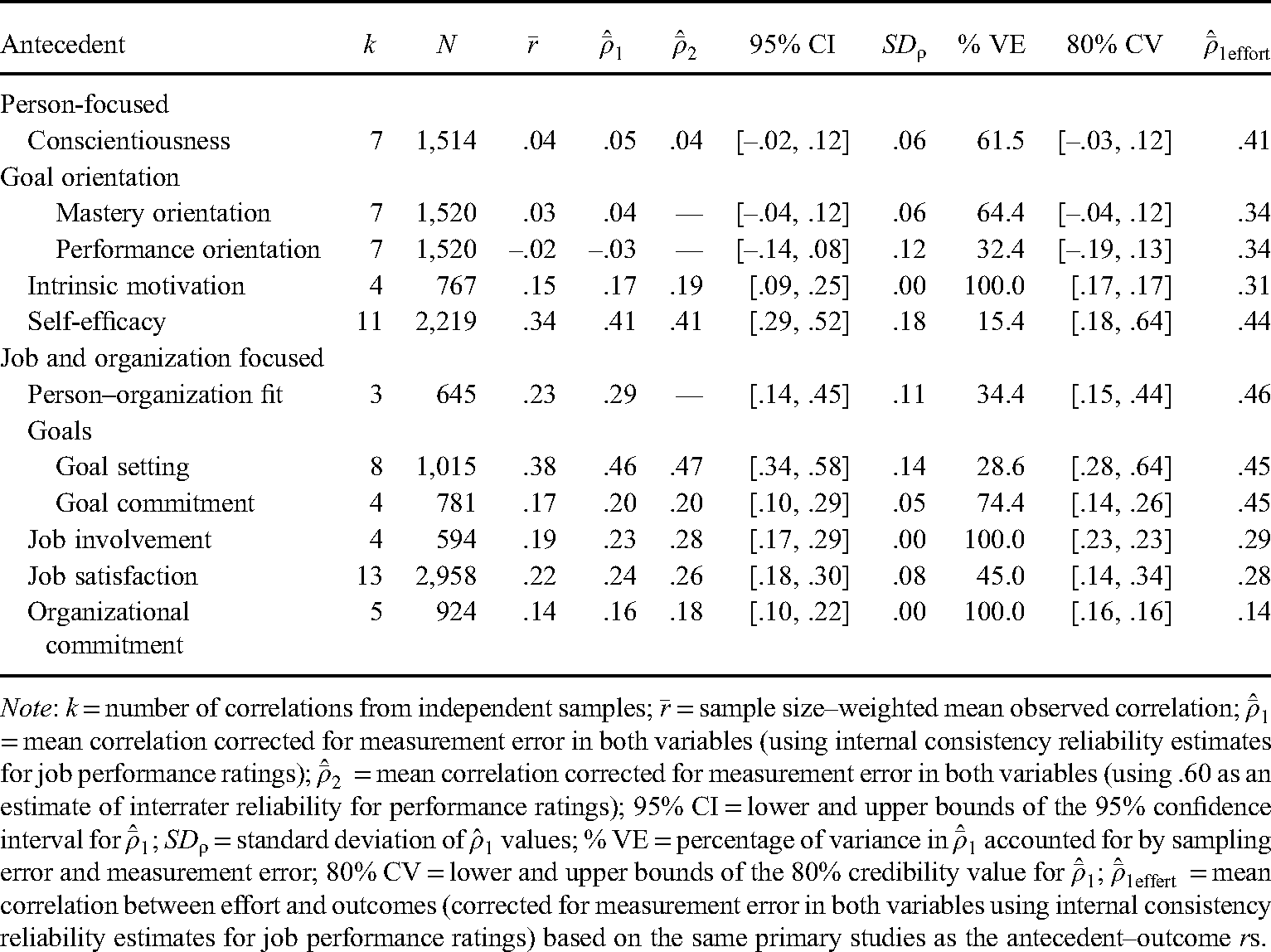
Note: k = number of correlations from independent samples;
Among the person-focused constructs, only self-efficacy emerged as a strong predictor of performance (
General Discussion
Implications for Theory
Although work effort has been a key concept in management theories for more than a century (e.g., Porter & Lawler, 1968; Ryan, 1947; Taylor, 1911), our review suggests effort has been a somewhat overlooked construct empirically. One reason effort has not received more empirical attention may be uncertainty regarding what effort is and where it fits into theoretical models. For instance, our review revealed that effort has been conceptualized as motivation, an outcome of motivation, an antecedent of performance, and a component of performance. Without a clear definition of effort, it is difficult to understand its role in various theories. Our review addressed this key issue by providing an integrated definition of effort that clarifies what it is and how it is similar to, but different from, motivation and performance. Specifically, motivation is an “unobservable force” that causes workers to exert effort to accomplish their work. Effort is about what workers do and how hard they try to do those things. In contrast, performance is about how efficiently and effectively workers do those things. Thus, effort is necessary, but insufficient, for performance in that workers need to exert effort to perform their roles, but their effort must be efficient and focus on the appropriate behaviors.
An implication of the distinction between effort and performance is the need to reconsider theories and models that include effort as a dimension of performance. Viswesvaran (1993), for instance, found that many performance measures include effort-related dimensions. Some measures of extrarole behavior also refer to effort. For example, Van Scotter and Motowidlo’s (1996: 526) conceptualization of contextual performance includes a dimension called job dedication, which they defined as “self-disciplined behaviors such as following rules, working hard, and taking the initiative to solve a problem at work.” Because effort is an antecedent of performance, these conceptualizations (and measures) need to be refined.
Our review also revealed a lack of consensus regarding how effort should be operationalized. Indeed, researchers have attempted to measure effort in various ways, many of which do not focus on effort, or they focus on effort but also on other constructs (i.e., they are contaminated; Messick, 1995). Even measures that focus solely on effort typically do not measure all dimensions of effort (i.e., they are deficient). Theories involving effort cannot be tested if there is not consensus regarding how to measure the construct. Our review provides a framework for understanding the ways effort can be operationalized, and our meta-analysis suggested that some measures may be more effective than others. For example, relations between effort and outcomes are stronger for (a) measures that focus on persistence or multiple effort dimensions (
Further, the nomological network we developed clarifies what constructs are antecedents and outcomes of effort as well as how these constructs are distinct from—or in some instances overlap with—effort. Meta-analytic correlations of the network relationships revealed that intrinsic motivation (
Our review also provided a critical examination of constructs that appear similar to effort. Our results reveal that definitions of grit refer to effort. In addition, several widely used measures of work engagement focus on effort. This conceptual and operational overlap with effort raises questions about the uniqueness of these other constructs (Newman, Harrison, Carpenter, & Rariden, 2016).
Further, the present results reveal that effort is a moderately strong predictor of job performance. For example, the overall corrected r between effort and performance was .31 (see Table 3). The corrected r of .37 between measures that assess multiple effort dimensions and performance also is notable (see Table 4). Thus, both theoretically and empirically, effort is related to, but distinct from, job performance. 6 Finally, we found evidence to suggest that effort is more strongly related to performance than most of its proposed antecedents. Only self-efficacy, goal setting, job satisfaction, and organizational commitment were similarly related to performance compared with effort.
Implications for Future Research and Organizational Practices
First, we hope our review will inform decisions about how to measure effort in different situations and for different purposes. Specifically, if the goal is to maximize prediction, the somewhat stronger validity evidence for objective over subjective measures of effort suggests using more objective measures. For example, measures such as number of sales calls made during a certain period reflect effort intensity. Measures such as hours worked reflect persistence and may be particularly appropriate when comparing workers in the same roles. Time on task also may be a useful measure of persistence, particularly in laboratory settings. However, researchers need to take care that these measures capture effort that is under workers’ control and not influenced by external factors, such as limited availability to schedule work hours. Additionally, because lower intensity of effort could result in longer work hours, researchers need to consider multiple dimensions of effort. Indeed, results suggested measures that assess multiple effort dimensions relate more strongly to performance than measures that focus on only one dimension or on effort more generally.
If objective measurement is not possible, more subjective measures of effort can be used. For example, Brown and Leigh’s (1996) Work Intensity scale appears to be a good measure of effort intensity. For measuring persistence, we suggest measures such as Sujan et al. (1994) and Fang, Palmatier, and Evans (2004, which is based on Sujan et al., 1994) that assess working long hours and persisting despite obstacles. However, even this scale could be expanded to capture effort persistence more fully (e.g., additional items to assess overcoming obstacles). In addition, most or all subjective measures ask how much effort workers typically exert. Given that effort is more predictive of outcomes over shorter time spans, we recommend including a time frame, such as effort during the past week. Referring to shorter time spans may also help raters recall the effort level. Finally, if researchers wish to assess effort on tasks or projects, we suggest measures that capture on-task effort (e.g., Robinson, 2009). Overall, there does not appear to be one “perfect” measure of work effort. Thus, when possible, researchers should incorporate multiple measures and consider their advantages and disadvantages carefully.
The present results also have implications for human resource practices involving employee selection, compensation and rewards, performance management, and job design. First, if it is infeasible to measure effort directly, organizations might measure antecedents that are most strongly related to effort, for instance, selecting job applicants who possess a high level of intrinsic motivation to perform a particular job or taking steps to increase workers’ self-efficacy through training or practice. Second, the fact that goals and goal commitment were relatively strong antecedents of effort provides further evidence for the importance of having employees set goals. Accordingly, practices about compensation and rewards, and the role goals play within those practices, should consider their impact on work effort. Third, skill variety and task significance are the two job characteristics most strongly related to effort. This underscores the importance of designing jobs that allow employees to develop and use different skills as well as considering ways to increase the (perceived) impact jobs have on other aspects of the organization and/or society in general. Similarly, we found that person–job fit is more strongly related to effort than person–organization fit (see Table 2). This finding reinforces the importance of assessing person–job fit during the staffing process as well as finding ways to improve fit post-hire (e.g., through job crafting). Finally, not only is greater effort related to positive outcomes, such as better job performance, but decreased effort is related to higher CWB and intentions to leave. This suggests that performance management systems should include checks for monitoring effort because decreases in effort may be a sign of bad things to come.
Agenda for Future Research
Measurement of effort
Our meta-analytic review highlights some critical needs for future research. First, we found that many effort measures are contaminated or deficient. Thus, one avenue for future research would be to conduct a systematic review of the content (substantive) validity of effort measures to identify sources of contamination and deficiency within these measures. Further, we identified eight primary studies from our data set (N = 1,283) that reported correlations between two distinct measures of effort. The mean corrected correlation between effort measures was only .25, which suggests that alternative measures are only moderately correlated. Therefore, more work is needed to validate effort measures currently in use, including attempting to sort out the similarities and differences among the measures.
The meta-analysis revealed a lack of data on several aspects of effort. Among the dimensions of effort, relatively few studies have attempted to measure effort direction. As Brown and Leigh (1996: 361) noted, although “decisions employees make regarding allocation of effort across tasks constitutes an additional important dimension of effort, it also entails considerable complexity (e.g., related to knowledge structures and cognition, or working smart).” One approach to assess effort direction may be to adopt resource allocation methods (e.g., Vancouver et al., 2008), for example, asking workers to indicate the percentage of their total effort devoted to various in- and extrarole activities and then scoring responses according to the relative importance of the activities to the job. However, effort direction may blur the line between effort and performance because effort direction focuses on whether workers direct their efforts to the most important tasks. If so, effort direction may capture effectiveness of behavior more so than the intensity and persistence dimensions.
Similarly, very few studies have examined the consistency with which workers exert effort over time (for an exception, see experimental studies by Yeo and Neal, 2004, 2008). For example, do some workers exert consistently high levels of effort, whereas others exert high effort only when necessary, such as in response to a deadline or an incentive? Relatedly, future research could examine a possible distinction between typical and maximal effort that may parallel the typical-maximal distinction for job performance (Beus & Whitman, 2012).
In addition, although we identified several factors on which effort measures can vary, future research might consider additional factors. For example, we noted that some measures are labeled and/or focus on mental effort, whereas other measures focus on physical effort. For example, Rich et al.’s (2010) Cognitive Engagement scale includes items such as “At work, my mind is focused on my job” and “At work, I concentrate on my job.” Other measures focus on attentional effort, such as whether people's thoughts focus on the task or on off-task things. For instance, Kanfer et al.’s (1994) On-Task Thoughts scale includes items like “I focused my total attention on learning a specific rule,” whereas their Off-Task Thoughts scale includes items like “I took ‘mental breaks’ during the task.” In contrast, we did not find any measures of physical effort that met our inclusion criteria. Some measures include “physical” in their name, such as the Rich et al. (2010) and May, Gilson, and Harter (2004) Physical Engagement scales. However, the items often are not specific to physical effort (e.g., “I work with intensity on my job,” “I exert my full effort to my job”). Future research might explore ways to measure physical effort within the work context, such as adapting physiological measures used in research on health and physical ability. For example, Halper and Vancouver (2016) measured the level and persistence of handgrip force participants applied. Similarly, Feltz et al. (2016) measured effort using cycle ergometer power output in a study designed to improve astronauts’ exercise in space.
Furthermore, we focused on effort workers devote to job tasks. However, effort also can be interpersonal, such as effort workers devote to developing and maintaining relationships with coworkers. For instance, emotional labor measures sometimes refer to effort workers devote to the emotional display rules organizations ask them to show (e.g., smiling toward customers; Beal, Trougakos, Weiss, & Green, 2006). Similarly, measures of deep acting (e.g., Diefendorff, Croyle, & Gosserand, 2005) sometimes refer to effort employees devote to experiencing the emotions of others (e.g., “I work hard to feel the emotions that I need to show to customers”). Thus, research is needed to examine the possibility of interpersonal effort, including whether it is indeed distinct from concepts such as helping-focused OCB and emotional labor.
Finally, results suggest that effort is a stronger predictor of outcomes than many more commonly measured constructs. However, all the primary studies measured effort in a postemployment context. Thus, research is needed to examine how to best measure effort in a selection context. Given the transparent nature of most self-report effort measures, response distortion is likely to be an issue when administering such measures to job applicants. If so, researchers could explore measuring effort using methods that may be less susceptible to distortion, such as situational judgment tests and assessment center exercises.
Effort antecedents and covariates
Several of the relationships in the nomological network we tested were based on data from small numbers of primary studies. In addition, there may be additional constructs within effort's network for which we did not find any data. For example, work drive is “a disposition to work long hours, take on extra responsibilities at work, display a high level of energy at work, and to see oneself as being a hard worker compared to other people” (Lounsbury et al., 2004: 429). Several elements of this definition appear to overlap with effort, including “energy at work” and “being a hard worker.” Lounsbury et al.'s (2004) measure of work drive also taps elements of effort, such as “I tend to work more hours every week than most people I know” and “I would say that I have more work drive and energy than most people.” Similarly, individuals who possess a proactive personality “show initiative, take action, and persevere until they bring about meaningful change” (Crant, 1995: 532), and personal initiative is “a behaviour syndrome resulting in an individual's taking an active and self-starting approach to work and going beyond what is formally required in a given job” (Frese, Fay, Hilburger, Leng, & Tag, 1997: 140). Proactive personality and personal initiative appear similar to one another but somewhat different from effort. For example, these constructs focus on initiating behaviors, whereas effort focuses more on the intensity and persistence of behaviors.
Another related construct, work ethic, originates from the concept of Protestant work ethic and “reflects a constellation of attitudes and beliefs pertaining to work behavior” (Miller, Woehr, & Hudspeth, 2002: 455). Miller et al. (2002) identified seven dimensions of work ethic: centrality of work, self-reliance, hard work, leisure, morality/ethics, delay of gratification, and wasted time. Thus, work ethic appears to be much broader than work effort. The two dimensions that may be most relevant to effort are hard work and wasted time. However, hard work focuses on beliefs about the value of working hard (e.g., “Hard work makes one a better person”) rather than on how hard one actually works, and wasted time focuses more on planning one's time (e.g., “I try to plan out my workday so as not to waste time”).
Finally, several recent research streams have focused on the concept of work passion (Pollack, Ho, O'Boyle, & Kirkman, 2020). General passion represents positive feelings toward work (e.g., Baum & Locke, 2004) and is measured with items such as “I love my work” and “I love to work hard.” The dualistic model defines passion “as a strong inclination toward an activity that people like, that they find important, and in which they invest time and energy” (Vallerand et al., 2003: 757) and encompasses two dimensions. Harmonious passion is measured by items such as “My work is in harmony with the other activities in my life,” whereas obsessive passion is measured by items such as “I have an obsessive feeling for my work.” It is not yet clear whether passion is distinct from constructs such as engagement, job satisfaction, and positive affect, all of which demonstrated substantial correlations with certain aspects of work passion in Pollack et al.’s (2020) meta-analysis.
Outcomes of effort
Research has focused primarily on effort as a predictor of job performance, but effort may also be related to other work-related outcomes. For example, although theoretical models of training often refer to effort (e.g., Kraiger, Ford, & Salas, 1993) or related constructs, such as motivation to learn (e.g., Colquitt, LePine, & Noe, 2000), we did not come across any field studies that measured effort during training. Although effort appears to be a promising construct for understanding the performance of entrepreneurs (e.g., Uy et al., 2015), research relating effort to entrepreneurial success is very limited.
We focused on linear relations between effort and outcomes and found that effort is related to better performance and, to a lesser extent, negatively related to CWB and turnover intentions. Future research could explore whether high levels of effort could be “too much of a good thing” (Pierce & Aguinis, 2013). For example, perhaps a moderate amount of effort is optimal for increasing positive outcomes without having negative consequences, such as withdrawal. Relatedly, we did not incorporate research linking fit between effort and rewards to strain and poor health (e.g., Lang, Van Hoeck, & Runge, in press). In addition, we came across only a few studies that examined effort at levels higher than the individual, such as team- or unit-level effort (e.g., Morgeson, Johnson, Campion, Medsker, & Mumford, 2006). Future research could examine the nature of collective effort as well as whether and how this form of effort relates to higher-level outcomes, such as unit and firm performance.
Future research also is needed to better understand how decision makers perceive effort versus ability. For example, social psychology research suggests that judges tend to give higher evaluations to those who are naturally talented than to those who are less talented but exert high effort (e.g., Tsay & Banaji, 2011). Other research has found that decision makers sometimes provide higher evaluations to those who exert effort to improve than to those whose performance is consistently high from the outset (Alessandri, Cortina, Sheng, & Borgogni, 2020; Soliman & Buehler, 2018). Future research is needed to examine how these tendencies and potential biases for talent versus effort manifest in decisions involving selection and performance appraisals.
Additional moderators of effort–outcomes relations
Our review identified situations in which relations between effort and outcomes are stronger or weaker. However, we need more research that examines conditions under which effort has the greatest impact on outcomes. For example, Blau (1993) found that performance was highest when both effort direction (i.e., frequency of performing job-relevant behaviors) and effort intensity (i.e., time spent working) were high. Another avenue would be to see if effort is relatively more important in certain types of jobs. Perhaps effort is relatively more important than constructs such as intelligence in less complex jobs. Similarly, Kanfer and Ackerman (2004) proposed that effort may be a substitute for cognitive abilities, such that workers who possess lower cognitive capacity may still achieve high levels of performance by exerting substantial effort (see also Van Iddekinge, Aguinis, Mackey, & DeOrtentiis, 2018). Kanfer and Ackerman also distinguished between jobs and tasks that require high levels of expertise and those that require high levels of fluid processing capacity. Expertise-intense jobs and tasks depend on effort only during skill acquisition. As expertise accumulates, workers can execute the tasks with less effort. In contrast, tasks that require fluid capacity depend on effort.
Finally, future research could explore cross-cultural differences in the amount or effects of effort. For instance, in Japan, a culture of working long hours has led to the deterioration of workers’ health in a phenomenon known as karoshi (which means “work to death”; Kanai, 2009). Further, Hofstede’s (2011) model of cultural values includes a dimension (i.e., long-term vs. short-term orientation) that reflects whether people focus their effort on the future or on the past and present. Future research also could examine subgroup differences in effort, which could be important if organizations try to assess effort when making selection or promotion decisions.
Conclusion
Organizational researchers have written about work effort for more than a century, and managers are continually looking for ways to maintain and increase effort from their employees. However, it seems as though the field has assumed we know what effort is and, for example, often “lumps” it in with related but distinct constructs, such as motivation and performance. This is in stark contrast to the considerable research attention devoted to constructs that theoretically are more distal to outcomes such as job performance (e.g., personality, person–environment fit, goal setting). “New” and exciting concepts, such as work engagement, grit, and work passion, have also received much more attention than effort. Our review provides some clarity about what effort is, what it is not, and how to measure it. In addition, we hope some of our ideas will spur future research, which will be challenging given some of the complexities we identified regarding how and when to measure effort. Nonetheless, we hope the field is willing to put in the “effort” to help researchers and managers better understand, measure, and affect this long-standing, yet still very relevant, antecedent of work behavior.
