



Abstract
This review presents comprehensive analyses of extant research on culture creation and change. We use the framework of culture creation and change ( Kim & Toh, 2019), which consists of three unique perspectives, to understand past research on the antecedents of cultures. The basis of the functionality perspective is that environmental changes shape cultures, and thus, the created cultures enable an organization to address the demands of its environments effectively. In contrast, the leadership perspective argues that leaders have disproportional influence on cultures, and when exercising such influence, they are often unsuccessful at creating functional cultures. The leadership perspective comprises two subperspectives—the leader-trait and cultural transfer perspectives. The leader-trait perspective argues that when creating cultures, leaders often overlook the functionality of cultures but rely heavily on their traits. The cultural transfer perspective suggests that leaders often recreate the cultures that they have experienced in the past. Building on this framework, we review 74 studies in 68 articles across multiple disciplines to widen our understanding of culture creation and change. We then present agendas for future research guided by a four-stage model and a theory of coordinated actions for creating functional cultures. Finally, we discuss methodological limitations in past studies and offer possible solutions.
Keywords
Culture has been one of the most popular topics in the field of management research and the subject of several published reviews. In the Journal of Management, scholars have reviewed culture in relation to various domains in management, such as international management (Tsui, Nifadkar, & Ou, 2007), employee justice (Shao, Rupp, Skarlicki, & Jones, 2013), work-life research (Ollier-Malaterre & Foucreault, 2017), and firm internationalization (Beugelsdijk, Kostova, Kunst, Spadafora, & Van Essen, 2018). These reviews primarily examined how cultures affect various outcomes—that is, the consequences of cultures. The same has been true for culture reviews in other journals (e.g., Adler & Aycan, 2018; Allen, Eby, Chao, & Bauer, 2017; Cohen, Shin, & Liu, 2019; Earley, 2002; Gelfand, Aycan, Erez, & Leung, 2017; Gelfand, Erez, & Aycan, 2007; Gelfand, Harrington, & Jackson, 2017; Giorgi, Bartunek, & King, 2017; Kashima, Bain, & Perfors, 2019; Lehman, Chiu, & Schaller, 2004; Morris, Savani, Mor, & Cho, 2014; Oyserman, 2017; Rao & Giorgi, 2006; Schneider, González-Romá, Ostroff, & West, 2017; Triandis, Malpass, & Davidson, 1973; Triandis & Suh, 2002; Wang, 2021; Yates & de Oliveira, 2016).
In contrast, the antecedents of cultures—how cultures are created and changed—have not been reviewed in such a comprehensive and systematic manner. Apart from one review by social psychologists (i.e., Varnum & Grossmann, 2017) on ecological conditions as the antecedents of societal cultures, we found no systematic review on how organizational cultures are created and changed. This is because less scholarly attention has been given to the antecedents than to the consequences of culture, and thus, empirical evidence is relatively scarce. Schneider et al. (2017: 479) argued that there is a dearth of research on how “cultures naturally change over time and how to change them when such change is deemed necessary.” Similarly, Tsui et al. (2007: 465) urged more research to be conducted, stating that “culture is not static. We also need to develop dynamic models of culture by tracking changes in culture over time and the effect of cultural changes.”
Our review has three objectives. The first objective is to offer an initial review in the management literature on the antecedents of cultures. We organize our literature review using a novel framework proposed by Kim and Toh (2019) that identified three distinct perspectives on the antecedents of cultures. The second objective is to point out the limitations of this framework for understanding the literature on the antecedents of cultures and then to advance the culture literature by addressing the limitations of the framework. We do this by proposing a four-stage model of culture creation and change and the theory of coordinated actions to create functional cultures. The third objective is to provide specific agendas for future research to expand our understanding of how leaders and followers together can create functional cultures in their organization. Figure 1 offers an overview of our review.
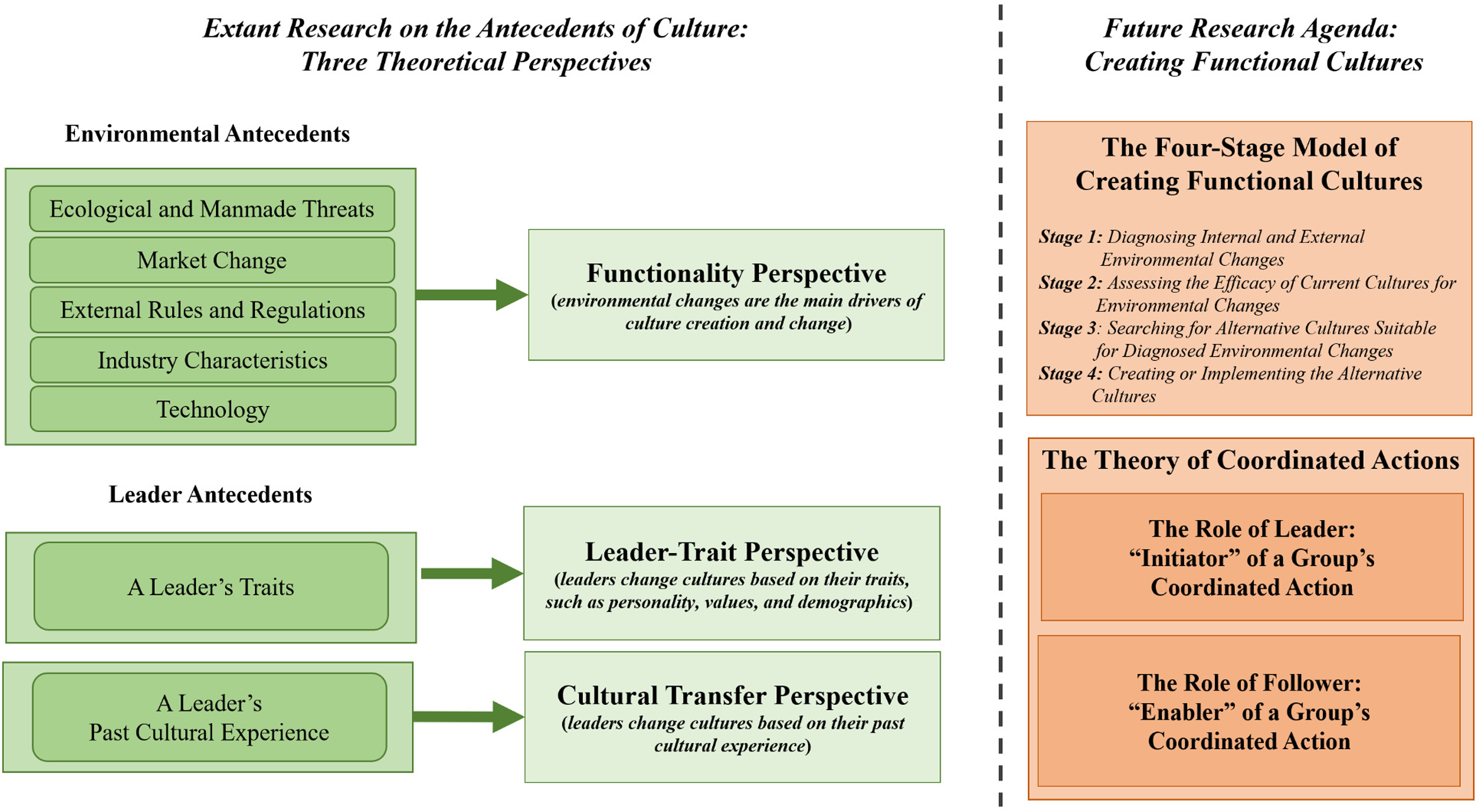
Visualization of Our Review
Definitions and Scope of the Review
We define culture as deeply rooted patterns of general beliefs, assumptions, values, and norms shared among its members (Chatman & O’Reilly, 2016; Kim & Toh, 2019). Culture researchers have investigated two distinct aspects of culture—the content of cultures and the structure of cultures (Chatman & O’Reilly, 2016; Gelfand et al., 2017a; Gelfand et al., 2017b; Tsui et al., 2007). The content of cultures refers to the discrete set of cultural assumptions, beliefs, values, and norms (e.g., individualism-collectivism, team orientation). The structure of cultures refers to the ways in which the contents of culture are organized or arranged (e.g., strength of the whole or some specific cultural contents, configurations of cultural contents in a company).
Culture researchers have assumed that each company has a unique combination of cultural contents and structures (Schein, 2004), and with this assumption, they have developed various cultural profiles (Chatman & O’Reilly, 2016). A cultural profile is a set of cultural operationalizations that comprehensively measures organizations’ cultural contents and structures (for further reviews, see Chatman & O’Reilly, 2016). However, within the topic of culture creation and change, only 20.27% of past studies (N = 15) have used the full versions of these cultural profiles to measure organizational culture (see Table S1 and Figure S1 in the supplementary material). Among them, the four most frequently used cultural profiles are the Organizational Culture Profile, which defines cultural contents in terms of innovation, attention to detail, outcome orientation, aggressiveness, supportiveness, emphasis on rewards, team orientation, and decisiveness (O’Reilly, Chatman, & Caldwell, 1991); the Organizational Culture Assessment Instrument, which categorizes cultures into clan, adhocracy, hierarchy, and market cultures (Cameron & Quinn, 2011); the Organizational Culture Measure, which distinguishes innovative, competitive, bureaucratic, and community cultures (Ogbonna & Harris, 2000); and Denison's Organizational Survey, which identifies cultures of involvement, consistency, adaptability, and mission (Denison, 1990).
Instead of adopting comprehensive measurements (or profiles) of cultures, the vast majority (79.73%; N = 59) of studies have taken a piecemeal approach in operationalizing cultures—that is, they tested their models by adopting only parts of culture profiles (e.g., innovation culture from the Organizational Culture Profile) or a single or few cultural contents and structures that do not belong to any of the existing profiles. In these studies, the most frequently used cultural contents and structures were individualism-collectivism, masculine, market-orientation, innovation, and collaboration cultures (for more information, see Table S2 and Figure S2 in the supplementary material). One reason for such a piecemeal approach to studying cultures is the absence of scholarly agreement on the existing profiles or comprehensive instruments for measuring cultures (for an in-depth review, see Chatman & O’Reilly, 2016; Jung et al., 2009). As a result, research has produced only pieces of empirical evidence without drawing a comprehensive picture of culture creation and change. We will further discuss this issue in the section, “Methodological Issues and Recommendations.” By drawing on the framework of culture creation and change (Kim & Toh, 2019), our review attempts to organize and synthesize these available, yet incomplete, pieces of empirical evidence to offer important insights into culture creation and change.
We first reviewed 10 leading journals in management, adapting the approach of past reviews (e.g., Tsui et al., 2007). We first read titles and abstracts to determine whether the papers examined antecedents of cultures. If it was not apparent from the titles and abstracts, we read further to determine whether these papers were relevant for our review. We then expanded our review to journals in other disciplines, such as anthropology, sociology, and psychology. Table S3 in the supplementary material shows the list of journals that we reviewed. Given that this topic is nascent and empirical papers are limited, we decided to include various levels of culture in our search (e.g., societal, organizational, group; levels of cultures are noted in Table 1 and Table S4). In total, we found 74 studies in 68 papers. Table 1 summarizes the key features of these studies, including their findings, variables used, research designs, and levels of culture.
Summary of Findings on Three Perspectives (Functionality, Leader-Trait, and Culture-Transfer) of Culture Creation and Change in Journals 1967–2020

Note: EMT = Ecological and Manmade Threats; ERR = External Rules and Regulations; IC = Industry Characteristics; MF = Market Forces; TN = Technology.
The Framework of Culture Creation and Change
Given that the research on the antecedents of culture is still nascent, an overarching framework that can offer theoretical guidance for our review was lacking. Our review of past papers revealed little existing scholarly effort to develop theories specifically explaining how cultures are created and changed. Only recently has a group of researchers put forward a framework of culture creation and change that identified three unique perspectives: the functionality perspective, the leader-trait perspective, and the cultural transfer perspective, with the latter two falling under the broader arc of the leadership perspective (Kim & Toh, 2019). According to this framework, these three perspectives have been independently developed and are somewhat contradictory in terms of answering why and how cultures are created and changed. Below, we explain the main tenets of the three perspectives, and in doing so, we also offer relevant theories that provide the theoretical foundations for these perspectives.
Functionality Perspective
The functionality perspective is based on the notion that cultures are sets of collective solutions to the pressing problems that organizations face in their environments. According to this view, as the environment changes, so does the culture of organizations as they adapt to changing environmental requirements. Cultural changes are made to allow organizations to achieve internal integration and external adaptation in ways that have “worked well enough to be considered valid” (Schein, 2004: 17). As noted in their research on societies, Kluckhohn and Strodtbeck (1961: 43) maintained that cultural change “is usually, if not always, the result of the interplay of internal variations and external forces which are themselves variable.” As such, when prevailing cultures are no longer effective due to environmental changes, they change to accommodate such environmental changes. Overall, the crux of the functionality perspective is that environmental changes are the main drivers of culture creation and change, and thus, the resulting cultures are likely to be functional because they provide valid cultural solutions to the issues arising from environmental changes.
Although most papers within the functionality perspective have not explicitly discussed the theories that they build on, our review identified three relevant theoretical foundations for the functionality perspective. First, the functionality perspective tends to follow the theories of environmental determinism—that is, the characteristics of agents (e.g., individuals, groups, organizations, nations) are determined by their environments (Barry, Child, & Bacon, 1959; Berry, 1979; Diamond & Ordunio, 1999; Hrebiniak & Joyce, 1985; Nisbett, 2004; Pelto, 1968). Second, open-systems theory posits that organizations are systems susceptible to the influences of their environments such that they reflect the characteristics of their current environments. As open systems, organizations continuously interact with and respond to environmental contingencies, and their cultures are the ongoing results of these environmental contingencies (Katz & Kahn, 1978). Third, the theory of rational decision-making (Simon, 1979; Weber, 1978) provides the theoretical rationale for how an organization can create a culture that effectively resolves issues from environmental changes. This suggests that organizations can engage in rational processes of accurately diagnosing changing environmental requirements and implementing effective cultures that meet the requirements of environmental changes.
Leadership Perspective
While the functionality perspective adopts a relatively optimistic view of the functionality of cultures, it does not explain the role of individual agents in organizations (e.g., leaders) in the process of culture creation and change. The leadership perspective, on the other hand, has an exclusive focus on the role of the leader in culture creation and change and is less optimistic about the functionality of the cultures that leaders create. It argues that leaders are particularly influential in shaping cultures, but that the cultures they create may not always be functional. This is because when leaders create cultures, their decisions are often heavily affected by their own traits (the leader-trait perspective), and/or they make heuristic decisions based on their past experience (cultural transfer perspective). Thus, the cultures created by leaders may or may not be functional—the cultures that reflect a leader's traits and/or past experience could be functional only if they happen to meet the requirements of the current work environment; otherwise, the created culture could be afunctional or even dysfunctional.
The leader-trait perspective
The central tenet of the leader-trait perspective is that leaders rely heavily on their own traits (e.g., personality, values) in creating and changing cultures. The theoretical mechanism of this perspective comprises two steps. First, a leader's traits shape his or her behavior in managing employees (for further reviews, see the sequence framework proposed by Locke [1991] and/or the revisited trait perspective in the leadership literature investigated by Judge et al. [2002]). Second, organizational members learn how they should behave (i.e., the formation of shared norms) and what is valued (i.e., the formation of shared values) by observing their leaders’ behavioral patterns as a critical source of information (for further reviews, see social learning theory proposed by Bandura & Walters [1977]). Together, leader traits influence cultures because leaders’ behaviors are shaped by these traits, which in turn provide guidance to members on organizational values and norms. As a result, it could be argued that leaders create functional cultures by chance; this is because when cultures are the product of a leader's own preferences rather than that of careful analyses of environmental changes, it is uncertain whether such cultures meet the demands of environmental changes. Overall, this perspective suggests that a leader's traits are the antecedents of cultures—cultures become the reflections of the leaders’ traits rather than the environmental requirements in the process of culture creation and change.
Cultural transfer perspective
The cultural transfer perspective also recognizes leaders’ substantial influence on cultures. What differentiates it from the leader-trait perspective is that it posits that leaders in fact seek to create functional cultures; that is, it is unlikely that leaders do not consider their organizations’ functionality when making decisions at work because they are in a position where they should be responsible for organizational outcomes. However, building on the bounded rationality theory of human judgment and decision-making (March & Simon, 1958), this perspective suggests that, despite leaders’ attempts to create functional cultures, they often fail to do so. Leaders, as human beings, possess inherently limited ability and capacity (i.e., bounded rationality) to process all the relevant pieces of environmental information and to proceed with the best course of action in creating cultures (Kim & Toh, 2019; March & Simon, 1958). For this reason, leaders’ decisions are bounded by readily available and easily accessible information such as the cultural experiences that they had in the past. Thus, when creating new cultures, they create cultures that resemble former organizations’ cultures, transferring the same or similar cultures to the current organizations. The main theoretical difference between the leader-trait and cultural transfer perspectives is, thus, whether a leader attempts to create functional cultures. While the leader-trait perspective suggests that a leader may not pay particular attention to the creation of functional cultures, the cultural transfer perspective proposes that leaders strive to do so, but their bounded rationality directs their cultural solutions to past experiences. This difference led the two perspectives to propose very different sets of leader characteristics as antecedents of cultures: a leader's traits vs. past cultural experience.
In organizations, we believe that all three perspectives reflect reality; the antecedents including environments (the functionality perspective), a leader's traits (the leader-trait perspective), and a leader's past cultural experience (the cultural transfer perspective) altogether should account for culture creation and change. Based on the abovementioned framework (Kim & Toh, 2019), our paper aims to offer a comprehensive and systematic literature review. As a result, we identified 68 papers (74 studies), which are summarized in Table 1. Despite this framework's usefulness in categorizing past research into three independent perspectives and aiding our understanding of the extant literature, we also acknowledge that the framework does have a limitation. As it simply categorizes past research using the three perspectives, it does not offer a way to integrate these separate perspectives. Specifically, the pressing question that this framework is unable to answer is How can a leader help his or her group create “functional” cultures despite the pessimistic view offered in the leadership perspective? To answer this question and to address the limitation of Kim and Toh's framework, our paper offers a novel model and theory in the later section “Future Research Agenda: How Do We Create Functional Cultures?”
Functionality Perspective
The functionality perspective suggests that environmental changes are the main drivers of culture creation and change (Kim & Toh, 2019). Our review categorizes past research supporting this perspective into five subcategories of environmental change that influence cultures: (1) ecological and manmade threats, (2) market changes, (3) external rules and regulations, (4) industry characteristics, and (5) technology.
Ecological and Manmade Threats
Throughout human history, societies and organizations have faced various external threats that hamper everyday life. These threats include natural catastrophes and other environmental threats, such as the prevalence of disease prevalence and social (territorial) conflict. Research shows that societies and organizations develop cultures that help them survive these threats.
Natural catastrophes and hazardous environments
Drawing on the theories of environmental determinism (e.g., Barry et al., 1959; Berry, 1979; Diamond & Ordunio, 1999; Nisbett, 2004; Pelto, 1968) and risk and crisis management (for a review, see Hällgren, Rouleau, & De Rond, 2018), research shows that the experience of natural catastrophes (e.g., extreme weather, earthquakes, volcanoes, floods) and hazardous organizational environments (e.g., nuclear submarines, power plants) increase the cultural tightness of organizations and societies (Gelfand et al., 2011; Gelfand et al., 2017a; Gelfand et al., 2017b; Harrington & Gelfand, 2014). Cultural tightness refers to the extent to which cultures coalesce around clear norms and strictly enforce those norms. Tight societies limit the behavioral options for people by implementing more autocratic governing systems, controlling media institutions and media content, and enforcing severe criminal justice and deterrence systems, whereas loose cultures leave much room for individual discretion and expression with fewer behavioral constraints (Gelfand et al., 2011). Tighter cultures facilitate the management of essential resources, such as food and water, which tend to be scarce during natural catastrophes, thus increasing the chances of survival for their groups (Gelfand et al., 2011; Harrington & Gelfand, 2014). In addition to data from populations across nations, computer simulations of social interaction games also provide corroborating evidence, for example, as societal threats rise, cultures evolve to favor stronger norms and greater punishment of deviance (Roos, Gelfand, Nau, & Lun, 2015).
A similar pattern has been observed in organizations as well; threats from hazardous environments cause organizations to have tighter cultures with stronger norms for behavior, a greater emphasis on hierarchy and accountability, and less tolerance of deviance (Bierly & Spender, 1995; Klein, Bigley, & Roberts, 1995; Roberts, 1990). Bierly and Spender (1995) investigated the case of U.S. Naval Reactor submarines, in which small failures and mistakes could be fatal, and found that these submarines tended to have very tight cultures to reliably manage the whole system of nuclear submarines. Similarly, power plants, in which hazardous working environments could easily endanger workers’ lives, tended to have tight cultures—for example, stricter hierarchical controls and stronger sanctions for mistakes (Klein et al., 1995). Finally, Roberts (1990) examined two nuclear-powered aircraft carriers in her qualitative study and showed that members in these carriers shared cultures of reliability to protect themselves from catastrophic hazards.
Disease prevalence
Societal cultures also vary on the basis of the prevalence of various infectious diseases (e.g., influenza, pneumonia, HIV; Fincher, Thornhill, Murray, & Schaller, 2008; Forrester, Hillman, & McDevitt, 2020; Harton & Bullock, 2007; Murray & Schaller, 2010). In societies where these diseases are more prevalent, cultures tend to be tighter (Gelfand et al., 2011), more collectivistic (Cashdan & Steele, 2013; Fincher et al., 2008), less extraverted (Schaller & Murray, 2008), and higher in obedience, authoritarianism, xenophobia, and behavioral conformity (Murray, Schaller, & Suedfeld, 2013; Murray, Trudeau, & Schaller, 2011; Thornhill, Fincher, & Aran, 2009). Researchers have argued that these cultures must have been developed to prevent disease transmission and improve chances of survival (Nettle, 2009).
The threats of disease also have significant impacts on organizational cultures. Smith, Watkins, and Hewlett (2012) found that a greater understanding of the threat of disease transmission in hospitals caused a cleanliness culture to emerge through frequent changes in staff attire (e.g., masks, gloves, and gowns), physical structure (e.g., washing stations, tiled floors), and practices (e.g., operating room cleaning). In addition, with growing global concerns about the transmission of infectious diseases such as MERS and COVID-19, organizational researchers have started to look at how such diseases influence organizational cultures, although empirical studies are not yet available. For example, Spicer (2020) suggested the possibility that employee mindsets and organizational cultures may shift in ways that are more suitable for reduced “face-time,” increased hours of working from home, flexible work hours, and safely distanced workspaces.
Social conflicts
Repeated exposure to social conflicts (e.g., civil war) can cause major shifts and accelerate changes in cultures. Wars have been found to increase humanitarian cultures in war-torn communities (Elcheroth, 2006), increase levels of cultural tightness among the U.S. states (Harrington & Gelfand, 2014), and create the potential cultural shifts in gender roles and agency in border towns (Petesch, 2018). Stevens, Plaut, and Sanchez-Burks (2008) found that during World War II, women and Blacks in the United States entered the workforce in large numbers for the first time to fill in for White men who were away at war, advancing the social acceptance of these groups at work and changing organizational cultures to accommodate these changes in expectations.
In organizational contexts, only a few studies are available. Belgrad (1998: 4) found that in the postwar period, U.S. corporations instituted a system of “homogenization that rewarded rule-following and attitude management” to take advantage of the conditions conducive to accelerated growth. This contributed to the creation of meritocracy and tight cultures. The experience of war also caused some corporations, such as British Airways, to develop highly masculine organizational cultures, as aviation developed military symbolism and adopted practices that favored men, former fighter pilots, and Royal Airforce members—a culture that persisted until the 1960s and 1970s (Mills, 1998).
Market Forces
Consistent with the theory of open systems (Scott, 1987)—that organizational cultures are heavily affected by the business environment (Pederson & Dobbin, 1997)—much evidence shows that market changes pressure organizations to create cultures that can better meet customer preferences. In this line of research, scholars have examined two topics: market threats and changes in customer needs.
In a case study of Bang & Olufsen (B&O), a high-end luxury electronics firm, Ravasi and Schultz (2006) showed that the company reevaluated its cultural values and identity due to severe competition from Japanese rivals in the 1970s, recession in 1993, and product imitation by competitors in the late 1990s. Similarly, Nahavandi and Aranda (1994) found that the market threat posed by Japanese “kaizen” culture in the 1990s pushed manufacturing firms in the United States to emulate a team-oriented culture. Similarly, others also found organizations reorienting their cultures to best respond to market threats (Gebhardt, Carpenter, & Sherry, 2006) and developing cultures of innovation to respond to changes in the market (Jassawalla & Sashittal, 2002). Finally, cultures in most companies became less ethnocentric as the globalization of markets and customer tastes created substantial market shifts, which threatened the survival of many companies in the world (Machida, 2012). This also led firms to develop new attentional structures and a global mindset, involving cultural self-awareness and the integration of various cultural values to stay competitive in the globally converging market (Levy, Beechler, Taylor, & Boyacigiller, 2007).
External Rules and Regulations
Institutional theory (DiMaggio & Powell, 1983) informs our understanding of the influence that external rules and regulations in higher order institutions have on cultures. According to the theory, firms are explicitly or implicitly pressured to conform to cultural norms supported by institutions (Suchman, 1995). Firms that fail to do so lose legitimacy and put their survival at risk (Kondra & Hurst, 2009).
In line with institutional theory, scholars have found evidence of changing organizational cultures influenced by external rules and regulations about gender, ethics, and the ecological environment. In an example of agricultural cooperatives in Norway, ethnographic evidence showed that the introduction of voluntary gender quotas for boards moved companies away from a dominant male culture to a culture of equal gender representation on boards (Brandth & Bjørkhaug, 2015). In addition, various institutional changes in the regulatory (sanctions by the Financial Conduct Authority) and normative (professional codes of conduct) arenas after the Global Financial Crisis of 2007–2008 gave rise to a compliance culture among U.K. financial institutions (Burdon & Sorour, 2020). Similarly, after the Sarbanes-Oxley Act was introduced in 2002 to prescribe ethical guidelines and legislate strong punishment for publicly traded companies and their auditing firms, financial companies eradicated overly aggressive corporate cultures that many blamed for the rash of major corporate and financial scandals in the late 1990s and early 2000s (Gilles, Alain, & Naoufel, 2020; Sims & Brinkmann, 2003).
Furthermore, scholars found that institutions supporting environmentally friendly rules and regulations encouraged their member organizations to create cultures that were mindful of environmental issues. Harrison and Corley (2011: 407) investigated how rules and regulations of clean climbing in the climbing field imbued the members in one company with a clean climbing ethos, “thinking about climbing in terms of personal challenge, acceptable risk, and minimal technology,” which was then manifested in organizational cultures. The evidence of the Arizona Public Service Company in the 1990s showed how new government mandates and greater regulatory scrutiny (e.g., increasingly stringent environmental regulations around emissions and safety) led the company to undergo a cultural transformation. The company transformed from a profit-oriented culture to a culture that valued cooperation, openness, and responsiveness to changing institutional requirements (DeMarie & Keats, 1995).
Studies have also shown that organizations and societies respond to changes in economic and social developments by changing their cultures. For example, researchers found that in 65 countries across three time periods from 1981 to 1998, economic development was associated with societal cultures of self-expression, secularism, rationality, tolerance, and participation in society (Inglehart & Baker, 2000). In the period from 2006 to 2014, societal changes, including greater political support for the legalization of gay marriage, promoted cultures valuing diversity among young people in the United States (Kiley & Vaisey, 2020). In the 1960s–1970s, mass social movements “in the streets” in the United States supporting social justice and antiwar ideals gave rise to widespread labor movements in the workplaces and stronger union cultures across organizations (Isaac, McDonald, & Lukasik, 2006). The Harvey Weinstein scandal in Hollywood and the rise of the #MeToo social media campaign against rampant sexual assault caused shifts in the culture of gender equality in Wall Street (Maaranen & Tienari, 2020) and changed hiring practices in Hollywood in an attempt to undo the widespread abusive culture of the industry (Luo & Zhang, 2021).
Last, one group of researchers conducted an interesting and unique simulation study to test whether institutional rules and regulations influence organizational cultures. In a series of computer simulations, Nowak, Gelfand, Borkowski, Cohen, and Hernandez (2016) investigated how the reliability and toughness of higher institutions change an agent's (e.g., company) honor culture and found that when institutions are less effective and less reliable, honor cultures tend to emerge and persist. In honor cultures, people are willing to retaliate against one another to uphold their reputation or “honor,” even if doing so risks costly consequences. This simulation study also showed that when higher institutions have effective and reliable regulations, agents (e.g., organizations within institutions) tend to form healthy, effective, and reliable cultures that ensure the health and survival of their members. However, without effective and reliable institutions to regulate members’ behavior, honor cultures emerge.
Industry Characteristics
Industries exert mimetic influences on organizations, causing them to be culturally homogeneous within an industry but culturally heterogeneous between industries. This is because organizations in an industry need to conform to industry-level assumptions about customer requirements and to uphold various expectations that a society has of the industry (Gordon, 1991). They also face pressures to model themselves after other successful organizations to gain and/or maintain legitimacy in the eyes of stakeholders. Indeed, examining cultural differences across 10 industries, Christensen and Gordon (1999) found that organizational cultures were shaped by industry characteristics such as the nature of the business, levels of capital intensity and competitiveness, customer types and relationships, and dominant organizational structures. For example, organizations in the manufacturing industry had more innovative and confrontational cultures, organizations in the banking industry were markedly more aggressive, and organizations in the utilities industry were the lowest on the innovative culture.
Similarly, Chatman and Jehn (1994) compared 15 U.S. companies in four different industries (i.e., public accounting, consulting, government/postal, and transportation) and found significant cultural similarities within an industry and cultural differences between industries—for example, profit-oriented accounting and consulting firms had higher levels of cultural aggressiveness to attract clients, and quasi-governmental postal services were higher on cultural stability. Furthermore, in health care and other potentially hazardous industries, conformity and reliability were both priorities and central characteristics in their organizations’ cultures (Hudson, 2003; Kolk & Levy, 2001; Vogus, Sutcliffe, & Weick, 2010). In the construction industry in Australia, the nature of the work (dirty, manual, long hours) caused the industry to have masculine organizational cultures (Galea, Powell, Loosemore, & Chappell, 2020). Similarly, organizations in the commercial aviation industry had hypermasculine cultures due to their link to the military (Mills, 1998). Researchers who have compared military organizations with civilian organizations show that military cultures are more collectivistic and hierarchical with strict chains of command (Redmond et al., 2015) and are more masculine, combative, and warrior-like (Dunivin, 1994).
Finally, trade associations that represent some industries or subsectors within industries often cause cultural similarities among their member organizations. Trade associations develop standards and practices that govern their industry members. Through “cultural infrastructure,” such as trade events and media, the industry's collective orientation and strategies may be shaped accordingly (Spillman, 2018). Trade associations thus become a forum through which industry members identify with and codevelop solutions to new problems within the industry (Lawton, Rajwani, & Minto, 2018). An example of the cultural influences that trade associations have on member organizations’ cultures may be found among oil companies in the American Petroleum Institute and the International Petroleum Industry Conservation Association. Levy and Kolk (2002) found that through industry meetings, workshops, conferences, and working groups, the industry developed and shared a common culture to address climate change.
Technology
Empirical research on how technology shapes cultures is scarce, presumably because technological factors “are difficult to operationalize in a consistent fashion over a long time span” (Grossmann & Varnum, 2015: 322). This is because the influence of technology is embedded in the complex “history, social context, and human agency” of societies, organizations, and groups (Cascio & Montealegre, 2016: 362). Nevertheless, historians and sociologists have offered some evidence regarding how various technologies (i.e., mass media, electricity, the tractor, and the locomotive) introduced over the course of time have shaped cultures and cultural artifacts such as urbanization, lifestyle, and music genres (Brown, 2004; Peterson & Anand, 2004).
Technological change has disrupted business models and required businesses to become more technologically savvy and more innovation-driven to keep up with new competitors and changing consumer preferences. For example, with digitalization, the music industry had to develop more flexible, service-oriented cultures (Leyshon, 2014) and cultures that were more responsive to the rise of virtual communities (Fulk & DeSanctis, 1995; Lee & Peterson, 2004). The technological disruption of media-distribution platforms (e.g., platforms supporting “video on demand”) changed cultures of mass-media firms, forcing them to become more consumer-oriented (Cunningham, Silver, & McDonnell, 2010). Similarly, Barley’s (2015) 2-year ethnographic study of sales agents in automobile dealerships revealed cultural changes as a result of the introduction of new technologies (in this case, the internet).
The adoption of communication technologies also substantially changed how employees relate to one another and how they work (for a review, see Cascio & Montealegre, 2016) and the way organizations are structured (Fulk & DeSanctis, 1995). In an account of General Motors Environmental Activities Staff's experience with management information technology adoption in the early 1980s, Foster and Flynn (1984) found that electronic communications facilitated the emergence of performance-oriented cultures due to the increased ease of connecting anyone across hierarchical levels, allowing individual competence to be more readily recognized and rewarded. Cascio (2000) offered theoretical insights that remote working technology may cause many symbols of organizational life (e.g., office attire, water coolers, and meeting spaces) to be replaced by new symbols (e.g., home offices, “hot desks,” virtual meeting spaces), which may create less coherent cultures. Fulk and DeSanctis (1995) theorized that new “communication cultures” may be created in organizations because electronic communication technologies create virtual “organizational spaces” outside of the physical workplace. Finally, Chen and Nath (2005) theorized that remote working technology would create “nomadic cultures”—cultures that provide employees the means and flexibility to work without fixed times or places.
Discussion and Limitations of the Functionality Perspective
Overall, there are some theories and empirical evidence supporting the functionality perspective. In essence, when environmental changes occur, so do cultures. By changing cultures, organizations effectively deal with new issues arising from environmental changes. The process of inventing and developing valid cultures does not stand still, and the resulting cultures may be the ones that best meet the demands of the current environments (Schein, 2004).
Based on our review of the functionality perspective, we identified topics for future research that can meaningfully contribute to the culture literature. First, our review revealed some counterevidence showing that cultures are resistant to environmental changes, and cultural changes may turn out in unintended ways. For example, past studies have shown that hegemonic masculine cultures are resistant to change even in the face of events as disruptive as war (Petesch, 2018). Many male-dominated industries (e.g., oil, automotive, manufacturing) continue to maintain harsh and patronizing cultures that are inhospitable to women, even with environmental changes such as equal opportunity laws and policies, more women achieving greater qualifications, and pressures to hire a more diverse workforce (e.g., Corcoran-Nantes & Roberts, 1995). In other situations, environmental pressures to change cultures created unexpected, undesirable results—that is, polarization between groups of people instead of a uniform change in cultures (Maaranen & Tienari, 2020; Petesch, 2018). We urge future research to address why cultural resistance sometimes exists even in the face of clear environmental changes and how functional culture changes may be best facilitated in response to environmental changes.
Second and probably most importantly, none of the studies were able to empirically show whether the cultural changes resulting from environmental changes were ultimately effective and functional. The central assumption underlying the functionality perspective is that cultures that adapt to environmental changes would be functional. It assumes that organizational cultures always adapt to environmental changes, and thus, the resulting cultures are beneficial to organizational survival. However, the mere fact that an organization changed its cultures in response to a certain environmental change does not necessarily guarantee that the cultural change has been made in the right direction. For example, to deal with fierce competitors in the market, an organization may end up forming more competitive and results-oriented cultures, when in fact the culture of resilience and learning orientation may result in better outcomes in response to such threats. That is, the changed cultures may be the products of misjudgments and heuristic analyses of environmental changes, as suggested by the theory of bounded rationality (March & Simon, 1958). In this regard, some researchers questioned whether cultural changes resulting from environmental changes were in fact functional (Edwards, 1983; Gordon, 1991). To investigate the functionality perspective more accurately and rigorously, future researchers should conduct longitudinal studies where they repeatedly measure organizations’ performance before and after the cultural changes that result from an environmental change. In this way, they can observe whether the new cultures are indeed functional.
Leadership Perspective
The leadership perspective takes the view that leaders, rather than environments, have dominant influences on cultures. As discussed earlier, the leadership perspective is further differentiated into two subperspectives: the leader-trait and cultural transfer perspectives. These two perspectives offer different reasons why leaders are often unsuccessful in creating functional cultures. The leader-trait perspective suggests that a leader creates cultures based on his or her traits, while the cultural transfer perspective argues that a leader's past cultural experience is the main source shaping cultures. A common argument shared between these two perspectives is that in the process of culture creation, leaders heavily rely on their own preferences, which are influenced by their traits or past experience, and pay less attention to the external cues from environmental changes. Thus, the functionality of leader trait- and leader experience-based cultures depends on chance—that is, whether the created cultures, which are tailored to a leader's personal preferences, happen to be suitable for current environments.
We first review past studies under these two perspectives. Afterward, we review five articles that examined the role of a leader's behavior as an antecedent of culture (see Table 1). These studies do not exactly belong to the leadership perspective, which only focuses on leader traits and past experiences but does not consider a leader's behavior as a separate antecedent of culture. Instead, as discussed earlier (see the section “The Framework of Culture Creation and Change”), the leadership perspective deems a leader's behavior as a mediator through which a leader's traits (the leader-trait perspective) or past experience (cultural transfer perspective) influences culture. We thus review these five studies in a separate subsection.
Leader-Trait Perspective
The leader-trait perspective suggests that a leader's personal traits are the antecedents of culture (e.g., Eagly & Johnson, 1990; Giberson et al., 2009; Kim & Toh, 2019; O’Reilly, Caldwell, Chatman, & Doerr, 2014; Peterson, Smith, Martorana, & Owens, 2003). Within the leader-trait perspective, our review covers three specific topics: a leader's (1) personality, (2) values, and (3) demographic characteristics.
Personality
Personality is an individual's consistent patterns of feelings and thoughts that remain stable over time and across situations (Costa & McCrae, 1990; Funder, 2001). A group of researchers advocating the leader-trait perspective has long argued that leader personality is the primary source of organizational culture (e.g., Giberson et al., 2009; O’Reilly et al., 2014; Peterson et al., 2003). A leader's personality traits are the root of the leader's recurring behavioral patterns across situations (Judge, Bono, Ilies, & Gerhardt, 2002; Locke, 1991; Schneider & Smith, 2004), and organizational members observe and emulate leaders’ behaviors as critical guidance at work (Bandura, 1962; Bandura & McClelland, 1977). In this way, a leader's personality, manifested in his or her behavioral patterns, influences the culture.
Supporting these theoretical accounts, scholars have documented empirical evidence linking leaders’ personality to various organizational cultures. For example, Giberson et al. (2009) examined CEOs’ Big Five personality traits and organizational culture in 32 companies and found that CEO personalities (e.g., agreeableness, emotional stability, extraversion, openness to experience) were associated with various organizational cultures (e.g., Clan, Adhocracy, and Hierarchical cultures). Similarly, using data from 32 high-technology companies, O’Reilly et al. (2014) showed that different personalities of CEOs led to different types of cultures—CEO openness to experience was positively related to flexible cultures, CEO conscientiousness was positively related to detail-oriented cultures, and CEO agreeableness was negatively related to result-oriented cultures.
Some scholars have also examined the dark side of leader personality and its effects on organizational cultures (e.g., Kets de Vries, 1994; Kets de Vries, 2003). Kets de Vries and Miller (1984), for example, showed that executives’ depressive personality (i.e., neuroses) led to a culture of helplessness in organizations. In addition, researchers began exploring leader narcissism—the personality trait related to the extent to which people self-enhance or self-promote (Paulhus, 1998) due to their grandiose and inflated sense of abilities (e.g., Campbell, Rudich, & Sedikides, 2002; Gabriel, Critelli, & Ee, 1994; Goncalo, Flynn, & Kim, 2010)—and its effects on cultures. In the data from 56 large, publicly traded, high-technology firms in the United States, O’Reilly, Chatman, and Doerr (2020) found that CEOs who were rated by their employees as more narcissistic tended to create organizational cultures that were less collaborative and less concerned about integrity.
In addition, our review found a few studies that investigated cultures in small-scale elite groups such as the top management team (TMT). In an archival study of 17 CEOs, Peterson et al. (2003) found that CEOs with a high degree of conscientiousness were more likely to have TMT cultures valuing close control over employees, while CEOs with high emotional stability tended to have TMT cultures emphasizing cohesiveness, intellectual flexibility, and leader dominance. Likewise, using a sample of CEOs and TMT members from 120 enterprises, Cortes-Mejia, Cortes, and Herrmann (2021) found that CEO humility increases decentralization in TMT decision-making and creates an organizational culture that conforms to societal norms and common sense. In sum, these results demonstrate that a leader's personality shapes the way he or she behaves and makes decisions consistently across various organizational contexts. Leaders’ consistent behavioral patterns then inform organizational members about what is important, what to expect, and how to behave. This sets the “tone” for the organization, which, over time, builds culture.
Values
Values refer to enduring and consistent beliefs that define sets of abstract goals and desires, which in turn influence individuals’ behavior (Kluckhohn, 1951; Rokeach, 1973; Schwartz, 1992). While personality traits are enduring dispositions, values are closely related to personal goals—what people prioritize as important to pursue (Rocca, Marchiaro, & Bogetto, 2002). Despite the conceptual difference, the process of how leader values influence cultures is virtually identical to that of personality. That is, a leader's values are embedded in his or her behavior (Judge et al., 2002; Locke, 1991), and then, through members’ social learning (Bandura, 1962; Bandura & McClelland, 1977), the leader behavior affects cultures (Martin, 1992; Schein, 1983; Schein, 2004).
Despite the theoretical emphasis on values in creating and changing cultures (Martin, 1992; Schein, 1983; Schein, 2004), leader values have not received much scholarly attention. In the data collected from 26 CEOs, 71 senior vice presidents, and 185 organizational members, Berson, Oreg, and Dvir (2008) found that CEOs’ self-directive values such as freedom and creativity were associated with innovation-oriented cultures, security values were associated with bureaucratic cultures, and benevolence values were related to supportive and cooperative cultures. A qualitative study conducted by Schein (1983) also provided evidence—examining the values of the three founders of U.S. companies, he found that the leaders’ values were shared with lower level employees, which, in turn, shaped company cultures.
Demographic characteristics
Demographic characteristics such as gender and age are among the most frequently investigated topics in the management literature. However, empirical work directly testing the relationship between a leader's demographic characteristics and culture is absent in the literature. Therefore, instead of reviewing empirical evidence, we draw on theories and indirect empirical evidence (e.g., Eagly, 1987; Eagly & Johnson, 1990; Judge et al., 2002) to show a leader's gender and age as potential antecedents of culture. Although we discuss a leader's gender and age only, we do not intend to argue that these two demographics are the only antecedents of cultures among many alternative demographics (e.g., tenure, education). We discuss them simply because the literature on these two demographics has accumulated more abundant, robust, and relevant evidence than the literatures on other demographics.
Research has documented theories and evidence that gender plays a vital role in the way leaders lead their groups. Eagly and Johnson (1990) conducted meta-analyses of 162 studies and showed that female leaders tend to display democratic and participative behaviors, while male leaders tend to demonstrate autocratic or directive behaviors. These different leadership behaviors may yield different cultures (Schein, 1983; Schein, 2004) such that a female leader's active efforts to include members in decision-making processes create cultures of supportiveness, autonomy, collaboration, and team orientation, while a male leader's directiveness leads to cultures of aggressiveness, decisiveness, and conformity (O’Reilly et al., 1991).
Another demographic characteristic that may influence cultures is a leader's age. Past research has shown that a leader's age is positively related to team-oriented and collaborative behaviors but negatively related to innovative and risk-taking behaviors (Oshagbemi, 2004), which points to the possibility that a leader's age may be positively related to team-oriented and collaborative cultures. Similarly, Kabacoff and Stoffey (2001) provided evidence of multigenerational differences in leadership behavior in the workplace indicating that younger managers were less resistant to changes in their environments, more willing to take risks with new approaches, more competitive and self-promoting, and more ambitious to achieve better results. Given that risk-taking and low resistance to change tendencies are highly related to managers’ orientation toward innovation (Anderson, Potočnik, & Zhou, 2014), it is possible that younger leaders may be more prone to creating change-oriented and innovative cultures.
Discussion of the leader-trait perspective
In our review, studies have shown that a leader would create the same set of cultures based on his or her traits across different work situations. Thus, it is not guaranteed that the culture the leader created will be functional because the created culture would be functional only to the extent that it aligns with the requirements of a given work situation. For example, past research showed that a leader's openness to experience was positively related to a risk-taking culture (Peterson et al., 2003), which could be functional in creativity-focused industries (i.e., fashion companies), but the same culture may not be as functional in companies in stable environments (e.g., government agencies). Similarly, a leader's conscientiousness is positively related to a detail-oriented culture (O’Reilly et al., 2014). Detail-oriented cultures may be functional when the work requires high levels of predictability, punctuality, and accuracy (e.g., government agencies) but could be dysfunctional for businesses that require innovation and change (e.g., fashion companies). In sum, an implication of the leader-trait perspective is that because leader traits tend to override what is required by external environments, it is uncertain whether cultures driven by a leader's traits are functional.
Cultural Transfer Perspective
The underlying assumption of the cultural transfer perspective that differentiates it from the leader-trait perspective is its acknowledgment that leaders strive to create functional cultures (Kim & Toh, 2019). It argues that as leaders are in a position to take responsibility for their groups’ outcomes, they are motivated to create cultures that are functional. Nevertheless, despite their intentions, leaders are constrained in the creation of “objectively” functional cultures due to bounded rationality, which limits their ability to accurately diagnose, search, and enact truly functional cultures (Gersick & Hackman, 1990; March & Simon, 1958). Instead, leaders often rely on their past cultural experience, which is readily available and accessible to them. Leaders tend to recreate the culture that they experienced in their former groups, assuming that the past culture would still be functional and applicable to their current groups. However, given that the work environments of the current groups could be different from those of former groups, it is uncertain whether such transferred cultures would be functional for the current groups.
Supporting the cultural transfer perspective, Kim and Toh (2019) conducted two studies. In the quasi-field experiment (Study 1), they collected data from 404 employees, including 108 group leaders in 91 groups. These leaders were newly recruited from outside of the company, meaning each leader had a unique past cultural experience acquired in his or her former group at another company. The authors found that the new leaders relied on their past cultural experience when creating cultures in their current groups. That is, the leaders transferred the cultures from their former groups to the current groups—leaders who experienced tighter (looser) cultures in their former groups created tighter (looser) cultures in their current groups. This finding was also replicated in a laboratory experiment (Study 2).
To our knowledge, this paper is the only examination of the cultural transfer perspective. We believe that the main theoretical tenet of the cultural transfer perspective—a leader tries to create functional cultures but often fails to do so due to bounded rationality—can be tested and extended in various ways. First, given that Kim and Toh (2019) examined only a specific cultural structure (i.e., tightness-looseness), future researchers are encouraged to investigate the generalizability of these conclusions by examining other types of cultural contents and structures. Second, the cultural transfer perspective does not yet offer a decisive answer to the question of what kinds of cultures would be created if a leader did not have any past cultural experience, and thus he or she happened to be a “blank slate.” For an indirect example, in an unpublished study of 855 S&P 500 CEOs appointed over 20 years, the leadership advisory firm Spencer Stuart found that novice CEOs outperformed leaders with experience (HBR, 2010). Their findings revealed that experienced CEOs’ performance lagged behind because they tended to refer to their past experience in their former companies, whereas novice CEOs were more flexible and adaptable to environmental volatility. This finding seems to be in line with the cultural transfer perspective. However, to test the “blank slate” hypothesis more accurately, future researchers should first examine whether a “blank slate” can exist in culture research. Even novice leaders likely have had some sort of cultural experience as team members in their past work teams before they became leaders. In fact, this is the core premise of the cultural transfer perspective—no one is entirely free of past cultural experiences. Thus, we believe that a more plausible topic for future research would be to investigate leaders who have relatively less experience in their professional careers before assuming the leadership position (e.g., leaders in youth groups; those who assume leadership positions right after their postgraduate education) and observe the kinds of cultures these inexperienced leaders create in their groups.
Leadership Behavior as the Underlying Mechanism of the Leadership Perspective
As we reviewed earlier, the leadership perspective mainly considers a leader's relatively stable characteristics (e.g., personality, values, demographic characteristics, and past cultural experiences) as the primary sources of culture creation and change. In addition, it treats leader behavior as the mechanism linking these characteristics to the cultures created. That is, a leader's distal characteristics drive more proximal patterns of his or her behavior (Locke, 1991), which in turn influences a group's culture (e.g., Enz, 1988; Giberson et al., 2009; Martin, 1992; O’Reilly & Pfeffer, 2000; Peterson et al., 2003; Schein, 1983; Schein, 2004). For example, a leader's conscientiousness translates into a detail-oriented culture (Peterson et al., 2003) because his or her close-monitoring and directive behaviors mediate this relationship. Nevertheless, the mediating role of leader behavior has not been empirically tested in past studies. Instead, we found a few studies that examined leadership behaviors as sole predictors of cultures. In this section, we briefly review these studies separately from the leader-trait and cultural transfer perspectives.
Gelfand, Leslie, Keller, and De Dreu (2012) examined how leaders’ own conflict management styles influence conflict cultures within organizational units. Among 92 branches of a large bank, the leaders’ three conflict management styles of collaboration, dominance, and avoidance shaped the units’ conflict management cultures of collaboration, dominance, and avoidance. Other researchers have found that a leader's ethical behavior, which displays ethical beliefs and values to followers and reinforces ethical norms (Brown & Treviño, 2006), was positively related to clan and adhocracy cultures but negatively related to transactional culture (Ofori, 2009; Pasricha, Singh, & Verma, 2018). Finally, Sürücü and Yeşilada (2017) found that a leader's charismatic behavior was positively related to adhocracy culture, clan culture, and market culture.
Discussion and Limitations of the Leadership Perspective
Overall, our review has provided theoretical and empirical support for the leadership perspective. Cultures are often created based on a leader's personality, values, and demographic characteristics (the leader-trait perspective) as well as a leader's past cultural experience (cultural transfer perspective). However, much research is still needed from the leadership perspective. An important, yet neglected, topic from the leadership perspective is the differential effects of founder vs. successor leaders on cultures. Among the papers that we reviewed in this section (N = 13), only one (7.69%) examined founders, while 12 papers (92.31%) investigated successor leaders (see Table S5 and Figure S3). They show that both founders and successors have a significant impact on cultures. However, to the best of our knowledge, none have directly examined which type of leader exerts more influence on cultures. Indirect evidence suggests that founders may exert stronger and more lasting effects on cultures (e.g., Martin, 1992; Schneider, Smith, Taylor, & Fleenor, 1998) because they tend to select successors who are similar to themselves (Schein, 2004; Schneider, 1987; Schneider, Goldstiein, & Smith, 1995), which makes it more likely for successors to continue the cultures that were created by the founders (e.g., Bennis & Nanus, 1985; Kotter, 2008; Schein, 2003; Schneider, 1987). Nevertheless, direct empirical evidence on the comparative influence of founders and successors on cultures is limited.
Future Research Agenda: How Do We Create Functional Cultures?
Creating functional cultures has been a main motivation among culture researchers for decades (Cameron & Quinn, 2011; Meyerson & Martin, 1987; Schein, 2004), but to our knowledge, theories and empirical evidence addressing this question have been surprisingly absent. Although Kim and Toh’s (2019) framework is useful in reviewing and understanding past research, it does not offer conclusive answers to the question of how organizations can create functional cultures. To resolve this issue, we propose three ways forward. First, we draw on the theories of rational decision-making (Simon, 1979; Weber, 1978) to outline the four-stage model for creating functional cultures. This model offers a normative process of creating functional cultures. Second, drawing on bounded rationality theory (March & Simon, 1958), we point out the limitations of the four-stage model and propose the theory of coordinated actions for creating functional cultures to complement the four-stage model. Finally, we highlight the roles of leaders and followers in facilitating the coordinated actions needed to create functional cultures. Figure 2 provides a visual illustration of how coordinated actions among leaders and followers in the four stages of functional culture creation can successfully transform environmental changes into functional organizational cultures.
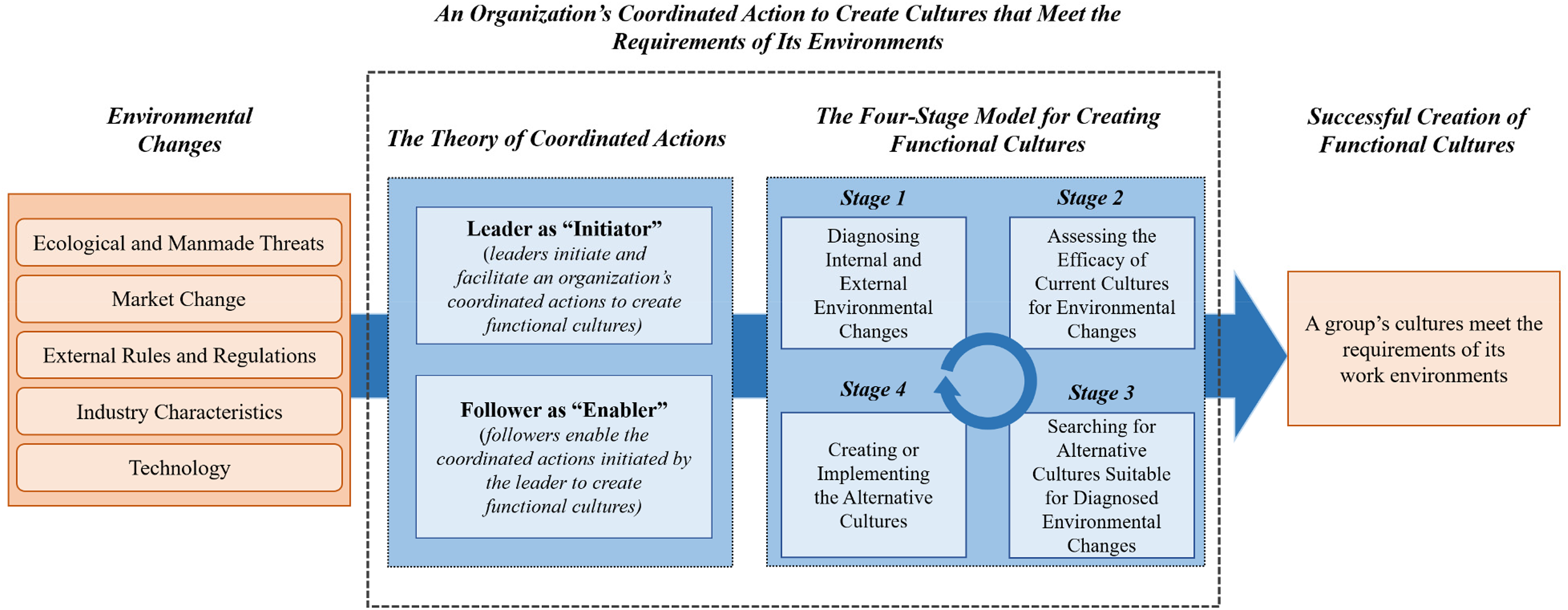
Future Research Agendas for Creating Functional Cultures
The Four-Stage Model for Creating Functional Cultures
The theories of rational decision-making assume that a decision-making agent (1) can obtain and use complete information about the current environment to generate various alternative solutions that address issues arising from the environment and (2) has unlimited cognitive capacity to process all the information needed to make optimal decisions. As we will discuss later, these assumptions are unrealistic in real-world decision-making settings (March & Simon, 1958; Simon, 1979). However, the theories of rational decision-making are still valuable for deriving a normative model of decision-making that the agent can refer to and emulate in the decision-making process (for a review, see Gigerenzer & Selten, 2002). Thus, we build on theories of rational decision-making to propose a model that specifies four main stages of creating functional cultures. In what follows, we explain each of the four stages, briefly pointing out issues and challenges in each stage, as well as identifying topics for future research.
Stage 1: Diagnosing internal and external environmental changes
The first stage of creating functional cultures is to make sense of the environmental changes that may significantly impact the organization. As reviewed earlier, these changes include ecological and manmade threats, market forces, external rules and regulations, industry characteristics, and technology. To create functional cultures, an organization should accurately understand whether these changes affect organizational performance and whether these changes create opportunities or pose threats. For such an accurate diagnosis, organizations should carry out two main tasks. First, organizations should gather as much relevant information regarding environmental changes as possible by enabling information flows from various directions (e.g., information from market to organization; bottom-up and top-down information flows within an organization; Fang, Kim, & Milliken, 2014; Kim & Kim, 2020). In reality, assessing all environmental changes is impossible. Instead, organizations may need to perform strategic assessments of their business environments by paying selective attention to the changes that are most relevant and useful to their performance and survival (e.g., Porter, 2008). Second, based on the information collected, they should initiate collective sensemaking (e.g., open discussion, creating task forces) to accurately interpret the situation and diagnose the impact of these changes on the organization.
Stage 2: Assessing the efficacy of current cultures for environmental changes
The second stage is to estimate whether and how current organizational cultures can be effective in addressing the environmental changes identified in Stage 1. In this stage, the two main tasks for organizations are (1) a cultural audit (i.e., assessing the current cultures) and (2) discovering the evidence needed to evaluate the efficacy of the current cultures (discovering the evidence is also an important task in Stage 3 and will be discussed later). Conducting a cultural audit is challenging for two reasons. First, there is no agreed-upon tool to measure a comprehensive set of cultures. In the extant culture literature, although there are several cultural instruments available to researchers, each evaluates different kinds of cultures with no consensus on which instrument works the best or which is the most comprehensive and useful for understanding cultures (for relevant reviews, see Chatman & O’Reilly, 2016; Jung et al., 2009). We also discuss this issue later in the “Methodological Issues and Recommendations” section (see Issue 1). The second challenge is to assess cultures from organizational members. By definition, cultures are shared among members; that is, they do not reside in a single individual. To assess cultures, ideally all (or most) members in the organization should participate in the process of the assessment in various ways, such as an organization-wide survey or focus-group interviews with diverse samples cutting across organizational ranks and units (Schein, 2004).
Stage 3: Searching for alternative cultures suitable for diagnosed environmental changes
Once an organization is aware that its current culture is not aligned with the diagnosed environmental changes, it should search for alternative cultures that can properly address critical issues arising from the environmental changes. In this process, the primary task is to find concrete evidence showing what kinds of cultures would be most effective in solving issues that arise from environmental changes (i.e., evaluating the efficacy of alternative cultures). This task is probably most challenging and time-consuming because it is related to understanding a nomological network of complex interactions between cultures and environmental factors in predicting organizational performance. While there have been abundant scholarly efforts on the consequences, or main effects, of cultures on various organizational outcomes, studies that examine the interactions between cultures and environmental factors in predicting organizational outcomes are deficient. Substantial scholarly effort in this area is needed.
Stage 4: Creating or implementing alternative cultures
The final stage is the creation or implementation of the culture that best meets the current internal and external requirements. The underlying assumption in this stage is that organizations are somehow able to create intended cultures, and thus, effective cultures can be created intentionally. However, there is a lack of theories and empirical tests that support this assumption. This is a surprising limitation given that researchers and practitioners alike have long advocated the importance of creating functional cultures (e.g., Schein, 2004; Walker & Soule, 2017). We could only identify a few qualitative studies broadly tackling this topic (Howard-Grenville, Golden-Biddle, Irwin, & Mao, 2011; Lok & De Rond, 2013), and in regard to the specific methods and techniques for creating intended cultures, the evidence is largely anecdotal. Most importantly, the literature seems equivocal and uncertain about the possibility of creating intended cultures. One group of researchers has argued that cultures are not created intentionally; instead, they may occur spontaneously or unconsciously (e.g., Feldman & Pentland, 2003; Rerup & Feldman, 2011). Another group has argued that cultures can be deliberately planned and created (e.g., Howard-Grenville et al., 2011). More research is needed to understand whether and how organizations can create intended cultures.
Iterative nature of an evolving culture via the four stages
Perhaps the most important feature of the four-stage model, apart from laying out the four critical stages in creating functional cultures, is the iterations between the four stages to meet the changing requirements of environments. Internal and external business environments are constantly changing, and presently, the scale and velocity of such changes seem to only increase. For this reason, organizations should regularly go through the four stages to create cultures that are compatible with environmental demands. In other words, creating cultures via the four stages should not be a one-off organizational event but rather a part of organizational routine in which all members should continuously engage. After all, there is no universally functional culture that can meet all kinds of environmental requirements. To be functional, cultures should constantly evolve in line with the environmental changes that are most essential to organizational effectiveness (Porter, 2008).
Even within one cycle of creating functional cultures through the four stages, organizations would have to iterate between these stages. For example, organizations may need to frequently revisit Stage 1 (i.e., diagnosing business environments) when they work on cultural audits (i.e., Stage 2) and/or find alternative cultures (i.e., Stage 3). In addition, as implementing intended cultures is a challenging process (i.e., Stage 4), organizations may often fail to implement the cultures as intended (Schein, 2004). They should then revisit Stage 3 to seek alternatives or reconsider approaches to implementing intended cultures. Thus, in practice, we believe that the four stages are unlikely to occur in a linear manner but that organizations may iterate between the four stages during their process of culture creation and change.
Roles of subcultures in creating functional omnibus cultures
In the current review, we did not differentiate between omnibus cultures and subcultures. To the best of our knowledge, there is only one available review that addresses the issue of subcultures with an in-depth discussion (i.e., Boisnier & Chatman, 2003). This review argued that organizational cultures may be homogenous or comprised of distinct subcultures. Theoretically speaking, subcultures can exist within organizations for numerous reasons; for example, subcultures may reflect organizational structures (e.g., the subgroups and departments in organizations), levels of hierarchies, professional or geographical variation, or sociodemographic factors. However, there are only a few available studies that have examined whether, how, and when homogenous cultures or subcultures are created (for a further review, see Boisnier & Chatman, 2003). Reflecting the state of the extant literature, none of the studies in our review examined this topic.
Nevertheless, the four-stage model can be applicable to subcultures within organizations. Functional changes may first occur in subcultures, which in turn spur larger changes in omnibus cultures. Subcultures may emerge to “challenge, modify or even replace the official culture” (Jermier, Slocum, Fry, & Gaines, 1991: 172). Changes in subcultures can occur more easily because a smaller number of people need to agree compared to changes in omnibus cultures that require an entire organization to be involved. A pioneering subgroup in an organization may initiate and complete cultural changes proposed in the four-stage model, and then through social learning processes (Bandura, 1962; Bandura & Walters, 1977), there may be organization-wide (or omnibus) culture changes taking place. However, it is also possible that subcultures hinder the creation of functional organizational cultures. For example, subgroups in an organization may wish to preserve their subcultures for any reason. In this case, even though the organization tries to go through the four stages to create functional omnibus cultures, these subgroups may resist and reject attempts to coalesce with the omnibus culture. This ultimately could cause friction between the subgroups and the organization and become an obstacle for creating functional omnibus cultures. None of the studies in our review have investigated the dynamics between subcultures and omnibus cultures. Further research is needed on this topic.
The Theory of Coordinated Actions for Functional Culture Creation
Our four-stage model builds on the theories of rational decision-making (Simon, 1979; Weber, 1978), which assumes ideal rationality involving the systematic gathering and processing of complete information. However, in practice, organizations and their members are bounded rational (for a review, see the theories of bounded rationality; March & Simon, 1958). The assumptions of rational decision-making are thus unrealistic, particularly if a single individual (e.g., a leader) bears the information-processing load. Nevertheless, the theories of bounded rationality are not simply meant to disparage human capacity by calling it irrational information processing but rather to offer insights into how humans can become more effective decision-makers despite their cognitive constraints. The original proposers of this theory (March & Simon, 1958) and subsequent scholars (e.g., Gigerenzer & Selten, 2002) have suggested that a group may be able to overcome individual bounded rationality via coordinated actions (i.e., mobilizing individual capacity and collectively making sense of complex information in problem solving), which may enable the group to more closely emulate a rational decision-making process.
Applying this knowledge to the topic of creating functional cultures, we introduce the theory of coordinated actions for creating functional cultures (hereafter, coordinated actions). We propose that a group’s “coordinated actions,” which refer to the whole process by which the group collectively makes sense of its environment and current cultures, identifies better alternative cultures, and implements alternative cultures, are necessary for carrying out the four-stage model. By overcoming the limited rationality of individuals, a group as a whole may be able to collect more complete information on its environmental changes that are most relevant to the group's performance and survival (Stage 1), accurately assess the efficacy of its current cultures (Stage 2), accurately design new cultures (Stage 3), and better create intended cultures (Stage 4). Then, an important question that should be addressed by future research is How can organizations facilitate coordinated actions to create functional cultures? In what follows, we identify the two important organizational agents—leader and follower—in culture creation and change and present theories for how each of the two agents may contribute to their group's coordinated actions to create functional cultures. In short, we argue that leaders should act as the initiators of coordinated actions to create functional cultures, and followers should be the enablers in this process. We also present a series of future research questions.
Leaders as initiators of coordinated actions
Fulfilling the four-stage model for creating functional cultures requires deep and systematic analyses of environmental changes as well as careful searches for and precise implementation of those cultures most suitable for the environments. This requires a level of cognitive capacity that is unlikely to reside within a single individual. To overcome this limitation, a leader should rely on the collective effort of the whole group (i.e., coordinated actions in a group) to fulfill the four-stage process.
This conclusion poses interesting tensions on the role of leaders in culture creation and change. As suggested by the leadership perspective (Kim & Toh, 2019), an individual leader has the power to create cultures. With this power, the leader often relies on his or her personality traits or past experience to create preferred cultures, which may or may not be functional for his or her group. However, the theory of coordinated actions suggests that to create functional cultures, leaders need to resist the tendency to rely on their own preferences. Instead, they should find ways to initiate coordinated actions in the whole process of creating functional cultures. Thus, the central role of the leader would be an initiator, motivating and helping groups engage in gathering, processing, and utilizing the necessary information to make sense of environmental changes and creating effective cultures that are most suitable for the changed environments.
A critical agenda for future research is to investigate how a leader can initiate coordinated actions in his or her group to create cultures that respond effectively to environmental changes. Promising research questions that future researchers should answer include: (1) What kinds of leader individual differences (e.g., openness to experience, learning goal orientation) and leadership styles (e.g., supportive, transformational, change-oriented leadership) would initiate and facilitate coordinated actions in the process of culture creation and change? (2) What would prevent leaders from initiating and facilitating coordinated actions for cultural change (e.g., work overload, emotional exhaustion, tight deadlines)? And (3) can organizations train leaders to pay more attention to and actively engage in the activities necessary for initiating and facilitating coordinated actions?
Followers as enablers of coordinated actions
In the culture literature, followers have been considered “keepers” of cultures rather than “change agents” of cultures. For example, the socialization literature has generally viewed followers as passive agents whose role is to maintain existing cultures and socialize newcomers (Bauer, Bodner, Erdogan, Truxillo, & Tucker, 2007; Grusec & Hastings, 2014). For this reason, researchers (e.g., Schein, 2003; Schein, 2004) and practitioners (e.g., Katzenbach, Steffen, & Kronley, 2012) have regarded employees’ tendency to reinforce extant cultures as the main obstacle to cultural changes, something that should be overcome by organizational leaders who seek to transform organizational cultures (Cameron & Quinn, 2011; Schein, 2004). In addition, evidence has shown that followers, compared to their leaders, may not have a significant influence on culture. Kim and Toh (2019; Study 2) offered empirical evidence about the competing influences of a leader and followers on culture creation and showed that followers did not have any influence on culture. In sum, the literature has discounted the role of followers in culture creation and change.
However, once we assume the presence of a leader's active initiation of coordinated actions to create functional cultures, the role of followers becomes essential; followers become enablers in the process of creating functional cultures. As noted earlier, without followers’ cooperation, a leader cannot create the intended culture, given that culture, by definition, does not exist in a social vacuum but is based on a consensus of beliefs, assumptions, norms, and values internalized among all members within a group (Schein, 2004; Schneider et al., 2017). This conclusion resembles the concept of followership in leadership research. Followership refers to “the nature and impact of followers and following in the leadership process” (Uhl-Bien, Riggio, Lowe, & Carsten, 2014: 89). Followership scholars have suggested that leadership influences should be supported by followers’ cooperation and support because “without followers and following behaviors, there is no leadership” (Uhl-Bien et al., 2014: 83).
Applying followership theory, we propose that followers play a critical role in enabling their leader's efforts aimed at initiating the group's coordinated actions for creating a functional culture. This proposition presupposes the presence of a leader's efforts to initiate coordinated actions because without it, the influence of followers who lack formal authority at work would be greatly limited (Schein, 2004). We believe that there are several interesting topics for future research about followers’ role as enablers in culture creation and change. For example, (1) what are the followers’ characteristics that enable or hinder their leader’s efforts to facilitate coordinated actions to create functional cultures (e.g., a follower’s supportiveness for his or her leader, leader-member exchange, trust in leadership)? And (2) are there certain followers or follower behaviors (e.g., voicing, negative feedback to their leader) that could stimulate their leader’s efforts to facilitate coordinated actions to create functional cultures?
Culture vs. Climate: Research on Their Antecedents
Culture and climate have been treated as distinct concepts in the literature, and our review solely focused on cultures, not climates. Chatman and O’Reilly (2016: 204-205) detailed the difference between the two concepts and the reasons they should be examined as separate constructs. They argued that climates (1) reflect concrete work environments and policies (e.g., safety) rather than shared values and norms, (2) are conceptually group-level constructs, (3) are outcome-oriented, and (4) are relatively fleeting and less enduring than cultures. In essence, compared to cultures, climates are more specific and narrower in scope, mainly focusing on the shared perceptions of group policies and practices (Chatman & O’Reilly, 2016; Schneider et al., 2017). For example, safety climate only captures whether a group has policies related to safety, and thus once a leader or an organization implements safety measures, the group tends to readily perceive a safety climate. Cultures, on the other hand, are not outcome-oriented but are rather deeply rooted and fundamental beliefs and/or values. Thus, cultures are more enduring and less likely to be swiftly changed by an organization's policy. For this reason, some scholars have suggested that climates are the products of cultures (Ehrhart, Schneider, & Macey, 2013: 229). That is, a group's policies and practices (i.e., climates) are created based on deeply rooted beliefs within the group (i.e., cultures) (for another review in Journal of Management, see Holmes et al., 2020). Other researchers have proposed that climates are surface-level cultures that can be easily changed (Schein, 2004).
Unlike the process of creating functional cultures, creating functional climates is thus relatively straightforward. For instance, a leader can readily diagnose which climate is needed in his or her group (e.g., a leader of a fire station can simply diagnose that his or her group needs a safety climate) and implement the climate by enacting relevant policies (e.g., strict policies on wearing protection gear). Our review on the antecedents of climates also confirmed this proposition. With few exceptions (Chiang, Chen, Liu, Akutsu, & Wang, 2021), the majority of past studies have argued that leaders may create climates that are functional for group outcomes. For instance, researchers have shown that climates created by certain leader behaviors are positively related to functional outcomes such as performance (Koene, Vogelaar, & Soeters, 2002; Pirola-Merlo, Härtel, Mann, & Hirst, 2002), helping and sales behavior (Hunter et al., 2013), and ethical behavior (Schminke, Ambrose, & Neubaum, 2005). Table S6 summarizes these findings.
Given the evidence that creating functional climates is a more straightforward task for leaders than creating functional cultures, an intriguing question for future research is whether functional climates can help groups create functional cultures. To our knowledge, this question has not been answered in the extant literature. As mentioned earlier, most researchers have previously proposed that climates are the outcomes of cultures (Ehrhart et al., 2013; Holmes et al., 2020) or sheer manifestations of cultures (Schein, 2004). Hence, the direction of influence would be from cultures to climates, not the other way around. However, we believe that it is still possible that enactments of certain policies, which result in the creation of a certain climate, have the potential to alter cultures. Thus, future research studying the effects of policy enactments, or climates, on cultures is needed.
Methodological Issues and Recommendations
In this section, we turn our focus to the common methodological issues that we observed in the studies we reviewed. We highlight two main issues and offer recommendations to improve the research design of future studies on culture creation and change.
Issue 1: Measuring the Contents of Cultures
As discussed earlier, culture consists of both contents and structures. Much research on culture has focused on the contents of culture over the last several decades. This has resulted in a proliferation of cultural instruments or profiles to measure the contents of cultures (for a review, see Chatman & O’Reilly, 2016). The lack of a parsimonious set of measurements is suggested to be one of the greatest obstacles to advancing the culture literature, as it scatters research efforts and hinders the development of a coherent body of findings (Jung et al., 2009).
The current state of research on the contents of culture resembles that of personality research in the 1980s (Goldberg, 1992; Goldberg, 1993). Before the Big Five Model of personality was inductively discovered (Goldberg, 1999), there were numerous instruments measuring diverse personality traits. In the 1990s, personality researchers around the globe collaboratively generated a parsimonious factor structure from the existing instruments using statistical tools such as exploratory and confirmatory factor analyses. The result was the identification of five higher order personality factors, which effectively and parsimoniously capture most personality traits found in the literature. This methodology used by personality researchers is a proven way of creating a simpler yet comprehensive inventory of cultural contents. Likewise, a series of large-scale empirical studies collating all the existing cultural instruments and conducting factor analyses may together yield a smaller set of higher order factors of cultural contents that capture much of the existing constructs. The resulting parsimonious profile consisting of a set of cultural factors would facilitate future theory-building and advancement of knowledge around the key cultural factors. It can also facilitate interesting comparisons among the higher order cultural factors for future research (e.g., which cultural factors are most resistant to change and why?).
Issue 2: Measuring the Structural Aspects of Cultures
While the efforts to investigate the contents of cultures are long standing, scholarly work on examining and understanding how cultures are structured is more nascent. In their seminal work, Gelfand and her colleagues elaborated the idea of cultural structures and developed a six-item scale of cultural tightness-looseness (Gelfand et al., 2011). This novel scale is designed to capture people's subjective sense of one specific aspect of cultural structure (i.e., the strength or enforcement of social norms) without specifying the contents of the culture. In addition to the strength of culture, we believe that other aspects of cultural structure are worth exploring, and such exploration could again be done by using a parsimonious culture profile for measuring the contents of cultures (as we discussed in Issue 1).
For example, researchers could examine various structures of cultures by adopting network analyses to understand the centrality of a certain cultural content in the whole network of cultural contents (i.e., culture network), the influence of the absence or addition of a certain cultural content in a culture network, and the different combinations or configurations of cultural contents. These interesting investigations of diverse structural aspects of cultures could be done when a parsimonious profile for measuring the contents of cultures is discovered. Without it, drawing a complete and generalizable picture of what a culture network looks like for any given group or organization will remain elusive. The investigation of diverse cultural structures opens new research topics that can meaningfully contribute to research on the antecedents of cultures—for example, What kinds of antecedents (e.g., changes in CEOs, M&As, interfirm collaborations) predict different cultural structures? Are there antecedents that influence cultural contents differently than cultural structure? How might the changes of a specific content of culture (e.g., from high individualism to moderate or low individualism) influence the whole structure of cultures?
Conclusion
Drawing on the framework of culture creation and change (Kim & Toh, 2019), we offer a systematic and comprehensive review of the antecedents of cultures. In total, we reviewed 68 papers (74 studies) categorized by three perspectives: functionality, leader-trait, and cultural transfer perspectives. Based on our review, we propose a four-stage model for creating functional cultures and lay out its potential limitations. To complement the limitations of the four-stage model, we propose the theory of coordinated actions and present future research agendas about the potential roles of leaders and followers in creating functional cultures via coordinated actions. We then conclude our review by presenting important methodological issues in the extant literature with our suggestions for future research. We hope our review provokes productive research that can advance our understanding of how organizations create functional cultures.
Authors’ Notes
We wish to thank Pauline Schilpzand and two anonymous reviewers for their insightful and constructive feedback.
Footnotes
Acknowledgements
Supplemental material for this article is available with the manuscript on the JOM website.
Declaration of Conflicting Interests
The author(s) declared no potential conflicts of interest with respect to the research, authorship, and/or publication of this article.
Funding
The author(s) received no financial support for the research, authorship and/or publication of this article.
