



Abstract
The field of Chinese management studies has grown tremendously over the past four decades. Management theories originating from the United States have remained dominant in the analysis of Chinese firms, prompting the question of how powerfully these Western lenses explain management practices in non-Western contexts. Through a matched-samples meta-analysis, which integrates matching techniques into meta-analysis, we compare the mean effect sizes for five classic Western management theories—institutional theory, resource dependence theory, the resource-based view, agency theory, and transaction cost theory—on 452 matched samples drawn from 1,028 U.S. and Chinese studies. Surprisingly, as compared to their U.S. counterparts, Chinese firms (a) are less responsive to coercive and mimetic pressures yet more subject to normative pressures, (b) establish fewer business relations when faced with resource dependencies and transaction costs, (c) extract more profit from managing generic strategic resources, and (d) are more sensitive to pay incentives and private blockholders. To understand the specificities of Chinese management practices, we furthermore conduct a focused review of the emerging literature on China-endemic explanations: political institutional imprinting theory, state-driven sustainable development, and China-endemic corporate governance. We conclude that indigenous theories effectively complement Western perspectives when accounting for Chinese management practices.
Keywords
Scholarly interest in Chinese firms and management practices has grown exponentially over the past four decades (see Figure 1). This “Cambrian explosion” in the Chinese Management Studies (CMS) field in part derives from China's rapid change and astounding growth since the economic reforms beginning in 1979, rendering it “a legitimate and viable context for management and organization research” (Tsui, Schoonhoven, Meyer, Lau, & Milkovich, 2004: 136). Whereas most contributions to the CMS field consider China a natural laboratory for testing “Western” theories, a growing interest in uniquely Chinese phenomena is noticeable (e.g., Haveman, Jia, Shi, & Wang, 2017; Marquis & Qiao, 2020; Raynard, Lu, & Jing, 2020; Wang, Du, & Marquis, 2019; Wang & Luo, 2019; Wang, Wijen, & Heugens, 2018; Xu, Zhou, & Chen, 2021). These indigenous studies attempt to demystify the seemingly paradoxical “Chinese model,” which weds sustained economic growth to communist rule by an autocratic government (Mitter & Johnson, 2021). While prior research has shown the value of applying Western theories in China, the country also hosts many idiosyncratic management practices, which call for complementary perspectives that go beyond established frameworks (Barney & Zhang, 2009; Meyer, 2006; Tsui, 2006, 2009; Van de Ven, Meyer, & Jing, 2018).
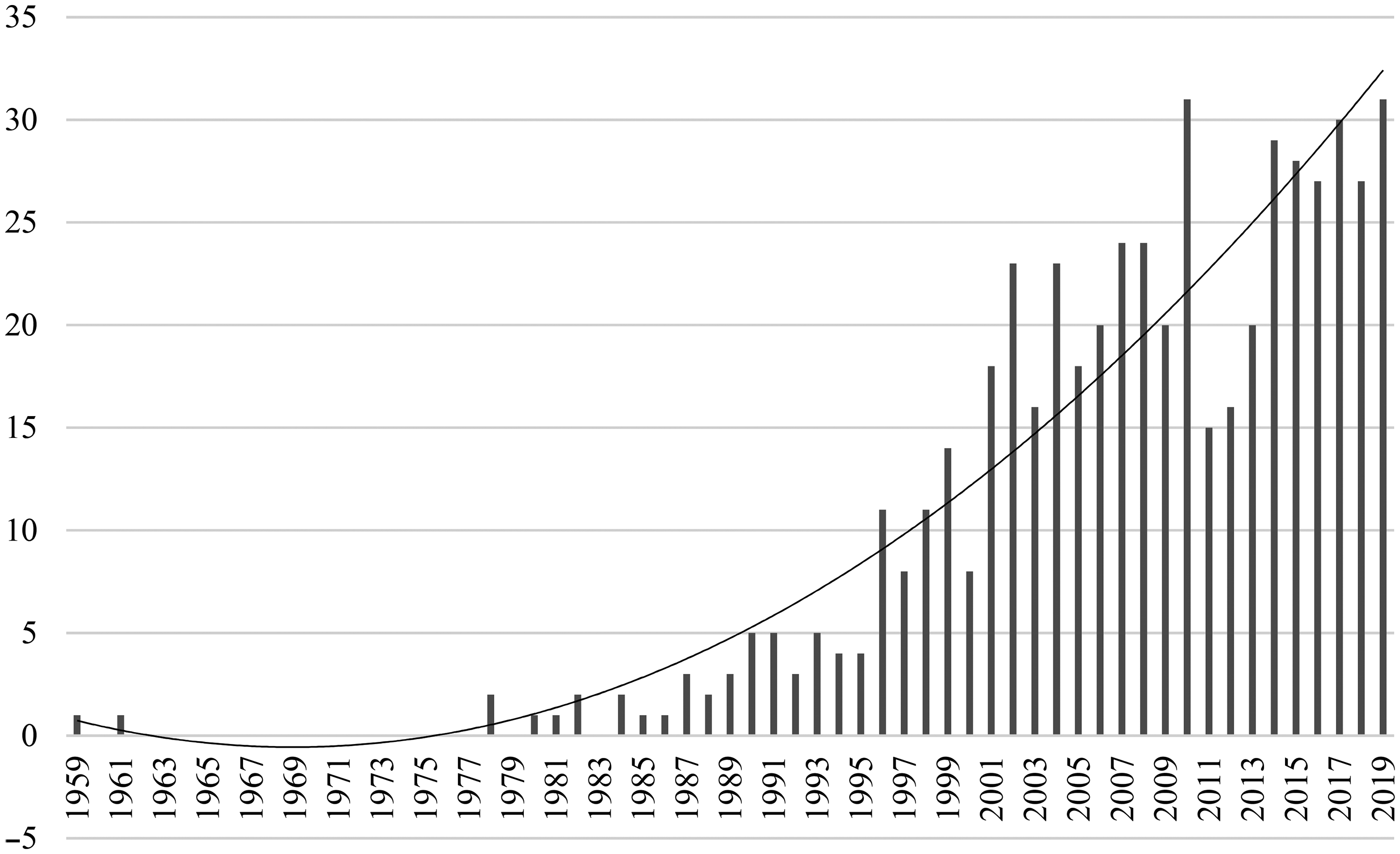
Distribution of Chinese Studies in Leading Management Journals Over Time
Yet our knowledge about Chinese management remains relatively limited and is colored by Western lenses (Barkema, Chen, George, Luo, & Tsui, 2015; Jia, You, & Du, 2012). It often relies on the strong assumption that management knowledge is universally valid (Jack et al., 2013; Muzio, 2021), including the applicability of Western theories to China. Yet most management theories that are currently in use originated in North America between the 1950s and 1980s, inspired by the rapid growth of the American economy at the time (Colquitt & Zapata-Phelan, 2007). The Chinese economy, however, has evolved through a system of industrial governance and political involvement that is very distinct from the Western trajectory (Boisot & Child, 1996; Haveman et al., 2017; Nee, 1992; Xu, Lu, & Gu, 2014). Furthermore, through their training in PhD programs of international universities, Western theories have strongly been instilled in Chinese scholars, which has long kept indigenous Chinese perspectives from blossoming (Barney & Zhang, 2009; Tsui et al., 2004). But later generations of CMS scholars have increasingly begun to develop China-endemic perspectives on management (e.g., Huang, Geng, & Wang, 2017; Marquis & Bird, 2018; Marquis & Qiao, 2020; Wang et al., 2018; Wang et al., 2019). The CMS field thus consists of two main parts: (a) studies using Chinese data to test and extend Western frameworks, and (b) studies developing endemic perspectives on Chinese management practices. An overarching framework capturing these is presented in Figure 2.
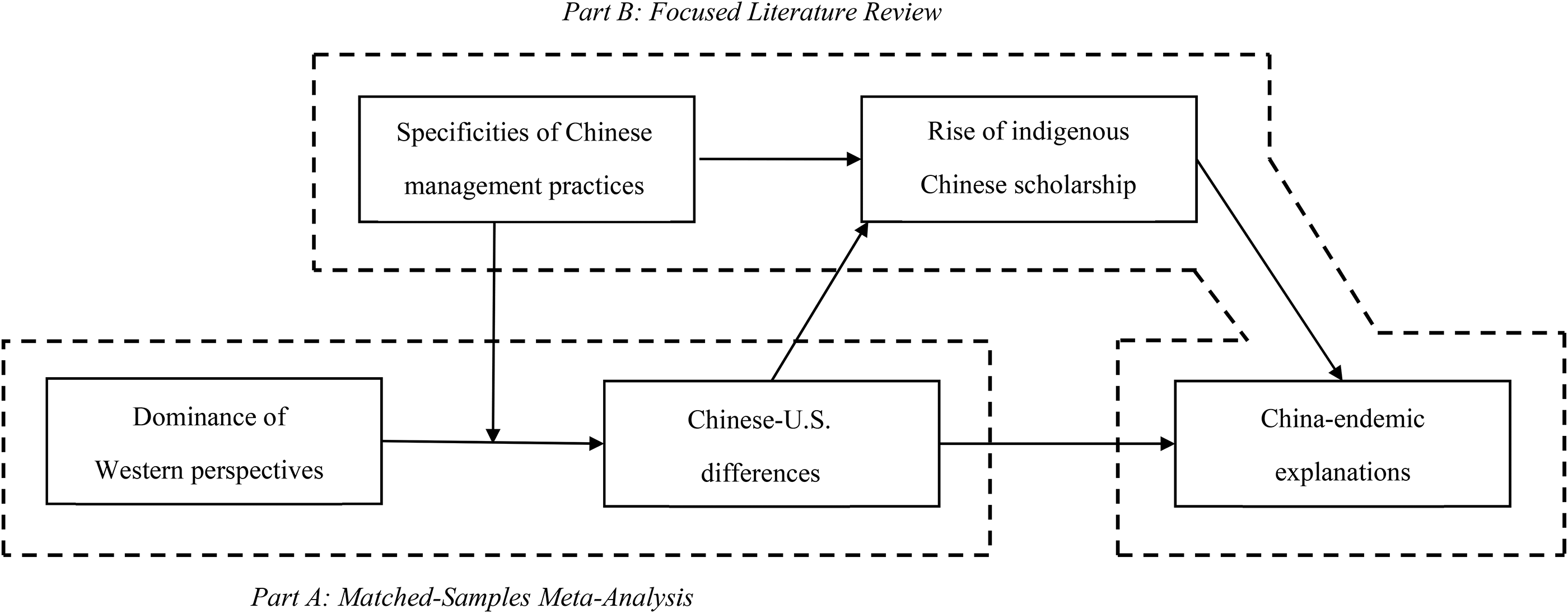
Framework of Matched-Samples Meta-Analysis and Focused Literature Review
To take stock of the entire CMS field, we therefore first conduct a matched-samples meta-analysis (MSMA; Part A in Figure 1), in which we compare mean effect sizes and mechanisms for five classic management theories—institutional theory (e.g., DiMaggio & Powell, 1983; Meyer & Rowan, 1977), resource dependence theory (e.g., Pfeffer & Salancik, 1978), the resource-based view (e.g., Barney, 1991), agency theory (e.g., Fama & Jensen, 1983a; Jensen & Meckling, 1976), and transaction cost theory (e.g., Williamson, 1975)—on two comparable samples of studies drawn from the United States and China. These five theories encapsulate the bulk of macro-management research to date (Pugh & Hickson, 2007; Smith & Hitt, 2005), making the body of empirical studies testing them sufficiently large for a meta-analysis in both contexts (cf. Crook, Ketchen, Combs, & Todd, 2008; Drees & Heugens, 2013; Geyskens, Steenkamp, & Kumar, 2006; Heugens & Lander, 2009; Mutlu, van Essen, Peng, Saleh, & Duran, 2018). 1 We integrate matching principles into meta-analysis to test the applicability of Western theories in China and probe the need for complementary perspectives. Our database consists of 1,028 primary studies, 452 matched samples, and 1,030 effect sizes. Second, we conduct a focused review of the literature on China-endemic studies (Part B in Figure 1) to identify distinct ways of theorizing that emerge from China. 2 We find that political institutional imprinting theory, state-driven sustainable development, and China-endemic corporate governance represent the most salient China-endemic perspectives.
Our study harbors four contributions. First, we unveil contextual differences between China and the United States in mean effect sizes and intervening mechanisms, and discuss the extent to which established Western frameworks are useful to our understanding of Chinese firms and management practices. Second, we report the results of a focused review of the CMS literature, identifying three emerging strands of China-endemic theorizing. Third, we introduce MSMA, or meta-analysis of econometrically matched samples, as a way of making inferentially more valid comparisons across macrosocial units. Fourth, we propose opportunities for further theoretical advancement in the CMS field and identify uncharted empirical territory.
Overview of the Classic Management Theories
The second half of the 20th century witnessed the formalization of hitherto fragmented ideas into a variety of comprehensive theoretical frameworks (Colquitt & Zapata-Phelan, 2007). Neo-institutional theory (DiMaggio & Powell, 1983; Meyer & Rowan, 1977), for example, questions Weber's (1978) instrumental view on the functioning of bureaucracy. Another major lens is resource dependence theory (Pfeffer & Salancik, 1978), which codifies preexisting ideas about the external control of organizations (Emerson, 1962; Thompson, 1967). The resource-based view of the firm (Barney, 1991) attributes interfirm performance differentials to internally accumulated factors of production. Agency theory (Fama & Jensen, 1983a; Jensen & Meckling, 1976) focuses on principal-agent relationships to broaden the risk-sharing literature. Informational imperfections are also central to transaction cost theory (Williamson, 1975), which is based on Coase's (1937) analysis of the choice between markets and hierarchies. These five theories represent the most prolifically researched ideas on management that have sprung up in the West, and they collectively reflect a prominent and complementary set of views on many aspects of organizational behavior.
Institutional Theory
Institutional theory has developed into a leading perspective in organization and management over the past four decades (Greenwood, Oliver, Lawrence, & Meyer, 2017; Heugens & Lander, 2009; Scott, 1987, 2008). Scholars have assessed how institutions—mutualistic and durable social arrangements—account for the homogenization of organizational populations without necessarily rendering them more efficient (Mizruchi & Fein, 1999; Tolbert & Zucker, 1983). The limitations of economic reasoning have led institutional theorists to shift attention from the task environment to the institutional context and emphasize the logic of appropriateness over consequentiality (e.g., DiMaggio & Powell, 1983; Meyer & Rowan, 1977; Zucker, 1977). The search for legitimacy drives the development and sustenance of rationalized collective rules—the “institutionalized myths”—of society (Meyer & Rowan, 1977: 345). Institutionalism thus reflects on isomorphic processes through which organizations “collectively incorporate templates for organizing from their institutional environments in search of legitimacy” (Heugens & Lander, 2009: 61).
DiMaggio and Powell (1983) identified three institutional drivers of isomorphism: coercive, mimetic, and normative pressures. First, coercive pressures come from commanding authorities such as governments with legislative power over organizations (Mezias, 1990; Provan, 1987) and from critical resource providers upon whom organizations depend (Ingram & Simons, 1995; Palmer, Jennings, & Zhou, 1993). Second, mimetic isomorphism occurs when organizations face a problem with unclear solutions (Haunschild & Miner, 1997; Kraatz, 1998). To mitigate uncertainty, organizations mimic the behavior of others with similar traits (Baum & Haveman, 1997; Keister, 2004), who appear with great frequency (Guillén, 2002, 2003; Haunschild, 1993), or who realize desirable outcomes (Keister, 2002; Williamson & Cable, 2003). Third, isomorphism becomes normatively diffused when organizations struggle to establish a cognitive base and legitimation for their autonomy (Greenwood, Suddaby, & Hinings, 2002; Lawrence, 1999). The diffusion of normative isomorphism is predominantly driven by professional networks (Geletkanycz & Hambrick, 1997; Haunschild, 1994; Lee & Pennings, 2002) and accreditation bodies (Eesley, Li, & Yang, 2016; Honig & Karlsson, 2004; Mezias, 1990). We focus on the three core empirical relationships stipulated by institutional theory: (a) coercive pressures–isomorphism; (b) mimetic pressures–isomorphism; and (c) normative pressures–isomorphism.
Resource Dependence Theory
Resource dependence theory has long been a dominant perspective for understanding organization-environment relations (Smith & Hitt, 2005), constituting one of the most influential theories in organization and management (Davis & Cobb, 2010; Drees & Heugens, 2013; Hillman, Withers, & Collins, 2009). The theory is premised on the notion that organizations critically depend on means supplied by actors in their environment (Aldrich & Pfeffer, 1976; Pfeffer, 1972; Pfeffer & Nowak, 1976; Pfeffer & Salancik, 1974). A central concept is that of power (Emerson, 1962), which derives from external actors’ control over resources vital to business organizations (Ulrich & Barney, 1984). Resource dependencies make organizations lose autonomy (Pfeffer & Salancik, 1978), either through power imbalances (stemming from uneven dependencies) or mutual dependencies (involving reciprocal power) (Casciaro & Piskorski, 2005).
Resource dependence theory assesses the countermeasures organizations can take to secure resources and regain their autonomy (Drees & Heugens, 2013). Organizations regain control by creating (semi)permanent ties or merging with other formally independent organizations (Pfeffer & Salancik, 1978). Forming interorganizational arrangements allows organizations to set their boundaries “at the point that maximizes strategic control over crucial external forces” and become more autonomous (Santos & Eisenhardt, 2005: 495). Prior studies have highlighted several arrangements: board interlocks (Mizruchi, 1996), alliances (Gulati, 1998), joint ventures (Ahuja, 2000), and mergers and acquisitions (M&As; Meyer, Estrin, Bhaumik, & Peng, 2009). Despite their dark-side manifestations (Oliveira & Lumineau, 2019), most studies show that interorganizational arrangements can help mitigate resource dependencies (Drees & Heugens, 2013; Krishnan, Geyskens, & Steenkamp, 2016; Shi, Sun, & Prescott, 2012). Therefore, we test the following relationships: (a) resource dependence–board interlock; (b) resource dependence–alliance; (c) resource dependence–joint venture; and (d) resource dependence–M&As.
The Resource-Based View
The resource-based view originated in strategic management but has also secured a preeminent position in disciplines like human resource management, entrepreneurship, and international business (Barney, 2001; Barney, Ketchen, & Wright, 2011; Barney, Wright, & Ketchen, 2001; Kraaijenbrink, Spender, & Groen, 2010). 3 Its central question is “Why do some firms persistently outperform others?” (Barney & Arikan, 2001: 124). Barney (1991) argued that competitive advantage derives from a firm's resources that are valuable, rare, inimitable, and nonsubstitutable (VRIN)—traits that conjunctively produce performance advantages. Within this framework, competitive advantage is viewed as “a rent conferred by one or more imperfections in the resource market that prevents at least one input being on equal terms to all actual or would-be competitors” (Lockett, Thompson, & Morgenstern, 2009: 11). Central to this argument are two assumptions: firm heterogeneity and path dependence (Barney et al., 2001; Lockett et al., 2009). First, strategic resources may be heterogeneously distributed across firms within an industry (Barney, 1991; Conner, 1991; Priem & Butler, 2001). Second, these resources may not be perfectly mobile across firms, leading to sustained firm heterogeneity (Barney, 1991, 2001).
Prior research has tested the relationships between a firm's control over strategic resources and its performance-related outcomes (Armstrong & Shimizu, 2007; Crook et al., 2008; D’Oria, Crook, Ketchen, Sirmon, & Wright, 2021; Nason & Wiklund, 2018; Newbert, 2007). A prior meta-analysis (Crook et al., 2008) shows that VRIN resources have stronger performance effects than resources lacking these traits. This relationship strengthens when performance outcomes are not subject to potential value appropriation by third parties. The meta-analysis by Nason and Wiklund (2018) furthermore indicates that, even though VRIN resources facilitate opportunity recognition and exploitation, they mostly stimulate nongrowth performance outcomes. To evaluate the resource-based view's predictive power across contexts, we investigate two central relationships: (a) non-VRIN resources–accounting and market performance and (b) VRIN resources–accounting and market performance.
Agency Theory
Agency theory is a leading framework informing especially corporate governance research (Aguilera, Desender, Bednar, & Lee, 2015). It has spawned an extensive body of empirical evidence (Dalton, Daily, Ellstrand, & Johnson, 1998; Dalton, Hitt, Certo, & Dalton, 2007). Many contributors to the field of corporate governance focus on the principal-agent conflict of separated “ownership” and “control” in organizations (Fama & Jensen, 1983a). A separation of decision-making and risk-bearing functions implies that decision-making agents do not bear the wealth effects of their strategic choices (Fama, 1980; Fama & Jensen, 1983b; Jensen & Meckling, 1976). In spite of specialization benefits (Fama & Jensen, 1983a), it also leads to “potential for mischief when the interests of owners and managers diverge” (Dalton et al., 2007: 1). That is, managers may inappropriately leverage their advantages to extract higher rents than what the owners of organizations accord them (Villalonga & Amit, 2006; Villalonga, Amit, Trujillo, & Guzmán, 2015).
Three principal governance mechanisms have been developed to mitigate conflicts of interest between owners and managers (Dalton et al., 2007). Independent monitoring (Fama, 1980), first, functions through the board of directors, which is supposed to oversee managers to ensure that the latter's decisions are aligned with the interests of owners (Fama & Jensen, 1983a, 1983b). This mechanism spans two aspects of board structure (Dalton et al., 1998; Dalton & Dalton, 2011): board composition, specifically the proportion of the board that is comprised of outside directors (Bhagat & Black, 2002; Wagner, Stimpert, & Fubara, 1998), and leadership structure (Mizruchi, 1983), especially CEO duality—referring to CEO chairing of the board (Krause, Semadeni, & Cannella, 2014). Managerial incentives (Jensen & Meckling, 1976; Jensen & Murphy, 1990), second, are effectuated through executive compensation (Barkema & Gomez-Mejia, 1998; Devers, Cannella, Reilly, & Yoder, 2007; Tosi, Werner, Katz, & Gomez-Mejia, 2000) and managerial ownership (Dalton, Daily, Certo, & Roengpitya, 2003). Research has shown that performance-dependent compensation and equity ownership motivate executives to embrace the interests of shareholders, leading to decisions that serve their joint interests (Fahlenbrach & Stulz, 2011; McConnell & Servaes, 1990; Mehran, 1995). Concentrated external ownership (e.g., Pound, 1988; Shleifer & Vishny, 1986), third, grants large-block shareholders or institutional investors the means to monitor management (Aggarwal, Erel, Ferreira, & Matos, 2011; Anderson, Mansi, & Reeb, 2003; Demsetz & Villalonga, 2001). Hence, we examine three core relationships: (a) monitoring mechanism (i.e., board independence, CEO duality)–performance, (b) alignment mechanism (i.e., executive compensation, managerial ownership)–performance, and (c) investment mechanism (i.e., blockholder, institutional investor)–performance.
Transaction Cost Theory
Transaction cost theory explains why organizations exist in markets and where the boundaries of organizations should be (Cuypers, Hennart, Silverman, & Ertug, 2021; Gibbons, 2010; Madhok, 2002; Santos & Eisenhardt, 2005). It sees society as a network of transactions, which can be performed either via a market or within an organization (Coase, 1937). As transacting agents are boundedly rational and opportunistic (March & Simon, 1958), the most efficient form of exchange depends on the balance of the transaction costs associated with market mechanisms to organize an arm's length exchange and the governance costs ensuing from organizing exchanges through managerial authority within an organization (Williamson, 1975, 1981, 1991). Competition is expected to enhance the efficiency of market mechanisms, but market failures and transaction costs push more transactions within the boundaries of organizations (Williamson, 1971).
Williamson (1975) translated the core tenets of transaction cost theory into testable hypotheses by attributing the relative efficiency of alternative governance structures to observable dimensions of transactions (i.e., asset specificity, uncertainty, and frequency). Asset specificity highlights the idiosyncratic nature of “assets that are tailored to a particular transaction and cannot be easily redeployed outside the relationship of the parties to the transaction” (Geyskens et al., 2006: 520). Since market mechanisms often fail to curb transacting agents’ opportunism, transaction-specific assets induce the problem that agreements may not be respected (Williamson, 1998). One solution is hierarchical governance, which addresses this safeguarding problem more efficiently than market governance (Williamson, 1991). Relational governance, characterized by the transacting parties maintaining autonomy yet jointly developing certain policies, is a viable alternative to hierarchical governance (Williamson, 1991). As such, we test two relationships: (a) asset specificity–hierarchical governance and (b) asset specificity–relational governance.
Methods
Meta-analytic techniques are instrumental in understanding inconclusive prior research findings and determining a field's state-of-knowledge (Cooper, Hedges, & Valentine, 2009; Hunter & Schmidt, 2004; Post, Sarala, Gatrell, & Prescott, 2020; Stanley & Doucouliagos, 2012). However, prior findings are often synthesized into a single effect size without sufficiently considering and removing the influence of study characteristics such as data, sample, context, and method (Aguinis, Ramani, & Cascio, 2020; Gonzalez-Mulé & Aguinis, 2018). By integrating the principles of matched sampling into meta-analysis, we introduce MSMA to make inferentially more valid comparisons of meta-analytically derived effect sizes across macrosocial units.
Literature Search and Coding
To ensure comprehensiveness, we employed four complementary literature search strategies. First, we consulted prior review articles and meta-analytical reviews (e.g., Crook et al., 2008; Drees & Heugens, 2013; Geyskens et al., 2006; Heugens & Lander, 2009; Mutlu et al., 2018). Second, we explored four electronic databases—ABI/INFORM Global, EconLit, Google Scholar, and JSTOR—using a comprehensive set of search terms (see Online Appendix A). Third, we manually searched eight leading management and organization journals: Academy of Management Journal, Administrative Science Quarterly, Journal of International Business Studies, Journal of Management, Journal of Management Studies, Organization Science, Organization Studies, and Strategic Management Journal; and a China-focused journal Management and Organization Review. Finally, we used two-way snowballing to forward-trace references of the retrieved studies and backward-trace articles citing these studies in Google Scholar and ISI Web of Knowledge.
We used three inclusion criteria (Lipsey & Wilson, 2001). First, a study had to investigate either the U.S. or Chinese contexts. We also included multicountry studies reporting U.S. or Chinese effect sizes separately. Second, the article empirically examined at least one of the relationships of interest. We used a list of construct definitions and measures derived from prior meta-analyses to identify correct relationships (see Online Appendix B). Third, the study reported sample size and effect size information. These efforts yielded a database of 1,028 primary studies, divided over institutional theory (97), resource dependence theory (146), the resource-based view (234), agency theory (433), and transaction cost theory (118).
We developed a coding protocol to harvest both study-level and effect-size-level information (Lipsey & Wilson, 2001). 4 When studies examined more than one focal relationship, we coded them all to extract more information from each study. From the 1,028 primary studies, we coded 1,720 samples, divided over institutional theory (162), resource dependence theory (161), the resource-based view (304), agency theory (948), and transaction cost theory (145). We then identified comparable U.S. and Chinese samples, producing a definitive dataset comprising 452 matched samples and 1,030 effect sizes, distributed over institutional theory (40 matched samples and 84 effect sizes), resource dependence theory (38/88), the resource-based view (78/257), agency theory (274/559), and transaction cost theory (22/42). The supplemental materials offer bibliographic information on the articles included in the meta-analysis (see Online Appendix C).
A Novel Analytic Strategy: MSMA
As emphasized by Lipsey and Wilson (2001: 73), “[c]onceptually, this distinction [between study-level and effect-size-level information] is similar to that between independent and dependent variables.” Study characteristics like context, method, and sample influence the nature and magnitude of research findings. Effect sizes are not only influenced by theorized mechanisms that have treatment effects on selected populations but also by espoused study characteristics. Such characteristics can substantially confound research findings (Lipsey & Wilson, 2001). To address this challenge, meta-analysts often model study-level variables as moderators of the mean effect size through meta-analytic regression analysis (MARA) or hierarchical linear modelling meta-analysis (HiLMMA). These approaches, however, are less suited for direct comparisons of effect sizes affected by macro-institutional and cultural differences (Aguinis et al., 2020). Inasmuch as treatment effects could be more causally estimated by econometrically inferring randomized controlled trials in observational studies (Shadish, Cook, & Campbell, 2002), finding an appropriate “counterfactual” allows us to more precisely compare effect sizes drawn from two macro units in meta-analysis.
Matching techniques allow researchers to compare the effect sizes of studies with those of their closest peers only, rendering comparative meta-analysis feasible. As “an intuitive method for addressing causal questions,” matching pushes researchers to “confront the process of causal exposure as well as the limitations of available data” (Morgan & Winship, 2015: 140). The basic idea of matching is: If there are two large pools of cases, those that receive a treatment (treatment group) and those that do not (control group), researchers should identify cases that are very similar on salient dimensions across both groups and then check whether the treatment causally affects the outcome in a subsample of treated cases and matched control cases (Imbens, 2004; Imbens & Wooldridge, 2009). This simplifies the analysis of causal effects and reduces dependence of estimates on parametric models (Morgan & Winship, 2015). In recent years, matching has become an indispensable technique for empirical research at the macro and micro levels to address endogeneity concerns (Li, 2013; Stuart, 2010). We combined meta-analytical techniques with matching routines to accomplish adequate cross-country comparisons.
We developed MSMA for comparative theoretical synthesis. First, we selected a number of conditioning variables—geographical range (dummy, nationwide/regionwide), data collection method (dummy: archival/survey), mean year of observation (continuous), median year of observation (continuous), sample size (continuous), industry (categorical: manufacturing/technology/service/mixed), and focal relationship (categorical: intervening mechanisms)—to calculate the “closeness” that determines whether cases are good matches and correct for violation of the strongly ignorable treatment assignment (SITA; Rosenbaum and Rubin, 1983) assumption (Imbens, 2004; Imbens & Wooldridge, 2009). Second, we entered these conditioning variables into the logit model to predict the propensity score (Rosenbaum, 2010), the conditional probability of receiving the treatment (i.e., using a Chinese sample). Third, we matched Chinese and U.S. studies using four schemes of propensity score matching (Guo & Fraser, 2014): nearest neighbor within caliper = .25σp (Scheme 1), nearest neighbor within caliper = .1σp (Scheme 2), Mahalanobis without propensity scores (Scheme 3), and Mahalanobis with propensity scores (Scheme 4). Nearest neighbor within caliper matching is useful for addressing nonnormal, noncontinuous variables, and Mahalanobis metric matching for identifying matched pairs where the sample is small (Guo & Fraser, 2014). We used one-to-one matching to avoid the exclusion of treatments that could not be matched with multiple nontreatments. After matching, we used the Wilcoxon rank sum (Mann-Whitney) test for continuous covariates and the chi-square test for categorical covariates to check for remaining imbalances (Guo & Fraser, 2014). Lastly, we selected the matched samples with the highest matching effectiveness for meta-analysis and used the others for robustness checks.
We used Hedges-Olkin meta-analysis (HOMA; Hedges & Olkin, 1985) to calculate meta-analytic mean correlations between variables and corresponding confidence intervals (Lipsey & Wilson, 2001). We used Pearson product-moment correlation coefficients (r), which are commonly used by management scholars to assess bivariate relationships (Bergh et al., 2016; Combs, Ketchen, Crook, & Roth, 2011). When applying HOMA, researchers should make a choice between a fixed-effects model and a random-effects model (Hedges & Vevea, 1998). Considering that not all of the variance between effect sizes can be attributed to sampling error, we opted for a random-effects model to account for unique differences in the set of true population effect sizes (Geyskens, Krishnan, Steenkamp, & Cunha, 2009).
Matched-Samples Meta-Analytic Results
MSMA Results for Institutional Theory
Table 1 presents the matching results for institutional theory. The logit model has a high level of goodness of fit (pseudo R2 = .506). While prematching imbalance checks show that the pretreatment characteristics geographic range (p < .05), median years of observation (p < .001), and focal relationship (p < .01) were not exogenous, postmatching imbalance checks suggest that selection bias was successfully removed in Schemes 1, 2, and 4. We chose matching Scheme 2, as the known variance of that scheme's postmatching logit model diminished most (pseudo R2 = .035).
Propensity Score Analysis and Imbalance Check: Institutional Theory
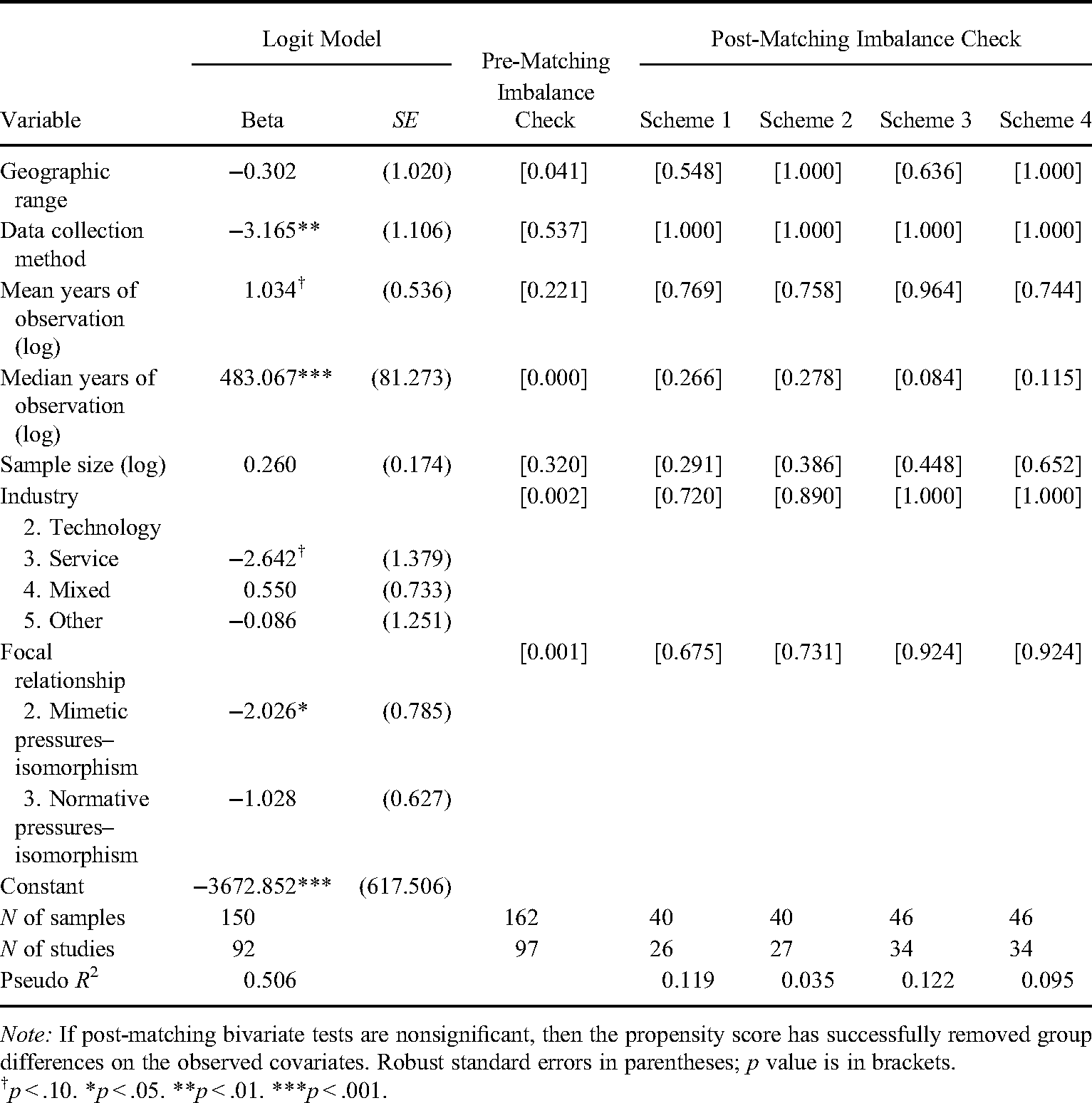
Note: If post-matching bivariate tests are nonsignificant, then the propensity score has successfully removed group differences on the observed covariates. Robust standard errors in parentheses; p value is in brackets.
p < .10. *p < .05. **p < .01. ***p < .001.
Table 2 reports HOMA results for institutional theory based on matching Scheme 2. The mean effect size of organizational isomorphism is significantly positive across both contexts, yet it is stronger in the United States than in China (U.S.: r = .23, p < .001; China: r = .13, p < .001). In terms of intervening mechanisms, the bivariate correlations of the matched U.S. and Chinese samples for coercive, mimetic, and normative pressures and isomorphism are .30 (p < .001) vs. .09 (p < .001), .34 (p < .001) vs. .11 (p < .001), and .10 (p < .001) vs. .19 (p < .001). This implies that coercive and mimetic isomorphic forces are weaker in China than in the United States, and vice versa for normative isomorphism.
Hedges-Olkin Meta-Analytic Results: Institutional Theory (Scheme 2)
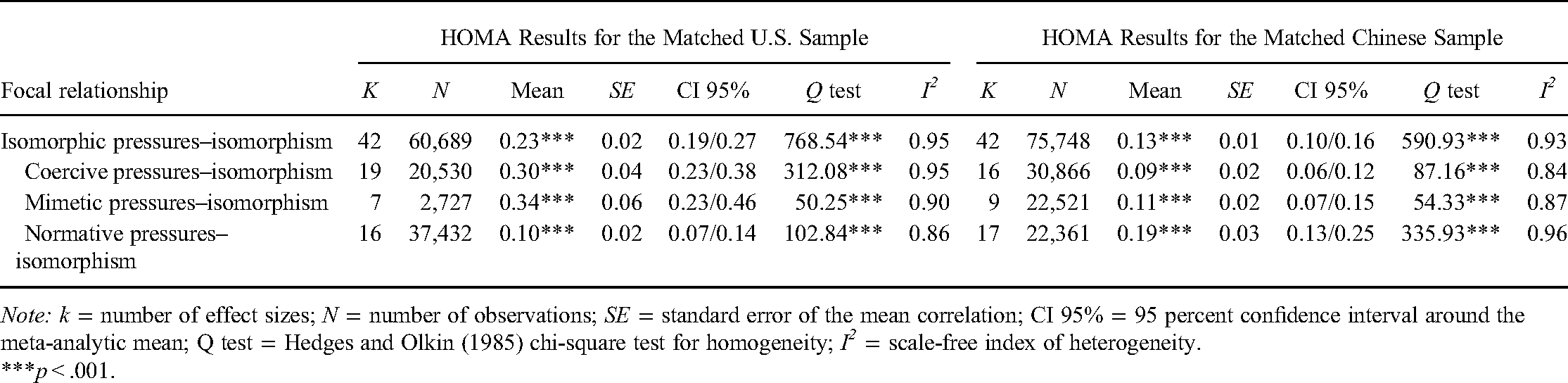
Note: k = number of effect sizes; N = number of observations; SE = standard error of the mean correlation; CI 95% = 95 percent confidence interval around the meta-analytic mean; Q test = Hedges and Olkin (1985) chi-square test for homogeneity; I2 = scale-free index of heterogeneity.
***p < .001.
MSMA Results for Resource Dependence Theory
Table 3 presents the matching results for resource dependence theory. The logit model for predicting propensity scores has a moderate level of goodness of fit (pseudo R2 = .259). While prematching imbalance checks show that data collection method (p < .10), mean years of observations (p < .05), median years of observations (p < .001), and focal relationship (p < .001) were associated with the treatment, postmatching imbalance checks suggest that selection bias was successfully removed through matching in all four of the schemes. We chose matching Scheme 3, as known variance of that scheme's postmatching logit model diminished most (pseudo R2 = .026).
Propensity Score Analysis and Imbalance Check: Resource Dependence Theory
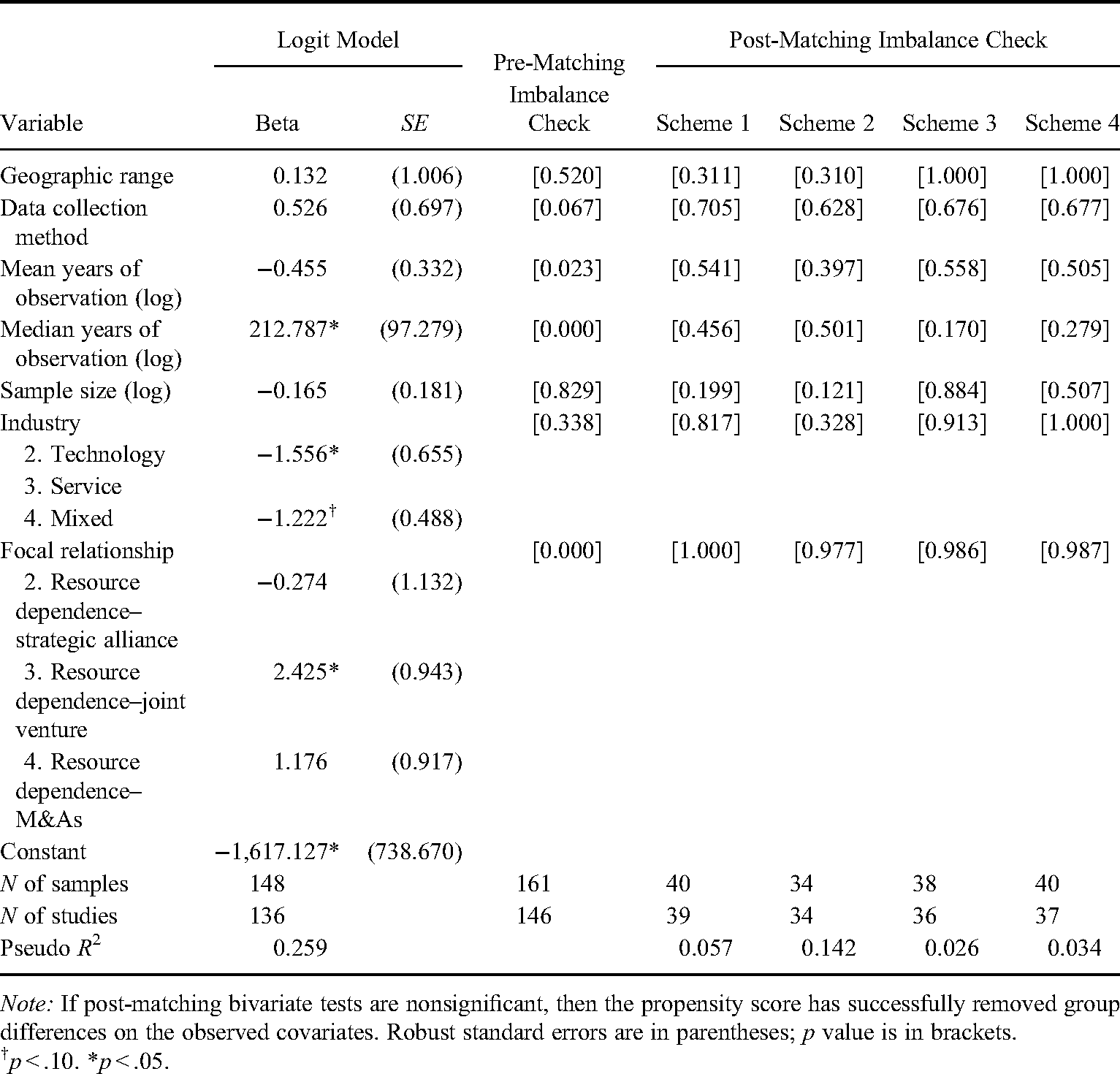
Note: If post-matching bivariate tests are nonsignificant, then the propensity score has successfully removed group differences on the observed covariates. Robust standard errors are in parentheses; p value is in brackets.
p < .10. *p < .05.
Table 4 reports HOMA results for resource dependence theory based on matching Scheme 3. The mean effect size is significantly positive in the United States but not statistically significant in China (U.S.: r = .04, p < .001; China: r = .02, p > .10). In terms of intervening mechanisms, the bivariate correlations of the matched U.S. and Chinese samples for resource dependence and board interlocks, alliances, joint ventures, and M&As are .05 (p < .05) vs. .04 (p < .05), .10 (p < .01) vs. .05 (p > .10), .03 (p > .10) vs. .03 (p > .10), and .03 (p < .10) vs. –.01 (p > .10). Heightened resource dependencies thus lead to the formation of interlocks, alliances, and M&As in the United States, whereas in China only the interlock effect is positive. These results suggest that Chinese firms are less likely to take a relational approach when faced with market and nonmarket resource dependencies.
Hedges-Olkin Meta-Analytic Results: Resource Dependence Theory (Scheme 3)
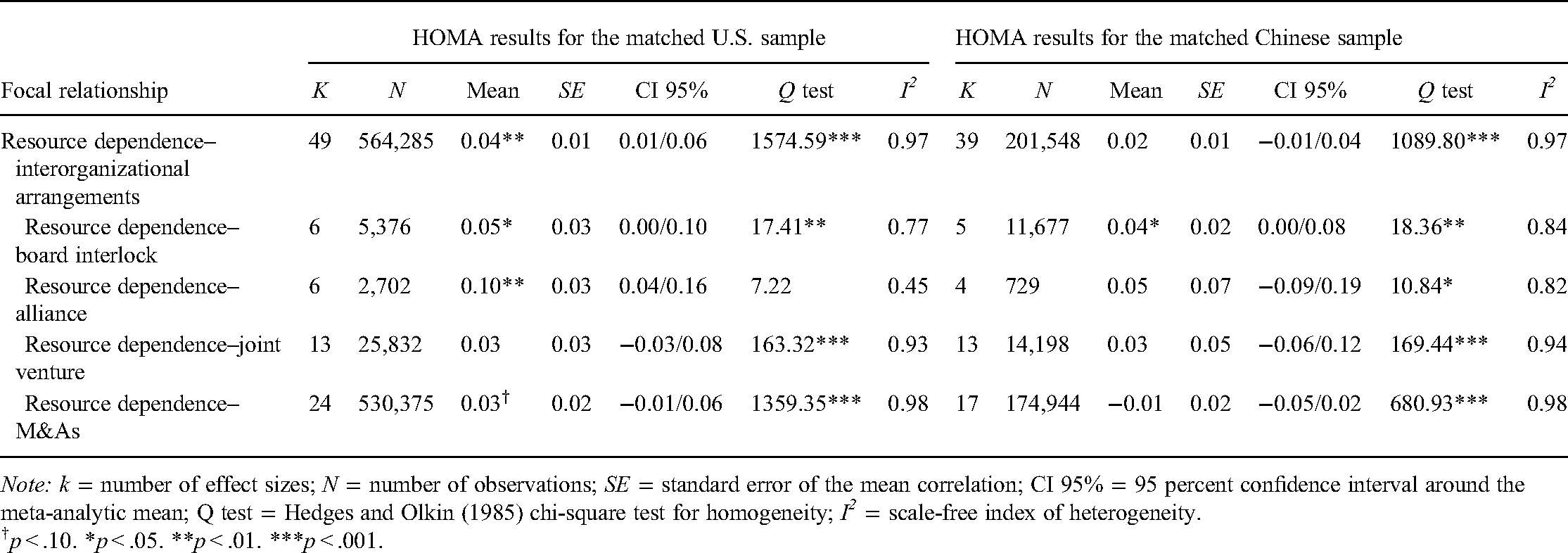
Note: k = number of effect sizes; N = number of observations; SE = standard error of the mean correlation; CI 95% = 95 percent confidence interval around the meta-analytic mean; Q test = Hedges and Olkin (1985) chi-square test for homogeneity; I2 = scale-free index of heterogeneity.
p < .10. *p < .05. **p < .01. ***p < .001.
MSMA Results for the Resource-Based View
Table 5 presents the matching results for the resource-based view. The logit model for predicting propensity scores has a high level of goodness of fit (pseudo R2 = .429). While prematching imbalance checks show that geographic range (p < .001), data collection method (p < .001), mean years of observations (p < .10), median years of observations (p < .001), industry (p < .001), and focal relationship (p < .10) were not exogenous, postmatching imbalance checks suggest that selection bias was successfully removed in Schemes 1 and 2. We chose matching Scheme 1, as known variance of that scheme's postmatching logit model diminished most (pseudo R2 = .024).
Propensity Score Analysis and Imbalance Check: The Resource-Based View
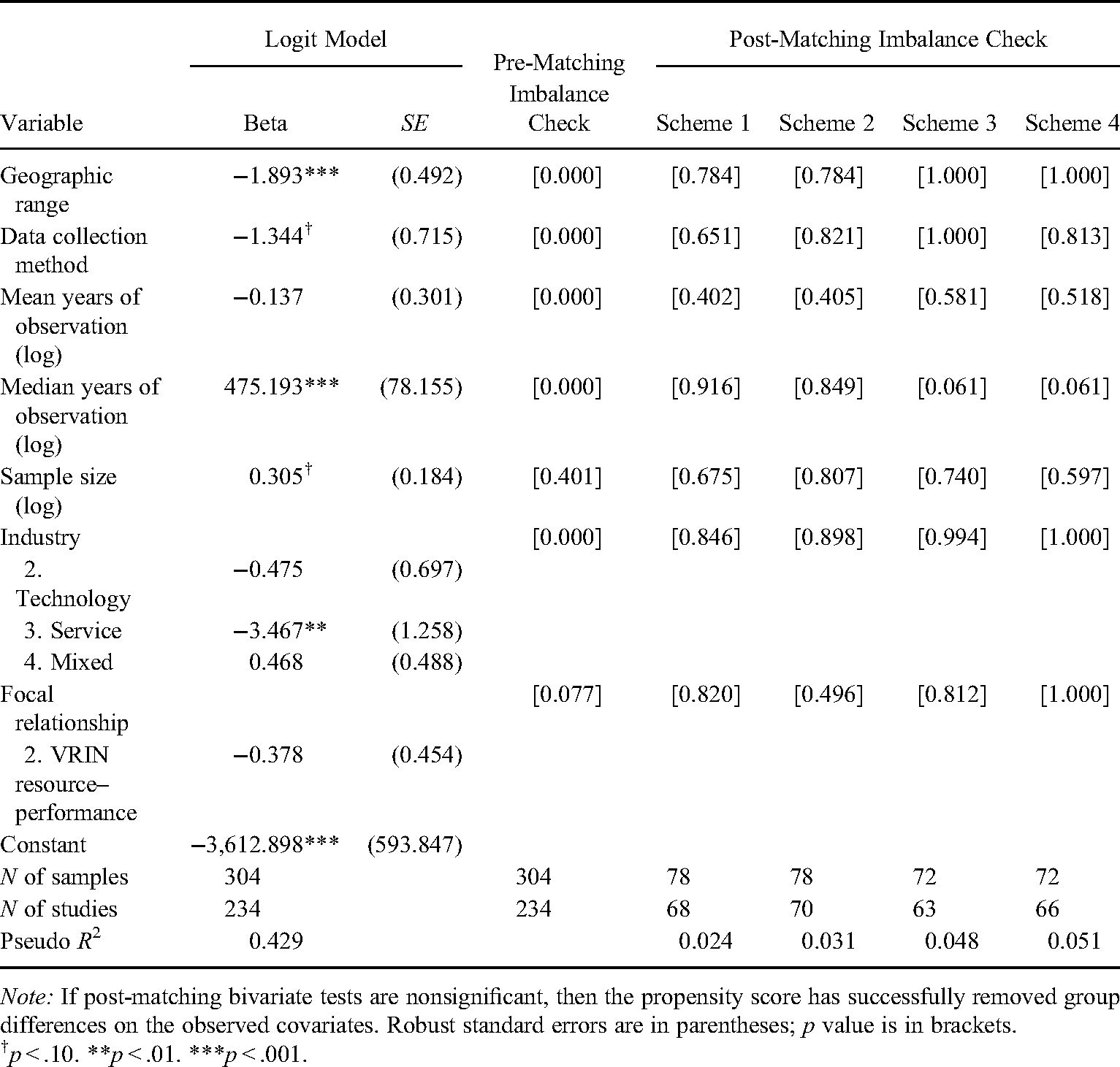
Note: If post-matching bivariate tests are nonsignificant, then the propensity score has successfully removed group differences on the observed covariates. Robust standard errors are in parentheses; p value is in brackets.
p < .10. **p < .01. ***p < .001.
Table 6 reports HOMA results for the resource-based view based on matching Scheme 1. The mean effect size is significantly positive in both contexts, though it is weaker in the United States than in China (U.S.: r = .09, p < .001; China: r = .14, p < .001). This pattern holds for accounting performance (U.S.: r = .08, p < .001; China: r = .13, p < .001) but is reversed for market performance (U.S.: r = .20, p < .001; China: r = .03, p > .10). In terms of intervening mechanisms, the bivariate correlations of the matched U.S. and Chinese samples for the performance effects of non-VRIN and VRIN resources are .02 (p > .10) vs. .04 (p < .01) and .19 (p < .001) vs. .21 (p < .001). From these results, we conclude that the performance effects of VRIN resources are on par across both contexts yet those of non-VRIN resources are stronger in China than in the United States.
Hedges-Olkin Meta-Analytic Results: The Resource-Based View (Scheme 1)
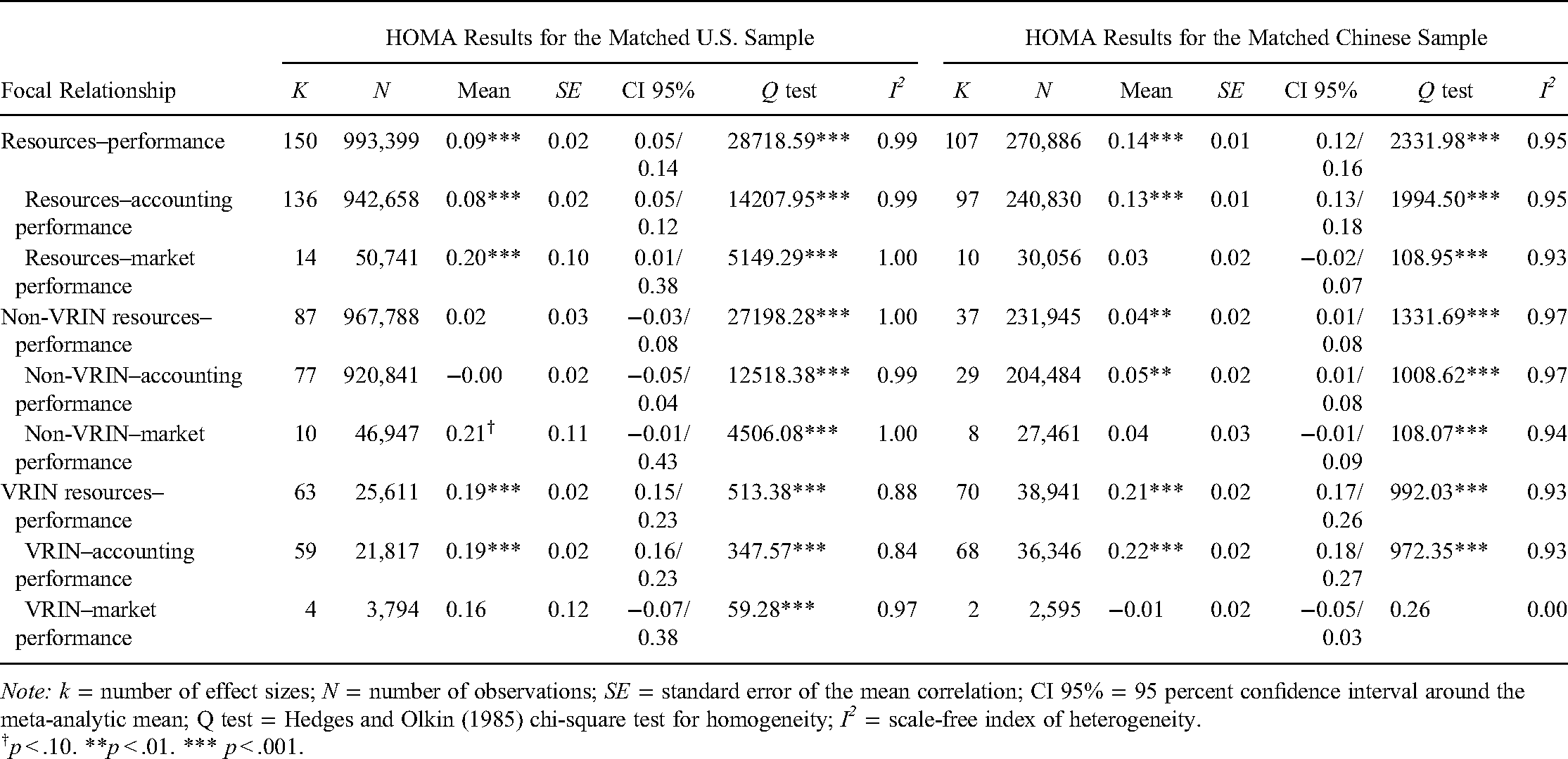
Note: k = number of effect sizes; N = number of observations; SE = standard error of the mean correlation; CI 95% = 95 percent confidence interval around the meta-analytic mean; Q test = Hedges and Olkin (1985) chi-square test for homogeneity; I2 = scale-free index of heterogeneity.
p < .10. **p < .01. *** p < .001.
MSMA Results for Agency Theory
Table 7 presents the matching results for agency theory. The logit model for predicting propensity scores has a moderate level of goodness of fit (pseudo R2 = .387). While prematching imbalance checks show that data collection method (p < .001), mean years of observations (p < .10), median years of observations (p < .001), sample size (p < .001), industry (p < .05), and focal relationship (p < .001) were not exogenous, postmatching imbalance checks suggest that selection bias was successfully removed in Schemes 1 and 2. We chose matching Scheme 2, as known variance of that scheme's postmatching logit model decreased most (pseudo R2 = .005).
Propensity Score Analysis and Imbalance Check: Agency Theory
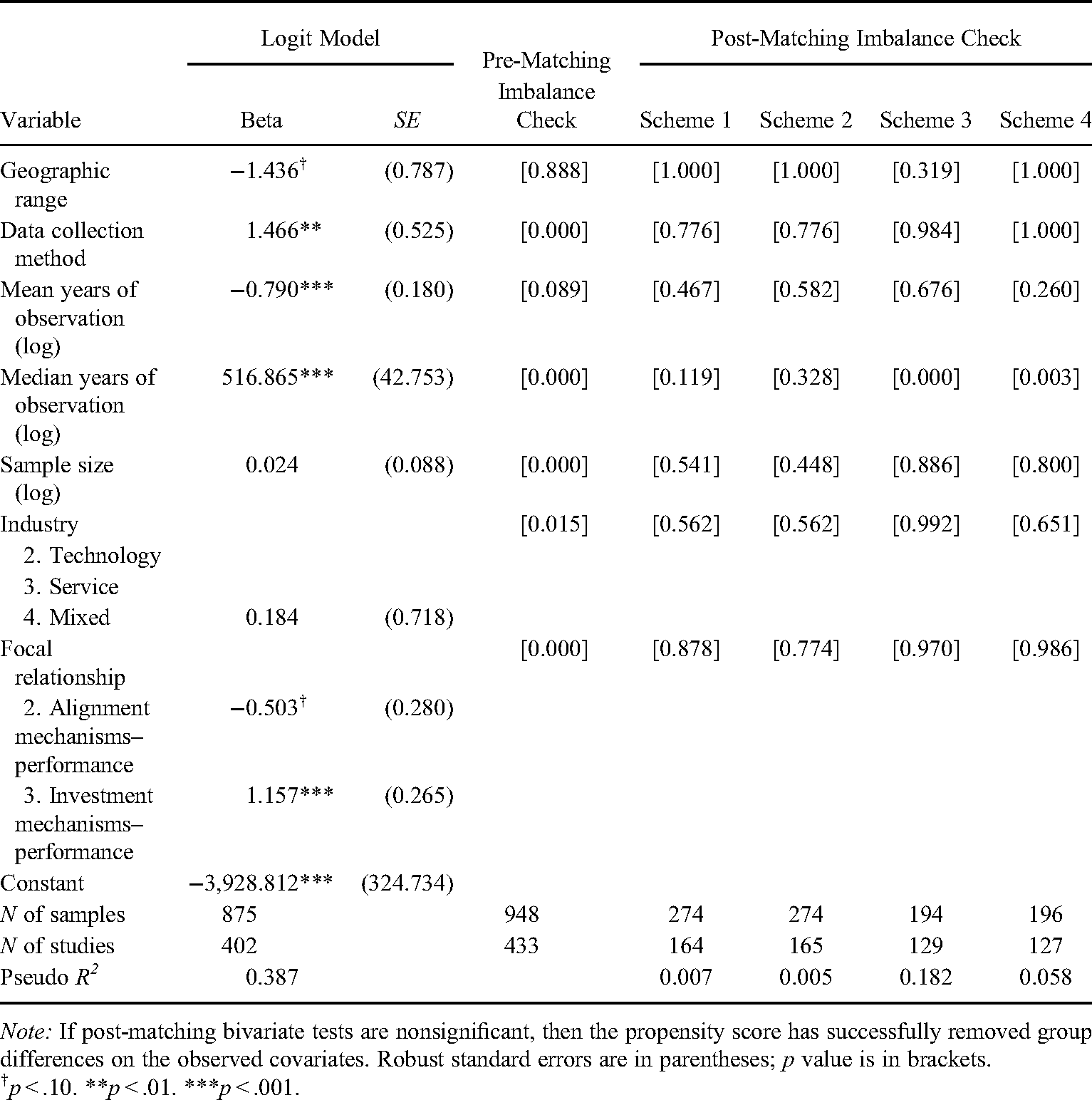
Note: If post-matching bivariate tests are nonsignificant, then the propensity score has successfully removed group differences on the observed covariates. Robust standard errors are in parentheses; p value is in brackets.
p < .10. **p < .01. ***p < .001.
Table 8 reports HOMA results for agency theory based on matching Scheme 2. The main relationships (monitoring mechanisms, alignment mechanisms, and investment mechanisms) are all in the same order of magnitude and show similar patterns of (non)significance when comparing U.S. and Chinese samples: –.02 (p < .001) vs. –.02 (p < .10), .03 (p < .01) vs. .05 (p < .001), and .00 (p > .10) vs. .00 (p > .10). In terms of monitoring mechanisms, the bivariate correlations of the matched U.S. and Chinese samples for the performance effects of board independence and CEO duality are –.02 (p < .01) vs. –.02 (p > .10) and .02 (p < .10) vs. .01 (p < .10). With regard to alignment mechanisms, the bivariate correlations for the performance effects of CEO pay and managerial ownership in the United States and China are .05 (p < .01) vs. .13 (p < .001) and .01 (p > .10) vs. .03 (p < .01). Concerning investment mechanisms, the bivariate correlations of the matched U.S. and Chinese samples for the performance effects of blockholders and institutional investors are –.03 (p < .05) vs. .04 (p < .05), and .01 (p > .10) vs. .03 (p > .10), and the bivariate correlation between state ownership and performance for the Chinese sample is –.03 (p < .05). 5 From these results, we conclude that agency theory tends to hold similarly across China and the United States, although there are some noticeable differences in alignment and investment mechanisms.
Hedges-Olkin Meta-Analytic Results: Agency Theory (Scheme 2)
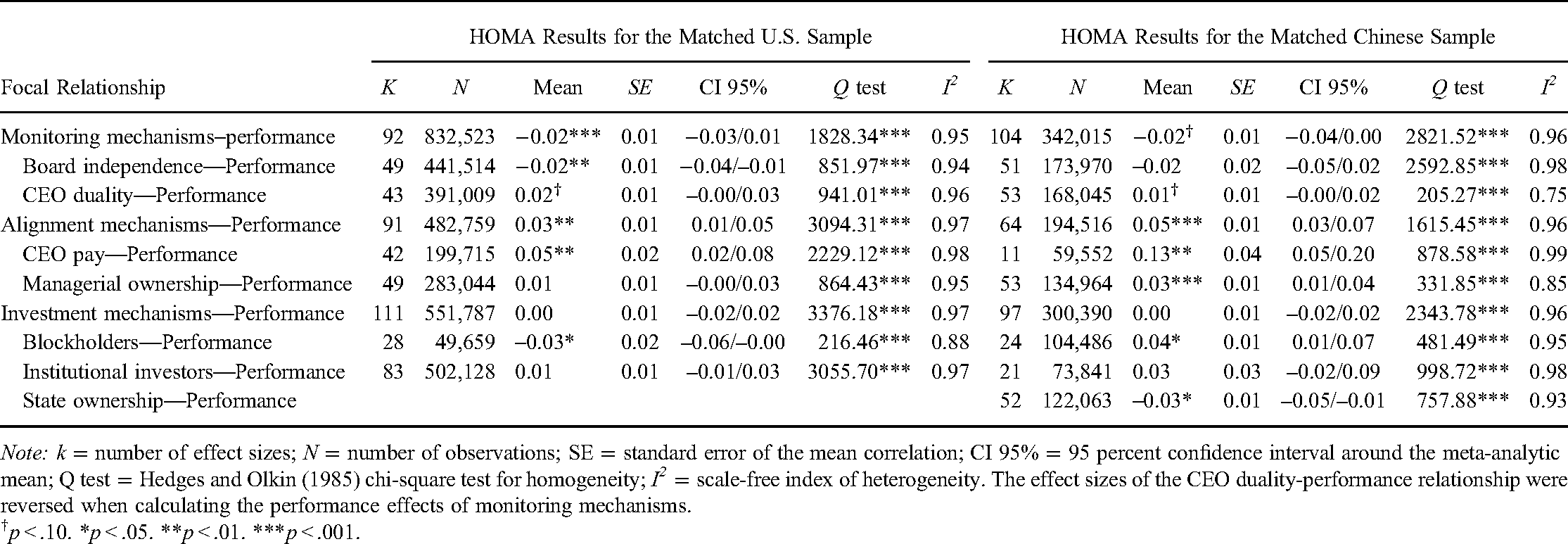
Note: k = number of effect sizes; N = number of observations; SE = standard error of the mean correlation; CI 95% = 95 percent confidence interval around the meta-analytic mean; Q test = Hedges and Olkin (1985) chi-square test for homogeneity; I2 = scale-free index of heterogeneity. The effect sizes of the CEO duality-performance relationship were reversed when calculating the performance effects of monitoring mechanisms.
p < .10. *p < .05. **p < .01. ***p < .001.
MSMA Results for Transaction Cost Theory
Table 9 presents the matching results for transaction cost theory. The logit model for predicting propensity scores has a high level of goodness of fit (pseudo R2 = .572). While prematching imbalance checks show that geographical range (p < .001), data collection method (p < .10), median years of observations (p < .001), sample size (p < .05), and industry (p < .01) were not exogenous to the treatment, postmatching imbalance checks suggest that selection bias was removed in Schemes 1 and 2. We chose matching Scheme 1, as known variance of that scheme's postmatching logit model decreased most (pseudo R2 = .107).
Propensity Score Analysis and Imbalance Check: Transaction Cost Theory
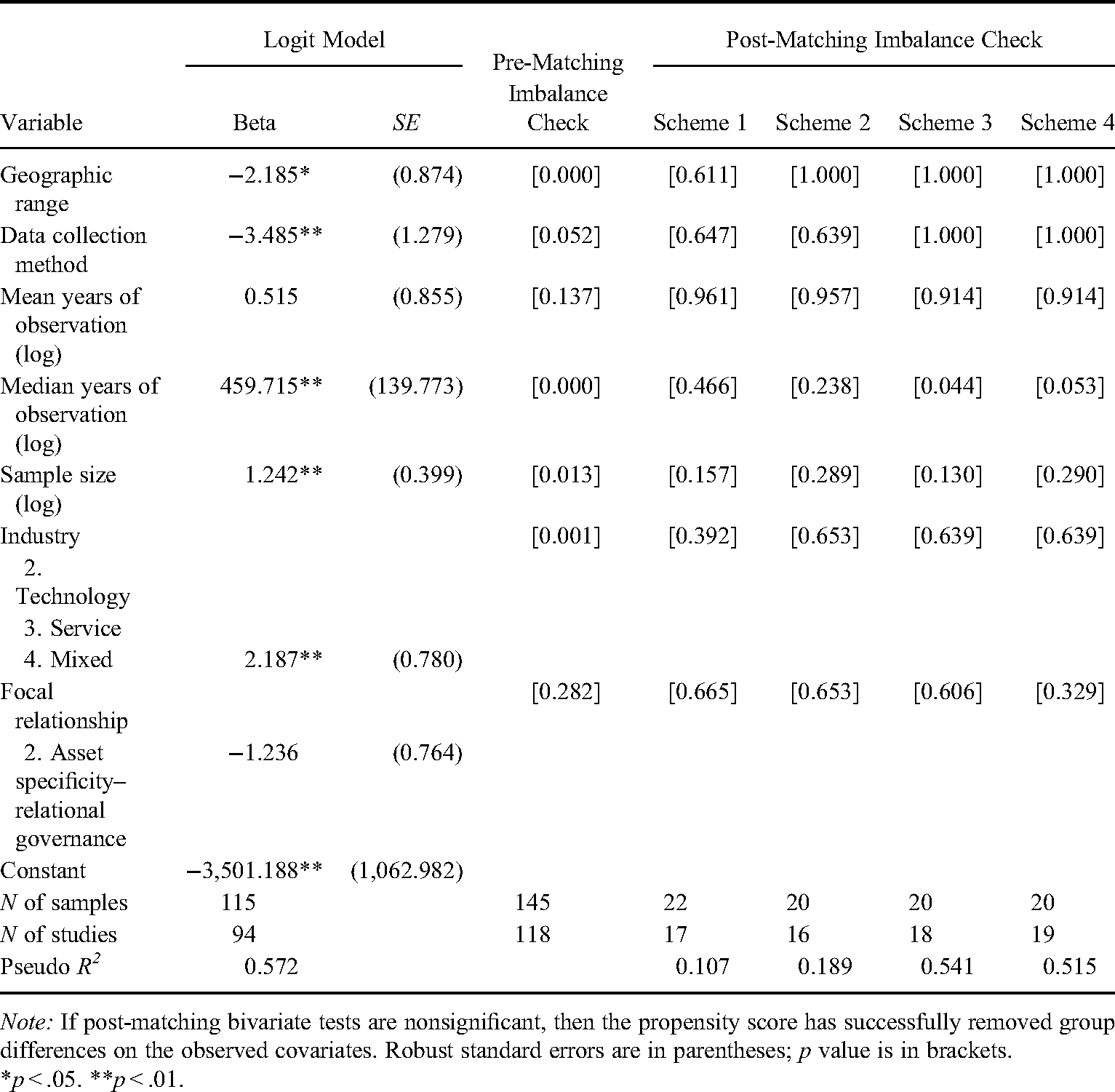
Note: If post-matching bivariate tests are nonsignificant, then the propensity score has successfully removed group differences on the observed covariates. Robust standard errors are in parentheses; p value is in brackets.
*p < .05. **p < .01.
Table 10 reports HOMA results for transaction cost theory based on matching Scheme 1. The mean effect size is considerably stronger in the United States than in China (U.S.: r = .12, p < .01; China: r = .06, p < .10). In terms of intervening mechanisms, the bivariate correlations of the matched U.S. and Chinese samples for asset specificity and hierarchical governance as well as relational governance are –.05 (p > .10) vs. .02 (p > .10) and .21 (p < .001) vs. .16 (p > .10). These results show that transactional hazards resulting from asset specificity are more likely to lead to the formation of relational governance in the United States than in China.
Hedges-Olkin Meta-Analytic Results: Transaction Cost Theory (Scheme 1)
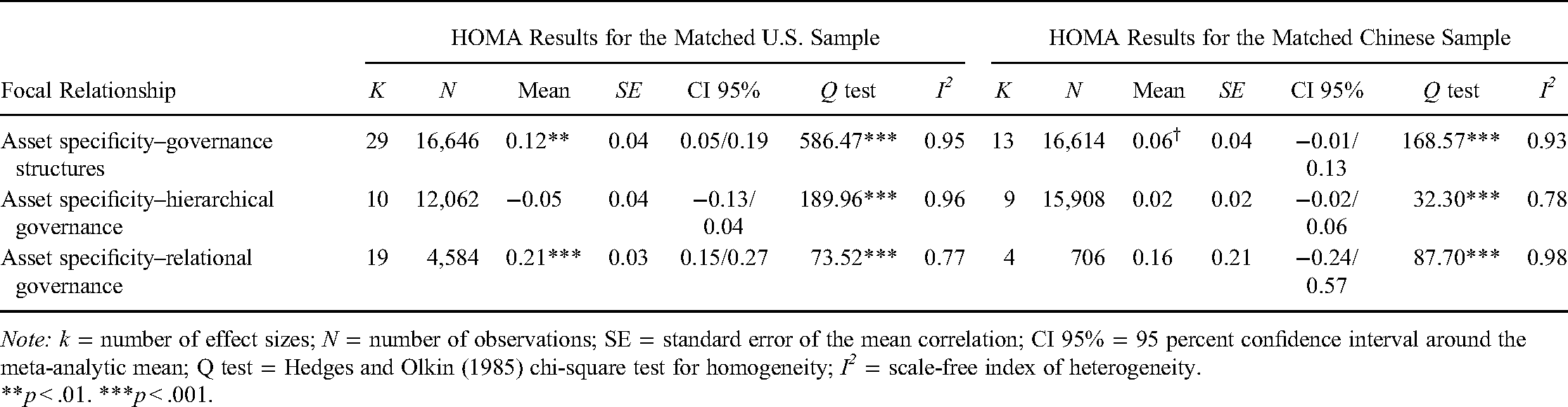
Note: k = number of effect sizes; N = number of observations; SE = standard error of the mean correlation; CI 95% = 95 percent confidence interval around the meta-analytic mean; Q test = Hedges and Olkin (1985) chi-square test for homogeneity; I2 = scale-free index of heterogeneity.
**p < .01. ***p < .001.
Applicability of Classic Management Theories in China
One objective of this study is to assess the applicability of the five classic management theories in the Chinese management context. We build on the MSMA results to explicate how these theories further our understanding of Chinese firms and managerial practices. This section serves as a prolegomenon to the contributions of CMS research to global management knowledge (Tsui, 2004, 2006, 2009), its purpose being to open contextual dialogues of our empirical findings, rather than to offer definitive answers (cf. Sætre & Van de Ven, 2021). Table 11 provides an overview of the MSMA results in relation to U.S.-China convergencies and divergencies as well as China-endemic explanations.
Theoretical Implications of Matched-Samples Meta-Analytic Results
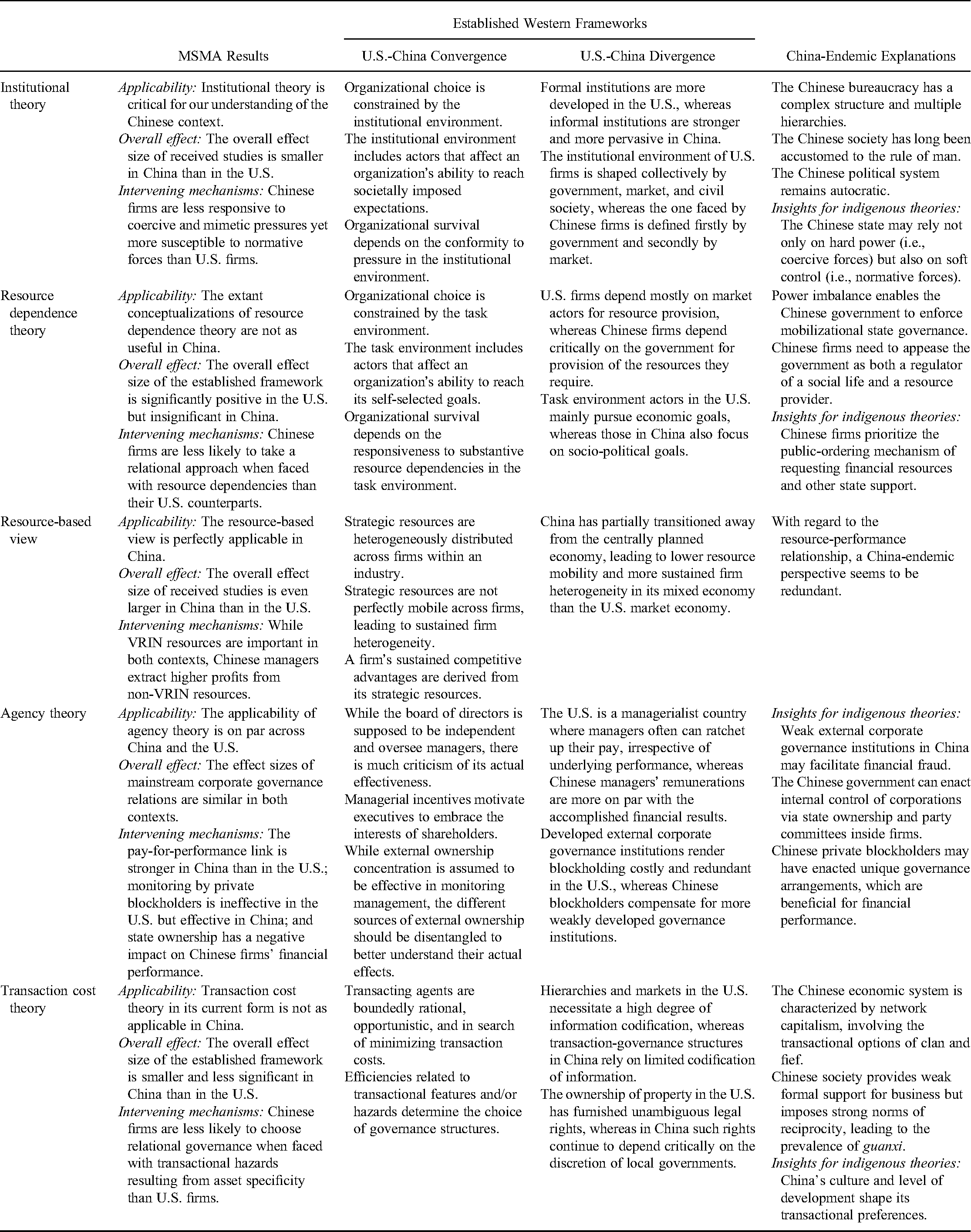
Applicability of Institutional Theory in China
From the MSMA results, we find that institutional theory is critical for our understanding of the Chinese context, for two reasons. First, its central tenets are applicable across both contexts: Organizational choice is restricted by the institutional environment; the institutional environment is inhabited by actors that impact an organization's behavior in relation to societal expectations; and an organization's survival depends on its conformity to institutional pressure (DiMaggio & Powell, 1983; Meyer & Rowan, 1977). Second, institutional theory is capable of accommodating contextual differences. Formal institutions (e.g., constitutions, laws, regulations) serve as the dominant isomorphic force in the United States (North, 1991). In contrast, informal institutions (e.g., traditions, cultures, political ideologies) are stronger and more pervasive in China (Li & Liang, 2015; Marquis & Qiao, 2020; Wang et al., 2019; Yiu, Wan, Chen, & Tian, 2021). Relatedly, the institutional environment of U.S. firms is collectively shaped by government, market, and civil-society actors (Greenwood et al., 2017; Scott, 2014), whereas the one facing Chinese firms is defined predominantly by government and secondly by market (Marquis & Bird, 2018; Yue, Wang, & Yang, 2019). Despite the varied institutions and institutional actors across contexts, its context-sensitive nature renders institutional theory an instrumental theoretical toolkit for explaining organizational isomorphism in China.
Nonetheless, the theory's predicted effects are weaker in China than in the United States. Notably, Chinese firms are less responsive to coercive and mimetic pressures yet more so to normative forces than their U.S. counterparts. This challenges the conventional wisdom that the Chinese government relies mostly on coercion due to its overwhelming influence (Liu, 2021; Xie, Shen, & Zajac, 2021; Zhang & Greve, 2018). We conjecture that the Chinese government does not rely on coercion alone but combines its “hard” power (i.e., coercive forces) with “soft” control strategies (i.e., normative forces) to generate more effective governance, for three reasons. First, the Chinese bureaucracy has a highly complex organizational structure and multiple levels of hierarchy (Chang & Wu, 2014; Child, Lu, & Tsai, 2007; Zhou, 2021). Since 1979, China has enacted a series of administrative and economic reforms (Lin, 2011; Nee, Opper, & Wong, 2007), leading to the decentralization of power but also to conflicting demands between the central state and local governments (Jia, Huang, & Zhang, 2019; Wang & Luo, 2019). Lower-level administrators may thus not faithfully enforce policies and directives from higher authorities and even form alliances to compromise the original intention behind state policies (Luo, Wang, & Zhang, 2017; Wang et al., 2018), engendering “collusion among local governments” (Zhou, 2010: 47). Decentralization may, therefore, push the central state to resort to complementary, informal control mechanisms. Second, Chinese society has long been accustomed to the “rule of man” (Huang et al., 2017: 358), where “the rule of law is weak and state bureaucrats retain power over the economy” (Haveman et al., 2017: 67). State bureaucrats not only uphold the formal policies issued by their higher-ups in government, but also rely on unwritten rules and expectations that are considered binding on business organizations in exchange for socio-political legitimacy (Marquis & Qian, 2014; Stevens, Xie, & Peng, 2016). The central state can make use of these informal forces emanating from local state bureaucrats by designing and adjusting its political evaluation system (Wang & Luo, 2019). Third, despite decades of reform, China's political institutions remain autocratic, allowing the central state to control individuals and organizations beyond “naked coercion” (Schatz, 2009: 208). Chinese firms and managers have a vested interest in the survival of the regime and therefore work for the benefit of the ruling party (Lee & Zhang, 2013; Levitsky & Way, 2010).
Recent CMS scholarship has shown tremendous interest in China's political institutions and the associated soft power. Raynard et al. (2020), for example, reported an inductive, longitudinal analysis of a small state-run factory transforming into a global leader in power equipment manufacturing. To theorize the state-owned enterprise (SOE) transformation that unfolded during China's economic transition away from Soviet-type economic planning, the authors built on the institutional change literature to frame China's institutional upheaval, emphasizing the unicity of this context: “Not only was the entire institutional fabric of society in flux, but basic assumptions about the purpose of economic activity were effectively rewritten” (Raynard et al., 2020: 1301). These authors unpacked the ways in which SOE managers use “values work”, “a category of actions directed at (re)articulating what is right or wrong, good or bad, in the design and operation of an organization” to mitigate the risks of enacting seemingly immoral organizational change (e.g., pay differentials), practices which were condemned in the orthodox socialist era (Raynard et al., 2020: 1301). This way of contextualizing and theorizing enables them to engage both Western and Chinese audiences, thereby making theoretical contributions to global management knowledge while maintaining relevance to indigenous management practices.
Applicability of Resource Dependence Theory in China
We also find that resource dependence theory in its current form is less useful in China. The overall effect size is significantly positive in the United States but insignificant in China. This might be because extant conceptualizations stop short of considering the type of power-dependence relations in Chinese society. According to resource dependence theory, organizational choice is constrained by the task environment and subject to the logic of consequentiality (Pfeffer & Salancik, 1978). But whereas U.S. firms are mostly dependent on resources supplied by market actors (Ahuja, 2000; Gulati, 1998; Mizruchi, 1996), Chinese firms are also critically dependent on the resource-provision role of government (Marquis & Qian, 2014; Zhang, Marquis, & Qiao, 2016). Extreme power imbalance between the public and private sectors allows the Chinese government to enforce “mobilizational” state governance (Zhou, 2012, 2013), ranging from the Great Leap Forward launched by Mao Zedong to the Great Rejuvenation of the Chinese nation initiated by Xi Jinping. Since this type of state governance prevails over all other considerations, it can pose tremendous pressure on the firms involved in the mobilization (He, Wang, & Zhang, 2020; Wang et al., 2018). Since the task and institutional environments substantially overlap in China, Chinese firms are inevitably forced to accommodate both the logic of consequentiality and of appropriateness in coping with resource dependencies (Li & Lu, 2020; Luo et al., 2017; Wang et al., 2018). In China, the government is not only the regulator of social life but also the main resource provider. Meeting governmentally imposed expectations is therefore not just a goal onto itself but also an intermediate goal towards substantive performance for Chinese firms (cf. Drees & Heugens, 2013). As such, while organizational survival still requires responsiveness to resource dependencies, the countermeasures Chinese firms will deploy are likely to be distinct from those used by U.S. firms.
This China-endemic explanation renders the counterintuitive MSMA results understandable: The private-ordering option of corporate tie formation (e.g., alliances, joint ventures, and M&As) may not help Chinese firms to cope with their dependence on the government. To mobilize critical resources, Chinese firms need to invoke the public-ordering mechanism of requesting resources from the state (Haveman et al., 2017; Jiang, Jia, Bai, & Bruton, 2021; Liu, 2021; Yu, Zhang, Tan, & Liang, 2021). CMS scholars have explored some strategies that are useful in this regard, such as business-state ties and fraudulent means. Haveman and associates (2017: 67), for instance, found that developing relationships with state bureaucrats enables Chinese firms to develop mutual trust, which “help[s] persuade bureaucrats to lighten regulatory burdens, grant firms access to state-controlled resources, and improve government oversights.” Relatedly, through an investigation of Chinese high-tech firms’ patenting activities, Wang, Stuart, and Li (2021 : 269) concluded that “Fraud appears to pay in the context of China's state innovation subsidy program.” These studies instigate us to rethink the ways in which Chinese firms can regain autonomy by proving their worth to the ultimate regulator of both social life and the economic domain.
Applicability of the Resource-Based View in China
We find that the resource-based view has high application value in China, where its explanatory power is even stronger than in the United States. Whereas VRIN resources are important in both contexts, Chinese firms squeeze higher profits from unremarkable non-VRIN resources. This can probably be attributed to China's incomplete transition to a market economy, leading to more sustained firm heterogeneity in its mixed economy (He, Tong, & Xu, 2021; Huang et al., 2017). Over the past four decades, China has implemented a series of economic reform and open-door policies to bolster its economic development (Lin, 2011; Nee et al., 2007). Nevertheless, this transition seems not to arrive at a free market economy but a mixed economy where the state still retains substantial control (Musacchio, Lazzarini, & Aguilera, 2015; Wu, Eesley, & Yang, 2021; Xu et al., 2014). Many characteristics of the former state-command economy are still alive in today's Chinese economy, such as Soviet-style 5-year plans (Li & Lu, 2020; Wang et al., 2018) and multilevel state capitalism (Arnoldi, Villadsen, Chen, & Na, 2019; Genin, Tan, & Song, 2021; Zhou, Gao, & Zhao, 2017). Even though economic reforms have given rise to an increasingly open market (Duanmu, Bu, & Pittman, 2018; Xia & Liu, 2017), these characteristics continue to prevent the efficient distribution of strategic resources across firms and hinder the mobility of strategic resources in the market (cf. Barney, 1991). Strategic resources are, therefore, more likely to yield sustained competitive advantages in China than in the United States. Since the resource-based view has been able to accommodate U.S.–China differences, the scope for a China-endemic theorization of the resource-performance relationship appears limited.
Applicability of Agency Theory in China
We also find the applicability of agency theory is on par across China and the United States. First, the results for monitoring mechanisms render support to the criticism against the effectiveness of corporate boards in both contexts. Although independent monitoring was originally considered to be an effective way of overseeing managers (Fama & Jensen, 1983a, 1983b), there has been much criticism of monitoring mechanisms’ negative impacts on efficient decision-making (Dalton & Dalton, 2011; Krause et al., 2014). While empirical findings about CEO duality and outside directors in the United States are mixed, the evidence from China is also largely inconclusive (Chen, Li, & Shapiro, 2011; Peng, Li, Xie, & Su, 2010; Peng, Zhang, & Li, 2007). Second, managerial incentives have shown to be an effective instrument to mitigate managers’ self-interest in both contexts. Even though institutions matter to the functioning of alignment mechanisms (Mutlu et al., 2018; van Essen, Heugens, Otten, & van Oosterhout, 2012), performance-based compensation helps managers in both contexts to embrace the interests of shareholders. Third, evidence on the role of concentrated external ownership remains inconclusive in both China and the United States, suggesting that it might be important to differentiate between public and private blockholders and institutional investors in order to compare their respective motives and means to monitor management.
Some noticeable differences exist as well. First, the pay-for-performance link is considerably stronger in China than in the United States, possibly because the United States is a more “managerialist” country than China. While U.S. managers can ratchet up their pay, irrespective of the underlying performance—helped by strong market intermediaries such as pay consultants—and form an elite class of their own (Mizruchi, 1983, 1996; Useem, 1980), Chinese managers are not equally powerful and their remunerations are more tied to accomplished financial results (Du & Choi, 2010; Hu & Xu, 2021). Another salient difference is monitoring by private blockholders, which is an ineffective mechanism in the United States but an effective one in China. It is of critical importance, since “[t]he origin of corporate governance in China springs from the existence of large controlling shareholders” (Jiang & Kim, 2020: 734). Our findings point to the less-developed external corporate governance institutions (e.g., banks, market authorities, ministry of finance, and courts) in China. Such institutions are strong in the United States, making blockholding costly and redundant. By contrast, such institutions are relatively weak in China, making it rewarding for blockholders to monitor managers themselves (Li et al., 2015b). One further difference is the negative relation between state ownership and financial performance in China, suggesting that state ownership impairs corporate profitability. This is worthy of discussion, because it casts doubt on the recent viewpoint that Chinese SOEs have become strategic players, well-equipped to face “the new realm of corporate governance” (Mutlu et al., 2018: 946). Since “SOEs currently account for one-third of firm numbers but two-thirds of market capitalization” (Jiang & Kim, 2020: 735), this begs the question of resource efficiency. Collectively, these differences call for a more nuanced theorization of corporate governance in the Chinese management context.
Applicability of Transaction Cost Theory in China
We find that transaction cost theory in its current form is not as applicable in China as it is in the United States. In fact, the ability of a unidimensional markets–hierarchies continuum to adequately capture transaction options in non-Western settings has long been questioned in the literature (e.g., Boisot, 1986; Boisot & Child, 1988, 1996; Nee, 1992). The extant literature has identified two major divergencies between China and the United States. First, hierarchies and markets in the United States require a high degree of information codification, yet transaction-governance structures in China rely on limited codification of information (Boisot & Child, 1988; Ouchi, 1980). Second, whereas the ownership of property in the United States has furnished unambiguous legal rights, such rights in China continue to depend critically on the discretion of local governments (Boisot & Child, 1996; Nee et al., 2007). These contextual divergences imply the transactional options of “clan” and “fief” in the Chinese system, which cannot simply be seen as an intermediate state between markets and hierarchies. To better understand the transactional options available in the Chinese context, therefore, the current markets and hierarchies framework of transaction-cost theory needs to be reconceptualized.
Culture and level of development have been regarded as two critical factors shaping transactional preferences in China (Boisot & Child, 1988, 1996). An important concept capturing these two factors is guanxi, which has been used to understand the prevalent use of personalized relationships to address transactional hazards in Chinese society, where legal support for business development is significantly underdeveloped yet norms of reciprocity are deeply rooted (Park & Luo, 2001; Peng & Luo, 2000; Xin & Pearce, 1996). Decades of research have been devoted to the relative effectiveness of guanxi activities (cf. Chen, Chen, & Huang, 2013; Luo, Huang, & Wang, 2012). A more recent line of research has explored the antecedents of guanxi activities and found this choice to be determined by individual-, firm-, and institutional-level factors (e.g., Bu & Roy, 2015; Karhunen, Kosonen, McCarthy, & Puffer, 2018; Li, Wei, Cao, & Chen, 2021; Nee, Holm, & Opper, 2018; Opper, Nee, & Holm, 2017). Opper et al. (2017) proposed that while guanxi activities can protect the firm from serious risks, they are also inherently costly, such that the level of guanxi activities must be determined by a careful trade-off between risk and return. Relatedly, Nee et al. (2018) questioned the sharp distinction between personalized relationship and generalized trust, showing that the level of trust Chinese entrepreneurs display in interacting with strangers is associated with their prior experience in relational exchange. Transaction cost theory is, therefore, less capable of accounting for the processes whereby Chinese transactors balance transaction costs and governance costs. In addition, the Chinese term guanxi itself is a highly complex construct that is difficult to capture (Li, Zhou, Zhou, & Yang, 2019). This calls for further theoretical development unpacking the role of culture and level of development in shaping the choice between guanxi and other transactional options available in China.
Focused Literature Review of China-Endemic Studies
While traditional Western lenses are important for understanding the Chinese context, they cannot completely account for the specificities of Chinese firms and managerial practices. This points to a need to develop complementary, China-endemic explanations. We identify three emerging strands of China-endemic theorizing. Political institutional imprinting theory is developing into an indigenous lens for understanding the soft power of political institutions in China. State-driven sustainable development focuses on explicating how the shift in government priorities drives corporate socio-environmental actions. China-endemic corporate governance offers a more nuanced understanding of Chinese firms’ corporate governance practices.
Political Institutional Imprinting Theory
Political institutional imprinting theory is rooted in China's historical trajectory. China has a long history, which has produced wide acceptance of a dominant role of the state and aversion toward capitalism. While these historical roots have created a breeding ground favoring today's practices (Li & Liang, 2015; Smith & Kaminishi, 2020), the strong guidance of the Chinese Communist Party (CCP) over the past 70 years (1949-present) has left a strong imprint on the Chinese economy (Marquis & Qiao, 2020; Wang et al., 2019). The historical development of CCP-led China becomes unintelligible if abstracting from the transformative power of Sino-communist ideology (cf. Mulvad, 2019). Despite a high level of administrative continuity under the CCP, contemporary China has witnessed several fundamental political-ideological transitions: from Mao Zedong's utopian-egalitarian universalism (1957–1976), via economic modernization in Deng Xiaoping's spirit (1978–2012), to most recently Xi Jinping's common prosperity (2012–present). This transformative power characterizes Chinese society and the associated complexity and malleability of its political institutions (Liu, Heugens, & Wijen, 2020; Luo et al., 2017; Wang et al., 2018). By combining insights from the MSMA results for institutional theory with elements drawn from imprinting theory (e.g., Stinchcombe, 1965), political institutional imprinting theory argues that autocratic governments can affect organizational behavior through cognitively experienced political imprinting. By complementing Western organizational institutionalism, the theory offers a framework for understanding the unique political embeddedness of Chinese firms and managers.
Most studies taking a political institutional imprinting perspective focus on the transition from Maoism to Dengism (e.g., Marquis & Qiao, 2020, 2021; Raynard et al., 2020; Wang et al., 2019; Wang & Luo, 2019; Xu et al., 2021). From the establishment of its basic socialist institutions (1957) to Mao's death (1976), China adhered to Marxism-Leninism and sought to abolish private ownership of capital goods and to overthrow the capitalist world system (Wang, 1999). This hegemonic vision generated three types of enduring influence on organizations and individuals with prior exposure to intense ideological experiences. First, Mao's imaginary of class struggle between proletarians and capitalists and the related Great Proletarian Cultural Revolution (1966-1976) affect the ways in which ideologically vested individuals, especially the generation of “children of the cultural revolution” (Zhou & Hou, 1999: 12), perceive capitalism. Wang et al. (2019) found that government officials who joined the Party in Mao's era were socialized into orthodox communist ideology, rendering them more reluctant to engage with entrepreneurs, as the latter were viewed as domestic capitalists. Chinese entrepreneurs thus had to resort to external support, such as international business transactions (Lu & Xu, 2006; Zhao & Ma, 2016). Interestingly, Marquis and Qiao (2020) showed that even Chinese private entrepreneurs who were politically imprinted at an early age also perceived foreign capitalist countries as evil. In a similar vein, recent work by Xu et al. (2021) unveils that corporate leaders who were influenced by Maoist ideology advocated the spirit of unselfishness and viewed private ownership as a sin, thus engaging less in patent applications and more in patent infringement.
Second, the communist model of serving the public interest is still alive in government bodies and business organizations. In Maoist China, the national economy was strictly state-planned and the central state assumed all economic rights, in which the state-led economic model “considers the public interest as comprehensive input into the system” (Adizes & Weston, 1973: 114). This system profoundly impacted the individuals, organizations, and regions of today's China. At the individual level, orthodox communist imprints facilitate the development of entrepreneurs’ prosocial mindset (Jiang, Zalan, Tse, & Shen, 2018) and motivate them to act on public policies (Dai, Liu, Liao, & Lin, 2018). Communist imprints also have an enduring impact on government officials (Liang, Wang, & Zhu, 2020; Wang & Luo, 2019). For instance, as compared to provincial governors, leaders of provincial party committees more consistently prioritize social stability across their career and encourage firms to employ SOE employees who lost their jobs (Wang & Luo, 2019). At the organizational level, SOEs founded during the communist era maintain their state logic in the market reform era, as evidenced through continued prolabor policies and welfare practices (Han & Zheng, 2016, 2019; Han, Zheng, & Xu, 2014; Marquis & Qian, 2014) and government director appointments in corporate boards (Wei, 2017). At the regional level, political legacies are embedded in local institutional infrastructures and spawn variations in firms’ environmental or social actions (Marquis & Qian, 2014; Raynard, Lounsbury, & Greenwood, 2013).
Third, economic ramifications of Mao's focus on autarky—that is, local self-sufficiency through the people's communes and the Great Leap Forward—shape managerial risk preferences and corporate financial strategies. Starting from the ruins of the civil war in 1949, the domestic growth model of Maoist China relied predominantly on state-led industrialization and collectivization. Numerous urgently needed resources were withdrawn from the agricultural sector and diverted to industrial production, which, however, failed to produce qualified industrial products (Fan, 1997; Wang, 1999). Consequently, the three years of the Great Chinese Famine (1959-1961) had accustomed Chinese entrepreneurs and SOE managers to the norm of frugal management: valuing strategic resources and minimizing resource losses (Hu, Long, Tian, & Yao, 2020; Lai, Morgan, & Morris, 2020; Long, Tian, Hu, & Yao, 2020; Marquis & Qiao, 2021). For example, Long et al. (2020) found that firms led by CEOs who experienced the Great Chinese Famine in early life have lower stock-price crash risks than those with CEOs who did not. Hu et al. (2020) showed that CEOs who bore this imprint opted for more conservative accounting policies, especially in uncertain environments. Finally, Marquis and Qiao (2021) offered a more nuanced understanding of how Chinese private entrepreneurs’ resource scarcity imprinting affects their resource use. The idea of frugal management also resonates with the MSMA results for the resource-based view, which show that Chinese firms run a given resource base more efficiently.
Little scholarly attention, however, has been paid to the role of Dengism and Xiism in shaping China's contemporary institutional landscape. Marquis and Qiao (2020) and Xu et al. (2021) indicated that when the Chinese government lost faith in orthodox Marxist communism, entrepreneurs’ communist ideological imprints that characterized capitalism as evil began to decay. Relatedly, by spotlighting the corporate control function of state political ideology, Liu et al. (2020) demonstrated that since his ascent to power in 2012, President Xi has exercised informal state control over corporate practices by reinterpreting the labels and meanings of the prevailing political ideology of Chinese society. It enables the Chinese government to align corporate behavior with public policy goals by actively exerting ideological pressure.
State-Driven Sustainable Development
As our MSMA results for resource dependence theory suggested that Chinese firms prioritize the public-ordering mechanism of requesting state support, we formalize a state-driven sustainable development theory. This endemically Chinese perspective is triggered by the shift in the government's priorities from unbridled economic expansion towards sustainability. From 1978 until 2012, policies aimed at developing the economy have led to phenomenal economic growth and significant welfare increases for most Chinese citizens. These achievements have, however, taken a heavy environmental and social toll. Natural resources are rapidly depleting, forcing China to import ever more energy, ores, and other resources (Zhang & Cheng, 2009). Furthermore, the pollution of land, water, and air continues to increase, threatening the livability of major Chinese cities (Liang & Yang, 2019; Wang, Li, Fang, & Zhou, 2016). Likewise, the uneven spread of economic affluence between and within regions has seriously challenged social cohesion (Chen & Fleisher, 1996; Fleisher, Li, & Zhao, 2010). This raises important questions about the sustainability of the Chinese model. In late 2012, Xi Jinping came into power and altered the one-sided promarket vision by highlighting common prosperity and better social and environmental performance (Economy, 2018). In the words of Mulvad (2019: 458), “[t]he task of rebalancing development is no longer secondary to furthering growth but has become the primary, existential challenge for the CCP and the defining problem of Xiism.” This shift in government priorities renders corporate environmental management and social responsibility (CSR) more state driven in Xiist China.
Meanwhile, Chinese firms are confronted with the question of how to allocate scarce resources to address government pressure associated with environmental and social challenges. Rapidly diverting resources from production and operations to socio-environmental practices might thwart profit imperatives and even threaten organizational survival (He et al., 2020; Wang et al., 2018). Yet Chinese firms depend critically on the government for the provision of requisite resources (Haveman et al., 2017). They also seek sociopolitical legitimacy from the state, rather than from market or civil-society actors (Chen, 2007; Stevens et al., 2016). When faced with resource scarcity, Chinese firms are also less likely to resort to the private-ordering mechanism of corporate tie formation than to the public-ordering solution of requesting resources from the state (Wang et al., 2021). This power-dependence relation enables the Chinese government to force local firms heavy-handedly to go beyond primary business considerations.
CMS scholars have developed two indigenous frameworks explaining how Chinese firms enhance CSR or environmental action in response to government pressure: the multifaceted state influence model (Li & Lu, 2020; Luo et al., 2017; Wang et al., 2018; Wang & Luo, 2019) and the political dependence model (Ge & Zhao, 2017; Ji, Huang, & Li, 2021; Jia & Zhang, 2013; Marquis & Qian, 2014; Zhang et al., 2016; Zhang, Xu, Chen, & Jing, 2020). The former captures conflicting socioenvironmental demands emanating from the central and local governments. China's economic reform has resulted in “a regionally decentralized authoritarian system” (Xu, 2011: 1076), in which the central government maintains political control while local governments enjoy high economic discretion (Choi, Jiang, & Shenkar, 2015; Jia et al., 2019). Where the central government has recognized the societal and environmental challenges facing China, local governments still tend to exclusively focus on economic development (Child et al., 2007; Qi, Ma, Zhang, & Li, 2008). Luo et al. (2017) found that provincial governments’ high priority given to short-term GDP growth conflicts with the central government's expectations on CSR reporting. Wang et al. (2018) showed that Chinese firms controlled by both highly central and very decentral government bodies are less likely to engage in environmental action than those under the jurisdiction of intermediary administrative branches. Regional disparities in government demands can also be explained by officials’ concerns over their promotion to the central government, such as political contestability and career horizon (Li & Lu, 2020) and desires of peaceful retirement (Wang & Luo, 2019). Political opportunism implicit in China's water quality monitoring system is an archetypal example. Since political promotion is linked to water quality assessments yet monitoring stations record only upstream pollutant emissions, local government officials tend to enforce more stringent environmental standards on firms located upstream from monitoring stations than those located downstream (He et al., 2020).
The political dependence model stresses the influence of firms’ dependence on the government on their motivations for engaging in socio-environmental actions. Marquis and Qian (2014) examined differentiated effects on CSR reports of four political dependence sources: political connections, private or government ownership, political legacy, and financial resources. Zhang et al. (2016) further distinguished between ascribed and achieved political connections, showing that ascribed connections—that is, executives holding government positions—buffer firms from donation pressures by the government, whereas achieved connections—that is, executives serving on political councils—bind firms to government pressure and enhance donation. Ge and Zhao (2017) found that firms with ascribed connections tend to engage in more visible external CSR practices, whereas those with achieved connections adopt more internal CSR actions. Relatedly, Li and Lu (2020) showed that firms are more likely to respond to government pressure by making advances in CSR when politically connected CEOs have greater concerns for legitimacy. In addition, corporate philanthropy is also considered instrumental in regaining political legitimacy after harm-inflicting decisions (Ji et al., 2021) or fraud punishment (Zhang et al., 2020).
China-Endemic Corporate Governance
Corporate governance in China has experienced three institutional transitions: the privatization of SOEs and the introduction of SOE laws in the 1980s; the launch of the Shanghai and Shenzhen Stock Exchanges, company laws, and security laws in the 1990s; and the introduction of listed firms’ corporate governance codes and revision of corporate laws from 2000 onwards (Jiang & Kim, 2015; Mutlu et al., 2018). Despite increasing convergence to international standards, corporate governance legislation and enforcement are still lacking, which exacerbates corporate fraud in China (Chen, Firth, Gao, & Rui, 2006; Yiu, Wan, & Xu, 2019; Yiu, Xu, & Wan, 2014). Scrutinizing private Chinese technology firms’ financial statements, Stuart and Wang (2016) observed that more than half of the sampled firms engage in fraudulent financial reporting. The prevalence of financial misdemeanors was aggravated by low penalties and viable ways to regain legitimacy after committing fraud. Zhang et al. (2020) found that after being penalized by the government, Chinese firms often resort to corporate philanthropy to regain legitimacy. Bao, Zhao, Tian, and Li (2019: 809) showed that political connections and interlock networks lighten penalties and transform fraudulent Chinese firms “from financial misdemeanants to recidivists.” Furthermore, fraudulent firms treat inappropriately secured resources, such as state-funded innovation grants, as unearned gains and often invest them in symbolic innovation projects (Wang et al., 2021).
As compared to weak external corporate-governance controls, the Chinese government has enacted strong internal controls of corporations. These are enforced via the voting rights on shares owned by the state and through the decision-making right of the party committee inside the firm. First, state ownership continues to thrive in China and plays a critical role in the corporate sector (Bruton, Peng, Ahlstrom, Stan, & Xu, 2015). Unlike profit-seeking firms, Chinese SOEs mainly serve to support the government's policy agenda, such as maintaining high employment levels (Raynard et al., 2020; Shinkle & Kriauciunas, 2012; Wang & Luo, 2019), securing access to international markets (Liang, Ren, & Sun, 2015; Luo, Xue, & Han, 2010; Pan et al., 2014; Wang, Cui, Vu, & Feng, 2022), and offsetting competitive disadvantages in global competition through clustering R&D (Genin et al., 2021; Jia et al., 2019; Zhou et al., 2017). Second, the CCP's grip on the corporate sector has been tightened since 2013, when the Chinese government embarked on a series of SOE reforms to strengthen the “mixed ownership” strategy, which encourages private capital to invest in SOEs and help mitigate agency problems. To counterbalance the introduction of private capital investment and formalize the leadership role of the CCP in firms, the Chinese government launched the “party building” initiative in 2015. By 2018, around 90% of SOEs and 6% of private-owned firms listed on Chinese public stock exchanges have incorporated party-building provisions in their corporate bylaws (Lin & Milhaupt, 2021). A recent study finds, though, that formalization of the Party's leadership increases the risk of political influence and undermines corporate value (Lin, Guo, & Chen, 2019).
In contrast to the negative performance implications of government blockholding and political influence, Chinese private blockholders tend to monitor managers more effectively, through an elaborate shareholder structure (Luo, Wan, Cai, & Liu, 2013), psychological ownership (Zhu, Chen, Li, & Zhou, 2013), a family-owned business group (Chen, Arnoldi, & Na, 2015), family involvement in middle management (Hu, Zhang, & Yao, 2018), and/or strong nonkin relationships (Liang, Wu, & Zhang, 2018). Private blockholdings also generate agency problems, however, between controlling and noncontrolling shareholders, between controlling shareholders and the family, and between shareholders and creditors (Villalonga et al., 2015). These problems entail unique governance arrangements. For instance, work on family firm succession by Huang, Chen, Xu, Lu, and Tam (2020: 710) demonstrates that the power-transfer paradox of both empowering and dominating child-successors, which is rooted in ancient Chinese patriarchal monarchies, is still alive in Taiwan and mainland China, as “parent-incumbents tend to exert generational coercive control when their child-successors are seen as very unwilling and incapable or very willing and capable of taking over patriarchal family organizations.” Relatedly, a study of seven family firms by Li and Piezunka (2020: 314) showcases the influence of role transitions on intergenerational leadership successions, suggesting that a succession is more likely to be successfully completed when the mother is active in the family but not the firm as this “allows the mother to help the founder and successor maintain their existing family roles and interactions while transitioning into new roles in the firm.”
Future Research Directions
These strands of indigenous theorizing are still under development and harbor promising avenues for future research. We identify research opportunities in three areas: autocratic governments, impact of past on future actions, and generalizability of indigenous theories.
Autocratic Governments
The autocratic rule of the Chinese government is one of the most salient characteristics distinguishing China from Western countries and driving the emergence of China-endemic studies. A first opportunity is to investigate how the Chinese government seeks to accomplish the “Two Centenary Goals.” By 2021, the centennial of the founding of the CCP, China aimed to have eliminated extreme poverty and reach an average middle income with equivalent improvement in overall living standards. Open questions are what role local firms play in meeting these targets and whether the Chinese government would close the chapter on high-speed growth and move on to high-quality development. By 2049, the centennial of its founding, China wants to stand on the frontier of science and technology, achieve moderately advanced income levels, and become influential internationally. Future research could explore the way in which Xi's hegemonic projects and the associated 5-year plans champion the 2049 goal. In what way does Xi's Chinese Dream reshape China's global view of the capitalist world economy? What motivations underlie Xiist China's major economic initiatives, including the Belt and Road Initiative, Made in China 2025, China Standards 2035, and the Digital Silk Road Initiative? To what extent will Xiist hegemony affect Chinese and non-Chinese firms, and how should they react?
These major economic initiatives spotlight China's decoupling strategy in the domestic market and coupling strategy in international markets. Made in China 2025 sets market-share targets for indigenous firms, and China Standards 2035 aims at establishing China as a global standard setter for cutting-edge technologies such as artificial intelligence and 5G telecommunication. Whether and to what extent will China's decoupling strategy reduce its dependence on foreign markets for provision of critical products and technologies? And what strategic shifts will domestic and foreign firms, respectively, entail for a decoupled future in the Chinese market? On the other hand, the goals of the Belt and Road Initiative are focused on building connection, cooperation, and integration with the countries involved, and those of the Digital Silk Road Initiative are to complement the Belt and Road Initiative by promoting digital infrastructure. In what way will China's coupling strategy reshape Chinese firms’ competitiveness, internationalization strategies, and business models, and how should foreign firms within and outside the nations involved respond to possible changes in international trade rules? Moreover, as these initiatives serve as integrative parts of China's overall approach, what fundamental impacts will their combination have on the world economic order?
Sustainable development is likely to remain one overarching topic on China's economic agenda for the next few decades (e.g., China's 2060 carbon neutral goal). Despite the increasing attention paid to the role of the government in promoting the sustainability of the Chinese model, we still insufficiently understand the types of institutional arrangements that can most effectively accommodate economically, environmentally, and socially sustainable business operations. Future research could shed light on the following questions: Should the central government continue to play a leading role in securing natural resources and containing pollution as well as maintaining social cohesion, or should it delegate these important policy issues to local governments to accommodate local conditions? What environmental and social practices will business organizations voluntarily assume, either on an individual basis or through industry self-regulation? Should Chinese civil society assume a larger and more independent role? Should China embrace the same institutional arrangements as those in Europe and North America, where environmental and social policies have been implemented for several decades, or should it develop institutions germane to the Chinese situation?
Impact of Past on Future Actions
There is a need to rethink the complexity and malleability of China's political institutions. While Maoism remains a major source of political imprinting, Dengism and Xiism become increasingly salient in defining the prevailing political ideology of Chinese society. Future research could explore how these more recently created political ideologies reconceptualize what is politically right or wrong and morally good or bad in China and how these ideological changes redirect social expectations towards local firms. Researchers could unpack the black box of the persistence and discontinuity of Mao's dream, the decay and reamplification of Deng's spirit, the formation and interpretation of Xi's vision, as well as the ways in which multiple sources of political imprinting conflict, coexist, and coevolve. Critical questions include: How does Dengist imprinting affect the generation of Chinese entrepreneurs and SOE managers who have become the dominant corporate decision makers in contemporary China? How do these politically imprinted corporate elites respond to the legacy of Maoism and the rise of Xiism, and will they also act as institutional entrepreneurs who actively define China's future institutional landscapes?
A related interesting area for future research is the impact of Chinese cultures: “Within China, there are five major schools of philosophy; four locally developed (Confucianism, Taoism, Legalism, and Militarism) and one imported (Buddhism)” (Barkema et al., 2015: 462). Future studies could unpack the ways in which these traditional cultures persist and diffuse in Chinese society and how they shape corporate governance and strategy (Park, Zhang, & Keister, 2020). It would be important to factor in political institutions’ influence, as the formation of dominant cultural values in the Chinese context never seems to be independent from the government and its political leadership. Furthermore, it would be interesting to more deeply study how the inflow of Western cultural values, such as via Chinese returnees from abroad (Luo, Chen, & Chen, 2021), affects corporate behavior and the impact of the countermeasures the Chinese government has employed to blockade Western values (Zheng & Wang, 2020). Owing to the growing importance of international business, additional meaningful contributions can be made by exploring foreign investors’ perception, intercultural translation, and cultural entrepreneurship (Jean, Kim, Zhou, & Cavusgil, 2021; Park & Zhang, 2020). How should foreign investors understand and tap into Chinese business models and market opportunities? When going public in advanced economies, will the prevalence of financial fraud suppress the quality of Chinese firms’ financial reports and produce unfair valuations, and if so, how should they mitigate risks of distrust and reshape investor perceptions? Will Chinese corporate practices and cultural values diffuse in the West and influence Western firms?
Generalizability of Indigenous Theories
A key question in the CMS field is: Can certain China-endemic theoretical lenses be applied to non-Chinese contexts? This question is worthy of careful thought, as it is critical for elucidating the role indigenous ideas assume in theory building (Banerjee, 2021; Bruton, Zahra, Van de Ven, & Hitt, 2021; Filatotchev, Ireland, & Stahl, 2021). Indigenous theorizing emerges as a way of knowing that is contrasted to the Western-based mainstream, but this dichotomous view may limit contributions of non-Western theories to global management knowledge (Barney & Zhang, 2009; Child, 2009). In fact, “[i]t is fair to say that the bulk of organizational and managerial theories informing scholarship conducted within the USA would be classified as context specific” (Whetten, 2009: 32). However, this body of “indigenous” scholarship has been characterized as acontextual by many scholars outside the United States, and its insights have been directly applied to many other contexts. This hinges on the assumption that the insights can, at least partially, be generalized to other market economies—an assumption that may be challenged. It also suggests that our current theoretical toolkits are not a panacea, and they may not apply in autocratic contexts or in settings where the informal economy is dominant.
We share organization theorists’ unease “with one-sided invitations into the Northern mainstream, as well as with Southern critics’ retreat into indigenous enclaves of organizational scholarship” (Hamann et al., 2020: 1). We maintain that China-endemic studies are not inherently China-specific but potentially generalizable to non-Chinese contexts. Yet it would be difficult to adequately cognize the generalizability of indigenous theories in the very beginning. Consider, for instance, the line of guanxi research. Initially, CMS scholars created their own term for the conceptualization of personalized relationships in Chinese society, which has long been accustomed to norms of reciprocity (Tsui, 2009). Later, scholars outside China have gradually realized that the conception of guanxi is rooted in local social capital and that similar relational systems also exist in other societies. As documented by Child (2009), Brazil has jritinho, Hungary has uram batyam, Russia has blat, and good old boys networks abound in the U.S., Japan, and elsewhere.”
A meaningful area for future inquiry, therefore, is to explore the applicability of China-endemic lenses in non-Chinese contexts, especially in other autocratic contexts. The core tenet of political institutional imprinting theory is that autocratic governments can serve as an ideological imprinter. Likewise, the backbone of Chinese sustainable development theory is that firms depend on the government for provision of resources and political legitimacy in autocratic contexts. And the Chinese take on corporate governance also highlights state control in the corporate sector. In fact, a large share of the world economy operates at the nexus of corporatism and autocracy. A large part of the world's political order is autocratic, historically or currently, with political power residing in the hands of a dominant political party, military regime, or monarchy (Magaloni & Kricheli, 2010). In recent years, autocracy as a political system has been on the rise (by 55%; Economist Intelligence Unit, 2021). The economic reach of autocratic regimes has become increasingly large as well. In 2020, nearly one quarter (24%) of the Forbes Global 2000 largest public companies were held and operated in nondemocratic countries and territories, representing a 6% increase over the past decade. These companies generated a total of USD 9.51 trillion in revenues and USD 0.58 trillion in profits in 2019. As such, autocratic countries represent a highly relevant context in which to test and extend the theories derived from China.
Conclusion
We examined the extent to which Western management theories are applicable in non-Western contexts. Our MSMA of Chinese and U.S. firms demonstrated the existence of contextually varying differences across mean effect sizes and underlying mechanisms. We attributed China's autocratic state and political ideology as the overarching drivers of the marked organizational and managerial differences across both countries. Building on the meta-analytic results, we identified three strands of China-endemic theorizing, which addresses the idiosyncratic context of Chinese business.
A methodological innovation is the integration of the principles of matched sampling into meta-analysis, which broadens the remit of meta-analytic techniques in management studies. The MSMA approach enhances the comparability of effect sizes between macro-social units like countries or industries. This enables researchers to draw more valid inferences and spur more precise theoretical advancement from comparative meta-analytic studies. This approach may inspire researchers studying management practices in other non-Western contexts, including Africa, Latin America, and India. In conclusion, while well-established Western management theories do shed valuable light on corporate practices in China, they need to be complemented with China-endemic lenses to more comprehensively account for contextual dissimilarities.
Footnotes
Acknowledgments
We are grateful for the guidance and constructive comments of our Editor, Tieying Yu, and the two anonymous reviewers. Earlier versions of this manuscript were presented at the 2021 Academy of Management Annual Meeting, Academy of International Business Annual Conference, and seminars at Peking University and Renmin University of China. Special thanks to Maike Liu, Qiaoling Zhang, Hao He, and Zhengyifan Chen for their assistance with data collection.
Supplemental material for this article is available with the manuscript on the JOM website.
Notes
Declaration of Conflicting Interests
The author(s) declared no potential conflicts of interest with respect to the research, authorship, and/or publication of this article.
Funding
The author(s) received no financial support for the research, authorship and/or publication of this article.

References
Supplementary Material
Please find the following supplemental material available below.
For Open Access articles published under a Creative Commons License, all supplemental material carries the same license as the article it is associated with.
For non-Open Access articles published, all supplemental material carries a non-exclusive license, and permission requests for re-use of supplemental material or any part of supplemental material shall be sent directly to the copyright owner as specified in the copyright notice associated with the article.
