



Abstract
Drawing upon self-concept and social-information processing perspectives, we theorize and test a model linking ethical leadership with ethical voice via ethical value internalization and integrity identity. In two field studies (N = 972 and N = 765, respectively) of police officers and staff in the United Kingdom and an online three-wave study (N = 448), we investigate the mediating role of ethical value internalization and integrity identity in the relationship between ethical leadership and ethical voice. Study 1 uses time-lagged data and demonstrates ethical leadership to be positively related to followers’ ethical value internalization, which in turn enhances their integrity identity and ethical voice. The serial mediation effect of the relationship between ethical leadership and ethical voice via employees’ ethical value internalization and integrity identity is also significant. Further support for our hypotheses is provided using multisource data (Study 2) and a three-wave cross-lagged design (Study 3). Theoretical and practical implications are discussed.
Keywords
Following a number of serious corporate scandals, a consensus has emerged in the literature that ethical leadership matters (Brown & Treviño, 2006; Mayer, Aquino, Greenbaum, & Kuenzi, 2012). The majority of empirical studies and meta-analyses have shown positive effects of ethical leadership on individual and organizational outcomes such as work attitudes and job performance (Brown & Treviño, 2006; Chen & Hou, 2016; Ng & Feldman, 2015). We also observe a significant number of studies focusing on the role of ethical leadership in shaping ethical employee behaviors (e.g., Mayer et al., 2012). Ethical voice is an employee behavior of particular interest in this context (Avey, Wernsing, & Palanski, 2012; Huang & Paterson, 2017). It refers to a form of expression that challenges, and seeks to change, the ethically inappropriate behaviors and practices of others (Huang & Paterson, 2017). It is highly important for organizational functioning, as it reveals unethical issues and practices early on and allows for timely counteraction.
Past ethical leadership research has mainly focused on leaders’ direct influence on employee attitudes and behaviors, whereas there has been less exploration of mechanisms through which ethical leadership elicits those outcomes (Moore, Mayer, Chiang, Crossley, Karlesky, & Birtch, 2019). Most importantly, existing research has mainly examined mechanisms implied in the definition of ethical leadership, such as role modeling, trust, and social exchange aspects (Moore et al., 2019; Piccolo, Greenbaum, den Hartog, & Folger, 2010). Despite its valuable insights, such an approach runs the risk of circular theorizing (Antonakis, 2017). We extend prior ethical leadership research by focusing on employees’ self-concepts and personal identities (Lord, Brown, & Freiberg, 1999; Shamir, House, & Arthur, 1993) as possible explanatory mechanisms of the relationship between ethical leadership and behavioral outcomes such as ethical voice. Research on the potentially transformative role of ethical leadership regarding employees’ self-concepts and the process via which ethical leaders make salient those aspects of the followers’ selves associated with ethics and morality is still in its infancy (Gerpott, Van Quaquebeke, Schlamp, & Voelpel, 2017). Examining the role of ethical leadership on ethics-related personal identities is important as “followers’ self-concepts are powerful determinants of follower behavior” (Lord et al., 1999: 167). Of further interest is the mechanism via which ethical leadership influences individual identities. We argue that ethical leaders are important “meaning makers” (Ashford, Sutcliffe, & Christianson, 2009) who provide important cues about ethical norms in the organization and facilitate organizational-individual value convergence. Such value internalization further primes aspects of the self-concept that are aligned with those values, such as ethics-related identities.
In this paper, we integrate leadership self-concept (e.g., Lord & Brown, 2001; Lord et al., 1999; Shamir et al., 1993) and social information processing (Salancik & Pfeffer, 1978) theories to extend current research on the mediating mechanisms of the ethical leadership-behavioral outcomes relationship beyond those implied in the ethical leadership definition (Brown, Treviño, & Harrison, 2005; Moore et al., 2019). We examine employee ethical voice as an important behavioral outcome and specifically propose two novel mechanisms of the relationship between ethical leadership and ethical voice—that is, (a) followers’ internalization of the organizational ethical values the leaders signal via their behaviors, and (b) the subsequent implication of followers’ self-concept, in particular aspects of the self that relate to ethics. The role of leadership for follower value internalization and self-concepts has been highlighted in prior work (Chen, Zhu, & Zhou, 2015; Kark, Shamir, & Chen, 2003; Shamir et al., 1993). In this study, we argue that ethical leaders motivate followers to internalize ethics-related values of the organization and that through this internalization they engage follower ethics-related identities. We specifically focus on follower integrity identity, which refers to the extent to which individuals take commitment to ethical principles as an inherently valuable component of their identity (Schlenker, Miller, & Johnson, 2009).
Our study contributes to the literature in several ways. First, by integrating self-concept (e.g., Lord & Brown, 2001; Lord et al., 1999; Shamir et al., 1993) and social information processing theories (Salancik & Pfeffer, 1978), we contribute to the ethical leadership literature by testing ethical value internalization and integrity identity as important explanatory mechanisms of the relationship between ethical leadership and employee voice. We build on prior scholarly work postulating that systematic relationships exist between leadership, values, and self-identities (e.g., Brown & Treviño, 2009; Hannah, Schaubroeck, & Peng, 2016; Lord & Brown, 2001; Shamir et al., 1993) and highlight the importance of this motivational process for ethical leadership and ethical voice behaviors. We further argue that ethical leaders are highly instrumental for the convergence of individual’s ethical values to those of the organization. Drawing from social information processing theory (Salancik & Pfeffer, 1978), we cast light on how ethical leaders act as important cues for the alignment of organizational and individuals’ values and how they make salient ethics-related aspects of the self, which subsequently drive employees’ voicing of ethical concerns. Through communication of ethical standards, and the guidance and feedback they provide on ethical issues, ethical leaders provide cues about the importance of the organization’s ethical values and help followers to align their own values with these. Such internalization of values makes salient those aspects of the follower self-concept that are related to ethics, such as integrity identity, which subsequently drive ethical voice behaviors.
Second, we extend the examination of mediating mechanisms concerning ethical leadership–ethical voice behavior beyond those implied in the ethical leadership definition (Brown et al., 2005). Past research on ethical leadership and the ethical behavior of followers has mainly adopted social learning, affective and social exchange perspectives (e.g., Ng & Feldman, 2012; Piccolo et al., 2010), but there have been recent calls for the examination of more follower-based mechanisms, distal from the definition of ethical leadership (e.g., Moore et al., 2019). In our paper, we argue for the importance of implicating followers’ values and personal identities in the ethical leadership-outcomes process.
Third, we contribute to the literature on ethical voice by moving beyond the group-focused perspective of past research (Huang & Paterson, 2017). The vast majority of existing studies on ethical leadership and ethical voice (e.g., Huang & Paterson, 2017) have adopted a group-level perspective and examined ethical voice as a “shared unit property” (Klein & Kozlowski, 2000). However, voice in nature is a form of self-initiated action (LePine & Van Dyne, 2001). It is typically not part of a person’s job description to voice ethical concerns (Parker, Bindl, & Strauss, 2010), and as such, “voice acts are self-implicating” (Ashford et al., 2009: 177). Thus, examining ethical voice predominantly as a shared phenomenon underplays individual agency and motivation and assumes homogeneity in the manifestations and drivers of ethical voice behaviors (Klein & Kozlowski, 2000). Furthermore, the study of ethical leadership and ethical voice on the group level of analysis assumes uniformity in leader behaviors and employee reactions and ignores the importance of one-to-one leader-follower relationships (Howell & Shamir, 2005) and the interpersonal nature of ethical leadership (Brown et al., 2005). We argue for an individualized path of ethical leadership influence on ethical voice via employees’ self-concepts—namely, values and personal identities. By raising the salience of ethical organizational values and connecting them with personal values and goals, ethical leaders instill followers with the belief that being ethical is organizationally important and personally meaningful. We theorize ethical voice as a form of behavioral enactment resulting from individuals’ desire to maintain self-consistency and correspondence between their behavior and their self-concept (Gecas, 1982). Thus, our model explores the relevance of the follower’s “self” in the ethical leadership–ethical voice relationship and the motivational significance of self-concepts for individuals engaging in ethical voice behaviors (Shamir et al., 1993).
Finally, we aim to offer more nuanced insights into the causal direction of the proposed relationships. Although prior conceptual work has generally proposed a causal path from personal values to self-concepts to behaviors (McAllister & Bigley, 2002; Verplanken & Holland, 2002), scholars have also argued for a possible reciprocal relationship (Hitlin, 2003; Lord & Brown, 2001). Still, empirical research testing this causal relationship is scant. By using cross-lagged analyses in our third study, we add to this literature by providing a stronger test of the direction of the leadership-value-identity-behavior link in an ethics context.
Theory Framework and Hypotheses
Leadership, Follower Self-Concepts, and Social Information Processing
The role of leadership for follower self-concepts has been consistently highlighted by prior research (e.g., Brown & Treviño, 2009; Hannah et al., 2016; Lord & Brown, 2001; Shamir et al., 1993). Shamir et al. (1993), for example, highlighted the role of leaders in influencing followers’ self-concepts via motivational mechanisms such as self-consistency and self-enhancement. Lord et al. (1999: 176) conceptualized the working self-concept as a “continually shifting combination of core self-schemas and peripheral aspects of the self made salient (activated) by context.” Thus, different aspects of the self-concept may be activated through exposure to various stimuli in the environment. Leaders are strong stimuli in organizational environments and can influence followers’ self-regulatory processes by making specific values salient and by subsequently activating followers’ aspects of the self that relate to these values (Lord & Brown, 2001). Through their behaviors, leaders influence follower self-concepts and serve as strong regulatory guides for followers’ cognitive processes and behaviors (Lord & Brown, 2001). Thus, leadership self-concept theory asserts that leader behaviors are important stimuli that can activate follower values and relevant self-identities.
We further draw from social information processing (Salancik & Pfeffer, 1978) to explain how leaders can play an instrumental role for the convergence of individual and organizational values and for aligning follower behavior with normative expectations (Boekhorst, 2015; Lu, Zhang, & Jia, 2019). Social information processing theory argues that individuals learn from cues in the social context and adapt beliefs, attitudes, and behaviors to the context (Salancik & Pfeffer, 1978). Employees actively process workplace cues to understand and behave in congruence with organizational norms. Leaders are “meaning makers” (Ashford et al., 2009) and important role models who symbolize “the way things are around here” (Yam, Christian, Wei, Liao, & Nai, 2018). They help followers make sense of their work environment, and thus, their actions and behaviors send powerful cues to followers regarding organizational values and standards (Boekhorst, 2015; Schneider, White, & Paul, 1998). These cues are largely derived from interpersonal relationships via daily interactions between leaders and followers (Katz & Kahn, 1978). By processing these cues, followers reduce uncertainty (Van den Bos, 2001) and develop a more nuanced understanding of their normative work environment—that is, what the key values and work expectations are and what behaviors get rewarded or punished.
By integrating social information processing theory with leadership self-concept theory, we argue that when ethical leaders convey important messages regarding a specific set of organizational ethical values, followers tune in to this information, actively process it, and internalize these values as part of their self-concept. Value internalization makes salient ethics-related personal identities, such as integrity identity, which then drive individual ethical voice behaviors that will be deemed as personally relevant and meaningful.
Ethical Leadership, Value Internalization, and Integrity Identity
A fundamental underpinning of ethical leadership theory is that leaders are influential role models for normative and ethical behavior in organizational settings. Ethical leadership has been defined as “the demonstration of normatively appropriate conduct through personal actions and interpersonal relationships, and the promotion of such conduct to followers through two-way communication, reinforcement, and decision-making” (Brown et al., 2005: 120). Brown and Treviño (2006) further conceptualized ethical leadership as having two key components: a moral person who demonstrates desirable characteristics such as honesty, integrity, and fairness, and secondly, a moral manager who communicates ethical standards and guides the ethical behavior of followers. Prior scholarly work has also identified ethical leadership as a value-driven form of leadership that affects the self-concept and beliefs of followers (Den Hartog, 2015). Past research has mainly examined mediating mechanisms implied by the definition of the construct, such as role-modeling and ethical climate (e.g., Mayer, Kuenzi, & Greenbaum, 2010), trust (e.g., Ng & Feldman, 2012), and positive social exchanges (e.g., Piccolo et al., 2010). It is only recently that research has attempted to examine more follower-based mediators, distal from the ethical leadership definition, such as moral disengagement (Moore et al., 2019) and moral identity (Gerpott et al., 2017). We aim to add to this literature by examining follower value internalization and self-concept as important explanatory mechanisms of the relationship between ethical leadership and ethical voice behavior.
The role that leaders can play in motivating followers to internalize the organization’s values has been previously highlighted (e.g., Lord & Brown, 2001). As Shamir et al. (1993) have pointed out, leaders can help define values for followers that are appropriate and desirable to be developed in the context of their work. Thus, the leader “provides an ideal, a point of reference and focus for followers’ emulation and vicarious learning” (Shamir et al., 1993: 585). Value internalization refers to the incorporation of the values of another person or group within the self (Kelman, 1961, 2006; Shamir & Howell, 1999). It reflects congruence of one’s values with the values of another entity (person, group, or organization). Aligning employees around core organizational values is highly important for ensuring that their behavior is consistent with organizational priorities, ethical principles, and codes of ethics (Hannah et al., 2016). Thus, the internalization of the ethical values of the organization will be central to how employees view ethical issues in their work environment. Past studies examining value internalization in the leadership domain have mainly operationalized it as perceived value-congruence (e.g., Hannah et al., 2016). Person-organization concordant values can serve to regulate behavior towards organizationally desirable outcomes and function as important self-standards that motivate value-congruent behaviors (Hannah et al., 2016; Rohan, 2000). In our paper, we use values and principles advocated in an organization’s code of ethics to represent organizational ethical values. Prior research has demonstrated the important role of an organization’s code of ethics in reducing employee unethical behavior (see a meta-analysis by Kish-Gephart, Harrison, & Treviño, 2010). The presence of a code of ethics acts as an important normative reference point to express the legitimate norms of expected behavior in an organization (McCabe, Trevino, & Butterfield, 1996).
We further draw from social information processing (Salancik & Pfeffer, 1978) to examine how ethical leaders facilitate the convergence of individual and organizational values (Boekhorst, 2015; Lu et al., 2019). We argue that ethical leaders’ behaviors function as powerful cues that provide information to followers regarding organizational values and expectations as well as relevant behaviors that are likely to be rewarded or punished (Boekhorst, 2015; Schneider et al., 1998). Two important features of ethical leadership are (a) the visible demonstration of ethical practices and (b) the use of ethical communication (Greenbaum, Quade, & Bonner, 2015). We suggest that both these two behavioral patterns expressed by ethical leadership support followers’ internalization of ethical values in organizations. From a social information processing perspective, through personal demonstration of ethical practices, ethical leaders embody ethical values in organizations and convey important cues that help followers understand what is right or wrong according to these values. Further, through engaging in communicative processes, ethical leaders explicitly send clear messages about ethical values and guide followers’ attention to the importance of adherence to these ethical principles (Treviño, Brown, & Hartman, 2003). Thus, we expect ethical leadership to serve as a strong stimulus in the working context, providing cues around ethical values and standards in everyday organizational practice. Such cues strengthen followers’ beliefs that these ethical values are important and can increase the maintenance and effectiveness of the organization.
We further contend that followers’ internalization of organizational ethical values will then increase the salience of aspects of the followers’ self-concept that relate to ethics, due to employees’ desire to achieve self-consistency (Lord & Brown, 2001; Shamir et al., 1993). We specifically focus on integrity identity as an important self-identity in this context. Integrity identity reflects an individual’s level of commitment to ethical principles (Schlenker, 2008). According to Miller and Schlenker (2011: 3), high integrity is defined by a principled ideology, comprising the idea that ethical principles must be followed regardless of personal consequences or rationalizations and that “integrity is an inherently valuable component of one’s identity.” Based on experimental research, they argued that integrity identity has unique relational importance as it is a lynchpin for social interactions and transactions. Integrity identity is regarded as desirable for individuals due to self-verifying and/or self-enhancement motives and is an important aspect of an individual’s core sense of self and self-identity. Individuals with high integrity identity tend to see ethical principles as part of their self-identity and do not take advantage of opportunities that may be deviant from these principles (Miller & Schlenker, 2011).
Based on leadership self-concept theory (Lord & Brown, 2001), we argue that ethical leaders, by facilitating followers’ internalization of organizational values, further engage followers’ integrity identity. Lord and Brown (2001) proposed that followers’ values act as an important mechanism linking leadership with followers’ self-identities and behaviors in turn. They explicitly asserted that values and identities are related. Because self-identities are dynamic, context-sensitive structures (Lord et al., 1999), we argue that self-identities such as integrity identity may be generally dormant in followers but will be activated by leaders clearly stressing the importance of the organization’s ethical values. More recently, Den Hartog (2015: 419) argued that followers adopt ethical leaders’ demonstration of ethical values and integrity by integrating these into their identity, and following ethical leaders’ values thus becomes “an intrinsically motivating way of expressing their self-concept” for followers. In sum, we expect that ethical leaders engage followers’ integrity identity by increasing followers’ internalization of organizational ethical values.
Hypothesis 1: Follower ethical value internalization mediates the positive relationship between ethical leadership and integrity identity.
A Sequential Mediation Model
We further expect ethical value internalization and integrity identity to act as serial mediators linking ethical leadership with ethical voice. Voice in general refers to individual discretionary effort in expressing ideas to improve or change the context of the work environment (LePine & Van Dyne, 1998; Van Dyne & LePine, 1998). Speaking up generally involves risks, and voice behaviors are associated with a series of potential losses for the individual such as “existence losses” (e.g., job loss) and “relatedness losses” (e.g., marginalization) (Detert & Burris, 2007). Ethical voice is a distinct type of voice that challenges other colleagues’ actions and status quo related to ethics. As it challenges others’ moral shortcomings, ethical voice involves higher personal risks and exposure to costs than other types of voice. It can be considered as “finger pointing” (Bird & Waters, 1989: 76), and interpersonal relationships may be adversely affected to a great extent (Kreps & Monin, 2011). Therefore, engagement in ethical voice requires strong intrinsic motivation that cannot be taken for granted (Parker et al., 2010). Internal values, self-standards, and identities can become strong intrinsic drivers of ethical voice because the expression of ethical concerns can help individuals reestablish internal consistency and coherence.
Past research on ethical voice has mainly examined it as a group-level phenomenon and a “shared unit property” (Klein & Kozlowski, 2000). For example, Huang and Paterson (2017) examined the role of ethical leadership for group ethical voice and further investigated the role of group voice efficacy as a mediating mechanism. In contrast, we opt for a more individualized perspective that acknowledges the fundamentally interpersonal nature of ethical leadership (Brown et al., 2005). In contrast to a group-focused perspective that is indicative of homogeneous influences (Klein, Dansereau, & Hall, 1994), we argue that ethical leaders can have heterogeneous, interpersonal influences on followers’ self-concepts and ethical voice behaviors. Just as voice “occurs in specific episodes in specific settings and is targeted toward specific leaders” (Detert & Treviño, 2010: 251) or specific coworkers, leadership influences can also be differential and person-specific. We aim to propose a novel, self-based perspective focused on individuals’ internal values and self-identities to understand the link between ethical leadership and ethical voice. Unlike prior studies framing ethical voice as a generalized response of followers confident that they can change the opinions and behaviors of others, we suggest it is the desire to behave consistently with their self-identities activated by ethical leaders that ultimately influences followers’ decisions to voice their ethical concerns.
Markus and Wurf (1987) argued that self-identities motivate identity-consistent behaviors, because enactment of these behaviors fulfills individuals’ needs for self-verification. Although integrity identity shares common traits with other self-identities such as moral identity (i.e., honesty), it is unique in its emphasis on internal consistency and coherence between values and behavior. “Integrity is commitment in action to a morally justifiable set of principles and values” (Becker, 1998: 157) and requires “consistency within one’s sets of principles” and “coherence between principle and action” (McFall, 1987: 7). Such a heightened need for consistency between the principles and actions underlying integrity identity will have important implications for ethical behaviors such as ethical voice. Individuals with high levels of integrity identity will tend to speak up when they see ethical violations in the workplace, because by doing so they get self-verification opportunities to confirm their self-identity. Therefore, we suggest that followers’ integrity identity is positively related to their preparedness to engage in ethical voice behavior. Lord and Brown (2001) also emphasized that values and identities are interrelated mechanisms linking leadership and followers’ identity-consistent behaviors. Incorporating the arguments above, we propose a serial mediation model linking ethical leadership and ethical voice. Specifically, ethical leadership, via cue signaling, will increase follower ethical value internalization, which, in turn, engages follower integrity identity and, consequently, promotes follower ethical voice.
Hypothesis 2: Ethical value internalization and integrity identity sequentially mediate the positive relationship between ethical leadership and ethical voice.
Although not explicitly hypothesized, we should further acknowledge the possibility of reciprocal effects between ethical value internalization, integrity identity, and ethical voice. As outlined in our earlier discussion, prior research has generally suggested that individuals internalize important values into their self-concept and behave in congruence with those values (McAllister & Bigley, 2002; Verplanken & Holland, 2002), indicating a direction from values to identities to behaviors. However, other scholars have argued that the value-identity-behavior link may be reciprocal. Hitlin (2003) argued that the behaviors individuals enact as a result of their identities can cause them to reflect more on their values and thus to experience shifts in identities over time. Lord and Brown (2001) suggested that values are organized in a complementary manner to self-identities and that values and identities are likely to have mutually reinforcing effects on outcomes. Although we do not propose competing hypotheses regarding the directions of variables, we examine whether our hypothesized effects are supported over time using a cross-lagged panel design (Study 3).
Method and Results
Overview of the Research
Data were collected as part of a larger research project from two English police forces, to test the proposed relationships (Studies 1 and 2). We further utilized a third sample of working professionals recruited via the online platform “Prolific Academic” and a three-wave cross-lagged design to test the generalizability of the results of Studies 1 and 2 in a more general population and also to examine the possibility of reciprocal relationships.
The context of U.K. policing is particularly relevant for our study due to the introduction of the policing Code of Ethics (College of Policing, 2014), which sets out the principles and standards of professional behavior for the policing profession of England and Wales. Integrity and honesty are emphasized as key principles that are expected to guide decisions (College of Policing, 2014: 5). As the policing Code of Ethics explicitly requires employees to challenge “the conduct of colleagues which has fallen below the standards of professional behavior” (College of Policing, 2014: 15), we focus on ethical voice towards coworkers.
Study 1 tests our main hypotheses using a time-lagged sample of 972 officers and staff, whereas Study 2 tests hypotheses in a sample of 765 officers and staff matched with coworkers who rated their ethical voice. In Study 3, we used three-wave data of 448 working professionals and tested cross-lagged mediation effects. In all three studies, we applied structural equation modelling (SEM) to test our hypotheses.
Study 1
Sample and Procedure
Questionnaires were administrated to police officers and staff at two time points, 4 weeks apart. At Time 1, respondents were asked to rate their levels of ethical value internalization and integrity identity and to rate their supervisors’ levels of ethical leadership. Four weeks later, we asked each respondent to rate their levels of ethical voice behavior toward their coworkers. The final sample of matched responses achieved was 972. Of these, 55.5% were male, and 54.6% were police officers. Respondents ranged in age from 18-24 years (5.8%) to 55 years and above (11.4%), with the mode being 35-44 years (31.3% of the sample). Respondents had worked in policing from less than 1 year (4.1%) to over 20 years (21.2%), with the mode being 6-10 years (20.2%).
Measures
All measures utilized a 7-point scale from strongly disagree to strongly agree.
Ethical leadership
Brown et al.’s (2005) 10-item scale was used to measure ethical leadership. A sample item is “Sets an example of how to do things the right way in terms of ethics” (α = .96).
Ethical value internalization
In order to measure ethical value internalization, we adapted the three-item scale developed by Cable and DeRue (2002), which originally measured person-organization values congruence. We replaced the word “organization” in the original items to “Code of Ethics.” Items included “My personal values match the Code of Ethics’ values and ideals,” “The things that I value in life are similar to the values of the Code of Ethics,” and “The Code of Ethics’ values provide good fit with the things I value” (α = .97).
Integrity identity
To measure integrity identity, we adapted Zhang and Bartol’s (2010) four-item scale for empowerment role identity, which was based on Callero’s (1985) well-validated role identity scale and Farmer, Tierney, and Kung-Mcintyre’s (2003) creative role identity measure. Items included “I often think about behaving with integrity in my job,” “I have a clear concept of myself as an individual who wants to behave with integrity,” “Behaving with integrity is an important part of my identity,” and “I would feel a loss if I behaved with a lack of integrity in my job” (α = .84).
Ethical voice
Ethical voice was measured by a four-item scale (Zheng, Graham, Farh, & Huang, 2019), adapted from Tucker, Chmiel, Turner, Hershcovis, and Stride’s (2008) safety voice measure. We used this measure because it specifically focuses on voice targeted at colleagues, such as “telling a colleague who is doing something unsafe to stop.” This focus is aligned with the conceptual definition of ethical voice about challenging other colleagues’ actions and status quo related to ethics. Items included “I am prepared to talk to coworkers who fail to behave ethically,” “I would tell a coworker who is doing something unethical to stop,” “I encourage my coworkers to act with integrity,” and “I speak up in our team to stop others from behaving with a lack of integrity” (α = .92).
We acknowledge that the scales we used to measure value internalization, integrity identity, and ethical voice were adapted from previously established scales. Scale adaptation is a generally accepted practice in organizational science, but transparent description of the adaptations and evidence for their validity needs to be provided. In this study, we followed Heggestad et al.’s (2019) recommendation regarding item-wording changes in scale adaptations and provided all scale items in the above measure descriptions. Further, we conducted a pilot study in a separate police sample (N = 1,243) to examine the discriminant and nomological validity of integrity identity through a comparison with conceptually related variable of moral identity (Aquino & Reed, 2002). Our maximum-likelihood exploratory structural equation modeling (ESEM) analyses showed that integrity identity, with its emphasis on internal consistency and coherence between principles and actions, was discriminant from moral identity, which relates to the degree to which moral traits are central to one’s self-concept (Aquino & Reed, 2002). Additional information about this pilot study can be provided by the first author on request.
Control variables
As males have been found to respond differently to ethical leadership behaviors than females (Kacmar, Bachrach, Harris, & Zivnuska, 2011), we controlled for respondents’ gender (0 = male; 1 = female). Following the research of Takeuchi, Chen, and Cheung (2012), which indicated that job tenure is related to lower uncertainty associated with voice behavior, we controlled for job tenure in policing (0 = less than 1 year to 4 = over 10 years). We also controlled for age (0 = 18-24 years to 4 = 55 years and above) because past research showed age to be associated with individuals’ perceptions of ethical issues (Kohlberg, 1981). Finally, as the job responsibilities of police staff (providing professional support and organizational services behind the scenes) are different from those of police officers (promoting law and order, the protection of life and property, detection and prevention of criminality, and increasing the quality of life for citizens), we considered the possibility of a difference in willingness to engage in ethical voice and controlled for job role (0 = police officers; 1 = police staff) in our analyses. The results of our analyses remained largely the same with or without the inclusion of these controls.
Results
Preliminary analyses
We conducted a series of confirmatory factor analyses (CFAs) to confirm the construct distinctiveness of the four main variables (ethical leadership, ethical value internalization, integrity identity, and ethical voice) used in this study. As shown in Table 1, the hypothesized four-factor model provided a model fit (χ2 = 1,014.97, df = 183, RMSEA = .07, CFI = .96, TLI = .95, SRMR = .03) superior to other alternative models, which supported the distinctiveness of the measures used in our study.
Fit Comparisons of Alternative Factor Models in Study 1 and Study 2.
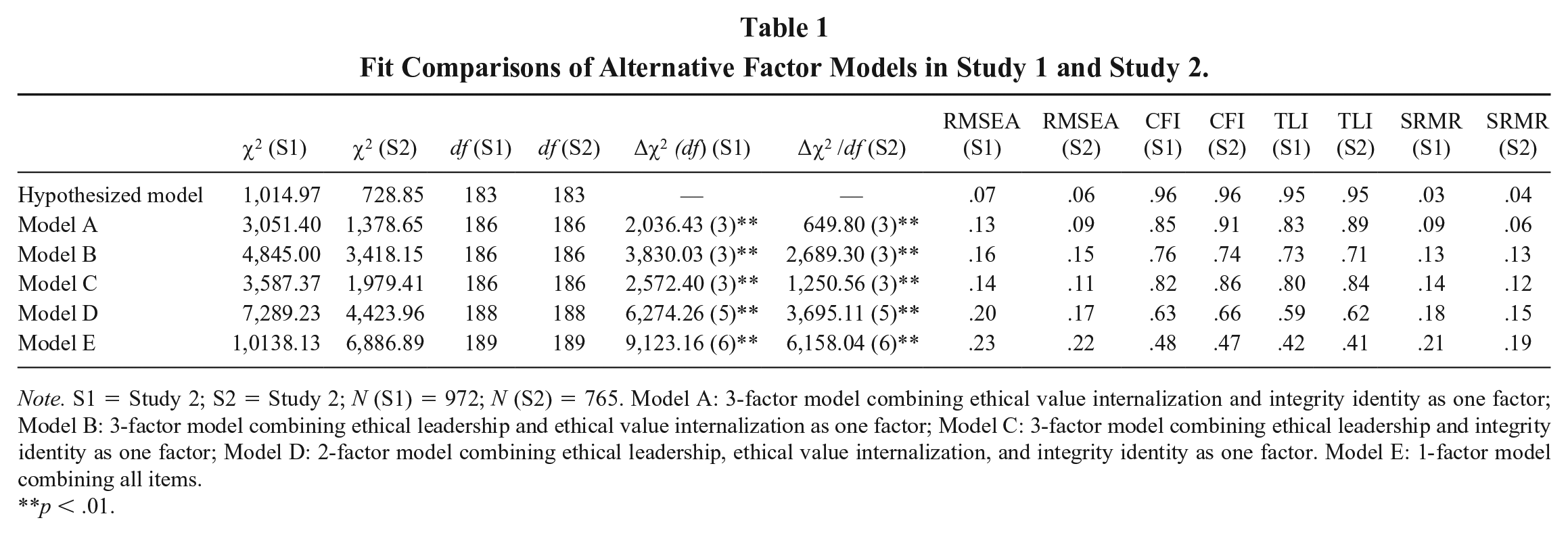
Note. S1 = Study 2; S2 = Study 2; N (S1) = 972; N (S2) = 765. Model A: 3-factor model combining ethical value internalization and integrity identity as one factor; Model B: 3-factor model combining ethical leadership and ethical value internalization as one factor; Model C: 3-factor model combining ethical leadership and integrity identity as one factor; Model D: 2-factor model combining ethical leadership, ethical value internalization, and integrity identity as one factor. Model E: 1-factor model combining all items.
p < .01.
We accounted for the effect of common-method variance (CMV) by using a marker variable approach (Butts, Vandenberg, DeJoy, Schaffer, & Wilson, 2009; Lindell & Whitney, 2001). We followed Butts et al.’s (2009) method and randomly selected six items from approximately 180 unused items. These six items had the same Likert anchors as the measures used in our model. Butts et al. suggested that CMV is present if a randomly selected set of items from different constructs display high reliability and has a good model fit. The six randomly selected items from our dataset displayed poor reliability (α = .31) and poor model fit (χ2 = 265.98, df = 9, RMSEA = .17, CFI = .45, TLI = .08, SRMR = .09), suggesting that method variance had limited systematic influence across responses.
To further rule out the method variance, we followed Butts et al.’s (2009) procedure and created a marker variable by taking the average of the six selected items. We then regressed each item from the measures that were collected at the same time (i.e., ethical leadership, ethical value internalization, and integrity identity) on this marker variable and used the unstandardized residual in all subsequent analyses. Using unstandardized residuals controlled for any systematic influence resulting from method variance.
Table 2 reports the descriptive statistics, reliabilities, and correlations among variables. By comparing the correlations below the diagonal (without method variance controlled) and above the diagonal (with method variance controlled), we only found slight changes in magnitudes of correlations. This suggested that CMV had a very small impact on our results. Ethical leadership was positively correlated with ethical value internalization (r =.15, p < .01), ethical value internalization was positively correlated with integrity identity (r = .40, p < .01), and integrity identity was positively correlated with ethical voice (r = .31, p <.01).
Means, Standard Deviations, and Correlations among the Variables in Study 1
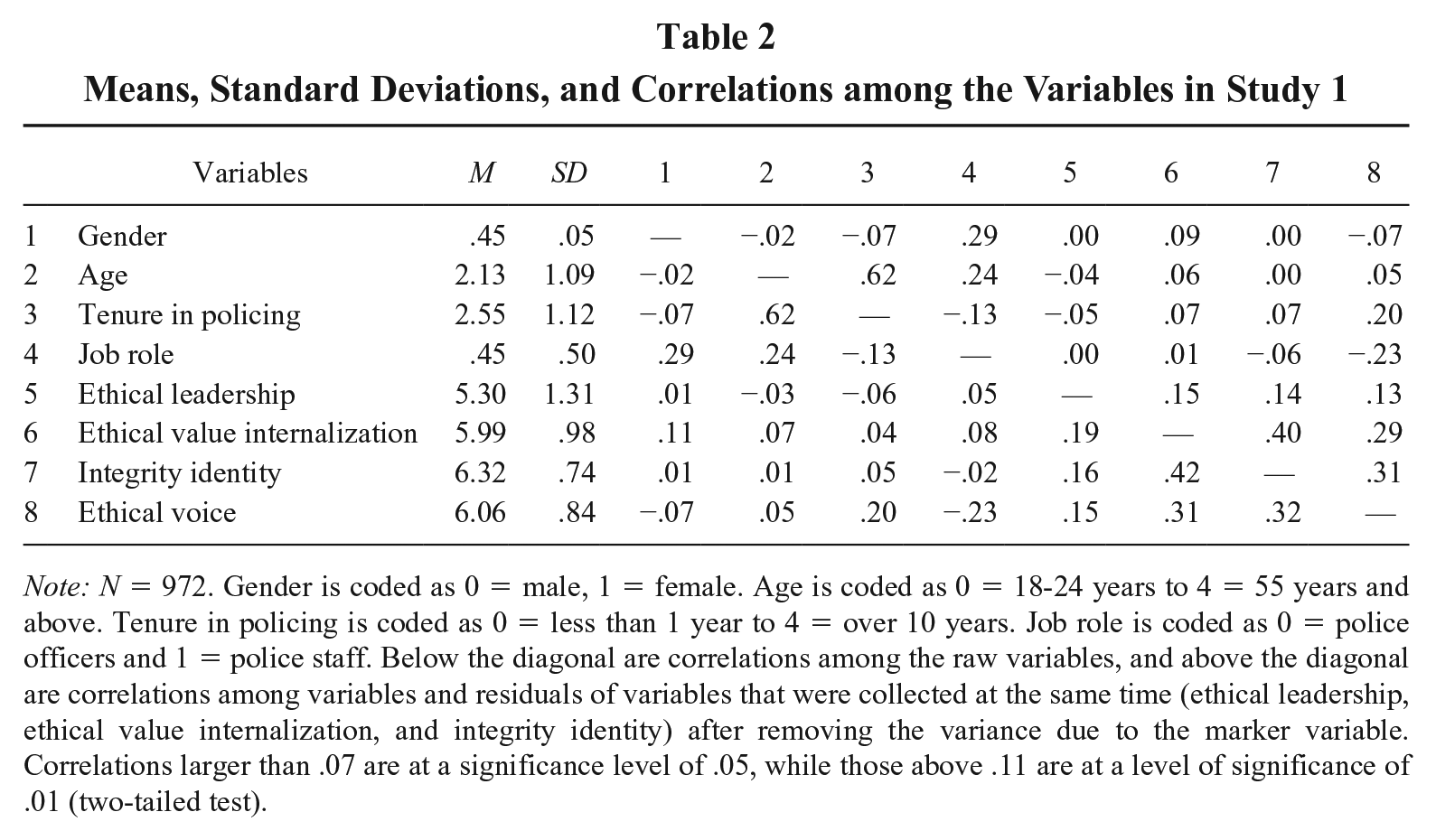
Note: N = 972. Gender is coded as 0 = male, 1 = female. Age is coded as 0 = 18-24 years to 4 = 55 years and above. Tenure in policing is coded as 0 = less than 1 year to 4 = over 10 years. Job role is coded as 0 = police officers and 1 = police staff. Below the diagonal are correlations among the raw variables, and above the diagonal are correlations among variables and residuals of variables that were collected at the same time (ethical leadership, ethical value internalization, and integrity identity) after removing the variance due to the marker variable. Correlations larger than .07 are at a significance level of .05, while those above .11 are at a level of significance of .01 (two-tailed test).
Hypotheses testing
We tested the hypotheses using SEM with latent variables. James, Mulaik, and Brett (2006) recommended testing for full mediation models if theory is insufficient to hypothesize full or partial mediation effects. We followed their suggestion and specified a full mediation model where the serial mediation effect was considered. This full mediation model provides a good fit to the data (χ2 = 1,168.40, df = 258, RMSEA = .06, CFI = .95, TLI = .95, SRMR = .05). The path estimates are presented in Figure 1. Ethical leadership was positively related to ethical value internalization (b = .11, p < .001), ethical value internalization was positively related to integrity identity (b = .32, p < .001), and integrity identity was positively related to ethical voice (b = .43, p < .001).

Parameter Estimates for Study 1
To test Hypothesis 1 and Hypothesis 2, our results from the full mediation model showed that the proposed mediation effect of ethical leadership on integrity identity via ethical value internalization was significant, supported by a 1,000 bias-corrected bootstrapping method (effect = .03, indicated by the 95% [.02, .05], which excluded 0). We further found that the proposed serial mediation effect from ethical leadership to ethical voice via ethical value internalization and integrity identity was significant (effect = .02, [.01, .03]). In sum, these results provided support for Hypothesis 1 and Hypothesis 2.
Study 2
Study 2 extends Study 1 by using multisource data that address common-method variance concerns. Police officers and police staff in a different English police force to that of Study 1 were asked to rate their levels of ethical value internalization and integrity identity and their supervisors’ levels of ethical leadership. Of the respondents, 52.4% were male and 56.3% were police officers. Average tenure in policing was 12.98 years. They were also asked to provide a coworker, whom they worked with closely, with a short survey to rate their level of ethical voice. Coworkers were asked to return the completed survey directly to the research team in the self-addressed envelope provided. As coworkers have more daily interactions with the respondents and thus more opportunities to observe the respondents’ voice behaviors than other sources, such as supervisors (LePine & Van Dyne, 1998), this approach has been recognized as a valid source for evaluating voice and has been widely applied in previous studies (LePine & Van Dyne, 1998, 2001; Liu, Zhu, & Yang, 2010). The final sample included 765 matched surveys from the two sources, indicating a response rate of 32.4%.
Measures
Ethical leadership, ethical value internalization, and integrity identity
Ethical leadership, ethical value internalization, and integrity identity were assessed by the same scales as those used in Study 1 (α = .94, .95, and .71, respectively).
Ethical voice
Ethical voice was measured by the same four-item scale used in Study 1, referent shifted for coworker ratings. A sample item was “She/he is prepared to talk to coworkers who fail to behave ethically” (α = .93).
Control variables
Again, employees’ gender, role, and tenure were controlled for in the analyses. Again, the results of our analyses remained largely the same with or without the inclusion of these controls.
Results
Preliminary analyses
We conducted a series of CFAs to confirm the construct distinctiveness of the four main variables (ethical leadership, ethical value internalization, integrity identity, and ethical voice) used in this study. As shown in Table 1, the hypothesized four-factor model provides a model fit (χ2 = 728.85, df = 183, RMSEA = .06, CFI = .96, TLI = .95, SRMR = .04) superior to other alternative models, providing support for the distinctiveness of the measures used in our study.
We followed the same approach as in Study 1 to partial out the effects of a marker variable. Again, we randomly selected six items from 140 unused items to form the marker variable. The six items presented unacceptable reliability (α = .29) and model fit (χ2 = 374.84, df = 9, RMSEA = .23, CFI = .74, TLI = .56, SRMR = .12). We also used the unstandardized residuals after regressing each item of the variables collected at the same time (i.e., ethical leadership, ethical value internalization, integrity identity) on the marker variable (the average of the six items) in all subsequent analyses.
The descriptive statistics, reliabilities, and correlations among variables are reported in Table 3. Similar to Study 1, we found slight changes in magnitudes of correlations between those below the diagonal (without method variance controlled) and those above it (with method variance controlled). This suggests that CMV had a limited impact on our results.
Means, Standard Deviations, and Correlations among the Variables in Study 2
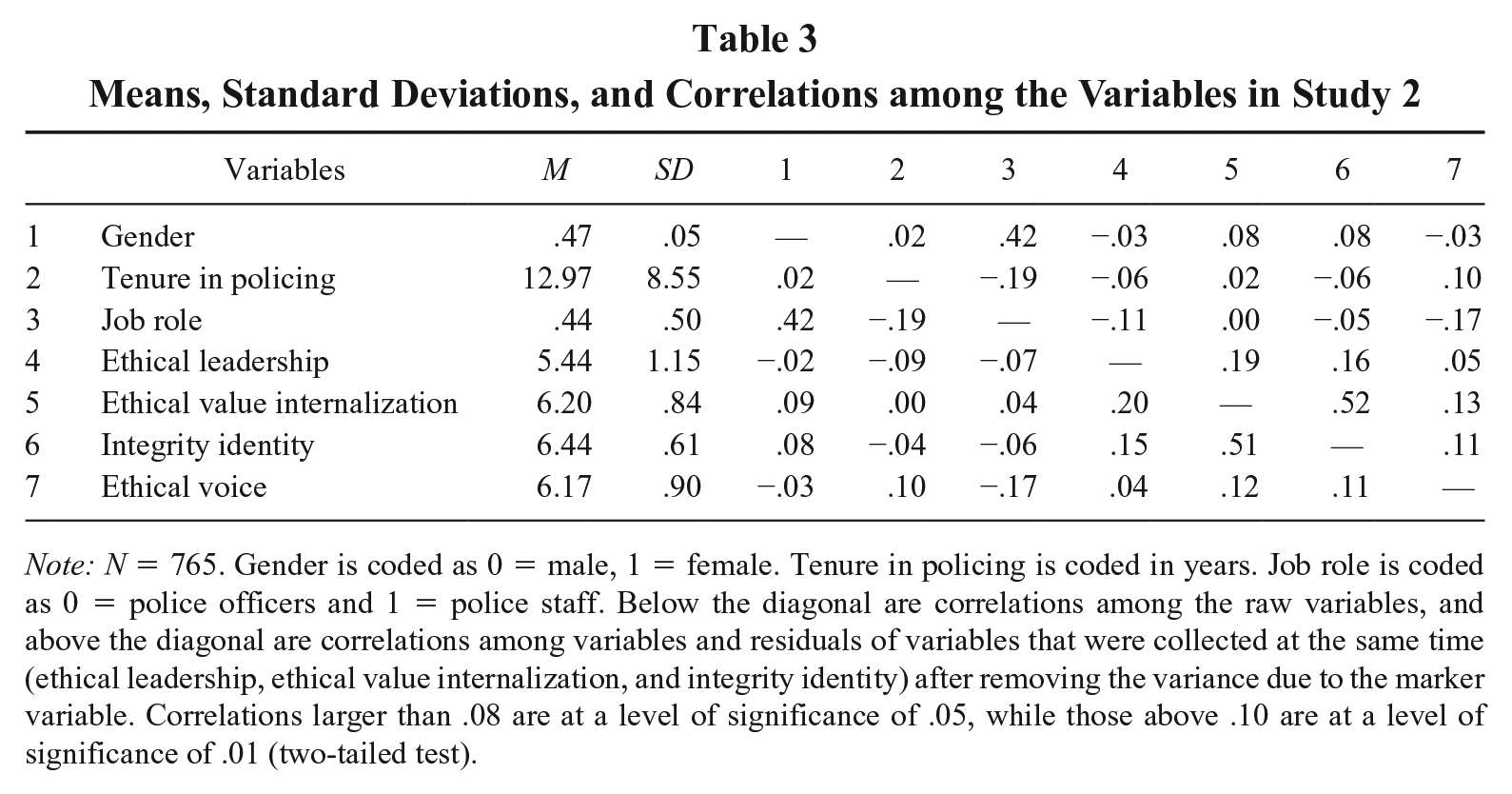
Note: N = 765. Gender is coded as 0 = male, 1 = female. Tenure in policing is coded in years. Job role is coded as 0 = police officers and 1 = police staff. Below the diagonal are correlations among the raw variables, and above the diagonal are correlations among variables and residuals of variables that were collected at the same time (ethical leadership, ethical value internalization, and integrity identity) after removing the variance due to the marker variable. Correlations larger than .08 are at a level of significance of .05, while those above .10 are at a level of significance of .01 (two-tailed test).
Hypotheses testing
We followed the same procedure as in Study 1 and specified a full serial mediation model. This model provided a reasonable fit (χ2 = 826.73, df = 240, RMSEA = .06, CFI = .95, TLI = .95, SRMR = .04). The path estimates for this model are presented in Figure 2. The results showed that ethical leadership had a positive effect on ethical value internalization (b = .19, p < .001), and ethical value internalization was positively related to integrity identity (b = .38, p < .001). Also, integrity identity was positively related to ethical voice (b = .29, p < .001).

Parameter Estimates for Study 2
Our analyses showed that the mediation effect of ethical leadership on integrity identity via ethical value internalization was significant (effect = .07, [.04, .11]). The serial mediation effect from ethical leadership to ethical voice via ethical value internalization and integrity identity was significant (effect = .02, [.01, .04]). Thus, Hypotheses 1 and 2 received support.
Study 3
We recruited 650 full-time working professionals through Prolific Academic. We included a screening question asking participants whether their organization had an official code of ethics as this was an important requirement for them to be able to take part in the study. Participants filled in the same survey at three time points each a month apart, and we used the participant ID generated by the platform to match data over time. Of the initial 650 respondents (N = 638 after screening for incomplete responses), 513 completed the survey at Time 2 (response rate of 80.4%). The final matched sample at Time 3 was 448 (response rate of 87.3%). Of these respondents, 48.9% were male and their average organizational tenure was 5.28 years.
Measures
Ethical leadership, ethical value internalization, integrity identity and ethical voice were assessed by the same scales as those used in Study 1 (α = .93, .91, .88, and .86, respectively, for Time 1; α = .94, .93, .86, and .86, respectively, for Time 2; and α = .94, .93, .89, and .88, respectively, for Time 3).
Control variables
We controlled for respondents’ gender (0 = male; 1 = female), age (0 = 18-24 years to 4 = 55 years and above), and tenure in organizations (in years) in the analyses. The results of our analyses remained largely the same with or without the inclusion of these controls.
Results
Measurement invariance
We followed the recommendations of Vandenberg and Lance (2000) and tested measurement invariance for the latent variables across the three waves to make sure that our hypotheses could be tested accurately. Two nested models were compared: (a) a model that imposed no equality constraints between the three time points and (b) a restricted model that fixed the corresponding factor loadings of the same variables as equal (invariant) across the three time points. The measurement errors of the same item over time were allowed to correlate (Cole & Maxwell, 2003; Little, Preacher, Selig, & Card, 2007). The unconstrained model provided a good model fit (χ2 = 2,945.38, df = 1,761; RMSEA = .04; CFI = .95; TLI = .94; SRMR = .04), as did the alternative model, which set the factor loadings of all items as equal across the three time points (χ2 = 2,984.95, df = 1,795; RMSEA = .04, CFI = .95; TLI = .95; SRMR = .05). There was a nonsignificant chi-square difference between the two models, ∆χ2(34) = 39.57, ns. These results provided evidence for measurement invariance of our variables over time.
Descriptive results
Descriptive statistics, reliabilities, and correlations among variables are presented in Table 4.
Means, Standard Deviations, and Correlations Among the Variables in Study 3
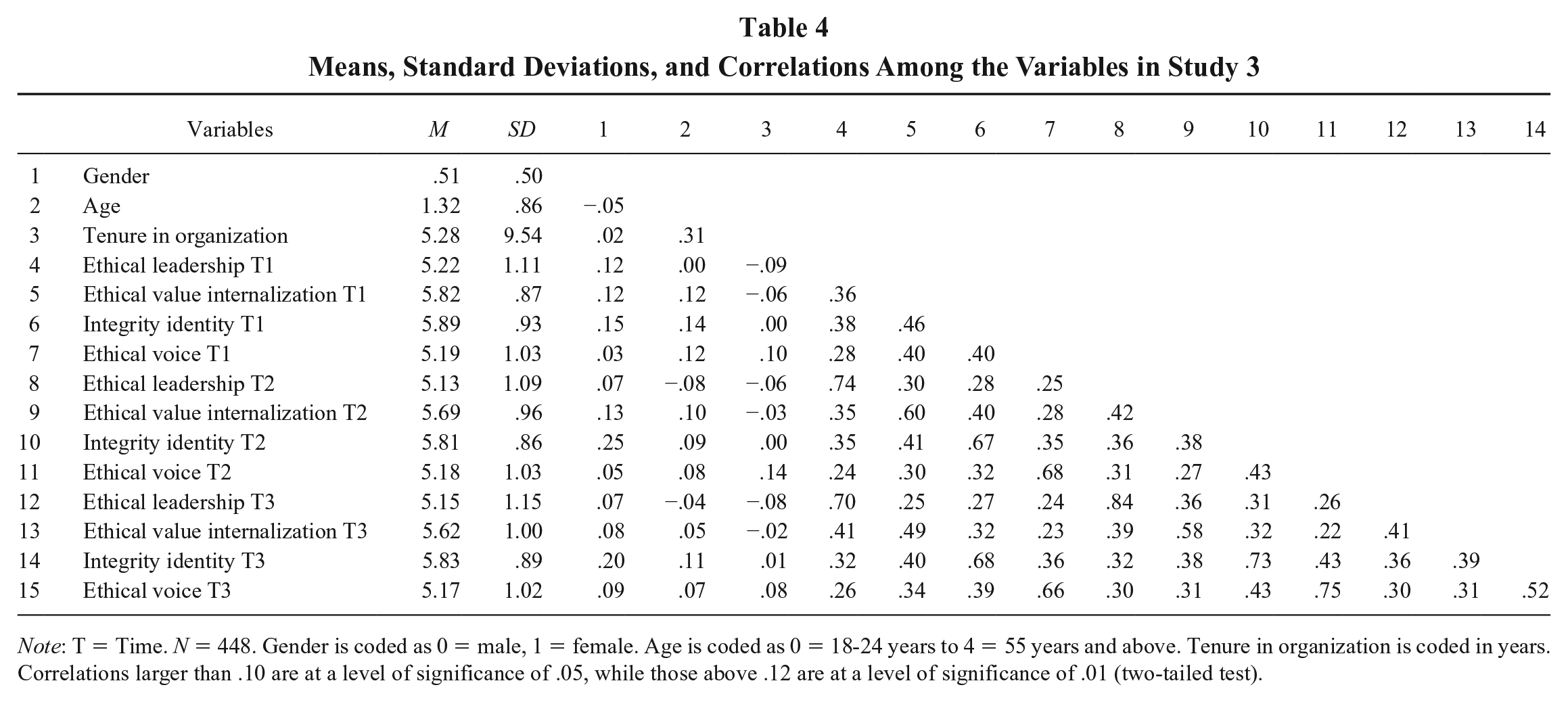
Note: T = Time. N = 448. Gender is coded as 0 = male, 1 = female. Age is coded as 0 = 18-24 years to 4 = 55 years and above. Tenure in organization is coded in years. Correlations larger than .10 are at a level of significance of .05, while those above .12 are at a level of significance of .01 (two-tailed test).
Hypotheses testing
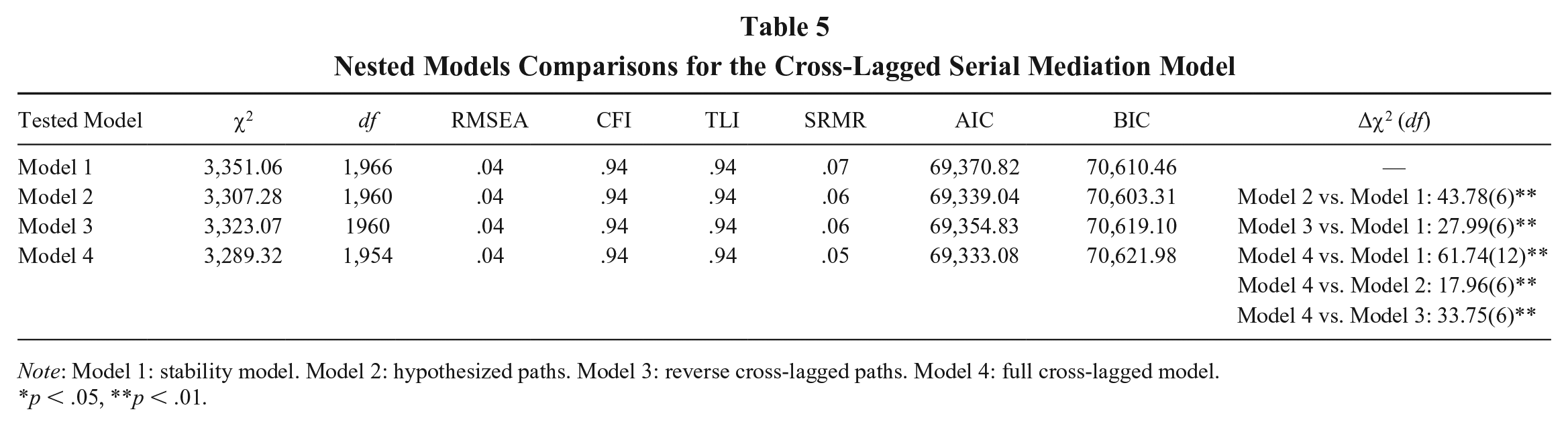
After confirming the adequacy of our measurement model, we compared alternative structural models (Kline, 2015). Smaller values of Akaike information criterion (AIC) and Bayesian information criterion (BIC) indicated better fit. We also evaluated the model fit through multiple indices (Byrne, 2012), as shown in Table 5.
Nested Models Comparisons for the Cross-Lagged Serial Mediation Model
Note: Model 1: stability model. Model 2: hypothesized paths. Model 3: reverse cross-lagged paths. Model 4: full cross-lagged model.
p < .05, **p < .01.
Model 1 was a null model that only specified stability effects but no relationships among variables. T1 variables were set to correlate freely. Error terms among variables for the same time point and between single indicators across times were estimated freely. Control variables were regressed on T2 and T3 variables. Model 2 extended Model 1 by adding the hypothesized relationships where T1 and T2 ethical leadership predicts T2 and T3 ethical value internalization, respectively; T1 and T2 ethical value internalization predicts T2 and T3 integrity identity, respectively; and T1 and T2 integrity identity predicts T2 and T3 ethical voice, respectively. Model 2 provided a better fit than Model 1 and also had smaller values of AIC and BIC, indicating that adding the hypothesized effects was meaningful. In Model 2, we found that ethical leadership T1(T2) was positively related to ethical value internalization T2(T3) (b = .13, p < .001; b = .16, p < .001, respectively), and ethical value internalization T1(T2) was positively related to integrity identity T2(T3) (b = .08, p = .06; b = .07, p < .05, respectively). However, integrity identity T1was not significantly related to ethical voice T2 (b = .04, ns), and this relationship was only marginally significant from T2 to T3 (b = .09, p = .08).
Model 3 represented a reversed causation model where T1 and T2 ethical voice predicts T2 and T3 integrity identity, T1 and T2 integrity identity predicts T2 and T3 ethical value internalization, and T1 and T2 ethical value internalization predicts T2 and T3 ethical leadership. Model 4 included reciprocal effects between ethical leadership and value internalization, between value internalization and integrity identity, and between integrity identity and ethical voice. Model 4 provided the best model fit by chi-square difference test. However, a close inspection of the cross-lagged paths in Model 4 showed that most of the reversed relationships were not significant. For example, the reversed relationships from T1 (T2) ethical value internalization to T2 (T3) ethical leadership were not significant (b = .08, p = .08; b = −.05, ns, respectively). The only two reversed paths found to be significant were from T1 integrity identity to T2 ethical value internalization (b = .10, p < .05)—but not from integrity identity at T2 to ethical value internalization at T3 (b = .09, ns), and also from ethical voice at T2 to integrity identity at T3 (b = .09, p < .05)—though not from ethical voice at T1 to integrity identity at T2 (b = .02, ns). Given that these two reversed paths were not consistent over time and also that Model 2 provided a slightly better BIC value than Model 4, we concluded that the hypothesized directions of effects were supported. We presented estimates for Model 2 in Figure 3.
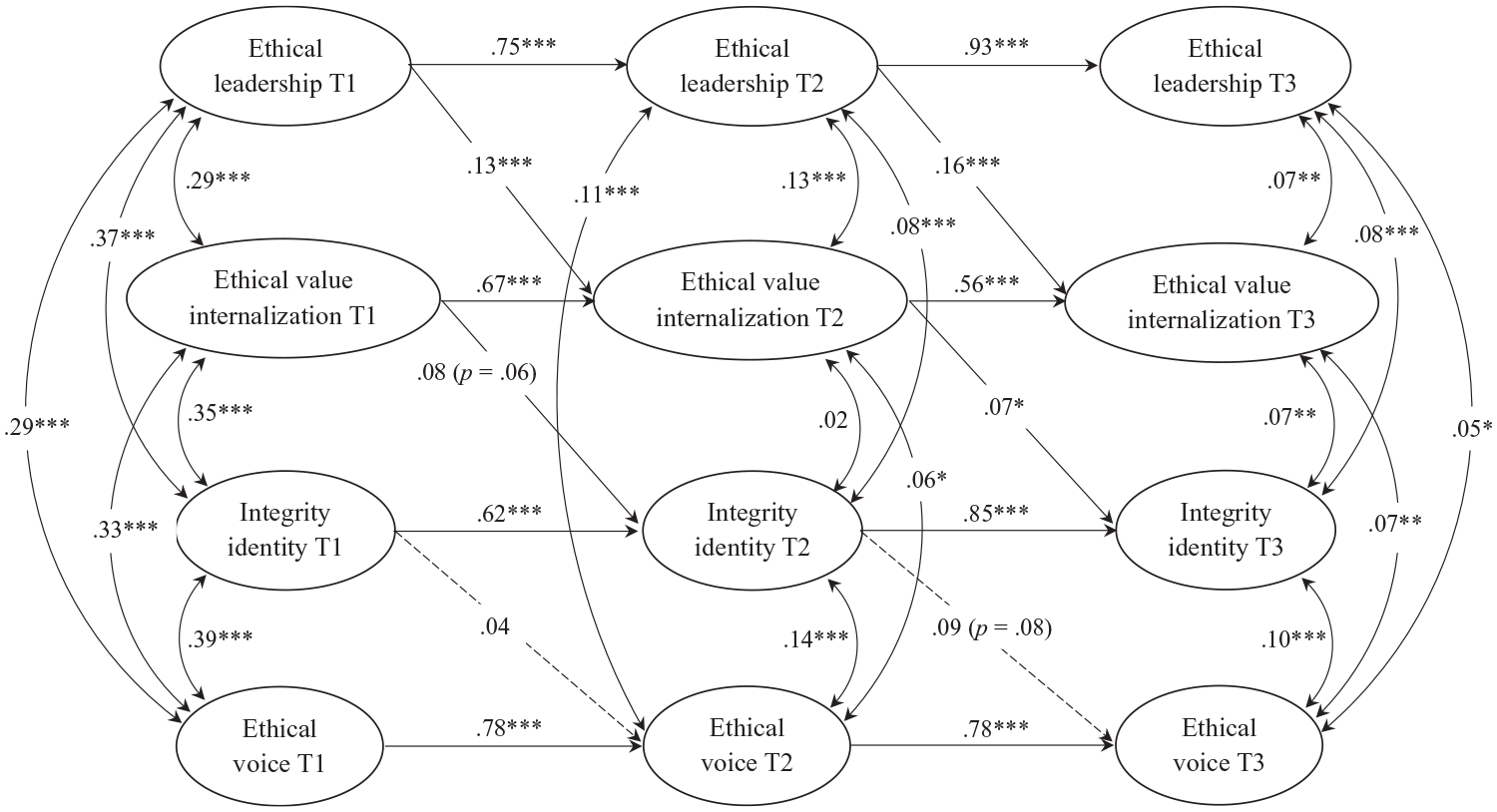
Path Estimates for Model 3 (Study 3)
As our four focal variables were measured repeatedly in only three waves and thus our two mediating variables are contemporaneous, in order to test Hypotheses 1 and 2 we followed Cole and Maxwell’s (2003) and Maxwell and Cole’s (2007) recommendations of calculating mediation effects in half-longitudinal designed mediation models. They specifically suggest that if stationary relationships are assumed (i.e., the structure remains unchanged over time), mediating paths should be equal over time. Following this, based on Model 2, we further constrained the stability effects, hypothesized lagged effects, direct effects from T1 (T2) ethical value internalization to T2 (T3) ethical voice, and covariances of the same items, so that each was equal between Time 1 to Time 2 and Time 2 to Time 3. This constrained model provided good fit to the data (χ2 = 3,862.66, df = 2,015; RMSEA = .05; CFI = .92; TLI = .92; SRMR = .06). To estimate the mediating effect proposed in Hypothesis 2, we multiplied constrained paths from ethical leadership to ethical value internalization (b = .14, p < .001) and from value internalization to integrity identity (b = .08, p < .01). This mediation effect was significant (effect = .01, 95% CI [.003, .02]), supporting Hypothesis 1. For Hypothesis 2, we multiplied the two constrained paths mentioned above and the constrained path from integrity identity to ethical voice (b = .06, p = .07). The serial mediation effect was not significant as the confidence intervals of 1,000-bootstrap resampling includes 0 (effect = .001, 95% CI [.000, .002]). Hypothesis 2 was not supported.
Discussion
The goal of this research was to cast new light on the underlying processes and the explanatory mechanisms of the relationship between ethical leadership and employees’ ethical voice. Drawing from self-concept theory (e.g., Lord & Brown, 2001; Lord et al., 1999; Shamir et al., 1993) and social information processing theory (Salancik & Pfeffer, 1978), we tested a sequential mediation model examining the effects of ethical leadership on ethical voice via ethical value internalization and integrity identity. Across three studies, including one cross-lagged panel study, we found consistent empirical support for the hypothesized mediating model, which highlights the importance of ethical leadership for ethical value internalization, salience of follower integrity identity, and ethical voice. Our studies confirmed our hypotheses that ethical leaders serve as important cues signaling the organization’s ethical values, encourage followers to internalize those values, and make salient aspects of the self-concept that relate to ethics such as integrity identity (Lord & Brown, 2001; Shamir et al., 1993).
Theoretical Implications
Our study has several theoretical implications. First, our study contributes to the ethical leadership literature. By integrating leadership self-concept perspectives (Lord & Brown, 2001; Lord et al., 1999; Shamir et al., 1993) and social information processing theory (Salancik & Pfeffer, 1978), we add novel insights into ethical leadership influence processes. Whereas past research on ethical leadership and the ethical behavior of followers has mainly examined mechanisms implied in the definition of ethical leadership (such as social learning, trust, and social exchange) (Moore et al., 2019; Piccolo et al., 2010), we find evidence for the role of followers’ values and personal identities as important mediators. We integrate leadership self-concept theory postulating that leaders activate follower identities and identities drive behaviors (Lord et al., 1999) with social information processing (Salancik & Pfeffer, 1978) and emphasize leader behaviors as important cues that facilitate follower internalization of organizational values. Ethical leaders signal to followers that the values described in the code of ethics are organizationally important and personally meaningful and facilitate their convergence with individual values. Such value internalization makes salient aspects of the self that are related to ethics, such as integrity identity, and subsequently drives follower ethical voice behaviors.
Despite the wealth of past conceptual papers highlighting that leaders are effective in communicating important values and implicating followers’ self-identities (Den Hartog & Belschak, 2012; Lord et al., 1999; Shamir et al., 1993), to our knowledge there is limited previous research investigating the leadership-values-identities-behaviors link. Our study is unique in explicating the connection of ethical leadership with ethical value internalization, integrity identity, and ethical voice behaviors by building theoretical arguments and demonstrating a serial connection between these factors. Our findings empirically support the core assumption of ethical leadership as a “value-driven” form of leadership (Den Hartog & Belschak, 2012) by highlighting the important role of value internalization as a mechanism via which ethical leadership influences followers’ integrity identities and subsequently ethical voice behaviors.
Our research also contributes to the ethical voice literature. It is only recently that studies have attempted to link ethical leadership with ethical voice (e.g., Huang & Paterson, 2017). These studies have mainly adopted a group-level approach and shown that leaders can increase members’ shared confidence about raising ethical voice in a group. There has been limited research investigating the process by which ethical leaders exert individualized influences to increase voice instrumentality and reduce follower-perceived risks and costs associated with voicing ethical concerns. By facilitating value internalization and by making integrity identity salient, ethical leaders enhance follower willingness to engage in ethical voice in order to maintain self-consistency and correspondence between their behavior and their self-concept. Prior ethical voice research has predominantly examined mediating variables representing shared group-level “can do” states (e.g., group voice efficacy: Huang & Paterson, 2017). However, given that voice in nature is an individually initiated, intrinsically motivated behavior (Ashford et al., 2009; Parker et al., 2010), the decision to engage in ethical voice is informative about the individual who engages in it. Ethical voice involves high personal risk as prior research has suggested that ethical voicers may be seen as “hypocritical,” “incompetent,” or “judgmental” (Fiske, Cuddy, & Glick, 2007; Greenbaum et al., 2015; Kreps & Monin, 2011). Our research suggests that ethical leaders reduce perceptions of risk and mitigate the fear of negative consequences by signaling the importance of the values in the code of ethics through their own actions and behaviors. Within organizational settings, followers tune in to leader behaviors as cues and references of how they should think and act. The more the ethical leaders make the organizational values visible through their behaviors, the more salient these values become and the more they are likely to be internalized in their employees’ self-concepts. Followers can then be motivated to engage in ethical voice as a way for them to express the internalized values and to enact behaviors consistent with their self-concept.
Although the results from the cross-lagged model in Study 3 generally support our hypothesized effects showing significant relationships from ethical leadership (Time 1) to ethical value internalization (Time 2) and from ethical value internalization (Time 2) to identity integrity (Time 3), we must acknowledge the fact that the significant path from integrity identity to ethical voice found in Study 1 and Study 2 was not replicated in the cross-lagged design of Study 3. Though extant work treats identity as an antecedent of behaviors, the absence of a longitudinal path from identity to behaviors has been observed in other prior studies and scholars have argued that behaviors can be enacted in a habitualized way rather than being predicted by values and identities (Prati, Albanesi, & Pietrantoni, 2017). In our case, it is possible that when the habit of raising voice is nurtured, it becomes automatic for employees to raise voice without deliberately thinking about their self-perceptions. It would be interesting for future studies to take a developmental perspective and investigate the trajectories of integrity identity activation and associations between integrity identity and ethical behaviors over a longer time frame.
Finally, our results confirm the important role of organizational codes of ethics in helping ethical leaders guide followers towards ethical behaviors in work settings. Our results generally support the notion that formal ethical principles help ethical leaders clearly communicate ethical values to followers, facilitate internalization of those values, and engage followers’ integrity identity, which in turn can result in higher levels of ethical voice. Our findings not only highlight the crucial role of ethical leadership in facilitating normatively appropriate behaviors among followers but also extend previous literature, which has shown the positive impact of formal ethical principles in facilitating ethical conduct in organizations (Giessner & Van Quaquebeke, 2010; Hill & Rapp, 2014).
Managerial Implications
Our findings suggest several practical implications. They show that ethical leaders play a critical role in encouraging followers to speak up about unethical issues that could potentially result in severe outcomes for organizations. Organizations are thus encouraged to cultivate ethical leadership behaviors by managers. This can be achieved through senior leaders acting as ethical meaning makers (Ashford et al., 2009) and through the provision of leadership development programs (Mayer, Kuenzi, Greenbaum, Bardes, & Salvador, 2009). Although selection and recruitment processes can be useful in attracting ethical individuals into organizations, our findings suggest that the work context employees become part of (especially the ethical cues and signals sent by their leaders) can influence their values and ethical identities and ultimately increase their ethical voice behaviors.
In addition to increasing ethical leadership in organizations, managers should also be aware of the psychological processes underlying their ethical leadership behaviors and followers’ engagement in ethical voice. Our study suggests that ethical leaders who emphasize the importance of organizational values can significantly activate followers’ integrity identity and encourage ethical voice. Organizations should invest in trainings to increase managers’ awareness and knowledge of the ethical values and standards of the organization and further encourage them to communicate organizational ethical values with followers. The application of social information processing theory in our model suggests that by conveying cues and messages about organizational values, leaders are essential for increasing followers’ ethical awareness. Therefore, to optimize ethical message transfer, organizations should provide leaders and followers with opportunities for interactional and systematic learning about organizational values and codes of ethics (e.g., role-play, case studies, peer discussions; Eisenbeiss, 2012).
Finally, our results confirm that ethical messages and cues that are sent to employees can be internalized into their self-concept, thereby leading to enhanced ethical voice. It is important to note that ethical messages can be sent via a broad set of actors in an organization (Den Hartog, 2015; Mayer, Nurmohamed, Treviño, Shapiro, & Schminke, 2013). Not only direct supervisors but also coworkers and top managers can all help employees better understand their roles and ethical expectations in organizations. Thus, organizations should provide ethics training to all groups of organizational actors, in order to embed ethical messages deeply into the work context and make them salient to employees.
Limitations and Future Directions
Our research has important strengths that deserve mention. We provide consistent evidence for our hypothesized model across three different studies and show that ethical leadership influences ethical voice via value internalization and integrity identity. Using multiwave (Studies 1 and 3) and multisource data (Study 2), we first test our model in the policing context and then replicate our findings in a sample drawn from a general population. We further address the possibility of reciprocal effects in our cross-lagged study and cast light on the causal direction of effects of the variables in our model. Despite its strengths, our research still has limitations. First, all measures used in our studies, with the exception of ethical voice in Study 2, were rated by the same source, raising concerns of CMV (Podsakoff, MacKenzie, Lee, & Podsakoff, 2003). To reduce the influence of CMV, we measured the outcome variable in Study 1 at a different time point and used coworker ratings in Study 2. We also employed several statistical tests to examine the influence of CMV and concluded that CMV did not play a significant role in influencing our results. Furthermore, Study 3 uses a three-wave longitudinal design, which has been argued to lower the risks for CMV (Doty & Glick, 1998).
Another limitation of our study is that the scales of value internalization, integrity identity, and ethical voice were adapted from previously established scales. Nevertheless, we followed recommendations made by Heggestad et al. (2019), and more importantly, we used these scales in three different studies collecting both self-reported and peer-reported data (i.e., ethical voice) and in different occupational contexts. The CFA results support our scales’ distinctiveness and their correlation estimates are largely consistent across the three studies. This evidence to some extent lowers the concern about the validities of these measures.
Although the issue of causality and the possibility of reciprocal effects remain in Studies 1 and 2, Study 3 reduces this concern by using a cross-lagged panel design to demonstrate the directions of effects. Conceivably, our 1-month time lag may have not been sufficiently long to estimate the true cross-lagged relationships, as it might take longer for an identity to be fully activated and manifest itself in behaviors. Research in identity formation has utilized 1- or 2-year time lags (Duriez, Luyckx, Soenens, & Berzonsky, 2012; Erentaitė, Vosylis, Gabrialavičiūtė, & Raižienė, 2018; Mercer, Crocetti, Branje, Van Lier, & Meeus, 2017), whereas shorter time lags (1-week) have been used in leader identity development studies (e.g., Miscenko, Guenter, & Day, 2017). Research in ethical leadership has also utilized short time lags such as 2 months (Detert, Treviño, Burris, & Andiappan, 2007). However, the current state of conceptual and empirical work on identity and behaviors does not offer clear evidence as to what the appropriate time interval might be. Our work indicates that though little is known about the optimal time lag for identity-behavior effects to be captured, using longer time lags to test our model may be a fruitful avenue for future research.
In Study 3, we find two reversed relationships, that of T1 integrity identity to T2 ethical value internalization (not from T2 to T3) and T2 ethical voice to T3 integrity identity (not from T1 to T2), to be significant. Additional research is clearly needed to provide stronger evidence for these effects as they were not consistent over time. Nevertheless, our findings indicate that employees’ integrity identity strengthens their internalization of organizational ethical values. This is consistent with Lord and Brown’s (2001) view that values and self-identities are interrelated. Because working self-concept provides the information about the self that is currently accessible in working memory (Lord & Brown, 2004), salient integrity identity can make employees pay more attention to and internalize cues about organizational ethical values sent by ethical leaders. Further, our findings also indicate that employees’ engagement in ethical voice may satisfy their need for self-enhancement, and raising ethical voice further directs their attention toward the integrity aspect of their self-concept and thus strengthens their integrity identity. This is consistent with a self-perception perspective (Bem, 1972), which proposes that individuals come to know their own beliefs from observing their own voluntary behaviors and/or the contexts in which their own behaviors occur. To further test these two ideas, later studies could employ experimental designs to confirm the causal directions between value and identity as well as between identity and behaviors.
In Studies 1 and 2 we used two samples from UK policing where ethical voice is specifically required by a code of ethics which obligates police officers and staff to challenge the conduct of colleagues that they believe falls below the expected standards (College of Policing, 2014, p.15). In Study 3, respondents were working in multiple industries. Situational strength (Mischel, 1977) may thus be a possible explanation for our finding of a significant relationship between integrity identity and ethical voice in Study 1 and Study 2 but not in Study 3. In “strong situations” such as policing, where there is high emphasis on a code of ethics and clear expectations for employees to behave ethically, ethical leaders play a critical role in helping employees make sense of the nuances of the code of ethics, facilitating value internalization, engaging integrity identities, and encouraging ethical voice behaviors. In other organizational settings, where “weaker situations” may prevail with regard to ethical conduct (despite the existence of an official code of ethics), employees may feel less obligated to act against the unethical conduct of colleagues. Thus, although ethical leaders may still facilitate value internalization and engage employees’ integrity identities in such contexts, this process may not necessarily result in ethical actions and engagement with ethical voice behaviors. Future research may seek to examine situational strength (Mischel, 1977) as a moderator of our model. In addition to examining different organizational contexts, future research could also focus on differences between organizational roles with regard to ethical expectations. Role ethicality, defined as “the degree to which employees view their role as including the expectation to behave ethically” (Paterson & Huang, 2019: 2841), might also be a potential variable of interest for future research. The leader’s span of control may also be of interest (Thiel, Hardy, Peterson, Welsh, & Bonner, 2018). A wider span of control may decrease the frequency of interactions ethical leaders have with their followers and the opportunity to discuss ethics matters on a daily basis, creating a context where the importance of ethical voice may become accentuated. Finally, we used coworker ratings to measure employee ethical voice behavior. Future research should measure voice targeted at different sources (e.g., supervisors and other out-group individuals) to depict a fuller picture of how ethical leadership influences followers’ intention to voice ethical concerns.
Although we established integrity identity to be a distinct construct from Aquino and Reed’s (2002) moral identity in our pilot study, very recently, Hannah, Thompson, and Herbst (2020) proposed a more complex view of moral identity that encompasses integrity identity as a subcomponent. Using self-complexity theory, they proposed to move away from the dominant view of moral identity as a global unitary construct and instead adopt a multidimensional perspective. They specifically proposed four dimensions of moral identity—namely, benevolence, justice, obligation, and integrity—and found individuals to construe themselves differently on these dimensions across different roles (e.g., coworker, leader, son/daughter). Their results across five studies showed that individuals formulate differentiated moral content for each of the four dimensions in different roles, with specific dimensions driving corresponding ethical choices (i.e., integrity identity influenced integrity-based choices). Hannah et al.’s (2020) study evidenced the complex content and structure of moral identity as well as its dynamic nature and cross-role variance. Future studies could examine the role of their proposed moral identity dimensions on ethical voice across different organizational roles and contexts.
Next, it is possible that the relationship between ethical leadership and ethical voice can be explained by other mechanisms. For example, psychological safety and efficacy have been examined as mechanisms in the leadership-voice relationship (e.g., efficacy: Huang & Paterson, 2017; safety: Walumbwa & Schaubroeck, 2009). However, these two constructs tend to emerge through interaction, exchange, and amplification among employees in work groups (Edmondson, 1999, 2003; Van Zomeren, Leach, & Spears, 2010). That is, employees need to work in environments where they feel it is safe to risk interpersonal relationships or believe in the group’s ability to initiate changes. We therefore argue that these two mechanisms are more relevant for group-level ethical voice research and less so for our research focused at the individual level. However, we cannot fully confirm the robustness of values and identity in explaining our theoretical model without empirically testing these constructs. Also, social exchange-related variables (e.g., trust in leader and leader-member exchange) have also been used to research the leadership-voice linkage (Zhang, Huai, & Xie, 2015). Future studies should include these factors as parallel mechanisms.
While our study focused on testing the extent to which individuals internalize organizational values into their self-identities, we did not examine the different motives and reasons underlying this internalization process. For example, self-determination theory (Ryan & Deci, 2011) argues that the formulation of an identity can occur as a result of autonomous motivation, which involves a sense of volition and choice, or a controlling motivation, where behaviors are performed due to causes that are external to the self and hence volition and choice are partially or completely absent (La Guardia, 2009). It is possible that ethical leaders facilitate followers’ value internalization both through an internalized regulation and an introjected regulation where employees feel an internal pressure to behave in a way that will please the leader. Future studies could build on our model and investigate different motives underlying followers’ value internalization and integrity identity salience. Further, the identity literature has suggested that individuals have multiple self-identities to be selectively activated in response to different cues (e.g., Hannah, Woolfolk, & Lord, 2009). Future ethical leadership research could include other aspects of self-identities (individual, relational, and collective self-identities: Brewer & Gardner, 1996; Johnson, Selenta, & Lord, 2006) and associate them with relevant types of voice. For example, supportive voice might be associated with employees’ relational identity activated by ethical leaders.
In conclusion, our paper used self-concept and social information processing perspectives to cast light on how ethical leaders align followers’ values with those of the organization and engage followers’ integrity identity to achieve higher levels of ethical voice. Our research shows that followers’ ethical value internalization and integrity identity are important explanatory mechanisms and creates new avenues for research in this domain.
Footnotes
Acknowledgements
We thank the Action Editor Rebecca Greenbaum and the two anonymous reviewers for their developmental feedback and insightful suggestions that have significantly improved our work. We also thank Marisa Plater (Durham University) and Natalie Brown (Durham University) for their help with the data collection of the first two studies and for their continuous support of the Policing Research Unit at Durham University Business School.
