




Abstract
We apply insights from organizational behavior, psychology, and sociology to make the case that the community in which a firm is embedded is a valuable, rare, inimitable, and nonsubstitutable resource that holds potential as a source of sustained competitive advantage. First, we review several key principles of the resource-based view (RBV) and show how they apply to community as a strategic resource, incorporating prior work that simultaneously addresses communities and RBV. Next, we juxtapose pairs of firms in the same industries, comparing those that have embraced this strategy with those that have not, demonstrating the superior sustainability of the firms that consider community as a strategic resource. Finally, we conclude with thoughts as to a future research agenda that allows for an expansion of the concept of resources to further the development of RBV, the firms that apply it, and the communities in which they are embedded. In doing so, we demonstrate how expanding RBV to incorporate the community as strategic resource contributes to managerial theory, research, and practice.
In times of turmoil, upheaval, and uncertainty, it is human nature to take stock and inventory what resources we can muster to approach the challenges ahead; there is no time more appropriate than the present for organizations and organizational scholars to engage in this exercise (Bakker & Demerouti, 2017). The resource-based view (RBV) of the firm offers many insights as to available resources organizations can rally, informed by its basic tenet: Resources that are valuable, rare, inimitable, and nonsubstitutable are strategic resources in that they hold potential as sources of sustained competitive advantage (Barney, 1991; Chi, 1994).
Prior work acknowledges these resources include not just physical resources, such as plants, equipment, and raw materials (Collis & Montgomery, 1995), but also intangibles, which include human capital at a micro level, such as interpersonal relationships and leadership (Wright, Dunford, & Snell, 2001), and organizational capital at a more macro level, such as relations among units or groups or company culture (Hart, 1995; Teece, Pisano, & Shuen, 1997). Recent work convincingly argues for incorporating a stakeholder perspective into RBV, suggesting that beyond shareholders, a firm’s employees, suppliers, customers, and debt holders also have claims on the profits that the firm’s resources help generate (Barney, 2018). This, in turn, suggests that managers seeking to generate economic profits adopt a stakeholder perspective in how they manage their firm. Scholars acknowledge that stakeholders can also include communities, governments, and the natural environment, but given there is “ongoing debate about whether these last three groups are always firm stakeholders” (Barney, 2018: 3308), they are seldom examined in RBV scholarship.
However, communities hold great promise as a key resource for firms, especially in tumultuous times and, as we explain later, particularly when defined according to a broad psychological and sociological tradition as those individuals not formally part of the firm, who share an intrinsic connection, a sense of distinction from others not in the community, rituals or traditions, and a sense of obligation to one another (see Wellman & Wortley, 1990, for review). Importantly, when communities are considered as such, firms are likely to make more substantial investments in developing those very same communities, contributing to a mutually reinforcing circular economy (Bocken, de Pauw, Bakker, & van der Grinten, 2016; Esposito, Tse, & Soufani, 2018; Kirchherr et al., 2018; Linder & Williander, 2017). Barney (2018: 3321) does admit, If the interests of all stakeholders are taken into consideration, then it seems less likely strategies that systematically disadvantage some of those stakeholders will be chosen. . . . If those stakeholders include the community . . . then this does seem to form the basis for a more socially responsible and ethical approach to business decision-making . . . at least compared to the shareholder supremacy approach.
Now more than ever, firms need a means of expanding their resources in order to remain in business. But the livelihood of communities and the welfare of people around the globe also depend on the ability of firms to do so. Revealing how this is possible requires an understanding of the relational pathways developed during corporate–community collaboration, incorporating an interdisciplinary approach and a focus on collaborative dynamics with insights from organizational behavior, psychology, and sociology.
The purpose of this article is to apply the insights from these disciplines and make a case for the community as a potentially valuable, rare, inimitable, and nonsubstitutable strategic resource that holds the potential as a source of sustained competitive advantage. We explore the question of how expanding RBV to incorporate the community as strategic resource contributes to managerial theory, research, and practice. First, we review several key principals of RBV and show how they apply to community as strategic resource, incorporating prior work that simultaneously addresses communities and RBV. To identify this prior work, we conducted a systematic literature review across 85 journals in business and management, which ultimately revealed 25 articles directly applicable to this argument (see the appendix for more detail on the search protocol). Although limited, this prior work has provided some justification for the plausibility of the view of community as strategic resource and source of sustained competitive advantage. Next, for purposes of illustration, we juxtapose pairs of firms in the same industries, comparing those that have embraced this strategy with those that have not and demonstrating the superior sustainability of the firms that consider community as a strategic resource. Finally, we conclude with thoughts as to future research agendas that allow for an expansion of the concept of resources to further the development of RBV, the firms that apply it, and the communities in which they are embedded.
Features of RBV Applicable to Community as Strategic Resource
Barney (1991: 101) defined firm strategic resources as any semipermanent firm assets, capabilities, organizational processes, attributes, information, or knowledge that enables a corporation to implement strategies that improve its efficiency and competitive position. RBV holds that managers should select the strategy that best utilizes their internal resources relevant for external opportunities in order to achieve sustained competitive advantage (Barney, 1991). More recently, this framework has been expanded to include whether a company is organized to make use of valuable, rare, inimitable and nonsubstitutable resources, with scholars arguing that the resources themselves do not confer any advantage for a firm if not adequately organized to capture the advantages from them (Sirmon, Hitt, & Ireland, 2007; Sirmon, Hitt, Ireland, & Gilbert, 2011).
Scholars outside the strategy discipline have taken strides to incorporate RBV. The view of people as strategically important to a firm’s success has contributed to the interaction and convergence of strategy and human resources (Wright et al., 2001), although there is debate over whether human resource practices can provide sustained competitive advantage. Wright et al. (2001) argued that individual human resource practices may be imitable, but human resource systems and routines, which develop over time, may be unique to a firm and contribute to creation of specific human capital skills. Research has not systematically explored whether human resource practices are path dependent, causally ambiguous, or imitable, and the evidence regarding links to firm performance is mixed (Combs, Liu, Hall, & Ketchen, 2006; Gibson, Porath, Benson, & Lawler, 2007).
In the marketing discipline, Srivastava, Fahey, and Christensen (2001) suggest that further work is required to identify and document how particular market-based assets and capabilities contribute to generating and sustaining specific forms of customer value. For example, increased attention to external stakeholders is demonstrated in customer-centric and relation-based marketing (Christopher, Payne, & Ballantyne, 2013) as well as the notion of brand communities (Muniz & O’Guinn, 2001). Incorporating these externalities as key strategic resources demonstrates an innovative application of RBV.
In the business ethics literature, the importance of a healthy interface with the community was emphasized by Russo and Fouts (1997). These scholars analyzed corporate social responsibility (CSR) from an RBV perspective and asserted that the social performance of firms can constitute a source of competitive advantage, with firms such as Ben & Jerry’s, Johnson & Johnson, and The Body Shop embedding a concern for ethics into their culture in ways that are inimitable. Cantrell, Kyrianzis, and Noble (2015) drew on RBV to suggest that CSR implementation in the form of corporate giving to charities can be developed as a dynamic capability, providing a competitive advantage by allowing organizations to manage key stakeholder relationships (external and internal) more effectively, ultimately leading to increased organizational productivity.
Other scholars have argued for a revision of RBV to acknowledge that achieving triple bottom line (simultaneously meeting economic, social, and environmental objectives) may require reliance on resources that are imitable and substitutable and may shift focus from competitive advantage to “collaborative advantage” (Glavas & Mish, 2015). Researchers also point to the value of corporate reputation, both social and business reputation, as a key resource for the firm (Branco & Rodrigues, 2006; De Castro, López, & Sáez, 2006; Ruf, Muralidhar, Brown, Janney, & Paul, 2001). Enhanced image and reputation among various stakeholders can be considered as an intangible resource or moral capital that serves as “reputation insurance,” protecting loss in firm value in the aftermath of adverse events (Godfrey, 2005; Godfrey, Merrill, & Hansen, 2009). Coleman (2011) found that profitability is damaged by unethical treatment of stakeholders as evidenced by environmental, social, and governance breaches, presumably because risk-averse customers and suppliers are alert to signals of risk. Sales margins of firms fell by 0.8% if they announced a product recall and by 0.4% if cited by the Occupational Safety and Health Administration for an unsafe workplace; shareholder return was significantly reduced by an Environmental Protection Agency or a Securities and Exchange Commission prosecution.
For organizational behavior, the RBV represents an opportunity to link psychological and social processes to the success or failure of organizations. While there are a few examples of extant RBV research identifying the effects of such resources on outcomes (e.g., Combs & Ketchen, 1999; Miller & Shamsie, 1996), this research has made much less progress in describing how such resources are developed, and there is ambiguity as to what exactly constitutes such a resource. Further, it is fair to say that the organizational behavior literature less often examines the implications of focal concepts for firm outcomes. Yet, the focal concepts in organizational behavior and the related foundational disciplines of psychology and sociology hold much promise for detailing how unique resources can develop (Barney, 1986). We turn now to one such approach.
Community as Strategic Resource
Community has long been a core construct in scholarly and popular discourse and was a key concern of philosophers of the 19th and 20th centuries (e.g., Durkheim, 1883/1933; Kant, 1782/1980; M. Weber, 1922/1978). Initially, a community was considered a physical space, a definition still widely embraced by many researchers today. For instance, organizational behavior scholars have examined the relationship between organizational demographic diversity and demography of the stakeholders in the community served by the organization (Brief, Butz, & Deitch, 2005; Pugh, Dietz, Brief, & Wiley, 2008). As a specific example, King, Dawson, West, Gilrane, Peddie, and Bastin (2011) compared diversity of health care providers and that of the surrounding community, finding that patients perceived greater civility from hospital staff of similar demography to themselves, which in turn facilitated organizational performance. Hence, by considering the local community as a resource from which to draw employees, the hospitals delivered higher-quality health care. To measure community diversity, they linked census data for specific geographic locations based on distance to each hospital using GIS mapping.
In contrast, researchers in operations management view “local” communities as not necessarily neighboring the firm (Padgett & Galan, 2010). Vanclay (2003) used the figurative terms upstream (anywhere that contributes to project or production inputs, including where workers reside) and downstream (the pathway of outputs, products, and discharges) to assist in defining the boundaries of an affected community (Esteves, 2008). Yet other scholars argue for an even more expansive consideration of community. A review of the sociology literature indicates at least three core markers of a community (Muniz & O’Guinn, 2001): first, an intrinsic connection between community members and the collective sense of difference from nonmembers, referred to as consciousness of kind (Gusfield, 1978) or “shared knowing of belonging” (M. Weber, 1922/1978); second, shared rituals and traditions creating social solidarity (Durkheim, 1915/1965), inculcating behavioral norms and values (Marshall, 1994: 537); and finally, a sense of community duty or obligation, producing action in times of threat—a broader definition more applicable today with communication technology uniting geographically dispersed individuals with common purpose and identity through online communities (Wellman & Wortley, 1990). It is this broader definition that we adopt here.
There is an existing organizational literature in which community is given a central role: corporate community investment (CCI). Formally defined as “voluntary contributions or actions by companies to help communities address their development priorities in ways that are sustainable and support business objectives” (International Finance Corporation [IFC], 2010: i), CCI is sometimes included in firms’ CSR strategies. In the best-case scenario, the investments create lasting improvements in the quality of life for communities and simultaneously generate business value for the company in the form of community support, reputational benefits, risk reduction, productivity gains, or competitive advantage (IFC, 2010).
For example, it is not unusual for a single firm in the mining sector to contribute $200 million per year to the communities in which they do business. This can take the form of physical infrastructure development; educational, social, health, or well-being programs; or corporate volunteering in the community. Especially in contexts where social risks are high, community investment programs can help companies gain a “social license to operate,” gain access to land, reduce project and reputational risks, boost productivity or quality of services rendered, meet government requirements, and compete for the next venture (Bhattacharya, Sen, & Korschun, 2008; Bice, 2015), all indicating that viewing community as resource has the potential to generate sustained advantage. Indeed, the use of the term investment implies an expectation of return and signals that company support for community development is often viewed like other business resource investments.
Community is one of 13 issues addressed in the stakeholder relations index within the KLD data that have been used to examine CSR among the Russell 3000 (Hillman & Keim, 2001). Research suggests that positive stakeholder relations not only enable a firm with superior financial performance to sustain its competitive advantage but also help poorly performing firms to recover from disadvantageous positions more quickly (Choi & Wang, 2009; Wang & Choi, 2013). However, results are most often not as robust as firms might hope (Aguinis & Glavas, 2012; Caligiuri, Mencin, & Jiang, 2013), leading to an examination of boundary conditions and intermediate factors (Carroll & Shabana, 2010). For example, Rodgers, Choi, and Guiral (2013) argued that by actively participating in community programs, either through charitable donation, sponsorship, or employee volunteering, firms promote their brand. Reasoning that this improves the firm’s image and helps to attract not only customers but also potential employees and investors, Rodgers et al. (2013) found that such activity can increase market value. Research also indicates distinctive advantage to engaging in a combination of initiatives. For example, among small and medium-sized enterprises, Torugsa, O’Donohue, and Hecker (2012, 2013) demonstrated that the interaction between the three dimensions of CSR (economic, social, and environmental) positively moderated the deployment of each individual CSR dimension to generate financial performance.
Beyond benefits to the firm, do these investments deliver benefits to the community? Despite the influx of corporate investment, the most needful communities (e.g., at-risk, remote, and rural communities) struggle to improve living conditions, health, and well-being (C. Gibson, 2021). Few social-impact returns on investments for these communities have been documented. For example, Esteves (2008) reviewed a series of CCI programs among eight of the largest global resource companies across 22 sites. He found that most community development efforts focus on indicators of impact with long time horizons (e.g., tertiary graduation rates, life expectancy), missing intermediate means of creating both business and community value. He concluded the cessation of useful programs occurs as “managers have therefore had to justify ongoing investments by trusting their intuition . . . it is not seen how they contribute to the bottom line,” further identifying issues of “promotion of ‘pet’ projects . . . that have little real value, and loss of company credibility in the community who see or have to live with the results of ineffective investments” (Esteves, 2008: 40).
Margolis and Walsh (2003) criticized the CSR field for its “preoccupation with instrumental consequences,” which overlooks the social impacts of programs such as CCI. This led to the 181 CEOs of the Business Roundtable making a public commitment to serve all stakeholders, broadly defined (Kaplan, 2020). An argument for the importance of the social impact on communities was reiterated by Wang, Gibson, and Zander (2020) in their review of scholarly work in the CSR domain. What is particularly surprising is how little research exists examining social, psychological, or relational outcomes of corporate collaboration with communities (C. Gibson, 2021). Without this, firms may discontinue programs that have great promise, or fail to invest in programs that can bring about change, because they do not understand the multifaceted impacts (Wang et al., 2020).
Community as Source of Competitive Advantage
We argue that attention to the very characteristics that determine whether a community constitutes a source of sustained competitive advantage for firms (i.e., that they are valuable, rare, inimitable, and nonsubstitutable; Barney, 1991) also ensures that a well-executed community investment strategy will have social impact. Examining these four characteristics reveals community as a powerful firm resource but also suggests means of enhancing social impact. In the sections that follow, we address each and provide illustrations of the advantages accrued by firms that have embraced the community as resource, as compared with those which have not.
Communities as Valuable Resources
According to RBV, firm attributes become resources that sustain competitive advantage only when they are considered valuable; that is, the resources produce rents by exploiting opportunities or neutralizing threats in a firm’s environment (Barney, 1991). Most resources have limited lives and offer only temporary profits (Fiol, 2001). Therefore, the more intense a resource and the longer it lasts, the more valuable it will be. Although community profiles do change, given gentrification in space-based communities and the fickle nature of online community trends, members truly embedded in the community often remain (S. Gibson, 2020). Hence, community is a resource that can have a relatively high degree of depth and durability. Once relationships and conduits are built with members of the community, the resulting returns are likely long-lived.
Existing research in international management has demonstrated that particularly in transition economies, intensity of experience in a local context often results in well-established marketing and distribution networks (Shenkar, 1990), familiarity with culture-specific business practices (Luo, 1997), and greater ability to reduce operational uncertainties and financial risks (Luo, 1998). Many transition economies (e.g., China) have a strong relationship-oriented culture, and connections within the community can increase odds of success. Luo and Peng (1999) showed that multinationals’ subunits with a higher intensity of experience who are willing to spend time to cultivate local relationships have superior performance, and this is particularly true when the local environment is hostile (i.e., weak regulatory regime, underdeveloped factor markets, and poorly protected property rights).
Likewise, scholars have argued that without social connections in the surrounding society, a firm’s CSR efforts will not be perceived as genuine and authentic by stakeholders (Mazutis & Slawinski, 2015; Yuan, Bao, & Verbeke, 2011). The work of Driver (2006) and Brickson (2007) suggests a continuum whereby at one end organizations view themselves as embedded in a larger social context and are more likely to engage with a wide variety of stakeholders. At the other end of the continuum, organizations are disconnected from society, with less awareness of their social context and a we/them attitude vis-à-vis their stakeholders that pits their goals against those of others. These firms deny their connection to others, especially when these others are distant or not directly affected by the firm (Mazutis & Slawinski, 2015). For example, in the case of child labor by suppliers in developing countries, managers may argue that the firm is not responsible for the practices of its suppliers (Young, 2004). Such firms are unlikely to engage with the community or to have a positive social impact, because as trust is built between the organization and the community, this social interconnectedness provides for greater understanding of community needs but also commitment to make use of the programming for ongoing social impact, providing for mutual benefit.
For example, although they did not examine communities per se, Caligiuri et al. (2013) examined 116 employees of a pharmaceutical firm who were volunteering with nonprofit organizations or nongovernmental organizations (NGOs) for 3 months or more. Projects ranged from marketing and change management to clinical health, project management, and logistics. Surveying employees before, during, and after their volunteer experience, they found that when projects were perceived as meaningful, when the volunteers felt social support, and when the organization they worked with had the resources necessary to sustain the project, then employee engagement was sustained when employees returned to their regular work. Likewise, based on interviews with 70 managers in United Kingdom–based firms, Liu and Ko (2011) found that employee voluntary activities in social alliances helped both parties develop their own resources, with the purpose of enhancing their competitive advantage in their own sector. The companies reported encouraging employee voluntary activities (i.e., donations of time and goods or fundraising) in order to inform stakeholders of “increased commitment and efforts regarding community involvement . . . and allow it to differentiate itself from its opponents in the marketplace” (Liu & Ko, 2011: 259). Likewise, Escobar and Vredenburg (2011) examined four major oil and gas multinationals subject to similar sustainable development pressures—climate change, biodiversity, renewable energy development, and social investment—and revealed how these challenges were navigated through the use of complex and intangible resources.
Woodside Energy is a firm that considers the communities in which it operates as coveted resources. Established in 1954, Woodside is a world leader in the supply of natural gas. It supports over 131 communities around the globe, having developed particularly strong relationships with indigenous communities. For example, it signed benefit agreements with all 16 First Nations along the proposed Pacific Trail natural gas pipeline in western Canada, supporting training, employment, goods and services contracting, environmental stewardship, and financial benefits. In 2019, long-term agreements were signed with two of the largest Aboriginal organizations in Australia where Woodside operates.
Woodside also partners with an Australian nonprofit to match skilled people in the firm with indigenous-led organizations and communities to share knowledge, skills, and experience aimed at regenerating communities through development projects prioritized by the community. Employees on secondment spend between 6 weeks and up to 3 years living and working alongside indigenous partners, building lasting relationships. Woodside leadership initially engaged with the communities near their operations in order to ease interactions with indigenous landholders. They achieved this and more. Using a quasiexperimental research design involving the corporate volunteers and matched samples of those who did not volunteer, C. Gibson et al. (2012, 2021; C. Gibson & Dunlop, 2015) found that the corporate volunteers experienced significant improvements in many important leadership domains, including emotional sensitivity, inquisitiveness, cosmopolitanism, social flexibility, and interpersonal engagement. Within the communities, indigenous leader Noel Pearson said, I’ve seen young guys who are really the next generation of leaders work with secondees, and seen how their confidence grows and how they’ve expanded their own networks. In 10 years’ time, they’ll be the next leaders. . . . They’re learning more, and they’re thinking about opportunities that might come their way to expand their horizons. (cited in Jawun, 2017)
Hence this initiative benefits both parties by actively building community capacity, indigenous-led enterprise, and indigenous leadership while improving cultural competency, resilience, and growth of Woodside employees. The community is considered a valuable resource, with relationships characterized by both intensity and durability.
Woodside’s approach is contrasted with that of Rio Tinto, a firm embedded in similar communities but that has not utilized community as a resource. As but one example, Rio Tinto expanded one of its iron ore mines in a culturally and environmentally sensitive region of Australia, demolishing a 46,000-year-old cave evidencing human occupation since the last ice age, after an embittered dispute with local custodians lasting 7 years. An Australian NGO described the act as “a breathtaking breach of a respectful relationship” (Reconciliation Australia, 2020), while another condemned Rio Tinto in a formal statement, noting that this “incident is a severe adverse impact on cultural rights that has engendered extreme concern and outrage among the . . . traditional owners of the site” (World Benchmarking Alliance, 2020). In late 2020, after pressure from investors, the CEO of Rio Tinto, the head of iron ore, and the group executive for corporate relations resigned alongside a devastating dip in Rio Tinto stock values (He & Watson, 2020). This suggests that not considering the community as resource has severe consequences.
Communities as Rare Resources
Moving on to a second resource characteristic, RBV asserts that only when a resource generates value through a strategy that is not being simultaneously implemented by others does that resource create a competitive advantage (Barney, 1991), although if a small number of firms have more accurate expectations about the future value created compared with others, then acquiring access to these resources can be a source of competitive advantage (Barney, 2018). Firms may have more or less accurate expectations when there is value created by combining resources through specific investments accumulated within a firm over time. Admittedly, capturing value from the community is unlikely to be straightforward or easily quantifiable, but by recognizing and combining the different sources of advantage (e.g., reputational benefits, access to diverse employees and customers, or less social resistance to issues that affect the community), a firm can appropriate greater advantages from the community as resource. These same actions are likely to create added social impact in the community.
Along these lines, Maurer, Bansal, and Crossan (2011) argued that the conventional approach to RBV understates the role of cultural elements in the firm’s context in driving economic value. They focused on social values, the guiding principles that shape preferences and act as criteria that determine whether something is perceived as desirable (Schwartz, 1996). It is not just the social values of the customer that matter, they argue; rather it is the totality of values that exist in the firm’s organizational field, which comprises multiple and distinct populations of fragmented constituents (Hoffman, 2001) not easily categorized into what are seen as typical stakeholder groups. The social values of those outside the organization shape views of social issues, and as a firm’s strategy becomes associated with a social movement, it becomes dependent on the understanding and meanings of the issue in the community. Maurer et al. (2011) argue that the key is for the firm to build “value bridges” across persistent social values, which help to create positive associations with a firm strategy. An example is framing LGBTQ issues as human rights and equality in order to create a positive image for a firm that supports such issues.
Since the early 1990s, a grassroots coalition movement spurred a market for grass-fed meat and dairy products in the United States. K. Weber, Heinze, and Desoucey (2008) demonstrated that this movement developed what they refer to as “broad cultural codes” and that these codes motivated producers to enter and persist in a new market. The firms cocreated a collective identity and shaped their choices about production, and this created the basis of the products’ value. Companies such as Chobani, a leading provider of yogurt, embraced this collective identity, while others, such as Tyson, did not.
Specifically, Chobani anticipated the future value of the position it developed with the community and engaged in multiple programs that served to create a bundle of community-related resources. For example, when Chobani’s Idaho plant was built, CEO Hamdi Ulukaya partnered with the local community college to train hundreds of workers from the area and offered translators and buses to help integrate refugees, who now make up 30% of Chobani’s workforce. Ulukaya went on to found the Tent Foundation, which works with over 80 major corporations to provide refugee relief. The Chobani Community Impact Fund provides annual funding through grants for residents of surrounding counties, intended to expand economic opportunity and promote entrepreneurship in the locations where Chobani employees live and work. These initiatives demonstrate that Chobani anticipated future needs of the community and created unique bundles of programing, building a reputation for giving and support, not just a product for profit (Lagorio-Chafkin, 2020). Yet Chobani’s profits are solid: Sales growth continues at about 10% despite a general downturn in the market segment. The benefits accrued to the community by engaging with the firm are increased when strategic bundles of resource are created by the firm within the community. For example, a firm that helps to create educational and well-being programs in a community develops both a pipeline of skilled and healthy employees and builds goodwill in the community; the community benefits in terms of higher socioeconomic level and pride in a local business with whom it identifies.
In contrast, Tyson Foods has battled social movements and failed to establish value bridges within the community. Tyson built its success on occupying manufacturing locations in predominantly rural areas, often becoming the major employer in the county. One such location is Cherokee City, Iowa. In 2014, the plant was closed, yet Tyson maintained the lease to prevent competitors occupying the facility, holding the town “hostage” and plunging it into substantial economic difficulty (Hardy, 2016). Of most recent note is the Tyson response to safety amid the COVID-19 pandemic. Reports indicate a failure to provide protective equipment to all workers, lack of adherence to physical-distancing protocols, and no paid sick leave, even after federal guidelines on COVID-19 safety were published (Telford & Kindy, 2020). In late 2020, plants were forced to close amid public pressure over the number of COVID-19-positive test cases (Colwell, Gallagher, Kirkland, & Totopin, 2020). Actions by Tyson have been cast in the media as caring more for profits than the lives of workers, the well-being of communities, or the health of the American people (Schlosser, 2020).
Communities as Inimitable Resources
Resources offer sustained competitive advantage only if they are hard to copy, such that firms that do not possess them cannot obtain them (Barney, 1986, 1991). Inimitability arises when (a) the resource results from unique historical conditions, (b) the link between the resource and competitive advantage is causally ambiguous, or (c) the resource is socially complex. As Hart (1995: 989) explains, “A unique path through history may enable a firm to obtain unusual and valuable resources that cannot be easily acquired by competitors.” Alternatively, if the link between a firm’s resources and sustained competitive advantage is causally ambiguous, it becomes difficult for competitors to know which resources and strategies they should imitate. Finally, a firm’s resources might be imperfectly imitable due to socially complex phenomena that are beyond the ability of firms to systematically manage and influence, such as a firm’s culture, its reputation among suppliers, or interpersonal relations among its managers (Barney, 1986, 1991; Hambrick, 1987).
Communities consist of unique collections of individuals who reside in, or are present online in, amalgamations that are very difficult to reproduce. Recreating a community and the means by which it serves as a resource for one firm is nearly impossible to duplicate by another firm, because it is unlikely that the exact same amalgam will engage with each firm. At the same time, as they invest in communities, many firms make the mistake of using the same programs regardless of the constitution of the specific community in question. This is particularly true of large firms, even more so if they are multinational. Yet as the research by King et al. (2011) and others demonstrates, communities are unique, and factors such as demography matter. Both greater return (and hence competitive advantage) and greater social impact are likely to result when firms develop unique means of engaging with the diverse communities they serve.
The concept of interest alignment, defined as the degree to which members of the organization are motivated to behave in line with organizational goals (Gottschalg & Zollo, 2007), is applicable here. Integrating theories of motivation with the RBV approach, these scholars contended that alignment of individual employee interests with the interests of the organization generates sustained competitive advantage. This same rationale can be applied to the alignment of interests between the organization and the communities served by it. Once interests are aligned, both parties are more likely to behave in ways that benefit the other. Gottschalg and Zollo (2007) contended that cultural norms and values, as well as socialization, play an important role in the emergence of interest alignment, serving as “levers” to establishing this alignment.
Within the health care services field, interest alignment is a prominent practice, with providers identifying the unique needs of the different communities they serve and providing outreach that fits those needs. For example, the health care organization Kaiser Permanente acknowledges the diversity within the communities it serves and engages in processes of interest alignment. This was demonstrated during the COVID-19 pandemic, as Kaiser guaranteed continuity of coverage even for those who lost coverage when they lost their jobs; for others, it provided stay-fit-at-home initiatives. Its Thriving Communities Fund seeks to address homelessness and the housing crisis by providing housing for 500 people—a direct impact on an identified community need (Wingard, 2019). Kaiser’s Healthy Eating Active Living initiative has a goal of reducing obesity in low-income communities, providing over $60 million for 730 different policy, programmatic, and environmental strategies that reach more than 715,000 people. The initiative includes collaborating with local community partners, such as stores and schools, to create systems that promote healthy lifestyles.
In contrast, some initiatives in health care organizations have less positive social impact. For example, in 2010, WellPoint, a managed care provider based in California, donated $22 million to charity without necessarily achieving alignment of interests. In that same year, WellPoint proposed health care premium increases of up to 39%, resulting in policy holders’ inability to afford health care and a U.S. congressional committee hearing (Hilzenrath, 2010; Rappeport, 2010).
Communities as Nonsubstitutable Resources
A final characteristic of a resource that constitutes a source of competitive advantage is that it is not easily replaced by a different resource (Barney, 1991). Managers must be aware of the potential impact of substitutes, whether by similar resources or different resources that serve the same purpose. For example, to create a strong common vision built by a charismatic leader, competitor firms could substitute either a unique but similar leader or a very different formal planning system that generates the same common vision (Barney, 1991). At the same time, many firms might identify the same resource as a core competence, leading to corporate strategies that fail because other competitors with better skills are simultaneously pursuing the same strategy (Collis & Montgomery, 1995). As mentioned earlier, Ben & Jerry’s, Johnson & Johnson, and The Body Shop generated reputations as ethical firms, but as the diverging track records of these firms illustrates, a uniquely ethical culture does not necessarily translate into financial success. Yet, firms that do succeed in one facet of community engagement often develop an ongoing record of success.
This is likely to be attributed to the fact that strong relationships built in the community spill over into other means of obtaining value for the firm. Likewise, the community is more likely to approach the firm to develop new collaborative efforts when these relationships are built, which in turn increases the social impact in the community. Critical social issues are often complex and require collective interdependent actions, which likely involve complex conflicts and interdependencies in stakeholder claims (Howard-Grenville, Buckle, Hoskins, & George, 2014; Wang, Tong, Takeuchi, & George, 2016). Firms that navigate these interdependencies generate competitive advantage but also greater social impact on the communities in which they do business. For example, a nationwide standard or policy may conflict with local community interests. Firms can play a mediation role to broker compliance but help to meet community needs.
Evidence for this was offered by a detailed discourse-semiotic analysis of corporate–NGO communication conducted by Joutsenvirta and Uusitalo (2010). Examining interactions between a global forestry company (Stora Enso) based in Finland and Greenpeace during forestry conflicts occurring between 1985 and 2001, the authors revealed the importance of the ability to understand changing consumer preferences and values, to utilize culturally determined positions of expertise, and to maintain trust and credibility in the community through open communication. They referred to these as “cultural competencies” and suggest that such competencies could provide nonsubstitutable resources and “distinguish the firm from its competitors. . . . Therefore, possessing cultural knowledge will have positive effects on long-term performance” (p. 380). For Stora Enso, the organizational capacity to utilize the community as a valuable resource was manifested in the discourse it maintained with Greenpeace and the wider community. It recognized that the industry at large had a credibility problem and engaged in self-criticism toward its own business practices. It became more transparent and open in the dialogue with stakeholders and the wider community. Stora Enso also established the role of executive vice president for sustainability and now includes sustainability managers in its division leadership teams. In 2016, it qualified for inclusion on the “climate A-list” of environmental organizations, a status awarded to only 193 of 1,893 companies sampled (Lyons-Hardcastle, 2016). Stora Enso is now a leading provider of renewable solutions in packaging, biomaterials, wooden construction, and paper globally. It employs more than 26,000 people in 30 countries. It engages in over 400 community investment projects, and 66% of its CSR investment budget is earmarked for building resilient local communities. As just one example, Stora Enso’s joint operation in Brazil encourages multiple land uses to help local residents improve their livelihoods. To support honey production and exports, local beekeepers are able to keep millions of beehives on the company’s land.
In contrast, Freeport-McMoRan, a global mining company, demonstrated a lack of such dialogue with community in its recent interactions in Indonesia pertaining to the sale of the Grasberg gold and copper mine, one of the richest mines in the world. In 2018, the company offered the Indonesian government a controlling stake in the mine, framing it as “the return of a prized asset” to the Indonesian public after decades of foreign control (Gokken, 2019). But little was said about the long legacy of toxic pollution from the mine or how exactly the new arrangement, at a cost of $3.85 billion to Indonesia, would finally bring real benefits to the indigenous people on whose land the mine sits and who remain among the most impoverished communities in Indonesia. The region’s Amungme and Kamoro communities traditionally subsisted on agriculture, fishing, and hunting until the opening of the mine in 1967. They were stripped of their rights to 386 square miles of their ancestral land and over the following decades have been further displaced and marginalized. Now the provincial government will have to deal with the fallout from the environmental damage stemming from the mining waste churned out over decades, which could cost more than $13 billion. The deal was criticized by advocates, such as the Indonesian Center for Environmental Law, for failing to include civil society representatives in discussions about mining waste management. As of 2020, the mine continues to face challenges with the local community, as evidenced by a recent protest when 1,000 mine workers blocked the entrance to the mine. Freeport has failed to acknowledge that in each country in which it does business, there is an expectation that it will contribute to local, regional, and national development in such a way that resources are exchanged for a significant increase in citizens’ quality of life and that each subsidiary must be responsive to the needs of its stakeholders in the host countries (de la Cruz Déniz-Déniz & García-Falcón, 2002). Treating community stakeholder interests as externalities is risky business, creating a fragile system vulnerable to sudden shifts, such as social movements or environmental crises (Kaplan, 2020).
Implications and Future Research Directions
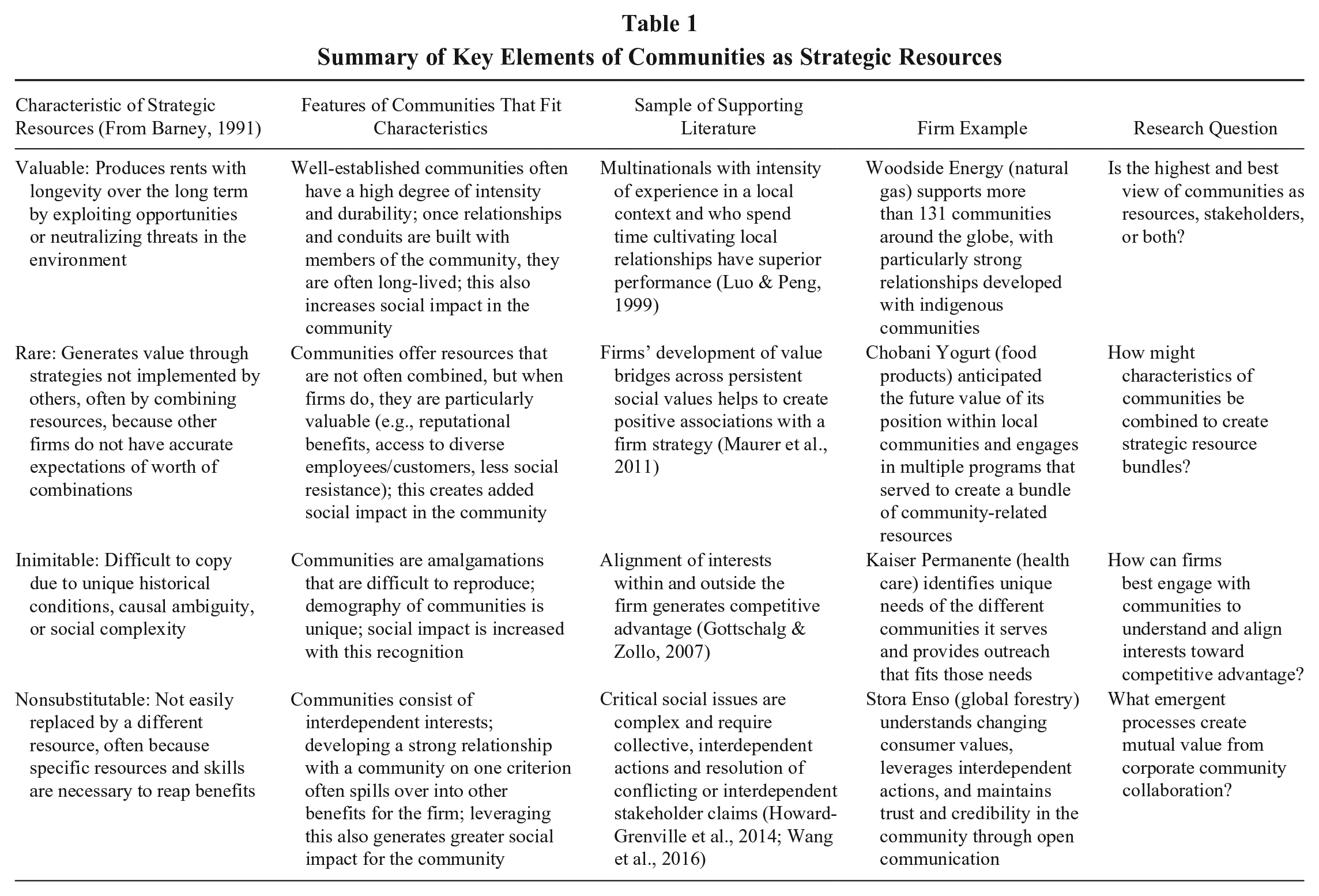
This analysis demonstrates that the community can indeed become a resource that provides sustained competitive advantage (see Table 1 for a Summary of the Analysis). We have made the case that attention to what makes the community a valuable, rare, inimitable, and nonsubstitutable resource also increases social impact of CCI. Next, we elaborate on implications of this approach.
Summary of Key Elements of Communities as Strategic Resources
Boundaries of Community Within and Outside the Firm
A fair question is whether communities are best considered strategic resources or stakeholders. A resource is an attribute available to the firm to pursue opportunities, while a stakeholder has a claim to the rents produced by said opportunities. Just as with an employee workforce, communities fit both of these descriptions, and as our examples illustrate, to maximize mutual benefit, we assert they are best considered as both. Likewise, certain schools of thought within strategy literature have defined the firm itself as “a social community specializing in the speed and efficiency in the creation and transfer of knowledge” (Kogut & Zander, 1996: 503; see also Kogut & Zander, 1992, 1993), which suggests that a firm’s interactions with the surrounding community may be more accurately described as an interaction between communities. What does this imply for healthy collaboration? Over a decade ago, Mahoney, McGahan, and Pitelis (2009: 1034) argued for a merging of research agendas of management (which tend to consider the corporation as the unit of analysis) and public policy (which often analyze governmental, multilateral, community, and nonprofit organizations), given that “private and public interests cannot be fully understood if they are conceived independently.” We fully endorse this call for action.
This merging of disciplines and research agendas affords an opportunity for management scholars and practitioners to perceive of and enact more holistic methods of achieving healthy collaborative outcomes, to the mutual benefit of company, community, and academia. For example, business and management academic departments in institutions of higher education are providing courses and programs based on community engagement, sustainable development, and social entrepreneurship, all leading to a merging of disciplines and a tangible benefit to all communities.
Theories of Community Engagement
Noticeably missing from prior work on communities is evidence-based theory, grounded in the literature, that specifies key concepts involved in corporate community engagement. Such models are beginning to emerge (C. Gibson, 2011, 2021) but need additional empirical substantiation. The underlying logic is that corporate–community engagement begins with inputs (e.g., personnel, skills, time) provided from communities and corporations, which feed into activities such as volunteer programs or educational projects. As they participate in these activities and programs, community and corporate participants experience outputs in the form of observable and measurable short-term changes in social and psychological competencies and capacities. These psychological outputs then result in social, attitudinal, and behavioral outcomes, which are medium-term changes in the communities and firms. Importantly, the psychological outputs and social/attitudinal/behavioral outcomes are brought about by building strong collaborations and relationships, which are relational pathways to impact. These are the mechanisms for achieving longer-term and sustained competitive advantage in firms and social impact in communities.
A key to this model is that direct corporate involvement in the communities facilitates connections and collaborations as well as interest alignment and understanding of values, leading to ongoing relationships. Collaboration is a source of social capital, and collective agency is critical for achieving social impact (Organization for Economic Co-operation and Development, 2001). Firms have choices about how hands-on they are during the implementation process of community investment (IFC, 2010). They might choose to simply make financial contributions or to have third-party providers engage with the communities. In contrast, approaches drawing upon organizational behavior suggest the need for a more direct form of involvement, whereby members of the firms engage with the community over substantial periods of time, in order to develop relationships that are sustainable and to enhance the extent to which community members accept accountability and responsibility for programs. The firms we profiled in this piece have achieved this, distinguishing their approach from other types of support.
Processes of Community Engagement
Within the field of management, Cantrell et al. (2015) developed a set of best practices for corporate giving, which included, for example, appointment of a dedicated CSR manager with companywide CSR responsibility, training in CSR reporting, and viewing CSR as a substantive outcome. But best practice has not yet been documented with regard to community engagement. Community engagement is a process utilized in several fields outside of management that can inform specific best practices for relational processes. For example, in public policy and urban planning, the process is critical for ensuring that policies and designs meet the needs of specific members of the community most affected.
These disciplines advocate that working directly with the community should span four phases: (1) understanding, (2) relationships, (3) engagement, and (4) facilitation (S. Gibson, 2020; S. Gibson & Grabash, 2011). The process unfolds prior to first community contact, with a firm developing an understanding of the community’s environment, history, culture, and most importantly, current capacity for change. The ability to garner strong relationships is dependent upon the community capacity for accepting change and can take many months in the case of a particularly fragile or untrusting community (e.g., indigenous or refugee community). Employees or customers of the firm may help to broker connections with members of the community. The success of the ongoing engagement requires trust and transparency to be achieved during this phase, and a means for establishing this is for the firm to sponsor forums and venues in which the connections can occur.
Once a trusting and open relationship is formed, engagement of the community begins, initially involving a conversation around the desired outcomes for the community members (from their perspective) and then moving toward support for and openness to the ideas being presented. This is critical as it places the community members in the position of decision maker, which is essential for success (S. Gibson, 2020). The final phase—facilitation—involves implementation of the community interests and ideas, leading to a sustainable outcome produced through a durable sense of ownership over the results by the community. Each of the aforementioned phases requires a strong awareness of the characteristics of the community (Phase 1) but more so an ability to implement that knowledge appropriately to the benefit of the community (S. Gibson, 2020). Most importantly, to achieve success, the outcomes must be those desired by the community. We encourage additional research that investigates the efficacy of this process in contexts outside of public policy and urban planning.
Research Methods to Examine Communities as Resources
Scholars from the different disciplines described here may need to adopt methodologies with which they are not familiar if they are to further develop RBV to incorporate communities as resources. Thus, like others before us (Barney, Wright, & Ketchen, 2001), we encourage experienced RBV researchers to deploy new methodologies when the state of knowledge requires it. In the area of corporate community investment, current indicators are very coarse, often simply indicating in yes-or-no fashion whether a company has a foundation or a volunteer program. This was the measure utilized in the index created by Rodgers et al. (2013), for example, although it is notable that they included a comparison relative to other firms in their operationalization. Clearly, these metrics and indicators are simplified quantifications and likely represent a host of complex underlying processes that are used to achieve growth in these indicators. Most organizations make very limited use of the variety of evidence that they might obtain to substantiate links between community engagement and impact (e.g., randomized control trials, longitudinal studies, stakeholder feedback forums, or qualitative interviews and case studies). These are the tried-and-true tools of organizational behavior researchers, and hence a natural synergy exists in applying these to understand the social return on investment in communities.
Conclusion
Competition in business drives innovation, particularly during times of social or economic upheaval. Some of the greatest assets to any firm are both its human capital and those stakeholders and community members external to the company. Viewing community as a resource through the lens of RBV offers a fresh approach to establishing competitive advantage. Applying alternative insights such as these to business models and mobilizing the skills required to wield them appropriately add to our inventory of resources and increases sustainability of both business and community during challenging times.
Footnotes
Appendix
To investigate the extent to which community had been considered in prior work incorporating the resource-based view (RBV) of the firm, we engaged in the following protocol. First, we identified the 85 business and management journals rated in the two highest tiers in terms of quality, as determined by the 2019 Australia Business Dean’s Council journal quality report (https://abdc.edu.au/research/abdc-journal-list/). This report consists of an extensive review conducted by an expert panel of scholars of 2,683 journals. Journals are classified into four tiers. The report is being adopted by many institutions around the world as an indicator of journal quality due to its comprehensiveness and rigorous review process.
Next, we electronically searched these journals across several data bases (Business Source Premier, JSTOR, LexisNexis, PsycINFO, Scopus) using the terms “resource-based view” and “community” and with no date constraints. This returned 905 articles that contained these two terms anywhere in the title, keywords, full text, or reference list. An initial screen of the occurrence of these terms within the articles allowed us to narrow the set to 111 articles, for example, by eliminating articles that contained the search terms only in the reference list. The Journal of Business Ethics returned the largest number of articles at 36, followed by 25 from the Strategic Management Journal and 14 from the Journal of Management.
Two raters then read these articles and retained 25 articles that were relevant both to the RBV and to community as a sociogeographical resource rather than other uses of the word community (i.e., academic, research, or investment community). These articles are noted in the reference list with an asterisk (*).
