




Abstract
There is growing interest in management and organizational research to study the relocation of knowledge workers, defined as a move by the knowledge worker to a different place of work. Relocation has been well studied as a potential source of losses or gains in human and social capital. However, our understanding of whether and how it disrupts a scientist’s innovation activities is limited. Relocation could disrupt innovation activities in the new workplace by making it difficult for a scientist to coordinate work with prior collaborators with whom the scientist has relational experience and forcing the scientist to work with new collaborators. In this study, we develop a conceptual framework assessing the effectiveness of the scientists’ research and development (R&D) experience to counter these disruptions arising from relocation and develop valuable patented innovations. We hypothesize that both the scientist’s relational experience and working with new collaborators decrease the value of innovations the scientist creates after relocation. Scientist R&D experience, however, is double-edged in nature: It leads to less valuable innovations prior to relocation but facilitates the creation of more valuable innovations after it. Our theory suggests that this is because R&D experience facilitates the scientist’s adaptation to the new context and helps coordinate her or his activities in new collaborations. Nevertheless, R&D experience is less effective in sustaining the efficacy of relational experience with prior collaborators after relocation. Using a longitudinal dataset from the knowledge-intensive genomics industry, we find support for our hypotheses. This study yields important managerial and policy implications.
Introduction
There is growing interest in management and organizational research to study the relocation of knowledge workers, defined as a move by a knowledge worker to a different place of work. Relocation has been well studied as a potential source of losses or gains of human and social capital (Almeida & Kogut, 1999; Campbell, Ganco, Franco, & Agarwal, 2012; Dierickx & Cool, 1989; Jain, 2016; Rosenkopf & Almeida, 2003; Song, Almeida, & Wu, 2003; Wezel, Cattani, & Pennings, 2006). Knowledge worker relocation is an important and commonplace phenomenon that may arise because of fluid teams in organizations (Huckman & Staats, 2011), 1 the spin-off of employees to new ventures (Kim & Steensma, 2017; Marchetti et al., 2018), and mobility across organizational boundaries (Kim & Steensma, 2017; Wagner & Goossen, 2018). We have a limited understanding, however, of whether and how such relocation may disrupt the innovation activities of knowledge workers, of which scientists form a particularly important group because they contribute to major advances in scientific and technological innovations and knowledge production that underscore the growth and development of modern economies (Huang & Murray, 2010; Romer, 1994; Rosenberg, 1974).
Relocation of scientists presents two major related challenges in the new workplace that may disrupt their innovation activities. First, relocation may make it difficult for a scientist to coordinate work with prior collaborators with whom she or he has relational experience, which is the experience acquired by the scientist when she or he works repeatedly with collaborators in her or his workgroup (Reagans, Argote, & Brooks, 2005). Second, relocation may make it necessary for a scientist to work with new collaborators in the new workplace. Relocation thus leads to a fundamental question: How may a knowledge worker counter the challenges associated with relocation and develop valuable innovations after moving to a new workplace? In view of these issues, researchers have identified the need for a clearer theoretical framework and a richer understanding of coordinating mechanisms that may enable a person to effectively face the disruptive effects of exogenous events (Jarzabkowski, Le, & Feldman, 2012) such as relocation. We capitalized on this opportunity and developed a novel framework conceptualizing how the value of innovations created by a scientist after her or his relocation is shaped by her or his research and development (R&D) experience, relational experience, and work with new collaborators.
Scientist R&D experience, the first component of our framework, is a strategic resource that accumulates through learning-by-doing in R&D projects about the tasks at hand and the different roles that she or he can perform during the R&D project (Argote, 2013; Jain, 2013). Prior research emphasizes the content-based nature of R&D experience because it corresponds to an increase in technological knowledge of the tasks and roles a scientist undertakes (Anderson, 1983; Cohen, 1991). This experience is likely to make the scientist more rigid, inert, and resistant to change over time (Cattell & Tiner, 1949; Sorensen & Stuart, 2000), decreasing the value of innovations the scientist creates in the steady state conditions prior to relocation. Prior research and literature, however, do not inform us of the effects of the scientist’s R&D experience in the relatively dynamic state after relocation, which this study sheds light on. In our conceptual framework, we propose that R&D experience has a process aspect to it as well (Cohen & Bacdayan, 1994), which becomes important after the scientist relocates. This process effect may enable the scientist to influence other people she or he works with after relocation through socialization and learning (Jain, 2016; Oettl, 2012), thus enhancing the value of innovation created.
Relational experience, the second component of our framework, results from working with collaborators repetitively. Relational experience improves coordination in a scientist’s workgroup (Reagans et al., 2005) because it results in a dynamic that “pulls a group together” (Harrison & Rouse, 2014). As the scientist acquires relational experience by working with her or his collaborators repeatedly, roles become better defined as the scientist has a better sense of who knows what and how to work effectively with her or his colleagues (Lewis, 2003; Moreland, Argote, & Krishnan, 1996). Relational experience also improves coordination by facilitating higher order routines (Cohen & Bacdayan, 1994). Through these mechanisms, relational experience has been found to improve productivity in a number of settings such as hip joint replacement procedures in hospitals (Reagans et al., 2005) and innovation in the biotechnology industry (Jain, 2013). Coordinated activity resulting from a scientist’s relational experience, we propose, may be disrupted in the new workplace following relocation, resulting in less valuable patented innovations.
New collaborators, the third component of our framework is at odds with a scientist’s relational experience because when a scientist works with a new collaborator, the division of labor and coordination, and routine (Gersick & Hackman, 1990) in the scientist’s work is disrupted. In most cases, the scientist has little or no prior relational experience working with the new collaborator. It is important to better understand the effects of the scientist’s new collaborations on innovation work because membership change is an integral part of a workgroup’s life (Summers, Humphrey, & Ferris, 2012) and workgroups are fluid in their membership (Huckman & Staats, 2011). New collaborations thus introduce a dynamic that “pulls the group apart” (Harrison & Rouse, 2014) and reduce coordination in a scientist’s work. Not only does a new collaborator disrupt routine activity (Gersick & Hackman, 1990), but she or he also necessitates a redefinition of roles (Okhuysen & Bechky, 2009) and a reorganization of the division of labor. This reduces the degree to which the activities of a focal scientist are coordinated in the new workplace. Relocation could thus disrupt the effectiveness of a scientist’s work because both the novel context and new collaborators disrupt coordinated activity, resulting in less valuable patented innovations.
The question that now arises is how a scientist may develop more valuable patented innovations after her or his relocation given that prior relational experience and working with new collaborators in the new workplace may have negative effects on the value of innovations produced. We argue that the scientists’ R&D experience may have the effect of facilitating adaption to a new context and work with new collaborators, increasing the value of patented innovations she or he creates after relocation. We test our theory and framework using the relocation of scientists in the knowledge-intensive genomics industry, which is a suitable setting for studying the effects of a scientist’s R&D experience and collaboration work. A scientist engaged in innovation and knowledge work in the genomics industry has to coordinate her or his activities with both prior collaborators and new collaborators to produce valuable patented innovations, where value is proxied by the number of forward citations accrued to their patents (Hall, Jaffe, & Trajtenberg, 2002; Sorensen & Stuart, 2000). We investigate whether the prior R&D experience of 477 genomic scientists facilitates or impedes them from producing valuable patented innovations following their relocation. For this study, we leverage the context of the 1994 Northridge earthquake in Southern California, which provides us with an exogenous shock that helps us identify the effects of relocation of scientists and reduce endogeneity concerns.
This study contributes to the theory of learning and innovation and to the growing literature on mobility of knowledge workers (e.g., Al-Laham, Tzabbar, & Amburgey, 2011; Carnahan, Agarwal, & Campbell, 2012; Jain, 2016; Marchetti et al., 2018; Mawdsley & Somaya, 2016; Rosenkopf & Almeida, 2001; Wright, Tartari, Huang, Di Lorenzo, & Bercovitz, 2018) by developing and testing a novel conceptual framework of scientist relocation in which the effects of a scientist’s experience may vary before and after relocation. Our conceptual framework and empirical analyses highlight the double-edged nature of a scientist’s R&D experience. In the steady state before relocation, we theorize that due to increased rigidity and encased learning from the content-based nature of R&D experience, a scientist would create less valuable innovations. On the other hand, our theory suggests that after relocation, the process aspect of a scientist’s R&D experience may gain salience and help an experienced scientist develop more valuable innovations as such experience facilitates adaptation to the new setting and to the integration of new collaborators into her or his workgroup. Our theory and empirical findings thus advance our understanding of the heterogeneous and interdependent nature of a scientist’s R&D experience, relational experience, and working with new collaborators before and after a scientist’s relocation and how these factors concomitantly shape the value of innovations created by scientists, which in turn affect group-level innovation outcomes. Our study shows that while a scientist’s relational experience and working with new collaborators lead to the creation of less valuable innovations after relocation, the scientist’s R&D experience may mitigate the latter. Our analyses support this theory as we find that a scientist’s R&D experience improves the likelihood that she or he creates more valuable innovations after relocation and this likelihood increases when she or he works with new collaborators.
Theoretical Background
Coordination pertains to collaborative interactions aimed at managing and integrating resources and interdependencies among activities effectively (Faraj & Sproull, 2000; Faraj & Xiao, 2006; McGrath & Argote, 2001; Okhuysen & Bechky, 2009). Coordination involves the “fitting together” of activities (Argote, 1982: 423) and “the organization of individuals so their actions are aligned” (Heath & Staudenmayer, 2000: 154). Members in a workgroup bring together unique perspectives and opinions, which can stimulate new insights through combinations of knowledge (Knippenberg, Dreu, & Homan, 2004; Taggar, 2002; Woolley, Chabris, Pentland, Hashmi, & Malone, 2010).
The performance of knowledge workers in a workgroup is linked with the effectiveness with which members coordinate work with one another (Bruns, 2013; Kraut & Streeter, 1995; Nidumolu, 1995), build on one another’s ideas, and generate new associations that result in a valuable solution (Baer, Leenders, Oldham, & Vadera, 2010; Brophy, 2006), such as valuable patented innovations (Cummings & Kiesler, 2007). Several recent studies have empirically validated the importance of coordination in cross-functional workgroups in services and in knowledge-based work (see, e.g., Aggarwal & Wu, 2015; Faraj & Sproull, 2000; Faraj & Xiao, 2006; Harrison & Rouse, 2014; Kellogg, Orlikowski, & Yates, 2006; Majchrzak, More, & Faraj, 2012; Olson, Ruekert, & Bonner, 2001).
Mechanisms for Coordinating Activity
Organizational learning and coordination research provides us with various mechanisms through which coordination and collective performance may be realized. These mechanisms include roles (Bechky, 2006), routines (Cohen & Bacdayan, 1994; Feldman, 2000; Nelson & Winter, 1982), and proximity (Okhuysen & Bechky, 2009). 2 Roles provide for expectations associated with social positions; thus, they facilitate coordination through continuity in behavior over time (Biddle & Thomas, 1966). Similarly, routines enable coordination by bringing people together and providing a template for task completion (Okhuysen & Bechky, 2009). Physical proximity and co-location facilitate interaction, communication, and the exchange of tacit knowledge especially in scientific and laboratory work (Allen, 1977), and these lead to coordinated activity (Nonaka, 1994). In the absence of such physical proximity, working and seeing one another through electronic communications could serve as a viable substitute in certain contexts (Pershina, Soppe, & Thune, 2019).
Relational experience, which manifests in the experience knowledge workers derive from working with prior collaborators repeatedly, is another mechanism through which coordination in a workgroup increases. Relational experience leads to a sharp definition of roles and to increased routine, and it may be positively correlated with physical proximity. First, relational experience with other members in a workgroup results in transactive memory of who knows what and how to work with colleagues effectively (Jain, 2020; Lewis, 2003; Moreland et al., 1996; Reagans et al., 2005), a sharp role definition, and an effective division of labor (Liang, Moreland, & Argote, 1995). Second, relational experience in workgroups arises from patterns of repeated interaction and induces routine in collaborative activity (Cohen & Bacdayan, 1994). Third, relational experience is likely to arise from collaboration among those who are geographically proximate or even collocated especially in scientific work or among those who engage in meetings and interactions using electronic means in certain contexts. In scientific and laboratory work, physical proximity facilitates communication and coordination. Consequently, the relational experience that knowledge workers gain by working together repeatedly has been found to increase productivity in diverse settings, such as hip replacement procedures in hospitals (Reagans et al., 2005) and in R&D work in the biotechnology industry (Jain, 2013).
Disruption to Coordinated Activity
Relative to the considerable work that exists elaborating on mechanisms that facilitate coordination, much less attention has been paid to “de-integration,” which refers to forces that reduce coordination (Harrison & Rouse, 2014). We study two sources of de-integration. First, when a scientist works with new collaborators, it leads to de-integration of work in her or his workgroup as it introduces coordination challenges in a number of ways. A new collaborator is disruptive to coordination because she or he necessitates a reorganization of the division of labor and a redefinition of roles (Bechky, 2006). New collaborators also diminish transactive memory working together (Lewis, 2003; Moreland et al., 1996; Reagans et al., 2005) and lead to lower routine in R&D activities (Feldman, 2000; Nelson & Winter, 1982).
Second, the relocation of a scientist to a new workplace may also disrupt patterns of repeated activity and routine (Feldman, 2000; Nelson & Winter, 1982) that need to be re-established. A scientist’s relocation may also require new collaborations that result in a change in the composition of the collaborative arrangement. This necessitates that roles be reassigned in the new workgroup, a new division of labor generated (Bechky, 2006), and work needs to be reallocated among collaborators (Gersick & Hackman, 1990: 83). This will negatively affect coordination. In addition, if a scientist is forced to relocate, then physical distance with other collaborators may increase and this may not be well substituted by electronic communications especially in scientific and laboratory work. This in turn may disrupt coordinated activity (Bechky, 2006).
In the next section, we build on the kernel of theory presented above and develop a conceptual framework and hypotheses pertaining to the respective utility of scientist R&D experience, relational experience, new collaborators, and relocation on the value of patented innovations created by scientists in the genomics industry.
Hypotheses
Scientist R&D Experience
Similar to Reagans et al.’s (2005: 871) definition of “individual experience” in the context of hip replacement procedures in hospitals, we define a scientist’s R&D experience as the experience gained when a scientist engaged in R&D projects accumulates knowledge about the tasks at hand and about the different roles she or he performs during these projects. Scientist R&D experience accumulates through learning by doing (Jain, 2010) and has both content and process aspects to it.
A scientist’s R&D experience is content based in nature because it corresponds to an increase in technological knowledge of the tasks and roles the scientist undertakes in a workgroup (Cohen, 1991), which results in improved division of labor and efficiency (Argote, Beckman, & Epple, 1990). A second aspect of the content-based nature of R&D experience is that a scientist with more scientist R&D experience is also likely to become more rigid to change (Cattell & Tiner, 1949; Sorensen & Stuart, 2000) as she or he accumulates experience in conducting R&D over time. This experience may result in encased learning and belief structures (Walsh, 1988) that can blind scientists to aspects of the environment (Walsh & Fahey, 1986) and make them resistant to change (Sorensen & Stuart, 2000). Accumulated R&D experience also leads to the development of procedural memory that reduces the novelty of individual and firm actions (Cohen & Bacdayan, 1994; Moorman & Miner, 1998). These arguments suggest that in steady-state conditions prior to relocation, R&D experience could make a scientist resistant to change in her or his work practices due to increased rigidity (Audia & Goncalo, 2007; March, 1991). Thus, the innovations that a scientist creates will tend to be similar to her or his prior work and translate into less valuable innovation with a lower impact on the focal scientists’ technological community.
R&D experience, however, may also yield some process benefits because a scientist with more prior R&D experience can shape innovation by influencing other people she or he works with through their socialization and by inducing them to learn (Jain, 2016). For instance, star scientists, which are outliers in terms of their influence on other scientists have been identified based on their prior R&D experience (Grigoriou & Rothaermel, 2014; Zucker & Darby, 1998).
After relocation
In our conceptual framework, scientist relocation positively affects the relationship between scientist R&D experience and the value of innovations she or he creates in two ways. First, a change in the R&D context following the scientist’s relocation disrupts routine, rigidity, and resistance to change that arise from her or his prior R&D experience as she or he is forced to adapt to the new circumstances. In this vein, Campbell, Saxton, and Banerjee (2014) argued that employee mobility events may disrupt the location-specific components of human capital, thus disrupting rigidity. Consequently, after relocation, an experienced scientist is more likely to experiment with new technologies and deviate from path-dependent innovation activities, leading to the creation of more valuable innovations.
Second, as noted above, relocation provides an experienced scientist with the opportunity to influence and socialize collaborators present in the new working context (Miller, Meng, & Calantone, 2006). The prior R&D experience a relocating scientist possesses provides other people she or he works with an indication of the level of influence she or he may have to shape the technology trajectory and strategy of her or his organization and consequently develop valuable innovations. For instance, prior research in the context of executive migration has indicated that executives with considerable industry experience who exerted a greater influence in their previous organizations were more likely to exert influence in their new organizations (Boeker, 1997: 218).
Thus, while an experienced scientist tends to be rigid and inert before relocation, she or he is forced to change and adapt to new circumstances after relocation. This situation decreases her or his rigidity and inertia. Furthermore, a focal scientist with greater R&D experience is better positioned to facilitate coordination and learning of other scientists she or he works with after relocation. This leads us to predict that:
Hypothesis 1 (H1): Scientists’ R&D experience will be more positively related to valuable patented innovations in the case of scientist relocation as compared to when scientists do not relocate.
Scientist Relational Experience and New Collaborators
Working with collaborators is the fundamental building block of R&D work, and a scientist may work with both prior and new collaborators. Similar mechanisms are likely to govern how prior and new collaborators influence the value of innovations a scientist creates. First, a scientist may have worked repeatedly with her or his prior collaborators in R&D projects. This will lead to the development of relational experience working with them and to coordination and routine (Reagans et al., 2005). Since workgroups are often fluid and unstable in their membership (Huckman & Staats, 2011), the scientist also may need to work with new collaborators. When a scientist works with new collaborators, it disrupts coordination and routine in the scientist’s work and may decrease the value of innovations she or he creates.
When a scientist works repeatedly with her or his collaborators, she or he acquires a number of benefits that are absent when she or he works with a new collaborator. A scientist working on R&D projects with other people needs to know where suitable expertise is located, where it is needed, and should be able to bring this knowledge to use to ensure that coordination effectively occurs (Faraj & Sproull, 2000: 1556). The scientist acquires transactive memory and develops a better sense of who knows when she or he works repetitively with a collaborator (Lewis, 2003; Moreland et al., 1996; Reagans et al., 2005). Work in this way leads to additional benefits such as a sharper definition of roles and an effective division of labor (Liang et al., 1995), increased trust (Reagans & McEvily, 2003) arising from resource sharing (Sarada & Tocoian, 2019) and sharing of private information, and a common perspective (Okhuysen & Bechky, 2009). Relational experience thus leads to routine (Cohen & Bacdayan, 1994) and coordination (Faraj & Sproull, 2000) in a scientist’s R&D work.
In contrast to working with prior collaborators, working with new collaborators may negatively affect coordination and routine in innovation activities (Kane, Argote, & Levine, 2005). Given that a focal scientist does not benefit from transactive memory and relational experience working with a new collaborator, coordination and routine will be lower. Without proper routine and coordination, the focal scientist’s work with her or his new collaborators may be impeded, thus decreasing the value of innovations created.
In sum, the focal scientist’s relational experience with prior collaborators is likely to be positively associated with the value of innovations created because it results in role definition, routine, trust, and information sharing in a given workplace. However, the scientist may not gain these benefits when she or he works with new collaborators because such work will disrupt coordination and routine and decrease the value of the innovations the scientist creates.
After relocation
We postulate that relocation decreases the value of innovations a focal scientist creates while working with both prior and new collaborators. Relocation may lead to a significant change in geographic and workplace settings and to a disruption in coordination and routine (Campbell et al., 2014). Relocation may also require a redefinition of roles, and it reduces the reliability of R&D activities (Gersick & Hackman, 1990: 83). These factors will likely reduce the value of innovations a scientist creates both while working with prior and new collaborators.
By disrupting coordination and routine, relocation may decrease the information benefits that follow from a scientist’s relational experience. After relocation, a scientist with greater relational experience needs to counter disruption to coordination more by making additional efforts to develop trust, a shared perspective, and reallocation of work among the collaborating scientists in the new workplace. In other words, a scientist with more relational experience will need to adapt more to conditions after relocation relative to a less experienced counterpart, and this tends to negatively impact the value of innovations she or he creates.
Like working with prior collaborators, working with new scientists is likely to disrupt routine collaborative activities, particularly when coordination becomes more challenging after the focal scientist relocates. Working with new collaborators after relocation also necessitates the learning of roles to be played by new collaborators (Bechky, 2006) and also the reallocation of tasks in the new collaborative structure (Gersick & Hackman, 1990: 83). Together, these changes negatively affect coordination in a scientist’s R&D work after her or his relocation. In the absence of a mechanism to compensate for these disruptions to coordinated activity, we predict that working with new collaborators will decrease the value of innovations a scientist creates after the relocation. This leads to our next set of hypotheses.
Hypothesis 2a (H2a): Scientists’ relational experience will be more negatively related to valuable patented innovations in the case of scientist relocation as compared to when scientists do not relocate.
Hypothesis 2b (H2b): Scientists’ working with a greater proportion of new collaborators will be more negatively related to valuable patented innovations in the case of scientist relocation as compared to when scientists do not relocate.
The Contingent Effects of Scientist R&D Experience
How does a scientist’s R&D experience moderate the roles of relational experience and working with new collaborators described above? We argue that the scientist’s R&D experience will negatively moderate the effects of her or his relational experience on the value of innovations she or he creates after relocation. On the other hand, the scientist’s R&D experience will positively moderate the effect of her or his working with new collaborators so that the scientist creates innovations of greater value after relocation.
First, consider a scientist with substantial R&D experience who has prior relational experience working with (at least some of) her or his old collaborators in the new workplace after relocation. This may arise in two situations: if the focal scientist had worked with at least some of the collaborators before the scientist relocated, or if at least some of them had relocated together with the focal scientist (Phillips, 2002). In both cases, relocation to a new workplace and context (Campbell et al., 2014) disrupts coordination and routine more when a scientist has greater prior relational experience and is likely to decrease the value of innovations the scientist creates (H2a).
A scientist with more relational experience and more R&D experience may develop less valuable innovations after relocation for two reasons. First, she or he may have realized the benefits of socialization and learning already in her or his former workplace. A scientist with more relational experience working with her or his collaborators in the past is likely to have already developed transactive memory working together with them (Lewis, 2003; Moreland et al., 1996; Reagans et al., 2005) and have engaged in substantial socialization and knowledge exchange (Nonaka, 1994). The integration and learning process-based benefits of the scientists’ R&D experience are likely to be lower in this case with greater prior relational experience, and this will decrease the value of patented innovations that she or he creates after relocation.
Second, while a scientist with more R&D experience may become less rigid and develop more valuable innovations after relocation (H1), this benefit may decrease with the scientist’s relational experience. Indeed, even though there may be a decrease in the inertia after relocation, the focal scientist may still face difficulty in realizing such benefits because of the challenges in establishing coordination and routine in work due to disruptions to her or his relational experience. Thus, disruption to the scientist’s relational experience may not allow her or him to benefit from the reduced inertia arising from her or his R&D experience after relocation, resulting in less valuable innovations. This leads to our next hypothesis:
Hypothesis 3a (H3a): There will be a three-way interaction of scientist R&D experience, scientist relational experience, and scientist relocation such that the interactive effect of scientist relational experience with scientist relocation on innovation value proposed in H2a will be stronger for scientists with higher degrees of R&D experience.
Consider a situation in which a scientist with R&D experience engages in a new collaboration after relocation by working with new collaborators. In this case, the focal scientist has little or no relational experience working with the new collaborators. This condition gives rise to the following effects. First, both relocation and working with new collaborators disrupt coordination as they necessitate learning, reassigning roles and tasks in the revised collaborative structure, and to a revision of the division of labor (Gersick & Hackman, 1990: 83). These tend to decrease the value of innovations the scientist creates (H2b).
The disruptive effects of working with new collaborators and relocation need to be compensated to ensure the production of valuable patented innovations. The process effect of the scientist’s R&D experience may endow her or him with the ability to effectively influence, integrate, and socialize new collaborators (Jain, 2016; March, 1991) and mitigate disruption arising from relocation and working with a new collaborator. A focal scientist with more R&D experience tends to be better at socializing and integrating new collaborators as prior R&D experience endows the scientist with status and influence (Nerkar & Paruchuri, 2005). Star scientists with considerable R&D experience have been found to have a high degree of influence over other scientists, and collaboration between such experienced star scientists and other collaborators results in more valuable innovation and in more extensive product development (Zucker & Darby, 1996).
Consequently, not only is inertia in a scientist’s work disrupted by relocation, prior R&D experience also provides the scientist with the ability to integrate and influence new collaborators. Jointly, these create the necessary conditions for the focal scientist to benefit from working with new collaborators to generate more valuable innovations. Therefore, we predict the following:
Hypothesis 3b (H3b): There will be a three-way interaction of scientist R&D experience, the proportion of new collaborators, and scientist relocation such that the interactive effect of the proportion of new collaborators with scientist relocation on innovation value proposed in H2b will be weaker for scientists with higher degrees of R&D experience.
Figure 1 presents our conceptual framework. It indicates that scientist R&D experience leads to the creation of more valuable innovations after relocation (H1). While appearing to be two sides of the same coin, scientist prior relational experience (H2a) and working with new collaborators (H2b) both disrupt coordination and routine and lead to less valuable innovation after relocation. Scientist R&D experience, however, negatively moderates scientist relational experience and results in the creation of less valuable innovations after the scientist relocates (H3a). On the other hand, scientist R&D experience tends to facilitate the creation of more valuable innovations when the focal scientist works with new collaborators (H3b).
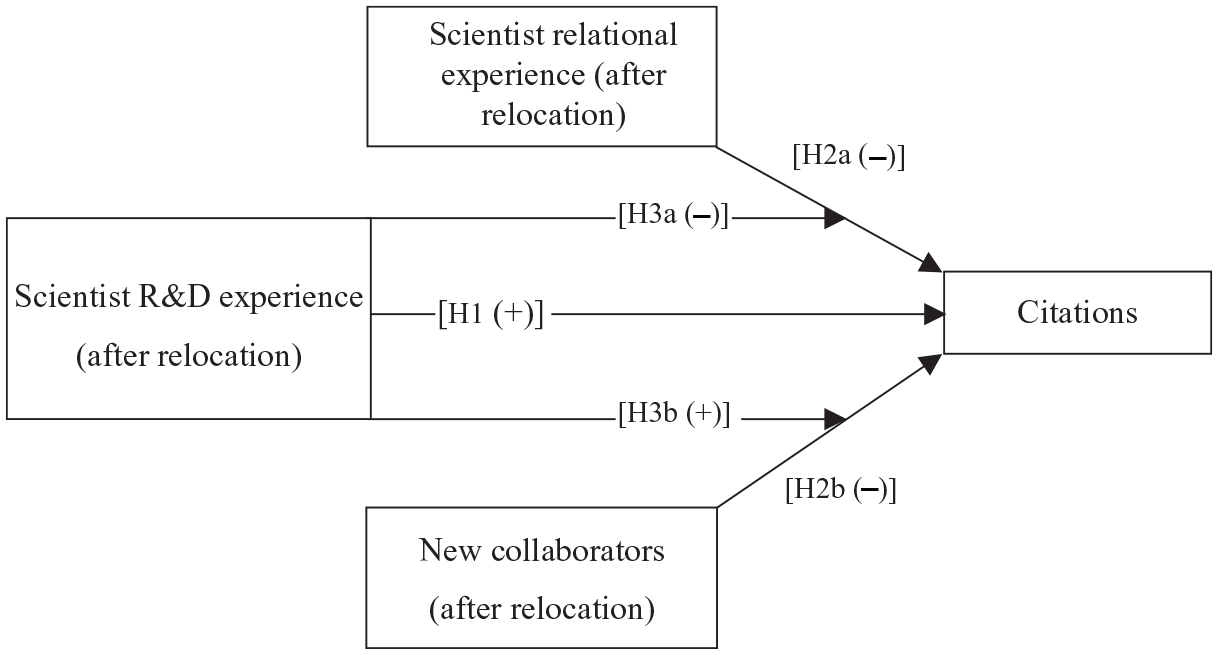
Conceptual Framework: How R&D Experience, Relational Experience, and Working With New Collaborators Impact the Value of Innovation (Citations) After Relocation
Methods
Empirical Context
We study ways in which a scientist’s relocation affects the value of innovations she or he creates in collaborative research in the genomics industry. This industry plays an important role in advancing discoveries in life sciences and biotechnology innovations. Genomics innovations provide the foundation for a myriad of important life sciences and medical, biotechnology, and environmental innovations, such as drug discovery, gene therapy and testing, personalized medicine, environmental diagnostics, DNA forensics, agriculture, and bioprocessing. Genomics patents are important sources of revenues for biotechnology and pharmaceutical companies (Cook-Deegan & Heaney, 2010).
Genomics scientists have been at the forefront of biotechnology and genomics innovations since the Human Genome Project (HGP). The project is a 13-year (i.e., from 1990 to 2003), $3.8 billion research effort and one of the largest science projects ever funded by the U.S. Department of Energy and the National Institutes of Health. These genomics scientists primarily reside in the Pasteur’s quadrant as they conduct “use-inspired basic research,” which not only advances our fundamental understanding of genomic science but also leads to the creation of innovations with potential for practical and commercial applications downstream (Geison, 1995; Stokes, 1997). The importance of their work makes understanding the relationship between mobility and innovation performance of these scientists particularly pertinent.
We focus on scientists in the United States and trace the location where they work by using their organizational address listed on scientific publications between 1983 and 2009 obtained from the ISI Web of Science (Thomson) database. This database provides one of the most comprehensive coverage of scientific publications. Our sample of treatment and control groups is composed of 477 scientists who have contributed to innovation in the genomics industry and have undertaken the first step to commercialization by having at least one genomics patent granted by 2005. Scientists’ research in this area not only advances our fundamental understanding of genomic science but also creates innovations with potential for commercial applications downstream. These scientists can be affiliated with firms or academic institutions at different points in time (Huang & Ertug, 2014), but they commonly conduct research inspired by practical problems, societal needs, and patent technologies based on genomic and life science (e.g., Huang, 2017; Huang & Murray, 2009, 2010). We construct and analyze the relevant attributes and detailed location and mobility patterns of each of these scientists.
Empirical Approach
Causal inference in most prior studies has been difficult, as they have dealt with the issue of endogeneity between mobility and innovation performance indirectly. This issue may arise because an inventor can move to a new location to find a better match in the new location (Topel & Ward, 1992; Trajtenberg, 2005). Furthermore, more competent and productive inventors tend to move more for professional reasons than their less productive counterparts. This situation may result in a potential selection bias.
We use an exogenous shock—namely, the 1994 Northridge earthquake—to mitigate problems associated with causal inference between mobility and performance in prior studies. The earthquake struck on January 17, 1994 and had a registered magnitude of 6.7 on the Richter scale. This resulted in one of the most costly natural disasters in U.S. history (Bolin & Stanford, 1998; Tierney, 1997) with total damage estimated at about $44 billion (Office of Emergency Services, 1997). Approximately 23% of the total losses from the earthquake were attributable to business interruptions (Gordon, Richardson, Davis, Steins, & Vashishth, 1995) and were unexpected (Toh, 2013). The earthquake also disrupted scientists’ routine R&D activities and forced some scientists to move outside the region. Since such moves occurred in response to the earthquake and without the possibility of any prior planning, they provide a better identification of the effects of mobility and reduce endogeneity concerns. 3
We use a difference-in-differences approach with scientist fixed effects to estimate the effects of relocation and scientist experience on the value of patented innovations prior to and after the earthquake. We first identify the treatment group of genomics scientists as those who were residing in Southern California where the effect of the earthquake was the greatest (Tierney, 1997) but who moved elsewhere in the United States within the 3 years following the earthquake. Using a “coarsened exact matching” (CEM) procedure (Iacus, King, & Porro, 2009), 4 we match this treatment group to a control group of comparable genomics scientists with similar attributes who reside in the United States either in a city outside or within Southern California and who did not move after the Northridge earthquake. 5 This control group of genomics scientists matches the treatment group on the following key dimensions (in the pre-move period, unless otherwise stated): cumulative number of patents applied (that are eventually granted), presence of any earlier location change, cumulative number of publications, gender, postmove location (of treatment group matched to the location of control group), and year of observation.
Overall, our difference-in-differences approach enables us to observe the temporal effects of relocation of the treatment group of scientists on the value of innovations they created by observing changes in the citations to the patents invented by them before and after the earthquake in comparison with the citations to patents invented by the control group of scientists. Relative to cross-sectional approaches, this methodology enables us to obtain more precise estimates of the causal effect of scientist relocation (as a result of the exogenous “shock”) and the effects of its interactions with scientist R&D experience, scientist relational experience, and new collaborators on the value of patented innovations created by these scientists (Furman & Stern, 2011; Singh & Agrawal, 2011). We describe the dependent, independent, and control variables and the estimation model below.
Dependent Variable
The dependent variable citations captures the extent to which the patents of an inventor (who in the case of genomics is a scientist) applied for in a given year are valuable and have an impact on her or his technological community (Hall, Jaffe, & Trajtenberg, 2005; Sorensen & Stuart, 2000). It has been well established that the citations received by a patent are a proxy of the value and quality of the patented innovation (Sorensen & Stuart, 2000; Trajtenberg, 1990) and its impact on the technological community (Podolny & Stuart, 1995). Citations is computed as the total number of forward citations received by patents that a scientist applied for in a given year from all patents applied thereafter until 2015, less the number of self-citations made by the scientist to these patents until 2015.
Independent Variables
To construct the independent variable after relocation, we first construct the variable focal scientist. Focal scientist is an indicator variable that equals 1 if the scientist belongs to the treatment group (i.e., resided in a location in Southern California before the earthquake but moved [once] between 1994 and 1996 to a location in the United States outside Southern California [and did not move again]) and equals 0 otherwise. Then, we construct the independent variable after relocation as follows. For a focal scientist, after relocation equals 1 for all years of observation after the relocation event that occurs in the year 1994 or later and equals 0 otherwise. For a control (nonfocal) scientist, after relocation always equals 0 (i.e., a control scientist does not relocate).
A scientist becomes rigid and resistant to change as her or his R&D experience increases (Sorensen & Stuart, 2000). In addition, the R&D experience of the scientist facilitates learning and socialization of other workgroup members (Jain, 2016). We construct the independent variable scientist R&D experience as the number of years that have elapsed between the year of the scientist’s first scientific publication or patent application, 6 whichever comes first, and the year of the focal patent application (Argote, 2013; Argote, Epple, Rao, & Murphy, 1997; Darr, Argote, & Epple, 1995; Singh & Agrawal, 2011).
The independent variable scientist relational experience captures the extent to which a focal inventor has repeatedly collaborated with her or his co-inventors prior to a given year. This variable captures the effect of repeated collaboration by the focal scientist with the same workgroup members because it leads to routine formation and coordination. This variable is similar to the “relation-specific knowledge” variable constructed by Reagans et al. (2005: 873). We first compute relational experience for the focal scientist and each of her or his collaborators as the number of times they had collaborated previously (prior to a given year). We also compute scientist relational experience as the average of relational experience across all scientists the focal scientist had worked with in a given year.
The independent variable new collaborators captures the extent to which a workgroup is affected by the introduction of new members. New collaborators is the degree to which a given scientist works with collaborators that she or he had not worked with previously. New collaborators is computed as the number of collaborators a focal scientist has in a given year that she or he had not worked with previously divided by the total number of collaborators she or he has worked with in the past. For instance, if in a given year a focal scientist worked with 10 collaborators of which he had not worked with 3 collaborators before, the value of new collaborators is 3 out of 10 or 0.3.
Control Variables
Mobility controls
We control for the following mobility-related variables. Move window is an indicator variable that equals 1 for a focal scientist in the year that she or he moves. This variable helps control for transitory effects to R&D and collaborative activities and noise during the actual year of the move. Second, different organization is an indicator variable that equals 1 if the organization the scientist is affiliated with in the current year is different from that in the previous year. This control variable allows us to capture and account for differences in recombination possibility open to those scientists who relocate but stay within the same firm or organization in comparison with those who relocate and also change their organizational affiliation. Crossing academia and industry is an indicator variable that equals 1 if the organization a focal scientist is affiliated with has changed from an academic institution to a firm, or vice versa, compared with his or her affiliation in the previous year. This variable helps control for the difference in access to and recombination of new information and knowledge across academic institutions and firms.
Scientist-level controls
We include four scientist-level controls to capture the effects of unobserved scientist heterogeneity. First, scientific award controls for the status and accomplishment of a scientist. It is an indicator variable that equals 1 if the scientist has received a prestigious scientific award or fellowship in her or his career, such as the Nobel Prize, Lasker Awards, or National Medal of Science. A list of 14 leading scientific awards was used to create this variable and was independently validated by three reputable life scientists with PhD degrees. 7
Second, assignees captures the diversity of experience focal scientists have across multiple firms prior to the year of application of a given patent (Fleming, Mingo, & Chen, 2007). Assignees is computed as the natural log of the cumulative number of different assignees that an inventor has patented for prior to the year of application of the focal patent.
Third, we control for the number of patents a focal scientist had developed in the past because of its correlation with productivity and innovativeness of the scientist (Ahuja, 2000; Owen-Smith & Powell, 2004; Rothaermel & Hess, 2007). This variable is a count of the number of patents that a focal scientist successfully applied for prior to the given year under consideration.
Our fourth scientist-level control—namely, number of collaborators—provides an indication of the extent to which a focal scientist collaborated with different scientists in a given year. A focal scientist with a large number of collaborators has increased number of ideas available to him or her and increased challenge she or he faces in coordinating her or his activities with them. This variable is computed as a count of the number of distinct collaborators a focal scientist has worked with in a given year.
Patent-level controls
We include several controls for the characteristics of patents produced by the scientists in our sample that may influence their value. Claims provides a proxy for the strength of the patent as the number of claims is the legal articulation of the boundary of the patent. As such, claims measures the extent to which a given patent provides intellectual property protection and the contribution of the innovation to the state of the art of knowledge. This variable may influence the value of the patent and thus needs to be controlled for. The number of claims listed on a patent indicates the degree to which the patent advances the state of prior art (Tong & Frame, 1994). Claims is computed as the natural log of the number of claims made on the average by patents of a focal scientist applied for in a given year.
Consistent with prior studies (Fleming et al., 2007), we control for prior art age defined as the average age of the patents cited by the patents of a scientist in our models. If the scientist builds on older technologies (i.e., greater prior art age), then innovations developed will be less current and could get cited less as time progresses. For each patent cited by focal patents applied for by a scientist in a year, we determine cite age as the difference in days in the application dates of the cited patent and that of the focal patent. Prior art age is computed as the average cite age across all patents cited by a scientist’s patents applied for in a given year.
We include the variable subclasses to control for the complexity of a patent and for the diversity of technologies used to develop it. The United States Patent and Trademark Office (USPTO) classifies technologies into approximately 150,000 technology subclasses. This classification system is periodically updated for patents granted by the USPTO (Fleming et al., 2007). We determine the number of subclasses for every patent of a focal inventor. Subclasses provides a measure of the average number of subclasses across these focal inventor patents applied for in a given year.
Apart from citing other patents, USPTO patents also cite peer-reviewed scientific articles. Since patents that build on scientific knowledge may be more original, they could be more highly cited as well. We control for this effect using the nonpatent references variable, which is the natural log of the average number of nonpatent references made by an inventor’s focal patents applied for in a given year (Fleming et al., 2007).
Table 1 provides the summary statistics and the pairwise correlation matrix of the key variables described above. We do not observe any highly correlated variables that may be of concern, including the key independent variables. Table 2 compares the statistics of the variables for the focal and control scientists matched using the CEM procedure. None of the means differ between the focal and control scientists at the 5% significance level.
Descriptive Statistics and Pairwise Correlations
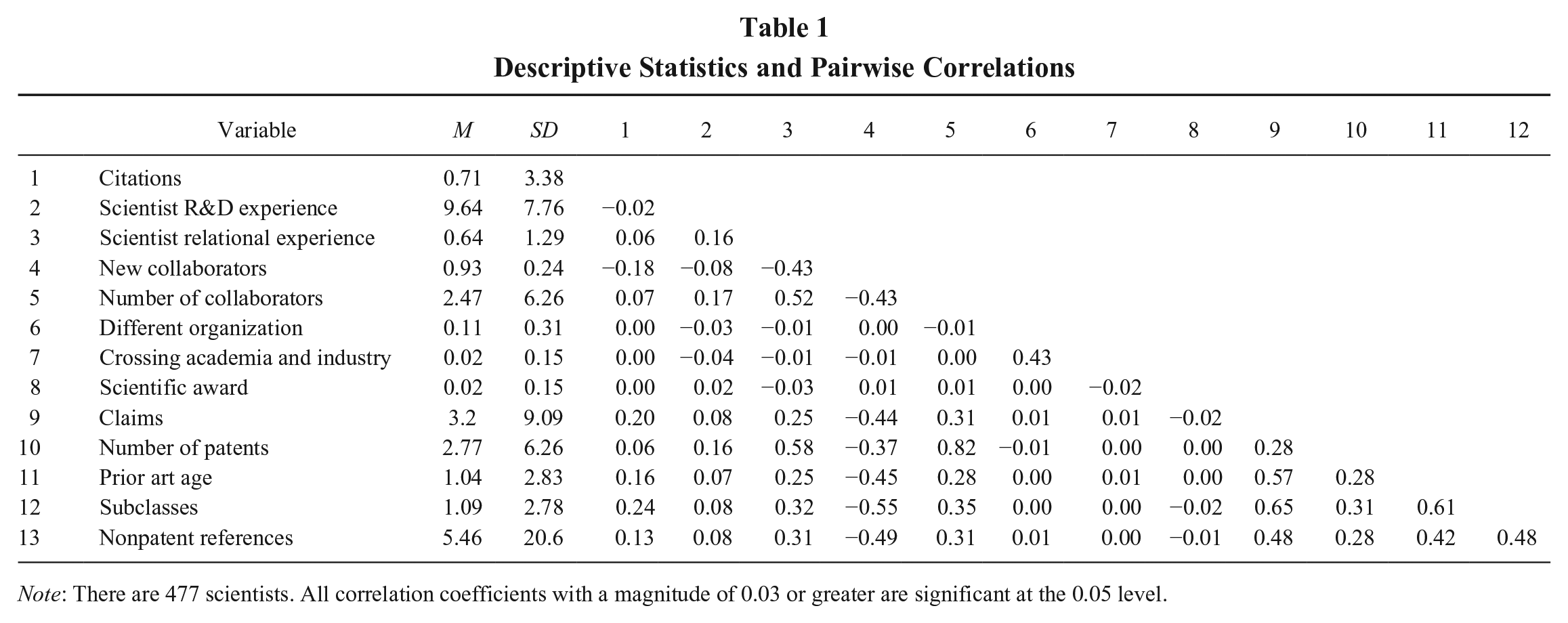
Note: There are 477 scientists. All correlation coefficients with a magnitude of 0.03 or greater are significant at the 0.05 level.
Characteristics of Focal vs. Control Scientists Matched Using the CEM Procedure
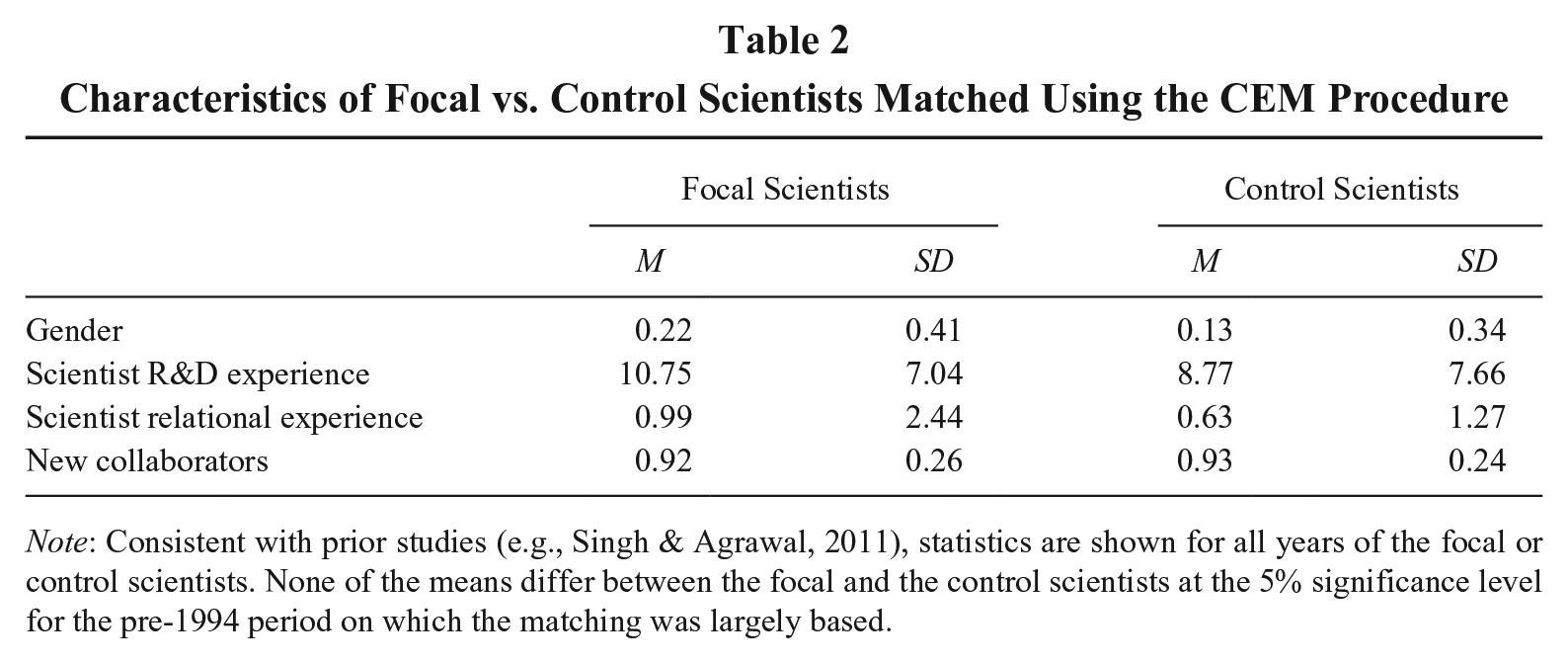
Note: Consistent with prior studies (e.g., Singh & Agrawal, 2011), statistics are shown for all years of the focal or control scientists. None of the means differ between the focal and the control scientists at the 5% significance level for the pre-1994 period on which the matching was largely based.
Model Estimation
The dependent variable citations provides a proxy for the value of the patented innovations created by scientists. It is measured by the cumulative number of forward citations accrued to the scientist’s patents applied for in a given year until the year 2015. Citations is a highly right-skewed count variable that takes on nonnegative integer values. Thus, we use conditional quasi-maximum likelihood (QML) estimates based on the fixed-effects Poisson model developed by Hausman, Hall, and Griliches (1984) to avoid heteroskedastic, nonnormal residuals (Hausman et al., 1984). The fixed-effects Poisson estimator produces consistent estimates of the parameters under very general conditions and provides a consistent estimate of the conditional mean function even if the variances are misspecified (Wooldridge, 1999).
We also incorporate robust standard errors in the fixed-effects Poisson models based on Wooldridge (1999). We use the Huber–White sandwich estimator (Allison & Waterman, 2002; Greene, 2004) in all models to account for possible heteroskedasticity and lack of normality in the error terms. QML (i.e., “robust”) standard errors are consistent even if the underlying data-generating process is not Poisson. Furthermore, QML standard errors are robust to arbitrary patterns of serial correlation (Wooldridge, 1999) and are thus immune to issues highlighted by Bertrand, Duflo, and Mullainathan (2004) concerning inference in difference-in-differences estimation. We cluster the standard errors around scientists to adjust for possible nonindependence across same-scientist observations over time as consistent with prior studies (Azoulay Zivin, & Wang, 2010; Simcoe & Waguespack, 2011).
Results
We present our baseline Model 3-1 in Table 3, which includes only the control variables. We note that the direction and significance level of the coefficients of the control variables remain quite consistent throughout the models.
Factors Affecting the Value of Innovation after Scientist Relocation
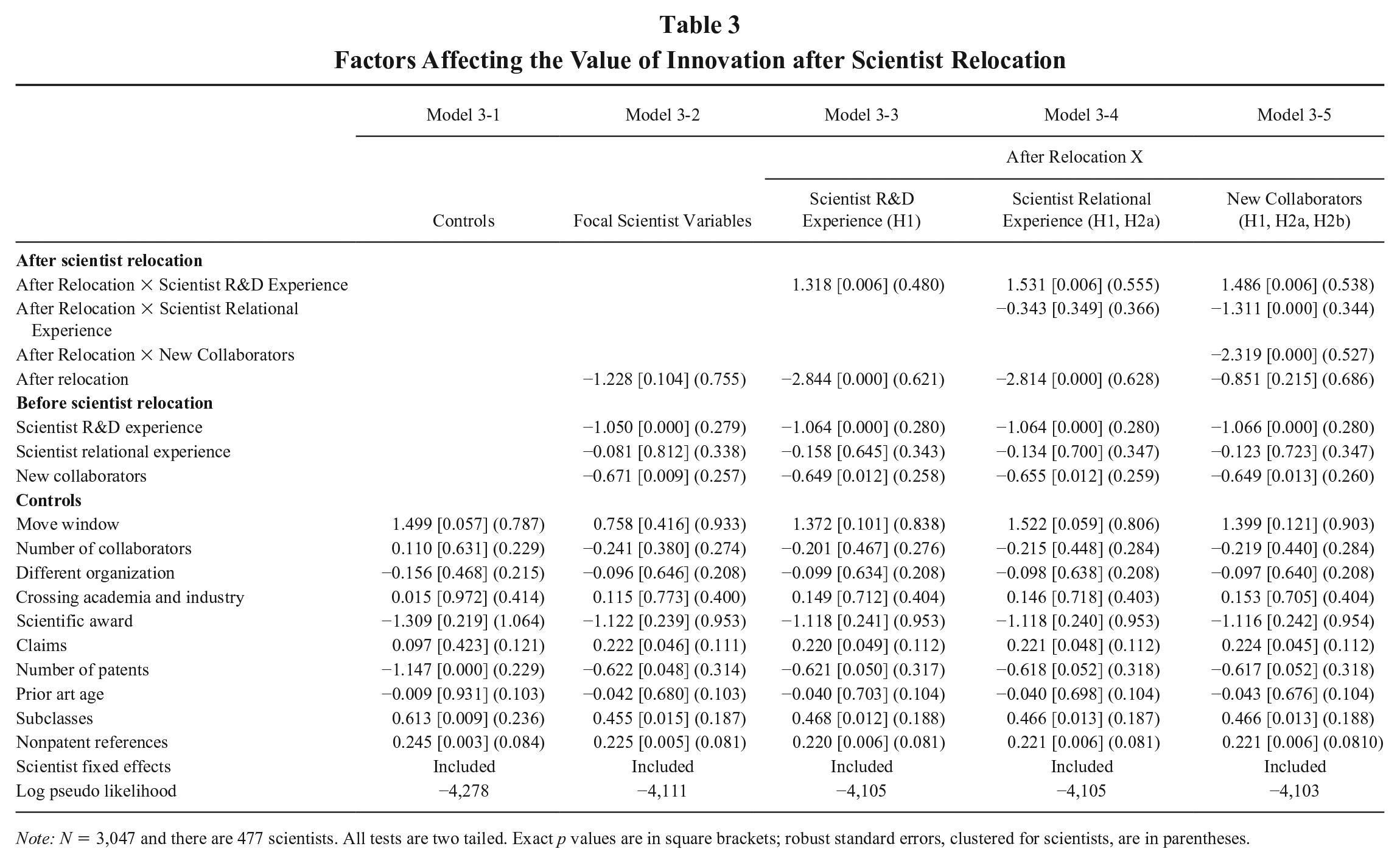
Note: N = 3,047 and there are 477 scientists. All tests are two tailed. Exact p values are in square brackets; robust standard errors, clustered for scientists, are in parentheses.
Before Scientist Relocation
Model 3-2 tests for the baseline effects of our three key independent variables—namely, scientist R&D experience, scientist relational experience, and new collaborators, before relocation. First, we argue and find that scientist R&D experience significantly lowers the value of innovations they create before relocation (β = −1.050, p < .000). Too much experience can make scientists rigid and resistant to change in their work practices, and this situation negatively affects the value of innovations they create. Second, we argue that, when scientists engage in collaborations with new collaborators before relocation, it disrupts routine, necessitates the reallocation of tasks in the new collaborative structure, and negatively affects coordination in R&D processes. Consistent with this argument, new collaborators significantly decrease citations (β = −0.671, p < .01). On the other hand, the coefficient of scientist relational experience is not significant. Models 3-2 to 3-5 indicate that these results are robust.
After Scientist Relocation Model Testing for H1, H2a, and H2b
In Table 3, Models 3-3, 3-4, and 3-5 provide a test of H1, which predicts that a scientist with greater R&D experience is more likely to create valuable patented innovations after relocation. R&D experience confers scientists with the ability to influence other organizational scientists and create innovations with greater value. In Models 3-3, 3-4, and 3-5, the coefficient of the interaction term between after relocation and scientist R&D experience all have a positive and significant effect (p = .006) on citations due to scientist relocation compared with those with less scientist R&D experience. Thus, we find support for H1.
Models 3-4 and 3-5 show the results of our test of H2a. We propose that relocation decreases the cohesiveness of relations between a focal scientist and her or his collaborators and reduces information benefits from repeat collaboration. Thus, we postulate that a scientist with greater relational experience with collaborators is likely to create less valuable innovations after relocation, relative to comparable scientists who do not relocate. We test for this hypothesis by interacting after relocation with scientist relational experience. In Model 3-4, the coefficient of the interaction term suggests a negative effect consistent with H2a, but it is not significant (β = −0.343, p = .349). However, the complete Model 3-5 suggests a significant and negative effect (β = −1.311, p < .001). At the mean value of scientist relational experience, citations decrease by 48% relative to when scientist relational experience takes on a value of zero. This finding supports H2a.
Model 3-5 in Table 3 provides a test of H2b. We argue that collaboration with a greater proportion of new scientists adversely influences coordination because it disrupts behavioral routines and requires reallocation of tasks in the collaborative structure. Thus, we hypothesize that a scientist is likely to create less valuable innovations after relocation when she or he collaborates with a greater proportion of new collaborators. The coefficient of the interaction term between after relocation and new collaborators shows a significant (β = −2.319, p < .001) and negative effect (of 78%) on citations due to scientist relocation (at the mean value of new collaborators) compared with another scientist with fewer new collaborators (at zero value). Thus, we find support for H2b.
Model 4-1 of Table 4 provides a test of H3a. We argue that a scientist with more R&D experience who repeatedly works with the same collaborators after relocation as she or he did prior to relocation is less able to induce them to do more learning as learning is likely to have already taken place during prior interactions. Consistent with this argument, the coefficient of the interaction term After Relocation × Scientist Relational Experience × Scientist R&D Experience suggests a significant and negative effect (β = −2.395, p < .001) on citations. Thus, H3a is supported.
Effect of Scientist R&D Experience on Helping Integrate New Collaborators After Relocation
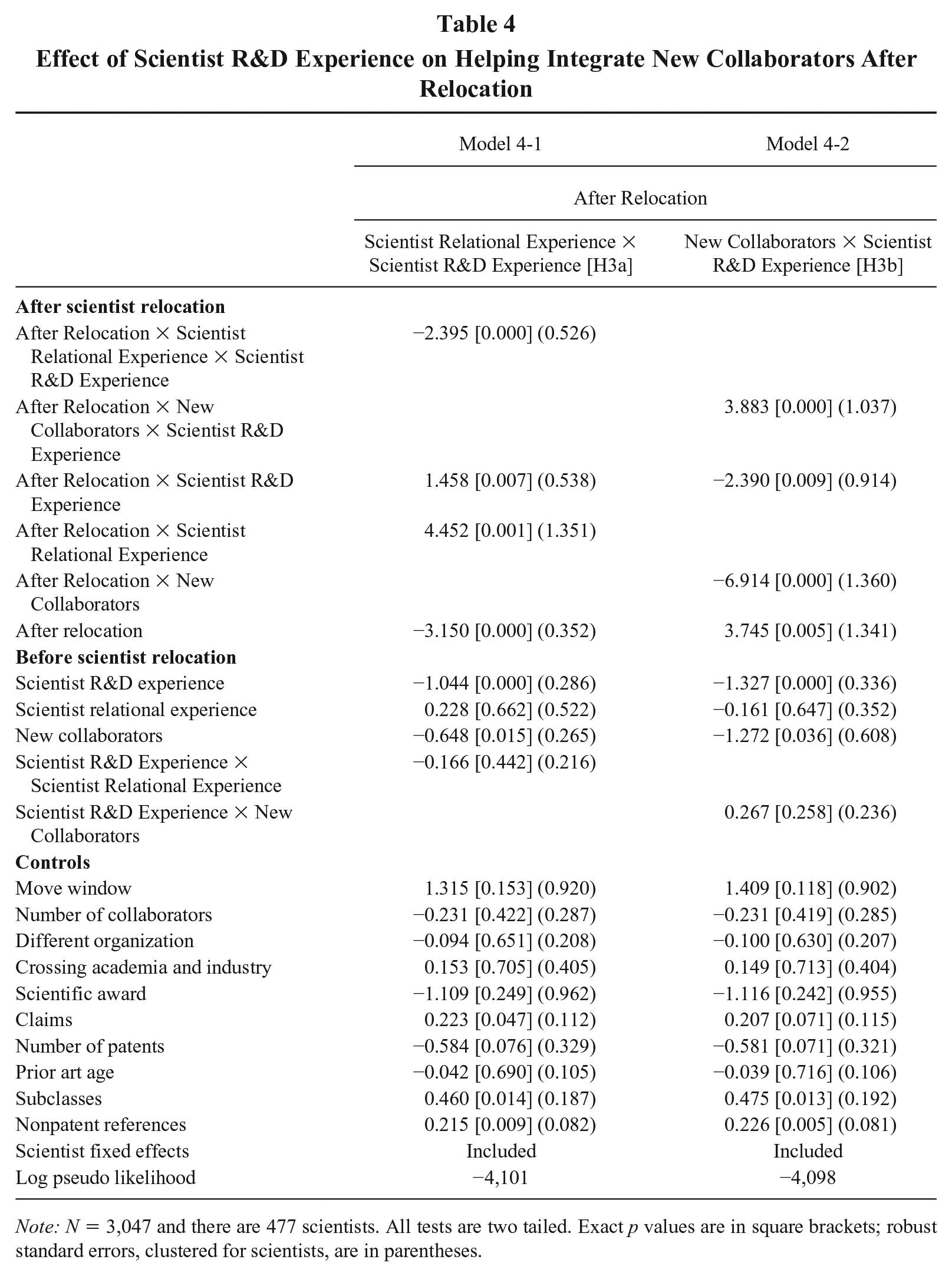
Note: N = 3,047 and there are 477 scientists. All tests are two tailed. Exact p values are in square brackets; robust standard errors, clustered for scientists, are in parentheses.
Model 4-2 provides a test of H3b that predicts a scientist with more R&D experience is more likely to create value in innovation after relocation when she or he works with a greater proportion of new collaborators. We argue that scientist R&D experience facilitates the integration of new collaborators and helps them leverage their expertise in innovation activities after relocation. This enhances the value of innovation created. Consistent with this hypothesis, the coefficient of the interaction term After Relocation × New Collaborators × Scientist R&D Experience suggests a significant and positive effect (β = 3.883, p < .001) on citations. This result lends support to H3b.
Robustness analyses
We first perform a robustness check on the possibility that our analysis might not account for the fact that more recent patents are likely to receive less forward citations as they have less time to be cited. Another temporal trend is that, given that a greater number of USPTO patents are being granted each year, more recent patents (for a given citation window) are likely to receive more forward citations on average. We believe that these potential effects should not bias our results substantively. However, we conduct two separate tests following Hall, Jaffe, and Trajtenberg (2001) to address this potential concern. First, we control for the average forward citations accrued by genomics patents applied for in a given year in our dataset (Table A1 in the Appendices). This helps control for the potential effect that patents applied for in later years are less well cited. Second, we repeat our analysis by including year fixed effects in our regression models to control for temporal effects in citation patterns (Table A2 in the Appendices). Our results are robust to these alternative specifications, which help control for the temporal trends in patent forward citations.
We also perform a robustness check to assess whether proximity to the earthquake epicenter indeed affects the patented innovation produced by scientists who chose to relocate. We check for the interaction effect of after relocation and the potential damage to the facilities of these scientists in Southern California. To this end, we first obtain the five-digit zip code for each firm and organization in Southern California in our sample (which have produced at least one patent in the period we studied) to calculate the direct distance (in miles) of each location to the epicenter (which was in Reseda, zip code 91335). Given that the effect of distance is nonlinear, we proxy for “damage” by the log of distance from the epicenter for each location in Southern California that has produced patents in our observations period. This distance score ranges from 1.67 (5 miles) to 4.78 (119 miles) for locations within Southern California, with a low value suggesting locations close to the epicenter and thus with great potential damage; we assign an arbitrarily high value score of 6.9 (1000 miles) for locations outside Southern California.
As expected, we find that a positive and significant interaction effect exists between after relocation and the distance score. This result suggests that the negative impact of after relocation decreases as the distance increases (i.e., as the focal scientist resides further away from the epicenter of the earthquake). Thus, we conduct a robustness analyses to include the variable distance (in miles) of a scientist from the epicenter of the earthquake in the regressions with two- and three-way interactions (Table A3 in the Appendices). The results are consistent and largely similar to those of the main models shown in Tables 3 and 4.
We also conduct a sensitivity test using a 2-year relocation window (1994 and 1995) instead of 3 years (1994 to 1996) as our boundary. As shown in the models in Table A4 in the Appendices, using a 2-year relocation window yields consistent and largely similar results to our regressions using a 3-year relocation window.
Lastly, in the difference-in-differences regression models shown in Table A5, we excluded all (nontreatment group) scientists who experienced the earthquake and remained in Southern California after the earthquake. In this sample, we used the shorter relocation window between 1994 and 1995. The results are again consistent with our main results (shown in Tables 3 and 4). These robustness analyses using different specifications, samples, and controls lend additional support to the main results we have obtained in the main models.
Discussion
This study contributes to the theory of learning and innovation and advances the literature on mobility of knowledge workers by developing a novel conceptual framework and empirically investigating the effects of the focal scientist’s R&D experience, relational experience, and working with new collaborators on the value of innovations created after her or his relocation. Our empirical methodology leverages the 1994 Northridge earthquake in Southern California as an exogenous shock, forcing a number of genomics scientists to relocate far from the earthquake’s epicenter with little or no prior planning. This relocation resulted in a change in context and disrupted coordinated activity.
Our framework and results suggest that relocation is associated with two major challenges: It becomes difficult to coordinate prior collaborations in which a scientist has relational experience, and a scientist must form new collaborations in the new workplace. These challenges decrease the value of innovations a scientist creates after relocation. Consistent with our theoretical arguments, our findings show that scientists can leverage the R&D experience they possess to address these challenges. Our study sheds light on the double-edged nature of scientist R&D experience: In the steady state prior to relocation, a scientist’s R&D experience leads to innovations of lower value, which we theorize could be due to increased rigidity and encased learning. On the other hand, a scientist experienced in R&D may develop more valuable innovations after relocation because R&D experience may facilitate her or his adaptation to the new context and the socialization and integration of new collaborators she or he works with in the new workplace. We also find that a focal scientist with greater prior relational experience—gained by working repeatedly with collaborators—will create less valuable patented innovations after relocation, relative to a comparable scientist who does not relocate. A focal scientist who works with a greater proportion of new collaborators after relocation will also create less valuable innovations.
Building on our conceptual framework, an important contribution of our study is that we show the scientist’s R&D experience, relational experience, and working with new collaborators are heterogeneous and interdependent in nature. The focal scientist with more R&D experience will create relatively less valuable patented innovations after relocation when she or he has greater prior relational experience. Furthermore, we theorize and find that a scientist who works with a greater proportion of new collaborators after relocation will create relatively more valuable patented innovations when she or he has more R&D experience. This could be due to the process aspect of R&D experience, which can influence and facilitate the integration of new collaborators in the new workplace, thus affecting not only the individual scientists but also group-level and firm-level innovation outcomes.
Strategy and Policy Implications
Our findings shed light on the previously underexplored concomitant effects of contextual change (arising from relocation), R&D experience, relational experience, and new collaborations on the value of innovations created by knowledge workers. These findings have important implications for strategic management of human assets and hiring in firms as well as broader regional economic policy. In terms of management of human assets and hiring, our study offers important strategic implications for technology-based and science-based firms looking to hire experienced scientists into their organizations. While increased scientist experience could lead to more rigidity and inertia in steady state prior to relocation, this study finds that scientists’ R&D experience enables them to mitigate the negative effect of relocation on the value of innovations they create and better manage the crisis. Experienced scientists’ ability to coordinate activities and facilitate learning after relocation dominates any inertia-creating effect their experience had prior to relocation, helping produce innovations of higher value than those produced by their less experienced counterparts.
Experienced scientists facilitate coordination through a second mechanism based on the integration of new collaborators into their workgroups prior to and after relocation. New collaborators in a workgroup disrupt established roles, routines, and coordinated activity prior to and after relocation. Experienced scientists mitigated the disruption caused by the introduction of new collaborators as they facilitated the integration of new collaborators into their workgroups. Experienced scientists facilitated coordination through the socialization of new collaborators into R&D workgroup before and after relocation; however, this capability is particularly valuable after relocation because moving provides experienced scientists with the opportunity to socialize and influence organizational members present in their new setting (Jain, 2016). Socialization and learning also facilitate the integration of new collaborators into workgroups; this situation creates the necessary conditions for a focal scientist to benefit from the knowledge and creative efforts of her or his new collaborators. Consistent with this argument, this study finds support for the proposition that scientist R&D experience aids integration of new collaborators in the new context after relocation, leading to the creation of innovations with greater value.
The strategic management of human assets is critical for firms, particularly those in knowledge-intensive industries (e.g. Campbell et al., 2012; Coff, 1997). Acquiring knowledge and enhancing the value of innovations through employee mobility and collaborative work using mechanisms, such as learning-by-hiring, technological alliance, or spin-outs, represent important sources of strategic advantage (e.g., Franco & Filson, 2006; Palomeras & Melero, 2010; Rosenkopf & Almeida, 2003). In addition to the specific implications our study offers on the hiring of experienced scientists, technology-based and science-based firms should more broadly consider the benefits and drawbacks of relocating scientific and technical talent or employees with different levels of R&D experience and relational experience in their decision-making process. Similarly, mobile talent and employees should consider the likelihood of producing valuable innovations resulting from their relocation and contextual change. In attracting and retaining the most promising scientific talent, firms should consider the potential challenges that relocation introduces and formulate strategies to mitigate the constraints and enhance the conditions for the production of valuable innovations. Further investigation and understanding of these challenges and strategies can represent a potentially valuable source of firm competitive advantage.
Our study also provides implications for broader regional economic policy. Knowledge workers and scientific talent contribute to regional and national economic growth and innovation (Audretsch & Feldman, 1996; Franco, 2005; Oettl & Agrawal, 2008). In the knowledge-based economy, different geographic regions and countries compete for talent to enhance their economic, innovative capacity (Furman, Porter, & Stern, 2002). The successful attraction and retention of these mobile knowledge workers constitute important competitive advantages for regional and national economies that focus on innovation as a way to create economic growth. Nevertheless, our findings suggest policymakers must have a comprehensive and accurate assessment of the nuanced effects of contextual change and relocation of knowledge workers and the factors that help or hinder the adaption of these knowledge workers to the new context and location. In particular, policymakers should consider not only the mechanisms that facilitate coordination and integration but also those that lead to de-integration, which refers to forces that pull a group apart and reduce coordination. Such knowledge will help policymakers devise public policies to attract mobile scientific talent into regional geographic clusters and foster collaboration of these highly skilled knowledge workers to enhance the value of their innovations. Specifically, policymakers could take a more balanced approach in regional talent attraction and consider bringing in an appropriate mix of experienced scientists in R&D and innovation activities and those who just started out. Another consideration is to balance those who have prior extensive experience collaborating with others in the workgroups in the region with those who are new to the workgroups in the region. Such policies will better contribute to regional economic growth and innovation capacity. Having such considerations in mind is important because relocation and contextual change are becoming increasingly common in today’s interconnected society.
Limitations and Future Research
Like other studies, our study has some limitations that may serve as opportunities for future research. For instance, the Northridge earthquake provides a unique opportunity to study relocation that is involuntary, but it may limit generalizability. Nevertheless, we think the tradeoff between having such a unique exogenous shock to look at more involuntary movement and including a broader sample of scientists (not subject to this shock) who move more voluntarily is worthwhile. We believe this study advances our understanding of scientist mobility (mobility of highly skilled knowledge workers), and our approach helps tackle some methodological issues present in prior studies of knowledge worker mobility. Finally, our definition of relocation of a knowledge worker as “a move by the knowledge worker to a different place of work” primarily concerns geographic relocation. A broader definition of relocation, however, may also include relocation to a new team in the same location. Such a relocation could involve similar dynamics as those studied in this research due to the interplay of scientist experience, relational experience, and working with new collaborators. However, the decision to work in a new team in the same location is not as exogenous as it not only depends on individual preferences but also is subject to further firm requirements and constraints. Therefore, more research is required to investigate the effects of disruption to coordination involving working with a new team in the same location.
Another potential issue with our study is that its findings may not fully generalize to today’s dynamic, collaborative research environment. However, recent studies indicate that an alternating interplay between digital and nondigital tools (means of collaboration) enables transformation, knowledge integration, and coordination (Pershina et al., 2019). For example, Sarada and Tocoian (2019) found that working with former coworkers helps resolve information asymmetries and results in more information sharing. These findings are not only consistent with those of our study but also complement our study and strengthen our belief that our study provides an important lens or insight into how a change in context will trigger a change in the value of innovations generated. Face-to-face contact and collaboration are crucial in scientific research and laboratory work in order for scientists to move research forward effectively with clear role definitions and to establish trust, routine, and effectively share information in the laboratories. Nevertheless, an interesting extension to our study is to investigate if a change in context from face-to-face collaboration to online collaboration in scientific work and other settings would lead to similar or different findings. Future research can focus on this area to further establish the generalizability of our findings, especially in the dynamic, collaborative contexts of the 21st century.
Appendices
Robustness Checks Controlling for the Average Forward Citations to Genomics Patents Applied for in a Given Year
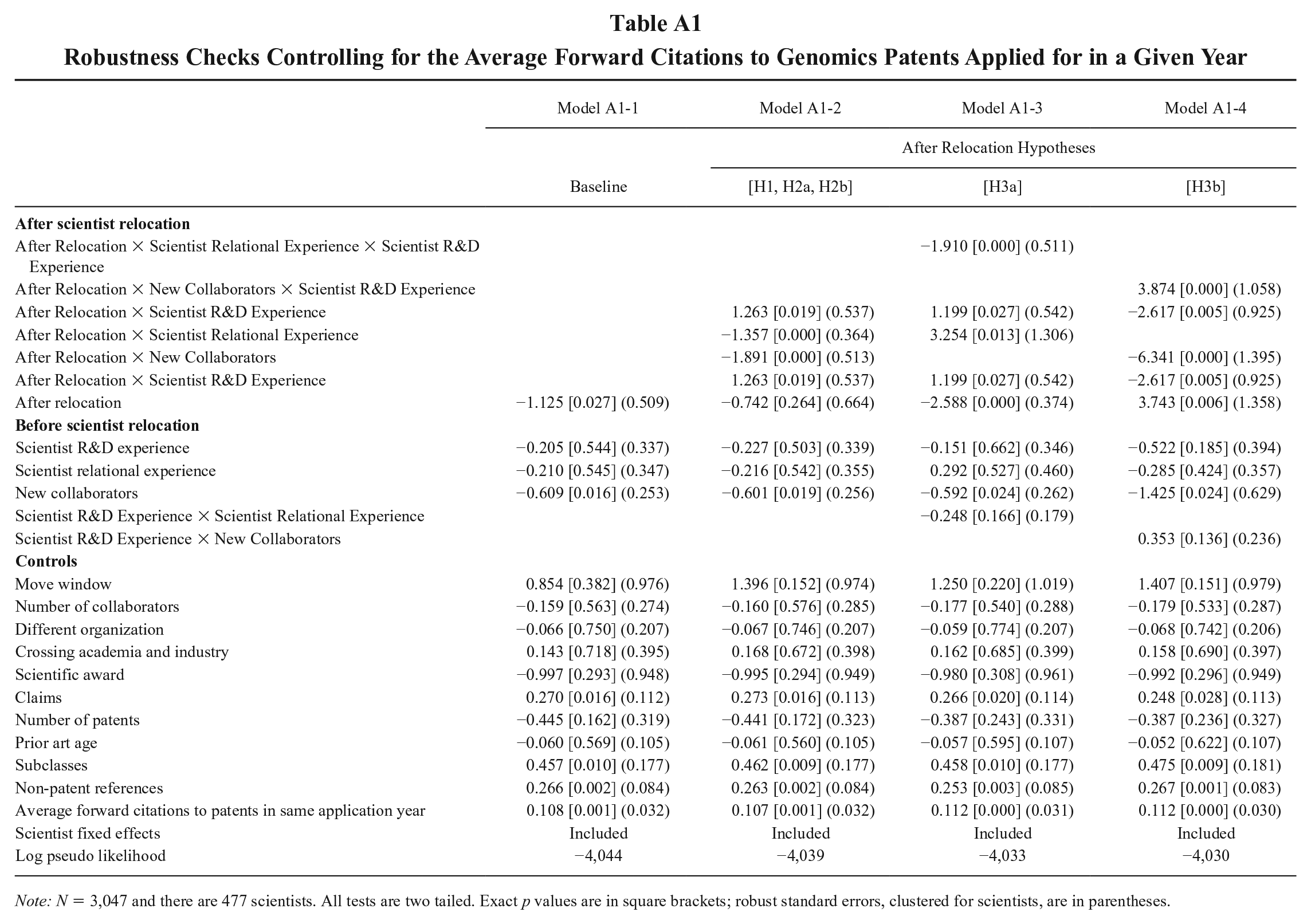
Note: N = 3,047 and there are 477 scientists. All tests are two tailed. Exact p values are in square brackets; robust standard errors, clustered for scientists, are in parentheses.
Robustness Checks Including Year Fixed Effects
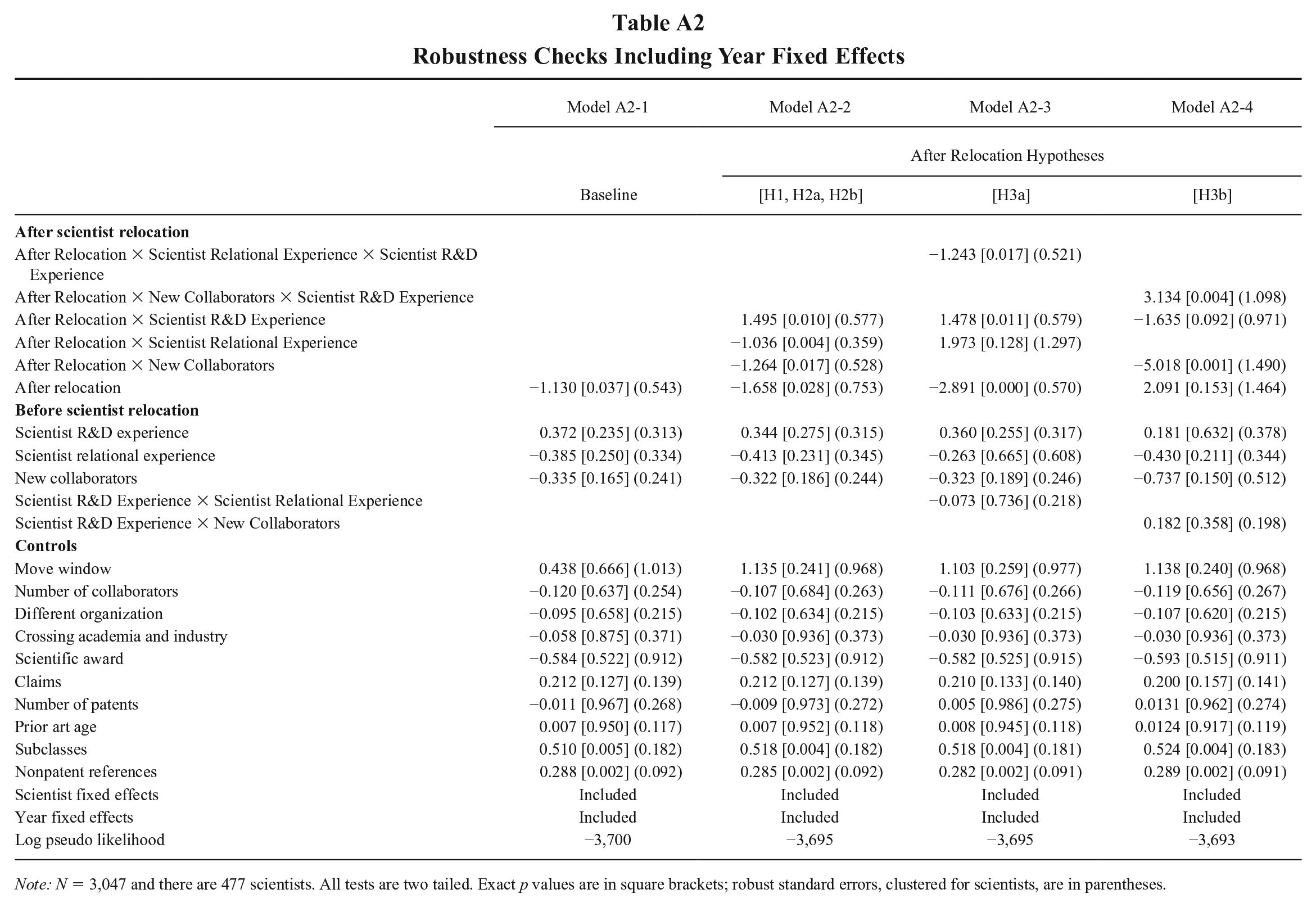
Note: N = 3,047 and there are 477 scientists. All tests are two tailed. Exact p values are in square brackets; robust standard errors, clustered for scientists, are in parentheses.
Robustness Checks Including Distance
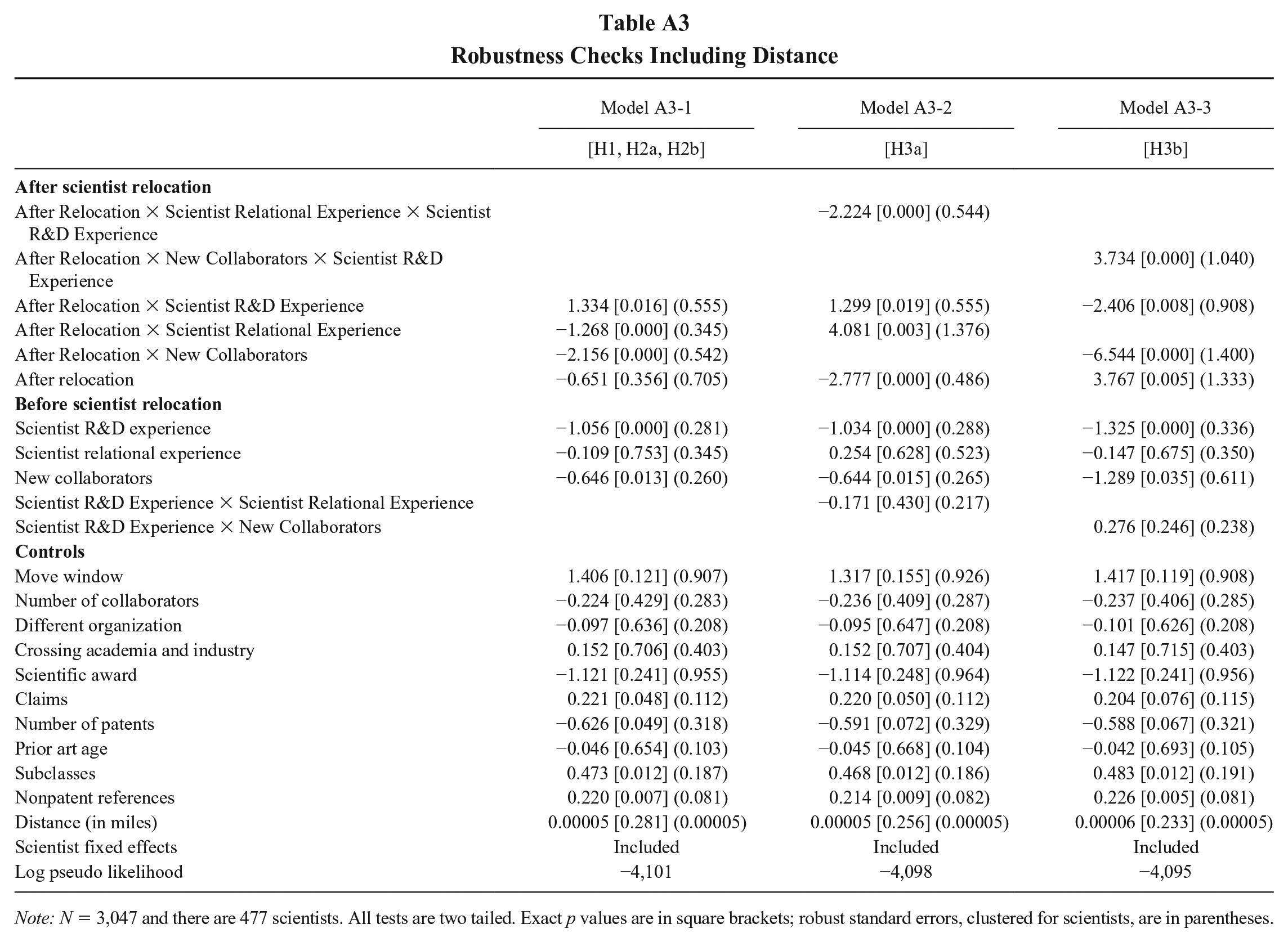
Note: N = 3,047 and there are 477 scientists. All tests are two tailed. Exact p values are in square brackets; robust standard errors, clustered for scientists, are in parentheses.
Robustness Checks Using 2-Year Relocation Window (1994 and 1995)
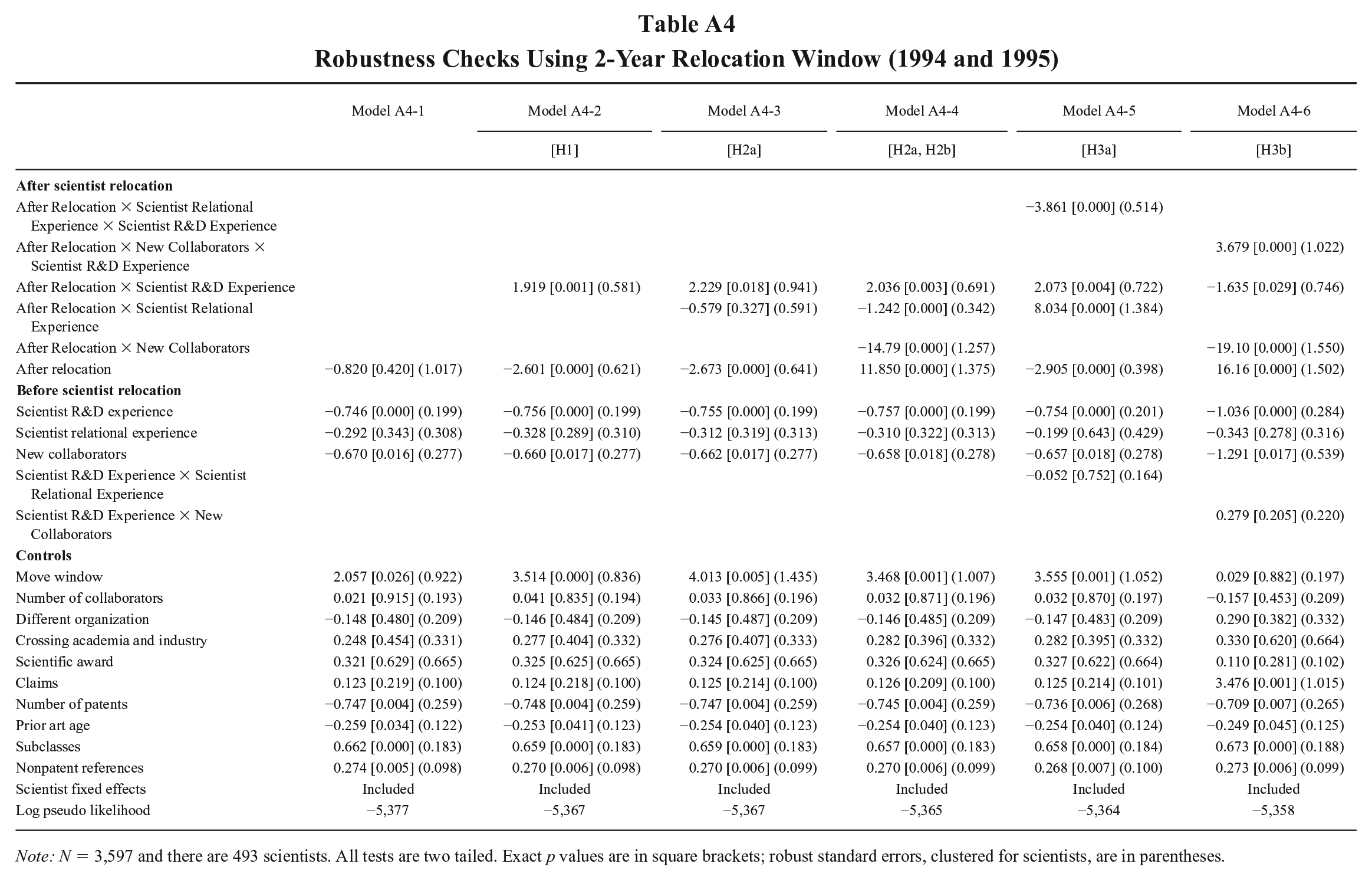
Note: N = 3,597 and there are 493 scientists. All tests are two tailed. Exact p values are in square brackets; robust standard errors, clustered for scientists, are in parentheses.
Robustness Checks Excluding Scientists Who Remained in Southern California After the Earthquake and Using 2-Year Relocation Window (1994 and 1995)
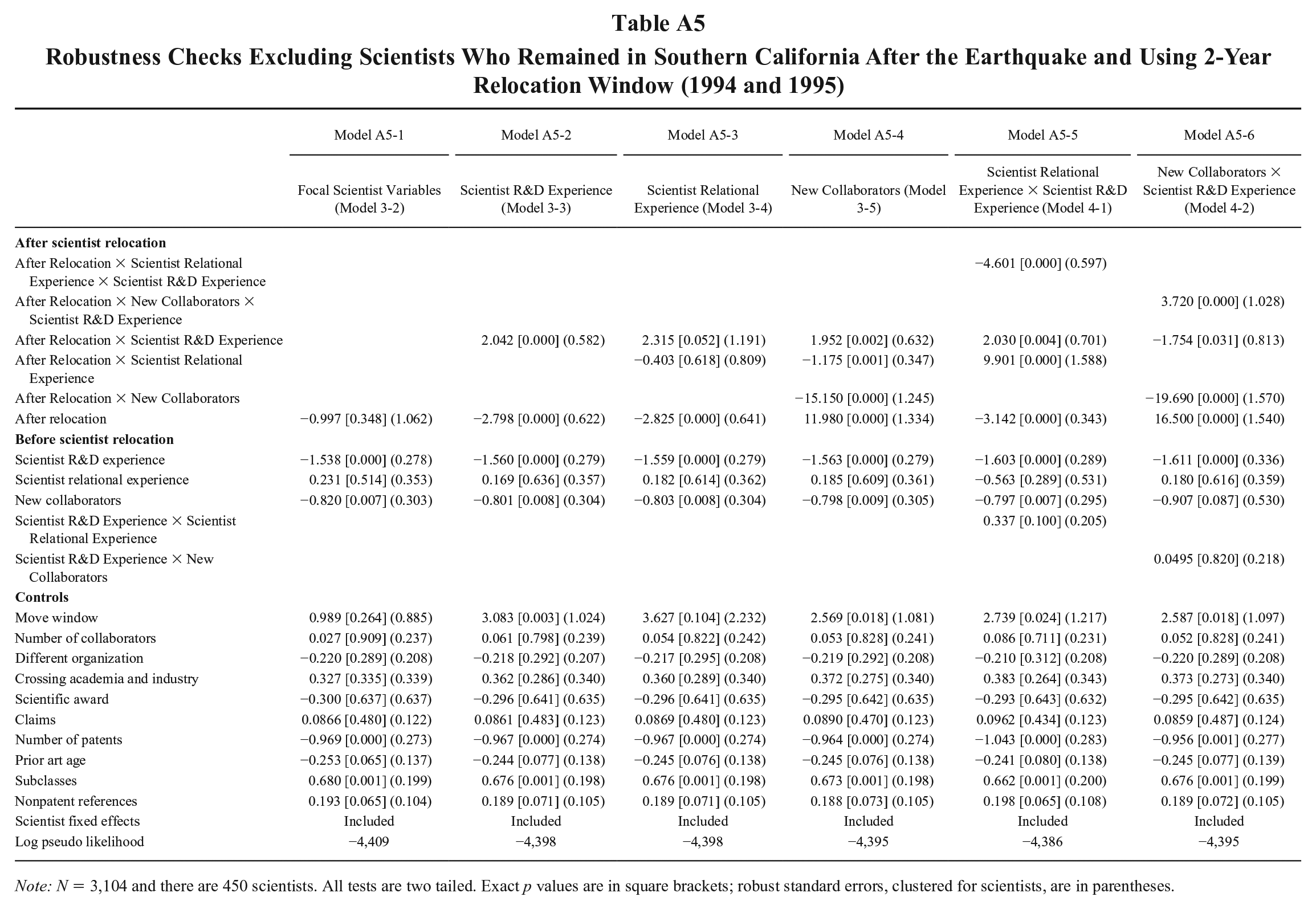
Note: N = 3,104 and there are 450 scientists. All tests are two tailed. Exact p values are in square brackets; robust standard errors, clustered for scientists, are in parentheses.
Footnotes
Acknowledgements
The authors contributed equally. We would like to thank editor Jorge Walter and three anonymous reviewers for their constructive comments and insightful suggestions. We thank Lee Fleming, Karin Hoisl, Stefan Kuhlmann, and participants of the AOM Annual Meeting, SMS Annual Conference, and the ARISE Seminar at NUS Business School for helpful comments on prior versions of this paper. We thank the funding support by the Ministry of Education, Singapore AcRF Tier 1 Research Grant R-313-000-113-112, and the Singapore Ministry of Education Social Science Research Thematic Grant MOE2017-SSRTG-022. Any opinions, findings, and conclusions or recommendations are those of the authors. The usual disclaimers apply.
