




Abstract
This article investigates the emergence and development of the innovation platform in a nascent industry, through a dynamic capabilities perspective. Based on an inductive study of the U.K.’s tele-rehabilitation through gaming (TRTG) industry, we identify four capabilities that are important for successful platform development: innovation leverage, market exploration, quality control, and appropriation. A holistic framework is developed to explain how these capabilities can facilitate platform development by enabling appropriate business models and activities. We then discuss how a firm could define and redefine its firm boundary in order to deploy the four capabilities for platform development.
This study examines the emergence and development of the innovation platform, which consists of a core component that can be shared by complementors to develop useful complements for customers, and the interface through which these complements are connectable to the core component (Cusumano, Gawer, & Yoffie, 2019; Gawer, 2014; Jacobides, Cennamo, & Gawer, 2018; Tiwana, Konsynski, & Bush, 2010). At the interface between the core and the complements, a platform firm may also provide boundary resources (Eaton, Elaluf-Calderwood, Sørensen, & Youngjin, 2015; Ghazawneh & Henfridsson, 2013), such as application programming interfaces (APIs), software development kits (SDKs), game engines, technical standards, and rules that facilitate the use of the core component to build its complements.
Innovation platforms have been developing rapidly worldwide across different industries. Examples include video games (e.g., PlayStation and its games), PCs (e.g., the Intel microprocessor and other hardware components; Microsoft Windows and Windows-based programs), web browsers (e.g., Google Chrome and extensions), smartphones (e.g., iPhone and its apps), and smart homes (e.g., Amazon Alexa and peripheral devices). With the spread of these platforms, the focus of value creation has been moving towards networks. The platform firms and their complementors, therefore, form platform ecosystems that make the platforms’ offerings more valuable to the customers (Cusumano & Gawer, 2002; Jacobides et al., 2018). According to the United Nations’ Digital Economy Report, the combined value of platform firms with a market capitalization of more than US$100 million was estimated at more than $7 trillion in 2017—67% higher than in 2015 (United Nations Conference on Trade and Development, 2019).
How do these innovation platforms come into being and evolve over time? Prior studies, including the related conceptual discussions (e.g., Dhanaraj & Parkhe, 2006; Nambisan & Sawhney, 2011), have focused primarily on successful platforms in established industries to understand the factors behind their successes (Cusumano, 2010; Gawer & Cusumano, 2014; McIntyre & Srinivasan, 2017). Because these studies are mostly based only on snapshots of established and successful platforms, their discussions tend to pay insufficient attention to the early stages of platform development in nascent industries; rely on understanding the de facto status of the platforms as well as the platform firms, the complementors, their activities, and associated interactions; and underplay the dynamic and evolving nature of the actual platform development process (Dattée, Alexy, & Autio, 2018; de Reuver, Sørensen, & Basole, 2018; Gawer, 2014).
This issue can be vital and yet challenging when comprehending the platform phenomenon, particularly its emergence and in nascent settings, because the success of a platform depends on concurrent inputs from various stakeholders that can be unclear and constantly evolving at the platform and the industry’s early stages. For instance, Apple did not intend to allow third-party developers to build native apps when iPhone was unveiled in 2007. Then in 2018, Apple released the SDK, which allowed the development of native apps, thereby promoting an increasing number of developers to become complementors of the iPhone platform. Our understanding of the platform phenomenon can benefit from more longitudinal studies on platform dynamics (de Reuver et al., 2018). Unfortunately, due to the methodological difficulties of following a specific platform development from the beginning forward (Gawer & Cusumano, 2014), we have very limited knowledge and empirical evidence of how business ventures actually develop their platforms, especially in nascent industries (Dattée et al., 2018; de Reuver et al., 2018; Kyprianou, 2018; Nambisan, 2017; Nambisan, Lyytinen, Majchrzak, & Song, 2017).
To investigate the emergence and development of the innovation platform, this study uses comprehensive evidence gathered from multiple sources (archival documents, interviews, observations, and facilitate workshops) in a 3-year study of the U.K.’s nascent tele-rehabilitation through gaming (TRTG) industry. Our analysis is informed by a dynamic capabilities perspective. We consider this perspective appropriate because the concept of dynamic capabilities refers to a firm’s ability to identify business opportunities in a changing environment and then align its resources to pursue them successfully (Teece, Pisano, & Shuen, 1997; Zahra, Sapienza, & Davidsson, 2006), which can be used to depict the platform development and the requirement of the platform firms to orchestrate all the different resources and activities at a large scale during the process.
Although the existing discussions of dynamics capabilities mainly focus on resources within firms’ boundaries, more recent studies (Giudici, Reinmoeller, & Ravasi, 2018; Helfat & Raubitschek, 2018; Teece, 2012; Zeng & Mackay, 2019) have indicated that platform firms may need a set of new capabilities in order to coordinate their resources and the activities of the platform firms and complementors. Therefore, by investigating platform development in a nascent industry through the analytical lens of dynamic capabilities, this article focuses on the following two research questions: (1) What capabilities can enable business ventures to develop innovation platforms in nascent industries, and how? (2) How do business ventures deploy the desired capabilities for platform development?
The article makes two main contributions to the existing literature and academic debates. The first relates to the development of a holistic framework that identifies four capabilities for successful platform development. The framework extends received wisdom on previous studies by reaffirming the importance of innovation leverage and appropriation, advancing the less researched role of market exploration and quality control and, more importantly, illustrating how these capabilities relate to each other to drive the platform development process. By doing so, we provide a thick description and contextualized theoretical understanding of the phenomenon and the underlying dynamics. The second contribution is to illustrate how a business venture in a nascent industry can deploy the desired capabilities by altering its firm boundary and integrating selective roles in the industry. As a result, we interpret platform firms’ boundary decisions and dynamics as the need of these firms to deploy these capabilities when developing the platforms. Our results further encourage a fundamental rethinking of platform firms’ boundaries by showing that platform firms do not always shrink their firm boundaries inwards because of increased support from complementors. They sometimes expand their firm boundaries with the goal of deploying those capabilities in order to facilitate platform developments.
Theoretical Background
A review of the platform research points to the existence of different literature streams. In this section, we first present an overview of the platform studies and highlight the knowledge gap, as it relates to the current study. Next, we introduce the dynamic capabilities perspective that we used as an analytical lens to examine how a business venture develops its platform.
Platform Discussion in the Existing Literature
Platforms have been the focus of a growing body of academic and practitioner-oriented work, due to the substantial and abnormal returns driven by the direct and indirect network externalities (Gawer, 2014). The discussions in this field have mainly centered on innovation platforms and transaction platforms (Cusumano et al., 2019). The former are also referred to as technology platforms (Kyprianou, 2018), industry platforms (Gawer & Cusumano, 2002), and software-based platforms (Tiwana et al., 2010), while the latter platforms are often referred to as matchmakers (Evans & Schmalensee, 2016), multisided platforms (Boudreau & Hagiu, 2009), shared economy platforms (Constantiou, Marton, & Tuunainen, 2017), and peer-to-peer marketplaces (Kyprianou, 2018). Similarly, both types of platforms rely on the number of supply-side and demand-side participants to improve their transactional efficiency through direct and indirect network effects (Armstrong, 2006; Lee, Lee, & Lee, 2006; Rochet & Tirole, 2006). Differently, innovation platforms focus on the purposefully designed technological foundation that can facilitate complementors with specialized expertise in developing complementary innovation outputs (Thomas, 2017; Ulrich, 1995)—with Intel and Apple as frequently named successful examples, while transaction platforms emphasize the network effect that comes into being between two groups of interdependent customers (e.g., buyers and sellers) in the multisided markets created by the platforms themselves (Boudreau & Hagiu, 2009; Kyprianou, 2018)—with Airbnb and Uber as frequently named examples. The current article focuses on the innovation platform.
Given the potential of platforms for rapid and nonlinear growth (Cusumano et al., 2019), scholars are increasingly interested in platform-related strategies—in particular for the emergence and persistence of competitive advantage—and focusing on those firm-related factors and actions that may influence success (McIntyre & Srinivasan, 2017). Examples include entry timing (Suarez, Grodal, & Gotsopoulos, 2015), the competition between emerging platforms and incumbents (Ansari, Garud, & Kumaraswamy, 2016; Eisenmann, Parker, & Van Alstyne, 2011), the coordination and competition between the platform firm and its complementors (Eaton et al., 2015; Svahn, Mathiassen, & Lindgren, 2017; Zhu & Liu, 2018), the roles played by the installed base size (Shankar & Bayus, 2003), and the complementors (Boudreau & Jeppesen, 2015; Gupta, Jain, & Sawhney, 1999; Ozalp, Cennamo, & Gawer, 2018; Wareham, Fox, & Cano Giner, 2014).
While increasingly research on the platform phenomenon has been presented by successful platforms in established industries, much less work exists that illustrates the early stages of platform development especially in nascent industries (Dattée et al., 2018; de Reuver et al., 2018; Kyprianou, 2018; Nambisan, 2017; Nambisan et al., 2017). We thus argue that many findings and insights from previous studies may not apply to platforms in the latter settings and for two main reasons. First, a functional platform relies on the platform firm, the complementors, and their coordination (Jacobides et al., 2018; Tiwana et al., 2010). While one can identify the de facto structure of an established and successful platform ecosystem, it will still be difficult to obtain an ex ante understanding of a nascent one where the participants and their relationships are yet unclear. Second, it is vital to recognize that platforms and industries can evolve over time (de Reuver et al., 2018; Gawer, 2014). While an established platform and its ecosystem may be relatively stable, a nascent platform can experience constant and rapid change, as the platform firm and its complementors are exploring new value creation activities and finding and exercising new ways to coordinate with each other.
As a result, the recent literature has started to shift its attention to study the early stages of platform dynamics through longitudinal studies. Eaton et al. (2015) explained platform development as a process through which distributed actors collectively tune the boundary resources but focused on the boundary resources as the unit of analysis. Dattée et al. (2018) studied how the focal firms can lead others to collectively discover and then create a de novo ecosystem but only give specific attention to the formation of new value propositions. Kyprianou (2018) illustrated the value creation process of new platforms by governing and conforming individuals’ behaviors but derived these insights from the contexts of peer-to-peer marketplaces. These related studies, therefore, are still insufficient to support a comprehensive understanding of how business ventures develop innovation platforms in nascent industries, leaving a gap that this study aims to fill.
Dynamic Capabilities for Platform Development
Firms with dynamic capabilities are able to integrate, build, and reconfigure their resource base to address the changing business environment (Teece et al., 1997). Therefore, “almost by definition, the capabilities that platform leaders require are dynamic, in that designing, introducing, and redesigning products and ecosystems are directed toward strategic change” (Helfat & Raubitschek, 2018: 1393). Examining the platform phenomenon using the lens of dynamic capabilities has the potential to produce important implications to both theory and practice. Although dynamic capabilities are usually discussed based on resources within a firm’s boundaries (Eisenhardt & Martin, 2000; Pentland, Feldman, Becker, & Liu, 2012; Teece, 2007, 2012), more recent studies have recognized the importance of dynamic capabilities to mobilize external resources in ongoing conceptual discussions of platform firms (Helfat & Raubitschek, 2018; Teece, 2012) as well as in empirical studies of transaction platforms (Zeng & Mackay, 2019) and venture associations (Giudici et al., 2018). Even though these studies offer little detailed information on the process of business ventures as they develop innovation platforms, their results all indicate that platform firms need a set of capabilities to align their internal and external resources. Such capabilities are particularly important for innovation platforms that rely on the platform firms and their complementors’ coordinated resources and activities.
In the context of platform development, dynamic capabilities allow platform firms to sense opportunities (and threats), seize the opportunities, and reconfigure their existing business models and resource base (Teece, 2007, 2018a), which implicate a wide variety of capabilities and activities as pertaining to creating the core component, managing the complements, growing the market, and capturing value from doing so. We argue that platform firms with these desired capabilities can enable appropriate business models and their related activities (Teece, 2007, 2010, 2018a), thereby facilitating platform development and addressing the challenges involved in the process.
The existing literature has only addressed some of the capabilities and activities for platform development. For instance, researchers have long been examining the central role of platform firms to identify what innovation assets to be shared as the core component and how (Gawer & Cusumano, 2008; Iansiti & Levien, 2004). The pricing strategies for innovation outputs have also been well studied in order to understand how platform firms grow the market, profit from the innovation outputs, and reward complementors (Boudreau & Jeppesen, 2015; Hagiu, 2014). However, we still have limited understanding of many other aspects of firms’ capabilities and activities in the platform development process (see future research directions highlighted in Jacobides et al., 2018; McIntyre & Srinivasan, 2017; Nambisan et al., 2017). In particular, although being considered as a compelling rationale for successful platforms, network effects are not automatically generated without purposeful actions of the platform firms (Helfat & Raubitschek, 2018). Therefore, more empirical evidence is needed to illustrate how firms can establish such network effects in the early stages of platform development. Moreover, platforms can introduce new innovation outputs, but they also bring in new uncertainties and risks due to the increased diversity of the complementors and their activities (Nambisan & Sawhney, 2011). Given its responsibility to maintain the continued relevance and market value of the innovation outputs, a platform firm needs to regulate its complementors (Jacobides et al., 2018; Wareham et al., 2014) and control the quality of innovation outputs (McIntyre, 2011; McIntyre & Srinivasan, 2017), which are still inadequately discussed in the literature.
Another area that is poorly understood and theorized is how platform firms coordinate the complementors and other stakeholders in the ecosystem, integrate all the related activities, and transform their business models and wider resource base accordingly (also referred to as “dynamic integrative capabilities” by Helfat & Raubitschek, 2018). Furthermore, some platform-related activities may serve multiple purposes and involve various platform participants. For instance, the use of pricing strategies can stimulate market growth, determine profit from innovation outputs, and provide incentives for complementors to participate in the ecosystem (Hagiu, 2014); the development of boundary resources can facilitate the use of the core component for complements and secure the control of the core component (Eaton et al., 2015). Therefore, it is vital for a platform firm to provide necessary alignment and adjustment throughout the ecosystem, especially when the platform is constantly evolving at its early stages, which can also benefit from an improved understanding of the platform development process.
Informed by these knowledge gaps and encouraged by recent calls to develop and test theories pertaining to platform development (Jacobides et al., 2018; McIntyre & Srinivasan, 2017; Nambisan et al., 2017), we adopt the dynamic capabilities perspective to examine how a platform firm purposely deploys capabilities in order to facilitate platform development and address the key challenges in the process.
Research Method
Setting the Scene: TRTG in the U.K.
The setting for this study is the nascent TRTG industry in the U.K. TRTG is one form of tele-rehabilitation that resides in the broader area of assisted living technologies and services (ALTS). Like other nascent industries and markets, 1 TRTG is driven by innovative products and services that defy the existing categories (Zuzul & Tripsas, 2020); that is, it allows patients to rehabilitate while playing video games.
The TRTG industry was enabled by the combinational advancement in rehabilitation therapy knowledge and video game technologies. Many stroke survivors require long-term clinical treatment to prevent their further deterioration and let them remain as independent as possible for the best possible quality of life. This process is causing financial difficulties in the U.K. and many other countries due to their growing aging populations. TRTG promises to offer improved clinical and financial results compared with traditional approaches. Because of the broad range of potential beneficiaries involved—including the patients, their families and friends, healthcare providers, financing bodies, and society at large—this nascent industry has generated high hopes for researchers, industry practitioners, investors, and the public sector.
Our research was principally inductive and we collected a full range of evidence within this context (Eisenhardt, 1989; Yin, 2003). The industry resides within a mixed economy of care that consists of public sector and business players from different private sectors; this context generated an uncertainty about the ownership, responsibilities, and direction of businesses that made the industry particularly fragmented. An expert invited to our facilitated workshops explained: The enormous complexity and practical difficulties involved necessitates a co-construction approach by creating the context in which different stakeholders can explore, discuss and make sense of the complex relationships and conflicting demands, and negotiate and co-develop consensus and plausible and workable solutions. [. . .] organizations in this fragmented marketplace need to move away from providing closed platforms and integrated solutions [e.g., one product package with a set of generic functions developed by a single firm]. This fragmentation stifles innovation, limits inter-operability, and fails to achieve the potential benefits of network externalities. It also leads to limited joining up between the commercial and public sector to personalize the client, patient, and customer experience. (Notes taken during the facilitated workshop)
Indeed, the successful provision of TRTG products has been more likely to rely on the collaboration of different businesses that share and reuse innovation assets. This scenario has offered opportunities for the development of new innovation platforms, which allowed us to investigate the key challenges of this nascent industry and understand how these are being addressed during the platform development process.
Data Collection
Data were collected from mixed sources between 2011 and 2014 using different methods. In addition to the comprehensive evidence gathered from various industry stakeholders, the research paid particular attention to one firm, because it was one of the few leading players that possessed the key mechanisms to embed clinically approved therapy knowledge in video games.
To develop an in-depth understanding of the U.K.’s TRTG industry, we conducted 17 semistructured expert interviews with knowledgeable stakeholders including two TRTG providers and two tele-rehabilitation providers. These interviewees were selected using the purposive snowballing technique (Miles & Huberman, 1994). Because TRTG is a subfield of ALTS, we also interviewed the senior executives at 11 U.K. ALTS providers to examine the similarities and differences with the TRTG industry. Each interview lasted between one and two hours. Notes were taken during the interviews and later expanded for more detail. The interviews were deliberately not recorded to encourage uninhibited discussion. The semistructured nature of the interviews also left room for any emerging issues and personal interaction beyond the designated topics and questions (Yin, 2003). This choice was intended to enable a full exploration of the TRTG industry, including its structure, key business players, business models, 2 and key challenges.
Throughout this project, we also collaborated with three U.K. research teams that were studying the ALTS industry with specific focuses on macroeconomic analysis, user attitudes, and user engagement. Through shared data (research notes, case studies, and project reports), monthly meetings, and regular personal interactions and conversations, we also accessed their findings and insights. These mixed data sources enabled a useful triangulation of information (Yin, 2003). We eventually produced a total of 321 pages of documentation that afforded us a rich and multifaceted understanding of the TRTG industry.
In parallel to collecting data about the U.K.’s TRTG industry, we followed one U.K. TRTG provider (code-name TRTG-Provider for confidentiality reasons) for three years with the main objective being to study its business development, especially its strategic decisions and key activities during that process. This focus on a single TRTG provider enables us to establish a continuing and fruitful relationship and address the research problem in considerable depth (Crouch & McKenzie, 2006).
TRTG-Provider, founded in 2010, was among the few key players in the U.K. that was leading this nascent industry. We undertook two field observations of the company, one at the beginning of the first year of our project and one in the second year. 3 After the first field observation, we maintained regular contact with the firm at least once each month to understand its business development. We collected data using emails, Skype meetings, and informal talks and by attending its business meetings; that is, we would ask for information recounting what had happened since our last conversation. Some of these conversations were brief (when no major business changes had taken place), but we often needed to arrange additional conversations if the business had experienced major changes in its direction and/or activities. To capture as much verbatim information as possible, notes were taken during these observations and conversations, and we later expanded them for greater detail. During the second year of this project, we conducted a formal in-depth interview with the founder of TRTG-Provider to verify, comment on, and discuss our initial findings. We also gathered relevant information about the business and the entrepreneur before this project. These collected data enable us to produce an 80-page document describing the TRTG-Provider’s business and its development over time.
We also organized two facilitated workshops (one halfway through the project and the other at the end) with the interviewees, members of three collaborative research teams, and other interested parties. In these, we presented and discussed our preliminary findings, validated our data, identified any biases, and obtained additional feedbacks (Johnston, Leach, & Liu, 1999). Notes were taken by two researchers and included in the above two noted documents to update main findings accordingly. Archival files saved in the project’s shared Dropbox were also helpful for understanding the research context and supporting the final interpretation of the collected data.
Data Analysis
All the collected data were reviewed, discussed, and analyzed by two researchers supervised by the project principal investigator. For simplicity, we present the data analysis here in four stages, although multiple iterations actually occurred.
Stage 1: Understanding the TRTG industry
For a broad understanding of the industry, we engaged in the open coding of all notes collected from the interviews conducted with U.K. TRTG stakeholders and ALTS providers, three collaborative research teams, and two workshops (Miles & Huberman, 1994). Using the first interview as a starting point, we searched for text segments that referred to the industry’s key business players and their business models. An analytic induction approach was subsequently adopted. We analyzed each subsequent interview and input from the collaborative teams and workshops for evidence that added, supported, amended, or contradicted the prior findings, and we then iteratively modified them (Bansal & Roth, 2000). The data coding was first undertaken by two researchers independently and then compared and discussed to ensure intercoder reliability and agreement. When conflicting or inconsistent views emerged, we discussed them within the project team and consulted the relevant interviewees before making a final judgment. Because the resulting context represented an aggregate view of the key industry stakeholders, it was likely to guide and shape the development of the TRTG industry and its players during the study. It served the purpose of setting a clear and reliable research context, although it might not represent the industry’s ultimate profile, as that industry evolves and matures.
By conducting multiple rounds of reading and discussions, we also searched the notes for text segments that referred to the key challenges of TRTG development and commercialization. We then gradually combined similar codes into first-order categories. In a further round of coding, we combined those first-order categories into fewer, broader, and theoretically relevant second-order themes. Eventually, we identified four key challenges as the aggregated dimensions of this nascent industry that required specific attention from the TRTG providers.
Stage 2: Tracing the business development of TRTG-Provider
We continued our open coding activity by placing a specific focus on the data collected from TRTG-Provider. Following the observation notes taken during the first field visit, we recorded any key changes—including strategic decisions and key activities—in chronological order, based on the data collected thereafter through conversations and a second field visit. Eventually, we formed an interpretation of TRTG-Provider’s business development process, which we then discussed within the project team to produce a full and complete narrative of its key activities. Any discrepancies were resolved through discussions and occasional data recoding. The interview with the entrepreneur was used to verify our initial findings and obtain additional information complementing TRTG-Provider’s development process—for instance, any relevant information about the firm and the entrepreneur prior to this project—and then discuss emerging insights. The two facilitated workshops thereby served a purpose similar to that of the interview with the entrepreneur.
Stage 3: Identifying capabilities for platform development
We moved on to axial coding to uncover the relationships between our observations (Corbin & Strauss, 2008). First, we associated the key challenges (identified in Stage 1) with the key activities (observed in Stage 2); that is, we examined how TRTG-Provider had responded through its activities to the four key challenges identified in this nascent industry. This analysis enabled the grouping of TRTG-Provider’s observed activities into four categories for the four key challenges and the derivation of four capabilities. In brief, these capabilities had enabled TRTG-Provider to deploy key activities appropriate to facilitate platform development and address the key challenges in the process. It is worth noting that each activity could be associated with different key challenges; for instance, product module design could be used to produce economies of scope for innovation outputs and also as a quality control mechanism to manage quality of innovation outputs. This data reduction enables us to focus precisely on our topic of interest (Miles & Huberman, 1994). We present the resulting data structure in Figure 1.
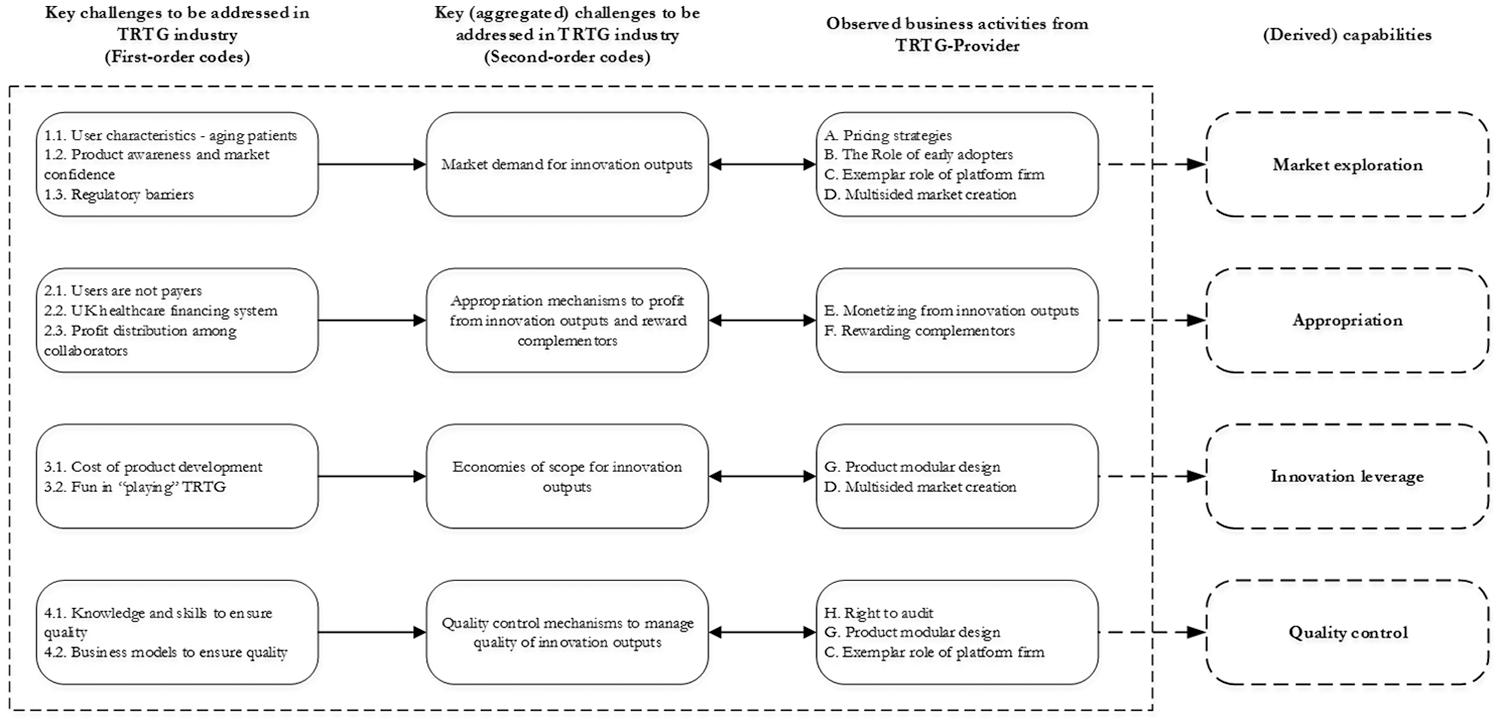
Data Structure
Stage 4: Building a holistic framework for platform development
We organized our emerging interpretations into a processual illustration and a holistic framework that account for the four identified capabilities, the observed activities enabled by the capabilities to address the key challenges, and how this process enables business ventures to develop innovation platforms. We tested alternative conceptual frameworks and assembled our interpretations into an overarching framework that fit the gathered evidence (Locke, 2001). The findings were reviewed for contradictions and generation of new insights related to gathered literature (Eisenhardt, 1989). To increase the reliability of our overall interpretation, provisional interpretations offered at various stages of the analysis were submitted to informants for feedback. Combining the framework, the industry setting and the business development of TRTG-Provider also allowed us to reveal and discuss how the business venture had deployed the required capabilities in its platform development.
Overview of the Industry and the Case Firm
Before presenting our findings, we briefly describe the studied industry and case firm here. Figure 2 illustrates the five key business players (i.e., therapy knowledge providers, middleware designers, game studios, hardware providers, and publishers) in the TRTG industry, their roles, and the key information pertaining to their business models. Note that the business players are specifically defined based on their roles in the TRTG industry. Therefore, a single firm can act as multiple business players by taking on different roles. More specifically, our findings suggest that therapy knowledge providers developed the clinically approved therapy knowledge that could be coded into game engines for TRTG game development, middleware designers supplied game studios with game engines for game development, hardware providers developed consoles to run the TRTG games, and publishers sought market potential and commissioned game studios to produce TRTG games best suited to their market demand.
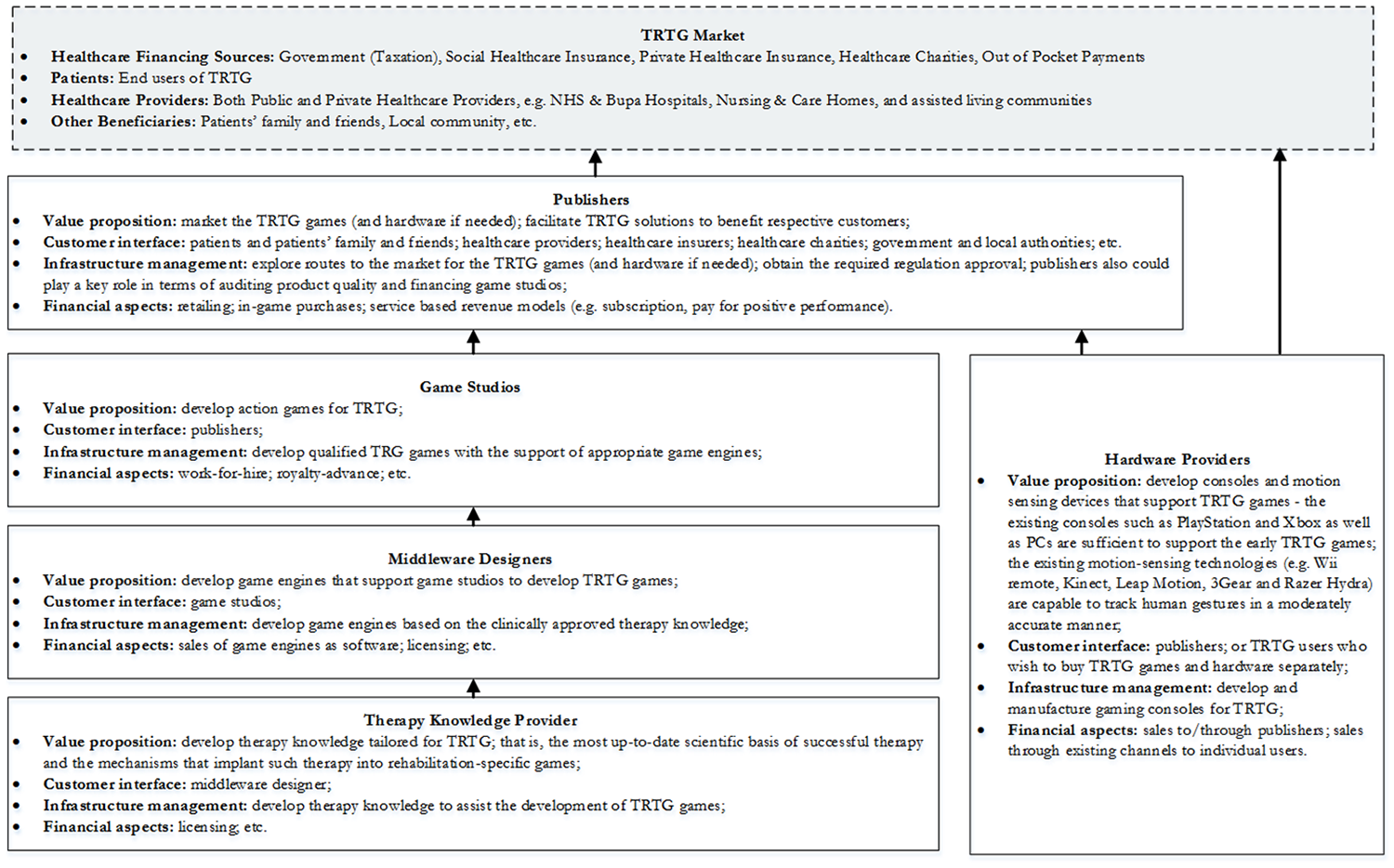
Key Business Players and Business Models in TRTG Industry
TRTG publishers, in particular, required understanding of poststroke rehabilitation and the healthcare market, including its regulations pertaining to clinical governance, innovation governance, and communication protocols. To successfully market these products, TRTG publishers needed to understand not only the patients but also healthcare providers and financing bodies—including the U.K.’s National Health Service (NHS)—who had their own related considerations and agendas. One interviewee from the NHS commented on the barriers to the adoption of such products: In a climate where reorganizations are regularly taking place in the NHS, it can be hard for staff to feel in control and understand the impact of changes on them. With so much effort placed in the reorganization of the NHS in recent years, the appetite to adopt new technology and change the way they work has diminished. Practically driving a project within the NHS is challenging when staff are moving from post to post, so new relationships need to be established all the time. (Interview notes: Interviewee from the NHS–Innovation Hub)
TRTG-Provider was founded in 2010 as a university spinoff by a university scholar in partnership with the university and an NHS Hospital Foundation Trust. It was rooted in many years of research on a mechanism that could transfer clinically approved therapy knowledge into action video games for tele-rehabilitation. Operating as a publisher, it also included therapy knowledge as part of its intellectual property. In other words, the firm took on the additional role of a therapy knowledge provider. The entrepreneur explained that mixed role as follows: [TRTG-Provider] has medical expertise and has the ability to call the experts to actually devise the programme which can go to the games and then certify it based on the experts’ names. (Interview notes: Founder of TRTG-Provider)
TRTG-Provider’s Executive Board included the entrepreneur and representatives of other funding organizations. After setting up TRTG-Provider as a publisher, the entrepreneur planned to expand the firm to include middleware and game development activities to speed up product development. However, that proposition was rejected by other board members, and the entrepreneur then founded two separate firms with another business partner. Due to our close relationship with TRTG-Provider, we were able to obtain a precise understanding of the two affiliated firms during our data collection process. TRTG-Provider later started to build links with hardware providers with the intention of developing tailored consoles and devices for TRTG purposes. However, the need for this collaboration was not urgent, as the existing consoles and motion-sensing technologies were sufficient enough then to support the initial TRTG games. Thus, by the end of this study, there was still only limited direct involvement of hardware providers in the development process. Given the generic nature (Jacobides et al., 2018) of the hardware in this industry, the hardware developers were excluded from this particular platform ecosystem in our discussions.
To summarize, the core component of our studied innovation platform is the clinically approved therapy knowledge developed by TRTG-Provider (i.e., the platform firm). Based on the core component, TRTG-Provider also developed the game engine and the rules of the game (i.e., boundary resources) to attract other game studios (i.e., complementors) to participate in the ecosystem and develop more TRTG games (i.e., complements) for the market.
Main Findings
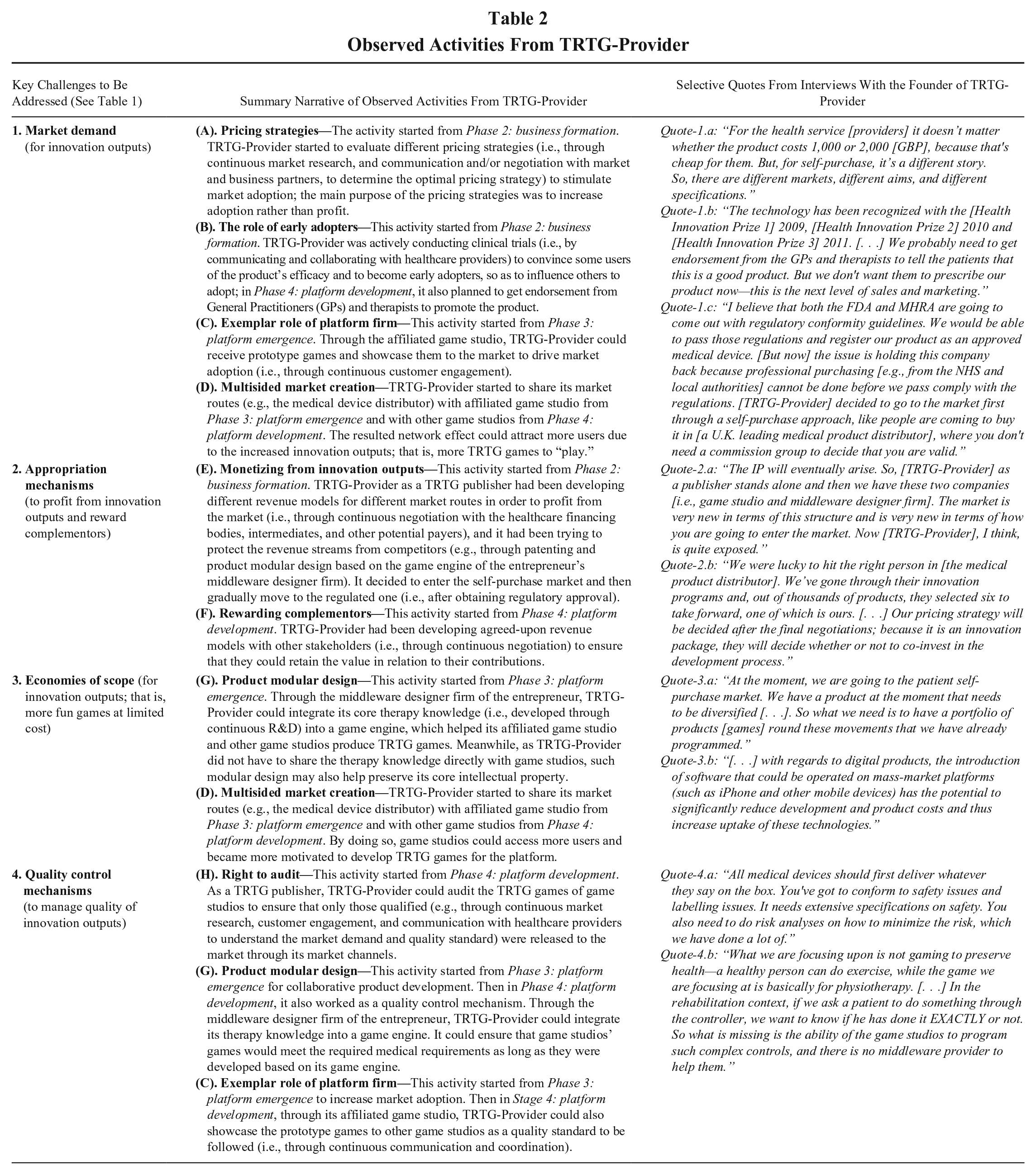
By analyzing the stakeholder viewpoints and the findings from TRTG-Provider, respectively, we identified four key challenges for this nascent industry (see Table 1) and the key activities enacted by TRTG-Provider related to them (see Table 2). The integration of the above findings allows us to derive four capabilities 4 deployed by TRTG-Provider to address the key challenges involved in developing its platform (see Figure 1):
Key Challenges to Be Addressed in the TRTG Industry
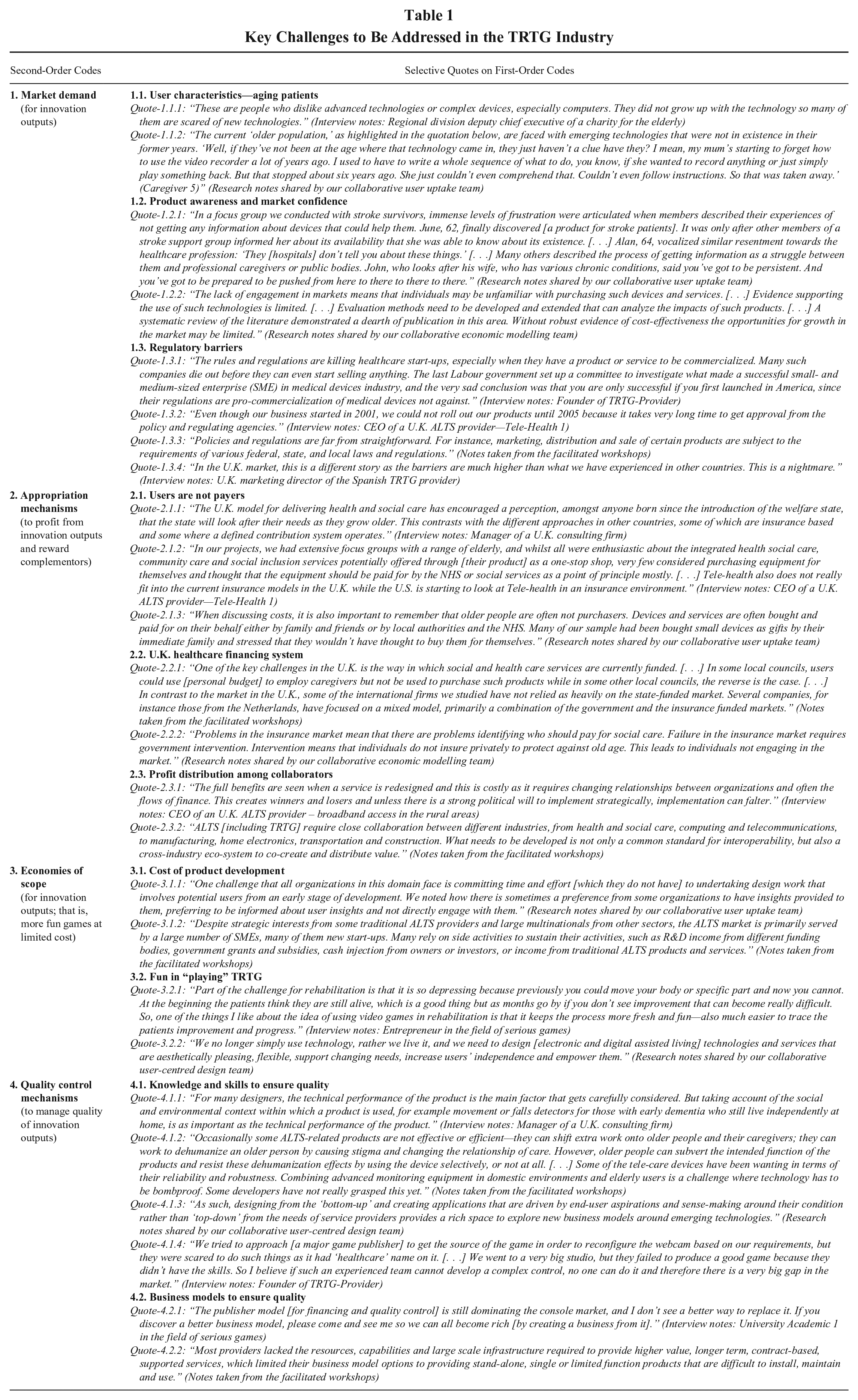
Observed Activities From TRTG-Provider
We present more detail on these challenges, capabilities, and activities below along with the business and platform development of TRTG-Provider (see a summary in Table 3). These challenges became prominent for TRTG-Provider at different phases of its business development, and we explain the activities that were enabled by TRTG-Provider’s capabilities to address the challenges in its platform development process.
Summary Narrative of TRTG-Provider’s Business and Platform Development
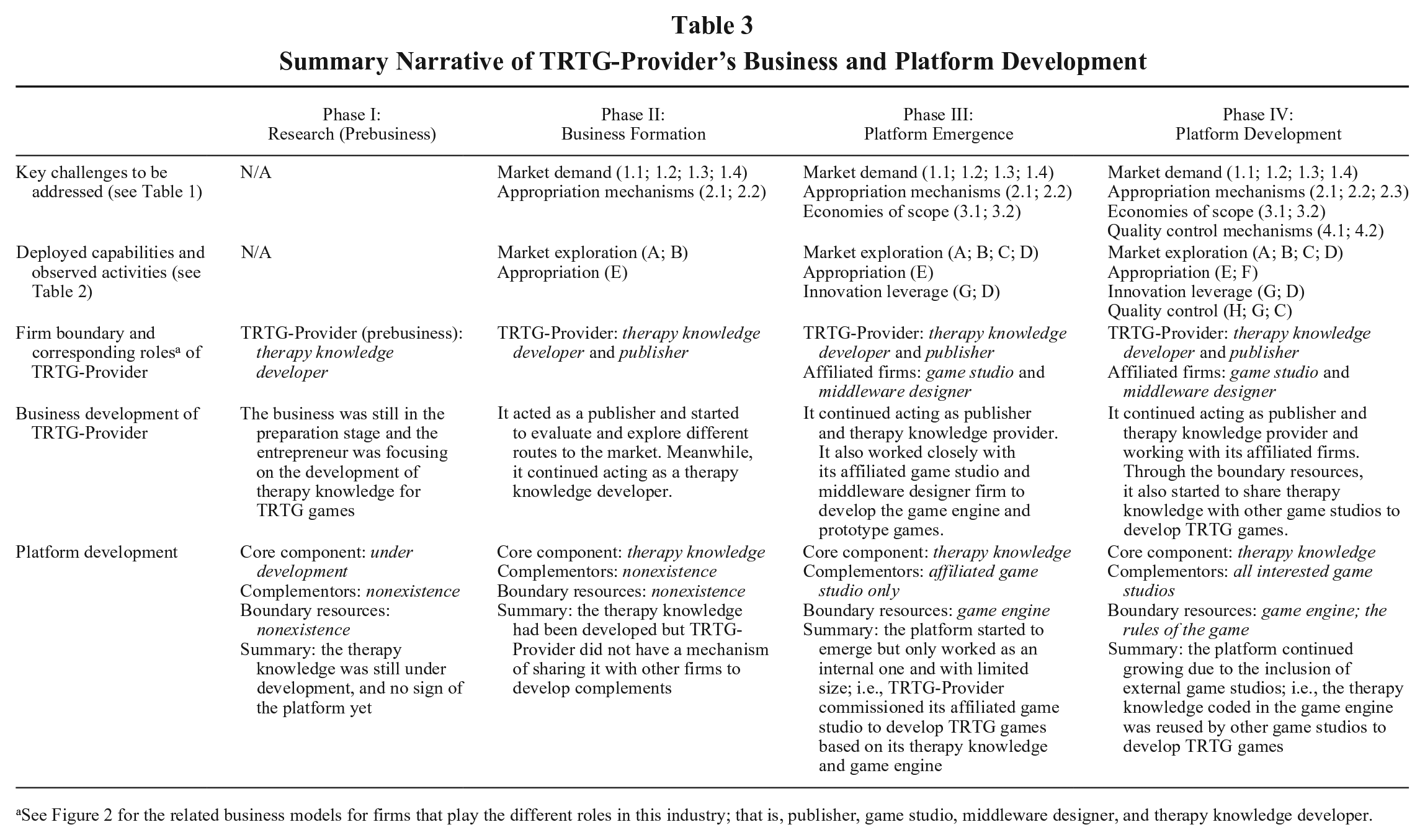
See Figure 2 for the related business models for firms that play the different roles in this industry; that is, publisher, game studio, middleware designer, and therapy knowledge developer.
Phase I: Research (Prebusiness)
The entrepreneur was a university academic who had many years of research experience in therapy development and wanted to collaborate with game developers to explore the benefits of using video games for upper limb rehabilitation. After a few attempts, the entrepreneur realized that the existing game industry was neither interested in nor capable of developing TRTG games, because it did not have the required resources and considered the development and commercialization of health-related products too risky. Therefore, the entrepreneur decided to start a business to lead and develop this nascent industry further.
By then, the entrepreneur was mainly focusing on the development of therapy knowledge for research purposes. Hence, the entrepreneur was not aware of the potential challenges in this industry and further had not conducted or planned any business activities to respond to those unknown challenges. Nevertheless, we considered this phase vital for the case firm and for our study because the therapy knowledge in the development would later become the key intellectual property of the firm and indeed the core component of its platform.
Phase II: Business Formation
A first major grant (£250K) was secured to develop an initial TRTG game (based on PC and existing motion-sensing technologies). After the grant was awarded, the entrepreneur managed to found a spinoff firm (i.e., TRTG-Provider) in partnership with the university and a NHS Hospital Foundation Trust. An internal team of experts in action games at the university was also hired to help develop the game. Meanwhile, the entrepreneur noted that no existing firm had the channels or the knowledge of the related regulations to market the products. Therefore, TRTG-Provider was set up originally to be a TRTG publisher and thereby explore the different routes to the market.
Emerging key challenges
Like most other businesses, once product development reaches a substantial stage, market exploration and monetization are vital for these firms. Two challenges became prominent for TRTG-Provider in this phase. One pertained to the market demand for innovation outputs; the other challenge pertained to the appropriation mechanisms that were best suited to profit from the innovation outputs.
TRTG-Provider and many other industry stakeholders reported that the market had actually been developing much more slowly than had previously been expected. Our data revealed three main reasons for this slow market growth. First, the potential users of TRTG products were often aging people unfamiliar with (or even scared of) advanced technologies. They had never played video games in their entire lives (see Quote-1.1.1 and 2 in Table 1), so they were little motivated to adopt the products. Second, TRTG had been struggling to increase its product awareness (see Quote-1.2.1 and 2 in Table 1). Many users, especially the aging ones, could not be easily reached via the usual marketing channels, including the Internet; instead, they often relied on information sourced from healthcare providers (e.g., their doctors and caregivers). More concrete evidence was also needed to support the effectiveness and economic value of TRTG and convince both users and healthcare providers; this focus required more clinical trials and cost-effectiveness analyses. Third, TRTG products had to face strict regulatory barriers to be able to enter the regulated medical device market (see Quote-1.3.1, 2, 3, and 4 in Table 1). That issue is particularly important for the U.K. market, because its healthcare is primarily provided by the public sector (i.e., the NHS).
In addition, healthcare products and services in the U.K. are largely financed by the public sector (i.e., the NHS), so end users (i.e., the patients) were mostly not individuals who paid for such products and services (see Quote-2.1.1, 2, and 3 in Table 1). Therefore, to successfully profit from their products, the TRTG providers had to either reach the end users indirectly (e.g., by entering the regulated market, working with insurers, and targeting the users’ family and friends) or convince the users to pay (e.g., through the superior performance of their products and more dedicated marketing campaigns). These difficulties linked to monetization were made worse by the complex nature of the U.K. healthcare system. Its policies and procedures were different than those found in other countries and also differed between regions and local authorities (see Quote-2.2.1 and 2 in Table 1).
Deployed capabilities and enabled activities
Responding to the first challenge, TRTG-Provider started to deploy the capability of market exploration, which could enable the business models and activities that were appropriate to increase market demand for its innovation outputs. Efforts during this period focused on the evaluation of different market routes, such as the self-purchase market, the NHS, private hospitals, and insurers using various pricing strategies (e.g., the initial offer of a lower price to attract more self-purchase users; also see Quote-1.a in Table 2) to stimulate market adoption. Meanwhile, TRTG-Provider also conducted more clinical trials to convince patients, healthcare providers, and financing bodies of the efficacy of their products and thus become early adopters and influence others to follow suit (i.e., the role of early adopters in Table 2; also see Quote-1.b in Table 2).
Responding to the second challenge, TRTG-Provider started to deploy the capability of appropriation to develop business models and activities appropriate to provide mechanisms suited to ensure they would profit from their innovation outputs. In particular, TRTG publishers played a key role in the industry for monetizing from innovation outputs (see Table 2), which required them to develop revenue streams suited to profit from the explored market (i.e., through continuous negotiation with the stakeholders in that market; also see “Financial aspects” in Figure 2 for the different publisher revenue models) and protect those revenue streams from competitors. As a result, TRTG-Provider decided to enter the self-purchase market as a starting point and then gradually move to the regulated market after obtaining regulatory approval and during the process tried to apply patents to protect its core intellectual properties; that is, the therapy knowledge (see Quote-2.a in Table 2).
Summary of the business and its platform development
TRTG-Provider acted as a publisher and therapy knowledge provider at the same time; that is, it evaluated and explored different routes to the market, and it held the developed therapy knowledge. A team of video game experts was contracted to work with TRTG-Provider to develop the TRTG games. In terms of platform development, although the core component (i.e., therapy knowledge) had been developed, TRTG-Provider did not know how to attract complementors (i.e., game studios) to develop complements based on the core component.
Phase III: Platform Emergence
Another £2.1m grant was secured to develop the entire package of TRTG and study the possible business models for commercializing such a product. TRTG-Provider needed faster development of TRTG games to showcase the benefits of the product (medical performance and the fun experience of the process) to its stakeholders, conduct clinical trials, and explore the market. Therefore, specialized game developers were needed. However, there were no game studios that could develop such games and no game engines to assist the game studios in that development. Therefore, the entrepreneur set up a middleware designer firm and a game studio to support TRTG-Provider’s business.
Emerging key challenges
While the key challenges in the previous phase remained prominent, another also appeared—the economies of scope for innovation outputs; that is, how to develop more TRTG games at a limited cost.
Like other medical devices and video games, TRTG products involve high product development and commercialization costs. In an emerging industry like TRTG, it was vital, although costly, to obtain better understanding of the potential users and the market from the early stage of development forward (see Quote-3.1.1 in Table 1). However, as many of the existing business players in the TRTG industry were SMEs, product development was largely constrained by the limited funding these players could access (see Quote-3.1.2 in Table 1). Further still, TRTG requires variously themed games to satisfy different patients’ preferences and make the rehabilitation process more fun (or less tedious). It should be noted as well that this element of fun is the key difference between TRTG and conventional tele-rehabilitation (see Quote-3.2.1 and 2 in Table 1). Therefore, TRTG providers were seeking a solution that would enable them to develop more TRTG games at a limited cost (i.e., economies of scope) and enrich the product family while providing patients with more games from which to choose.
Deployed capabilities and enabled activities
To respond to this challenge, the business ventures in this nascent industry needed the capability of innovation leverage to be able to develop business models and activities appropriate to provide the economies of scope needed for innovation outputs. TRTG-Provider adopted product modular design and multisided market creation (see Table 2). The former means that a core component—in this case, clinically approved therapy knowledge developed through continuous R&D activities—can be identified and reused to develop more innovation outputs. By coding the therapy knowledge into a game engine through the affiliated middleware designer firm, TRTG-Provider could reuse it for efficiency and cost reduction. Later in Phase IV, other game studios could do the same and lower their entry level and development costs (see Quote-3.a and b in Table 2). The latter means that a platform firm can create and maintain a multisided market to facilitate the transactions between its users and complementors. In our case, TRTG-Provider shared its market routes and enabled users to access more TRTG games and its affiliated game studio (and other game studios later on in Phase IV) to reach more users. This process gave the game studios additional motivation to develop TRTG games for the platform.
TRTG-Provider continued to deploy the capability of market exploration, which enables business models and additional activities appropriate for increasing market demand for its innovation outputs further. In particular, TRTG-Provider could receive prototype games from its affiliated game studio and showcase them to the market to drive engagement (i.e., the exemplar role of platform firm in Table 2). The increasing numbers of TRTG games available to users also gave them more choices and made the rehabilitation process more fun, thereby attracting more users into adopting their products (i.e., multisided market creation in Table 2).
Summary of the business and its platform development
TRTG-Provider continued acting as publisher and therapy knowledge provider simultaneously—that is, exploring the routes to the market and developing therapy knowledge for TRTG development. It also worked closely with its affiliated game studio and middleware designer firm to develop the game engine and prototype games. However, it had very limited collaboration with other firms.
The core component (i.e., therapy knowledge) and the game engine (i.e., boundary resources) that allowed the game studio (i.e., complementors) to access the core component were both developed. The platform started to emerge, but it only worked as an internal platform (Thomas, Autio, & Gann, 2014) in this phase; that is, therapy knowledge was coded into the game engine, but it could only be reused by the affiliated game studio as commissioned by TRTG-Provider.
Phase IV: Platform Development
The business continued to move forward with ever increasing endorsements from different stakeholders in the industry. TRTG-Provider decided to enter the self-purchased market before moving to the regulated market. To explore and penetrate that market, more TRTG games of good quality were needed, but they could not be provided by TRTG-Provider and its affiliated firms alone. However, other game studios hesitated to join, due to their lack of skills to develop such games and concerns about profitability. Therefore, the entrepreneur decided to share necessary innovation assets with other game studios to develop more TRTG games and explore the market.
Emerging key challenges
While the key challenges in the previous phase remained prominent, new ones also started to emerge. One pertained to the quality control mechanisms that were suited to manage the quality of innovation outputs; the other pertained to the appropriation mechanisms that were suited to rewarding complementors, in particular.
As medical devices, TRTG products had to meet a higher standard than required for normal games before a significant proportion of the population would take responsibility for their own health and care needs and pay for these products. If they were less effective than required, they could attract stigma and shift extra work onto the users and their caregivers. Therefore, the quality issue in TRTG—and, more broadly, in ALTS—was emphasized by various stakeholders during our research. However, different from its affiliated game studio that could receive direct attention and support from TRTG-Provider, other game developers lacked the essential knowledge and skills to develop TRTG games well suited for the desired rehabilitation purposes (see Quote-4.1.1, 2, 3, and 4 in Table 1). Moreover, firms from the video game industry, including the game studios, had additional concerns regarding quality control, due to that industry’s history 5 and its established business models (see Quote-4.2.1 in Table 1). More specifically, game studios relied heavily (and usually comfortably) on the publisher model, wherein publishers were responsible for financing the game studios’ development, manufacturing, and marketing activities. In other words, the publishers were taking more financial risks, while the game studios lacked the business model and incentives to develop qualified games on their own. Therefore, the game studios did not show complete confidence about entering the TRTG industry due to the lack of mechanisms well suited to help them develop good quality TRTG games and also protect them from the losses linked to the development of poor quality ones, which could lead to a poor user experience of the TRTG products overall (see Quote-4.2.2 in Table 1).
In terms of the challenge of the appropriation mechanisms to reward complementors, our findings indicate a need for the development of a more transparent mechanism better suited to facilitate the flow of finance, so that TRTG providers can attract and maintain more firms (e.g., game studios) for the development process (see Quote-2.3.1 and 2 in Table 1). In the previous phase, TRTG-Provider did not consider the issue important, because its collaborative game studio and middleware designer firm were both owned by the same entrepreneur. It did not have much concern about profit distribution between the three firms.
Deployed capabilities and enabled activities
Responding to the first challenge, TRTG-Provider started to deploy the capability of quality control to develop business models and activities appropriate for providing mechanisms well suited to meet the quality standards of TRTG games. To achieve this desired quality control mechanism, TRTG-Provider managed to place triple insurance on the quality of innovation outputs by playing different roles in the industry and create more confidence in the game studios to collaborate. First, as a publisher, TRTG-Provider could audit TRTG games and ensure that only qualified ones were released to the market (i.e., right to audit in Table 2). Second, through the entrepreneur’s middleware designer firm, TRTG-Provider’s therapy knowledge was coded into the game engine to maintain the TRTG games’ required clinical value (i.e., product modular design in Table 2). In other words, the basic medical performance of the games could be guaranteed if the game studios developed them based on the game engine. Finally, by showcasing the TRTG games developed by the entrepreneur’s game studio, TRTG-Provider could then establish quality standards for other game studios to follow (i.e., exemplar role of platform firm in Table 2). Based on the above activities, TRTG-Provider was able to prescribe a quality standard that could satisfy the high requirements of the market and, at the same time, be easily achieved by the game studios (see Quote-4.a and b in Table 2).
Responding to the second challenge, TRTG-Provider continued to deploy the capability of appropriation to develop business models and activities appropriate for providing the mechanisms well suited to ensure they could reward complementors. Our findings indicate that the TRTG industry had been forming a set of agreed-upon revenue models between different business players to ensure that all their contributions could be properly rewarded—that is, rewarding complementors in Table 2. For instance, TRTG publishers needed to agree on the appropriate revenue models with the game studios—also see the “Financial aspects” of game studios in Figure 2—through continuous negotiation. During the period of this study, new revenue models were still being formed by TRTG-Provider to profit from the market and also facilitate the financial relationship with other industry stakeholders. The TRTG-Provider entrepreneur commented on the firm’s revenue models and explained the situation when negotiating a deal with a major medical product distributor in the U.K. (see Quote-2.b in Table 2).
Summary of business and its platform development
TRTG-Provider and its affiliated game studio and middleware designer firm worked in a similar pattern to that of the previous phase, but with the additional sharing of its therapy knowledge with external game studios through the game engine. Due to the inclusion of other game studios, TRTG-Provider had to introduce new activities that ensured the quality of complements and reward complementors for their contributions.
By sharing the core component with other game studios, the platform evolved from an internal platform to one that can receive complementary innovation outputs from external game studios. Through the game engine and by accepting the rules of the game, including the quality standard and agreed-upon revenue models set by TRTG-Provider (i.e., boundary resources), other game studios (i.e., complementors) were then able to access the therapy knowledge (i.e., core component) and develop TRTG games for the platform’s customers.
A Holistic Framework for Platform Development
Our findings show that TRTG-Provider was able to address the key challenges and facilitate the platform development through its capabilities and enabled activities. Such capabilities, however, were quite obscure in other TRTG firms. For instance, the publishers and game studios from the video game industry had little therapy and the market knowledge to ensure product quality and profit from their innovation outputs. One main competitor of TRTG-Provider (i.e., a Spanish TRTG provider) had product development knowledge but failed to identify the appropriate mechanisms needed to share its therapy knowledge with other game studios for platform development. Before discussing the implications of our findings, let us recapitulate TRTG-Provider’s platform development process, to illustrate which, we developed a framework as shown in Figure 3.
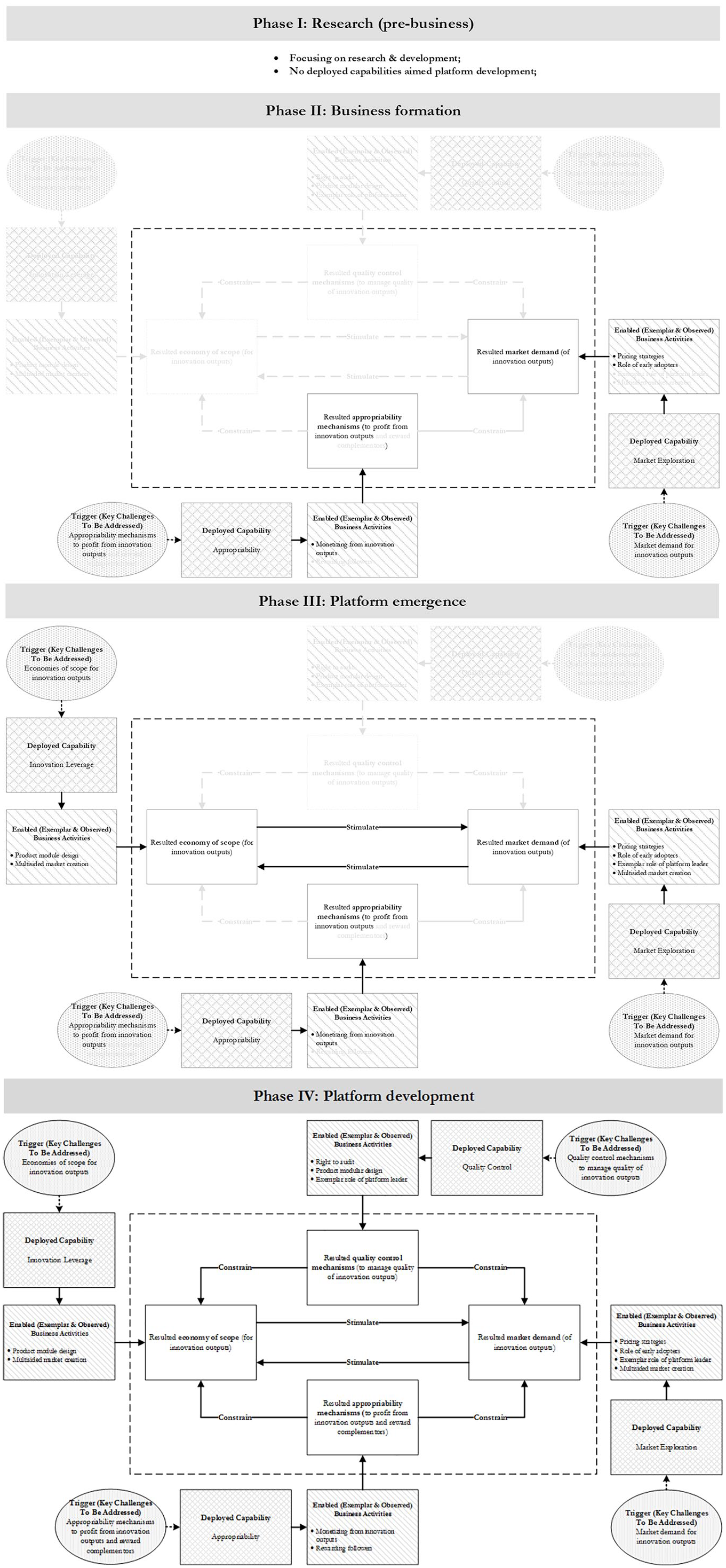
A Holistic Framework for Platform Development
Firms can deploy the desired capabilities at different times and even before platform emergence. For instance, the capabilities of market exploration and appropriation started to be deployed by TRTG-Provider before the other two capabilities in Phase 2: business formation (also see Table 3 and in Figure 3). The two capabilities together allowed TRTG-Provider to explore routes to the market and therefore fueled the development of the business at its very early stage. However, innovation leverage is usually the starting point for platform emergence. A platform can only be functional once a firm has identified and developed the innovation assets (i.e., core component) that can be reused to produce more innovation outputs—that is, when the economies of scope for the innovation outputs are actually achieved. For TRTG-Provider, its platform only started to emerge (also see Phase 3: platform emergence as in Table 3 and in Figure 3) when it coded its therapy knowledge into a game engine (through its affiliated middleware designer firm) that could then be reused for game development.
Once deployed, a platform continues to attract users and complementors due to the platform firm’s capabilities of innovation leverage and market exploration—the former leads to the generation of more innovation outputs, and the latter results in more market demand for those outputs. These economies of scope and market demand can stimulate each other. In the TRTG industry, as more game studios joined, the economies of scope brought by innovation leverage indicated a capacity for more TRTG games, hence requiring greater market demand to accommodate the increased innovation outputs. At the same time, the increased market demand indicated greater demand diversity, hence requiring more games to be produced.
Finally, the fully deployed capabilities of quality control and appropriation can enable the corresponding mechanisms for the innovation outputs, which then constrain the above economies of scope and the market demand (also see Phase 4: platform development as in Table 3 and in Figure 3). An effective quality control mechanism can help foster innovation outputs of higher quality and hence drive innovation leverage and market exploration by instilling confidence in complementors and in the market. In the case of TRTG’s products, meeting the required quality standards (i.e., medical performance) was also a prerequisite to enter the regulated market. To achieve the optimal quality control mechanism, TRTG-Provider decided to focus on the medical aspects of quality through triple-quality insurance (i.e., product modular design, right to audit, and exemplar role of platform firm) and thus left the nonmedical aspects to the expertise of the game studios. An effective appropriability mechanism that generates profits and rewards complementors equitably can attract and motivate more complementors, thereby facilitating more innovation outputs. As indicated in our findings, TRTG-Provider noted the different characteristics of the market routes and was developing its revenue models and pricing strategies accordingly. At the same time, it was sharing its market routes to enable its complementors to profit from their own contributions.
Discussion
In this article, we have illustrated the platform development of a business venture in a nascent industry in a way that differs from the most commonly studied platform phenomenon that uses snapshots of successful platforms in established industries. By drawing on the case of TRTG, this article uncovers the process of platform development in this industry and explores a set of issues that both challenges and extends the way we think about the platform phenomenon. In this section, we answer the research questions and discuss the implications of our findings. First, we focus on the identified capabilities and process for developing innovation platforms. Then we discuss how a business venture can deploy the capabilities by altering its firm boundaries.
Capabilities and Process for Developing Innovation Platforms
Our findings and our developed framework (see Figure 3) illustrate platform development based on the four capabilities of platform firms: innovation leverage, market exploration, quality control, and appropriation. Although these capabilities have been discussed to different extents in the platform literature, our unique dataset and related results allowed us to illustrate how the capabilities together drive the platform development. To highlight the novelty of our findings, we show how our observations extend the existing frameworks for platform development, and discuss the new evidence and insights, as they relate to the two less understood capabilities of the four—namely, quality control and appropriation.
Extending the frameworks of platform development process
The platform discussions thus far (see the reviews of de Reuver et al., 2018; Gawer, 2014; McIntyre & Srinivasan, 2017; Thomas et al., 2014) were primarily based on successful de facto platforms, and most studies adopted a focused view to examine the selected factors and phases of the platform development process. In addition, these articles were silent on how these interpretations can be transcribed to platform firms’ capabilities. For the process of platform development, for instance, the framework of Dhanaraj and Parkhe (2006) focused on knowledge mobility, network stability, innovation appropriability, and their causal relationships and the innovation outputs. Nambisan and Sawhney (2011) instead conceptualized three orchestration processes for platform firms—that is, innovation leverage, innovation coherence, and innovation appropriability.
The lack of full-fledged accounts of the platform development process can be ascribed to the methodological difficulty of following platform development from the beginning. That issue encouraged our study of the nascent TRTG industry. Our study indicates how the extant studies only provided a partial account of the platform firms’ efforts at platform development. While our findings on innovation leverage and appropriation echo their orchestration processes (Dhanaraj & Parkhe, 2006; Nambisan & Sawhney, 2011), this article advances these two frameworks and the following studies based on two main aspects. First, our framework embraces the uncertain and evolving nature of platform development in nascent settings and recognizes it as a continuous and dynamic process (de Reuver et al., 2018; Gawer, 2014) driven by the platform firm’s appropriate capabilities. We do that by outlining the platform firm’s gradually deployed capabilities that underpin the iterating transition between innovation outputs and market demand under the constraints of quality control and appropriation mechanisms, thereby offering a more comprehensive representation of the platform development process, especially for the pursuit of platforms in nascent industries.
Second, and for the identified capabilities, our observations suggest that platform firms should maintain not only their relevance (as in the framework of Nambisan & Sawhney, 2011) but also (and more specifically) the quality of their innovation outputs whenever managing network stability (as in the framework of Dhanaraj & Parkhe, 2006). Meanwhile they raise the importance, in platform development, of market exploration that is affected by employing a mix of activities rather than simply relying on the network effect, pricing strategies, and other standalone activities. Below, we focus on quality control and market exploration to provide further discussion in relation to the literature.
Advancing the understanding of quality control in platform development
Despite the delicate tension between complement quality and quantity, the quality issue in platform businesses is still underresearched. Most of the existing studies focus on platform features and relative quality (e.g., McIntyre, 2011; Suarez & Lanzolla, 2007; Tellis, Yin, & Niraj, 2009; Zhu & Iansiti, 2012) but provide insufficient reference of the control mechanisms that a platform can actually use for complement quality (Jacobides et al., 2018; McIntyre & Srinivasan, 2017). Some of the recent studies (Eaton et al., 2015; Ghazawneh & Henfridsson, 2013; Kornberger, 2017; Kyprianou, 2018) have discussed the issue, using cases such as iPhone and Wikipedia, and their results in general indicate the need for platform firms and their complementors to continuously adjust and align the quality standard and the complement quality.
Platforms that aim to produce products of both high cost and quality (e.g., medical products), however, may not want to rely on this lengthy and costly alignment process due to the high development costs and the risk of low-quality complements. While our results do echo the discussion of “continuous efforts” noted in the above studies, they take a clear departure from them by recommending a mixed mechanism made up of both control of and support for high-quality complements (e.g., see the observed activities of TRTG-Provider in Table 2). Although doing so means that these platform firms will have to retain more responsibility themselves, it also reduces uncertainty and risk, facilitates firm collaboration, and helps better explain and communicate their innovation outputs and their vision of the industry. Such received benefits can prompt more potential complementors to join the platform at its early stages (Ozcan & Eisenhardt, 2009; Santos & Eisenhardt, 2009).
Advancing the understanding of market exploration in platform development
One of the most promising features of platform is its ability at self-enhancement based on the network effects. As a result, past platform studies often focus on the first-mover advantage due to the network effects of platforms and the suggested winner-takes-all outcomes (Lee et al., 2006). Platforms at their early stages, however, often face the chicken-and-egg problem (Caillaud & Jullien, 2003; Kyprianou, 2018; McIntyre & Srinivasan, 2017; McIntyre & Subramaniam, 2009), which occurs when the network effects alone become insufficient to drive platform growth forward. Recent studies show that the network effects of an established platform may also be restricted, for instance, due to the network structure of its complementors and customers (Lee, Song, & Yang, 2015; Zhu & lansiti, 2019).
While most scholars emphasize the use of appropriate pricing, such as that resulting from subsidizing one side of the platform (Boudreau & Jeppesen, 2015; Parker & Alstyne, 2005; Rochet & Tirole, 2003, 2006), some have started to draw attention to other practices, such as the exemplar role played by platform firms (Cennamo, 2016; Gawer & Cusumano, 2014) and the role played by early adopters (Frattini, Bianchi, Massis, & Sikimic, 2014), both of which were adopted by TRTG-Provider. Our observations, therefore, provide further evidence on the limits of network effects in platform discussions and suggest that platform firms should adopt proactive and concurrent marketing activities so as to effectively communicate with the market and increase the odds of developing successful platforms.
Firm Boundaries for Deploying the Capabilities
Firms need to recontextualize their business journey on an ongoing basis (Garud, Gehman, & Giuliani, 2014). This aspect is particularly important in nascent industries where businesses must constantly react to the changing context (Dattée et al., 2018). Our findings provide a processual view of a business venture in nascent settings that is deploying the desired capabilities for platform development by altering its firm boundaries. In the remainder of this subsection, we revisit the boundary changes of TRTG-Provider and then discuss how the findings of our study extend the theories of entrepreneurial firms’ boundary decisions and platform firms’ integrative capabilities, respectively.
Revisiting the boundary changes of TRTG-Provider
The lack of conceptual clarity and consistency found in the TRTG industry, although largely nonproblematic in everyday conversations, continued to cause significant problems when setting boundaries and developing business strategies. This observation is consistent with the less bounded and less predefined nature of entrepreneurial activities in the digital context (Nambisan, 2017).
As indicated in Table 3, TRTG-Provider was carefully defining and redefining its firm boundaries. Although different business players in the TRTG industry may have had the potential to develop the reusable innovation assets needed to achieve innovation leverage, a modular product design based on clinically approved therapy knowledge could be more desirable. In terms of market exploration and appropriation, TRTG publishers were given more attention because they dealt with the market directly and determined the overall profits to be gained from the innovation outputs. In terms of quality control, those who possessed clinically approved therapy knowledge could set the bottom line for product quality, and those who controlled market routes had the final word on which complementary innovation outputs should be released. Therefore, it was vital to act as both a publisher and a therapy knowledge provider in the TRTG industry. The foundation of TRTG-Provider was its therapy knowledge. It was developed based on the entrepreneur’s own research (see Phase 1: research in Table 3), and the business was then founded as a TRTG publisher thereafter (see Phase 2: business formation in Table 3 and in Figure 3).
In addition, this studied entrepreneur founded one game studio and one middleware designer firm to support the TRTG-Provider’s business development (see Phase 3: platform emergence and Phase 4: platform development in Table 3 and in Figure 3). More specifically, the game studio developed prototype games for TRTG-Provider to attract early adopters in the market and set a quality standard to be followed by other game studios. Therefore, the game studio did support TRTG-Provider by enhancing its market exploration and quality control abilities. Meanwhile, the middleware designer firm was dedicated to coding TRTG-Provider’s therapy knowledge (i.e., core component) into the game engine that could then be reused by other game studios for game development—namely, the boundary resources that connected the game studios and the therapy knowledge. The game engine also acted as a black box to protect the therapy knowledge from infringement by others. Therefore, the middleware designer firm supported TRTG-Provider by enhancing its innovation leverage and quality control abilities.
Extending the theories of platform firms’ boundary decisions
A firm’s boundary choice is a vital yet complex decision (Santos & Eisenhardt, 2005). Based on studies of vertical integration and strategic outsourcing (e.g., Holcomb & Hitt, 2007; Jacobides, 2008; Jacobides & Billinger, 2006; Jacobides & Winter, 2005), scholars have noted that a firm’s boundary choice can have a major impact on its capabilities. As stated by Teece (2007: 1331), “a company’s integration upstream, downstream, as well as externally, is partly driven by the need to build capabilities, particularly when such capabilities are not widely distribute in the industry.” However, the existing literature provides insufficient evidence of the boundary dynamics during the early stage of businesses (Nason, Wiklund, McKelvie, Hitt, & Yu, 2019; Zenger, Felin, & Bigelow, 2011) including the boundary decisions of platform firms. To extend that existing literature, this article illustrated how an actual business venture defined and refined its firm boundaries by integrating selective roles in the industry—thereby enabling it to deploy the desired capabilities to gain the upper hand in developing platforms.
Since flexible boundaries allow firms to access more resources but with less control (Nason et al., 2019), firms need to decide very carefully what activities need to be done internally and what activities need to be conducted externally. When planning firm boundaries for their early stages, firms tend to focus on areas that can provide the highest cash leverage (Jacobides & Winter, 2007) and/or areas that cannot be encroached upon by other players (Zander, 2007). These viewpoints, however, only partly explain the business development of TRTG-Provider. It was founded as a TRTG publisher because its entrepreneur saw the financial importance of this role and realized that no other firms could or would take it on. Yet adopting these viewpoints alone tends to overlook the importance of boundary decisions in platform development. Our results show that the appropriate planning of firm boundaries can also allow platform firms to deploy the four capabilities and increase the odds of developing successful platforms. Therefore, the current article extends the understanding of firm boundaries by answering the call from Nambisan (2017) for the drivers of platform firms’ fluid boundaries and the calls from earlier works for this same line of research (e.g., Gawer, 2014; Schreyögg & Sydow, 2010).
Our observations of the boundary dynamics also revealed the continuous coordination between the platform firm and the complementors, by showing how the platform firm develops its boundary resources (e.g., game engine) based on the complementors’ (i.e., game studios) resources and requirements. In this regard, we showed that boundary resources can be developed with the inputs from both platform firms and complementors (Eaton et al., 2015; Svahn et al., 2017). However, different from their findings that emphasize the shared control between platform firms and complementors when developing the boundary resources, our case indicated there was a predominant role of the platform firm in that process. This role is largely due to the high development costs and uncompromisable quality of medical products, which cannot afford the low-quality outputs caused by overinvolvement and overcontrol of complementors who have insufficient knowledge about the products and the market. Therefore, our results do suggest that platform firms and complementors’ involvement in the development of boundary resources should differ in different cases; that is, platform firms who have a better understanding of the products and market need to take on more responsibilities for developing boundary resources and encouraging complementors to participate.
Extending the theories of platform firms’ integrative capabilities
The dynamic capabiliteis of firms often need to rely on external sources in addition to their own (Giudici et al., 2018; Zeng & Mackay, 2019). Consistent with this observation, Helfat and Raubitschek (2018) propose that integrative capabilities are important for platform firms in order to coordinate their complementors and other stakeholders in the ecosystem, a proposition that was empirically evidenced by our study of the TRTG industry. While in contradiction to one key argument of Helfat and Raubitschek (2018), we show that platform firms with such integrative capabilities do not always shrink their firm boundaries and rely more heavily on other business partners; that is, sometimes they expand their firm boundaries and play selective roles in the ecosystem with the aim of deploying the four capabilities of platform development.
More specifically, our empirical evidence illustrates how a business venture performed its integration, both internally and externally, by expanding its business operations, setting up new collaborative firms, and coordinating relationships with others in the ecosystem. Throughout this process, this business venture deployed and enhanced the four capabilities for platform development. It evolved from one that focused on developing therapy knowledge to a platform leader that plays multiple roles in the ecosystem (e.g., a publisher and therapy knowledge provider) and coordinated different relationships with other business players (e.g., the middleware designer firm and game studio of the same entrepreneur, other game studios, and hardware providers) and other stakeholders (e.g., in the TRTG market). Similarly, we see platform firms from many other sectors (e.g., Apple, Sony, and Intel) have expanded their firm boundaries (e.g., through internal growth and acquisitions) to integrate their selective roles and assets when developing their platforms.
One main reason for the contradiction here can be that the existing platform literature pays insufficient attention to the platform firm’s manipulative role in the ongoing process. For instance, prior studies often consider the availability of complementors as an exogenously determined fact rather than an asset that should be strategically developed and maintained through the platform firm’s continuous investment (McIntyre & Srinivasan, 2017; McIntyre & Subramaniam, 2009). A platform, once successfully developed, can allow the platform firm to focus on its core activities and enjoy its complementors’ inputs (Helfat & Raubitschek, 2018; Schilling, 2000; Thomas et al., 2014)—that is, a shrunken firm boundary due to successful integration of its complementors’ supporting activities. However, to successfully develop such a platform does require investment in resources and capabilities to create, integrate, and manage the ecosystem (Helfat & Raubitschek, 2018; Teece, 2018b), which can then result in an expanded firm boundary. In this respect, our investigation encourages a rethinking of platform firms’ boundaries that can shrink and expand, based on increased complementors’ support and the need of resources and the capabilities for platform development, respectively.
Conclusions
In this article, we presented a study of the U.K.’s nascent TRTG industry to shed further light on the platform phenomenon. Our rich, longitudinal data enabled us to develop a thick description and contextualized theoretical understanding of the emergence and development of an innovation platform. Our observations extended our theoretical understanding of the platform phenomenon and in particular platform emergence in nascent industries. By unpacking the platform development process into actual capabilities and specific activities that can be deployed by firms, we encourage businesses to consider them as epistemic guidance for successful platform development.
Our results shed light on other sectors beyond TRTG, such as video games, web browsers, and smartphones, all of which have experienced a similar platform development process to the one illustrated in our holistic framework. Consistent with what we predict, many of the platform firms in these sectors have managed to alter their firm boundaries and integrate selected roles in their respective ecosystems, while also developing their innovation platforms and increasing their attractiveness to the market and the complementors. These insights may also help us better understand the emergence of certain transaction platforms. For instance, through a series of acquisitions (e.g., NabeWise, Localmind, Accomable, Luxury Retreats International, and Tilt), Airbnb integrated new services, including city guides, location-specific information, accessible travel, villa rentals, and social payments, to create new segments (i.e., market exploration) and also provide better services (i.e., quality control), more product categories (i.e., innovation leverage), and more payment options (i.e., appropriation) to enhance its hospitality platform.
This study of course has limitations. Like any qualitative case study, the research was based on a single industry, which may limit the generalization of its findings and conclusions to other contexts. However, we do maintain that these results enhance our understanding of platform development by business ventures overall. This study is based on exploratory work, which is also expected to inform and encourage subsequent research. Future research could conduct econometric analyses to test the relationships between the four noted capabilities further and examine their integrative impact on platform development overall. Analytic and simulation modeling could also shed even greater light on the entire phenomenon.
Footnotes
Appendix
Description of Data
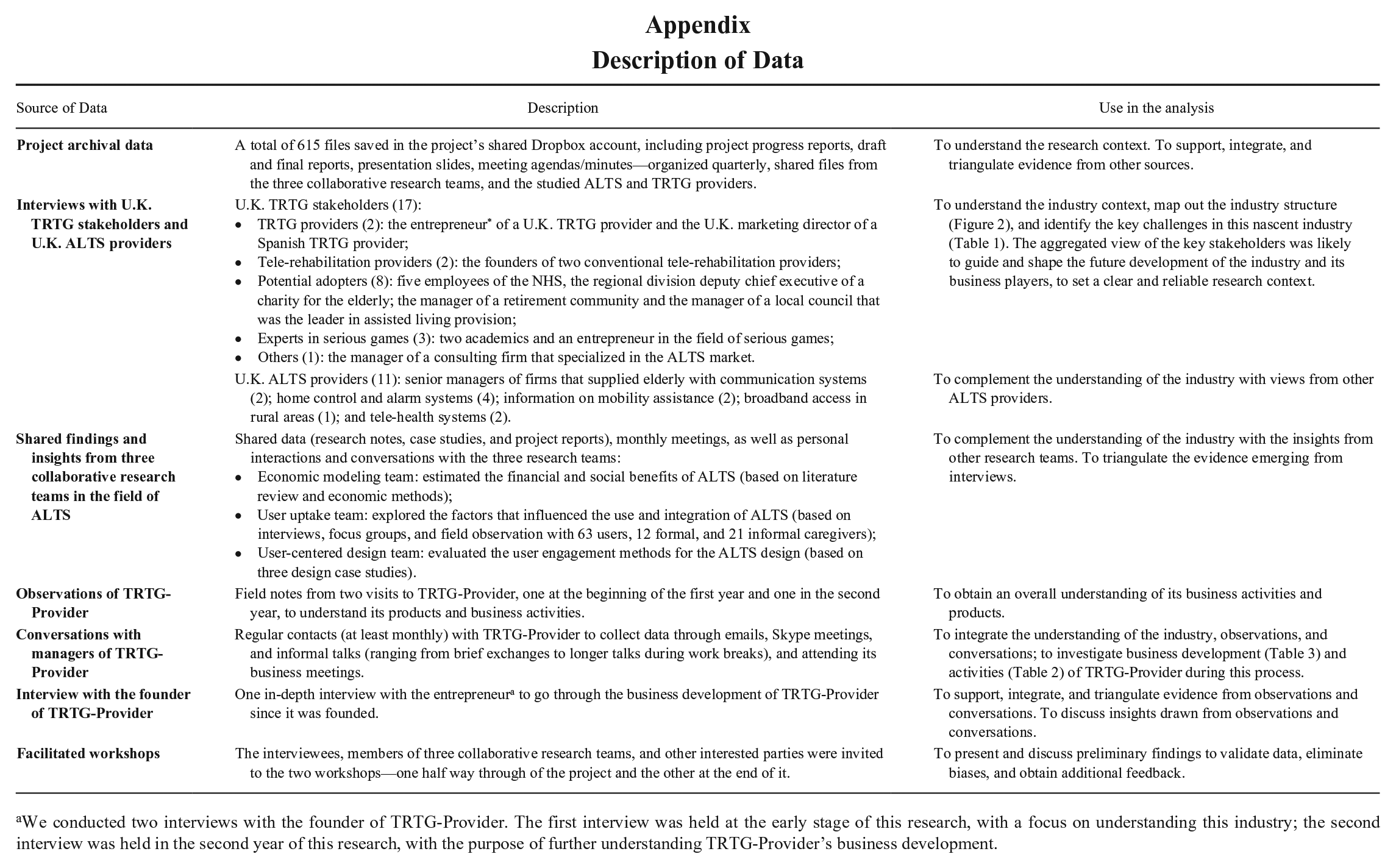
| Source of Data | Description | Use in the analysis |
|---|---|---|
|
|
A total of 615 files saved in the project’s shared Dropbox account, including project progress reports, draft and final reports, presentation slides, meeting agendas/minutes—organized quarterly, shared files from the three collaborative research teams, and the studied ALTS and TRTG providers. | To understand the research context. To support, integrate, and triangulate evidence from other sources. |
|
|
U.K. TRTG stakeholders (17): • TRTG providers (2): the entrepreneur* of a U.K. TRTG provider and the U.K. marketing director of a Spanish TRTG provider; • Tele-rehabilitation providers (2): the founders of two conventional tele-rehabilitation providers; • Potential adopters (8): five employees of the NHS, the regional division deputy chief executive of a charity for the elderly; the manager of a retirement community and the manager of a local council that was the leader in assisted living provision; • Experts in serious games (3): two academics and an entrepreneur in the field of serious games; • Others (1): the manager of a consulting firm that specialized in the ALTS market. |
To understand the industry context, map out the industry structure (Figure 2), and identify the key challenges in this nascent industry (Table 1). The aggregated view of the key stakeholders was likely to guide and shape the future development of the industry and its business players, to set a clear and reliable research context. |
| U.K. ALTS providers (11): senior managers of firms that supplied elderly with communication systems (2); home control and alarm systems (4); information on mobility assistance (2); broadband access in rural areas (1); and tele-health systems (2). | To complement the understanding of the industry with views from other ALTS providers. | |
|
|
Shared data (research notes, case studies, and project reports), monthly meetings, as well as personal interactions and conversations with the three research teams: • Economic modeling team: estimated the financial and social benefits of ALTS (based on literature review and economic methods); • User uptake team: explored the factors that influenced the use and integration of ALTS (based on interviews, focus groups, and field observation with 63 users, 12 formal, and 21 informal caregivers); • User-centered design team: evaluated the user engagement methods for the ALTS design (based on three design case studies). |
To complement the understanding of the industry with the insights from other research teams. To triangulate the evidence emerging from interviews. |
|
|
Field notes from two visits to TRTG-Provider, one at the beginning of the first year and one in the second year, to understand its products and business activities. | To obtain an overall understanding of its business activities and products. |
|
|
Regular contacts (at least monthly) with TRTG-Provider to collect data through emails, Skype meetings, and informal talks (ranging from brief exchanges to longer talks during work breaks), and attending its business meetings. | To integrate the understanding of the industry, observations, and conversations; to investigate business development (Table 3) and activities (Table 2) of TRTG-Provider during this process. |
|
|
One in-depth interview with the entrepreneur a to go through the business development of TRTG-Provider since it was founded. | To support, integrate, and triangulate evidence from observations and conversations. To discuss insights drawn from observations and conversations. |
|
|
The interviewees, members of three collaborative research teams, and other interested parties were invited to the two workshops—one half way through of the project and the other at the end of it. | To present and discuss preliminary findings to validate data, eliminate biases, and obtain additional feedback. |
We conducted two interviews with the founder of TRTG-Provider. The first interview was held at the early stage of this research, with a focus on understanding this industry; the second interview was held in the second year of this research, with the purpose of further understanding TRTG-Provider’s business development.
Acknowledgements
This work was supported by the U.K. Technology Strategy Board (TSB) with ESRC and NIHR under the Assisted Living Innovation Platform Programme, Reference Number TP 2377-25137. We are grateful to our editor and the anonymous reviewers for their constructive comments. All omissions and errors remain our own.
