



Abstract
Industry groups engage in venue shifting when they seek to overturn or alter restrictive regulations imposed by one political venue through another. A critical step in this process is resolving uncertainties surrounding the preference of the targeted venue and the nature of the relevant policy proposal. While existing studies emphasize a long-term trial-and-error process of policy learning, we focus on nascent industries and argue that ventures seek other information sources to resolve these uncertainties quickly. In particular, nascent industry groups are likely to perceive that the targeted venue will support their policy proposal if the targeted venue is ideologically distant from the venue that has enacted the restrictive regulations, if the targeted venue has recently supported other nascent industry groups’ similar policy proposals, or if the industry groups themselves are more exposed to industry peers’ success in promoting the same policy proposal in other jurisdictions. Under these conditions, the industry groups invest more to influence the targeted venue in response to restrictive regulations enacted by other venues. We find support for our theory by examining how from 2013 to 2019 the small unmanned aircraft systems industry trade associations in the United States lobbied state governments to nullify local regulations.
Keywords
Corporate political activity (CPA) research has increasingly shown that an industry’s political environment consists of multiple political venues in which firms or industry groups can engage (Baumgartner & Jones, 1993; De Figueiredo & De Figueiredo Jr., 2002; Grandy & Hiatt, 2020; Holburn & Vanden Bergh, 2004; Sytch & Kim, 2021). A political venue is an institution that has the authority to make decisions concerning a policy issue (Baumgartner & Jones, 1993, p. 31). As a certain policy proposal may be received differently by different groups, political venues can vary in their policy decisions. When a policy issue can be addressed in more than one political venue and each venue provides a different answer to the same question, industry players can employ a venue-shifting strategy: that is, leveraging one venue to veto or change restrictive regulations enacted by another.
Such a venue-shifting strategy can be particularly useful for nascent industries seeking to remove restrictive regulations on their development. Nascent industries that develop from new technologies often face uncertain regulatory authorities, because unlike an established industry in which the government entity with regulatory power is often already set, the government entity with the jurisdictional power to regulate in a nascent industry may be contested (Glynn & Navis, 2010; Santos & Eisenhardt, 2009). Moreover, adopting a new technology can improve production and service efficiency; however, it may also disrupt an established industry or pose unknown hazards to society. As the advantages and disadvantages of adopting a new technology are debated, the political venues that have different constituency bases may have different policy preferences regarding regulation. Thus, when facing restrictive regulations enacted by one political venue, nascent industry groups may lobby at an alternative venue to nullify these regulations.
When a nascent industry pursues the venue-shifting strategy to remove restrictive regulations, it faces the acute issue of determining whether its targeted venue will support its policy proposal. Uncertainties regarding how a political venue will respond to the policy that a nascent industry proposes can reduce the effectiveness of its venue shifting strategy. As such, industry groups must “acquire as much information as possible on their orientation and preferences [of their political venues]” before “influencing regulatory decisions” (Coen et al., 2021, p. 327). Scholars have developed a policy-learning perspective to emphasize this process of information gathering, viewing venue shifting as a trial-and-error process through which industry groups learn which venue works best for them in the long term (Lubinski, 2022; Pralle, 2003). Such a view of policy learning as a lengthy process of self-learning suggests that nascent industry groups would be ineffective in engaging into venue shifting because of their lack of interaction experience with venues. Yet the fact that nascent industries such as fracking (Ballotpedia, 2021), ridesharing (D. P. Baron, 2018; Taylor, 2016, p. 201), and e-cigarettes (Milov, 2019) have successfully adopted the venue-shifting strategy to remove restrictions suggests that that nascent industry groups’ policy learning process may not hinge solely on self-learning. In fact, by focusing solely on firsthand experience, the current policy learning perspective leaves out other information sources that can inform industry groups.
In this article, we build on the organizational learning literature which suggests that organizations are capable of learning not only from their own experience but also from signals in their environments and the experience of others (Argote & Miron-Spektor, 2011 ; Levitt & March, 1988; Miner & Haunschild, 1995; Naumovska et al., 2021). In particular, uncertainties regarding how a targeted political venue would respond to a policy proposal center on two aspects: the preference of the venue and the nature of the policy proposal. Regarding the first aspect, the relevant information sources include an indicator that the targeted policy venue is likely to oppose restrictions enacted by the existing venue and the history that the targeted policy venue recently supported similar policies in other industries. Regarding the second aspect, the success of industry peers’ venue-shifting strategies in other jurisdictions indicates the popularity of the industry’s policy proposal. Therefore, we predict that nascent industry groups will expend more effort to influence their targeted venue when the targeted venue is ideologically distant from the venue that is presently restricting their operation, when the targeted venue has vetoed or changed similar regulations in other nascent industries, or when they are more exposed to industry peers’ success in promoting the same policy in other jurisdictions.
We test our theory by studying lobbying and regulations in the small unmanned aircraft systems (UAS) industry from 2013 to 2019. This context is suitable for study due to the uncertainty of regulatory authority by multiple layers of government (Federal Aviation Administration [FAA], 2018) that the UAS industry faces in its nascent stages. The uncertainty of state or local government authority in regulating zoning and privacy issues provides opportunities for UAS trade associations to lobby state governments to nullify local ordinances. We adopt the newly developed covariate balance propensity score method (Fong et al., 2018) to address the endogenous concern regarding the prevalence of local restrictions within a state. We find that UAS trade associations hire more lobbyists targeting a state government if there are more local restrictions, especially when there is information indicating that the state government is likely to veto or change the local restrictions. This article contributes to the literature on both industry venue shifting and the political strategies of nascent industries, and offers insights into the relationship between business and society.
Theory
Policy Learning in Venue Shifting
Public policy researchers have introduced the concept of venue shifting, which has been demonstrated by Baumgartner and Jones (1993) in their seminal research. They found that the US environmental activists that were unable to persuade national policymakers to stop the expansion of nuclear power plants were more successful in organizing local protests and pressing state and local governments to slow down or stop these constructions. This led to the conclusion that the decline of the U.S. civilian nuclear sector is a story of venue shifting “in a federal characterized by many separate but overlapping policy centers” (Baumgartner and Jones, 1993, p.76). While the venue shifting concept originates from the public policy research on interest groups’ political activities, it has enhanced our understanding of corporate political activities in shaping their regulatory environments as well. Management scholars, especially CPA researchers, have come to view that a key component of corporate political strategy is to find the decision setting that offers industry players the best prospects for reaching their policy goals (Grandy & Hiatt, 2020; Sytch & Kim, 2021).
CPA scholars have explored which political venue can offer businesses more advantages, focusing on the divisions between branches of government (executive, legislative, judicial, etc.). Through modeling how industry groups can strategically allocate resources to target a pivotal institution, CPA scholars predict that industry groups will deploy an indirect strategy instead of a direct strategy to achieve more favorable regulatory agency rulings (De Figueiredo & De Figueiredo Jr., 2002; Holburn & Vanden Bergh, 2004, 2008; Rubin et al., 2001). However, how the division between different levels of government provides opportunities for policy actions, which is the venue-shifting literature’s original focus, has been largely under-explored in the CPA literature.
Moreover, the theoretical models in the CPA literature typically depict industry groups as being deliberate and calculated in their approach: they know the policy preferences of political venues, can identify pivotal institutions, and then strategically determine the best way to allocate resources. However, empirical studies of venue-shifting practice provide a more complex picture (Coen et al., 2021). In particular, Pralle, (2003, p. 234) advances a “policy learning” perspective, suggesting that venue shifting is not a one-time strategic decision but a learning process that extends over many years in which interest groups learn about both the policy preferences of political venues and the nature of relevant policy issues. In a case study of British Columbia’s forest policy, Pralle (2003) found that environmental groups that encountered significant barriers at the local and provincial levels employed a trial-and-error process when deciding to abandon these conventional venues and move to international venues. The difficulties that the environmental groups faced include both their lack of information about the policy preferences of political venues and their lack of understanding of the nature of relevant policy issues. As such, they spent decades battling in traditional venues only to find that these venues did not support their policy proposal. Over this lengthy process, they only gradually came to realize the root cause of deforestation was on the demand rather than the supply side of the market. Similarly, in analyzing U.S. preschool education advocates’ venue shifting in the federalist system, Karch (2009, p. 200) found advocacy groups turned to lobby the states only after their long-term campaign of an overly ambitious plan failed at the federal level. They began to experience greater success at the state level after they significantly shrank the scope of their policy proposals.
While the policy learning perspective highlights the importance of resolving uncertainties surrounding the preference of a political venue and the nature of a policy proposal, the trial-and-error approach applies more to established industries that have accumulated tacit knowledge, skills, and expertise through their long-term participation in the policymaking process. It is unclear how nascent industries, such as those of ridesharing, broadband, and e-cigarettes, that lack such experience can overcome information difficulties. The fact that these nascent industries have been successful in adopting venue-shifting strategies in their early stages of development indicates that it is essential to investigate what other sources of information they draw on to resolve uncertainties in the venue-shifting process. As the organizational learning literature suggests, organizations are capable of learning not only from their own experience but also from signals in their environments and the experience of others (Argote & Miron-Spektor, 2011; Levitt & March, 1988; Miner & Haunschild, 1995; Naumovska et al., 2021). Moreover, nascent industry groups should have strong motivations to seek alternative sources of information because they have had few interactions with political venues and thus do not have firsthand experience from which to infer a targeted venue’s preference over their policy proposal. Thus, it is imperative to extend the policy learning perspective and examine how other information sources help nascent industry groups resolve these two sources of uncertainties and consequently alter their venue-shifting behaviors.
In the following sections, we first identify the main effect of venue shifting as a strategy for nascent industry groups to overturn restrictive regulations. We then theorize information sources that help them resolve the uncertainties related to the preference of a targeted venue and the nature of the focal industry’s policy proposal. We argue that resolving these two sources of uncertainties can positively moderate nascent industry groups’ venue shifting efforts.
Nascent Industries’ Venue Shifting
When it comes to adopting a strategy to remove restrictive regulations, nascent industry players opt for collective action, and the potential benefits of such policy changes will be shared by all industry members within a jurisdiction (Lee et al., 2018). As nascent industries consist mostly of small firms without deep pockets, trade associations provide a forum through which the firms can pool resources to influence regulation as a group (Hillman & Hitt, 1999). Trade associations represent the collective interest of an industry; their members join voluntarily and pay dues in exchange for benefits such as favorable regulations, mutual assistance, and in some cases, protection from foreign competition (Aldrich & Staber, 1988). Some nascent industries include not only small ventures but also large, incumbent firms that are diversifying into the nascent economic sectors. As incumbent firms may benefit disproportionately from industry-wide collective actions, they are usually willing to bear the cost of that collective action, which enables the actions to take place despite the free rider problem (Olson, 1965; Yue, 2016).
Venue shifting can be a particularly effective strategy for nascent industries to veto or change restrictive regulations. Nascent industries often find themselves in a regulatory void, where the legal structures that guide the industries’ development are still taking shape and different political venues are involved in the process. For example, nascent industries may be subject to regulation by multiple levels of government. If these different levels of government have intertwined responsibilities but divergent interests or political orientations, nascent industry groups may leverage one level of government to veto or change a policy enacted by another level of government. In such a scenario, a local government reigns over a smaller jurisdiction, and its constituents are likely to have more homogeneous policy preferences than those of a state or a national government. When there is a strong local sentiment opposing the use of technology, the local government is likely to promote restrictive regulations. When the holder of regulatory authority is contested, nascent industry groups can exploit this contestation and leverage the state government to nullify existing local regulations. Therefore, when facing restrictive regulations enacted by a political venue, a nascent industry’s trade associations can lobby an alternative political venue that shares regulatory authority over the nascent industry with the existing venue to veto or change the regulations:
While H1 states that venue shifting is a strategy by which trade associations seek to veto or change restrictive regulations, such associations’ efforts to lobby an alternative venue are likely to be stronger if they perceive that the alternative venue is likely to support their policy proposal. Whether the alternative venue would support the industry groups’ policy proposal is determined by both the preference of the targeted venue and the nature of the nascent industry’s policy proposal. In the following section, we argue that nascent industry groups will enhance their venue shifting efforts when there is information indicating that the alternative venue’s preference to change or veto the existing regulation and when there is information indicating the popularity of the specific policy proposal that the nascent industry groups are advocating.
Targeted Venue’s Policy Preference
Scholars of industry regulation have long argued that the ideological orientation of political power indicates its policy preference (Fligstein, 1996; Schneiberg & Bartley, 2010). As industry operations often have social and environmental impacts, policymakers who embrace different political ideologies may have varying views on how to regulate such operations (Jenkins, 2006). Consequently, the dominant political ideology in a region has been linked to the enactment of either pro- or anti-industry policies (Dokshin, 2016; Fremeth et al., 2022; Rao et al., 2011). When multiple political venues with divergent political ideologies have regulatory power over a nascent industry, industry regulation can become a contested ideological arena.
Policymakers at an alternative venue are more likely to perceive regulations enacted by their ideological opponents as ideological extreme, rather than based on any underlying merits. This was evidenced in the fracking industry in Denton, Texas, in 2014, when a local ban was passed in November and overturned by the Republican-dominated state government 6 months later. According to the state’s conservatives, “These local bans are counterproductive, based on faulty ‘science’ and have hindered potential economic recovery.” Therefore, energy companies’ taking shots at the “towns, cities, or counties around Texas [that] have been listening to their liberal, green-minded activists” helps the energy companies as “they struggle to figure out where and how they can do their work” (Shaw, 2015). Similarly, Constantelos (2010) studied interest groups’ lobbying of federal and state governments in both the United States and Canada after the 2008–2009 financial crisis, reporting that partisan ideology is one of the most significant predictors of interest groups’ venue shifting between these two levels of government. This ideological divergence between policymakers implies that they are likely to take divergent policy stances on a nascent industry. When the venue that has implemented restrictive regulations is ideologically disparate from an alternative venue that shares its regulatory authority, nascent industry groups are likely to advocate more vigorously to the alternative venue to revoke or modify these restrictions:
Nascent industry groups can learn about the policy preference of their targeted venue not only from the venue’s ideological alignment but also its history of vetoing or changing restrictive regulations in other nascent industries. For nascent industries that have yet to accumulate much experience in the policymaking process, the experience of other nascent industries can be particularly informative. If other nascent industries have encountered similar restrictive regulations and successfully lobbied the targeted venue to veto or change these regulations, then trade associations of the focal nascent industry are likely to conclude that the targeted venue will support a similar course of action for their own industry. Hence, they will invest more to lobby the targeted venue to veto or change the restrictive regulations that they themselves face.
The Nature of the Focal Industry’s Policy Proposal
Besides the preference of a political venue, uncertainty regarding the nature of a focal industry’s policy proposal is an important aspect that is likely to affect nascent industry groups’ venue shifting efforts. Policy issues arising from different industries vary in their salience, complexity, and controversy (Bonardi & Keim, 2005; Somaya & McDaniel, 2012), and thus some industries’ policy proposals face more opposition than those of others. Policymakers are less receptive to policy proposals that are unpopular with the public or their own constituency bases. The ridesharing and fracking industries are good examples to illustrate the difference. In the United States, the ridesharing industry enjoys a wider range of public support than the fracking industry and therefore has been much more successful than the fracking industry in securing state legislation that helps nullify local restrictions. The ridesharing industry is broadly supported by passengers, drivers, and the public, whereas its competitor, the taxi industry, is perceived as an entrenched special interest. By contrast, the fracking industry, despite the economic benefits that it yields, is fiercely criticized by environmental activists. The releases of the popular documentary Gasland, as well as the Hollywood drama Promised Land, has contributed to a shift in public opinion that is unfavorable to the industry (Vasi et al., 2015). Although the two industries boomed in the United States around the same time, by 2020, only 13% of states with fracking activity had enacted state laws that nullify local regulations while more than 90% of states had done so for the ridesharing industry.
Despite heterogeneity in the nature of different policy proposals, interest groups do not necessarily understand the potential popularity of their specific policy proposal, especially before submitting it to the targeted political venue. In the aforementioned “policy learning” case of the British Columbia’s forest protection groups, for example, part of the reason that these groups initially faced setbacks was that their lack of understanding of deforestation’s root cause made them propose policies targeting the supply side rather than the demand side of forest products (Pralle, 2003). Similarly, what contributed to the initial failure of U.S. preschool education advocates’ campaign at the federal level was their overly ambitious policy proposals; these groups were able to achieve policy success only after modifying these proposals to a more modest level (Karch, 2009).
While nascent industry groups face uncertainties regarding the feasibility of their policy proposal, industry peers’ experiences in other jurisdictions can essentially serve as field experiments that provide information regarding the popularity of its policy issue. The vicarious learning theory suggests that an important way that organizations acquire knowledge is by learning from other organizations’ experiences (Kim & Miner, 2007; Miner & Haunschild, 1995). Others’ experience provides proven templates that can help a focal organization to solve similar problems. In addition, the learning effect is likely to be stronger when there are strong ties between a focal state’s industry players and their peers in other states that have successfully promoted the same policy proposal. Cross-state trade association networks help diffuse information about how industry peers in other jurisdictions have successfully promoted the focal industry’s policy proposal. Trade associations organize annual meetings and periodically issue newsletters and therefore are forums for members to exchange information. When a nascent industry’s trade associations are more exposed to industry peers’ success in leveraging equivalent targeted venues in other jurisdictions, they are likely to invest more in lobbying the targeted venue in their own jurisdiction to veto or change the restrictive regulations that they face:
Consequence of Nascent Industries’ Venue Shifting
Numerous studies have shown that lobbyists help industries obtain favorable policy outcomes such as lower tax rates or contracts or a larger slice of a government budget (see De Figueiredo & Richter, 2014, for a review). We similarly expect that the more lobbyists that a nascent industry’s trade associations hire to target a venue, the more likely it is that the targeted venue will veto or change the restrictive regulations that the industry faces.
Method
Research Context: Venue Shifting in the UAS Industry
The commercial applications of UAS for monitoring, surveillance, and aerial photography emerged only after President Barack Obama signed the Federal Aviation Administration (FAA) Modernization and Reform Act in 2012. Since then, the industry has shown enormous growth potential. According to a Fortune Business Insights report, the U.S. small drone market amounted to US$6.48 billion in 2018 and is expected to grow to US$22.55 billion by 2026 (McNabb, 2020). By late 2020, nearly 200,000 individuals and organizations had obtained a remote pilot certificate to use UAS in the domestic U.S. sky. Despite the industry’s enormous market potential, the safety hazards and threat to privacy posed by the technology have raised concerns among regulators. The news media periodically reports accidents in which drones crash down from the sky and cause damage to property or injury to humans. A 2017 study by the Pew Research Center showed that 54% of the U.S. public does not approve of drone flights near residential areas. Activists have campaigned to educate the public about the dangers of drone-enabled surveillance and called for greater scrutiny of the technology’s use. Meanwhile, municipal restrictions on drone usage have proliferated.
The FAA is the federal institution that regulates the UAS industry. Although it sets safety-related operational standards, privacy-related issues fall within the regulatory jurisdiction of state and local governments. In a press release regarding its regulatory authority, the FAA (2018) states that Congress exclusively authorized the FAA to regulate aviation safety, the efficiency of navigable airspace, and air traffic control, among other things. . . . Laws traditionally related to state and local police power— including land use, zoning, privacy, and law enforcement operations—generally are not subject to federal regulation.
While the regulatory boundary between the federal and the state governments is relatively clear, the division of labor between state and local governments is far less so. Local governments exercise the powers that are granted to them by their state, and a state may redefine the role and authority of local governments as it deems appropriate. In recent years, the relationship between many state and local governments has grown more complex as the urban areas of a state usually have more liberal policy preferences than the rest of the state (Bishop & Cushing, 2008; Mason, 2018). On one hand, municipal governments have increasingly turned to activism to promote policies that the state government is reluctant or unable to enact (Dolan, 2008; Riverstone-Newell, 2012). On the other hand, state governments have been more active in adopting preemption laws to restrict the political assertiveness of local governments (Briffault, 2018; Fowler & Witt, 2019; Phillips, 2018). As such, the regulatory authority battle between state and local governments provides an opportunity for UAS trade associations to engage in venue shifting by lobbying a state government to nullify local restrictions on their development.
There is anecdotal evidence suggesting that UAS industry associations, such as the Association of Unmanned Vehicle Systems International (AUVSI), have lobbied extensively to influence state policies (Martinez, 2020). According to a Washington Post report (Laris, 2017), “Drone industry representatives . . . have pushed states to enact their own ‘preemption’ laws preventing their cities or counties from regulating drones.” We examined UAS trade associations’ lobbying activity in all 50 U.S. states from 2013 to 2019. We identified 11 trade associations related to the U.S. UAS industry from news reports as well as the website links of drone companies and associations (Table A1). Of these associations, we excluded seven that either are not politically active or are comprised mainly of members outside of the UAS industry. We focus on the remaining four: the Association for Unmanned Vehicle Systems International (AUVSI), the Drone Manufacturers Alliance, the Small UAS Coalition, and the Unmanned Systems Association. We aggregated the lobbying behavior of these four trade associations in a state and took our unit of analysis to be a state-year. Because the FAA does not regulate in the domains of privacy and zoning, which are the primary factors that lead to local bans, the UAS trade associations’ venue shifting mainly targets state governments. We start with 2013 because that is when state and local regulations first emerged, and we end in 2019 to avoid the disruptions to the industry’s development and regulation processes caused by the COVID-19 pandemic.
Dependent Variables
The key dependent variable for testing test H1 and H2 was the number of lobbyists (Lobbyists) hired by the four trade associations to target the state-level government in a given state in a year. 1 As the UAS industry is nascent, knowledge about the industry is not yet widespread. Disseminating information through lobbying is a direct way for the industry to influence policies. Another common political strategy is making campaign contributions; this is an indirect way of exerting influence that opens the door to lobbying (Hillman & Hitt, 1999). In our observation period, UAS trade associations engaged in lobbying activity in 14 states but made campaign contributions in only three states. Therefore, we focused on lobbying and coded the number of lobbyists hired by the four trade associations at the state level using data we gathered from the National Institute of Money in State Politics (NIMSP). Although lobbying expenditures could have served as our measurement, the data is incomplete as 32 states do not require lobbyists to report their lobbying expenditures 2 (National Conference of State Legislatures [NCSL], 2018). We controlled for the campaign contributions made by UAS trade associations.
To test H3, we examined the states’ taking over cities’ authority (State overruling) to regulate drones. Using both LegiScan and the state drone regulation database hosted by the Center for the Study of the Drone at Bard College, we identified 16 states that by 2019 had enacted legislation overruling localities from regulating drones. 3 As not all state laws completely overrule local regulations, we coded the laws as follows: 0 (no overrule of local regulations), 1 (partial overrule of local regulations), and 2 (full overrule of local regulations). For example, in 2017, Florida’s House Bill 1027 strips local governments of the authority to regulate the operations of unmanned aircraft but does allow local governments to enact ordinances related to “nuisances, voyeurism, harassment, reckless endangerment, property damage, or other illegal acts” (Section 1, 3c). By contrast, in 2017, Utah’s Senate Bill 111 fully overrules local governments’ regulatory authority by stipulating that “a political subdivision of the state, or an entity within a political subdivision of the state, may not enact a law, ordinance, or rule governing the private use of an unmanned aircraft” (Section 4, 72-14-103). We hired three independent coders to code the degree of the limitations. The coding agreement was about 80%, which is highly agreeable. We checked the robustness of this category variable that reflects to the degree to which a state government strips regulatory power from local governments by coding a dummy variable to indicate the presence of state restrictions on local governments’ regulation of UAS and found consistent results.
Independent Variable
Our primary independent variable is the number of local bans (Local bans) on UAS in a state in the prior year. These local bans consist mostly of city or county ordinances that prohibit drone use over public parks, schools, roads, local buildings, private property, or public events and gatherings. A few cities (e.g., Berkeley, CA, and New York, NY) completely ban drone use. For our study, we counted both partial and complete bans in a state, drawing on local regulations data from Municode and the local drone regulation database hosted by the Center for the Study of the Drone at Bard College. From these sources, we were able to identify 797 local bans across 27 states. As bans can happen at both cities/towns and county level, we considered all the cities/towns have bans if they are located in a county with bans. We also tried only considering only county-level bans and got similar results. During our observation period, 20.45% of these cities had at least part of their authority usurped by state laws.
Moderators
To test the three moderation hypotheses (H2a, H2b, and H2c) of policy learning, we identified three moderators. The first one was state–local ideological distance. Following Tausanovitch and Warshaw (2014), we calculated the distance as the percentage difference of votes for Republican candidates in the most recent presidential election between a whole state and the municipalities in the state that have enacted UAS bans. Municipalities include cities, towns, and counties. We proxied the political standing of a local municipality by using the presidential election data for the county in which the municipality is located. We then calculated the local-level Republican voting percentage as the average of the Republican voting percentages in all the municipalities with bans. We collected the voting data from the Massachusetts Institute of Technology’s Election Data and Science Lab. The state–local ideological distance variable had a higher value if a state’s overall tendency of the voting was more Republican while the banning areas’ voting was more Democratic. This measurement assumes that the political leanings of state and local governments are reflective of those of their constituents. In the robustness check section, we report our results using alternative measures of political elites’ ideology.
The second moderator, the experience of other nascent industries in the targeted venue (Experience of other nascent industries), captures the extent to which trade associations can learn about the targeted state policymakers’ probability of nullifying local restrictions from other nascent industries’ experience. We collected a list of state preemption laws that nullify local restrictions by consulting several sources, including the list provided by Fowler and Witt (2019), the Policy Surveillance Program, 4 and the LegiScan database. We selected the e-cigarette and sharing economy industries to approximate other nascent industries. 5 Like the UAS industry, both the e-cigarette and sharing economy industries are nascent industries developed from new technologies and have faced significant local restrictions; therefore, their preemption histories are prime cases from which UAS trade associations can learn about the policy preferences of state venues. We created a state-level variable to indicate the presence of state laws that nullify local restrictions over these two nascent industries, which takes the value zero for states that do not have any laws for either e-cigarette or sharing economy industry, the value 1 for states that have laws for either e-cigarette or sharing economy industry, and the value 2 for states that have laws for both the e-cigarette and sharing economy industries. In our robust examination, we also tested preemption regulations on Artificial Intelligence, encompassing a broad scope of industries, such as electronic vehicles, robotics, facial recognition, autonomous vehicles, machine learning, computer vision, and biometrics, to assess the sensitivity of our results to the above two industries. To account for the potential repeal of certain preemption laws, we captured the successful preemption laws that had not been repealed in the past three years. The results remain valid, which are reported in the appendix (Table A6).
The third moderator, peers’ success in targeted venues of other jurisdictions (Peers success), captures the extent to which trade associations can learn through their membership networks in other states about the viability of such a strategy. A trade association may have members across different states, and these members serve as information sources for members of trade associations in the focal state. The information spillover effect is determined by both the sent effect and the received effect. The sent effect from other states is stronger when trade associations have a large percentage of members in states that have successfully nullified local restrictions, and the received effect is stronger when trade associations have a large percentage of members in the focal state. To capture both the sent and received effects, we measured across-state learning through trade association memberships using the following formula, where i represents the focal state in the set of all 50 states (S = {1, 2, . . ., 50}) and k indicates an association (K = {1,2,3,4}). At year t for state i, the measure of peer state spillover is calculated as:
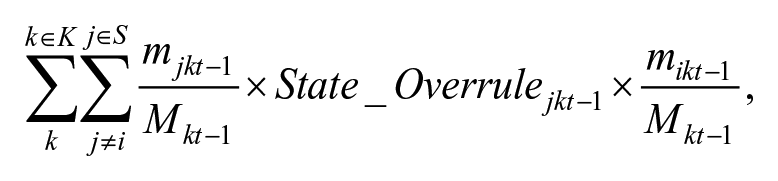
where
Control Variables
We controlled several variables that influence the number of local bans and/or the trade associations’ hiring of lobbyists. First, we controlled the total number of members (Total members) that the four UAS trade associations have in each state in the prior year because trade associations with more members in a state can mobilize more resources to lobby the state. If a firm is affiliated with multiple drone industry associations, we counted the firm only once.
Second, we controlled for two key features of the UAS ventures in a state. One was the number of ventures per capita (×100) (UAS venture per capita). States with a larger venture population may be more likely to adopt UAS-friendly policies because the industry may play a bigger role in the local economy. We collected data on UAS ventures from the Crunchbase and CB Insights databases and found that, on average, each state has 719 UAS ventures. To account for the difference between large and small states, we weighted the number of ventures by the total population of a state to obtain the per-capita number of UAS ventures in a state. The other feature we controlled for was the diversity of UAS ventures. Generally speaking, there are three types of UAS ventures: those focusing on manufacturing hardware, those focusing on developing software, and those focusing on providing services to other industries. States with diverse UAS ventures may have a broad constituency base that supports industry-friendly policies. Therefore, we measured the diversity of UAS ventures as one minus the Herfindahl index, which is calculated based on the total number of three types of ventures. Data on the type of UAS ventures was collected from the Crunchbase and CB Insights databases and ventures’ self-descriptions on their websites.
Third, we controlled two variables related to other political activity by UAS companies or trade associations. We controlled UAS trade associations’ campaign contributions in the prior year (Campaign contribution). We coded the amount of money contributed to political campaigns by UAS trade associations at the state level from Follow the Money (followthemoney.com) and used the logged amount to adjust the distribution bias. We then controlled the number of lobbyists hired by private ventures in the prior year (Private lobbyists). Since the UAS industry is composed of both small ventures and incumbent firms like Google and Amazon that spawn into the sector, incumbent firms can act individually to influence state regulation. Using the list of firms that operate in the UAS industry and that we compiled from Crunchbase and CB Insights, we manually searched for the number of lobbyists hired by these firms according to the National Institute of Money in State Politics (NIMSP). Because incumbent firms tend to have other lines of business and may hire lobbyists for other purposes, we used this variable as a control rather than an independent variable.
Fourth, we controlled for state UAS laws, which measure the number of state clauses on UAS devices in the prior year. The existing regulation on UAS devices may affect a state’s tendency to enact more laws in the future.
Fifth, we controlled for two variables related to the enactment of local bans on drones. One was the proportion of cities with city managers in a state in the prior year. As most of the bans on UAS are enacted at the city level, this variable reflects the professionalization of local governments, which has been found to affect the prevalence of restrictive local laws (Swanson & Barrilleaux, 2020). The other variable was the number of local anti-UAS protests in a state in the prior 2 years. States with more protests are more likely to enact local bans and less likely to nullify these bans. We coded anti-UAS protests based on news data collected from the Lexis-Nexis database. These protests usually target the local government (especially the police department) or industry expo events.
Finally, we controlled for a state’s GDP per capita (GDP per cap.) and population size (Pop.) for the prior year using data collected from the U.S. Census Bureau. States with better GDP development or a large population may have more resources and thus are likely to be less dependent on the nascent UAS industry. Table 1 shows the summary statistics and correlations for all the variables.
Summary Statistics and Correlations.
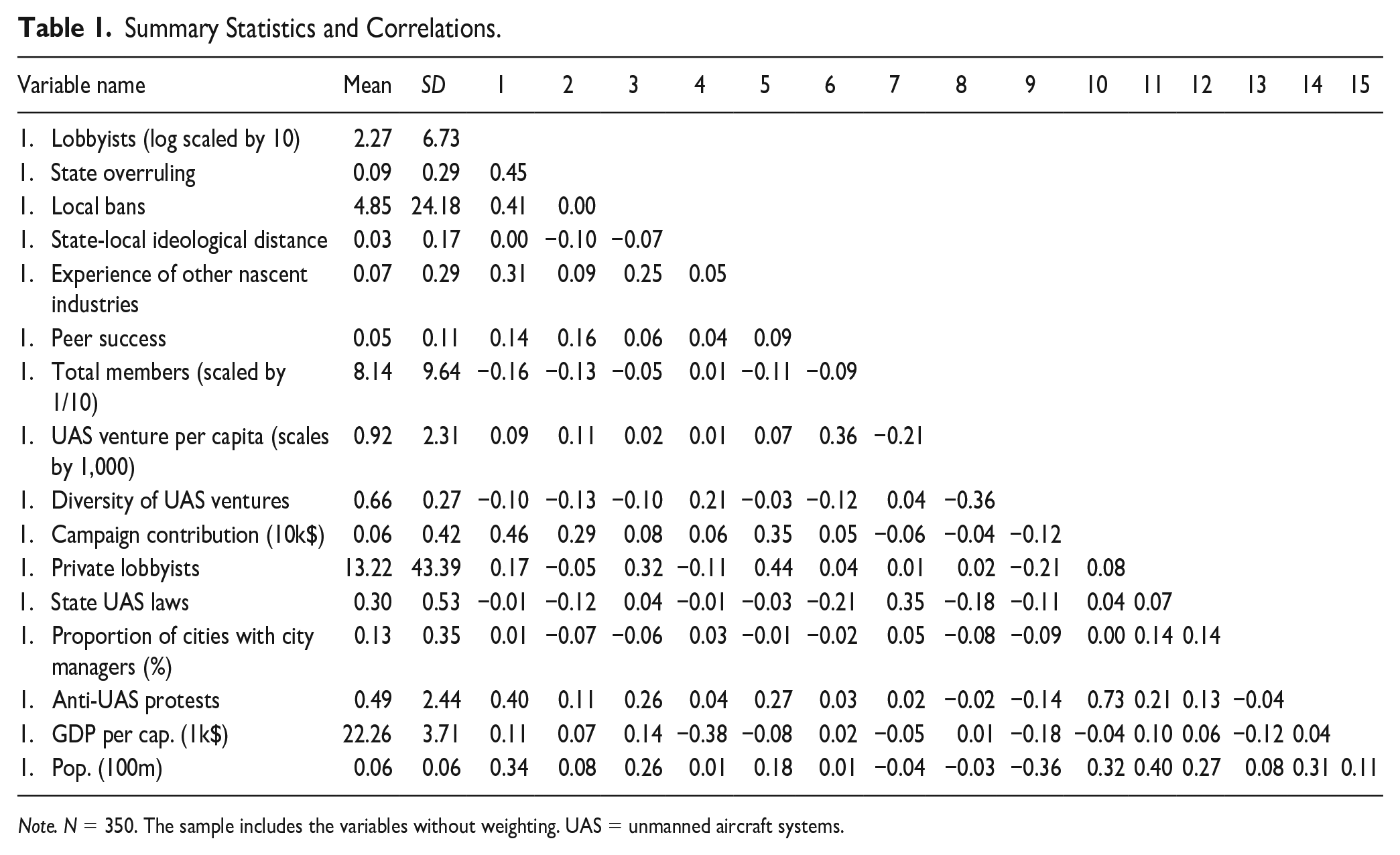
Note. N = 350. The sample includes the variables without weighting. UAS = unmanned aircraft systems.
Empirical Strategy
One key challenge when testing our hypotheses was the nonrandom distribution of local bans. To address this, we turned to the newly developed covariate balance propensity score (CBPS) method (Fong et al., 2018). CBPS is an extension of the inverse-probability treatment weighted (IPTW) method (Robins & Wang, 2000) in that it relies on observables to predict the probability distribution of a treatment and then generates a weighted population in which the treatment is approximately randomly distributed. In this way, the method can derive a causal effect. CBPS shares the advantages of the IPTW method in that (a) it estimates weights stage by stage and is thus particularly suitable for sequential analysis; and (b) it does not drop off samples and is thus advantageous for studies based on a limited number of observations. 6 However, CBPS also has advantages over IPTW in that it utilizes a nonparametric method to iteratively calculate weights for each observation. It can thus be used for continuous treatments. The propensity score or the IPTW method generally requires researchers to specify models to predict the probability of treatment. When the models are not specified properly, it is easy to bias the estimation of the model parameters.
Rather than specifying a functional form for estimating weights, CBPS uses a nonparametric method to transform weight estimation into a constrained optimization problem that is solved using the standardized Broyden–Fletcher–Goldfarb–Shanno (BFGS) algorithm:

where
As shown in the equation, the optimization problem has three components: (a) weights are estimated by maximizing the probability that the combination of treatments (
We used a state’s percentage of windy days in the prior year as
We tested the effectiveness of the CBPS method by calculating the Kullback–Leibler (KL) divergence 10 between the CBPS-weighted and actual probability of each observation being treated. The underlying notion is that when the CBPS-weighted probability of each observation being treated is closer to the actual probability of each observation being treated, the inverse-probability weights will create pseudo-observations that have city bans more randomly assigned. We found that the KL divergence for CBPS weighting was 5.68. To understand the meaning of the KL divergence for CBPS, we compared the CBPS weighting with the IPTW weighting using a probit model (6.05), a widely accepted method (Robins & Wang, 2000). The CBPS method showed 6.11% (=[5.68 – 6.05]/6.05) improvement over the IPTW method.
To address the concern that states may have unobserved confounding factors, we included a state fixed effect in our main model. However, state fixed effect has the potential to bias nonlinear regressions (Hahn & Kuersteiner, 2011). Therefore, we took a log of the dependent variable, number of lobbyists, and scaled it by 10 to demonstrate coefficients within two digits. We adopted the Ordinary Least Squares (OLS) model to predict the logged number of lobbyists. In our robustness checks, we reported the results of adopting nonlinear models such as the negative binomial or the Poisson model with state fixed effects. Once we estimated the CBPS weights, we applied them to the OLS model.
Results
Trade Associations’ State Lobbying
Before running the formal estimation model, we conducted a t-test of the number of lobbyists hired by drone associations at the state level by comparing the states with city bans to the states without (t = 4.8, p < .05). The test showed that states with more city bans tend to have more lobbyists. We also did a t-test of the number of state laws enacted to overrule local restrictions by comparing the states with lobbyists to those without (t = 3.8, p < .01). The test showed that states with more lobbyists are more likely to overrule local restrictions. In Figure 1, we graph the distribution of local bans, the average number of lobbyists, and a state’s overrule status in 2019. This graph clearly shows the concurrence of local bans and lobbyists. It also provides direct evidence that states with more lobbyists hired by UAS trade associations tend to enact preemption laws.
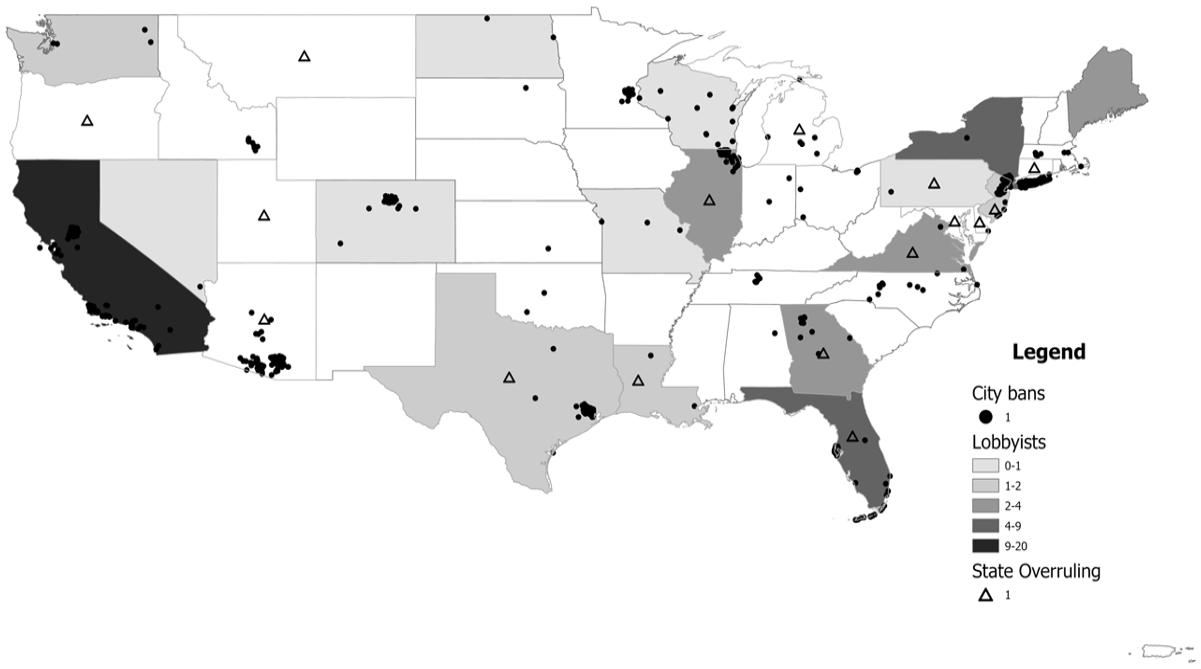
Geographic Distribution of Local Bans, the Number of Lobbyists, and State Overruling Local Authorities.
Table 2 verifies our main hypotheses. Model 1 is the basic model. While the number of trade association members at the state level is negatively correlated with the number of lobbyists, the diversity of drone ventures is positively correlated with the number of lobbyists at the state level. Trade associations’ campaign contributions complement their lobbying activity at the state level. By contrast, drone companies’ private lobbying activities substitute for trade associations’ lobbying activities at the state level. The states have more anti-drone protests are more likely to have lobbyists.
Estimates of the Number of Lobbyists.
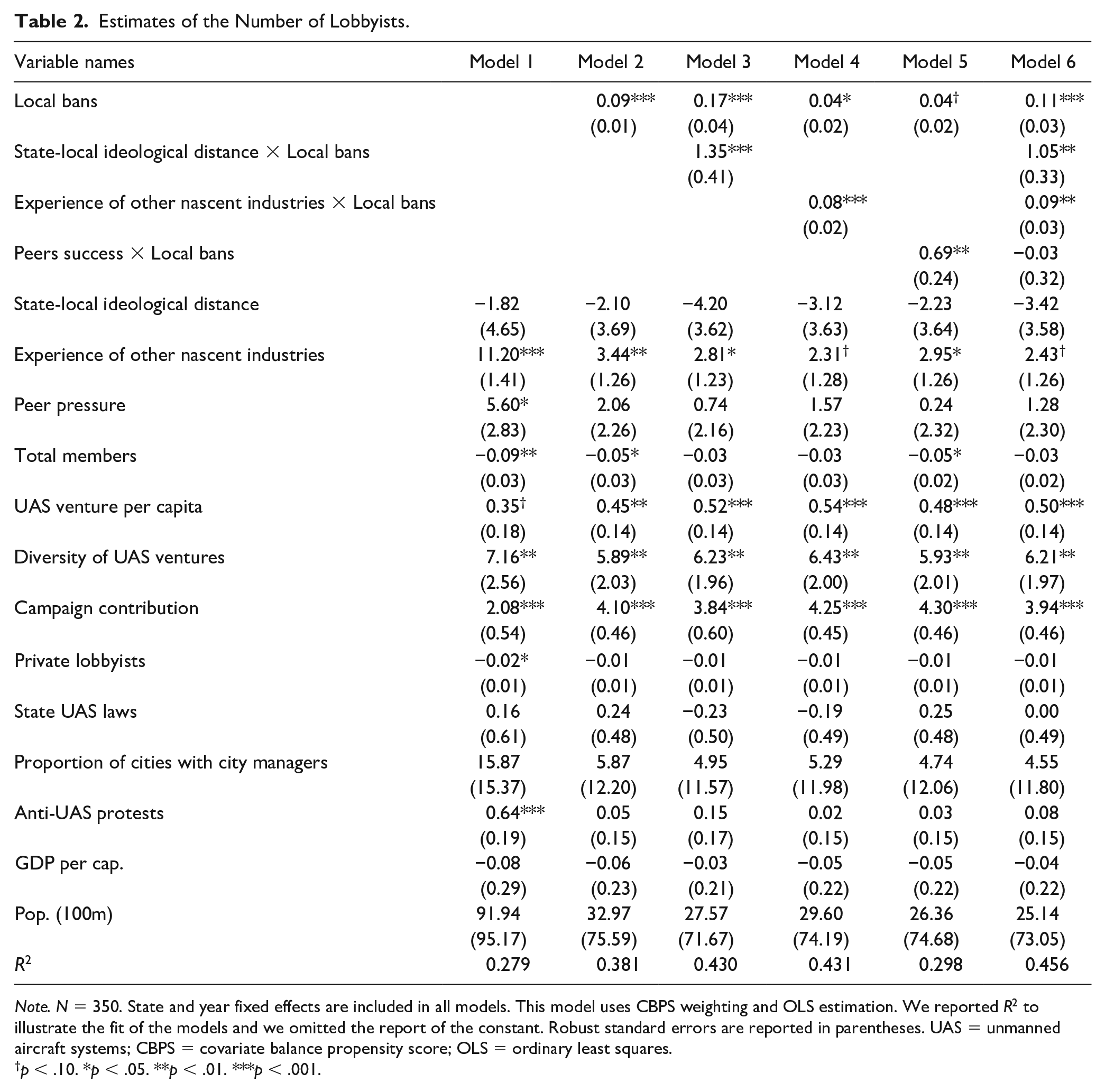
Note. N = 350. State and year fixed effects are included in all models. This model uses CBPS weighting and OLS estimation. We reported R2 to illustrate the fit of the models and we omitted the report of the constant. Robust standard errors are reported in parentheses. UAS = unmanned aircraft systems; CBPS = covariate balance propensity score; OLS = ordinary least squares.
p < .10. *p < .05. **p < .01. ***p < .001.
Model 2 confirms H1. The number of local bans significantly increases the number of lobbyists hired at the state level (
Model 3 confirms H2a. When the state legislators are more conservative than the city legislators, trade associations are more motivated to lobby at the state level when the number of cities with bans increases (
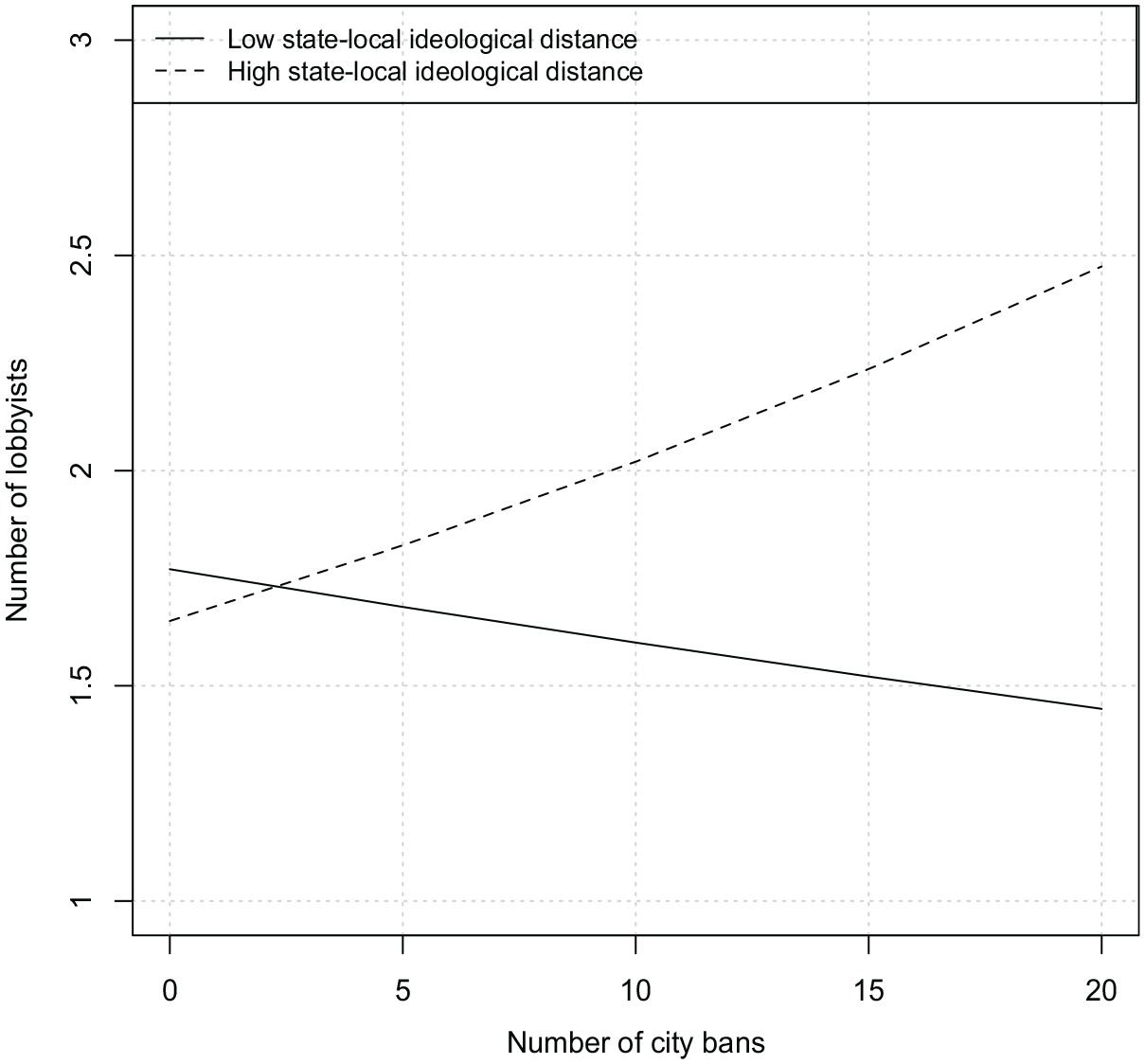
Interaction Effect of State-Local Ideological Distance.
Model 4 partially confirms H2b. When state legislators have taken over local authorities in other nascent industries, trade associations are more motivated to lobby at the state level when local bans increase (
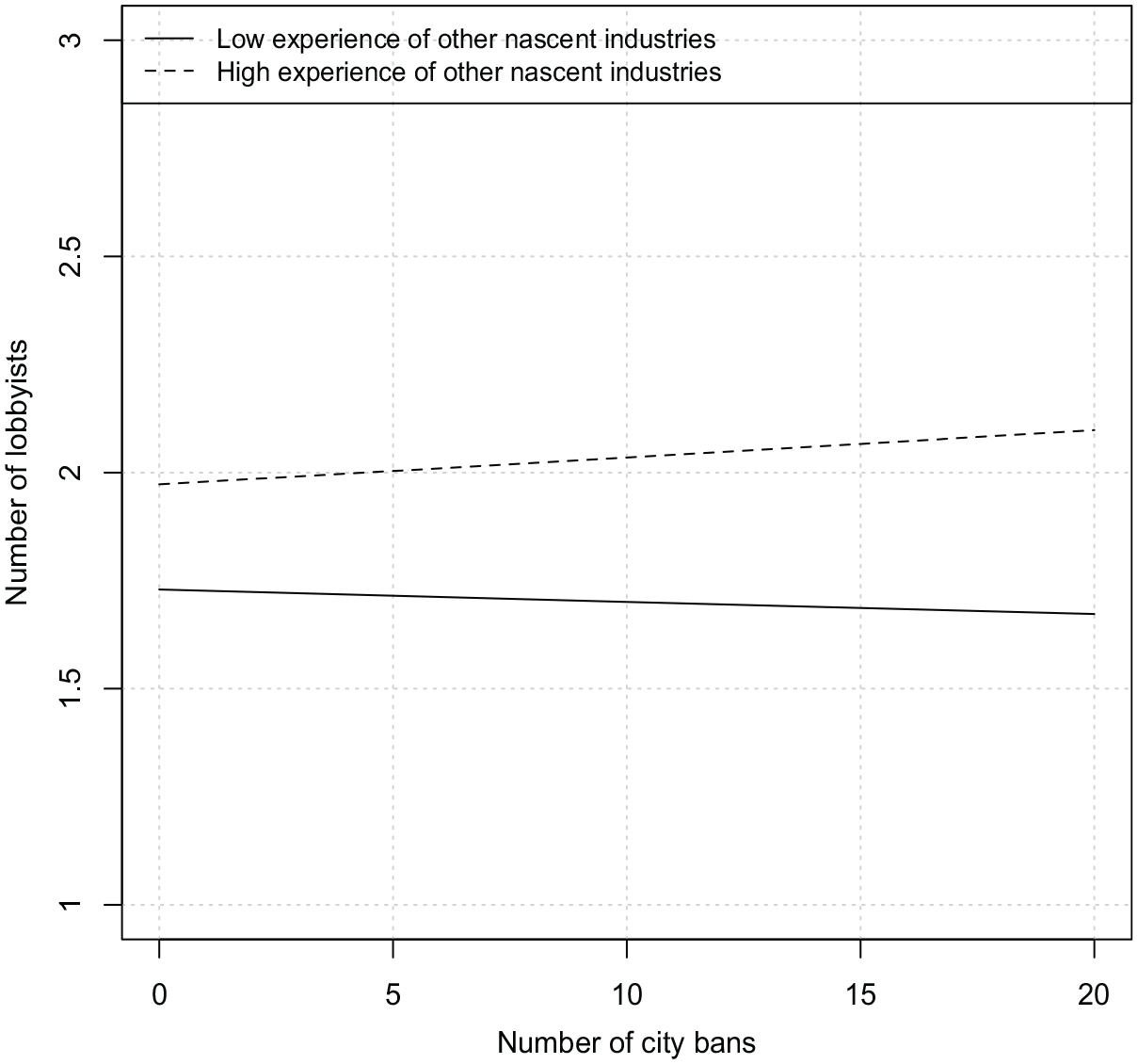
Interaction Effect of Experience of Other Nascent Industries.
Model 5 confirms H2c. When trade associations learn that other states have taken over their cities’ authority to regulate drones, they are more motivated to lobby at the state level when the number of local bans increases (
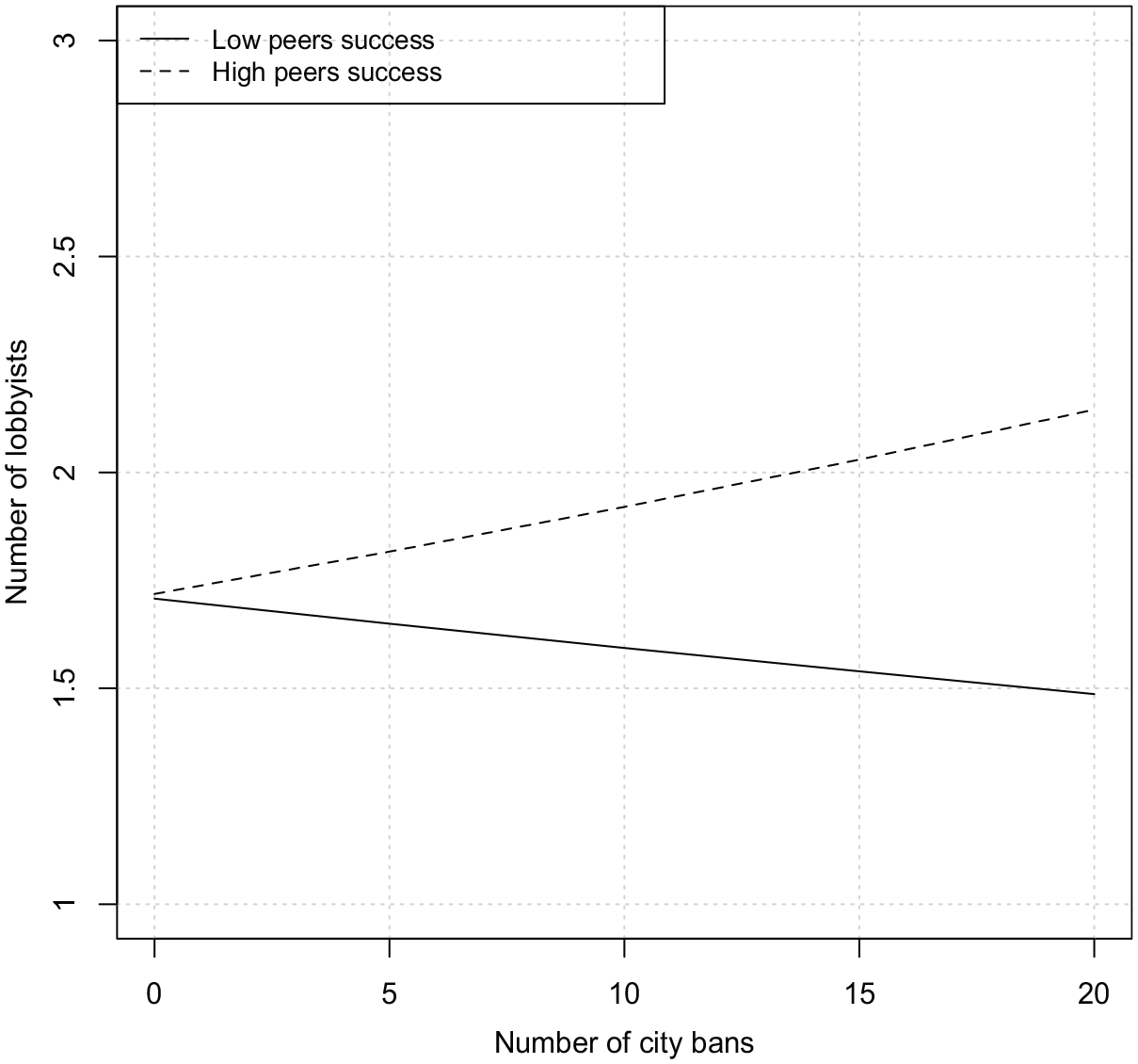
Interaction Effect of Peers’ Success.
Finally, Model 6 is the full model. H1, H2a, and H2b are all supported. However, the moderating effect of trade association learning is no longer significant.
States’ Overruling of Local Regulations
Next, we tested H3, which focuses on the impact that the number of lobbyists hired by trade associations makes on a state’s overruling of local authorities to regulate the UAS industry. The independent variable, number of lobbyists hired by UAS trade associations targeting the state-level government in a state in the prior year, is defined in the same way as it is when used as a dependent variable to test H1 and H2. In this case, however, it is lagged by 1 year. We first included the same sets of control variables we had used to test trade associations’ lobbyist hiring since the variables that affect lobbyist hiring also influence the lobbying success rate. We then controlled for the predicting variable used in testing H1-2, the number of local bans in a state (i.e., the independent variable for H1-2), and the three moderating variables in H2.
When testing the impact of lobbyists on state overruling (H3), we similarly needed to weight the sample so that the number of lobbyists was randomly assigned across different states. To generate the CBPS weights, we used an exogenous variable, number of model aircraft hobbyist events. Model aircrafts are usually used only for recreational purposes, but hobbyist events help build connections among individuals who are interested in unmanned aircrafts and thus can facilitate collective political activity organized by UAS trade associations. We collected data on the annual number of hobbyist events in a state from the Academy of Model Aeronautics. We then adopted an OLS model with state and year fixed effects to predict the categorical variable capturing states’ overruling of city regulations.
Table 3 shows our results from testing H3. Model 1 illustrates all the control variables. Model 1 shows that peer successes and trade associations’ campaign contributions increase states’ overruling. Model 2 confirms that when there are more lobbyists hired at the state level, states are more likely to enact preemption laws (
Estimates of the Degree of State Overruling.
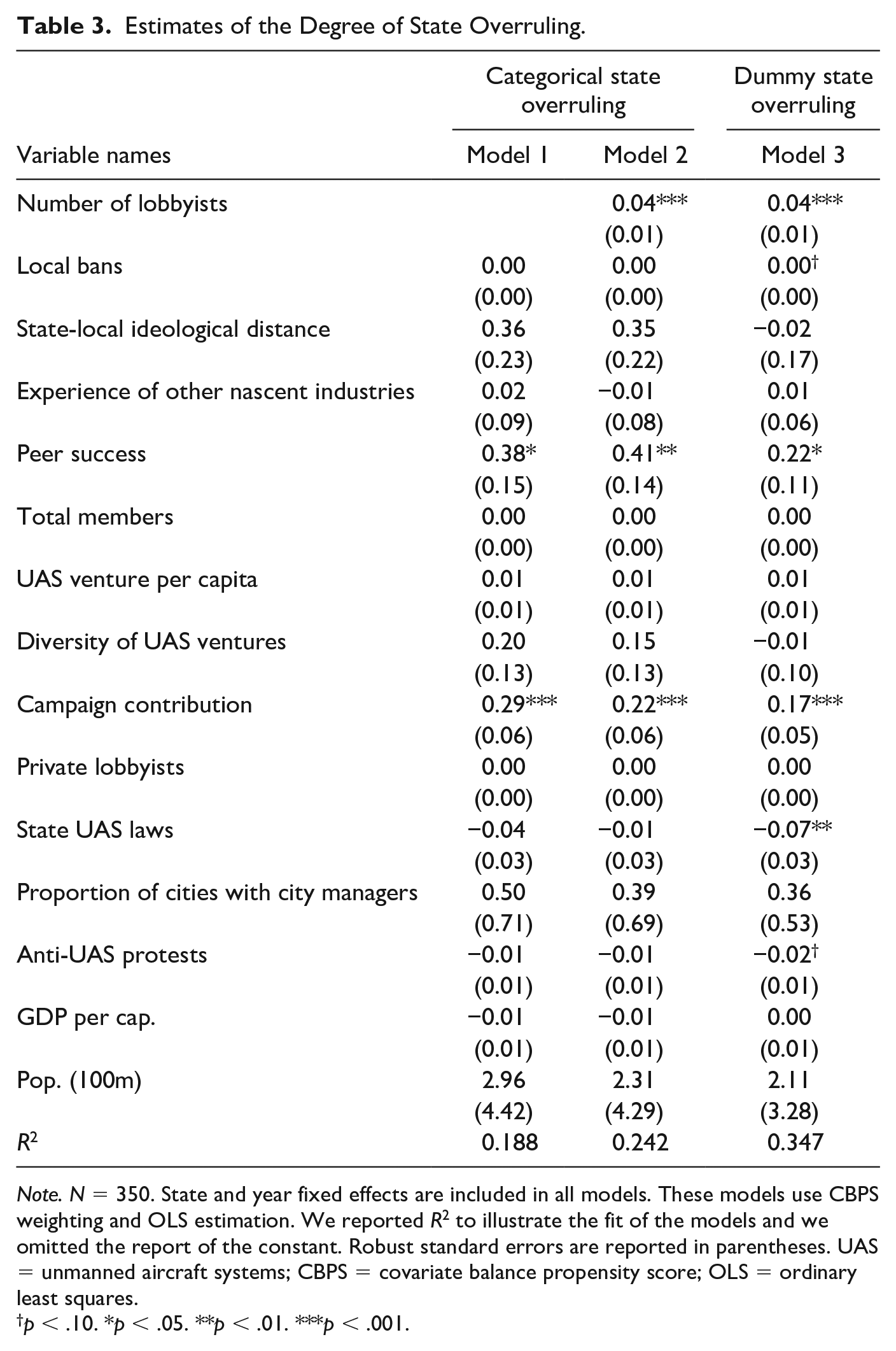
Note. N = 350. State and year fixed effects are included in all models. These models use CBPS weighting and OLS estimation. We reported R2 to illustrate the fit of the models and we omitted the report of the constant. Robust standard errors are reported in parentheses. UAS = unmanned aircraft systems; CBPS = covariate balance propensity score; OLS = ordinary least squares.
p < .10. *p < .05. **p < .01. ***p < .001.
Robust Checks
To extend our analyses and assess the robustness of our results, we conducted five sets of additional tests. First, we assessed the robustness of our findings to potentially omitted variables. Although we controlled for many confounding variables, there may still be omitted variables. To assess the robustness of our results, we adopted the impact threshold of a confounding variable (ITCV) method developed by Frank (2000). This method aims to assess the thresholds that possible confounds would need to reach to overturn our estimates. We conducted the ITCV analyses following existing literature (J. S.Harrison et al., 2018; Hill et al., 2019; Hubbard et al., 2017) using the Konfound R package (Xu et al., 2019). The ITCV results show that to invalidate inferences for the number of state-level lobbyists, 44.2%, 58.3%, 73%, and 73.8% of the estimates on the number of local bans and the three moderation effects would have to be biased, respectively. Similarly, the ITCV test on states’ overruling showed that 79.7% of the estimates on state-level lobbyists would need to step from biases in case of a zero effect. These scenarios are highly unlikely, suggesting the robustness of our findings.
Second, while our main results show a two-step process in which (a) local bans increase the number of lobbyists that trade associations hire at the state level and (b) lobbying contributes to states’ overruling of local restrictions, we considered it worthwhile to test the mediation effect of the number of lobbyists between local bans and states’ overruling. Because the mediation effect functions better with linear models (Aguinis et al., 2017), we adjusted the estimation of the number of lobbyists by using the log-transformed number of lobbyists to fit linear models. In addition, because the calculation of the mediation effect requires using one CBPS-weighted sample between the two steps of estimation, we adopted the weights estimated for local bans that are at the starting point of our mediation models.
11
The indirect effect through trade association lobbyists is a*b, where a and b refer to the coefficients of the first and second steps, respectively. The z score for the indirect effect is
A third implication of our theory is that when there are more city bans, the trade associations will increase their political activity at the state level but will reduce their political activity at the city level. Lobbying data targeted at local governments are generally unavailable as cities are not required to submit lobbyists’ reports (Green & McCann, 2013). Therefore, to determine trade associations’ political activity at the city level, we collected data about grassroots activity organized by the four UAS trade associations. By searching the associations’ websites, we identified two major types of grassroots events: organizing local educational events about unmanned aircraft and hosting industry conferences on unmanned aircraft. These two types of events allow ventures to mobilize local constituents to support their businesses. We coded the yearly number of grassroots influencing activities conducted by UAS trade associations in a state. We utilized the CBPS weighting model to test whether threatened members result in decreased grassroots influencing activities. We ran the OLS fixed state and year effects model to predict the log number of grassroots activities and found that when there are more local bans in a state, the trade associations reduce their grassroots activities (
Fourth, we further explored alternative measures of state–local ideological differences. As our key measurement uses constituents’ ideology as a proxy for policymakers’ political ideology, we collected data about the political ideology of state legislators, state governors, and city mayors (or city managers) from Ballotpedia (https://ballotpedia.org) and developed a more direct measure. At the state level, both legislators and governors tend to play a significant role in the policymaking process (Scholz & Wei, 1986). For this reason, we regarded a state government as Republican if both the governor and most state legislators were Republican. Similarly, we regarded city governments enacting local bans as Democratic if the cities had Democratic mayors (or managers if no mayors). We created a dummy variable that takes the value of one when a state is Republican and more than half of the banning cities in the state were Democratic. We used this dummy variable to indicate the presence of political ideological differences between the state and the banning cities. Table A4 shows that using this elite-based measurement generates results consistent with those reported in the main analysis.
Finally, we checked the robustness of our model choices. Rather than adopting OLS analyses, we used the maximum likelihood estimation of generalized estimating equations (GEEs) to estimate the parameters of our analyses. GEE models are advantageous in that they estimate parameters and standard errors based on correlations derived from within-cluster residuals and allow multiple correlation matrix structures to fit the data (Liang & Zeger, 1986; Ndofor et al., 2011). In addition, they are suitable for estimating limited-range dependent variables (D. A. Harrison, 2002) such as count variables through using a Poisson linkage. Once we estimated the CBPS weights, we applied them to the GEE Poisson model to estimate the impact of local bans on the number of trade association lobbyists. In addition, we used a negative binomial model to predict the number of lobbyists. Table A5 reports these results and shows that using these alternative estimation models did not affect the basic patterns of our results.
Discussion and Conclusion
In this article, we argued that nascent industry groups can engage in the venue-shifting strategy to remove restrictive regulations. However, such groups face a high level of uncertainty surrounding the preference of the targeted political venue and the nature of industry associations’ policy proposals. To mitigate these uncertainties, nascent industry groups can draw on the venue’s political ideology and recent history in regulating other nascent industries to infer the venue’s policy preference and gauge the popularity of their policy proposal from industry peers’ experience adopting the same strategy in other jurisdictions. If the targeted political venue is likely to support the focal industry’s policy proposal, industry groups will invest more in the targeted venue. The more they invest in the targeted policy venue, the more likely it is that they will be able to persuade the venue to veto or change existing restrictions. A study of the U.S. UAS industry from 2013 to 2019 supports this theory, demonstrating that UAS trade associations hire more lobbyists targeting the state government when facing local bans on their operations. This effect is even stronger when state policymakers are ideologically distant from their local counterparts that have enacted bans, when state policymakers have recently vetoed or changed local restrictions in other nascent industries, or when trade association members are more exposed to their peers’ success in leveraging state policymakers to remove local restrictions. An increased number of lobbyists also contributes to the probability that state laws overrule local restrictions. In the following section, we outline the implications of our findings for the literatures on industry venue shifting, the political strategies of nascent industries, and the relationship between business and society. We also discuss our study’s limitations and directions for future research.
Contributions
First, we contribute to the venue-shifting literature by addressing the lack of studies on how resolving uncertainties surrounding political venues’ policy preferences affects industry groups’ venue-shifting efforts. While industry groups are strategic and rational actors, they have only incomplete information on policymakers’ references and potential reactions to their policy proposals. Therefore, venue shifting consists of two steps: acquiring information on a target venue’s ideological orientation and preferences and influencing its decisions. Our article investigates how information acquisition influences industry groups’ venue-shifting strategy and answers the call for more research on the “micro-political theories” of venue shifting (Coen et al., 2021, p. 325).
More specifically, our article extends the “policy learning” perspective in the venue-shifting literature. The policy learning perspective acknowledges that decisions that advocacy groups make about which venues to target and how much resources to allocate are strategic but regards these calculations as being “informed by information, ideology, organizational contexts, and long-term learning processes” (Pralle, 2003, p. 256). While the existing literature emphasizes that industry groups’ policy learning is an experimental process of trial and error (Bouwen, 2002; Broscheid & Coen, 2003; Hall & Deardorff, 2006), our article argues that learning may not have to be based on industry groups’ own experience in the policymaking process. In fact, as strategic actors, industry groups are motivated to obtain information more efficiently from external sources. By studying nascent industry groups that seek an alternative venue to change restrictive regulations but lack prior experience interacting with the venue, we theorize that the venue’s political ideology and recent history in regulating other nascent industries indicate its policy preference while industry peers’ experience adopting the same strategy in other jurisdictions informs the popularity of the focal industry’s policy proposal. Taking into account these external sources of information enables us to paint a fuller picture of the policy learning perspective of venue shifting. In addition, as nascent industries develop and accumulate knowledge about political venues and their policy proposals, internal and external sources of information are likely to interact to influence the industries’ venue-shifting strategies. Future research across a longer time span should explore how industry groups take advantage of both internal and external sources of information in different stages of industrial development.
Our article also contributes to the venue-shifting literature by demonstrating the diffused consequences of successful venue shifting. We show that the consequences of venue shifting are not limited to policy changes within a focal policy domain or a focal jurisdiction. Instead, successful venue shifting has diffused consequences and inspires industry groups to engage in venue shifting in other industries and other jurisdictions.
Second, we contribute to research on the political strategy of nascent industries by studying the collective venue shifting strategy that nascent industry players can adopt to shape their regulatory environment. Nascent industries face regulatory voids because technological discontinuities often render extant rules obsolete before the development of a new regulatory system that governs the industries’ production, distribution, and consumption (Kaplan & Tripsas, 2008). Despite the crucial importance of regulation to organizational survival and growth in nascent industries, there has been little research on how regulatory voids are filled (C. Gao & McDonald, 2022). One exception is C. Gao and McDonald’s (2022) recent study on the human genomics industry, in which the researchers find that entrepreneurs take advantage of their industry know-how to directly participate in the regulatory formulation process. Other studies have investigated how entrepreneurs overcome legal barriers by avoiding a preset regulatory framework (Gurses & Ozcan, 2015; Ozcan & Gurses, 2017). While these studies usually assume that traditional corporate political activities, such as lobbying, are not viable for nascent industries because ventures often lack resources, our findings demonstrate that nascent industry companies can overcome resource limitations by adopting a collective CPA strategy through trade associations. By investigating the collective CPA strategy, our article paints a fuller picture of how nascent industries fill regulatory voids.
Our article also extends the literature on regulatory voids by showing that companies in nascent industries encounter not only an absence of regulations but also confusion surrounding the regulatory roles of multiple government entities. When a nascent industry falls into the regulatory jurisdiction of multiple government entities, the overlapping responsibilities of the different government entities provide opportunities for the industry to influence those that make it easiest to reach its policy goals. In addition, the extant work on regulatory voids focuses on national/federal agencies such as the U.S. Department of Agriculture (Hiatt & Park, 2013), Federal Communications Commission (Gurses & Ozcan, 2015), and Food and Drug Administration (C. Gao & McDonald, 2022; Ozcan & Gurses, 2017) and adopts a qualitative research method. Our article extends this line of inquiry by focusing on subnational regulators. 13 Applying our quantitative method to a large sample from a hand-collected dataset, we can systematically examine the CPA strategies adopted by nascent industries. In addition, our article is among the first in the management literature to adopt the newly developed CBPS method. Such a nonparametric method provides more effective control of the confounding effects surrounding continuous treatment variables.
Third, our article on the regulation of nascent industries has implications for the literature on the relationship between business and society. As disruptive new technologies pose problems for society, regulators face the competing demands of allowing new technologies and businesses to flourish, protecting citizens, and ensuring fair markets. Thus, regulation is a contested territory in which activists, trade associations, and others compete to define the rules of the game (Fligstein, 1990, 1996; Ingram & Rao, 2004; Schneiberg & Bartley, 2001). In this contentious process, industry players and citizen activists have different incentives for mobilization and face different constraints on resources. They thus work on regulators that are receptive to their influence. Activists opposed to disruptive technologies tend to be decentralized and geographically spread out and are thus more effective at organizing local protests and better at pushing municipal or city governments to enact restrictions on the use of technology. By contrast, industry players who have banded themselves into trade associations can rely on lobbying that induces state governments to nullify the authority of local governments to regulate the new industry.
Anecdotal evidence suggests that lobbying for state preemption is a general tactic that has proven effective at eliminating local restrictions in many industries. In recent years, state governments have been preempting more restrictive local regulations on labor practices, environmental protection, and health and nutrition. By 2019, every state in the United States had at least one preemption law, while some had as many as 12 (Fowler & Witt, 2019). Journalists’ reports suggest that lobbying by industry trade associations such as the National Restaurant Association and the plastics trade associations has played an important role in promoting state preemption in these areas (Huizar & Lathrop, 2019). Our article is among the first to provide rigorously tested results supporting the claim that lobbying state governments helps industry groups nullify unfavorable local regulations. Moreover, besides removing restrictive regulations, industry groups can also adopt venue shifting to skirt prudent regulations or prevent local regulations from developing. Future research should evaluate the impacts of states’ nullification of local regulatory authority on industry development and general social welfare. In addition, venue shifting has long-term consequences (Karch, 2009), and successful venue shifting can permanently alter the regulatory authority in a nascent industry. If states’ punching down of local regulations jams citizen advocacy and sets up a regulatory template, then more discussion of how the distribution of government power matters to a democratic society will be necessary.
Limitations
It is important to point out our study’s limitations, which offer directions for future research. First, industry groups’ venue shifting with the goal of pursuing policy change can take a variety of forms. While our study focuses on vertical venue shifting between different levels of government, industry groups might also pursue horizontal opportunities between different branches of the same level of government (Coen & Héritier, 2005; Gilardi, 2010; Levi-Faur, 2005). For example, the nascent clean meat industry, which grows cell-based meat products, is in the midst of a debate over whether it should be regulated by the U.S. Department of Agriculture, which oversees meat products, or the U.S. Food and Drug Administration, which regulates foods made from food “components” (Purdy, 2018). Thus, future research should investigate whether the process by which nascent industry groups resolve uncertainties in horizontal venue shifting differs from that in vertical venue shifting.
Second, while we focus on policymakers’ ideological differences, there may be other sources of conflict to indicate that policymakers in different political venues are likely to take opposing stances. For example, multiple government agencies may compete to demonstrate their competence or extend their influence in a certain policy field. Future research could expand the policy learning perspective to include other sources of conflict. Finally, it is important to point out that although the context of our research is the jurisdictional conflicts between local and state governments in the United States federalist system, the uncertainty surrounding political venues’ policy preferences is not unique to this political system. We expect our expanded policy learning perspective to be applicable to other political systems so long as there exists regulatory authority overlap. However, we would like to point out that a boundary condition of our study is that opportunities exist for firms to choose venues. This condition may not hold for all nascent industries as some may have a pre-determined policy venue.
Conclusion
In sum, advances in technology do not only spur growth in nascent industries but also present new challenges for regulation. Upon emergence, nascent industries often face legal obstacles due to the disruptions they pose to incumbents and/or their uncertain impacts on society. However, nascent industries also have a unique opportunity to eliminate these obstacles: using venue shifting, they can leverage the ambiguity of their regulatory authority to obtain greater regulatory freedom. Once an industry recognizes that a political venue is likely to aid them in doing so, their efforts to influence the venue pay off well.
Footnotes
Appendix
Estimation of Lobbyists (Alternative Models).
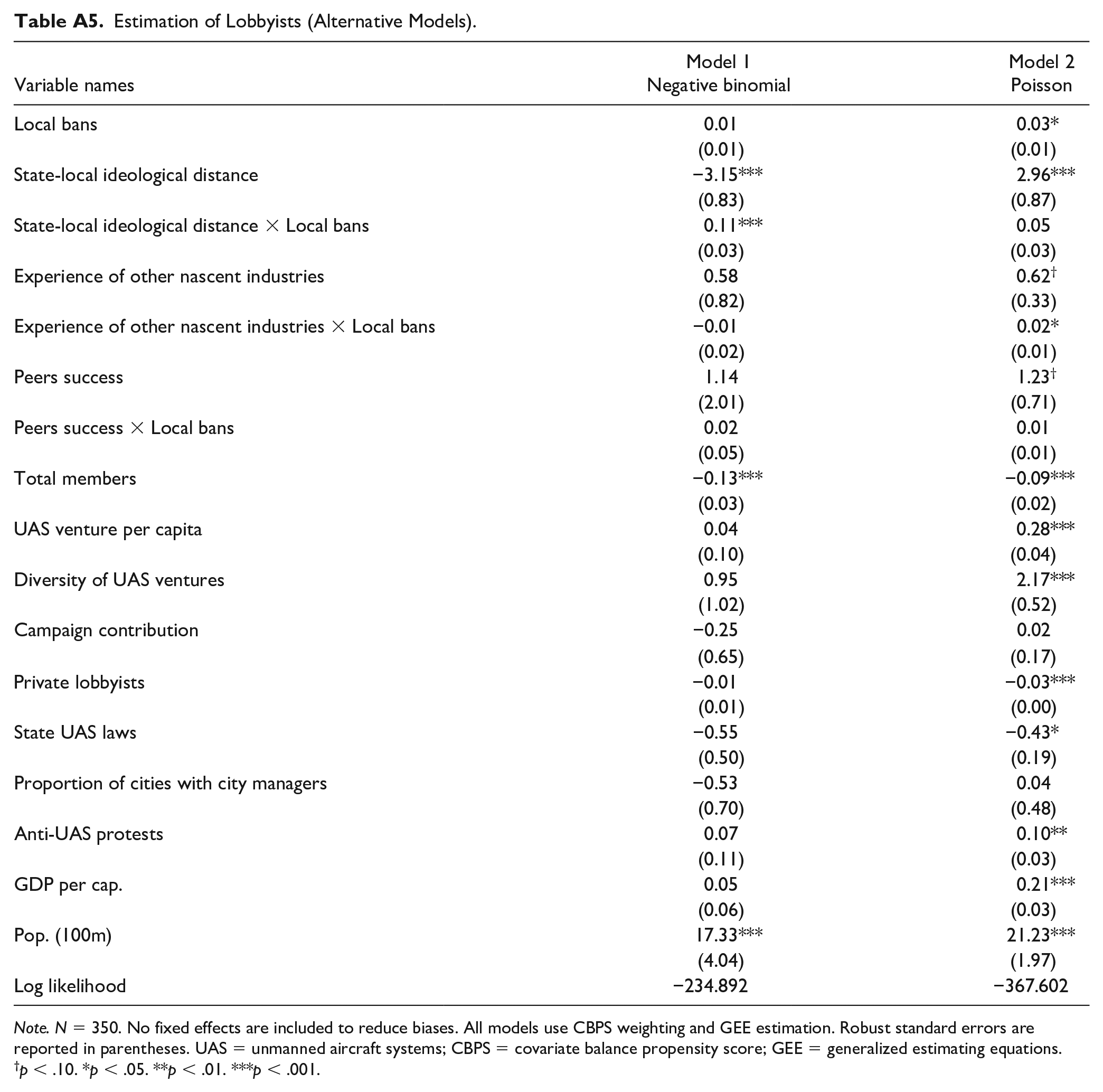
| Variable names | Model 1 |
Model 2 |
|---|---|---|
| Local bans | 0.01 | 0.03* |
| (0.01) | (0.01) | |
| State-local ideological distance | −3.15*** | 2.96*** |
| (0.83) | (0.87) | |
| State-local ideological distance × Local bans | 0.11*** | 0.05 |
| (0.03) | (0.03) | |
| Experience of other nascent industries | 0.58 | 0.62† |
| (0.82) | (0.33) | |
| Experience of other nascent industries × Local bans | −0.01 | 0.02* |
| (0.02) | (0.01) | |
| Peers success | 1.14 | 1.23† |
| (2.01) | (0.71) | |
| Peers success × Local bans | 0.02 | 0.01 |
| (0.05) | (0.01) | |
| Total members | −0.13*** | −0.09*** |
| (0.03) | (0.02) | |
| UAS venture per capita | 0.04 | 0.28*** |
| (0.10) | (0.04) | |
| Diversity of UAS ventures | 0.95 | 2.17*** |
| (1.02) | (0.52) | |
| Campaign contribution | −0.25 | 0.02 |
| (0.65) | (0.17) | |
| Private lobbyists | −0.01 | −0.03*** |
| (0.01) | (0.00) | |
| State UAS laws | −0.55 | −0.43* |
| (0.50) | (0.19) | |
| Proportion of cities with city managers | −0.53 | 0.04 |
| (0.70) | (0.48) | |
| Anti-UAS protests | 0.07 | 0.10** |
| (0.11) | (0.03) | |
| GDP per cap. | 0.05 | 0.21*** |
| (0.06) | (0.03) | |
| Pop. (100m) | 17.33*** | 21.23*** |
| (4.04) | (1.97) | |
| Log likelihood | −234.892 | −367.602 |
Note. N = 350. No fixed effects are included to reduce biases. All models use CBPS weighting and GEE estimation. Robust standard errors are reported in parentheses. UAS = unmanned aircraft systems; CBPS = covariate balance propensity score; GEE = generalized estimating equations.
p < .10. *p < .05. **p < .01. ***p < .001.
Acknowledgements
The authors thank Cheng Gao, Rory McDonald, Hayagreeva Rao, and seminar participants at the University of Southern California and Columbia University for their comments on the early version of the article.
Declaration of Conflicting Interests
The authors declared no potential conflicts of interest with respect to the research, authorship, and/or publication of this article.
Funding
The authors received no financial support for the research, authorship, and/or publication of this article.
