




Abstract
We use extensive longitudinal data from companies in the book retailing and telecommunication industries to replicate and extend Gilbert’s qualitative study on the influence of opportunity/threat perceptions on resource rigidity and routine rigidity in incumbents’ responses to discontinuous change. After discovering important anomalies in an empirical generalization study, we engage in a generalization and extension study to unbundle opportunity/threat perception into the dimensions of gain/loss framing and perceived control and induce a revised theory of the effect of such appraisals on incumbent inertia. Specifically, we induce that (a) imminent loss framing relaxes resource rigidity only when decision makers perceive a moderate level of control; (b) resource rigidity also relaxes in response to gain framing, at least when decision makers perceive the discontinuity as a particularly relevant strategic issue and strongly sense that they can control it; (c) loss framing and low perceived control can amplify routine rigidity by exacerbating resource rigidity; and (d) structural separation creates perceptions of gain and control by fostering the emergence of a local organizational identity in the unit implementing the discontinuous change. We resolve long-debated contradictions in studies on managerial and organizational cognition and discontinuous change, particularly between studies invoking threat rigidity theory and studies invoking prospect theory. We also demonstrate the usefulness of replicating qualitative research that is based on multiple case comparison.
A central stream in management research illuminates incumbent firms’ struggles to adapt to discontinuous change and how some incumbents defy the odds and overcome such organizational inertia (e.g., Christensen, 1997; Danneels, 2002; Tushman & Anderson, 1986; for overviews, see Christensen, McDonald, Altman, & Palmer, 2018; Eggers & Park, 2018). Discontinuous change denotes novel ways of creating and capturing value “that depart dramatically from the norm of continuous incremental innovation” (Anderson & Tushman, 1990: 606) and the established innovation trajectory (Christensen, 1997; König, Kammerlander, & Enders, 2013). Studying discontinuous changes, such as digital imaging (Benner, 2010) and fiber optics (Kaplan, 2008a), scholars have identified many barriers to adaptation as well as antidotes to organizational inertia (Gerstner, König, Enders, & Hambrick, 2013; O’Reilly & Tushman, 2008).
A particularly lively discussion within this literature pertains to the role of managerial and organizational cognition (MOC) and its consequences for incumbents’ (non)responses to discontinuous change (e.g., Benner & Tripsas, 2012; Garud & Rappa, 1994; Kammerlander, König, & Richards, 2018; Kaplan, 2011; Tripsas & Gavetti, 2000). The key premise underlying this research is that discontinuous change is ultimately characterized by a change in fundamental assumptions and beliefs (Dosi, 1982; König, Schulte, & Enders, 2012) that renders established knowledge structures (Walsh, 1995) dysfunctional for organizational sensing, interpretation, and reaction (Daft & Weick, 1984). As such, attempts to explain adaptation to discontinuous change by considering how managers recognize, attend to, and interpret discontinuous change promise especially rich insights and have found strong empirical support (Eggers & Park, 2018).
Especially influential to the conversation on MOC and organizational adaptation to discontinuous change has been the work of Clark G. Gilbert (2005; see also Gilbert, 2001, 2006; Gilbert & Bower, 2002). Gilbert’s core idea, which he infers from multiple case studies following the “Eisenhardt template” (Eisenhardt, 1989; Langley & Abdallah, 2011: 108), is that scholars wishing to explain adaptations to discontinuous change need to disentangle two forms of organizational inertia. The first, resource rigidity, denotes incumbents’ “failure to change resource investment patterns” in response to discontinuous change; the second, routine rigidity, describes the “failure to change the organizational processes that use [invested resources]” (Gilbert, 2005: 741). Gilbert furthermore suggests that in the process of organizational adaptation, decision makers’ perception of a discontinuous change as a threat to the organization—rather than as an opportunity—has a paradoxical effect: Although the perception of an imminent threat is both necessary and sufficient for overcoming resource rigidity (see also Gilbert, 2006), threat perception amplifies routine rigidity. Gilbert also proposes that outside influences and the structural separation of the venture unit that implements the discontinuous change can help overcome threat-induced routine rigidity by allowing decision makers in the venture to develop an opportunity perception, which leads to a relaxation of routine rigidity.
In this article, we replicate and extend Gilbert’s (2005) research, which is—by his own account—partially inconclusive (p. 761). Specifically, we combine two types of replication analyses proposed by Tsang and Kwan (1999). First, in an “empirical generalization,” we engage in a grounded search for anomalies to the original model by faithfully applying Gilbert’s methodology in a different context, namely, six German physical book retailers’ responses to the emergence of online book retailing. Second, as we observe anomalies to Gilbert’s propositions in the empirical generalization, we perform a subsequent “generalization and extension.” Specifically, we enfold extant literature (Eisenhardt, 1989) and adapt Gilbert’s methodology to revisit the cases in the book-retailing industry and to additionally study the reaction of four European telecommunication companies to the emergence of “mobile virtual network operators” (MVNOs).
Our empirical generalization corroborates much of Gilbert’s (2005) model; however, we also observe intriguing anomalies that allow us to readjust and advance it in fundamental ways in the generalization and extension. Most importantly, contrary to Gilbert, our evidence suggests that opportunity or threat perception cannot explain adaptation behaviors coherently if it is understood as a unidimensional opportunity/threat continuum (Dutton & Jackson, 1987). Instead, we need to conceptualize it as a construct that comprises two dimensions that do not necessarily covary: first, positive-gain or negative-loss framing and, second, the level of perceived control (Thomas, Clark, & Gioia, 1993). In particular, counter to Gilbert’s propositions, we induce that imminent loss framing relaxes resource rigidity only if perceived control is at a moderate level. Further contradicting Gilbert, our evidence also suggests that resource rigidity in response to discontinuous change can relax when company decision makers perceive the discontinuity as a gain, as long as they simultaneously perceive it as a relevant strategic issue and sense at least moderate levels of control. Moreover, we explore how loss framing and low levels of perceived control can trigger routine rigidity and how structural separation spurs experimentation by fostering a local identity (Kammerlander et al., 2018).
Our study particularly contributes to the conversation on the role of MOC in the context of incumbents’ responses to discontinuous change. In this regard, the unbundling of evaluative appraisals into gain/loss framing and perceptions of control (Brockner, Spreitzer, Mishra, Hochwarter, Pepper, & Weinberg, 2004; Chattopadhyay, Glick, & Huber, 2001; Lazarus, 1991; Thomas & McDaniel, 1990) enables us to build novel theory on how and why differences in gain/loss framing and perceptions of control might explain heterogeneity in incumbent adaptation (Eggers & Park, 2018). Most notably, we predict different levels of managerial resource commitment to discontinuous change under both gain framing and loss framing for different levels of perceived control. Furthermore, we shed new light on the relation between decision makers’ perceptions and their (dis)inclination to experiment with discontinuous change, and we add to recent research emphasizing the role of organizational identity in adaptation to discontinuous change (e.g., C. Anthony & Tripsas, 2016; Raisch & Tushman, 2016). We also substantially contribute to more general conversations on MOC, especially by highlighting the role of perceived control as a moderator of the influence of gain/loss framing on resource commitment in the broader context of organizational challenges (Huff, Huff, & Thomas, 1992; Staw, Sandelands, & Dutton, 1981). Our insights help us better understand, for instance, managerial sensemaking in crisis management (James, Wooten, & Dushek, 2011) and reconcile long-standing contradictions between explanations of organizational behavior that build on threat rigidity theory and those that draw on prospect theory (e.g., Audia & Greve, 2006; E. George, Chattopadhyay, Sitkin, & Barden, 2006; Shimizu, 2007). Finally, our study shows the value of replications of qualitative research in the Eisenhardt (1989) tradition.
Theory Background
Discontinuous Change and the MOC Perspective on Organizational Inertia
Generally speaking, discontinuous change is “[external change that requires] internal adaptation along a path that is nonlinear relative to a firm’s traditional innovation trajectory” (Gilbert, 2005: 742). Specifically, Gilbert (2005) builds on literature that views discontinuous change as challenging the established paradigm regarding how value is created and captured in a given industry (Christensen & Bower, 1996; Dosi, 1982; Tushman & Anderson, 1986), which comprises three critical aspects (Kammerlander et al., 2018). First, discontinuous change introduces a new mix of benefit dimensions so that, at least initially, innovations may underperform existing approaches in terms of traditional benefits while offering new, and new bundles of, benefit dimensions (Christensen, 1997). Second, discontinuous change involves fundamentally new processes and structures of transforming inputs into benefit (Christensen & Bower, 1996) and is, thus, competence destroying (Anderson & Tushman, 1990; Sosa, 2011) as it requires “fundamentally new skills and competences” (Tushman & Anderson, 1986: 444). Third, discontinuous change involves a new approach to transforming value into profit, especially in terms of revenue and pricing structures (Christensen, 2006; Markides, 2006).
As discontinuous change challenges existing paradigms—that is, mental models and activity patterns that are rooted in deeply embedded shared principles, beliefs, and norms (König et al., 2012)—the literature on organizational adaptation to discontinuous change has particularly benefited from the perspective of MOC (Weber, Lehmann, Graf-Vlachy, & König, 2019). MOC research illuminates how cognitive and emotional structures and processes affect the ways in which members of organizations sense, interpret, decide, and act in response to the environment (Daft & Weick, 1984; Eggers & Kaplan, 2013; Hodgkinson & Healey, 2008; Walsh, 1995). Studies investigating adaptation to discontinuous change from a MOC perspective have primarily highlighted that decision makers’ knowledge structures are bounded and difficult to change (Barr, Stimpert, & Huff, 1992; Kiesler & Sproull, 1982) and, in turn, can make decision makers overlook discontinuous change, interpret it in ways that confirm their schemas, decide against adopting it, and implement responses that reflect the established rather than the new mind-set (Kaplan, 2008a; T. Levitt, 1960). Tripsas and Gavetti (2000), for example, showed how managers at Polaroid interpreted digital imaging through the outdated prism of Polaroid’s traditional “razor-and-blade” model of selling film cartridges at margins that were high compared to those of camera hardware; Kammerlander and colleagues (2018) revealed how decision makers struggle with discontinuous change as it challenges what they perceive as their organization’s identity; Vuori and Huy (2016) revealed how managers at Nokia, depending on their hierarchical level, developed different kinds of fears when Nokia was attacked by Apple’s iPhone. Notably, these and other MOC-based studies help explain not only why incumbents succumb to discontinuous change even when they possess complementary assets but also why, sometimes, incumbents overcome deeply anchored tendencies of organizational inertia (e.g., Gerstner et al., 2013).
Gilbert’s Research and the Reception of Its Contributions
Gilbert (2005) also applies an MOC perspective to discontinuous change and adaptation, although he sheds light on an element of cognition that played no central role in research on discontinuous change prior to his own: decision makers’ perception of the discontinuous change as a threat or an opportunity (Dutton & Jackson, 1987). 1 Specifically, analyzing the responses of eight newspaper companies to the rise of online news, he induces two key ideas. First, he proposes that firms faced with discontinuous change may exhibit resource rigidity and routine rigidity—that is, two distinct types of organizational inertia. Gilbert argues that resource rigidity is driven by resource dependence (Pfeffer & Salancik, 1978), especially from investors and high-end customers (Christensen & Bower, 1996), and “incumbent position reinvestment incentives” (2005: 747)—that is, the tendency of incumbents to reject innovations that cannibalize the established market position (Chandy & Tellis, 1998). As for routine rigidity, he refers to research showing that routines, over time, become anchored in organizational structures and managers’ minds and activities (Feldman & Pentland, 2003; Teece, Pisano, & Shuen, 1997) in ways that render firms less likely to depart from the proven innovation paradigm (March & Simon, 1958).
Second, Gilbert (2005) induces that resource rigidity and routine rigidity are influenced in intriguing ways by decision makers’ perception of a discontinuous change as a threat rather than as an opportunity. Following Dutton and Jackson (1987) and Jackson and Dutton (1988), he conceptualizes opportunity/threat perception as the aggregate of three covariant attribute pairs: positive/negative, gain/loss, and high/low control. Thus, he interprets any instance in which decision makers describe the discontinuity as something positive and/or as a gain and/or as being under the focal firm’s control as opportunity perception, whereas he treats decision makers’ descriptions of the discontinuity as something negative and/or tied to a loss and/or beyond their and their firm’s control as indicative of threat perceptions of the discontinuity.
Particularly, Gilbert (2005) distills five nomological propositions, which we refer to as Propositions G1 through G5. Proposition G1 states, “The perception of an imminent threat in the face of discontinuous change enables managers to overcome sources of resource rigidity that stem from resource dependence [G1a] [and those that] stem from incumbent position reinvestment incentives [G1b]” (Gilbert, 2005: 747). In fact, he notes that “[under the conditions of discontinuous technological change] anticipation of a threat to the core business appears necessary to motivate response [italics added]” (Gilbert, 2006: 162). Gilbert (2005) theoretically undergirds this proposition by referring to prospect theory (Kahneman & Tversky, 1979), which suggests that decision makers engage in stronger risk seeking and externally directed reaction to an event if they perceive it as negative and as a loss (Audia & Greve, 2006; Ocasio, 1995).
Proposition G2 predicts that “[decision makers’] perception of [a discontinuous change as] an imminent threat leads to a contraction of authority [G2a], a reduced level of experimentation [G2b, and] a focus on existing resources [G2c] that amplif[y] routine rigidity” (Gilbert, 2005: 749–751). G2 echoes threat rigidity theory (Staw et al., 1981), especially the idea that opportunity/threat perceptions are evaluative appraisals (Lazarus, 1991), which influence both decision makers’ “cold,” reflective processing of information and their “hot,” reflexive and affective processing and reactions (Dutton & Jackson, 1987: 79). As Dutton and Jackson (1987: 82) note, “Evaluative appraisals are the affective components of cognitions; they make cognitions ‘hot.’” This might be crucial in the context of discontinuous change as “visceral (felt) reactions to choice alternatives often overpower evaluations based on subjective probability assessments” (Hodgkinson & Healey, 2014: 5). Dutton (1993: 200), for instance, specifically suggests that “opportunity frames are almost irresistible because of the positive ‘charge’ or emotion . . . that [they] evoke.” Conversely, threat is “a deep sense of vulnerability” (Gilbert, 2005: 742) that typically leads decision makers to constrict control and to exclude other organization members from participating in decision making (Staw et al., 1981). Additionally, faced with a threat—and the unpleasant emotions associated with it—subordinates are inclined to avoid responsibility for strategic decisions (Nutt, 1984). Especially interesting in this regard is Gilbert’s (2005) observation that threat framing reduces experimentation because it relaxes resource rigidity (see G1): The more resources managers possess to implement discontinuous change, the more difficult it becomes for them “to step back and change behavior” (Gilbert, 2005: 751).
Gilbert’s (2005) three final propositions distill his observations of how newspaper companies varied in their abilities to overcome resource rigidity and routine rigidity. Proposition G3 states, “Involving outside influence [e.g., consultants] when deciding how to respond to discontinuous change will increase the likelihood that managers will structurally differentiate a new venture from its parent organization” (Gilbert, 2005: 755). Proposition G4 predicts that “structural differentiation can help decouple threat perception in a parent from an opportunity perception in a new venture” (Gilbert, 2005: 755). Proposition G5 notes that “outside influence, structural differentiation, and opportunity framing combine to relax routine rigidity in a new venture” (Gilbert, 2005: 757). These propositions relate to research on the benefits of external networks (Geletkanycz & Hambrick, 1997; Stuart & Podolny, 1996) and studies on the role of structural ambidexterity in the context of discontinuous change (e.g., O’Reilly & Tushman, 2008).
Gilbert’s research is widely regarded as a substantial contribution to management research. 2 His notions of resource rigidity and routine rigidity are relevant to MOC-focused research on discontinuous change, particularly as they highlight that managers not only need to recognize discontinuous change and gather specific capabilities but also must “mobilize those capabilities in taking strategic action” (Eggers & Kaplan, 2013: 312). Gilbert’s idea to disentangle inertia has spurred other researchers to refine adaptation to discontinuous change even further, allowing them to develop more precise theories (König et al., 2013). Generally, his work has added substantially to scholars’ shift “away from viewing the inertia of incumbent firms as an inevitability” (Gerstner et al., 2013: 258) toward a focus on the heterogeneity of incumbent adaptation—that is, the standard perspective today (Eggers & Park, 2018).
Gilbert has also received attention in the wider MOC literature (e.g., Parmigiani & Howard-Grenville, 2011; Voss, Sirdeshmukh, & Voss, 2008), primarily because he adds to the ample body of studies investigating the impact of managerial appraisals on a diverse set of organizational outcomes (e.g., Audia & Greve, 2006; Bockmühl, König, Enders, Hungenberg, & Puck, 2011; Chattopadhyay et al., 2001; Fiegenbaum & Thomas, 1988; Ocasio, 1995; Shimizu, 2007). In particular, he offers an innovative reconciliation of the implications of threat rigidity theory (Staw et al., 1981) with those of prospect theory (Huff et al., 1992; Kahneman & Tversky, 1979; Lant, Milliken, & Batra, 1992). He suggests that both theories hold, although one explains the relaxation of resource rigidity while the other explains the exacerbation of routine rigidity. More broadly, Gilbert’s research has resonated with scholars studying MOC and the overall “microfoundations” of management (e.g., Aggarwal, Posen, & Workiewicz, 2017; Felin, Foss, & Ployhart, 2015). These authors have long noted the role of reflexive cognitive processes (Hodgkinson & Healey, 2011) in contexts of highly ambiguous, unstructured, and uncertain situations, including radical change (Huy, 2002) and crises (König, Graf-Vlachy, Bundy, & Little, 2020). Vuori and Huy (2016), for example, refer to Gilbert in their study of the combined implications of “cold,” deliberative cognition and affect-infused, “hot” cognition, such as fear, in Nokia’s battle against Apple’s iPhone.
Finally, Gilbert’s work has left traces in the methodological and practitioner-oriented literature. Eisenhardt and Graebner (2007: 29) lauded it for the rich display of qualitative evidence, calling it an “excellent example . . . of blending construct tables with selected text descriptions,” and it has been showcased in a number of other influential methodological articles (e.g., Christensen, 2006; Kouamé & Langley, 2018). Gilbert himself translated his findings into practitioner-oriented publications (e.g., S. Anthony, Gilbert, & Johnson, 2017; Gilbert, 2003; Gilbert & Bower, 2002), providing oft-cited recommendations on how to overcome organizational inertia.
Some Critical Considerations Regarding Gilbert’s Study
Our study is motivated not only by the general interest in replication of empirical work in management (Brandt et al., 2014; Tsang & Kwan, 1999) and the replication logic innate to qualitative research (Glaser & Strauss, 1967) but also by specific limitations of Gilbert’s (2005) work. In particular, limiting its generalizability, Gilbert analyzes relatively similarly sized quasi-monopolists that possess substantial slack resources. However, such firms can be expected to show idiosyncratic strategic practices (Voss et al., 2008) including especially strong incumbent position reinvestment behavior (R. Gilbert & Newbery, 1984; Reinganum, 1983). Moreover, their strategic position and available resources might influence the nature and intensity of organizational decision makers’ perception of and reaction to organizational challenges (e.g., Audia & Greve, 2006; Barr & Glynn, 2004; Lehner, 2000; Nohria & Gulati, 1996). The same is true for characteristics of the specific cultural context of the United States (House, Hanges, Javidan, Dorfman, & Gupta, 2004), which could interfere with mechanisms central to Gilbert’s model.
More importantly, Gilbert’s (2005) three-dimensional conceptualization of opportunity/threat perceptions contradicts other related theories and evidence, raising concerns about the internal validity of his research. In particular, in contrast to his definition (Dutton & Jackson, 1987), theory on appraisal—one of the most influential bodies of psychology—envisions perceived control as a distinct part of situation appraisal (Lazarus, 1991, 1993). Studies on managerial sensemaking published before Gilbert’s have also considered gain/loss framing and perceptions of control as discriminant dimensions of interpretation (Thomas et al., 1993).
We deem these contradictions especially important in light of the fact that Gilbert’s (2005) propositions—although they echo some prior findings (Huff et al., 1992; Lant et al., 1992)—contradict several extant theories and empirical evidence. Particularly, a substantial body of literature indicates that threat perceptions regarding a given strategic issue, including perceptions of lacking control, can also taper organizational resource commitment in response to this issue (e.g., Brown & Starkey, 2000; Milburn, Schuler, & Watman, 1983; Staw et al., 1981). Relatedly, prospect theory suggests that, at extreme points, when survival is threatened, organization members are likely to resign and allocate progressively fewer resources (Fiegenbaum & Thomas, 1988; Lehner, 2000; March & Shapira, 1987). Also counter to Gilbert, studies suggest that opportunity framing may not only induce cognitive flexibility but can also create positive “gloss” (Dutton, 1993: 199-200) and emotions (Dutton, 1988). Given that positive emotions can induce risk taking (Isen & Geva, 1987), opportunity frames could lead to higher commitment and top management involvement in response to discontinuous change—a conjecture that is supported by other studies observing increased resource commitment to new technologies under opportunity perceptions (e.g., Sharma, 2000; White, Varadarajan, & Dacin, 2003).
Research Method
We aim to address the limitations of Gilbert’s (2005) work through a combination of replication, generalization, and extension (Tsang & Kwan, 1999). In so doing, we leverage the fact that even though, from a strict natural-science point of view, qualitative research is not reproducible, his study is de facto replicable from the epistemological perspective of Eisenhardt’s template of multiple case comparison (Eisenhardt, 1989; Yin, 1994), which treats cases akin to “discrete experiments that serve as replications, contrasts, and extensions” (Eisenhardt & Graebner, 2007: 25). Specifically, we consecutively combined two types of replication outlined by Tsang and Kwan (1999). First, we replicated Gilbert’s research process as exactly as possible in a different context in an empirical generalization. The objective of this study was to test whether Gilbert’s theory generalizes to another population, and our results reveal important anomalies contradicting some of Gilbert’s propositions. Second, we conducted a generalization and extension—that is, a type of replication that can help “account for disconfirmation of previous findings” (Tsang & Kwan, 1999: 770)—with the explicit goal of resolving these anomalies.
Empirical Settings and Cases
We undertook 10 longitudinal case studies in two industries. For the empirical generalization, we analyzed six incumbents in the German book-retailing industry; for the generalization and extension, we revisited these cases and added four incumbents from the European mobile telecommunication industry. We chose these two settings, first, because both industries were affected by discontinuous changes akin to that studied by Gilbert (2005): the emergence of online retailing in the book-retailing industry and the emergence of MVNOs in the telecommunication industry. Second, these settings simultaneously diverged to different degrees from the U.S. newspaper industry studied by Gilbert. The German book-retailing industry was relatively fragmented, whereas U.S. newspapers were quasi-monopolists (Gilbert, 2005). The European mobile telecommunication industry, while being an oligopolistic market, had been a traditionally highly dynamic environment, whereas the established newspaper market was rather stable prior to the advent of the Internet (Gilbert, 2001).
For physical book retailers, online retailing presented a discontinuity that was bound to especially high levels of uncertainty and required nonlinear internal adaptation, as defined in our Theory Background section. First, online book retailing initially fell short on customers’ established performance criteria but introduced new features, such as convenience and customized recommendations (Schrape, 2011). Second, online retailing required sophisticated information technology competencies, which were less relevant in the established business. As Jeff Bezos, founder and CEO of Amazon, noted, “[Online book retailing] is a technology business, and [physical book retailing is] a real estate business” (Beunza & Garud, 2007; Collura & Applegate, 2000: 27). Third, online retailing also introduced new revenue categories, such as banners and online marketplaces for secondary sellers (Altman & Tripsas, 2013).
Our observation period spanned the years from 1993, the year the German book retailer Lehmanns launched the country’s first online book retailing site, to 2008, when most players had come to view Amazon’s model of online retailing as the dominant design. We selected the cases based on a theoretical and “purposeful” (Patton, 1987: 51) sampling logic. Specifically, the organizations had to be, first, in the industry’s top 100 (as listed in the trade magazine Börsenblatt) to ensure a comparable size to that of the organizations studied by Gilbert (2005); second, at least 10 years old at the time of the discontinuity to ensure residual fit with the traditional business model (Gilbert, 2006); and third, sufficiently heterogeneous regarding the theoretical variables of interest to enable us to juxtapose polar types (Eisenhardt, 1989). The top left of Table 1 describes the six book retailers we studied. As all companies were promised strict confidentiality, we disguised firms’ names and precise figures. With the exception of Il Libro, which was a large division of a conglomerate, all book retailers were stand-alone businesses.
Description of Organizations and Data Sources
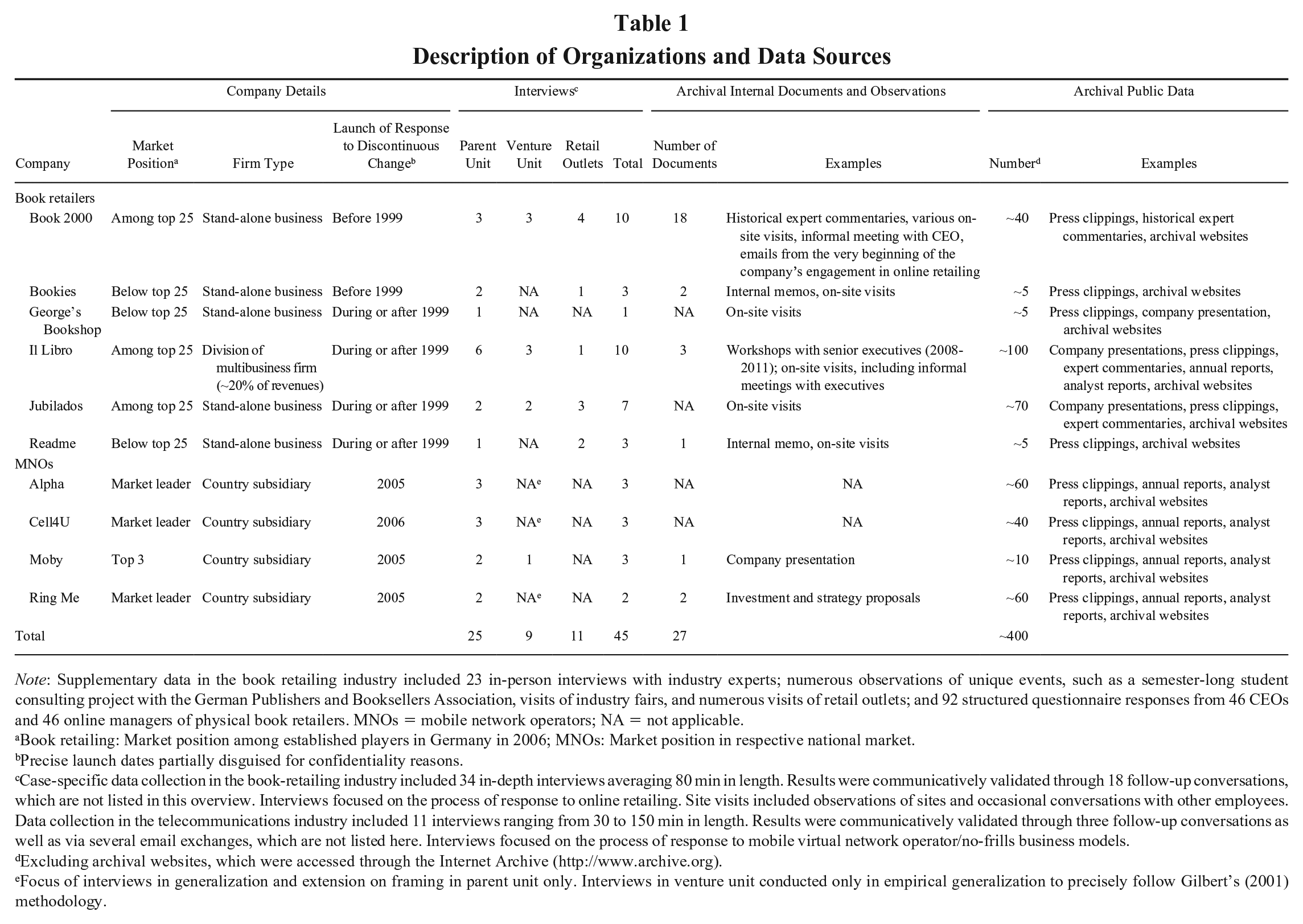
Note: Supplementary data in the book retailing industry included 23 in-person interviews with industry experts; numerous observations of unique events, such as a semester-long student consulting project with the German Publishers and Booksellers Association, visits of industry fairs, and numerous visits of retail outlets; and 92 structured questionnaire responses from 46 CEOs and 46 online managers of physical book retailers. MNOs = mobile network operators; NA = not applicable.
Book retailing: Market position among established players in Germany in 2006; MNOs: Market position in respective national market.
Precise launch dates partially disguised for confidentiality reasons.
Case-specific data collection in the book-retailing industry included 34 in-depth interviews averaging 80 min in length. Results were communicatively validated through 18 follow-up conversations, which are not listed in this overview. Interviews focused on the process of response to online retailing. Site visits included observations of sites and occasional conversations with other employees. Data collection in the telecommunications industry included 11 interviews ranging from 30 to 150 min in length. Results were communicatively validated through three follow-up conversations as well as via several email exchanges, which are not listed here. Interviews focused on the process of response to mobile virtual network operator/no-frills business models.
Excluding archival websites, which were accessed through the Internet Archive (http://www.archive.org).
Focus of interviews in generalization and extension on framing in parent unit only. Interviews in venture unit conducted only in empirical generalization to precisely follow Gilbert’s (2001) methodology.
As part of the generalization and extension, we additionally explored the responses of four mobile network operators (MNOs) from three European countries to the emergence of no-frills MVNOs between 2000 and 2006. MVNOs provide mobile telecom services to end customers by reselling wholesale minutes they purchase from MNOs. In stark contrast to MNOs, MVNOs do not own infrastructure and focus on basic services, such as voice and text messaging. MVNOs constituted a discontinuous change as per our definition. First, the performance metrics stressed by MVNOs—low prices, simple tariff structures, and basic services—diverged considerably from those pursued by traditional MNOs. Second, transitioning to an MVNO business model would render existing resources and capabilities obsolete. For instance, MVNOs did not need to use the best possible network, and a reputation for service and reliability was worth much less in the MVNO context than in the MNO context. On the contrary, MVNOs needed to run a lean organization with a low cost base (Dahlström, Deprez, & Steil, 2004). Third, MVNOs had a very different approach to transforming value into profit because they sold their offerings primarily via the Internet, had a very simple tariff structure with little price differentiation, and, at least initially, did not sell subscriptions bundled with subsidized devices. Thus, as late as 2005, industry observers wondered whether MVNOs “could have the same impact as no-frills airlines have had on the aviation industry” (Marketing Week, 2005: 26) and highlighted the fact that MVNOs, if implemented by MNOs, might cannibalize their revenue, shift profit pools, and ultimately, change the profitability of the incumbent technology (Christensen, Kaufman, & Shih, 2008). The bottom portion of Table 1 provides an overview of the four MNOs, all of them national subsidiaries of European telecom firms. Three were market leaders in their respective countries, and one was in third place. Each firm launched its own MVNO in 2005 or 2006.
Data
Like Gilbert (2005), we developed longitudinal, embedded case accounts (Gibbert, Ruigrok, & Wicki, 2008; Yin, 1994) of perceptions, decision making, and decision implementation among the senior decision makers at the levels of the parent organization as well as the venture unit, that is, in the unit responsible for developing a response to the discontinuity. We collected rich data as shown in Table 1. Our most important source was a total of 45 in-depth interviews with company representatives. Each interview lasted on average 80 min and was conducted between 2006 and 2009. We interviewed top executives and middle managers because both are crucial for the allocation of monetary and attentional resources (Bower, 1970; Burgelman, 1983) and the implementation of routines as well as change processes (Huy, 2001, 2002, 2011). In particular, middle managers might have a lower commitment to the status quo and exhibit greater awareness of discontinuities than top managers (Hill & Rothaermel, 2003), and corresponding cognitive states may propagate not only top down but also bottom up in an organization (Hodgkinson & Healey, 2008; Kammerlander et al., 2018). All interviews followed an interview guideline based on Gilbert (2001, 2005) and included problem-focused questions as well as narrative questions to elicit rich, anecdotal evidence (Daft, 1983; Kvale, 1996). To reduce possible retrospective bias, we (a) ensured interviewees’ confidentiality and gave them the opportunity to report their recollections freely, (b) worded questions to allow interviewees to not answer whenever they felt they could not make reliable statements, (c) compared information from multiple informants, and (d) repeatedly triangulated interview data with contemporary archival sources (Golden, 1992; Huber, 1985; Huber & Power, 1985; Miller, Cardinal, & Glick, 1997). Most interviews were conducted by two investigators (Eisenhardt, 1989), who took and then compared individual notes (Nadin & Cassell, 2006). Interviews were transcribed verbatim within 24 hr.
We collected extensive additional data for triangulation. Company-internal documents, company visits, follow-up conversations, visits of industry fairs, 23 expert interviews, and supplementary data collected through, for example, a student project with the German Publishers and Booksellers Association, a supplementary survey, and workshops with executives filled gaps in our historical accounts and provided a more ethnographic, intuitive understanding (Tsoukas & Chia, 2002). We also collected about 400 pieces of archival public data, including historical interviews with top managers, historical websites, analyst reports, and expert comments mentioning one or more of the companies during discussions on the industries’ development. Notably, at no time did we influence managers’ perceptions of the discontinuous change, nor did we interfere in any strategic decision of the firms we observed as part of our study.
Data Analysis
The coding guidelines for our studies are provided in Table A2 in the online supplement. The empirical generalization followed Gilbert’s (2005) design as faithfully (Easley, Madden, & Dunn, 2000) as possible. We reconstructed a coding scheme (Mayring, 2003) from Gilbert (2001, 2005) as the basis of our structural content analysis (Miles & Huberman, 1994). As part of interpreting the findings of the empirical generalization and, even more so, during the generalization and extension, we carefully monitored the reliability of existing coding guidelines and added new codes, much in the spirit of an informant-based, inductive analysis (Gioia, Corley, & Hamilton, 2013). In particular, in the generalization and extension, we dropped the coding of “opportunity” versus “threat” perception and instead differentiated between the two dimensions of “gain/loss framing” and “high/medium/low perceived control” (Brockner et al., 2004). Notably, we added a code for “relevance” perceptions, which captured the degree to which interviewees perceived the respective discontinuity as a high-priority situation (Jackson & Dutton, 1988)—in other words, the intensity of attention or recognition (Kaplan, Murray, & Henderson, 2003). Relevance is orthogonal to the direction of perception, that is, gain or loss, but, as defined by research on appraisal and coping, equally essential to appraisal (Tomaka, Blascovich, Kibler, & Ernst, 1997). As described later, considering relevance perception was crucial to recognizing some instances that, at first, appeared to constitute anomalies to Gilbert’s model as theoretical replications (Yin, 1994). Throughout the various stages of the analysis, we aimed to maximize reliability. Cases were first coded independently by up to four coders. Intercoder agreement (Krippendorff, 2004; Landis & Koch, 1977) was high from the beginning of the analysis and increased to quasiperfect coherence toward the end. Remaining incongruent codings were dropped from the final analysis.
Both the empirical generalization and the generalization and extension include in-depth single case studies. In the empirical generalization, each case study was treated as a microreplication (Yin, 1994) of Gilbert’s (2005) research. Throughout the generalization and extension, each new case served as a replication of the evolving theoretical conclusions that we derived from previous cases (Eisenhardt, 1989). For each case, we compiled 10- to 50-page case write-ups reconstructing its “story” (Stake, 2006) along the chronological structure of Gilbert’s model.
Very early in our research, we noted that we had to extend Gilbert’s (2005) analytical approach to account for the iterative process of resource allocation that we observed in the book-retailing companies. Specifically, in line with Gilbert’s notion of resource allocation as an “iterative process” (Gilbert, 2006: 152; see also Bower, 1970; Bower & Gilbert, 2005), we induced that the decision makers of the studied companies did not perform the resource allocation process only once but went through the process repeatedly. As such, similar to Gilbert (2006) and prior related case studies (Benner, 2010; Kaplan, 2008b; Tripsas, 2009), we partitioned the companies’ responses into discrete “temporal brackets” (Langley, 1999: 703), or phases, each of which covered one cycle of resource allocation. We induced the phases in vivo (Glaser & Strauss, 1967) from our informants’ statements about “turning points” (Kaplan, 2008b: 733) in their own perceptions of the discontinuity as well as their accounts of changes in the shared perceptions among and the resource allocation behavior of decision makers. 3 Following Langley (1999), we further ensured that each phase is clearly distinct from the preceding and following phases and characterized by a certain level of phase-internal coherence and specificity in the activities. For each phase, we then evaluated whether the evidence corroborated or contradicted Gilbert’s model (in the empirical generalization) or our own revised theory (in the generalization and extension).
Findings From the Empirical Generalization
Table 2 provides an overview of the physical book retailers’ responses to online book retailing. Table 3 shows the results of the next step of our analysis, that is, the assessment of whether our observations literally or theoretically replicate Gilbert’s (2005) propositions (Yin, 1994) or constitute anomalies. Specifically, Table 3 displays stylized versions of Gilbert’s propositions in the columns and the results of the assessment of each phase in the rows (anomalies in boldface). It is apparent that our observations corroborate Gilbert’s Propositions G2 through G5. In contrast—and this is the reason why our study ultimately focused on the relation between opportunity/threat perceptions and resource rigidity—we found several anomalies to G1a and G1b.
Overview of Findings From the Empirical Generalization
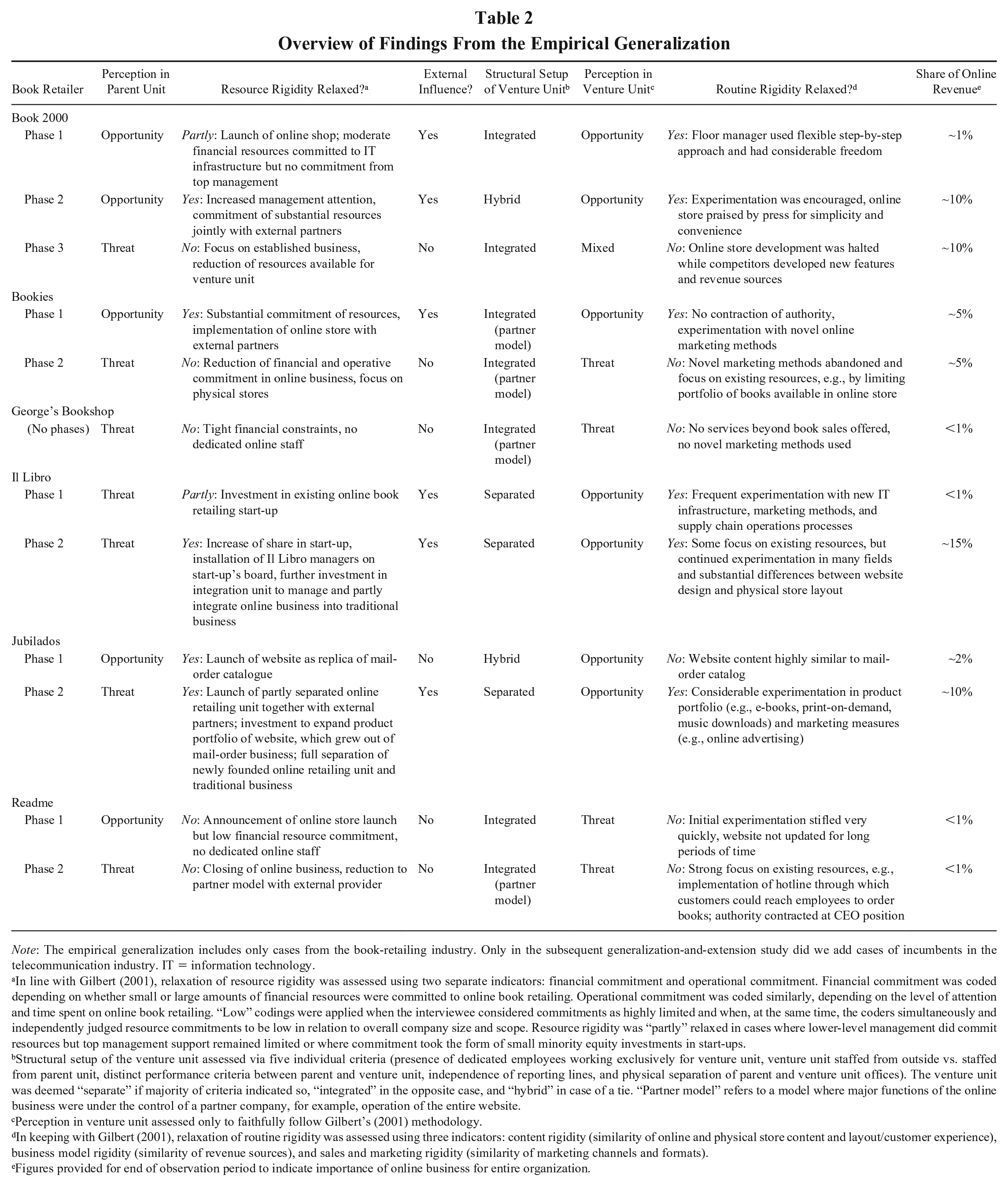
Note: The empirical generalization includes only cases from the book-retailing industry. Only in the subsequent generalization-and-extension study did we add cases of incumbents in the telecommunication industry. IT = information technology.
In line with Gilbert (2001), relaxation of resource rigidity was assessed using two separate indicators: financial commitment and operational commitment. Financial commitment was coded depending on whether small or large amounts of financial resources were committed to online book retailing. Operational commitment was coded similarly, depending on the level of attention and time spent on online book retailing. “Low” codings were applied when the interviewee considered commitments as highly limited and when, at the same time, the coders simultaneously and independently judged resource commitments to be low in relation to overall company size and scope. Resource rigidity was “partly” relaxed in cases where lower-level management did commit resources but top management support remained limited or where commitment took the form of small minority equity investments in start-ups.
Structural setup of the venture unit assessed via five individual criteria (presence of dedicated employees working exclusively for venture unit, venture unit staffed from outside vs. staffed from parent unit, distinct performance criteria between parent and venture unit, independence of reporting lines, and physical separation of parent and venture unit offices). The venture unit was deemed “separate” if majority of criteria indicated so, “integrated” in the opposite case, and “hybrid” in case of a tie. “Partner model” refers to a model where major functions of the online business were under the control of a partner company, for example, operation of the entire website.
Perception in venture unit assessed only to faithfully follow Gilbert’s (2001) methodology.
In keeping with Gilbert (2001), relaxation of routine rigidity was assessed using three indicators: content rigidity (similarity of online and physical store content and layout/customer experience), business model rigidity (similarity of revenue sources), and sales and marketing rigidity (similarity of marketing channels and formats).
Figures provided for end of observation period to indicate importance of online business for entire organization.
Overview of Findings From the Empirical Generalization (Only Book Retailers) and Relation to Stylized Propositions of Gilbert (2005)
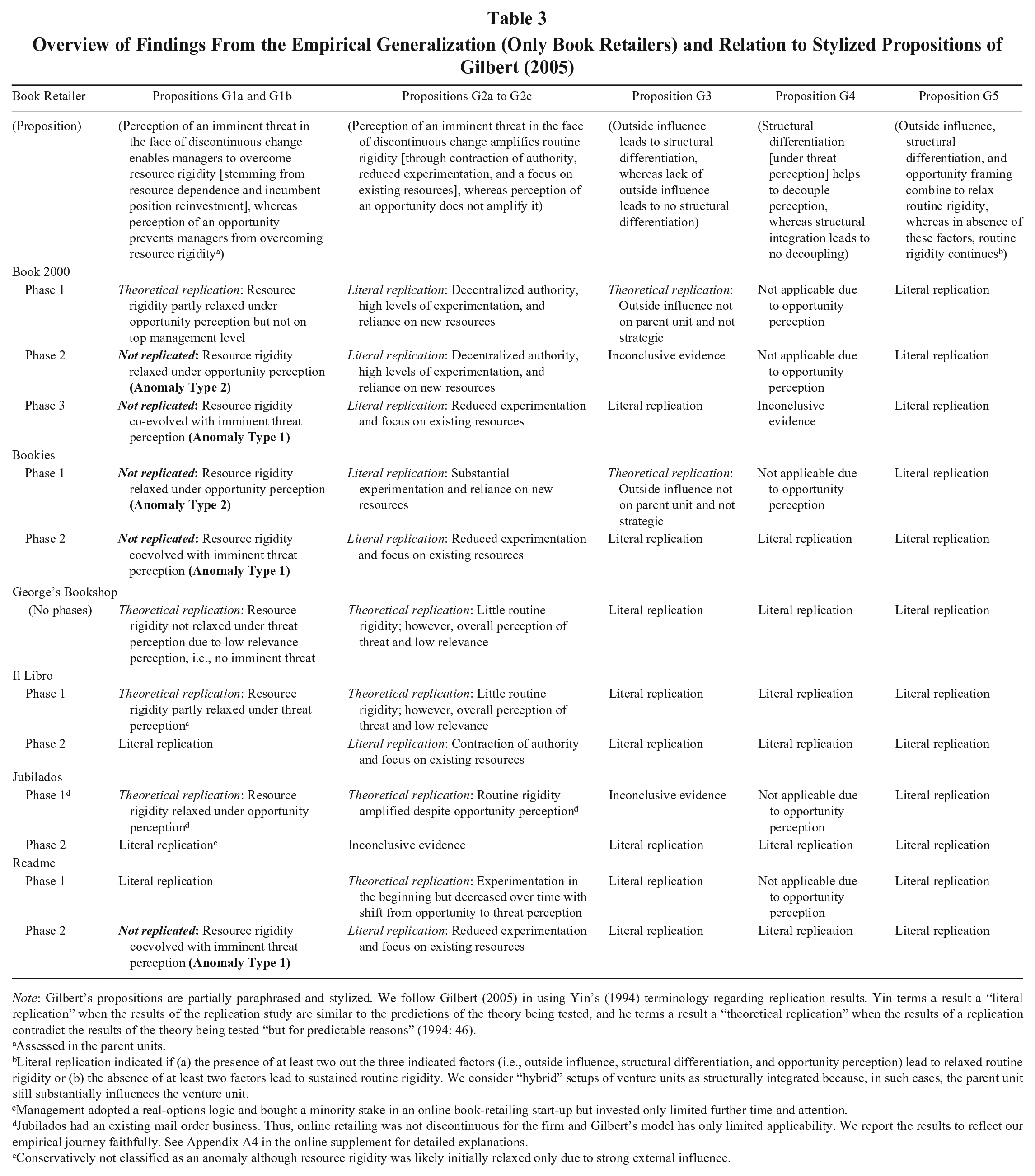
Note: Gilbert’s propositions are partially paraphrased and stylized. We follow Gilbert (2005) in using Yin’s (1994) terminology regarding replication results. Yin terms a result a “literal replication” when the results of the replication study are similar to the predictions of the theory being tested, and he terms a result a “theoretical replication” when the results of a replication contradict the results of the theory being tested “but for predictable reasons” (1994: 46).
Assessed in the parent units.
Literal replication indicated if (a) the presence of at least two out the three indicated factors (i.e., outside influence, structural differentiation, and opportunity perception) lead to relaxed routine rigidity or (b) the absence of at least two factors lead to sustained routine rigidity. We consider “hybrid” setups of venture units as structurally integrated because, in such cases, the parent unit still substantially influences the venture unit.
Management adopted a real-options logic and bought a minority stake in an online book-retailing start-up but invested only limited further time and attention.
Jubilados had an existing mail order business. Thus, online retailing was not discontinuous for the firm and Gilbert’s model has only limited applicability. We report the results to reflect our empirical journey faithfully. See Appendix A4 in the online supplement for detailed explanations.
Conservatively not classified as an anomaly although resource rigidity was likely initially relaxed only due to strong external influence.
Corroborating Results Regarding Gilbert’s Propositions G2 Through G5
Our observations strengthen Gilbert’s (2005) propositions about threat-induced routine rigidity and those about the effects of structural separation and external influence as relaxants of such manifestations of threat rigidity. 4 First and foremost, all phases for which we had sufficient data represent literal or theoretical replications of propositions G2a, G2b, and G2c, which argue that threat perception—mediated by contraction of authority (G2a), a reduced level of experimentation (G2b), and a focus on existing resources (G2c)—amplifies routine rigidity, whereas opportunity perception relaxes it. In fact, as illustrated in the third column in Table 3, no firm in our sample whose managers perceived online book retailing as an opportunity showed either of these three intermediate types of response, and all cases where managers perceived online book retailing as an imminent threat showed at least two of the three indicators of routine rigidity. For instance, managers at Il Libro (Phase 2) began to increasingly perceive online retailing as a loss and getting out of control, leading to a contraction of authority in that the top management installed its own managers, including a new CEO, in the venture unit and eventually even decided to integrate most of the online store into the established organization. Such responses were especially remarkable because they were uncharacteristic of Il Libro’s decentralistic corporate culture, as emphasized by a number of informants. We observed reduced experimentation as a consequence of threat perception in the third phase at Book 2000, when managers began to (re)focus on its retail outlets and increasingly neglected the online store. Similarly, Bookies (Phase 2) stopped engaging in innovative marketing campaigns when threat perceptions increased. Finally, threat perception co-emerged with a focus on existing resources in many cases. Readme (Phase 2) began making investments in large stores, Book 2000 (Phase 3) invested in a new inventory management system to improve store operations, and Bookies (Phase 2) expanded the physical store’s catalog to defend the existing customer base.
Later, in our description of the results of the empirical generalization, we elaborate on the fact that our data confirm the overall effect of threat perception on reduced experimentation observed by Gilbert (2005; Proposition G2b) but intriguingly contradict him in terms of the underlying causal mechanism. In this regard, we did not observe what Gilbert had noted, namely, that “because the expansion [of the online units] occurred so quickly, the resources invested [in response to the threat perception] reinforced rather than reshaped established routines” (Gilbert 2005: 751). In contrast, we observed that all four instances where threat coincided with reduced experimentation that it was constrained resources and low perceived control that led managers and employees to refrain from pursuing experimental approaches to online book retailing. Thus, our data seem to indicate that perception of an imminent threat leads to a reduced level of experimentation not necessarily due to escalated threat-induced resource spending.
Furthermore, our findings support G3, which posits that outside influence fosters the structural separation of the venture unit. The only two cases we regard as merely theoretical replications are the first phase of the response of Book 2000 and the first phase of Bookies’ response. In both cases, outside influence was present, but structural differentiation did not take place. Two mechanisms explain this apparent contradiction of Gilbert’s (2005) proposition. First, in both cases, external influence was present only at the venture level and not at the parent units that made the decision on the ventures’ organizational setup. Second, in both cases, the external influencers were either information technology providers or traditional book wholesalers that had limited expertise in implementing organizational structures to address discontinuous change. In our other cases, as well as in Gilbert’s, the external influence was of a more strategic nature, for example, from external consultants (e.g., Il Libro, Phases 1 and 2; see Gilbert, 2005: 752).
Gilbert’s (2005) Proposition G4 is also consistently supported by our evidence. Gilbert suggests that under threat framing at the parent level, structural differentiation helps to decouple perception in the venture unit from that in the parent unit. This, in turn, allows those working in the venture unit to develop an opportunity frame. In contrast, if the venture unit is structurally integrated, perception in the venture unit remains coupled to the threat perception at the parent level. All phases for which we had sufficient data and to which the proposition was applicable—that is, threat perception was prevalent at the parent level—confirmed Gilbert’s proposition.
Finally, our evidence supports G5. All our cases provide literal replications of the proposition that outside influence, structural differentiation, and opportunity perception in the venture unit combine to relax routine rigidity (O’Reilly & Tushman, 2013).
Mixed Results Regarding Gilbert’s Propositions G1a and G1b
Our data were substantially more heterogeneous regarding Propositions G1a and G1b, which suggest that the perception of a discontinuous change as an imminent threat enables managers to overcome resource rigidity stemming from resource dependence and incumbent position reinvestment incentives. Crucially important—because it legitimizes our choice of context for the replication—is the fact that the resource rigidity we observed was indeed driven by these two very causes, as laid out in Table A3 in the online supplement. For instance, regarding resource dependence, many of our interviewees argued like the CEO of Readme, who remarked, “I thought our customers wanted us to be a fine book retailer—nothing else.” Regarding incumbent position reinvestment, we found that most branch managers highlighted the danger of cannibalization, just like Gilbert (2005) had observed.
However, as highlighted in Table 3, we detected two types of anomaly that we could not discard as theoretical replications of G1a and G1b.
Anomaly Type 1: Resource rigidity under imminent threat perception
Contrary to Gilbert’s (2005) propositions, we observed three cases in which decision makers at the parent level perceived online retailing as an imminent threat but did not readily commit substantial financial or operational resources to adopt it: Book 2000 (Phase 3), Bookies (Phase 2), and Readme (Phase 2). For example, during the third phase of Book 2000’s reaction to online book retailing, decision makers increasingly began to view it as an imminent threat. They perceived the change not only as bound to bring about great loss but also as a development over which they no longer had control. Whereas G1 suggests that in such a case, the company will commit funds and attention to embracing the discontinuous change, decision makers at Book 2000 chose to slash resources for online retailing and instead invested in the physical business. Events unfolded similarly at Bookies and Readme. When Readme’s CEO, for instance, realized that “we just don’t have the same resources as Amazon . . . and all those big ones,” he shut down the firm’s online specialist business.
Anomaly Type 2: Strong resource commitment to the discontinuous change under opportunity perception
In three cases, our findings contradicted Gilbert’s (2005) by showing that decision makers can overcome resource rigidity under opportunity perception: Book 2000 (Phase 2), Bookies (Phase 1), and Jubilados (Phase 1). Archival data show that during the second phase of Book 2000’s response, toward the end of the 1990s, executives started to perceive the online business as an important opportunity when they witnessed the success of their own online store among the early online user community. Top management provided funding for infrastructure, information technology, and new staff devoted exclusively to online retailing. The top management team also became closely involved in establishing relationships with external partners. The first phase of Bookies’ reaction to online retailing followed a similar pattern, including substantial investments in an online store and a considerable operational commitment. The CEO recalled, [I found online stores] compelling and somehow fascinating [and we decided] “We need to open such a store.” . . . We took the money, [the equivalent of around 20,000 euros] for the first three quarters, from our reserves. That does not happen very often.
Notably, in these instances, strong opportunity perception was sufficient for overcoming resistance among managers, particularly branch managers, raising doubts about whether threat perception is really necessary to overcome resource rigidity, as Gilbert (2006) suggests.
In summary, our empirical generalization corroborates G2 through G5 and, thereby, the general notion that opportunity/threat perception, outside influence, and structural design crucially affect routine rigidity. In contrast, our analysis systematically contradicts the notion underlying Gilbert’s (2005) first proposition regarding the linkage of perception and resource rigidity. Thus, it was only reasonable for us to try to explain these findings and further develop this specific part of Gilbert’s theory in the subsequent generalization and extension of his study.
Setup and Results of the Generalization and Extension
Enfolding of Relevant Literature, Recoding of Data, and Extension of Sample
As suggested by Tsang and Kwan (1999), we began the generalization and extension by reflecting on our insights in light of other relevant literature. When we considered the anomalies to G1a and G1b, we noted that they might potentially be related to Gilbert’s (2005) conceptualization of opportunity/threat perception (Dutton & Jackson, 1987; Jackson & Dutton, 1988), which made him code any statement that denoted the discontinuity as negative, likely to result in loss, and/or largely out of one’s control as threat perception and any statement denoting it as positive, likely to result in gain, and/or largely within of one’s control as opportunity perception. Specifically, it became apparent that findings from other domains suggest that perceptions of “positive/negative” and “gain/loss” are conceptually distinct from perceptions of control (Thomas et al., 1993). In particular, research on appraisal and coping (Lazarus, 1966, 1991; Lazarus & Folkman, 1984) contradicts Gilbert’s assumption that positive/negative, gain/loss, and control/no control are all covariant indicators of opportunity/threat perception that have similar consequences. This research instead suggests that people generally appraise events by first assessing “its significance for the person’s well-being (primary appraisal) [and then] the available coping resources and options (secondary appraisal)” (Lazarus & Launier, 1978: 302). In other words, there is substantial evidence for a need to subsume the attribute pairs of “positive/negative” and “gain/loss” under one dimension of appraisal, and treat appraisals of “high/low perceived control” as a separate dimension. This notion has also received empirical support from research in the field of organization science (Brockner et al., 2004; Thomas et al., 1993; White et al., 2003). Moreover, it resonates with well-established theories in the realm of psychology, all of which highlight the relatively independent effect of control perceptions (e.g., Ajzen, 1991; Bandura, 1977; DeCharms, 1968; Rotter, 1966).
Consequently, in our generalization and extension, we adapted and expanded our coding scheme and the analysis in a theory-informed fashion. Specifically, we recoded all previously collected material for opportunity/threat perceptions to separately account for two dimensions: The first is “gain/loss framing,” under which we also subsumed the perceptions of positive/negative, as suggested by Thomas and McDaniel (1990). We use the term “framing” to account for the fact that gain/loss frames are the labels used in prospect theory (Kahneman & Tversky, 1979), which plays an important part in Gilbert’s theorizing, especially as Gilbert (2005) uses the term in his Proposition G5. The second is “perceived control,” which notably covers all instances of managers’ social construction of control in the currently perceived as well as the anticipated competitive context (see Table A2 in the online supplement for coding guidelines).
In keeping with Tsang and Kwan’s (1999) notion of generalization and extension, we also collected extensive additional data in our second empirical context, that is, the telecommunication industry. Doing so allowed us to observe not only more variance in framing but also additional combinations of perceptions that were missing from our initial data set. We compared the responses of the four European MNOs in our sample to the predictions of Gilbert’s (2005) entire model. However, for two reasons, we focused our further inquiry, that is, the generalization and extension, on the effects of frames and perceptions on resource rigidity (i.e., G1a and G1b). First, the empirical generalization did not reveal substantial anomalies regarding Propositions G2 through G5; and second, in our analyses of the MNO cases, we did not stumble upon further anomalies—neither to G2 through G5 nor to our subsequently revised theorizing presented in Propositions P3 and P4 (see Additional Extensions section). Tables 4 and 5 summarize our extended observations in the book-retailing and telecommunication industries, respectively, ordered alphabetically by case and response phase.
Book Retailers: Response Behavior as Triggered by Gain/Loss Framing and Control Perception Among Managers in Parent Unit
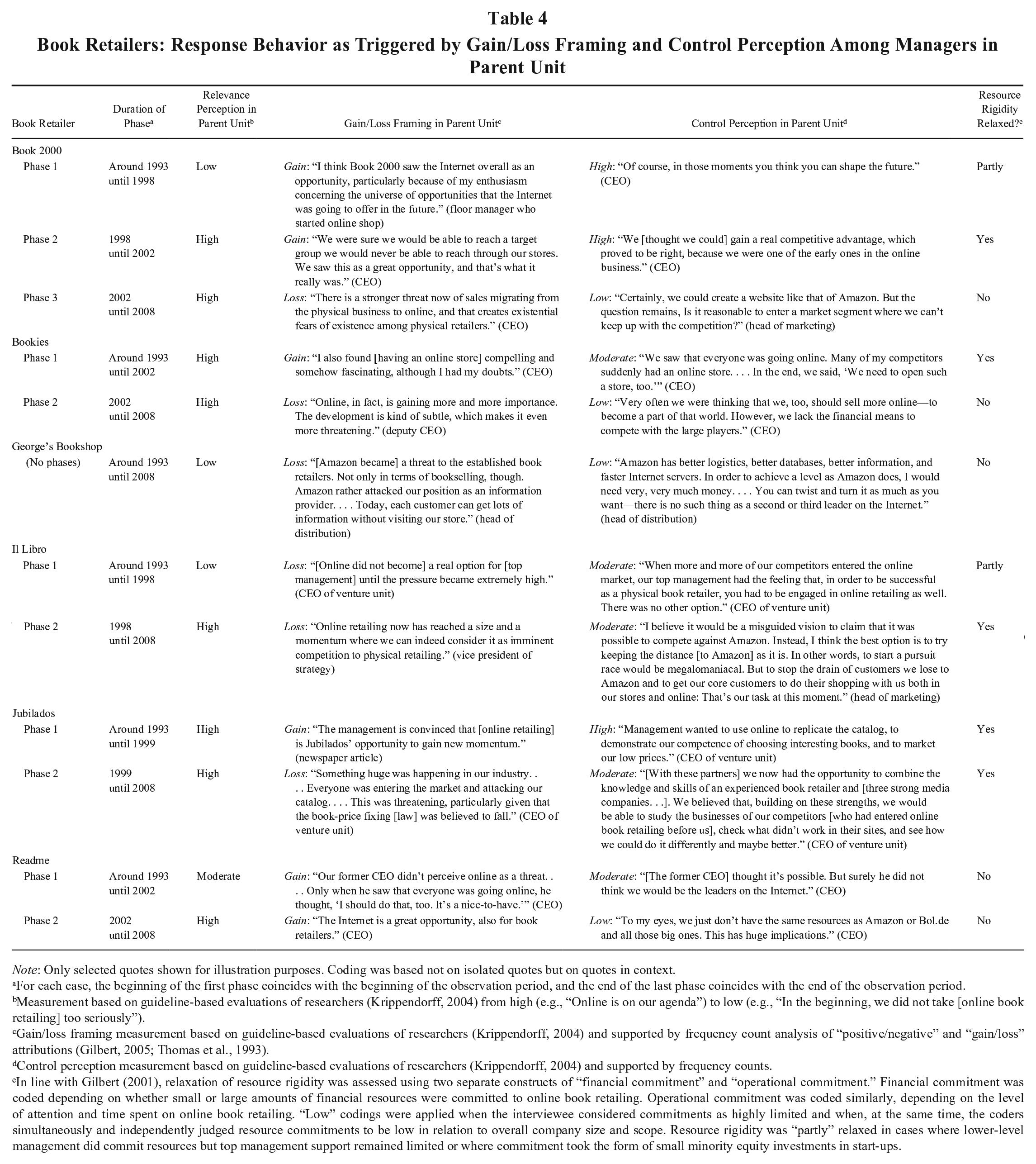
Note: Only selected quotes shown for illustration purposes. Coding was based not on isolated quotes but on quotes in context.
For each case, the beginning of the first phase coincides with the beginning of the observation period, and the end of the last phase coincides with the end of the observation period.
Measurement based on guideline-based evaluations of researchers (Krippendorff, 2004) from high (e.g., “Online is on our agenda”) to low (e.g., “In the beginning, we did not take [online book retailing] too seriously”).
Gain/loss framing measurement based on guideline-based evaluations of researchers (Krippendorff, 2004) and supported by frequency count analysis of “positive/negative” and “gain/loss” attributions (Gilbert, 2005; Thomas et al., 1993).
Control perception measurement based on guideline-based evaluations of researchers (Krippendorff, 2004) and supported by frequency counts.
In line with Gilbert (2001), relaxation of resource rigidity was assessed using two separate constructs of “financial commitment” and “operational commitment.” Financial commitment was coded depending on whether small or large amounts of financial resources were committed to online book retailing. Operational commitment was coded similarly, depending on the level of attention and time spent on online book retailing. “Low” codings were applied when the interviewee considered commitments as highly limited and when, at the same time, the coders simultaneously and independently judged resource commitments to be low in relation to overall company size and scope. Resource rigidity was “partly” relaxed in cases where lower-level management did commit resources but top management support remained limited or where commitment took the form of small minority equity investments in start-ups.
MNOs: Response Behavior as Triggered by Gain/Loss Framing and Control Perception Among Managers in Parent Unit
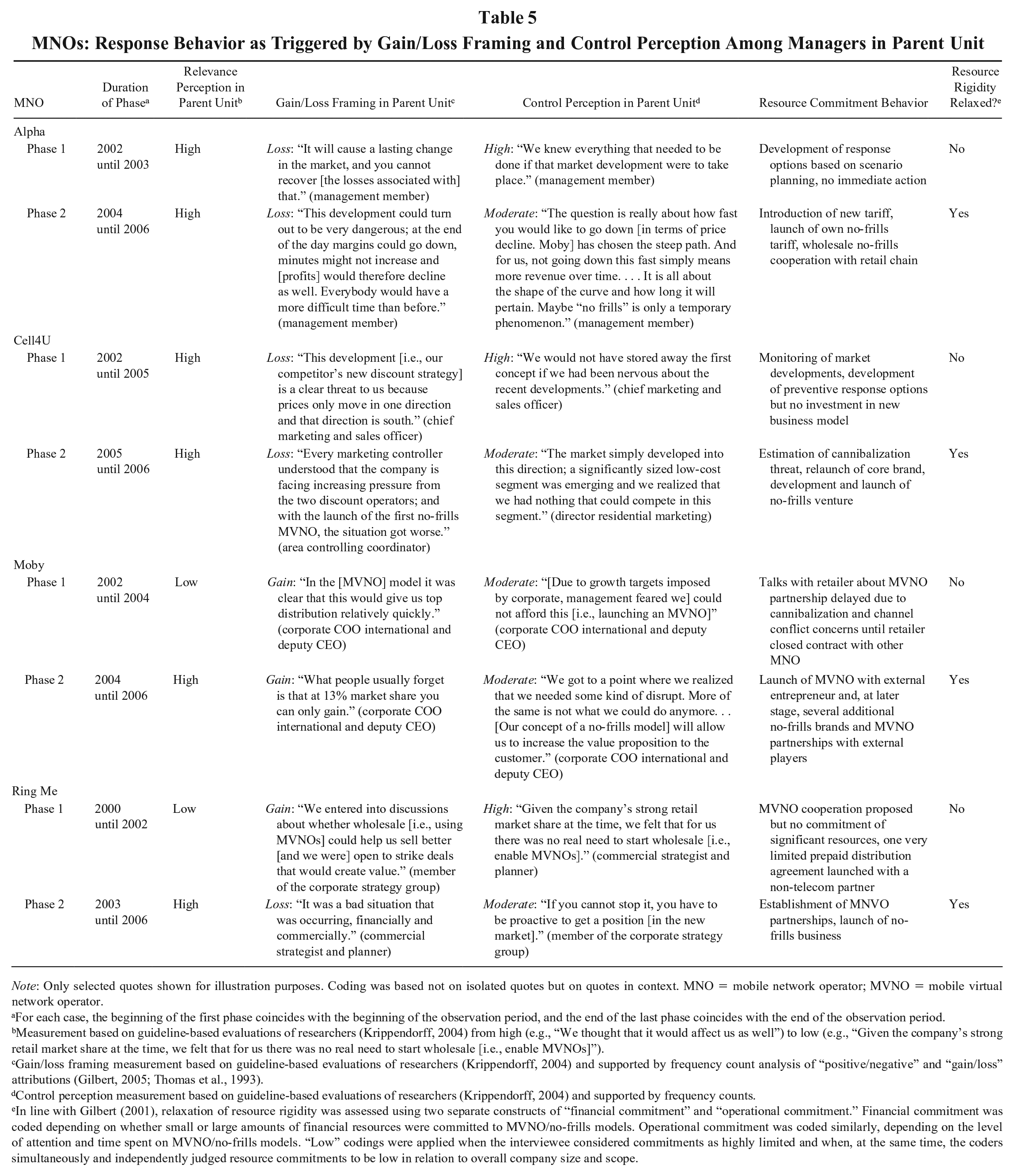
Note: Only selected quotes shown for illustration purposes. Coding was based not on isolated quotes but on quotes in context. MNO = mobile network operator; MVNO = mobile virtual network operator.
For each case, the beginning of the first phase coincides with the beginning of the observation period, and the end of the last phase coincides with the end of the observation period.
Measurement based on guideline-based evaluations of researchers (Krippendorff, 2004) from high (e.g., “We thought that it would affect us as well”) to low (e.g., “Given the company’s strong retail market share at the time, we felt that for us there was no real need to start wholesale [i.e., enable MVNOs]”).
Gain/loss framing measurement based on guideline-based evaluations of researchers (Krippendorff, 2004) and supported by frequency count analysis of “positive/negative” and “gain/loss” attributions (Gilbert, 2005; Thomas et al., 1993).
Control perception measurement based on guideline-based evaluations of researchers (Krippendorff, 2004) and supported by frequency counts.
In line with Gilbert (2001), relaxation of resource rigidity was assessed using two separate constructs of “financial commitment” and “operational commitment.” Financial commitment was coded depending on whether small or large amounts of financial resources were committed to MVNO/no-frills models. Operational commitment was coded similarly, depending on the level of attention and time spent on MVNO/no-frills models. “Low” codings were applied when the interviewee considered commitments as highly limited and when, at the same time, the coders simultaneously and independently judged resource commitments to be low in relation to overall company size and scope.
Independence of Gain/Loss Framing From Perceived Control, and Levels of Perceived Control
Our analyses revealed various instances that, first, violated Gilbert’s (2005) premise of inherently covariant perceptions of “gain/loss” and “perceived control” and, second, demonstrated that one can reliably distinguish three (as opposed to Gilbert’s two) distinct levels of perceived control. First, in the case of Readme (Phase 2), managers at the parent level predominantly perceived online book retailing not only as highly relevant for their organization but also clearly as a gain. However, at the same time, they also perceived low levels of control over the future of that business.
5
For example, Readme’s CEO explained, The Internet is a great opportunity, also for book retailers. Yet, to my eyes, we just don’t have the same resources as Amazon or Bol.de and all those big ones. This has huge implications. For instance, we can’t persuade other companies . . . to link their home page with ours, and so forth.
Our adapted coding scheme allowed for greater nuance than Gilbert’s original coding scheme. According to Gilbert, the preceding statement should have been coded as an indication of threat, given the low level of perceived control it reflects. Conversely, our new guidelines suggest that it expresses a gain frame (“great opportunity”) coupled with low perceived control.
Second, our data include co-occurrences of imminent loss framing with high levels of perceived control in the mobile telecommunication industry (parent units of Alpha and Cell4U, both Phase 1). For instance, decision makers of Alpha noted that the emergence of no-frills MVNOs would lead to economic losses: “It will cause a lasting change in the market, and you cannot recover [the losses associated with] that.” However, they simultaneously perceived high levels of control over the situation: “We knew everything that needed to be done if that market development were to take place.”
Third, we observed cases in which the decision makers of the respective companies unanimously framed the discontinuity either as a substantial gain or as an imminent loss, respectively, but perceived only moderate levels of control (parent units of Bookies, Phase 1; Il Libro and Jubilados, Phase 2; Alpha, Cell4U, Moby, and Ring Me, all Phase 2). For instance, in the book-retailing industry, the CEO of Jubilados’ online specialist business framed online book retailing as a gain and something eventually positive, while noting a moderate level of control: We know that Amazon is extremely strong, and that limits our potential, definitely. However, there is a small niche where we can thrive and grow profitably. . . . Today, all of us know that it is possible to make money on the Internet, and that’s what we do.
Resource Commitment to the Discontinuous Change Under Loss Framing
Unbundling opportunity/threat perception into two distinct dimensions enabled us to induce three thus-far undescribed patterns of resource allocation behavior in response to discontinuous change under loss framing. 6
Pattern 1: Loss framing, high perceived control, and resource rigidity
Contrary to the analysis in the book-retailing industry, data on incumbent mobile telecommunication providers’ reactions to MVNOs revealed two cases—Cell4U (Phase 1) and Alpha (Phase 1)—in which managers predominantly framed the discontinuity as a loss while simultaneously perceiving that they had strong control over the situation and ultimately responded with resource rigidity and reinvestments in the established business. For example, imminent loss framing initially arose among Cell4U’s managers when a competitor adopted an MVNO business model with substantially lower prices and a simple tariff structure that directly attacked Cell4U’s business model. Cell4U’s chief marketing and sales officer pointed out that “this development is a clear threat to us because prices only move in one direction and that is south.”
Loss framing at Cell4U intensified as the competitor’s discount approach became increasingly successful. Interestingly, however, Cell4U’s responses were still dominated by resource dependence and incumbent position reinvestment. In particular, during the first half of 2004, Cell4U’s executives initially pondered whether to pursue a radically different business model under a separate brand. The project team also developed a prototype concept for a no-frills business model. Yet, as per a newspaper report from 2004, when management eventually had to decide, it opted to shelve the no-frills concept and instead increased investments in its current business. As a board member noted, a key reason for this decision was that the discontinuous technology failed to meet core performance criteria: “Estimates in [the no-frills] concept projected lower margins than those we earn with our prepaid tariffs and that was unacceptable to me.” Notably, this resource rigidity at Cell4U (and similarly at the second case, Alpha) emerged not simply under loss framing but also under perceptions of a high level of control despite the potential for loss. Executives at Cell4U maintained a “wait-and-see” attitude as they had already thought through potential responses and perceived that they had substantial resources at their disposal to control the situation. The chief marketing and sales officer noted, “We would not have stored away the first concept if we had been nervous about the recent developments.”
Our observations suggest that high levels of perceived control greatly influence incumbent response to discontinuous change: They seem to alleviate the sense of urgency stemming from loss framing, make managers more reluctant to jeopardize their dominance for the sake of survival, and consequently weaken the effect of loss framing on resource commitment to the discontinuous change. In other words, such a perception strengthens the tendencies described by incumbent position reinvestment theory (R. Gilbert & Newbery, 1984; Reinganum, 1983).
At first sight, this pattern appears to contradict reference-point theories of decision making (Kahneman & Tversky, 1979; Lehner, 2000). While there are various strands of such theories, all share the notion that firms adjust their behavior as a function of their perceived position relative to one or more reference points or aspiration levels (March & Shapira, 1987; Shinkle, 2012). Scholars have argued that performing below a relevant reference point might trigger an elevated propensity to change (Moliterno, Beck, Beckman, & Meyer, 2014) and increased risk seeking (Fiegenbaum, 1990). As such, one might wonder why Cell4U and Alpha did not increase search activity and risk by committing resources to the discontinuity of MVNOs. However, if one explicitly considers the degree of perceived control, our findings are a theoretical replication of reference-point theories. When managers perceive to have control, they seem to believe that the negative effects of a performance-related threat can be offset. Consequently, the anticipated performance level stays close to the reference point and there is no need to engage in risk-seeking behavior, that is, commit resources to a discontinuity.
Pattern 2: Loss framing, moderate perceived control, and relaxation of resource rigidity
In three MNOs (Alpha, Cell4U, and Ring Me, all Phase 2) and two book retailers (Il Libro, Phases 1 and 2; Jubilados, Phase 2), we observed a co-emergence of loss framing and moderate perceived control among decision makers. Such configurations of appraisal consistently resulted in high levels of resource commitment to the respective discontinuous change.
For instance, in the second phase of Cell4U’s response, the already prevalent perception of loss intensified when a major competitor launched a separately branded no-frills MVNO and internal market research indicated that the no-frills segment would likely grow substantially. Initially, resource commitment to the discontinuous change in this phase was limited and focused on safeguarding the existing businesses, for instance, by relaunching Cell4U’s brand. However, resource rigidity at Cell4U relaxed substantially when management began to sense that the situation began to spiral out of control. As the director of residential marketing remembered, this occurred in 2005, when a large international player announced that it was planning to acquire the leading MVNO in Cell4U’s home market: A significantly sized low-cost [i.e., no-frills MVNO] segment was emerging and we realized that we had nothing that could compete in this segment.
In response, toward the end of 2005, Cell4U’s management decided to reanimate the no-frills concept that had been developed almost two years earlier.
Similarly, managers of book retailer Il Libro invested in online retailing propelled by loss framing paired with moderate levels of perceived control. Especially in the second response phase of this company, online book retailers started to gain market share, and loss framing among Il Libro’s executives became increasingly imminent. In addition, according to the vice president of strategy, they realized that the company’s knowledge of the online business and its experience from early experiments with the Internet were not fully sufficient for an adequate response: We thought we weren’t prepared in the first place, but we had to react before players like Amazon started to attack our core business.
As a board member recalled, management responded by seeking support from external partners and mobilizing substantial resources to purchase a larger share of and gain more influence over the separate venture unit in which Il Libro had acquired a stake in the first phase of its response. Management also invested heavily in professionalizing online operations.
In terms of observed behavior, our cases closely resemble those observed by Gilbert. Companies overcome resource rigidity when they feel a certain amount of pain but still believe they can meaningfully influence the outcome to a certain degree. In fact, the company that Gilbert (2006) described also reacted when perceived control reached what we define as moderate levels. Statements coded by Gilbert as “low control,” such as “We can slow it down, but we can’t stop it” (Gilbert, 2006: 157), are similar to expressions used by the informants in our study that we coded as representing “moderate control” (see Table A2 in the online supplement for our coding guidelines). In the focal cases, our results are thus materially similar to those of Gilbert, although we applied different labels in the coding process.
Consequently, the theoretical reasoning that we apply to explain the various behaviors is similar to that of Gilbert, and the findings are also uncontroversial in light of other theories. Prospect theory (Kahneman & Tversky, 1979) provides evidence that individuals in loss situations are risk seeking as long as they have a certain level of control over the situation. 7 Moreover, the model of stress-induced behavior presented by Lazarus (1966), which is one of the foundations of the threat rigidity thesis (Staw et al., 1981), suggests that individuals who perceive moderate levels of loss but still feel able to control the situation are likely to respond actively and aggressively to threats. As is apparent in our informants’ statements, moderate perceived control seems to trigger activating feelings and emotions, while low levels of control deactivate through “dejection” and resignation (Brown & Starkey, 2000), and—as we highlight in the next paragraph—high levels of control deactivate by “quiescing” (Huy, 2002; Larsen & Diener, 1992; Lazarus, 1991). Finally, other research, for instance, on organizational cognition and capabilities (Eggers & Kaplan, 2013), also proposes that if decision makers perceive a stimulus, feel motivated to respond to it, and perceive themselves as capable of achieving a desired outcome, they will allocate resources to a response, even in the face of resistance to that decision.
Pattern 3: Loss framing, low perceived control, and resource rigidity
Although we did not observe a co-emergence of loss framing with low levels of perceived control among decision makers of MNOs, we observed this framing constellation—and no resource commitment to the discontinuity as a response—in three of the studied book retailers, namely, Book 2000 (Phase 3), Bookies (Phase 2), and George’s Bookshop. For example, before 2002 (Phases 1 and 2), decision makers across the Book 2000 organization predominantly perceived online business as a gain, and the company was one of the first and most active players in the German online book-retailing market. In fact, Book 2000 had launched its online bookshop even before 1994, the year Amazon was founded in the United States. Perceptions did not change until the third phase of Book 2000’s response, when Amazon and other large players were rapidly gaining market share. At that time, imminent loss framing emerged alongside a strong sense of having lost control over the development of the online segment. The CEO commented, Look, Amazon’s marketing expenditures are many times . . . my monthly revenue. They just burn money. We can’t do that. We simply cannot compete with them.
Book 2000’s management considered various response options. Finally, and contrary to Gilbert’s predictions, management decided to reduce the resource commitment to the discontinuous change and to downsize the online team. Management simultaneously increased investments in the old business to defend the existing customer base and gain market share there.
As shown in Table 4, this was a persistent pattern wherever executives simultaneously perceived online retailing as an imminent loss and as something beyond their control. Instead of adopting the discontinuous change, they preferred to act in areas where they perceived a high level of control. Thus, both Book 2000 and Bookies decided to withdraw resources from the new business and to reinvest in the old, for example, by opening new physical bookstores.
Similar to the first two patterns described, this pattern can also be explained by reference-point theories and by research on stress. Reference-point studies suggest that decision makers in firms interpret stimuli in relation to multiple reference points (Shinkle, 2012; Washburn & Bromiley, 2012), of which at least two are particularly relevant. The first represents a firm’s “aspiration level” (Shinkle, 2012: 433) or “top performance threshold” (Moliterno et al., 2014: 1688), that is, the performance level that is to be sought. The second is a firm’s “survival level” (Shinkle, 2012: 433) or “reference group threshold” (Moliterno et al., 2014: 1686), that is, the performance level that is to be avoided (March & Shapira, 1987, 1992). Decision makers either integrate these multiple reference points into one by weighting them (Cyert & March, 1963) or switch between focal reference points depending, for example, on past firm performance (Moliterno et al., 2014; Washburn & Bromiley, 2012). Following this logic, if decision makers perceive an issue as a likely loss that is largely out of their control, they can be expected to focus their attention (Ocasio, 1997) on the reference point that is to be avoided. Because the organization’s performance is still above this survival level, the shift of attention from the aspiration level to the survival level, in turn, induces risk-averse behavior—in our case, resource rigidity. Research on individual and organizational stress, appraisal, and coping (Ford & Baucus, 1987; Lazarus, 1991; Lazarus & Folkman, 1984; Milburn et al., 1983) also suggests that under perceptions of low control, even imminent loss framing may trigger unpleasant, dejecting, and deactivating emotions and paralysis (Brown & Starkey, 2000; Huy, 2002). Similarly, the threat rigidity thesis states that “executives [who perceive low levels of control] are likely to respond in domains over which there is greater organizational control” (Chattopadhyay et al., 2001: 939).
Combining our three empirically observed patterns and extant theory, we posit the following: Proposition P1: If decision makers in an incumbent firm frame a discontinuous change as an imminent loss, resource rigidity will relax only if decision makers also perceive moderate—rather than low or high—levels of control over the situation.
Resource Commitment to Discontinuous Change Under Gain Framing
Treating perceived control as a distinct dimension of appraisal is also instrumental for explaining high resource commitment to discontinuous change under what Gilbert (2005) coded as opportunity perception—an anomaly to G1 we observed in the empirical generalization. The pattern we induced here relies on considering the additional dimension of the perceived “relevance” of the discontinuity—that is, as conceptualized in our Method section, the degree to which the change is on top managers’ cognitive agendas (Gerstner et al., 2013; Kaplan et al., 2003; Ocasio, 1997) and perceived as a high-priority situation (Jackson & Dutton, 1988). Notably, whenever decision makers framed the discontinuous change as a loss, they also perceived it to be a relevant event. In contrast, gain framing co-emerged with varying levels of perceived relevance.
Specifically, as illustrated in Tables 4 and 5, under gain framing, three patterns emerged from our analysis. The first pattern is gain framing, low relevance perception, moderate/high perceived control, and resource rigidity. We identified gain framing accompanied by moderate or high levels of perceived control in the first phases of book retailers Book 2000 and Readme and MNOs Ring Me and Moby. 8 However, our coding revealed that the decision makers in the mentioned book-retailing cases perceived online retailing as a fairly irrelevant issue. Not surprisingly, this resulted in limited resource commitment to the discontinuous change. During the first phase of Book 2000’s response, for example, gain framing and high control perceptions were dominant across all hierarchical levels. The CEO reminisced, “Of course, in those moments you think you can shape the future.” Yet, top management also felt that online book retailing was not yet strategically relevant. The CEO stated, “In the beginning, we did not take [it] too seriously.” Other managers confirmed that he did not pay much attention to online retailing because he had not recognized its importance. As a result, the online store did not receive financial and operational support from the organizational apex.
The second pattern is gain framing, high relevance perception, low perceived control, and resource rigidity. In one case, Readme’s second response phase, managers perceived the discontinuity as a highly relevant gain but, as indicated already, simultaneously sensed low levels of control. In response to this perception of control-reducing constraint, Readme’s decision makers not only cut investments in online book retailing but also shut down its entire self-operated online business.
The third pattern is gain framing, high relevance perception, moderate/high perceived control, and relaxation of resource rigidity. In two of the relevant cases, Book 2000’s second response phase and Bookies’ first response phase, managers perceived online retailing not only as a highly relevant issue that could have a decidedly positive impact on their business but also as an issue over which they had moderate or high control. Together, these perceptions led to a high level of resource commitment to the discontinuous change. For example, in Book 2000’s second response phase, decision makers framed the discontinuity as a controllable gain, especially when their company had the opportunity to further develop the online business in cooperation with an external nonprofit, a state-funded institution, and a publishing company. The CEO noted, We [thought we could] gain a real competitive advantage, which proved to be right, because we were one of the early ones in the online business.
Moreover, in contrast to the view adopted in the company’s first response phase, Book 2000’s CEO and his team now perceived online retailing as a strategically relevant issue and, in turn, invested heavily in the development of their online specialist business. The floor manager who had founded the online business explained, Once you could see that there was a real business, of course the CEO scheduled a meeting with us. . . . I think [top management became engaged] when we reached the first 100,000 Deutsche Mark. If sales exceed such a level, our CEO personally takes care of the business.
In the first phase of Bookies’ reaction, decision makers viewed online book retailing as just as relevant and only slightly less positive and controllable than did the managers at Book 2000 (Phase 2). In addition, our data indicate that because of these perceptions, Bookies decided to invest substantial financial and operational resources in its online business. The CEO explained, We saw that everyone was going online. Many of my competitors suddenly had an online store. I also found it compelling and somehow fascinating, although I had my doubts. In the end, we said, “We need to open such a store, too.”
The first of the three patterns resembles the one observed by Gilbert (2005): The combination of gain framing and high levels of perceived control—that is, the combination Gilbert labels “opportunity perception”—does not suffice to overcome barriers to resource commitment to the discontinuous change (note, however, that Gilbert does not consider relevance perception). However, the second and third patterns contradict Gilbert’s observations. The second pattern involves framing the discontinuity as a substantial but hardly controllable gain, therefore violating Gilbert’s unidimensional conceptualization of opportunity/threat perception. The third pattern contradicts Gilbert in that incumbents overcome sources of resource rigidity even in the absence of threat perception, which Gilbert portrays as a necessary precursor of resource commitment to discontinuous change (see Gilbert, 2006: 162).
These findings echo various streams of the extant literature that envision gain or opportunity perceptions together with substantial perceived control as catalysts for change (Ford & Baucus, 1987; Shimizu, 2007; Thomas et al., 1993; White et al., 2003). Dutton and Jackson (1987), for instance, refer to the threat rigidity thesis, that is, the conjecture that threat perceptions cause organizational rigidity, and emphasize that in contrast, “when decision makers label issues as opportunities, involvement in the process of resolving the issue will be greater” (p. 83). Dutton (1993), although she does not explicitly discuss the separate role of perceived control, argues that this effect of gain framing might be rooted in the positive activating emotions it evokes. Similarly, the concept of self-efficacy (Bandura, 1977) strongly supports the notion that gain perceptions in combination with perceived control can effectuate individual, and thus ultimately organizational, action. Synthesizing all our insights, we formally posit the following: Proposition P2: Gain framing relaxes resource rigidity in response to a discontinuous change if organizational decision makers perceive the change as a highly relevant issue and perceive at least moderate levels of control.
Table 6 provides a comprehensive overview of the various configurations of gain/loss framing and perceived control we have described in Propositions P1 and P2, respectively, and their consequences, that is, whether or not resource rigidity relaxed. Note that the table assumes that decision makers perceive the focal discontinuous change as a relevant, that is, high-priority, situation. In accordance with our observations (see Proposition P2) and given the abundant evidence in the literature (e.g., Eggers & Kaplan, 2013; Gerstner et al., 2013; Kammerlander et al., 2018; Kaplan et al., 2003), we expect, but do not formally propose, that resource rigidity does not relax when the discontinuous change is perceived as irrelevant.
Configurational Illustration of Resource Allocation in Response to Gain/Loss Framing and Perceived Control Regarding a Discontinuous Change
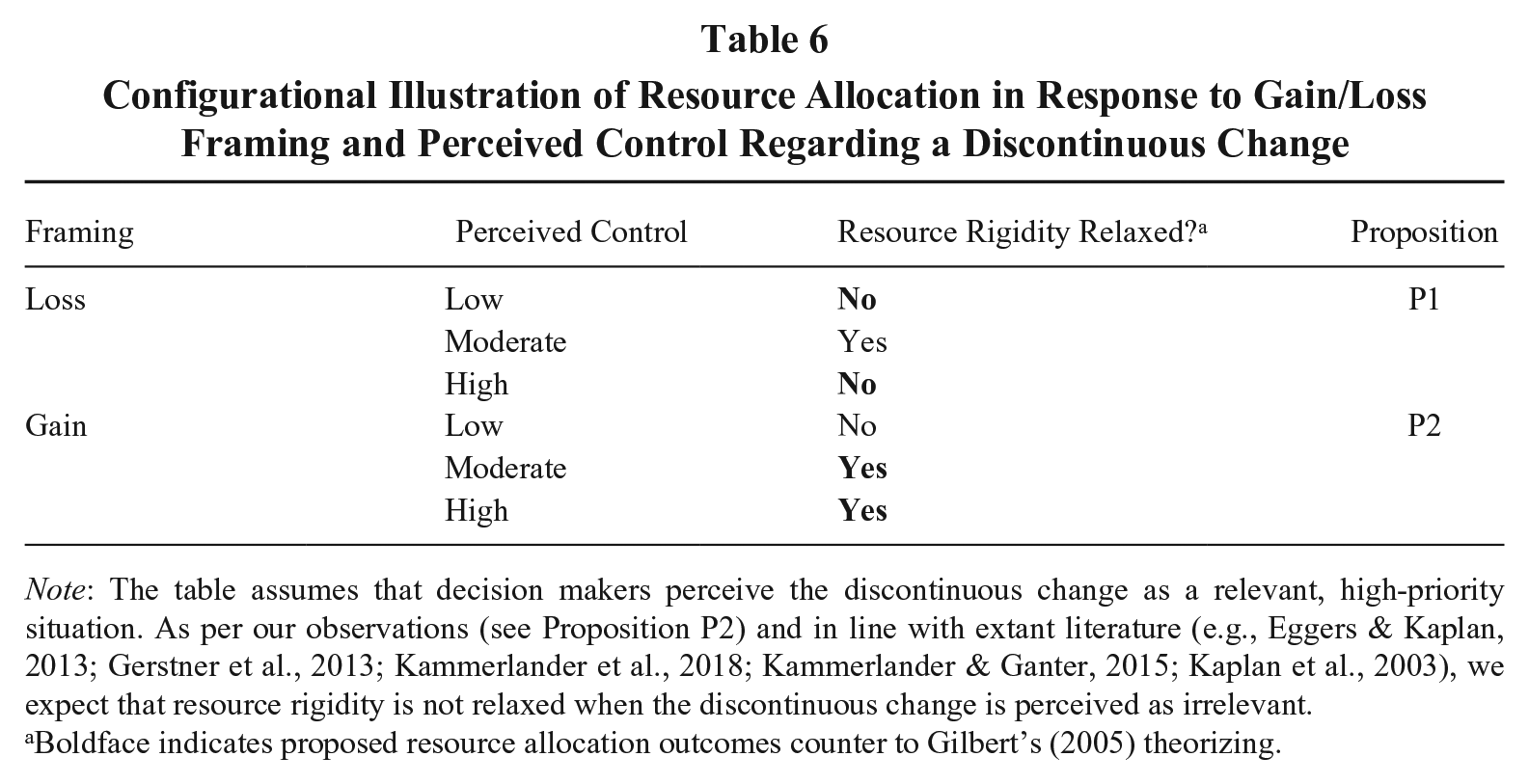
Note: The table assumes that decision makers perceive the discontinuous change as a relevant, high-priority situation. As per our observations (see Proposition P2) and in line with extant literature (e.g., Eggers & Kaplan, 2013; Gerstner et al., 2013; Kammerlander et al., 2018; Kammerlander & Ganter, 2015; Kaplan et al., 2003), we expect that resource rigidity is not relaxed when the discontinuous change is perceived as irrelevant.
Boldface indicates proposed resource allocation outcomes counter to Gilbert’s (2005) theorizing.
Additional Extensions Regarding Perceptions, Experimentation, and Structural Separation
A key objective of a generalization and extension is to uncover important novel nuances of the focal phenomenon (Tsang & Kwan, 1999). In this vein, we induced two additional propositions (P3 and P4) from our data, both of which substantially extend Gilbert’s (2005) work.
Perceptions, resource rigidity, and experimentation
We expanded on the seeming incompatibility of Gilbert’s (2005) finding that threat-induced resource commitment to the discontinuous change causes reduced experimentation (G2b) and our observation in the empirical generalization that, whenever threat perception coincided with reduced experimentation, it was the limited resources and low perceived control that made decision makers refrain from developing experimental approaches. Interestingly, our reexamination of book retailers’ perceptions and patterns of routine rigidity revealed that our results and those of Gilbert are not contradictory if gain/loss framing is separated from perceived control. Rather, Gilbert’s and our data provide evidence for two different patterns by which appraisals at the parent-unit level can reduce experimentation at the venture unit level.
The first pattern—observed by Gilbert (2005)—links loss framing and moderate perceived control to low experimentation. Due to loss framing and moderate perceived control at the parent level, organizations overcome resource rigidity. However, the resulting resource commitment to the discontinuous technology can be so strong that “the aggressive pace of resource commitment [makes] it more difficult [for those in the venture] to step back and [experiment]” (Gilbert, 2005: 751).
The second pattern—the one we observe—links low perceived control to low experimentation. Due to loss framing and low perceived control at the parent level, firms are unable to relax resource rigidity. The resulting lack of financial and operative support reinforces a sense of inability to influence the further development of the discontinuity—that is, perceptions of low control—at the venture level. Ultimately, venture-unit managers disengage from creative activities around the discontinuous technology. We observed this pattern at Book 2000 (Phase 3), Bookies (Phase 2), and Readme (Phase 2). For instance, during the third phase of Book 2000’s response, managers and employees working for the online business began to perceive low control over their business once parent-unit management communicated that the established business had become the top priority and that no further resources would be allocated to the online venture. Those responsible for the online business were frustrated by this decision, particularly because they felt that any attempt to compete with players like Amazon would require substantial resource commitment. Because of their frustration, they essentially stopped experimenting.
Both patterns are supported by extant literature. Research on corporate venturing and escalation of commitment supports the first pattern. As Gilbert (2005) notes, corporate-venturing research suggests that the more resources a venture receives at the beginning of the technological evolution, the more managers at new ventures instantly invest in systems and structures that, in turn, become institutionalized and paralyze adaptation (Block & MacMillan, 1985). Relatedly, research on escalation behavior posits that the more resources managers have invested in a given course of action, the less likely they are to deviate from it (Ross & Staw, 1993).
The second pattern echoes the literature on creativity and decision making. Creativity scholars point out that managers engage in experimentation if they feel that they command the resources to control an experiment’s outcome (Amabile, Conti, Coon, Lazenby, & Herron, 1996). These resources encompass time, financial means for employees and equipment, and physical resources, for example, office or laboratory space (Amabile, Burnside, & Gryskiewicz, 1999). Studies on decision making, stress research, and literature on the effect of control perception (Ajzen, 1991; Bandura, 1977; Lazarus, 1991; Lazarus & Launier, 1978; March & Shapira, 1987) also point out that decision makers pursue risky activities, such as experiments, only if they feel that they can control the outcome. Thus, extant literature explains why, in the case of the book retailers we observed, a lack of resources combined with low perceived control led to low experimentation.
In brief, Gilbert’s and our observations, as well as the extant literature, suggest two different but theoretically consistent mechanisms linking perceptions to reduced experimentation. It is pivotal to point out that both Gilbert and we observed the previously described effects only at organizations where the new unit was structurally integrated in the established business. Thus, although the observed patterns might also unfold when the venture unit is structurally separated, we explicitly include a boundary condition for our theorizing when we formally state the following:
Proposition P3a: Low perceived control (irrespective of gain/loss framing) leads to reduced experimentation, at least in case the venture unit is structurally integrated in the established business.
Proposition P3b: Loss framing and moderate perceived control lead to reduced experimentation, at least in case the venture unit is structurally integrated in the established business.
Structural separation and organizational identity in the venture unit
Gilbert’s (2005) Propositions G3 and G5 describe how structural separation helped managers in the venture unit to develop opportunity perceptions, which encouraged creative ideas. However, neither Gilbert nor the ambidexterity literature citing his research (e.g., Raisch & Tushman, 2016) formulates precisely how structural decoupling affects evaluative appraisals.
Our book industry data might fill this gap by indicating a mediating effect of organizational identity. As part of our analysis, we collected data on interviewees’ perceptions of their organizations’ identity—reflexively applied and collectively shared cognitions and claims regarding the question of “Who are we?” (Albert & Whetten, 1985; Gioia et al., 2013). Organizational identity is important in the context of discontinuous change because such change often challenges established organizational identity perceptions, which are typically tied to established processes of value creation and value capture, and can therefore cause routine rigidity (Altman & Tripsas, 2013; C. Anthony & Tripsas, 2016; Kammerlander et al., 2018; Tripsas, 2009).
Data from Il Libro and Jubilados replicate G4 in that structural separation relaxed routine rigidity. However, going beyond Gilbert, the case of Jubilados highlights how the separation of Jambooks.de, Jubilados’ new venture, engendered a spirit of autonomy and freedom and, especially, a distinct, “local” identity—that is, the sense of being an own entity, different from the parent organization (Raisch & Tushman, 2016). This, in turn, fostered a sense of positivity and gain, a notion of control, and experimentation. Ultimately, Jambooks.de could overcome the routine rigidity that stemmed from threat perception at the parent level. As the CEO explained, We were a separate business in many regards with freedom in our strategy development. This allowed us to develop our own culture, our own identity, and an online-appropriate strategy.
Interestingly, a reinforcing process unfolded. According to the CEO, the separated unit and its “start-up vibe” attracted young employees with skills related to the new technology, further strengthening the entrepreneurial spirit; the sense of an own, independent role (Kammerlander et al., 2018); and the motivation to experiment and discover. Notably, the online units of both Jubilados and Il Libro achieved considerable growth and profitability.
In sum, our data indicate that structural separation not only prevents managers of the parent organization—and their old-technology-related mental models—from influencing the new venture (G4) but also allows a new venture to develop its own identity and a spirit of autonomy and freedom to “shape” the new technological domain (Kammerlander et al., 2018). These positive perceptions, in turn, engender experimentation at the new venture.
Proposition P4: Structural separation increases experimentation by fostering a local identity.
Discussion
Our results corroborate Gilbert’s (2005) original Propositions G2 through G5 but do not fully mirror the effects of decision makers’ appraisals of discontinuous change on firms’ strategic responses predicted by G1a and G1b. We explain these anomalies through substantial theoretical modifications, particularly by proposing to unbundle gain/loss framing and perceptions of control. We show that imminent loss framing relaxes resource rigidity only when decision makers perceive a moderate level of control. Further, we find that resource rigidity relaxes in response to gain framing when decision makers perceive the discontinuity as a particularly relevant issue and sense that they can control it in a way that will allow them to capture the gain. Finally, we move beyond Gilbert’s propositions and suggest that loss framing and low perceived control can amplify routine rigidity by exacerbating resource rigidity and that structural separation creates perceptions of gain and control by fostering a local identity in the venture unit.
The theory that emerges from our replication and extension of Gilbert’s (2005) study offers at least three original contributions to the broad debate on the role of MOC in the context of incumbents’ responses to discontinuous change (Cozzolino, Verona, & Rothaermel, 2018; Danneels, Verona, & Provera, 2017; Eggers & Kaul, 2018; Kammerlander et al., 2018; Kaplan, 2008a; Tripsas & Gavetti, 2000). First, our work provides a nuanced perspective on how incumbent decision makers appraise discontinuous change and how this affects organizational rigidities. In this regard, we show that and why the unidimensional conceptualization of threat/opportunity perceptions presented by Dutton and Jackson (1987) is insufficient to explain resource rigidity and routine rigidity and that, to do so, scholars instead need to distinguish gain/loss framing and perceived control. Interestingly, this distinction has been a keystone of prior research (Brockner et al., 2004; Chattopadhyay et al., 2001; Thomas & McDaniel, 1990), particularly on evaluative appraisals, which are central elements of cognitive activity (Lazarus, 1991). Reinvigorating this distinction, our study reveals how specific elements of extant theory on organizational adaptation to discontinuous change—especially, of Gilbert’s model—might be misleading and offers an adapted theory to resolve these issues.
Second, we build novel and testable theory on how and why differences in gain/loss framing and perceptions of control might explain the focal phenomenon studied by discontinuous change researchers, that is, “heterogeneous incumbent response” (Eggers & Park, 2018: 357). Our research is novel primarily because it highlights the distinct role of perceived control and because it predicts different levels of resource commitment to discontinuous change under both gain and loss framing for each level of perceived control. In particular, we propose that regardless of gain or loss framing, inertial forces, such as resource dependence and incumbent position reinvestment, prevail if decision makers predominantly perceive the situation as out of their control. We further predict that at the other end of the spectrum, high perceived control can also reinforce mechanisms of inertia. These propositions are important because they imply that both gain and loss framing can help relax resource rigidity. In addition, they also allow us to shed new light on the relation between decision makers’ perceptions and their (dis)inclination to experiment with discontinuous change. As such, our research—by enfolding prior findings, for example, on organizational slack and strategic flexibility (G. George, 2005; Nohria & Gulati, 1996)—challenges dominant views in discontinuous-change research. This is true as much for Gilbert’s work as it is for other studies that focus only on gain/loss framing and disregard perceived control (e.g., Eggers & Kaul, 2018).
Third, we contribute to the emerging debate on the implications of organizational identity in the context of discontinuous change (C. Anthony & Tripsas, 2016; Garud & Karunakaran, 2018). Recent studies highlighted that discontinuous change challenges perceptions of organizational identity among members of established firms (Tripsas, 2009) and that the ways incumbent firms deal with the unfolding identity struggles can fundamentally influence their responses to discontinuous change (Kammerlander et al., 2018). As Tripsas (2013) suggested, organizational design might matter in this context. Especially, Raisch and Tushman (2016) showed how structural differentiation can help the new venture to develop an own “local” identity and how this affects the collaboration between a separated unit and other units. Our study adds by suggesting that a local identity spurs perceptions of gain and control, which, as suggested by Gilbert (2005), can help foster experimentation. In fact, our findings echo those of Kammerlander et al. (2018), who note that identity perceptions of fulfilling a “shaper” (p. 1124) role can foster innovative responses to, but are also particularly challenged by, discontinuous change.
We also make substantial theoretical contributions to broader ongoing conversations on MOC. In this regard, our work is unique in highlighting the decisive, but so far only peripherally considered, role of perceived control as a moderator of the influence of gain or loss framing on resource commitment in the greater context of organizational challenges (Huff et al., 1992; Staw et al., 1981). In this regard, our findings inform at least two conversations. First, they add to the literature on how decision makers make sense of and respond to organizational crises (James et al., 2011; König et al., 2020). As highlighted by Bundy, Pfarrer, Short, and Coombs (2017), recent advances indicate that threat/opportunity perceptions might strongly influence how organizational crises unfold and how they are resolved. Building on threat rigidity theory, various authors have proposed that “leaders who frame crises as threats react more emotionally and are more limited in their efforts, while leaders who frame crises as opportunities are more open-minded and flexible” (Bundy et al., 2017: 1671). We add to this debate by emphasizing the crucial distinction between, and different effects of, gain/loss framing and perceived control. In fact, our findings might help explain better under which conditions, and how promptly, organizations allocate resources to crisis resolution and use such an episode to learn and advance.
Second, our findings help reconcile the long-standing contradictions between explanations of organizational behavior that build on threat rigidity theory and those that draw on prospect theory (Audia & Greve, 2006; Chattopadhyay et al., 2001; E. George et al., 2006; Kim & Rhee, 2014; McKinley, Latham, & Braun, 2014; Ocasio, 1995; Shimizu, 2007; Sitkin & Pablo, 1992). According to the threat rigidity hypothesis (Staw et al., 1981), opportunity perceptions stimulate more outward-oriented resource allocation and the consideration of novel solution alternatives, while threat perceptions impede such commitments and induce decision makers to rely on well-learned response behaviors (Dutton & Jackson, 1987). Prospect theory (Kahneman & Tversky, 1979) suggests essentially the opposite. Researchers proposed various ways to reconcile these contradictions. For example, Chattopadhyay et al. (2001: 941) differentiate perceptions into the threat-rigidity dimensions of “control-reducing threat [and] control-enhancing opportunity” and the prospect theory dimensions of “threat of likely loss [and] opportunity for likely gain.” Gilbert (2005) unbundles organizational responses into resource and routine rigidity. Finally, others suggest moderators of the effects of perceptions, such as risk propensity (Sitkin & Pablo, 1992) and resource availability (Voss et al., 2008), as solutions to this conundrum.
Our study comprehensively combines all three approaches: disentangling gain/loss framing from control perceptions, applying Gilbert’s (2005) differentiation of resource and routine rigidity, and considering the interactive effects of the disentangled dimensions of perceptions. In so doing, this study proposes that both the threat rigidity thesis and prospect theory are valid in organizational settings. Loss framing can both amplify and attenuate resource commitment to discontinuous change—depending on perceived control. Thus, our model provides insight into the question of why some studies, such as Beach and Lucas (1960) and Wallace (1956), describe patterns of resource commitment to organizational challenges conforming to the threat rigidity thesis, while other studies, such as Gilbert (2005) and Huff et al. (1992), uncover resource allocation patterns consistent with prospect theory: Whereas the first group of studies explores reactions to issues that decision makers perceive as uncontrollable, such as natural catastrophes and extreme financial crises, the second group of studies investigates reactions to issues that the decision makers perceive as likely losses but as still controllable.
Our research has substantial managerial implications. In this regard, it is important to reiterate that during the era of ferment of discontinuous change (Anderson & Tushman, 1990), it is highly unclear whether or not embracing it will ultimately pan out (Gerstner et al., 2013). Nevertheless, first, we suggest that leaders of organizations facing discontinuous change should be aware of their own appraisals of the event and the consequences of these appraisals, especially given the reflexive, often unconscious nature of such evaluations (Hodgkinson & Healey, 2011; Lazarus, 1991). Second, assuming that “discursive framing” can in fact influence “cognitive framing” (for the distinction between the two, see Cornelissen & Werner, 2014: 183), we recommend leaders actively use discourse to shape how members of their organizations perceive a discontinuous change (Kaplan, 2008b). Importantly, contrary to Gilbert’s (2005) recommendations, our findings imply that CEOs may rhetorically invoke either loss or gain framing to stimulate resource commitment to discontinuous change; however, they must additionally emphasize the relevance of the discontinuity (Kammerlander & Ganter, 2015), and they need to actively manage perceived control among the members of their organization when communicating discontinuous change as a potential loss. At the same time, CEOs need to carefully weigh the advantages and disadvantages of gain and loss framing, respectively. For example, during the era of ferment, sustaining a loss frame may be difficult over a longer period, as the discontinuity is unlikely to immediately pose a substantial threat to the traditional business due to residual fit (Gilbert, 2006). Third, leaders may use other means to influence appraisals. For example, research suggests that control perceptions are affected by the organizational leadership climate (Chen & Bliese, 2002) and by perceived stress (Friedland, Keinan, & Regev, 1992)—both factors that can be influenced by organizational leaders. Notably, our results indicate that actively managing perceived control is also important because low and moderate perceived control may adversely affect experimentation. Fourth, CEOs seem well advised to nurture an independent organizational identity in the venture unit (Kammerlander et al., 2018).
Finally, our study has methodological implications. Specifically, it highlights the value of replicating and extending qualitative studies—at least those that are based on Eisenhardt’s (1989) logic of multiple case comparison (Langley & Abdallah, 2011). By replicating Gilbert’s (2005) research in two steps, we extend and improve upon the original research with a focus on testing and illuminating nuanced mechanisms rather than mere correlations, which is difficult when performing large-scale quantitative tests of evolving theory (Bettis, Gambardella, Helfat, & Mitchell, 2014).
Limitations, Future Research, and Conclusion
Several limitations open up avenues for future research. First and foremost, and in the spirit of our replication-and-extension approach, we see opportunities for future studies to test our findings in other contexts and by accounting for further alternative explanations for the phenomena we observe. Future research should particularly address the fact that we study two settings that—although alike in important aspects—encompass two episodes of discontinuous change that are not completely similar. Beyond further qualitative research, experimental approaches seem suitable for investigating the precise interplay of relevance perception, framing direction, and perceived control (Croson, Anand, & Agarwal, 2007). In addition, large-sample studies could use discursive vehicles, such as conference calls and other publicly available material (e.g., Graf-Vlachy, Bundy, & Hambrick, 2020), to gauge cognitive frames within and across companies.
Second, we acknowledge that, similar to that of most MOC research, our view of appraisal as gain/loss framing and perceived control is somewhat simplistic (Hodgkinson & Healey, 2008). Scholars in domains as diverse as management (Huy, 2002) and neuroscience (Li, Smith, Clithero, Venkatraman, Carter, & Huettel, 2017) have long noted the complex character of knowledge structures, appraisal, and emotion. Future research could integrate such findings to illuminate adaptation to discontinuous change (e.g., Vuori & Huy, 2016). In fact, the cognitive framing construct and the notions of opportunity and threat appear to be rich theoretical concepts precisely because they seem inclusive enough to allow for an integration of both “cold” and “hot” facets of managerial cognition and behaviors (Hodgkinson & Healey, 2011; see also Cornelissen, Mantere, & Vaara, 2013; Hodgkinson & Healey, 2014; Seo, Goldfarb, & Barrett, 2010).
Third, scholars could study the antecedents of evaluative appraisals. In this regard, our data did not reveal any pattern indicating that the changes in perceptions we observed were systematically driven by factors in the strategic and structural context (Greve, 2003; B. Levitt & March, 1988). However, we envision opportunities for research on discontinuous change that considers the potential links between the resources available to decision makers and their perceived control (Conner & Armitage, 1998; Nohria & Gulati, 1996; Voss et al., 2008) as well as the perceptual nature of resources (Eggers & Kaplan, 2013). For example, it would be intriguing to illuminate the iterative effects between perceptions of resources and perceptions of control. Researchers could also study the implications of other drivers of cognition, arousal, and motivation, such as decision makers’ motivational systems and foci (Huy, 2002), information-processing styles (Hodgkinson & Clarke, 2007), locus-of-control beliefs (Hodgkinson, 1992), and core self-evaluations (Hiller & Hambrick, 2005). Due to the replicatory nature of our study, we only tangentially brushed those and other issues, such as the role of team composition and leaders’ approaches to managing emotions (Huy, 2002, 2011; Vuori & Huy, 2016). Yet, our study indicates the potential value of a more contextualized perspective on managerial appraisals.
Fourth, and relatedly, scholars could develop an explicitly longitudinal, within-firm theory of organizational appraisals and their effects on organizational inertia. For example, transitions from gain framing to loss framing might affect inertia differently than the reverse. While we did not observe such a pattern, it might surface in other contexts.
In conclusion, we have used an extensive replication design to explore how different evaluative appraisals influence incumbent response to discontinuous change. Doing so allowed us not only to detect several anomalies to Gilbert’s (2005) original work but also to develop more nuanced propositions that resolve them. This study contributes to scholarship on MOC and incumbent inertia. In particular, it further explores the role of perceived control in managerial appraisal of discontinuous change and advances our knowledge on the implications of structural design and experimentation in established firms trying to adapt to paradigm-challenging innovations. We show that replications can be fruitful beyond the realm of quantitative research and how the combination of different replication designs can be useful for the further development of existing theory. We hope that the results presented here stimulate new conversations that use our study as a platform for insightful scholarship on managerial cognition, particularly in the context of organizational responses to discontinuous change.
Supplemental Material
04_JOM-18-0630-R4-Online_Appendix-vF – Supplemental material for Opportunity/Threat Perception and Inertia in Response to Discontinuous Change: Replicating and Extending Gilbert (2005)
Supplemental material, 04_JOM-18-0630-R4-Online_Appendix-vF for Opportunity/Threat Perception and Inertia in Response to Discontinuous Change: Replicating and Extending Gilbert (2005) by Andreas König, Lorenz Graf-Vlachy and Markus Schöberl in Journal of Management
Footnotes
Acknowledgements
We gratefully acknowledge highly valuable contributions by Albrecht Enders and Daniel Albert, both of whom coauthored earlier working-paper versions of this article. We thank all our interviewees for their time and willingness to share information with us, and we are thankful for helpful comments from Jay Barney, Harald Hungenberg, John Joseph, Torsten Wulf, and participants of the 2007 Annual Meeting of the Academy of Management in Philadelphia. We thank Georg Beck, Janine Fiering, Katharina Forster, Stefan Hilgner, Henning Hofmann, Florian Karger, Johannes Muck, Björn Rentner, Marcus Seegel, Christoph Stetter, Philipp Wagner, Nils Werhahn, Michael Wild, and Eduard Yurovskyy for their extensive research assistance during this project. We also express our appreciation to associate editor Gerard P. Hodgkinson and three anonymous reviewers for their very constructive and thoughtful input and suggestions. We thank Tina Pedersen for careful copy editing support. This study builds on the first and last authors’ dissertations, and it has benefited from the generous support of the Frisch Foundation at the University of Erlangen-Nuremberg.
Supplemental material for this article is available with the manuscript on the JOM website.

Notes
References
Supplementary Material
Please find the following supplemental material available below.
For Open Access articles published under a Creative Commons License, all supplemental material carries the same license as the article it is associated with.
For non-Open Access articles published, all supplemental material carries a non-exclusive license, and permission requests for re-use of supplemental material or any part of supplemental material shall be sent directly to the copyright owner as specified in the copyright notice associated with the article.
