



Abstract
Self-promotion is a form of impression management aiming to present to others a positive image of oneself by emphasizing one’s strengths, contributions, or accomplishments. In the workplace, self-promotion is often targeted at leaders, with employees trying to show a positive image and impress their leader. Self-promotion does not always impress observers though, and we propose that leaders high on narcissism are more likely to be impressed by employee self-promotion than those low on narcissism for two reasons. First, narcissists endorse and engage in self-promotion themselves, and the similarity-attraction principle suggests that people more easily develop affective regard for and show more positive behavior towards those who are more like them, resulting in having a better relationship with them. Second, because narcissists are instrumental and exploitative, they are particularly sensitive to self-promotors’ message that they are an important and influential group member who potentially forms a useful asset to the leader. In turn, we expect high leader-member exchange (LMX) and perceived importance to be positively related to leader evaluations of employee performance. We tested this model twice, once using two scenario experiments and once in a multisource field study among 311 leader-follower dyads. Overall, the results suggest that, as expected, the relationship between self-promotion and both perceived LMX and perceived importance of the employee depends on leader narcissism.
Introduction
People generally strive to make a good impression on others and prefer to portray themselves in a positive light. One prominent impression management strategy is to engage in self-promotion by drawing others’ attention to one’s strengths, accomplishments, and importance (e.g., Jones & Pittman, 1982). On social media, for example, people often “toot their own horn” by highlighting their recent achievements and successes. Self-promotion is also commonly used in face-to-face interaction in the workplace. For example, self-promoting job candidates may aim to improve their reputation or affect perceived competence in job interviews, and self-promoting employees may attempt to positively affect leaders’ impressions by highlighting their achievements (Bolino & Turnley, 1999; Stevens & Kristof, 1995).
Creating a positive and successful image in the eyes of their leader can be beneficial for employees as leaders typically have influence over decisions that are of importance to the employees (e.g., promotions, bonuses, performance evaluations). However, individuals often overestimate the positive effects of self-promotion (Scopelliti, Loewenstein, & Vosgerau, 2015). For example, a meta-analysis on influence tactics in the workplace found no significant links of employee self-promotion with career success (e.g., salary, promotions) or leader performance assessments (Higgins, Judge, & Ferris, 2003). Clearly, self-promotion does not always work as intended by the self-promoting individual. Self-promotion does not impress all observers all the time, and whether it is a useful way to present oneself may be dependent on whom one is trying to make a good impression on. Here, we propose that narcissistic leaders may be more affected by self-promotion than their less narcissistic counterparts. Narcissism is linked to leader emergence (e.g., Brunell, Gentry, Campbell, Hoffman, Kuhnert, & DeMarree, 2008), and determining whether leader narcissism affects the success of self-promotion is important because if narcissistic leaders overestimate the importance, utility, and contributions of self-promoting employees and underestimate contributions of those who do not do so, this could ultimately harm organizations.
Narcissists are likely to react positively to self-promotion because they are chronic self-enhancers themselves (e.g., Carpenter, 2012; Grijalva & Zhang, 2016), and evidence suggests that similarity between individuals relates to fit between people and is a robust predictor of favorable judgments in interpersonal relations and the quality of relationships (e.g., Dulebohn, Bommer, Liden, Brouer, & Ferris, 2012; Montoya, Horton, & Kirchner, 2008). Research shows that narcissists endorse self-promotion as a means to make a good impression (Hart, Adams, & Burton, 2016). Narcissists condone a “boasting” style of behavior in others, are prone to present themselves in this manner, and are convinced that is an effective way to make a positive impression on others. In line with the “similarity-attraction principle,” we thus expect that leaders high on narcissism have more favorable interpersonal judgements of and develop higher relationship quality (leader-member exchange, or LMX) with employees who strongly self-promote than with those low on narcissism, who do not engage in or condone such behavior.
Second, narcissists like being linked to important others (Campbell, 1999). They are instrumental and often exploitative, and they are likely to be more sensitive than others to cues that relationship partners may be important and of instrumental use to them (Brunell et al., 2008). Narcissistic leaders endorse self-promotion and are more likely to interpret self-promotion as a cue that the employee is important and central to the group’s success and, therefore, that this employee can be useful to the leader for his or her own goal attainment (e.g., an employee may enhance team performance, making the team leader look effective as well). Thus, we expect that for narcissistic leaders who are sensitive to cues of others’ importance, employee self-promotion will relate positively to the leader’s perception of how central the employee is, whereas leaders low on narcissism should be less sensitive to such cues.
Thus, the first aim of the research presented here is to test whether narcissistic leaders experience higher quality relationships (LMX) with employees who engage in strong self-promotion as well as see them as more important than employees who do not strongly engage in such self-promotion. In addition, research on performance evaluations shows that supervisors grant more favorable performance ratings to employees with whom they have a better LMX relationship (e.g., Dulebohn et al., 2012; Gerstner & Day, 1997; Rockstuhl, Dulebohn, Ang, & Shore, 2012). Also, more important and influential employees tend to be more central to team functioning and form a useful resource for leaders as they can help the leader to achieve success, which the leader may reciprocate through positive performance ratings. Thus, we propose a moderated mediation model in which the interactive effect of employee self-promotion and leader narcissism is linked to leaders’ performance evaluation via both LMX and leader perceptions of employee importance (see Figure 1 depicting the model in which moderation is proposed to take place at the first stage).
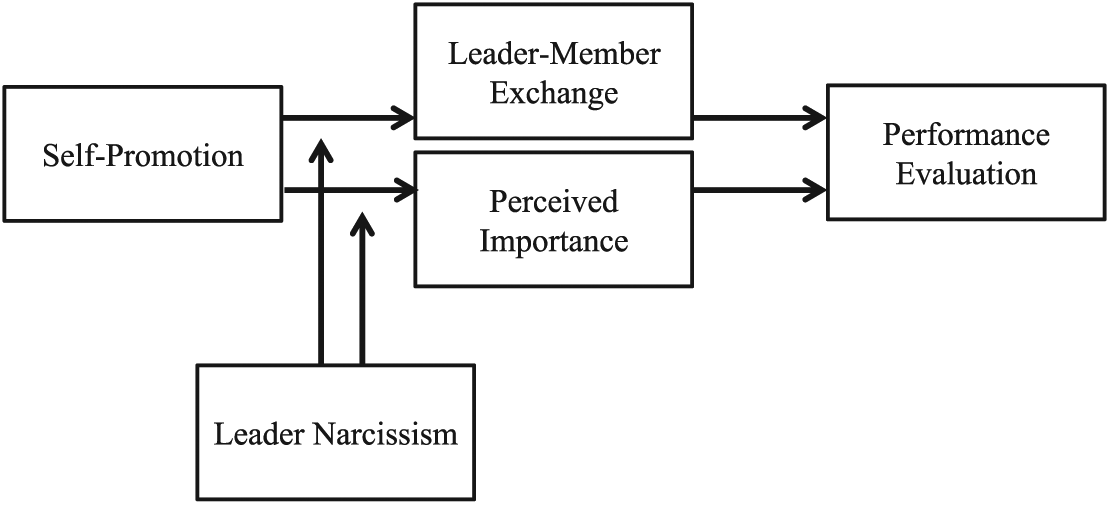
Hypothesized Research Model
We present two studies to test the model. The first study consists of two separate scenario experiments. In the first experiment, we test whether as compared to those low on narcissism, more narcissistic participants who are placed in the role of the leader form more positive perceptions of a self-promoting employee than of a not self-promoting employee in terms of LMX and perceived importance ratings. In a separate second experiment, we test whether LMX and perceived importance affect performance evaluations. Next, our multisource field study tests the full model. Together these studies extend the literature on narcissism in organizations by exploring whether leaders high on narcissism react differently to follower behavior compared with those low on narcissism. Second, we add to the literature on supervisor evaluations of employees by investigating whether narcissistic leaders’ ratings of LMX as well as employee importance and performance are more positive if the employee engages in self-promotional activities. Also, we contribute to the impression management literature by exploring narcissism as a contingency variable that affects the effectiveness of self-promotion as an impression management tactic.
Theory and Hypotheses
Leader Narcissism and Employee Self-Promotion
Narcissism forms a trait that describes a preoccupation with oneself, an inflated self-view, and the showing of an excessive and defensive assertion of status and superiority (Emmons, 1987). While coming across as entertaining and confident at first, over time narcissists often come to be seen as arrogant and cold (Paulhus, 1998). Narcissists are overconfident, feel they are special and unique, require excessive admiration, have a sense of entitlement, and are interpersonally exploitative (e.g., Campbell, Bush, Brunell, & Shelton, 2005; De Hoogh, Den Hartog, & Nevicka, 2015; Grijalva, Harms, Newman, Gaddis, & Fraley, 2015; O’Boyle, Forsyth, Banks, & McDaniel, 2012). In contrast, Campbell and Buffardi (2008) conceptualize low narcissism as lacking in self-centeredness and grandiosity and not needing to constantly maintain and defend one’s status and esteem. Narcissism is negatively correlated with the Big Five trait of agreeableness and especially its facet of modesty (Miller, Price, & Campbell, 2012).
Narcissists approach life as an arena for achieving status, success, and admiration, all of which aiming at increasing their self-concept (Campbell et al., 2005). Narcissism is related to power motivation and a sensitivity to social comparison (e.g., Bogart, Benotsch, & Pavlovic, 2004; Krizan & Bushman, 2011; Nevicka, Ten Velden, De Hoogh, & Van Vianen, 2011; Rosenthal & Pittinsky, 2006). Compared to individuals low on narcissism, those high on narcissism tend to more often emerge as leaders in groups because they possess traits such as authority, confidence, dominance, decisiveness, and high self-esteem, which are the ingredients people tend to look for in a leader (Brunell et al., 2008). However, while narcissism relates positively to leader emergence, overall it does not relate positively to leader effectiveness (Grijalva et al., 2015; O’Boyle et al., 2012).
Narcissists are keen to be admired and strongly engage in impression management. Impression management can be defined as the process through which people try to influence the images and impressions that others have of them (e.g., Rosenfeld, Giacalone, & Riordan, 1995; Turnley & Bolino, 2001). Narcissists are preoccupied with seeing and presenting themselves in a positive light and, thus, often use self-promotion (e.g., DeWall, Buffardi, Bonser, & Campbell 2011; Hart et al., 2016; Rhodewalt & Morf, 1998). Self-promotion is a specific form of impression management focused on enhancing one’s perceived status, achievements, and attractiveness in the eyes of others and includes, for example, proudly and explicitly pointing out accomplishments, claiming internal rather than external attributions for achievements, and speaking directly about one’s strengths, importance, and talents (Rudman, 1998). While narcissists endorse self-promotion and engage in it, the two are not the same. Narcissism is a general trait and broader than the tendency to self-enhance (e.g., also encompassing overconfidence, entitlement, and grandiosity and showing dominant and exploitative behaviors), and nonnarcissists can also choose to engage in the tactic or behavior of self-promotion if they want to impress someone, even if this is not something they habitually do.
An individual engaging in self-promotion hopes to come across as an important, competent, and influential person, yet when boasting about accomplishments and strengths too much, the individual risks coming across as conceited and having a lack of modesty instead (Jones & Pittman, 1982; Turnley & Bolino, 2001). How well individuals are acquainted is likely to play a role in the effects of self-promotion. Jones and Pittman (1982) argued that tactics such as self-promotion generally become less likely to affect judgments regarding performance in longer-term relationships because observers can test claims of accomplishments and competence against their own observations of performance. For example, in a study trying to assess the impact of self-promotion over time, Bolino, Klotz, and Daniels (2014) report a small but positive impact on performance and likeability in a short-lived experiment, but in a two-wave field study, there was a small negative relationship with performance at Time 1 and a null effect at Time 2, and for both waves also a null effect for likeability. Even the overall somewhat positive effects of self-promotion in job interviews (Higgins et al., 2003) may be only very short-lived ones. For example, Tsai, Chen, and Chiu (2005) found that even when job interviews had a longer duration, the effects of impression management tactics such as self-promotion by job applicants already became nonsignificant. Bolino et al. thus argue that generally as supervisors (or other observers) develop a deeper sense of who someone really is, they are less influenced by self-promotion in developing judgments of likability and performance.
Here, we explore who is more likely to be positively impressed by self-promotion and argue that whether self-promotion of employees has the intended positive impact on their leader’s impression of them depends at least in part on characteristics of that leader. As noted, we focus specifically on leader narcissism. We propose that more narcissistic leaders not only engage more in self-promotion themselves but also react more positively to employees who engage in self-promotion for two reasons. First, as noted, narcissists endorse and strongly engage in self-promotion. The similarity-attraction principle suggests people develop better relationships with those who behave more like them, and in line with this, we expect narcissistic leaders, compared with nonnarcissistic leaders, to react more positively to self-promoting employees. Second, narcissists are instrumental and exploitative and, thus, likely more sensitive than nonnarcissists to a self-promoting employee who signals that he or she is a strong and important group member who may form a useful asset to the leader.
Similarity Attracts and LMX
Some literature describes narcissists as suffering from a feeling of personal inadequacy (Rhodewalt & Morf, 1998), which makes them focused on self-enhancement and leads them to engage in self-aggrandizing behavior (Morf & Rhodewalt, 2001). This narcissistic need for self-enhancement is particularly activated in social situations in which others can be used to provide enhancement (Campbell & Campbell, 2009). The general similarity-attraction link might therefore be especially strong for narcissists (Campbell, 1999; Freud 1914/1957) as similar people allow for validation of one’s own ideas and attitudes and are associated with positive feelings about oneself, thus enhancing narcissists’ fragile self-image (Byrne, 1971).
However, while people generally tend to develop better relationships with people who are similar to them, the dark triad traits (e.g., O’Boyle et al., 2012) might conceivably work differently and instead lead to rejecting similar people, for example, the selfishness of narcissists might conceivably clash with or even threaten others showing similar behavior. Also, if narcissistic individuals feel personally inadequate, a self-promoting employee could potentially increase that sense of inadequacy and hence be evaluated negatively. Yet research suggests that similarity does also appeal to narcissists. For example, research by Wallace, Grotzinger, Howard, and Parkhill (2015) shows that while generally narcissism is negatively rated as a trait in others, in social judgement tasks, narcissists themselves are far less negative about narcissism in others than are nonnarcissists.
Thus, while nonnarcissists might react neutrally or even negatively to self-promotion, as noted, narcissists endorse self-promotion as an appropriate means to make a good impression (Hart et al., 2016). Hart and Adams (2014) found that narcissists are more tolerant than nonnarcissists of others’ narcissistic characteristics that they share, such as being bossy, aggressive, arrogant, or selfish. In their study, Maaß, Lämmle, Bensch, and Ziegler (2016) examined the associations between pairs of long-term friends’ personality profiles, depending on their similarities in narcissism (controlling for similarity on other dark triad traits). Their results show that those with similar personalities are willing to be friends with a narcissist and that people with similar narcissism profiles are more likely to establish long-term relationships. Here we therefore propose that narcissistic leaders react more positively than nonnarcissistic leaders to followers engaging in behaviors that are similar to their own, such as self-promotion.
The similarity-attraction paradigm (Byrne, 1971) suggests that (perceived) similarity affects the affective regard individuals hold for each other as well as their interactions and behavior towards each other. Indeed, similarity enhances the quality and depth of the relationships they build over time, such as friendships (Selfhout, Denissen, Branje, & Meeus, 2009). Affective regard or liking in leader-follower relationships is one of the core elements of so-called LMX, which more broadly describes leaders and followers experiencing a high-quality relationship with each other. Key to LMX theory is the observation that leaders do not treat every subordinate the same, that LMX quality can range from low to high, and that members’ work-related attitudes and behaviors depend on how their leaders treat them and how high this relationship quality is (e.g., Liden, Sparrowe, & Wayne, 1997). The LMX literature includes (perceived) similarity as an important antecedent of LMX (e.g., Dulebohn et al., 2012). Given the similarity in behavior and the endorsement of self-promotion by narcissists, we propose that leaders high on narcissism are likely to develop high LMX relationships with self-promoting employees, whereas those low on narcissism are not likely to appreciate such self-promotion in others. We hypothesize:
Hypothesis 1: Narcissism in leaders moderates the relationship between employee self-promotion and LMX such that the relationship between employee self-promotion and LMX is more positive when leaders are high on narcissism than when they are low on narcissism.
Employee Importance and Instrumentality
Narcissists use interpersonal relationships to enhance their self-concept and enjoy being linked to important and influential others (Campbell, 1999). In addition, narcissists are often less successful performers than they seem to be at first glance (Nevicka et al., 2011), and they tend to exploit others for their personal gain (Campbell et al., 2005). Their strong power motivation and striving for status leads narcissists to assess others in an instrumental way (Brunell et al., 2008; Campbell, 1999). Thus, narcissists will think about whether others they interact with may be of use to them and help them achieve their own aims. Individuals low on narcissism are less likely to think in such instrumental ways about others. This suggests that narcissistic leaders will be much more sensitive to cues that subordinates can be instrumental to these leaders’ personal success and goal attainment than those low on narcissism.
Narcissists condone self-promotion and are likely to more positively evaluate the strength, accomplishments, and usefulness of employees who stress their positive qualities and claim success. We therefore expect that as compared to those low on narcissism, highly narcissistic leaders will attribute more importance to employees who self-promote as they provide cues of being influential and competent than to employees who do not engage in such behavior. In line with this, Exline and Geyer (2004) found that narcissists generally showed more negative attitudes toward others’ expressions of humility. Thus, we expect that self-promoting employees will come across as more important in the group, that is, they seem more influential in and central to the team; therefore, they are also more instrumental to narcissistic leaders (e.g., by facilitating high team performance, which contributes to the leader’s success and goal achievement) than employees who do not engage in such behavior and do not seem equally important and influential to these leaders. In contrast, leaders low on narcissism generally should be far less sensitive to self-promotion and should not necessarily see self-promoting employees as more important than those who do not engage in self-promotion. We hypothesize:
Hypothesis 2: Narcissism in leaders moderates the relationship between employee self-promotion and perceived importance of the employee in the group such that the relationship between employee self-promotion and perceived importance is more positive when leaders are high on narcissism than when they are low on narcissism.
Relationships With Performance Evaluations
Leaders have a tendency to rate the performance of employees with whom they have a high LMX relationship as higher than the performance of employees they do not have a high LMX relationship with (e.g., Gerstner & Day, 1997). Indeed, meta-analyses also show a positive relationship between LMX and performance (Gerstner & Day, 1997; Rockstuhl et al., 2012), suggesting either that the exchanged work-related information and resources afforded by higher quality LMX may help employees to perform well and/or that leniency bias on the part of leaders may come into play more in high LMX relationships.
Leaders also tend to rate the performance of those employees whom they perceive to have characteristics that are instrumental to them to be higher. For example, Borman, White, and Dorsey (1995) found that employee ability, knowledge, and proficiency affected supervisor ratings of their performance most strongly (even outperforming the influence of interpersonal factors such as friendliness). Also, centrally important or powerful group members are generally evaluated more positively by leaders (e.g., Sparrowe, Liden, Wayne, & Kraimer, 2001). Relatedly, being perceived to have important friends in the organization similarly was found to boost employees’ reputation of being a good performer (Kilduff & Krackhardt, 1994). Thus, employees who are able to create the image of being important and influential in the unit or group may seem more instrumental to the leader. Such employees might form a resource for leaders, as their (perceived) role in the success of the group also enables leaders to come across as more effective. Leaders may reciprocate through positive performance ratings. Thus, a leader’s perception of an employee as important and influential within the organization is positively linked to his or her evaluation of the employee’s performance.
Combining the above arguments, we propose a moderated mediation model (see Figure 1) in which the relationship between employee self-promotion and the evaluation of employee performance by leaders is mediated by LMX and perceived employee importance. However, self-promotion is more likely to translate into higher LMX and perceptions of importance for narcissistic leaders who endorse such behavior and who are sensitive to it than for those low on narcissism who do not endorse such behavior. Thus, the proposed pattern should occur more strongly when leaders are high on narcissism than when they are low on narcissism. We hypothesize:
Hypothesis 3: Narcissism in leaders moderates the relationship between employee self-promotion and leader performance evaluations, via LMX, such that the mediated relationship is stronger when leaders are high on narcissism than when they are low on narcissism.
Hypothesis 4: Narcissism in leaders moderates the relationship between employee self-promotion and leader performance evaluations, via perceived employee importance, such that the mediated relationship is stronger when leaders are high on narcissism than when they are low on narcissism.
Study 1: Scenario Experiments
Study 1 consists of two separate scenario experiments designed to be able to test our proposed research model (following a design suggested by Stone-Romero & Rosopa, 2008). In the first, we tested whether the independent variable was related to the mediators and whether the proposed moderation occurred. To this end, narcissism of participants was measured. After a filler task, participants were placed in the role of a leader, and we measured their reactions to the strong versus weak self-promotion of an employee in a scenario. We tested the effect of participant narcissism on their perception of a high or low self-promoting employee’s LMX and importance in the group. In the second experiment, among a different group of participants, we tested whether the proposed mediators related to the dependent variable of performance using a 2 × 2 design. Participants were placed in the role of a leader and read a scenario about an employee whose performance evaluation was pending in which we manipulated LMX (high/low) and importance (high/low) and tested whether these related to performance evaluations.
Method Experiment 1
Sample
Participants in the online scenario study were 116 U.S. American adults who were recruited via MTurk and paid a compensation of $1 for participating in the study. Only those who completed all measures were included in the analyses. Ten participants were excluded as a result of failing the manipulation and/or reading checks (see below), and 4 more were excluded because of missing values, resulting in a final sample size of 102. We also checked whether there were duplicate IP addresses, which there were not. A majority of the respondents were male (56%). The average age was 34.97 years (SD = 9.83), and respondents had a mean working experience of 14.86 years (SD = 9.57). In total, 13% held a master’s degree, 55% held a college degree, and another 32% had not completed a higher education program.
Procedure and measures
Respondents first had to answer the 16-item version of the Narcissistic Personality Inventory (NPI) to measure their degree of narcissism (Ames, Rose, & Anderson, 2006). The narcissism option from each of the original dichotomous items was rated on a 7-point Likert scale ranging from 1 (strongly disagree) to 7 (strongly agree) to indicate the extent respondents agreed with the NPI statements (e.g., “I know that I am good because everyone keeps telling me so”), as done in some prior research (e.g., Lee, Gregg, & Park, 2013). Cronbach’s alpha was .94.
After filling out the NPI, respondents were presented an unrelated filler task. Specifically, they were asked to think of and fill in several animal names starting with a series of specific first letters that they were prompted with. Next, they were presented a scenario in which they were asked to imagine that they were the supervisor in a marketing department in a big company. One of their subordinates (called Arnold) would soon have to be appraised by them in the yearly performance review. In what followed, the behavior of the subordinate was described as either strongly self-promotional (e.g., explicitly making the supervisor aware of his qualities, emphasizing that he was important for the department) or low in self-promotion (e.g., being modest, never boasting about accomplishments). Both scenarios are presented in full in Appendix A. After having read one of the scenarios, participants had to answer a number of questions about their perceptions of the subordinate’s LMX as well as importance.
Similar to social psychological work on impression formation that assesses the extent to which participants expect to like a person they read about in a scenario (see, e.g., Collins & Miller, 1994), we measured expected quality of the LMX relationship with the subordinate with eight items: six from Scandura and Graen (1984) and two from Liden and Maslyn (1998; Cronbach’s alpha = .87). Specifically, we included six of the seven items from the Scandura and Graen measure (e.g., “I would be willing to ‘bail out’ Arnold, even at my own expense, if he really needed it”), excluding one more general and differentially worded item: “How would you characterize your working relationship with . . . ?” We complemented these six with the two highest-loading items of the affective relationship dimension by Liden and Maslyn (e.g., “I would like this subordinate very much as a person”) as this important “liking” element of LMX is not covered by the measure by Scandura and Graen.
Perceptions of the subordinate’s expected importance and influence in the group were measured with three items based on Anderson and Galinsky (2006). Sample items include “In my team, Arnold can get others to do what he wants” or “. . . can ensure that others listen to what he has to say” (Cronbach’s alpha = .82).
Reading and manipulation checks
We included two reading checks in the survey. More specifically, we asked respondents after about one third and after about two thirds of the questions to choose a specific response option. Only respondents who correctly answered both of the reading checks were included in the further analyses. Also, we asked participants after the scenario whether the employee described in the scenario engages in self-promotion activities. Again, only respondents who correctly answered this question were included in the further analysis. As a consequence, 10 participants were excluded from the further analyses for failing either the reading checks (8 participants) or the manipulation check (2 participants).
Results Experiment 1
Table 1 shows the intercorrelations between narcissism and the perceptions of subordinate LMX and importance. While narcissism was significantly correlated with LMX (r = .29, p = .00), narcissism was not significantly correlated with perceived subordinate importance (r = .18, p = .08). To test our hypotheses, we regressed participants’ perceptions of subordinate LMX and subordinate importance on participant narcissism, the self-promotion manipulation (0 = low, 1 = high), and the interaction of these two variables. The interacting variables were mean-centered before computing the interaction term. We used structural equation modeling to compute the regressions as this allowed us to model relationships with the two dependent variables simultaneously. The results are presented in Table 2. The table shows that participant (leader) narcissism was significantly related to both perceived LMX (b = 0.26, p = .00) and subordinate importance (b = 0.24, p = .00). Furthermore, the self-promotion manipulation also had a significant main effect on both LMX (b = −0.48, p = .00) and perceived importance (b = 0.94, p = .00). LMX and perceived importance were not significantly correlated with each other (r = .15, p = .12). The direct effects of self-promotion and narcissism were qualified by significant interaction effects (LMX: b = 0.50, p = .00; importance: b = 0.48, p = .00).
Correlations and Descriptive Statistics (Study 1, Experiment 1)
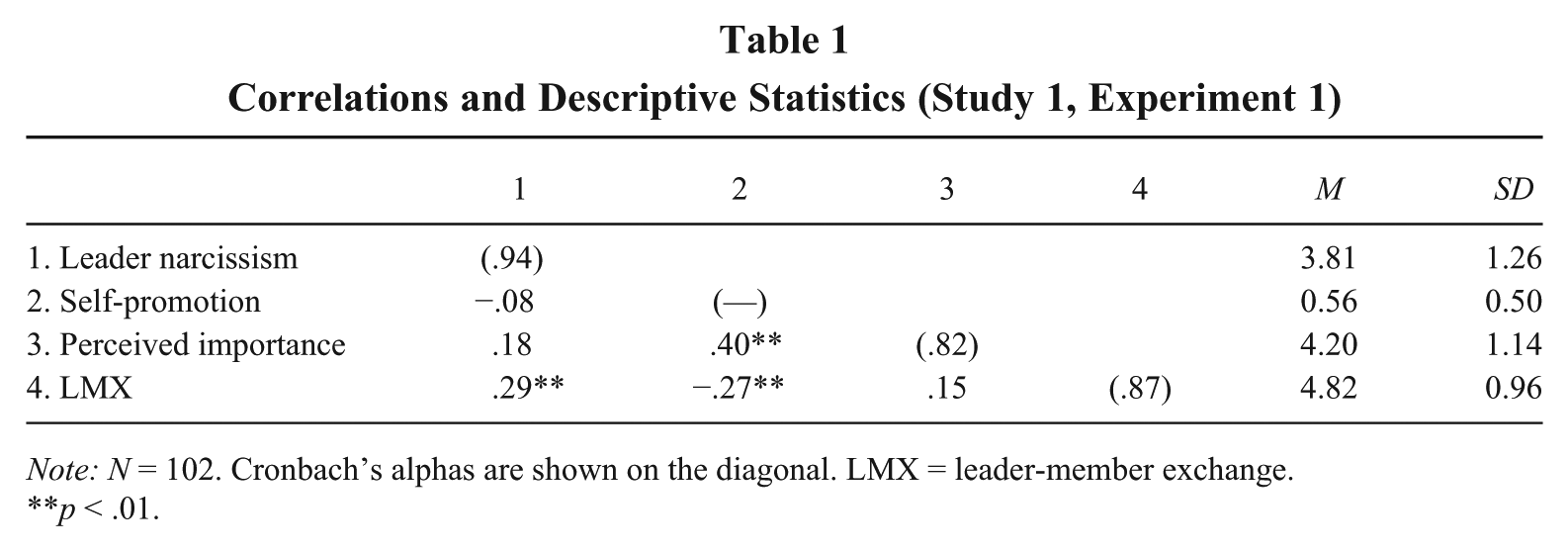
Note: N = 102. Cronbach’s alphas are shown on the diagonal. LMX = leader-member exchange.
p < .01.
Results of Regression Analyses Using Structural Equation Modeling (Study 1, Experiment 1)
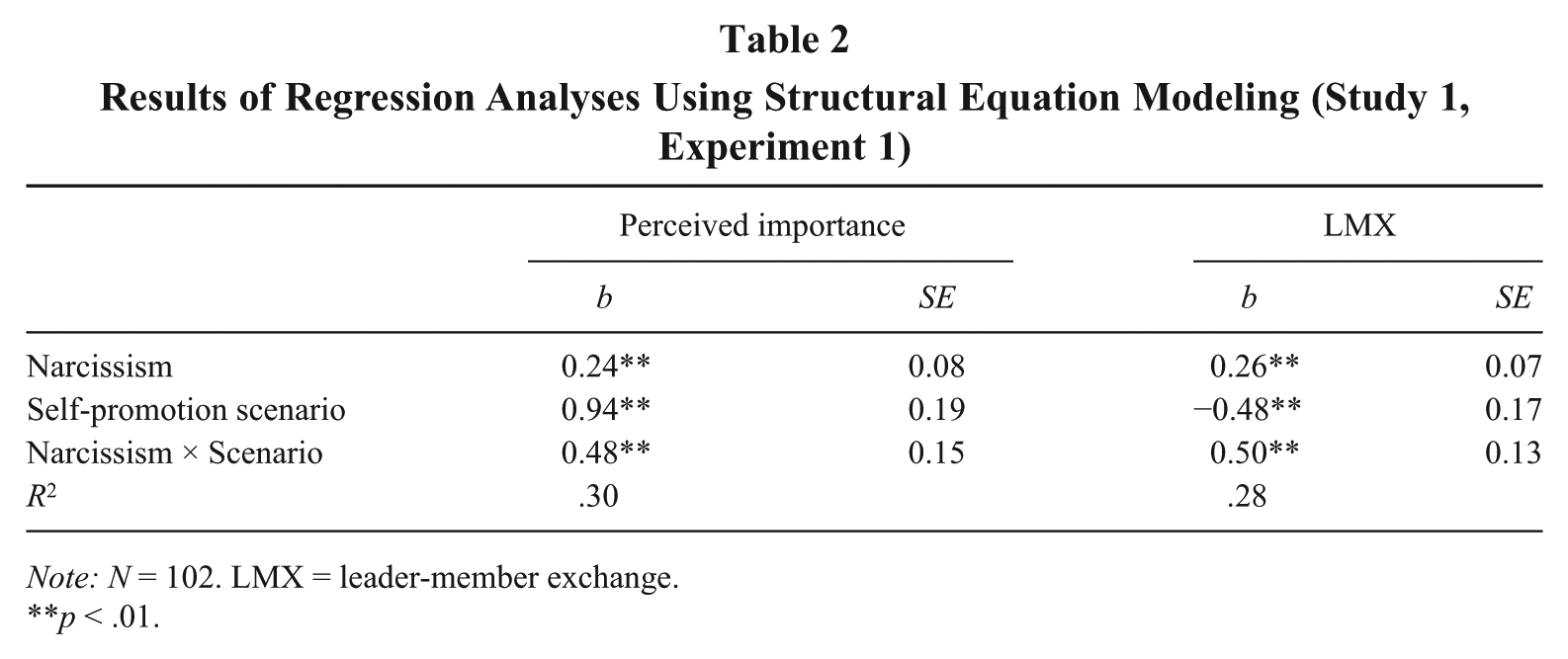
Note: N = 102. LMX = leader-member exchange.
p < .01.
To facilitate interpretations, we plotted the results for high and low values of narcissism (plus or minus 1 SD from the mean; see Figure 2). As hypothesized, narcissism moderates the relationship between employee self-promotion and perceived importance such that the relationship between employee self-promotion and perceived importance is more positive when participants (leaders) are high on narcissism than when they are low on narcissism (this is in line with Hypothesis 2). Simple slope analyses showed that both slopes were positive and significant. Also, narcissism moderates the relationship between employee self-promotion and LMX. However, the relationship between self-promotion and LMX was nonsignificant for highly narcissistic participants (nonsignificant slope) and negative for participants low on narcissism (significant negative slope; see Figure 2), which was not completely in line with Hypothesis 1 as we had expected narcissists to have more favorable LMX perceptions rather than the nonsignificant effect we found. Self-promotion thus never hurts if leaders are narcissistic, but it potentially can be harmful for LMX perceptions if leaders are low on narcissism. Overall, the results do support that participants high on narcissism form more positive impressions of people who strongly self-promote than do those low on narcissism in terms of perceived importance, but the pattern is somewhat less clear for LMX. We return to this in more detail in the discussion.
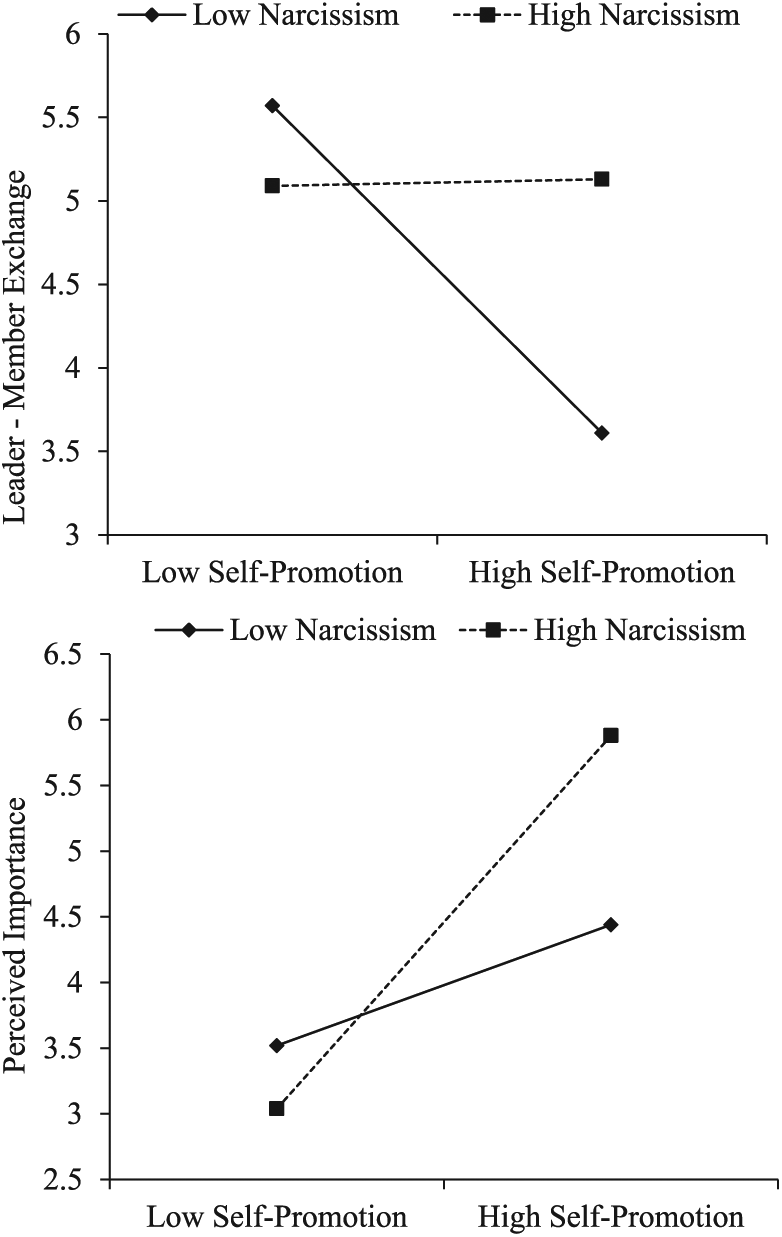
Plots of the Self-Promotion × Leader Narcissism Interactions (Study 1)
Method Experiment 2
Sample
Participants in our second online scenario study were recruited via MTurk and received a compensation of $1 for participating. Only those who completed all measures were included in the analyses. Twenty-two participants were excluded as a result of failing the checks (see below), resulting in a final sample size of 140. There were no duplicate IP addresses. A majority of the respondents were male (59%). Respondents’ mean age was 34.76 years (SD = 11.53), and respondents had a mean working experience of 13.49 years (SD = 11.38). In total, 13% held a master’s degree, 59% held a college degree, and another 28% did not hold a higher education degree.
Procedure and measures
Similar to our first experiment, we asked participants to imagine that they were a leader and to read a scenario about a subordinate (Arnold) who would soon be appraised by them in the yearly performance review. He was described as someone who had either a good or a bad relationship with the supervisor (“You (dis)like Arnold very much as a person and have a good/bad relationship with him”) and who was either important for and influential in the team (e.g., being an important person) or of low importance and influence (e.g., has little impact on others’ behavior in the team), resulting in a 2 × 2 experimental manipulation. The four scenarios are presented in Appendix B. The dependent variable here was perceived performance, and after having read one scenario, participants were asked to report how they would rate the subordinate’s performance at the next performance evaluation using three items from Pearce and Porter (1986). Sample items are “Arnold is a high performer” and “Arnold performs better than an average team member.” Cronbach’s alpha was .97.
Reading and manipulation checks
As a reading check, we asked respondents after their performance rating to choose a specific response option. No participants failed this check. As a manipulation check, we asked participants after the scenario whether the employee described in the scenario was important to and influential in the team and whether the employee had a good or a bad relationship with them. In total, 22 participants were excluded from further analyses for failing the manipulation check.
Results Experiment 2
To test the relation between the mediators in our research model and the dependent variable, we regressed respondents’ performance rating on both the employee importance and the influence manipulation (0 = low importance, 1 = high importance) and the employee relationship manipulation (0 = low LMX, 1 = high LMX). As expected, both employee importance and LMX were significantly related to participants’ ratings of employee performance (F = 228.68, p = .00, R2 = .77; importance: b = 3.25, p = .00; LMX: b = 0.63, p = .00). Together, our two scenario experiments thus suggest that employee self-promotion may affect supervisor performance ratings via perceived employee importance and LMX.
Study 2: Multisource Field Study
While we manipulated our study variables in the two experiments of Study 1, thereby helping internal validity, the external validity of a scenario study is of course limited as it focuses on individuals’ reactions to a hypothetical person. Thus, we also undertook a multisource correlational field study among existing leader-follower dyads.
Method Study 2
Sample and procedure
We performed a multisource survey-based field study to test the proposed research model and hypotheses. We collected data from a sample of 311 unique leader-follower dyads in the Netherlands who were approached through business school graduate student contacts (which represented a 61% response rate for complete dyads; 32 cases were excluded due to missing values on study variables). Students helped with data collection only; they were not included as respondents. Respondents were employed in various professions (including office administrators, salespersons, technicians, and consultants). Most leaders (mean age = 43.0 years, mean tenure = 10.8 years) were male (69.5%), and slightly more employees (mean age = 34.8 years, mean tenure = 7.1 years) were female (50.5%). The survey was accompanied by an explanation about the confidential nature of the study. Respondents were also told that participation was voluntary, they would not receive anything in return for participation, and they could contact researchers if they had questions. One reminder was sent to all who were asked to participate. The dyads were matched with codes without identifying information attached to them to ensure we could match dyads while allowing for complete confidentiality. All items in the surveys were from validated scales derived from the international literature, translated to Dutch, and back translated to check their meaning. The research met the requirements of the university ethical standards and was approved by the faculty research ethics board.
Measures
Employees rated their self-promotion on a four-item scale (α = .80) based on Bolino and Turnley (1999). Respondents were asked to describe how frequently they had used each of the self-promotion strategies described towards their leader in the last 6 months while at work. Response choices ranged from 1 (never behaved this way) to 7 (often behaved this way). A sample item is “Make people aware of your accomplishments.”
We measured leader narcissism with the 16-item short NPI (α = .72) developed by Ames et al. (2006). For each of these forced-choice items, leaders were asked to choose one of the two responses that was the most self-descriptive. A sample item of a narcissistic response is “I am apt to show off if I get a chance.”
Leaders reported the LMX quality (α = .77) between themselves and their employee using the same eight items from Scandura and Graen (1984) and Liden and Maslyn (1998) used in Study 1. Leaders were asked to rate the relationship with their followers on a 7-point response scale (1 = strongly disagree, 7 = strongly agree). Leaders also filled out the same three items based on Anderson and Galinsky (2006) as in Study 1 to measure the perceived importance and influence of the employee in the unit (α = .85). Each leader indicated the extent to which he or she agreed with statements about his or her subordinate’s importance and influence in the group on a 7-point response scale (1 = strongly disagree, 7 = strongly agree). A sample item is “In my unit others listen to what this employee has to say.”
Finally, leaders provided ratings for the focal employee’s performance (α = .87) using four items from Pearce and Porter (1986). Leaders were asked to report how the subordinate was rated relative to others on a percentage basis at their last actual performance evaluation (e.g., 60th percentile, 70th percentile). A sample item is “The achievement of work goals.”
Control variables included employee tenure with the leader and education. We included these variables as they might affect other variables in our study. The longer leader and employee have worked together, the more leaders might like their employees (proximity and frequent interaction are linked to liking); thus, they might evaluate them more positively. Also, higher employee education qualifications might lead to higher expertise ratings by the leader. We checked whether we needed to control for these variables to take these possible relationships into account and avoid related potential bias in our results but retained them only if they had an impact to conserve statistical power (e.g., Becker, 2005).
Results Study 2
To test the measurement model, we first conducted several confirmatory factor analyses (CFAs). The first CFA supported the proposed five-factor measurement model: χ2(550, N = 311) = 999.52, root mean square error of approximation (RMSEA) =.05, standardized root mean square residual (SRMR) = .06, comparative fit index (CFI) = .90. Factor intercorrelations were moderate, ranging from .02 to .50. Two alternative models, one in which the items of LMX and employee performance were merged into an overall factor, χ2(554, N = 311) = 1,599.13, p = .00, RMSEA = .08, SRMR = .08, CFI = .82, Δχ2(4) = 599.61, p = .00, and one in which the items of perceived importance and LMX were merged into an overall factor, χ2(554, N = 311) = 1,383.46, p = .00, RMSEA = .07, SRMR = .07, CFI = .83, Δχ2(4) = 383.94, p = .00, exhibited significantly poorer fit. We also compared the proposed five-factor measurement model with a two-factor model with the items of leader narcissism, LMX, perceived employee importance, and performance (all rated by the leader) loading on the same factor. Again, the five-factor measurement model showed a significantly better fit over the alternative model—χ2(559, N = 311) = 2,799.58, p = .00, RMSEA = .11, SRMR = .11, CFI = .67, Δχ2(9) = 1,800.06, p = .00. Finally, we compared the proposed model to a four-factor model combining the narcissism and self-promotion items onto a single factor. The five-factor measurement model showed a significantly better fit over this alternative model—χ2(554, N = 311) = 1,547.19, p = .00, RMSEA = .08, SRMR = .09, CFI = .80, Δχ2(4) = 547.67, p = .00.
Descriptive statistics and correlations are presented in Table 3. Leader narcissism correlated significantly positively with employee self-promotion (r = .15, p = .01) and perceived importance of the employee (r = .16, p = .00), and perceived importance (r = .26, p = .00) and LMX (r = .39, p = .00) correlated significantly positively with performance evaluations.
Correlations and Descriptive Statistics (Study 2)
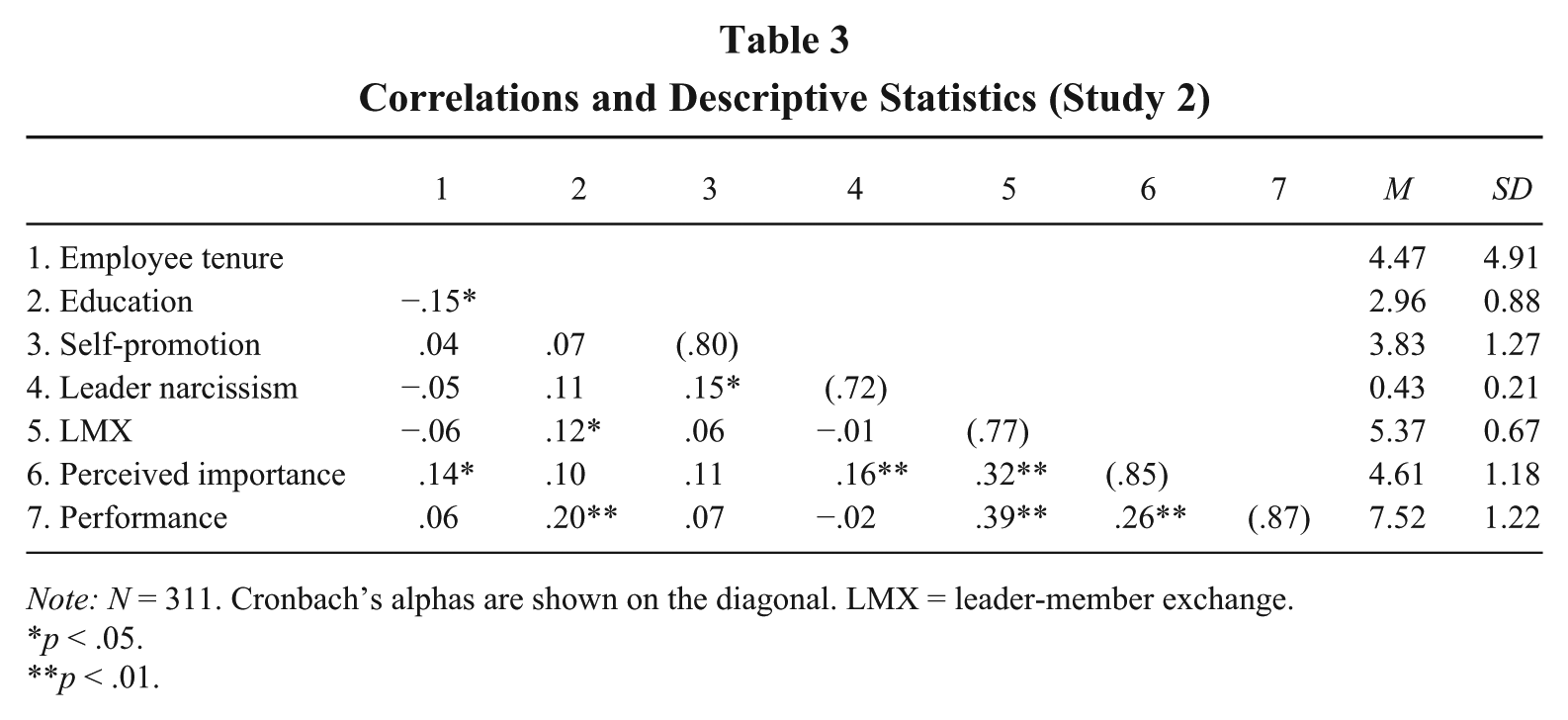
Note: N = 311. Cronbach’s alphas are shown on the diagonal. LMX = leader-member exchange.
p < .05.
p < .01.
To test our proposed hypotheses, we conducted (moderated) mediation analyses using bootstrapping (e.g., Preacher, Rucker, & Hayes, 2007). Specifically, we used the PROCESS macro developed by Hayes (2013). Predictors were centered around their respective means, and the interaction terms were based on the mean-centered scores. As control variables in the main analyses, we checked whether employee tenure with the leader and education had a significant impact on the results. Neither tenure nor education significantly altered the variables, interactions, or relationships (effect sizes, their significance levels, and direction remained the same); however, education was significantly linked to one of our outcome variables, LMX, and did affect the overall F value and significance of the model predicting LMX. Thus, we report the results with education, but not tenure, as a control. We also tested whether employee tenure with the leader interacted with employee self-promotion or with the two-way interaction of employee self-promotion and leader narcissism. There were no significant interaction effects explaining LMX or employee performance. Results of the moderated mediation are presented in Table 4.
Results of Moderated Mediation Analysis (Study 2)
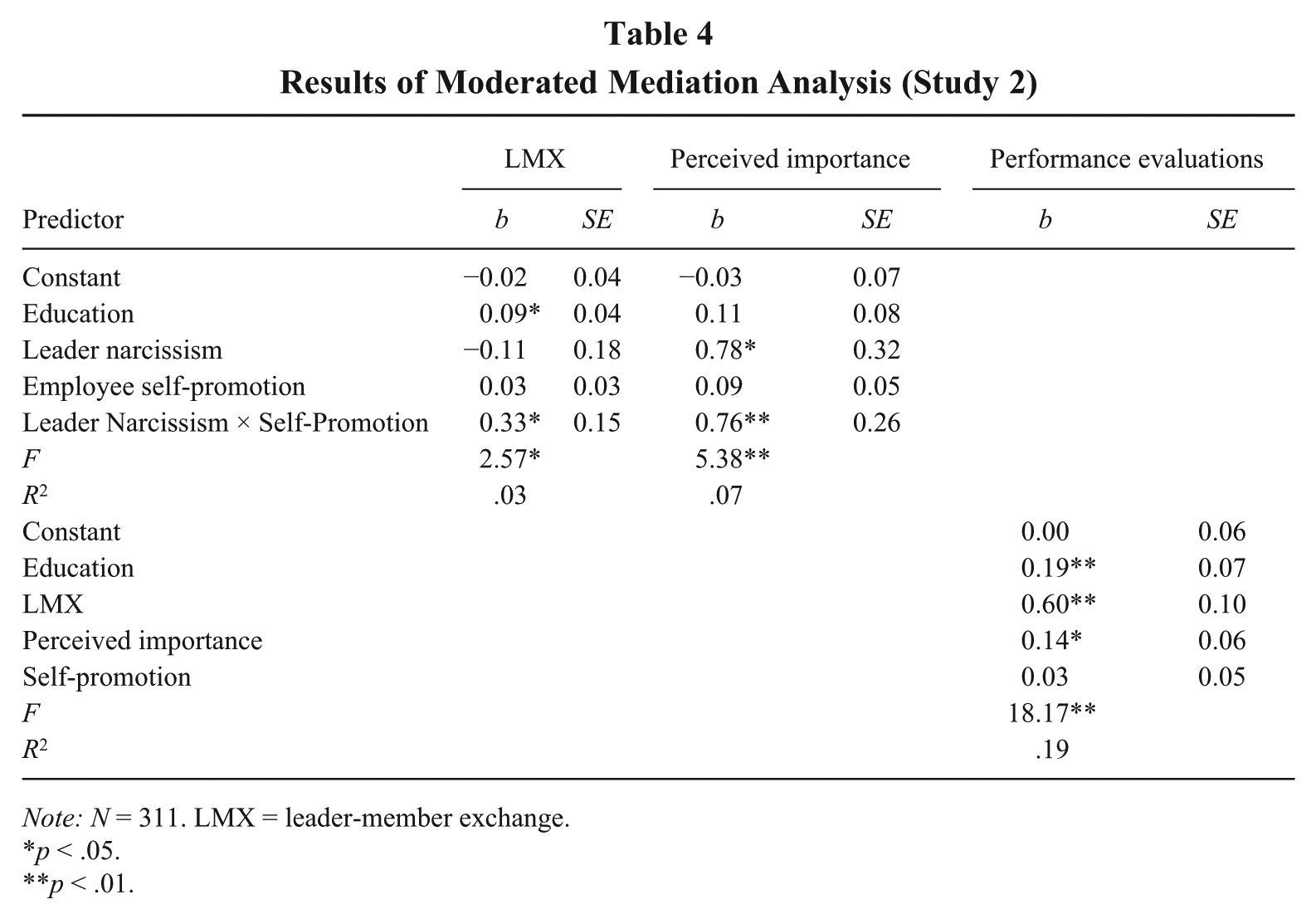
Note: N = 311. LMX = leader-member exchange.
p < .05.
p < .01.
As hypothesized, we found significant interactions between self-promotion and leader narcissism for explaining LMX (b = 0.33, p = .03) and perceived employee importance (b = 0.76, p = .00). To facilitate the interpretation of the significant interaction effect, we plotted high and low regression lines (i.e., plus or minus 1 SD; see Figure 3 below). Results of simple slope analyses showed that the slopes were positive and significant for high values of leader narcissism but nonsignificant for low values of leader narcissism. Employee self-promotion was significantly positively related to LMX for leaders high on narcissism, b = 0.10, SE = 0.05, t = 2.23, p = .03, 95% confidence interval (CI) = [.01, .19], but not for leaders low on narcissism, b = −0.03, SE = 0.04, t = −0.87, p = .38, 95% CI = [–.11, .05]. Also, employee self-promotion was significantly positively related to perceived importance for leaders high on narcissism (b = 0.25, SE = 0.08, t = 3.12, p = .00, 95% CI = [.09, .40]), but not for leaders low on narcissism (b = −0.07, SE = 0.07, t = −0.96, p = .34, 95% CI = [–.21, .07]). Hypotheses 1 and 2 thus receive support.
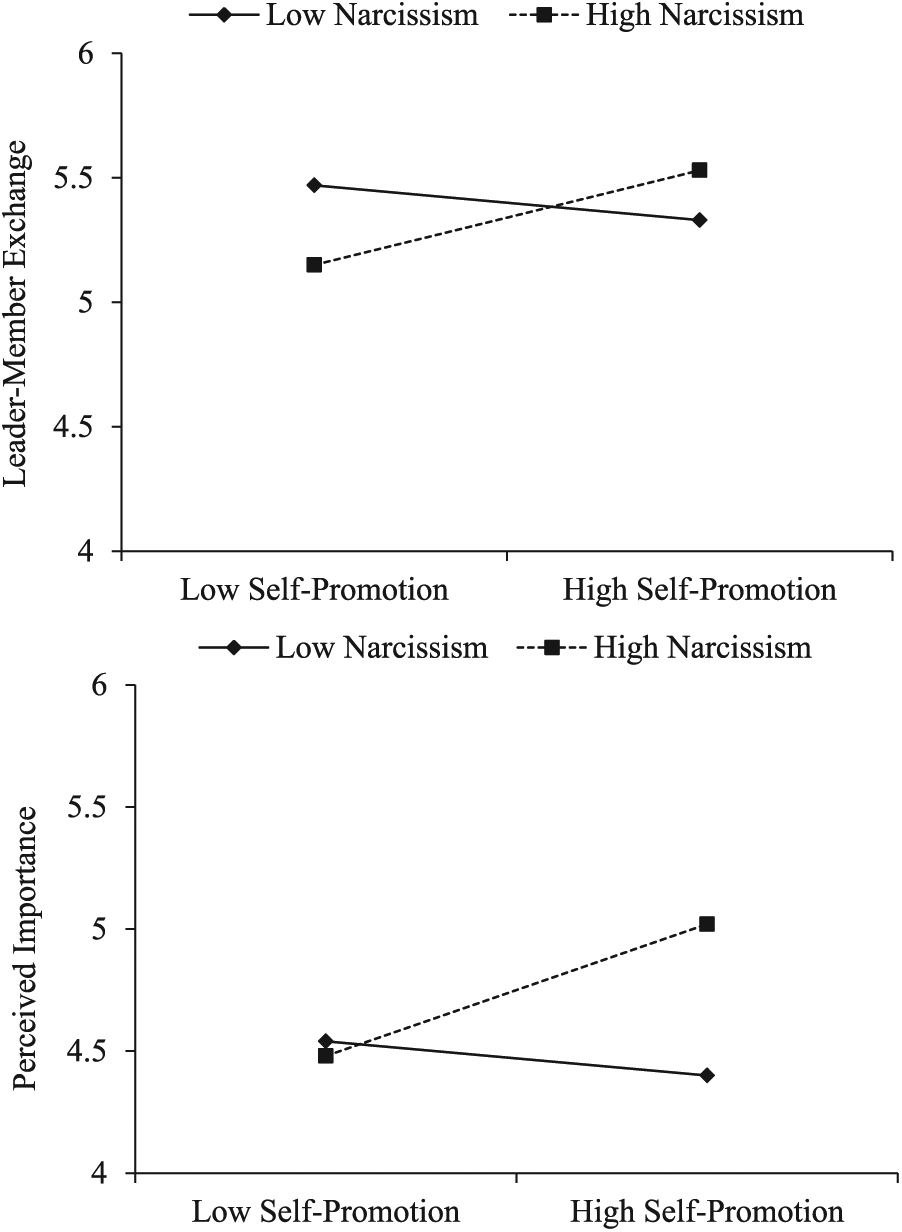
Plots of the Self-Promotion × Leader Narcissism Interactions (Study 2)
Next, LMX (b = 0.60, p = .00) and perceived importance (b = 0.14, p = .01) of the employee were related to performance evaluations from the leader. Results showed that the indices of moderated mediation were significant (Hayes, 2015), indicating that the indirect relationships between employee self-promotion and employee performance through LMX (index = .20, SE boot = .10, 95% CI = [.04, .47]) and perceived importance (index = .10, SE boot = .05, 95% CI = [.02, .23]) are a function of leader narcissism. The bootstrapped conditional indirect effects were significant for high but not low levels of narcissism. That is, for high narcissism, the CI of the bootstrapped effect sizes did not include zero (LMX: b = 0.06, SE boot = 0.03, 95% CI = [.004, .14]; perceived importance: b = 0.03, SE boot = 0.02, 95% CI = [.01, .07]), whereas for low levels it did (LMX: b = −0.02, SE boot = 0.02, 95% CI = [–.07, .02]; perceived importance: b = −0.01, SE boot = 0.01, 95% CI = [–.04, .01]). These results are in line with Hypotheses 3 and 4.
Discussion
In organizations, an important person for employees to make a positive impression on is their leader as leaders tend to be central to many desirable employee outcomes, such as rewards and career decisions. However, given that previous research indicates that employee self-promotion overall does not tend to relate positively to job performance (e.g., Higgins et al., 2003), leaders should not be too easily impressed by employee self-promotion. Indeed, while self-promotion may have (very) short-lived positive effects on observers’ first impressions, its effects become less likely to affect performance evaluations in longer-term relationships because observers can test the self-promotor’s claims against their own observations of performance (Jones & Pittman, 1982). However, many employees still do engage in self-promoting behavior, such as boasting about successes and emphasizing their role in an achievement, which suggests they may at least at times experience success using this impression management behavior (e.g., Stevens & Kristof, 1995). We reasoned that whom one tries to impress through self-promotion is likely to make a large difference in the effectiveness of this impression management tactic as not everyone will be equally sensitive to self-promotion.
One trait that might make observers both more sensitive and open to others’ self-promotion is narcissism, and we proposed that individuals high on narcissism would react favorably to self-promotion, whereas those low on narcissism would be far less likely to do so. One way in which we hypothesized narcissists would react favorably is that they would perceive self-promoting employees as more important and central to the group, whereas those low on narcissism would not do so as they are less likely to be impressed by self-promotion. We found support for this both in the experimental and in the field study. In the first experiment in Study 1, we presented participants with a scenario of an employee either strongly engaging in self-promotion or explicitly not doing so to test whether individuals high on narcissism would rate the self-promoting employee as more important than would those low on narcissism. The pattern of the interaction shows that self-promotion can make a positive first impression on observers in terms of enhancing perceived importance, which is in line with earlier work on the (albeit short-lived) positive impact that self-promotion can make on others (e.g., Bolino et al., 2014), although this effect is clearly much stronger when observers are high on narcissism than when they are low. We again tested our hypothesis among existing leader-follower dyads in the field in Study 2 and found that in organizational settings too, narcissistic leaders ascribed more importance to employees who self-promoted than to those who did not and that this did not hold for leaders low on narcissism. Taken together, the results of these two studies suggest that highly narcissistic leaders react more positively to self-promotion by employees than do leaders who are low on narcissism and that narcissists rate these employees as more central and important, as predicted.
We also predicted that narcissistic leaders would develop better relationships with self-promoting employees than would nonnarcissistic leaders. However, for LMX, the results differed somewhat between the two studies. In the experimental study, we did find a significant interaction effect; however, the relationship between self-promotion and LMX was not significant and positive for narcissists but instead was nonsignificant for narcissists and significant and negative for nonnarcissists. While this generally aligns with the idea of a more positive reaction to self-promoting behavior from those high on narcissism than from those low on narcissism, we had expected that individuals high on narcissism would react more positively to self-promotion and that this would drive the interaction effect. The results of the field study did show that expected pattern, namely, that narcissistic leaders had better relationships with self-promoting employees than did their less narcissistic counterparts.
The differences in this pattern between our studies may have to do with first impressions and the fact that we presented the participants with a fictional person to think about in the scenario study versus investigated actual personal relationships that developed between individuals over time in the field study. In line with our hypothesis and previous work showing that long-term friends are similar in terms of narcissism levels (Maaß et al., 2016), narcissistic leaders in actual organizational settings seemed to have developed better relationships with followers who strongly engage in self-promotion than with those who do not do so. However, in the experiment, narcissists were not necessarily attracted more at first sight to a person they did not yet know and who was described on paper to display such behavior. Such a relationship cue might not have been sufficient to stimulate strong positive responses in terms of loyalty, liking, and taking personal risks for the described person (e.g., being willing to “bail out” the subordinate, even at one’s own expense, or using one’s power to help the subordinate to solve problems in his or her work). Here, interpersonal trust may be needed, which evolves over time based on repeated interactions (e.g., Mayer, Davis, & Schoorman, 1995).
In the experiment, it was those low on narcissism who seemed to be repelled by self-promoting behavior and who expected they were not likely to have a good relationship with such a self-promoter. Thus, while some previous work suggests a short-term positive effect sometimes occurs, here we find that in the first instance, those low on narcissism explicitly expect to dislike someone described as a self-promoter. In the field study, where people have gotten to know each other over time, we do not see this negative reaction of those low on narcissism occurring. As noted, Bolino et al. (2014) argue that generally as individuals develop a deeper sense of who the other person really is, they are less influenced by self-promotion in developing judgments about them. This may especially hold for those low on narcissism who do not condone self-promotion as a behavioral strategy, whereas for those high on narcissism, who do appreciate and condone boasting about oneself, such self-promoting behavior does contribute to having a good relationship (see also Maaß et al., 2016). Future work in which changes in the quality of these relationships over time could be taken into account would be of interest to further unpack this.
In the second experiment in Study 1, we manipulated LMX and importance of the employee in scenarios and included performance ratings and found that employees rated higher on LMX, as well as more important and, hence, more instrumental to the leader, indeed also received higher performance ratings, as expected. In the field study, we tested the full research model, and the results of our study support the idea that self-promotion can indeed “impress the boss” and be positive for performance evaluations through enhancing LMX and perceived importance but only under a very specific condition as this pattern holds only when leaders are high on narcissism. When leaders are low on narcissism, employees’ self-promotion does not positively affect LMX, perceived importance, or performance appraisals of the employee in the field study. Thus, more narcissistic leaders were impressed by self-promotion of subordinates, while leaders low on narcissism were not and in the scenario experiment even reacted negatively in terms of LMX. These results have several implications.
First, as noted, research has established similarity between individuals as a robust predictor of favorable judgments in interpersonal relations (e.g., Montoya et al., 2008). The principle of similarity attraction seems to extend to self-promotion as a behavioral strategy as this behavior seemed to especially impress narcissists, who also present themselves in this way and who condone self-promotion as a way to make a good impression (Hart et al., 2016). This suggests that similarity attraction may extend to narcissism and self-promotion. Our findings are not in line with past work on dominance complementarity, which argues that dominant individuals react negatively to dominance in others (e.g., Shechtman & Horowitz, 2006) and which has been proposed to apply also to narcissistic leaders by Grijalva and Harms (2014). Narcissistic leaders, in line with their sense of grandiosity, might not quickly perceive self-promoting employees who have less formal power than they have as a threat and may not expect that subordinates are able to easily challenge their power and authority. Future research could address when and why narcissistic leaders might start perceiving employees as posing a threat.
As noted, we found that narcissistic leaders see self-promoting others as more important. Also, narcissists were found to be more likely to interpret humility as a sign of weakness or insincerity (Exline & Geyer, 2004). Thus, employees may learn over time in interacting with a narcissistic leader that they are appreciated as important and liked by these leaders only if they emphasize and perhaps even overemphasize their achievements and their role in successes or accomplishments of the team. Vice versa, when working with nonnarcissistic leaders, employees may learn that “bragging” does not help them. Whether these learning processes occur, and how changes in employee influence tactics develop over time, should also be investigated in future (longitudinal) research that can track such patterns over time.
Relatedly, our results provide new insights into the potential risks of having highly narcissistic leaders in groups and organizations (Rosenthal & Pittinsky, 2006). Previous research shows that narcissists tend to perform less well than others think they do (Nevicka et al., 2011). Narcissists strongly “toot their own horn” by engaging in self-promotion, but they do tend to overestimate their own positive qualities, such as their intelligence and creativity (Campbell, Rudich, & Sedikides, 2002; Goncalo, Flynn, & Kim, 2010). Our findings add to this line of work by showing that narcissists also seem more likely to overestimate the centrality and contributions of others who strongly self-promote their strengths and accomplishments.
Our results also add to the literature on supervisor evaluations suggesting that supervisors consider more in their evaluation of employee performance than just task performance (see Kilduff & Krackhardt, 1994). In particular, narcissistic leaders seem to be sensitive to employee self-promotion and, thus, are likely to suffer from a leniency bias or overestimation of employee performance under these circumstances. Leader narcissism might also help to explain the contradictory results in the literature regarding the link between employee self-promotion and supervisors’ ratings of their performance (see the meta-analysis by Higgins et al., 2003).
Narcissists are exploitative and prefer to be around others who they feel may be of use to them (e.g., Campbell, 1999). Self-promoting employees manage to come across as more influential and successful to narcissists, and they are thus likely to appear to be of more potential use to these narcissistic leaders than employees who do not self-promote and whose accomplishments are then not as clear to these leaders. That leaves the risk of employees exploiting this blind spot of such leaders, especially when performance ratings rely heavily on the leader’s impression of the employee. Not much is known about how employees can strategically “manage their manager” in this regard, which forms an interesting area for future research. As a starting point for this, our findings suggest that even though not all leaders are sensitive to self-promotion, certain types of leaders (e.g., leaders high as compared to those low on narcissism) are more prone to react favorably to impression management techniques such as self-promotion. Future work could assess whether this is also the case when clearer objective evidence of performance is available, whether other impression management techniques such as ingratiation similarly impress narcissistic leaders, and whether other leader characteristics may also affect the success of self-promotion or other forms of impression management.
In line with previous work (Higgins et al., 2003), in the field study, self-promotion was overall unrelated to performance ratings. While leaders high on narcissism rated employees who self-promoted to be more important and better performing and rated the quality of the leader-employee relationship to be higher, for less narcissistic leaders, there was no effect. Also, although for those low on narcissism self-promotion negatively affected LMX ratings in the scenario experiment, it did not affect relationship quality in the field study. Thus, while self-promotion did not “help” the impression employees make in the eyes of the latter type of leaders in the field, it did not “hurt” it either. Examining whether this finding is generalizable to leaders with other characteristics, such as strong humility, or other outcomes, such as the leader’s perception of followers’ organizational citizenship behaviors or promotability, may also be of interest. Also, Owens, Wallace, and Waldman (2015) find that paradoxically, for some leaders, their narcissism is tempered with humility, and leaders with this combination of characteristics may react differently to self-promotion than when narcissism is not combined with humility. Future research should explore whether there are more leader characteristics that are able to suppress or cancel the negative effects while fostering the positive effects of narcissistic leaders.
Limitations
Like most studies, the two studies presented here also suffer from some limitations. First, the main field study is correlational in nature. We can therefore not determine any direction of causality between our variables of interest in Study 2, nor does a correlational study form a solid test for a mediation model. In the first scenario experiment, we manipulated self-promotion by randomly presenting participants with a high or low self-promotion scenario to show that narcissistic participants do in fact react differently to self-promotion than do less narcissistic participants. We then also performed a study manipulating the proposed mediators showing that these affect leaders’ performance ratings. Although we cannot exclude the possibility that causation runs in both directions in the field, the findings in the experiments do suggest that it is not likely that the effects found in the field study are solely due to reversed causality (e.g., high LMX employees showing more self-promotion with narcissistic leaders). In addition, though, studying how narcissistic leaders’ impressions of employees start and develop over time would be of interest. For instance, repeated use of self-promotion might lead to habituation processes of leaders, thus reducing effects. Also, narcissistic leaders engage in self-promotion themselves and might therefore act as role models for their employees (cf. Bandura, 1986); thus, over time the levels of self-promotion of employees under such leaders may increase. In addition, some employees may be more inclined or successful than others at “strategically” impressing their (narcissistic) bosses. This too would be of interest to study.
We explicitly started our research from the behavioral notion of self-promotion of followers towards their leader as a form of impression management because even nonnarcissists might self-promote if they feel this is advantageous to them. However, self-promotion is a type of behavior that narcissists typically engage in more than nonnarcissists; thus, another interesting avenue for future work would be to test whether our findings would extend to narcissistic leaders also being more positive about narcissistic followers than nonnarcissistic leaders.
Also, in this study we focused on and assessed global narcissism. Several authors have suggested there would also be merit in more specifically addressing facets of narcissism and most notably to look at grandiosity and entitlement separately (e.g., Brown, Budzek, & Tamborski, 2009). However, internal consistency of measures of facets are generally only modest (e.g., Ackerman, Witt, Donnellan, Trzesniewski, Robins, & Kashy, 2011; Boldero, Bell, & Davies, 2015; Corry, Merritt, Mrug, & Pamp, 2008). The lower-order trait scales associated with narcissism also currently do not yet capture all of the variance central to the study of narcissism (e.g., Miller et al., 2012); thus, most work currently still focuses on the global construct of narcissism, as we do here (Brunell et al., 2008; De Hoogh et al., 2015; Hart et al., 2016; Hoffman, Strang, Kuhnert, Campbell, Kennedy, & LoPilato, 2013). Yet it might also be of interest in future work to assess whether relationships of self-promotion with outcomes are perhaps driven specifically by more specific narcissism facets (e.g., Do the relationships differ for authority, entitlement, or grandiosity?).
A strength of the scenario experiments is their internal validity and the manipulation of self-promotion in the first and of the mediators in the second experiment, and strengths of the field study are the relatively large multisource field sample and the external validity. Yet the context for both needs to be taken into consideration. The scenario studies were conducted in the United States and the field study in the Netherlands. Both Americans and the Dutch are generally known for their relatively direct and outspoken language styles (e.g., Den Hartog, 2004; Holtgraves, 1997), thus making it possible that self-promotion as an influence tactic might work differently in such cultures than in other more indirect or less assertive cultures. Cross-cultural studies might thus also form an interesting avenue for future research in this area.
Practical Implications
Practical implications of the research presented here include that organizations and broader social groups need to be aware that self-promotion, which overall generally does not relate to job performance (Higgins et al., 2003), does positively impress narcissistic leaders. They have better relationships with self-promoting employees and ascribe more importance and influence to them than to employees who do not self-promote. In a sense, narcissism in leaders may thus create room for and even stimulate more narcissistic forms of behavior such as strong self-promotion in others throughout the work group or organization. Often leaders’ performance evaluations are important in career decisions, and especially when more objective measures of performance are hard to obtain, this biased perception on the part of narcissistic leaders presents a risk. If employees can gain higher performance appraisals than deserved and due to this eventually start to move up the hierarchy through impression management rather than through actual performance, this is harmful to the organization in the longer run. Similarly, narcissistic leaders may be more prone to hire others who strongly engage in self-promotion when they are involved in selection decisions. Such leaders may also form role models by their own excessive self-promotion, suggesting to employees that self-promotion and bragging rather than modesty are appreciated and expected, thus creating a negative culture of arrogance and overestimating one’s abilities, which might lead to overly risky decisions and actions. In that sense, narcissism may “breed” more narcissistic interactions and behavior in organizations over time.
Given the above-mentioned potential dangers, what could organizations do? First, organizations might be careful when hiring or promoting individuals high on narcissism, and they should closely monitor narcissistic individuals to avoid bias in their decision-making. But organizations could also take structural countermeasures against such decision biases. For instance, organizations could install committees (rather than leaving important decisions to a single person), and they should provide clear decision criteria to reduce room for subjective interpretation and biases. Thus, similar to other individuals with “dark” personality traits (e.g., Machiavellians; see Belschak, Den Hartog, & Kalshoven, 2015), narcissists potentially have positive contributions to offer to some organizations (e.g., the charisma, drive, and vision of narcissistic leaders can strongly motivate employees; see Rosenthal & Pittinsky, 2006) but should be carefully managed to reduce or avoid their negative behavioral tendencies.