



Abstract
This article contributes to the growing body of research that focuses on the microfoundations of organizational ambidexterity, that is, understanding what enables individuals to address the exploitation-exploration dilemma. One central challenge generated by ambidexterity is the multiplicity and divergence of organizational roles, to which individuals need to cater when exploiting and exploring. Specifically, we point to the relevance of how individuals identify with and enact this multiplicity of role demands. Following identity theory, we apply the logic of role integration and role segmentation, a foundational classification of how individuals cognitively manage role multiplicity. Further, as different role domains often require the interaction with other organizational functions, we test for the moderating effect of cross-functional coordination on the relationship between role segmentation and individual ambidexterity. Based on data from 120 global account managers employed by multinationals with an average size of 73,348 employees, our results indicate that role segmentation negatively influences an individual’s ability to behave ambidextrously. Interestingly, though, when operating in cross-functional teams, the impact of role segmentation becomes positive. We conclude by highlighting the scope and significance of these findings for theory, managerial practice, and future research.
Keywords
Research on organizational ambidexterity, defined as the ability to exploit existing competencies and at the same time explore new opportunities, has pointed to the microfoundational role of individuals in striking a balance between exploitation and exploration (e.g., Birkinshaw & Gupta, 2013; O’Reilly & Tushman, 2013). To this end, a nascent stream of research has been studying the formative abilities behind the observed variance in individual ambidexterity (Rogan & Mors, 2014). For example, some studies stress the benefit of paradoxical cognitive frames that increase creativity and mitigate falling back into constrained, established cognitive frames (e.g., Miron-Spektor, Gino, & Argote, 2011; Smith & Tushman, 2005), while others suggest the application of different cognitive agendas to address the divergent requests of exploration and exploitation (Eisenhardt, Furr, & Bingham, 2010). The underlying rationale to this approach is summarized by Andriopoulos and Lewis, who posit that “delving into underlying sense-making and cognition may suggest powerful enablers and deterrents to pervasive ambidexterity” (2009: 709).
The above studies and others have generated valuable insights into the cognitive mechanics of addressing the exploitation-exploration dilemma. However, what allows these cognitive mechanisms to be activated remains underresearched. The question then is, What enables some individuals to harness these cognitive processes, while others cannot? Lacking an answer to this question limits our ability to further our understanding of individual ambidexterity.
A predisposition that motivates individual behavior, and that is linked to cognition, is identity. Individuals generate an understanding of themselves through an internalized structure of so-called role identities (Turner, 1990). Each role identity connotes a summation of expectations and requirements for an individual holding a role (e.g., role of a marketing manager, a CEO, or a customer representative) and is conveyed through specific goals, norms, beliefs, and values (Ashforth, Kreiner, & Fugate, 2000). Role identities are the stimuli for individuals to develop cognitive schema through which to interpret different social situations and determine their appropriate behavior (Burke & Reitzes, 1981).
One central individual-level challenge generated by organizational ambidexterity is the multiplicity and divergence of organizational roles (and thus corresponding role identities), to which individuals need to cater when exploiting and exploring (Floyd & Lane, 2000). How individuals move between different role identities in order to generate ambidexterity is therefore crucial to understand. We can draw upon prior research that points to individuals differing in how easily they can cognitively transition between multiple role identities, classifying these as role transition styles that favor either segmentation or integration (Ashforth et al., 2000). Role segmenters need a clear matching between situation and role to draw on the cognitive schema to behave appropriately in different role settings. Role integrators, on the other hand, allow for more permeable role boundaries and thus move more flexibly between different role identities and their corresponding role schemas.
Individual predispositions are vital to understand why some individuals are able to behave ambidextrously. Yet, as has been noted, ambidexterity is likely to be a function of closely interrelated individual and organizational effects (Raisch, Birkinshaw, Probst, & Tushman, 2009). As individuals engage in multiple roles within the organization, cross-functional coordination becomes an inevitable necessity (Jansen, Tempelaar, Van den Bosch, & Volberda, 2009). In fact, many organizational roles require coordination in cross-functional settings, often executed in the form of cross-functional teams (Hollenbeck, Beersma, & Schouten, 2012; Pinto, Pinto, & Prescott, 1993). Therefore, we examine the moderating effect of cross-function coordination on the relationship between role segmentation and integration and individual ambidexterity.
This study has the potential to make several contributions to our understanding of when and how individuals can engage in exploitation as well as exploration. First, ambidexterity research has postulated that the inherent tension when integrating exploitation and exploration requires resolution on the next level down (Raisch & Birkinshaw, 2008). We seek to explore this further by adopting a behavioral perspective on individual ambidexterity. We claim that the extent to which individuals identify as role segmenters or role integrators affects their ability to use their role identity portfolio toward ambidextrous ends. By taking an identity perspective to explain when and why certain individuals are better at becoming ambidextrous, we add to the predominantly cognitive approach to individual ambidexterity. Second, we contribute by bridging organizational and individual approaches to ambidexterity. In doing so, we are answering a call to show how integration and separation mechanisms across multiple levels of analysis affect individual ambidexterity. As Raisch et al. posit, “Organizational factors have to be considered alongside personal characteristics when explaining individuals’ ambidexterity” (2009: 688). We follow up on this and extend previous research on organizational factors by showing that, next to their beneficial direct effect, their impact may be contingent on individual characteristics. Third, our research expands beyond the predominant focus on senior management teams or middle managers. In line with Kauppila and Tempelaar (2016), we argue that ambidexterity at the individual level is a challenge not just for senior teams. Relying only on singular organizational functions to bear the weight of connecting exploitation and exploration within an organization seems too confined (Birkinshaw & Gupta, 2013). This is echoed by a manager quoted by Andriopoulos and Lewis (2009: 703): “You need everybody thinking like that, right down to the interns.” Thus, understanding individual ambidexterity allows managers to position employees in the appropriate functions and provide the contextual conditions that support individual ambidexterity (Gibson & Birkinshaw, 2004).
Foundations of Individual Ambidexterity
Numerous scholars have researched what allows organizations to achieve ambidexterity. In this, a central role has been attributed to the individual needing to engage in both exploration and exploitation within the ambidextrous context, framed as individual ambidexterity (Kauppila & Tempelaar, 2016). In line with extant research, we conceptualize individual ambidexterity as the individual ability to pursue both exploitation and exploration and find synergies between them (Mom, Van den Bosch, & Volberda, 2009; Rogan & Mors, 2014). While exploitation centers on activities that refine and deepen existing competencies and focuses on implementation and selection of existing knowledge, exploration involves searching for opportunities through recombination and experimentation to expand knowledge and advance new capabilities (Jansen, George, Van den Bosch, & Volberda, 2008; March, 1991). As a result, pursuing ambidexterity requires integrating divergent behavioral expectations related to both exploitation and exploration (Floyd & Lane, 2000). Research has highlighted mechanisms that help individuals deal with these divergent demands. This research has developed into two substreams, one drawing on organizational theory and the other drawing on organizational behavior, to explain individual ambidexterity.
The first stream of research concentrates on the organizational context as a fruitful ground that induces individuals to both exploit and explore. Here, research has emphasized contextual factors influencing individual behavior, such as group-reward structures (Jansen et al., 2008), behavioral integration (Lubatkin, Simsek, Ling, & Veiga, 2006), trust (Gibson & Birkinshaw, 2004), and exposure to cross-functional interfaces (Mom et al., 2009). The commonality among these studies is that they emphasize a social means to help individuals handle the opposing demands of exploration and exploitation. By virtue of being embedded in an appropriate context, individuals are exposed to different areas of expertise and a wide array of knowledge, behavioral expectations, and cultures (Raisch & Birkinshaw, 2008). Such embeddedness helps individuals to see merit in both exploratory and exploitative pursuits, therefore enhancing their ability to behave ambidextrously.
However, while these and other studies of the organizational context examine individuals’ behavioral responses to an experienced tension, they do not include individuals’ predispositions to address exploitation and exploration. This is relevant, as previous studies investigate the ability of individuals to execute contradictory tasks but fail to explain why they could do so while others could not (Raisch et al., 2009). Following this call, a second stream of research studies the individual predispositions that support or hinder individual ambidexterity (e.g., Kauppila & Tempelaar, 2016; Laureiro-Martínez, Brusoni, Canessa, & Zollo, 2015). A now-growing body of microlevel studies has approached individual ambidexterity from a cognitive perspective. For instance, in his study on technological innovation within ventures in the solar industry, Furr (2010) provides evidence that combining mental frames that were formed through prior experience allowed individuals to identify and integrate information toward exploitative as well as exploratory ends, when combined with new mental frames that were developed in the new venture setting. Failing to do so may have severe implications. In Tripsas and Gavetti’s (2000) case study on Polaroid, managers described how their way of thinking about instant photography was a part of their DNA, rendering them unable to transit into digital photography because they failed to adopt new ways of thinking about the market for digital imaging alongside their prior conceptions.
Some scholars have pointed to a lack of in-depth understanding of the process with which this mental differentiation is reintegrated and have advocated moving beyond the ability to embrace two conflicting solutions (Eisenhardt et al., 2010). To the best of our knowledge, only a few recent studies have explicitly addressed the cognitive processes individuals go through when exploiting and exploring. The most prominent approach to cognitively integrate both exploitation and exploration has been what Smith and Tushman (2005) call “paradoxical thinking,” or the ability to recognize and embrace contradictions rather than avoid them. To achieve this, individuals who aim to exploit and explore need to integrate cognitive schemas that cater to both efficiency-oriented and variability-increasing goals (Bonesso, Gerli, & Scapolan, 2014; Swart & Kinnie, 2007).
Thus, studies on cognition highlight the mental capacity to both differentiate and integrate exploratory and exploitative thinking. Yet, we lack understanding of why some individuals are able to engage in these cognitive processes while others are not (Eisenhardt et al., 2010; Raisch et al., 2009). One explanation of the variance in individuals’ abilities to integrate exploitative and exploratory thinking lies in the identities they hold. Prior research posits that identities function as evaluative mechanisms that inform individuals’ decision making and the behavior these individuals deem appropriate (March, 1994). The extent to which individuals delineate between different identities may have a distinct influence on the degree to which they may behaviorally integrate across these identities.
Role Identities: The Multiple Hats of the Ambidextrous Individual
Organizations position individuals within organizational contexts through the allocation of role assignments (e.g., functional or hierarchical roles). Individuals develop role identities to make sense of these roles, to generate an understanding of themselves but also to position themselves in the broader organizational context (Turner, 1990). Role identities are the codification of the assumed role-corresponding values, beliefs, norms, and behavioral assumptions (Ashforth, Harrison, & Corley, 2008). To that end, March highlighted that “creating or accepting an identity is a motivational and cognitive process by which order is brought to the concept of self and to individual behavior” (1994: 61-62).
In line with Floyd and Lane (2000), however, individuals charged with addressing the exploitation-exploration dilemma need to be able to cater to multiple, possibly conflicting, roles. In doing so, these individuals must contend with sharply differing values, contextual knowledge, and behavioral expectations reflective of the divergent demands of exploration and exploitation (Leavitt, Reynolds, Barnes, Schilpzand, & Hannah, 2012; Mom et al., 2009). This notion of conflicting roles and corresponding cognitive frames was exemplified by the Challenger disaster, when a senior engineer helped reverse a decision not to launch the Challenger after being asked to “take off his engineering hat and put on his management hat” in the evaluation of the available information (Ashforth & Mael, 1989: 30). Thus, role identities have a significant influence on the assessment of available information and the decision alternatives one considers (Brusoni & Rosenkranz, 2014).
Prior research has conceptualized that the exposure to different roles and their corresponding cognitive frames will allow individuals to be better equipped to integrate both exploitative and exploratory demands (Floyd & Lane, 2000). The accumulation of different role identities nurtures the development of different cognitive schema (Burke & Reitzes, 1981). However, this does not predict that these different schema inform each other, which is required in order to generate synergies between exploitation and exploration. In fact, role identities impose a structure on the environment to minimize the ambiguity over expected behavior. As Zerubavel states, “We basically confine to a particular radius of activity and regard any conduct which drifts outside that radius as somewhat inappropriate or immoral” (1991: 15-16). Therefore, we posit that holding multiple roles is only one half of the logic to explain how individuals may cognitively address ambidexterity. The manner in which individuals manage different role identities, however, may provide answers as to how individuals behaviorally integrate exploitation and exploration towards ambidextrous ends.
Switching Hats: The Effects of Role Transition on Individual Ambidexterity
Individuals have innate, invariable, and deeply engrained preferences in how they erect a “mental fence” around different role identities (Rothbard, Phillips, & Dumas, 2005). In what is termed role transition—the psychological movement into or out of a role—individuals differ along a continuum from role segmentation to role integration. The former adheres to a strict delineation of role identities, and the latter accommodates or actively pursues commonalities between role domains (Ashforth et al., 2000; Nippert-Eng, 1996a; Zerubavel, 1991). 1
Role segmenters desire to create nonoverlapping role domains, which allow them to align situational contexts with unambiguous behavioral blueprints (Edwards & Rothbard, 2000; Rothbard, Phillips, & Dumas, 2005). They cognitively isolate information to concentrate on demands singularly, which in turn helps them shield themselves from role conflict and interruptions. Yet, segmentation requires more effort (i.e., cognitive investment) to move between role identities, due to the robust boundaries between them. Identities also function as information filters, highlighting salient issues and masking irrelevant ones (Burke & Stets, 2009). This is corroborated by research in social and cognitive psychology that documents biases in focusing on specific information while failing to incorporate other available and relevant information (e.g., Ocasio, 1997) as well as findings that individuals are most receptive to information that confirms their current frame of reference (Hambrick & Mason, 1984). In this sense, role segmenters strive to generate predictable and comprehensible expectations with respect to behavior, both for themselves and for others. This prerequisite accentuates the natural tendency for individuals to exploit rather than explore within a given role. This chimes with prior literature on ambidexterity that has highlighted the individual and organizational tendency to concentrate on exploitation as a self-reinforcing mechanism (Birkinshaw & Gupta, 2013; March, 1991). 2
Conversely, individuals with a preference for role integration tend to blur roles, leading to congruence between activities from different role identities due to the active overlapping of role features (Ashforth et al., 2000; Edwards & Rothbard, 2000; Nippert-Eng, 1996b). Therefore, integrators are more flexible, as they perceive fewer differences in terms of behavioral expectations, allowing them to switch easily and frequently between roles. This flexibility also facilitates the synergistic use of information for possible positive externalities in different domains in coordinating one’s activities.
As noted by Taylor and Helfat (2009), individual ambidexterity requires individuals to cross-fertilize knowledge between the exploratory and exploitative business demands. Individuals seeking ambidexterity need to move between different knowledge domains freely and be able to combine existing knowledge with disparate, novel information (Smith & Lewis, 2011). For the effective integration of knowledge that crosses different role boundaries, the individual needs to respond to, and translate between, the mental representations of the different role domains (Ghoshal, Korine, & Szulanski, 1994). Here, a role segmenter’s intrinsic need for clean identity management becomes a hindrance. Role integrators, on the other hand, have the ability to move between role identities rather fluently, allowing them to take different perspectives on individual tasks. Doing so fuels a broader thinking pattern that may allow for frame-breaking behavior. As such, the role integrator is inclined to integrate information foreign to a given role identity. Hence, we hypothesize as follows:
Hypothesis 1: An individual’s predisposition for role segmentation (role integration) has a negative (positive) effect on individual ambidexterity.
Bringing in the Organizational Context: Cross-Functional Coordination
While research on individual ambidexterity have provided significant insights, a central critique to prior studies is that the context in which an individual is embedded affects the actor’s behavior alongside individual tendencies (Kauppila & Tempelaar, 2016). As such, ambidexterity is likely to be a function of both individual and organizational effects (Raisch et al., 2009). Similarly, identity scholars postulate that one’s identity and the way it is enacted are governed by preferences and cognition as well as social cues (Collier & Callero, 2005). Thus, how an individual behaves, based on his or her identity and associated behavioral expectations, is heavily influenced by the need to integrate one’s own behavior into the broader social fabric (e.g., colleagues, team settings). To this end, we conceptualize that the impact of individuals’ predisposition toward role segmentation or role integration on individual ambidexterity is contingent on their exposure to cross-functional coordination.
The moderating effect of cross-functional coordination
Cross-functional coordination mechanisms laterally coordinate individuals from different organizational functions to increase information exchange and cooperation (Gupta & Govindarajan, 2000). Such mechanisms help create a favorable environment within which knowledge sharing is encouraged, leading to the exchange of different points of view. As a result, when researchers consider team coordination of diverse organizational members, they typically argue for a positive net effect on creativity and ambidexterity (Mom et al., 2009; Runco, 2004). However, in cross-functional settings, individuals from different hierarchical, functional, and divisional backgrounds are likely to differ in their goals, interests, time horizons, and values, and bring along their own role identities, too (Floyd & Lane, 2000; Whetten, 1978). Hence, even as they grant access to their expertise and specialized knowledge, individuals involved in cross-functional coordination have to understand and accommodate the different interests, beliefs, and values of the other team members in order for knowledge to be exchanged and combined (Floyd & Lane, 2000).
We argue that cross-functional coordination can help mitigate the challenges that role segmenters face when engaging in ambidexterity. Role segmenters require a good fit between role identities and their corresponding situational context to engage in context-appropriate behavior (Ashforth et al., 2000). The diversity of a cross-functional team will create a novel context within which the segmenter is likely to experience a certain mismatch. In their need to accommodate, segmenters are driven to devise new roles that meet the new demands of the cross-functional context and respect the values, beliefs, and goals of the cross-functional setting. As a consequence, information that previously needed collecting across individual role boundaries between the role segmenter and other organizational members can now be accessed via the singular role domain within which he or she resides. For role segmenters, being positioned in a cross-functional environment will alleviate the social burden of connecting knowledge domains from the individual level to the group level (Gibson & Birkinshaw, 2004). This makes role segmenters more likely to reap the benefits of boundary-spanning knowledge that flows within a cross-functional environment. As a result, they are more likely to become ambidextrous.
Role integrators, however, will be hindered in their natural inclination toward ambidexterity in a cross-functional setting. Role integrators erect permeable and flexible role identities. This allows them to be flexible but also makes them more susceptible to role stress, such as role overload and role ambiguity (Ashforth et al., 2000). Role overload can arise in a situation where an individual is confronted with many or diverse behavioral expectations. In this situation, role demands are overwhelming relative to available role resources (Brown, Jones, & Leigh, 2005). Because role integrators blur boundaries between roles, they tend to perceive behavioral commonalities between them. Thus, the integrator is more likely to approach novel role demands via their existing portfolio of roles. When confronted with a diverse cross-functional setting, this may lead to role overload, since integrators tend to build on role identities that are potentially ill fitted for the situation. Role integrators are also more likely to experience role ambiguity: lack of understanding what is required to perform well in a role (Ambrose, Rutherford, Shepherd, & Tashchian, 2014). Given the diversity of social cues emanating from the different role identities embodied by other members of the cross-functional team, the role integrator may find multiple role identities suitable for the cross-functional setting. This confusion over which role identity to deploy in the team context may place substantial cognitive strain on the individual—through either ambiguity over the content of role identities or ambivalence over which one to choose, requiring constant switching between different role identities (Miles, 1977).
When confronted with role stress, for example, ambiguity and overload, individuals use coping mechanisms, such as stress avoidance or defense mechanisms, which interfere with effectively dealing with the situation (Rizzo, House, & Lirtzman, 1970). Prior research provides evidence that attending to multiple roles through role integration may consume more time and lead to a lack of focus and a strain on the cognitive resources to attend to all requirements (e.g., Settles, Sellers, & Damas, 2002). In sum, a role integrator may run the risk of becoming a “jack of all traits and master of none” in a cross-functional setting. As a consequence, cross-functional coordination may hinder the role integrator in articulating, accessing, and absorbing exploratory and exploitative knowledge. Accordingly, we hypothesize the following:
Hypothesis 2: Cross-functional coordination lessens the negative (positive) effect of an individual’s role segmentation (role integration) on individual ambidexterity.
Figure 1 summarizes our above line of argument.
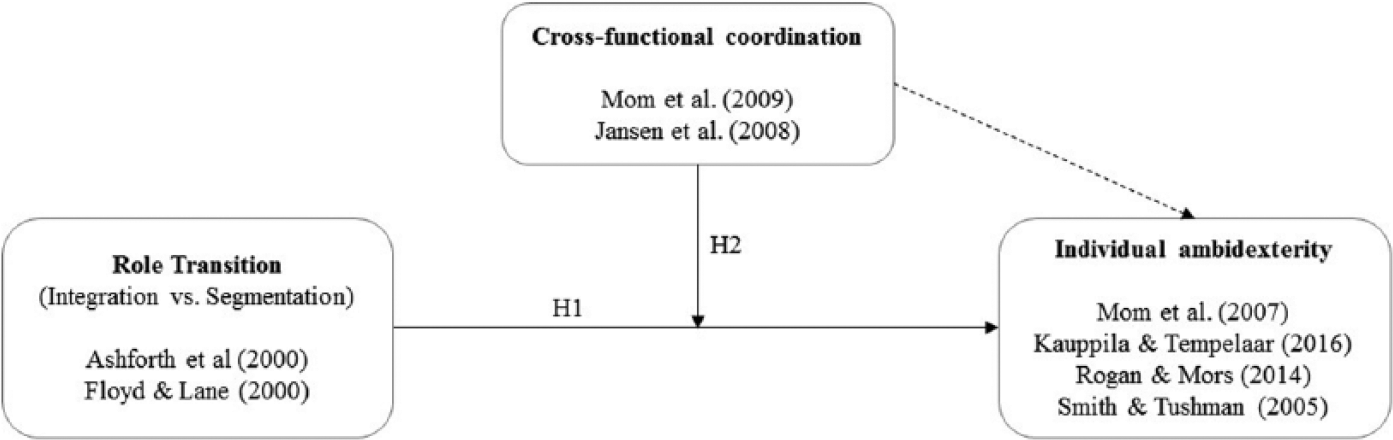
Theoretical Model
Method
To test our hypotheses, we conducted a survey in two waves among strategic account managers (SAMs). SAMs focus on sustaining long-term strategic customer relationships. They are a particularly fitting sample for our focus, since they must deal with a complex task environment within which they are required to work effectively across business units and functions, while creating value for, and with, customers. SAMs are natural candidates for research on role transition, because they inherently need to cater to distinct external and internal roles. Consequently, SAMs usually exhibit high role divergence, as they have to achieve alignment with both their strategic customers and a variety of internal “clients,” while also furthering the firm’s business strategy (Webster, Malter, & Ganesan, 2005). In doing so, SAMs are positioned to meet current demands as well as to probe future potential. Through their relationships, liaison activities, and dual foci, SAMs engage in both exploitation and exploration, allowing them to generate and integrate crucial knowledge for the organization. Consequently, effective SAMs lay the grounds for value creation through innovation, providing their organization with a competitive differentiation advantage (Piercy, 2009; Piercy, Cravens, & Lane, 2009). Because of their liaison activities, they often operate in cross-functional interfaces, often involving clients but also many internal functions, such as finance, operations, research and development, and many others.
We gained access to our sample through the support of the Strategic Account Management Association (SAMA), a worldwide nonprofit association for strategic account management. SAMA conducts and supports ongoing research in the field of account management. The association functioned as a platform to reach out to its members, which are globally representative of the field of strategic account management in terms of industry sectors, firm size, and geographic locations. To contact its members for research purposes, SAMA issued direct e-mails to members, rather than publicly communicating ongoing research. This way, SAMA generated higher response rates than through, for instance, publishing research initiatives on its webpage. At the same time, addressing its members directly via e-mail secures that only interested members participate, mitigating group pressure, social desirability biases, or pressure from supervisors who may be members of SAMA. To ensure commitment from participating SAMs, we provided an initial communication that was circulated through SAMA’s network, but we also reemphasized our purpose on the landing page of our online survey. As a further measure to motivate long-term commitment to our study, we promised an individualized report for each participant. In line with ethical standards, confidentiality of results was assured.
We conducted the survey in two waves. First, we collected data on our independent and moderator variables; then, after an intentional hiatus of 6 months, we surveyed our dependent variable. Separating surveys in such a manner helps mitigate common method bias and introduces an element of time into the model. When we collected our data, SAMA had about 3,000 members, of which about 900 people (35%) were SAMs. The remaining members were academics, consultants, top management members, or other sales executives not vested in an account responsibility. In the first wave, 342 SAMs took part (38% response rate); the second generated 134 responses (14.9% response rate). For our analysis, we included only SAMs who had answered questions in both waves, which brought our final sample size to 120 (13.3% response rate). Included SAMs were from multinational companies with an average size of 73,348 employees. The companies were from a wide range of industries: construction (5.8%); manufacturing (31.7%); information technology (11.7%); professional, scientific, or technical services (12.5%); chemicals, pharmaceuticals, and biochemicals (6.7%); other services (except public administration; 4.2%); and other industries (27.4%). The average age of SAMs was 42 years, 79% were male, and their average tenure was 12.7 years. We compared our initial first-wave response (without two-wave response) with our final two-wave response to check whether biases were present. We ran t tests on the means of the two subsamples on gender, number of accounts, age, experience, internal coordination, role segmentation, and cross-functional coordination. None of the t values were significant, with the lowest being .220 and the highest 1.328.
Measures
Unless otherwise indicated, our items are measured on a scale ranging from 1 (strongly disagree) to 7 (strongly agree). A full list of the utilized scales and associated items can be found in the appendix at the end of this study.
Individual ambidexterity
To capture SAMs’ individual ambidextrous behavior, we used the scales for exploratory and exploitative behavior as developed by Mom, Van den Bosch, and Volberda (2007). SAM exploitative behavior is measured by seven questions pertaining to the extent to which SAMs engage in tasks they are familiar with, that they consider routine, or that build on existing knowledge. Conversely, the seven-item scale for exploration captures the degree to which SAMs engage in activities that require them to pursue novel knowledge or engage in tasks they consider nonroutine or for which the outcome is unclear. An exploratory factor analysis of the 14 items combined forced us to omit two from the exploration scale and one from the exploitation scale (indicated in the appendix). This yielded a two-factor solution with five items for exploration (α = .73, composite reliability [CR] = 0.83, average variance extracted [AVE] = .50) and six for exploitation (α = .85, CR = 0.90, AVE = .58), with loadings above .52 and cross-loadings below .053. We calculated the average for each scale, thus creating exploratory and exploitative behavior variables. Finally, in accordance with previous studies (Gibson & Birkinshaw, 2004; Mom et al., 2009), we multiplied exploration and exploitation to create a variable for SAM individual ambidexterity.
Role integration/segmentation
We measured SAMs’ inclination for role segmentation or integration by adapting Edwards and Rothbard’s (2000) scale. This is an established scale that has demonstrated robust results when used in prior research (Edwards & Rothbard, 2000; Rothbard et al., 2005). Our four-item scale was adapted to fit the SAM context and capture the extent to which SAMs integrate their company and client roles. Here, the basic assumption is that SAMs have at least two overarching, pervasive roles. First, each has an internal role in which they focus on internal demands, such as realization of strategy, performance criteria, and so on. However, they also have an external, client-oriented role. In this capacity, they are expected to cater to the demands posed by the account, such as quality, on-time delivery, product development, and so on. These roles lie at the heart of the boundary-spanning nature of SAMs (Piercy, 2009). As such, we expect the extent to which SAMs segment or integrate both roles to be fundamental to their functioning. We omitted one item to increase reliability (α = .82, CR = 0.90, AVE = .74). Exploratory factor analysis resulted in a single-factor solution with all loadings above .82.
Cross-functional coordination
The extent to which SAMs hold multiple roles is partially a function of the extent to which they are involved in intraorganizational coordination. Coordination mechanisms, such as cross-functional teams, bring together actors from different backgrounds, with different expertise and different behavioral expectations. As such, the more a SAM is part of such coordination, the more he or she will be exposed to diverse role expectations. Our four-item measure for cross-functional coordination (Gupta & Govindarajan, 2000) captures the extent to which SAMs function in teams and whether they coordinate across internal functional boundaries. Initial exploratory factor analysis indicated we had to drop one item (indicated in the appendix). The final three-item scale (α = .70, CR = 0.84, AVE = .63) resulted in a single-factor solution with all loadings over .74.
Control variables
To rule out alternative explanations, we included several control variables. First, we controlled for age and gender, since past research has shown these to have an effect on innovative behavior. Second, we included a control variable for tenure. Experience is considered an indicator of expertise but can also lead to habitual behavior (Mascitelli, 2000). Third, the number of accounts a SAM has may influence the extent to which he or she experiences conflict or is required to divide attention among several contexts and, potentially, roles. Such effects have an impact on the individual ability to exploit and explore (Floyd & Lane, 2000). Fourth, we controlled for internal coordination, which captures the extent to which different departments and hierarchical levels are involved in the coordination of the account (Shi, White, Zou, & Cavusgil, 2010; α = .74, CR = 0.85, AVE = .65). Such coordination may influence the leeway SAMs have to engage in exploration. Fifth, we included firm size, since past research has shown this to have an effect on innovation and performance. Finally, to capture industry-specific dynamics, we included industry dummies for construction; manufacturing; information technology; professional, scientific, or technical services; chemicals, pharmaceuticals, and biochemical; other services (except public administration); and other industries.
Further Psychometric Assessment of Measurements and Robustness Checks
Besides testing the reliability and validity of our individual measures, we ran some additional tests. First, we carried out an integrated exploratory factor analysis with all the retained items for our independent and dependent variables. In line with expectations, this resulted in a four-factor structure with all items loading appropriately above .50 and cross-loadings below .37. Second, we observe that all our AVE scores were higher than the maximum shared variance and average shared variance between our variables, and the square roots of our AVE scores were also significantly higher than correlations. Finally, confirmatory factor analysis with all the items loading on the appropriate factors yielded an adequate fit (χ2 = 158.08, p < .01, root mean square error of approximation = 0.058, incremental fit index = .93, comparative fit index = .93). This provides further evidence of both convergent and discriminant validity of our measures.
Next, we assessed common method variance. First, we took care to mitigate common method bias through our research design in three ways (Podsakoff, MacKenzie, & Podsakoff, 2012; Podsakoff, MacKenzie, Lee, & Podsakoff, 2003): (a) We separated our survey in two waves, with Wave 1 containing independent variables and Wave 2 containing dependent variables; (b) we assured anonymity of our respondents and asked them to be conscientious when answering the questions; and (c) the SAMs in our sample have considerable expertise and experience, which should ensure an appropriate assessment of our survey questions. Second, to determine whether common method bias was still an issue, we also ran two additional tests: Harman’s one-factor test and a common latent factor test. With Harman’s one-factor test, there is reason to suspect significant common method variance if (a) a single factor will emerge from the factor analysis or (b) one general factor will account for the majority of the covariance among the variables (Podsakoff et al., 2003). We ran a principle axis analysis and principle component analysis with varimax rotation using all survey variables from our model. Both methods yielded a four-factor solution with the first factor accounting for 23.33% of total variance. We also ran an unrotated factor analysis with all the items of our independent and dependent variables with the number of factors constrained to one. This factor explained 22.95% of total variance. Thus, we have little reason to believe our results are heavily influenced by common method bias. Next, we tested for common method variance by introducing a common latent factor. By comparing the difference between standardized regression weights with and without the common latent factor, one can assess the extent to which common method variance is a concern (Podsakoff et al., 2003). The largest difference between these values was −0.061. Finally, by squaring the estimate for our latent factor, we can derive the common variance. In our case, this yielded a percentage of 3.9%. These tests, paired with our research design, give us the confidence that our results are not likely to be influenced by common method bias.
Finally, we checked for endogeneity. Conceptually, since role segmentation is an individual traitlike preference, it is not very conducive to change. This makes the reverse direction unlikely from a theoretical point of view. To assess endogeneity, we first followed Bascle (2008) and Heavey and Simsek (2014) and correlated our independent variables with the error term from our regression model. They were uncorrelated, yielding a first indication that endogeneity is not likely to be present. We also ran a Granger test to ascertain whether causality was directional, bidirectional, or not present (Granger, 1969). To test for this, we regressed ambidexterity on its lagged values alone and both its lagged values and the lagged values of role segmentation. To test reverse causality, we regress role segmentation on its lagged values alone and both its lagged values and the lagged values of ambidexterity. The first test yielded a weakly significant relationship (F = 3.39, p < 0.1), whereas the second test yielded an insignificant result (F = 0.67, ns). This provides us with some confidence that, at least, segmentation is not driven by ambidexterity. Because Granger’s test does not account for nonlinear relationships, we checked if our assumption of linearity was flawed by checking for a curvilinear effect of role segmentation on ambidexterity in our regression analysis. This yielded an insignificant effect (β = –.002, ns). To conclude, we have both theoretical and empirical reasons to assume endogeneity is not a major concern.
Analysis and Results
Before running our analyses, we checked for multicollinearity using variance inflation factors (VIFs). The maximum VIF in our models was 1.587, which is well below the cutoff point of 4 (O’Brien, 2007). Table 1 shows the means, standard deviations, and correlations for all variables in our model. To test our hypotheses, we ran ordinary least square regressions on our two-wave data set (lagged by 6 months), the results of which are included in Table 2. Model 1 includes control variables only. Model 2 introduces our independent variable, role segmentation, which is a significant addition (ΔF = 4.25, p < .05). Model 3 adds the direct effect of our moderator (without our independent variable), which is a significant addition to Model 2 (ΔF = 3.98, p < .05). Finally, Model 4 includes all our variables, including the moderation effect, which constitutes a significant addition compared to Model 3 (ΔF = 7.47, p < .001). In the following, we discuss the results from Model 4.
Means, Standard Deviations, and Correlations
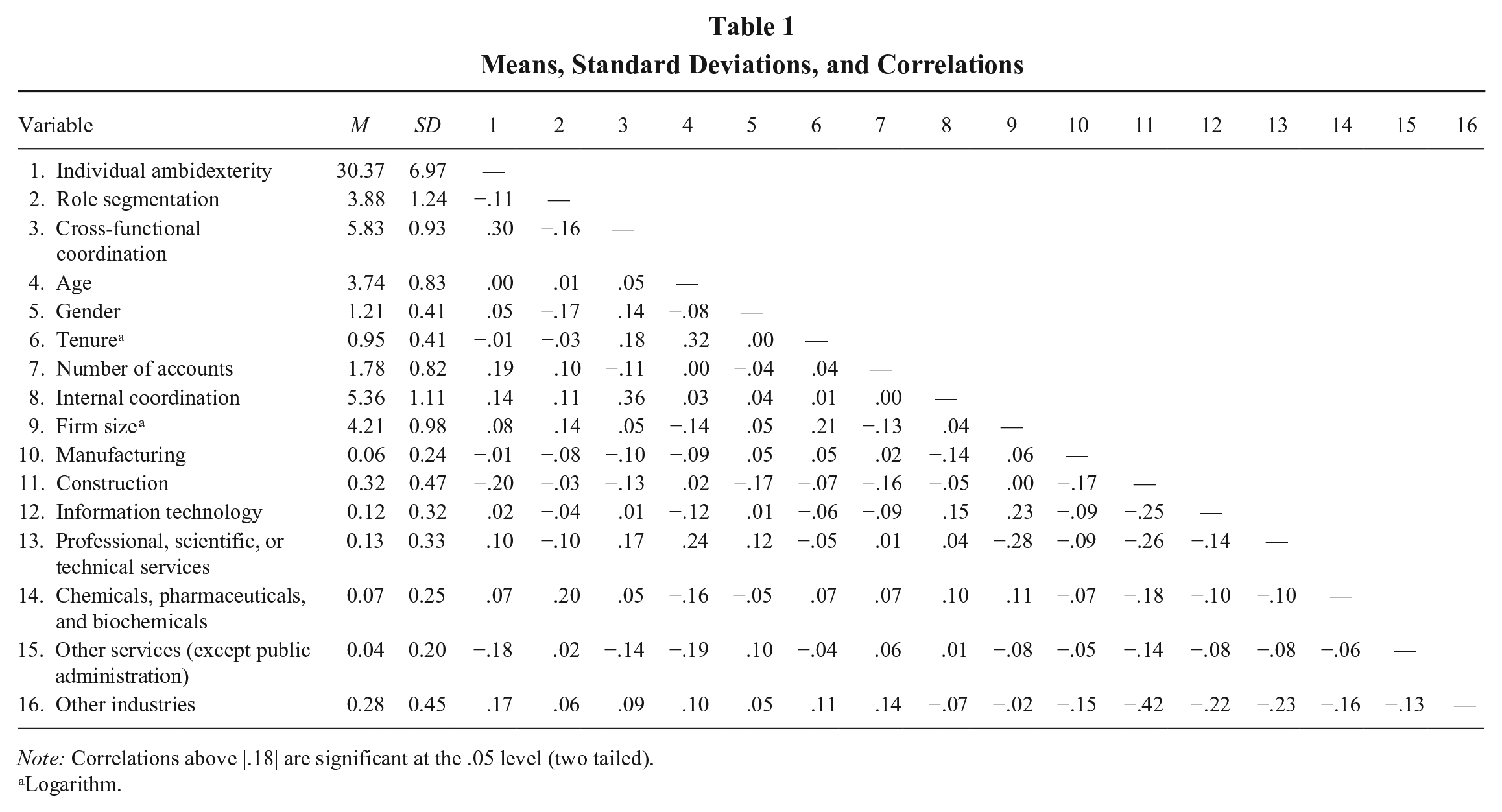
Note: Correlations above |.18| are significant at the .05 level (two tailed).
Logarithm.
Stepwise Regression of Role Transition and Cross-Functional Coordination on Individual Ambidexterity
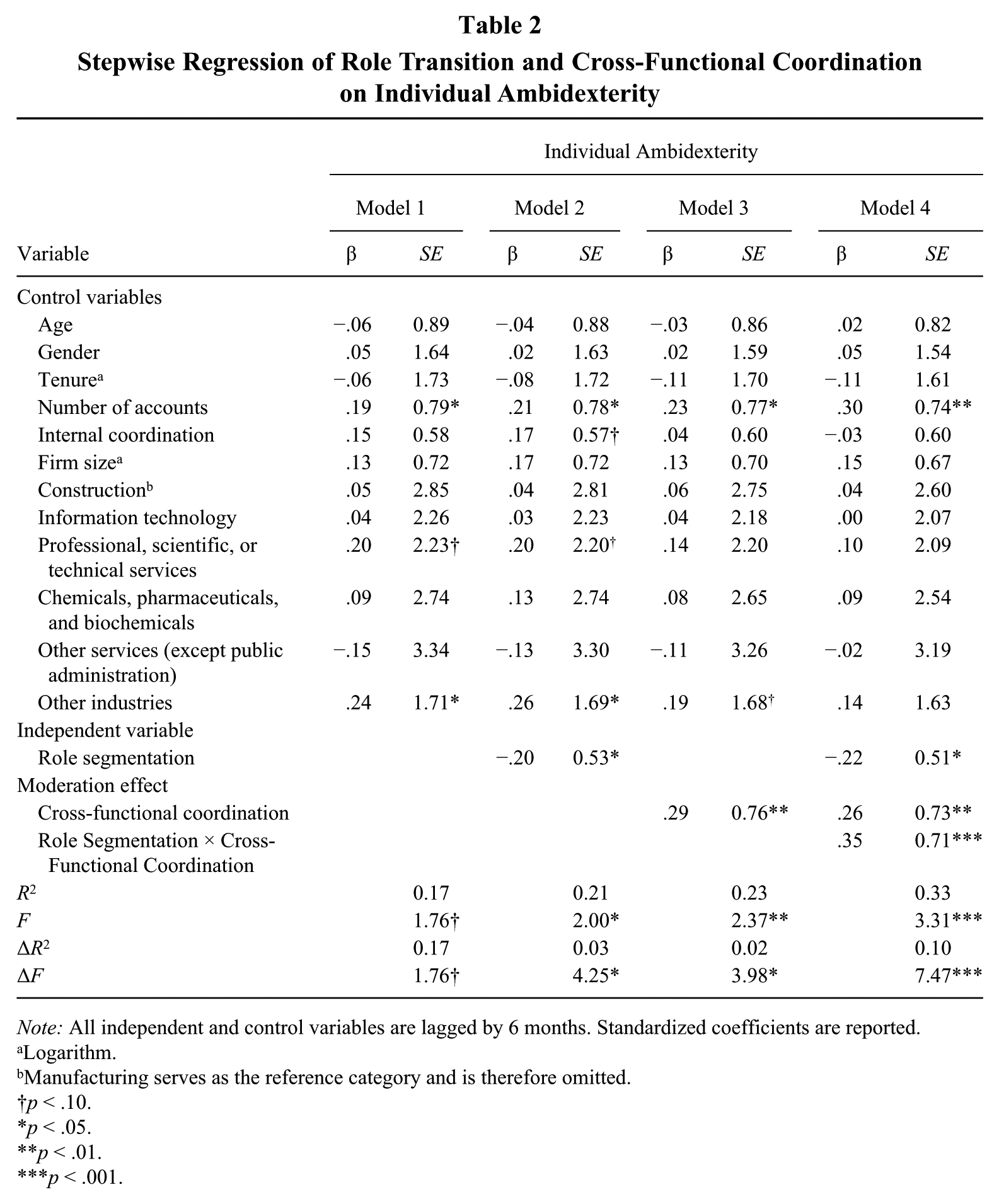
Note: All independent and control variables are lagged by 6 months. Standardized coefficients are reported.
Logarithm.
Manufacturing serves as the reference category and is therefore omitted.
p < .10.
p < .05.
p < .01.
p < .001.
Hypothesis 1, a negative (positive) effect of role segmentation (integration) on individual ambidexterity, was supported (β = –.22, p < .05). Role segmenters have difficulty crossing exploratory and exploitative boundaries, while role integrators are able to view exploration and exploitation as being more similar, allowing them to switch between them more comfortably. Finally, Hypothesis 2, which predicted a positive effect of cross-functional coordination on the relationship between role segmentation/integration and individual ambidexterity, was also supported (β = .35, p < .001). Figure 2 depicts the interaction effect.
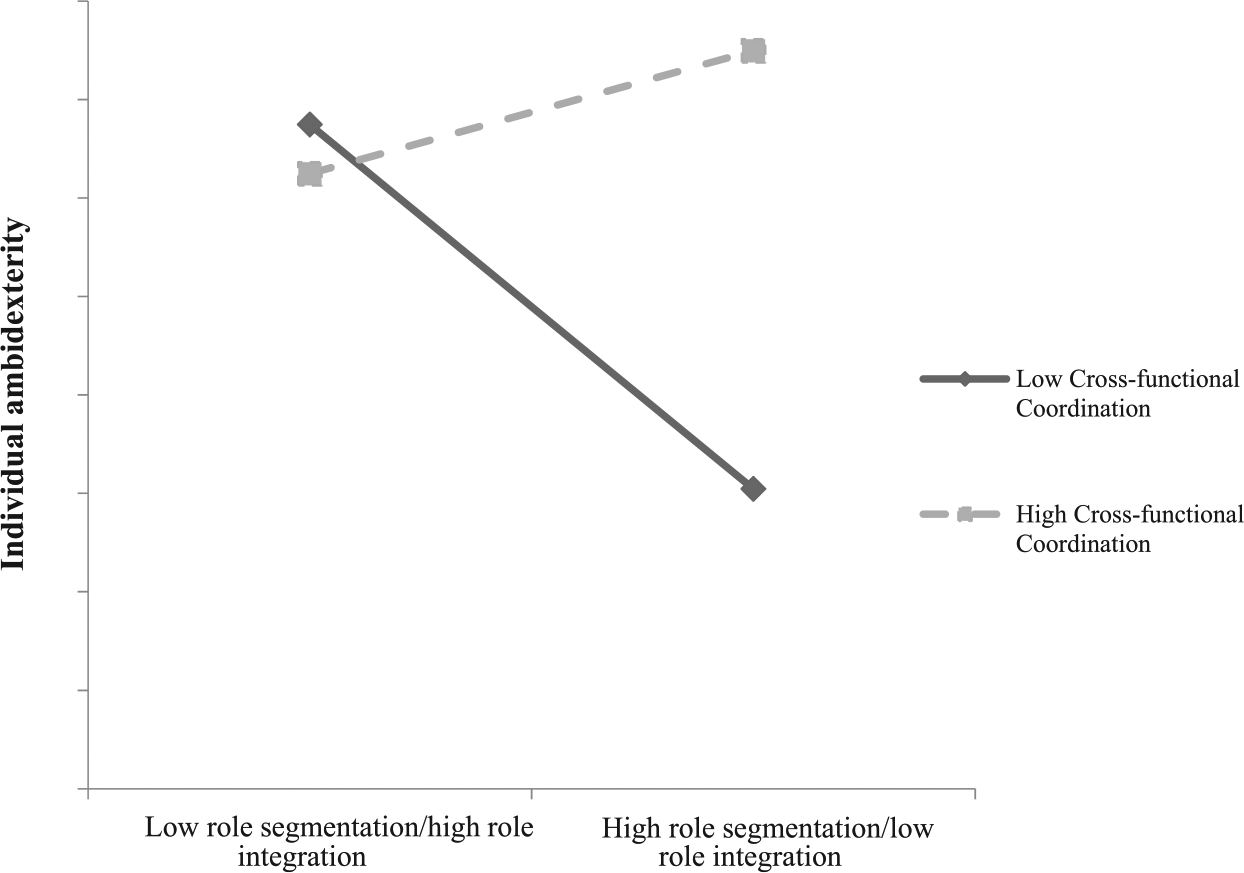
Interaction Effect of Role Transition and Cross-Functional Coordination on Individual Ambidexterity
At low levels of cross-functional coordination, the slope is negative. Thus, when role segmenters are not exposed to the diversity that cross-functional teams offer, they have trouble attaining ambidexterity. Conversely, when cross-functional coordination is high, the slope tilts toward a positive angle. This indicates segmenters do better in a more ambiguous role environment and find it much easier to behave ambidextrously in such a multirole context. For role integrators, the effect is reversed. Individuals with a preference for integration are best not positioned within cross-functional teams when pursuing ambidexterity, as it will be detrimental for their ability to do so.
We also ran the model using the additive of exploration and exploitation as individual ambidexterity variables, since this has been done in the past (Heavey & Simsek, 2014; Jansen et al., 2009; Lubatkin et al., 2006). This replicated the results from the multiplicative version, with significant support for both Hypotheses 1 (β = –.23, p < .05) and 2 (β = .34, p < .001).
Interestingly, our results also replicate the direct influence of cross-functional coordination on ambidexterity (Jansen et al., 2009; Mom et al., 2009). To explore the role of individuals versus organizational means to achieve ambidexterity, we conducted a z test as described by Clogg, Petkova, and Haritou (1995). This test divides the difference between two coefficients by the square root of the added squared standard errors of the coefficients. Using this procedure, we can test whether the coefficient for role segmentation in Model 2 is significantly different from the coefficient for cross-functional coordination in Model 3. This yielded an insignificant z value of −1.172. This means that in our study, the contingent (moderating) role of cross-functional coordination notwithstanding, role transition and cross-functional coordination are statistically equal in their impact on ambidexterity.
Discussion
Organizational ambidexterity is vitally important for corporate renewal and adaptation, which in turn are considered strong drivers of firm survival and overall market performance (Benner & Tushman, 2015). Ambidextrous individuals are in a unique position to contribute to organizational ambidexterity. They bridge boundaries between work roles, organizational divisions, and social groups, and are often required to deal with opposing intentions, distinct bodies of knowledge, and possibly conflicting expectations. As such, they are faced with a challenge. On the one hand, their task is to operate between multiple role boundaries and integrate demands or knowledge; at the same time, they must differentially cater to stakeholders within their respective role domains. Individuals who behave ambidextrously are more creative and innovative; at the same time, however, they do not lose sight of the status quo and associated performance criteria (Kauppila, 2010; Mom et al., 2007; Raisch et al., 2009; Rogan & Mors, 2014).
This article adds to the ambidexterity literature by theorizing a model through the lens of identity theory, which posits that individual role predispositions directly influence how activities are performed. Role theory provides a nuanced and parsimonious lens to describe how within and across organizational entities, multiple identities may exert influence over individual members.
Theoretical Implications
We contribute to existing literature in three distinct ways. First, we develop a concrete logic to account for when individuals may be able to deal with the conflicting demands of exploitation and exploration. In particular, we explain when individuals are capable of translating different roles and therefore interpreting knowledge embedded in a multiplicity of roles (Floyd & Lane, 2000). By investigating how actors define, select, and enact roles, we are able to identify microlevel dynamics of the integration of exploitation and exploration. Most ambidexterity research focuses on some combination of separation and integration mechanisms to capture synergetic value between exploration and exploitation (Mom et al., 2007; Raisch & Birkinshaw, 2008; Sheremata, 2000). Our research indicates that from an individual role-transition perspective, integration is a sufficient condition for individual ambidexterity. Role integrators have a natural advantage in combining exploitation and exploration. Their ability to overlap different role domains and recognize the merits of different knowledge pools mitigates potential silo thinking within role domains. This stands in stark contrast to role segmenters, who are rather conflicted by simultaneous and diverging demands. As such, they need a clear mandate with clearly defined boundaries. In this respect, what constitutes a boundary becomes a point of attention. Prior organizational ambidexterity literature refers to “boundaries” as the divisional, occupational, disciplinary, organizational, or hierarchical gaps that must be bridged in order to achieve ambidexterity (e.g., Raisch et al., 2009). Kauppila (2010), for instance, describes how, within a large Finnish company, a major challenge was to overcome divisional and organizational boundaries in order to integrate exploratory and exploitative efforts. For individuals, however, striving to integrate different knowledge domains for ambidexterity requires an understanding and management of knowledge boundaries more than legal or structural demarcations (Carlile, 2004; Orlikowski, 2002). The way such boundaries are drawn and executed may depend largely on idiosyncrasies among individuals, as our research confirms. Taking a role identity perspective, paired with the notion of role transition styles, allows us to account for perceptual boundary drawing, as “people in an organization execute their tasks most of the time by following a set of skills, responsibilities, and rules that define a role” (March, 1994: 60–61). Thus, by adopting a role transition lens, we contribute to a clearer understanding of what drives a sphere of activities through knowledge, tasks, cognitive abilities, or disciplinary skills.
Second, our results provide a nuanced image of the joint impact of organizational and individual drivers of individual ambidexterity. Segmenters may compensate for their shortcomings when engaged in intense cross-functional coordination. Role integrators, on the other hand, do not function as well under such conditions, as they are more susceptible to role overload and ambiguity in a multirole environment. As a result, they are less likely to achieve high levels of ambidexterity via cross-functional coordination. In the broadest sense, this caters to a stream of research within ambidexterity that assumes that individual employees may act ambidextrously within a favorable context (Gibson & Birkinshaw, 2004). We find support for this notion, provided that individual characteristics are properly taken into account in the context’s design—specifically, so that a favorable context is provided for both role integrators and role segmenters. Besides this interaction effect, significant direct effects of both role transition and cross-functional coordination provide evidence that individual mechanisms as well as organizational mechanisms are valid explanations for individual ambidexterity. Our comparative analysis of both coefficients underlines that role transition and cross-functional coordination are equal in their impact on individual ambidexterity. However, the dramatic shift in slope of our interaction effect is an indication that role transition and cross-functional coordination should not be considered separately. More specifically, these results show that integration mechanisms are relevant at different levels within the organization. If integration is generated at the individual level (i.e., role integration), this is sufficient. If differentiation (i.e., role segmentation) is mostly present at the individual level, it should be compensated with organizational integration mechanisms, such as cross-functional coordination. This has the potential to inform future research on ambidexterity, as it advocates a bottom-up perspective on ambidexterity: Heterogeneity at the individual level matters and is an important determinant of the success of organizational solutions for ambidexterity (Eisenhardt et al., 2010; Raisch et al., 2009; Rogan & Mors, 2014).
Third, when explaining ambidextrous conduct, prior research has concentrated on specific groups of individuals. In particular, senior managers and top management team members have enjoyed the most scholarly attention. However, neglecting whether and how individuals across the organization may support organizational ambidexterity through their individual activities is unwarranted and overly limiting. For example, Adler, Goldoftas, and Levine (1999) describe how distributed decision making within a joint venture between Toyota and GM allowed them to combine superior efficiency with superior flexibility. With our findings, we support efforts to widen the scope of individual ambidexterity and to examine psychological and sociological antecedents that may explain individual ambidexterity throughout an organization (e.g., Kauppila & Tempelaar, 2016; Rogan & Mors, 2014).
Managerial Implications
Based on our results, there are a few practical guidelines that could enhance the individual capacity to engage in exploration, exploitation, and ambidexterity. The first overarching takeaway for management is the necessity of exposing targeted organizational members to a variety of work roles. Exposure to different role sets within the organization allows individuals to create divergent role identities, which function as the basis to allowing individual employees to engage in role transitions. There are many social, identity-shaping forces, such as customers, suppliers, shareholders, project teams, and managers (Ashforth, Rogers, & Corley, 2011). Establishing, for example, job rotation and the creation of liaison roles is key here.
Second, understanding how individuals prefer to manage a multirole portfolio allows for more effective placement to garner exploitative, exploratory, or ambidextrous behavior. When employees have a tendency toward specialization and a preference for clear guidelines, this may be an indicator of role segmentation. Without taking organizational solutions into account, these individuals are generally less suited to contribute to ambidexterity on their own. Conversely, individuals who seem to prefer an overarching, generalist approach and who revel in uncertainty may achieve ambidexterity on their own. Our results indicate role integrators should be allowed to roam relatively free so they can contribute to innovation processes. They have a unique ability to translate and transform exploratory and exploitative knowledge. In this capacity, they are able to act as linking pins between embedded actors who can offer in-depth, specialized knowledge. While role integrators are best left to their own devices, role segmenters have potential that can be unleashed through organizational integration mechanisms. They are excellent candidates for positions within coordinative bodies that straddle different functions and/or knowledge domains within organizations. As such, when managers staff cross-functional teams and initiatives, they do well to select employees beyond their formal functions and areas of expertise but also based on their role transition styles.
Thus, while some individuals can become ambidextrous through organizational means, by bringing together different areas of expertise and absorbing their knowledge, others may do so through individual action, by striking out on their own to seek relevant knowledge. These combined results speak to mixing and matching in terms of the positioning of individuals; determining how and when individuals are suited for cross-functional embedding or individual action becomes a key managerial task.
Limitations and Future Research Suggestions
There are several limitations and pathways for further inquiry that warrant attention. First, while we incorporate a time lag by employing a two-phase design, our data do not allow for a process-based approach. This could be an interesting avenue for future research. For instance, our research paints a portrait of the role integrator as a free-roaming agent. This may, however, have its limits. A consistently laissez-faire managerial style may lead to a more exploratory path (Jansen et al., 2008). As Levinthal and March (1993) point out, exploration and exploitation are self-reinforcing. Therefore, there may be little natural incentive for autonomous role integrators to pay sufficient attention to exploitation. This is in line with the work of Sheremata (2000), who posits that combining exploration and exploitation requires a balance between two sets of forces: those that drive individuals away from conventions and norms, and those that help them focus on the tasks at hand and associated norms. To conclude, it could be interesting for future research to incorporate a process-based, longitudinal lens to investigate the impact of individuals’ role transition styles.
Second, field studies are generally unfit to uncover causality. For further causal inquiry, the model presented in our study lends itself for a replication in an experimental setting. In replicating our study design, an experiment may test for role integration and role segmentation preferences and then design settings that replicate four scenarios: individual task execution by role segmenters and role integrators, respectively, followed by cross-functional team setups with role integrators and role segmenters. Testing for the effect of role integration and role segmentation in a lab experiment may allow to also further elicit the effect of role scope and number of available roles within one’s role identity portfolio.
Third, we assume that an individual’s ambidextrous disposition is important for higher-level innovation. Future research could investigate the boundary conditions of types of roles and knowledge of our antecedents as well as our assumed relationship between individual ambidexterity and higher-level innovation. For instance, when technological distance between role domains is considerable, the integrator may be better suited individually for integrating knowledge. However, this may go beyond the abilities of an individual, thus warranting a team effort, which poses role overload challenges for the integrator. In such a situation, a segmenter would be more suitable.
Fourth, our research may provide input for multilevel examinations of the effectiveness of individuals in ambidextrous organizations. Ambidextrous firms employ integration mechanisms (Tushman & O’Reilly, 1996). Individuals who are subject to such mechanisms may need to exhibit ambidextrous behavior (Birkinshaw & Gibson, 2004). Cross-functional teams are considered a key organizational mechanism for firm-level ambidexterity (Jansen et al., 2009; Raisch & Birkinshaw, 2008). In these environments, integrators are stifled in their pursuit of individual ambidexterity, and segmenters outperform them. Conversely, ambidexterity researchers have shown the benefits of less directed mechanisms, such as connectedness (Jansen et al., 2009) and trust (Gibson & Birkinshaw, 2004). It would be interesting to investigate such multilevel contingencies between organizational and individual characteristics.
Last, we facilitated our research through the support of a single organization, SAMA. SAMA functions as a platform to reach organizations globally that conduct strategic account management. In fact, gaining the support of SAMA in conducting our research allowed us to reach companies more effectively and in a way that would otherwise be impossible to accommodate. Finally, the member base of SAMA counts members from a very wide array of industry sectors (i.e., as classified by Standard Industrial Classification) and also company size, ranging from midsized companies to large multinationals. But we need to point to the limitation that ultimately only those organizations being a member of SAMA were able to take part in this study.
Conclusion
Extant literature highlights the challenges of ambidextrous individuals navigating different organizational domains, with their associated knowledge, norms, and cultures (Benner & Tushman, 2015; Kauppila & Tempelaar, 2016). By taking a role transition perspective, we are able to reflect on the notion that the perception of role boundaries is an important driver for individual ambidextrous behavior. In this, we found that different types of individuals are fit for different circumstances. As such, we contribute to research on ambidexterity by advocating an interactionist perspective. Organizational approaches to ambidexterity may prove effective or detrimental, depending on individual characteristics.
Footnotes
Appendix
Acknowledgements
This article was accepted under the editorship of Patrick M. Wright. The authors contributed equally to the manuscript and both are co–first authors. We appreciate the feedback provided by Ingrid Nembhard, Lori Rosenkopf, Stefano Brusoni, and Kinde Wubneh. We are also very thankful for the comments made by action editor J. Craig Wallace and two anonymous reviewers. Data collection was supported by the Strategic Account Management Association, for which we are grateful. An earlier version of this article was presented at the Academy of Management Annual Meeting, Anaheim, California, in August 2016.