




Abstract
Following the turn to practice in organization theory and the emerging interest in the microfoundations of ambidexterity, understanding the role of individuals in realizing ambidexterity approaches becomes crucial. Drawing insights from Greek philosophy on paradoxes, and practice theory on paradoxes and ambidexterity, we propose a view of individual ambidexterity grounded in paradoxical practices. Existing conceptualizations of ambidexterity are largely based on separation strategies. Contrary to this perspective, we argue that individual ambidexterity can be accomplished via paradoxical practices that renegotiate or transcend boundaries of exploration and exploitation. We identify three such paradoxical practices at the individual level that can advance understanding of ambidexterity: engaging in “hybrid tasks,” capitalizing cumulatively on previous learning, and adopting a mindset of seeking synergies between the competing demands of exploration and exploitation.
Introduction
Organizational ambidexterity is seen as a dynamic capability for adapting to a complex and shifting competitive landscape (O’Reilly & Tushman, 2008). The ambidexterity concept is grounded in the assumption that organizations have to pursue the complementary yet contradictory goals of exploration and exploitation (Duncan, 1976; March, 1991; Tushman & O’Reilly, 1996). Exploitation allows organizations to build on and extend core competencies whereas exploration allows for growth and adaptation through the search for new opportunities and resources (March, 1991). A singular focus on exploitation of existing resources and competencies runs the risk of inertia and stagnation, whereas a singular focus on exploration would prevent any meaningful exploitation of inventions (Levinthal & March, 1993).
Research on organizational ambidexterity to date has predominantly focused on organizational-level solutions to balancing the tensions of exploration and exploitation. Dominant approaches include structural separation (Tushman & O’Reilly, 1996) or temporal separation (Romanelli & Tushman, 1994), or through building a supportive organizational context that enables individuals to alternate between exploration and exploitation as they see fit (Gibson & Birkinshaw, 2004). Whereas these organizational-level approaches have gained considerable attention from scholars, what has not been adequately addressed is that each of these approaches is predicated on the contributions of individuals. Despite growing recognition of the fundamental role of individuals in organizational ambidexterity (O’Reilly & Tushman, 2013; Raisch et al., 2009) relevant empirical research is scarce, scattered, and fragmented across different ambidexterity approaches with limited cross-fertilization among insights and findings.
Contextual ambidexterity, for example, relies on actors being able to select how to best focus their energies at any given time so that their actions in aggregate address both exploitation and exploration demands (Burgess et al., 2015; Gibson & Birkinshaw, 2004). Structural ambidexterity relies on senior managers developing an ambidextrous mindset, with the cognitive ability to hold ambidexterity tensions over time and reallocate resources accordingly (O’Reilly & Tushman, 2011). With respect to temporal ambidexterity, the strategic actions and investments that shape punctuated equilibrium processes that enable temporal separation of focus, are occasioned by senior executives’ decisions and led by senior and middle managers (Tushman et al., 2015). Individual ambidexterity therefore lies at the heart of managing the organizational tensions between exploration and exploitation. Yet to date we have limited understanding of how individuals themselves deal with these conflicting demands and contribute to organizational ambidexterity (Birkinshaw & Gupta, 2013; Keller & Weibler, 2015).
By shedding light on the microfoundations of ambidexterity, paradox theory offers a promising avenue for exploring cognitive and behavioral aspects of how individuals may deal with contradictory demands (Andriopoulos & Lewis, 2009; Papachroni et al., 2015, 2016; Smith & Tushman, 2005). Shifting from an either/or to a both/and lens, paradox literature offers valuable insights for conceptualizing exploration and exploitation tensions not as necessarily mutually exclusive but as dynamic, interwoven polarities (Lewis, 2000; Papachroni et al., 2015). In this context, individuals’ role is likely to involve the need for paradoxical cognition (Miron-Spektor et al., 2011) as a dynamic capability; at least in cases where a temporal switch between exploration and exploitation efforts is not possible, sufficient, or warranted.
In the context of insights from the practice turn in organization theory and the social sciences (Bourdieu, 1990), our analysis is informed by recent work on practical rationality (Sandberg & Tsoukas, 2011) and practice theory (Schatzki, 2000, 2005). A practice approach to managing tensions, consistent with paradox theory, challenges dominant approaches to ambidexterity that assume an inherent contradiction between exploration and exploitation and mutual incompatibility of relevant capabilities. Individuals’ practices of ambidexterity display a more nuanced and dynamic perspective of how tensions are perceived and managed.
In response to calls that urge us to explore the microfoundations of ambidexterity, we therefore develop a practice approach of managing tensions that acknowledges the meaningful, pragmatic context into which practitioners are immersed, the situational uniqueness characteristic of the tasks practitioners undertake, and the temporal dimension as experienced by practitioners (Sandberg & Tsoukas, 2011).
Specifically, we argue that individual ambidexterity can be enacted via three paradoxical practices that renegotiate or transcend boundaries of exploration and exploitation. These practices are, first, engaging in “hybrid tasks” that accomplish dual goals; second, by seeking synergies between exploration and exploitation; and third, by pursuing actions that cumulatively and over time capitalize on previous efforts. These practices bring forward an alternative approach to how ambidexterity can be theorized and researched that challenges the underlying assumption of inherent contradictions between exploration and exploitation (March, 1991). This assumption entails a binary either/or approach to managing tensions at the individual level through structural or temporal separation, yet individual practices transcend these assumed contradictions.
Drawing from paradox theory, we move individual ambidexterity from an assumption of dualism between exploration and exploitation to a view of a dynamic duality between them. This view conceptualizes exploration and exploitation processes as dynamic polarities rather than as static contradictions. We advance ambidexterity theory by proposing an approach to tension management that is grounded in practices. Furthermore, this approach views paradoxes not as something merely conceptual or nebulous, but as something people can engage with through their daily actions and work life. Together these paradoxical practices animate a dynamic and flexible approach to nested tensions that individuals navigate in response to their context and based on their own perceptions of time, resources, and capabilities. A practice lens of individual ambidexterity aims to complement current macrolevel and tactical approaches to ambidexterity with a more nuanced and processual view. Such a view reflects more closely and pragmatically how individuals negotiate ambidexterity tensions in practice, and offers concrete behavioral strategies for transcending the assumed contradictions.
Recovering the Role of the Individual in Organizational Ambidexterity
In the following section, we discuss some of the key themes emerging from the organizational ambidexterity literature with a focus on recovering the role of individuals. We then discuss the underlying assumptions of bipolarity that have guided how individual ambidexterity has been theorized and researched to date, and how a practice perspective at the individual level challenges and transcends these assumptions.
Ambidexterity as a Dynamic Managerial Capability: Insights From Structural Ambidexterity
Initial interest in organizational ambidexterity placed an emphasis on the macrolevel aspects of balancing exploration and exploitation through separation of organizational subunits (Tushman & O’Reilly, 1996). With respect to the individual level, structural ambidexterity holds that senior management actors should act as a form of “corporate glue” that can manage tensions as they arise. In this context, studies conceptualize ambidexterity as a dynamic managerial capability based on paradoxical cognition (Smith & Lewis, 2012; Smith & Tushman, 2005). From this perspective, managing successfully a complex business model such as an ambidextrous organization depends on leaders’ ability to make dynamic decisions, build commitment to dual overarching visions and agenda-specific goals, learn actively at multiple levels, and engage in conflict resolution (Smith et al., 2010).
A related stream of research focuses on the role of senior management in promoting ambidexterity within the whole organization rather than simply managing tensions arising between explorative and exploitative subunits. Nemanich et al. (2007) explored the role of transformational leadership in promoting ambidexterity, while Jansen et al. (2016) argued that senior executives may play an important role in facilitating the emergence of ambidexterity at lower hierarchical levels through “the encouragement, of initiatives, the clarification of individual responsibilities, the provision of clear and complete performance evaluation feedback and the emphasis on a strong task orientation” (p. 948). Similarly, Kauppila and Tempelaar (2016) showed that employees exhibit higher ambidexterity when their group managers demonstrate a leadership style that couples strong managerial support with high performance expectations.
The role of actors is thus central to accomplishing organizational ambidexterity, through individual capabilities and practices. While calls have been made to research the role of microlevel practices of managing ambidexterity (Turner & Lee-Kelley, 2012), the structural ambidexterity perspective has predominantly focused on senior management, privileging a “managerial role rather than directing attention toward the individual interaction and operational microlevel work of an organization” (Stokes et al., 2015, p. s68).
Behavioral and Social Means of Ambidexterity: Insights From Contextual Ambidexterity
Further research shifted attention more explicitly to the individual level based on the notion that ambidextrous organizations need ambidextrous individuals who are able to understand and be sensitive to the demands of both exploration and exploitation practices (O’Reilly & Tushman, 2004). Contextual ambidexterity argues that both exploration and exploitation can be pursued within the same unit, as individuals “make their own judgments as to how best to divide their time between the conflicting demands” for exploration and exploitation (Gibson & Birkinshaw, 2004, p. 211). Gibson and Birkinshaw (2004) argue that ambidextrous behavior is characterized by the ability to take initiatives and recognize opportunities outside one’s field of expertise, the search for cooperation, the ability to hold multiple roles, and the ability to identify potential synergies. Similarly, Mom et al. (2009) define ambidextrous managers as multitaskers, able to host contradictions, and refine and renew their knowledge, skills, and expertise. More recent research has also recognized the role of front-line managers in resolving tensions that result from the pursuit of ambidextrous objectives (Zimmermann et al., 2018).
Microfoundations of Individual Ambidexterity
Research on the microfoundations of individual-level ambidexterity aims to answer the question of “what makes someone ambidextrous” (Raisch et al., 2009), by studying individual predispositions that support or hinder this capability (Laureiro-Martínez et al., 2015). Focusing on individual-level competencies and characteristics is expected to shed new light on why certain individuals are more effective than others in undertaking ambidextrous roles (Bonesso et al., 2014). A growing body of microlevel studies has approached individual ambidexterity from a cognitive perspective (Tempelaar & Rosenkranz, 2019) based on the premise that exploration and exploitation are distinct behaviors associated with different cognitive processes (Gupta et al., 2006; Laureiro-Martínez et al., 2015). In that context, individual ambidexterity is conceptualized as the simultaneous pursuit of exploration and exploitation activities within a single work role (Kauppila & Tempelaar, 2016) and is reflected in an individual’s capacity to engage with and shift between opposing tasks (Bledow et al., 2009; Smith & Tushman, 2005). This focus on shifting behavior is allied with the assumption of incommensurability between exploration and exploitation.
Current literature on the cognitive mechanisms that support ambidexterity is clustered around two key themes: First, paradoxical thinking that can enhance creativity and mitigate the risk of established cognitive frames (Hargrave & Van de Ven, 2016; Lewis, 2000; Miron-Spektor et al., 2011). Second, the use of single cognitively sophisticated solutions (Eisenhardt et al., 2010), whereby individuals switch between exploration and exploitation tasks over time (Adler et al., 1999). Further research has complemented these views with research into the antecedents of individual ambidexterity such as prior work experience and behavioral competency profiling (Bonesso et al., 2014). More recent studies into the microfoundations of individual ambidexterity that draw from the psychology and neuroscience (Good & Michel, 2013; Laureiro-Martínez et al., 2015) offer the prospect of an expanded understanding of how individuals in different contexts and organizational levels manage ambidexterity tensions.
Guiding Principles of Ambidexterity and the Role of Individuals
Two main principles have influenced how ambidexterity is theorized to date: First, that exploration and exploitation compete for scarce resources (March, 1991). Based on the argument that individuals’ intangible resources such as time and knowledge are limited, it is reasoned that individuals’ ability to attend to and develop sufficient competence in both exploration and exploitation is also limited (Ambos et al., 2008; Gupta et al., 2006).
Second, drawing from Duncan’s (1976) early arguments on the differential organizational characteristics needed in the initiation versus the implementation stages of innovation, that exploration and exploitation are opposing practices based on different and incompatible capabilities. Exploitation is associated mainly with efficiency, refinement, and implementation; whereas exploration is associated mainly with innovation and experimentation (March, 1991). Experimenting and exploring is more time consuming, entails uncertain results, and has longer time horizons than refining current knowledge and building on current competencies. Based on the above, individuals are assumed to need to switch between explorative and exploitative tasks (Kauppila & Tempelaar, 2016; Mom et al., 2009; Simsek, 2009), an assumption that research on individual ambidexterity to date has tended to follow.
Table 1 gives an overview of research on the role of individuals in different approaches to ambidexterity.
The Role of Individuals in Different Ambidexterity Traditions.
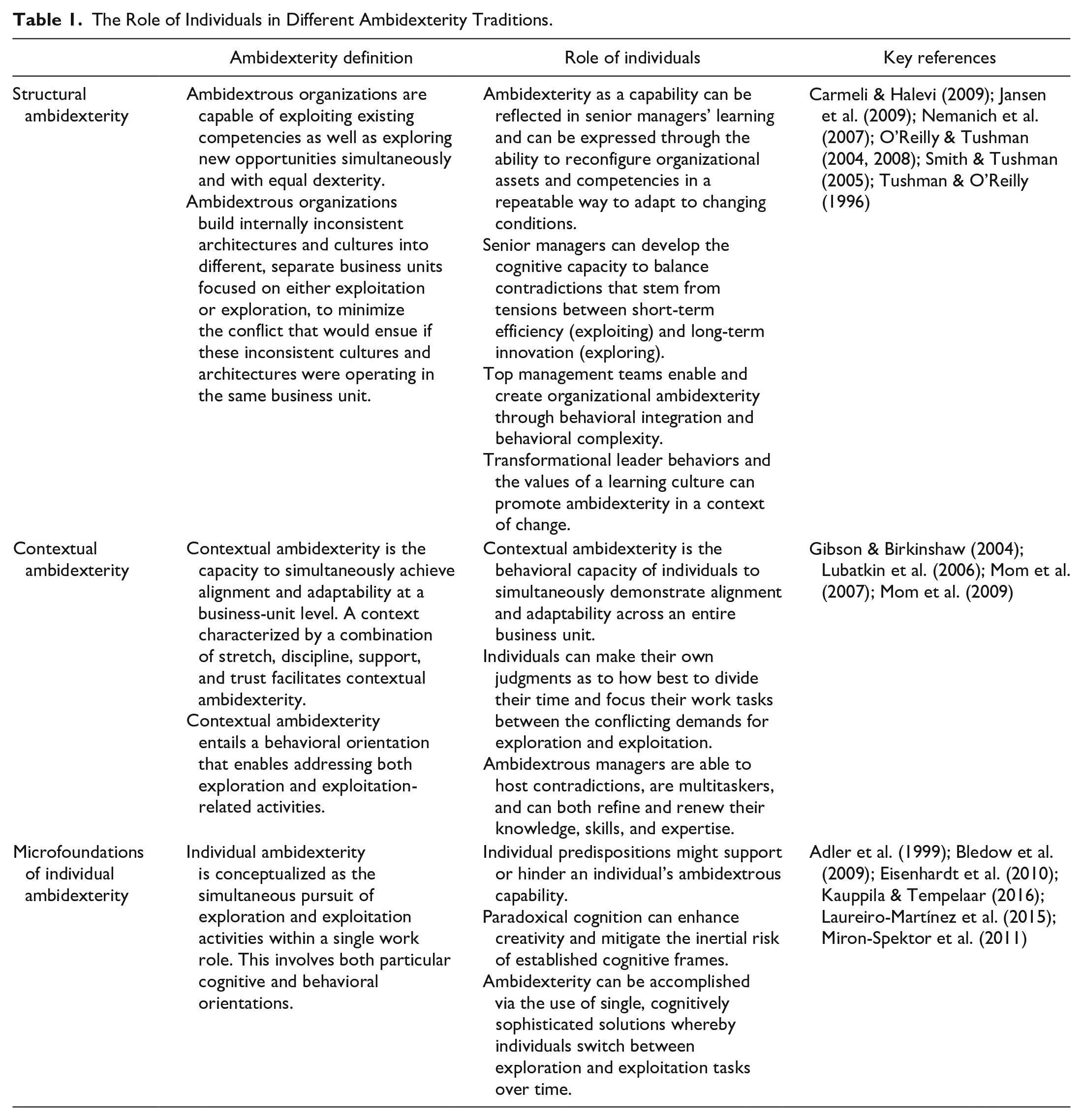
Ambidexterity conceptualizations, influenced by March’s (1991) seminal work, have highlighted the competing demands between exploration and exploitation. Suggested solutions based on structural, contextual, or temporal approaches have advocated separation between exploration and exploitation in terms of organizational units, agents’ actions, and temporal frames. We argue that adhering to separation thinking limits our understanding of how organizational practices may help to address ambidexterity tensions. Furthermore, a conceptual lens of paradox theory can take us beyond separation as a way to accomplish ambidexterity, toward duality thinking, the transcendence of tensions, and a longitudinal, dynamic, and synthetic interrelationship between poles (Papachroni et al., 2015). By bringing forward a practice lens to paradox theory, we untangle the complexities of managing contradictory demands in practice.
A Practice View of Managing Paradoxical Tensions
Within organization theory paradox is defined as “contradictory yet interrelated elements that seem logical in isolation but absurd and irrational when appearing simultaneously” (Lewis, 2000, p. 760). Paradoxes are often illustrated by the Taoist symbol of yin and yang, which depicts a duality that consists of two elements that although oppositional are also interconnected and mutually constitutive. This symbol can be seen as a representation of paradox given that two opposing elements are parts of a seamless whole. How is this synergistic whole achieved in practice? We turn to Greek philosophy to discuss one of Zeno’s famous logical paradoxes of motion, and a particular resolution by Diogenes, who brought forward a pragmatic yet ground-breaking response.
Paradox in Greek Philosophy
Defined literally, paradox denotes a statement that runs counter to ordinary expectations—from Greek paradoxon: from “para,” which means “distinct from,” plus “doxa,” which refers to popular opinion (Rescher, 2001, p. 3). Paradoxes had a prominent place in ancient Greek philosophy both as parts of complex philosophical arguments and as tools for engaging with or refuting philosophical theses. One of the famous logical conundrums of philosophy is Zeno’s “Achilles paradox” of motion: through a step of logical propositions Zeno argued that it would in fact be impossible for Achilles to overrun a tortoise’s head start. Zeno’s reasoning was the following:
To pass the tortoise, Achilles must first make up for the head start. But by the time he has covered that distance, the tortoise has moved ahead further. Achilles must therefore make up for that distance. But once Achilles has done that, the tortoise has moved again. Although this new distance is shorter, Achilles must still make up for it. But the enterprise of making up this endless sequence of distance debts is futile. Achilles cannot pass the tortoise because he cannot catch up infinitely many times. (Sorensen, 2003, p. 49)
Solvitur Ambulando: Reasoning Refuted by Experience
Paradoxes such as these have troubled philosophers for centuries. Their logical foundations were so well-argued that despite their apparent absurdity in terms of how we experience the world, Zeno’s paradoxes remained undisputed for a long time. However, Diogenes of Sinope, also known as “Diogenes the Cynic,” is said to have resolved Zeno’s paradoxes following an obvious yet ground-breaking method: by simply standing up and walking. This was famously reflected in the Latin phrase “solvitur ambulando,” meaning “it is solved by walking.” Diogenes’ pragmatic approach of actually walking the distance to demonstrate that Achilles can indeed surpass a tortoise that is also moving, brings forward the value of practice, in this case pitted against the power of semantics and closed, binary logic. Such an action by Diogenes was an expression of Cynical philosophy. According to Shea (2010), “the early Cynics mocked abstract principles and codified philosophies in favor of a lived philosophy” (p. 1). Such a “Diogenian approach” to organizational paradoxes would suggest that at least in practice, some paradoxes might not be as intractable as assumed.
A key implication is that rather than attempting to manage the inherent contradictions of exploration and exploitation through separation approaches, we could study practices that may resolve, reframe, transcend, or bypass paradoxes of ambidexterity. Adopting an irreverent, “cynical” stance toward assumed incommensurability and contradictions between exploitation and exploration, we can afford primacy to practice and observe how agents deal with tensions arising from the pursuit of both. Rather than necessarily reducing the problem to logical and in this case binary, competing propositions, we can take a wider perspective. According to Sorensen (2003):
I concede that paradoxes sometimes ought to be studied in isolation. Logicians and mathematicians routinely assemble paradoxes in a clinical setting. Antinomies, paralogisms and sophisms are stood before the reader like draftees at a mass medical screening. Much has been learned by analytical methods that ignore the bigger picture. But why always ignore the bigger picture? (p. xiii)
From the perspective of closed logic, Zeno’s paradoxes are built on binary oppositions and semantics, on the either/or metaphysics of Greek philosophy, and on a Wittgensteinian (1955) correspondence theory of language. However, organizations and individuals can indeed meet contradictory demands and balance opposing tensions, often not by sequentially switching between either/or options (Heracleous, 2013; Heracleous & Wirtz, 2010). As Handy (1994) vividly describes:
We ourselves can in the same hour make plans to move house next year and decide on the menu for tonight’s dinner. Parents are simultaneously tough and strict and tender and relaxed with their children. . . . Similarly, organizations are tight and loose; concerned only about the longer term in some areas but passionate about details on others. When we are used to it and understand it, paradox is no problem. It is however the understanding that is key. Balancing the opposites or switching between them must not be a random or a haphazard act. (p. 48)
Following this reasoning, balancing tensions of ambidexterity at the individual level is indeed not a random or haphazard act but linked to specific paradoxical practices. A practice perspective suggests that actions that construct and respond to paradoxes may be entangled in everyday actions and talk. For example, a discourse of transcendence (Abdallah et al., 2011) is as much a response to paradox as it is part of the local construction of paradox itself. In this way, “paradoxes and responses are understood as unfolding in a mutually constitutive fashion and in relation to each other through the actions of actors” (Lê & Bednarek, 2017, p. 493).
Paradoxical Practices of Individual Ambidexterity
Based on the assumption that exploration and exploitation are inherently contradictory activities, research on individual ambidexterity has predominantly argued that individuals attempt to address tensions of ambidexterity by switching between or somehow separating exploration and exploitation tasks. The contextual approach to ambidexterity for example reflects a sequential switching prescription by arguing that ambidextrous individuals should make their own judgements in terms of how to divide their time and attention toward meeting demands of exploration and exploitation (Gibson & Birkinshaw, 2004). Such a “monodextrous” approach to ambidexterity, however, fails to encapsulate the messy organizational reality that individuals are often immersed in or the varied individual responses to how tensions are perceived and managed (Papachroni et al., 2016).
Rather than sequential switching or somehow separating activities in pursuit of exploration and exploitation, paradoxical practices involve a fluid and dynamic approach to temporal balancing and integrating these pursuits. This is based on a temporal orientation that goes beyond linear processing of tasks and routines toward a layered, multidimensional temporal organizational process. Transcending the distinction between “clock-time” and “event-time” (Kunisch et al., 2017) in which temporalities are ordered by life events and recurrent cycles, an alternative temporal orientation that revolves around tasks, or “task time” has been acknowledged (Agypt & Rubin, 2012).
At the same time, the pervasiveness of “mobile technologies (e.g., laptops, smartphones, tablets) that are increasingly wearable and nearly always ‘on’ makes it difficult to keep role boundaries separate and distinct” increasing role integration and exploratory learning for employees (Reyt & Wiesenfeld, 2015, p. 739). Research in role identities and the flexibility and permeability of role boundaries suggests that movement between different roles might occur rapidly, with little or no conscious awareness. For instance, a manager may exit one meeting, where she was the boss, and enter another, where she is a peer, with little psychological (and physical) effort (Ashforth et al., 2000). In a similar vein, technology has enabled the transcendence of classic tensions, such as the richness versus reach distinction in communications (via, e.g., distributed video streaming) or the volume versus cost tension in manufacturing (via, e.g., mass customization). Working patterns such as virtual teams, portfolio working, or telecommuting enable degrees of organizational flexibility not traditionally or previously possible (Papachroni et al., 2015).
All of the above bring forward a more fluid and dynamic context in which individuals operate, a more complex, contextually informed set of interrelationships between exploration and exploitation and a richer view of possible practices of managing tensions through paradoxical practices that can transcend, synthesize, or integrate opposing tensions. We discuss below three such practices, moving from the specific (what we label “hybrid tasks”), to the longitudinal (capitalizing cumulatively on previous learning) to the holistic (adopting a mindset of seeking synergies between the competing demands of exploration and exploitation).
Engaging in “Hybrid Tasks” That Accomplish Dual Types of Outcomes
Ambidexterity research at the individual level has focused on individuals’ capacity to switch between opposing tasks of exploration and exploitation within a single work role (Bledow et al., 2009; Miron-Spektor et al., 2011; Smith & Tushman, 2005). As a result, this conceptualization assumes individuals’ engagement in two separate types of tasks (exploration or exploitation) aiming for two different types of outcomes (such as refinement or efficiency on the one hand and innovation or service improvement on the other hand), typically sequentially. However, a paradoxical perspective and a focus on practice would suggest that actors are not necessarily bound by this assumed contradiction. Tasks that accomplish dual types of outcomes, that we label “hybrid tasks,” challenge this assumption.
The review of an academic manuscript is an apt example of a hybrid task. When academics review a research paper, a prevalent practice of academia, they draw on their existing knowledge about that particular field (exploitation dimension). It is also likely however that they have ongoing research in that or a related field, since they were selected by the editor as expert reviewers. When conducting the review, they may also keep an open mind and reflect on how the manuscript could inform their own thinking, or could spark new thinking about a current or potential research project (exploration dimension).
Hybrid tasks shift fundamentally dominant understandings of ambidexterity from viewing exploration and exploitation as orthogonal (2 types of actions lead to 2 types of outcomes) to viewing exploration and exploitation as intertwined and aspects of a broader holistic process (1 type of action may lead to 2 types of outcomes). Consistent with the concept of Janusian thinking defined as “the capacity to conceive and utilize two or more opposite or contradictory ideas, concepts, or images simultaneously” (Rothenberg, 1971, p. 197; see also Rothenberg, 1996), hybrid tasks simultaneously have both an exploratory and an exploitative dimension.
For example, the practice of improvisation entails both the composition of something new in terms of melody (exploration) and the execution of existing knowledge and skills (exploitation) at the same time (Crossan et al., 2005). As Moorman and Miner (1998) note, improvisation is “the degree to which composition and execution converge in time” (p. 702). At the same time, improvisation enables individuals to find new approaches to tensions between event time and clock time and between cyclical time and linear time by acting swiftly, often in concert with others, and adapting to unexpected contingencies (Slawinski & Bansal, 2017).
Current research highlights the active role of operational managers in reconciling tensions between exploration and exploitation among product and market domains (Mom et al., 2019; Zimmermann et al., 2018). Furthermore, Kao and Chen (2016) and Jasmand et al. (2012) identify ambidextrous frontline employees who accomplish seemingly contradictory tasks in terms of both service efficiency as well as quality during service encounters.
Carrying Out Tasks in a Way That Cumulatively Capitalizes on Previous Efforts
Managing tasks in a way that capitalizes on previous efforts brings forward a more constitutive sense of time, in the sense that there is no limitation of when previous efforts have been carried out. Despite the limitations of organizational learning (Levinthal & March, 1993), individuals may leverage their learning through past experience in terms of task sequencing or how a task is carried out, in order to balance competing tensions. Individuals, for example, may rely on past knowledge for managing complex tasks in the present (Reyt & Wiesenfeld, 2015) in a way that addresses both exploitation and exploration, moving from a dichotomous to a dialectic view of these imperatives.
When an artist creates a new painting for example, they draw on accumulated experience and learning on many aspects of their craft: stretching the canvas, mixing the paint, different ways of applying it, creating different effects on the painting such as light or depth, maintaining the equipment such as cleaning the brushes, and so on. Yet in exploiting accumulated learning, the artist simultaneously creates. There is no switching between exploration and exploitation. The same action of putting paint on the canvas is at once exploitation of accumulated learning as well as creation, exploration of new artistic avenues that will ultimately result in a new creation.
Similar practices can be seen within academia, when for example the teaching of a certain course based on already possessed knowledge (exploitation) can also lead to stimulating discussions, new understandings that can feed into course redesign, and even breakthrough ideas that could be researched further (exploration).
Such a practice would include performing one task in a way that contributes to the performance of a subsequent task via learning from the process. One example is reading published research (exploration of knowledge) before writing or refining a manuscript (exploitation of knowledge acquired during reading). This process goes beyond sequential switching in that there is an intended, temporally oriented, cumulative enhancement effect. Sequencing tasks so that later tasks draw from and build on earlier tasks draws from a holistic, dialectical way of thinking rather than an analytical, binary one (Nisbett et al., 2001). Zhang et al. (2015) identify such holistic thinking in managers who integrate elements of both structural and follower demands in people management.
Furthermore, literature on creativity refers to the ability of individuals to reassemble knowledge gained from past experiences in a novel way to produce new ideas. Gavetti et al. (2005) argued that when managers encounter new and complex situations, they categorize the elements that seem the most relatable, and dive into their “memory library” to search for analogous encounters in the past and the kind of solutions that worked in the previous situations. While such search may not always work, particularly for facing novel problems, it is a process that is widely employed but not sufficiently explored in the ambidexterity debate, with respect to the relationship between exploration and exploitation.
Carrying out tasks in a way that capitalizes in previous efforts is complementary to engaging in hybrid tasks (tasks that have dual outcomes). Indeed, dual outcomes may manifest more strongly due to the learning process that accompanies the longer term, cumulative effects of past efforts on tasks carried out in the present.
Adopting a Mindset of Seeking Ways to Accomplish Task Synergies Between Exploration and Exploitation
Beyond carrying out hybrid tasks and capitalizing cumulatively on previous learning, actors may adopt a broader mindset of routinely seeking ways to accomplish synergies between exploration and exploitation. Synergy has been defined as the coordination of distinct competing elements in ways that are mutually advantageous (Hargrave & Van de Ven, 2016). Seeking synergies between exploration and exploitation can be seen as a paradoxical cognitive practice that manifests in corresponding actions that seek to transcend assumed contradictions between exploitation and exploration.
In the context of structural ambidexterity, where organizations institute separate subsidiaries to focus on exploration, a key capability of senior management is paradoxical cognition (Tushman & Euchner, 2015; Tushman et al., 2011). As Tushman argued:
The biggest issue companies face is developing senior teams that can handle paradox, that can handle living in two different worlds—the world of the future and the world of the past— and can share resources and co-create both these worlds simultaneously. (Tushman & Euchner, 2015, p. 16).
Such cognitive capabilities, however, do not simply have to be the province of senior management but are relevant to individuals as they attempt to manage ambidexterity tensions in their daily work. Good and Michel (2013), for example, suggest that individual ambidexterity is an integrative ability to flexibly explore and exploit, and found that this ability is related to individual characteristics such as fluid intelligence, cognitive flexibility, crystallized intelligence, and divergent thinking.
Paradox research has emphasized that synergy is a messy, ongoing process in which managers seek to “work through” to construct “a more workable certainty” that enables action (Lüscher & Lewis, 2008, p. 228). The literature illustrates this “messiness” by indicating that ambidextrous managers fulfil multiple roles related to both competence deployment and competence definition activities (Floyd & Lane 2000; Sanchez et al., 1996) and carry out both creative and collective actions simultaneously (Sheremata, 2000).
Close temporal proximity seems to play an important role as exploration and exploitation need to be closely integrated for synergies between those two types of behavior to emerge (Bledow et al., 2009; Gebert et al., 2010). Rosing and Zacher (2017) argue that
an artificial temporal separation of exploration and exploitation will stifle innovative performance . . . individuals are highly innovative when they engage in high levels of both exploration and exploitation within the same time frame (i.e., the same day or the same week). (pp. 704-705)
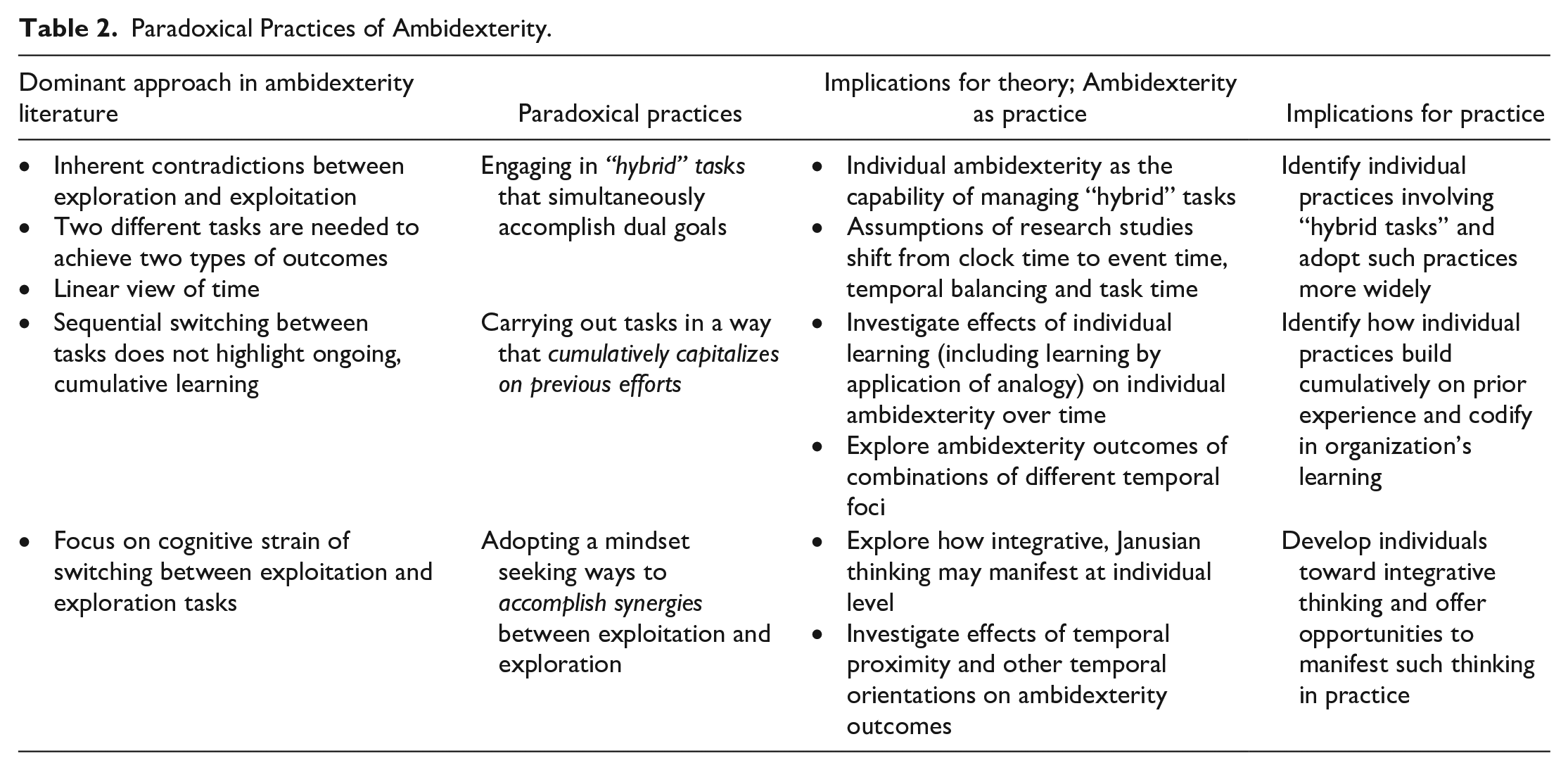
Some types of routine tasks have been intentionally enriched in this way, to include both exploitation and exploration goals as shown by research on mindless and mindful performance of routine work (Langer, 1989; Schon, 1984). Table 2 gives an outline of the above discussion.
Paradoxical Practices of Ambidexterity.
Discussion
We begin with Turner et al.’s (2015) observation that “the wider literature is vocal about the merits of ambidexterity, but largely silent on how it is achieved in practice” (p. 186). Structural approaches to ambidexterity highlight the importance of leaders’ paradoxical cognition in terms of integrating and managing the conflicting demands of exploratory and exploratory units (Tushman & O’Reilly, 1996). Contextual approaches highlight the need for leaders to create a conducive organizational context where individuals can decide how to focus their task efforts (Gibson & Birkinshaw, 2004). Research on the microfoundations of individual-level ambidexterity aims to answer the question of “what makes someone ambidextrous” (Raisch et al., 2009), by studying individual predispositions that support or hinder this capability (Laureiro-Martínez et al., 2015). Despite the fact that these approaches are predicated on individuals, research on individual-level ambidexterity has received scant attention. Our analysis gathers insights from different ambidexterity traditions in relation to individuals, brings forward some important gaps in our understanding, and suggests ways forward via study of paradoxical individual practices.
Structural approaches to ambidexterity dilute individual differences to coping with ambidexterity tensions (Papachroni et al., 2015) and sidestep the realization that individuals engage in ambidextrous, paradoxical behaviors within equally increasingly dynamic contexts (Good & Michel, 2013; Smith & Tushman, 2005). Further studies have offered a more pluralistic approach to ambidexterity that entails a combination of integration and separation strategies (Andriopoulos & Lewis, 2009; Papachroni et al., 2016), without however explicitly untangling the individual practices that these strategies may entail. As a result, our understanding of how individuals manage ambidexterity tensions in dynamic contexts has remained limited.
More important, individual-level studies of ambidexterity are guided by the underlying assumption that individuals explore or exploit through task switching from one to the other, rather than within the same task (Good & Michel, 2013). This assumption favors temporally sequential versus simultaneous ambidexterity (Raisch et al., 2009). Overall, the “simultaneity of exploring and exploiting, asking about past behavior of exploring or exploiting, rather than testing one’s ability to cycle between them” is yet to be addressed (Good & Michel, 2013, p. 436). These assumptions that have guided ambidexterity theory have so far lead researchers to impose a binary logic on practice, as in Zeno’s paradoxes:
the meaningful relational totality in which practitioners are involved is neglected in favor of focusing on discrete entities with pregiven properties, the situational nature of the dilemmas practitioners face is underestimated in preference of generic propositional statements, and time as experienced by practitioners is excluded from contingency models. (Sandberg & Tsoukas, 2011, p. 342)
Paradox theory provides an insightful lens for understanding the complex mechanisms of tensions and contradictions and how a paradoxical mindset can enable individuals to deal with these tensions (Andriopoulos & Lewis, 2009; Ingram et al., 2008; Martini et al., 2013).
Our analysis suggests a view of ambidexterity as practice, by bringing forward three paradoxical practices of individual ambidexterity: engaging in “hybrid tasks” that seek to accomplish dual goals, carrying out tasks in a way that capitalizes cumulatively on previous learning, and adopting a mindset of seeking synergies between the competing demands of exploration and exploitation. These practices recognize two key principles of practice; that practitioners are immersed in organizational practices in a holistic manner and that temporality is inherent to practice (Sandberg & Tsoukas, 2011). Taken together these principles suggest that “the circumstances surrounding practitioners constitute a meaningful, unfolding totality, not a set of abstract, contingently linked variables” (Weick, 2003, p. 467).
In this context, exploration and exploitation tasks can rarely be as clearly distinguished at the individual level as assumed in dominant understandings of ambidexterity. Similarly, we draw inspiration from Farjoun’s (2010) position that stability and change should not be considered as a dualism where one precludes the other, but as a duality, whereby stability may enable change, and change may enable stability. An acceptance of such a duality model for exploration and exploitation may necessitate the recognition of the interwoven nature of constructs, such that “the duality view casts doubts on organizations’ ability to separate elements of stability and change so neatly. Individuals engaged in routine tasks exercise some degree of experimentation, and those engaged in creative tasks use routines to some degree” (Farjoun, 2010, p. 218).
As we outline in Table 2, studies of ambidexterity as practice would investigate, for example, individual ambidexterity as the capability to manage “hybrid” tasks and would adopt temporal assumptions such as event time, temporal balancing or task time, rather than of linear time. Such studies would explore the effects of individual learning (including learning by analogy) on individual ambidexterity over time and would investigate ambidexterity outcomes of adopting different temporal foci over time. Finally, such studies would explore aspects of paradoxical cognition at the individual level, and how these manifest in terms of particular practices that enable individuals to deal with tensions of ambidexterity.
Our contribution is consistent with the stream of research that views exploitation and exploration as temporally and organizationally co-existing, as mutually interrelated, and with potentially constitutive dimensions (Cao et al., 2009; Gupta et al., 2006; Raisch et al., 2009). This is particularly so in complex organizations where interactions and boundaries may not be so clear-cut (Benner & Tushman, 2003; Gupta et al., 2006) and where exploration and exploitation might occur at any point in time (Turner et al., 2015). In such dynamic environments of “nested” ambidexterity (Birkinshaw & Gupta, 2013), the three paradoxical practices we discussed present a nuanced and processual view that reflects more closely and pragmatically ambidexterity in practice and offers concrete behavioral strategies for negotiating ambidexterity tensions at the individual level.
Conclusion
Our analysis brings forward an alternative approach to how ambidexterity can be theorized and researched that challenges underlying assumptions of ambidexterity to date; namely the inherent contradiction of exploration and exploitation that assumes a binary either/or approach to managing tensions at the individual level through structural or temporal separation. Our analysis draws from paradox theory and the interdependent nature of dualities that views them as dynamic polarities rather than static contradictions. We also advance paradox theory by bringing forward an approach to managing ambidexterity tensions that is grounded in practices; that is, we view paradoxes not as something merely conceptual or nebulous, but as something people can engage with through their daily actions and work life within dynamic environments.
Our analysis follows recent research that argues for an active and diverse role of individuals in the pursuit of organizational ambidexterity (Mom et al., 2019; Zimmermann et al., 2018). This notion of managerial capability is central to the view of the organization as a value-creating entity (Martin, 2007). As Moran and Ghoshal (1999) observed, managers in organizations are “more than mere players in a game to allocate resources efficiently. They are also powerful levers that enable people to productively defy the market’s institutional forces” (p. 391). Or, as Birkinshaw and Gupta (2013) ask, “Why else do we need managers other than to help organizations do the things that don’t come naturally to them? If managers allowed exploration and exploitation to self-reinforce, without intervention, then their organizations would quickly fail” (p. 293). The paradoxical practices highlighted in this article aim to shed some light on how individuals renegotiate or transcend tensions of exploration and exploitation to overcome their self-reinforcing tendencies.
Footnotes
Declaration of Conflicting Interests
The author(s) declared no potential conflicts of interest with respect to the research, authorship, and/or publication of this article.
Funding
The author(s) received no financial support for the research, authorship, and/or publication of this article.
