



Abstract
Adverse outcome pathway (AOP) analysis is getting attention from radiation researchers. This study aims to examine the validity of AOP in the study of radiation health effects. For this purpose, a bibliometric analysis of previous research on AOP and a quantitative analysis of AOP-Wiki were conducted. A keyword search with ‘adverse outcome pathway’ in Web of Science (WoS) yielded 920 hits in 190 journals. The first article that related AOP to radiological protection was published in Health Physics in 2015 and proposed ‘Integrating Basic Radiobiological Science and Epidemiological Studies’ to reduce the uncertainty in risk estimates. Since that initial proposal, 31 radiation-related AOP articles have been published in four journals. Among them, 21 articles were published in the International Journal of Radiation Biology. Despite the wide range of knowledge necessary to complete links from radiation exposure to population responses, the contribution is biased toward biology. At the OECD AOP-Wiki, 437 AOPs have been registered, but only 29 were endorsed as reliable. Among the 14 radiation-related AOPs, AOP 272, ‘Deposition of energy leading to lung cancer’, reached the most advanced OECD approval status. It registered the following common sense link: ‘Energy deposition (molecular initiating event)’, ‘Increase, DNA strand breaks (KE1)’, ‘Insufficient DNA repair (KE2)’, ‘Increase, mutations (KE3)’, ‘Increase, chromosomal abnormalities (KE4)’, ‘Increase, cell proliferation (KE5)’, ‘Increase, lung cancer (AO)’. According to NCRP's review on radiation epidemiology published in 2018, ‘Most of the larger, stronger studies broadly supported an LNT model’. To explain this relationship, quantitative evaluation is necessary for each chain, for example, the probability of DNA break and repair considering the dependence on location in the organ. However, among the 14 key event relationships, 7 are rated low in quantitative understanding. The unified field theory that aims to integrate quantum mechanics and relativity is far from complete in physics. Integrating biology and epidemiology: A series of events at different levels, from molecular to population, seems impossible in principle. The fact that the OECD hosts the AOP-Wiki, which prioritises economic development rather than public health, causes a conflict of interest concern. In the case of the Minamata disease, despite it being clear that the cause was fish caught in Minamata Bay, the Japanese government did not regulate fishing and distribution of fish because the causality is unclear. Adherence to mechanisms could lead to delays in regulation and more significant health hazards. The LNT model should be confirmed as a scientific fact, and AOP studies should be separated from regulations for radiation protection.
RESEARCH BACKGROUND AND PURPOSE
Ankley et al. (2010), published in Environmental Toxicology and Chemistry, proposed an adverse outcome pathway (AOP) approach. An AOP is ‘a conceptual construct that portrays existing knowledge concerning the linkage between a direct molecular initiating event and an adverse outcome at a biological level of organisation relevant to risk assessment’ (Ankley et al., 2010). They proposed accumulating piecewise knowledge from toxicant exposure, macromolecular interactions, cellular responses, organ responses, organism responses, and population responses.
Recently, AOP has been getting attention from radiation researchers, especially radiobiologists. This study aims to examine the validity of AOP in the study of radiation health effects. For this purpose, a bibliometric analysis of previous research on AOP and a quantitative analysis of AOP-wiki were conducted.
A BIBLIOMETRIC ANALYSIS OF AOP
Data
The database of academic papers Web of Science (WoS) is utilised to search for AOP-related articles. A database search was conducted with the keyword ‘adverse outcome pathway’. Statistical software R and R code developed by Hiki et al. (2020) were utilised for the analysis.
Descriptive statistics
A keyword search with ‘adverse outcome pathway’ in WoS yielded 920 hits in 190 journals. Based on the journal title, publications were categorised into toxicology (55), biology (50), pharmacy and chemistry (42), and environment (32). Publication increased from one to more than 100 annually (Fig. 1).
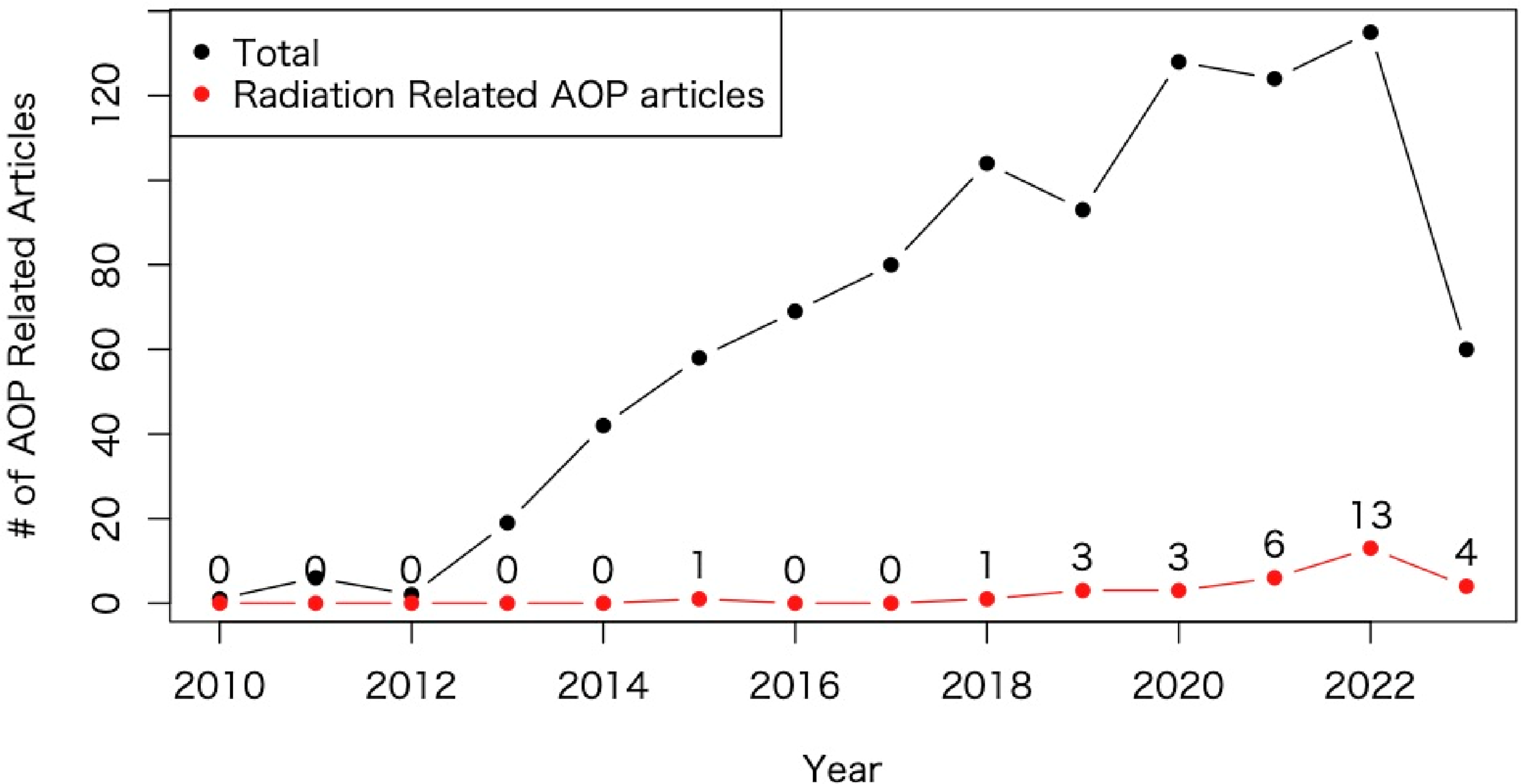
Publication trend on AOP-related studies up to 3 June 2023. Note: The decrease in 2023 is due to the publication search conducted on 3 June 2023.
Preston (2015), published in Health Physics, was the first article that related AOP to radiological protection and proposed ‘Integrating Basic Radiobiological Science and Epidemiological Studies’ to reduce the uncertainty in risk estimates. Since Preston (2015), 31 radiation-related AOP articles have been published in four journals. Among them, 21 articles were concentrated in the International Journal of Radiation Biology (IJRB). Issue 12, 2022, of the IJRB was a special issue on AOP with an introductory editorial, a commentary, three review papers, and seven original articles published. Seventeen of 21 articles are co-authored by Dr. Vinita Chauhan, Health Canada. Despite the wide range of knowledge that is necessary to complete links from toxicant exposure to population responses, the contribution is biased toward biology.
Data
The Organisation for Economic Co-operation and Development (OECD) launched a new programme on developing adverse outcome pathways (AOP) in 2012. 1 The OECD has been hosting the Adverse Outcome Pathway Knowledge Base (AOP-KB) 2 , including AOP-portal, AOP-Wiki, Effectpedia, AOPXplorer, and AOP-DB. Among them, AOP-Wiki is a collaborative platform for sharing scientific evidence on AOP. Registered users can contribute to building a knowledge base by registering scientific evidence with AOP-Wiki. We downloaded the content in XML format in September 2023. 3 Statistical software R and R code developed by Hiki (2020) was utilised for the analysis.
Overview of AOP-Wiki
At the OECD AOP-Wiki, 437 AOPs have been registered. OECD AOP has a three-stage review system: (1) review proposal of a new AOP application, (2) scientific review by EAGMST (Advisory Group on Molecular Screening and Toxicogenomics), and (3) endorsement decision by WNT/WPHA (Working Party on Hazard Assessment).
As summarised in Table 1, among 437 AOPs, only 29 reached WPHA/WNT endorsed status. Registered 1630 key events (KE) are classified as molecular (627), cellular (725), tissue (314), organ (248), individual (262), and population (100). KE/AO at the population level, which is the most important for protecting humans, is the least registered.
Situation of registered AOPs at AOP-Wiki.
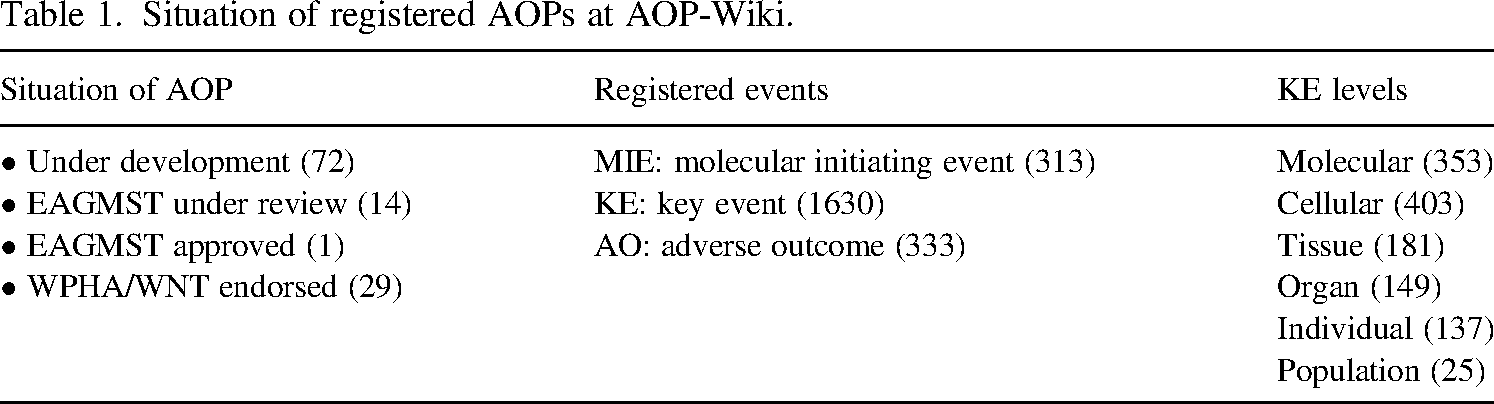
Situation of registered AOPs at AOP-Wiki.
Based on biological plausibility and empirical support, the evidence-level key event relationships (KER) are categorised into low, moderate, and high. Among 1758 KERs, regarding ‘weight of evidence’, some 500 are judged to have a ‘high evidence level’. On the contrary, regarding quantitative understanding, which is essential to relate exposure and outcome, only 220 are classified as ‘high’ (Fig. 2).
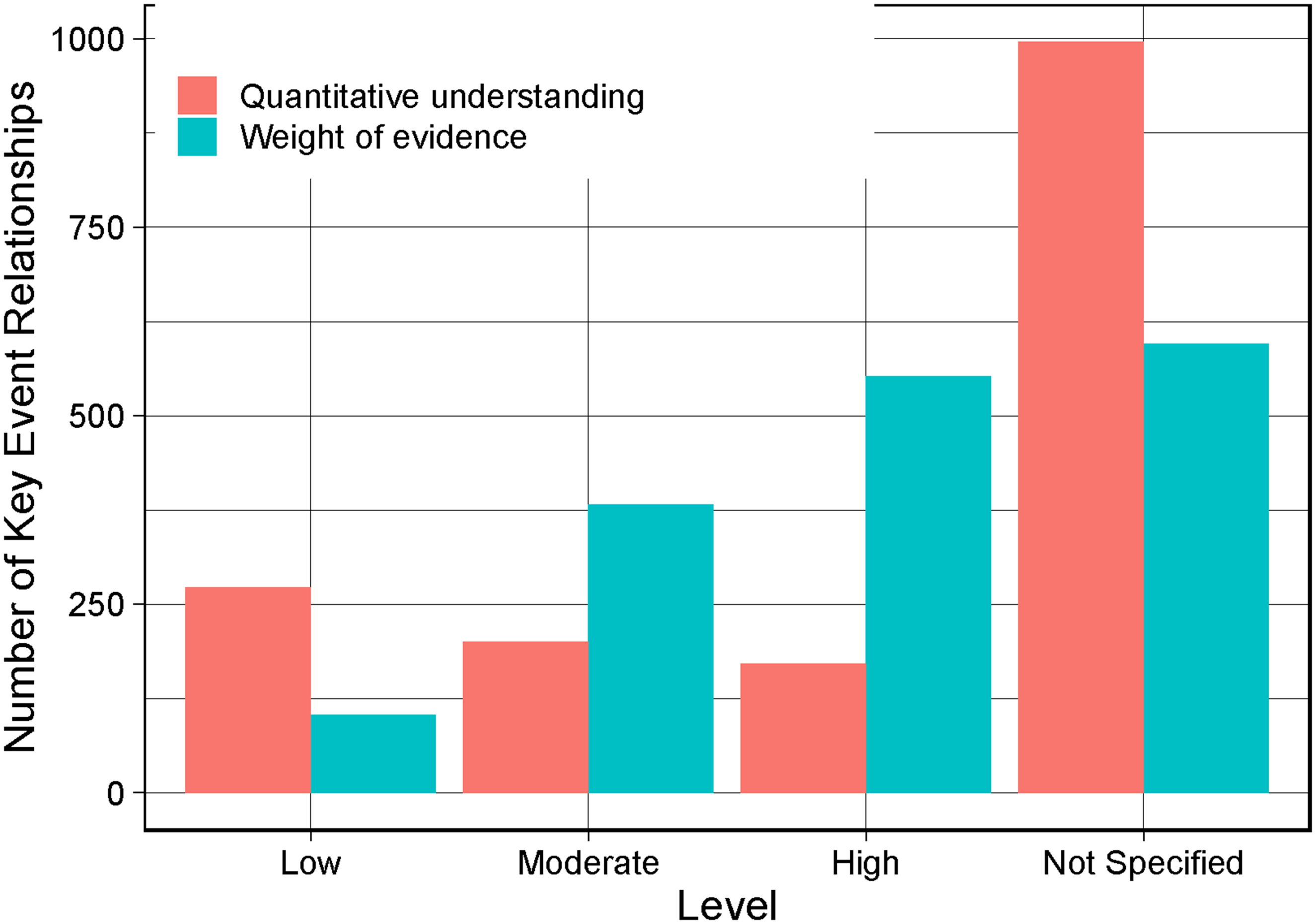
Evidence-level of key event relationship (KER).
Among 14 radiation-related AOPs, AOP 272, ‘Deposition of energy leading to lung cancer’, reached the most advanced OECD approval status. EAGMST approved that registered the following link: ‘Energy deposition (molecular initiating event)’, ‘Increase, DNA strand breaks (KE1)’, ‘Insufficient DNA repair (KE2)’, ‘Increase, mutations (KE3)’, ‘Increase, chromosomal abnormalities (KE4)’, ‘Increase, cell proliferation (KE5)’, ‘Increase, lung cancer( AO)’ (Fig. 3). Although AOP-Wiki compiles related articles, the proposed chain (Fig. 3) is as common as a textbook. According to NCRP's review on radiation epidemiology, ‘Most of the larger, stronger studies broadly supported an LNT model’ (NCRP 2018) or the starting point: radiation exposure and the endpoint of the chain—lung cancer mortality should be related linearly. To explain this relationship, quantitative evaluation is necessary for each chain, for example, the probability of DNA break and repair considering the dependence on location in the organ. However, AOP does not provide quantitative information essential for radiological protection at the population level. In fact, among 14 key event relationships, seven are rated low in quantitative understanding. 4
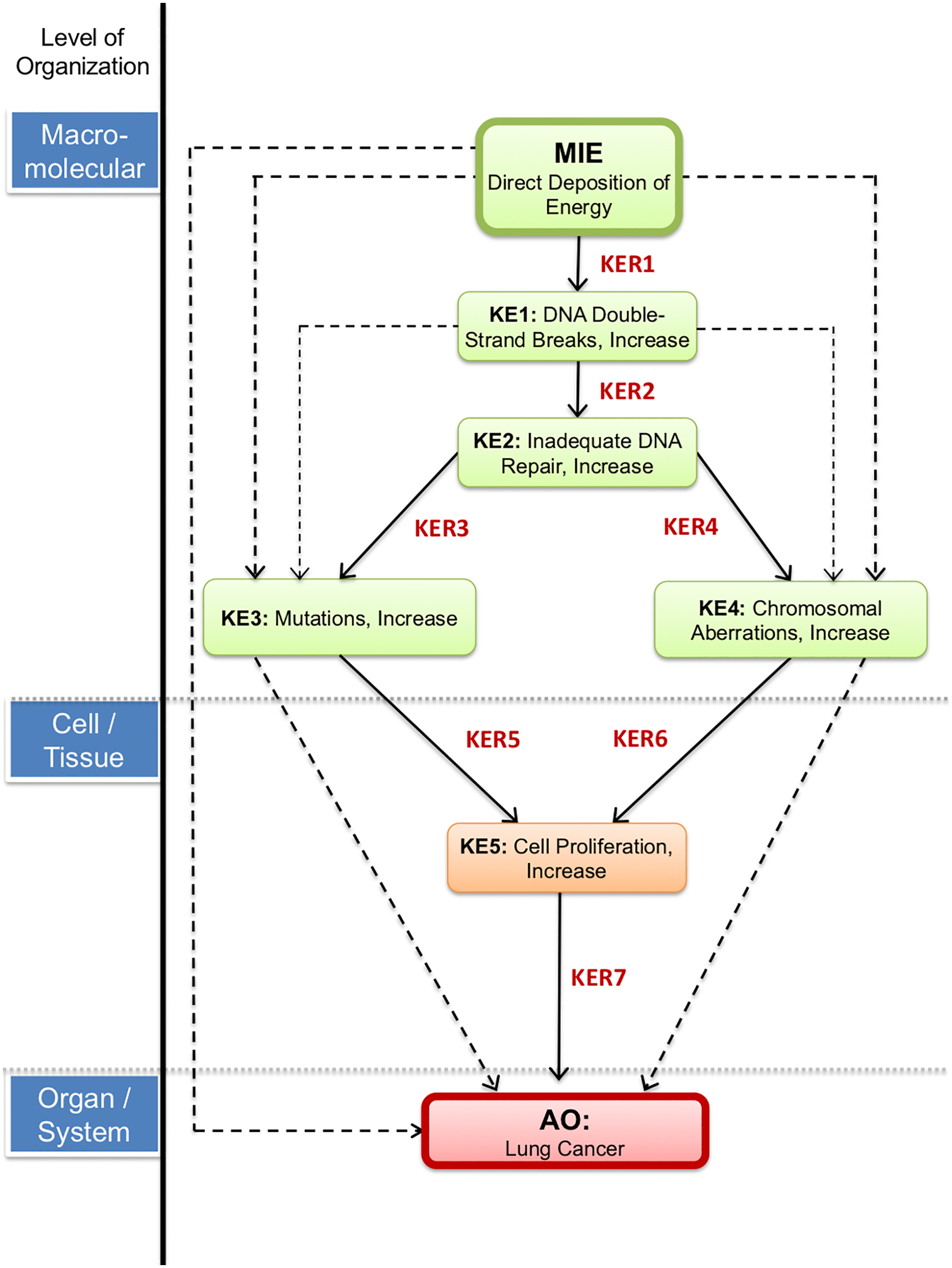
AOP 272, Deposition of energy leading to lung cancer (https://aopwiki.org/aops/272).
This article aimed to examine the validity of the AOP proposed by Ankley et al. (2010) to study the effects of radiation on health. For this purpose, a bibliometric analysis of previous research on AOP and a quantitative analysis of AOP-Wiki were conducted. The bibliometric analysis identified 920 studies and an increasing trend of AOP-related research. Preston (2015) proposed that to reduce uncertainty in the risk estimates, AOP is helpful and could integrate basic radiology and epidemiology. Since then, 31 radiation-related AOP articles have been published, but 21 were concentrated in the International Journal of Radiation Biology (IJRB). A total of 437 AOPs have been registered at the OECD AOP-Wiki, but only 29 were endorsed as reliable. Among the 14 radiation-related AOPs, AOP 272, ‘Deposition of energy leading to lung cancer’, reached the most advanced OECD approval status. However, it does not provide quantitative information essential for radiological protection.
According to NCRP's literature review on radiation epidemiology, ‘Most of the larger, stronger studies broadly supported an LNT model’ (NCRP, 2018). Present AOP does not provide quantitative information and does not contribute to the explanation of dose response. Moreover, a unified field theory that aims to integrate quantum mechanics and relativity is far from complete in physics. Integrating a series of events at different levels, from molecular to population, is impossible in principle. As the application areas of Newtonian dynamics and quantum mechanics differ (Anderson, 1972), integrating biology and epidemiology is unnecessary, unlikely, and time-consuming.
The OECD hosts the AOP-Wiki, which prioritises economic development rather than public health. Moreover, ‘a radiation and chemical (Rad/Chem) AOP Joint Topical Group has been formed by the OECD Nuclear Energy Agency’ (Chauhan et al., 2022). Dr. William D. Magwood, former director of the civilian nuclear energy programme at DOE, former NRC, and now OECD/NEA Director-General, delivered a speech expressing his hope to reject both LNT and the collective dose: that we were then to be able to assume that there would be no risk below some threshold level, we could even say there was a benefit, this could be a significant easing and the need to manage a lot of operational effluences, we could with the easy to clean up facilities, we would be able to deal with very very very low level waste in a very different way.
5
we could all do is look for any opportunity to attack mercilessly anyone who dares put out a number use the collective dose.
6
In the case of the Minamata disease, although it was clear that fish caught in Minamata Bay caused it, the Japanese government did not regulate fishing and distribution because the causality was unclear (Yorifuji and Tsuda, 2014). Adherence to mechanisms could lead to delays in regulation and more severe health hazards.
For radiation protection, the LNT model must be confirmed as a scientific fact, and AOP studies should be discarded or separated from regulations. A new ICRP General Recommendation should be developed based on LNT as a scientific fact.
Footnotes
ACKNOWLEDGEMENTS
The authors have no conflicts of interest to report. This research is supported by JSPS Kakenhi 21H00501.