




Abstract
The Steering Committee for Post-accident Management Preparedness (CODIRPA) was commissioned by the French Government in 2005 with the aim of establishing the main principles to be set up for population protection and recovery in the long term. From the beginning, one of the main principles was the pluralistic nature of the working groups (WGs), including scientific and technical experts, representatives from state departments, nuclear operators, and representatives of civil society (i.e. stakeholders). Stakeholders were mainly associated with the various WGs of CODIRPA. In order to foster the involvement of stakeholders from civil society in the works of CODIRPA, a new organisation was implemented with two WGs: one mainly composed of technical experts for tackling technical issues, and one for evaluating the proposals made by the experts from the stakeholders’ point of view. This article presents the results of this new strategy.
1. INTRODUCTION
The Steering Committee for Post-accident Management Preparedness (CODIRPA) was created in 2005 under the leadership of the French Nuclear Safety Authority (ASN). The aim of CODIRPA was to develop a comprehensive strategy for the management of population protection and the resilience of affected territories against the consequences of a major nuclear accident. For this purpose, working groups (WGs) were created on specific topics (e.g. medical and psychological support, consumption of locally produced foods, evaluation of radiological contamination of the environment, remediation actions and waste management) based on lessons learnt from the accidents in Chernobyl and Fukushima. In this approach, the following basic guiding principles (ASN, 2012) were used:
Anticipation: the issues at stake in post-nuclear accident management need to be taken into account from as early as the end of the emergency phase. Justification: actions, especially those aimed at protecting the population, must be warranted, meaning that the expected benefits must exceed the risks and drawbacks inherent in their implementation. Optimisation: population exposure to ionising radiations must be kept to a level as low as reasonably achievable, taking economic and societal factors into account. Shared construction and transparency: post-accident management must involve the population, elected officials, business community, and social stakeholders.
Lessons learnt from previous radiation accidents (Lochard et al., 2020) demonstrate that the fourth principle is essential to attain the main objectives of post-accident management (i.e. protecting the population from harmful effects of radiation, providing support to affected populations, and sustaining the resilience of the affected territories from economic and social viewpoints). In order to cope with this fourth principle, the pluralistic nature of CODIRPA was promoted from the beginning through the inclusion of representatives of scientific and technical expert institutes, governmental departments, nuclear operators, and civil society [e.g. members of non-governmental organisations and members of local information committees (LICs)]. These LICs exist for each nuclear plant (NP) and involve local stakeholders living in the urgent protective action zone, as defined by the International Atomic Energy Agency (IAEA, 2015). As such, the main recommendations issued by CODIRPA (ASN, 2012) included the views and opinions of stakeholders from civil society.
Nevertheless, the participation of stakeholders was limited to attending the meetings of the various WGs and providing advice on the management options discussed, which represents fairly limited involvement. Thus, CODIRPA decided to implement a WG on ways to foster the involvement of stakeholders in evolution of the post-accident management strategy. The so-called ‘stakeholder involvement’ WG (SI-WG) proposed several actions, one of which is presented in this article. Moreover, the principles of this action were extended to other WGs and a specific example is discussed below.
2. HEALTHCARE PROFESSIONAL WORKING GROUP
A key group of people who may serve as facilitators between the authorities and experts and the affected population are healthcare professionals (Kawashima et al., 2020; Ozaki et al., 2020). As such, the SI-WG proposed to create a document intended for medical care professionals with two objectives: to provide answers to questions that patients could ask their healthcare professionals, and to provide answers to the healthcare professionals’ own questions.
To achieve this, the healthcare professional WG (HCP-WG) was set up, with two subgroups:
A group of healthcare professionals living in the vicinity of an NP located in the centre of France, close to the city of Poitiers. This ‘local’ group included hospital practitioners, family doctors, emergency doctors, pharmacists, veterinarians, and nurses. A representative of the expert group (see below) and a representative of ASN were also included in the local group to coordinate the work between the two groups. The expert group was composed of experts in radiation protection, medical care, and post-accident management; representatives of ASN; and representatives of ANCCLI, the national association of LICs.
The work started with acculturation of the local group to the post-accident situation with a simulation of the consequences of a nuclear accident at the nearest NP. The local group was then in charge of generating a list of questions that they could be asked by their patients in a post-accident situation, and their own questions. A list of 201 questions on various subjects was developed, such as generalities about radioactivity, irradiation, and contamination (one question); health care (86 questions); daily and social life (69 questions); professional life (16 questions); the environment (four questions); and management of the emergency phase (27 questions), including two supplementary questions that arose later on. All of the questions were practical in nature, such as ‘what are the precautions to be taken when receiving a potentially contaminated patient?’ or ‘will the public services remain open?’ Even surprising questions were taken into account, such as ‘will my pet be evacuated with me?’ or ‘do I have to cut my hair if I’m contaminated?’ The questions were transferred to the expert group for answering. Experts from specific domains (e.g. thyroid pathology specialists) were asked for help in writing some answers. During the course of this process, the need for additional factsheets to go deeper into some specific subjects was underlined by the local group. A list of 25 subjects was established and transmitted to the expert group. The resulting document (80 pages, including numerous illustrations) was then submitted to the local group for approval. In particular, the local group was asked if the final document was sufficiently clear, complete, and understandable (i.e. met their expectations). This step is currently underway. A synthesis of their comments will be made, and the document will be amended and published. The whole process is depicted in Fig. 1.
Process used for creation of a document intended for healthcare professionals working in or close to the urgent protective action zone. (1) Generation of questions and factsheets; (2 and 3) preparation of answers and factsheets; (4) review of the complete document; and (5) synthesis and publication.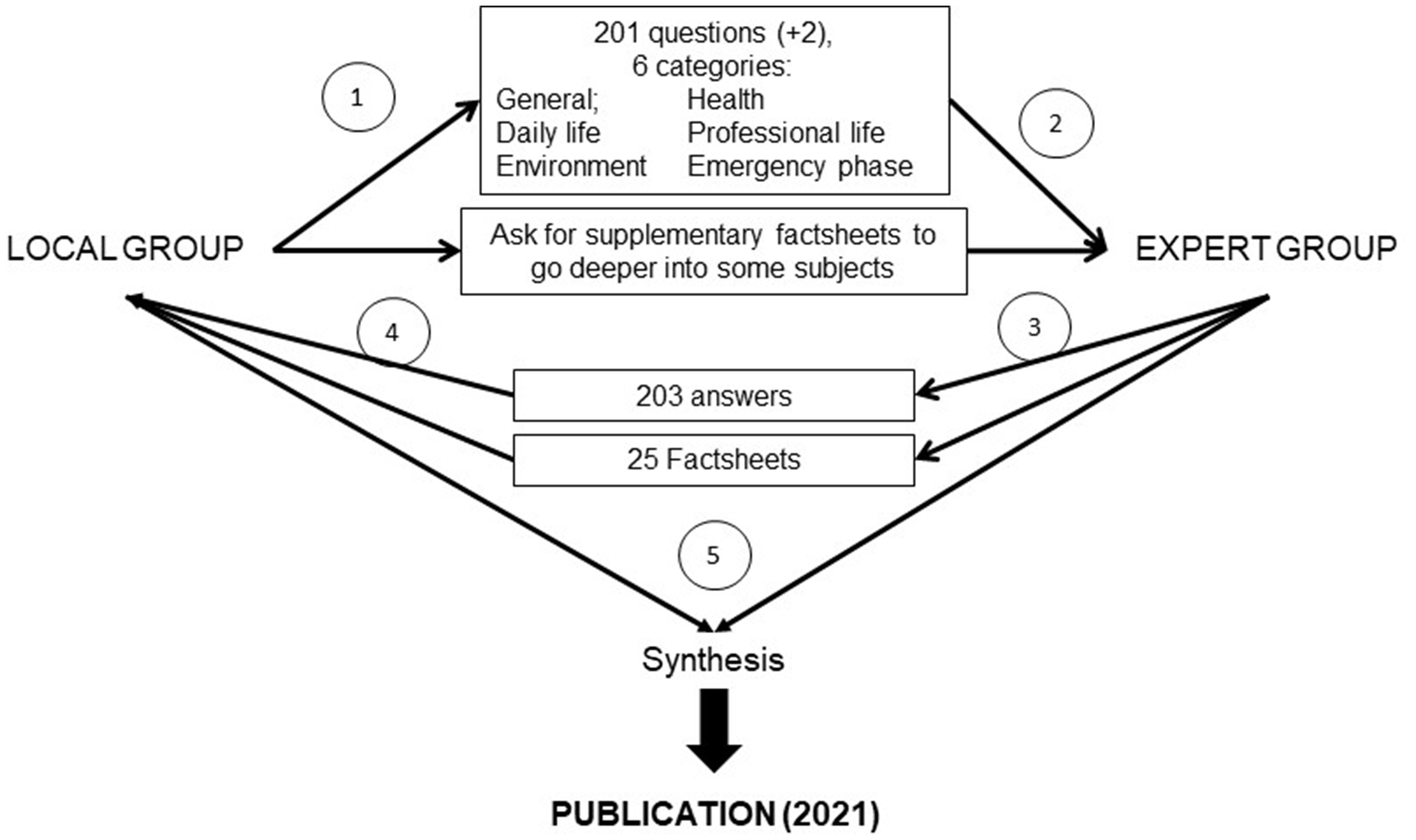
Although the final document is not yet published, this action is judged as very positive by both the stakeholders who participated in the process and the SI-WG. As a result, CODIRPA is intending to publish this document in several formats, including publication on a website with a search engine in order to find answers associated with keywords, a printable document, and a pocket memo for hospital practitioners. Moreover, in a plenary session, CODIRPA decided to foster the involvement of stakeholders, especially stakeholders in the vicinity of NPs, in all WGs.
3. CITIZEN PANELS IN THE LOCAL FOODSTUFF CONSUMPTION WORKING GROUP
In the first step, ways to reach the objective of fostering the involvement of stakeholders was debated in CODIRPA, who proposed to test a new way of working with local stakeholders (i.e. people who are potentially affected by a nuclear accident). The general principle (Fig. 2) is to test the proposals made by a technical WG (in charge of developing protective measures on the basis of technical and radiation protection elements) with a panel of citizens living in the vicinity of an NP, including representatives of the local LIC, to gain their advice on whether the protective measures are understandable, and whether the protective measures will be acceptable for the population. The advice of the panel will be presented to the main WG, gathering the technical WG and representatives of the panel and the LIC. The main WG will subsequently issue a final report including a synthesis of the panel’s advice and final recommendations on protective measures to be implemented. The final report will be submitted to a plenary session of CODIRPA, before issuing recommendations for new protective measures to the French Government.
Schematic representation of the general principles for working with stakeholders with five different steps. (1) A technical working group (WG) proposes protective measures. (2) Submission of proposals to a local WG. (3) Comments and proposals of the local WG are presented to the whole WG. (4) Final report with proposed protective measures taking into account the comments of the local WG submitted to a plenary session of the Steering Committee for Post-accident Management Preparedness (CODIRPA). (5) Recommended protective measures proposed to the French Government. NP, nuclear plant; LIC, local information committee.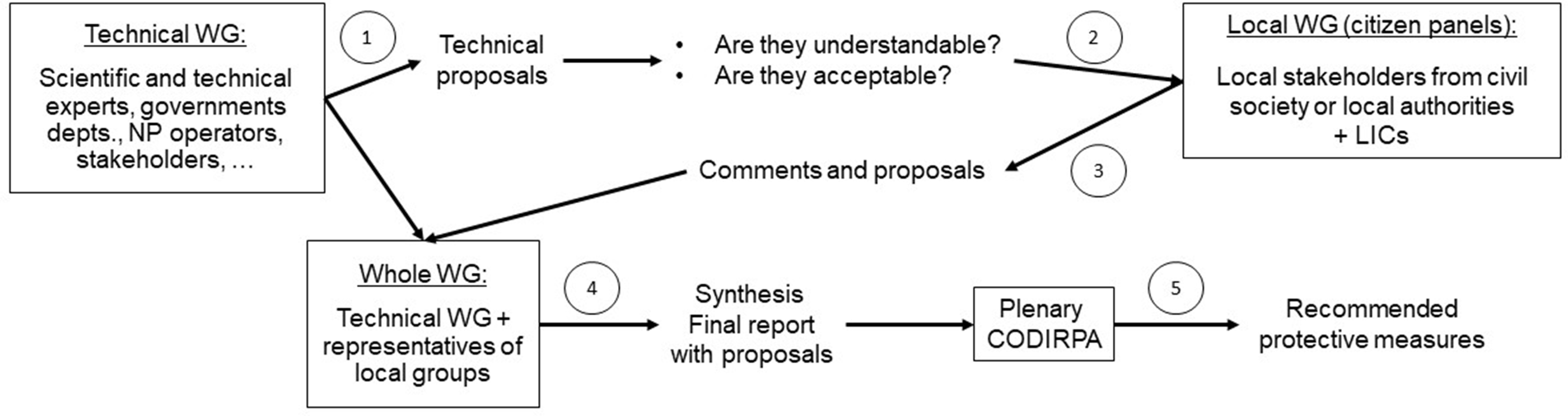
In order to evaluate the feasibility, interest, and potential pitfalls of this new scheme, the decision was made to apply these principles to a specific WG in charge of delineating protective measures against internal contamination from locally produced foodstuffs. In fact, a main exposure pathway in the long term in a post-accident situation is exposure through ingestion of locally produced foodstuffs, even 35 years after the Chernobyl accident (Bertho et al., 2019). Thus, a central protective measure is the restriction of consumption of locally produced foodstuffs in an area defined by estimates of radiation exposure (technical criteria). These technical criteria could be, for instance, an effective dose due to ingestion or a level of radioactive contamination in locally produced foodstuffs. Both of these options have advantages. However, such a protective measure should be understood and accepted by the local population, especially those living a self-sufficient lifestyle, as the consumption of products from kitchen gardens, hunting, fishing, and forest gathering (e.g. mushrooms, wild berries) might be forbidden.
For that purpose, the main WG asked for the collaboration of four LICs located in four different regions of France, representing four different agricultural practices and eating patterns: North shore (fish products and seafood), Rhone valley (fruits and vineyards), South west (fruits, vegetables, and poultry), and Loire basin (vegetables and vineyards). The LICs are in charge of gathering local citizens (approximately 20 citizens per region), as representative as possible of the diversity of the local population, and representatives of local authorities (mayors and representatives of local administration). These panels are currently under construction. The next step will be to set up face-to-face meetings during which a phase of acculturation to a nuclear accident situation will be made, including a scenario for contextualising the post-accident management situation. Thereafter, the different options will be presented and an open discussion will take place. The local LIC will be in charge of preparing a synthesis of the discussions and proposals made by the citizens, which will need to be approved by all the participants. These proposals will subsequently be presented to the main WG. A final report will be issued, taking into account the proposals of the citizen panels.
This action is in development; however, the LICs are very positive about this approach. Moreover, some key points appear to be essential for the success of this new approach. The first point is setting up face-to-face meetings with citizens and a limited number of experts so that each citizen can express their concerns and opinions in an open-minded frame. The second point is the diversity of citizens joining the panels, in order to have a picture of the local population and eating patterns. The third point relies on confidence among the citizens that their opinions will be taken into account. For that purpose, it is important that the synthesis of the panel discussion is approved by each participant. It is also important that the final report of the main WG includes the comments of panels, and that the panels receive a feed back about their proposals.
If successful, this method will be applied to other subjects, such as waste management and citizen measurements. In addition, meeting citizens living in the vicinity of an NP regarding a specific subject of interest in their daily lives is a way to improve the safety culture among these populations. Moreover, in the worst case of a nuclear accident, these knowledgeable citizens may help the local population to acquire good practices of radiological protection when living in a contaminated territory. The SI-WG will continue its work with the aim of making proposals to answer two new questions – how to promote a safety culture among populations in the vicinity of an NP in the preparedness phase, and how to involve local stakeholders in the management of a real post-accident situation. The present process of local stakeholder consultation with the help of the local LIC is a first step, but other means are needed to improve these two key points.
Footnotes
ACKNOWLEDGEMENTS
The authors wish to thank the LICs of Tricastin, Golfech, Chinon, and Paluel-Penly for their involvement in the constitution of citizen panels. In addition, the authors wish to thank the members of the healthcare professional WG for their sustained work, particularly the WG heads Joël Robert and Catherine Luccioni.