



Abstract
Hereditary effects in future generations following radiation exposure of parents prior to the conception of their children are an important component of the ICRP system of radiological protection as set out in the 2007 Recommendations of ICRP. Also of special interest is the exposure in utero of the embryo/fetus because not only do the consequent carcinogenic and hereditary effects need to be considered (as with individuals exposed after birth), but additionally teratogenic (developmental) effects, such as congenital malformations, need to be taken into account. ICRP Task Group 121 is examining the evidence of health effects following preconceptional and intrauterine exposure to radiation to determine whether the evidence that has become available since the 2007 Recommendations will require modification of the risk estimates associated with these exposures. Further, the current ICRP system of radiological protection does not encompass transgenerational effects of exposure of non-human biota, and this is a gap that needs to be filled. This article summarises the work of Task Group 121 from a brief review of the position taken on preconceptional and intrauterine exposures in the 2007 Recommendations to what might have been learnt from more recent studies.
INTRODUCTION
The 2007 Recommendations of the International Commission on Radiological Protection (ICRP), as set out in ICRP Publication 103 (ICRP, 2007), presented a system of radiological protection that addresses somatic effects in the exposed individual and hereditary effects in the exposed individual's descendants. Two components of the ICRP system, health effects arising from exposure of parents before the conception of a child and those following intrauterine exposure of the developing organism between conception and birth, are currently being examined by ICRP Task Group 121 with a view to updating the evidence relating to these health effects in preparation for the next set of ICRP Recommendations (https://www.icrp.org/icrp_group.asp?id=189, accessed 8 January 2024) (Degenhardt et al., 2024). This article will briefly review the position of the 2007 Recommendations on the effects of preconceptional and intrauterine exposure to radiation, and the approach of Task Group 121 to the assessment of evidence that is now available. It will also touch on the transgenerational effects of exposure of non-human biota in relation to the work of Task Group 121.
It will be appreciated that the effects of preconceptional and intrauterine exposure are based upon different biological processes: Hereditary effects arise from the irradiation of the germ cells of parents, whereas intrauterine exposure produces somatic effects in the exposed organism (effects that are apparent both in utero and after birth) as well as hereditary effects due to exposure of the gonads in utero. These two exposures and their effects are illustrated schematically in Fig. 1.
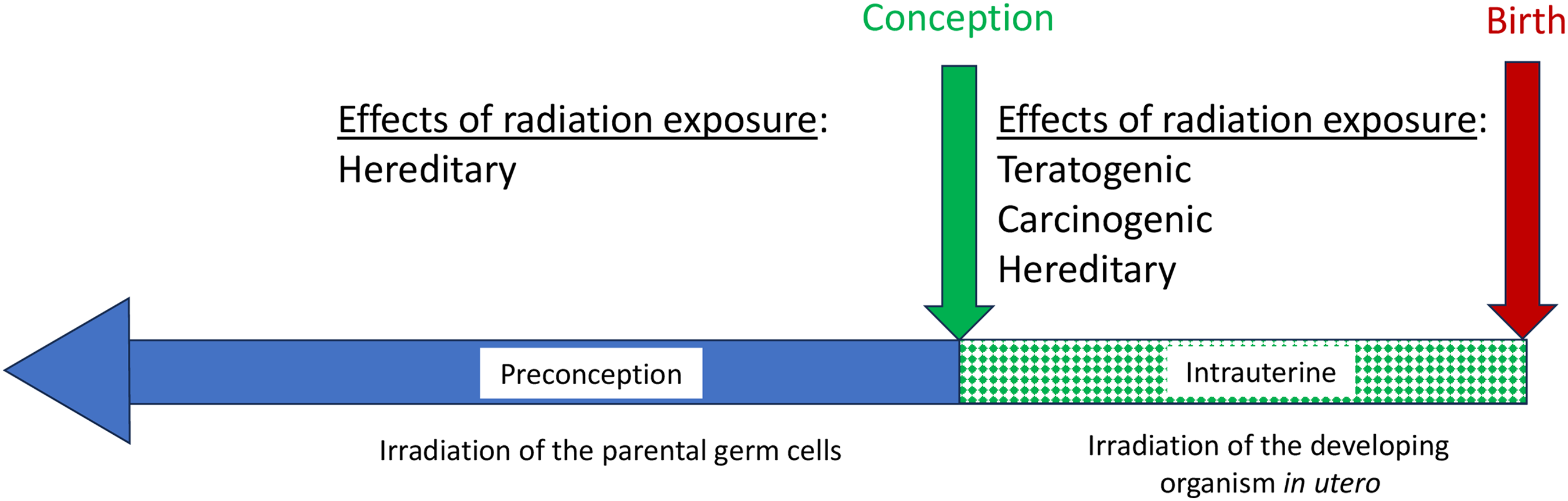
Schematic diagram showing the broad effects of preconceptional exposure of parental germ cells and intrauterine exposure of the developing organism.
The hereditary effects of exposure to radiation were reviewed in Annex A of the 2001 Report of the United Nations Scientific Committee on the Effects of Atomic Radiation (UNSCEAR, 2001). The ICRP 2007 Recommendations (ICRP, 2007) relied heavily on the findings of this UNSCEAR review. Particularly influential in the understanding of the radiation-related risks of hereditary effects at that time was the series of articles by Professor Krishnaswami Sankaranarayanan (e.g. Sankaranarayanan and Wassom, 2008).
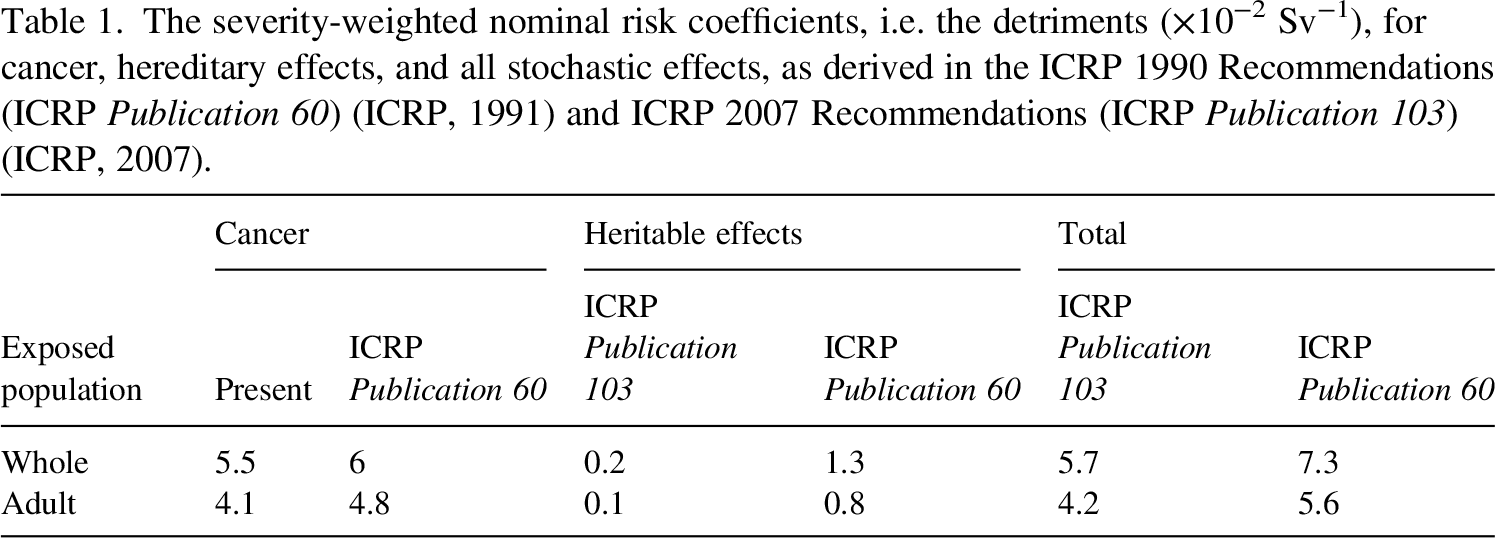
Of note is the reduction in the severity-weighted nominal risk coefficient (i.e. the detriment) for hereditary effects between the 1990 Recommendations of ICRP, as set out in ICRP Publication 60 (ICRP, 1991), and that presented in ICRP Publication 103 (ICRP, 2007). This is shown in Table 1.
The severity-weighted nominal risk coefficients, i.e. the detriments (×10−2 Sv−1), for cancer, hereditary effects, and all stochastic effects, as derived in the ICRP 1990 Recommendations (ICRP Publication 60) (ICRP, 1991) and ICRP 2007 Recommendations (ICRP Publication 103) (ICRP, 2007).
The severity-weighted nominal risk coefficients, i.e. the detriments (×10−2 Sv−1), for cancer, hereditary effects, and all stochastic effects, as derived in the ICRP 1990 Recommendations (ICRP Publication 60) (ICRP, 1991) and ICRP 2007 Recommendations (ICRP Publication 103) (ICRP, 2007).
It is shown in Table 1 that there was a substantial reduction (81%) in the detriment for hereditary effects between the 1990 and 2007 Recommendations, from 133 × 10−4 to 25.4 × 10⁻⁴ Sv−1, and that the contribution of hereditary effects to overall detriment of stochastic effects has reduced from 18% in ICRP Publication 60 (ICRP, 1991) to 4.4% in ICRP Publication 103 (ICRP, 2007). A useful review of the evolution of the risk estimates for hereditary effects has recently been published by Amrenova et al. (2024).
Reliable estimates of radiation-related hereditary risks are not available from epidemiological studies of humans, including studies of the offspring of the Japanese atomic bomb survivors, so hereditary risk estimates have to be derived from large experimental studies of irradiated laboratory animals and an incomplete knowledge of human genetics.
Task Group 121 will be examining the derivation of hereditary risk estimates in ICRP Publication 103 and whether the evidence that has been gathered since the 2007 Recommendations will have changed the risk estimates for hereditary disease and, if so, by how much. In this respect, reviews such as that of Nakamura et al. (2023) and Amrenova et al. (2024) and the studies of the increasing numbers of offspring of young cancer survivors treated with radiotherapy (see the review of Boice, 2020) will be of importance. The US National Council on Radiation Protection and Measurements (NCRP, 2013) has conducted a valuable review of the evidence for hereditary effects that will be of substantial use to the work of Task Group 121.
Exposure of the developing organism in utero leads to an increased risk of:
Teratogenic (developmental) effects (e.g. congenital malformations and mental retardation) Carcinogenic effects (cancer in childhood and later life) Hereditary effects (due to exposure of the gonads of the embryo/fetus)
The effects of intrauterine exposure to radiation were examined in ICRP Publication 90 (ICRP, 2003), which provided the basis of the framework of protection in respect of exposure in utero in the ICRP 2007 Recommendations (ICRP, 2007).
In considering the effects of radiation exposure in utero, in ICRP Publication 103, ICRP (2007) concluded the following about the risks of tissue injury and malformation at acute doses less than around 100 mGy of low-LET radiation:
The early stages of pregnancy are the most sensitive time for pregnancy loss, but the lethal effect of exposure will be very infrequent. The greatest risk of malformations occurs during the period of organogenesis, but at low doses malformations are not expected. The most sensitive period for severe mental retardation is 8–15 weeks postconception (followed by 16–25 weeks postconception), but at low doses there is no risk. The associated effect of IQ reduction is more difficult to interpret in terms of low-level exposures, but any effect at low doses ‘would be of no practical significance’.
ICRP (2007) noted that there are difficulties in interpreting the evidence for the risk of cancer following radiation exposure in utero but concluded that it is prudent to assume that the lifetime risk of cancer will be similar to that following exposure in early childhood.
Task Group 121 will be examining the evidence that has become available since the 2007 Recommendations, such as the risk of cancer in childhood (e.g. Wakeford and Bithell, 2021) and adulthood (e.g. Sugiyama et al., 2021) following radiation exposure in utero. Again, the review of NCRP (2013) will provide valuable material.
NON-HUMAN BIOTA
In the current system of radiological protection, hereditary effects arising from the irradiation of non-human biota are not considered. Task Group 121 will look to fill this gap by reviewing the evidence for transgenerational effects in non-human species. Such effects at the population level will be assessed, and the implications for the system of radiological protection will be reviewed.
CONCLUDING REMARKS
ICRP Task Group 121 has a remit that covers the wide fields of hereditary effects following preconceptional irradiation of parental gonads, and of teratogenic, carcinogenic, and hereditary effects following irradiation of the developing organism in utero. In addition to humans, non-human species will be considered with respect to transgenerational effects. The impact of the review of presently available evidence on the current system of radiological protection will be assessed by Task Group 121.