




Abstract
Australia’s regulatory framework has evolved over the past decade from the assumption that protection of humans implies protection of the environment to the situation now where radiological impacts on non-human species (wildlife) are considered in their own right. In an Australian context, there was a recognised need for specific national guidance on protection of non-human species, for which the uranium mining industry provides the major backdrop. National guidance supported by publications of the Australian Radiation Protection and Nuclear Safety Agency (Radiation Protection Series) provides clear and consistent advice to operators and regulators on protection of non-human species, including advice on specific assessment methods and models, and how these might be applied in an Australian context. These approaches and the supporting assessment tools provide a mechanism for industry to assess and demonstrate compliance with the environmental protection objectives of relevant legislation, and to meet stakeholder expectations that radiological protection of the environment is taken into consideration in accordance with international best practice. Experiences from the past 5–10 years, and examples of where the approach to radiation protection of the environment has been well integrated or presented some challenges will be discussed. Future challenges in addressing protection of the environment in existing exposure situations will also be discussed.
1. Introduction
Until the International Commission on Radiological Protection (ICRP) published Publication 103 (ICRP, 2007), the recommended radiological protection framework was designed for protecting humans from exposures to ionising radiation. In accordance with international best practice, this was the approach implemented in Australia through a complex regulatory framework for radiation protection. In this paper, an overview of the Australian framework for radiation protection will be described, and factors that have driven the proactive approach to implementation of a framework for protection of the environment will be discussed. A number of case studies will be described, as well as future challenges that remain before radiological impacts on non-human species (wildlife) are considered in their own right across all exposure situations.
2. The case for a proactive approach to protection of the environment
2.1. The Australian framework for radiation protection
The radiation protection framework in Australia is complex and provides a range of challenges. Australia is a federation comprising six states and two self-governing territories, and the Federal (or Commonwealth) Government. For radiation protection alone, this results in nine sets of laws and regulators that reside within both the Health and Environment Protection Ministries. The Australian Radiation Protection and Nuclear Safety Agency (ARPANSA) is the Commonwealth Government regulator established under the Australian Radiation Protection Act 1998 (the ARPANS Act). ARPANSA’s primary function is to protect the health and safety of humans and to protect the environment from the harmful effects of radiation. ARPANSA regulates commonwealth entities, their facilities, and their use of radiation sources, and is the only regulator of nuclear installations in Australia. ARPANSA also has responsibility under the ARPANS Act to promote national uniformity in radiation protection across all the jurisdictions, and to advise the Australian Government on the safety of radiation facilities and nuclear installations, source and radioactive material security, radiation protection, and emergency preparedness and response. While ARPANSA does not directly regulate activities such as uranium mining (which is regulated under state or territory law), it does provide advice to other departments, such as the Commonwealth Department of Environment, on radiation aspects of environmental impact assessments for uranium mine developments, and engages in a range of international programmes and activities. ARPANSA develop (in cooperation with all jurisdictions) and publish the Radiation Protection Series which underpins the regulatory framework in Australia.
2.2. Existing legislation
In the late 1990s, ICRP expressed that a framework was required so that protection of the environment could be demonstrated explicitly. The period that followed in the early 2000s saw much development of this framework through publication of Publication 91 (ICRP, 2003), a number of European projects, the establishment of ICRP Committee 5, and the publication of Publication 103 (ICRP, 2007), which included – for the first time – protection of the environment as an issue to be addressed explicitly.
The timing of this coincided with the introduction of new legislation in Australia. The ARPANS Act and the Australian Radiation Protection and Nuclear Safety Regulations 1999 (the ARPANS Regulations) were enacted, and soon thereafter, the Australian Government also introduced the Environment Protection and Biodiversity Conservation Act 1999 (the EPBC Act) and corresponding regulations (the EPBC Regulations), which commenced on 16 July 2000. Whilst this may have been coincidental, in the Australian context, both of these pieces of legislation led to a recognised need for specific national guidance on protection of non-human species, for which the uranium mining industry provided a major backdrop. In Australia, the implementation of the EPBC Act was just prior to the ‘mining boom’, during which period there was significant exploration of uranium deposits and planned expansion of current uranium mining operations. The EPBC Act focuses the interests of the Australian Government on the protection of matters of national environmental significance, with the states and territories having responsibility for matters of state and local significance. The objectives of the EPBC Act include: provision for the protection of the environment, especially in matters of national environmental significance; conservation of Australian biodiversity; and enhancing the protection and management of important natural and cultural places. These objectives are well aligned with ICRP’s stated aim of ‘… preventing or reducing the frequency of deleterious radiation effects to a level where they would have a negligible impact on the maintenance of biological diversity, the conservation of species, or the health and status of natural habitats, communities and ecosystems’ (ICRP, 2007). Under the EPBC Act, there are nine matters of national environmental significance, of which world heritage properties, nationally threatened species and ecological communities, and nuclear actions (including uranium mining) are listed specifically.
In effect, it was application of the EPBC Act, in conjunction with commonwealth and state or territory radiation protection laws governing uranium mining, that influenced and required Australia to proactively support and adopt these new approaches in order to address political and societal demands for better scientific understanding of possible radiological harm to non-human species and their related ecosystems. Today, the Australian Government promotes a ‘one-stop shop’ for environmental approvals that accredit state planning systems under national environmental law, to create a single environmental assessment and approval process for nationally protected matters.
2.3. Early adoption by industry
Mining in Australia is a significant primary industry and contributor to the Australian economy. In the early 2000s, Australia was experiencing a period of one of the biggest mining booms in its history. This saw significant development in the uranium mining industry; as a consequence, assessments of environmental impact were required under the EPBC Act. The Olympic Dam Expansion Draft Environmental Impact Statement (EIS) (Arup, et al., 2009) was released for public comment in 2009, and – for the first time in Australia – saw the application of the framework for protection of the environment prior to formal adoption of Publication 103 (ICRP, 2007) in Australia. The EIS states: Recently there has been increasing awareness of the vulnerability of the environment and of the need to be able to demonstrate that it is protected against the effects of industrial pollutants, including radionuclides. The
ICRP, in its 2007
Recommendations (
ICRP, 2007
) has given more emphases to the protection of the environment. More detailed advice is given in ICRP Publication 91, ‘A framework for assessing the impact of ionising radiation on non-human species (
ICRP, 2003
) which reviews the various methods that have been developed for the assessment of radiological impacts with the objective of identifying and suggesting the best framework. It recommends making an initial assessment using primary (generic) reference organisms for flora and fauna to give an order of magnitude assessment of the probability and severity of likely effects of radiation exposure on the population …This approach has been adopted by the European Union as part of its ERICA project … (Arup, et al., 2009).
The 2009 Olympic Dam Expansion Draft EIS records the first application of the principles of the ICRP approach in a regulatory assessment process in Australia for the protection of non-human species and their related ecosystems. The Draft EIS describes the methodology and use of the ERICA tool (Brown et al., 2008) to assess the potential radiological risk to the terrestrial environment surrounding the Olympic Dam expansion area. While radiation protection regulators indicated in 2008 that the principles of Publication 103 (ICRP, 2007) would be adopted into the Australian framework, it became clear that specific guidance on how to demonstrate protection of the environment was required to support industry activities.
3. Development of national guidance
During the period from 2009 to 2015, a number of activities were undertaken or led by ARPANSA in order to develop national guidance to provide clear and consistent advice to operators and regulators on protection of non-human species (wildlife). Advice on specific assessment methods and models and how these might be applied in an Australian context were also developed. This commenced with publication of a technical report (Doering, 2010) that reviewed the ICRP and ERICA frameworks for assessment and protection of non-human species and the applicability to the Australian context. This report concluded that Australian specific guidance on protection of non-human species was required, that the ERICA Integrated Approach (Larsson, 2008) and ERICA tool (Brown et al., 2008) provided a practical framework (aligned with the ICRP framework) that could be used for assessing absorbed dose rates to non-human species and could be adapted to Australian situations. This report also noted that research was required to collect and assemble data on flora and fauna common to major Australian environments in order to establish a set of Australian reference organisms. During the period 2011–2013, ARPANSA worked cooperatively with industry and other government departments to review existing Australian radionuclide activity concentration data in non-human biota inhabiting uranium mining environments (Hirth, 2014; Hirth et al., 2017).
At the national level, ARPANSA, through its Radiation Health Committee, was also developing new national guidance for publication in the Radiation Protection Series. In February 2014, Radiation Protection Series F-1: Fundamentals for Protection Against Ionising Radiation (ARPANSA, 2014) was published. This included, for the first time, enviromental exposure as one of the exposure categories, and defined environmental exposure as: the exposure of wildlife to all additional radiation sources resulting from human activities. Wildlife may require protection in order to maintain biological diversity, conservation of species, or the health and status of natural habitats, communities or ecosystems, or anything that may be otherwise required from a conservation point of view in accordance with relevant legislation (ARPANSA, 2014).
Following publication of the Fundamentals, ARPANSA published Radiation Protection Series G-1: Guide for Radiation Protection of the Environment in November 2015 (ARPANSA, 2015). This guide built on scientific and regulatory developments, and outlined the framework for protection of the environment from the harmful effects of ionising radiation and the practical aspects of the process through which protection could be demonstrated. National guidance supported by these ARPANSA publications in the Radiation Protection Series provides clear and consistent advice to operators and regulators on protection of non-human species, including advice on specific assessment methods and models, and how these might be applied in an Australian context. These approaches and the supporting assessment tools provide a mechanism for industry to assess and demonstrate compliance with the environmental protection objectives of relevant legislation, and to meet stakeholder expectations that radiological protection of the environment is taken into consideration in accordance with international best practice.
Recently, two more documents have been published. Radiation Protection Series C-1: Code for Radiation Protection in Planned Exposure Situations was published in December 2016 (ARPANSA, 2016), and Radiation Protection Series G-2: Guide for Radiation Protection in Existing Exposure Situations was published in September 2017 (ARPANSA, 2017). This now sees the Australian framework fundamentally underpinned by high-level guidance documents that align with the principles of Publication 103 (ICRP, 2007) and the International Atomic Energy Agency (IAEA) Basic Safety Standards (IAEA, 2014), and has fully integrated protection of the environment (Fig. 1). While significant progress has been made in Australia, a large body of work remains to update other guidance documents and to support implementation of these new standards.
The system of radiological protection described in the Australian Radiation Protection and Nuclear Safety Agency Radiation Protection Series, illustrating the inter-relationships between principles of protection, exposure situations, categories of exposure, dose criteria, and application of the system. Reproduced from Radiation Protection Series G-2: Guide for Radiation Protection in Existing Exposure Situations (ARPANSA, 2017).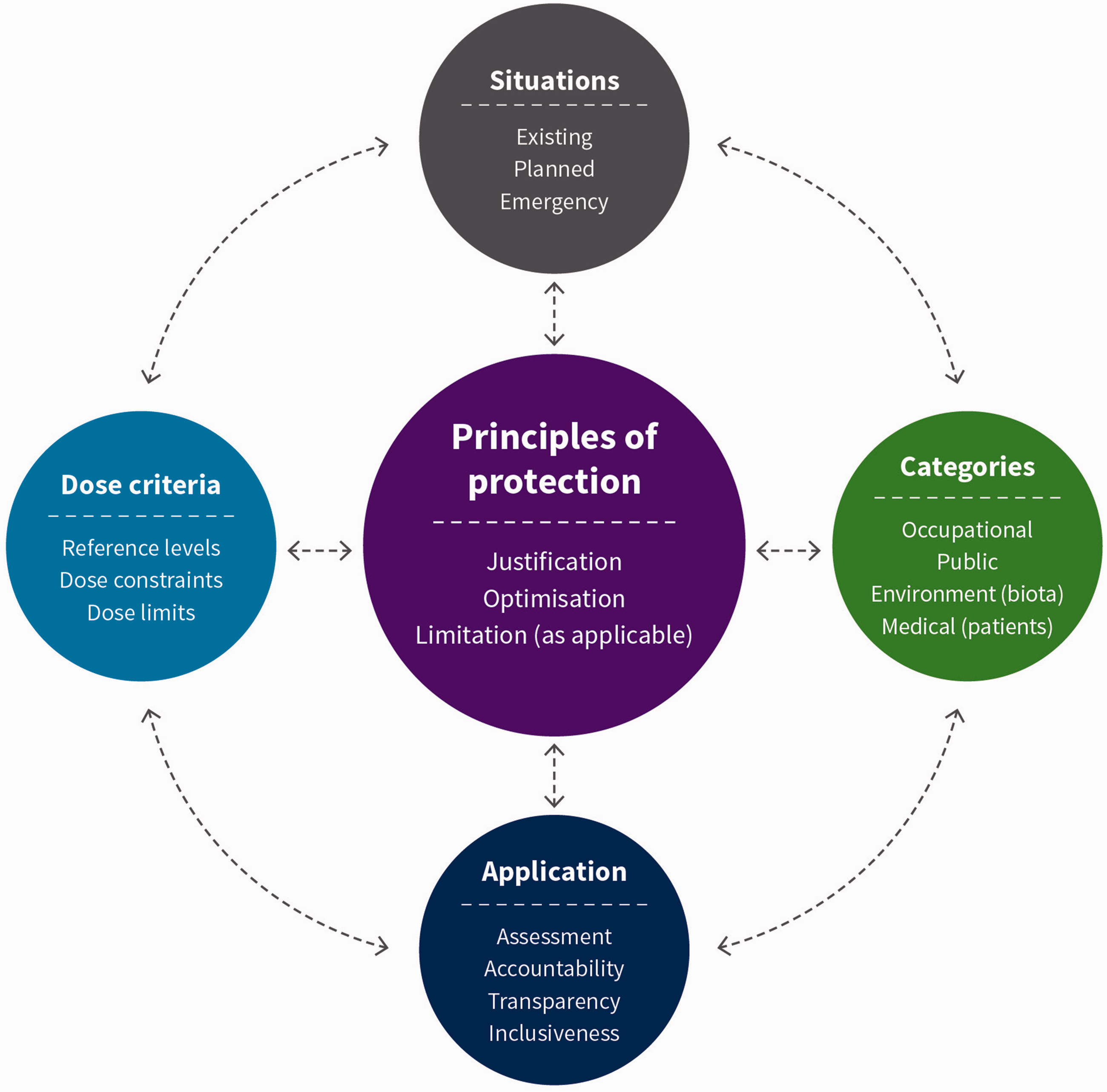
4. Protection of the environment – how integrated is it with protection of humans?
On reviewing the first application of the ERICA tool in the 2009 Draft EIS for the Olympic Dam expansion (Arup, et al, 2009), it could be suggested that the assessment of the environment is well integrated with the protection of humans. Subsequent assessments demonstrate a similar link. The nature of uranium mining activities in Australia is that these developments are mostly conducted in isolated and largely unpopulated regions. The primary impacts from such developments are expected to be on the environment and on occupationally exposed workers. However, in these remote regions, indigenous communities may gather or hunt in a traditional manner, which makes the exposure of wildlife and the associated exposure pathway to humans important considerations in the impact assessments. While impacts on the public in remote areas such as these may seem less obvious due to the absence of large towns or urban environments, the public can become a more prominent exposure group if developments occur closer to more urbanised areas.
The following four case studies demonstrate the different integrated approaches that have been considered in both remote and urban areas of Australia. Fig. 2 provides a map of the different case study locations.
Map of Australia showing case study locations.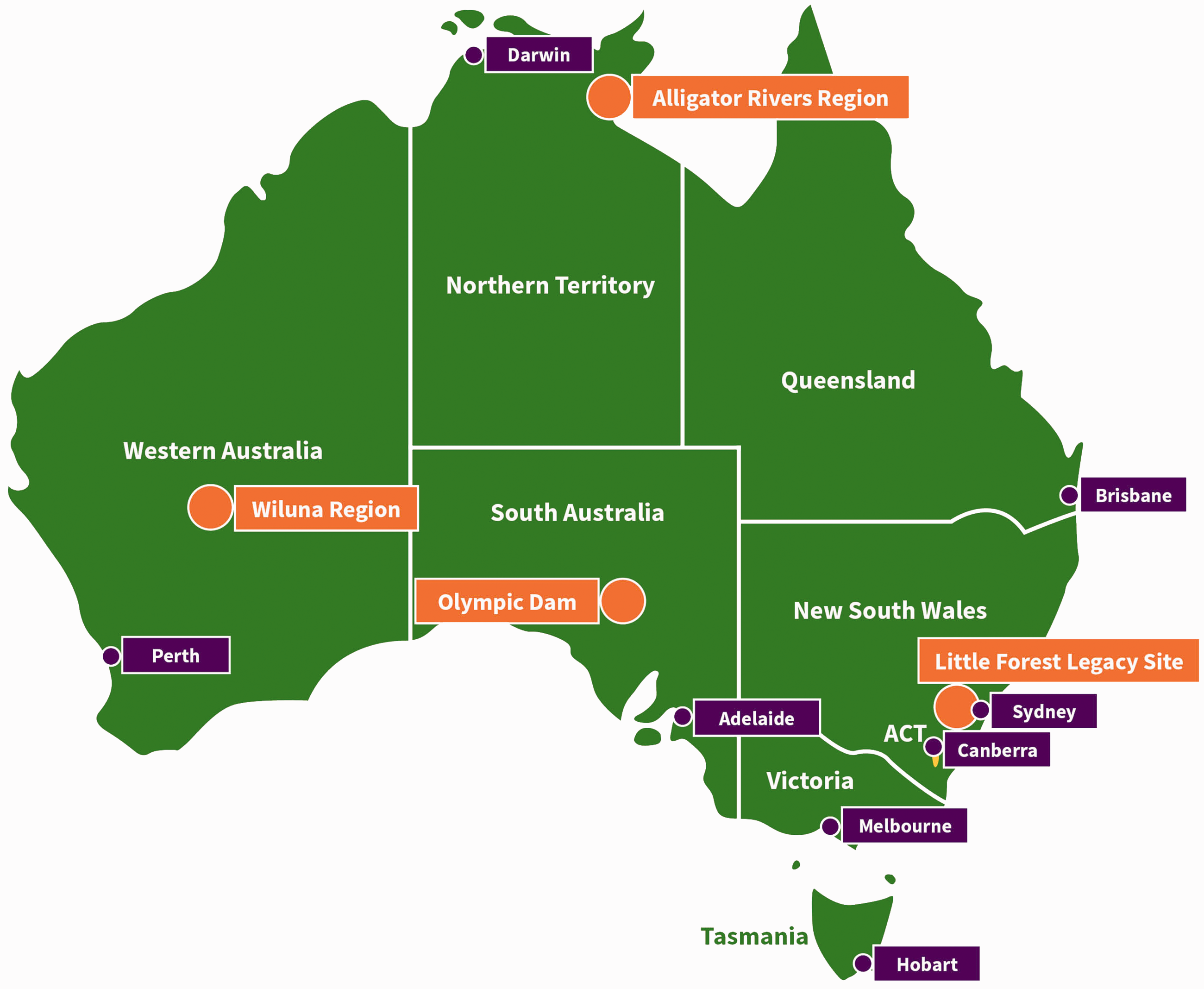
4.1. Case Study 1: Alligator Rivers Region
The Alligator Rivers Region (ARR) in Northern Australia is an area of past and present uranium mining activity. It is one of the most diverse biological regions in Australia, with a wet–dry tropical climate, and around two-thirds of the area is world heritage listed as Kakadu National Park. The Ranger uranium mine, which commenced operation in 1980, is located in the ARR. The ARR is an area where local Aboriginal people hunt and gather wild plants and animals (‘bush foods’) from the environment.
In 1978, after an Australian Government inquiry (Fox et al., 1977) into the environmental concerns surrounding uranium mining in the ARR, the Environmental Research Institute of the Supervising Scientist (ERISS) of Supervising Scientist Division of the Commonwealth Department of Environment and Energy was established. Since establishment, ERISS has been undertaking research and monitoring to independently assess the environmental impacts of uranium mining in the region. ERISS has established a database for the storage and handling of data on natural series radionuclide and metal concentrations in Northern Australian bush foods and environmental media from the ARR (Doering and Bollhöfer, 2016a). Colloquially referred to as the ‘BRUCE database’ (Bioaccumulation of Radioactive Uranium-series Constituents from the Environment database), it contains 5060 sample records for individual biota (plants and animals) and environmental media (water, soil, and sediment) samples, and 57,473 concentration values (Doering and Bollhöfer, 2016a), representing measurements by ERISS since the late 1970s.
Query functions within the BRUCE database enable the estimation of concentration ratios for radionuclide transfer to Northern Australian bush foods, and the calculation of ingestion doses to members of the public using information on local diet and intake dose coefficients recommended by ICRP. Although not specifically designed for non-human species, the scope of the BRUCE database now includes biota tissue samples of wildlife not usually eaten as bush foods, but which could be of potential importance to estimate exposures to wildlife. The BRUCE database can also be used to determine organism-to-media concentration ratios for some organism types for use in non-human biota dose assessment tools, such as ERICA and RESRAD-BIOTA.
The BRUCE database supports many projects as the planning for the closure and rehabilitation of the Ranger uranium mine approaches. This has included the prediction of postrehabilitation radiation exposure due to the consumption of terrestrial Aboriginal bush foods (Doering et al., 2017), and the development of environmental media concentration limits for terrestrial wildlife (Doering et al., 2016b). Bollhöfer et al. (2016) reviewed the trigger values for 226Ra in water. This included, for the first time, assessment of the radiological potential impacts on the environment in addition to the impacts on human health using data extracted from the BRUCE database.
4.2. Case Study 2: Wiluna Uranium Project
The Wiluna Uranium Project covers the proposed mining of the Centipede and Lake Way uranium deposits located approximately 30 km from Wiluna, in the mid-West region of Western Australia. Wiluna is in an arid environment.
In 2011, Toro Energy Ltd conducted a technical review of radiological parameters associated with its proposed Wiluna Uranium Project (Toro Energy Ltd, 2011). This assessment was based on the ICRP principles of radiation protection, and an integrated approach that considered both humans and wildlife was applied. A detailed assessment of the natural background of the region concluded that radionuclide concentrations in flora, fauna, dust, water, and soil were consistent with concentrations observed across Australia. Predictive modelling demonstrated that dust generated during mining would be a common major exposure pathway to both humans and wildlife.
An ERICA assessment to assess radiological impacts on non-human species at the Lake Way and Centipede deposits was undertaken. Airborne impacts were mapped for the region in the form of dust deposit contours from air quality modelling. The ERICA tool was used to determine whether there was any risk to any standard ecological communities in the mining region. Following this, a search to determine if those ecological communities existed within that deposition profile was undertaken. The assessment found the risk of radiological harm was negligible for all reference organisms, with the exception of lichen and bryophytes. Based on further investigation of the literature, Toro Energy Ltd concluded that there would be no effects expected at any dust fallout level on lichen and bryophytes due to their tolerance for high levels of radiation.
Further extension of an integrated approach was demonstrated by considering indirect and direct exposure of humans from lichens and bryophytes due to their ability to concentrate radionuclides. Toro Energy Ltd considered this because it is well understood that, in the northern hemisphere, reindeer can have elevated levels of 137Cs due to the consumption of contaminated lichen. It was concluded that no lichens were known to be consumed as bush food in the Wiluna region. This is another example where both human and wildlife pathways can be considered together to provide a better understanding of environmental exposures.
4.3. Case Study 3: Yeelirrie Uranium Project
The Yeelirrie Uranium Project covers the proposed mining of a uranium deposit located approximately 70 km from Wiluna, in the mid-West region of Western Australia.
In 2015, the Public Environmental Review for the Yeelirrie Uranium Project was released and included a radiation technical report detailing the assessment of the radiation-related risks to human health and non-human biota (Cameco Australia Ptd Ltd, 2015). This report provides the data, methods, and assumptions used to estimate human health and non-human impacts. A similar approach to the Wiluna Project assessment for non-human species was applied, with deposition of radioactive dusts considered as the major off-site pathway.
The ERICA tool was utilised to undertake an assessment of 13 different organisms identified as potentially at risk. At the time of the assessment, five vegetation communities, all occurring on the central calcrete system of the study area, were considered to be significant. The assessment identified lichen and bryophytes as a species that would exceed the screening level. An impact assessment on fauna from radon and its decay products was conducted using the tool of Vives i Batlle et al. (2012). Levels were very low, so further assessment was not deemed to be necessary.
In 2017, the Western Australian Government approved the Yeelirrie Uranium Project despite environmental concerns over the potential impact of the operation on tiny stygofauna and troglofauna in the groundwater. The species is currently only found within the project area, and is at risk from the physical practice of mining and not from the increased radiological exposure associated with mining. Nonetheless, in the comprehensive nature of the 2015 ERICA assessment, micro fauna were not considered. Cameco are now required to undertake further research into the stygofauna and minimise the impact on the species.
4.4. Case Study 4: Little Forest Legacy Site
The Little Forest Legacy Site (LFLS) is a secure, shallow land burial site used by the former Australian Atomic Energy Commission for the disposal of some wastes (both radioactive and non-radioactive) up until 1968. It is located about 40 km southwest of central Sydney, surrounded by industrial and greenspace areas with encroaching urban development.
The facility was licensed as a ‘prescribed legacy site’ under the ARPANS Act in July 2016, becoming the first site licensed under this new classification, and is an example of an existing exposure situation under regulatory control. The LFLS was presented as a case study at the ICRP symposium in 2015 (Copplestone et al., 2016). As noted by Copplestone et al., assessments of the potential impacts on humans and wildlife applied the ICRP recommendations and the International Basic Safety Standards requirements for existing exposure situations. These assessments found that exposure of humans was well below the 1 mSv dose limit for members of the public, and for the bulk of wildlife species assessed, the dose rates predicted were below the relevant DCRL (there were two species that were around the relevant DCRL). In the case study, Copplestone et al. concluded:
that it is not possible from the assessments conducted to explore direct comparisons between people and wildlife exposures, partly because few humans use this area and those who do are working there. This results in an existing exposure situation where the exposure to wildlife, whilst currently not a concern from a viewpoint of environmental protection, may be a relevant component of strategies for long-term management.
Under the regulatory control of ARPANSA, the operator of LFLS has been requested to develop a plan for the medium- and long-term management of LFLS by mid-2018 and provide this to the Chief Executive Officer of ARPANSA for review. This plan will need to examine the options related to the future safe management of the facility and the waste inventory contained therein, and will require an environmental management plan as a component of this plan. This plan will need to be developed applying a graded approach which is commensurate with the radiation risks, and takes into account a range of other hazardous materials that are also known to be present.
5. Future challenges
In Australia, the past decade has seen significant advancement in demonstrating radiation protection of non-human species for planned and existing exposure situations. However, challenges remain. The focus of environmental radiation protection has largely been on the impact from the mining and milling of uranium. The success with this industry has also highlighted the need to begin considering other practices that release radioactive material into the environment.
In the gas and petroleum industry, where environmental legislation is the driver for risk assessment, there is a disconnect between making the environmental decision and looking at the impacts on human health in an integrated manner. Decommissioning activities for offshore petroleum projects in Australia have been increasing, with operations expected to expand significantly in the next decade. The issue of removing or leaving seabed pipelines contaminated with radioactive scales remains a challenge for the industry and regulator to justify. Leaving contaminated pipelines in situ may have a radiological impact on wildlife, while removing the contaminated pipeline creates a human exposure pathway and land disposal challenge.
Australia also has legacy sites that may need reconsideration. The former British nuclear weapons test sites in Australia were originally assessed based on characterising the radiation risk to humans. For the Maralinga test site, a reference level of 5 mSv was established as the primary clean-up criterion, and was based on the conservative assumption of continuous habitation of humans engaged in a traditional aboriginal lifestyle (MARTAC, 2003). In 2011, an ARPANSA re-assessment for the Maralinga site showed that this approach was justified (O’Brien et al., 2011). Neither the original clean-up criteria nor the 2011 re-assessment considered the potential impact on wildlife at Maralinga. The impact of plutonium on wildlife in the residual contamination remaining at Maralinga is currently being studied (Johansen et al., 2014, 2016). However, an environmental dose assessment has yet to be performed. The Montebello Islands were also assessed for human exposure alone, with the exposure criteria related to transient island visitors (Cooper et al., 1990). Recent investigations have commenced on wildlife impacts at the Montebello Islands (Johansen et al., 2017) to gain a better understanding of the behaviour and impact of plutonium on wildlife in this marine atoll environment.
6. Conclusions
Building a cooperative relationship between industry and regulatory authorities has allowed the development of national guidance, implementation of practice, shared training programmes, and acceptance of approach. This engagement has been critical to the successful achievements in Australia as reflected in the case studies, and has allowed common goals to be established. Ten years ago, barriers were related to some regulatory and industry stakeholders not wanting to move away from the assumption that if you protect humans, you protect the environment. Today, Australia can now be considered a global leader in the assessment of radiological impacts on non-human species.
Notwithstanding the challenges associated with taking an integrated approach to protection of humans and the environment from ionising radiation, the case studies presented above and other experience demonstrate that it is indeed possible. An integrated approach (rather than two separate approaches) facilitates communication with stakeholders who can engage in discussions about contentious facilities and activities based on an understanding of implications for both human and environmental health. The recent decision by ICRP to integrate the work on environmental protection with the work on human radiological protection, rather than dealing with ‘the environment’ in a separate committee, will promote holistic safety and environmental impact assessments. Any future revision of the current ICRP Recommendations (ICRP, 2007) should carefully consider an ‘integrated’ or ‘holistic’ perspective on radiological protection.